CONTENTS
11
12
11 Why are good-quality mangoes still available so late in the season? 13 Geography as Destiny: From Empire’s Port to Underleveraged Asset 16 The case against new provinces
20
20 International Steels’ profit more than doubles on a volume rebound 23 Cherat Cement’s profits fall despite Pakistan’s cement recovery 26 The State must deliver Muhammad Azfar Ahsan 30 Is Peshawar a part of Pakistan-proper? Imran Khan
11
34
32
32 The Final Eight Percent: Pakistan’s Bet on Digital Finance Vugar Usi Zade 34 China has tripled cotton purchases from India. Where does Pakistan fit in? 37 Pakistan is borrowing tomorrow’s dollars today. How does that work?
Profit Publishing Editor: Babar Nizami - Senior Editor: Abdullah Niazi Business Reporters: Taimoor Hassan | Usama Liaqat | Zain Naeem | Shahnawaz Ali | Ghulam Abbass Ahmad Ahmadani | Aziz Buneri - Sub-Editors: Saddam Hussain | Abdul Hameed - Video Producer: Adnan Maqsood Director Marketing: Muddasir Alam - Regional Heads of Marketing: Agha Anwer (Khi) Kamal Rizvi (Lhe) | Malik Israr (Isb) GM Special Projects Zulfiqar Butt - Manager Subscriptions: Irfan Farooq Pakistan’s #1 business magazine - your go-to source for business, economic and financial news. Contact us: profit@pakistantoday.com.pk
Why are good-quality mangoes still available so late in the season? 10
Pakistan’s mango crop has battled disease, hostile weather and disrupted export routes. Yet, as August draws to a close, good Chaunsa remains plentiful and reasonably priced in local markets. The explanation lies in a strange combination of closed borders and weather patterns
I
t is the 21st of August and the mangoes are still here. Not merely the soft, blotched fruit that usually marks the exhausted end of the season, either. Fruit shops and roadside stalls continue to carry Mausami Chaunsa that is firm, fragrant and surprisingly good. Recent indicative retail and mandi listings put ordinary Chaunsa at around Rs220 per kilogramme in Multan, Rs270 in Lahore, Rs285 in Karachi and Rs295 in Islamabad. Even allowing for daily differences in grade and location, these are hardly the prices one would expect during a severe shortage. Pakistan’s mango season does stretch into August, but its quality normally follows a familiar downward slope. Safaid Chaunsa disappears early. Kala Chaunsa begins appearing around mid-July and, once the monsoon settles over the mango belt, securing clean, firm fruit becomes progressively harder. This year, the decline has been slower. The selection is narrowing and the season is petering out, but consumers can still find fruit that tastes as though it belongs several weeks earlier in the calendar. In 2026, this is a genuine puzzle. Reports from the orchards described malformed flowers in Sindh, damaged roots and erratic temperatures in Punjab, stubborn pests, fruit drop, lower yields and export routes disrupted by war and border closures. Exporters cut their target from 100,000 tonnes to 80,000 tonnes, while expected earnings fell from last season’s $110 million to a projected $80 million. So why, after all that, are Pakistan’s markets Batoor, a malformation disease that hits mango trees, still full of affordable mangoes? became a serious problem for mango farmers in Sindh The condition of the crop and the amount of early in the season this year. fruit visible in local markets are not the same thing. A smaller harvest can produce a domestic glut if of shocks. February was unusually warm, while rainfall was exports collapse. Better practices can preserve more of what almost 89% below normal. The warmth encouraged heavy survives, newer varieties can alter the harvesting calendar, early flowering and raised hopes of an exceptional crop. and later rain can keep fruit marketable for longer. Then March temperatures climbed sharply during flowering, reducing pollen viability, disturbing pollinators and causing young fruit to drop. An abrupt mid-month cooling produced uneven flowering, delayed maturity and condihe trouble began long before the first mango tions favourable to fungal problems and mango hoppers. reached the city. In lower Sindh, growers reported Rain, hail and windstorms later scarred fruit and a serious outbreak of mango malformation, known knocked it from trees. Even mangoes that remained edible locally as batoor. The fungal disease produces could lose the clean skin and uniform appearance required dense, distorted clusters that consume the tree’s nutrients, by higher-paying export markets. This left growers with less deprive neighbouring flowers and young fruit, shelter fruit overall and a larger proportion of lower-grade produce. insects and weaken the next fruit-bearing cycle. Control The orchards were also carrying damage from the depends on cutting and removing affected clusters early, 2025 floods. More than 41,000 acres in Multan, Shujabad alongside careful irrigation and preventive treatment. Miss and Jalalpur were reported to have remained underwater, that window and two harvests can suffer. Punjab’s orchards faced a different but overlapping set damaging roots and weakening trees. Some growers sprayed
The season from hell
T
AGRICULTURE
repeatedly this season without controlling infestations. Industry estimates placed this year’s crop roughly 20% below Pakistan’s average annual production of 1.9 million tonnes, with much heavier losses in some areas. More sprays and disease management were required to protect a smaller quantity of saleable fruit. Then came the export shock. Afghanistan is a crucial buyer because it accepts fruit with fewer sanitary and phytosanitary requirements than many wealthier markets and provides an inexpensive route towards Central Asia. Last year, it bought about 22,500 tonnes, just over one-fifth of Pakistan’s mango exports. In 2024, the figure was 28,700 tonnes. This season, exports to Afghanistan fell to zero as the border remained closed. Conflict involving Iran disrupted another important market and destabilised shipping towards the Gulf. Vessel shortages and higher freight rates also hit shipments to the United Arab Emirates, normally Pakistan’s largest mango destination. By 6 July, total exports stood at 42,343 tonnes, compared with 55,684 tonnes at the same point last year — a fall of nearly one-quarter. Growers had less fruit, but much of it could not reach its intended buyer. A greater share was B- or C-grade and domestic purchasing power was weak. In some producing areas, prices fell below what farmers needed to cover cultivation, harvesting, packing and transport. The crop was damaged. The export market was damaged. But the surviving mangoes still had to go somewhere.
Closed borders and a glut in the city
T
he first explanation for the late abundance is also the simplest: mangoes that would normally have left Pakistan remained inside it. “A couple of reasons. Not as much rain during the harvest, so fruit stays fresh longer, but the major factor is reduced exports. With the Afghanistan and Iran borders largely closed, and exports to the UAE also affected by the war, there is considerably more fruit in the domestic market,” one large mango grower based in Punjab said. Lower exports redirect supply. Fruit grown for Kabul, Tehran, Dubai or onward regional trade is pushed into Pakistani wholesale markets. Even with a smaller national crop, the domestic market can receive more than usual. Weather may also have preserved the fruit that survived. Rain during harvesting makes mangoes harder to handle and more susceptible to damage. Less rain at the critical moment can keep them firm and fresh for longer. A second large Punjab grower points to something more structural: the mangoes them-
12
Farmers sort mangoes near Multan. selves are changing. “There are some newer varieties of Chaunsa that have replaced Kala Chaunsa. They’re smaller than Safaid Chaunsa, which runs out by the end of June, but still firm and fragrant. Passable as Safaid even. I’ve heard the saplings were smuggled from India in the early 2010s,” he said. The account of how the saplings entered Pakistan could not be independently verified. The more important observation is that consumers may be buying late-season Chaunsa that does not fit the old Safaid-Kala distinction. Newer cultivars can be smaller than Safaid but retain its firmness and aroma. The old seasonal calendar, in other words, may no longer describe everything being grown. The same farmer has seen changes in Anwar Ratol cultivation. “There have been some pretty cool changes in how they’re farmed. No more godi, smaller water nozzles near the tree base rather than flooding entire fields, and cultivating shorter but stouter trees for bigger crops. On top of that, transport and packaging have improved, so there is much less wastage.” Some estimates put Pakistan’s post-harvest mango losses as high as 30%. Better irrigation protects roots from overwatering, shorter trees are easier to manage and improved boxes, handling and transport allow more fruit to arrive intact. This does not eliminate climatic stress, but it increases the share of a damaged crop that can still be sold. A smaller harvest with lower wastage may supply markets better than a larger harvest handled badly. Rainfall timing may also be shifting the season. “The best mangoes, especially Chaunsa, ripen after the first rains in May. But when
the monsoon hits around early July, the rest of the crop is tougher to secure. A lot of wastage happens then, which is why mango quality declines. Otherwise, the fruits are ripening all the way up to August. Since at least 2020, the rains have been appearing later and later, so the best mangoes actually arrive a little later than we’re used to,” the second grower said. His comments are based on personal experience in Punjab and do not describe Sindh. But mangoes have always continued ripening into August; an early monsoon usually reduces how much of that crop reaches consumers in good condition. If disruptive rain arrives later, the commercial window shifts with it. Taken together, the explanation is less mysterious than it appears. Pakistan grew fewer mangoes than it should have, but export disruptions trapped more of the surviving crop at home. A relatively dry harvesting window helped fruit last longer. Improved cultivation and packaging reduced losses. Newer varieties blurred the traditional end of the Chaunsa season. The result is an August that is generous to buyers but far less kind to growers. Full fruit stalls do not disprove reports of a troubled crop. The season has lingered because supply chains failed abroad even as they improved at home. For consumers, that means a few unexpected final weeks of good Chaunsa at manageable prices. For growers, it means that the appearance of abundance may conceal lower yields, lost export earnings and weak margins. For now, Pakistan’s mango season has extended a little longer than it usually does. But it is not an extension mango farmers will take too much heart from. n
AGRICULTURE
Geography as Destiny: From Empire’s Port to Underleveraged Asset
S
By Saad Zuberi
ir Walter Raleigh’s oft-cited axiom, “Whosoever commands the sea commands the trade; whosoever commands the trade of the world commands the riches of the world, and consequently the world itself” remains a powerful reminder of the enduring logics of maritime power and global influence some four centuries after it was first articulated. It resonates particularly stronger for states whose geopolitical fortunes are bound to maritime corridors in a world where around 80 percent of international trade still moves by sea (UNCTAD, 2023). Few nations exemplify this more poignantly than Pakistan – a country perched at the confluence of South, Central, and West Asia, commanding access to the Arabian Sea and proximate to the Strait of Hormuz, one of the world’s most vital energy chokepoints. Karachi was once central to British imperial logistics as a strategic hinge between continental trade routes and Indian Ocean lanes, serving as a maritime gateway linking South Asia to the Persian Gulf, the Arabian Peninsula, and East Africa (Buchanan 1920). Though decades of political instability, infrastructural decay, and regional insecurity have dulled its luster, Pakistan’s geography remains an underleveraged strategic asset. As the world’s geoeconomic axis shifts toward the Indo-Pacific, Pakistan’s maritime geography and emerging port infrastructure – particularly Gwadar –reclaim renewed relevance within the evolving logic of 21st-century connectivity and competition. It is within this geopolitical and geoeconomic context that Shahryar Khan Niazi’s new book, ‘Game Plan: Pakistan Economic Gateway’ situates itself. The book offers a comprehensive and ambitious vision of Pakistan as a regional fulcrum linking East and West through trade, energy, and
BOOK REVIEW
Book: Game Plan: Pakistan Economic Gateway, Markings Publishing, 2025, ISBN: 978-969-9748-27-1,
Author: Shaheryar Khan Niazi Pages: 148
logistics corridors. Niazi’s work advances a compelling argument for reimagining Pakistan’s role in the global economic order by anchoring it firmly in the intellectual lineage of classical geopolitical thought including Halford Mackinder’s Heartland Theory (1919) and Alfred Mahan’s The Influence of
Sea Power upon History (1890), as well as contemporary debates on strategic connectivity and regional integration. It makes an important contribution to the discourse on grand strategy by bridging traditional security frameworks with emerging forms of economic statecraft in the Global South.
13
Grand strategy in this context may be understood as the overarching framework through which states align their political, military, economic, and diplomatic instruments to achieve long-term national objectives by linking domestic resources to international ambitions.
Game Plan: Reimagining Pakistan’s Role in the World
N
iazi advances a daring and forward-looking vision for Pakistan that repositions the nation as a pivotal economic hub that connects four continents rather than a peripheral state struggling with crises of governance and debt. His central proposition is straightforward yet profound: Pakistan’s geography is its destiny. “The PEG is not a complete strategy but rather a vision of what Pakistan could become” (p. xvii), he writes, reminding readers of Pakistan’s geographic potential while constructing a comprehensive roadmap for its transformation. As the brains behind the Pakistan Economic Gateway, Niazi exemplifies a form of what can be described as applied geostrategy – reflecting the integration of soft power, strategic planning, and imaginative policy design as essential components of effective statecraft. He quotes George Bernard Shaw’s maxim, “Don’t wait for the right opportunity: create it,” invoking a sense of self-determined strategic agency that encapsulates the book’s proactive ethos. This orientation marks a refreshing departure from conventional development analyses that have frequently situated Pakistan within dependency frameworks. The work is grounded in geographic determinism but infused with systems thinking which encapsulates a holistic analytical framework integrating transport corridors, mineral wealth, industrial potential, and foreign policy alignment. Systems thinking as an approach that recognizes interconnections and feedback loops within complex systems. Shahryar frames Pakistan’s potential as an outcome of mutually reinforcing linkages between geography, economy, and strategy to advance an integrative framework in which transport corridors, mineral resources, industrial growth, and foreign policy alignment operate as mutually sustaining components of a larger geoeconomic ecosystem. By treating geography as the infrastructure of Pakistan’s destiny, Niazi aligns with a classical school of strategic thought
14
reminiscent of Mahan’s (1890) emphasis on maritime command and Mackinder’s ideas of continentalism (1919) – while also successfully extending these principles to the 21st century’s interconnected world of logistics, supply chains, and green technologies.
Lay of the Land: Mapping the Corridors of Power
T
he book’s thirteen chapters progress from a global geopolitical overview to a more granular regional analysis to mirror the logic of a policy white paper while also maintaining academic rigor. The first six chapters situate Pakistan within global trade and power dynamics, covering critical maritime chokepoints such as the Strait of Hormuz, Suez Canal, and Malacca Strait, and also unpacking the grand strategies of major powers including the United States, China, Russia, India, and the European Union. This contextual breadth introduces Pakistan’s challenges while situating its prospects within the global race for power across the Indo-Pacific and Eurasia. Chapter seven marks the book’s conceptual pivot, unveiling Niazi’s brainchild: the Pakistan Economic Gateway (PEG) as both a theoretical and actionable framework. The PEG is organized through Western, Eastern, Northern, and Southern corridors, each designed to integrate trade, energy, and industrial flows across the Afro-Eurasian landmass. “The PEG will increase trade, trigger economic development, create employment, and improve living standards in participating countries. Furthermore, it will contribute to food, energy, and climate security and is envisioned as a carbon-neutral or low carbon transport network that utilizes renewable and green energy in overland and hybrid corridors” (p. 39). The PEG network aims not only to facilitate global trade by creating new lines of communication but also to integrate with existing economic corridors and global supply chains to unlock Pakistan’s full potential. A key objective of PEG is to offer alternative and resilient routes for international supply chains, circumventing vital maritime chokepoints and mitigating “transportation challenges caused by natural disasters, accidents, conflicts, piracy, pandemics, and capacity issues” (p. 39). According to Niazi, the utility of the PEG spans its four defined regional corridors. In the Western Region, corridors such as the Pakistan–Iran–Turkey–Europe (PITE) Corridor and the Pakistan–Iran–Eur-
asia (PIE) Corridor provide vital alternatives to congested global transit routes. For instance, the PIE “merges the ancient Volga Trade Route with the Baloch-Persia Route and creates a game-changing shortcut to South Asia and the Indian Ocean, bypassing the often-crowded Suez Canal” (p. 46). Meanwhile, the Central Asia–Afghanistan–Pakistan (CAAP) Corridor offers a “vital lifeline for the landlocked nations of Turkmenistan, Uzbekistan, Tajikistan, Kyrgyzstan, Kazakhstan, and Afghanistan, giving them crucial access to the Indian Ocean and South Asia” (p. 51). In the Eastern Region, the Pakistan–India–Southeast Asia (PISE) Corridor offers an alternative path that “bypasses both the Strait of Malacca and the Suez Canal” (p. 54), for Eurasian integration. The Northern Region, anchored by the China–Pakistan Economic Corridor (CPEC), ensures China has a direct route to the Indian Ocean, bypassing critical chokepoints like the Strait of Malacca and the Singapore Strait. “In doing so, it brings China closer to key regions such as Africa, the Middle East, and Western India, strengthening its strategic influence in these areas” (p. 58).
Green Geoeconomics and the Architecture of Opportunity
N
iazi’s ambitious concept progresses beyond high-level corridor mapping into meticulous detail concerning the strategic infrastructure nodes required for its activation, focusing heavily on maximising Pakistan’s coastal assets. This vision marks an intentional departure from extractivist development paradigms, advancing instead an argument for value-added industrialization and Pakistan’s integration into global supply chains for electric batteries, semiconductors, and renewable technologies. He positions PEG at the frontier of global sustainability discourse by embedding climate strategy within geopolitical planning through the proposed establishment of battery and energy zones for a low-carbon future. The project envisions “a carbon-neutral or low- carbon transport network that utilizes renewable and green energy in overland and hybrid corridors” (p. 39), contributing to global food, energy, and climate security. This linkage between Pakistan’s mineral economy and the broader global energy transition situates the book within emerging scholarly conversation around green geoeconomics (Scholten, 2018). This framework is complemented with detailed case studies directly linked
to Pakistan’s mineral potential. In chapter 9, he situates the “Chagai – The Capital of Low-Carbon Battery Minerals, ” as “the ultimate treasure trove” (p. 78), that is strategically vital, arguing that the area “can potentially become the global capital for battery minerals that can fuel the LIB and renewable energy industries” (p. 78). These domestic resources, paired with renewable energy are intended to “power the mining industry and create a supply chain of low- and zero-carbon battery minerals” (p. 78). By developing the PEG’s battery and energy zones, Pakistan could supply minerals for manufacturing and, in the process, help not just itself but also “the global community move towards a low-carbon economy” (p. xvii). Niazi further provides extensive data on mineral reserves, renewable energy capacity, and logistical requirements to support these claims. Chapters 10 and 11 focus on the two critical nodes “Gabd –The Western Door,” and “Sonmiani – The Green Seaport” respectively, which exemplify the potential for synthesis of continental connectivity and sustainability. Gabd, which is posed to serve as a critical logistical hub, anchors Pakistan’s overland linkage to Eurasia, while Sonmiani is envisioned as a low-carbon seaport powered by smart technology, electrical equipment, and renewable energy sources, symbolizing the integration of energy transition into geostrategic planning. Under the project, Sonmiani would be supported by a renewable energy with “the capacity to produce 2,500 MW of electricity that will be used to power the seaport and the desalination plant, as well as industrial, residential, and commercial areas” (p. 83), and complemented by the development of a Green Hydrogen Park and Blue Carbon Project aimed at the conservation and protection of Pakistan’s Mangrove forests. These concepts are deeply integrated with Pakistan’s wider strategy for mineral processing, low- carbon development, and geopolitical positioning within the Indian Ocean region. Niazi’s thesis asserts that Pakistan can create its own opportunities and become an “indispensable partner in the international arena” (p. 93) by becoming an “architect and driver of international trade” (p. 93). In doing so, it can break free from the inertia of externally imposed economic and political paradigms that are rooted in the country’s own historical lack of vision, planning, and strategy. This framework resonates with contemporary discussions on connectivity as a strategy where infrastructure is recast as an instrument of power rather than mere development, particularly in Central and South Asian contexts (Pan-
tucci & Petersen, 2022).
Rethinking Foreign Policy in the Second Cold War
H
is argument for a multi-directional foreign policy further echoes the balancing strategies of mid- tier states navigating bipolar tensions and current superpower dynamics. Chapter 13, titled “Pakistan: Navigating the Second Cold War” confirms his perspective that “The second Cold War has begun and is being played out in Eastern Europe, the Middle East, South Asia, and Southeast Asia” (p. 93). To successfully navigate this period of exceptional strategic uncertainty, Niazi insists that Pakistan must develop a cohesive strategy to counter the primary geopolitical challenge. “The strategy needs to address the foremost challenge confronting Pakistan: the superpower politics between the US and China that will play out in the Indo-Pacific and Eurasia. Pakistan must adopt a multi-vector foreign policy approach to skillfully navigate this complex political landscape” (p. 93). This strategic pluralism seeks to gain leverage and make Pakistan indispensable to the world by diversifying partnerships and promoting global cooperation. Niazi emphasizes augmenting international engagement by intensively partnering with a long list of nations, including the United States, China, Russia, Turkey, and Indonesia, and actively pursuing Free Trade Agreements (FTAs) with major blocs like the European Union (EU), the Eurasian Economic Union (EAEU), and ASEAN.
Aspiration versus Pragmatism
T
he book’s evidentiary range is also notably diverse and impressive. Each chapter is accompanied by maps, satellite imagery, and annotated illustrations that have arguably transformed the text into a visual atlas of Pakistan’s true potential. The inclusion of 33 maps and 30 illustrations sourced from institutions like NASA, China Ports Holding Company, and Pakistan and U.S. Navy adds immense production value rarely seen in policy-oriented literature. Its extensive Notes section and accompanying Data and Statistical Sources list draw from an impressive range of institutions including the World Bank, U.S. Geological Survey, Chatham House, MERICS, Carnegie Endowment, and IRU, adding to its robustness. The inclusion of mineral data, population
and GDP statistics, and infrastructural benchmarks further demonstrate a level of empirical diligence and credibility that must be applauded. Niazi has also successfully integrated endorsements from leading scholars, diplomats, and U.S., Australian, British and Pakistani officials, lending both academic and policy credibility to his arguments. While the book’s vision is compelling, it operates at the intersection of aspiration and pragmatism. Its obvious strength lies in its ability to weave classical geopolitics, contemporary economics, and technological foresight into a coherent narrative. The portrayal of Pakistan as a gateway state resonates with the conceptual language of strategic geography, where spatial positioning is understood as a determinant of political and economic influence. Yet the realization of this vision ultimately hinges on institutional reform, infrastructural investment, and internal political stability. Given Pakistan’s complex domestic realities, not the least of which include energy shortages, governance challenges, and security constraints, some readers may find Niazi’s optimism to border on prescriptive idealism. However, his argument gains persuasive force precisely because it refuses defeatism and instead reclaims agency through strategic imagination and starting a much-needed conversation around the political will required to leverage geography as destiny. The result is a book that straddles classical geopolitical thought and contemporary debates on the reconfiguration of global power in a fast-changing world. For policymakers, it offers a well-designed actionable framework; and for scholars it provides an empirically rich, theoretically grounded case of how geography continues to shape national destiny in the age of globalization. The book therefore should not only be read as a geopolitical treatise but as a developmental manifesto for national agency, as well as (and perhaps most importantly), a timely call to action for Pakistani authorities. Saad Zuberi (ORCID: 0009-00077360-0532) is a PhD student at Louisiana State University’s Manship School of Mass Communication and a Derek Ingram Press Fellow at Cambridge University. His research examines power, identity, and representation in international journalism. A documentary journalist with over a decade of experience, he has worked with the BBC, Al Jazeera, Sky, Channel 4, and Vice News, earning nominations for Emmy and other industry awards. In 2024, he received the British Council’s Global Culture and Creativity Award. n
BOOK REVIEW
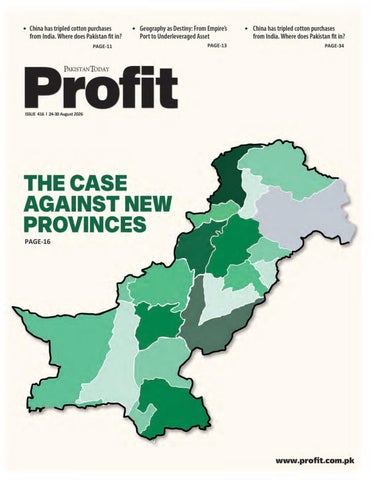
The case against new provinces
16
L
Pakistan does not need a weaker chief minister of Punjab; it needs a stronger mayor of Faisalabad.
By Farooq Tirmizi
et us not sugarcoat this: the “let’s convert every Division into a province” idea has been floated for two reasons: first, because the military-led Establishment and their civilian allies find the idea appealing as a means of cutting down the power of the Chief Minister of Punjab, and second, because Mohsin Naqvi thinks that if that happens, he has a shot at becoming prime minister (in your dreams, sir). We are not a political publication, and once again, will fully admit that there is far better political analysis about Pakistan available elsewhere. But we do pay a bit closer attention to the economic context in which that politics operates, and hence can offer at least that layer of analysis. The part often missing from the conversation is that the locus of Pakistan’s society and economy, and therefore its politics, has moved from the village to the city, and that single fact changes everything. The median Pakistani voter moved from the village to the city, and faced a completely different physical and economic environment, one that went from requiring collective effort on a farm as the sole source of sustenance and economic security, to one where labour was much more individualized, and hence requires a different set of social relationships. That change in economic opportunity and social relationships changes the nature of political demands – and the criteria by which the voter will allocate their political support: from needing the clan and tribe to be represented in Parliament (hence voting for the local land-owning aristocrat), to needing and demanding a higher quality of impersonal government services, something for which Pakistani politics has yet to adjust on a mass scale. To achieve and hold on to power on a sustained level, one needs to have a theory of politics that maps onto reality, and the problem for both the military Establishment as well as nearly all political parties is that their theory of politics is outdated, and hence every idea they have about reorganizing power is unlikely to deliver the goal they have of sustained political relevance, and ultimately power. The above three paragraphs contain many assertions that require evidence to back them up, and we will now do so. Let us start with the most central one of all: that the median Pakistani voter now lives in the city, not a village.
A majority-urban Pakistan
A
s we have covered in November 2025, government statistics – and popular perception – view Pakistan as an agrarian, majority rural society, despite the
COVER STORY
fact that there is considerable evidence that the government’s definition of what constitutes an urban area move too slowly, and far more of Pakistan lives in urban areas than they appear to believe. An analysis conducted by Profit arrived at 57% as the approximate percentage of the Pakistani population that lives in urban areas, using a combination of those government statistics, particularly on the composition of the labour force, as well as a 2025 World Bank study that analyzed highly detailed satellite imagery from the Global Human Settlement Layer (GHSL), produced jointly by the European Commission’s Joint Research Centre and Columbia University’s Center for Integrated Earth System Information (CIESIN). Our definition of urban used a narrower slice of what the World Bank study defined as urban, and using their data, we estimate that even using that narrower definition, Pakistan first became majority-urban as far back as 1990. So why has public perception not quite caught onto this fact? Partly because what is supposed to be the most authoritative study on the matter – the 2023 Population Census – does not seem to have accepted this. According to the census, the government of Pakistan estimates that the country’s population is about 39% urban and 61% rural. But other government data points hint at the majority-urban nature of Pakistan’s population. According to the 2025 Labour Force Survey from the Pakistan Bureau of Statistics, about 32.5% of the Pakistani labour force was engaged in agriculture or livestock as their primary occupation. Strictly speaking, rural areas consist of more people than simply farmers and livestock herders, and rural family sizes tend to be larger than urban family sizes, so the rural population percentage is likely higher than what the labour force number might imply. But it seems like a stretch to think it is 61%.
How this changes politics
I
f we accept that Pakistan is majority urban, and we believe the evidence is compelling that we should, what does that say about Pakistani politics? For one thing, this theory has at least some explanatory power in that it helps describe why the changes we are seeing are happening now. We have gone from a country where talking about Pakistani politics meant talking about feudalism (true as recently as the Musharraf era) to hardly ever needing to talk about the disproportionate power of land-owning families, simply because they do not have much left, and what little they have seems like a relic that will pass when the current generation holding office dies.
18
Why is this happening now? Well, if the majority of Pakistan was rural until about 1990, that means this is the first generation where the majority of the population has grown up entirely in the cities, and therefore their understanding of rural social norms and mores comes not from their own experiences, but from the childhood memories of their parents. The grandfather who would silently accept a beating at the hands of the guards of the Nawab of Kalabagh had a son who would still vote for the nawab’s children, and has grandchildren who probably cannot even name anyone in the nawab’s family, let alone vote for them. Now why would that happen? Simply put, Pakistan grew out of that problem. While the rest of the economy continued to grow, agriculture lagged behind as this landed gentry saw the land as the basis of their political power and not their primary economic asset that they should invest capital into in order to grow their own income. As a result, some time around the middle of the Musharraf administration, agricultural land ceased to be the most valuable asset in Pakistan, and was overtaken by urban land, according to an analysis from Elphinstone, an investment advisory company (of which I am the founder and CEO). Based on that analysis, agricultural land has decreased in value relative to the total size of the economy, from about 314% of gross domestic product (GDP) in 1998 to just 181% in 2021. The monopoly of landowning aristocrats on wealth generation has considerably receded. If you were a farmer in rural Pakistan about 50 years ago, you were either reliant on work or a tenant farming position on the estate of the local aristocrat, or a government job, as the means of creating economic security for yourself and your family. And even that government jobs was only accessible through the intercession of that aristocrat on your behalf. Now, however, while Pakistan is far from being an economically prosperous country, there are plenty of options, and the land or government job options seem far less appealing than they used to be. As a result, the aristocrat gets far less deference from the residents of the villages that their family owns, and the demands and needs that the villagers have are far more complex and beyond the ability of these aristrocrats to give. In other words, we did not dismantle feudalism. We outgrew it. And that, in turn, means that we need to engage in a more urban politics, but have yet to find even a single political party that is able to do this at a national scale. Rural society relies far more on social cohesion, since it requires more collective
effort for economic survival. And that means the rural aristocrat being from the same clan or tribe carried a lot more significance in that era. This is why the “electables” consisted of rural aristocrats who represented, in a literal sense, the clan and tribal mosaic that makes up Pakistani society. Urban areas allow for more individualism, which means the clan and tribal identity matters less, and so the criteria by which the voter decides who to vote for expands beyond “is this person the leader of my tribe?”
The rise of urban politics
W
hat Zuhair Toru (of garmi mein kharab fame) and the gutka-chewing MQM sector in-charge have in common is that they are both creatures of urban politics. The former is a newly political active middle class person calling for what he believes to be a more efficient government that will deliver the kind of underlying infrastructure upon which he can build his life. The latter knows the government has abandoned his city and seeks to create an alternative government-like structure, including the coercive use of armed force, to allow for at least stability to exist. They both form the bookends of the spectrum that is urban politics. One comes across as naïve about the cutthroat nature of politics, the other is the sometimes-literal cutthroat that makes politics that way. But their end goal has a big common factor: a government that provides the basics efficiently, and then leaves them alone to build the kind of lives they want to build for themselves. Make sure the roads are good, the water and sewage system works, and the lights turn on, and I will send my children to a private school on a private school bus while going to a private sector job myself. I will gripe about my taxes and complain about things, but if these basics work, I will be fine. Therefore, the standard by which the voter now judges their politicians is much more basic and administrative in nature, something that at least some politicians understand. The great “rural-urban divide” and “civ-mil balance” simply does not matter as much to the voter (though the vast majority most certainly do not want the military to be the dominant power in politics.) In many ways, what is happening in Pakistani politics now is similar to what happened to British politics around the middle of the 19th century, when the dominant political order that pitted the Whigs against the Tories in a debate between landed aristocrats about the relative balance of power between the Crown and Parliament ended decisively
in favour of Parliament, and began the rise of political parties that represented the new, growing urban middle class in the country. The nature of the debate changed, the Whigs died out completely, and the Tories had to significantly update their political program in order to maintain political relevance. In Pakistan, the landed aristocrats used to debate between the faction that wanted independent power for the Prime Minister and Parliament, and those more comfortable doing deals with the military Establishment. But now, with a more urban electorate, one of the major political parties – the Pakistan Peoples Party (PPP), the one that used to be more opposed to the military Establishment (just like the Whigs were more opposed to the Crown’s power) – is dying a slow and painful death and likely will see its elements merge into whatever becomes the new challenger. To deal with this new reality requires understanding what will win votes, and there, none of the major political parties has built a machine that will do the job. And as this “more provinces” idea illustrates, even the military Establishment is operating based on an old view of how Pakistani politics works.
“More provinces”: the answer to an outdated problem
I
f you are the military Establishment and want to roll back at least some of the power civilians have won over the last several decades, a reasonable place to start might be to make the Chief Minister of Punjab – easily the second-most important political office in the country behind Prime Minister – less powerful than it is today. A popular Punjab Chief Minister is, almost by definition, a prime minister in waiting, given the fact that the province has more than half the population of the country. The math works in favour of whoever can dominate Punjab: you only need 50% of the votes in Punjab to win the chief ministership, which means winning about 25% (and sometimes even less) of the national vote can set one up to become a nationally prominent candidate to lead the country as a whole. The logic goes: break Punjab, and you make the task a lot harder, because then 25% of the vote might only get you political prominence in about 50% of the provinces, not a single province representing a majority of the whole country. You would need to win more provinces to get the same amount of mileage, and it would make every other chief ministership less powerful and less important. To win national power in that set up would require more coalition building, which in turn allows the military Establishment to
step back into the kingmaker role where its power was at its most unquestioned peak. And besides that, it would distribute more money to parts of the country that right now rely on the government in Lahore to grant them that money, so it might have some role in improving overall governance. It is a logical train of thought. But its core problem is that it assumes that the electables who constitute the coalitions of provincial governments today are the way power will continue to be distributed in Pakistan in the future. That if the electables have more chief ministers to chose from, that will allow for a more pliable national politics from the military Establishment’s perspective. The problem with that view is that it goes against the grain of gravity of national politics, which is moving away from the coalitions of electables entirely. Reshuffling the deck of electables is not the path to sustainable power. Understanding the new locus of political legitimacy is.
The rise of city politics
A
central organizing fact of Pakistani politics must be this: the country is simply too big and complex to be governed by only one or two levels, and what voters will reward more than anything else is competence in governing closest to their own lives, which is, by definition, at the local level. The 18th Amendment to the Constitution and the 7th National Finance Commission (NFC) award meant that we finally accepted that federal would not be the only empowered level of government in the country. The problem is that the third level of government – the fiscally autonomous, elected local government – has yet to be fully accepted by those currently in power. The last generation of electables is still alive and knows that if they give in on the matter of elected local governments, their last few years of political power will end in a hurry. Not surprisingly, their younger heirs – like Ahsan Iqbal’s son Ahmed Iqbal, and Prime Minister Shehbaz Sharif’s son Hamza Shehbaz – appear to understand that the days of the current system are numbered. If the ruling Pakistan Muslim League Nawaz (PML-N) wants to continue winning elections in Faisalabad, for example, it needs to back a popular, effective mayor of Faisalabad, not the rural aristocrat who used to own lots of land in the villages outside Faisalabad and to whose family the old farmhands who moved to the city still owe some memory of allegiance. But a popular mayor cannot go on name recognition alone beyond one election, and
needs a degree of competence in order to hold onto power. That means the back room of the PML-N that hands out electoral tickets for the mayoral election will have to factor in competence, and downplay aristocratic credentials. It will not be “we went to Aitchison together, of course you are getting the ticket”. It will be “when have you actually managed a complex organization, and what do you know about how city governments work?” The current members of the Punjab Assembly from Faisalabad, meanwhile, know that even if they allow that seat to go to someone outside their family and friend circle, their days of holding onto their Punjab Assembly seat are numbered. A visible, highly successful mayor will be the new kingmaker in Faisalabad, and setting up a criterion of success that does not involve friendships in Lahore that help you secure more funding is bad for their hold on politics. More provinces creates more of these provincial capitals from which this kind of politics can continue. But this is not what the voters want or need, and it is holding the country back. What they want is a politics centered on competence and service delivery down to the street level. Anyone who promises to deliver that – most likely the next generation of politicians’ sons who are willing to take more risks – will build the machine that will have the capacity to win and maintain power in almost every part of the country.
A note on the cult of personality
O
ne more note on why the Pakistan Tehrik-e-Insaf’s government was pushed out, and why their attempts at agitation based on the alleged mistreatment of Imran Khan in prison are not getting much traction: the public is no longer interested in the cult of personality, and attempts to win power based on a politics of martyrdom and a messiah complex are over. People gave Imran Khan a chance at power because he was a well known name who promised something different. But he is also the most narcissistic man to have governed Pakistan since Zulfikar Ali Bhutto, except that he is in an era when the voter will watch one reel of a PTI press conference and then move on to the next reel of teenagers in Taiwan dancing to K-Pop songs. “Look at how they are mistreating your leader” does not matter anymore. “Remember what we did for your city” still does. The irony is that while larger than life leaders allow the creation of political parties in the first place, they are now increasingly a liability. The sooner parties recognize that, the sooner politics in the country will become more functional. n
COVER STORY
International Steels’ profit more than doubles on a volume rebound 20
The flat-steel manufacturer increased revenues by 50% and profits by 136% in FY26, as recovering demand allowed higher volumes to overcome a less favourable global steel-price environment.
I
nternational Steels Ltd (ISL) has spent much of the past few years waiting for its enormous factory to have something more useful to do. The company owns Pakistan’s largest flat-steel manufacturing complex, capable of producing as much as one million tonnes of cold-rolled steel annually. Yet capacity is only valuable when there are customers willing to buy the output. The economic slowdown that followed Pakistan’s balance-of-payments crisis had hit precisely the industries that buy ISL’s steel: automobiles, appliances, furniture, tubes and other manufactured goods. Fiscal year 2026 appears to have finally brought something resembling a recovery. ISL reported a profit after tax of Rs3.67 billion for the year ended June 30, 2026, an increase of 136% compared with the previous year. Revenue rose 50% to Rs93.35 billion, while earnings per share increased to Rs8.44. In the fourth quarter alone, profits more than doubled year-on-year to Rs1.27 billion, or Rs2.91 per share, according to a result review published by Topline Securities. The results were better than Topline analysts had expected, with both sales and gross margins exceeding their forecasts. And that distinction matters. ISL did not simply benefit from a lucky move in international steel prices. Quite the opposite: the underlying spread between the hot-rolled coil it buys and the cold-rolled product it sells was actually less favourable than a year earlier. Instead, the biggest change appears to have been volume. For a company whose factories have spent years operating well below their theoretical capacity, that may be the most important part of the result.
More steel through the same machines
I
SL’s fourth-quarter revenue rose 57% year-on-year to Rs26.07 billion, while gross profit almost doubled to Rs3.54 billion. Its gross margin expanded to 13.5%, compared with 10.7% in the same quarter last year. For the full year, gross profit rose 101% to Rs10.73 billion and the gross margin improved to 11.5%, from 8.6% in FY25. Profit before tax increased 127% to Rs5.55 billion. The improvement is particularly striking when placed against the previous year. In FY25, ISL had generated Rs62.31 billion in sales and just Rs1.56 billion in net profit. Its net margin had fallen to 2.5%, less than half the 5.3% earned in FY24. FY26 therefore represents a recovery from a particularly weak base. At approximately Rs3.67 billion, net profit is now almost exactly back to FY24 levels, though still well short of the Rs5.41 billion the company earned in FY22. Sales, on the other hand, have surpassed even FY22’s Rs91.42 billion. That divergence tells an important part of the story. ISL is selling considerably more rupees’ worth of steel again, but the economics of converting those sales into profit remain less
generous than during the extraordinarily profitable conditions of the post-pandemic commodity boom. To understand why, it helps to understand what ISL actually does. The company does not make steel from iron ore. Its principal raw material is hot-rolled coil, or HRC, which it imports and then processes into higher-value cold-rolled coil, galvanised steel and colour-coated products. That makes the difference between the international HRC price and the selling price of cold-rolled coil — the HRC-CRC spread — one of the critical variables governing profitability. According to Topline, that spread averaged just US$53.5 per tonne in the fourth quarter of FY26, down from US$69.5 per tonne a year earlier. International CRC prices themselves averaged US$553 per tonne, compared with US$528 a year ago. Ordinarily, a narrowing conversion spread ought to be bad news for margins. Yet ISL’s margins rose sharply. Topline attributes that mainly to stronger volumes, which enabled the company to absorb its manufacturing costs across a larger amount of production. There may also have been some help from inventories during the fourth quarter: international CRC prices increased around 5% quarter-on-quarter, potentially allowing ISL to sell steel manufactured from cheaper material purchased earlier. That is operating leverage in its simplest form. ISL has already spent the money to build the machines. Once demand drops below a certain level, the fixed cost of running those machines becomes painfully expensive per tonne. When volumes return, much of the incremental gross profit can fall rapidly through the income statement. Not all of it did. Distribution expenses rose 88% during FY26 to Rs2.95 billion, broadly consistent with moving considerably more product through the company’s domestic and export networks. Other expenses rose 168% to Rs982 million. Finance costs also increased 51% to Rs1.21 billion despite the substantially lower interest-rate environment prevailing through much of FY26, though the quarterly trend was more encouraging: fourth-quarter finance costs fell 32% from the preceding quarter to Rs240 million. The net result was nevertheless powerful enough to swamp those increases. ISL’s after-tax earnings grew considerably faster than either revenue or gross profit.
The customers came back
I
SL’s recovery is easier to understand when one looks at what happened to Pakistani manufacturing during FY26. The company sells cold-rolled steel into industries including automobiles, home appliances, furniture, drums, tubes, filters and tinplate. Its galvanised and colour-coated products have additional applications in fabrication, construction and consumer durables.
INDUSTRIALS
Several of those industries had a much better FY26. Pakistan’s large-scale manufacturing output grew 4.98% during the year, according to the Pakistan Bureau of Statistics. Automobile production was one of the strongest contributors, with output in the category rising 57.8%. Electrical equipment increased 14.3% and furniture production rose 22.7%. The automotive turnaround was particularly dramatic. Passenger car sales reached 155,631 units during FY26, up 39%, while sales of jeeps, SUVs and vans increased 41% to 50,814 units. Lower interest rates, reduced inflation and a wave of new models helped revive a market that had collapsed during Pakistan’s earlier macroeconomic crisis. The State Bank’s own data for the first half of FY26 had already shown where the year was heading: passenger-car production was up 56%, jeep and pickup production rose 37%, and truck and bus production almost doubled. For ISL, automobiles are especially useful customers because locally assembled vehicles require precisely the sort of relatively sophisticated cold-rolled and galvanised products that the company was built to manufacture. Yet it would be a mistake to describe FY26 as a broad steel boom. PBS data actually show overall iron and steel output falling 7.8% during the year. What ISL benefited from was therefore a more specific recovery: the revival of downstream manufacturing sectors that consume flat steel, rather than a universal resurgence in every part of the Pakistani steel industry. That distinction also helps explain why an ISL result can look extraordinarily strong while conditions for some long-steel manufacturers remain much more difficult.
A very large factory built for a much larger economy
I
SL was incorporated in 2007 as a greenfield project backed by International Industries Ltd (IIL), Sumitomo Corporation of Japan and JFE Steel, also of Japan. Production began in 2010 and the company listed on the Karachi Stock Exchange the following year. Its origins lie within the Amir S. Chinoy Group, one of Pakistan’s older industrial families. IIL itself traces its history to 1948, when Amir S. Chinoy established Sir Sultan Chinoy & Company as a trading concern. It subsequently moved into manufacturing steel pipes and tubes and became one of the country’s major engineering businesses. The logic behind creating ISL was vertical as much as entrepreneurial. IIL required flat steel as a raw material
22
for its own pipe-making operations. Instead of remaining dependent on imports, the group created a domestic flat-steel producer capable of supplying IIL while also serving the much larger Pakistani industrial market. The scale increased rapidly. ISL initially had cold-rolling capacity of roughly 250,000 tonnes. Subsequent expansions added galvanising and colour-coating lines and ultimately increased cold-rolled capacity to one million tonnes a year. Today, the company has capacity for approximately one million tonnes of cold-rolled steel, 462,000 tonnes of galvanised steel and 84,000 tonnes of colour-coated steel. IIL remains the controlling shareholder with approximately 56.3% of ISL. Sumitomo owns around 9.1%, while JFE Steel holds approximately 4.7%. The challenge with that industrial footprint is that Pakistan has rarely grown as quickly or as consistently as the factories were designed to anticipate. In FY25, for example, domestic coldrolled steel demand contracted by 5%, according to ISL’s annual report. Galvanised demand did somewhat better, growing 11%, and ISL itself managed to grow volumes by 15%, but declining international steel prices kept pressure on revenue and margins. FY26 appears to have been the year in which improving domestic industrial demand finally began translating that installed capacity into significantly better earnings.
A little help from Islamabad
T
here is also a regulatory dimension to the recovery. Pakistan’s formal steel manufacturers have long complained about tax concessions available to factories in the former FATA and PATA regions. ISL specifically highlighted the issue in its FY25 annual report, arguing that misuse of those exemptions created an uneven competitive environment for documented producers elsewhere in Pakistan. It has also complained about circumvention of anti-dumping duties on imported galvanised steel. The government has begun dismantling part of that advantage. Under the federal budget introduced for FY26, the sales-tax exemption available to industrial units in the former FATA and PATA was converted into a phased tax regime: 10% during FY26, rising to 12% in FY27, 14% in FY28 and 16% in FY29, still short of the normal 18% rate. The government explicitly cited complaints from industries including iron and steel about misuse of the exemption. As of July 2026, the rate has duly risen to 12%.
That does not eliminate informal competition, nor does it protect ISL from cheap imports. Global steel markets remain notoriously oversupplied, with Chinese exports capable of compressing prices and spreads across the region. ISL itself warned last year that global overcapacity, pricing pressure and growing trade protectionism were likely to remain major features of the flat-steel market. But the gradual normalisation of domestic taxation removes at least one structural disadvantage for companies such as ISL that have invested heavily in formal manufacturing capacity.
The rebound is real. The question is how durable it is
S
hareholders received some of the benefit directly. Alongside the fourth-quarter results, ISL announced a Rs3 per share final cash dividend, taking the FY26 payout to Rs5 per share. That represents roughly 59% of the company’s Rs8.44 in annual earnings. At the share price used in Topline’s result review, the stock was trading at 10.9 times FY26 earnings with a dividend yield of around 5%. The immediate investment case is therefore relatively simple. ISL has enormous spare manufacturing capacity, and FY26 demonstrates just how quickly profits can respond when more steel passes through that capacity. A sustained recovery in automobile production, appliances and broader manufacturing could allow the company to continue raising utilisation without needing another enormous round of capital expenditure. The risk is equally straightforward. ISL remains exposed to international steel prices, imported HRC costs, exchange rates, domestic interest rates and Pakistani industrial demand — a combination of variables that has produced some spectacular swings in profitability over the past five years. FY26 is not evidence that those cycles have disappeared. What it does show is that the company does not necessarily need unusually attractive global steel spreads to earn respectable profits. Even with the HRC-CRC spread moving against it, ISL managed to increase gross margins because it sold considerably more steel. That may be the most encouraging number hidden beneath the headline 136% earnings increase. For years, ISL’s problem was not that it lacked a factory. It was that Pakistan’s economy was not generating enough demand to keep that factory busy. In FY26, at least some of those customers came back. n
INDUSTRIALS
Cherat Cement’s profits fall despite Pakistan’s cement recovery
Domestic cement demand finally returned in FY26, but one of northern Pakistan’s lowest-cost producers had an unexpectedly difficult year as weaker pricing, the Afghan border closure and rising fuel costs squeezed margins
T CEMENT
here is an awkward question sitting inside Cherat Cement Company’s latest financial results. Pakistan finally started buying cement again. Domes-
tic cement sales rose 9.5% during fiscal year 2026, snapping the demand weakness that had characterised much of the preceding economic downturn. Across the industry, total despatches rose more than 7%, utilisation improved and the final months of the fiscal
year provided some of the strongest evidence yet that the construction cycle was recovering. Yet Cherat Cement, one of the producers seemingly best positioned to benefit from such a recovery, made less money.
23
The Nowshera-based cement manufacturer reported net profit of Rs7.25 billion for the year ended June 30, 2026, down 16% from the record Rs8.68 billion it earned the previous year. Earnings per share declined from Rs44.68 to Rs37.34, while revenues slipped 4% to Rs36.48 billion. The final quarter was better, but not by enough. Cherat earned Rs1.74 billion, or Rs8.94 per share, during the three months ended June, down 6% from the same period last year, although up 23% from the preceding quarter. More importantly, the result disappointed analysts. Topline Securities had expected quarterly earnings of Rs9.80 per share. The problem was not demand. Cherat’s domestic despatches actually increased 2% year-onyear and 5% sequentially during the quarter to 520,000 tonnes. The problem was what happened between selling the cement and converting those sales into gross profit. Cherat’s fourth-quarter gross margin collapsed to 27.4%, compared with 32.6% a year earlier and 31% during the preceding quarter. Topline had expected a margin of more than 35%. The brokerage estimates that around Rs200 million of costs resulted from a oneoff production-line stoppage, based on its channel checks. Even after adjusting for that, however, analysts said profitability was weaker than expected. That is the central story of Cherat Cement’s FY26: volumes started moving in the right direction, but the economics of producing and selling each tonne became considerably less attractive. And in Cherat’s case, much of the explanation begins roughly 80 kilometres west of its factory, at the border with Afghanistan.
A good year for cement, but not necessarily for Cherat
A
t first glance, FY26 should have been almost tailor-made for cement manufacturers. Pakistan’s domestic cement despatches increased from 37.91 million tonnes in FY25 to 41.51 million tonnes in FY26, an increase of 9.5%. Including exports, industry despatches rose 7.21% to 50.52 million tonnes. Industry capacity utilisation improved to approximately 59%, from 56% the previous year. The improvement accelerated towards the end of the year. Local despatches in June were up almost 27% year-on-year. Normally, that combination — increas-
24
ing volumes through factories with enormous fixed costs — should be excellent for profitability. But Pakistan does not really have one cement market. It has at least two. Southern manufacturers, with relatively easy access to ports, can sell significant quantities into overseas markets. Northern producers rely much more heavily on domestic demand and, in the case of plants located in Khyber Pakhtunkhwa, trade with neighbouring Afghanistan. Cherat sits in Village Lakrai in Nowshera district, a location that has historically been one of the company’s great advantages. It is well placed to serve Khyber Pakhtunkhwa, northern Punjab and Azad Kashmir, while also being geographically positioned to export cement into Afghanistan. The company has annual installed cement capacity of more than 4.5 million tonnes. In FY26, geography became more complicated. The prolonged closure of the Pakistan-Afghanistan border severely disrupted northern cement exports. Cherat’s exports fell 71% year-on-year during its second quarter, according to IMS Research, and northern manufacturers also lost access to an important source of inexpensive Afghan coal. By June 2026, north-based cement mills were recording no exports at all, compared with more than 200,000 tonnes in the same month the previous year. The pattern continued into July: the northern region again recorded zero exports even as domestic demand surged. For Cherat, that created two problems simultaneously. One was obvious: an export market on its doorstep effectively disappeared. The second was more subtle and potentially more damaging to margins. Cement production is intensely energy-dependent. Khyber Pakhtunkhwa manufacturers had enjoyed access to relatively inexpensive Afghan coal, particularly because their factories were geographically close to the border. Once that supply was interrupted, manufacturers increasingly substituted imported coal, including Richards Bay coal from South Africa, adding both fuel and inland freight costs. Across Pakistan’s listed cement industry, gross margins fell to 28.2% during the first half of FY26 from 31.9% a year earlier. Analysts attributed much of that decline to lower retention prices and the loss of Afghan coal in the northern region. Cherat was therefore caught in an unusual squeeze: domestic demand was improving, but its traditional cost advantage was being eroded at precisely the same time.
Revenue went down while costs went up
T
he annual numbers illustrate that squeeze particularly well. Cherat generated Rs36.48 billion in revenue during FY26, down 4% from Rs37.81 billion the previous year. Yet its cost of sales increased 3%, from Rs23.84 billion to Rs24.44 billion. The inevitable consequence was that gross profit fell much faster than sales: down 14% to Rs12.04 billion from Rs13.97 billion. The deterioration was even sharper during the fourth quarter. Revenue declined 9% year-on-year to Rs8.89 billion, but gross profit fell 23% to Rs2.44 billion. Since domestic despatches actually rose during the quarter, falling revenue suggests that Cherat was earning less revenue per tonne sold, whether because of pricing, sales mix or some combination of the two. The analyst report itself does not break that impact out separately. The broader northern market provides some context. Average cement prices in the north were approximately Rs1,381 per bag during the first half of FY26, down 6.7% year-on-year. The south, by contrast, recorded prices of roughly Rs1,444 per bag, up 4.1%. In other words, northern producers were moving more cement into the domestic market at a time when price realisation was under pressure and input costs were becoming more difficult. Cherat still remained highly profitable. A 27.4% quarterly gross margin hardly constitutes a crisis for an industrial manufacturer. The disappointment is relative to what Cherat had demonstrated it could achieve. In FY25 the company earned a record Rs8.68 billion, up 58% from Rs5.50 billion in FY24, despite a decline in sales volumes. Its annual gross margin had reached approximately 37%. FY26 therefore looks less like a collapse and more like a normalisation from an exceptional year. Indeed, at Rs7.25 billion, Cherat’s FY26 earnings remained well above the Rs5.50 billion earned in FY24 and the approximately Rs4.4 billion earned in each of FY22 and FY23. The factory is still making considerable money. It is simply no longer producing the extraordinary margins of the preceding year.
The cheap-energy strategy still matters
T
he broader reason investors have historically liked Cherat is that management has spent years attempting to drive the cost of making each bag
as low as possible. Cherat was incorporated in 1981 and is part of the Ghulam Faruque Group, one of Pakistan’s older industrial groups. Its manufacturing complex in Nowshera now comprises three production lines with combined annual capacity exceeding 4.5 million tonnes. The company underwent a major expansion cycle during the previous decade. Line II, capable of producing 4,200 tonnes of clinker per day, commenced commercial production in 2017. Line III, with clinker capacity exceeding 6,700 tonnes per day and an accompanying waste-heat-recovery system, followed in January 2019. Those expansions turned Cherat into a substantial regional producer but also left it — like much of Pakistan’s cement industry — with more manufacturing capacity than the market immediately required. That explains the focus on efficiency. Cherat has invested heavily in wasteheat recovery and solar generation. Another 9MW solar project became operational during FY25, taking solar capacity to roughly 23-24MW and total renewable generating capacity, including waste-heat recovery, to approximately 45MW. Those investments matter because electricity and fuel are among the largest variable costs in cement manufacturing. They do not, however, eliminate exposure to coal prices. Management disclosed late last year that Line III generally operated throughout the year while Line II operated only partially because of insufficient demand. That is the other side of Cherat’s 4.5-million-tonne capacity: until Pakistan’s cement market recovers more substantially, management has to decide which equipment is economically sensible to operate. FY26’s roughly Rs200 million line-stoppage cost provides a reminder that switching large industrial facilities on and off is not necessarily costless.
The balance sheet did what the factory could not
W
hile production economics weakened, one part of Cherat’s financial statements improved considerably:
financing. Finance costs fell 42% during FY26 to just Rs342 million. In the fourth quarter, they declined 26% year-on-year and 22% sequentially to Rs63 million. Topline attributed the decline primarily to lower debt levels. That matters because Pakistan’s previous cement expansion cycle was built partly
with borrowed money. As new production lines came online and the economy slowed, finance costs became a significant burden for some manufacturers. Cherat has instead been moving in the opposite direction. By the second quarter of FY26, total borrowings had fallen approximately 55% to Rs6.2 billion, according to IMS Research. Lower debt combined with falling Pakistani interest rates creates a useful buffer against operating-margin pressure. It means that when domestic cement volumes eventually recover enough to improve factory utilisation materially, a smaller portion of operating profit should disappear into interest payments. Other income provided another cushion. It increased 11% during FY26 to Rs1.77 billion and rose 13% year-on-year in the fourth quarter to Rs507 million. Topline believes the quarterly number included Rs109 million of one-off income from SIDC. Even with that benefit — and an unusually low quarterly effective tax rate of 27.5%, compared with 38.7% a year earlier — earnings still came in below the brokerage’s expectations. That makes the margin miss difficult to dismiss as an accounting curiosity. The underlying manufacturing economics genuinely weakened.
Cherat is returning cash anyway
M
anagement does not appear particularly worried about the balance sheet. Alongside the FY26 result, Cherat announced a final dividend of Rs4 per share, bringing the full-year payout to Rs5.50 per share. More significantly, the company is already in the middle of a share-buyback programme. Cherat has authorised the purchase and cancellation of as many as 7.77 million shares, equivalent to up to 4% of its outstanding equity. The shares are being acquired at prevailing market prices between June 12 and December 1, 2026, with the purchases funded from distributable profits. The company said the buyback would improve earnings per share and provide an exit opportunity for shareholders wishing to sell. Cancelling 4% of the shares would, all else being equal, increase earnings per share for the remaining shareholders by a little over 4%, even before any growth in absolute profits. It is also a fairly clear signal about capital allocation. Cherat has completed its major ex-
pansion programme, has been reducing debt and already possesses significant unused production capacity. There is little reason to spend billions building another factory while existing plants remain underutilised. The company does hold land for a potential 3.5-million-tonne greenfield plant in Dera Ismail Khan, while additional brownfield expansion is possible at Nowshera. But management has indicated that new capacity would only be considered once a sustained demand recovery becomes evident. For now, returning some capital to shareholders makes more sense.
The demand recovery has arrived. The margin recovery has not
T
he early evidence from FY27 is encouraging. Pakistan’s domestic cement despatches rose another 17.3% year-on-year in July 2026. More importantly for Cherat, northern manufacturers recorded domestic growth of 19.25%. The problem is that northern exports remained at zero. So the two forces that defined Cherat’s FY26 are still pulling in opposite directions. Pakistan’s domestic construction market is recovering, which should gradually allow the company to run more cement through a factory capable of producing more than 4.5 million tonnes annually. But the Afghan border disruption continues to deny it both an export market and access to one of its cheapest sources of coal. Topline nevertheless maintains a Buy recommendation on Cherat Cement, noting that the shares trade at approximately 6.8 times its estimated FY27 earnings. The investment proposition therefore depends less on whether Cherat can sell cement and more on what it costs the company to make it. FY26 demonstrated an uncomfortable truth about cement manufacturing: volume growth is not enough if every additional tonne carries lower pricing and higher energy costs. But it also demonstrated something else. Cherat went through a difficult year, suffered the disappearance of its Afghan export market, lost access to cheap Afghan coal, absorbed a costly plant stoppage and watched its gross margins fall sharply. And it still earned Rs7.25 billion. If Pakistan’s construction recovery continues — and if the company eventually recovers some of the cost advantages it lost during FY26 — the enormous Nowshera factory should have considerably more to give.n
CEMENT
OPINION
Muhammad Azfar Ahsan
The State must deliver
A
state does not earn legitimacy because it exists. It earns legitimacy when citizens can feel that it works. For the ordinary citizen, the state is not an abstract constitutional arrangement, a ministry, a policy document or a budget speech. It is the school that teaches or fails to teach, the hospital that treats or turns illness into anxiety, the police station where protection is sought, the court where justice is awaited, the municipal service that determines whether a neighborhood is livable, and the public office where a business owner discovers whether the state is a facilitator or an obstacle. These everyday encounters are where the authority of the state acquires meaning. This is where the social contract becomes real. Pakistan has spent decades debating the size, structure and capacity of the state. We have created institutions, commissions, authorities and reform programs, often with good intentions and considerable effort. Yet the more fundamental question remains: what does a citizen receive in return for the obligations imposed by the state? Citizens pay taxes, obey laws, work, invest, educate their children and contribute to society. In return, they expect security, justice, education, healthcare, infrastructure, opportunity, and fair treatment. When these expectations are repeatedly unmet, dissatisfaction becomes something more consequential. Trust erodes, compliance weakens, and citizens begin to construct private substitutes for public systems. Those who can afford it purchase private education, healthcare, security, transport, and utilities. They increasingly seek
Writer is a public policy advocate, business strategist, and former Pakistan’s Minister for Investment and Chairman of the Board of Investment. He is a strategic advisor to leading corporate entities, focusing on business policy, investment facilitation, and leadership branding. He writes frequently on the economy, governance, and society.
26
private mechanisms to resolve problems that should be addressed through public institutions. The state remains formally present, yet citizens increasingly learn to navigate around it rather than rely on it. A functioning state does not make citizens dependent upon its bureaucracy; it gives them confidence that its institutions will perform their essential functions fairly, predictably, and without requiring personal influence. Pakistan, therefore, does not simply need more government. It needs a more capable state: one that knows where its presence is essential, where it should step back and where institutional capacity can create the greatest public value. The question is not how much the state does, but how well it performs the responsibilities that only the state can discharge. A capable state performs its essential responsibilities reliably, allocates resources intelligently, protects citizens equally, and creates conditions in which individuals and businesses can build better lives. Its strength should be measured not by the number of departments it controls, regulations it issues or meetings it holds, but by the outcomes citizens experience.
The citizen must become the ultimate unit of measurement
T
his is why public service delivery is ultimately a question of legitimacy. A citizen should not need influence or connections to obtain something the law already entitles them to receive. A business should not need personal access to secure an approval that ought to move through a transparent system. A patient should not need a privileged connection to receive timely care, and a student should not require a privileged family background to access quality education. Justice should not depend on social standing. When access to public services becomes dependent on privilege, the state ceases to be experienced as equal. Citizens begin to distinguish between the state they are promised and the state they actually encounter. The result is not merely frustration; it is a loss of dignity. A citizen should be able to approach an institution as a rights-bearing member of society, not as someone seeking a favor. That gap between entitlement and experience is one of Pakistan’s deepest governance problems, and it carries a significant economic cost. When public
systems fail, citizens and businesses purchase private alternatives, absorb higher transaction costs, delay decisions, and devote resources to navigating bureaucracy rather than creating value. Weak institutions, therefore, impose an invisible institutional tax on the economy. They reduce productivity, discourage investment, constrain social mobility, and make economic growth more expensive. The answer is not another institutional rearrangement without a corresponding change in performance. Every major institution should know what it exists to deliver, whom it serves, how performance will be measured, and who is accountable when outcomes fall short. Government must become outcome oriented. A ministry should not be judged primarily by the number of meetings it holds, notifications it issues or schemes it announces. It should be judged by whether the problem within its mandate is becoming smaller. Health departments should be measured by health outcomes, education departments by learning, police by public safety, and confidence in the law, and municipal governments by the quality of services citizens receive where they live. Public expenditure should be judged not simply by what is spent, but by what capability that expenditure creates. This requires a fundamental administrative shift: from activity to outcomes, from discretion to systems, from hierarchy to responsibility, and from announcements to measurable delivery. It also requires designing government from the citizen’s experience backwards rather than from the bureaucracy’s structure forwards. The citizen should not have to understand which department, authority or tier of government is responsible for solving a problem. That is the state’s problem, not the citizen’s.
Local government is indispensable
C
itizens do not experience the state primarily in Islamabad or provincial capitals. They experience it where they live. Roads, drainage, waste management, water supply, public transport, local planning, parks, building permissions, and many everyday services are fundamentally local. Yet Pakistan has repeatedly struggled to create empowered, financially viable, and accountable local governments capable of performing these functions. A strong federation cannot be built on weak local institutions. Local governments need defined responsibilities, predictable resources, professional capacity, and clear accountability to the citizens they serve. Decentralization without capacity is ineffective, but centralization without local responsiveness is
equally damaging. Decisions should be placed as close as practical to citizens while national standards, fiscal discipline, and accountability remain intact. Local government is not an intermittent political arrangement; it is part of the basic architecture through which citizens experience the state. The same principle applies to justice. Justice delayed is not merely a legal inconvenience. It changes economic behavior, weakens investment confidence, raises the cost of doing business, and teaches citizens that formal institutions may not protect their interests. Businesses cannot make long-term commitments when contracts are difficult to enforce. Families cannot plan confidently when property disputes remain unresolved for years. Citizens cannot develop institutional trust when access to justice appears unequal. Judicial reform, therefore, belongs within the architecture of economic and social development. Courts need capacity, technology, procedural efficiency, and disciplined case management. Commercial disputes require mechanisms capable of producing timely and credible outcomes, while alternative dispute resolution should be strengthened where appropriate. Most importantly, citizens must believe that the law is not merely written but enforceable.
The same standard must apply to the civil service
P
akistan does not lack capable public servants. It lacks a system that consistently enables capable people to perform, rewards results, and protects professionalism while holding failure accountable. Frequent transfers, unclear mandates, political disruption, and weak performance management can turn competent officials into administrators of process rather than leaders of delivery. A professional civil service requires clear roles, continuity in critical positions, relevant expertise, and measurable performance. Officials need sufficient authority to execute their mandates, matched by responsibility for outcomes. Political leadership should establish direction and priorities without repeatedly disrupting the machinery required to implement them. Merit must matter not only at recruitment, but throughout a public servant’s career. Competence should determine responsibility, performance should influence progression and integrity should remain non-negotiable. Institutional continuity matters because public institutions must outlast governments. A new administration may legitimately change priorities, but it should not have to rebuild institutional memory, reverse established
systems or disrupt capable teams every time political leadership changes. Policy can evolve without the state having to start again. Accountability must reinforce this architecture, not undermine it. A state that cannot measure performance cannot manage it. Major public institutions should have a limited number of clearly defined priorities, measurable indicators, and transparent reporting mechanisms. Performance evaluation should be connected to outcomes rather than seniority or procedural compliance. But accountability must not become selective pressure. It must be predictable, transparent, and governed by rules. When accountability is perceived as arbitrary, it produces fear rather than performance. Public servants become more concerned with avoiding decisions than making them, and administrative paralysis follows. The purpose of accountability should be to improve institutions, correct failures, and protect public resources, not merely to produce headlines.
Creating equal opportunities
E
quality does not mean identical outcomes. It means that a person’s prospects should not be determined overwhelmingly by the circumstances of birth. A child from a low-income family should have a genuine pathway to quality education. A talented young person should be able to acquire skills connected to employment. A small entrepreneur should be able to enter markets without political access. A woman seeking economic participation should not face unnecessary institutional barriers. A citizen in a smaller city should not be condemned to inferior public services because of geography. A society can tolerate differences in wealth more easily when people believe that effort, education, ability, and enterprise can change their circumstances. It becomes far more fragile when advantage reproduces itself across generations while opportunity narrows for everyone else. A healthy social contract does not promise equal outcomes; it creates credible pathways through which merit, effort, and enterprise can improve outcomes. Pakistan’s young population, therefore, represents both an extraordinary opportunity and a profound responsibility. Demography does not automatically produce a dividend. Young people become an economic asset when they possess knowledge, health, skills, confidence, and access to productive work. Without these, a large youth population can become a source of frustration rather than national strength. Education must consequently be understood as both economic and social infrastruc-
COMMENT
ture. The question is no longer simply how many children are enrolled. It is whether they are learning, whether teachers are equipped, whether curricula develop critical thinking and practical skills, whether technical education responds to industry, and whether universities connect with a changing economy. Pakistan cannot build a competitive economy while millions of children remain outside quality education. Nor can it build a cohesive society when the quality of education is determined largely by household income. Education is not simply a service the state provides; it is the mechanism through which a society expands capability across generations and gives merit a genuine opportunity to overcome inherited disadvantage. Healthcare presents the same challenge. A productive society depends on healthy citizens, yet access to quality healthcare remains deeply unequal. Public health policy must move beyond hospitals towards prevention, primary care, maternal and child health, nutrition, and early intervention. Healthcare is not
28
merely a welfare obligation. It is an investment in human capability and national productivity. These responsibilities cannot be discharged by the government alone. The private sector is Pakistan’s principal source of investment, employment, innovation, and enterprise. It should not replace the state, but neither should it be treated merely as a source of taxation. A productive relationship requires predictable rules, competitive markets, efficient regulation, and a shared understanding that growth expands the resources available for social development. Corporate Pakistan can contribute to skills, research, innovation, healthcare, education, and community development. But corporate responsibility should complement public responsibility, not substitute for it. The state must remain accountable for public goods that only the state can reliably provide. A strong private sector and a capable state are not competing propositions; each strengthens the conditions in which the other can perform. Civil society has an equally import-
ant role. Non-governmental organizations, professional associations, philanthropies, universities, community organizations, and citizens’ groups often understand local problems better than distant institutions. They can experiment, mobilize resources, identify gaps, and hold institutions accountable. Government should create space for responsible civic participation rather than viewing independent civil society merely through an administrative lens. The strongest societies are not those in which the government does everything. They are those in which the government performs its essential functions well while citizens, businesses, and civil society contribute their capabilities.
Tech has a role to play
D
igital governance should not simply mean putting existing forms online. It should redesign the citizens’ interaction with the state. A citizen
should not have to understand the internal structure of government to obtain a public service. Where legally appropriate, data should be moved between departments rather than forcing citizens to repeatedly provide information the state already possesses. Applications should be trackable, timelines visible, and grievances capable of escalation. But digitization must follow institutional reform. A bad process placed on a digital platform remains a bad process. Technology should remove friction, reduce discretion, improve transparency, and make performance measurable. The objective is not to make bureaucracy look modern; it is to make the state easier to navigate, harder to manipulate, and more accountable for delivery. Trust is built through these ordinary interactions. A school opens on time; a police complaint is registered; a land record is accessible; a license is issued without unnecessary delay. A tax assessment follows clear rules. A court resolves a legitimate dispute. A municipal service works. These experiences accumulate into either confidence or cynicism. The state, therefore, does not build trust through communication alone. It builds trust through consistency. Citizens do not need to be persuaded every day that the state is functioning; they need to experience it functioning. This has a direct implication for public policy. Reform should not be designed primarily around what government wants to announce. It should be designed around what citizens need to experience differently. The measure of reform should be visible in the reduction of friction, the improvement of services, and the widening of opportunity. That requires listening systematically. Ministries and local governments should understand the citizen journey through public services, identify points of friction, and measure satisfaction alongside operational performance. Feedback should not be treated as public relations; it should become an input into policy design. The deeper challenge is to restore the idea that citizenship carries both rights and responsibilities. Citizens must contribute through taxation, lawful conduct, civic participation and respect for public institutions. But the state cannot demand responsibility from citizens while consistently failing to fulfil its own obligations. The social contract is reciprocal. Citizens are more willing to comply when they believe that rules are fair, institutions are impartial, and the benefits of functioning government are shared broadly. Taxation is, therefore, part of the social contract. A system that repeatedly burdens the visible and the compliant, while leaving large segments of economic activity outside the effective tax net, weakens both revenue
and legitimacy. Citizens are more willing to comply when taxation is understandable, enforcement is fair, and public resources are visibly used to create collective value. The same principle applies to regulation. Rules should protect the public interest without becoming instruments of arbitrary control. The state should regulate where regulation creates genuine public value and remove unnecessary barriers where citizens and businesses can create value more effectively themselves. State capacity is not demonstrated by the number of permissions it can withhold; it is demonstrated by how intelligently it enables legitimate activity while protecting public interest. A capable state, therefore, requires discipline not only about what it does, but also about what it chooses not to do. Pakistan’s social contract cannot be renewed through a single reform, institution or government. It requires a sustained shift in the relationship between state and citizen: public institutions becoming more capable, political leadership more consistent, civil servants more accountable, local governments more empowered, courts more effective, and public services more responsive. It also requires continuity. Governments will change, priorities will evolve and political mandates will differ. But the fundamental responsibilities of the state cannot be reset with every transition. Education, healthcare, justice, local government, institutional capacity, and public service delivery require long horizons. A state that constantly starts again cannot build lasting capability. This is ultimately a question of institutional maturity. Mature states do not depend entirely on the preferences of individuals at the top. They build systems that preserve competence, carry institutional memory, enforce rules consistently, and continue delivering when political leadership changes. But institutional reform will not be enough if the citizen remains an afterthought. The ultimate measure of the state is the distance between what the law promises and what the citizen experiences. Closing that distance should become a national priority, not as an exercise in administrative reform alone, but as a renewal of the relationship between the state and society. Pakistan does not need a state that is omnipresent. It needs a state that is dependable: strong where only the state can be strong, restrained where society and markets can perform better, and relentlessly focused on the public goods that determine national capability. The purpose of government is not to make citizens dependent on the government. It is to create the security, opportunity, and institutional confidence that allow citizens to become more capable, independent, and
productive. A state succeeds when its institutions expand the choices available to citizens rather than narrowing them through uncertainty, privilege, or administrative friction. That is the foundation of a functioning social contract. Pakistan’s next phase of development cannot be built only through higher investment, stronger exports, or faster economic growth. Those are essential, but they will not endure without institutions that citizens trust and services that allow people to participate meaningfully in the economy and society. Economic transformation ultimately depends on institutional transformation because capital, talent, and enterprise respond not only to incentives, but to the predictability of the environment in which they operate. A country becomes stronger when its citizens believe the system is capable of working for them, not merely operating around them. It becomes more productive when citizens spend less energy navigating institutions and more energy building families, businesses, careers, and communities. It becomes more cohesive when people believe that merit can matter, effort can produce mobility, and the law can protect them without regard to influence. Pakistan has enormous human potential. The question is whether our institutions will release it or continue to constrain it. The state does not need to promise everything. It needs to deliver what matters most, consistently, fairly and at scale. When a child receives an education that expands their possibilities, a patient receives care without privilege, a citizen obtains justice without influence, a business can operate without arbitrary interference, a young person finds a pathway into productive work, and a family believes that effort can improve its future, the social contract ceases to be an idea. It becomes a lived reality. That is when the state earns legitimacy. That is when trust becomes an economic asset, social stability becomes a development advantage, and citizenship becomes a source of confidence rather than frustration. Pakistan’s future will ultimately depend not only on the strength of its economy, but on the strength of the relationship between its people and the institutions that serve them. Economic strength without institutional confidence will remain fragile; institutional strength without opportunity will remain incomplete. Therefore, the real test is not whether the state is present. It is whether it is dependable when citizens need it, fair when citizens encounter it, and capable enough to deliver what citizens are entitled to expect. The state must, therefore, do more than govern. It must deliver. n
COMMENT
OPINION
Imran Khan
Is Peshawar a part of Pakistan-proper?
P
eshawar valley has recently been subjected to an interesting analysis, where the region is declared a part of “Pakistan-proper”, i.e. a region that is a beneficiary of the State’s policies and priorities. Reasons quoted for this are its connectivity to the GT road, the over-representation of Peshawar valley in Government jobs and higher ranking on development indicators among Pashtun majority districts. This argument is then extended by some Pashtun nationalists to claim that the interests and politics of Peshawar valley is more in-line with the priorities of Pakistan-proper than with the Pashtun peripheries. However, a look at relevant statistics and historical realities paints a different picture. These arguments take a very quasi-orientalist lens to this situation, where they assume all Pashtun regions to be at the same level of pre-1947 development. Once seen from that angle, Peshawar’s present development indicators would seem like a post-1947 phenomenon where Peshawar prospered along with its GT road compatriots in Punjab to outpace other Pashtun majority regions, such as D. I. Khan and Quetta. However, the fact is that Peshawar, due to its geographic location and as a central trading hub, has long been a preferred seat of administration for different kingdoms throughout history. This history goes back to the days of the Gandhara civilization (6th century BCE), it was also the capital of the Kushan Empire (2nd Century CE) and the winter capital for the Durranis (1770s). This prominence over the centuries has resulted in it being one of the
longest surviving cities in South Asia. In comparison, both Quetta and D. I. Khan rose to prominence in the late 1800s, after they became British cantonments. Any present-day comparison of the levels of development amongst these regions should not ignore their levels of development before 1947.
The Kanishka Stupa in Peshawar dates back to the 2nd Century CE. It was established by King Kanishka of Kushan during today’s Shaji-ki-Dheri on the outskirts of Peshawar, Pakistan
The writer is a development sector professional and posts on X @iopyne The Bala Hissar Fort was used as a royal residence for the Durrani Empire since 1772, when Timur Shah Durrani made Peshawar his winter capital
30
The Bala Hissar Fort was used as a royal residence for the Durrani Empire since 1772, when Timur Shah Durrani made Peshawar his winter capital. To put things in perspective, let’s look at some indicators from the pre-1947 British Gazetteers. One relevant indicator is the population density, and this is important because regions that are better at supporting human population tend to have a more developed infrastructure and business opportunities to support the population. On this measure Peshawar had 302 persons per square miles in 1901. This was substantially higher than Hazara at 185, D. I. Khan at 66 and Quetta at 22. A comparable district to Peshawar on this measure was Lahore at 314 persons per square mile. Similarly, another relevant indicator could be the presence of metaled roads in 1903-04, and on this Peshawar scored at 6.01 miles of metaled roads per 100 square miles of area, substantially higher than Hazara at 3.15, D.I. Khan at 2.88 and Quetta at 1.13. Here again, Lahore was a close comparator at 5.37. Therefore, if any post-partition comparisons of development are to be carried out, then Peshawar should be compared with the likes of Lahore and not D. I. Khan and Quetta. And when that comparison is carried out, Peshawar is found to be lagging severely behind Lahore, i.e. the real “Pakistan-proper”. A recent working paper from the World Bank reported a poverty rate of 25.9% for Peshawar, much higher than the 3.8% for Lahore, and this is despite Peshawar’s GT Road connectivity and its over representation in Government jobs. Interestingly, Quetta’s incidence of poverty (23.3%) was a bit lower than Peshawar, and this is not the only indicator where this Pashtun periphery scored higher than Peshawar. The PSLM 2019-20 shows that Quetta surpasses Peshawar on; literacy (10+), fuels for cooking and lighting, solid waste collection, and is within the margin of error for several others. All of this was achieved without any access to GT Road. So, does this make Quetta a part of “Pakistan proper” as well, and its priorities and politics not reflective of a Pashtun periphery? Being part of what social scientists call an “in-group” (read Pakistan-proper) is not merely about poverty and infrastructure, it’s about the alignment of interests. To be the “ingroup” the group’s interests need to align with the priorities of the State, if they don’t, then they are the “out-group” (read periphery). Understanding the interests of Peshawar requires an understanding of the region’s ancient role of being the toll booth that connected Central Asia to South Asia. It was this role that secured its relevance for centuries and generated its wealth. This is not just an irrelevant footnote for this region, trade revenues have always been as central for Peshawar, as agriculture
and industrial revenues have been for the districts on the Punjab side of the GT road. The arrival of the British and the start of the “great game” between the British and Russian empires negatively impacted this central lifeline for Peshawar. It transformed Peshawar from being part of the in-group for most of its history to a frontier periphery that was to be a militarized staging ground for imperial games in Afghanistan. On the other hand, the Punjab side of GT road received investments in agriculture and industries such as cotton spinning and weaving, railway repairs, iron foundries, oil and flour mills, etc. This pre-independence distribution of roles along the GT road has continued after 1947 as well. The closure of Torkham still deals a devastating blow to Peshawar’s economy but is almost a non-issue for other districts on the GT road. Other costs of Afghanistan related strategic games are also overwhelmingly borne by Peshawar and have introduced debilitating insecurity in the region. According to data from the Global Terrorism Database, Peshawar alone accounted for 13% of all War on Terror (WoT) related terrorist incidents and 14% of the resulting fatalities in Pakistan from 2001 to 2021. This makes Peshawar the worst hit district in Pakistan when it comes to terrorism. Taliban’s abduction and extortion campaigns have been beside this, and the combined effect of these has resulted in an exodus of both physical as well as human capital from Peshawar Valley and mostly towards other districts on the GT road. The access to GT road and a few thousand government jobs could not save Peshawar from this fate and it cannot compensate for all these losses by any stretch of the imagination. Goes without saying that if Peshawar was truly part of “Pakistan-proper”, it would not have been left to absorb these costs for decades. The closure of the Torkham Border has
a far starker effect on Peshawar than on any other GT Road District. It is because of the resulting discontent from these policies that Peshawar Valley has been at the fore of anti-establishment struggles even before partition. Under the leadership of Bacha Khan, this region posed perhaps the biggest political challenge to the British in present day Pakistan. This anti-center fervor continued after independence and Wali Khan’s Peshawar valley support base enabled him to build strong alliances with periphery ethnicities, especially the Baloch, against the establishment. Even the not-on-the-same-page-anymore PTI is also increasingly using Pashtun nationalist talking points to whip up support in Peshawar valley. This has not been the case with the other GT road districts, which have always aligned with the center; from the loyalist Unionists of Colonial Punjab to the present day “samepage” of PML-N. Many explain this stark contrast in cultural terms, but such explanations overlook the mobilization and resistance of Punjabis in India, where they are an out-group (periphery). From the farmers movement to the Khalistan movement, Punjabis in India have mobilized to defend their interests, their kin just across the border don’t because they don’t feel the need for it, and it is this lack of a need to mobilize is what defines “Pakistan-proper”, not some random survey results on infrastructure or poverty. So, is Peshawar a part of Pakistan-proper? Well, if that membership depended on a few development indicators, then Quetta’s politics and priorities should also not be considered as those of the periphery, but stating so would not hold up to scrutiny. The same is true for Peshawar. Being a part of the in-group is about the alignment of interests with the center: a region can sit on the same central highway as the in-group yet still be treated like a periphery. Peshawar is a prime example of this phenomenon. n
The closure of the Torkham Border has a far starker effect on Peshawar than on any other GT Road District
COMMENT
OPINION
Vugar Usi Zade
The Final Eight Percent: Pakistan’s Bet on Digital Finance
Rails Built Before the Mandate Arrived
T
he target is within reach because Pakistan has already built much of the infrastructure needed to support it. Between July 2025 and June 2026, the country recorded 11.9 billion digital transactions, while the number of n 14 July, Prime Minister Shehbaz Sharif was told mobile banking app users increased from 95 million to 137 million. that 92% of inbound remittances already travel Merchant acceptance grew just as quickly. The number of through a digital channel – and instructed officials active merchants taking digital payments increased from roughly to bring the remaining 8% online. half a million to more than two million during the first year of the The instruction came after workers’ Cashless Pakistan initiative, while financial inclusion reached remittances reached a record US$41.6 billion in 69%. FY2025/26 and held their place as Pakistan's single largest source For the digital-finance industry, the rise in merchant accepof external financing. Moving from 92% to 100% may seem like a tance is especially important. small final step in a transition that is already largely complete. A large number of registered users says little if people have In reality, the remaining 8% will likely be the hardest to few reasons or opportunities to use their accounts. But more than reach, as Pakistan must now address the barriers that rapid two million accepting merchants gives a clear signal that digital adoption among already-connected users has allowed it to leave payments are becoming part of everyday economic activity. unresolved. At MEXC, we have observed a similar pattern across many The global average cost of sending US$200 across borders emerging markets: sustained digital-finance adoption depends far is put at 6.36%, while banks charge close to 15% and digital-only more on everyday usage than on account-opening figures alone. providers operate well below both. Set against inflows of US$41.6 Payment infrastructure becomes truly valuable only when conbillion, a single percentage point of friction accounts for more than sumers and merchants use it as part of their daily economic lives. US$400 million a year that never reaches a household in Multan or Government support helped drive that adoption. Under the Mardan. Prime Minister’s cashless-economy programme, the State Bank Pakistan is fortunate to sit at the receiving end of South of Pakistan allocated PKR 3.5 billion to subsidise Raast perAsia's most competitive corridors, particularly those running out son-to-merchant QR transactions between September 2025 and of the Gulf. Extracting the remainder demands attention to the last June 2026. mile, meaning the recipient without a smartphone, the district with By lowering the cost of accepting digital payments, the patchy connectivity, and the sender still trusting a familiar agent programme gave merchants a practical reason to join the system. behind a counter. Consumers could then use digital payments at businesses they already visited. That helped build the habits and infrastructure on which wider fintech and regulated digital-asset services depend. Remittances as an Entry Point to Digital Finance The writer is the A digital remittance accomplishes something a cash collection never can, since it CEO of MEXC, one of leaves a record, and a record turns a recipient into an identifiable customer who can be the leading crypto offered savings products, credit, insurance, and eventually a pension. Cash pickup delivexchanges in the world ers the money and erases everything else about the transaction. Ten million Benazir Income Support Programme beneficiaries now receive their payments through digital wallets, and 99 per cent of the National Database and Registration Authority's (NADRA) disbursements have been digitised, with the cash share
O
32
falling from 71% to 1%. In the emerging markets that we follow, regular use is far more important than the number of accounts opened. People who already receive money through a wallet have crossed one of the biggest barriers to wider digital-finance adoption. They understand how to access, hold and transfer value without cash. And Pakistan’s remittance and government-payment flows are building that familiarity at national scale.
A Second Track Running in Parallel
A
t the same time, Pakistan began building a formal regulatory framework for digital assets. Parliament passed the Virtual Assets Act, 2026, establishing the Pakistan Virtual Assets Regulatory Authority (PVARA) as a permanent federal body with the power to license and supervise exchanges, custodians and token issuers. Operating without a licence is now a criminal offence. PVARA has since opened a No Ob-
jection Certificate pathway and placed ten licence categories under public consultation. The State Bank has also brought virtual-asset service providers within Pakistan's anti-money-laundering framework. From MEXC's experience across emerging markets, retail crypto adoption has often preceded legal frameworks, with regulation typically arriving only after markets had already developed outside formal supervision. Pakistan reversed that order. They wrote the rules while adoption was still climbing and while the payment rails were still under construction, creating a stronger foundation for regulated digital-asset providers through verified identity, instant settlement and a customer base already familiar with digital payments. Governments across Asia, Africa and Latin America are pursuing similar goals, but the pieces often develop at different speeds. Some markets have widespread digital-asset use without clear rules, while others introduce licensing regimes before digital payments and identity systems reach enough people. Pakistan is bringing those pieces together.
That changes how international digital-asset firms evaluate market readiness. A licence carries more weight in a country where customers already use digital accounts, payments settle quickly and compliance teams can rely on established identity systems. Pakistan has built much of that groundwork while its digital-asset framework is still taking shape. The independent review due in November 2026 will provide a clearer test of the government’s figures. If they hold up, Pakistan will offer other emerging markets a practical model: establish the infrastructure, build real use around it and give regulated firms a market they can operate in. From our perspective at MEXC, Pakistan's experience reinforces a broader lesson we are seeing across emerging markets: the future of digital assets will not be built on regulation or technology alone. It will be built on strong payment infrastructure, widespread digital participation and clear regulatory frameworks working together. Countries that get those foundations right will be best positioned to lead the next phase of digital finance. n
COMMENT
China has tripled cotton purchases from India. Where does Pakistan fit in? India’s share in China’s cotton imports has increased from 7% to 21% in the past 10 months. The surge is temporary, but it sheds light on just how far behind Pakistan has fallen in the global textiles market. 34
C
hina’s cotton yarn purchases from India have nearly tripled in ten months. According to the latest United States Department of Agriculture (USDA) assessment, India’s share of Chinese yarn imports rose from 7% to 21% over the period, helping increase India’s total cotton yarn exports by a total of 8% during the current marketing year. Vietnam is now India’s main competitor for the Chinese order, while Pakistan’s share has receded. The immediate question for Pakistan is obvious: if China suddenly needed more yarn, why was one of the world’s old cotton and textile centres unable to capture more of that demand? Part of the answer lies in what made the Indian yarn so attractive. The Iran conflict produced wider supply-chain and fuel disruption just as China faced tight cotton availability and delays in shipments from suppliers including the United States and Brazil. China, which imports both raw cotton and yarn to feed the world’s largest textile industry, needed a closer source. India had the cotton, spinning capacity and ports ready to respond. Currency movements widened the advantage. The Indian rupee weakened by roughly 7% against the Chinese yuan during the year, lowering the effective price for Chinese buyers. At the same time, yarn made within China became more expensive. Mills in Gujarat, located close to both cotton-growing districts and western ports, were particularly well placed. Reuters reported that around 1,500 containers carrying 30,000 tonnes of yarn had been leaving India for China each month since November, five times the previous average. This is a meaningful export win, but not
a permanent one. It is the product of an unusual alignment of disrupted routes, tight Chinese supplies, exchange rates and relative prices. If those conditions reverse, some of the orders will move again. Indian exporters already face pressure from rising domestic cotton prices, which can compress the very margins that made the trade attractive. Pakistan should therefore read the episode as neither a miracle to copy nor an order book it can simply reclaim. It is a demonstration of industrial readiness. When the market shifted, India had enough cotton, functioning mills and favourable logistics to act. Pakistan did not. The missed order begins in the field long before it reaches a spinning frame.
The field was the first link in the supply chain. It fell out
P
akistan’s relationship with cotton is older than the country itself. Cotton fibres found inside copper beads at Mehrgarh constitute some of the earliest archaeological evidence of spun cotton. In the modern economy, that inheritance became a complete industrial chain: cotton was grown in southern Punjab and Sindh, ginned, spun into yarn, woven into fabric, dyed and stitched into garments and home textiles. The chain still supplies more than half of Pakistan’s export earnings, but it no longer produces the growth it once promised. In 2003, Pakistan’s textile exports stood at around $8.3bn, ahead of Vietnam at $3.87bn and Bangladesh at roughly $5.5bn on the industry comparisons commonly used at the time. The categories are not perfectly identical, but the subsequent divergence is too large to explain away statistically. Pakistan record-
ed textile exports of $17.93bn in FY26, an increase of only 0.26% over the previous year. Bangladesh exported $38.7bn of ready-made garments alone during the same fiscal year, while Vietnam’s textile and garment exports were estimated at about $46bn in 2025. Pakistan has not merely been overtaken; it has remained trapped near the lower-value end of the industry while its competitors built scale in finished goods. The Pakistan Business Council estimates that apparel accounted for only $8.71bn of Pakistan’s $17.5bn textile exports in 2024. In Bangladesh, apparel represents more than 80% of total exports. Yarn earns foreign exchange, but a shirt captures the value of fabric production, dyeing, design, cutting, stitching, finishing, packaging and a relationship with the final buyer. Each additional stage creates income and employment that the sale of an intermediate input leaves on the table. Pakistan’s upstream weakness now compounds its downstream failure. Cotton output reached roughly 14m local bales in the mid-2000s. Comparisons across years require care because bale weights and reporting practices differ, but every consistent series shows the same collapse. The USDA estimates actual production at 5.3m standard 480-pound bales in 2025-26, including a large volume it believes went unreported after an 18% sales tax encouraged off-book transactions. Its forecast for 2026-27 is lower still at 5.1m bales. That is almost exactly half of the 10.2m bales Pakistani mills are expected to consume. The USDA consequently projects imports of 5m bales. Pakistan has, in effect, built a textile industry whose most important natural raw material must now be imported in roughly equal proportion to the domestic crop. The collapse was not caused by one bad season. Cotton acreage peaked at around 7.9m acres in 2005 but had fallen to about 2m hectares — just under 5m acres — by 2020. Farmers were asked to keep planting old or unreliable seed against pests, disease, heat stress and erratic rainfall. Research failed to deliver a steady pipeline of high-yield, climate-resilient varieties. Extension services did not give growers the tools to manage increasingly complex pest cycles. A crop that once offered dependable cash returns became a wager. The demand signal also weakened. The power crisis of 2008 shut more than 90 textile mills in a year and forced others to idle machinery. When mills stopped buying reliably, farmers shifted land towards sugar cane and rice. Those crops offered clearer markets and, at times, stronger political protection, even though both consume far more water than cotton. The substitution imposed a cost well
36
beyond textiles. In cotton districts such as Khanewal, farmers report groundwater that could once be reached at 20 to 24 feet now lying as deep as 65 to 70 feet in some places. Exporting rice and sugar in a water-stressed country effectively exports the water embedded in those crops. Pakistan thus lost cotton, increased pressure on its aquifers and then spent scarce dollars importing the fibre its mills still required. The mills, meanwhile, were not given a stable route out. High and unpredictable electricity and gas prices raised the cost of spinning, weaving, dyeing and finishing. Changes in taxes and delayed refunds locked up working capital. Policy repeatedly alternated between short-term concessions and sudden reversals, making long-term investment difficult. Cheap labour could not compensate for an unreliable supply of cotton, expensive energy, older machinery and weaker links to global buyers.
Rebuilding a broken supply chain
T
he recovery has two connected parts. The first is to make cotton commercially credible again. A support price can help for a limited period, but a number printed in a notification is useless without credible procurement, private-sector offtake or a price-insurance mechanism behind it. Any floor should be time-bound and linked to improvements in yield and quality so that it protects the transition rather than preserving inefficient production indefinitely. The more durable work is less visible: certified seed, transparent variety approval, sustained agricultural research, pest surveillance, better extension services and locally adapted advice on planting windows. Recent performance in parts of Sindh, where earlier sowing has helped farmers avoid some climatic stress, shows that management and timing can
still make a difference. Water and crop policy must also stop rewarding sugar cane and rice in places where the ecological cost is plainly unsustainable. The second part is industrial. Pakistan does not need energy to be artificially cheap forever, but exporters do need tariffs that are regionally competitive, predictable and free of arbitrary cross-subsidies. Tax refunds must arrive quickly enough to remain refunds rather than involuntary loans to the state. Ports, customs and inland freight need to support short lead times, because global clothing buyers purchase reliability as much as they purchase cloth. Above all, the objective cannot be to restore cotton simply so that more yarn can be exported. Pakistan needs the crop to anchor a broader move into garments, technical textiles, activewear and blended products using manmade fibres. That requires modern machinery, design and merchandising skills, better labour productivity, more women in the industrial workforce and direct relationships with international brands. Cotton is an advantage, not a complete strategy. The Chinese order makes that distinction clear. India’s mills have benefited because a temporary market opening found an industry capable of responding. But even India’s advantage will narrow when routes, currencies or cotton prices change. Pakistan cannot base a revival on waiting for the same disturbance to happen again. There is more value in cloth than in yarn, and more in a finished garment than in cloth. The countries that overtook Pakistan understood that progression and built policy around it. Pakistan’s opportunity is not one shipment from an Indian mill or one month of Chinese demand. It lies in reconnecting the cotton field, the spinning frame, the garment factory and the buyer — and ensuring that the next shift in global trade finds the entire chain ready. n
Pakistan is borrowing tomorrow’s dollars today. How does that work? Bank Alfalah has secured up to $100 million by leveraging future foreign-currency inflows. The arrangement could open a new financing channel for Pakistan’s dollar-starved economy
P
akistan has found a new way to bring in dollars: borrow them today against foreign-currency payments expected to arrive tomorrow. On Thursday, Bank Alfalah and the International Finance Corporation, the World Bank Group’s private-sector arm, signed Pakistan’s first financing under a Diversified Payment Rights programme. The initial transaction envisages up to $100 million. The name is complicated, but the central idea is not. Pakistani banks routinely receive remittances, export proceeds, card settlements and other payments from abroad. A DPR structure uses the rights to some of those expected future flows to raise financing immediately. What makes the arrangement attractive is the route the money takes. A conventional foreign lender must trust both the borrower and the country in which it operates: reserves may run low, controls may be imposed and repayments may become difficult to send abroad. Under a DPR structure, designated foreign payments are collected offshore first. What the bank owes its investors is deducted there, before the remainder enters Pakistan. The lender has the first claim over a pool of dollar inflows designed to sit apart from many of the risks attached to the bank or the country. Because that pool contains payments from numerous sources, it does not depend upon one sender to pay. For Pakistan, the significance goes beyond $100 million. The country has long scrambled for dollars from multilateral lenders, friendly governments and expensive commercial borrowing. DPR financing could connect Pakistani banks more directly to long-term international capital and, if Bank Alfalah’s programme performs well, provide a template for other banks and investors. It is not free money: future inflows are being pledged and the financing still carries a cost. But it changes the order of the transaction and, with it, the lender’s calculation of risk. So how does it work?
BANKING
The Mechanism
L
et us consider a scenario. Bank A is a local bank that aims to be the gateway to bring foreign money into the country. It opens a Special Purpose Vehicle (SPV) abroad, usually in tax-neutral jurisdictions such as Delaware in the United States, the Cayman Islands, or Luxembourg. An SPV is a subsidiary body which is intended to serve one narrow purpose, and to protect the parent company from financial risk. In this case, this SPV acts as the central hinge. Bank A sells its rights to future inflows of foreign money to this SPV. The sale is structured in a way that even if the bank loses its money, the assets continue to belong to the SPV. The bank’s own balance sheet is not the determining factor, and the arrangement consequently becomes ‘safer’. The SPV then issues debt securities or bonds - called Notes - to global institutional investors, such as the IFC. These investors pay cash for these securities, and this foreign cash is then transferred to Bank A. Foreign money comes home. But, of course, the loan is not free, and has to be repaid. What Bank A does then is open up an offshore account. Now, the bank must be expecting payments from abroad, such as remittances, credit card settlements, and export receipts. What Bank A then does is direct the senders of these payments to transfer the sum to this offshore account instead of sending it directly to Bank A. This offshore account is handled by a trustee, and this trustee is charged with paying from these incoming payments any amount - whether principles, or interests - owed to global investors at a particular time. Once these amounts have been settled, the rest of the money is then transferred to Bank A, which can then use it to pay the intended recipients of those payments. So, essentially, the money that is due to come into the country is used - before it comes into the country - to settle payments against foreign capital that might have been raised. The previously-used circuitous route, whereby dollars first came into the country
and then left for debt servicing is avoided. A more streamlined route is born.
Any Future?
T
he DPR mechanism has its advantages. It affords a more streamlined control over the inflow of foreign currency into the country. Pakistan has always relied upon foreign financing, looking towards either multilateral, bilateral, or commercial borrowing to supply its needs. With the DPR in place, the sources become more diversified, and access to longer-term financial capital becomes more straightforward. And then there’s the matter that the DPR is also considered generally a safer investment. Foreign transactions often continue to be made even during times of crises exports don’t stop after all, for instance, save in the most extreme of circumstances. And the funds are protected - for the most part from risks of government intervention. That’s the reason why DPR’s generally receive higher credit ratings as compared to the country’s sovereign and country ceilings. Theoretically, then, the DPR system should then lead to a greater inflow of foreign capital in Pakistan. This is where hopes gain ground that this first-of-its-kind agreement in Pakistan would go a long way towards unlocking foreign investment in Pakistan. The International Finance Corporation has already committed 100 million dollars under this arrangement, and it is hoped that this would be followed by not only other institutional investors opting in, but also other local banks stepping up and creating and instituting more of these arrangements. Foreign investment in Pakistan is already drying. In FY26, for instance, the total foreign direct investment in Pakistan fell by 34 percent compared to the preceding 12 months. The need for such alternative means to raise and bring more money into Pakistan becomes more pronounced. What remains to be seen is then how successfully this DPR programme is implemented, and whether it allows a steady and reliable source of foreign financing for Pakistan’s development and other needs. n
37
Exporters urge SBP to devalue rupee into absolute negative value against USD to boost competitiveness “Zero value was a soft floor”
By Profit Pointing out that decades of currency depreciation had failed to deliver export growth only because the rupee insistently retained positive mathematical value, the All-Pakistan Joint Council of Exporters (APJCE) has formally requested the State Bank of Pakistan (SBP) to allow the currency to slide into absolute negative territory against the US dollar. Addressing a press conference on Friday, APJCE Chairman Mian Jalal-ud-Din explained that previous devaluations—from 100 to 150, and later past 280 rupees to the dollar—had yielded underwhelming results because the policy was abandoned halfway through the number line. “When the dollar hit 280, our exports barely budged. Why? Because as long as the rupee possesses any positive value whatsoever, our prices remain uncompetitively high,” Jalal-
38
ud-Din stated, adjusting a microphone imported using scarce foreign exchange reserves. “Zero was merely a psychological barrier, a soft floor. Once the exchange rate crosses into absolute negative value, foreign importers won't just buy our towels—we will effectively pay them to take them, finally giving us a decisive edge over Bangladesh.” When asked how local manufacturers would cope with the resulting hyperinflation, skyrocketing fuel prices, and the astronomical cost of importing raw materials like cotton and dyes under a negative currency regime, the association dismissed the concerns as “narrow accounting pedantry.” “Inflation is purely a consumer lifestyle issue, whereas exporting 3% more bedsheets is a sacred national duty,” noted APJCE Vice-President Chaudhry Zafar. “Granted, importing yarn and machinery will cost a negative-infinity rupees, but that will simply force our industrial sector to become more
self-reliant—for instance, by running textile looms on raw patriotism and unearned confidence.” Economic analysts noted that despite perpetual currency devaluations over the last twenty years, Pakistan’s export basket has remained stubbornly low-value and static, while domestic consumers bore the full brunt of import-driven inflation. However, APJCE leadership assured reporters that arithmetic would behave differently once negative numbers were introduced. “Look, the logic is flawless,” Jalal-ud-Din concluded. “If a weak rupee is good for exports, a mathematically negative rupee will usher in an Asian Tiger economy by Tuesday. We just need the SBP Governor to stop clinging to positive integers.” At press time, the Ministry of Commerce was reportedly considering the proposal, provided the negative exchange rate could somehow be subjected to a 10% withholding tax.
SATIRE