31 Habib Metro lays out Rs700 million investment in non-banking financial services
34 China’s canola bet in Pakistan targets $4 billion oilseed import bill
08 How will existing solar net metering users be affected by NEPRA’s new regulations?
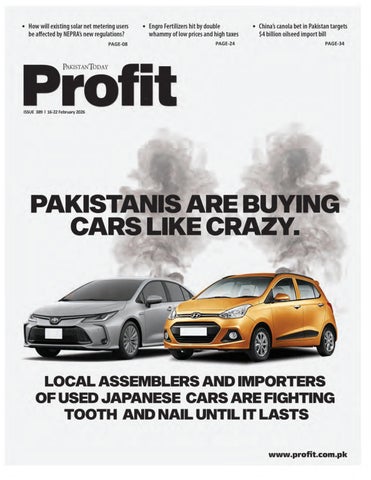
12 Pakistanis are buying cars like crazy. Local assemblers and importers of used Japanese cars are fighting tooth and nail until it lasts
18 After solid 2025, revenues at Mirpurkhas Sugar Mills faces rough start to the year
22 Falling market share, higher taxes hit profits at Bank AL Habib
20 In 2025, Meezan has a banner year… again
24 Engro Fertilizers hit by double whammy of low prices and high taxes
26 As AI eats into regular business, Symmetry acquires US-based marketplace
28 What are the expected savings from solar electricity for Beco Steel?
Publishing Editor: Babar Nizami - Editor Multimedia: Umar Aziz Khan - Senior Editor: Abdullah Niazi
Editorial Consultant: Ahtasam Ahmad - Business Reporters: Taimoor Hassan | Usama Liaqat Shahab Omer | Zain Naeem | Nisma Riaz | Shahnawaz Ali | Ghulam Abbass Ahmad Ahmadani | Aziz Buneri - Sub-Editor: Saddam Hussain - Video Producer: Talha Farooqi Director Marketing: Muddasir Alam - Regional Heads of Marketing: Agha Anwer (Khi) Kamal Rizvi (Lhe) | Malik Israr (Isb) GM Special Projects Zulfiqar Butt - Manager Subscriptions: Irfan Farooq Pakistan’s #1 business magazine - your go-to source for business, economic and financial news.
Contact us: profit@pakistantoday.com.pk
How will existing solar net metering users be affected by NEPRA’s new regulations?
In NEPRA’s new regulations, existing net metering solar producers have been shifted to net billing as well, however the Prime Minister has since taken notice of the matter
By Abdullah Niazi
Here is what has happened in short: the government has decided to abolish net metering for both existing and future solar consumers. New regulations were approved by NEPRA on Tuesday, and it became clear that the system of billing had changed for anyone who was on net-metering, be it new consumers or old ones.
There are 4.66 lakh net metering connections in the country, and most of them are installed in urban areas.
In response to the regulation there has been an uproar, and merely a day after NEPRA made its announcement the federal government seems to be backtracking on the status of those households that have existing net-metering connections.
The Prime Minister has already directed the power division to file an appeal with NEPRA and the Power Minister, Awais Leghari, has assured the senate there will be no change in the status of existing net-metering consumers (despite what the regulation clearly states). The question remains: What will happen now?
The difference be-
tween net-metering and net-billing
If you have solar panels, two things happen. During the daytime your panels produce a certain number of units of electricity and export them to the DISCO, and you offset that by consuming a certain number of units, either at the time or later in the day. If you consume less than you export, you get paid, and if you
consume more, you pay. (For the sake of simplicity and understnding this analysis excludes the additional calculation of on-peak consumption)
Now, if you make excess electricity, that electricity is free for you to store or to export to your DISCO, depending upon the kind of inverter setup you have. For all intents and purposes, the number that matters in net-metering is the units you export to the DISCO. Say you export 1,000 kWh of electricity in a month and consume 900 kWh from the grid.
Under the older net metering, you would receive credits for the 100 kWh that you give back to the grid. This means that your total bill is (-100 x NAPP), where NAPP is the National Average Purchase Price, the price at which the government buys back extra units. If the NAPP is 27, the bill comes out to be -2700. (The negative sign signifies that this bill is a receivable, and the DISCO owes you Rs 2700)
In net billing, this will change. Under the new regime, the total bill of your export will be netted against total import, instead of treating the differential of electricity consumed/ produced. Basically, the DISCO will now bill your entire export at the NAPP and charge you separately against your entire import.
To explain this we take the same example as above. If the electricity purchase rate, the NAPP, is Rs. 27 per kWh, your credit amount would be (-1000 kWh * NAPP), which comes out to be Rs, 27,000. But the bill for your electricity import will be calculated differently, at (900 kWh * Rs 47), which comes out to be Rs 42,300. The amount payable will hence be the net of these bills (hence the term net-billing), which is Rs 15,300. (A three-phased connection’s consumption of over 600 kWh is billed at ~Rs 47, according to current pricing regulations).
However, there is another twist. This calculation above is for existing prosumers, who have already signed a 7 year contract. New connections will get a different NAPP, at approximately Rs 11. Which means that if you are yet to get solar panels installed, then your bill, under the same consumption pattern would not be Rs 15,300, but a whopping Rs 31,300.
Compared to the earlier negative bill, under net-metering, the consumer will now have to pay at least Rs 15,300, for the same pattern of consumption. If the consumer manages to produce an extraordinary amount of units such that the net bill is still negative, they would get PKR credits like before, which can then be used to offset future electricity bills or be paid out based on the agreement, but that is also a fool’s hope.
Because the government’s plan is twopronged, in this regard and that is where sanctioned load comes in. Under the new sanctioned load regulation, a prosumer cannot get a net-metering setup of more than their sanctioned load. Previously, this requirement was at 1.5x a connection’s sanctioned load. Simply, this means that if your sanctioned load was 7 kW, you were allowed to install up to a 10.5 kWh solar setup. But under the new rules, your connection will only be approved if it is under 7kwh. This means that no-one can essentially beat the house (DISCO), in the longer run, until they significantly lower their consumption.
For a rough estimate, a 7kWh connection makes ~840 kW(units) per month on average, according to the commonly accepted annual average yield of 4x per day. A new user would hence, have to consume less than 200 units for the month, to merely break even.
How it affects existing prosumers
The decision has naturally been a cause for concern for those households that have already installed rooftop solar and are on
net-metering connections. Initial reports in the media were mixed over the status of existing net-metering users. Since those people with existing net-metering connections had signed seven year (in some cases five and three) year contracts with their respective power distributing companies like LESCO, PESCO etc, many felt they could not be shifted to net billing because it would go against the contract. However, while the Nepra regulations are dense, they are also very clear.
In section 21 of the regulations, Nepra categorically states that the 2015 regulations under which existing prosumers had signed contracts stand repealed. While this does not render the agreements void, the existing consumers will now be billed according to the new regulations.
This has naturally caused an uproar among existing consumers. They feel cheated out of their contracts. While the 2015 contracts explicitly stated that distribution companies cannot change the terms of these agreements, there was a provision that the terms of their contracts could be changed if Nepra intervened, which is what has happened in this case.
As things stand, all existing net metering connections have been shifted to the new net-billing system. There is still a protection for existing consumers in the new regulations. In section 21, the new regulations make it clear that existing consumers will be charged for electricity at the national average power purchase price until the terms of their contracts are up, which is currently around Rs 27 per unit. After the terms of their contract is up it will be charged at the national average energy power price.
Is the government backtracking?
There are currently 4.66 lakh net meter prosumers in the country. Most of these are centered in urban areas and have installed large solar systems to offset their consumption. Many have achieved zero as well as negative bills through net metering. With the introduction of net billing, the party will have to come to an end.
However, it is worth mentioning that the section of the population that has reaped the benefits of net metering are wealthy and influential as a group. Their complaints are loud and the government is clearly affected by them. The very next day after Nepra’s new regulations, Minister for Power, Awais Leghari, claimed on the floor of the senate that existing users would not be affected — despite what the regulations clearly state.
A little while after this, Prime Minister Shehbaz Sharif has instructed the power division to immediately file an appeal with Nepra to review the new solar regulations in an effort to protect existing contracts for current solar users. As things stand, the net metering of all consumers including old ones has been revoked. It has been replaced by net-billing. But the tone from the PM’s office indicates that these 4.66 lakh households will get what they want. n
PBy Usama Liaqat
akistanis are buying cars like crazy. Recent data released by the Pakistan Automotive Manufacturers Association (PAMA) has revealed that January 2026 recorded the highest automotive sales in the past 43 months. The total number of cars sold in January 2026 was 23,055 units. Of these, 18,602 (around 80 percent) are passenger cars such as sedans, hatchbacks, and EVs. The other 20 percent consist of light commercial vehicles, vans, jeeps, and SUVs.
While these numbers are not historically high, they mark a recovery after a sustained slump that began in 2023 when the rupee crashed and the dollar soared.
And this isn’t even the full picture. PAMA is the largest industry association for automotives in Pakistan, but they do not count KIA Lucky Motors among their ranks, meaning their sales are missing from this data. On top of this, these numbers do not include the sale of imported used cars coming mostly from Japan into Pakistan — and their slice of the pie is probably more than you think. Over the past year Japanese refurbished cars coming to Pakistan have increased exponentially. In fact, import data combined with excise registration numbers reveal that nearly 20% of all auto sales from December 2024 to December 2025 were imported used cars.
This is a monumental shift from where the auto industry was only a few years ago. Between 2020-23, the percentage that used cars occupied in Pakistan’s auto market was around 7.5%. The fact that the sale of locally assembled cars have increased over the past year in tandem with the sale of used Japanese cars indicates a market that has grown and accommodated all kinds of players after a period of stagnation.
The glut makes sense. Interest rates are down to 10.5% and the rupee has risen (ever so slightly) against the dollar every day for the past one hundred days. It is a classic picture of Pakistan leaning on import-led growth and similar to what happened to the auto market between 2022 and 2023. The rupee is propped up, import based consumption leads to a temporary surge in income, and Pakistanis that are raking it in spend the money on cars, weddings, and gold. While an inevitable crash could be around the corner any minute now, for the time being car sales are booming.
Those in the auto industry looking to sell you their wares are well aware of this. That is why there is a race between local assemblers and importers of used Japanese cars to try to make the most of this moment. Auto assemblers are lobbying to have restrictions placed on the import of used cars, and the start of this year proved a successful moment for them — with the government tightening the import process to effectively stop Japanese used cars from coming into Pakistan. But the lobbying to reverse this is
already underway. The clash is not a new one, but it is taking a new shape in what is a unique moment for Pakistan’s automotive industry. But how has it shaped up?
The rise and the interloper
It is important that we understand just how much car sales have increased in the past year. While only the first seven months of the current financial year have passed, the number of cars (including passenger cars, LCVs, vans, and jeeps) is already higher than the total number of cars sold during the whole of FY24.
Just look at last month. January usually records higher numbers because people delay registrations in order for the car to have a more recent date, which affects its value. Yet, if we compare data from the first 7 months of FY25 with the first 7 months of the current fiscal year, it would still register a 43.4% increase, from 77,686 to the current figure of 111,377 units.
According to Mashood Ali Khan, the former Chairman of Pakistan Association of Automotive Parts & Accessories Manufacturers (PAAPAM), who said there are hopes that the total number of cars sold would reach 170,000 to 180,000 units by the end of this fiscal year. This, of course, only has to do with local car assemblers. You see when you’re in the market for a car in Pakistan you essentially have three markets to choose from. The first is to get a brand new car directly from a dealership. The second option is to buy a second-hand car that has already been bought and driven by someone else. Then there is a not-so-secret third option: imported used cars.
Normally, imported cars are a small segment of any country’s car market. Used cars represent almost zero per cent of sales in India, 0.3 percent in Vietnam, and 1.2 percent in Thai-
land — a contrast that experts say highlights Pakistan’s policy inconsistencies. Imports are usually just luxury cars in most countries. But things played out differently in Pakistan.
In the early mid-2000s, the government introduced a policy to facilitate overseas Pakistanis so that they would be able to bring over their vehicles from other countries. In theory, the cars being imported into Pakistan were simply for returning expatriate Pakistanis being allowed to bring their own cars back home. Since these were to be used vehicles and not brand new ones, the duty on them was much lower irrespective of brand and variation. Locally, or when a brand new car is imported, the tax is determined by how high-end the car is. Under this policy, even the fanciest of cars could be imported at the same duty meaning they would be cheaper in Pakistan.
People saw this as a business opportunity. Savvy car buffs earmarked Japan as the country to target because it has the kind of cars that Pakistanis like, and is home to brands like Toyota, Honda, and Suzuki that Pakistani consumers are used to. However, going to Japan every month and buying cars at an auction is difficult, and importing them even more so. Which is
why prospective importers contacted Pakistanis settled in Japan, and asked them to buy and ship the cars on their behalf for which they would pay them a fee. The overseas Pakistanis get a neat easy sum for signing some papers, and importers get next to duty free cars to sell on the Pakistani market.
Dealers set up massive showrooms all over the country with these cars. At the time when they started filtering in, Pakistan’s car market was a very different space compared to today. There were only three brands and their triopoly was so strong they did not bother introducing basic features like airbags even. The Japanese cars were a better quality, better build, and had superior features to locally assembled clunkers. And because of their superior features and Japanese safety standards, the cars compete with new cars. At least that is how the market has developed. There is more than enough room for fraud in this market, with dealers often misrepresenting how old the car is and why it was actually optioned off from Japan with things like accidents and the car getting stuck in a flood often swept under the carpet.
While the popularity of used imported cars has been undoubted, their supply has been inconsistent. When the government caught on to this business, they changed up regulations to reduce the number of cars a single expat could import. Local assemblers, incensed by the loss of business, lobbied strongly against them as well. The details of the back and forth are long, tedious, and have been covered by Profit before.
What matters is that from December 2024 to December 2025, the import of these cars was in full swing. And last year was a bit different in terms of how things played out. It has not been a question of local assemblers and Japanese importers duking it out. It has been instead a story of both finding plenty of buyers.
Car sales in Pakistan December 2024 to December 2025
Total sales
231,247 Total locally assembled cars sold
185,489
Total used imported cars sold
45,758
The interest rate has gone from 22 percent to 10.5 percent. This has made financing cars much easier for the consumers. Although the industry is still away from reaching the benchmark of selling 2 lakh cars per year, if the interest rate falls even more, we can cross that threshold
Mashood Ali Khan, former chairman of PAAPAM
For instance, the share of used car imports in the local auto market consisted only around 7.5 percent between 2020 and 2023. This share rose to around 20 percent by 2025.
Put this in number terms. From December 2024 to December 2025, just over 2.31 lakh unregistered cars were sold all over Pakistan. Of these, around 1.85 lakh were locally assembled cars. The remaining 45,000 cars were all used imported cars. That means on average nearly 4000 used imported cars were sold every single month. To put it very simply, Pakistanis seem to have more money to spend on cars. They are buying more Japanese cars and more locally assembled cars. The options for both have increased, and the response has been robust. The market has grown and gotten close to the heights it was at a few years ago, but the composition of who controls those heights has changed significantly in only a few years.
According to Mashood Ali Khan, the overall market has grown largely because of the slashing down of the interest rate. “The interest rate has gone from 22 percent to 10.5 percent. This has made financing cars much easier for the consumers. Although the industry is still away from reaching the benchmark of selling 2 lakh cars per year, if the interest rate falls even more, we can cross that threshold.”
Of course as we have just seen, it is the local assemblers that have not hit the 2 lakh mark last year. If used imported cars are included, last year’s sales were well over 2 lakhs.
Mashood admits, the stabilising political and economic situation also has a big part to play in how confident the consumers are of investing in the market. The fact that the rupee has stabilised and new players from South Korea and China have been encouraged by the government to enter and participate in the market has also made the consumer more optimistic, and willing to spend on a new car.
Plenty of space for the new kids
And this brings us to the second major cause. The dynamics of the market have been totally revolutionised by the entry of new OEMs. The govern-
ment had a policy to encourage auto producers to set up plants by offering them tax reductions, rebates, and discounts. And, on the fact of it, the policy appears to have done the job – there are now seventeen OEMs, compared to the Japanese Big Three which had dominated the local market for long.
But the fact remains that this massive influx – especially of Chinese OEMs such as BYD – is part of a global phenomenon. These cars because of their lower price point and better features that comparatively priced cars have really blown competition out of the stadium. And Pakistan is no different. Every few weeks a new car is introduced – such as the recent cases of Jaecoo J5, Tank 500, Deepal S05 – that astonishes the consumers into buying cars they had no plans to buy. And the ripples sent by such cars in the market have directly affected the prices of more established players. Even KIA had to slash the price of Sportage by around 14 percent last year to compete with these cheaper and more advanced variants.
Mashood Ali Khan welcomes this competition as bringing in something better for the consumer. According to him, “there will be a price fight between brands and models, so the OEM would have two choices: either to reduce their margins somewhat to make their prices more affordable, or to raise their quality of service to the customer so much that they are willing to pay higher prices for that”.
The fact, however, remains that the prices are still out of reach for many, and even the prices that have come down relatively, are still quite high on the nominal scale. And, if we consider the fact that car financing loans are capped at 30 lakh, it is still a little perplexing how people are rushing in to buy these cars.
This can however be explained, at least partially, by the fact that multiple car companies have been offering Equated Monthly Instalment plans at low (or in some cases, no) markup rates, filling the gap left by the State Bank’s cap of Rs 30 lakh on car financing.
At the same time, there is a real hype about the new cars. Even people who were not looking to buy new cars, enticed by the new features and ‘sale’ levels of prices, have rushed into the market. EVs and hybrid cars are the vogue, and
since multiple companies are competing for the consumer, it has tended to improve features and drive down prices. Given that multiple recently-hyped models are yet to be delivered – and are therefore not counted in the PAMA statistics –we might see a further jump once the deliveries start taking place.
Is the growth for real?
The point about hype and lower prices also raises questions on how sustainable this bump really is. There is a certain point below which the car prices cannot go. Similarly, although EVs do reflect a broader shift of preference, following global trends, the fact remains that the buying power of people generally is eroding, with real wages falling by almost 20 percent in the past 3 years. Though these new cars are also part of the framework supposed to usher in Pakistan’s green revolution in the automotive sector by encouraging the use of hybrid and EVs, it remains the fact that these cars remain beyond the reach of most of the population.
Similarly, the real GDP growth (2.68 percent in FY2025) has been below what regional peers like Bangladesh, Sri Lanka, and Vietnam have been achieving. Unemployment has been rising to levels not seen in decades, and foreign direct investment stats too don’t give sign for great optimism. The macroeconomic outlook doesn’t appear to be giving bright signs of times turning for the better, and the charm of newer models might soon have to contend with a moneyed reality.
The persistent question of policy again rears its head. In the previous two auto industry policies, incentives were given to OEMs in order to encourage new entrants to set up production ecosystems in Pakistan. Yet, as Mashood pointed out, the 2021-2026 policy is about to end soon. According to him, “the two previous auto industry policies allowed OEMs to import not only CKD kits, but also CBUs, and even assembly parts. This has meant that in the past 4-5 years almost no localisation has taken place through the new entrants platform”.
The only way the auto industry will register sustainable and positive growth, as Mashood says, is through increased localisation. Granted the OEMs have ‘brought in’ new technology, the opportunity for SMEs to do the same should also be granted. Mashood highlighted that once large OEMs are incentivised to localise, it would lead to the attachment of local SMEs with large scale manufacturers, and help improve not only the shape of the industry, but also contribute positively to local employment and export numbers. He also stressed upon the role of SMEs in generating economic activity, and highlighted that they employ around 25 million jobs and contribute Pkr 2.8 billion in exports. Helping them grow would, in the end, be better
for everyone.
And, it is not like there is no precedent for this. Since the mid-1980s when the three major Japanese OEMs entered Pakistan, they did invest in local industry, with the result being that some models were able to achieve 65-80 percent localisation. There’s no reason why, provided consistent institutional support, this might not be possible again today.
One way to incentivise localisation, according to Mashood, is to give export incentives to OEMs. “Now that we have so many OEMs, it is time to incentivise them to invest in local capabilities,” he said. This would involve not only creating new employment opportunities, but also the import of the latest global technologies. The result would be beneficial to the OEMs in two ways: first, their vehicles would become more competitive in the local market, and, secondly, it would enable them to compete in regional markets. This will then, ideally, help strengthen our exports, and ultimately lead to economic growth.
But the question of imports might yet complicate this situation. As mentioned before, the proportion of used vehicles in the total number of vehicle units being imported has risen to 25 percent in 2025 from 7.5 percent in 2020-23. The issue with these used car imports is that they are too good and have been able in the past to compete winningly with locally produced cars. Most of these cars originate from Japan, and the mere tag of a ‘Japanese’ car is enough to instill trust in the buyer, not to mention their superior performance and features. To the consumer, in the short run, this appears to be good. They are getting great cars at great prices.
Yet, there is a problem associated with this. In most of its recent history, Pakistan has been turning on the import tap without at the same time enabling local manufacturers to compete with these imported used cars. Though some localisation has taken place, in general with the new OEMs entering the market, the levels remain low. Since the demand for locally produced cars is eaten into by the imports of hifi Japanese cars, the local manufacturers feel it’s a losing game. At the same time, the economies of scale needed to economically produce more domestic cars become even harder to reach. To make locally produced cars of that quality and which inspire the same confidence will take time and investment.
This puts the government in a position where it has to juggle two main interests: first, of the consumer who wants cars, and Japanese imported cars are ever in demand; and secondly, of the local manufacturers who feel that if these imports continue to cut into the local demand, localisation – upon which the future of the automotive industry depends, would not take place.
The usual way of importing cars is through the overseas Pakistani method. Here
overseas Pakistanis are used as a front to import cars, since the government allowed them to import cars through three main schemes: the personal baggage scheme, the gift scheme, and the transfer of residence schemes.
In January 2026, however, the government abolished the personal baggage scheme through an S.R.O. 61(1)/2026, issued by the Ministry of Commerce. This move also tightened conditions on the other two schemes, making it much harder for imports to take place through this method. It would appear, on the surface, that the government is trying to reduce imports, and since then, imports are in fact at a halt. Yet, according to Arghan Tahir, an industry expert, disallowing and discouraging imports through the overseas Pakistanis scheme does not make sense for the government because of its shortterm goals of prioritising tax collection, and therefore, the decision cannot stay for long.
According to Arghan, “what usually happens in the ‘overseas’ way is that the overseas Pakistani makes a payment to, let’s say, Japan, from wherever he is. The car is then shipped to Pakistan, where import duties are required. This sum is again paid by the overseas Pakistani. So, effectively, no money has gone out of Pakistan, but the government is still able to collect taxes and duties off of it. It is too lucrative a way to collect revenue for the government to not do it.”
This underscores an important point. The government needs to find better avenues of taxation that are also sustainable in the long run, and do not actively discourage local industries from taking hold. This would obviously require tax reforms. At the same time, the local automotive industry is at a stage where some form of protectionism is required to incentivise local production, to effectively develop the industry across all functions, and not simply in name only.
It remains to be seen how effectively the government is able to negotiate the interests of the industry – which requires patience, and a long term strategy – and the demands of the local consumers for imported cars – which brings short-term gains yet could harm local industry in the long run if left unchecked.
For now, the market has absorbed all kinds of new players and there is money to be made for everyone. Beyond the traditional “Big Three” there are Korean and now Chinese brands making waves. The acceptability of used cars from Japan is also up. But the sunny disposition of this moment hides a plain truth: assemblers are not moving towards localisation fast enough. While localisation is widely seen as potentially a real leap forward, the fact remains that the current high demand – and inconsistent policy framework – means that it is still a reality more to be desired than achieved. In the long run another crash will come, and when it does, there will be many more players around to rue the day. n
After solid 2025, revenues at Mirpurkhas Sugar Mills faces rough start to the year
The company’s profits and dividends declined substantially in the first quarter of 2026 after a reasonable year in 2025
Mirpurkhas Sugar Mills’ latest numbers are a reminder that, in Pakistan’s sugar business, a “good year” is often best defined as less bad than the last one – and even that can prove fleeting.
For the year ended September 30, 2025 (FY25), the mill booked sales of about Rs12.6 billion, up from roughly Rs12.0 billion the year before, while the loss after tax narrowed sharply to about Rs251m (versus a loss exceeding Rs2.2 billion in FY24). The improvement was large enough to look like a turnaround on a chart – and it helped explain why the company’s own corporate briefing materials portrayed FY25 as a reset
year, even as the bottom line remained in the red.
But the first quarter of the new year landed with a thud. In the quarter ended December 31, 2025 (1QFY26), turnover fell to Rs2.27 billion, down from Rs3.19 billion in the same quarter a year earlier, while the loss after tax widened to Rs173 million from Rs60 million – a deterioration that effectively nearly tripled the quarterly loss.
Shareholders looking for a consolation cheque did not get one. Alongside the results, the board disclosed no cash dividend, no bonus shares, and no right shares for the quarter. That is not shocking – loss-making companies seldom distribute cash – but it matters because it frames the quarter as more than a soft patch: it pushes
any “back-to-dividends” narrative further out.
The broad arc, then, is clear: FY25 looked like stabilisation; 1QFY26 looked like relapse. The more interesting question is why.
The headline revenue decline in 1QFY26 is hard to separate from the two variables that routinely decide the fate of a sugar mill: the price of sugar sold and the price of cane bought.
In briefings around the period, Mirpurkhas’ management pointed to a market where ex-mill sugar prices were hovering around Rs138–140 per kg, even as sugarcane prices moved up from about Rs425 per 40kg to roughly Rs500–550 per 40kg. That is the kind of squeeze that can quietly ruin a quarter: selling prices don’t rise fast enough to keep pace with
raw material costs, and volumes alone rarely rescue margins.erly P&L reflects that compression. Gross profit roughly halved year-on-year, and operating profit shrank to a fraction of last year’s level. Put differently: even before finance costs, the business generated far less cushion to absorb the fixed costs of running an industrial plant.
Two additional factors also hang over the quarter: Even after Pakistan’s interest-rate environment eased substantially from its 2024 peaks, financing costs remain material for leveraged industrials. The State Bank cut the policy rate by 50 basis points to 10.5% in December 2025, but a lower policy rate does not instantly erase a large debt stock or working-capital borrowing tied to inventories.
Mirpurkhas has been building up its paper operations, but management itself notes that the paper division faces intense competition from informal players who avoid sales tax, creating a pricing disadvantage for compliant corporates. In other words, the “non-sugar” leg is growing, but it is not a smooth, high-margin annuity.
None of this suggests disaster on its own. What it does suggest is something more mundane – and more typical in this sector: a weaker quarter can arrive simply because the spread moved against you.
To understand why spreads move abruptly in Pakistan, you have to look beyond
the mill gate. Pakistan entered the 2025/26 season with a weather hangover. A USDA sugar report in December 2025 noted that flood damage across key growing zones –especially in Punjab – forced downward revisions to cane output, and projected cane sugar production of around 6.15m tons for 2025/26. The same report described how disruptions and uncertainty were shaping government choices, including the likelihood of keeping export restrictions in place.
Even the calendar matters. Cane harvesting typically begins in early November in Sindh and then moves northwards, with Punjab and Khyber Pakhtunkhwa following later; the PSMA recommended starting the crushing season on November 1, 2025 to mitigate supply gaps. A quarter ending in December, therefore, sits right at the intersection of start-up dynamics (ramping operations) and market expectations (what traders think the season will yield).
Then there is policy: sugar remains politically sensitive, so markets rarely clear in a neat, textbook way. In mid-2025, for instance, government and industry discussions around administered ex-mill prices made headlines, underscoring how quickly “market pricing” can become “managed pricing” when inflation optics matter.
This is the environment in which Mirpurkhas is trying to plan procurement, set sales strategy, and manage inventory. When management speaks about sugar prices being “range-bound” and about the upward drift in cane prices, it is describing not just supply and demand, but also a policy-and-weather driven market that can change character mid-season.
Mirpurkhas Sugar Mills is not a new-economy story. It was incorporated on May 27, 1964, and its principal business is still, plainly, manufacturing and selling sugar. It operates out of Mirpurkhas in Sindh and sits within the wider ecosystem of Pakistan’s long-established industrial groups.
Over time, however, the company has worked to be more than a one-crop, one-commodity play. Company materials describe an operating footprint that includes paper production alongside sugar, and the firm’s own briefing documents show paper volumes rising in recent years even as sugar volumes have been volatile. The logic is easy to see: a sugar mill with bagasse and fibrous inputs has natural adjacency to packaging, particularly when domestic demand for corrugated packaging rises with retail and FMCG distribution.
That pivot is not free of friction. Mirpurkhas’ management has highlighted how the paper segment competes with informal producers who can undercut compliant firms by avoiding tax, and how the company is exploring paper exports partly to reduce reliance on local credit cycles.
The more ambitious bet is still ahead: an
agro-pulping plant that management expects to commence operations by April/May 2026, with an intention to export surplus pulp if capacity exceeds internal needs. If executed well, that could deepen the non-sugar revenue stream –and, in theory, reduce the company’s sensitivity to sugar price swings.
But sugar cyclicality is stubborn. Even in the company’s FY25 operational data, sugar output and cane crushed were lower than the year before, while paper output increased – an encapsulation of a business trying to rebalance its mix without fully escaping its legacy core.
Zoom out, and Mirpurkhas’ quarter looks less like a company-specific crisis and more like a case study in how Pakistan’s sugar sector works.
Three structural realities matter.
Official policy has oscillated between intervention and “market forces”. The USDA report notes that Pakistan has moved away from announcing support prices and is formally withdrawing from setting sugarcane pricing –yet the government still plays a role in market stabilisation, including through trade policy and emergency measures.
Export permissions, export restrictions, and imports can each flip the domestic balance. The same USDA report noted that higher-than-anticipated exports contributed to market disruption and that the government authorised sugar imports (500,000 tons) to stabilise supplies. When that is the backdrop, a mill’s realised price is never just “the commodity price”; it is “the commodity price plus policy”.
Pakistan’s Competition Commission has repeatedly flagged the sector, including references to coordinated behaviour facilitated by industry bodies and even record penalties in the past. Whatever one thinks of enforcement outcomes, the fact that the regulator keeps returning to the sector speaks to a market where pricing and supply are often viewed through a political and regulatory lens, not purely a commercial one.
For investors, this translates into a sober conclusion: sugar mills can show dramatic yearon-year improvement without becoming “stable businesses”. Mirpurkhas’ FY25-to-1QFY26 swing fits that mould. A single quarter can look ugly simply because cane got pricier, sugar didn’t, and fixed costs did what fixed costs do.
The constructive reading is that the company’s diversification – paper, and potentially pulp – could gradually reduce that volatility. The cautious reading is that diversification itself has execution risk, and sugar remains the cashflow engine whose ups and downs will continue to dominate headline numbers.
Either way, Mirpurkhas has begun FY26 the way Pakistan’s sugar industry often begins: with uncertainty, narrow margins, and a market that can turn on a government notification as easily as it turns on the weather. n
In 2025, Meezan has a banner year… again
The Islamic banking juggernaut has continued to take market share and climb up the rankings of Pakistan’s largest banks
Meezan Bank has a habit of making even its “down” years look like someone else’s boom. The country’s biggest Islamic lender ended 2025 with deposits crossing Rs3.30 trillion – up 28% from Rs2.58 trillion a year earlier – at a time when the broader banking system’s deposit growth was closer to the high-teens.
And yet, the headline profit number went the other way. Profit after tax (PAT) slipped to Rs89.0 billion from Rs101.5 billion in 2024, while earnings per share (EPS) fell to Rs49.54 from Rs56.62. Total income also declined –Rs285.1 billion in 2025 versus Rs315.9 billion in 2024 – underscoring an awkward truth about Pakistani banking: in a falling-rate cycle, even a bank that is hoovering up deposits can find its revenue engine losing torque.
That combination – deposit momentum that screams “market share gains”, alongside profits that suggest a tougher operating climate – sets up the real story of Meezan’s 2025. It was
a year of franchise strength, but also a reminder that banking is, at heart, a repricing business: what you earn on assets moves faster than what you pay on liabilities, until it doesn’t.
In its year-end results announcement, Meezan framed 2025 as another year of “sustainable value” creation, pointing to a return on equity of 34% – still an eye-catching number for a bank of its size. The deposit milestone is the simplest proof point of the bank’s continuing gravitational pull. Deposits rising almost 28% in a single year is not just “growth”; it is growth that typically shows up when customers are switching primary relationships, payroll accounts, trade flows and business collections.
Contrast that with the system backdrop. The State Bank of Pakistan (SBP), in its mid-year review of the banking sector, reported deposits grew 17.7% in the first half of 2025 – strong, but well below Meezan’s full-year pace. Even allowing for the fact that mid-year numbers and full-year numbers do not map perfectly, the direction is hard to miss: Meezan is expanding faster than the market it plays in.
The bank’s balance-sheet deployment remained heavily tilted towards the classic Pakistani playbook – investments first, financings second – but with Meezan’s characteristic scale. It reported gross financings of Rs1.69 trillion and an investment portfolio of Rs2.60 trillion at year-end, with investments up 39% from the prior year. That matters because 2025 was not just any year: it was a year when the return on those investments began to drift down.
On the bottom line, the drift is visible in multiple places at once. Mark-up earned fell to Rs420.5 billion in 2025 from Rs494.3 billion in 2024, while profit after tax declined by roughly 12% year-on-year. Total income dropped by nearly 10%.
And yet, shareholders were not left high and dry on payouts. Meezan’s board maintained a familiar rhythm, approving a final cash dividend of Rs7 per share (70%), bringing the total cash dividend for 2025 to Rs28 per share (280%), following the interim dividend already paid for the first nine months. For investors, it was a message that the bank’s management still views the
earnings softness as cyclical, not structural. The cleanest way to describe Meezan’s 2025 is: the franchise got bigger, but the spread got thinner.
Meezan itself highlighted that net spread (its shorthand for the core margin pool) fell to Rs252.5 billion from Rs287.0 billion in 2024 –about a 12% decline – “primarily reflecting the impact of a lower policy rate environment”. That phrase – lower policy rate environment –did a lot of work in Pakistan in 2025.
SBP’s mid-year performance review noted that the policy rate was reduced by 100 basis points in January 2025 and by another 100 basis points in May 2025, reaching 11% by June 2025. By the end of the year, the easing trend continued: Reuters reported SBP cut the policy rate again in December 2025 to 12% (and that it had already been cut sharply from a peak of 22% earlier in the cycle).
Why does that matter so much for Meezan?
Because Meezan’s size and growth come with a balance-sheet reality: it has to park a large portion of its liabilities somewhere, and in Pakistan the “somewhere” is overwhelmingly government paper. When policy rates fall, the yield on new treasury bills and bonds usually falls quickly. Asset yields reprice down with speed, particularly on the liquid investment book.
Liabilities behave differently. For a bank with a heavy share of current accounts and low-cost savings (and for Islamic banks, profit rates that are competitively managed but often sticky), the cost of deposits can be slow to adjust and is bounded by practical floors. You can only cut the “cost” of a current account so far – because it is already near zero – and you can only compress savings returns so far before customers start shopping.
So, in a falling-rate environment, the bank can grow deposits and still see the margin pool shrink. That is the paradox of 2025: Meezan’s deposit engine likely brought in more lowcost funding, but the asset side of the book repriced down faster than the liability side repriced down, causing net spread compression. Meezan’s own numbers line up with that story: mark-up earned dropped by about 15% year-onyear, and total income declined by about 10%.
There is another, quieter factor in the background: industry-wide liquidity and investment behaviour. SBP’s review of the banking sector noted that deposits were growing strongly while advances contracted in the first half of 2025, pushing down the system’s advances-to-deposit ratio. When credit growth is subdued and deposits are plentiful, banks tend to compete more aggressively on asset pricing for quality borrowers and lean even more heavily into investments – both of which can pressure spreads when rates are falling.
Meezan, however, does not appear to have
paid for growth by weakening its risk posture. The bank reported a non-performing financing (NPF) ratio of 1.8% and a coverage ratio of 146%, alongside a capital adequacy ratio (CAR) of 19.2% – comfortably above the regulatory minimum. In other words: profits fell, but not because the bank went chasing bad assets. The compression looks cyclical – an interest-rate story – rather than a credit-quality story.
If net spread was the headwind, non-funded income was the tailwind.
Meezan reported non-funded income rose 13% to Rs32.6 billion from Rs28.9 billion in 2024, explicitly presenting it as evidence of diversification and resilience. That matters because in Pakistan, fee and commission streams, trading income and foreign exchange income often behave differently from the interest-rate cycle – sometimes providing exactly the kind of ballast banks need when margins narrow.
A useful window into the composition of that “other” income comes from Meezan’s consolidated interim financials for the nine months ended September 30, 2025. In that period, fee and commission income rose to Rs21.84 billion from Rs18.32 billion a year earlier, while foreign exchange income jumped to Rs5.99 billion from just Rs0.61 billion. The numbers are interim rather than full-year, but they help explain what “non-funded income” is likely doing under the bonnet: fees rising with transaction volumes, and FX income responding to flows and market activity.
Meezan’s own operational highlights point in the same direction. The bank said its Roshan Digital Account (RDA) programme had recorded cumulative inflows of USD 3.4 billion since inception, capturing 29% of total industry inflows – positioning it as a major conduit for overseas Pakistanis. RDA is not just a deposit story; it is also a payments, remittances and FX story, and those tend to show up in fee lines and foreign exchange income.
The strategic implication is important, especially as Pakistan’s banking sector becomes more competitive on deposits. It is one thing to win customers by offering a slightly better return; it is another to win them by being the bank that handles their payments, their business collections, their trade documentation, their investment subscriptions, and their cross-border flows. Non-interest income is often the scoreboard for that deeper relationship.
In 2025, Meezan’s non-funded income growth suggests it is doing more than expanding the balance sheet – it is expanding the “surface area” of its customer relationships. And as rates continue to normalise down from the extraordinary highs of recent years, that surface area becomes increasingly valuable.
Meezan’s market-share story did not begin in 2025. It has been decades in the making.
The bank was incorporated in 1997 and
later obtained a scheduled Islamic commercial bank licence in January 2002, formally commencing Islamic commercial banking operations in March 2002. It has long positioned itself as a bellwether for Shariah-compliant finance, describing itself as Pakistan’s first and largest Islamic bank.
The timing has turned out to be fortunate. Islamic banking in Pakistan has been steadily expanding its footprint, and SBP data suggests the segment has been inching up its share of system deposits. In SBP’s mid-year review, Islamic banking institutions’ share of deposits rose to 25.5% by June 2025 (from 24.9% in December 2024). That rising tide lifts multiple boats, but Meezan is not just floating – it is rowing harder than most.
Scale helps, and Meezan now has plenty of it. It reported 1,105 branches across 363 cities and a network of over 1,300 ATMs. It also said its market capitalisation had surpassed USD 3.2 billion, placing it among Pakistan’s most valuable listed companies.
But scale alone does not explain why deposits are growing so quickly. Part of the answer is structural demand: a meaningful share of Pakistani savers prefer Shariah-compliant products, and that preference has broadened beyond a niche audience into mass retail and corporate banking. Another part is execution: branch rollout, digital services, and the unglamorous work of becoming a bank that customers use daily rather than occasionally.
Meezan’s 2025 results suggest it is managing that transition well. The bank combined rapid deposit growth with strong capital buffers and low non-performing financings, while also expanding non-funded income streams – exactly the sort of mix that tends to produce durable market-share gains.
Still, the year also offered a cautionary note. A bank can win market share and still see profits soften when the macro cycle turns. Pakistan’s falling-rate environment in 2025 reduced the value of the industry’s most reliable profit engine – high yields on government securities –at least compared with the recent past. Meezan is not immune to that, regardless of how many deposits it collects.
In that sense, 2025 was a banner year… again – just not in the way the market has come to expect. The bank’s franchise strengthened, its balance sheet swelled, and its fee and FX engines gained traction. But the cycle reminded everyone that in banking, “bigger” does not always mean “more profitable” – not immediately, and not when the interest-rate tide is going out.
For Meezan, the bet looks clear: keep taking relationships, keep widening the revenue base beyond spread income, and ride the secular growth of Islamic banking – while accepting that the next few years may be about building advantage, not merely harvesting it. n
Falling market share, higher taxes hit profits at Bank AL Habib
The bank’s lending rates have come down faster than its deposit rates, causing a compression in net interest margins, but deposits have failed to keep pace with the industry
Bank AL Habib’s 2025 numbers read like a reminder of what Pakistani banking looks like when the interest-rate escalator starts moving down instead of up. The bank closed the calendar year with consolidated profit after tax of Rs32.5 billion, down from Rs41.9 billion a year earlier, as total income slid and operating costs rose. Earnings per share fell to Rs29.19 from Rs37.70.
In isolation, a Rs32 billion profit is not a crisis. It is still a large figure, and the bank remains meaningfully profitable. But in a sector where investors have become accustomed to bumper results – fuelled by high policy rates and the banking system’s heavy tilt towards government securities – any step-down in profitability immediately invites a more granular question: was the decline “macro” (the rate cycle), “micro” (execution), or “policy” (tax)? In Bank AL Habib’s case, it is a bit of all three.
The most telling line is net mark-up/ interest income, which fell 16% year-on-year to Rs131.0 billion, reflecting the squeeze that comes when asset yields reprice faster than funding costs. The bank’s consolidated total income (net interest income plus non-mark-up income) declined 12% to Rs162.9 billion.
Meanwhile, operating expenses rose to Rs95.6 billion from Rs81.6 billion – an increase of about 17% – further compressing the room
between income and profit. A research note by Topline Securities argued the fourth-quarter result landed below expectations largely because of higher-than-expected operating expenses, and pointed to elevated marketing spend (notably around remittances) that pushed the cost-to-income ratio to 67% in 4Q2025.
The bank also trimmed its cash payout. Topline estimates full-year dividend at Rs15.0 per share, down from Rs17.0 in 2024. For a shareholder base that has come to view part of Pakistani banking that reliably shows up –regardless of whether the economy is behaving – that step-down matters.
Start with margins. The State Bank of Pakistan’s mid-year review of the banking sector describes 2025 as a period of “further monetary easing,” noting the policy rate was reduced by 100 basis points in January 2025 and another 100 basis points in May 2025, reaching 11% by June 2025. That easing cycle is the sort of macro shift that quickly flows into banks’ asset yields – especially in Pakistan, where a large portion of earning assets are either floating-rate government paper or loans whose pricing is linked, directly or indirectly, to a benchmark that does not wait around.
For Bank AL Habib, mark-up/interest earned fell sharply year-on-year, while markup/interest expense declined as well but could not keep pace in a way that preserved the
spread. The result: net interest income down 16%. Topline attributes the fourth-quarter weakness specifically to “decline in asset yields,” which is precisely what you would expect once the rate cycle turns.
The bank did get some help from nonmark-up income, which rose to Rs32.0 billion from Rs28.9 billion. Foreign exchange income nearly doubled year-on-year, though it remains a smaller line than fee and commission income. In a bank with a meaningful trade-finance franchise, that makes trade-related flows tend to be more resilient than pure interest spread when borrowers and depositors are both repricing and recalibrating.
But costs did not co-operate. Operating expenses expanded, and the income statement shows total non-mark-up/interest expenses (including operating expenses, workers’ welfare fund and other charges) at Rs97.1 billion. Topline’s read is that the bank’s spending – particularly around customer acquisition and transaction flows such as remittances –helped explain why the quarter disappointed versus expectations. This is not necessarily an irrational trade: marketing and distribution spend can be an investment if it builds durable, low-cost funding and fee-based relationships. The issue is timing. In a year when the spread is already narrowing, “investing for growth” becomes harder to sell because it shows up
immediately in the cost base, while the pay-off arrives later – if it arrives.
Then there is the bank’s deposits its. Bank AL Habib’s consolidated deposits and other accounts were Rs2.598 trillion at end2025, up from Rs2.278 trillion at end-2024 –growth of about 14%.
Fourteen per cent deposit growth is not bad in a vacuum. But it looks less impressive against the system’s pace. SBP’s mid-year review notes that deposits for the banking sector grew 17.7% in the first half of 2025 –an “impressive” pace by the central bank’s description. Using that roughly-17% industry benchmark for the year (as market participants commonly do), Bank AL Habib’s 14% implies a modest loss of deposit market share – the kind of drift that does not trigger alarms, but does matter over time in a business where scale and funding mix are destiny.
This matters for the prompt’s central point: if lending rates come down faster than deposit rates, margins compress. But the reverse problem can also bite. If deposits fail to keep up with peers, a bank must either (a) compete harder on price, (b) rely more on wholesale borrowings, or (c) constrain asset growth. None of these is ideal. Bank AL Habib’s balance sheet shows borrowings fell materially year-on-year, while investments remained very large and advances declined. That pattern suggests a cautious posture: keep liquidity and investment income stable, avoid overpaying for deposits, and accept slower balance-sheet momentum.
There is a broader structural point here. SBP has repeatedly highlighted how Pakistan’s banking system earns a large share of its interest income from government securities, and its 2024 Financial Stability Review notes that interest/markup earnings from investments have risen to about 69% of total interest income. When that is the baseline, a rate-cut cycle is not a gentle headwind – it is a direct hit to the engine that was powering headline profitability.
The deposit market-share point can be overstated, so it is worth keeping it in proportion. A three-to-four percentage point gap between a bank and the system over a single year is not a referendum on franchise strength. Deposit growth is lumpy, and it can be influenced by corporate flows, government-related accounts, and one-off repricing decisions.
Still, the direction is meaningful. In Pakistan, deposit share is not just a bragging right; it is the raw material for (i) loan growth, (ii) fee income via transaction banking, and (iii) resilience when policy rates fall. If a bank’s deposit engine runs cooler than peers precisely as margins are compressing, it reduces management’s room to manoeuvre. You can see the tension in the numbers: total income down
12%, operating expenses up 17%, and profit after tax down 23%.
One plausible reason is that competition for deposits has become more intense – not merely among conventional banks, but also from Islamic banking institutions. SBP notes IBIs continued to edge up their share of deposits to 25.5% by June 2025. As Islamic banks expand, they do not just take new-to-bank customers; they also compete for the same retail and SME deposits conventional banks have historically treated as sticky.
Another factor is that 2025 was a year of “recovery after withdrawal of ADR related tax,” in SBP’s phrasing, which helped deposit mobilisation at the system level. If the system’s deposit growth was aided by policy-driven normalisation, then a bank that still grew deposits at 14% may simply have under-captured that rebound.
If margins were the macro story and deposits the competitive story, taxes were the policy story.
Bank AL Habib paid Rs35.7 billion in tax in 2025 versus Rs44.9 billion in 2024, but that decline reflects lower profit before tax. On an effective basis, the tax burden remained extremely high. Profit before tax was Rs68.2 billion; tax was Rs35.7 billion – an effective rate north of 50%.
That is not a Bank AL Habib quirk. SBP’s Financial Stability Review notes that taxation charges rose to 52.9% of pre-tax profit for the banking sector in CY24, becoming “an important factor” moderating after-tax earnings. In other words, the sector’s effective tax rate has been drifting towards levels that would look aggressive even in jurisdictions that openly treat banks as revenue workhorses.
The headline corporate tax rate has also moved against banks. SBP’s Financial Stability Review explicitly notes that the government “raised the tax rate for banking companies to 44 percent (for tax year 2025) from 39 percent.” That change is tied to Pakistan’s stopstart attempts to use tax policy to push banks away from government securities and towards private-sector lending.
A Financial Times report from late 2024 described how the government backtracked on an advances-to-deposit ratio (ADR) based tax penalty, and instead approved an overall increase in the income tax rate on banks to 44% (with a tapering path thereafter). The mechanism changed, but the message did not: banks are among the easiest places for the state to collect revenue, particularly because they are documented, regulated, and – unlike large parts of the informal economy – cannot simply disappear.
For investors, this creates a recurring dilemma. Banks benefit from high interest rates and government borrowing; then they are taxed because they benefited. As rates fall,
margins compress; but the tax take does not necessarily fall proportionately because the headline rate and supplementary levies remain high. The net effect is that after-tax profitability becomes more volatile than the underlying franchise might justify.
Bank AL Habib’s story is also, in miniature, the story of Pakistan’s private banking revival.
The bank is sponsored by the Dawood Habib Group, whose banking lineage stretches back to the pre-Partition era. On its own account, the group was among the founder members of Habib Bank Limited, and later – after nationalisation and then privatisation – was permitted to set up a new commercial bank. Bank AL Habib was incorporated in October 1991 and commenced operations in 1992.
It has since built a large domestic branch network and an outward-facing posture that includes international touchpoints (such as overseas branches and representative offices). Operationally, the bank has long been associated with relationship banking and a meaningful presence in areas like trade-related flows – an orientation that can be advantageous in a country where import cycles, export receipts, and remittances meaningfully shape liquidity and FX dynamics.
The group structure also reflects a broader ambition to sit across financial services. In its interim disclosures, the bank has referenced subsidiaries including AL Habib Capital Markets, AL Habib Asset Management, and AL Habib Exchange Company. These adjacencies matter because, over time, banks that can combine deposit gathering with fee-generating products – asset management, brokerage, transaction banking – are better placed to weather the next margin squeeze.
Bank AL Habib’s 2025 result is not a “story” because it is shocking. It is a story because it is illustrative.
An easing cycle (policy rate down to 11% by mid-2025) compresses asset yields. A bank’s ability to protect margins depends on funding mix and deposit momentum. Bank AL Habib grew deposits 14%, but that lagged the system’s roughly-17% pace, implying modest market-share slippage. And even after the macro hits land, the state’s tax appetite remains robust – SBP itself has pointed to a 44% banking tax rate for tax year 2025, and to taxation charges consuming an outsized share of pre-tax profit.
Put together, that is how a bank can go from Rs41.9 billion in profit to Rs32.5 billion in a year without any single line item imploding. The challenge for 2026 is equally unglamorous: rebuild deposit momentum, keep operating leverage in check, and hope the policy environment stops treating documented profitability as a sin. n
Engro Fertilizers hit by double whammy of low prices and high taxes
The company’s profits and dividends declined substantially after it faced lower prices from farmers still reeling from the effects of flooding, and the government’s extractive taxation policies
Engro Fertilizers (EFERT) has long been treated by Pakistani equity investors as the sort of stock you buy when you want to sleep at night: a defensive business tied to food security, plus a dividend stream that arrives with near-calendar regularity. In calendar year 2025, that reputation took a knock – not because the company stumbled operationally, but because two pressures hit at once: weaker realised prices and a heavier tax bite.
According to the company’s CY25 result reviews published by Arif Habib Limited (AHL) and Topline Securities, net sales fell 8% yearon-year to Rs237.1 billion, down from Rs256.7 billion in CY24.
The earnings line fell harder. Profit after tax declined 20% to Rs22.6 billion, translating into EPS of Rs16.95, compared with Rs28.3 billion and EPS of Rs21.16 a year earlier.
Then came the part that income-focused shareholders notice most: cash dividends.
Alongside the results, Engro Fertilizers declared a full-year dividend of Rs15 per share, down from Rs21.5 per share last year – a cut of roughly 30%.
Even the quarter, despite being a volume-heavy period, carried a sting. 4QCY25 profit fell 19% year-on-year to Rs8.4 billion (EPS Rs6.26), and the 4Q dividend was Rs4 per share, down from Rs8 per share in 4QCY24.
To put that dividend cut in context, Engro Fertilizers has historically run with a high payout posture. The company’s own published “dividend payout ratio” history shows long stretches where payout hovered around (or even above) 100% – a sign of how committed it has been to distributing cash to shareholders in good years. The AHL note underscores the same point from another angle: it puts the CY24 payout ratio at 102%, versus 89% in CY25, and flags that
the 4Q payout ratio fell to 64%, well below the company’s typical pattern.
So what changed? The short answer is: pricing and taxes balance-sheet caution that often accompanies both.
At first glance, an 8% decline in sales does not sound dramatic for a fertiliser business. But the composition matters. Both AHL and Topline attribute the revenue decline primarily to lower urea price per bag and a sharp slump in DAP dispatches (down 46% year-on-year).
In 4QCY25, Engro Fertilizers recorded net revenue of about Rs101.7 billion, up 20% year-on-year – helped by what AHL calls the company’s highest-ever quarterly urea sales of 1.03 million tonnes (up 46.7% YoY).
That sounds like a bumper quarter. Yet the same research shows that the company had to lean on discounts of roughly Rs400 per bag to move volume.
This is not conjecture confined to analyst spreadsheets showing on the fertiliser market described exactly that dynamic: record December offtake helped by major producers’ discounts, with Engro Fertilizer said to have maintained a discount around Rs400 per bag during December 2025 (later reduced as inventories tightened).
Discounting is the quiet reality of a market that looks “essential” on paper but is brutally sensitive to farm economics in practice. When farmers’ cashflows are squeezed, they delay purchases, trade down, or apply less than recommended – then producers end up financing inventory or pushing stock through the channel with incentives.
Pakistan’s farm sector has had plenty of reasons to be cautious. Commentary on the rural economy through 2024–25 highlighted a sharp erosion in farmers’ purchasing power, driven by falling crop prices alongside rising input costs – precisely the kind of environment in which fertiliser usage becomes a discretionary lever rather than a fixed habit.
Layer on repeated climate shocks and the caution deepens. The country is still dealing with the long tail of flood-related disruption, and subsequent flooding episodes have continued to hit agricultural areas – damaging crops, disrupting planting decisions, and worsening rural balance sheets.
Put simply: urea may be a staple input, but farmers still buy it with cash they may not have – and in 2025, many did not.
The bigger drag appears to have come from phosphate. AHL points to DAP dispatches down 46% YoY as a key factor in CY25 revenue pressure.
That, too, fits the broader market picture. DAP is usually the first fertiliser farmers compromise on when budgets tighten because it is far more expensive per bag than urea. Market reporting in 2025 noted how DAP dynamics were shaped by seasonal demand swings, inventory overhang, international pricing – conditions that can make distributors cautious and farmers reluctant to buy at the “wrong” moment.
Engro’s own quarterly picture, as summarised by Topline, shows that even as 4Q sales surged on higher offtakes, gross margins were below expectations, which the broker attributed mainly to higher discounting. In other words: EFERT managed the volume problem late in the year, but it did so by giving up some price and margin.
The result is a familiar Pakistani corporate tale: when end-customers are financially stressed, listed manufacturers do not necessarily lose sales outright – they often buy demand back through price concessions. That protects volumes and market position, but it depresses topline and squeezes profitability.
If lower realised prices explain much of
the revenue softness, they do not fully explain the profit drop. The more direct hit came from taxation – and, specifically, an additional levy that has become emblematic of the government’s habit of squeezing the formal sector when it needs cash.
Both research notes highlight a one-off “super tax” charge of roughly Rs2 billion booked in 4QCY25, which pushed the effective tax rate (ETR) to 49% for the quarter – well above the prior-year quarter.
Pakistan’s “super tax” has evolved from a targeted measure into a broader, slab-based surcharge on higher-income corporates. Professional tax summaries describe how the super tax regime was reshaped with new slab rates (including rates reaching as high as 10% for the largest income brackets), and later adjusted again via the Finance Act 2025 for certain ranges in subsequent tax years.
For companies like Engro Fertilizers, the point is not merely the percentage. It is the signalling: when the government is short of revenue, it tends to reach for tools that are easiest to administer – meaning the burden lands on the most documented, audited, and compliant businesses first.
This is where the “extractive” description starts to feel less like rhetoric and more like mechanics. The informal economy cannot be charged a super tax if it does not declare income. A large, listed manufacturer that files, audits, and pays – can.
AHL also notes that management appears to be provisioning for other policy-linked liabilities – such as GIDC, “concessional gas”, and super tax – suggesting a more cautious stance on payouts even beyond the immediate quarter’s tax charge.
This matters for dividends because fertiliser businesses often function like cash machines in stable years: high utilisation, predictable demand, and relatively visible working capital patterns. When the tax authority (and related policy regimes) become less predictable, boards tend to hold more cash back – especially when they fear a retrospective bill or an adverse interpretation of a levy.
Topline’s note adds another piece of colour: EFERT’s debt was elevated by December 2025, reflecting capex financing and inventory-related working capital dynamics. In that context, a board that cuts the dividend is not only responding to lower earnings; it is also preserving flexibility in a tax-and-policy environment where surprises have become routine.
So while investors may debate whether EFERT’s dividend reduction is “temporary” or “a reset”, the more accurate interpretation may be: the company is absorbing a policy risk premium – and asking shareholders to share the pain.
Structurally, the company is part of the Engro ecosystem: PSX records describe Engro
Fertilizers Limited as a public company incorporated in Pakistan in 2009 as a wholly owned subsidiary of Engro Corporation Limited, with Dawood Hercules Corporation as the ultimate parent.
Operationally, the company’s roots go back further. Engro’s corporate history traces the commissioning of a major urea plant in Daharki with an annual capacity of 173,000 tonnes, launching what became one of Pakistan’s best-known fertiliser brands.
The modern scale step-change came with the commissioning of the EnVen plant in 2011. Engro’s own press materials describe that facility as having a production capacity of 1.3 million tonnes per annum, taking the company’s total annual urea capacity to 2.3 million tonnes – a reminder that EFERT is not a marginal producer; it is one of the anchors of Pakistan’s urea supply chain.
Over time, Engro Fertilizers has also broadened its commercial footprint beyond a single product category – through marketing of other nutrients, farmer engagement, and logistics. PSX’s company profile summarises its business as manufacturing, purchasing and marketing fertilisers, seeds and pesticides, and providing logistics services.
And then there is the shareholder compact: dividends. Whether one labels it “discipline” or “brand positioning”, EFERT has historically behaved like a high-distribution stock. The company’s own published payout history reflects years of high payout ratios, reinforcing why investors have treated it as a quasi-income instrument within the KSE ecosystem.
That is why CY25 matters. A one-year profit dip is one thing; a dividend cut in a name long associated with consistent cash returns is something else. It forces the market to ask: is this merely a rough patch driven by transient farm economics and a one-off tax, or is it an early sign that the “steady dividend payer” identity is becoming harder to sustain in Pakistan’s current policy environment?
Engro Fertilizers did not have a bad year because it forgot how to make urea. It had a harder year because the environment around it changed: farmers bought reluctantly and demanded price relief, while the state’s tax appetite rose – especially for the kinds of companies that cannot hide.
The double whammy shows up cleanly in the numbers: sales down 8%, profits down 20%, and dividends down from Rs21.5 to Rs15.
If 2026 brings better farm economics and fewer fiscal “surprises”, EFERT can plausibly revert towards its old patterns. But for now, the result is a reminder that in Pakistan, even the most essential businesses can find themselves squeezed – from below by customers with thin wallets, and from above by a state with a thick pen. n
As AI eats into regular business, Symmetry acquires US-based marketplace
The company is attempting to navigate the disruption caused by artificial intelligence in the software services business by owning its point of contact with prospective clients
Symmetry Group Ltd has decided that, if the world is going to shop for digital services differently, it would rather own the shopfront than merely rent shelf space.
In a notice to the Pakistan Stock Exchange dated February 11, 2026, the listed digital technology and experiences company said it has executed a Share Purchase Agreement to acquire LogoDesignGuru.com, Inc. (LDG), describing it as a US-based digital branding and technology company that operates “AI-powered design platforms, digital asset marketplaces, and hybrid design-service models” serving international customers.
The company did not disclose the purchase price or transaction structure, but it did provide a rare datapoint that hints at scale: LDG is expected to generate roughly $0.7 million (about Rs200 million) in revenue during the current year, and is “currently generating a healthy level of profitability”, with Symmetry expecting post-acquisition earnings to improve via cost optimisation, operational efficiencies, and revenue growth initiatives.
That framing matters because Symmetry is not buying a trophy asset; it is buying a pipeline. The company explicitly linked the deal to an earlier, board-approved investment programme “to expand its international footprint and strengthen its platform-led digital capabilities” – a phrasing that reads like a strategic north star for a services firm facing a fast-chang-
ing competitive landscape.
Just two days earlier, Symmetry had told the exchange its board approved an aggregate investment plan of up to Rs1.25 billion, including “the acquisition of a US-based technology firm and a strategic investment in a local AI and data-driven digital company,” alongside spending to scale capacity, strengthen technology infrastructure, and support longer-term engagements. The LDG acquisition appears to be the first shoe to drop from that plan.
For two decades, Pakistan’s software and digital-services companies have sold a familiar promise: competent talent, priced competitively, delivered remotely. That model still works – but generative AI is changing the unit economics and the customer’s expectations on speed, iteration, and what “good enough” looks like.
The shock is not that AI can replace entire firms overnight. It is that AI can unbundle tasks – drafting copy, generating a first design pass, writing boilerplate code, producing multiple variants, testing edge cases – and compress timelines that used to justify a healthy billable-hours cushion. Large language models and generative tools push more work into the “commodity” bucket, and when work becomes commodity-like, buyers start shopping harder on price, turnaround time, and distribution rather than on bespoke craft.
Research outfits have been blunt about the breadth of exposure. The IMF has argued that AI is likely to affect a significant share of
jobs globally (with higher exposure in advanced economies), even if the outcomes vary depending on whether tasks are complemented or substituted. The OECD similarly highlights that many tasks – especially in higher-skill occupations – are susceptible to automation or reshaping as AI capabilities diffuse. And while “AI replaces jobs” is the headline that travels, the more immediate business reality is usually messier: AI changes workflows, shifts bargaining power, and pressures margins for firms selling time-and-materials services.
There is also evidence that AI can lift productivity in knowledge work – meaning clients may decide to do more in-house. A widely cited study by the US-based National Bureau of Economic Research (NBER) study on customer-support work found measurable productivity gains when workers used generative AI, with larger improvements for less experienced staff. Translate that into a procurement manager’s worldview and the conclusion is straightforward: if my internal team gets faster, why outsource as much?
For a services-heavy firm, this is a double bind. AI can help you deliver more with fewer people – but it can also help your customer internalise what you used to sell. That pushes services providers towards either (a) higher-value work that is harder to commoditise, (b) productised offerings where revenue is tied to platforms and subscriptions rather than hours, or (c) owning distribution so you can keep feed-
ing the funnel even as the market gets noisier. Symmetry, at least on paper, is leaning hard into (b) and (c).
Symmetry is an organisation that looks less like a single agency and more like a cluster of digital capabilities. The company traces its roots to an interactive agency launched in 2003, later evolving into a broader group focused on technology, content, and digital commerce. The listed entity was incorporated as a private limited company in 2012 and converted into a public limited company in 2017, with its shares listed on the PSX in 2023.
On the numbers, it is profitable but not enormous – exactly the kind of company that cannot afford to be complacent. In its audited unconsolidated financial statements for the year ended June 30, 2025, Symmetry reported net revenue of Rs526.1 million and profit after tax of Rs158.0 million.
What is more revealing than the income statement, however, is the strategic drift reflected in its presentations: a shift from custom project work towards “IPs (products)” and platforms. In a corporate briefing for annual results 2024, Symmetry described four core business areas – interactive, transformation, commerce, and mobility – and highlighted work on product/IP initiatives including platforms such as Influsense (influencer marketing) and CartSight (retail shoppers’ insights), while also declaring “AI is the way forward” as part of its growth strategy.
That backdrop makes the LDG acquisition feel less like a random overseas punt and more like vertical integration in practice. If Symmetry believes the next phase of competition is not merely “who can deliver the work”, but “who can capture the demand”, then owning a marketplace-style front end becomes strategically valuable. Marketplaces and platforms control discovery: search rankings, paid acquisition, repeat customers, customer data, and the ability to cross-sell adjacent services. They also reduce reliance on third-party intermediaries – global freelancing platforms, referral networks, channel partners – where fees rise and rules change.
Symmetry’s own PSX notice leans into exactly that logic by describing LDG not only as a business, but as a set of operating rails: AI-powered design platforms, digital asset marketplaces, and hybrid design-service models for international customers. In other words, the company is buying a customer-acquisition engine (and, potentially, a trove of behavioural data about what buyers want) at a time when “just being good at delivery” is no longer a moat.
The hard question is whether owning the marketplace solves the problem Symmetry actually faces – or simply moves the goalposts.
AI does not merely squeeze service providers; it changes what customers think they are buying. A small business that used to pay for a
logo might now generate dozens of options in minutes, then ask a junior marketer to pick one. A product manager who once outsourced first drafts of marketing creatives might now run in-house experiments using generative design tools. The friction drops, the willingness to pay drops, and what remains valuable is not “a design” but the higher-order work around brand strategy, consistency across channels, performance measurement, and iteration.
If that is the direction of travel, then buying LDG’s marketplace and platforms could be a smart distribution move – but it will not be sufficient on its own. A marketplace is a funnel; it does not guarantee differentiation. Marketplaces can become race-to-the-bottom arenas if the supply side is undifferentiated and the demand side is price sensitive. They can also become expensive to grow if customer-acquisition costs rise faster than lifetime value – especially in categories crowded with AI-first tools and template-driven offerings.
However, Symmetry’s filing hints at a more defensible path: hybrid design-service models layered on top of platforms, with profitability that can be improved further through optimisation and operational efficiencies. That suggests the company may be aiming for a blended model: AI to generate volume and speed, humans to provide judgement, refinement, and packaging – and a marketplace to sell bundles, subscriptions, or add-ons (brand kits, social templates, landing pages, even broader digital campaigns).
There is also a strategic logic to “owning the front door” even when the underlying work gets easier. When commoditisation hits, distribution often becomes the scarce asset. If Symmetry controls where the customer shows up, it can (at least in theory) manage pricing, segment customers, personalise offerings, and route higher-value clients to deeper services –moving from “sell a logo” to “sell a brand refresh” to “sell ongoing growth creatives and performance marketing.” That is where a services firm can still command meaningful margins.
In that sense, Symmetry may be making a bet that the real disruption is not AI itself, but the shift in how buyers shop. Instead of relying on other people’s marketplaces, it wants its own.
Still, the risk remains: AI makes it easier for customers to do more in-house, and for new competitors to enter. The marketplace can help Symmetry stay close to demand signals, but it cannot stop the market from resetting price expectations. Success will likely depend on whether Symmetry can turn that marketplace into a durable product ecosystem – where repeat usage, subscriptions, and cross-sell revenue create an annuity-like stream rather than a oneoff gig economy treadmill.
Zoom out, and Symmetry’s move sits inside a bigger national story: Pakistan’s tech
exports are real, growing, and still disproportionately services-led. In the Pakistan Economic Survey 2024–25, the government noted that telecommunications, computer, and information services led services exports, with exports rising to $3.14 billion during July–April FY2025, sustaining a large surplus in that category.
At the same time, the state is explicitly trying to help IT firms internationalise in a more structural way. The same survey points to SBP reforms aimed at facilitating outward investment by IT exporters, including a dedicated “Equity Investment Abroad” category and permission for IT companies to acquire equity interests in foreign entities. That policy direction aligns neatly with what Symmetry is doing: buying a US-based platform business to deepen its foreign footprint.
But Pakistan’s export exposure is also concentrated – especially on the demand side. A US government country commercial guide, citing PSEB data, notes that ICT exports to the United States accounted for 54.5% in FY2023, underscoring just how central the US market is for Pakistani tech earnings. Concentration is not inherently bad – until the market dynamics change. Generative AI is a change in market dynamics.
For Pakistan’s services exporters, the vulnerability is straightforward: much of what the country sells is skilled labour delivered remotely. AI’s first-order effects – faster prototyping, auto-generated drafts, code assistance, design variants – directly target the “time spent” component that historically underpinned services billing. Even if demand for digital work continues to grow, clients will expect more output per dollar, and more proof that the vendor brings something beyond what a well-instrumented in-house team can do with modern tools.
This is why Symmetry’s marketplace acquisition is worth watching, even if it is not a seismic corporate event. It signals a modest but telling shift in how at least one Pakistani listed tech firm is thinking: not simply “how do we sell services abroad?”, but “how do we own the channel through which customers buy, and productise what we sell?”
If more Pakistani firms follow that playbook – moving up from labour arbitrage to platforms, distribution, and IP – it could help the industry absorb AI-driven margin pressure. If they do not, the sector risks being squeezed: customers with AI tools bring more work inhouse, while global competition intensifies as new entrants use the same tools to narrow the capability gap.
For now, Symmetry’s message is that it intends to stay in the fight by buying proximity to the customer. In an AI-shaped market, that might be the most rational form of defensive offence: when the work gets easier, make sure the demand still finds you first. n
What are the expected savings from solar electricity for Beco Steel?
The company has been somewhat specific about disclosing how much it expects to save from generating its own solar energy. What is the return profile of this investment?
Beco Steel, a small listed manufacturer of steel and engineering products based in Lahore, has joined the rush towards captive solar power – but with a twist.
In a filing to the Pakistan Stock Exchange (PSX), the company did not just announce a 5-megawatt (MW) solar installation. It also put numbers to the idea: once commissioned, the system is expected to generate about 600,000 kilowatt-hours (kWh) a month and deliver monthly cost savings of roughly Rs16.8 million, or nearly Rs201 million a year. The company expects the installation (and related grid-side steps) to be completed in around four months, and notes it has applied for the requisite sanctioned load with LESCO.
That level of specificity is unusual in Pakistan’s corporate solar disclosures. Many listed firms have made similar announcements over the past two years – often framed as “reducing energy costs” or “improving sustainability” – but without a clear estimate of the rupee savings, the implied unit economics, or the expected payback. Beco’s numbers, by contrast,
invite scrutiny.
They also allow a quick reverse-engineering of what management believes it is offsetting. If 600,000 kWh yields Rs16.8 million in savings, the implied avoided electricity cost is Rs28 per kWh (16.8m ÷ 600k). That lines up with the reality many industrial consumers face once you blend energy charges with the growing thicket of adjustments, surcharges, and fixed components that have become a feature – not a bug –of Pakistan’s power tariff regime.
The projection also hints at plant performance. A 5MW solar system generating 7.2 million kWh a year implies a capacity factor of roughly 16%, which is plausible for an industrial, behind-the-meter installation in Punjab (where dust, heat, and operational constraints can drag output below the best-case solar maps).
So far, so practical. But does it add up as an investment?
Beco has not disclosed the capital cost of the project in its PSX notice. So the right way to estimate it is to lean on the most recent, Pakistan-specific cost benchmarks that regulators and market participants have put in the public domain – particularly NEPRA’s documentation
on solar procurement.
In a NEPRA decision relating to a 15MW solar project (Gharo Newgen) supplying K-Electric, the regulator explicitly flags a proposed project cost of about $0.63 million per MW, noting that solar costs are “at [their] lowest” and questioning whether the figure reflects current market conditions. The same document provides a granular breakdown of EPC components (modules, inverters, civil works, balance of plant, transport) consistent with a modern, utility-style project, including corrosion protection and trackers in a coastal environment.
Separately, NEPRA’s admission notice for the same project earlier cited an EPC cost of roughly $543,000 per MW (with additional allowances taking it modestly higher), again reinforcing that Pakistan’s benchmark for gridscale solar has moved into the “half-a-million dollars per MW” range.
Beco’s installation is not a coastal, utility-fed plant selling power under a negotiated tariff. It is an industrial captive system intended to displace purchased electricity. That matters, because the cost structure can differ.
A reasonable planning range for an
industrial 5MW system is still anchored near NEPRA’s benchmark: $0.50–0.65 million per MW, depending on mounting type, site conditions, and electrical integration.
That implies an all-in capital cost of roughly $2.5–3.25 million for 5MW. On that basis, Beco’s 5MW system likely costs on the order of Rs700 million to Rs910 million.
That is a meaningful cheque for a small listed industrial, but not an outlandish one –especially if staged through EPC milestones and funded internally.
With the cost range in hand, Beco’s own savings estimate becomes more than a nice-tohave. It turns into an investment model. The annual savings (as disclosed) are Rs201 million. And the estimated capex is Rs700–910 million.
A simple payback would be between 3.5 and 4.5 years.
For a piece of infrastructure with a typical operating life of 20–25 years (with gradual degradation), a 3½–4½ year payback is the kind of math that has been pushing Pakistani factories, warehouses, and commercial buildings into solar at pace.
A more realistic picture should account for: panel degradation (often ~0.5% a year in planning cases), operations and maintenance (say 1–2% of capex annually, depending on cleaning frequency and inverter servicing), and one mid-life inverter refresh (industrial systems often budget a replacement around year 10–15).
Under those conservative assumptions, the implied internal rate of return still tends to land in the high teens to mid-20s – roughly 19% to 26% across the Rs700–910m capex range, depending on how hard you haircut savings and how strict you are on O&M.
That is before you factor in a feature that Pakistan’s power market has made unavoidably valuable: optionality. A captive solar system is not merely a cost-saving device; it is a hedge against the next tariff shock. If grid power gets more expensive – which, in recent years, it often has – the savings rise mechanically.
Beco’s estimate is management’s best view, not a guaranteed annuity. Three practical issues can move realised returns:
1. Self-consumption vs export: Under Pakistan’s evolving rules, exported daytime units may be credited far below imported units. If Beco is exporting a material slice of output, the value of those kWh matters a great deal.
2. Operational realities: Steel and engineering plants are dusty environments. Soiling losses and downtime can be real if cleaning regimes are not properly budgeted.
3. Tariff structure risk: If a larger share of industrial bills shifts towards fixed charges, the “per unit” savings from offsetting kWh can be diluted – even if the total bill remains painful.
In other words: the headline payback looks attractive, but execution and policy will determine whether the realised IRR is merely
good – or truly exceptional.
Beco’s move also lands in a moment when Pakistan’s energy policy is trying to catch up with the sheer speed of solar adoption.
The country has witnessed a rapid spread of distributed solar – on homes, mosques, farms, and factories – fuelled by high grid tariffs and a flood of relatively cheap imported panels. The grid has not always enjoyed the transition. When affluent or industrial consumers self-generate, they buy fewer units from distribution companies, but many system costs remain fixed. The result is both financial strain and operational complexity.
One technical symptom is the “duck curve”: demand on the grid falls sharply during sunny hours as solar generation rises, then ramps steeply in the evening when the sun sets and consumption returns. Pakistani power-sector commentary – citing Power Planning and Monitoring Company (PPMC) data presented in NEPRA hearings – argues the country is now seeing this pattern in real time, creating difficult balancing conditions for the system.
Policymakers have responded by revisiting net metering and export compensation.
In March 2025, the government’s Economic Coordination Committee (ECC) approved amendments that revised the buyback rate from the National Average Power Purchase Price framework to Rs10 per unit, with a mechanism for periodic revision (subject to cabinet ratification).
By early 2026, reporting around NEPRA’s updated framework described a shift towards net billing, cutting buyback rates for future prosumers to around Rs10–11 per unit (from the mid-20s), limiting new contracts to shorter tenors, and billing imported units separately at prevailing rates.
Even NEPRA’s own tariff documentation has, at times, highlighted the distortion created by a flat credit rate – such as a universal Rs27/ kWh credit – arguing it can lead to overpayment compared with time-of-use realities. Meanwhile, policy motions have increasingly leaned towards time-differentiated pricing and reforms that change how solar exports are valued.
For an industrial player like Beco, the implication is straightforward: the best economics come from using solar electricity on-site, in real time. Exporting excess power at Rs10–11 while buying shortfall power at much higher industrial tariffs is no longer the easy arbitrage it once appeared to be. Net billing makes solar less of a “sell to the grid” proposition and more of a “shave your daytime bill” proposition – closer to how industrial captive solar works in many countries.
That may actually align with Beco’s needs. Steel and allied manufacturing tend to run substantial daytime loads. If the solar system is sized to match those loads, the policy shift
matters less. If it is oversized relative to daytime consumption, payback stretches.
Beco Steel is not a mega-mill. It is a smaller listed industrial that has been trying to broaden its footing in Pakistan’s cyclical metals economy. In an earlier disclosure in October 2025, the company described itself as operating in ferrous and non-ferrous segments, catering to local and export markets, and maintaining a debt-free position. It also outlined a diversification plan into deformed steel bars, to be achieved through a new steel furnace and continuous casting mill with an annual production capacity of 72,000 tons of rebars – with a 5MW solar power plant planned as part of the expansion.
That matters because energy is often the silent killer – or saviour – of manufacturing margins in Pakistan. In Beco’s own corporate briefing materials, the company flags volatile input prices and energy costs as ongoing challenges even as it points to revenue growth and improved profitability.
The firm’s FY2025 annual report shows a sharp turnaround: sales rising to about Rs7.45 billion and profit after tax at roughly Rs111 million, after a loss in the prior year.
Against that backdrop, Beco’s disclosed solar savings target – Rs201 million a year – is not a rounding error. If achieved and if volumes and pricing hold, the savings could exceed the company’s most recently reported annual net profit, creating meaningful room for either margin expansion, competitive pricing, or reinvestment.
Of course, there is a catch: the October 2025 expansion disclosure suggests Beco’s power needs may rise as it adds capacity and product lines. If the solar output is effectively “spoken for” by new production, the headline savings may manifest less as a windfall and more as an insulation layer – preventing power costs from swallowing the economics of expansion.
Either way, that is often the real logic of captive solar in Pakistan. It is not always about making today’s profit line look prettier. Sometimes it is about making tomorrow’s expansion viable at all. A 5MW solar installation will not reshape Pakistan’s energy system. Nor will it transform Beco Steel into a different kind of company. But Beco’s disclosure is still worth reading closely because it does something Pakistani corporates rarely do in this area: it turns “going solar” into a spreadsheet.
If the company executes well – and if policy changes continue to favour self-consumption over export arbitrage – the numbers suggest a payback measured in a handful of years and returns that most industrial capex committees would envy. The bigger story is not that Beco is installing solar. It is that, in Pakistan’s present power economy, the arithmetic is becoming too persuasive for even small manufacturers to ignore.
Habib Metro lays out Rs700 million investment in non-banking financial services
The bank aims to bolster the capital position of its currency exchange subsidiary and its securities brokerage firm as clients seek diversified financial services
Habib Metropolitan Bank Ltd (HMB) is not buying a shiny new business. It is doing something far more prosaic – and, in Pakistan’s financial system, quietly revealing. In a board meeting held on February 12, 2026, the bank approved a Rs700 million capital injection into two wholly owned subsidiaries: HabibMetro Exchange Services Ltd (HMES), its currency exchange arm, and Habib Metropolitan Financial Services Ltd (HMFS), its securities brokerage.
The split is telling. Rs500 million goes to HMES, lifting its capital from Rs1.0 billion to Rs1.5 billion. The remaining Rs200 million goes to HMFS, taking its authorised and
paid-up capital from Rs300 million to Rs500 million. Both moves remain subject to the usual regulatory clearances.
Read narrowly, this is housekeeping: topping up capital so subsidiaries can operate “smoothly”, as the disclosure language tends to put it. Read more broadly, it is a small window into how banks are trying to keep customers inside their own walled gardens, even as Pakistan’s financial services sector slowly widens beyond plain-vanilla deposits and loans.
That matters because HMB is not a tiny niche player. The bank, incorporated in 1992 and owned by Habib Bank AG Zurich (Switzerland), has grown into a sizeable mid-tier franchise. In its 2025 reporting, the group disclosed total assets of about Rs1.69 trillion and
deposits above Rs1.1 trillion, and it reported profit attributable to equity shareholders of roughly Rs22.7 billion.
So while Rs700 million is hardly transformational on a balance sheet of that scale, the direction of travel is worth noting: HMB is putting fresh money into businesses that sit adjacent to banking – foreign exchange and brokerage – precisely where customer behaviour has been shifting.
HMES is a relatively recent creation. It was incorporated on November 22, 2023, as a limited company under the Companies Act 2017, and it operates foreign currency business under the Foreign Exchange Regulation Act, 1947, with an ambition to expand its footprint across Pakistan. It is also listed by the central
bank among authorised exchange companies – an important signal in a sector that has seen repeated clean-ups.
Its timing was not accidental. In September 2023, the State Bank of Pakistan (SBP) launched “structural reforms” for the exchange companies sector, explicitly calling for leading banks active in foreign exchange to establish wholly owned exchange companies to meet legitimate public demand. In parallel, SBP began consolidating categories of exchange firms and tightening the screws on weaker governance structures – particularly among Category ‘B’ exchange companies and franchise arrangements – by forcing conversion, merger, or closure.
The same reform package also came with a higher bar on capital. SBP raised the minimum paid-up capital requirement for exchange companies from Rs200 million to Rs500 million (free of losses), with deadlines and enforcement baked in. And the tightening did not stop there: subsequent updates and a new consolidated framework (effective from January 1, 2025) have continued to raise compliance expectations across governance, controls, reporting, and enforcement.
In practice, this has made the exchange business less of a free-for-all and more of a capital-and-compliance game – one that banks, with deeper pockets and mature risk systems, are better equipped to play. The SBP’s posture is aimed at giving more space to bank-owned exchange companies, even as independent operators struggle with compliance burdens and licence cancellations.
HMB’s additional Rs500 million into HMES looks less like an adventure and more like insurance – especially given the bank’s long-standing focus on trade and treasury-linked activity.
In its 2024 consolidated reporting, the bank disclosed large off-balance sheet positions tied to trade and foreign exchange – most notably forward foreign exchange contracts and letters of credit running into the hundreds of billions of rupees. Even without over-reading a single disclosure line, the message is straightforward: a bank that does a lot of trade-related business has a structural need to be close to the foreign exchange transaction flow.
That is where a dedicated exchange subsidiary can help. A bank’s authorised dealer branches already handle forex for trade settlement and permitted remittances. But an exchange company subsidiary can operate in the space where retail customers, SMEs, travellers, and remitters intersect with the “open market” culture – precisely the market segment regulators have been trying to pull into more transparent, documented channels.
And if the regulator’s preference is slow-
ly shifting towards fewer, better-capitalised exchange firms – especially bank-sponsored ones – then capital strength becomes a strategic asset rather than a box-ticking exercise.
In other words: for a trade-leaning bank, owning the exchange counter is not about glamour. It is about control of the customer journey – from the documentary credit that brings goods into the country to the last-mile currency conversion that customers still demand.
If HMES is the new kid shaped by fresh SBP reforms, HMFS is a more traditional financial services adjunct – an old-school brokerage sitting next to a commercial bank.
In the group’s 2024 reporting, HMFS is described as a wholly owned subsidiary, incorporated on September 28, 2007, and engaged in equity brokerage services as a corporate member of Pakistan’s stock exchange. The bank’s own public material adds that HMFS has been operating since 2008, building an institutional client base that includes mutual funds, banks, DFIs, pension funds, modarabas, and foreign clients – alongside local individuals and non-resident Pakistanis.
HMFS’s own positioning remains consistent with that: it markets itself as a fully owned HMB subsidiary offering a “comprehensive array” of equity brokerage services. Its website also publishes frequent market research and trading commentary – exactly the kind of content that keeps brokerage clients engaged during dull weeks and euphoric ones.
Brokerages live and die by capital adequacy, risk limits, and the ability to support client activity – whether that is more trading volume, new distribution partnerships, or simply staying comfortably within regulatory buffers as markets swing.
Here, the numbers are clear. HMB’s board has approved increasing HMFS’s authorised and paid-up capital from Rs300 million to Rs500 million. That Rs200 million top-up will not turn HMFS into a giant overnight, but it does three useful things.
Firstly, it creates headroom for growth (more clients, more operational capacity, and more resilience when the market turns nasty). Second, it signals commitment to the brokerage model at a time when banks often flirt with, but do not always nurture, their nonbank subsidiaries.
And finally, it supports cross-selling: a bank with a brokerage can convert depositors into investors, corporate clients into capital-market participants, and overseas Pakistanis into repeat customers across channels.
There is also a softer, behavioural point. Pakistani savers have historically defaulted to deposits, property, and gold. But as inflation, interest rate cycles, and currency volatility reshape household decision-making, “diversi-
fication” stops being a buzzword and becomes a coping strategy. A bank with an in-house broker is better positioned to capture that shift than a bank that only offers a savings account and a smile.
HMFS’ 2024 annual financial statements indicate that it earned about Rs99 million in revenues, which places it as a meaningful, but not dominant, player in a brokerage market that includes far larger institutions and bankbacked competitors.
In a sense, that is the point. This is not HMB trying to rewire the capital markets. It is HMB ensuring its brokerage is sturdy enough to serve customers who want a single group relationship for both banking and market access.
Pakistan’s financial system remains heavily bank-centred. Banks dominate savings mobilisation and credit intermediation, while non-bank finance and capital markets play a secondary role – important, growing, but still not the main act. Even international programme documents that discuss structural reforms tend to treat non-bank segments as areas needing development and better oversight, not as the system’s core.
That backdrop is why HMB’s move should be read with the right level of volume. It is not a thunderclap. Plenty of banks already own or partner with securities brokers, asset managers, and exchange-related entities. And in the currency exchange space, SBP’s reform agenda has explicitly pushed banks towards creating their own exchange companies, while simultaneously raising the compliance-and-capital bar for everyone else.
What HMB’s Rs700 million does suggest, however, is a measured belief that customer demand is becoming more layered. Trade and treasury clients want smoother execution across letters of credit, forwards, and settlement. Retail and SME customers want legitimate, accessible foreign exchange channels in a market where regulators are squeezing weak operators. And affluent individuals and non-resident Pakistanis (NRPs) want brokerage access, research, and a familiar brand they already trust with deposits.
The bank’s response is incremental: strengthen the capital base of the non-bank arms so they can expand carefully, stay compliant, and keep more customer activity inside the group.
If you are looking for a single line that captures the subtext, it is this: in a system where banks still run the show, even “non-banking” investments are often about defending the banking relationship.
HMB’s Rs700 million is not a land grab. It is a bolt tightened on two moving parts – foreign exchange and brokerage – that customers increasingly touch, and regulators increasingly scrutinise. n
Fundraising whiz raising funds for AI-enabled startup that helps startup founders raise funds
By Profit
Fundraising expert Usman Gul has successfully raised funds for Metal, a fundraising startup that will help raise funds for startup founders.
Backed by Y-Combinator and Andreessen Horowitz, Metal seeks to make the fundraising process more efficient and fruitful than it currently is.
“It’s an interesting case,” said tech business analyst Sidra Hakeem, of Slice Research.
“On the one hand, the founder has under his belt a couple of tanked startups, but on the other hand, has had experience raising funds.”
“If he has shown he cannot run a transportation, and then a grocery delivery business, he has also shown he can raise funds,” she said. “His core competency being…raising funds.”
Hakeem was referring to Gul’s successful fundraising for Airflit, a mass-transit, ride-hailing service. He then pivoted that company to grocery delivery, and
raised money for that as well.
“This is analogous to the expression of interest by many telecom industry observers that U-Fone should focus only on making commercials, and not operating a cellular service, as it was very good at one, and not so good at another,” she added.
Industry insiders, however, are cautioning that Gul might pivot to a till-yet unexplored sector of providing fundraising support to startups that seek to provide fundraising support to startups.
China’s canola bet in Pakistan targets $4
billion oilseed import bill
Pakistan imports about 90% of edible oil at a cost of roughly $4 billion a year; a China-backed canola package aims to substitute imports. The possibilities go much farther
Cooking oil is the kind of purchase that feels too ordinary to carry national consequences. It is there in every kitchen, measured in litres and rupees, bought in tins that last a month or a week depending on household size, and argued over in the same way groceries always are: price first, then taste, then whatever people have started calling “healthy” this year.
Yet behind that routine sits a number that refuses to behave like a routine. Pakistan imports about 90% of its edible oil and spends roughly $4 billion a year on it. In a country where dollars are never a neutral input, that bill is not just a food story. It is an annual claim on foreign exchange that shows up in trade data, in policy improvisation, and eventually in the price of everyday meals.
The question is not whether Pakistan wants to be less dependent. It is whether it can be. And in the pitch being made by Chinese companies operating under the broader arc of China–Pakistan economic cooperation, the route to “self-reliance” is not a single breakthrough crop or a one-off subsidy. According to Zhou Xusheng, country director of Wuhan Qingfa Hesheng Agricultural Development Company, which is working in Pakistan on seed and agri-technology projects with local partners including Evyol Group, the answer is seeds, machines, and a supply chain that keeps more value inside the farm gate.
For the Chinese agri company, their first bet is on canola. For years, canola has been the oil that carries two promises at once: it sits higher on the health ladder than the cheapest fats, and it can be grown locally if yields and quality are made reliable. Wuhan Qingfa Hesheng Agricultural Development Company says its first hybrid canola variety was registered locally in 2019 after a long period of joint research, and that the canola effort was later brought under the CPEC umbrella in 2025. Zhou frames the project as an attempt to raise yields and oil content while lowering chemical use, and to turn canola from a seasonal crop into an economic chain.
That chain, as described by the firm, includes two bottlenecks Pakistani farmers know well. One is post-harvest loss: Zhou says losses in canola can run as high as 30–40% when mechanisation is limited, and claims specialised harvesting equipment can reduce that to 5–10%. The second is value capture: the firm says it is introducing small and micro oil-extraction units to let villages process canola locally, so households can sell oil, use high-protein by-products as livestock feed, and add income streams that do not depend on distant mills.
If that reads like a blueprint, it is also meant to be a rebuttal to Pakistan’s deeper agricultural frustration: weak seed research, slow varietal improvement, and crops that remain vulnerable to pests and disease while yields stall. This is why the canola story, in the telling of Chinese firms, is not really only about oil. It is a test case for whether modern seed systems—hybrids, field support, machinery, processing—can be made to work at scale in Pakistan.
And then comes the pivot crop: rice. Zhou points to hybrid rice as one of the earliest areas of cooperation and links it to Pakistan’s export rise, arguing that hybrid adoption has lifted yields materially over time. Chinese buying interest has also become a real market signal for
Pakistani sellers; in October 2025, Platts reported trades and assessed prices for Pakistani white rice and broken rice moving to China, a reminder that demand can steady prices even when global markets are heavy with supply.
But rice also exposes the constraint Pakistan cannot breed its way out of: water. Yield gains and export volumes look clean on a ledger, yet they can pull farmers toward varieties and cropping patterns that intensify groundwater stress—especially where cheap solar makes pumping feel close to costless.
The question is, what will the claims made by Chinese companies working in Pakistan amount to when placed inside Pakistan’s actual constraints?
Import trap
Pakistan’s edible oil problem is often treated like a procurement headache, when it is really a structural import habit with a recurring price tag. Pakistan imports about 90% of its edible oil requirement and spends roughly $4 billion a year on it. That makes cooking oil one of the economy’s most predictable drains on foreign exchange: large enough to matter, persistent enough to shape policy choices, and politically sensitive enough to invite ad-hoc fixes rather than durable planning.
Demand is moving in exactly the direction that makes this dependence harder to manage. A United States Department of Agriculture (Foreign Agricultural Service) projection cited in the canola feature shared for this story puts Pakistan’s total oilseed consumption at 5.68 million tonnes in 2025/26, up 14% from 2024/25, while oilseed imports are projected at 2.65 million tonnes, up 20%. Palm oil still dominates the import basket. Pakistan imported 3.213 million tonnes worth $3.4 billion in FY 2024–25, sourced largely from Indonesia and
Malaysia, and the same feature notes this places Pakistan as the world’s fourth-largest palm oil importer after India, China and the EU. Soybeans form the second pillar, not only because of edible oil but because soybean meal is central to poultry feed; imports reached 321,107 tonnes worth $344 million in FY 2024–25, sourced mainly from the US, according to the same data. This is also the backdrop to a quiet consumer shift. As more households move into higher spending brackets, the oil aisle stops being purely about affordability and starts signaling health, status, and diet. Canola sits neatly inside that shift: it is marketed as a lighter oil, and globally it is associated with low saturated fat. Yet Pakistan still relies on imports to meet canola demand. As Profit has reported earlier, there were $595 million worth of rapeseed/canola oilseeds imported in 2025, sourced almost entirely from Australia. Local production remains limited. A VIS Credit Rating Company report cited in the same feature estimates Pakistan consumed about 4.8 million metric tonnes of edible oil in Trading Year 2024 but produced only 1.1 million domestically. It also describes the composition of domestic oilseed output: cottonseed accounts for about 76% of production, with rapeseed at 19% and sunflower at 3%. Even that picture flatters “self-sufficiency,” because cottonseed is largely produced for fibre and much of it goes into cake for cattle feed. Excluding cotton, the area under oilseed cultivation is only around 3% of Pakistan’s total crop area of 24.1 million hectares.
Against that structural gap, canola has become a diplomatic commodity as much as an agricultural one. A recent joint statement by Pakistan’s Deputy Prime Minister and Foreign Minister Ishaq Dar and Canada’s Foreign Minister Anita Anand announced an agreement to “facilitate the export of Canadian canola to Pakistan,” framed as a measure to improve bilateral ties, according to the feature. The un-
usual elevation—foreign ministers rather than commerce officials—signals the politics behind the commodity. Canada is trying to widen its buyer base for canola after its trade relationship with China tightened; the feature links this to the broader tariff dispute that has pushed Canada to seek “many smaller markets” to absorb supply previously absorbed by China. Pakistan, for its part, is a structurally large and growing market for edible oilseed imports, and canola sits in the space where health preferences and industrial demand overlap.
That is what makes canola the right place to locate the bigger question: whether Pakistan is merely reshuffling import suppliers as global trade wars rearrange flows, or whether it can build a credible pathway to import substitution in an area where it already has a domestic crop base. Canada’s renewed push underscores how attractive Pakistan is as a buyer; the domestic production data underscores how distant self-reliance remains. Between those two realities sits the potential significance of local canola—if it is treated not as a seasonal crop, but as an industrial project built around seed quality, harvest losses, processing capacity, and the incentives that decide what farmers plant.
What are the Chinese offering?
On a canola harvest, the loss is rarely dramatic. It is a quiet, cumulative spill: pods shatter, seed drops, and what looked like a decent crop in the field becomes a thinner pile in the trailer. Zhou Xusheng, country director of Wuhan Qingfa Hesheng Agricultural Development Company, puts that loss at 30–40% in parts of Pakistan where mechanisation is limited, and argues that specialised Chinese harvesting equipment can cut it to 5–10%. That is the kind of claim that matters because it reframes the edible-oil prob-
lem from acres to efficiency: Pakistan does not only need more oilseeds; it needs to stop losing the ones it already grows.
Wuhan Qingfa Hesheng’s pitch in Pakistan is not a single “miracle” seed. It is an industrial package designed to make canola behave less like a marginal winter crop and more like a dependable link in a local edible-oil chain. The company points to a first hybrid canola registration in Pakistan in 2019 after years of joint research, and says the effort was later incorporated into the China–Pakistan Economic Corridor in 2025. The most cited variety in public reporting around this cooperation is HC-021C, presented as a hybrid double-low canola line developed with local partners; Pakistani coverage has linked the work to CERTUS SEEDS and Evyol Group’s wider canola initiative.
The logic is straightforward. If the national import bill is driven by the gap between edible-oil demand and domestic supply, then the quickest route to relief is not necessarily expanding planted area alone; it is raising output per acre and reducing waste between harvest and processing. Hybrid canola is marketed as higher yielding with better oil content, while the mechanisation component targets shattering losses. The processing component is what makes the package feel like a value-chain proposal rather than a farm-input sale: the company says small and micro oil extraction units are being introduced so villages can press canola locally, sell oil, and use high-protein by-products as livestock feed. In the firm’s telling, this creates a household-level model where families can grow and process in the same season, with women operating extraction machines and converting crop residue into income, rather than treating oilseed as a commodity that only becomes value-added once it reaches a mill.
This kind of “seed-to-oil” approach is also a quiet critique of how Pakistan has typically tried to address import dependence: through price signals, short-term import management, and occasional crop campaigns, without building the industrial capability that makes a crop scalable. Canola is being used as a demonstration that productivity is not only agronomy; it is logistics, machinery, varietal testing, extension, and processing capacity moving together.
That gets to the deeper point: Pakistan’s missing agricultural industry is seed science, not slogans. The country’s recurring ceiling is weak seed R&D, slow varietal turnover, and uneven diffusion of improved varieties, which shows up across crops as low yields and persistent vulnerability to pests and disease. When seed systems are weak, every other input becomes less effective: fertilizer cannot compensate for poor genetics, and irrigation cannot fix susceptibility. Conversely, when a new seed system arrives with institutions and incentives attached—registration pathways, private partners, machinery support, offtake models—crop economics change quickly. That is the promise embedded in the canola package being marketed under China–Pakistan cooperation: not merely replacing one imported oil with another, but building a domestic pathway that can actually compete with imports on yield, quality, and reliability.
The skeptical question, though, is the one that decides whether this remains a pilot story or becomes an economic story. If the package scales, does it move the national equation meaningfully—enough acreage, enough extraction capacity, enough loss reduction to dent a multi-billion import bill? And if it does not scale, the reason will likely be familiar: fragmentation of extension services, financing
constraints for machinery and micro-processing, inconsistent quality control, and the policy volatility that can disrupt markets overnight.
The same seed question will soon spill beyond canola. If Pakistan can build a functioning modern seed system here, it becomes a template for other crops that urgently need varietal renewal. But the next pivot in this story—rice—also shows why seed science is not a free lunch: raising yields can raise exports, yet it can also intensify pressure on constrained inputs, especially water.
The hidden equation
The same seed question that hangs over canola becomes sharper the moment it touches rice, because rice is where Pakistan’s agricultural upside and its resource constraint collide most visibly. Export volumes have been climbing fast enough to reshuffle the global pecking order. In December 2025, Pakistan shipped 4.89 lakh tonnes of rice compared with Vietnam’s 3.87 lakh tonnes, pushing Pakistan into third place globally behind Thailand and India. The shift has not been led by a revival of Basmati. It has been carried by higher-yield, non-Basmati varieties and a widening set of destinations.
That new geography is visible in the monthly destination mix. In one recent month, the UAE imported 74,897 tonnes of Pakistani rice, China took 74,685 tonnes, and African markets remained important volume buyers. Central Asia has emerged as a real lane: Kazakhstan took more than 17,000 tonnes and Uzbekistan 10,382 tonnes, while the EU and UK combined imported 21,100 tonnes. The composition matters because it explains the incentives on farms. Non-Basmati varieties travel easily into low-value and mid-value markets,
and acreage responds quickly when the offtake looks predictable.
China is becoming the cleanest example of how demand anchors trade when global prices are under pressure. In October 2025, Pakistani sellers told Platts that Chinese buyers were bidding actively for white rice and broken rice, with reported trades including about 20,000 metric tons of 100% broken white rice at $305 per metric ton FOB and 5% broken at $345–$350 per metric ton FOB. Platts assessed Pakistani 5% white rice at $347 per metric ton FOB on October 10, up $3 from the prior week, and assessed 100% broken at $305, up $1. In a soft global market, that kind of buying interest does more than move price by a few dollars; it signals to exporters that there is a stabilising floor.
The customs picture supports that direction of travel. In the first half of 2025, China’s import data showed Pakistan’s semi/wholly milled rice shipments rising to $29.53 million with volumes at 66,960,601 kilograms, versus $5.23 million in the same period a year earlier. Total rice exports to China in that period, including premium and broken categories, were put at about $35.93 million, compared with $19.53 million in the first half of 2024—an increase of roughly 84%. Broken rice categories were part of the story too, with Irri-6 alone crossing $4.52 million in export value, alongside other broken-rice grades.
This is the export story on paper: higher rank, wider markets, and a large buyer whose pull can steady prices. The crop-side story looks equally strong. Rice cultivation area has been described as up 20% versus last year. Expected production has been put at around 1.1 crore metric tons, while domestic consumption is estimated at 20–25 lakh metric tonnes, leaving an exportable surplus of around 80 lakh metric tons. That surplus looks like a macro gift in a country that is always searching for additional dollar inflows.
But rice comes with a hidden input ledger, and it is one Pakistan cannot trade its way out of: water. The uncomfortable truth about the current surge is that it is increasingly tied to cheap groundwater extraction. Solar has changed the economics of tubewells, and tubewells change what gets planted. When pumping becomes close to costless during daylight hours, acreage can expand into places that were never traditional rice belts, and yield-maximising varieties start winning against water-saving logic.
The scale of that shift is no longer marginal. One estimate cited for 2025 suggested around 400,000 tubewells that once relied on grid electricity had switched to solar, while farmers likely added another 250,000 tubewells since 2023—implying roughly 650,000 sun-powered units across Pakistan. Another
estimate linked to that same shift described a 45% collapse in grid electricity consumption by the agriculture sector over three years as solar replaced diesel and grid power. In other words, a crop expansion that looks like export dynamism can also be an energy transition story— and a groundwater story—running in parallel.
The mechanism is simple. When the cost of pumping collapses and regulation is weak, groundwater becomes the unpriced subsidy behind export tonnage. The water table pays, but it pays slowly enough to be ignored until it cannot be. That is why the line often used by farmer leaders—when you export rice, you export water—lands as more than rhetoric. It describes the gap between private incentives and national constraints.
Placed beside canola, rice becomes the mirror image of agricultural modernisation. Canola hybrids, as described by Wuhan Qingfa Hesheng and its Pakistani partners, are pitched as import substitution: higher yields, lower post-harvest loss, and local processing that could, in theory, displace part of a $4 billion edible oil bill. Rice hybrids and newer non-Basmati varieties are pitched as export growth: higher yields that can turn into higher volumes and new markets, especially when demand from China shows up. Both are productivity gains, but they pull on different national constraints— dollars on one side, water on the other.
That contrast matters because cotton is next, and cotton will not allow the country to avoid this trade-off for long. Cotton remains the backbone crop for Pakistan’s most important industrial chain—the textile economy—and it has been losing ground in farmer preference where competing crops appear easier, quicker, or better supported by market signals. If Pakistan is serious about a seed revolution, cotton will demand it, because yields, pest pressures, and varietal turnover are not issues that can be solved with speeches. The canola package is being offered as a proof of concept for how a seed-and-machinery partnership can work when it is treated as a value chain rather than a bag of seed. The GMO scare that disrupted oilseed imports is the warning label for how quickly policy uncertainty can turn input markets brittle.
The choice is not whether Pakistan modernises agriculture. It is where it places modernisation first, and whether it builds institutions strong enough to keep the rules stable while the technology scales.
What “success” would mean
If the canola pitch is an attempt to shrink an import bill and the rice boom is an attempt to expand export earnings, then “success” cannot be measured only in
higher yields. It has to be measured in whether Pakistan is easing the constraints that actually bind it: foreign exchange pressure, water stress, and the competitiveness of the farm-to-industry corridors that matter most. That starts with a seed-and-standards track that is boring but decisive. Hybrid seeds and better machinery can raise output, but only if the ecosystem keeps quality consistent—credible testing, reliable certification, enforcement against low-quality seed, and extension that actually reaches farms beyond a few pilots. Without that, the market gets flooded with noise, farmers lose trust, and yield gains remain patchy. With it, seed science becomes a repeatable industrial capability rather than a one-off foreign partnership.
The second track has to treat water and power as one system, not two. Solar tubewells are not inherently a threat; they are a productivity tool that becomes dangerous when pumping is unpriced and unmanaged. Rice demonstrates the risk in real time: export momentum can be built on groundwater depletion without looking like it on a balance sheet. A serious framework would make water constraints visible in incentives—through governance that acknowledges pumping scale, monitors depletion, and prevents crop expansion from becoming a race to the bottom of the aquifer.
The third track is trade-and-industry, and it is where Pakistan decides whether it wants to keep playing only in volume or move up in value. For edible oil, that means whether local canola becomes a scaled processing story—seed plus harvesting loss reduction plus crushing capacity that stays close to farms—rather than remaining a small patchwork beside a massive import pipeline. For rice, it means deciding whether export growth continues to be built largely on non-Basmati volume into low-value markets, or whether Pakistan invests in the work that turns Basmati into a premium product—definition, categorisation, seed development, and branding—so earnings rise without requiring ever-expanding water use.
None of this requires choosing between China and Canada, or between imports and domestic production, as if policy were a loyalty test. It requires choosing which constraints Pakistan wants to solve first and building rules stable enough that farmers, processors, and investors can respond rationally. Pakistan cannot keep paying for edible oil with scarce dollars while also chasing export volume that quietly burns through groundwater. If hybrid seeds are the headline, institutions are the story underneath—and the difference between pilots that impress and systems that endure. n