CONTENTS 12
9
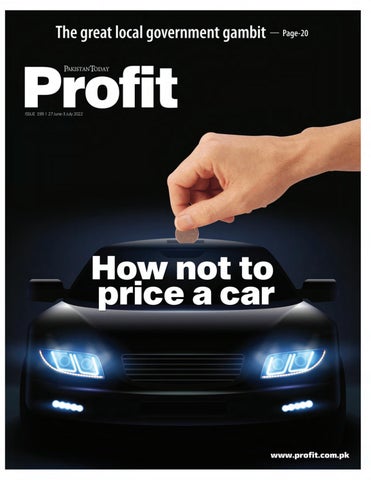
12 How not to price a car: the case of Kia's Sorento 18 Slow rockets and fast feathers: Why exports fall fast but increase slowly after exchange rate changes Gonzalo Varela 20 The great local government gambit
14 24 Failing to communicating Uzair Younus
20
25 A Freu-Darian slip of the tongue? Abdullah Niazi 27 Paper cut Ammar H Khan
28 28 MCLEOD MAYHEM; FX and PSX woes
30
29 How banks make money by holding onto your international payments 30 The gas conundrum 33 Is the ‘Super-Tax’ the need of the hour or an easy way out?
Editorial Sit down, Mr Dar! For a number of weeks now former finance minister Ishaq Dar has been providing unsolicited input into the economic decision making of the country, but lately he has ramped this up to now dropping broad hints that he is preparing to return to the country and take up the position of finance minister from Miftah Ismail. He is running his campaign aggressively with the aid of his circle of admirers, mostly UK-based YouTubers who produce short clips and commentary with suggestions – and sometimes outright claims – that he is about to return and take up the role of finance minister. Mr Dar then forwards these clips to journalists around the country via WhatsApp, and if any of the recipients produce a story of a clip or an article based on these claims, he forwards these as well to his recipient list. As a result he has succeeded in building a small campaign around this mission of his, to the point where some TV anchors with a large following have also taken to repeating this news of his imminent return to the ministerial position as a “fact”. And Mr Dar has been only too happy to further retweet these on himself, sometimes in a show of theatrical humility, as if the tweet carrying the news is actually an invitation.
Mr Dar needs to sit down. Senior members of his party have denied that any such thing is in the works, with one even going so far as to say he has not even heard the matter being discussed among the party leadership, let alone it being under consideration. At the same time, there has been an admission on the part of interior minister Rana Sanaullah that Dar is ‘guiding’ the party on the economy. This little piece of undermining might have caused Miftah Ismail to be a bit miffed, but even this was a passing comment. If Mr Dar covets a role in the current set up, it is better to express this wish in internal party deliberations rather than by stoking public speculation. The aggressive campaign of his “imminent return” does not help his party’s government when it is navigating the country through very trying circumstances. Economic stability is slowly returning to the country after a hard fought series of very difficult decisions, and the fund program is on the cusp of revival. There could not be a worse time to be injecting further uncertainty into the country’s politics than this. Making such a public display of his wish to return to power makes for a juvenile spectacle. We can all do without it.
Profit Publishing Editor: Babar Nizami - Editor: Khurram Husain - Joint Editor: Yousaf Nizami Assistant Editors: Abdullah Niazi I Sabina Qazi - Sub-Editors: Mariam Zermina | Basit Munawar Editor Multimedia: Umar Aziz - Video Editors: Talha Farooqi I Fawad Shakeel Reporters: Ariba Shahid I Taimoor Hassan l Shahab Omer l Ghulam Abbass l Ahmad Ahmadani Shehzad Paracha l Aziz Buneri | Maliha Abidi | Daniyal Ahmad | Ahtasam Ahmad | Asad Kamran Chief of Staff: Maliha Abidi Regional Heads of Marketing: Mudassir Alam (Khi) | Zufiqar Butt (Lhe) | Malik Israr (Isb) Business, Economic & Financial news by ‘Pakistan Today’ Contact: profit@pakistantoday.com.pk
7
IN BRIEF
Prime Minister Shehbaz Sharif on Friday announced that the government will be imposing a 10 per cent “super tax” on largescale industries in a bid to shore up revenues for supporting the country’s poor amid rising inflation.
“There is nothing wrong with taxing the affluent because they are able to pay. In Pakistan, it is the poor who have always suffered the burden of taxes,” Finance minister Miftah Ismail The prime minister’s announcement of imposing a 10 percent Super Tax on the country’s major industry has opanicked the manufacturers, who have announced that they have no option left other than to resist the plan by all means.
Pakistan has signed a $2.3 billion (RMB 15 billion) loan facility agreement with a Chinese consortium of banks. Later, finance minister Miftah Ismail announced that the inflows had arrived in the SBP’s account.
8
Pakistan has decided not to accept the single bid for LNG cargo it received for delivery in July at a record $39.8 per million British thermal unit (mmBtu) for being too expensive and unaffordable amid rising electricity prices and shortages.
Board dram boils up at TRG Pakistan
F
ollowing the hotly contested board election, things had been quiet at TRG Pakistan until recently. In a material information notice to the PSX, the company secretary informed the PSX and shareholders that one of the ten directors of the company, Asad Nasir filed a complaint with the SECP against other current and former directors. As per the notice to the PSX, the complaint is primarily about matters voted on in December 2021, prior to the new board taking charge. In the notice, the company secretary Rahat Lateef further states that when the vote was taken in December 2021, Nasir was the only dissenting director. “The company strongly believes the complaint to be entirely without merit and is in the process of responding to the complaint. The company is further of the position that the contents of the online article are inaccurate and misleading, and cautions investors not to readily rely on unsubstantiated articles and rumors,” read the notice. On June 18, 2022; an online publication titled World News Observer published an article, “SECP investigating into matter of TRG Pakistan Limited.” As per Profit research, there has only been a letter of dissent written to Aamir Khan, Chairman SECP by Asad Nasir, a director appointed by JS Group onto the TRG Board. The letter was sent on May 18, 2022. Rules of procedure now allow the TRG management to respond. They, however, have asked for an extension. Following the management’s response, the SECP can decide whether or not to investigate the matter further.
In December, TRG announced that it would receive $120 million and approximately 5.4 million shares in Ibex Limited, a listed entity on NASDAQ. This is TRG Pakistan’s share of TRG International’s liquid assets. This, however, was decided to be parked in a Special Purpose Vehicle titled Greentree Holdings Limited (GHL) established in Bermuda. Shuja Keen has been appointed the CEO Of the SPV. Keen is also the managing director at TRG. The SPV is not governed by the laws of Pakistan, instead it is by the laws of Bermuda. The decision to use the funds in the SPV for a share repurchase was taken before the new board stepped in. The complaint letter to the SECP is around the legality of the purchase of shares on the PSX keeping in mind that some board members are on the board of TRG Pakistan and the SPVs parent company, TRG International at the same time. It is important to note that all purchases made by GHL are duly notified to the PSX. A market source explains that it seems like the volumes are purposely kept small so that there is no jolt in the share price and that there is no manipulation. This, however does make sense considering the share price of TRG has remained roughly range bound for the past few months following a slump owing to the Chishti scandal. Following a scandal, on November 29, 2021, Zia Chishti, the founder of TRG resigned as CEO and director of TRG Pakistan. This is after Tatiana Spottiswoode, a 23 year old former employee of Afiniti came out with detailed allegations against Chishti in a sworn testimony before Congress given a fortnight earlier.
Following this, an extraordinary general meeting (EOGM) was held in January 2022 to elect a new board. Khaldoon Bin Latif, Farrukh Imdad, Hasnain Aslam, Waleed Tariq Saigol, John Leone, Patrick Mc Ginnis, Zafar Iqbal Sobani, Abid Hussain, Asad Nasir, and Suleman Lalani were elected for a term of three years commencing January 14, 2022. Asad Nasir, the complainant, and Suleman Lalani are from JS appointed board members. On company record, Abid Hussain is treated as the nominee director by JS as his appointment was achieved primarily through votes cast in favor by JS group. There are two directors from Pinebridge Investments, an foreign investor. The rest are independent investors from Faysal Funds, Maple Capital, and Hamdard respectively. Hasnain Aslam was re-elected as CEO. The issue, however, remained the same regardless of the change in board. Like any company, TRG’s board comprises differing individuals and institutions. They do not always have to be on the same page. Disagreements on boards exist from time to time. It is, however, important how they are dealt with. When these disagreements impact the way decisions are made and how investors see the company, things get serious, especially for a company like TRG Pakistan that has one of the highest free floats on the PSX. The stock is owned by a number of retail investors, not just institutions and high net worth. Considering the fact that TRG is a widely watched script makes this newsworthy, especially considering the complex structure of TRG.
12
A story of corporate greed, brashness and the upside down dynamics at play in Pakistan’s car industry
AUTOMOBILES
I
By Daniyal Ahmad
n February 2021, the KIA Sorento had some big shoes to fill. The seven-seater SUV was following on stage the KIA Sportage, which in the two years since its launch in 2021 had put KIA on the map in Pakistan and solidly placed them as a significant player in the country’s automobile industry. All indications pointed towards the Sorento being a great success too. By the time it was launched, KIA already had brand equity because of the Sportage, and on top of that the Sorento beat other cars in its category like the Toyota Fortuner in terms of price - Rs 1.1 million on average in fact. Today, the KIA Sorento is languishing in KIA’s showrooms. You see very few of them on the road, and it is not even part of drawing room discussions. In fact, in Pakistan the sign of a vehicle selling well is high ‘on-money’ and unavailability. The KIA Sorento is actually selling at large discounts up to Rs 100,000, that KIA dealers are giving customers to get the car off their hands. So what exactly happened with the Sorento? To a large extent, the Sorento is definitely a victim of how the market is structured in Pakistan and the peculiarities of customer demands, preferences, and priorities in the country. It is also a victim of investor greed. To another extent, it is also a major miscalculation on the part of Lucky Motors - and perhaps just a bit of greed and brashness. They believed that they could easily replicate the success of the Sportage with an older version of the Sorento with an above-standard profit margin. All of this has contributed to the Sorento never managing to take flight. A lot has happened since the launch in February 2021, and a lot more is yet to go down. But our story begins with the Sportage, and how KIA struck gold in its pricing of the KIA, which has served it so well.
“We have had a favourable response at this price and the Sorento is now doing well. I see more of them on the road everyday.” Muhammad Faisal, President of the Automotive Division at Lucky Motors Corporation
14
The beginnings - Sportage meet Sorento
H
ere’s a bold statement for you the KIA Sportage changed the history of cars in Pakistan. In 2019, KIA was trying to break into the Pakistani market for the third time, this time in association with the Lucky Group. While it is hard to remember given the huge strides the car market has made in the past three or four years, at this point Pakistan was still very firmly under the thumb of the ‘Big Three’ triopoly of Honda, Suzuki, and Toyota. KIA, and all other new entrants, had the challenge of breaking into this triopoly. In Pakistan, the car market lives in a strange conundrum. Automobiles are almost entirely imported products in Pakistan, in one form or another. Thus, their prices are closely tied to the US dollar. This characteristic in particular allows them to act as a hedge against inflation. If you keep your car in good condition, don’t have it repainted, and sell it a few years after you buy it, you will most likely get the rupee value of what you bought it for back or even a little more than that. This means cars in Pakistan are an asset class, and since Honda, Toyota, and Suzuki are considered to have ‘good resale value’ - most consumers do not want to buy outside of these three. So what did KIA do?They made an offer that Pakistani consumers could not refuse KIA came in on a model that was completely different from the Big Three. Up until this point, Toyota, Suzuki, and Honda had been operating on a just-in-time model (JIT) for assembling automobiles. This is to say they first absorbed orders to ascertain demand and then assembled automobiles to satiate it accordingly. This is why the industry is characterised with artificial shortages, and subsequently, long wait times. Lucky Motors flipped the model upside down by ordering CKDs en-masse and then trying to sell them.
Suddenly there was a car in the market that was readily available. Not only that, but it was a crossover SUV in the same price range as sedans like the Honda Civic and the Toyota Corolla. Secondly, and most importantly, they single-handedly created a resale market by changing the way automobile manufacturers delivered vehicles. These factors acted in unison led to customers flocking to the Sportage to both satiate their Chaudhry Sb urges but also because they were unlikely to ever get any other automobile in time. Suddenly, there was a new option available in the market, and it offered a larger car in a different category in the same price range. The rest is history. KIA started selling more than a thousand Sportages a month, and while the Big Three resisted, KIA not only became entrenched as a ‘resellable’ brand but also helped pave inroads for other manufacturers like Hyundai, Changan, and MG. Read more: Can KIA be King, or do the Big 3 have another trick up their sleeve? This is where the Sorento comes in. Between 2019 and 2021 KIA sold a lot of Sportages, and we mean a lot. Their hatchback, the Picanto, did good business too. In 2021, perhaps galvanised by their success, KIA Lucky Motors decided to launch the KIA Sorento. This was going to do to the high-end SUV segment what the KIA Sportage did to sedans like the Civic and Corolla.
The Sorento equation
T
his is the market the Sorento came into. After the massive success of the Sportage, KIA announced pretty quickly that they would be launching this car. Another peculiarity of the car market in Pakistan is that initial buyers are investors and not end-consumers. These are dealers that buy cars before they are even launched. Often, when investors expect the car to sell a lot, they agree to buy them without knowing either the price or the generation of car being imported. KIA chose to use their winning strategy with the Sportage on the Sorento as well - importing CKD models en masse. And it worked with investors. The initial price of a top-variant KIA Sorento was around Rs 8.4 million. The Sorento, unlike the Sportage, was a larger car and its top-variant came with a 3500cc engine and a 7 seat configuration, which meant its main competitor was the Toyota Fortuner. Compared to the Fortuner the Sorento at this point was around Rs 1.1 million cheaper and came fully loaded with a host of features that Fortuner lacked. On paper, it was a good car and KIA Lucky Motors were confident that they would be able to sell it the same way they sold the
A Google Trends search showing the popularity of the KIA Sorento alongside the Toyota Fortuner and the KIA Sportage Sportage. And the initial response especially during the pre launch period was favourable. Muhammad Ali Tabba, Chairman Lucky Motors, even took to Twitter to thank people for the response. This is where our problems with the Sorento start. The Sorento was plagued with problems from the onset. Lucky Motors opened pre-bookings for the KIA Sorento to test the waters and gauge demand, and investors piled into it like wedding guests onto a buffet because they thought Lucky Motors was about to lay another egg. Now investors making pre-bookings for automobiles in Pakistan is a perfectly normal matter. They do so in an attempt to create artificial shortages and then resell automobiles on on-money. This was also the likely fate of the KIA Sorento, until it wasn’t. The problem was that like the parents of a couple bound for an arranged marriage, Lucky Motors did not disclose the price nor introduce the investors to which generation of the KIA Sorento they were launching. Investors, however, completely trusted Lucky Motors. They had launched the latest Sportage at a good price point, and they’d do the same with Sorento is what they thought. Any doubts Lucky Motors may have had
about the KIA Sorento were never brought up due to the pre-bookings. And in February 2021, Lucky Motors unveiled the KIA Sorento at their Power Play event. They proceeded to launch the Sorento in a matter of days afterwards. Let’s just say Lucky Motors went from the Muh Dikhai to marriage counselling immediately. The KIA Sorento’s interest peaked around its launch and has subsided in the months to follow. According to a sales manager at one of the KIA dealerships, the explanation for this is that Lucky Motors did not advertise the Sorento as much as they should have, relying instead on word-of-mouth and the brand equity they had gained through the Sportage. Profit ran a simple Google Trends search to see the popularity of the Sorento next to its younger brother and the Toyota Fortuner. The results were not pretty. It became clear very quickly that the car had not made the kind of splash KIA was expecting. Once the excitement of the early days passed, not a lot of people were coming in to buy, let alone have a look at, the Sorento. There was always going to be lesser demand than the Sportage since there are fewer customers for more expensive cars like the Sorento, but even by those standard buyers
just weren’t coming in. The days passed into months and the investors started becoming jittery about the car. They started selling it on a discount, up until the point that Lucky Motors themselves slashed the car’s price by around Rs 700,000. This, of course, was a cardinal sin in Pakistan’s car market. For a market that treats cars as an asset class rather than a utility item, the manufacturer reducing the price says only one thing - there is little demand and hence resale price will not be good. It doesn’t matter at that point how good the car is (and the KIA Sorento is a good car) or what a good deal you’re getting on it (and now you are getting a great deal). All that matters is that the car may not have great resale value and hence is shunned by the market. Of course, there were also reasons for why customers were not coming in the first place - because KIA had cut some very important corners. For starters, they had chosen to bring in the third generation Sorento even though the fourth generation was available. The fourth generation Sorento, with a design concept close to the Range Rover, is significantly more modern looking and would have been successful in Pakistan. The other corner was that they kept their price margins quite high - as high as 26% compared to the usual 15% as per Profit’s analysis. This, of course, was because Sonerto was still cheaper compared to the Fortuner. Under their Sportage model, they thought this would be enough to break a chunk of the market. Besides, if they had reduced their price further, the Sorento might have been uncomfortably close to the price of the Sportage. Unfortunately for them, it did not work out this time and that is what led them down the path of readjusting their prices.
Was the Sorento overpriced?
“T
he market felt the KIA Sorento was overpriced at its initial price” conceded Muhammad Faisal, President of the Automo-
AUTOMOBILES
tive Division at Lucky Motors Corporation, in an interview with Profit. The initial price was the aforementioned near Rs 8.4 million. According to one senior executive at a rival automobile manufacturer, one of the mistakes made by KIA was keeping higher profit margins than usual. “We set our prices to achieve, on-average, a gross profit margin of 15% above the cost of assembly and import for completely knocked down (CKD) and completely built up (CBU) units respectively,” they said. Profit ran the numbers to figure out just how much the margin on the Sorento was. Profit did the maths behind the Sorento’s profit margins and the results were not flattering. The 3,500 cc variant currently retails for Rs 7.5 million If we were to assume that this includes the on-average profit margin of 15% then the initial price of 8.4 million had a margin of 26%. “In response to our questions, Muhammad Faisal said that while he could not share the specifics, the 26% margin was very hefty and that even the 15% margin sounded hefty to him.” So why did customers believe the Sorento was overpriced? Both the nature of the strategy for product selection and promoting it failed in unison. As a product itself, the KIA Sorento is probably a very good car. The problem is that combating the Fortuner was always going to be an uphill battle. The Toyota Fortuner was both the incumbent and the progenitor of the affordable luxury segment. KIA had admittedly dislodged the Big Three before but on this occasion they overshot their mark. The fact that the Sorento was not the latest generation and was overpriced by that standard led to it launching with a whimper rather than a bang. Also, in a segment where a buyer is paying Rs 8 million and more for a car, being able to pay an additional Rs 1.1 million is not that rare. Of course, KIA felt at the time that they had to bring in an older generation of the Sorento to keep its price lower than the Fortuner, but the strategy clearly didn’t work. It was possible that the Sorento may have still
An advertisement by Lucky Motors announcing a limited time discount on the KIA Sorento on 8th January 2022 2021. The Fortuner’s facelift was universally well-received and was perhaps the final nail in the coffin for the KIA Sorento.
Damage control slashing prices
H
ere is the situation we have. KIA is stuck with a product, the Sorento, that has proven itself difficult to sell. The company has itself admitted that the market felt the product was overpriced, and they put their money where their mouth was by offering a limited time
A Tweet byinMuhammad Taba, Chairman Lucky Motors, hailing the discount of upto Rs 700,000. carved a niche the market hadAli Toyota Indus initial response of the KIA Sorento on 19th February 2021 not introduced the Fortuner’s facelift in May
16
A price reduction on a product that is not selling well would have been hailed in almost any market, other than the Pakistani automobile market. As we have discussed earlier, cars are an asset class in Pakistan and hence any drop in their price is received as a warning sign rather than an opportunity. In a country as starved for investment avenues as Pakistan, the automobile sector provides a means to accrue wealth. However, this relationship is contingent upon the price of the car increasing. The KIA Sorento’s discount harmed the relationship and sent a signal to both investors and regular customers that the Sorento was not a safe investment. However, the well was not yet completely poisoned. Lucky Motors did not disclose when this limited time discount would lapse. Some buyers bought the Sorento assuming the discount was temporary, but Lucky Motors had other plans. Automobile manufacturers increased prices in March and May this year due to the Pakistani rupee’s devaluation against the US dollar. Lucky Motors did so as well, for all of its portfolio except the KIA Sorento. The Sorento retained its discounted price, and automobile buyers were now certain that they had been handed the short end of the stick. This meant that where the Sorento’s
TEXTILES
On the left is the 4th Generation KIA Sorento that was launched internationally in 2020, and on the right is the 3rd Generation KIA Sorento that was launched in Pakistan in 2021 rival, the Fortuner, had a price hike that took it up to as much as Rs 12.6 million, the Sorento’s price actually decreased - making the gap between the two cars swell to more than Rs 5 million. Let us recap here. Lucky Motors reduced the price of the KIA Sorento because customers felt it was overpriced and Lucky had excess inventory. The price reduction was met with even fewer sales due to shattered demand that could only be ameliorated with a price increase. However, if Lucky increases the price then the market will deem it overpriced again which will stagnate sales. And on top of all this, this self-fulfilling prophecy was made worse by another issue - KIA badly bungled the car’s marketing.
Could a comeback be on the cards?
I
n facing the ghosts of pricing decisions past and providing arguably one of the best bargains ever, Lucky Motors may have found a way out. Albeit, not of their own doing. The KIA Sorento’s discount price is now the official ex-factory price. When asked about the matter Muhammad Faisal told Profit “We have had a favourable response at this price and the Sorento is now doing well. I see more of them on the road everyday.” The KIA Sorento for all we know may actually be doing very well (Lucky Motors is not a member of the Pakistan Automotive Manufacturers Association and therefore does not disclose its sales numbers like the other big car assemblers). It is one of the very few automobiles that can still be bought from an official dealership at a time when automobile manufacturers have suspended bookings. Furthermore, the Sorento may have also benefited from Toyota Indus’ pricing deci-
sions. The Toyota Fortuner on average retails for Rs 4.2 million more than the KIA Sorento. Pricing-wise, the two are incomparable with the KIA now more comparable to the Chery Tigo 8 Pro, which provides far less of an uphill battle in comparison to the Fortuner. However, these are assumptions. However, this writer did inquire about the availability of a KIA Sorento at his nearest official dealership earlier in the month. The experience was quite pleasant. The sales team not only promised to deliver the Sorento within 7 days but also a further discount on the already discounted price of approximately Rs 100,000. These are not the signs of an automobile that is highly in-demand by any means. However, Lucky Motors may have solved some of their issues. “We gave discounts from Rs 80,000 to 1 lac last month to sell the Sorento, but we’ve stopped for now as it’s rumoured that Sorento might actually see a price increase in the next two weeks” said the owner of a KIA dealership to this writer. Muhammad Faisal also confirmed the same to Profit. “It’s price will definitely increase. Jub iski price correction aye gi upwards tou automatically consumer confidence barhay ga aur ye gaari apni, is tarah samaj lein is gaari ko uski value sai hum kum baich rahay hain”, he claimed.
The company’s recent decision to suspend further bookings of Sportage is also helping Sorento’s cause. A price increase may seem plausible given that the KIA Sorento absorbed the shocks in the previous two price hikes its siblings enjoyed. A price hike within the range of 10-19% would be in-line with the ones witnessed by the rest of KIA’s offerings. It would also reset the price upwards of its original retail price for the top two variants. While the KIA Sorento may be on the precipice of burying its troubled past, it could also easily continue down the rabbit hole it’s found itself in. Any prediction would be premature given the irrationality that the Sorento has displayed, and because of Lucky Motors’ handling of one of the Sorento’s newest Pakistani cousins, the Peugeot 2008. One thing for sure is, the KIA Sorento currently oscillates between arguably one of the most expensive enthusiast products and one of the best bargains one can buy. This juxtaposition may not be the market position Lucky Motors envisioned for the Sorento, but hey, home is wherever the customer is willing to take your excess, possibly very excess, amounts of inventory off your hands. n Daniyal Ahmad is a member of the staff, and covers the automobile sector for Profit
AUTOMOBILES
ANALYSIS
Gonzalo J. Varela appreciations) in the long run. A 10 percent real depreciation increases exports by 4.9 percent over a two-year period. Yet, and somehow validating that conventional wisdom, the speed at which exports adjust to the ‘new normal’ after a depreciation is only one-third as fast as the adjustment after an appreciation. Exports fall faster after (real) appreciations than they increase after depreciations. The natural follow up question is why. We rely on product-destination level export data and examine three complementary explanations: information frictions, supply constraints, and pricing to There’s no exportable surplus. market. First, information frictions increase the costs of finding new That is the typical response you get from private sector and policy makclients and make losing clients after appreciations easier than getting ers alike when you ask why Pakistani exports don’t increase when the rupee new ones after depreciations. To test this hypothesis, we exploit the weakens. In other words, what Pakistan can export, it is already exporting. If fact that information frictions affect differentiated products more prices improve, then exporters will make more money, but will not expand than homogenous ones: finding a client to buy more t-shirts requires much. This reasoning is hard to accept, given that just a year ago we estimated agreeing on design, sizes, or pricing. Instead, if you are selling basmati the country’s export potential at US$88 billion—far more than it is currently rice, product specifications tend to be pre-defined and reference pricexporting. The “missing” export surplus is close to US$60 billion! es made public through organized exchanges. Our results back this Understanding the extent of the export response to currency depreciaup. For differentiated goods, export responses to depreciations are 27 tions is now more important than ever, as central banks in advanced economies percent lower than to appreciations, while there is no difference for are increasing interest rates to fight inflation. On June 15, the Fed increased homogenous goods. Thus, the value of export promotion in reducing rates by 75 basis points from 1 to 1.75 percent. Add to that, commodity prices the costs of searching for new clients increases after depreciations. are at record highs. The combination means that many developing economies Second, the “no exportable surplus” story is a supply conlike Pakistan face increasingly large import bills, scarcer external finance, and straints argument. If you were exporting recycled cotton towels and pressure on their currencies. Indeed, the PKR/USD parity hit a maximum of the rupee depreciated, you’d now get more rupees per towel. But scal210 on June 20, up from 185 only two months before. Flexible exchange rates ing up takes financing for that extra machine to recycle the yarn, and help weather external shocks, provided exports respond in a timely manner. the plant expansion. We examine the extent to which these supply As economists, we are used to drawing an automatic link between (real) constraints explain the limited export response to depreciations, exchange rates and exports. If you export recycled cotton towels at $1 per exploiting differences in sectors’ access to credit. We find that an inpiece, the weakening rupee means 25 additional rupees per dollar exported crease in the credit-to-export ratio of 10 percent is associated with a 5 today than two months ago. Because a chunk of your costs is fixed in rupees – percent larger export sensitivity to the real exchange rate. Credit and say, the salaries of your workers, depreciations boost your profits, you’ll try to export responses to depreciations are complementary because credit sell as many towels as possible – perhaps hire a few additional workers to scale facilitates scaling up. But it’s possible that sectors that access more up, or even re-orient some of your domestic sales into export markets. credit are special for reasons other than credit, and that’s why they We are also used to assuming a symmetric link. Exports increase with also respond faster to depreciations. This is why we also relied on (real) currency depreciations and fall with (real) appreciations in the same two largely exogenous export supply constraint variables: factor inway. But this may not always be the case. In a new paper with Martin Brun tensity and external finance dependence. We find that more labor-inand Juan Gambetta, we tackle this question of if and why export responses to tensive sectors and those that are structurally less external-finance real exchange depreciations are lower than those to appreciations. dependent show higher sensitivities to real exchange rate depreciaWe first use macro-level data to understand the nature of the link tions. Taken together, these results point to supply constraints in imbetween exchange rates and exports in Pakistan. We find that, contrary to the peding export responses to depreciations. hird, we examine if pricing conventional (Pakistani) wisdom, exports do respond to depreciations (and to markets also explains the asymmetry. If Pakistani exporters are small relative to global buyers and have limited bargaining power, buyers could negotiate lower dollar-prices after the rupee depreciates, thus eating up the exporters’ margins. This is is a Senior what Pakistani textile and apparel exporters told us when we interviewed them and asked them why they did not Economist in the scale up exports after the depreciation of the rupee in 2018/19. Part of the benefit was passed to foreign buyers. We Macroeconomics, test this hypothesis by analyzing differences in exporting prices by selling destination. We find that adjustments in Trade and profit margins stabilize export prices in the domestic currency, and this is amplified during depreciations: US dollar Investment Global export prices react to nominal exchange rate changes by 15 percent more than in appreciations. This asymmetric Practice of the World response of export US dollar prices becomes more pronounced the larger the change in the exchange rate, suggestBank. He is currently ing that buyers smoothen prices in Pakistani rupees. While the focus of this analysis is Pakistan, it likely that these based in Islamabad, results are also valid in other countries at a similar level of development. Policymakers should take stock of these where he leads the findings and ensure the enabling environment for a maximized export response to currency depreciations. trade program Reproduced with permission from Trade Post
Slow rockets and fast feathers: Why exports fall fast but increase slowly after exchange rate changes
18
COMMENT
The PLGA 2022 brings a lot to the table. But will it meet the same fate as previous attempts to enshrine a third tier of political and economic governance?
I
By Abdullah Niazi
t will be hell to implement, but the recently passed Punjab Local Government Bill (PLGA) 2022 has taken another step towards an entrenched, empowered, third tier of government. The Act, which has been one of the first and few things on the legislative agenda of a weakened Pakistan Muslim League-Nawaz (PML-N) government in the Punjab, has stripped the chief minister of his discretionary power to dissolve local councils, has placed land development authorities under the jurisdiction of Municipal Councils, has placed organisations like WASA
20
and TEPA as well as local taxation under the control of the mayors of each district, and has formed the Punjab Local Government Commission. All of these are progressive moves. Yet this is not the first time an ambitious local government Act has been passed through the Punjab assembly. In 2019, the Buzdar-led Pakistan Tehreek-e-Insaf (PTI) administration in Punjab had bulldozed the Local Government Act, 2019, and the Village Panchayat and Neighbourhood Councils (VPNC) Act, 2019 through the provincial assembly on the direct instruction of then prime minister Imran Khan. Empowering local bodies has long been a talking point of Khan, and to his credit one
of the first things he attempted to do when his party first came to power in KP in 2013 was to try and set-up a local government system. That experiment of course, as we will see later in the story, was a trainwreck inside a dumpster fire - with funds not being dispersed and local representatives completely toothless. But Khan learned from those mistakes and the 2019 Act that was passed through the Punjab Assembly was progressive, ambitious, and took the issues head on. While he was criticised for dismissing more than 58,000 sitting local government representatives, the Act itself was largely seen as a step in the right direction even by his opponents. Yet over the three years that his party was in power in Punjab, rather than the Act
The 2019 Act radically changed electoral rules and introduced a party-based proportional representation system for the election of upper-tier councillors. If it had been applied, it would make councils representative by ensuring that the representation of political parties is in proportion to their voting strength Dr Ali Cheema, professor of economics at LUMS
being implemented and local body elections taking place, Khan’s men in the Punjab rolled back on it, with policies such as the Punjab Spatial Strategy (PSS) and the Punjab Local Government Ordinance 2021, which undermined not just the spirit of the constitution, but the 2019 Act that had been passed by the same government. Much like the 2019 Act brought in by the PTI, the 2022 Act is also a prgressive step towards local bodies. In fact, by disallowing things such as the right to dissolve local governments, the new law goes further than the previous one. The issue, however, will once again be implementation. Profit looks at the administrative and economic impacts that the newly passed PLGA 2022 could have, and compares it with past attempts at implementing local government systems in the country.
Why local governments matter
L
ocal government makes sense. We are not speaking here specifically of any local government acts that have been passed in Pakistan, but generally of a third tier of democracy as a concept. It is a more efficient administrative system and adds another tier to the democratic process, making accountability and access to said administrators a less arduous process than it currently is. It also allows communities to look out for and administer themselves in accordance with their own best interests, and leave legislators in the assemblies to the more important task of actually legislating instead of being caught up in gali mohalla riff raff. But more than just being a third tier of democracy, having a local bodies system means having a new economic process. In essence, it is not just a new administrative stratification, but also involves the dispensation and spending of money. Things such as education and health that people automatically look towards the provincial government for would now be handled by local representatives. Perhaps most crucially, the ability of local governments to
collect taxes and release their own schedule of taxation allows them to make their own money and spend it on themselves rather than waiting for the benevolence of the provincial or federal government. Currently in Pakistan, the system that operates rather than local body governments is a bloated, vain, and self-contradictory bureaucracy where rather than elected representatives controlling local issues, the district is in essence the fief of a government appointed district commissioner (DC). This not just centralises authority, but means locals with a better understanding of the area’s politics and requirements are not in charge of decision making.
The precursors to the current Act - 2013 and 2019
W
hen the history books are written, one of the turning points in Pakistan will be the 18th amendment. In 2010 after the long years of the Musharraf era, the country finally seemed to be on a democratic track. And while the 18th amendment will always first and foremost be remembered for limiting the powers of the President and bringing Pakistan into a purely parliamentary form of democracy, it will also be remembered for bringing about the dissolution of certain powers from the centre to the provinces. The dissolution of powers, however, is not complete yet. Under the 18th amendment, when matters such as health and education were made provincial subjects the understanding was that in due time these powers would be further devolved to a third tier of government - locally elected city, district, and tehsil representatives. Before the 18th amendment, the only serious effort at forming this third tier of government had been made in the Musharraf era. After it, the first time was when the PML-N government in Punjab and the PTI government in KP tried to form local
governments in their respective provinces after coming to power in 2013. The PLGA 2013 enacted by the PML-N left much to be desired. It was a very basic form of local government to begin with, and there was not much control that the local functionaries would have. Under this system, larger issues such as health and education continued to be run by the provincial government through their DCs. More importantly, there was no guaranteed funding that these local governments received. The PLGA 2019 that followed and was brought in by the PTI improved on this significantly. Under this Act, a guaranteed 30 percent of the provincial budget would be given to the provinces through the Punjab Finance Commission. The PTI’s Act also introduced directly elected mayors (a measure that has been removed by the new 2022 Act), and gave more control of some subjects to the local governments but still retained major responsibilities such as health and education. Details of how the 2019 Act improved upon the 2013 Act have been covered by Profit before. Read more: Will Imran Khan’s new local government system be a game changer — not just for governance but also for the economy? What happened, however, was that no local governments were ever elected under the PLGA 2019. Constant political turmoil in the Punjab, where then chief minister Usman Buzdar seemed to enjoy only the reluctant support of a large swathe of his own legislators and that too on the insistence of the prime minister, elections just did not come about. Even during Shehbaz Sharif’s iron-fisted rule of Punjab between 2008-2018, elections for local governments were delayed. Sharif’s assembly passed the PLGA in 2013 but elections could not be held until 2017, and then the elected bodies were dismissed by the chief minister when the PLGA 2019 was passed. Because of this, the PTI’s 2019 Act never really got a shot at being implemented. There was also the fact that the PTI themselves sabotaged the Act through the Punjab Local Government
ADMINISTRATION
Around 26% of General Revenue Receipts (GRR) in the first two years and 28% of GRR from the third year onwards will be transferred directly to local governments (LGs) through the PFC. Approximately PKR 550 bn will be allocated to LGs Ahmad Iqbal, former district chairman Narowal
Ordinance 2021. “The PTI’s ruling alliance superseded its own 2019 Act with the 2021 Punjab Local Government Ordinance and sounded the death knell for proportional representation and the council’s ability to act as a check on the mayor,” says Dr Ali Cheema, a professor of economics at the Lahore University of Management Sciences who has written on the subject. “The 2019 Act radically changed electoral rules and introduced a party-based proportional representation system for the election of upper-tier councillors. If it had been applied, it would make councils representative by ensuring that the representation of political parties is in proportion to their voting strength,” he wrote in an op-ed for Dawn earlier this year. Of course, the PLGA 2019 never got a shot at being applied. As Dr Cheema described it, the PTI’s draft was a radical one and never seen before in Pakistan. The recently passed act by the incumbent PML-N government in Punjab improves even on that - particularly in regards to financial controls, independence from the provincial government, and the strengthening of democracy as a result.
How the PLGA 2022 fares
T
his is the context into which the PLGA 2022 has been born. To make a complicated story simple, in 2008 the 18th amendment entrenched Pakistan as a three-tier constitutional democracy. In 2013, a first effort was made in Punjab by the PML-N, and elections were indeed held. However, back then the League was frugal with sharing power with the local bodies and they definitely had training wheels on them, with the DC being much stronger than the elected chairman of a council and the chief minister retaining the power to dissolve the LGs any time he wanted. Another attempt was made in 2019, when the PTI walked in with a radical plan to reform local governments and drafted a generally solid piece of law. The problem was that elections were never held, the law was never implemented, and the PTI itself rolled back on it with an ordinance in 2021. Now, the PML-N
22
has come back again and is trying to make the issue their own. “On his very first day in office, Hamza Shehbaz asked me where the draft for the local governments bill was. That is how high it has been on our party’s priority list,” says Ahmad Iqbal, an up-and-coming policymaker and PML-N leader who is one of the architects of the 2022 Act along with Awais Leghari. Back in 2019, when the PTI had put 58,000 local government representatives out of office, Iqbal had been the chairman of the Narowal District Council - essentially the mayor of Narowal. “For a political party to be in favour of and promoting local governments is quite antithetical. It does involve giving up some control, but we have long felt this has been long overdue,” he says. The basics of the PLGA 2022 are pretty simple. Nine Municipal Corporations will be created in the largest cities, namely Lahore, Faisalabad, Multan, Gujranwala, and Rawalpindi. These cities will have a three-tiered local government system, of which the basic building block will be Union Councils which have been restored. A similar system has been set up for other cities and divisional headquarters, with an overall 234 Municipal Committees being set up for all cities with populations between 25,000 to 250,000. All of these local government units will have the power to collect their own taxes, however because of a lack of infrastructure they will have to do this through the provincial tax collection machinery. One of the most impressive parts of the PTI’s 2019 Act had been the financial freedom and promise that nearly 30% of the provincial budget would be dispersed among the local governments. Under the recent Punjab budget, it was announced that Rs 528 billion is allocated to local governments. Of this, and any future budgets, 10 percent will go directly to the Union Councils through the Punjab Finance Commission - meaning around Rs 55 billion. “Around 26% of General Revenue Receipts (GRR) in the first two years and 28% of GRR from the third year onwards will be transferred directly to local governments (LGs) through the PFC. Approximately PKR 550 billion will be allocated to LGs,” explains Iqbal.
This is pretty much a carry forward compared to the 2019 Act that the PTI had brought in terms of how much revenue is being given to local governments. The last time elected local governments were around in 2017 under the 2013 PML-N Act, district councils would have to get funding approval from the local DC on a project to project basis. This time, they will be empowered to make their own budgets with auditing oversight but no oversight from the DC. “As far as budgetary allocations are concerned, we tried to build a consensus. Back in January the PTI had been a part of the standing committee on this and we tried to include all of the things that had cross-partisan support,” says Iqbal.
The really big changes
A
ccording to a source close to the matter, the Act was nearly brought into force through an ordinance and not through the assembly. That is because the act has not been without its fair share of resistance. According to Iqbal, one of the sticking points was the control that the new Act has given local governments over local development authorities. This means that in Lahore, for example, the Lahore Development Authority (LDA) will now fall under the jurisdiction of the municipality. You see, land is one of the most important sources of revenue for local governments. Taxes on land transfers, taxes on immovable property, taxes on unused property, building taxes - all of these are major streams of revenue for local governments. Particularly in large cities where there is real estate development. In most of these cities, all of these streams of revenue are controlled by development authorities, like LDA and Faisalabad Development Authority (FDA) in Faisalabad and even by private housing societies like DHA. “There is some confusion regarding this as well. Because of the resistance, we have not been able to achieve the ideal situation of completely devolving these bodies to the local governments. Instead what we have done is empower the Punjab Local Government Commission to at some point completely devolve
New Punjab LG act (freshly approved) takes away the discretionary right of the CM/provincial govt to dissolve local councils. One step closer to an actual, permanent third-tier of govt Dr Umair Javed, professor of sociology at LUMS
these companies. Until then, any action of these companies that is covered under local govt law - such as LDA building a road - they will now have to get approval from the MC.” This, of course, will be a big change. Development authorities all have a lot of power and unbridled powers. A lot of the ways they make money are by cannibalising revenues that would normally go to local governments, but in the absence of a three tier infrastructure the development authorities have been allowed to grow and become bloated. They will naturally be opposed to local government’s taking over. To give even more control to local governments over development authorities, one more significant change is that wherever the chief minister heads an authority or company, mayors will serve as vice chairmen; in all other cases, mayors will serve as chairman of authorities and companies performing functions that overlap with LGs. This is important for authorities like LDA because there the chief minister is the chairman but does not sit on the meetings and the vice-chairman takes control of the matter. So under this, the mayor of Faisalabad will be the vice-chairman of the FDA. This also points towards the importance of the formation of the Punjab Local Government Commission. This is a body in addition to the Punjab Finance Commission and is unique to the new Act. “The Punjab Local Government Commission will arbitrate all disputes and protect the autonomy of LGs as their guardian. There is no provision for early dissolution of LGs. Arbitrary control powers of CM, Secretary LG, Provincial Government; under past laws, have been deleted,” says Iqbal. This is a major change. The chief minister also no longer has the ability to dissolve local governments at his discretion, which is a major step towards entrenching local representation as a permanent law. “New Punjab LG Act (freshly approved) takes away the discretionary right of the CM/provincial government to dissolve local councils. One step closer to an actual, permanent third tier of government,” Dr Umair Javed, a professor of sociology at LUMS, tweeted after the Act was passed. In addition, all future recruitment in LGs above BPS-11 will be conducted competitively
and transparently through the Punjab Public Service Commission (PPSC) to strengthen the administrative and technical capacity of LGs, Around 150 LG officers recruited through PPSC regularised effective immediately.
Where (and why) did the mayors go?
T
here is, of course, one glaring thing missing from this Act. In fact, it is not just missing, it is a regression. “A major shortcoming of the new Act is reversion to indirect elections for heads of local government, as in 2001 and 2013. Only the UC/ward tier is directly elected,” tweeted Javed. The absence of directly-elected mayors means that there will not be strong mayors around who will be able to lead the financial and economic strategy of a city. “Mayors vested with direct electoral authority will have greater bargaining power vis-à-vis the provincial government, which will help local governments take root,” says Cheema. “City or district-wide electoral mandates provide a powerful point of mayoral accountability. This will incentivise mayors to focus on district or city-wide issues, rather than hyper-local issues that become the focus of local councillors elected from small wards.” The Act has, to be fair, made a number of changes that make local governments more autonomous and powerful. The threat of the chief minister dissolving their assemblies at any time is no longer constantly dangling above their heads. This in addition to collecting taxation and controlling development authorities means they will be able to tailor their own responsibilities. In addition to this, bureaucratic oversight has also significantly decreased. The former post of ‘chief officer’ which had been introduced in the 2019 Act had a lot of oversight. The DC and the MPA are household terms – princely figures in local politics and the distribution of money. But what the PTI’s plan introduces is the concept of a chief officer, a figure now verging on the Kingly in his district. You see, in the new system, the PTI has argued that a district is too large to be run by a single body efficiently, so the largest
division in the new local bodies system will be a Tehsil. “In the new Act we have increased the administrative autonomy of mayors and LG heads. Mayors and chairmen will interview a panel of officers for selection as chief officer and will have the power to surrender them back to the Punjab LG Board in case of poor performance,” says Iqbal. However, there not being directly elected mayors is possibly a large downside of the Act, one recognised even by Iqbal himself. “I was conflicted initially over this as well. The thing is right now, one of the biggest changes in the offing is real estate being controlled by local governments. If a real estate developer wants to throw Rs 20 crore at an election campaign and then run a city to benefit himself, the damage will be immense. This way through indirect elections we are trying to encourage middle-class politicians to come up as mayors and heads of LG admins.”
Conclusion
T
he PLGA 2022 is a well thought-out piece of legislation. It honestly takes a look at previous policy and has incorporated parts of the PTI’s PLGA 2019 as well, and has tried to take a practical approach to issues that LGs have had in Pakistan historically. To their credit, the PML-N have not gone back to their original 2013 plan, which had its fair share of issues. The problem, of course, is that it is not a final draft and implementation will come with compromise. Currently, the PML-N is in a difficult position in Punjab. Its government has been formed through turncoats, whose votes have been ruled to not count by the Supreme Court. The Act was also taken through the Punjab Assembly without the presence of an opposition and a lack of debate. Local governments are a major political and economic issue in the country. Their formation requires political consensus which the PML-N does not have at the moment. The Act itself is ambitious and well-intentioned. The problem, of course, is whether or not that will be enough. For that, we will all have to wait and watch. n
= ADMINISTRATION
OPINION
Uzair Younus
Failing to communicating
at the same time, leading the outgoing PTI government to lay an economic minefield by first cutting and then freezing energy prices. When the new coalition government took over the helm of affairs, many experts advised it to immediately rollback these subsidies. But they wasted precious time and with each passing day, the crisis worsened. What should have been a simple crisis to deal with mutated larity and consistency. These are two of the most into something much worse. With the rupee sliding by the day, the important elements of crisis communications, inflationary impact of the crisis continued to mount. Throughout these especially during an economic crisis. Given the fact past few weeks, the experienced team of the PML-N has been found that economic crises tend to spiral at an exponenwanting, both on the decision-making and the communications side. tial rate, policymakers that communicate clearly It is no secret that there are various camps within the party – and consistently to their citizens and market this by itself is no issue, as most democratic parties around the world participants find it easier to manage the situation. Over the last have such divides. What has been astounding to watch is how a prime few weeks, Pakistan has been engulfed in a major economic crisis minister, pitched as someone operating at “Shehbaz speed,” has been where the currency has been in freefall, markets have been spooked, found dithering when it comes to decision-making. His inability to and citizens are only just feeling the pain of rising inflation. This discipline his own rank and file has compounded the crisis, first by not period has also shown the complete failure of the ruling coalition’s getting quick alignment on a strategy, and then by the lack of clarity crisis communications strategy, which has neither been clear nor and consistency in crisis communications. consistent. The initial address to the nation he gave was a sorry affair, with The scope of the crisis facing the coalition, led by the PML-N, the prime minister struggling to read off a teleprompter. Before and was known to almost everyone keeping a close eye on both the doafter that speech, various members of his own party have said different mestic and global economic situation. Rising global energy prices in things about the economy. Key among them has been former finance the aftermath of Russia’s invasion of Ukraine turbo-charged global minister Ishaq Dar and his supporters within the PML-N. Rarely a inflation, which had been inching upwards following unprecedentweek has gone by where the Dar wing of the party has not undermined ed monetary and fiscal stimulus around the world. This inflationary their party’s own finance minister. From talk of strengthening the storm meant that central banks, especially the U.S. Federal Reserve, rupee to negotiating a better deal by “looking into the IMF’s eyes,” were caught behind the curve. As a result, they began to first the spokesmen of the Dar camp have done more damage to their signal and then aggressively tighten monetary policy, meaning that own prime minister than anyone else. Just last week the social media liquidity was sucked out of global financial markets. Countries like handle of the PML-N referred to Ishaq Dar as finance minister. Some Pakistan faced a perfect storm: rising energy prices fueled inflation may say that this could have been an honest mistake, but this does not and blew up their current account deficits, while tightening monseem like an honest mistake given the rumors circulating that he may etary policy in the U.S. made it that much more challenging to find be soon returning to Islamabad to take over the finance ministry. the dollars necessary to finance this yawning gap. Pakistan’s economy is likely to stabilize in the coming weeks As if this was not enough, a domestic political crisis unfolded as the IMF program resumes, and bilateral and multilateral inflows of dollars bring calm to the markets. The crisis, especially for the PML-N, is nowhere close to being over. With inflation expected to rage through the economy in the coming weeks, a more effective crisis communications strategy is sorely needed. This requires the prime minister to step up to the plate, first by imposing discipline within The writer is Director of his own rank and file, and second by directly communicating with Pakistanis in a clear and consistent the Pakistan Initiative manner. at the Atlantic Council, a Any talk of improvement and better days will be dismissed by ordinary citizens being pummeled by Washington D.C.-based inflation – the prime minister must show empathy and emotion. Additionally, his ministers and spokesthink tank, and host of the men need to stick to a simple script and stop undermining their own colleagues. Shehbaz Sharif can start podcast Pakistonomy. He with one simple step: muzzle Dar and his spokesmen. This will not only ease the communications crisis, tweets @uzairyounus. but it will also signal to market participants that the disastrous era of Daronomics is dead and buried. n
C
24
COMMENT
OPINION
Abdullah Niazi
A Freu-Darian slip of the tongue?
waters. On the other hand is Ishaq Dar, who has a proven track record of maintaining a ‘strong’ currency at all costs. What is a little strange perhaps, and we must stress that it is only a little strange and not a lot considering the stature of Ishaq Dar, is that even the PML-N seems to be clamouring for Mr Dar to return and replace Ishaq Dar. In a recent tweet, the official account of the PML-N tweeted a picture of Miftah Ismail but in the caption wrote “finance minister Ishaq Dar.” At first, it seemed that perhaps it was a Freudian slip - the e would request that everyone take a moment PML-N social media handle remembering fondly a time of great prosto send their thoughts and prayers towards Fiperity when Pakistan’s economy was in the fiscal wild west. nance Minister Miftah Ismail. And no, he does But then it began becoming clear that PML-N associated acnot just need our prayers right now because he counts were tweeting quite strongly for the former finance minister is on the precipice of cutting the biggest deal to make a comeback. A recent statement by interior minister Rana of his professional life with the IMF, but because of the shadow he Sanaullah had him openly admitting that Dar was “guiding” the govcontinues to live under. ernment’s economic policies. It is always a tough gig to follow into office a great man. In his https://twitter.com/UzairYounus/status/1539198080851095554 two stints as finance minister, particularly in the current one, Miftah Naturally there have been detractors to this. All visionaries are has proven to be a sensible actor that manages to strike a balance told at some point that they are mad. People have said that despite between honest-policy making and loyalty to his party cadre. He Ishaq Dar’s towering persona, his 32-Watt smile, and the calm his seems to possess the trust of the prime minister and has moved him presence instils in the nation, perhaps he is not strictly speaking an on important issues like petrol prices. economist and hence not the best person to lead the economic agenda Despite this, the embattled finance minister is fighting off more right now. than a recession. He is also constantly reminded of the man he may https://twitter.com/arhuml92/status/1539625912873918464 never live up to - the PML-N’s iconic former finance minister and One feels for Miftah Ismail here of course. Much like any person, perpetual samdhi Ishaq Dar. he has made mistakes. The response to the petrol subsidy, for example, Living up to Dar was always going to be a challenge. It is testawas not quick enough. But at the same time he has done a decent job ment to his towering intellect and economic prowess that an entire at implementing the necessary, despite the difficulty of the decisions. school of economics popularly known as ‘Darnomics’ has popped Perhaps that is why his situation has been seen sympathetically in up and become a household name in Pakistan. Dar, to his credit, is some quarters. not one for false modesty and has been seen publicly accepting and https://twitter.com/mosharrafzaidi/status/1539586736837337089 acknowledging the services of Darnomics to the country. A recent And there is of course the little detail that all of this noise might heartwarming exchange shows how the sentiments of the nation, dehave been kicked up by Ishaq Dar himself. He has not been shy in spite the best efforts of Miftah Ismail, continue to be with the finance making mind (and rule) bending graphs and posting statistics on his minister of hearts Ishaq Dar. twitter handle. He has also been sharing on private channels youtube https://twitter.com/MIshaqDar50/status/1539355182886273024 analysts claiming a big ‘change’ is coming on the 15th of July. In addiIt makes sense in many ways that the nation is clamouring for tion to this, the PML-N, despite the social media slip-ups, is denying Ishaq Dar to return. After all, on the one hand you have Miftah Ismail, the rumours. Former Sindh Governor Muhammad Zubair very recently who has raised petrol prices, has returned to the IMF, and is consaid in a talk show that he had not heard any mention or whisper of tinuing to steady a ship that is going through some seriously choppy Miftah Ismail being replaced by Ishaq Dar in any senior circles of the PML-N. That does not, however, change the fact that the shadow of Dar will always hang over Miftah Ismail. The writer is assistant Why would it not? The shadow of Dar and his Darnomics hangs over all of us today as well. The obsession editor at Profit. He also with a strong rupee, the failure to regularise the taxation system, and unsustainable and inequitable growth writes for The Dependent. are all legacies of Ishaq Dar’s time. It is a shadow that must haunt Miftah Ismail on a personal level. He can be reached As a businessman in charge of Ismail Industries, he must have struck a lot of deals in his life. But he is at abdullah.niazi@ currently in the middle of striking the biggest and most important deal of his entire career. At such a time, to be pakistantody.com.pk undercut by whisperings and musings of a former finance minister must be disheartening. And Miftah is not alone. All of us are under the shadow of Ishaq Dar, and no one is likely to forget the impact he has had for a very long time.
An Ishaq Dar shaped shadow hangs over Miftah Ismail and all of us
W
COMMENT
25
OPINION
Ammar H. Khan
Paper cut
C
ommodity prices don’t increase in isolation, they mostly move in tandem. Just like the butterfly effect wherein a butterfly fluttering its wings can lead to a natural disaster thousands of miles away, similarly, a supply constraint, bad weather, a proverbial money printer, or any other factor can either push commodity prices to increase multifold in a matter of few months, or go into a tailspin. The integrated nature of supply chains that has evolved over the years has also resulted in susceptibility of supply chains to extraneous shocks. Just like the butterfly effect, or a domino effect, a Russian invasion of Ukraine earlier in the year following a stimulus driven recovery from the pandemic potentially led to a scenario where it may not be possible to ensure availability of textbooks for students once the new school session begins in a few weeks in Pakistan. According to market checks, price of paper in the local market has more than doubled across all varieties over the last twelve months. Increase in price ranges from 100 percent to more than 170 percent for the 86-gram paper, on a per kg basis. Increase in prices has been witnessed for both local and imported paper. Increase in price of local paper can be attributed to higher raw material cost, as well as higher production cost given increase in fuel prices, among other commodities. Similarly, increase in price of imported paper can be attributed to increase in price of wood pulp by more than 20 percent during the last twelve months, followed by PKR depreciation of another 20 percent. Imposition of additional import duties further made imported paper more expensive. Due to imposition of additional taxes and duties on imported paper, local paper manufacturers also increased their prices bringing price of local paper largely in parity
The writer is an independent macroeconomist and energy analyst.
COMMENT
with imported paper after adjusting for quality differences. As price of paper more than doubled, there is a high chance that the price of textbooks published in substantial quantities by provincial education boards would also increase, both as a function of higher direct prices, as well as second-round effects of inflation driven by higher fuel prices, and depreciation of PKR which has extended compounding effects spread over six to nine months. Even though price of paper has more than doubled in the market, the Consumer Price Index (CPI) as computed by the Pakistan Bureau of Statistics is exhibiting that there has been no increase in
price of paper during the last three years, which is not just surprising, but also dangerous. This suggests that the CPI may actually be understating inflation across the board and is yet to fully capture the market realities. Paper is a commodity which doesn’t really make headlines, as it just exists in the background with a latent presence. But supply side distortions following the pandemic coupled with a severe balance of payments crisis resulted in a scenario where even the price of paper more than doubled across the board. Despite presence of anti-dumping and import duties to support development of local industry, the local paper industry is yet to fully develop to not just meet local demand, but also tap export markets. Inability to compete internationally both on the basis of cost, and quality has pushed the country to be a price taker, rather than a price setter. Market checks also suggest that it is actually cheaper to print books in South East Asia, who have developed a thriving export-oriented paper and printing industry – even though given our population base we have sufficient critical demand to attain scale in the paper and printing segment. The current episode suggests that the price of textbooks (a key component of universal education) is inadvertently linked to not just international prices of paper, but also to movement of the PKR against the US$. Any depreciation of PKR inadvertently also affects the price of paper available locally. Like every other industry, in order to avoid exposure to such price volatility, a re-think is required which necessitates focusing on competing in the international market on both price and quality, rather than staying in a perpetually infancy protected by duties, and tariffs.
27
MCLEOD MAYHEM; FX and PSX woes
PSX down, CRR down to inject dollars and OMO injections to calm yields mitigative steps to calm down mayhem on McLeod Road By Ariba Shahid
O
n June 13, Profit reported that the interbank was out of dollars. As a result the forward premium grades on the dollar were selling at a discount. On Monday and Tuesday last week, the one-week, two-week, one-month, two-month, and three-month tenor sold at a discount. A discount happens when the forward exchange rate is less than the spot rate (the ready or immediate rate). However, after a cut in the Cash Reserve Ratio (CRR) and Special Cash Reserve Requirement (SCRR), reported by Profit on June 21, the discounts turned into a premium once again. As a result, the exchange rate rode a roller coaster through the week, rising from Rs210 (selling rate in the interbank market on Monday open) to a high of Rs212 by Wednesday, triggering a string of headlines across TV screens breathlessly announcing the “highest ever interbank rate in history” for the dollar. But then it plunged sharply on Thursday, opening at Rs208, down by a whole Rs4 in a stroke. By Friday it maintained this level as the week drew to a close. The impact of the SCRR cut was almost immediate, it seems. There has been no one specific cut for all banks, as per Profit reporting – banks are supposed to request for cuts, and the State Bank of Pakistan (SBP) will decide on a caseto-case basis. The SBP has made no official announcement regarding the cuts either. Taking the foreign exchange deposits held on May 2022 as per FE-25, a 1% drop in the CRR or SCRR injects $72.88 million into the interbank, given that total foreign exchange deposits are around $7.288 billion as of May 2022. This cut in CRR worked to inject liquidity into the interbank, sending premiums back into positive territory. In the past, in April 2020, at the height of the pandemic, the SBP slashed the SCRR from 15% to 10% through circular no. 08 issued by the SBP’s Domestic Market and
28
Monetary Management Department. Currently, the CRR stands at 5%, and the SCRR at 10%. Before that, the combination of CRR and SCRR had been more or less unchanged since 2002, In fact, there was only one temporary reduction in December 2007. In that fateful year, when the Great Financial Crisis was approaching, and amid a massive withdrawal of dollars, the SCRR was slashed from 15 percent to 5 percent. This was reversed six months later. The CRR is the minimum percentage of a bank’s deposits that are to be held in the form of cash. It is applicable on demand liabilities and time liabilities with tenor of less than a year. The banks, however, don’t hold this cash themselves. Instead, it is deposited with the SBP. The CRR does not earn interest for the bank. The SCRR is the minimum percentage of deposits that a bank has to maintain in the form of cold cash or other approved securities. It is the ratio of liquid assets to the demand and term liabilities or deposits. Banks are able to earn interest on the SCRR.
PSX and rupee down
C
onversations with branch managers of a few banks suggest that the last week saw heavy withdrawals from foreign currency accounts of retail savers, mostly out of concern that a repeat of the freezing of these accounts from 1998 could be in the offing. The fears are clearly misplaced, especially with the arrival of $2.3 billion from the Chinese rollover on Friday (finally!). Despite appreciating following the reduction in the CRR, the PKR reversed Thursday’s gain on Friday, and appreciated 0.12 percent closing at Rs207.48. Earlier this week the PKR was shy of 210. However, it is important to note that Friday’s performance of the PKR is heavily dependent on the “super tax” imposed by Prime Minister Shahbaz Sharif, which also caused the PSX to nosedive, flirting with the market’s circuit breaker of a 5% decline.
Sharif announced that the government will be imposing a “super tax” of 10% on large scale industries to increase revenues to support the economy. These sectors include cement, steel, sugar, oil & gas, fertilizers, LNG terminals, textile, banking, automobile, cigarettes, beverages, and chemicals.
Mother of all OMOs: 77-Day injection
S
peaking of unprecedented, the SBP announced a 77-day Open Market Operation (OMO) injection into the interbank on Friday. Earlier this month, in a confidential meeting with the treasurers of commercial banks, the SBP instructed (read: bullied) banks to bring down yields on the request of the government. OMOs are an indirect way the central bank can lend to the government. Rs 402 billion was injected through this OMO expected to mature in mid September. The SBP has already locked-in 94% of outstanding OMOs worth Rs 4.1 trillion in 63 day tenors. These OMOs by nature are usually shorter tenors. The SBP has been locking in longer tenor OMOs in order to calm the markets and provide practical forward guidance. This signifies that it is likely that the monetary policy rate will remain unchanged till maturity in September. “This combined with developments on IMF can bring yields down to some extent as markets have incorporated c. 100bps increase,” says Fahad Rauf, Head of Research at Ismail Iqbal Securities. “As per our channel checks, secondary market yields are down by 15-20bps,” says Rauf. The SBP has never injected through a 77-day OMO before, making this the longest tenor till date. Previously, the highest OMO tenor was 63 days introduced in the last quarter of 2021 to calm markets. The SBP repeated the 63-day OMOs five times before this latest 77-day injection. n
Yes the banks are being greedy here. But then again, they’re banks. They’re supposed to be greedy.
I
By Ariba Shahid
f you receive remittances from a non-resident Pakistani every month, you have it good. Of course, you have it good compared to people working in Pakistan and making money in the Pakistani rupee, but you also have it good compared to people in Pakistan that receive international payments for services. You see, when a person abroad sends their family money, it simply drops into your account in a breeze. But if you are, say for example, an independent contractor working for a foreign organisation like the World Bank, and they send you an international payment for a report you have written for them - it’ll take at least a few days for the money to get to you, and may even take weeks! And during those few days or few weeks, your money is safely parked at your bank. Except the bank is not just waiting for your money to be ready so they can send it to you, they are keeping it and earning an interest on it. Because there is plenty of this money coming in, they end up making a pretty penny basically for doing nothing. While this may sound a little scam-ish, there are reasons behind why this happens. International payments for services are not as easy breezy and tension free as remittances because banking channels require bureaucratic checks and balances. At times, they may even ask you to provide some documentary evidence to show why someone is sending you this money.
Why are banks being clingy?
T
he first question might, how much could banks possibly make off of this? For simplicity, let us say the money coming in on a certain day is $10 million and that banks keep these with them for an unnecessary period of 5 days on average. If the yield on the dollar lending is 1.5%, banks earn $0.75mn off just holding the amount for a 5 day period. That is equivalent to $54.75 mn for the whole year. It is important to point
BANKING
out that the assumption of a 1.5% yield is much lower than what it usually is. This is not all. The rate at which you get your inward remittance is usually lower than the interbank buying and selling rates. Let’s say the bank manages to charge you Rs 1 extra spread on buying and selling. This gives the bank the opportunity to earn $10 mn a day, or Rs 3650 mn a year. The total earning of a bank through holding your money and through giving you a lower rate is equivalent to $54.75 mn + Rs 3650mn. Again, this is just an example. The reason we are not calculating this on total remittances is because if sent through RDA they are instantaneous, while other methods are also almost immediate. This concern primarily lies for individuals getting paid for services they’re providing abroad.
So it’s not a scam but not entirely right either?
A
s we mentioned before, this may seem a bit like a scam. And to be fair, it really isn’t a scam. A scam would be if the bank didn’t give you all your money. Another example of a bank engaging in a scam would be bancassurance, but that of course is best left for another day. What it is, is inconvenient and a trick of the trade for the banks. Sometimes banks hold this money due to stringent compliance measures. Banks often ask for SWIFT instructions to trace the funds. Sometimes the transaction is not as simple. Because of the international banking network, at times up to four banks can be involved in a single transfer. However, with technology and digital payments working instantaneously, this does pose questions. A source at the FX desk of a bank explains, “Sometimes this is done to trace funds, while sometimes banks hold onto the transaction to buy two to three days to make a quick buck.” While speaking to profit, an individual with a similar problem explained, “I’m a lawyer
and get paid for legal services from international clients. Sometimes my payments are withheld unnecessarily long. Sometimes I respond with a threat to a legal notice. As a result, the funds are remitted the following day. It is all about pressure and leverage.” This position of leverage is not a standalone event. “My branch staff knows that I know the CEO of the bank. I have never threatened to talk to him directly, but they are still scared. It works for me, because I get my funds immediately. In case of any delay, I get a call from the branch manager or operations manager apologising to me and repeatedly asking if I’m disappointed or angry. I didn’t know that service depends on that.” However, it is also important to note that banks can hold funds for a maximum duration of 2 weeks. A source at the treasury of a leading bank explains, “banks are banks. You can’t expect them to not be greedy. They want to make money off everything they possibly can.” That does make sense. Expecting a bank to not be greedy is like expecting a great white shark to be vegan.
Can the regulator do anything?
H
owever, this poses a question towards the regulator, the State Bank of Pakistan (SBP). It is the SBP’s job to make sure the banking experience for customers is safe and hassle free. Ofcourse, they can’t penalise banks for carrying out their due diligence, especially in wake of the FATF watch, however, they can make note of when these “checks” are just a form of nuisance that helps drive profits. The source further explains, “In light of the SBP pushing banks to incur FX losses in order to bring the exchange rate down on the behest of the government; we may see banks trying to cover up these losses through earning off the FX spread by holding your funds.” The source adds, “The SBP may even continue to turn a blind eye to it, considering the position the SBP is in.” n
29
International prices continue to play havoc on the local market
30
By Asad Ullah Kamran
P
akistan’s latest bid to acquire four Liquified Natural Gas (LNG) cargoes for the month of July, one each in the first and second weeks, and two in the last week yielded an alarming response from the market. No bids were received for the first two weeks and a single bid from Qatar Energy Trading was received for the last week at the highest ever rate of $39.80/mmbtu. This grim response to the tender is the latest reminder of the hugely volatile global energy market at the moment and its potentially disastrous consequences for Pakistan which is already struggling with high inflation and energy shortfalls. The country needs to take drastic and painful decisions to keep the economy above water. Pakistan has increased its dependence on LNG drastically over the last few years for its power generation in particular. Natural gas combustion produces green-
house gases, but it also produces much less CO2 and air pollution than many of the hydrocarbons it is replacing, notably coal. Compared to other fossil fuels, natural gas consumption increased significantly during the previous 10 years, making for approximately one-third of the expansion in global energy demand. Studies also show that its usage will continue to expand substantially in the upcoming years, followed by severe divergences. Additionally gas is capable of responding both to seasonal and short-term demand fluctuations and to provide backup to the expanding use of variable renewables like wind and solar power. Because of its storage capacity, ability to be transported through pipelines or liquefied and sent by ship, and the ability of gas-fired power plants to turn on and off quickly, gas is key in helping the transition from fossil fuels to renewables.
The problem
H
owever, the price of LNG has increased by more than 1,000% over the past two years, first due to demand after the epidemic and then
because of Russia’s invasion of Ukraine. The Russia-Ukraine war has had a staggering impact on global commodity markets. The primary source of income for the Russian war machine is its sale of fossil fuels, particularly oil and gas, of which Moscow is one of the leading producers. The main buyers of Russian oil and gas are European economies which are standing with Ukraine. To squeeze Russia’s revenue, Europe is slowly but surely weaning itself off of Russian supplies, and imposing sanctions at the same time to restrict other countries from approaching Moscow for their energy needs. Since European countries are transitioning away from Russian gas, their reliance on LNG is on the rise. Previously piped gas was being shipped from Russia directly to Europe, now these countries are looking to import LNG shipments. And that has a direct impact on Pakistan. Pakistan buys from the spot market but also has multiple long-term contracts, including two with Qatar - one for six shipments in a month at a slope of 13.37% of Brent and the other one for two shipments each month at 10.2% of Brent. The price of LNG in long-term contracts is determined by a fixed percentage (slope) of the average price of oil over a period of three months. In the spot market, prices are determined on a day to day basis and the lowest bidder is awarded the tender. With rising oil prices and higher than ever spot rates, Pakistan is in a very tenuous situation. European customers are prioritised as the higher rates suppliers are able to get from customers in Europe is lucrative enough for companies to divert supplies and even in some cases default, as the penalty of defaulting can be compensated through higher rates coming in from EU nations. This is especially alarming considering the fact that demand for energy is inelastic and, therefore, the supplier has leverage and can get the prices they want. The massive increase in prices can be explained through the basic economic concept of supply and demand. Given the fact that the US and Europe are shunning Russian oil and gas, the supply side has contracted due to sanctions. If we were to draw a simplified demand and supply diagram, the supply curve
would shift to the left leading to an increase in price. The following figure shows the concept as supply contracts and shifts to supply’ we can see the increased price determined by the market equilibrium.
What can Pakistan do?
T
he latest bid received by Pakistan from Qatar at an alarmingly high price can be viewed as a precursor to what we can expect further down
the road. Rising international energy prices are putting a strain on Pakistan’s coffers, even as the country’s foreign exchange reserves are fast declining. Even if somehow we’re able to finance our expensive LNG, the inflation following it would have a crippling effect on industries and consumers alike. The energy division of the government has apparently also realised that importing increasingly expensive fossil fuels to generate electricity is not sustainable. They are putting forward the use of renewables, coal from Thar and Hydel power as the answer to our perpetual energy troubles. Like this has never happened before. The government needs to take a combination of decisive decisions to address both the short-term and long-term issues in the sector. The gas supply will remain constrained, at least for the foreseeable future, and being proactive right now can help the government avoid shortages in the upcoming winter when demand peaks. Coal from Thar, although not exactly an environmentally-friendly option, is perhaps one of the most affordable options the government can avail. As of now, the contribution from plants using Thar coal is a meagre 1,320MW, coming in from the Lucky Electric and Engro power plants. There are another three projects under construction that will utilise Thar coal as fuel and contribute a further 1,980MW to the national grid. The Sino Sindh Resources plant with a capacity of 1,320MW, is expected to be commercially operational in August of this year, providing much needed respite to the national grid. The other two projects, with a capacity of 330MW each, are also expected to become operational during the course of this year. The government also hopes to convert power plants currently using imported coal to local coal. Though this can prove to be an
engineering and financial challenge, the option should be explored given the skyrocketing rates of coal in the international market along with the country’s financial situation. Coal might just be the most practical solution the country has. All stakeholders recognise the environmental implications of using coal as fuel, but ensuring energy security trumps this concern. This week, plans were unveiled by Austria, Germany, Italy, and the Netherlands to restart decommissioned coal plants as their gas supplies deteriorate. The action was taken shortly after Moscow curtailed the flow of natural gas to many European countries. Pakistan should also follow suit by prioritising the energy security of the country by increasing reliance on local coal supplies. It requires a long-term commitment on behalf of the government, and, at the same time, all measures should be taken to minimise the effects of harmful emissions. The global energy situation has been relentless, and it would be safe to assume this trend will remain going forward.
On a side note…
E
urope’s attempt to curb the Russian onslaught hasn’t been very successful. Russian revenues from oil and gas have skyrocketed to unseen heights due to high prices of the commodities, and China, the second largest economy in the world, is now buying more from Russia than before. China’s President Xi Jinping recently spoke about the West’s sanctions at the Brazil-Russia-India-China-South Africa (BRICS) business forum, saying: “To politicise the global economy and turn it into one’s tool or weapon, and wilfully impose sanctions …will only end up hurting one’s own interests as well as those of others, and inflict suffering on everyone.” The chain reaction initiated by Russia’s actions in Ukraine is disrupting the entire global economy, which is now an extremely integrated ecosystem. The war has increased the already intense strain on the natural gas markets and added uncertainty to the situation. The overall energy commodities market is becoming increasingly pricier due to the sanctions. Europe has been the centre of market tensions caused by a combination of a lower than average underground storage inventory, primarily from sites that are partially owned or controlled by Gazprom, a Russian subsidiary, and a significant decline in Russian pipeline supplies. n
ENERGY
Is the ‘Super-Tax’ the need of the hour or an easy way out? The effective corporate tax rates are now highest in the region but is this necessary? By Ahtasam Ahmad
F
riday morning brought a bombshell for the business elites of the country. In a televised address to the nation, the Prime Minister himself announced that a new “super tax” will be applied on 13 sectors of the economy starting from July 1. As the news filtered through, and the inevitable rush of anxiety and panic wafted through their ranks, confusion began to prevail. The budget had already brought a raft of new taxes, most importantly under the head of “Poverty Alleviation Tax” that was staggered to fall on all persons and firms with incomes in excess of Rs 300 million. But now an additional 8 percent “super tax” was being levied on top. As confusion spread, the finance minister stepped in with a tweet clarifying the burden the new tax will place on the business elites.
As Ismail stated, the maximum amount of tax paid by the persons and firms would be 4%. However, 13 sectors – Cement, Steel, Sugar, Oil and Gas, Fertilisers, LNG terminals, Textile, Banking, Automobile, Cigarettes, Beverages, Chemicals and Airlines – will have to pay an additional tax of 6% over and above
TAXATION
*includes firms and individuals the 4% Poverty Alleviation Tax. The incumbent government finds itself between a rock and a hard place. If not for the “Super Tax” and Poverty Alleviation Tax, the salaried class and low income class would have been taxed through direct and indirect measures to raise incremental revenue. However, this is not the first time such tax measures have been introduced by the Pakistan Muslim League - Nawaz (PML-N) led
government. In 2015, the then finance minister, Ishaq Dar, levied a one-time tax for ‘rehabilitation of temporarily displaced persons’. The tax was imposed on banking companies at the rate of 4% while other companies and persons having an income in excess of Rs500 million
were slapped with a “super tax” of 3%. The government ended up extending the period for the “super tax” by three years for individuals and companies other than banks. However, the levy became a permanent feature for the banking sector. The business community went to court against this measure and challenged the government’s rationale to levy a tax for a specific purpose through a money bill. The case regarding the issue is still pending in the Supreme Court of Pakistan. “If the government has to impose a special tax for deficit financing, it should not be named as poverty alleviation tax as its implementation can be challenged due to being a part of the money bill and not being presented to the parliament for approval.” Asif Haroon, senior tax partner of AF Ferguson & Co, said, addressing the matter in a post-budget conference held by the Institute of Chartered Accountants of Pakistan, on June 13. It is likely that the business community will again challenge this tax in court on the basis of faulty legislation. As an immediate aftermath of the Prime Minister’s address, the Pakistan Stock Exchange crashed, as expected, due to a large portion of the total market capitalization held by the 13 sectors facing the highest taxes. Tahir
33
Abbas, Head of Research at Arif Habib Limited, told a private publication that the “super tax” will have around a 10%-12% impact on the profitability of the companies. The additional taxation comes as a blow to industries struggling amid an economic slowdown and high inflation, which is expected to shoot higher still in coming months. Compounding matters, the country is also experiencing a low level of foreign direct investment and, according to the business community, ad hoc tax measures like the one proposed would only deter investor confidence. Then, there is also the likelihood that this Poverty Alleviation Tax will encourage people to split their declared incomes to avoid crossing thresholds beyond which these taxes would be imposed. This could increase “creative accounting” practices and may push those who are already paying taxes to start evading them. However, part of the business community does acknowledge the fact that these are hard times and some measures such as super taxes are inevitable but shouldn’t be imposed on a few businesses while sparing others. Dr. Ikram ul Haq, a Senior Tax and Corporate Law practitioner, while talking to Profit stated, “The super tax is another way to punish those who are compliant with the tax regime. It is against the fundamental principles of a balanced tax regime that demands equity in taxation. The retail and trading sector has been given a jail pass while the documented sector pays a hefty price for it.” “The government is handing out exemptions on income tax worth Rs 1.5 trillion and if there is a financing need then these exemptions should be removed first rather than taxing the existing tax base. Such measures are
34
detrimental to the efforts of increasing the tax base,” Dr Ikram added. “If these taxes are for poverty alleviation, then the government needs to be transparent about how much is being collected and where the money is being used. However, the reality is that all this goes towards debt financing and there is not much poverty alleviation happening,” he said. The criticism of the additional taxes is primarily based on the argument of an equitable tax regime. The canons of taxation pre-
sented by Adam Smith, widely acknowledged as a basis for a fair tax regime, include equity and certainty which are not characteristics attributable to Pakistan’s system. “Pakistan was de-industrialised in the past and now that industrialisation is picking up pace, such tax measures will halt the process. The industry already contributes 56% of the total revenue and the sectors that will bear the brunt of the super tax contribute around 70% of the industry’s tax revenue. Therefore, this approach of taxing the already compliant taxpayers is not sustainable,” said Ehsan Malik, CEO of Pakistan Business Council. Another problem with these taxes is the fact that they are retrospective in nature. For
example the companies who have a financial year ending in December 2022 will have to revise their yearly projections and related policies including dividend payments to shareholders. However, Malik did acknowledge that the government was in a fix as it has to comply with IMF requirements as well as look after the underprivileged and salaried class: “The IMF programme is a front end programme that looks at the short term and usually doesn’t provide space for sustainable solutions. The government is forced to take such measures as the revenue needs are immediate.” On the other hand, the sectors being taxed have long enjoyed subsidies and government handouts to churn out profits, especially in the aftermath of COVID-19 in the name of economic revival. The textile sector, for instance, has been given subsidized loans to increase scale. However, many players in the industry just reinvested the amounts at a higher rate to earn through arbitrage. The fertilizer sector has also received government support in form of gas subsidies, which are supposed to be passed on to the farmers. Yet, a substantial portion of it
ends up being absorbed by the companies in their profits. Source: PACRA
Fertilizer sector margins analysis by PACRA
T
here is consensus amongst economists that difficult times such as these further emphasize the need to broaden the tax base. The country is dependent on less than 1% of taxpayers for more than two-thirds of its collection. Some might blame PML-N governments pointing out that they have historically been inclined towards the trading sector and have failed to bring them into the tax net. However, data shows that no government has done enough to document the economy and if this trend continues, the salaried and tax paying class will continue to be leant on while those evading taxation will be incentivized. n
TAXATION