CONTENTS
08
12
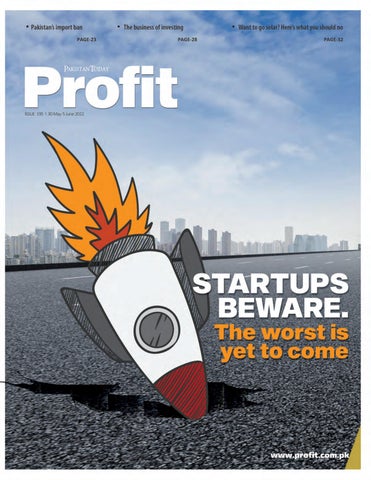
08 Fuel price and kidnapped chocolates - this week in Pakistan’s business and economics twitterverse 12 Startups beware. The worst is yet to come
20 20 Pakistan’s external financing gap could rise to $8bn: Morgan Stanley 23 Pakistan’s import ban Gonzalo J. Varela 25 The case against sovereign default Ammar H Khan
32
23
27 27 Tough reforms ahead Uzair Younas 28 The business of investing Asif Saad 30 Four losers and one winner from the import ban Muneeb Sikandar
Profit
32 Want to go solar? Here’s what you should no
Publishing Editor: Babar Nizami l Editor: Khurram Husain lJoint Editor: Yousaf Nizami l Assistant Editor: Abdullah Niazi Reporters: Ariba Shahid l Babar Khan Javed l Taimoor Hassan l Meiryum Ali l Shahab Omer Chief of Staff & Product Manager: Muhammad Faran Bukhari Regional Heads of Marketing: Muddasir Alam (Khi) l Zulfiqar Butt (Lhr) l Malik Israr (Isl) Layout: Ahmad Salahuddin l Photographers: Zubair Mehfooz & Imran Gillani l Business, Economic & Financial news by 'Pakistan Today' Contact: profit@pakistantoday.com.pk
Readers Say Now, globally, investors have started asking questions – not just from @airlift_pk but many q-commerce startups. This has led to them scaling down operations to profitable locations and laying off employees. Gorillas @gorillasapp did the same in Europe and Airlift followed in their footsteps to do it in Pakistan and South Africa. Airlift @airlift_pk (a wannabe unicorn), allegedly, had been inflating its numbers to secure millions of dollars in funding. Investors, earlier on, did not seek many details and were pouring money into this mass-transit-turnedquick commerce startup. Apropos: Airlift slashes operations, workforce amid global downturn @aj1kz, Twitter Sad news....something similar is happening with Cheetay. My weekly grocery orders now turn to monthly @airlift_pk Airlift shuts down operations in South Africa, smaller cities in Pakistan amidst global downturn. Apropos: Airlift slashes operations, workforce amid global downturn @loneloafelikes, Twitter This happens when a company is focused on hyper-scalability instead of focusing on sustainability. Apropos: Airlift slashes operations, workforce amid global downturn @bigsadcarousel, Twitter Everytime you visit the app more than half of the inventory is always sold out. Apropos: Airlift slashes operations, workforce amid global downturn @Mushtaq_Khan, Twitter Startups for you. Expect more troubled times ahead as funding dries up amidst a recession. Gen X - dream job in startups *bubbles burst* Apropos: Airlift slashes operations, workforce amid global downturn @mwaqassh, Twitter
facebook.com/Profitpk twitter.com/Profitpk linkedin.com/showcase/13251020 profit.com.pk profit@pakistantoday.com.pk
HOW TO CONTACT
7
So @airlift_pk is officially scaling down now. Apparently efforts for another round to fund an expensive blitzscaling strategy didn't materialise in time. Sources say, investors have finally started asking difficult questions from founders/lead investors. Apropos: Airlift slashes operations, workforce amid global downturn @BNizami, Twitter Reported accurately back in Dec 21’. Legal notices ensued but @Profitpk held its own. Apropos: Airlift slashes operations, workforce amid global downturn @Paktoday, Twitter What’re the odds the next few Karandaz reports on investments in Pakistan look nothing
like the previous few? Apropos: Airlift slashes operations, workforce amid global downturn @smkumailakbar, Twitter Sad to hear. In such an environment, it makes a lot of sense for a company to tighten its belt so that it and the majority of its people can live to fight another day. Apropos: Airlift slashes operations, workforce amid global downturn @asfandyarf, Twitter It only goes to show that a large and successful fundraising round does not define a company’s future trajectory. Apropos: Airlift slashes operations, workforce amid global downturn @arrafiq, Twitter This isnt/wasnt sustainable. Sadly the hype cycle for the investors may turn a leaf but the employees & the hyper inflated compensation wars will only come back to haunt most folks. Not saying don't pay what people they deserve. Apropos: Airlift slashes operations, workforce amid global downturn @faizansiddiqi, Twitter The problem for our ecosystem is that it just won't impact the well-funded quick commerce startups but will cause collateral damage that'll make it harder for other startups to raise (in an already tough market). Apropos: Airlift slashes operations, workforce amid global downturn @sheryhydri, Twitter This story aged like fine wine. "There is less than meets the eye in Airlift’s evolution." Flash forward to the present, Airlift is downsizing (again) and cutting operations Kudos to @taimoorhassann for this investigative piece for @Profitpk. Where are all the people that were annoyed at @taimoorhassann ? Why must we hate accountability? Why must all startup coverage be positive? Call a spade a spade. When you write fluff pieces and overhype companies like these people jump there for jobs. And then reality hits Apropos: Airlift may have hit a billion, but is it for real? @AribaShahid, Twitter I don’t generally agree. In times like these when interest rates are increasing, cash flow and borrowing money will not be cheap. Considering that startups will expand their runway and focus on profitable segments. It’s good that focus is on improved numbers rather than valuation alone. Apropos: Airlift may have hit a billion, but is it for real? @UmairSandhu
COMMENTS
Fuel price and kidnapped chocolates this week in Pakistan’s business and economics twitterverse
O
ne thing that would have been unexpected a few months ago would have been that the same week a Rs 30 hike in petrol prices was announced, the greatest outrage for the people of Twitteristan would have been chocolates held back by customs. But that was the case last week, when people were in fact relieved that fuel prices were increased and that the country was not hurtling towards default as it was up until recently. Let us hope this little episode allows people to no longer politicize petrol prices which are a result of international market dynamics that we do not have much to do with. Fingers crossed. All this and more in this week’s social media roundup.
Repetitive but let’s bomb the term petrol bomb.
Digital safety is as important as physical safety in today’s day in age. The existing government officials and former officials need to ensure they are safe online. If you think increasing fuel prices was a difficult decision, deciding how to help the income segment most impacted by the 20% rise in fuel prices. The government needs to act fast before inflation hits and purchasing power is wiped out.
Do you need anymore reasons to understand why banistan isn’t the right state of mind to be in.
8
Can we stop with the crowdsourcing? Wake up everyone.
Commodity price hikes are not bombs especially when they’re not out of choice. Fuel prices shouldn’t even be up for debate. They should be deregulated. There should also be public transport so that people aren’t impacted severely when prices rise.
If you’re annoyed your khaipiya was held back at customs, just know he was held back for smuggling. But yeah, bans create grey economies. In a country where the informal economy is roughly as big as the documented one, why create more distortions?
SOCIAL MEDIA ROUNDUP
NEWS BITES Khan saab’s glorious U turn By Khurram Husain
The Great U Turn
H
e came. He saw. He left. After leading a frenzied mob all the way from Peshawar to Islamabad to demand the government’s resignation and fresh elections, Imran Khan sure left his followers – along with the rest of the country – scratching their heads when he abruptly announced that he is going back after entering the capital. Only a few kilometres away from his destination, a crowd of his followers were assembled waiting for his arrival in D Chowk, the seat of all power and flashpoint for all protests in this country. What happened? Nobody seemed to know. Reports in the newspapers the next day carried conflicting accounts, and ruling party folks gave different accounts of what actually happened. Some reports said a “deal” of some sort had been cut at the last minute. Bristling at this suggestion, Imran Khan held a news conference on Thursday afternoon in which he claimed he made the decision to end the march because he was afraid of the possibility of bloodshed. This explanation made even less sense given that Khan appeared to have left the container without really telling anyone around him what the actual reason was. None of those who were with him on the container came forward with plausible explanations for the decision. The papers on Friday carried further reports. Apparently a combination of low turnout coupled with messages from powerful quarters – relayed through intermediaries – drove Khan to the decision. Dawn carried a report referring to three individuals who served as the go-betweens in this process. One was a retired Chief Justice, another a retired General and a third a prominent businessman. Folks spent much of the day Friday guessing the names. Fact is this was the first real world test of the populist juggernaut Khan has been busy
10
Advice for Miftah Ismael
building since his ouster. All those rallies, all those speeches, all those hair raising allegations and conspiracy theories – they were building up to this point. And for it to deflate so rapidly means reinflating that balloon will take a lot more than the six days he has given to the government to announce the election schedule. Could this be Khan’s last U turn? We don’t know, but whatever it is, it is glorious no doubt.
The turning point
T
hursday morning saw the abrupt end of the long march in the morning followed by the first major fuel price hike in the night. It was a turning point. Until Thursday the new government was held captive by indecision at the centre and Khan’s threats from outside. Both seemed to break on Thursday as Khan’s threat deflated and the first step in a long and painful economic adjustment was taken. The clouds parted, it would seem. But the storm has yet to pass. Having taken the first step the government is now committed to seeing the process through. It would make no sense to take a few baby steps and then call it quits because they get the worst of both worlds – damage to their electoral prospects and no real stabilization of the economy either. Are early elections off the table? Khan is demanding a date by Wednesday of this week (six days from last Thursday).
Advice for Miftah
D
ear Miftah: when you have an overheating economy on your hands, don’t be Asad Umar. Be Hafeez Shaikh. Decisive action is needed, and it is not going to be easy. The new finance minister has the unenviable job of having to push millions of people below the poverty line. Anybody with an iota of humanity in them would hesitate
Chopping education
before such an awful choice. But failure to make the choice means letting tens of millions of people fall below the poverty line instead, along with triggering massive instability in the entire system as the ramifications of a default cascade through the country. The choice before him is not between good and bad. The choice is between bad and worse. Hafeez Shaikh did not flinch when he had to make this choice twice – first when he came as finance minister for the PPP government, and again for the PTI. But Miftah is known as a man of heart, so he can flinch. But he must make the choice and carry it through decisively.
Axing education
W
hen austerity strikes, the first to go is almost always the education budget. The Higher Education Commission has rightly objected to a steep cut in its budget for next year. The HEC is funded in significant measure through a recurring grant. In ongoing fiscal year the amount the allocation was Rs66 billion against a demand for Rs120bn. For next year the HEC submitted a demand for Rs104bn but has been given an allocation of only Rs30bn, a cut so steep that the commission fears it will not be able to function under it. The HEC has 100 existing universities, 18 new universities and 49 centres or institutes under it. On May 24 the Executive Director of the HEC – Dr Shaista Sohail – had to write to the ministry of education asking them to “sensitize the M/o Finance to the fact that only an effective education system can raise the nation” and warning that such a steep cut in one year could “cause inconceivable damage to the overall education system” of the country. Even Hafeez Shaikh would blush at this travesty. How is it the government has found it so hard to remove fuel price caps that cost more in a month than what the HEC is asking for in a year, but so easy to slash the HEC budget? n
PROFIT NEWS BITES
12
COVER STORY
By Taimoor Hassan and Abdullah Niazi
I
f the news of quick commerce startup Airlift cutting down operations and laying off staff rattled you, know that the worst is yet to come. The proverbial party is on hold for now, and while it may have been a blast while it lasted there are now splitting headaches to nurse and consequences to deal with. The dizzying highs seen by tech-startups all over the world have been brought down to abysmal lows by the brutal claws of a market that is persistently bearish in the face of rising inflation and a global recession. Major tech players including Apple, Microsoft, Amazon, and Google have taken significant stock hits, shaking investor confidence and almost overnight making funding for startups scarcer than it has been in years. What does it mean for Pakistan? Very briefly put, it means for the time being funding is going to dry up and our startups will have to show their true metal. Over the past couple of years the startups have done very well for themselves. To list a few of their achievements, the startup ecosystem in Pakistan has managed to raise record amounts of funding, get massive valuations, capture the imaginations of the nation, and perhaps most importantly curate a workforce composed of young, driven, and talented individuals. These were the ‘dizzying’ highs we earlier mentioned from which they have been brought back to hurt. And all of these highs were largely achieved through a cash-burning strategy which involves spending exorbitant amounts of money for customer acquisition and unbridled growth. Little thought has been given to sustainability or the possibility of hard times - which we are now squarely in. The reality is that despite the hype Pakistan is very low down on the priority list of foreign investors, particularly Americans. Startups, essnetially, are babies. They need constant feedings, constant investment, constant attention, and it takes a lot of money to invest in them. If you’re lucky, they end up making something of themselves but if you aren’t then you’re stuck with a deadbeat leech. The problem for Pakistani startups is that for American investors they are not their babies. In fact, to American VCs Pakistani investors are the equivalent of the kittens that you discover outside your home one day and decide to leave them bowls of milk and shreds of chicken. You care about the kittens, you want them to grow big and strong so that maybe one day they’ll get rid of the mice infesting your lawn. But as soon as you lose
14
Don’t overreact, focus on unit economics are advice that are given to us in the good times as well as the bad times Salman Allana
your job, buying chicken and milk for the cats outside is no longer important - you have your own kids indoors that you need to worry about. The problem? You’ve spoiled the kittens so much they may no longer know how to fend for themselves. It has largely been American VCs that have poured money into Pakistan and have spoiled the startups in the process. Now that their domestic market is facing a serious downturn, they will either focus on ‘safe investments’ or pour their money towards their own homegrown flagship startups. That leaves Pakistani startups to fend for themselves. There are two ways to deal with this. The first is to cut costs and try to get by on the funding that they already have in the bank until the global recession ends and VCs are ready to back them again. This we are already seeing in the massive layoffs and downsizing. The key, however, will be finding internal cash sources. Startups that can cut costs and find streams of revenue to break even or be slightly profitable will be able to stave off the inevitable longer as well as impress VCs - which might be interested in investing looking at their grit. The question is, will our startups manage to weather the storm or are they too used to their cash-burning growth models to toe a line of austerity? So — Are Pakistani startups preparing for a legendary rearguard effort, or are we already seeing the last throes of a sinking ship? That is the question.
The global context
H
ere’s something right off the bat - Airlift probably didn’t have any other option but to lay-off 31% of their workforce. With funding flow gone almost overnight, startups all over the world have had to take firefighting measures to stay afloat and survive these direstraits. A lot can be said about how Airlift and others should have been prepared for this a long time ago. That is true, but it is also true that they are now doing the best they can to get through this.
And they are not alone. Globally, May was a brutal month with tens-of-thousands in the tech industry being laid off. In Pakistan, Airlift is the prime example of scaling down but not the only one. Two agritech startups, Tazah Tech and Jiye Tech had already changed plans for their business and downscaled staff, anticipating that it is going to get ugly in the near future. And all of it can be traced back to the bearish markets. Between May 4 to May 7, the biggest tech stocks lost nearly $1.3 trillion in value in just three days. Apple lost $226 billion, Microsoft $190 billion, Amazon $174 billion, Google’s parent company Alphabet lost $125 billion value and Airbnb saw $24 billion of its value slashed. Trillions of dollars worth of companies have been wiped out in a matter of days. On May 20, the S&P500 index fell 20%. When prices of publicly listed securities continue to fall, and if they fall 20% or higher, the bear market sets in - the investors are panicked and act as risk-averse than risk seeking. “Every bear market has its own cause behind it. When March 2020 started, the US Fed put an emergency to support the repo markets with virtually unlimited capital,” explains Faisal Aftab, Co-Founder & Managing Partner at Zayn Capital. “When the pandemic hit, everything went down quickly.” “When the lockdowns started in March 2022, the US Fed printed $7 trillion dollars and pumped it into the economy. That resulted in a massive short term artificial boom that started and peaked out in the October of 2021; the VC boom, the crypto boom, the housing market boom. Now, when you print so much money with a delayed 6 month effect, it creates inflation of all assets.” The consequence has been that because the inflation has also peaked , the US Fed has resorted to increasing interest rates to curb inflation. “Once they started raising interest rates, the market started getting jittery,” says Faisal. The increase in interest rates squeezes supply of money and increases borrowing cost for businesses, which pass it on to consumers. Consumers are faced with increasing credit
Every bear market has its own cause behind it. When March 2020 started, the US Fed put an emergency to support the repo markets with virtually unlimited capital Faisal Aftab, Co-Founder & Managing Partner at Zayn Capital
card or mortgage rates, or both and have less disposable income to spend which decreases the overall purchasing in the economy. Revenue for businesses declines because of a lower purchasing power while debt increases because of a higher borrowing rate. Because the business would now make less money, the stock prices fall. Investors also anticipate that the return on this stock is less and falling stock prices trigger panic selling which further decreases the stock price. If many companies see a decline because of this phenomenon, the market as a whole experiences a downward spiral, setting in the bear market. Investors suffer exorbitant losses because of the fall in stock prices. Investing in securities becomes risky for investors and they start moving money towards safer investments. Venture capital investment is the riskiest of all investments, hence the funding crunch for startups all over the world. If stable companies like Apple and Alphabet could have concerns around their future profits because of high interest rates, they would not want to put money in highly risky, unstable startup companies that have prioritised growth at all costs instead of having strong fundamentals.
Why Pakistan is acutely affected
P
akistan, as mentioned before, will face the brunt of this downturn on the startup front. Over 90% of the funding that fueled the startup
boom in Pakistan last year came from foreign investors — most of them American. Since investors in the states are seriously strapped for cash, Pakistan will be the last thing on their minds right now. And if they do think of their Pakistani investments, it will be how to get out of them. The bear market phenomenon right now is a global one, and it is during times like these that everyone is looking out for themselves. Bear in mind (all puns intended) that both large and small foreign investors that have invested in Pakistan, do not have dedicated funds for Pakistan. They have invested from probably a very small allocation for Pakistan to test waters here. So amid this downturn, their focus would not be a frontier market like Pakistan. Bear also in mind that VC investors have invested heavily in startups around the world. The core investments of these funds are currently also in distress and they would rather divert funds towards these companies to support them instead of investing in new companies. In short - scaling down is very much on the cards for Pakistani startups. Outside funding has been diverted to greener and safer pastures, and the local funds are not big enough to sustain the ecosystem without the riches of foreign funding. While there will be scrambling to get to the local funds, since there just isn’t enough to go around, startups here are very much anticipating a major cash crunch. Several startups are facing the heat when it comes to raising funding. Chee-
tay, for instance, has reportedly not been able to raise a $10 million bridge round. Logistics startup Bykea has been unable to raise a $50 million funding round and is instead trying to raise a $10 million bridge round. The problems with regards to fundraising are occurring because startups have prioritised growth despite weak fundamentals. Now as investors are cautious about risky investments, they are asking for strong fundamentals and a path to profitability, and cutting down on valuation multiples because of the same reasons.
The irony of it all
F
or those uninitiated in the world of startups and how they work, in very simple terms all startups begin by raising funds in different rounds. Initially the founder of the startup controls 100% equity and then sells off that equity in exchange for funding. Startup valuation is the process of quantifying the worth of a company, aka its valuation. During the seed funding round, an investor pours in funds in a startup in exchange for a part of the equity in the company. The higher the valuation that a startup gets, the more expensive its shares get. Because of this, it is very easy for startup founders to get distracted by high valuations. The higher the valuation, the more they can sell their equity for. The past few years have seen the startup bubble rise on the back of a record-long bull run that has given us some truly meteoric valuations. In a bull market there is euphoria and investors are in the fear of missing out (FOMO) and writing cheques at exorbitant valuations to get an allocation. Investors are looking to throw money anywhere they can and thus end up encouraging unstable companies with weak business fundamentals. It has been one large party in which investors bring in money and pay startup founders to spend the money with the belief that the startup will keep raising higher rounds even if it takes time to become profitable. In short - a bubble. Now, with the markets down, investors do not have the same luxury of throwing darts
COVER STORY
We feel that the capital constraint has been really helpful in shaping our thinking towards building a valuable business that is capital efficient. Fortunately, due to our overcapitalization we have a runway of more than 3 years and are well placed to dominate in this new world Abrar Bajwa, the co-founder and CEO of Tazah
at a board whilst blindfolded. That is why they are now looking at the fundamentals of startups and trying to weed out the ones whose long-term business strategies make sense. Ironically, it was thes very investors that were behind the great startup funding pump that had been exalting expensive growth strategies and agreeing to crazy valuations that are now asking sober, practical questions. With their money on the line, the investors have sobered up very quickly and the startups are now scrambling to catch up with the current reality. These investors have encouraged the rise of unstable companies but are now discouraging investors from growing and encouraging them to at least stay alive. “Unit economics, healthy margins and discipline will be valued over GMV, booming revenue and unbridled growth,” an excerpt from the advisory from VC firm Shorooq Partners reads. Founders too have been caught by surprise because of the urgency to shift focus in business and the nervousness because of uncertainty around funding. Most of the startup founders, even Pakistanis, are young, and have not lived through a recession like this before. And for the first time young founders, the situation is like a “deer caught in headlights”, as one investor put it.
In search of profitability
I
t is because of the funding crunch and the desire of investors to see strong fundamentals that startups in Pakistan, too, are trying to improve their profitability to decrease reliance on external capital. Airlift also announced that it was seeking profitability. Its scale down is in line with the need to cut expenses to have enough cash to sustain operations while fundraising is difficult. Though Airlift has credibility issues as reported by Profit earlier, because of which it is reportedly not been able to raise funds since last year before the bear market set in, despite making public announcements that they had received funding.
16
Airlift has since been under exhaustive due diligence from investors. On the other hand, Tazah Technologies has also laid off over 100 people from its staff and pivoted towards a different business model, the details of which they shared with Profit but did not yet want them to be public. “We feel that the capital constraint has been really helpful in shaping our thinking towards building a valuable business that is capital efficient. Fortunately, due to our overcapitalization we have a runway of more than 3 years and are well placed to dominate in this new world,” says Abrar Bajwa, the co-founder and CEO of Tazah. Jiye Technologies too has shifted focus towards farmers in the agri supply chain to cater to their needs, scaling down operations on the retailer side. The scale down has come with some staff members laid off but Ali Amin, co-founder of Jiye Technologies, says that because of the new focus, not many people were needed for operations concerning fruits and vegetables retailers. And that because of the prime focus on farmers, to scale operations on that front, they would be hiring new people, in line with the new reality of the business. Hence the advisory from the YC, Shorooq Partners and local investors here has been that the startups should extend their runways which essentially calls for cost-cutting, manifested in the recent announcements of scaling down, layoffs and pivots. Funnily enough, as the news of Airlift layoffs saddened the ecosystem, LinkedIn and Twitter posts have been abound by startup founders and ecosystem stakeholders in support of employees laid off by startups such as Airlift, offering to hire them in these hard times. This support appears superficial because of the dire times that require all startups to be focusing on increasing their runways which might entail layoffs at their own startups. Startup founders have told Profit that their prime concern at this time was to stay alive and hiring resources at this time looked difficult. The times are going to get tougher
ahead as the US Fed are poised to increase interest rates even further which would further squeeze the money available for investment. The advisory for startups posted by YCombinator last week hence asked them to “prepare for the worst ‘’ and have a runway of 24 months. Salman Allana, the CEO of eCommerce logistics startup Rider, which was part of YCombinator’s Winter 2022 batch, says that the YC advisory actually implies that founders should actually build solid businesses, which has been their advisory even in good times. “Don’t overreact, focus on unit economics are advice that are given to us in the good times as well as the bad times,” says Salman Allana. “The recent advisory reinforces that. If you were following this in good times, the bad times would not have such a big impact on you. You might have to steer the ship a few degrees here and there but you wouldn’t have to do a complete turn towards a different direction,” he says.
Conclusion
T
here isn’t much to it. The funding is drying up but only for now. Whether it lasts a year, or two years, or more than that this recession will end. When it does, a lot of people and startups will have been weeded out. The ones that are left behind will be hardened and better off for the experience. At this juncture, the most important thing for our startups will be that they not just cut on costs and act austerely, as Airlift and others have already done, but also focus on their business fundamentals. This requires going back to basic unit economics and figuring out the question of profitability. After all, their success is good for Pakistan. Profit has often held startups here accountable. It has majorly been to warn against situations like this. Fundamentals are important, and we want Pakistani startups to thrive and be a catalyst for the economy. If they manage to get through this time, they will come out more established than ever before. n
COVER TEXTILES STORY
Pakistan’s external financing gap could rise to $8bn: Morgan Stanley By Khurram Hussain
T
he outlook for Pakistan is worsening, says Morgan Stanley in a report released on Friday. The country has “underperformed significantly since February”, with spreads widening up to 1250 basis points and some bonds selling for as low as sixty cents on the dollar. “The key driver has been rising concerns about Pakistan’s external funding gap” say the authors of the report. The deteriorating current account deficit, “increased risks to the IMF disbursements” and slowing remittances are principally responsible. “We expect total funding to be $35 billion for 2022” the report says. The current account deficit could widen to $17bn, and “predetermined drain on reserves” is $18bn. The authors consider external financing requirements under two scenarios: with and without and IMF program. “[I]n a better scenario, we estimate the available sources to be $32bn, assuming Pakistan will receive the next IMF tranches and issue Eurobonds successfully. This means a $3bn funding gap.” This means even with a fund program and a successful Eurobond floatation, there will still be $3bn required to plug the financing gap in 2022. The real problem begins in the absence of an IMF program. “[I]f Pakistan does not get the rest of the EFF loans from the IMF, it would add $2.8bn of funding pressure. And if Pakistan is not able to roll over the global sukuk bond due in December 2022 it adds another $1bn of funding pressure. In this case we estimate the funding gap to be $8bn, also driven by lower private sector loan disbursements”. The authors advise their clients to steer away from Pakistani paper. “We suggest a dislike stance on Pakistan” they say bluntly, pointing to the “downside risks regarding funding” and persistent uncertainty around the talks with the IMF, with
20
oil prices continuing to rise. The authors also point out risks to Pakistan’s credit rating of B negative given these powerful vulnerabilities. “[W]e don’t think that now is a good time to be long in Pakistan despite their cheaper valuations. Pakistan’s bonds rallied on
Friday as the government began the process of fuel price adjustments on late Thursday night. The adjustment was cheered by the markets since it is the first step down the road the country has to walk to restore its economic viability. n
Khaadi announces $25mn investment from IFC
I
By Saad Tanvir
n a news filing today, Khaadi officially announced that IFC is to invest up to $25 million in the organization against a minority stake. In an email sent from Khaadi’s top management to its employees, it claimed “This strategic investment will enable us to accelerate our growth plans, support future sustainability and empower us to achieve our vision of becoming a global brand.” This would be the first investment by IFC in Pakistan’s fashion retail sector, where IFC has not only promised financial
investment, but also its strategic expertise and global presence to bring Khaadi closer to its vision of becoming a global brand. In September 2021, IFC had announced this proposal as a quasi-equity investment via convertible preference shares for up to $25 million. This takes Khaadi’s initial expansion plan to: grow its operations as it recovers from disruptions related to Covid-19 through expansion of footprint/retail space; accelerate global online sales; and expand the international store network, a step further towards its implementation phase. The International Finance Corporation is an international financial institution that offers investment,
advisory, and asset-management services to encourage private-sector development in less developed countries. The IFC is a member of the World Bank Group and is the largest global development institution focused on the private sector in emerging markets, with a presence in more than 100 countries. Khaadi Corporation Limited is one of the companies in Pakistan in fashion retail with
the largest market share in the formal apparel retail market. Having started operations in 1998 with one store, Khaadi has expanded its retail network to 62 stores over 25 cities in Pakistan and 14 international stores in Qatar, UAE, Bahrain and the United Kingdom. Currently, Khaadi is a single member private limited company with Shamoon Sultan as its founder, Chief Executive and sponsor
owning 100% of its capital. Shamoon, who started his career by working for a prominent couture designer for a couple of years set up his own clothing line in 1998 under the brand name “Khaadi” defined as “handlooms” in local language. Since its inception, Khaadi and Shamoon have won numerous local industry awards, and now Khaadi seeks to expand to a global scale. n
Committee fails to finalize inquiry into MG’s under-invoicing case By Shahzad Parach
A
n inquiry committee tasked to probe the alleged under-invoicing of MG motors, reportedly is using delaying tactics in finalizing the inquiry. Sources said that the four-member inquiry committee led by Director General Customs Intelligence and Investigation Rasheed Shiekh failed to furnish a report in the MG under-invoicing case. The committee was supposed to submit its report by May 15, 2022. Sources said that the committee members are waiting for the written instructions of the Public Accounts Committee for investigating the alleged under-invoicing matter. The MG motors scam has been already adjudicated by the Collector Adjudication Karachi however such an adjudicated case needs to be reopened by the FBR through a written order under section 195 of the Customs Act as Chairman FBR or member customs legal can mandate a probe committee to reinvestigate such an adjudicated case, sources added. Sources also said that member customs legal has asked incumbent chairman FBR to decide on re-opening of the adjudicated order in the MG case but no response has been given to her so far. According to the TORs of the probe committee, its members have been required to determine the fair value of imported MG vehicles under section 25 of the Customs Act. The valuation department of FBR determines fair values of imported goods under section 25 usually by following the deductive value method of customs valuation. In the deductive value method of customs valuation given under section 25 of the Customs Act, the basic idea is, to begin with, the market value in the country of importation of imported goods similar or identical to the imported goods being valued and work back all through from country of importation to the country of exportation deducting from the market value all the expenses incurred from the country of exportation to the country of importation.
The expenses which are to be deducted under the law from the market value of similar/ identical goods to arrive at the assessable value of the goods being valued include duty/ taxes payable on importation/ sale in the country of importation, usual costs incurred on account of transport and insurance and the additions to value usually made on account of profit and general expenses incurred on the sale of similar/ identical imported goods in Pakistan. Under the deductive value method of customs valuation, the determination of the true assessable value of 10,000 MG vehicles allegedly under assessed by the customs at Karachi has to begin with the market sale value
of MG vehicles imported into Pakistan other than the 10,000 MG vehicles in question. If the probe committee follows this FBR’s usual and most commonly used valuation practice for MG vehicles too, the revenue losses caused in the MG motors scam may swell far beyond the presently alleged amount. However, by following the FBR’s favorite deductive value method of customs valuation, the probe committee members may end up spoiling the career of their benefactor who is accused of the scam. The scribe approached Chairman FBR and DG Customs intelligence and investigation for comments but no reply was received till the finalization of the story. n
Airlift slashes operations, workforce amid global downturn By Taimoor Hassan
Q
uick commerce startup Airlift has announced closing down operations in South Africa as well as some cities in Pakistan as the global capital downturn ravages
startups. “In light of the significant downturn in global capital markets, Airlift is undertaking a strategic realignment to reduce the surface area of operations and to increase focus in key areas that drive sustainability and profitability. As a part of efforts to reduce the surface area, Airlift is pulling out of certain markets, including Faisalabad, Gujranwala, Sialkot, Peshawar, Hyderabad, Johannesburg, Cape Town and Pretoria.” Airlift said in a statement. “Additionally, the company is relocating 8-10 dark stores in our largest markets (Lahore, Karachi and Islamabad), which account for almost 90%
of our revenue,” Airlift said in a statement. “The above efforts are a part of Airlift’s strategy to focus on building scale and profitability in markets with considerable scale and high order density,” the statement added. Additionally, Airlift is also reducing headcount by 31 per cent across all markets and limiting the number of categories on the platform. “The decision to part ways with talented teammates has been incredibly challenging for the company. For impacted teammates, Airlift stands committed to providing financial and placement support to help find new roles.” These decisions, Airlift said, are an important step toward Airlift’s long-term vision of enabling self-empowerment and leveraging technology to offer customer-centric solutions. “By reducing the breadth of our operations, Airlift seeks to achieve greater depth in key areas and deliver stronger value to customers in our largest markets,” Airlift said. n
ANALYSIS
Gonzalo J. Varela
Pakistan’s import ban
Table 1: Coverage of SRO (I) 598, aka “import ban”
A
structurally large trade deficit coupled with a complex external environment that includes high commodity prices and rising interest rates have placed Pakistan in a tough position. Tosave foreign exchange, the Government of Pakistan on May 19thintroduced an import ban over 894 products, followed by a State Bank decision to require approvals for the imports of an additional 25 products. This note discusses the coverage of these measures, their likely effects on imports, exports, and revenues, as well as the policy alternatives the Government faces.
The coverage
T
Import Ban Lines affected Import value of products affected No of Share of FY21 FY22 (Jul-Mar) Products product lines affected In Mn As a In M As a USD share USD share of FY21 of FY21 imports of imports of affected affected products products
Intermediate Consumption Capital (except mobiles) Mobile phones Not classified Total
73 8.2% 659 73.7% 25 2.8% 1 0.1% 136 15.2% 894
145.5 5.6% 605.0 23.2% 76.2 2.9% 1,494.1 57.3% 286.3 11.0% 2,607.1
139.3 10.8% 494.6 38.3% 66.8 5.2% 244.0 18.9% 348.3 26.9% 1,293.1
As imports of mobile phones dropped between FY21 and FY22, imports of completely ‘completely knocked down’ (CKD) mobile phone kits soared, from US$52.8 million per month to US$146.9 million per month. Indeed, adding up imports of mobiles and CKD mobiles, on average, imports of mobiles and CKD mobiles reached US$177 million in FY21 and US$174 million in FY22 – virtually no change in import dollars spent. This shows that when firms or households faced increased costs of importing a given product (CBU mobiles), they found a good substitute (CKD mobiles). This is why, to prevent leakages from the import ban through these type of substitution effects, the ban was complemented by an additional import restriction: a State Bank Pakistan’s (SBP’s) import approval requirement that could be taken as a non -tariff barrier aiming at increasing import costs for a set of 25 products that had seen a sharp increase in imports between FY21 and the first nine months of FY22 (Table 2), among which feature CKD cars and mobile phones, in addition to a handful of other capital goods. In total, the import restrictions add up to about 9 percent of imports in FY22, or US$542 million per month.
he import ban that covers 894 products falls predominantly on consumer goods (659 out of the 894), but there are also intermediates and capital equipment products included (most prominently ‘mobile phones’ that are considered by trade statistics as ‘capital equipment’). The products covered by the ban accounted for 4.8 percent of imports of FY21 (US$2.6 billion), and for 2.24 percent of imports of the first nine months of FY22 (US$1.29 billion). The sharp decline in imports of targeted products is mostly explained by a decline in imports of mobile phones, in turn likely driven by a more depreciated rupee that increases the prices Pakistani households and firms pay for imported goods, and higher import duties to support localization of mobile phone production (Table 1).
is a Senior Economist in the Macroeconomics, Trade and Investment Global Practice of the World Bank. He is currently based in Islamabad, where he leads the trade program
COMMENT
The impact: imports, revenues, exports, policy instability The import restrictions are expected to curb imports. Yet, leakages are likely to occur through substitution, misreporting and smuggling. Some substitution might occur, for example, from CBU phones and cars to CKD or semi KD phones and cars. The extent of this substitution will depend on the conditions of the SBP approvals, which have not been disclosed(the fact that the criterium to grant these approvals is not known poses
23
Table 2: Coverage of SBP’s Exchange Policy Department Circular Letter No. 9, aka “import approval” SBP Approval Requirement Lines affected Import value of products affected No of Share of product FY21 FY22 (Jul-Mar) Products lines affected In Mn USD As a share of In Mn USD As a share of FY21 imports FY21 imports of affected of affected
Intermediate Consumption Capital Mobile phones (CKD) Not classified Total
1 0 10 1 13 25
4.0% 0.0% 40.0% 4.0% 52.0%
88.1 0.0 1,244.8 633.8 39.1 2,005.8
additional challenges as it increases policy uncertainty). The ban (and the approval requirements) increases incentives for importers to misreport shipments and it also incentivizes smuggling. The unavailability of certain import products (particularly intermediates and capital goods) will likely impact the ability of firms to operate, invest, or upgrade productivity. In Sri Lanka, for example, a recently imposed import ban that included chemical fertilizers led to substantial reductions in agriculture yields, which in turn led to the reversal of the policy. Revenues from import duties are expected to fall more than proportionately than imports as banned products are predominantly consumer goods, mobiles, and cars, that face high import duties. Import duty revenues during the first 9 months of FY22 for the banned tariff lines accounted for 14 percent total import duty revenues, or about 10 billion PKR per month. The increased export restrictions are also expected to reduce incentives to export. On the one hand, import restrictions that affect intermediates and capital goods affect the competitiveness of firms that use these types of products. In Argentina, a country that has introduced similar combinations of import bans and import licensing, restrictions have reduced exports, and particularly affected small exporters, which struggled to secure the
24
products
4.4% 0.0% 62.1% 31.6% 2.0%
100.8 0.0 1,145.8 1,322.5 1,012.7 3,581.7
products
2.8% 0.0% 32.0% 36.9% 28.3%
necessary approvals to be able to access the required inputs. On the other hand, import restrictions on final goods create an anti-export bias. The import ban creates (additional) market power for domestic producers that focus on the domestic market. Thus, the combination of the ban and the import approval requirements increase the relative profits of selling domestically versus exporting. Our estimates show that a 10 percent increase in import duties on a given product increases their profit margins by 40 percent (profits account for about 25 percent of output, according to the latest CMI, this was empirically validated by an analysis of margins of publicly listed firms). An import ban will be more powerful than the increases in duties, while the effect of the import approval requirements are uncertain and will depend on the likelihood of receiving the approval as well as its speed. The anti-export bias of these measures does not require a firm switching from exporting to selling domestically because of higher margins at home. This is only one possibility, which we also see in the data. But you can also think about it as a portfolio choice for investors or banks. If relative profits of the import-substituting sector increase relative to the export sector, then resources will likely be allocated to the former sector. In other words, expect more TERF disbursements, less LTFF
disbursements, and a more muted aggregate effect on the trade deficit (imports will fall, but so will exports). Also, these import restrictions affect policy stability, thusreducing incentives to invest and innovate, as they alter the rules under which firms operate. In particular, import approval requirements incentivize rent-seeking and favor large firms that can devote more resources to navigate the system to secure timely approvals. The alternatives Fundamentally, the introduced import restrictions do not tackle that underlying driver of the trade deficit: the fact that there is a macroeconomic imbalance, with saving being too low relative to investment. In particular, the main driver of the imbalance comes from the public sector: the large fiscal deficit drives the large trade deficit. Addressing that imbalance requires reducing the fiscal deficit in a way that does not affect the livelihoods of the poorest segment of the population. The fuel subsidy has been the talk of the town because of three characteristics that make it problematic: it is costly, it is structured in a way that incentivizes more use of fuel by firms and households (thus increasing imports of petroleum products), and it predominantly benefits richer households instead of the poor. The decision to gradually phase it out, by increasing prices of petrol, high speed diesel, kerosene oil and light diesel oil by 30 rupees is a step in the right direction that will help reduce the fiscal and trade deficits. Yet, there are many additional steps that could be taken to reduce the fiscal deficit so that the pressure on the trade deficit eases. One is related to taxing property that is largely outside of the tax net. A recent study of the International Growth Center, for example, showed that all of Punjab collected less in property taxes than the city of Chennai in India. A first step would be to introduce progressive real estate taxes, and to ensure property valuation tables reflect market values, so that capital gains on real estate are at least partially more accurately taxed. In agriculture, there is also substantial space to increase tax revenues by harmonizing schemes across provinces, and rates with other sectors of the economy. Streamlining subsidies that do not favor the poor, including to State Owned Enterprises; minimizing (or eliminating) exemptions in the tax code, or making better use of state-owned assets by leasing them to the private sector, are just some examples that could help bring down expenditures and with that the trade deficit. Importantly, these changes will not just help reduce pressures on the trade deficit side. They will also help achieve a more efficient allocation of resources, impacting productivity and sustainable growth moving forward.
COMMENT
OPINION
Ammar H. Khan
The case against sovereign default
through Eurobonds, Sukuks, and Commercial loans. Multilateral institutions have rarely (if ever) called on a default, they negotiate with the borrowing country, no matter how stubborn, and eventually work out a restructuring plan. Similar to what happens in our case with the International Monetary Fund (IMF) on an average of every three years in the last half century. roundhog Day is now a preferred reference point for Debt due to other sovereign nations is more an extension of the the economic cycle in Pakistan, with each crisis largely relationship that exists between the sovereigns. It can either resembling the previous crisis, and a government that be rolled over, or repaid, depending on the stage of camaraderie refuses to learn from its mistakes. Another facet of that exists at that point in time. this Groundhog Day is the noise regarding sovereign If history is considered a guide, a sovereign nation can default that starts emerging as soon as we get close to get its debt repaid through a number of violent and non-violent the peak of a balance of payments crisis. Despite all such noise, Pakistan actions, here is to hoping none of that happens and we can has never been in default on its sovereign debt, except for a technical maintain camaraderie with various nations, who keep on rolling default that occurred in the late 90s due to sanctions that were imposed over our debt. This time is slightly different though – none of on the country following nuclear tests. the friendly sovereign nations are willing to extend any fresh A sovereign default occurs when a sovereign nation is not able to debt, or rollover, till we get the IMF program in place, which pay back its creditors, whether the interest or principal amount as per means till we agree to ensure some kind of fiscal and monetary its commitment. Pakistan has been an active borrower from the capital discipline, for a change. markets, but relative to total external debt, debt from global investors Finally, it is the private investors subscribing to the or commercial loans is about17 percent of total external debt. It is country’s debt who may call on a default in case of an interest important to understand the composition of Pakistan’s debt position or principal payment is not made. These private investors here. Roughly 63 percent of debt is PKR based, which means it is doneed to be the first ones to be paid, and it is estimated that the mestic debt, from the population and institutions of the country, largely country needs to pay US$ 3.1 billion to these investors during through banks, who utilize individual and institutional deposits alike the current year. A sovereign with a GDP of more than US$ 380 to invest in government debt. The sovereign can’t really default on this, billion, which has posted growth rates to the north of 5 percent as it can theoretically print more currency, and repay earlier PKR based during the last two years isn’t really going to default on an creditors. Although it may not default, but if it makes a habit out of this amount less than 1 percent of its GDP, or just about equivalent (which it has), then the logical consequence is inflation, which means to a month of remittances. This is more of a liquidity issue, higher prices for everyone. Printing money to solve problems isn’t really rather than a credit issue. Rapid rise in commodity prices after the optimal solution here. the pandemic, as well as geopolitical volatility has put budgets 37 percent of our total debt is in FCY (mostly US$). Further of countries around the world under strain, particularly of breaking down external debt, 57 percent of external debt is due to commodity importers. multilateral institutions, 24 percent is due to other sovereign nations Lack of decision making on the sovereign front, and ab(mostly friendly), while another 17 percent is due to private investors solute chaos in terms of certainty is a bigger problem here. The recent removal of fuel subsidies after more than three months of a fiscal disaster has signaled to the market, and to the lenders that decisions are finally being taken, which will eventually push inflation to the north of 20 percent for a few months, but would stave away a fear of default, and evenThe writer is an tually create an environment of macroeconomic stability – till the next time someone goes ballistic with an independent expansionary monetary and fiscal policy. macroeconomist and Pakistan has had much severe crises over the last three decades, the current crisis pales in comparison energy analyst. to many of those. A resolution of the decision-making crisis and a much-needed consensus among all political and non-political actors would stave away any risk of sovereign default. If the country continues to inch towards a default this time around, it would solely be a consequence of the current political crisis, in addition to consistently bad policy making during the last fifty years.
G
COMMENT
25
OPINION
Uzair Younus
Tough reforms ahead
the bottom up, is the only path forward. Much has been written about what needs to happen: raise taxes from the privileged few and end the subsidies and perks doled out to them, which total over $17 billion annually; reduce the government’s t long last, the Shehbaz Sharif government has interventions in key markets, especially wheat and sugar; restructure decided to bite the bullet. Finance minister the energy sector through various measures including privatization; Miftah Ismail has finally announced a Rs. 30 and reduce the incentives for investment in Plotistan by raising taxes per liter increase in the price of petrol, beginfrom real estate and bring an end to recurring amnesties that encourning the process of actions that are expected age tax evasion. to bring the IMF program back on track. The blueprints are there but what is lacking is the political will This should not have taken as long as it did, but now that the and courage. This is not a surprise. After all, the very beneficiaries of government has decided to expand political capital in the nearthe status quo are in and around the corridors of power. This elite term to stabilize the economy, Pakistanis can breathe a sigh of class has continued to enrich itself from the status quo economy relief. while ordinary citizens have fallen behind the rest of the world. For It is likely that the government will announce further this class, the good times continue and come what may, they always painful measures in the coming days, including an increase in emerge as the winners. electricity tariffs. There will be the usual howls about how This elite class, however, should step outside its bubble and citizens are being burdened, something that the leading parties take a serious look at the crisis brewing around it. From Karachi to in the current coalition government are also guilty of when they Skardu, a volcano is showing signs of eruption. The anger is manifestwere in opposition. Inflation is surely going to rise in the coming itself through various movements, including tens of thousands of ing days and ordinary citizens, beaten down by over 40 percent youth marching out in support of Imran Khan, an underprivileged and inflation over the last three and a half years, are only going to urbanized class aligning itself with the Tehreek-e-Labbaik Pakistan, experience more pain. and an evolving insurgency in Balochistan whose backbone are young, The ongoing economic pain in Pakistan is part of a educated citizens who have had enough of the kleptocracy. decades-long decline where Pakistanis have continued to fall For now, these groups are divided across ethnicity, class, and behind the rest of their peers in the world. While another dose ideology. But as Pakistan urbanizes and gets connected through digof the proverbial chemotherapy administered under the careful ital technologies, these disparate groups are likely to unite to form a supervision of the IMF is necessary for the economy, it is imtidal wave that will shake the very foundations of Pakistan’s politportant for Pakistan’s elites to recognize that a shock and awe ical economy. The majority of Pakistanis are under 25 years of age, approach, where the economy is rebuilt and restructured from meaning that they are entering a phase of their life where they need jobs and growing incomes to meet their ambitions and aspirations. An ossified ruling elite, both civilian and non-civilian, has shown over the last few months that it is simply incapable of understanding what this cohort desires and how angry it is becoming. As the next few years tick by, millions of these citizens will find themselves unable to meet the needs of their elderly parents and young children. What happens at that time is anyone’s guess, but a prudent analysis will lead one to The writer is Director of conclude that it will not be a pretty sight. the Pakistan Initiative Which is why it is in the Pakistani elite’s own self-interest to alter the status quo and rebuild Pakiat the Atlantic Council, a stan’s economy. Because if they choose not to reform, reforms will be thrust upon them. The signs are not Washington D.C.-based encouraging so far, but the ongoing crisis and the upcoming budget is an opportunity to begin the long think tank, and host of the and arduous process for reforms. podcast Pakistonomy. He The Sharif government seems to have decided to make tough choices. One hopes that they beyond tweets @uzairyounus. just doing the bare minimum needed to get the IMF program back on track.
A
COMMENT
27
OPINION
Asif Saad
The business of investing
sustain good returns for the longest period of time. To take a simple example, from real estate if I may; if I bought a house to live in 10 years ago and its value has increased 3 times since then – does that qualify as financial gain? Will I sell it because it has given a fantastic return? Or is it irrelevant to me? After all, I live in this house and it provides adequate space to meet my needs. If I sell it, I will need to buy another similar The focus needs to be on sustaining returns over house which will cost the same or even more. Therefore, I will time instead of amplifying them in the short-term never sell it unless it stops meeting my needs and if that happens my decision will be driven by my needs – which is completely disclaimer to start with; this article is not meant to be different to my desire to maximize my returns. The only people taken as investment advice and I am certainly not qualiwho gain from speculative trading are brokers whose business fied to give such advice. What I am narrating here is based depends on trading volume – irrespective of market direction. on common sense and my own experience. The herd mentality is the killer of value and if you follow As we witness another significant fall of the the market – buying when the price is rising and selling when it stock market, our human survival instinct is to cut our is declining – you are likely to lose money. The reason is simple – losses, sell and run away. The buying and selling will depend on your life when everyone behaves in the same way they will all eventually perspective and whether you are inherently an optimist or a pessimist. either overpay or undersell. Instead, when making buy or sell Human beings are known for finding patterns when none exist and make decisions, long-term investors look for the underlying value of predictions based on guessing what is coming next. Guessing means the asset and what it means to them today and in the future. there is no evidence and hence the narrative swings to whichever way we The important thing to keep in mind as a long-term inveswould like it to be. tor in an asset, is that one would never look at the daily, monthly We also tend to think in isolation; if we predict the stock market to or even annual fluctuations of value. You need to track your fall by 50%, we would like to tell ourselves that share values will be the investment over 10-20-30 year periods. And you track it against only thing that declines while the rest of the world remains the same. your needs – just as I illustrated in the case of my house. Do the In reality, if and when we make this sort of a prediction, it is based returns meet your needs? If so, they are good enough! on our world view being extremely negative – whether this is because of It is not about me moralizing against avarice – its about a pandemic or a recession or political uncertainty. Whatever causes them, what makes sense for us to have a high-quality life! doomsday scenarios cannot pertain to one particular market or product. It is only logical to assume that this sort of thinking will Likewise for the vice versa upswing. beat speculative worries hands down – and not just monetarily. Common sense tells us not to invest for short term gains, which is It is difficult to practice but is the only way to keep yourself sane. well understood, although not always practiced. The only sound investYou need to understand that swings in value are not of ment time horizons are long-term and to me, that should not be less than any interest to you – unless they are driven by the fundamental 25-30 years. That kind of timeline might as well be called ‘forever’. destruction of the asset. And if that is ever the case, trust me Think about why people invest in the first place. You invest your - we will all lose much more than our savings. In the words of savings – which is money you do not need to run your daily life. You want Nassim Taleb, the renowned investment philosopher, “never take this money to compound over time. However, most people don’t get this. investment advice from someone who has to work for a living, They want to know how to earn the highest returns instead of wanting to unless there is a penalty for the advice”. Investment managers are incentivized to beat the market. The better the fund manager the higher the returns compared to the market index. The problem is that this is achieved within a short period – a month or a quarter or a year. It defeats the purpose of investors who are holding assets for long-term value creation. The writer is a strategy Don’t get me wrong – fund managers and investment advisors are well-meaning professionals. But the consultant who has advice they give has to be based on short-term time horizons for no fault of theirs. Their clients expect them previously worked at various to provide maximum returns in the short-term. It is rare, for an investment advisor to provide and for a client C-level positions for national to care for, performance over 25-30 years. To conclude, financial investment is like most things in life – a and multinational long-term perspective wins every time. The same is true for entrepreneurship, career, relationships – even in corporations real estate – the real winners are those who hold don’t sell properties. Life is a marathon and to complete the marathon you need to make wise choices. The sooner one learns to make them the more the gain.
A
28
COMMENT
OPINION
Muneeb Sikandar
Four losers and one winner from the import ban “Many people want the government to protect the consumer. A much more urgent problem is to protect the consumer from the government.” —Milton Friedman
T
ypically, “saving foreign exchange” is the reason given by developing countries for implementing protectionist trade measures including a ban on select import of goods. The argument goes something like this: foreign producers of a product are offering Pakistani consumers a more attractive price or better quality product than they can get from Pakistani producers of the same product. This can occur for any number of reasons. For example, foreign producers may be more efficient than the Pakistani producers. Otherwise, foreign producers may receive subsidies in its home country, thereby allowing it to charge lower prices to Pakistani consumers. The fact is that the particular reason will make no difference with respect to the arguments presented here. The main argument used to defend protectionism is that the less expensive or higher quality foreign products are “costing the leakage of foreign reserves.” In other words, if more of these products were produced domestically and fewer were imported, then more people would need to be em-
The writer is an economist and strategy consultant. He can be reached at muneebsikander@hotmail. com
30
ployed in the Pakistan Industries manufacturing the product allowing the country to save valuable sources of foreign exchange. Hence, if Pakistan. imposed a ban on imported products, Pakistani would drastically purchase fewer products from foreign firms. Conceptually, more of the product would be produced in Pakistan, fewer would be imported, and more foreign exchange could be saved by such a ban of select items.
Winners and losers from protectionism
T
he typical argument for protectionism is accurate in that it identifies those Pakistani interests that gain from the protectionist policies, but it does so while ignoring those who lose. In particular, it ignores those whose jobs are put in peril from trade barriers. Here is how the winners and losers from protectionism break down :
The Winners
E
conomically, as opposed to politically, there is only one winner from protectionism and ban on imports – the domestic industry being protected from competition. Because of reduced competition, the Pakistani or domestic industry will produce and sell more. For instance this shall benefit Pakistani automobile and mobile industry as the ban targets finished cars or mobiles but not their component parts. With a captive Pakistani consumer who has limited options to purchase consumer options, they are likely to generate higher profit margins and shall enjoy the ability to set higher prices. Another example is how Pakistani pet food manufacturers will benefit from the ban being imposed as imports previously had met up to 75-90% of the total demand for such products in urban areas of Pakistan. Furthermore, limited supply of pet food is likely to result in higher prices of both previously stocked imports as well as local pet food.
Neutral territory
T
he Ministry of Commerce has projected that the imports of Pakistan would now only grow to $77 billion by the end of June as a result of the measures taken by the government. The projected saving from banning the import of 38 products therefore is estimated at $600 million or around 5% of the annual bill. It is also noteworthy that a ban on certain goods such as cigarette imports is likely to result in massive savings of foreign exchange as up to 20% of the local market currently consists of cigarettes sold which are smuggled by illegal
mechanisms. Therefore, in the grand scheme of things, the saving of foreign exchange by banning the list of 40 import products is at best limited. Finally, such marginal gains are also likely to be wiped out resulting from further depreciation of the PKR on the open market against the dollar in the coming weeks.
The losers The Pakistani Consumer
P
rotectionist measures are a tax on all those who purchase a product manufactured by the protected industry. This includes those who purchase the protected product for direct consumption purposes and those who use the protected product as an input into other production processes. It is necessary to note this tax is paid not necessarily through higher prices but from inferior quality of domestic products or limited choice of products available to consume or poor quality goods. For instance, there has been an exponential surge seen in spending money on both local as well as imported cosmetics and personal products. However, there are many reported facts about high loads of lead, mercury, copper, and other hazardous and cancerous elements in local Pakistani cosmetic brands according to a local scientific study. Consumers are therefore at the mercy of limited quality regulation by the government of local cosmetic manufacturers and are forced to consume a substandard product compared to imports irrespective of the price difference.
Import-Using Industries
S
ince the government announced it shall also ban salon items, shampoos, and personal care products, we have been hearing about its harm to service providing industries such as beauty parlor’s, for which such products form an important input. The fact of the matter is that protectionism drives up the cost of production for industries that use the protected products. As such, it leads to a reduction in the supply of those products, which, in turn, means fewer people are employed in those industries.
Import-Related Industries
T
he fact is that there are many industries and employment opportunities that exist because we, as consumers, purchase imported products. For example, while unions typically support protectionist trade policies, you will never see the longshoreman’s union endorsing them. These are among the many categories of workers who take a hit when trade falters, regardless of reason, including increased protectionism. Other industries that would be harmed because of protectionism include many parts of the financial industry, retail industries of all kinds, shipping, and other forms of transport.
Export Industries
W
ith a captive market for many domestic producers, they have little incentive to produce higher quality products produced at a lower cost by
innovating when they can merely generate supernormal profits by meeting the demand of local consumers. This is likely to be the case for furniture and electrical appliance producers.
Conclusion
U
ltimately, the performance of an economy and society cannot be made better off, on net, through ban of trade imports. Such policies can only result in an expansion of the protected sectors of the economy at the expense of depressing others. Any foreign exchange savings resulting from the protected sectors will furthermore be more than offset by losses in other areas. The arguments against protectionism and in favor of free trade were put forth by Adam Smith in his 1776 masterpiece, The Wealth of Nations. At the time, he found the arguments for free trade to be so obvious that he thought they were hardly worth stating. As Smith concluded, In every country it always is and must be the interest of the great body of the people to buy whatever they want of those who sell it cheapest. The proposition is so very manifest that it seems ridiculous to take any pains to prove it; nor could it ever have been called in question, had not the interested sophistry of merchants and manufacturers confounded the common-sense of mankind. Unfortunately, there is just as much sophistry from merchants and manufacturers (not to mention politicians) today than there was when Smith penned these words. n
COMMENT
By Asad Ullah Kamran
E
ventually, we’re all going to have to rely on the sun. That much is an unfortunate (or fortunate depending on how you look at it) fact. Pakistan has continued to lag behind in electricity production over the decades with coal, oil, and hydel production all failing to effectively meet demand. And if the infrastructural problems were not enough there are the environmental realities that make our reliance on the sun inevitable. In such a situation, while commercial use might be a little far, a lot of domestic users in the country have already become early adopters of solar technology. Seeing homes, mosques, small businesses, parks, and street lights powered by solar panels is a common enough sight all over the country. Surprisingly the technology has even permeated in lower-income neighbourhoods as well as smaller cities. And why would it not? With electricity a growing cost, the unit economics of going solar more than make sense. There is very much a future, in fact, where middle and upper-middle class households should be powered by solar energy to the extent that they also have cheaply available electric cars that they can fuel through the sun and run completely off the grid. Energy from the sun is being wasted until we use it. But what does a person need to understand before they make the decision to go solar? What are the different kinds of options available? If you’ve been considering getting a solar energy solution for your home, there are some
32
things that you should know before making your decision. Pakistan has been experiencing load shedding for over a decade now, this makes it an ideal market for residential solar solution providers. Solar technology has a high initial investment cost, but it has a cheap running cost and a long service life. The ability to finance a PV system reduces the initial cost of purchasing the system and distributes the cost over time while the system is already saving money on power bills. This makes solar more accessible to people who can’t afford to pay for the system all at once. Although essentially when looking at the solar energy solution the ideal goal is maximising the efficiency in terms of cost and benefit. Whether or not the investment is worth it or not, to do this start with the data around as in your utility bills. For going solar it is important to understand your own requirements in terms of units consumed and having an estimate range you’re willing to spend. Now to get an idea of what you’re consuming is to look at your utility bill, use the data for the entire previous year to get a more accurate assessment.
The economics of going solar
I
f, for instance, you’re looking for a 5kW system for your home it is important to ask the right questions before making the purchase. After taking into consideration multiple sources, a 5kW system costs around
Rs700,000 to 1,000,000 and is expected to produce anywhere from 6,000-7,000 units in the year. To calculate the per unit cost of electricity you’re getting from the system, multiply the annual units produced by the system over the span of it’s warranted life span, usually solar panels last over 25 years. Using 6,500 units as a benchmark annually for a system and costing Rs850,000 for this calculation, we get an approximate 162,500 units over the course of systems life, dividing the total cost of the system by this number would give the per unit cost of Rs5.23 per unit. The benefit from going solar is very evident, if you just take a look at the utility bill. For the period of 12 months stretching from March last year the total electricity I consumed was 6,261 units at an average cost of Rs 24.87. The benefit is quite obvious from here on out as the difference between the cost per unit is Rs 19.64. Furthermore, any further increase in the energy prices in the future would only help you save more costs. Now if the system in an annual year produces 6,500 units whilst considering the annual consumption remains constant, the system would yield an annual benefit of Rs127,663. Using this calculation you can figure out the time it would take for the system to pay for itself, by dividing the total cost of the system by the annual benefit. The payback period for the system would take six to seven years based on the numbers from the example above. Using the numbers from the example above you can safely conclude that going solar is
not a bad investment however the upfront cost you have to bear for the system is substantial. It should be considered as a long term investment and the eventual return on investment will pay for itself and help you cut costs over the system’s life. Using the figures from the example above you can save approximately Rs 2.3 million over the life of the system and if energy prices increase which is likely the monetary saving will increase and the payback period would also reduce significantly. This disclaimer should be noted before making any decision, these numbers are rough estimates for simplicity, the costs as well as yearly output of the system is dependent upon a multitude of factors. However, that does not make these calculations invalid the arithmetic of getting these numbers would remain the same.
Where to start?
T
his is simple. Who do you go to for solar panels? Advertisements in print media, online searches, and chatting to people who have previously installed PV systems are all good ways to find PV system providers in your area. Another option is to contact solar organisations and obtain quotes from various providers through their members. Companies that provide solar installation services have websites that may be easily found, and there are several solar associations in Pakistan. Component manufacturers and local distributors usually publish lists of approved installers of their products. When picking a vendor/supplier, go for the one that offers the best quality at the best price. Providing the ability to register for net metering is a nice bonus, but it shouldn’t be the only factor to consider when choosing a provider. It is vital to mention all basic things in choosing the most effective offer. Some components, such as a data logger, are useful add-ons but not critical to the PV system’s operation; however, an offer containing options such as an operation and maintenance contract, warranty extensions, and insurance policy for the PV system can be added benefits, and such offers can be given preference if the system’s quality is comparable.When comparing similar deals, go with the firm that has local representation and/ or is willing to give after-sales services. Furthermore, emphasis should be given to a firm that provides a realistic time period for installing the solar PV system, as well as enough technical capability and qualified and skilled people.
Getting familiar with basic technicalities
A
lthough the engineering side of it can seem daunting, it is relatively simple if you break it down to the most fundamental parts that go into
Science lesson - Solar energy for dummies The amount of sunlight that strikes the earth’s surface in an hour and a half is enough to handle the entire world’s energy consumption for a full year. Solar technologies convert sunlight into electrical energy either through photovoltaic (PV) panels or through mirrors that concentrate solar radiation. This energy can be used to generate electricity or be stored in batteries or thermal storage. The most common kind is PV, which is utilized in solar panels. When the sun shines onto a solar panel, energy from the sunlight is absorbed by the PV cells in the panel. This energy creates electrical charges that move in response to an internal electrical field in the cell, causing electricity to flow. installing a solar system. When installing a solar energy system, the most crucial decision to make is which materials to utilise or which business to entrust with the project. Cost is important, but it’s also important to be sure that the system being built can satisfy load requirements, that its long-term endurance is assured, and that the roof has adequate room for solar panels to be put. The most fundamental or core aspect of any solar system are the solar panels (also known as photovoltaic or PV modules) , the actual devices that convert sunlight into electricity. To maximise the amount of electrical power that may be generated, a number of modules are joined together. The array refers to the full collection of modules. On the market, there are two primary types of modules. Crystalline silicon (c-Si) cells have a high efficiency rate, as well as a high level of stability, manufacturing simplicity, and dependability. Other advantages include great heat resistance and minimal installation costs. They’re further split into mono-crystalline and poly-crystalline varieties. Poly-crystalline modules are utilised more commonly than mono-crystalline modules, despite the fact that they are slightly less efficient. The pricing contrast between these two kinds, on the other hand, compensates for the modules’ inefficiency. Compared to c-Si wafer cells, thin-film solar panels are less costly. They are more flexible and easier to handle since they are available in thin wafer sheets. They’re also less prone to breakage than crystalline silicon (c-Si) modules, although they’re less efficient. The next critical component would be the inverter. The link between the solar system and the public distribution grid is represented by the inverter. It transforms the PV system’s direct current (DC) into alternative current (AC) (AC). Grid-connected, stand-alone (off-grid), and hybrid inverters
are available. Grid-connected inverters, as the name implies, are directly connected to the public energy grid via the in-house electrical network. Now, the key plus point of a grid connected inverter is the fact that for instance if you’re not in your home and not utilising any energy, the excess electricity produced by the solar system would be sold to the local DISCO. This would directly have a positive impact on the energy bills as all the units sold to the grid would be netted against the units consumed during the period the solar panels aren’t working. Off-grid solar inverters with utility backup or grid-tied solar inverters with additional battery storage is another approach depending upon personal requirements. In the scenario that you don’t want to be connected to the grid for any reason you can also utilise batteries that can support the load during non production hours of the system. However batteries entail additional costs and maintenance consequently affecting the overall cost of the system. A hybrid solar inverter combines the benefits of both grid-connected and off-grid inverters. In basic terms, a system with a hybrid solar inverter prefers solar input and can both export to the grid and power in-house loads. These inverters function in off-grid mode when the grid is unavailable, providing battery-stored power to address the load of the house. There are several crucial criteria to consider during the installation process of the inverter. The inverter should be installed closest to the solar panels, this reduces the
Figure 1. Grid connected inverter
ENERGY
loss of the solar PV system by using shorter DC cabling. Inverters are large, expensive pieces of equipment that get somewhat hot during operation. Appropriate ventilation is required to attain improved performance. Always adhere to the manufacturer’s external requirements, notably the maximum humidity and ambient temperature. Now in case you opt for a battery storage facility along with your system it is important to understand how to go about it. The following is a quick summary of the many types of batteries that may be used to store electricity generated by solar power systems. For backup purposes, traditional lead acid batteries are utilised in the majority of solar household systems. New deep-cycle/OpzS and OpzV lead batteries, on the other hand, should be favoured. Deep-cycle batteries are built to do deep discharges on a regular basis, utilising the majority of their capacity. The OpzS and OpzV batteries include tabular plates that are specifically intended for all industrial applications that need minimum maintenance and average and extended discharges. The lead selenium alloy tabular design ensures long working life, little maintenance, and maximum performance in cycle and standby applications. With proper care, deep-cycle batteries can last 4-5 years; however, lead acid batteries typically last one to two years, and battery life varies depending on the frequency and pattern of usage as well as maintenance. The considerations into the mounting structure should be made carefully, PV modules deployed to produce power from sunlight are supported by solar mounting frames. These structures position the solar panels at an angle that allows them to catch the most sunlight. A rule of thumb to remember when looking at structures is the size you’ll need to accommodate the PV modules required by the system, you’ll need approximately 8-12 square feet per kW. Other tips that you should keep in mind are when choosing a mounting option it should be corrosion-resistant and statically tested. Verify that the chosen mounting system meets the module manufacturer’s criteria.
Renewable energy - A reality The current state of affairs in both the economic and political domains has been dismal and disappointing on all fronts and has contributed to worsening the already trembling economy. Long power outages throughout Pakistan have become somewhat of a new norm going back to before the vote of no confidence. Although as per NEPRA the energy supply is adequate enough to deal with the demand, and in some scenarios more than the demand. However despite this stance power outages have not subsided. The energy sector of Pakistan is an extremely fragile and volatile environment that’s further exploited for political gains at the cost to private and state owned enterprises. Given the dismal situation in terms of availability of energy, private consumers have started leaning more towards renewables, particularly solar energy to meet their domestic needs. Furthermore by installing net metering and selling the excess units to the local DISCO citizens are able to cut down on their electricity bills and at the same time add to the somewhat constrained supply. At the recent Pakistan Energy Reform Summit 2022 issues in the energy sector that directly affect the overall economic health of the country was a key topic. And as per the government officials that addressed the private sector entities the importance of and increased reliance on renewables was pointed out. In order to stimulate the use of alternative energy, Prime Minister Shehbaz Sharif has ordered the repeal of the previous PTI government’s 17 percent general sales tax on solar panels. It’s a positive step in the right direction toward lessening the country’s dependency on fossil fuel resources. Consider the maximum wind loads in your area. Throughout the life of the solar panels, the structure should be protected against corrosion by two coats of paint: red oxide and galvanised paint. Unlike in the past, manufacturers now provide flat roof mounting options that are simple to install. Frames are now typically lightweight, aerodynamic, self-supporting, and free of roof penetration issues. Drilling holes into the module frame should be avoided while installing the modules. Before drilling any holes, check with your module’s manufacturer for warranty information. Wiring is perhaps one of the most critical aspects of ensuring the safety and reliability of the system, and to avoid any unnecessary electrical short circuits. DC wires should be selected carefully for connecting panels to the inverters. Wires are rated according to the current rating (Amps) that can safely pass along it, higher the current, thicker will be the wire. Allow at least 35% margin in the rating of wire and the load. Consult a qualified electrician, having knowledge of DC wiring and solar system to decide the best wires for the system The distance between the inverter and the panel should also be minimum to minimise losses
Figure 2. Stand alone inverter
34
Conclusion
T
o summarise the points and information given above, keep in mind that the PV system will only cover a percentage of your household’s power usage. As a result, it’s critical to establish an approximate estimate of the entire capacity of the PV system you’ve installed – based on the available roof space – and match the PV energy production to your usage. To size the system, determine the load you want to run on the PV system, the number of hours you want to run it for, and the maximum load that can be operated on the system at any given moment.On the basis of this information, the vendor will be able to size a system for you. You can obtain numerous bids for your system from various vendors to determine which system best matches your needs. Furthermore, whenever the PV system generates maximum power and achieves peak capacity, you may enhance your home’s demand pattern to maximise the benefit of the system. Managing your load in this manner will allow you to get the most out of your solar system. n
Figure 3. Hybrid inverter.
ENERGY