CONTENTS
14
16
14 An inflationary summer 16 Between claims and reality: the economy of Naya Pakistan 20 The many amnesties of Naya Pakistan
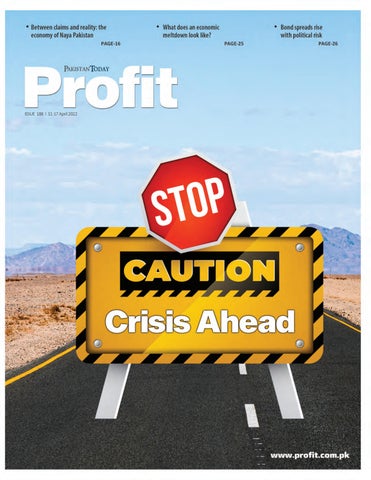
25 25 Crisis ahead! 26 Bond spreads rise with political risk 27 Pull over, the economy’s check engine lights are on
20
38
32 32 Mobile Money: The way forward for Pakistan 36 PSX gives you Sahulat to open your brokerage account
Profit
38 Despite the pandemic, employment rises steadily
Publishing Editor: Babar Nizami l Editor: Khurram Husain lJoint Editor: Yousaf Nizami l Assistant Editor: Abdullah Niazi Reporters: Ariba Shahid l Babar Khan Javed l Taimoor Hassan l Meiryum Ali l Shahab Omer Chief of Staff & Product Manager: Muhammad Faran Bukhari Regional Heads of Marketing: Muddasir Alam (Khi) l Zulfiqar Butt (Lhr) l Malik Israr (Isl) Layout: Ahmad Salahuddin l Photographers: Zubair Mehfooz & Imran Gillani l Business, Economic & Financial news by 'Pakistan Today' Contact: profit@pakistantoday.com.pk
Readers Say As the country was embroiled by political chaos, in the background the government attempted to continue to shine light on the successes of their term in power and PM Imran Khan did not miss the chance to highlight this post by retweeting it and adding that, ‘we handled the Covid pandemic – better than all the countries in South Asia.’ Apropos: No, Pakistan does not have the lowest unemployment rate in South Asia Zee, Website Perhaps one of the most fiercely debated scenes in Shakespearian scholarship is the crowning of Henry IV. After being exiled by Richard II, Henry returns with an army of nobles formerly loyal to Richard II and ousts him from power. To make the change of guard seem legitimate in the eyes of the court, Henry makes Richard renounce his throne and hand him the crown publicly and willingly. Apropos: Tragic hero or self-pitying schmuck — What will it be Mr Khan? Zee, Website Although I voted for PTI, however since coming into power, the PTI team has clearly shown that they are not here to change the status quo. In Fact they are only focused on not letting go of the power seat, by hook or crook. This is a very dangerous precedent and has made the country much much more vulnerable to economic a security threats. Unless an agreement is reached between the political parties to wait for the next election, the situation will become worse for everyone. Apropos: Tragic hero or self-pitying schmuck — What will it be Mr Khan? Faisal Malik, Website Given the choices I PREFER TO STICK WITH IMRAN. THIS IS A NO BRAINER. Apropos: Tragic hero or self-pitying schmuck — What will it be Mr Khan? Tariq Ali, Website I always thought of its “own” price rather than “on”. Apropos: The curse of ‘on’ money Farhan Raza Khan, Website
facebook.com/Profitpk twitter.com/Profitpk linkedin.com/showcase/13251020 profit.com.pk profit@pakistantoday.com.pk
HOW TO CONTACT
9
My thesis above is all about proving the fact that the promotion of literature, art and culture has a direct bearing on the economic well-being and sustainable growth of any nation, which ultimately benefits it’s commercial organizations; they just have to be patient and forward-looking about it. With this realization and recognition sinking-in,
it is absolutely imperative that commercial organizations, like The Bank of Punjab, must step-up and support these literary activities wholeheartedly, for the character building and betterment of our future generations. Apropos: Literature and economy: Role of commercial organizations Zee Raja, Website Managing big organizations is still a huge challenge. All the prominent technical as well as finance schools are incorporating general management and HR courses in their curriculum. It shows the importance of such knowledge for all professionals. I would say, instead of losing ground, business education is influencing other fields of study. Apropos: Let’s Shutdown the MBA program Jamil Bajwa, Website Vow! Finally an article which clearly spells out the redundancy of a MBA degree in today’s world and especially in Pakistan. We don't need 100s of MBA institutes but a few great MBA institutes with other institutes providing basic skills to technical individuals such as Engineers, IT professionals, Doctors, etc on cash flow/ marketing only. Hundreds of thousands of young minds wasted in mediocre universities across Pakistan with the belief that one day they will be CEOs of private sector companies such as banks whereas reality is that they will be hired as bank cashiers. Apropos: Let’s Shutdown the MBA program Faisal, Website MBA teaches you all round management skills with specialization in a specific field as electives. Business schools tend to adopt the ever changing specialization needs by offering new electives such as Data Sciences. Engineers and Doctors do MBA to get equipped with management skills. There are hundreds of MBA institutes but doing one from the best is definitely worth it.Apropos: Let’s Shutdown the MBA program Amir, Website Pakistan education is being subverted by such industry “leaders”. The MBA degree is the most valuable degree today in North America and europe. Deny it till kingdom come. It is Pakistan education which has nose-dived in the past 5 years, not the MBA degree. Let us please stop subverting our own country. Apropos: Let’s Shutdown the MBA program Javed Ahmed, Website
COMMENTS
IN BRIEF Rupee makes a comeback against the dollar
PM says would reject ‘imported govt’ in Pakistan
The rupee soared 1.9 percent versus the US dollar in the interbank market owing in large part to the Supreme Court’s decision to reinstate the National Assembly and the central bank’s move to raise the policy rate by 2.5 percent the day before.
Prime Minister Imran Khan said that if he is ousted in a no-confidence vote, he will not recognise an “imported administration,” but instead will go public and launch a fight against a foreignbacked regime in the nation.
Supreme court sides with the Constitution
The Supreme Court overturned Deputy Speaker Qasim Suri’s decision to dismiss the no-trust motion against Prime Minister Imran Khan and President Arif Alvi’s subsequent dissolution of the lower house of parliament on the premier’s suggestion in a momentous unanimous decision.
Weekly inflation sees biggest rise since November Inflation, as assessed by the Sensitive Price Indicator (SPI), jumped 1.53% in the week ending April 7, mainly due to an increase in the cost of key food products, according to statistics from the Pakistan Bureau of Statistics (PBS).
Punjab chief secretary, IGP removed from office for ‘refusing to sort out dissidents’ Prime Minister Imran Khan rescued his nominee for Punjab chief minister, Chaudhry Parvez Elahi, by dismissing the chief secretary and the IGP for reportedly refusing to ‘sort out’ PTI dissidents in order to prevent them from voting for the opposition candidate in the Punjab Assembly.
FO expresses concern over govt move to reveal diplomatic cable to NA The Foreign Office has expressed worries over the government’s decision to reveal the contents of the “diplomatic cable” to parliament, saying that such a step would not only jeopardise the work of foreign missions, but would also “damage our national interests”
Lt-Gen (retd) Tariq Khan refuses to lead ‘lettergate’ probe Lt-Gen (retd) Tariq Khan recused himself from heading a commission formed by the federal cabinet to investigate the alleged “foreign conspiracy plot” and dig out the facts about the so-called “threat letter”.
10
12
COVER STORY
An inflationary summer
A powerful price spiral awaits the government as inflation could top 15 percent once the price caps on power and fuel are lifted, making further rate hikes necessary. Are they ready? By Ammar H. Khan
V
olatility on the political front which spurred a constitutional crisis may, or may not change faces at the helm, but whoever is going to take charge needs to have a transition plan to navigate through a multi-faceted crisis, compounded further by an incessant global commodity super cycle, and populist fiscally irresponsible decisions. Inflation is on a rout across the globe, whether developed market, or emerging market. Central Banks which had gotten used to close-to-zero or negative rates are now scurrying for options as supply chains go haywire, while demand reverts back to pre-pandemic levels. Pakistan is no stranger to double-digit inflation with monthly inflation (on a year-on-year basis) clocking in double-digits in almost 40 percent of the months during the last fourteen years. Over the years, vulnerability has only increased, as the country’s dependent on imported energy, and food has only increased. Depleting energy sources locally, and increased demand due to economic growth has further increased vulnerability of our external funding position to vagaries of the global commodity market. A lopsided incentive structure in agriculture has also ensured that Pakistan continues to import the most basic of staples, including various kinds of pulses, garlic, ginger, among other items. Inability to develop integrated supply chains, or backward integrations to ensure food security, traders continue to make hay given low elasticity of demand of many staples, which ensures that prices can be easily passed onto consumers. Increasing prices not only encroaches on an already shrinking disposable income in real terms, but also has an adverse impact on the trade balance. It is estimated that food and energy make up almost 50 percent of the goods basket which is used for calculating inflation, against an
14
average of 35 percent for other emerging markets. The argument for food security is often used for mandating support prices, but inability to assess production and consumption requirements often results in a scenario where there is a shortage, resulting in price increases, and eventually import of the same. If that is not enough, in case of a surplus, sometimes export subsidies are also given, all attributable to the national exchequer. During March 2022, the UN FAO World Food Price index increased by 13
any setup in the next few days would be to rationalize subsidies before it gets too late. An unintended consequence of not increasing prices was a sharp increase in demand for motor gasoline during last month, which further compounded the fiscal situation. An increase in price of fuel would ripple through inflation numbers, with inflation potentially exceeding 15 percent on a year-on-year basis. In a few months, the second-round effects of inflation would start shaping up as producers reprice products, while consumers reconfigure their consump-
An increase in price of fuel would ripple through inflation numbers, with inflation potentially exceeding 15 percent on a year-on-year basis percent on a monthly basis, its largest jump in more than ten years. Increase in food prices follows increase in fertilizer prices, which have increased by more than 30 percent during the last few months. A bonanza in fertilizer prices led to smuggling of fertilizer from the country (despite it being produced through subsidized gas), pushing the government to import more fertilizer. As farm inputs increase, so will the price of final product. Ukraine and Russia, which are among the more important agricultural producers in the world may not have an exportable surplus during the next few months due to the invasion of Ukraine, and subsequent sanctions on Russia. A scamper for finite agricultural output for the year is only going to increase prices globally, and eventually locally. Similarly, as discussed in this space last week, reluctance of the government to pass on increase in fuel prices continues to rack up subsidies at a rate of PKR 100 billion per month. The first point of agenda for
tion requirements. To avoid a repeat of the last few months wherein the central bank was more reactive than proactive, we may see another few rounds of interest rate hikes in the next few months as the central bank may want to target a mildly positive real interest rate. With inflation at 13%+, it is anyone’s guess where interest rates ought to be. Any delay on the same may result in a downward pressure on the PKR against the USD, which would further compound our problems. This is a bitter pill that needs to be swallowed, but after every shortage, there is a glut – after every spike, there is a fall. It is for that glut, and that fall that the policy makers need to be ready to make structural changes to the economy, which are easier said than done. Broad based subsidies only distort incentives, and do not serve those who truly deserve it. The policy makers should be looking at targeted subsidies through the Ehsaas program, such that the most vulnerable can be sheltered from the inflationary shock that may materialize during the next few months. n
COMMENT
Between claims and reality:
the economy of Naya Pakistan Imran Khan brought his own style of managing the economy. How do the results compare with his predecessors? Dr. Shahram Azhar
A
s a pure imaginary, Naya Pakistan promised to be an era of institutional change and economic prosperity. From a political economy point of view, Naya Pakistan had one unique advantage that not many governments
in Pakistan enjoyed: it was premised on a cooperative new political coalition; a “hybrid” power-sharing arrangement between the civilian government and the establishment, a new ‘political settlement’ that promised sustained institutional transformation and rapid economic development. The proof of the pudding is in the eating. Leaving the lofty promises made at
1a: GDP per capita (current USD)
its inception aside, what can one objectively say about the economic performance and legacy of Naya Pakistan (2018-2022)? While a lot has been written in recent months on inflationary pressures during this period, a lot less attention has been paid to the issue of economic output. Specifically, what can one say about the evolution of the fundamental measure of the health of any economy - output
1b: GDP per capita (constant 2015 USD)
Fig 1: GDP per capita before the pandemic
16
per capita - under the institutional setup of Naya Pakistan? The answer hinges on three major issues. Since these issues will ultimately shape the contentious discourse around the economic performance of Naya Pakistan, it is important to lay them out clearly before proceeding to see what the data suggests. In this article, for reasons described below, I offer readers a comparative/counterfactual ap-
proach by comparing the performance of Naya Pakistan with two regional economies (India and Bangladesh) during the same period. Three things frame all discussions about the economy’s performance under Imran Khan. First, is the COVID pandemic. The pandemic presents an ‘exogenous shock’ to the system that will continue to be a key shaper of the political discourse around the
Figure 3- Disease Burden: Confirmed COVID cases per million
global economy, as well as discussions within Pakistan. Understandably, the proponents of Naya Pakistan will tend to overestimate the ‘shock’, using it to justify everything that opponents claim went wrong. The opponents of Naya Pakistan, by contrast, will tend to underestimate the shock and place the entirety of the blame on the economic mismanagement of the government. Regardless, any discussion of the period will almost certainly be muddled by the virus. Second is the inheritance. Although not strictly about the time-period (2018-April, 2022) under question itself, it nevertheless weighs on discussions of economic performance under Naya Pakistan with claims, critical or complimentary, about the situation of the economy before Imran Khan assumed office. While opponents of Naya Pakistan point to the demonstrably upward tick in GDP per capita during the 2014-18 period (Fig. 1), proponents of Naya Pakistan--- who disparagingly refer to this period as Daronomics--- argue that the economy was artificially ‘inflated’ via a ‘manipulated’ exchange-rate regime (Figure 4, notice the relatively stable line from 2014-17) that collapsed as soon as the transfer of power took place. Finally, a third issue deals with the future effects, real or presumed, of any policies undertaken by the current regime that may have lagged policy-effects in upcoming years. In contrast to the first issue, in this case proponents will tend to exaggerate the prospective output gains while opponents will seek
Figure 4: US Dollar to Pak Rupee to undermine them. Given the political (and somewhat rhetorical) nature of these issues, there will never be a perfect approach to dealing with any of them. One way of dealing with them is to compare the economic performance of Pakistan with two regional economies (India and Bangladesh) immediately before, during, and after the COVID pandemic. This allows the discussion to take place via the aid of some counter-factual with which the actual performance can be compared. Moreover, this must also be weighted in relation to the burden of the pandemic in each of the three economies (Fig 3). It is also crucial to remember that while the COVID pandemic hit the Chinese economy in November 2019, it was not before March 2020 that the rest of the world even began contemplating lockdowns. Figure 1 plots World Bank data on GDP per capita for Pakistan, India, and Bangladesh in current (panel 1a) as well as constant (panel 1b) dollars. As we can see, regardless of one’s opinion of Daronomics, both measures demonstrate that all three economies witness an increase in per capita GDP between 201417. While it is true that Pakistan’s growth lags behind India and Bangladesh during this period as well, it is nevertheless inching upwards alongside its South Asian neighbors. A sudden divergence, a reversal, appears in this trend in 2018-19, that is after the inauguration of Naya Pakistan, and more than a year before the pandemic. Between 2018-19, Pakistan’s GDP per capita fell by 1% while India and Bangladesh continued to
18
expand their per capita GDP by 3% and 7%, respectively. Between 2019-20, India’s output per capita declined by 8%, while Bangladesh continued to expand its per capita GDP, albeit at a slightly lower rate (3%). During the same year, Pakistan’s GDP per capita contracted by another 3% in constant dollar terms and 8% in current dollar terms, reflecting the immiserating effect of the depreciation of the Pakistani currency (Figure 4). This overall decline in output can also be observed by zooming into the sector-wise changes to GDP growth (at factor cost) in Figure 2.1 and 2.2. Moreover, since the economic impact of any exogenous shock must be assessed in relation to the quantum of the shock, it is also important to appropriately weigh our assessment of the economic impact of the COVID pandemic by comparing the disease burden per million across the three countries. This will also be useful when thinking about the speed and magnitude of the post-pandemic recovery. To do this, consider Figure 3 which presents a timeline of daily new confirmed COVID cases per million people between March 2020 and April 2022 using the Johns Hopkins University COVID dataset. As we can see, for most months Pakistan’s per million curve is lower, reflecting an overall lower disease burden. Ideally, a lower disease burden should have translated into a much swifter and more robust economic recovery: the lesser the original shock, the quicker the recovery. Unfortunately, that has not been the case, either. A
January 2022 World Bank Global Economic Prospects report (https://www.worldbank. org/en/publication/global-economic-prospects) estimates that despite the low-base effects associated with the 2020 downturn, Pakistan’s real GDP grew by a dismal 3.5% in 2021 (the government estimates a higher number); contrast this with the South Asian average (India estimated at 8.3% and Bangladesh at 5%). If we now combine the three facts the conclusion is obvious: Pakistan’s economic downturn began before the pandemic and its economic recovery from COVID is significantly lower than India and Bangladesh despite the lower disease burden per million. Finally, what can one say about the future trajectory of the economy in the aftermath of Naya Pakistan? Here too, World Bank estimates provide a rather grim picture. Estimates suggest that while India and Bangladesh will grow, on average, by 6-8% in 2022 and 2023, the Pakistani economy will grow at around 3-4% per annum. The depleting net reserves of the State Bank of Pakistan point to more economic hardship in upcoming years. Over the past seven months, the State Bank has been losing $1 billion a month of reserves. During the week ending on March 25th, the SBP witnessed the biggest weekly fall in reserves in Pakistan’s economic history. Once the political dust settles, a sobering conclusion awaits the judgement on Naya Pakistan: a stagflationary period with rising inflation, stagnating output, and a loss of competitive advantages to other regional economies. n
The many amnesties of Naya Pakistan “First they steal money then introduce tax amnesty schemes. Such schemes are created to benefit the corrupt. Only corrupt elements become the ultimate beneficiaries. This is to fool the honest people of the country and encourage corrupt elements to plunder and amass wealth, only to whitewash it later on”. Imran Khan
A
By Mohito
ll governments in the recent past when facing economic slowdown have introduced amnesty schemes to kickstart the economy. The result has always been the same. The promised fruits failed to materialize. It is ironic that in PTI’s short tenure of three and a half years, Prime Minister Imran Khan
20
despite his distaste of amnesty scheme as obvious from the above quote introduced three amnesty schemes through presidential ordinances.
Asset Declaration Scheme 2019
May 14, 2019
T
he President of Pakistan promulgated the Asset Declaration Ordinance 2019 on 14th May 2019 offering the people 45 days (till June 30) for declaration and whitening of undisclosed assets, sales, expenditure and Benami assets at nominal tax rates. The scheme was announced two days after the staff-lever agreement with IMF was reached by the government for the $6 Billion
Extended Financing Facility (EFF) to implement “ambitious structural reform agenda” over a period of 9 months. The amnesty scheme was discussed in the staff level negotiations and IMF had grudging given a nod to it according to Teresa Sanchez, IMF’s country representative “...we were not happy about it at the time, we said OK, because we saw it as a targeted attempt to facilitate the implementation of the Benami law”” The scheme allowed whitening of assets within country and abroad (with the exception of real estate) after paying a nominal rate of 4%. The whitened cash assets will have to be kept in Pakistani bank accounts. To continue keeping the cash abroad, a rate of 6% will be applied. In case of real estate, its value will be considered 1.5 times the FBR assigned value (or DC rate in case FBR assigned value isn’t available) before applying the nominal rate of 4% for whitening.
June 27, 2019
O
n national TV, businessman Aqeel Karim Dedhi asks the PM if the scheme can be extended such that people can declare there assets by the deadline yet the payment of the 4% tax can be made later. It was also reported in the press that businessmen are approaching PM for extension as the scheme was announced in Ramzan which does not leave that many working hours at the FBR office and the banks to complete the decaration. PM replied that it leaving things until the last minutes appears to be a Pakistani trait but he is considering it and is discussing with Shabbar Zaidi (Chairman FBR) and Abdul Hafeez Shaikh (Adviser to PM on Finance) that people can register by June and make the payment later. He added, “In the next 48 hours, we will bring a programme”. This statement took everyone was surprise as apparently there was no discussion with respect to his.
June 28, 2019
FBR informed the reporter who reached out to them that they oppose any announcement of an extension as it would break the momentum of the declarations. IMF also expressed its displeasure over the extension with IMF’s Sanchez saying that “The IMF is not in favour of tax amnesties... [as an amnesty or an extension of it] will certainly not help at all because it is inconsistent with the whole package”. The country’s case case was to be discussed at IMF Board meeting on July 3 and this last minute talk of extension in amnesty was putting it in jeopardy. IMF’s Sanchez added, “I hope they are not going to do it. It’s not going to work”. She emphasised that “But no extension is needed. People have already had a chance to declare their assets for this purpose, an extension will not serve any purpose.” What is unfortunate is that the amnesty scheme already had accounted for late payment. If the people declare their assets by June 30 but delay the payment of the tax, they will have to pay a surcharge on the delayed payment based on the following table. Hence, there was no need for announcing an extension.
June 29, 2019
C
hairman FBR issues a statement “No extension is being provided in the Asset Declaration Scheme.”
Source: KPMG
June 30, 2019
I A
n a post budget press conference, Adviser to PM Abdul Hafeez Shaikh said that the government had decided to extend the scheme till July 3.
July 3, 2019
s a IMF Board meeting was to be held today and Pakistan had extended the deadline despite IMF voicing its opposition to it, FBR Chairman explained that technically it was not an extension as June 30 and July 1 were a bank holiday. However, this meant that the extension should have been till July 2 but the extension was till the end of working hours on July 3. Apparently, the scheme ended in Pakistan before the start of office hours in US where the board of IMF was to meet to approve the $6 Billion EFF. The IMF Executive Board approved the $6 billion EFF. In the letter of intent dated June 19, 2019, Reza Baqir and Abdul Hafeez Shaikh commit to not granting further tax amnesties.
Assessing the Amnesty
A
round 137,000 people declared their assets under the scheme earning a revenue of Rs.70 billion for FBR and whitening Rs. 3 trillion worth of
assets as per Abdul Hafeez Shaikh. Was it a successful scheme? We can compare it a similar scheme announced by PMLN at the end of its tenure. That scheme realized a revenue of Rs.124 billion from 83,000 new tax payers and whitened Rs.2.5 trillion of assets. It should be noted that at the time of PMLN scheme, Imran Khan threatened the potential beneficiaries to stay away from the scheme as he would put behind bars those who avail the scheme.
Construction Amnesty Scheme 2020
April 17, 2020
T
his was introduced by President of Pakistan through another ordinance. What is novel about this scheme as that instead of getting people to declare assets like the earlier amnesty scheme, this granted amnesty in exchange for engaging in construction. Thus, the declared asset wouldn’t remain as dead capital in the bank rather it will be used to create employment and generate economic activity. The incentive was in the form of very low tax rate and as such, one need have undeclared wealth to benefit from the package. Even those with documented wealth could benefit from the scheme by registering their project under the scheme. The developers and businessmen appeared on talkshows and declared it “best
amnesty in the history of the country”, “a game changer”, and a “development second in significance only to independence of the country.” In brief, the scheme was available for any project new or existing that was registered with FBR before Dec 31, 2020. The projects would have to be completed by June 30, 2022 thus the scheme offered a very short window of 2.5 years to complete the project. The incentive was that the tax payable on the project was fixed at a very nominal rate based on the area of the housing unit regardless of its price (e.g. Rs.80/Sq ft. for a flat measuring less than 3000 sq.ft. in Karachi). This prevented FBR from probing the books of the builder for assessing the tax. Secondly, FBR was prohibited from inquiring about the source of cash the builder invested in the registered project. There was also an amnesty for a buyer of the housing unit in the registered project as long as the buyer is buying the unit in his own name and completes the payment of the apartment by September 2022. Surreptiously another clause was also introduced in the scheme which allowed the seller of house (less than 500 sq. yds) or a flat (less than 4000 sq. ft) to avoid any capital gains tax as long as the unit was being used for personal accomodation and utility bill was in the name of owner. This was a head scratcher as this step did not raise any revenue for FBR nor generated any economic activity. There was no reason for this to be included in the amnesty. Like clockwork, the same Pakistani traits began to manifest that the PM IK hinted at as the deadline of amnesty approaches.
Dec 26
E T
lectronic media reports that amnesty has to be extended due to various delays and bottleneck, Rs.1.3 trillion projects wont be registered if the amnesty isnt extended.
Dec 28, 2020
he newspapers report that Chairman Association of Builders and Developers (ABAD) saying that 500 projects will be registered by Dec 31 with total project value of Rs.600 billion. Another 300 projects are pending in Sind and once those projects are approved, another Rs.600 billion of investment will come online if an extension can be granted
Dec 30, 2020
I 22
n contrast what the electronic media is reporting or Chairman ABAD is saying, FBR reports that only 183 project with estimated cost of Rs.96 billion were
registered that fulfilled all requirements. There are another 147 which were submitted temporarily with FBR with an indicative investment of Rs.25 billion. In addition, there were another 218 projects worth 88billion in draft stages according the FBR official i.e., only existed on paper or may be not even that. If we sum up the registered, temporarily registered and projects that exist only in draft stages, the total volume comes to around Rs.209 billion which is a far cry from Rs. 1.37 trillion.
Jan 1, 2021
P
M announced extension in scheme for another six months. He also stated that projects worth Rs.186 billion have been registered with FBR and the projects in the process of registration amount to Rs.116 billion. A break down was not provided on how many were existing projects and how many were new projects. According to the FBR, the government has extended tax amnesty, the most controversial part of the package, for investors — builders and developers — for another six months to June 30, 2021 and the deadline for investors to complete their projects registered with the FBR under the package has been stretched to September 2023.
Reportedly IMF wasn’t pleased but the government impressed upon it that extension of the scheme is required due to the slowdown brought by Covid-19 lockdowns.
Jan 22, 2021
T
he extension in the amnesty is formalized when President Alvi approved the ordinance. The ordinance has been promulgated 48 hours before the start of the National Assembly and Senate sessions.
March 24, 2021
I
MF prepared the staff report of second, third, fourth and fifth review under the EFF and mentioned that Pakistan missed the benchmark on avoidance of further tax amnesties. In the letter of intent attached to the report dated March 9, 2021, Abdul Hafeez Shaikh and Reza Baqir commit to not granting further tax amnesties.
June 13, 2021
F
31, 2021.
inance Minister Shaukat Tarin states in a press conference that IMF has been requested to extend the scheme for another 6 months till December
June 30, 2021
T
he construction amnesty scheme ends. Most likely IMF did not agree to extension in the scheme or it could be that the government didn’t want to further antagonize the IMF. The sixth review of IMF $6 billion Extended Fund Facility had been postponed from July 2021 to September 2021 as IMF remain unsatisfied over implementation of prior conditions and achievement of structural benchmarks.
Assessing the Amnesty In the absence of detailed data, we are left to rely with the FBR statistics. As per FBR, 1,083 projects worth Rs340 billion have been registered with the FBR along with another 292 tentative projects with an indicative investment of Rs43bn till May 2021. FBR does not provide breakdown of how many of the 1,083 projects are existing projects and new projects. Similarly we do not know the about the Rs.340 billion registered projects that how many are existing projects and how many are new projects that came online solely on account of the amnesty. While there is no doubt the construction amnesty led to increase in construction activity as noted by increase in consumption in cement and steel during the time construction amnesty was available, however, in the absence of more detailed numbers about the type of projects (new or existing), number of projects completed, type of units built etc., it is hard to measure the effectiveness of the scheme. Moreover, at the same time, SBP was also aggressively pushing construction financing by giving targets to banks for the deployment of construction financing and housing finance as well as providing subsidized mortgages. From cement and steel sales data which is usually cited to show the success of the scheme, it is hard to untangle the impact of amnesty, SBP construction targets and GoP’s subsidized mortages. To wit, FBR list of the approved projects 2021329153317664ProjectsRegisteredundersection100DoftheIncomeTaxOrdinance.pdf (fbr.gov.pk)under construction amnesty includes Le Paris Gujranwala. As this paper has covered, the scheme is illegal and doesn’t exist. The question then arises that how many other such schemes are registered under the amnesty and of the Rs.340 billion
reported for registered projects, what is the realistic number. The list of approve project also includes FGEHA Chaklala Heights - a project for federal government employees housing. FGEHA has been undertaking similar projects for federal employees for a long time. The amnesty may have helped the builder avoid taxes but it is not clear that the apartments would not have been built in the absence of amnesty. Moreover, based on the price list on the website, it is obvious that the tax benefits to the builder have not resulted in lower price for the federal employees. Based on the price list available on FGEHA website Chaklala Heights Rawalpindi 1.pdf (fgeha.gov.pk), the sellout value of the project comes to around Rs.17 billion which is almost equal to 5% of Rs.340 billion reportedly approved by FBR. Thus the construction amnesty benefited the builder of the project who would have constructed the building anyway by lowering his tax bill. The list also includes Grove Residency, which is a project being developed by Dolmen Group in Karachi. When the project was announced, the lowest priced unit was announced at Rs.37.5 million with the project having around 400 units. This makes the sell out value of the project around Rs.15 billion which is 4.4% of the Rs.340 billion. Under SBP’s construction financing push, HBL Islamic Banking also offered mortgage financing on the project and still approving mortgages under Roshan Apna Ghar scheme as per HBL website. While there can be no doubt that construction amnesty led to employment generation and economic activity, without more granular data, it will hard to verify the Rs.340 billion number cited as well as to disentangle the exact impact of construction amnesty from the SBP and GoP schemes.
Industrial Amnesty
Feb 22, 2022
I
MF published the staff report In February 2022 for the sixth review of EFF. In the appended letter of intent dated December 17, 2021, Shaukat Tarin and Reza Baqir, reaffirmed the commitment to not granting further tax amnesties in writing.
March 1, 2022
A
few weeks after the publishing of the aforementioned IMF report, on March 1, 2022, the the Federal cabinet through circulation approved the Promotion Package for Industry
(PPI) by promulgation of yet another ordinance by the President. The amnesty offer three main offerings. One, 5% tax rate on undeclared source of investment for setting up new industry or carrying out balance and modernization of existing industrial unit provided the unit starts commercial production by June 30, 2024. Two, a profitable company an acquire a sick industrial unit which has been making losses in last 3 years and adjust the tax losses of the sick unit for the next years. Three, those who will repatriate their declared foreign assets for investment into industry, they are entitled to 100% tax credit on the profits of the industrial unit for next five years.
March 4 to March 24, 2022
B
y now, IMF has had enough. The IMF isn’t convinced of the government’s justification of the amnesty scheme. The talks on the seventh review of the $6bn Extended Fund Facility started on March 4. Talks were originally targeted to be completed by March 14 but were extended as differences remained. IMF was not convinced with the justification for the amnesty. Reportedly IMF staff mission was completely dissatisfied with the arguments advanced in favor of the amnesty scheme.
April 4, 2022
A
fter the dissolution of the national assembly on April 3, IMF stated that it will onll continue the program (the seventh review) once the new government is formed.
Assessing the amnesty
We have already covered that tax incentives for foreign investment cannot compete with the rate of returns offered on the Naya Pakistan Certificates. Industrial investments are intensive undertakings both in terms of capital (material, labour and financial resources) as well as the personal time the industrialist has to devote to setting up an industry. An industrialize decides to make such an investment when he has certainty of commensurate return from the endeavor. The current political turmoil as well as rising inflation and rapidly devaluing rupee has taken away any certainty there was in the economy. It is unlikely that there will be any significant take up of the industrial amnesty till the matter are resolved. n
Crisis ahead!
What does an economic meltdown look like?
I
magine a patient with elevated levels of blood sugar. If said patient does not change course quickly and take the prescribed medication, complications set in. Ignore those complications and the patient’s life is at risk. The economy of a country functions in a similar way: ignoring early warning signs and doubling down on poor decisions can lead to contagion, turning what was once a relatively manageable situation into a multi-headed hydra threatening the very foundations of a nation-state. With no functioning federal government, about two months of import cover, and a disastrous policy to freeze energy prices in effect, Pakistan is staring into the abyss. Immediate course correction is needed, but an ongoing political and constitutional crisis means that there is no captain to steer the ship into steady waters. Sri Lanka offers an example of what happens when crises mutate at an exponential rate. The island nation has been facing external sector challenges for several years, with the coronavirus pandemic worsening the situation as dollar inflows from tourism dried up. Astute policymaking at that time could have stabilized the situation, but the Rajapaksa regime, where the family itself dominated decision-making, kept doubling down on one bad policy choice after another. An example was the ban on chemical fertilizers which led to farmer protests and a dramatic decline in the output of key products including tea and rice. With reserves collapsing, the regime delayed negotiating with creditors and the IMF; the country ultimately was left with about $2 billion in reserves and $7 billion in debt repayments due in 2022. What was initially a balance of payments crisis has quickly turned into socio-political one. The foreign currency has collapsed in value, declining by over 30 percent year to date, making it the worst world’s worst-performing currency. The shortage of foreign currency means that the country is now rationing power, with the country’s public utilities announcing power cuts of up to 6.5 hours a day from April 6 to April 8. Petroleum products are in short supply and essential food items are not readily available in markets; inflation clocked in at 19 percent in March, the highest in Asia. Sick and tired of the pain, Sri Lankans have taken to the streets, protesting outside Rajapaksa’s home, clashing with police. As
COMMENT
the situation has worsened, the government declared an emergency and restricted access to social media to stop the protests, but this did not help. By the time Rajapaksa decided to bring the opposition parties together, it was too late. The government’s own allies have dissented, Rajapaksa is being told to resign, and Sri Lankan society is facing unprecedented upheaval. Lebanon is another example of how unresolved economic and political crises can exponentially mutate and lead to widespread chaos. What the World Bank referred to as one of the worst financial crises in centuries did not happen overnight. Political tensions in the
shut down, threatening over 50 percent of the country’s flour supply. The country is negotiating a program with the IMF to stabilize its economy and the government has defaulted on over $30 billion of its external debt. The total financial losses from the crisis are estimated to be about $69 billion and it is facing renewed pressures due to rising commodity prices. Lebanon, once the success story in the region, has now become a basket case. This is not to say that Pakistan is facing the same nature and scope of the crises faced by Sri Lanka and Lebanon. The point is that political uncertainty, paired with populist economic decision making and external
As a result, Lebanon’s real GDP declined by 21.4 percent in 2020 and 10.5 percent in 2021. The currency has lost over 90 percent of its value against the dollar on the black market. Inflation soared to 145 percent in 2021, which was the third-highest rate in the world behind Venezuela and Sudan; in February 2022, inflation came in at 215 percent region, starting with the civil war in Syria, set things off in motion. Lebanon’s central bank offered higher interest rates on dollar deposits, but these returns were paid for by money coming in from new deposits, as Lebanon was not earnings enough dollars to pay these rates. Eventually, people caught on, and in 2019 things started to get out of hand. As a result, Lebanon’s real GDP declined by 21.4 percent in 2020 and 10.5 percent in 2021. The currency has lost over 90 percent of its value against the dollar on the black market. Inflation soared to 145 percent in 2021, which was the third-highest rate in the world behind Venezuela and Sudan; in February 2022, inflation came in at 215 percent. Short of funds, the government proposed new taxes, including a tax on WhatsApp calls, which fueled further anger on the streets. The pandemic dried up tourism revenues and a major explosion at Beirut port highlighted how basic governance was collapsing due to the ongoing crisis. Essential products have been tough to get a hold of, with recent reports indicating that flour mills in the country have
sector pressures, can quickly mutate into socioeconomic crises. With the Imran Khan government deciding to freeze energy prices and bringing about a constitutional crisis, the country’s risk premium in the international bond market has reached its highest levels since 2013. Two months of import cover means that finding an influx of dollars is going to be an urgent necessity. All of this must be done at a time when the country is deeply divided and there is an ongoing political and constitutional crisis. Making tough decisions to bring about some level of stability in the macroeconomy within this context is going to be a Herculean task. It will require a government to bear serious political costs and face unprecedented societal pressure, all while moving the political process along through to elections. All in all, the country’s political and non-political elite have their work cut out from them, and it is about time they resolve their political differences and focus on the emerging economic crisis. Any further delay risks socioeconomic chaos. n
25
Bond spreads rise with political risk
P
Raza A. Agha
akistan has a long history in global capital markets. The country’s first international bond dates to late 1994 when $150mn was raised at a yield of 11.5%. Since then, the sovereign has tapped global capital markets intermittently over 1994-98, 2004-7 and 2014-17. The most recent placements, six since April 2021, have totalled $5bn including bonds from the government-owned Water and Power Development Authority. This is the most frequent and largest amount raised via Eurobonds over any 12 month period by Pakistan. And this has had an impact on the bonds post issuance performance. In the recent past, spreads* (a measure of risk perceptions) on Pakistan’s Eurobonds tracked those of similarly rated peers. Till the start of the recent spate of issuance in April last year, these spreads tended to be inside (i.e. lower than) the average for peers indicating better ‘technicals’ and lower risk perceptions. Indeed, there was a small Eurobond float ($4.3bn), which was relatively well held since there had not been any new bonds issued in nearly 3.5 years (between December 2017 and April 2021) while an IMF program provided a reform anchor for investor expectations. These dynamics have changed in two distinct steps. With significant issuance since April last year, Pakistan’s spreads started trading flat to those of peers (Figure 1). Further, the correlation between Pakistan’s spreads and those of peers has broken in recent weeks – while single B rated issuers have rallied post wides due to the Russian invasion of Ukraine, spreads on Pakistan’s Eurobonds have shot up higher. Indeed, Pakistan’s Eurobonds are now amongst the highest yielding within similarly rated countries (Figure 2). A key driver behind this breakdown are recent political developments and complications they engender for Pakistan’s macroeconomic outlook. Of particular concern is the external sector, specifically the level of foreign
exchange reserves held by the State Bank of Pakistan. Since their peak in late August last year at $20.1bn, SBP FXR have declined to $11.3bn as of early April this year. That an average fall of about $1bn a month. Worryingly, this pace of decline has accelerated in 2022, from $400mn a month over September – December 2021 to $2bn+ a month year-to-date. This headline decline masks even worse underlying dynamics – FXR have fallen despite the $3bn Saudi deposit in December, $1bn from the sukuk issuance in January and about $1bn from the IMF tranche in February. In the meantime, the IMF’s February 2022 report projects Pakistan’s gross external needs at $30.4bn this year. These estimates include a full year current a/c deficit projection of $13bn for the on-going fiscal year. However, realised data for the first 8 months shows the deficit at $12.1bn. Even if the next four months see this deficit averaging around the February low print ($545mn), the full fiscal year outcome is likely to be over $14bn. Including debt amortization, this suggests gross external needs of $31.7bn for the full FY22. That’s an average $2.6bn a month, or $7.8bn in Q4-FY22 (AprilJune) on a pro rata basis. Meanwhile, IMF estimates for FY23 gross external financing needs are even higher at $35b+. Note neither number includes potential outflows from Roshan Digital Accounts that total nearly $4bn. The above raises two concerns for investors. If political uncertainties persist with fresh elections not taking place in the next 6-7 months, how will such large needs be met given the level and pace of decline in SBP reserves. Further, the outlook may not be any clearer even after elections. The outgoing government has made allegations of attempted regime change by the United States, the largest shareholder of the IMF. Meanwhile, current
opposition leaders have publicly stated they will reverse the SBP autonomy law passed in January as part of prior actions for the sixth review of the IMF program. Clearly, regardless of who is in power, it seems Pakistan could face a potentially protracted fracture with the IMF. That’s not good news for investors who value political stability, policy predictability and reform commitment. Perhaps the best hope is that if the opposition wins office, the reality check of being in government prevents a legislative agenda that derails prospects of the seventh program review, already a month late. Without the IMF, political uncertainties will keep Pakistan’s external liquidity under pressure making issuance in international markets prohibitively expensive. In that scenario, preventing further drain of SBP reserves will require bilateral and multilateral donors to step-up. Will they, when Pakistan’s political leadership appears engaged in a virulent protracted battle, remains to be seen. All said and done, Pakistan’s external liquidity has seriously weakened since August last year. SBP reserves of $11.3bn face gross external needs of nearly $8bn till June. Without inflows, SBP reserves will fall further. That risks ratings downgrades. Given current ratings of B3/B-/B-, a one notch downgrade will take Pakistan to Caa1/CCC+, a rating level considered extremely vulnerable to default. That will make a bad situation worse. *the difference between a USD denominated bond’s yield and comparable maturity US treasuries. The author is a macroeconomist and sovereign debt strategist with 20 years of experience in investment banks, multilateral agencies, asset management and the central bank of Pakistan. The above views are the personal opinions and assessments of the author. They should not be construed as investment advice. He can be reached on razaxagha1@ gmail.com
26
Pull over, the economy’s check engine lights are on What does the hiking of the interest rate mean in the larger scheme of things?
By Ariba Shahid There are two kinds of people. The first are the stable ones. As soon as they see the ‘check engine’ light on their cars turn on, they pull over and call a mechanic. At most, they will take the risk of taking their car to the mechanic themselves. The other kind of people are the chaotic ones. These are the ones that not only ignore their check engine light as if it means nothing, but when the car engine starts rumbling and making scary noises they turn up their stereo to drown out the noise and ignore the problem. Of course, eventually the car will break down and the mechanic’s job (and cost) will be doubled. The economy is often analogised as a car. The question is, how are we handling our check engine light? The emergency monetary policy com-
MACROECONOMICS
mittee (MPC) meeting hiking policy rates by 250 basis points on Thursday, more than 12 days ahead of the scheduled MPC meeting was a blaring check engine light if there ever was one. In an emergency meeting, the State Bank of Pakistan announced a 250 bps policy rate hike bringing the policy rate to 12.25%. In the last scheduled Monetary Policy Committee (MPC) meeting, the SBP stated that it was “prepared to meet earlier than the next scheduled MPC meeting in late April, if necessary, to take any needed timely and calibrated action to safeguard external and price stability.” The MPC meeting for April is scheduled on Tuesday April 19, 2022. Analysts expect the policy rates to rise in the upcoming MPC meeting as well. This increases forward-looking real interest rates (defined as the policy rate less expected inflation) to mildly positive territory.
Why couldn’t the SBP wait?
T
o TLDR is to get ahead of the markets. The markets were ahead of the SBP and the SBP, despite calling this a proactive measure, was behind. In fact, primary market participants felt that the move to hike policy rates was not proactive, nor swift enough to be called reactive. In fact, the market behavior kept poking at the SBP to do something, until the SBP called in this emergency meeting. The MPC is calling the decision to hike policy rates through an emergency meeting as a “strong and proactive policy response.” “The SBP should have ideally hiked the policy rates in the last MPC meeting to set the tone. They adopted the wait and see approach which resulted in markets getting ahead,”
27
explains Dr Sajid Amin Javed, Research Fellow and founding head of Policy Solutions Lab at Sustainable Development Policy Institute (SDPI) Pakistan On Wednesday, the Market Treasury Bill (MTB) auction hinted towards a need for a policy rate hike as cut off yields rose significantly. The 3 month cut off yield increased by 80bps to 12.8%, 6 month cut off yields by 75% to 13.25%, 12 month cut off yield rose by 60bps to 13.3%. This is important to note as the average spread between the 3 month, 6 month and 12 month MTBs and policy rate used to be 0.61%, 1.04%, and 1.3% respectively but have climbed to 3.05%, 3.50%, and 3.55%. “The markets are pricing in aggressive rate hikes in April and hence we see the sharp 80bps increase in the Tbill cut off yields,” explains Sayem Zulfiqar, Visiting Faculty at the Institute of Business Administration. The SBP received bids of Rs911 billion, however was able to raise Rs680 billion against the target of Rs600 billion. The bid cover ratio clocked in at 1.34x. The highest participation came in the 3 month tenure MTBs as the market is anticipating higher policy rates in the foreseeable future. Therefore, the decision to hike policy rates by 250 bps and restart the tightening cycle is not only done in light of macroeconom-
28
ic developments but also keeping into account the financial markets and the signals it was setting. In normal situations, the SBP guides the market, not the other way round. “Had the SBP hiked the policy rates gradually over a period of time, the transition to a
tightening cycle might have been smoother. However, it is now expected that the SBP will have to be faster with the hikes which could weigh down on the economy,” Javed adds.
Does this fix all our economic woes?
T
he SBP explained that the reason for the home is because the outlook for inflation had deteriorated and risks to external stability had risen. The inflation forecasts have been revised upwards to slightly above 11% in FY22 by the SBP. The SBP believes that inflation will moderate in FY23. While the inflation witnessed in Pakistan is primarily cost push inflation driven by rising international commodity prices which are beyond the control of Pakistan, this move is an attempt to mop up liquidity and any demand driven inflation there is. “Externally, futures markets suggest that global commodity prices, including oil, are likely to remain elevated for longer and the Federal Reserve is likely to increase interest rates more quickly than previously anticipated, likely leading to a sharper tightening of global financial conditions,” reads the Monetary Policy Statement (MPS). The MPC also commented on the impact of political uncertainty on the economic climate of Pakistan “heightened domestic political uncertainty contributed to a 5% depreciation in the rupee and a sharp rise in domestic secondary market yields as well as Pakistan’s Eurobond yields and CDS spreads since the last MPC meeting,” However, what should be an immediate cause of concern is the declining reserves and the swelling current account deficit which is inadequately met by the import cover.
Reservations on the reserves as the rupee nosedives
T
he total liquid foreign reserves held by the country stood at $17,476.9 million as of April 1, 2022, the lowest level since June 2020. During the week ended in April 1, 2022, SBP reserves decreased by $728 million to $11,319.2 million, largely due to debt repayment and government payment pertaining to settlement of an arbitration award related to a mining
project. Total reserves are down by $1,078 million. A breakdown of this shows that SBP reserves stand at $11.3 billion, and are down by $728 million. Bank reserves are down by $350 million, clocking in at $6.2 billion. The total liquid FX reserves have declined $1.078 billion over last week which is equivalent to a 5.8% decline week on week. The import cover has declined from 1.82 months to 1.71 months based on average imports of the last 12 months. At this point it is important to note that while Pakistan has been at a worse position before, it is the trend that is alarming. “The rupee had been depreciating because the import bill had risen and reserves had been depleting. However, if you look back, we’ve been in such a situation before where reserves were at this level, and the import cover was low too,” explains Javed. He adds, “There are three basic reasons for declining reserves. The first is the foreign obligations Pakistan has met over the past few months. The volume of imports has grown, and the unit price of imports as a result of a rise in international markets has also added pressure.” However, despite the economic reasons, behavior theory also comes into play as panic sentiments rise. “The reason for the recent behavior [in the rupee weakening] could primarily be because of the political uncertainty and the outlook of the economic situation. Moreover, another reason is outflows in portfolio investment, particularly in Naya Pakistan Certificates (NPC). There is also a panic factor in the market especially considering the future of the IMF program.,” says Javed. Javed, however, feels that the solution to these economic woes, however, would have been easier had there been stability on the
MACROECONOMICS
political front. He opines, “At a time when we’re faced with such issues on the economic front, the one thing we needed was a stable government to deal with it.” The very fact that the rupee recovered 1.89% day on day closing at Rs 184.86 following the supreme court’s judgment shows that political uncertainty played a factor. Moreover, the import bill of the country does not seem to be coming down any time soon, at least until global commodity prices cool down, especially petrol and palm oil.
A slowed down future
T
he Asian Development Bank (ADB) on Wednesday (prior to the surprise MPC) forecast Pakistan’s economic growth rate to slow down to 4 per cent this year from 5.6pc in FY21 owing to tighter fiscal and monetary policies and Russia-Ukraine war fallout. “Pakistan’s growth is forecast moderating to 4pc in 2022 on weaker domestic demand from monetary tightening and fiscal consolidation before picking up to 4.5 in 2023”, the ADB said. Pakistan has a GDP growth rate target of 4.8pc for the current fiscal year. It is important to note that the ADB forecast is based on the revival of the IMF programme in January for fiscal and monetary tightening. This is before the finance package announced by Prime Minister Imran Khan which was the opposite of fiscal tightening. “slower growth in the current fiscal year reflects the government reactivating its stabilisation programme under the International Monetary Fund (IMF) Extended Fund Facility to narrow the current account deficit, raise international reserves, and cut inflation,” said the ADB.
30
Will our imported economic turmoil ever end?
K
eeping in mind, Pakistan’s reliance on imported fuel, despite the SBP’s forecasts, one cant be sure as to when inflation will recede. “International commodity prices have jumped to the highest levels since 2011, primarily due to the Ukraine conflict but also due to record quantitative easing measures by the global central banks. For e.g. oil prices have jumped 91% since Dec 2021 and currently trading above $ 100 bbl. This is putting enormous pressure on our import bill, which has jumped by 50% (Jul-
Mar) and led to sharper drawdown of the SBP FX reserves,” says Zulfiqar. Zulfiqar adds, “In the last month, the political crisis has severely compromised the authorities ability to respond to the crisis. Political instability has led to delay in disbursement of credit from IMF and other international development agencies. Cost of borrowing from international bond markets has increased sharply, with Moodys warning off a rating downgrade. As a result, plans to launch Eurobond / Sukuks have been shelved. Fiscal measures to curb import bill including new import taxes and reduction in subsidies cannot be taken until a new government takes office.” However, in order to suppress the import bill and the overheating of the economy, the SBP has hiked the markup rate by 250 bps for financing under Export Finance Scheme (EFS) bringing it to 5.5%. Despite the increased markup rate for EFS, the banks’ spread for corporate borrowers and SMEs remains unchanged at 1% and 2% respectively. It is important to note that the revision in rates will not be applicable on financing under rupee based discounting facility of EFS which suggests that this may be a way to curb FX outflow in light of declining reserves and the PKR depreciation. Moreover, the SBP has also imposed a 100 percent cash margin on 177 items in a bid to curb their imports. “These items are mostly finished goods including luxury items and exclude raw materials,” the SBP said in a monetary policy statement. The SBP is using this as a means to curb imports, bring down the CAD, save reserves, and stop the depreciation of the rupee, despite stressing that the non-oil current account balance has continued to improve. What this means is, the breaks are being pulled, and you’re going to feel it. n
MACROECONOMICS
Mobile money is becoming huge globally. Is Pakistan keeping up? By Ahtasam Ahmad
T
here was a time when phones were meant for calling and that was it. Within a decade of cellular phones becoming popular, however, phones began to double as not just a device for calling and messaging but as cameras, computers, calendars, clocks, and so much more. For the vast majority of the world, mobile phones are their primary computing device which they use the most. And its uses are continuing to grow. In 2022, the transactions involving ‘mobile money,’ which refers to payment services operated under financial regulation and performed from or via a mobile device (these include your bank app, QR codes, and services like JazzCash and EasyPaisa in Pakistan), increased to an all time high of more than $1 trillion globally. The world also saw an 18 percent increase in user accounts - all according to a report of the Groupe Speciale Mobile Association (GSMA) titled “State of the Industry Report on Mobile Money 2022.” Pakistan has also been highlighted in the report, which points out the development in the Pakistani market ranging
32
from growing user accounts to an uptake of digital financial services like loans and insurance. However, it went on to highlight the regulatory and socio-economic barriers that exist in the country’s ecosystem which can hamper the pace of adoption for mobile money amongst the masses.
The Industry
T
he mobile money service includes; transferring money and making and receiving payments using a mobile phone. While the service must be available to the unbanked. Also, the service must offer a network of physical transactional points which can include agents, outside of bank branches and ATMs, that make the service widely accessible to everyone. The agent network must be larger than the service’s formal outlets. The organization specifically excludes products and services linked to the traditional banking networks from its definition of mobile money to give a holistic view of the intended market segment. In Pakistan the Digital Financial Services operators fall in the ambit of this study. As per the PTA annual report 2021, “The m-banking network has expanded to over 534,460 m-banking agents and 74.6
million m-wallet accounts. This network has enabled more than 2.2 billion annual transactions worth over PKR 8 trillion in 2021.” However, only 45.6 million of the accounts are classified as active user accounts.
The adoption of Mobile Money
T
he mobile money market has great potential to grow in the low and middle income countries as per GSMA. The case for Pakistan is no different, 70 percent of the country’s population is unbanked as per World Bank’s Global Findex Report and this provides an opportunity for existing and new services providers to bring in a substantial amount of customers. However, the process is hindered due to inherent problems in Pakistan’s socio economic structure. The primary barriers to adoption of mobile money include; lack of awareness, infrastructural limitations, internet penetration, smartphone possession and lack of documentation. These characteristics are not unique to Pakistan rather shared amongst the population living in the low and middle income countries. One of the aforementioned barriers, Lack of Documentation, primarily pertains to an absence of official ID amongst the adult
Source: PTA Annual report 2021 population. As per GSMA, “close to 40 per cent of adults in low-income countries (LICs) do not have an ID, which limits their ability to use digital services.” Yet, through effective use of technology, this hurdle can be overcome. An example is Biometric for all (B4LL), a voice-enabled verification solution. Easypaisa is the first one to test this solution in collaboration with GSMA. Omar Moeen Malik, Head of Easypaisa
Business commented on the solution, “B4LL has been a highly useful asset for us to assess the utility of voice enabled biometric verification techniques for our customers.” The solution is developed to be supported on feature phones and low tech smartphones as a vast majority of the targeted audience is not in possession of more advanced devices. Another key trend that prevails in the mobile money market across the globe is diver-
Source: GSMA
sification of services. As per GSMA’s State of the Industry Report on Mobile Money 2022, “A decade of growth in active accounts and transaction values has shown that mobile money is playing an increasingly important role in the daily lives of people in LMICs. It is also diversifying its value proposition. Beyond Peer to Peer transfers and cash-in/cash-out transactions, the growth of partnership driven “ecosystem transactions”,such as bill payments, bulk disbursements, merchant payments and international remittances, together with interoperable transactions, are accounting for a greater share of the global mobile money transaction mix.’’ Pakistan is on a similar route as now the mobile money platforms are aiming to develop a digital financial services ecosystem. In an interview with Profit, Irfan Wahab the CEO of Telenor also acknowledged the fact that his organisation as well as other market players were looking to expand beyond the conventional money transfer services. M. Mudassar Aqil, CEO, Easypaisa while talking to Profit stated, “Our next step forward now is to convert Easypaisa into a digital financial services platform that allows any Pakistani to easily access a multitude of digital financial services including P2P payments, online purchases, savings, investments, and have access to basic insurance products amongst others. We have digitised our micro lending and have evolved a low-cost sustainable model with Easypaisa being the delivery channel.” The reason is two-fold. Firstly, the opportunity is there to be availed but also, the regulatory environment became such that the move was inevitable. The overreliance on customer fee leaves the entities operating in the market vulnerable to regulatory shifts. As per 2021 Global Adoption Survey by GSMA, “79 per cent of all mobile money provider revenue came from cash-out and P2P transfer fees. Higher competition in several markets has put significant pressure on prices, resulting in large reductions in cash-out fees, which still represent a significant proportion of provider revenues. Moreover, while most transaction fee waivers introduced by regulators during the COVID-19 pandemic were rolled back, some transactions remain zero-rated.” The Pakistani market has experienced a similar change in dynamics. The money transfer fees formed a bulk of the mobile financial services revenue and a move to abolish IBFT charges by State Bank further propelled the speed of diversification amongst the segment. The diversification drive has led to the introduction of several digital financial products including Loans, Insurance and Savings. The GSMA State of the Industry Report on Mobile Money 2022, highlighted that Pakistan was an exception in adoption of mobile credit amongst its peer group as 16 percent
FINANCIAL TECHNOLOGY
As per the report, “In Pakistan for instance, 76 percent of men and 51 percent of women own a mobile phone, 77 percent of men and 70 percent of women have heard of at least one national brand of mobile money, but only 19 percent of men and six per cent of women have a mobile money account.” The figures are representative of the overall gender gap in our society. As per Global Gender Gap Report 2021 by the World Economic Forum, Pakistan ranks 153 out of 156 countries when benchmarked against the criteria of Economic Participation and Opportunity, Educational Attainment, Health and Survival, and Political Empowerment. The benefits of servicing this gap are not restricted to just the profitability of the service providers but it can also bring in disproportionate benefits to the women using mobile money as due to societal norms their access to conventional financial services is already restricted compared to men.
Regulatory framework
Source: GSMA consumers took credit through the digital channel which is high compared to the prevalence of mobile money in the country. However, it may seem as a positive indicator that the financially marginalised segment is able to avail credit which through conventional means it could never have, but this credit comes at a cost, an exceptionally high one. In Pakistan, One of the biggest providers of such loans is Jazzcash, which charges an interest of around 180 percent and a loan processing fee on top of it. It is likely that the increased uptake of credit products might be more influenced by service providers pushing it to the consumer rather than a genuine trend
of consumer adoption. Similarly, the GSMA report pointed out that after Covid-19, amongst its peer group, “only Pakistan shows a trend towards increased use of mobile money enabled insurance.” This again can possibly be due to a push from the service provider’s side as insurance business is a lucrative one with around 60 percent of initial year’s premium going out as commissions majority of which in this ends up with the mobile money operator. Alarming gender gap A concerning development that was highlighted in the GSMA report was the staggering gender gap in Mobile money adoption.
Source: GSMA
34
T
he regulatory body overseeing mobile money is State Bank of Pakistan (SBP). The entities operating in the segment are licensed under the branchless banking regulation or the EMI regulation issued in 2019. The EMI regulations was the first one to permit complete digital operations but the services allowed to be offered are limited. As per the Mobile Money Regulatory Index 2021, “The regulation restricts EMI to neither pay interest/returns to customers nor offers anything that adds to the monetary value of e-money, leading to some restrictions on how the interest may be utilised.” The solution to this has already been introduced by the SBP through the introduction of Licensing and Regulatory Framework for Digital Banks. However, there are some inherent limitations in this framework also. Sardar Abubakr, Chief Finance and Strategy officer of Mobilink Bank/Jazzcash, while talking to Profit stated, ‘ As of now, the opportunity to operate at a larger scale is limited under digital banking licence. The minimum capital to deposit multiple is something that would need to be looked upon as under given limits maximum deposit that can be raised is well below the deposits already held by Jazzcash.” Amidst all the developments, Pakistan is progressing well in the sector as the market opens up for new service providers and solutions. An evidence of the improved performance and initiative from the regulator is the country being amongst the top ten in the “positive rating movement list” of Mobile Money Regulatory Index 2021 by GSMA. n
FINANCIAL TECHNOLOGY
PSX gives you Sahulat to open your brokerage account
The facility, which was only available to overseas Pakistanis, has finally been extended to those undersea By Ariba Shahid While overseas Pakistanis could open up an account online to trade stocks at the PSX, local residents (or as the meme-ers call them, underseas Pakistanis) could not until this week. In an attempt to bring up the meager number of investors at the Pakistan Stock Exchange (PSX), the bourse has introduced Sahulat Account Service which simplifies the investment process. “We worked closely with the State Bank and SECP and convinced them, particularly the central bank, that banks can share KYC and customer information with brokers. It works quite well for Roshan Digital Accounts. You can be sitting anywhere in the world, not only can you open your bank account digitally but you can also open your brokerage account digitally. Why not extend the same to Pakistanis living here? They should have the same facilities” said Farrukh H Khan, the MD and CEO of the PSX. It is important to note that RDA accounts are fully digital from the get go. Local bank accounts, however, haven not always been as digital as they are now. “The difference between RDA and local is that RDA starts as a digital experience, while for most local bank accounts, the initiation was not digital,” says Khan.
What do you need?
B
asically, all you’ll need to open an account is a CNIC or an SNIC. You do not need to provide any evidence or proof of your income source. The accounts will be sahulat accounts, and you can invest a maximum of Rs 800,000. all licensed financial security brokers offer the Sahulat account facility In a statement, Khan said, The Sahulat Account involves an extremely simplified and straightforward process of account opening,” “Coupled with recent improvements in online account opening and local KYC sharing, it has never been easier for individuals to open
36
a brokerage account and benefit from investing in the stock market,” First things first, you have to pick a broker. Fill out a simple form, provide a copy of your CNIC and you’re good to go to invest on the PSX.
Why this is important
T
he more investors there are at the stock exchange, the more listings you have, and the more documented the economy is. Pakistan has approximately 540 companies listed on the Pakistan Stock Exchange. Let’s compare the number of listings in South Asia. India has 5,034 companies listed on the Bombay Stock Exchange, 3500 on the Calcutta Stock Exchange, and 1300 on the National Stock Exchange of India located in Mumbai. Bangladesh has 750 listings on the Dhaka Stock Exchange, and 293 on the Chittagong Stock Exchange. Sri Lanka has 285 listed companies, Neal 230, Bhutan 20. Just a small reminder, the PSX is a combination of the Islamabad Stock Exchange, Lahore Stock Exchange, and the Karachi Stock Exchange. The fact that the sole stock exchange in Pakistan has less listings than either of the three exchanges in India, or the Dhaka Stock Exchange is a wake up call. Moreover, this also makes it easier for those that live in cities that do not have brokerage offices to open up accounts. The use of digital means to open an account, however, helps bridge that gap. “If you were sitting in Sukkur and you opened an account- the broker had to send, or you had to come to Hyderabad or Karachi where the broker’s branch was to do a biometric verification to get your account opened. So we’ve worked with the regulator, and we’ve taken away the requirement for the biometric verification,” explains Khan. Khan explains that biometric verification is no longer needed because you’re already verified against your CNIC, bank account, and of course mobile number. “Because when you open
an account you already have a biometric for your mobile phone, for your CNIC, for your bank account, etc. We’ve worked on that to simplify it. We’ve also simplified the account opening form. This not only makes it easier for the investor but also the broker.”
Why aren’t there enough investors in Pakistan
T
he answer is usually the same old story, citizens are scared, better returns on interest income, lack of corporate governance, low financial literacy and low financial inclusion. However, the answer is far simpler. The reason we have few investors is because the process of opening an account is long and tiring. The number of documents you have to submit just acts as a deter. If you decide to open a regular brokerage account online, you have to go onto their website, and fill out an account opening form. You will have to provide some documents which include a copy of your CNIC and the CNIC of joint applicants (if any), a duly attested by a notary public employee card/ job card for salaried individuals, company letterhead for business individuals mentioning the name, CNIC, designation, etc, salary slip for salaried persons, income statement for business individuals, copy of utility bill/ drivers’ license/ rent agreement, and zakat declaration. Basically, you have to provide the broker with all these documents, probably even name your first born after them considering how exhaustive the list is. This is because of the extra stringent KYC measures Pakistani financial institutions have to undertake. While they help keep the financial transactions of the country clean, they also act as a deter for formalization. However, if you’re keen on investing in the PSX and you want to keep your exposure upto Rs 800,000 you could open up a Sahulat Account and save your time and effort. n
Despite the pandemic, employment rises steadily The 2020-2021 Labour Force Survey results were released on 31st March. It gives insight into the labour market during Covid-19, demonstrating overall positive developments.
By Zunairah Qureshi
W
hat do you think would have happened to employment in Pakistan in the last few years? An immediate thought would be that the unemployment rate will have been soaring thanks to the Covid-19 pandemic. However, to the contrary, there has been a marked increase in employment despite the pandemic. Coming after the delayed results of the last 2018-2019 edition of the Labour Force Survey (LFS), the 2020-2021 LFS by Pakistan Bureau of Statistics (PBS) updates the labour market’s situation during the Covid-19 pandemic period. The survey, which was conducted for the period of June 2020 to July 2021 was, for the first time, carried out on digital tablets through a specialised Android software application. The survey obtained data from the highest number of sample households in the history of all LFS previously conducted. A total of 99,904 households were surveyed, which is a considerable increase from the 41,184 households that were surveyed for the 2018-2019 LFS. The LFS reported that labour force
38
participation rates and employment, notably for women, increased between the last and present survey periods. Appropriately, more young people joined the labour force, however, participants from the under 15 age group decreased. This edition included a section on Sustainable Development Goals (SDGs), reporting performance for each of its indicators. This encompasses a breakdown of data for employment of disabled persons. It was previously reported by PBS that, ‘Labour Force Survey for 2019-2020 did not take place due to preparations for an extensive survey in 2020-2021.’ This means the newly released LFS results are a much needed and crucial update which may remain relevant for some time. PBS communicated to Profit that, ‘We are currently focusing our energy and efforts on the upcoming 7th census. At the time of the national census, all other surveys apart from price updates are halted.’ So, it is hard to expect another LFS update anytime soon.
Labour Force Participation
[
All comparisons of the 2020-2021 LFS results are against that of the previous 20182019 LFS’ result]
Both the crude and refined activity participation rates increased since 2019. The crude labour force participation rate is 32.3%, meaning that this percentage of Pakistan’s total population is either employed or available for work. The refined rate is 44.9% which means that this percentage of Pakistan’s working-age (10 years and above) population is either employed or available for work. This makes sense as there is a significant increase in participation from the 15 – 44 age groups. In contrast, there is a decline in participation from the 10-14 and 45 and above age groups. The age-specific participation data indicates increasing youth participation in the labour force. A side by side comparison for participation rates from the previous LFS and the new LFS depicts an increasing youth bulge It is, however, interesting to note the decrease in the number of younger kids in the labour force, who are perhaps increasingly opting for school instead of working. The Labour Force Survey SDG indicator for participation rate of youth in formal and informal education was estimated at 38.2%. Updated data for the number of school-going kids will be available through the upcoming national census. In terms of sex, female participation for crude labour force remained the same overall, with increased participation from the age
However, it’s important to note that while unemployment decreased, underemployment increased from 1.2% to 1.5%. Underemployment is the number of employed persons working less than 35 hours in the reference week, who were available to work for longer hours, expressed as a percentage of all employed persons. The increase in underemployment rate is an apparent effect of Covid-19 impact on working conditions as many employees switched to remote work and faced salary cuts during ‘smart lockdown’. As for wages, average monthly wages increase from 21326 to 24028. There was a significant hike in female employees’ wages as it increased by 30.1%. This is much higher than the 11.1% increase in male employees’ wages. This significant development brought the Rs 6711 wage gap between male and female wages down to Rs 4536 by 2021. This might be in part due to the 1.9% increase of women in managerial positions as reported by the SDG indicator.
Employment by sector
I groups 20 – 44. There was also an increase in female participation rates in the provinces of Khyber Pakhtunkhwa and Sindh. However, significant increase to the labour force was observed through increased male participation which, for refined rates, went from 67.7 % to 67.9 % while refined female labour force participation rates actually declined from 21.5% to 21.3%. In total there was an induction of 3.01 million people into the labour force from 2019 to 2021, bringing it to 71.76 million.
n terms of industrial division, employment in the construction and community/social and personal services sectors has increased, going from 8.0% to 9.5% and 25.5% to 16.0% respectively. Female employment in the services sector significantly increased from 15.1% to 15.8%. On the other hand, there was a decrease in agricultural/forestry/ hunting and fishing during the 2022 to 2021 fiscal year, which went down from 39.2% to 37.4%. Employment in other categories remained the same overall. Skilled agricultural, forestry & fishery workers remained the largest occupational group with 33.2% of all employment – although this was a decrease from the previous estimate of 33.5%. Service and sales workers also went down from 16.0% to 15.6%, while plant/machine operators and assemblers significantly increased from 6.9% to 7.4%. Other occupational groups saw slight changes or remained the same In terms of employment status, the percentage of employers, own account workers, and contributing family members decreased. Employees remained the largest group with a significant increase from 39.8% to 42%. While male employees increased 1.9% from 45.1 to 47.0%, the greater increase was observed in female employees at 3.2%, going from 21.8% to 25.0%.
(Un)employment
T
he total number of employed persons increased from 64.03 million to 67.25 million while unemployed persons decreased from 4.71 million to 4.51 million. The increase in new employment indicates that around 3.22 million jobs were created from June 2019 to June 2021. The circulating figure of ‘5.5 million jobs created by the PTI government’ is likely reporting the total number of jobs created since the start of the present government’s tenure in 2018. The overall unemployment rate in the country came down to 6.3% from 6.9%. In terms of provinces, unemployment decreased in each province but the greatest decrease was observed in KP, where it went down from 10.3% to 8.8%. Punjab’s rate was estimated at 6.8%, Balochistan at 4.3%, and Sindh at 3.9% The most notable change in unemployment was the decrease in female unemployment, which significantly declined in both rural and urban areas. Overall female unemployment came down from 10.0% to 8.9% by 2021. Male unemployment rates went from 5.9% to 5.5% in the same period.
The formal sector saw a marginal decrease in employment while the informal sector saw an increase in employment as it rose to 72.5% in 2021. Female employment significantly decreased in the informal sector while increasing in the formal sector. In comparison, the opposite trend was observed for male employment. n
LABOUR
Pak-Iran barter trade
A fresh notification could mean trade volumes increase by as much as $4 billion
I
By Ahtasam Ahmad
n the most basic explanations of human civilization provided in social studies textbooks, humankind evolved from an economic system that was based on barter trade all the way to the high-rolling and often confusing world of capital markets today. However, barter trade still has its place in the world today. On the one hand, it exists in more sophisticated forms, such as in the advertising industry, where one company sells its available ad space to another company in exchange for the right to advertise on the second company’s space. However, barter trade also exists in some of its archaic form in the world today. Just recently, the Ministry of Trade issued a notification on 7th April to lay down the procedure for barter trade between Iran and Pakistan. Officials believe that this move will increase the bilateral trade from the existing level of $1 billion to $5 billion. A preferential trade agreement was signed between the two countries back in 2006 but it failed to increase bilateral trade as the US heavily sanctioned the Iranian economy.
40
The barter trade agreement
T
he draft working for a trade agreement was shared by the Iranian officials with their Pakistani counterparts at the 8th Joint Trade Committee (JTC) meeting held in Quetta in October 2020. After due deliberation by Pakistani officials including those from; State Bank of Pakistan, Ministry of Commerce and Federal Board of Revenue, a barter trade agreement was drafted that was subsequently tabled and signed between Quetta Chamber of Commerce and Industry (Pakistan) & Zahiddan Chamber of Commerce and Industry (Iran) at the 9th JTC meeting that took place in Tehran in November last year. On the signing of this agreement, Pakistan’s Commerce Secretary Sualeh Faruqi, expressed his optimism on removal of impediments for trade between the two countries and the possibility to achieve $5 billion bilateral trade by 2023. Reza Fatemi Amin, Iranian Industry, Mining and Trade Minister, while talking to a private publication stated, “With the measures taken, the existing barriers will be removed within the next three months and the trade processes will be facilitated. Hopefully, the Pakistani government will provide Iranian companies with the same facilities.” However, analysts were apprehensive about the success of this agreement given that there is an absence of a formal banking channel between the two countries. An official of the Ministry of Commerce, while talking to a private publication commented, “Until the regular banking channel was established for a mode of payment, the target to increase trade to $5bn in the next two years might also remain only on paper.”
The Notification
T
he ground for barter trade was laid with the agreement back in November, however, procedural complications were yet to be resolved. The recent notification along with the SROs defines the procedures for conducting barter trade between the two countries. Through SRO 484 and 485, the ministry of commerce made amendments to the Import Policy Order 2020 and Export Policy Order 2020. Prior to this amendment, exports and imports were regulated by Foreign Exchange Regulation of the State Bank of Pakistan. The Export Policy states, “Exports from Pakistan shall be made under the foreign exchange rules, regulations and procedures notified by the State Bank of Pakistan.”However, the notified amendments will permit barter trade by adding the following clauses, “Provided that import/export shall also be allowed under barter trade agreements as approved by the Ministry of Commerce”. The notification also specifies some rules of trade to be followed for barter trade under the agreement. These directions include; special customs code to be introduced for tracking of goods, barter trade cell to be introduced for record keeping and registration purposes, Both chambers to reconcile the trade figures quarterly and net-off outstanding amounts through trade or other means. While a trade dispute mechanism will also be formulated to ensure timely resolution of any trade conflicts. As per the notification, the Quetta Chamber of Commerce will open a Pak rupee bank account and will receive and disburse proceeds of imports and exports on confirmation from the Zahiddan Chamber of Commerce.
Pak-Iran bilateral trade
A
s per the Observatory of Economic Complexity, Pakistan’s major imports from Iran include Petroleum Gas, Electricity and Refined Petroleum while Pakistan’s export to the country consisted primarily of Rice and other agri products mainly reaching Iran through a transit route like Dubai. The trade with Iran is of great significance for the people living in Balochistan near Iran’s border. Their livelihood is heavily dependent on trade while a major source of food supply in the region is the neighboring country. As of now, there are 959 joint border crossings between Iran and Pakistan but only nine are operational. n
Economy: the timeline ahead
T
By Mushtaq Khan
hese are unprecedented times in Pakistani politics. IK’s April 3rd surprise has been unanimously ruled to be unconstitutional, and the Supreme Court (CN) has reconvened the assemblies and has instructed the Speaker to carry on with the vote of no confidence (VONC) by 10:30 am on April 9th. But as going to press, the assembly session was underway with no sight of voting on the horizon. Just hours before the SC decision, SBP finally acted and hiked interest rates by 250 bps and has increased the scope of cash import margins on all goods that are not raw materials. That the rupee in the interbank market lost Rs 1.84/$ on the same day before SBP acted, has created a narrative that the rupee’s weakness is driven by the political crisis. This is true and untrue at the same time. Casual correlation (between key economic parameters like the currency and interest rates, and political developments) does not reveal causality, and the timing of SBP’s decisions could be driven more by a political schedule, than the need to manage market sentiments and keep the FX market calm. Figure 1 shows the interbank rupee parity in the past seven months, and the underlying current account deficit (CAD). Despite large CADs from October to January 2022, the rupee was remarkably stable, which puts into question SBP’s claim that it is following a market-determined exchange rate. Even before the opposition tabled the vote of no confidence on March 28th, the rupee was already in a deep dive. SBP’s management of the currency defies understanding: the rupee was managed from November to January, with near record high CADs, but after the improvement in February (CAD was only $ 545 mln), the rupee appears to have lost its anchor. Figure 2 shows the sharp fall in SBP’s reserves in March (reserves fell by 4.9 bln), which could explain the rupee’s weakness in the month. However, it does beg the question about why
42
SBP did not act last month to manage the CAD as it took a heavy toll on its reserves. Could it be that SBP did not want to disturb PTI’s political narrative that IK has the people’s support, and the economy is doing just fine? One must realize that the finance minister and SBP governor had both committed to the IMF that fuel and power tariffs would reflect global prices, and no new amnesty scheme would be launched: IK’s relief package announced on February 28th was a blatant U-turn on these commitments and will have to be reversed if Pakistan wants to re-engage with the IMF. While the finance minister comes with a political agenda (Shaukat Tarin is, after all, a Senator), the SBP governor is supposed to be apolitical.
How will this play out?
A
fter the SC ruling, it is hard to see how the PTI can stop the VONC, even as it tries to create further impediments. PTI is likely to lose the vote of confidence, and the opposition coalition will be asked to select a new prime minister and cabinet. Indications are that Shahbaz Sharif will be the PM while Miftah Ismail is likely to be the new finance minister (FM). It is understood that the new (PML-N) government wants to contest the next general election as incumbents. Hence, NAB cases against members of the Sharif family will have to be dealt with (and ended), while the use of electronic voting machines (EVMs) will be delayed; furthermore, given PTI’s support from expat Pakistanis, the new government will seek to limit the number of expats who are able to vote in future elections. Finally, some key positions in Punjab and Sind will be changed to help the incumbent government in the next elections. However, as we have discussed earlier, the new FM will have to prepare for his trip to the WB/IMF Spring Meetings during April 18-23, and will need a plan to restart the EFF. We have heard that a $ 2.2 bln loan from China was repaid in March (which explains the sharp fall in SBP’s reserves in the week ending March 25th), which will only be rolled over if Pakistan is engaged with the IMF. As a signal of intent, the new FM will have to reverse IK’s relief package before he leaves for D.C. This means a sharp increase in retail fuel price and its repercussions on inflation, which (obviously) will be blamed on the short-term policies of the PTI government. The FM may also argue that IK’s relief package was a cynical political play as he knew the PTI government would not survive, so why not let the next government take the blame. When the relief package is reversed, we can expect positive statements from the IMF and a concerted effort to complete the 7th review of the
EFF. This will certainly calm sentiments in the FX market and stabilize the rupee. In view of the exceptional circumstances created by the war in Ukraine, the IMF is likely to endorse the measures recently taken by SBP to reduce imports. The IMF may also provide some leeway on the size of Pakistan’s external deficit and its reserve targets.
Conclusion
I
n our view, SBP’s last-minute steps to help the external sector are too little, too late. The next government will have to do the heavy lifting to stabilize the economy, and the resulting political pain will have to be accepted if the new government wants to contest the next elections on its terms. Once the political groundwork has been done, the ruling coalition will have to decide the election date. There could be much squabbling on this issue, but that is the nature of politics. The outlook for the next general election will depend on the political campaigns. IK will surely focus on the Western conspiracy against his government and accuse the opposition as complicit in these designs. IK will accuse opposition leaders of corruption and how the US encouraged this as a means of keeping Pakistan’s economy weak and dependent on the IFIs. Since the reform programs started in the late 1980s and have failed to deliver tangible results (and have increased income inequality), IK may find a sympathetic audience, especially from conservatives who are anti-Western. So, while it appears that Pakistan has again dodged the bullet, there is much pain in store. How the political class handle the public anger with looming general elections, remains to be seen. One thing is clear: if the opposition parties win the next elections, Pakistan’s relations with the West will improve and we will be back with the IMF; if PTI manages to gain power, Pakistan will enter uncharted waters. n The author is an economist who has worked as the Chief Advisor to the State Bank Governor and now runs a private economics consultancy.