CONTENTS
12
14
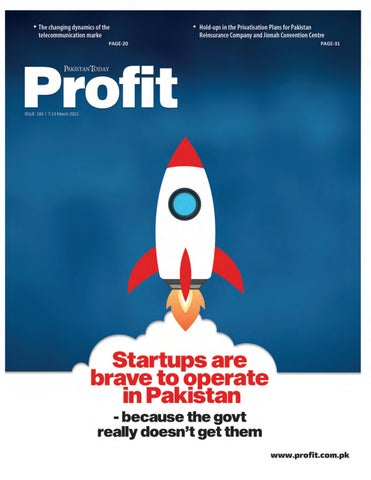
12 Blowout on Pakistani bonds 14 Startups are brave to operate in Pakistan - because the govt really doesn’t get them
20
20 The changing dynamics of the telecommunication market 24 Can the industrial package compete with Roshan Digital Accounts in attracting dollars? 28 The opportunity cost of energy subsidies Ammar H Khan
33
29
30
30 Russia, Ukraine, and Pakistan Uzair Younas 31 Hold-ups in the Privatisation Plans for Pakistan Reinsurance Company and Jinnah Convention Centre 33 How many MG cars is Chelsea Football club worth?
Profit
Publishing Editor: Babar Nizami l Editor: Khurram Husain lJoint Editor: Yousaf Nizami l Assistant Editor: Abdullah Niazi Reporters: Ariba Shahid l Babar Khan Javed l Taimoor Hassan l Meiryum Ali l Shahab Omer Chief of Staff & Product Manager: Muhammad Faran Bukhari Regional Heads of Marketing: Muddasir Alam (Khi) l Zulfiqar Butt (Lhr) l Malik Israr (Isl) Layout: Ahmad Salahuddin l Photographers: Zubair Mehfooz & Imran Gillani l Business, Economic & Financial news by 'Pakistan Today' Contact: profit@pakistantoday.com.pk
Editorial A deadly crossroads The country is now standing on a very dangerous precipice and more than ever before requires the highest quality decision making at the top to be able to navigate its way forward. Both externally and internally, its politics, foreign policy and economy are teetering on the edge of very delicate decisions that require deft handling. Rarely has the country faced such a wide spectrum of challenges pressing down on it simultaneously. The list is formidable. Pakistan is facing mounting pressure to clarify its position on the Russian invasion of Ukraine following its abstention on the resolution in the United Nations General Assembly. We don’t know how far this will go, but looking at how the conflict is shaping up between the west and Russia, it is important to understand that this is not some sort of passing phenomena. Already it is looking like a “with us or against us” situation and Pakistan will not be able to sit on the fence for very long, especially not after the Prime Minister decided to be part of a photo op visit with President Putin on the day the invasion began. The path of neutrality through this conflict was always going to be difficult and complicated. It has been rendered far more difficult after that visit. Next up is the IMF program which is now clouded by serious ownership concerns. The government chose to announce a freeze on fuel and power prices on the eve of the 7th review without properly passing it by the fund. Along with this came an entirely unnecessary amnesty scheme. The fund will undoubtedly ask after these two moves. With time the weight of this commitment – to keep fuel and power prices frozen till the next budget – will increase. The cost of this commitment will rise and the mechanism for making this freeze possible will also cast uncertainty on the oil supply chain. Already the oil marketing companies are warning that the government’s inability to process Petroleum Differential Claims (PDC) can endanger their ability to place order for new cargoes in time. Trying to maintain this commitment now means complications with the fund program as well as risking possible disruptions to the supply chain, with OMCs warning of the risk of another oil crisis. The external sector is also coming under mounting stress as the trade deficit powers on and the
financing requirements look set to mount. The government is trying to find comfort in the revenue numbers but they are more likely to find that despite some overperformance on this front, their fiscal troubles are far from over. In the months to come, yet another round of tax hikes, devaluation and tariff increases is going become necessary. Eventually the bill from the protracted procyclical policies will have to be paid. That moment can be deferred, but at a cost. Politically the Prime Minister is looking weak and in panic mode as questions grow about the survival of his premiership. His grip on power is getting weaker by the day. This growing weakness is now the prime motivation for all his actions, whether in politics or economic management, weakening the quality of decision making at a time when the most delicate, and difficult, decisions need to be made urgently. In short, a very toxic brew of vulnerabilities is now bubbling in the country. The country is facing the prospect of growing international isolation coupled with internal economic vulnerability and political uncertainty. Taken together these challenges appear nearly insurmountable unless something big changes. The one bright spot appearing on the horizon is the prospect of a breakthrough in the talks with Iran to revive the 2015 nuclear deal that could pave the way to reopening their oil exports. If the talks succeed, which they are very close to doing, then some respite could come in oil prices. It would be a grave mistake to underestimate the challenges shaping up around the country today. We may not like the pressure the western powers are mounting on us to choose sides in the European conflict, but we cannot wish away the strong ties of dependence that Pakistan has with the western world. Similarly, the economic pressures building up cannot be shooed away with tweets and hype. And the political isolation of the government at home hampers its decision making, and cannot be addressed with televised harangues against the opposition. Reconciliation is needed in our politics. Sobriety is needed in our foreign relations. And clarity is required on the economic front. Carrying on with things as they are is taking the country deeper down the road towards a possible crisis.
9
Readers Say The biggest problem here is that the Ravi Urban Development Authority (RUDA), has time and again repeated warnings that no files or housing societies are currently supposed to be selling land in the project, despite which the land continues to be sold. However no one seems to want to listen. There is something peculiar about the river Ravi. Most residents of Lahore even do not realise just how closely tied the river is to the City’s history and essence. The mighty river once flowed along the walls of the Lahore fort, but has over the centuries and decades been diverted away from the main city and has found a course away from the outskirts of Lahore. Apropos: The ‘real estate’ scams that have bled into the bones of the Ravi Urban Riverfront Project Zee Raja, Website @umairjav aap k or hamaray Ch Mujahid Yaseen makes it to The Profit The ‘real estate’ scams that have bled into the bones of the Ravi Urban Riverfront Project. Apropos: The ‘real estate’ scams that have bled into the bones of the Ravi Urban Riverfront Project @2paisay, Twitter You and I are going to get him to 100k subscribers IA. Apropos: The ‘real estate’ scams that have bled into the bones of the Ravi Urban Riverfront Project @umairjav, Twitter
facebook.com/Profitpk twitter.com/Profitpk linkedin.com/showcase/13251020 profit.com.pk profit@pakistantoday.com.pk
HOW TO CONTACT
10
Lol India is also not attracting FDI. We got $38B in FDI in 2007 also, and we get only 4050B usd in FDI each year that too is in the service sector only and only 5 states in India get 90% of all FDI inflows. Other 25 states like UP, Bihar, west Bengal, Assam, Rajasthan, MP, Chattisgarh, Jharkhand, Kerala, Odisha and others don't get enough FDI. These states get less FDI than Pakistan. India also is not getting any FDI in export oriented sectors like textiles, electronics. So India's condition is even worse than Pakistan. If you see the FDI to GDP ratio in India it has been consistently going downhill. India is not getting any FDI into the manufacturing sector. Don’t compare yourself with India. Compare Pakistan with Brazil. India is behind Brazil also in the FDI sector. Brazil, which has 1/6th of India's population, gets more than $70B in FDI. India is also not getting any FDI in labour intensive sectors. Indian exports r STAGNANT at $300$330B from 2011. India is in much worse condition than Pakistan my friend. Apropos: Exports, exports, and more exports – attracting the right kind of FDI Mayur, Website
Between FDI and export … every sane economist would recommend increasing export as the ONLY solution for reducing, controlling or eliminating CAD or making CA surplus. FDI is not a solution for CAD. In fact, FDI can increase CAD as profit gets repatriated and FDI itself can also get repatriated at times when the country faces the worst economic situation. FDI can also make a country vulnerable & dependent on foreign investors. FDI is only good if it has an element of technology and knowhow transfer. For Pakistan, best solution is to educate workforce, eliminate corruption (draconian law needed), bring business friendly environment, introduce tax on agricultural income like any income, build infrastructure, provide good roads and other amenities so that healthy working environment is created And than increase production of exportable gòods in huge quantity, find market and export. Export increases job opportunities, gives confidence to the economic sector and brings healthy foreign exchange in the country. For an economically progressing country, export should always be more than import, without Ifs and Buts. Apropos: Exports, exports, and more exports – attracting the right kind of FDI Dr S Naim, Website We have never taken export promotion seriously. Our standard import substitution policy has been to build a moat around local assembly plants that breed inefficiency. High import tariffs encourage production that only caters to the local captive market. We had an Export Promotion Bureau that has now been renamed Trade Development Authority of Pak because the bulk of their work is on supply improvements, not on export promotion. The flavour of the month is IT exports. The Pakistan Software Export Board is another misnomer. There is very little export promotion that PSEB does. Mainly supply side initiatives. Not that this is unnecessary but promotion has to be done simultaneously. The attitude that building it and they will come doesn’t work. Help them find you. PSEB has now started funding some trade show participation by IT companies. Previously TDAP would subsidise the events. Be it IT or textiles or sports goods we need to follow the sun. In markets where these are becoming sunset industries we need to aggressively promote these sectors to encourage FDI in Pakistan. Apropos: Exports, exports, and more exports – attracting the right kind of FDI @irfanahmed, Twitter
COMMENTS
IN BRIEF Turmoil in the foreign capital markets hit Pakistan’s bonds all last week with sharp sell offs coming on Friday. Bid yields on Pakistani bonds soared past 13 percent, touching as much as 15 per cent in some cases.
The Federal Board of Revenue (FBR) on Monday directed the public sector development departments not to issue NOC to real estate development authorities or housing society (commercial/residential) unless the applicant is registered with FBR as a Designated Non-Financial Business and Profession (DNFBP).
Rs 644 billion:
In fiscal year 2020-21 the telecommunications sector achieved the highest revenue of Rs644 billion in comparison to Rs592 billion last year. According to the report, almost 50 per cent of the population subscribed to broadband services, most of which consists of mobile broadband services. The new Promotion Package for Industry (PPI) has introduced a 5% across-theboard tax rate and will make investors immune from any probes about their sources of investment. As the Prime Minister announced a Rs 10 cut in petrol prices and a Rs 5 cut in electricity prices, the government is left having to foot the bill for a subsidy that could cost the government Rs120 billion by June.
The Benazir Income Support Program (BISP) has yet to provide a 30 per cent subsidy to 20 million families on the purchase of flour, pulses and cooking oil. The Prime Minister had announced a Rs120 billion historic welfare program on November 3, 2021.
Conversations with members of the Prime Minister’s Economic Advisory Council (EAC) suggest the IMF may not have been consulted before the Rs250 billion subsidy plan was announced in a live televised address by Imran Khan.
11
Blowout on Pakistani bonds
Pakistan’s foreign bonds have plummeted in price and yields skyrocketed all last week with no let up in sight. By Khurram Husain
T
urmoil in the foreign capital markets hit Pakistan’s bonds all last week with sharp sell offs coming on Friday. Bid yields on Pakistani bonds soared past 13 percent, touching as much as 15 per cent in some cases, with the largest increases coming on the last day of the week. Prices also plummeted as funds moved to offload their holdings amid rising uncertainty with drops ranging between $5.75 and $10 on Friday by some accounts. The weekly price drops ranged from $13 to $20 according to data provided to Profit by multiple bond traders. Pakistan has ten bonds maturing between 2022 and 2031. The Wapda bond that matures in 2031 is not a sovereign issue and saw the sharpest increase in its yield and drop in its price. Its bid yield rose above 15pc and the price dropped by $12 on Friday with a weekly drop of $24. “It’s risk-off in the markets” one trader told Profit from his office in London. Russia and Ukraine, both investment grade until last week, saw their ratings drop to junk status as all funds moved to offload their holdings. This drove down risk appetite. “Pakistan is not looking like a good asset in this environment” one trader said. “When you have the Prime Minister announcing power and fuel price caps on the eve of an IMF visit, coupled with the poor optics of the Prime Minister visiting Putin on the day of the invasion, uncertainty is bound to rise” he went on. Pakistan’s gross external financing needs are estimated by the IMF around $30 billion for the ongoing fiscal year. Next year these are projected to rise to $35 billion. So far the State Bank has been assuring its creditors that all of these are “fully financed”. An update on this assessment will be sought by these creditors after the monetary policy announcement scheduled for Tuesday (March 8). “If your yield is above 10pc, as per market convention it more or less means you have lost market access” one trader says. Another trader underlines the global
12
nature of the sell-off. “Everything is under stress” he says, “some from contagion risk from Europe, investors feeling they need to be reducing their exposure, it’s all very illiquid at the moment.” Under these circumstances, he continues, investors start focusing in on any vulnerability they can see in the country’s debt profile. “Pakistan’s spread to Egypt has been relatively stable for the past few months” he says. “But in the past five days these have widened, which suggests the market is wondering how the relationship with the IMF will develop. Pakistani holdings seem marginally overweight by our assessments” he adds. Financial markets were already clouded by the prospects of rate hikes in the United States before the invasion. Pakistan entered the
market at a bad time in late January to raise $1 billion from a Sukkuk offering. The bookbuilding exercise for that offering took place days after an IMF mission concluded talks but before the board had sat down to grant formal approval, triggering questions in the market about what the rush was for Pakistan to access these funds. Talks with the IMF for the 7th review of the ongoing Extended Fund Facility (EFF) began on Friday and are expected to continue through Saturday (March 5). “The authorities and the IMF will discuss recent developments, the merits of the recently adopted relief and industrial promotion packages, and other measures to promote macroeconomic stability” the Fund’s Resident Representative in Pakistan, Esther Perez Ruiz tells Profit. n
14
COVER STORY
I
By Taimoor Hassan
n early 2019, the CEO of foodpanda’s APAC region visited Pakistan and held a meeting with the then finance minister. In the beginning of the conversation, the CEO laid down his company’s concerns regarding FBR taxing the company on the GMV instead of revenue. Exactly 7-minutes into the discussion, the minister asks the CEO to pause and says: “Gentlemen, let’s take a step back. Can you explain what foodpanda is?” After the meeting was over, the foodpanda CEO wryly said: “The minister talked to us for 45-minutes without knowing what foodpanda was.” This happened three years ago, so why bring it up today? Because while it’s a reflection of how the government embarrasses itself, it’s a stark reminder for the technology industry that the government does not support them beyond acknowledgements and awards: the said matter of taxation by FBR still lingers on. And also because nothing has changed in those three years. On March 3, an event was hosted at the President House by a little known BizNet. The event was hosted to celebrate, as the presenter called it, a “massive success of the tech heroes” achieved in the past year by raising huge capital for startups. The awards were handed over by President Arif Alvi to startups Airlift, Bykea, Finja, Cheetay, and TAG for raising substantial funds. An unusual recipient of the award was Unilever Pakistan, which was given an award for backing Munchies, a quick commerce startup, with investment. Since the event was about celebrating startups for raising investments, it would be fair to say that Munchies was on that list instead of Unilever but could not be an appropriate nominee for the event because of an unfortunate turn of circumstances: a day before the event took place, news of Munchies shutting down broke. Munchies shutting down should serve as a warning of how things can quickly take a turn for the worse in the startup space. Just five months ago, Munchies announced raising $2.5 million in pre-seed funding and was continuing on a strong growth trajectory. Munchies closure should also serve as a warning to the government that measures like acknowledging startups for raising investments, repeatedly, by giving them an award are superficial and premature. Not only is it artificial and premature, the government’s disposition towards tech companies has been callous and disrespectful in some instances.
16
In another recent instance, at the National eCommerce Convention, the newly appointed adviser to the prime minister on eCommerce, Senator Aun Bappi, took all the credit for startups raising record investment in 2021. “We should all be proud of our investment abroad policy. What used to happen before was that you could set up a company in Pakistan and no one would know about this company outside of Pakistan. We introduced this investment abroad policy under which you can bifurcate holding company and operating company in two parts,” the advisor said at the convention. “....look at the figures now. Between 2014-17, venture capital funding was $130 million. After this policy, from 2018-21, because of our government, startups raised $433 million and in 2021 alone, $364 million investment came into the pockets of these young startups.” “....Just because of this one policy,” Senator Bappi said to a packed audience among which the prime minister and the incumbent finance minister were attendees. The senator misrepresented facts to wrongfully take credit for the investment that came into Pakistan’s startups, and, in the process, insulted startups that raised this money on their own, and were called to the same convention, and given awards as a gesture of acknowledgment from the government. There was no investment policy introduced in 2018, according to the Board of Investment data. The last investment policy was introduced in 2013 when the PML-N government was at the helm. The State Bank of Pakistan amended rules in the February of 2021 which legalised setting up holding companies abroad. Even before the SBP’s intervention, startups raised funds as per their requirement. Karachi-based startup Bykea is one case in point which announced raising $13 million in September of 2020, has a holdco abroad and was one of the startups given an award by the president at the recent dinner. Bazaar is another startup which announced a $6.5 million raise in January 2021 and has incorporated a holding company abroad. Startups are courageous to be operating in a country like Pakistan where the government only supports them through such superficial acknowledgments, and tries to steal them later, without understanding the core needs of these startups. There’s been a series of events either hosted or attended by either the president of Pakistan, the prime minister, ministers or advisers. There’s been private meetings, eCommerce convention, BizNet 2022 Awards, and there is an upcoming Future Fest to be privately organised in Islamabad this month. Future Fest, which is expected to bring a footfall of 35,000 attend-
ees, is a broad themed event not focused on acknowledging startups particularly and is reportedly not going to be an exclusive event for the tech ecosystem and would be open for everyone to attend. Such big events once a year can suffice the need for celebration, instead of back to back micro events focused on one particular agenda which achieves nothing. The government seems to be fixated on the idea that startups, just because they are able to raise funds against an idea, are the cure to the country’s economic woes. It [the government] does not seem to realise that tech startups are a very high-risk venture and without addressing their actual needs, the high of startups can turn to a low very soon. Munchies closure is an example of that manifestation. In another example of how superficial the government’s measures are, Prime Minister Imran Khan announced a complete waiver on taxes for the IT industry. Seemingly an encouraging measure, the PTI government was actually the one to revert the exemptions earlier and introduced a tax credit scheme instead. It only reverted back to the earlier status and exemptions does not mean the IT industry has become a zero-rated industry. It’s a tax exemption, which means that the FBR officials have the powers to grant exemptions to companies and individuals at their will. The exemption does not come into immediate effect either. It is going to be approved in June when the next year’s budget is presented. Who can guarantee that the government will eventually see it through? VC investment is flowing into Pakistan because investors see it as a big market. The doors to this market were opened and caught the attention of foreign investors thanks to Aatif Awan, the founder of Indus Valley Capital. But Pakistan simply being a big market as the reason for investor interest in Pakistan is no reason to celebrate or take credit for. What is going to be worth celebrating is if the investments continue rolling in and for that, startups need to be able to grow and show to the investors that the market was actually worth investing into. The next phase of investments is going to be contingent upon how startups in Pakistan foreign investors invested into have grown. And if they do not see substantial results as promised, they would be reluctant to invest further and likely discourage others from investing as well. The investment ecosystem is tightly knit where investors mostly know each other, talk to each other to vet the market before investing. So if an investor has a bad experience investing in Pakistan because despite Pakistan being a very large market, if the startup
he invested in was not able to grow, the tables can turn on the Pakistani market quickly. These are times when everyone in the ecosystem has to be very cautious and focused. The sheer quantum and the pace at which venture capital funding entered the Pakistani market last year should be more of a reason to be thoughtful about what is going to happen next than rejoicing. If the government’s reforms are not able to keep up with the pace at which startup investment comes into Pakistan, startups are going to have a hard time growing and which will bust the next cycle of investment, or prolong it. The earlier celebrations would then appear silly and meaningless. It is perhaps cultural here that whenever we think of an idea, we start celebrating and get complacent in the process. Our bar for reasons to celebrate is very low to begin with and complacency even when we think goals are achieved can be dangerous. If the government wants to support the startups, it should turn away from lunches, dinners and awards and resort to meaningful ways to acknowledge them. Startup founders tell me that the government calls them, thanks them for what they are doing, listens to their problems, does nothing! It calls them again, does not do anything and the cycle continues. Should the government be appreciated for creating STZAs? Well if the government needs appreciation for that, I need a raise every time I write an article! I know of an instance where a startup’s vendor refused to pay what he owed. Because of lack of enforcement of contracts, the start-
President Arif Alvi handing over an award to Unilever official for backing Munchies up thought it was better to let that money go and dedicate resources to something else. Instances of IP rights violations are also not unheard of. On a broader level, inflation has been averaging around 10% each month since last year. High inflation adds up to the GMV of a startup but adds to their costs as well and decreases the demand of products and services. Wages have been stagnant on the other hand. All of this is going to limit the growth of a startup which is a factor that will decide the quantum and pace of influx of future investments and which the government can look into.
Asad Umar with foodpanda APAC CEO in 2019
Government PR on steroids with respect to acknowledging startups is also going to make the government look bad some day. Out of sheer frustration because of issues in the market, a startup might do something silly to appease investors and get follow-on funding. Someone from the outside is going to pick it up and think that the government was in it all along to get the dollars to sustain its reserves. The government will end up embarrassing itself at the least if the government’s PR packages identify such a startup with government dignitaries. Startups are courageous to be operating in the Pakistani market. There is a lot of risk that these entrepreneurs have taken, leaving high paying jobs in countries like the US and the UK to start a high risk venture in Pakistan. The services they have started in Pakistan are simply a privilege for the people here. Think about it! There is someone out there that can deliver you a hot meal at midnight, at a discounted rate, without any delivery charges in some cases. Or deliver groceries at your doorstep. It’s definitely a privilege for the people here. The startups need to be rightfully acknowledged for giving us this privilege but if they are not able to keep these services up because the government did not have its priorities sorted, the government would be denying Pakistan a privilege yet again. Most of the problems in the Pakistani market are not created by the PTI government but it has, like it or not, fallen upon them to fix. Under these circumstances, one can only hope that the PTI government gets to recognise the opportunity and the challenges timely and does not become the one to deny us the privilege of subsidised hot meals and groceries.
COVER STORY
By Ahtasam Ahmad
T
wo decades after the 2002 Telecom Policy ushered in the mobile communications revolution, the telcos find themselves in search of an unknown path into the future. Their business model for two decades was centered around providing voice and short messaging services for a growing consumer base. With the rise of social media platforms, and the increasing speeds at which their system is able to operate, data has emerged as the new frontier and none of them is sure how to turn it into a profitable proposition. This is a dilemma unlike what most other businesses face. Their own investments are rendering their own business model obsolete. Over the past decade, they have invested more than $2 billion in purchase of high speed spectrum and installed the required equipment to provide 4G services to their customers, but in the course of doing so, their own revenue base has been eaten away as the higher speeds have made it possible for their customers to make voice calls and send short messages without using the telcos own service. Today the telecoms are searching for the business model that helps carry them into the new world that has been ushered in by the proliferation of high speed telecommunications. Two decades ago nobody thought that one day telecoms would be looking at ways to process payments or manage bank accounts, provide streaming content or operate Super Apps to provide myriad services to their customers like hailing a cab, making a restaurant reservation or purchasing cinema tickets. Today all this and much more is being looked at because, as telecom executives put it, they cannot remain a “pipe” connecting two individuals for much longer. They must branch out into other services. Once known to be the core of telcos, the voice and texting services have seen a
20
decline in importance as more and more OTT players like Whatsapp and Facebook enter the market. As per PTA annual report 2020, “10% decline in total ARPU occurred because consumers shifted away from traditional voice services.”
The willingness to change
C
EO of Jazz, Aamir Ibrahim while he was on a panel discussion arranged by Tabadlab last year stated, “Jazz was a telecom company. Today we are a tech company and in the future we’ll be a data company.” However, he is not the only one to foster this ambition, Irfan Wahab, the CEO of Telenor, in an interview with Profit stated, “The digital economy, it’s a proven thing, will generate most of the wealth in the coming decades. ICT sector exports, young freelancers, startups all have to rely on this and we acknowledge the added responsibility and are committed to that.” These statements and a strategic emphasis on shifting the telecom business model is not new. The search for new business avenues by Mobile Network Operators (MNO) has picked up ever since the digital revolution hit the Pakistani market. A testament to this change was back in 2016 when Jazz launched Veon, an all-purpose app where users could do almost everything using mobile phones like news feeds and self-serving mobile top-ups and cellular bill payments. Though the app proved to be a failure, it underpinned the importance telcos were placing on digital services to replace their core business “Cellular”. The Cellular services have two components; Data and Voice. The demand for data services continues to grow with ample space remaining in the market for MNO’s to acquire. As per PTA, the Mobile Broadband Penetration is around 50% in Pakistan which is comparatively low compared to economies
like China that have a mobile broadband penetration rate of more than 70%. While the fact that Teledensity is already around 86% in the country coupled with falling voice and messaging revenue leaves the conventional services market a very saturated one with limited opportunities to grow.
What avenues Telcos are exploring?
M
obile Data and Adjacent Digital Services will be the primary revenue streams for Telcos in the future. The importance of Mobile broadband as a revenue stream for Telcos has been widely discussed and the impact of 3G, 4G and now 5G rollout has been assessed in detail over the past few years. However, the data services available in the country are one of the cheapest around the world, but the investment for provision of these services is considerably high. This means that the standalone return on investment from mobile data services would be quite low. However, as the data penetration grows, so will the demand for adjacent services and telecom can be seen as the “Sector of Sectors”. As the economy digitizes, it finds itself an enabler of multiple services. Therefore, venturing into these services segments provides opportunity for synergies and healthy profitability. As per GSMA report, Pakistan: progressing towards a fully fledged digital economy, “Digital economies are multi-faceted constructs: high-speed internet access, digital identity frameworks and multi-sided platforms provide the foundations for effective digital citizen-
UBank Branchless Banking Income Half Year Ended June 30 Rs in 000,
PKR 47,407
PKR 30,181
PKR 30,572
2019
2020
PKR 25,645
2018
2021 Source: UBank Financial Statements
ship, rich digital lifestyles and global digital commerce. Mobile is at the center of Pakistan’s national development plan and its progression along the digital society path, helping to close connectivity gaps, increase financial inclusion and sustainably transform verticals as part of the Fourth Industrial Revolution.” The MNOs are quite aware of the opportunity that lies in the digital sector and they are actively trying to make a shift towards providing these services. Telenor Pakistan’s parent, in its strategy mentioned, “Beyond our core operations, Telenor will continue to offer selected products and services to offer customers with new solutions. The combination of 5G and other network assets, AI and IoT will bring opportunities to create value further from the core.Telenor will explore such opportunities, in cooperation with customers and targeted partnerships.”
Source: PTA
The statement further added, “Monetising these opportunities and delivering on customers’ needs will to a large degree require capabilities outside of what Telenor has today. Thus, developing partnerships is a key priority. This includes partnerships with Big Tech players, traditional players as well as smaller players with more niche capabilities and offerings. Based on these partnerships Telenor seeks to understand the position where it can create the most value, which capabilities it will have to develop and what type of business models to deploy.” Jazz, in an internal strategy document, also laid down its direction to be; Best self care ecosystem (Jazz World), Win adjacent digital markets & be the market leader: in FinTech, Affordable Device segment, Digital Content, Instant Messaging, Cloud, Data Monetization & Adtech. However, the search for diversification is not just limited to pieces of paper. There are many onground examples. One such is the Digital Financial Service Market. The telcos specially, Telenor and Jazz are amongst the pioneers of this business model in Pakistan. Back in 2008 when Telenor partnered with Tameer to develop Easypaisa App, not many people actually understood the business case. However, soon the industry realized the potential of the market. Jazz launched Jazz Cash in 2012 while Ufone followed with Upaisa in 2013. The market proved a successful endeavor for the Telcos. PTCL, the parent company of Ufone, experienced a declining revenue from its conventional streams between 2018-2021, However, its Mobile banking business saw significant growth. Jazz on the other side is gearing up to be the market leader. Last year it registered a company for its Digital Financial Service operation with SECP. A move to shift its Mobile Financial Service business to a dedicated entity that will focus on; a separately branded fintech platform Opening API for merchants, Developing Agent & Merchant network and introducing
TELECOMMUNICATION
Loan/savings products. The company projects to generate around 15% of its service revenue from DFS by 2023. Another avenue that the Telcos are actively exploring is the Cloud Computing and IoT services. At present, Pakistan has a very underserved market for cloud solutions. However, in the past few years demand has increased due to the massive growth shown by the country’s IT sector and this has resulted in MNOs providing their own Cloud Solutions. Earlier this month, Jazz launched its dedicated cloud service platform “Garaj” as per Ali Naseer, Chief Business Officer, Jazz, “Garaj will enable a secure and affordable cloud experience as more businesses and government seek digitalization to capture efficiencies and reinvent their customer experience. Cloud solutions will allow for much needed cost and operational efficiencies, while delivering security and improving the ease of doing work.” While talking to Profit about their Cloud and IoT ventures, CEO of Telenor said, “In Pakistan, we have deployed tens of thousands IoT solutions primarily in energy management, vehicle tracking and similar solutions. We work with a lot of banks, have been working with energy companies and FMCG merchants like Nestle, Unilever etc.” He further added, “In the IoT space, our B2B solutions are cloud based and we are selling those cloud solutions to our customers as well. So as the market evolves, you will see more and more shouting around it as well.”While Zong is also offering IoT and Cloud solutions to enterprises through China Mobile’s (Parent Company of Zong) dedicated platform OneNet.
A Step towards diversification
A
change in Business Model will not only have an effect on the revenue model, but also lead to changes in the resource mix. Initially when the Pakistani Telecom market opened up to foreign players in the early 2000s, the focus of all these companies was to build infrastructure and
22
compete on coverage. Therefore, a lot of initial investment went into building tower sites and purchasing equipment. However, as the market evolved this focus has shifted towards service other offerings which require the MNOs to free up capital to route it into segments that have better ROI. As per TowerXchange’s research, Pakistan has an estimated 36,187 towers serving four MNOs with 189mn subscribers, while estimated 30-40,000 additional towers will be required over the next five years The research further stated that of the 36,1687 towers, 10,000 operate as co-location that means they serve multiple MNOs. The model going forward would be that the MNOs outsourcing their infrastructure to third party service providers while they themselves focus on service offerings. There is a genuine shift towards this approach evident from the developments in the Telecom market over the past few years. An example is Jazz creating a special purpose vehicle, Deodar, and transferring ownership of all its towersites to the company. The aim behind this move is to sell off all the towersites as an incorporated company when a suitable bid arrives. Official representative of Jazz commented on the matter, “Jazz supports passive and active sharing as it reduces CAPEX and OPEX costs incurred by the business, allowing us to provide quality services specifically to unserved areas. The current regulatory framework entails passive sharing, and we hope to have an update on active and spectrum sharing in the near future to optimize network spend, open secondary markets, and create innovative network expansion
Source: TowerXchange opportunities.” Not just Jazz, but also other operators are moving towards the infrastructure sharing approach. While talking to Profit, the CEO of Telenor stated, “When we were building most of our sites back in the 2004-2008 period, there were no tower sharing companies. Therefore, we had to build our own infrastructure but now we are sharing and we are sharing quite substantial numbers”. He further added, “However, I suggest we should move on from passive sharing to more active sharing like in other countries where regulators and the policymakers are moved to the point that they allow for electronics and frequencies to be shared. Because that’s where the biggest synergy lies.” Last year, as per TowerXchange, Telenor and Zong undertook Pakistan’s first RAN sharing trials across around 30 sites. A step towards active infrastructure sharing. Ufone also has been searching for a suitable sale and leaseback transaction for its tower sites across Pakistan. A very pertinent example of Asset light strategy is the Indian telecom market. As per EY report, From evolution to revolution, India has 83% sites with shared infrastructure, only second to China’s 100%. In the report, “How telecom companies can win in the digital revolution”, published by McKinsey & Company, it is mentioned that for telcos to lift their business, there is a need for two major changes. First one would be the reinvention of core services while second would be to pursue adjacencies. This is the path that most telcos have adopted and the Pakistani companies are no different. In the next few years the pace of change will speed up and one thing is certain that going forward, connectivity will be just one of the many services that Telcos provide. n
TELECOMMUNICATION
OPINION
Mohito
Can the industrial package compete with Roshan Digital Accounts in attracting dollars? The returns offered on Roshan Digital Accounts are too lucrative for a Non resident Pakistani to opt for anything else
T
here has been a lot of talk that the latest industrial package offered by the government under Income Tax (Amendment) Ordinance 2022 will lead to an inflow of dollars. This article explains why this might not be the case.
The Benefit of Investing
T
ax credit for foreign investment for industrial promotion. The company [set up under the package] shall be entitled to a one-time tax credit equal to 100% of the amount remitted and credited in rupees in the bank account of such company against the tax liability for the tax year in which commercial production commences.
24
Who is eligible?
A I
non-resident Pakistani (NRP) citizen having continued non-residential status for more than five years; or a resident individual having foreign assets declared in terms of section 116 or 116A by the 31st December, 2021, (meaning it is not an amnesty for undeclared assets).
What are the conditions?
nvestment is required in equity of a company incorporated on or after the 1st March 2022. The company shall be an industrial undertaking in Pakistan. Equity shall be at least Rs 50 million with funds remitted into Pakistan through proper banking channels as per the procedure to be prescribed by the State Bank of Pakistan, at any time up to the 31st December 2022. Commercial production should commence by the 30th June 2024. Where no tax is payable by the taxpayer in respect of the tax year in which the commercial production has commenced or where the tax payable is less than the amount of credit, the amount of the credit, or so much of it as is in excess thereof, shall be carried forward and deducted from the tax payable by the taxpayer in respect of the following tax year and so on, but no such amount shall be carried forward for more than five tax years. To summarize, the package allows the investor to earn income tax-free from the industry set up by her under the package equal to the money remitted from abroad as rupees into the company’s bank account.
The money should be remitted by December 31, 2022 and commercial production should start by June 30, 2024. The equivalent tax-free income should be earned within five years.
The risks facing an industrial undertaking
T
he purpose of limiting the tax credit to investment in industrial undertaking is to discourage the setting up of trading businesses or service-oriented businesses under this incentive scheme. The intention is to sow the seeds for industrial growth in Pakistan. Industries are long-term investments. It takes 12-36 months to set up before production can take place and the recovery of investment can take up to a decade unless the industrialist over invoices. Investments are made if the projected rate of return on the investment is higher than the hurdle rate. The higher the risk of the return, the higher the hurdle rate. Some of the factors that an investor will consider for calculating her hurdle rate are; Opposition’s long march, the no-confidence motion on the horizon, and political instability, Elections due in a year, Inflation, Devaluation (the dollars will be converted into rupees at the rates prevailing between now and Dec 31, 2022. The tax credit ceiling will be based on this amount. Taking an extreme scenario, if the rupee devalues by 25% by the time the company starts making a profit, the tax credit has reduced by 20% in foreign exchange terms), Interest rate risk, Budget deficit, Current Account deficit, Bureaucratic red tape for getting the tax credit, Law and order situation, Readily available infrastructure and Project completion risk as the project has to start commercial production by June 30, 2024, to qualify for a tax credit. The aforementioned isn’t a comprehensive list or a mutually exclusive list. One may
rightly point out that investors in real estate plots also face the same risk, but they couldn’t care less about the factors listed above. An industrial undertaking isn’t like an investment in a plot. Setting up an industrial unit requires dealing with the bureaucracy of FBR or all other bureaucratic headaches of permits, licenses, bank account openings, utility connections, or the challenges of hiring employees, firing them, training them, dealing with buyers, suppliers and whatnot that come up when someone sets up an industry.
Deriving a hurdle rate
F
inance textbooks provide a methodology of calculating a hurdle rate by starting with a weighted average cost of capital (WACC) and then adding a risk premium to it. In real life, investors usually go by rule-of-thumb or arbitrary numbers such as the projects should have a minimum IRR of 12%. The other method is to use a rate on a sovereign instrument (a proxy for risk-free rate) and add to it an arbitrary risk premium of 2% - 5% based on the risks the project faces (some of which were listed in the previous section).
Sovereign risk-free rate
F
or a non-resident Pakistani (NRP), the closest thing to invest in a risk-free instrument is Reza Baqir’s Naya Pakistan Certificate (NPC). The advantage of NPC is that if one invests in a foreign exchange denominated instrument, it eliminates the
foreign exchange/devaluation risk. The below table lists the profit offered on dollar NPCs as per the SBP website. It should take at least 5 years from investment to earn enough income to benefit from the tax credits, thus the 5-year rate provides a good comparable.
Leveraging it up
L
et’s start with dollars. The 5-year dollar profit rate is 7%. HBL and UBL are offering 3x leverage on this investment. By leveraging it up with HBL/ UBL, the NRP is getting a 10.1% on a 1-year NPC instrument. It is reasonable to assume that a leveraged return on a 5-year instrument should be at least 11%.
SBP encouraging more leverage
B
elow is a slide from SBP’s presentation at a meeting held with Bank CEOs on January 19, 2022. SBP is imploring the banks to increase the leverage offered on NPCs. If the leverage is increased to 4 times of that in the HBL Excel sheet presented earlier, the return on a 12-month instrument comes to around 16%. The leveraged return on a 5-year instrument would not be less than 17%. Based on the risks highlighted in an earlier section, we can add 2% arbitrarily as a risk premium. However, as the profit on the industrial unit is not repatriable, we will ignore this assumption for now.
Summary
T
he closest thing to a sovereign riskfree instrument for an NRP contemplating investment in Pakistan is the NPC.
COMMENT
Even with the 3x leverage that HBL and UBL are offering, the risk doesn’t increase as the return is guaranteed by the Government of Pakistan. Thus, an NRP can earn at least 11% per annum. in dollar terms by investing NPC through HBL and UBL. The profit, as well as the principal amount, is 100% repatriable in foreign exchange guaranteed by the government of Pakistan. We are ignoring the 4x leverage as, despite the fact that SBP is encouraging it, we don’t have any evidence if HBL/UBL is offering it. If HBL/UBL starts offering 4x leverage, all NRPs might as well beg, borrow or (steal) to invest in the short-term NPCs at 4x leverage.
Alternative Investment
Y
ou may say that using NPCs as a proxy is not fair. The comparison between investments isn’t apples to apples. NPCs don’t have the same risk characteristics as industrial units. Fair enough. Whereas it is hard to come up with a perfect hurdle rate, we can try to find an investment whose characteristics closely match that of the industrial investment. Let’s consider the favorite investment of Pakistanis (overseas and underseas) i.e., real estate. Not just any real estate, rather a project where Reza Baqir is providing additional benefits to NRPs. Yes, you guessed it right. Real estate investments through Roshan Digital Account or Roshan Apna Ghar scheme. Earlier, DHA allowed investment in its plots through Roshan Digital Accounts with the same terms, i.e., full repatriation of sales proceeds. Under the income tax laws of Pakistan,
no capital gains tax is payable if a property is held for 4 years. Thus, an NRP can invest in a commercial property, a residential property, or a residential plot through Roshan Digital Account and repatriate the entire proceeds tax-free if he holds on to the property for four years.
Bottom line
Source: Meezan Ban
26
The NRP has to decide between three options: Invest in Reza Baqir’s Naya Pakistan Certificate and earn 11% in dollar terms after withholding tax, hassle-free and guaranteed by the government of Pakistan and fully repatriable. As close as
you can get to risk-free. Buy real estate under Reza Baqir’s Roshan Digital Account, sit on the real estate whether a home or a plot for at least 4 years, and then repatriate all the sale proceeds taxfree. It has political risk and foreign exchange risk. Invest in setting up an industrial unit under PM Imran Khan’s Foreign Investment for Industrial Promotion Package for a tax credit equal to the equity investment, wherein the tax credit will be calculated at the exchange rate prevalent when the equity investment is made and not when the company incurs the tax liability. There is no repatriation guarantee and setting up an industrial unit requires exposing the investment to operational risk in addition to political and Foreign exchange risk. A rational choice for NRP with surplus liquidity, would be option 1 or option 2. To use the term that economists love, investment in Reza Baqir’s hot money packages will crowd out PM Imran Khan’s Industrial Promotion package. n
COMMENT
OPINION
Ammar H. Khan
The opportunity cost of energy subsidies
price, given the proposed subsidy regime. Directed subsidies through Ehsaas programs are a much better tool in supporting the vulnerable segments rather than blanket fuel subsidies. Such a subsidy essentially encourages more consumption of fuel, which would result in higher imports at potentially higher prices, resulting in a downward pressure on PKR. A subsidy may seem worthy in the short term, but has disastrous consequences in the mid to long term – the never ending circular debt is a good example in this regard. Similarly, prices are downward sticky, as the price of fuel increases, so does the price of pretty much everything else in an economy as fuel remains a critical input for goods produced, or services rendered in an economy. However, once those prices incommodity super cycle which led to a sharp increase in crease and second round effects of inflation are fully captured, the commodity prices across the board has been further suprices don’t reduce. It is rare to see price of secondary and tertiary percharged by the Russian invasion of Ukraine, which goods decreasing in price due to a reduction in price of fuel. resulted in a flurry of sanctions which further strained It is understood that the subsidy will be funded by increased an already stretched commodity market. Post-pandemtax collection, however the same has largely increased due to inic supply constraints had catalyzed a commodity super flationary pressures and due to higher collection of import duties cycle, but the recent geopolitical events have made it worse. Energy due to depreciation of PKR. Expenses have also increased at a importing economies across the globe are scampering for a shrinking similar pace, and fiscal deficit has only worsened. Such free flow pool of resources as the global economy is thrown into a tailspin. of subsidies may have made sense if there were a fiscal surplus, but Recently subsidies of up to PKR 250 billion were announced that isn’t the case. through which the price of petrol and diesel would be fixed at retail The proposed allocation of PKR 250 billion in energy level for four months, while there will be a concession on electricity bills subsidies spread over four months is a colossal misallocation of across the board. Price of petrol at retail level is often considered as a baresources. As an example, the Karachi Green Line was completed rometer for inflation, and has often been used for political point scoring. at a cost of PKR 35 billion (despite cost escalations), and enables In order to mitigate the same, a subsidy has been proposed which can transportation of a million plus commuters on a monthly basis. have dire consequences. The core objective of a subsidy is to support or The project has a thirty-year life cycle, and would become self-susensure affordability for the most vulnerable segments of a population. taining in a few years. A subsidy on fuel and electricity effectively treats everyone as the The subsidy being provided for energy for four months can same, whether it be a household with multiple cars, or a household with essentially be used to seed equity for at least twenty such mass a motorbike. The household with multiple cars actually benefits more transit project across the country, assuming a equity-debt ratio from such a subsidy even though they can afford to pay a fair market of thirty percent. A focused approach towards developing mass transit across the country would drastically reduce the oil import bill as commuters gradually move from private transport to public transit. The development dividend of the amount under consideration would last a few decades and have a multiplier effect across various urban and semi-urban areas. The writer is an Meanwhile, the easier way out is to give energy subsidies and waste precious resources in only a few months. independent Pakistan’s energy value continues to reel with the disastrous impact of energy subsidies which were macroeconomist and doled out fourteen years back. A reversion to the same is only going to make the situation worse. Allocaenergy analyst. tion of resources must be done in a judicious manner and serve sustainable growth prospects. Similarly, targeted subsidies would have a much higher impact than blanket subsidies. Protecting the vulnerable segments of population should be the utmost priority of those at the helm, but doling out blanket subsidies is flawed policy at best. n
A subsidy on fuel and electricity treats one-bike households the same as homes with multiple cars
A
28
COMMENT
OPINION
Uzair Younus Russia, Ukraine, and Pakistan
was that since he did not have assets in the West, he could not be persuaded to follow foreign diktats, which is why he said “absolutely not” to the United States as it sought some level of counter-terror cooperation with Pakistan in 2021, which potentially included some level of American military capabilities on Pakistani soil. From here, Khan pivoted to the economy, sharing data on how On the economic front, Khan’s strategy his government inherited an economy in crisis, how the pandemic added to the pain, and how well his government had performed dehas two core goals - providing relief spite these crises. He shared data on inflation and exports in a bid to and boosting popularity showcase his government’s performance. Inflation, he accepted, was a major problem, which is why his government was announcing a ussia has invaded Ukraine and global commodity subsidy for petroleum products and electricity. Other programs were prices have been on a tear. From crude oil to coal, also mentioned, including the Kamyab Jawan program, expansion wheat, and palm oil, prices are skyrocketing as of cash transfer under Ehsaas, and yet another amnesty, this time markets fear for the worst. With inflation across focused on investments in industrial projects. the world at levels not seen for years, if not decades, The speech, especially the key focus on foreign policy, populist and a global economy only just recovering from the economic measures, and another amnesty targeted towards benefitpandemic, the timing of this conflict could not have been worse. In ing the elite is an indication that Khan has his eyes on the elections. the United States, pressure is mounting on Biden to allow increased With the opposition agitating on the streets and proposing a no-condomestic production of oil; Japan is moving to expand subsidies; fidence vote in parliament, Khan knows that the tide could soon and China is prioritizing a strategy to secure key commodities at turn against him. To prepare for this, the prime minister is laying a all costs. Pakistan’s government has also reacted to this, with Prime minefield for if and when he finds himself out of the prime minister’s Minister Khan announcing a surprise cut to petroleum and electricoffice and as an opposition leader. ity prices, with the total cost of this subsidy amounting to over Rs. This minefield will seek to attack the prime minister’s op200 billion over the next four months. This populist move, and the ponents, both civilian and non-civilian, on the foreign policy front: overall speech given by the prime minister, needs closer scrutiny, there is no doubt about the fact that there is unease among parts of because within this speech we find the framework of Khan’s politiPakistan’s civilian and non-civilian elite over the increasing distance cal strategy for 2022 and beyond. between Islamabad and Washington. The Russian-Ukraine crisis A key opening thrust of the speech was focused on the need has further added fuel to this fire, especially given that a significant for Pakistan to have an independent foreign policy. This, the prime portion of dollar flows that keep Pakistan’s economy afloat come minister recalled, was why he went to China and engaged with from Europe and the United States. In this scenario, a government Putin during a historic trip to Moscow. From Khan’s point of view, which is not led by Khan may try to engage and hit the reset button this independence was not possible in previous governments as with Washington and the West. If this happens, Khan is likely to they were beholden to the West due to their assets in places like argue that foreign forces opposed to his independent foreign policy London and Switzerland. It was for this reason, Khan argued, that conspired to oust him from power. This rhetoric will rally his core Pakistan joined the United States in the war on terror and its cibase of supporters who have been drawn to Khan for his consistent vilian leaders permitted Washington to wage a war through drone opposition to what one could call western imperialism as representstrikes on Pakistani soil. What the prime minister was insinuating ed by the United States and its foreign wars. On the economic front, Khan’s strategy has two core goals. The first is to provide relief to ordinary citizens in a bid to bolster his popularity while providing more handouts in the form of an amnesty scheme to elites to keep them onside. The writer is Director of These measures may bolster his chances in the upcoming elections, especially if they are held ahead of the Pakistan Initiative schedule. Should this strategy fail, the incoming government may find itself forced to take painful measures at the Atlantic Council, a that raise prices, taxes, and debt. At this point, Khan can fall back to his pre-2018 rhetoric of how a corrupt Washington D.C.-based elite, brought to power through a foreign conspiracy, is burdening the masses with inflation and borrowing think tank, and host of increasing amounts of money from abroad to indent the nation, thereby undermining its sovereignty. the podcast Pakistonomy. Some may argue about what happens if Khan remains in power and must clean up the economic He tweets @uzairyounus. mess he is creating. Like previous leaders before him, Khan will deal with that mess if and when the time comes. After all, one does not have the luxury of thinking about the medium-term when near-term survival is at stake. n
R
30
COMMENT
Hold-ups in the privatisation plans for
Pakistan Reinsurance Company and Jinnah Convention Centre Widely negative market sentiments subdued investor confidence and high volatility have been given as reasons By Zunairah Qureshi
T
here are up to 21 Public Sector Entities (PSE) on the active privatisation list. This includes 10 energy sector entities consisting of 2 power plants and 8 regional electric supply companies. The rest belong to the real estate, financial, and industrial sectors, with the Heavy Electrical Complex’s (HEC) privatisation process having reached near completion in February. Among these are a number of PSE’s that face frequent blockades to smooth sailing processes. At times, this has meant the delisting of certain entities which have been placed on the privatisation list and after months of work, progress comes to halt usually owing to bureaucratic entanglement. The decades-long delay in the privatisation programme of the First Women’s Bank Limited (FWBL) was covered by Profit earlier
PRIVATISATION
and can be read here. In September 2021, the State Life insurance Company (SLIC), which was added to the privatisation list in 2016 was delisted in its final stages when the Senate Standing Committee on Commerce proposed some amendments. According to sources at the Privatisation Commission (PC), the divestment plan for 20 per cent shares of the Pakistan Reinsurance Company Limited (PRCL or PakRe) awaits a similar fate. In addition, the Jinnah Convention Centre (JCC) in Islamabad has also come to an impasse after becoming close to its final stages in the privatisation process.
Pakistan Reinsurance Company Limited
F
ormerly called the Pakistan Insurance Corporation (PIC), Pakistan Reinsurance Company Limited was established in 1952 as Pakistan Insurance
Corporation under PIC Act 1952 to facilitate the local insurance industry. It is a public sector company under the administrative control of the Ministry of Commerce and is the sole reinsurance organisation operating in Pakistan. By way of which, all insurance companies in Pakistan are mandated to offer 35 percent of its reinsurance business to PRCL. In August 2019, Cabinet Committee on Privatisation (CCoP) approved the divestment of 20 percent shares of PRCL’s held by the government. By January 2020, HBL, Next Capital and Haidermota & Co. were appointed as financial advisors. Then in August 2020, CCoP and Federal Cabinet further approved the transaction structure for the divestment of 60,000,000 ordinary shares through Secondary Public Offering (SPO) at the Pakistan Stock Exchange (PSX) to Institutional, High Net Worth Individuals (HNWI) and Retail Investors (RI). Out of these shares 75 per cent will be offered
31
to institutions and HNWIs and remaining 25 per cent to the general public which includes retail investors. Any remaining shares from this 25 per cent allocation to the public will be offered to institutions and HNWIs as well. According to the PC, book building method has determined price per share at Rs 34 but the selling price came down to Rs 23 per share, which will equal to a total sale of Rs 1.2 billion. Sources told Profit that among the many issues raised against the privatisation process was the Ministry of Commerce’s objection to the discounted share price. However, in October 2021, the Financial Advisory Consortium (FAC) wrote a letter to the PC communicating that, ‘…market sentiments are widely negative with subdued investor confidence and high volatility,’ and advising that the book building method for price determination should be deferred. This prompted the PC to recall the summary of valuation options that had been previously submitted to CCoP for approval. Major shareholders of PRCL consist of the Ministry of Commerce with 44 percent shares, State Life Insurance Company with 24.4 per cent shares, and the National Bank of Pakistan (NBP) with 8 per cent shares. Once 20 percent of their shares are divested as per the privatisation plan, the government will no longer be a majority shareholder and the requirement for insurance companies to obtain 35 per cent reinsurance through PRCL will no longer be effective. Our source explained that, ‘This would mean that PRCL’s present business model will not remain the same and its shareholders obviously don’t favour this.’ The source further added that the matter was referred to a legal council which reaffirmed that government shares have to remain in the majority in order for PRCL’s current business model to remain as is. The NBP has already confirmed the retention of its shares in PRCL and confirmation from SLIC is yet to be received. If SLIC does choose to retain its shares – which is likely – this would pose an additional challenge for the FAC and further delay the transaction process. ‘The Ministry of Commerce is entirely against the privatisation and SLIC says it doesn’t have a Board of Directors in place yet so it cannot give a final decision,’ said the source. We reached out to SLIC for a comment multiple times but have not received a response. Apart from SLIC’s delay in giving a confirmation, other issues identified by PC include the Sindh Revenue Board sales tax case against SLIC, which amounts to an approximated sum of Rs 15.116 billion. While SLIC has argued in the past that sales tax does not apply to its insurance services, the pending case negatively impacts the share price of PRCL. Since the last
32
three years, the maximum share price was Rs 35.5 but has now fallen to Rs 22.36. In the case that SLIC is ultimately charged with sales tax avoidance for an amount above Rs 15 billion, the fate of PRCL will end in the shallows. It is then, no wonder that the finance ministry proposed to delist the divestment of PRCL’s shares.
Jinnah Convention Centre
J
innah Convention Centre (JCC) was developed by the Habib Rafique Group in 1997 and is located in a prime area near Constitution Avenue, Islamabad, with a total land measuring up to 7.59 acres and a built-up area of 4.13 acres. The Capital Development Authority (CDA) has been maintaining the convention centre by renting out its facilities to public and private sector organisations. The CCI approved privatisation of JCC in August 2006. However, it wasn’t until October 2018 that the Cabinet Committe on Privatisation (CCoP) included Jinnah Convention Centre in the active privatisation list. By May 2019, the Prime Minister had approved the transfer of ownership of the plot measuring 7.59 acres from CDA to the Ministry of Interior (MOI) for Rs 1.14 billion, which was the payment to be made to CDA. Following thorough consultation with CDA and other stakeholders, CCoP approved the JCC’s transaction structure which addressed a number of observations raised by CDA. This includes agreement upon sale of the entirety of the 7.59 acres land for the purpose of which the said area of land is to be converted from ‘amenity’ status to commercial area status. In simple terms amenity area is the area of land set aside for purposes of visual improvement or relaxation and can be used for shared recreational purposes like parks, playgrounds, masjids, etc. The transaction structure included further details regarding land use after privatisation, establishing that the buyer will have rights to flexible use of the land whether to build a hotel, or office spaces and/or apartments and also the right to sell built-up units. Other specific details required by the CDA regarding the maximum allowable height for structures, floor area ratio and vehicle car parking area were also finalised. Approval for height clearance was also taken from Civil Aviation Authority (CAA) and Pakistan Air Force (PAF). Subsequent to the approval of the transaction structure in August 2020, in October of the same year, CDA issued a non-objection certificate (NOC). Since then the PC has pre-qualified 12 investors. While specifics
could not be shared, sources from PC told Profit that the investors include HNWIs such as business owners, TV channel owners, and insurance sector parties among others. In July 2021, complications arose when the CDA board raised objections to the commercialisation of all 7.59 acres of land and instead stated that ‘…for the purpose of commercialisation only the existing footprint of JCC may be considered.’ This was contrary to the transaction structure that had previously been approved and against which CDA had already issued the NOC. Profit contacted various members at CDA, including the Member (Estate) who was in charge of moving the action on the transaction of JCC in board meetings and the Director General Services but was ultimately told to refer to the PC as they are the ‘dealing ministry’. However, according to the source at PC, ‘CDA has now decided to forgo discussion with the Privatisation Commission and intend to take up the matter with the Federal Cabinet directly.’ This can also be inferred from the meeting minutes of the CDA Board Meeting, where it states, ‘Almost all the board had strong reservations regarding this project,’ and ‘we should make the cabinet aware that they have not been presented a clear picture of the implications of their decision.’ The CDA Board said this out of fear that the privitasation plan would turn the land in question into a ‘concrete jungle’. There were serious observations raised by board members within the meeting which included the decision to add a lease agreement of 99 years for the sale of the land within the transaction structure as per CDA by-laws. The CDA further raised the point that it would require an undertaking from the buyer or Privatisation that they will bear all costs of such services as the sewage treatment plant, water supply system traffic impact, and others. This information is present within the minute of the board meeting held in November 2021. While the PC communicated that CDA maintained its observations in the December 2021 meeting, the minutes of this session are not available and the minutes for the January 2022 board meeting has no mention of the JCC privatisation matter. The latest development, as learned from the PC, was on 20th January when chairman CDA met with minister of privatisation and secretary privatisation commission to resolve the deadlock regarding JCC’s sale. During this meeting CDA promised to hand over the allotment letter and all necessary documents. The PC is yet to receive these. The source at PC dejectedly expressed that, ‘At the rate things are going, I don’t see the process reaching completion by the 22nd June deadline.’ n
PRIVATISATION
How many MG cars is Chelsea Football club worth? The football club is worth billions of dollars and will give instant fame to anyone that buys it
By Abdullah Niazi
O
n the 2nd of March, the Khaleej Times reported that Pakistani businessman and owner of Pakistan Super League (PSL) franchise Peshawar Zalmi, Javed Afridi, was in the running to buy Chelsea, one of the biggest football clubs in the world. The club, which is up for sale by Russian oligarch Roman Abramovich who is selling the club because of pressure on him in the face of the Ukraine crisis, has in the past been valued at $3.2 billion and is expected to sell at a price upwards of $4 billion. To put that into perspective, in 2015 Javed Afridi bought Peshawar Zalmi for $1.2 million. That would mean that Afridi would be able to buy 3333 more PSL teams in the price that it would take for him to buy all of Chelsea Football Club. And if Afridi was to invest the $1.2 million that he spent on Peshawar Zalmi to put money in a consortium buying the Chelsea Football Club, it would give him exactly a 0.03% stake in the team. To further put this into perspective, the current owner of Chelsea, Roman Abramovich, has a personal net worth of around $13 billion. In comparison, Pakistani origins businessman Shahid
SPORTS
Khan (reportedly the richest ‘Pakistani origins’ has a net worth of $8.6 billion, and when he bought the NFL team Jaguars in 2011, he spent $770 million on it - the team is now worth $2.33 billion and the 23rd most expensive team in the NFL. That means to buy Chelsea, Shahid Khan would have to sell the Jacksonville Jaguars and would still only have just over half the amount needed to buy the team. This makes the news that Afridi is in the running to buy the club a little suspect. According to the 2020 audited financials for Haier Pakistan, which is owned by Afridi, the assets of the company are worth over Rs 56 billion, which is equivalent to around $313 million. Meanwhile in 2015, Afridi bought the Peshawar Zalmi team for $12 million, which is to be paid in 10 equal instalments over 10 years. Even if Afridi were able to sell both of these and funnel the money into the club, he would not be able to acquire even 10% of the Chelsea Football franchise. According to the report of the Khaleej Times, “Afridi’s team held a meeting on Wednesday with a sports and legal agency in the UK. According to a source quoted by KT, a number of investors are interested in the project and there has been some conversation that someone from Asia should come in and put money in the team.” Even here Afridi’s team has simply held meetings and made inquiries at most, and he himself has mentioned nothing in the public sphere in terms of his desire to buy the team. On top of that, even if he were to sell everything and become part of a consortium wanting to buy the club, the problem is that sports franchises are not profit making enterprises and are not meant to be. These teams are normally vanity assets for the uber-rich who pour money into these sides without making profits to connect with the sports that they love. Being the owner of such teams is also a way to gain an international profile because of the reach and interest that sports teams have. Any such investment from a Pakistani businessman would not
only be a huge purchase, it would also result in a massive rise in international status. According to another report, Abramovich has already declined an offer upwards of $3.4 billion for the club. The likelihood of Afridi buying the club is a near impossibility. What is worth looking at, however, is how the business of sports franchises work, and why people are willing to spend such big money on projects that are not meant to be profitable, as well as what would happen if some Pakistani billionaire ever did have to buy a club like Chelsea.
What is Chelsea worth and how much will it go for?
A
longstanding part of the English Premier League, Chelsea has been around since 1905 and has won 5 Premier League and 2 UEFA Champions League titles in its more than 100 year long history. According to Forbes, the football club is worth a whopping $3.2 billion, with a gross annual revenue of $520 million - which mostly comes from sponsorships and tournament revenue pools. In the past two years, with the club Chelsea winning the UEFA Champions Trophy in 2021, the club’s value has risen by a massive 24%. According to initial reports, the club will likely go for a price tag above $4 billion. The club was listed on the London Stock Exchange back in 1996, and the current owner bought just over 85% of the club in 2003 and took control. Buying the club, however, will not necessarily be a matter of making money as sports teams are rarely a profitable business and are usually a passion project for the ultra-rich that enjoy both the opportunity to be involved in the game of their choice and the fame (or in some cases infamy) that comes with the territory. “Most teams operate at a net loss. Most of the revenue generated by the team is paid out to the players in the form of salary, and the rest is used to cover the operating expenses of the business,” says Jeff Farmer, a sports executive based in the
33
United States. “Like any other company, they also employ lawyers, finance people, marketers, sales people, HR, etc. Obviously every league/ team/country is different and some teams may turn a small profit on occasion.” Even when Abramovich bought the club in 2003, it had debts of around £100 million, which included a ten-year £75 million Eurobond. Over the past two decades, he has poured billions of dollars into the club and provided it with soft loans as well to buy high-ranked players and turn the club into a championship contender. At the time of his exit, the club owed in excess of $1.5 billion to Abramovich. It is extremely unlikely that Afridi will be able to pull in the kind of money that is needed to buy the club. Even if he were to sell all of his assets and spend everything he has from Haier, MG, and Peshawar Zalmi on the club, he would not be able to muster the funds to buy the football club. However, allowing the rumours to run amuck is in his interest. Even just the news that he is in contention has given him a boost in terms of his profile. According to a report in The Independent, Swiss billionaire and football enthusiast Hansjorg Wyss has already confirmed that he has been offered the chance to buy Chelsea and a number of other international oligarchs have their eye on the club. Simply by having the rumour run around that he is in talks to buy the team, Afridi gets a boost in profile by being in the same company of some of the wealthiest people in the world. And that also goes to the heart of the psyche that is involved in buying sports franchises. They are more about the prestige than they are about the money - and since winning is important, those that can afford it are happy to pour in the big bucks because they can afford to and make their teams the best in the world.
Why would anyone want to buy the club?
T
he business of football, however, is not an easy one and rarely a profitable one. There are many reasons to own a sports franchise that are not fiscal, with prestige being the most obvious, diversification of wealth, passion for the sport, etc. As Malcolm Gladwell has written about the motivation behind owning teams in the US’s National Basketball Association (NBA): “The issue isn’t how much money the business of basketball makes. The issue is that basketball isn’t a business in the first place — and for things that aren’t businesses how much money is, or isn’t, made is largely irrelevant….” However, there is also economic value in owning a sports franchise - most obviously the fact that the value appreciates over time. Think of buying a sports franchise like buying an asset rather than buying a business - much
34
like owning art, rare coins or other collectibles (in an example more familiar to Pakistan - think of it as buying a plot in DHA Phase 5). In fact, when Chelsea was bought by Abramovich in 2003, it was sold to him for £140 million - and is now being sold for close to £4 billion. This rise in value can also be seen in other franchises, and has been charted by Business Insider in the case of the American NFL and MLB franchises. Of course, this increase in value has come after decades of money being poured into franchises. According to ESPN, Abramovich is the sole shareholder of Fordstam Limited, which is Chelsea FC plc’s parent company. Over the years, Abramovich has pumped £1.514 billion ($2 billion) of his own money into Fordstam to acquire Chelsea FC plc and support it financially; in turn, Chelsea FC plc owns Chelsea Limited (the actual club). But that financial support for Chelsea FC plc has come largely in the form of loans. Since Abramovich owns both Fordstam and Chelsea FC plc, he has effectively been lending money to himself, which is not an uncommon way for club owners to finance their teams.
What could a purchase mean for Pakistan?
W
e have only recently discussed in Profit how the franchise owners of the PSL are not necessarily in it to make money but in it for the prestige, for the fame, and to be close to the game. All of these reasons could also be the same for Afridi being interested in being a part of buying out Chelsea. Think of it this way. There is one possibility in which Afridi is leading or part of a consortium that is pooling money to take Chelsea off
Abramovich’s hands. In that case, Afridi might invest a smart amount of money, get some publicity through it, and be able to make a killing whenever the club is sold again eventually. It would be him hedging his money and protecting his income by putting it in an asset that also helps him gain international fame. However, this money would be a small amount and it would mean Afridi would be a one-time investor and never regularly involved with the club - which would make it one time publicity. However, if a Pakistani billionaire like, say Mian Mansha, decided to buy a football club (not Chelsea but a smaller club because even Mian Mansha could likely not afford a $4 billion vanity project) then it might mean certain things for Pakistan. After all, teams like Chelsea have an international following and reputation, and the game of football is the biggest sport in the world. Being involved in that might cause some losses initially, but it also opens up a number of doors. The other possibility is that Afridi is in it for the prestige and knows it. Just the news that he is in the running to buy the club has excited many, actually buying the club would obviously be a much bigger deal. Meanwhile, football fans in Pakistan will be hoping that there is truth to the reports. If a Pakistani buys the club or is in any way involved, it will mean a lot more interest in football in Pakistan and the game’s profile rising in the country. It might also mean that the person buying would be able to get the team involved in Pakistan, which would bring massive marketing opportunities. The thought of Chelsea holding training sessions at a football stadium in Peshawar already has football fanatics in Pakistan giddy with excitement. While the likelihood of this happening is low, the possibilities would be gargantuan. n
SPORTS
MPC: To status quo or not, that is the question
Will the SBP make a bold move or will it wait and watch - that’s the rub By Ariba Shahid
A
ll eyes are on the State Bank of Pakistan (SBP) right now, as the central bank’s Monetary Policy Committee is set to meet, deliberate, and announce what will happen to Pakistan’s monetary policy on the 7th of March this Saturday. Only a week after Prime Minister Imran Khan’s address to the nation in which he announced an economic relief package, the interest in the decision is high. As per a survey by Profit, most research departments at financial institutions expect the policy rate to remain status quo at 9.75%. This is in contrast to the way the market was responding during the last quarter of the calendar year 2021. To recap, in November, the SBP increased the Cash Reserve Requirement from 5% to 6% and increased the policy rate by 150 bps within the same week. To add to the situation, the SBP also brought forward the MPC meeting and increased the frequency of meetings. This made the market go into a frenzy whereby the expectation was for rates to go high and fast. In December, the policy rate was further hiked by 100bps. That again created multiple distortions in the debt market as the market started to anticipate more. It turned into a chicken and egg problem whereby the SBP was hiking policy rates to get ahead of the market, but the market was increasing the spread in expectation of higher policy rates.
What’s different this time?
W
ell for starters, we’re in an IMF program that requires fiscal and monetary discipline. However, despite that, on Tuesday, Prime Minister Imran Khan came out with a “mega relief package” which is far from fiscal prudence. In a televised address to the nation (after a long ramble), the Prime Minister made some major announcements which are deviations from the IMF’s bailout package. The package had it all, tax exemptions,
MONETARY POLICY
subsidies, amnesty for the industrial sector, internships, stipends, scholarships, and the commitment to keep fuel and power charges at a low. Needless to say, tax collection doesn’t seem to be on the right foot, whereas there is now more the government will spend instead of collect. For instance, Prime Minister Imran announced incentives for the information technology (IT) sector by giving 100% tax exemption to both companies and freelancers; 100% foreign exchange exemption and 100% exemption from capital gains tax for investments in start-ups. Moreover, Rs 407 billion to be distributed as subsidized loans under the Kamyab Pakistan Program to the youth, farmers and for low cost housing. The stipend for the Ehsaas program was increased from Rs 12,000 to Rs14,000 per month, announced a graduate internship stipend of Rs30,000 per month and allocated Rs2.6 million scholarships with Rs38 billion. While these steps may help on the political front by garnering more support from the public, the implications on the budget, the deficit, and the rupee will be drastic. Keeping this in mind, one would expect the SBP to make tough decisions, especially in light of the SBP amendment act.
is at 10 month low. Lastly, the SBP has already indicated in the last MPS that the current level of money policy settings is appropriate.” Abbas adds, “Despite the fact that things have changed drastically since the last MPC Meeting, we believe that SBP wil use the ‘wait and watch’ approach for this monetary policy.” On the note of forward guidance, Fahad Rauf, Head of Research at Ismail Iqbal Securities notes, “ given the rise in commodity prices (SBP expecting a fall), and the start of loose fiscal policy (PM package) could change SBP’s stance on forward guidance.” Saad Hashmi, Director Research at BMA Capital, however expects a 50 bps hike “due to the 2022 Russian Energy Shock”. Hashmi explains, “Parallels of this are being made with the 1973 Arab oil embargo, 1979 Iranian Revolution and the 1990 Gulf War. Brent is currently trading at $115+/bbl which means that it is up by $40 since last monetary policy in Jan. This in turn means an external account burdened by an additional $8bn on an annualized basis!”
Expectations for the policy rate
U
P
rofit surveyed 17 research departments at financial institutions. 11 expected the policy rate to remain unchanged.
Only Adam Securities expected the policy rate to go up by 25 bps, while 5 respondents expected the policy rate to rise by 50 bps. They include Al Habib Capital Markets, BMA Capital, JS Global Capital, KASB Securities, and SCS Trade. AHL expects the policy rate to remain unchanged. Tahir Abbas, head of Research at AHL Research explains, “The rationale behind our stance is based on the downward trend in the CPI due to the relief package announced by the PM. Moreover, a reduction in the current account deficit in the upcoming months is expected, considering the trade deficit for Feb22
Can the SBP keep the policy rate status quo?
nprecedented circumstances is a word we’ve grown quite used to. The IMF was easier with its conditions during the initial stages of COVID. However, as we know more about the virus and the world is going back to normal, the fund has been getting tougher. Despite that, there is now a war between Russia and Ukraine - an important war with all eyes on it. This might give the SBP more room considering the impact the war has had on commodity prices and in the short run on inflation. With these developments, one can expect that the SBP will keep the policy rate unchanged and wait for things to settle down before making any sudden moves that send the market into a frenzy, especially considering the impact of the last rate hike. Moreover, with the PM’s package out and the likelihood of inflation settling down,
35
the SBP could justify a status quo policy rate. However, the debt market has already started betting on the tightening cycle to continue. The SBP can hike the policy rate in order to push the government to show more prudence when it comes to fiscal expenditure, especially popularist moves. You may be wondering how? But it’s simple. When the policy rate goes up, the government will have to borrow from banks at higher yields. This may help push them towards spending less as the government will have to pay back debt, interest and also pay for operational expenses. However, this move may not always push the government to save, instead the SBP may have to resort to massive OMO injections as a means for cheaper indirect credit to the government. The latest T-bill auction conducted on February 23rd, shows that the 3 month cut off yields are up 19 bps to 10.49%, 6 month are up by 23 bps to 10.89%, and 12 month are up by 12 bps to 11%. That isn’t as scary as the fact that the government did not manage to raise much of what it set out to. The target of the auction was Rs 800bn. It received bids of Rs 732 billion but only managed to raise Rs 367 billion. This shows that not only was the raised amount significantly lower than what the government set out to raise, but also shows that participants’ bids didn’t even equal to that amount. This is not a case of low liquidity, it is a case of wanting higher yields. In order to raise more, the yields would have to go up higher. In March the government is faced with a big auction target of Rs 1.8tr cumulative in two March auctions. This distortion in the market will eventually be sorted out through either an OMO to calm markets and flush them with cheap liquidity, or by eventually increasing the policy rate by the end of this fiscal year. In the past, during an exclusive interview with Profit Magazine, Governor State Bank Reza Baqir however explained how the SBP likes to stay one step ahead of banks and market expectations.
To lead or to follow?
B
efore the November MPS decision, the market had anticipated at least a 100bps policy rate hike based on the debt market auctions. In order to beat the market, or in other words, lead the market instead of following the lead, the SBP hiked interest rates by 150 bps which is 50 bps over the expectations. Baqir said, “If the rate increases too much, well above the hundred basis points that the markets were expecting, then that may be counterproductive, because it may
36
signal something that we don’t want to signal. It may signal that the concerns about developments are actually very pronounced, which is not really the case. So the discussion in the MPC was to strike the right balance. And in the view of the MPC, 50 basis points more than what the market anticipated was considered to be striking the right balance in these considerations.” What all this suggests is that on Tuesday the SBP is still very capable of increasing
the policy rate to get ahead of the markets. However with tensions regarding cost push inflation rising the SBP may not be too keen, especially after a mass media campaign signaling a pause in the tightening cycle. The decision to hike drastically will only bring chaos to the markets and push everyone to completely ignore forward guidance. In short, can the SBP keep the policy rate status quo? Yes. Will they, it’s up to them. Should they, er, well… n
MONETARY POLICY
A brief history of
Ukraine-Pakistan trade ties
A brief account of Pakistan’s relationship with Ukraine after the dissolution of the Soviet Union By Saad Tanvir
A
s the crisis in Ukraine deepens, its effects on the world are far-reaching. Crude and Brent have reached 7-year highs, equity markets around the globe are facing steep decline, and the Pakistani premier has held bilateral meetings with Russian President Vladimir Putin. While the impact on the globe and Pakistan has been direct, there are also larger implications for Pakistan because the country being invaded is Ukraine. Historically, Ukraine and Pakistan have had a steady relationship based on bilateral trade since the former became an independent nation at the time of the dissolution of the Soviet Union. In August 2021, the Foreign Minister - Shah Mahmood Qureshi said that Pakistan highly values its relations with Ukraine, and desires to enhance bilateral cooperation in all areas of mutual interest. At present, there are numerous dimensions to the relation between the two states including economic, trade, military, technology, and infrastructure projects. The two vital aspects to this relationship are military and economic trade essentially revolving around weaponry and agricultural output. The total trade between the two stood at US$ 801.2 million during 2021 including Pakistani exports to Ukraine of US$61.7 million and imports of US$ 739.51 million. Since the inception of Pak-Ukraine relations in 1996 (four years into Ukraine’s independence), Pakistan has been a loyal customer for Ukraine’s armored battle tanks with multiple acquisition and upgradation contracts in place. Apart from military vehicles, 39% of Pakistan’s total imported wheat comes from Ukraine courtesy of a massive supply and demand mismatch in Pakistan. In 2021, the principal import from Ukraine to Pakistan was Cereal (mainly wheat) amounting to US$ 477.8 million, followed up by seeds and fruits, and iron and steel.
38
On the flip side, Pakistan’s exports to Ukraine have been rather conventional with the primarily focus on staple fibers (cotton yarn, jute yarn, wool yarn, silk yarn etc.) essentially half of the total exports to Ukraine, followed up by Edible fruits, nuts, rice, raw cotton etc. Although recently Pakistan has shifted its focus towards Chinese made battle vehicles, Islamabad has been one of the most enthusiastic clients of Ukraine’s arms industry. According to UkrSpetsEksport, a Ukrainian state-owned foreign arms trading agency, Kyiv is currently working on 12 contracts valued at over $150 million. According to Stockholm International Peace Research Institute (SIPRI), Ukraine has completed arms contracts with Pakistan worth US$ 1.6 billion since its independence. The relation started when Pakistan offered to buy 320 Ukrainian T-80UD tanks in august 1996, which essentially had been introduced during the Soviet Union period before the independence of Ukraine (pre-1991). At a contract cost of US$ 650 million, Pakistan did get the tanks at a 40% discount compared to alternate suppliers primarily due to the dying Kharkiv Malyshev Tank Factory in Ukraine from bankruptcy subject to lack of business activity after the dissolution of USSR. The contract was completed between 1997-2002. Alongside the acquisition of Tanks, Pakistan has signed a major deal with the same Ukrainian factory valuing at ~ US$ 85.6 million for repair and upgradation of the same 20–25-year-old fleet of Ukrainian T-80UD. This contract once again enabled the Pakistani defense industry to give the Malyshev factory a boost, which was at that time struggling with its burgeoning debt of US$ 67 million. According to UkrOboronProm, a Ukrainian state-owned agency for managing & promoting the country’s public-sector defense industry, a Memorandum of Understanding (MOU) worth US$ 600 million was signed between High Industries Taxila (HIT) and Ukrspecexport in november 2016, for
‘technical service, maintenance and modernization’ for the Pakistani tanks including an order of 200 - 1,200 hp 6TD-2 diesel engines for the Chinese-Pakistani MBT 2000 tanks, commonly known as Al-Khalid I. Pakistan also ventured into the Aircraft refueling industry of Ukraine back in December, 2008 and manage to sign an agreement with Ukraine to purchase four IL-78 refueling aircraft outfitted with Russian-designed UPAZ refueling pods, with all aircraft arriving in 2012 Only recently, Pakistan has gone shopping for Ukraine’s aircraft repair services by signing two new contracts to repair its Ilyushin Il 78 refueling tankers. From this, the deal for modernization of one Pakistan Air Force Il-78 aerial refueling tanker aircraft was completed on February 02, 2022, and the aircraft was delivered to the Pakistan Air Force. The deal was worth US$ 30 million signed back in 2020. “The successful implementation of this contract is another confirmation of the high level of cooperation between Ukraine and Pakistan in the field of military-technical cooperation. We are not putting an end to this, because we have many more joint projects ahead.” Artur Maksimov, Deputy Director General of Ukrspetsexport. The second IL-78 refueling tanker deal was signed in June, 2021 at the Arms and Security exhibition in Kyiv, Ukraine, the delivery of which is expected in mid-2023. Ukraine has also been one of the leading cereal exporters in the world with a penetration of ~9% and total production of 24 million metric tons worth ~ US$ 9.4 billion. Pakistan gets approximately half of its wheat imports from Ukraine amounting to US$ 477.78 million in 2021 out of a total wheat imports bill of ~US$ 930 million, because of the development of a steep demand-supply gap in the Pakistani Wheat industry. Alongside wheat, Pakistan also imports barley, buckwheat, oats, grain & corn. n
TRADE