CONTENTS
10
16
10 Nazar na lag jaye, haye - this week in Pakistan’s business and economics twitterverse 14 What in the world happened with the PSL media rights bid?
16
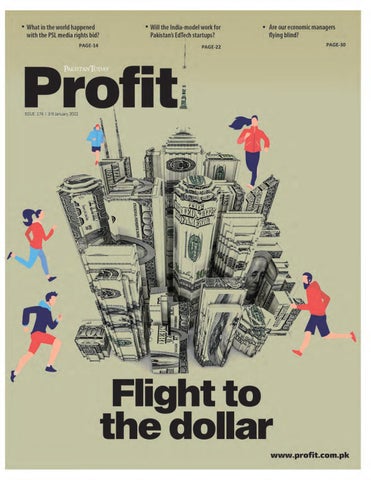
16 Flight to the dollar and the new shape of currency supports 21 The challenges at the end of the tunnel Uzair Yunus
14
22
22 22 Will the India-model work for Pakistan’s EdTech startups? 27 The unicorns are here and it’s time to invest in our tech infrastructure Ammar H Khan
Profit
30 Are our economic managers flying blind?
Publishing Editor: Babar Nizami l Editor: Khurram Husain lJoint Editor: Yousaf Nizami l Assistant Editor: Abdullah Niazi Reporters: Ariba Shahid l Babar Khan Javed l Taimoor Hassan l Meiryum Ali l Shahab Omer Chief of Staff & Product Manager: Muhammad Faran Bukhari Regional Heads of Marketing: Muddasir Alam (Khi) l Zulfiqar Butt (Lhr) l Malik Israr (Isl) Layout: Ahmad Salahuddin l Photographers: Zubair Mehfooz & Imran Gillani l Business, Economic & Financial news by 'Pakistan Today' Contact: profit@pakistantoday.com.pk
Editorial Uncertainty gives flight to the dolla On the 9th of December, the US dollar reached an all time high by crossing the Rs 178 mark on the interbank market. Over the next three weeks, it would stay relatively stable. The needle on the dollar rate would every now and then move ever so gently above or below Rs 178.2. From the 10th of December to the 29th of December, this remained the case. Then on the second last day of the year, the dollar fell suddenly to Rs 177.5. On New Year’s Eve it opened at Rs 176.6, having shred Rs1.7 per the dollar along the way after a relatively stable run at the Rs 178 mark. And that is not all. Further declines are expected to come as we enter 2022. So what happened? Clearly 2021 has not been a good year for the rupee. December has been a particularly bad month in an already pretty bad year. The dollar seemed to be skyrocketing with each passing day and it did not inspire confidence when the State Bank of Pakistan was clearly scrambling to try and control the demand and supply of dollars in the market in am effort to control it’s level. Within days, they announced both a requirement for biometric verification for buying more than $500 and a limit of $10,000 at most per person. In addition, the SBP has also reportedly been slowing down approvals for the placement of import orders in some places. There have also been reports that repatriation of dividends by overseas investors are facing obstacles in a bid to stop the demand for the dollar rising in both the interbank and the open market. Things have clearly been chaotic. The dollar took flight and the SBP has been desperately trying to keep a tail on it and pull it back to avoid further damage. But what could in reality have been done? One of the most substantial reasons for the flight of the dollar was the growing uncertainty surrounding the fate of the government, and the direction of the economy. Very serious doubts surfaces about Pakistan’s external sector as well as the uncertain outlook on the talks for the resumption of the IMF programme and matters become all the more complex. As confusion
rolled through the markets, it appeared to investors and people looking to keep their savings afloat that the dollar was the safest asset to be holding at such an uncertain time. Our own history has taught us that in times of mounting economic and political uncertainty, the dollar always appears as the safest haven and such episodes have seen a similar flight to the dollar in previous such episodes as well., High net worth individuals, businesses and retail savers all made a dash to protect themselves and their wealth from what increasingly seemed like a period of protracted currency depreciation. For a large part, even the stability of the dollar between December 10 to 29 was because of the intervention of the state bank in the interbank market. The open market was another story completely. On Dec 29, when the dollar finally broke and fell back down to 177, it almost seemed as if the threat issued by finance minister Shaukat Tarin a few weeks earlier about investing heavily in the forex markets was finally being delivered upon. In televised interviews given when the dollar had risen to and crossed Rs 178, Tarin was very vocal in describing this as the handiwork of speculators and went so far as to blame banks for a specific part of the speculation. He issued a dire warning to all those speculating that they would be forced to take a heavy hit. For 20 days, the markets ignored this admonition and the dollar hovered with great tranquility around Rs 178.2, but on NYE this tranquility broke and the dollar began to fall again. It is important to bear in mind that shouting down the dollar is no way to achieve exchange rate stability. Such tactics can achieve short term results but the underlying driver of exchange rates remains economic and political uncertainty. Until this is cleared up, it seems that the authorities - both the government and the central bank - will find themselves in an endless cat and mouse game.
7
Readers Say Not sure about the timing of the story… what was the agenda behind publishing it at this point in time and could ‘Profit’ wait till new year to publish it. While Airlift may be like all other startups ie projecting higher than actual numbers, I am sure both Atif Awan and Usman Gul are not operating Airlift as a one off startup. Neither do they plan to milk the investors and then vanish in thin air. Each of them have a reputation to keep and will be in the same startup space after Airlift, which will not be possible in-case they are accused of number fudging. Careem is a classical case in point which when acquired by Uber was dominating the local market but is nowhere to be seen. No one has accused the founders of any wrong doing although the model was unsustainable from day one. Why accuse Airlift of burning cash based on the same model? Apropos: Airlift may have hit a billion, but is it for real? Faisal Malik, Website Big boys investing in big ventures do so with eyes wide open and understanding the risks involved. They have high paid professional analysts doing due diligence and usually invest with a herd of similar peers (equally capable and equipped). Pakistan is a frontier market where much of the initial investment will be made in startups that set up the initial frameworks/rails on which Pakistan will catch up / make up / and take quantum leaps from there on. Wish we could hold off on our natural skeptical tendencies and let these young entrepreneurs and their teams “go for it.” Ordinary folks don’t have Unicorn dreams – believing there is a horse out there with a horn! A Unicorn journey will certainly be a thriller – we shouldn’t expect anything less! Hey teacher, leave them kids alone! Apropos: Airlift may have hit a billion, but is it for real? Yusuf Jan, Website
facebook.com/Profitpk twitter.com/Profitpk linkedin.com/showcase/13251020 profit.com.pk profit@pakistantoday.com.pk
HOW TO CONTACT
8
I am reading the kool aid comments of unicorn dreams and “why did you publish this article now”. Fraud for a single dollar is a fraud! And if Mr. Atif or Mr. CEO is inflating to make money out of it they should be answering the auditable questions or just present an audit report. Sending legal notices on queries/questions as a business that claims strong fundamentals sounds so much like Theranos. In fact the hype and FOMO of investment created around the company sounded so much like Theranos, I don’t expect enough DD done by investors TBH. In conclusion I don’t want to drink too much kool aid with “Hey teacher, leave them kids alone” and “Neither do they
plan to milk the investors and then vanish in thin air”, this is a critical stage for Pakistani startups and we should ensure success by avoiding any frauds. Apropos: Airlift may have hit a billion, but is it for real? Gulshair, Website Aatif raised funds, invested a lot of money himself so it's only fair that he's boots on grounds there. Lofty projections are okay too as long as investors are aware and signed off on those. What's NOT okay and is very dangerous? Doubts over actual vs reported performance! Apropos: Airlift may have hit a billion, but is it for real? @salmanebrahim, Twitter Excellent piece. @taimoorhassann is an underrated journalist, and one of the best in @Profitpk. He covers the start-up and tech segment. An area neglected by the usual breed of business journalists. I subscribed to the Profit magazine to read his work.Apropos: Airlift may have hit a billion, but is it for real? @AliKhizar, Twitter Solid piece. This is a good deep dive into the numbers, and unit economics. We need more of this, and not less. Good stuff by @taimoorhassann. Also, they are all estimates, more like educated guesses, and this is fine. We work with iterations. An entity can either confirm numbers, or not comment, that is also fine. But getting all worked up because someone's guess does not align w/ your guess is kinda going overboard. If people can challenge the central bank for not following a more prudent or data driven process, then a random start up is no match. We should be open to more critical views of things rather than pretend to be untouchables. Apropos: Airlift may have hit a billion, but is it for real? @rogueonomist, Twitter If true, quite a damning piece. For the company as well as the investor. If untrue, I’m sure airlift won't leave any stone unturned to clarify and save their reputation to ensure they continue to get the funding to operate. Apropos: Airlift may have hit a billion, but is it for real? @MustafaJBajwa, Twitter I think a lot of the conversation around the article is fixated on Aatif being an active board member (which isn't wrong). However not much is being said on twitter about the alleged number fudging. If anything, that is the most important bit of the article. Apropos: Airlift may have hit a billion, but is it for real? @AribaShahid, Twitter
COMMENTS
IN BRIEF The federal cabinet here on Tuesday appointed Mehmood Mandviwala as chairman Securities and Exchange Commission of Pakistan (SECP) Policy Board after a gap of 6 months, paving way for the approval of the commission’s annual budget 2021-22.
Prime Minister Imran Khan on Wednesday reconstituted the ECC of the cabinet after the recent appointment of Shaukat Tarin as Finance Minister. The number of members have gone from 14 to 12, with the PM retaining the commerce portfolio and ministries of power and petroleum being merged into the energy ministry.
In the wake of a growing fertiliser crisis and urea hoarding scandal, the government has advised farmers against panic buying urea, assuring them that unlike the shortage of urea stock in the international market, akistan had surplus stock for Rabi season. The Bank of Punjab (BoP) on Wednesday announced it’s going to acquire a strategic stake in NRSP Microfinance Bank from the National Rural Support Programme (NRSP), which owns a 57 per cent stake in the country’s fourth largest provider of microcredit in terms of the number of active borrowers. The federal cabinet has approved a revised draft of the State Bank of Pakistan (SBP) Amendment Bill 2021, which promises complete autonomy for the central bank and places a complete restriction on the government’s borrowing from the SBP. The law gives unprecedented autonomy to the SBP, and is one of the demands of the IMF under the current programme it has with Pakistan.
Prices of vehicles are set to go up further due to proposed duties and taxes on the auto sector announced in the mini budget. The government has proposed increasing the FED, advance tax, transfer tax and other duties through the bill, making locally manufactured cars much more expensive. Contrary to the expectations of money market analysts, cut-off yields in the auction of treasury bills on Wednesday registered a less-than-anticipated decline in three- and six-month papers. The SBP raised Rs1.26 trillion in the latest treasury bill auction against its target of Rs1.2tr.
9
Nazar na lag jaye, haye this week in Pakistan’s business and economics twitterverse
T
his week we’re talking about capitalism, enviable taxes that warrant laal mirch to cast off nazar, fast ecommerce, and of course the PSX. We start the new year with new taxes, yet the same diminishing purchasing power. All this and more from the Pakistani econ twitterverse.
Not endorsing his PSX picks for investing, however, I feel the decision to make investing fun and in the form of a football team is a good way to go. This goes to show you don’t need to be a financial professional to make money off the PSX. Your lungs will soon adapt to the smog and air pollution. Besides, who needs u turns when you can say one thing and do another?
10
Uh, say what you want about sell side reports but hey, stay away from horoscopes and astrology.
We looked for the tax and couldn’t find it unfortunately.
I’d do the same but sadly, I work for Profit Magazine and not Jacobin.
Urdu is not the universal language you think it is especially in a culturally diverse country like Pakistan.
Laal Mirch is often used to cast off nazar. I don’t think anything the government is doing with regards to taxation and fiscal management is Nazar inducing.
Purchasing power matter, real changes in inflation and income matter too. Regardless, I think very few of us are better off than we were in the past. Wages don’t rise the way they should, and prices remain sticky downwards. What’s faster than fast commerce? Willingness. Shami Courier Service probably has a valuation of $100 billion by now.
SOCIAL MEDIA ROUNDUP
What in the world happened with the PSL media rights bid?
The bidding table drama between Geo and ARY has spilled out into a battle being waged in the news media By Abdullah Niazi
O
n the 23rd of December, Geo and ARY found themselves sitting across a table with the Pakistan Cricket Board (PCB) in the middle. A tense struggle was underway between both sides to get the media rights to the next two editions of the wildly popular Pakistan Super League (PSL) – the PCB’s most prized product worth an estimated $300 million. Both sides had everything to play for. Geo’s sports channel Geo Super has been in broadcasting wilderness for years now, finding itself unable to capture media rights for cricket series and tournaments. Meanwhile ARY’s freshly launched high-definition sports channel, A-Sports, was looking to make it big and capitalise after a successful broadcasting run with the recently concluded ICC T20 World Cup.
14
Normally, it would have been a simple matter of which side made the bigger bid, except on this occasion, ARY came to the table with a card up their sleeve – Pakistan Television (PTV). ARY did not come to the bidding table on their own, but rather came as part of a consortium between itself and PTV Sports. This has since become a bitter bone of contention. The result of the bid is currently public knowledge. Geo Sports lost out to the consortium of PTV and ARY, which secured the media rights for the PSL from 2022-23 at a price of nearly Rs 4.5 billion. In the aftermath, Geo Sports has, backed by the entire Jang group, cried foul and claimed that the consortium between ARY and PTV was illegal and promoted unfair practises. What went down at the bidding table, and does Geo have a case? Geo is currently pointing towards a judgement of the LHC from 2011 claiming PTV Sports did not follow fair practice as a state run broadcaster. In response,
the PCB has launched a detailed statement and PTV Sports director, Dr Nauman Niaz, has told Profit that the channel did approach other parties to form a consortium and got the best offer from A-Sports and went with it. With Geo not backing down from its claims, it is worth looking at what went down on the bidding table, and whether or not there has been any foul play.
What happened at the bid
T
he bidding process itself is always tense. Put in two old rivals in the mix and the stakes are bound to flare. On the 1st of December, the PCB made a public tender announcement inviting bids for PSL TV Broadcast media rights for 20222023. By the 23rd of December, two different financial and technical proposals were received by the board. One was from Geo, and the other
was from a consortium between ARY and PTV. The consortium had been made well before the tender was announced by the PCB. PTV Sports knew that the media rights for the PSL were up for grabs and a tender would be announced, and well beforehand had been hitting the phones and looking for a media house to partner up with – which they found in the shape of ARY’s A-Sports. PTV Sports has told Profit that Geo was also approached to form a consortium. On the day of the actual bid, on the 24th of December, both sides sat on the same table. The way the bid works is that both sides hand over their proposals in closed packets. After the packets have been handed over, the side receiving the bids, in this case the PCB, announces a reserve price – which is the price that the side receiving the bids is willing to get. Once this reserve price has been announced, the proposals are opened in front of everyone. If both bids are above the reserve price, then the higher bid automatically gets the contract. However, if both bids are below the reserve price, the bidders are asked to revise their bids and the higher bid in a second round of bidding gets the contract. Say if the reserve price is Rs 50, and Side A’s bid turns out to be Rs 55 while Side B’s bid turns out to be Rs 58, then Side B will get the contract. In the same way, if only one side bids higher than the reserve price and the other does not even meet that, the side with the higher bid gets it. However, if both bids are below the reserve price then the bidders are asked to revise their offers. They then have the option of either going above the bid price or staying below. For example, if the reserve price is Rs 50, but the bid from Side A is Rs 45 and the bid from Side B is Rs 48, they will revise their offers. If Side A has a higher bid in this revised offer, they will get the contract. In this case, however, right before the reserve price was announced, Geo and ARY were already in a Mexican stand-off. The representative from Geo, according to a PCB press release, “raised a concern, asking the PCB what process PTVC, as a state broadcaster, had followed to align itself with ARY. The PCB rightly advised that this query was better directed towards the PTVC who would be best placed to respond.” Once the PCB made this clarification at the bidding table, they then asked if there were any further concerns or objections before the PCB announced the Reserve Price and then opened the sealed financial proposals. As per the PCB’s handout, “no further concerns were raised and both bidders agreed for the bidding process to continue.” The PCB’s representative then announced that the reserve price was Rs 3.584 billion. Before the proposals that had been
submitted could be opened, the representative from ARY/PTV said that they had mistakenly put in their bid number for one year, not two, and that their bid should be doubled after opening. The representative from Geo objected to this, and the PCB said that “a verbal request made at this belated stage could not be entertained in order to modify the contents of the sealed financial proposal. Hence, the request was declined and this decision was accepted by the bidders.” When the proposals were opened, Geo had a higher proposal at Rs 3.36 billion, while the proposal by ARY/PTV was worth nearly Rs 2.2 billion. If the PTV/ARYs request to consider their sum is doubled had been accepted, they would have gotten the contract. However, since neither bid matched the PCB’s reserve price of Rs 3.584 billion, the two sides were asked to revise their bids. In the next round, Geo made a bid of Rs 3.74 billion, marginally raising their initial offer. The PTV/ARY representative on the other hand, went with their initial intention to double the amount and offered Rs 4.4 billion as a bid. The media rights were then awarded to the consortium between PTV and ARY, meaning the next two seasons of the PSL will now air on PTV Sports and A-Sports.
Why is Geo crying foul?
G
eo was clearly taken aback by this. Wounded, they left the bidding table having lost but not given up. Since then, the entire Jang Group has been on a mission to explain that the bid was lost under unfair conditions. Their target, however, has not been the PCB but rather PTV. In a report published in The News International, it was said that the consortium was made in a clear violation of the Lahore High Court’s 2011 verdict. The 2011 verdict had ordered that no contract could be concluded unless it was based on a transparent and competitive bidding process. “However, the state-run TV in a non-transparent manner formed a consortium to bid for the rights despite a strong protest of the other bidder Geo Super,” read the report. Over the same issue, Transparency International Pakistan also wrote a letter to the PCB, saying that the consortium between PTV and ARY was a typical case of abuse of power and requested the Pakistan Cricket Board to examine the allegations and cancel the bid if the accusations were correct. “Why did PTV not bid independently? Who ordered PTV to form a consortium with ARY A Sports? Why has PTV not invited open tenders and without competitive bidding, made a JV with ARY? This nexus between PTV and ARY A Sports is an unholy collusion, and is also a violation of
PPRA Rules,” the TIP letter says. “The issue was brought up at the bidding table. Geo’s representative asked how the consortium between PTV and ARY had come about and the PCB representative told them that this was a question for PTV. They then agreed to move on with the auction, and when it didn’t go their way, they started a media campaign,” says Dr Nauman Niaz, who is the director of PTV’s sports channel. According to Dr Niaz, there is no need for PTV Sports to offer a tender for a partnership because it is a privately run business and thus does not need to follow the PPRA rules. “Despite this we followed all of the procedures to pursue a public-private partnership through the competent authority. As a business entity, our job first and foremost is to make money and see how well we can do financially. And on that front we were more profitable going for an agreement with A-Sports.” Dr Niaz also told Profit that they also approached Geo Super for the consortium, and that it fell through. “We approached all interested parties. We then took it to our risk management committee, and then finally to the board of directors for approval. There was nothing illegal about it and we will continue to back our agreement and we have made it very clear.” According to the PTV/ARY consortium, they are yet to respond directly since Geo has not approached the PCB’s grievance committee or taken the matter to court, and have “only pursued a media campaign without rhyme or reason” , said another source close to ARY. “Another factor in the entire situation is that the PCB is the only vendor. There are not multiple vendors out there for us to approach. Everyone is bidding with the PCB so there is no question of fairness here. Geo brought up their grievances at the bid and then both sides agreed to move forward. Why are they complaining now?” The PCB in its statement has also said that if Geo is still upset and unhappy with how the bid went, the appropriate forum to take the issue is the board’s grievance cell. According to board sources, even after the press release was issued no move has been made by Geo to approach the grievance cell. There has also been no news of Geo approaching the courts to settle their complaint. “The extraordinary interest and increase in the TV broadcast rights of the HBL Pakistan Super League underscores how popular the tournament has become despite being launched just six years ago,” PCB’s acting CEO Salman Naseer said. “I want to thank the consortium of ARY and PTV for valuing the biggest product of Pakistan cricket, which has become a source of inspiration for thousands of young children to take up the sport.” n
MEDIA
16
By Ariba Shahid
W
alk into any money changer in Karachi or Lahore and you will undoubtedly witness the same things. A few tellers will be busy counting cash and sitting in front of windows with the rates for major currencies displayed somewhere - either on a digital ticker display or shabily written on a white board. And the one currency always displayed is the US dollar. In principle that should be the extent of it. If you want to go buy dollars for example, all you need to do is walk into the closest money changer, give them cash in the Pakistani rupee, and ask for the greenback in return depending on that day’s exchange rate. However, often what you will find instead is the tellers offering rates for the greenback much higher than the official rates displayed on the boards. The difference between the rate of the dollar on the interbank market and the open market in Pakistan is telling of many things. For starters, the hike in the price of the dollar the entire month of December tells us that despite the government and central bank’s full efforts, currency devaluation was happening as a result of economic and political uncertainty. That uncertainty in turn leads to people trying to buy dollars to secure their savings because the rupee does not feel reliable in trying times. This has been something that has happened in Pakistan before - uncertainty leads to people trying to buy dollars which in turn leads the dollars to go short from the market and the price of the dollar in the open market being significantly higher than the dollar rate in the interbank market. To confirm these suspicions, your correspondent visited multiple money changers in Karachi. What quickly became apparent was that as far as small quantities were concerned, around less than $500, most of the money changers were selling them without hassle at the rates quoted on the board. Some were charging a premium of up to Rs 3 and were willing to negotiate. For larger
amounts, however, it was a little trickier and more expensive. Matters were no different in Lahore and Islamabad, where people looking to buy the dollar have complained to Profit about money changers charging an exorbitant premium even on small amounts of the dollar. One such buyer informed me that the best rate they could find for a mere $450 purchase was Rs186 on a day when the dollar selling rate was not even Rs179. The practice of money changers selling currency at a higher rate than it is actually worth is a common one. However, the practice increases around December because of the holiday season, and becomes particularly bad because there is a high demand for the greenback during this time of the year. This year, it was worse because Pakistan was going through negotiations to continue its programme with the International Monetary Fund, and with there being political as well as economic uncertainty, it seemed that the country was headed towards dollarization at least on the savings front. But as the speculation settles and the rupee seems to be making a minor comeback at the twilight of the new year’s eve, it is worth looking at how Pakistan faced dollarization in the last few months of the year.
Dollarization and availability
D
ollarization is the term for when the U.S. dollar is used in addition to or instead of the domestic currency of another country. It is an example of currency substitution. Dollarization usually happens when a country’s own currency loses its usefulness as a medium of exchange, due to hyperinflation or instability. This happens most starkly in countries where the local currency has completely collapsed, like in Zimbabwe or in Venezuela, where devaluation has gotten to a point where it is just simpler to trade in the US dollar. However, since the supply of these dollars is low, acquiring them can be difficult and expensive. In Pakistan, we are not close to a point where the US dollar will be used
“While the statistics are not too bad, the trajectory is not encouraging. Bangladesh’s remittances have already dropped back to pre-Covid levels. Ours remained sticky but are now moving in the same direction” Fahad Rauf, head of research at Ismail Iqbal Securities
18
as legal tender. However, while we haven’t started using the USD as a medium of exchange, for savings more and more people are turning to the greenback to protect themselves from the depreciation of the rupee. In Pakistan, because of its constant uptick in value, the US dollar is considered the currency of investment and savings. While this savings strategy can be debated, this does show a trend of finding solace in the dollar and treating it as a safe haven investment amidst uncertainty and inflation. “I try to save as much as I can in dollars,” said one young professional in one of the lines at the money changers. These days, the lines are typically long and moving at a snail’s pace, because instead of customers simply going up and trading currency, they are haggling with the tellers over the markup they are charging. However, the desire to buy the US dollar as a saving tool has not been affected by this. “Keeping inflation into account, the riskiness of the stock market, the fact that I don’t want to pay interest and don’t want to pay tax on my savings, I’d rather just keep them in physical notes at home,” said the person in the line. This means finding and buying is a tough task - and the rates thus keep rising even if off the books. And when people are investing, sometimes the amounts they want to buy are high. The government has introduced limits and barriers to buying the dollar freely, such as requiring biometric verification along with CNIC for anyone buying more than $500, and an overall limit of $10,000. However, the general sentiment at money changers when asked about how to get around these measures is that “sab hojaye ga.” There are easy workarounds to the SBP rules recently put into place to curb the dollarization, especially in light of hawala hundi rebounding as travel eases.
The rupee is stable
D
espite all of this in addition to international pressure, the rupee has been as stable as can be expected against depreciation as of late. This is often attributed to the current account deficit numbers clocking in lower than usual and the various means by which the SBP is trying to slow down the dollarization of Pakistan. However, uncertainty regarding the IMF program has in the past caused the rupee to weaken. We don’t really see that happening right now. On October 26 2021, for example, the rupee shed Rs 2.80 against the dollar over confusion regarding the resumption of the IMF program. If we look at the remittances front, that
“Since June 2019, Pakistan has adopted a market based flexible exchange rate system, where the exchange rate is determined by market demand and supply conditions. Under this system, the role of SBP’s interventions in the FX market is limited to prevent disorderly market conditions, while not suppressing an underlying trend” Abid Qamar, SBP spokesperson too has not been very promising. Remittance by overseas Pakistanis registered a meager 1 per cent year-on-year (YoY) growth, clocking in at $2.4 billion in November FY22 compared with $2.3bn during November FY21. All of this despite the federal government swooning as they wax and wane poetic in praise of overseas Pakistanis and their contributions to the economy. On a month-on-month (MoM) basis, remittances declined by 7pc, whereas a growth of 10pc was registered for the current fiscal year clocking in at $11.76bn. “Clear signs that opening of travel restrictions are affecting official remittance,” Topline Securities CEO Mohammad Sohail said. “While the statistics are not too bad, the trajectory is not encouraging. Bangladesh’s remittances have already dropped back to pre-Covid levels. Ours remained sticky but are now moving in the same direction,” said Fahad Rauf, head of research at Ismail Iqbal Securities. Earlier in November, the World Bank released a report titled “Migration and Development Brief” wherein it claimed that remittances are likely to remain flat at the presently high levels in 2022 as the one-off effects of government incentives to attract them fade although the Afghanistan factor will continue to sustain flows. Afghanistan’s fragile economic and political situation emerged as an unexpected prompt of remittance inflows into Pakistan in 2021, the report reads. “Second factor that comes into play is starting in August. And that is developments related to Afghanistan because they cause additional pressure, especially in the open market. reports that foreign currency cash is being taken in large amounts to Afghanistan. That adds pressure. It also adds some broader concerns and uncertainty on the part of the investor community about geopolitical developments in the country, when there is a desire to move into safe assets. In the local context that is either gold or dollar,” said Governor State Bank of Pakistan while speaking to Profit in an interview.
It is a healthy reminder that political problems like the Afghanistan issue have not just political repercussions for Pakistan, but also a direct impact on the rupee which drives inflation. It also has an impact on the investment climate in Pakistan especially if one is to take into account international sentiment towards the region. However, the situation with regards to Afghanistan has improved as per sources which is due to the SBP curbs, FIA activeness in the border areas, and better geopolitical dynamics. Talking about the Real Effective Exchange Rate (REER), it has depreciated by 4.1% during the 4MFY22. This means exports have become cheaper in international markets, whereas imports seem more expensive to Pakistanis. “Over the next few quarters, our base case FX outlook is less pessimistic than initially feared. We expect PKR to be 178/ USD by June 2022 and 183/ USD by December 22”, says the Arif Habib Limited Pakistan Investment Strategy 2022 report.
How is the rupee stable?
I
n a major scoop uncovered in September of 2021, Shehbaz Rana of the Express Tribune claimed that the SBP pumped $1.2 billion into the interbank market in three months to defend the weakening rupee. “The SBP does not comment on speculations about market interventions,” said Abid Qamar, Spokesperson at the SBP when Profit asked for a comment in September. That means that official confirmation is not a possibility. Yet there was no official denial of the story either. “Since June 2019, Pakistan has adopted a market based flexible exchange rate system, where the exchange rate is determined by market demand and supply conditions. Under this system, the role of SBP’s interventions in the FX market is limited to prevent disorderly market conditions, while not suppressing an underlying trend. When the ex-
change rate does not reflect realistic market conditions it can contribute to unsustainable current account deficits and repeated balance of payments problems,” Qamar added.
How the rupee is controlled - allegedly
P
reviously when the SBP would intervene in the market, it would do so quietly by making calls to bank treasuries asking them to buy, sell, or hold the rupee at a specified rate. This is different from injecting rupees within the interbank market. That, however, is not the case anymore. As per a source in a leading bank, the process is far more complex. Let’s say Bank A wants to buy an X amount of dollars. When the transaction is put up, the SBP calls the bank and asks them to hold off on the transaction and arranges supplies of dollars at the specified rate. Instead, they offer the bank to buy from a broker to prevent the interbank rate from going up. Bank B pays the broker through money they receive from the SBP. All this effort is designed to keep the intervention silent and maintain the rupee at a level the central bank has determined for it. “The central bank is actively, aggressively and systematically intervening in the interbank FX market to regulate rupee depreciation as best as it can”, said a senior banker while speaking to Profit. This is interesting because when the SBP makes an intervention by injecting money into the interbank it has to be a temporary transaction. This means that interventions will be temporary and they will maintain a net zero position at the end of each quarter. so whatever they sell to the market, they will purchase back at a later date. In the case of the SBP arranging the dollar liquidity for the purchasing bank through market mechanisms, it may not have to treat this as a temporary injection. If true, however, we can now understand why currency traders have been seeing more action in light of fears of more depreciation. n
COVER STORY
OPINION
Uzair Younus
The challenges at the end of the tunnel
the IMF program will also fuel further inflation, making it extremely difficult for the government to maintain economic growth while effectively dampening inflation. To ensure that rising prices do not wipe away the PTI’s electoral chances along with citizens’ purchasing power, Khan and his team will have to reform markets, starting with the agriculture sector, and stop telling citizens that things are still cheaper in Pakistan when compared to the rest of the world. More seasoned governments have Pakistan’s leadership does not want to accept the reality failed at these end-of-term difficulties. that the country is currently fighting its second war on terror. The Taliban’s takeover in Afghanistan has significantly complicated the Will the PTI do any better? domestic terrorism challenge and things will only get worse in 2022. According to publicly available data, 219 security personnel were akistan is no easy place to govern, especially for a government killed by terrorists in 2021, making it the deadliest year since 2016, that is in the tail-end of its tenure. After facing several crises when 291 security personnel were killed; from 2020 to 2021, security since coming to power in 2018, the Pakistan Tehreek-e-Insaf personnel casualties by terrorists have increased by 23 percent. While (PTI) government is facing challenging situations on the the government has sought to negotiate with the TTP from what it economic, political, and national security fronts. Three imargues is a position of strength, it is unlikely that any further talks portant issues are: rising inflation, the resurgence of terrorism, and the will yield positive results. Greater violence seems inevitable given change of guard in the military high command. Successfully navigating recent skirmishes on the Pakistan-Afghanistan border, where Taliban these challenges in 2022 would help increase Prime Minister Imran security personnel have allegedly torn down fencing put up by PakiKhan’s electoral chances, paving the way for him to become the first stan, and the sharp uptick in IED attacks and targeted assassinations politician in the country’s history to be reelected to office. in Khyber Pakhtunkhwa. It should not come as a surprise to anyone that the most pressing As the humanitarian crisis in Afghanistan worsens in 2022, the issue needing attention is rising inflation. In recent years, households Taliban’s control in the country may weaken. This could lead to the across Pakistan have experienced a dramatic decline in purchasing emergence of safe havens for a variety of terror groups, including ISIS. power and inflation is unlikely to ease anytime soon due to a weak These terror groups are likely to collaborate with external actors, esrupee, higher indirect taxes, and persistently high commodity prices. pecially India, to undermine Pakistan’s geoeconomics ambitions and While significant blame can be placed on past policies – the stabilitarget the China-Pakistan Economic Corridor. A sustained increase zation pursued in late 2018 and early 2019 was a necessity – and high in terrorism violence that spills into Pakistan’s urban centers will also international commodity prices in 2021, the government cannot ignore dent investor confidence and fuel uncertainty, making it that much its own shortcomings. This is particularly true in terms of the governmore difficult for the PTI to make the case for its reelection both to ment’s failure to pursue long-needed structural reforms and prioritizavoters and the military establishment. tion of policies like the real estate amnesty scheme, which only end up Given Pakistan’s political history, a change of guard at the benefiting the few at the expense of the many. military high command is always a sensitive decision for all prime Forecasts for the first half of 2022 predict higher oil and commodministers. General Bajwa’s upcoming retirement in November 2022 ity prices, meaning that the external sector situation will remain chalwill be a key test for the prime minister, especially given that Khan lenging at best. The second-order effects of adjustments made under seems to have a clear preference for Bajwa’s successor. Khan’s pushback during the change of guard at the ISI – something well within the constitutional rights of a prime minister – has already dented the government’s “same page” narrative. Islamabad is rife with rumors about a growing civil-military divide; growing The writer is Director speculation is fueled by the opposition’s ongoing engagement with the military establishment and the PTI’s devof the Pakistan astating loss in the Khyber-Pakhtunkhwa local bodies elections. Initiative at the While the November 2022 change of guard will be a major inflection point for the government and set the Atlantic Council, a tone for the 2023 general elections, the way in which Khan and his cabinet deal with the economy and Pakistan’s Washington D.C.second war on terror will ultimately make or break the PTI’s electoral chances. Pakistan’s political system is based think tank, and always full of speculation and conspiracy theories, but these stories have low impact value. While elites may host of the podcast engage in secret negotiations and seek to make deals to suit their own interests, voters will ultimately go to the Pakistonomy. He polls and make their voices heard based on economic and security concerns. tweets @uzairyounus. To come out on top, Khan must do more than just hope that inflation eases, terrorists agree to and uphold a ceasefire, and the military establishment stands by him due to a lack of other options. Hope is not a strategy.
P
COMMENT
21
T
By Taimoor Hassan
he most valuable startup in India is an educational technology company. EdTech companies, as they are known in financial circles, have a grip on India. Byjus, which also has its brand logo on the Indian cricket team’s kit, has been valued at $18 billion and have been given a ballpark estimate of a valuation over $50 billion if they go public by next year. And they aren’t the only massive edtech out there either. While Pakistanis are at odds over the country’s first unicorn, India has four unicorns just in the EdTech sector - Unacademy, Vedantu, UpGrad and Eruditus - in addition to 3,500 other
22
startups. But then why isn’t the same happening in Pakistan? Why is our nascent but noisy startup scene mostly finding its money in grocery delivery and banking disruptions when education is right there and available? Think about it - education and health are the two things most important to any parent when they think about their child. And with the Covid-19 pandemic putting into perspective how learning can be done online and people becoming more comfortable with digital payments, why is EdTech not thriving in Pakistan like it is across the border? One reason could be the obvious one - education is structured very differently in Pakistan. These apps can tailor their tutoring to help students achieve excellence in the Indian school
While the agents are selling these subscriptions to parents, they also pitch, right then and there, financing options turn the upfront payments into instalments and the affordability and the capacity to pay increases. Except that these plans are financed by banks and Byju’s gets a big chunk of revenue on a yearly basis Faraz Ali, head of marketplace and growth at Noon Academy
system and aim to get into the vast network of world-class IIT and IIM universities in India that are highly coveted. The other reason could be that school is boring and an education startup isn’t sexy enough for ‘finance types’. The EdTechs do exist in Pakistan. Some have been around longer than the B2B and eCommerce ‘disruptors.’ But they simply have not had the same traction. The question is, will they ever manage to step up and get somewhere? Because the space for this definitely exists. It is only a question of whether the EdTechs will be able to claim it.
EdTech startups and opportunity in Pakistan
I
n the world’s fifth most populous country, there are only a handful of edtech startups purely homegrown trying to digitise learning at and out of schools. These startups have only caught the eye recently, with their funding announcements. The unsung heroes for the industrious work they are doing are EdKasa, Maqsad, Out-class, Taleemabad, and Sabaq - a few names you might have heard about. Then there are others like Noon Academy, Knowledge Platform and Educative which are not purely home grown. Except Knowledge Platform and Educative, all others are consumer facing EdTech startups; they are providing learning to end students directly. Both Knowledge Platform and Educative are B2B startups, targeting schools to digitise them for learning at school. Among the B2C startups, the prominent ones are EdKasa, Maqsad, Noon Academy and Taleemabad, which have made a headway in the space and have created their own apps.
EdKasa
F
ounded in 2017, EdKasa’s target market presently is matriculation and intermediate students. It started off with a Youtube channel and has now evolved
into an app-based learning platform which has pre-recorded lectures available for students for different subjects. (More on content below). EdKasa raised $320,000 this year in April.
Maqsad
L
ike EdKasa, Maqsad has pre-recorded videos on its learning platform at present, with the same target market as EdKasa (matriculation and intermediate students). Maqsad announced raising $2.1 million this year in September.
Noon (formerly Noon Academy)
N
oon’s model is focused on live sessions by popular teachers on Noon mobile application. Noon, formerly Noon Academy, is an international EdTech startup having raised $21.6 million in funding for its international operations in the Middle East, North Africa and Pakistan (MENAP), as well as in India.
Taleemabad
F
ounded in 2015, Taleemabad appears to be targeting children until primary school through animated content on its app. Taleemabad has not disclosed if it has received any VC funding. But in a country that has a dilapidated education system and where enrolment rates fall from primary education to secondary education and around 22 million children out of school, tech saviours are only a few? That doesn’t make sense. Globally, edtechs have been late to get noticed. They’re boring, and they don’t have the allure or the promise of quick change that eCommerce and fintech companies bring with them. In a country like Pakistan, however, people should be clamouring for them. There are essentially two kinds of EdTechs. The first are B2B, which means companies that provide digital services to schools, and then there are C2C, meaning the
EdTechs that teach children directly through their own digital platform. The latter has the biggest opportunity because it is directly targeting millions of students enrolled in schools and colleges. In Pakistan, this opportunity is estimated at 20 million children enrolled in primary, middle and secondary education, who need some sort of out-of-school support to ace the exams. These apps are not claiming to want to disrupt schools, no - they are coming for the tuition centres. The consumer facing business works best in countries with a large middle class (as India has proven) which Pakistan has. However, the market also shrinks because of a large out-ofschool population (approximately 22 million children). The make-or-break moment is then how much access Pakistanis have in terms of tech and connectivity access. Pakistan ranks low (76th spot) on the internet inclusivity index. Pakistan also has one of the lowest internet speeds in the entire world. As per Speedtest Global Index, Pakistan’s internet speed on mobile was 17.95 megabits per second (Mbps), and on fixed broadband was 10.84Mbps, as of January 2021. Compare this to the internet speed of our neighbouring countries, like India (54.73 Mbps), Iran (19.42 Mbps), Nepal (24.86 Mbps), Bhutan (22.30 Mbps), Sri Lanka (27.87 Mbps). Then consider countries like Somalia (16.05 Mbps), Rwanda (13.62 Mbps), Cambodia (27.69 Mbps), and the Republic of Congo (25.36 Mbps). The speeds are low because of low penetration of optical fibre cable infrastructure, limitations of low bandwidth available per site, complications in deployment of telecom infrastructure, and the fragile state of the telecom sector. Clearly there is both an opportunity and hindrances for EdTechs here. So what are the consumer facing startups doing? This is where Pakistan could learn some lessons from Byju’s. The first thing they did was understand that the market was truly massive. It used an aggressive push sales strategy in which it put its people on the ground going
EDUCATION
Though the concept of formal education has evolved from definitive graduate, post-graduate and doctoral education to skills-based education where a graduate can instead choose to learn new skills to get a formal entry into the jobs market, instead of getting a formal higher education, Fahad Tanveer, CEO EdKasa
door to door. Byju’s salespersons would go from house to house offering different subscription packages on a year, two yearly, or even three yearly basis. They also provided devices such as tablets with all the content pre-recorded and personalised which removes the barrier of having the right equipment for students to learn. This also eliminates the need for the internet and students can learn on the go. But that is coming at a big amount of money asked upfront for a tutoring application. A parent’s willingness to pay such amounts for a child’s education is certainly going to be there but the capacity to pay might not be there. And as the flag bearers of Pakistan’s EdTech scene explain, it might not be that easily emulated in Pakistan.
Lessons from Byju’s
“W
hile the agents are selling these subscriptions to parents, they also pitch, right then and there, financing options turn the upfront payments into instalments and the affordability and the capacity to pay increases. Except that these plans are financed by banks and Byju’s gets a big chunk of revenue on a yearly basis,” says Faraz Ali, head of marketplace and growth at Noon Academy. Noon Academy is a UK-headquartered edtech company with presence in MENAP and India. “They would also give devices with pre-recorded lectures so that customers do not have the internet restriction or device restrictions with Byju’s and that too can be financed.” “There would be no Byju’s without banks that finance these purchases,” says Fahad Tanveer. “The very high valuation for Byju’s also comes because of the fact that they have very certain revenues and very high ticket. Consequently, receivables are also big that banks would love to collect for Byju’s on a discounted rate.” In Pakistan, the likelihood of such a model being replicated has slim chances of success considering how Pakistani banks shy away from consumer financing. Food inflation already erodes purchasing power and affording
24
education, because education establishments like schools and colleges are not majorly state funded, and ends up becoming expensive for Pakistani households. The lack of consumer financing options by private lenders such as banks means that there is a barrier for these EdTechs to scale. “Edtech startups need to make it possible for families to pay in bite size chunks for a high value product. That is presently not possible because of the dearth of fintech companies and banks that can cater to such financing,” explains Fahad. The business model of B2C edtech companies in Pakistan has therefore also been reliant on low monthly subscriptions running in a few thousand rupees only, with value added purchases, or a freemium model where students are able to access some content free, with the option to purchase value added services if they choose to. The other issue has been payments. Since these startups are small and unable to sell their receivables to Pakistani banks, they are reliant for collection through digital payment channels like EasyPaisa and JazzCash. The payment experience is not friendly to say the least, with payments getting stuck and back and forth confirmations about the payments in addition to poor user experience. “The financial infrastructure that we have is too rudimentary to scale an edtech company. The financial ecosystem was critical to scale the world’s multi billion dollar unicorns so that they could collect their revenues seamlessly,” says Fahad.
The pace of scaling an EdTech startup in Pakistan
G
o to the Byju’s website today and you will see ShahRukh Khan, possibly the biggest Bollywood superstar in history, holding a tablet with a child resting her head on Khan’s shoulder. That is besides the ads ShahRukh Khan has done for Byju’s. Having a Bollywood superstar as your brand ambassador is going to pull cus-
tomers for any business because of the Bollywood craze among the Indian public, but what’s crazier would be the marketing spend required to sign up a Bollywood superstar as your brand ambassador. On the other hand, Vedantu, another Indian edtech company which has recently entered the vaunted unicorn club, has another Bollywood superstar Aamir Khan as its brand ambassador. In Pakistan, you will hardly see any marketing done by edtechs, except some targeted social media campaigns which are not very expensive. Generally, startups have an aggressive marketing ethos. Somehow, aggressive scaling is not commonplace among edtech startups. “Scaling a startup very fast can happen, but scaling a startup very fast when the space is not mature is unlikely to happen. And tech in the education space is still not mature,” says Faraz. The EdTech companies operating here say that the cost of creating their content is high because teachers are expensive. Teachers have to be convinced to do this with money instead of going to tuition centres. The content gets more expensive as animations are developed to make the content more engaging. “One of the hardest things for us to do in education is to develop this new category in Pakistan which is studying online. Getting that awareness, to get the people to take edtechs as serious platforms to study in the presence of traditional brick-and-mortar academies is consuming to achieve,” says Faraz. “The first generation of edtechs are going to have a hard time changing the market behaviours, whereas the next generation is going to have it easy.” Scaling is difficult because unlike a product on Daraz, which is ordered and gets delivered, the deliverable results in the case of EdTechs are exam results - which take time to show progress. If a child signs up in September, their first results will be in December and the next ones in May. The parents will want to compare those to the child’s previous performance. How can the startups scale up until the parents are not comfortable with their performance?
So if Byju’s had signed on ShahRukh Khan in its early days as brand ambassadors without proving to parents and students that students would be able to ace their exams using the Byju’s app, ShahRukh would have meant less to the parents than the grades of their children. Today, Byju’s claims that 95% of the parents who have signed up with Byju’s for their children’s education, have seen their kids’ grades improve. While none of the local edtech startups, because they are too young, can claim the same unless they prove it over a period of time. It is an interesting proposition for Pakistan’s EdTechs as well to adopt a Byju’s and Unacademy kind of sales model where startups can have sales teams on ground, selling tablets recorded with educational content to students through telesales, or door-to-door sales, by skilled salesmen against hefty commissions. The question, however, is can that be done in Pakistan? EdTechs are only starting here, and it is hard to push sales at this point. People often develop a distaste for businesses that come off too strong. Of course, in Pakistan, there is the problem of what end these startups are aiming at. In India the promise is very clear - we will get you into a good college and they have the metrics to prove it. India’s Vedantu claims that between 6% of the admissions into the upcoming batch of Indian Institute of Technology (IIT), the top tech university in India, and a globally recognised university, will be students who prepared through Vedantu. The Pakistani startups neither have similar stats right now nor a similar promise that they can make to the middle class. Most parents and students obsessed with university admissions are focusing on foreign universities and places like LUMS - and their kids are going through the O and A levels systems. This means the door to door model might not work here. Large ticket size and long term revenue means that the cost of sale per sales individual would be low. So if the sales were low ticket size monthly subscriptions primarily, the cost of such sales through the sales team would have been high, making it an unattractive model. What would that look like in Pakistan? According to our conversation with EdTechs, the monthly subscription rates in Pakistan would be very low to begin with because of the low affordability. For instance, EdKasa sells its courses at a monthly price of Rs899/month per subject, and Rs3,599 for four subjects, which it thinks is a reasonable price and what is already being charged by teachers at minimum. Noon Academy also believes that Rs1,000 for matriculation and intermediate students is a reasonable charge per subject and that is what they charge as well. As these EdTech startups say, setting up a sales team to sell Rs899 subscriptions to parents becomes a costly proposition, yielding bad unit
economics. Even a 12 month subscription sold at once would not make sense because it will only add up to Rs10,788 which would still not make a business case if the sales team is to be paid on a monthly basis and given commissions against the sales. It is especially important if you consider that the market is small to begin with for edtechs, with 20 million out of school children in Pakistan that can not be reached out for out of school support. Likewise, asking parents in Pakistan to pay a lump sum amount for a year is also something that has not been tested because most schools and academies do not charge their students yearly or even quarterly.
How are they setting up instead and who plans to be like Byju’s?
“T
he two models that we thought would work are a freemium model, where students are able to access the majority of the content free and purchase add-ons really deep into their learning journey,” says Faraz. “The other model is where the class sizes are really big. The combination of these models for us is that we want somewhere between one and five per cent of students to pay for an educational product and the class size to be sufficiently big to reduce the ticket size.” . The freemium model under Noon Academy is where most of the content for a student is free and the student can make purchases for additional products far ahead in his/her journey with Noon. The cohort size is going to be really big where students, 1,000-1,500 in number take live classes and by virtue of a large class size, the 5-10% students that will pay would also be more in number. Sales, a moral choice for some, aside, for a Byju’s-like platform, creating content on devices is an expensive proposition because content production is expensive. What are the layers of content production? At the very basic level, the content can be a recorded lecture of a teacher explaining a concept. On the next level, you can just add various animations and graphics to explain the content to the student. On the third level, content can have questions that can be answered after watching a short video explaining a concept. Based on the questions format, an edtech platform can then build personalised journeys for students to learn concepts from a subject. The different levels of content creation can cost an edtech startup at different levels. And what sort of content needs to be created depends on what problem in the market is or what we call the product-market fit. What sets Byju’s apart is its content. Download the Byju’s app today (yes, you can
access limited content from Pakistan but likely won’t be able to send payments to India) and you will find Byju’s content wholly engaging, with animated games for better learning. That is besides live classes and one-on-one guidance from teachers for schooling and college years, beside India’s competitive examinations. All of that combined has made Byju’s what it is today, and two of the startups are skeptical that it can be replicated in Pakistan. BUT, Maqsad in its curtain-raiser funding announcement in September dropped a hint that it plans to follow Byju’s. Maqsad said that it will develop in-house content, such as production studio, academics and animators, as well as bolstering R&D and engineering. The Maqsad platform will also have gamified features, tailored towards giving personalised learning experience to students. The plans are expensive, animation and gamification of learning is expensive, but the size of Maqsad’s pre-seed funding alludes that it is ready to expend money on creating high quality content. It announced raising $2.2 million in September, the biggest so far by an EdTech startup in Pakistan. Maqsad is backed by Aatif Awan of Indus Valley Capital and the companies in which Aatif and Indus Valley Capital have invested in have gone on to raise huge rounds (for example Airlift and Bazaar), in very short periods. With such backers, Maqsad has the capability to incur expenditures to create very high quality content for a Byju’s like model for Pakistan. The expenditure incurred on creating such content is going to be once, while revenue would be coming in for a lifetime, laying foundations for a startup that could be valued very highly in the future, exactly like Byju’s. Maqsad has a second mover’s advantage which means there is an early traction and awareness of such apps in the market which it can bank on. In a small survey of over 50 respondents, the majority of the parents, responding on behalf of their children, said that they had heard of and used these apps. They also said that online modes of learning were already the preferred mode over academies for their children and most had shown a willingness to pay for these apps. Since it is education we are talking about, we can extrapolate that parents would be willing to spend beyond their means when it comes to educating their children. This means that if an EdTech startup spends heavily on content that is able to further improve grades of students, parents will most likely be willing to spend more on child education. We can assume that parents will most likely buy devices and the internet too. Adoption of digital payments is on the rise, the central bank is pushing for access to finance, banks are under pressure to offer consumer financing
EDUCATION
and fintech startups are popping up, trying to fix the fractured financial ecosystem. All this means that we can hope for Pakistani EdTech companies to have an enabling ecosystem sooner rather than later, and become sustainable businesses with steady revenue, which will make them very valuable companies in the future, just like Byju’s. Maqsad’s specific plans, beyond the hint, are a secret yet and it plans to stay low for sometime, testing and scaling products and achieving a product-market fit before going public with anything. Others like Noon Academy and Edkasa are also testing the markets at their own pace, are skeptical of the success of a Byju’s like model, but are committed to their true calling, that is tech in education. “We spent a lot of time researching what the problem in the market is. It is time consuming and it could be different for different kinds of students. So there was a lot of research that was needed and only then we were able to launch a product that we believe can really help students learn in the Pakistani context,” says Fahad Tanveer.
The competition - Is a Pakistani EdTech company really worth the effort?
T
here are two worrying trends too, however: established EdTech startups like Byju’s can capture the market, Khan Academy dominates with its free content and Youtube channels are eating up the market in Pakistan. Try downloading an Indian EdTech app today, or any other prominent EdTech’s application, and chances are you would be able to get access to their content on the application without a hassle. We tried Byju’s and it was accessible to us in Pakistan. The content on the Byju’s application was interactive, informative and accessible, making us want to think that if Pakistani users can access a big EdTech startup’s app, is there really a need for a Pakistani EdTech startup, what can possibly locals do? Or can Pakistani EdTech startups make it big in the presence of apps like Byju's? The likelihood of established EdTech unicorns inadvertently tapping Pakistan’s market has been assessed and analysed by some of the local startups but there are certain aspects you need to realise why startups think local market might not be willing to access content on Byju’s, or Unacademy for that matter, because if they do, they are going to hit a paywall soon after they have consumed the limited content that is free. From what we have come to know, content on Byju’s is free for only a few hours (2-3) of videos. Whereas the premium content
26
behind paywall has thousands of hours of recorded videos. For joining live classes, a student would be required to pay and the course relevance would simply be not there because the content on the application and the classes have to be personalised and followed according to the local curriculum in place to help students learn according to their respective syllabus for a class, so that they can perform well in exams. Local competitive exams are also different in geographies and the likelihood of Byju’s, Unacademy or Vedantu to create content for Pakistan is going to be a far cry for now, given the strained relations between the two countries. Data on children is very sensitive and at least Pakistan is not going to be willing to let that flow out to India. On the other hand, streaming platform Youtube is itself an EdTech player in the market, with a massive content database consisting of lectures and exam guides from popular teachers. “The problem, however, is that there are a very few big teachers on Youtube in Pakistan. There are a few because of problems related to monetising the content. Monetising Youtube on purely academic videos is difficult because the purpose of Youtube is not to create such content but one that has the potential of going viral,” says Faraz Ali.
Displacing the kings in business
S
eths dread tech because it threatens their dominance and they have been notorious for not recognising it as a threat until it's too late. Do seths in education dread tech? Scratch that! Is there a cause for seths in education to dread a B2C EdTech company? Well, yes! Most of the competition that EdTechs bring to the table is against academies. Edtech startups present themselves as out of school support types. Meaning that you can get your regular education at schools and instead of choosing academies or at-home tuition, you can instead choose an app with or instead of these options to supplement learning out of school. In this scenario, if a student aces an exam, the school as well as the app can boast it as a success. However, traditional school systems are also not free from the bite. But, if an edtech startup is able to get an out of school student (22 million in Pakistan) to subscribe to its app, give the student high quality education content, following which the student appears privately for a board exam and aces it, it can turn things dramatically. If any one of these manages to get even one student ace a board exam and then advertises that student on its website or billboards as its shining star, conventional brick-and-mortar schools would
be at the risk of losing their own students to these apps. Should schools be worried about such an eventuality? Attending a school does not only involve regular tuition, stationary and books cost. It can involve travelling costs, cost of recreational activities at school and keeping up with your peers. All of these are important for grooming but for out of school students not having any access to education because it can get costly, apps can at least deliver the education in this arrangement. So do schools see it as a threat? To reiterate, schools are customers of B2B startups and use their solutions to supplement at-school learning. How do they see B2C edtech startups? Multiple schools like Lahore Grammar School, Beaconhouse and The City School were approached by Profit for comments on how they see education technology startups. Only one school responded with little worries. “In my experience edtech tools often provide very niche products and the scope is, for the most part, very focused or fragmented. As a result they can help supplement a typical school curriculum rather than be robust enough to substitute legacy methods of teaching,” says Omer Salamat, director at Salamat School System. “Additionally I find a lot of the products falling short of our expectation as the architecture of the tech solution resembles more tech rather than education,” he adds. Omar is also confident that as Covid-19 subsides, brick-andmortar schooling is a much preferred alternative to any virtual teaching especially in the developing world where internet and hardware penetration is weak. Regardless of what schools think, the reality is that EdTech startups are finally here. They are raising funds and showing commitment that they are ready to take it on in the Pakistani market. Has it come late? Certainly, because tech in Pakistan has come late. But education in Pakistan is a big business and quality education is a dream for many. Why are there not so many players? It is market specific, as EdTech companies tell us, because the technology ecosystem is still developing in Pakistan. But let’s be hopeful here of the fact that Pakistani EdTech companies are going to make it big. As mentioned earlier, fintech companies are trying to fix the fractured enabling ecosystem with RAAST now launched which will give a superior payments experience. As the entire ecosystem evolves, the EdTech growth will also witness a surge and ideally, we have a timeline of a decade for edtech startups to reach zenith; that is how long it took Byju’s and other unicorns to get to the point where they are now. But since Covid has increased the pace of digital adoption and venture capital funding has increased, we can expect that to be happening across a shorter timeline because of the removal of these constraints. n
EDUCATION TEXTILES
OPINION
Ammar H. Khan
The unicorns are here and it’s time to invest in our tech infrastructure
The hope here is that whatever worked in those jurisdictions can also work in Pakistan – often because the real actionable valuable insights are below the surface. Additionally, and more importantly, figuring out whether the necessary hard and soft infrastructure exists is too often taken for granted in other markets. That critical vital valuable infrastructure often does not exist in Pakistan. Entrepreneurs who solve Pakistan’s infrastructure problem present the most attractive investable opportunities in tech today. Building a technology stack on top of a physical and knowledge infrastructure is easier and has been demonstrated to work in market after market. But building the same technology stack on a weak or non-existent physical and knowledge infrastructure will limit growth. In some markets a high literacy rate, or universal access to broadband provides an enabling environment for deployment of a technology stack, but in other jurisdictions where literacy is low, and access to broadband is sparse, the same ight now there’s a super exciting cambrian explosion enabling environment does not exist. Building out this infrahappening in Pakistan’s technology space. Dozens structure stack in Pakistan is a multi-billion dollar high-return of startups going from zero to one in Pakistan. Every investor opportunity. few days a passionate entrepreneur raises several It’s always the right time for starting an AgriTech company, million dollars, powered with an idea, a hope, and a given Pakistan’s natural competitive advantage and the obvious dream. Pakistan is the most exciting country in the opportunities across the entire value chain from pre-farm, farm, global startup space right now. and post-farm. Yet these AgriTech startups will have trouble These are certainly reasons to feel good about Pakistan’s tech scaling up to glory in absence of more transparent commodiinvestment scene as startups go from zero to one. At the same time, ty markets, formal credit, information symmetry, substantial there are some big hurdles in Pakistan for tech startups in going storage, and specialized transport and related supply chain from one to ten. This potential for exponential value creation, beinfrastructure for farm to market operations. The infrastructure yond the first headline round, is why investors like us will be drawn enabling scale is a gigantic near-term investor opportunity which deeper into Pakistan. Most ideas and execution roadmaps are often we hope entrepreneurs chase down. Counter-intuitively for most a replica, or inspired from high-income or middle-income markets. tech entrepreneurs’ views these days, the infrastructure layers are the lower hanging fruit. FinTech is the furthest along in having a usable stack due to the introduction of smart bold recent moves by State Bank of Pakistan, such as the launch of Raast. There remain substantial infrastructure opportunities such as the identity layer. We believe there is a mega opportunity for startups that identify and build and rent out parts of the full The writer is the chief risk officer foundational stack required upon which FinTechs can go to market with confidence. for Karandaaz Pakistan, an Similarly, smartphone penetration is growing and bandwidth is spreading but is far organisation that seeks to promote from ubiquity; an unfortunate regressive taxation regime will discourage full potential of financial inclusion in Pakistan. He smartphones. has previously worked at several Low literacy rates also hold back smartphone penetration particularly in agriculture financial institutions in Pakistan, and everyday commerce, thereby requiring one to be more realistic about utilization rates. both in commercial banking and In parallel, smart startups will figure out how to overcome the literacy challenge, and, decapital markets
Investing in the Pakistan tech infrastructure stack that will power our tech unicorns
R
COMMENT
27
liver awesome customer experiences in any of Pakistan’s diverse beautiful languages. Carving out the urban high-literacy 4G patches will provide valuable initial impetus for startups, but for unicorn-type numbers which can sustain many larger future funding rounds, entrepreneurs need to tap as much of 220+ million population. These additional tens of millions of Pakistanis living in socalled Tier 2 and Tier 3 cities beyond the “KIL” comfort zones present sound value for tech entrepreneurs. Making things even more interesting, Pakistan is a low-trust society and will remain so for the foreseeable future. The overwhelming preference of cash-on-delivery e-commerce orders over more digital means, even in urban cores, testifies to the lack of trust that exists in our country. Entrepreneurs must respect customer data privacy, while building customer experiences that gradually build trust with customers. For example, not having to share much data upfront, or, building a less ambitious product but delivering phenomenally reliable service. Startups that build trusted relationships with customers will be rewarded with a disproportionate share of wallet and able to extend those customer relationships outside of their initial space - e.g. from deliv-
28
FinTech is the furthest along in having a usable stack due to the introduction of smart bold recent moves by State Bank of Pakistan, such as the launch of Raast. There remain substantial infrastructure opportunities such as the identity layer. We believe there is a mega opportunity for startups that identify and build and rent out parts of the full foundational stack required upon which FinTechs can go to market with confidence. ery to banking. A direct consequence of a trust deficit is the lack of willingness of people to pay taxes. It is a near-universal truth that people don’t like to pay taxes, but in Pakistan the prevalence is much higher, resulting in high circulation of cash in the economy with undocumented economy estimated to be as large as the documented economy. In such a scenario, replicating whatever worked in hightrust societies may actually fail miserably. A transition towards a formal economy needs to be incentivized, for example with premium
services or lower pricing. This is a problem that can certainly be solved by technology, but not just with technology. Our friend HanJoo Lee, a legendary tech entrepreneur and venture investor in Korea and the US often says “entrepreneurs change the world”. In Pakistan we urgently need more high-energy patient smart entrepreneurs changing our worlds in fundamental ways. The entrepreneurs who solve Pakistan’s infrastructure problems will be rewarded by owning large sustainable valuable businesses. n
COMMENT
OPINION
Babar Nizami
Are our economic managers flying blind?
The finance ministry wasn’t amused. The economy is not overheating, they say. It’s just some cost-push inflation. Please let’s just wait it out and in the meanwhile, let us not create conditions (like high interest rates) that will hurt businesses, as well as the government’s own fiscal space. Whichever side of the debate one is, however, it underlines yet again, an issue that we keep coming back to. The lack of statistics with which to prove one’s argument. Take, for instance, the issue of whether or not the The Dismal Science is also an inexact economy is overheating. As recently as September, the science, yes. But our horrible statistics advisor on finance announced that the economy might be overheating. However, the SBP back then did not see any departments have made it look like serious dangers, and was thus not ready to increase the inastrology terest rates drastically, which is the usual medicine given to an overheating economy. However, this difference of opinion wasn’t a problem back then since even then the finance disagreement seems to be brewing between the fiadvisor didn’t want an increase in interest rates and wanted nance ministry and the central bank. Not on whether to cool down the economy through fiscal tools. or not there is inflation – one would have to be a The advisor and the governor still disagree, but now certain kind of overseas supporter of the ruling party they have clearly switched sides. Who was right, when? to dispute that – but on what is causing it. By definition, an economy can be pronounced as The lot at Q Block thinks we’re seeing costoverheated when, in addition to inflation, it is also at full push inflation caused by international supply shocks. There are just employment, – which economists describe as 96 out of a 100 way too many inputs that we are importing, like fuel, most notably, people having jobs. Now, whereas the managers of the Amerthat are just too expensive, which in turn, make everything else too ican economy make their calls using employment figures expensive. The central bank, on the other hand, feels there’s too much provided to them on a monthly basis, their Pakistani counmoney sloshing about and some of it needs to be sucked out of circuterparts have absolutely no usable employment data to rely lation to curb it chasing the same quantum of goods and services. on (the last Labour Force Survey was conducted in 2018-19.) Unfortunately for the finance ministry, in these two competing The quality of data is heavily contested in many countries views, the central bank’s view involves something under its direct but we are not even at that stage yet. Our data is ancient to control: the interest rate. And, as we saw on the 14th of this month, begin with, hence, completely useless. they hiked it up by another 100 basis points. So what does the SBP do then? The good news is that, before each meeting, the members of the Monetary Policy Committee (MPC) of the central bank are all presented with an exhaustive compendium of statistics by the SBP’s own statistics department. And the MPC does make decisions based on that data, including an effort to estimate the output The author is a business gap, which is considered to be an acceptable alternative to the unemployment number. But journalist and a media the problem here again is that the number crunchers at the central bank mainly rely on professional, presently working the GDP number calculated a year ago, and also some other guesstimates that the Pakistan as the Publsihing Editor for Bureau of Statistics (PBS) working under the Ministry of Planning gives them. Profit. He can be reached It is also a fact that the MPC is a sort of a democratic body, containing a rather diverse via email at babar.nizami@ set of viewpoints. And we don’t use that word lightly. Not only does it have industry reprepakistantoday.com.pk. He sentation (which one would assume would always vote for low interest rates), it also has an tweets @Bnizami
A
30
MMT proponent in Dr Asad Zaman (MMT folk believe in zero interest rates). And yet, in the latest meeting, when the members were presented with the exhaustive compendium of (mostly old) statistics, all members reached the same conclusion: to increase the policy rate by 1pc. And this isn’t an anomaly. In the last four meetings, for which minutes are available, there was complete consensus in two meetings, while in the other two, decisions were taken with an 8-to-1 majority vote. What does all this mean? It means that though the central bank doesn’t seem to be operating on mere whims, it is still relying heavily on the old statistics it is presented with. The current governor of the State Bank claims to understand how quickly things change nowadays, and has thus increased the frequency of monetary policy meetings regarding interest rates decisions. But how does he know what has changed every month? ——————— Economics, like the rest of the social sciences, suffers from what is called Physics Envy. It wants its theories to be considered as immutably mathematical as those of physics. It is accused of mathematicising certain arguments more than they possibly should be. But even those disbelieving matheists don’t recommend not using numbers to begin with. Statistics are the fundamental units
By definition, an economy can be pronounced as overheated when, in addition to inflation, it is also at full employment, – which economists describe as 96 out of a 100 people having jobs. Now, whereas the managers of the American economy make their calls using employment figures provided to them on a monthly basis, their Pakistani counterparts have absolutely no usable employment data to rely on (the last Labour Force Survey was conducted in 2018-19.) with which any argument is made in economics or, indeed, all of the social sciences. The government is currently moving ahead with some legal amendments to the fundamental nature of what the central bank should be. But perhaps it should be more interested in reforming the Statistics Division. The Pakistan Bureau of Statistics doesn’t need to be reformed, it needs to be completely overhauled. In an era of Big Data and artificial intelligence, our mandarins over at the stats div are still using antiquated methodologies.That too, sluggishly. NADRA is perhaps a Pakistani success story and, barring delays on high-speed internet spectrum, so is mobile teledensity in the country. These two, combined, could serve
as extremely useful tools for the PBS to go about its job. Not just through data mining but also plain, old-fashioned call centres dialing up for data. And perhaps the government could also look into the idea of making it compulsory, with scheduling flexibility, to answer queries and surveys over the phone by the PBS. The culture of flying practically blind has to stop. There are economic arguments to be made and crucial decisions to be taken. They should be made seriously and with data. What our economic managers are working with is haphazardly collected data using outdated methods. Sketchy data which, to further twist the knife, is also lagging behind by several years. n
COMMENT
The SBP Amendment Act: What’s What Now
A look at the proposed legislation that empowers the central bank and why it might not matter much, or for too long
By Babar Nizami
W
e’re heading back to the days of The East India Company, the opposition tells us, about the proposed legislation that seeks to increase the autonomy of the central bank. The Company, here, being the IMF at whose behest the upcoming legislation is being passed. As opposed to general perception, the bit about increasing the tenure of the SBP Governor - and making it difficult to get rid of him - isn’t the main bone of contention for the finance ministry. On the face of it, all governments profess that they want to give a reasonable level of autonomy to the central bank, and this bit doesn’t really clash with that, regardless of how little they might actually want it. Not allowing the federal government to borrow directly from the central bank is also not too contentious an issue, in fact. The actual contentious bit relates to the issue that reared its head most recently
32
between the central bank and the finance ministry: the interest rate. The rate, both in theory and practice, is decided by the central bank. But the how is a delicate dance between the SBP and Q Block (a sexier term for the finance ministry), one that involves a power play that spreads out over a number of boards and committees.
Enter: the Board
I
n this tripwired minefield, it is the proposed dissolution of a pivotal board that is giving a lot of fuel to the rumours of ceding a lot of autonomy to the IMF - through the incumbent Governor, who was allegedly brought in by the Fund to help steward the economy for the current program between the government and the Fund. This isn’t some tin foil hat-wearing local press conspiracy theory. The timing of the incumbent Governor’s appointment and the IMF’s loan program make it difficult not to put two and two together. That board is the Monetary and Fiscal Policies Co-ordination Board. Its job is exactly what it says on the label. Enshrined in the SBP Act, 1955, the board that will make
sure that the finance ministry and the central bank take steps in tandem. That the policies aren’t at loggerheads with each other. That the left hand should know what the right hand is doing. If one were to look at its constitution, however, we get a clear idea of which is the upper hand. Chaired by the finance minister, each of the seven-member Board is appointed by the federal government. In case of a disagreement, the SBP Governor is outnumbered six-to-one. The proposed legislation seeks to dissolve this Board to replace it with just a head-to-head mutual agreement between the finance minister and the SBP Governor over policy. In case there isn’t an agreement over monetary policy, well, you can’t just get rid of the Governor anymore now, can you? This really does make the central bank’s position better in the aforementioned delicate dance. However, though the finance minister might have expressed some reservations about the dissolution of the coordination board, he still sits pretty in knowing his ministry’s considerable position over a particular committee.
Enter: the Committee
T
he legislators, back in 1955, knew that the where-its-at of the central bank was going to be the determination of the interest rate. To that end, the SBP Act lays out the constitution of the central bank’s Monetary Policy Committee. Even if the SBP Governor gets some more equitable footing in the successor to the coordination board, he is all but outnumbered in the MPC. He chairs the committee, yes, but it’s one-member-one-vote here, even if his is the casting vote in case of a tie. He can choose an additional three senior executives of the SBP to be on the MPC. That’s four votes in total for the central bank chief. On the other side, however, the lot at Q Block decides three external economists to be the members of the MPC.So? That’s still the Governor’s four versus the finance minister’s three. Well, there are still three members left over. They will all be from and chosen by - another board.
Enter: the Other Board
T
he State Bank of Pakistan’s Board of Directors is for the “general superintendence and direction of the affairs and business of the Bank.” The Board of Directors is generally the most important body of any organisation and though the SBP is no exception, it is the Monetary Policy Committee that trumps its importance somewhat. Not to belittle the BoD, though. It does have considerable powers. But in the context of this article, it is only being mentioned because three members of the MPC are drawn from it. The Board of Directors are the Governor and eight other members who are appointed entirely at the discretion of the federal government (read finance ministry) and these don’t even have to be economists; even banking, accountancy and MBA-types can be chosen. The only restriction on the federal government is that each of the four provinces will have at least one member amongst these eight. To sum it up, the SBP Governor is outnumbered eight-to-one here. No points for guessing who will get to choose the three remaining members of the Monetary Policy Committee. So that yields six votes on the MPC to the finance ministry and four to the central bank. Now anyone acquainted with the nuances of monetary policy will tell you that, regardless of how extremely central the interest rate is as a tool, there is still more
to monetary policy. Like, the SBP-mandated Cash Reserve Ratio, for instance. Although it is technically very much what a body titled The Monetary Policy Committee should be deciding, it has been somewhat up to the discretion of the Governor. The legislation seeks to change that. But not really.
Enter: another committee
T
he proposed legislation seeks to bring in an Executive Committee over to the central bank. The aforementioned decisions like the CRR and other executive decisions have to be run by this committee by the Governor. The catch here is that, barring the Deputy Governor, all of the members are going to be appointed by the Governor. And to further twist the knife, the quorum of the Executive Committee is the Governor….and just one other member. Other than perhaps the noting of minutes, this particular committee won’t change much in the scheme of things. And Q Block doesn’t seem to want to tread on this particular turf yet anyway.
Tarin has an edge…barely
T
he finance minister isn’t all too perturbed by the dissolution of the coordination body. He will still pretty much call the shots in the scheme of things. He does have the numbers. But he will have to keep all of them (eight on the Board of Directors and definitely all six on the MPC) in line. Do keep in mind that the proposed legislation is also going to make the BoD and MPC members difficult to remove. If there are multiple precedents for SBP Governors getting too big for their shoes, how will he ensure all six of his appointees in the MPC stay in their lane?
But what about future finance ministers?
T
here is also another scenario that the new legislation actually does give the central bank governor a disproportionate power in the dance. And that is in situations like the PPP government of ‘08-’13 and definitely the current PTI government. In these two dispensations, the finance portfolio has been a game of musical chairs. Not during the League’s tenure, where it was very clear that
it was going to be Dar all the way. He was only removed from the portfolio only because of NAB, not because of some party intrigue by his successor Miftah Ismail. In situations like those of the two governments, once the finance minister is removed from office, his appointees in the SBP’s Board of Directors and its Monetary Policy Committee might not want to play ball with the next guy. That’s a kind of vacuum that could bode well for the central bankers.
The Republic will inevitably stand up to The Company:
I
f all goes well, the IMF program will end in Oct, 2022. The current government will be under no compulsion to stick to the new legislation. The opposition has put in enough political capital into the idea that the legislation is a form of neo-colonialism. In the likelihood of any of the other two parties forming government in ‘23, they are also likely to revoke the legislation and reap political mileage from it. All of it doesn’t have to go out, however. If the central bank doesn’t rock the boat too much, it wouldn’t rile the next government enough to do away with some of the clauses of the proposed legislation, like the tenure security of the Governor and the members of the Board of Directors and the Monetary Policy Committee.
What is autonomy, then?
W
e need our civil servants to have autonomy. But for them to have too much autonomy runs counter to what democracies are supposed to look like. Even those civil servants who are supposed to be independent in all democracies (the judiciary) are bound to comply with the laws that the representatives of the people have drafted. Questions about the autonomy of civil servants - not only the top brass at the central bank, but also the Deputy Commissioners managing the districts and the SSPs policing them - are to be addressed by the people themselves. There might be no one right answer for all nations. There might not be even one right answer for one nation through all of time. These are issues that the polity has to grapple with, in a free and unfettered manner. Not bulldozed through by foreign bodies that hold some leverage over us. n
NEWS ANALYSIS
Economy seems to be at Full Employment, says CEO after fourth graduate engineer in row turns down Rs 20K/month job
T
he economy seems to be operating at Full Employment, concluded Syed Hassan Abbas, CEO after the fourth engineer in a row turned down his offer to work at MultiTech Energy at Rs 20,000 per month.
“The central bank was right in its assertion that the economy is overheating,” said Abbas. “Here I am, practically begging youngsters to take jobs and they keep turning me down.”
34
“They were telling me that the salary was too low and I told them that mechanical engineers have to make do with this,” he said, describing the engineers, two of whom are now preparing for their CSS exams, while the other two have taken call centre jobs while preparing for their visa applications. “Either the economy is operating at full employment, or these guys are being ungrateful,” he said. “It’s because of youngsters like these that our national economy - and my company - hasn’t been able to grow much.”
SATIRE