CONTENTS
09
16
09 Export leftovers and seasonal cricket fans - this week in Pakistan’s business and economics twitterverse 11 LNG 202: Volatile spot markets and record breaking prices 13 SERF’ defaulting drama shows ugly side of PSX
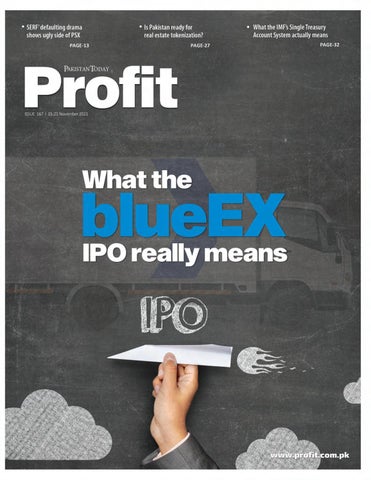
16 16 What the blueEX IPO really means 22 Indus Motors claps back 23 Local retail pivot helps Gul Ahmed surge
11
27
27
25 WPP and Coke, Publicis and Nestle - the conflict shop phenomenon in advertising 27 Is Pakistan ready for real estate tokenization?
Profit
32 What the IMF’s Single Treasury Account System actually means
Publishing Editor: Babar Nizami l Joint Editor: Yousaf Nizami l Assistant Editor Abdullah Niazi Reporters: Ariba Shahid l Babar Khan Javed l Taimoor Hassan l Meiryum Ali l Shahab Omer Chief of Staff & Product Manager: Muhammad Faran Bukhari Regional Heads of Marketing: Muddasir Alam (Khi) l Zulfiqar Butt (Lhr) l Malik Israr (Isl) Layout: Ahmad Salahuddin l Photographers: Zubair Mehfooz & Imran Gillani l Business, Economic & Financial news by 'Pakistan Today' Contact: profit@pakistantoday.com.pk
Readers Say The writer and interviewees talked most of the time about development of developed countries which they attained through polluting the environment. Another thing, which was also consistently discussed throughout the article, was the USD 100 billion that needs to be given to the developing world. This makes it seem as if the writer is obsessed with the USD 100 billion that was promised, but he is not alone in this obsession. Other people also have their eyes on these dollars and are raising a hue and cry to try and get them. For example, the Philippines is saying that they will cut emissions by 75% by 2030 if it is showered with cash. However, iIf it is not provided financial help, the cut will be just 3%. That is a massive difference and clearly the initiative of these countries is driven purely by money and not in a hurry to do what is necessary. The writer himself has mentioned that Pakistan is the fifth most polluted country in the world, yet he didn’t bother to discuss the responsibilities of the Pakistani government towards its people for their safety. It is their job to protect them from the harmful effects of climate change. For example, he didn’t talk about how Pakistan is developing its road infrastructure in cities in a way that it is only suitable for cars which run on subsidised fossil fuel. It is pertinent to note that both cars and fuel are imported in Pakistan. The Pakistan government has made its country the home of imported SUVs and Saloons. Apropos: COP26 – It’s time to take a stance on climate financing Mumtaz Hasan, Website
facebook.com/Profitpk twitter.com/Profitpk linkedin.com/showcase/13251020 profit.com.pk profit@pakistantoday.com.pk
HOW TO CONTACT
7
As a PR professional for the past 23 years both in and out of Pakistan, there are certain parts in this interview that I would like to give my comments on so that the reader’s of Profit get all of the information that they should have on this subject. Firstly, to say that PR agencies act as post offices is a serious sweeping statement. Yes there is this impression because agencies at times get drafted press releases which they release and then use their clout in the media to get them placed, but even that is good work and takes some effort. It means maintaining relations with the media and also working on these press releases. Looking at the quality of some of the press releases that agencies receive, it is no mean feat that they get placed so consistently and regularly. Having said that, one needs to understand that PR people are involved in drafting press releases, articles, getting them placed, interviews, digital and social media PR, crisis communications, community communications and a lot more. To call them post offices just because Azfar Ahsen has not chosen the title of PR agency for his own
organization is unjust and shows a lack of knowledge regarding the PR profession. I have worked in two markets and can safely say that PR pros from Pakistan are doing a good job both on the client and agency side. At another point, Azfar claims that he has 90 regular clients and up to 150 clients overall that this new organisation works with. For an agency that is a mere seven months old, this is quite unbelievable. According to him, these clients include some of the largest banks in Pakistan, all four major telecom companies, K-electric, and other major energy companies…’ This means, he is claiming that he has got all the competing accounts, a major conflict of interest here, just in the telecom sector alone. And isn’t Telenor with Media Matters, PTCL/Ufone is with APR, Jazz/Mobilink is with Syntax, from what I know. In addition to that, what constitutes 90 clients remains unclear. Are these retainer clients? Continuous assignments or assignments in the past. It is also not true that there are no lobbying firms in Pakistan other than his or to assume that other PR agencies are not into research based lobbying. Factually incorrect information. At this level every lobbyist does his/her homework. Also saying that others who are doing lobbying are just making a quick buck is unnecessary generalisation, insulting, and another sweeping statement. It is also interesting to note that this interview appeared 3-4 days before his announcement as Chairman BoI and just before this he is selling his organization to the corporate sector as the only lobbying firm in Pakistan. Isn’t that a major conflict of interest and a grossly unethical thing to do? So an institution like BoI where lobbyists go to address the policy part of investors will be headed by a lobbyist now? Won’t this result in companies falling over to hire the company he founded for lobbying? If others are making a ‘quick buck ‘ then what is this supposed to be? I also feel that due care should also be exercised while mentioning officials from forces for the purpose of lobbying. This gives a bad message about the most prestigious institution in the country. Nobody knows what the terms on which they have been hired. Apropos: Sons, bribes, perks, and jobs – the murky world of corporate lobbying in Pakistan Aamir Abasi, Website Don’t forget to talk about the cost of using LNG resulting in shutting down (reducing capacity utilization) of our refineries and paying capacity charged with no use of our fuel oil powered power plants and the bankruptcy of the SSGC. Apropos: LNG 101: What is LNG, and how is it priced and traded? Ayyazdawood2, Twitter
COMMENTS
IN BRIEF “While an unprecedented rise in commodity prices internationally has adversely affected most countries in the world as a result of Covid lockdowns, Pakistan mashaAllah has fared relatively much better.”
“Digital transformation of the global Islamic financial services industry has become a necessity for its growth whereas the industry needs to focus on innovative ways of service delivery that aligns with expectations of today’s techsavvy and convenience-driven customers.”
Prime Minister Imran Khan
Dr Reza Baqir, governor of the SBP
Rs 111 billion:
The National Assembly was informed that an investment of Rs111 billion will be made in the power transmission system during the next three years. In this regard, Minister for Energy Hammad Azhar told the House during question hour that the transmission line projects will be executed in different areas of the country. The SBP had to clarify that Pakistan’s currency notes were not undergoing any change after hypothetical designs for the Pakistani rupee made as part of a project by a design student went viral on social media. The SBP declared any new currency notes being launched as fake news.
$761.5 million
The Ministry of Economic Affairs and the International Islamic Trade Finance Corporation (ITFC) have signed a financing agreement, worth $761.5 million, to import crude oil, refined petroleum products and liquefied natural gas (LNG). The facility will be made effective immediately.
$10 billion:
The ADB plans to provide Pakistan with about $10 billion in fresh assistance for sectors including urban services, disaster risk reduction and policy-based programmes in the next five years, it was disclosed in a meeting between the bank and economic affairs minister Omer Ayub. The Pakistan LNG Limited (PLL) has decided to procure LNG cargo at the highest ever price of $30.6 per million British thermal units (mmbtu) in a bid to avert the looming gas crisis. Efforts are also underway to convince the LNG companies who have backed out of signed agreements with PLL to review their decision.
8
Export leftovers and seasonal cricket fans this week in Pakistan’s business and economics twitterverse
A
s the nation reels from the loss to Australia in the semi-final and collects itself from the fever dream that was this world cup, there were a lot of lessons to learn - both from cricket and the increasing pressure of inflation. Ariba Shahid brings you cricket, visa rejections, and the hard realities of inflation in this week’s social media roundup
This week the spokesperson for the ministry of finance came out to talk about how inflation in india is bad. He even made a list using random prices of products that were exaggerated. Here Uzair is schooling him over how you actually compare inflation.
SOCIAL MEDIA ROUNDUP
Hire a proofreader
Kind of embarrassing when a company that sells expensive cars can’t afford someone to draft or proof read their documents. {Editor’s note: This is particularly irresponsible when there are so many unemployed graduate students out there sitting on their humanities degrees}
9
An idea a day
Hope from cricket
Enough talk about cricket. Time to be unproductive while talking about something else such as the PKR and petrol prices. The good news for die-hard cricket fans is that the pain from this will not go away for a while, and maybe we’ll be feeling just a little numb the next time we’re getting our gas tanks filled. Airlift now sells mobile phones. A new hussle every week in the hopes something will click. However, the transportation tech company could’ve changed how people commute permanently. Oh well, guess they’ll just sell phones now. But hey, maybe when they stop believing in this idea they can bleed their investors for even more money and start selling cars and buses on their app too.
The fault, dear Brutus, is not in our stars
{Editor’s aside: On a very brief off-beat note, the Pakistan cricket team’s performance at the world cup has been outstanding. Their ability to distract the nation and bring out smiles at a time when inflation is soaring has perhaps been one of the few things keeping us all going. What is even more heartwarming than the team’s talent is the clear camaraderie and friendship that exists in this young group. It is something to admire and look up to. To all seasonal cricket watchers, this unit has been developing for years and has acted with pride and dignity. They deserve the same in return.}
The real export leftovers
Pakistan has a market for export leftovers. We’re not just talking about the t-shirts and night suits you get at zainab market, but people that couldn’t make it to foreign universities. There are some employers that hire almost exclusively graduates of foreign universities, but since times are tough they may want to go dumpster diving and get some of these export leftovers on board. {Editor’s note: Prime locations to find these export leftovers are universities like LUMS, IBA, Habib and others. Some common defects might include bitterness, frequent bouts of weeping whenever the word ‘Visa’ is uttered within a 10 mile radius of them, overuse of the word ‘bourgeois,’ and a liberal arts education.}
Financial inclusion for women
Being a heiress is goals. Inheriting a crippling economy is not goals. Too bad we were dealt the cards we have. I wonder who is to blame. Perhaps a certain generation that had it far easier than this current one?
10
A ratio of 1:21 is absurd. Absolutely absurd. We hope the gap is bridged and more women are able to become financially independent. Women must be given opportunities to work and their access to financial institutions must be improved - this is essential, and it is a mantra we will preach anytime it comes up. This is where you really need affirmative action.
SOCIAL MEDIA ROUNDUP
LNG 202:
Volatile spot markets and record breaking prices
Pakistan gets half its LNG through long-term contracts. The rest is dependent on the spot market
I
By Ariba Shahid
n the first of this series of articles on the intricacies and workings of Liquified Natural Gas (LNG), the focus was to understand what LNG is, how it works, what that means in terms of shipping, how it ends up getting priced, and how it is traded. Those were very much the basics of LNG. With those still in mind, in this edition we will go deeper into the world of LNG and try to understand how the international market for LNG operates, what the difference is between long and short term contracts, and most importantly what Pakistan’s LNG capacity is. The world has been hungry for natural gas ever since it has become widely available as a fuel source. The consumption of natural
ENERGY
gas has jumped from only 0.28 Bcf/D in 1971 to 4.42Bcf/D in 2019. Of this increase, the last two decades since the turn of the millennium have seen gas consumption increase at a rate of 4.8 percent. However, Pakistan’s gas production during this time has remained almost stagnant at about 4 Bcf/D, and since 2015 the country has been importing RLNG (regasified liquefied natural gas). Because of the reliance on imports and no increase in gas production, approximately 78 percent of households in Pakistan do not have access to natural gas. Despite that, natural gas has been the fastest-growing source of household energy consumption in the country. Domestic consumption is the second largest after the power sector gas consumption. To understand why this is so, first we must look at the international market, and
then look at Pakistan’s LNG capacity.
What’s going on in the international markets?
A
couple of years ago, LNG was a cheap commodity. Its low prices were its main selling point and what attracted so many governments and corporations to rely on it. Yet in the past two years, it has hit record highs in terms of price. One simple answer for this rise in price is that just like all the other commodities, LNG prices are rising as a result of the pandemic. When the global economy came to a halt as an initial response to the covid crisis, it was always bound to happen that whenever it started up again it would do so with a jolt. As soon as
11
trade began to normalise, there was a surge in global demand as economies all over recovered. This resulted in soaring prices. In addition to a recovery in demand, the fact that there have been hotter summers and colder winters means that the demand for energy is rising. Supply side issues, however, remain due to the scarcity of other fuel sources. It is a very basic equation - cold and resurging economies meant higher demand but supply side issues went nowhere. For instance, China faced coal shortages due to which the reliance on LNG rose. This meant suppliers had to choose between supplying more to China or to Europe since there was not enough to go around for both places. In the meanwhile, China is rationing the LNG between industries and residential users. You can tell that there is a situation of surplus demand by the fact that gas inventories have been tight in Asia and Europe. These two continents account for 94% of LNG imports and also make up more than 30% of the world’s gas consumption. On the flip side, you can’t just increase capacity overnight. Most LNG producers are operating capacity or near capacity. With most suppliers operating near total capacity, there is very little left to be traded on the spot market. As a result prices have drastically gone up. To make matters worse, due to the pandemic the transfer of knowledge, expertise, and skills weren’t at their usual levels. Therefore, LNG related projects and maintenance was widely delayed. This resulted in slow investment in LNG infrastructure. Moreover, the global energy sector pivot from fossil fuels to green energy has also led to less investment in LNG related projects. The fact that LNG prices were pretty low for half a decade also played a role.
Long term vs short term contracts
L
NG is sold contractually. A government or a corporation goes to an LNG provider and signs either a long or a short term contract with them that then determines how long and at what rates they will be supplied with LNG. One can either get a long term contract with an LNG provider which comes at a fixed rate over a period of time, or go for an immediate short term contract in which prices are determined in the moment. The place where these short term contracts take place is known
The spot market or cash market is a public financial market in which financial instruments or commodities are traded for immediate delivery. It contrasts with a futures market, in which delivery is due at a later date. Basically, a spot market is where one can trade commodities, securities and currencies for immediate delivery as a ‘spot market.’ The spot market or cash market is a public financial market in which financial instruments or commodities are traded for immediate delivery. It contrasts with a futures market, in which delivery is due at a later date. Basically, a spot market is where one can trade commodities, securities and currencies for immediate delivery. The name comes from the phrase “on the spot”. You buy on the spot in these markets. They are also called physical markets or cash markets. This is because trades are swapped for the asset effective immediately. The transfer of money can take time, but the buyer and seller agree to the trade in the present, immediately. A non-spot or a futures trade is where the buyer and seller agree to a price in the present but deliver the product/ transfer the funds later. The prices of future trades depend on the spot market. Meanwhile long term contracts are an agreement to buy over the long term. These can be as long as 25 years. In essence with a long term contract you are under agreement to receive the commodity and the seller is supposed to sell it to you. Regardless of how lucrative the spot market is, neither the buyer nor the seller can back out. In the last decade, the dominance of long term contracts has phased off. Basically the LNG long term and spot market are moving in opposite directions. For now, buyers that are looking for stable supply beyond 2025 have choices. The volumes are present and the demand just isn’t very high then. However, if you’re out shopping for LNG right now, the higher spot rate and expensive short term deals aren’t the ideal situation you would have hoped for. So what is the ideal choice between these two? With long term contracts there is the issue of finding yourself receiving a commodity at a time when you do not need it. While spot market and short term contracts
It is a very basic equation - cold and resurging economies meant higher demand but supply side issues went nowhere. The price rising was a natural reaction 12
are flexible, they have their downsides. You may find yourself buying at high prices in supply shortages or demand surges just like we are now. The best way to go forward is to have a mix between the spot and long term contracts. The solution at present is bridging contracts which “bridge” the short and long term. A bridging contract gives buyers lower prices over the next five years in exchange for sellers getting the security of a long term deal. Due to transitions in the energy sector, LNG buyers around the world are looking towards bringing in more flexibility in their LNG procurement portfolio.
What’s happening in Pakistan?
G
as prices have surged all over the world. As a result, Pakistan is paying the highest price it has ever paid to import LNG through spot markets. Over the past half decade Pakistan increased its reliance on LNG under the assumption that the supply would be abundant and the fuel would remain cheap in the long run. They did not want to engage in a long term contract because they assumed the spot market would remain cheap. Add a pandemic to the mix and you’ve got unprecedented circumstances. Pakistan gets more than half of its LNG under long term contracts which saves it from the volatile spot markets. However, the long term contracts faced their fair share of criticism too in the past. Currently the government is under pressure from the opposition over the spot market purchases of LNG. The problem will be enhanced when spot shipments will be required through winter months as well. The controversy between the current government and opposition is precisely the reason we have begun writing this series. As of now Pakistan has two LNG terminals with 600mmscfd each with a total baseload of 1240 mmscfd. The demand for natural gas can go as high up to 2 billion cubic feet per day in winters. The deficit is what Pakistan imports. We will get into the details in our next class. n
EXPLAIN-IT-LIKE-I’M-FIVE
SERF’ defaulting drama shows ugly side of PSX After a new business plan, rights issue, and AGM – the PSX moves the company to the defaulters segment through an ill thought decision By Ariba Shahid
D
efaulter. The word elicits horror from investors and appears in the nightmares of CEOs. Which is why it is relatively understandable Service Fabrics Limited (SERF) has been less than happy with a notification of the Pakistan Stock Exchanged (PSX) that has placed it in the defaulter’s segment. SERF’s crime? Revamping their once dormant business that has existed only in name for years now. For years SERF was dead, and the PSX was happy enough to let it carry on with 100% of its shares floating in the market. There was no real business activity going on in the company and investors were essentially just trading on paper. This once dead company has now very quickly become not just the subject of the PSX’s attention, but also the talk of the town. Finance and stock market whatsapp groups are exploding in equal parts confusion and outrage over why the PSX has placed SERF under A dead company that was finally being revamped, getting a CEO, and coming back to life has been shot down and thrown to the defaulter’s segment. With a spotty past and a heartening hope for revival still alive, the story of SERF is worth telling because it also says a lot about the PSX, and there is also a lesson to learn for others in similar positions.
STOCK MARKET
What is SERF?
S
ervice Fabrics Limited (SERF) was incorporated in December 1987. The principal business of the company is manufacturing and selling of fabrics as per the PSX website. The company, however, had not been operational for years. However, SERF hasn’t been involved in the fabrics business since 2004. At one point in time it had also bought a brokerage firm from Noor Capital and then ended up selling it back to Noor Capital. In 2016, the SECP initiated winding up proceedings on the company. Winding up is the process of dissolving a company. While winding up, a company ceases to continue with business as usual. The purpose of winding up is to sell off stocks, pay off creditors and distribute the remaining assets to shareholders. While the company could not continue its core operations since 2004, some shareholders wanted the business to go into the FMCG sector. This would have been a complete overhaul and a switch in business trajectory. Essentially, shareholders wanted to use the remaining resources of SERF to set-up a new business. For this purpose, key investors approached the Ghani Group to take over the company. The role of management was then assumed by the Ghani Global Group which has been in the business of glass manufacturing, gas and chemical sales. The Ghani Global Group already has two listed companies, both operating in unique industries. Ghani Global Glass
(GGGL) produces Ampoules and Vials for the medical industry, and Ghani Global Limited (GGL) is a holding company that owns 75% equity in Pakistan’s largest producer of medical and industrial gases-Ghani Chemicals or GCIL. In the case of SERF, the group stepped in with an aim to revive the company. This resulted in the Lahore High Court throwing out the winding up proceedings for SERF. The court dismissed the case following shareholder approval of the revival business plan. As per SERF’s website, the company is in the process of changing its name to G3 Technologies with a revised memorandum. Spearheaded under the chairmanship of Aftab Ahmed Chaudhry, former Managing Director of the Lahore and Islamabad Stock Exchange. At this point, the company’s financial position was weak. It had a negative net worth and liabilities of more than Rs 210 million outstanding. To make matters worse, approximately 100% shares were free float which meant no majority ownership. In the absence of majority ownership, there is unlikely to be any entrepreneurial stake or leadership to bring changes. However, what they did have was a solid business revival plan.
The revival plan
T
he revival plan for the business entails changing the name to G3 Technologies Limited in order to represent that the company is revising its intended
13
business activities. Changes in the Memorandum and Articles of Association of the company are also subsequently needed. In addition, the authorized share capital was to increase from Rs 160 million to Rs 2500 million. In addition, a joint venture agreement is being made with Ghani Global Holdings Limited (GGL) to make a joint investment in their “Supercapacitor project”. Super capacitors are electrochemical energy storage devices that store and release energy by reversible adsorption and desorption of ions at the interfaces between electrode materials and electrolytes. These are a modern and more efficient replacement to batteries. The hope is that the joint venture would result in the manufacturing and sale of super capacitors which will be used in electric vehicles, solar and UPS battery solutions, telecom, micro-grid, locomotives, industrial equipment, energy harvesting, and green technology, etc. in Pakistan. They also plan to export to other countries. The joint venture will be with Kilowatt Labs Technologies Limited (KLTL) as the implanting entity. The manufacturing facility is to be set up in Faisalabad. To get things going, the Ghani Group’s independent subsidiary, GGL, would make an investment in the now rebranded G3 Technology Limited and G3 would make a joint venture agreement with KLTL and its associates, which would bring expertise, technology, intellectual property, and territorial rights. However, KLTL would have 50% ownership despite only putting in 35% investment because of everything else they were bringing to the table. The remaining 50% lies with G3. “We plan to capture the Rs 100 bn battery market. The start of production of the super capacitors in Pakistan will enable more efficient storage of energy,” Aftab Ahmed Chaudhry, Chairman of SERF told Profit. ”The first phase will require Rs 1,000 million project cost which excludes the capital requirement. The second and third phases include manufacturing processes and new product lines being added.” In addition to super capacitors, there are also plans to set up a calcium carbide plant. Ghani Global is in the business of importing calcium carbide. This is primarily used for fruit ripening amongst other uses which include the manufacturing of acetylene, iron, steel, ductile steel, alloys, welding material, and cutting metals. In an attempt to substitute import, the group plans on setting up a calcium carbide chemical plant through SERF. The country meets its entire calcium carbide demand through imports, mainly from China. This adds around $ 12-15 million annually to the nation’s import bill. The group not only plans to address local demand but aims to make exports worth Rs US$ 3-5 million every
14
year of the chemical. In a bid to raise funds, the company in a filing to the PSX had informed that it would issue a further 234,116,328 ordinary shares at par value (ie at Rs10 each) by the issue of right shares to be offered to the members in proportion of approximately 1,486 right shares for every 100 ordinary shares held. This means a 1486% rights issue at par value. Rights issuance is done for existing investors. The investors had the right to subscribe or decline to subscribe. Ghani Group was able to buy approx 29% stake through investors that chose not to subscribe through its associated companies and individuals.
Why is the company on the defaulter’s list?
B
efore we explain why SERF is on the defaulters list, it is important to know what type of companies find themselves in this segment. A listed company is placed in the defaulters segment for a number of reasons. If a business has not commenced commercial activity such as production or business operations within 90 days of listing, or has suspended commercial production and business operations for a continuous period of one years. Similarly, companies that have failed to hold one Annual General Meeting, and submit their annual audited accounts are also added to the defaulters list. If a company hasn’t paid its listing fee for 2 years, any penalties imposed, or any other dues owed to the PSX or SECP they may find themselves on the list. Issues with the CDS such as revoking CDS eligibility, not joining CDS can result in being put on the list and also result in suspension in trading of shares. A company can also be placed on the defaulter list if the auditors flag it as a going concern or when a show cause notice for winding up has been issued to the company by the SECP. A winding up petition filed by creditors or shareholders, or voluntary winding up proceedings through a special resolution also land you on the defaulters segment. The last two reasons are more pertinent to know for this story. SERF was added to the defaulters segment because it has suspended commercial production and business operations for a continuous period of one year and the auditor has flagged it as a going concern in its report for the year ended June 30, 2021. However, this makes very little sense. The notice doesn’t make much sense as it has been given based on last year’s accounts. The decision to move the company to the defaulters segment is primarily based on what was said by the auditors for FY 21. Back then the company merely operated as a shell company. Following that, the revival business plan
was submitted, an AGM was conducted, and a rights issue was also undertaken. “This makes absolutely no sense. The business model has changed, the exchange was aware. What good does a default counter do anyway other than hampering price discovery and trading in the market while hurting the minority investor? Such arbitrary decisions by the exchange should be avoided,” says economist Ammar Habib Khan. The company is now submitting a response auditors’ certificate that will enable the company’s removal from the defaulters counter. “The Auditor has certified that the company is no longer a going concern,” said Chaudhry. About the other reason for the placement of the Company’s shares on the defaulters’ counter, Chaudhry said “the Company’s revised Memorandum and change of name matters have been submitted to the CRO, Lahore since July. The approval is expected shortly as the confirmation from a bank for the settlement of a loan from the 1996 period is in process”.
Is the PSX at fault here?
I
f you look at things technically, the PSX is right to put the company in the defaulters segment as per the rules. However, that raises the question why the PSX waited till after the AGM, corporate briefing sessions, and rights issue to do so. The company had been deserving of being put into the defaulter’s segment for a long time now, and the timing of the PSX is incredibly strange. It is even more important to note that while the company was flagged as a going concern, the revival business plan was to be taken into consideration. Moves like this damage investor confidence. “Without proper interpretation of PSX rules and without reading the business plan and company’s perspective, how can the PSX just make this decision one day and damage investor confidence?” says economist Baqir Jafri. “Either this is a lack of professionalism from PSX management or a case of manipulation to accumulate more shares from the market by market makers and then you will see that company will get out of the defaulters counter.” While the rules for the defaulter segment exist, it is important to look at companies on a case to case basis. Not doing so will only deter investors to come in and revive companies. Moreover, correspondence with company officials before changing the status of a company is important. This could’ve been explained in a meeting. “There are about 122 companies on the defaulter counter. That is equivalent to around 20% of the total listed companies. These companies need to be revived. You will soon hear of our future revival plans,” said Chaudhry. n
STOCK MARKET
16
COVER STORY
By Taimoor Hassan
W
asim Akram might be about to make some money. But the former Pakistan captain is not about to make bank on a lucrative commentary deal, nor is he accepting the many offers for coaching that he regularly gets. Instead, the source of his soon-to-be fortune is his investment in a little known logistics and delivery company called blueEX. Founded in 2005, blueEX is a logistics company that initially came onto the scene to compete with organisations like TCS, but in the recent past has made an active pivot towards providing eCommerce logistics solutions. A few days ago, it was announced that it was looking to raise Rs445.7 million through an initial public offering (IPO) on the Pakistan Stock Exchange’s Growth Enterprise Market (GEM) board. The move is a bold one, which is precisely what makes this story so interesting. Pakistani companies are currently going through a funding fever-dream fueled by the success of numerous Pakistani startups, particularly tech startups. In this climate everyone wants a slice of the massive venture capital pie that has turned its attention towards Pakistan. For blueEX to then go for an IPO, and that too on the PSX’s GEM board means one of two things. It could either mean that the people behind blueEX have had an inspired moment of brilliance, or that they have failed to raise money through the traditional VC route, and are now going to the PSX as a second resort. Given the cast of characters running blueEX, the latter is a more likely possibility. At the helm of the company is Imran Baxamoosa, who despite being CEO does not have a lot of skin in the game with only 5% ownership of blueEX. The majority stakes of the company lie with Safina Danish Elahi, whose husband Danish Elahi is the CEO of the
18
Elahi Group and got sentenced to time in the slammer for embezzlement. As one can clearly see, blueEX isn’t exactly a venture capitalist’s dream project. Not only do the people heading it not exactly inspire confidence, there is also the issue of there being a lot of competition in the logistics space and blueEX not quite showing what sets them apart. However, despite all of these misgivings, one thing that goes in the favour of blueEX is that they have not taken this lying down. The decision to go for an IPO is a brave one, and it has set off a lot of wagging tongues. The question now is whether blueEX can beat the odds, and how they got to this position in the first place.
Finding capital mid-way
E
verything about blueEx seems to scream middle-ground. If you place it in the context of Pakistan’s logistics market it enters the timeline somewhere around the middle. Companies like TCS have been around since 1983 while newer startups like Swyft have only been around for a couple of years. Companies like TCS are now making a change towards eCommerce backed by their decades long legacy, while the startups have been geared towards this model from the very beginning. blueEX had to make a complete pivot and turn itself around to become an eCommerce logistics company. That is why perhaps it is not so strange how instead of losing itself in the race to get venture capital money, bluEX is going for an IPO and that too on the GEM board. Growth Enterprise Market Board is a listing platform aimed at facilitating Growth oriented businesses whether small, medium or greenfield businesses to raise capital to fund their growth and expansion plans. It is designed particularly to facilitate small enterprises, startups and green field companies that are aspiring to raise funds through capital markets but cannot fulfill the cum-
bersome conditions for listing on the Main Board of PSX. Essentially, this means that the PSX now has an undercard where high-risk companies can put themselves up for IPOs and investments. Normally, startups try to get funding from individual venture capitalists, VC firms, or angel investors in different rounds. Since startups are not developed enough to meet the criteria for being listed on the stock exchange, the GEM board provides a way to utilize the exchange without going through the old fashioned way of raising money in public markets. The GEM Board allows growth companies to quickly raise capital in public markets without the complexities associated with a full-scale initial public offering (IPO), but does not allow all public investment. The Pakistan Stock Exchange introduced regulations for the GEM Board listing purely for high-risk, small and medium scale companies and startups to raise funds. Compared to the listing on the main board, GEM Board listing is less costly with the post-issue minimum paid up capital requirement of Rs25 million compared to Rs200 million in the case of listing the company on the main board. The GEM listing, because it is designed for new and growth companies, comes with a lower listing fee and tax incentives. But because this listing is designed for new and growth companies, the investment is high risk which is why the Securities and Exchange Commission of Pakistan has restricted the participation in GEM Board listing to accredited investors, institutional and individual. The institutional investors could be financial institutions and companies, whereas individual investors that are eligible to invest in such companies going public should have net assets worth of Rs5 million and should be registered with the National Clearing Company of Pakistan (NCCPL) Limited, the company that provides settlement and clearing services to the stock exchange. The shares are traded at the exchange like in the case of a full-scale IPO but the regulations require the company to issue a fixed share price to reflect the true value of the company instead of the market value. In what is going to be the second GEM listing and first listing ever of a logistics company in Pakistan, blueEx is planning to raise Rs445.7 million (approximately $2.67 million) by issuing 6,857,000 ordinary shares, which is going to make up 25% of post-issue paid up capital, at Rs65 per share. The listing, if successful, is going to value blueEx at Rs1.78 billion or roughly $10.5 million. In contrast, some competitors in the space, Rider and PostEx have announced raising $2.3 million and $1.5 million respectively. Reportedly, one of the competitors in the space, Swyft Logis-
When we came in, we created the company with solid foundations and a solid balance sheet and P&L and bootstrapped. In our scheme of things, we thought GEM listing was the right way to move forward. Private valuations are given by the last investor and do not make sense sometimes Imran Baxamoosa, the CEO of blueEx
tics, is in the process of raising $100 million along with sister company Cheetay. The GEM listing is the middle-way for blueEx, and trying to stay in the middle also perhaps runs in its DNA because it also now calls itself a ‘technology logistics’ company, in an effort to keep a legacy business relevant in the world of technology. However, the blueEX listing is going to be significant in two ways: this is going to set precedent for small companies particularly startups to explore avenues of raising investment other than VC funding and learn from the blueEx IPO. Secondly, it is the first public listing of a logistics company and a delve into financials of a company in a sector which has remained closed for decades for any scrutiny. We have given fair consideration to the merits of a GEM listing. This is all very new of course, which is why the move is also audacious. But what makes it more interesting is the very real possibility that the decisions may have been made after failed attempts to get VC funding. As mentioned earlier, the company is majority owned by Safina Danish Elahi, and the CEO owns only 5% of it. Both of these would generally be considered red flags for VC investors. You see, VC investors are less likely to invest in a company in which the CEO has very less shareholding.That is because VCs
then feel that the person running the show doesn’t really have a lot of skin in the game. If the CEO is simply there for a salary, they are more likely to either play it safe or not be as zealously invested in turning profits for the company. However, Imran Baxamoosa asserts otherwise. “Because we founded the company with solid foundations and a solid balance sheet and P&L and bootstrapped, in their scheme of things, GEM listing was the right way to move forward,” he says. “Private valuations are given by the last investor and do not make sense sometimes,” says Imran Baxamoosa. That is another part of why the decision to list on the GEM board is so stunning. In the process, blueEx are revealing their financials and provoking scrutiny instead of choosing a VC route of funding which is the spirit of the day with startups and especially technology related businesses as they identify themselves as. However, Baxamoosa takes a more measured approach. “We do not want to make it overhyped. We want to keep it underwhelmed which is why we are doing a fixed priced IPO. Everything is calculated and in front of the public. There is a lot of conservatism instead and that is because we are looking at a long term horizon.” . What else might have been problematic for the company to raise VC funding is the fact that the majority investor in the company, Sa-
fina Danish Elahi, is the wife of Danish Elahi, a controversial Karachi-based businessmen who recently settled a case out of court against him filed by Bank Islami for alleged embezzlement and irregularities in his bank account. So even if Baxamoosa’s big talk is right, there is indication that if blueEX wanted, securing VC funding would not have been the easiest route for them. And that might have helped push their GEM board decision along.
The Danish Elahi angle
L
ast year in September, the Federal Investigation Agency (FIA) of Pakistan registered a case against a former employee of Bank Islami and officials of a private company in an embezzlement case and subsequently jailed them, according to media reports. One of the officials named in the case was Danish Elahi, the CEO of Karachi-based Elahi Group of Companies. The Elahi Group of Companies had started off as a small electronics company known as Elahi Electronics in 1971. Since 2016, Danish Elahi has also served as the director and co-owner of Daewoo Pakistan, with a 50% share in the private company. He has a 50% stake in Kiran Builders and Developers; a 70% stake in E&U Foods; is a director at Opal Laboratories since 2019; a director and co-owner at TripKar; and even a shareholder in the Sehat Kahani app. The Bank Islami episode was not the first controversy stirred by the Elahi Group CEO. Earlier, he is reported to have defaulted on a Rs1.4 billion loan from the same bank. Surprisingly, on November 5, less than two weeks before the IPO of blueEX, Danish entered into an out of court settlement agreement with Bank Islami, disposing of any complaints and litigation.The timing of the settlement also lends credence to the fact that because Elahi was embroiled in a court case, raising funds would have been difficult. Quite simply, not only VC investors but any
COVER STORY
investors investing in a company would want it to be as clean as possible, because any association of a company with persons that are controversial are not just a VC investment risk but an investment risk overall. The add-on is that the accounts of blueEX were not audited by one of the big four auditing firms. The big four auditors have a distrust of the Pakistani market because of the rampant frauds that emerge every now and then at businesses in Pakistan. These firms do not make much from their services to Pakistani businesses and coupled with the risks, Deloitte left Pakistan earlier this year.
The state of blueEX
b
lueEX, a brand of Universal Network Systems (UNS), was incorporated in 2005 as a courier company which shifted its focus towards eCommerce Logistics in 2011. The company provides local and international cargo shipment services and courier services under which it delivers letters and documents, and eCommerce deliveries. The biggest component of the business is courier services, forming about 96% of the company’s income, while only 3% comes from the international freight segment and 1% from providing cargo services to international airlines, according to an Information Memorandum published by the company. Under the GEM Board listing rules, companies planning to list are not required to issue a prospectus which is the case in case of full-scale IPO. Instead, they are instead required to provide an Information Memorandum (IM) which is a document providing a comprehensive overview of the business. The financials released by the company show that its revenues have been growing since at least 2019, when the company generated Rs 508.3 million. In 2020, the company generated a revenue of Rs1.17 billion whereas blueEx closed the year 2021 at Rs1.53 billion. On the net profit side, the company generated a net profit of a tiny Rs7.49 million,
20
with a dip in 2020 when the profit after tax was only Rs2 million. The net profit, however, increased by over 1,500% in 2021, with the company reporting net profit of Rs33.22 million for the latest year. Post 2021, the company projects its profits to more than double each year, with projected revenue in 2022 to be Rs78.5 million, 169.92 million in 2023 and 238.9 million in 2024. Consequently, the earning per share (EPS) for investors also more than doubles each year onwards. According to the IM, the EPS for 2021 was Rs1.61, increasing to Rs8.71 in 2024. “The increase in EPS is rich for the initial share price of Rs65 for a growth company,” notes an analyst. “The company income and profits are increasing which are all good indicators but the question then is will the company be able to execute on these projections,” he adds. The price-to-earning (PE) ratio, trailing at 53.71 (FY2021) and forward at 22.72 (FY2022), according to an analyst, indicates that the company was overvalued for a logistics company given the competition in the space, which we discuss below. “The forward earnings are on the higher end and likely exaggerated,” says one analyst. On the other hand, KASB Securities, a Karachi-based securities trading firm, in its report endorsed that the sponsors and management of BlueEx have strong experience in sectors of supply chain, warehouse, courier and bulk cargo which, they think, make it a dominant player in the sector. “We think the public offering is a good way for institutional and accredited investors to get exposure to this area of ecommerce enablement,” the report read. The problem, however, is that while the blueEx management would have the requisite experience in logistics and supply chain, the company hasn’t been able to create a serious space for itself in the market that is currently dominated by TCS and Leopards. From blueEx’s research presented in the IM, it currently
owns only 6% market share in the courier business, whereas Trax, which was founded in 2010, has a market share of 13%, almost double than blueEx. In the eCommerce logistics as well, which blueEx says is its niche and which is booming helped by the pandemic and hence provides the opportunity for growth for blueEx, the company is not in the top 5 eCommerce logistics providers. In fact, revenue-wise, the top ten clients of blueEX in the courier business include only Daraz, Metro Cash n Carry and AlKaram Textiles for which blueEX handles eCommerce deliveries. But here’s the kicker: Daraz is the biggest eCommerce company in the country in e-tailing and handles 70% of its deliveries through its own delivery network set under Daraz Express and 30% through 7 third party logistics providers like blueEX, TCS and others. Last year, Daraz was doing 50% of its deliveries through Daraz Express while the remaining was being handled by third party logistics companies. The increase in eCommerce deliveries through its own logistics infrastructure shows Daraz’s commitment to grow its logistics arm. The fact that the biggest eCommerce company in Pakistan which constitutes the bulk of e-tailing volume does most of its deliveries itself which it can most likely grow to even 100% in the times to come, is a serious limitation for the growth not only blueEx but other eCommerce logistics companies as well. And as I have come to know, Daraz plans to not only do all of its deliveries in the future, it also plans to become a third-party logistics provider for all eCommerce deliveries in Pakistan, for Daraz as well as others. This effectively makes Daraz a competitor to all other third party logistics companies and an earlier article by Profit also highlighted why Daraz could be a threat to all eCommerce logistics companies. After Daraz, the biggest e-tailers by volume are most likely big clothing brands like Khaadi, Sapphire, Gul Ahmad and Al Karam, which have presence in offline retail as well. While all of these retailers saw a boom in eCommerce deliveries during the pandemic, in a recent interview with Profit, officials from Khaadi told us that the trend of shopping from their brand has seen a surge in in-store shopping and a dip in online sales as the pandemic restrictions have eased. On the other hand brands Sapphire and Al Karam also saw a surge in their eCommerce sales because of store closures but since September this year in the case of Al Karam and October in the case of Sapphire, they have witnessed their online sales come down and the footfall at brick-and-mortar stores going up. However, Gul Ahmad says that there
TEXTILES
has been an increase in brick and mortar sales, it is not coming at the expense of eCommerce sales at their brand because they say that their strategy is focused on increasing eCommerce sales along with brick and mortar sales. At Gul Ahmad too, the brand does eCommerce deliveries through 7 logistics partners, one of which is BlueEX and the favourite, and on top of their brand is also the logistics behemoth TCS, which is not going to be easy to displace as highlighted in an earlier piece by Profit. The fall in eCommerce volumes as pandemic eases insinuates that the going is going to get tough for blueEX in its niche, and more so because it was never among the top in terms of market share. While there are no solid numbers because of a lack of independent market research, market estimates put TCS and Leopards on the top spot, followed by M&P and CallCouriers, and then rank the startups Rider, Swyft and Trax, younger than blueEx in the ranking pyramid for eCommerce deliveries. The revenue-wise breakdown of the top 10 clients in courier business of blueEX does not give an encouraging picture but it is quite possible that blueEX has on boarded many small customers for eCommerce deliveries which eventually add up to a significant number. In the Information Memorandum, blueEX has claimed to have over 11 thousand customers for courier service but Imran refused to disclose how much of their business came from eCommerce deliveries for us to ascertain if their eCommerce numbers were serious for a niche.
A technology company that does logistics?
I
t is perhaps because of the inability to create a serious dent in logistics that blueEx now calls itself a tech logistics company, trying to stay relevant in the market that is dominated by bigwigs and now
saturated by the entrance of VC funded startups, which have their own claims of being the tech titans in logistics. Anything tech is booming these days. The old guard, the likes of Systems Limited and TRG, have their stocks booming on the PSX. The new guard, the startups, are raking in record rounds of funding. To recall, blueEx’s competitors Rider recently announced completing a raise of $2.3 million, PostEx announced $1.5 million in its recent round. Whereas Swyft Logistics is planning a $100 million raise collectively with delivery company Cheetay, all on the back of being a tech company. It does not at all come as surprising then that spinning a logistics company to make it look like a tech company obviously comes with gains: attracting investors is one of them. At the face of it, blueEx is a logistics company that uses technology to make its processes efficient. That, however, would not qualify blueEx to be called a tech logistics company, just like it does not make Unilever using some technology or increasing technology in its processes a tech FMCG company. What, however, does make it a technology company is what blueEx says is its in-house technology products which it sells to different clients, besides using its solutions in the company’s own operations. “Tech is at the forefront of everything at blueEx. When we started off in 2011, we were the first company to come in and formalise COD. We gave a booking portal in the very beginning which is now defacto. Anyone who does COD shipments has a booking portal. Earlier it was all manual,” says Imran. “As of today, it’s not only the technology that we developed and use at BlueEx, we have also outsourced that to other players in the market. One of our clients uses a solution developed by blueEx to execute their eCommerce. Their website is built on our technology stack. When the order comes in, and it gets processed in one of their outlets, the picker
app also uses our technology and when the order gets processed, again it goes through our technology,” says Imran. It is because of the focus on technology that the company chose to classify costs incurred on the production of softwares as assets instead of expenses, turning the overall loss into profits. For instance in 2021, the company incurred Rs59 million in expenses for the production of software but was accounted as an asset which is going to bring economic benefits to the company. Had it been classified as an expense, it would have turned the net profit of Rs33 million into a net loss of Rs26 million, thereby making it unattractive for investment. Strangely, however, the company assumes that the economic benefit is going to be indefinite and has not accounted for the depreciation of the software. “That is besides the overall orientation of the business. Or if you want to connect your website with our warehouse management system, our plugins are ready for warehousing and logistics. So all you have to do is download the plugin on the platform you are on and it gets connected. That is why we are a technology logistics company,” he adds. Imran, however, did not disclose how much of their business came from the tech component of the business but margins have a story to tell. For the year 2019, according to full financials available publicly, blueEx’s gross margin was 20.17%. It was 8% in 2020 and 10.27% in 2021. Company’s net profit margin was 1.47% in 2019, 0.17% in 2020 and 2.17% in 2021. “These margins do not represent a sustainable tech company which usually has a net margin of over 10% and gross margin of 40%,” notes one analyst. Imran, however, affirms that their raise is going to help the company move towards businesses that have more depth in margins, rather than chasing market share. And because they are not chasing any further market share, they are not worried about any funding coming into other startups. Projections also show that the company’s gross margins are going to be over 15% and net profit margins are going to reach close to 7% by 2024, but it is unclear how much of the growth in margins is because of the technology solutions it provides to clients, let alone if growth in margins would be possible because of the dynamics in eCommerce logistics.. Segment wise revenue numbers show that the company is betting on the growth in eCommerce delivery volumes. And owing to the lack of transparency from their company on the tech side of business, the question then is will blueEx as a ‘tech logistics’ company be able to grow in a market, in which it has not earlier been able to show a promising growth as a ‘logistics only’ company? n
COVER STORY
Indus Motors
I
claps back
An astonishing increase in volumes has kept Indus motors on top
ndus Motors has had quite the quarter. It released its latest financial results for the quarter ending in September 2021 on October 29, and the contrast could not have been more stark. In September 2020, the company had earned Rs34 billion in revenue, and net income stood at Rs1.8 billion. Fast forward one year, and revenue stood at Rs65 billion, and net income had shot to Rs5.4 billion. That means net income increased 194% year-on-year, and 22% quarter-on-quarter. What explains this? According to Sarosh Saleem, analyst at investment bank AKD Securities, it’s the astonishing increase in volumes, which grew 59%year-on-year and 28%quarter-on-quarter. Mist of this was because of budgetary measures. The company’s cash investments also grew to 28% quarter-on-quarter, resulting in higher other income (which saw an impressive 100% yearon-year increase). According to the corporate briefing that the company held on November 10, the company had increased the prices of its vehicles across the board by around 7%, in line with the depreciation of the rupee against the dollar in the first quarter of fiscal year 2022. This was done to stop the impact of higher input costs. According to Saleem’s own estimates, a 1% increase in price inflates earnings by around 5%. Yet it may not all be good news: increasing prices may also impact the volumes in upcoming quarters. Also imported complete built up sales (CBU) sales will decrease because of the latest regulations of SBP where consumers can no longer purchase imported vehicles on auto finance arrangements. Indus Motors is well aware of this fact. Yet the company’s management stayed upbeat at the corporate briefing: after all, while the revised auto finance regulation by SBP may dent the sales in upcoming quarters, the risk was lower than its peers since the rural sales contribute around 50% to revenue. Infact, the share of Hilux sales through auto financing arrangements is around 15% while the share of Fortuner is around 25%. Better yet, the company insisted that it is not facing any delays as the chip shortage hasn’t impacted the company much. This has been possible due to the company’s efficient
22
inventory management system (so they say). But the optimism is important: in fact, the management said it seemed confident to deliver 90-95% of its commitments in fiscal year 2022. This has kept them competitive. For a while it seemed that Toyota and the other two parts of the big three would find their necks on the chopping blocks, but the semiconductor chip shortage has meant that despite great demand for new models introduced by new manufacturers, Toyotas are still more widely available than most cars - especially since even Suzuki and newer entrants have booking closed for months ahead. With car sales skyrocketing post-pandemic, people are in a rush to get cars. It has also been an incredible move on the part of Indus Motors in terms of introducing new cars. The company’s upward trajectory looks set considering its sales have been high, and its strategy in terms of introducing new cars has been successful, and with car prices rising generally as well they have stayed competitive despite the entry of new players in a market that has traditionally very much been a triopoly. Indus motors had the idea to launch the Toyota Yaris. Essentially, they discontinued the cheaper variants of the Toyota Corolla with 1300cc engines, and launched a new car from scratch that was cheaper. Now, people could either buy a Toyota Corolla in the Rs 3.5 – 4 million range, or a Toyota Yaris in the Rs 2.5 – 3 million range. Toyota offered a sedan at just a little over the price of a hatchback. Think of it this way. If you were going to buy a Suzuki Cultus hatchback with a 1000cc engine in 2019, you would be spending around Rs 2 million. Now, you could simply add in Rs 400,000 and get a Toyota Yaris, which is a sedan with a 1300cc engine. The Yaris was also priced just a little lower than the Honda City, which ranges from Rs 2.7 – Rs 3.1 million. And since the Yaris is a newer design, people naturally gravitate towards it.
The results? Toyota Indus Motors have sold the most cars in Pakistan ever in the past year, and the Toyota Yaris has quickly become Pakistan’s best and fastest selling car. In the past two years, Toyota has sold 38,514 Corolla units. The Toyota Yaris, on the other hand, has only been around for 14 months, and in that time has sold 29,266 – making it the fastest growing car around. At this rate, if the Toyota Yaris would have been around for two years, Indus motors would have sold more than 50,000 models of the car at more than 4000 cars per month. On the issue of the federal excise duty, the federal government has not reduced the duty for double cabin vehicles. So Indus Motors management anticipates that the government will fulfill their request to avoid any disparity and boost up the sales in the double cabin vehicle segment. What of the future ahead? The company said it is in the process of increasing its production capacity by 20%. The increased capacity is expected to come online by the fourth quarter of fiscal year 2022. And is it that fact that leads to Saleem revising its estimates for Indus Motors. “We expect the revenue in fiscal year 2022 to increase by 52% year-on-year while the earnings to witness a growth of 36% year-on-year to stand at an all time high at around Rs17.5 billion,” Why so rosy? Saleem believes that the effect of monetary tightening will have minimal impact on the sales of Indus Motors due to the layer of insulation it has, by virtue of its rural sales standing at 50%. (rural sales mix of 50%). n
AUTOMOBILES
Local retail pivot helps Gul Ahmed surge The companies’ sales jumped 60% to Rs53 billion to Rs86 billion in 2021
I
f you had read the pages of this magazine just a few years ago, you would have noted a somewhat skeptical approach to Gul Ahmed. The textile mill with the local retail footprint was struggling to find ground, having a patchy year in 2012, and stagnant growth between 2013 and 2017. Then, in 2020, the year of Covdi-19, it experienced a drop in sales, and its first loss in net income since 2012. Which makes the financial results for the year 2021 all the more surprising. The companies’ sales jumped 60% to Rs53 billion to Rs86 billion, while the company’s loss of
TEXTILES
Rs479 million went straight to a profit of Rs5 billion - the highest net income the company has ever recorded. Even Gul Ahmed itself seems surprised. As its annual report notes, all of this change happened despite a record year of, “unpredictable and strange movements in rupee versus dollar parity, continued increase in raw material prices, increase in utility prices, challenges in logistic front, enhanced supply chain cost, and a continuously growing inflation.” You know, just the usual problems when it comes to doing business in Pakistan. But actually that very bit - that the textile mill has switched its focus somewhat just from pure exports to local retail in Pakistan - is
what has helped Gul Ahmed, and paid off in the long run. To understand how, first, some history. Gul Ahmed as a group started in the early 1900s trading in textiles. It was in 1953 that the company entered manufacturing with Gul Ahmed Textile Mills. It was listed on the Karachi Stock Exchange in 1955. Today, the plant has more than 130,000 spindles, with 300 weaving machines and yarn dyeing, processing and stitching units. Its four main business segments are spinning, weaving, retail, and distribution & processing for home textile and apparel. Subsidiary companies of Gul Ahmed include GTM USA Corporation, Gul Ahmed
23
International Limited, and GTM Europe Ltd. The company reaches more than 44 countries around the world. Its greatest revenue contributor, after Pakistan, is Germany, followed by the US, France, Netherlands, UK and Italy. On one front, Gul AHmed is quite unusual: unlike many of Pakistan’s textile exporters, it has had a domestic retail brand presence in the Pakistani market for decades. The retail segment is more recognizable as Ideas by Gul Ahmed, which has over 100 stores all across Pakistan. Ideas has been pushed strongly by the CEO Zaki Bashir, son of founder Bashir Ali Mohammad. Zaki, a graduate of Babson College in the United States, joined Gul Ahmed in 2005 where he learned the ropes from his father before transitioning towards becoming the CEO of the company in 2014, around the time that he decided that the retail business could become the core of the company. There are two reasons for this. First, the year 2014 was a time when Pakistan’s textile manufacturers were suffering from a chronic shortage of reliable supplies of natural gas to run their manufacturing units, making it difficult to meet tight export order deadlines. Second, the early 2000s and 2010’s had seen a boom in the number of women working, leading to a demand for cheap and easily available clothes such as ‘lawn’. Retailers such as Khaadi and Junaid Jamshed were beginning to
24
Then 2020 happened: Customers in Europe and the US began to cancel orders, affecting exports. But worse, those 100 Ideas stores had remained closed for eight weeks. Even when they did reopen, the timings were severely shortened: ranging from 8am to 5pm during the quasi-lockdown, and shut on the weekend, which is usually peak sales time make serious money off of serving the domestic market - Gul Ahmed, the original manufacturers of lawn could not afford to be left behind the trend. With this new strategy, an improvement in the textile sector, and general investments in manufacturing and retail, the years 2018 and 2019 proved fruitful, with net income reaching unprecedented levels of Rs2 and Rs3 billion. Then 2020 happened: Customers in Europe and the US began to cancel orders, affecting exports. But worse, those 100 Ideas stores had remained closed for eight weeks. Even when they did reopen, the timings were severely shortened: ranging from 8am to 5pm during the quasi-lockdown, and shut on the weekend, which is usually peak sales time. Yet in 2021, the company bounced back, with the company noting this year had become a ‘yardstick’ for the company. “Our re-
sults reflected the yield from investments made in machinery, inventories, marketing channels, human capital, and choosing the right options available in the financial sector,” noted the annual report. Like the year 2020, the local retail sector still had to operate within restricted timings; but unlike the year 2020, Gul Ahmed got the required volume of export orders, which allowed full utilization of available capacities. The home textile segment, which is mostly exports, reported three-folds profit compared to last year. And almost every other segment did well as well. New investments in the spinning segment resulted in sales increasing by 89% to Rs26 billion. Even when retail sales constricted, the segment bounced back with a 12% increase in sales and 160% increase in operating profit, compared to last year. n
TEXTILES
WPP and Coke, Publicis and Nestle
the conflict shop phenomenon in advertising WPP winning the Coca-Cola media review, while retaining PepsiCo as a client, is a lesson in how to grow your business amid category exclusivity clauses
W
hen the effects of consolidation, diversification, and globalization began to sweep through the advertising industry and exposed the limitations of the traditional norm of exclusivity, discordant agency-client relations surfaced. And this led to hybrid conflict policies. One of the best badly kept secrets in Pakistan’s $2 billion media and advertising industry is the open acknowledgment that MNC client requests for category exclusivity requests are to be dealt with by using one holding company over multiple conflict shops, which is separate agency brand created so the holding group can serve multiple advertisers in the same category. This is exactly how WPP recently won the Coca-Cola media review, with GroupM in Pakistan taking the multinational beverage corporation under its agency brand called Mediacom. For the media executives unaware of the concept of conflict shops, this news came as a shock since the Mindshare media agency under GroupM in Pakistan has been leading media investments for PepsiCo for a number of years. “We have any and every possible way to ensure that the client confidentiality is
maintained at all points of time,” said Naveed Asghar, CEO of GroupM Pakistan. “Having a separate agency, separate teams, seperate locarions, separate operating models and having rigorous firewalls to ensure absolute confidentiality. For example, in most countries, we do Unilever and P&G together. In Pakistan, we handle competing brands via independent agencies/teams and the testament of that is the fact that we have been successfully working with these clients for decades.” GroupM isn’t alone on this. Z2C Limited has three of the four largest telecom brands under its portfolio companies: Zong is with Publicis Media affiliate Pak Media Communications (PMC), Mobilink is with Spark affiliate Blitz Advertising, and Telenor is with Starcom & MediaVest affiliate Brainchild Communications Pakistan (BCP). The same group has found a way to serve multiple CPG companies such as P&G, Friesland Campina, Reckitt, Mondelez, and now Nestle. Parked with different media agencies across its portfolio companies, Z2C Limited justifies these competing category clients by giving each a separate agency, agency team, business office, reporting line, and adheres to a range of client-led SOPs around ensuring that data on the activities of one advertiser or brand are not leaked to the account team from the competing category brand.
“The critical feature of hybrid policies is the establishment of distinct organizational units operated separately, but in parallel, while under common control and/or ownership,” wrote Alvin J. Silk, the Lincoln Filene professor emeritus at Harvard University in a paper titled Conflict Policy and Advertising Agency–Client Relations. “Competing accounts/ clients can then be served by quasi-independent units, subject to the protection against security breaches afforded by safeguards that serve as organizational and personnel mobility barriers.” He said that this flexibility facilitates the selective relaxation of the demands of strict exclusivity and fosters the design of customized conflict policies to address the heterogeneity and dynamics of agency and client interests.
Elephants enter the room
O
n the one hand, most advertisers be it telco or CPG - will shout from the rooftops that the brands in their portfolio have no equal in the country and are number one, which itself makes the insistence for category exclusivity perplexing, to begin with. If your brand cannot be beaten due to its customer sentiment, customer loyalty, and value for money, what difference
Building a productive relationship with your media agency is a two-way street and both parties need to work hard to drive business success. Managing conflict well is one key ingredient that both sides increasingly need to get right if they are to have a lasting relationship Nadia Shchipitsyna, marketing manager at the ID Comms Group
ADVERTISING
25
Having a separate team, having a separate agency, separate operating models, having proper firewalls, teams in different offices. In most countries, we do Unilever and P&G together. In Pakistan, we handle four banks through four different agencies. One of our competitors has three telco brands Naveed Asghar, the CEO of GroupM Pakistan
does it make if an agency works on both your supposed star brand and the inferior other as you put it? That may be the topic for another report about how deep down all advertisers in Pakistan know they are peddling commodities that only sell due to penetration pricing rather than the value-based pricing model commonly associated with actual brand builders such as Apple and Tesla. Back to conflict shops.The absence of this business strategy is reflected in the 2020 media agency rankings from RECMA, where the agency groups that lack a conflict shop are struggling, to put it mildly: • OMD affiliated Manhattan shrunk by 48%, • Carat affiliated Synergy Dentsu shrunk by 23%, • Havas affiliated Media Axis shrunk by 18%, • UM affiliated Orient Communications shrunk by 17% It also doesn’t help that the aforementioned full-service agencies have a track record of working with advertisers that have been suspended by the Pakistan Broadcasters Association (PBA) multiple times due to late payments.
26
Given that advertisers, particularly multinationals, tend to request documentation from prospective media agencies to prove they have the financial muscle and liquidity to handle their business, it is often that poor cash flow clients hurt credibility during these bids. “Marketers can protect themselves from the impact of conflict by making sure that key competitors, those who should not be in the same agency brand, are named in their contract,” said Nadia Shchipitsyna, marketing manager at the ID Comms Group, a consulting firm that helps advertisers through the media review process. “The same document should also specify how a company’s data is managed and protected. Marketers should expect agencies to let them know that they are pitching for business that might be of interest.” She added that it shouldn’t take an article in the trade press - such as Profit being the first to report that Publicis Media won Nestle in Pakistan - for the client to find out. She said that advertisers need to seek reassurance that they still have priority status or else they may want to rethink their relationship. “Of course, advertisers also need to work hard to maintain that priority status,” she said. “Even small brands can raise their status at an agency by being good media partners. Building a productive relationship with your media
agency is a two-way street and both parties need to work hard to drive business success. Managing conflict well is one key ingredient that both sides increasingly need to get right if they are to have a lasting relationship.” This is why Adcom Media set up the short-lived digital-first media agency Green Man’s Ark, why IG Square has Mesh Media, and why IAL Saatchi & Saatchi has a close relationship with Digitz, where the companies share the same faces in the board of directors.
The real issue
T
he scale and reality of conflict are something that all marketers should consider, planning ahead to make sure it does not have a negative impact. This is independent of the conflicts created when agencies win the bid for events and then sell sponsorship deals for those events regardless of what the Medialogic data suggests. “The risks are less about media buying capabilities, although all marketers will want to ensure they are paying competitive rates for media, particularly compared to competitors in traditional media,” said Shchipitsyna. “What really makes a difference when it comes to conflict and will have a dramatic effect on business and the ability to drive growth through media is talent and innovation. Add also, today’s big concern and a key driver of potential growth: data.” As cautioned by Profit - months ahead of the global panic around data depreciation - investments towards first-party data are critical for all advertisers around the world and more so in Pakistan where there is only one second-party data marketplace. Given that data will be the most important asset an advertiser has, the first-party data it does acquire needs to be first housed within a customer data platform (CDP) that only advertisers and dedicated agency teams can access. This approach quells the relatively meaningless concerns around conflict shops, placing advertisers back in the driver’s seat. n
ADVERTISING
Is Pakistan ready for real estate
tokenization?
Given that the distributed ledger is a trigger word for the State Bank of Pakistan, any disruptions to the boots status quo will need to tread carefully
E
very time technology disrupts an exploitative business sector, the crying, wailing, and frothing at the mouth by Whatsapp uncles is inevitable. We saw this in 2016, shortly after Savaree, Careem, and Tripda went mainstream. We saw this recently in 2020 when the All Pakistan Restaurant Association announced the suspension of business with Foodpanda, citing unfair business practices. That is not to say that these tech forward start-ups do not then become exploitative entities in and of themselves, but for a brief glowing moment they offer respite. And for every one of those brief moments there is panic and outrage. And now, the start-ups are coming for something that is perhaps and nearest and dearest to the hearts of the Pakistani Whatsapp uncle - real estate. Having a ‘plot’ (pronounced pee-lat) in Pakistan, particularly in Lahore and Punjab, is a concept that both boggles the mind and makes a person sad. There is such little investment opportunity in the country and markets and financial institutions are so far removed from the middle and upper middle class that
TECHNOLOGY
most people find themselves investing in things like real estate and gold. And because people park outrageous sums of money in these properties, the market maintains a self fulfilling prophecy of prices remaining high. Now, the start-ups are planning on tapping into the same obsessions and offering small term investments in real estate, in a bid to offer the true middle class of Pakistan a chance to own and flip a slice of the real estate bubble. The Real Estate Investment Trust (REIT) model is facing disruption from several stealth startups. Notably, these include DAO PropTech, xState, and FracEstate, which allow budding investors to own a piece of Pakistani real estate through fractional ownership using digital security tokens. Investors can buy and sell their property tokens on a digital exchange or keep and gain a yield. All three companies have been given a license by the Securities and Exchange Commission of Pakistan to tokenize real estate. “The solution is to create liquidity in real estate, allow investors to liquidate their investments in real estate quickly,” said Asif Khan, co-founder & CEO of xState. “There
is a need for an exchange for real estates, like Nasdaq or Binance for real estate properties.” Khan said that xState plans to give liquidation to the traditional real estate holdings and transactions, help Pakistani expatriates invest in premium locations without needing to visit the country to transfer their money, and empower real estate agents to earn a 1% commission through a partner program. “Pakistan’s GDP is USD $280 billion but $400 billion are parked in Pakistani real estate,” said Khan. “Comparing it to the USA, their economy is over $20 trillion but only $10 trillion are parked in real estate. xState is a real estate investment platform that enables anyone to invest in real estate with as low as Rs. 5,000 and allows for an exchange in real-time. Think of xState as Binance for real estate.” Promising greater efficiency, higher security, and lower costs to the financial industry, xState is a real estate equity crowdfunding and exchange platform that intends to use tokenization, which enables investment in the form of digital tokens backed by real-world securities or assets, to transform the real estate investment landscape in Pakistan.
27
The tokens used by xState and FracEstate will impact its tax treatment and if it has additional applications, this may create a wide tax implication depending on the jurisdiction at hand. They need to make the distinction between utility, equity, and security tokens, and deciding which rights are available to token holders are vital to determining how it will be taxed and regulated Ali Rehman, founder of Allee and co-founder of Find The Venue
Signaling confidence
I
t is a concept that has SECP approval under the 2nd Cohort of Regulatory Sandbox shortly after publishing a position paper in 2020 titled Regulation of Digital Asset Trading Platforms, which introduced the concept of digital assets and gauge the opportunities and risks of introducing the same in Pakistan, under a bespoke regulatory framework. With the position paper from the SECP signaling to investors and business builders that the financial regulatory agency would recognize the need to allow the new middle class to invest in real estate at affordable prices, through fractional ownership, three companies have emerged: DAO PropTech in September 2020, xState in January 2021, and FracEstate in July 2021. In an RFP from Karandaaz from mid2021, the financial inclusion nonprofit sought a landscape study and framework for the reg-
28
ulation of digital assets & digital asset trading platforms in Pakistan. Industry insiders told Profit that the outcome of the RFP will become law. Within a month of this news, industry insiders learned that Foodem.com co-founder Kash Rehman - who recently joined Sarmayacar Ventures as a limited partner - was in Pakistan and meeting with various mobility industry co-founders in a bid to find partners for a service around real estate tokenization and another InsurTech service around offering extended warranties. Sources close to Kash told Profit that the drawbacks with real estate tokenizing, such as lack of management and deeds, scalability problems, and liquidity paradoxes, led Kash to seek alternative business models for investment, such as cloud kitchens and InsurTech. As reported by Profit, Kash recently invested an undisclosed amount towards Lettus Kitchens, a cloud kitchen business, at a rumored $3 million valuation. Sources said that upon studying the Pakistan market at length,
he was bearish about fractional ownership.
Tokenization barriers
“T
he biggest challenge is to ensure that the title of the underlying property is clear,” said Mubariz Siddiqui, a legal practitioner with a demonstrated history of working with early-stage businesses and investors in the technology industry. “So, for fractional ownership, the customer gets shares of a company. The company owns the property. While the customer’s ownership of the shares is fine (record with the SECP), the company’s ownership of the property could be disputed easily.” Among the barriers to the idea that Kash came across were the capital gains tax structures which create a disincentive for the sale of real estate before the holding period. As reported by Profit, a longer holding period indicates that property was not bought for the purpose of making a profit on its resale, and hence, leads to lower taxes. On the other hand, a higher amount of capital gains earned is sub-
Since we lie in equity crowdfunding, it’s a space that is not prohibited by any laws as of now. However, it would be great if there were regulations that would actually add a further layer of security for our investors. This will also increase the element of trust in a business like ours Azfar Kashif, the VP of business development at xState
jected to a higher tax rate by the authorities, leading to higher taxes. “The first property we listed had a holding period of 2 years as we overlooked this,” said Azfar Kashif, the VP of business development at xState. “In that case, xState will bear the CGT on its own and not let its investors get affected by that. All of our next properties including the current one have a holding period of 4 years, in which case CGT won’t be applicable. If anyone wants to sell their shares in our properties, they’ll be able to do it on the xState Xchange launching next month. Since that is P2P trading, CGT won’t be applicable to that. The property itself will only be sold after the holding period.” The second challenge with regards to real estate tokenization is how the token will remain linked to the asset regardless of what
occurs in the real world: the most common example for land in Pakistan is the creation of a mosque on the property by land grabbers, which inevitably hurts the token owners. “This burden of responsibility lies on us,” said Kashif. “We pick prime properties in trusted societies like DHA, Faisal Town / Hills, Eighteen, and others where there are no NOC or litigation issues. It’s because we don’t need to go for cheap properties. That is exactly the benefit we’re providing to our investors that through us they can invest in those safe properties that were previously out of their budget. We stay away from all those projects where there is high speculation & are still pending NOCs etc. This is also the reason we have expensive but few properties listed on the portal.” The third challenge is the uncer-
tainty of the value proposition in the eyes of regulators, central banks, private companies, and even local communities. Regulators will be focused on striking a balance between supporting innovation and ensuring systemic financial stability. Furthermore, they will need to consider whether to include tokenization under existing legal frameworks or develop new ones. “This is an unregulated space as of now. e.g. In Dubai, this is being regulated by DFSA,” said Kashif. “Here, SECP is yet to regulate this space. Since we lie in equity crowdfunding, it’s a space that is not prohibited by any laws as of now. However, it would be great if there were regulations that would actually add a further layer of security for our investors. This will also increase the element of trust in a business like ours.” The fourth challenge pertains to the extensive nature of real estate scams, wherein either the same plot is sold repeatedly to multiple investors or they are charged an unfair premium without understanding the basis behind the unfair pricing. “The real estate market is home to a lot of scams, with people dividing properties in the form of kiosks, pearls, and cubes while calling this approach fractional ownership,” said Owais Barlas, the co-founder & chief sales officer at DAO Proptech. “And as a result of those deals being exposed as scams, it has left a bad taste for prospective buyers and investors. So now people associate fractionalization with a scam.” Speaking with Profit, Barlas said that an inherent problem with fractional ownership is the tendency of double-spend: wherein one property can be oversold, which happens when the seller does not know or does not disclose the total supply of investments available for the real estate they are selling. “If there’s a building, it matters to know whether it’s half a million square feet or what the total area in terms of square foot per floor is,” he said. “Even if the seller knows this, there is no way for a buyer to verify the number of transactions completed and the number of investors who have purchased the available units and whether the property has more area
TECHNOLOGY
While fractional ownership won’t solve all the problems in the real estate industry, it will create a new generation of financial freedom by giving investors data on the valuations, the premium being charged, and transparency around all reactions surrounding that asset Owais Barlas, the co-founder & chief sales officer at DAO Proptech
available to sell. To resolve this, we need a distributed ledger for that particular property.” Similar to how Binance and Nasdaq operate, an exchange for real estate properties would help investors evade sellers that intend to sell the same property to them that has already been promised to countless others. “To address this, we need a database or a blockchain where the transactions are transparent and irreversible,” he said. “The lack of transparency also creates resistance for investors that want to dabble in fractional ownership - buyers are unsure about where they are investing, whether the price being set is fair, what premium - if any - is being charged to them.” He added that when it comes to fractional ownership of land plots, it enables liquidity and if not monitored properly it can lead to high speculation which may artificially drive up the price within hours and days, which usually does not happen with regular real estate transactions, that are relatively opaque by their nature, and thus can heighten FOMO and trigger frequent trading of fraction of a plot at speculative prices. “While fractional ownership won’t solve all the problems in the real estate industry, it will create a new generation of financial freedom by giving investors data on the valuations, the premium being charged, and transparency around all reactions surrounding that asset,” he said.
Global acceptance
A
report from Moore Global stated that tokenization is going to be a disrupter in global property markets because it has the potential to lower the cost of capital, increase the pool of potential investors and increase liquidity. Dan Natale, Global Leader of Moore Global’s Real Estate Group, said that it could take time for a critical mass of institutions to invest with confidence in tokenized real estate, adding that if even just 0.5% of the total $280 trillion global property market were tokenized in the next five years, it would become a $1.4
30
trillion market. “The concept of a REIT is significantly different,” said Kashif. “In that, the company has its investment holdings in real estate, and people buy shares of the company. In our case, people only use our platform to buy shares, in particular, assets that they choose themselves, based on the info provided by us. We have one property live right now but will have multiple options pretty soon. Investors will only hold shares & “investment certificates” for those assets, not xState itself. We’re a centralized platform right now but in the future will be moving to decentralized and will be blockchain-based. There are similar models in the rest of the world, including Dubai, the UK, Australia, etc.” In the United Arab Emirates, Emaar Properties partnered with the distributed ledger technology of IBM in 2020 to pilot the tokenization of its real estate assets. Lead Real Estate plans to tokenize Tokyo real estate projects on a platform built by Securitize. And Tokai Tokyo and iStox invested in Hash Dash Holdings. Last month, real estate tokenization platform RedSwan CRE began efforts towards raising $5 million preferred equity capital, with the company reporting that it has already tokenized more than $2 billion worth of the commercial real estate. Working with Japanese blockchain startup LayerX, last month Mitsui Bussan Digital Asset Management announced plans to issue regulated digital asset securities linked to real estate. The company claims to have a project pipeline of $170 million for assets to be tokenized, with plans to reach $910 million within three years. Using its Progmat security token platform, Japanese firm MUFG Trust is planning real estate asset-backed securities. “The cons with real estate tokenizing exceed the pros, although the phenomenon has great potential in a more mature market,” said the former CTO of a leading bank. “In Pakistan, real estate tokenization will face implementation obstacles when converting the real estate industry to blockchain technology. As such, the success of FracEstate or xState is dependent on the regulator’s view of blockchain
technology, which we know is bearish.”
Establishing trust
A
n advisor to the central bank told Profit that real estate tokenization companies such as xState would have to think about the incentive mechanism and the type of participant behavior that could add the most value to the platform, adding that xState needs to consider which type of tokens it plans on using and whether those tokens have additional applications. “The tokens used by xState and FracEstate will impact its tax treatment and if it has additional applications, this may create a wide tax implication depending on the jurisdiction at hand,” said Ali Rehman, founder of Allee and co-founder of Find The Venue. “They need to make the distinction between utility, equity, and security tokens, and deciding which rights are available to token holders are vital to determining how it will be taxed and regulated.” An incentive mechanism that is developing rapidly, tokenization has the potential to become the new means of generating stronger indirect network effects and subsequent. In the Pakistan market, tokenization could address challenges such as multihoming and disintermediation. “Both xState and FracEstate would do well to get the necessary certifications and accreditations to become 100% Shariah-compliant and use state of the art on-demand cloud computing platforms to secure their service infrastructure,” said Rehman. “They should also implement two-factor authentications at every step.” Kashif told Profit that xState is in the process of converting to a public limited company and has initiated the process with the SECP. This will ensure higher levels of transparency as xState’s records & audits will be public. “I am hugely bullish on fractional ownership in real estate,” said Habibullah Khan, a strategy and branding advisor for early-stage companies. “Wheels [are in] motion to set regulations.” n
TECHNOLOGY
What the IMF’s Single Treasury Account System actually means
The government has been dragging its feet on implementation for nearly a year-and-a-half now By Ariba Shahid
E
verytime there is an IMF programme in the country, the rhetoric surrounding it focuses overwhelmingly on the conditions being imposed in exchange for the IMF providing funds to Pakistan. The concept is that when a country borrows from the IMF, its government agrees to adjust its economic policies to overcome the problems that led it to seek financial aid. This system of conditionality is designed to
32
promote national ownership of strong and effective economic policies. The policies that the IMF sets can either be general macroeconomic guidelines, or they can be very specific steps that the organization feels the countries taking money from them need to follow. It is because of the imposition of rules like this that there is often tension between governments and the IMF. In the current second stage of the IMF programme Pakistan is in right now, one of the conditions is the adoption of a Single Treasury Account System.
This means the IMF wants Pakistan to close all bank accounts maintained by public sector entities and the defense ministry in commercial banks. All that money is to be transferred to the central bank in one account. The concept is as simple as it sounds - all public money must be gathered in a single account maintained by the central bank. How this will work, however, is a complex issue. The task of adopting a Single Treasury Account System would be gargantuan. According to sources in the finance ministry handling the transition, there are roughly 50,000 bank
accounts maintained just by the defense ministry, the armed forces and public sector entities including the Oil and Gas Development Company Limited (OGDCL) and National Highway Authority (NHA). Under the second phase of the financial management reforms, all of these have to be closed. On the 19th of August 2020, the finance division directed all federal government ministries, divisions, attached departments and subordinate offices (MDAS) to close their bank accounts with commercial banks/ financial institutions and transfer the balance funds to the federal government’s central account no 1 (non-food) with the SBP. In a circular to commercial banks and financial institutions, the SBP said that upon receipt of account closure requests, the respective branches will initiate the closure of accounts and transfer the available balances to their centralized treasuries within seven days. Nearly 18 months later, progress on this front has been slow. In October this year, the IMF expressed serious concerns over Islamabad’s inability to close down accounts of federal and provincial governments into private commercial banks. Under the Treasury Single Account (TSA)-1, Pakistan already agreed with the IMF to withdraw Rs2,900 billion from commercial banks and shift it into the Federal Consolidated Fund (FCA) known as the account number of the federal government with the State Bank of Pakistan. However, all-powerful ministries, including the Ministry of Defense and others, had not yet accomplished such assigned tasks within the stipulated time-frame. Currently, an amount of Rs1,665 billion of different federal ministries and divisions are lying into commercial banks’ accounts while over Rs1,100 billion of provincial governments is also deposited into private commercial banks. Why are government departments and wings dragging their feet on this? And more importantly, how does the TSA work and is it in Pakistan’s benefit? Profit explains.
What is a Treasury Single Account?
Much like any individual or organization, a government needs to have a bank account. A treasury single account (TSA) can be defined as a unified structure of government bank accounts enabling consolidation and optimum utilization of government cash resources. The TSA separates transaction level control from overall cash management for a country. It is easy to imagine the TSA as a big vault where the government stashes all of its money and takes some out when needed, but it is more sophisticated than that. To put this simply, a TSA is basically just a bank account or a set of linked bank accounts that the
Countries with TSAs FRANCE:
he TSA includes balances of local authorities, T municipalities, and quasi-governmental bodies as well as central government and spending departments.
United Kingdom: All central government cash balances are aggregated into a TSA maintained at the central bank. Australia: The TSA is for the national government. The central bank is the manager but departmental payments are executed through the commercial banking system. United States: The TSA is a consolidated pool for all the funds of the federal government. Sweden:
Decentralized structure of a TSA
New Zealand: The TSA, known as the Crown Settlement Account works nationally. Columbia: National government but does not include public establishments Georgia and Moldavia: National government and social security India:
Federal and State governments
government uses to transact all its receipts and payments. It presents a consolidated view of the government’s cash position at the end of each day. Basically, this works on the principle of fungibility of all cash regardless of what the cash is used for. So instead of separate accounts for each type of transaction, the distinguishing of individual cash transactions is done through the accounting system. To sum it up in a line, instead of having an account for each transaction type, the government clubs its money into one account and distinguishes transactions through accounting and record keeping.
Where does the government open this account?
C
onsidering the fact that the central bank is a fiscal agent of the government, the custody of the TSA is usually with the central bank for most countries. There is no harm in holding it at commercial banks. The aggregate nature of sums make the idea of TSAs interesting for the private sector too with a number of large public listed companies in Latin America using this mechanism too through commercial banks.
Why the government need to do this
F
or starters, an inventory of existing bank accounts which includes their nature, type and cash balances. Secondly, the IMF also believes that political support is important to establish a TSA. The legal and regulatory requirements to go forward with a TSA must also be met. In addition, the interbank settlement system and technological requirements must be in place. For the TSA to work well the interface between the treasury and the banking network needs to be effective and efficient. The government will also have to compressively map out accounts.
Why go for a TSA?
I
n simple terms the primary reason to set up a TSA is to ensure effective aggregate control over government cash balances. The IMF believes that a country having a fragmented system for handling government receipts and payments is a critical public finance management weakness. This is because with a fragmented government banking system, you’ll find idle cash lying around in bank accounts. These may or may not be earning market related remuneration, or simply interest. In economics, the concept of opportunity
EXPLAIN-IT-LIKE-I’M-FIVE
cost makes this even more important. Secondly, not knowing its resources fully or being able to tap into them collectively, the government may find itself borrowing unnecessarily. For instance, the government may pay unnecessary borrowing costs such as interest while raising funds in light of a cash shortage. In reality, there is no cash shortage, it was perceived because the system is fragmented and money is lying around in various accounts. The government is fully aware of the volume of funds and no longer faces ambiguity associated with the location of the funds. Moreover, any cash that is lying around in banks, can be put to use by the banks to extend credit. This, however, drains the extra liquidity in the system when the SBP goes for open market operations especially when the government has issued debt to cancel off the extra borrowing. Essentially, the debt is draining the liquidity. Government debt servicing costs all go down through the TSA and also brings down the liquidity reserve requirements. This is because through the TSA, cash flow volatility goes down. As a result, the government no longer finds itself in a position where it needs to maintain a high cash reserve to meet unaccounted for or exogenous shocks that impact fiscal operations. And while it may seem trivial, a little goes a long way. The usage of TSA helps reduce bank fees and transaction costs along with lower administrative costs associated with maintaining these costs. Reconciliation costs are also saved. Basically, this provides an opportunity for the government to reap the benefits of economies of scale in processing
34
payments. Around the world, countries that have moved to TSA have been able to save on banking costs. Like we said, a little goes a long way. Through TSA, the government can have a consolidated view of all government cash flows. Through the TSA, the ministry of finance has full control over budget allocations. This helps the government improve its budget control and monitoring. It drastically improves the quality of fiscal information. In addition, the TSA also helps improve coordination for fiscal and debt management with monetary policy. What does this mean for Pakistan? There was a lot of buzz about military extensions as of late. I don’t know if you’ve thought of it yet but the implementation of a TSA is bound to bring some tension between the military and the government. The IMF has given no special exemptions to military or defense accounts. It is said that the defense ministry and armed forces have more than 30,000 accounts which will have to be closed and brought under the TSA. So the implementation of this may not be as smooth as you would have thought. Moreover, considering the fact that banks will not have idle government money lying around, their profitability may go down. This is because banks will have to compete for funds from the market. In a way this will help bring down inflation and also currency devaluation. However, it will lead to lower private sector credit and investment which could have repercussions on the GDP. However, it is interesting that the government would deposit money into commercial banks. The commercial banks would use that
money to lend to the government. Essentially meaning the government would sometimes be paying to use its own money. The gross total of government deposits in banks is Rs 2.88 trillion. The total banking deposits of the country stand at Rs 19.27 trillion which means the government has a 14.94% share of the total country deposits. That is potentially the maximum liquidity wiped out. This will make banks more competitive in the long run as liquidity is wiped out permanently. The immediate impact would be higher spreads and higher borrowing rates. Another downside would be that provincial banks would have little to no purpose left. What about the aid and loans we get? In the case of external loans and help through donors, the government may find itself in pressure to use separate commercial bank accounts. This is because for low income countries, donors and creditors often require governments to manage their funds through separate commercial bank accounts instead of the TSA. However, signatories of the Paris Declaration have committed to use country PFM systems. Therefore, in future, the Pakistani government should encourage official donors to use the TSA as much as they possibly can. This can be done through converting donor funds into the local currency upon transfer to the TSA main account. Another option could be to open a separate foreign currency sub account within the TSA for each foreign currency or at least for major currencies one receives aid and loans in. The third option would be to maintain other accounts beyond TSA and bring the flows into the TSA. This however is not ideal. n
EXPLAIN-IT-LIKE-I’M-FIVE