CONTENTS
09
16
09 Please stop talking about unprecedented times - this week in Pakistan’s business and economics twitterverse 11 Jahan Maamta, wahan Dalda...and CCP too
13
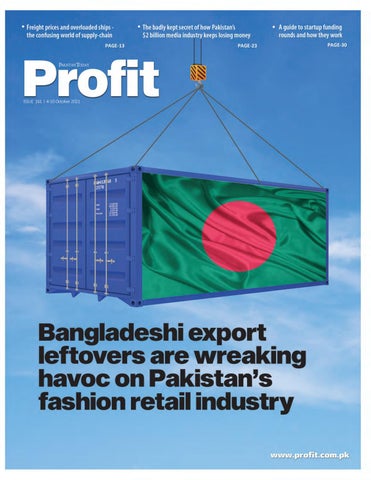
13 Freight prices and overloaded ships - the confusing world of supply-chain 16 Bangladeshi export leftovers are wreaking havoc on Pakistan’s fashion retail industry 23 The badly kept secret of how Pakistan’s $2 billion media industry keeps losing money
11
23
28
28 Foreign educated startup founders and coworking spaces - four takeaways from Pakistan’s startup ecosystem A guide to startup funding rounds and how they work
Profit
33 Debt restructuring and IPOs - the case of Supernet
Executive Editor: Babar Nizami l Managing Editor: Farooq Tirmizi l Joint Editor: Yousaf Nizami Reporters: Ariba Shahid l Babar Khan Javed l Taimoor Hassan Abdullah Niazi l Meiryum Ali l Shahab Omer Chief of Staff & Product Manager: Muhammad Faran Bukhari Regional Heads of Marketing: Muddasir Alam (Khi) l Zulfiqar Butt (Lhr) l Mudassir Iqbal (Isl) Layout: Ahmad Salahuddin l Photographers: Zubair Mehfooz & Imran Gillani l Business, Economic & Financial news by 'Pakistan Today' Contact: profit@pakistantoday.com.pk
Readers Say This is a great piece of journalism by @taimoorhassann. Brilliant write up, bravo. Apropos: No, TAG isn’t worth $100mn. And here is why it might never be. @2paisay, Twitter I don't know why some people are hyping up b2b startups claiming billions of dollars in the retail industry of Pakistan. Apropos: No, TAG isn’t worth $100mn. And here is why it might never be. @rumii_elia, Twitter Solid read on wonky valuations. Sheds light on how they're all just wallets, so no direct competition w/ banks. Everyone wants to be a neobank w/o a viable product, or even tech just vibes. Looking at board compositions, this looks like rent seeking 2.0. Apropos: No, TAG isn’t worth $100mn. And here is why it might never be. @rogueeconomist, Twitter @rogueonomist it would have been a balanced article if they would have shed light on all startups rather than tagging only one fintech that has managed to secure funding and is also part of Y Combinator. I think this is intellectual dishonesty. Apropos: No, TAG isn’t worth $100mn. And here is why it might never be. @wajidmalik, Twitter The bet is that eventually they’ll get full banking licenses. That comes with its own set of regulatory constraints, but it’s a bet on a population of 220 million and one of the highest pop growth in the world. A pretty shit banking sector in terms of active accounts. As bets go it’s not a bad one. That's how investments go. You win some and you lose plenty! Apropos: No, TAG isn’t worth $100mn. And here is why it might never be. @shakirhussain, Twitter
facebook.com/Profitpk twitter.com/Profitpk linkedin.com/showcase/13251020 profit.com.pk profit@pakistantoday.com.pk
HOW TO CONTACT
7
One can't predict the future, but all of this does remind me of investment banking licenses given by the Ministry of Finance back in the 1980s. If not all, most of these were like a bank version of the famous movie character ‘Mini Me’ - as they tried to mimic banking in hopes of getting a banking license. Some merged with banks to meet PUC requirements and the rest were taken care of by GFC of ‘08. Apropos: No, TAG isn’t worth $100mn. And here is why it might never be. Akifsaeed65, Twitter Brilliant long read. Finally someone took time out to analyze from all perspectives. Apropos: No, TAG isn’t worth $100mn. And here is why it might never be. @sophasnain, Twitter
No product, just vibes. I’ll use this in some comp scan of mine. Apropos: No, TAG isn’t worth $100mn. And here is why it might never be. @gulraizkhan, Twitter A must-read for everyone interested in the growing fintech space of Pakistan. Apropos: No, TAG isn’t worth $100mn. And here is why it might never be. @hassanulhaq01, Twitter The bit about the founder of Sadapay is interesting as well. Need a bit more on that front. Apropos: No, TAG isn’t worth $100mn. And here is why it might never be. @babarmurshid, Twitter A great development for Pakistan but at the same time your article is full of anti-growth sentiment and seems to be “paid” content. Apropos: No, TAG isn’t worth $100mn. And here is why it might never be. SubZero, Website Great write up. So thoughtful and clear. Apropos: No, TAG isn’t worth $100mn. And here is why it might never be. Faizan, Website Well written and researched. Try making it a bit shorter though. Apropos: No, TAG isn’t worth $100mn. And here is why it might never be. Ramish Zafar, Facebook I don’t like your negative approach to startup valuations in Pakistan. Apropos: No, TAG isn’t worth $100mn. And here is why it might never be. Omer Zeeshan Khan, Facebook A very useful piece on economic drive and stretched. Apropos: Breaking the habit: will the government let the rupee go? @fazlihaq345, Twitter Congratulations and best of luck! So pleased to hear this. Apropos: Maqsad announces raising $2.1mn in pre-seed funding for its mobile-first learning platform @the_teriffic_m, Twitter Inexperienced man! Calling a winning car a soap dish is such a biased approach to be taken here. Furthermore, when presenting a piece of analysis, you don't deliver it this way. Profit is a great page for business updates but highly disappointed by this video. Apropos: Can KIA be King, or do the Big 3 have another trick up their sleeve? Fahad Noor Verka, Facebook
COMMENTS
IN BRIEF The federal government has appointed Pakistan Customs officer, Asif Mahmood Jah, as the new Federal Tax Ombudsman (FTO) for a period of four years. This is the first time that the government has appointed an FTO from Pakistan Customs.
Rs 1.3 billion:
Minister for Information and Broadcasting Chaudhry Fawad Hussain said on Thursday that after a long deficit, Pakistan Television was set to earn a profit of Rs1.3 billion this year.
Rs 203 billion:
The State Bank of Pakistan (SBP) on Thursday mopped up Rs203 billion from the money market as a repo sale for one day through its open market operation. Two bids of Rs203 billion were offered which were accepted. The rate of return accepted is 7.22 per cent per annum.
$1 billion:
The government is expecting at least $1 billion in foreign investment by the end of the year to revive Pakistan’s largest steel manufacturing complex, Pakistan Steel Mills (PSM), with investors from Russia and China displaying interest in running the facility as part of a consortium. After the FBR website crashed on the due date for filing income tax returns, the board has decided to extend the date for filing income tax returns for individuals and companies to October 15, 2021 because of the trouble caused by the technical difficulties.
8
The operationalisation of the Matiari-Lahore transmission line — Pakistan’s first and mega High Voltage Direct Current (HVDC) project — would reduce power losses from 17 to four percent, resulting in the availability of cheap electricity, Prime Minister Imran Khan has claimed.
National Electric Power Regulatory Authority (NEPRA) has asked the power distribution companies (DISCOs) to compensate the power consumers in next month’s electricity bills for excessive billing beyond one month period.
Please stop talking about unprecedented times this week in Pakistan’s business and economics twitterverse
W
e are sick of hearing how these are unprecedented times. And no, this should not be the new normal because it is not normal at all. So this week we make an imploration to the world before March 2020, a world we never quite appreciated, can you please go back to how you were? Other things were going on as well this week, with defamation in the music industry, lots being said about rising fuel prices, and the world continually facing shortages. Ariba Shahid brings you all this and more in this week’s social media roundup.
Always short
Quite obvious
Shortage shortage shortage. We’ve even written an explainer on it for this issue! You’ve heard it once, you’ve heard it hundreds of times. The word unprecedented just doesn’t hit the way it did before. However, with the world crashing and burning we salute you for working tirelessly on your excel sheet or whatever people with corporate jobs do. We wouldn’t know. All we know is that at least you get your paychecks on time and (hopefully) decent compensation. Half our compensation is getting to make fun of you.
The joke that keeps on giving
{Editor’s note: Any residual salt found in this magazine is not the responsibility of Profit. It is simply an occupational hazard that journalists face regularly when we compare ourselves to other professions} Speaking of digitization, digital Pakistan is a joke that keeps giving.
SOCIAL MEDIA ROUNDUP
9
Inflation
Seriously?
No matter how high or low inflation is, it is always a meal for the privileged in Pakistan. This privileged journalist thinks twice before ordering a meal considering it can easily get to Rs 1000 which is definitely a strain on our pockets
Tough business
That “It is pertinent to note…” bit just seems a tad bit excessive. I mean this is a pricing notification. Why does one need to celebrate cheapest fuel in the region?
More tact needed
Defamation cases and lawsuits are usually a joke. This takes that to the next level. However, we’re not surprised. Abrar ul Haq had to change Nach Punjaban to Nach Manjajan and also billo k ghar. Sajjad Ali had to run away after Chief Sahab. The music business in Pakistan is not easy at all.
10
Petrol is expensive. There are a lot of reasons for this. However, Freakonimist is right. This isn’t the time for the journalists to play opposition tactics. Basic understanding of petroleum pricing, reasons for the rise etc should be explained. However, what goes around comes around. And we are definitely not suggesting comparisons be made to prices of fuel in California as some intellectual giants have ventured to do.
SOCIAL MEDIA ROUNDUP
Jahan Maamta, wahan Dalda ...and CCP too
Why did the IHC decide that the regulator had overstepped in investigating Dalda? By Meriyum Ali
W
hy is the CCP on everyone’s case? It’s a rhetorical question that no doubt several CEOs and management level staff have grumbled to themselves. After all, the Competition Commission of Pakistan, or CCP, was created in 2007, and exists to ‘promote competition in market and fair trade’. In effect, it exists to stop the creation of monopolies and oligopolies. But a recent judgement issued by the Islamabad High Court asks a different question: rather than ask why the CCP is the way it is, it posits, can it go after everyone? When is the CCP justified in investigating a company, and when has it overstepped? And in the case of Dalda Foods, the much beloved (and ancient) company that sells cooking oil and ghee, the court ruled that it had overstepped. Will the decision set a precedent and embolden other companies that the CCP needless-
COMPETITION
ly tries to chastise? Or will it simply disappear into the annals of legal discourse to be used years later by some upstart lawyer desperate to defend their client? That cannot be said with much certainty as of yet, but what is clear is that the CCP has been given a slap on the wrist and a reminder of what its purview is.
The role of the CCP
E
ssentially, the competition commission is supposed to be on the side of the consumers. This is an important distinction, since the CCP currently acts as if it is a judge or a middleman between different companies in the same business. The purpose of the CCP is to make sure that companies do not collude or engage in practices that make life difficult for consumers. The only reason they have any role in regulating the entry of new companies is because freedom to compete is an important factor in allowing end consumers to have choice. Competition law enforcement benefits
consumers through detecting and sanctioning anti-competitive practices, including cartels, and the abuse of market power. The things that the CCP should be looking at is deceptive marketing, abuse of dominant position in the market, and the approval or mergers. So if a company is lying in its ads the CCP is responsible for shutting them down. Similarly, if there are only two players in an industry, the CCP cannot let them have a merger since that merger will lead to a monopoly. What the CCP cannot do, however, is try to act as a price regulator or determine how companies run their businesses. And that is essentially what they have been told by the court as well.
Here’s what happened
T
here have been a number of complaints on the excessive pricing of cooking oil directed towards the Government of Punjab as well the Federal
11
Government. The matter of excessive pricing of food items was considered by the National Price Monitoring Committee in its meeting held on May 20, 2020, and it was decided in that meeting that the CCP should look into ‘anti competitive practises’. Separately, on the very next day, a complaint was filed through the Pakistan Citizen’s Portal about how local ghee companies had reduced their prices after reduction of prices of petrol and diesel, and yet multinational companies had not. So, the Ministry of Industries and Production of the Government of Pakistan then wrote to CCP on June 8, stating that despite reduction in Palm Oil prices, the retail prices of vegetable ghee in the market have not shown a declining trend. It then requested the CCP to take suo motu action. Which is exactly what the CCP did, asking for information from all the players in the ghee and cooking oil industry. While most responded, Dalda Foods refused to cooperate, ignoring the letter sent to them by the CCP on July 7th. CCP then went one step ahead, ordering an inquiry on September 7th, and then a Special Order on November 6 for an enquiry, and a penalty if Dalda Foods did not cooperate. That is when the company filed a petition.
Dalda’s case
T
he company’s main point was this: that the request for information contained neither details of CCP’s concerns regarding excessive pricing, nor the relevant statutory provisions under which it was exercising authority. Dalda in fact told CCP after its request that the pricing of food items did not fall within CCP’s domain. Dalda argued that its share in the ghee and cooking oil market was limited to 3%, which meant that it did not have a dominant position in the market to influence prices either. When it received the enquiry notice, Dalda said that “regulatory authorities could not initiate enquiries without relevant basis or forming a prima facie view regarding the infraction suspected as otherwise such enquiry would amount to a fishing expedition.” Without the prima facie basis, the special order of November was therefore illegal.
The CCP’s retort
T
he lawyers for CCP argued that in fact the CCP has merely called for information from undertakings that transacted in edible oil, and pointed out that many had already provided the information sought. He said a few clarifying points: that the CCP’s chairperson was part of the national price monitoring committee (headed by the federal finance minister) - the same committee that had asked the CCP to in-
12
Dalda in fact told CCP after its request that the pricing of food items did not fall within CCP’s domain. Dalda argued that its share in the ghee and cooking oil market was limited to 3%, which meant that it did not have a dominant position in the market to influence prices either vestigate edible oil price problems. The lawyer also said that the enquiry in question was not targeted against Dalda Foods, but was a sectoral enquiry regarding agreements and business practices within the edible oil industry. Therefore, Dalda Foods could not be aggrieved by such an inquiry. Besides, the purpose of the inquiry was to protect the rights of consumers, which fell squarely within CCP’s mandate and responsibility.
What the court thought
I
n coming to a decision, the court mulled over three questions:
1. What are the prerequisites for exercise of authority by CCP to order an enquiry? 2. Is a division of the Federal Government or the National Price Monitoring Committee vested with authority under the Competition Act to direct CCP to initiate regulatory action? 3. Did the CCP have legitimate authority in ordering an enquiry against Dalda Foods? To the first point: According to Section 37(2) of the act, ordering an enquiry is a twopart test. The first part is that there must be facts that appear to be in contravention to the provisions of an Act. The second is that the complaint seeking the enquiry cannot be ‘frivolous, vexatious, or based on insufficient facts, or not substantiated by prima facie evidence.’ That is a tall order: and according to the court, it’s because the legislature has attempted to give enough power to the competition regulator, without having unnecessary and intrusive enquiries. “In other words, CCP does not have unbridled authority to order an inquiry on the basis of a hunch alone,” the judgement said. The information must meet the prima facie test, without having to call for an investigation just to find the information in the first place. The court ruled that the enquiry had been made on the prodding of the Ministry of Industries and the National Price Monitoring Committee, but without having received a complaint from any governmental body, or satisfying the two tests of calling for an enquiry. With that sorted, the court moved to the
second point. This one was slightly more convoluted. Firstly, the CCP was created in such a way that it is autonomous and independent of the Federal Government. That means the federal government can only issue directives that are not inconsistent with the Competition Act. A small point is that the federal government does not have the executive authority to price control, considering that the Parliament itself does not have legislative authority to regulate prices by law. What is odd, however, is that the CCPs chairperson was included in the National Price Fixing Committee headed by the Federal Finance Minister. As the court pointed out, the Competition Act envisages no such role for the CCP or its Chairperson or Member. The court categorically states: “Price regulation or reduction is not an object or purpose of the Act, and CCP cannot be goaded or counselled into exercising its statutory authority such that the outcome is a reduction of prices of goods or services to a level deemed desirable by the Federal Government.” After all, “ while price efficiency is expected to be an ancillary outcome of competition law and policy and is deemed as one of the products of an effective competition regime, the object of the Act is the facilitation of free competition in the market and not price fixation, stabilization or reduction. Thus, the use of regulatory authority flowing from the Act for the purpose of achieving pricing outcomes is not a legitimate use of such authority.” And finally, to the third question regarding the specific enquiry against Dalda Foods. The CCPs legal team had argued that the enquiry was needed for a sectoral review. ANd yet, the court said that the Act made no special allowance for a sectoral enquiry. In conclusion, the court decided that the CCP has simply not done their homework. The CCP could not “exercise enquiry powers as part of a lazy and mindless expedition to gather information from one undertaking or all undertakings in a certain sector of the economy with the hope that the regulator might stumble upon an infraction of the Act during such exercise.” Which just goes to show that while the other companies complied, Dalda Foods was the only one to ask: do we really have to? And it turns out, they didn’t have to after all. n
COMPETITION
By Ariba Shahid
W
hen you ask a kid what they want to be when they grow up, chances are they are going to say something like pilot, or cricketer, or actor, or bus driver. These are jobs that they either see on television and imagine to be glamorous or cool, or jobs they see people doing in real life. Kids are sweet that way, they don’t particularly think about money or the world’s problems. Which is why perhaps it is highly unlikely that asking that
SUPPLY
question will result in a child telling you they want to grow up and become a supply-chain professional. Yet supply-chain is not only a profession, it is a particularly critical line of work to go into. As underwhelming and boring as it may sound as a career, supply-chain professionals deal with some of the world’s most complicated problems and try to avert them to keep the global economy on track. And if you’ve been following recent news regarding freight, you probably realise just how complicated this line of work can get, and that it is pretty important at the end of the day.
Why the supply-chain matters
I
n simple terms, supply chain is everything that has to do with how products get to the market to meet demand. Behind this seemingly simple chain is a very complicated process. Each link of this chain is a process and this very particular sequence of processes leads to the successful distribution of a product. If even a single link in this chain is broken, damaged, blocked, or not doing its job the entire thing can fall apart. On a more tangible level, supply chain has to do with the network that exists between a
13
company and its suppliers so a product could be produced or processed in house, and of course the network of distribution that brings the product to the final consumer. As a consumer, one puts very little thought into supply chains and how a particular good gets to them. Take the example of fruits. If the apples you’re eating are from an orchard in Swat, once they have been picked, they are packed and transported through various middlemen and wholesalers. Eventually they reached Karachi Sabzi Mandi where your local thelay wala buys them and then sells them to you. This is a very basic example of how a supply-chain works. Supply chains get more complex when you bring in international trade and the notion of value addition and processing. For instance, pink salt mined in Pakistan is exported to other countries which then process the salt, package it, and then sell it to other countries including Pakistan from where the salt was first mined. With globalization and international trade, supply chains remain essential for commercial activity to continue. Despite not realizing one should know that everyday life, especially in urban centers, is highly dependent on the perpetual motion of the supply chain. Single events like a ship blocking the Suez Canal can cause international crises. The food you have on your table, medicine on your bedside table, clothes in your closet, and electronics in your hands all compete for logistical resources in the world of supply. In the past, shipping expense was considered fractional and too small to have a dent on products or inflation. However, the exponentially rising shipping costs witnessed around the world are now pushing economists and accountants to finally account for them. A business that imports or exports using sea freight primarily has three options. Either to halt trade until the glut improves and prices return to normal. Another option is to raise prices of the products and transfer it to the consumer. The third option is more expensive, it means using existing resources to absorb costs in the present (maybe just in the short run) and pass it on later. Regardless of what choice a business goes for, prices for products are going to rise. If they halt trade, there will be a shortage, the second option is straightforward enough, and the third option results in higher prices at a later point in time.
With globalization and international trade, supply chains remain essential for commercial activity to continue. Despite not realizing one should know that everyday life, especially in urban centers, is highly dependent on the perpetual motion of the supply chain Why is freight so expensive?
T
he problem had taken root even before the pandemic. The number of containers loaded on a ship has been increasing over the years. This is known as call size. As container ships have been getting bigger, the total capacity of these ships has been increasing. To top this off, the industry is highly concentrated as a result of consolidation amongst shipping companies. For perspective, around 80% of all shipping is done through 10 major companies. At this point, it is natural to wonder how increasing capacity could possibly be anything other than a good thing? Shipping companies are filling their ships to as close to maximum capacity as they can, so what is wrong with that? All they were trying to do was make themselves as efficient as possible to decrease the time it takes to get products across. While the idea might have been well intentioned, it was badly thought through and greedy. Already the number of containers on ships was increasing, and then Covid-19 hit and there was a rush in ecommerce orders, and supply chains were starting to become more strained. This meant space onboard container ships became scarce and competed for, thus, making it more expensive. Shipping companies then filled their containers and ships to the brink to try and increase their profit. However, this meant another thing happened too. Ports and their infrastructure weren’t able to cope with the unloading of ships that had too many containers. You can’t magically increase the number of cranes at berths even if you managed to stuff more containers onto a ship than you would have a couple of years ago. This meant that ports couldn’t drastically increase their capacity to
Ports and their infrastructure weren’t able to cope with the unloading of ships that had too many containers. You can’t magically increase the number of cranes at berths even if you managed to stuff more containers onto a ship than you would have a couple of years ago 14
meet the demands of ships with more containers. Even if they somehow managed to do that, storage and stacking space at ports is also finite in nature. These are primarily problems at older ports that were made at times when ships were significantly smaller. This is why Asian countries have dealt better recently considering their ports are relatively new. As per HIS Markit, the average time to load or unload a container in Asia is 27 seconds, 46 seconds for Northern Europe, and 76 seconds for North America. Moreover, the Christmas rush isn’t making this easier for the industry. The situation is so bad that some vessels have been waiting weeks near ports to dock and unload. Moreover, you can’t just build more ships. It takes at least two to three years to build a vessel. So even if you order dozens right now, they won’t be available any time soon. Besides, considering the future regulations on shipping industry emissions, many are skeptical at increasing their fleet size. The new regulations are expected to be in place by 2050 which might make all these ships obsolete. Thus, it doesn’t seem like a smart investment. Moving on, there is a container shortage too. You can’t really find a container easily because the supply is finite and because most of them are either being used on a ship or stuck somewhere at a port or factory. However, because of issues at ports, shipping companies are finding that while containers are short in one part of the world, they have empty ones piling up at a port in another part of the world. Due to the slow nature of transport and of course the glut at ports, this is all taking more time than planned. In addition, you can’t just make ships bigger because not all ports are equipped. Big ships need deep ports and giant cranes. That means the port destinations for these ships are few. And to top it off, the Suez canal blockage was not kind on shipping logistics either. With that narrow pathway blocked, ports faced immense pressure once the pathway was clear for ships to pass by. However, it is not all doom and gloom, modern consumerism backed problems usually have IT related solutions. For instance Automated Checkpoints in Sweden have helped bring down idling time by 30% by scanning every container that enters the ports. n
SUPPLY
16
FASHION RETAIL
By Shahab Omer
T
he GAP, Ralph Lauren, Hugo Boss, Zara, Armani, Nike - what do they have in common? All of them are luxury fashion retail brands spread all over the world. All of the brands originate from Europe or North America. All of them are globally in demand. All of them produce their clothes in the global south. While these fashion brands were once coveted because of their mystique and exclusivity, they eventually found that the global demand for their clothes meant they would have to pivot towards becoming mass producing fashion retailers. To make this system profitable, however, it was necessary to find places where their clothes could be manufactured cheaply without compromising on quality. Over the years, Pakistan, India, and Bangladesh’s textile industries have filled this role, getting massive orders from these brands. With cheap labour, raw materials, and very little regard for working conditions the Indian subcontinent fit the bill perfectly. One of the industries that this spawns, however, is export leftovers. Large brands have very specific criterias for the clothes they want to sell, which means even if there are small inconsistencies or imperceptible flaws in the clothes like a wonky stitch or a mismatched button, they get rejected from being exported to western countries. This leaves the countries producing with a problem - suddenly they have tens of thousands of branded shirts or pants or pairs of underwear or socks in stock and their clients are not willing to take them. Since the defects in these pieces are miniscule, the products end up being sold for cheap in the country they are being produced in. Traditionally in Pakistan, the factory owners set up retail business on the side for these leftovers or sell them directly to their preferred retailers at high prices. However, a recent trend in Pakistan has been the influx of export leftovers coming into the country from Bangladesh - both through legal imports and through smuggling routes. With the rise of social media marketing, people can (and have) set up businesses from their home, operating through Facebook, Whatsapp and Instagram selling these products from Bangladesh. And they are giving the local fashion retail industry a run for their money.
The fashion industry and its leftovers
I 18
n Pakistan, the business of export leftovers has been common for a while. Garment factories end up over producing due to inefficiencies or because some of their
products have minor flaws in them. However, because the owners of the factories either sell the clothes themselves or have partnerships with retailers, the prices of these clothes are high. With 3000 garment factories in the country, according to one estimate, Pakistan ends up with as many as 5 million pieces that are then sold in the fashion retail market. But because of the high prices, it is actually cheaper to buy shirts made in Bangladesh which are also supposed to be of a higher quality. It is a strange situation in terms of economic theory - Pakistani made products are local and more readily available, but they are more expensive while the relatively unavailable Bangladeshi products are cheaper even though they have to be imported. If a Ralph Lauren shirt made in Pakistan costs between Rs 4500 - 6500, the same shirt brought in from Bangladesh will be as cheap as Rs 2000. This is largely because of the insistence of the local industry to price their products higher. They are not producing 5 million products a year because of demand, but because they have production inefficiencies that leave them with extras. At the same time, they sell these extra products in small quantities to retailers which means the rates are higher - in Bangladesh they are sold in bulk quantities known as ‘lots.’ It makes sense because Bangladesh is producing more and better products than Pakistan. In their 50 year history, the nation has banked on its textiles and has developed them into a complete process from raw materials to finished products. With its cheap labour and electricity, the garment industry of Bangladesh has been the key export division and a main source of foreign exchange for the last 25 years. In the last seven years, Bangladesh’s garment industry has increased its annual revenue from $19 billion to $34 billion—a 79 percent rise. This makes the country the second largest exporter of garments in the world, with the sector accounting for 80 percent of Bangla-
desh’s total export earnings. The industry provides employment to about 3 million workers of whom 90% are women. They are the 2nd largest individual country for apparel manufacturing in the world behind China and are where brands like H&M, Target and Marks and Spencer produce much of their goods. Currently, the textile industry accounts for 45% of all industrial employment in the country and contributes 5% of the total national income. Within this, the Ready-Made-Garments (RMG) industry is the fastest growing. By 2014 the RMG industry represented 81.13 percent of Bangladesh’s total export. As of 2019, there were nearly 5000 garment factories in Bangladesh compared to Pakistan’s 3000. The export leftovers industry that these RMG manufacturers spawn is massive. Now, when we talk about brand names like Ralph Lauren or The GAP, it is a very particular segment of the Pakistani apparel retail market. Pakistan’s apparel retail industry has flourished in recent years. The Pakistani apparel retail industry had total revenues of $9.1 billion in 2018, representing a compound annual growth rate (CAGR) of 5.9% between 2014 and 2018. The menswear segment was the industry’s most lucrative in 2018, with total revenues of $4.6 billion, equivalent to 50.4% of the industry’s overall value. Most of this comes from local fashion retailers that produce traditional eastern wear - giants like Sapphire and Gul Ahmed. However, there are two very interesting facts that might be giving rise to the influx in Bangladeshi leftover clothing. The first is that growth within the Pakistani industry has been encouraged by economic prosperity in urban areas. Urbanization has led to improved living standards, higher disposable income and improved retail spaces, which supported increased spending. The entry of women into the workforce has meant they also have disposable income and it has given a massive push to the retail fashion industry locally. Then there is the more
China loses ground Up until the 2000s, it was China that ruled the ready-made garments industry. However since then, firms in China have increasingly confronted difficulty in maintaining low production costs. With an appreciation of China’s currency, inflation, higher cost of raw materials and shortages of water and electricity led by increasing industrialization, China faced a surge in the cost of production. Moreover, increasing labor costs, shortages of labor as workers shifted away from low paying to high paying jobs and labor protection laws and activism also directly or indirectly contributed to escalating input costs, due to which export-oriented firms have particularly suffered.3 In 2016 alone, raw materials prices in China went up 7.8 percent, labor costs rose 6.8 percent, and rents increased by 9.7 percent, on average. This has led to countries like Bangladesh, Pakistan, Cambodia, and Vietnam to duke it out for dominance in this space.
important fact, which is that in the fashion segment, 18% of total market revenue will be generated through online sales by 2023. This is where the future of competition lies.
Everything is online
O
mar Butt wakes up everyday and the first thing he checks is his social media. On Facebook, Instagram and Whatsapp he has hundreds of messages from different people asking him to sell them clothes. He then gets up, responds to the messages, and heads off to the warehouses he has in the city. The ‘warehouses’ as he refers to them are two small rented residential houses in Wapda Town that are filled top to bottom with clothes imported from Bangladesh. Whether they get there legally or not, Butt does not know. He gets them from a
middle-man. All he knows is that he gets them cheap and markets them well on social media, and manages to make a pretty penny out of it. “In 2013, I had no job or business to do. During this time, a friend of mine who used to visit Dubai suggested that I start a branded clothing business. My first question was where I would buy these clothes from, and secondly who would buy such expensive clothes? My friend reassured me that I should leave it at that. Since I did not have a shop, my friend’s advice was that I should not do this work in the open market but in closed groups. So I set aside my home drawing room for this business,” he explains. According to Butt, he thought that maybe his friend who goes to Dubai regularly would buy the branded clothes from there and Butt would sell the goods to different people but this did not happen. Instead, the friend introduced him to a man from Lahore who was already working on branded clothes. Butt was taken to this man’s warehouse which was a rented house in Lahore’s residential Johar Town area. From the get-go it seemed shady to Butt. However, he had done his research and knew how to recognise whether the shirts were original. When Butt got to the place, the house was filled to the brim with clothes from at least 30 different international brands. Stocked with different sizes and colours, all of the shirts still had their tags. When he scanned the QR codes on the tags, they took them straight to the websites of these brands. Butt knew the clothes were for real, but what surprised him more were the prices that were being offered. “I was quite surprised when the man I was meeting said that the wholesale rate of casual shirts was Rs 950,” he explains. “I immediately thought that I could easily sell this shirt for Rs 2000. There were also shirts from brands such as Prada, Polo, Armani, Burton, Marks & Spencer, Zaraman and H&M. Now when I reviewed the pants, there were paints from Diesel, Levi’s, True Religion, H&M and other luxury brands that are usually very expensive. These pants also had price tags ranging from $150 to $250, however, the
wholesale price of the pants was stated by the said person as Rs 1,000 to Rs 1,200,” he said. From this point on there really was no looking back. Butt immediately ordered pants, trousers, and belts and both formal and casual shirts from various brands in bulk. The man promised him that the shipment would arrive soon and soon he received his order. With no store, Butt simply uploaded well taken pictures of the clothes to a Facebook page and gave people his address so that they could come check out his stock themselves and ascertain that all the clothes were original and not knock off pieces. The man Butt got the stock from was a simple importer and did not know much about selling products. Butt was savy in this department and in this way used his marketing skills to sell the products. “All these clothes were made in Bangladesh and they had the ‘Made in Bangladesh’ tag on them. I bought the entire stock for around Rs 400,000 and I set all these things in my drawing room. People saw my posts on Facebook and contacted me. I was selling shirts you couldn’t find anywhere for less than Rs 6000 for around Rs 2000 because I had gotten the whole bulk order so cheap. At this point, I also saw a pattern and noticed people that were regular customers,” he explains. “For them I created Whatsapp groups where I would show them my stock before I displayed it publicly and they would buy a lot of the good stuff directly before anyone knew about it at a premium price. This worked well for everyone involved. Right now I’m running a Facebook page and 22 WhatsApp groups.” “I started this business at the end of 2013. At that time the value of the dollar was not very high and the profit margin was so great that I used to sell goods that I got for Rs 400,000 for Rs 900,000. Now, I have rented two houses in Wapda Town, Lahore where all these clothes are sold. I also have a variety of Bangladeshi made clothes for women and children which are sold hand in hand.”
How does it come to this - smuggled or legal?
B
utt still has no idea how these clothes get to him. All he knows is that he still goes to the middle man who sells him his stock in bulk and he comes back, stores it, markets it, and sells it. The problem is that while most clothes from Bangladesh are imported, a lot are also smuggled into the country. Most of the smuggling happens when people visiting Bangladesh bring back clothes pretending they bought them for personal use when in fact they bring them here to sell. Butt claimed that Excise and Customs Department staff visited his business point
FASHION RETAIL
several times over a seven-year period but never sealed his business because he managed them well. “Because I run a branded clothing and accessories business, my clients are high government officials, lawyers, judges, bureaucrats and army officers. They help me whenever I have a problem,” he claimed. When Butt was asked if his business was now large enough to buy directly from Bangladesh without a middleman, he replied that it was not. “I am still buying from the person from whom I started buying garments and accessories on the first day. However I am always on the lookout now. If I ever go to Dubai or any European country, I will definitely bring different things for my customers from there. Because in foreign countries, most of the valuables are sold cheaply when they are on sale and when they are brought here and sold, we get good profit. Just before the pandemic, I brought perfumes, shirts and tracksuits from Dubai that were a bit more expensive, but those who wear the brands are alright with buying more pricey items every now and then.” While Butt admitted all of this quite freely, he claimed to have no knowledge of how the clothes got to Pakistan. For this, Profit also visited various markets and reached out to the cloth people involved in the business as well as smugglers. The story of how these clothes from Bangladesh reach customers is fascinating, and what is more interesting is that authorities are deliberately keeping quiet about it.
This is how they get here
“I
t all starts in Karachi. Bangladeshi textile companies have orders to manufacture garments of European, American and British brands. Most of the textile mills in Pakistan also have orders for these brands. Now, when we talk about smuggling or availability of Bangladeshi clothes in Pakistan, the first question that arises is that if Bangladesh has made shirts for Armani, for example, how did they get to Pakistan?” says Seth Shaukat, a Karachi based businessman. He claims that not every Bangladeshi garment needs to be smuggled but to sell branded clothes one has to get permission from the respective brands. “This is where the sale
of the rejected readymade garments begins. These garments go from Bangladesh to India and also to Pakistan. In this way, sometimes some traders from Karachi or Lahore go to Bangladesh and visit the textile industries there and book their order and bring it to Pakistan. These orders come by air as well as by ship. For this, the buyer also pays the customs duty and legally keeps the garments in his warehouse. Import of readymade garments in Pakistan is not an easy step but 20 percent customs duty has to be paid on its import. Similarly, sales tax is 17 percent, regulatory duty is 10 percent, income tax is 11 percent and additional customs duty is 6 percent,” he explains. “Similarly, if we look at the total, the importer will pay a total tax of 64 percent on the amount of garments he imports. For example, if a shirt is bought from Bangladesh for RS 200, it will cost the importer RS 328 while paying its duties and taxes. I myself have been to Dhaka twice to buy Bangladesh ready-made garments and there you will find ready-made garments of every category. However, I must say that if a garment has been rejected because it is not A plus quality, that does not mean it is B quality. It is rather A quality or A minus quality instead of A plus. It is always very minor details or flaws.” The Bangladeshi factories sell these leftovers in bulk. Most of the people hoping to sell in Pakistan do not want to sell just a single product. So if they are buying 500 pairs of pants, they will also place an order for 1000 shirts that their customers can get with those pants. This will then mean that they buy socks, undergarments and belts etc in the same amounts as well. There are some factors that are important here. Some textile mills are selling products that are in the original packaging and have QR codes on them that can prove they are original. These are more expensive than the textile mills that sell their leftover products openly without packaging or tags.
Bangladesh’s place on the map In 2014, western fashion retailers spent $200 billion on sourcing cheap garments from the developing world. The same were retailed for $1.0 trillion back home. Bangladesh earned $21 billion of revenues last year by exporting garments to the West. Pakistan earned $2.6 billion. Out of that $200 billion, China held an $80 billion share while the next two contenders, Turkey and Bangladesh, held $30 and $21 billion apiece. India, Vietnam, Indonesia, Philippines, Sri Lanka and Pakistan jointly account for another $50 billion.
20
This is because within Bangladesh there is not a lot of demand for these products so manufacturers want to get their hands off the excess production. Some are savvy and tag and package the clothes to sell them at a premium price, but others just want to get rid of them. “The rates available to me a few days ago in various designs and sizes of H&M are such that a shirt is costing 340 Taka in a Bangladeshi lot,” says Shaukat. “Now that the currency of Bangladesh has become expensive, you will get a shirt from Bangladesh for around Rs 667 and if 64 percent duty is added on it, then the price of this shirt will go above one thousand rupees,” Shaukat informed. These shirts are then sold for around 200 to 2500, which are still much lower than the prices Pakistani retailers are offering, and that too for shirts that are not as high quality as the ones from Bangladesh. In case the shirts are smuggled instead of imported legally, the margins are even more for the sellers. While the rupee devaluation in recent times has meant less
TEXTILES
The extent of the smuggling
H
profits for these importers, it has meant better things for the smugglers. “Everything is on social media these days. There are dozens of Whatsapp groups where importers find out about what products are available in Bangladesh and what the prices of available lots are. Sometimes, the importer does not even have to go to Bangladesh. He books lots through bank guarantees and receives them in Pakistan. This is where the sale of Bangladeshi garments in Pakistan begins. Any shirt, or pair of pants or any ready-made garment, for example, which costs an importer Rs 1000 to import, he can sell it for between Rs 2,000 and Rs 4,000. Polo, for example, is an expensive brand and the shopkeeper or supplier who has to buy one of its lots has to sell the shirt to the customer for at least Rs 3000 to Rs 4000, and the customer has to be satisfied that this shirt is original because he or she will also see the same shirt on the official website of Polo through QR code,” he said.
owever, Shaukat says that if 60 percent of Bangladeshi readymade garments are being imported into Pakistan, the remaining 40 per cent reach the local markets through smuggling. The claim is seconded by many traders that are candid about this fact. One trader in Lahore’s Azam Cloth Market famous for their involvement in textile smuggling has been caught several times by customs officials. The trader/smuggler wished to be unnamed and believed that smuggling of unstitched garments and ready-made garments in Pakistan was not a difficult task. “In Lahore and Karachi, on a daily basis, containers of clothes and ready-made garments are smuggled through Peshawar. The containers also carry goods from China and Bangladesh. All this cloth comes from Peshawar through Afghanistan. If you consider, branded clothing stores have opened in cities like Abbottabad and Mansehra and they sell original branded readymade garments at very cheap prices. Many garment stores have opened on Karakoram Road, a short distance from Abbottabad, where clothes of Mango, Levi’s, and True Religion, Diesel, Nike, Gucci, Prada and other very expensive brands are readily available,” they say. “Similarly, ready-made garments smuggled to Rawalpindi, Islamabad, Gujarat, Gujranwala, Lahore and Karachi are being sold easily. Warehouses of smuggled readymade garments are also present in the Northern Areas, Islamabad, Rawalpindi and Lahore and Karachi. From here, clothes are available at very cheap prices and customers also get cheap prices. I bought an H&M smuggled shirt for Rs 1200. Now think for yourself that the price of a brand like H&M is Rs 1200 and is the best quality shirt available anywhere in the world? These branded readymade garments are smuggled and imported here because the people here want to wear them,” he informed. Yasir Sarfraz, a trader of Panorama, puts forward the story of the said smuggler in such a way that people demand brand, quality and low price and all this is very difficult in Made in Pakistan clothes. “Either a lot of brands do not make their clothes in Pakistan or the ones that do are not of a very high quality,” he says. “You could buy a pair of Levis jeans from a Levis store for Rs 6000, or you could get a pair
of the same jeans, probably more professionally manufactured, for Rs 1800 from an importer. If you are able to find a pair of pants brought in by a smuggler, they will be as cheap as Rs 1200.” Because of such massive differentials in prices, the demand for Bangladeshi readymade garments, whether smuggled or imported, has skyrocketed. In Lahore’s Karim Block Market, a shop called Jobbers is openly selling Bangladeshi garments, while an e-commerce web portal is openly selling Bangladeshi clothes under the name Brandspopper.com. Not only that, but Bangladeshi readymade garments are being sold through many websites, Facebook pages and WhatsApp groups. “This is obviously damaging the local textile industry, but they have no one to blame but themselves,” says Sarfara. “They do not seem capable of providing A quality products to their own people and instead produce B quality products and sell them at astronomical prices. Perhaps the only exception is www. exportleftovers.com, which is selling good quality readymade garments at low prices and that is why they are gaining popularity among those who are interested in branded clothes.” “Our branded clothing enthusiasts also flocked to flea markets where used clothes from the United States, London and European countries come. Most of these clothes are in very good and new condition. I also have a shop in the flea bazaar in Anarkali, but ever since the Coronavirus, this used clothing container has also become so expensive that if one hundred shirts out of a thousand shirts come out in good condition, they will be sold in the flea market for between Rs 800 and Rs 1,200. As a result, people are now opting for Bangladeshi ready-made garments instead of turning to these flea markets. There are many shopkeepers in our market who buy and sell smuggled clothes and if ever the customs authorities ask them for an import receipt or documents about the sale and purchase of these garments, they do not have anything to prove that they are not selling smuggled garments,” he informed. Customs maintains that smuggling from Bangladesh was not possible, and that many people at most bring some ready-made garments with them to Dubai or Bangladesh and they claim that they have bought these items for their personal use or as gifts to relatives, but they in fact intend to sell. In such cases, they cannot take any action. Despite these claims, it is abundantly clear that Bangladeshi clothes coming into Pakistan are not only increasing with time, but are biting off a significant chunk of the branded fashion retail market in Pakistan. Whether this will grow or whether the garment factories will finally step up is yet to be seen. n
FASHION RETAIL
A
crisis is afoot and the media industry is choosing to stay mum about it. According to the annual media agency rankings from RECMA, a French research company that evaluates media agencies worldwide, the top eleven media agencies in Pakistan are losing money year on year. Featuring data on media agency revenues, media agency headcount, the ratio between earnings and number of employees, and the share of revenues coming from nontraditional - digital and social - media, the report shows a harrowing decline in advertising expenditure
ADVERTISING
23
The Pakistani rupee depreciated by over -30% amidst a growing current account deficit, and the media industry was hit hard by spending cuts from many major TV spending verticals, including CPG/FMCG and communications Michelle Bovee Stange, an associate director of Global Market Intelligence at Magna Global
(AdEx) that all members of the Pakistan Broadcasters Association (PBA) depend on. In no particular order, the top eleven media agencies in Pakistan profiled by RECMA are: n WPP’s Mindshare, Wavemaker, and Mediacom, n Publicis affiliates Brainchild Communications Pakistan (BCP), Blitz Advertising, and Adcom Media, n Omnicom affiliates Manhattan and Orient Communications, n Dentsu affiliate Synchronise Carat n Havas Media affiliate Media Axis Per RECMA, the top five media agencies in 2017 and 2018 were ordered as Mindshare, Starcom & MediaVest affiliate BCP, Maxus, OMD affiliate Manhattan, and Spark affiliate Blitz Advertising. The research company reported that in 2019 the top five media agencies were BCP, Mindshare, Wavemaker, Manhattan, and Blitz Advertising. In 2020, this changed to BCP, Mindshare, Wavemaker, Blitz Advertising, and Adcom Media.
24
“Brainchild [grew] by 22%,” said the 2020 RECMA media agency ranking report. “Activity is boosted by the organic increase of key existing clients (P&G, Mondelez, Friesland Campina, and China Mobile), coupled with additional businesses in 2020 (Telenor GSM, Easy Paisa, Lotte Kolson, and ARY Laguna).” After over a decade at the very top from an individual agency rankings perspective, Mindshare was dethroned by affiliate agencies under the Publicis Groupe. That said when considering revenues as a group - i.e. WPP vs Publicis vs Omnicom, vs Dentsu vs Havas - the media agencies under WPP still come out on top even in the 2020 report. When measured as a group, WPP’s Mindshare, Wavemaker, and Mediacom are estimated to hold the market share leadership at 42.3% while Publicis affiliates BCP and Blitz Advertising under Z2C Limited only hold 37.5% market share. “The group ranking is unchanged with GroupM at the top, challenged by Brainchild,” said the report. “Mindshare, Wave-
maker, and Mediacom grew by an estimated 5% each.” In a pure WPP and Publicis faceoff, the latter comes out on top due to Adcom Media controlling 5.9% of the market, bringing the Publicis market share to 43.4% and comparing three versus three media agencies. In terms of growth rate, the 2020 RECMA media agency ranking found that n Zenith affiliated Adcom Media grew by 26%, n Starcom affiliated Brainchild grew by 22%, n PHD affiliated Manhattan grew by 13%, n Spark affiliated Blitz Advertising grew by 8% There were of course those agencies that shrunk as well, with Pakistan Broadcasters Association data on their clients’ list showing an inability to win as many new clients - possibly due to lacking relative media muscle sought by advertisers that commoditize media - including troubles with client
Many, paradoxically, consider the policies of PEMRA to actually be responsible for the unprecedented progress of the media industry in the country, which ironically paved the way for the concentration of ownership and the unbridled political influence enjoyed by the owners of media organizations Sehar Raothar, a seasoned media consultant
retention, and a focus on client categories that are historically suspended: n OMD affiliated Manhattan shrunk by 48%, n Carat affiliated Synergy Dentsu shrunk by 23%, n Havas affiliated Media Axis shrunk by 18%, And UM affiliated Orient Communications shrunk by 17%. The $20 million Nestle media review that will drastically change all of the above in the 2021 report from RECMA, given that it makes up 40% of Wavemakers’ 2020 revenue and 11.6% of the overall 2020 revenue of GroupM, which is still the market leader in Pakistan in terms of revenue and headcount. Usurping a market leader while losing money #FunnyAndSad The RECMA reports show that the combined earnings of all eleven agencies equaled $478 million in 2017, $397 million in 2018, $395 million in 2019, and $407 million in 2020. As reported numerous times by Profit, the existence of self-serve advertising tools, the nationwide trend of media in-housing, the proliferation of influencer marketing ecosystems, and the lowered barriers to entry for media buying mean that less than 25% of the $2 billion of the 2021 media and advertising industry in Pakistan is covered by media agencies. It’s also worth noting that there are more than eleven agencies in Pakistan with media wings, the bulk of which did not make the RECMA ranking, such as The Brand Partnership, Spectrum Communications, the infamous Midas Pvt Ltd, the rapidly growing Oktopus 360 Media, former Maxus MD’s IG Square, M&C Saatchi World Services, and Wings Media, to name a few. According to the Pakistan Media Outlook 2021 report from Brainchild Communications Pakistan (BCP), AdEx in Q2 2020 declined sharply by 27% than Q2 2019 due to the pandemic induced recession. According to the report, AdEx in 2021 is expected to
outgrow previous years following normalization in Q3 2020, which was quantified by a 12% growth in AdEx directed at the TV inventory through Q4 2020. Data from the annual Global Advertising Forecast (GAF) by Magna Global shows that linear and digital ad spend both grew by high-single digits to double-digits from 2013 until 2018 in Pakistan, which was plagued with economic and political uncertainty. “The Pakistani rupee depreciated by over -30% amidst a growing current account deficit, and the media industry was hit hard by spending cuts from many major TV spending verticals, including CPG/FMCG and communications,” said Michelle Bovee Stange, an associate director of Global Market Intelligence at Magna Global, who studied the Pakistan media landscape for the GAF. “2019 saw a return to stability for the Pakistani economy and the advertising market, bolstered by cyclical events like the 2019 Cricket World Cup.” As reported by Profit, when Pakistan went into COVID lockdown on the 24th of March 2020, the linear AdEx decline was relatively modest compared to many other APAC markets. The GAF suggests that AdEx declined in Pakistan by 6% in 2020, with cinema seeing the steepest decline of 15%, from a very low base; OOH declined by 10%, and television and radio declined by 5%. Analysis by GAF suggests that digital spend slowed significantly, but still saw double-digit growth of 18%, bringing total net digital ad revenues to $15 million—just 18% of total net advertising revenue. “Digital video (+28%) and social (+23%) are the engines of growth, followed by search (+11%) and finally display (+4%). 2021 should bring recovery for most media formats, including radio (+3%), OOH (+4%), and magazines (+1%),” said Bovee Stange. “Television will see continued erosion, -2%, while digital will accelerate (+21%). Growth will continue in 2022, supported by improving macroeconomic fundamentals (real GDP: +4%, following growth of +1% in 2021).”
If this is the case, why are media investment companies such as GroupM and Z2C coughing up significant amounts of upfront revenue commitments towards sports such as the rating funeral that is the ICC games and motorsports for the elite? And aside from these 15 ways of stealing from marketers, how are media agencies staying afloat - and getting fancier offices - when AdEx is on a decline? The answer appears to reside with the race to become the largest and specialized sports marketing agency, since pushing advertisers towards music platforms is proving to be a losing battle amid market saturation and the death of music channels in Pakistan. The leading example of a sports marketing agency in Pakistan is Blitz Advertising, the only full-service agency to make the necessary upfront guarantees to the Pakistan Cricket Board which led to six seasons of the Pakistan Super League from 2016 to 2021. As of October 2021, Blitz Advertising holds broadcast media rights for the Lanka Premier League, Kashmir Premier League, Pakistan Celebrity League (CLL), along with contracts with the Pakistan Hockey Federation, Pakistan Volleyball Federation (PVF), and the Pakistan Kabaddi Federation (PKF). The full-service agency jointly holds rights for the CLL, PVF, and PKF games with the Trans Group. There is a direct correlation between Blitz Advertising investing in securing media rights for mainstream and niche sports events and in its rise to the top five slots of the annual media agency rankings from RECMA. This appears to be the same strategy mirrored by both GroupM Pakistan and BCP. Direct or indirect sports content ownership, deep vertical integration, and the drive towards owning influencer marketing ecosystems appear to be the survival strategy of the Big Three. For the remaining eight, ignorance is bliss.
ADVERTISING
ARY Digital Viewership
Audience: All individuals Pakistan Urban Period: 01 Jun to 25 Sep 2021 Source: Medialogic
26
59
1.0
60
61
61
62 60
59
61
Week 10 - (8/1/2021 - 8/7/2021)
Week 11 - (8/8/2021 - 8/14/2021)
Week 9 - (7/25/2021 - 7/31/2021)
40
43
43
43
44
41
42
39
41
43
43
Week 5 - (6/27/2021 - 7/3/2021)
Week 6 - (7/4/2021 - 7/10/2021)
Week 7 - (7/11/2021 - 7/17/2021)
Week 8 - (7/18/2021 - 7/24/2021)
Week 9 - (7/25/2021 - 7/31/2021)
Week 10 - (8/1/2021 - 8/7/2021)
Week 11 - (8/8/2021 - 8/14/2021)
3.3
Week 4 - (6/20/2021 - 6/26/2021)
3.4
Week 3 - (6/13/2021 - 6/19/2021)
2.9
2.7
Week 1 - (6/1/2021 - 6/5/2021)
2.7
2.0
Week 2 - (6/6/2021 - 6/12/2021)
2.6
62 60
48
48
46
45
Reach 39
44
Week 17 - (9/19/2021 - 9/25/2021)
Week 16 - (9/12/2021 - 9/18/2021)
Week 15 - (9/5/2021 - 9/11/2021)
Week 14 - (8/29/2021 - 9/4/2021)
Week 13 - (8/22/2021 - 8/28/2021)
Week 11 - (8/8/2021 - 8/14/2021)
Week 10 - (8/1/2021 - 8/7/2021)
Week 9 - (7/25/2021 - 7/31/2021)
2.0
Week 12 - (8/15/2021 - 8/21/2021)
2.8
Week 8 - (7/18/2021 - 7/24/2021)
2.5
Week 7 - (7/11/2021 - 7/17/2021)
2.7
Week 6 - (7/4/2021 - 7/10/2021)
2.7
Week 5 - (6/27/2021 - 7/3/2021)
2.7
Week 4 - (6/20/2021 - 6/26/2021)
2.8
Week 3 - (6/13/2021 - 6/19/2021)
2.8
Week 8 - (7/18/2021 - 7/24/2021)
Week 6 - (7/4/2021 - 7/10/2021)
Week 7 - (7/11/2021 - 7/17/2021)
Week 5 - (6/27/2021 - 7/3/2021)
Week 4 - (6/20/2021 - 6/26/2021)
Week 3 - (6/13/2021 - 6/19/2021)
Week 1 - (6/1/2021 - 6/5/2021)
Week 2 - (6/6/2021 - 6/12/2021)
3.9
Week 17 - (9/19/2021 - 9/25/2021)
Week 15 - (9/5/2021 - 9/11/2021)
Week 16 - (9/12/2021 - 9/18/2021)
Week 14 - (8/29/2021 - 9/4/2021)
Week 13 - (8/22/2021 - 8/28/2021)
Week 12 - (8/15/2021 - 8/21/2021)
Week 10 - (8/1/2021 - 8/7/2021)
Week 11 - (8/8/2021 - 8/14/2021)
Week 9 - (7/25/2021 - 7/31/2021)
Week 8 - (7/18/2021 - 7/24/2021)
Week 6 - (7/4/2021 - 7/10/2021)
Week 7 - (7/11/2021 - 7/17/2021)
Week 5 - (6/27/2021 - 7/3/2021)
Week 4 - (6/20/2021 - 6/26/2021)
Week 3 - (6/13/2021 - 6/19/2021)
Week 1 - (6/1/2021 - 6/5/2021)
4.0
62
58
57
Rtg%
63
60
Week 17 - (9/19/2021 - 9/25/2021)
61
Week 17 - (9/19/2021 - 9/25/2021)
61
Week 15 - (9/5/2021 - 9/11/2021)
1.4
1.3
Week 16 - (9/12/2021 - 9/18/2021)
1.3
Week 16 - (9/12/2021 - 9/18/2021)
1.4 1.2
Week 14 - (8/29/2021 - 9/4/2021)
1.3
Week 15 - (9/5/2021 - 9/11/2021)
1.3
Week 13 - (8/22/2021 - 8/28/2021)
1.3
1.6
Week 14 - (8/29/2021 - 9/4/2021)
1.4
1.7
Week 12 - (8/15/2021 - 8/21/2021)
1.3
1.8
license of the forthcoming sports channel known as A Sports. The SECP database shows that Horizon Communications is led by a CEO named Irfan Malik who just happens to be the SVP of ARY Films. When asked to comment on the connection between A Sports and ARY Digital Network, Malik said that there was no connection between the two. He declined to answer further questions and was even shown visuals for the aforementioned sponsorship proposal, which did not prompt a response. Even If we ignore the proposal from ARY Digital Network for packages around sponsoring the 2021 ICC Men’s T20 World Cup, one could have still argued that A Sports has nothing to do with the Pakistani pay television network. They could argue this point by saying Irfan Malik is operating a non-competing channel on his own independently, having possibly severed his employment with ARY as a whole. This could very well be the case. But there’s more.
Week 13 - (8/22/2021 - 8/28/2021)
1.4
Reach 1.6
Week 12 - (8/15/2021 - 8/21/2021)
1.5
Week 2 - (6/6/2021 - 6/12/2021)
One would think that members of the Pakistan Broadcasters Association would be alarmed at the decline in AdEx year-on-year and perhaps attempt to maintain a semblance of relevance. In an attempt to capture more of the AdEx pie, ARY Digital Network has followed through on our last story by securing a license for A Sports, its first sports-focused channel, inARY the lead-up to Trends broadcast the Digital Weekly Ratings (1900 to 2200 Timeband) Week Rtg% Reach ICC games. It has also awarded exclusive Week 1 - (6/1/2021 - 6/5/2021) 2.8 40 live digital rights to Daraz for its Week 2 streaming - (6/6/2021 - 6/12/2021) 2.8 43 Week 3 - (6/13/2021 - 6/19/2021) 2.7 43 app, with Alibaba-owned marketplace Week the 4 - (6/20/2021 - 6/26/2021) 2.7 43 Week 5 - (6/27/2021 2.7 down-44 capitalizing on the- 7/3/2021) subsequent app Week 6 - (7/4/2021 - 7/10/2021) 2.5 41 loads and no interruptions in the Week promising 7 - (7/11/2021 - 7/17/2021) 2.8 42 8 - (7/18/2021 - 7/24/2021) 2.0 39 form ofWeek ads. Week 9 - (7/25/2021 - 7/31/2021) 2.6 41 Week 10 - (8/1/2021 - 8/7/2021) 2.7 This could just refer to the absence of43 Week 11 - (8/8/2021 - 8/14/2021) 2.7 43 digital Week video commercials 12 - (8/15/2021 - 8/21/2021) (DVCs) 2.0of adver39 Week 13 - (8/22/2021 - 8/28/2021) 2.9 44 tisers that don’t stock products with Daraz, Week 14 - (8/29/2021 - 9/4/2021) 3.4 48 Week 15 - speculates (9/5/2021 - 9/11/2021) 4.0 contex48 while Profit that ads for Week 16 - (9/12/2021 - 9/18/2021) 3.9 46 tually relevant products - perhaps3.3cricket 45 Week 17 - (9/19/2021 - 9/25/2021) merchandise - may still pop up while app users attempt to watch the ICC games. This week, advertisers and agencies received a proposal from ARY Digital Network for packages around sponsoring the 2021 ICC Men’s T20 World Cup. The packages are categorized into six types of sponsors namely presenting, main, associate, support, exclusive, and post-match exclusive features. Across all six packages, the total possible AdEx based on this proposal is Rs. 617.5 million ($3.625 million), of which 40% of profits will go to the GroupM and ARY consortium per their agreement with PTV. As reported by Profit, there was no additional clarification sought by PTV to determine how it would safeguard itself from low profit created by exaggerated costs which benefit the consortium. Industry insiders also claim that rules of public procurement (PPRA) were also flouted by PTV while finalising this tri-party deal. Given that PEMRA has rules to the number of licenses allowed per network, the fine team at ARY Digital Network formed a completely new company called Horizon Communications (item 119) to secure a
Rtg%
Week 1 - (6/1/2021 - 6/5/2021)
ARY Digital Weekly Ratings Trends (0900 to 2400 Timeband) Week Rtg% Reach Week 1 - (6/1/2021 - 6/5/2021) 1.5 59 Week 2 - (6/6/2021 - 6/12/2021) 1.4 61 Week 3 - (6/13/2021 - 6/19/2021) 1.3 61 Week 4 - (6/20/2021 - 6/26/2021) 1.4 60 Week 5 - (6/27/2021 - 7/3/2021) 1.3 61 Week 6 - (7/4/2021 - 7/10/2021) 1.3 61 Week 7 - (7/11/2021 - 7/17/2021) 1.3 60 Week 8 - (7/18/2021 - 7/24/2021) 1.2 57 Week 9 - (7/25/2021 - 7/31/2021) 1.4 59 Week 10 - (8/1/2021 - 8/7/2021) 1.3 61 Week 11 - (8/8/2021 - 8/14/2021) 1.3 60 Week 12 - (8/15/2021 - 8/21/2021) 1.0 58 Week 13 - (8/22/2021 - 8/28/2021) 1.4 62 Week 14 - (8/29/2021 - 9/4/2021) 1.6 63 Week 15 - (9/5/2021 - 9/11/2021) 1.8 62 Week 16 - (9/12/2021 - 9/18/2021) 1.7 62 Week 17 - (9/19/2021 - 9/25/2021) 1.6 60
Week 2 - (6/6/2021 - 6/12/2021)
How are broadcasters reacting to this?
And there was light
T
he SECP database shows that the directors of Horizon Communications are:
n Sabeen
Salman - the wife of Salman Iqbal, the CEO of ARY Digital Network, n Mehak Yaqoob - the wife of Yaqoob Iqbal, brother of Salman Iqbal n Tariq Wasi - the head of ops at ARY Digital Network, n Muhammad Mohsin - the SVP of human resources at ARY Digital Network n and Ayesha Mehboob, whose connection to ARY could not be verified at the time of publishing.
Sources confirmed that it was Irfan Malik that led the bid for the license around A Sports, without PEMRA conducting any audit or even considering the possibility of an attempt to circumvent the rules of the media regulator, which are framed as a vehicle to avoid monopolization but could very well also be a response to the limited on-air space and slots available on satellite and cable. According to the amended PEMRA Ordinance 2002: the authority is meant to ensure that undue concentration of media ownership is not created in any city, town, or area and the country as a whole: Provided that if a licensee owns, controls, or operates more than one media enterprise, he shall not indulge in any practice which may impede fair competition of the level playing field. Perhaps by placing the new channel under a company owned by spouses, the
leaders of ARY Digital Network are overcoming this rule: the authority shall ensure that undue concentration of media ownership is not created by virtue of the applicant for a broadcast or CTV operation license already owning or operating, as a sole or joint shareholder of any other broadcast or CTV station, printed newspaper or magazine. While this may work on paper, there is no way the remaining members of the broadcast industry will stand for this, and no one believes that spouses are actually competing with each other instead of colluding behind the scenes. This is Pakistan, after all. “Many, paradoxically, consider policies of PEMRA to actually be responsible for the unprecedented progress of the media industry in the country, which ironically paved the way for the concentration of ownership and the unbridled political influence enjoyed by the owners of media organizations,” said Sehar Raothar, a seasoned media consultant. “In fact, successive Pakistani governments have endeavored to revisit their previous policy vis-à-vis media regulation and licensing of electronic media in the country, and an erstwhile inefficient PEMRA has recently been instructed by the government to reconsider a few policy initiatives related to the cross-media ownership and licensing of new television channels.” She told Profit that the industry as a whole needs to duly explore the relationship between media regulation and concentration of ownership in Pakistan through the lens of the political economy of communication. She concluded that owner-friendly policies of PEMRA and its inefficiency in implementing its mandate have resulted in the concentration of ownership, one way or the other, which facilitated diagonal growth of a handful of companies that control the airwaves in the Pakistani media industry – whether they do it through nepotism by creating different channels under new ownerships. “In developing countries such as Pakistan, where privatization of electronic media and its regulation are nascent experiences, communication regulation grows even more complex,” she said. “With the introduction of advanced communication technologies, new regulatory challenges emerge that require decision-making and regulatory policies that can best serve the interests of citizens – however, loopholes in the PEMRA laws or the lack of fear of consequences for violating these laws are prevalent in the ARY/Horizon case.” Less than a month ago, several media agency leaders considered severing their ties with ARY based on concerns that the Pakistani pay television network would help GroupM steal its clients with undercut-
“PEMRA has failed to effectively check crossmedia ownership and has not been able to exercise its authority to implement an efficient regulatory regime as enshrined in its mandate” Azmat Rasul, a faculty member at the Valdosta State University ting rates. Amid industry pressure, this did not come to pass. The deal with PTV was perhaps intended to strengthen GroupM’s chances of retaining the $20 million Nestle media review, amid a senior replacement at Wavemaker. Industry sources confirmed to Profit that the Starcom affiliate BCP has won the account on a local level. The incumbent Nestle media agency, Wavemaker, will lose 40% of its recurring revenue, assuming the RECMA data from 2020, showing the media agency network earned $50 million in that year, is correct.
When the watchmen are asleep
“P
EMRA has failed to effectively check cross-media ownership and has not been able to exercise its authority to implement an efficient regulatory regime as enshrined in its mandate,” said Azmat Rasul, a faculty member at the Valdosta State University, in a paper titled Regulation and Media Monopoly: A Case Study of Broadcast Regulation in Pakistan. “Prior to the PEMRA era, these groups were monopolizing the print media market and the new regulatory body brought novel chances of expansion for these large media corporations.” The sponsorship proposal for the 2021 ICC Men’s T20 World Cup was floated by ARY Digital Network despite sources at Star Middle East - the audio-visual rights holder for ICC games between 2015 and 2023 - stating that they had not received a bank guarantee from ARY Digital Network, which GroupM cannot provide under its compliance rules. Given that ARY Digital Network agreed to partner with GroupM on the condition of guaranteed business from the world’s largest media investment company, it is unclear why the Pakistani pay television network is unable to provide Star Middle East with the bank guarantee. Media and account managers across the country expressed confusion over the sponsorship proposal for the 2021 ICC Men’s T20 World Cup floated by ARY Digital Network given that there is no MediaLogic
data to use to even extrapolate the potential reach and ratings of A Sports - which is yet to go on air. While Ten Sports does air without a license, media and account planners shared that there is MediaLogic data attached to the channel but no multinational client is willing to partake due to the illegal nature of the channel airing. Meanwhile, the ICC official broadcasters list states that only Ten Sports and PTV Sports are the respective satellite and terrestrial channels for Pakistan, with no mention of A Sports by ARY Digital Network, which makes the proposal from ARY Digital Network for packages around sponsoring the 2021 ICC Men’s T20 World Cup even more perplexing. The Pakistani pay television network is reportedly working out a deal with the cable lobby to replace a relatively smaller competing network channel with A Sports while attempting to broadcast the channel in the areas suspected of being used by MediaLogic for PeopleMeter data collection. This suspicion is founded on sources within the cable lobby, PTCL, and in the latest MediaLogic data showing an unusual spike in ratings for ARY Digital Network channels. That’s right, taking advantage of a legal system where one stay order after the other and a relationship with the powers that be, can hold the media regulator back ad nauseam. We went from being told that no new licenses would be awarded by PEMRA to one being arranged in a matter of days. “In all societies, regulation of media organizations and the market has remained a contested area generating heated debates, like mass media and other means of communication have traditionally run counter to the interests of elites in democratic societies,” said Raothar. “Therefore, communication policymaking and regulation have emerged as a challenge of great magnitude in transitional societies such as ours that are witnessing the rapid growth of electronic media. Policymaking in the field of communication is considered to be a measured intervention by the government in the structural designs and business plans of companies offering media and communication services.” n
ADVERTISING
In colaboration with
Foreign educated startup founders and coworking spaces
four takeaways from Pakistan’s startup ecosystem 28
P
By Profit
akistan is prime to be the next big tech destination. This little statement has had its doubters, it has been analysed, dissected and repeated to an annoying extent and none of that has exhausted the belief that is true. While there might be much else going on in the country that raises neck hairs everywhere, the budding of a startup ecosystem and the frontand-center role that tech has had in this has been a glowing takeaway. Pakistan’s startup funding has reached $276 million this year, with the last quarter still to go. This massive highlight from Pakistan’s startup ecosystem is undoubtedly a source of joy. Many new startups in different sectors have popped up. The hot ones are grocery delivery startups, financial technology startups and trucking marketplaces. Throughout the process, Profit has been following keenly as the technological startup ecosystem in Pakistan has blossomed, taken ugly turns, made inroads, and kept us all watching to see what comes next. Profit brings you four tech takeaways from Pakistan’s startup ecosystem.
Foreign educated founders vs locals
T
he ‘Wapistani’ effect is real. Our loath for the term aside, much of the $276 million startups raised this year has been raised by founders who are foreign educated, have served at startups and companies abroad. Collectively, they have managed to raise $251.2 million in claimed funding across 30 deals. In contrast, local founders managed to raise $24.39 million in claimed funding across 15 deals, almost half as compared to foreign educated founders. The difference in the size of funding pulled by the two types of founders is staggering. There is a unique mindset at both types of founders. Our interaction with local co-founders revealed to us that they are very cautious, with deeply ingrained notions about how the Pakistani society operates and how things work here. It is the local market that they believe will only allow them to grow at a certain speed, which money alone won’t be able to change right now. Foreign founders on the other hand have exhibited this optimism that they will be able to drive the market the way they want, even if it comes at the expense of burning more money. But we are still far away from judging who is right and who is not.
An investor to look forward to
A
few days back, Profit had an interaction with an investor interested in launching a fund in Pakistan. Our initial perception was that the investor would be like your run-of-the-mill kind, where the face of the fund is really just one guy. This one, however, is different. This one is your serious professional US-based investor who wants to launch a massive fund for Pakistan’s startups. It’s like one of your big ones out there that invest in Pakistan from their offices abroad but do not have their offices here or will have partnerships with locals because Pakistan is still unworthy of their physical presence in the country. Big ticket size investors looking to pump money in Pakistan’s startups, but not like the ones who would rush to invest if they see others
investing. This one wants to be the one to set standards, that when this investor invests, others will follow. Profit will reveal the details about the size of the fund and plans in due time.
The future is co-working
T
here’s a place in Lahore that is fast becoming the centre of the startup community. You can easily get access to the startup people at Colabs - a co-working space which is fast becoming a growing community of tech people. So if you are someone coming back to Pakistan, say from Singapore or the US, to start your own startup and need quick access to people who know tech, or if you are an investor and want to have a first hand experience of what tech in Pakistan looks like, Colabs can perhaps be your first destination for this purpose. Why do we say this? Because very recently, the investor we met and got to know about his plans was at Colabs. It was through an introduction and that is what precisely makes Colabs a great place for the tech community. You will be able to find people who can make introductions with important people. The co-working space has a smattering of startups already housed there and aims to become a full-fledged community of startups. If you want to hire tech people, Colabs plans to have those. If you want to outsource work, you can find partners there, and if you are expanding your startup to other locations in the country, well Colabs has expanded to another city already. Co-working makes perfect sense if one is going by the startup playbook. Commercial spaces are getting expensive by the day and startups have to be conservative with their expenditures. The future at least for tech is co-working.
Harry Stebbings has a lesson in PR for your startup
A
nnouncements need to matter! This is plainly what the 24-year-old British podcast host and investor Harry Stebbings has to tell startups. Harry Stebbings is an investor in Pakistan’s grocery delivery startup Airlift and freight marketplace BridgeLinx. Everything is not news and if it is news, it needs to be told in a certain way for it to really matter. This is precisely what Harry wants to convey to startups. “It is staggering to me how few founders think through the press release & funding round announcement strategically. Journalists will not just care. You have to sell it to them. You have to have an angle. Existing relationships convert better. Cultivate them pre news,” wrote Harry in a recent Tweet. Our own interaction with startups has had us feel that startups are shy of responding to questions which can actually help them bring clarity to their news releases. The idea is to get the news out to achieve a certain effect, which can not be achieved if startups choose to withdraw into their shells when they are asked a question. In our recent interaction with a startup, the startup founder was visibly uncomfortable when he was asked a question that would have brought clarity to their own news announcement and have cleared thoughts in many people’s minds about a few things. This article is published in collaboration with COLABS.
TECH TAKEAWAYS
A guide to startup funding rounds and how they work The basics of all the stages in which startups raise funding, and who brings in the money By Taimoor Hasan
T
he evolution of Pakistan’s startup ecosystem has meant that in the past few years, there has been continuous news about different startups raising money in different rounds of funding. It seems everyday there is some new round of funding and some new massive amount of money that has been raised. But for those uninitiated in the world of venture capital, the many rounds and kinds of funding that are a part of the startup system can be confusing. If the back to back startup funding announcements make you want to start something of your own, or simply make you want to understand what in the world is going on, you need to be aware of how startup funding works, how it starts, and what are the important stages that define it. Funding and where it comes from can often determine the direction that a startup takes, which is why it is essen-
30
tial to understand exactly what is happening in a country like Pakistan, where the startup culture seems to be thriving. There are different types of startup funding rounds which are raised at different stages of a startup’s life. These rounds come as pre-seed, seed, Series-A, Series-B, Series-C and beyond. The rounds which are venture capital funded but are not categorised as any series are called venture rounds. The funding in each subsequent round is higher than the previous one and is raised during various stages of startups growth journey. Funding in these rounds starts coming from founders and their friends and family, eventually leading to participation of big venture capital firms if the startup is able to make it big on growth. Essentially, you start very small like with any business. Your dad gives you a loan, you ask your friends for small contributions, someone says they’ll make an investment and you get started. Then, maybe when you start seeing
signs of the idea or the company growing, professional investors seem interested in the idea and make offers to give you funding in exchange for equity in the company. These investors are who we call venture capitalists they look out for good ideas and invest in them at an early stage for a minority stake. Normally, they don’t get involved in the workings of a startup which means they simply evaluate the founders and the team and determine whether a startup can put its money where its mouth is and turn profitable. If they do manage to become profitable, then the venture capitalist gets their initial investment back and also a steady stream of profit.
Some basics
B
efore we get into the details, it is necessary to understand who exactly is investing in these startups. Yes, as has been mentioned, initially the absolute initial stage is friends and families. However, the maini
investors that any startup wishes to attract are venture capitalists. There are two kinds of venture capitalists, either individual ‘angel investors’ or venture capitalists firms. In the case of angel investors, they are private venture capitalists operating on their own - lone wolves. Venture capitalist investment firms are different. These are usually collaborations where a number of investors pool their money to invest in different startups, except the firm hires someone to manage this money. This person can be hired separately or can be one of the investors, or the decisions can be made in collaboration as well. It all depends on how that firm wants to structure itself. Firms don’t generally invest in high risk companies, and it is usually angel investors that take the plunge with more high risk ventures. However, investing in any startup is risky by nature as you are investing not just in an idea, but also in the people leading that idea and the team they are hiring. This risk is taken because the venture capitalists know that while these companies could fail, if they do make it, the returns would be massive. While these startups are very high risk, they are also very high return.
Pre-seed
C
onsider this as the ideation stage of the startup. You have an idea and you want to carry out research, formulate a plan and start building the product around it. The startup is just taking off the ground and funding can come as founders’ own capital and funds from friends and family. Many angel investors are the source of funding at this stage. On the other hand, VC firms have also started funds to invest in startups at pre-seed stage. Since it is just the beginning, startups usually do not have solid data to present and investors are betting on the the founders, the team, product and the market to make the investment decision. The investment size is also small since the idea is to invest in developing the product and carry out the research. Preseed funders take anywhere between 10-25% equity at this stage. Since this is the concept stage, the size of funding is very small compared to the later stage rounds, usually running in tens of thousands or in some cases hundreds of thousands of dollars. Lately in Pakistan, however, startups have been coming big with their announcements of large amounts raised at pre-seed stages. For instance, B2B platform Bazaar raised $1.3 million in pre-seed funding in 2020, and more recently, edtech startup Maqsad came with the announcement of $2.1 million in pre-seed funding.
Seed stage
T
he business idea has moved on from the concept stage to product development and testing the viability of the business model. Investments at this stage are usually small coming from angel investors and seed stage VCs. Many incubators and accelerators also invest at this stage, putting in small amounts in the startup. Average investment size is usually small, running in a few million dollars. But after the pandemic, we are seeing the seed funding rounds fetching investments running in tens of millions of dollars. Recently, Pakistan’s BridgeLinx raised $10 million in its seed round, while fintech startup TAG raised $12 million in its seed round. At the seed stage, since the product is still in the testing stage, there is no solid trajectory of growth for investors to make an investment decision. Investors are again taking the risk with their bets on the founders and the idea. The funding is usually spent towards developing the product, recruiting the talent and on getting the initial traction.
Series-A
S
eries-A is the financing round raised when the startup has managed to get the product off the ground, has a dedicated user base and revenue coming in. Series-A rounds are raised to further consolidate the strategy for long-term growth and earn profits. In the Pakistani context, very few startups have made it to Series A rounds. Globally as well, startups which generate investor interest following the seed round are small in number. That is because not all the startups are able to become a hit in the market after their launch. World’s top VC firms such as Kleiner Perkins, Sequoia Capital and Andreessen Horowitz have usually invested in startups during the Series-A rounds. Angel investor participation in Series-A rounds is also not uncommon and early investors also follow on to maintain their shareholding in the startup.
Series-B
S
eries-B financing rounds are mostly about bringing stability in the business. The startup has built a dedicated user base, the product is optimized for the market and the idea now is to expand the scale to a bigger level. Series-B funding rounds run in tens of millions of dollars, and in some cases, hundreds of millions, depending on the market. The startup at this stage is focused on spending to capture the market through sales and advertisement. Of course product iterations
are ongoing always, but the basic product is already optimised for the market. Same sort of investors, late stage institutional VCs and angels, are also participating in the Series-B rounds with large cheques coming in this time. The round is usually led by a single institutional investor, or co-led by two or three big investors. Earlier investors may also follow on and some may think about exiting. In recent times, Bykea is the only startup in Pakistan which reached Series-B funding in September 2020 and raised $12 million, in a round led by Prosus Ventures. Earlier, Careem, and Zameen.com’s parent company Emerging Markets Property Group (EMPG) raised Series-B rounds and beyond.
Series-C and beyond
T
hese are the serious rounds raised when the startups has reached a high level or growth and the idea still is to consolidate further. Big funding comes in during this round which can be utilised to introduce new products or services, scale into new geographies and carry out strategic acquisitions. By the time Series-C is reached, founders and early investors’ shares have increased considerably in value and sets stage for an exit. Since the value of the company at these stages is high, exits will reap lucrative returns. Series-C funding can be followed on by Series-D and Series-E, or even Series-F in some cases, all focused on raising funds to consolidate as market leader by eliminating competition, scaling into new geographies, setting ground for an IPO or to achieve some other key performance indicator (KPI) set by the startup for itself. Investors which participate in these rounds are the prominent VCs which inspect the business in and out. Startups affiliated with Pakistan which have made it to the Series-C or beyond are Zia Chishti’s Afiniti, Mudassir Sheikha’s Careem, Shoaib Makani’s KeepTruckin and EMPG helmed by brothers Zesshan, Imran and Haider Ali Khan. All three of these startups are also the only four unicorns which have a Pakistani connection.
Bridge rounds
S
ometimes startups need interim funds to make it to the next planned round. In these instances, a bridge round is raised to fund the requirements to make it to the next round. Startups can sometimes miscalculate their funding requirements and raise less in a round. Contrarily, they might spend more than planned, in which case they will need some interim investment to fund their requirement, but only to make it to the next funding round. These rounds, known as bridge rounds, then simply act as a bridge between two funding rounds. n
EXPLAIN-IT-LIKE-I’M-FIVE
Debt restructuring and IPOs the case of Supernet The subsidiary company of Telecard has had its IPO delayed due to its balance sheets By Ariba Shahid
T
here are complications surrounding whenever a company goes public. We have already explained in quite some detail the ins and outs of what an Initial Public Offering (IPO) is and its workings. However, for a company itself, there may be many implications to offering an IPO. For example, a private company may simply want to make one of its subsidiaries public, which makes the structure of the company a little different. An example of this would be Supernet. From its simple beginnings in 1995 as a dial-up ISP, Supernet has evolved into a nationwide provider of ICT solutions. With a largely corporate clientele, Supernet is actually a subsidiary of Telecard, which is already listed on the Pakistan Stock Exchange (PSX) as a public company. The move to also list Supernet could indicate that they are looking to increase their reach into the technology sector. Again, an IPO would mean raising money and being able to expand their subsidiary business. The IPO could also be an indication of Telecard’s indications to possibly pivot completely towards ICT solutions that its subsidiary offers. However, there has been one hiccup in the entire process. The IPO has been delayed for a while considering the company considering the debt on the balance sheet. The company had raised Rs 2.4 billion through its TeleTFC, and has managed to pay back Rs1.7 billion to the creditors so far. It is expected that the remaining Rs700 million owed to creditors will also be repaid. However, that will be done following restructuring of the outstanding TFC loan. A TFC, or Term Finance Certificate, is basically like a loan that has to be repaid within a particular term as the name suggests.
What exactly are Telecard and Supernet?
T
elecard was launched in the 1990s as a payphone operator. Over the years, as technology changed, Telecard evolved its product line. Telecard now has subsidiaries like Supernet and Super Secure.
STOCK EXCHANGE
It works with global partners like Genesys to provide services to its customers. The customer portfolio generally consists of corporations and enterprises. Supernet, its subsidiary that is looking to be listed on the PSX. It is currently a public unlisted company that is solely owned by Telecard. Supernet has been up and running for the past 25 years. It is in the business of providing connectivity services and IT and communication solutions to its clients.
What is debt restructuring?
T
his is a term you will have heard a lot about companies that have bad debts or whose balance sheets are seriously wonky. When terms of a loan are altered after mutual agreement between both parties, a loan is said to be restructured. Usually, when a loan is restructured, it is more favorable for the borrower in the form of a lower interest rate or monthly payment. Getting a loan restructured, however, is done when the borrower can no longer afford to repay the loan under the old terms and conditions. Instead of writing off the loan as a bad debt completely, creditors then restructure the loan so that they get their money back. When a company restructures its debt, it is usually believed that the company is under distress to meet its obligations. It is not a great sign. However, renegotiating terms allows the company to restore its liquidity, pay off its creditors and avoid bankruptcy. Not only is the interest rate brought down, but sometimes the levels of debt are decreased, whereas an extension or more time is granted to pay the money back. Creditors, however, do not always have to agree to restructuring and therefore the negotiations are a hassle. Despite that, a creditor would prefer restructuring when compared to bankruptcy. It is interesting though, that when companies manage to renegotiate the terms and restructure their debt, they are sometimes able to go through with a debt-for-equity swap. When that happens, creditors get a share of equity in the company in exchange for letting go of some or all of their debt. In the case of Supernet which is solely owned by Telecard, this could be a possibility considering the company is already
going for an IPO to raise money for Supernet.
Why is Telecard restructuring its debtand what will it achieve?
A
ccording to a source close to the company, this will be finalized within a week’s time considering that the company has been in discussion with TFC holders regarding restructuring for a few months. As per a company statement, “The Company has the support of its board and the TFC holders for the restructuring and is now in a position to quickly complete the formalities.” What is interesting is that this is not the first time TeleTFC has been restructured. In January 2016, the TeleTFC was restructured so that it would be repaid by December 2020. However, that did not happen and the company finds itself in need of renegotiation of terms. Company sources claim that COVID 19 and challenging business circumstances are the reason behind this. However, the news of the negotiations for restructuring made its way to the PSX resulting in TELECARD losing 20 percent of its share price. This is because investors took this as a hint towards the company’s inability to settle its outstanding obligations. “The company has the ability to pay the outstanding amount out of its own consolidated cash flows and expects to do so under the restructured terms. Furthermore, the IPO of Supernet (SNL) is in line with our efforts to expand the business, seek new revenue streams and create fiscal space and value for its stakeholders,” said the company in a statement. A prime reason for restructuring its debt is the fact that Telecard is looking to go public with Supernet, its subsidiary. In addition to the various checks that the PSX has prior to listing, the company needs to make sure its debt levels are manageable and do not pose a risk to investors. In accordance with that, the company decided to restructure in order to get approval from the PSX. While Telecard was planning to go forward with the IPO In 2021, the decision depends on when they get an approval from the PSX.
33
By The Dependent
T
he fuel prices are cheapest closest to where you live, you were informed on Friday by Federal Minister for Energy Hamad Azhar. While congratulating you on being the luckiest person not just in Pakistan, but the entire region, the energy minister said that once you add the cost of petrol consumed in travelling to a petrol station to buy petrol, there is no place in the world that petrol is cheaper than the pump nearest to your home. “Petrol becomes more expensive the further you travel from your home. You know what that means? It means that there is no place in the world that is selling cheap-
34
er petrol than the pump nearest to you,” Hammad told you early Friday afternoon “Many congratulations on being the luckiest beneficiary of petrol prices. But your good fortunate could not have been possible had it not been for the PTI,” he added. The energy minister further explained to you that your good fortune isn’t limited to yourself but every single Pakistani is the luckiest Pakistan and in turn the luckiest human in the world. The minister further informed you that using the same groundbreaking energy economics the prices of petrol are almost negligible compared to the rest of the world. “Compared to Rs 127.30 in Pakistan, one litre of petrol in Colombo will cost you
over Rs 200,000 if you factor in the visa, airfare and stay cost that you will spend in traveling to Colombo to get that litre of petrol,” he further told you. “That means Pakistan’s petrol price is a mere 0.06 percent of what it will cost you anywhere else in the region. Let’s not even go into the prices for Europe and America.” The energy minister also told you that the value of rupee is actually the same if you look at the PKR-USD exchange rate in view of the exchange rates of other currencies with the US dollar. “1 American dollar gets you 170 Pakistani rupees. And 1 American dollar gets you 74 Indian rupees. However, 74 Indian rupees also get you 170 Pakistani rupees. So where is the difference?”
SATIRE