CONTENTS 20
09
09 Old currency and middle child syndrome - this week in Pakistan’s business and economics Twitterverse 12 Why does Daraz have a DarazMall?
16 16 The curious case of Husein Industries 20 The end of cheap energy? 26 How to apply social proof for customer retention and conversion goals Hasan Saleem
28 28 Askari Bank gets new president 31 Leather Up? More like Leather Down 33 SEO, how it works, and why it’s important for Ecommerce
Profit
Executive Editor: Babar Nizami l Managing Editor: Farooq Tirmizi l Joint Editor: Yousaf Nizami Reporters: Ariba Shahid l Babar Khan Javed l Taimoor Hassan Abdullah Niazi l Meiryum Ali l Shahab Omer Chief of Staff & Product Manager: Muhammad Faran Bukhari Regional Heads of Marketing: Muddasir Alam (Khi) l Zulfiqar Butt (Lhr) l Mudassir Iqbal (Isl) Layout: Ahmad Salahuddin l Photographers: Zubair Mehfooz & Imran Gillani l Business, Economic & Financial news by 'Pakistan Today' Contact: profit@pakistantoday.com.pk
Readers Say Only time will tell how this vertical gambit pays off. However, one thing that is becoming more and more clear with every passing day is that the PTI government has very clearly identified government owned real estate as a cash cow they are very happy to milk for all it is worth. A similar pattern is also being observed in the case of the CDA in Islamabad, which is rapidly selling prime government owned land and using the money from these sales to meet their current expenditures. This is a completely reckless way of doing things, and these lands are to build on and invest in not to sell. If oil can run out, how is real estate any different? Apropos: Lahore’s vertical growth gambit Fraaz Jamshed, Website The short answer is that it will fail. Lahore is expanding at an unprecedented rate from all its corners with scores of housing schemes being launched, specifically in the south, south east, south west and western part. There are hundreds of good gated community societies being launched and developed or have already been developed. In this situation, the supply far outstrips the demand. Due to this supply imbalance, the property prices in Lahore are still one of the cheapest among major cities in Pakistan (less than 50% of that in Karachi or Islamabad). On top of that, Lahoris (and Punjabis in general) don’t like to live vertically and want to own a piece of land. So when cheap land is available and the road network has been expanded to connect far flung areas with the city center, why would they invest in expensive high rise buildings? Cost of development of these tall buildings have sky-rocketed and there is no way these apartments can be offered at competitive rates to the public. Further, all local banks are financing these residential and commercial complexes like crazy due to stupid government and SBP policies where heavy penalties will be imposed on banks in case they don’t do that. It’s all a recipe for disaster barely two or three years down the road.cApropos: Lahore’s vertical growth gambit Shahid, Website
facebook.com/Profitpk twitter.com/Profitpk linkedin.com/showcase/13251020 profit.com.pk profit@pakistantoday.com.pk
HOW TO CONTACT
7
This is where the tenure-split will come into play. What kind of housing is it? Single bed/studio for new graduates/fresh starters? They definitely need housing more so flats that are affordable. So yes I agree with your perspective and adding to that will be that the rents of these are controlled to make them affordable for occupiers. It cannot house families as they will require larger /direct access amenity spaces. However, thank you for the articles and link
above. I really hope that these ‘high rises’ are not concrete jungles and have a comprehensive master plan approach within the surrounding residential urban realms of Lahore. Worries me how the CEO Imran Amin has not mentioned green, sustainable, public realm, well-being, social spaces, consideration of surrounding heritage for these planned CAZs (Central Activity Zones). Lahore (outside of our beloved Walled City) has no identity architecturally. We (as planners & architects) need to give urban Lahore that character. It cannot just be ‘highrises’. Apropos: Lahore’s vertical growth gambit Sabrina Raja Safdar, Website Living in that area for a couple of years now, we know how bad the water conditions are. With this construction and everything else, I doubt it will improve. And on top of that the last of some greenery that was left will also end. Apropos: Lahore’s vertical growth gambit @UmaimaBlogger, Twitter This sales pitch is false itself. Lahore already has a central business district, which is favourable to high-rises, given its farther away from the CAA no-fly zone. This happens when autocrats and realtors with zero-clue about the city run it, without a Metropolitan government. There’s also litigation on these plans, from the Flying clubs. The auction being done is contempt of court orders. The reporting should cover this as well. Apropos: Lahore’s vertical growth gambit @theLahorewala, Twitter What do you folks at Profit smoke? Lol the PTI Govt is suburbanizing 100,000 acres of land along the Ravi & you folks get excited about a high rise land scam; tout it as some sort of development revolution. Apropos: Lahore’s vertical growth gambit @rafay_alam, Twitter What in the what does one have to do with the other? The environmental and moral atrocity that is the Ravi project deserves a longer, separate, scathing story. Doesn't mean the possibility of Lahore getting vertical growth is a bad thing. It's a pretty simple concept. Apropos: Lahore’s vertical growth gambit @BabarEnthusiast, Twitter Fashion industry's crimes against the environment are getting more known. As are its financial crimes. Story by @AribaShahid worth a read. Apropos: How big is Pakistan’s bridal dress business? And why are wedding dresses so expensive? SameerChishty, Twitter
COMMENTS
IN BRIEF The Sindh government on Sunday assured traders of reopening business sectors whose workforce has received Covid vaccination from August 9. In an emergency meeting with traders, Sindh Information Minister Nasir Hussain Shah said that they would allow businesses having vaccinated workforce to operate from August 9.
Special Assistant to the Prime Minister (SAPM) on Power and Petroleum, Tabish Gauhar has proposed to convert the commissioned and under-construction 5,500 MW imported coalbased Independent Power Plants (IPPs) including Jamshoro-I to local coal from the existing Thar Blocks 1 and 2.
The federal government has made licensing of brand names mandatory for selling unregistered products in the market. All existing and new manufacturers of tobacco, sugar, fertilizer, cement, and beverages are required to register their brand for each product with FBR before selling the same in the market. The Khyber Pakhtunkhwa (KP) government has proposed to amend the United States Agency for International Development (USAID) funded projects in the province after the agency set September 30 as the deadline to utilise the funds, failing which it will withdraw a $5 million aid it granted to KP for these projects.
Rs 164.17:
The rise of the United States (US) dollar in the interbank against the Pakistani rupee continued on Monday as it crossed the Rs163 mark. By the end of the week, the dollar continued to rise compared to the rupee and was at Rs 164.17 by Friday.
Pakistan has been ranked as ‘the cheapest country in the world to live in’ with a cost of living index showing 18.58, followed by Afghanistan 24.51, India 25.14 and Syria 25.31, according to cost of living index by GoBankingRatesCompany. Several organisations have used statistics to determine the cheapest countries to live in.
$400 million:
The government has sought approval for an approximately $400 million energy sector loan by the World Bank (WB) by endSeptember in order to cope with a 20 per cent increase in peak summer electricity demand.
8
Old currency and middle child syndrome this week in Pakistan’s business and economics twitterverse
A
lot happened this week that wasn’t business and economics related, with Pakistani athletes putting in stellar performances at the olympics and former Prime Minister Nawaz Sharif being denied a visa extension. But with so much going on, Profit’s Ariba Shahid brings you old currency, bailout packages, the special status of expat Pakistanis, and the utility of Whatsapp at work from Pakistan’s business and economics twitterverse. All this and more in this week’s social media roundup.
Kind robbers
Give a man a fish
So you kept some gold at home and were told that it’s unsafe and that you should keep it in a locker. But now lockers are unsafe too. However, the good news is some robbers are kind enough to replace gold with artificial jewelry.
Petrol bomb
Every year we see billions of rupees handed out in the form of subsidies with little to none allocated towards actually making structural changes which help the industry sort out its own issues on its own. We’ve often heard the phrase “give a man a fish and you feed him for a day, teach a man to fish and you feed him for his lifetime.” If only we didn’t just hand out fish in the form of export subsidies, price floors, etc. and instead provided these farmers opportunities to learn new techniques and provided them with the necessary technology they need in this day and age.
SOCIAL MEDIA ROUNDUP
The fact that there’s news of a petrol bomb every few days and that we excessively discuss LNG prices could be because we usually have slow news days.
9
Middle child syndrome
Everyone hates being the middle child. Why wouldn’t you, you just don’t get the same love and respect that the eldest or youngest get. Which is why if you are a regular Pakistani living in Pakistan, you are very much treated like the middle child by the state - ignored and misunderstood. The favorite child of the state is, of course, the one that doesn’t live here because they send in dollars. Regardless, if you’re interested in reading more about the scheme and how you could call up your sibling, aunt or uncle and ask them to buy you a car, check out our story on RDA. Who is the youngest sibling you ask? We aren’t quite sure. Perhaps expats are the only child and we are merely the orphans of some long de-ceased khala or mamu
The stock market is not an indicator of the economy
When we say the PSX is not an accurate indicator of the economy, we mean this too. The company could be on the defaulter’s list and still make its way up to the top active stocks and close in green. As long as the market players think you could make them a quick buck does it even matter? And just so you can’t claim we never said it, let us say it again: the stock market is an indicator of the perception of the economy, not of the economy itself.
Bring back the one rupee note
Whatsapp government
Gone are the days when you needed to write a “Dear Mr/Ma’am” email to your boss or colleagues. You don’t even need to talk to clients over email anymore compared to the past. Whatsapp is now your solution to your personal and professional life. Too bad it makes it hard to differentiate and to set limits. In addition, we need to add that it’s most likely that our government is run over whatsapp too. If you haven’t checked out the update in whatsapp’s archived feature recently, please do, it is life changing.
10
How cool would it be to have your sign/ autograph on every note in circulation? We think it’s very cool. Also, how cool would it be to have a Rs 1 note back
SOCIAL MEDIA ROUNDUP
I
By Profit
n May 2018, Chinese e-commerce giant Alibaba acquired Pakistan-based leading online retailer Daraz Group for an estimated $150 to $200 million. This was an exciting time for eCommerce in Pakistan. The acquisition was not just an expression of interest in Daraz, it was an affirmation that the eCommerce space in Pakistan had real potential. And the investment coming in from Alibaba seemed even more serious since only a few months before this acquisition, Alibaba had agreed to acquire a 45 percent stake worth around Rs20 billion in a subsidiary of Norwegian Telenor to broaden access to
12
financial services through digital payment solutions in Pakistan. This was supposed to be ‘it’ for Pakistan and the eCommerce industry. The time for its rise had come, and with it would come development and other foreign investors. Initially, progress seemed to be quick. In 2019, DarazMall was launched in Pakistan, with brands now having the option of listing exclusively on a place online for brands. This was supposed to be the rosy conclusion to the arrival of DarazMall in Pakistan. Think of it this way, Daraz currently lists products put up by small sellers that are selling directly to customers in a consumer-to-consumer model (B2C). Most large brands do not list on Daraz because they have
their own websites or they have brick and mortar stores where people go to shop. With DarazMall, a distinction is drawn between these two categories of sellers. DarazMall would host large sellers that are considered ‘brands’ and people could simply buy directly from these brands with DarazMall as the platform where they go to look for these products. Essentially, it would be like walking through an online mall. The concept of an online mall is one that has been tried and tested by Alibaba in other regions. Instead of small sellers, large brands with brick and mortar stores sell directly to consumers on an exclusive platform. Take the example of Alibaba’s website Taobao, which initially operated
“Customers have different needs. Some are coming to get cheaper goods, others are looking out for brands. From a customer segmentation perspective, DarazMall is intended for those customers who are looking to make purchases from flagship stores and are not tilted towards discounts” Zain Ahmed, head of DarazMall.
exactly like Daraz. Then, Tmall (or Taobao Mall) was launched. This proved a great success. Before 2008, there were only Taobao and AliExpress for C2C and B2C sales, just like Amazon operates right now. But Alibaba ordered restructuring of Taobao and spunoff a platform dedicated for brands to sell exclusively to their customers. Today, Tmall is the world’s largest platform for brands to sell online. A little down southeast from China, Singapore-based eCommerce platform Lazada is a major player with a presence in six countries: Singapore, Vietnam, Malaysia, Indonesia, Thailand and Philippines. In 2016, it was acquired by AliBaba and in 2018, Lazada launched LazadaMall for big brands to sell to customers, separate from small sellers. DarazMall is supposed to do that for Pakistan. But has it? That is the question we are dealing with. Pakistan’s once nascent eCommerce industry has taken off in the past few years, fueled both by the entry of Alibaba, more competition, and the arrival of the coronavirus pandemic which strongly armed people into shopping online. But has DarazMall seen the kind of success it was claimed it would? What does DarazMall even mean for Pakistan? What does it mean for brands and what does it mean for consumers? To understand this, it is necessary to first come to grips with how DarazMall is supposed to work and the vision behind it. Then, we must look at the problems that consumers, brands and the marketplace face in eCommerce, and how an innovative mall-like model in the case of Daraz is a potential solution for these problems - as well as what the pitfalls are.
What’s in it for the consumers and the brands
L
et us first look at this from the perspective of the brands. You want to list your products on Daraz, but you feel that the competition you would have would be beneath you. Say, for
example, you are a brand that sells relatively high end t-shirts. On the one hand, you could have your products up on Daraz, but their presence there would be diluted by cheaper, non-branded t-shirts being sold by some small seller. Being on Daraz would not be good for brand image. So what do you do? You go and list yourself on DarazMall. This is an exclusive marketplace where not anyone can list. You will be competing with other brands that you already compete with in your brick and mortar stores. People visiting DarazMall will not come lookin necessarily for the best deal, but also for specific products. Essentially, it is the section of Daraz that would be behind a red velvet rope - a VIP room of sorts. And that sort of exclusivity is good for business. Brands would want to be there and businesses aspiring to be brands would also. This is where it gets interesting. Because now, let us look at it from the perspective of a customer. What are the things you are most concerned about when you are buying a product? Normally, for most things, the two constant worries are price and quality. You don’t want to pay too much for something but you also want that thing to last or do its job properly. Often, buying and selling is striking a balance between price and quality and reading where a greater price is worth the better quality and where it is not. And when you’re paying online, these two factors worry you even more. Without the ability to hold a product in your hand and feel it and look at it, judging it becomes all the more difficult. The act of purchasing something can be crippling as it is, especially with so many options available. It is worse online. Already in Pakistan, online shopping is a fledgling concept that is taking its sweet time to soar to the heights so many hope it will one day reach. The biggest problems for online marketplaces in the country are customer experiences with the quality of the products that they receive. Take Daraz for example. We all remember the sullen faces of the ‘yai fraud hai kids’ making an unboxing
video of a drone. In a social media survey carried out by Profit of consumers that shop online, 57.5% users out of the 387 that responded, said that they were not satisfied with the quality of the product they received from Daraz, Pakistan’s biggest online marketplace. Of course, Daraz cannot control all of this. There are many factors that are at play. Consider the issue of knockoffs. Infringement of intellectual property rights is rife in Pakistan and product replicas inundate the offline, and now online, markets. For instance, your neighborhood mobile accessories shops will for sure have ‘genuine’ Apple charging cables available at cheap rates. For reputable brands that invest to ensure quality and are, therefore, pricey, replicas are simply a pain that eats their market and won’t go away. With online marketplaces, you cannot tell at all what product is a replica and what is an original. Daraz does not have the responsibility to ensure it since an overwhelming majority of the products that you order on Daraz are not by Daraz; they are from individual sellers or SMEs that Daraz lists on its website and facilitate the transaction. So what do you do? You go to DarazMall. Again, this is a smaller marketplace in the bigger overall Daraz marketplace where all the brands are listed. Brands that have been out there for a while, have made a name for themselves in terms of quality of the products that they offer and would want a premium on that in terms of where they are listed on Daraz, that is listed with the sellers that sell replicas, or have some exclusive space on the platform that sets them apart from others as exclusive brands, catering to an exclusive market of shoppers that want to purchase from brands only. Currently, the brands listed on DarazMall include renowned brands such as Sapphire, Uniworth, Huawei and others. From a marketplace perspective, this is a big problem from a growth perspective. “There are two main pain points that are blocking the growth of eCommerce: one is
ECOMMERCE
There are two main pain points that are blocking the growth of eCommerce: one is the quality of the products and second is the consumer trust. Consumer trust comes from a consumer when he can not see, when he can not touch products and then decides if the product is authentic” Nina Yao, regional manager of DarazMall at Daraz the quality of the products and second is the consumer trust. Consumer trust comes from a consumer when he can not see, when he can not touch products and then decides if the product is authentic; it is critical for a lot of products like food, or cosmetics that they are applying on themselves,” says Nina Yao, regional manager of DarazMall at Daraz.
What all of this means
E
ssentially, DarazMall is doing business with brands, which have their own flagship stores and DarazMall is their virtual flagship store. Whatever they get from DarazMall channel is directly from the brands themselves which ensures that the product is authentic and there are no quality issues. Now, this means a few things. For starters, as a consumer, you can trust the products you find on DarazMall, or so Daraz claims at least. Then there is the fact that because DarazMall is more exclusive and well recognised, people will gravitate towards it - meaning sellers will want to get on it. The only way sellers will be able to get there is if they have a good reputation. So even if they are new and have not as of yet made a name for themselves, they can still do a whole lot and become a recognisable brand that people trust since that is the only way they have
14
in the presence of a smaller more carefully curated platform like DarazMall. Currently, with DarazMall acting as the online marketplace for big stores with flagships of their own, these smaller retailers will want in on DarazMall for legitimacy. Imagine a new brand entering the market with a new product. Most likely, as someone who is only entering the market, you’d place your product at a low price to gain traction. Lower price gets you good sales in the short term, but in the long run, your sales volume will depend on the quality of the product. If your product quality is good throughout, you are good to be upgraded as a ‘trusted’ brand: people trust the quality of the product; they trust that the brand will do its best to ensure that quality. Once it is trusted, people will want it to be available on DarazMall and it will be good for the seller’s business. In this way, legitimate brand building will be encouraged. But to get there, these new brands will need to do a lot of work to match up to the professional standards, since the concept is for it to be just like a regular mall with the same guarantees - only online. “DarazMall further has a return policy that ensures that if the product has any quality issues, for example that could happen during the delivery process, then DarazMall makes sure that the finance is secure and Daraz can give it back to the customer if he
claims it back,” says Nina. “The very big difference between Daraz and DarazMall is that DMall (DarazMall) does not consider itself just as a shelf to present its products. Like in a mall or a flagship store, DarazMall is a stage for brands to tell their stories, to present their brands, which is critical for brand marketing and equity. Brands can put their videos and images and share a lot about themselves. For brands, DarazMall is their official website,” she adds. From a customer perspective, DarazMall is providing a channel to customers that offers premium service. Daraz stands as a normal marketplace whereby any and every seller or reseller is allowed to sell anything. When we talk about DarazMall, this is where one enters perhaps a virtual mall where all the brands are listed. So if you as a consumer want a peace of mind or if you want to be absolutely sure of what you are buying and if you want to ensure what you are buying is coming directly from the brand that would have no authenticity or originality issues, then DarazMall is your go to place to make that purchase. It’s not to say that Daraz doesn’t have quality controls on the normal marketplace. To be on Daraz, a seller has to keep product returns because of quality issues below a certain percentage. The service Daraz provides restricts it from checking products to say that the product quality is good. It lists products of sellers on the website, orders will come in and Daraz will either dropship the product under which it picks the product up from the seller and deliver it to customer, or will fulfill the order whereby Daraz picks it up from the seller, does the packaging at its warehouse and then delivers it to the customer. The process is the same with DarazMall as well. However, since Daraz knows that the brand is renowned and it picks the product up from that brand, it can endorse that the product is authentic, not a replica or not coming from a reseller in the market, and therefore can vouch for the authenticity
of that product. But that does not mean that is it for brands. On DarazMall as well, Daraz has quality controls whereby brands have to keep a certain percentage of order returns because of quality issues below a certain level. What these percentages are can not be made public because of confidentiality concerns of the company, but Daraz did say that comparatively, brands on DarazMall have to keep quality returns lower as compared to quality returns on bigger marketplace. The quality controls on DarazMall, therefore, are further tightened because of a lower quality rate of return required from brands. On top of that, Daraz has a 14-day money back guarantee for products on DarazMall whereby if a customer still has a concern about the product quality, he can claim a refund. In the case of DarazMall, Daraz does keep a healthy inventory of products that sell more to keep the stock from running out. For further quality controls, Daraz has listed names of brands that cannot be sold on the normal Daraz marketplace unless they are authorised by the brand itself for which sellers would be required to provide documentary proof of such authorisation. Consequently, products on DarazMall, coming from corporate brands and not individual sellers, are pricey because quality comes at a price. If you go to Daraz today, products would be running on heavy discounts that Daraz bears on its own. In contrast, if you go to DarazMall, discounts would be comparatively less. “Customers have different needs. Some are coming to get cheaper goods, others are looking out for brands. From a customer segmentation perspective, DarazMall is intended for those customers who are looking to make purchases from flagship stores and are not tilted towards discounts. The main USP for Daraz Mall is not exclusive offerings or crazy discounts. It is along the lines of originality, genuineness, and coming directly from the wider scope of brands,” says Zain Ahmed, head of DarazMall. “We are selling on the basis of the quality of the brand. And because we deal with corporations, our process of supply is also better,” he adds. The way Daraz measures the success of DarazMall is through some key-performance indicators which it says show exponential growth in the DarazMall segment. While numbers were not shared about the growth of the overall Daraz marketplace, numbers were shared about the growth of DarazMall which portray an encouraging picture of the future of DarazMall. In terms of topline, the DarazMall managers disclosed that yearon-year growth had been roughly 100% for
fiscal year 2021 compared to year 2020. The AliBaba financial year, which is the financial year for Daraz as well, ends on March 31. The growth in topline, however, might be because of the growth of the overall marketplace because from another survey carried out by Profit, close to 60% out of the 604 respondents said they were not aware of the purpose of DarazMall. These users were likely shopping on DarazMall unaware of its value proposition, thinking it was simply Daraz. Growth numbers for DarazMall relative to Daraz were not shared to contextualise DarazMall’s growth better. “The bigger part is that the market potential is so big that individual percentages do not count. It is not a battle of cannibalisation right now. While there are thousands of sellers that are missing from the platform that Daraz has to tap, there are also hundreds of corporates that are also missing from the platform. So from a holistic perspective, or a macro perspective, it is not about growing two channels perhaps individually. It is about increasing the overall size of the pie,” says Zain. Compared to 2019 when DarazMall was launched, DarazMall was standing at 700-800 brands that were onboarded in 2019, which now stands at over 1,500 brands for the year end 2021. Daraz expects to be closing the financial year 2022 ending on March 31 next year with over 3,000 brands on DarazMall. Assortment wise, more than 150,000 products are being offered on DarazMall and the eCommerce company aspires to take this number to 350,000 products. “This is going to happen through the influx of brands, as more are listed on dMall. Historically, on the assortment side, the growth has been roughly in line with the growth in topline,” says Zain. “The number of customers that Daraz served during 11-11 or the buyer orders that were received with all the marketing investments, post the high growth period during these days on the back of marketing spend, Daraz was able to achieve the same amount of customers and buyers and perhaps the same amount of topline standing at an organic level, where there was no big mirror campaign as we like to call it from a business perspective. At minimal sort of marketing influx, improving the baseline to a much higher level” he says.
Creating brands
D
araz is taking DarazMall very seriously. As earlier mentioned, it does not reflect well on a marketplace that over 50% of the products sold, according to our survey, are rated bad
for quality. It primarily reflects badly on the seller but chokes growth for Daraz because Daraz processes returns from its own pocket. It is taking DarazMall seriously as a strategy to improve the overall quality of goods sold on the platform and through DarazMall, it will eventually qualify individual sellers to become corporate brands and list on DarazMall. And the endorsement from Daraz assuring brand quality would mean that the seller on Daraz that is now qualified to list on DarazMall will be trusted by consumers. “In the period of Covid, it was through the DarazMall model that corporates were functioning behind DarazMall, and able to get grocery products delivered to consumers door to door, rather than consumers going to the shopping centre and collecting, increasing the risk. Those were authentic products because of the DarazMall endorsement,” says Nina. The plans for DarazMall are not just restricted to local brands. In fact, an interesting use case for dMall is that it would serve as an incubator for international brands to make inroads into and test the Pakistani market for their products. The aforementioned Tmall and Lazada Mall are prime avenues for internationally reputed brands to enter into the Chinese and Southeast Asian markets via the mall marketplace model, without having to worry about government regulations around setting up a brand or organising a supply-chain in a new country. In numbers, Tmall lists roughly 25,000 international brands out of the 75,000 plus total brands, according to information available on the internet. This speaks of the potential eCommerce holds when it comes to cross-border trade. DarazMall is on the path of facilitating cross-border eCommerce and already lists brands from China, with plans for more international products that could potentially be launched across different categories. For consumers, it diversifies the range of offerings they can choose from to make a purchase but for cross-border businesses, it could be a safe method to test waters. “Launching cross-border brands is a unique proposition. For international businesses and brands, dMall would be light, with zero risk of entering into a new market. They can just come in and see and do a pilot if their brands are welcomed or accepted by local consumers. Entering a new market can be very complicated and risky. You need to find somebody, partner with them to open the channel for you, talk to the stores and talk to the distributors. Instead, they can take the DarazMall route of entering the Pakistani market,” says Nina.n
ECOMMERCE
W
hen was the last time Husein Industries saw a profit? Well, it depends on the technical definition of what profit is. So yes, in one sense it made a profit of Rs2 and Rs3 million in the years 2019 and 2020. And yes, that was better than the preceding five years of consistent losses. But Husein Industries has not seen what is called an actual profit as a textile manufacturing company - which it was initially established as - for years now. In fact, it has sort of been flailing around for most of the last decade trying to figure out what to do with itself. And now, Husein Industries has come up with a plan. Out with the old, in with the new: the company is reviving itself as a real estate player. It sounds strange but that is what it is. Husein Industries was established as a textile manufacturing company, failed at doing so, and
16
is now turning into a real estate company in a bid to revive its failing fortunes. There is, however, one little stumbling block in this process. The Pakistan Stock Exchange (PSX) still has the company on its default list, and if you go to the PSX”s website, a bright red ‘DEFAULTER’ flashes on Husein Industries entry. Not exactly the look one is going for when trying to convince investors that the company has turned a new leaf. So Husein Industries submitted its revival plan to the PSX on July 19, in order to get it overturned. Before we get to the revival plan, some context: Husein Industries Limited, also known as HIL, was established in 1951 as a Textile Manufacturing Company, by Husein Ibrahim Jamal. It had a good run, particularly during the swift industrialization of a young Pakistan in the 1950s and 1960s, and was able to fully integrate from fiber to fabric, and start home textiles. It was initially considered a blue chip company at the then Karachi Stock Exchange, and was also one of the biggest exporters of household textiles to the United
States. The company did well enough for the then directors to actually donate to Karachi: such as the Husein Ebrahim Jamal Research Institute of Chemistry (in 1976, which was at the time the largest donation in the country), the NED University Latif Ebrahim Jamal (Husein’s son) Campus, and the Latif Ebrahim Jamal Nanotechnology Institute. Then, 2008 happened. According to the company, the global recession threw the company in disarray, where it suffered extreme losses, as their US clients filed for Chapter 11 protection (ie. bankruptcy filed by US corporations under US laws). “Writing off significant export receivables put a great strain on the company and led to a cash flow crisis where HIL had to balance between paying its creditors, paying the bank, and meeting its overhead expenses,” the company explained. Profit does not know the exact losses or cash flow crisis, as the earliest publicly available financial data starts from 2014. The following years were not kind: in
2010, the company came to a standstill, as it had no money to meet day-to-day obligations. It tried to secure extra financing from banks, and even reached a settlement agreement in 2011, which then fell through in months after pressure from the banks and creditors. Meanwhile, management and staff fled to other textile companies, and no further investments could be made in the company. Then, of course, the PSX came calling. HIl was unable to prepare accounts on time, hold AGMs, and faced constant show cause proceedings and fines and penalties from the SECP. Finally, things came to a head in 2015, as the entire textile operations of HIL were shut down, and the majority of its workforce was laid off. So, what could the company do instead? First it negotiated with the bank: and this time, was successful . in 2016, a settlement agreement was executed between the company and its secured creditors whereby the entire liability of Rs1,309 million was agreed to settle by December 2018. This settlement with secured creditors allowed the company to recognize a one time gain of Rs416 million.
Then, 2008 happened. According to the company, the global recession threw the company in disarray, where it suffered extreme losses, as their US clients filed for Chapter 11 protection (ie. bankruptcy filed by US corporations under US laws) It also sold a bunch of assets and paid back the bank, with all obligations fully settled in October 2020. Second, it decided to become a real estate developer and builder after seeking approval from shareholders. Apparently, recent government incentives for the real estate sector also increased the demand in the market, which helped HIL make that crucial pivot. Third, its first real estate project is Jamal Garden, which has been developed over eight acres of company owned land, and is a gated community with 113 residential plots, including a mosque, parks and medical facility. Two more commercial plots are to be developed later, which will include a market and office. Another housing society is being considered in Sheikhupura.
It is these plans which lead the company to project that it will make revenue of Rs184 million in 2022, and then cross the Rs300 million mark in 2024. Similarly, the company expects profit of Rs23 million in 2022, and then cross the Rs40 million mark in the next two three years. But that is then. The more pressing matter is of course, the default list. “In view of aforesaid submissions and explanations; the directors of the Company and its management are hopeful that the PSX would agree to shift the name of the Company from defaulters’ segment to normal counter and allow resumption of Trading in the shares of the Husein Industries Limited,” the presentation read. Will it work?
STOCK EXCHANGE
20
COVER STORY
S
By Farooq Tirmizi
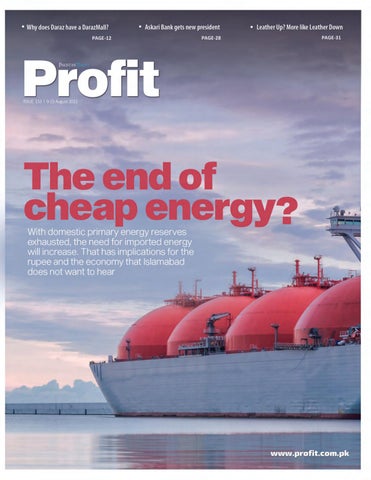
ome time in the next two to three years, possibly even this fiscal year, something extraordinary will happen: for the first time since at least the completion of the Tarbela dam in 1976, a majority of Pakistan’s electricity generation will come from imported primary fuel sources rather than domestic ones. Needless to say, this has profound implications for the cost of energy in the country, and the government’s management of the economy. The biggest impact of this shift is one that we see crudely playing out on the nightly opinion talk shows on television: volatility in global oil and liquefied natural gas (LNG) prices have a significant impact on the price of energy in Pakistan. Of course, the mouth-breathing cretins who constitute the class of people we in Pakistan call ‘television journalists’ (barring a handful of notable exceptions) are engaged in the most meaningless possible discussion about the topic, so we do not want to dignify them by suggesting that they are discussing anything remotely important. They are not. But there is still a bigger issue at play here: the next decade will be a highly volatile one for Pakistan when it comes to electricity prices. If we are very, very lucky, global energy prices for oil and gas will remain relatively low (ideally below $60 a barrel for crude oil) and thus we might be able to skate through this period relatively unscathed. But to be reliant on a full decade of low energy prices is a bad place to be as a country, especially one whose public is used to cheap domestic sources of energy. This story will explore three questions: how did we get here, what is the outlook for the next decade, and what can be done to ensure that we get out of this situation? Rarely for Pakistan, this also appears to be one area where the government and private sector appear to be on track to solve the problem – provided we do not veer off track. Both the current Pakistan Tehrik-e-Insaf (PTI) led administration and its predecessor Pakistan Muslim League Nawaz (PML-N) led administration have put in place both policies and projects that appear to be on track to result in Pakistan’s energy mix getting both cleaner and less import-dependent over the next ten years. But that is nearly ten years from now. Today, we still face a difficult situation. Let us take a look at how we got here, and what it all means.
22
A very brief history of Pakistan’s electricity sector
T
he first Pakistani city to get electricity was Lahore, when the Lahore Electric Supply Company (LESCO) was created in 1912. Karachi got its electricity a year later, in 1913. Electricity generation back then was mainly thermal power plants reliant on either coal or oil. This remained the dominant source of electricity in what is now Pakistan for most of the next five decades. The game changer for electricity in Pakistan – and therefore the whole Pakistani economy – was the Indus Water Treaty of 1960. At Partition, the matter of which country would get use of how much of the Indus River System – which existed on both sides of the border – was not settled, resulting in a dispute between the two countries. With mediation from the World Bank, India and Pakistan agreed to split the use of the system under a proposal first developed by the American lawyer, David Eli Lilienthal, with the treaty signed by President Ayub Khan and Prime Minister Jawaharlal Nehru at Karachi in September 1960. Why did this matter? Because it functionally resolved nearly all of the disputes between India and Pakistan over water and meant that any hydroelectric power project on the Pakistani side of the border could get international financing without fear of being dragged into international litigation, or worse, a border conflict. While India and Pakistan have gone to war – including three times after the treaty was signed – it has never been over water, and the treaty remains unbroken. Having resolve the territorial conflict over water resources, Pakistan could begin construction on hydroelectric power projects and almost immediately began working on the Mangla dam, on which construction started in 1961 and ended in 1965. The much larger, and more ambitious Tarbela dam was constructed between 1968 and 1976. It is worth pausing to take stock of just how big an achievement it was for Pakistan to have built these dams. Tarbela was the largest mud-filled dam in the world, and at the time of its construction was the fourth largest hydroelectric power project in the world. But here is the truly mind-blowing fact about these two dams: if every single coal-fired power project in Thar came online today, all of them combined would produce less electricity than Tarbela and Mangla. Yes, these two dams that saw most of their construction completed in 1976 (the most recent extension project on Tarbela was completed in 2018 and another one will be completed by
2024) produce more power now than Thar Coal will produce ten years from now. These two dams – and the spree of dam construction that followed over the next two decades – meant that the bulk of Pakistan’s electricity needs were met by clean, domestically produced hydroelectric power plants. Yes, in the 1980s, the government began setting up oil-fired power plants, but the vast majority of Pakistan’s electricity came from water until at least the early 1990s. At that point, with international financing difficult to procure owing to Pakistan’s poor relations with the United States, the government instituted a policy that allowed for more private sector players to set up independent power plants (IPPs) that were reliant mainly on oil. Over the next decade, this increased Pakistan’s reliance on imported oil as a fuel for its electricity generation. In the early 2000s, the Musharraf Administration decided to convert at least some of that thermal power generation capacity from imported oil to domestic natural gas, under the assumption that Pakistan had abundant domestic reserves. (This, as has been pointed out in this publication on many previous occasions, was a very faulty assumption.) As of 2005, the height of the Musharrafera economic boom, Pakistan derived more than 84% of its electricity generation from entirely domestic fuel sources, according to Profit’s analysis of data from the National Electric Power Regulatory Authority (NEPRA). That meant that even as the Iraq War of 2003 drove up global oil prices, Pakistani consumers of electricity remained largely unaffected. Unfortunately, there was a limit to just how much natural gas was available in Pakistan and around the end of the Musharraf years, Pakistan went from being a gas-surplus country to having a shortage. That shortage, in turn, meant that the thermal power plants that could run on either natural gas or furnace oil ended up having to run on oil almost all of the time as the government scrambled – and failed – to keep the lights on. Look at the charts for Pakistan’s power generation. The orange part of the bars that represent oil-fired power starts growing larger in 2006 and keeps growing larger almost uninterrupted until it peaks in 2017. That period also coincides with rising oil imports, which kept on rising in volumetric terms during this period, though they declined in dollar terms from 2013 onwards with the sharp decline in global oil prices. The sharp rise in reliance on oil coincided with a dramatic rise in oil prices themselves (late 2007 and again in early 2009). Oh, and the rupee’s value collapsed at the same
time, which created a perfect storm for the incoming Pakistan Peoples Party (PPP) led government, which did tried to keep consumers insulated by increasing government subsidies, but the government did not have the money to do so. The whole energy industry entered a massive financial crunch as the government’s failure to pay subsidies meant that power companies could not pay the oil importing companies which in turn could not pay their international suppliers, which meant that the country frequently ran out of enough oil to keep the power plants running. The PPP-led government was utterly inept at trying to resolve the problem that resulted in 12-hour daily power outages even in major cities, and even longer in rural areas. So, when Prime Minister Nawaz Sharif came into office in 2013, he knew he had one big problem to solve: energy.
The Nawaz legacy on energy
T
he PML-N strategy was reliant one big thing above all else: build lots and lots of power generation capacity, build nearly all of it on coal-fired plants, and build it all very, very quickly. In many ways, this strategy worked: between 2013 and 2019, Pakistan’s power generation capacity rose nearly 64%, from 23,825 megawatts (MW) to 38,995 MW, according to NEPRA data. In order to get the capacity to rise that quickly, however, the Nawaz Administration offered overly generous contracts to private sector energy companies and agreed to allow the building of power plants that relied on imported coal. [An interesting fact: nearly all of Pakistan’s coal imports come from South Africa and Indonesia.]
In addition, the Nawaz Administration took a hard-nosed look at Pakistan’s domestic gas supply and decided that the country needed to begin importing natural gas as well. It allowed private sector companies to set up LNG import terminals. That meant that the thermal power plants that could no longer run on domestic gas could now run on imported gas rather than imported oil. This change had the effect of both reducing Pakistan’s import bill (even LNG is cheaper than furnace oil) and reducing carbon emissions (burning gas emits less carbon dioxide than burning oil). Both of these policies meant that Pakistan’s imports of furnace oil dramatically declined, but its imports of LNG and coal went up. The overall energy import bill for electricity generation declined by about 36% between 2012 and 2020, mainly because
COVER STORY
both coal and LNG are cheaper than oil, and because Pakistan was able to secure a very good price on LNG from Qatar. The Nawaz Administration was criticised heavily for the high price it paid for that increase in power generation capacity, including by this publication. However, it appears that much of that capacity is already being used. While power generation capacity rose by 64% over the past eight years, actual power generation rose by over 46% during that same period, suggesting that bulk of that new capacity is being utilised. And while the import bill for Pakistan’s power generation has declined even as the country’s reliance on imported fuels has gone up, that is largely the result of a relatively benign global energy price environment. That may last a while longer, but it cannot last forever, and if global prices start
24
to rise again, Pakistan’s energy bills will be much more vulnerable to rising with them than ever before. It is a classic Faustian bargain: a rapid increase in electricity generation capacity that is cheap for now, but will likely start to get expensive later. However, the Nawaz Administration did one other thing that will likely help the country’s energy system: it began work on the Dasu dam, the first near-Tarbela-sized dam to be constructed in Pakistan in nearly 50 years. While the Nawaz Administration ultimately halted work on Dasu in 2017, the Imran Khan Administration was able to revive the project when it came into office a year later, and it is now on track for completion by 2025. But more on why Dasu matters later. For now, let us examine the consequences of this deal with the devil.
A rough decade ahead
A
s a result of the increased reliance on both imported coal and LNG, Pakistan now generates just over 52% of its electricity from purely domestic sources as of the fiscal year ending June 30, 2021, according to Profit’s analysis of NEPRA data. That is down from over 84% in 2005, and 71% as recently as 2012. This stark decline in domestic energy sources makes Pakistan more vulnerable to both changes in global energy prices as well as increases the negative consequences of the government’s poor decision-making on trying to control the currency exchange rate. A reliance on imported energy is not inherently a bad thing. If the economy can reliably produce electricity using imported
TEXTILES
fuels, and its electricity grid can continue to serve the economy’s growth needs, imported fuel might even be a good thing. But the problem is that imported fuels makes changes in prices something the government of Pakistan cannot control, which means they will tend to get panicky and make all sorts of bad decisions about economic management. How will this play out? Picture the following scenario. Global energy prices start to rise, which – given the level of dependence the country has right now on imported energy – will mean a considerable strain on the country’s current account balance. That strain will start to affect the value of the rupee. The government will try to protect the value of the rupee by borrowing more money from foreign lenders and simultaneously either decreasing taxes on petrol or increasing subsidies on electricity. Both of these will have the effect of exacerbating the fiscal deficit, leaving the government more vulnerable financially even as it has taken on more debt obligations in US dollars. Meanwhile, the government’s deteriorating fiscal health will mean that foreign lenders will stop wanting to lend more money to the government of Pakistan, which will decrease its ability to keep the rupee stable. That means the rupee’s value will start falling, just as the loan payments to those foreign lenders will come due. Repaying those loans will both further decrease the value of the rupee, and cause an increase in inflation as the rise of global energy prices will be exacerbated by the rise in the price of the dollar. Except instead of happening gradually, this will now all happen suddenly, in the span of one calendar year. Because the government will have artificially held the rupee’s price up, when it eventually has to let go, it will fall both faster and deeper than it would have had the government simply allowed it to happen gradually. Inflation has a way of collecting its due, and there is nothing the government can do to prevent that from happening. Of course, the government could try not being stupid and when energy prices rise, simply pass them on to consumers. But that would mean that the screeching banshees on television would start yelling themselves hoarse about the “petrol bomb” or “crushing inflation”, which would scare the government into doing precisely the thing that will make the problem worse. Here is where things get truly scary: in order to manage the fiscal deficit, one of the first things the government cuts when energy prices start to rise is the development budget. That is where the money for the construction of hydroelectric power projects
like the Dasu Dam (and hopefully the Diamer-Bhasha Dam) will come from. And those are the key to solving this mess.
How the problem gets solved
I
f the government can be patient and for once – just one energy price cycle – not panic and try to subsidise electricity unnecessarily, it will find itself with a problem that has fixed itself on the other side. Because a combination of the energy policies of the past four administrations means that the next decade will see an additional 20,453 MW of power generation capacity come online, in a mix that is both cleaner and less import-dependent than the current mix. You see, the one good thing the PPPled Zardari Administration did was to finalise a policy that allows for the construction of private sector hydroelectric power plants. The Nawaz and Imran Khan Administrations have started and continued the construction of the public sector Dasu Dam hydroelectric power project. And the Nawaz and Imran Administrations’ facilitation of the Thar Coal power projects means that that domestic source of energy will finally start to contribute a meaningful percentage of the nation’s electricity supply. Of that 20,453 MW, over 10,600 MW are from hydroelectric power projects, the two biggest of which are the government’s Dasu Dam and the fifth extension of the Tarbela Dam. These two projects combined will add 5,730 MW in power generation capacity, with the bulk of that coming from the 4,320 MW Dasu Dam project. The remainder will come from smaller scale private sector hydroelectric power projects.
Nearly 5,000 MW of Thar coal-fired power projects will also come online over the next few years, which will change the make up of the country’s coal-fired power generation capacity. Currently, less than 20% of coal-fired power in Pakistan comes from domestic coal. Over the next decade, that number will rise to nearly 56% of coalfired power generation capacity. In short, if the government manages to not delay the construction of its hydroelectric power projects – and does nothing that will prevent the private sector hydroelectric and Thar coal projects from reaching completion – the country will see its dependence on imported fuels decline and the proportion of clean energy in its overall power generation capacity rise, despite the increased coal-fired power generation. For that to happen, however, it is absolutely critical that the government not panic whenever global energy prices next start to rise. The prize here is a reduction in the country’s dependence on imported energy and for that to happen, the government will have to ensure that it does not sacrifice its long term ability to reduce the problem (construction of Dasu and Tarbela’s extension) for its short-term needs (decreasing the development budget to pay for increased subsidies on electricity). Will that happen? Our initial inclination would be to say no. One can almost always count on the government of Pakistan to make the panicked, short-term decision. But then again, the government seems to have made at least enough of the kind of decisions to have placed itself on the verge of fixing a long-term problem. So maybe there is hope they will not get distracted near the finish line? One can always dream. n
COVER STORY
OPINION
Hasan Saleem
How to apply social proof for customer retention and conversion goals Converting customers is a massive challenge. Retaining those new customers can be tricky, too
A
t least 97% of the people who visit your business’ website leave without taking any conversion action. They don’t buy anything. Don’t add anything to their carts. Don’t even subscribe to your newsletter. And 70% of them will never come back. In short: Converting customers is a massive challenge. Retaining those new customers can be tricky, too. However, there are proven strategies you can apply to increase your conversion and retention rates. Fundamentally, these tactics rely on data, customer communication, and social proof. Below, I’ll walk you through the process in detail. To illustrate all that, I’ll use data and case studies from OptinMonster, PushEngage, and MonsterInsights, three popular conversion, and analytics tools.
Hasan Saleem is a web professional with experience in planning, launching, and operating successful web-based ventures. He has been featured in Forbes, Yahoo, Benzinga and Digital Journal
26
T
However, there are proven strategies you can apply to increase your conversion and retention rates. Fundamentally, these tactics rely on data, customer communication, and social proof Gather Data As Indirect Feedback
W
hen it comes to customer conversion, data is the rock you should build your decisions on. With the right data, you can pinpoint your business’ weak spots. Then, you can make targeted improvements. First, though, you’ll need to gather that crucial data. There are two basic ways to go about that. The more direct one is to collect actual feedback from customers - sending out surveys, going through forums, reading comments, and checking out reviews onand off-site. However, if you’re new and your conversion rates are low, it’ll be hard to gain a lot of actionable insights this way. That’s where the second data source comes in: analytics. With the help of analytics tools such as MonsterInsights, you can keep an eye on important metrics, like bounce rates, visitor statistics, session duration, and - of course - conversion rates. For communications like push notifications and emails, you can further analyze deliverability, open rates, and click-through rates. Together, these numbers form a clear picture of where your site and marketing strategy succeed - and where you can apply improvements.
Bounce Rate Pinpoints Abandonment Hotspots
o start with, bounce rates tell you how many visitors visit your page and then immediately leave again. On average, 47% of all visitors will simply bounce. However, this number varies between industries and devices. For example, average bounce rates are much higher in the B2B sector than in food-related businesses. That’s because B2B website visitors are looking for much more specific products. High bounce rates result from content that simply didn’t match visitor’s needs - but can also indicate poor user experience. So, before you deep-dive into content issues, give your site a thorough technical once-over. For example, consider mobile-friendliness. As
the graph shows, mobile visitors bounce more than others - often because your site loads too slowly. Since mobile accounts for 68% of global traffic, this is a huge problem. You’ll find similar patterns when it comes to cart abandonment. Partially, that happens when your customers-in-the-making simply have second thoughts about quality, price, or shipping. In fact, about 70% of all carts never make it to purchase. However, in some industries, as many as 40% are abandoned because of website functionality issues. Once you’ve eliminated any technical issues, it’s time to hash out a strategy to increase conversions.
strategy. Push notifications are particularly powerful. A PushEngage case study found that visitors subscribe to them at 12 times the rate of email newsletters. They also open them twice as open, and stay subscribed for longer.
Add Conversion Boosters Like Pop-Ups and Push Notifications
With Positive Data
S
omeone is looking at your site. They’re not quite sure the content is right for them. Their mouse cursor flicks up to close the tab. Before it gets there, however, your website sends up a flare. What happened here is that a tool automatically detected that a website visitor was about to leave and responded with a last-ditch pitch. Coupled with freebies, these popups can be incredibly effective. One OptinMonster user built an exit popup offering a free consultation call and a coupon. As a result, their conversion rate soared by 500%. On-page communication, such as live chat and notifications, is another great
Upgrade Content
A
nother analytics-based way to improve conversion and retention rates is to focus on the positives. Which pages do particularly well? What content is most popular among first-time visitors? What keeps repeat visitors coming back? Once you have pinpointed customer preferences, capitalize on them. Expand popular blog posts into ultimate guides. Offer freebies such as PDF guides in return for email sign-ups. OptinMonster clients have significantly improved their key metrics by implementing content upgrades. SEO expert Brendan Hufford, for example, saw his bounce rate decrease by 3% and session duration increase by 20%. Add Social Proof to Increase Visitor Trust and Engagement Finally, there is another invaluable element that boosts customer conversion
You’ll find similar patterns when it comes to cart abandonment. Partially, that happens when your customersin-the-making simply have second thoughts about quality, price, or shipping. In fact, about 70% of all carts never make it to purchase and retention rates: social proof. Social proof highlights the reach of your business, the trust that scores of other people put in it, and that they are satisfied with your results. The most direct form of social proof is reviews and testimonials, of course. However, there’s much more to social proof. One tactic is to implement real-time event notifications. This lets website visitors know that others are currently engaging with your content and your products. In visitors, this establishes basic trust and a sense of community. Finally, showcase prominent clients and news coverage on your websites. This underscores that it’s not just individuals who trust your business, but also household names in your industry, and impartial media.
Conclusion
O
n an average site, just 2 out of 100 visitors are actually converted. But you can do better than the average. Find the weak spots in your website user experience, catch the attention of those who are about to leave, implement social proof, and communicate on different channels. By acting on the right kind of data insights, you’ll be able to convince potential customers to stick around. n
COMMENT
Askari Bank
gets new president
A
The former UBL CEO adds Askari to his long resume
skari Bank has a new president - and they are a familiar face to anyone who is a cursory follower of corporate Pakistan. On July 28, the bank informed the Pakistan Stock Exchange that Atif Bokhari would be the new president and CEO of Askari Bank, effective from September 1, 2021. The previous CEO, Abid Sattar, who had joined in August 2018, would be completing his term on August 8, 2020. Meanwhile Khurshid
28
Zafar, the COO, would be acting president for the interim period. Askari Bank has always been an unusual bank: it is owned by a military-owned foundation called the Fauji Foundation Group, and yet does not operate like other government entities. In fact, it behaves like any other profit-oriented bank. And the recent influx of private sector experts - like Sattar, and Bokhari - are testament to the Fauji Group’s pivot to try and run a more efficient, and profitable venture.
First, who is Bokhari?
B
okhari has a long resume. And why wouldn’t he: he’s a career banker with 32 years of experience in domestic and international banking. He started his banking career in 1985 with Bank of America, where he remained for the next 15 years. Subsequent to leaving Bank of America in July 2000, Bokhari joined Habib Bank, where he was Head of Corporate and Investment Banking. Perhaps most famously, Bokhari is known
as president and CEO of UBL Bank, a position he took up in May 2004. He remained in this position till June 2014. In this ten-year period, UBL expanded into consumer financing, e-Commerce, branchless banking, asset management and general insurance. Bokhari was also the chairman of UBL Tanzania, UBL AG Zurich and director of UBL UK. After this successful stint, Bokhari then had a not so successful two-year stint as the president and CEO of NIB Bank. This bank ceased to exist in January 2017, with its assets shifted to MCB Bank. So, Bokhari left banking for a bit. Instead he became the founding director of a private equity company known as Adira Capital, which successfully acquired Linde Pakistan (subsidiary of Linde AG). In his spare time, he served as Director of State Bank of Pakistan Board and Member of the Monetary Policy Committee. He was also a founding Director of the Karachi School for Business and Leadership, and also features on the Board of Governors of Kidney Center Karachi, Patients Aid Foundation, Shaukat Khanum Memorial Hospital and Indus Valley school of Arts and Architecture.
The Fauji connection
A
skari Bank has existed since 1991; it was bought by the Fauji Group only in 2013. It was previously owned by another military-operated charita-
ATIF BOKHARI President and CEO of Askari Bank ble organisation, the Army Welfare Trust. The Fauji Foundation, was founded in 1954 as a charitable trust and was initially designed to help provide welfare for the Pakistan Army’s retired soldiers as well as their dependents. The two most important, and most lucrative, of those companies are Fauji Fertilizer Bin Qasim Ltd. and Fauji Fertilizer Company. While Fauji Foundation itself only has a 7.19% share of Askari Bank, because Fauji Fertilizer Company and Fauji Fertilizer Bin Qasim own 43.15% and 21.57% respectively of Askari Bank, in essence, Fauji Foundation has control over Askari Bank.
WAQAR A. MALIK CEO Fauji Foundation and chairman, Askari Bank In April 2020, the foundation made the news for hiring a civilian as the managing director and CEO of the group: Waqar Ahmed Malik. The man had zero connection to the army: instead, his career began with the ICI group based in the UK, and then Akzo Nobel in the Netherlands. In Pakistan, he was appointed as the country head of ICI Plc’s operations in Pakistan, the largest foreign investment in the chemical sector at the time. For over 10 years, Malik served as the CEO of ICI Pakistan and also the CEO and Chairman of Lotte Pakistan (formerly Pakistan PTA Limited). Remember Adira Capital? In fact, it was Malik and Bokahri who had teamed up together in 2017 to found the company. The company bills pitches itself as akin to a private equity firm, but instead of several funds with limited life spans, it has a pool of permanent capital that it deploys on behalf of some of the wealthiest Pakistani families. In late 2017, it acquired a controlling stake in Linde Pakistan, a provider of industrial gases (now
BANKING
called Pakistan Oxygen). It seems both Malik and Bokhari moved on. Now that Malik became the CEO of Fauji Foundation, it seemed only natural that his former partner and co-founder be tapped for the role of a bank CEO. What is more interesting is that Bokhari, after running one of the country’s largest bank, was convinced to come back to banking, and that too, for a much smaller bank.
What kind of bank does Bokhari inherit?
I
n general, Askari Bank’s financials can be divided into two: pre, and post Fauji. The year 2013 represents the worst year financially for the bank, and also the year when the bank was acquired by the Fauji Group, which then attempted to make some turnarounds, to some degree of success. Much of the credit of the last three years at least, is to Sattar, who took over as CEO in August 2018. The banker had previously started his career in 1982 at ANZ Grindlays Bank, moving to Chase Manhattan, before moving on to have extended stints at Citigroup and Standard Chartered. He then went
30
on to run large divisions at Habib Bank - just like Bokhari. At Askari, he reshuffled senior management and tried to implement changes in the performance measurement systems, in order to bring more of a professional culture to the bank. The bank’s deposits have been steadily increasing since 2009, when deposits stood at Rs 206 billion. In particular, deposits grew 13.9% year-on-year in 2011, and at 15.6% year-on-year in 2014. Deposits crossed the Rs300 billion mark in 2012, and the Rs400 billion mark in 2015, and finally, crossed the Rs700 billion mark in 2020. Deposits in 2019 and 2020 grew 18.4% and 16.5% year-on-year. If one looks at the deposits as a share of the total deposits in the banking industry, Askari Bank’s share has actually fallen. In 2010, the market share stood at 5%, the highest share it would ever have; by 2016, it fell to 4.2%, before hovering around marginally to 4.4% in 2020. The bank’s non performing loans were a definite problem area. Between 2011 and 2015, the ratio of the non performing loans to gross advances was significantly higher than the industry average. The greatest discrepancies were seen in 2013 (20.2% compared to the industry’s 13.4%) and 2014 (18.4% compared
to the industry’s 12.3%). In fact, the greatest success of Fauji has been to decrease non-performing loans, both in absolute terms, and as a percentage. By 2018, non-performing loans were contained to just 7.8% of gross advances, or less than the industry average of 8%. Between 2014 and 2019, Askari Bank saw its revenues increase. In particular, it saw growth in its non-interest income segment, which jumped to the Rs9,000 billion ballpark range in 2020. Net interest income climbed to Rs 30 billion, the highest it has ever been. A similar trend can be observed with the net income at Askari Bank, which has hovered between the Rs4-5 billion range after 2014, and shooting to Rs10 billion in 2020. For the most part, Askari Bank has enjoyed a high ROE, which is an indication of financial health (basically, how effectively management is using a company’s assets to create profits). While the bank suffered from an appalling ROE of -28.5% in 2013, it bounced to 22.4% in 2014, and stayed above the 20% mark for four out of the next five years. Its ROE in 2020 stood at 25.5% - the highest it has ever been. It now remains to be seen if Bokhari can continue leading the bank forward in the trajectory it has set itself upon. n
BANKING
Leather Up? More like Leather Down With leather waning in demand, manufacturers might have to think of alternative options By Meiryum Ali
D
id the title make you groan? Don’t worry: there’s more of where that came from. After all, we’re talking about a company which decided to have the ‘Leather Up’ sign slowly ‘go up’ every time you load a new page on their website. But the real issue at hand is not their website design (though perhaps someone could look into that). The issue is Leather Up, and what it’s deciding to do with itself. On August 2, the company issued a notice to the Pakistan Stock Exchange (PSX), that it was deciding to hold a meeting of the board of directors on August 9. The reason? To decide ‘the future course of action of the company’. You see, the problem that Leather Up has been facing is the same problem it has highlighted openly in its annual reports of the last decade: that the leather market is struggling, and that people just are not as interested in leather in
LEATHER
the same way. Specifically, western people: if a company relies exclusively on export markets in Europe, like France, Italy, Germany, and the UK - and those Europeans turn around and stop buying the product at hand, then it will create a problem. What’s a leather company to do if no one wants to buy leather? Add to that the fact that leather in Pakistan is decreasing in terms of quantity and quality, which is causing raw material prices to rise (both hides and treatment chemicals), and it is not an ideal situation for a company called ‘Leathur Up.’ But first, before we get into the financials, a little history: Leather Up was incorporated as a private limited company on December 2, 1990. Subsequently the company was converted into a public limited company pretty early on, on May 15, 1993. Its chief executive and founder is Khalid H. Shah, born and raised in Karachi, where the company is based, and a graduate in electrical engineering from NED UNiversity Karachi. He was a founder director since 1990, and the CEO since 1996.
Today, the company manufactures and exports leather garment products. The company has a production capacity of 20,000 pieces of leather garments and over 35,000 ‘ladies’ bags on the basis of one shift of eight hours per day and 330 days annually. The capacity can also be expanded to 30,000 pieces of leather garments and over 50,000 ladies bags within four to six weeks depending on a client’s need. The company is entirely export based, with 100% of its production sent out of the country. Between 2009 and 2013 (the earliest available data), the company did just about ok. Its revenues fluctuated at around the Rs20 million mark in the first two years, but the company made losses of Rs4.2 million and Rs9 million. The next two years, the company fared a little better, with revenues in the Rs70 million range, and profits for the first time. Then again, the company’s revenue fell the next year to 2009 levels. The real change in the company’s financials came about in the year 2014. That year,
31
the company decided to diversify from leather garments to leather bags. The company was, at first, quite enthusiastic. “The company is having a flood of orders of ladies bags for Europe, mainly Italy,” they claimed. It didn’t matter that the profit margin in leather garments decreased that year, or that an increase in cost of production was on the cards. What mattered was that the company had managed to secure export orders, and shipped goods. And it worked: the revenue that year was Rs165 million, the highest it has ever been. The good run lasted all the way till 2017, with consistent revenue figures around the Rs 120 million mark. Most importantly, after a string of fluctuating incomes, the company’s net income steadily rose from Rs5 million in 2014, to Rs 15 million in 2017. Then, history happened. As any cursory follower of politics knows, the rupee was propped up by the Sharif administration - and when it crashed, export oriented companies were the first to feel the hit. Companies, including Leather up, had to suddenly reckong
32
with lower rupee income than before, and an unstable rupee. And 2018 was a terrible year. Revenue fell by more than half to Rs51 million. At the time, the company blamed two factors. First: the usual difficulties of working in Pakistan: “limitations of the natural raw material, extraordinary fluctuation in the prices of raw material (leather skins and bag accessories), the higher cost of production per unit in Pakistan has immensely curtailed the potential export business in this industry” the annual report said. Then, the company blamed “the historical aspects, boom and decline in the leather industry experienced over the last decade”, and the “ inherent cyclic nature of the fashion world” and the “loss of priority in terms of leather garments on the international scenes”. The outrageously high net income that year was not due to exports, but rather, sale of land. Thos phrases were then copied word for word in the annual report of 2019, and in 2020. IN 2019, revenue dipped to Rs48 million, and
then to Rs27 million in 2020. Net loss in 2019 stood at Rs8 million - the second worst loss in the last decade - and net loss in 2020 stood at Rs859,000. In 2020, there was the added problem of Covid-19: as that year’s annual report pointed out, ‘the recession grips Europe in recent periods and the impact of low business activity there, automatically affected the main exporting countries of leather garments and allied products. Therefore, in the first quarter of 2020-21, export orders were badly hit.” But the truth is, pandemic or no pandemic, the company had been suffering for a while. Which explains the board meeting: what’s a company to do if fashion sensibilities keep changing? And it’s not like there is a huge market for leather within Pakistan, save for the northern areas of the country year round. Most other parts of the company only need a leather jacket for a few months, or weeks, of the year. Perhaps it’s time to start selling bags to women in Pakistan, and not abroad. n
LEATHER
SEO, how it works, and why it’s important for Ecommerce Making the most out of your online presence is not a simple matter of setting up a website By Ariba Shahid
C
hances are that during the course of the COVID-19 pandemic, you have had to rely more on your web presence because of lockdowns and reliance on online shopping and ecommerce. This is true for almost all consumers that have had to face the realities of the pandemic. It is also true for businesses. As people have gone online to shop, platforms that did not have an online presence before have had to go online and others have had to ramp up their internet presence. However,
EXPLAIN-IT-LIKE-I’M-FIVE
with so much competition on the internet already, it is not a simple matter of setting up a website and waiting for the customers to roll in. In order to make your online presence worthwhile for your business, there are quite a few steps you can take to improve your visibility and get greater traffic. Search Engine Optimization is one of them. SEO is a way of optimizing a website or a webpage in such a way that it increases the targeted traffic to a website from a search engine’s organic (or non-paid) ranking. Last year we wrote an article about data portals available to financial investors.
We mentioned that the website SCStrade is either the first or second result when you google a stock in Pakistan. That is an example of SEO. Essentially, it is a manipulation on search engines to make sure that your website ranks higher when on the search list when people search. The aim is to appear front and center - after all, you have to be really desperate to go to the second page of google. Getting a better ranking through SEO tactics is not exactly easy. However you could get this done through many service providers. Before we talk more about SEOs, let’s figure out how search engines work.
33
“Even though, Google is not explicit about how its algorithm works but based on years of testing and statements by Google, SEO experts understand that these web pages are ranked based on three factors – relevancy, authority, and usefulness,” Usman Aqeel, CEO at 10X Ecom SEO agency
How exactly does a search engine work?
W
hile most of us use Google primarily, there are countless other search engines. They all work in the same way. Think of them as a library of billions of websites and web pages. Think of the webpages as books, and websites as pages in a book. When you search something on a search engine, it goes through all the books in its library and all finds the relevant pages from books and returns them as search results. The search results are what the search engine considers “most relevant”. In other words, the search engine goes through its index of billions of pages to answer every query. “Even though, Google is not explicit about how its algorithm works but based on years of testing and statements by Google, SEO experts understand that these web pages are ranked based on three factors – relevancy, authority, and usefulness,” explains Usman Aqeel, CEO at 10X Ecom SEO agency. Relevancy in simple words means that you get web pages about the topic you’re searching for. “If you search Google for the T20 World Cup 2021 Schedule, it’s obvious you are not looking for web pages about three-milk cake recipes. So as a first step, the Google algorithm looks for pages that are relevant to your search query. However, Google doesn’t simply rank the ‘most relevant’ web pages at the top. The reason is that if you search ‘three-milk cake recipes’ in Google, it will show you 30,000,000+ relevant search results for that particular query,” explains Aqeel. Hence, in order to make sure the ‘best results’ come at the top, Google further filters down the relevant search results through authority and usefulness. Authority is a metric whereby the search engine determines whether a website is trustworthy and accurate. They look at how many other pages on the web link to your page. These links from other websites are called ‘backlinks’ in the SEO universe. As a general rule, the higher the number of
34
backlinks to your page, the higher chances it will appear on the search results for your target query. “For example, if you type the query ‘three-milk cake recipes’ in Google and it shows a Wikipedia page as a result, it’s because Wikipedia is considered as a trusted source by Google’s algorithm. This trust comes from the number of websites on the internet linking to Wikipedia’s article about ‘three-milk cake recipes’ thus, making it rank at the top of search results,” says Aqeel. It is also interesting that while other search engines do deliver results, Google’s ability to determine authority through backlinks is what makes it the leading search engine in the world.In addition to being relevant and authoritative, Google also looks for usefulness. If the content on a website is relevant and authoritative but not useful then it may not make its way up to the top of search results. Google itself states that “higher quality content” is not necessarily “useful content”. For instance, you search for “Keto Diet” in Google and you click on “Result X” written by a leading Keto diet expert. Since, it is likely that the page will have quality content, most web pages would have linked to it as a source. However, the content lacks structure and is filled with jargon that somebody who’s a beginner doesn’t understand. Now, compare this with “Result Y”. The author of this article is relatively new to Keto diet and writes in a structured manner. In addition, he uses simple language to make sure that other beginners also understand the content. And also, the website does not have many links going to it. The Result? “Result Y” is going to outperform “Result X” on the usefulness scale. Even though Result Y has less trust / authority when compared with Result X, it may still be able to outrank it in the search results. “This usefulness factor is measured through ‘User Experience Signals”. In short, if Google determines that users really like a particular search result, it will be promoted within the search engine rankings,” explains Aqeel.
How does SEO work and is it worth it?
I
n simple terms, SEO works by showing search engines that your webpage is the best result for a particular topic. If you hire an SEO expert, their job would be to make sure Google picks your website for a wide array of search results by making it seem like the best result. “This determination of best result is primarily based on authority, relevancy, page speed, backlinks, etc. Google has more than 200 ranking factors in their algorithm,” states Aqeel. SEO is important considering that search is one of the biggest sources of traffic for a page. In fact Google searches make up around 60% of all traffic on the web. If you take all search engines into account such as Yahoo, Bing, etc. it goes up to 70%. “Assume you have an online business selling edible food arrangements. Now, let’s say that 50,000 people search the phrase “edible food arrangements” every month on Google. Since the first result in Google gets around 20% of the clicks, this will account to 10,000 visits to your e-commerce website every month if you are ranking at the #1 position. If we assume a conversion rate of 10%, and an average edible food arrangement order value of PKR 3,000, then this means that 10,000 visits per month amount to PKR 3 million in revenue. And this is just for one phrase. An SEO-friendly website is able to rank on thousands of different keywords!” explains Aqeel. A large number of companies and businesses are now hiring SEO experts in house or outsourcing to agencies to get their website in more and more searches with better ranking. With the world going digital and businesses hoping to reach greater numbers through the web, SEO seems like a good strategy for all sizes of businesses to get greater reach. n
EXPLAIN-IT-LIKE-I’M-FIVE