CONTENTS 18
09
09 Freelancing and ‘money management’ - this week in Pakistan’s business and economics Twitterverse 12 WorldCall: An acquisition or another Pump and Dump?
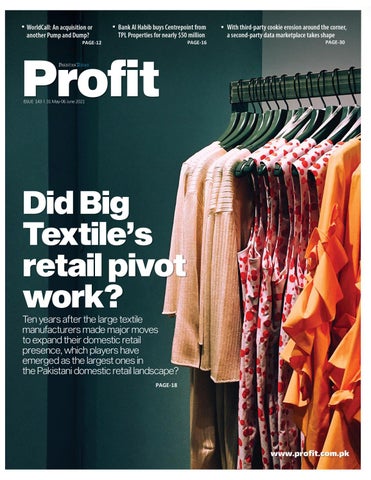
16 16 Bank Al Habib buys Centrepoint from TPL Properties for nearly $50 million 18 Did Big Textile’s retail pivot work? 24 Why a Master Data Management project is the way to go Burhan Rasool
26
26 FBR and Regulatory Technology Omer bin Ahsan 30 With third-party cookie erosion around the corner, a second-party data marketplace takes shape
Profit
33 Unlocking creativity that resonates with Pakistan audiences in the time of corona Mubah Khan
Executive Editor: Babar Nizami l Managing Editor: Farooq Tirmizi l Joint Editor: Yousaf Nizami Reporters: Ariba Shahid l Babar Khan Javed l Taimoor Hassan Abdullah Niazi l Meiryum Ali l Shahab Omer Regional Heads of Marketing: Muddasir Alam (Khi) l Zulfiqar Butt (Lhr) l Mudassir Iqbal (Isl) Layout: Rizwan Ahmad l Photographers: Zubair Mehfooz & Imran Gillani l Business, Economic & Financial news by 'Pakistan Today' Contact: profit@pakistantoday.com.pk
Readers Say Pakistan should have an indigenous version of Amazon. Pakistan should do more high-tech manufacturing and trade more with Iran, China, and Turkey. Instead of taking loans from gulf countries, why don’t you ask them to spend the money on building up manufacturing in Pakistan for the things they need. Have them take advantage of Pakistan’s cheap labor. Apropos: Pakistan wins over Amazon: De-coding another dream Anonymous, website @fawadchaudhry being broadcast minister it is your duty to make Pakistan an advanced country in broadcasting, but we are still stuck in the 90s. Have mercy on Pakistan and launch DTH. Apropos: All that stands between PEMRA and direct to home services @shahzaibsaif74, Twitter Thanks Mr. Babar Khan Javed for the update on DTH service being launched in Karachi, Pakistan, and the rest of the world by this company. The dynamics behind it sound very interesting. It will be fascinating to see the information about the options, standard accessories, charges for the premium content, and broadcast online on the internet. Another follow up article with those details would be greatly appreciated. Apropos: All that stands between PEMRA and direct to home services Haroon Rashid, Website A bit of a diversion but, from a consumer point of view the questionable quality of cigarettes produced by both these local giants and the inability to verify the authenticity of a purchase are some of the reasons for the boom in smuggled cigarettes. Half the price for a superior product just makes sense based on the local markets ethical and economic state. Taxes are transferred to the consumer literally as well as in terms of the quality of the end product. “Tobacco industry is loudly calling for a crackdown on smuggling,” - I mean, we’ve all heard of the boy who cried wolf, but has anyone ever heard of the wolf that cried wolf? Apropos: Why the tobacco industry is loudly calling for a crackdown on smuggling Umer, website
HOW TO CONTACT
facebook.com/Profitpk twitter.com/Profitpk linkedin.com/showcase/13251020 profit.com.pk profit@pakistantoday.com.pk
7
Careem once charged me 1200 rupees for a ride that's usually a maximum of 400 rupees on the highest peak factor. When I called them, they said they can't do anything since it's a peak factor charge. It was clearly not. I hate them. Apropos: Careem overcharges customers tens of thousands of rupees for short-distance rides @dezgostang, Twitter On the other hand, the flour mills in KPK are closing one by one due to the black market policy of the Punjab government, which is becoming a nui-
sance for the rest of the provinces, and despite this faces no repercussions. Here in KPK, we do not have enough wheat because of Punjab, and because we don’t, we end up having to take wheat from Punjab which creates a vicious cycle. It is true what they say, that sometimes a province ends up becoming larger than the entire country. Apropos: Ill-gotten policies building up to wheat crisis Ahmed Qureshi, website So the lesson learnt? When it comes to ecommerce sites/apps, always avoid using credit cards and debit Cards in Pakistan be it any app, no matter how deep the discount banks offer on cards. Or if you ask me, to increase the usage of cards, every bank in Pakistan should offer a certain amount of insurance on every transaction above 5,000 rupees. For this they can even take a consent form from the consumer to insure their transaction. I’m sure consumers will feel much more comfortable, especially since there is currently a major trust deficit in Pakistan. Apropos: Careem overcharges customers tens of thousands of rupees for short-distance rides @habidz, Twitter Careem has bled a lot of cash so they are just cooking the books now - signature Ponzi scheme! Never use the option to pay by card. First they had this data issue which they claimed they fixed and now this? Massive issues in their data protection while junior employees sell data! In Pakistan, it doesn’t make sense to pay for any app by card (at least that is my philosophy). In the world today, there is better data protection. Just see how we are bombarded with spam Messages where those people got our data from the mobile companies. Apropos: Careem overcharges customers tens of thousands of rupees for short-distance rides @suleymania, Twitter That's a big unsubstantiated accusation. I've had multiple cards saved on the app over the years, never encountered any issues.I didn't come across reports of employees selling customer data. Also - data breaches aren't unique to companies operating here. They happen across the world. Need to be careful everywhere. I also don't see it like that @habidz . The cases are still limited and Careem is making amends (their response could have been better). While it is very important to share and report these experiences to hold businesses accountable, we shouldn't just stop using cards. Apropos: Careem overcharges customers tens of thousands of rupees for short-distance rides @MubarizSiddiqui, Twitter
COMMENTS
IN BRIEF In an increasingly silly disagreement, the IHC served a notice to the SBP on a petition challenging the appointment of new National Bank of Pakistan (NBP) President, Arif Usmani, because he has a physics degree in his undergraduate education.
“Power subsidies for the next budget will be allocated on the basis of actual consumption whereas the government will adopt a more targeted approach for disbursement. We are firmly committed to growth with the willing contribution from the business community.” Shaukat Tarin, Finance Minister
Rs100 billion:
Prime Minister Imran Khan on Tuesday announced a Rs100 billion fund for startup loans and 170, 000 skilled education scholarships to overcome the challenge of unemployment. Out of the 170,000 scholarships, around 50,000 would be reserved for high-end skills such as latest technology, including Artificial Intelligence (AI) and Big Data (BD). Minister for Interior Sheikh Rasheed Ahmad on Sunday said that the government would provide incentives to the poor, and especially the salaried and white collar class in its next federal budget. He said positive economic indicators mean that Pakistan’s economy has now taken off, adding that this growth rate will increase further in the next two years. The Economic Coordination Committee (ECC) of the Cabinet on Wednesday approved the launching of the second phase of Ehsaas Emergency Cash Programme. The virtual meeting was held under the chair of Federal Minister for Finance and Revenue Shaukat Tarin.
8
After increasing international difficulties continue to mount, the price of the Morris Garage (MG) HS CBU has been increased to Rs5,749,000, showing an increase of Rs300,000. The new price for the premium SUV is effective as of Thursday, whereas the booking price remains the same at Rs2,000,000. Despite record wheat production across the country, a wheat crisis is looming due to ill-gotten policies of the government. Flour mills are facing severe difficulties in procuring wheat despite the fact that Punjab has achieved the purchase target of 3.5 million tonnes during the current season.
Freelancing and ‘money management’ this week in Pakistan’s business and economics twitterverse
I
n this week’s social media round up, Ariba Shahid walks us through income woes when it comes to freelancing, organizing finances, or just the sad reminder of the fact that salaries do not go up 1.5x. The round up also points out a growth in trade with China and the lack of data utilization by banks.
Export-happy
The worst of times and the worst of times
Pak Cheen dosti Zindabad. Pakistan has signed a Free Trade Agreement with China and as a result one can see export growth. In fact, during FY 21, export growth can be seen with the USA, UK, and Germany too. This is because exports of goods and services grew by 6.2% surpassing the US$ 25 billion mark. The export of goods grew more than the export of services given the pandemic and lockdowns. If it makes no one else happy, the government will absolutely be giddy with excitement since improving exports has been one of their top agendas ever since they got into power.
We’re done with corporate fluff
There is a lot of hue and cry any time that \ inflation is high and when the rupee devalues. When the pandemic hit, a number of employers gave their employees pay cuts too. When the going gets tough, salaries get cut. But when things get better, we don’t see the same employers giving increments. Wages are sticky, and no Azam, no one got their salaries increased by 1.5x but thank you for making us feel bad about it.
SOCIAL MEDIA ROUNDUP
We hate corporate fluff and its jargon. We roll our eyes when someone says “Hey guys, let’s think out of the box” or “We need to create synergies.” We feel your pain Samir Ahmed and hope you manage to stick it through. We suggest you eye roll like us too. But as a hint from seasoned professionals in the eye-rolling business, we strongly suggest doing it when your boss is turned away - when they are in front of you, big smiles and vigorous nods of agreement are recommended, especially if you need the job. If the meetings are on zoom, you can even scream and put your head down. Just make sure you have your mic and camera off.
9
Freelancing woes
Calling out the banks
While we are normally wroth to include ourselves in Profit’s weekly social media roundup (you hear plenty from us already in the remainder of this magazine), this is one point that we felt deserved highlighting because it could not be ignored. It is not only funny, but also highlights where banks lack. Banks need to do a better job at credit scoring which and should not only rely on deposits. The service a bank should provide to you should be based on the type of customer you are and not always on how big your bank balance is. However, to do this they will need to be more tech savvy, something we feel is unlikely. Sure freelancing is a good source of income. That does not mean you should not take into account the fact that you may be exploited. Moreover, how does it look on your resume? Do you think freelancing is a sustainable earning model? These are just some questions this thread by Sophia Hasnain has us thinking. Perhaps the most important thing you can ask yourself is, maybe it is a good way to get by with flexible hours when you’re young, a student, or even in between job, but does it a career make?
Take a break, breathe
Design thinkers
Design thinking is about solving user problems. In researching consumer behavior one often comes across various answers. This is just one example of things design thinkers keep in mind while designing interfaces and platforms for users
10
Jawwad Farid tweets something that resonates with us. It’s hard churning out articles every week. Our readers are demanding and they want new stories, each better than the ones before. It gets hard because of writer’s block, imposter syndrome, and usually just because corporations do not respond on time. Well, the solution is simple, put on a movie, go for a run, or just simply relax and take a break. Things will get back in control in no time.
SOCIAL MEDIA ROUNDUP
By Ariba Shahid and Taimoor Hassan
O
n the 26th of May, the Pakistan Stock Exchange (PSX) saw an all-time high daily trading volume. As usual, government ministers were quick to jump on the news to try and portray
12
the big day at the stock exchange as an indicator for the economy. Federal Minister for Planning and Development, Asad Umar, attributed the development to the market reacting to signs of sustained economic recovery. Other government ministers and spokespersons joined in on the fanfare. The traded volume clocked in at 1,560 million shares in today’s session, which is the highest ever in the history of the PSX, exceeding
the previous record by a massive 39%. Carrying the lion’s share of gains for the investors was Worldcall Telecom Limited (WTL), which added volumes of 707 million shares to the overall trading activity — almost half of the total intraday volume, while achieving a steep gain of 41.23pc in its share price. And that is where it gets interesting. You see, Worldcall has for years been a barey sinking ship desperately patched up and kept
afloat in the hopes that a buyer is around the corner. Between 2014-2016, it leaked billions of rupees before making a surprising recovery in 2017 on the back of a huge surge in other income (income derived from activities unrelated to the main focus of a business such as the gain and sale of assets). While they did not get the same kind of other income in the following two years in 2018 and 2019, they still got more than they had in previous years and stopped turning over a loss. The only problem was that their profits were insignificant, and Worldcall was sort of just hanging around the PSX doing nothing. And even though the company has not yet posted financial results for the year 2020, the financial performance of the company for the half year 2020 is available and the numbers are not healthy. At this point, it is natural to wonder what exactly happened that made Worldcall such a hot item all of a sudden to the extent that it single handedly led a record shattering day at the PSX in terms of volumes traded. The answer is simple: Salman Iqbal and the ARY group’s decision to buy the company. For at least the past two years, the ARY group has very publicly been trying to take over Worldcall, issuing notices each time but not getting to the part where they are supposed to offer a tender notice. Once again, it seems that ARY is trying to make a move for Worldcall. As a result, demand for stocks rose when news of the possible acquisition broke. The only question, however, was whether this was a pump and dump scheme by market participants. So what exactly happened with Worldcall, ARY, and the PSX? And could it be a scam?
A recap of the possible acquisition
M
uch like some of the television dramas that channels like ARY produce, the substantial acquisition of WorldCall Telecommunication Limited (WTL) has been a significantly stalled affair that dates back to 2019. In fact, when ARY communications Limited and ARY Digital FZ LLC made an intention to acquire 51 percent shares of WTL on 6 May, 2021, it was the third time ARY has made such a public announcement offer. Following the announcement, the share price has risen from Rs. 1.53 to Rs Rs 3.24 today (Thursday), after attaining an intraday high of Rs 4.03, implying a 163% increase in a matter of few days. (Insert cumulative volumes before submitting). What has been going on with these announcements? Well, simply put, a public announcement offer is made when an individual or a company makes an intention to acquire voting shares beyond the prescribed limit of 30 percent or control of a listed company. They have 75 days to complete the process of public offer. This
We’re still in the ring for Worldcall. I think it’s a good company. It’s dying. It’s the age of media, and we’re looking to acquire majority shareholding in the company Salman Iqbal, CEO of ARY Communications
was previously 92 days, however, extensions can be granted. Despite that, once an extension has also lapsed, the acquirer can send another letter of intention to acquire the company. On October 30, 2019, ARY made an acquisition announcement through their transaction manager Shajar Capital but did not go through with it. WTL announced its takeover, with the intention to disclose the takeover information on November 1, 2019. But as per PSX data, the announcement was made on October 31, 2019, and the next trading week saw a price upshoot from Rs1.22 to Rs1.70, implying a 39 percent increase during the period. During an interview with Profit last year, Salman Iqbal, CEO of ARY Communications said his company was more than interested. “We’re still in the ring for Worldcall. I think it’s a good company. It’s dying. It’s the age of media, and we’re looking to acquire majority shareholding in the company.” As for a timeline on the deal, Iqbal optimistically chirped, “You’ll hear from the PSX very soon. It’s happening. We’re going through it.” Despite this, they did not go through with it. A few months later, on August 7, 2020, ARY was back but with a new broker. AKD Securities issued a similar letter of disclosure
Worldcall’s losses between 2014-16: 2014 - Rs 2.7 billion 2015 - Res 10.6 billion 2016 - Rs 1.26 billion
2017 anomaly: Net profit - Rs 6.2 billion Other income - Rs 8.1 billion
Barely alive in 2018 Revenue growth - 88% at Rs 4.3 billion Net profit - Rs 446 million Other income - Rs 1.57u billion on behalf of their client ARY communications Limited and ARY Digital FZ LLC to acquire 51 percent shares of WTL, and they did an entire technical audit of the company. On February 23, 2021 the SECP granted an extension to ARY Communications Limited & ARY Digital FZ
STOCK EXCHANGE
LLC to make a Public Announcement Offer. The acquirer was granted until 5th May 2021. This transaction did not go through. Suspicious, no? The very next day, ARY made another intention to acquire WorldCall through its manager, AKD Securities. While the letter is dated 6th May, it was posted on the PSX on 17 May 2021 owing to Eid break. While Profit’s attempts to reach Salman Iqbal have been fruitless, WorldCall Company Secretary, Zaki Munawar said that the reason for these continuous delays was the laborious process of due diligence. “The company is pretty big and it takes time to conduct due diligence. The due diligence and technical audits have been done. If someone like Salman Iqbal, a famous entrepreneur, is investing time into this deal, there must be a reason,” said Munawar. The same excuse was given by Aqeel Karim Dedhi, who said “this is not an easy deal. It is a difficult subject. There are always issues that come through. That is why it is taking time.” Those are both reasonable explanations for the delays. But the sheer numbers that Worldcall is seeing on the stock market are astounding and beg a deeper reckoning. Because let us get this straight, Worldcall is not doing great and for the year 2020, no one outside the company really knows if the company did great. Strangely, again, the WorldCall stock is doing great. While it is completely normal for share prices to rise when there is an acquisition intention, the word in the market suggests that the high volumes may be indicative of something else driving the WorldCall stock. As Muhammad Sohail, CEO of Topline Securities pointed out a point to ponder, high volume is good. But abnormal volume is not. “Usually, when the volumes are significantly higher as a proportion of free float and total shares, it is constructed as pump and dump. Alternatively, if there is a material change in the business outlook or any corporate actions, the company gets rerated eventually at a higher price. Often, these volumes are not sustainable when the story, if any, is public,” says Arsalan Soomro, MD, KASB Securities. What is also interesting is the fact that an alleged Draft report by PwC has been floating on WhatsApp groups which contains WorldCall’s valuation. As per the document, WTL’s value post-funding using the discounted cash flow method is Rs 48,783 million, the value of the existing business using adjusted breakup value is Rs 10,061 million, and the value post-funding for the asset replacement cost value is Rs 49,107 million. Whether the document is authentic or not, it can also pump investors to buy WorldCall based on the valuation. “All these stories generally move the stock prices first and then produce such hypotheses true or not - to gain traction,” says Soomro when asked if the alleged PwC document had anything to do with the alleged pump and dump.”
14
This is not an easy deal. It is a difficult subject. There are always issues that come through. That is why it is taking time Aqeel Karim Dedhi
Is there a pump and dump?
L
et us get just a couple of things straight here. The first, is that we can never really know whether a pump and dump is happening while it is happening, because there is no real way to tell who is buying the stocks. And say, even if it is Salman Iqbal or anyone’s most trusted friends buying them, there is no way to know that they are doing it on his request.
stocks if it doesn’t work out again. This does not necessarily mean that ARY is pumping the stock, other market participants are capable of doing so too. Again, we must also say that Salman Iqbal and ARY Communications are serious buyers. The ARY group does not have any publicly listed company (because that would involve being more exposed and out in the open than their
A "pump and dump" is a form of securities fraud that involves artificially inflating the price of an owned stock through false and misleading positive statements, in order to sell the cheaply purchased stock at a higher price. In this case, the alleged pumping would be as a result of ARY’s repeated attempts to acquire Worldcall, and the dumping would be the selling of the
top brass likes), but a company like Worldcall would make a fine addition to the group’s umbrella of portfolios. And while one cannot say so with certainty unless you see transactions running through for individuals, there does seem to be a pattern, and the indicators for a pump and dump situation are present. After all, if Salman Iqbal is this interested in getting his hands
on Worldcall, then why has he not been able to up until now? More importantly, why does this create ripples in the market? A key indicator of a pump and dump situation is where trading volumes for a stock will go from regular or low levels to extremely high levels right at the start of the price rise. While this circumstance does not always mean a pump and dump, this is one instance that draws attention to the possibility of a pump and dump. Based on the graphs above, one can notice a significant build-up in price over a short span of time and then a significant fall. These ups and downs coincide with acquisition intentions going through. Moreover, to quantify this, the table above compares average and total volumes during news of the acquisition in comparision to the yarly volume. A year is taken as a calander year. It is important to note that nearly 40% of volumes in worldcall are witnessed within 2 months of a public announcment. For 2021, the volume witnessed in just two weeks after the announcement is equivalent to 51.44% In WorldCall’s case, one can say it is relatively easy for a pump and dump because the share is very liquid, it has a significant free float, and most importantly it is a cheap stock. All these factors enable it to make significant volumes. There were also rumors about AKD servers crashing at crucial moments today as WTL reached Rs 4, and on Wednesday preventing investors from selling. While speaking to Profit, Aqeel Karim Dedhi denied that and said, “There is no truth in it. The company (AKD) has zero interest/ standing in WTL.” It is also important to note that in February 2021, WTL issued a notice to PSX explaining that there was no material information to back the behavior in its share price following a period of rise in volumes and share price.
Who else is interested and why?
I
n addition to ARY Communications, the Dunya Group is another media company that has expressed interest in WorldCall in the past. So clearly there is interest in the
The company is pretty big and it takes time to conduct due diligence. The due diligence and technical audits have been done. If someone like Salman Iqbal, a famous entrepreneur, is investing time into this deal, there must be a reason Zaki Munawar, Worldcall company secretary
potential of Worldcall, particularly from media companies. Then there is another entrant. As per a source that chose to remain unnamed, a foreign investor is interested in acquiring a stake in WTL and has asked a prominent name (Munaf Ibrahim) to accumulate shares. However, Munawar comments, “I can neither deny nor confirm such news,” when asked if there were any other potential acquirers other than ARY Communication. While no
material information has been made publicly available as of late, it is important to note the potential of the business. “I do feel fiber to home business is moving the needle, it can be worth a lot. That is a big if and usually with high failure ratios. The fact that Facebook partnered with Nayatel for fiber networks in Pakistan acts as proof that Pakistan is a huge market for broadband services and aggregating user returns,” says Soomro. While ARY has taken its sweet time mulling over the acquisition, Soomro also does not deny ARY’s interest in the company. “ARY Group does seem to be interested in WTL for a while now. In the long run, businesses would need to be publicly listed to fetch higher valuation and enact better corporate governance structures,” he opines. As per sources, Salman Iqbal has been wanting to add a publicly listed company to his portfolio without having to make one of his businesses public. A source alleges that the deal has not been able to go through because of a lack of funds to complete it. n
STOCK EXCHANGE
Bank Al Habib buys Centrepoint
from TPL Properties for nearly $50 million The nation is curious: exactly how much did one of the fanciest buildings in the largest city sell for?
O
n May 17, TPL Properties and Bank Al Habib said that it successfully completed the sale and transaction of the TPL’s flagship project ‘Centrepoint’, which is located off Shaheed-e-Millat Expressway near KPT Interchange, Karachi.This has been several months in the making - its a follow up from the earlier notice the company sent to the PSX on August 20, 2020, in which Bank Al Habib said it had
16
decided to purchase the building. TPL Properties is the property arm of TPL Corp Ltd., a technology conglomerate that today focuses on auto, fire, life and health insurance, real estate development and security services. TPL Properties Limited itself was incorporated in Pakistan as a private limited company in February 2007. Subsequently in 2016, the company changed its status from private limited company to public company. Centrepoint happens to be, quite
literally, the center of TPL’s ambitions. This is one of the biggest developments in the real estate sector of Pakistan. Some facts about the building: the 28-story Centrepoint, stands 385 feet high, and has been constructed on 26,226 square feet of land. It has 197,810 square feet of rentable space, with the offices on 17 floors (from the 11th floor to the 24th, and the 26th and 27th floor). The building is considered TPL properties flagship project, and has been built
accordingly, with facilities such as built-in IT infrastructure, international standards of security and fire safety, nine floors of dedicated parking, and an in-house independent power generation unit. The high-rise, which according to TPL has been designed in mind for a ‘high-end corporation’, also features a health club, a swimming pool, and a coffee bar. Here’s the problem: the company managed to share information down to the coffee bar, and not the actual valuation and sale price. As twitter user Rasheed Narejo tweeted: “Now that the deal has been successfully completed, I wonder what is still restraining buyer (Bank Al Habib) & Seller (TPL) to disclose sale price? By now every major shareholder (with board seat or contact with board) would definitely be aware of the transaction.” He went on to add: “I am aware that these transactions are always subject to adjustment but company can put this disclaimer with transaction disclosure.Withholding of critical material information from minority shareholders have become a norm, under the guise of complying with minimum regulatory requirements. Is it still material information if the selling price is not disclosed?” Profit posed the same questions to Ali Asgher, the chief operating officer of TPL Corporation, who took the viewpoint that this was entirely a non-issue. “It’s not required and it’s a commercial decision,” he wrote in a short message to Profit. Instead, he said the information was present to anyone who chose to look at the latest financials. As of March 31, 2021, the latest period for which the financials are available, TPL Properties carries Centrepoint on its balance sheet at Rs7,647 million or around $49 million. According to Asgher, the sale amount is at or higher than this price, while the actual figure will be available in the annual report, released at the end of June this year. The figure of $49 million may seem like a lot, but it is not the largest amount that a bank has actually paid for a building. Consider that in 2017, Habib Bank Ltd, paid Rs14,440 million then worth $137 million for the new HBL Tower in Clifton Karachi They bought this form Mega and Forbes, the shipping conglomerate
It’s not required and it’s a commercial decision Ali Asgher, chief operating officer of TPL Corporation
owned by the reclusive billionaire Habibullah Khan. But even if it is not the most amount a bank has paid, Bank Al Habib still desperately needed a building - any building, really. Its old office was in a small building on II Chundrigar, quite literally in the shadow of Habib Bank Plaza. That visual comparison alone says a lot about Bank Al Habib’s relationship with HBL - which used to be part of the Habib Family, before it was forcibly nationalized in 1974. The Habib grandson reentered the bank space in 1991, when the government allowed for privatization. It would be good for the bank to escape the shadow of the much larger bank, since Bank Al Habib itself is doing quite well. It was the seventh largest bank in Pakistan by deposits, crossing the Rs1 trillion mark in September 2020. Its profit after tax at the end of year in 2020 stood at Rs28.6 billion. The decision also represents a bit of change of address for any large commercial bank. For years, the financial hub of the city was concentrated on I.I. Chundrigrar road, where the State Bank of Pakistan and the Pakistan Stock Exchange are also located Other companies, not necessarily banks, would set up along the Shahrah-e-Faisal artery. But now, those hubs are changing: consider Harbour Front, at the edge of the sea, or even HBL’s own building, at Teen Talwar (overlooking Gulf Market, which has undergone a much needed facelift of its own). TPL Properties has also promoted the project’s location as another alternative, pointing out its ease of access to Defense, Korangi, and the airport. What about TPL Properties itself? The
The figure of $49 million may seem like a lot, but it is not the largest amount that a bank has actually paid for a building. Consider that in 2017, Habib Bank Ltd, paid Rs14,440 million then worth $137 million for the new HBL Tower in Clifton Karachi They bought this form Mega and Forbes, the shipping conglomerate owned by the reclusive billionaire Habibullah Khan
transaction is just the latest in a series of interesting decisions the company has taken in the last few years. For instance, in January 2019, TPL Properties signed a memorandum of understanding with Equitativa, the largest real estate investment trust (REIT) manager in the UAE, to form a REIT Management Company (RMC) in Pakistan. Equitativa has over $2 billion of assets under management in the UAE, and the event marked the first foreign direct investment in this sector after amendments in the regulations. Second, TPL Properties bought the 129-year-old Katrak Mansion, a heritage building close to Frere Hall. Why does it matter if some old colonial building is now in their possession? Because it represents an investment in the skyline of the city. The mansion is a heritage site in an extremely high-value commercial-residential area, and yet crucially, the pre-Partition mansion will not be turned into a high-rise structure. Instead, the architects intend to restore the building from the outside, while constructing residential apartments inside – and there may even be plans for a museum located as well. Third, the company has decided to build a technology park in Korangi, Karachi. According to the company, “The Technology Park will be the first of its kind of such scale in the province of Sindh, with high end technology facilities. Such a platform with high end IT infrastructure shall provide a platform to several IT sector companies across Pakistan.” TPL Properties estimates the project will be completed in two years, including planning and designing. And that’s just what they have done so far. According to the company’s last annual report, selling Centrepoint “has opened up various new avenues for us in terms of acquiring more real estate for development. We are actively exploring these new development avenues with a focus on the Karachi market.” Perhaps that is why the company did not think too much of sharing the transaction price. After all, that is the least of what’s on their plate. n
PROPERTY
18
COVER STORY
By Farooq Tirmizi
C
onsider this picture: the year is 2010. You are the owner of a large textile company in Pakistan, based in Landhi, in Karachi. You face eight hours of power outages every day, but even that’s better than your counterparts in Punjab, where it gets to 12 hours a day or worse. Your factories cannot run like this. Textile manufacturing is a continuous process that needs to keep running smoothly, or else you have to start all over again, which can be extremely costly. And that is if you are lucky and your machines do not start breaking down. At your desk in your office next to the factory floor, you are staring at that order that you worked so hard to get from Gap in the United States, but now will miss the Christmas deadline for because you have no idea how long it will take to make the clothes given how much your machines have to keep shutting down because of the power outages. Great. Your engineering manager just came in and told you that what you thought was going to happen has happened: some of your machines have broken down. That is hundreds of thousands, if not millions of dollars in damages, plus reduced capacity for weeks, if not even longer. Oh, and the electricity in the factory and your office just went out again. For the sixth time today. How can anyone possibly make any money in the textile business? On your drive home from work, you are thinking about what some of your friends in the textile business have told you about Bangladesh. How the European Union has just granted them preferential tariff access and how the electricity situation there is supposedly a lot better. Some of them have been talking about relocating their factories there, or at least setting up new ones. It is a thought that goes through your head all the time. “Maybe
20
this country just isn’t the place for a textile manufacturer,” you think. You live in DHA Phase 5, and that is a straight, if somewhat long, drive from Landhi, but you are so stressed that you do not feel like going home right away, so you decide to drive around a bit. You find yourself around Clifton. You drive past Ocean Tower, that new building that is coming up. Right next to it is a wedding hall, but then you notice something. There is a huge crowd around there, but it is not a wedding. It looks like a large number of people – clearly mostly upper middle class – lining up to buy lawn clothing. You remember hearing something about a Sana Safinaz sale today, and think this line probably has something to do with that. “Hmm… maybe somebody is making money in textiles in Pakistan after all,” you think to yourself. Then the idea hits you like a ton of bricks and you curse yourself for not having thought of it sooner: why are you not making the clothes that these people would line up for? You are in the clothing business. You have a massive factory that can take ginned cotton and churn out beautiful clothing good enough to be worn by middle-income consumers in the United States and Europe. What is to stop you from selling to middle-income Pakistanis?
The retail pivot
I
t is hard to overstate just how counterintuitive it was for the textile industry to pivot towards domestic retail consumers over the past decade, after having spent the previous several decades having served mainly as contract manufacturers for brands in North America and Europe. Think about it: if you already have relationships selling to some of the biggest retail brands in Europe and North America – populations collectively approximately four times the size of Pakistan and economies over 100 times the size, with orders of magnitude
more in individual consumer spending power – why would you bother with the Pakistani consumer? But, of course, that broader macroeconomic picture hides important details. You may have relationships with those brands in developed economies, but you are one of tens, if not hundreds of thousands of manufacturers all over the world competing for the same business, including some in countries with much better infrastructure than Pakistan, such as Vietnam, China, and the Philippines. In that highly commoditised market, your margins on the product are thin because you have so many competitors all over the world ready to jump in at a moment’s notice if you try to raise prices or cut corners too much. And, of course, there are those accursed power outages that make it impossible for you to predict how long it will take you to manufacture their orders, and retailers in the US and Europe require just-in-time deliveries, and if they cannot rely on you to meet a deadline, you can forget ever getting an order from them again. So it is a high-volume, low-margin, highly competitive business where Pakistan’s infrastructure makes it very difficult to retain relationships over the long run unless you have enough pull with the government of Pakistan and enough capital of your own to set up your own captive power plant to supply you electricity directly without having to rely on the grid. Did we mention we now also have gas load shedding? In that environment, all of a sudden, the Pakistani market starts looking a lot more attractive. Yes, it is less than one-hundredth the size of the combined North American and European markets, but there are also no foreign competitors to speak of. You are the very big fish in the very small pond. If you do not dominate the market, who else will? There are also other advantages: no more having to worry about just-in-time logistics.
You own the stores, and the supply chain, so delays in delivery matter less, and you can always just store a little more in inventory. And because you own your own brands, the margins are much higher than in manufacturing for foreign brands.
Who entered the retail market?
A
ll of this sounds very logical and it makes complete sense that many of Pakistan’s biggest textile exporters would want to pivot from being contract manufacturers alone to becoming owners of their own local brands and retail chains. But who exactly entered this market? And how well are they doing in it? For this story, Profit examined the retail landscape for textiles in Pakistan, broadly defined, and identified some of the largest retail chains in the space. Ours is by no means an exhaustive list, but we have aimed to have as close to representative a sample of companies in our discussion as possible. For this story, we are asking and answering the following set of questions: who are the biggest players in textile retail in Pakistan, how big is the overall market, and was the pivot towards investing in more domestic retail a worthwhile endeavour for the exporters who made those investments? In other words, can you build a growing business by moving more and more of your business towards domestic retail? Our analysis relies in part on data from a large number of companies, but some of the most detailed analysis centers around the case study of Gul Ahmed. That is because Gul Ahmed is both publicly listed and has been the most committed towards moving its business towards domestic retail. Indeed, its CEO has publicly stated on several occasions that his aim is to flip the business mix of the company from two-thirds exports and one-third domestic towards one-third exports and two-thirds
domestic retail. But first, let us examine who the biggest domestic players in textile retail are. Our metric for this is number of stores, which we fully acknowledge is not the best metric to use, because both revenue and square footage of retail space would be much better indicators of size of a retailer. However, both of those data points are inconsistently available for many of these companies, which remain private. Hence we have used the data most readily and consistently available, which is the number of stores. The single largest retailer in Pakistan is Sefam (Pvt) Ltd, a Lahore-based company that owns several brands including Bareezé, Kayseria, Minnie Minors, and Leisure Club, among many others. All told, we were able to find at least 252 stores that belong to the various brands owned by the group. We suspect they are also the largest by domestic retail revenue, though we cannot be certain.
Nishat Linen, a private subsidiary of the publicly listed Nishat Mills is the second largest by number of outlets, with 110 stores, followed by Ideas by Gul Ahmed, which is in third place with 102 outlets nationwide. Surprised not to see Khaadi in the top three? We were too, until we realized that most other retail chains have a strategy of having a dispersed retail footprint, whereas Khaadi wants to have a smaller number of large stores with a more inviting shopping experience. So it is possible that Khaadi might be larger than these three companies. (This is one of those situations where having access to square footage and revenue data would have been useful.) Here is what is most interesting, however: of the top 10 textile retailers in Pakistan, only four are companies whose biggest business line was, at some point, exports. The other six are all companies that have had a primarily domestic business from the very
COVER STORY
beginning. And even those four have a history of having a branded presence in domestic retail for decades. Why is this important? Because the Pakistani consumer is a lot more discerning and brand conscious than the boom in fashion design as a career would have one believe. The biggest brands are still the ones that have a long history of building products that the domestic consumer likes. In other words, if you were previously focused on making jeans for German teenagers, you cannot expect to waltz into the local market and expect the kids at Beaconhouse to start wearing your brand just because your kid goes to Beaconhouse too. It takes time and effort – and a lot of hard work – to figure out what consumers in any market want, and only those that devote a considerable amount of both time and resources to the problem can succeed at it. The Pakistani consumer plays second fiddle to nobody.
How big is domestic retail?
T
he past three years of a slowing economy have not been kind to the domestic retail market for clothing, but at its peak in 2017, the domestic clothing market was worth approximately Rs1,077 billion ($10.3 billion), according to Profit’s analysis of data from the Household Integrated Economic Survey conducted by the Pakistan Bureau of Statistics. As of 2019, that number had declined to Rs963 billion ($7.1 billion), a nearly 11% decline over two years, as consumers scaled back on buying clothes during the economic slowdown. Nonetheless, the part of domestic retail that saw virtually no decline at all between 2017 and 2019 was readymade clothes. This is already the fastest growing segment of Pakistan’s clothing market, having grown at
22
an average of 21% per year over the 17 years between 2002 and 2019. The total size of the market stands at Rs350 billion in 2019, just 1.5% off its peak of Rs356 billion in 2017. The domestic clothing market is both big and growing very fast as consumer tastes change and as more women enter the workforce, simultaneously gaining both spending power, and a need for more clothes to wear to outside-the-home workplaces. Winning this prize, therefore, is worth the effort for companies that want to compete for a share of the Pakistani consumers’ wallets. Consumer behaviour has evolved dramatically over the past two decades. Buying clothes in Pakistan used to mean buying the cloth separately, then having the clothes custom tailored, and while that remains a sizeable portion of the overall market, its share has gone down considerably. Unstitched cloth used to account for over two-thirds (68%, to be precise) of total retail spending on clothes in Pakistan as recently as 2002, and tailoring services another 19%. Only 13% of spending was on readymade clothes. In 2019, readymade clothes account for 37% of total consumer spending on clothing in Pakistan. Life is getting faster in Pakistan, and people simply do not have the time or patience to have the clothes-buying process take several weeks, especially since both the variety and quality of clothes available off the rack has improved significantly over the intervening two decades.
Is it profitable to pivot towards domestic retail?
T
his, of course, is the multi-billion-dollar question, after all. If I am the CEO of a company and I have a certain amount of cash flows and capital available to me to invest, which part of my business am I better off investing in? Which business line will most increase my profitability: the export line, or the domestic retail line? There is, of course, at least some overlap between the kind of investments required to expand into both. Take the example of Gul Ahmed, for instance. Gul Ahmed is a vertically integrated textile company, meaning they take ginned cotton (slightly more refined than raw cotton) and take it all the way through spinning into thread, weaving that thread into cloth, dyeing that cloth into patterned colours, and then sewing that cloth into readymade
TEXTILES
clothes. Investing an expansion of their spinning, weaving, dyeing, and even stitching capacity is something that would work on both the export and domestic retail line. So the trade-off is not that clear cut for at least part of the production process. After that, however, the needs completely diverge. The export business needs some investment in a foreign sales team, but not much else. The domestic retail business, however, needs one to hire and retain a design team for local designs (export orders require minimal design work from the manufacturer), plus a massive investment in domestic retail outlets, which can sometimes involve buying real estate and building out custom stores. On the domestic retail front, the textile industry has been helped by the quiet revolution that has taken place in commercial real estate across all of urban Pakistan. It used to be that malls were a concept known in Karachi and Lahore, and barely anywhere else. Now, one of the nicest malls in all of Pakistan is in Gujranwala, and virtually every city with a population above half a million has a sizeable
mall. Why are malls important? Because you can then just rent a space, pay an interior decorator to spruce it up, and fill it with inventory and you have a functioning retail outlet. Without a mall, you need to buy land in a desirable location (expensive), build a structure on top of it, and then do the interior decorating, etc. And given the lack of liquid real estate investment trust (REIT) market in Pakistan, a sale-leaseback – where a company sells a structure it has created to investors and then rents it out on a long-term lease from them – is not really an option. That means that the amount of capital it took to buy the land is simply stuck in that asset. The rise of malls, however, solves this problem. So just how profitable is it to do all of this additional investment in the retail outlet? Is the incremental profit margin from owning one’s own brand of clothes enough to cover the additional cost of running stores? The answer, at least insofar as Gul Ahmed’s financials are concerned, is a resounding yes. Gul Ahmed only started breaking out its retail business on its financial statements in
2017, so we were only able to analyse four years of data, but in all of those four years, the return on equity from the retail business was significantly higher than that of its export-oriented business. That means that every additional rupee invested in the retail business earned more profits for Gul Ahmed than an additional rupee invested in the export business. This was true even in the year 2020, when retail lockdowns in the last quarter of the financial year ending June 30, 2020 meant that revenues declined, causing a decrease in profitability. One expects that subsequent, non-lockdown-impacted years will continue to show even higher profitability for the retail business relative to the export business. So how does the retail business have so much higher profitability? Because when you own your own brand, you get to charge prices significantly higher than your cost of production. Gross margins – the profits left over after incorporating the direct costs of manufacturing a product – for the retail business even in the worst year only went down 25%, and are typically closer to 30% of revenue. The export-oriented business, on the other hand, generally has gross margins less than 10%, and even in the very best of years only jump to 15% of revenue. It is true, of course, that distribution costs for the retail business are significantly higher. Running those stores does not come cheap, after all. But the difference in gross margins more than covers for the higher operating and distribution costs.
Will e-commerce change the need for domestic retail outlets?
T
he pandemic changed Pakistani spending habits, making more people willing to buy online than ever before. So is this rise of physical retail a relic of a bygone era? Our initial inclination would be to say that while e-commerce will no doubt cause a significant shake-up in the way clothes are sold in Pakistan, it will likely not remove the need for physical stores. Clothing is one of those items where even large e-commerce players find value in eventually going for a more omni-channel strategy of having physical outlets as well. What we will be on the lookout for, however, is a brand that starts entirely online and cracks into the top 10 or even top 5 retailers by revenue after having opened up retail outlets. No matter which way the market evolves, there is no doubt that investing in serving the clothing and fashion needs of the Pakistani consumer is a profitable business. And the Pakistani consumer demands customized attention, not export rejects. n
COVER STORY
OPINION
Burhan Rasool
Why a Master Data Management project is the way to go If we can protect our data and do this right, everyone from businesses to govt departments will win
A
few years ago, the government of Punjab decided that it wanted to give a subsidy to the manufacturing sector with the intention of curbing child labour. Now, by any standard, this is a good policy move that should be supported bipartisanly. Subsidies to the manufacturing sector are good, and subsidies aimed at ending child labour are even better. Normally, it is not the spirit of the initiative that comes under doubt, but rather its execution and the allegations of corruption that arise around it. In the case of this subsidy, for example, the first step to implementation was collecting data about different manufacturing industries. The official number was that there were 23,392 such industries. Now, the government could very well have carried on with this number, but instead chose to hire a third-party source to double-check and confirm this number. As a result, an independent third-party survey was carried out, in which the locations of all such
Burhan Rasool is a member Prime Minister of Pakistan’s Task Force on Austerity & Restructuring Government and General Manager, Punjab Information Technology Board, Government of Punjab (Pakistan)
24
industries were geo-tagged. The results of this survey revealed that in reality, on the ground, there were 66,318 manufacturing industries eligible for the subsidy. Now, if the government had decided to give, say, Rs 1 million as subsidy per industry, Rs 22 billion would have been allocated in the Annual Development Budget, instead of the Rs 66 billion that were actually required for the initiative to be successful. As a result, countless children would have continued to suffer as child labour, and nearly two-thirds of the people that the policy was aimed towards would not have gotten their fair share. As a result, they would have cried foul, and allegations of corruption would start to be hurled around. Neither side would be wrong here, and the perception that there was corruption in this situation would be caused because of a lack of accurate data. All of this points towards an absence of centralized data, which means different departments and offices are collecting their own data instead of using a wider infrastructure, making both the data collection and the access to it incredibly difficult and inefficient. This centralized data would then not only make the lives of policy makers and government departments easier, but a lot of this data would be available publically, and could be used by businesses, entrepreneurs, students, researchers, and organizations.
The fault in our data
A
s the world continues to revolve more and more every day around more accurate, sensitive, precise, and specific data - policy making machinery will have to catch up. One way in which government’s can both control corruption perception and make sure there is no real corruption either is trying to make their data acquisition more sophisticated. To address the corruption perception issue, it is critically important that data wins on the policy table, instead of verbosity. For this, it is important that the Bureau of Statistics be revamped. The first thing that must happen is that the latest scientific methods must be adopted the same way they have been by the developed world. For this, they must have funds to send their statisticians abroad to attend international conferences on data collection and statistics. Once this starts happening, we need to make sure that we are getting the right human resources, and then providing them with the best set of technologies available in the market. In the long-run, this will be an important and successful investment.
Effective data management
E
ssentially, of course, this is as much a question of data collection methods and scientific technique as it is of management, and making sure that the data that has been collectd is being shared and systematically used. The key to this is a concept called Master Data Management (MDM), which is defined as data that
is shared across teams and IT applications and defines key information of an organization, company or public sector departments such as assets, locations, reference codes, financial hierarchies, products, customers or suppliers. Essentially, what this means is that there is a central data repository accessible to different departments and stakeholders. Master data management (MDM) involves creating a single master record for all critical business data from across internal and external data sources and applications. This information becomes a consistent, reliable source for an organization. It is a technology-enabled discipline in which business and Information Technology work together to ensure the uniformity, accuracy, stewardship, semantic consistency and accountability of the enterprise’s official shared master data assets. A system like MDM makes sure that there are no inconsistencies in data and that it is efficiently shared and used across an organization, or in this case, across government institutions.
Implementation challenges
T
he natural question is how MDM might be implemented in Punjab, or anywhere else for that matter. For this, it is important to understand that it can be done through different techniques, or styles. One way is to make it centrally authorized, which means that there is one central source where all information is not just stored but created, and it is from this point that it is pushed down into different applications and streams. This would mean data would be created at a central level by a data authority, and then provided to departments. Another way is the opposite of this, which is that different departments would collect their own data, and that then this data would be consolidated onto a central MDM platform, and will be accessible to all departments. So for example, in this way, the agriculture department would be responsible for collecting their own data, but this would be centrally uploaded and available to the housing and urban development department as well if they may need it. The other methods are crosses between these two. One is coexistence, which is a mashup of centrally authored and consolidation styles that allows for the creation of data in multiple systems. This would mean departments would still create and upload their own data to the MDM platform, whereas the MDM platform would also create its own data. There is also the possibility of creating a registry, where rather than consolidating all records, the MDM platform joins and aligns
unique identifiers across all the systems into intersection tables. In every single one of these methods to apply MDM, the main building blocks are always going to be creating centrally available data that interacts with other data, collected in the latest scientific ways.
What the Punjab government is planning
T
he method that the government of Punjab wants to pursue is consolidation. This is mostly because a lot of departments already have applications and data banks that can easily be centrally consolidated, offering the best results. For this, there are a few steps that will have to be diligently followed. The first is identifying data sources that we have, and making sure that all datasets available with any departments are identified. After this, the data must be scrutinized, which involves data cleansing, conflict resolution, and profiling. This means the data is analyzed, bad data is removed, any conflicts in the data are figured out and the data is ‘profiled’ into appropriate categories. This is when it will finally be possible to create an internal master data repository. During profiling, the data is classified into three main categories of shareable, common data, and sensitive. These categories are saved together in a repository called Internal Master Data Repo (IMDR) for internal consumption. Now, at this stage the biggest priority is security. It is important to ensure that data classified as shareable is anonymized before loading into External Master Data Repo (EMDR) so that no personal or sensitive information is identifiable. The EMDR comes after anonymization, when the now secure shareable data and the common data is saved in a repo for external consumption. Golden records (or
big numbers) aggregated from different datasets can also be stored separately in the EMDR for instant access of consumers. After this everything is mostly based on making accessing the data more efficient. In addition to direct access to EMDR, data consumers can also subscribe to receive periodic updates through a service bus called Data Service Bus.
How will this help?
I
f properly implemented, this will enable the availability of the right data to the right people, at the right time, and at the right place. Just imagine making all useful datasets digitally accessible (after anonymizing personal and sensitive information) to businessmen, traders, merchants, and budding entrepreneurs. These datasets may include but are not limited to population census, the sale and purchase of movable and immovable properties, imports, exports, toll taxes collected on highways, domestic travel, transportation of goods, shipping, commodities in wholesale markets and many other datasets. This master data repository would enable businesses to gauge their potential consumer base as their market size and plan accordingly for their respective product/service at any given point in time. Considering how impactful this can be, one cannot help but wonder what is stopping us from opening these datasets, and making them searchable via free text mechanism just like Google’s search engine? Also, why can we not have web services for real-time data sharing? As an incentive to the government, there is also no harm in the government monetizing its data, wherein the government gives a certain amount of generic data for free and then charges slightly on each detailed level of granularity. All this can be done digitally over the internet. All the payments for getting more specific datasets can be made online via credit and debit cards. n
COMMENT
OPINION
Omer bin Ahsan
FBR and Regulatory Technology
suppliers, retailers paying wholesalers, distributors and businesses paying service providers (shipping, logistics, warehousing) the correlation of payments with invoice, bilateral contract, incorporation status of the company is of significant value to the tax authorities. The contextual information that flows in parallel to the payment is what makes the transaction meaningful to the regulator. Digital Financial Service providers, help the regulator in making the consumer and business invoice-based payments accessible and pristine. There is a definitive and demonstrable inverse relationship between digital transactions and the size of the shadow economy. Documentation of the economy is a primitive concept and must be replaced by digitization of the economy. In the last 10 years, progressive regulatory initiatives by SBP ax administrations around the world are losing valuable have enabled an environment where Payment Service Providers, tax revenues due to an opaque shadow economy which Electronic Money Institutions, Branchless Banking and FinTech by safe estimates is one-third of the world economy. providers are in the process of providing innovative use cases for Consumers, deliberately or passively, buy goods and better financial inclusion, ease of payments and ensuring consumer services without bills or receipts which ends up helping protection. Similarly, FBR has in the past provisioned third parties the business avoid VAT. to act on its behalf as auditors, bonded carriage, bonded warehousing, “Consumers do not have any incentive to receive invoices or track and trace of container movement and taxable commodities receipts from businesses, since they ordinarily do not claim input tax to ensure better tax transparency and ease of filing returns. credit for VAT or report it as an expense for their income tax. Hence Regulators are recognizing that the state has a limited capacif business sellers offer customers prices ity lower than their competitors’ in an ever-changing business environment, where traditional on the condition of cash payment, customers are very likely to accept rules of regulatory supervision and audit are outdated, inefficient that offer. In this case, it is very difficult and for the authorities to detect almost always corruptible. FBR (Inland Revenue and Customs) and curb cash transactions, since sellers Inand buyers have no conflicttelligence and Audit processes are like driving forward while ing interests and provide no cross‐checks” said the World Bank in a looking at the rear-view mirror. Advances in local software develresearch paper. opment capabilities enables an environment where Risk Management Latin American countries offer 2-3% rebate or discount on using Systems and real-time data movement and monitoring allow early digital instruments for retail transactions. Mexico has mandated that warning and detection. payments above 2000 pesos (PKR 150,000) must be paid electronically A licensing regime built around e-Intermediaries by FBR can or through a banking channel. Kazakhstan and Turkey have made it help the Board in transcending its technological and resource mandatory to have POS/Electronic Fiscal Devices at Retail or Service constraints by creating allies in the local tech industry. A country Centers. that exports more than USD 1Billion, cannot be hamstrung by the For business-to-business payments, such as manufacturers paygovernment’s in-sourced software development capacity. ing vendors and service providers, distributors paying manufacturing PRAL, NITB, NTL and PITB are great public institutions who have done a lot to bring core digital infrastructure for government organizations but their speed to market, lack of innovation, resource constraint, below market pay scale, archaic management style and poor customer support operations Omer bin Ahsan limits their ability to respond to the agility the regulator needs. They cannot push e-Governance on their own and need allies in the market. is the CEO of Haball Those allies can be found in the tech industry working in the digital financial services space. A coordiand Regulatory nated effort between SBP, FBR, SRB and PRA will create an enabling environment for the tech industry to Lead – Pakistan help in regulatory supervision. This enabling environment needs to be further helped by adoption schemes that rely on Deterrence (penalize-criminalize tax avoidance/evasion or non-contextual payments), Encouragement Fintech Association (incentivize digital transactions such as reduction in sales tax in non performing tax segments) and Normative Building (awareness, engaging religious scholars on moral hazards of breaking the covenant with the state). Meaningful public-private partnership can only bear fruit if it is symbiotic as opposed to the master-slave procurement or licensing mechanism. Digital utilities are acting on their own for their business and product growth and regulators need to instrumentalize their digital capture for supervisory support.
A licensing regime built around e-Intermediaries by FBR can help the Board in transcending its technological and resource constraints
T
26
COMMENT
Akhtar Fuiou Technologies
secures in-principle approval from SBP to launch e-wallet Backed by Akhtar Group’s industrial presence and technological prowess of Chinese partner, AFT is gunning to digitise payroll processing in industries and remittances, besides provisioning of smart PoS machines
A
khtar Fuiou Technologies, an up-and-coming financial technology (Fintech) company, has received State Bank of Pakistan’s (SBP) in-principle approval for Electronic Money Institution (EMI) license, making it the third fintech company to receive the in-principle approval from the country’s top financial services regulator. With the newly secured approval, the company has its eyes set on digitising the way financial transactions are carried out in Pakistan with the launch of an e-wallet to digitise payroll processing in industries, facilitating remittances through the wallet and provisioning of Point of Sale (PoS) terminals for processing digital payments. “The in-principle EMI approval for e-wallets provided by SBP will allow AFT to connect with and extend its services to Pakistan’s large unbanked population,” a statement from the company read. “AFT will effectively contribute to further the digital payments ecosystem in Pakistan and in doing so, it will bank on its extensive international reach with ready access to state-of-the-art global technology,” it added.
Akhtar Fuiou Technologies
A
khtar Fuiou Technologies is the culmination of a partnership between Pakistan’s Akhtar Group and the Chinese Fuiou Pay to further digitise Pakistan’s rapidly growing financial payments infrastructure through leveraging Akhtar Group’s industrial presence and expertise and Fuiou Pay’s technological finesse. Another party to this joint venture is Chinese eCommerce platform JollyChic that has come in as an investor in the company, with plans of launching the eCommerce platform in Pakistan in the future. Incorporated late last year, Akhtar Fuiou Technologies is the new venture into the technology world of an old business group in Pakistan. The Akhtar Group owns sugar mills, ethanol distilleries, and a CO2 plant. Besides the sugar business, the Group has a presence in steel and textile industries and is the franchisee for PepsiCo in Lahore through Lotte Akhtar Bev-
TECH
erages – a joint venture between Korean Lotte Corporation and the Akhtar Group. On the other hand, China’s Shanghai Fuiou Payment Services Limited (also called Fuiou Pay) was established as a financial technology company by employees of a major Chinese financial services company, China Union Pay (CUP) that provides bank card services and is a globally recognised card scheme that competes with the likes of Visa and Mastercard. In China, Fuiou Pay is a major player in processing inward digital remittances, e-wallets and provisioning of payments hardware and software like Point of Sale terminals. “Our aim is to bring top-notch technology from China to Pakistan and we will rely on our local partner, Akhtar Group, to set up the network and the connections and to better serve the Pakistani merchants and institutions and individuals,” says Mick Wu, the CEO of Akhtar Fuiou Technologies. With the three companies together, AFT is set about with an initial investment of roughly $5 million and zealous plans for Pakistan’s payments industry.
E-wallet and digitisation of industries
I
n the world of EMIs in Pakistan, there are eight known fintech companies that are gunning to digitise payments through e-wallets. The prominent ones are Finja, SadaPay and Nayapay that have all launched their pilots, whereas EP Systems, TAG, and now AFT have only received in-principle approval, which will be followed by the pilot phase and then the commercial launch of the wallet. AFT will be commencing its pilot within a period of six months. “AFT’s first focus is to offer e-wallets for domestic industries to digitise their operations,” read a statement from the company. The company asserts that its entry into Pakistan’s new economy is in line with its ethos to work towards the diminution of financial exclusion in the country. In keeping with this vision, Akhtar Fuiou Technologies would be starting off with payroll processing for sugar mills. Qasim Akhtar Khan, strategy executive at AFT, says that the aim is to target Pakistan’s unbanked rural population.
“Starting off with cloud-based payroll solutions would enable AFT to rapidly provide mobile wallets to the primarily unbanked employees of agricultural commodity-based industries located in Pakistan’s rural areas,” he says. “The idea is to digitize, document, and streamline raw material procurement, which makes up the bulk of the cost of production in these industries,” says Qasim. “We are going for the payroll wallet because we have a large base of workers working in different factories and industries and payroll is the source of income. First of all, we are going to digitalise that part and add relevant services and features and value-added services to them,” says AFT CEO. For the wallet, AFT is going to harness the ability of Fuiou Pay that has a technology team sitting in China. Fuiou Pay is a technology group of over 250,000 people that provides technology solutions to individual merchants like little grocery shops on the street, to financial institutions, and domestic big banks like HSBC. Though the technology is going to be modified for the Pakistani market, it is going to be built on cutting-edge and innovative foundations that Fuiou Pay has worked to build over the years in China. On the other hand, “AG’s strong presence in the agricultural commodities, industrial chemicals, and FMCG sectors will help AFT establish multiple use cases for its mobile wallets across a wide range of industries,” says Qasim. “The vast distribution network AG has established in its FMCG business will enable AFT to create merchant wallets for distributors and retailers and eventually result in a large agent network which will assist the company scale both in the PoS terminal acquiring business and in creating an unparalleled last-mile infrastructure for inward cross border remittances,” adds Qasim. This is the essence of this partnership: Fuiou Pay will be providing the technology to make the e-wallets; it already operates some wallets in China, and has partnered with major internet companies like Amazon, Payoneer, and Airbnb. In concert, the Akhtar Group is going to leverage its industrial presence for the initial launch of the wallets for payroll processing in the sugar industry and the planned digitisation of other sectors.
27
This here is also the differentiating factor between AFT and other fintech companies: AFT is moving to digitise industries that it knows and has influence in; it has the technology that it has earlier used to help digitise the world’s second-largest economy; and all that is coupled with the financial heft that the partnership brings.
Scaling wallet for remittances
B
esides payroll processing, AFT will also work towards creating an ecosystem for inward and outward remittances, in line with the State Bank of Pakistan’s vision to bring Pakistan’s diaspora into the country’s home banking system. “Leveraging AG’s footprint and clout across various industries, AFT aims to create a large base of merchants and consumers in Pakistan using its mobile wallets, enabling AFT to reach out to the exchange companies, fintech’s, banks, financial card operators, and other alternative remittance systems to facilitate home remittances from overseas Pakistanis who are sending money back to AFT wallet users in Pakistan,” says Qasim, contextualising the case for remittances on AFT wallets. Quite simply, remittances would be received into the AFT consumer wallets that would be available to be withdrawn as cash using the China Union Pay branded AFT debit cards. Fuiou Pay has similar arrangements for wallet users in the Middle East and AFT also plans to start off with remittances from the Middle East. And if cash withdrawals are not enough, wallet users will also be able to make various payments like school fees and utility bills, and QR payments through the remittances received into the wallet “On the remittance business we fully understand and we have witnessed a lot of news that inward remittance of Pakistan has risen significantly. In China, we have a cross-border payment license and we are really familiar with cross-border payment because that is what we are doing in China. We have technologies and market knowledge to do that,” says Mick. “With many other value-added services, we can achieve use cases and a customer base to further broaden our technology and services,” he adds. But AFTs push towards digitising remittances comes at a time when the State bank of Pakistan (SBP) is pushing the adoption of Roshan Digital Account (RDA) which does what the AFT wallet is going to do, and more, and remittances received through RDAs have pushed the $2 billion mark mainly on the back of aggressive marketing by the government itself. Does this make things difficult for AFT when it has the central bank and the government as its nemeses? Qasim, while acknowl-
28
edging the contribution of RDAs towards the improvement of remittances, dismisses it as a concern because the remittances received through RDAs are still a very small percentage and the actual potential is much higher. “Foreign Remittances play a crucial role in maintaining Pakistan’s balance of payments and are the single largest source of foreign exchange, ahead of exports and foreign investment,” says Qasim. “In the past year, remittances have grown by a whopping 30% and are expected to reach $30 billion for this fiscal year while experts believe that an additional $10 billion flowed into the country via illegal channels over the past year so AFT feels that while the SBPs RDA scheme and other private sector players are entering this space, it is still big enough and will continue to grow because the proportion of OPs sending remittances through legal corridors will increase due to FATFs scrutiny of Pakistan and the global push towards transparency in the form of AML/CFT regulations,” he adds
PoS and QR codes for payments
B
esides launching e-wallets, AFT plans to build on the financial technology hardware expertise of Fuiou Pay in China to provide PoS terminals in Pakistan. To be clear, AFT is not going to be another acquirer for Point of Sale machines. It is going to be a distributor of PoS terminals for acquiring banks in Pakistan, through an exclusive distribution agreement from a major Chinese payments hardware provider. Mick explains that in Pakistan, AFT plans to introduce smart PoS machines that have the functionality of processing bank card transac-
tions as well as QR transactions, on the same machine. “With smart machines, you would be able to process bank cards initially. In the future, when QR payments start to spread in Pakistan, the machine will be capable of reading those QR codes. It would be like banks and merchants would not have to spend extra money to carry out QR code transactions,” says the CEO. “In Pakistan, there are currently just 50,000 PoS Terminals but SBP aims to increase that number ten times to 500,000 over the next three years. Bearing in mind Fuiou’s relationships with the leading PoS manufacturers in China and with UnionPay which Is the world’s largest financial card operator, AFT is uniquely positioned to capitalize on this lucrative opportunity to digitize Pakistan’s payment ecosystem by providing smart PoS Terminals and issuing UnionPay Debit Cards to its wallet users,” says Qasim. Payments via QR codes have seen an abysmally low uptake in Pakistan and AFT recognises the hurdle. While the Pakistani population has thus far remained averse to smart payment technologies, AFT’s bet is that the era of QR codes will be more bullish than all other forms of payments in Pakistan, and once recognised, the Pakistani population will overlook debit cards to move directly to QR codes from cash. “The annual transaction volume handled by Fuiou in China is $200 Billion, which is approximately 2/3rd the size of Pakistan’s GDP. 90% of those transactions are QR code-based, and considering that only 12% of Pakistan’s population has access to payment cards, AFT can foresee that like China, Pakistan will transition straight from a cash-based economy to one where QR codes will become the predominant payment mechanism, bypassing the financial cards,” says Qasim. n
Why did Retailo raise a phenomenal seed round? With $6.7mn in seed round and $9mn in total funding, the B2B marketplace is gunning to digitise mom-and-pop stores in Pakistan, and Saudi Arabia
B
2B e-commerce marketplace Retailo Thursday announced raising $6.7 million in what the company claimed was the largest seed round for a Saudi Arabia-based startup. Largest or not, the round is undoubtedly indicative of how rapidly the B2B e-commerce is heating up. At least four not-so-old B2B marketplaces are contending to digitise neighborhood convenience stores in Pakistan. Bazaar and Jugnu are trying their luck from their offices in Karachi, whereas Dastgyr and
Tajir are sporting in Lahore. Then we have Retailo, digitising momand-pop stores in Pakistan from their office in Karachi, and Saudi Arabia from their head office in Riyadh.
Retailo’s seed round
I
n October 2020, Retailo raised $2.3 million in what was also then the largest pre-seed round as claimed by the startup. Seven months later, on May 6, 2021,
another $6.7 million was raised by the company in the seed round, bringing the total raised by the startup to $9 million. The round was led by UAE’s Shorooq Partners that earlier led Retailo’s pre-seed round as well. Shorooq Partners has also invested in mass transit and logistics startup Airlift. Besides Shorooq, the round was co-led by UK’s Abercross Holdings, which is backed by Saudi family offices. Other investors that joined the round include Silicon Valley’s AgFunder and Kuwaiti Arzan Venture Capital. Along with institutional investors, key individual investors also include Junaid Iqbal, former MD of Careem Saudi Arabia and Pakistan who also serves as an advisor to the Retailo team. In just a few months, the company has already expanded to two key markets, Pakistan and Saudi Arabia, and is set to become a major regional player in the B2B e-commerce space of MENAP. Today, Retailo claims to serve tens of thousands of retailers, has thousands of SKUs in its portfolio, and a growing team of over 400. With the new round, the startup is geared to grow in Pakistan and Saudi Arabia. “With this investment, Retailo is geared for hyper-growth to rapidly build on what we have already achieved in a short time. The current round of $6.7 million will not only help us expand our existing verticals across MENAP but also build new, much-needed technology products for the highly underserved SME market and bring us closer to achieving our grand vision of unlocking the earning potential of 10 million SMEs,” said Talha Ansari, co-founder of Retailo. “By making supply chains more efficient and empowering and unlocking the earning potential of 10 million SME retailers, Retailo aims to have an outsized impact on the economy of the entire region. Retailo’s mission is crystal clear: simplify retail by using cutting-edge technology and increasing access by making complex supply chains beautifully uncomplicated, streamlined and efficient,” a statement from the company read.
Why did Retailo raise a large amount?
A
convenience store owner told Profit that he preferred to buy inventory for his store through online marketplaces instead of distributors now. This is simply a testament to the increasing adoption of these applications and this also underpins that since the market is responding positively, more funds are needed to grow. Applications like Retailo all have their unique propositions. For instance, Retailo offers a 24-hour delivery service and the number of SKUs (stock-keeping units) is 2,000. However, though store owners like the one we spoke to like these services, what they love are the discounts offered on these online applications.
What the shop-owner further disclosed was that he would also regularly go to wholesale markets to buy goods whose prices are further discounted. This makes one thing clear: as long as discounts are there, applications would remain attractive, and it also establishes that startups like Retailo require more money to offer these discounts on a continuous basis. So did Retailo raise a hefty amount to subsidize these transactions with retailers? A company spokesperson said that the discounts offered by Retailo are almost the same as the discounts offered by distributors, and the funds, therefore, have been raised by the startup not to subsidize transactions but to capture the market further. “No, we are not buying growth by burning capital. It is the opportunity size of the market that is large and what we want to capture,” he said. “We have had some examples previously where investor money simply squandered. Now, the investors have also learnt. Lyft, WeWork and Deliveroo had bad listings. Now investors want to see the positives of investing. Revenue, at least, if not profits, and sooner than before,” says the spokesperson, adding further that unlike the times of Amazon that took decades to show a positive bottom line, investors want to see returns quickly. Though Retailo started off with operations initially in Pakistan, it quickly moved to set up operations in Saudi Arabia. However, for expansion, Pakistan ranks above Saudi Arabia for Retailo. According to the spokesperson, roughly 20% of Pakistan’s GDP comes from retail and that is essentially what the market size for the business is. The 20% statistic is also what the size of retail as a percentage of GDP in Middle Eastern countries, including Saudi Arabia. This is why Saudi Arabia is not an odd pick for a startup to expand. And Saudi Arabia has similar fragmentation as Pakistan when it comes to mom-and-pop stores. More importantly, the pace of digitisation is picking up rapidly in line with Crown Prince Muhammad Bin Salman’s technological push in the country under Vision 2030. The hallmark of Muhammad Bin Salman’s vision, to diversify Saudi Arabia’s economy, is building a $500 billion futuristic Neom city, overloaded with tech-
nology. “Because of the technological push, the government is quite encouraging in this regard and the incubation units are great. The investors are now realising this and are very enthusiastic about it. Contrary to popular opinion, Saudi Arabia is an interesting space and they are trying to directly compete with Dubai,” says the Retailo spokesperson. For Retailo, when it comes to operations, Pakistan is currently bigger than Saudi Arabia, with a bigger team, more retailers on the platform, a greater number of brands onboarded in Pakistan, and more warehouses. But even with the smaller operations in Saudi Arabia, the lower rupee value against the Saudi riyal means that the exchange rate differential simply brings more revenue from Saudi Arabia. So much so that the revenue for Retailo is almost neck-and-neck between the two countries. However, the company’s bet for further expansion is still Pakistan because of the size of the population which makes Pakistan a bigger target market. Pakistan is a 220 million people country while Saudi Arabia’s population is 33.27 million. Pakistan has several large cities, while Saudi Arabia has only two large cities. As of 2019, Saudi Arabia had 95.7% of its population using the internet. Whereas in Pakistan, only 17% of the population were internet users in 2019. Though the qualitative trends are favorable in Saudi Arabia, because of the sheer number of people in Pakistan, the percentages stop making sense. “If you look at the basic numbers, the people that have smartphones, internet, access to data and have awareness about usage, comes to 22 million people in Pakistan, which is only 13 million less than Saudi Arabia’s absolute population. So like that, the market size here is very big. But transaction-wise, you will see that Saudi Arabia’s transaction would remain more favorable. But the associated costs of that market are also higher than in Pakistan. For instance, salaries or rentals,” says the spokesperson from the startup. “Even with a large population and a smattering of startups already digitising the space, there is still enough room in the market for even more players to enter and grow, without hurting anyone else’s share,” the spokesperson said. n
TECH
By Babar Khan Javed
T
elenor has just signed strategic partnerships with both Starcom Pakistan and GroupM Pakistan - the two largest media agencies in Pakistan - around sharing data assets to be able to deliver increased value to their respective clients and connect digital and physical identifiers. Only a year ago, Profit had demanded action around the depreciation of
30
cookies. “As part of an ongoing effort to evolve beyond our core media services, we are engaged in a range of exclusive partnerships across data, technology, audiences, content, and e-commerce, ” said Farhan Khan, CEO of Brainchild, which has a non-ownership franchising agreement with the Publicis Groupe to use the trademarks of Starcom and Mediavest. “Our goal is to stay ahead of the industry and offer our clients media solutions that drive ac-
tional business outcomes while also delivering meaningful human experiences.” An extension of a long-standing relationship between the two companies, this partnership expands to incorporate data services in the form of exclusive partnerships to an extended list of media services already managed by Starcom including media planning and media buying for multiple media touchpoints along with integrated marketing communications, special events, content opportunities
for multi-touch attribution amongst other services. “Its always a good initiative to be collecting data on publishers or digital media providers, as we as a market are still far behind in terms of data-driven decision making, so I only see a benefit to their clients in the future,” said Muhammed Ibrahim, the CEO of Giraffe. “And if this is an automated collection, then it’s a winner!” Through partnerships with Google and Oracle, Brainchild is credited with being the first agency in Pakistan to run multiple successful pilots of 2nd party data campaigns and is currently the largest 2nd party data hub in Pakistan. On the back of a recent success case with Mondelez, the media agency is building a second-party data marketplace, through initial partnerships with UrduPoint and HamariWeb, the top two publisher sites in Pakistan based on Alexa rankings. “You might purchase this type of data to add scale to your first-party data,” said a spokesperson from Lotame. “Although first-party data is of high quality, if your audience is small, you might not be able to
As part of an ongoing effort to evolve beyond our core media services, we are engaged in a range of exclusive partnerships across data, technology, audiences, content, and e-commerce Farhan Khan, CEO of Brainchild
reach the scale you are hoping for with your campaigns. Supplementing it with similar data from a second party can make your campaigns go further with no questions of quality.” When an organization collects straight from its audience and then sells directly to another company, it is called second-party
This form of data gathering and detailed reporting is already a norm across the world and will help marketers target their ads better towards relevant customers Muzamil Hasan Zaidi, founder of One8nine Media
data. As with the recently published case study for Mondelez, the second-party data collected from UrduPoint and HamariWeb was blended with the first-party data collected from a Cadbury Generosity website. “This is a very welcome step, particularly for the influencer marketing industry,” said Syed Muzamil Hasan Zaidi, founder of one8nine Media. “This form of data gathering and detailed reporting is already a norm across the world and will help marketers target their ads better towards relevant customers. This will help increase customer satisfaction towards partnered/paid content as currently, irrelevant ad pieces annoy the viewers and the influencers end up being the target of their frustration. This will also increase ROI through campaigns whether it is based on conversions or brand affinity, thereby increasing the value and payouts for Influencers in their particular niches. All in all, I am glad one of the biggest players in the industry is taking a step in the right direction.” Using Google’s Display & Video 360, advertisers and agencies can use a blend of first-party data and second-party data to create lookalike audiences, thereby reaching
ADVERTISING
new audiences. A prominent example of this is fitness nutrition brands buying data from websites catering to health and fashion. The true benefit of a second-party data marketplace may be in its implicit impact on predicting the behavior of target audiences, including future patterns which can be monetized down the line. The second-party data also comes with insights on the content consumption habits of the audience and an understanding of what they prefer interacting with. As digital publishers look to expand paths towards data monetization, selling to a data exchange appears to be a low-risk path to growing business viability and exploring an alternative avenue for growth. The second-party data handed over is often demographic and contextual while also being mobile-first and pinpointed to a location. Existing regional leaders in this space include Oracle, Lotame, Neustar, Salesforce, and Adobe. The BlueKai data management platform (DMP) by Oracle is a strategic partner of Brainchild at the moment, as stated in the widely circulated Mondelez case study. According to a whitepaper from the American multinational computer technology corporation, the data sellers can use the 2nd party listings page to list the private data assets they have available for monetization, cooperative campaigns, or analytics-only use cases. “Data buyers can browse the listings
32
It’s always a good initiative to be collecting data on publishers or digital media providers, as we as a market are still far behind in terms of data-driven decision making, so I only see a benefit to their clients in the future Muhammed Ibrahim, CEO of Giraffe
and contact the data sellers when they are interested in buying data,” says the paper. “Second-party listings help to generate interest and facilitate deals for clients and publishers, and enable marketers to independently discover buying opportunities in the second-party data marketplace.” For media agencies such as Brainchild, the private data marketplace by Oracle allows them to monetize data assets through custom and direct-to-marketer deals. Protect the value of new and unique data assets in a closed & private market, Brainchild will be able to customize pricing for high-value data assets and increase the usage of data assets through audience analytics. According to Oracle, publishers can feature their brand to advertisers in the data cloud ecosystem and monetize data with strategic partners, while focusing content and ads based on data gained or purchased through the marketplace and increase ad buying on sites. For advertisers, Oracle promises the freedom to browse and select from the inventory of branded data providers to scale targeting campaigns to a unique set of in-market and highly brand-related consumers. The Forrester Wave™: Data Management Platforms report for Q2 2019 ranked Salesforce as the best DMP in the world, followed by Adobe, then Neustar, Nielsen, and Oracle in
that order. It stands to reason by default that the local market leader is Oracle, which placed in The Forrester Wave™ in 5th place globally since Nielsen is weening itself off from Pakistan. “The Oracle DMP, acquired as BlueKai, is part of the Data Cloud and is positioned to help Oracle straddle both the adtech and martech worlds with its large consortium of third-party data,” says the report. “Oracle continues to focus on audience extension use cases and building upon the breadth and depth of its branded data providers, adding curated segments to meet vertical-specific audience needs. Its bullish approach to third-party data has led it to put data quality and ethical data sourcing checks in place to vet providers that participate in the Oracle Data Marketplace.” The report stated that as regulations threaten the data ecosystem, concerns arose of how Oracle is future-proofing its solution, with the need for the company to communicate a more balanced approach of not only updating its user interface but also investing in its underlying data infrastructure to address client concerns over its product road map. By contrast, the Salesforce DMP gained the best ranking due to its renewed focus on data privacy, quality, and accuracy. With integrations allowing marketers to begin sequencing toward omnichannel advertising executions, Salesforce has proven best suited for marketers looking to manage myriad data sources and a guided approach to data management and syndication. With the benefits of this initiative seemingly outweighing any local data privacy concerns, the workaround of using a second-party data marketplace - in response to 3rd party data depreciation - appears to be a path for media agencies, advertisers, and publishers to optimize brand messaging based on insights and analysis gained from shared audiences built with second-party data. n
ADVERTISING
OPINION
Mubah Khan
Unlocking creativity that resonates with Pakistan audiences in the time of corona
L
ast year’s initial lockdown led to a surge of in-home entertainment as a source of distraction and entertainment. And while time spent watching TV increased by 45%, our copy-testing Link database, which includes validation of copy from over 650 Pakistani ads, reveals average ad performance declined after the initial waves of COVID-19 infection. This is because consumer perceptions and attitudes towards how they rate ads have changed, as has the actual creative execution of ads. Worsening economic conditions have also placed a renewed strain on mental health and well-being as many are now struggling to make ends meet and have replanned their expenses as they become more sensitive to prices and promotions. That’s why brands need to focus on the aspects of creativity that resonate with the new consumer mindset.
But with much of the world as we know it now turned on its head, creativity may be the number one brand asset over which you have control. Here’s how to create lasting brand memories that drive sales, now and into the future, based on what the Pakistan audience wants from advertising in 2021.
Focus on building a positive connection with an uplifting, positive tonality
T
apping into that new sensitivity means radiating positivity through uplifting stories. People still love a good story. Stories are the reason we stay awake late to finish a book, watch a movie, or binge-watch on Netflix. Stories engage us like nothing else and we know that stories with emotional relevance and creative engagement are critical to an ad’s success. And, in a world of uncertainty and considerable anxiety, people look for ways to escape from the grim realities of the news and social media to more uplifting and comforting content. Your creativity, therefore, needs to offer a form of escapism and relief, such as CupShup’s ‘slice of life’ ad that quickly draws you into the characters’ storyline. Analysts also believe that although consumers have cut down on purchasing expensive products, they are still willing to pay more for products they find ‘functionally innovative’, so be sure to communicate how they’ll get their money’s worth in terms of product functionality, innovation, and benefits.
Mubah Khan is a senior research executive at Kantar and can be reached on mubah.shehrozekhan@ kantar.com
COMMENT
33
Do so by giving the audience a reason to believe, showcasing how the benefit like glowing skin can be achieved by listing the ingredients, along with an overarching emotional benefit like feeling more confident. This emotive payoff must be communicated by depicting the functional benefit as done effectively in this ad by Tapal Danedar, as it gives new parents the opportunity to relax together after a tough day of work.
Best practice for brand integration in your storytelling
A
lso remember that the brand needs to be fully integrated into the creative story because as cognitive psychologist Roger C. Schank states, while humans are not ideally set up to understand the logic, they are ideally set up to understand stories. According to Kantar, ads have six seconds to land an impression in the name of the brand. Marc Pritchard, the Chief Brand Officer for P&G reckons brands have two seconds to connect with the consumer – and it’s hard to be relevant in six seconds, never mind two, so that means you really need to know your audience to grab their attention creatively. To produce a powerful brand narrative, the duration of the ad and duration of the brand role should be significant enough for the brand to create a meaningful impact in the story. We recommend a product window with
34
the brand on screen for more than 5 seconds and an ad that’s at least 30 seconds in length. It also makes sense to note what’s no longer deemed effective.
Six obstacles to overall creative performance in 2021
1. An absence of enjoyable and relatable characters, such as children and mothers 2. Including a celebrity presence that overshadows the brand 3. Use of overpowering humor that comes across as inauthentic
4. Depending on emotionality without demonstrating other elements of functionality 5. Neglecting to include functional elements (product demonstration, a reason to believe, product use) 6. Purely focusing on a modern look and feel without any aspects of traditionality “COVID-19 is proof that the unimaginable can happen and a brand’s ability to adapt, assess and respond swiftly is now the difference between riding that wave of change or going under,” said Taimur Tajik, former head of creative at Manhattan International. “So, stay on top of the creative aspects that most resonate with consumers today to futureproof your brand’s success.”
COMMENT