CONTENTS 17
10
10 Social Media Roundup 12 The state of play in Pakistan’s freight industry and how startups plan to change it
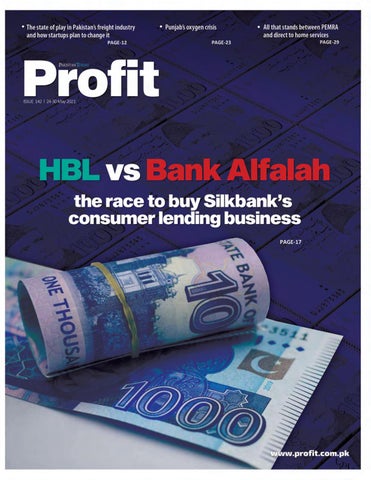
15 15 Don’t be so surprised, PSX: Image Pakistan is doing well 17 HBL vs Bank Alfalah: the race to buy Silkbank’s consumer lending business 23 Punjab’s oxygen crisis
27
27 A checklist for CMOs interested to export with Amazon Sehar Raothar 29 All that stands between PEMRA and direct to home services
Profit
33 Learning from history: How to protect Pakistan from Amazon’s antitrust practices Hamza Nizam Kazi
Executive Editor: Babar Nizami l Managing Editor: Farooq Tirmizi l Joint Editor: Yousaf Nizami Reporters: Ariba Shahid l Babar Khan Javed l Taimoor Hassan Abdullah Niazi l Meiryum Ali l Shahab Omer Regional Heads of Marketing: Muddasir Alam (Khi) l Zulfiqar Butt (Lhr) l Mudassir Iqbal (Isl) Layout: Rizwan Ahmad l Photographers: Zubair Mehfooz & Imran Gillani l Business, Economic & Financial news by 'Pakistan Today' Contact: profit@pakistantoday.com.pk
Readers Say The giant e-commerce store Amazon, just by marking Pakistan an approved seller, has done more than enough to uplift the consumer’s confidence. There is surely a flavor of intangibility in this whole take, but nevertheless, the savory aroma is already in the air. Apropos: Is Pakistan ready to unlock its export potential with Amazon? Muhammad Khurram Shabbir, Website Amazon is no one's friend, so don't be too excited about bringing another agressive US company to Pakistan. Instead of fawning over Amazon and its like, we should let local companies develop and flourish. This world is a dog eat dog place, and I want to see more of Pakistani companies striving to compete in the international marketplace and improve exports, not bring in more imports. I must say, the elite class of Pakistan are the worst enemies of Pakistan’s businesses as they only desire imported goods. Apropos: Is Pakistan ready to unlock its export potential with Amazon? Khalid Ahmed, Facebook
facebook.com/Profitpk twitter.com/Profitpk linkedin.com/showcase/13251020 profit.com.pk profit@pakistantoday.com.pk
HOW TO CONTACT
8
As one of the initial 500 users of Medialogic equipment installed on our TV set in late 2007, we were very impressed with how quickly and efficiently the company ran its system and fixed any equipment faults within a short time. We did not even have to complain about the fault, as the company noted the equipment was not giving feedback and proactively contacted us and fixed the fault. It made sense as the company’s revenues depended on the feedback of its limited user base for assigning ratings of channels & programmes. However, after a fault in the equipment in 2013 the company did not respond at all even after the fault was communicated to them, and the feedback system installed in our home stopped being functional. We assumed at the time that the Medialogic may have massively increased its sample size so maintenance of equipment would not be a priority anymore, and forgot about the whole thing and disconnected the equipment. However, based on news related to Medialogic during past 5 years and as per this article, the company’s sample size is still very low at 2,000 households (roughly 10,000 users if the average household has 5 users) among a population of over 200 million, and one can’t help but wonder about why Medialogic has kept its sample size so low, and why did it stop maintaining its equipment to ensure accurate feedback from the end-users? Perhaps the concerned authorities would do well to check the integrity of the 2,000 households, and ensure the feedback system is still intact, otherwise there is a risk that ratings may be fabricated as the feedback equipment may no longer be functional. Apropos: Medialogic and PEMRA go head to head in LHC over forensic audit Anonymous, Website
The whole issue has risen due to weak governance from the regulator ie PEMRA. The rules and regulations are openly flouted by most of the TV and print companies in the industry. The only time PEMRA seems to be interested is when there is some criticism of the judiciary or army. It is critical that PEMRA should play a more active role by limiting the trashy political talk shows which dominate every channel programming. Also it needs to immediately stop the vulgarness, especially on the morning TV shows & ramzan transmission 9 in the name of religion). It is also important that all TV channels should be required to provide daily prime time slots for public service / civic messages related to traffic, garbage dumping etc. Apropos: Medialogic and PEMRA go head to head in LHC over forensic audit Faisal Malik, Website An interesting report carried by @Profitpk shedding light on The mystery behind Pakistan’s abysmal ranking in the ease of doing business index. Apropos: Medialogic and PEMRA go head to head in LHC over forensic audit @mshabbirawan, Twitter This is an excellent venture. Most impressed. Will forward this article to all my groups. Definitely visiting your outlet. May you achieve success in all endeavours. Apropos: MNCs claim to care about the environment. Can this Pakistani startup convince them to walk the talk? Naheed S Mirza, Website This rebate is only plausible in-case the land ownership is digitized across the country. This will enable the tax authorities to know if any family owns a house or not, in-case of only relying on data related to the main breadwinner. Also people who earn through rent income should be taxed more, in-case there is another source of income available. Apropos: Renters should be given a taxbreak on their income. BS or not? Faisal, Website People who are filing tax returns and fall under the active taxpayer list should be given benefits such as a reduction in the 17 percent GST on electricity, gas, and telephone bills, which should instead be charged at only 10 percent. School fees paid by them for their children should also be exempted for taxable income. Purchasing of cars, houses, etc should also have benefits for taxpayers such as charging taxes at a lower rate to them. If benefits to be provided to taxpayers were more, people would come to tax system. Apropos: Renters should be given a tax-break on their income. BS or not? Owais Khan, Website
COMMENTS
IN BRIEF Rs575 billion:
The government on Wednesday raisedRs575.3 billion through the auction of treasury bills (T-bills). The rate was slightly changed from the previous auction held on May 5. The cutoff yield of six-months T-bills increased by 5 basis points to 7.60pc. The government raised the highest amount of Rs325.5bn through the auction of sixmonth T-bills.
“The Second Phase of Pakistan-China FTA (FTA-II) became operational on 1st January 2020. MOC is glad to share that during Jul-Apr 2021 our exports to China have increased by 31% to USD 1.951 Billion from USD 1.491 Billion in corresponding period last year.” Adviser to Prime Minister on Commerce and Investment Abdul Razak Dawood
Balochistan Mineral Exploration Company (BMEC) – a joint venture of the government of Balochistan and government of Pakistan and the concession holder of EL199 consisting of Reko diq and Tanjeel reserves – has received a proposal from the National Resources Private Limited (NRL) on unsolicited basis to develop and implement the Tanjeel reserves as a starter project, followed by development of the vast Reko diq area reserves. The National Accountability Bureau (NAB) has decided to investigate the Rawalpindi Ring Road Project over alleged corruption committed in the acquisition of land. NAB chairman Javed Iqbal has directed the bureau’s Rawalpindi branch to submit a report about the authenticity of the allegations after conducting an inquiry into the proposed project.
$3.8 billion:
A joint study of the ADB and WB has estimated Pakistan faces up to $3.8 billion in annual economic loss due to climate change if temperatures keep increasing, making it one of the top risk-prone countries in the world.
9
Industries and Production Minister Makhdoom Khusro Bakhtyar has said the government’s new auto-policy will focus on growth and development of the industry, and that the government would like to see an increased footprint of electric vehicles to improve the environment and to reduce oil import bill.
$2.8 billion:
Remittances by overseas Pakistanis continued to surge, rising to an all-time high of $2.8 billion in April, 56 per cent higher than a year ago, said the SBP. Cumulatively, during the July-April FY21 workers’ remittances rose to an unprecedented level of $24.2bn, up by 29pc, compared to the same period last year.
Chart malfunctions and the future of rotis this week in Pakistan’s business and economics twitterverse
T
his week, we look at differences of opinions. Different opinions are vital to healthy debate and are at the soul of the democratic process. So when there is a twitter debate about graphs and their interpretations, Profit is there to watch and observe so we can bring it to you every week. Along with differences of opinion, we look at kachra stocks and the future of the current account. Profit’s Ariba Shahid brings you the future of rotis, Pakistan’s livestock potential, sofas strapped on motorbikes, and more in this week’s social media roundup.
Prepare for the swarms
Agricultural country
For an agricultural country it’s important to talk about agriculture and make policies centric towards it considering the workforce employed. And no, that doesn’t mean adding a section to geography textbooks about how rich in minerals and natural resources Pakistan has. While Pakistan has its fair share of livestock, commercializing it is something it needs some help in. But before we get to that we need to make sure we bank on the right breeds for optimum output and returns. Agriculture is a science, it’s time we pick up pace. If we’re truly proud of being an agrarian economy, then we should put our money where our mouths are.
10
Tahir Abbas, Head of research at AHL, shares a report by his team expecting that Pakistan is going to hit the green spot for its current account for the fiscal year 2021. This is something we haven’t witnessed for a year or so. Our only question is, how many ministers are we going to see chanting this when it comes true. That isn’t a day we’re looking forward to.
Ugly charts are unacceptable
Everyday we see a chart and a chart enthusiast trying to explain it or force some pattern out of it. If you think about it very seriously, there is not that much of a difference between disciplines like literature and economics. The former try to force patterns out of texts and argue vehemently about what it means and what we should derive from it. The latter does the same thing, but with graphs and about numbers. Why then are all the jobs reserved for the economists when the literature crowd is so much cooler? You may agree or disagree with this assessment, and difference of opinion is something we encourage and uphold at Profit. And on all graphs being made and their analysis, we accept and indeed expect differences of opinion. There is one caveat however, and that is that the chart isn’t made on an obnoxious yellow background with big pictures pasted on it (hint hint, you know who we’re talking about). On that front, everyone should be in agreement. {Editor’s note: The defence of a literature degree may or may not have been added to this section by an editor with a literature degree}
Kachra
Kachra is a very subjective term. It could either mean stocks for underperforming companies, stocks that don’t give out generous dividends, or stocks you’ve lost out on and are holding grudges against. But the market really has a mind of its own and that said, sometimes you don’t need fundamentals to witness a rally. Sometimes all you need is luck. And if you don’t have luck, you could always resort to labeling the stock as kachra or wait patiently (hopefully not perpetually) for it to turn to gold.
Mr Bean moment
The future of rotis
Gas stove ovens are inefficient and waste tons of precious gas while you’re cooking. While we love it when our rotis inflate on the flame, Pakistan may need to think about going electric. The downsides of that are you might have trouble with your rotis. More importantly, you might have to just order out when there’s unscheduled load shedding and you’re just too hungry to wait. For a lot of people out there, even that may be a win. How will your parents insist that you eat ghar ka khana instead of ordering out when the ghar ka khana just cannot be eaten because there is no light to cook your rotis. In any case, if this shift does happen, we can already hear people from today’s generation telling their kids 30 years down the line “back in our days rotis were made on a gas stove and they’ve never been the same since.” Whether that’s the power of nostalgia or a genuine complaint we have yet to say.
Leave it to Pakistanis to find a creative solution to any problem. So far we’ve seen goats moved around on motorcycles. A sofa is a first for us. What really takes the prize here is how nonchalant the passenger is. Kind of reminds us of some of our locally manufactured cars that don’t have airbags or seat belts. It was also reminiscent of a legendary episode of Mr Bean, in which he attempts to steer a car while sitting on a sofa strapped on top of the hood. We wonder if that was part of the inspiration.
SOCIAL MEDIA ROUNDUP
By Taimoor Hassan
Y
ou need to be familiar with four stakeholders in Pakistan’s truck freight industry: shippers that want their goods to be transported to a destination within or outside a city in Pakistan; transporters that these shippers have to reach out to deliver these
12
goods; brokers that transporters reach out to get them these delivery orders in case they don’t have direct arrangements with shippers; and truck drivers that execute the deliveries. The hauling is year-round and these truckers are moving freight within the city and outside, doing short hauls and long hauls. “There is a fragmented ownership market. The way the demand side works is
that the big companies like Unilever, Packages Group or different industrial groups like Nishat, all have a criteria that small truckers will not be able to walk through the door and offer their services to them,” says Abid Butt, founder of TruckSher, a startup working on removing inefficiencies in the freight industry. In recent years, as the startup culture has grown in Pakistan, some have popped
We encountered numerous problems, one of which was that the brokers would be giving transporters less amounts to the transporters for delivering a full load, whereas the price decided with the shipper would be higher, simultaneously deducting commission from the transporter as well Umair Atta, founder of Freightfix
up in the freight industry as well. Profit takes a look at what the impact of these startups might be.
Trucking in Pakistan
B
y small truckers we mean ones that have a small fleet size. According to Abid, corporates are more likely to work with big fleet owners and transporters, leaving smaller ones in the lurch, and the industry predicament is that big transporters do not represent the entire market. In fact, they really have a bigger fleet because small truckers join these transporters for work. “Small truckers are substantial in number. They have two choices. As a single truck owner, he can go to large truck owners and associate himself with their fleets. Alternatively, he can become associated with a broker who would give him work.” In local parlance, brokers are essentially truck addas. If you have ever had a chance of moving goods within a city, and by goods we mean ones that are sizable enough to require a vehicle large, it is very unlikely that you would find them standing somewhere isolated on roads. They are usually concentrated at locations that we call addas. And it is here that they get the bulk of their work, through brokers. This works really well for big transporters. They have bigger fleets that now help them sign up with corporates and the double-whammy is that the small trucker has to give the transporter a cut for providing him loads. All this happens because of small truckers not having access to the big companies. “In terms of cash flows as well, if this big transporter needs to give the small trucker some kind of payment, instead of making full payments, these transporters make partial payments, creating disabling inefficiencies for small truckers” adds Abid. Conversely, there are small and medium sized businesses who do not really have the size and scale and smooth production cycles to warrant formal contracts, like big manufacturers have with transporters, to deliver
loads. Who do SMEs turn to in this case? The brokers, again, that are encumbered with inefficiencies. “Brokers work in an informal arrangement. There are brutal negotiations over rates that result in time delays,” says Umair Atta, founder and CEO of Freightix. “We encountered numerous problems, one of which was that the brokers would be giving transporters less amounts to the transporters for delivering a full load, whereas the price decided with the shipper would be higher, simultaneously deducting commission from the transporter as well.” According to estimates provided by TruckSher, there is also a North-South trade imbalance in Pakistan that results in 70% of the freight moving from South of Pakistan, mainly Karachi, to the North, and only 30% of the volume moving Southwards from upcountry. Consequently, the trucks that go North to deliver loads run the risk of returning without any load. It is for this reason that reverse loads would be less expensive for a transporter to deliver. For instance, if a lone trucker in Karachi, not affiliated with the fleet of a big transporter, manages to run a delivery for a small business to Lahore, might be returning back to Karachi empty because he did not simply have a reverse load booked. “It is a hit and miss for them if they get the reverse loads or not because on returning, there is less load and the supply is more and what rate trucker gets to deliver the load matters significantly for him,” adds Abid.
Enter Trucking Tech
T
he above arrangement, however, held when startups were not really a thing in Pakistan. Forward to the times when raising capital for startups appears to be a breeze, plenty of new entrants have sprang to remove the inefficiencies in the freight delivery ecosystem. Among the known ones which are also recent entrants are Trella that was launched in Egypt in 2019 started operations in Pakistan in
November last year, Karachi-based Truck It In that was also launched last year and raised $1.5 million in April this year. The most recent entrant is Karachi-based TruckSher, founded by Abid Butt, which was launched in February this year and raised an undisclosed seed round from Pakistani Venture Capital firm Sarmayacar in May. While Trella is naturally Egyptian, Truck It In has by far been able to gather the most hype after its funding announcement, followed by TruckSher that also now plans to go big after its recent round. But while both Truck It In and TruckSher are the pandemic startups, meaning they launched during the Covid-19 pandemic, Lahore-based Freightix, founded by Umair Atta, claims to be the pioneer that started digitising the freight industry back in 2017. Freightix is backed by Daewoo Express Pakistan and raised $2.25 million in April 2019 from Daewoo Express Pakistan and Sparklab Ventures, a Korean Venture Capital firm. The round was never announced. Freightix was founded by Atta in 2016, followed by incubation in the 8th cycle of the Punjab Government’s technology incubator Plan9, and was officially launched in 2017. The startup has since remained in stealth mode, claiming to have been busy building their customer base instead of buzzing the market with announcements. On the other hand, TruckSher was conceived by Abid Butt in October 2020 and launched in February 2021. Butt is a celebrated entrepreneur, with an MBA from INSEAD, and a Young Global Leader nominated by the World Economic Forum. He founded E2E Logistics Company in Karachi that he exited from, and which he says had as many as 300-350 trucks in its fleet in the heyday of the business. Atta, on the other hand is a software engineer with a family business in truck transport, whereas Truck It In founders are Careem alumni with main experience in tech and a different vertical of logistics, that is ride-hailing and last mile deliveries. Back to inefficiencies.
TRANSPORTATION
In terms of cash flows as well, if this big transporter needs to give the small trucker some kind of payment, instead of making full payments, these transporters make partial payments, creating disabling inefficiencies for small truckers Abid Butt, founder of TruckSher
The online platforms are deployed with the shippers, that are corporates and the SMEs, that can put in a detailed shipment order on the platform and push the job. On the back end, transporters are online that can accept the jobs and forward these to trucks in the fleet. Solo drivers can also accept the jobs without any transporters in between. The entire process simply makes it easier to get a job and that is simply virtuous for lone truckers. “If you have a platform where demand is mapped, supply is mapped, then it is much easier to find reverse loads than if you were just calling brokers up to find where the loads are, which is the traditional model for the truckers,” says Butt, elaborating on how technology platforms like TruckSher help truckers with securing timely reverse loads when travelling back after a delivery. The startups then have pricing mechanisms in place whereby truckers can bid for the jobs. This is common for both Freightix and TruckSher, except that TruckSher has more to offer in terms of pricing options for both shippers and carriers (transporters), making it more dynamic. “On the customer (shipper) side, we can have them agreeing for a rate that is fixed for a certain period or they can take rates from us on a daily basis. Or they can get truckers to bid for their business. Of course we won’t allow customers to do all three because then he will take the long term rates, and bid and see if he gets a lower bid and switch to that,” says Butt. On the vendor (trucker) side, fixed rate for a period is very rare as their business does not really run like that and they are more inclined towards negotiating rates on a daily basis. “Usually we negotiate the rates with them on a daily basis and then the loads are delivered at that price. Alternatively, we let them bid between themselves for the business.” “I think over time, we would head to the dynamic model completely like Uber where prices are not set and supply, demand and other factors. For instance, in trucking, we have holidays and vacations that would be considered as factors that would be affecting rates. On an hourly basis, some impact could be that certain sizes of trucks are not allowed into the
14
city during certain hours,” he adds. Now what about the drivers? According to Atta, there are accountability problems that arise on the driver’s end when delivering a load. There have been instances where the drivers delivering the loads would simply switch off their phones and there would be no information about the whereabouts of the cargo enroute to the delivery location. However, Freightix does not have anything solid to curb that except that they claim to have transporters that are credible enough and on board after thorough vetting. While that is certainly a welcome thing to do, TruckSher has been more innovative with technology on the platform and introduced real-time live-tracking of the cargo to eliminate the aforementioned risks and keeping a track of timely deliveries. TruckSher was in fact launched under a technology transfer from a regional player in the same space, the name of which the startup founder did not disclose. “We could build our own technology or bring technology from existing players and we thought that it would be better to use market-tested technology. It is already being used by a company that has a presence in many countries. We started working on it in October and took four to five months to customise the technology for use in Pakistan,” says Butt. Freightix’s technological evolution has been rather painful because the startup, before it launched in 2017, had to develop its own technology stack that was launched with the shippers initially followed by an application for the customers later. But according to Atta, the feature limitation of live tracking on their platform has to do with reluctance of transporters to use the internet and non-availability of internet along the long routes that they are hauling.
Reverse Disruption
E
ssentially, these startups are eliminating the brokers by creating a marketplace where the shippers and transporters can connect directly. And broadly, these startups are also disjointing the big transporters that include smaller
truckers in their fleet. Smaller ones would simply leave big transporters when smaller ones are able to get enough work through the online platforms like TruckSher and Freightix and they would not be required to pay commissions. To sum it up, the freight industry’s new order looks something like this: shippers want their goods delivered; transporters that deliver these goods and startups that are breaking transporters large fleets that shippers reach out to; startups that are gunning to eliminate brokers and connect the shippers with transporters directly, digitally; and drivers that execute the deliveries. The challenge, however, as candidly admitted by Freightix, is that big transporters have recognised that tech can be a problem solver. While they themselves have till now abhorred tech, their posterity and future owners of the business that have started getting involved in the business love tech and have degrees in tech, have recognised that tech is something that they can incorporate themselves as well in their business. Knowledge about technology is penetrating and a call to arms to stop disruption means that these transporters would use technology to create reverse disruption, creating similar apps to connect directly with businesses to move freight Being the crude businessmen that these transporters are, they are ready to expend resources to make these applications to cut out the startups and connect directly with shippers. After all, these startups are also an expense for transporters because startups make money in the form of variable commission charged to various stakeholders. “It’s best to cut the startups out, they [the transporters] believe. And they are ready to do it,” says Atta. But startups like Freightix are coming up with innovative ways to increase adoption of their platforms. For instance, Freightix offers loyalty programmes under which the company provides tyre replacement and fuel cards with discounts for transporters and concessions for vehicle maintenance like oil changes, in a bid to keep their platform from dying out. n
TRANSPORTATION
Don’t be so surprised, PSX:
Image Pakistan is doing well
Stock market investors seem to be taking a liking to embroidered lawn By Meiryum Ali
E
very week, Profit combs through the announcements on the Pakistan Stock Exchange (PSX) website for the benefits of our readers, in case we see an interesting development in some company. Invariably though, instead of seeing material developments, we see the same story over and over again: PSX asks a company why their stock price is shooting up. It is one of the interesting quirks of the PSX that it is somehow simultaneously a) a robust, well-performing stock exchange that consistently tops lists of stock exchanges in Asia, and b) has a long history of, for lack of better word, market manipulation. So , if a company’s stock price really increasing for a reason? Is someone just meddling? Who knows? It is almost endearing how the PSX expects that companies will give an actually honest answer to their ‘query’. One cannot
TEXTILE
begin to say how many times Profit has read the following sentence from companies, “We are at a loss to explain why such an activity of price movement is taking place.” This is an exceptionally pointless statement. One company, however, not only could explain why their stock price was increasing, but did so enthusiastically. Image Pakistan, formerly known as Tri-Star Polyester, was sent a letter by the PSX on May 5, asking them to explain their sudden rise. For context, since the beginning of this year, Image shares were sold at between the Rs8- Rs10 price range. Then, on March 4, it shot up to Rs11.96, then to Rs14 on March 19, then to Rs15 in the beginning of April. On May 6, it was trading at Rs16.97 - and as of May 18, it was trading at Rs18. Image Pakistan was categorical about why the increase is happening: “The increase in price or volume of traded security may be a result of growth and progress in the company’s business and of the above mentioned developments disclosed in the directors’ report
annexed to the periodic accounts.” And what growth and progress it has been. Think of Image Pakistan as the phoenix that has risen from the ashes of Tri-Star Polyester. We are not being dramatic: that is how the company has transformed itself. Image Pakistan Limited, formerly Tri-Star Polyester Limited, was incorporated in Pakistan as a public limited company in November 1990. The principal activity of the company is manufacturing and sale of polyester filament yarn and embroidered fabric. And the shalwar kameez line was started in 1993. That year is key: the 90s were the beginning of Pakistani brands making stitched clothes and offering high-quality unstitched lawn that varied according to season. No more buying any random kapra and spending hours at the tailor; the modern Pakistani woman, who worked and earned an income, could now afford to simply buy her clothes. Image, Generation, and TeeJays were the pioneers of this movement. This was only set to explode
15
in the 2000s and 2010s, with a variety of styles, price ranges, and material now available in the market. And it mirrored the increase in disposable income: the total number of women in Pakistan’s labour force – earning a wage outside the home – rose from just 8.2 million women in 1998 to an estimated 23.7 million by 2020, according to the Pakistan Bureau of Statistics. Intelligent brands were quick to capitalize on this rapid change in society. Except for Tri-Star Polyester. Get this: between 2011 and 2015, the company did not sell any clothes at all. In fact, in those years, the company made losses, including a particularly bad year in 2013, where the company made a loss of Rs113 million. What happened? The company was most probably negatively affected by the textile crisis of the early and mid 2010s, where the industry lost close to half a million jobs over two years. We say ‘most probably’, because actually very little can be ascertained, as Image Pakistan has gone out of its way to try and remove historical evidence of what happened. The last publicly available financial statement is the annual report of 2016, which said “the company’s commercial operations have been idle for many years...production remained suspended owing to unfavourable conditions and lower demand in the market, resulting in high production cost
16
and has not produced any material in the year.” The year 2016 is also when the company decided, enough was enough. First, it decided to ignore the polyester fabric aspect of its business, and go all in on its embroidered fabric business. In 2016, Tri-Star Polyester decided to invest in a Rs1.8 billion air looms project at its existing plant in SITE, Karachi. Then in 2017, it started operations to produce embroidered fabric for Image for stitched and unstitched fabric. In 2018, it took a Rs138 million loan from Al-Baraka bank (payable in 2022). And Image took off. The brand pivoted towards a floral and pastel aesthetic, backing it up with reasonable prices. It also invested in their separate pants section, which proved popular among young women. In the last five years, sales have shot up from Rs20 million, to Rs200 million in 2017, to Rs403 million in 2020. If one anualizes their 2021 results (its financial year ends in June), then the company is on track to make Rs843 million, its highest yet. Similarly, the company has managed to make a profit every year since 2016, and is on track to make Rs75 million in profit this year. The decision taken so many years ago prived so fruitful, that the company decided, to hell with the old name, and let’s rebrand as our most successful product: Image Pakistan. This is what the company also explained to PSX. It gave four reasons in its response to
the exchange on May 6: First, that according to the half-yearly accounts for the period ended 31st December, 2020, on-line sales continued to be the fastest growing channel. “We are confident to achieve a growth of 150% in sales from last year.” Second, in March 2021, the SECP approved a change in the name of the company to Image Pakistan Ltd. Third, the company opened an outlet in Islamabad, which received ‘tremendous’ response. Previously, the company had four branches in Karachi, and two in Lahore. Perhaps most importantly, in the last quarterly report ending March 31, the company is now planning on expanding into perfumes and Halal cosmetics. This was done in order to “capitalise on the growth potential in terms of both sale volume and brand value as well as ensure sustainability of the growth in business.” In doing so, Image is following in the footsteps of brands like Khaadi, which partnered with organic skincare brand Co-natural to produce its own skincare and perfumes. Just five years ago, no one would have predicted that the Tri-Star Polyester would be venturing into the world of halal cosmetics. And yet, here we are: with robust sales, healthy profit, and a brand identity that has literally enveloped the company itself. No wonder they are rushing to tell the exchange. n
TEXTILE
COVER STORY
17
I
By Meiryum Ali
t is not often that a small bank puts up a portion of its lending portfolio for sale in Pakistan. It is even rarer for that to happen and for it to matter to the broader banking industry’s competitive dynamics, but that is exactly what is happening with the announcement that Silkbank is selling its consumer lending portfolio, and that the leading contenders, at least at the moment, are Habib Bank Ltd (HBL) and Bank Alfalah. In a press release issued on May 3, the bank announced that the two much larger banks are interested in acquiring Silkbank’s consumer lending portfolio, which is made up of credit cards, running finances, and personal installment loans. “The Silkbank Board of Directors has requested the State Bank of Pakistan to grant permission to both HBL and Bank Alfalah to conduct due diligence of the Silkbank Consumer Accounts portfolio prior to its possible acquisition by either of these banking entities,” the bank said in its press release. As of the close of 2019, the most recent period for which Silkbank’s detailed financial data is available, the consumer lending portfolio at the bank stood at Rs23 billion. In the grand scheme of the Pakistani financial services sector, that is hardly anything, accounting for just 2.6% of the industry’s total consumer lending. But it matters for three reasons. Firstly, the portfolio consists of a high margin credit card business that has a relatively low default rate, by Pakistani banking standards. Secondly, Silkbank has consistently been one of the leading consumer-facing lending banks in Pakistan, so a sale of its consumer lending portfolio represents a significant shift in the bank’s strategy. And finally, the two banks leading the charge to buy it are interesting contenders. Which one of them ends up buying it could mean some very interesting things for the shape of competition in consumer finance in Pakistan. One additional caveat for this story: Silkbank has had some struggles with profitability
[The sale] can help Alfalah further grow its consumer business as they already focus a lot on this segment Faizan Kamran, research analyst at Arif Habib Ltd
and growth in recent years, and those will be the subject of a future in-depth feature about the bank. This story, however, will focus more on how it has built this attractive asset and what its sale would mean for the broader banking industry in Pakistan.
Tarin, consumer banking, and the making of Silkbank
T
he most important thing to know about Silkbank is the one thing everyone already knows about it: it was founded by former – and now again current – Finance Minister Shaukat Tarin. To understand what the bank does well, and why its consumer lending has been a strong competitive advantage for the bank, one needs to understand Tarin’s professional history. Tarin is by now a legend in the world of Pakistani finance, but his specific achievements are relevant to understanding how he has been able to build up Silkbank. Shaukat Tarin was born in Multan to an Army family and grew up in cantonments across Pakistan. He completed an MBA from the University of Punjab, and almost immediately began a banking career in 1975, joining Citibank in Pakistan, rising through the ranks of the New York-based global financial institution in both
Pakistan and abroad. Among the stints that Tarin had in Pakistan was leading a legendary team at Citibank that practically invented consumer finance in the country, introducing credit cards and personal loans and vastly expanding the scope of mortgage lending and auto lending in Pakistan. After 22 years at Citibank, he was tapped by the government of Pakistan in 1997 to lead the restructuring of Habib Bank, then a state-owned basket-case of a bank that had a balance sheet with more holes than a block of Swiss cheese. Over the next three years, Tarin surgically repaired the bank’s balance sheet and got it on a footing that allowed the government of Pakistan to be able to privatise it for a profit rather than having to give it away for free, which is what they did with Allied Bank. He then joined Union Bank as its CEO, brought on and given a 5% equity stake in the bank. This was the heyday of the Musharraf-era boom in consumer lending, and Tarin used every ounce of his Citibank skills to make Union Bank into a consumer banking powerhouse. It was that prowess with consumer finance that made it an attractive asset for Standard Chartered Bank, which bought Union Bank in 2005 for Rs29.4 billion ($490 million). In short, Tarin knows consumer finance in Pakistan probably better than anybody. So when he took over Silkbank, it was always going to be a key part of his strategy.
Bank Alfalah and HBL are also two of the leading banks in the merchant acquisition business, meaning The creation of they give out credit card processing machines to Silkbank ilkbank began life in 1994, as the Prudential Commercial Bank, before being merchants and process their payments for them, acquired by the Saudi Pak Industrial a highly lucrative and rapidly growing business in and Agricultural Investment Company (SAPICO) in 2001, which gave the bank a new Pakistan. If they were to begin competing in the name: Saudi Pak Commercial Bank. Shortly card issuance business - in addition to their already afterwards in 2008, the bank was bought yet by a consortium of individuals, including cutthroat competition in the card processing business again, Tarin. The acquisition of Saudi Pak Bank was - that could mean good things for both businesses and supposed to be a continuation of Tarin’s succonsumers that rely on credit and debit card payments cessful streak as a bank executive. One can hard-
S
18
ly blame him for wanting to keep going. He was just 53 at the time he successfully exited Union Bank, having already knocked it out of the park with CItibank, and Habib Bank before that. Why would he want to slow down now? Tarin was able to put together that consortium, led by Japanese investment banking giant Nomura, to acquire Saudi Pak Bank. Timing, however, was not on Tarin’s side, and by that, we do not just mean the fact that the transaction happened right before the 2008 financial crisis (though, of course, that probably did not help). The Saudi Pak acquisition closed on April 1, 2008. Almost exactly six months later, on October 8, Tarin was appointed federal finance minister by President Asif Ali Zardari at a crucial time in Pakistani economic history. In other words, Tarin was not able to take charge of his own bank, and left his brother Azmat Tarin as CEO. Of course, the investors who had backed Tarin were very unhappy about not having him at the helm of the bank they had just helped him acquire and so Tarin stayed in the finance minister job for only 16 months, despite being universally regarded as having done a good job, having shepherded through the negotiations on the transformative 7th National Finance Commission Award and the financial components of the 18th Amendment to the Constitution. The consortium that owned the bank,
meanwhile, changed composition. In 2015, the Arif Habib Group acquired a stake. According to Silkbank’s latest annual report for the year ending December 2019, around 62.39% of the bank’s shares are held by the consortium that has management control. That consortium today consists of the Arif Habib Group, which holds 28.23% of the bank, Shaukat Tarin (who holds 11.5%), the International Finance Corporation (which holds 7.74%), Zulqurnain Nawaz Chattha (one of the owners of Gourmet Foods, who holds 7.47%), Nomura European Investment Ltd (3.93%) and Bank Muscat, which holds 3.48% of Silkbank’s shares. Between 2008 and 2020, the bank’s CEO was Azmat Tarin, Shaukat Tarin’s younger brother. He was replaced in August 2020 by Shahram Raza Bakhtiari, the head of retail banking at Silkbank. The bank is presently headed by Nabeel Anjum Malik, who is the acting president and CEO, while Bakhtiari waits for approval from the central bank.
Consumer lending prowess
A
s we stated above, Silkbank has had its fair share of challenges. What is undeniable, however, is the bank’s prowess in consumer lending.
As of September 30, 2020, the latest period for which the bank has released financial statements, Silkbank had issued 163,496 credit cards, one of the largest credit card businesses in the country, with balances of around Rs5.4 billion. You might think credit card balances of Rs5.4 billion is not much as an asset, but consider this: credit cards frequently have interest rates north of 30%, meaning that the bank is frequently earning a net interest margin in the range of 15-20% on them. On Rs5.4 billion, that would amount to as much as Rs1.1 billion in revenue for the bank. And this is a growing business for Silkbank. It booked an additional 72,000 accounts in 2019, with roughly 16,000 readyline accounts, 11,000 installment loan accounts, and 45,150 fresh credit cards. The total ENR (ending net receivable, also defined as the total money owed to a company by its customers minus the money owed that will likely never be paid) increased to Rs20 billion for consumer banking. According to the bank, that gave it a 38% market share among comparable banks. Its credit card activation rate jumped from 83% to 87% (which according to the bank is the highest activation rate in the industry). The credit card utilization rate
COVER STORY
also increased from 27% to 31%, while retail spending on credit cards jumped 28% yearon-year to Rs28.3 billion. In other words, people are not just applying for Silkbank credit cards: they are activating them and then actually using them for spending. Silkbank clearly put a lot of effort into innovation: for instance, it kickstarted a free gymnasium program for Silkbank platinum credit card holders. It relaunched a 5-year loan, 4-year markup scheme in personal loans on media. And it revamped and added additional features to its ready line business (credit for emergency needs). The bank seemed quite set on maintaining its edge in consumer banking, despite the bank’s other difficulties. For instance, in the annual report of 2019, the bank said that it wanted to reduce the real estate portfolio, close loss-making branches, and increase consumer loans, in order to improve CAR. And even in the financials for the nine month period ending September 2020, the bank said that it wanted to dispose of Other Real Estate Owned (OREO) assets, and use the proceeds to further grow its consumer banking segment. We cannot emphasise this enough: it
20
is unheard of for Pakistani banks to be this interested in their consumer lending business. Ever since the crash of 2008, the banking sector had effectively sworn off consumer lending, like the hard-charging party-boy who wakes up after blacking out the night before and promises to never drink again… and then actually goes ahead and quits drinking. And, here is what makes it even more interesting: Silkbank has managed to contain its bad loans in the consumer lending space to a relatively low level. As of the end of 2019, the bank’s infection ratio in its consumer lending business – the proportion of its loans that were in default – was just 6.1%. That may be high by developed market standards, but it is very low for Pakistani consumer finance. But it gets better: Silkbank’s consumer lending portfolio has a lower default rate than its overall lending portfolio. And this has been true for almost the entirety of the bank’s history, and most of the time since Tarin took over the bank. This is truly extraordinary because it means that the bank is better at lending to Pakistani consumers than it is at lending to Pakistani businesses. That is practically unheard of. Nearly 22% of the bank’s lending
is to consumers, and with those kinds of default rates and net interest margins, one can see why the bank is so enamoured with its consumer finance business. According to Shankar Talreja, deputy head of research at Topline Securities, Silkbank is known to be an outlier when it comes to consumer banking. Talreja is not wrong. Profit analysed the numbers, and Silkbank has the third-highest concentration of consumer finance in its lending portfolio among all banks in the country, with only Albaraka Bank Pakistan and BankIslami Pakistan being higher. And Islamic banks are generally forced into consumer lending by virtue of the relatively scarce supply of Shariah-compliant government bonds for them to invest in.
Why is Silkbank selling its consumer business?
W
hich makes the potential sale of its darling segment all the more interesting. As the notice said, “The potential
sale of its portfolio will allow Silkbank to strengthen its Capital Adequacy Ratio (CAR), rebuild profitability and enhance value for all stakeholders.” Silkbank has had an unusually bad run of defaults on its other lending book and needs the money to shore up its capital reserves, which have been below the levels required by the State Bank of Pakistan for some time now. Now, why is this important? Silkbank stressed to the PSX – and by extension, everyone worried about this bank’s future – “The potential sale of its portfolio will allow Silkbank to strengthen its Capital Adequacy Ratio (CAR), rebuild profitability and enhance value for all stakeholders.” Then, Silkbank went on to say that its ‘focus on individual customers’ is reflected by the fact that the bank had “retained its market share and is one of the leading personal loans and credit card issuers in the market.”
Why who wins this asset matters
T
he first contender is HBL, which already has a well developed consumer banking segment, which is the second-largest one in the industry, behind only National Bank’s state-mandated consumer lending portfolio. As of December 31, 2020, Habib Bank had Rs106 billion on gross consumer loans outstanding, or about 8% of its total lending book. The next contender is Bank Alfalah, which is narrowly in fourth place in terms of consumer lending, with a Rs67 billion portfolio as of the end of 2020, representing 11.1% of its lending book. Whether it is HBL that wins the bidding war or Bank Alfalah will mean very different things for the consumer finance space in Pakistan. There is debate among analysts as to what would be Habib Bank’s goals with this acquisition. Some analysts said that the sale of the portfolio would enhance HBL overall consumer segment exposure and its profitability; others argued that the portfolio would be negligible to HBL’s total assets. Either
way, as HBL’s own annual report pointed out, there has been an uptick in e-commerce in Pakistan overall, and especially more so in the pandemic, and thus more credit cards are being used. An expanded consumer portfolio would be able to take advantage of that trend in consumer spending. Indeed, just this month, HBL became the first bank in Pakistan to allow automatic approval for e-commerce transactions on credit and debit cards on its network, meaning that
Its credit card activation rate jumped from 83% to 87% (which according to the bank is the highest activation rate in the industry). The credit card utilization rate also increased from 27% to 31%, while retail spending on credit cards jumped 28% year-onyear to Rs28.3 billion. In other words, people are not just applying for Silkbank credit cards: they are activating them and then actually using them for spending
consumers no longer need to call Habib Bank to ask for their credit cards or debit cards to be authorised to be used online. And HBL has been growing its consumer business. In 2020, the consumer banking business grew by 25% to Rs75 billion, despite the disruption caused by the pandemic. Of that, personal loans remained the largest product, at 50% of the total consumer lending portfolio. Auto loans in particular grew by 52% in 2020, with HBL’s market position in this real, jumping from fourth to second. And HBL’s credit card business grew by 22%, and total spending on those cards increased by 12% from 2019. What about our second contender, Bank Alfalah? The logic behind Bank Alfalah seeking to enter this space is obvious: Bank Alfalah began its life in Pakistan as a consumer-focused bank, something it had to shed since 2008, but an attribute that is still baked into the bank’s DNA. That it is the fourth largest consumer bank in the country is likely something that the Bank Alfalah management
COVER STORY
wants to remedy in a hurry. If they were able to buy out the portfolio, it would make them the third largest consumer lender in Pakistan, and only narrowly behind HBL, meaning the competition between Bank Alfalah and HBL in the consumer lending space would heat up considerably. Incidentally, Bank Alfalah and HBL are also two of the leading banks in the merchant acquisition business, meaning they give out credit card processing machines to merchants and process their payments for them, a highly lucrative and rapidly growing business in Pakistan. If they were to begin competing in the card issuance business - in addition to their already cutthroat competition in the card processing business - that could mean good things for both businesses and consumers that rely on credit and debit card payments. According to Faizan Kamran, research analyst at Arif Habib Ltd, an investment bank, Bank Alfalah is known to have a strong asset quality. “[The sale] can help Alfalah further grow its consumer business as they already focus a lot on this segment,” he said. And the annual report’s future outlook did mention this: “We will work hard to regain and grow our market share in low cost deposits, consumer products and SME financing.”
Boon to electronic payments?
D
espite the attempts to build noncard-based payment methods, the most common form of electronic transactions remains the use of credit and debit cards online. If HBL wins this auction and becomes the dominant card issuer, while already being the biggest merchant acquirer in the country, that will make it very difficult for other banks to compete in this space, meaning that the incentive to promote the use of credit and debit cards among both consumers as users and businesses as acceptors will diminish. If, however, Bank Alfalah wins the auction for Silkbank’s card business, it will become more of an even rival with HBL, and will force its bigger rival to spend more resources in competing for both the merchant acquisition business as well as the card issuance business. For businesses looking to accept credit cards, that could mean lower transaction fees. And for individuals, that could mean more discounts and incentives to use their cards. Both of those could speed up the adoption of electronic payments, and therefore increase the pace of growth for e-commerce in Pakistan, already being accelerated by the coronavirus pandemic. In short, this battle for Silkbank’s credit card business could mean
22
big things for the e-commerce industry in the country, as well as the domestically focused consumer-facing tech industry more broadly.
At what price?
G
ood question: just about nobody knows what the exact valuation of the consumer portfolio will be. There is some historical precedent to an acquisition of a consumer portfolio: Citibank. The story has a number of coincidences. For one, Citibank was also run by Shaukat Tarin in the 1990s. And secondly, both HBL and Bank Alfalah applied for due diligence regarding the consumer portfolio – just as in this case. Here’s what happened: as an American bank, Citibank was badly hit by the US financial crisis of 2008. Subsequently, Citibank Pakistan suffered: in 2007, the bank’s infection ratio was just 2.1%, but by 2010, the infection ratio was 21%, and peaked in 2012 at 25.4%. To counter this, Citibank decided to sell off its portfolios. In 2009, the bank sold off
its mortgage lending portfolio to BankIslami Pakistan. Then, in November 2012, it decided to sell off its credit card and consumer lending portfolio to HBL, a transaction was approved in February 2013. At the time, Citibank closed 12 of its 15 branches in the country. The consumer portfolio was bought for Rs1.9 billion (net of specific provision) at the time. According to the 2012 annual report of Citibank Pakistan, the bank’s gross advances stood at Rs24.4 billion, of which Rs4.5 billion fell under consumer and SME classification. Here’s the crucial takeaway from the Citibank story: it worked. The bank was able to focus on corporate and investment banking, and saw its profits climb to pre-2008 levels again. As of 2019, nearly 80% of Pakistan’s multinational companies bank with Citibank. Will Silkbank be similarly able to recover? It is not a bank that traditionally has focused on corporate banking – in fact, its entire shtick has been consumer banking. And with that portfolio gone, it will be interesting to see how the bank manages to reinvent itself, and turn a new leaf – if it can. n
COVER STORY
A
By Shahab Omar
s the Covid-19 crisis escalated in India over the past few weeks, there began to trickle in harrowing images and videos of people unable to get medical assistance. The reason this global pandemic has halted life as badly as it has is not because Covid-19 is a particularly deadly virus, but because it is extremely infectious. While most people do only get minor symptoms that can be treated at home, so many people get it so quickly that the people that do need medical attention are enough to overwhelm even the best and most
HEALTH
23
sophisticated healthcare systems in the world. That is why social distancing and masks are so important, so that the spread of the virus slows down and healthcare systems can cope with the influx of new patients while still dealing with all of the other healthcare needs that people have. In Pakistan, the fear was that an already crumbling health infrastructure would collapse under the burden. But Pakistan remained lucky, perhaps due to a young population, and while hospitals came to full capacity in each wave they were never completely overwhelmed and overpowered. Looking at the third wave in India, however, was a cause for anxiety in Pakistan where people began to worry about the third wave finally overpowering the healthcare system. Tensions grew higher when it started being reported that oxygen tanks and ventilators were almost at capacity with more than 90% gone. Covid-19 causes serious respiratory symptoms when the virus attacks the lungs. Air consists of 21% oxygen, and the remaining gases are a combination of Nitrogen and noble gases. This 21% oxygen is enough for healthy lungs, but with limited lung function caused by Covid-19, the lungs need medical grade oxygen. This has been known about Covid-19 from the very beginning, so when reports started arriving that more than a year into the pandemic Punjab was facing an oxygen shortage, questions were raised about what the government has been doing since the pandemic started. According to an official of Primary and Secondary Healthcare Department (P&SHD) Punjab, from the onset of the first Covid wave it was obvious that the demand in oxygen was set to increase in proportion with infections. “There was a shortage in supply of oxygen leading the authorities to consider alternate options to meet the demand. The health authorities in Punjab Govt pondered upon the idea of making hospitals self-sufficient by installing oxygen generation plants across the health facilities to cater for the increased demand,” said the official. “The major suppliers of oxygen gases engaged with the Secretary specialized healthcare Punjab and assured him of an increase in production in an attempt to offset the
concerns of a possible catastrophe resulting from lack of supply to hospitals. However, based on the assurances, the health secretariat scrapped the project of oxygen generation plants. During this time the positivity ratio dropped as well easing the woes of officials albeit temporarily,” he said. This is essentially where things went wrong. When the initial force of the pandemic was blunted, the Punjab government stopped procuring oxygen to try and shore up the province’s capacity. Then, when Covid-19 hit again in March 2021 with mutated versions of the virus, they were caught unaware.
Dires straits
“T
he mutated virus has evolved to be far more infectious with enhanced ability of transmission and accelerated pulmonary damage requiring oxygen therapy during early stages of hospitalization. This is exactly what is being witnessed in India. The run up to increased infections caught the authorities completely off guard not being able to withstand the surge in demand and to plug the gap in supplies,” explains another source at the health department. And after looking at what was happening in India, the concerns were increasing. India is far more industrialized, ranked as second largest steel producer, steel industry being one of the major consumers of oxygen other than medical use, and even India could not cope up with shortage of oxygen despite cutting off supply to the steel industry. “Pakistan shares a lot in common with India considering the socio economic and cultural similarities, dense population with the general population being naïve of the lethality of Covid. It is just a matter of time until the Indian variant gets introduced in Pakistan leading to a snowball effect in resurgence of Covid cases,” says the source. The official informed that it was just recently that the authorities realized that the storm of a third wave was just at the doorstep and Pakistan may soon start reeling with Covid wave similar to India. “It seems that
This is essentially where things went wrong. When the initial force of the pandemic was blunted, the Punjab government stopped procuring oxygen to try and shore up the province’s capacity. Then, when Covid-19 hit again in March 2021 with mutated versions of the virus, they were caught unaware 24
the government only took heed based on the political repercussions that the third wave meant for the BJP Government. The Sindh government claimed to have approved Rs1 billion for the revival of a faulty oxygen plant of Pakistan steel mill. Restoration of a faulty oxygen generation unit well over and beyond its operational life being 40 years old does not make sense.” “Since restoring the plant requires engineering and parts from the local representative of the same manufacturer will provide the liberty to charge the desired amount for repairs. There is no guarantee on operational capability and assurance on how long would the repairs last post maintenance. Another question arises on doing the cost benefit analysis of restoring the plant vs investing the same amount in procurement of oxygen generation plants enabling hospitals to produce onsite oxygen.”. The official added that Punjab, on the other hand, took the initiative back in July 2020 of moving forth with procurement of 15 oxygen generation plants via Project Management Unit under the Punjab health department. However, the project was scrapped and never proceeded as according to the PSH&MED, the oxygen suppliers assured of increase in production downplaying the possibility of shortage. It was only until recently that the panic bells rang as the producers of oxygen voiced their concerns that they may not be able to meet the supply. The Project Management Unit under Punjab health department intended to proceed with the tender last year for DHQ hospitals all across Punjab, but the project was scrapped once the Covid cases subsided. It was also due to this reason that gas companies assured the Govt that there will be no shortage of oxygen. This statement was based on a conflict of interest as the gas companies never want the health institutes to become self-sufficient..
Emergency measures
H
owever, according to the official, the PSH&MED floated an emergency tender for procurement of 10 large oxygen generation units tender on emergency basis. The tender was called on the 7th of May on a Friday afternoon calling for bid submission by the following Monday on 10th May, making this the government’s over the weekend plea to get ahead of the shortage. “This allowed for a very narrow window for the bidders to submit bids. Upon reviewing the bidding documents it was noticed that the department issued a premium to bidders for early supply.The current tender is for 10 oxygen generation units , each with a capacity
“The government has installed an oxygen unit at Jinnah Hospital. However, the transparency of the said tender will also be closely monitored and all procurement will be in accordance with the PPRA rules and rates. Dr Yasmin Rashid, health minister Punjab
of 1000 litres per min. Combined output will be 10,000 litres per min , in simplified terms , enough oxygen to support 1,000 Covid patients as the oxygen requirement of a Covid patient is between 8 litres to 12 litres per min, depending on severity of disease. The allocated budget for the oxygen generation plants by PSH&MED is RS 600 million for 10 units of 1000 litre / min,” they said. The question arises as to whether the tender issued by the PSH&MED includes vendors that are experienced and able to deliver on time or it is going to be the traditional thing to give tenders to the blue-eyed companies and take kickbacks in return. Health department officials that Profit spoke to said that an investigation had been conducted on such accusations, and that it had been revealed that some blue eyed companies that have no previous experience of supplying oxygen generation plants are also being considered for qualification. Another source said that in fact there are no figures yet to estimate how much oxygen Punjab has or how much oxygen it may need in the future, meaning basic research has still not been conducted but these firms got contracts over the weekend. “There is no gauge to determine the insufficiency of oxygen, how-
ever the publicly available statements from the Govt that all oxygen produced was being diverted from the industry to health facilities and the gap between overall consumption and production was at 10% is of great concern.” “In case of further upsurge of cases the consumption will outpace the production paving way for scenes being witnessed in India. However, this time too the tender is going to be awarded to the companies that are favoured by people in power, even though they have no experience. Having gone through multiple technical evaluation reports uploaded on PPRA’s websites it was observed that a local past performance and reference was mandatory for products such as an ECG machine and blood pressure monitor. However, procurement of a mission critical system such as an oxygen generator system no past performance criteria or references were made mandatory,” he revealed. The source further revealed that it seemed the committee formed for evaluation of the bidders was pushing for competition between two selected firms. “This would justify the grounds of price based competition and tender will be awarded to the so called ‘lowest bidder’,” they said. When asked how it would be possible that those two firms will collude
for an engineered outcome he replied with an example of a recent tender in Wazirabad Institute of Cardiology for Modular Operation Theatre. “This is mostly done via creating specifications which no other firm can fulfill , or creating a package of various equipment so that only two firms can participate and qualify. The tender goes to the “lowest”. The high profit over and above market price are split between the two or the losing firm is given an opportunity to win in the next tender. The specs in the tender of Wazirabad Institute of Cardiology for Modular Operation Theatre were prepared so that only two firms were able to offer the desired equipment combination of heart lung machine and modular operation theaters. Both firms were technically qualified leading to financial opening and the price was well over and above the estimated budget. When our research team search the reports of tenders on various public sector online portals it was observed that there are at least 4 vendors of heart lung system and 5 offering modular operation theaters, however only two vendors were able to offer the required combination of heart lung machine and modular operation theatre for tender in Wazirabad Institute of Cardiology. We did
HEALTH
some online research to determine the price of a heart lung system and our search from the import database of India Zauba revealed the price of heart lung machine to be 85,000 USD whereas the quoted price of the lowest bidder for Wazirabad Institute of Cardiology is 180,000 USD. The issue of misprocurement within the health sector has been overlooked and completely unabated without due checks and balances. Vendors who are part of the procurement being aware of malpractices hesitate raising their voice due to the backlash from the procuring authorities. The others involved in the procurement process have vested financial interest. Usually, the people at the institute level are biomedical engineers, and end-users at secretariat level and the committee of end users. This is often a handpicked group of advocates of those firms.”
The possible consequences
W
arning about the tender going into the hands of inexperienced people and its ill effects, the source said that the oxygen generation plant being specialised equipment which needs to operate 24/7, oxygen to covid patients is what water is to a fish. Inexperienced firms and manufacturers with a poor track record or who have been in the trade for less than a decade are still in the process of improving their R&D to come with better versions of their product. This implies that they are more prone to faults and frequent maintenance delays. If experienced firms will be honing their skills over a mega project of 10 installations, this could lead to delays in commissioning poor after-sales support due to lack of experience, false sense of security to the institutes that their oxygen needs will be fulfilled. “Will you be comfortable being on a transatlantic flight on a plane manufactured by someone who has been in this business for less than a decade and being flown by a pilot who just received his commercial license. In such a technical and sensitive procurement the authorities shall follow cost quality criteria set forth by PPRA. In case it is not possible for the procuring authority to float another tender due to lack of time , they should exercise due diligence in vetting the past performance of manufacture as well as that of the local distributor,” said the source. According to an official within the health department the best way to mitigate the crisis of oxygen shortage is to equip the hospitals with oxygen generation plants. “Based on the global events and forecasts it was written on the wall that Pakistan will soon face an oxygen shortage. The Govern-
26
The official added that Punjab, on the other hand, took the initiative back in July 2020 of moving forth with procurement of 15 oxygen generation plants via Project Management Unit under the Punjab health department. However, the project was scrapped and never proceeded as according to the PSH&MED, the oxygen suppliers assured of increase in production downplaying the possibility of shortage ment should have proceeded with procurement of oxygen plants last year instead of scrapping the project. As per situation now, the leading manufacturers are inundated with orders from South Asian countries , primarily India. This has left the health department not with many options but to relax the procurement criteria. It may be the case that the order be placed to vendors with no past experience and lowest rates. Placing the order may be one thing but the ability, knowledge and the technical experience matters the most when it comes to installation, commissioning and post-sales support. Preference shall be given to firms who have a proven track and successful installations.” In addition to this, oxygen generation units are able to pay off the costs within a span of 2 to 3.5 years hence it is an investment worth making even once the pandemic is over. There are some successful installations of oxygen generation plants in hospitals like Rawalpindi Institute of Cardiology and Bahawalpur Victoria Hospital. “Typically health procurement in Punjab has been marred with controversy with allegations of awarding contracts to a selected few and “blue eyed” firms. We doubtfully anticipate that this procurement to the tune of Rs600 million will be transparent. The bid evaluation report for the emergency tender uploaded the following day was rather in line with the overall perception of procurement. None of the 18 participating firms were technically qualified, even the ones with a well established track record of oxygen generation plants were disqualified on unjustified grounds. Based on the global events and forecasts it was written on the wall that Pakistan will soon face oxygen shortage.” As per the situation now, the leading manufacturers are inundated with orders from South Asian countries, primarily India. This has left the health department not with many options but to relax the procurement criteria. It may be the case that the order be placed to vendors with no past experience and lowest rates. Placing the order may be one thing
but the ability, knowledge and the technical experience matters the most when it comes to installation, commissioning and post-sales support. Preference shall be given to firms who have a proven track and successful installations. According to a vendor who participated in the bidding process and did not want to be named, this was being done to facilitate the “ favorites”. The vendor further added that if it is an emergency tender then the qualification criteria shall be based on vendors with past performance on oxygen generation systems. “Procurement is part of the answer to the problem, the expertise to install, commission and train the institutes on use of the system is a key factor being overlooked. From the overall synopses of events and “past performance” of the procurement authorities within Punjab health there is little hope that this critical procurement in times of crises will be performed on the basis of due merit,” they said. On the other hand, Punjab Health Minister Dr Yasmeen Rashid told Profit that it is not at all the case that such an important tender falls into the hands of an inexperienced firm or any purchase is made at a price higher than the market price or out of merit. “The decision to procure oxygen has been made at the government level and this procurement is being done not only through the PSH&MED but also through the primary and secondary healthcare department. The Punjab government has allocated funds for the purchase of oxygen and no delay will be tolerated,” she said. “The government has installed an oxygen unit at Jinnah Hospital. However, the transparency of the said tender will also be closely monitored and all procurement will be in accordance with the PPRA rules and rates. Procurement has started at the government level. Technical teams have been formed in the department for the said tender which will look after the entire process in a transparent manner. The company/firm who is technically sound and completes all the SOPs will be awarded the tender.” n
HEALTH
OPINION
Sehar Raothar
A checklist for CMOs interested to export with Amazon
T
he advertising industry in Pakistan is shifting focus to digital marketing in eCommerce, transforming the retail industry, and the way in which sellers need to think about their retail marketing strategies. These days, a savvy and forward-thinking digital marketing strategy is crucial to the success of any retail business – because it is very likely that they have an online presence – especially globally with worldwide shipment processes aligned and enabled. What the inclusion of Pakistan on the Amazon sellers list does is vastly facilitate sellers with easier payment terms and processes which makes it easy for different countries to access Pakistani products and not worry about credibility or uncertainty of timely shipment. Digital marketing allows local sellers to reach new customers on Amazon, and in order to catch on to the latest trend, advertising agencies have to focus on these digital marketing strategies and the media industry has to keep a higher percentage of their media budget on digital medium for the brands that will now become sellers on Amazon and serve globally. At least 80% of digital marketers working in the advertising industry think Facebook is an effective use of resources for small busi-
Sehar Raothar leads strategy for the BL Group Of Companies and can be reached on sehar. raothar@gmail.com
COMMENT
In a constantly changing and increasingly competitive environment, we will need to make more effort to grow a seller’s online sales; especially in an untapped global territory. For many sellers and even advertisers, this is the biggest reason why revenue goals aren’t met.
nesses, and it’s easy to see why: social media marketing and paid search have allowed retail sellers to reach more customers than ever before. While previously the advertising industry would need to rely on persuading customers to go to their clients’ physical store locations as a basis for their marketing efforts, today customer geography is spread out over a much wider area, and now with Amazon, even on a global scale. Because the pool of potential customers is larger, there’s also a need for more precise targeting via channels such as paid search and social media to ensure leads are of high quality. Advertisers and sellers should always put the customer first. The proliferation of eCommerce trading means that customers can more easily shop around to find the best value. With customer loyalty and repeat business being harder to obtain, ATL agencies need to be smarter in utilizing channels such as social media to directly connect with customers and provide personalized responses and service – therefore the advertising industry needs to have an IMC approach for all their campaign ideas. This means there should not be segregation of ATL/BTL and digital; every agency should offer fluid services to give meaning to the seller’s brand’s unique selling proposition. A customers’ purchasing behavior is also being driven less by advertising and more by word-of-mouth recommendations. In a recent study, 67% of consumers said that online reviews were “fairly, very or absolutely important” to their online buying decisions. In another survey, 45% of respondents aged 18 and older said that reading reviews, comments, and feedback on social media influenced their online shopping decisions. Advertisers now need to consider surfacing customer-generated feedback like positive reviews and testimonials through online channels, as a complement to more traditional marketing efforts. Digital marketing for Amazon sellers has had a significant positive impact on SME retail
27
advertisers – smaller businesses are now able to compete with large companies in terms of customer reach online and driving leads. Similarly, online inventory management systems have also allowed eCommerce SMEs to streamline operations and stock management, making the buying cycle more efficient. However, as the demand for personalized customer experiences grows, small-to-medium sellers need to better utilize data and analytics to understand their global customers’ habits, preferences, and needs. In a recent report, 48% of SMEs said they didn’t know whether their digital marketing efforts were effective. It is clear that there’s a need for smaller eCommerce sellers to be more diligent about defining their marketing objectives and measuring their results rather than just registering themselves with Amazon and not be able to deliver the desired results – this is where the advertising and media industry shifts and offers more relevant services and media plans. E-commerce marketing will require the advertising industry to regulate the practice of driving top-of-funnel traffic to convert into sales and customers. And there are hundreds of ways to go about it. From focusing on organic traffic and SEO to using Facebook or Google ads to drive targeted traffic, advertisers can mix and match paid strategies with non-paid strategies all in an effort to figure out which mix converts the most people and makes it stay relevant for sellers of Amazon. As marketing tactics and marketplace algorithms evolve, so too must the industry’s strategy in order to win the highest return on ad spend – as well as return on operating costs associated with non-paid growth strategies like SEO. You may have once heard: “If you build it, they will come.” It’s a great quote, from a great movie. Unfortunately, when it comes to eCommerce marketing, this notion is completely false. When you build it, they don’t necessarily come. In a constantly changing and increasingly competitive environment, we will need to make more effort to grow a seller’s online sales; especially in an untapped global territory. For many sellers and even advertisers, this is the biggest reason why revenue goals aren’t met. Unless a seller is pounding the pavement to build awareness, his eCommerce presence on Amazon will exist in a vacuum. And that’s not good for anybody – the seller and the people who want to buy his products. In order to effectively grow an eCommerce business – whether or not the seller has a retail presence – he will require a well-thought-out eCommerce marketing plan to drive brand awareness and increase sales. And there’s no way around it. Amazon offers Amazon Advertising to help sellers grow their business in the countries they are selling their products as well. But how would a Pakistani seller effectively partner with Amazon and use their advertising
28
What the inclusion of Pakistan on the Amazon sellers list does is vastly facilitate sellers with easier payment terms and processes which makes it easy for different countries to access Pakistani products and not worry about credibility or uncertainty of timely shipment portal? Many advertisers have a media budget dedicated to both linear and connected TV. However, because of Amazon’s history as an eCommerce website, many forget to include Amazon in their connected TV buys. Amazon just surpassed Roku with its number of OTT video service users in the US at 96.5 million, so the pool of potential customers is large. Activating OTT is a way to scale your connected TV and tap into Amazon’s first-party data to reach new audiences and develop the seller’s brand. “A failure to plan is a plan to fail.” Another valid quote. This time, by Benjamin Franklin. To be clear, there’s no shortage of literature around “how to adapt to the ever-changing marketing needs.” In fact, that topic keeps many authors, teachers, and high-priced public speakers employed. And justifiably so. Many tried and true principles remain relevant today, but with the continued evolution of eCommerce, this isn’t the time to get complacent. Without a well-thought-out plan of attack, the chances of accomplishing the seller’s marketing goals will be slim to none. And without an understanding of the Amazon marketing landscape, they are at a severe disadvantage. A seller would have to seek out mentors and advice. Find agencies or individual advertisers who have already built and scaled a successful eCommerce business, ideally within the same industry. Then, ask for their advice. • How did they get started? • What marketing channels produced the biggest ROI in the short term? • What technology did they use to track data? The advertising industry as a whole has to outline a roadmap for growth. Make goals and objectives very clear and specific. Once the agency begins to execute, there’s no shame in amending the goals if they turned out to be too low or too high. Eventually, the primary focus should be creating realistic, attainable goals. And then, layering in “stretch goals” to really excite the sellers. That being said, the media industry must make sure to include specific goals and metrics, such as: • Increase sales by X% during the slow season. • Increase AOV by X% on Black Friday & Cyber Monday. • Increase email marketing conversion rates by X%. Can the advertising industry target cus-
tomers, personas & markets? Only by knowing the global audience. If we don’t have a clear understanding of who we are targeting, what characteristics define them, and where they’re located — we are bound to run inefficient campaigns that waste money targeting low-converting, unqualified individuals. We have to know the following: • Age ranges. • Gender breakdown. • Geographic location. • Purchasing power. “You can only know where you’re going if you know where you’ve been.” Therefore, advertisers need to perform a thorough assessment of the current state of the company, the competition, and the overall marketing plan. Leave no stone unturned. A better understanding of the current situation will lead to better decision-making, and eventually, better results. Ensure the pricing and positioning provides real value to the target audience. Forcing products upon your target customers that they deem to be overpriced is a losing proposition, especially when price comparing is SO easy these days. Therefore, we as an industry need to do our research and equip our sellers accordingly. Of course, there are opportunities for testing and refinement throughout their product’s lifecycle, but by doing a little more work upfront, we will be better off in the long run. Even if we are starting small currently, we should have a clear understanding of the distribution and order fulfillment requirements that will evolve as the seller grows in a foreign market. Whether the seller is packing and shipping himself, overseeing a small team, or leveraging a third-party fulfillment shop, he needs to know whether his fulfillment processes can meet the demand of his upcoming marketing push. Therefore, we can say that our sellers being added to the Amazon sellers’ list globally is a positive sign – how it affects the advertising or media industry is in more ways a positive wake-up call for agencies to change with changing times and shift focus towards building an e-commerce marketing strategy empire, equipping the local sellers to compete in a global market with same advertising skills. Sellers are not going to be successful without the backing of solid media and advertising strategies which can only be generated through an adaptable advertising industry on a whole. n
COMMENT
By Babar Khan Javed
P
akistan is number one. It is number one thanks to cable companies, broadcasters, advertisers, and media agencies in that order. The whole world, nay, the whole APAC region looks at Pakistan and acknowledges its number one status in a
ADVERTISING
coveted category. What is it number one in? Being left behind in media innovation. Specifically direct to home (DTH). Across Afghanistan, India, Bangladesh, Sri Lanka, Nepal, and the APAC region, DTH is the chain between broadcasters and TV audiences, whereas in Pakistan a cable operator is wedged in the middle. With DTH, signals are transmitted from direct-broadcast satellites. And while we harp on about 5G
and being a wireless nation, our broadcasters are still reliant on cable and the lobby that ensures that nothing ever changes. Simply put, DTH is a digital satellite service that provides television services direct to home with a personal dish, meaning that viewers at home are directly in touch with the broadcaster, which leaves out the innovation barrier in the form of local cable operators. A satellite transmits encrypted signals to an an-
29
DTH is an inevitable platform for progress in media services and [Supreme Court] had instructed PEMRA not to halt auctioning of the DTH licenses. The ones who are opposing and running campaigns against DTH, the ones who have approached the courts, had never opposed Indian DTH Absar Alam, former PEMRA chairman
tenna, which in turn are directed to a set-top box that sends a decrypted stream to the TV. For viewers at home, the benefits of DTH are manifold: greater service coverage, more channels, better signal quality, multiple language options, the option to only pay for the channels and services that the user wants, and value-added options such as parental lock and both pre-booked and impulse pay per view. Given the electricity distribution issues nationwide, the principal drawback is the loss of service even if it rains. According to PEMRA, DTH services will minimize the discretion of government agencies in off-airing any news channel, unlike in the current analog system where channels are penalized under one pretext or the other. The regulator also believes that DTH services will democratize access to real-time audience analytics, which can help channels negotiate better with advertisers and impact their channel ratings. This prospect hurts channels that have allegedly relied on their backdoor relationships with rating agencies for high rankings, while also hurting the business model of rating agencies and cable operators. The latest MediaLogic data suggests that channels with the highest rating air repeated content while the channels with original programming rank lower. The democratization of viewership data from DTH services gets in the way of the media oligopoly. “Keeping the benefits in mind, one can see why DTH adoption has been delayed by PEMRA as the democratization of entertainment access hurts the pathetic quality of content creators in Pakistan,” said a former cable executive. “The Actors Collective Trust (a body representing Pakistani actors) does not want competition, no one does, everyone wants to remain a monopoly in their own way. So they oppose better content and channels from abroad. Same with broadcasters.” With the current status quo, cable operators control the distribution of eligible channels, carry out real-time editing according to the Code of Conduct of the Pakistan Censor
30
Board, and distribute television channels in such a sequence that the first three frequency slots are allocated to the national broadcaster. At the subscriber level, they earn through a one-time connection fee and a monthly subscription fee.
A history of promises
I
n 2015, The Express Tribune reported that there were between 70,000 to 2.5 million DTH users in Pakistan, concentrated across Karachi, Lahore, and Islamabad. DTH services of Indian companies such as Dish TV, Reliance Sundirect, SDN, Tata Sky, and Videocon were reported as being sold through local agents working under the radar, earning $150 million per year through illegal channels according to a PEMRA spokesperson. “The money was moved illegally from Pakistan to Dubai as license and subscription fees by the agents/operators in the country who illegally market and sell Indian DTH services like Tata Sky, Sun Direct, Reliance, Videocon, Dish TV, etc,” said Wakeel Khan, director general of licensing at PEMRA. “We can target cable operators and the agents but it is difficult to go to every home. That’s where (Pakistan) Customs intelligence, FIA, and other agencies have a role to play.” Understandably, this is a point of concern for authorities such as PEMRA which had not sold DTH licenses to any company at the time, least of all not permitted cable operators from airing channels such as Star Sports, Star Movies, and National Geographic. Moreover, cable operators were paying Tata Sky, Reliance, Dish TV, and others in India through channels that the FIA could not record nor detect. It was also reported that PEMRA had lined up ten investors that were interested in bidding for DTH nonexclusive licenses which would be valid for 15 years - in Pakistan with a spokesperson from the regulator stating that DTH should have rolled out in 2009 and that DTH would be a game-changer. Given that license holders would pay
PEMRA an annual fee of Rs 10 million and 2% of their gross revenue, the DTH service model would be a permanent source of income for the regulator. In light of this, in the months that followed, PEMRA began cracking down against the illegal provision of Indian DTH services, with less than impressive outcomes. In August 2016, the then PEMRA chairman Absar Alam announced that the regulator would launch its own DTH service by October that year, adding that the crackdown on illegal Indian satellite dishes was ongoing while appealing to the administration of television channels and cable operators to voluntarily follow the rule that only 6 minutes per hour limit of Indian content can be aired or face fines, suspension, and revocation of the license after repeated violations. On the 21st October 2016, PEMRA issued a statement that a blanket ban would be imposed on the airing of Indian content on satellite TV channels and FM radio, adding that those found guilty of violating the ban would have licenses revoked without any show-cause notice. The following month, PEMRA announced that it had shortlisted 12 companies - including Parus from Russia and Star Time from China - while DTH licenses would be issued to the three successful bidders. From Pakistan, the shortlist contenders included Orient Electronics, Mag Entertainment, Skyflix, Smartimes Communications, Sardar Builders, Smart Sky, Naya Tel, Maestro Media Distribution, Shahzad Sky, HB DTH, and IQ Communications. PEMRA said that a committee, which included members from intelligence agencies, had scrutinized these all contenders. A spokesperson for the regulator said that 1,500 direct and another 15,000 jobs would be generated with the initiation of the DTH services in Pakistan while the basic or starting price of the DTH license would be Rs 200 million. The spokesperson ruled out the possibility of delaying DTH services in Pakistan for two years on the demand of the cable operators association.
I think this has more to do with institutional voids and political instability signatures to developing countries. I am sure there is corruption, every institution and every industry is a miniature Pakistan so it will obviously have corrupt people with vested interests Umair Saeed, chief operating officer at Blitz Advertising
In November 2016, PEMRA officials said that illegal Indian DTH services transfer between $200 to $350 million to India annually on account of subscription fees, adding that legal DTH services will give consumers a choice against the current monopoly of cable operators as well. The spokesperson added that the DTH launch would inject $400m in the media sector and that the regulator is set to auction off three non exclusive licenses on the 23rd of November 2016. In response to this news, the Cable Operators Federation (COF) announced their plans of going on a strike at 7:00 pm on the 21st November 2016, stating that DTH services - which are the norm all over South Asia at this point - would spell an end for the archaic mafioso cable business in Pakistan. The COF requested that PEMRA postpone the DTH license auction for five years or more,
which the cable lobby said would allow its members to recover investments. This despite the fact that PEMRA announced its intention to sell DTH licenses in 2010, which already gave the COF and its members six years at the week before the scheduled auction to make alternative plans. As evidenced by the timeline above, DTH license auctions had already been postponed nearly thrice and the COF made no effort to pivot its business model. “DTH is an inevitable platform for progress in media services and [Supreme Court] had instructed PEMRA not to halt auctioning of the DTH licenses,” said Absar Alam, the former chairman of PEMRA. “The ones who are opposing and running campaigns against DTH, the ones who have approached the courts, had never opposed Indian DTH.” The month after the auction, the LHC
ruled that the DTH auction was null and void, citing that broadcasters were not allowed to bid for the license, which PEMRA stated was always the rule due to concerns that any vertical integration between broadcast media and distribution services would result in an undue concentration of ownership. In March 2018, the Space and Upper Atmosphere Research Commission (SUPARCO) and China Great Wall Industry Cooperation (CGWIC) signed a contract for the acquisition of communication satellite PakSat Multi-Mission Satelite (PakSat-MMI). Among the range of arguments in favor of this acquisition, it was said that the PakSat-MMI would prove to be another major asset to initiate and expand various communication services including DTH. In May 2018, the SC rejected the LHC judgment from December 2016 which stated that PEMRA had acted in violation of its own ordinance while conducting the bidding for DTH licenses in November 2016. From October 2018 to date various news reports suggest the FIA raids against illegal Indian device providers are ongoing, with cable operators identified as culprits. “When the cable lobby requested a delay in the sale of the DTH license - citing an interest to shift reserves towards other investments - they took that extra time to procure Indian devices illegally and hurt the national exchequer by up to $300 million a year,” said a cable executive. “Instead of using that time to innovate, they doubled down on their thievery.” The day before the auction for the DTH licenses on the 23rd November 2016, the Lahore High Court (LHC) issued a stay order, which Alam said would not impact the auction. After 15 hours of bidding, PEMRA announced that the three DTH licenses were auctioned off for Rs 14.69 billion. The highest bids submitted were Rs. 4.91 billion by Mag Entertainment, Rs. 4.90 billion by Shahzad Sky, and Rs. 4.89 billion by Star Time from China. “The current analog distribution system is offering a maximum of 80 channels while the
ADVERTISING
The money was moved illegally from Pakistan to Dubai as license and subscription fees by the agents/operators in the country who illegally market and sell Indian DTH services like Tata Sky, Sun Direct, Reliance, Videocon, Dish TV, etc Wakeel Khan, director general of licensing at PEMRA
DTH would increase the capacity to around 120 and each local DTH license holder is expected to have at least 500,000 subscribers,” said Alam. “To date, this is the biggest investment in Pakistan’s electronic media history.” He said that the licensees will have to start operations within a year or risk termination. Cut to January 2020 and PEMRA stated that licenses for Mag Entertainment and Star Time were delayed due to security reasons and that local firm Shahzad Sky had requested leeway in paying the remaining 50% of the bid amount over ten years citing Letter of Credit issues. As of the 16th of May 2021, nothing has changed. The ease of doing business ranking for Pakistan makes perfect sense, given the barriers before the media regulator. Now imagine what a foreign direct investor goes through and understand why they stay away. “I think this has more to do with institutional voids and political instability signatures to developing countries,” said Umair Saeed, chief operating officer of Blitz Advertising. “I am sure there is corruption, every institution and every industry is a miniature Pakistan so it will obviously have corrupt people with vested interests. Take for example the evolution of telecom in Pakistan; we had AMPs,
then GSM, then briefly WLL/CDMA, and the one fine day we went straight to 4G. I recon the same happened to DTH, several companies worked on setting up DTH solutions and then stopped midway as the feasibility didn’t work out.” Saeed told Profit that the primary reason quoted by two such players he personally knows was a change in political leadership and the resulting chain reaction in policy, adding that nobody wants to invest in anything in Pakistan until they are promised a return on investment attractive enough and a risk score manageable enough. While he acknowledged that there are some culprits in the ranks of broadcasters and their industry representing institutions, he overall felt that it was not entirely their fault.
S
Channel placement, bouquet formation, pricing, all determine viewership on that platform and may be very different from viewership on other distribution platforms like cable, IPTV, etc Salman Danish, founder & CEO of MediaLogic
32
The ground realities
peaking to a seasoned media practitioner with over two decades of experience, Profit was told that DTH is not feasible for Pakistan given that budgets for TV advertising have been declining by 8% year on year since 2017. He said that if PEMRA rolls out DTH and introduces over 200 channels to the Pakistani audiences, there is simply not enough advertising expenditure to go around.
The second ground reality he shared is that equipment tends to be one of the largest investments a broadcaster makes in order to operate a channel, with DTH requiring an entirely fresh investment into new equipment to broadcast directly to homes nationwide. The third ground reality he shared is that the DTH provider in Pakistan would be facing a black market of illegally procured Indian devices, which has been documented above as an unending and futile battle led by the FIA. “The legally operating DTH provider would need to face a customer that is used to paying 10 thousand rupees a year to now charging them nearly 15 thousand rupees a year for the legal service,” he said. “Pakistanis don’t care about IP, the law, and doing anything the right way, they just want things at the lowest price. This is why you have bootleg shops all over the country. They will not accept an expensive solution and will go to those that provide a workaround.” He added that in a country where less than 1% of the population has a credit card, the prospect of acquiring a sizable portion of the market for DTH is foolish. Sources at MediaLogic shared that a DTH service and its ability to share audience analytics with broadcasters would have no sizable impact on their value proposition, which is the monopoly currency. “Channel placement, bouquet formation, pricing, all determine viewership on that platform and may be very different from viewership on other distribution platforms like cable, IPTV, etc,” said Salman Danish, the founder & CEO of MediaLogic, in a 2019 interview with Profit. “So DTH data in terms of TV ratings is never considered industry currency for ratings.” At the time he said that television audience measurement companies such as MediaLogic would still collaborate with new platforms such as DTH so that the data continues to remain representative. He said that MediaLogic has created data platforms that accept and integrate with new data streams coming from DTH and IPTV, which he said is the key to accurate TV measurement in the future. n
ADVERTISING
OPINION
Hamza Nizam Kazi
Learning from history: How to protect Pakistan from Amazon’s antitrust practices
There are many success stories that people have been using the Amazon platform residing in Pakistan and people are aware that Amazon’s entry into a seller’s market is positively correlated with the popularity and customer ratings of the seller’s products
The sellers need to remember that Amazon is not just an opportunity, it is the competition
The most common antitrust violations fall into two categories: (i) Agreements to restrain competition, and (ii) efforts to acquire a monopoly. In the case of a merger, a combination that would likely substantially reduce competition in a market would ith recent hype being and many looking also violate antitrust laws. forward, Amazon entry was confirmed As most of us know, Amazon is widely understood as a via a tweet by Minister of Pakistan for retail, shipping, and logistics platform that operates as the infraCommerce and Investment Mr. Abdul structure for the retail industry. It basically acts as a transaction Razak Dawood on 6th May 2021. Amazon platform through Amazon Marketplace by facilitating transacopening its market for Pakistani sellers tions between third-party sellers and users of both new and used brings in opportunities as well as raises questions on many antitrust products through its website and mobile app. With a fulfillment practices that we may perceive in the future, (Antitrust law is the law center where the logistics and deliveries are handled by Amazon of competition). over a premium price it basically creates efficiencies through vertical integration that affects the consumers. Furthermore, the advertisements it generates are also one of the major sources of its revenue. However, what most people do not have information Hamza Nizam Kazi about is that one of the competitor’s sellers on the Amazon platform has to compete against is Amazon itself. Amazon enters into arrangements with manufacturers separately is a corporate and technology to sell products directly to consumers with free two-day shipping through a service called lawyer having experience Amazon Prime. in the telecom industry and All this and Amazon in return, other than generating billions of dollars, is able to collect a variety of consumer data in real time which helps in understanding the consumadvising digital startups. er needs and gains competitive advantage over other sellers and potential threats that He can be reached on Amazon may feel may directly affect its business thus either blocking them or strategically hamza.n.kazi@gmail.com maneuvering them on its platform. Here enter the Antitrust laws, whereby Amazon, though refuting the claims, has for advice on legal and so far been named in many such cases of exploiting sellers and using the data gathered regulatory issues pertaining for creation of its own products, persuading merchants to use its fulfillment centers, to the telecom sector and placement of products, and many such anti-competitive policies that affect the sellers. The report of Investigation of Competition In Digital Markets by U.S. House Judiciary electronic media.
W COMMENT
33
Committee’s antitrust subcommittee is also an evidence against the antitrust practices. Recently European Union struggled to build an antitrust case against Amazon where Amazon has been accused of manipulating its platform to boost its own product sales. Now coming to the Pakistan scenario, with Amazon entering the country, though at one end it can be a component force to boosts exports and help sellers looking to expand their market, it also brings in excess baggage of these antitrust practices which may directly hit the sellers having unique products and gaining advantage over Amazon on their products. Previously, Amazon Marketplace prohibited sellers from offering lower prices on their own sites or any other online marketplaces that were offered on Amazon, however, such provisions were removed from the seller terms and conditions but it indicates that Amazon seller –restrictive practices may be tactically moved in their algorithms. Pakistani sellers engaging on Amazon platform need to be wary about Amazon’s predatory pricing strategy where Amazon willingly foregoes its profits to establish dominance by pricing the most ordered products, firstly by moving to Amazon Prime and secondly by offering the same below cost that the sellers are offering thus taking the competition out and gaining an advantage. There are many success stories that people have been using the Amazon platform residing in Pakistan and people are aware that Amazon’s entry into a seller’s market is positively correlated with the popularity and customer ratings of the seller’s products. Another practice that can be seen is Amazon shifting costlier transactions to third-party
34
Now coming to the Pakistan scenario, with Amazon entering the country, though at one end it can be a component force to boosts exports and help sellers looking to expand their market, it also brings in excess baggage of these antitrust practices which may directly hit the sellers having unique products and gaining advantage over Amazon on their products. sellers and appropriating less costly transactions from sellers for its own benefit. Amazon continues to grow at a rapid pace while expanding into new industries and collecting massive amounts of user data. Utilizing this data, enables it to exercise its market power to create restraints of trade, like acquiring entrants before they become competitive threats or selectively excluding participants from search engine results.Amazon acquires or invests in the potential sellers thus meaning that the sellers on the Amazon platform are basically ventured or associated companies of Amazon itself, flowing the revenue back to itself. Though Pakistan is now open as a marketplace for Amazon, Pakistani market sellers looking to expand their business and products need to wary of the fact that Amazon has a tendency and the data to maneuver strategically refuting the claims of giving preferential treatment to selected sellers and adjusting itself to laws, rules, and regulations of the country. Further, one must be vigilant that Amazon having a presence and relevant market power is able to drive the policies at
the government level as well. This is where the local providers of similar platforms should engage with the higher authorities and have policies that ultimately are beneficial in the long term for the country and not just a gimmick to portray to the world the e-commerce industry booming in Pakistan. Sellers here in Pakistan need to equip themselves with all necessary licensing of their trademarks, business structure, products, return policies, and carry out a detailed financial plan. We should learn from the countries that have a strict code of conduct against these tech giants and help in safeguarding and protecting the country's interests and having full transparency and disclosures by these companies in light of the laws of the land. Pakistan needs to step up its implementation of its e-Commerce Policy and updating its Competition laws and have an implementation procedure of the polices, rules and procedures. Policies are only good once they are implemented and with this rapid change and development the implementation is the key which would drive the success of sellers and increasing exports of Pakistan via Amazon.n
COMMENT