CONTENTS 22
10
10 Financial inclusion, Waqar Zaka, and the reign of twitter - this week in Pakistan’s business and economics twitterverse 12 Chakri’s real estate gang wars
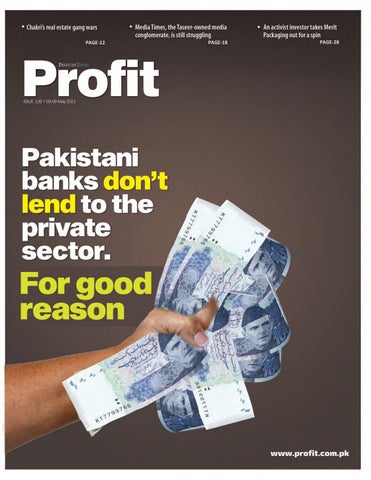
18 18 Media Times, the Taseer-owned media conglomerate, is still struggling 22 Pakistani banks don’t lend to the private sector. For good reason
34 36
28
Dr Hafeez Shaikh’s scorecard Sayem Z. Ali
28 An activist investor takes Merit Packaging out for a spin
Which public affairs strategy should tech unicorns use in Pakistan?
Profit
32 The banking industry’s exceptionally good first quarter
Executive Editor: Babar Nizami l Managing Editor: Farooq Tirmizi l Joint Editor: Yousaf Nizami Reporters: Ariba Shahid l Babar Khan Javed l Taimoor Hassan Abdullah Niazi l Meiryum Ali l Shahab Omer Director Marketing: Zahid Ali l Regional Heads of Marketing: Muddasir Alam (Khi) Zulfiqar Butt (Lhr) l Mudassir Iqbal (Isl) l Layout: Rizwan Ahmad l Photographers: Zubair Mehfooz & Imran Gillani l Business, Economic & Financial news by 'Pakistan Today' Contact: profit@pakistantoday.com.pk
Readers Say History repeats itself. Mumtaz Hassan has a history of defrauding banks. Earlier he connived with Philips and got them off the hook with the purchase of Whirlpool brand for one pound and then immediately shut down the operations. While SCB and ANZ Grindlays were paid by Philips International, the three local banks were left with PR 300 Million of write off. Apropos: What is Hascol hiding? Faisal Malik, Website I wish the author had reached out to the directors, particularly independent directors and also the audit committee and the risk committee. Given there is enough evidence to suspect negligence/illegality and possibly fraud these people 1. have questions to answer about how this was allowed to happen under their watch and 2. an obligation to investigate and pursue perpetrators of any wrongdoing for recovery for benefit of shareholders that have been affected. For too long, directors – particularly independent directors have not been held to account in Pakistan. Perhaps, the SECP should investigate this. Or maybe it's time for some shareholders to pursue this legally. Don’t even get me started on the auditors. Apropos: What is Hascol hiding? Manto, Website Fuel experts is a medium sized distributor and can never take credit worth Rs 8 billion. Even Rs 8 Million might be too much for them. Apropos: What is Hascol hiding? Anonymous, Website This was a much needed dive into the Hascol matter. Could other members of higher management also be involved? What's SECP doing is the main question. Apropos: What is Hascol hiding? M Khan
facebook.com/Profitpk twitter.com/Profitpk linkedin.com/showcase/13251020 profit.com.pk profit@pakistantoday.com
HOW TO CONTACT
7
There is an issue. This is assuming that Facebook, Google will be happy to comply with the PTA. Big Tech doesn’t necessarily comply with countries’ orders if they expect loss in revenue and don’t have incentive to do so. And if PTA tries to implement something itself on platforms hosted by big tech, they will simply limit services which only exacerbates the issue as plentiful Pakistanis will take to the streets insisting that PTA back down. This was a similar case in China, except China was able to develop its own search engine, social media unlike Pakistan. If anything, it is time people of Pakistan should develop their own search engines and social media apps, but I guess that is not going to be happening anytime soon. Apropos: An open letter to the chief blocking officer at the PTA Anonymous, Website
When you hire heroes you can either retain them by paying handsomely or by challenging them with opportunities. It seems from your article that Group M is failing at both. Unfortunately all media agencies are focused on revenue generation whereas if they spend some time to fix internal operations they should be able to increase profitability by at least 30%. Advertisers and Agencies need to understand that a lot of work that these buyers and planners are doing can be automated allowing the team to develop analytical mindset to find creative solutions. Having a team of 30 people on an account and boast about it doesnt enrich the outcome. Babar Why the focus on Group M only? Apropos: How does GroupM plan to solve its talent retention challenges? Rizwan Merchant, Linkedin I was also a victim of the same situation while leaving GroupM Pakistan. They forced me to sign a resignation letter, and silenced me even as I was going through this even. I was the head of finance in the group for almost a decade and served with distinction in my nine years of employment. I left GroupM Pakistan on 06-10-2019, but because of the same fears that have been elaborated in the story, I could not write the truth in my exit form. It has been nearly two years and I have still not been able to share the real story behind my departure from GroupM. Apropos: How does GroupM plan to solve its talent retention challenges? Feroz Alam, Website You didn’t mention that his daughter is married to Anwar Majeed’s (Omni Group) son. No bearing on his credibility but that makes him a PEP (politically exposed person). Apropos: Hammad Azhar out: Shaukat Tarin new finance minister 2Paisay, Website Shaukat Tarin is the Big Old Cat, he is the missing link of “Notorious Swiss, Offshore and Fake Accounts!” He is the one who managed the Benazir and Asif Zardari funds transfer to Switzerland along with many others. Shaukat Tarin is also related to Anwar Majeed, isn’t he? His daughter married Anwar Majeed’s son. Shaukat Tarin has ideated fake account titles since the inception of money laundry in the 1980s! Like all other hoggish corn artists, there is not much time left before he will have to depart, which will be very soon and he will have to go with empty hands as well. He should be preparing for the afterlife, not trying to run the show. Besides, he doesn’t have any skills, so why is he trying to meddle in the economy! Apropos: Hammad Azhar out: Shaukat Tarin new finance minister Shahab Siddiqui, Website
COMMENTS
IN BRIEF Rs 1.24 trillion:
Federal Minister for Finance and Revenue Shaukat Tarin has said that the government has introduced the largestever economic stimulus package of Rs1.24 trillion for Small & Medium Enterprises (SME) to shield them against insolvency during the COVID-19 pandemic. The government has extended the date on which mango export is to begin to May 25 instead of mid-May keeping in view the delay in season owing to global warming. According to a notification of the Ministry of Commerce, local exporters will be able to begin their export from May 25.
Prime Minister Imran Khan has said that the government’s historic initiative of Kisan Card will transform the agriculture sector in the country, making farmers prosperous. He said the Kisan Cards would provide agriculture loans for farmers in Multan, and that the step would help eradicate poverty of around five million farmers across the country.
Pakistan managed to maintain a current account surplus during the first nine months of the current fiscal year (9MFY21), indicating that the fiscal year might end without an overall deficit. However, it also posted a current account deficit of $47 million in March for the fourth month in a row.
After completing the examination of the oxygen plant at Pakistan Steel Mills (PSM) on the directives of the federal government, Engineering Development Board (EDB), Pakistan Oxygen Private Limited, and a team of experts will now compile a report on how to revive the facility. Pakistan Army Corps of Engineers will also assist in the compilation of the report.
$367 million:
Pakistan and Japan on Tuesday signed debt suspension agreements amounting to $367 million under G-20 phase one Debt Service Suspension Initiative. Economic Affairs Division Secretary Noor Ahmed and Ambassador of Japan to Pakistan Kuninori Matsuda signed the agreements in Islamabad.
$500 million:
The Punjab government is seeking $500 million from the World Bank to provide water to rural areas and address sanitation problems in 16 districts and tehsils to serve a population of 6.65 million in the province.
8
Financial inclusion, Waqar Zaka, and the reign of twitter this week in Pakistan’s business and economics twitterverse
Has the Twitter community finally had its voice heard in the corridors of power?
T
his week, we had Waqar Zaka on our minds. It isn’t necessarily the best thing to have on one’s mind (particularly during a holy month) but it was definitely there, especially because of how he continues to have success giving cryptocurrency advice to mostly young men that idolize him. The problem is that this isn’t even the strangest thing happening right now, and as one of the tweets in this week’s round up points out, decisions being made recently are saner than expected - almost too sane for our liking. Unfortunately, this kind of skepticism comes with the territory, and all we can really hope to do is keep our readers informed, and clutch onto our seats and hope that nothing catastrophic happens. Ariba Shahid brings you all this and more in this week’s social media round up.
Profit’s reporter Ariba Shahid analyses the business and economic highlights from Pakistani Twitter this week.
Table it already
Remember all the noise about the SBP amendment bill? Well it’s all hush now except for people that are genuinely interested in the bill asking about its contents and what is taking it so long? Important to note that unless it isn’t tabled, one can’t get a look at the official document. We’re wondering the same thing, but all that can be done for now is to wait it out and hope it gets tabled sooner rather than later, preferably with an explanation about what in the world took so long.
Shady investments
Retirement regrets?
Everyone has an opinion. Only some of them make it into op-eds. Ammar Khan shares our frustration over op-eds from people on how to change things up or fix things AFTER they no longer have the power to do so. It is nearly as bad as cricketers starting Youtube channels and advising the top players of the game after their less than prolific careers.
10
In this thread, Rasheed Narejo asks an important question about how capital markets can ever take off in a country where shareholders do not trust the books. The SECP, PSX, and Audit Firms in Pakistan need to make sure they have the trust of the public. In March we wrote about the Hashimi Can Company that was going through a buyback of shares. Pakistan’ continues to have a trust deficit, and as long as businesses and investment remain shady, there will be very little hope.
Twitter in the driving seat?
Waqar Zaka alternatives
Very, very, politely, we would ask Azam Khan not to repeat this simply because we’re afraid he is going to bring down the commentator’s curse on all of us. For the longest time, we have been complaining that the government is running on whatsapp, and we’ve been praying that the government turns its heads away from those scrumptious ‘forwarded as received’ messages and look towards Twitter, where (some) saner minds do exist. Perhaps that wish has finally come true, as Azam Khan is pointing out and in the process dangerously tempting the Gods of fate. Then again, all CSS officers and politicians make their way to twitter as soon as they have office. There must be something we’re missing out on. Our only suggestion is that Azam Khan should touch wood because he might jinx it for all of us.
We repeat, financial inclusion is a necessity
Financial inclusion is something we feel strongly about. No, it should not be limited to pink check books and sign boards. It requires men to step up and help the women in their household to open accounts. It also requires the men at banks to be less daunting and scary to the women that show up to get their accounts open. They should be proactively welcoming and encouraging. Faizan Sidiqi rightfully says, “normalize” it because until it is treated as a privilege or a novelty, we won’t get anywhere with financial inclusion.
Waqar Zaka has 32000 members in his Facebook group where he gives crypto investment tips. He charges Rs 1250 per month from members. If that isn’t sheer genius on Zaka’s part, then we don’t know what is. However, we would suggest you save your money and get a Profit subscription instead. No disrespect to the towering intellectual giant and fearsome cruncher of numbers that is the enigma Waqar Zaka, but we would humbly say that we’ve got a few things that make us a better option for budding investors. We’re real, we’re authentic, we’re definitely PG, and we’re much easier to like. Oh, and also, we’re cheaper.
SOCIAL MEDIA ROUNDUP
Caught in an armed standoff, Blue World City and Abdullah City are fighting over land they don’t own, all while they continue to sell plots illegally By Shahab Omer
L
ess than 60 kilometers away from the federal capital, a gang war between two rival real estate companies has left the once small area of Chakri devastated. For a long time now, Chakri has been considered a prime location for new housing societies to sink their teeth into. Currently, according to details available with Profit, there are at least 50 housing societies vying for space in the area around Chakri interchange, where they believe a new city extending out of Islamabad and Rawalpindi will attract investors. The only problem is that the land in
12
Chakri is a quagmire of legal cases, feuds, and disputed ownership that now has multiple parties involved. In Pakistan, real estate development is a game of gambling. No single investor or group has enough money to buy thousands of kanals of land, develop it, and then start to sell the plots to people. So instead of doing all this hard work, they focus on marketing heavily, selling pre-registration certificates, files for plots to be allotted in the future, and by getting property dealers to hype up their upcoming housing societies. It is only after they have made enough money by selling files, certificates, and all kinds of marketing tools to gather the capital they need for these projects, that they actually start buying the land that they have prom-
ised a number of people in the form of files. The problem is, since the land has not been acquired completely as of yet, it either gets sold to someone else in the meantime or some legal issue arises over it, which means people that buy files in these societies end up having their money tied up for years on end. All of this they do without getting any prior permission from local authorities, so even if the land is successfully acquired, it may be a long time before they are given permission to build their society on it. On our radar this week is Blue World City, a supposedly mammoth undertaking in Chakri’s real estate development game which is currently feuding with Abdullah City, another large real estate project in the area.
Chaudhry Nadeem Ijaz, the partner and owner of Blue World City, has a good reputation in the area and is well versed in land acquisition. Due to the good reputation of Ijaz, people hand over the possession of their land to him for token money Chauhdry Saad Nazir, Chairman Blue World City
Most of these societies in Chakri have no standing with the Rawalpindi Development Authority, which is the governing body on such issues. Despite this, they continue to inflict violence on each other and fight over disputed land, all the while fooling unwitting investors into giving them their money. Initially, when it was launched in 2017, Blue World City was only one of these small fish in a big pond. By 2018, however, they started appearing as a big name. Having presumably collected a decent amount from initial sales of files, they went on a massive marketing campaign that used all of the tactics mentioned above and then some. They even roped in Engin Altan, the Turkish actor that plays the lead role in the Ertugrul Resurrection drama series that has become a phenomenon in Pakistan, to be their brand ambassador. Since those early high flying days when Blue City became one of the hottest names in the Chakri real estate market, things have gone south. The society still does not have approval from the RDA and the land authority says it is not planning to give its approval any time soon. In fact, on recommendation of the RDA, Blue City is being investigated by the National Accountability Bureau (NAB), and has not bought a fraction of the land they claim to already be in possession of. This is how it all happened.
Blue World’s actions
I
n March 2021, Tahir Aziz called the Chauntra police station and complained that five armed guards had barged into the housing society of his brother on Chakri road named Abdullah City. The five guards overlooked the destruction of residential houses in the society. Who were these culprits? Tahir Aziz claimed that the guards said they had been sent by Nadeem Ijaz, Naeem Ijaz and Saad Nazir – the owners of Blue World City to demolish residential houses of Abdullah City. The intruders said they would kill anyone who tries to stop them. Shortly after this, the Chauntra police station received another complaint from Sawab Gul, an employee of the Blue World City, in which he stated that he and two other security
guards of the housing society, Ahmad Shah and Mohammad Naseer Abbasi, were sitting in their camp when unidentified armed men attacked them. Gul alleged that armed men from Dera Mushtaq Anwar which is under the control of Abdullah City owners Asim Aziz and Tahir Aziz stormed in and opened fire. “ In the Chakri area, the armed guards of both societies have started a series of gang wars, which the police are also afraid of. Abdullah City, Blue World and Mavida City are located side by side on Chakri Road. The same claims made by Blue World regarding the land area are also made by the management of Abdullah City,” explains a police official on condition of anonymity. This sort of attack and counterattack had become the norm in Chakri back in March. Here is what happened in a nutshell. Blue World City bought 1534 kanals of land near Chakri, and went to the Rawalpindi District Council (local government) for verification of their land in 2018. They are then supposed to take the verification to the RDA, after which they are supposed to get their planning permission, and then finally an NOC from the RDA, after which they can begin selling plots. The only problem is that Blue World City did not really buy all this land outright. With the help of Nadeem Ijaz, a domineering figure in Chakri, they had made deals for a lot of this land with land owners in Chakri for ‘token money’ and then treated it as if the deal was done, and started collecting money from investors. However, when they finally went to finalise the deals, they found out that a lot of the land they had taken token money for was disputed or that other societies had also taken token money for it. This is where the dispute between Blue World and Abdullah City originated. “Since both the parties keep claiming that they have thousands of kanals of land but in reality it is the opposite. Lands in this area were not very expensive. Nadeem Ijaz, the owner of Blue World, is an influential figure in his area and even lower class people are afraid of him. So instead of buying plots from the people, Ijaz pays them a token and agrees that the people give him possession of their land,” explains the police official.
“The same is true of the people of Abdullah City. Of course, when developers buy people’s land, where do they pay the full amount? Now most of the people in the area have taken token money from Blue World and Abdullah City in exchange for their plots.” One example was the ancestral land of PML-N MNA Rana Tanveer, who was going to sell to Blue World City. However, it was only later that Blue World found out there were FBR cases on the land that made it impossible to sell. The second reason is that Rana Tanveer, an MNA of PML-N in the area, also has thousands of kanals of ancestral land. On the one hand, Blue World intends to buy this land and on the other hand, Abdullah City is also trying to either buy a part of this land or this deal cannot be done between the two parties. However, due to some FBR cases on this land, it cannot be sold yet. It is a classic case of having the cart before the horse. Any real estate developed should first acquire the land, get permission from the authorities, and then start marketing and selling the project. Instead Blue World, and indeed other societies like Abdullah City, began by marketing it first, then trying to (unsuccessfully) get permissions, and then trying to (unsuccessfully) acquire the land. In the process, gun battles have left one dead, Blue World City staged a protest on the motorway by blocking it, and had one of their directors, Chaudhry Naheem Ijaz, arrested in the process back in March. All of this, and they still neither have any land that they own there despite having sold thousands of files, and they also continue to get denied permission from the Rawalpindi Development Authority. In the process, they have turned Chakri into gangland. Getting young boys in at salaries of Rs 25000 to Rs 30000, as told to Profit by the police, to move around with guns and strike terror into the hearts of their opponents. Gun ranges have been established, and even the police are afraid of the consequences of what has become a quickly escalating and heavily armed situation. Two months ago, the police sent the owners of the both illegal housing societies to Adiala Jail on a court order. Chaudhry Naeem
REAL ESTATE
The reason for not getting NOC is non-implementation of layout plan, and there is nothing personal about it. Let us say if this area does not come under the jurisdiction of RDA, then whatever development authority comes under its jurisdiction, do they have their NOC? They are working totally illegally and the NAB is also investigating them Hafiz Irfan, RDA spokesperson
of Blue World City and Tahir Aziz of Abdullah City were summoned by the police for inquiry into the land dispute. During the inquiry, both parties started threatening each other with dire consequences in the presence of Rawalpindi police officers and district administration officers and there were quarrels between them. The situation has since been eerily calm, but with the RDA continuing to not give Blue World City the green light and Blue World City continuing to sell files despite this in clear violation of the law, it may only be a matter of time before things take a turn for the worse.
The RDA’s role
N
ormally, the bigger housing societies do go through all of these hoops and then start selling more plots than they own. For example, if a developer has 500 plots, he may book 5,000 plots and then dodge the people. While this is illegal, the entire premise of the project is not illegal. In Blue World’s case, they seem to have taken it to another level. On August 8th 2018, they got verification from the district council, which was only the first step. They sent this verification to the RDA and began selling plots and marketing their society as “approved”, before it had actually been. But then four days later, on August 12th 2018, the RDA declared Blue World City an illegal housing society. Blue World has since gotten planning permission twice, but has still not received an NOC and is categorised as illegal. Despite this, they are continuing to sell plots. “Who cares about that. It will become legal soon enough,” said one agent for Blue World when Profit called them pretending to be a customer. The transparency of any housing society is measured by how much land it has. That is, how much land the developer has bought and no disputes or lawsuits over the land. (Editor’s note: This by the way is one of the main reasons for the success of DHAs. They, for some reason, are amongst the best at convincing people to sell their lands). The next important thing to look at is whether the society that is
14
buying and selling the plots is approved by the relevant development authority in its area. If approved, it means there is less chance of fraud. Then there is the reputation of the housing society and the developer in the market. In the case of Blue World, none of these things are encouraging signs. Now, the management of Blue World claims that this is an effort by their competitors to try and conspire against them.They also claimed that they are not being issued an NOC on purpose, because the RDA is out to get them for some reason. This would be a reasonable explanation perhaps, and crazier things have happened. But the facts of this case are sensational.
RDA takes a stand
T
he RDA took a big stand against Blue World. Jamshed Aftab, then RDA’s director of metropolitan planning and traffic engineer (MP&TE), also informed the press that Blue World City has been declared an illegal scheme and legal notices have been issued to its sponsors because the said housing society was not approved by RDA. Meanwhile, the RDA had warned the public in their own interest not to invest in the said housing scheme. However, an RDA official informed that despite being declared an illegal scheme, Blue World City continued its advertising campaign and sale of plots. However, the RDA official believes that in fact, not only the housing society but also government agencies are to blame for such incidents. “If someone is doing something illegal, they should be caught immediately, instead of being cautious when they succeed in committing fraud. The problem with us is that the prices of clear lands are very high. If the housing society approves at all and if it starts selling after taking NOCs, then the price of the plots they are selling for Rs1.5 million go up to Rs5 million and it should be out of reach of the common man.” “Deception is always beautiful, that is why the people also want to be deceived. Why
do people go to these societies when the law says that no housing society can sell plots without NOC? We also object to the media people publishing advertisements of such societies and doing them on air.” The RDA official believed that since Prime Minister Imran Khan announced the Naya Pakistan Housing Project, many illegal housing societies have been trying to give the impression under the guise of this vision that they too are associated with government projects. “The reality is quite the opposite. How can any society which has no legal status do a government project. Blue World City is booking residential and commercial plots of five marla to four kanal areas in its various blocks without NOC for Rs500,000 to Rs 2 million. In the meantime, they also take money from people in the form of plot installments and I don’t understand why they call this project a Pak-China friendly project. What does this project have to do with China or CPEC? Adding the name of an illegal housing society to such a big project like CPEC is tantamount to deceiving the entire public,” he said. “According to our estimates, they have also sold thousands of such files against which they have no land area and if the inquiries against them are conducted in a transparent manner, it is a scandal worth more than Rs 2 billion. We were informed that the owners of Blue World City are going to buy the ancestral land of Rana Tanveer, a PML-N MNA in the same area which covers thousands of kanals but some FBR cases are going on on this land and these cases don’t seem to be resolved,” he added. The RDA official further complained that many real estate based web portals also market such projects as our cyber laws are not fully functional. “Why do these property portals market such housing societies or register their properties which have no legal status? People are trusting these web portals and these portals also play the same role in deceiving the public as real estate developers,” he said. Even in the case it was found out that
the said society is neither registered with the concerned development authority nor does it have as much area as is being claimed. The second is that Blue World City is not selling plots but files.
Blue World tries to mount a defence
B
lue World City Chairman, Chaudhry Saad Nazir. tried to dispel the impression through a TV channel that he had an area of 30 to 35 thousand kanals in the process of mutation while an area of 25,000 to 27,000 kanals has been transferred to his name. Nazir said he had documents for all the items that could be shown to any institution. Apart from this, they have sale deeds of many other land areas with a volume of 60,000 to 70,000 kanals. “Chaudhry Nadeem Ijaz, the partner and owner of Blue World City, has a good reputation in the area and is well versed in land acquisition. Due to the good reputation of Ijaz, people hand over the possession of their land to him for token money,” he explained. This in itself is a huge problem, since he is admitting here that they do not own the land yet, a prerequisite to get the permissions they need for a project like this. He also claimed that when the Blue World City project was launched, planning permission for the project was obtained by the RDA in 2017. Later, another planning permission for an area of 1543 kanals was obtained in 2019 and earlier an NOC was also issued to Blue World City by the District Council. As mentioned earlier, the two planning permissions did happen. The problem is that no NOC was ever given by the RDA, and it was only a recommendation given by the district council to give them the NOC, which the RDA did not comply with. Nazir later held a press conference at the Lahore Press Club here in November last year and accused the RDA chairman and government figures of taking illegal action against the society. Nazir had alleged that RDA chairman Tariq Murtaza, who had a political post, was demanding large sums of money from him through his frontman and started harassing him through false cases and various means. According to an official of RDA, Nazir held the press conference because the RDA had sought registration of an FIR against Blue World City at the Chontra police station, alleging that the society was involved in illegal marketing, advertising and sale of plots. “Initially, the Chontra police station stayed the application and when the RDA approached the Additional Sessions Judge Rawalpindi under Rule 22-A, the Blue World City officials obtained a stay order from the High Court,” the official said. They also said
General block development that without an NOC, Blue World City continued all kinds of advertising campaigns and also used social media for the campaign.
NAB gets involved
S
tung by the accusations of the owners of Blue World, the RDA and its chairman Tariq Murtaza decided to clap back. During this time, Blue World managed to bag Turkish actor Engin Altan as their brand ambassador. However, the RDA very quickly moved to declare Blue World illegal again, and the actor ended up cancelling on the deal because of the bad press that Blue World was getting. After this, the RDA Chairman also wrote a letter to the Chairman NAB, and an inquiry was initiated against Blue World. A press release was also issued by the NAB to inform the public through the media according to which, the Chairman of the National Accountability Bureau, Justice Javed Iqbal, had taken notice of the complaints of the Blue World Private Housing Scheme for allegedly extorting billions of rupees from the public through massive fraud and DG NAB Rawalpindi had ordered to conduct an inquiry. The Chairman NAB had directed the DG NAB to take all legal steps for the timely return of the money looted from the public apart from investigating the illegal activities of the Blue World Private Housing Scheme. At this point, the explanations of Chaudhry Nazir began to sound a little hysterical. He said that Ertugral star Engin Altan did not end up coming to Pakistan because India did not want it to happen. He also cried foul on different platforms, claiming that the RDA Chairman was out to get him and his family and project because of personal grievances. He has also repeatedly claimed that the NOC
was only a matter of time and that his society would get it, the same answer that all dealers for the society have been told to give as well. RDA spokesman Hafiz Irfan, while giving a clear answer to Profit about the legal status of Blue World City, said that this society is illegal. “For the last few years, we have been informing the people about their illegal status and have taken several actions against them. No matter what Blue World City says, they sold plot files to people without getting NOC which was an illegal act. Sometimes they say that the area of Blue World City does not fall within the limits of RDA, sometimes they ask us for NOC.” “The reason for not getting NOC is non-implementation of layout plan, and there is nothing personal about it,” he adds. “Let us say if this area does not come under the jurisdiction of RDA, then whatever development authority comes under its jurisdiction, do they have their NOC? They are working totally illegally and the NAB is also investigating them.” On the other hand Assistant Director (Monitoring) at the Anti-Corruption Establishment Rawalpindi, Zahid Zahoor, believes that the society’s management is befooling the people. The method of fraud is the same in almost all fake and illegal societies. “The first thing is that this housing society is not approved by the RDA and yet they are selling plot files to the people. The second thing is that only the files are sold to the people and then a long series of starvation begins. We had a lot of complaints against them and then we registered an FIR against the management as well,” he said. According to the FIR which was registered against Nazir, Ijaz and different government officials, the management of BWC encroached state land measuring 1250 kanals. “Reliable sources have confirmed that
REAL ESTATE
a housing society namely Blue World City has encroached state land measuring 1250 kanals land in Mauza Sangral in Tehsil and District Rawalpindi. Sources also informed that the encroached state land has been made a part of society and the developer is selling this encroached state land along with the actual land he owns in the shape of plots. It is also important to mention that the housing society is not approved, and all marketing and sale of plots is illegal. District administration is protecting the encroachers rather than reclaiming it from the illegal possession of Blue World City,” the FIR states. Now here is where it gets interesting. While the RDA is not giving Blue World an NOC, the district council did recommend that it be given. In the FIR, the very same officials of the district administration that played a role in that recommendation have been named. One of them is Patwari Halq Anjum Rabbani, who has been working in league with said housing society, facilitating the said society in fulfilling their nefarious plans of encroaching state land worth millions of rupees. “The district administration supported the Blue World Housing Society by inaction despite public voices against this criminal act and senior level of administration supported the Patwari Anjum Rabbani, by assigning him the additional charge of adjoining Patwar circles which were lucrative in terms of potential areas for a housing sector. This land was free from all encroachments till July, 2018, after which Patwari Halqa entered fake and bogus mutations enabling the society to encroach state land in excess of its shares. No efforts were made by district administration to stop these encroachments which shows involvement of officials as well,” the FIR reveals. Director MP&TE, Tahir Mayo, Deputy Director MP&TE, Samiullah Niazi, Assistant Director Planning RDA, Shehzad Mehmood Scheme Inspector, Patwari Anjum Rabbani, Saad Nazir and Chaudhry Nadeem Ijaz have been nominated in the FIR. Representatives of a firm named Sky Marketing, which also markets Blue World City and booked plots there, are unconcerned that the society is illegal. Omar, a Sky Marketing representative, claimed that Blue World City had a land area of about 100,000 kanals. While this claim is completely bogus, coming from the marketing agency, it gives us an idea of how many bookings have been made so far. This would indicate that nearly a hundred times more than the amount of land they claim to have (1534 kanals), and even that is under dispute. “If it is illegal then what happened? The process of getting NOC from RDA is in process and NOC will be available soon. A large number of people are booking here and with the speed at which development work is going on there,
16
NAB Press Release construction of houses will start in the next few months,” he claimed. When Omar was asked if anyone wanted to get possession of the plot by paying the full amount directly instead of buying the plot file, he replied that society has some plots available which are also numbered and can be taken directly.“The price of posessionable plots is a bit higher. There is going to be a draw soon for those who are booking, in which they will also know the number of their plots,” Omer added. When Chaudhry Nadeem Ijaz, who is a self professed expert in land acquisition and owner of Blue World City, was contacted by Profit about whether Blue World City was really cheating people and whether there was as much land as was being claimed, Ijaz flatly refused to answer these questions.
Why do people keep falling for the same thing?
W
e have been through this before. In fact, very recently we went over the case of La Ville De Paris, a housing society in Gujranwala aggressively marketing themselves as the next big thing in Pakistan’s real estate market. They too used pictures of the Prime Minister and the tag of the Nayya Pakistan Housing Scheme. They too have yet to get the go ahead from the GDA and have still not bought as much land as they have already sold off. They too have tied up the money of a lot of hardworking people for who knows how long. Somehow, real estate is the most dangerous investment opportunity in Pakistan tantamount to walking through a field of landmines. Yet people keep coming back for more. There are many explanations for this. One is that there either are no other opportunities
Verification of District Council for investment in Pakistan (blatantly false) or that there is very little awareness about them. The other is that there is something about the concept of owning land that speaks to the Pakistani middle and upper class. Something deeply ingrained from a culture that reveres land ownership. Whatever the case, we are unfortunately stuck with it, and real estate developers exploit this to no end. In their marketing campaigns they always appeal to this most basic instinct - that one can have a peaceful life in a home that one owns. That is how Blue World played it in 2017. As one consultant for a real estate marketing firm in Islamabad, who did not want to be named, informed Profit the project was introduced in 2017 with a very small area. The management then generated a huge fund by selling its files and later they started spending that fund on land purchase, but mostly on more marketing. “As real estate is considered a lucrative business around the world, including in Pakistan, there are also frequent complaints in it that many people complain about losing their capital. Pakistan has the highest investment in real estate compared to other sectors. This is the sector that is of the greatest interest to the public. Ask any poor, rich, or middle class person in Pakistan where to invest, then everyone from all walks of life will immediately answer that they should invest in real estate. A common observation is that no matter what the circumstances, no matter how dissatisfied the people are with the system, the buying and selling of property has been on the rise in every era and land prices have risen in every era,” explain this consultant. n
REAL ESTATE
By Meiryum Ali The news media in Pakistan has been suffering for at least two decades now, and the past few years have perhaps been some of the hardest. Well established newspapers and television channels have had to undertake mass layoffs, and despite such measures have still regularly failed to meet payroll. Amongst those affected was also Media Times, the publicly listed Taseer family’s media conglomerate that had at one point under its umbrella the English daily newspaper Daily Times, the Urdu daily, Aaj Kal, a cooking channel called Zaiqa, a kids channel called Wikkid and Pakistan’s first business and economics oriented news channel called Business Plus. The media group’s misfortunes are made worse by the fact that things were not always so, in fact, Daily Times, and its parent group ‘Media Times,’ started off strong. Since those early days the fortunes of Media Times and its associated organizations have been largely downhill. The media conglomerate has made a loss every single year since 2009 - and is on track to make another loss in 2021 (the company’s financial year ends in June). On April 26, the company released its latest financial results for the nine month period ending on March 31. The company’s net revenue stands at Rs81 million, significantly lower than the Rs126 million from the same period the year before. And the loss after taxation is also greater, at Rs73 million, compared to Rs56 million for the period the year before.
18
If one analyzes that data, the results are not pretty: for the year 2021, the net revenue stands at Rs111 million. That would be the lowest recorded revenue since 2004. And the net loss stands at Rs127 million, which is greater in value than last year’s loss of Rs110 million. Perhaps the kindest thing one can say is that the annualized loss for 2021 is still not as bad as the years 2018 and 2019, where losses stood at around Rs220-250 million range; or as bad as the loss in 2014 (Rs565 million), or 2012 (Rs699 million). What is going on? It is a two-pronged problem: first, is that the Taseers have invested in a traditional media group, in an era where media is struggling, both globally, and most certainly in Pakistan. Second, is the peculiarities of the family itself - the group has not benefited from being attached to the Taseer family name.
Beginnings
First, some context: Media Times was founded in 2001 by Salmaan Taseer, who had become very wealthy from his accounting firm Taseer Hadi, and his real estate business Pace Corporation. The core businesses were print and electronic, and Taseers were constantly trying to make sure that their media organizations were innovative. In its heyday in the early 2000s, Edited by Najam Sethi and owned by the
Taseer family, Daily Times was the first new entrant in the English language newspaper space that looked like it had the journalistic standards and financial backing to challenge the old guards of the English press that were still around, which back then included Dawn, The News, and The Nation. Similarly, Business Plus was the first time a business and
economics channel was introduced in Pakistan, and Zaiqa targeted middle class women working as homemakers, both of which were acquired by Media Times in 2008. Initially, when it was just a print media organization, Daily Times like many others in the print industry was not doing too well in terms of roping in advertisers. At this point, the surprising saviour of the group was Sunday Times, the fashion and lifestyle magazine that came out with the Sunday edition of Daily Times and kept the company stable. At a time when facebook was still very new and there was no Instagram, the lives of the rich were largely hard to get a peek into. Through Sunday Times, people suddenly had an inside man and celebrities had people to photograph and publish their parties and weekend activities. Driven by the surprising amount of ad revenue from Sunday Times, the company’s revenue between 2004 and 2010 grew by 34.6% per year on average, reaching a peak of Rs504 million in 2009. The only problem was that thing got to a point where Sunday TImes was carrying the entire operation. For a long time, it had very successfully carried Daily Times, which could easily focus on news reporting and journalism while Sunday Times brought home the bacon. But when the news channels joined the mix in 2008, suddenly there was a lot more weight to carry, and the first serious signs became apparent. It still has to be said that for the first two years that Media Times had its television channels, they still managed to increase revenue, but this involved glossing over a lot of cracks. By now, meeting payroll
Since those early days the fortunes of Media Times and its associated organizations have been largely downhill. The media conglomerate has made a loss every single year since 2009 - and is on track to make another loss in 2021 (the company’s financial year ends in June) and delayed salaries had started becoming an issue for the organization. It would be made worse in the coming years.
Competition enters the race
In 2010, the television channels were not getting the kind of ratings that advertisers salivate over, and the print side of the business was also suffering as a result. Then, in 2010, the last thing that Daily Times wanted happened - they got competition. Express Tribune was launched in 2010, and late in the same year, this paper’s parent publication, Pakistan Today, was also launched. The English newspaper space in Pakistan has always been small. There was a small period in the late 80s and early 90s when it was a thriving and vibrant space with older papers like Dawn and Pakistan Times being established giants, and new entrants like The Nation, The News, Frontier Post, and The Muslim around. Byt the late 90s, it was only Dawn, The Nation, and The News that remained before Daily Times figured it
had some space to grow. But with two new entrants on the scene in 2010, dire straits had arrived for Media Times. Then, in 2011, the organization suffered the blow of its founder, Governor of Punjab Salman Taseer, being assassinated by one of his own bodyguards. Rudderless and at a difficult turn in its history, Media Times plummeted. Between 2011 and 2018, revenue figures declined by 3.8% per year. The year 2019’s revenue figure of Rs177 million and 2020’s Rs157 million are the lowest figures since 2005 (Rs148 million). And as mentioned before, the year 2021’s revenue of Rs111 million is the lowest revenue since 2004 (Rs84 million). According to the company’s latest half-yearly report, the company has incurred a net loss of Rs 57 million during the period ended December 31 2020 and, as of date, the company’s current liabilities exceed its total assets by Rs561 million. Worse, the company’s equity has eroded and the accumulated losses exceed the share capital and share premium by Rs902 million The company had also defaulted in
NEWS MEDIA
payments of its loan and lease liabilities, and was negotiating with Faysal Bank Limited for settlement of short term borrowings from their own sources. “There is a material uncertainty related to these events which may cast significant doubt on the Company’s ability to continue as a going concern and, therefore, the Company may be unable to realize its assets and discharge its liabilities in the normal course of business,” the report read. So much for being a media business: both Zaiqa and Business Plus remained non-operational all of 2020. According to one company report, it was “due to shifting of up-linking stations from Karachi to Lahore region.” Revenue from advertisements also decreased by 12% compared to 2019, because of the economic crisis caused by Covid-19. In fact, in October 2020, Media Times said it would restructure its company: the electronic and print media divisions would be broken apart, while the electronic media would be divided into two wholly owned subsidiaries for Business Plus and Zaiqa. According to the company, “The ultimate purpose of this corporate structuring includes to operate the Electronic Media at own, or to be sold or to be liquidated as a divestiture… the above restructuring of
20
Driven by the surprising amount of ad revenue from Sunday Times, the company’s revenue between 2004 and 2010 grew by 34.6% per year on average, reaching a peak of Rs504 million in 2009 Electronic Media into two different entities may be used ultimately to raise capital or selling off two different segments,” said the company in its public announcement. Unfortunately, that has not happened yet. But at least it shows one thing: the group has realized that satellite TV is not the way to go. Perhaps even without the Taseer name, the group would have made losses: increasingly, people get their news, information, and entertainment from their smartphones. And that is why Media Times has decided to pivot, with a new planned Web TV under the brand name Daily Times. But is this a realistic strategy? Will people turn towards watching their WebTv? And even if they do, would they be able to make enough money from it? As per Profit’s own research, Youtube channels in Pakistan typically make close to USD 0.5 per thousand video views from Youtube advertising. So even with as high as 10 million video views in a month (which is saying something), Media Times will make a paltry USD
5,000 a month. There are obviously other ways to monetise the web, each with their own set of challenges. The good news for the shareholders is that there is more to the plan, well at least on paper, than just a WebTv. “The Management is also planning to purchase and install its offset printing machines so that the Company can offer offset printing services to outside customers as well.” the company said in its latest annual report. The plan to diversify outside of media also includes exploring the real-estate business. One thing is obvious: The company knows it is in trouble and that it needs to liquidate its legacy businesses to fund new projects. But it is unclear what is causing the delay in selling of the satellite Tv licenses which should sell for much more than the Rs 4 million mentioned against these in the company books. The intent is there but as the saying goes, the road to hell is paved with good intentions. The management must act, before it is too late. n
NEWS MEDIA
22
COVER STORY
By Meiryum Ali & Babar Nizami
B
y now, anyone who has been observing the Pakistani banking sector has had the same lament for the past 10 years: why do they not lend to the private sector? Why are they so content to lazily continue to plow their growing deposits into government bonds? There are good reasons why the banks in Pakistan have seen superior risk-adjusted returns on government bonds compared to private sector lending, some of which has been covered by Profit in previous editions. This story, however, is not about why they find government lending attractive, but rather why they find private sector lending unattractive. First, some context: since the second quarter of 2011, the government of Pakistan has accounted for a majority of the lending by banks in Pakistan, almost without interruption, according to aggregate banking sector data from the State Bank of Pakistan (SBP). It has also accounted for the majority of net new lending for that time as well. And even when the banks do lend to the private sector, it tends to not end very well for the banks. The country’s infection ratio, or the gross non-performing loans to gross total loans, is not exactly great either. That figure stood at 9.7% in the first half of calendar year 2020, compared to 8.8% in 2019. Still, at least this is somewhat manageable: to recall, that ratio reached an all-time high of 16.7 % in September 2011, and a record low of 7.1% in June 2007. The current amount of gross non-performing loans for banks in the country, as of December 2020, comes in at a staggering Rs829 billion, according to State Bank data. Let us place that number in context: In developed economies like the United States and Britain, this ratio is typically around 1% of total loans outstanding, or sometimes even less. In the United States, for instance, when the NPL ratio went from 1% in 2007 to 5% in 2009, it caused the greatest financial crisis the country had ever seen in almost a full century. Even in India, the worst the ratio had ever gone before the pandemic was 11%. In Indonesia, the ratio often hovers around just 3%. In other words, Pakistan is unusually bad at private sector defaults, even by emerging markets standards. How did we get here? It is a question that banks are asking themselves as well. At least part of the reason appears to be legal: both the law as it is currently written, as well as judicial precedents and practices as established by the courts. As behavioural economists are fond of noting, the more you incentivise something, the more of it you
24
will get. And in Pakistan, the law, it seems, incentivises taking a loan from a bank and not paying it back. Yes, we are talking about the standard problems of the Pakistani court systems, where when banks take legal recourse, typically against large companies who have defaulted, they find that their case is stuck in courts for years – sometimes even decades. But as we will note in this story, that is far from being the only problem (though it is, admittedly, one of the biggest ones). And that is why Profit finds itself in the unusual seat of, for once, agreeing with the banks. Around the world, this very ability of banks to immediately receive their money, or for one’s assets to be captured by the bank, creates a system of checks and balances, and also, for banks to not exactly be viewed favourably. But in Pakistan, the lack of an efficient, or even ruthless judicial system, means banks are simply institutions one can take money from, while court cases are pending. It does not help that there are several companies in Pakistan who are perfectly comfortable evading accountability when it comes to their loan defaults. Why is this happening? Profit takes a look at some of the reasons behind this quagmire, and the very real ramifications it can have.
Designing a bankruptcy law: competing pressures
W
hen it comes to designing effective banking laws to prevent the rise of non-performing loans one has to consider this main point: how does a society enforce a loan contract against a borrower who has defaulted on their loan payment obligations, and what is the most effective way to go about it? In designing such a law, there are two sets of interests that need to be considered: those of the borrower, and those of the lender. Make matters too easy for the lender, and you open up the possibility of the lender engaging in highly exploitative behaviour with the borrower, and with a reduction in the demand for loans over time. Go in the opposite direction, however, and lenders would not be willing to lend to otherwise qualified borrowers, reducing the optimal level of lending and economic activity in the country. In Pakistan, the law and even more so, the legal system appears to be biased in favour of borrowers, forcing banks to go through the full court case before they could recover the property from the loan defaulter, a process that takes several years and costs millions of rupees for each individual loan. As one source put it, the current legal
framework has proven to be a shield for habitual defaulters, to manipulate the system and delay payment of money they owe for years. Part of the problem is that key word: banking courts. Some context: The Pakistani Judicial system consists of district courts that cover civil and criminal matters, high courts in each province, and one Supreme Court in Islamabad. Separately, the system also includes specialized courts, such as banking courts, customs courts, drug courts, anti-terrorism courts, labour courts, etc. These courts are manned by district judges, and have more or less the same powers as a district court. Banking courts are special courts constituted under Section 5 of The Financial Institutions (Recovery of Finances) Ordinance, 2001. In Pakistan at a provincial level, banking courts are working to deal with cases relating to recovery of finances with the aim of monitoring obligations of financial institutions and the borrowers. The issue of delays was so pervasive, that in 2018, the Sindh Judicial Academy commissioned a report, “The Causes of Delay in Disposal of Cases in Banking Courts”. The report examined five banking courts in Karachi, covering 2,494 cases. A large chunk of commercial activity and banking litigation occurs in Karachi, which makes the report a good barometer for the state of affairs in the rest of the country. The findings were not kind. First, one must understand that cases pending in general (and not just in specialized courts) is a huge problem. For instance, there were 118,687 pending cases in district courts in SIndh in 2016 alone. There are meant to be nine banking courts, but only five are functioning at a given time, and their backlog runs into thousands of cases. The current legal system as it stands is overburdened and tardy. The report noticed for instance, that there seemed to be no consistency at all to the length of delays: “The variation in disposing of the cases was significant as some cases were decided on the day of the filing, while others took 23 years to decide.” According to the report, the hearing age took the most part of the litigation process, as on average, cases took 478 days to conclude hearing. Civil cases could take 464 days, while criminal cases would take 388 days. What was happening? In banking cases, frequent adjournments by the advocates was one issue. Another issue was absenteeism: of the both parties of the accustomed persons in criminal cases, even of witnesses. Then, banking courts suffer from vacancy, which is the period during which a court remains without a judge. This is due to one judge relinquishing his charge till the assumption of charge of the said court by another.
In this intervening period, many cases that are put up to be heard have to suffer delays in their cases’ progress. All the cases fixed for hearing in the interim period are consequently adjourned, which adds to the delay, simply because judges are in limited supply, and vacancy can go on for months and years. The report noted that presiding officers at banking courts often have little academic qualification to “comprehend the subtle nuances involved in banking litigation. These same unqualified presiding officers were mentioned in the report as having “been very liberal and generous in granting adjournments during various stages in the litigation process, even without an application being filed by parties to that end. This is a very harmful practice which has been identified as one of the major reasons for delay”. The whole point of a specialized court is so that cases can be dealt with in a judicial environment designed to facilitate such matters, and to resolve it as efficiently as possible. That is not the case with banking courts in Pakistan, where cases essentially go to languish. This defeats the point of expedited recovery of finances. The delays are severe enough to affect the entire banking industry. For instance, in April 2019, the Pakistan Banks’ Association (a powerful lobbying group that was established in 1953) wrote a letter to the Chief Justice of Pakistan. “Although the special statue [the 2001 Financial Institutions (Recovery of Finances) Ordinance – discussed in the next section] was promulgated to provide speedy disposal of recovery cases however these cases are confronted with serious crisis of inordinate delays and thereby causing substantial losses to the banking companies for sustained growth. As these advances are extended against public deposits, the banking companies can find it difficult to distribute fair profits among the public and maintain a healthy minimum capital adequacy ratio with the SBP.” Regardless of the claim, the letter also said that delays go on till five to seven years, and gave a list of recommendations that they wanted implemented. First, they wanted only
Facts speak for themselves: the method has ensured a recovery rate of 90% of the defaulted loans. At least in the Sri Lankan context, the Parate law has proved an effective deterrent recovery cases to be placed before the special benches of the respective High Court of each province. The report claimed that, “as a matter of practise, the special benches are burdened with other cases of various nature and thus, recovery matters are not taken up due to paucity of time.” The letter also said that they needed to fix the trial duration of a maximum of six months regardless of the amount in dispute at both high court and banking court levels. All miscellaneous applications filed during the trial should be decided expeditiously within a period of two weeks; and any party delaying the recording of evidence should be penalized.
Changing the foreclosure law
O
f course, these are suggestions. But it was timely – and allowed for another law to be re-examined. Just a few months later in July 2019, Prime Minister Imran Khan introduced the Naya Pakistan Housing Programme, which has as its goal to build five million new housing units in Pakistan over the next five years. The only problem was that the Asian Development Bank (ADB) was unwilling to give loans for this project without some kind of reassurance with regard to Pakistani law. After all, those five million homes need to be sold to people, and most of the buyers will need loans to buy those homes, which in turn means that banks need to be willing to lend to those new borrowers. Banks, however, would not be willing to lend without knowing that, if the borrower defaults, they will be able to recover the money by selling the house. Surely, there must be some law designed to make life easier for banks? Actually, yes:
the 2001 Financial Institutions (Recovery of Finances) Ordinance. The ordinance came into force in the early years of the Musharraf Administration, when then-Finance Minister Shaukat Aziz was seeking to update Pakistan’s regulatory structure to make credit markets in the country function better. It was intended to replace the 1997 Banking Companies (Recovery of Loans, Advances, Credits and Finances) Act. The 2001 Ordinance was designed to make it easier for banks to take control of and sell property of loan defaulters without having to wait for a court order to do so. This would significantly reduce the banks’ risks, and thereby make it easier for them to lend to the private sector. The 2001 law has 29 sections, of which Section 15 allows banks to sell mortgaged property, in the case of a default in payment by the customer. This section was in place until December 10, 2013, when the Supreme Court of Pakistan declared Section 15 of the 2001 Ordinance as ultra vires, or an act that is beyond one’s legal authority, to the constitution of Pakistan. Section 15, it was stated, did not have adequate protections for borrowers. The government then scrambled to amend the ordinance, and after approval from the legislature, The Financial Institutions (Recovery of Finances) Amendment Act was signed into law in August 2016. The Lahore High Court suspended the ordinance almost immediately, before reversing that decision in 2020, spurred as it was somewhat forcibly by the prime minister’s office. The decision was not close: four of the five judges agreed with the defendants: the federal government, the State Bank, and the banking industry. The bench argued that the new Section 15 had adequate protections for borrowers: for instance, the borrower could
COVER STORY
object to the creation of the mortgage liability and amount of the outstanding loan claimed in a banking court. The borrower could also exercise the right of redemption of property, subject to the payment of the outstanding loan amount. Similarly, banking courts are given exclusive rights to judge disputes. Yet despite the new ordinance, according to sources within the banking industry, it is still extremely difficult for the banks to determine borrower’s default and sale of mortgaged properties without the intervention of the courts. And even though the law exists, it remains practically ineffective because the courts grant long status quo orders against its implementation.
The implicit interest-rate subsidy in default
H
ere is where the case of perverse incentives baked into the law get even worse. The 2001 Financial Institutions (Recovery of Finances) Ordinance includes in Section 2, Subsection 3 a clause that effectively offers an active incentive for any borrower to default. The clause says that if a borrower defaults, their obligation to the bank is the default amount plus only the bank’s cost of funds from the day the bank says they went into default. Note, that it does not say that the borrower owes the interest rate that they agreed upon in the loan agreement. It says that the borrower legally only owes the cost of funds. Why does that matter? Because a bank’s cost of funds can be as low as 2-3%, whereas interest rates agreed to in the loan agreements tend to be north of 10% on average (usually 12% or even more are not unheard of). That implies a massive interest rate subsidy. So, if you take a loan, the next thing you do is go into default, invest the borrowed money into real-estate, bonds or stocks (depending upon your risk appetite), and lawyer up. Then, after
26
In Pakistan, the law and even more so, the legal system appears to be biased in favour of borrowers, forcing banks to go through the full court case before they could recover the property from the loan defaulter, a process that takes several years and costs millions of rupees for each individual loan ten years or more, settle the bank by paying the principal and the absurdly low interest (cost of funds) back to the bank, get your name completely cleared off the credit bureaus’ databases as a defaulter and remember to pat yourself on the back. Frankly, given this provision in the law, it makes complete rational sense for a borrower to default almost immediately on every loan,: you get a very low interest rate, and you face almost no consequences of being shut out of the financial system (which a default in a normally functioning financial system would entail).
Culture problems
S
o, if you are a bad faith actor, and you have borrowed money from a bank, are you obligated to pay them back? Think about it: part of how crime is deterred is not by the severity of the punishment; it is that the punishment is actually enforced. So it does not matter how many times the Lahore High Court meets and figures out legalese. Either way, a company can sit secure in the knowledge that there will not be an enforced penalty. This has led to a rise in what is called ‘willful defaults’. These are defaults not attributable to the genuine business losses, but rather a refusal by the borrower to pay bank dues despite having the capacity and resources. As one banker complained: “such chronic willful defaults appear to be nothing but scams as personal wealth and assets of the sponsors of several large groups seem to be burgeoning whereas their companies seem to be failing.”
This, by the way, is not just the complaints of one industry. In fact, this has become such a serious problem that parliament actually introduced willful default provisions in the Recovery of Finance (Amendment) Act, 2016. According to the act, a willful default is a “deliberate or intentional failure to repay a finance, loan, advance or any financial assistance received by any person from a financial institution after such a payment has become due under the terms of any law or any agreement, rules or regulations issued by the State Bank of Pakistan; utilization of finance, loan, advance for a purpose other than that.” Additionally, under the amendments in 2018, the Federal Investigation Agency was empowered to investigate willful default complaints filed by banks.against willful defaulters. If the accused were found involved in any of the categories of willful default, then FIA could submit its report to a banking court. This has not exactly materialized. Sources complain of glacial proceedings, a lack of interest on the part of the FIA, and status-quo orders granted by the high court.
Bad faith actors
O
ut of the many cases, Profit picked three sample cases filed in different courts against three different companies: Dewan, Tanveer and Ghaffar Group. These groups owe money to several banks. It is typical for companies to owe to multiple banks at the same time, and for the banks to then club together, and either file concurrent suits, or try to make the company operative through restructuring. We
TEXTILES
use these examples to illustrate not the details of the particular suits themselves, but the interplay of groups and banks when it comes to defaults, and the same problems cropping up again and again. Before the recent Rs50 billion+ default by Hascol, the Dewan Group has the dubious distinction of being the largest defaulter in the private corporate sector, with approximately Rs36 billion of overdue claims from banks. Much smaller banks and development finance institutions, which had been exposed to Dewan, suffered miserable losses. Even large banks ended up filing suits. As mentioned before, there is a lengthy judicial process it takes for banks to retrieve their money from defaulters, often between five to 10 years. This gives a defaulter a lot of time to go about their business, while the case is pending in court. So what can a bank do in this situation? Releasing the weak legal system, banks in Pakistan usually try to make the company operative through restructurings, rather than demand their money. Which is what happened in Dewan’s case. A steering committee of banks was formed to handle the restructuring, particularly in the group’s sugar and textile-related entities in 2012. Fresh financing was also extended. However, the group’s sponsor Dewan Yousuf continued to breach the rescheduling agreements. Similarly, there is the case of the Tanveer Group of one Azar Saleem Vohra. The group which consists of three entities: Tanveer Cotton Mills, Tanveer Spinning and Weaving Mills, and Tanveer Weavings, defaulted on loans from MCB, UBL, BOP and Summit Bank. Despite making substantial profits from these three companies, the group refuses to pay and is apparently a case of willful default, i.e. refusing to pay back banks despite having the resources to do so. Not to mention that banks have also identified multiple high value real estate assets in the personal name of Azhar Saleem Vohra. Our third example, the Ghaffar Group has over Rs 2 billion of overdues towards the banking industry. The key sponsor, Noor Muhammad is engaged in the ship breaking business. The group asked for significant loans from different banks and imported scrap ships for shipbreaking in 2014. However, despite several extensions, the group refused to pay back the loan. The banks allege all three: Dewan Group, Tanveer Group and Ghaffar & Co of willful default and claim that sponsors of these and many other groups use the system to avoid payment and also delay restructuring of their debt by submitting proposals on terms, which were not acceptable to Banks, just to delay the bank’s legal recourse.
So, if you take a loan, the next thing you do is go into default, invest the borrowed money into real-estate, bonds or stocks (depending upon your risk appetite), and lawyer up. Then, after ten years or more, settle the bank by paying the principal and the absurdly low interest (cost of funds) back to the bank, get your name completely cleared off the credit bureaus’ databases as a defaulter and remember to pat yourself on the back Turn to our southern neighbour
S
o Pakistan has laws, but they are non-applicable, or workarounds can be found instead. Is there another model we could look to? According to one banking industry expert, it would be better to have a stricter foreclosure law, like the Parate Execution, implemented in Sri Lanka. Exactly what is this law? We can tell you that bankers in Pakistan are obsessed with it. That is because this law allows for the sale of mortgaged property, without going through court proceedings. How does this happen? The bank demands payment of the outstanding loan amount, which is due at the end of a 14-day final notice. If the customers fail to make a payment, then the bank can pass a board resolution whereby an independent agency or person is appointed that sells the property through public auction. The notice of such a resolution has to be published in at least three national newspapers, and fourteen days prior to the intended sale by public auction. If the auction is not successful [i.e. nobody wants to buy it], the bank is authorised to purchase it at a nominal price of one Sri Lankan rupee and with it, the rights of the bank change from that of a mortgagee to that of an owner. If the auction is successful, the bank can subtract all its dues and administrative charges and return the balance money (if any) to the borrower. If the property ends up being purchased by the bank, the bank is required to sell the property in a reasonable amount of time and adjust the amount received against its outstanding. There are still protections for the borrower: for instance, the customer can negotiate buying the property back from the bank (once it has been auctioned off to the bank). The borrower can also approach the bank before the auction and renegotiate its terms and get the auction cancelled. But the main idea is to recover losses that the bank may have suffered through the
default. Crucially, and why this law is so appealing to many in Pakistan, is that the entire procedure takes between a month to one-and half months. This is a far cry from the years and years in which cases in Pakistan drag. The law is not without its critics – ever since its introduction in 1990, the law has been accused of favouring the bank over the borrowers. In fact, as mentioned before, this balance is exactly what Pakistan’s own courts and foreclosure laws have struggled with: what is the appropriate leeway given to both parties? But the facts speak for themselves: the method has ensured a recovery rate of 90% of the defaulted loans. At least in the Sri Lankan context, the law has proved an effective deterrent.
Where we are headed
L
et us return to that figure: Rs829 billion, the non-performing loans of 2020. That figure will rise: after all, consider the future projections of additional defaults against the backdrop of the Covid-19 pandemic. The impact of such large scale defaults will weaken the country’s economy. And even if there was not a pandemic to handle, the problems remain: a culture of willful defaults, and muted housing and mortgage finance in the economy. The issues of non-performing loans means that perhaps banks simply will not give out loans. Consider the statistics that seem familiar to many readers of Profit by this point: that Pakistan’s financial sector caters to less than 2% of all housing finance transactions, that our mortgage to GDP ratio stands at a miserable 0.6% of GDP. If banks do not feel comfortable ledning out to Pakistani citizens, then citizens simply will not have funds at their disposal to be able to generate more wealth for themselves. In the end, we are all affected. And the courts, in their misplaced bid to protect the rights of borrowers (or even less ideological than that – just through their sheer inefficiency and complacency) have instead curtailed the ability of a modern financial system to actually do its job. n
COVER STORY
An activist investor takes
Merit Packaging out for a spin
Ahmed Munaf, a self proclaimed activist investor, has made the Lakson Group turn its head and pay attention to its packaging business
I
By Ariba Shahid
n October 2020 Merit Packaging was suffering, and nobody seemed to care. Well, nobody that actually mattered and could do something about it seemed to care to be more exact. You see Merit is a packaging and printing company based in Karachi and a subsidiary of the Lakson Group. Why is that a problem? Well, the Lakson Group is huge. Its total assets exceed $1 billion (Rs 153 billion), and as an employer they have more than 17,000 people. Of those numbers Merit contributes 264 employees and has a Rs 3 billion capital. And
28
despite Merit being in the doldrums, Lakson has been doing great, which means it is very easy for Merit’s underwhelming performance to slip through the cracks. If the executives at Lakson are getting their profits overall, a small subsidiary like Merit Packaging does not warrant a big shake up. And while dealing with the problems at Merit might be an inconvenience for their parent group, Merit Packaging does have shareholders, and those shareholders were not happy at the company’s performance. So in October 2020, a group of minority shareholders wrote to Lakson to tell them they were not happy with how the Merit Packaging was being run. Usually, this kind of letter gets thrown
in the bin. To Lakson’s credit, however, they responded and responded with action and not just words. Since then Merit Packaging has turned a new corner. It has gotten a new CEO, and it has stopped selling products for less than what it cost to make them, a policy that had resulted in them making a gross loss over the years, not just a net loss. It is heartening to see minority shareholders raise their voices and be heard, because even though Merit Packaging might not be a priority for the Lakson group, it is one for the people that have invested in it. This is the story of how activist investors and a business group willing to listen came together to shake up and save a packaging company.
The role of the minority
G
enerally, minority shareholders have very little say in how a company is run. That is to say, they usually have none at all. They do have a right to show up and vote, but if one party holds the majority of shares, it really does not matter. This was the same story at Merit Packaging. The Lakson group had a majority of the
not only get the sponsor interested but also managed to get the CEO changed. Amir Chapra, a veteran in the packaging industry was brought on as CEO to help revive Merit. More so, Lakson provided interest free debt to Merit Packaging to give it a lifeline. That is what Munaf and co managed to do. One would expect that now that the group has managed to change the CEO, get the sponsor to be interested in the operations of the business, and get the company to consider some of their
nessman that has been in the textile business for more than 15 years, but he is also deeply inspired by Carl Icahan, the American businessman famous for developing the concept of the modern corporate raid. Munaf refers to himself as an activist investor. He was simply a shareholder in Merit Packaging, and while he did not reveal how many shares he has in the company, he was given 17% of the shares through proxy when writing his letters. Now, credit must be given to Lakson for actually taking up the letter and acting on it, but it was Munaf that managed to galvanize other minority shareholders to effect this change.
Not in it for a takeover
T
shares, and did not really do much to improve the place and let it run on its own inertia. It was filled with a CEO that did not know the business very well, there was a surprising lack of middle management, and it was essentially a retirement career for old brass employees playing by the same old rules. So in October 2020, sick of the continued lack of attention the company was being given, Ahme Munaf wrote a letter. He got other minority shareholders and pushed forward a resolution in October 2020 demanding the company explain itself and its performance. Following the EOGM, Munaf and a proxy of 17% shareholders were able to
suggestions, they would be content. However, the recent notice to the PSX suggests far from it. In a recent announcement to the PSX, Merit Packaging has notified that there is to be an EOGM on May 4, 2021. Nine people have applied to be elected as Directors of the company for the next three years. However, there is only room for seven directors on the board. That means there is going to be an election and Iqbal Ali Lakhani, Amin Mohammad Lakhani, Anushka Lakhani, Aftab Ahmad, Farrukh Shauket Ansari, Wasim Akram, Ahmed Munaf, Mohammed Raziuddin Monem, and Ali Asrar Hossan Aga are to contest. So who is Ahmad Munaf? He is a busi-
hat question can never be answered with immense confidence unless one actually sees it happening. When asked if a takeover is his intention, Munaf suggested otherwise. He said, “Hostile takeover is too strong a word. What we’re trying to do is different.” That begs the question, what is it that he is trying to do by contesting if it isn’t a hostile takeover? “The company was losing a lot of money over the past few years. A group of investors saw there was an opportunity to push the management and the sponsors into improving the company. The company as you know has been making perpetual losses. We are fighting for minority investors,” Munaf explains. When asked about the strength in numbers, he tactfully evaded the question, saying “we own a substantial part of the company and do not want to disclose the shareholding percentage to spoil what we want to do. However, in October we held a proxy of 17% of shareholding to force the management for special agenda items.” For someone that calls himself an activist investor and idealizes Carl Icahn, one can’t help but be cautious of his intentions. For some background, Ahmed Munaf Lodhikawala is the proprietor of M-Tex, which indents Polyester yarn, and is the sole agent for the Polyester yarn in the Pakistan market for Hangzhou Zhongli / Zhongcai China yarn. He has more than 15 years of experience in leading businesses. However, Munaf says that there are no grievances. “We do not intend to have any fight with sponsors. Lakson Group is fantastic. However, prior to the time we expressed our grievances, Lakson Group wasn’t as involved with Merit Packaging. The group has now become active which can also be seen by the fact that the sponsor has given interest free debt to revive the company. They weren’t really interested but are now really looking into the business. The biggest change is the CEO. Many managers have been changed too” Munaf also agrees. He says, “In Pakistan
PACKAGING
The company was losing a lot of money over the past few years. A group of investors saw there was an opportunity to push the management and the sponsors into improving the company. The company as you know has been making perpetual losses. We are fighting for minority investors Ahmed Munaf, minority shareholder in Merit Packaging
we’ve noticed that a number of good sponsors also have some companies that are not run as well. We cannot judge intentions, but maybe this is because these groups have a number of companies. Merit Packaging and companies of the sort may seem like babies or smaller concerns for them.” Based on what Profit was able to gather, Munaf no longer resents the company or the sponsors. In fact it is quite the opposite based on his statements. Then why is he contesting despite having his voice heard and a new CEO appointed? His answer was simple, to address the need of being heard. “The reason I am contesting is so there is independent thinking that can help the management improve the performance of the company but more importantly to restore the pride of minority shareholders. The minority shareholders have chosen me to represent them so that I can speak on their behalf. As a director, I would be in board meetings to listen and suggest changes and improvements.” But it doesn’t stop here. Munaf is set on a path to become a messiah for minority shareholders. He plans on re-doing this whole exercise with other companies. “Over the next few weeks we will also be coming for other companies which have not been run well. Per-
haps, this is the most I can share with you at this moment and will in due course inform you once we commit to another action.” The plan is simple, identify companies with potential but bad management, wake their sponsors up, mobilize shareholders, and push the company to do better. He adds, “Our pockets are deep and we will not stop at only proposing changes but we will do the following from a position of strength.”
Is there a probability of a hostile takeover?
A
s of 31 March 2021, directors, sponsors, and senior management officers and their associates hold 147,899 shares or 0.18%. Approximately 57.4% is held by associated companies. The rest is free float, i.e. almost 43%. This is mentioned on the company website. However, on 24 April 2021, the PSX website states that the free float is approximately 45%. As far as performance on the PSX is concerned, volumes have been picking up and so has the share price. In the past one year, the lowest share price has been Rs 7.79 whereas Rs 17.73 has been the highest. Lately it is trading at approximately Rs 16, having gained from Rs
13.16 on April 1, 2021. While this may just be business as usual, considering the upcoming EOGM, it could be interesting to see what goes down during the elections and who wins. Well for starters, in the past Merit Packaging operated in a way that is averse to normal logic. What this means is that the company used to sell its products at a price that was lower than the cost of goods sold. That makes no sense and is a point where businesses question whether they are to produce and sell at all. The CEO claims that the gross profit at the very least will become profitable in the next quarter. The management is now hiring middle management for HR, production, maintenance, and marketing – something they lacked on. Plans of capital expenditure of around Rs 500-700 million are under consideration which could be footed by the market or sponsors. Moreover, the business is also considering operating in one location, i.e. Karachi. It would be an understatement to say that things have shaken up at Merit Packaging. The question is, will they think out of the box and manage to end up in the green and keep minority shareholders happy? n
Corporate raiders
I
n the 1980s, Carl Icahn, an American businessman, developed the concept of the modern corporate raider. He made considerable gains from his hostile takeover and asset stripping of Trans World Airline, an American airline, which became a textbook example of a corporate raid. A corporate raid is the process of buying large stakes in corporations and using voting rights as a tool to push company management to undertake novel measures that boost share value. These measures are usually in opposition to what the current management of the company deem appropriate or want to carry on with. Examples include downsizing, mergers, and liquidating among many others. Over the years, however, corporations have made it increasingly difficult for corporate raids to go down. These include tactics like
30
golden parachutes to reduce the chances of suggestions of downsizing and high debt levels on balance sheets making the company undesirable. As opposed to the past, corporate raids have decreased. What we now have are activist shareholders. These are shareholders that use equity stake to put pressure on the management of a company. One can even launch a campaign with a stake of nearly 10%, sometimes even less. To put this in perspective, a company’s board of directors are more powerful than the CEO because it is they who elect the CEO. But the real power in a company lies with shareholders. Afterall, they are the owners. This does not mean they can show up at work and boss around people and management, but they can cast votes, access information, and push their demands.
PACKAGING
A combination of increased deposits and declining provisioning expenses have resulted in spectacular quarterly financials
32
T
By Meiryum Ali
he Covid-19 pandemic ravaged entire societies, economies, and countries. For a brief period, particularly between March and May 2020, it seemed as if the capitalist world as we know it was coming to a grinding halt. Companies’ entire supply chains were upended and distribution models were thrown out the window, while the regulator and federal government scrambled to provide relief efforts. Now in 2021, the pandemic seems (dare we say it) somewhat under control, as the vaccine comes to Pakistan (though the new variants still threaten any sense of normalcy). But like every year, the financials and annual reports of companies are being released for 2020, and they reflect the gaping holes for those few months when the entire world seemed to be turned on its head. Most of these reports come with similar feeble explanations about how challenges presented by the pandemic are to blame for these gaps. Except for one industry: banking. Between April 18 and April 30, a spare of the banks have released their financial statements for the first quarter (banks’ financial years end in December;
first quarters cover the period between January and March 2021). And they have been - unbelievably, spectacularly - quite good.
How did the banks do?
P
rofit looked at thirteen banks that have released their quarterly financial statements to the PSX so far. Of those, only three banks - Samba Bank, Standard Chartered Bank, and Bank of Khyber - reported negative year-on-year change in their quarterly net income (at -234%, -39%, and -20%). And of those, only Samba Bank reported an actual loss of Rs355 million. The remaining ten banks all reported a positive year-on-year increase between their net income of the first quarter of 2021, and the first quarter of 2020. On the lower end of the list, MCB Bank, Allied Bank, and Faysal Bank, saw a year-on-year increase in their net income in the single digits: 7%, 6% and 3% respectively. Then, Alfalah Bank and Meezan Bank saw an increase year-on-year of 18% and 24% respectively. Of notable mention are Askari Bank and UBL Bank, which saw an year-on-year increase in their net income of 54% and 48% respectively.
And the banks that did the best? That would be Habib Metro Bank, and HBL: Habib Metro’s income in the first quarter in 2020 stood at Rs1.6 billion. It then shot up 103% year-on-year to Rs3.3 billion in the first quarter of 2021. Similarly, HBL’s net income in the first quarter of 2020 stood at Rs4.1 billion. This increased by an astounding 108% to Rs8.6 billion in the first quarter of 2021. Its this kind of absurdly ‘above expectations’ results that has everyone surprised. According to a report prepared by Taurus Securities (a subsidiary of National Bank of Pakistan), sent to clients on March 26, the profitability of listed commercial banks rose 34% year-on-year, compared to 21% last year, despite the pandemic, as the total income for the sector posted 23% year-on-year growth. Across the industry, similar performance indicators can be seen: deposits were up by 16% year-on-year, current account savings account (CASA) has increased 78% year-onyear. Meanwhile, advances are up 2% year-onyear, investments were up 34% year-on-year, balance sheet growth was up 14%, provisions were up 18%, while the capital adequacy ratio 18.6%, up 1.6 percentage points year-on-year.
So, what explains this rise?
T
here are two ways to understand what is going on with the banking industry On a whole, the banking industry’s net interest income shot up 25% year-on-year backed by around 40 basis points year-on-year surge in net interest margins. Meanwhile, non-markup income shows up 16% year-on-year as capital gains increased 11.4 times year-on-year. According to Saad Hashmi, executive director at BMA Capital Management, a brokerage house, the growth in profits is attributable to many factors, including, “reduced provisioning, stronger fee income, capital gains on investments and finally, controlled administrative expenses”. This view was echoed by Faizan Kamran, senior research analyst at Arif Habib, “Banks have done well primarily because of a sequential decline in their provisioning expenses. During the last year banks had aggressively built their coverage ratios.” Additionally, he said, “due to the im-
It’s this kind of absurdly ‘above expectations’ results that has everyone surprised. According to a report prepared by Taurus Securities (a subsidiary of National Bank of Pakistan), sent to clients on March 26, the profitability of listed commercial banks rose 34% year-on-year, compared to 21% last year, despite the pandemic, as the total income for the sector posted 23% year-on-year growth
proved economic activity some reversals have also clocked in this quarter while provisions against loans have come down significantly. Banks have also posted healthy fee income and foreign exchange income this quarter which have further supported earnings.” Another key factor? Deposits. According to Taurus Research This was the highest growth recorded in deposits in the last eight years, supported by 18% year-on-year in March in M2 growth. Hashmi also pointed out Pakistan’s ‘very healthy deposit growth’, as overall bank deposits were up over 18% in March year-on-year basis. It is a trend that has persisted throughout the entire pandemic. For instance, the total deposits held by commercial banks clocked in at Rs17.25 trillion in February 2021, which was then a growth of 17% month-on-month. To recap, in 2002, the total deposits in scheduled banks stood at Rs1.3 trillion, which crossed the Rs2 trillion mark in 2004. It crossed the Rs10 trillion mark in mid 2016, and then jumped quite significantly in recent years. Consider in January 2020, deposits stood at Rs14.6 trillion, and just in the space of one year, shot to Rs17 trillion in 2021. In truth, the government remained the single largest borrower from commercial banks and depositors as well during the pandemic. The growth in lending to the private sector remained slow, compared to the ones in deposits and investment in government papers. Still, the banks’ lending to the private sector slightly improved with a partial revival in economic activity. And regardless of the causes, the results speak for themselves. Banks’ - perhaps the most comfortably profitable industry of the last few years - have managed to sail through the last year, in a way few other industries have. n
BANKING
OPINION
Sayem Z. Ali
Dr Hafeez Shaikh’s scorecard Despite the less than warm welcome he received from everyone, Dr Abdul Hafeez Sheikh has left the economy better than he found it
D
r Hafeez Shaikh was villainized during the Senate elections as an economic hitman sent under an elaborate global conspiracy to shove the IMF program down our throats. He was loathed by the big business for taking away their big tax exemptions, and the government machinery was hostile towards him because he refused to divert scarce taxpayers money towards increasing their salaries. Many of his own party members refused to acknowledge him as their own. Yet, as he leaves office and goes back to a more comfortable life, let us acknowledge that our economy is accelerating at full throttle with key sectors like exports, construction, and automobiles operating at near full capacity. Dollar reserves are over $ 16 billion, with the current account running a surplus from a record deficit of $ 20 billion handed over by the financial geniuses over at the PML-N.
Sayem Z. Ali is a banker and over the past two years has worked closely with the Ministry of Finance on financial markets reforms. He is a visiting faculty member at IBA Karachi
34
Dr Hafeez Shaikh stayed focused on doing his job, taking all criticism with a sense of humour. However, his frustrations had started to boil over. Despite efforts, the privatization program remained stalled, and the pandemic has created further complications on reforms of the bleeding state enterprises
All of this was accomplished against the backdrop of the biggest global economic crisis since the Great Depression, with Pakistan outperforming nearly all global and regional economies in 2020. More than Rs1240 billion of fiscal stimulus and over Rs 1,000 billion in monetary stimulus were injected into the economy despite the dire fiscal situation – with Government Debt hovering around 84% of the GDP. Nearly 15 million households, which means around 45% of Pakistanis, received emergency cash assistance from the government. Nearly 1.6 million jobs were protected from layoffs through the Rozgar scheme. More than 1000 new large construction projects have been registered (worth over Rs350 billion), which will generate new jobs and provide affordable housing to a million households. Even before the Covid 19 pandemic, the economy was sent into a downward spiral due to the systematic destruction caused by the DARvid 2013-2018 crisis. When the PML-N government left in 2018, they handed over an economy on the verge of bankruptcy, with power sector losses piling up at record pace and Pakistan on the verge of financial sanctions (FATF sword hanging over our heads). In 2019, the government needed $ 25 billion just to keep the wheels of the economy moving and pay back loans owed to international creditors. However, only $ 2.5 billion cash balance was left behind (SBP Reserves net of forwards and swaps). An estimated $ 30 billion loss was caused to the economy because of loss in exports and record dollar borrowing to finance the ballooning deficits. Despite all of these challenges, the economy seems to be turning around. The IMF staff forecasts that on the current trajectory GDP growth will accelerate to 4.5%, and inflation to taper down to 6.5% by 2023. More importantly the quality of growth will be significantly better, with lower reliance on imports and more job creation. Consider that during 2008-2013, the economy grew at only 2.8% but created 7 million jobs. Whereas, during 2013-2018 the economy grew 4.7%
but only 5.7 million jobs were created (Labor Force Survey, PBS). Dr Hafeez Shaikh stayed focused on doing his job, taking all criticism with a sense of humour. However, his frustrations had started to boil over. Despite efforts, the privatization program remained stalled, and the pandemic has created further complications on reforms of the bleeding state enterprises. The tax machinery resisted moves for any meaningful change, with focus on marginal gains rather than overhaul of policy and compliance. Capacity payments on power projects signed on by previous governments will rise alarmingly to Rs 1,455 bn by 2023, from Rs 468 bn in 2018 – the main reason power tariffs must be raised by Rs 3.34 per unit to achieve cost recovery, stoking concerns over inflation. The new Finance Minister Mr Shaukat Tarin will face similar challenges and the same treatment at the hands of the hostile crowds. Prime Minister Imran Khan has tasked Mr Tarin to increase the run rate in the final overs, targeting 6% growth by 2023. The foundations have been laid to accelerate growth, but to achieve this target the government will have to ramp up spending while giving further monetary and fiscal incentives to the private sector. It is important that the government
Even before the Covid 19 pandemic, the economy was sent into a downward spiral due to the systematic destruction caused by the DARvid 2013-2018 crisis. When the PML-N government left in 2018, they handed over an economy on the verge of bankruptcy, with power sector losses piling up at record pace and Pakistan on the verge of financial sanctions anchors this growth on sustainable policies. Firstly, tax reforms targeted for 2021 including harmonization of GST under a unified tax rate must be accompanied by a plan to reduce the tax rate to 12% (from 17%). FBR will oppose this tooth and nail as it will force them to get out of their comfort zone and do meaningful work to enhance tax compliance. However, the gains to the economy will be significant as this move will drive down inflation and more money in the pockets of the businesses and households will drive higher growth. Secondly, the government needs to reduce its cost of borrowing. Banks have a monopoly over government debt and more
competition especially from retail consumers will force banks to lend at lower rates. The National Savings program needs to be expanded with focus on leveraging technology and bringing new products, especially long term Islamic saving products. The Government can raise Rs 500 bn of additional funds in the next 2 years by just allowing online sales of NSS products through partner banks and non bank financial institutions. This move will force banks to lower the cost of borrowing for the government. n Disclaimer: The views expressed by the authors do not necessarily reflect those of the publication
COMMENT
public Which
affairs strategy should tech unicorns use in
Pakistan?
Instead of banning apps due to objectionable content, maybe collaborate?
I
By Babar Khan Javed
n February 2008, YouTube was blocked by the Pakistan Telecommunication Authority (PTA) for nearly a week after a controversial Dutch firm was uploaded by a user. The ban was lifted once the user-generated content (UGC) was removed from the website, at the request of the Government of Pakistan. In May 2010, the PTA imposed a ban on 450 websites including Facebook, Flickr, Wikipedia, and YouTube for allowing UGC it deemed objectionable. A news report suggested that the ban resulted in a 25% decline in internet traffic coming from Pakistan at the time. More recently, the PTA has placed bans on apps such as TikTok in October 2020, then again in March 2021, citing the presence of objectionable UGC in both cases. The Bytedance-owned app along with several others was once again blocked in order to limit the propaganda of the TLP during the April 2021 protests.
36
The first issue is that since the first ban in 2008, technology companies have had the means - in the form of machine learning - of identifying and flagging advertiser uploaded content in the form of statuses, images, and videos that violate the guidelines created by video search engines and social networks. The second issue is that applying the same publishing controls on its users would recate-
gorize these apps as publishers, thereby being potentially liable for the UGC on their site. The third issue is that these bans get in the way of freedom of speech. Since 2015, data on Sensor Tower pertaining to Pakistan has consistently ranked UGC-oriented apps across the Apple App Store and Google Play Store as the top downloaded apps in the country. The latest data
In my opinion or what I think could be a potential solution would be deploying tools that can identify profiles [and] pages on platforms and monitor them for any political propaganda or hate speech. The world has advanced enough in terms of social listening and managing data for the apps affected to suggest the government to opt for a proper monitoring system instead of leading to untimely bans Adeeqa Nazir Lalwani, head of public relations at Digitz
from the trusted source of enterprise-grade market intelligence in the mobile app ecosystem suggests that in Q1 2021, SnackVideo, Snapchat, TikTok, StarMaker, and Likee were the top UGC apps in the country, and this trend isn’t going away. Even if the PTA bans all of these apps, copycats will crop up and they will be harvesting user data at an unprecedented scale. If
the PTA channeled the national security fears of Trump with regards to TikTok, it would have the same feelings about MX TakaTak, an Indian owned TikTok replica that ranked in the top 25 most downloaded apps in Pakistan every time the PTA blocked access to TikTok, SnackVideo, Bigo, and Likee. “In my opinion or what I think could be a potential solution would be deploying tools that can identify profiles [and] pages on platforms and monitor them for any political propaganda or hate speech,” said Adeeqa Nazir Lalwani, head of public relations at Digitz. “The world has advanced enough in terms of social listening and managing data for the apps affected to suggest the government to opt for a proper monitoring system instead of leading to untimely bans.” In speaking with the scarce Chartered Institute of Public Relations (CIPR) certified public affairs experts in Pakistan, Profit was unanimously told that approaching the PTA and the Ministry of Information Technology & Telecommunication (MoITT) as a collective interest group makes the most sense for the technology unicorns that are on the receiving end of app blockages due to UGC. By approaching the PTA and the MoITT with advocacy coalitions and alliances, the foreign technology unicorns can issue joint statements on the same issues, coordinate advocacy work, and even exchange resources & staff. Conveying a stronger signal of support and providing more political weight, Profit was told that advocacy coalitions and alliances make life easier for policymakers who no longer need to meet each corporate stakeholder separately. The occasional challenge with this approach is agreeing on a unified policy, which can be challenging when one company is distinct. For instance, in October 2018, Amazon announced that for all its US employees, it would raise the minimum wage to $15, with
founder Jeff Bezos challenging competitors to do the same, months later. Appearing altruistic on the surface, the realities made clear in the SEC 10-k filings by the American multinational technology company showed that it has ramped up its use of robotics as a cost-cutting measure that triples efficiencies. The e-commerce advocacy coalitions that opposed the push by Amazon for all warehouse workers to be paid a $15 minimum wage were doing so due to an inability to match the robotics at the Amazon warehouses, not simply as a cost-cutting measure. Bearing this example in mind, the advocacy coalitions and alliances formed for interfacing with the PTA and MoITT need to represent a united and unified front in order to lobby for a mutually beneficial framework.
Stakeholder mapping
T
he primary stakeholders for this issue are the interior ministry, inclusive of political heads and the bureaucratic framework, including the establishment, and the PTA. The secondary stakeholders are key opinion leaders in the media, think tanks, and policy institutes, including industry leaders and the general public. “It is imperative to develop a public affairs strategy that aligns with both the primary and secondary stakeholders,” said Asma Rao, CEO of Prizm Public Relations. “What is required is a public affairs cohesive strategy that reinforces a message of precaution, safety and the ability of social media applications to filter/ban/deny the presence of extremist content. Content deemed potentially dangerous for the state by the government of Pakistan. Secondly, the strategy also needs to incorporate the economic losses that the state and
ADVERTISING
The foreign companies can control the content comprising lunatics, blasphemy, pornography, and such content which is forbidden by the state and against the constitution of Pakistan and the policy directives issued by the government from time to time Hamza Nizam Kazi, head of legal at Multinet
its citizens are burdened by with such mass blackouts of social media.” Rao and several CIPR certified public affairs experts told Profit that technology unicorns need to learn to accept the fact that the process of getting frameworks and policies that they want can and will take years. She said that the foreign technology unicorns will need to engage with multiple representatives from each stakeholder identified, adding that this is necessary to ensure that the campaigning remains consistent even if members from stakeholder groups change. “After identifying key goals for campaigning and audience segmentation, one can focus on developing a public affairs strategy,” said Rao. “A public affairs strategy needs to be backed by data, facts, and statistics that support key goals outlined by social media companies. Studies on the importance of social media are to be funded and disseminated
38
to the right audiences.” She said that the advocacy coalitions and alliances need to identify several touchpoints to increase interactions between companies and their stakeholders in order to get their intended message across, adding that all member companies of the advocacy coalition and alliance need to actively & consistently do their part to change to the mindset of stakeholders identified.
Collective strategy
“T
he companies should instantly follow up and request the PTA and MoITT for the development of a roadmap on Over the Top (OTT) services under directives given in Telecom policy 2015,” said Hamza Nizam Kazi, head of legal & corporate affairs at Multinet, with the policy stating that the PTA,
in consultation with the federal government and stakeholders, will develop an appropriate regulatory framework to treat VoIP and other OTT services. Kazi told Profit that the government needs to coordinate directly with parent companies of OTT apps and content delivery networks (CDN) including the foreign-funded app companies whose servers are being hosted here in Pakistan. “The foreign companies can control the content comprising lunatics, blasphemy, pornography, and such content which is forbidden by the state and against the constitution of Pakistan and the policy directives issued by the government from time to time,” he said. “The OTT and CDN foreign companies must be asked by the government to have a presence in Pakistan, establish an office or a liaison office so that content blocking messages can be effectively communicated to them by the operator.” He added that with foreign technology unicorns having representative teams and offices in Pakistan, it means they would not only have to comply with Pakistani laws but the tax benefits they may avail may not only create jobs but revenues for the country but also a quid pro quo stance can be taken and their input and contentions can be put in the roadmap and future policies. “The foreign advertiser-funded app companies already have a strong public image that needs to be channelized in a manner that is under a framework,’ said Kazi. “The draft roadmap can be shared in line with Telecom Policy in the first instance. This roadmap can have the input of local influencers and decision-makers or in some aspect a collaboration with local companies to develop the framework which all corners of the government agree to or have their input. This would help in issuing a policy directive or legislative changes from the Government that can help the companies to lay the foundation to collaborate on a larger scale with power center legislatures.” n
ADVERTISING