CONTENTS 16
11
11 Pak Suzuki has a lousy year, but a promising last quarter 13 Highnoon meets the hype
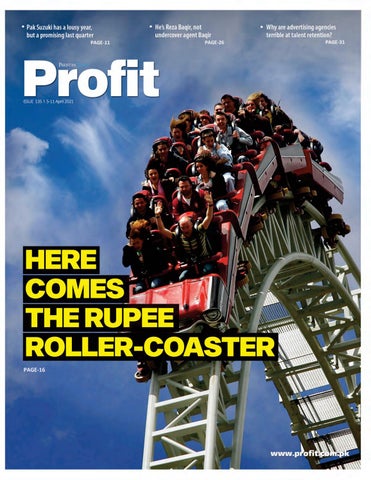
16 16 Here comes the rupee roller-coaster 23 Hammad Azhar: The new poster boy for PTI
25
25 Cabinet Roulette: Tabish Gauher as Petroleum Aide 26 He’s Reza Baqir, not undercover agent Baqir
28 28 Summit Bank to get a new CEO 31 Why are advertising agencies terrible at talent retention?
Profit
Executive Editor: Babar Nizami l Managing Editor: Farooq Tirmizi l Joint Editor: Yousaf Nizami Reporters: Ariba Shahid l Babar Khan Javed l Taimoor Hassan Abdullah Niazi l Meiryum Ali l Shahab Omer Director Marketing: Zahid Ali l Regional Heads of Marketing: Muddasir Alam (Khi) Zulfiqar Butt (Lhr) l Mudassir Iqbal (Isl) l Layout: Rizwan Ahmad l Photographers: Zubair Mehfooz & Imran Gillani l Business, Economic & Financial news by 'Pakistan Today' Contact: profit@pakistantoday.com.pk
Readers Say The sample size here is very small, so can't really draw any broad conclusions. Another way to look at it is that those privileged enough to get an American degree already have the network to raise capital. Apropos: Want to raise capital for your startup in Pakistan? Get a degree in America @rogueonomist, Twitter
Interesting take on funded startups with foreign educated founders - It's definitely an advantage on paper and makes people more "presentable." - Meanwhile local VC's may not have an explicit bias but a US educated founder is more sellable & will have a better chemistry with foreign VC's. Apropos: Want to raise capital for your startup in Pakistan? Get a degree in America
Agree with @rogueonomist here. It is still pretty early days and the sample size is too small. Also, please consider the co-founders and founding team members to the mix (without whom raising capital isn't possible). Apropos: Want to raise capital for your startup in Pakistan? Get a degree in America @MubarizSiddiqui, Twitter
More and more of them are investing in Pakistan now, so it matters. Early stage startups get funded on their founders hustle and such profiles can tip the scale in your favour. For later stage investments, I feel it doesn't matter as the metrics become more important. It might be my personal bias but the reverse is also true. A US educated ex-McKinsey Wapistani from an elite family is a bad fit for startups solving complex local problems. For those segments, I'd rather bet on a street smart desi founder who can't speak fluent English. Apropos: Want to raise capital for your startup in Pakistan? Get a degree in America @sheryhydri, Twitter
I think the second point is more valid. Those who have an US degree not only have the network to raise capital but also they know the ways and means to raise capital and they are willing to give part of their company to raise capital unlike many pakistanis who like to become "Seths."Apropos: Want to raise capital for your startup in Pakistan? Get a degree in America @Al33mK, Twitter That is just the reality. Even with government funded projects, which get their funding through loans from development partners, only those candidates that have foreign qualifications, or are from LUMS are screened and short listed, let alone selected. Local talent doesn’t even make it to the final decision maker’s table. And the worst thing is that this trend is growing. Apropos: Want to raise capital for your startup in Pakistan? Get a degree in America @safyanjabbar, Twitter Perhaps you are confusing cause and effect here. Studying in the US is already an indication of privilege, connections and a leg up. Apropos: Want to raise capital for your startup in Pakistan? Get a degree in America @FaisalImranMiazn, Twitter
facebook.com/Profitpk twitter.com/Profitpk linkedin.com/showcase/13251020 profit.com.pk profit@pakistantoday.com
HOW TO CONTACT
7
I think it is still too early to draw this conclusion. However, it is true that investors at this point have certain criterias, and one of those criterias seems to be that the startup they are investing in should have someone at the helm that has a “degree from a prestigious western university.” Can’t blame them either, it’s too early and they would want as many caveats and checks as possible. Apropos: Want to raise capital for your startup in Pakistan? Get a degree in America @ARafayGadit, Twitter
Does anyone have this data for Indian startups? In Pakistan, 0.45% of people that attend college or university get a degree from the United States, but 46% of total funding went to founders with this background. Apropos: Want to raise capital for your startup in Pakistan? Get a degree in America @VishalBhargava5, Twitter That’s true not just of startups. I have seen it in the IT industry. The opportunist expats who have US citizenship, as soon as it is convenient or whenever they want their teen kids to spend their formative years in India, very conveniently state reasons of old parents or something like that to get job priority here. Once it is time for their kids to go to college, they once again find a US posting most likely through the same firm that was hired in India, and go back to the US. That is Indian jobs lost to these opportunists. Check how many expats come back when their kids’ are around 12 and go back when they need to start their graduation. And they get the jobs here because of that US client experience. Apropos: Want to raise capital for your startup in Pakistan? Get a degree in America @nirmalavodafone, Twitter It's not the degree but the necessity of having entered the startup circles in the US, during the pursuit of that degree. If the first assumption was correct we have people in thousands who have degrees for the US but no startup funding. It's all about the right connections and the right mindset. Apropos: Want to raise capital for your startup in Pakistan? Get a degree in America Ali Khawaja, Facebook
COMMENTS
IN BRIEF The Oil and Gas Development Company Limited (OGDCL) Board of Directors (BoD) has elected Zafar Masud as chairman Board for a term of three years. As per details, OGDCL, informed the PSX and London Stock Exchange Plc about the appointment. The government has decided to conduct a forensic audit of loss-making State-Owned Enterprises (SOEs) for the last decade. According to sources, enterprises that will undergo a forensic audit include the Pakistan Railways (PR), the Pakistan International Airlines (PIA), and others.
“Ministry of Commerce is glad to share that according to provisional figures, in March 2021 our exports increased to $2.345 billion. This is an increase of 13.4 percent over Feb-2021. It is the monthly highest in last ten years,” Adviser to the Prime Minister on Commerce and Investment, Abdul Razak Dawood
Trade with India:
The Economic Coordination Committee (ECC) on Wednesday allowed the private sector to import 0.5 million tonnes of white sugar from India, Finance Minister Hammad Azhar said. The finance minister added that the country will also import cotton from India starting from end-June this year.
SAPM on power Tabish Gauhar has been given the additional charge as the PM’s aide on petroleum only three months after Imran Khan rejected his resignation as SAPM on power. Gauhar had resigned over Whatsapp citing unnecessary meddling and interference within the power ministry. Newly-appointed Federal Minister for Finance and Revenues Hammad Azhar on Tuesday assumed his charge and chaired the first meeting in the ministry. Azhar has replaced former Minister Abdul Hafeez Sheikh, who failed to secure a seat in parliament after losing a senate election to former Prime Minister Yousaf Raza Gillani.
$300 million:
The Asian Development Bank announced on Tuesday that it will be extending Pakistan a $300 million loan to finance the construction of a 300-megawatt hydropower plant near Balakot. The plant will incorporate seismic strengthening and climateproofing measures, will be built on the Kunhar river near Balakot.
8
Eurobonds, Margot Robbie, and snooty LUMS grads this week in Pakistan’s business and economics twitterverse
In a week that saw the replacement of a finance minister, a lot else was going on
T
he week was dominated by the appointment of Hammad Azhar as Finance Minister and the unceremonious exit for Hafeez Sheikh that this appointment caused. This, of course, was followed by rumors of Shaukat Tareen replacing Azhar in only a couple of days. However, Hammad Azhar’s appointment is something we have discussed in more detail in another piece in this issue. For this week’s social media round up, we look at how State Bank Governor Reza Baqir might be going from Governor to Viceroy according to some, along with speculation of who will star in a Pakistani version of ‘The Big Short.’ The autonomy of the SBP dominated most conversations, and there was fierce contention over whether the sale of Eurobonds is a success or not so much. On a lighter note, we also look at how the finance side of Pakistani Twitter dealt with the infuriating landmine of April’s Fools jokes that are apparently still a thing. Profit’s Ariba Shahid looks at all this and more.
Profit’s reporter Ariba Shahid analyses the business and economic highlights from Pakistani Twitter this week.
Bank autonomy
Help wanted
The Big Short was the movie that first introduced this reporter to the fascinating world of Capital Markets and Finance. And while the presence of Ryan Gosling proved a distraction from the numbers and technicalities, it was Margot Robbie whose explanations of financial terms in made the movie memorable. Ammar Khan asks an important question – who will do the same for Pakistan? Will it be Saba Qamar or Mehwish Hayat? Or maybe even Mahira Khan?
SOCIAL MEDIA ROUNDUP
Remember everyone going crazy over the SBP autonomy bill and making up imaginary worst case scenarios? Brazil recently made their central bank autonomous, and Rooshan Aziz, a financial services professional based in London is reminding Pakistani’s through a thread of subtweets on how central bank autonomy is completely normal and desirable, despite the fact that critics will always be there.
9
Those snooty LUMS grads
Eurobond question
IBA and LUMS grads often have a sense of entitlement and a very strong hint of “we’re better than you” attitude. Trust us, lots of them exist. Despite the abundance of these finance dudebros/sis, the same people keep showing up in the government. However, it is important to note that graduates from these institutions would rather be corporate sellouts than national sell-outs (if that is a term).
The cupboard they don’t tell you about
Nadeem ul Haque at PIDE is asking all the questions. Honestly, at this point I don’t even know how many copies of my ID card I’ve ever made. It’s fascinating how many banks keep around. It is also nice to see Nadeem ul Haque still using twitter, and not getting in trouble for it as he has tended to on a few occasions in the past.
April’s fool is still a thing
In a less off-beat tweet, Ammar talks about how selling Eurobonds is no triumph, but that doesn’t mean you call it underwhelming. Pakistan being a B- rated country, grey listed by FATF and with political instability (hint hint, FM was just sacked), managed to perform well in the international market. Credit where credit due?
Same old same old
April’s Fool is an interesting day for marketing professionals. Why? Well they can come up with the wackiest offers and fool their audience into believing them. For instance, KFC claimed to give away their fried chicken on twitter. However, sometimes marketing teams tend to forget its April’s Fool day and post their advertisements and promotions on the dreaded day. As a result, the targeted audience have their guards up and view posts with skepticism. This happened with Roomph, advertisement which may or not be a prank. Regardless, if you’re getting people to talk about your promotions, you’re doing something right.
10
Every week, whilst preparing our twitter round up, we often witness the same few people. Arhum manages to sum up the Pakistani twitter experience in 280 characters. As for the finance bros giving stock tips, Profit advises caution whilst advising stocks for greater compliance to the market regulations.
SOCIAL MEDIA ROUNDUP
Pak Suzuki has a lousy year, but a promising last quarter
The company’s fourth quarter helped improve overall financial results
J
ust how bad of a year did Pak Suzuki Motors have? The financial results for the year ending December 31, 2020 were released to the Pakistan Stock Exchange on March 22, and they were not kind. Pak Suzuki had an absolutely lousy 2020; in fact, the nicest thing one can say about the results are that they were not as bad as the year 2019. In 2019, the company’s sales stood at about Rs116 billion, while the costs of sales
AUTOMOBILES
stood at Rs114 billion. Hence gross profit was roughly Rs1.9 billion, while loss after tax stood at Rs2.9 billion. Now, in 2020, the company’s sales stood at a much smaller Rs76 billion, while costs of sales stood at Rs73 billion. Hence, gross profit stood at roughly Rs3.3 billion, while loss after tax stood at Rs1.6 billion. Which leads to the question, what happened in both these years, and why was there such a difference? First, some context. At this point,
rehashing Pak Suzuki’s history almost seems pointless, but we will stick to Profit tradition nonetheless. Pak Suzuki Motor Company Limitedis a public limited company which was formed in August 1983, as a joint venture agreement between Pakistan Automobile Corporation Limited (representing Government of Pakistan) and Suzuki Motor Corporation (SMC) Japan. The company started commercial production in January 1984, with the primary objective
11
of manufacturing, assembling and marketing of cars, pickups, vans and 4x4 vehicles in Pakistan. The company is a big deal. Consider that the foundation stone laying ceremony of the company’s existing plant located at Bin Qasim was performed in early 1989 by the then Prime Minister, Benazir Bhutto. By early 1990, in-house assembly of all the Suzuki engines started. In 1992, the plant was completed and production of the Margalla Car commenced. Over the years, Suzuki became the working man’s car in Pakistan, and was considered the cheaper but reliable competitor to the more high-end Toyota sedans. Then, under the government’s privatization policy, the company was privatized and placed under Japanese management in September 1992. At the time of privatization, SMC increased its equity from 25% to 40%, and then to 73.09% by purchasing remaining shares from PACO. After privatization, the management expanded the existing plants capacity to 50,000 per annum. The expansion was completed in July 1994. The capacity was further increased to 80,000 vehicles in 2005, 120,000 vehicles in 2006, and 150,000 vehicles in 2007. The Company also set up a new plant for motorcycles
12
“The improved margins resulted from favorable rupee dynamics and potential use of previous outstanding inventories. As part of cost cutting measures, the company was able to reduce administrative expenses by a significant 61% quarter-on-quarter and 71% year-on-year for fourth quarter. The finance cost declined 42% quarter-on-quarter, and 73% year-on-year” Ammar Javed, analyst at Bin Qasim, for which all the operations of motorcycles from July 2011. Pak Suzuki has introduced such landmark brands in the Pakistani market, like the Suzuki Cultus, Alto, Bolan and Swift, to name a few. And it did well, mostly. Between 2014 and 2018, the company’s production of motorcars rose from 80,384 cars to 143,239 cars, while the production of motorcycles stayed at around 24,000 annually. Similarly, the company sold 78,005 cars in 2014, climbing to 140,313 cars in 2018.
Then, in 2019, the company stumbled. Production volume fell to 107,999 cars, and 22,737 motorcycles, and sales volume fell to 113,270 cars, adn 22,589 motorcycles. This was reflected in the year’s financials as well. Where gross profit in 2018 stood at Rs7 billion, in 2019 gross profit stood at Rs1.9 billion. What happened? According to the company’s annual report, “Massive devaluation of Pak rupee and multiple duty and tax increase levied from July 2019 budget ,resulted in increased imported material cost, consequently
AUTOMOBILES
adversely affecting the profit margins. Company incurred net loss of Rs 2,921 million as compared to net profit Rs 1,298 million in last year. Beside decline in gross profits, another factor for adverse profitability was increase in financial charges by Rs 1,763 million in current year from Rs 185 million in 2018 to Rs1,948 million in 2019.” In part, they were right. The auto industry in Pakistan went through a lot in 2019, with Suzuki, Toyota Indus Motors, and Honda Atlas motors all halting production after a massive increase in car prices led to a drastic fall in demand. Then, in 2020, the coronavirus pandemic struck and Suzuki ended up having two bad years in a row. At the time, Pak Suzuki had said that it would be taking countermeasures, initiating cost cutting measures, and improving efficiencies. The report also said: “The company also gradually increased the selling prices of its products to pass on the impact of increase in production cost. Prices are being increased in
phases to maintain the sales volume.” One thing Pak Suzuki did not foresee is the pandemic of 2020. The Covid-19 months are highlighted in red on the data available from the Pakistan Automotive Manufacturers Association (PAMA), and one can see why. In February 2020, the company produced 97 Swifts, 1,107 Cultuses, 52 Wagon Rs, 94 Bolans, 1,502 Altos, 523 Ravis, 1,890 motorcycles. In April 2020, it produced and sold zero of those models. Indeed, Pak Suzuki has well and truly been saved by the last quarter results, when the pandemic somewhat eased, and the automotive industry experienced a rebound of sorts. The company posted profit after tax of Rs1 billion in the fourth quarter of calendar year 2020, compared to a loss after tax of Rs136 million in the third quarter. The gross margin stood at 8.2% in the fourth quarter, compared to 5.3% in the third quarter. According to analyst Ammar Javed, in a
Highnoon
meets the hype After being named a high-performance company by Forbes, Highnoon performed highly
H
ighnoon Laboratories Limited has just had a good year. They just announced a 150% dividend, which is Rs 15 per share and bonus shares in the proportion of ten shares
PHARMACEUTICALS
for every 100 shares held. Add to that earning per share of Rs 42.58 in 2020 compared to Rs 28.91 in 2019, and you see that the profit for the year grew by a whopping 47.2%. And that is not because they had a dicey 2019 or anything, in fact, this was quite expect-
note sent to clients on March 22, the results were even ‘above expectation’. “The improved margins resulted from favorable rupee dynamics and potential use of previous outstanding inventories. As part of cost cutting measures, the company was able to reduce administrative expenses by a significant 61% quarter-on-quarter and 71% year-on-year for fourth quarter. The finance cost declined 42% quarter-on-quarter, and 73% year-on-year,” he added. Will Pak Suzuki have a better 2021 after all? As a February 2021 report from Taurus Research said, “We expect PSMC’s volume trajectory to grow at a stable rate given its affordable product range, low-maintenance costs and availability of after-sales service.” But Pak Suzuki will also have to consider the fact that because of the bad years that Honda, Suzuki, and Toyota had in 2019 and 2020, companies like MG, and KIA have managed to find a market so there will be more than the usual competition in the year to come. n
ed. At a time when Pakistan’s economy was teetering at the edge of disaster, Forbes Magazine listed Highnoon as one of the high-performance companies in Asia in 2019. Only three Pakistani companies out of two hundred have been added to the list. Chances are, however, that you have not necessarily heard of Highnoon before. Established in Lahore in 1984, Highnoon was listed on the stock exchange as a public company more than a decade later in 1995. Highnoon has a wide product portfolio, producing basic therapeutic class medicines, generic name medicines, as well as herbal medication. Within this segment, Highnoon produces drugs for alimentary tract and metabolism, antihistamines, anti-invectives, cardiovascular, endocrine, hematology, musculoskeletal, nervous system, parasitology, respiratory, and urinary tract infections.
13
At its Lahore facility, the company manufactures Solid Dosage Forms including tablets, capsules, pellets encapsulation, dry powder suspension, and dry powder sachets. The facility also also supplies Liquids (Syrups & Suspensions and Oral Drops) which have state of the art dedicated Hormonal Facility. The present manufacturing capacities fully cater to the needs of local and export markets. According to their own data, their facility has a capacity of producing 180 million capsules, 788 million tablets, 8 million bottles of syrup, 6 million oral droppers, and a capacity to package 68 million cartons. They also have under their umbrella Curexa Health, which is a wholly owned subsidiary of Highnoon that was incorporated in 2015. Curexa specializes in the area of antibiotics, primarily cephalosporins. Route–2 Health (Private) Limited is an associated company of Highnoon. Route–2 Health is a manufacturer
14
of herbal medication and its association with Highnoon has existed since 1984 and has been rapidly expanding as a brand with a presence in Canada, UAE, and a state-of-the-art manufacturing facility in Lahore, Pakistan. This facility of Route2Health is Asia’s 1st USP accredited dietary supplement facility. So how did Highnoon manage to make the past few years count after being around since 1984? It is interesting as to how they were able to perform so well during the year considering the industry dynamics. The company managed to thrive in a challenging environment despite the high inflation rates and rising costs, slow economic growth, and most importantly currency depreciation, in addition to a global pandemic that rocked almost every business in the world in some form or the other. Raw material consumed as a percentage of sales remains an important variable for this industry. With a number of raw materials
imported, the devaluation of the rupee certainly weighs on the costs of production. A problem the industry faces is the fact that it cannot pass on an increase in costs to the consumers as easily as other industries. This is because the industry is heavily regulated and pricing is often decided. In 2020, however, the company managed to increase its net revenue by 18.24%, cost of revenue by 13.29% and gross profit by 23.86%. While the breakup for raw materials is not available for 2020, cost of revenue as a percentage of net revenue stands at 51% in 2020 compared to 53.2% in 2019. Other costs increased by 13.81%. However, other income increased by 23.01% and finance costs decreased by 9.4%. As a result, for the year, Highnoon’s profit increased by 47.2%. The company exports to a number of markets, with Afghanistan being a major market for it. It can be assumed that better trade ties with Afghanistan may have resulted in greater sales. n
PHARMACEUTICALS
16
COVER STORY
I
By Farooq Tirmizi
t was in September 1992 that George Soros became a household name. Or at least famous amongst those who read the financial press. In that month, he successfully predicted that the value of the British pound would go down and bet heavily against it, making more than $1 billion for himself and his investors over a span of just four weeks. One of these days, somebody will do the same thing to the Pakistani rupee and they will deserve every penny of profit they make off the folly of the government of Pakistan’s macroeconomic policies. Dear reader, it is happening again. The government of Pakistan is undertaking a series of economic actions meant to hold the value of the rupee at a stable rate against the US dollar, a policy that sounds like it is the right thing to do, but has invariably been the cause of every single economic crisis in Pakistani history except two (those would be the two that followed the 1965 and 1971 wars). At this point, we at Profit have spent so much time trying to persuade the government of Pakistan to leave the exchange rate alone – to absolutely no avail, we might add – that
18
we have decided to simply give up. We are not sure that anyone important in Islamabad reads our thoughts, and even if they did, it is abundantly clear that our advice is not seen as particularly helpful in the corridors of power. The point of this article is not to tell the government what it should be doing in terms of macroeconomic policy. No, the point of this story is to tell you, the reader, what you should do in anticipation of the inevitable economic crash that will come once the government is unable to prop up the value of the rupee any longer. This story will first lay out our case for why we think the government is artificially intervening in the currency markets, why it is unsustainable and hence the wrong economic policy, why a crash is inevitable, some estimates of when we think the crash will happen, and what you can do to protect your assets when that eventually happens.
Why currency interventions are a bad idea
T
he single biggest problem with the government of Pakistan’s interventions in the currency markets is the fact that it does not actually have the
money to do so, and so therefore relies on borrowed money to prop up the price of the rupee. Debt, in itself, is not a bad thing. Used appropriately, it can be quite useful. But there are some rules to using debt wisely, and, more specifically, there are basically three circumstances in which taking on debt makes sense. It allows you to invest in assets that will increase your income by more than the principal and interest you will repay on the debt. It allows you to purchase an item that will reduce your expenses by more than the principal and interest you will repay on the debt. It allows you to buy an asset that will increase in value by greater than the amount you will pay back in interest on the debt. Under any other circumstances, if you borrow money, you are deliberately making yourself poorer. As you can imagine, unfortunately, that is exactly what the government of Pakistan has been doing for the last several decades. The government of Pakistan borrows money in US dollars – both from global bond investors as well as the International Monetary Fund (IMF) and other multilateral lenders – as a means of stabilizing the rupee so that the cost of imported goods does not increase. In the government’s view, since imported goods
form the inputs to so many essential goods, a rise in the price of the dollar – and therefore those imports – will result in inflation. And since inflation has a tendency to hurt the poorest sections of the population the most, resisting that pain is seen as worth government effort and resources. The problem with this strategy is that it is focused on using borrowed money to finance today’s consumption. In effect, the government wants people to have cheaper tea and bread and so it will borrow money from foreign investors in order to – through a series of complicated financial maneuvers – make the tea and the bread cheaper by paying for part of it. By making imported goods cheaper than they should be, the government creates an unsustainable situation for itself. It wants people to have cheap goods, but if the imported goods are cheap, people will buy more of them. If they buy more of them, the value of imported goods will go up, meaning more rupees need to be sold and dollars bought in order to pay for those imported goods. That, in turn, means the value of the dollar will rise relative to that of the rupee, the very thing the government was trying to avoid in the first place, and so the government will need to borrow yet more money to push the price of the dollar back down, which then restarts the same cycle all over again. Needless to say, this is far from a healthy situation, and one that the government of Pakistan has been caught in since at least the
early 1980s. It is this foreign borrowing, by the way, which results in the government having to repeatedly turn to the IMF for bailouts. At some point, global bond investors see that Islamabad has borrowed money only to finance consumption and has done nothing to increase the country’s aggregate earning power, and so they refuse to lend more money and demand that we pay the old loans back, which is when we go to the IMF to borrow from them to pay back the global lenders.
The ‘smart’ way to borrow
W
e must give the Imran Khan Administration some credit. They are somewhat more sophisticated than their predecessors in the Nawaz Administration in that they are trying to increase the flow of dollars into the country through new methods. Among the most successful programs the government has launched is the Roshan Digital Accounts, which allows expatriate Pakistanis to open bank accounts in Pakistani banks and deposit foreign currency at very favourable interest rates. The problem with these new methods is that they share the same fundamental characteristics as the older, cruder methods of the past. Deposits for a bank are a liability, and
as such the same thing as if one had borrowed money. The government is paying the interest rates on those dollar deposits, which means that it is the government that has borrowed money in US dollars. You can call it a deposit. You can call it foreign investment. You can call it remittances. At the end of the day, it is a loan. And like loans in the past, it is going mostly to finance consumption expenses, not investment. To be fair to the government, the year 2020 was an extraordinary one, where the government needed to undertake a Keynesian stimulus so that it could mitigate the economic effects of the shutdowns that resulted from the coronavirus pandemic. That meant that the government ended up being suspended out of its IMF bailout program, which it had entered in 2019. Only now is the government slowly making efforts to get back into the IMF program, by making both regulatory as well as fiscal changes that are likely to win the approval of the Washington-based lender and demonstrate that Islamabad is serious about curbing its fiscal profligacy. But we have been here before. At the end of the day, the bureaucrats in the finance ministry do not see the IMF as a temporary bailout that they need to get the country back on its feet, but instead as a permanent source of liquidity from which they can continue to borrow ever-increasing amounts with regularity in order to finance the budget deficit. We want to make one thing clear: our predictions about the coming crash have nothing to do with the recent run up in the price of the rupee against the US dollar. That increase is based on market fundamentals: the current account deficit is decreasing, and for the right reasons, with the rise in exports and remittances outpacing imports and capital outflows. Now, our hesitation is based on the fact that the government just raised money in the global bond market again, a move that is eerily reminiscent of the worst tendences of former Finance Minister Ishaq Dar’s policies.
When is the crash coming?
T
his is a somewhat harder thing to predict, though if the past three decades are any guide, the answer is some time in the third and fourth quarter of 2023. Yes, we recognize that we are making a remarkably precise prediction for something that is inherently difficult to predict. But we have our reasons. In essence, we believe the next crash will coincide with the next election. Why? Because two of the last three elections coincided with economic crashes because they were run by
COVER STORY
governments that were operating in roughly the same manner as this current administration. Here is what typically happens. The government that comes into office decides shortly thereafter to go to the IMF and seek a bailout during the period of maximum political goodwill following their election / coup. They implement the tax increases and spending cuts that slow down economic growth early, but then also set the repayment period to be just after the next election so that they can go through a full term without having to think about another bailout. Towards the end of their term, however, every government ends up engaging in highly populist behaviour, which generally means cutting electricity and fuel prices in order to make themselves popular with the voters. This has the dual effect of cutting tax revenue and increasing government expenditures, which drives up the government deficit right before the loans are about to come due. The inevitable happens: they lose their election. No government in Pakistan has ever served a second consecutive term at the federal level. The new government comes in, stuck with the bill the last one left them in their futile attempt to win the election. Incidentally, this whole “spend money so that people will like me” move is shared both by civilian as well as military leaders. The people matter in
20
Pakistan, even to dictators. But nonetheless, that is why economic crises in Pakistan coincide with elections. They are the direct result of poor political choices made by leaders – both elected and unelected. Since the next election is going to take place is October 2023, we believe the next economic crisis will take place around that time. If we had to pin it down, we would say the rupee will start crashing in late July/early August of 2023, right around the time the caretaker government is taking over in preparation for the election. Caretaker governments in Pakistan are a bit like letting one’s muscles relax: it can get messy when you do it, but it is necessary, and you will feel better after you do.
What you can do to protect yourself
[
Disclaimer: We should caution that this coming section is not to be taken as investment advice and is not tailored to any individual’s circumstances. The purpose of this section is merely to illustrate the kinds of effects economic cycles can have on investments, and how professional money managers think about such effects. In general, timing the market is a risky proposition, and people are better off systematically saving a little bit every month
and deploying that money into assets that are appropriate for their risk and liquidity needs. Consult a licensed financial advisor before making any major decisions.] If you could predict exactly when the rupee would start to crash, the best thing you could do would be to borrow a large sum of money in Pakistani rupees, convert that cash immediately to US dollars, and then wait for the crash. Once the rupee crashed, you would then convert your US dollars back into rupees at the higher exchange rate, which would mean that you could convert fewer of those dollars back into rupees to pay back the same rupee amount. The dollars remaining in your account would be your profit. In order for this to work, you would need to time this nearly perfectly, and have lots of real estate at your disposal. Even when interest rates are low in Pakistan, as they are now, they tend to be quite substantial. That means that you cannot borrow for too long, since the interest on the loan would start cutting into your profits. For example, even when the State Bank’s benchmark interest rate is at 7%, you would be lucky if you were able to borrow at a 9-10% interest rate as an ordinary individual, even with collateral. If you had to hold that loan for two years, even a 20% devaluation in the rupee would not be profitable for you. To be safe, you would need to time the loan to within three months of the
TEXTILES
crash, because the crash itself is not overnight, and often takes six months or more to play out in full. And you would need spare real estate, because banks in Pakistan would not just be willing to lend you the money unless you could pledge a substantial amount of collateral against the loan. Since this is a risky transaction, you obviously should not do this with your own home, meaning you would need to have real estate to spare in order to pull off this transaction. Needless to say, this is a very, very risky proposition that is suitable for almost nobody. It would be a terrible way to hedge your risk and there are simply too many ways for this to go wrong. What else could you do in order to protect yourself from a crash of the rupee? Simply buying dollars is one option, but that has its limits. The government of Pakistan restricts how much foreign currency an individual can buy, and depending on how much money you have, that may not be enough. In any case, buying large quantities of foreign currency is quite a cumbersome process. (This is by design: the government wants to make it inconvenient for you to sell rupees and buy dollars so that you do not do it unless you absolutely need to.) So, what else would work? Well, think about what is happening when the value of the rupee crashes. Specifically, there are two trends to think of. Firstly, the cost of goods
and services priced in rupees is declining relative to the cost of goods and services priced in US dollars. And secondly, there is going to be a spike in inflation, and therefore interest rates. Now let us think about what kinds of businesses would benefit from both of these trends. The first trend would benefit several different companies, but one much more directly than others: exporters. Any publicly listed exporter will see their profits rise because their revenues – priced in US dollars – will immediately rise, while the price of their costs – usually priced in rupees – will be slower to rise, resulting in a jump in profitability. For the second trend, the biggest beneficiaries would be the banks, which would see the interest rates they charge on their lending increase much faster than the interest rates they have to pay out on deposits. (This trend is more apparent in the larger banks than the smaller ones, which tend to have higher cost deposits that need to be repriced faster, this leaving less room for higher profits.) The problem with buying stock in both of these sectors, however, is that they both will first see a sharp hit to their profits when the rupee crashes before they will see any increase in profits. In the case of exporters, the rise in interest rates can sometimes result in a significant increase in their cost of borrowing. And banks are effectively the same as large government bond portfolios, which would first see a hit from the decline in the value of those low-interest bonds as interest rates rise, before
A safer possibility is to place one’s funds in a money market mutual fund, which may have lower returns, but returns that are nonetheless higher than savings accounts, and have the benefit of being invested in short-term fixed income instruments, meaning they fluctuate far less with interest rates than the longer-tenor bonds that form the bulk of the portfolios at fixed income funds
seeing any benefit from the rise in interest rates. So, what can you do? Should you buy these stocks while the market is crashing and hope that they will recover by the time you need to sell? That’s one possibility. A safer possibility is to place one’s funds in a money market mutual fund, which may have lower returns, but returns that are nonetheless higher than savings accounts, and have the benefit of being invested in shortterm fixed income instruments, meaning they fluctuate far less with interest rates than the longer-tenor bonds that form the bulk of the portfolios at fixed income funds. Park your money in those money market funds, wait for the market to crash, and then – when everyone is screaming in pain – start buying stocks in the two sectors laid out above, or buy an equity mutual fund with substantial exposure to those sectors of the economy. What about the two methods of investing Pakistanis love above all others: gold and real estate? Gold can be quite volatile during an economic downturn, and hence, while it might end up being profitable, is a high-risk proposition in times of turmoil. Yes, that is despite its reputation as a safe-haven asset. As for real estate, yes, prices do tend to tumble during a downturn, but people in Pakistan also tend to hoard real estate. Sure, prices will be down, but try actually buying anything. People will not be selling if they do not like the price. In short, there are a few ways to protect yourself from the government’s folly, and even make some money along the way. Just because the government does not plan its money decisions wisely does not mean you should not either. n The writer is the founder and CEO of Elphinstone, a US-based registered investment advisor regulated by the United States Securities and Exchange Commission. Elphinstone’s Pakistan subsidiary is currently seeking – but has not yet been granted – a Securities Advisory license by the Securities and Exchange Commission of Pakistan.
COVER STORY
T
By Meriyum Ali
here was, almost immediately after the appointment of Hammad Azhar as the Minister for Finance, a tweet doing the rounds that highlighted Azhar’s education. The tweet proudly displayed pictures of Imran Khan, Pervez Khattak, Hammad Azhar, and Reza Baqir and pointed out that for the first time in history, four Aitchisonians were occupying the position of Prime Minister, Defence Minister, Finance Minister, and State Bank Governor at the same time. The tweet forgot to include Foreign Minister Shah Mehmood Qureshi, who is also an alumni of the school. The tweet, which meant this to be a reassuring mark of distinction, raised concerns for all that have had to interact with the gentlemen of Punjab Chief’s College (actually what it used to be called) about the future of this country. Don’t get us wrong, as individuals, we are sure they can be fine men and have in the past served the country with distinction, with two former Presidents and Prime Ministers each as well as Nawab Akbar Bugti for good measure among the many graduates of the school that have occupied high office. But it says something about a country when the four (constitutionally) most powerful people in the country are all men that studied from the same, elitist, boarding, prep-school that was built by colonists to turn the Chieftains of Punjab into civilized englishmen. But setting aside the vapid realisation that Pakistan continues to operate and vest power in the same group of people it has been for a century, Hammad Azhar deserves to be looked at as his own person, particularly because very little about him is stereotypical. Take for example his higher education, in which he graduated from the School of Oriental and African Studies (SOAS), which should put him less in the category of wantsto-raise-federal-taxes and more in the category of abolish taxes
FINANCE MINISTRY
23
and demand colonial reparations (“Hammad Azhar’s fellows from SOAS are going to judge him so much for becoming finance minister, like why didn’t he become minister for intersectionality of culture and colonialism,” was another popular tweet after the appointment). Young, impressive, well-spoken, erudite and most importantly experienced, Azhar’s appointment has given PTI supporters a breath of fresh air, and they are hoping he can be their new poster child. The appointment coming in the middle of an International Monetary Fund (IMF) programme makes things more interesting, and has thrown investors a curveball. As you would expect in the wake of something like this, drawing room discussions have grown heated and Whatsapp uncles have been rubbing their fingerprints clean with their gripes and complaints. And according to the long forwarded messages making the rounds, Azhar’s appointment is yet another example of the Pakistan Tehreek-e-Insaf government having no direction, that the government has bungled the announcement by making it right before the crucial offering of Eurobonds, and that Azhar is not adequately qualified. But despite our concerns about the Federal cabinet being not just a visibly but unabashedly elitist boys club, let us try and assess one by one the concerns that fearsome hordes of uncles have raised on their green-logoed platform. And let us begin with the question of the government being directionless. At this point, casual observers of national politics and the most ardent fans of PTI will know that Prime Minister Imran Khan has a problem with his team. In fact, not having a dream team with his commitment is the tragic flaw his supporters often try to peddle as the reason he has not yet come through on his promises. No sooner does one golden boy fumble, then he is unceremoniously dumped, and a new golden boy is brought in to replace him. Khan’s trust, it seems, is easily won, and easily lost. Or perhaps Khan has no sense of responsibility, in understanding that these are federal government positions, and not just random team picks. Just consider the history of the wazarat-e-khazana. In 2018, the first finance minister brought in was Asad Umar, a man
“It means the government is finally taking ownership of the decisions it is making, which is necessary for a democratically elected government. There was criticism against Sheikh that he simply hadn’t won the votes necessary to be able to lead something like the finance ministry” Saad Hashmi, Executive Director of BMA Capital that had been earmarked for the role ever since joining the PTI years before they were even close to power. He was dumped just eight months later, right in the middle of IMF negotiations. Then came Hafeez Sheikh, a former finance minister who was brought in as a finance advisor - only to also be dumped during the IMF programme. It is enough of a trend that some news channels even broke the news earlier this week that Azhar himself had been sacked just a few days later (he has not, as of time of writing). But it is worrying that rumors of his possible replacement (Shaukat Tarin) are still making the rounds. So while the irritation among commentators is palpable, there is another camp that is grateful at least for a technical shift. Sheikh was brought in as an advisor because he was not an elected representative. The government has turned him into a minister, with the hope that he might win the senate elections. But then he lost the Islamabad seat to Pakistan Democratic Movement’s (PDM) joint candidate Syed Yousuf Raza Gilani. Azhar, on the other hand, is an elected MNA from Lahore. And according to some, it is always a net positive when positions like the finance minister are out of the hands of technocrats (which is what Sheikh represented), and back with representatives. According to Saad Hashmi, Executive Director of BMA Capital, it means the government is finally taking ownership of the decisions it is making, which is necessary for a democratically elected government. “There was criticism against Sheikh that he simply hadn’t won the votes necessary to be able to lead something like the
“Given the response, and the amount they have raised, it seems they were able to address some of those concerns. Remember the 30 year bond has been successfully floated for the first time ever in our history. It’s a big deal [that] foriegn investors are willing to take a 30 years view on Pakistan” Sayem Ali, former banker and financial markets specialist
24
finance ministry.” Then, there was the timing of the announcement: Sheikh was dismissed on Monday, March 29, one day before Tuesday, March 30, which is the day when Eurobonds were meant to be floated. To recap: Pakistan issued US dollar denominated Eurobonds for the first time since November 2017, when it raised $1 billion through a 5 year Sukuk and $1.5 billion through a 10 year conventional bond. The Ministry of Finance had been arranging investor calls through banks, while April 6, 2021, is the expected settlement date. According to sources, Deutsche Bank AG, JPMorgan Chase & Co., Credit Suisse Group AG, Standard Chartered Plc, and Emirates NBD Bank PJSC have been hired for the purpose of raising capital by the government. All of that planning, and still on Tuesday, Azhar had to scramble to assure bond investors privately that the events were still on track. On the bright side, the good news is that the Eurobonds went more or less smoothly, with 5, 10 and 30 year Eurobonds offered at 6%, 7.375% and 8.875%. According to Sayem Ali, former banker and financial markets specialist, those concerns have been soothed. “Given the response, and the amount they have raised, it seems they were able to address some of those concerns. Remember the 30 year bond has been successfully floated for the first time ever in our history. It’s a big deal [that] foriegn investors are willing to take a 30 years view on Pakistan,” he said. As for criticism that this is more expensive than previous bond issuance, Ali highlighted that it had been a difficult year due to Covid-19 anyway. “All countries are in an unprecedented recession , and the global situation -- very different from 2017. Pakistan is also under a FATF grey list, so there is an added risk.” Here’s a final point we will leave our readers with (and perhaps this may be the real problem) is there really any difference between Azhar and his predecessors? After all, either way, because of the IMF, there is a certain blueprint the government has to follow, no matter who is at the helm. The only difference is now, there is a new person for Khan to blame - should he need to. Luckily for Azhar, he has survived his first few days, which isn’t necessarily easy in the brave new world we live in. n
FINANCE MINISTRY
Cabinet Roulette:
Tabish Gauher
as Petroleum Aide
Ex K Electric CEO finds himself with a promotion months after tendering a rejected resignation. However, is this appointment free from controversy? By Ariba Shahid
T
he Cabinet has been reshuffled and Special Assistant to the Prime Minister (SAPM) on Power, Tabish Gauhar, now finds himself with the additional charge as the prime minister’s aide on petroleum. He is the current replacement for Nadeem Babar. Some background here is that Nadeem Babar was asked to step down by the prime minister himself, in addition to the secretary of petroleum being suspended for 90 days. This is until the FIA finishes the forensic probe that aims to identify the reasons behind the petroleum shortage last year and the people behind it.
GOVERNANCE
What is interesting is that Tabish Gauhar himself tendered his resignation to the prime minister three months ago through Whatsapp because he did not like the unnecessary meddling and interferences within the power ministry. Moreover, before his appointment, he had submitted several proposals which he pitched through his time at the ministry that were not implemented or were overlooked. Gauhar’s resignation came a little over three months after his appointment. The resignation, however, was rejected by the prime minister and Gauhar had been asked to stay. And now, one could say Gauhar got a promotion.
So who is Tabish Gauhar?
G
auhar was born and raised in Karachi and had then moved to Islamabad when his father got a job at the World Bank. As far as his education is concerned, he did his O-levels from Beaconhouse and his A-levels from
Frobel’s. He is an IBA alumnus belonging to the MBA class of 1996 and is an Electrical Engineer from King’s College London as a Chevening Scholar. He is a UAE iqama holder. His first job was as a systems analyst at Exxon Chemical. He has also worked at Engro. He is also the founder of Oasis Energy, a management consultancy firm in the power and energy sector that was established in 2016. Interestingly enough, Oasis Energy’s website and LinkedIn remain unavailable as of late. Gauhar has also worked at Abraaj Group and has served as the chief financial officer (CFO) at AES Corporation. Moreover, he has also been associated with the Hub Power Project in Pakistan. In 2019, he was appointed as a director at Byco. He has more than two decades worth of experience in project development in private power, water and petrochemical industries within the MENA region, Europe and Africa. However, perhaps his most notable role was when he served as the CEO and chairman of K-Electric until 2015.
What went down at K Electric?
K
-Electric was then known as KESC. It had been a private entity since 2005. However, back then power outages had become a menace with day-long power outages. Despite the terrible operational and financial performance of KE, Abraaj Capital, a private equity firm based in Dubai bought a majority stake in the company and got management control in 2008. In November 2009, Gauhar stepped in as the CEO. Amongst the many changes Gauhar is credited to, the strongest one remains that K-Electric posted its first profit in 17 years in 2012. One way this was achieved was through massive redundancies whereby 7,000 employees were given a golden handshake which resulted in massive protests. Gauhar himself was the target of two shooting events.
25
Gauhar however also found himself as a prime suspect in a criminal case alongside his two security officials in an attempted murder case where they were booked for allegedly asking guards to fire at protesting workers. The case however had been later struck down by the court. Moreover, this is not where troubles at K-Electric ended. Back then there was talk of corruption at the power company which resulted in Gauhar being summoned to a standing committee to go through important details regarding K Electric and ascertain whether corruption was taking place. However, Gauhar did not attend citing the fact that KE was a private institution and therefore, the company was not answerable to anyone. Need we remind Gauhar that private companies on the Stock Market are answerable to shareholders at the very least? Following this and a whole list of other
discrepancies found at K-Electric at the time, Transparency International Pakistan (TIP) filed a case in the Supreme Court of Pakistan (SCP).
Gauhar’s love for the media
I
nterestingly enough, Gauhar believes that beat/staff reporters belong to the ‘have nots which he writes in an article titled “Why is Pakistan so ungovernable” published in 2014. In his words, “The beat/ staff reporters are a completely different lot belonging to the "haves not" of the society.” He adds, “Any important position holder is taken to task ruthlessly because that's the only opportunity this poor soul has to turn the tables on the system and the society that hasn't given him much - he suddenly has some "power" and he'll use it to the maxi-
mum - and occasionally to extract favours in private from the same people he's bad-mouthing publicly.”
Is this appointment free from controversy?
I
n simple terms, no. In Gauhar’s defence, all appointments in ministries can become controversial. However, in this case, critics believe that the timing of this decision is crucial. With Gauhar being promoted to Petroleum, there is the probability that the significant progress made on selling the majority stake of K-Electric to Shanghai Electric may be hampered. Moreover, it is said that he is a UAE iqama holder since 1999, which remains highly controversial in Pakistani politics. n
He’s Reza Baqir,
not undercover agent Baqir With the SBP autonomy bill up for debate, governor SBP is back to being scrutinised by the media and critics for his history at the IMF
A
lot has been said about State Bank Governor, Dr Reza Baqir, as of late due to the news of the notoriously controversial SBP autonomy bill. Some call him an agent, some say he is still on IMF’s payroll, while others claim he’ll make Pakistan another Egypt. Most of what is said outside financial circles about him are often hearsay that has little to do with reality. Despite the fact that the post, regardless of whether the governor of a province or SBP, remains apolitical and rarely criticised, Dr Baqir has faced and still faces more than his fair share. Profit debunks some of the claims made about him.
So who is Dr Baqir and how did he end up as Governor?
D 26
r Baqir’s family belongs to a village called Vehari. His father, Chaudhary Sharif Baqir was a Barrister of Law who also had a political background.
His father joined the Pakistan People’s Party (PPP) and even contested in the general elections in 1988. He, however, did not win. Later on, in 1997, he became an advisor to the then interim PM Azam Mairaj. Following his education at Aitchison College Lahore, Baqir moved to the US where he obtained a degree in economics from Harvard University. Later on, he obtained a PhD in economics from the University of California, Berkeley. He holds an A.B. (Magna cum Laude) in Economics from Harvard University. Baqir managed to land himself a job at the IMF where he spent approximately 16 years of his life and served as the IMF office head and senior resident representative in Egypt. He also served as the chief of the IMF Debt Policy Division that looked at policies regarding external debt sustainability and restricting debt for member countries and as deputy division chief of the IMF’s Emerging Markets Division. Through his role at the Debt Policy Division, he helped design debt and fiscal
policies for countries like Greece, Cyprus, Ghana, Jamaica, Portugal, and Ukraine that were facing major debt-induced economic crises. In addition to this, he has also had the privilege to head the IMF delegation at the Paris Club meetings. Moreover, Baqir has also worked at the World Bank and Union Bank of Switzerland, in addition to the Massachusetts Institute of Technology (MIT).
Pakistan Egypt bhai bhai?
W
hile there may be similarities between Egypt and Pakistan, it is very important to note the stark differences. Pakistan is a democracy. The extent of democracy in Pakistan remains up for debate, but it is vastly different from Egypt that is governed by a dictator. During the IMF Programme, Egypt was transitioning to a democracy. The elected Muslim Brotherhood government, however,
was faced with a number of challenges on the political front including, internal and external resistance. Secondly, Egypt does not have nuclear weapons. Pakistan, on the other hand, is the only nuclear-armed country that keeps going back to the IMF. Egypt entered into its last IMF programme after a gap of 15 years. Pakistan has not made it that long between IMF bailouts. Pakistan first sought assistance from the IMF in 1958. Following that the country has been bailed by the organisation 22 times out of which 15 times have been from 1980 to the present. Egypt, however, had a tougher time dealing with the international financial institution’s regulations and conditions considering the fact that it was not used to IMF programmes and its interference.
Did Baqir replicate Egypt’s inflation problem in Pakistan?
T
he most significant problem Egypt faced after going into an IMF programme was hyperinflation whereby the food prices shot up by 40 per cent and headline inflation maxed out on 30%. In comparison, throughout Pakistan’s history, inflation has peaked at 2% during 2008. Reasons for the hyperinflation witnessed in Egypt can be linked to the slash in subsidies that it had given out on petroleum products. Subsequently, the prices of electricity shot up by 40% too. In addition, currency adjustments required by the country fueled inflation. The slash in subsidies, however, resulted in an approximate 2.2x increase in the number of people living below the poverty line resulting in 60% of the population below the poverty line. However, hyperinflation can occur in a country regardless of whether there is an IMF programme or not such as with Venezuela, Argentina, and Zimbabwe. While Pakistan is witnessing high inflation rates, it has not entered into hyperinflation territory despite a number of IMF suggested reforms and actions being put in place. For instance, the currency is now left on the behest of market forces following a massive devaluation. The impact of the devaluation is now in the past and had been weighed on inflation rates of 2019 and the first half of 2020. A similar case has been witnessed with the high policy rates that had also weighed on inflation. As for petroleum subsidies, Pakistan did not have to remove any as the government rather than subsidising, applies a levy on the price. Most importantly, Pakistan’s inflation can be tied to corruption which has resulted in supply shocks. Shortages of food staples have
resulted in the prices soaring. This is beyond the scope of any central bank and cannot be tied back to the State Bank of Pakistan.
Is it bad that Baqir once worked for the IMF?
T
o simplify this, Reza Baqir is now an employee of the Pakistan government. This means that despite him being paid less than what he would have made at the IMF, his loyalty should remain with his current employer. With the
country entering agreements with Baqir’s former employer, the governor brings the right experience to negotiate and explain on Pakistan’s behalf in the language and way the IMF would best understand. Having been on the other side of the table, and now having to think from a national perspective, Baqir’s past should not make his appointment a cause of concern, especially two years later. To make this easy to understand, let’s say you hire an ex-loan agent at a bank as your personal finance manager. The odds of him being in cahoots with his old employer are slim. It’s similar in this case, but just on a bigger and fancier level.
GOVERNANCE
Summit Bank to get a new CEO
After years of losses and being in the limelight for all the wrong reasons, the bank will be looking for normalcy
W
ill Summit Bank’s fortunes change now that there is a new CEO in charge? Or perhaps a better way to put this question is to ask, will there ever be any CEO with the star power and direction to
28
erase Summit Bank’s colourful history? In a notice from March 26, the bank informed the Pakistan Stock Exchange (PSX) that Ahsan Raza Durrani would no longer be the acting CEO and President of the Bank. Instead, Jawad Majid Khan was to be the new CEO and President. Majid Khan is a choice in line with the bank’s new mission. The bank
has recently decided to convert itself into a fully fledged Islamic Bank, and about 48 branches in 23 cities offer Islamic services. Which means the choice is great, because in his previous role, Jawad Majid Khan was the group head of Emaan Islamic Banking at Silk Bank. And before that, he was the country head for distribution and small
and medium enterprises for Dubai Islamic Bank between 2005 and 2011. He is a graduate of economics with a specialization in development economics from Quaid-e-Azam University, in Islamabad. Silk Bank is not exactly the country’s most profitable bank, or free from interesting moments in its history. But even it comes out looking perfectly normal when compared to the history of Summit Bank. To recall, Summit Bank is an amalgamation of three different (and absolutely tiny banks): Arif Habib Bank, Atlas Bank, and Mybank. In 2010, Suroor Investments Ltd, a Mauritius based investment firm, acquired a majority stake in Arif Habib Bank, and rebranded it as Summit Bank. It also acquired majority shares of MyBank Ltd and Atlas Bank Ltd in Pakistan. None of those three banks was ever a viable bank on its own. But the founding CEO of the bank (in 2009), Husain Lawai, made a valiant effort to make the bank profitable, undertaking several initiatives to improve the bank’s operations. For instance, he moved nearly a third of the branches he inherited to cut costs, and also tried to attract retail deposits by introducing co-branded and prepaid debit cards (then still unusual in Pakistan), and focusing on the remittances business. And yet, this did not translate into profits. In the nine years that it has been in existence, Summit Bank has posted a profit in precisely two years and has otherwise continued to hemorrhage money. Those two years happened to be 2014 and 2015. After Lawai resigned in 2016, Mohamad Zahir Esmail was appointed as President and Chief Executive Officer. But the bank made massive losses in both 2016 and 2017 – Rs2.2 billion and Rs1.1 billion respectively. And in 2018, the bank made a shocking loss of Rs8.9 billion. And yet, somehow, this is still not the
The FIA’s investigation report revealed a pattern of flouting the law against money laundering on the part of Summit Bank employees, who appeared to be operating under direct orders from Husain Lawai. Turns out, Lawai and Zardari are old friends, and Lawai spent a considerable portion of the 1990s and 2000s in exile, fighting charges of money laundering on behalf of Zardari most bizarre thing that happened to Summit Bank. The bank has been under increased scrutiny since it was mentioned in relation to the ongoing fake accounts case of 2018, involving former president Asif Ali Zardari and his sister Faryal Talpur. The fake accounts case involves alleged money laundering worth billions of rupees through 32 bank accounts, which were opened in five banks. Of those accounts, 15 were opened in Summit Bank. The FIA’s investigation report revealed a pattern of flouting the law against money laundering on the part of Summit Bank employees, who appeared to be operating under direct orders from Husain Lawai. Turns out, Lawai and Zardari are old friends, and Lawai spent a considerable portion of the 1990s and 2000s in exile, fighting charges of money laundering on behalf of Zardari. He was exonerated of those charges in the UAE in 2002 and the charges against him in Pakistan were dropped in 2008. The FIA is alleged not only that Summit Bank failed to catch the money laundering going on through its accounts, but actively facilitated it through a procedure put in place by the bank’s CEO himself and one in which a large part of the bank’s staff was also involved. The FIA also alleged that bank’s ma-
jority shareholder, Nasser Abdulla Hussain Lootah, a member of one of the oldest and wealthiest families in Dubai, may have been a beneficiary of the money laundering himself. As if this was not enough, the National Accountability Bureau went ahead and arrested Husain Lawai. For his part, Lawai maintained his innocence throughout. So what happened? After Esmail retired, on account of reaching 70 years of age, Ahsan Raza Durrani took his place as acting President and CEO. Durrani had previously been the Senior Executive Vice President (SEVP), Group Head of the Credit Department, at the Summit Bank since August 2017, prior to which he served as the Group Head of Corporate, Investments and Financial Institutions for a five and half years at the Bank. He also held the position of the CEO of Faysal Asset Management Limited from September 2003 to April 2006. He was only meant to be acting CEO for a while - and yet since the scandal, the bank has been in disarray. The financials for post 2018 have never been released to the PSX, and the bank remains on the defaulters list, since at least January 2020. Khan has a tough task ahead of him, if he wants to turn the bank around into the Islamic bank that he envisions. n
BANKING
I
By Babar Khan Javed
t’s that time of the year. As advertising agencies across Pakistan gear up to pitch for one of the largest media reviews in the country, an internal value proposition assessment is revealing the flaws in talent management and retention strategies. Across GroupM, Z2C Limited, Adcom, Synergy Advertising, and others, top talent with decades of experience has been leaving in droves over the past year, with the departure of Sarwar Khan at Maxus seemingly nuking the camel’s back. Chief among the reasons for leaving are immigration to Australia or Canada, better salaries, a clear career progression, learning opportunities, and the prestige of joining the client-side. While there is little an advertising agency can do to retain talent on the brink of immigrating
ADVERTISING
to what they think are greener pastures, there is possibly much they can do in the face of monetary compensation or reward structures and merit-based cultural reengineering. According to data from LinkedIn Insights, the top advertising agencies in Pakistan - be it creative, digital, or media - ranked by the average tenure of employees are 1. Lowe & Rauf at 9.3 years 2. Synergy Advertising at 8.7 years 3. Interflow Communications at 8.3 years 4. BullsEye Communication at 6.4 years 5. Orientm McCann Pakistan at 5.9 years 6. RED Communication Arts at 5.3 years 7. IAL Saatchi & Saatchi at 4.5 years 8. Adcom Leo Burnett at 4.3 years 9. Blitz Advertising at 4.1 years 10. Brainchild Communications Pakistan at 3.1 years 11. Bramerz at 2.9 years 12. BBDO Pakistan at 1.5 years
A comparative analysis pitting all Pakistan-based agencies of GroupM against Z2C Limited found that the average tenure of a GroupM employee across Mindshare, Mediacom, Wavemaker, Xaxis, and MEC was nearly 44 months which is 19% better than the average tenure of an employee of Z2C Limited across Starcom Pakistan, Blitz Advertising, Starcrest Communication, Brainchild Communications Pakistan, MHoldings, and PakMediaCom. These numbers are still less than the apparent six average year tenure from the 12 listed advertising agencies mentioned above, with media predominantly taking the largest slice of the promotion services budgets of the advertiser, evidenced by a ranking based on taxes paid. To understand all the reasons executives are leaving the advertising function, we spoke with several marketers on the client-side and on the agency to document and highlight the chief variables compelling a break.
31
The biggest motivation to come and join GroupM is to learn more. So obviously when it comes to the organizations and local agencies that are working as competitors to GroupM - yes they do provide opportunities [in the form of] much faster growth within the organization in terms of being promoted or salary increases, but in terms of learning they are not as good as GroupM Naureen Awais, the general manager of human resources at GroupM
A lack of flexibility
“P
eople were always leaving their workplaces in search of better opportunities,” said Mehwish Aslam, the current project manager for bSecure and former media leader at Spark SMG and Starcom MediaVest Group. “Any reasonable employee plans to switch simply because the workplace has become redundant. There is little to no opportunity for learning. The new normal of WFH has opened doors to a bigger workforce, especially comprising women, who initially were reluctant to step out due to their home duties.” She told Profit that young adults are sharp, street smart, and restless. Much like industrialists that are unwilling to evolve unless an unseen force shatters their kneecaps for investing all resources in one basket, human resources professionals are seemingly uninterested in evolving the variables that makeup company culture and facets of motivation. “Flexibility is the key to survival,” said Aslam. “Targets should be short term, evaluations should be quarterly and bi-annually, recognition and increments should be with it. This generation is too fickle to wait a year for results. I feel this would help the employer decide if the resources they are using to train an employee are worth it. It helps the employee’s see their progress more frequently and feel a bit more motivated.” She added that an actual open-door policy - not one that exists for PR points - includ-
ing frequent surveys of managers - including top management - and a suggestion box will surely help too. She said doing so would create three outcomes: a workforce • which is on their toes to meet their targets because rewards are instant. • who gets frequent feedback and hence has a chance to make improvements. • who doesn’t feel that employees are sitting on their butts playing PUBG And added that at the end of the day, employers can see instant progress and are able to pick out their most productive employees and hence spend more time and effort to keep them motivated. “I have seen agencies appreciating late sittings & on-time finishing work or going home is considered a big question mark on one’s performance,” said Sundus Shahid, a digital marketing manager at SpurSol. “There is a lot of 11th-hour work, with crucial deadlines along with other exhausting practices with close to none focus on individual’s well-being which sooner or later pushes the employee at the verge of either being dull & non-productive or worse, leaving the place.”
The death of meaningful work
S
peaking with Naureen Awais, the general manager of human resources at GroupM, Profit sought a reverse exit interview perspective to understand why top talent is joining the organization as of
late and what she has gauged are the reasons for the big switch. “The biggest motivation to come and join GroupM is to learn more,’ she said. “So obviously when it comes to the organizations and local agencies that are working as competitors to GroupM - yes they do provide opportunities [in the form of] much faster growth within the organization in terms of being promoted or salary increases, but in terms of learning they are not as good as GroupM.” She said that as the only multinational media investment business in Pakistan, GroupM has access to a lot of global learning which she says is missing out in other agencies, adding that the basic motivation for joining GroupM is training and development adding that regional assignments and the knowledge sharing from the region itself nourish the employee experience. “I feel agencies are now failing to enrich talent experience,” said Rizwan Merchant, the founder, and CEO of M2 Pakistan, a media auditing firm. “Fresh talent requires continuous attention and engagement which agencies are failing at especially with traditional mediums other than digital. The seth owned agencies are focused on making money through any means necessary hence continuous instructions are coming from the top management whereas the other agencies are just working in the same rut. On one hand, fresh talent is ambitious yet impatient on the other agencies are hiring herds thinking a few might stick around basically running on the same old model of hiring train-
Agencies need to stop glamorizing the workaholic life and if they want to retain females in their company, regardless of their relationship status, they need to create boundaries and promote a healthier work-life balance Tehmina Fatima, the creative director of Manhattan International
32
Any reasonable employee plans to switch simply because the workplace has become redundant. There is little to no opportunity for learning. The new normal of WFH has opened doors to a bigger workforce, especially comprising women, who initially were reluctant to step out due to their home duties Mehwish Aslam, the current project manager for bSecure
ees attracting them through higher salaries and other benefits. He told Profit that by its nature, the world of media agencies works around the clock and is a reality that all stakeholders employees, clients, channels - should come to terms with. He said results should matter and should be prioritized over vain measures of performance and loyalty such as time spent in the office or filling out timesheets. The ability to manage work - at any location - should be what matters, nothing else, he said. “I just saw [an episode of] ID Comms [where they discussed] the new Wavemaker launch of media planning artificial intelligence,” said Merchant. “We did that back in 2012 when we managed RB at OMD. Our plans were automated which allowed a quick turnaround for media plans and more focus on analytical thinking, execution, and deliverables. Fresh MBAs require analytical challenges not the dog work of managing data on excel and software. As the agencies understand brand audiences they need to understand their own [internal] audience and what they need to retain it.” He added that the relationship between advertisers and agencies needs an F5 intervention, as the former faces changing audience habits while the latter is unwilling or unable to deliver a solution that delivers the wow factor. “For example, I clicked on Cadbury’s static ad on a website which took me to Youtube to show the same ad which they are running on television,” he said. “If I am clicking a digital ad it means I am interested in buying the product or getting engaged with the brand
in one way or the other. Showing me the same ad as on television will not achieve anything. The point is that if agencies continue to deliver such solutions how do you expect them to retain fresh talent despite their clients facing new challenges with the audience.” Piling on, Brandverse co-founder Raza Matin told Profit that advertising agencies - be it activation, creative, media, or digital - have no point of differentiation. The former marketing consultant for Google lamented that across the board you find the same talent, business models, and channels. “You are in the business of selling rice, and complaining about not getting credit for the dish that Aylanto put out using it,” he said. “Why do people not transition from brand to agency until their tail end of their career, if at all? Agencies in Pakistan are in the outsourcing business, not in the value addition business. No different than the janitorial services or security guards company you contract out to. If you are unable to quantify the value that you provide as an agency, you will forever be resigned to playing the subservient service provider, who hopes to retain retainers, whilst fighting the inevitable race to the bottom in terms of commissions.” He said that any business whose output has been commoditized - as has media - will pay people commodity prices for talent, which is why they don’t stick around, eventually migrating to markets where they are able to do the same work, for more money, because the agencies there have figured out how to articulate, calculate and quantify the business value
they provide to their clients. “Ten years ago, when graduating from Indus Valley, I chose [the] advertising industry,” said Tehmina Fatima, the creative director of Manhattan International. “The main reason for being in this field was for the thrill of seeing my concepts, ideas, and design executed for the world to see. Another reason for being in advertising was the fact that I have the chance to create something that can influence a mindset and hopefully change it for the better.” Speaking to Profit, Fatima expressed apprehension that when she does marry and start a new chapter in her life, the people around her will assume she cannot give it her all as the industry expects its employees to be available all the time, which is a mindset she wants to be changed. “Agencies need to stop glamorizing the workaholic life and if they want to retain females in their company, regardless of their relationship status, they need to create boundaries and promote a healthier work-life balance.”
Casual misogyny
I
n the past decade, nearly 100 universities across Pakistan have introduced undergraduate programs in media sciences, the fine arts, media journalism, advertising, and more skills desired by the advertising industry. And yet, with half of all graduates representing women, LinkedIn analytics shows that on average women make up less than 30% of the workforce at the advertising agencies
Yes, we understand what advertising requires us to do. It’s grueling work. It’s crazy. It’s heartbreaking in every way. But we love it. That’s why we’re here. Make it a little easier for us. And for your male employees. And yourselves Amina Baig, head of operations at East River
ADVERTISING
There is a lot of 11th-hour work, with crucial deadlines along with other exhausting practices with close to none focus on individual’s well-being which sooner or later pushes the employee at the verge of either being dull & non-productive or worse, leaving the place Sundus Shahid, a digital marketing manager at SpurSol
listed above and their SME counterparts. In light of cultural expectations, women that get the chance to gain an undergraduate education are either engaged or married by the time they graduate and expected to deliver khush khabri within the next year. And in this time, four years of undergraduate education do not - contrary to what some may think - magically disappear, nor does the desire to work in the profession of one’s training. For the women placed in the above scenario, the absence of flexible work from home initiatives from advertising agencies across the activation, creative, media, or digital spectrum sends a very clear message: we are not willing to win you over. Ironically, the decision-makers against WFH are the same people that immigrate to Australia or Canada to work in firms with nearly a 50-50 male-tofemale workforce due to flexible arrangements for both genders. In the same vein that the failure to recognize the importance of testing a user interface with a range of races is a path towards frictionless user experiences, it is the lack of consideration towards the stronger sex that creates an atmosphere that hasn’t taken the time to craft a human capital strategy for women at various stages of their personal lives.
34
And of the women that do end up joining the workforce, there’s the expectation silently accepting decades of being undermined. “My mind has always raced, from business numbers to recoveries, to team management and client expectations,” said Mariyem Abdi, a senior brand manager at Tapmad. “With over ten years of experience in the industry, I have found that criticism of the work that you do is fundamentally based on gender. Male-dominant management will sweep your ideas, and opinions under the rug, and that is what I believe forces female professionals to leave advertising.” She told Profit that women start off by taking these instances as a challenge, but when they realize the same idea by a male employee is well perceived and, in fact, holds greater value, that is where women begin to lose motivation and just focus on getting the work out rather than putting in the effort to reshape values. She said that talent thrives in a culture where they are challenged and appreciated not mentally dissected or undermined. “Statistically, historically you would find more women in advertising than men, but those are just optics,” said Amina Baig, head of operations at East River. “You will find a lot of those women struggle to keep up with the
hours. So, let’s assume 20 to 30 percent of these women will eventually be forced to leave for easier hours. I will sidestep this and tell you that almost all these women put in a full workday and still work once they’re home but unlike their male counterparts, their work is not seen, hence not considered. Optics.” She told Profit that married women are often dismissed as useful unless they prove their worth by working twice as many hours as everyone else while new mothers are doubly dismissed as their first priority is never assumed to be their job. “If the employers are supportive and flexible, colleagues and subordinates may think you just got lucky in some mysterious way which involves zero hard work,” she said. “The best employers will think a few times before offering you more responsibility, or a promotion, or balk at your ‘ridiculous’ requests for flexible hours.” She lamented that at the end of the day, week, or a couple of years, most women tire of this dance. This can be fixed, she said, by setting standards and procedures that can streamline the workflow. She suggests introducing precedents with clients so they know your agency will work in a certain order and still deliver, adding that while this shift will take time, it is in her experience doable. “No one is saying no to the twice or three times a month all-nighters or the shoot that never ends, but a month full of nothing but those hours would burn anyone out, regardless of gender, “ said Baig. “Yes, we understand what advertising requires us to do. It’s grueling work. It’s crazy. It’s heartbreaking in every way. But we love it. That’s why we’re here. Make it a little easier for us. And for your male employees. And yourselves.” She concluded that advertising is roundly pushing everyone out, not just women, adding that the industry needs to revisit how it works otherwise the trend of high employee turnovers means that neither the agency nor employees nor clients are gaining the solid, lasting understanding that leads to good relationships and great collaborations. n
ADVERTISING