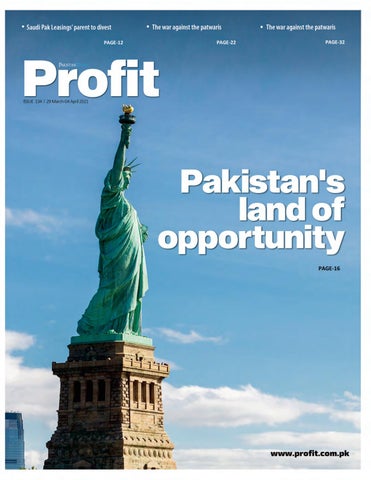
CONTENTS 16
12
12 Saudi Pak Leasings’ parent to divest 14 What is wrong with Mian Textile Mill? A lot, apparently
16 16 Want to raise capital for your startup in Pakistan? Get a degree in America 22 Who is Saudi billionaire Shaikh Abdulaziz HamadAljomaih and why was he in Pakistan
26
26 The war against the patwaris 30 Waves Singer corrects course with Coca Cola commercial freezers deal
32 32 IGI Holdings survives 2020, and then some
Profit
33 Big changes at Packages
Executive Editor: Babar Nizami l Managing Editor: Farooq Tirmizi l Joint Editor: Yousaf Nizami Reporters: Ariba Shahid l Babar Khan Javed l Taimoor Hassan Abdullah Niazi l Meiryum Ali l Shahab Omer Director Marketing: Zahid Ali l Regional Heads of Marketing: Muddasir Alam (Khi) Zulfiqar Butt (Lhr) l Mudassir Iqbal (Isl) l Layout: Rizwan Ahmad l Photographers: Zubair Mehfooz & Imran Gillani l Business, Economic & Financial news by 'Pakistan Today' Contact: profit@pakistantoday.com.pk
Readers Say This is the story of the benevolent beneficiary of the journalism industry, which had before his arrival, been languishing in cramped corridors, and squalid dark rooms. Because of Inam Akbar, this industry entered a new era of prosperity and innovation. His opponents have used every tactic to make fake cases against him. Apropos: The legend of Inam Akbar and the truth behind his Midas touch @javedmalikisd, Twitter Very interesting article, and definitely an eye opener for everyone. Such things should be exposed and the name of the scammers should also be exposed among the general public so that they can be warned against being taken advantage of. Their prior dealing should be looked at, and a competent authority must please make sure that such projects are legal and have completed all dues formalities as per the law of Pakistan, before they are allowed to masquerade around as the saviours . Nowadays, such scams have also been started in other cities where this didn’t happen before, particularly in Karachi where the network of such people and groups is very strong. They get away with doing all of these things right under the nose of the law and order enforcement agencies. The incumbent federal government of Pakistan (PTI) must take strong actions against them so that people who have worked hard their entire lives to earn capital are not swindled out of them. Apropos: The great Pakistani real estate racket Anonymous, Website Please also do a write-up on DHA Valley in Islamabad. A project of DHA IslamabadRawalpindi which scammed thousands of people both in-country and abroad. Launched in 2008, there is very little progress at the site and approx. 72000 allottees are waiting. Lots of facebook groups present and people willing to talk who have been scammed as well as whatsapp group. Irony, extra charges have been asked from the allottees for plots which are in the air. Apropos: The great Pakistani real estate racket Sleepless, Website
facebook.com/Profitpk twitter.com/Profitpk linkedin.com/showcase/13251020 profit.com.pk profit@pakistantoday.com
HOW TO CONTACT
7
Even after a wait of 12-13 years, DHA has failed to hand over allotted plots. Allotments have been changed/cancelled for re-balloting which outlines the fraudulent nature of DHA Valley management in uniform. Further charges such as SDC are being charged from people who invested there and are still holding on. Some limited plots have been handed over for show mostly to armed forces personnel which is unfair. DHA is now less about welfare of armed forces retirees and more about being another non-transparent money earning avenue for the
armed forces of the Pakistan empire like “Fauji” companies and conglomerates. Apropos: The great Pakistani real estate racket Anonymous, Website Yes this is a scam game, but it was started by Bahria Town and Malik Riaz after which everyone started following suit, including DHAs and recently ARY Laguna too. Apropos: The great Pakistani real estate racket Azhar Malik, Website Real estate matters should be highly regulated and transparent under law and any digitization efforts for land records must be expedited. Local governance bodies (like GDA) can play a vital role in preventing ordinary public from being defrauded. Apropos: The great Pakistani real estate racket Anonymous, Website This is a great deep dive by Profit into the Le Paris scam. In the last paragraph Chairman GDA denounces the scheme and says we have asked Lahore authorities to take down Le Paris boards. It appears the TC of GDA Chairman in the ad didn't deliver. Apropos: The great Pakistani real estate racket @2paisay, Twitter A Mega Real-estate project was unveiled and people were pouring money into it. On March 19, the Securities and Exchange Commission of #Pakistan warned that it was unlawful and had no permissions. Apropos: The great Pakistani real estate racket @ZainabFarooqi_, Twitter This whole deal about there being no buyers is a misconception. ETFs are liquid as the market maker holds inventory and will sell you ETF units and then replenish by submitting a basket of securities to the Trustee of the ETF. For selling purposes also, the market maker is there, try it. Indian ETFs also got off to a slow start and it took time for them to grow. Issue is the mindset of our investors which needs to change. Sadly, the vast majority of brokers and investors are interested in speculation and not investment. Apropos: Exchange Traded Funds: An Opportunity Lost? @tanweer_haral, Twitter The Pakistan Stock Exchange (PSX) is currently going through an update, so I think it is not such a crazy move to wait for a bit. Let us see what it brings to the table, because the current infrastructure is completely obsolete and one cannot expect much from it. Also, we need to get rid of vested interest for display delayed data. Apropos: Exchange Traded Funds: An Opportunity Lost? @SubhanJR99, Twitter
COMMENTS
IN BRIEF The government is making all-out efforts to include the Chashma Right Bank Lift Canal (CRBC) project in the China-Pakistan Economic Corridor (CPEC). According to a statement issued on Sunday, the technical and financial evaluation for a feasibility study, engineering design and PC-I of the CRBC has been completed. Pakistan is no longer the leading country in terms of trade with Afghanistan as bilateral trade has declined drastically over the last several years. According to details, the volume of Afghan trade through Pakistan has declined by more than 50 per cent from $2.5 billion to $1bn.
“We have purchased one million and 60,000 doses of Sinopharm and CanSino vaccines. We will be receiving the consignment before the end of March. The government is also in talks to purchase another seven million doses of the vaccines.” Federal Minister Asad Umar
The federal government has allowed the import of auto-disable syringes till 30th June 2021. Importers can now import auto-disable syringes with or without needless. In addition, they can also import raw material for manufacturing of the same.
$50 million:
Pakistan’s current account deficit – the difference between the county’s higher foreign expenditures compared to income – was recorded at a nominal $50 million in February 2021. This marks the third consecutive month the current account has recorded a deficit, after registering a surplus for five months in a row.
Rs 7.4 billion:
The Punjab Land Record Authority (PLRA) has added a revenue of Rs7,456 million to public exchequer under the head ‘land transfer and management’. PLRA spokesperson Nadia Ahmed attributed the increase in revenue to use of technology in the land records system.
The International Monetary Fund (IMF) has agreed to release the third loan tranche of around $500 million for Pakistan while approving four pending reviews of the country’s economy. The decision to revive the $6 billion programme came following the government’s decisions to jack up electricity prices, impose additional taxes and to grant significant autonomy to the central bank.
8
Spy governors, WhatsApp uncle’s, and the Suez block this week in Pakistan’s business and economics twitterverse
Questions of clandestine operations, Turkey, and the rupees recover dominates in this week’s social media round up
T
Profit’s reporter Ariba Shahid analyses the business and economic highlights from Pakistani Twitter this week.
A Suez story
his was a long, long, week. As the coronavirus continues to spread unabashedly and the government continues to refuse to do anything about it even more unabashedly, Pakistanis looked back at the stability of the rupee compared to last year, and similarities between Pakistan and former Muslim empires. This week, we look at shade being thrown at all the pundits and anchors that predicted death for the dollar, the possibility of a certain State Bank Governor conducting cloak-and-dagger activities in his spare times, to how Pakistan’ Ottoman obsession is now crossing over to comparisons of decline. Private vaccines were also on everybody’s mind, and once again, the battle against the big three car companies continued to be waged on twitter. Profit’s Ariba Shahid presents this week’s social media roundup.
Whatsapp uncles eat your words
Regardless of whether you have an economics background or not, there are strong chances you have at some point in recent times found yourself amidst a heated drawing room discussion about the rupee vs dollar led by uncles that later send you hot take Whatsapp forwards. These forwards you might remember as being the ones that had advised you to buy up the currency now for when it skyrocketed to Rs 250 for $1. The rupee, however, has stabilized much to the surprise of armchair analysts and television anchors that act as fuel for drawing room discussions. Will any of them be willing to eat their words?
SOCIAL MEDIA ROUNDUP
While this does not belong to the Pakistani Twitterverse, this news did make way for Pakistani memes. As someone that struggles to parallel park despite having six years of experience in driving, this reporter sends out our heartfelt sympathies to the ship and the companies worried about the disturbance in the supply chain. It also shows how little things and small mistakes are often what become iconic.
9
Conspirator supreme
Yes, we know Dr Reza Baqir is cool. In fact, he is very cool. But no, we do not think he is cool enough to be a secret spy or agent out on a self-destruct mission. While we would love to see the State Bank of Pakistan Governor dorn a tux and go on secret missions, it is a vision that remains highly unlikely.
Awards in sight
Dying like the Ottomans
Pakistan’s obsession with Turkey and Erturgral knows no bounds. That being said, Kaiser Bengali, despite being an economist played his role in fueling the propaganda against the SBP amendment bill before the contents of the bill officially were disclosed to the public with this astounding claim. We do have a question however, is Dr Bengali slyly trying to claim Imran Khan is the current Caliph? His recent disregard for social distancing will now send a horrible message to the entire Muslim world instead of just Pakistanis.
Email etiquette
The ecommerce awards hosted by Profit are nearing the announcement of winners. The Founders Vote has also gone live as of late
Helpful reminders Writing work emails is always daunting. Do you say dear? Do you write hi? Do you ask them how they’re doing? More importantly how does one ask for a task that has been overdue for a while without sounding like a jerk? See, we’re not exaggerating. Everyone that has had to write an official email has probably shuddered at the very idea. Umer Farooqi here explains the importance of good email etiquette for a good work relationship at work.
Criticism aside, fact checks are important. Thank you Azam, for reminding us that the AGP is a publicly listed company in the private sector.
10
SOCIAL MEDIA ROUNDUP
Saudi Pak Leasings’
parent to divest
While the joint-venture has done well generally, Saudi Pak Leasings’ never managed to recover from the 2006 financial crisis By Meiryum Ali
C
an a company have ‘Saudi Pak’ in its name if the ‘Saudi Pak’ factor in question decides it wants nothing to do with it? Or for that matter, can a company have ‘leasing’ as part of its name, if the last time it leased anything was more than a decade ago, way back in 2010? These are not philosophical questions, they are
12
legitimate questions that Saudi Pak Leasing is facing. It won’t be Saudi or Pakistani any more much longer, and leasing it never really got around to anyway, at least not in the last decade. So what will it be instead? Profit thinks a name change is in order, at the very least. Let us unpack the chain of events. On March 19, Saudi Pak Leasing issued an invitation for expression of interest. Essentially, the parent company Saudi Pak Industrial and Agricultural Investment Company Ltd.
(known as Saudi Pak) has decided to divest its entire investment in the leasing company. That is 35.6% of the leasing company. This action is simultaneously unusual, and yet also expected. It is unusual because the leasing company is part of the flagship brand of the original Saudi Pak. That company was incorporated in 1981 under a joint venture agreement between the Kingdom of Saudi Arabia and Government of Pakistan with initial authorized capital of the company of Rs1,000 million (as of December 31, 2019 paid up capital of the company is Rs6,600 million). The original Saudi Pak was the second largest of the three investment companies set up by the Government of Pakistan as a joint venture with
other sovereigns. The Saudi Government holds 50% equity stake of the joint venture, with the other 50% held by Pakistan. Generally, other than Saudi Pak Leasing, the joint venture has done well. Cumulative loan disbursements to sectors of economy like manufacturing, energy, services etc. aggregated to Rs72,599 million as of December 2019. Along the way, the company acquired Prudential Bank in 2001, renamed it Saudi-Pak Commercial Bank, and sold it as a considerable profit in 2008 (it is now Silk Bank). It also constructed a 20 storey high-rise building in Islamabad for its head office, and at the time was a landmark in the city. Its current investments are Saudi Pak Real Estate Limited (SPR), and Saudi Pak Leasing Company. SPR is the first real estate investment company licensed by State Bank of Pakistan. Neither one is doing particularly well: the 2019 real estate market was sluggish, for instance, affecting SPR. But it is Saudi Pak Leasing that has done abysmally. From another perspective, Saudi Pak’s tower in Islamabad has made more money than that entire company (it has revenue of Rs379 million in 2019; the last time Saudi Pak Leasing had comparable revenues was in 2010.) So, what happened? Turns out, the 2008 financial crisis absolutely crushed the company, and was a blow it is still trying to recover
from. Before that period, it was doing well, with revenue slowly increasing from Rs358 million in 2001, to Rs722 million in 2007. In 2006, it was the fifth largest leasing company in Pakistan in terms of asset size. Even in 2008, it was easy to be optimistic. In that year’s annual report, the focus was still on commercial banks, maybe squeezing out leasing companies. In fact, the only line it had to say was this: ‘the uncongenial macroeconomic environment will continue to challenge our bottom line … [but] the strengthening of our risk management function will provide us a shield against the probable risks). And yet with each year, the problem grew. Look at the language from 2009: “ It is now a matter of grave concern that the leasing sector is passing through a severe liquidity crunch induced by stoppage of financing by the Commercial Banks and Development Finance Institutions and lack of financial support from Government and SBP. It is time that both the regulators, SECP and SBP, take immediate and supportive measures before the NBFC sector is irreparably damaged.” And that is how that year, due to freezing of credit lines and non availability of long term funding, the lease and loan disbursements decreased to Rs851 million, compared to Rs3,249 million the year before. Then in 2010, came the beginning of the end. “The continuous liquidity crunch and
higher cost of doing business is posing serious challenges to the company. Due to the liquidity crisis, the company could not undertake the new business, resulting in further erosion in lease and loan portfolio during the year.” There would never be any further new business. There is now a blank section for the entire new decade to follow, as Saudi Pak Leasing tried to get a handle on the situation. Because of the severe liquidity crunch, the company had to manage its affairs out of funds generated through settlements, and recovery of a stuck up portfolio. This meant that the company’s entire business model now relied on the goodwill and efficiency of the Pakistani legal system. Good luck to whoever tries. As the company itself noted in its 2020 annual report: “The Company is trying its level best to recover as much as possible from the non performing portfolio. Due to lengthy and complex legal processes, the pace of recoveries through courts is very slow. Therefore, the main factor for the present position of the Company remains the slow pace of court’s proceedings resultantly affecting the pace of recoveries. Future prospects of the Company heavily rely upon recoveries through court decrees/out of court settlements.” It seems like Saudi Pak is finally trying to get rid of this 10 year long headache. n
END OF AN ERA
What is wrong with
Mian Textile Mill? A lot, apparently
O
ften, in these pages, we discuss what is wrong with a company. So when we are starting out our analysis, we look at a few classic examples that can tell us a lot. These include their losses, their missteps, and their bad strategic planning. All of these normally pop up as concerns particularly when we are talking about the textile industry, which has been visibly crumbling ever since the textile crisis of the 2010s. Mill after mill has been falling on the defaulter list and ceasing production. Most end up either being merged and consolidated with other mills, or there are often vague announcements of moving into, say, the rental space. But for all their problems, Mian Textile Mill has not dealt with the problem with vague statements. The new acquirer of the mills submitted a 14 slide powerpoint deck to the Pakistan Stock Exchange on February 22, 2021, detailing exactly how Mian Textile Mill
14
The new acquirer thinks they can make it a successful warehouse business might become profitable again. However, to understand how the mill can be revitalized, it is important to get a sense of how badly the mill struggled to begin with. Mian Textile Industries Limited was incorporated in Pakistan in December 1986 as a public limited company. The registered office of the Company is situated at 29-B/7, Model Town, Lahore and its manufacturing facilities were located in Tehsil Chunian, District Kasur. The word ‘were’ is being used because the textile mills are a thing of the past. For a textile mill, the company did pretty poorly. It's highest recorded sales were in 2006 (the last year for which there is publicly available data), at Rs919 million. It fell sharply after that: to Rs741 million in 2007, and then to Rs152 million by 2014. Crucially, the company’s cost of sales were always exorbitant, which is why the company only made a gross profit in 2006, 2007, and 2009. Every other year was a gross loss. This is also why the company did not make any net profit during the years between
2006 and 2015. The warning signs were always there. In the company’s annual report for 2011, for instance, they had been hit hard by the high cost of production, geo political issues, unprecedented suspension of electricity & gas and uneven prices of cotton. “Due to above mentioned reasons; our conversion parties could not supply cotton regularly/full quantity to us for conversion, consequently, our mill could not run on its full capacity which resulted in decline of production and sales, causing serious production and financial losses,” the company noted. Then, in 2014, a shortage of energy and high input costs forced the mill to close down temporarily in February 2014. This, as it would soon be discovered, would turn into a permanent problem. Which is why in April 2017, in a meeting held by shareholders, it was decided that the operation of the manufacturing unit was not viable, and that the unit be closed down in order to pay the loans to the remain-
ing bank. The land, building and remaining plant & machinery of the company were also to be disposed off. The mill has not made any sales between 2014 and 2020, surviving solely on rental income from properties and trading income. SO, what was to be done? The company received an offer from acquirer Ali Arif in March 2020, but that entire plan was set aside when the Covid-19 pandemic hit the country. By the end of the year, the company was looking for a new acquirer. Enter Danish Ali, of the Elahi Group of Companies. The group began operations in Pakistan in 1971 as a trading house, and over the years diversified with interests in warehousing, logistics, ecommerce, technology and commodity trading. Elahi successfully acquired Mian Textile Mill on February 15, 2021, and intends to turn it into...warehouse management?
“The company plans to start with the warehouses in both Northern and Southern parts of the country. Initially the operations will start with a substantial area of total warehouse space. The company also intends to introduce Collateral Management Services,” read the material submitted to the PSX. Elahi is betting big on the CPEC changing the game for warehouses. According to the group, 90% or more of CPEC trade is expected through road transportation, and around 28.2% of CPEC investment, or around $14 billion, is to be invested in the development of transport and logistics. As per the company’s math, private investment in Pakistan’s logistics and warehousing industry can be potentially around $31 billion.In particular cold chain logistics has considerable investment opportunity as Pakistan’s 50% agricultural produce is wasted due to lack of standardized storage facilities on the route.
So now, Elahi Group wants to start a network of warehouses, starting with Karachi and Gwadar Port. To do this, the group has a rights issue of Rs 1.2 billion in the pipeline, and a Rs 2.5 billion debt facility to finance the warehouse civil work.Around 560,000 sq ft are available with the Elahi Group and will be transferred into the business upon completion of rights issue in year one. “We believe that in as little as six months (i.e Dec’21), MTIL can become a fully functional and profitable company,” the group says, somewhat optimistically. This takes into account a first year capacity utilization of 22%, and growth at 10% (which is below the market demand for warehousing, which grows at 20%). The group expects Mian Textile MIll to make a profit of Rs541 million in 2023. That is more money that the company has probably ever seen in its existence. Will it work? n
TEXTILES
16
COVER STORY
By Farooq Tirmizi
W
hen your business is tearing down the old to build the new, you have every incentive to say out loud just what is wrong with the old, and why it deserves to be torn down. Turn to Twitter or Clubhouse, the two social media apps of choice for tech startup founders and venture capitalists, and you will find – on almost any given day – a long discussion about how credentials do not matter, only the quality of one’s ideas and the drive to execute do. Like all good lies, this one is at least partially true. The truth in it is the fact that yes, the quality of idea and motivation to execute well matter a lot in the success or failure of a business, but one other thing also matters: money. And to raise money, it seems, those who control the purse strings of investor cash – the venture capitalists – seem to have a very strong preference for old-fashioned credentials. And when it comes to venture capital in Pakistan, one credential seems to matter more than any other: a degree, whether undergraduate or graduate, from the United States of America. Only 0.45% of Pakistanis who attend a college or university get a degree from the United States, yet founders with an American degree accounted for fully 46% of total funding that went to startups between 2015 and 2020, according to Profit’s analysis of startup funding data compiled by i2i Ventures, a venture capital fund. Here is what might shock the egalitarian sensibility even more: founders with just a Pakistani degree – as is the case with about 97% of Pakistanis with a college degree or higher – account for just 16.4% of total venture capital during that period. This is not a simple story about a lack of egalitarian outcomes in a new industry in Pakistan, however. It is an exploration of the story behind the numbers: what it means for the numbers to be skewed this way, how Pakistan compares globally, and what the implications are for startup founders who do not fit the profile we laid out as the most coveted by venture capitalists. And for our friends at the Lahore University of Management Sciences (LUMS) who may be wondering if there is a “LUMS exception” to the general rule of “US Grads Preferred”, the answer is yes, but with some significant caveats.
18
“Most emerging markets founders are, unsurprisingly, polished with strong backgrounds at either US institutions or with experience at recognizable tech companies” Kalsoom Lakhani, founder and partner of i2i Ventures, on Twitter
A note on methodology (feel free to skip)
B
efore we dive into what the data reveals, first a few disclosures on how we compiled the data. For startup funding data, we relied on the database created by i2i Ventures on venture capital transactions over the past six years. The i2i database includes 173 transactions between January 1, 2015 and December 31, 2020, involving 122 startups. We then excluded all transactions for which the funding amount was undisclosed, and then further excluded any transactions for which any other major detail was undisclosed as well, such as the name of the startup, or the names of the founders. This whittled down the list to 129 transactions involving 96 startups, and approximately $201 million in total venture funding for Pakistani startups over that period. For each of those 96 companies, we totaled all disclosed funding (this, unfortunately, excluded some marquee transactions where the deal size was not disclosed, such as Dawaai’s most recent round). We then looked at the list of founders as i2i had been able to discern them. After further refining to exclude startups that raised less than $100,000 in total disclosed funding, we were left with 80 startups on which we had reasonably complete data. We then went through the LinkedIn profiles of all 148 founders of those 80 companies, and entered both their educational credentials as well as their work experience (the latter of which ended up not being materially different from the effect of the educational credentials). For any founder with both a foreign and a local education, we included their most recent or relevant foreign degree rather than their local one (with the exception of LUMS, for which we tracked when a LUMS graduate obtained a foreign degree). We then divided the total funding amount by the number of founders in order to be able to attribute funding levels by country in the case of founding teams with varying educational credentials. For example, if a
startup raised $1 million in total funding, and it had two founders with US educations and two founders with Pakistani educations, the US would get attribution for $500,000 and Pakistan for the remaining $500,000 of that funding amount. In an ideal world, we would have known the founding team’s respective shareholding, and weighted it accordingly, but that data is not readily available for any startup. Serial founders are counted as many times as they raised capital and the amount raised attributed to their country of education every time. This, in our view, is not double counting because each time a serial entrepreneur raises capital is money being deployed towards their business and not towards other businesses it might potentially have gone towards. The data discussed below utilises the above methodology.
The dominance of the Americans
T
he numbers tell a very clear picture: if you have a degree from the United States, you are far more likely to get more funding than if your education was entirely within Pakistan. Of the 148 founders whose data we examined, 80 (or about 54%) were educated entirely in Pakistan, but they accounted for only 16.4% of total funding, or about $32.5 million out of the $198 million in total funding raised by Pakistani startups between 2015 and 2020. The 35 founders with American degrees, by contrast, accounted for 46% of total venture funding of Pakistani startups, with about $2.6 million in total funding per founder compared to just $0.4 million per founder for those with a Pakistan-only higher education. Those numbers become even more astounding once one places them in the context of just how few Pakistanis have a US education to begin with. According to the Higher Education Commission (HEC) of Pakistan, there were approximately 1.6 million students in all tertiary institutions in the country in 2018, the latest year for which complete data is available. The United Nations Educational, Scientific and Cultural Organization (UNES-
CO) estimates that the number of Pakistanis studying at universities abroad in 2018 was approximately 59,000. That means that only about 3.6% of Pakistani students of higher learning are abroad at any given moment in time, which is a useful proxy for what proportion of Pakistanis get a foreign degree by actually studying there (for the purposes of this analysis, we are counting foreign degrees earned through distance learning within Pakistan as being the same as local degrees.) Of those Pakistani students abroad, only about 7,400 are in the United States, which means that of the Pakistani college student population, those with an American education constitute just about 0.45% of the total. Yet, as we noted, graduates of American universities commanded 46% of all venture capital raised by Pakistani startups over the past six years.
Put that in starker terms: a Pakistani with an American higher education is 93 times more likely to be able to raise venture capital for their startup than a Pakistani with only a Pakistani higher education. Also, for those of you who think of Canada as “almost America”, no, it is not. At least not when it comes to venture capital funding. Pakistanis with an American education raised $91 million in founder-weighted funding over the past six years for Pakistani startups. Pakistanis with Canadian educations raised just $3.75 million. It is not even remotely close. The bulk of the remainder is accounted for by the UK, with a couple of highly successful INSEAD graduates ensuring that France somehow manages to sneak into the league tables here. Here’s one bit of bad news for startup founders with a Pakistan-only education:
founders with a foreign education are more likely to raise funding in subsequent rounds and see their startups survive than founders without a foreign education. Of the five startups in the dataset that shut down, four had teams of founders of whom none had a foreign education. Even if you manage to convince the VCs to bet on you once, getting them to do so again seems to be harder than for those with foreign educational experiences.
Is it unfair, or are the Americans better?
I
t is too early to say with any definitive sense whether venture capitalists are correct in betting so heavily on Pakistanis with an American education when it comes to Pakistan-focused startups. There
COVER STORY
simply have not been enough investor exits for us to know with any certainty whether or not there is a pattern in the profile of successful founders in Pakistan. But some investors are very clearly betting on the returning Pakistani émigré startup founder. (We refuse to use the word Wapistani. It has a distinct “pawry” vibe, but somehow even worse.) Rabeel Warraich of Sarmayacar has talked about the return of such emigres as a catalyst for the Pakistani startup ecosystem. And Aatif Awan of Indus Valley Capital has gone even one step further and actually created a program to help Pakistani expatriates return to the country. It is also, of course, not a coincidence that the most prominent names in Pakistani venture capital all have an American education. Rabeel Warraich went to the Massachusetts Institute of Technology (MIT), Aatif Awan went to the University of Illinois at Urbana-Champaign, Kalsoom Lakhani of i2i Ventures to the University of Virginia, Faisal Aftab of Lakson Investments Venture Capital went to Michigan State, and Ali Mukhtar of Fatima Gobi to the University of Pennsylvania. So, are these VCs simply playing to their own bias, or is there something inherently more investable about Pakistanis with an American education? (Take every single one of the next few paragraphs with a bucketful of salt: the author of this story is a Pakistani with an American higher education who just raised venture capital for his fintech startup.) The likeliest explanation for the strong preference for US graduates is the simplest one: the kind of person who is able to get a US education is also the kind of person who has the financial wherewithal to take the initial risk to prove that they might have a successful startup on their hands, or else the kind of person who has spent years in educational institutions that have honed their natural cognitive abilities to a point where they have a significant advantage over those who may have started off at the same level of ability at birth. Put another way: there are two possibilities as to why the US graduates take up all the funding. The first is that your parents were rich enough to pay full tuition for an American university – which, by the way, now costs twice as much as a British or Canadian university – and so you had the family resources to be able to quit your job with no need for an income while you worked on your startup idea and gained the kind of early traction that investors like to see before pouring in serious amounts of money. The second possibility is that your parents were perhaps not rich, but well-off
20
enough – and with the right kind of social capital – to send you to the handful of right schools in Pakistan that are the feeders to an undergraduate education in the United States. Just over 800 Pakistani students leave for the US every year for a bachelors degree, and it is a safe bet that well over half that number comes from a small number of schools: Karachi Grammar School, Aitchison College, Lahore Grammar School, and Beaconhouse Margalla Campus. Students who attend these schools were not born with more brains than any other part of the population, but they do have something else going for them: a set of parents who are uniquely obsessed with ensuring that their child’s cognitive abilities develop to their maximum potential. Two children born with the same ability at birth would be expected to perform at the same level when they are very young, but give one of those children far more resources and attention over the course of two decades, and by the end of it, that child will be far outpacing those who were their peers at birth. The students going to America, in other words, are some of Pakistan’s best and bright-
est. Why do they choose to go to America? At least part of that is the draw of US institutions of higher learning, which command a level of prestige unmatched anywhere. It is not for nothing that they say: “Harvard is Harvard in any language.” And there is something about America itself: a land of entrepreneurial self-starters, the home of Silicon Valley and almost every major tech company you have ever heard of, the place where the future is invented and exported to the rest of the world. The place that may not have as generous a social safety net as Canada, the UK, or Australia, but whose upper middle class is three times richer than its peers in other high-income countries. This is not an exaggeration. According to data from Credit Suisse, the average net worth for a European adult is about $150,000, while the average net worth for an American is about $450,000. America is a high-risk, high-reward country, and if you have brains and ambition, that bet starts to look mostly like very high rewards for risks that are not as high for you as they are for others of lesser ability. There are no two ways to say it: of the
TEXTILES
students who are able to go abroad for an education, the most talented and most ambitious students from Pakistan and elsewhere generally tend to go to America. In short, Pakistani students in America are not a random sample of Pakistani college students more broadly, and if you are in the business of looking for Pakistanis with talent and ambition, it would be easier to start in Boston than in Lahore.
Not just Pakistani VCs that do this
T
he dominance of US-university graduates in startup fundraising is hardly unique to Pakistan. The pattern holds true in most other parts of the world as well. As Kalsoom Lakhani noted on Twitter in her observations about YCombinator’s most recent Demo Day for startups: “Most emerging markets founders are, unsurprisingly, polished with strong backgrounds at either US institutions or with experience at recognizable tech companies.” YCombinator is perhaps the world’s best-known startup incubator, based in San Francisco, California, which takes in two batches of startups every year. At the conclusion of its 11-week program is something called Demo Day, where startups pitch themselves to a wide audience of investors, and are frequently able to raise large sums of money and go on to become highly successful companies. Some of the most famous YCombinator companies include Airbnb, Stripe, Coinbase, Twitch, and others. And incidentally, even within the US, there is a significant bias towards the graduates of some of America’s most prestigious universities. Stanford, MIT, Harvard, and the University of California Berkeley produce more startup founders who are successfully able to raise more than $1 million than any other universities. VCs may routinely denigrate the value of a college education, but they also just as routinely seem to be using it as a credential to help them decide where to deploy capital.
Is there a LUMS exception?
A
s some of our friends from LUMS never tire of reminding us, LUMS is Pakistan’s finest institution of higher learning and in many ways comparable to an American education. Do graduates of LUMS fare better than those of other universities? And, crucially, do they hit parity, or come close to parity, with those who have foreign degrees? The answer is yes, LUMS alumni do
have an advantage in fundraising over and above any other Pakistani institution of higher learning. LUMS alumni accounted for 21.9% of all venture capital, in founder-weighted terms, raised by Pakistani startups, which you will note is higher than the amount raised by graduates of all Pakistani universities combined. That is because about 70% of the money raised by LUMS graduates was by those LUMS alumni who then went abroad for a graduate degree. But even LUMS alumni who never leave the country have an advantage: that one university accounts for almost 41% of all venture capital raised by founders who do not have a foreign education. If you cannot go to America, go to LUMS. It really will pay off.
What does this mean for a Pakistani startup founder?
S
o does this mean that a Pakistani who wants to create a company should start applying to universities in the United States? Are the odds
so stacked against those with local degrees that it is worth adding this extra step? Not entirely. The foreign graduates simply have a set of attributes that VCs are looking for: the ability to formulate and articulate an idea, and the grit and perseverance to come up with a way to demonstrate that it will work. The foreign degree itself is not a direct factor in the investment decision-making process of any self-respecting venture capitalist. The best thing a budding entrepreneur can do in order to get venture capitalists to take them seriously and fund their idea is to find a way to demonstrate product-market fit, which is really shorthand for two separate, but related tasks: developing a product people will find useful, and then finding enough people willing to use it to demonstrate that the product will have a sizeable market. Everything else in terms of credential-hoarding is a waste of time for an entrepreneur who has a clear vision of what they want to build. If you know what you offer the world, the world will find a way to come to your doorstep. At least investors will. n
COVER STORY
I
By Shahab Omar
t all starts with the reign of one of the most influential Kings that the Indian subcontinent has witnessed. In his five year reign in the early 16th century, Sher Shah Suri built the administrative and infrastructural framework that the Mughal empire would later use as a foundation for its governance. Sher Shah is remembered most for his system of coinage and the Grand Trunk road, but one of the other things we have him to thank for is the Patwari system for land revenue. At the time, it was revolutionary, and it was followed first by the Mughals, and then by the British colonialists that built the institution further. Fast forward to today, and the word Patwari has been demonized by the Pakistan Tehreek i Insaaf (PTI) as a symbol of corruption, resistance to change, and everything
22
that is wrong with Pakistan. In many ways, they are not wrong. As the most basic unit of administration, Patwaris often had unusual sway over people much richer and much more powerful than them, and leveraged the position to its maximum utility. So when the PTI came into power both at the center and in Punjab, the expectation was that the patwari system would be one of the first things to go both because it is about time and for symbolic purposes. And while efforts were made to this end and to digitize existing land records, in February 2020, Dawn reported that instead of completing the digitisation of land records in the province, the PTI-led Punjab government has begun to reintroduce the patwari system. A senior Punjab Land Revenue Authority (PLRA) official even said that the Punjab Board of Revenue has asked divisional commissioners to allocate two revenue circles – known as kanungoi – in each district that will be controlled by a tehsildar and patwaris and serve
as a model. So what is the Patwari system? And why has it proven so difficult for Pakistan to let go of it, even when across the border in India the sway of the patwaris ceased to exist relatively quickly?
The Patwari system
T
he role of patwari initially was often hereditary. From the 16t century onwards and all the way into the 19th and even 20th century, roles like the patwari were a basic building block of administration. Record keeping was done orally for the most part, with village mirasis being protectors of an entire community’s miras (genealogy). Land records were a little different however. You see, the Mughals would hand out jagirs to their courteries and anyone they wanted to bestow favours on. Nawabs were often the owners of multiple jagirs, and this meant they had effective control over
Digitization is a complete development of the system. There is a huge difference in the services and process today than there was a few decades back. Everyone had to go to the Patwari to get a record of their land or change it, and it was done after paying a reasonable bribe Moazzam Iqbal Sipra, director general PLRA
hundreds of villages. The ruler in Delhi would expect them to manage the land and make a profit out of it, and in turn give a tax to the center - land revenue tax. For this, every village had an appointed accountant, or patwari. The patwari would keep a record of who owned what land where, and also keep tabs on crop rotation so that no jagirdar could fleece the emperor in Delhi out of taxes. Since the patwari held all of the records, they were also involved in the buying and selling of land, and could also block or report it, which gave these otherwise junior level government employees the judges of the fate of large landowners. Naturally, they were easy picks for flattery and bribery. When the British came into power in India, they tried to stamp out the corruption on the lower level and gave more power to white bureaucrats so that they could then make bank in India. However, they did not get rid of the system. The British-imposed this system by reinforcing the spirit of control and exploitation rather than empowering the right, as it was designed with colonialism in mind. In this system, there was a system of strict accountability for government employees, but the responsibility of accountability was in the hands of the seniors rather than the people. This same system was then inherited by both India and Pakistan after partition. Any person in Pakistan that owns or has owned land or has been involved in the agricultural sector have to be patient whenever they have to reach out to the land management staff to get a record of their land or transfer of ownership. As the country’s population grew, so did the number of landowners and with the complexities of the existing system of land management, conflicts and corruption were on the rise. Over time, the system has become so notorious that even the manifestos of political parties claimed to change this system. This whole system was manual and its drawback began to emerge in Pakistan very quickly. Fees collected in respect of various land documents being pocketed by the staff of the Board of Revenue, especially the patwaris, became a common and accepted practice. For
example, if the fee for the land document for record was scheduled at RS 500, then Patwari took RS 5,000 from the applicant and did not deposit a single rupee in the exchequer. It was keeping all these issues in mind, the process of computerization of land records in Punjab province of Pakistan was started, and in this regard the Punjab Land Record Authority (PLRA) was also established and the authority officials claim that the situation is much better than in the past and efforts are being made to bring about further improvements. However, during an interactive session, PLRA Director General (DG) Moazzam Iqbal Sipra informed Profit that evolving and dynamic characteristics is the secret by which existing systems remain intact. “The systems keep on changing as static things eventually die. Initiative and changes in any existing system is neither a single step movement nor that certain development in a specific time frame will be enough. It is the first step to digitalize the land record when a point about major cons and reason was raised that led the department to improvise the British system and recently taken initiatives,” he says, defending the switch back to the patwari system. “Any system is neither good nor bad as it depends upon how effectively, efficiently and well-mannered the system is being implemented. One hundred years back when the transaction rate of land was low, there was an existing hierarchy and great supervision. People usually did not commit fraud in those decades but with the passage of time the number of complaints regarding record authenticity increased and the requirement of certain initiative and change raised.”
Where does the digitization stand
L
et us get this much straight - this should have happened a long time ago. And no matter what Chairman Sipra says, the patwari system continues to lag behind. It has implications in both urban and rural settings. In urban settings, patwaris are less relevant but often still
hold records to old land that have not been digitized and can put a lot of people in messy legal battles. In rural settings, landowners both large and small have to deal with the immense power that patwaris do have. A patwari can withhold the transfer, sale or purchase of your land. They have the authority to make changes relating to ownership, use and taxation in the original land record. The patwaris are the sole authority to issue copies of land records (‘Farde Malkyat’), which are required for many other government-related services i.e. in court cases and obtaining domicile certificates. This leads to a lack of transparency, inaccuracies and complexities, and thus land disputes. At one point, all of this was necessary because these constantly changing records had to be stored somewhere and it made sense to do it on a village level where everyone knew each other personally. However, with digitization, these records can be a click away from everyone. While it was hoped that the formation of PLRA would end the patwari system, progress seems to be very slow. Sipra believes that the initiative of establishment of PLRA is really important to understand for people as artificial intelligence and computers did not exist a few decades ago.“These [computers and artificial intelligence] have only become available for the general masses in the last couple of decades. As we have entered the modern world with the advancement in technology and the expectation of people has enhanced the services but on the contrary part, certain complaints have been registered about the services and process. I.T. base development and digitalization is far different from just typing the manual record on computer software,” he explains. “Digitization is a complete development of the system. There is a huge difference in the services and process today than there was a few decades back. What used to happen in the past was that checking land documents in urban areas, especially in rural areas, was a very difficult task for the owners to access. Anyone had to go to the Patwari to get a record
LAND
These services will be for overseas Pakistanis who will not have to come to Pakistan to get or change their land deeds and will be able to do their work online. About 100,000 errors have already been fixed in the computerized record and about 98,000 errors out of pending mutations have been corrected Nadia Ahmad, director communications PLRA
of their land or change it, and it was done after paying a reasonable bribe. Now, the record of JamaBandi [Periodical record of rights] has been scanned and is available. Fee of fard [land document] is attached with the document. For officials related to adjudication the record and data is available on one click whereas prior data has not been linked and shared in the access of different administrative departments.” Sipra insists that the computerized land record system is really designed to eradicate Patwari culture. According to him, the major reason for the start of PLRA is to end the long existing monopoly of the Patwari system. Officially, there used to be 18 different duties on a patwari’s shoulder, including Gardawri [periodical crop inspection], cite markation, fard issuance and to handle certain litigations etc. From compiling land records to reporting small-scale clashes in the area, it is Patwari’s job. With the initiation of PLRA, only two duties has been conferred upon the authority which are issuance of Fard and mutation. However, it must be noted that these are the two most important duties that involve the most power as well, since the patwari can block sale and purchase of land. There has also been the issue that even when digitization has happened, it has happened without any check and balance. This means that the errors which were made by the patwaris earlier have all gone in as it is and have been digitized. Sipra responded to this with a strange candor, saying that life is not a bed of roses, and there would be many other difficulties and problems faced during the advancement. “Of course, there may be certain mistakes in manual records like name, address or markation. If things are shifted as it is to a computerized record it would be garbage in garbage. The first task of PLRA was to eliminate these mistakes and we’ve corrected a lot of mistakes from the record. CNIC numbers have not been in revenue records for the last 70 years. PLRA has printed all Jama Bandis and sent those to field officers. They have been ordered to visit every plot, correct any error and attach the CNIC number with it too. Prior to computerization, in the manual system after every 4 year
24
the records were archived and Jama-Bandis were updated. But today the things are completely different,” he explains. Essentially, this means that the process is slow because the manual records must first be fixed before they can be digitized. And for this, they do need the help of the old order. What has changed For starters, there are a lot fewer patwaris around now, mostly because those that retired were not replaced. There have also been changes in the agricultural census. Nowadays, at the time of mutation, the data is automatically updated in Jama-Bandi in real time. Similarly, Girdawari is an agricultural census. It provides the statistics about the crops, but in the last decade there was no real-time girdawari because it is considered the duty of patwari, and the centre has not been recruiting patwaris for a few years. “As a result only 20 percent of patwaris are left. Girdawari helps to make assessment about the production in certain crops. But as this system has not been carried through for a long time, Pakistan has to face certain difficulties. In the last few years, the government has not been well aware of the actual number as a result a shortage of some prominent crops have to be faced. Girdawari includes possession matter, type of crops yielded from a land, output land yielded and waste or deficit in the crop. It is processed twice a year,” claims Sipra. Meanwhile, other well placed sources in the PLRA informed Profit that the PLRA had set up land record centers in various tehsils for the convenience of people, and in the areas where land records have been computerized, these centers have been set up whereas the staff at the centers demand bribes in exchange for providing services to the people there. The sources further informed that the staff of PLRA puts the fees collected in the form of land documents for records in their pockets instead of depositing them in the public treasury.For example, if someone does not have to pay a fee of RS 500, he can pay half the amount to the PLRA staff and take a screenshot of his document through WhatsApp and due to these issues, a lot of money
cannot be deposited in the public treasury. When the same matter was discussed with Sipra he replied that this has definitely been happening, but it has been almost controlled by the authority. “In fact, in the areas where land records were computerized, our land record centers were set up and people turned to these centers instead of the patwaris. Now, technically speaking, there are fifteen Naib Tehsildars and about two hundred patwaris working under one Tehsildar who are working in different parts of the entire Tehsil. But when we took over the responsibility of mutation and issuance of land documents, the load of an entire tehsil fell on one service center. People had to travel as there used to be one branch in every district and certain people exploited and tried their best to tarnish the image of PLRA.” All of this meant that while the monopoly of the patwaris ended, it gave great opportunities to the staff at the center. And as long as more centers like this cannot be setup, the sheer volume of people coming to these centers means there will always be room for oversights. So when the rush of people started at these centers, the staff also took bribes, and Sipra admitted to this happening rampantly. “In fact the physical access and monopoly were grave concerns of the PLRA as the work load of issuance of fard mutation on 150 branches created a monopoly. PLRA is handling litigation, fard for record, fard for sell and mutation. Things which should have developed with the passage of time already exist but due to some misfortune could not develop has proven harmful,” says Sipra. “In addition to this, because of low in-house IT capacity, it has taken five months to develop the software and still we have only 14 or 16 IT employees. So to end this monopoly, we first expanded the scope of services. For example, 80% of the whole workload is issuance of fard for record. After providing certain credentials, verifying oneself and after paying the fee charges one can attain fard for record. We just introduced the online payment module which includes debit/credit card,
Easypaisa paisa, Jazz cash and Bank account. The purpose of introducing online facilities is to eliminate human interference as much as possible. Similarly, we collaborated with NADRA for CNIC verification and now a step forward is taken by authorizing and permitting 2385 branches of NADRA Punjab-wide to access and issue the fard for record to end this monopoly so that people do not have to go to just one land record center for convenience and provide services to them.” According to Sipra, all of this has cost not a single penny to PLRA. On average, 46,000 fard for records are being issued from NADRA only on a daily basis which helps to increase the revenue. Similarly, the next big concern was mortgage as people and banks remain under great tension for managing certain documents of fard for mortgage at the time of issuance mortgage and to redeem it. Through the State Bank of Pakistan, the PLRA has signed an agreement with all 49 banks in Punjab and now they do have access to PLRA certain data. With this step, whenever someone comes to apply for a mortgage or redeems it, banks themselves can send an electronic request which will entertain in a certain time from PLRA centre. “Things become very different with the passage of time. Some officials exploited the human interference and even started to think they were bigger than entire departments.To end these corrupt practices, PLRA is planning to launch universal access. This project will be revolutionary as no official will be aware beforehand who has appointments the next day for mutation. All the LROs and ADLRs will be transferred back to the centres in Lahore. Citizens via NADRA, Arazi centre or e-khidmat markaz can make their appointments for mutation. All this process will end direct human interference with LROs and ADLRs and make the process effective. Check and balance is important to make the system dynamic and effective,” he said. Sharing statistics, he claimed that 243 employees have been punished under different inquiries. 73 employees have been terminated in the previous year and more than 300 inquiries and transfers have been initiated. “Things develop with gradual and continuous improvements but in the last decade no certain improvement of initiative can be seen. Mind set and behavioural change issues are currently something that people have to work on. In property dealing it is very seldom that direct sale and purchase happens. Rather mostly some agent, wasiqa navees or lawyer is involved in it.” “Complications usually exist in urban areas. There is also the problem of a lot of rural areas turning into urban areas, but PLRA would have a record of rural period but not urban area demarcation. This then becomes the
responsibility of the local government. PLRA do have Khasra numbers but not cadestal numbers. Prime Minister Imran Khan and Chief Minister Buzdar have given directions to develop cadestals for urban areas as well and develop a law for the multi story buildings,” he said, adding that after receiving a few complaints of transfer of registry of land to a second or third person without mutation, the concept of separation of power was adopted for the purpose of effective implementation of the regulations. All 200 Sub-registrar in Punjab have been authorised to issue mutation on the time of registry to avoid any other obstacle. For check and balance, one person is appointed from PLRA in the sub- registrar office under the project of RDO. The right to issue mutation has been shifted from ADLR (additional director of land record) to sub-registrar. To some extent, Covid-19 lockdowns have been a blessing in disguise in this regard. It helped to revive the system and the new category of booking pre-appointment was introduced by PLRA. Pre-appointment can be reserved by four methods, from ufone helpline, website, calling the arazi record centers and through the under process app of PLRA. “This has helped us to tackle the load of masses at centers. More than 9000 transactions are carried out daily by PLRA, out of which more than 8000 are booked via pre-appointment. Providing facility is the duty of the department. In order to end corruption and bribe for early work, special services in the name of executive services and express facilities have also been introduced. By paying Rs 1000 extra to the government one can avail oneself of early appointment. Similarly, In the process of computerizing data,
the PLRA has stored upto 70 years old registries of Lahore in its server and the relevant citizen to the registry can verify or even print the registry after providing credentials and verification. This project has been underway for the last two years. On 31st Jan 2021 data related to registries in Lahore was completed. All these registries are online and archived,” he said. Speaking about the revenue generation he informed Profit that the revenue generation was also the main responsibility of PLRA. “There remain two ways to increase revenue either the department increases the service charges or make certain business developments that help to increase the revenue. PLRA has been successful in increasing its revenue by 100 percent in the last 1 year by just stopping the leakages and making some linkages. However, the Director Communication of PLRA, Nadia Ahmed, while sharing the statistics with Profit said that the number of service delivery centers of PLRA is continuously increasing.The number of land record centers has increased from 152 last year to 5,000 this year, including 2,300 e-service centers in NADRA franchisees and commercial banks. Similarly, out of 115, 60 Qanoon Goi Centers and 20 Mobile Land Centers have been started. Meanwhile, 11 missions of embassies of four countries USA, UK, UAE and Saudi Arabia have been trained and services will be launched soon. “These services will be for overseas Pakistanis who will not have to come to Pakistan to get or change their land deeds and will be able to do their work online. About 100,000 errors have already been fixed in the computerized record and about 98,000 errors out of pending mutations have been corrected. On a daily basis, out of an average of 9,000 transactions from all Land Record Centers, 8,000 transactions are booked under the pre appointment system. Expanding the scope of all these services has also increased our revenue and this year we have so far deposited RS 7456 million in the exchequer which is more than one hundred percent more than previous years,” she concluded. n
LAND
Can this
Saudi tycoon
finally convince the government to waive KE’s problems? By Ahmad Ahmadani
S
hanghai Electric Power has wanted to buy K-Electric for years now; that is a well established fact. But who is helping sell KE to them in the first place? For a while, it seemed like Arif Naqvi, the head of Abraaj Capital, was in charge. After all, Abraaj Group, a Dubai-based private equity, in partnership with Al-Jomaih Group of Saudi Arabia and National Industries Group of Kuwait, holds a total shareholding of 66.4% in K-Electric. But following his very public and controversial downfall, someone else has to fill his shoes. That someone comes in the form of Saudi billionaire, Sheikh Abdulaziz Hamad Aljomaih - the head of the Al-Jamoaih group. He is now the point person in charge attempting to convince Pakistani leadership to
26
ensure smooth acquisition of 66.4% shares of K-Electric (KE) by a Chinese firm, Shanghai Electric Power (SEP). Well-informed sources disclosed that despite being a minority shareholder in K-Electric (KE), the tycoon visited Pakistan for two days, and tried to remove any impediments for SEP’s proposed acquisition.
Who is the Sheikh?
S
heikh Abdulaziz Hamad Aljomaih is the managing director-investments of Aljomaih Group, and is principally responsible for all international investments on behalf of the group. He is also the chairman of Arcapita Investment in Bahrain and holds numerous board positions in various portfolio companies of Aljomaih Group. Previously, he served on the board of directors of Etihad, Etisalat in Saudi Arabia and Dana Gas in the UAE.
The connection to KE has persisted for years now. The Aljomaih Group had invested in KE 15 years ago, since its privatisation in 2005. Aljomaih was among the investors in KE that bought the then KESC (Karachi Electric Supply Corporation). As mentioned before, Abraaj Group, a Dubai-based private equity, in partnership with Al-Jomaih Group of Saudi Arabia and National Industries Group of Kuwait, holds a total shareholding of 66.4% in K-Electric. This three-firm consortium operates in the name of KES Power, which is the parent company of K-Electric. The Government of Pakistan's shareholding stands at 24.36%. The Sheikh also served as the first chairman of the KE’s board of directors at that time. He continues to serve on the board of KES Power, the company that holds a controlling stake in KE.
The visit
A
ljomaih arrived in Pakistan on March 15, and left the country on March 16. Despite the trip’s brevity, the Sheikh managed to pack quite a bit in. During the first day of his visit, Aljomaih met with the who’s who of Pakistani politics: President Arif Alvi, Prime Minister Imran Khan, Finance Minister Dr Hafeez Sheikh, Federal Minister for Privatization Mohammed Mian Soomro, Federal Minister for Energy Omar Ayub Khan and Special Assistant to PM on Petroleum Nadeem Babar. Then, on his second day, the Sheikh met the who’s who of Sindh: Governor Sindh Imran Ismail, Provincial Minister for Energy Imtiaz Sheikh, Murtaza Wahab, Adviser to Chief Minister of Sindh on Law, Anti-Corruption Establishment. The Sheikh was looking for a removal of all ‘impediments’, particularly the issue of receivables and payables in the way of the KE’s transaction.
KE’s problems
S
o what are these so called ‘impediments’? KE has essentially two problems: first, that the non-receipt of KE’s net receivables from various federal and provincial entities for over a decade has pushed the power utility into losses. Second, the delayed payment of price differential claims by NTDC and SSGC. About the first: KE claims about Rs234 billion against the government and its agencies on a gross payable basis, and expects about Rs80 billion net payments from the public sector provided all payables and
receivables are settled on principal payment basis i.e. if both sides give up mark-up and settle for principal dues. Second: there is the issue of the Rs275 billion outstanding dues of the National Transmission & Despatch Company (NTDC) and Sui Southern Gas Company(SSGC) claim against KE on account of past electricity and gas supplies. Of this, the SSGC has a claim of Rs125 billion against the KE, which the company maintains had developed over the years despite no formal gas supply agreement. The NTDC management wants clearance of its Rs150 billion before signing the agreement for additional power supply. Crucially, and what is holding up the entire selling process, is that both companies are reluctant to sign fresh supply agreements with KE unless these dues are cleared. Though Pakistan LNG Limited (PLL) and KE have signed an agreement for gas supply, the SSGC is reluctant to sign an agreement due to payment dispute issues. According to sources, the company is also concerned about the National Accountability Bureau (NAB) which is already investigating several former heads of the gas company.
Did the visit yield any results?
S
ources painted a picture of a dedicated businessman trying to resolve multiple problems at the same time. These primarily included: 1. the acquisition of KE shares by SEP, and 2. The price differential claims and gas sales agreement and power purchase agreement with Sui Southern Gas Company (SSGC) and National Transmission
and Despatch Company (NTDC) respectively, which have hindered the acquisition by SEP. Aljomaih, in his meetings, insisted on the release of KE’s pending payments, removal of hindrances to the signing of fresh agreements for KE’s upcoming 900 MW power plant located at Bin Qasim . Aljomaih also asked the government to extend support in expediting the process of approvals so that held up tariff differential claims to the tune of around Rs275 billion on principal basis, are released at the earliest. According to sources, KE’s management is engaged in negotiating with the government to ink an arbitration agreement for settlement of issues, and wants all debts waived. The Sheikh has arrived on KE’s behalf to negotiate favourable terms. And apparently, it worked. According to sources, Prime Minister Imran Khan assured Saudi business the Sheikh that KE’s debt issues would be expedited, so that SEP can acquire KE. In addition, the agreements are critical to ensure availability of additional power in Karachi’s grid. A spokesperson of the power division said negotiations are on for sale of KE to SEP, and the Privatisation Commission has been dealing with it. The spokesperson also said that the Sheikh’s meeting with Omar Ayub Khan, Energy Minister, was brief, but it was discussed that the out-standing issues of KE should be resolved in the best interests of the people of Karachi. Will the Sheikh finally be the lucky charm that solves KE’s problems? Will the acquisition finally happen? If recent events are to be believed, perhaps it will. n
K-ELECTRIC
Sazgar
to introduce new brand
The big three’s domination is finally under threat
P
akistan is not exactly car heaven. For a country of 200 million, there are only between 17 to 20 cars per 1000 people (as per 2018 data). Also, the kind of cars we have are limited as well The average Pakistani household has 6.7 people. Yet our preferred method of transportation is the classic, stuff everyone in the tiny car, philosophy. Barring that, it has been a ‘van’ think the Suzuki Bolan, or APV, that is useful for larger families. For families that own cars, sedans are the done deal. And those sedans tend to be Japanese. Suzuki might as well
28
be Pakistani, for its brand recognition in the country. We paint this picture for you to understand why Profit considers Sazgar such an anomaly. The automobile assembler has decided to introduce SUVs from China in the Pakistani market. Will it work? First, who are Sazgar? The company is principally engaged in the manufacturing and sale of three wheelers including auto rickshaws, tractor wheel rims and home appliances during the financial year. It has done mostly well: if one looks at the last six years of financials, turnover has risen from
Rs2.5 billion in 2015, to Rs 3.9 billion in 2018, to Rs2.8 billion in 2020. Similarly, net income from Rs74 million in 2015, to Rs186 million in 2018, to Rs27 million in 2020. Which leads to the question: what happened in 2020? That year is very much an anomaly: according to the company’s annual report, economic slowdown, higher inflation rate and higher borrowing cost deeply affected the automobile industry. In fact, during 2020, there was a decline in production and sale in respect of cars 54.90% and 53.50%, tractors 34.70% and 35.10%, 2&3 wheelers 23.10% and 23.10% respectively.
Now, Sazgar, in a notice to the PSX on March 18, has said that it will introduce another Chinese brand, Haval. This is an SUV brand of another Chinese automaker, Great Wall Motors. The company has only been around since 2002, and created a name for itself by introducing the SUV craze in China in the mid-2000s.
Plus, Sazgar shut its operations for an entire month during 2020, thereby missing its own production and sale targets. Consider: the net sale of three wheelers decreased from Rs 2,697.04 million to Rs 2,404.97 million, reflecting a decline of 10.83%. The net sale of automotive parts declined by 4.84 % from Rs 500.20 million to Rs 476.00 million. The net sales of home appliances has decreased from Rs 9.38 million to Rss 4.41 million compared with the corresponding period of last year. But both Sazgar (and by extension, this magazine), are hopeful about the future. As the annual report notes: “The Company intends to introduce passenger cars and off-road vehicles in the market during the financial year 2020-21. This would be the new segment of market for the Company and it has to face various challenges for penetration in the market. The Company is establishing a solid dealership network throughout the country for the marketing, sale and after sale service of its products. The Company is receiving inquiries on daily basis from the
prospective buyers of the passenger cars and off-road vehicles and interested parties for the dealership”. So to the first trend: SUVs. The trend of SUVS has been slow to catch on in Pakistan they are expensive, they consume a lot of fuel, and in previous years, the road conditions did not warrant such nice cars. But this has changed in the last few years: SUVs are now the rage for that group of people who would typically have opted for a high-end sedan. SUVs account for less than 10% of all car sales in Pakistan, but are expected to grow (consider India, where SUV car sales now account for 36%). Those that would have bought nice Honda Civics and Toyota Corollas are now gravitating towards compact SUVs. Sazgar is hoping to bank on this market. It has already introduced BAIC, or Beijing Automotive Industry Holding Co., Ltd. BAIC is huge: it is a Chinese stateowned enterprise that has existed for 59 years, and is now the third largest automotive
group in China, producing more than two million vehicles a year with 2.4 million sold units in 2018. It also exports to more than 40 countries or regions. Crucially, the company is the third largest electric vehicle manufacturer in the world. Now, Sazgar, in a notice to the PSX on March 18, has said that it will introduce another Chinese brand, Haval. This is an SUV brand of another Chinese automaker, Great Wall Motors. The company has only been around since 2002, and created a name for itself by introducing the SUV craze in China in the mid-2000s. Both BAIC and GWM have massive operations within China, slick English websites (key for Chinese firms), and a sizable global presence. Yet there is one country that seems to have missed the boat: Pakistan. It is perhaps a testament to Pakistan’s automobile ‘backwardness’ that our only conceptions of cars still seem very much stuck to dated Japanese models. Even Sazgar is aware of this. As it notes: “This brand is much famous in the Chinese markets and BAIC group is one of the largest vehicle manufacturers in China specially the Off- Road vehicles. The products are already trial and tested in China. However, the brand is new for the Pakistani markets.” The company says it has started “ abrand awareness campaign on social media which is being proved very effective. Alongside, the company has also imported some units of these vehicles which are being tested on Pakistani Roads under local weather conditions. The results so far are encouraging.” Will it be enough to make Pakistanis switch? n
AUTOMOBILES
Waves Singer corrects course with
Coca Cola commercial freezers deal The deal means that Waves Singer is now giving competition to Caravell, which has otherwise dominated the sector
I
By Ariba Shahid
n 1844, English inventor John Fisher created a prototype of what would be the first sewing machine in the world. Fisher, however, incorrectly filed his application at the patent office, and six years later, Isaac Merritt Singer improved on the design and created what is now considered the first modern sewing machine in the world. Singer was able to turn his invention into a lucrative business that quickly expanded all over the world. The invention and mass production of sewing machines meant that great changes were on the cards for the domestic lives of women. As more households began to own sewing machines, women, the ones who traditionally stayed home to do chores including making and repairing clothing, found themselves with more free time, making the sewing machine one of the most significant inventions of the 19th century.
30
Fast forward to 2019, and Singer in Pakistan (now known as Waves Singer ever since its 2015 merger with Waves) was facing one of its worst years yet. The year 2019 was generally a tough one for the domestic appliance industry. A series of events that started with high policy rates, followed by the rapid devaluation of the rupee meant that finance and import costs skyrocketed. At the same time, the purchasing power of consumers was down in the dumps. So for Waves Singer, 2020 was a beacon of hope in which they planned to pull up their socks and correct their course from the less than ideal 2019 that they had. Of course, with 2020 came the global coronavirus pandemic, and the entire country went into lockdown in March. While nearly all segments of the economy were badly hit, spending on consumer appliances came down to next to nothing, and companies like Waves Singer were left scrambling by the twin blows of the 2019 financial crunch and the 2020 global pandemic.
This was the result of extenuating circumstances and not direct negligence on the part of the companies. In fact, since the downwards patch of 2019-2020, Waves Singer is actually one of the companies that has done reasonably well, starting 2021 strong after securing corporate orders from the Coca Cola Corporation, doubling their revenue compared to last year. The turnaround will be a relief for the company, which while it has been listed on the Karachi Stock Exchange (now PSX) since 1985, has been around in the subcontinent since the last quarter of the 19th century. While Singer originally emerged in the United States in the mid 1800s, their easy to use machines became extremely popular, and they were operational in British India by 1877. Following the partition of the subcontinent in 1947, Singer split between India and Pakistan and based itself in Lahore. The company continued to produce its flagship sewing machines, other domestic consumer appliances, and assembling light engineering products. In 2015, the sponsors of Singer acquired Waves. The company operates under two brand names. The waves brand manufactures and sells deep freezers, refrigerators, air conditioners, washing machines, microwaves, and water dispensers. Singer brand makes refrigerators, air conditioners, washing machines, microwaves, water dispensers,
sewing machines, water heaters, and cooking ranges. So what has prompted the turnaround from the lows of 2019 and 2020? Well, two things really. The first was a strong recovery in the later half of 2020 when cases of the coronavirus went down and lockdown were eased all over the country. In a webinar hosted by BMA Capital in August 2020, CEO of Waves Singer, Haroon Khan, said that the appliance sector had been experiencing strong recovery after the easing of lockdown and improvement in economic dynamics. “We hope that the opening of remaining businesses such as marriage halls, restaurants, and hotels will further boost the momentum,” he said back then. However, as lockdowns begin again with the third wave of the coronavirus pandemic, the thing that Waves Singer will be looking towards is the second reason why they have been able to do well over the past few months. Singer signed corporate orders with Coca Cola to provide branded deep freezers and visi-coolers. These are the coolers and freezers that you will see at departmental stores all over the country, branded with Coca Cola’s livery that they provide to these stores. The order for the deep freezers and vi-
si-coolers is worth Rs 975 million, which means that the company has brought in revenue of Rs 2 billion from corporate sales alone, as compared to Rs 1 billion in the previous year. Corporate sales are roughly worth 23% of the total revenue earned this year. According to a report by BMA Research last year, Waves Singer Company held a market share of 31% for the deep freezer and 7% for refrigerators, and was expecting a higher increase in demand for the latter as it has significant potential to post growth going forward. While the deep freezer segment is operating at its full capacity, the refrigerator segment is utilizing around 70% to 75% of its overall capacity. However, the name that is more well known in the commercial refrigerators market is Caravell, which holds the major market share. The orders from Coca Cola places to Waves Singer means that competition is getting tougher, especially since Caravell is a foreign brand and domestically assembled products are easier to brand or white label. The hope at Waves Singer will be that now that they have managed to bag a big client like Coca Cola, they may be able to lure in more corporate clients. One possible reason why Coca Cola has
“We hope that the opening of remaining businesses such as marriage halls, restaurants, and hotels will further boost the momentum” Haroon Khan, CEO of Waves Singe
struck a deal with Waves Singer could also be the fact that both Coca Cola and Waves Singer are based in Lahore, and the immediate result of the dealt will be that we will see a greater number of CocaCola branded visi coolers and refrigerators concentrated in the Punjab. Coca Cola’s distribution in Sindh remains limited, especially in Karachi, once again because Coca Cola is based in Lahore. However, another reason behind the deal could be that compared to 2019, Waves Singer also increased its marketing, selling and distribution expenses by approximately 60%. This could suggest that Waves Singer is not out to play and is heavily spending in acquiring new customers and branching out customers to drive sales. n
DOMESTIC APPLIANCES
IGI Holdings survives 2020, and then some
IGI Holdings may itself only be a few years old, but it is part of a much older legacy of businesses that predates independence
J
ust how well did IGI Holdings do last year? The parent company of all the IGI companies, had a surprisingly great year. The pandemic has dented larger companies than IGI, and yet the company remained relatively unscathed - at least according to the latest financial statement for the year ending December 31, 2020, released to the Pakistan Stock Exchange on March 19. If one looks at the company on a standalone basis, the company’s net income stood at Rs944 million, compared to 2019’s Rs896 million. And the results are even better when one looks at the consolidated income statement: the company’s operating revenue jumped from Rs9.9 billion in 2019, to Rs11.5 billion in 2020. This led to a sharp rise in net income (as all other expenses stayed relatively the same).
32 36
In fact, net income in 2020 stood at more than double that of the previous year at Rs1.7 billion, compared to just Rs650 million before. And this had an impact elsewhere as well: the earnings per share for the company shot up from just Rs4.8 in 2019, to Rs12.1 in 2020. To place this in context, it helps to understand a little about the company itself. IGI Holdings may itself only be a few years old, but it is part of a much older legacy of businesses that predate independence. The family patriarch, Sir Syed Maratib Ali, was a highly successful entrepreneur in the early part of the twentieth century and made his fortune supplying a variety of goods to the British government in India, specifically the British Indian Army. Maratib had three sons, Amjad, Wajid, and Babar. Amjad, the eldest, went into poli-
tics and became Pakistan’s ambassador to the US in the 1950s and the United Nations in the 1960s. Wajid and Babar decided to stay in the family business. The Packages Group is essentially the ‘Babar Ali’ branch of the family, while the Treet Group is the ‘Wajid Ali’ branch. Babar Ali is responsible for many things. He created and grew Packages Ltd, Milkpak Ltd, Tri-pack Films, and the IGI Group. He brought several foreign companies to Pakistan, including Nestle (Switzerland), Tetrapak (Sweden) and serves on the board of Coca Cola Pakistan, Siemens Pakistan, and Sanofi-Aventis. He is also the founder of the Lahore University of Management Sciences (LUMS). The IGI Group is a relatively lesser known venture by Syed Babar Ali, compared to the others. The first company in the IGI Group was IGI Insurance, the property and ca-
sualty insurance company, which was founded in 1953 and is currently the fourth-largest property and casualty insurance company in the country. IGI Investment Bank was the next entity created by the group, founded in 1990 as the group’s first financial services foray outside insurance. Shortly after creating the investment bank, IGI bought themselves a seat on the Karachi Stock Exchange and set up IGI Securities (now called IGI Finex Securities) in 1994. IGI Investment Bank did own a securities brokerage licence as well, but in 2007, IGI Securities became a subsidiary of IGI Investment Bank and the two securities licenses were merged into IGI Securities. In 2007, the group further deepened its foray into the capital markets and created IGI Funds, an investment management company that offered mutual funds to retail and institutional investors. IGI Funds was a subsidiary
of IGI Investment Bank. However, in 2013, IGI agreed to sell its asset management business to Bank Alfalah’s subsidiary, Alfalah GHP Investment Management Ltd, for Rs200 million. The reason? A need to raise cash for the struggling parent company, IGI Investment Bank. It was of no use, and in 2016, the Securities and Exchanges Commission of Pakistan (SECP) ordered the group to wind down the operations of IGI Investment Bank and merge its remaining assets into IGI Insurance in late 2016. Then in late 2016,IGI Insurance announced that it would be renaming itself IGI Holdings and consolidating the IGI Group’s insurance and financial services companies under a single umbrella. Today, this group has four subsidiaries, IGI Finex Securities Limited, IGI General Insurance Limited, and IGI Investments (which are wholly-owned), and IGI Life Insurance Limited (where the parent company owns
Big changes at
Packages
While Packages is now a massive organization it has gone through a major change in the previous year
I
n 2019, the Board of Directors & Shareholders of Packages Limited approved internal restructuring of the Company. This means transfer of the manufacturing business to a newly formed wholly owned subsidiary called Packages Convertors Limited (PCL). Following approval from the SECP in January 2020, PCL is in the business of manufacturing folding cartons, flexible packaging, consumer products, and mechanical fabrication and roll covers.
This, to put it mildly, is a big deal. Packages is one one of the most iconic and recognisable companies in Pakistan, and has been at the forefront of innovation and leading business in the country ever since it started operation in 1956. Founded by Syed Babar Ali, one of the sons of legendary colonial era Lahori merchant Syed Maratib Ali, the multinational packaging company based in Lahore began as a joint venture between the Wazir Ali Group, and tw Sweedish companies named Akerlund,
82.69%). This new entity is a behemoth. Look at the graph for total assets included with this story, and it will show you that IGI Insurance total assets never crossed the Rs50 billion mark, at its peak. Meanwhile at the end of its first full year of operations in 2017, IGI Holdings had a consolidated balance sheet with assets worth Rs103 billion. This remained at Rs86 billion in 2018, and Rs84 billion in 2019. That giant asset value fuelled rumours that IGI was a formidable company with the ability to buy a substantial asset - such a bank. This did not materialize and yet others said the merger was simply for tax reasons. Either way, the restructuring has finally paid off. After Rs968 million in net income in 2018, and just Rs650 million in 2019, net income in 2020 stood at ar Rs1.7 billion - comparable to IGI Insurance profits from the early 2010s. n
and Rausing. The group now owns a number of companies that include the Coca Cola Bottling plant in Lahore, Packages Mall, Milkpak, IGI General Insurance, Treet Corporation, Tullo Cooking Oil, amongst many more. Along with the Aga Khan, Syed Babar Ali is considered one of the most trustworthy men to invest within the country, and a respected titan of industry. And while Packages is now a massive organization it has gone through a major change in the previous year. As a result of this, Packages now operates as a holding company. This means that the performance of Packages Limited is dependent on the functioning of its subsidiaries, Packages Convertors, Bulleh Shah Packaging (Private) limited, DIC Pakistan Limited, and Packages Real Estate (Private) Limited. Out of all the subsidiaries, Bulleh Shah Packaging has the highest net sales. In addition to subsidiaries, Packages Limited has investment in equity instruments of associates which include IGI Holdings and Tri-Pack Films Limited. In addition, the com-
IGI HOLDINGS
pany has investment in equity instruments of joint ventures which include Plastic Extrusions Limited in South Africa and OmyaPack Private Limited in Pakistan. The investment is cumulatively equivalent to Rs 6,991,707,000 as of December 31, 2019. The shift to IGI Holdings has also been recent, when in 2016 IGI Insurance announced that it would be renaming itself IGI Holdings and consolidating the IGI Group’s insurance and financial services companies under a single umbrella. And as a Profit story pointed out back in 2019, It is practically an axiom in the world of corporate strategy: if you consolidate several separate businesses under a single holding com-
34
pany, you are in the market to buy something, usually something big. While we often see consolidated and unconsolidated financial statements, to analyze Packages Limited, one will now have to see the consolidated statements for a better look into the business’s performance. This is because the consolidated form reports all activities of a company and its subsidiaries as a combined entity. Covid-19, however, had an impact on Packages Limited’s unconsolidated performance with net sales decreasing by 44% in 2020 compared to 2019. Most of this can be traced back to the massive decrease in local sales. Despite that, Packages Limited was able to increase
in profit for the year by bringing down other expenses by 87%. Moreover, finance cost also decreased by 26% due to the fall in policy rates. As a resulted, the diluted earnings per share for the company managed to double from Rs 14.79 in 2019 to Rs 30.48 in 2020. In the case of consolidated results, the business managed to maintain its revenue whilst also showing an approximate 16x growth in Profit for the year and 2.5x growth in profit before tax. As a result of the company’s performance, it has announced a 225% dividend, meaning Rs 22.50 per ordinary share to its shareholders compared to Rs 12 per ordinary share announced in 2019. n
CONGLOMERATES