CONTENTS 16
11
11 Banks, finance ministers, and vaccines - this week in Pakistan’s business and economics twitterverse 13 Bata missteps in 2020
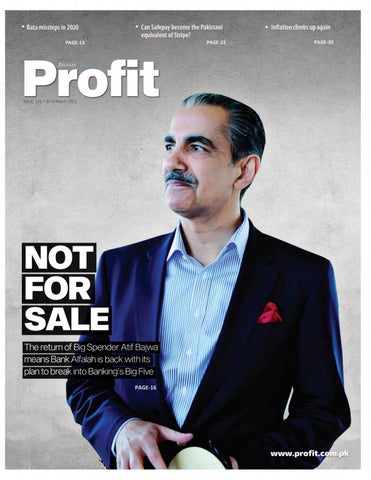
14 14 Unilever Foods passes the pandemic test with glowing results 16 Can Bank Alfalah regain its lost glory?
22
22 Can Safepay become the Pakistani equivalent of Stripe? 26 Are advertisers in Pakistan ready to directly buy out of home inventory?
30 30 Inflation climbs up again 31 Minority shareholders in action
Profit
33 What the frenzy over Clubhouse reminds us about brand strategy Babar Khan Javed
Executive Editor: Babar Nizami l Managing Editor: Farooq Tirmizi l Joint Editor: Yousaf Nizami Reporters: Ariba Shahid l Babar Khan Javed l Taimoor Hassan Abdullah Niazi l Meiryum Ali l Shahab Omer Director Marketing: Zahid Ali l Regional Heads of Marketing: Muddasir Alam (Khi) Zulfiqar Butt (Lhr) l Mudassir Iqbal (Isl) l Layout: Rizwan Ahmad l Photographers: Zubair Mehfooz & Imran Gillani l Business, Economic & Financial news by 'Pakistan Today' Contact: profit@pakistantoday.com.pk
Readers Say A seasoned banker who is an asset to Pakistan’s banking sector. Hopefully he will bring the changes he is aiming for before he is removed like other sincere individuals, who have tried to do some good to the country but were forced out by the corrupt. Apropos: National bank recorded its highest profit ever. But has Usmani treated the cause or only the symptom? Faisal Malik, Website Mr Arif Usmani, what is the fault of small shareholders who are deprived of any return or dividend. National Bank continuing onwards despite gross management has come at the cost of the small investor. There was also huge fraud worth billions of rupees at the Bangladesh branch. Both the then President of the NBP and the staff were involved, and even pension cases have not been properly handled. Apropos: National bank recorded its highest profit ever. But has Usmani treated the cause or only the symptom? Muhammad Seed, Facebook I am surprised that the effects of centralized internet exchanges in various cities for PTA IP/URL filtering/censorship and traffic monitoring by various “agencies” on available internet have not been discussed at all. They pose a significant source of delay/latency in internet access. This wreaks havoc with many internet services and use cases like online games. Having internet access is one thing. Having quality internet access with reliability is another. Apropos: Why is Pakistan’s internet so slow? Asad Asif, Website Given the rates that internet providers in Pakistan are providing internet at, the speeds we are getting are completely fine, so I really do not see the problem? If you want speeds like they have in first world countries, please keep in mind that you will have to pay the same kinds of rates that they pay in first world countries for their significantly faster internet. Who here will be willing to pay for that? Apropos: Why is Pakistan’s internet so slow? @ZubairKhanPK, Twitter
facebook.com/Profitpk twitter.com/Profitpk linkedin.com/showcase/13251020 profit.com.pk profit@pakistantoday.com
HOW TO CONTACT
9
This is a typically one sided article. According to the article it's all technical shortcomings and has nothing to do with lower per capita incomes. Business journalism at its peak. Apropos: Why is Pakistan’s internet so slow? @ChaiWalaBiscuit, Twitter Indeed there must never be any fine charged to anyone that has paid tax, or any persons
whose income tax had already been withheld throughout the year. In fact, they ought to be given tax discounts instead. The e-filing form should be so easy that everyone (standard literate) can easily go through it and fill the form on their cell phone. Please exempt all retired persons, windows, widovers, jobless, disables, senior citizens, alikes etc. Kindly think over it so we can move towards making a stronger nation. Apropos: FBR notifies Rs1,000 surcharge for individuals Khurram Jamil, Website All salaried employees should not be made to file tax returns. Complete details are held by their employers, and they should be the ones to upload information to the FBR, which is how it normally happens in most countries of the world. There should be a system in place where even if a person leaves their job to join another company, the accounts department of that company issues a detailed earnings certificate to be submitted to the HR department of the new employer. Pensioners normally don’t file tax returns as most state pensions are tax free upto a certain threshold, and after that tax is deducted directly by the tax authorities and the deducted pension is paid into the bank account. The FBR should learn from other countries and simplify tax returns and not make it cumbersome for the public. Our system is made deliberately complicated to advance corruption. The FBR should review such practices. Apropos: FBR notifies Rs1,000 surcharge for individuals Shaheen Iqbal Soomroo, Website The problem with our bureaucracy is that they decide first and think later, if at all! Secondly, they are dearly lacking in conscience and most of them have no fear of God, otherwise why should they shirk their responsibility? Apropos: FBR notifies Rs1,000 surcharge for individuals Syed Fazle Ali Naqvi, Website The process of filing tax returns is not easy. We have to take help from someone to do it, and then pay them for it. So it is ridiculous that first we pay taxes, and then we have to file the tax return by paying extra money to people that have made a business out of it. If you are really interested in ease of access for people wanting to file taxes, make the process easy so that everyone can actually do it. Apropos: FBR notifies Rs1,000 surcharge for individuals Anonymous, Website
COMMENTS
IN BRIEF Pakistan’s domestic market is set to receive a significant boost as the country prepares to launch three new airlines. The Civil Aviation Authority (CAA) is in the process of awarding operational permits to three new domestic airlines to provide a “breather” to local travel and tourism business badly hit by the coronavirus pandemic.
Pakistan Telecommunication Authority (PTA) has said it has issued Mobile Device Manufacturing (MDM) regulations and has started receiving applications for mobile device manufacturing.The PTA said that with the successful execution of DRIBS, the local assembly industry had evolved from infancy to growing stage, with significant growth seen in local assembly of smartphones.
Private sector borrowing through banks went up by 80 per cent in the first eight months of the current fiscal year, reflecting accelerated economic activities in the country. The private sector borrowed Rs352 billion during July to Feb 19, FY21. This was 80.5pc higher than the borrowing of Rs195bn made during the same period in FY20.
Rs 16.53 billion:
The government has approved Rs16.53 billion for three development schemes in the urban development sector. The said schemes were approved during the 25th meeting of the Provincial Development Working Party (PDWP), presided over by Planning and Development (P&D) Board Chairman Abdullah Khan Sumbal.
The Pakistani rupee extended gains against the United States (US) dollar at the start of Wednesday’s trading in the inter-bank market, touching a one-year high. According to foreign currency dealers, the local currency appreciated by 38 paisa to 157.47 against the greenback.
Rs 2.15 billion:
The Bank of Khyber (BoK) closed the previous year with a historic profit before tax (PBT) of Rs3, 806 million, while profit after tax (PAT) clocked in at Rs2,151 million as compared to Rs1,306 million for the same period of 2019.
Pakistan and its closest ally in the Islamic world, Turkey, have initiated a connectivity link to strengthen their strategic partnership that could juxtapose China’s Belt and Road Initiative (BRI). Running through Iran, the freight train service will resume after more than a decade.
10
Banks, finance ministers, and vaccines This week in Pakistan’s business and economics twitterverse
The fall-out from the senate election, why financial inclusion for women is more than painting things pink, and more.
M
ulti-layered, multi-dimensional, and all kinds of confusing, the Twitterverse is a complicated venn diagram of criss-crossing interests, niches, and mutuals that is difficult to navigate on a good day for the most seasoned of Twitterati. This week, in Pakistan’s business and economics Twitter-sphere, financial inclusion for women, and the possible fallout of the Senate election on the Pakistan Stock Exchange were hot topics. Also in the eye of the social media storm were Pakistani banks, and former Finance Minister Miftah Ismail, who coming out of a strong week of personal achievement in which he was lauded for shutting down a sexist question from a television host, went on the offensive against the economic policies of the incumbent federal government. This week’s Profit social media roundup also includes one thread on LinkedIn, an often ignored platform in terms of social impact, where Gallup Pakistan’s Bilal Gillani stirred a hot debate by claiming that one of the reasons for the slow uptake of the Covid-19 vaccine in Pakistan was that Chinese products have bad brand perception, and the AstraZeneca or Pfizer vaccine would see a much better reception in Pakistan.
SOCIAL MEDIA ROUNDUP
Profit’s reporter Ariba Shahid analyses the business and economic highlights from Pakistani Twitter this week.
Miftah Ismail
For a very brief moment, Miftah Ismail became a darling of ‘woke’ Twitter last week. While the bar is set agonisingly low, it was refreshing to see a man that has held powerful office act as an ally. The adulation and glowing reviews on Images would only be a moment, however, and soon it would be back to business for Ismail, who took the incumbent PTI government to task for “running up the largest deficits and public debt in our history.” While the PTI has borrowed and is running massive deficits, Ismail needs to be reminded that a significant amount of money that the government is borrowing is used to service off its existing debt, which includes both the principle amount and the interest. It is also important to note that roughly 70% of the cumulative fiscal deficit experienced during the PTI government is due to interest payable on debt previously borrowed. While these facts stand, Ismail is right as he points out that governments in the past have done the same job of paying off the previous government’s debt.
11
Financial inclusion for women This particular conversation was stirred when the United Nations Development Programme (UNDP) Pakistan’s twitter handle posted a simple question as part of a series of questions they have been posting on their social media to try and stir important conversations. This week, the question was, “What roles have financial inclusion & technology played in reducing structural inequality in the country?” In response, @OSmanSiddiqi, who holds a Masters in Public Administration from Harvard, points out instances of Pakistan lagging behind the world in female financial inclusion through charts and numbers. Adding to the conversation, Profit columnist and economic commentator Ammar Khan (@rogueonomist) adds his two cents over how it is not at all “Asaan” to open up a bank account as a woman. The discussion goes on to talk about how making something look pink does not make it accessible to women. This is a point that the Governor of the SBP recently agreed to in an earlier webinar discussing female financial inclusion. While some individuals have come up with successful instances of being able to open an account, the thread serves as a reminder that it is not always “Asaan” to do so.
#Chaltanaheinhai #Chaltanaheinhai is quite the hashtag. What is obvious is the fact that Sohail feels that banking stock prices are not a true representative of the actual potential banks have, especially considering the fact that these are safe bets. Banks in Pakistan are not risk takers, they prefer lending largely to the government and big names. This means their money is safe and so is your investment in their stocks. However, one can’t ignore the fact that the banking sector is resilient to change and needs the biggest push to get with the times – which it really needs to.
While there is no discussion in this thread, it is important to note that Pakistanis have often in the past been wary of Chinese goods so it only makes sense that they’re wary of the Chinese vaccine. Generally, Pakistanis are more than happy to buy Chinese goods when they are small consumer items. However, whenever China starts to offer bigger items like cars, the walls go up and Pakistanis become cautious. And the vaccine is definitely more monumental than a car. And why not? Gilani is correct that the Chinese makers of the vaccine are not known for their cutting edge research which may result in some uneasiness.
As news of former Prime Minister Yousafe Raza Gillani winning the Islamabad Senate seat hit twitter, a number of people started making jokes about how the PSX would crash the next day. This is just one example of those jokes. You see, immediately, the thought is that since Gillani won, Prime Minister Imran Khan has defectors in his ranks and thus the government is unstable. But how much instability is there really? After all, Hafeez Sheikh losing to Gillani is a strange moment considering Gillani used to be his boss. Clearly Prime Minister’s, Senators and politicians come and go, but the economists hang around, and so does the sense of political instability and makes the government’s status as a ‘going concern’ pop into one’s mind.
12
SOCIAL MEDIA ROUNDUP
Bata
missteps in 2020
The shoe company made a loss for the first time, as sales fell drastically
F
or a certain generation of Pakistani children, Bata is the first store they can remember. In fact, this Profit reporter was raised almost exclusively with Bubble Gummer sandals in their wardrobe, and B-first shoes when they started school. It is a testament to Bata’s brand presence in Pakistan, that it comes as a surprise to many that the company is not Pakistani - that it was founded in the Czech Republic, and is currently domiciled in Switzerland. A large, international, chain operating
SHOES
since before partition, with quality yet affordable footwear, Bata ticks all the right boxes. Today, it is one of the things that defines the middle class, from being the place to go for school shoes and joggers, to the infamous everyday wear such as the Bata ‘chappal’ that is safe in the collective consciousness of generations. Yet the Bata story is not an overly complicated one, despite its 80 year old history in the Indian subcontinent and its more than century old history internationally. It is a story of consistency, persistence, and innovation at the right time. Particular in Bata’s corporate
history has been its success in Pakistan, where it maintains its position as an iconic brand that still produces quality products that sell well. Its performance in Pakistan has always been exceptional, that is, up until last year. The financial results for the year ending December 31, 2020, were released to the Pakistan Stock Exchange (PSX) on February 26 of this year and to many they may have come as a shock. The company reported a loss of Rs627 million, which is the first and only loss recorded since 2007, which is the last year for which there is publicly available financial information.
13
What happened? Well, Covid-19 happened. To understand how big the shock was, let us take a historical look at the company. First, some context: In 1894, eighth generation shoemakers, Tomáš, Anna and Antonín Baťa, established the Bata Shoe Company in then Czechoslovakia. Their first product, called the Batovka, was a shoe made of leather and canvas at a time when shoes were made of only leather. The product was wildly successful, setting up the company for success. By the 1930s, the company had factories and stores across Europe; in 1931, the company entered India, and set up ‘Batanagar’, a specially built industrial town in West Bengal for Bata shoes. Today, the company is the largest shoemaker by volume, and serves around a million customers a day in nearly 5300 retail stores around the world. In what is now Pakistan, the first Bata outlet was established in Lahore in 1942. That was just a single store, then after independence, was formally incorporated as the Bata Shoes Company (Pakistan) Limited in 1951. It would eventually go public in 1979 as Bata Pakistan Limited. Today, the company has a retail network comprising more than 467 retail outlets and 331 registered wholesale dealers. In Pakistan, the company was able to create the specific Bata ‘chappal’ - a classic, go-to and cheap version of regular sandals available in markets. The formula of everyday shoes, and specialized school and children’s shoes has been key to the brand’s success. Every August, schoolchildren must buy plain black shoes and white ‘PT’ canvas shoes, and the options are either Bata, or Servis. There are also surprisingly limited options for affordable and high quality shoes for children - and Bata has an enviable position as a store that can produce shoes for children that will not be uncomfortable. Traditional and affordable Bata school shoes and slippers aside, Bata sells Marie Claire, their brand for women’s shoes, Power for sports, Bubblegummers for childrens’ shoes, and Bata comfort for special medicated footwear. In addition, the company sells Weinbrenner and
14
North Star sneakers. The formula has served them well: between 2007 and 2012, sales increased from Rs3.9 billion, to Rs11.5 billion, becoming one of the few retail companies where revenue exceeds Rs10 billion mark. Sales then reached their highest mark in 2019, at Rs17.4 billion. Similarly, the company’s net income rose form Rs359 million in 2007, to Rs1 billion in 2012, to Rs1.5 billion in 2018. The company’s net income fell in 2019 to Rs1.09 billion, but this was primarily due to a change in adopting IFRS standards that year. One could say Bata Pakistan was feeling optimistic. The brand was trying to shift away from its usual core products, to a more upbeat, ‘modern’ aesthetic. The company had started a ‘Surprisingly Bata’ campaign, (a play on expectations of the company), and hired popular actors Sheheryar Munwar and Maya Ali as brand ambassadors. And then, the pandemic hit. The real surprise for Bata. As Bata CEO Imran Malik told Profit earlier in an interview last year, the company’s plans for an evolution and a change in branding all came grinding to a halt because of Covid-19. “Covid-19 has severely affected the retail businesses which has resulted in the negative sales
volume and overall operational profitability of the retail businesses across the globe. This new normal may totally change people’s lifestyle, their shopping behavior and their outdoor preferences,” Malik had said. And it shows. In 2020, the company’s sales drastically fell to 2012 era sales, erasing gains made since then. Meanwhile, the company made a loss of Rs627 million - the first loss recorded in the period between 2007 and 2020. The culprit is obvious - in a time of heightened lockdown, panic, and economic stress, the last items people had in mind was new shoes. This coupled with the massive shutdown of schools for most of the year meant that Bata was not selling as many shoes as it usually did. Typically, brands also pivoted during the pandemic to sell online, and to focus on e-commerce, something that Malik had previously alluded to. But Bata is not typically what one searches for in a browser - it is still very much a brick-and-mortar retail experience. With the opening of schools this year, the advent of the vaccine, and the general desire for people to leave their homes and life to return to normal, perhaps Bata Pakistan, too, will see a return to normal. n
Unilever Foods
passes the pandemic test with glowing results
T
he Covid-19 pandemic ravaged entire societies, economies, and countries. For a brief period, particularly between March and May 2020, it seemed as if the
capitalist world as we know it was coming to a grinding halt. Companies’ entire supply chains were upended and distribution models were thrown out the window, while the regulator and federal government scrambled to provide relief efforts. Now
in 2021, the pandemic seems (dare we say it) somewhat under control, as the vaccine comes to Pakistan. But like every year, the financials and annual reports of companies are being released for 2020, and they reflect the gaping holes for those few months when the entire world seemed to be turned on its head. Most of these reports come with eerily similar feeble explanations about how challenges presented by the pandemic are to blame for these gaps. One exception to such insipid statements is Unilever Foods. While the company's annual report is not yet published, on March 1, the company issued its financial results for the year ending December 31, and the numbers speak for themselves. Unilever managed to increase its sales from Rs13.3 billion in 2019, to Rs15.5 billion in 2020. Similarly, the company’s profit after tax increased from Rs2.4 billion, to Rs3.8 billion. That is the highest sales, and net income achieved by the company ever, in the last ten years. How did Unilever Foods get here? It goes to the heart of what Unilever is as a company. Let us take a look at how they managed to navigate these uncharted waters. In September 1929, Unilever was formed by a merger of the operations of Dutch Margarine Unie and British soapmaker Lever Brothers, with the name of the resulting company a portmanteau of the name of both companies. Lever Brothers had been manufacturing Lifebuoy Soap since at least 1894. They would end up controlling 60% of UK’s soap manufacturing in the 20s. Even today, Unilever remains the world’s largest soap manufacturer.
In Pakistan, Unilever was founded in 1948, taking over the operations of Lever Brothers Pakistan. The company has one manufacturing plant in District Kasur, and six sales offices across the country.he company is a subsidiary of Conopco Inc. USA, whereas its ultimate parent Company is Unilever N.V. Netherlands. It manufactures and sells consumer and commercial food products, personal care, and home care products. The Pakistan division is headed by Amir Paracha, who joined the company in the year 2000, but became the CEO in February 2020. Think of the most iconic, most bought items at grocery stores, or even your regular khoka, and chances are Unilever has sold it. For instance, under food it sells Rafhan, Knorr, Energile, Glaxose-D and Food Solutions. Under personal care it sells Lifebuoy, Fair and Lovely (sorry, now ‘Glow’ and Lovely), Lux, Ponds. It also sells Surf Excel and Vim. The company’s sales have grown steadily over the last decade. In 2009, the company’s sales stood at Rs3.3 billion, crossing the Rs5 billion mark in 2012, the Rs10 billion mark in 2017, and then finally the Rs15 billion mark in 2020. The company’s net income has been a little more erratic: in 2009, the company’s profit stood at Rs176 million. Then in 2012 it crossed the Rs1 billion mark, and then stayed roughly in that same territory till 2018 (Rs1.7 billion), shooting up to Rs2.4 billion in 2019, and then Rs3.8 billion in 2020. What explained the rise in 2019? That is easy: according to the company’s annual report, Unilever benefited from the growing foods market. The foods market (total
packaged segment) in Pakistan was estimated at Rs2.6 trillion in 2019, with packaged food growing at 10.2% mainly led by edible oil and dressings. In 2019 , the company’s food products grew by 11.7%, mainly led by volume growth. Growth was broad based, both within the Knorr and Rafhan portfolios.Growth in Knorr was primarily led by Noodles that grew on the back of building brand equity and leveraging digital mediums through precision marketing and capitalizing on the excitement of mega occasions, leading to increased consumption in urban and rural areas,” the company report noted. Similarly, the annual report noted that the Rafhan was able to record healthy sales growth in desserts and corn oil product lines. This was achieved by strategic pricing decisions and relevant consumer promotions. But what caused the year 2020 to stand out so drastically? One word: soap. Though the financials do not mention it, it is easy to see why Unilever would benefit. There are only two items the federal government has tried to hammer home: that if one wears a mask, and one washes their hand, the pandemic will be kept at bay. Lucky for Unilever, it supplies not just soaps, but also all sorts of cleaners, detergents, and anything else needed to keep an individual or a home virus-free. Besides, in an air of general panic, one can imagine that consumers would flock towards a brand they already know and trust. And Unilever, thanks to its decades long presence in the country, managed to deliver on just that. n
FOOD
16
By Meiryum Ali
BANKING
T
hree years ago, it seemed like Alfalah Bank was on the chopping block. Alfalah’s parent group, the Abu Dhabi Group, was in talks with a variety of buyers to potentially sell the bank. And why not? For years, the medium sized bank had been punching exactly its weight, and was brimming with the potential to crack the ranks of the big five banks; now it had slipped in the ranking, losing market share. Despite the rumours of Bank Alflah being sold, here we are in 2021, with the bank very much intact. Not only that, but the group has recently decided to bring back Atif Bajwa, who had been the president of the bank for over five years before resigning in June 2017, for personal reasons. He was brought back to helm the bank in February 2020. On one hand, the decision seems strewn with all kinds of baggage and complication. Why would Bank Alfalah go from being on the market to bringing back a former president to steady the ship? But on the other hand, the decision makes sense. Those three years away from Alfalah have given Bajwa time to reflect. When asked in a recent interview with Profit whether anything had changed in his time away, Bajwa had the etiquette to be reticent about his predecessor, but that did not mean he was shy about discussing the path the bank had been on. “What I didn't like was certainly the fact that we had lost market share. I think we have in our people a desire to be ahead. We don't want to see anybody else in the race getting ahead of us. So there's that competitive spirit that made me feel, you know, maybe we've lost it a little bit. What could we have done better? What are things that need to be addressed? And that's where strategy comes from.” he said. If one reads between the lines, it's clear what message the group wants out: Bank Alfalah is back, and it is coming for what it lost and more. But can the rejuvenated Bajwa help Alfalah regain lost ground?
18
History of the bank
M
uch as all roads lead to home, most banking careers and stories in Pakistan from the 1990s and before lead to the Bank of Credit and Commerce International (BCCI). The BCCI is also where the story of Bank Alfalah starts. The Bank of Credit and Commerce International was one of the most notorious banks in the recent past of the global banking system and it started in Pakistan, founded by Agha Hasan Abedi, a man who got his start at Habib Bank in 1946, but then went on to create United Bank Ltd (UBL) in 1959, and the BCCI in 1972 after UBL got nationalised. The BCCI started off from an office building on Karachi’s McLeod Road (in what is now Bank Alfalah headquarters) but quickly grew to become the seventh largest private bank in the world, along with it introducing an entire generation of Pakistanis to the world of international banking. The alleged fraud that caused British regulators to shut down the bank in 1991 is, of course, now a well-documented part of banking history, but it did have a significant legitimate business that left orphaned assets in its wake after the bank was disbanded worldwide. In Pakistan, its assets consisted of three branches in Karachi and Lahore. The State Bank of Pakistan took over those assets in 1992 and renamed them Habib Credit and Exchange.The move to seize BCCI’s Pakistan assets coincided with the deregulation and privatization of the Pakistani banking sector. In 1997, Habib Credit and Exchange was bought out by a new banking entity backed by Middle Eastern investors: Bank Alfalah. Bank Alfalah’s majority shareholder, with approximately 22% holding, is Sheikh Nahyan bin Mubarak Al Nahyan. His brother, Sheikh Hamdan, has been the chairman of BAFL’s board since 2002. Both brothers are minor members of the UAE federal cabinet.
Historical financials
B
ank Alfalah grew from almost nothing to being one of the largest banks in Pakistan. In 2005, only seven years into existence, overtook Allied Bank to be-
come the fifth largest in the country in terms of total assets. A deeper dive into the last decade shows some interesting trends. First the bank’s deposits have been steadily increasing since 2009, when deposits stood at Rs 324 billion. In particular, deposits grew 13.9% year-on-year in 2012, and at 15% year-on-year in 2014. Deposits crossed the Rs500 billion mark in 2013, and the Rs700 billion mark in 2018, and finally, crossed the Rs800 billion mark in 2020. Growth in deposits stagnated in 2016 and 2017, before jumping again in 2019 and 2020. If one looks at the deposits as a share of the total deposits in the banking industry, Alfalah Bank’s share has actually fallen. In 2009, the market share stood at 7.5%, the highest share it would ever have. It would hover between 6% and 7% until 2015, and then fell to the 5% range for the next five years. The bank’s non performing loans have mostly been under control. For every year between 2010 and 2019, the ratio of the non performing loans to gross advances has been significantly lower than the industry average. In 2010, non-performing loans made up 8.3% of all loans; this fell to 4.8% by 2016, and has been maintained in that range ever since. In 2020, non-performing loans were contained to just 4.3% of gross advances. Between 2012 and 2015, Alfalah Bank saw its revenues jump from the roughly Rs17 billion range to around Rs37 billion. Revenues would stay there until 2019, crossing the Rs50 billion mark. A similar trend can be observed with the net income at Alfalah Bank, which has hovered between the Rs7-8billion range between 2015 and 2017, and then crossed the Rs10 billion mark in 2018.
The CEO switch
T
o lead this decade, the group brought in Atif Bajwa, a veteran banker with a professional career spanning three decades. Bajwa was previously the president and CEO of MCB Bank Ltd, president and CEO of Soneri Bank Ltd, and country manager for ABN AMRO Bank. He has also served as chairman of the Pakistan Business
If you look at what’s happened in the banking industry over the last few years, we’ve seen that a number of our competitors have increased their growth momentum. We want to get the momentum back in and the energy back. And so the number one of course is that we have to slowly regain market share in various products:, not just deposits, but its lending, its consumer products, its payment products, SME Atif Bajwa, the president & CEO of Bank Alfalah
Council and as president of the Overseas Investors Chamber of Commerce & Industry. Perhaps most importantly, in the Pakistani banking context, he is an ex-Citi banker, having joined that bank in 1982. That bank has been an incubator not just for leader’s in Pakistan’s banking ecosystem, but for overall financial leadership as well, producing more high-profile CEOs of the current banks in Pakistan, as well as finance ministers and one Prime Minister in the shape of Shaukat Aziz. Add to these credentials that Bajwa is arguably the most high profile bank president in the industry right now. Yet his tenure at Bank Alfalah was somewhat complicated, and controversial. Some historical context may be necessary. As mentioned before, Bank Alfalah is owned by the Abu Dhabi Group. Within Pakistan, it not only owns Bank Alfalah, but also the telecom company Wateen, and has minority stakes in Jazz (which it is selling back to VEON, the majority owner of Jazz), and also real estate projects worth several hundred million dollars, though many of these projects have been on standstill for several years now. Yet despite his contract having been extended for another five years, Atif Bajwa surprisingly resigned in June 2017, citing personal reasons. Instead, the former CEO of Faysal
Bank, Nauman Ansari, was appointed as his successor. As the numbers will reveal, under Bajwa, Bank Alfalah had grown rapidly. And yet industry insiders had previously told Profit that Atif Bajwa did not get along with Adeel Bajwa, then CEO of the Abu Dhabi group. Adeel Bajwa had been made the CEO of the Abu Dhabi Group in 2016, and had been associated with the Dhabi group for more than a decade, helping with mergers and acquisitions for the group in South Asia and Africa. Reportedly, Adeel Bajwa had told Atif Bajwa that Bank Alfalah was spending too much money. The Sheikh sided with Adeel Bajwa, due to his long history with the firm. But why did it matter whether or not Bank Alfalah was spending money or not? Well, that is because given the struggles of its telecom businesses, it has long been rumoured that the Abu Dhabi Group may decide to close shop in Pakistan altogether and even sell off Bank Alfalah. It was in this interest in selling off Bank Alfalah which is said to be behind Atif Bajwa’s departure as CEO of the bank in June 2017. Sources inside the bank say that he had been under tremendous pressure to reduce operating costs and had been unable to do so, in part due to his desire to protect the exceptionally strong benefits that the bank offers to its
employees, matched in their generosity only by the state-owned National Bank of Pakistan. It is not a coincidence that the man brought in to replace Bajwa was Nauman Ansari, the man who was responsible for removing an estimated Rs1.5 billion a year in excess operating costs from Faysal Bank’s income statement. Ansari served as CEO of Faysal Bank from 2014 through 2017. In bringing in Ansari, the sponsors sent a clear signal that the bank’s operations were being made more efficient and profitable in preparation for a sale. Higher profits are likely to result in a higher sale price for the Abu Dhabi Group’s shares in the bank. Except, as we now know, this never materialized. According to industry insiders, the group was in talks with at least four potential buyers: Faysal Bank, Habibullah Khan’s Mega conglomerate, Arif Habib, and a consortium headed by Sameer Chisty. In all four cases, a deal never materialized, because no party could agree on the pricing. (Editor’s note: In the case of Faysal Bank, the idea was to merge the two banks, while the Sameer Chishty led consortium was a non-starter, since its main backer Syed Babar Ali’s IGI/Packages group board never gave a go ahead to be part of the consortium.) While this was ongoing, Adeel Bajwa
BANKING
himself resigned (somewhat unceremoniously) and left the Dhabi group in March 2019. With one Bajwa’s departure, perhaps it was now time to turn to the other Bajwa, to helm Bank Alfalah once more. For his part, Bajwa mentions none of this convoluted history, and is nothing but supportive of the group: “I think we have a great board now. Most of them are the same people and they've been very supportive, always. They look for ideas to come from management and then they support them or disagree, or adjust, which is how a professional board should run. And you know, obviously everybody relies on the chairman's guidance and support and he's been very, very good and he's got a direction for growth.”
The year 2020
W
hat about the financials for the year that Bajwa finally returned? A deeper dive reveals that despite a higher revenue than last year, the bank’s net income is lower than last year’s - in fact, it is the first time in seven years that the bank’s after tax profit has decreased compared to the year before. Let us break this down. In 2020, the bank’s net interest income stood at Rs44.7 billion, which is comparable to 2019’s net interest income of Rs44.9 billion. The bank’s total
20
non-interest income is, in fact, much higher, at Rs 12.8 billion, compared to 2019’s Rs10.4 billion. Within that category, the bank’s fee and commissions income increased from roughly Rs6 billion in 2019, to Rs6.6 billion. The bank’s dividend income also increased from Rs338 million in 2019, to Rs403 million. And finally, the bank experienced a significant gain from securities, jumping from just Rs64.8 million in 2019, to Rs2.3 billion in 2020. That is how the bank’s total income increased from Rs55.2 billion in 2019, to Rs57.5 billion in 2020. So, what happened? Essentially, the bank’s expenses went from Rs29.8 billion to Rs32 billion. Then, the bank’s provisions went from Rs3 billion to Rs7.6 billion. This was enough to tilt the bank’s net income to below 2019 levels. According to the bank’s annual report of 2020, the bank’s non mark up expenses were driven by higher staff costs, IT support and maintenance fee, and the full year impact of the new branches which were opened in 2019, was finally realized in 2020. This meant the cost to income ratio of the bank went to 54.7%, which is higher than that of 2019's. But the main cost is, of course, the provisions: To that, the director’s report noted that “During the year, in addition to subjective provisioning against clients showing credit
weakening, the bank has taken a general provision of Rs4.25 billion. Given an uncertain economic environment, the bank anticipates that several borrowers will be impacted due to the pandemic. Many such borrowers have availed the SBP enabled deferment and rescheduling relief, however, since the full potential effect of the economic stress is difficult to predict, this general provision has been created as a buffer for the following year.” The bank added that the loans with principal over Rs52 billion were rescheduled under the SBP loan, and over Rs29 billion of fresh loans backed by the SBP refinance scheme were provided to over 300 entities. This is ultimately a good sign for analysts, who say that booking large provisions usually is a good sign for banks, and means they are cleaning the books. Bajwa reiterated the stance on provisioning, saying that the provisioning number was introduced to withstands any shocks from the fallout of Covid-19 pandemic. “Look at our NPL-coverage ratio. We had come down to about 79%, which in our assessment was probably a little bit lower, and certainly was lower compared to the industry. So we wanted to bring that up into the nineties. And so this extra provisioning also helped us get to 91%. So now we're feeling comfortable that our provisioning position and
TEXTILES
coverage is at the right level. We don't foresee any major shocks and the provisioning that we've taken will also help us,” said Bajwa.
Problems with the bank
A
s far as Bajwa was concerned, the bank had lost its way on two major aspects. The first, of course, are the financials. But other than this, Bajwa saw that the bank had taken a major blow in terms of bank culture. “It really was a tough year financially for the bank, especially when you look at it on a relative basis,” he says on the financial side, without mincing his words. “So the question is what was different for us? When we were growing our market share, we had started competing for the fifth position in terms of size of the market share. And you know, we were very close to being overall number five. Now we’ve ended up being number eight now.” “If you look at what's happened in the banking industry over the last few years, we've seen that a number of our competitors have increased their growth momentum. We want to get the momentum back in and the energy back. And so the number one of course is that we have to slowly regain market share in various products:, not just deposits, but its lending, its consumer products, its payment products, SME.” But to drive a bank, one needs people. As that famous management quote goes: “Culture eats strategy for breakfast”. And the culture had Bank Alfalah, according to sources, had stagnated. Employees continuously left for other banks. Allegedly, Bajwa had been unhappy with few of the group heads on his return, promising to shuffle or remove some (when asked about this, Bajwa denied the anecdote, and said it would be unfair to single out any one group head). On the same count, sources have mentioned a more active, handson approach now that Bajwa is back, and the beginnings of a slight cultural shift.
For his part, Bajwa is acutely aware of the bank’s culture problem. “[People] need to be driven by a common culture. That's driven by caring for customers... ambition, progressive attitude, innovation, high energy and extremely importantly, by teamwork and solution orientation. When an organization goes through frequent changes you tend to lose focus [on those]. So we want to bring that focus back in and certainly build that consistent, sustainable culture that drives an organization forward.It’s really based on making sure that our people's strengths are strong, that they have career progression, if they feel they have personal enrichment, and whether they feel comfortable in this culture.” When asked if the bank’s human resources department could have done better, Bajwa resisted: “It's probably not fair to just blame the HR department for, if there is any level of unhappiness in the organization, it comes from the atmosphere and the culture that gets developed. And as a leader I would have to take personal responsibility. So I would never be able to say that my HR is not doing a good job, because it would be my job to make sure that there is an atmosphere developed and there's a culture developed where everybody feels that they have to do the right thing by the customer and by the employees.”
The future
I
n conversation, Bajwa continuously referenced the bank’s digital strategy: “One of the key pillars is digital banking, and investing in the future of financial services. Going forward we have a strong position in terms of what we have developed and probably the richest range of products and services that are digitally offered today.” Bajwa said that Covid-19 had helped transition more customers from physical transactions to digital transactions. However, the internal processes needed to now be driven digitally. “We just need to keep on pushing that frontier of what we can do as a bank based
on technology.” To that end, Bajwa said the bank was in conversations for partnerships with fintechs, though he did not disclose names just yet. As he puts it: “Banks are good buyers of technology. They're not necessarily great innovators or creators of new solutions.” Instead, it is startups and fintechs full of “young, energetic, nimble people who are coming up with new ideas.” And the new generation is much more comfortable with technology. Bajwa sees enormous potential in that age bracket, and thinks fintechs will help bring value to new customers. But one must take a step back and reflect: why is Bajwa dropping buzzwords? ‘Digital’, ‘Market Share’ - these are the words of a bank that is here to stay. Bajwa is also cautious, caveating each reference to growth with a ‘slow and steady’ approach. It is as much a signal to the group about his expected performance, as it is to the market. Except - the market has not reacted as well to Bajwa’s return, as it did to Ansari’s appointment. Perhaps then, it was clear that the bank was being sold, and that it would fetch a multiple of around 2 on the going market price of the share. And perhaps now, it is clear that there is no deal in sight. But also there was no clear understanding of Bank Alfalah’s path forward, or why Bajwa is even back. Well, now we know. Can the bank become competitive enough to give the big five banks a run for their money? Two other banks have come close, as Profit has previously covered. Meezan Bank had deposits of just Rs3 billion on December 31, 2001 while Bank AL Habib had nearly Rs25 billion. And yet as of June 30, 2020, the latest period for which both banks’ financial statements are available, Meezan Bank had deposits of Rs1,045 billion to Bank AL Habib’s Rs1,042 billion. Meezan overtook Bank AL Habib as the sixth largest bank in Pakistan by deposits in 2019. In contrast, Bank Alfalah is the eighth largest bank, as mentioned by Bajwa himself previously. Can it climb the ranks again? Bajwa and the group are betting on it. n
BANKING
22
T
By Taimoor Hassan he permeability of digital payments in Pakistan has been an issue of serious concern for stakeholders in the country’s economy for some years. From credit cards to online banking, Pakistanis have been stubborn in accepting innovation when it comes to money. Cash is very much still King,
and the dream of a digital Pakistan is hampered by not just customers untrusting of digital payments, but entire companies. In 2018, it was to offer a solution to exactly this that Ziyad Parekh, a Pakistani-American entrepreneur, created a digital tool that would allow anyone to make and receive payments digitally. This was the birth of Safepay. The idea is to enable any business to accept digital payments online. Whether you have
We had closed our round and after we closed it, Stripe reached out. They were interested in what we were working on and they wanted to be able to back us and support us in their mission to bring digital payments to Pakistan. They were the last investor to come in but then they overtook everyone in terms of amount Ziyad Parekh, Co-founder, Safepay
a website or you don’t, Safepay can help you make digital payments. But there are plenty of fintech startups and technology companies that have been making inroads in Pakistan’s largely untapped market. Not to mention, this is not a particularly groundbreaking idea, since the Irish-America company called Stripe does the exact same thing - Online payment processing for internet businesses. So what makes Safepay worth profiling? Well, for starters, it is how the company’s founder grew it. The idea for Safepay, even inspired by Stripe, is much needed in Pakistan. One would expect that Safepay will have grown in meetings with investors in sleek board rooms and over expensive if greasy business lunches. In the era of the startup, that is the culture that exists in Pakistan. Except Ziyad Parekh and Safepay did not start off like this at all. Parekh had created the digital payments tool on his own time out of his own home. Now that he had it, he needed to pitch it. Normally, he would try to look for connections and contacts to get to investors or possible clients. Instead, he turned to Facebook, and simply started posting about his tool in different Facebook groups where the members would understand what he was offering. That is how Safepay came to be, and today, it is in the race for which company takes control of making payments easier in Pakistan. Since those early Facebook days back in 2018, however, Safepay is now among the only three startups from Pakistan that have been accepted into, and secured seed funding from, the prestigious US-based Y-Combinator (YC) startup accelerator. But what makes it a star among the very few fintech startups is its recent funding round. Safepay raised an undisclosed seed amount from investors that include global financial technology company Stripe. Does the investment from Stripe signal a kind of blessing from the American company, and is Safepay looking to turn itself into the ‘Stripe of Pakistan?’
Building Safepay
I
t is amazing what a single person sitting in their home with a laptop and an internet connection can do. That is what Parekh discovered when what began as mere dabblings in softwares and computers meant to sate his own curiosities turned into a major opportunity. “I started working on Safepay as a side project for my own knowledge, and just to see if it leads to anything. The platform was built all through 2018 and launched in May of 2019 on Facebook groups that I had been interacting with, trying to understand the pain points of customers when it comes to payments,” Ziyad Parekh told Profit. “I worked on Safepay in my spare time while I still had a job here in the US. I worked on the weekends, in the evening, just building the platform, building the product, talking to potential customers in Pakistan and asking them what they like about existing payment options. Obviously, a lot of them were relying on COD and when they had this option of making payments digitally, the response was nothing short of overwhelming.” It wasn’t anything fancy in the beginning. Just pitching a payments tool randomly to clients, asking for feedback, learning about the issues in the tools and then fixing them. “Surprisingly, however, I was overwhelmed by the response I got and a lot of people took a leap of faith and tried it out. So that made me realise that I might be onto something. And it also made me realise that right now, if I am going to try and maintain these customers, and turn them into clients, I needed some sort of support and the sort of customer service that I would want for myself,” he says. That is when Raza Naqvi, the co-founder of the company joined Safepay. A Karachi-born solicitor practicing in London, Raza left his job in London to pursue Safepay. From its launch on Facebook groups in May of 2019, and then throughout the second half of 2019, Safepay’s focus remained on products where Ziyad would be talking to customers, getting
their feedback and reiterating the product. The gaps in the market were appalling and as Ziyad identified, there was a need for a digital payments solution that suited individual customers’ needs. And customer interaction is what led them to discover an unmet need in the market that was quite significant.
Quick Links
I
t was one case in particular that would shape how Ziyad and Safepay would orient themselves. The particular customer in question was looking to start their own ecommerce business, even though they had not set up a website yet. Normally, digital payments are integrated into e-commerce stores. But what Ziyad’s client in this case wanted was a way where they could go to the Safepay website, enter in an amount, generate a link and send that link to a customer and have the customer pay me through that link. This feature came to be known as Quick Links, which outlines the essence of digital payments that allows individual digital payments transactions even if you do not have a website to have digital payments integrated into the online store. And as Ziyad tells us, over time, Quick Links became one of Safepay’s most popular products forming about 25% of the volume on Safepay where customers would just generate a quick link and make payment through that. Quick Links is essentially invoicing that makes reconciliation of transactions easy. While payments can be made through bank transfers as well, it is the reconciliation of these payments that becomes a hassle with other modes of payments like bank transfers. Consider this. If you buy a shirt from an Instagram clothing store, chances are that to make an online payment, the owner of the page will have to send you their bank account details, after which you will have to add them as a beneficiary on your online banking account, make the payment after a two-step verification process, and then take a screenshot
DIGITAL PAYMENTS
of the payment and send it to them to confirm. For the person buying the shirt, it is a bit of a nuisance but still manageable. But for the business, when these orders run in hundreds in numbers, manually reconciling each transaction individually becomes an arduous task and one that still carries the risk of errors. Another way to make reconciliation easy is to go to the SafePay website, use Quick Links to generate an invoice for the customer placing the order. That invoice is sent to the customer and that invoice has a link that will take the customer to the checkout page where the customer can pay and complete the order. What this means is that small businesses such as e-commerce stores that do not have a website can also accept debit and credit card payments. With such invoicing, reconciliation is automatic and easy as compared to bank transfers. “Though the customer who suggested this idea did not start their business, they gave us a use case that the market needed but did not have a way to express themselves,” says Ziyad. “It really led me to believe the power of talking to customers and listening to what they really want rather than working in a silo or building something the world really needs.” The caveat, however, is that it is not only Safepay that is providing such service. Lahore-based Post-Ex provides the same option of Quick Links, and Bsecure also provides a checkout solution. So how is Safepay better? From what Profit learnt from sources in the industry, Safepay was winning on the speed of integration of these solutions with businesses. Where others will take 3-4 days or more, Safepay will get it done in a day. “Our product is focused towards developers and is meant to make their lives easier while integrating payments across all their products,” says Ziyad. “Our focus is on using technology to create a better user interface and user experience for merchants and their customers,” he adds. But while everyone else is doing the same as what Safepay is doing, none of them is the pioneer of this model. “They started providing these payment solutions when nobody else was. They essentially brought the Stripe payments model into Pakistan and everyone is following them,” an expert in payments told Profit. But pioneering only goes so far, especially if there are others on the market providing the same services. It is the recent investment and endorsement from Stripe that qualifies Safepay to be called Stripe for Pakistan. “We want to bring the payments experience that exists in the west to Pakistan by leveraging our experience working abroad. Our goal is to create a payments experience tailored for the Pakistani market,” Ziyad further says. At the end of the day, the scope of digital
24
payments lies with the SMEs and upcoming startups. There are an estimated 900,000 SMEs in Pakistan that are not properly served by banks and existing fintechs, according to Ziyad. Banks would rather focus on bigger brands and not have to deal with extra risks and burdens and customer support issues that will come with dealing with smaller guys. “When we launched, we were figuring out how to democratise access to these tools. There is an extra element of risk with small companies, but maybe we can solve that with technology,” he explains. “What we realised was that small enterprises were so ready to accept digital payments that they did not care about any restrictions, like settlement times, put on them. We have the highest processing fees in the market but they wouldn’t care. They were happy with the fact they would get digital payments, and as long as eventually they got their money, they wouldn’t mind,” he adds.
The YC Experience
I
n January 2020, SafePay applied to YC, and in April they were accepted. This was a big deal. YCombinator (YC) is an American seed money startup accelerator launched in March 2005. It has been used to launch over 2,000 companies, including Stripe, Airbnb, Cruise Automation, DoorDash, Coinbase, Instacart, Dropbox, Twitch, and Reddit. Safepay’s acceptance into YC and subsequent investment from investors at YC is what really got Safepay noticed in Pakistan. May 2019 was when YC started and that was also when Ziyad quit his job and made Safepay his only ambition. The three-month programme at YC was full of rigour, with learnings for a lifetime. “They really work you, make you focus on your business. It can get overwhelming,” says Ziyad. Each year, YC invites applications from all around the world and incubates hundreds of startups. The number of startups has increased over the year with as many as 197 startups incubated at YC in the summer batch of 2019. YC runs two batches in a year. What makes it more intense at YC is that a startup is a part of a batch with 100-150 other startups that are presumably the cream of the crop from around the world that you are collaborating with. At the same time the startups and the founders are also competing with some of the smartest people in the world that are leading those 100-150 startups, striving to raise investment from a limited set of investors. “Founders of various startups in the US came and talked about their experiences, their highs and lows, what were the most challenging things in their journey and that helps you learn from them,” says Ziyad. “Safepay also got paired up with mentors that were ex-founders that were now part of YC, one of which was
head of growth at Airbnb learning from them was a great experience,” he adds. But it isn’t just who you meet and who mentors you while you are at YC. The YC experience is for life and it continues even after you have graduated from the accelerator programme. You are a part of the network of startups and founders that have been to YC and whom you can reach out to whenever you want. It’s this network that makes YC even more precious. Any of the founders of top startups are only an email away and they are more inclined to reply to you because, according to Ziyad, YC has that pull about it. “At YC, we were focusing on how we can grow our business,” says Ziyad. “Let’s say you are a startup that has come into YC with a concept, your main focus would be to turn that idea into MVP (minimum viable product) till the Demo Day. Now because we already had a product, our focus was how we can scale this and show numbers so that investors will be attracted,” he adds. At YC, things were myopic, with the Safepay co-founders focusing on how the customer onboarding process could be streamlined and how bigger clients could be scored. “The focus really was on that at YC but after YC, the focus was on bigger picture items like enabling new features and going back to what you really wanted to do,” he adds further.
The Stripe investment
T
he YC experience culminates in a Demo Day when startups present in front of a whole host of investors. The startup presents what it has built, what it has worked on and wants to work on and the vision it holds. Safepay that was part of the Summer ‘20 batch at YC, secured $150,000 investment after its presentation on Demo Day. One of the audience members on that day was a team from Stripe, the global financial services company and one of the most successful startups to have graduated from YC. Ziyad says that Safepay’s tagline that they used to introduce Safepay to introduce to the audience in America was “Stripe for Pakistan” and that is what perhaps resonated with the fellows from Stripe and caught their eye. It resonated with them because they are “Stripe for the world”. Now for Stripe, one way to come into Pakistan is by coming individually into Pakistan which can be time-consuming and expensive. Stripe currently has no operations in Pakistan. The other way is to invest in a company that is more or less like Stripe. And it is not surprising that for a country like Pakistan that is not on the roadmap of technology companies around the world, it would rather make more sense for them to come into Pakistan via an investment into a company that has the similar ideology
as them. Consequently, Stripe ended up investing in Safepay in a seed round that was announced in February this year. Though the exact amount remains undisclosed, it is a seven-figure investment and the round was led by Stripe that put in the most money. “We had closed our round and after we closed it, Stripe reached out. They were interested in what we were working on and they wanted to be able to back us and support us in their mission to bring digital payments to Pakistan. They were the last investor to come in but then they overtook everyone in terms of amount,” Ziyad says. Stripe did not just come in with money. It came in with all their resources behind them that have made them successful in countries where they operate. There is a lot for Safepay to leverage from Stripe and what it can potentially bring to the Pakistani market and do things in ways that are global. And as such, that might actually help it become Stripe for Pakistan. For now, the operations of Safepay are at a pause pending regulatory approval from the State Bank of Pakistan (SBP). For clarity, Ziyad says that the SBP did not shut Safepay down or forced it to stop operations. It was rather a deliberate decision by the company
to have all the necessary regulatory covers to avoid any undesirable situation in the future. Without giving many details about what happened, Zyad only said: “If one party isn’t a regulated entity and the other party is, then it becomes cumbersome for the regulated entity to realise where the liability of KYC (know your customer) lands. The SBPs main concern is consumer protection and preventing money laundering and terrorism financing. So they have regulations that fintechs have to adhere to.” “If you are not a regulated entity and you are doing something in fintech, the SBP pretty much has no jurisdiction over you. But if you are working as a non-regulated entity with a regulated entity, all the responsibility goes to the regulated entity. If we do something wrong, the regulated entity will bear the burden of our mistake and that is something that we did not feel comfortable putting on someone else’s shoulder. Therefore, we are looking for regulatory cover from the SBP,” Ziyad adds. An independent source in the country told Profit that Safepay pausing its operations was followed by the central bank’s objection on one of the top Pakistani bank’s, Habib Bank, collaboration with Safepay. As a fintech company, Safepay is only an enabler of payments and holds money in a
settlement account with a bank for sometime before transferring it in bulk to a merchant’s account within that same bank. The State Bank apparently had a reservation that Safepay holding money in a settlement account for some time before settlement with a business might be a risk as money could be transferred somewhere else before it was transferred to the business. Industry sources say that the SBP was right in its concern that money could flow out from the settlement account but fintech regulations do not prevent opening of such accounts and therefore it is the onus of the bank to ensure all mandatory regulatory requirements are fulfilled. “The banks should not allow opening up of such an account if it is a regulatory risk,” a source said. The result was that Habib Bank and Safepay, upon intervention of the central bank, stopped collaborating and before it could spillover to other banks with which it had accounts, Safepay paused its operations to seek regulatory covers first to prevent any similar undesirable situation in the future. At the same time, sources say that the central bank was duplicitous in implementing this policy because Safepay is not the only fintech company that operates in this way but they still continue to operate. n
DIGITAL PAYMENTS
By Babar Khan Javed
H
ow can a ride-hailing service like Careem, for example, find an additional revenue stream? Advertising. Imagine if with its vast fleet of vehicles in Pakistan, Careem began advertising by pasting stickers and advertising slogans on their cars, bikes and rickshaws. The permeability of these ad campaigns would be huge, even if they would entail massive logistical issues. And this doesn’t even have to be it, they can take it a step further. Imagine sitting in your cab and finding a pre-installed tablet in front of you that has different advertisements flashing
26
across it. The entire experience sounds a little far fetched - a maybe-possible but unlikely situation. However, it is exactly what the Singapore based ride-hailing service, Grab, did back in 2018. It launched an advertising business unit called GrabAds to provide an online to the offline advertising platform. Marrying an extensive on-ground fleet of vehicles with a rich digital presence across eight countries and more than 200 cities in Southeast Asia, in-car tablets by GrabAds represent an additional content distribution arm for Mediacorp, which co-created tailor-made content for in-transit viewing. On the advertising side, GrabAds allows advertisers to turn a fleet of cars, buses, and bikes into their own roving billboards to generate mass offline awareness.
We do not offer a self-serve DOOH advertising campaign management platform yet as we feel the market is not receptive to such a platform currently. However, we are constantly working on innovative tools which we feel would be adopted by our clients Anika Baig, the director of business development and strategy at Red Tape Media
This includes in-car branding, digital displays, in-car sampling, and in-car retail, transforming cars into mini mobile pop-up stores for customers to learn, test, and purchase new products while in commute. Capitalizing on the super app reach, GrabAds offers advertisers the opportunity to build and customize interactive widgets in the form of games, quizzes, and content to reach over 100 million smartphone users in Southeast Asia Within months of announcing GrabAds, Go-JEK purchased Promogo in order to launch its own DOOH solution, capturing more value from the mobile real estate on its extensive fleet of two-wheel vehicles in the Southeast Asia region. In 2020, Go-JEK launched a programmatic OOH advertising solution called GoScreen through Promogo and is meant to democratize access to brand awareness touchpoints. However, the idea has not been received very well in Pakistan, where a number of ride-hailing services with designs to become Pakistan’s ‘Super-app’ have felt the success of the project is highly unlikely. Speaking to Profit during the week GoScreen launched, Bykea CEO Muneeb Maayr said that the solution was currently not feasible for Pakistan given that its costs incurred by city permissions are upwards of five thousand rupees per day for a maximum of three to four zones in a city. He said that the revenue outcomes as a function of the costs of operating at the sophistication of GoScreen would not be commercially feasible for Pakistan. At the time, a representative from Careem told Profit that the super app is exploring placing static ads inside its vehicles as an additional revenue-sharing medium for its captains and itself, adding the solution would not likely be programmatic with digital screens given the realities of rampant theft that would occur. Less than six months later, this stance has changed. Last month, Careem announced that it was partnering with Lambda Marketing Solutions in order to launch a digital out-of-home (DOOH) ad platform. As the DOOH version of
Adbuq, the ad platform intends to allow advertisers and agencies to place ads and content on up to five thousand data-sim enabled tablets installed in vehicles, measuring and monitoring performance in real-time. This is similar to the screens found in Faisal Movers. “In-taxi DOOH screens have their own unique advantages over traditional media and pair well with overall OOH or DOOH campaigns I believe,” said Muhammad Armaghan, the managing director of Adbuq. “These smart screens must be able to determine ad frequency based on demographics and routes. The mobility market leader intends to complete the installation of an additional five thousand screens within the next phase of three months. The initiative intends to create additional earning opportunities for the company itself, the captains behind the wheel, and the vehicle owners. Demand dictates supply and if enough advertisers show interest, Careem may eventually tap into all 800 thousand captains it has nationwide. It stands to reason that Careem would mirror parent-company Uber with branded vehicle wraps and car toppers in the near future. According to the latest issue of the Association of National Advertisers (ANA) magazine, global spending on digital OOH will grow 19.2 percent in 2021 due in part to advances in technology for tracking the channel’s effectiveness and a rise in the number of brands that are looking to experiment with new, affordable channels amid the pandemic. Within the DOOH space, Careem is going up against a range of DOOH media owners and DOOH media agencies, with the latter being important as the super app company intends to roll out a self-serve DOOH campaign management system, also known as programmatic ad buying. While still in the development phase, the current workflow for interested parties is to drop an email and initiate a back & forth to go over campaign budgets, the number of ads, number of spots, the campaign timeline, and other variables. At the end of the campaign, Careem will then provide the enterprise customer
with impact reporting in terms of eyeballs and impressions. In contrast, the end-of-campaign reporting offered by Uber includes a heatmap trend, geo-temporal engagement, and a breakdown of impressions by commuters and riders. “If Careem enables Pakistani brands to tap into the benefits of programmatic in-taxi advertising, it will be a unique medium to reach an audience,” said Armaghan. “For optimal delivery of promotional messages, it can be broadcasted on a particular location and at a particular time. This brings ads to the riders directly. We have heard a saying that content is the king. To grab passenger attention, it has to be seen whether the In-taxi screens by Careem will provide entertainment content as well or only serve ads?” The intended self-serve DOOH platform by Careem, however, would disrupt the status quo. If successful, the approach would allow advertisers to buy ad space and place campaign creatives across a range of DOOH inventory with the mobility leader. In a nation where advertisers are the root cause behind non-transparent media agencies, would decision-makers be prepared to use programmatic tools which create pricing transparency and limit instances of rebates or kickbacks? Armaghan told Profit that in the current OOH advertising landscape, advertisers and agencies have to go through a long process of finding perfect billboards for their campaign. This includes the tedious and mind-numbing manual tasks of ascertaining the availability of specific inventory from OOH vendors using PDF files passed from between agencies, with no verification on how updated the information and the listed rates are. In the Pakistan market, DOOH inventory comes in two forms: large format displays and digital displays in destination locations. According to sources at leading media agencies in Pakistan, the former category is dominated by Kinetic - which did not respond in time to capability queries - while the latter is dominated by Red Tape Media. Large-format displays include highway billboards, ads on buses or the outside of other
ADVERTISING
moving vehicles, and street furniture, which are displayed along sidewalks such as those on benches and bus shelters. Digital place-based media are visible at airports, on university campuses, in HoReCa, and in retail stores. “OOH, like every medium, has its own cost working,” said a senior OOH media buyer. “The number of assets, the frequency or duration of a campaign, the out of the box approach versus static visual, creative executions and reach in terms of how many cities all comprise the cost of the campaign. In a simpler form costs are divided into three heads; media cost - billboard, vehicle or island -, production cost - fabrication, printing, installation - and lastly permission cost [which is ] paid to an authority by media owners.” A leading media executive told Profit that DOOH has the most potential to grow in times to come as it gives advertisers the space to play with time-barred messages, promotions, customized real-time communication based on weather and traffic, allowing advertisers to change messages in the midst of campaign without incurring any additional costs. “The challenge in using the programmatic app with DOOH is that every screen network has its own dashboard, display specifications, resolution parameters,” said a planner. “Hence the content piece developed is completely different from a creation perspective but it looks the same visually for the consumer. Outdoor agencies are taking key steps to bring this closer to automation but challenges do exist and need mitigation before we go to complete automation.” Reaching 144 million people in the SEC A to C demographic annually, DOOH media owners and media planners Red Tape Media operates 400 screens across Pakistan including over 450 medium and large format screens at the domestic departure side at the Jinnah International Airport in Karachi. “We do not offer a self-serve DOOH advertising campaign management platform yet as we feel the market is not receptive to such a platform currently,” said Anika Baig, the director of business development and strategy at Red Tape Media. “However we are constantly working on innovative tools which we feel would be adopted by our clients.” The current workflow by which an advertiser or agency deals with Red Tape Media starts with finalizing a budget, against which in-house DOOH media planners map a range of touchpoints across the inventory network. Within 30 minutes of receiving content from advertisers, Baig told Profit that Red Tape Media can go live with a campaign. She said that the media owner can execute dynamic campaigns which can be integrated into real-time data, adding that the network offers weather, time, traffic, and other sources of real-time data
28
We have heard a saying that content is the king. To grab passenger attention, it has to be seen whether the In-taxi screens by Careem will provide entertainment content as well or only serve ads? Muhammad Armaghan, the managing director of Adbuq
integration. “Our networks are built in such a way that we can integrate programmatically when we feel the market is mature enough,” said Baig. “We are constantly working on innovative ways to provide our clients with the best tools available. Our goal is always to provide maximum value addition to our clients and their campaigns.” Agreeing with Baig, several advertisers spoke to Profit that too many stakeholders rely on the opaque and nontransparent nature of OOH and DOOH pricing in order to stay afloat. In a survey conducted by 24Grey, seven out of ten marketers said they were directly or indirectly offered a kickback for their OOH business, and nine out of ten OOH vendors admitted to having paid kickbacks to secure business or to install inventory. Sources shared that a programmatic ad buying platform with transparent pricing would only hurt middlemen such as media agencies, adding that Careem needs to offer preferential pricing to media agencies that can deliver a larger volume of advertisers than what Lambda Marketing Solutions or its own internal teams can procure. Then there’s the infrastructure problem. Sources told Profit that DOOH media owners were attempting to create programmatic integrations with demand-side platforms (DSPs) and related providers. Given the fragmented nature of the marketplace, there is no unified targeting, measurement, or even vocabulary to ease media buyers’ access to inventory across providers. The final nail in the coffin is the dearth of media professionals with the skills, experience, and qualifications in programmatic media buying. Speaking to Profit, a Publicis Groupe media agency executive shared that there are less than 100 qualified programmatic media buyers in Pakistan - primarily employed at GroupM and Starcom - most of whom struggle with the manual work required to unify campaigns.
“Some DSP interfaces have not incorporated impression multipliers, which means that either the media owners or the media buyer have to manually calculate in order to normalize a campaign or to employ a third party to do so,” shared one programmatic media buyer. “There is no transparency on the variables that influence pricing and DOOH can lack precision, which hinders the transition from conventional to digital. Finally, the real-time claim of DOOH executions is seldom accurate, with only a paramount improvement in the buying component.” Amid the claims of being a super app and the call to actions that can be created within the API ecosystem connecting Careem to a host of D2C brands, one of the ways in which the mobility leader could instill confidence is adding that the availability of data on transactions, coupled with location-based information which tracks passengers after exposure to a DOOH campaign. In order to attenuate pushback from advertisers and agencies when it comes to its DOOH solution, Careem will have to invest in analytics & measurement tools partners combined with an independent media auditor. The goal here will be to offer decision-makers confidence amid the lag in the digital ecosystem. An independent media auditor may recommend ameliorating measurement tools such as post-purchase surveys, focus groups, geofencing, and quick response codes with new metrics that leverage location data from mobile providers and other opt-in sources. If Careem can driving qualified shoppers towards in-store visits, it can prove the value of its DOOH solution. With time, the mobility market leader may even abate its reliance on Lambda Marketing Solutions and allow advertisers and agencies to use the super app itself to plan, track, measure, and optimize DOOH campaigns, mirroring the vertical integration strategies of global unicorns. n
ADVERTISING
Inflation climbs up again
T
hink back to the beginning of the year 2020. A simpler time, pre-Covid-19, pre economy crumbling, when the biggest concern Pakistan had on its plate was our spiraling inflation. No, really: inflation in January 2020 stood at a whopping 14.6%. It was the highest recorded monthly inflation rate in nine years. Thankfully, inflation figures improved in the period since then. As our graph shows as well, inflation fell to 12.4% by February, 10.2% by March, and then to single digits realm by April 2020, at 8.5%. The inflation rate was then to stay in this realm for the next eight months, occasionally hitting 9%. Then in January this year, inflation accelerated to just 5.7%. Could it be? Was inflation
30
finally under control? Commentators certainly thought so: the finance ministry was quick to say that the sliding trend would continue, and that there would be no increase in the interest rate. Not quite - the inflation rate, announced by the Pakistan Bureau of Statistics at the beginning of March, jumped to 8.7%, a four month high. It was a number that Hamza Kamal, senior investment analyst at AKD Research, had already predicted, in a notice sent to clients on February 25. In the report, Kamal said that inflation is likely to stand at 8.7% in February 2021, predominantly due to resurging food prices, and a revision in electricity tariffs. “After being recorded at 5.7% in January 2021, mainly on account of high base effect and
muted food inflation, inflationary reading is likely to return to +8% reading, with February 2021 inflation likely to clock in at 8.7% yearon-year,” says Kamal. According to Kamal, monthly food inflation was likely to turn positive after recording two consecutive monthly declines, with a growth of 0.96% month-on-month. Consider that chicken prices increased 30.8% month-onmonth, after declining 18.3% month-on-month in January 2021. There has also been an increase in fuel prices, which rose 5.4% month-on-month on account of the boom in oil. The government also revised electricity tariffs, increasing the base tariff by Rs1.95 per unit across all consumer categories including life-line consumers. There was also a fuel price adjustment
affect inflation. Indeed, the inflationary reading for the remaining fiscal year 2021 is likely to average at 10.2%. According to Kamal’s estimates, every 5% increase in oil price raises our monthly inflation estimate by 19 basis points, whereas every 10% increase in utility tariffs translates into an increase of 47 basis points on on monthly inflation. “In the medium run, IMF directives to increase tax revenues in fiscal year 2022 to Rs5.9trillion, compared to the Rs4.7 trillion for the current year should result in inflationary pressure jacking up,” says Kamal. Apparently, the federal government is already considering withdrawing sales tax exemptions worth Rs360 billion which would push up consumer end prices. From monetary policy vantage, the State Bank of Pakistan is still likely to keep interest
rates on hold in at least next two monetary policy meetings based on stable external account outlook. According to Kamal, the resumption of the IMF program has been perceived as a net positive by the market. There will be pressure to keep the external account in a comfortable position despite potential pressure from pickup in imports in line with economic activity, and rising commodity prices. This will prompt the State Bank to maintain interest rates at current level, though perhaps there will be some tightening in the later half of 2021. “Moreover, potential positive developments on FATF (also acknowledged by IMF, plenary session scheduled from Feb 22-24) should accentuate the bull run in the market,” says Kamal. He looked favourably upon the cement, steel, power, and oil and marketing industries, particularly Pakistan State Oil. n
Minority shareholders in action
of Rs1.54 per unit in December 2020, which pushed up the overall housing index by 4.44% month-on-month. According to Kamal, urban inflation was likely to clock in at 8.24% year-on-year in the current month compared to 5.03% year-onyear in January 2021, whereas rural inflation was likely to be recorded at 9.37% year-on-year in February 2021 compared to 6.60% year-onyear in January 2021. For the first eight months of fiscal year 2021, inflation was expected to stand at 8.25%, compared to 11.7% during the same period last year. So, what does Kamal predict for the future? According to his research, inflationary pressure could mount in the medium run. After all inflationary pressure is expected to build up following surging commodity prices(in fact, the commodity price index TRG has surged by 36.7% since the start of this year). The federal government is also likely to allow pending and future tariff adjustments. Plus, the month of Ramadan is approaching, which will likely
E
veryone loves a good story of the underdog versus the top dog; David vs Goliath. The following anecdote is not exactly as high stakes, but it does represent a turn in how companies in Pakistan have treated minority shareholders thus far i.e. pretended they do not exist. Now, one company, Merit Packaging, has provided a blueprint for the powers that any minority shareholders can potentially wield against a much larger parent company. To recall, in October 2020, this magazine had covered the plight of Ahmed Munaf, and his friends. Together his band of roughly 15 to 20 supporters, all who had an excess of 17% shares in the company, asked the Lakson Group: exactly what was wrong with the management of Merit Packaging, and why was the printing company making loss after loss? Some context is necessary here: The Lakson Group was established in 1954 and is one of the largest business groups in Pakistan. Sultan Ali Lakhani is the co-owner, along with his brothers, including Iqbal Ali Lakhani. The group runs over 15 compa-
nies in all sorts of fields: agri-business, call centers, fast food, financial services, media, paper and board, printing and packaging, surgical instruments, and travel. All together the assets of the Lakson Group exceed $1 billion, employ more than 17,000 people, and are present in 50 towns and cities in Pakistan. However, among those companies, Merit Packaging is not exactly top of the list. It was incorporated on January 28, 1980, and manufactures and sells printing and packaging materials. Between 2015 and 2017, it made sales roughly in the ballpark of between Rs1.6 billion and Rs2 billion. The profit after taxation wildly oscillated, from Rs15 million in 2015, Rs3 million in 2016, and Rs33 million in 2017. But then, starting in 2018, something happens: total sales increase (reach their highest at Rs2.8 billion in 2019), while the company begins to accrue losses: Rs8 million in 2018, Rs311 million in 2019, and Rs693 million in 2020. Meanwhile, capital expenditure rose in the same time period, along with long-term liabilities; property, plant and equipment; and total capital employed. Additionally, deferred taxation also rose.
MACROECONOMY
In both the company’s 2019 and 2020 annual reports, Merit Packaging pointed out that the losses were in part because “The other major factor is increase in the financial charges due to increase in markup rates and higher borrowings required for CAPEX and working capital requirements”. In addition, “Full capacity production and sales orders could not be achieved due to slow development of value products on new double coater machine, lower production performance of old offset printing machines in Karachi, at the same time substantial increase in input cost coupled with abnormal market conditions and shifting of Lahore factory to new location hampered the production.” In the annual general meeting to be held on October 23, the minority shareholders pushed through resolutions, demanding that the management of the company explain themselves, and why they had not managed to achieve their stated target goals. And if the answer is unsatisfactory, then maybe Lakson should consider merging Merit Packaging with another printing mill: Century Paper & Board
32
Mills Ltd [another Lakson company, formed in 1984]. At the time, commentators were not too hopeful of this band achieving their desired result. After all, in Pakistan the family always owns a significant majority to ward off any loss of control, and the concept of shareholder based growth is non-existent. It was entirely believable that Lakson Group could just ignore the resolutions. Except, the group did not. In fact, on December 31, the group removed the then CEO, Shahid Ahmed Khan. And on March 2, they replaced him with Amir Ahmed Chapra. Chapra is a significant choice: he is the former executive director of marketing at Cherat Packaging, Limited, and has worked for 29 years in the packaging space. According to Suleman Maniya, Head of Advisory at Vector Securities, Chapra had built Cherat Packaging’s flexible business to Rs2.5 billion in the space of two years, while Merit Packaging’s entire revenue was only to the tune of Rs2.1 billion in 2021.
“Merit only needs improved HR, they already have the best machinery along with increasing focus towards production and lowering wastage along with utilising machinery (improved volumes to give a boost to margins and lowering per unit costs) helping it regain competitive advantage.” he specified in a series of tweets. But the real victory is not about the Merit Packaging and its individual fortunes, and whether or not Chapra can turn around the company. It is about the fact that Lakson Group - one of the largest conglomerates in the country - actually listed to its minority shareholders. This is more in line with companies outside of Pakistan, who follow such procedures. However, in Pakistan, it is easy to ignore, despite SECP regulations that take into account minority shareholders opinions. But that is set to change, The minority shareholders wanted a new CEO; and lo and behold, they got one. Will there be an uprising in other companies as well? Can minority shareholders influence the seths to make decisions based on their best interest now? n
PACKAGING
OPINION
Babar Khan Javed
What the frenzy over Clubhouse reminds us about brand strategy
I
n the New York Times Bestseller “The Four” by Professor Scott Galloway of the NYU Stern School of Business, the trillion-dollar valuation of Apple and its worldwide success is attributed to its positioning as a luxury brand that sells technology. The transformation from a hardware company to a luxury brand began with the introduction of the iPad and was completed when the American multinational technology company took out a 17-page spread in Vogue magazine for the $12,000 rose-gold version of the iWatch. Key to this success is manufactured scarcity, with only the top 1% able to afford Apple products and the iPhone accounting for only 18.3% while still garnering over 90% of industry profits. As a low-cost producer and luxury phenomenon, the iconic Apple Store and its immersive premium experience cement Apple as a luxury brand as well.
Babar Khan Javed Babar Khan Javed is the chief investigative journalist covering the advertising industry and marketing function in Pakistan. He can be reached on babar.khan@ pakistantoday.com.pk COMMENT
So the question for advertisers is: what story do audiences use your brand to tell about themselves? And does your marketing strategy align with or reinforce this story? Understanding this, brands tie themselves to the primal needs of customers, with the act of spending links to taste, privilege, and desire
“Apple is sex,” said Galloway at the 2017 Cannes Lions International Festival of Creativity. “We want to signal power, we want to signal how elegant, how smart, how creative we are. This isn’t a phone, it's my attempt to signal to women that if you mate with me you’re more likely to survive than if you mate with someone carrying an Android phone.” Historically speaking, manufactured scarcity is the key to Apple's success, with the company ensuring that only the top one percent of the world can afford their products. The lessons from Apple explain the relentless frenzy that has overtaken white-collar workers in Pakistan as they scramble to light their personal data on fire by downloading Clubhouse as a beacon of how wealthy, knowledgeable, well-connected, and desirable they are. By limiting access to the app through only invites, Clubhouse has manufactured a frenzy nationwide and also worldwide, with Meltwater sentiment analysis showing that message boards are loaded with comments offering money in order to get an invite on the audio app. Great brands help people tell stories about themselves or help people tell others the story they want to believe about themselves. In 1997, seven-time Tour de France winner Lance Armstrong founded the Livestrong Foundation, a nonprofit organization that provides support for people affected by cancer. In 2004, advertising agency Wieden+Kennedy partnered with Nike to launch a $1 yellow silicone gel bracelet known as the Livestrong wristband. Within a decade, nearly 100 million Livestrong wristbands were sold worldwide. On eBay, the band sold for upwards of $10 in the mid 2000s. Was it because people suddenly became empathic to the plight of those afflicted? Perhaps. According to experts in the field of consumer psychology and behavioral economics, wearing the Livestrong wristbands acted as a signal that the wearer is knowledgeable about the importance of
33
cancer research, supports a credible foundation, and is wealthy enough to do so. Innovation Protocol founder Sasha Strauss says we’re all looking for a story to tell and great brands do not leave it to chance. Playing with the basic principles of supply and demand, the scarcity created by Clubhouse reinforces extravagance, prestige, and elitism which are at the core of a luxury brand. This translates into advertisers ready to pay a premium - that extends beyond their function - to have a presence on the platform, which provides the advertiser a perceived status through association. The constructed scarcity in availability as a result of enforced distribution restrictions - and associations with particular consumer segments grows appeal and desirability is as a result. The reason demand for Pumpkin Spice Lattes at Starbucks - which frequently releases special holiday food and beverages - spikes is because they’re only available for a few months every year. For Clubhouse, the manufactured scarcity has not only created a frenzy to join the platform but also propelled the app to unicorn status in a relatively short period of time, with the parent company Alpha Exploration Co already in talks with leading luxury brands that seek to reach its affluent audience exchanging ideas freely. "Limited access and staged Beta launches are not about creating FOMO, it's tactical and a prerequisite to ensure you can scale, have the infrastructure in place to handle increased usage and the time to fix problems such as bugs
34
For Clubhouse, the manufactured scarcity has not only created a frenzy to join the platform but also propelled the app to unicorn status in a relatively short period of time, with the parent company Alpha Exploration Co already in talks with leading luxury brands that seek to reach its affluent audience exchanging ideas freely or add new features,” said Henry Joseph-Grant, co-founder of Alpha Exploration Co in an interview with Profit. “You have to be able to walk before you can run." The external positioning of limiting access for the sake of the product roadmap is a common reason in the technology industry, with Facebook doing the same in its earlier days where users could only register with university email credentials, limiting the social networking service among Ivy League students in its earliest days and creating a frenzy to join the platform as a signal of worth. While the app is free to use, this does mean the users are the product and reinforces qualitative findings that suggest that app users view policies as a nuisance, ignoring them to pursue the ends of digital production, without being inhibited by the means. A 2018 study found that 98% of new app users will ignore privacy policies and terms of service policies about data sharing with the NSA and employers, and about providing a first-born child as
payment for SNS access. As stated by Galloway in his book, mating rituals overwhelm the brain's rational choices and make people irrational enough to sacrifice their money or data to signal that they are elegant, intelligent, relatively rich, and attractive. Much like wearing the Livestrong wristbands is a wordless humblebrag that communicates generosity, the act of using social media to invite people to the Clubhouse app or inform them about an upcoming event is a means of signaling exclusivity and being special enough to gain limited access. So the question for advertisers is: what story do audiences use your brand to tell about themselves? And does your marketing strategy align with or reinforce this story? Understanding this, brands tie themselves to the primal needs of customers, with the act of spending links to taste, privilege and desire. More importantly, branding around luxury leads to inelastic demand and removes the need to change pricing in order to influence demand. n
COMMENT