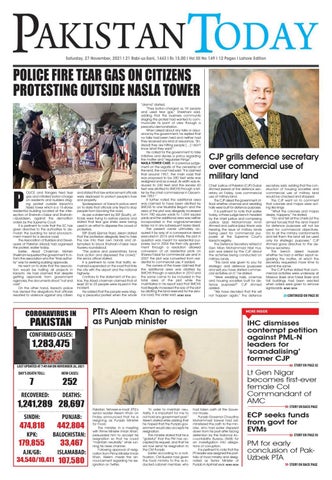
Saturday, 27 November, 2021 I 21 Rabi-us-Sani, 1443 I Rs 15.00 I Vol XII No 149 I 12 Pages I Lahore Edition
Police fire tear gas on citizens Protesting outside nasla tower
P
oLICE and Rangers fired tear gas and initiated baton-charge on residents and builders staging protest outside Karachi’s Nasla Tower which is a 15-storey residential building located at the intersection of Shahrah-i-Faisal and Shahrahi-Quaideen, against the demolition orders by the Supreme Court. It is pertinent to note that the SC has given directive to the authorities to demolish the building for land encroachment meant for a service road. The Association of Builders and Developers of Pakistan (Abad) had organised the protest, earlier today. Earlier, Abad Chairman Mohsin Sheikhani requested the government to inform the association who the “final authority” was for seeking building approvals. He went on to state that the association would be halting all projects in Karachi. He had claimed that despite getting approvals from government agencies, the documents stood “null and void”. on the other hand, Karachi police has denied the allegations that officials resorted to violence against any citizen
and stated that law enforcement officials were deployed to protect people’s lives and property. Spokesperson of Karachi police went on to state that officials only tried to stop people from blocking the road, As per a statement by SSP (South), officials were trying to restore peace and stated that tear gas shells were being used in an effort to disperse the crowd of protesters. SSP (East) Qamar Raza Jiskani stated that the protestors allegedly tried to take the law into their own hands and attempted to block Shahrah-i-Faisal near Nursery roundabout. “The police and paramilitary force took action and dispersed the crowd,” the senior officer stated. It is pertinent to note that traffic remained suspended on the road that links the city with the airport and the national highway. Contrary to the statement of the police, the Abad chairman claimed that at least 20 to 25 people were injured in the incident. He added that the people were staging a peaceful protest when the whole
coronavirus in
Pakistan
“drama” started. “They baton-charged us, hit people and used tear gas,” Sheikhani said, adding that the business community staging the protest had wanted to communicate its point of view through a peaceful demonstration. When asked about any talks or assurance by the government, he replied that no talks had been held and neither had they received any kind of assurance. “[Instead] they are hitting people […] I don’t know what they want.” He called for the government to take initiative and devise a policy regarding the matter and “regularise things”. NASLA TOWER CASE: In a previous judgement on the legality of the ownership of the land, the court had said: “It is claimed that around 1957, the main road that was proposed to be 280 feet wide was realigned and as a result, its width was reduced to 240 feet and the excess 40 feet was allotted to SMCHS through a letter by the chief commissioner in December 1957.” It further noted the additional area was claimed to have been allotted by SMCHS to one Mustafai Begum and the area of the plot was allegedly increased from 780 square yards to 1,044 square yards and the additional area was neither incorporated in the original/amended lease nor in any subsequent lease deed. The present owner ultimately acquired it by way of a conveyance deed executed in 2015 and initially, the plot in question was meant for residential purposes, but in 2004 the then city government through a resolution allowed conversion of all residential plots on Sharea Faisal for commercial use and in 2007 the plot was converted from residential to commercial use, it added. The owners of the tower claimed that the additional area was allotted by SMCHS through a resolution in 2010 and the same came to be included in the total area of the plot while the mukhtiarkar in his report said that SMCHS had illegally increased the size of the plot by allotting the land reserved for the service road, the order said. News Desk
CJP grills defence secretary over commercial use of military land Chief Justice of Pakistan (CJP) Gulzar Ahmed jeered at the defence secretary on Friday, over commercial use of military land. The CJP asked the government official whether cinemas and wedding halls were built for defence purposes. It is pertinent to note that earlier today, a three-judge bench headed by the chief justice and comprising Justice Qazi Mohammad Amin Ahmed and Justice Ijazul Ahsan was hearing the issue of military lands being used for commercial purposes at the Supreme Court’s Karachi registry. The Defence Secretary retired Lt Gen Mian Mohammad Hilal Hussain was asked by the CJP about the activities being conducted on military lands. “This land was given to you for strategic and defence [purposes and yet] you have started commercial activities on it,” he stated. “Were wedding halls, cinemas and housing societies built for defence purposes?” CJP Ahmed added. “We have decided that this will not happen again,” the defence
PTI's Aleem Khan to resign as Punjab minister
CONFIRMED CASES:
1,283,475
NEW CASES:
7
252
RECOVERED: SINDH:
PUNJAB:
474,818
442,804
KPK:
BALOCHISTAN:
179,855
33,467
AJK/GB:
ISLAMABAD:
34,540/10,411
107,580
more inside
IHC dismisses contempt petition against PML-N leaders for ‘scandalising’ former CJP Lt Gen Nigar becomes first-ever female Col Commandant of AMC
DEATHS:
1,241,289 28,697
CONTINUED ON PAGE 05
STORY ON PAGE 02
LAST UPDATED AT 7:49 AM ON NOVEMBER 26, 2021
DAY'S DEATH TOLL:
secretary said, adding that the construction of housing societies and commercial use of military land would be checked and stopped. The CJP went on to comment that colonels and majors were acting like kings. “What the colonels and majors desire, happens,” he stated. “Go and tell all the chiefs [of the armed forces] that the land meant for defence purposes will not be used for commercial objectives. Go to all the military cantonments and tell them the land will be used only for strategic purposes,” CJP Ahmed gave directive to the defence secretary. The bench asked Hussain whether he had a written report regarding the matter, at which the secretary requested more time to submit the same. The CJP further stated that commercial activities were underway at Masroor Base and Faisal Base and tall buildings had been erected when orders were given to remove signboards. News Desk
Pakistan Tehreek-e-Insaf (PTI)’s senior leader Aleem Khan on Friday announced that he is resigning as Punjab Minister for Food. The minister, in a meeting with Prime Minister Imran Khan, persuaded him to accept his resignation so that he could “maintain neutrality” while running his news channel. Following approval of resignation from Prime Minister Imran Khan, Aleem made the announcement regarding his resignation on Twitter.
“In order to maintain neutrality, it is important for me to not hold any government post,” Aleem stated while adding that he hoped that the Punjab government would also accepts his resignation. The minister stated that he is “grateful” that the PM has accepted his request, and that he will now send his resignation to the CM Punjab. Earlier according to a notification, CM Buzdar had given the food ministry to the re-inducted cabinet member, who
had taken oath at the Governor House. Punjab Governor Chaudhry Muhammad Sarwar had administered the oath to the minister, who had ealier stepped down from his post after facing detention by the National Accountability Bureau (NAB) for an investigation into allegations of corruption. It is pertinent to note that the PTI leader was assigned the portfolio of food ministry and designated as Senior Minister of Punjab in April last year. News Desk
STORY ON BACK PAGE
ECP seeks funds from govt for EVMs STORY ON PAGE 03
PM for early conclusion of PakUzbek PTA STORY ON BACK PAGE
02
Saturday, 27 November, 2021 | LAHORe
NewS
IHC dIsmIsses CoNtemPt PetItIoN AgAINst PmL-N LeAdeRs foR ‘sCANdALIsINg’ foRmeR CJP
t
News Desk
HE Islamabad High Court on Friday dismissed a petition, seeking contempt proceedings against PML-N leaders, Maryam Nawaz and Shahid Khaqan Abbasi, for ‘scandalising’ former chief justice of Pakistan Saqib Nisar. It is pertinent to note that on November 15, Abbasi had demanded a suo motu notice against Nisar after former chief judge of Gilgit-Baltistan, Rana Shamim, accused him of deliberately denying bail to PML-N supremo Nawaz Sharif and Maryam ahead of the 2018 general elections. “If Mian Nawaz Sharif can go to jail, why can’t Mian Saqib Nisar?” Abbasi stated. As per reports, former top judge of GB had witnessed Nisar relaying instructions to a high court judge to not grant bail to Nawaz and Maryam in the corruption cases against them.
IHC Chief Justice Athar Minallah while throwing out the petition stated that a judge who ceased to hold a judicial office “attains the status of a private citizen”. He added that “Such a person is no more a member of the ‘Court’ in the context of Article 204 of the Constitution nor under the Ordinance of 2003” The court said judges were entrusted with an “onerous duty to serve the people through the fountain of justice and they are not immune from public scrutiny nor criticism”. “An independent judge would not be influenced nor affected in any other manner because of public criticism,” he continued. He further stated that as a private citizen, “it remains open to a retired judicial officer to seek remedies available in a court of law. However, the offence of contempt is not attracted in the case of a retired judge because after retirement the latter attains the status of a private citizen.” The IHC chief justice went on to explain that the
exercise of the power of contempt would be justified only if it was in the public interest. “In the case in hand, the petitioner seems to be hurt because a former Chief Justice of Pakistan has been publicly criticised in his individual capacity. This definitely does not attract the offence of contempt,” the order read. The IHC had taken notice of the investigative report on November 16 and issued show-cause notices to Ansar Abbasi, the former chief judge of GB and two others. The next hearing of the case will be held on November 30. It is pertinent to note that earlier during the hearing, Justice Minallah observed that remarks about retired officials did not warrant contempt of court charges, even if they were made against a former chief justice. He insisted that judges were open-minded about criticism, saying, “Judges hold a very high position and they should welcome criticism.”
No increase in taxes in mini-budget: Tarin By MONitORiNg RepORt
Punjab govt approves deployment of Rangers for NA-133 by-poll News Desk The Punjab government has allowed the deployment of police, along with Rangers for the NA-133 by-election, to be held in Lahore. It is pertinent to note that the byelection for Lahore’s NA-133 constituency is scheduled to be held on November 5. As per the sources, the ECP had sought deployment of Rangers on the polling day for the NA-133 by-election. It must be noted that the seat fell vacant after the demise of PML-N MNA Pervaiz Malik who passed away on October 11. As per the Punjab election commission, there are 254 polling stations in the constituency, with 440,485 voters. As per the details, 199 polling stations have been declared sensitive. In order to cater to the security concerns, closed-circuit television cameras will be installed at the polling stations.
Punjab reports four deaths, 147 dengue cases in a day
Adviser to the Prime Minister on Finance and Revenue Shaukat Tarin on Friday said the government will not impose any new taxes in the upcoming ‘mini budget’, but it will withdraw a few tax exemptions given to various sectors in an effort to increase revenue. It is pertinent to mention here that the government will table the supplementary budget in the National Assembly (NA) following the staff level agreement with the International Monetary Fund (IMF) earlier this week. Talking to media persons in Karachi, the finance adviser said that the government had agreed to withdraw Rs700 billion in exemptions and impose new taxes as per an agreement with the International Monetary Fund (IMF) reached in March this year, after which Pakistan got $500 million. “When I became the finance minister, I had said we will not increase taxes. We will not allow [the IMF] to impose more taxes on people who are already paying them,” he said, adding that the finance ministry had stood firm on its stance during the talks and eventually convinced the Fund to bring down the revenue target to about Rs300bn. Tarin said the IMF questioned why Pakistan had distorted its tax system, adding that the Fund’s argument held substance. “They say, ‘you have imposed 17 per cent sales tax on some [sectors], zero on some and 10pc on some. Take your sales tax and give them targeted subsidies [instead]’.” Talking about the fertiliser industry, the adviser said the government provided subsidised gas to companies as well as did not impose any tax. The combined subsidy provided to the fertiliser industry was around Rs150 billion, he said, questioning: “Is this reaching our
INP
Four persons died of dengue fever whereas 147 new cases surfaced in Punjab during the past 24 hours. Punjab’s Primary and Secondary Healthcare Department Secretary Imran Sikandar Baloch on Friday confirmed that 147 new cases of dengue fever were reported in a day, whereas, four more deaths were recorded. The health department stated that 133 persons have died of dengue fever this year, whereas, the province has witnessed overall 24,605 cases. 106 out of the total cases were reported in the provincial capital, Lahore, taking the total count to 17,618. Dengue is a mosquitoborne viral disease that has rapidly spread in recent years around the world. These mosquitoes are also vectors of chikungunya, yellow fever and Zika viruses. Dengue is widespread throughout the tropics, with local variations in risk influenced by rainfall, temperature, relative humidity and unplanned rapid urbanization.
currency of your competitors and says your exchange rate should be around [the specific figure]. Experts say that according to the real effective exchange rate, the rupee should [be traded] around 165 or 167 or 168,” he explained. Tarin also rejected rumours that the rupee will be demonetised, adding that the government will not take any steps that would “hurt the businesses’ confidence or create distortion in the market.” “We are taking some steps because of which the rupee will go on the other side. They (speculators) will be badly defeated so don’t get into this kind of speculation. Rupee will move on both sides,” he said.
Shehbaz calls for legal action against officers involved in Daska by-poll case News Desk
LAHORe
farmers?” The government will use the Ehsaas database to provide direct subsidy to farmers instead, he said. Speaking about speculations about the exchange rate for rupee, the advisor said as per the “real exchange rate”, the local currency should be traded around Rs165-167 against the US dollar, but due to speculators, the rupee was undervalued by Rs10. “First it was said that [rupee] was falling because the deal with IMF was not reached. The agreement happened […] The benchmark is the real effective exchange rate. It compares your currency to the
Leader of the Opposition Shehbaz Sharif has called for legal action against the officers involved in the Daska by-election fraud. As per sources, Shehbaz has written a letter to Chief Election Commissioner Sikandar Sultan Raja on Friday, demanding to take stern action against those involved in the fraud. Shehbaz has stated in the letter that perpetrators of rigging must be caught and an inquiry should be initiated against them. “Investigate and take action against those responsible at the federal and provincial levels,” he stated. The Leader of the Opposition further wrote that those who issued instructions to the district authorities under criminal intent should be arrested. He went on to state that the rules, code of conduct and Election Act should be amended in consultation with political parties so that there would be no irregularities like the one in Daska in the forthcoming polls. Shehbaz added that complaints should be lodged in court against the officers and staff involved in the Daska by-election and a process of punishment should be started against those who have been identified. Earlier in February, reports surfaced that the NA75 Sialkot-IV by-election held in Daska was not held in transparent manner. In this regard, an inquiry report was issued by the
ECP earlier this month, which was prepared by the Joint Provincial Election Commissioner Saeed Gul. As per the report, the fact-finding team gathered details from official records obtained from Pakistan Telecommunication Authority, Islamabad; Intelligence Bureau, Islamabad; District Police, Sialkot; Elite Police Force; written statements and supplementary question
and answer sessions of the presiding officers (POs), senior assistant presiding officers, naib qasids, drivers, and police personnel, etc. The report further stated that the election officials and other government functionaries “did not play their designated role in a requisite manner [and] they were found puppets in the hands of their unlawful masters”.
Saturday, 27 November, 2021 | LAHORe
eCP seeks fuNds fRom govt foR evms
t
News Desk
HE Election Commission of Pakistan (ECP) has written a letter to the government, demanding money in order to produce electronic voting machines (EVMs) for the upcoming general elections of 2023. As per the ECP’s stated demand, at least 800,000 EVMs will be mass produced for the upcoming general elections, which requires a lot of money. In addition, the ECP has also asked the government to provide a warehouse where 800,000 EVMs can be kept safely. The letter stated that “ECP looks to develop proper infrastructure for the elections and monitor the entire process without any difficulty. For the development of infrastructure, ECP has requested the government to release the funds as soon as possible.”
It is pertinent to note that earlier this week, Information Minister Fawad Chaudhry announced that the federal cabinet has formed a committee to form liaison with the ECP to ensure implementation of the recently passed legislation on electoral reforms. Chaudhry had announced that the next general elections would “surely be held” through EVMs, adding that overseas Pakistanis would be able to cast their votes as well. It must be noted that earlier this month, the government convened a joint sitting of Parliament, in which the bill pertaining to the usage of EVMs in the elections and the right to vote to the Pakistanis living abroad was approved. The Information minister stated that a ministerial committee has been formed which comprises of Parliamentary Affairs Adviser Babar Awan, Railways Minister Azam Swati, Science and Technology Minister Shibli Faraz,
Information Technology Minister Aminul Haq and Attorney-General Khalid Jawed Khan. The minister went on to add that the committee will liaise with the ECP to ensure implementation of the recently passed laws, while finalizing all the nitty-gritty on use of the EVMs in the next election such as cost, numbers of machines and others. However, despite the passage of bill, the ECP was still not sure if EVMs will actually be used in the next polls or not. The development had been revealed during a meeting of the members of the National Assembly’s Standing Committee on Law and Justice, chaired by PTI MNA Riaz Fatyana. MNA Aalia Kamran raised some very pertinent questions, including how the EVMs would be used in areas without internet. “[The] people of Balochistan barely go to cast votes. How will they cast a
vote on an EVM?” she had asked. The ECP Secretary Omar Hamid Khan had told lawmakers that it took India 20 years and Brazil 22 years to start using these machines, explaining that it will also take them “a while” to get EVMs fully functional. While elaborating further, Khan stated that EVMs would have to go through 14 steps before they can be used in the next general elections. There would be three to four more pilot projects related to the use of the EVMs, he had maintained. He went on to add that there are challenges in using EVMs and they cannot say anything with surety on whether the use of EVMs will be applicable in the next elections or not. “How many EVMs will there be at a polling station also remains to be figured out,” he had said, adding that the state institution is working to facilitate overseas Pakistanis.
NewS
03
senior civil judge arrested on rape charges in Lower dir News Desk Police on Friday apprehended a senior civil judge under rape charges in Lower Dir, Khyber Pakhtunkhwa. The police registered an FIR at Balambat police station of district Lower Dir in response to application of a female resident of Chitral, who alleged the senior civil judge of sexually assaulting her. The complainant stated in her application that she was in contact with the accused for appointment of her sister in government service, adding that she has given her ornaments and some other valuables to the accused as a bribe. She further stated in the FIR that the accused called her last night saying that he is unable to get her sister appointed so she can collect her valuables from his house. When she went to the accused’s house, he insisted to fetch his sexual thirst in exchange for returning her valuables. After getting medical examination report of the complainant woman, the local Police registered the FIR against the accused with charges of rape under Section 376 of the Pakistan Penal Code. Further investigation will be carried out in light of the medical report of the alleged rape-victim woman. On the other hand, the Peshawar High Court registrar suspended the judge and said that everyone is equal in the eyes of the law.
sindh govt makes vaccination mandatory for offering prayers in mosques
Islamabad: President Dr Arif Alvi chairs the 5th meeting of Federal Task Force on Population. PPI
Punjab ombudsman steps in to facilitate public LAHORe Staff RePoRt
On the direction of Punjab Ombudsman retired Maj Azam Suleman Khan, Water and Sanitation Agency (WASA) has been directed to prepare a feasibility report for changing the sewerage line of Jamia Masjid Allah Tawakal in the China Scheme neighbourhood of Lahore and submit the same to his office by November 29. Muhammad Yusuf, a resident of the China Scheme, requested the ombudsman that the people of the area have been facing sewagerelated problems for the last several months. As a result, the approach to the mosque has become difficult and mosque-goers are finding it extremely difficult to make it to the place to offer prayers. According to the applicant, the Gujjarpura sub-divisional officer (SDO) and Lahore wing of WASA have been informed about this several times but no progress has been made towards resolving the issue. The sewerage line of Jamia Masjid Allah Tawakal should be replaced, he demanded. On the orders of Khan, a consultant from the ombudsman office, Mian Mohsin Rasheed, visited Gujjar Pura neighbourhood in China Scheme where Executive Engineer (XEN), SDO and their staff were summoned on the spot and the sewerage line was cleaned. The locals thanked Khan for prompt action.
SHC allows Faryal Talpur to travel abroad kARACHi INP
The Sindh High Court on Friday allowed Pakistan People’s Party (PPP) MPA Faryal Talpur to travel abroad to meet her ailing daughter in the United Kingdom. Faryal Talpur had submitted a plea in the high court, seeking the removal of her name from the Exit Control List (ECL) to travel to the United Kingdom (UK). In her plea, Faryal had stated that she wants to travel abroad as her daughter Ayesha Talpur is studying in the UK and her health has worsened. She had sought onetime permission to move to the UK for taking care of her daughter for one week. On Friday, Justice K K Agha heard the plea moved by the PPP lawmaker. The bench showed resentment over no response from the interior ministry and the Federal Investigation Agency (FIA). The NAB prosecutor, in his argument before the court, said that Faryal’s name is placed on the ECL but the bureau has no objection over one-time visit of the PPP lawmaker to abroad.
After no objection from the NAB, the SHC allowed Faryal, who is also the sister of former president Asif Ali Zardari, to travel abroad and directed her to submit Rs2.5 million in court as a surety bond. The court also directed to send a copy of the order to the secretary interior and DG FIA personally.
Punjab becomes polio-free province LAHORe NewS DeSk
Punjab has become the polio-free province after all environmental samples collected from the sewerage water from different cities tested negative on Friday. Punjab Chief Minister Sardar Usman Buzdar said that it is a big achievement of the provincial government following the blessing of Allah Almighty and a positive outcome of teamwork. He said the efforts of the provincial
health department and anti-polio teams are commendable. The chief minister vowed that the anti-polio vaccination campaign will be continued to immunise the children to prevent the new generation from the lifethreatening disease. Buzdar said that anti-polio vaccination is necessary to prevent children from disabilities. He added that the children in Punjab are being administered anti-polio drops alongside the vaccination of measles and rubella. Earlier in October, Special Assistant to the Prime
News Desk The government of Sindh has made vaccination mandatory for people offering prayers in mosques, in order to curb the COVID-19 cases. In line with the National Command and Operations Centre’s (NCOC) directions, the Sindh Home Department has issued a notification on Friday listing revised COVID-19 protocols for mosques. As per the notification, “only fully vaccinated individuals are allowed for prayers in masajid to avoid risk to others.” The notification added that all worshippers will be required to continue wearing a face mask when praying inside mosques. Adding to that, carpets will have to be removed from the floors of mosques, while adequate ventilation has to be ensured for indoor prayer gatherings. Sindh Chief Minister Murad Ali Shah stated that 6,686,895 tests had been conducted in the province against which 473,750 cases were diagnosed, of which 97.1% or 460,136 patients had recovered, while adding that 5,995 patients were under treatment, of which 5,794 were in home isolation, while 12 were admitted to isolation centres and 189 at different hospitals. It is pertinent to note that as of November 25, Sindh reported 43 new cases of COVID-19 in the province after 6,468 tests were conducted. However, no deaths were reported.
Minister on National Health Services Dr Faisal Sultan had said that Pakistan is nearing to eradicate polio. While talking to a delegation of the Pakistan Polio Eradication Programme, he had said, “We should not lose this golden opportunity.” Pakistan is engaged in efforts to eradicate poliovirus since 1994, he had said. “The country has extremely improved its polio surveillance and controlled the virus with the best strategy.” “Despite coronavirus pandemic, Pakistan’s anti-polio programme has launched best vaccination drives,” he had said. He had thanked the team for the best surveillance review, adding that all resources are being utilised for a polio-free Pakistan.
04 NEWS 27th November 2021_Layout 1 11/27/2021 12:35 AM Page 1
Saturday, 27 November, 2021 | LAHORE
04 NEWS
IMC to PRoduCe fIRst hybRId eV In PakIstan ISLAMABAD
W
GhuLAm AbbAS
ITH an investment of $100 million as announced earlier, Indus Motor Company (IMC) is set to produce the first hybrid electric vehicle
in Pakistan. According to IMC CEO Ali Asghar Jamali, the investment will go towards localisation of components, plant expansion and production preparation for the first hybrid electric vehicle to be manufactured at IMC plant. In a statement issued here on Friday, Jamali said besides this investment, the IMC has also made an additional investment of $30 million in its plant in order to meet the demand in the post-covid era. The total industry wide installed capacity has touched 420,000 units annually and it is expected to increase in the foreseeable future with further investments across the industry. “Hybrids, in the larger interest of the country, are the practical sustainable new option for our local customer to enjoy better mileage but also help curb the oil import bill. While facilitating customers through 50% to
70% fuel savings, Hybrid will also help generate jobs through localization,” he added. “Pakistan’s macroeconomic goals are tied to ‘Make in Pakistan’ and import substitution. With a multiplier effect of 10, the auto industry can help contribute to it significantly,” said the CEO. According to him, the industry has invested heavily in the last 4 decades to establish a local engineering base and we are proud that IMC has been at the forefront of this initiative. ”We are working on numerous upgrades and new models in the coming future with a key focus on localization. With 36 Technical Assistance Agreements in Pakistan, we have laid the foundation of automobile technology transfer in Pakistan and exponentially contributed to it. This has not only generated employment but also opened doors to export for many local part makers,” Jamali added. He claims with more than 60% localization, IMC is procuring local parts worth over 200 million every day from its vendors. The localization has increased with the passage of time due to keen interest by the government and the local auto manufacturers. Higher volumes result in higher localization levels and vice versa. There is a 90% chance that what you touch in a Corolla and Yaris
is locally manufactured. Such is our commitment to the economic development of the country. Original Equipment Manufacturers’ initiatives in localizing parts of their vehicles
have helped the local vendor industry significantly over the years. “Local vendors and OEMs are working in collaboration for localization. Recently IMC announced an investment of $100 mil-
ET&NC initiates inquiry against ETO Rana Aurangzeb LAHORE ShAhAb OmER
The Secretary Excise Taxation and Narcotics Control (ET&NC) Punjab Waqas Ali Mahmood has ordered an inquiry against Excise and Taxation Officer (ETO) Rana Aurangzeb on the issue of opening vend shops in Islamabad during the lockdown last year, Pakistan Today learnt. Pakistan Today further learnt that the inquiry will be initiated under the Punjab Employees Efficiency, Discipline and Accountability Act 2006 (PEEDA) and an inquiry order has been issued by the secretary in this regard. In his orders, the secretary accused the ETO to continue the sale of liquor at Pearl Continental (PC) Hotel Rawalpindi, ignoring the complete lockdown in the province in April, May and June 2012 during its deployment as ETO
in Rawalpindi. However, during this period, the hotel management also paid a total of more than RS 4.4 million in duty (tax) even though the sale of liquor during this period was illegal. “While posted as Excise and Taxation Officer (Exc i s e ) , Rawalpindi, liquor was sold at vend shop of Pearl Continental Hotel, Rawalpindi under your direct control, during the months of
April, May & June 2020, despite the complete lockdown imposed by the Government of Punjab. This is further corroborated by the fact that the vend fee amounting to RS 30,60,233, RS 9,29,866 and RS 4,50,000 during the said months respectively was deposited into Government treasury by the Management of Pearl Continental Hotel, Rawalpindi,” order said.
Similarly, the Secretary appointed Director ET&NC Dera Ghazi Khan as the Inquiry Officer in the case while Deputy Director Muhammad Sameer who was posted in Rawalpindi was appointed as DR in the inquiry. “And whereas in the light of facts / preliminary probe of the case and in the interest of justice, it is necessary to hold an inquiry. I, therefore, appoint Mr. Muhammad Asif, Director, Excise and Taxation, D.G. Khan to proceed against the accused officer in terms of Section 5 read with the Section 9 of the Act Ibid and to conduct inquiry proceedings on the grave of misconduct and inefficiency. Mr. Muhammad Sameer, Deputy Director, Excise and Taxation, Rawalpindi, is appointed as Departmental Representative in terms of Section 9(1)(c) read with Section 12 of the Act Ibid,” letter stated.
Shaukat Tarin visits PBA office KARACHI PR
Advisor to the Prime Minister on Finance and Revenue Shaukat Tarin visited the office of Pakistan Banks’ Association (PBA) in Karachi, on Friday and met PBA Executive Committee Chairman Muhammad Aurangzeb and PBA Secretary General and CEO Tawfiq Hussain. Tarin lauded the role of PBA, saying that it has become an increasingly effective and vibrant body. Matters pertaining to the banking sector were discussed and Tarin emphasized the need for the banks to aggressively grow their deposit base so that the saving rate of the country increases and moves closer to those in countries similar to Pakistan. On this, PBA pointed out the continuing wide disparity between the lower tax rates on profit/dividends from investment in shares listed on stock market and in units of mutual funds, & the tax rates on profit from bank deposits classified as "profit on debt". Apart from the need to diversify lending, both geographically and sectorally, Tarin asked the banks to also focus on product innovation. He specifically asked the Development Financial Institutions to develop long term paper. Talking about Kamyab Pakistan Program, Tarin asked for more banks to participate in the second bidding process. On Roshan Digital Account, Tarin emphasized the need for banks to also push this offering in markets other than UAE.
In response to PBA’s concern on the huge disparity in tax rates on banks and the tax rate on corporate sector and the continuation of Super Tax on banks, which
stands withdrawn from the corporate sector, Tarin understood and agreed with the PBA concern and said that the Government will look into the matter.
TAG partners with IDEMIA to offer Pakistan’s first eco-friendly debit card KARACHI PRESS RELEASE
Leveraging IDEMIA’s Global Fintech Accelerator Program, the Islamabad-based fintech can now effectively scale-up its operations and offer a certified green payment experience to its customers. TAG recently concluded another round of funding, attracting an additional $12 million in September . The one –year old fintech, currently valued at $100 million,
partners with public and private firms to offer banking services to their employees, including a Visa-powered debit card . TAG has chosen to partner with IDEMIA and leverage the IDEMIA GREENPAY eco-friendly product suite for the card it is offering to its customers. Made from recycled PVC, IDEMIA’s GREENPAY cards have recently been certified by Mastercard as more sustainable . TAG’s eco-friendly card also happens to be Pakistan’s first green debit card.
“As a fintech, we aim to be the front-runner in everything we do, from innovative banking services to cards. Working closely with IDEMIA, a payment technology leader, we have now again clinched another first in the country - by offering to our customers Pakistan’s first green debit card. The step we take today is critical for our generations to come, we are first in the region to take initiative which is sensitive to climate change and in-line with international-national commitments of Pakistan.” said Talal Gondal, CEO & Founder, TAG.
lion for localized manufacturing of hybrid vehicles. This huge investment is sure to give a boost to the local auto vendor industry while it will also open doors for new hybrid technology,” said Jamali.
Punjab approves Rs36bn for four uplift projects LAHORE: The Punjab Provincial Development Working Party (PDWP) has approved four development schemes of various sectors with an estimated cost of Rs36,611.336 million. These schemes were approved in the meeting of the PDWP of current fiscal year 2021-22 presided over by Chairman Planning & Development Board Abdullah Khan Sumbal. The approved development schemes included Punjab Poverty Graduation Initiative (PPGI) at the cost of Rs9,854.067 million, Punjab Home Based and Domestic Workers Survey (PHB&DWS) 2022-23 (PC-II) at the cost of Rs156.458 million, Ten Billion Tree Tsunami Programme (Phase-I) Up-Scaling of Green Pakistan Programme (forest component) (revised) at the cost of Rs25,760.811 million and Purchase of Linear Accelerator with Allied Facilities for Oncology Department, Jinnah Hospital, Lahore at the cost of Rs840 million. Provincial Secretary P&D Mujahid Sherdil, all members of the Planning & Development Board, provincial secretaries of concerned departments, and other senior representatives of the relevant provincial departments also attended the meeting. TLTP
Saturday, 27 November, 2021 | LAHORE
NEWS
corporate corner FBR chairman holds e-kachehri As a sequel to E-Kachehries held on monthly basis to comply with the directions of the Prime Minister of Pakistan, Chairman Federal Board of Revenue (FBR)/Secretary Revenue Division, Dr. Muhammad Ashfaq Ahmed held an E-Kachehri at FBR (HQs) on Friday to listen to the complaints and concerns of taxpayers. The complainants interacted directly with the Chairman, FBR. Chairman FBR listened to the complaints of the taxpayers and issued on spot directions for resolution of complaints. He appreciated the suggestions put forth by the taxpayers and assured them that their suggestions would be considered for formulation of tax policies and initiatives for taxpayers. He reaffirmed that FBR was taking all possible steps to facilitate the taxpayers. He also advised the taxpayers to visit their nearest RTO and Collectorate of Customs for redressal of any problem confronted by them. Chairman FBR has already instructed all field formations to resolve the outstanding issues of taxpayers and made it clear that any negligence in this regard will not be tolerated. PR
KP govt set to launch skills training programme
Peshawar: The government of Khyber Pakhtunkhwa (KPK) is all set to trigger youth skills trainings in the province as international donorsfunded TVET Sector Support Programme (SSP) has handed over a state-of-the-art Centre of Excellence to the KPK Technical Education and Vocational Training Authority (KP TEVTA) established in Hayatabad, Peshawar. The handing-over ceremony was held in Hayatabad where Advisor to Chief Minister KPK Abdul Karim Khan was the chief guest. First Secretary of the EU Delegation to Pakistan, Mr. Sven Ruesch; Cluster Coordinator for Training, Sustainable Growth and Decent Employment Opportunities, GIZ-Pakistan Mr. Olaf Handloegten; Managing Director KP TEVTA Engr. Sajjad Ali Shah and representative from the Embassy of Germany Ms. Antonia Peters attended the event. According to details, as many as five centers of excellence (CoEs) have been planned which is a collaborative initiative of the National Vocational and Technical Training Commission (NAVTTC) and Deutsche Gesellschaft für Internationale Zusammenarbeit (GIZ) GmbH under the TVET SSP, which is funded by the European Union (EU), the German Federal Ministry for Economic Cooperation and Development (BMZ) and Norwegian Embassy. These five CoEs are being established through upgradation in Islamabad, Lahore, Kotri and Hub cities. They will provide a cascading model of teachers’ training, upscaling of skills for trainees, modern lab facilities, career counselling and job placement services under one roof. The CoE Peshawar, which is the first one of these CoEs to be completed and launched, will foster excellence in training delivery for thousands of youth and TVET practitioners as well as will assist in the building up of a competent workforce with better job opportunities. In his opening remarks, Olaf Handloegten from GIZ Pakistan, said it is a moment of pride for them to see the CoE in Peshawar being handed over to the KPK government, that will set an example for all the other regions in Pakistan imparting excellent trainings to teachers and trainees. Speaking about the TVET SSP at the ceremony, MD KP-TVETA Engr. Sajjad Ali Shah said that programmes like TVET SSP are essential to open opportunities for youth to compete in the national and international labour markets. The provincial TEVTAs in close collaboration with the TVET SSP are equipping a large number of young people with competency-based trainings and preparing them for employment opportunities for skilled workers. Antonia Peters from German Embassy said, she sees a great potential in not only relying on jobs but also entrepreneurship models and SME development for people to benefit from economic opportunities especially in areas such as KPK. She hoped that with the initiation of activities at the Hayatabad CoE, young men and women can come forward and learn innovative skills. At the occasion, Sven Ruesch from EU Delegation to Pakistan appreciated all stakeholders involved in finalising this Hayatabad CoE with commitment. “We hope that the KP TEVTA management will take advantage of the upgraded training facilities for both TVET teachers and trainees and devise mechanisms to ensure this CoE lives up to its full potential. The EU calls upon the government and the private sector to ensure sustainability of our joint efforts and achievements in this regard,” he said. While addressing the ceremony, Advisor to KPK Chief Minister Abdul Karim Khan appreciated the establishment of the Hayatabad centre of excellence. He termed this extraordinary training facility as a gift to the KPK government from European Union, Germany and Norway and assured that the provincial government will ensure its smooth functioning. PR
70 EntERPRISES gEt ACtIvE StAtuS In SEZS
t
HE Special Economic Zone Management Information System (SEZMIS) has facilitated the grant of the active zone status to 70 enterprises by the Board of Approvals (BOA) compared to 200 in the last eight years, according to the State Bank’s report on SEZs in Pakistan. Potential zone enterprises have to submit an online application to purchase land from the developer and apply for zone enterprise status through SEZMIS maintained by the Board of Investment (BoI) under the latest regulations, a report by Dawn stated on Friday. In the last eight years the foreign direct investment (FDI) committed was $1,081.7 million while in first five months (January-May 2021) of SEZMIS establishment the FDI commitments rose to $646.6m. However, the State Bank analysed the current SEZs situation in Pakistan with comparative study of the region as well as global trend, the report said. The central bank has suggested that Pakistan could take steps for making im-
provements in certain areas, pointing out that Bangladesh’s SEZ Act could be analysed for useful insights. The two main rationales and conceptions of SEZs around the world are islands of excellence and laboratories for policy reforms.” In both these conceptions, the SEZs in Pakistan have room for improvement,” said the SBP.
“There have been some positive developments recently, such as the passing of the SEZMIS regulations, which prevent real estate speculation,” said the report. However, that vision is yet to be fully implemented; the one stop shop has not been set up, whereas overlapping coordination functions have led to delays in
05
provision of infrastructure and utilities. “In addition, policy frameworks to ensure business friendly climate in SEZs with respect to skilled labour and facilitative legal environment have not been announced,” said the report. Under current SEZ framework, all the SEZ authorities, organisations and persons engaged in the creation, development, operations and management of a SEZ are required to follow respective applicable laws and standards of Pakistan including vis-à-vis environment, employment, procurement, and building code, unless specifically exempted, relaxed or otherwise provided in the SEZ Act, it added. “However, the current SEZ framework does not offer exemptions, with the exception of building codes,” said the report. It contrast, Bangladesh’s SEZ Act not only exempts SEZs from various national and local government laws, but also allows the government to modify any other Act or do any other thing necessary to remove difficulties for growth and development of SEZs. MonitoRing RePoRt
Sania briefs KP MPs on Ehsaas Ration Riayat programme Foodpanda Pakistan exhibits Pandafly drone at Dubai Expo. Foodpanda CEO Nauman Sikandar Mirza, Hassan Arshad, and Syed Maz Hashmi were present on the occasion. PR
Peshawar: Senator Dr Sania Nishtar, SAPM went to Peshawar today to brief KP Parliamentarians on Ehsaas Rashan Riayat Registration. The meeting took place at KP Assembly Secretariat. Speaker KP, Mushtaq Ahmed Ghani, Deputy Speaker KP, Mehmood Jan, Finance and Health Minister KP, Taimur Saleem Jhagra and senior officials of National Bank of Pakistan (NBP) were also present in the briefing. Speaking to Provincial Parliamentarians of KP, Dr. Sania urged them to support Ehsaas in registering Kiryana shops and deserving families provincewide. This was Dr. Sania’s second interaction with Provincial Parliamentarians in this week. Yesterday, she met with Provincial Parliamentarians of Punjab in Lahore and briefed them on the federal-provincial collaboration under the Rashan programme. Dr. Sania comprehensively explained the registration and operational modalities of the programme. “Kiryana merchants can register in the programme through web-portal: https://ehsaasrashan.pass.gov.pk/. Karyana merchants operating anywhere in the country need to have a bank account for registration. Those without bank accounts are being facilitated to open their accounts in branches of NBP”, she said. Kiryana owners will also earn substantive commission on Ehsaas’ subsidies as an incentive. Lucky draws will also be held every three months to give away cars, motorcycles, mobile phones and several other prizes to best performing Kiryana owners. Regarding family registration, Dr. Sania briefed, “Families with monthly income less than Rs. 50,000 can register either through 8171 or the web-portal with their CNIC and a cell phone number issued on the same.” Responding to a question, she emphasized that only one member of a family can enroll for Rashan. Applicant families will be sent eligibility messages from 8171. According to the new criteria approved by the Cabinet, deserving families of foreign travelers, low-income government employees, and those with high cell phone bills can also enroll in the Rashan programme. Dr. Sania thanked the KP Government for their participation in the programme. Like other participating provinces, Ehsaas and KP are sharing the cost in the proportion of 35:65. Parliamentarians lauded the transparency measures hardwired in the programme and ensured full cooperation to create awareness on the execution of programme. Through Ehsaas Rahsan, 20 million eligible families will avail a subsidy of Rs. 1,000 a month on the purchase of wheat flour, cooking oil/ghee and pulses from designated Karyana stores. This fiscal year, the budget of the programme is Rs. 120 billion. Under the stewardship of Ehsaas, the programme is being implemented in partnership with NBP. Ehsaas and NBP have also developed a mobile point of sale system (mPOS) app to serve Rashan beneficiaries through a network of designated Kiryana shops. PR
cmYK
CJP grills defence secretary over commercial use of military land coNtINuED from pagE 01 Earlier on Wednesday, the CJP had stated that the conversion of cantonment land into private land seemed to be in direct contravention of the Cantonment Act, 1924, Cantonment Land Rules, 1937, and various constitutional provisions and the issue needed to be heard and decided by the court.
Afghan humanitarian crisis, drug trafficking alarm India, Russia, China NEW DELHI ReuteRs
The foreign ministers of India, Russia and China expressed concern on Friday at the deteriorating humanitarian situation in Afghanistan and the spread of drug trafficking in the country. Afghanistan has been plunged into crisis by the abrupt end of billions of dollars in foreign assistance, following the collapse of the Western-backed government and return to power of the Taliban in August. "Expressing concern over deteriorating humanitarian situation in Afghanistan the Ministers called for immediate and unhindered humanitarian assistance to be provided to Afghanistan,"
It is pertinent to note that the bench had expressed resentment over director cantonment and military land, Karachi region, Adil Rafi Siddiqui, over such activities within the jurisdiction of cantonment boards and also sought a report from him about a wall being built on the premises of a park in Defence Housing Authority Phase-I. The court has adjourned the hearing until November 30.
06-07 Comments - 27th November 2021_Layout 1 11/27/2021 1:01 AM Page 1
Saturday, 27 November, 2021
06 COMMENT
Communist Party of China: The Centenary Journey
How the PTI resolves disputes Seeds of future discord in all agreements
T
HE All Pakistan Petrol Pumps Dealers Association has called off a nationwide strike against the government’s failure to increase their profit margin. it was decided that the margin on petrol will be increased by 99 paisas to Rs4.90 per litre from the existing Rs3.91. There were also important promises about the future that the government has agreed to fulfill. While the government has brazenly called the end of the strike its victory, it has once again proved that it is unable to resolve conflicts in time, allowing them to generate tensions and cause a lot of suffering to the masses. This is what happened earlier in the case of the TLP protests when the situation was allowed to worsen and go out of control with the government finally reaching an agreement that amounted to surrender. Failing to take any action against the hoarding and blackmarketing of fertilizers, the government blames the Sindh government for not stopping fertilizer companies of the province from providing additional stocks to the local dealers. This is happening at a time Kisan Ittehad has announced it would take to the roads if the peasants were not provided the much needed fertilizers at the sowing of the wheat. Whatever settlement the goverment reaches contains seeds of future discord. The Petroleum Division has agreed “in principle” to the petroleum dealers’ demand that after six months (during June 2022) margins will be readjusted according to the level of inflation prevalent at the time. The dealers’ association suggested that in the subsequent adjustment, the margins might be fixed in percentage terms and the Petroleum Division would put its best efforts to obtain approval from the competent forum for revision of dealers’ margin up to 4.4pc of the selling price. The Petroleum Division has assured that it will put all its endeavours to defend the proposal for a 25pc increase in the existing margin of the dealers’ profit. As things stand the promise is no more than a lollypop. What will happen if the Petroleum Division fails to convince the ECC or the Cabinet? Like the unresolved issue of the expulsion of the French ambassador with the TLP, the failure to readjust the margins could give birth to another round of confrontation between the government and the petrol dealers.
There have been many twists and turns on the road to progress
Dr rajkumar Singh
2
021 5s the 100th year of the foundation of the Communist Party of China, wh5ch was formed by Chen Duxiu and Li Dazhao on 1 July 1921 with the help of the Far Eastern Bureau of the Russian Socialist Democratic Labour Party (olsheviks) who, after the revolution of 1917, seized power in the country. For long, beginning in 1927, it fought a civil war against the Kuomintang and ultimately became victorious in 1949 and formed the government on 1 October, the same year. The long war of the party was fought under the leadership of Mao Zedong, who driven the then Kuomintang Nationalist Government from 0 ainland China to Taiwan and cleared the way for the establishment of the authoritarian Marxist-Leninist oneparty state in the country, wh5ch also controls nation’s armed forces, the People’s Liberation Army (PLA). The party never allowed the system to conduct any general election like other democratic governments of the world, but maintained its own democratic centralism, the principle formulated and propagated by Vladimir Lenin who believed in open discussion and policy of agreed decisions. In principle, the highest powerful body of the Chinese Communist Party is the National Council whose meeting is convened every five years and when it is not in session, the Central Committee is the highest body wh5ch normally meets once in a year. However, in regular functioning of the party, the Politburo and its Standing Committee members are seen as the top leadership of the party who get its assigned works done through different committees, but the leader of the party is its supreme leader. Currently, the supreme leader of the party is Xi Jinping who was elected in the 18th Central Committee held on 15 November 2012. Originally, the official ideology of the Chinese Communist Party, as its name Indicates, is MarxismLeninism mixed with Chinese characteristics, which includes the political thoughts of Mao Zedong, Deng
Dirty linen washed in public Fatyana’s disclosure about the Climate Change ministers is part of the tradition
P
TI MNA Riaz Fatyana’s disclosure to the Public Accounts Committee that Climate Change Minister of State Zartaj Gul Wazir had quarrelled with PM’s Climate Change Advisor Malik Amin Aslam at the Pakistan pavilion at the Glasgow COP 26 is sensational enough, and it is not mitigated by Mr Aslam’s blanket denial, and his explanation that Ms Wazir had returned to Pakistan to attend the recent joint session of Parliament. Mr Aslam did express surprise that a party MNA had made the disclosure, but that merely seems to be in line with a party tradition of letting it all hang out. Perhaps the most egregious example was the dispute between former Secretary-General Jehangir Tareen and Foreign Minister Shah Mehmood Quresni, which at one time threatened to split the party. There seem to be two reasons for this. The first is the friction caused by the induction of electables within the party, including those with outstanding issues between them. The second is the seeming inability of PTI chief Imran Khan to mediate such squabbles in private, and prevent them becoming public in such explosive fashion. One of Mr Khan’s handicaps has been his slim majority in Parliament, which means he can say nothing either to Ms Wazir or Mr Fatyana, for fear of their merely abstaining. However, he was famed for his man management when captain of the national cricket team, when he had to handle some temperamental players, getting the best out of them. It was particularly unfortunate that this unseemly display took place abroad, at one of the most wellattended and high-profile international events of recent times. Not only was Pakistan made a laughing-stock in the comity of nations, but free ammunition was handed to India, which never misses an opportunity to downgrade Pakistan. Before some much bigger embarrassment is caused, Mr Khan must exert himself, and send the message that the country’s imade is not to be treated so cavalierly.
areebah ShahiD
P
AKISTANI children are growing up in a world where economies, governments, and people are increasingly intertwined in a single global network. In just a little over two decades, globalization and the rapid advancement in technology have entirely redefined academic and professional success and a new set of expectations now govern a country to stay relevant and competitive in the global arena. The failure to keep pace with the new-age dynamics has significant strategic repercussions for a country to both remain relevant on the world stage and protect its frontiers. The integral importance of education to a country’s national security has been pleaded with great
Arif Nizami (Late) Founding Editor
Yousaf Nizami M. A. Niazi
Umar Aziz
Joint Editor
Joint Editor
Executive Editor
Lahore – Ph: 042-36300938, 042-36375965
of 1.5 in economic capability. In a further move as part of Jiang Zemin’s nominal legacy, in the year 2003, the Chinese Communist Party (CCP) made a revision in the party’s constitution and included three guiding ideologies to encourage the party to represent; a. advance productive forces, b. progressive course of China’s culture, and c. fundamental interest of the people. In the coming days the leadership team of Deng and Hu Jintao, unlike Mao, focused on collective leadership rather than on one-man dominance of the political system. However, over the years, the emphasis on economic development led to a wide growth of allied social and political problems and for whose address two ideological concepts-scientific outlook of development and harmonious socialist society were introduced. Once again, China was ready to move in upgraded direction and it showed the Change of leadership in 2012 during the 18th National Congress which replaced Hu Jintao, the general secretary of the CCP, and in his place, eleced tXi Jinping CCP general secretary and Chairman of the Central Military Commission (CMC). Born on 15 June 1953 and son of a veteran Chinese Communist, Xi Zhongxun, Xi Jinping is presently holding thre posts, as the General Secretary of the Chinese Communist Party, Chairman of the Central Military Commission and President of the Peoples Republic of China since 2013, after having experience of serving on number of party posts. Just after being elected to the post on 15 November 2012 he made a new team in the Politburo and Standing Committee of the country, and immediately started an anti-corruption campaign and within three years in office, initiated several cases against former party and government officials who were charged with involvement in corrupt practices. In affairs of foreign policy, he initiated the Belt and Road Initiative (BRI), to help the poor and developing countries of the world and promote the level of human index at large for which he also faced criticism from across the world. It’s a very popular and dream project of PRC, indicating its might and global strategy as well.
Xi initiated the Belt and Road Initiative (BRI), to help the poor and developing countries of the world and promote the level of human index at large for which he also faced criticism from across the world.
The writer is head of the political science department and dean of the Social Sciences faculty of the B.N.Mandal University, Madhepura, Bihar, India. He can be reached at rajkumarsinghpg@gmail.com
Education and National Security
Dedicated to the legacy of late Hameed Nizami
Editor Aziz-ud-Din Ahmad
Xiaoping and Xi Jinping. It surprised the world in 1978 when it adopted economic liberalisation and opened its door for foreign investors 6n a large scale and gave the plea that the country is in the primary stage of socialism and it is a developmental stage similar to the capitalist mode of production. Adoption of economic reforms in view of global trends replaced the earlier mode of command economy and opened the door for socialist market economy. In course of time the Chinese ruling party has learnt a lot since the collapse of Eastern European communist governments in 1989-1990 as well as the dissolution of the USSR in 1991 and strengthened its relations with both communist and non-communist parties of the world and specially in the post-Mao phase it converted into an ideological concept of socialism with Chinese characteristics with emphasis on reforms and opening China for world market. Deng Xiaoping, who became supreme leader of the party in 1978 after the death of Mao in 1976, also left some patterns of Mao’s economy and introduced new inputs to move the country forward. As a result, although he faced an aggressive protest which climaxed in 1989, the protestors were crushed and by early 1990s and the concept of socialist market economy was introduced with its inclusion in the CCP constitution in the year 1997. In the context he was clearly of the view that a socialist state could use the market economy without being itself capitalist. In addition to economy, there also became some changes in style of leadership and, in place of a veteran revolutionary background, leadership was being selected largely on rules of promotion, retirement, educational background, managerial and technical expertise To a large extent, the economic reforms that commenced in 1978 which soon followed other socio-political changes in the country, were significant not only for the region but for the globe as a whole. It fully modernized the country and provided Beijing a huge flow of investments mostly from Western and European countries mainly because China is most populous nation of the world which contains a vast market for consumer goods, cheap and skilled labour, smooth law and order and pro-business environment made available by the government of the day to keep the country strong and forward-looking. As a result, in the last 3-4 decades, China has left many countries of the region and the globe behind in the nation’s most valuable sectors, making it a strong contender of the United States of America with only a difference
I
Karachi – Ph: 021-35381208-9
I
eloquence by scores of scholars over the last 20 years. Taking stock of this scholarly evidence, many governments around the world have already equipped an entire generation of their students with the necessary knowledge and training to participate and dominate the professional fields that define the 21st century. And so, not very surprisingly, Pakistan’s seven decades’ worth of failure to prioritize its human capital has left the country vulnerable on multiple national security fronts. Chief among these are economic growth and global competitiveness, physical safety, global awareness, and as the last 15 years have sufficiently illustrated– unity and cohesion. With the country still struggling to curtail the colossal figure of 22.8 million out-of-school children– the second largest in the world– too many young Pakistanis are neither qualified to serve in the country’s civil and military services, nor do they have the necessary skills to compete in a high-stake global economy. However, despite being perched in a rather unfriendly neighbourhood and battling the many threats to its sovereignty and integrity, education in Pakistan continues to be treated as an afterthought. Pakistan invests far less in K-12 public education compared to most other regional countries. A comparison of Pakistan’s public spending on education against other South Asian countries documented in, “Bringing All the Girls to School: A Case for More Investment,” revealed that in 2017 Pakistan allocated 2.9 percent of its GDP to education. This was far below Bhutan’s 6.6 percent, Nepal’s 5.2 percent, India’s 3.8 percent, and even Afghanistan’s 4.1 percent! While this lack of investment causes a serious barrier to accessing education for millions of Pakistani chil-
Islamabad – Ph: 051-2204545
I
Web: www.pakistantoday.com.pk
I
dren, most of those who do find their way into the classroom are also unfortunately ill-prepared to compete with their global peers. As per the results of the Trends in International Mathematics and Science Study(TIMSS) published in 2020, Pakistani Grade 4 students ranked second to last in maths and science. Only 27 percent of Pakistani children met the low international benchmark (i.e., basic addition, subtraction, multiplication, and division), and just 21 percent were able to meet the low international benchmark in science. Though the last decade saw some promising reforms, on the whole, the effort has been ill-disciplined, inconsistent, and disorganized. As highlighted in a recent white paper, “Public Investment in Education: An Appraisal of SDG-4 in Pakistan,” Pakistan requires a rapid response underscored by strong coordination between the federating units to ensure simultaneous, countrywide implementation of a nationally owned plan of action to uplift the country’s dreary education indicators. Much greater public investment in education lies at the heart of achieving desirable results. Past neglect in building its human capital has already compromised Pakistan’s ability to sufficiently protect itself against internal and external threats, conduct diplomacy, and grow its economy .With the region battling yet another wave of uncertainty, the state must no longer dismiss calls for greater funding in education as tirades from a naïve group of idealists, but must finally give education the importance that a matter of national security demands. The author is the Executive Director of Pakistan Youth Change Advocates (PYCA) and a Malala Fund Education Champion.
Email: editorial@pakistantoday.com.pk
06-07 Comments - 27th November 2021_Layout 1 11/27/2021 1:01 AM Page 2
Saturday, 27 November, 2021
COMMENT 07 Editor’s mail Send your letters to: Letters to Editor, Pakistan Today, 4-Shaarey Fatima Jinnah, Lahore, Pakistan. E-mail: letters@pakistantoday.com.pk Letters should be addressed to Pakistan Today exclusively
Court marriage
The growing influence of SCO The SCO can be an effective regional organization
Dr muhammaD akram Zaheer
T
HE Asian continent has seen many changes in the recent era. Liberation of many central Asian States from the clutches of the USSR made this region an opportunity for many to benefit from this openness. Central Asian states, knowing their potentia,l became active in developing new relations. War stricken decades caused losses of lives, values, assets and morale. All these elements after independence fr60 the Soviet Union became important to be restored. China as an immediate neighbour is already a stable international actor with a more rightful stake than anyone else from outside. China’s economic success could be assured if it was able to get a reasonable share from this region. It has a geographical, military and economical strategic advantage because of its location and rich resources. Afghanistan’s presence in the middle between Central and south Asia is a big challenge for China. It may be the biggest hurdle in connecting various trade and link routes. Other stakeholders have a strong presence in Afghanistan and their presence may produce an obstacle in China’s peaceful economic rise. China and Russia are two major regional Asian powers to control and influence developments in the Asian region. American long-standing presence in the region cannot be denied as well. Recently there have been great developments in world power economic and strategic structures. A regional organization such as SCO is becoming greatly influential and creating an effective order in the region. At the same time declining US influence can also be witnessed when states are taking long-term mega-initiatives without US presence in contracts such as Pakistan and China in CPEC and China with other states in OBOR. Chinese world economic influence is at a very rapid pace which has made it the leading economic leader, and long-run investments in Asian region seem a very strong foundation for regional hegemony while Russia also seems equally interested in regaining its glory. Both are key actors in conflict resolutions these days. Asian continent with almost half of the world’s population contains three major atomic powers, China, India and Pakistan, closely bordered with each other. China, as an emerging regional and international actor, is playing a very active role in regional politics. Pakistan remained an important state for superpowers in the recent past because of her geographical location and strategic position. However, India’s role has always been suspicious in the maintenance of regional stability. Security
and stability are the backbones of any progress. Past events such as separation of Bangladesh, insurgencies of Tamil Tigers or of separatists of Balochistan, tyranny in Kashmir, terrorist support in Afghanistan and issues in Maldives and Nepal reflect the Indian negative role in the region. India seems to be an opportunist state which would put others at stake for her benefits. It is very important to analyse future Indian strategy for the region. The Indian past is littered with support for adding tensions and acceleration of conflicts. There is also a need to discuss the Indian response to new Asia. Whether India will play a role in leading the region to heights of progress, stability, and development, or whether it will repeat its previous trends. This dimension will decide whether India would accept the growing influence of the SCO or it would react negatively. China needs to bring India to harmony for regional development. Afghanistan has been a safe haven for militants involved in destabilizing regional countries. Even the Chinese Muslim province of Xinjiang remained an area affected by various Tajik and Uzbek militant organizations. Pakistan has greatly helped China in dealing with militants and in joint security activities to safeguard the region. The proposed TAPI, which will links Tajikistan Afghanistan Pakistan and India, can be a great economic project but there are large hurdles in its materialization. Iran and Pakistan are major powers to benefit and compete if central Asia needs access to warm waters and a trade route to Europe, the Middle East and Africa. The Iran India joint project at Chabahar is one of the efforts to attract central Asian states, but at the same time IPI, the proposed Iran-Pakistan-India gas pipeline, is again a new development if materialized. Russia’s interests are more than any other and it can be witnessed by Russian involvement in Ukraine and other regional countries. Chechnya’s unrest is causing antiRussian feelings in the Muslim Central Asian states, which can lessen Russian influence. The Asian continent, with its multi sociocultural and religious diversity, intensifies disputes because of clash of philosophies and interests of various communities. It has also been a focus of international powers because of its rich resources which meet the need of international community. The region has been under long stress because of wars and various armed conflicts. The bipolar world made Afghanistan a battlefield to let the superpowers contain each other. Afghanistan connects central and south Asian states and all neighbouring countries have a stake in this battle of superpowers. The whole region faced the pressure of this regional international conflict. Now when China and Russia are seeking economic progress in the region, the security issue is to be tackled as well. There is a need for analysis of the security state and solutions being offered to this region along with developmental progress initiated for the long run to exist. It would also discuss the strengths and weaknesses of proposed security orders, especially consociation security order (CSO) mainly associated with Chinese plans. It is almost impossible to gain economic success without being fully secure. Security and energy are the backbones of development. Both are essential needs of thriving states. Before execution of any plan or strategy, a country has to arrange inputs for growth which are security and energy. Unfortunately, energy rich region is lacking security for many decades.
In order to restore peace and improve security measures, an effective organization is a must need. UNO failures in maintaining peace and security devastated the situations in many region and conflicts were increased. Now the world is looking for a more effective organization which can serve as a mediator to resolve issues. The SCO can fill this gap by actively playing its role in resolving conflicts and bringing nations in close cooperation. Possibilities are bright and declining US influence has given an opportunity to new international actors to avail this status which China best suits. The Shanghai Cooperation Organization (SCO) has recently active participated in multiple dimensions to resolve regional conflicts of Asian states. Its sphere of influence is on rapid rise and this reflects a big change in the strategy of China and its partners in cooperation. It is indeed essential for China to seek help from an international organization to legitimize her actions with consent of stakeholders as in the case of the international hegemon, the USAQ, which got support from UNO throughout her military and economic expansionary ventures. Economic corridors cannot be established and huge sums of investment cannot be made without prior feasibility and concrete plans. China’s silk route initiative, CPEC, OBOR and increasing role of SCO are all closely linked steps SCO has filled the gap of ineffectiveness of UNO in resolving regional conflicts which might have been more influenced by US involvement for its greater interests. SCO seems to be playing the role of economic motivator and dispute mediator. Past few years are the witness of the phenomena that Asia is the focus of economic activity with greater shifts in state policies. Enhanced membership and consent for actions of SCO would further legitimize China’s supremacy in the region, which is less confrontational and more cooperative. However, the biggest challenge in the smooth running of the SCO under the patronage of China is the satisfaction of other stakeholders who have deeprooted interests in the region for more than half a century. India can play a decisive role in the triumph of projects by being part of it, as well as a failure by being antagonistic. US resistance would also decide the fate of Asian region because the USA along with its allies possesses the potential of derailing any initiative. Minute to minute change is occurring in international relations these days. States are quickly shifting and rolling their policies with these changing scenarios. SCO should focus more on successful mediation in reducing tensions and negotiating around the table frequently by bringing conflicting states closer. At the same time security measures are an essential part of successful economic projects. No development is possible without peace and a secure business environment expected by the international business community in order to invest. Success of a forum like the SCO as a uniting unit is compulsory for a complex and diverse Asian region. China needs Russian and Indian support to work together for a sustainable prosperous future. China’s soft image and progressive mindset has the potential to bring these states closer to mutually benefit from thriving economic growth. It will create a regional supremacy as well as there are possibilities of an international regional order to be established in coming decades. The writer has a PhD 5n Political Science and can be reached at akramzaheer86@yahoo
SINCE few years, the number of court marriages has been increasing in Pakistan. It is really shocking that when we read Daily newspapers or watch Television news, we know that every day, dozens of spouses tie the knot at court in Pakistan. According to the constitution or law of Pakistan, court marriage is also a legal act, because it provides the right of liberty to all the people of the country. But it is essential that there would not be any force or threat from one side to the other for court marriage; it means the consent must be added from both sides (groom and bride)when they are going to get court marriage with each other. If we look into the main cause of the court marriage, either the marriage is against the wish of the groom’s parents or the bride’s as well. Therefore, they run away from their home for court marriage at all. In addition, honour killing especially in the rural areas of Pakistan is an important cause behind court marriage. Owing to the court marriage, quarrels or fights arises between the relatives of both parties and therefore, sometimes that spouse can’t live a long life. According to a report, half of the court marriages have been reported to fail in Pakistan due to untrusted relationships, a gap of understanding and love or respect for parents either by groom or bride after realizing that he or she had taken a wrong decision. It is important for spouses to know all about each other so that they can live a comfortable life ahead without any trouble. On the other side, the parents should avoid managing their childrens’ marriage with someone else without his/her consent. MOHAMMAD AMEEN SiNDH
No permanent friends IT is a widely accepted notion and practice that there are no permanent friends or permanent enemies, only permanent interests, in international relations. The behaviour of the state / government is always governed and driven by its national interests. This argument can be justified in the light of historical and contemporary relations between Iran and Taliban ruled Afghanistan. Iran and Taliban ruled Afghanistan nearly went to war after the killing of several Iranian diplomats and a journalist in 1998. In 2001, Tehran cooperated with the United States’ military with the intelligence against the Afghan Taliban. Between 2001 to 2020, the Islamic Republic of Iran remained in conflict with Afghan Taliban and Washington due to several reasons. Past days have witnessed dramatic changes in the relations between Iran and Afghan Taliban. Today, Tehran and Kabul have a strong relationship. Iran is predominantly Shia while Afghanistan has 80 percent Sunni population. Despite this, Iran provided Taliban forces with enough military equipment to pressure the United States. Similarly, Talibans are hardliners, yet, they provided security to Shias of Ghazni in the holy month of Muharram. Despite their stark ideologies, both camps adhere to coexistence. Now enemies turned friends because it is no wonder that there are only national interests. ZAiN RAZA BALOCH HyDERABAD
Welfare or abuse? IT is a constitutional and moral obligation of any sovereign state to cater for the welfare of all citizens to enable them to meet their basic needs. State-funded welfare must only be for sustenance of the beneficiaries and definitely not to lead a life of luxury. While it does make sense to provide plots to state employees for construction of a house to live in, it becomes an abuse when multiple subsidized plots are given to individuals and they sell them to buy properties and assets in foreign countries, while millions live in poverty with no house and not enough money to have two meals a day. The civil and uniformed elite of this country is paid salaries from the national exchequer for services rendered, along with pension, subsidized or free housing, tax rebates and medical facilities. The list of the paid and political elite revealed in Pandora Leaks and Panama Papers, holding offshore accounts and properties abroad exposes the unchecked abuse of power. This debt-ridden country has to take foreign and domestic loans to pay salaries and subsidize the luxurious lifestyles of its paid elite. These debts can be curtailed, if the State were to sell these plots at market rates and raise enough funds to meet the non-development expenditures. State lands allotted for golf courses and clubs at subsidized rates for the paid elite is definitely an abuse, when the State has a paucity of funds to provide hospitals and schools for the poor who cannot afford basic health and education. Although it is a constitutional obligation to provide health, education and basic needs like clean drinking water, security of life and property, the State seems to have outsourced this to the private sector. MALiK TARiQ ALi LAHORE
Vehicles maintenance policy AFTER every election, the new government forms a new car policy, which has in some cases been very successful in reducing prices and increasing the number of car manufacturers in Pakistan, but in other cases has not reaped any benefits for Pakistan. It is interesting how the new government is keen on creating a policy for newly manufactured cars, but remain quiet about forming any policy for maintaining these vehicles that are bought by customers. After buying expensive cars that have no or minimum safety features, the buyer is then forced to install fake and second-hand oil and air filters or use low quality mobile oil for their new car’s scheduled maintenance. None of the vehicle manufacturers has helped create any manufacturing facilities for these regular use products. Therefore I would like to request the current government to create a policy where each vehicle manufacturer has to work with five local partners to establish oil filters, air filters and mobile oil manufacturing for their manufactured vehicles. The manufacturer will buy 1/5th of its requirement from each company, while the companies will sell their remaining production to the public. Each product will have a track and trace sticker which the consumer will use to validate that the product is not fake. While the sale to car manufacturer will ensure that each product is made to a specific high quality. SHAHRyAR KHAN BASEER PESHAwAR
08 WORLD VIEW 27th November 21_Layout 1 11/26/2021 11:40 PM Page 1
Saturday, 27 November, 2021
08 WORLD VIEW
ConfrontIng thE klEptoCrats? ContaIn thEIr wEstErn fInanCIal managErs THIS ARTICLE IS ADAPTED FROM VOGL’S NEW BOOK – THE ENABLERS – HOW THE WEST SUPPORTS KLEPTOCRATS AND CORRUPTION – ENDANGERING OUR DEMOCRACY
t
Globalist
He crimes perpetrated by the kleptocrats governing russia, China, Iran, egypt, Hungary, nigeria and many more nations not only impoverish their own citizens. They ultimately impoverish all of us. More gallingly, we are assisting them in their greed and their corruption. even more worrying, Western governments, as well as major multinational corporations headquartered across Western europe and north America, are complicit in their quest. MOUNTING THREATS TO INTERNATIONAL SECURITY: The leaders of kleptocratic regimes and their cronies strive for ever more power, reaching far beyond their own national borders. Their insatiable appetite for wealth directly undermines an already fraying consensus on globalization and poses mounting threats to international security. It is no solace that their activities are moving forward at a time when authoritarianism is on the rise across much of the world, while the major democracies are deeply troubled. COUNTERING AUTHORITARIANISM: Government officials on both sides of the Atlantic are now preparing proposals, including action plans, for President Biden’s virtual White House “summit for Democracy” on December 9, 2021 (the Un International Anti-Corruption Day) and December 10 (the Un’s Human rights Day). Countering authoritarianism is the central theme of the event. But the relevance of that entire effort, to a large extent, depends on whether we finally show the courage and follow-through to tackle the issue of illicit finance. PROTECTING THE COHESION OF
THE DEMOCRATIC WORLD: Allowing autocrats to avail themselves of high-end financial services provided by Western institutions directly undermines the credibility of the West, if not the cohesion of the democratic world. sanctions have been prime tools that have been used in recent years by the United states, the UK and the eU to counter the dictatorships. But is this sufficient to contain the oligarchs and the companies which they control? As the Biden summit’s planners must acknowledge, authoritarianism has just kept marching ahead. INSUFFICIENT WILL POWER: The Trump years of White House corruption, the Brexit vote, the Kremlin’s direct efforts to undermine U.s. and German elections, the increasing Chinese endeavors to obtain Western technology by all means, are just some of the illustrations of this trend. Moreover, many governments have used the Covid-19 pandemic to curb the activities of civil society, to censor and jail journalists, and to reduce transparency in public procurement. Authoritarian regimes consolidate their power at home by providing special benefits to their supporters. Meanwhile, they abuse the human rights of critics and opponents – real or imagined. EXTRAORDINARILY GREEDY: The kleptocratic leaders are almost all not only paranoid and narcissistic, but extraordinarily greedy. The governments participating in the Biden summit should hit the authoritarians where it hurts them the most – in their wallets. We have the means to cripple authoritarian leaders’ vast money laundering schemes. We can also stop the flow of hundreds of billions of dollars that currently flow licitly into the treasuries and central banks of governments that are run by officials who refuse to publicly explain just what
Investor panic about India’s proposed ban on private cryptocurrencies may be premature
Quartz
I
MIMAnSA VERMA
T may be too early for cryptocurrency players in India to be panicking, as they are now, over a possible ban on virtual tokens. Prices of major cryptocurrencies have fallen significantly – Bitcoin by 17%, ethereum 15% and Tether by almost 18% since november 23. This is in reaction to the Lok sabha bulletin, released on november 23 that said the Cryptocurrency and regulation of official Digital Currency Bill, 2021, will be presented in the winter session of Parliament starting november 29. The Draft bill proposes proscribing private cryptocurrencies in India, but “allows for certain exceptions to promote the underlying technology of cryptocurrency and its uses”. Their average price is now at around a 15% discount compared to global rates, according to nischal shetty, founder and Ceo of one of India’s major cryptocurrency exchanges, WazirX. While Bill’s fine print is yet unknown, experts believe the panic selling of cryptocurrencies is partly reflective of their increased popularity since January when the draft Bill was first announced.
WHAT INDUSTRY SAYS: Industry estimates suggest there are nearly 2 crore crypto investors in the country, with total crypto holdings of around rs 40,000 crore. First-time investors, including ones from tier-2 and -3 cities, constitute a considerable part of India’s cryptocurrency ecosystem and they are now alarmed, shetty said. “since the description [of the Bill] is the same as January, there is a lot of panic in the market…right now everyone’s pre-empting,” said shetty. The description in the Lok sabha bulletin, the same as it was in the earlier version issued in January, said: “To create a facilitative framework for the creation of the official digital currency to be issued by the reserve Bank of India. The Bill also seeks to prohibit all private cryptocurrencies in India, however, it allows for certain exceptions to promote the underlying technology of cryptocurrency and its uses.” This implies that all private cryptocurrencies like Bitcoin, ethereum, Tether and ripple will be banned. such a move would force cryptocurrency exchanges to shut down in India. experts, however, suggest investors take this draft Bill with a pinch of salt since the government has shown that it was rethinking the matter since this description was first used. on november 15, India’s parliamentary standing committee on finance came to the conclusion that cryptocurrencies cannot be stopped, though they have to be regulated. “…there is broad agreement on ensuring customers are protected, financial system stability is reinforced and India is able to take advantage of the crypto technology revolution”, said Ashish singhal, founder of another cryptocurrency trading platform Coinswitch Kuber. The cryptocurrency industry is hopeful that the government will involve stakeholders while drafting the Bill, he said. A query sent out to the Union Ministry of Finance went unanswered.
they do with all this cash. SHAMEFUL WESTERN ENABLERS: Central to Western complicity with kleptocrats and their associates are many of the world’s largest banks, together with armies of financial and legal advisors, real estate and luxury yacht brokers, art dealers and auction house managers, diamond and gold traders, auditors and consulting firms. Many of these entities are based in the City of London, on Wall street, in Zurich and Geneva, and in other important global financial centers. These are the enablers, who are motivated not only by the substantial incomes they obtain for aiding and abetting kleptocrats and their associates, but by the minimal risks they take in doing so. INDISPENSABLE AGENTS OF THE KLEPTOCRATS: The enablers are the indispensable agents of the kleptocrats. They alone have the skills to ensure that the flows of dirty cash through the world’s financial system finds a safe and secret home in investments across the leading Western industrial economies. At a minimum, total illicit financial flows exceed $2 trillion every year and I conservatively estimate that more than $600 billion is invested annually in the world’s single largest capital market, the United states. When banks, auditing firms and other enablers get caught red-handed by justice departments for laundering cash and bribing foreign government officials, then they settle the charges by paying fines – which have come to be seen as just the costs of doing business. A STUNNING FACT: not a single chairman or chief executive officer of the largest global auditing firms, or the top global banks, has been personally prosecuted, let alone jailed, for the crimes pursued by the organizations that they run. Until that hap-
pens, one can count on this shameful practice of enabling despots and autocrats to continue. The top enablers in Western countries, like the kleptocrats at the helm of power in authoritarian nations, all revel in their impunity. The most powerful Western enablers, led by the heads of the biggest banks, are deeply networked into the political establishments of their countries. To safeguard their activities, they have equipped themselves with teams of professional lobbyists. In the case of the U.s., they also rely on making large political campaign contributions to protect their operations. ENDING BUSINESS AS USUAL: This needs to change. And democratic countries actually have a very potent avenue to see to it that it changes. After all, many of the same enablers are at the center of the sovereign bond markets. Their firms arrange bond issues for governments, mobilize international investors, and so raise vast sums of hard currency. They do so for governments from Albania and Belarus to Zambia, not to mention such stateowned enterprises as russia’s Gazprom, which alone has outstanding international notes and bonds in excess of $100 billion. The Biden summit has been called because the U.s. President and an increasing number of members of the U.s. Congress, both republicans and Democrats, are increasingly concerned about the threats that authoritarian regimes are posing to democracies. They, like UK and eU authorities now support regulations that seek to strip away the secrecy of investments by forcing the identification of the true owners of shell companies, often registered in offshore havens. Alas, so far Western authorities have failed to indicate that they will provide adequate budget resources to ensure that the new regulations protecting the world against the
scourge of illicit finance are fully enforced. The Biden summit provides an opportunity for action — and here the enablers need to be a key target. All categories of enablers should have to conform to rigid know-yourcustomer requirements that ensure they report all suspicious transactions to authorities. We need to know who owns those apartment building in Miami, Munich and Monte Carlo, and how they obtained their cash. THE BASIC RESPONSIBILITY TO SERVE THE PUBLIC INTEREST: enforcement of current international money laundering and anti-corruption laws needs to be sharply increased with new laws that make top executives fully responsible for criminal actions pursued by their institutions. Corporate boards of directors need to recognize that the top priority of short-term profit maximization dare no longer shunt aside the basic responsibility to serve the public interest, which means refusing to aid and abet kleptocrats. The menu of actions that should be taken against the enablers, which would hit their kleptocratic clients very hard, is substantial. But it demands countering the enormous influence that the biggest banks and financial institutions, together with leading law firms and auditors, have on our political systems. Public opinion polls across the world show that trust in government is exceptionally low and that too many politicians are boosting their fortunes and those of their business associates at the public’s expense. The time has come for Western government leaders to address these concerns directly. They need to recognize the threats of authoritarianism and demonstrate the courage to finally challenge the major financial institutions on our Western shores that assist the kleptocrats to become ever-more secure in their power and ever richer.
Metaverse has same, if not worse, issues as Facebook did Jerusalem Post TEHILLA SHWARTZ-ALTSHULER And ITAI BRUn
E
veryone’s talking about Meta, Facebook’s new name, and the thrilling future world of virtual and augmented reality, in which we will communicate, shop, play and even work. Are we entering a new chapter of the Internet’s history, in which we will merge with events and don’t just watch them on screen? Mark Zuckerberg thinks so, as he wrote: “The defining quality of the metaverse is presence, which is this feeling that you’re really there with another person or in another place.” The criticism was not long in coming. We are only too familiar with the addiction and emotional impact that Facebook and Instagram’s algorithms have had on us and on our adolescent children. Why add our whole body as well? The dissonance between our online image and the real us will be even sharper. What will happen with all the bad behavior that some of us indulge in as a result of online disinhibition? With the anxieties, the envy, and the FoMo – fear of missing out? What is more, Facebook rightly acquired its terrible reputation because of its failure to protect our private data and abusing it for the purpose of targeting. Handing our entire life over to it sounds like the worst nightmare imaginable. some have even said that we are on our way to becoming the product whose sole goal is to prove that Facebook did not throw two billion dollars down the drain on the oculus virtual reality headset. Interestingly enough, the first metaverse app that Zuckerberg introduced, back in August, is Horizon Workrooms, a vr version of a conference room. The focus on work meetings and conference rooms makes sense: When there are problems that require creative solutions or decisions, there is no substitute for groups of people who get together, argue, review the data, think about alternatives and sometimes even choose one of them. There is still no magical technological device that can do this for us. employers understand that remote and hybrid work is the new normal; but they also recognize the
problems of video conferencing platforms like Zoom, which have proven to be especially fatiguing and full of bugs and which make it hard to notice nonverbal communication and body language. Workrooms wants to replace these with a vr work environment and smiling avatars. This is Zuckerberg’s vision of the “infinite office.” Using Workrooms is an impressive experience, just as any experience that has had infinite sums of money thrown at it can be. In addition to the unique three-dimensional impression provided by augmented reality glasses, there are variable voice levels as a function of users’ distance from the other person “sitting” at the table. Head movements are copied one for one, and a thumbs up or down gesture comes across perfectly. you can “write” on a whiteboard or transmit pictures from your own computer. But just as with infinity pools, so it is with infinite offices – sooner or later you bump into a real wall. To start with, you have to buy the headset, which costs several hundred dollars, and charge it. Then you have to create an avatar to represent you, to get used to having two joysticks in your hands, and to practice drawing with them. suddenly all the complications of “can you see the screen I shared?” and cries of “you’re on mute” seem so very simple. even the possibility of a 360-degree field of vision through the glasses makes “Zoom fatigue ” seem pleasant. Third, it’s very hard to talk to nonhuman faces. Millions of years of evolution have taught us to decode nonverbal hints and create interpersonal contexts from what was and what wasn’t said, and why. Just how can we do this with automatons with comic-strip eyes from which you can’t tell who agrees with you and who doesn’t? Zuckerberg rightly understands that the shift to virtual work meetings creates new possibilities, but the direction he is taking is problematic. yes, switching to video could lead to a profound revolution in how we conduct discussions, in ways that aren’t possible in physical conference rooms. some of the technological tools already exist, and others will have to be developed; they will provide moderators with real-time assistance to make the best use of time, to promote diverse opinions and sharing, to enhance cre-
ativity, to blend ideas and identify alternatives and to make appropriate use of the data in order to corroborate or refute them. responsible collection of data and information can make a significant contribution to understanding what improves the interaction at various types of meetings of various sorts, to creating a “meeting science” that expands the anecdotal knowledge on which organizational consultants rely today. But admitting a group of avatars to the room doesn’t guarantee that the discussion will be open and creative and marked by the dynamic that gives all the participants a sense of confidence; a discussion based on data and information, focused on the problem and leading to a clear and rational decision. As it stands, in Zuckerberg’s current format, the avatar society will soon collide with all the problems that participants in conferences and discussions in physical rooms have faced for years – and which have led many to define meetings as a total waste of time. Above all, we mustn’t let Facebook into the conference room because its digital heritage, as shown by the leaks of recent months, is that for the sake of profit you are allowed to measure human behavior on a scale of emotions and engagement. It is due to this original sin that the social networks are flooded with neo-nazis and CovID deniers; this is what created the social threat of the inability to agree about the real world and about the facts that compose it, and to arrive at decisions based on them. When Zuckerberg says that he is moving over to the metaverse and the sense of presence in space, we must never forget that he, more than anyone else, is the one who has undermined the complex process of examining and understanding the real world. In Workrooms, this will affect the ability to make decisions in the business world, and not only in politics. Meetings and conference rooms are a complex human endeavor that combines intelligence and emotion, group dynamics and bias. To shake them up with technology, as ought to be done, requires study and understanding in order to learn from every interaction with customers. To just drop augmented reality on the conference room is a surefire recipe for failure and disaster.
Saturday, 27 November, 2021 | LAHORE
NEWS
09
PTA slAshes mobile TerminATion rATes From JAnuAry 1 ISLAMABAD
Fears over new Covid variant hit global markets SYDNEY agencies
Global markets sank while safe havens rallied on Friday over fears of a new Covid-19 variant that scientists warn could be more infectious than Delta and more resistant to vaccines, dealing a blow to the global recovery. The B.1.1.529 strain has been blamed for a surge in fresh cases in South Africa and has already cropped up in Hong Kong, with the World Health Organization due to hold a meeting later in the day to decide if it should be designated a variant of “interest” or of “concern”. The finding of the South African variant has led Britain and Israel to ban all travel from the country and five others in southern Africa as officials look to prevent it from taking hold in populations and spreading quickly. “Early analysis shows that this variant has a large number of mutations that require and will undergo further study,” the WHO said. The news has hammered confidence in Asian markets, which were already under pressure as traders prepared for the Federal Reserve to start tightening its monetary policy to fend off surging inflation. On equity markets, Tokyo dived three percent while Hong Kong was more than two percent off — with Sydney, Seoul, Singapore, Taipei, Manila, Mumbai, Wellington and Jakarta more than one percent lower. Indian shares tumbled as much as 2.5% on Friday, with the blue-chip Nifty 50 set for its worst week since late-January. Autos, banks, metals, energy and realty stocks were the worst hit, with the sub-indexes down between 3% and 5%. Firms linked to travel were among the worst affected as investors fretted over the possibility that more restrictions will be brought in by governments. Sydneylisted Qantas lost more than five percent and Hong Kong’s Cathay Pacific shed more than three percent. Macau casino operators were also hammered in Hong Kong. “The one bull in the China shop that could truly derail the global recovery has always been a new strain of Covid-19 that swept the world and caused the reimposition of mass social retractions,” said OANDA’s Jeffrey Halley. The flare-up of uncertainty also sent safe-haven currencies up with the yen — a go-to unit in times of turmoil — piling ahead against the dollar. The greenback advanced against other units, including a 1.9 percent gain on the South African rand. “It’s a scary headline” about the virus, so it may have caused a knee-jerk reaction, Kyle Rodda of IG Markets said. The fact that US markets were closed for Thanksgiving on Thursday and trade would be thinner Friday “means there’s a wall of buyers missing”, meaning moves would be accentuated. But Justin Tang at United First Partners said that, while the latest news was worrying, “the world has gone through this before with Delta” and that governments were more adept at knowing how to deal with the situation. “Mutations are expected and not something unknown,” he said. Traders are also keeping a wary eye on the Fed as it considers its next moves to fight inflation, which is sitting at three-decade highs and threatening the US recovery. Some officials at the bank have flagged a quicker pace of tapering its vast bondbuying programme, with a hike in interest rates possibly coming in mid-2022. “The increased openness to accelerating the taper pace likely reflects both somewhat higher-than-expected inflation over the last two months and greater comfort among Fed officials that a faster pace would not shock financial markets,” said a team at Goldman Sachs in a note.
T
staff report
HE Pakistan Telecom Authority (PTA) has reduced the Mobile Termination Rate (MTR) from Rs0.70 per minute to Rs0.50 per minute from January 1, 2022. According to PTA, rates shall be further reduced to Rs. 0.40 per minute from July 1, 2022. Reduction in the MTR has been made after thorough consultation with the telecom industry. PTA is of the view that lowering of MTR would allow more competitive and innovative offerings such as free minute off-net bundles for the consumers. It is expected to make the market healthier and beneficial in terms of lower tariffs for making off-net calls. It would also benefit smaller operators in terms of reduced net payments to be made to the bigger operators. In July 2021, PTA issued a consultation paper wherein it was observed that current MTR of Rs0.70 per minute in Pakistan is still higher than the benchmarking results of the MTR determination of 2018 and the MTRs prevailing in regional countries. Further, PTA had also received requests from telecom operators to review the existing mobile termination rates. Majority of the responses received, supported
PTA’s recommendation to lower MTR. However, there were opposing responses too. After industry hearing and thorough analysis, PTA has determined the MTR for all types of calls (i.e. local, long distance and international incoming calls) terminated on mo-
bile networks from other mobile networks or fixed networks in Pakistan and AJ&K/GB, to be Rs0.50 per minute from January to June 2022, Rs0.40 per minute from July 2022 to June 2023 and Rs. 0.30 per minute from July 2023 onwards.
President to attend 15th ECO summit in Ashgabat on Nov 28 ISLAMABAD app
President Dr Arif Alvi will pay an official visit to Turkmenistan to attend the 15th summit of the Economic Cooperation Organisation (ECO) being held in Ashgabat on November 28. The summit will be chaired by President of Turkmenistan Gurbanguly Berdimuhamedov. The theme of the summit is ‘Into the Future Together’. The meeting will review activities of the organisation and adopt the ‘Ashgabat Consensus for Action’, the Foreign Office (FO) said here on Friday. As per details, President Alvi will address the plenary session of the summit and will also hold bilateral meetings with participating leaders on the sidelines of the meeting. The ECO is a regional economic trade and development organisation established in 1985 with Pakistan, Iran and Turkey as founding members. The three countries were earlier part of the Regional Cooperation for Development (RCD) established in 1964. In 1992, the ECO expanded to include Azerbaijan, Turkmenistan, Uzbekistan, Tajikistan, Kyrgyzstan and Kazakhstan while Afghanistan also became a member later. The ECO region is located in neighbourhood of China, Europe, Russia and Gulf States. It comprises 6.3
per cent of world population and contributes more than 2pc to global trade with around 3pc share in global GDP. Intra-region trade is 8pc while main trading partners of the region include EU, China and the U.S. It may be recalled that Pakistan
hosted the 13th ECO summit in Islamabad in 2017, while the 14th ECO Summit was hosted by Turkey in virtual format. Besides reviewing ECO programmes and activities, the meeting will also consider the mid-term review of the ECO Vision 2025. The Vision 2025 was
adopted in 2017 during the 13th Summit held in Pakistan. It serves as an overarching policy roadmap for the future and revival of ECO and provides guidelines for cooperation in trade, connectivity, energy, tourism, economic growth, social welfare and the environment.
Oil tumbles on concerns of surplus supply in Q1, new variant SINGAPORE agencies
Oil prices slid more than 2% on Friday on concerns that a global supply surplus could swell in the first quarter following a US-led coordinated release of crude reserves among major consumers and as a new COVID-19 variant spooked investors. Brent crude futures extended declines for a third session, falling $1.69, or 2.1%, to $80.53 a barrel by 0327 GMT. US West Texas Intermediate (WTI) crude was down $2.04, or 2.6%, at $76.35 a barrel. There was no settlement for WTI on Thursday because of the Thanksgiving holiday. Oil prices likely dropped in tandem with wider financial markets on concerns the new variant would hit demand by limiting movements again, while market participation has fallen due to the US holidays, CMC Markets analyst Kelvin Wong said. US President Joe Biden’s administration announced plans on Tuesday to release mil-
lions of barrels of oil from strategic reserves in coordination with other large consuming nations, including China, India and Japan, to try to cool prices. Such a release is likely to swell supplies in coming months, an OPEC source said, according to the findings of a panel of experts that advises ministers of the Organization of the Petroleum Exporting Countries (OPEC). The Economic Commission Board (ECB) expects a 400,000 barrel-per-day (bpd) surplus in December, expanding to 2.3 million bpd in January and 3.7 million bpd in February if consumer nations go ahead with the release, the OPEC source said. Forecasts of rising surplus oil clouds the outlook of the meeting between OPEC and its allies, a group known as OPEC+, on Dec. 2 to decide on immediate production. The group is to decide whether it will continue raising output by 400,000 bpd in January. Still, the benchmark contracts are set to post their first weekly gain in nearly a month as the overall volume of the crude reserve re-
lease – estimated at 70 million to 80 million barrels – was smaller than market participants expected. “Since the volume is small, I think it is aimed at easing tightness in supply, rather than having a big impact on oil markets,” Tsutomu Sugimori, president of the Petroleum Association of Japan (PAJ), told reporters late on Thursday. Next Monday, world powers and Iran will resume negotiations to revive a 2015 nuclear deal that could lead to the lifting of US sanctions on Iranian oil exports. However, the failure of Iran and the International Atomic Energy Agency to reach even a modest agreement on monitoring of Tehran’s nuclear facilities this week bodes poorly for next week’s talks, Eurasia analyst Henry Rome said. “That Iran did not do so, and instead took a hard line with the IAEA, is another negative sign about its interest in reviving the 2015 nuclear agreement,” he said in a Nov. 24 note.
Saturday, 27 November, 2021 | LAHORE
10 FOREIGN NEWS
EuRopE, AsiA tightEn boRDERs AgAinst CoviD vARiAnt As Who uRgEs CAution LONDON
g
ReuteRs
LOBAL authorities reacted with alarm on Friday to a new coronavirus variant detected in South Africa, with the EU and Britain among those tightening border controls as scientists sought to find out if the mutation was vaccine-resistant. Hours after Britain banned flights from South Africa and neighbouring countries and asked travellers returning from there to quarantine, the World Health Organization (WHO) cautioned against hasty measures. But European Commission chief Ursula von der Leyen said the EU also aimed to halt air travel from the region. Scientists are still learning about the variant, identified this week, but the news pummelled global stocks and oil amid fears what new bans would do to already shaky economies across southern Africa. The variant has a spike protein that is dramatically different to the one in the original coronavirus that Covid-19 vaccines are based on, the UK Health Security Agency said, raising fears about how current vaccines, successful against the more familiar Delta variant, will fare. “As scientists have described, (this is) the most significant variant they’ve encountered to date,” British Transport Secretary Grant Shapps told Sky News. The WHO was holding a meeting in Geneva, with experts discussing the risks the variant, called B.1.1.529, presents, WHO spokesperson Christian Lindmeier said. For now, it warned against travel curbs. “At this point, implementing travel measures is being cautioned against,” Lindmeier told a UN briefing in Geneva. “The WHO recommends that countries continue to apply a risk-based and scientific approach
when implementing (curbs).” Nearly 100 sequences of the variant have been reported and early analysis shows it has “a large number of mutations” requiring further study, Lindmeier said. British health minister Sajid Javid said the new variant had probably spread to other countries. “The sequence of this variant … was first uploaded by Hong Kong from a case of someone travelling from South Africa,”
Death toll in Russian mine tragedy jumps past 50 ReuteRs A gas leak in a Siberian coal mine killed at least 52 people on Thursday, Russian news agencies said, including six rescuers who were sent down to try to bring out dozens of men in what was one of Russia’s worst mining disasters since Soviet times. The regional Investigative Committee said three people, including the director of the Listvyazhnaya mine and his deputy, had been arrested on suspicion of violating industrial safety rules. It said miners had suffocated when a ventilation shaft became filled with gas. State television said prosecutors believed there had been a methane explosion. The dead comprised 11 miners already confirmed killed, 35 who had been reported missing, and the six rescue workers. Dozens of people were treated in a hospital, at least some of them for smoke inhalation. Four were in critical condition. The coal-producing region of Kemerovo, roughly 3,500 kilometres east of Moscow, has suffered fatal mining accidents for years. The Listvyazhnaya mine is part of SDS-Holding, owned by the privately held Siberian Business Union.
Javid told lawmakers. “… Further cases have been identified in South Africa and in Botswana, and it is highly likely that it has now spread to other countries.” Israel barred its citizens from travelling to southern Africa as Prime Minister Naftali Bennett said a few cases of the variant had been reported there. Israel’s Ynet news website reported that, according to the Health Ministry, one of
those individuals had received a third shot, or booster, of the Pfizer-BioNTech Covid-19 vaccine two months ago. A Health Ministry spokesperson could not confirm the report. “We are currently on the verge of a state of emergency,” Bennett said, according to a statement from his office. “Our main principle is to act fast, strong and now.” TOO LATE FOR TRAVEL CURBS? One epidemiologist in Hong Kong said
it may be too late to tighten travel curbs. “I think we have to recognise that most likely this virus is already in other places. And so if we shut the door now, it’s going to be probably too late,” said Ben Cowling of the University of Hong Kong. South Africa, which is to convene its advisory National Coronavirus Command Council on Sunday, will speak to British authorities to try to get them to reconsider their ban, the foreign ministry in Pretoria said. “Our immediate concern is the damage that this decision will cause to both the tourism industries and businesses of both countries,” Foreign Minister Naledi Pandor said in a statement. Britain and other European countries had already been expanding booster vaccinations and tightening curbs as the continent battles a fourth wave of the coronavirus, led by the delta variant, with many reporting record daily rises in cases. The new wave and discovery of the new variant come as Europe and the United States enter winter, with more people gathering indoors in the run-up to Christmas, providing a breeding ground for infection. Italy imposed an entry ban on people who have visited southern African states in the last 14 days, and Germany will declare South Africa a virus variant area, a health ministry source said. France suspended all flights from southern Africa for 48 hours. Bahrain and Croatia will ban arrivals from some countries. India issued an advisory to all states to test and screen international travellers from South Africa and other “at risk” countries, while Japan tightened border controls for visitors from South Africa and five other African countries. The coronavirus has swept the world in the two years since it was first identified in central China, infecting almost 260 million people and killing 5.4 million.
Delhi’s choked roads worsen India’s toxic smog crisis NeW DeLHI AFP
After decades commuting on New Delhi’s parlous roads, office worker Ashok Kumar spends more time than ever stuck in the gridlock that packs the Indian capital’s thoroughfares and pollutes the city. The sprawling megacity of 20 million people is regularly ranked the world’s most polluted capital, with traffic exhaust a main driver of the toxic smog that permeates the skies, especially in winter. Delhi’s patchwork public transport network struggles to cater for a booming population, with long queues snaking outside the city’s underground metro stations each evening and overloaded buses inching their way down clogged arterials. “When I came to Delhi, the air was clean because there were hardly any cars or bikes on the roads,” Kumar told AFP while waiting for a ride home outside the city’s main bus terminal. “But now everyone owns a vehicle.” Kumar spends nearly four hours each day in a “gruelling journey” to and from his home on Delhi’s far southern outskirts, alternating between commuter buses, private shared taxis and rickshaws. Even at the age of 61, Kumar is hoping to save enough money to buy his own scooter and spare himself the pain of the daily commute. “Not many people can afford to waste their time on public transport,” he said. Private vehicle registrations have tripled in the last 15 years — there are now more than 13 million on the capital’s roads, government figures show. The consequences are felt yearround, with Delhi road users spending 1.5 hours more in traffic than other major Asian cities, according to the Boston Consulting Group. But come winter the daily inconvenience escalates into a full-blown public health crisis, as prevailing winds slow and the thick blanket of haze settles over the city sees a surge in hospital admissions from residents struggling to
breathe. Vehicle emissions accounted for more than half of the city air’s concentration of PM2.5 — the smallest airborne particles most hazardous to human health — at the start of November, Delhi’s Centre for Science and Environment (CSE) said. A study from the centre last year showed the capital was experiencing a steady decline in public transit ridership. Infrastructure has improved since the turn of the century, when Delhi inaugurated the first links in an underground rail network that now spans more than 250 stations and stretches into neighbouring satellite cities. But the CSE said long distances between metro stops and residential areas was pushing commuters to switch to private vehicles. “The Metro is convenient but I still had to take an auto-rickshaw or shared taxi from the station to my home,” Sudeep Mishra, 31, told AFP.
Mishra’s daily commute was a 50kilometre (30-mile) return journey, including the two kilometres he had to navigate between the nearest station and his home — now all done on a secondhand motorbike. “It was a hassle and expensive as well,” said Mishra, also a white-collar worker. “It made more sense to buy my vehicle to save time and money.” Experts say this poor last mile connectivity is a particular issue for women, who often have to choose between private transport or risking a walk on dark and unsafe streets. The move to private vehicles has seen Delhi’s bus network atrophy, with more than a hundred bus routes culled since 2009. The state-run Delhi Transport Corporation’s fleet has shrunk by nearly half since a decade ago and last ordered new buses in 2008 — with a planned expansion marred by corruption claims. There is a direct link between this underinvestment in public transport and
the capital’s worsening air pollution, said Sunil Dahiya, a New Delhi-based analyst with the Centre for Research on Energy and Clean Air. Official campaigns have attempted to lighten the haze in recent years, with the city at one point banning vehicles from the roads using an alternating oddeven system based on licence plate numbers. Groups of youngsters are paid to stand at busy traffic intersections, waving placards urging drivers to turn off their ignitions while waiting at red lights. And incentives have been offered for electric vehicle owners, but with only 145 charging stations across the city, take-up has been slow. Dahiya told AFP that only a huge investment to make public transport more appealing and convenient would start to solve the intractable problem. “We need aggressive growth in public transport to start seeing an absolute reduction in air pollution levels,” he said.
Saturday, 27 November, 2021 | LAHORE
SPORTS 11
LiTon, Mushfiqur resCue BAngLAdesh AfTer ToP-order CoLLAPse DHAKA
L
The AssociATed Press
IToN Das hit his maiden century as Bangladesh recovered from a shaky start to reach 253-4 against Pakistan on the opening day of the first Test on Friday. He and Mushfiqur Rahim combined for an undefeated 204-run partnership after Bangladesh was reduced to 49-4 in the first session. They kept the Pakistan bowlers at bay from the first half of the morning session through the entire second and third sessions. At stumps owing to bad light, Liton was on 113 and Mushfiqur on 82. The first hour belonged to the Pakistan fast bowlers, who utilised the early moisture on the pitch. opener Saif Hasan hit fast bowler Hasan Ali for two boundaries in the second over to hint at a good start for Bangladesh. opening partner Shadman Islam
struggled against Shaheen Shah Afridi, who moved the ball well, but Saif grew with confidence, driving the left-arm pacer through mid-off for four. Afridi broke through with the next delivery when Saif fended a short delivery to a short leg for 14. Shadman also fell for 14, as Ali had him leg before after leaking runs in his opening spell. offspinner Sajid Khan gave the side a big breakthrough when he reviewed successfully to dismiss captain Mominul Haque for 6. Najmul Shanto followed him, giving a straight catch to point for 14 as Bangladesh crumbled under pressure. Liton and Mushfiqur were duly cautious at the start and survived some tricky moments before they dominated. They went unscathed in the whole middle session during which they raised their half-centuries and Liton hit Khan for the lone six of the day.
Pat Cummins named Australia Test captain as Ashes beckon
Liton, who was dropped from the Twenty20 squad following a poor T20 World Cup, chopped leftarm spinner Nauman Ali’s short delivery past backward point to the boundary to bring up his half-century off 95 balls. With the pitch offering nothing for the bowlers, the Pakistan pacers came up with a short balls plan which almost worked as Liton, on 67, mistimed one off Afridi but Khan put down the catch at midwicket. Liton then became more watchful. Mushfiqur, meanwhile, raised his 24th half-century with consecutive boundaries against fast bowler Ali off 108 balls. He survived because of a no-ball by Nauman Ali after sweeping straight to point. Playing with caution, Liton reached his first test century off 199 balls after pushing Nauman to midoff for a single. Pakistan took the new ball as soon as it was available without re-
ward for another five overs. The home side is missing three key players as Shakib Al Hasan and Tamim Iqbal were ruled out due to injuries and Mahmudullah, who hit
a 150 not out in Bangladesh’s last Test against Zimbabwe, retired from the five-day format. Pakistan came into the Test series having swept Bangladesh in the
three-match T20 International series. The visitors handed a Test debut to Abdullah Shafique, who scored two centuries in three first-class matches he has played.
Southee five-for triggers Kiwi fightback against India
SYDNEY AFP
Australia named paceman Pat Cummins as their Test cricket captain and Steve Smith as vice-captain Friday after a sexting scandal led Tim Paine to resign last week, just ahead of the Ashes. “Pat is an outstanding player and leader – he has earned enormous respect from his teammates and from all corners of the game for his attitude and achievements, both on and off the field,” Cricket Australia chief Nick Hockley said in a statement. Cummins becomes the 47th captain of the Australian men’s Test team while Smith returns to a key leadership role, having been forced to stand down as skipper for his part in the “Sandpaper-gate” ball-tampering scandal of 2018. “I am honoured to accept this role ahead of what will be a massive Ashes summer,” Cummins, 28, said in the CA statement, with the first Test against old rivals England starting on December 8. “I hope I can provide the same leadership Tim (Paine) has given the group in the past few years. “With Steve and I as captains, a number of very senior players in this squad and some great young talent coming through, we are a strong and tightly knit group.” Earlier Friday, Cricket Tasmania said that Paine would leave all forms of the game for the “foreseeable future”. The Tasmanian wicketkeeper quit as Test captain a week ago over the public revelation of an exchange of allegedly sexually graphic text messages with a female colleague in 2017.
KANPUR AFP
India finished the second day of the first Test on the defensive with New Zealand’s openers unbeaten on 129 after Tim Southee’s five-for restricted the hosts to 345. The Black Caps’ openers Tom Latham on 50 and Will Young on 75 survived 41 testing overs of spin by Ravichandran Ashwin, Ravindra Jadeja and Axar Patel. Starting the second day on 258-4 in their first innings in a polluted Kanpur, all the Indian batsmen except debu-
tant Shreyas Iyer found Southee a handful. The 32-year-old pacer finished with five for 69 in his 27.4-over spell, four of the wickets coming in Friday’s morning session, getting New Zealand back into the game after Iyer’s maiden Test century. India’s stand-in skipper Ajinkya Rahane introduced Ashwin’s spin after seven uneventful overs by pacers Ishant Sharma and Umesh Yadav on a slow pitch. Latham and Young looked in control, rotating strike at will and hitting 16 fours between them to keep the scoreboard moving.
Latham hit four fours in his 165-ball innings against Young’s 12 fours off 174 balls. Latham, on 50, was given out caught behind off Ashwin in the penultimate over of the day before bad light stopped play, but was reprieved on review. The World Test Championship holders now trail India by 216 runs in the first innings, with the pitch expected to further aid Indian spinners on Saturday. Ashwin finished the day with 17 wicket-less overs for 38 runs. Jadeja bowled his 14 economical overs for 28 runs and Patel — the other left-arm spinner in the Indian team — went for 26 runs off his 10 overs. Sharma was taken out of the attack by Rahane only after six overs and Umesh bowled his 10 for 26 runs. Southee stopped the Indian advance in the first session on Friday when he bowled Ravindra Jadeja in his 12th delivery of the day for 50, the all-rounder having failed to add to his overnight score. This broke Jadeja’s 121-run partnership with Iyer and started the Indian collapse. Iyer looked fluent and picked up from his overnight score of 75 to hit two fours in the first over off Kyle Jamieson, the Black Caps’ standout bowler on Thursday. White-ball specialist Iyer hit 13 fours and two sixes in his 171-ball innings of 105 before he was undone by Southee and caught by Young at cover to reduce India to 305-7. Southee also removed Saha for one off 12 balls when he edged a delivery to Tom Blundell behind the stumps. Patel too fell to Southee after edging a delivery to Blundell after scoring three off nine balls. The hosts went to lunch at 339-8 and lost the last two wickets immediately after the break, both to Ajaz Patel. Ravichandran Ashwin was bowled by Patel for 38 off 56 balls and the spinner also claimed Ishant Sharma for zero. Jamieson, the other pacer, could not add to his tally after three wickets — of openers Mayank Agarwal, Shubman Gill and stand-in captain Ajinkya Rahane — on the first day. He bowled 23.2 overs for 91 runs.
Sweden, France on song but Australia suffer on Davis Cup opening night PARIS AFP
Brothers Elias and Mikael Ymer helped Sweden sweep aside Canada, France fought back to down the Czech Republic and Croatia crushed Australia as the revamped Davis Cup opened on Thursday. Holders Spain suffered a blow to their title defence before hitting a ball in anger with Carlos Alcaraz in quarantine after testing positive for Covid-19. The rest of the Spanish team, who are missing Rafael Nadal, were given the allclear after PCR tests to play Ecuador in Madrid on Friday. Sweden were in imperious form in the Spanish capital against the Canadian 2019 finalists who went into battle without their top two players Felix Auger-Aliassime and Denis Shapovalov. Elias Ymer, 25, got the show on the road, beating Steven Diez 6-4, 6-2 before his twoyear younger sibling Mikael sped past Vasek Pospisil 6-4, 6-4. “Today my forehand was blasting,” said
Elias. “I was hitting winners from everywhere!” Robert Lindstedt and Andre Goransson then combined for a 7-6, 6-4 doubles win over Pospisil and Brayden Schnur to leave the Swedes needing a win over Kazakhstan on Saturday to progress to the quarter-finals for the first time since 2011. In Innsbruck, where the surge in coronavirus cases and the subsequent lockdown in Austria meant that matches ware being played once again in an empty arena, France got off to a rocky start when 35-year-old veteran Richard Gasquet lost 7-6, 6-2 to Tomas Machac. “Experience isn’t everything. Form is the key and I wasn’t up to scratch today,” said Gasquet. But France then came back as Adrian Mannarino beat Jiri Vesely 6-7 (1/7), 6-4, 6-2. And Nicolas Mahut and Pierre-Hugues Herbert completed the comeback with a three-set defeat of Jiri Lehecka and Machac. Great Britain complete Group C. Australia, 28-time winners of the Davis
Cup, have work to do after losing 3-0 to Croatia in Turin. Borna Gojo beat Alexei Popyrin 7-6, 75 before Marin Cilic despatched Alex de Minaur 6-1, 5-7, 6-4. Nikola Mektic and Mate Pavic then raced to a 6-3, 6-1 win over de Minaur and John Peers. Hungary await their debut in this group D. The Davis Cup, which began life back in 1900 as a bilateral contest between Britain and the United States, has had numerous makeovers in the past, most recently in 2019 when it was reshaped to resemble a world championships. This year’s competition sees 12 qualifiers – Australia, Austria, Colombia, Croatia, Czech Republic, Ecuador, Germany, Hungary, Italy, Kazakhstan, Sweden and USA – joined by the previous edition’s semi-finalists – Spain, Canada, Great Britain and the Russian Tennis Federation. These are joined by two wild card nations France and Serbia. These 18 nations are divided into six
groups of three, with winners and the top pair of second places going into the quarterfinals pot. The semi-finals and December 5 final
will all be played in the Spanish capital, reward for the team that won the title two years ago after 2020 was cancelled due to the Covid-19 pandemic.
Saturday, 27 November, 2021
PRAyeR timings
NEWS
Lt GeN NiGAr becomeS firSt-ever femALe coL commANdANt of Amc ABBOTTABAD
c
tLtP
HIEF of Army Staff (COAS) General Qamar Javed Bajwa in break with precedent has installed Lt General Nigar Johar “as first-ever female general to be appointed as Colonel Commandant of Army Medical Corps (AMC)”, military said. The Inter-Services Public Relations (ISPR) in a statement issued on Friday said that the army chief visited AMC Centre in Abbottabad and laid a floral wreath at Yadgar-e-Shuhada and offered Fateha on arrival. “[The] COAS pinned the badges of rank to formally install Lieutenant General Nigar Johar as first-ever female general to be appointed as Colonel Commandant of AMC,” it added. Speaking at the occasion, Gen Qamar lauded the contributions of AMC in ensuring high standards of healthcare during peace and war. “AMC has always answered the call of duty during natural calamities, both inland and abroad. Our doctors and paramedic staff have been frontline warriors against Covid-19 and displaying exemplary commitment and resolve for safety and well-being of the people of Pakistan,” the COAS was quoted as saying. Installation of the first-ever three-star
female general officer of Pakistan Army as Colonel Commandant of AMC is indeed a matter of immense pride for Pakistan Army and the country, he added. Gen Bajwa, as per the military’s media wing, said, “Keeping pace with rapid advancements in medical science is imperative for the doctors and paramedics to keep themselves at par with modern militaries and best global practices in healthcare.”
Before becoming the first female officer to be promoted to the rank of lieutenant general owing to her spectacular performance in different leadership and administrative roles last year, Gen Nigar served as commandant of Pak-Emirates Military Hospital, Rawalpindi. She has an illustrious career in the Army Medical Corps spanning almost three decades with a rich and diverse experience in management and leadership
appointments in the armed forces. She holds Membership of the College of Physicians and Surgeons (MCPS) degree in family medicine, MSc in Advance Administration and a Masters’ Degree in Public Health in addition to multiple courses. She is also the national instructor of Hospital Preparedness for emergencies. Gen Nigar is also a recipient of Tamgha-e-Imtiaz (Military) and Fatima Jinnah Gold Medal for her meritorious services in Army Medical Corps from the prime minister. Born in Panjpir village in Swabi district of Khyber-Pakhtunkhwa to a Pashtun family, Nigar received her early education from the Presentation Convent Girls High School, Rawalpindi in 1978 and graduated from the Army Medical College in 1985. She is from the 5th MBBS (Bachelor of Medicine and Bachelor of Surgery) course of the Army Medical College and has served as female Company Commander at the same college. In 2017, she also became the third female officer in the history of Pakistan to reach the rank of major general. She also served as vice principal of the Army Medical College. She served as the first-ever female deputy commandant of the Combined Military Hospital, Rawalpindi in 2015. In 2010, she completed the examination for membership of the College of Physicians and Surgeons Pakistan.
PM for early conclusion of Pak-Uzbek PTA ISLAMABAD news desk
Prime Minister Imran Khan has underscored the need for enhancing bilateral economic relations between Pakistan and Uzbekistan through early conclusion of a Pref-
erential Trade Agreement (PTA). In a telephonic conversation with Uzbekistan’s President Shavkat Mirziyoyev on Friday, the prime minister underlined the importance of realising full potential in diverse areas to achieve common goals and objectives. The prime minister hoped that peace and stability in Afghanistan would help advance the connectivity agenda leading to regional prosperity. The Uzbek president accepted the prime minister’s invitation to visit Pakistan, which would further boost existing bilateral cooperation in various fields including economic and trade relations between the two countries. He discussed bilateral relations and expressed satisfaction over the pace and momentum. sindh developmenT plan: Separately, while chairing a high-level meeting to review implementation on the Rs444 billion Sindh Development Plan, Imran directed for expediting the pace of work on the projects. The prime minister said that under the Sindh Development Plan of the federal government, the uplift of 14 districts is a priority, adding the objective is to improve the socio-economic status of the residents of Sindh. He directed that priority must be given to less-developed and rural areas of Sindh to ensure prosperity. He regretted that the previous governments ignored the development of Sindh. The prime minister directed the concerned departments to fast-track work on Hyderabad-Sukkur Motorway and construction of sports complexes in Badin, Ghotki, Thar, Mirpur Khas, Tando Muhammad Khan, Hyderabad and Sanghar.
He also stressed transparency, quality of work and adherence to timelines while implementing Sindh Development Plan. The Sindh Development Plan includes projects related to roads and motorways, housing, information technology and telecom, water resources, health, higher education, vocational training, disaster management, railways, energy and establishment of sports facilities. The meeting was informed that overall the Sindh Development Plan comprises 48 Public Sector Development Programme (PSDP) projects, 50 non-PSDP projects and seven public-private partnership projects. The government has approved 26 new PSDP projects and allocated financial resources for fiscal year 2021-22. An amount of Rs16.304 billion has been authorised by the Planning Commission for eight federal government divisions and organisations. Separately, the prime minister also chaired a meeting of PTI leaders on Friday. According to a news outlet, Minister for Information and Broadcasting Fawad Chaudhry briefed the PM on the progress of the committee formed to probe PML-N Vice President Maryam Nawaz’s admission that she was running the party’s media cell. Imran questioned: “In what capacity was [PML-N Vice President] Maryam Nawaz running the then government’s media cell?” The PM observed that the PML-N tried to create a division in the media. “They accuse us of trying to curb the media while they themselves stood exposed now,” he stated.
FAJR SUNRISE
ZUHR
ASR MAGHRIB ISHA
5:10
11:48
2:42
6:33
5:02
6:27
Pakistan offers transit routes to int’l donors for Afghan aid: NSA ISLAMABAD APP
National Security Adviser (NSA) Dr Moeed Yusuf on Thursday said that Pakistan was offering its air and land routes, including access to local markets, to international donor agencies to provide humanitarian assistance to Afghanistan. In an interview with PTV News, the NSA highlighted the plight of Afghan people, who were at the brink of a catastrophe due to the cold harsh weather and the looming threat of famine. Dr Moeed said that there were two main reasons why Pakistan was flagging the impending Afghan crisis: first, it was Pakistan’s responsibility to alert the world community of it. “Any instability in Afghanistan will have a spillover effect on Pakistan. It is not the matter of Taliban rather 35-40 million Afghan people that the world is worried about and need their support,” he stated. Secondly, he said that right now the focus was on humanitarian assistance. “If they [the Afghan people] do not get the international aid then they will die in the winters due to hunger and cold,” claimed the NSA, adding that Pakistan was trying to provide humanitarian assistance to Afghanistan but cannot afford to do it for long. “We can play a role in ensuring aid for Afghanistan but there are international sanctions, and it can’t be provided within those restrictions,” he said. The NSA further stated that these sanctions were halting the banking system in Afghanistan and Pakistan was merely supporting the Afghans to improve the situation. Dr Moeed underlined that despite all the reasons, including what kind of leadership existed in Afghanistan, Pakistan wanted to collaborate with the Afghan people. He reiterated that the international community should provide humanitarian assistance to the Afghans and also work out ways towards institutional building in the war-torn country. “Any government in Afghanistan will demand aid and legitimacy. The leverage [of this] is with the US, UK and other developed countries. They should send aid and then desire acceptable outcomes,” he added. He maintained that Pakistan will agree with the international decision on the Afghan regime’s legitimacy, adding that the fugitives of the Islamic State (IS) in Afghanistan were a threat to both the US and Pakistan, and the issue could be tackled through dialogue. On the resurgence of terrorism in Pakistan, Dr Moeed claimed that the counter-terrorism and intelligence capacity of the country had augmented in the past decade and there was no threat of any resurgence. “The splinter groups in Afghanistan are a threat for Pakistan and it’s the responsibility of the state to ensure the protection of its people. We are just gauging the sincerity of the Tehreek-e-Taliban Pakistan [TTP] for dialogue,” he said, adding that Pakistan’s terms were clear on that matter. Responding to a question regarding Afghanistan’s former vice president Amrullah Saleh’s allegations levelled against Pakistan, the NSA stated that “Amrullah Saleh was part of the power process for 20 years when $2 trillion investment came to Afghanistan. I always asked who stopped him from improving governance in the country.”
WHO classifies new coronavirus variant as 'highly transmissible', names it Omicron An advisory panel of the World Health Organisation (WHO) classified on Friday a new Covid-19 variant first detected in South Africa as a "highly transmissible" virus of concern and named it Omicron under its Greek-letter system. The panel said early evidence suggests an increased risk of reinfection. The discovery of a new coronavirus variant sent a chill through much of the world on Friday as nations raced to halt air travel, markets fell sharply and scientists held emergency meetings to weigh the exact risks, which were largely unknown. Medical experts and bodies, including the WHO, warned against any overreaction before the variant that originated in southern Africa was better understood. But a jittery world feared the worst nearly two years after Covid-19 emerged and triggered a pandemic that has killed more than five million people around the globe. There was no immediate indication whether the variant causes more severe disease. As with other variants, some infected people display no symptoms, South African
experts said. Even though some of the genetic changes appear worrisome, it was unclear if the new variant would pose a significant public health threat. Some previous variants, like the Beta variant, initially concerned scientists but did not spread very far. Travel bans: The 27-nation European Union (EU) imposed a temporary ban on air travel from southern Africa, and stocks tumbled in Asia, Europe and the US. The Dow Jones Industrial Average dropped more than 1,000 points. The S&P 500 index was down 2.3 per cent, on pace for its worst day since February. The price of oil plunged nearly 12pc. Meanwhile, EU Commission President Ursula von der Leyen said, "flights will have to be suspended until we have a clear understanding about the danger posed by this new variant, and travellers returning from this region ( southern Africa) should respect strict quarantine rules. She insisted on extreme caution, warning that mutations could lead to the emergence and spread of even more concerning
variants of the virus that could spread worldwide within a few months. The United Kingdom also banned flights from South Africa and five other southern African countries at noon on Friday and announced that anyone who had recently arrived from those countries would be asked to take a coronavirus test. The Japanese government announced that Japanese nationals travelling from Eswatini, Zimbabwe, Namibia, Botswana, South Africa and Lesotho will have to quarantine at government-dedicated accommodations for 10 days and take Covid-19 tests on the third, sixth and tenth days. Japan has not yet opened up to foreign nationals. FirsT cases: Belgium became the first EU country to announce a case of the variant. "It's a suspicious variant,” Health Minister Frank Vandenbroucke said. "We don't know if it's a very dangerous variant." Showing how complicated the spread of a variant can be, the Belgian case involved a traveller who returned to Belgium from Egypt on November 11 but did not become sick with mild symptoms until Monday, ac-
cording to professor Marc Van Ranst, who works for the scientific group overseeing the Belgian government's Covid-19 response. Israel, one of the world's most vaccinated countries, announced on Friday that it also detected its first case of the new variant in a traveller who returned from Malawi. The traveller and two other suspected cases were placed in isolation. Israel said all three were vaccinated, but officials were looking into the travellers' exact vaccination status. After a 10-hour overnight trip, passengers aboard KLM Flight 598 from Capetown, South Africa, to Amsterdam were held on the edge of the runway on Friday morning at Schiphol airport for four hours pending special testing. Passengers aboard a flight from Johannesburg were also being isolated and tested. "It's ridiculous. If we didn't catch the dreaded bugger before, we're catching it now," said passenger Francesca de Medici, a Romebased art consultant who was on the flight. Meanwhile, Dr Anthony Fauci, the US government's top infectious disease expert, said, "It has yet to be detected in the United States."
Abroad, the variant seems to be spreading at a reasonably rapid rate, he told CNN. And although it may be more transmissible and resistant to vaccines than other variants, “we don't know that for sure right now. vaccine inequiTy: Some experts said the variant's emergence illustrated how rich countries' hoarding of vaccines threatens to prolong the pandemic. Fewer than six per cent of people in Africa have been fully immunised against Covid-19, and millions of health workers and vulnerable populations have yet to receive a single dose. Those conditions can speed up the spread of the virus, offering more opportunities for it to evolve into a dangerous variant. This is one of the consequences of the inequity in vaccine rollouts and why the grabbing of surplus vaccines by richer countries will inevitably rebound on us all at some point, said Michael Head, a senior research fellow in global health at Britain's University of Southampton. He urged Group of 20 leaders “to go beyond vague promises and actually deliver on their commitments to share doses". ReuteRs
Published by Arif Nizami at Qandeel Printing Press, 4 Queens Road, Lahore, for PT Print (Pvt) Limited. Ph: 042-36300938, 042-36375965. Email: newsroom@pakistantoday.com.pk