Saturday, 23 October, 2021 I 16 Rabi-ul-Awwal, 1443 I Rs 15.00 I Vol XII No 114 I 12 Pages I Lahore Edition
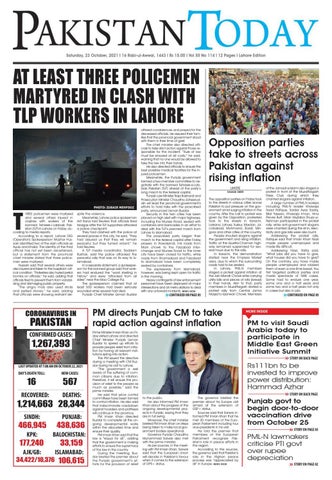
at least three PoliCemen martyred in Clash with tlP workers in lahore
photo: zubair mehfooz
t
HREE policemen were martyred and several others injured in clashes with workers of the banned Tehreek-i-Labbaik Pakistan (TLP) in Lahore on Friday, according to media reports. According to a report, Lahore DIG (Operation) Spokesperson Mazhar Hussain identified two of the slain officials as Ayub and Khalid. The identity of the third official has not yet been ascertained, but a statement from the provincial chief minister stated that three policemen were martyred. Hussain said that several others were also injured and taken to the hospital in critical condition. “Protesters also hurled petrol bombs on officials,” he said, adding that officials tried to prevent them from vandalising and damaging public property. “The angry mob also used sticks and pelted stones,” he said, adding that officials were showing restraint de-
spite the violence. Meanwhile, Lahore police spokesman Arif Rana told Reuters that officials fired teargas after the TLP supporters attacked a police checkpoint. They had clashed with the police at several places in the city, he said. “They had assured us that they will remain peaceful but they turned violent,” he told Reuters. A TLP media coordinator, Saddam Bukhari, said the police attacked the peaceful rally that was on its way to Islamabad. In a separate statement, a spokesperson for the banned group said that workers had endured the “worst shelling in history” and were “attacked from all sides” near the Mao College Pul. The spokesperson claimed that at least 500 workers had been seriously wounded while several had died. Punjab Chief Minister Usman Buzdar
Coronavirus in
Pakistan
CONFIRMED CASES:
1,267,393
LAST UPDATED AT 7:08 AM ON OCTOBER 22, 2021
DAY'S DEATH TOLL:
NEW CASES:
16
567
RECOVERED:
DEATHS:
1,214,663 28,344 SINDH:
PUNJAB:
466,945
438,636
KPK:
BALOCHISTAN:
177,240 AJK/GB: 34,422/10,376
33,159 ISLAMABAD:
106,615
offered condolences and prayed for the deceased officials. He assured their families that the provincial government stood with them in their time of grief. The chief minister also directed officials to take strict action against those responsible for the incident. “Rule of law must be ensured at all costs,” he said, warning that no one would be allowed to take the law into their hands. He also directed officials to ensure the best possible medical facilities for the injured policemen. Meanwhile, the Punjab government formed a two-member committee to negotiate with the banned Tehreek-e-Labbiak Pakistan (TLP) ahead of the party’s long march to the federal capital. Punjab Law Minister Raja Basharat and Prosecution Minister Chaudhry Zaheeruddin will lead the provincial government’s efforts to hold talks with the proscribed party, announced Usman Buzdar. Security in the twin cities has been placed on high alert with major highways, including the Murree Road, sealed with containers and barricades in an effort to deal with the TLP’s planned march from Lahore to Islamabad. The proscribed party began their march to the federal capital after Friday prayers. In Rawalpindi, link roads from Marir chowk to the Faizabad Interchange and Murree Road to the inner city have been closed for traffic, while roads from Shamsabad and Faizabad to Islamabad have been completely sealed by containers. The expressway from Islamabad, however, was being kept open for traffic in the morning. Heavy contingents of law enforcement personnel have been deployed at major intersections and at metro stations to deal with any untoward incidents. NewS DeSk
CONTINUED ON PAGE 05
Opposition parties take to streets across Pakistan against rising inflation lahore Shahab Omer
The opposition parties on Friday took to the streets in various cities across Pakistan to put pressure on the government amid surging inflation in the country. After the call to protest was given by the Opposition, protesters took to the streets in Karachi, Larkana, Lahore, Sukkur, Mardan, Jacobabad, Mohmand, Ziarat, Mingora and other cities of the country. People shouted slogans against the government and rising inflation. Traffic at the Quetta-Chaman highway remained suspended for several hours due to the rally. In Karachi, the demonstration started near the Empress Market area, due to which the surrounding roads had to be sealed. In Lahore, PML-N members staged a protest against inflation at the Jain Mandir Chowk while carrying utility bills and pieces of rotis (bread) in their hands. Akin to that, party members in Muzaffargarh started a protest rally from Central Jamia Masjid to Qanwan Chowk. Members
PM directs Punjab CM to take rapid action against inflation Prime Minister Imran Khan on Friday visited Lahore and directed Chief Minister Punjab Usman Buzdar to speed up efforts to provide people relief from inflation by having all relevant institutions spring into action. The PM issued the directive during a meeting with CM Buzdar during his visit to Lahore. “The government is well aware of the suffering of common citizens due to inflation, therefore, it will ensure the provision of relief to the people as much as possible,” said the prime minister. He said that price control committees have been formed to control inflation. He also said that indiscriminate crackdown against hoarders and profiteers will continue in the province. PM Imran Khan directed Buzdar to complete all the ongoing developmental works within the allocated time and ensure their quality. PM Imran Khan said that the law is “equal for all”, adding that the government is making efforts to ensure the supremacy of the law in the country. During the meeting, Buzdar briefed the premier about the Punjab government’s efforts for the provision of relief
of the Jamaat-e-Islami also staged a protest in front of the Muzaffargarh Press Club during which they chanted slogans against inflation. A large number of PML-N workers including PML-N leader Khawaja Saad Rafique, Sardar Ayaz Sadiq, Bilal Yaseen, Khawaja Imran, Hina Pervez Butt, Mian Mujtaba Shuja-urRehman participated in the protest rally, while anti-government slogans were chanted during the sit-in, electricity and gas bills were also burnt. Addressing the protest rally, Rafique said that Imran Khan Niazi made people unemployed and made life difficult. Addressing Niazi, Rafiq said, “What jobs did you have to give, what houses did you have to give? On the contrary, you have made people unemployed and robbed them of even a one-time bread. You first targeted political parties and made spectacle of NAB cases. Some had to endure one year, some one and a half years and some two and a half years not only in cases but also in jails.
CONTINUED ON PAGE 05
more inside
PM to visit Saudi Arabia today to participate in Middle East Green Initiative Summit STORY ON BACK PAGE
Rs111bn to be invested to improve power distribution: Hammad Azhar to the public. He also informed PM Imran Khan about the progress of the ongoing developmental projects in Punjab, saying that they are in full swing. Moreover, the chief minister briefed PM Imran Khan on steps being taken to make local government bodies operational. Governor Punjab Chaudhry Muhammad Sarwar also met with the prime minister. As per sources, in the meeting with PM Imran Khan, Sarwar said that the European Union will decide in Pakistan’s favour when it comes to the extension of GPS+ status.
The governor briefed the premier about his Europe visit aimed at the extension of GSP+ status. Sources said that Sarwar informed PM Imran Khan that he met 30 members of the European Parliament including four vice-presidents in his visit. He told the premier that members of the European Parliament recognize Pakistan’s role in peace efforts in the region. According to the sources, the governor said that Pakistan’s role in the Afghan peace process was “appreciated by all” in Europe. NewS DeSk
STORY ON BACK PAGE
Punjab govt to begin door-to-door vaccination drive from October 25 STORY ON PAGE 03
PML-N lawmakers criticise PTI govt over rupee depreciation STORY ON PAGE 02
02
Saturday, 23 October, 2021 | LAHORE
NEWS
PML-N LAwMAkErs criticisE Pti govErNMENt ovEr ruPEE dEPrEciAtioN
d
NewS DeSk
URING a session of the National Assembly on Friday, the Pakistan Muslim League-Nawaz (PML-N) leaders on Friday jeered at the incumbent government over massive depreciation in the value of the Pakistani rupee against the US dollar. PML-N leader Murtaza Javed Abbasi criticized the government over the poor exchange rate, saying the ruling PTI used to criticise PML-N’s finance minister Ishaq Dar for keeping the US dollar stable through
Efforts underway to promote exports, NA told ISLAMABAD TLTP
The government is making concerted efforts to promote exports through facilitation of the industrial sector by reducing its costs and rationalising duties on raw materials. Parliamentary Secretary for Commerce Aliya Hamza Malik informed the National Assembly on Friday while responding to a question during the Question Hour session. She said the country’s exports crossed the figure of over $25 billion last year due to prudent policies of the government. She said that gas prices have been rationalised for export–oriented sectors. She said fifty percent relief in electricity tariff for small and medium enterprises was granted till June this year. Malik said that customs duty of two percent on 1,623 tariff lines has been removed. She further said duties on 112 tariff lines have been reduced to implement the “Make in Pakistan Initiative”. She said the government launched the Look Africa Policy to promote exports to nontraditional markets in the African region. She said Pakistan has gained market access to Indonesia under the Pakistan-Indonesia PTA. She said Pakistan is in the process of negotiating FTA’s with other countries including Thailand and Iran. Responding to another question, Prime Minister’s Adviser on Parliamentary Affairs Baber Awan said the government has taken various steps for reviving the economy, accelerating pace of economic growth and creating employment in the country. He said the government took several special initiatives, which include construction package, textile package, Kamyab Jawan initiative, Employment generation through CPEC, and Pakistan’s Green Stimulus Package to strengthen the economy. Babar Awan said despite all constraints around 2.32 million jobs were created during the first year of the government.
“artificial means”. “I challenge the government to bring the US dollar to Rs100, even temporarily,” he said, alluding to the record depriciation in value of the Pakistan rupee against the US dollar. Economic Affairs Minister Omar Ayub Khan while repsonding to Abbasi said that the PML-N took loans to the tune of $23.6 billion to keep the rupee stable. “The government is still paying $9.9 billion interest on these loans,” he stated. It is pertinent to note that on Thursday, the Pakistani rupee saw a decline as the currency dipped 0.28%, or Rs0.49, against the US dollar in the inter-bank market,
touching a fresh all-time low of Rs173.96. During the NA session, PML-N stalwart Khawaja Asif also grilled the government and the State Bank of Pakistan (SBP) Governor Reza Baqir, over the latter’s remarks regarding the depreciation of the rupee. According to Asif, the central bank chief said that the fall in the value of the rupee benefitted the overseas Pakistanis and their families. “What will happen to the 220 million Pakistanis living in the country,” Asif questioned the SBP governor. The PML-N leader said Baqir was a “representative of the IMF [International Monetary
Fund] who will return abroad after the job is done”. Baqir destroyed Egypt’s economy first now it is Pakistan’s turn, he alleged. The session was adjourned indefinitely by the NA speaker after Pakistan People’s Party (PPP) leader Naveed Qamar pointed out the quorum. During the session, the details of the China-Pakistan Economic Corridor (CPEC) were also tabled in the house. The planning ministry officials said that currently 39 projects worth $25 billion had been started under the CPEC. Some of them have been completed whereas work is in progress on some, they added.
Bill to restrain fake news sent to cabinet for approval: Fawad NewS DeSk Federal Minister for Information and Broadcasting Fawad Chaudhry on Friday said that a proposed law to curb fake news in Pakistan has been sent to the cabinet for approval. The minister said that Pakistan could not move forward unless there were political reforms. “Reforms concerning judiciary and media are also necessary,” Fawad stated. Last week, the minister stated that the “greatest challenge” being faced by modern media was the dissemination of false propaganda through fake news. “The phenomenon of fake news emerged after a revolution in information technology (IT) and an increase in the number of media platforms,” he had told
a seminar. He had said the international community would have to prepare some rules to counter fake news and the aspect of responsibility would have to be added
with freedom of expression. While speaking of the soaring inflation, the minister stated that the government would soon provide
“massive relief” on four items of daily use i.e. sugar, flour, ghee and pulses. He further revealed that the government will also provide relief on education and healthcare services. He stated that the Pakistan Tehreek-e-Insaf (PTI) has decided to start distributing health cards in Punjab. “Now every family in Punjab will be able to get health insurance up to Rs1 million every year,” he said, adding that the process to distribute cards will start in December and conclude by March. He added that these cards will be accepted at all hospitals, including private, across Punjab. Calling the programme a “gamechanger”, Fawad said that this will ensure “best treatment” to everyone belonging to the poor and middle classes.
Pakistan's economy on path of progress: Farrukh NewS DeSk Minister of State for Information and Broadcasting Farrukh Habib has said that Pakistan is going to be surplus in food security due to the agri-focused approach of Prime Minister Imran Khan. In a tweet on Friday, the state minister shared data regarding increase in production of ‘Kharif’ crops showing wheat production increased up to 25 percent, cotton 60 percent, and rice and maize 18 percent each.
Farrukh Habib expressed the hope that wheat production will witness record increase next year. The minister of state said the country's economy is on the path of progress as textile, foreign remittances, large scale manufacturing and IT exports have all witnessed substantial increase during the first quarter of the current fiscal year 2021-22. He shared figures showing foreign remittances increased up to 12.5 percent, exports 38 percent, textiles 28 percent, IT exports 42.7 and Federal Board of Revenue's tax collection increased up to 38 percent.
IHC disposes of Zakir Jaffer’s petition against indictment NewS DeSk The Islamabad High Court (IHC) on Friday disposed of a petition by Zakir Jaffer, father of Zahir Jaffer in the Noor Mukadam murder case against his October 14 indictment by a trial court after the petitioner withdrew his plea. Raja Rizwan Abbasi, Zakir’s counsel, appeared in court earlier today and requested a withdrawal of the petition. It is not clear why the petitioner withdrew his plea. Zakir had been indicted by a trial court along with 11 others including Zahir Zakir Jaffer, Zahir’s mother Asmat Adamjee, their three household staff Iftikhar, Jan Mohammad and Jameel, Therapyworks CEO Tahir Zahoor and employees Amjad, Dilip Kumar, Abdul Haq, Wamiq and Samar Abbas. Zakir, Asmat Adamjee and Zahoor had challenged their indictment in the IHC under separate petitions. “The indictment gives an impression as if it was carried out on the longing of the prosecution,” Zakir’s petition had said, adding that the order suggested that the court can frame charges against the accused while copying the police challan and making it a mechanical exercise. He had requested the court to declare the indictment illegal. Presiding over a hearing on Wednesday on petitions by Zakir and others, IHC Justice Aamer Farooq had sought a reply on the petitions by the authorities. The judge had also observed that the court would pass an order binding the prosecutor to provide all necessary evidence to the defendants. In the indictment, the trial court had charged the 12 accused in the murder case for 15 offences. While the four charges were specific to the principal accused, Zahir only, the fifth charge was against his parents for allegedly concealing facts from the police.
The charge sheet stated: “Zakir Jaffer and Asmat Zakir remained in touch with the accused Zahir Jaffer through telephone from Karachi and despite knowledge that the accused Zahir Zakir Jaffer had abducted Noor Mukadam, did not inform the police.” The sixth charge was similar in nature as it stated that they did not disclose to the police that their son had planned to murder Noor. The seventh charge accused Zakir and Zahoor (Therapyworks CEO) of “causing disappearance of evidence”. The eighth charge was framed jointly against Zakir, Asmat, Iftikhar (watchman), Jan Mohammad (gardener) and Jameel (cook) that “they were well aware of illegal act and activities of Zahir” but they did not inform the police. The ninth and 10th charges are also jointly framed against Iftikhar, Jan Mohammad and Jameel for concealing the abduction of Noor and Zahir’s murder plan from the police. They have also been accused in the 11th and 12th charge of not letting the deceased escape from the Zahir’s illegal confinement. In a written order, authored by Justice Umar Ata Bandial, on the petitioners’ bail pleas, the court observed that the “Learned counsel for the petitioner has urged that the time period of eight weeks specified in the paragraph 14 of the impugned judgment dated 23.09.2021 “to conclude the trial expeditiously preferably within eight weeks from the framing of charge” deprives the petitioner of a fair opportunity to lead his defence. We do not agree with that submission which is conjectural and without reference to fact.” A division bench of the apex court led by Justice Bandial granted bail to Zahir Jaffer’s mother, Asmat Zakir Jaffer, four days ago. The written order further stated that the
petitioners (parents) have the right to present their defence before the trial court and in this respect the trial court shall consider and decide their pleas in accordance with law as envisaged in Article 10A of the Constitution. “Be that as it may, without going into the merits of the case, we consider that the petitioner being a woman may be granted bail under the first proviso to section 497(1), Cr.P.C in absence of any circumstances that may justify declining this relief to her. The prosecution has not been able to point out any such circumstance,” the order stated The SC order held that “without interfering with the directions given by the Islamabad High Court in the judgment dated 29.09.2021 and in the light of the observations made by us above, we convert this petition (Crl.P. No.1110 of 2021) into appeal and grant bail to the petitioner Asmat Zakir Jaffer subject to her name being retained on the ECL and her furnishing bail bonds in the sum of Rupees One Million with one surety in the like amount to the satisfaction of the learned Trial Court concerned.” “Needless to say that this concession of bail may be withdrawn if the petitioner misuses it in any manner, including causing a delay in the expeditious conclusion of the trial or influencing the prosecution witnesses,” the order added. IndIctment plea dIsposed: In a separate hearing, the IHC disposed of the accused’s parents’ plea challenging the trial court’s order to indict 12 accused in the case, after the petitioners’ counsel withdrew it. The court indicted 12 people, including Zakir Jaffer and Asmat Adamjee, in Islamabad on October 14. All of the accused had pleaded not guilty to the charges. The plea stated that the court “abused its authority”.
Saturday, 23 October, 2021 | LAHORE
PuNjAb govt to bEgiN door-to-door vAcciNAtioN drivE froM octobEr 25
t
NewS DeSk
HE government of Punjab has announced it will kick off its door-to-door coronavirus vaccination drive from October 25. The aim of the drive, as per the government’s notification, is to ensure 100% of the targeted people are vaccinated. A focal person has also been appointed to ensure the campaign achieves its targets. The campaign initiated by the Punjab government will last till November 12, as per a notification issued by the provincial government, adding that it will vaccinate people at their homes across its nine divisions and 36 districts. The Punjab government has decided to vaccinate those who have not yet received the jab at their homes after reports indicated that a lot of people have not received the jab. DCO Lahore Dr Faisal Malik stated that he has been instructed to ensure people who have not yet received the jab are vaccinated. He said legal action will be taken against those who refuse to get themselves vaccinated. Earlier, National Command and Operation Centre (NCOC) chief Asad Umar had said that despite a sharp decline in new COVID-19 cases, we will remain vulnerable if a large number of people remain unvaccinated. He went on to urge authorities in
certain cities to improve their vaccination efforts. Umar had commended the vaccination progress in Islamabad, Peshawar, Gilgit, Sargodha and other cities. The federal minister, however,
underscored the need for improvement in the vaccination process in Karachi, Hyderabad, Nowshera, Faisalabad, Quetta, Mardan and other cities. “To ensure there is no 5th wave of COVID-19, we have to meet vaccination
NHA takes revolutionary steps in light of PM’s vision GohAr ZAMAN BABAr After coming into power, the present government focused on improving the performance of national institutions. To further improve the efficiency and working regime of National Highway Authority with the objective to inculcate transparency and fairness in its affairs was a great challenge to the government. However, keeping in view the vision of Prime Minister Imran Khan, National Highway Authority, an attached organisation of Ministry of Communications, undertook concrete steps and chalked out comprehensive plan to complete road infrastructure projects at a rapid pace throughout the country. Revolutionary measures taken by NHA to translate vision of PM into reality will ever be remembered as a part of national history. The first priority was to construct motorways and national highways on Public Private Partnership (PPP) basis with the view to reduce the financial burden on national exchequer and to make roads construction and their maintenance procedures completely transparent. At present times, it is noteworthy that in the past the value of dollar was low while now its value has increased. Cement, steel and building materials were cheap in the past. While presently with increased value of dollar, the rates of construction materials have also been increased. In such state of affairs, the extraordinary measures undertaken by present government have resulted in execution of national highways and motorways projects at much lower cost. In the past, despite low dollar rate, 1-km long, 2lane road was constructed at a cost of Rs118.171 million whereas presently 1-km long, 2-lane road is being constructed at a cost of Rs110.991 million despite increase in dollar rate. In the past 4-lane national highway was completed at the cost of Rs411.078 million per kilometre, while the Pakistan Tehreek-e-Insaf (PTI) government is constructing 4lane national highway at a cost of Rs173.515 million per km. Again, previously, 1-km long road was used to be rehabilitated and maintained at a cost of Rs80.111 million, while presently this cost has been reduced to Rs53.400 million. In the past, 4-lane motorway on Build Operate Transfer (BOT) basis was built at Rs606.044 million per km, while presently, 4-lane motorway on Build Operate Transfer (BOT) is costing Rs395.652 million per km. Prime Minister of Pakistan Imran Khan has commended efforts made by construction experts and engineers of NHA for building roads at low cost. Due to transparency and effective process of self reliance, a considerable saving has been achieved by starting projects at low cost. National Highway Authority is also earning revenue from Toll Plazas and exploitation of its Right of Way (ROW). Resultantly, NHA is not getting loan from the government for construction and maintenance of roads. Now, the
government is spending this money on public welfare schemes of health and education sectors including the Ehsaas Programme. It is worth mentioning that introduction of e-bidding system is another remarkable step forward towards ensuring transparency in award of roads construction and maintenance projects, for which NHA deserves appreciation. Credit goes to National Highway Authority (NHA) for recapturing its land from the land mafia. Presently issues relating to land acquisition are being resolved in an efficient manner thereby ensuring timely completion of road projects. The present government has played a vital role in recapturing land from land mafia. It seems appropriate to recall that NHA is controlling 51 roads network across the country having total length of 13,572 kms that includes 11,255 km long 38 national highways, 2055 km long 10 motorways and 262 km long 3 strategic roads. Following the vision of the Prime Minister of Pakistan Imran Khan and Ministry of Communications, National Highway Authority has successfully started construction of motorways and national highways under Public Private Partnership (PPP) mode, thus providing opportunity to private sector to come forward and invest in road building schemes of the public sector. The federal government has formulated a comprehensive policy to undertake projects on the PPP mode. To this effect, an Act has also been approved for effective implementation of such projects. Establishment of Public Private Partnership Authority is reflective of government’s keen interest to this pragmatic approach. A Public Private Partnership Cell is also actively functional at NHA head office. The cell has made practical advancement for private sector participation in national highways, motorway, tunnels and bridges projects in the country. NHA considers that the technical, managerial and financial resources of the private sector can fortify its efforts towards national development. After carefully evaluating a wide range of alternatives, NHA has decided to encourage the private sector to participate in a number of significant
targets set,” he added. Urging the public to get themselves vaccinated against COVID-19, the minister had said, “Remember that 2nd dose is vital for protection against covid.”
projects of national highways and motorway as well as a limited number of tunnel and bridge projects with the view to support and sustain Pakistan’s rapid rate of economic growth. This initiative will not only prepare the ground to promote construction industry but will help at large reduce financial load on national exchequer. Undoubtedly, the private sector financing based schemes are repository to national development ultimately putting country on the track towards a new Pakistan. During the last few years, NHA remained successful in providing conducive atmosphere for private sector investment in road sector and to date has completed four projects of worth around Rs135 billion on Build-Operate Transfer (BOT) basis. Construction of 2-km long new flyover (Habibabad bridge) located on N-5 is one of the projects completed on PPP mode at cost of Rs0.831 billion. Likewise overlay and modernization of 357-km Lahore-Islamabad motorway has also been realized costing more than Rs46 billion. Further, conversion of 4-lane highway into six-lane Karachi-Hyderabad motorway was also taken on PPP mode. This 136-km long motorway was completed at cost of Rs44.251 billion. Another milestone of NHA is the completion of 89-km long Lahore-Sialkot motorway. This 4-lane motorway is built with 6-lane structures at cost of Rs43.847 billion. This motorway has linked industrial city of Sialkot with motorways network of the country. On successful completion, all these projects are operational now. NHA has now decided to undertake nine more projects on this emerging concept of PPP having total length of 1726 km. Hyderabad-Sukkur Motorway is a project of national as well as regional significance. NHA is endeavoring for earlier start of construction activity on this mega project. Sukkur-Hyderabad Motorway will be 306 km long, 14 interchanges, one major bridge on River Indus, 6 flyovers, 10 Service Areas and 12 Rest Areas will also be built along this motorway. NHA is working to start work on this last missing link of Peshawar-Karachi Motorway (PKM) economic corridor at the earliest. The PKM will pave the way of prosperity besides promoting regional trade through ports of Karachi and Gwadar. Participation of private sector in motorways and highways building will bring National Highway Authority and private sector more close to each other to have maximum advantage from experiences of each other. The government’s vision is to build roads and expand road network to a great extent by 2030, so as to achieve goals of national and regional economic integration. In order to achieve this objective, cooperation of the private sector is an important element. National Highway Authority (NHA) has also undertaken gigantic game changer China Pakistan Economic Corridor (CPEC) programme and Central Asia Regional Economic Cooperation Programme (CAREC) under which countrywide national highways and motorways projects are being started. The transparent efforts being made by NHA in line with the vision of Prime Minister of Pakistan Imran Khan will have far-reaching positive impact on economic conditions of the whole region in general and that of Pakistan in particular. This will ultimately be instrumental in making Pakistan a hub of regional trade in the true perspective.
NEWS
03
court rejects Mufti Aziz’s bail petition NewS DeSk A sessions court in Lahore dismissed the bail petition of former Jamiat Ulema-i-Islam (JUI) leader Mufti Azizur Rehman on Friday. It is to note that Mufti Aziz was accused of sexually abusing a student of his madressah. This is the second time that the court has denied bail to Mufti Aziz, who was apprehended in June this year after police had registered an FIR against him on charges of sexually assaulting a student of his madressah, Jamia Manzoorul Islam, in Lahore. Additional Sessions Judge Noman Muhammad Naeem rejected the post-arrest bail plea after the completion of arguments by the lawyers. It is pertinent to note that the case was registered on the complaint of the victim under Section 377 (unnatural offences) and Section 506 (punishment for criminal intimidation) of the Pakistan Penal Code. In his complaint, the student had alleged that Mufti Aziz got him and another student expelled on the charge of cheating in examinations of Wafaqul Madaris for three years. A video clip of the sexual assault was also shared by the student as proof with police and the seminary administration. Mufti Aziz’s five sons have also been booked in the case for attacking the complainant with the intention to exact revenge and all of them have been granted bail. Mufti Aziz remains under arrest as his first bail petition was rejected by a judicial magistrate in Lahore last month. The cleric had then approached a district and sessions court for the grant of a post-arrest bail, which was denied on Friday.
security forces conduct operations in Miran shah, North waziristan
NewS DeSk The security forces conducted intelligence-based operations in Miran Shah and North Waziristan on reported presence of terrorists. During intense exchange of fire, a terrorist, Ahmed Ullah, got killed. Weapons and ammunition were also recovered from the killed terrorist. However, during exchange of fire, Naik Khalil (34), resident of Kohat and Sepoy Shakir Ullah (21), resident of Lakki Marwat, embraced martyrdom.
Saturday, 23 October, 2021 | LAHORE
04 NEWS
Shibli aPProveS eXemPtion of marking fee for SmeS IsLAMABAD
f
app
EDERAL Minister for Science and Technology Senator Syed Shibli Faraz on Friday approved the exemption of marking fee for small and medium enterprises (SMEs) with a business turnover up to Rs50 million. Shibli said the move was an effort to give industries relief due to market inflation so that they could support the local industry. According to details, the decision was taken in the 23rd meeting of the Pakistan Standards and Quality Control Authority (PSQCA). The decision will provide relief to more than 1,500 industries registered with the authority. The PSQCA marking fee was previously revised in the
year of 2008 at the rate of 0.05 per cent ex-factory price for food items and 0.1pc ex-factory price of non-food products. However, the industry was dissatisfied with the decision and requested to revise the fee on flat rate basis. Article continues after this advertisement The decision of the present government has resolved the long pending demand of the industry. The proposal facilitates the micro, small, medium and large enterprises of food as well non-food producing enterprises through fixed and flat rates calculated on the basis of present fees being charged. It will also encourage new businesses to register and come under the ambit of licensing and certification regime. Moreover, it will help in increasing the size of the formal econom.
Karachi STZ to promote tech-driven growth in Pakistan kARACHI Staff RepoRt
The Special Technology Zone Authority (STZA) and Khadim Ali Shah Bukhari Institute of Technology (KASBIT) have signed a Memorandum of Understanding (MoU) to plan and develop a Special Technology Zone (STZ) in Karachi, which will provide technology companies, including startups, SMEs, and multinationals a high-tech business environment to promote technology-driven growth in Pakistan. As per the details, the signing ceremony took place at the site of KASB Altitude Building in Clifton, While speaking at the MoU Signing Ceremony, Chairman of the STZA, Amer Hashmi, said “Pakistan is at a turning point in its technological history. We hear of Pakistani startups receiving enormous
PSX revises market timings News Desk According to the PSX notice sent to all market participants on Friday, key changes to the Designated Time Schedule (DTS) include an extension of 30 minutes for continuous trading session, reduction of post-close session to 10 minutes, and a reduction of the break period to one minute. The stock market timings would be from 09:30am to 04:00pm from Monday to Thursday. On Fridays, the market will open in two sessions, from 09:15 am to 12:00 pm and the second session from 02:30 pm till 05:00 pm. The office timings of PSX would be from 09:00 am to 05:15 pm from Monday to Friday.
China becomes world’s largest carbon market BeIJING agencieS
China’s national carbon market covers around 4.5 billion tons of carbon dioxide emissions, with more than 2000 power companies enlisted, said Zhai Qing, vice minister of Ecology and Environment, at the 2021 Asia-Pacific Forum on Green and Low-Carbon Development on Wednesday. The market, which began online trading on July 16 this ye.ar, has become the world’s largest in terms of the amount of
Customs foil bid to smuggle imported phones, drone cameras IsLAMABAD Staff RepoRt
The Pakistan Customs has foiled an attempt to smuggle large quantities of imported phones and drone cameras. Sources said that Pakistan Customs confiscated more than 350 imported luxury phones as well as drone cameras worth Rs90 million from Islamabad airport. Two passengers namely Nabeel Ahmad and Shahzad made an attempt to smuggle the huge quantity of imported iPhones, including the new Pro Max and 5 drone DJJ cameras on Thursday night from a flight no ER702, which was coming from Dubai to Islamabad. However, Customs officials deputed at the airport foiled the bid and confiscated the goods. Sources said that officials registered a case against the two passengers and further investigation is underway. It is pertinent to note that the incumbent government has imposed taxes on the import of phones to promote the local industry.
amounts of funding almost every day now which for us is a source of immense pride. STZA focuses on an ecosystem approach to harness the country’s technology potential and work towards scientific and technological growth and development. Article continues after this advertisement KASB Altitude will be a thirty five floor building situated at Clifton. At its completion, it will house 500+ technology firms from different sectors that will be sharing high performance computing and other facilities promoting high-tech industrial growth, creating job opportunities, up-skilling the youth, and attracting foreign direct investments (FDI) through development of a knowledge ecosystem driven by research, innovation and collaboration.
greenhouse gas emissions covered, he said. Zhai noted that China has achieved remarkable results in tackling climate change through a series of measures like adjusting industrial structures, optimizing energy mixes, improving energy efficiency, and promoting the construction of carbon markets. In 2020, China’s carbon dioxide emissions per unit of GDP was slashed by 48.4 percent compared to 2005, he added. From 2016 to 2020, China cut 170 million tons of steel overcapacity and
1 billion tons of coal overcapacity, reducing the production of cement and plate glass by 300 million tons and 150 million weight cases, data from the Ministry of Ecology and Environment showed. Statistics further revealed during the five years, the share of coal in total energy consumption dropped from 67 percent in 2005 to 56.8 percent in 2020, while the share of non-fossil fuels in the country’s primary energy consumption increased to 15.9 percent. China has also constructively partic-
ipated in and promoted the multilateral process on climate change by earnestly fulfilling its obligations under international environmental conventions, Zhai said. China launched the International Coalition for Green Development along the Belt and Road in 2019, which now includes more than 150 institutions from 43 countries, he added. In 2020, China announced that it aims to realize the goal of peaking carbon dioxide emissions by 2030 and achieving carbon neutrality by 2060.
Japan agrees on $200m debt deferral for Pakistan IsLAMABAD Staff RepoRt
Japan and Pakistan on Friday agreed on a debt deferral of $200 million for making fiscal space to fight against Covid-19 in Pakistan. The debt deferral facility has been extended to Pakistan for a second time under the G20 Debt Service Suspension Initiative (DSSI). Prior to this, governments of the two countries agreed on the first debt deferral amounting to $370 million in April this year under the same initiative. The total amount of deferred debt has now reached $570 million, which will widen fiscal space for the Pakistani government to restore its economy affected by pandemic. It may be recalled that a memorandum of understanding (MoU) was signed between Pakistan and the creditor countries under the G20 DSSI on June 9, 2020. Article continues after this advertisement The concessional loans, subject to debt deferral, have been utilised for infrastructure development such as roads,
tunnels, power plants and grids, irrigation, water supply, and drainage facilities in Pakistan from the early 1990s to the mid-2010s. These loans have favorable conditions for Pakistan in terms of low interest rate, as well as long grace and repayment period. Under the second agreement, repayments for the debt and interest, originally due between January 1 and June 30, 2021, will be rescheduled after December 15, 2022. In addition to the debt deferral, Japan has also extended a total of $23.5 million in grants to Pakistan for supplementing its counter-Covid measures. In a statement, Ambassador of Japan to Pakistan Matsuda Kuninori said, “We hope that such cooperation with Pakistan will contribute to the expansion of bilateral economic relations, including the promotion of trade and investment in both directions”. The envoy said that he strongly believed that the seeds sown through the cooperation between the Japanese embassy and the Pakistani government during his tenure will blossom in the near future.
CMYK
Saturday, 23 October, 2021 | LAHORE
NEWS
OPPOsItION PaRtIes take tO stReets aCROss PakIstaN agaINst RIsINg INFlatION continued from page 01
W
HEN all this was happening to us, there was no one to ask and no one to give justice. Nothing came out of all these cases and it was proved that all those cases were baseless and lies were told to the people.” Rafiq further said that the punishments were given to Nawaz Sharif and Maryam so that these leaders would somehow get out of the country and politics but the political leadership is not afraid of such punishments. “You (Imran Khan) can stop the election but you cannot stop us from ruling the hearts of the people. Our country is in the hands of clumsy people at the moment and these people have put the country on the path of destruction. The anchors who still tire of praising Imran Khan on TV are also responsible for this catastrophe. The country’s GDP has fallen, the CPEC has rolled back, the rupee has depreciated, the value of the dollar is skyrocketing. Pulses, flour, sugar, gas, electricity and petrol are not
expensive but far from the reach of the people and now there is another wave of inflation,” he said. Rafiq said that those who create the drama of ‘Absolutely Not’ have the shackles of IMF slavery around their necks. “The chowks of Lahore are closed because you (Prime Minister) never fulfill the agreement you make. You lie, you deceive people, you make empty promises and you do not know about anything. You have left my well-to-do, prosperous Pakistan desolate,” he added. Addressing the protest, Sardar Ayaz said that Imran Khan has to respond for the missing watch from Toshakhana and sewing machines. “Niazi also has to respond to the Pandora Papers as his ministers and party members are also involved in this scandal. In the past, the sole purpose of making cases against Nawaz Sharif alone was to remove him, but he will definitely come to Pakistan,” he said. PML-N’s Qari Saifullah Saifi led the protest in Murree. When protesters reached the city’s Mall Road, many tourists also joined in. In Mardan, protesters started gather-
FUI, RIC sign agreement for training of students
ing at the city’s Kachehri Chowk, while in Gilgit, members of PML-N, as well as JUI, participated in the protest rally at Ittihad Chowk. Leader of the Opposition in the National Assembly and PML-N President Shahbaz Sharif appealed to the masses and asked them to join the protest against growing inflation in the country. He maintained that giving more time to the government means that people of the country will have to face more troubles, more inflation, more unemployment. “The economic condition of the country and its people would not improve unless we get rid of this tyrannical government,” said Shahbaz, as he directed party leaders of the Pakistan Democratic Movement (PDM) to ensure cooperation with civic and business organisations and people’s associations and appealed to the people to join the nationwide protests against inflation. Earlier today, PML-N leader Rana Sanaullah had said that demonstrations will be held at Lahore’s Jain Mandir Chowk after Friday prayers. The former Punjab law minister invited labourers, traders, lawyers and other wings to sup-
port the Opposition’s protest. “The masses will get relief only when this inept and corrupt government is sent packing,” said Sanaullah, urging people to come out of their homes and join in. Separately, the PPP also held a protest in Karachi — led by Sindh Chief Minister Murad Ali Shah — against the rising inflation in the country. The protest was held in Karachi’s Malir district. CM Shah, while addressing the participants of the protest, criticised the incumbent government and said: “Thieves of wheat and sugar should spare the poor masses. Only Bilawal Bhutto-Zardari can rid the poor of inflation.” Addressing a protest gathering at Karachi’s Empress Market, Jamiat Ulemai-Islam-Fazl (JUI-F) general secretary Maulana Abdul Ghafoor Haideri said that protests against inflation and the current government were a “public referendum”. The JUI-F stood in solidarity with the poor, farmers and lawyers, he said, adding that party chief Maulana Fazlur Rahman — who is also the PDM president — had announced nationwide protests from October 20. “Protests against inflation will continue,” he vowed.
At least three policemen martyred in clash with TLP workers in Lahore continued from page 01
ISLAMABAD: The Foundation University Islamabad (FUI) has entered into an agreement with Rawalpindi Institute of Cardiology (RIC) for Supervised Industrial Training (SIT) of the students of BSc. Biomedical Engineering Technology. This is a 4-year long technology programme, in which students spend three years on campus and one year in the industry as a fulltime human resource. Their 7th and 8th semesters are dedicated for practical experience. This industry exposure will prepare market compatible biomedical engineers aligned with Pakistan’s Vision 2025 as well as the National Technology Council’s guidelines. This important milestone has been achieved through continuous efforts by FUI’s Office of Research, Innovation and Commercialization (ORIC). Press release
As a result of road closures, citizens commuting to schools, colleges and workplaces faced severe difficulties. According to a spokesperson for the Islamabad City Traffic Police (CTP), Park Road, Tramri chowk, and Lehtar Road could be used as an alternate route to reach Islamabad Highway. Srinagar Highway, while Ninth Avenue, and IJP Road can be used to reach Rawalpindi. “Additional traffic police personnel have been deployed at High Court chowk, Kachehri, and Mall Road to maintain the flow of traffic. However, citizens should avoid unnecessary travel to Islamabad to avoid trouble,” the CTP spokesperson said. The TLP demands of the government to fulfil its promise made to it a few months ago. The main demand of the party is the expulsion of the French ambassador to
Pakistan. However, Interior Minister Sheikh Rashid said on Thursday
the government could not expel the ambassador on TLP’s demand.
05
corporate corner Development work in Islamabad’s I-12 sector likely to start soon ISLAMABAD: After the experimental success of dumping site in Sector H-16 of Islamabad, development work in I-12 is likely to start soon. The biggest obstacle in the development work of I12 was dumping site there. Now, after the CDA board decided to establish a temporary dumping site in Sector H-16 of Islamabad to expedite these development works as directed by the CDA administration and to protect the citizens of Islamabad from environmental pollution and provide a healthy environment, the test run of the temporary dumping site has been successfully completed and the road plan has been found to be viable. A summary of environment impact will be submitted to EPA and then it will be made operational until a permanent dumping site is set up at Mandra. These measures will not only protect the citizens from environmental pollution but also help in speedy completion of development works in Sector I-12 Furthermore, it has been decided that no residential or commercial construction of any kind would be allowed around the dumping site to protect the citizens from the environmental pollution. Press release
FBR completes actions on DNFBPs ahead of deadline ISLAMABAD: The Federal Board of Revenue (FBR) has completed actions on DNFBPs in the FATF action plan in just one reporting cycle and one year ahead of the deadline in September, 2022. In June 2021, the FATF plenary had approved a new action plan for Pakistan, focusing on combating money laundering. This action plan contained two actions specific to DNFBPs, in particular the real estate agents and dealers in precious metals and stones (DMPS). FBR was already designated as AML/CFT regulatory authority for real estate agents, DPMS and accountants other than those registered with ICAP and ICMAP under the AntiMoney Laundering Act, 2010 through amendments made in September, 2020. Since designation of FBR as the AML/CFT regulatory authority, FBR issued AML/CFT regulations for its regulated entities and also embarked upon an extensive outreach to educate and facilitate the DNFBPs on implementation of the new AML/CFT regime. A dedicated portal was made available on FBR website, which contains comprehensive guidance documents and other information for the DNFBPs. FBR also launched a customised mobile app for the registration by DNFBPs, screening the lists of proscribed /designated persons and generating Suspicious Transaction Reports (SRTs). A detailed supervisory plan was chalked out for offsite and onsite supervision of the DNFBPs. Since June 2021. Press release
Israel outlaws Palestinian rights groups, alleging terrorism
Israel on Friday effectively outlawed six prominent Palestinian human rights groups by declaring them terrorist organisations in a major escalation of its decades-long crackdown on political activism in the occupied territories. The declaration appeared to pave the way for Israel to raid their offices, seize assets, arrest staff and criminalise any public
expressions of support for the groups. Most of the targeted organisations document alleged human rights violations by Israel as well as the Palestinian Authority, both of which routinely detain Palestinian activists. Israeli and international rights groups condemned the move as an assault on civil so-
ciety and expressed solidarity with the targeted organisations. Many noted that Israel already outlaws even peaceful political activities in the occupied West Bank. Palestinians want the territory that Israel captured in the 1967 war to form the main part of their future state. The designated groups are Al-Haq, a
cmYK
human rights group founded in 1979, as well as the Addameer rights group, Defence for Children International-Palestine, the Bisan Centre for Research and Development, the Union of Palestinian Women's Committees and the Union of Agricultural Work Committees. The Israeli defence ministry said they are secretly linked to the Popular Front for the Liberation of Palestine (PFLP), a secular, left-wing movement with a political party as well as an armed wing that has allegedly carried out deadly attacks against Israelis. Israel and Western countries consider the PFLP a terrorist organisation. The ministry's statement was released during the Israeli and Palestinian weekend. Representatives from the targeted organisations could not immediately be reached for comment. The defense ministry said the organisations are controlled by senior leaders of the PFLP and employ its members, including some who have participated in terror activities. It said the groups "serve as a central source of financing for the PFLP and had received large sums of money from European countries and international organisations,” without elaborating. Israel has long accused human rights groups and international bodies of being biased against it and of singling it out while ignoring graver violations by other countries. The European Union (EU) delegation to the Palestinian territories acknowledged fi-
nancing activities by some of the groups. It said past allegations of the misuse of EU funds by partners "have not been substantiated”, but that it takes the matter seriously and is looking into it. "EU funding to Palestinian civil society organisations is an important element of our support for the two-state solution," it said. The Palestinian Authority condemned what it said was a strategic assault on Palestinian civil society and the Palestinian people's fundamental right to oppose Israel's illegal occupation and expose its continuing crimes.” New York-based Human Rights Watch and London-based Amnesty International released a joint statement condemning the move as an attack by the Israeli government on the international human rights movement. For decades, Israeli authorities have systematically sought to muzzle human rights monitoring and punish those who criticise its repressive rule over Palestinians, they said. This decision is an alarming escalation that threatens to shut down the work of Palestine's most prominent civil society organisations. Israeli human rights group B'Tselem called the government's declaration "an act characteristic of totalitarian regimes, with the clear purpose of shutting down these organisations.” "BTselem stands in solidarity with our Palestinian colleagues, is proud of our joint work over the years and is steadfast to continue so." aP
06-07 Comments - 23r October 2021_Layout 1 10/22/2021 9:03 PM Page 1
Saturday, 23 October, 2021
06 COMMENT
Imran Khan: Remembering his early political ideology
TLP protests Why must the country be shut down?
T
HE Tehrik Labbaik Pakistan (TLP) is once more on the streets, protesting not against some fresh blasphemy against the Holy Prophet (Peace Be Upon Him), but for the expulsion of the French Ambassador, because of its ire against the French President for his support to blasphemy. It is also protesting to secure the release of its leader, Hafiz saad Hussain Rizvi, who was detained when the deadline for action on the Ambassador came up, and which sparked off protests that led to a number of deaths, as well as clashes with the police. The inevitable has happened, and the TLP succeeded in doing what it had done on the previous occasion, and shut down at least the large cities. The underlying issue may be emotive, but that does not justify the casual handling by the state. The government’s pointman on the issue, Interior Minister sh Rashid Ahmed, is away in Dubai, while Prime Minister Imran Khan is going to off to saudi Arabia. The DG IsI, who is worse off than an officer under transfer (as no notification has yet been issued), cannot really concentrate on the crisis. But even when fully manned, the government has persisted in giving commitments it has not been able to keep. The deadline given for expulsion was not wise, and led to the panicked excuse that the matter had to be brought up in Parliament; and then ducking out from that. The expulsion of the Ambassador of a leading European Union member, at a time when Pakistan’ case for renewal of its GsP Plus status is up for renewal, would be to cock the snook at the EU itself, not just France. This development coming at a time when the Financial Action Task Force (FATF) has decided to keep Pakistan on the grey list only complicates issues. This should not distract from the basic issue of the writ of the state. The paralysis has meant that people could not move freely, could not get to their offices and schools, with medical emergencies getting stuck a likelihood. This persisted from the PML(N) era, when a minister had to be sacked to end the TLP sit-in at Faizabad. The TLP may have got hold of an emotive issue, but it has also got powerful protectors, who it seems it cannot persuade to follow a more orthodox course of action in registering its protest.
The long road to power
Dr rajkumar Singh
A
s a result of rhe general election held in Pakistan for 342 members of the National Assembly on 25 July 2018, the present Prime Minister, Imran Khan, secured a total of 176 seats with 8 other allies who helped him in forming the government at the Centre. Although all opposition parties, including the PML (N), made charges of large-scale rigging, the other agencies and the European Union Election Observation Mission to Pakistan termed the overall situation of the general election as satisfactory. In a post-election development Imran Khan took the oath of office of Prime Minister of Pakistan’ on 18 August 2018, becoming the 22nd Prime Minister in the country’s history and apart from making a full-fledged ministry, in major bureaucratic reshuffling appointed Lieutenant General Asim Munir as the Director-General of Inter-services Intelligence. In more than three years Imran has largely experimented with his policies in the spheres of the economy and society, and in Pakistan’s relations with regional countries, along with the superpower, the UsA, as well as Chinma, the top well-wisher of Islamabad in today’s context. Recently, he became famous due to his preferential and growing friendship with the People’s Republic of China and simultaneous deteriorating understandings with the UsA in more than one manner and openly supporting Taliban in capturing power in Afghanistan with Chinese help and Russian silent consent, at the cost of its relationship with Washington aon other democratic nations of the region and the globe as well.
IMF talks Shaukat Tarin’s departure is not a good sign
W
HILE the negotiations with the International Monetary Fund are not over, the departure of PM’s Finance Adviser shaukat Tarin, not just from the talks, but from the UsA itself, cannot be construed as a good sign. While the foot soldiers of the Pakistan delegation will continue to dicker, the departure of their lead negotiator means that their chances of achieving their goal, the revival of the IMF Extended structural Adjustment Facility of $3.3 billion, are infinitesimal. The IMF is not ready to relax its conditionalities for reviving the package. Much has been riding on a revival. The Pakistan stock Exchange earlier went up after news that there was a staff-level agreement in the offing. There is much riding on the IMF programme. At the time of the approval of the programme, it was made clear to Pakistan that being moved onto the Financial Action Task Force’s black list would result in the programme being suspended. Pakistan being kept on the FATF grey list obviously did not go down well with the IMF. There have been other hurdles, however, one of which was the IMF’s demand that taxation be increased, and another being the power tariff increase demanded for ending the circular debt problem in the power sector. It would be wrong to throw the blame on Mr Tarin, who was after all the government’s fourth Finance Minister, but the fact remains that he too was unable to introduce the kind of reforms that the IMF has long pressed, and which have been resisted by powerful lobbies. His inability was probably not because of any inability on his part, but because the head of the PTI government was unwilling to take the necessary tough decisions. The IMF programme had been a centerpiece of the government’s programme, and any failure to revive it will mean that the measures taken to obtain, and policies meant to revive it, such as the recent power tariff hike and rupee devaluation, have all gone in vain. Other avenues, such as friendly countries, are all a little up in the air at the moment.
The country is teetering on the brink
Dr. muhammaD abDul kamal
P
AKIsTAN was ranked 92nd out of 116 nations in the Global Hunger Index (GHI) in the year 2021. The country has a level of hunger that is categorized as ‘serious’, with a score of 24.7. On the regional level, Pakistan is better positioned as compared to India which ranked101, while the other two close regional neighbours, Bangladesh and sri Lanka, outshone Pakistan by getting ranks of 76 and 65, respectively. The GHI is aimed at galvanizing global action to combat hunger. The index comprises four indicators, including undernourishment (which depicts the proportion of the population which consumes insufficient calories); child wasting (refers to the proportion of children under the age of five who are underweight for their height, reflecting acute under-nutrition); child stunting, and under-five mortality rate (the mor-
Arif Nizami (Late) Founding Editor
Yousaf Nizami M. A. Niazi
Umar Aziz
Joint Editor
Joint Editor
Executive Editor
Lahore – Ph: 042-36300938, 042-36375965
Pakistani Government’s decision to cooperate with the UsA in fighting militants near the Pak-Afghan border. In that context, throughout his career Imran Khan remained soft on, and supportive of, the Taliban active in the Federally Administered Tribal Areas (FATA), and strongly believed in negotiation with the Taliban. Attached to the Taliban was the issue of Us drone attacks and Imran was dead against these events. Being conscious of Pakistan’s cultural and religious norms he criticized political and economic elites who, according to him, had become Westernised and out of touch with the country’s traditional heritage. On other sensitive issues like ‘forced conversion’ and ‘the problem of Jammu and Kashmir’ between India and Pakistan he was then very clear of his views. He described the forced conversion of anyone including the Hindu girls in Pakistan as un-Islamic and considered the issue of Jammu and Kashmir as humanitarian rather than territorial. Gradually, the socio-political and religious ideas of Imran Khan began gaining ground in the public domain of Pakistan and in an opinion poll conducted in 2012, he was found to be the most popular political figure in the country. His continued efforts and the different types of movements he launched proved him a successful leader of Pakistan and as a result, he won just less than half of total seats for which general elections were held in May 2013. In this election, although he failed to form a government, he was assigned by the people to discharge the functions of an accountable Opposition Party in the country’s politics in days to come. In the postelection phase the leak of Panama Papers on sharif’s corruption and supreme Court’s 2017 verdict disqualifying Nawaz sharif from holding a public post, substantiated Imran Khan’s way to the throne of Pakistan and made it an easy one, leading to his oath as the 22nd Prime Minister of the country on 18 August 2018.
Attached to the Taliban was the issue of US drone attacks and Imran was dead against these events. Being conscious of Pakistan’s cultural and religious norms he criticized political and economic elites who, according to him, had become Westernised and out of touch with the country’s traditional heritage.
The writer is head of the political science department and dean of the Social Sciences faculty of the B.N.Mandal University, Madhepura, Bihar, India. He can be reached at rajkumarsinghpg@gmail.com
Food security: where Pakistan stands
Dedicated to the legacy of late Hameed Nizami
Editor Aziz-ud-Din Ahmad
Originally, Imran Khan was an international cricketer-turned-politician who was born on 5 October 1952, in a Pashtun family in Lahore, graduated in 1975, from Keble College, Oxford and also remained Chancellor of the University of Bradford in the United Kingdom from 2005 to 2014. He started his career as a cricketer at the age of 18 in a Test series against England and played the game till 1992 where he served as the Pakistan team’s captain between 1982 and 1992 and under his captaincy, Pakistan also won the Cricket World Cup, the nation’s first and so far only victory in the sphere. After a career in cricket Imran turned to politics and founded a political party named, Pakistan Tehreek-eInsaf (PTI) on 25 April 1996, began serving the party as its chairman, won a seat in the National Assembly in 2002 and represented Mianwali as opposition leader until 2007. Although his party, the PTI, boycotted the general election held in 2008 after the end of Pervez Musharraf’s regime,t in the subsequent general election held in 2013 his party participated and emerged as the second largest party with forming the government in Khyber Pakhtunkhwa province with coalition partners of the time. From the beginning of his career Imran Khan was a popular figure and always remained in the public eye as a cricketer, a philanthropist and also as a believer in the ideas of poet-philosopher Muhammad Iqbal and the Iranian writer-sociologist Ali shariati in his youth and generally described as a nationalist and a populist. His early proclaimed political leanings include: Islamic values to which he rededicated himself in 1990s; liberal economics, with the promise of deregulating the economy and creating a welfare state; decreasing the bureaucracy and the implementation of anti-corruption laws, to create and ensure a clean government; the establishment of an independent judiciary; overhauling the country’s police system and an anti-militant vision for a democratic Pakistan. Now, after entering in politics he experienced a religious awakening, embracing sufi Mysticism by shedding his earlier playboy image at the national level and remained a critic of continuing corruption and economic inequality in Pakistan and opposed the
I
Karachi – Ph: 021-35381208-9
I
tality rate of under-five children). The prevalence of 37.6percent of stunting among children appears the area of grave concern for Pakistan. However, Pakistan has been able to bring the proportion of the undernourished population down to 12.9 percent from 21.1 percent in 2000-2002.Along the same lines, Pakistan has also succeeded in cutting down the percentage prevalence of wasting in under-five children to 7.1 percent in 2020 from 14.1 percent in 2000. The report, jointly published by Concern Worldwide and Welthungerhilfe on global hunger, mentions, “As the year 2030 draws closer, achievement of the world’s commitment to Zero Hunger is tragically distant”. Further, it contends that “current projections based on the Global Hunger Index (GHI) show that the world as a whole— and 47 countries in particular— will fail in achieving even low hunger by 2030”. In addition, the global report on food crises-2021 predicts that food crises will become more widespread and severe, with a bleak outlook for 2021. According to the World Food Programme, 41 million people are on the verge of famine. According to the global hunger report, food security is being threatened on numerous fronts, with growing conflicts, extreme weather events due to global climate change, and the economic and health issues posed by the covid-19 pandemic, all contributing to hunger. Food insecurity is about more than just a scarcity of food in the market. It also indicates a lack of sufficient funds to acquire food, let alone nutritious and wholesome foods.
Islamabad – Ph: 051-2204545
Over the last three years, Pakistan’s double-digit food price inflation, along with dwindling income, has left more Pakistanis food insecure. The World Food Programme (WFP) estimates that approximately 43 percent of Pakistanis are food insecure. 18 percent of those in this group have acute food insecurity. The WFP contends that affordability is the “greatest barrier in achieving a nutritious diet,” estimating that the majority of Pakistanis are incapable of affording nutritionally acceptable food. Thus, increasing food availability is insufficient to end hunger and undernutrition; and it is just as essential, if not more so, to ensure that people have access to healthy and safe meals if universal food security, and the pervasive concerns of stunting and wasting among children are to be dealt with. Our economic and financial policies have only exacerbated social and economic inequities while simultaneously increasing the number of people who are food insecure. To avoid future food crises, the government must strive to improve the value chain of fruit and vegetable crops while also ensuring the availability of storage facilities. The government must promote crop diversification, water management, and “climate-smart” farming to decrease the devastating effects of natural disasters on food security. Prioritizing agricultural value addition and preserving subsidies for essential crops are also critical for the country’s food security.
Our economic and financial policies have only exacerbated social and economic inequities while simultaneously increasing the number of people who are food insecure.
I
Web: www.pakistantoday.com.pk
I
The writer is working as an Assistant Professor at Abdul Wali Khan University Mardan and can be reached at kamal@awkum.edu.pk
Email: editorial@pakistantoday.com.pk
06-07 Comments - 23r October 2021_Layout 1 10/22/2021 9:03 PM Page 2
Saturday, 23 October, 2021
COMMENT 07 Editor’s mail Send your letters to: Letters to Editor, Pakistan Today, 4-Shaarey Fatima Jinnah, Lahore, Pakistan. E-mail: letters@pakistantoday.com.pk Letters should be addressed to Pakistan Today exclusively
Child abuse in Pakistan
Why do Kashmiris observe October 27 as the darkest day?
muhammaD ZahiD rifat
K
AsHMIRIs in Indian occupied Jammu and Kashmir, Pakistan and around the world are yet again observing October 27 as the darkest day of their history as a continued protest against the occupation of their territory which India had forcibly taken over on this day way back in 1947. The long unresolved Kashmir dispute remains a source of lingering tension and conflict between India and Pakistan which had originated when the people of Jammu and Jammu were denied their fundamental right of self-determination after the partition of the Indian sub-continent and the emergence of two separate independent states of Pakistan and India on 14 August 1947. At that time, it was generally presumed that Kashmir as a contiguous state with a predominantly Muslim population would accede to Pakistan. However, its ruler, the Hindu Maharaja Hari singh, fled to New Delhi in the face of local residents’ protests, and through an improper and illegal Instrument of Accession acceded the territory to India on 27 October 1947. The same day India had airlifted its forces in srinagar and forcibly occupied the Valley against the aspirations of the Kashmiris. This in brief is the background why the Kashmiris everywhere and the freedom and human rights loving people all over the world who support them, including Pakistan, observe October 27 every year as the Black Day to mark this as the darkest day in their history. This year, for the 74th consecutive time, the Kashmiris are observing the darkest day on October 27 in changed circumstances, following revocation of special status of Jammu and Kashmir on 5 August 2019 through illegal amendments to the Indian Constitution by fascist regime of Narendra Modi, merging the territory into the Indian Union as its integral part. since 5 August 2019 when India revoked the special status of Indian-Occupied Kashmir and placed the territory under military siege, raising the strength of occupying security forces to 900,000, the Indian troops have killed 273 innocent Kashmiris to date, another 1539 were injured with most of them having sustained pellet injuries. Over 2000 people, including Hurriyet lead-
ers, activists and youth were facing illegal detention and lodged in different jails in the occupied territory and India. For the last 74 years, India has illegally occupied Kashmir against the wishes of the Kashmiri people and in blatant violation of the UN security Council resolutions and indeed its own commitments to the people of Kashmir. Through the determined efforts of Pakistan through its Prime Minister Imran Khan, the Kashmir issue has been activated in the UN security Council after more than five decades. The PM had highlighted the Kashmir issue and the dangers it entailed by remaining unresolved through his three successive addresses to the UN General Assembly in 2019, 2020 and 2021 also. As such, the Kashmir issue is now being discussed at all international forums, thrice at the UN security Council during last year, Indian security forces brutalities and atrocities in the occupied territory are being condemned , the Indian government is being asked to take measures for restoring normalcy there and implement UN security Council resolutions and accordingly hold a free, fair plebiscite to let the Kashmiris exercise their birthright of selfdetermination and decide their future themselves. But it is rather deplorable as well as condemnable that the international community, topped by the world body, does not pressurize India in any manner more than its condemnation as everyone has their own vested financial and economic relations with a big country like India. Not only has the longest military siege paralyzed the entire Valley with educational institutions and health facilities closed and not available and the territory remaining as a no-go area for all foreigners including diplomats and media people, but the longest lockdown in mankind’s history continues unabatedly in IIOJK. Furthermore, besides the Indian security forces brutalities and atrocities the persistent military siege is being followed by intentional moves to change the demographic structure of the occupied territory as a brute attempt to obliterate the distinct Kashmiri identity in order to affect the outcome of a plebiscite envisaged in the UN security Council resolutions. This action by the Narendra Modi- led Indian government is in violation of the UN Charter, the security Council resolutions and international law particularly the Fourth Geneva Convention, as changing the demographic structure of territory is a war crime. The Indian government is settling Indian Hindus in the territory in the garb of immigrant Kashmiri Pandits. Changing Indian-Occupied Kashmir ‘s Muslim majority into a minority has long been part
of the Hindutva agenda of the Rss ad BJP and they are practically implementing it now. The Modi government is hastily constructing transit accommodation to settle Hindus in IndianOccupied Kashmir Indian-Occupied Kashmir. Indian troops in their unabated acts of state terrorism in Indian-Occupied Kashmir have brutally killed almost 100,000 Kashmiris, including women, since January 1989, 7149 of the victims being killed in fake counters or while in custody. As the Indian occupation of its occupied Kashmir continues without the UN security Council resolutions being implemented the indigenous, unarmed struggle for freedom by the Kashmiris is also going on till they achieve their cherished objective of freedom from Indian shackles. Pakistan has been extending full political, diplomatic and moral support all along to the Kashmiri people and will continue supporting their indigenous, just legitimate struggle for securing their right of self-determination as enshrined in the relevant UN resolutions. A peaceful, negotiated settlement of the lingering Kashmir issue in accordance with UN resolutions has been and remains on top of Pakistan’s foreign policy. Without resolving the Kashmir issue, the agenda of the partition of the Indian subcontinent remains incomplete as Kashmir is regarded as the lifeline of Pakistan. It is an internationally accepted and acknowledged fact that Kashmir entails global danger in itself of spiraling nuclear and missile proliferation in both India and Pakistan coupled with their respective domestic instabilities and historical animosities. India can kill the Kashmiris but not their aspirations for freedom which they will never surrender. India should honour its promises of giving the right of self-determination to the people of Kashmir who have already rendered endless sacrifices for freedom from illegal Indian occupation, while international community must take concrete steps to end Indian occupation of the held Kashmir and must intervene to resolve the lingering Kashmir dispute peacefully to ensure durable peace, progress and prosperity for the people of the region. India is bound under the international law not to change the demography of Indian-Occupied Kashmir and the international community must forestall this move and try to exert all possible pressure on India’s fascist regime to honour its decades-old commitment implement UN security Council resolutions and let the Kashmiris exercise their birthright of self-determination.
India is bound under the international law not to change the demography of Indian-Occupied Kashmir and the international community must forestall this move and try to exert all possible pressure on India’s
The writer can zahidriffat@gmail.com
be
reached
at
ARTICLE 25 (1) of the pakistani constitution states that “all citizens are equal before Law and entitled to equal protection of Law” Children also need to be protected but unfortunately children are suffering from child abuse as Child abuse is one of worst issue by which Pakistan is suffering . child abuse is an action of abusing the children when they are at a young age .children are abused sexually and also you say the child Labour one of the abuses on children when at young age they go for work they are beaten and sexually abused that makes their physical contact bad. There are many people who involve the children in bad works like drugs, sexual participation and force them to do bad things . Furthermore children are very innocent and are most vulnerable, least powerful and they are unable to protect themselves from the abusers.child abusers often know how to emotionally manipulate their intended victims , gaining their trust well in advance of the actual abuse . furthermore there were many children who were raped and killed in these following years , some of the following cases have occurred in workplace the issue is pending and children are unsafe According to the International society for the Prevention of Child Abuse (IsPCAN), overall ust41.69 percent respondents were sexually abused in one form or another. Child abuse is become social problem in Pakistan this all because of the poverty , the poor families who send their children for work and are often abused In near 1,780 cases, children were abused by their acquaintances while service providers, such as teachers, shopkeepers and drivers, were involved in 91 such cases. We live in such a sick society where fear of sending the children outside when a children is abused due lack of support from family members, friends and neighbours or the community leads to the isolation of the victim, making him hesitant to share his experience about his abuser.and many of commit suicide Besides other factors responsible for child abuse are socio-economic stresses; unemployment, low selfconfidence and feelings of incompetence, loneliness .more ever ,According to data released by an NGO, eight children were abused every day in Pakistan in one form or the other while 51pc of the victims were girls and 49pc boys and. 2,960 major crimes against children were reported in the four provinces, including Islamabad Capital Territory (ICT), Azad Jammu and Kashmir (AJK) and Gilgit-Baltistan (GB) in 2020. What is going on in our country is how our society is so sick and in the worst condition of kidnapping the children and abusing them. As the children are the future of the nation and it is a rising issue and media can also play an important role in it by creating awareness and the government needs to establish stronger laws regarding children. If once better laws are made against child abusers children can be protected. HomEr Jan BalocH laHorE
Curing corruption CORRUPTION is the utilization of public offices, official positions, ranks status, and powers for private benefits. The word corruption is experienced almost everywhere. The most triggering spurs, which encourage corruption, are the paucity of transparency, ineffective accountability, and institutional vulnerabilities. Here, Everything is possible by spending a penny either legal or illegal. Owing to this shortcoming, corruption is continuing despite multiple preventive paces. Its hazardous implications are immense such as it is a big barricade to social, political, and economic development. Furthermore, It imposes its stringency and curse in multiple modes. These corrupt behaviors include bribery, fraud, embezzlement, nepotism, and appropriation of public assets and property for illicit use. It is verified that corruption spread is the yield of great neglect. Lastly, The wise committee should be arranged to check the outcome of devised policies. Making policies isn’t a big act, but its complete implementation till its requisite results is a tremendous job. However, Plentiful policies are planned, but their fruits can’t be harvested. These are useless and futile in this regard. The useful conclusion can emerge that corruption is a proven fact, corruption hampers the countries from attaining development. Firstly, Owing to massive corruption, many projects do not meet the deadlines timely. muHammad afzal KHairpur mirS
Menace of drugs DRUG addiction is one of the most detrimental dilemmas in Pakistan . It is alarmingly ruining the lives of hundreds of thousands people in Pakistan . It takes the youth towards a dark and egregious future and it kills and destroys their lives awfully . Afghanistan is a neighboring country of Pakistan which rapidly supplies dozens of kinds of drugs to Pakistan. UNODC gauged that 800000 youth of Pakistan are addicted to drugs. Due to these drugs , the life of every soul is falling into destruction and misery. Lastly, I would like to plead to the government of Pakistan to stop the drugs so that the future of Pakistan’s youth would be secured . SHoail raSHid laHorE
Tech troubles TODAy’s world is jamed with technology .The main inventions which are playing an important role to destroy our health’s such as computers, mobiles and social media etc. Which almost every family owns. Originally it was created to make our lives more easier then before but later on researches were carried on and it came up that our physical and mental health suffers because of immoderate usage of technology. Technology appears to create global network bringing people together but infact this technology ends up the importance of real life communication the enjoyment of life even because of this we forget to give time to our relatives,families and friends. In today’s world it’s a habit of almost every people to live in their own world stuking at the device screen even when surrounded with the kith and kins. This technology have ruined the peace of people specially, the most inferior impact of technology is that it reduced the quantity and quality of sleep and today’s generation have become habitual of technology. so we should not fail to think of that this technology have harmful effects too for our health so we should not accustomed to technology. We should take care of our health also. urooJ nadEEm HydEraBad
Saturday, 23 October, 2021
08 WORLD VIEW
The WorlD BaNk NeeDs a NeW age of TraNspareNcy RECENT CONTROVERSIES POINT TO THE IMPORTANCE OF SCRUTINY AND CREDIBILITY IN GETTING CRITICAL WORK DONE
Financial times
s
GilliaN tEtt
IX years ago, World Bank leaders asked a law firm to investigate a controversial episode involving China. no, this was not connected to the “doing Business” report that sparked drama earlier this month, amid allegations that data had been tweaked to favour China by former top Bank officials. Instead, the 2015 controversy was about a $1bn “loan” that China extended to the Bank, which was opposed at the time by all seven of the senior Treasury officials managing the affairs of the Bank and the Inter-
national development association — and triggered an investigation by an outside law firm, locke lord. Today, this 2015 episode has almost completely disappeared from public view, partly because the locke lord investigation did not ultimately accuse anyone of wrongdoing and the report was never published. (China apparently opposed its release, World Bank officials tell me.) But it is worth considering that littleknown saga again today, to give a wider context to the latest dramas around the Bank and its doing Business rankings. one reason is that this 2015 tale should remind us that this is not the first time that controversy about China’s role at multilateral organisations has emerged; nor is it the first time that there have been allegations that big donors have tried to bend Bank rules to their will. However, the 2015 dispute also underscores a second, important point. Just as the Bank would benefit from implementing a more independent system for writing economic reports, it would also benefit from having (and upholding) more consistent, cohesive and transparent rules around financial flows.
This point is doubly important right now given that the Bank is under pressure to expand its financial footprint in creative ways to tackle issues such as climate change. Just this week, say, I heard a chorus of calls for the organisation to create a novel green blended finance project during a meeting of a Un investors’ group. To understand why the institutional issues matter, the history of the 2015 saga may be informative. In the early years of the last decade, World Bank officials were also hunting for creative ways to raise money for worthy development causes. Western donors, such as the US, faced a fiscal squeeze. However China offered to step in with a $1bn package. There was a catch. China did not want to use a loan or grant, as other countries had done previously, partly due to complex domestic constraints around what level of interest rates it could charge on the loan. Instead China gave slightly more than $1bn to the Ida, which bought a long-term $1bn structured note issued by the International Finance Corporation (a Bank arm). When news of this deal reached the top, officials in the Bank’s Treasury team (who
Our common agenda and the road to 2023 in a new report, Un SeCretary-general antónio gUterreS argUeS that “hUmanity faCeS a Stark anD Urgent ChoiCe: a breakDown or a breakthroUgh.” in the miDSt of two global CriSeS anD riSing great-power tenSionS, how CoUlD a breakthroUgh be poSSible?
Project syndicate MadElEiNE alBriGHt aNd iBraHiM GaMBari
N
oT since World War II has the international community confronted as monumental a test as the intertwined crises of CoVId-19 and climate change, and the profound social and economic inequalities they have exposed. Yet precisely when global, collective action is most needed to address these crises, exclusionary nationalism and rising great-power tensions, including a new Cold War-like standoff between democracies and autocracies, are eroding essential multilateral cooperation. at least 15 million people today are stateless, and millions more are threatened with national exclusion. The issue of statelessness thus demands urgent attention, as do works of history that shed light on the problem. In his pathbreaking new report, our Common agenda, Un Secretary-General antónio Guterres argues that “humanity faces a stark and urgent choice: a breakdown or a breakthrough.” Guterres underscores the fundamental values of trust and solidarity – and the need for a new social contract between citizens and their institutions at all levels of governance – in seeking a just and sustainable global recovery from the current pandemic. as we mark another Un day (october 24), these values must inform a politically savvy yet ambitious strategy for long-overdue institutional and legal changes to the post-1945 multilateral system. Shortly after Un member states gather, under the leadership of abdulla Shahid, President of the General assembly, on october 25 in new York, they are expected to endorse a resolution to initiate follow-up action on many of Guterres’s proposals. among his most timely ideas for building more inclusive and networked multilateralism are an updated agenda for Peace, supported by a new Emergency Platform to respond to complex global crises; the appointment of a Special Envoy
for Future Generations; and innovations involving digital transformation, data analytics, and strategic foresight. We also applaud Guterres’s call for an “investment boost” for the Un Sustainable development Goals and for a green and just recovery for all countries (complementing next month’s Un climate-change conference in Glasgow). His proposal to hold a biennial summit of world leaders representing the G20 and the Un Economic and Social Council, alongside the heads of the United nations, the World Bank, and the International Monetary Fund is the right way to shepherd this process. The report of the 2015 Commission on Global Security, Justice & Governance, which we co-chaired, made a similar recommendation: a “G20+” that would convene the group’s leaders and all Un member states every two years in September during the General assembly’s High-level Week, with a lightly staffed G20 secretariat to sustain and manage the relationship. Given the urgent need to improve governance of the global commons, including the high seas, antarctica, the atmosphere, and outer space, we support Guterres’s suggestion to repurpose the Un Trusteeship Council. But effectively delivering global public goods and managing global public risks will require authorities that go beyond the reconfigured body’s proposed “advice and guidance” role. In our 2015 report, for example, we proposed upgrading the Un Peacebuilding Commission from an advisory body to one empowered to coordinate international responses and mobilize resources for conflict situations not on the Security Council’s agenda. This Peacebuilding Council could also monitor early warning indicators to avert the outbreak or recurrence of deadly violence. Implementing Guterres’s ambitious proposals will necessitate government buy-in, which in turn will require a dedicated intergovernmental reform process to rejuvenate the global governance system. Time is of the essence: Before the year concludes, Un member states should endorse a follow-on “modalities resolution” supporting Guterres’s call for a Summit of the Future in September 2023. Several steps should be taken to maxi-
mize the summit’s impact. For starters, preparatory committees (PrepComs) should be convened around the world to consider and advance global governance innovations in peace, security, and humanitarian action; sustainable development and CoVId-19 recovery; human rights, inclusive governance, and the rule of law; and climate governance. They should also consider how to promote integrated, system-wide reforms based on the ideas that emerge. Second, building on the far-reaching Un75 Global Conversation dialogues and surveys, global and regional Peoples’ Forums and E-dialogues should be established to increase global public awareness and channel civil-society perspectives into the PrepComs and summit. Third, a High-level advisory Board (comprising public intellectuals and former heads of state) and a related series of Un ambassador-expert roundtables should be created to channel additional ideas into the PrepComs about how to strengthen the global governance system’s capacity to address major current and future threats. lastly, the 2023 summit must be preceded by broad agreement that its outcome document will emphasize select, concrete, time-bound, and measurable reform commitments to aid near-term and longer-run results that are, at the very least, as ambitious as the 2005 (Un60) outcome document. These ideas and related proposals for global governance innovation are elaborated in the recent Stimson Center report Beyond Un75: a Roadmap for Inclusive, networked, & Effective Global Governance. Combined with our Common agenda and countless good ideas advanced by past commissions, scholars, and advocacy organizations, they can help rebuild the trust and regenerate the solidarity needed to restore and strengthen people’s confidence in their multilateral institutions. now it’s time to get to work. Madeleine Albright, a former US secretary of state and ambassador to the United Nations, is a former co-chair of the Commission on Global Security, Justice & Governance. Ibrahim Gambari, a former Nigerian foreign minister and ambassador to the United Nations, is a former co-chair of the Commission on Global Security, Justice & Governance.
also oversaw the Ida), were furious. They dispatched dozens of complaints to the Bank’s board warning that the deal cut them out of the loop and breached prior financing, reporting and investment protocols. as one January 2015 email shown to me complained: “We welcome China’s support and partnership...[our] concerns center around: the total lack of transparency in the negotiation of this transaction and a breakdown in governance, the conflict of interest, violation of separation of roles and responsibilities.” ouch. However, the Bank staff responsible for snagging that $1bn deal rejected this criticism, insisting the structure was the only way to accommodate China. and the investigation eventually concluded that there was no evidence of fraud or dishonesty, attributing the dispute to “a lack of clarity regarding the roles [of different teams]...so well-meaning people in each group differ over their roles and responsibilities.” In plain English, it was presented as a turf war. Six years later, that “loan” still holds some lessons when it comes to the various issues the multilateral organisation is grap-
pling with today. For one, the saga shows the importance of having co-ordinated, transparent governance structures and processes for treasury operations at multilateral development banks. after all, the fact that so many Treasury officials were unhappy about what they viewed as breaches of internal rules around that $1bn China loan should have prompted an open debate, even if the investigation refuted allegations about wrongdoing. The history of Wall Street shows that murky deals are rarely a good idea. Second, it is high time for the World Bank to embrace and implement a Freedom of Information act, which would allow outsiders to scrutinise documents on funding — or anything else — to see if rules are being broken, or arbitraged. The organisation is already tiptoeing in that direction. The 2015 locke lord report was never published (although the summary leaked out). However, this year the board decided to swiftly publish the report by the law group WilmerHale into the recent doing Business allegations. That is progress. This precedent must now become the norm, not the exception, if wider trust in the Bank and other MdBs is to be restored. If there was ever a time when the Bank’s work is needed in critical areas such as the alleviation of poverty or tackling climate change, it is now. For this, it needs credibility — not controversy.
US ambassadors, State Department officials held hostage Senate ShowboatS CrUz, hawley are aCting oUt their ‘iSSUeS’ aS ConfirmationS langUiSh Boston GloBe
D
Editorial Board
onald Trump spent the four years of his presidency hollowing out the State department. now, as Joe Biden attempts to once again make the United States a player on the world stage, Republican Senators Ted Cruz and Josh Hawley are continuing the mission of decimating this nation’s foreign policy apparatus. Their weapon of choice is the Senate’s own arcane confirmation process. The consequences of their separate but equally devastating political vendettas is a scandalous backlog of high-ranking State department officials and ambassadors now stuck in confirmation limbo. nine months into the Biden administration, the Senate has confirmed only two ambassadors — Ken Salazar to Mexico and linda Thomas-Greenfield as US ambassador to the United nations. as of Tuesday, 79 other nominees to various positions at the State department, including dozens of ambassadorships, were still pending.among those is that of former Massachusetts House majority leader Claire Cronin to be US ambassador to Ireland and Victoria Reggie Kennedy, widow of the late Senator Edward M. Kennedy, to be ambassador to austria — two of the 30 nominees approved by voice vote in the Senate Committee on Foreign Relations on Tuesday. others included new ambassadors to Israel, Canada, and the European Union.With Biden scheduled to make his second foreign trip early next month to Europe, getting key players in place takes on added importance. The administration has also this week agreed in principle to a virtual meeting between Biden and President Xi Jinping of China before the year is out — with an agenda that includes tensions over Taiwan, trade, a recently fired hypersonic missile, and human rights abuses. But thus far the nomination of longtime State department veteran nicholas Burns to be US ambassador to China is still pending. These are no small matters to be held hostage to the political agendas of two individuals. Cruz is refusing to allow the nominations to go forward by the usual unanimous consent route because he wants to halt the nord Stream 2 pipeline that would carry natural gas under the Baltic Sea from Russia to Germany, thus bypassing US ally Ukraine. Cruz wants sanctions imposed on the Russianbacked company building the pipeline — sanctions the Biden administration has waived as a gesture to another valued ally, Germany. Yes, foreign policy is often complicated, but not in Ted Cruz-world. and he doesn’t care if he has to bring the State department to its knees to make his point. Hawley’s “cause” is the disastrous nature of the US withdrawal from afghanistan. He’s vowing to hold up every State and defense department nominee until heads roll in both those places — the heads of Secretary of State antony Blinken and defense Secretary lloyd austin, among others. The State department is not Cruz’s only target either. The US Treasury has only four confirmed nominees of about 20 high-ranking jobs critical to the administration’s ability to tackle the global minimum tax that is slated to be the topic of upcoming talks and the issue of terrorism and financial intelligence, which becomes critical in the wake of the Taliban takeover of afghanistan. Yes, Senate majority leader Chuck Schumer could bring each and every nomination to the floor of the Senate for a full-scale debate and vote — a process that would take time away from critical votes on the debt ceiling, the infrastructure bill, and the myriad day-to-day issues of governing. according to a tracking system set up by the nonpartisan Partnership for Public Services and The Washington Post to track 803 of the 1,200 posts requiring Senate confirmation, as of this week, 399 Biden nominees have been approved. However, that leaves 224 still stuck in the Senate. no, this is no way to conduct the people’s business. But then, when has Ted Cruz ever cared about the people’s business. His conduct and that of Hawley are nothing short of shameless showboating, with potentially disastrous consequences.But when a system can be rendered dysfunctional by two men, then it’s also time to look at changing the system. Part of that would mean dealing with the number of confirmations required. If hundreds can be dealt with by unanimous consent, it’s likely they shouldn’t have to go through the Senate at all. While the Senate is usually loathe to relinquish any power, it did do so in the 1980s when it cut back on the number of posts subject to a Senate vote. at the time, some 3,500 civilian jobs were subject to Senate confirmation So nothing is impossible. However, those 200-plus nominees being held hostage by Cruz and Hawley need a more immediate solution — and that means pressure, particularly from their GoP colleagues. Someone needs to convince these two that their conduct represents a clear and present danger to this nation’s security and its place in the world.
Saturday, 23 October, 2021 | LAHORE
NEWS
Rupee bloodbath continues, closes at 174 against US dollar The depreciation of the Pakistani rupee against the US dollar continued on Friday with the local currency losing 0.02 per cent as compared to the previous close on the back of higher demand due to import payments. The US currency closed at an all-time high against the Pakistan rupee on Friday, settling at Rs174 in the inter-bank market compared to Rs173.96 recorded on Thursday. At the beginning of this week, the rupee fell to 172.78 against the US dollar, breaching last week’s low of 171.13, amid uncertainty regarding resumption of the International Monetary Fund’s (IMF) $6 billion Extended Fund Facility (EFF). Since global commodity prices have more than doubled over the past few months, brokerage houses have revised their estimates for the rupee-dollar parity to Rs176-178 by the end of June 2022 compared to their early projection of around Rs170. Monitoring report
Gold prices witness another jump of Rs1,400 INVESTORS TURN ATTENTION TOWARDS YELLOW METAL AS INFLATION RISES AROUND THE WORLD
09
‘No time fRame caN Be GiveN foR coNclUSioN of imf talkS’ t hE Ministry of Finance and Revenue has said that a specific time frame cannot be given for the conclusion of Pakistan’s talks with the International Monetary Fund (IMF). In this regard, a statement was issued by a spokesperson of the ministry on Thursday, saying that currently, no comments can be made on the progress of the negotiations. The Pakistani team headed by Finance Secretary Yousaf Khan continues to engage in talks with the IMF in Washington after Adviser to the Prime Minister on Finance and Revenue Shaukat Tarin left for Saudi Arabia on late Thursday. Tarin’s departure before the conclusion of the talks has deepened the uncertainty over the resumption of a $6 billion loan facility that would bring an immediate relief to the cash-starved government by delivering a suspended tranche of $1bn. however, officials at the Finance Ministry while speaking to a local TV channel said that “good progress is ex-
pected in one to two days”. Another report by Dawn similarly quoted an official privy to the matter: “I think we are in a good place. We are getting positive vibes.” Earlier this week, State Bank of Pakistan (SBP) Governor Reza Baqir said Pakistan’s negotiations with the
IMF are moving forward in a positive manner. Meanwhile, the IMF’s country representative for Pakistan Teresa Daban said that IMF’s Sixth Review talks with Pakistan are underway. The representative said that Pakistan’s efforts for the completion of talks are being
reviewed. “The IMF is reviewing Pakistan’s economic policies and reforms,” she added. It is pertinent to mention here that Pakistan will face a new set of conditions from the Fund if the talks are successful. Earlier on Thursday, it was reported that Fund were expected to conclude, with the two sides issuing a joint statement regarding the details of the arrangement for finalising the release of the next tranche of a $6 billion Extended Fund Facility (EFF). however, the Pakistan delegation sent another alert to the media late at night, cancelling the briefing. The PM’s aide, then finance minister, first came to Washington in early October and went to New York on Oct 15 after a 10-day stay. he was scheduled to fly to London from there but instead rushed back to Washington on Tuesday to join the ongoing discussions as an IMF official acknowledged progress. The finance secretary was holding the talks in his absence. news Desk
Pakistan’s regional exports increase 31pc in Q1FY22
ISLAMABAD Monitoring report
The price of 24 karat per tola gold witnessed increase of Rs1,400 and was sold at Rs125,600 against its sale at Rs124,200 in the local market on Thursday. Gold prices in the local bullion market jumped Rs1,201 per 10 grams to reach Rs107,682. A day earlier, the precious commodity closed at Rs124,200 per tola and Rs106,481 per 10 grams. The price of per tola and ten gram silver; however, remained unchanged at Rs1,470 and Rs1,260.28, respectively. The price of gold in the international market increased by $8 and was traded at $1,793 against its sale at $17,85. It is pertinent to mention here that cumulatively, in the past four trading sessions, the price of gold has soared Rs7,600. Gold dealers suggest that uncertain economic conditions have sparked a flight from risky commodities towards safer commodities such as gold, which is considered one of the safest investments.
SBP reserves dip by $1.64bn in a week ISLAMABAD app
Pakistan’s exports to the seven regional countries witnessed an increase of 31.60 per cent in first quarter of current financial year (Q1FY22) as compared to the corresponding period of last year. According to details, the country’s exports to the regional countries including Afghanistan, China, Bangladesh, Sri Lanka, India, Nepal, and the Maldives totaled $946.212 million, which is 13.64pc of Pakistan’s overall exports of $6,933.080 million during July-September FY22, the State Bank of Pakistan (SBP) reported.
China tops the list of countries in terms of exports to neighbouring countries, leaving behind countries such as Bangladesh and Afghanistan. Exports to China posted growth of 69.73pc amounting to $559.153 million in the period under review compared to $329.421 million during the same period last year. The country’s exports to Afghanistan, however, dropped by 39.12pc to $127.647 million from $209.868 million in Q1FY22 whereas exports to India plunged by a whopping 90.43pc to $0.099 million from $1.035 in Q1FY21 as the government has
Oil stays near $85 a barrel, Brent set for seventh weekly gain SINGAPORE agencies
Oil prices stayed near multi-year highs on Friday, erasing some earlier losses in Asian trading hours, with concerns about tight supply and stockpiles fuelling bullish sentiment. Brent crude futures rose 23 cents, or 0.3%, to $84.84 a barrel at 0933 GMT, after Thursday’s three-year high of $86.10. The benchmark is set for its seventh weekly gain. U.S. West Texas Intermediate (WTI) crude futures gained 20 cents, or 0.2%, to reach $82.70 a barrel, not far off a sevenyear high hit this week.
Prices have been boosted by worries about coal and gas shortages in China, India and Europe, spurring some power generators to switch from gas to fuel oil and diesel. Winter weather in much of the United States is expected to be warmer than average, according to a National Oceanic and Atmospheric Administration forecast. “Crude oil’s sharp rise may make it vulnerable to profit taking, however, a substantial correction may not happen unless global energy crisis subsides,” said Ravindra Rao, vice president for commodities at Kotak Securities. “Global gas and coal prices have eased
but concerns persist with tighter market and higher demand winter season around the corner.” U.S. crude found support this week as investors eyed low crude stocks at the U.S. storage hub in Cushing, Oklahoma. U.S. Energy Information Administration data on Wednesday showed crude stocks at Cushing fell to 31.2 million barrels, their lowest level since October 2018. read more “America’s gasoline demand appears to be experiencing an Indian summer,” PVM analysts said in a note, pointing to the highest implied demand for this time of year since 2007 despite high pump prices.
suspended trade relations with the neigbouring country. Similarly, exports to Sri Lanka rose by 64.96pc to $81.017 million from $49.111 million in the same period the previous year whereas exports to Nepal also increased by 5.18pc to $1.238 million from 1.177 million; in addition exports to Maldives increased by 53.54pc to $1.669 million from 1.087million. On the other hand, imports from the seven regional countries were recorded at $4,128.996 million during the period under review as compared to $2,895.227 million in Q1FY22, showing an increase of 42.61pc.
The SBP reserves plunged by $1.646 billion to $17.492bn during the week ended on Oct 15 from over $20bn in August, announced the central bank on Thursday. The State Bank said that reserves decreased mainly due to external debt repayments that included $1bn against Pakistan International Sukuk. During the week the reserves of the commercial banks increased by $4m to $6.835bn. The country’s overall forex holdings fell by $1.642bn to $24.327bn in the period under review. The decline in forex reserves which coincides with the Pakistani rupees slide against the dollar may further weaken the rupee, according to a report by Dawn. The report added that while the government is negotiating with IMF for loans, it has reportedly planned to raise $3.5bn through selling of bonds on the international market. Monitoring report
Saturday, 23 October, 2021 | LAHORE
10 FOREIGN NEWS
Biden says Us woUld deFend Taiwan againsT China invasion WASHINGTON
P
AFP
RESIDENT Joe Biden on Thursday said the United States would come to the defence of Taiwan if the island were attacked by China, which considers it part of its territory. “Yes,” he responded when asked in a CNN town hall about defending Taiwan. “We have a commitment to that.” Biden’s statement was at odds with the longheld US policy known as “strategic ambiguity,” where Washington helps build Taiwan’s defences but does not explicitly promise to come to the island’s help.
He made a similar pledge in August during an interview with ABC, insisting that the United States would always defend key allies, including Taiwan, despite the withdrawal from Afghanistan in the face of the victorious Taliban. Biden said the United States made a “sacred commitment” to defend Nato allies in Canada and Europe and it’s the “same with Japan, same with South Korea, same with Taiwan.” The White House subsequently told reporters on both occasions that US policy on Taiwan “has not changed.” Military coMpetition: At Thursday’s live town hall, Biden was also asked
by an audience member whether the United States would be able to keep up with China’s rapid military development. Biden responded with “Yes.” “Don’t worry about whether… they’re going to be more powerful,” he said. “China, Russia and the rest of the world knows we have the most powerful military in the history of the world.” But Biden expressed concern that rival countries may “engage in activities where they may make a serious mistake”. He referred to his longtime relationship with Chinese President Xi Jinping and repeated his position that he does not want “to start a new Cold War with China.”
But he warned: “I just want to make China understand that we are not going to step back.” China has ramped up economic, diplomatic and military pressure on Taiwan ever since the 2016 election of President Tsai Ing-wen, who views Taiwan as already sovereign and not part of a “one China.” The military pressure has escalated in the last year with China sending waves of fighter jets and nuclear-capable bombers into Taiwan’s air defence zone. According to an AFP tally, more than 800 flights have been made into the zone since September last year — 170 just this month. Defending Taiwan, one of Asia’s most
progressive democracies, has become a rare bipartisan issue in Washington’s otherwise deeply polarised landscape. Biden’s comments also come in the wake of a Financial Times report that China has tested a stateof-the-art hypersonic missile with nuclear capacity that flew around the planet before landing, albeit not on target. The United States and Russia are racing to develop their own hypersonic weapons, which are more difficult to defend against than existing ballistic missile arsenals.
Parts of China toughen Covid curbs to fight new outbreak BEIJING ReuteRs
Friday prayers resume in Tehran after nearly 2-year hiatus due to Covid TEHRAN ReuteRs
Mass Friday prayers resumed in Tehran after a 20month hiatus due to the Covid-19 pandemic, state TV reported. The prayers at Tehran University, a gathering of religious and political significance, came as authorities warned of a sixth wave of the coronavirus, which has so far claimed 124,928 lives in Iran and afflicted more than 5.8 million. On Saturday, schools with less than 300 students are also due to reopen. Also starting on Saturday, government employees, except those in the armed forces, will be barred from work if they are not vaccinated at least with a first dose, according to a government circular released earlier this week. The government says more than 28.2 million people have so far received a second dose of the Covid-19 vaccine. “Today is a very sweet day for us. We thank the Almighty for giving us back the Friday prayers after a period of restrictions and deprivation,” said Mohammad Javad Haj Ali Akbari, Tehran’s interim Friday prayer imam. Worshippers had to heed social distancing and use face masks during the gathering. Most worshippers brought their own prayer rugs, said the broadcast. It said Friday prayers also were performed in several other Iranian cities. Health Minister Bahram Einollah said earlier this week that it was a “certainty” that Iran would face a sixth wave next week. The warning came even as the country has accelerated its vaccination drive. Einollahi added that his country was well-prepared for the new surge. Schools with more than 300 students will re-open on Nov 6, Alireza Kamarei, spokesperson for Iran’s Education Ministry, said earlier this week, adding that it was not essential for students and teachers to be vaccinated. He said 85 percent of the country’s teachers and 68 percent of students had so far been inoculated and that classrooms were well ventilated. Required social distancing was at least one and a half metres.
A new Covid-19 outbreak has spurred parts of China to increase restrictions on movement, with the capital Beijing sealing off some areas and northwestern regions imposing a range of transport curbs and closing public venues. China, where the coronavirus was first identified in late 2019, reported 28 new domestically transmitted cases for Thursday, more than double the 13 cases a day earlier, health authority data showed on Friday. The numbers are tiny compared to elsewhere in the world, but Chinese cities are quick to contain outbreaks under tough national guidelines of zero tolerance. The Changping district of Beijing banned people in certain higher-risk areas from leaving their residential compounds, suspended face-to-face classes at schools close to those areas and ordered nearby businesses to halt operations, an official told a news briefing. Six local cases, some of the highly transmissible Delta variant, were detected this week in Beijing city, which has vowed high vigilance ahead of the 2022 Winter Olympics Games in February. Beijing city has started injecting booster vaccine doses, with groups including people taking part in the Games given priority. In Hebei province next to Beijing, the cities of Xingtai and Baoding, a few hours’ drive from Zhangjiakou that is co-hosting the Games with Beijing, this week found a total of four local asymptomatic infections, which China counts separately as confirmed cases. The majority of the 70 local confirmed cases reported since Oct. 16 were from northwestern China – Gansu province, Ningxia autonomous region and some northwestern areas of Inner Mongolia, which in general are remote and do not have as much health resources as major cities.
Around a dozen cities in Gansu province, many of which have yet to report any local infections, halted some long-distance bus services as of Friday morning, state television said. A few trains linking Gansu’s capital, Lanzhou, and the outside had been halted, while only one flight from Lanzhou to Beijing was allowed, an official said on Thursday. In Qinghai province, an airport has halted serving passengers transferring flights. The province reported one local case on Thursday, the first this year. All tourist attractions in Ningxia, and some in Gansu and Qinghai, have been suspended.
US urges all WTO members to support intellectual property waiver for Covid-19 vaccines
WASHINGTON ReuteRs
The White House on Thursday called on all World Trade Organization members to support an intellectual
property waiver for COVID-19 vaccines. “We … need every WTO member to step up as well and support an intellectual property waiver, and every company must act ambitiously and urgently to expand manufacturing now,” White House spokesperson Karine Jean-Pierre told reporters. A year after South Africa and India introduced a proposal to temporarily waive intellectual property rights on COVID-19 vaccines and therapies at the WTO, negotiations have failed to make any progress. More than 100 countries backing the waiver say it will help save lives by allowing developing countries to produce COVID-19 vaccines, but the European Union and several countries, including Switzerland, remain opposed. US President Joe Biden reversed the previous US position to back the proposal in May, but a
Rocket failure mars US hypersonic weapon test as others succeed WASHINGTON ReuteRs
The Pentagon's hypersonic weapon programmes suffered a setback on Thursday when a booster rocket carrying a hypersonic weapon failed, people briefed on the test result said. The test was intended to validate aspects of one of the Pentagon's hypersonic glide vehicles in development, two of the people said. Hypersonic glide vehicles are launched from a rocket in the upper atmosphere before gliding to a target at speeds of more than five times the speed of
Travellers arriving from overseas who have stayed in China for less than 28 days have to take tests before they are allowed enter to Ningxia, and are required to stay indoors for a week of health monitoring on arrival. China’s railway authorities have halted the loading of cargo destined for some stations in the Xijiang region until the end of October, citing virus control measures without giving further details. Xinjiang reported one local confirmed case and five asymptomatic infections earlier this month. It has reported no infections since October 16. As of Thursday, China has had a total 96,665 confirmed coronavirus cases. The death toll stood at 4,636.
sound, or about 6,200 kilometres per hour. In a separate series of tests conducted on Wednesday, the US Navy and Army tested hypersonic weapon component prototypes. That test successfully "demonstrated advanced hypersonic technologies, capabilities, and prototype systems in a realistic operating environment," the Pentagon said in a statement. The United States and its global rivals have quickened their pace to build hypersonic weapons the next generation of arms that rob adversaries of reaction time and traditional defeat mechanisms. US President Joe Biden expressed concern on
Wednesday about Chinese hypersonic missiles, days after a media report that Beijing had tested a nuclearcapable hypersonic glide weapon. Glide bodies are different from their air-breathing hypersonic weapon cousins which use scramjet engine technology and the vehicle's high speed to forcibly compress incoming air before combustion to enable sustained flight at hypersonic speeds. An airbreathing hypersonic weapon was successfully tested in September. Companies such as Lockheed Martin and Raytheon Technologies are working to develop the hypersonic weapon capability for the United States.
breakthrough has so far failed to materialize. WTO Director-General Ngozi Okonjo-Iweala last week conceded the formal negotiations about a temporary waiver were “stuck,” but said she believed informal talks were intensifying. Okonjo-Iweala told a Washington think tank she believed that WTO members could “find a pragmatic compromise on the IP waiver” that would ensure equitable access to vaccines, while preserving incentives for research and innovation. An EU official described “intense talks” with South Africa about how to boost the availability of vaccines to developing countries, potentially breaking the deadlock. The WTO wants to reach an agreement on the global response to the pandemic at its ministerial conference in Geneva from November 30 to December 3.
Saturday, 23 October, 2021 | LAHORE
PAkIstAn look to breAk World CuP jInx AgAInst fAvourItes IndIA DUBAI
b
AFP
ABAR Azam-led Pakistan squad will look to end their losing streak against India at the ICC Men’s T20 World Cup when the two rivals begin their title race in a Sunday blockbuster. India have beaten Pakistan in all of their 12 matches at the T20 and 50-over World Cups. However, Pakistan come into the Super 12s contest with 10 wins in a row in the UAE and former Pakistan all-rounder Mudassar Nazar believes the team has struck the right balance to challenge Virat Kohli’s India. “A week ago I had apprehensions about the team but now they have made certain changes and they look a decent, well-balanced side now,” Nazar told AFP. “Pakistan stand a very good chance as they have experienced players who have
played a lot against India. India start as favourites and they have all the areas covered but in T20 anybody could beat anybody on their day.” Azam, who is in top form with two T20 centuries this year, believes his team can break the World Cup jinx. “Definitely we have played a lot of cricket in the UAE,” Babar said when asked about his team’s dismal 0-5 record against India in T20 World Cup clashes. “These conditions suit us and we know how to play here. We need to keep things simple in all the departments.” The two teams last met in the 2019 ODI World Cup in England as India only plays Pakistan in multi-nation events after cutting off bilateral cricket ties with their neighbours following the 2008 Mumbai terror attacks. India, who have blamed Pakistan for importing terror, last hosted their neighbours in a bilateral series in 2013 during a brief thaw in their rivalry.
BOYCOTT TICKET SALES: There have been protests in India with calls to boycott the match in the wake of recent killings of 11 migrant workers and minority Hindus and Sikhs in Indian-administered Kashmir.
But fans from both the nations have shown immense interest in watching Sunday’s game in Dubai as tickets for the key contest were sold out hours after they went on sale early this month.
SPORTS 11 Kohli, though, has downplayed the hype around the encounter, saying “it’s just another game” of cricket. “I have always approached this game as just another game of cricket. I know there is a lot of hype created around this game more so with ticket sales and the demands for tickets,” said Kohli. “Yes, the environment, you can say, is different. From the fans’ point of view, it is definitely louder. From the players’ point of view, we stay as professional as we can.” India’s two-time World Cup-winning skipper MS Dhoni is with the team as mentor and Kohli said the icon’s presence in the dressing room will further “boost” their morale. Dhoni led India to the inaugural T20 World Cup crown in 2007, beating Pakistan in the final, and hold a 7-1 advantage in the shortest format. Pakistan’s only win came in a bilateral series which ended 1-1. India head into the contest with two big wins against England and Australia in their warm-up matches with openers KL Rahul and Rohit Sharma scoring big runs. Pakistan will depend on the experience of Mohammad Hafeez and Shoaib Malik while Babar, Mohammad Rizwan and Fakhar Zaman hold the key at the top of the order. The bowling, led by Shaheen Shah Afridi and Hasan Ali, looks potent to trouble any opposition in the Super 12 stage.
T20 World Cup: Namibia qualify for Super 12 stage NEWS DESK Gerhard Erasmus' anchoring half-century and David Wiese's whirlwind 28* off 14 balls steered Namibia into the Super 12s of the 2021 T20 World Cup, ESPNcricinfo reported. This eight-wicket win over Ireland also meant Namibia have booked their spot in next year's edition as well, which will be played in Australia. Batting first in a virtual knockout, Paul Stirling and Kevin O'Brien laid the foundation by adding 62 in 7.2 overs but the incoming batters failed to capitalise on that. Ireland were 55 for 0 at the end of the powerplay but could score only 70 in the next 14 overs. Apart from their top three, no one else reached the double figures. Given the sluggish nature of the Sharjah pitch, a target of 126 wasn't an easy one, especially with Namibia playing a batter short. They could manage only 27 for 1 in the powerplay, and needed 49 off 36 balls at one point. Wiese then smashed back-to-back sixes off Craig Young in the 15th over to bring the asking rate down. With 19 required off 17 balls, Erasmus, who had hit only two fours in his first 44 balls, skipped down the track to Simi Singh to launch him for a straight six. That all but sealed the game for Namibia. When Wiese hit the winning boundary, there were still nine balls left in the game. STIRLING, O'BRIEN GIVE IRELAND BRISK START: It took Stirling and O'Brien a couple of overs to get used to the pace and bounce of the pitch but once they did that, boundaries came frequently. Stirling was the more aggressive of the two but he gained better rewards when he focused on timing and placement than power. In the third over of the innings, he punched JJ Smit over long-on for a
six before hitting three fours off left-arm spinner Bernard Scholtz in the next over. O'Brien, who was 9 off 12 balls at one stage, took a leaf out of Stirling's book and struck two fours off Jan Frylinck in the sixth over to bring up the fifty stand. Stirling and O'Brien now have 13 stands of 50 or more in T20Is, the most by any pair. Scholtz eventually ended the opening stand when Stirling holed out to long-on for a 24-ball 38. In the next over, O'Brien (25 off 24) picked out deep square leg off Frylinck to leave the side 67 for 2. THE SHARJAH SLOWDOWN: As was the case during IPL 2021, scoring runs became difficult once the ball softened and the field spread out. The first six overs of Ireland's innings featured seven fours and a six; the next six had just one four. Andy Balbirnie struggled for timing on a slowing track. He was on 5 when Aleem Dar denied an lbw appeal off PikkyYa France. Namibia chose not to review it but replays showed Balbirnie was lucky to survive. The reprieve, however, didn't hurt Namibia much. Their seamers kept peppering the good length in the line of the stumps and kept the Ireland batters quiet. Wiese put Gareth Delany out of his misery by castling him with a slower ball in the 15th over. Two overs later, Frylinck dismissed Balbirnie and Curtis Campher to jolt Ireland further as the innings petered out. IRELAND WIN THE POWERPLAY BATTLE: In IPL 2021, nine out of ten games in Sharjah were won by the team that scored more runs in the powerplay. That should have been extra incentive for Namibia to go hard in the first six overs. But even with the Ireland seamers missing their lines and lengths every now and then, Craig Williams and Zane Green failed to take advantage of the field restrictions. When Campher started
NAMIBIA 126 FOR 2 (ERASMUS 53 NOT OUT, WIESE 28 NOT OUT, CAMPHER 2-14) BEAT IRELAND 125 FOR 8 (STIRLING 38, O'BRIEN 25, FRYLINCK 3-21) BY EIGHT WICKETS
the sixth over, Namibia were 25 for 0. The first ball of the over was right in the slot for Williams, who tried to go over mid-on but couldn't get the desired elevation. O'Brien, right at the edge of the circle, timed his jump to perfection to hold on to an overhead catch. Namibia ended the powerplay with just 27 on the board, 28 fewer than what Ireland had managed. NO LUCK FOR THE IRISH: It was all going according to plan for Ireland. But a couple of incidents in the seventh over, bowled by Mark Adair, proved to be decisive in the end. With his third ball, Adair pinged Erasmus on the pads but umpire Chris Brown ignored the lbw appeal. Ireland chose not to review it but replays showed Erasmus was out. The Namibia captain was on 2 at that time. After the ball, Adair looked in discomfort with what looked like a side strain. He could bowl only one more delivery in the over before walking off the field. His absence would come to haunt Ireland in the death overs. In the 15th over, with Erasmus on 32, Young breached his defence and the ball brushed the off stump on its way to the wicketkeeper. But the bails didn't come off. ERASMUS, WIESE TAKE NAMIBIA INTO SUPER 12S: Green and Erasmus kept chipping at the target with ones and twos. In fact, Namibia didn't score a single boundary between overs 8 and 12. With the required rate crossing eight, Erasmus ended the drought with two fours off Josh Little in the 13th over. In the next over, Campher and O'Brien combined once again to send Green back, and that brought Wiese to the crease, with Namibia needing 53 off 40 balls. While Erasmus held one end, Wiese took the attack to the bowlers and turned the game in Namibia's favour. With Adair still off the field, Balbirnie had to use Simi in the 18th over, which produced 12 runs. With nine needed from 12 balls, Erasmus lofted Young over extra cover to bring up his half-century off 48 balls. Two balls later, Wiese wrapped up the game. Originally published on ESPNcricinfo
A look at the first meetings of Pakistan vs India cricket rivalry AFP India and Pakistan clash at the T20 World Cup in Dubai on Sunday in the latest instalment of one of cricket’s biggest rivalries. AFP Sport looks at the first meetings of the two nations in the sport’s three formats: FIRST TEST — OCTOBER 16-18, 1952: Five years after the Partition, India and Pakistan met for the first time. Pakistan were actually playing their maiden Test match when they took to the field at New Delhi’s Feroz Shah Kotla ground. In their ranks were Abdul Kardar and Amir Elahi who had both played Test cricket for India. India won the toss, batted and piled up 372 with Hemu Adhikari top-scoring with 81 and last man Ghulam Ahmed hitting 50 in a 10th wicket partnership of 109. In reply, legendary opener and skipper Hanif Mohammad made 51 before Pakistan collapsed from 64-1 to 150 all out with slow left-arm orthodox Vinoo Mankad famously taking 8-52. Mankad then picked up 5-79 as Pakistan, following on, were dismissed for 152 handing India victory by an innings and 70 runs. FIRST ODI — OCTOBER 1, 1978: After Pakistan had won the Test series 2-0, the teams met for a three-game ODI series, the first between the two nations. The opener was held in Quetta as India, who gave Kapil Dev his debut, made 170-7 in 40 overs with Mohinder Armanath top-scoring 51. Pakistan were comfortable at 82-1 at one stage before slipping to 166-8 to lose by just four runs. Majid Khan stroked a half-century. Pakistan then levelled the series with an eight-wicket win at Sialkot before the third game in Sahiwal ended in controversy. In sight of victory, India skipper Bishan Bedi was furious that Sarfraz Nawaz bowled four successive bouncers which were not called wide. In protest, Bedi conceded the match. FIRST T20I — SEPTEMBER 14, 2007: The rivals met in a T20 International for the first time at the 2007 World Cup in Durban. The group match ended in a tie after both sides made 141 which meant a ‘bowl-out’ was used to decide the winner. Mohammad Asif had taken 4-18 and Pakistan, who had already made sure of their place in the next round, looked set to win the match but Misbah-ul-Haq (53) was run out off the last ball. In the bowl-out, Virender Sehwag, Harbhajan Singh and Robin Uthappa all hit the stumps but Pakistan’s Yasir Arafat, Umar Gul and Shahid Afridi missed. The two sides were to meet also in the final at Johannesburg with India claiming a five-run win. Meanwhile, Pakistan went to claim the 2009 title.
Saturday, 23 October, 2021
PrayEr TimiNgS
NEWS
FAJR SUNRISE
ZUHR
ASR MAGHRIB ISHA
4:48
11:48
3:00
6:08
5:26
6:47
PM To VisiT sAudi ARAbiA TodAy To PARTiciPATE in MiddlE EAsT GREEn iniTiATiVE suMMiT
P
RIME Minister Imran Khan will visit Saudi Arabia from October 23 to 25 to participate in the launching ceremony of the ‘Middle East Green Initiative (MGI) Summit’ being held in Riyadh, the Foreign Office stated on Friday.
The PM on the three-day will be accompanied by a high-level delegation, including Foreign Minister Shah Mahmood Qureshi and other members of the cabinet. At the MGI Summit, PM Imran Khan will share his perspective on the challenges faced by developing coun-
tries due to climate change, the FO said, adding that he will also highlight Pakistan’s experience of launching “nature-based solutions to address the environmental challenges”. It is pertinent to note that the MGI Summit is the “first of its kind” in the Middle East, which is an initiative of Crown Prince Salman, the FO statement said. In March, Prime Minister Imran had appreciated two reforestation and environmental initiatives announced by MBS — “Green Saudi Arabia” and “Green Middle East”, saying the crown prince’s vision closely aligned with that of his own government. The premier had also offered to share experiences from Pakistan’s “Clean and Green Pakistan” and “10 Billion Tree Tsunami” programmes. The PM will also have bilateral interactions with the Saudi leadership, with particular focus on advancing economic and trade relations, creating more opportunities for the Pakistani workforce; and the welfare of the Pakistani diaspora in the Kingdom. The two sides will also exchange views on regional and international issues of interest, according to the FO. “The visit of the prime minister will carry forward the positive momentum of cooperation between Pakistan and Saudi Arabia,” the statement added. “Pakistan and Saudi Arabia have long-standing and historic fraternal relations, rooted deep in common faith, shared history and mutual support,” the FO said, noting that Saudi Arabia was home to more than two million Pakistanis who were contributing towards the progress and prosperity of both the countries. NEWS DESK
Japanese ambassador meets COAS Bajwa Japan Ambassador to Pakistan Kuninori Matsuda paid a farewell visit to Chief of Army Staff (COAS) General Qamar Javed Bajwa at General Headquarters on Friday. During the meeting, matters of mutual interest, bilateral cooperation in various fields, overall regional situation and peace and stability in Afghanistan were discussed. The COAS thanked the ambassador for his services and appreciated his contributions for fostering strong ties between the two countries and support towards security cooperation and stance on Afghan situation. The visiting dignitary appreciated Pakistan’s role in Afghan situation including successful evacuation operations and pledged to keep working for better relations between the two countries. NEWS DESK
PEMRA asks TV channels not to air indecent content The Pakistan Electronic Media Regulatory Authority (PEMRA) on Friday asked local television channels to refrain from airing content that is against common "standards of decency". The regulator, in a notification, said, "TV channels are indulged in airing objectionable dramas/content based on indecent dressing, caressing, bed scenes, and gestures, sensitive/ controversial plots, and unnecessary detailing of the event(s), which are highly disturbing, distressing for the viewers, and against the commonly accepted standards of decency." A "considerable stratum" of the society believes that dramas are not depicting the true picture of Pakistani society, the regulator said in the notification. On the prevalent trends in the Pakistani drama industry, PEMRA said it has not only received numerous complaints on Pakistan Citizen Portal (PCP) and the PEMRA Complaints Call Centre and Feedback System but they are also criticised on social media. "Hugs/caress scenes/ extramarital relations, vulgar/bold dressing, bed scenes, and intimacy of married couple are being glamorised in utter disregard to Islamic teachings and culture of Pakistani society," the regulator said. PEMRA directed all TV channels to refrain from airing caress/hug scenes in dramas and properly review the content of the dramas through in-house monitoring committee and edit or amend the same by giving due consideration to the reservations and apprehensions of the viewers. "Forgoing in view, all satellite TV licensees are required to stop airing such content in dramas, henceforth, and ensure compliance of PEMRA laws in letter and spirit," it added. NEWS DESK
Rs111bn to be invested to improve power distribution: Hammad Azhar ISLAMABAD TLTP
Federal Minister for Energy Hammad Azhar has announced a massive investment of Rs111 billion in the power distribution system through National Transmission and Despatch Company (NTDC). In a statement issued on Friday, the federal minister said that this investment would increase the capability of the national grid system to transmit 28,750 MW and 31,500 MW in the summer of 2023 and 2024, respectively. He added that in 2018, the incumbent government started off with 20,811 MW. It is pertinent to mention here that Prime Minister Imran Khan in September directed to devise a mechanism for uninterrupted power supply across the country to areas regularly paying their electricity bills during the Council of Common Interests (CCI) meeting. The prime minister while chairing the CCI meeting directed the power division to ensure uninterrupted power supply to grid stations from where payments are being received regularly. “The power division should utilise technology to identify theft at low recovery grid stations,” Imran Khan said during the meeting which was also attended by chief ministers from Sindh, Punjab, and KP, Finance Minister Shaukat Tarin, Energy Minister Hammad Azhar, and others. Previously sharing details of the meeting, Hammad Azhar said from his Twitter handle that the CCI has finally approved the long-term power generation plan that had been pending since 2005 which shall enable the generation of power proportional to the demand. The Indicative Generation Capacity Expansion Plan (IGCEP) model, which only allows power generation to be added when it’s needed and is cheap, has today been approved by the CCI, said Hammad.
Pakistan pavilion at Dubai Expo 2020 draws over 100,000 visitors The Pakistan pavilion at the Dubai Expo 2020 attracted more than 100,000 visitors over a period of just 18 days, a news outlet reported on Friday. According to the report, such number of visitors made it one of the busiest pavilions of the mega event since it started on October 1. The Pakistan pavilion's official Twitter account announced that "the 18th of October marked our 100,000 visitors' milestone. On this joyous event, we would like to take this opportunity to express our deepest gratitude to the team who [have] operated round-the-clock behind the scenes to bring such an abundant flow of visitors." Pakistan Pavilion Director General Rizwan Tariq said, "We are extremely happy to announce that the pavilion received more than 100,000 visitors during the first 18 days of October. The pavilion has attracted the attention of visitors through its spaces and activities that reveal the hidden treasure of Pakistan". According to the Gulf News report, around 8,000 guests visited the pavilion on the first day of the event and the footfall was recorded at 55,000 in the first week of October. "The pavilion reached 120,000 visitors in just three days of reaching its first milestone [of 100,000]," the report said, adding that the response had been exceptional particularly on weekends. Earlier, Adviser to the Prime Minister on Commerce Abdul Razak Dawood had also shared the news of the pavilion garnering attention from 55,000 visitors in the first week of the Expo. “The response we received was overwhelming and the number of visitors we had in the first week was beyond our expectations,” Dawood stated. NEWS DESK
Published by Arif Nizami at Qandeel Printing Press, 4 Queens Road, Lahore, for PT Print (Pvt) Limited. Ph: 042-36300938, 042-36375965. Email: newsroom@pakistantoday.com.pk