Thursday, 14 October, 2021 I 7 Rabi-ul-Awwal, 1443 I Rs 15.00 I Vol XII No 106 I 12 Pages I Lahore Edition
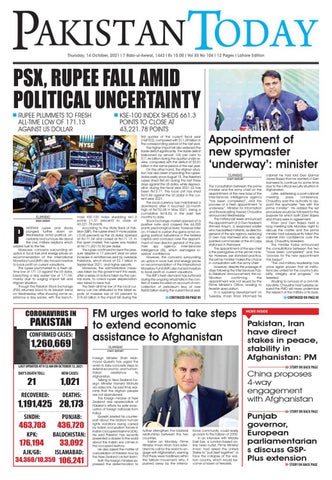
PSX, ruPee fall amid Political uncertainty g
RupEE plummEtS to fRESh all-tImE low of 171.13 agaInSt uS dollaR
ISLAMABAD Mian abrar
P
aKIStanI rupee and stocks plunged further down on wednesday amid political uncertainty and rumours rife about the civil, military relations which added fuel to the fire. moreover, concerns surrounding an uptick in local fuel and energy prices on recommendation of the International monetary fund (Imf) also forced investors to book profit on current valuations. the rupee plummeted to a fresh alltime low of 171.13 against the uS dollar, breaching a day earlier low of 171.04, mainly due to surging import bill and afghan situation. though the pakistan Stock Exchange (pSx) returned back to its bearish trend on wednesday after showing some resistance a day earlier, with the bench-
g
KSE-100 IndEx ShEdS 661.3 poIntS to cloSE at 43,221.78 poIntS
mark KSE-100 Index shedding 661.3 points (-1.51 percent) to close at 43,221.78 points. according to the State Bank of pakistan (SBp), the rupee shed 9 more paisas (-0.05 percent) as the uS dollar opened at Rs171.04 and closed at Rs171.13. In the open market, the rupee was traded at Rs171.20/172.50 per dollar. the rupee continued to bear the pressure despite a 17 percent year-on-year increase in remittances sent by overseas pakistanis, which stood at $2.7 billion in September 2021, and higher exports. moreover, the administrative measures taken by the government this week, after a series of actions taken by the central bank, to check rupee depreciation also failed to bear fruit. the fresh all-time low of the local currency can be attributed to the latest reports of massive rise of 65 percent to $18.63 billion in the import bill during the
coronaviruS in
PakiStan
CONFIRMED CASES:
1,260,669
first quarter of the current fiscal year (1QfY22), compared with $11.28 billion in the corresponding period of the last year. the higher import bill also widened the trade deficit significantly. the trade deficit ballooned by almost 100 per cent to $11.66 billion during the quarter under review, compared with the deficit of $5.81 billion in the same period of the last year. on the other hand, the afghan situation has also been impacting the rupeedollar parity since august 15. the pakistani rupee shed Rs0.60 during the last three days against the uS dollar, while depreciation during the fiscal year 2021-22 has been Rs13.71. the local unit has shed Rs10.86 against the uS dollar in the current year 2021. the local currency has maintained a downtrend after it touched 22-month high of Rs152.48 in may 2021, losing a cumulative Rs18.82 in the past five months to date. Stock Exchange market opened on a positive note and crossed the 44,000 points psychological level; however later on, it failed to sustain the gains amid ongoing political turbulence in the federal capital and confusion over the appointment of new director general of the premier spy agency Inter-Services Intelligence (ISI), which damaged investors’ confidence. however, the concerns surrounding an uptick in local fuel and energy prices on recommendation of the International monetary fund (Imf) also forced investors to book profit on current valuations. the Imf’s fresh demand has surfaced during the ongoing virtual talks in the context of losses incurred on account of noncollection of petroleum levy of over Rs600 billion during the current fiscal year.
CONTINUED ON PAGE 05
Appointment of new spymaster ‘underway’: minister ISLAMABAD staff report
the consultation between the prime minister and the army chief on the appointment of the new boss of the Inter-Services Intelligence agency “has been completed”, and the process of a fresh appointment “is underway”, minister for Information and Broadcasting fawad chaudhry announced wednesday. the military last week announced the appointment of lt gen nadeem ahmed anjum, a seasoned soldier who has battled militants, as directorgeneral of the spy agency, replacing lt gen faiz hameed who was appointed commander of the xI corps stationed in peshawar. the appointment of the spy chief is the prerogative of the prime minister. however, per standard practice, the prime minister makes the choice in consultation with the army chief. however, despite the passage of days following the Inter-Services public Relations’ announcement, the notification confirming the appointment was not issued by the prime minister’s office, leading to feverish speculation. In a surprising development on tuesday, Imran Khan informed his
FM urges world to take steps to extend economic assistance to Afghanistan ISLAMABAD staff report
LAST UPDATED AT 9:12 AM ON OCTOBER 13, 2021
DAY'S DEATH TOLL:
NEW CASES:
21
1,021
RECOVERED:
DEATHS:
1,191,425 28,173 SINDH:
PUNJAB:
463,703
436,720
KPK:
BALOCHISTAN:
176,194 AJK/GB:
33,092 ISLAMABAD:
34,360/10,359
106,241
foreign minister Shah mahmood Qureshi has urged the world to take concrete steps to extend economic and humanitarian assistance to afghanistan. talking to new Zealand foreign minister nanaia mahuta via video link, he said time warrants that the afghan people are not abandoned. the foreign minister of new Zealand was appreciative of pakistan’s efforts for safe evacuation of foreign nationals from Kabul. Qureshi briefed his counterpart about the blatant human rights violations being carried by Indian occupation forces in Indian occupied Kashmir (IoK). he said pakistan has recently presented a dossier to the world about the Indian war crimes in the occupied territory. he also raised the matter of cancellation of pakistan tour by the new Zealand cricket team. Both the foreign ministers expressed the determination to
cabinet he had told gen Qamar Javed Bajwa that he wanted lt gen hameed to continue for some time due to the critical security situation in afghanistan. later, addressing a post-cabinet meeting press conference, chaudhry said the authority to appoint the spymaster “lies with the prime minister”. he added the set procedure would be followed for the purpose for which both [gen Bajwa and Khan] were in agreement. Khan and gen Bajwa held a long meeting late monday night to discuss the matter and the prime minister had subsequently taken the cabinet into confidence over the issue, chaudhry revealed. the minister today announced the consultations between the two “have been completed” and the “process for the new appointment has begun”. “the civil-military leadership has once again proven that all institutions are united for the country’s stability, integrity and progress,” he tweeted. alluding to rumours of a civil-military strife, chaudhry had tuesday assured the pmo will never undermine the respect of the military or its boss.
CONTINUED ON PAGE 05
more inside
Pakistan, Iran have direct stakes in peace, stability in Afghanistan: PM STORY ON BACK PAGE
china proposes 4-way engagement with afghanistan
STORY ON BACK PAGE
further strengthen the bilateral relationship between the two countries. Earlier on monday, prime minister Imran Khan had reiterated his call for the world to engage with afghanistan, warning that there were hardliners within the taliban movement, who, if pushed away by the interna-
tional community, could easily go back to the taliban of 2000. In an interview with middle East Eye, a london-based online news outlet, prime minister Imran had asked the united States to “pull itself together” or face the collapse of the wartorn country, which would become a haven of terrorists.
Punjab governor, European parliamentarian s discuss GSPPlus extension
STORY ON BACK PAGE
02
Thursday, 14 October, 2021 | LAHORE
NEWS
NExt CCoE mEEtiNg likEly to tAkE dECisioN ovEr iNCENtivEs for oil rEfiNEriEs ISLAMABAD
t
AhmAD AhmADANi
he next meeting of the Cabinet Committee on Energy (CCoE) is likely to take a decision over the Petroleum Division’s summary to ensure incentives for oil refineries. According to sources, the upcoming meeting is likely to be held in the near future and grant an approval to the summary. “A key huddle convened on October 11, by the Petroleum Division had developed consensus among the stakeholders regarding incentives for refineries of the country,” said sources. They added that the petroleum division has prepared an updated summary for with changes such as a 30 per cent cap on the project cost instead of the previous 40pc,
No notification of NAB chief’s tenure extension yet, uncertainty prevails ISLAMABAD
a 10pc tariff protection for the existing refineries on motor gasoline and diesel with the construction of upgradation projects before December 31, 2025, and abolishing the 10-year tax holiday for existing refineries etc. Article continues after this advertisement Earlier, the CCoE while approving the Oil Refinery Policy, 2021, in principle had raised questions over proposed incentives for refineries. The CCoE had questioned the use of incremental revenue, utilisation of deemed duty by refineries and the collection of revenue and its utilisation if the government allowed a 10pc tariff protection. The energy minister had also opposed the policy and some of the incentives. Documents available with Profit show that there will be a tariff protection in the form of 10pc import duty on motor gasoline and diesel of all grades as well as imports
of any other white product used for fuel for any motor or engine, effective from the date of the commission for six years, provided that a refinery starts construction of a project before December 31, 2025. Similarly, there will be no import duties and sales tax on the import of petroleum crude oil with effect from July 1, 2022, being the primary raw material. However, the finished products shall be subject to import duties and sales tax notified by the competent authority from time to time. Profit also learnt from the government would issue a pricing mechanism for the pricing regime for new refinery projects that shall be no less favorable than the prevailing mechanism till deregulation. The product pricing formula of refineries will be based on true import parity price (IPP), to be derived from Arab Gulf Mean FOB spot price, or if not
published, shall be derived from Singapore Mean FOB price. The government will add all other elements, including premium, freight, port charges, incidentals, import duties, exchange rate, provincial taxes as applicable, and different price adjustments as per PSO actual imports, in the FOB price arrive at the true IPP. Additionally, prevalent inland freight of imported crude oil to refineries and provincial duties, levies, and taxes at the import of crude oil shall be added for refineries. All new deep conversion oil refinery projects of a minimum of 100,000 bpd refining capacity as well as infrastructure projects mentioned in the policy, to be set up anywhere in the country, that start the construction of the project before December 31, 2025, shall be eligible. The new deep conversion refinery shall maximize conversion of bottom of the barrel to value added products. It is pertinent to mention that the government had already approved a 10pc upfront tariff for the existing tariff in the FY22 budget. The government, through the new policy, intends to provide necessary incentives and tariff protection to attract an investment of $10-15 billion in the sector as well as supporting existing refineries in their modernisation and upgradation efforts, being a strategic asset to the country.
Pak, Hungary to increase trade to $250m: Hungarian envoy MEETING MULLS ONLINE AND DIGITAL MEETINGS TO DISCUSS TRADE MATTERS DURING COVID-19
News Desk
Despite the passage of seven days from the promulgation of the amended National Accountability Ordinance (NAO) 2021, the new notification regarding the extension in National Accountability Bureau (NAB) Chairman Justice (retd) Javed Iqbal’s tenure could not be issued by the Ministry of Law and Justice. As per the sources, The ministry is hesitant to issue that notification, they added, as it contains words such as “non-extendable” as well as it was issued under the NAB Ordinance 1999. Additionally, the law ministry is uncertain whether to issue the same notification issued in 2017 which expired on October 8. A new notification has to be issued by the law ministry as per established norms as the word “non-extendable” has to be omitted in the new ordinance. As per the sources, one of the reasons for the delay is the fear of the new notification being challenged in court. As per the reports, Justice (retd) Iqbal has been handling the affairs for a week without the issuance of the new notification from the law ministry. Earlier, on October 6, President Arif Alvi promulgated the amended National Accountability Ordinance (NAO). As per the Ordinance, Justice (retd) Javed Iqbal will remain in his seat till the appointment of a new chief of the NAB. It further stated that Iqbal could also be chosen as a candidate for the new NAB chairman slot. “If there is no consensus on the name of the chairman, the names(s) proposed by the leader of the House and the leader of the opposition shall be forwarded by the president to a parliamentary committee appointed under a clause (i) which may confirm any one name for appointment as chairman.” It read that the parliamentary committee, under clause (ii), would be formed by the NA speaker, comprising 50% percent members from both the treasury and opposition benches. It further read that the NAB chairman shall be appointed by the president in consultation with the leader of the House and the leader of the opposition in the National Assembly.
ISLAMABAD APP
Ambassador of Hungary to Pakistan, Béla Fazekas, on Wednesday pledged to increase bilateral trade with Pakistan to $250 million, paving new avenues for bilateral economic cooperation. “The two countries have a potential for bilateral trade in a number of sectors that needs to be further explored in addition to work in new areas,” he added. The ambassador said this in a meeting with former Islamabad Chamber of Commerce and Industry (ICCI) president Zafar Bakhtawari and former ICCI vice president Ahsan Bakhtawari in the Embassy of Hungary, according to a news release issued here.
Fazekas said bilateral trade between the two countries had reached to $150 million in 2008, but had come down to $50 million at present. The ambassador said that a few upcoming agreements and Memorandum of Understandings (MoUs) would pave the way for mutual economic cooperation between the two countries which would be signed soon. He said the completion of Gwadar Port would also help Pakistan and other regional countries to be connected in world trade. It is pertinent to mention here that Pakistan’s economy is set to experience an uptick with the completion of Gwadar Port, which will increase economic and trade links between regional countries in addition to bilateral trade with Central Asian Republics (CARs).
On the occasion, the Hungarian ambassador agreed, in a conversation with senior businessmen, agreed that a direct air flight between Pakistan and Hungary was important, adding that his government was considering it. He said every year on average around five million Pakistanis visit foreign countries for tourism and trade purposes and that the Hungary’s government was considering this area and wanted to attract tourism. Bakhtawari said that direct air link between the two countries
Pakistan, Iran agree to expand defence cooperation, work jointly for regional peace
would not only improve trade relations between the two countries, but also increase people-to-people contacts. Béla Fazekas said that the PakistanHungary Friendship Group of Parliamentarians was playing an important role in improving the relations between the two countries; however, he mentioned that bilateral trade between the two countries had been affected during the pandemic and said that online and digital meetings to discuss trade matters was a good solution.
Parliamentary panel on ECP appointments to meet today NewS DeSk
ISLAMABAD APP
Top military leadership of Pakistan and Iran Wednesday agreed to further enhancing defence cooperation and working together for regional peace and unified response to terrorism. The agreement was made during the visit of General Headquarters (GHQ) by a high-level delegation of Iran. Major-General Mohammad Bagheri, Chief of General Staff (CGS) of Armed Forces of the Islamic Republic of Iran, led the high level Iranian delegation who met with Chief of Army Staff General Qaar Javed Bajwa. On arrival, the Iranian CGS was presented a Guard of Honour by a smartly turned out contingent of Pakistan Army. The visiting dignitary laid floral wreath at Yadgare-Shuhada and prayed for Martyrs of Pakistan. Later, the Iranian CGS called on General Qamar Javed Bajwa, Chief of Army Staff (COAS) General
Qamar Javed Bajwa. During the meeting, a wide range of issues including Afghanistan situation, regional security and border management particularly fencing along Pak-Iran Border were discussed. Both agreed on further enhancing defence cooperation and working together for regional peace and unified response to terrorism which is a common enemy. Pakistan and Iran are two brotherly countries and our close cooperation is vital for regional peace and stability , COAS remarked. During delegation level meeting, Iranian delegation was given a comprehensive regional security appraisal and operational update besides briefing on Training Regime of Pakistan Army including collaboration with friendly countries and conduct of various joint military exercises. The Iranian CGS expressed his desire for further strengthening military to military ties particularly in counter terrorism and training domains.
The parliamentary committee on appointment of Election Commission of Pakistan (ECP) members will convene its meeting on Thursday to discuss appointment of the commission’s two members. According to the report, the committee, during its meeting, will consider nominations by the government and the opposition for appointment as ECP members from Punjab and Khyber Pakhtunkhwa. The two ECP members from Punjab and KP — Altaf Ibrahim Qureshi and Irshad Qaiser — respectively, had retired on July 26 after completing their five-year constitutional term. The prime minister has proposed the names of Ahsan Mahboob, former officer of the Police Service of Pakistan; Advocate Raja Amer Khan of the Supreme Court; and Dr Syed Pervaiz Abbas, a former officer of the Pakistan Administrative Service (PAS), for the vacant post of the ECP member from Punjab. The premier has suggested the names of retired Justice Ikramullah Khan, former PAS officer Faridullah Khan and Advocate Muzammil Khan of the Supreme Court for the appointment of ECP member from KP. The meeting will be chaired by Human Rights Minister Dr Shireen Mazari. Defence Minister Pervez Khatak, Minister for National Education and Vocational Training Shafqat Mehmood, Minister for Planning and Development Asad Umar, Railways Minister Azam Swati and Senator Naseebullah Ullah Bazai will attend the meeting from the government side while Rana Sanaullah, Shiza Fatima Khawaja, former prime minister Raja Pervez Ashraf, Shahida Akhtar Ali and Sikandar Mandhro will represent the opposition at the meeting.
Thursday, 14 October, 2021 | LAHORE
NEWS
03
HiNdutvA tHrEAtENiNg dEmoCrACy, stAtE-BuildiNg: PAkistAN UNITeD NATIONS
P
APP
AKISTAN urged the international community to recognise the threat “global Hindutva” posed to the ideals of democracy, peace, diversity and state-building, warning the extremist ideology sought to destabilise its neighbours. “The rise to power of right-wing and neo-fascist groups through electoral processes in certain countries is a disturbing phenomenon,” Pakistan’s ambassador to the UN, Munir Akram, said in a statement submitted to the Security Council on Tuesday. The 15-member body was holding a high-level debate on diversity, state-building and the search for peace, organised by Kenya, which holds the presidency for this month. Elaborating his remarks, the ambassador said South Asia was witnessing the rule by a populist, supremacist regime, elected on the basis of an agenda of religious exclusivity and hatred for other religious and caste communities. “It brands its Muslim minority and certain castes as racially inferior and even as untouchables,” he said,
adding this was contrary to every principle of equality and human rights. “The campaign to extinguish the freedom sought by the Muslim majority in occupied Jammu and Kashmir is ominously termed as the Final Solution,” he said. “Alarmingly,” he added, “these extremist ideologies also seek to destabilise neighbouring countries through a concerted campaign of disinformation and fake news as a weapon of foreign policy.” Resolution 2282 of the Security Council underlined the vital importance of inclusion in state-building which has become more relevant in the wake of the coronavirus, exacerbating social and economic inequalities threatening the very fabric of national cohesion in several countries, Akram said. Vaccine equity is the first and foremost pre-requisite for advancing inclusivity, especially in conflict-affected countries”, the envoy said, adding the world must act in a way that is responsive, emphatic and effective. In this regard, fragile countries require consistent substantial engagement and development support to meet the basic needs of their people and prevent a reversion to social turmoil and conflict, he emphasised. These countries require adequate financing to
generate economic activity and overcome liquidity constraints, and the member states and multilateral institutions should support these endeavours through such means as comprehensive debt restructuring, expanded ODA (official development assistance) and reallocation of a larger proportion of unutilised Special Drawing Rights (SDRs) to them. “The freezing of the resources of countries coming out of conflict is particularly deplorable,” Akram said, pointing out it was a recipe for chaos and renewed conflict. He also stressed that physical infrastructure, such as transportation, energy, water and sanitation facilities, were integral to promoting stability and state-building. There was also empirical evidence that investments in “social infrastructure
World standards day to be celebrated today
President Alvi for formative role of performing arts
ISLAMABAD PR
kArAchI PR
President Dr. Arif Alvi has emphasized the formative role of the creative and performing arts, culture and literature in reflecting the rich heritage of the Pakistani nation and in fostering a dynamic national identity. He was speaking at the conclusion of a presentation on the poetry and writings of the great Urdu poet Mirza Asadullah Khan Ghalib held at the National Academy of Performing Arts (NAPA), Karachi in the evening of 12th October 2021. President Arif Alvi called for NAPA to set up similar centres of excellence across Pakistan so that the people at large could have convenient access to the enormous wealth of the country's civilizational heritage which began over 5000 years ago and is marked by contemporary diversity in the 21st century. The President of Pakistan was welcomed by Syed Jawaid Iqbal, Chairman, NAPA Board of Directors, Zia Mohyeddin, President Emeritus, Senator (r) Javed Jabbar, Honorary Acting President and CEO, Members of the Board including Tariq Kirmani, Shahrukh Hassan, Mahtab Rashdi, Anwar Rammal, Satish Anand and Fauzia Naqvi. Due to Covid-19 conditions, attendance at the event was restricted to NAPA staff and students. President Arif Alvi expressed high praise for the impeccable rendering of some of Ghalib's memorable poetry and writings by Zia Mohyeddin, President
Emeritus of NAPA. Dressed immaculately in a black sherwani, Zia Mohyeddin’s narration vividly evoked glimpses from the unique life and times of the legendary poet. A group of NAPA alumni comprising both young women and men led by the Head of the Music Faculty Ustad Nafees Ahmed on the sitar presented five ghazals written by Ghalib with impressive talent, skill and sensitivity. The music was composed by Arshad
Mahmud. The programme was conducted by the Head of the Drama Faculty, Khalid Ahmed. The First Lady Mrs. Samina Alvi and members of the President’s family and entourage also attended and warmly applauded the presentation. The 10-Member ensemble comprised : Mehboob Ashraf, Yusuf Bashir, Sara Waqar, Amoon Daas, Liza, Cynthia, Obaid, Nigel Bobby, Simal Nafees and Sabeen Nawab Khan.
Islamabad faces continuous rise in dengue fever cases
ISLAMABAD stAff RePoRt
Islamabad has been facing a continuous rise in dengue fever cases, leading to pressure on the public and private hospitals amid the Covid-19 pandemic, an official said. Islamabad District Health Officer Zaeem Zia told media Tuesday was the second consecutive day when the capital reported over 100 dengue fever patients, increasing the overall tally to 1,343 cases this year. “On Tuesday, at least 113 people
contracted the fever and five more succumbed to it in a day,” said the official, adding that over 200 patients are under treatment at different hospitals. The official said that the capital witnessed a very high tally of 121 dengue fever patients in a day on Monday. According to the health officer, 896 cases were reported from rural areas while 447 cases were confirmed in urban areas of Islamabad. The Islamabad administration has launched an anti-dengue campaign in
response to the alarmingly high levels of dengue fever cases. Punjab — which appeared as the most affected province so far — has already sped up multiple actions against it and has also declared an emergency at all hospitals in Lahore. According to government officials, despite various challenges posed by Covid19, the government has been making all-out efforts and taking adequate measures to stem the further spread of the dengue virus. Only nine countries faced severe dengue outbreaks in 1970. But the disease is now seen in more than 100 countries. There are thought to be 390 million infections each year. In 2011, a major outbreak of dengue fever — potentially lethal disease spread by mosquito bites — infected 20,000 and killed more than 300 people. Subsequently, in 2019, rising temperatures across Asia and the Americas contributed to multiple severe outbreaks of dengue fever globally, making it the worst year on record for the disease. Other Asian countries, including Bangladesh, Thailand, Cambodia and Laos, also had outbreaks, with a particularly severe situation in the Philippines, where 1,000 people died of the disease, including hundreds of children, in 2019.
projects”, such as rule of law, health and education could promote sustainable economic growth in fragile countries. In a diverse society, he said, education can unite people, and Pakistan has decided to introduce a single national curriculum across all elementary, primary and secondary schools in the country. “The initiative aims to strengthen national unity, assimilation and build a common set core of values,” the envoy told delegates from around the world. In the same vein, Pakistan has initiated several social protection and poverty alleviation programs such as Ehsaas and Kamyab Jawan (accomplished youth), under which the government provides stipends and interest-free loans to people from low-income families.
Pakistan is celebrating Worlds Standard Day today with a theme of Sustainable Development Goals, Our Shared Vision for a Better World. Each year on 14 October, the members of the International Electrical Commission (IEC), International Organization for Standardization (ISO) and International Telecommunication Union (ITU) celebrate World Standards Day, which is a means of paying tribute to the collaborative efforts of thousands of experts worldwide who develop the voluntary technical agreements that are published as International Standards. In a statement issued by Zahid Mubarik President, SHRM Forum Pakistan, Member of the Board, The Centre for Global Inclusion USA and CEO, HR Metrics Pakistan, Sustainable Development Goals (SDGs), which project to address social imbalances, develop a sustainable economy, and slow the rate of climate change, are highly ambitious. To reach them will require the cooperation of many public and private partners, and the use of all available tools, including international standards and conformity assessment. He further added that the intense battle against a persistent global pandemic revealed the absolute necessity of addressing the SDGs in an inclusive way, to strengthen our societies, making them more resilient and more equitable. It is testament to the power of cooperation and the belief that the sum of whole is greater than parts. It is in this spirit that we are engaging in a multi-year World Standards Day journey that showcases the many ways in which international standards contribute to the success of the SDGs.
Parents of suspect in Noor murder seek reprieve from indictment ISLAMABAD: The parents of the prime suspect in the murder of the daughter of a former diplomat Wednesday asked the Islamabad High Court (IHC) to annul a sessions court’s order to indict suspects in the case on October 14. Noor Mukadam, 27, was found murdered at the residence of one Zahir Zakir in Sector F-7/4 of Islamabad in July. Zakir, widely believed to be the killer, was arrested the same day for his purported involvement in the gruesome incident. A first information report registered on the complaint of Ambassador Shaukat Ali Mukadam, Mukadam’s father, nominated Zakir under Section 302 (premeditated murder) of the Pakistan Penal Code. Zakir’s parents — Zakir Jaffer and Asmat Adamjee — domestic staff and six workers of Therapy Works — an Islamabad-based organisation providing mental health services that employed Zakir and Adamjee — were arrested days later on charges of abetting the murder. A total of 12 people have been facing the probe on multiple charges. Last week, a district and sessions court in Islamabad fixed October 14 for the indictment of suspects. stAff RePoRt
04 NEWS 14th October 2021_Layout 1 10/13/2021 10:30 PM Page 1
Thursday, 14 October, 2021 | LAHORE
04 NEWS
gArdezi wANts livestocK projectioN oN coMMerciAl BAsis LAHORe
p
APP
ROVINCIAL Minister for Agriculture Syed Hussain Jahania Gardezi Wednesday urged the livestock department to enhance its activities on commercial basis and also to extend its projects thus providing maximum benefits to livestock producing farmers. Mr Gardezi expressed these views while chairing a meeting to review the performance of livestock and dairy development department here. Provincial Minister Sardar Husnain Bahadur Dreshak, Additional Secretary Planning, Livestock & Dairy Devleopment Khalid Chaudary, Head of CM Special Monitoring Unit Faseel Asif and officers of P&D and Finance departments attended the meeting. The minister appreciated success to re-
india accused of systematic use of torture in occupied Kashmir NEW YORK: Pakistan told an independent United Nations human rights expert that security forces in Indian-occupied Kashmir indulged in widespread torture and illtreatment and that New Delhi denied facts and responsibility. During a dialogue with UN Special Rapporteur on Torture Nils Melzer, Pakistan diplomat Saima Saleem asked him point-blank how the Indian troops could be held accountable for the breach of the prohibition of torture. She also posed the question of whether an international commission of inquiry, proposed by the UN High Commissioner for Human Rights for Jammu and Kashmir, could help end the culture of impunity to prevent endemic torture. In his response, Melzer said rights experts could not answer that question, and instead the “Security Council should deal with this” with the situation in the held region. While the normative and institutional mechanisms for accountability were present, due to power politics and a lack of will, these were not utilised, he conceded. The exchange took place on Tuesday in the Third Committee of the General Assembly, which deals with social, cultural and humanitarian issues. Before posing her questions, Saleem said that torture and ill-treatment continue to be practised with complete impunity in various parts of the world, in particular in situations of foreign occupation such as Jammu and Kashmir. “Systematic denial, obfuscation, deliberate obstruction, and purposeful evasion of accountability of Indian occupation forces in Indian-occupied Jammu and Kashmir, has resulted in the widespread use of torture on innocent men, women, and children,” she said. “The occupation forces, who are perpetrating torture, indulge in all three patterns of denial identified by the Special Rapporteur, i.e. denial of facts, responsibility, and wrongfulness,” said Saleem. APP
duce the infertility by using the latest (IVF) in vitro fertilization technology. He directed to upgrade the existing labs which would help to expand their capabilities resultantly boosting export dairy products. The Minister also stressed the need for breeding process of small animals and to link CEPEC development projects for gaining define objectives. On this occasion, Provincial Minister Husnain Bahadur Dreshak said with the effective initialization of programmes of livestock could achieve its targets by using pragmatic approach. He also reiterated the need to better use of land, enhancement in capabilities and consistency of policies. Additional Secretary Planning briefed about the departmental performance, initiatives, nutritional reforms, infrastructure development and development strategy.
Brent, WTI trade above $80 for third day IsLAMABAD Agencies
Crude oil prices went down on Wednesday amid global growth concerns in the face of surging prices for coal and gas, which are set to stoke inflation, reducing oil demand; however, both crude benchmarks traded above $80 per barrel for the third straight day. At 1145 hours GMT, Brent, the international benchmark for two-thirds of the world’s oil, shed $0.74 (-0.89 percent) to reach $82.68 a barrel. Similarly, the US West Texas Intermediate (WTI) reached $80.01 a barrel, down by $0.63 (+0.78 percent). The price for Opec Basket was recorded at $82.53 a barrel with 1.19
percent increase, Arab Light was available at $81.87 a barrel with a 0.37 percent decrease, while the price of Russian Sokol jumped to $84.59 after gaining 1.88 percent. According to experts, a strong US dollar, trading near a one-year high, also weighed on oil prices, as it makes oil more expensive for those holding other currencies. The International Monetary Fund on Tuesday cut its growth outlooks for the United States and other major economies on worries supply chain disruptions and cost pressures are holding back the global economic recovery from the coronavirus pandemic. However, oil watchers are still focused on whether soaring gas and coal prices will
lead to more demand for oil products for power generation. Article continues after this advertisement. In its monthly report published on Wednesday, the Organisation of the Petroleum Exporting Countries (OPEC) announced that it lowered the 2021 oil demand growth forecast to 5.82 million barrels per day (bpd) from 5.96 million bpd. The OPEC kept 2022 oil demand growth unchanged at 4.15 million bpd. It sees rise in natural gas and thermal coal prices encouraging increased gasto-oil switching. The organisation raises estimated demand for its crude in 2022 by 100,000 bpd to 28.8 million bpd. It says its output rose 490,000 bpd to 27.33 million bpd in September.
pM imran Khan approves two policies to combat climate challenges News Desk PM Imran Khan has approved the National Climate Change Policy 2021 and National Wildlife Policy 2021 to better deal with environmental issues. While chairing the 3rd meeting of the Committee on Climate Change in Islamabad on Wednesday, the PM directed establishment of a think tank to coordinate efforts between various ministries and to devise out of box solutions for climate change mitigation. The PM said Pakistan established its credibility as a Green Champion due to flagship ten billion tree program. He further directed that a special zone in Margalla Hills be declared as a leopard preservation zone. He also approved the establishment of Wildlife Information Center at Islamabad s Marghazar Zoo. The premier said that the world must help developing countries to deal with the problem. PM Imran Khan said it was our government in Khyber Pakhtunkhwa which undertook the initiative of one billion tree tsunami and now the whole world is following our footsteps. He said the international community is acknowledging Pakistan’s realistic and tangible steps to mitigate impacts of climate change. He further emphasized that preservation of Pakistan’s National Parks is of paramount importance. The PM concluded by directing the Ministry of Climate Change to review targets and formulate new goals aiming at fast tracking the steps required to preserve natural environment.
NAB rAids AghA sirAj durrANi’s house for his Arrest, After rejectioN of BAil pleA News Desk The National Accountability Bureau (NAB) has raided the residence of Sindh Assembly Speaker Agha Siraj Durrani to arrest him after the Sindh High Court rejected his bail plea. After the rejection of bail plea by the Sindh High Court, the NAB team reached the residence of Agha Siraj Durrani seeking his arrest. The NAB team could not arrest Agha Siraj Durrani due to resistance from his guards and has called for additional teams. Meanwhile, Agha Siraj’s family member Agha Asad while talking to the media said that there is a family in the house, they will not allow to violate the sanctity of the house. Earlier in the day, Sindh High Court (SHC) had rejected the bail plea of Sindh Assembly
speaker Agha Siraj Durrani and seven other accused in the assets case. The SHC while rejecting the bails of Speaker Agha Siraj Durrani and the other seven accused in the assets beyond known sources of income case, approved bails of wife and daughters of Durrani. On July 20 last year, the anti-corruption body had ordered an inquiry on charges of corruption against the Sindh Assembly speaker. The NAB prosecution named 20 persons including Durrani as accused in the reference filed in accountability court Karachi after an inquiry. According to the NAB charge-sheet, the accused were involved in corruption of upto 1.6 billion rupees. This is not the first time that he has been arrested by the NAB as previously in February this year, the NAB Karachi had arrested Siraj Durrani from a hotel in Islamabad.
Pakistan will ‘never be up for sale’ as PM Khan set a new paradigm: NSA IsLAMABAD APP
National Security Adviser Dr Moeed Yusuf has said that Prime Minister Imran Khan has set a new paradigm whereby ‘Pakistan will never be up for sale’, but will stand for its interests. “Pakistan is going to stand for what its interests are, not emotively but very pragmatically,” he said in an interview with journalist Dr Moeed Pirzada, for Global Space Village. “This has invited much criticism, with many deeming it a mistake, but it is true – Pakistan no longer will host bases,” he said, with regard to not allowing the air bases to any other country in future. Dr Yusuf said for the past 20 years, there was an unwinnable war that “some wanted Pakistan to win for them, which was simply an unrealistic goal”. He mentioned that in the past, decisions had been taken without the public on board, which ultimately “backfired”. “This is a paradigm that this prime minister has set with every country and not just the United States,” he said, adding that “If there is a condition which Pakistan does not feel to be
in its interest, we will not go for it”. Dr Yusuf said Pakistan, at the cost of being looked upon as insincere, kept emphasizing that the war in Afghanistan could not be won militarily. He said Pakistan also stressed the need to talk with the Taliban, not because it was pro-Taliban, but “because it was the only way to solve this problem”. Referring to the exit of military forces from Afghanistan, he said the non-military strategy could have saved the Western world from embarrassment. “They bought New Delhi’s and Kabul’s narrative – lock, stock, and barrel – and this is what they have gotten for it,” he said. To a question on progress following his twice meetings with the U.S. counterpart held in Geneva and Washington in July, he said, a blueprint was agreed upon detailing how to move forward on commerce, investment, climate, health, etc. Dr Yusuf said Pakistan was “not in any camp” and emphasized that despite its relationship with China, it wanted very good relations with the U.S. He stressed that the contours of Pak-U.S. relationship could not be from the lenses of Afghanistan, India or China. “It has to be a
bilateral relationship, a give and take as equals where mutual interests lie. That has to be worked out now,” he said. Dr Yusuf reiterated that Pakistan was not in the ‘old mold,’ whereby the U.S. could divide and rule Pakistan’s house, talk to one official to get something done, use the civilmilitary disconnect that used to happen and get what it needs. “There is no civil-military disconnect anymore, and a coordinated effort is in place,” he said. “I have said this in public before, and I will say it again; 150 percent support from the military, the ISI, and the prime minister is in place”. The NSA said China was a key pillar of the vision of Pakistan’s north-south connectivity coming through the China-Pakistan Economic Corridor. He said Pakistan wanted the U.S. China and Russia to co-invest in Pakistan. To a question regarding the response of the U.S. after it was offered to invest in the CPEC reprocessing zone, he said, the response was ‘yes.’ “We need to work through and see what arrangements can be made and what companies would be interested in coming here,” he said. He said Pakistan was now the “melting pot” of all positive global economic interests
CMYK
as an essence of its geo-economics. Dr Yusuf hoped that the new situation in Afghanistan would turn into a connectivity corridor, which the Ghani government had deliberately stalled because they did not want Pakistan to benefit. “But now, with peace and stability holding in Afghanistan as things move forward, Central Asia and Pakistan can be connected.
This is very positive,” he said. He said as India in the past used the Afghan intelligence NDS to attack Pakistan, however he said, Pakistan had made it clear to the Afghan Taliban that “this was unacceptable”. The Taliban, he said, had assured Pakistan that this would not happen again from the Afghan territory. To a question on recognizing the Taliban government, he said, “We are not talking of recognition; that is a separate conversation. We need to engage because we have a 2,600kilometer shared border.” He said: “The same world comes to us and says, ‘please help us evacuate thousands of people,’ and the same world says, ‘please do not engage’. How is this possible? “So the world needs to think through this for their own sake – Pakistan’s position is only in self-interest,” he said. He proposed that there needed to be an agreement and a coordinating mechanism on engagement with the region and the rest of the world before recognition of the Taliban government. “Pakistan stands with the international community on how we move forward,” he said, referring to the new government in Afghanistan.
Thursday, 14 October, 2021 | LAHORE
NEWS
PSX, rupee fall amid political uncertainty coNtINueD fRoM pAGe 01 The IMF also recommended further jack up in the base price of electricity tariff to the tune of Rs1.40 per unit to curtail the surge in circular debt. The IMF has also asked Pakistan to take additional taxation measures in the shape of income tax, sales tax, and regulatory duty for jacking up the annual tax collection target from Rs5.8 trillion to Rs6.3 trillion. The KSE-100 Index moved in a range of 1,105.1 points, showing an intra-day high of 44,172.7 points and a low of 43,067.6 points. Among other indices, the KSE All Share Index shed 375.71 points (1.24 percent) to close at 29,850.69 points, while All Share Islamic Index shed 304.68 points (-1.42 percent) to close at 21,163.92 points. A total of 369 companies traded shares in the stock exchange, out of them shares of 71 closed up, shares of 279 closed down while shares of 19 companies remained unchanged. Out of 95 traded companies in the KSE-100 Index, 14 closed up, 77 closed down and while four remained unchanged. The overall market volumes decreased by 49.95 million to 354.96 million shares. Total volume traded for the KSE-100 Index was 156.34 million shares. The number of total trades decreased by 13,762 to 117,084, while the value traded decreased by Rs3.31 billion to Rs12.29 billion. The market capitalisation decreased by Rs104.06 billion. Among scrips, HASCOL led the table with 36.76 million shares, followed by WTL (28.87 million) and TELE (17.01 million). Stocks that contributed significantly to the volumes include HASCOL, WTL, TELE, GGL and TRG, which formed over 32 percent of total volumes. Sector wise, the index was let down by technology and communication with 185 points, cement with 107 points, oil and gas exploration companies with 66 points, commercial banks with 45 points and food & personal care products with 39 points. The most points taken off the index were by TRG which stripped the index of 110 points followed by SYS with 63 points, UBL with 41 points, LUCK with 28 points and ENGRO with 24 points. The sectors propping up the index were power generation and distribution with 11 points, and real estate investment trust and paper and board with one point each. The most points added to the index were by ABL which contributed 16 points followed by HBL with 16 points, HUBC with 16 points, FFC with 6 points and FABL with 5 points.
Appointment of new spymaster ‘underway’: minister coNtINueD fRoM pAGe 01 He said Gen Bajwa and his institution would also never take any measure that will undermine the respect of the prime minister or the government. He stressed both the prime minister and the military leadership were in close coordination, and the appointment would be made after fulfilling all the legal requirements. He said the two were in agreement over this and other matters and Khan reserved the final authority. Chaudhry also appreciated the media for not “sensationalising” the matter of the appointment.
IHC queStIoNS reluCtANCe to dISCloSe gIftS SeNt to PrIme mINISter ISLAMABAD
t
stAff report
HE Islamabad High Court (IHC) on Wednesday questioned the government’s reluctance to disclose details of the presents the prime minister received from world leaders after assuming the office in August 2018. Last month, the Cabinet Division challenged in the high court an “illegal” order of the Pakistan Information Commission seeking details of the gifts presented to Imran Khan after he became the prime minister. Government ethics rules mean the prime minister, ministers and special advisers must declare gifts received above a certain value — and pay for any of the gifts they wish to keep. In its petition, the government took the stance that disclosure of any information related to Toshakhana jeopardises Pakistan’s international relationships. Established in 1974, Toshakhana is a department under the administrative control of the Cabinet Division and stores precious gifts given to rulers, parliamentarians, bureaucrats and officials by heads
of other governments, states and foreign dignitaries as a goodwill gesture. It has valuables ranging from bulletproof cars, gold-plated souvenirs, expensive paintings to watches, ornaments, rugs and swords. The PIC had while deciding on an application on the matter directed the division to “provide the requested information about the gifts received by Prime
Minister Imran Khan from foreign heads of states, heads of governments and other foreign dignitaries […] description/specification of each gift, information about the gifts retained by the prime minister and the rules under which gifts thus received are retained by him”. During the proceedings on Wednesday, Justice Miangul Hassan Aurangzeb asked the counsel representing the gov-
SRINAGAR Trapped in an unending cycle of violence and now in the grip of a pandemic, many people in Indian-administered Kashmir continue to remain on edge, particularly the poor. More than 100 lives have been lost in the disputed Himalayan region this year due to violence by both government forces and militants, according to police data. Nearly 28 civilians have also been killed in suspected militant attacks. However, due to the COVID-19 pandemic, 4,426 people, with most of them having suffered underlying ailments, died, putting the already fragile community in more adverse conditions. On March 18 last year, when the regional administration of Jammu and Kashmir imposed a strict lockdown to stem coronavirus infections, Aijaz Ahmad Wani was baffled by the situation. The young man’s only concern was how to care for his elder diabetic and paralyzed sister at their home in the Shadipora village in the restive region’s Budgam district. Diagnosed with periodic paralysis – a rare genetic disorder that causes sudden attacks of short-term muscle weakness, stiffness or paralysis – at an early age, Gulshana Wani has remained bedridden for almost 20 years of her life. Struggling with abject poverty, Gulshana lost her
ernment if it would share the details of the presents or not. The judge acknowledged that details of certain items such as defence-related gifts may not be disclosed but questioned the need to apply the restriction on making details public applied to every item. “What is the harm in doing so if some country has given a necklace [to Khan] as a present?” Justice Aurangzeb questioned. “Why is the government facing embarrassment by not disclosing gifts received from other countries?” The judge observed that gifts given to the public office holders belong to the public and not the official. He also wondered if these very people would have been given the same presents were it not for their post. Justice Aurangzeb further asked why those gifts were not kept in a museum, observing this was the norm in other countries. He also said the government should disclose how many gifts had their valuation done by the Federal Board of Revenue (FBR). The government’s counsel requested time to respond following which the court adjourned the hearing.
Maryam jeers at PM Imran Khan for ‘attempting to be Nawaz Sharif’ over DG ISI appointment ISLAMABAD stAff report
Pakistan Muslim League-Nawaz (PM-N) Vice-President Maryam Nawaz has jeered at PM Imran Khan by stating that he “should not attempt to be Nawaz Sharif by now asking for the vote to be respected”. In the wake of controversy over the appoinent of new DG ISI which started after the Prime Minister’s Office delayed the notification of Lt Gen Nadeem Anjum’s appointment, who was named as the new ISI chief by the Pakistan Army’s media wing in a press release last week, she went on state that “Wearing the skin of a lion does not make you [PM Imran] a lion. One has to endure jail and go to the Attock Fort to demand for the vote to be respected.” “He [Premier Imran] has nothing to do with democracy and democratic struggle, but will have to answer for crushing people’s vote, and for burdening Pakistan with historical debts,” she added. A controversy sparked when Information Minister Fawad Chaudhry in a presser, following the federal cabinet meeting on Tuesday, said that “The authority to appoint DG ISI rests with the prime minister.” Maryam went on to add that there shouldn’t be two opinions about the constitutional rights given to a prime minister.
The PML-N vice-president said that she is not afraid of fake cases or arrests, adding that the National Accountability Bureau (NAB) can arrest her to show the world how afraid they are of the truth. “Power can temporarily suppress the truth but it will eventually come to light,” she said. She further said that “[PM] Imran Khan is neither a constitutional, nor legal, nor an elected prime minister,” she insisted and added that the premier relies on “magic” to run the country of 220 million people. “When important appointments are made on the basis of witchcraft and ghosts, then obviously the institutions of the country will be turned into a spectacle,” she further said. Maryam questioned why the premier’s “spells” could not be used for public welfare if they are so “successful”. “Why can’t these ‘spells’ be used to lower the prices of wheat, petrol and medicine? Why are they only used for important appointments?” she questioned, claiming that the new appointment [of DG ISI] isn’t for the country, but to save oneself. On NAB’s request for her and her husband’s bail’s cancellation, she sarcastically stated that “I want to meet the ‘close friend’ who filed the petition against my bail. This person should be given a 22-gun salute.”
Small volunteer groups in Kashmir act as beacons of hope AnAdolu Agency
05
parents years ago. But when the pandemic hit the region, it unnerved Aijaz and Tabassum Jan, the younger siblings and caretakers of Gulshana. “For two months at a stretch, there was no source of income for us. We were almost starving,” Aijaz said, adding it was very tough to manage medicines for his ailing sister during that time. Dropping out of school at the age of 13 and now working as a laborer, Aijaz has been unable to work and support his impoverished family since Aug. 5, 2019, when the Indian government stripped the region of its limited autonomy. The move threw the region’s population of over 12 million into a complete blackout after communication lines were severed. Aid group rush to help: As Aijaz was eagerly looking for financial help, it was the Help Poor Voluntary Trust (HPVT) based in the main city of Srinagar which managed the medical bills and provided medical assistance to Gulshana. After getting to know Gulshana’s condition, the aid group provided all the medicines free of cost. HPVT chairman Farooq Ahmad Bhat told Anadolu Agency that they are trying to help poor patients in whatever way they can, but there are many out there where help is yet to reach them. The aid group has been at the forefront of providing free medicines and medical assistance to the poor since
cMYK
the pandemic hit the region. For the past two years, it has helped over 3,000 patients with free medicines and is continuing to offer its services. hArd to mitigAte crisis: With foreign aid to the region blocked, small voluntary groups are still struggling along despite few donations coming in. “I have never seen such a crisis in my whole life where working class people are seeking help for food and medical assistance,” Manzoor Ahmad, a volunteer working with the Athrout Organization, told Anadolu Agency. The group primarily works in the areas of medical assistance, food and education. Data shared by the group show that for the last two years, more than 300 patients were given oxygen cylinders for free over a specific time period, some 150 people were given free dialysis treatment and around 200 families were given free food kits. In 2014, when the Kashmir region witnessed a crisis due to floods and the administration was largely “off the scene,” it was only Jamaat-e-Islami (JeI) – the region’s largest socio-political organization – that rushed to the aid of people organizing aid and relief campaigns. From rescue to relief operations, the group managed well. But amid the current crisis, they are nowhere to be found, as the Indian government imposed a five-year ban on the group, claiming it is involved in “subversive activities” and “in touch with the militant groups.”
NAB ordinance challenged in IHC islAmABAd: A petition challenging the National Accountability Bureau (Amendment) Ordinance, 2021, was submitted to the Islamabad High Court (IHC) Wednesday. Nominating the federal government and NAB chairman retired Justice Javed Iqbal as respondents, the petition sought annulment of the ordinance promulgated on October 6. The ordinance paves the way for Iqbal to continue holding his post for an indefinite period of time until the appointment of his successor. An ordinance is a law promulgated by the president, when parliament is not in session, in the exercise of the powers vested in him by Article 89 of the Constitution but for a limited time only. The petition contended the reappointment of retired judges was against the freedom of the institution of the judiciary. It requested the court to declare the ordinance null and void. Last week, a similar petition was filed in the Lahore High Court as well which contended that changing the law to accommodate or benefit a single individual was “patently illegal, mala fide, and unconstitutional”. “An ordinance cannot be allowed to override the parliament since assembly is there, and a session can be called at any time,” the petitioner said. stAff report
Suspect gets relief under new NAB ordinance A suspect in a fraud case was granted relief for the first time under the National Accountability (Amendment) Ordinance, 2021 on Wednesday, according to a news outlet. An accountability court in Islamabad referred the fraud case against Abdullah to a sessions court with the observation that the case does not come under an accountability court’s jurisdiction anymore after the promulgation of the new NAB ordinance. “Such cases will now be dealt with by other courts,” the judge remarked. Earlier on Tuesday, several accused in cases filed by NAB had sought relief following the promulgation of the ordinance. Several people named in NAB cases had approached accountability courts in Islamabad, seeking termination of fraud and other cases. They were of the view that all cases against them should be disposed off as NAB’s jurisdiction had ended. However, the accountability court had issued a notice to NAB, seeking a detailed reply from the bureau. Last week, President Arif Alvi had promulgated the National Accountability (Amendment) Ordinance, 2021, under which the NAB law will not extend to matters pertaining to federal, provincial and local taxation, and decisions pertaining to the Council of Common Interests, (CCI), National Economic Council (NEC), National Finance Commission (NFC), Executive Committee of the National Economic Council (ECNEC), Central Development Working Party (CDWP) and Provincial Development Working Party (PDWP). news desk
06-07 Comments - 14th October 2021_Layout 1 10/13/2021 11:00 PM Page 1
Thursday, 14 October, 2021
06 COMMENT
Creating Institutional Disorder
After resorting to brinkmanship The customary U-turn
T
Institutions in disorder cannot deliver
HE Prime Minister reacted strongly to the military establishment’s transfer of the DG ISI and his replacement by the Corps Commander Karachi. For five days toing and froing continued between the PM House and GHQ. Finally, on Tuesday Information Minister Fawad Chaudhry conceded that there were sharp differences between the government and the establishment over the issue of Lt Gen Faiz Hamid’s transfer. PTI’s chief whip in the national Assembly, Amir Dogar, said the incumbent DG ISI was indispensable as the situation in Afghanistan was deteriorating and he must retain the office for a number of months. It was also maintained that the new appointment was unlawful as the PM had not been properly consulted. The PM did not sign the DG ISI’s transfer orders even after the cabinet meeting where he maintained that he was not a “rubberstamp.” Everything however changed on Wednesday when the Information Minister tweeted that the consultation between the COAS and the PM over the appointment of the new ISI Chief was finally complete and the process for new appointment had been initiated. Presumably the PM has blinked first in what appeared to be an eyeball-to-eyeball confrontation. There is little likelihood of the military establishment changing the appointment of Lt Gen nadeem Ahmed Anjum, as the decision was taken after detailed discussions in GHQ, and the ISPR had duly announced it on October 6. It can however agree to go through the ritual of presenting three names to the PM provided there is a prior understanding that the PM would tick the name proposed by the Army. It is good for the county that the crisis has been resolved. Presumably the PTI leadership discovered that the confrontation with the establishment would spread despondency in the PTI’s rank and file, alienate its coalition partners and strengthen the opposition. With the masses reeling under the impact of ever-increasing prices, rising service charges and widespread unemployment, none would consider Mr Khan a martyr if he became a casualty as a result of political adventurism. But if the PM was to finally to agree to the establishment’s terms, what was the need to issue veiled threats which, among other things, led the KSE-100 to plunge 661 points as political uncertainty took toll on sentiment.
Dr FariD a Malik
A
FTER the dreadful Zia Referendum of Decemeber 1984, ‘Institutional Disorder’ (ID) was deliberately created for purposes of control. Mian nawaz Sharif of Gawalmandi as an ally of the establishment, played a key role together with the dictator in attacking civilian institutions. By inducting criminals into the Police, it was converted into a rogue force that moved from corruption to committing crimes and stealing elections. Muhammad Khan Junejo, who managed to become Leader of the House and Prime Minster in a partyless Parliament tried to serve the nation. Compared to the Sharifs, he was an upright and decent politician who desired to make a difference. He played a key role in getting rid of the Martial Law and wanted to move towards strengthening the Parliament. It was the dismissal of his government that proved to be the beginning of the end for the third usurper. Unfortunately the Sharifs sided with the establishment as their agenda was different. In the 1988 elections, despite being the largest single party, the PPP was denied the Chief Ministership of Punjab. While nawaz Sharif was given a free hand to run the province, Benazir Bhutto’s hands were tied at the centre. From the pivotal position of CM of the largest province of the federation, nawaz succeeded in first dislodging Benazir and then taking control of the country himself while leaving the province into the hands of his younger brother Shahbaz Sharif. The brothers together went after institutions that came in their way of loot and plunder. Even vital sectors of human development like education and health were not spared. Institutional memory plays an important role in its functioning. Public records were destroyed which rendered them non-functional. Recruitments and promotions were carried out against merit. Those who stood in the way, were either side tracked or pushed out. Mian Muhammad Sharif, the founder of the ‘Sharif Dynasty’ believed in the power of money. According to his doctorine; “Every person has a price, pay and get the job done “. With his money-centric approach,
Rizvi’s imminent release SC throws the ball back to LHC
A
FTER granting bail to Tehrik Labaik Pakistan (TLP) Amir Saad Rizvi, the LHC had put the Punjab government in a tough spot, forcing them to approach the Supreme Court (SC), which in turn has reverted the matter back to the LHC. This clearly shows that the apex court does not want to get involved. The Punjab government has failed to build a good case against Rizvi and is now on the verge of losing as the LHC review board’s rejection of the extension of his detention order will most likely be upheld by the new two-member bench formed on the instructions of the apex court. Perhaps the government was unwilling to pursue the case with too much zeal, because it did want to offend the TLP too much, mainly because the issue of Finality of the Prophet (PBUH) it espouses, is a sensitive one. Considering the TLP’s support base, Mr Rizvi, having spent close to six months in jail and getting released without being formally charged, will become a symbol of defiance to and absence of the state’s writ, further emboldening his followers and thereby increasing the likelihood of fresh violent protests to take place. Widespread protests over the government’s refusal to expel the French Ambassador as demanded by the TLP led to a countrywide shutdown, and to violent protests in which several protesters were killed, as well as two policemen, besides scores more injured. The TLP was supposedly banned after this, but the participation of TLP ticket-holders in the recent Cantt Board election has created confusion about whether the ban had been imposed or not. That the TLP came to prominence on the back of support from private individuals and state institutions is a matter of record defined in the Faizabad Dharna judgement penned by Justice Qazi Faez Isa. The TLP is just another addition to a list of extremist outfits that are unfortunately nurtured and propped up to challenge an existing political setup only to grow too big and independent and eventually bite the hand that feeds them. It is up to the government to control the TLP once its leader is released and it will not be an easy task. There needs to be a strategy in place before that happens, so as not to be playing catch-up when the situation gets too volatile. The government cannot expel the French Ambassador due to diplomatic reasons while the TLP cannot abandon the issue as it makes up the foundation of the cause upon which the party was built. Some common ground must therefore be reached to avoid another violent face-off.
TaMseel aqDas
I
n 2019, a global crisis took the world off guard. The implications were witnessed in the form of millions of deaths, declining economies, and fear amongst the general populace. The portrayed scenario falls under the genesis of covid-19, however, similar insinuations can be projected with the future of climate change. Despite the critical consequences of climate change, world governments have altered focus towards covid19 and restoration of economies. Accordingly, the plight of climate change serves as a potentially dangerous future. A valid argument is that covid-19 impacted the strides being undertaken against climate change. Towards the start of the pandemic, the world was exposed to lockdowns, social distances, and closed borders. Correspondingly, industries, aviation, and means of transportation were halted. The resulting notion was witnessed in the form of reduced CO2 emissions, improvement in air quality index, and reappearance of wildlife. Environmental index improvements hindered the urgency of measures against climate change, resulting in the shaping of a future global crisis. Subsequent to the lifting of covid-19 restrictions a continuation of greenhouse gas emissions was witnessed, however, their impli-
Founding Editor
Yousaf Nizami Umar Aziz
Joint Editor
Joint Editor
Executive Editor
Lahore – Ph: 042-36300938, 042-36375965
This deliberately created disorder has to be replaced with order, while those responsible for this mess have to be weeded out before the water crosses the bridge. A thoroughly corrupt and disorderly system cannot self-correct, it has to be corrected through leadership and iron will which has been missing thus far.
Covid-19 should not distract from the climate change disaster facing us
Arif Nizami (Late)
M. A. Niazi
been exposed, clearly indicating institutional weakness. Even nAB (national Accountability Bureau) is investigating its internal corruption. Education has been in total disarray for decades and has been turned into a very lucrative business. Both main political parties have established their own educational institutions and so have the armed forces, leaving the public sector universities in disarray. After the lawyers’ movement, the judiciary has not recovered. A country in which vital sectors of education, health and justice have been ignored, cannot develop. Institutions have to be rebuilt all over again but the task is much more gigantic now as there are no role models left in the arena and the institutional memory has also been erased for personal gains. As a private citizen, I have to remind officers of the past laurels of their own departments when they were functional. On seeing the deplorable state of the record of the Settlement Department (BOR), I decided to write about their legendary record keeper ‘Mumtaz Bola ‘who worked long hours to preserve the sanctity of his papers. Files, paperwork, nothing moves without wheels. The age-old ‘Diary System ‘has been abondoned. Letters are neither acknowledged nor answered. Even office hours are not kept. Without functional institutions, no records, no chain of command, lack of monitoring/accountability, absence of SOPs (Standard Operating Procedures), no delivery is possible. This deliberately created disorder has to be replaced with order, while those responsible for this mess have to be weeded out before the water crosses the bridge. A thoroughly corrupt and disorderly system cannot self-correct, it has to be corrected through leadership and iron will which has been missing thus far. Perhaps with another term in office the Kaptaan may succeed in steering the ship in the right direction. The writer is ex-Chairman, Pakistan Science Foundation. He can be contacted at: fmaliks@hotmail.com.
Has the Pandemic blurred Climate Change Attention?
Dedicated to the legacy of late Hameed Nizami
Editor Aziz-ud-Din Ahmad
combined with political power, he was able to build an empire. First it was the ‘Ittefaq Brothers’, after entering the corridors of power they were left behind to form the ‘Sharif Group’. The Sharif Medical City Complex and the Jatti Umra Estate are owned by this entity. Recently there has been a dispute of 127 Kanals of evacuee land which were allegedly acquired illegally. Stay has been granted against the recovery of this area by the Board of Revenue (BOR). The total area of the estate is around 175 Acres (1400 Kanals). In the formative years of Pakistan, institution building was taken very seriously to ensure long term sustainability. The founding fathers worked very hard. There was limited experience of running railways. Tarrifs were the domain of the Hindus who kept it a secret. The few Muslim officers sought help from the Pathan watchmen to review the calculations at night. There were few engine drivers and mechanics, yet the trains were kept running. The Mughalpura workshop was the only technical facility in the country which provided the base for development of the engineering industry in the new land. Banking was totally dominated by non-Muslims who left after Partition, leaving the sector unmanned. Starting from ground zero, the republic was moving in the right direction. The first derailment took place in 1958 when civilian institutions came under attack but the founding generation weathered that storm. Hardly had we recovered, from the 1971 debacle and the resultant break-up of Pakistan, that the third usurper attacked. This time the attack was more lethal. By the mid-1980s most founders had retired. A new breed of officers took control who were driven more by loyalty than rules. SROs (Statutory Regulatory Orders) were issued for individual gains. Conflicts of interest were blatantly ignored. Loans, plots, permits were doled out to party workers to buy their loyalty. In 1998 before freezing the foreign currency accounts, several insiders encashed their dollars. Till today their names have not been revealed. Then the individuals who had their loans written off have never
I
Karachi – Ph: 021-35381208-9
I
cations were overlooked. Before the spread of the pandemic, 2020 was coined as “pivotal year” for combating climate change, as part of Un Secretary-General António Guterres’s speech at the Un annual Climate Summit. The setbacks for climate change actions were witnessed on account of the postponement of 196 states introducing revamped plans for reducing the production of carbon emissions as per the 2015 Paris Agreement. Likewise, similar meetings with regard to biodiversity were disrupted. The decline in addressing climate change resulted in reduced sustainable efforts by world leaders. As, Poland pressurized the European Union to withhold the carbon trading program, the Czech Republic contended with the abandonment of the climate bill, and China issued delays in emission cutting policies. On that account, the USA showed a similar disregard for policies penetrating towards climate change. Upon succeeding to power, Joe Biden issued four main goals for his administration, namely: combating covid19, racial equity, economic restoration, and counteracting climate change. Strides can be witnessed on the economic and covid-19 fronts; however, the climate crisis remains unattended. It can be argued that environmental actions are simply limited to speeches and headlines. Since, the Biden administration hosted an international summit of 40 countries on Earth Day and issued new goals for the reduction of greenhouse gases by 50%; yet little action respecting implementations was observed. On the contrary, revenue allotment for the restoration of
Islamabad – Ph: 051-2204545
the economy was witnessed on mass fronts. $400 billion were invested for the promotion of Americanmade products, and $300 million was allotted for research and development. The emphasis on the economic potential of the USA was a direct consequence of covid-19 and its implications on economic fronts. Henceforth, the prominence of economic revitalization by world leaders has amplified the destructive consequences of climate change, and the potential of a global disaster. As a result, the effects of climate change are being witnessed currently. From forest fires, hurricanes, heat waves, to flash floods, the world is seeing it all. Wildfires were observed across Turkey, Australia, Brazil, and numerous other states. In addition, the USA fell victim to hurricanes such as Hurricane Ida, along with floodings across new York and new Jersey. The increased occurrence of natural disasters demonstrates the urgency to combat climate change, as the number of weather-related disasters has increased substantially over the previous 50 years. In fact, record temperatures were witnessed across Canada, the USA, and Europe, with the global surface temperature increasing by the average rate of 0.17°F. The overruling of climate disasters due to the implications of Covid-19 is not an unusual concept. Human nature binds individuals to concern with immediate needs in the wake of a disaster like covid-19. nevertheless, the increased natural disasters and high temperatures project a harsher future catastrophe. Henceforth, it is acute to initiate sustainable steps alongside combating Covid-19. Lack of action simply ensures a daunting future for the coming generations.
The overruling of climate disasters due to the implications of Covid-19 is not an unusual concept. Human nature binds individuals to concern with immediate needs in the wake of a disaster like covid-19. Nevertheless, the increased natural disasters and high temperatures project a harsher future catastrophe.
I
Web: www.pakistantoday.com.pk
I
The writer is a freelance columnist
Email: editorial@pakistantoday.com.pk
06-07 Comments - 14th October 2021_Layout 1 10/13/2021 11:00 PM Page 2
Thursday, 14 October, 2021
COMMENT 07 Editor’s mail Send your letters to: Letters to Editor, Pakistan Today, 4-Shaarey Fatima Jinnah, Lahore, Pakistan. E-mail: letters@pakistantoday.com.pk Letters should be addressed to Pakistan Today exclusively
Kashmir conundrum THE war that we are in the middle of is not a war between Pakistan and India. It is a war being fought in Kashmir which has expanded itself into another war between two states. Kashmir is the real theatre of unspeakable violence that can push us into violence and nuclear war at any moment. To prevent this from happening, atrocities in Kashmir have to be addressed and resolved. That can only be done if Kashmiris are given a chance to freely and fearlessly tell the world what they are fighting for and what they really want. Kashmir is the most militarized zone in the world, with an estimated half a million Indian soldiers posted there to counter what the army itself admits is now just a handful of jihadists for them the real enemy is Kashmiri people. Thousands have been disappeared and tortured that label the valley like a network of small scale Abu Ghraibs. The abrogation of Kashmir’s special status was the front burner of BJP and RSS kitchen, to reignite their flagging passions, all they need to do is to pick the villain from their gallery and unleash the dogs of war. For them there are several villains, Pakistani and Kashmiris Jihadists and 200 million Indian Muslims who are always accused of being Pakistani lovers and anti-national traitors. Home Minister Amit Shah demonstrated the siege only existed in people’s imagination saying that telephone lines in the valley were only used by terrorists, normal life has not been affected, people are doing their necessary works. Further said, those who feel that life has been affected are once whose survival depends on terrorism. It is hard to work out who exactly Indian government sees as terrorists. Why should they want to be a part of India? For what reason? If freedom is what they want, freedom is what they should have. Kashmir may not defeat India, but it will consume it and in many ways it already has. Shafi ahmEd Khowaja jati Sujawal
Provinces got less than projected share in 2020 -21
Deforestation
7th NFC Award continues to be in force even after 11 years Province ..........................................Budget (Rs in Million).........................Revised 2020-21 Punjab ..............................................1439116.169 ..........................................1322625.374 Sindh................................................742029.973 ............................................680478.849 Khyber Pukhtoonkhwa ....................477518658 .............................................443429.117 Balochistan ......................................265054.040 ............................................267630.614
MuhaMMaD ZahiD riFaT
A
LL the four provinces forming the Federation of Pakistan, Punjab, Sindh, Khyber Pukhtoonkhwa and Balochistan, got less than their projected share out of the Divisible Pool of Taxes and Duties under the 7th national Finance Commission (nFC) Award, which continues to be in force even after 11 years against its stipulated life of 5 years, in varying figures during 2020-21. According to the latest facts and figures now available from official sources, the hare of the provinces in the Divisible Taxes and Duties and Straight Transfers was projected to be Rs 2923718.740 million during financial year 2020-21. Against this, the revised figures of provinces share for the last financial year was Rs 2704163.854 million as detailed below: The provinces’ share in Divisible Pool of Taxes and Duties and Straight Transfers projected for financial year 2021-22 includes Punjab Rs 1691097.914 million, Sindh Rs 848208.127 million, Khyber Pukhtoonkhwa Rs 569256.821 million and Balochistan Rs 313295.609 million. (Figures of Khyber Pukhtoonkhwa are inclusive of one percent for the War on Terror). These are projected figures and what the provinces will actually be getting as their share will only be known around June 2022 when the federal budget for financial year 2022-23 is announced. Higher and lower share of the provinces depends mainly on the good or bad performance of the federal government’s main tax collection agency, the Federal Bureau of Revenue (FBR), to say the least. The share of the Federal Government in the net proceeds of the divisible pool is 42.5 percent and of the provinces 57.5 percent from the financial year 2011-12 onward, as per the 7th nFC
Award. The divisible pool of taxes , levied and collected by the federal government, include taxes on income; wealth tax; capital value tax; taxes on sales and purchases of goods imported, exported, produced, manufactured or consumed; export duties on cotton; customs duties; federal excise duties excluding the excise duty on gas charged at well-head; and any other tax which may be levied by the Federal Government. Allocation of shares to the provinces are based on multiple indicators. The indicators and their respective weights are Population 82.0 percent; Poverty or backwardness 10.3 percent; Revenue Collection or Generation 6.0 percent and Inverse Population Density 2.7 percent. Sum assignment to the Provincial Governments is distributed amongst the provinces on the basis of the percentage as specified against each: Punjab 51.74 percent; Sindh 24.55 percent; Khyber Pukhtoonkhwa 14.62 percent, and Balochistan 9.09 percent. Additionally, the provinces also receive payments of net proceeds of royalty on crude oil and development surcharge on natural gas. Prior to going onwards, it is appropriate to briefly mention as to when the 7th nFC Award had come into force and how it still continues to be in force. The provincial share of revenues from the divisible pool of taxes, straight transfers and so on is governed in accordance with the provisions of the 7th nFC Award notified through President Asif Ali Zardari’s Order to provide for distribution of revenues and certain grants issued on 10 May 2010 called “The Distribution of Revenues and Grants-in-Aid Order
Each of the four provincial governments as such nominates its technical member to the NFC while the Federal Finance Secretary acts as the official expert to the Commission.
2010” and it came into force from 1 July 2010. As no new nFC Award had surfaced within the stipulated period of five years, President Mamnoon Hussain amended the Order which came into force with effect from 1 July 2015. The amending Order called the Distribution of Revenues and Grants-in-Aid Order (Amendment) Order 2015 provided that it was to remain in force till further orders. Accordingly, the 7th nFC Award continues to be automatically extended every year thus saving President Dr Arif Alvi from issuing an order extending it every year. Over the years, 8th and 9th nFCs were appointed one after the after but both failed to accomplish the assigned tasks within the given time. The incumbent federal government also appointed 10th nFC in May 2020 which is continuing its deliberations, rather at a pretty slow pace and is expected it may come up with the finalized recommendations letting the President notify the 10th nFC Award well in time ahead of the next federal budget around June 2022. For the information of all those interested and concerned, it is briefly mentioned here that financial relations between the Federation and the Provinces are governmet by Part V1 of the Constitution of the Islamic Republic of Pakistan headed Finance, Property, Contracts and Suits and Chapter 1 Finance relates to Distribution of Revenues between the Federation and the Provinces through Articles 160 to 174. Article 160 (1) inter alia reads “ Within six months of the commencing day and thereafter at intervals not exceeding five years, the President shall constitute a national Finance Commission consisting of the Minister of Finance of the Federal Government , the Ministers of Finance of the Provincial Governments , and such other persons as may be appointed by the President after consultation with the Governors of the Provinces”. Each of the four provincial governments as such nominates its technical member to the nFC while the Federal Finance Secretary acts as the official expert to the Commission.
The incumbent federal government also appointed 10th NFC in May 2020 which is continuing its deliberations, rather at a pretty slow pace and is expected it may come up with the finalized recommendations letting the President notify the 10th NFC Award well in time ahead of the next federal budget around June 2022
The writer can zahidriffat@gmail.com
be
reached
at
FORESTS cover more than a quarter of Earth’s land surface. These forests areas provide food, medicine, shelter and so on. A 2017 report by scientists at the University of Maryland showed that the tropics lost about 61.000 square miles of forests in 2017_ an area the size of Bangladesh. The Guardian reported that every second, a chunk of forest equivalent to the size of a soccer field is lost. The mentioned amounts are pretty shocking that need proper attention before it is too late. Trees also absorb corbon dioxide and provide oxygen for living creatures. Tropic trees alone are estimated to provide about 23% of the climate change. There are different factors that cause deforestation. Mostly forests are found in rural areas because near cities forests have already been cleared for construction works. The forest areas that exist in rural areas, their residents chop down trees to meet their daily needs because of not having access to natural gas. Everyone can do their part to curb deforestation. Cleared areas of land must be planted again. It should be the responsibility of every state to implement strict laws on cutting down trees and the people that cut down trees for cooking and shelter must be provided alternatives. mEEr afzal hub
Land grabbing ADVISOR to the Prime Minister on Accountability and Interior, Mirza Shahzad Akbar on Sunday unveiled that the government had recovered Rs 210 billion from land grabbers, 36 of which belonged to the Pakistan Muslim League nawaz (PML-n). Illegally occupied state land worth billions of rupees had been retrieved from PMLn’s stalwarts including Khuram Dastagir, Senator Chaudhary Taveer, Javed Hashmi, Khawaja Asif, Abid Sher Ali, Malik Saif ul Malook Khokhar, Daniyal Aziz, Jave Latif and others, he said. Addressing a press conference here at Press information Department (PID), he said that these people had been using political influences to occupy the government property, which caused huge financial loss to the national exchequer. PML-n’s Chief nawaz Sharif, he said, had introduced the politics of ‘changa manga’ and use of money in it to get personal benefits. Through a rapid anti corruption drive, the incumbent government succeeded to make these recoveries from the thieves who had been looting and plundering the national kitty during previous regimes. Shahzad Akbar said that the government would utilize this money to introduce universal health insurance in Punjab to provide free health facilities to citizens. Punjab government and its anti corruption department had made outstanding role in anti corruption drive which would continue in future efficiently, he said. Speaking about the narrative of parties included in Pakistan Democratic Movement (PDM), he said that the purpose of their protests was just to defend their looted money and get nROs. Talking on senate elections, he said that the government had tabled a constitutional amendment bill in national assembly for open balloting, adding, the opposition parties had the opportunity to vote in its favor if they were sincere in transparency of the electoral process otherwise they should present their logic to the people for opposing it. Sohail ali Khan iSlamabad
Corruption galore UnBRIDLED corruption seems to have been gaining its ground in Pakistan. Corruption-free-Pakistan now appears to be a pipedream. “ Say no To Corruption” is meant to perhaps say nothing to corruption here—let it grow by leaps and bounds. Claiming to put an end to rampant corruption in Pakistan within 90 days and bring back the looted money siphoned off in foreign bank accounts, the PTI government has failed miserably from its start to make any dent in rife curroption in the country. Mentioning in its current report of 2020, The Transparency International has said that corruption has increased four times in Pakistan. And out of 180 nations, Pakistan is ranked at 124 and its score is 31, despite the extraordinary efforts of national Accountability Bureau (nAB) claiming to have recovered Rs363billion in the last two years and the Public Account Committee which has also claimed to have recovered Rs 300bn in last two years. To end corruption in Pakistan, PTI government should shun from cosmetic or perfunctory measures and take some serious and concrete efforts in this regard. riaz ahmad Soomro ShiKarpur
08 WORLD VIEW 14th October 21_Layout 1 10/13/2021 10:27 PM Page 1
Thursday, 14 October, 2021
08 WORLD VIEW
CIA CreATeS A mISSIon CenTre To CounTer ChInA BURNS TOLD HIS WORK FORCE LAST WEEK THAT CHINA IS “OUR TOUGHEST GEOPOLITICAL TEST IN A NEW ERA OF GREAT POWER RIVALRY”
CounTerPunCh
C
MELVIN GoodMAN
IA director William Burns has created a new centre to focus exclusively on collecting intelligence about China and countering its espionage against the United States. My first reaction was “really…what took so long?” You have to wonder what in the world Burns’ mediocre predecessors (John Brennan and Mike Pompeo) were thinking in creating mission centres regarding Iran and north Korea which represented little threat to the United States. But my second reaction is less facetious and more serious: why is the United States—its president, its politicians, its pundits—hell-bent on creating a Cold War environment and arms race with China? Burns told his work force last week that China is “our toughest geopolitical test in a new era of great power rivalry.” President Joe Biden has been slow getting out of the blocks on various foreign policy and national security issues, particularly when it comes to China. He has continued the bombastic policies of Donald Trump, leaving tariffs in place over the opposition of American business leaders and concluding a
treaty with Australia to provide nuclear submarine technology. The United States hasn’t provided such technology to any nation since the late 1950s, and the Australian treaty violates the spirit of the non-Proliferation Treaty of the late 1960s. Meanwhile, there are bipartisan majorities in the Congress supporting increased defense spending and modernization of nuclear weapons in order to counter Brennan’s description of the Chinese threat to “international order.” China’s response to the surprising submarine deal was quick and forceful. Last week, nearly 150 Chinese warplanes were flown into Taiwan’s air defense identification zone, placing military tensions between China and Taiwan at their worst level in four decades. China’s President Xi Jinping didn’t mention the flights in his speech commemorating the 1911 revolution that overthrew China’s last imperial dynasty. But he did vow to achieve a peaceful “unification” with Taiwan. Biden has assembled a hard-line national security team on China, particularly at the national Security Council. national Security Adviser Jake Sullivan, his deputy Kurt Campbell, and the director of the China staff Rush Doshi are hard-liners vis-a-vis Beijing. The new deputy assistant of defense for Indo-Pacific security, Ely Ratner, is a Sullivan acolyte and far to the right on dealing with China. The Department of Defense and the intelligence community, particularly the CIA, are exaggerating the China threat just as they exaggerated the Soviet threat during the Cold War. The mainstream media, par-
ticularly the editorial pages of the Washington Post, aid and abet the bloated warnings. Meanwhile, the Department of Defense prepares for confrontation with China, and issues worst-case assessments of Beijing. The recent war scare in China required several calls from former secretary of defense Mark Esper and Chairman of the Joint Chiefs Mark Milley as well as the postponing of a naval exercise in the South China Sea to calm Sino-American waters. An underwater collision involving a U.S. nuclear attack submarine in the South China Sea last week should serve as a wake-up call to the policy and political communities mired in group think on China. According to one of the country’s leading Sinologists, Lyle Goldstein, a research professor at the naval War College, leading Chinese foreign policy experts have compared the dispute in the South China Sea to the Cuban Missile Crisis. We hear nothing from the departments and agencies of government that could address the issue of China more modestly and realistically by providing political and economic measures to enhance bilateral relations and temper the public atmospherics. The Commerce Department should be focused on economic security and civilian technology in order to counter the Pentagon’s emphasis on military security and technology. According to a recent Politico article, the Commerce Department’s Bureau of Industry and Security—central to technology trade with China—suffers from a lack of strategic direction and insufficient resources.
Sadr and independents biggest winners under Iraq’s new election law
AL-moniTor
T
MustAfA sAAdouN
HE results of Iraq’s recent parliamentary elections came as a surprise to all, winners and losers included, indicating a new political era in the country. The Shiite Coordination Framework (a group including armed Shiite parties and forces, mostly from the Fatah Alliance) issued a statement Oct. 12 in which it questioned the results of the elections held Oct. 10 and threatened to take action. Less than an hour later, Abu Ali al-Askari, a security and military official in the Hezbollah Brigades, issued a statement challenging the elections and calling on “the armed resistance factions to prepare for a critical stage.” The Independent Electoral Commission results were somewhat shocking to political parties, including the Iranian-aligned Fatah Alliance led by Hadi al-Amiri, which won 14 seats after it had 48 seats in the previous session. Meanwhile, the Alliance of national State Forces led by Ammar al-Hakim, who is allied with former Prime Minister Haider al-Abadi, won only five seats, while Hakim alone had 19 seats in the previous session. The new electoral law led to a great victory for Sadrists in these elections. Preliminary results revealed the Sadr bloc led by leader of the Sadrist movement Muqtada al-Sadr won 73 seats; the Progress coalition led by parliament speaker Mohammed al-Halbusi won 43 seats; and former Prime Minister nouri al-Maliki regained some power with his State of Law Coalition with 37 seats. The new law was expected to reduce the influence of conventional political parties. However, some of them were able to benefit from it through social engineering and increase their influence by managing their candidates in the electoral circles. Sajad Jiyad, a fellow at the Century Foundation, told Al-Monitor, “The current election law is generally positive and better than the previous one, but it needs
amendments in the future to prepare the electoral conditions for reform and change. Parties are known for their electoral competition, so some of them used the law to their advantage.” Jiyad added, “Change is coming, but gradually. Some new faces and somewhat independent parties made it to the top in these elections but without having a serious impact on the political scene. So the new parliament is close to the outgoing parliament in terms of the dominance of large forces.” Unlike the previous law, which considered each governorate an electoral district, the new election law relies on multiple electoral districts. So it was not useful for parties that did not have fixed popular bases in specific geographical areas. In Dhi Qar, considered the capital of Iraqi protests for over a year, the law was also beneficial for the Emtidad Movement that emerged about a year ago from within the protests and is led by political activist Alaa al-Rikabi. It managed to obtain 10 seats — five in Dhi Qar and five in three other southern provinces — relying on the voices of protesters who are fed up with the Iraqi political class. These elections under the new law clearly showed the political organization of the popular bases is the backbone of access to parliament. This also included independents who relied on their communities in their cities to vote for them. Still, the Sadrist movement was the biggest winner thanks to the new election law. In previous years, Sadr worked to pass an election law in multiple districts. With the October 2019 protests, which he controlled at some point, Sadr had an opportunity to pressure the political blocs to pass the law, which came in accordance with his aspirations and was largely designed to fit his popular base. Sadr’s popular base is large, and his influence is concentrated in well-known areas such as those east of Baghdad and in the districts of southern Iraq. So it was very useful for him to have this law, which enabled him to obtain about a third of the seats in parliament. “Independents will be in danger among the organized parties later on, and they will thus find it difficult to form strong blocs,” Renad Mansour, fellow at the Carnegie Middle East Center, told Al-Monitor. The new law gave independents a great opportunity to reach parliament without having to enter into party organizations and follow the convictions of the heads of the blocs. Independents are considered the second largest winners, after Sadr, because of the new law. However, one cannot say the work of the independent representatives will be influential in parliament, which needs collective and partisan work. Their voices may not be heard amid the noise of large parties such as the Sadrist Movement, the Progress coalition, and other Kurdish, Shiite and Sunni parties, so they have no solution but to either unite or enter into alliances with the parties with which they share some visions.
There is no discussion of returning to the Washington-inspired Trans-Pacific Partnership, a regional trading association best suited to containing China’s economic power in East Asia. The Department of State remains understaffed, and there is no suggestion of the kinds of arms control measures that could address tensions in U.S.-China relations. Secretary of State Antony Blinken has surrendered his traditional role in bilateral diplomacy to national Security Adviser Sullivan, who has been the administration’s public voice on relations with Beijing. There is ample basis for a significant strategic dialogue between the United States and China; they share many concerns in East Asia, particularly north Korea’s missile program. The agency of government that we sorely need is the one that President Bill Clinton eliminated 25 years ago—the Arms Control and Disarmament Agency. The key to establishing an effective dialogue with China would be arms control, but the Department of Defense recently removed its assistant secretary of defense for arms control and disarmament. The two powers need rules of the road for navigating the South China Sea. The United States could limit its aircraft carrier deployments; China could limit its anti-ship forces. And both sides need to stop the China-bashing/Americabashing syndromes that have worsened over the course of the pandemic. Instead of nominating a serious luminary as ambassador to China, the Biden adminis-
tration has nominated nicholas Burns, a veteran foreign service officer with a modest background in Asian affairs. Burns was a hard-liner on the subject of the Soviet Union, a strong supporter of the Iraq war in 2003, and—upon retirement—joined the Cohen Group, a lobbying organization for arms manufacturers. He has often referred to Edward Snowden, a whistleblower, as a “traitor,” particularly because of his flight that took him to China. Even the U.S. trade representative, Katherine Tai, has issued an official statement that stressed the importance of tariffs and export controls as central to the Biden administration’s approach toward China. Donald Trump’s disastrous tariff war with China amounts to an annual hidden tax of $620 on each and every American household. President Biden has not indicated that he is willing to join the TPP or end the tariff war. The United States could easily tone down its propaganda. The U.S. strategic position is still unassailable, even in East Asia, with military superiority in various domains. China lacks strategic allies. The United States has important relations with Australia, Japan, India, South Korea, and various Southeast Asian states, a grouping which is beginning to resemble an anti-China partnership. China is making no effort to project power into regions outside of its neighbourhood; the United States has hundreds of facilities and bases the world over. President Biden needs to end the militarized approach to Asia, and institutionalize a serious bilateral dialogue. Melvin A. Goodman is a senior fellow at the Centre for International Policy, a professor of government at Johns Hopkins University and a former CIA analyst.
Columbus’ fear of Islam AT HEART, HE WAS A CRUSADER
L A Times
I
ALAN MIKHAIL
n all that has been written about Columbus — from his being the first Italian American to the progenitor of a continental genocide — one of the most crucial aspects of his biography is missing: A primary force behind Columbus’ Atlantic crossings was a fear and hatred of Islam. This shaped how white Europeans engaged with the “new World” and its native peoples for centuries, and how today’s Americans understand the world. It should influence how we think about the second Monday in October — whether you call it Columbus Day, Indigenous Peoples Day or Italian Heritage Day. Columbus was born into Europe’s anti-Islamic mind-set in 1451, raised on tales of the Crusades and the territorial losses his hometown of Genoa suffered after the Ottoman Empire’s capture of Constantinople in 1453. As a teenager, he took to the Mediterranean as a sailor’s apprentice. Some of his first maritime voyages brought him face to face with the awesome power of the Ottomans in the Aegean and of other Muslim states in north Africa. He later sailed down the coast of West Africa where the region’s powerful Muslim kingdoms impressed upon him that Islam was everywhere, surrounding Christendom. When Columbus returned to Europe, he joined Spain’s fight against the Muslims in the south of the Iberian Peninsula, six months before he set off across the Atlantic. At heart, Columbus was a Crusader. Throughout his life, in his encounters with and then battles against Muslims, he felt the burden of holy war deep in his soul. As he bobbed westward on the high seas — with the formal mission of finding a trade route to the Far East that would circumvent the need to go through Muslim territory — his mind was occupied by neither a secular passion for discovery nor a calculating commercial vision. More than anything else, he sailed to the Americas imbued with a Christian zeal. This centrality of Islam to Columbus’ life explains one of the strangest and least acknowledged aspects of the Atlantic voyages. When Columbus arrived in the Caribbean, he saw Islam there too, where it so very clearly did not exist. For example, he called the
weapons of the Indigenous Tainos alfanjes, a Spanish word derived from Arabic for a curved metal scimitar inscribed with Quranic verses that was commonly used by Muslim soldiers in battle. Columbus himself tells us that the Taino “have no iron” and of course knew nothing of the Quran, but he likens them to Muslim soldiers by putting alfanjes in their hands, thereby placing them in a mental category familiar to him and the intended audience of his writings. Later, when he first saw the scarves of a group of Indigenous women, he thought they were related through trade or some other form of Eurasian contact to what he termed Moorish sashes. Such stated equivalences between Islam and native America would continue. A couple of decades after Columbus, Hernán Cortés too wrote that the Aztecs of Mexico wore “Moorish robes” and that Aztec women looked like “Moorish women.” He claimed to see more than 400 mosques in the territory he conquered 500 years ago, which today we call Mexico, and he referred to the leader Montezuma as a “sultan.” The answer lies in Columbus’ — and Europe’s — long history of crusading against Islam. The crucible of centuries of these religious wars, and the increasing encroachment of the Ottomans and other Muslims in the years after 1453, forged the notion of Islam as an enemy in the minds of Columbus, Cortés and the thousands of other Europeans who fought Muslims in the Old World and then American Indians in the new World. For all their lives, these men had learned that Muslims were their foremost enemies. In their mind’s eye, an enemy conjured up the image of a nonwhite Muslim. Europeans fell back on this framework to understand the new enemies they faced in the Americas — Indigenous peoples. Europeans thought of Muslims and native Americans as somehow linked on a chain of continuity that today seems chimerical. This largely forgotten history matters. An anti-Islamic worldview was the mold that cast the European understanding of race and ethnicity in the Americas, as well as the concept of warfare in the Western Hemisphere. It, therefore, needs to be a part of any understanding of the history of the Americas and, regrettably, of native American history. While Europeans and white Americans aimed the warlike mind-set of the Crusades against native American populations, they also appropriated Indigenous iconography into their way of war. Hence, Americans flew Apache and Kiowa helicopters over Afghanistan; the navy launched Tomahawk missiles at Syrian targets; and Black Hawk helicopters ferried the navy SEALs in the nighttime raid in Pakistan that killed Osama bin Laden, code-named Geronimo. Alan Mikhail, the chair of the Department of History at Yale University, is the author of “God’s Shadow: Sultan Selim, His Ottoman Empire, and the Making of the Modern World.”
Thursday, 14 October, 2021 | LAHORE
NEWS
09
FBR to Revise RAtes FoR vAluAtion oF immovABle PRoPeRty
Financial discrepancies worth Rs300bn detected in CAA ISLAMABAD news desk
As per the auditor general (AG) audit report for the financial year 2019-20, serious financial discrepancies amounting to Rs300 billion have been found in the Civil Aviation Authority (CAA), As per the audit report released on Tuesday, the authority incurred a massive loss on account of financial irregularities, illegal flight permits and illegal occupation of its land. It laments that despite several reminders, the CAA failed to convene a meeting of the Departmental Audit Committee (DAC). The report, based on the 53 audit paras, also includes paras of financial matters worth Rs65.11 billion and observes that the CAA suffered a loss of 75.43 billion due to illegal flight permits and the nonrecovery of their arrears. Further, the audit points out that illegal seizure of the authority’s land caused a loss of Rs144.88 billion and the CAA sustained a loss of Rs14.58 billion due to delays and non-receipt of dues from airlines and other entities. The audit report says illegal flight permits and occupation of authority’s land caused a whopping loss of billions of rupees.
Apple cuts iPhone 13 output forecast on chip shortage
SAN FRANCISCO Agencies
Apple is unlikely to meet production goals for its new iPhone before the holidays because of a global electronic chip shortage. According to a foreign media report by Bloomberg News, the firm had planned to produce 90 million iPhone 13s before the end of the year, but will have to settle with 80 million as suppliers Broadcom and Texas Instruments cannot meet demand. Apple presented a new line of iPhones last month, with four new models, including the iPhone 13 Mini, which sells from $700, and the iPhone 13 Pro Max, which costs $1,100. “We estimate that overall demand has been robust globally,” Wedbush analyst Dan Ives said, highlighting strong demand in China and the United States especially. “Apple will be running into a 5 million-plus iPhone 13 unit shortage for the holiday season if consumer demand keeps up at this pace,” he added. Chief executive Tim Cook warned during quarterly earnings reports in late July that supply chain constraints would have an even bigger impact on the current quarter than it had in the previous three months. He pointed out that electronic chip shortages were affecting all parts of the industry, not just Apple, and stemmed from significantly higher-than-expected demand.
t
HE Federal Board of Revenue (FBR) has decided to revise the rates for the valuation of immovable property in major urban centres and adjacent areas to bring it on the same level as the market price whereas the deadline for submission of revised valuations by all field formations will conclude today. “In an official communication to Chief Commissioners Regional Taxpayers Offices (RTOs) across the country, the officers have been directed for valuation tables of immovable property under sub-section (4) of section 68 of the Income Tax Ordinance 2001. The FBR’s existing valuation table is close to 60 to 70% of market rates so upward revision will help the FBR to bring it in line with the prevailing market rates,” a report media report stated. At present, there are three different rates through which real estate can be valuated, including the market rate, the
DC rate, and the notified rate by the FBR itself. It may be mentioned here that a property in Pakistan, probably the only country with three types of property valuations, can be registered and owned at a value much lower than the
market rate. Earlier in the month, FBR officers were directed to specify any areas not covered under FBR notifications and also point out anomalies, if any, in the existing valuation tables. The rates of immovable property
will be revised and if any anomalies are left in the tables, the RTO will be held responsible for it. According to a report by The News, FBR had devised a system through which valuation rates would be increased. This would ensure more amount of tax is collected by the bureau. The move to revise valuations comes as a result of the International Monetary Fund (IMF) had persuaded the Board for a countrywide fresh valuation. Reports state that the Fund had raised objection to the continuity of old valuation despite the fact that the sale and purchase price of immoveable properties had jumped by many times since 2015-16 when the Board had initiated the project of assessing the taxable value of immovable properties alongside the DC rates. It had stressed the Board to carry out a fresh valuation before the start of policy level talks in Washington. news desk
What you need to know about the coronavirus right now WASHINGTON reuters
Here’s what you need to know about the coronavirus right now: US FDA staff say Moderna did not meet all criteria for Covid19 boosters Scientists at the US Food and Drug Administration said on Tuesday that Moderna Inc. had not met all of the agency’s criteria to support the use of booster doses of its Covid-19 vaccine, possibly because the efficacy of the shot’s first two doses has remained strong. FDA staff said in documents that data for Moderna’s vaccine showed that a booster does increase protective antibodies, but the difference in antibody levels before and after the shot was not wide enough, particularly in those whose levels had remained high. Data suggests mRNA booster dose generates stronger antibody response after J&J shot – Axios People who received Johnson & Johnson’s Covid-19 vaccine will have a stronger neutralising
antibody response if they get an mRNA shot as the second dose, Axios reported on Tuesday, citing a person who has seen data collected by the US National Institutes of Health (NIH). The NIH will present the mix-and-match data to the FDA panel on Friday, Axios said. J&J has asked the US Food and Drug Administration (FDA) to approve a shot of its own single-dose vaccine as the booster dose. The FDA’s advisers are set to consider the need on Friday. There were limitations to the NIH data, according to the report. Neutralizing antibodies only prevent the virus from entering cells and replicating, and the report said it was unclear how long the response would last. South Korea launches panel to debate ‘living with Covid-19’ South Korea established a panel on Wednesday to debate a strategy on how to “live with Covid-19” in the long term, as it seeks to phase out coronavirus restrictions and reopen the economy
as vaccination levels rise. Under the strategy, the government aims to relax coronavirus restrictions for citizens who can prove they have been fully vaccinated while encouraging asymptomatic and mild Covid-19 patients aged below 70 to recover at home, the health ministry said. The government will also focus on the number of hospitalisations and deaths rather than new daily infections, and will consider not publishing the latter on a daily basis, Yonhap news agency has reported. Covid-19 Curbs in sydney Could ease early New South Wales could ease more restrictions in Sydney a week earlier than planned on October 18 as Australia’s most populous state races towards its 80 percent double-dose vaccination target, the government said on Wednesday. The state is expected to hit the mark over the weekend, beating forecasts, and officials previously promised to relax more restrictions on vaccinated residents on the first Monday after reaching that milestone. Shops, pubs and gyms can welcome more vaccinated customers when inoculation reaches 80 percent. Masks will not be required in offices and nightclubs can reopen for seated drinking, while weddings can have unlimited guests. New York must allow religious exemptions to vaccine mandate, judge rules A federal judge ruled on Tuesday that New York state cannot impose a Covid-19 vaccine mandate on healthcare workers without allowing their employers to consider religious exemption requests.
KP proposes up to 10-year tax exemption on investments in tourism sector PESHAWAR Aziz Buneri
The Khyber Pakhtunkhwa (KP) government has started work on a proposal to provide tax exemption for 5 to 10 years for developing tourist destinations or building 4-star hotels in the Integrated Tourism Zones (ITZs). For this purpose, the KP culture and tourism authority has sought a response from the Ministries of Finance and National Revenue. According to sources, the KP government has decided to formulate attractive offers to promote tourism in the province. The provincial government, in the high-level meeting on Wednesday, suggested that if a citizen should be given a tax exemption if they develop a tourist resort in the ITZ designated by the government. Similarly, the government should also consider providing tax exemption to an investor even if they build a 4 or 5-star international standard hotel in these zones, it was said in the meeting.
KP to start 10 mega projects worth Rs65b under district development plan PESHAWAR Aziz Buneri
Khyber Pakhtunkhwa government to launch eight mega projects worth Rs65 billion which also includes 107 sub-projects. These projects include construction of 65 roads, 41 water supply and one solar energy transfer projects. The maximum amount of Rs 9.90bn will be spent on projects in Hazara Division. According to the Planning and development Department, Rs9.20 billion will be spent as per Peshawar Capital’s District Development Plan under which 15 subprojects for clean water supply and road construction have been identified in the capital city. Eight irrigation projects will also be completed in Peshawar.
According to the district development plan Rs. 6.50 billion will be spend on the districts development plans of Nowshera and Charsadda. In Nowshera, five water and 2 road construction projects will be completed while in Charsadda four road construction projects will be carried out. Under the district development plan of Mardan division, Rs9.58 billion will be spent on eight water supply schemes. Eight water supply projects will also be constructed in Swabi under the plan. The report said they Rs6.37 billion will be spent in Swat and Shangla. Three road projects would be constructed in Shangla while an irrigation and three roads projects have been identified in Swat. Under District Development Plan of Buner, Upper Dir, Lower Dir, Malakand,
Upper and Lower Chitral, Rs9.70 billions will be spend on the construction of 5 roads in Lower Dir, two irrigation projects, three roads and two irrigation schemes in Upper Dir while construction of two roads and one irrigation is identified project in Malakand. Under the District Development Plan of Kohat Division, Rs4.5 billion will be spent on construction of one road in Hangu and one irrigation and road have been identified in Karak and three road projects have been identified in Kohat. In Bannu Rs 4.60 billion will be spent on two irrigation and one solar energy project. Three irrigation projects in Lakki Marwat have also been identified. In Dera Ismail Khan Division, Rs4.70 billion will be spent under the District
Development Plan. Hazara Division were allocated Rs 9.90 billion in District Development Plan which include construction of three irrigation and two roads in Abbottabad, two roads in Batgram, three roads in Haripur, Lower Kohistan, Kolai Pals and Upper Kohistan. A plan has been identified for construction of three roads and one irrigation project in Mansehra while one road project is identified in Torgarh. Thus, Rs5 billion would be spent in the merged districts under the District Development Plan for which plans Rs5 billion have been allocated and the deputy commissioners have been directed to identify projects.
Thursday, 14 October, 2021 | LAHORE
10 FOREIGN NEWS
REpoRTS of wIDESpREAD coRRUpTIon In AfghAn REgImES UnDER US occUpATIon
I
APP
N 2008, US Congress set up the Special Inspector General for Afghan Reconstruction (SIGAR) after they found $145 billion were used without oversight. Pentagon stated the total cost of war in Afghanistan since 2001 was $825 billion while President Biden suggested it to be over $2 trillion. However, independent sources estimated the expenditures to be much higher. Watson Institute of Brown University suggested US wars have cost over $8 trillion to the US taxpayers in direct and indirect costs of War on Terror. In 2007, Afghan Defence Minister Abdul Rahim Wardak ordered 1.3 million sets of new uniforms with rare camouflage pattern, from Canadian company Hyper Stealth. This change from previous pattern in
$28 million in 2007 and $72 million for next decade till 2017. Interesting thing is that these uniforms were never tested or evaluated in the field, and there was just 2.1% forest cover across Afghanistan. Daud Wardak, son of former Afghan Defence Minister Abdul Rahim Wardak had just been reported buying $20.9 Million Beverly Hills Mansion in the US. He already owns $5.2 million Miami Beach residence. An extensive ring road around Afghanistan was funded by multiple grants and donors, totaling billions during the course of the war. Towards the end of the project, a 233kilometer section in the North, between the towns of Qeysar and Laman, led to $249 million being handed out to contractors, but only 15% of the road being built, a SIGAR audit reported. Between March 2014 and September 2017, there was no construction
on this section, and what had been built deteriorated, the report concluded. USAID declined to comment. An expensive hotel and apartment complex was commissioned next to the US Embassy in Kabul, for which the US government provided $85 million in loans. In 2016, SIGAR concluded “the $85 million in loans is gone, the buildings were never completed and are uninhabitable, and the U.S. Embassy is now forced to provide security for the site at additional cost to U.S. taxpayers.” The audit concluded the contractor made unrealistic promises to secure the loans, and that the branch of the US government who oversaw the project never visited the site, and neither did the company they later hired to oversee the project. A State department spokesperson said they did not manage the construction and it was “a private endeavor.” The Pentagon created the Task Force for
Business and Stability Operations (TEBSO) expanded from Iraq to include Afghanistan in 2009, for whose operations in Afghanistan Congress set aside $823 million. Over half the money actually spent by TTFBSO – $359 million of $675 million – was spent on indirect and support costs, not directly on projects in Afghanistan, SIGAR concluded in an audit. They reviewed 89 of the contracts TFBSO made, and found “7 contracts worth $35.1 million were awarded to films employing former TFBSO staff as senior executives. The facts highlighted in the report should serve as eye opener for the entire world and especially for the US led Western alliance which occupied Afghanistan to bring in a democratic, corruption free and lawful society and instead ended up joining hands with the corrupt mafia. International community needed to un-
derstand that all problems including terrorism could only be addressed by addressing local concerns and better approach was peaceful engagement. There were above the state elements even in the visibly most advanced countries of the world that plunder the resources of states and make fool of the masses as well as the elected representatives. Sorry tales of corruption emerging from Afghanistan should serve to reveal fault lines in the US led coalition’s policies. Heavy reliance on corrupt previous regime that encouraged the US for pushing military led option based on the interests of corrupt had been a major factor in the US failure in Afghanistan. It was time for the US and other powers of the world to get engaged with Afghans. Taliban had showed positive gestures for inclusiveness and positive engagement with the world.
Desperate Indians sell family gold to survive Covid cash crunch AgEnciES
Taliban warn US, EU of refugees if Afghan sanctions continue KABUL AFP
Afghanistan’s new Taliban government has warned the US and European envoys that continued attempts to pressure them through sanctions will undermine security and could trigger a wave of economic refugees. Acting foreign minister Amir Khan Muttaqi told Western diplomats at talks in Doha that “weakening the Afghan government is not in the interest of anyone because its negative effects will directly affect the world in (the) security sector and economic migration from the country”, according to a statement published late Tuesday. The Taliban overthrew Afghanistan’s former US-backed government in August after a two-decade-long conflict, and have declared an Islamic emirate governed under the movement’s interpretation of religious law. But efforts to stabilise the country, still facing attacks from Islamic State-Khorasan, have been undermined by international sanctions: banks are running out of cash and civil servants are going unpaid. According to the statement from his spokesman, Muttaqi told the Doha meeting: “We urge world countries to end existing sanctions and let banks operate normally so that charity groups, organisations and the government can pay salaries to their staff with their own reserves and international financial assistance.”
In Mumbai’s jewellery bazaar, Kavita Jogani gingerly places her wedding bangles on the shopkeeper’s scales, one of the thousands of Indians parting with their most cherished asset — gold. It was not an easy decision — Jogani was desperate after her garment business took a severe hit in the past year-and-a-half with multiple coronavirus lockdowns, making it difficult to pay shop bills and the salaries of her 15 employees. The headline growth numbers suggest Asia’s third largest economy is rebounding from the economic crisis unleashed by Covid-19, but there is no end yet to the financial pain for many Indians. “I don’t have any other option than selling the gold,” said Jogani as she waited nervously for the shop owner to make her an offer.
“I bought these bangles before my wedding 23 years ago,” the 45-year-old told AFP. Business closures and job losses pushed more than 230 million Indians into poverty in the past year, according to a study by Azim Premji University, leaving many struggling to pay rent, school fees and hospital bills. Their difficulties have been compounded in recent weeks by soaring prices for electricity, fuel and other items. Desperate for cash, many families and small businesses have been putting up gold jewellery — their last resort — as collateral to secure short-term loans to tide them over. Banks disbursed “loans against gold jewellery” worth 4.71 trillion rupees ($64 billion) in the first eight months of 2021, a whopping 74 per cent jump year-on-year, central bank data showed. And many of these loans have gone
sour with borrowers unable to keep up with repayments, leaving lenders to auction off the gold. Newspapers have been flooded with notices for such sales. Gold has immense financial and cultural significance in India — it is considered essential at weddings, birthdays and religious ceremonies, and also seen as a safe asset that can be transferred from one generation to the next. Indians bought 315.9 tonnes of golduse jewellery in 2020, almost as much as the Americas, Europe and the Middle East combined, according to the World Gold Council. Only China bought more. Indian households are estimated to be sitting on 24,000 tons — worth $1.5 trillion — in coins, bars and jewellery. “It is the only social security for the woman or any household because there is no such social security programme from the government,” said Dinesh Jain, director
Under years of Taliban rule, women nurses work alongside men AFP In a village deep in the mountains of central Afghanistan that has been ruled by the Taliban for a quarter of a century, women openly work alongside men at a vital health clinic. Tangi Saidan in Wardak province has lived in the shadow of the front line but never been under the full control of government forces since a US-led invasion ousted the brutal and repressive Taliban regime in 2001. Reached by narrow dirt roads, the Tangi Saidan clinic is alone in offering sur-
gery in the remote area, with local Taliban leaders allowing some flexibility in the movement’s rules on the segregation of the sexes. “We have to operate here. If we don’t, women will die,” said Sharif Shah, a man and the only surgeon, who carries out procedures on women. It takes hours to reach the clinic from some surrounding villages, and in the winter, when snow blocks the roads, patients are often carried on foot. Reaching better health facilities in the capital Kabul, a day trip away on rocky, winding roads, is out of the question for
people in this impoverished mountain area. There are seven women among the clinic’s 28 staff members: one nurse, a vaccine specialist, two midwives, a nutritionist and two cleaners, often working side by side with men. “When it is necessary, Islamic law permits it,” Mohammad, the Taliban official in charge of health care in Daymirdad district, told AFP. The Taliban, who seized power in August as US-led forces withdrew from Afghanistan, have yet to issue clear guidelines on how they will govern in line with Sharia law.
‘Squid Game’ strikes nerve in debt-ridden South Korea SEOUL The AssociATed Press
“Squid Game,” a brutal Netflix survival drama about desperate adults competing in deadly children’s games for a chance to escape severe debt, hit a little too close to home for Lee Chang-keun. The show has captivated global audiences since its September debut on its way to becoming Netflix’s biggest hit ever. It has struck raw nerves at home, where there’s growing discontent over soaring personal debt, decaying job markets and stark income inequalities worsened by financial crises in the past two decades. In the dystopian horrors of “Squid Game,” Lee sees a reflection of himself in the show’s protagonist Seong Gi-hun, a laid-off autoworker coping with a broken family and struggling with constant business failures and gambling problems. Seong gets beaten by gangster cred-
at the All India Gem and Jewellery Domestic Council. “Gold is like liquid cash,” he told AFP. “You encash it in at any time of the day and night.” Kumar Jain, 63, whose family has run a shop in Mumbai’s historic Zaveri Bazaar for 106 years, says he has never seen so many people coming to sell. “It wasn’t like this before the pandemic,” he told AFP. Jain says his customers — predominantly women — have sold a vast array of personal jewellery in recent months including gold bangles, rings, necklaces and earrings. “The worst part is when they sell their ‘mangalsutra’,” he said. That necklace “is a sign of a married woman. You start crying when she takes off the ‘mangalsutra’ from her neck and says, ‘Give me money for this’. That’s the worst scenario.”
itors into signing off his organs as collateral, but then receives a mysterious offer to play in a series of six traditional Korean children’s games for a shot at winning $38 million. The South Korea-produced show pits Seong against hundreds of other financially distressed players in a hyperviolent competition for the ultimate prize, with losers being killed at every round. It is raising disturbing questions about the future of one of Asia’s wealthiest economies, where people who once crowed about the “Miracle of the Han River” now moan about “Hell Joseon,” a sarcastic reference to a hierarchical kingdom that ruled Korea before the 20th century. “Some scenes were very hard to watch,” said Lee, a worker at South Korea’s Ssangyong Motors who struggled with financial difficulties and depression after the carmaker laid him and
They initially ordered women to refrain from returning to work until Islamic systems were in place. The group later called women health workers back to clinics and hospitals, but many were too afraid to resume their duties. Others in Kabul, the most progressive Afghan city, said rules on segregation made their work too difficult. But Jamila, the sole female nurse at the Tangi Saidan clinic, said she had never had to worry about working in Daymirdad, although she is chaperoned by a male “mahram”, or guardian, when she does the night shift.
Israeli arrested over Dubai drugs haul, may seek repatriation JERUSALEM Agencies
2,600 other employees off while filing for bankruptcy protection in 2009. After years of protests, court battles and government intervention, Lee and hundreds of other Ssangyong workers returned to work in recent years. But not
before a spate of suicides among coworkers and family members who were plunged into financial misery. “In ‘Squid Game,’ you see characters scrambling to survive after being laid off at work, struggling to operate fried
An Israeli has been arrested in Dubai on Wednesday on a drugs charge and may seek repatriation for any trial or resulting prison term, his lawyer said. The suspect denies wrongdoing. His Israeli lawyer, Ori BenNathan, said the suspect was arrested on October 5 at a Dubai apartment where UAE authorities said 500 kg (1,100 pounds) of cocaine had been stashed. He could face life behind bars in the UAE if convicted of a drugs crime. The UAE’s Foreign Ministry and Dubai Media Office did not immediately respond to a request for comment. On Sunday, the office said Dubai police had seized more than $136 million worth of pure cocaine, with a person – described only as being of Middle East origin — held on suspicion of serving as an intermediary for an international drug syndicate. “Our goal is to have him sent back over here, as soon as possible, for prosecution, if that is warranted, and any outcome,” Ben-Nathan told Reuters.
Thursday, 14 October, 2021 | LAHORE
Pakistan asks new Zealand to share why it called off cricket tour ISLAMABAD
f
APP
oreign Minister Shah Mahmood Qureshi Wednesday said that Pakistan expected new Zealand to share the information which led to the new Zealand Cricket Board’s lastminute decision to cancel Pakistan tour. “on new Zealand Cricket Board’s lastminute decision to cancel Pakistan tour, Pakistan expects new Zealand to share the
information that led to that decision to call off the tour,” Qureshi said as he received a video call from new Zealand Foreign Minister Ms. nanaia Mahuta. The Foreign Minister conveyed that it [the new Zealand Cricket Board decision] disappointed millions of cricket lovers. He also suggested that new Zealand Cricket Board may consider and indicate another opportunity for the Pakistan tour. During the video call, the two Foreign Ministers discussed the whole range of issues, concerning bilateral relations and re-
gional cooperation, a press release issued here by the Ministry of Foreign Affairs said. Foreign Minister Qureshi, while appreciating the steady progress in multi-dimensional bilateral relations over the years based on mutual trust and understanding, renewed strong desire and commitment to consolidate and further enhance cooperation in diverse fields in line with shared objectives of peace and development. Both sides agreed to further enhance bilateral cooperation in Anti Money Launder-
ing and Countering Financing of Terrorism (AML/CFT) domains. Foreign Minister Qureshi reiterated Pakistan’s high-level political commitment to bring Pakistan’s AML/CFT regime to international standards and highlighted the sustained efforts made including unprecedented actions taken by Pakistan in this area during the last three years. He also highlighted the ongoing gross human rights violations, committed by indian Security Forces in the indian illegally occupied Jammu and Kashmir (iioJK) and
SPORTS 11
underscored the need for the international community to help address the serious situation and facilitate a peaceful resolution of the Jammu & Kashmir dispute. Foreign Minister Qureshi briefed his counterpart on Pakistan’s constructive role in support of efforts for peace and stability in Afghanistan. He underscored the importance of inclusive political settlement, need for the international community to positively engage with Afghanistan, and provide urgently needed humanitarian assistance.
Murray supports restrictions on unvaccinated players at Australian Open LONDON ReuteRs
Andy Murray expects unvaccinated players to compete at the Australian open but says he would support moves by local authorities to impose stricter conditions on them at Melbourne Park than those who have been fully vaccinated against CoViD-19. Victoria sports minister Martin Pakula said on Tuesday that players planning to compete at the first grand Slam of the year should get vaccinated to give themselves the best chance of competing in Melbourne. Tennis Australia has declined to comment on arrangements for players based on their vaccination status. However, vaccinated players are expected to be given more freedom to move around and may also be able to skip the country’s mandatory 14-day quarantine upon arrival. “My understanding is if you’re unvaccinated you’re still allowed to play, it’s just the rules are going to be different,” Murray told a news conference after Tuesday’s third-round indian Wells defeat by Alexander Zverev. “You might just have to leave (for Australia) a few weeks earlier than everyone else. That’s the player’s choice. if the local government puts that in place then i would support that. “it would be great if more players got vaccinated. “Australia, in particular, has been very, very strict over there. The public there have had to endure a painful 18 months or whatever.
afghan cricket chief offers hope to women athletes
“if people are going to come into the country and potentially risk an outbreak in their community, yeah, that’s understandable.” World number four Zverev, who in April said he had not been vaccinated, did not want to be stuck in the middle of the debate. “i fully respect the decisions of players that are not vaccinated. i also do respect the decision that the Australian government is giving,” he said. “i don’t want to be in the middle of something which i kind of am not involved in because i don’t have that issue of the two-week quarantine, all that. i don’t want to go against anybody here.” The Australian open is due to start on January 17.
NewS DeSk
PCB launches head hunt for its new CEO NewS DeSk The Pakistan Cricket Board (PCB) is looking for a new chief executive officer as the position was left vacant after Wasim Khan’s resignation. The PCB has published an advertisement for the position, according to which, interested candidates are required to have a master’s degree and experience of sports administration. The successful candidate will be hired on a three-year contract.
Former Ceo Wasim Khan, during his three-year term, had played his role to revive international cricket in Pakistan. The 50-year-old had also carried out the revamping of Pakistan’s domestic structure. The new Ceo will have the task to implement PCB Chairman ramiz raja’s vision of making Pakistan the number one team in the world through restructuring of the grassroots cricket in the country.
Afghanistan Cricket Board (ACB) Chairman Azizullah Fazli has said the new Afghan government has not banned women’s sport, especially cricket, a news outlet reported on Wednesday. “We have spoken to the top Taliban government officials and their stance is that there is officially no ban on women’s sport, especially women’s cricket,” Fazli told Al Jazeera. “They have no problem with women taking part in sport. We’ve not been asked to stop women from playing cricket. We’ve had a women’s team for 18 years, although it wasn’t a major team, we’re not on that level yet. But what we need to keep in mind is our religion and culture. if women adhere to that [attire] there is no problem in them taking part in sporting activities. islam doesn’t allow women to wear shorts like the other teams do while playing football especially. That’s something we need to keep in mind. A Taliban official also recently said sport and politics will be kept separate and those who understand the game and are technically well-versed will be appointed into relevant positions. The government has told us it will support us in any way needed.” Following the Taliban takeover of Afghanistan, there have been concerns regarding women’s sports in the country, with several female athletes fleeing Kabul. “The security situation is great and the future is bright from Afghanistan cricket,” Fazli said.
T20 WORLD CUP
Babar optimistic about Pakistan’s chances against India LAHORe APP
Pakistan cricket team captain Babar Azam is optimistic about P a k i s t a n ’s
chances against arch-rival india in the opening match of the T20 World Cup on october 24. Talking to sports journalists during a virtual press conference on Wednesday, Babar, who is among top notch batsmen of the world, said, “our morale is high and we want to make a positive start to the tournament by winning the opening game against arch-rival india on october 24 in the United Arab emirates.” Ahead of the much-awaited fixture, the Pakistan captain said that gaining momentum at the start of the international tournament will boost the team’s confidence. “We are preparing hard during the team camp at the national High Performance Centre. The players are in good shape and training hard under the able guidance of national coaching staff. We are eager to start well against india, which will definitely boost the entire
team’s morale ahead of important World Cup matches.” He dispelled the impression that the Pakistan team will be under added pressure while facing india. “it will be an important game of the mega event for us and playing any match under extra pressure is never a wise thought. We will compete in the World Cup with undying spirit and collective efforts to achieve our set goals in the event in a gradual manner,” he said in a confident manner. To a question, he said, no team can be taken as an easy opponent in a competition like World Cup, adding that extra ordinary efforts and hard work are needed to outplay any opponent and keep the winning ways intact. Talking about the playing order for the game, the right-handed batsman said, “The batting order depends on conditions and it can be changed accordingly.
According to our plan, i will open the innings with Muhammad rizwan but there can be a change as per the conditions.” Babar also expressed the importance of having experienced players like Shoaib Malik and Mohammad Hafeez in the Pakistani squad, saying, “Although we have mixture of young and experienced players in the national squad but both Malik and Hafeez are match-winning players and their experience can help us on the field as well.” earlier, South African Lance Klusener, during a virtual presser, had said that the Pakistani team has the ability to upset arch-rival india in the T20 World Cup clash to be held in Dubai on october 24. He termed the match as a huge event, saying it is a match which fans cannot miss, especially in big competitions like T20 World Cup.
Thursday, 14 October, 2021
pRAyeR tiMings
NEWS
FAJR SUNRISE
ZUHR
ASR MAGHRIB ISHA
4:44
11:49
3:06
6:03
5:34
6:55
PAkistAn, irAn hAve Direct stAkes in PeAce, stABility in AfghAnistAn: PM P RIME Minister Imran Khan Wednesday emphasizing continued close coordination between Pakistan and Iran, including through the platform of six neighboring countries of Afghanistan established last month, stressed that the two countries had direct stake in peace and stability in Afghanistan. Pakistan wished to see a peaceful and stable Afghanistan with sustainable economy and promoting connectivity, PM Imran Khan said as he received Major General Mohammad Bagheri, Chief of General Staff of
the Armed Forces of Iran. Sharing Pakistan’s perspective on the latest developments in Afghanistan, the prime minister underscored that the international community must remain positively engaged, provide urgently needed humanitarian assistance, and take steps to prevent economic collapse. He also stressed the need for unfreezing of Afghanistan’s financial assets to help support the Afghan people at this critical juncture, especially before the onset of the winter.
ADB raises 2019–2030 climate finance ambition to $100bn ISLAMABAD
PM Imran Khan also underscored the importance of national reconciliation and inclusive political settlement in Afghanistan, a press release issued by the PM Media Wing here said. The PM welcomed the visiting dignitary and highlighted upward trajectory in bilateral engagement between Pakistan and Iran. He recalled the meeting with President Raisi in Dushanbe on the margins of Shanghai Cooperation Organization (SCO) Summit, which had imparted further impetus to bilateral cooperation.
The PM underscored Pakistan’s commitment to enhance closer bilateral trade relations as well as enhanced economic and energy cooperation. He described the Pakistan-Iran border as a border of ‘peace and friendship’, and underlined the importance of steps taken for enhanced security on both sides. The PM also noted agreement on the establishment of Border Sustenance Markets and stressed that the operationalization of these markets would facilitate livelihood in the region.
China proposes 4-way engagement with Afghanistan ANKARA
MARiAM ZeRMinA
AnAdolu Agency
The Asian Development Bank (ADB) on Wednesday announced that it was elevating its ambition to deliver climate financing to its developing member countries (DMCs) to $100 billion from 2019–2030. “The battle against climate change will be won or lost in Asia and the Pacific,” said ADB President Masatsugu Asakawa. “The climate crisis is worsening daily, prompting many to call for increased climate finance. We are taking action to meet this call by elevating our ambition to $100 billion in cumulative climate finance from our own resources by 2030.” In 2018, ADB committed to ensuring at least 75 per cent of the total number of its operations support climate action and its own climate finance resources reach at least a cumulative $80 billion by 2030. The latest announcement elevates the ambition of this financing, according to a press release issued by the ADB. ADB expects the cumulative climate financing from its own resources in 2019–2021 to reach about $17 billion. The expanded climate finance ambition is a key element of ADB’s efforts to support its DMCs. Facing the interconnected challenges of the coronavirus pandemic and the climate crisis, many DMCs are taking bold action to promote a green, resilient, and inclusive recovery. The additional $20 billion will provide support for the climate agenda in five main areas. First, new avenues for climate mitigation, including energy storage, energy efficiency, and low-carbon transport. ADB expects its cumulative climate mitigation finance to reach $66 billion. Second, a scale-up of transformative adaptation projects. Projects in climate-sensitive sectors, such as urban, agriculture, and water, will be designed with a primary purpose of effective climate adaptation and enhanced resilience. ADB expects its cumulative adaptation finance to reach $34 billion. Third, an increase in climate finance in ADB’s private sector operations. This includes creating more commercially viable projects for both ADB and private investors. The expansion will be underpinned by improvements in operational efficiencies, a post-pandemic recovery in market demand for financing, new technologies and innovations in climate financing, and new areas of business for private sector climate operations. ADB intends to support these initiatives with $12 billion in cumulative private sector climate finance from its own resources and anticipated crowding in of an additional $18 billion to $30 billion. Fourth, support for a green, resilient, and inclusive recovery from COVID-19, including through innovative financing platforms such as the ASEAN Catalytic Green Finance Facility and Green Recovery Platform, which are expected to leverage funds from capital markets and private sector investors for low-carbon infrastructure. Fifth, support to advance reforms in DMCs to unlock actions through policy-based lending to support policies and institutions for enhanced climate resilience and climate mitigation. Across these areas, ADB will continue to expand access to new, climate-focused technologies and mobilise private capital toward climate finance.
China said Tuesday that Afghanistan was at a “crossroads” where “challenges and opportunities coexist.” State Councillor and Minister of Foreign Affairs Wang Yi proposed a four-way engagement with the war-torn country during a G-20 leaders’ meeting. Wang urged helping Afghans’ livelihoods with humanitarian support to overcome difficulties, including food shortages, the coronavirus pandemic and a lack of medical supplies while stressing respect for Afghanistan’s sovereignty, independence, and territorial integrity. Beijing already announced $31 million in humanitarian support to the Taliban administration given the looming humanitarian disaster as warned by the UN, according to a statement by the Chinese Foreign Ministry.
Wang called for “an open, inclusive path of development” in Afghanistan. “The international community should proceed from a rational and pragmatic perspective, engage in dialogue and contact with all parties in Afghanistan, support the Afghan people to independently choose a development path that suits their national conditions,” he said. He encouraged more financial support to alleviate poverty and infrastructure projects and said “unilateral sanctions on Afghanistan should be lifted as soon as possible.” The US has frozen nearly $9 billion in Afghan reserves since the Taliban regained power in Kabul in August after the exit of foreign forces. Wang said there should be a “zero-tolerance attitude” to ensure Afghanistan stays away from terrorism. “It is necessary to push the relevant parties in Afghanistan to make early decisions and take concrete actions to eradicate the cancer
of terrorism,” he said, urging an end to “double standards and selective anti-terrorism efforts.” The top Chinese diplomat said the international community should build “consensus and promote the formation of synergy among various Afghan-related mechanisms.” “It is necessary to maintain the status of the United Nations as the main channel for promoting peace and stability and humanitarian assistance in Afghanistan,” he said. “The G-20 should base itself on the positioning of the International Economic Cooperation Forum, focusing on gathering wisdom and promoting cooperation from the economic perspective of humanitarian assistance and peaceful reconstruction,” he added. Italy, the current seat of the rotating G-20 presidency, convened the meeting to discuss the situation in Afghanistan. Wang addressed the meeting on behalf of Chinese President Xi Jinping as his Special Representative.
US, Taliban held ‘productive’ talks on humanitarian aid: State Department WASHINGTON ReuteRs
The United States and the Taliban had “productive discussions” on the issue of humanitarian assistance for Afghanistan during meetings in Qatar over the weekend, State Department spokesperson Ned Price said on Tuesday, describing the talks as “largely positive.” Officials discussed humanitarian access during the two days of meetings between Taliban representatives and US officials including some from the intelligence community and the US Agency for International Development (UNAID). Price said the talks focused on security and terrorism concerns, safe passage for foreign nationals and Afghanistan allies of the United States to leave the country, as well as human rights. Washington has repeatedly called for Afghanistan’s new rulers to demonstrate a respect for human rights, including the rights of women and girls, in order to win international legitimacy. “The delegation made clear, as we consistently have, that the Taliban will ultimately be judged not only on its words but solely on its actions,” Price said. A separate meeting with Taliban representatives in-
volving officials from the European Union as well as US officials took place on Tuesday, Price added. Since the Taliban took power in August, Washington has frozen bilateral assistance to Afghanistan but says it is still providing aid through non-governmental groups. There are calls for government reserves held in the United States to be made available to the new Talibanled government to ease a growing humanitarian crisis.
Punjab governor, European parliamentarians discuss GSP-Plus extension LAHORE App
Punjab Governor Chaudhry Mohammad Sarwar on Wednesday met with European Parliament Vice President Dr Fabio and 11 other members in a bid to win their support on the GSP-Plus status extension issue. A spokesman of Governor House said that the governor, who is on a vist to Europe, met with the European Parliament members including Maximilian
Karre from Germany, Karken Nicholas from France, Jordi Sol from Spain, Emanuel Fregos, Bernard Goetta, Joymer Marno and others. During the meeting, the Punjab governor briefed the members on the positive role of Pakistan in the Afghan peace process, protection of minorities in Pakistan, religious freedom, and provision of fundamental rights. Dr Fabio appreciated Pakistan’s role in establishing peace in Afghanistan and
eradicating terrorism. The meeting assured that they stand with Pakistan and also of their full cooperation in the extension of GSP-Plus status. Later while speaking with the media, Chaudhry said the meeting remained successful and he was happy that European members had appreciated Pakistan’s role in establishing peace in the region. “I have also called on the European MPs to play a role in the provision of basic services, peace and stability in
Afghanistan,” he added. Chaudhry Mohammad Sarwar said that Pakistan would succeed in its mission with regard to the extension in GSPPlus status to Pakistan. He said that Pakistan was working hard under the leadership of Prime Minister Imran Khan to counter the negative propaganda against Pakistan in Europe by India and we would not allow them to succeed as we have thwarted all the conspiracies of India in the past.
The opening of two additional border crossing-points in the last one year had further facilitated regulated movement on both sides, he added. The prime minister appreciated Iran’s steadfast support on the Jammu and Kashmir dispute, especially by the Supreme Leader, adding that Kashmiris looked forward to Iran’s strong voice in support of their just cause. PM Imran Khan conveyed cordial greetings for President Raisi and renewed his invitation for him to visit Pakistan. App
no further extension in tax filing date: fBr The Federal Board of Revenue (FBR) on Wednesday clarified that it is not considering an extension in the date for filing annual income tax returns. According to a statement by the FBR Spokesperson Asad Tahir Cheema, taxpayers should submit annual tax returns before October 15. He said that only two days were left for filing tax returns and urged people to do the same as soon as possible. Cheema added that the FBR online portal was working smoothly and round-theclock while the IT system’s capacity had also been improved. It is pertinent to mention here that the revenue board had mentioned earlier that it would not extend the deadline after September 30; however, the tax bureau’s IRIS online portal had crashed on the date as the public rushed to meet the deadline. The technical fault resulted in FBR notifying a one-time extension of 15 days on September 30, with the extended filing deadline set at October 15. “It is further reaffirmed that the extension given on September 30 was only because FBR’s IT System got overloaded and since that has been fixed now, no more extension will be allowed beyond October 15, 2021.” “It is positively hoped that the taxpayers both old and new will benefit from this extended timeline and thus file their tax returns well ahead of the final date i.e. October 15,” the statement read. news desk
shc decides to freeze hascol’s assets ISLAMABAD: Following the judgments of the High Court of Justice, Business and Property Court of England, and the Wales Commercial Court (QBD), the Sindh High Court (SHC) on Wednesday decided to freeze the assets of Hascol Petroleum Limited. As per details, SHC issued a notification in this regard on October 12, following an execution application filed by Mena Energy DMCC under section 44-A CPC for enforcing a judgment dated June 15, 2018, passed by the above mentioned court as Hascol Petroleum Ltd. owns assets in Karachi. The Court of England had awarded $9,500,000 against Hascol Petroleum Ltd., which is incorporated in Pakistan. It is relevant to mention here that the dispute was related to transactions for the sale of fuel oil by MENA to Hascol for shipment in November/December, 2014, when there was a sharp decline in oil prices. However, Hascol defaulted on its obligations under the contract. As per details, the arbitration case in English courts was concerned with two transactions; one related to the sale of fuel oil and the other of gas oil supply by Mena Energy that engaged in the trading of crude oil and petroleum products with Hascol Petroleum in November 2014. Mena Energy demanded damages it suffered as Hascol couldn’t open a letter of credit for the gasoil shipment, while Hascol pressed counter claims for the late delivery. On February 16, 2017, the England and Wales High Court of Justice (Commercial Court) had handed down judgment on the liability of the dispute between MENA and Hascol. The court ruled that MENA was authentic in its liability claim and dismissed counterclaims with regards to each of the fuel oil and gasoil shipments. Hascol Petroleum Ltd. was incorporated in Pakistan as a private limited company on March 28, 2001. On September 12, 2007, the company was converted into a public unlisted company. The company obtained an oil marketing license from the Ministry of Petroleum and Natural Resources in 2005 and acquired assets of an LPG licensed company in the year 2018. The company is Pakistan’s leading oil marketing company (OMC). It is engaged in the procurement, storage, and marketing of petroleum and related products in Pakistan with its inventory including fuel oils, diesel, gasoline, jet fuel, and liquefied petroleum gas (LPG) products. It is pertinent to mention that the Pakistan Stock Exchange (PSX) management had earlier put Hascol Petroleum Ltd.’s name on the list of defaulters for failure to comply with the rules and regulations of the exchange. stAff RepoRt
Published by Arif Nizami at Qandeel Printing Press, 4 Queens Road, Lahore, for PT Print (Pvt) Limited. Ph: 042-36300938, 042-36375965. Email: newsroom@pakistantoday.com.pk