Monday, 14 June, 2021 I 3 Dhul-Qadah, 1442 I Rs 40.00 I Vol XI No 344 I 48 Pages I Lahore Edition
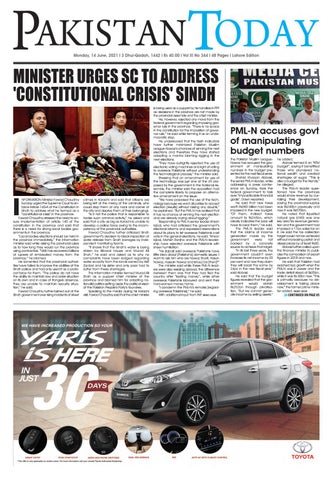
Minister urges sC to address 'Constitutional Crisis' sindh
i
NfORMATION Minister fawad Chaudhry Sunday urged the Supreme Court to enforce Article 140-A of the Constitution in Sindh to address what he termed as a “constitutional crisis” in the province. fawad Chaudhry stressed the need to ensure implementation of article 140 of the constitution in the province and said that there is a need for strong local bodies governments in the province. “Local bodies elections should be held in the province immediately,” the information minister said while asking the provincial rulers as to how long they would run the province using contractors. “NAB has recovered billions of rupees of embezzled money from the province,” he blamed. He lamented that the provincial authorities have failed to improve the abilities of the Sindh police and had only used it as a protocol force for them. “The police do not have the ability to maintain law and order situation on its own and in case of Rangers absence, they are unable to maintain security situation,” he said. fawad Chaudhry further lashed out at the Sindh government over rising incidents of street
crimes in Karachi and said that citizens are being left at the mercy of the criminals, who could stop them at any nock and corner of the city and deprive them of their belongings. “Is it not the police that is responsible to tackle such criminal activity,” he asked and said that a city as big as Karachi is unable to develop a police force owing to the incompetency of the provincial authorities. fawad Chaudhry further criticized Sindh government’s decision to block inspection of water release from Sindh barrages by independent monitoring teams. “It shows that the Sindh’s water is being stolen by Bilawal House and Murad Ali Shah,” he said and asked as to why no complaints have been lodged regarding water scarcity from the lands owned by Asif Zardari and his sister and only poor had to suffer from these shortages. The information minister termed Murad Ali Shah as a puppet chief minister of the province and blamed him for adopting nationalist politics setting aside the political vision of the Pakistan People’s Party’s founders. Speaking to the media during his Karachi visit, fawad Chaudhry said that the chief minister
is being used as a puppet by his handlers in PPP as decisions in the province are not made by the provincial assembly and the chief minister. He, however, rejected any move from the federal government regarding imposing governor rule in the province. “There is no space in the constitution for the imposition of governor rule,” he said while terming it as an undemocratic step. He underscored that the fresh indicators have further minimized Pakistan Muslim League-Nawaz’s chances of winning the next elections and therefore they have started adopting a mantra blaming rigging in the next elections. “They have outrightly rejected the use of electronic voting machines and right of voting to overseas Pakistanis without understanding the technological process,” the minister said. Stressing that an amendment for use of the technology was just one of the 49 proposed by the government in the National Assembly, the minister said the opposition had the complete liberty to propose an alternative amendment on the issue. “We have proposed the use of the technology because we want all parties to accept election [results] without raising any doubts,” he explained. “But the PML-N has realised that it has no chance of winning the next election and are already crying about rigging.” Responding to PML-N senior leader Ahsan Iqbal, who had criticised the government’s electoral reforms and expressed reservations about its plans to let overseas Pakistanis cast vote in the general elections, he said: “Ahsan Iqbal, Mohsin Ranjha and the PML-N leadership have rejected overseas Pakistanis with sheer humiliation. “He (Iqbal) said overseas Pakistanis have little idea about [Pakistan’s] domestic issues. I want to ask him who are Nawaz Sharif, Hasan Nawaz, Hussain Nawaz and Ishaq Dar [then]?” The minister said while these PML-N leaders were also residing abroad, the difference between them was that they had fled the country after “looting money”, while other overseas Pakistanis laboured and sent their hard-earned money home. “I condemn the PML-N’s remarks [regarding overseas Pakistanis],” he said. With additional input from INP. news desk
PML-N accuses govt of manipulating budget numbers The Pakistan Muslim LeagueNawaz has accused the government of manipulating numbers in the budget presented for the next fiscal years. Shahid Khaqan Abbasi, the senior PML-N leader, while addressing a press conference on Sunday, took the federal government to task over “impracticable financial goals”, Dawn reported. He said that new taxes worth Rs383 billion had been imposed in the new budget. “Of them, indirect taxes amount to Rs265bn, which clearly indicates the poor will have to bear them,” he said. The PML-N leader said that the claims of income generation made by the government were not backed by a concrete source to achieve that target. “In its last three years, the government couldn’t even increase its net income by 20 per cent and now they claim they will boost the same by 24pc in the new fiscal year,” said Abbasi. He said that the budget figures revealed that the government would obtain Rs252bn through privatisation. “But we cannot generate income by selling assets,”
he added. Abbasi termed it an “ATM budget”, saying it benefitted those who plundered national wealth and created shortages of sugar. “This is also a budget for the friends,” he alleged. The PML-N leader questioned how the provinces would share revenue by curtailing their development, saying the provincial surplus was Rs240bn previously and now it was Rs570bn. He noted that liquefied natural gas (LNG) was one key area for revenue generation and the government had imposed a 17pc sales tax on it. He said the tax collection target could not be achieved without increasing petrol and diesel prices by at least Rs30. Abbasi further called upon the finance minister to publicise the comparison of export figures in 2018 and now. He said that Pakistan had reached 6pc growth when the PML-N was in power and the trade deficit stood at Rs35bn, while it was Rs 30bn now. “This is primarily because no development is taking place now,” the former prime minister added. news desk
CONTINUED ON PAGE 05
02
Monday, 14 June, 2021
LAHORE
NEWS
Bilawal slams gOvt Over impOsitiON Of rs375BN wOrth Of taxes KARACHI
p
TLTP
AKISTAN People's Party Chairman Bilawal Bhutto Zardari has slammed the federal government for "not sparing a single thing of public's use from taxation," saying the decision to impose nearly Rs375 billion worth of taxes on the
masses is an "injustice." "The government's decision to impose taxes on phone calls and then immediately retracting the decision shows that it is confused," said Bilawal in a statement on Sunday. He said that the federal government is afraid of the public's reaction to the storm of heavy taxes imposed on them. The PPP chief quipped, "He rejected the pickpocketing of
the common man at the behest of the PTIMF." He vowed to continue unveiling Prime Minister Khan's anti-people economic measures." Two days ago, Bilawal had condemned the budget proposed by the federal government, calling it an "economic attack on Pakistanis". The PPP chairman, in a statement, said PTI would not be permitted to "play with the
nation’s future", vowing his party would not allow Prime Minister Imran Khan "to conduct an economic massacre of the people." Reiterating PM Imran Khan was "deaf, dumb, and blind" to the plight of the average citizen, he said: "The year might have changed, but the conditions of the people remain the same. A poor man’s house is still being deprived of necessities."
Condemning PM Khan for his "lack of empathy towards the underprivileged", Bilawal said through the new budget, the premier had made his "enmity" towards the poor people clear. "He has exposed his antipeople agenda with the new budget," he said. The PPP chairman said that while the government was busy presenting "false facts" through the Economic Survey 202021 and claiming that the nation is flourishing, government employees protested against inflation outside the Parliament. “People are now retaliating because they are aware of the puppet prime minister’s empty promises,” he said, adding: "They know it is Imran Khan’s habit to talk big and do nothing. He is incompetent and has completely failed to provide relief to the common man."
three terror suspects arrested in punjab: CtD LAHORE TLTP
The Counter-Terrorism Department Punjab conducted 53 intelligence-based operations across Punjab in a week and arrested three terrorists. According to the CTD spokesperson, during the operations, 54 suspects were questioned and three suspected terrorists namely Muhammad Arshad, Zubair and Rashid were arrested. The officials recovered religious hate-based documents from the terrorists, spokesperson said. “Arrested terror suspects have been affiliated with an outlawed group and cases have been registered against them,” the spokesperson said. Earlier on June 3, the CounterTerrorism Department had arrested an alleged terrorist during a raid conducted near Darya Khan-Bhakkar Link Road. The alleged terrorist Imran had been arrested on charges of planning an attack on a sensitive institution’s office. The raiding team recovered safety fuses, explosive material and other equipment from his possession. A case was registered against the alleged terrorist at CTD Sargodha police station and further investigation is underway.
sindh all set to present budget tomorrow KARACHI
ISLAMABAD: A beautiful view of the federal capital. ONLINE
TLTP
The Sindh government is all set to unveil the budget for the next fiscal year 2021-22 tomorrow (Tuesday). The budget would have programmes aimed at alleviation of poverty and social protection, besides 10 new mega projects for Karachi. The provincial budget would include the provision of loans under People’s Social protection and poverty alleviation programmes. An amount of Rs1 billion would be earmarked for social protection and poverty alleviation programmes while the minimum wage for labourers would be set at Rs25,000. A huge amount would also be earmarked for industrial workers in terms of medical care and social protection in the budget. The Sindh government will likely announce a relief package for senior citizens in the upcoming provincial budget for the year 2021-22. The government will announce the issuance of the ‘Senior Citizen Azadi Card’ to the province’s elderly citizens. Around 300 million rupees allocation is proposed for the Senior Citizen Azadi Card in the 2021-22 budget. The citizens having 60 or above age will be entitled to the issuance of the welfare card. Sources said that the Sindh government will sign an agreement with NADRA for the issuance of Azadi Card to senior citizens of Sindh. Separately, the provincial government will allocate Rs150 million for Darul Aman and Rs500 million for old age homes. The budget proposals also included a 20 percent increment in salaries of the government employees, while a 20 percent increase in pensions is also expected in the new Sindh budget. The salaries are also expected to be enhanced according to the pay scales of the employees. The Sindh government has also decided to allocate more than Rs3 billion for the purchase of new buses in Karachi in the provincial budget. Chief Minister Sindh Murad Ali Shah, who holds the portfolio of provincial finance minister as well, will present on June 15 the provincial budget in Sindh Assembly for the fiscal year 2021-22.
PM House saves Rs1.08bn in three years under austerity drive ISLAMABAD TLTP
Prime Minister Imran Khan’s austerity drive has helped in saving Rs1.08 billion under expenditure of the PM House during three years of his tenure, said SAPM on Political Communication Dr Shahbaz Gill. “As compared to previous expenditures at the PM House, Prime Minister Imran Khan saved Rs1.08 billion,” the SAPM said in his message on the micro-blogging site Twitter. He said if it would have been a government of Pakistan Muslim League-Nawaz (PML-N) supremo Nawaz Sharif or Pakistan People’s Party (PPP) CoChairman Asif Ali Zardari then the money would have been spent on them. “Imran Khan adopted an austerity drive, minimised his expenditures and now this amount would be used for funding Ehsaas programme,” he said. Meanwhile, Minister for Communication Murad Saeed said on Sunday that Prime Minister Khan has no camp office and saved Rs1.08 billion.
In a tweet, he said that PPP Co-Chairman Asif Ali Zardari had spent Rs2.6 billion and PML-N leader Nawaz Sharif had spent Rs4.3 billion during their tenures on their camp offices. He further said that 345 police vehicles and 656 personnel were deployed by Zardari on his camp offices, while 2,717 police personnel were deployed on security duty on Sharif’s camp offices. In September 2020, it emerged that the present government led by Pakistan Tehreek-e-Insaf (PTI) reduced the expenses of the Prime Minister (PM) House up to 68 per cent under its austerity measures. Imran Khan has fulfilled his promises for adopting austerity measures after making a record cut in PM House’s expenses by 68 percent. The expenses of staff and other expenditures of the PM House have visibly reduced from over Rs500 million to Rs310 during the last two years. It emerged that the numbers of employees at the PM House reduced to only 180 from 522, whereas, the present government spent Rs316 million so far during the two-year period as compared with the last year’s expenditures up to Rs509 million in 2018.
Murad returns after US visit KARACHI INP
Sindh Chief Minister Murad Ali Shah returned from the United States early on Sunday after a private visit. He reached Karachi via a private airline's flight. He had departed for the US on a
three-day visit last week, a spokesperson for the Chief Minister Office said. Shah, who also holds the portfolio of finance minister, is scheduled to unveil the budget for the 2021-2022 fiscal year on June 15. In a separate development, an accountability court has fixed June 30 for his indictment in the
Nooriabad power project reference. The decision was announced during a hearing into fake bank accounts, the Nooriabad project and money laundering cases on Tuesday. The project was launched in 2014 under a public-private partnership at a cost of Rs13 billion in which the Sindh government holds 49 percent shares and a private company owns the remaining 51 percent.
NCOC suspends travel from 26 countries NEWS DESK The government, on the recommendation of the National Command and Operation Centre, has placed strict restrictions on travellers from 26 countries, including India, to contain the spread of Covid-19 infections in the country. The NCOC, a nerve centre to synergise effort against the pandemic, has placed these countries in the "C category" and revised the inbound air and land travel categories with an immediate effect. "Countries in A category are exempted from the mandatory Covid-19 test, travellers from areas in B category require a negative polymerase chain reaction test that must be taken within 72 hours of the travel date while countries in C category are restricted and people can travel only under specific NCOC guidelines," an official from the Ministry of National Health Services said. The list of 26 countries includes India, Iran, Bangladesh, Bhutan, Indonesia, Iraq, the Maldives, Nepal, Sri Lanka, the Philippines, Argentina, Brazil, Mexico, South Africa, Tunisia, Bolivia, Chile, Columbia, Costa Rica, Dominican Republic, Ecuador, Namibia, Paraguay, Peru, Trinidad and Tobago as well as Uruguay in the C category list. Apart from the nations in the "C category", the rest have been included in the "B category" and passengers from these countries will be required to present a negative RT-PCR test result. The development comes as the nation reported 1,239 new cases and 56 deaths in the last 24 hours.
KP suggests LG polls in September-October period PESHAWAR INP
Khyber Pakhtunkhwa government on Sunday recommended holding elections for local governments between September and October. The recommendations forwarded by the provincial government further suggested that elections in the former tribal areas would be held separately.
“The elections in rest of the districts will be held on the same day,” it said as the cabinet would now mull over the recommendations on Monday. The Administration Department of the KP government has issued a 40-point agenda for the meeting that would also discuss measures to stem Covid-19 spread, the vaccination process, the inclusion of liver treatment in Insaf Sehat Card and approval of funds for tribal
areas. Laws relating to shelter homes, ordinance on safeguarding rivers and other key measures would also be discussed during the cabinet meeting. Earlier, it was reported that the local bodies elections in KP will be held in a phased manner. The new local government system will comprise the district, tehsil, village and neighbourhood councils. Officials have compiled
recommendations to keep the number of councillors less than the preceding local bodies systems. “It has also been recommended for direct election for the Tehsil Nazim”, sources said. “Under the new system, seven tehsil councils have been established in Peshawar,” officials said. The KP local bodies system completed its tenure in August 2020 and the Election Commission of Pakistan is bound to hold elections within 120 days after the expiry of tenure under the Election Act, 2017.
Monday, 14 June, 2021
LAHORE
JaDhav-speCifiC Bill aDOpteD tO implemeNt iCJ verDiCt: Qureshi MULTAN
D
gathered in front of the speaker’s dais and raised slogans like "Kulbhushan Ko Phansi Do" (Hang Kulbhushan) when PML-N Ahsan Iqbal pointed out that the government had included the bill in the legislative agenda. Speaking after the passage of the bill, Minister for Law and Justice Farogh Naseem said had they not passed the bill, India would have gone to the UN Security Council and could have moved contempt proceedings against Pakistan in the ICJ. Today, Qureshi said the opposition should act sensibly and understand the nefarious designs of India. The government, he assured, was taking measures on recommendations of the ICJ. Jadhav -- a serving commander of the Indian Navy associated with the Indian spy agency Research and Analysis Wing -- was
sTAFF REPORT
ENYING the rumours of reaching a backdoor deal with India on Commander Kulbhushan Jadhav, Foreign Minister Shah Mahmood Hussain Qureshi on Sunday said the government was taking measures to implement the ruling of the International Court of Justice in the case, Radio Pakistan reported. Last week, the National Assembly passed the International Court of Justice (Review and Reconsideration) Bill, 2020 to provide the right of appeal to the Indian spy. Shortly after, the rumour mill went into overdrive with claims that the development was the result of a backchannel agreement. During the session, the opposition MPs
arrested on March 3, 2016, from Balochistan on charges of espionage and terrorism. In his trial at a military court, he had confessed to his involvement in terrorist plots and was sentenced to death in 2017. In 2019, the World Court, after being approached by India, had ordered a stay in his execution through an interim order, urging Pakistan to review the penalty. Qureshi said that the Pakistan Muslim League-Nawaz government "mishandled" the issue, thereby "complicating" it for the Pakistan Tehreek-e-Insaf government. The foreign minister also reiterated that the government will neither provide troops or bases to the US nor permit it to use Pakistan's soil to conduct cross-border drone strikes. "Pakistan, under the leadership of Prime
Minister Imran Khan, will never provide its bases to the US," he declared. When asked, Qureshi said the process of accountability will continue and the government will not give National Reconciliation Ordinance to the looters. Responding to Pakistan Peoples Party chief Bilawal Bhutto-Zardari's reaction to the arrest of Syed Furrakh Shah, the son of PPP leader Khursheed Shah, he said everyone has the right to a fair trial. But, he said, the accountability drive can't be obstacled, and that Prime Minister Imran Khan would not offer NRO to corrupt elements. The decision of Saudi Arabia to restrict the Haj pilgrimage to its own citizens and residents for the second year running would help avoid the spread of coronavirus and its several mutants.
Covid-19 leaves 56 more dead, 1,239 infected: NCOC ISLAMABAD TLTP
The Covid-19 has claimed 56 more lives in the country during the last 24 hours, taking the nationwide death toll to 21,689, said the National Command and Operation Centre on Sunday. According to the NCOC data, the country’s caseload climbed to 941,170 after 1,239 more people tested positive for the deadly virus during this period. The 1,239 new infections emerged when 36,368 tests were conducted with a positivity rate recorded at 3.40 percent, the NCOC said. In Sindh, seven more patients of the coronavirus died during the past 24 hours, lifting the provincial death toll to
ISLAMABAD SEES 1PC POSITIVITY RATIO 5,243. In a daily statement on the Covid19 situation, Sindh Chief Minister Sindh Murad Ali Shah said 580 more people were diagnosed with the Covid-19 during the same period in the province. A total of 12,825 Covid-19 tests were conducted in the last 24 hours, he said, adding that the overall cases in the province stand at 328,167, he added. He further said that 299,446 patients have recovered, including 271 overnight. The CM said that currently 23,478 patients are under treatment, of them 22,755 were in home isolation, 20 at isolation centres and 703 at different
Over 170,000 youngsters have completed courses in high-tech trades: Dar ISLAMABAD: Special Assistant to the Prime Minister on Youth Affairs said on Sunday that investment in skill development of the youth had started paying dividends as more than 170,000 candidates completed their courses in high-tech trades from public and private universities under the skill scholarship programme. He said the government had disbursed an amount of Rs10 billion among the youth under the initiative. Young people were getting training in the courses of their choice under the technical and vocational institutes, he said. Dar said billions of rupees had been allocated for the youth as the government was striving to extend every possible technical and financial assistance in line with the instructions of Prime Minister Imran Khan. He urged young people to reap the benefits of the programme, aimed at creating job opportunities for the young population in the local and international market. Dar also shared the success story of Nadia Hassan Bangash who got an online job after completing the course in coding and device management from the National University of Technology in Islamabad. He posted her documentary on his Twitter account, saying Bangash had set an example for other young people. APP
time limit to probe taxpayer’s foreign income withdrawn The Federal Board of Revenue (FBR) has been authorised to probe foreign income of a taxpayer beyond the past five years as time limitation in this regard has been withdrawn through Finance Bill 2021. According to the budget 2021-22 documents, the Finance Bill 2021 proposed amendment to Section 114 of the Income Tax Ordinance, 2001. It is proposed amendment in sub-section (5) of Section 114, to insert new proviso, namely: “The time-limitation provided under this subsection shall not apply if the authority is satisfied on the basis of reasons to be recorded in writing that a person who failed to furnish his return has foreign income or owns foreign assets.” NEWs DEsK
hospitals. He added that the condition of 644 patients was stated to be critical, including 55 shifted to ventilators. According to the statement, out of 580 new cases, 355 have been detected from Karachi, including 130 from East, 64 South, 47 Korangi, 25 West and Malir 21. Murad urged people to abide by the SOPs issued by the government. In Punjab, at least 223 new coronavirus cases were recorded during the past 24 hours, taking the provincial tally to 343,926. According to the Punjab Primary and Secondary Health Care Department, at
least 22 more patients succumbed to the pandemic as the total death count reached 10,501. The department added that at least 321,879 patients had recovered from the deadly virus as of yet, with 457 people recovered in the past 24 hours. Islamabad recorded one percent Covid-19 positivity ratio, the lowest, over the past 24 hours in the current third wave of the pandemic. According to the district health officer, the positivity ratio was recorded at 1 percent in the past 24 hours in Islamabad. Only 34 cases were detected when the 3,226 samples were taken in the said period. The DHO Islamabad said as many as 500,000 people have been vaccinated against the coronavirus in the federal capital.
NEWS
03
When asked to comment on the criticism levied by Iqbal on what he said is the small increase in the defence budget, the foreign minister advised the PML-N MP to study the budget documents to "know the facts". About the work of District Coordination Committees, Qureshi said those were established at district-level following directions from the prime minister, and with a mandate to monitor development projects. The committee will meet after 15 days to review development projects, Qureshi said. Earlier, he laid the foundation stone of Al-Badar Park in his hometown of Multan and said that it would be an outstanding recreational facility for the people. The Parks and Horticulture Authority has also been directed to plant trees in the park, he said.
fOur laBOurers Die Of suffOCatiON iN Quetta QUETTA INP
Four young labourers, including three brothers, died of suffocation due to filling of gas in a water well they were working at in the provincial capital on Sunday. According to details, two labourers engaged in cleaning a water well in Khar Tar area of Marri Abad Quetta fell unconscious due to filling of gas in the well. Two more labourers climbed down the well to rescue the unconscious labourers but they were also affected by gas accumulation. The labourers were pulled out of the water well after half an hour and shifted to a hospital where they were pronounced dead by medics. The deceased included three brothers Muhammad Ashraf, Muhammad Rahim and Muhammad Taqi while fourth was identified as Abid Ali and they all were aged between 20 to 26 years.
Freedom movement can’t be suppressed through coercion: Masood five killed, six injured in RAWALAKOT TLTP
AJK President Sardar Masood Khan has said that world history is evident that the freedom movement could never be suppressed through oppression and coercion. On the contrary, he maintained that the states that had used force to silence the voices of justice could not survive for long. While strongly condemning the martyrdom of three youth at the hands of Indian occupation troops in Sopore town of occupied Jammu and Kashmir, Masood said that turnout of thousands of mourners in the funeral prayers of these youth despite all restrictions and hurdles is proof that the Kashmir people firmly stand with the liberation movement and they have rejected India's blind state terrorism.
The AJK president said that the Kashmiri youth who are sacrificing while resisting the Indian war machinery, give a clear message to Delhi that all repressive means and tactics would fail against their resolve for the liberation of their motherland. Khan recalled that once communism arrogantly ruled almost half of the world, but as this order was also based on oppression when it collapsed and its impacts spread up to Asia, Central Asia, and Eastern Europe. The state president advised the Delhi rulers that it was high time to grant the right of self-determination to the people of occupied Jammu and Kashmir, and play their role in maintaining peace in the region as well as the survival of their own state, otherwise, they were bound to experience the same situation in Assam, Mizoram, Behar, and West Bengal also, and if this happened, the Indian rulers would not be able to control it.
WAPDA supplying 5,800MW to grid during off-peak hours NEWS DESK The Water and Power Development Authority (WAPDA) has said that its all power houses are supplying 5,800 megawatts to the national grid during off-peak hours. The spokesperson of the Authority in a statement said that all
power houses including Tarbela are working as per their routine and are generating electricity according to water discharges. He said that currently, Tarbela is supplying 2,932MW to the national grid. He further said the power generation would further increase including from Tarbela during peak hours.
rain, windstorm in Kp ISLAMABAD sTAFF REPORT
Five people were killed and six others injured in separate rain and windstorm-triggered accidents in Khyber Pakhtunkhwa, the Provincial Disaster Management Authority said. Eight houses also collapsed when heavy rains coupled with strong winds lashed the province, the authority said in a statement. The district administration of all areas of the province was directed to stay alert for providing rescue and relief activities if some weather-related emergency occurs in their districts, the PDMA said. Meanwhile, one of the main highways in a tourist attraction of the Chitral district of the province was blocked due to erosion of a river passing by it, and efforts to repair and find an alternate path for vehicles is underway, the PDMA said. The injured people were shifted to nearby hospitals for treatment, the PDMA said. The Pakistan Meteorological Department forecasted more rains in Khyber Pakhtunkhwa and Punjab on Saturday night and Sunday, issuing a warning that windy and rainy weather conditions are feared to generate urban flooding in low-lying areas of the provinces. The weather office also advised tourists intending to visit resorts in Khyber Pakhtunkhwa and upper Punjab to check weather conditions before planning their trip.
G7's billion vaccine plan counts some past pledges, limiting impact ANALysIs REUTERS A G7 plan to donate a billion Covid-19 vaccine doses to poorer countries will have limited impact because it includes some previous pledges, but it still offers a small lifeline to a global vaccine buying system, according to some experts. Leaders from the Group of Seven major economies announced the move on Friday. A U.S. initiative announced on Thursday to donate 500 million doses of the Pfizer (PFE.N) and BioNTech SE (22UAy.DE) vaccine is part of the G7 pledge. Many of the promised doses will flow through COVAX, a global vaccine buying system backed by the World Health
Organization and Gavi, the vaccine alliance. The pledge does not represent entirely new resources, and the donation is far short of the 5 billion to 6 billion shots needed by poorer nations. Moreover, the plan does not address distribution gaps that could make it difficult to deliver doses. But experts said it is still a muchneeded boost to COVAX, which has so far only distributed 83 million shots worldwide. COVAX has struggled to secure deliveries as wealthy nations reserve enough shots to vaccinate their populations several times over. "It's going to rescue COVAX from its pretty dire predicament right now, so it's a very significant step," said Stephen Morrison, the director of the Global Health Policy Center at the Center for Strategic and International Studies, a
think tank. The United Kingdom's 100 million dose pledge is "entirely new" according to a spokesperson. But the European Union's 100 million dose commitment was promised during a summit in May, and the U.S. commitment partially replaces earlier promises to fund COVAX directly. The United States has already donated $2 billion to COVAX, according to a White House official. In February, the Biden administration pledged $2 billion more. But that second $2 billion will now fund the purchase of the Pfizer doses, along with $1.5 billion in additional funds, according to the official. Even if the shots are acquired and shipped, they risk overwhelming developing countries' limited distribution infrastructure, especially if many are delivered together late this year. The World Bank extended a $12
billion line of credit for developing countries to build out vaccine distribution infrastructure, but governments have drawn down only about $3 billion. "The low-income countries are wary of increasing their debt profile, that is the reality," said Edwin Ikhuoria, executive director for the ONE Campaign, a nonprofit focused on poverty and public health. Others argue that wealthy countries should find a way to ship doses more quickly, especially as some near expiry in countries with high vaccination rates, including those made by Johnson & Johnson Inc (JNJ.N). "When you just see the graph of the increase of vaccination coverage in wealthy countries and the accelerated pace at which that has been happening, and then when you look at the pace in developing countries, it's just so stark," said Kate Elder, senior vaccines policy adviser at Médecins Sans Frontières. "Doses are needed now.
04
Monday, 14 June, 2021
LAHORE
NEWS
MPas call on cM, ProMIse full suPPort LAHORE
M
INP
PAs from the PML-N and the PPP met Punjab Chief Minister Sardar Usman Buzdar on Sunday and expressed complete confidence in his leadership and assured him of their full support. They also lauded the vision of the chief minister for proposing excellent measures of
public welfare in the forthcoming budget. The elected representatives also apprised the CM about the problems of their respective constituencies, said a handout issued here. Buzdar assured them of resolving their issues on priority basis and said that his doors were always open for all. He asserted that the new fiscal year budget would open a new chapter of development and prosperity for the people of the province as substantial funds were being allocated in the budget.
More funds would be allocated for education, health, agriculture, infrastructure and other social sectors, he added. The chief minister said that separate development packages had been devised for all districts. The negative politics of the conspirators had been buried forever. Now the politics of public service would prevail instead of politics of anarchy, he added. He said that there was no room for corruption and corrupt elements in Naya (new)
Pakistan under the leadership of Prime Minister Imran Khan. Without caring for criticism, the journey of public service would be further accelerated, he said adding that the negative politics of the Pakistan Democratic Movement (PDM) had met its logical end and people had rejected the politics of chaos. The PDM’s end was quite a lesson for those who were engaged in the negative politics, he added. The attempts of opposition to divide the nation failed miserably, he
added. The people of Pakistan were well aware and would never be fooled by the corrupt elements, he said. Those who met the Chief Minister included Mian Jalil Ahmed Sharqpuri, Chaudhry Ashraf Ali Ansari, Muhammad Ghias-ud-Din, Muhammad Faisal Khan Niazi, Raees Nabeel Ahmed and Ghazanfar Abbas and Azhar Abbas Chandia. Chief Whip Punjab Assembly MPA Syed Abbas Ali Shah, Tahir Bashir Cheema, Younis Ansari and Masood Majeed were also present.
Hyderabad weddIng Hall staffers kIll waIter for ‘not lIstenIng’ HYDERABAD: People working at a wedding hall in Hyderabad’s Qasimabad have been accused of beating a waiter to death. A case was registered against a person named Muhammad Shah and others on Sunday. The FIR said that the staff members thrashed a man, identified as Tharo Shoro, for refusing to set up more chairs at the hall. He died on the spot. The case has been registered for murder and includes sections 34 (acts done by several persons in furtherance of common intention), 114 (abettor present when offence is committed), and 506 (punishment for criminal intimidation) of the Pakistan Penal Code. INP
weather turns pleasant after rain in lahore, other parts of Punjab LAHORE: Rain in the provincial capital Lahore and its adjacent areas and other cities of Punjab in the wee hours of Sunday turned the weather pleasant while Met Office predicted similar weather conditions for the next 24 hours. Rain with strong wind was also reported in other cities of Punjab, including Islamabad, Rawalpindi and Gujranwala. The Met Department has also forecast rain-wind/thundershower in Khyber Pakhtunkhwa and Kashmir. Isolated heavy falls and hailstorm are also likely during the period. The department warned that wind thunderstorm with heavy falls at times may generate urban flooding in low-lying areas of Azad Jammu and Kashmir, Jhelum, Rawalpindi, Lahore, Gujranwala and Sialkot during the spell. INP
2 more people abducted in shikarpur village after anti-bandit operation SHIKARPUR: Two more people have been abducted from the Garhi Tegho area of Shikarpur, raising the number of abductees from the area where police launched an operation against bandits to 10. According to sources having knowledge of the incident, two more people have been abducted from the area allegedly by the bandits. “The total number of abductees now stands at 10,” they said adding that the police have launched an investigation into the incident. A report on June 01 said that the anti-bandit operation in the riverine forest area of Garhi Tegho in Shikarpur district remained suspended for the fourth consecutive day. “Even the intelligence-based targeted anti-bandit operation yet to be started”, according to sources. SSP Shikarpur Tanveer Ahmed Tunio has said that surveillance drones are being used to monitor the forest area along the Indus River. “We have gathered information and made maps of different points in the katcha area,” the police chief said. INP
LAHORE: Return of tourists to Greater Iqbal Park brings an influx of littering and pollution. ONLINE
A Pakistani worker at Qasim power plant rated as role model BEIJING INP
Wearing a plain kurta, a chic waistcoat and a white hat, under Faisal Bashir’s bushy beard is his shallow smile. Known by all workers as whisker dude, he is an accountant at Port Qasim Electric Power Company. He has been mainly responsible for the company's taxation, auditing, and external coordination. He is proactive and conscientious in his work, says a report carried by China Economic Net on Friday. The Port Qasim power plant is a 1.32GW coal-fired plant developed approximately 37km southeast of Karachi, Pakistan. Jointly owned by Power China and Qatar’s Al-Mirqab Group, the coal power plant is one of the priority energy projects and the first largescale power energy project undertook as part of the China-Pakistan Economic Corridor (CPEC). It is also an important milestone in the iron-clad friendship between China and Pakistan, as well as a successful model of China-Pakistan energy cooperation projects and a benchmark project under the CPEC’s fast-tracked Early Harvest programme. Faisal is the first Pakistani tax consultant hired by the power plant to optimize its tax management. He used to work in professional accounting agencies such as PricewaterhouseCoopers and Deloitte for many years, and joined the Qasim power plant under the influence of CPEC. Faisal said that he still remembered how excited he was to see the Qasim project when he came to the plant for a job interview. Pakistan’s tax system is complex. Qasim Electric Power Company is not registered in the same place as its business place, which involves different kinds of taxes and the company has to
pay a large amount of taxes every year. Therefore, it is of great importance for the company to optimize its taxes according to relevant regulations of Pakistan. In this case, Faisal made a thorough study of relevant tax laws, assisted the company in completing the import of goods and equipment and exempting part of income tax. As two units connected to Pakistan’s national grid, the power plant’s consumption of coal was increasing day by day. In order to ensure the cash flow of the company, Faisal actively assisted in the reduction and exemption of related tax. Up to now, he has successfully handled 145 shipments of coal into Pakistan, saving millions of dollars in cash expenses for the company. According to the benchmark electricity price policy, the Qasim project needs to apply for commercial operation approval to the Pakistan’s National Electric Power Regulatory Authority (NEPRA). In April 2018, the second power generation unit began commercial operation. Faisal and the project team raced against the clock. Under the requirements of the NEPRA on data integrity and timeliness, Faisal compiled dozens of solid and reliable materials with a total of more than 5,000 pages and submitted them to the NEPRA in time. Since then, he actively maintained communication with the Islamabad team, assisted in clarifying the questions raised by NEPRA and cooperated with relevant staff to conduct on-site inspections. Finally, he properly resolved disputes in the electricity price accounting, and the project was approved for commercial operation electricity price on September 27, 2019. When talking about this story,
Faisal said, “We did go through a lot of difficulties, but we finally overcome them. In addition to the sufficient materials we prepared in the early stage, it is also imperative to answer the questions of NEPRA timely and accurately. This is the result of our team's unity and cooperation towards the same goal. Our colleagues in Islamabad and the financial team have done their best to achieve the goal." In his work, from contract signing to daily business communication, Faisal always communicated with the auditors in every detail, so that the auditors could have a better understanding of the project and the company structure. From 2015 to 2018, the accounting firm issued the company qualified financial reports for four consecutive years. Last year, Pakistan’s tax authority conducted a tax audit on the company. In order to properly solve relevant issues, Faisal took the initiative to discuss with the pundits and the company staff and finally solved those issues reasonably and effectively. Faisal has won unanimous praise from the plant employees. "He has been very careful and able to consider critical points that we might not have noticed, giving us a lot of professional support. I've learned a lot from him and even improved my English skill since working with him," said Wang Qingxi, an employee from Financial Management Department. As a local, he makes full use of his language advantages, especially when communicating with the State Bank of Pakistan, Federal Board of Revenue, Sindh Revenue Board, and accounting firms, he always uses Urdu to effectively resolve problems. Focusing on the long-term development and core interests of the company, Faisal can also handle various external affairs flexibly, which not only ensures the accelerated implementation of the localized talent strategy, but also effectively promotes the operating efficiency of the company.
Iranians in Pakistan prepare to take part in presidential polls ISLAMABAD TLTP
As the 13th presidential election in Iran approaches, Iranians living in various cities of Pakistan are preparing to participate in the election to play a role in the fate and future of their country. The Embassy of the Islamic Republic of Iran in Islamabad and the consulates general in four provincial capitals are also gearing up for the election to be held on June 18. The ambassador of the Islamic Republic of Iran in Islamabad will also chair the Executive Board of Elections in the federal capital. Overall, five polling stations would be established in different cities in Pakistan for the presidential election at the Iranian embassy in Islamabad and four consulates in the cities of Karachi, Lahore, Peshawar, and Quetta. Iranians living in the Pakistani capital are eligible to vote in this election period. The minimum voting age is 18 years, and Iranians who do not have a birth certificate or national identity card can use a valid passport to vote. The cities of Karachi and Lahore, as compared to other cities in Pakistan, have the largest population of Iranians, most of whom are students or businessmen or economic activists. Iran's 13th presidential election will be held simultaneously with the sixth round of municipal council elections for the cities and villages, the first mid-term for the 11th round of parliamentary byelection, and the second mid-term for the fifth round of the Assembly of Experts election. Seyyed Amirhossein Qazizadeh Hashemi, Alireza Zakani, Mohsen Mehralizadeh, Abdolnnaser Hemmati, Mohsen Rezaei Mirqaed, Saeed Jalili, and Ebrahim Raisi are competing in the elections.
Monday, 14 June, 2021
LAHORE
NEWS
BoxiNg LessoNs for seaMeN CITy NoTES M A NIAzI
T
HE Cabinet recently decided not to allow PTV to get its feed of the matches with England during the tour there from an Indian broadcaster. Obviously the Cabinet has not heard of geoeconomics. I don’t know whether it can play any role in the footage of Dr Firdous Ashiq Awam, which the WWF wants to an unlimited extent. Negotiations are going on with her boss, Punjab CM Usman Buzdar, but he is not an honest broker, and his own attempts to his footage taken are not helping. While the WWF acknowledges that Buzdar is Dr Awan’s boss, and she probably picked up some of the finer points of the noble art from him, the WWF has not seen him in action. On the other hand, Abdul Qadir Mandokhail has been a target, and has been left wondering whether he got into politics to get beaten up. That sort of thing was supposed to happen in Taiwanese assemblies, not here. Dr Awan would be a terror for pa-
tients. Imagine going to her with a headache. And then she might attempt to treat it without painkillers. Well, she’s probably a good anesthetist: sock ‘im in the jaw, and he’s out like a light. Well, it’s now obvious that the AC Sialkot didn’t walk away from Dr Awan’ dressing down in a Ramzan bazaar because she was concerned for her dignity, as for her bones. Imran Khan’s getting rid of her begins to make sense. During the PPP government, she was Information Minster, and before that Minister for Population Welfare. Under her as minister, journalists didn’t disappear. They were kept in line by fear of her. Mandokhail should think himself lucky. She could have sat on him. Her leader, Imran Khan, must have also noticed how the PSL has resumed, true, but with the day/night match being played so late by our time that no one knows the result even after watching. Sleepiness makes us feel we’ve gone ten rounds with Dr Awan, so forgive us for being punch drunk. But Imran doesn’t face the difficulties that COAS Gen Qamar Javed Bajwa does. It seems that the Central Asian Republics don’t know the differ-
ence between the Army and the rest, and keep sending him Navy men. First, he had to meet the Tadzhik President, Imomali Rahmon, who had dome his (Soviet-era compulsory) military service in the Soviet Navy. And next he had to entertain the Azeri Naval chief, a rear-admiral. Azerbaijan has a Navy because it has a Black Sea coast, but that is why it has one frigate, one ex-US Coast Guard cutter, and a number of patrol boats. Azerbaijan did have a vice-admiral as naval chief, but he was arrested for theft, fraud and embezzlement when the Defence Minister changed. Try and imagine a peon getting slapped on the wrist if Pervez Khattak gets changed. I wonder how the COAS got on with Rear-Admiral Subhan Bekirov. Maybe they talked about the six landing craft the Azeri Navy possessses. They are meant for naval infantry, or marines, of which we have got some, but no landing craft. Of course, getting the landing craft here would be headache. Not only would the Azeri Navy have to get to the Suez Canal via the Mediterranean, but then there would the journey across the Persian Gulf, and then what? A violation of the principles of geoeconomics?
Of course, Imran should pay attention to what happened to Emanuel Macron. The French rival to Dr Awan was a white supremacist. White supremacists are not nice people. Look at what they did to a Pakistani family in Canada. Imran has said that somebody should stop the hate speech which incites violence among them. What about the hate speech that is being used against the corrupt here? Hatred of corruption has reached the point where people get hit. Are we supposed to wait until somebody gets killed on a talk show? The government would be at an advantage, because its spokesmen would get the gun licenses necessary. And if TV anchors put their foot down, there’ll always be the option of running over the other guy, like they seem to do in Canada. And then there was the train accident near Ghotki, and for once, Sh Rahid was not at fault. This time, it was Azam Swati who was supposed to do the decent thing and resign as Railways Minister. But he didn’t. Instead, he asked for Rs620 billion for upgradation of Railways. Even Sh Rashid never thought of asking for money after a railways disaster. He just didn’t resign.
05
PML-N accuses govt of manipulating budget numbers contInueD froM pAge 01 Contradicting the government’s claim of achieving bumper crops, he said: “We are still a net importer of food so how did bumper crops witness growth? Our cotton production nosedived to seven million bales from 12m. Is this what you call bumper crop?” He alleged that the budget figures did not actually matter to the government because there would be another finance minister by the time the next budget was presented. The senior PML-N leader said that 20m people had fallen below the poverty line in the three years of the government, adding that the current rulers seemed to have “no strategy” to bring down inflated power, gas, and water bills. He said that the “construction mafia” was getting prime benefits in the budget. “The government has allowed people to invest in a sector which has amnesty and those with black money are buying homes, while the poor are unable to afford their own homes,” the PML-N leader alleged.
CBDCs a useful but risky tool for emerging markets: report ISLAMABAD
Crude prices poised for further highs this week
Cryptos grapple with regulation fears as bitcoin falls to $35,885
ISLAMABAD AGENCIES
ISLAMABAD
Oil prices are poised for further highs this week, as rising vaccination rates are leading to higher mobility in the US and Europe, with global demand estimated up 1.5 million barrels per day in the last month to 96.5 mb/d. The OPEC has said it expected oil demand to rise by six million bpd this year, and the International Energy Agency forecast it would add 5.4 million bpd this year and another 3.1 million bpd next year, returning to and exceeding pre-pandemic levels to reach 100.6 million bpd by the end of 2022. Brent, the international benchmark for twothirds of the world's oil, rose 1.11 percent to the highest finish since May 21, 2019 to close the week at $72.69 a barrel. Likewise, the US West Texas Intermediate (WTI) crude futures scored 1.85 percent weekly rise to reach $70.91 a barrel. The price for Opec Basket was recorded at $70.90 a barrel, Arab Light was available at $72.12 a barrel while the price of Russian Sokol reached $72.96 a barrel. Meanwhile, Goldman Sachs has reiterated its forecast that Brent crude will hit $80 per barrel this summer as demand quickly recovers. The IEA said in a report on Friday that producers will need to increase output to keep up with demand recovery. It expects demand to rise in 2021 before growing at a faster rate next year, reaching 100 million barrels a day (mb/d) by the end of 2022. According to the energy agency, there’s scope for the Organization of the Petroleum Exporting Countries and its allies (OPEC+) to boost production by 1.4 mb/d above its July 2021 to March 2022 target.
AGENCIES
The crypto market continued sliding down on Sunday with India and South Africa preparing for regulation of the market, and the total market capitalisation decreased to $1.57 trillion from $1.59 trillion a day earlier as of 13:00 GMT. The price of bitcoin (BTC), the largest cryptocurrency, shed 0.32 percent to reach $35,885. With this decrease in price, the market capitalisation of the BTC has reached $672 billion. Likewise, ethereum (ETH) price decreased by 3.25 percent to reach $2,359. With this decrease in price, the market capitalisation of ETH has reached $274 billion. Similarly, XRP shed 0.30 per-
cent to reach $0.832. The market capitalisation of XRP stands at $83 billion after this decrease. On the other hand, Cardano (ADA) price reached $1.42 with a 3.33 percent decrease in its price. Its market capitalisation has reached $45.6 billion with this decrease. Similarly, dogecoin (Doge) shed 1.57 percent to reach $0.309. With this decrease in price, the market capitalisation of Doge reached $40.1 billion. Meanwhile, India may be regulating crypto as an asset class under the purview of the Securities and Exchange Board of India (SEBI). In addition, a crypto bill is likely to be introduced during the Monsoon session of parliament, local media reported. According to Indian media, the government has moved away
from its earlier hostile stance towards virtual currencies and will most likely classify bitcoin as an asset class in India soon. Market regulator Securities and Exchange Board of India (SEBI) will oversee regulations for the cryptocurrency sector after bitcoin’s classification as an asset class. Likewise, South Africa’s Intergovernmental Fintech Working Group (IFWG) has released a new position paper that calls for the regulation of the country’s cryptocurrency ecosystem. In the document, the IFWG, which is a creation of the South Africa Reserve Bank (SARB), recommends “a staged approach to bring crypto-assets within the regulatory remit through the regulation of crypto asset service providers (CASPs).”
McDonald's hit by data breach SEOUL: McDonald's is the latest big company to be hit by a data breach that has exposed customers' details. The world's biggest burger chain said cyber attackers had accessed a "small number" of files on customers in South Korea and Taiwan. The breach included e-mail, delivery addresses and phone numbers - but not payment details. A spokeswoman for the firm said it would take steps to "notify regulators and customers listed in these files". The details of the breach, first reported by the Wall Street Journal, were discovered during an external investigation after unauthorised activity was spotted on the company's network. The company said its "substantial investment" in cyber security meant it was identified quickly. "These tools allowed us to quickly identify and contain recent unauthorised activity on our network. A thorough investigation was conducted, and we worked with experienced third parties to support this investigation," it said. Operations at its restaurants were not affected by the hack. AGENCIES
TLTP
Emerging market countries have been front runners in the adoption of digital currency projects, which could boost financial inclusion, according to a new report. However, countries adopting digital currencies face risks, such as increasing digital dollarisation as they gain access to other countries and a potential rise in local inflation rates, according to BofA Securities, an American multinational investment banking division under the auspices of Bank of America. "Central banks representing a fifth of the world's population are likely to issue a general purpose central bank digital currency (CBDC) in the next three years,” according to the latest Bank of International Settlements survey. Eighty-six percent of global central banks are exploring the benefits and drawbacks of CBDCs. About 60 percent are conducting experiments or proofof-concept,” the bank said in a research note. “The most advanced central bank digital currency projects are currently run in China, [South] Korea, Singapore, South Africa, Thailand and the UAE.” CBDCs are digital forms of national currencies such as the dollar, the euro or the dirham, backed by a country's central bank. A growing number of nations are trialling CBDCs and central bankers and finance ministers from the Group of Seven nations last week pledged to work together to understand "their wider public policy implications". "Our objective is to ensure that CBDCs are grounded in long-standing public sector commitments to transparency, the rule of law and sound economic governance," the policymakers said in a joint communique. The UAE has already completed Project Aber, a CBDC proof-of-concept trial with Saudi Arabia last year, which confirmed blockchain technology could be used to “reimagine both domestic and cross-border payment systems in new ways". In February, the UAE Central Bank also joined a multi-nation project with the Bank of Thailand, the Hong Kong Monetary Authority and the Digital Currency Institute of the People’s Bank of China to examine the business use cases for using blockchain for real-time, cross-border payments in both domestic and foreign currencies.
Analysis: With Trump gone, NATO wages war on climate threat If the U.S. military were a nation state, it would be the world’s 47th largest emitter of planet-warming greenhouse gases, a 2019 study found. Though the British universities of Lancaster and Durham took account only of emissions from fuel usage in their study, it pointed to the huge impact that armed forces across the globe are having on the earth's climate. Facing a battle against global warming, NATO has for the first time made it a central focus of planning and strategy. Leaders of the Western military alliance are set on Monday to agree on a climate action plan to make their armed forces carbonneutral by 2050, and to adapt to threats posed by global warming. NATO diplomats say efforts to focus on climate change were stymied during Donald Trump's U.S. presidency. He called climate change a "hoax" and pulled the United States out of the international Paris Agreement to fight climate change. Trump also expressed a lack of trust in the North Atlantic Treaty Organisation, and in 2018 threatened to withdraw the United States from the alliance formed in 1949 to contain a Soviet military threat. Now, with U.S. President Joe Biden pri-
oritising climate action, the diplomats said NATO was able to act on concerns that climate change is a threat both to transatlantic security and to alliance personnel. "This is a defining challenge of our time, and we must be an organisation that leads on it," a senior European NATO diplomat told Reuters. POLLUTERS: NATO member states' militaries have long been aware that climate change will have huge security implications, expected to include increased migration, flooding at coastal NATO bases and a larger Russian presence in the Arctic as sea ice melts. But, to reduce their own climate-warming emissions from fossil fuel use, the member states require reform at the centre of the alliance because NATO sets fuel standards across the organisation. By committing to eliminate its net CO2 emissions by 2050, NATO's action plan would align the organisation with the pathway to deliver the Paris Agreement's goal of limiting global warming to 1.5 degrees Celsius (34.7°F). Meeting that goal will mean reducing military emissions that are often exempted from countries' carbon emissions targets - no mean feat for the U.S. Department of De-
fense, the world's single largest consumer of petroleum, according to research in 2019 by Neta Crawford at Boston University. While experts say EU countries under-report emissions from national militaries, a study commissioned by the European Parliament calculated in February that the carbon footprint of EU military expenditure in 2019 was about 24.8 million tonnes of carbon dioxide equivalent - about the same as the CO2 emissions released by around 14 million cars. A German defence expert, who declined to be named, said a main battle tank such as Germany's Leopard 2 guzzles 400 litres (106 gallons) of diesel in the field to cover just 100 km (62 miles). The average fuel consumption in the United States of a light-duty civilian vehicle was 9.4 litres per 100 km in 2018, according to a 2020 International Energy Agency report. Tank warfare also risks being tougher under global warming. During a NATO exercise in Poland in 2019, temperatures in German Ozelot tanks rose above 40 degrees Celsius, and soldiers could spend only a few hours at a time inside, a military source said.Some NATO allies are working to reduce electricity use or are integrating climate prediction models into military missions.
cMYK
Germany has its first carbon-neutral barracks, producing energy almost completely from geothermal power and solar panels. The Dutch military can use solar panels instead of diesel generators during operations. 'CRISIS MULTIPLIER': NATO SecretaryGeneral Jens Stoltenberg and U.N. SecretaryGeneral Antonio Guterres have described climate change as a "crisis multiplier". Militaries are also expecting more operations in climate-vulnerable regions, as troops are called on to help tackle climatedriven natural disasters. Such crisis management is one of NATO's fundamental tasks, because of its ability to provide food supplies and logistical and medical support quickly. In 2018, eight of the 10 countries that host the largest number of personnel involved in multilateral peace operations were in areas highly exposed to climate change, according to a study by the Stockholm International Peace Research Institute. Allies are also testing more equipment to operate in extreme cold. Durability of assets on the battlefield has always been a priority, European defence sources told Reuters. Stoltenberg, a former U.N. special envoy on climate change, began pushing for a NATO climate agreement before Biden replaced
Trump, calling on the alliance to take action on climate in a speech in September 2020. Allies have yet to decide how much climate-related investment to fund jointly at NATO. "The security policy community now sees more clearly that climate change is a driver of conflict," said Jamie Shea, a former senior NATO official now at the Friends of Europe think tank in Brussels. Because military assets take decades to develop and have a longer life than civilian vehicles, one of NATO's biggest contributions in the medium term, experts say, will be in increased use of synthetic fuels instead of fossil fuels. Produced from water, CO2 and renewable energy, synthetic fuels do not produce sulphur or nitrogen pollution and still have a high energy density. NATO's standard fuel to power planes or ships is kerosene, one of the more polluting fuels. The German military, the Bundeswehr, may start adding synthetic fuel to traditional fuel in several years. Electric tanks, however, are not an option. "It will prove difficult to install charging stations on the battlefield in time before the fighting starts," said a German defence source who declined to be named. REUTERS
Monday, 14 June, 2021
06 COMMENT
A subtle form of workplace Harassment
Punjab-Sindh water dispute The only way out is dialogue
Men are under the double-headed axe, and women under the cold violence of ostracism
t
He dispute between the Punjab and sindh governments over water allocation for this Kharif crop seem both inevitable, yet entirely avoidable. the inevitability comes from the fact that the two provinces are ruled by two different parties, the Pti and the PPP, while the Pti rules at the centre. the Pti’s confrontational attitude has probably been further sharpened by the federal ministry involved, the Water resources ministry, was headed by senator Faisal Vawda, whose previous outbursts have marked him out as an extremist even in a pretty extreme crowd. it should be remembered that when the PPP was in office at the centre in 2008-2013, the PmL(n) held office in Punjab, but while the dispute existed, the centre did not allow it to be raised. the immediate dispute is over the sindh government’s refusal to nominate any member to the tripartite Discharge monitoring team, federal inspectors’ attempt to inspect Guddu Barrage discharges. the sindh irrigation secretary has taken the position that the Water resources ministry has no standing in the matter, and that disputes between the provinces were to be resolved by the indus river system authority. Be that as it may, it must not be forgotten that the 1991 Water accord, on which both provinces are relying, was reached and signed by the Pm and cms, with no formal role for irsa, even though it existed back then in 1991. in short, this is a political problem, and must be solved politically, through dialogue. However, two of the three parties, the centre and Punjab, are ruled by a party which aspires to carry out political activity without dialogue. in the process, it has alienated other parties, such as the PPP, by persistently calling it and its leaders thieves and corrupt. though there is the example of the Karachi transformation Package, it does not really hold out much hope. if instead of playing politics by incendiary statements, as information Fawad chaudhry indulged in, accusing sindh cm murad ali shah of stealing water, and diverting it to ex-President asif Zardari’s land. Keeping the doors of dialogue open is done exactly for times like this. the matter of irrigation water is sensitive, especially when all the three governments are backed by majorities comprising large landowners. there is no way out except dialogue, and the government’s take-no-prisoners attitude means no solution will be possible.
MuhaMMad arif Zia
O
stracism reflects a situation in which two or more people converse in a jargon that others around cannot grasp. social exclusion is putting a person into a situation of being alone or deprived of social interaction. Women in the workforce is another wheel of economic transition for sustainable development. a substantial proportion of the populace consists of competent women; but they are confronted with challenges at the workplace, to which they are vulnerable. Frequently harassment is deemed solitarily a sombre peril next to family issues, while on the flip side of the coin, working women face unnoticed cold violence which impedes work commitment and productivity. Workplace ostracism is an example of cold violence, nD is the degree to which an individual perceives that heor she is ignored, overlooked or excluded at work. social exclusion, abatement, being out of the loop, all in conjunction, are termed as ostracism. ostracism is inaction to socially engage with others and the omission of positive attention whereas harassment, bullying, interpersonal deviance, aggression, social undermining, and incivility are commissions of negative attention. the term “ostracism” started off in the Greek word “ostrakon”, which was “a piece of pottery” used
Netanyahu goes today
B
enjamin netanyahu is set to leave office today after the Knesset votes him out of office, and install naftali Bennett in his place. the government will have three immediate tasks: reaching out to arab israelis, reaching out to the Palestinians in the occupied territories, and repairing some of the damage globally, who are beginning to see that israel has made the occupied territories a prison for the Palestinian people. even though the new Prime minister neftali Bennett, heads an extremist rightwing settler party, basically campaigning on the platform that he was not netanyahu, he will have to solve these issues. the problem is, he might not. He was not really elected, for he has come to office at the head of an eightparty coalition, and in which he will have to give his office to another in midterm. Perhaps more pressing are what become of the corruption charges netanyahu faces. it was to avoid being arrested for them that he had soldiered on through four elections in the last two years. though the coalition replacing him is headed by a fellow rightwinger (in fact, mr Bennett was his Defence minister as recently as last year), it will have to find some way of dealing with the Palestinian arab issue. the violence against arabs in israeli cities pointed up a trend dangerous for any government. it is unfortunate that mr Bennett will be like mr netanyahu in refusing to face facts, and accept that there can be no peace so long as Palestine remains occupied. However, the fact that the writing is on the wall is reflected both by the worldwide condemnation, or at least awkwardness, over the recent israeli aggression in Gaza. that mr netanyahu has had to leave office also reflects the israeli people’s realisation that they cannot crush Palestinian aspirations forever. though perhaps not as dramatic as some dashing exploit, the steady drip-drip of electoral results provides a more durable result.
Now India is using fresh tools against Pakistan raania Siddiqui
“War never achieves its absolute because war is never an isolated act: war does not consist of a single short blow: and in war the result is never final. Clausewitz, On War 1780-1831
W
ar methods have transformed over the years from first- generation warfare to fifth, also known as hybrid warfare. Hybrid warfare is a military strategy which employs a blend of conventional and non-conventional warfare with political, irregular and emerging, alternating technologies being the most influential. it is the most dangerous form of warfare because it is hard to locate the targeted aspect as well as the direction of the incoming unleashed weapon. Historically, Pakistan and india have been at war more than once and still continue with border skirmishes and minor conflicts involving trade and diplomacy, however, now india has shifted its strategy to hybrid warfare. india made unlimited attempts to adversely affect the national security of Pakistan, however; Pakistan emerged victorious and defeated india through its strong course of counterattacks. some tactics used by india to destabilize Pakistan’s security includes; evident insurgency through statesponsored terrorism as in the Kulbhushan Yadav case, Lawfare; through abrogation of article 370 of the indian constitution revoking the special status of indian-occupied Kashmir, the 2019 PulwamaBalakot crisis, and the indian chronicles: india’s disinformation campaign. india struck on several fronts, isolating Pakistan from the rest of the world. it has openly financed terrorism in Pakistan for many years. india’s statesponsored terrorism was an attempt to paint Pakistan as a failing terrorist state on the worldwide stage. in recent years, india has been globally ex-
Dedicated to the legacy of the late Hameed Nizami
Arif Nizami Editor Managing Editor
Joint Editor
Umar Aziz Executive Editor
Lahore – Ph: 042-36300938, 042-36375965
havior, lower level of commitment, poor psychological well-being, knowledge hiding/hoarding, eroding of quality service delivery and high turnover among the workforce. ostracism persecutes both genders, however it is conjectured that it victimizes women relatively more than men because of masculine cultural dominance; gender indifferences; actors’ perceptions of low level of counter-attacks of victims and lack of cross-gender social integration. or on the one side of the coin, most women themselves prefer isolation over social integration, and the majority of women have the same state of mind. as a result the minority had to face ostracism. on the flip side of the coin the male workers are under a labrys, or double-headed axe; if they endeavour to socially integrate at the workplace cross gender; they are always in danger of being accused of harassment, and if they try to avoid this, they are accused of an act of ostracism. the boundary lines of both constructs, ostracism and harassment, are to be ruled out and the balance of thoughts and social integration are crucially needed in both genders. in a developing country like Pakistan, the work force in general and women in particular have to face cold violence in several forms of workplace ostracism. ostracism is ubiquitous, an inevitable part of the workplace; deplorably it is unnoticed and unaddressed; since organizations don’t regard it as an offense like workplace harassment in their codes of conduct, and due to the absence of a robust legislative framework. ostracized employees have to either tolerate it or sip it up silently. the ostracized employee doesn’t report it for being considering it as not an offence, to avoid disputes or to save jobs due to the high unemployment rate. conclusively, a legislative framework like the “Protection of women against harassment act” is required at the national level and the organizations should define ostracism in code of conduct as an offence, besides establishing a proper platform to address it. these acts are only the way forward to create a healthy work culture that values teamwork, cooperation and coherence among employees of all genders. Healthy work environment will bring high commitment and productivity among workforce, which will significantly contribute as a result to development and suitability of the national economy. The writer can be reached at muhammadarifzia@gmail.com
Impact of India’s Hybrid warfare on National Security of Pakistan
Will new government help or harm?
Yousaf Nizami Aziz-ud-Din Ahmad
as a voting ballot to exile an inhabitant from the city. therefore, the derivation of “ostracism” means “to be voted out”. Workplace ostracism can be pervasive, chronic, proportion, shared and can be with or without malicious intentions. Purposeful ostracism in general is thought of as “the silent treatment” of people used to deliberately chastise, retaliate, or hurt the target e.g. avoiding eye contact, refusing social contact, snubbing attempts to talk and non-acknowledgement of the verbal greetings of the victim. non-purposeful ostracism occurs when actors are unacquainted that they are indulging in behavior serving to socially eliminate another, like not inviting them for lunch for being out of the way of location, or forget to add them in emails of official memos and so on. the constructs falling under the rubric of ostracism may include: linguistic contact, social rejection: utterly saying no to a person who is pursuing to craft or sustain an alliance with him or her. organizational shunning is systematically exclusion of a person who was once an included member of the group. ostracism can simultaneously intimidate the four fundamental needs: First, sense of self-esteem; the ostracized individual feels remorse for doing something erroneous or having some unattractive characteristics which destroy their sense of self-esteem. second, the sense of belongingness is harmed because an individual will feel debarred from a faction that he or she covets being a part of. third, the sense of control is undermined for the reason that others’ feedback is not given to their actions and ostracized individuals do not have a way of affecting an end to the ostracism. Finally, ostracism affects the sense of meaningful existence. ostracism represents a stature of “social death” and illustrates how life would be if one did not exist. ostracism affects both individuals and their organizations. at the individual level ostracism is a painful and aversive experience; this social pain is often linked to physical pain because the psychiatrists surmise that ostracism triggers the same areas of the brain. it further creates emotional distress, annoyance, anxiety, nervousness, stress, dejected mood, sleep interference and so on. ostracism’s effect on mental health and psychological well being may lead to vengeance, withdrawal and even suicide in extreme cases. at organizational level ostracism has detrimental effects on success of the organization due to unfavourable job attitudes, counterproductive work be-
I
Karachi – Ph: 021-35381208-9
I
posed as a sponsor of terrorism in Balochistan via Kulbhushan Yadav. an indian agent who worked under the alias Hussain mubarak Patel, who was apprehended at Pak-iran border by border security forces in 2016, he confessed to being an indian navy officer recruited by the indian intelligence agency, research and analysis Wing (raW). He claimed that his purpose was to inflict insurgency in Balochistan. separatist groups were funded financially and equipped militarily to fight against the government of Pakistan. these separatist groups include the Balochistan Liberation army, the Baloch republican army and the Baloch Liberation Front. india completely denied any relation with the spy. after facing defeat in creating anarchy in Pakistan, india again shifted towards the innocent Kashmiris and started to provoke them deliberately. indian government abolished decades-old laws that gave a measure of autonomy to the disputed muslim-majority region. indian-occupied Kashmir was stripped of its special status under article 370 of the indian constitution and put under an infinite lockdown since 5 august 2019 with internet blackout, downgraded from a state to an union territory, and split into two. article 370 had allowed the indian-administered region jurisdiction to make its own laws in all matters except finance, defence, foreign affairs and communications. ever since the Kargil incident in 1999, the Pulwama-Balakot crisis is the most serious military engagement between india and Pakistan. the Pulwama attack occurred in indian-occupied Kashmir, killing more than 40 personnel of the indian central reserve Police Force. an attack was initiated by the indian air Force as they released payloads of bombs in Balakot, an area in KPK, on 26 February 2019. this led to an air combat between the indian and Pakistani air Forces on 27 February, which resulted in the loss of two indian aircraft and the capture of indian Wing commander abhinandan Varthaman by Pakistan. “essentially combat is an expression of hostile feelings. But in the large-scale combat that we call
Islamabad – Ph: 051-2204545
I
Web: www.pakistantoday.com.pk
I
war hostile feelings often have become merely hostile intentions. at any rate, there are usually no hostile feelings between individuals. Yet such emotions can never be completely absent from war. modern wars are seldom fought without hatred between nations; this serves as a more or less substitute for the hatred between individuals. even when there is no natural hatred and no animosity to start with, the fighting itself will stir up hostile feelings: violence committed on superior orders will stir up the desire for revenge and retaliation against the perpetrator rather than against the powers that ordered the action. it is only human (or animal, if you like), but it is a fact.” (Carl von Clausewitz) indian chronicle is a very recent episode of india’s hybrid warfare against Pakistan. the indian state intelligence agencies carried out a disinformation campaign against Pakistan for 15 years. there was fake news development against Pakistan in more than 116 countries and 9 regions of the world. it hijacked definite international organizations such as the Un and eU parliament and its members. around 750 fake news outlets and more than 550 domain names, which not only created an eco-cycle around indian information operations, which were then amplified by the asian news international (ani); fake news agencies that created this mass perception against Pakistan. its purpose was to distort Pakistan’s image internationally through registration of fake domains. even the deceased were resurrected for antiPakistan statements. although these tactics used by india to destabilize the national security of Pakistan did not persist for long, they did damage it. it affected the national security of Pakistan politically, economically, militarily and socially. Politically it attempted to tarnish the image of the country internationally. economically it added Pakistan to the FatF grey list in accusations of money laundering and terror financing. militarily it started insurgencies and increased border conflicts. and in the social media, propaganda and disinformation at the global level were initiated. However, its effort stands null and void before the counter-efforts of Pakistan. The writer is a freelance columnist
Email: editorial@pakistantoday.com.pk
Monday, 14 June, 2021
COMMENT 07 Editor’s mail Send your letters to: Letters to Editor, Pakistan today, 4-Shaarey Fatima Jinnah, Lahore, Pakistan. E-mail: letters@pakistantoday.com.pk Letters should be addressed to Pakistan today exclusively
Vaccine concerns sir, as the rollout for the vaccine to combat covid-19 begins in earnest in the country, the government has announced to equip and spread the vaccine soon to the health works and other victims successfully. But there should not be the concept of excitement in the country. our government's words never turn into real actions. Government's announcement about vaccine is like a daydream without any achievement. this is mysterious. the covid-19 pandemic has destroyed life around the world and changed the manner in which we live for the worse . it has also caused an economic meltdown in many countries, with nations everywhere struggling to recover. Government must make promises to vaccinate the victims of covid-19 pandemic around the country and take this problem serious till covid-19 pandemic should be eradicated soon . ImTaIz JavId aWaran
The Orphan City
Ambivalent approach of the FATF and 2017”. there are also reports that gold and diamond were also used for money laundering, while the 1373 designated terrorists, specifically those act- indian Premier League (cricket tournament) has also been pointed out for money laundering ing for or on their behalf. addressing an online news briefing in Paris, practices by the indian judiciary. it is mentionable that in november 2020, at the FatF’s President Dr. marcus Pleyer had said: “Pakistan will remain on the grey list as some de- a joint press conference and a joint press briefing, Foreign minister shah mahmood Qureshi and ficiencies still exist as out of 27 action plans.” the FatF authorities provided an opportunity isPr Director General major-General Babar to many indian journalists to ask questions, but iftikhar unveiled a dossier containing “irrefutable many Pakistani journalists could not get a chance evidence” of india’s sponsorship of terrorism in Pakistan. they revealed: “We have apprehended despite raising their hands in the news briefing. in fact, an active indian lobbying and propa- a raW-sponsored sleeper cell in Karachi, which ganda campaign to blacklist Pakistan failed, wants to create unrest in the country… india while a minimum of three votes by FatF mem- united tehreek-e-taliban Pakistan [ttP] with bers are required to avoid the blacklist and islam- banned dissident [terror] organizations… indian abad enjoys the unwavering support of malaysia, intelligence agencies are also trying to establish Daesh-e-Pakistan… has recently shifted 30 terturkey, and its all-weather friend china. some pro-indian european countries, espe- rorists of Daesh to Pakistan.” afterwards, Pakistan’s ambassador to the cially France and Germany, had recommended to the FatF to maintain Pakistan on the gray Un munir akram handed over the dossier to the checklist, saying that not all factors had been to- Un secretary General antonio Guterres. in its 27th report, dated February 3, the Un tally applied by islamabad. Last year, the Pti-led government got three security council’s monitoring team for tracking laws—the anti-money Laundering (second terrorist groups verified Pakistan’s dossier, while amendment) Bill 2020, anti-terrorism act acknowledging Pakistan’s efforts in arresting individuals engaging in (ata) (third amendterrorism financing and ment) Bill 2020 and isnoting the threat from lamabad capital the ttP— the reunifiterritory Waqf Propercation of splinter ties Bill 2020, which As FATF’s member-countries groups [of ttP] in were passed in the joint are the USA and other afghanistan, which ensitting of Parliament. hanced the threat of in recent months, Western countries, and terrorism not only to law enforcement ageninclude many Islamic states, Pakistan but the entire cies have cracked down region. on hardliner-religious the decisions of the US-led according to the groups such as Un report of 26 july tehreek-e-Labaik Pakmajor Western countries 2020, “the banned istan (tLP), and the prevail on the organisation. tehreek-e-taliban PakLashkar-e-taiba (Let) istan and its splinter and its welfare arms, Hence, FATF shows an group jamaat-ul-ahrar jamaatud Dawa (juD) ambivalent approach, as it continue to target Pakand Falah-e-insanyat— istan from their bases and on their sources of has become a tool of keeping in afghanistan… the income, arresting, trying, and convicting pressure on Islamabad, while significant presence of isiL-K (the islamic several of their memignoring New Delhi state of iraq and the bers and leaders. Levant Khorasan) in Pakistan has been afghanistan”, which on the grey list of the the Un warns “now FatF since june 2018. pursues a global in this regard, some Western countries and especially india have agenda.” moreover, the eU DisinfoLab continued unbeen calling on islamabad to take action against the terror groups to avoid ‘Dark Grey’ list status raveling gradually india’s terror-network and of the FatF. they have long failed to do so. in- anti-Pakistan propaganda campaign. nonetheless, the FatF was formed in 1989 dian media spreads disinformation that Pakistan by the G7 summit in Paris to combat the growmay be put on ‘Dark Grey’ list. For years, new Delhi has been, also accus- ing problem of money laundering, monitoring ing islamabad of using the banking system to legislative, financial and law enforcement activities taken at the national and international level, sponsor terrorism. on the other side, involvement of indian reporting on compliance, and issuing recombanks in money laundering and financing terror- mendations. the organisation’s mandate was expanded ism has been exposed. in this context, on september 27, last year, a report of the top-secret to include terrorist financing following the sepfiles of the Us treasury Department’s Financial tember 11 terror attacks in the Usa in 2001. although FatF’s member-countries are the crimes enforcement network (Fincen) which works to combat money laundering, terrorism fi- Usa and other Western countries, and include nancing and financial fraud, has revealed the many islamic states, and the decisions of the Us“involvement of indian banks, including the led major Western countries prevail on the organstate-owned banks, in money laundering through isation. Hence, FatF shows an ambivalent transactions used in facilitating and financing approach, as it has become a tool of keeping presacts of terrorism, particularly in the region— sure on islamabad, while ignoring new Delhi. the entities and individuals were involved in The writer can be reached at money laundering of $1.53 billion through 3,201 illegal and suspicious transactions between 2011 sajjad_logic@yahoo.com.
Pakistan will stay on the grey list
Sajjad Shaukat
I
n a second Follow up report (FUr) on the mutual evaluation of Pakistan, released on june 5, this year, the asia Pacific Group (aPG) which is a regional body of the Paris-based Financial action task Force (FatF) said that Pakistan’s rating on 21 of the 40 technical recommendations of the FatF against money laundering and terror financing has been improved, but retained it on ‘enhanced Follow-up’ for sufficient outstanding requirements. the finance ministry and Federal energy minister Hammad azhar, who is also head of the task force on FatF, separately welcomed the rerating, saying that the results proved the government’s sincerity along with its resolve in complying with the FatF requirements. But, showing an ambivalent approach, the aPG report also downgraded the country due to “insufficient progress” and pertained to mutual legal assistance (mLa) with other countries by elaborating: “Pakistan was re-rated to ‘compliant’ status on five counts and on 15 others to ‘largely compliant’ and on yet another count to ‘partially compliant…Pakistan will continue to report back to the aPG on progress to strengthen anti-money Laundering (amL) and combating Financing terror (cFt) measures.” Pakistan submitted its third progress report in February 2021 and it has yet to be evaluated. and the development comes only a few weeks ahead of a meeting of the FatF to decide on Pakistan’s grey-list status. However, Pakistan’s continuation on the ‘grey list’ means that it will not get any respite in trying to access finances in the form of investments and aid from global entities, including international bodies like imF. nevertheless, after holding the plenary meetings virtually from February 22-25, 2021 in Paris, the FatF had kept Pakistan on the grey list for another extended period till june 2021 and asked for complying with the remaining three points of 27 action plan to target amL and cFt. FatF’s three remaining demands includes (1) tF [terror financing] investigations and prosecutions of target persons and entities (2) tF prosecutions result in effective, proportionate and dissuasive sanctions and (3) effective implementation of targeted financial sanctions tFs [terror financing sanctions) against all 1267 and
i wish to draw the attention of the concern authorities through the coloum of your esteemed newspaper/magazine etc Karachi is the cosmopolitan city – the city of lights – an abode for every ethnicity & religion. the city which generates more tax than any other city in the whole country. the city which provides means of earnings and livings to hundreds of thousands individuals and their families – the city who embraces everyone without any discrimination – Yet, it’s an orphan: disowned and neglected by its own people. in spite of generating the highest tax amount the city lacks basic amenities. the tax-payers are deprived of their rightful facilities. the masses have to deal with the pathetic condition of the daily conveniences on regular basis making them frustrated and annoying of each other. Who will listen to the cries of this orphan city? Who will be the messiah? M. Zuhair Zubair KaraChi
Water security sir, Pakistan, in its early days, was a water rich country with plentiful resources of water , which of course is the fundamental requirement of every living being throughout the whole globe. But unfortunately, nowadays it is water scare country, because only 1000 cubic metres of water is available per day per person. experts fear it will reach acute water scarcity by 2025 when 500 cubic metres may be all that is available. in many major cities of pakistan people have no access to safe water and are in a worsen condition. However, due to unsafe water waterborne diseases are a common feature and the biggest cause of death, notably for children aged under five years. the country is drastically facing an acute of water shortage, because water is increasingly being polluted due to sewage dumpling, factory effluence entering supplies, and a rapidly growing population which requires more and more water . climate change is also effecting rain and weather patterns in Pakistan. to sum up my letter i would like to suggest to the government to take dire actions on this major problem. Hence, without water it is improbable to survive on the earth. iMtaiZ Javid awaran
Intolerance in our society PeoPLe nowadays are so intolerant, that nobody is here to listen to anybody. everyone in our society just want themselves to be heard. the people in our surroundings are always ready to impose whether it is freedom of speech, religion, culture or political differences. intolerance also may lead towards psychological issues, negativity and hate. most of the time intolerant people consider themselves superior and don't even hear to the point of view of others. We, as a believers of Prophet muhammad(P.B.U.H) should view the best example of his life towards tolerance. He set the magnificent sample of tolerance in his whole life for the entire world. even tolerance and patience is considered to be the best, among all the deeds in islam. every adherent of the religion is supposed to follow the exemplary life of our Prophet muhammad(P.B.U.H) towards tolerance in every part of life. nuMaira Mir KaraChi
Tiktok and Youth sir through the column of your esteemed newspaper, i just want to draw the attention of the Pakistan telecommunications authority (Pta) on the rising controversy on the ban of tiktok. tiktok popularity is increasing day by day. But as someone says, with great popularity comes great criticism. the app in the laat few months is facing massive criticism from the public. the app is widely used by the underage children which have sparked outrage from parents, privacy and security. it is just a wastage of time, people are spending hours on just scrolling and seeing videos on tiktok and the Youth which is known to be the assets of the country they are wasting their precious time and destroying their developmental period of age in making foolish videos just for the sake of fame. although i am not in favor of banning the tiktok as it is a great source of entertainment and a provide broader platform for the people to openly show their talent like acting, dancing, painting, sketching , singing and more but but it totally depends on us that how we are using it. beside, some of the content on tiktok is creating social unrest. Pta should have to ask the owner’s of the app for taking some actions on the policy as there should be certain restrictions such as age restriction, tiktok has a vibrant community of users so there should be content limitations in order to minimize the vulgarity and also the parents should filter and monitor the content their children are watching and posting. i hope the authorities should look into this issue and come up with a better solution than banning it. Ban of tiktok is not a solution. Madiha Zubair KaraChi
Monday, 14 June, 2021
08 WORLD VIEW
No, EuropEaN INTEllIgENcE Has NoT coNcludEd IraN Is sEEkINg To buIld NukEs FDD HAWKS TRIED TO LAUNDER PUBLIC ALLIED INTEL DOCS IN AN EFFORT TO HALT JCPOA TALKS, BUT A CLOSER LOOK REVEALS A HOUSE OF CARDS
responsible statecraft
I
Ben aRmBRusTeR
RAN hawks are pulling out all the stops in their campaign to prevent Iran and the United States from returning to full compliance with the 2015 nuclear accord. The latest effort comes in the form of an opinion piece published last week in Politico europe by Foundation for Defense of Democracies fellows Benjamin Weinthal and Alireza Nader, purporting to show that Iran is currently seeking to develop nuclear weapons, and therefore, they claim, American diplomats should “take a timeout” from the JCPOA negotiations. Weinthal — whose portfolio includes harassing people on Twitter — and Nader cite “european intelligence findings about the Islamic Republic’s illicit atomic weapons activities” which “make it clear that Tehran sought technology in 2020 for constructing nuclear weapons or other weapons of mass destruction.” It’s a clever presentation that could easily fool a casual reader into believing that Iran is indeed developing nuclear weapons under the noses of U.S., european, Russian, and Chinese diplomats (if you can believe that Weinthal and Nader of all people know something they don’t). But the evidence they culled from these european intel reports — which are public, by the way — prove no such thing. The first piece of evidence they cite is a public Swedish Security Service report that
has concluded the following: “Iran also conducts industrial espionage, which is mainly targeted against Swedish hi-tech industry and Swedish products, which can be used in nuclear weapons programs. Iran is investing heavy resources in this area and some of the resources are used in Sweden.” The key line they want you to focus on here is “which can be used in nuclear weapons programs” — or in other words “dual use” technologies. But the report does not state outright that Iran is using this stolen tech for nuclear weapons, just that it’s possible. What Weinthal and Nader also don’t mention is that the Swedish intel report also said that Russia, China, and Iran have tried to “gather information and knowledge from Swedish universities and colleges,” but it only singled out Russian and Chinese activities, i.e. not Iranian, as focused on “military research.” Next the FDD fellows claim that Dutch intelligence has concluded that “Iran’s regime sought technology for nuclear and possibly other WMD weaponry.” But here again, the evidence they present does not support their conclusion. They quote a Dutch intel report saying, “The joint Counter-Proliferation Unit of the AIVD and the MIVD [the country’s Military Intelligence and Security Service] is investigating how countries try to obtain the knowledge and goods they need to make
weapons of mass destruction. Countries such as Syria, Pakistan, Iran and North Korea also tried to acquire such goods and technology in europe and the Netherlands last year.” Again, Weinthal and Nader are seemingly relaying this information because they want you to focus on the term “weapons of mass destruction,” which does not necessarily mean nuclear weapons. And they don’t say what the Dutch mean by that either. The reality is that what constitutes WMD is quite broad. For example, the U.S. Department of homeland Security defines WMD as “a nuclear, radiological, chemical, biological, or other device that is intended to harm a large number of people,” while the FBI says WMD can be defined simply as “[a] destructive device, such as an explosive or incendiary bomb, rocket, or grenade.” But what makes this particular piece of evidence — that is meant to prove “Iran’s intention to develop nuclear weapons” — even weaker is the Dutch don’t say what Iran has done specifically, only that it, along with three other countries, have engaged in some very general activities aimed at acquiring “knowledge and goods” for unspecified WMD. Continuing this trend, Weinthal and Nader then claim that intelligence reports from two German states, Bavaria and Schleswig-holstein, “outlined Tehran’s efforts to obtain weapons of mass destruction
material on German soil in 2020.” But here again, Iran is lumped in with North Korea, Syria, and Pakistan as conducting general nefarious activities related to non-specified WMD. They write: “Proliferation-relevant states like Iran, North Korea, Syria and Pakistan are making efforts to expand their conventional arsenal of weapons through the production or constant modernization of weapons of mass destruction,” the state of Bavaria’s agency wrote in its report. The German state of Schleswig-holstein disclosed in its intelligence report the deceptive methods Iran uses to cover up its efforts to secure illicit technology for the world’s most deadly weapons: “Proliferation-relevant countries such as Iran, North Korea and Syria, but also Pakistan, try to circumvent safety precautions and legal export regulations and to disguise illegal procurement activities. To do this, they turn to mostly conspiratorial means and methods,” the intelligence agency wrote. In no way do any of these intel reports that Weinthal and Nader cite say explicitly that Iran is, in their words, seeking technology “for constructing nuclear weapons.” But even if that was true, it’s unclear why that would mean the United States has to pause its pursuit of rejoining the JCPOA, which would prevent Iran from using any of this technology it has supposedly illicitly acquired to build a nuclear bomb. Of course what Iran is up to in europe based on these public intel reports is not good, which is why what Weinthal and Nader propose — “[a] joint U.S.-eU task force … with its findings released, at a minimum, to Congress” — isn’t that crazy of an idea. But why does that have to come at the expense of diplomacy to officially, and permanently, limit Iran’s nuclear program?
Can the US build an alliance of democracies? WHETHER THE UNITED STATES, AFTER FOUR YEARS OF BACKSLIDING ON DEMOCRACY AND CONTINUING DOMESTIC POLITICAL RANCOR, IS ITSELF FIT TO LEAD A GLOBAL DEMOCRATIC ALLIANCE IS A QUESTION MANY AMERICAN ALLIES AND PARTNERS ARE ASKING russia in Global affairs
I
THomas GRaHam
N his remarks before a joint session of Congress on April 29, US President Joseph Biden warned that the 21st century would be defined by the outcome of a titanic struggle between democracy and autocracy and that the autocrats were confident they will win. he is determined to prove them wrong: “It’s never ever, ever been a good bet to bet against America, and it still isn’t.” America, he vowed, was returning to its leadership role in the world, and it would rally the world’s democracies to meet the challenge. Revitalizing America’s ties with its democratic allies in europe and east Asia, a top foreign-policy priority, is a first major step in this effort. Later this year, the administration plans to convene of summit of democracies to highlight that the United States is back as the leader of the democratic community and to develop ideas on how to advance democracy after years of retreat worldwide, including in the United States. After four years of Donald Trump’s transactional, value-free foreign policy, Biden’s aspirations mark a return to the mainstream of the American political tradition. Since its founding nearly 250 years ago, the United States has promoted democracy, either by example, “the shining city on the hill,” or by missionary activity in various countries across the globe. At the level of rhetoric at least, Biden’s rallying cry will almost certainly enjoy widespread support with the foreign-policy establishment and the country at large. Translating soaring rhetoric into concrete policy, however, is always a fraught endeavor. This is especially true
in a world facing an inflection point, as the global balance of power shifts; new technologies transform the way we communicate, work, and fight; and nationalism, populism, and fundamentalism ignite people’s passions and claim their loyalties. Forging an alliance of democracies that is powerful enough to bend the trajectory of global developments, and yet not so large that the idea of democracy itself is fatally compromised and the contest of ideas turns into a raw power struggle, is a formidable task. It requires a careful melding of ambition and acumen. In this regard, the Biden administration faces three major challenges. First is finding the right balance between ideological aspirations and geopolitical necessities. The Cold War provides a recent and apt illustration of the difficulties. In the effort to contain the Soviet Union, the United States, the leader of the “Free World,” often backed unsavory authoritarian regimes, especially in what was then called the “Third World,” against Marxist-inspired insurgent movements. It allied itself with authoritarian states in critical strategic locations, such as Saudi Arabia and Iran under the Shah in the Middle east. At the extreme, it forged a close relationship with Communist China to erode Soviet power. The justification for the compromise of principle was that containment was essential to creating a world in which freedom could advance—an argument not easily dismissed. Nevertheless, this approach left the United States open to accusations of hypocrisy and cynicism, which the Soviet Union happily propagated. The challenge is no less fraught today, as the Biden administration identifies autocratic China as its central strategic challenge. Does Washington put aside concerns about Narendra Modi’s authoritarian proclivities to secure India as a partner against China? Does it invite Turkey’s Recep Tayyip erdogan or hungary’s Viktor Orban, despite their serious backsliding on
democracy, because they are important allies in containing Russia in europe? And, if it doesn’t, what are the implications for NATO, now touted as an alliance of democracies, or the eU, which prides itself as the leading (democratic) normative power in the world today? No matter whether it decides to prioritize geopolitical interests over democratic values or vice versa, the Biden administration will have some explaining to do. An equally confounding challenge arises from the Manichean choice between freedom and tyranny that Biden is posing. Whether intended or not, this choice fuels visions of a world divided between a US-led democratic bloc and a Chinese-led autocratic camp. But bipolarity fits awkwardly with a world that is increasingly interconnected and multipolar. Leading democracies, such as France, Germany, Great Britain, and Japan, will resist pressure to choose sides, especially when their economic well-being is dependent on maintaining good ties with China. That the eU agreed to a comprehensive investment treaty with China on the eve of Biden’s inauguration is indicative of the resistance the American president will face. Democratic countries’ muted protests against China’s suppression of hong Kong’s freedoms and gross violations of the Uighurs’ human rights out of concerns for their broader relationship with China underscore the difficulties ahead. Consequently, for any significant group of democratic countries to come to agreement on how to promote democracy in today’s world will require a careful balancing of the political, economic, and geopolitical interests of the participating states, something that almost certainly guarantees the agreement will fall short of the robust defense of principles that Biden’s rhetoric suggests he wants. The last challenge arises from the state of America itself. Not unfounded fears that a Trumplike figure, if not Trump himself, could retake the presidency in 2024 only raise
concerns about the long-term viability of Biden’s proposal. This does not mean that leading American allies will refuse to attend Biden’s summit; nor does it mean that they will not express their deep commitment to reinforce democracy at home and promote it abroad. But it does forecast a less extensive list of cooperative endeavors or commitments to one another and a less-than-enthusiastic effort to engage on whatever joint endeavors a summit might develop. The Biden administration likes to announce that “America is back.” But it needs to demonstrate that American democracy and predictability are back for the long term before countries will be willing to bear significant risks to pursue joint endeavors with Washington. An alliance of democracies is not a utopian dream. But it will take time to construct one, and success is far from certain. Under the circumstances, a smart first step might be organizing a small group of leading democracies to discuss the challenges ahead and the contours of possible joint action. This would be akin to what the major developed democracies did in the 1970s, when they formed the G-7 to discuss, and manage, global economic issues. This year the G-7 is inviting Australia, India, South Africa, and South Korea to participate in part of its deliberations. As many observers have suggested, those eleven countries would make a good starting group for the discussion of democracy the Biden administration seeks and could form the core of a future alliance of democracies, which could slowly grow in numbers as circumstances warranted. Simultaneously, the United States would need to apply itself to the revitalization of its own democracy to turn that alliance into an effective player on the global stage. A tall order, to be sure, but hardly an impossible one. THOMAS GRAHAM is a distinguished fellow at the Council on Foreign Relations.
The article concludes by claiming that International Atomic energy Agency Director Rafael Grossi is also “sounding a warning” and they quote him saying that the IAeA “found traces of uranium that has (sic) been subject to industrial processing in different places, which had not been declared by Iran.” But what Weinthal and Nader don’t tell you is that Grossi is sounding an alarm about something completely different from what they claim these europan intel agencies are reporting. The IAeA chief was not talking about current Iranian activities. he’s referring to what Iran had done prior to the cessation of its weapons program back in 2003 and the need for Iran to come clean about those activities, which of course it should. The reality is that Weinthal and Nader already have a conclusion in mind and they are in search of evidence to support it. In fact, they provide a subtle hint that their presentation is completely bogus when they complain that these european intel reports “have gotten relatively little attention from Western journalists.” Indeed, there’s a reason for that: most Western journalists’ BS detectors probably started flashing red when presented with this information. Moreover, the “Annual Threat Assessment of the U.S. Intelligence Community” issued in April concluded: “We continue to assess that Iran is not currently undertaking the key nuclear weapons-development activities that we judge would be necessary to produce a nuclear device.” The bottom line is this article isn’t meant to present facts in an objective, good faith manner, but instead its purpose is to provide another piece of flimsy ammo for opponents of diplomacy with Iran to get back on the path to regime change and/or war.
How to kidnap the rich Ripping satire of Indian elites
Guardian
“T
Holly Williams
he first kidnapping wasn’t my fault. The others – those were definitely me.” As opening lines go, those of how to Kidnap the Rich certainly grab the reader by the throat. It’s a grip that Rahul Raina keeps tight throughout his first novel, already optioned by hBO with Riz Ahmed as executive producer. You can absolutely imagine how to Kidnap the Rich blazing across the screen. It roars through New and Old Delhi, sending up new money and old money, and taking an acerbic yet affectionately head-tilted, eyebrow-raised look at the corruption, hypocrisy and dynamism of modern India. A young Indian man, Ramesh, is an “examination consultant”: he takes exams for the underachieving children of Indian elites. But when he gets the best grade in the whole country – catapulting his dim student Rudi to countrywide fame and fortune, social media stardom and his own quizshow – Ramesh sees a chance to blackmail Rudi for a portion of the profits. Then he and Rudi get kidnapped, and before he knows it, Ramesh is putting life and limb on the line to save them both, via a series of double-crossings and hostage-takings of his own. I only hope an adaptation manages to find a way to convey Raina’s distinctive tone as well as his blockbuster plot, with its sometimes one-dimensional heroes and villains. he just about gets away with putting bad movie dialogue in his baddies’ mouths – but the love interest, perfect TV producer Priya, is unforgivably flat. Fortunately, Ramesh is a bracingly cynical and funny narrator: endlessly snarking about insincerity and greed, with a side helping of self-flagellation for being no better than he ought to be – just a kid from a chai stall, plucked from poverty and educated by a saintly white nun, who’s somehow ended up a serial kidnapper. Raina is unsentimental in depicting the mother country: “This India, my India, smells like shit. It smells like a country that has gone off, all the dream having curdled and clumped like rancid paneer.” And no opportunity to throw in a dig at India’s government, its super-rich, or its geopolitical rivals is missed, to the extent that his wince-inducing similes come to feel like something of a laboured tic (“he was totally disarmed, like Pakistan after the war”; “that’s how we became richer than … a reforming, business-friendly, Davos-attending chief minister of Bihar”). Still, how to Kidnap the Rich takes its readers on such a hurtling ride, it’s hard not to get carried along.
Monday, 14 June, 2021
bUSineSS 09
lahore
LSM expands by 68pc in April, 13pc in 10MFY21 Large-Scale Manufacturing (LSM) in Pakistan posted a growth of 68.07 per cent in April whereas, the sector’s output grew 12.84pc in the first 10 months (Jul-Apr) of the ongoing fiscal year 2020-21 (10MFY21). According to data released by the Pakistan Bureau of Statistics (PBS), 14 out of 15 sub-sectors in LSM rose during the month under review. Low interest rates and reduction in duties on raw materials are expected to further spur economic activities during the current fiscal year. Sectorwise, production of 11 items under the Oil Companies Advisory Committee was up by 85.76 per cent year-onyear in April. The 36 items under the Ministry of Industries and Production rose by 99.67pc, while 65 items reported by the provincial bureaus of statistics were up by 24.12pc. The growth in April, however, dropped 7pc compared to the previous month of March. April was the third successive month in which the sector maintained a downward trend on a month-on-month basis amid the third wave of Covid-19. As per the PBS data, the entire automobile sector showed strong growth in 10MFY21 compared to the same period from a year ago. Production of tractors rose by 65.26pc, trucks 2.56pc, buses 4.33pc, jeep and cars 41.61pc, LCVs 45.93pc and motorcycles by 33.39pc during the months under review. Cement output also grew by 25.36pc during the 11 months under review on the back of greater demand following the start of construction activities and increase in exports. In the steel sector, billets and ingots also posted a growth of 48.62pc. The production of paints and varnishes was up 73.25pc. Cigarettes production posted a growth of 19.76pc. On the other hand, vegetable ghee production rebounded and posted a growth of 1.52pc, cooking oil 3.04pc and tea blended 5.91pc while wheat and grain milling output dipped by 6.88pc. MONITORING REPORT
PIA slashes fares on domestic flights
Pakistan International Airlines (PIA) has reduced its fares for domestic flights by 40 per cent. According to PIA spokesperson, the national flag carrier has introduced special discounted rates for domestic flights during summer vacations from Karachi to Islamabad, Lahore and Peshawar. The one-side fare from Karachi to Islamabad, Karachi to Lahore and Karachi to Peshawar has been reduced to Rs6,950 whereas the new fares will come into effect immediately. Earlier in the week, the national flag carrier had announced a discount for senior citizens, who are 50-years-old or above, on domestic travel up to 10 per cent. The discount can be availed by showing Covid-19 vaccination certificates issued by NADRA. MONITORING REPORT
Govt ProPoSeS SALeS tAx on e-coMMerce FINANCE BILL FY22 PROPOSES ABOLISHING ADVANCE TAX ON CASH WITHDRAWAL, BANKING TRANSACTIONS
ISLAMABAD
t
SHAHZAD PARACHA
hE federal government has proposed to impose a sales tax on the sale of goods through an online marketplace. According to the Finance Bill 2021-22 (FY22), the Federal Board of Revenue (FBR) has proposed that the person running an online marketplace will be liable to pay sales tax whether or not owned by him. An online marketplace includes an electronic interface such as marketplace, e-commerce platform, portal or similar means which facilitate the sale of goods, including third party sale by controlling the terms and conditions of sale; authorising a charge to customers in respect of payment for supply, and ordering or delivering goods. According to details, the FBR's proposal includes new measures to make e-commerce marketplaces liable for VAT/GST on sales made by online traders besides, data sharing and enhanced co-operation between tax authorities and online marketplaces. These new measures provide governments with the tools needed to ensure that online platforms play their part in the collection of taxes. They will also level the playing field for those on high streets and in malls, which have had to compete against online competitors enjoying a tax advantage. The importance of these measures has been underlined in a report by the Organisation for Economic Co-operation and Development (OECD), which shows that two thirds of all cross-border e-commerce sales are made through online marketplaces. Tracking these online marketplaces to ensure that VAT/GST is paid, by making them liable and through data sharing, will allow tax authorities to focus their compliance efforts on the relatively small number of marketplaces rather than on the millions of small traders operating through them. AdvAnce tAx: Regarding advance tax, the federal government has proposed to abolish the advance
tax on cash withdrawal and banking transactions. Currently, tax at the rate of 0.6pc is deducted in case of cash withdrawal of an amount exceeding Rs50, 000 in a day by a non-active person. Similarly, tax is deducted at the rate of 0.6pc in case of banking transactions of an amount exceeding Rs50, 000 in a day by a non-active person. however, for vehicles, the bill proposes that every motor vehicle registering authority of the Excise and Taxation (E&T) department is required to collect advance tax at the time of registration of a new locally manufactured motor vehicle with respect to engine capacity, in addition to collecting advance tax from buyers who sell of locally manufactured vehicles within 90 days of delivery. The tax has been introduced to discourage the ‘on money’ culture in Pakistan, which has been a major factor behind the car price hikes over the past few years. cost of gifted cApitAl Asset: According to the Finance Bill FY22, when a capital asset becomes property of a person under a gift from a relative, the cost of the asset will be determined according to the fair market value of the asset on the date of its transfer. The bill proposes that if a capital asset acquired as a gift is disposed of within two years of acquisition, and the gift is part of a tax avoidance scheme, then the cost of asset in the hands of recipient of the gift will be equal to the cost of the asset for the one who transferred it. For example, a person purchased shares of a private limited company costing Rs20 million. Five years later, the fair market value of the shares became Rs30 million. The person then gives these shares to his son. Currently, as per Section 79 of the bill, the son will record these shares in his wealth statement at Rs30 million. If the son sells these shares after six months for Rs32 million, his capital gain will be Rs2 million. however, as per proposed amendment, since he has disposed of shares within two years of receiving
More US finance giants tiptoe into cryptoassets NEW YORK AGENCIES
Investing in bitcoin and other digital currencies remains a risky game where the rules could change significantly, but the payoff could be big. In response to this dilemma, several leading US financial heavyweights are staying on the sidelines, while an increasing number are proceeding cautiously into the growing world of cryptoassets. “My own personal advice to people: Stay away from it,” JPMorgan Chase Chief Executive Jamie Dimon said recently, before adding, “That does not mean the clients don’t want it.” JPMorgan, the biggest US bank by assets, is currently assessing how it can help clients transact in cryptocurrency, Dimon said last month at the bank’s annual meeting. Formerly something of an investment
sideshow dominated by computer geeks, cryptocurrencies are sparking greater interest among mainstream investors after a big jump in bitcoin prices in 2020 and early 2021. On Thursday, the venerable giant State Street announced the creation of a new digital finance division. On Wednesday, the head of online trading firm Interactive Brokers vowed to establish online trading of cryptocurrencies on the platform by the end of the summer. Like its rivals Charles Schwab and Fidelity, Interactive Brokers does not now offer bitcoin trading on its platform, although it does give clients the option to invest in some assets that include cryptocurrencies or bitcoin futures. Investors who want to trade bitcoin can currently turn to Robinhood or the cryptocurrency specialist Coinbase. ForUsAll, a platform that manages retirement accounts for small businesses, on Mon-
day announced an agreement with Coinbase that allows clients to invest up to five percent of their balances in cryptocurrencies. Investment bank Morgan Stanley in March said it would allow wealthier clients to invest in bitcoin funds, while Goldman Sachs recently established a team dedicated to trading cryptocurrencies. The chief executives of Wells Fargo, Citigroup and Bank of America said at a congressional hearing in late May that they are approaching the cryptocurrency landscape with caution. Fidelity Investments, which established a digital assets division in 2018 to execute cryptocurrency trades for hedge funds and other institutional investors, filed papers with US securities regulators for a bitcoin exchange traded fund (ETF). The move could potentially expand cryptocurrency investments to a broader range of individual investors.
CMYK
it, the government will have power to treat the cost of shares as Rs20 million instead of Rs30 million and may impose a tax on capital gain of Rs12 million instead of Rs2 million. conceAling income: The bill proposes to introduce the definition of 'concealment of income' through a newly proposed clause (13A) in Section 2 of the ITO. The term is defined to include the suppression of any item of receipt liable to tax in whole or in part, or failure to disclose income chargeable to tax. “If the person offers no explanation about the nature and source of the amount credited or the investment, money, valuable article, or funds from which the expenditure was made, suppression of any production, sales, any amount chargeable to tax and of any item of receipt liable to tax or the explanation offered by the person is not, in the Commissioner’s opinion satisfactory. The bill also proposes to insert explanation to the definition, and clarifies that mere dis-allowance by the Commissioner of any exempt income declared or any expenditure claimed shall not be treated as concealment of income unless it is proved that the act of the taxpayer was deliberate. Business BAnk Account: Moreover, the bill proposes to introduce the definition of a business bank account to be a bank account utilised by the taxpayer for business transactions. The bank account is also required to be declared through form under 181 on the IRIS portal of FBR. The bill also proposes non-declaration of business bank accounts, in registration form or updated registration form or return of income or wealth statement, in the list of offences punishable on conviction with a fine or imprisonment for a term not exceeding one year, or both. It is also possible payments of expenses from any non declared business bank account may be disallowed by the tax officials on the contention that payments were not made through a valid account.
Monday, 14 June, 2021
10 FOREIGN NEWS
LAHORE
China Cautions G7: 'small' Groups don't rule the world BEIJING
C
REUTERS
HINA on Sunday pointedly cautioned Group of Seven leaders that the days when “small” groups of countries decided the fate of the world was long gone, hitting back at the world’s richest democracies which have sought a unified position over Beijing. “The days when global decisions were dictated by a small group of countries are long gone,” a spokesman for the Chinese embassy in London said. “We always believe that countries, big or small, strong or
weak, poor or rich, are equals, and that world affairs should be handled through consultation by all countries.” The re-emergence of China as a leading global power is considered to be one of the most significant geopolitical events of recent times, alongside the 1991 fall of the Soviet Union that ended the Cold War. The G7, whose leaders are meeting in Cornwall in England, has been searching for a coherent response to the growing assertiveness of Chinese president Xi Jinping after China’s spectacular economic and military rise over the past 40 years. Leaders of the group – from the United
States, Canada, Britain, Germany, Italy, France and Japan – want to use their gathering in the English seaside resort of Carbis Bay to show the world that the richest democracies can offer an alternative to China’s growing clout. Canadian prime minister Justin Trudeau led a Group of Seven discussion of China on Saturday and called on leaders to come up with a unified approach to the challenges posed by the People’s Republic, a source said. The G7 are planning to offer developing nations an infrastructure scheme that could rival Mr Xi’s Belt and Road initia-
tive, launched in 2013 by Mr Xi involving development, port, road, rail and digital schemes from Asia through Africa to Europe. More than 100 countries have signed up to schemes with China. The G7 scheme would cover human rights, supply chains, support for Taiwan and demands to reveal more about the origins of the Covid-19 pandemic. COMPETITION: Some G7 leaders, however, including Italian prime minister Mario Draghi, have urged US president Joe Biden not to push competition with China to the extent that it prevents co-operation on other vital issues such as the climate cri-
sis. The European Union is also pressing the US to back a legally binding code of conduct for the South China Sea that Beijing has been negotiating with regional powers. Germany, often cautious about confronting China, has been reluctant to specify the monetary value of any infrastructure fund, and France has emphasised a reallocation of rich countries’ special drawing rights, foreign exchange reserve assets maintained by the International Monetary Fund, towards poorest countries as a means of easing liquidity. US officials said Mr Biden was pushing the other G7 leaders for “concrete action on forced labour” in China and to include criticism of Beijing in their final communique. Japan also said it was backing a mention of Taiwan in the final statement. Beijing has repeatedly hit back against what it perceives as attempts by Western powers to contain China, and says many major powers are still gripped by an outdated imperial mindset after years of humiliating China.
Activists from Crack the Crisis hold an installation during a vigil for the people around the world who have passed away due to the coronavirus on the sidelines of G7 summit, at Porthkidney beach near Carbis Bay, Cornwall, Britain, June 11, 2021. REUTERS
Israel to swear in new government, ending Netanyahu’s long rule AP Israel is set to swear in a new government on Sunday that will send Prime Minister Benjamin Netanyahu into the opposition after a record 12 years in office and a political crisis that sparked four elections in two years. Naftali Bennett, the head of a small ultranationalist party, will take over as prime minister. But if he wants to keep the job, he will have to maintain an unwieldy coalition of parties from the political right, left and centre. The eight parties, including a small Arab faction that is making history by sitting in the ruling coalition, are united in their opposition to Netanyahu and new elections but agree on little else. They are likely to pursue a modest agenda that seeks to reduce tensions with the Palestinians and maintain good relations with the US without launching any major initiatives. Netanyahu, who is on trial for corrup-
tion, remains the head of the largest party in parliament and is expected to vigorously oppose the new government. If just one faction bolts, it could lose its majority and would be at risk of collapse, giving him an opening to return to power. The new government is promising a return to normalcy after a tumultuous two years that saw four elections, an 11-day period of attacks against Gaza last month and a coronavirus outbreak that devastated the economy before it was largely brought under control by a successful vaccination campaign. The driving force behind the coalition is Yair Lapid, a political centrist who will become prime minister in two years, if the government lasts that long. Israel’s parliament, known as the Knesset, will convene to vote on the new government at 4pm. It is expected to win a narrow majority of at least 61 votes in the 120-member as-
sembly, after which it will be sworn in. The government plans to hold its first official meeting later this evening. It’s unclear if Netanyahu will attend the ceremony or when he will move out of the official residence. He has lashed out at the new government in apocalyptic terms and accused Bennett of defrauding voters by running as a right-wing stalwart and then partnering with the left. Netanyahu’s supporters have held angry protests outside the homes of rival lawmakers, who say they have received death threats naming their family members. Israel’s Shin Bet internal security service issued a rare public warning about the incitement earlier this month, saying it could lead to violence. Netanyahu has condemned the incitement while noting that he has also been a target. His place in Israeli history is secure,
having served as prime minister for a total of 15 years — more than any other, including the country’s founder, David Ben-Gurion. Netanyahu began his long rule by defying the Obama administration, refusing to freeze settlement construction as it tried unsuccessfully to revive the peace process. Relations with Israel’s closest ally grew even rockier when Netanyahu vigorously campaigned against President Barack Obama’s emerging nuclear deal with Iran, even denouncing it in an address to the US Congress. But he suffered few if any consequences from those clashes and was richly rewarded by the Trump administration, which recognised contested Jerusalem as Israel’s capital, helped broker normalisation agreements with four Arab states and withdrew the US from the Iran deal. Netanyahu has portrayed himself as a world-class statesman, boasting of his close
'Intense' Iran nuclear talks resume as Germany calls for rapid progress TEHRAN REUTERS
Indirect talks between Tehran and Washington on reviving the 2015 Iran nuclear deal resumed in Vienna on Saturday as the European Union said negotiations were "intense" and Germany called for rapid progress. The sixth round of talks began as usual with a meeting of remaining parties to the deal -- Iran, Russia, China, France, Britain, Germany and the European Union -- in the basement of a luxury hotel. The US delegation to the talks, known as the Joint Commission of the Joint Comprehensive Plan of Action, is based in a hotel across the street as Iran refuses face-to-face meetings. The talks' chief coordinator, EU foreign policy official Enrique Mora, who is leading
the shuttle diplomacy between Iran and the United States, has said he expects a deal in this round of talks. Other envoys, however, are more cautious, saying many difficult issues are yet to be resolved. "We are making progress but the negotiations are intense and a number of issues (remain), including on how steps are to be implemented," an EU spokesman said in a statement to reporters, adding that the aim was "to find ways to get very close to a final agreement in the coming days". The top Iranian negotiator, Abbas Araqchi, suggested it was unlikely the talks would conclude before Iran's presidential election on Friday. "I don't think we will be able to reach a final conclusion in Vienna this week," Iranian state media quoted Araqchi as saying. The deal, or JCPoA, imposed strict lim-
its on Iran's nuclear activities designed to extend the time Tehran would need to obtain enough fissile material for a nuclear weapon,
if it chose to, to at least a year from two to three months. Iran denies ever pursuing nuclear
ties with Trump and Russian President Vladimir Putin. He has also cultivated ties with Arab and African countries that long shunned Israel over its policies toward the Palestinians. But he has gotten a far chillier reception from the Biden administration and is widely seen as having undermined the long tradition of bipartisan support for Israel in the United States. His reputation as a political magician has also faded at home, where he has become a deeply polarising figure. Critics say he has long pursued a divide-and-conquer strategy that aggravated rifts in Israeli society between Jews and Arabs and between his close ultra-Orthodox allies and secular Jews. In November 2019, he was indicted for fraud, breach of trust and accepting bribes. He refused calls to step down, instead lashing out at the media, judiciary and law enforcement, going so far as to accuse his political opponents of orchestrating an attempted coup. Last year, protesters began holding weekly rallies across the country calling on him to resign.
weapons, saying its aims are solely peaceful. President Donald Trump pulled the United States out of the deal in 2018 and reimposed economic sanctions lifted by the deal. Iran responded by breaching many of those limits, producing more enriched uranium than allowed and enriching to higher purity levels, recently to near weapons grade. "Playing for time is in no-one's interest," German Foreign Minister Heiko Maas, who is not at the talks, told Reuters, urging all sides to show flexibility and pragmatism. China's top envoy said the main sticking point was US sanctions. "Our message to them (the United States) is that they should stop shilly-shallying by moving decisively to sanction-lifting," China's ambassador to the UN nuclear watchdog, Wang Qun, told reporters. On the steps Iran must take to return to compliance with the deal, Wang said: "To a great extent, the major issues have been worked out as a matter of principle, though I think there are some fixes (left)."
Monday, 14 June, 2021
LAHORE
HBL PSL 2021: ISLAmABAd UnITed BOUnce BAck TO deTHrOne LAHOre QALAndArS FrOm POInTS TABLe
A
SPORTS DESK
brilliant comeback by Islamabad United with the bat and later with the ball helped them trounce Lahore Qalandars in match number 20 of the sixth edition of the Pakistan Super League (PSL) at Abu Dhabi’s Sheikh Zayed Stadium, reported Geo News on Sunday. Islamabad United had set a 153-run target for Lahore Qalandars to chase after they chose to bat first when they won the toss. At the beginning of the chase, Lahore seemed like it would cruise to victory when Sohail Akhtar and Fakhar Zaman had opened the innings and taken their side to 55/0. But Fawad Ahmed bowled the Qalandars captain for 34 on the last ball of the powerplay. Zeeshan Ashraf then followed his skipper to the dugout after five balls. He was run out due to a mix up between him and Zaman. With the fall of the wicket, Lahore were 58/2. Then a double-wicket over by Mohammad Musa started to turn the tide in favour
of Islamabad. Musa, in the 11th over, dismissed Mohammad Hafeez and Ben Dunk within two runs to bring his side back in the game. Veteran Mohammad Hafeez was caught at point by Hussain Talat and Ben Dunk was dismissed after he edged a ball to the wicketkeeper. When Musa was asked to bowl the 13th over, he took the crucial wicket of Zaman. The opener was caught when he tried to hit for a six at third man. After Musa, Shadab bowled the 14th over and took wickets of Tim David and Rashid Khan to expose Lahore's tail. In the 14th over, Shaheen Shah Afridi and James Faulkner were sent back to the pavilion. The dismissals put Lahore at 100/9 at the end of the 15th over. At that point, the Qalandars required 53 runs from 30 balls while Islamabad needed one wicket to win. And United made sure there were no twists in the tale by taking Lahore's last wicket at the second ball of the 18th over to wrap up the game. The win has propelled Islamabad United to the top of the table and pushed
Biden reaffirms support for Tokyo Olympics to Japan’s Suga LONDON: US President Joe Biden reaffirmed his support for the Tokyo Olympics at a meeting with the Japanese Prime Minister Yoshihide Suga on Saturday, highlighting the necessity of imposing public health measures ensuring the safety of those involved. The Tokyo 2020 Olympic Games, which were postponed last year due to the global spread of the coronavirus, are scheduled to start on July 23, in the face of opposition from most of the public, many Japanese companies and medical staff. At a meeting with Suga on the sidelines of the Group of Seven summit in the British seaside resort of Carbis Bay, Biden also raised a range of other issues including Covid-19, North Korea, China and climate change, the White House said in a statement. “President Biden affirmed his support for the Tokyo Olympic Games moving forward with all public health measures necessary to protect athletes, staff and spectators,” it said. “President Biden expressed pride in the US athletes who have trained for the Tokyo Games and will be competing in the best traditions of the Olympic spirit,” it said. The comments echoed a similar statement made in April during Suga’s visit to Washington. Even as Tokyo has battled a fourth wave of infections and is under a state of emergency, the Japanese government and the organisers have said they will go ahead — barring “Armageddon”, as one International Olympic Committee member put it.Tokyo 2020 would be “grateful” if G7 countries could support the Summer Games going ahead as planned, Tokyo 2020 organising committee president Seiko Hashimoto said on Friday. REUTERS
Lahore to the number 2 spot. Apart from Musa's three, Fawad and Shadab took two wickets each and Ali Khan took one wicket. ISLAMABAD UNITED'S INNINGS: Earlier, a record-breaking 123-run partnership between Asif Ali and Iftikhar Ahmed took Islamabad United from 20/5 to 152/7. Shadab was hoping that his openers would give his team a flying start when he chose to bat first but the Lahore bowlers did not allow them to get away in the powerplay. Shaheen Shah Afridi dismissed Usman Khawaja with the third ball of the match. The United opener was hoping to flick the ball towards midwicket but instead, he edged the ball to Qalandars wicketkeeper Ben Dunk. Later, James Faulkner took the wickets of Rohail Nazir, Colin Munro and Hussain Talat to put Islamabad at 20/4 at the end of the powerplay. After Shaheen and Faulkner's magic with the ball, Haris Rauf decided to join the party. Rauf took the wicket of Shadab to push United to 20/5. However, despite the loss of five wick-
ets, Asif Ali and Iftikhar Ahmed took it upon themselves to lead United's batting. A quick-fire 50 by Asif along with Ahmed's support pushed United past 143 runs. The two in the innings also made the record for the highest sixth-wicket partnership in PSL history. They had a partnership of 123 runs before Asif got himself hit wicket in the 18th over. The batsman was dismissed for 75. On the other hand, Ahmed missed out on his half-century by a run after he was caught by Rashid Khan at long-off from the second last ball of the innings. For Lahore, Faulkner ended with three wickets, while Shaheen and Rauf took two wickets each. SQUADS: LAHORE QALANDARS: Fakhar Zaman, Sohail Akhtar (c), Zeeshan Ashraf, Mohammad Hafeez, Ben Dunk, Tim David, Rashid Khan, James Faulkner, Ahmed Daniyal, Shaheen Shah Afridi ISLAMABAD UNITED: Colin Munro, Usman Khawaja, Shadab Khan (c), Rohail Nazir, Hussain Talat, Iftikhar Ahmed, Asif Ali, Mohammad Wasim Jr, Mohammad Musa, Fawad Ahmed, Ali Khan
Djokovic eyes 52-year landmark in French Open final against Tsitsipas AFP Novak Djokovic can become the first man in 52 years to win all four Grand Slam titles twice in the French Open final on Sunday after conquering Rafael Nadal, the ‘Mount Everest’ of Roland Garros. World number one Djokovic takes on Greece’s Stefanos Tsitsipas for the title with tennis history on the line. Victory for the Serb will take him alongside Roy Emerson and Rod Laver as the only men to capture the four majors more than once. It’s an achievement that has proved even beyond the capabilities of Nadal and Roger Federer. It is so rare an accomplishment that it hasn’t happened since 1969 when Laver completed his second calendar Grand Slam. Djokovic can pocket a 19th Slam with victory and move just one behind the record of 20 jointly held by Nadal and Federer. Djokovic insists there will be no letdown physically or emotionally after reaching the final in Paris for a sixth time with an epic triumph over 13-time champion Nadal. “It’s not the first time that I play an epic semi-final in a Grand Slam and then I have to come back in less than 48 hours and play finals,” said the 34-yearold. “My recovery abilities have been pretty good throughout my career.” His four-hour, four-set battle with Nadal is already jostling for a prime
spot in the list of “greatest ever matches” at the Slams. ‘NEVER BELIEVED’: It featured a lung-busting 92-minute third set and required government intervention to allow the 5,000 fans inside Court Philippe Chatrier to watch the match’s conclusion despite it extending beyond the 11pm Covid-19 curfew. The 3-6, 6-3, 7-6 (7/4), 6-2 triumph gave Djokovic the honour of being the only man to have beaten Nadal in Paris more than once, having first achieved it in the 2015 quarter-finals. Nadal has only lost three times in 108 matches since his title-winning debut in 2005. Djokovic, the 2016 champion, said it was his best win in Paris and ranked it among his “three greatest” ever performances. “It’s hard to find words bigger than all the superlatives you can think of for Rafa’s achievements at Roland Garros,” said Djokovic who now leads their series 30-28 and had lost three finals in the French capital to Nadal. “Each time you step on the court with him, you know that you have to kind of climb Mount Everest to win against this guy here.” Djokovic will be playing in his 29th Slam final on Sunday. He holds a 5-2 record over Tsitsipas, a run which includes all three meetings on clay. At last year’s Roland Garros, Djokovic won their semi-final over five sets. “We played an epic five-setter last
year in the semis here. I know it’s going to be another tough one,” added Djokovic who also defeated Tsitsipas in Rome on the eve of the French Open. “I’m hoping I can recharge my batteries as much as I can because I’m going to need some power and energy for that one.” Tsitsipas, 22, and 12 years younger than the Serb, is in his first Slam final having ended a run of three semi-final losses by defeating Alexander Zverev over five sets on Friday. Victory on Sunday would make him the first Greek player to win a Slam title. He would also become the youngest champion in Paris since Nadal in 2008 and overall at the Slams since Juan Martin del Potro at the 2009 US Open. “I’ve never believed, have never really thought at what age this achievement might come,” said Tsitsipas. “But I’m really happy with myself. I think I’ve shown good discipline so far. I’ve been progressive.” Tsitsipas is the hottest player on tour in 2021 with a season-leading 39 wins. Twenty-two of those have come on clay and have reaped a Masters title in Monte Carlo as well as Lyon. Tsitsipas also had a match point in the Barcelona final against eventual champion Nadal. “There is the final on Sunday, which is exciting. I’m looking forward to leaving my entire body on the court,” said the Greek who knocked out second seed Daniil Medvedev in the quarter-finals.
SPORTS 11
Hasan Ali to miss remainder of HBL PSL for family reasons ABU DHABI: Islamabad United fast bowler Hasan Ali will miss the remainder of the HBL Pakistan Super League because of family commitments. “I want to say to all Islamabad United fans, unfortunately, due to personal reasons I have to pull out of the remaining PSL matches,” Ali was quoted as saying in Islamabad’s statement. “Some things are more important than cricket and nothing is more important than family. I am thankful to Islamabad United for their support and understanding. This team truly is a family that stands with you through thick and thin. I wish the team the very best of luck for the remaining PSL matches.” Hasan has been the key bowler for Islamabad this season, grabbing 10 wickets in six games at an impressive average of 14. Islamabad captain Shadab Khan said the absence of Ali will be a huge loss, but the franchise understood the fast bowler’s “situation right now.” “He will obviously be a huge loss to our team and the tournament, but some things are more important than cricket. At Islamabad United, we have always looked after each other like a family and we will continue to do so,” Khan said. AP
French Open chiefs insist they treated Osaka with ‘care and respect’ French Open chiefs insisted Sunday that they treated Naomi Osaka with “care and respect” after being accused of heavy-handedness towards the Japanese star who withdrew from Roland Garros, revealing she had suffered long term with depression. World number two Osaka was fined $15,000 and threatened with Grand Slam disqualification for refusing to attend mandatory press conferences. “I think we really cared for her. We really tried to engage. We were pragmatic in the way we handled the progressive approach to sanctions,” said French Tennis Federation director-general Amelie Oudea-Castera as the tournament closed on Sunday. “We were very much aligned with all the Slams to make sure this was not a Roland Garros position. We took care of her since she withdrew from the tournament. “It was a very sensitive and difficult situation, but we believe we really treated that with respect, with care.” The 23year-old Osaka withdrew from the tournament after the first round having already informed organisers that she would not be attending news conferences. She likened them to “kicking people when they are down”. She said she intended to take a break from the sport, casting doubt over her participation at Wimbledon, which starts in two weeks’ time, as well as her home Olympics in Tokyo. AFP
Brazil favourites to win Copa America, as Covid-19 strikes rival teams AP Brazil’s international players were reluctant to play in the Copa America on home soil. Now that they’re committed, they’re favourites to win it. Argentina still looms as a threat to Brazil’s title defence, but now as a visiting team. Argentina and Colombia were dropped as tournament co-hosts before Brazil contentiously stepped in late to stage the continental championship. Being away from home takes some pressure off Lionel Messi and his Argentina team. The Copa America will kick off Sunday with defending champion Brazil against Venezuela at the Mané Garrincha stadium in Brasilia. The final will be on July 10 at the Maracanã stadium in Rio de Janeiro, one of the Covid19 epicentres in Brazil, where more than 480,000 have died from the coronavirus. Eleven players have already tested posi-
tive for Covid-19 upon arriving in Brazil. Eight are Venezuelans and three Bolivians, football bodies of the two countries said on Saturday. Bolivia’s first match in the tournament will be on Monday against Paraguay. South American football body CONMEBOL stressed in a statement that “the matches will be played as scheduled”. Brazil health minister Marcelo Queiroga said Venezuela players who have the virus will return only after they test negative. He said there’s no reason for the Brazil match not to take place on Sunday. No spectators will be allowed to attend any Copa America matches because of restrictions in place for the pandemic, which has already delayed the tournament by a year. NO BOYCOTT: Brazil players ended speculation about a potential boycott by issuing a unified statement on Wednesday saying they are “unsatisfied” with the decision to move the tournament to their country, but it
wouldn’t stop them representing their national team. And if South American World Cup qualifiers are anything to go by, the Copa America title is Brazil’s to lose. Brazil has won all six of its games and is six points clear of second place Argentina. With the likes of Neymar on board, coach Tite expects not only to defend the title lifted in 2019, but also use the next 30 days to prepare for the 2022 World Cup in Qatar. Many tests are expected. Alisson is no longer the team’s unchallenged goalkeeper, with Ederson getting more chances to start. Captain Casemiro is yet to find out whether he will play as defensive midfielder next to Douglas Luiz, Fred or Lucas Paqueta. And four options appear up front to work with Neymar: Gabriel Jesus, Roberto Firmino, Richarlison and Gabriel Barbosa. Argentina placed third in the 2019 Copa America, but the team has improved under coach Lionel Scaloni. Defender Cristian
CMYK
Romero, and midfielders Leandro Paredes and Giovani Lo Celso are now trusted to break the opponents’ lines. Up front, Lautaro Martínez and Sergio Agüero bring the same respect. And that means Messi, who turns 34 later this month, doesn’t need to be part of every play for Argentina to win. “Argentina always dominates, sometimes in a very vertical way,” Scaloni said. “If you look at all our matches in qualifiers, we deserved to win. But at soccer, deserving doesn’t count.” Argentina hasn’t won a major title since the 1993 Copa America. AN IMPROVED COLOMBIA: Colombia has improved since the return of coach Reinaldo Rueda. It trashed Peru 3-0 in Lima and got a late equaliser to force a 2-2 draw after being two goals down against Argentina. Copa America could further enhance the team, which will not have midfielder James Rodríguez because of fitness problems. Uruguay has struggled de-
spite counting on Luis Suárez and Edison Cavani, who will return to the team after a two-match suspension in World Cup qualifiers. Uruguay hasn’t won any of its three latest matches on the road to Qatar. “We have to be aware there’s things to improve as always and get ready for something that gives us a lot of aspiration,” Uruguay coach Oscar Tabárez said after Tuesday’s 0-0 draw with Venezuela. Peru, the 2019 Copa America runner-up, is struggling in World Cup qualifying but hoping a 2-1 win at Ecuador earlier this week might spark a change in momentum. Coach Ricardo Garca decided not to bring in striker Paolo Guerrero, who is returning from injury. He will be relying instead on Santiago Ormeño, who plays at Mexico’s León. Chile coach Martín Lasarte has decided to use an inexperienced squad in Copa America, making it more of a priority to qualify for the next World Cup.
Monday, 14 June, 2021
PRAYER TimiNGS
NEWS
CAnAdA PAys fInAl hoMAge to MuslIM fAMIly kIlled In truCk AttACk LONDON
t
AFP
HE city of London in Ontario paid homage Saturday to a Pakistan-origin Muslim family deliberately mowed down by the driver of a pick-up truck, in an attack that has shocked Canada and which Prime Minister Justin Trudeau denounced as "terrorist." Four members of the Afzaal family -a man and his wife, their teenage daughter and his mother -- were out for a walk in their London neighbourhood Sunday when a 20-year-old man in a black pickup truck drove into them on purpose, according to authorities. A fifth family member, a nine-year-old boy, was seriously injured but is recovering. On Saturday, hundreds of people filled a large parking lot and a football field next to the London Islamic centre, where a private ceremony was held, to join in a public
remembrance around the family’s four caskets, each covered with a Canadian flag. “The very fact that their coffins are draped in the beautiful Canadian flag is a testimony of the fact that the entire Canadian nation stands with them,” Pakistan’s ambassador to Canada, Raza Bashir Tarar, told the crowd. The public ceremony, with brief remarks and prayers, was broadcast live on major Canadian networks. “We are not alone in our grief,” one family member said, adding that messages of condolence and consolation had helped on the long path to healing. The funeral cortege then headed to a cemetery — as people lined the route in a show of solidarity — for the private burial of Salman Afzaal, 46, his wife Madiha, 44, their daughter Yumna, 15 and Salman’s mother Talat, 74. Many people wore either green ribbons, in support of the Muslim community, or mauve ones, Yumna’s favourite colour. Numerous vigils and solemn com-
Pakistan-India exporters agree to share Basmati rice ownership ISLAMABAD TLTP
Exporters from Pakistan and India have agreed to share ownership of the region's prized Basmati rice in the form geographical indication tag. Islamabad and New Delhi have long been claiming to be the origins of Basmati rice, which is largely produced in both countries. The larger Punjab province, which was divided into East Punjab (India) and West Punjab (Pakistan) in 1947, is the origin of Basmati rice. India has filed a claim in the EU seeking a geographical indication tag for Basmati rice, a move opposed by Pakistan, which has filed its own request for protected geographical indication. However, Pakistani and Indian exporters believe that joint ownership of Basmati is the only viable solution to the dispute. A geographical indication is a label applied to products with a specific geographical origin that has qualities or reputation essentially based on the natural and human factors of their origin. "There has to be joint ownership, which is a logical solution to the dispute," Faizan Ali Ghouri, a Karachi-based rice exporter, told Anadolu Agency, a Turkish news agency. "There is no logic in both countries' claim for sole exclusivity. Although its origin is Pakistani Punjab, it is grown on both sides of the border," Ghouri said, adding: "Therefore, joint ownership is the only viable solution to the longstanding dispute." The EU buyers, he contended, also prefer the joint ownership of the rice as they want to keep both New Delhi and Islamabad on board in terms of commodity exports. "A joint ownership is in their (EU buyers) own interests for two reasons. First, demand for Basmati has been increasing over the past three years, and second, they want an alternative in case one country's production is reduced," he added. Endorsing Ghouri’s views, Ashok Sethi, director of Punjab Rice Millers Export Association in India, said the two neighbours should jointly protect the Basmati heritage. "India and Pakistan are the only two countries which produce Basmati in the world. Both countries should jointly work together to save heritage and protect the geographical indication regime of the rice," he said. "Hundreds of thousands of farmers (on both sides) are associated with the production of Basmati. We need to protect their businesses," he maintained. Pakistan exports 500,000-700,000 tonnes of Basmati rice to different parts of the world, with 200,000 to 250,000 tonnes shipped to EU countries, according to data by the Pakistani Commerce Ministry. Pakistan annually earns $2.2 billion compared to India's $6.8 billion from Basmati exports. Vijay Setia, a New Delhi-based exporter, said India has a "healthy" competition with Pakistan vis-a-vis Basmati exports, and has no objection to Islamabad getting its own geographical indication tag. "Both countries export Basmati rice. India, in its application to the EU, has never stated that it is the only Basmati producer in the world," he asserted while talking to Anadolu Agency. "We have always said it is a joint heritage of property of India and Pakistan," he said. However, Pakistan feels it is lagging behind India, and it will capture the market if Delhi gets approval sooner, he went on to argue. Muzzamil Chappal, another Karachi-based exporter, said that India did not produce Basmati until 1966. Basmati seeds, he claimed, had been taken to Indian Punjab from Pakistan somewhere around 1965. It was 2016-17 when India first tried to obtain ownership of 1121-type Basmati in the EU, according to Chappal. However, he added, the move was countered after Pakistan filed a similar claim. The second Indian move in 2020 was again foiled by Islamabad's counter-claim, he further said.
memorations have taken place across Canada in recent days, and on Friday several thousand people joined in an ecumenical walk through the streets of London, which is home to some 30,000 Muslims. Many bore posters reading "We are all human" or "Hate kills." People also paid homage Friday in Quebec City, where a January 2017 mosque shooting claimed six lives. The latest attack has fueled debate about the prevalence of Islamophobia in Canada and, within the Muslim community, has heightened fears that displaying outward signs of religious affiliation can make a person a target. The imam Aarji Anwer, from the Islamic centre, told the CBC public network that he hoped the ceremony would help people grieve and bring some closure. In a separate CBC interview, Prime Minister Imran Khan said the attack had shocked people across Pakistan. He called on the international commu-
nity to take action against "hate websites which create hatred amongst human beings." "The problem is, at the moment, there is not enough motivation and that some international leaders, or leaders in the Western countries, actually don't understand this phenomenon," he added. CBC is airing the interview Sunday (today) but released excerpts early. 20-year-old Nathaniel Veltman, who has no criminal record and no known link to any militant group, has been charged with four counts of first-degree murder and one of attempted murder. Police, who say the attack was planned and motivated by hatred, have not ruled out adding terrorism-related charges. Trudeau has promised to step up the fight against extremist groups. Following the attack, Canadian deputies adopted a nonbinding resolution, introduced by the left-leaning New Democratic Party, calling for a national summit on Islamophobia this summer.
G7 agrees 1 billion Covid vaccine donation: communique Group of Seven countries will provide 1 billion Covid-19 vaccine doses over the next year and work with the private sector, the G20 and other countries to increase the contribution over months to come, according to an almost finalised draft of the communique. "The commitments since we last met in February 2021 including here in Carbis Bay provide for 1 billion doses over the next year," said the communique, seen by Reuters. "We will work together with the private sector, the G20 and other countries to increase this contribution over the months to come," the communique said. Two sources said the draft had been largely finalised by diplomats who worked late into Saturday night to agree most of the text, though they
said parts of the draft could change over coming hours. There were few disagreements over the communique, which is going through final drafting, though Japan pushed for a tougher line on China, a diplomatic source said. The G7 said in the draft that the vaccine donations built on exports from domestic production with at least 700 million doses exported or to be exported this year, of which at least 50% have gone to non G7 countries. The group added that it had "a commitment to continue exporting in significant proportions; and the promotion of voluntary licensing and not-for-profit global production, which has so far accounted for 95% of the COVAX supply," the communique said.
The COVAX facility, backed by the World Health Organization (WHO) and the Global Alliance for Vaccines and Immunization (GAVI), aims to secure 2 billion vaccine doses for lower-income countries by the end of 2021. "We reaffirm our support for all pillars of the ACT-A across treatments, tests and strengthening public health systems as well as vaccines," the communique said. The ACT-Accelerator partnership was designed to accelerate the design, production and distribution of vaccines. "We support discussions regarding the extension of the ACT-A mandate into 2022, noting the planned comprehensive review to optimise its effectiveness and accountability." REUTERS
FAJR SUNRISE
ZUHR
ASR MAGHRIB ISHA
3:54
12:00
4:44
5:21
in today’s issue
6:39
8:07
attention Some readers have complained that they are not getting the magazine with their newspaper copy. Please call or WhatsApp us at the following number to register a complaint. Contact: 0307-7338168 irfan.farooq@pakistantoday.com.pk
Israeli army assaults 3 Palestinian workers in West Bank RaMallaH: Israeli army soldiers on Sunday brutally assaulted three Palestinian workers in the occupied West Bank, according to a Palestinian medical source. “The workers suffered bruises in the head and face,” the source told Anadolu Agency. According to the official Wafa news agency, the soldiers assaulted the workers after they attempted to cross Israel-built separation barrier near Barta’a village, north of Jenin city, on their way to their workplace. Palestinian workers usually seek to reach their workplaces via holes in the separation wall to avoid crowdedness and long-time waiting at the Israeli military checkpoints. ANADOLU AGENCY
Mortar kills 5 civilians in Afghanistan kabul: A mortar shell fired by Taliban hit a residence in Afghanistan’s Lagman province killed five civilians, according to Afghan Army. The 201st Selab Corps of the Afghan National Army said in a statement that Taliban militants’ mortar shell hit a residence in Alishing district of Lagman province. The mortar shell also injured one civilian, the statement said. On the other hand, Lagman Provincial Council Chairman Atiqullah Abdulrahimzai also noted that the clashes between Taliban militants and security forces continue in the Alishing district. Earlier, the United Nations Assistance Mission in Afghanistan (UNAMA) announced that 573 civilians were killed in Afghanistan in the first quarter of 2021. According to the statement made on June 5 by the National Security Council of Afghanistan, the Taliban carried out 1,455 attacks in May and most of the casualties in these attacks were civilians. ANADOLU AGENCY
Published by Arif Nizami at Qandeel Printing Press, 4 Queens Road, Lahore, for PT Print (Pvt) Limited. Ph: 042-36300938, 042-36375965. Email: newsroom@pakistantoday.com.pk