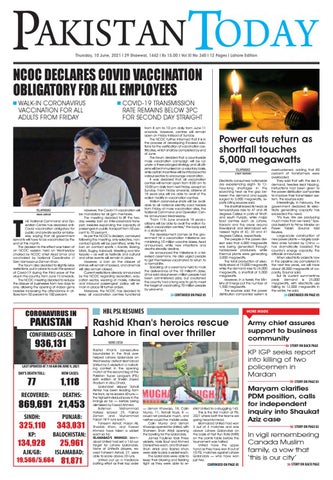
Thursday, 10 June, 2021 I 29 Shawwal, 1442 I Rs 15.00 I Vol XI No 340 I 12 Pages I Lahore Edition
NCOC deClares COvid vaCCiNatiON ObligatOry fOr all emplOyees g
WALK-IN CoRoNAvIRUS vACCINATIoN FoR ALL ADULTS FRoM FRIDAy
ISLAMABAD Mian abrar
t
He National Command and operation Centre has declared antiCovid vaccination obligatory for public and private sector employees, saying that all government servants will have to be vaccinated by the end of this month. The decision to this effect was taken at an NCoC session held on Wednesday chaired by NCoC chief Asad Umar and co-chaired by National Coordinator Lt gen Hamood-uz-Zaman Khan. The forum also decided to slightly relax restrictions, put in place to curb the spread of Covid-19 during the third wave of the virus in the country, from June 15 onwards. The NCoC meeting decided to reduce the closure of businesses from two days to one, allowing the opening of indoor gyms besides increasing the attendance in offices from 50 percent to 100 percent.
pakistaN
CONFIRMED CASES:
936,131
LAST UPDATED AT 7:10 AM ON JUNE 9, 2021
DAY'S DEATH TOLL:
NEW CASES:
77
1,118 DEATHS:
869,691 21,453 SINDH:
PUNJAB:
325,110
343,031
KP:
BALOCHISTAN:
134,928 AJK/GB: 19,566/5,664
CovID-19 TRANSMISSIoN RATe ReMAINS BeLoW 3PC FoR SeCoND DAy STRAIgHT from 8 am to 10 pm daily from June 11 onwards. However, centres will remain open on Friday instead of Sunday. The NCoC further informed that it is in the process of developing IT-based solutions for the verification of vaccination certificates, which shall be completed by end of June. The forum decided that a countrywide mass vaccination campaign will be run under a three-pronged strategy and all citizens will be immunised on a voluntary basis, while certain incentives will be introduced for various sectors to encourage vaccination. It was decided that all vaccination centres will remain open from 8:00 am to 10:00 pm daily from next Friday, except on Sunday. From Friday onwards, citizens of 18 years plus will be able to avail of the walk-in facility in vaccination centres. Walk-in coronavirus shots will be available to all national identity card holders from Friday at mass vaccination sites, the National Command and operation Centre announced Wednesday. “From 11th June onwards 18 years+ citizens will be able to avail the walk-in facility in vaccination centres,” the body said in a statement. The development comes as the government hit a vaccination milestone administering 10 million vaccine doses, Asad announced, while new infections and deaths steadily decline. He announced the milestone in a televised ceremony. He also urged people to get themselves vaccinated to return to a normal life. Speaking at a ceremony held to mark the deliverance of the 10 millionth dose, Umar said about seven million people had been administered jabs, but cautioned the country had a long way to go to meet the target of vaccinating 70 million people by year-end.
However, the Covid-19 vaccination will be mandatory for all gym members. The meeting decided to lift the twoday weekly ban on inter-provincial transport, besides expanding the capacity of passengers in public transport from 50 percent to 70 percent. As per the NCoC’s decision, conveyed following the meeting, only selective, noncontact sports will be permitted, while the ban on contact sports – Karate, Boxing, MMA, Rugby, Kabbadi, Wrestling and Waterpolo – as well as festivals and cultural and other events will remain in place. However, a ban on the closure of shrines will remain imposed, and cinemas will also remain closed. Current restrictions already announced by the NCoC regarding recreation, education sector, wearing of masks, railways and inbound passengers’ policy will remain in place till further orders. Moreover, the NCoC has decided to keep all vaccination centres functional
COrONavirus iN
RECOVERED:
g
25,961 ISLAMABAD:
81,871
CONTINUED ON PAGE 05
Power cuts return as shortfall touches 5,000 megawatts ISLAMABAD Staff report
electricity consumers nationwide are experiencing eight- to 12hour-long shortages in the scorching heat as the gap between the demand and supply surged to 5,000 megawatts, reports citing sources said. The shortfall reared its head as temperatures rose to 47 and 48 degrees Celsius in parts of Sindh and south Punjab, while major load centres such as Lahore, Karachi and the areas around Rawalpindi and Islamabad witnessed highs of 42, 33 and 41 degrees Celsius, respectively. The people in the power division said that 4,000 megawatts was being generated through hydropower producers, while thermal plants were generating 3,000 megawatts. The total production of electricity stood at 19,000 megawatts while the demand rose to 24,000 megawatts, a shortfall of 5,000 megawatts. However, in a tweet, the Ministry of energy put the number at 1,500 megawatts. The sources said the power distribution companies’ system is
CONTINUED ON PAGE 05
more inside
HBL PSL RESUMES
Rashid Khan's heroics rescue Lahore in final over thriller NEWS DESK Rashid Khan's consecutive boundaries in the final over helped Lahore Qalandars on Wednesday defeat Islamabad United by 5 wickets in a nail-biting contest in the opening match of the second leg of the Pakistan Super League's (PSL) sixth edition at Sheikh Zayed Stadium in Abu Dhabi. Qalandars' skipper Sohail Akhtar has been leading from the front, as he scored 40 runs — the highest individual score in the innings so far — before being dismissed by Fawad Ahmed. Batsman Mohammad Hafeez scored 29, Fakhar Zaman and Muhammad Faizan hit 9 runs each. Faheem Ashraf, Hasan Ali, Shadab Khan, and Fawad Ahmed have taken a wicket each so far. ISLAMABAD'S INNINGS: Islamabad United had set a 144-run target for Lahore Qalandars. None of United's players, except Faheem Ashraf, 27, were able to score above 20 runs. United put up a mediocre batting effort as their top order
overburdened, adding that 80 percent of transformers were overloaded. They said that with the rise in demand, feeders kept tripping. Instructions had been given to the power distribution companies to improve their transmission system, the sources said. Interestingly, in February, the government declared its electricity generating capacity has exceeded the need. “It’s true. We are producing much more than we need,” Special Assistant to Prime Minister on Power Tabish gauhar told Reuters. Large-scale construction of new power plants — largely coalfired ones funded by China — has dramatically boosted the country’s energy capacity, the officials announced. When electricity projects now in the pipeline are completed in the next few years, we will have about 38,000 megawatts of capacity, gauhar said. But its current summertime peak demand is 25,000 megawatts, with electricity use falling to 12,000 megawatts in the winter, he said.
Army chief assures support to business community STORY ON BACK PAGE
KP IgP seeks report into killing of two policemen in Mardan STORY ON PAGE 03
— Usman Khawaja, 18, Colin Munro, 11, Rohail Nazir, 8 — could not produce much, and neither could the middle order. Colin Munro and Usman Khawaja opened for United, with Shaheen Shah Afridi opening the bowling for the Qalandars. James Faulkner took three wickets, Haris Rauf and Ahmed Daniyal two each, and Shaheen Shah Afridi and Rashid Khan were able to pick a wicket each. The Qalandars were able to keep their blowing and fielding tight as they were able to re-
strict United to a struggling 143. This is the first match of PSL 2021 where both the teams are going head-to-head. Islamabad United had won 3 out of 4 matches and was above Lahore Qalandars on the basis of Net Run Rate (NRR) on the points table before the tournament was halted. United have the upper hand as they have won 8 out of 10 PSL matches against Lahore Qalandars — who have won just two.
CONTINUED ON PAGE 05
Maryam clarifies PDM position, calls for independent inquiry into Shaukat Aziz case STORY ON PAGE 02
In vigil remembering Canada Muslim family, a vow that ‘this is our city’ STORY ON BACK PAGE
02
Thursday, 10 June, 2021
LAHORE
NEWS
MaryaM ClarifieS PDM PoSition, CallS for inDePenDent inquiry into SHaukat SiDDiqui CaSe
P
NEWS DESk
AKISTAN Muslim LeagueNawaz Vice President Maryam Nawaz on Wednesday clarified that all the parties under the opposition parties’ alliance Pakistan Democratic Movement have one ideology. However, Pakistan Peoples Party is no longer part of the alliance, therefore, no discussion should be carried out on this matter, she added. Maryam Nawaz further said that those who have facilitated Prime Minister Imran Khan will also face the consequences. When asked about reports of USPakistan talks on military bases, Maryam alleged that such a decision could not be made through “secret negotiations” and the government had not yet denied the reports. She said she would oppose the hosting of US bases by Pakistan. “If you have made a deal for whatever reason — to save your government or compromised the country’s sovereignty — tell parliament about your blunder. The nation has the right to know what deal the government has made to save themselves,” she said. It is pertinent to mention that the Islamabad High Court is hearing pleas against PML-N leaders Nawaz Sharif, Maryam Nawaz and Captain (r) Safdar’s sentences in Panama reference. PML-N Vice President Maryam Nawaz, while speaking to the media after her hearing on Wednesday called for an independent inquiry to be held into ex-IHC judge Shaukat Aziz Siddiqui’s statement in the apex court in which he said a senior intelligence officer visited him over verdicts he had issued as a high court judge.
Speaking after the hearing of an appeal against her conviction in the Avenfield properties reference, Maryam said Siddiqui’s case was “not the case of one judge”, adding that he “should not be punished for speaking the truth”. She said the judiciary should consider the cases against Siddiqui and incumbent Supreme Court Justice Qazi Faez Isa as “an attack against it, resist external pressure and give weightage to Siddiqui’s statement”. A day earlier, Siddiqui’s lawyer had read out his statement in the Supreme Court during the hearing of his appeal against the opinion of the Supreme Judicial Council (SJC) as well as the Oct 11, 2018, notification under which he was removed as a judge of the high court for a speech he made on July 21 that year at the District Bar Association, Rawalpindi. His counsel said that during his second visit on July 19, 2018, the incumbent InterServices Intelligence director-general, who was then DG counter-intelligence, Lt Gen Faiz Hameed, told Siddiqui that after his June 2018 verdict, he was summoned by the army chief who showed great annoyance and displeasure. In June 2018, Justice Siddiqui of the IHC had directed the ISI to remove encroachments from a portion of Khayabani-Suharwardi in front of the headquarters of the spy agency in Islamabad. In his statement to the SC, Siddiqui claimed that when he asked how they managed the constitution of a bench to hear the appeal against the conviction of former prime minister Nawaz Sharif, Gen Hameed told him that the then IHC chief justice, Anwar Khan Kasi, was approached in Quetta through a common friend, where he was
Hamid Mir apologises over contentious speech against institutions ISLAMABAD: Hamid Mir — who was taken off air by his employer, Geo News, last month after he made a fiery speech at a rally in support of a vlogger who was beaten up by three unidentified men outside his apartment — has offered an apology, saying he had no intention to defame state institutions. In his speech, Mir had “threatened” to “identify those responsible” for what he claimed was a spate of recent attacks on journalists in Pakistan. He also implied the involvement of the security agencies but did not provide any evidence to back up his claims. After it suspended Mir, Geo News, in a statement, said it removed the anchor for potential “violation of policy and law” during the speech. Mir took to Twitter on Wednesday, saying he apologised over his remarks before Rawalpindi and Islamabad Union of Journalists that defended him since the media house removed him in May as the host of his programme “Capital Talk”. Staff RepoRt
SC grants two weeks to Sindh to argue in Daniel Pearl murder case ISLAMABAD: The Supreme Court on Wednesday accepted the application of the prosecutor general Sindh while granting two weeks’ time for arguments in Daniel Pearl murder case. A three-member bench of the apex court headed by Justice Mushir Alam is hearing a review petition in the matter as prosecutor general Sindh sought more time to deliver arguments against release of Ahmed Omar Saeed Sheikh and other suspects. It is pertinent to mention that United States has expressed ‘deep concerns’ over the acquittal of the accused in the Pearl murder case, asking the government to review its legal options. On March 25 the top court has resumed hearing of Sindh government’s petition involving Sheikh, the principal accused in the murder of Wall Street Journal journalist Pearl. A three-judge Supreme Court bench consisting of Justice Umar Ata Bandial, Justice Sajjad Ali Shah and Justice Munib Akhtar will take up the Sindh government’s application against the Dec 24, 2020, order of the Sindh High Court declaring as illegal the June 29, 2020, provincial government notification of placing all the accused on the IV Schedule of the Anti-Terrorism Act of 1997, pursuant to Section 11EE, with an observation that none of the accused were “enemy aliens” as contemplated under Article 10(9) of the Constitution and as such their detention under this provision was found to be illegal and unlawful. tLtp
asked to constitute a division bench which was not headed by Justice Siddiqui. Justice Kasi, according to Siddiqui, told Gen Hameed he “will constitute a bench about which we are comfortable”. Gen Hameed had further said that they wanted an assurance that the bail plea of accused Nawaz Sharif was not taken up before the 2018 general election, Siddiqui’s counsel said, adding that they wanted that later the matter be brought before a bench headed by Justice Siddiqui to attach some credence. “To this, I categorically replied that if from the material, I feel convinced for enhancement of the sentence, I will not hesitate to issue notice for enhancement to the conviction, but if the judgement would not be sustainable in the eyes of law, I will not spoil my hereafter to protect worldly affairs of any,” his lawyer quoted Siddiqui as saying. Speaking to the media today, Maryam termed Siddiqui’s statement a “very big testimony”. The PML-N leader said the “[Supreme Court] must realise that judges are pressured to make [certain] decisions and those decisions tarnish their images.” “I want to say that he [Siddiqui] should not be punished for speaking the truth. Otherwise, all judges intending to serve justice, follow the law and make independent decisions will be facing trial. “Judges and Supreme Judicial Council should consider [Siddiqui’s] case as their own and judiciary’s case and end external pressures and dictating of decisions,” she stressed. Earlier, a two-judge bench, comprising Justices Aamer Farooq and Justice Mohsin Akhtar Kayani, heard the appeals of Nawaz,
Maryam, and her husband, retired Capt Safdar Awan, against their convictions in the Avenfield properties reference. During the hearing, Justice Farooq said it was necessary to determine whether the court could hear the case on its merits. Nawaz’s counsel, Azam Nazir Tarar, argued that the case could be heard by the court if the documents were available. He requested the court to see “Azam Nazir Tarar, Amjad Pervez (counsel for Maryam and Safdar) and Nawaz Sharif in the same way”, adding that according to the spirit of the Constitution and the law, the court could “take a decision that opens a clear window”. “I will talk [without considering] my political affiliation. If the case against Zulfiqar Ali Bhutto was against someone else, it would not be remembered today. Political cases are mentioned not only in the books of law but in political history as well,” Tarar said. “Examples are present where the high courts heard appeals in the absence [of the appellant] but then the Supreme Court declared it invalid. Both sides tried to convince the court. The Supreme Court has asked the Islamabad High Court to announce the judgement,” he added. Tarar, who had in an earlier hearing suggested the court either adjourn the hearing till the return of ailing Nawaz from the UK or dismiss the appeal for nonprosecution, said the trial court’s decision would be maintained if the high court stayed the appeal at this stage. “The trial was held in his (Nawaz’s) presence so the appeal should also be heard in his presence. If a decision is announced now and is overturned later, what will happen then?” he questioned.
“If the court does not listen to this appeal or dismisses it now, it will neither benefit nor harm someone.” Tarar asked the court to decide the matter according to the law, saying we have to “take care of fundamental rights”. He contended that the Supreme Court had given relief in many similar cases. Justice Farooq said there were two other appeals — of Maryam and Safdar — in front of the court, asking what would be done about them. “Can we hear them on merit?” he questioned Tarar. Tarar replied that the court could decide on the other two appeals but “there should be a way to facilitate the convict (Nawaz).” He said all three convicts had recorded their statements under Section 342 of the criminal procedure code in which generally the accused rebuts the allegations and evidence submitted by the prosecution against him, adding that their lawyers had also presented their arguments. “The Supreme Court made it clear in the Ikramullah case that a judgement will only be announced if the [concerned person] is present,” he argued. Justice Farooq questioned what would happen if the court announced its verdict only on the appeals of Maryam and Safdar to which Tarar replied that Nawaz could file a separate petition after coming back to Pakistan. “If the court wants, it can also adjourn [hearings] on Maryam and Safdar’s appeals,” Tarar added. Justice Farooq said the appeals of two convicts could not be adjourned because of the absence of one. “The judiciary should do what it takes to ensure that judges do not make wrong decisions,” he remarked.
‘Unlikely’: Minister says dilapidated track not responsible for train accident ISLAMABAD Staff RepoRt
Minister for Railways Azam Swati on Wednesday ruled out the possibility of a fault in an eight-mile stretch of the track being responsible for the recent train accident in Ghotki city of Sindh. A horrific collision of two express services on Monday killed 65 people and injured more than 100. The collision took place on a dilapidated railway track when Sir Syed Express, coming from Rawalpindi, barreled into Sargodh-bound Millat Express that had derailed minutes earlier before dawn. The minister, while giving updates on the casualties, said that of the 107 that were injured, 20 were currently undergoing treatment. Of the 20, three were in critical condition, said Swati. Pakistan Railways’ Sukkur division’s superintendent Mian Tariq Latif said top authorities were informed “time and again” about the vulnerability of the 900kilometre-long up and down tracks of the division, but to no avail. “There are around 6,000 joints on both up and down tracks in the Sukkur division and the point where the tragedy has occurred is one of the welded joints,” Latif said, adding that the entire track in Sukkur division had welded joints. Addressing a press conference in Lahore, Swati said the tracks where the incident took place had recently undergone maintenance on a stretch of eight miles. He said he himself and other senior officials of the department inspected and monitored the accident site
themselves so “there is less possibility that there was any fault in the eight miles of tracks but I can’t determine this until the final report arrives.” Furthermore, blackboxes from the incident had arrived. He added that work had not yet started on them for the probe, reassured that a thorough investigation will be conducted. “It will take us at least three to four weeks,” he said. “The accident occurred due to the 12 bogies being derailed,” he said, explaining that bogies of the Millat Express train had shifted to the other track and because the time interval between it and the Sir Syed Express train was only of a minute or two, it had arrived suddenly. “I saw the signs of brakes on the tracks myself,” Swati said, adding that there was a need to do a lot more. “It is possible that it was a matter of less than a minute or few seconds in which the train derailed, people jumped down [to save themselves] and the majority were martyred in that and then the second train comes so they didn’t get any chance to reorient. “The driver of Sir Syed (Express train) didn’t get any chance to [avoid a crash] because of which more precious lives were lost,” said the railways minister. He reiterated that although the train track was old, dating back to 1971, and hadn’t been upgraded over the years, the testing in the initial probe had shown it to be functioning properly. The bogies were also shown to be within an acceptable working condition, he said. Swati said that one “big factor” identified in the initial probe was the late arrival of the rescue train. “The responsibility for this is on us. Whoever is [found] responsible will have to pay for it; their head has to be
Resolutions seek 70pc of education budget reserved for girls’ education PESHAWAR app
Two resolutions were tabled in Khyber Pakhtunkhwa Assembly seeking the provision of absent facilities to government schools, and to retain allocation of 70 percent of educational development budget for girls’ education for a third straight year. According to a press statement issued on Wednesday, the first resolution was jointly moved by 27 legialtors representing the ruling Pakistan Tehreek-e-Insaf, Jamiat Ulema-e Islam-Fazl and Awami National Party, seeking the retention of budget allocation in the forthcoming budget. The second resolution was moved by JUI-F MP Naeema Kishwar Khan which called for the provision of
facilities including restrooms, clean drinking water, furniture, electricity, boundary wall and other facilities in all Govt schools. “The upcoming budget for education is thereby crucial for many reasons. Government must ensure equitable allocation and spending of budget 2021-2022 to address the challenges for girls’ education especially, which have been further aggravated by the crisis of COVID-19,” the resolution read. Women’s Parliamentary Caucus chief Sumera Shams said: “During Covid-19, girls remain at greater risk, than boys, of not attending or staying in schools due to child marriage, poverty and disproportionately bearing the burden of housework and care for family members.”
rolled.” He added that the initial on-site survey after the accident was also found to be lacking. When questioned on the delay of officers arriving at the scene, the railways minister assured that it would be part of the inquiry and was being determined. “Whoever has shown negligence will be made responsible.” Swati also said that he would be willing to resign from his position as the railways minister if that would cover the losses and casualties in the incident. “If my resignation can put a salve on their [victims’] wounds then I am ready for this.” When questioned on the inquiry’s neutrality, Swati said that he had decided to also appoint an “experienced army officer with expertise in [conducting] investigations” and another individual known for investigations in the aviation ministry. Their main purpose would be to aid him and independently oversee the investigation, he explained. The railways minister lamented the lack of upgradation for railways assets and equipment, stressing that improving railway tracks was necessary to boost the economy and reduce input costs of exporters and importers. “You have to upgrade your entire railway track at any cost, there is no other way except for this.” Speaking about the compensation to be paid to the victims’ families, Swati stressed that no value could be placed on the injured and the lives lost, adding that they were “precious” and “priceless”. He said that compensation of Rs1.5 million would be given to the family of the deceased, while Rs50,000 to Rs300,000 would be paid to the injured, depending on their condition.
“The PTI government is vigilant of these issues and committed to eliminate these barriers through more allocation and efficient spending.” ANP MPA Shagufta Malik said: “Girls secondary education is now on the top priority agenda of women parliamentarians and we will play our meaningful legislative oversight role beyond our party lines to provide girls across Khyber Pakhtunkhwa with safe, quality, gender-transformative education so they may find their voices and learn to lead.” Civil society organisations and education right activists lauded the introduction of the resolutions by the parliamentarians. Blue Veins programme coordinator Qamar Naseem said that “education is one of the sectors that got hit the hardest by the Covid-19 pandemic, exacerbating the existing gender inequalities and digital divide.” “The upcoming budget needs to take cognisance of these challenges and accord a bigger thrust on augmenting educational opportunities and resources for the girl child, especially at the secondary level,” he added.
Thursday, 10 June, 2021
LAHORE
NEWS
03
leSCo failS to Control loaD-SHeDDinG in SuMMer LAHORE
i
Shahab omeR
N the midst of the rising heat and load-shedding, LESCO officials have said the field staff has been placed on high alert to accommodate the customers’ complaints. According to the officials, the heavy load on transformers and feeder resulted in the machinery tripping across the provincial capital.
Moreover, the spokesperson of LESCO said that emergency materials, including transformers, have been provided to all sub-divisions on the directives of the LESCO Chief. The spokesperson also added, “LESCO’s field staff and emergency squads are committed to customer convenience and redressal of grievances despite the hot weather. Timely redressal of consumer grievances is being made possible in all cases.”
Citizens faced a lot of disturbance during the night in the hot weather. A resident of Lahore, Saleem Shah, while explaining the scenario said: “LESCO should have been well prepared, keeping in view the upcoming summers. They always remain unprepared for such times and do not equip themselves as per weather conditions.” Another resident of Gulberg, Akhtar Hussain, expressed his distress over the situation and said that LESCO has failed
Kamyab Pakistan programme to accelerate economic activities: PM INAUGURATES FIRST ONE WINDOW EHSAAS CENTRE IN ISLAMABAD
every year in the summers to meet the situation. Afzal Shah, an officer in a government department, said: “It is high time of the year when the closing of accounts is going on. We have to sit for more hours and manage the work. In this hot weather, and so much load shedding we are unable to work because the computers cannot operate and load shedding does not end.” Fatima Asghar, a resident of Model Town, explained how the high-end areas
Train escapes accident after bogie derails kARACHI inp
ISLAMABAD Staff RepoRt
Prime Minister Imran Khan has said that a comprehensive strategy has been devised for the first time in Pakistan to bring the poor out of poverty. Chairing a meeting on Kamyab Pakistan Programme on Wednesday, the prime minister said that China has brought millions of people out of poverty in the last thirty years whereas India couldn’t succeed in this programme. He said that it is the foremost priority of the government to help the downtrodden segment of the society and make youth selfsufficient in employment. The meeting was briefed about the inclusion of Kamyab Kissan, Kamyab Karobar, Kamyab Hunarmand, low-cost housing schemes and lending programme for Kamyab Pakistan Housing in one programme titled Kamyab Pakistan Programme. Kamyab Pakistan Programme will play a pivotal role in accelerating economic activities and making people self-reliant. Under the programme, new applicants for housing, business and agriculture will be provided loans at mass level.
Separately, Prime Minister Imran inaugurated the first One Window Ehsaas Centre in the federal capital on Wednesday. On the occasion, the premier was briefed about the initiative, which is aimed at ensuring access to all the facilities and services of Ehsaas Programme under one roof. He was briefed that similar facilities will be established in every district of the country. The initiative comprises six components with the establishment of one-window facility being the first. Other components include digital information and services platform, a mobile application, digital interface for back office, an integrated database and a target policy for beneficiaries. “All Ehsaas services can be accessed at the centre,” an official statement said. Partner banks have opened their branches and a National Database and Registration Authority office has also been set up at the centre, it added. “Having all these services at one place can significantly facilitate Ehsaas Kafaalat beneficiaries who previously needed to go to many offices to get their complaints resolved. “Ehsaas stipends for children can be accessed at the centre also. The digital system, which has recently
kP iGP seeks report into killing of two policemen in Mardan
been put in place does real time verifications from three data sourcesbefore a child is enrolled in the programme and if the child doesn’t have a birth registration form-which is a prerequisite for enrolment-the mother can just walk the courtyard to get it made in the Nadra centre rather than taking taxi to go to another site,” the statement added. Under the Ehsaas umbrella, there are many programmes for 14 different target groups. “But often, poor families are not aware of the benefits they are entitled to and, if they are aware, they have to go to multiple offices to seek help. With One Window Ehsaas, the aim is to deliver services through a single window, a one-stop shop. One Window Ehsaas has six pillars: A One Stop Shop, the Ehsaas Centre; a public facing digital information and services platform; mobile app; back office consolidated digital interface; cognitive API (Application Programming Interface) architecture, or the integrated national socioeconomic database; and finally, the Ehsaas One-Window Beneficiary Selection and Targeting Policy,” it said. Ehsaas Registration Desks have been set up where people can get surveyed, to ascertain if they are eligible for Ehsaas benefits.
‘Hero’ family rushes to aid Ghotki train crash victims kARACHI
NEWS DESk
agencieS
Khyber Pakhtunkhwa Police Chief Sanaullah Abbasi on Wednesday, while taking notice of firing on anti-polio team and the killing of two policemen in the incident, sought a report from the Mardan deputy inspector general and district police officer. Condemning the incident, IGP said that it was a cowardly attack by the terrorists and assured that soon the culprits involved in the heinous crime would be apprehended and punished. It is to be noted that two policemen were martyred in Mardan when unidentified gunmen riding on a bike opened fire on an anti-polio team who were returning after completing the vaccination drive. The victims, identified as police constables Shakir and Syed Raza, were on security duty for the polio team and were on their way back to the police station on a motorcycle after safely dropping the team off, said DPO Zahidullah. He added that the two had been shot at by unknown assailants who then managed to escape. The rescue and police teams rushed to the site soon after the incident and shifted the dead bodies to Mardan district hospital. However, the two policemen died on the spot, the DPO informed. The DPO further said that the police had launched an operation to search for the assailants and evidence was being collected from the crime scene. Moreover, KP Chief Minister Mahmood Khan took notice of the incident and said the elements involved in the incident will not be able to escape the “grip of the law”. He added that the provincial government will take every step to help the martyrs’ families. In a tweet, the spokesperson for the provincial government, Kamran Bangash, termed the incident “deeply saddening”.No one claimed responsibility for the attack, which came two days after the federal government launched a nationwide drive to eradicate the crippling disease by the end of the year.
As an express train hurtled through farmland in the Ghotki district of Sindh and smashed into the carriages of another service that had derailed minutes earlier, a family of nearby villagers was jolted awake. “The blast of the collision was so loud that we woke up in panic,” said Ali Nawaz, describing the start of a frantic bid to help passengers from the wreckage of the double disaster. “When we came out of the house we saw the train had halted, as we got closer to the scene we heard people calling for help.” At least 65 people were killed, according to officials, with more than 100 wounded. With patchy mobile phone reception and a poor road network, it would be hours before emergency services could reach the site, some 25 kilometres from the nearest city of Daharki, deep in Sindh. Nawaz’s family of around a dozen people lives just 500 meters from the tracks. The men raced to identify the most seriously wounded passengers to take to hospital by car while those who appeared more stable were loaded onto tractor trailers. The first passenger, a mother that Nawaz’s cousin drove to the hospital, died in the back seat. Back at the farmhouse, the women raced to fill water containers for the injured in the sweltering summer night. “They made a chain — the women would carry water to the midway point from where the men would carry it to the passengers,” 63-year-old Nawaz told AFP, cows and calves roaming the courtyard of his single-story brick home. Hundreds of disorientated passengers emerged from the trains, slowly grasping the magnitude of the crash, which destroyed six carriages. They joined villagers in searching for survivors, clambering over the crumpled carriages to reach those trapped inside. Seat benches from the trains were turned into beds to carry people away, and bodies lined up on the ground and respectfully covered with scarves. “I kept working day and night — cooking meals, bread and tea — and my husband and other male members of the family kept supplying them to the victims and rescue workers,” said Habiba Mai, one of Nawaz’s two wives. As dawn broke, an injured passenger and her three children staggered to the house. “I milked my cow to feed her little daughter,” said 40year-old Mai. “The woman’s face was stained with dust so I washed it with water. She had no slippers on her feet so I gave her mine.”
of Lahore were not spared from the electricity shortage, lamenting on the fact that the lack of power was adversely affecting her elderly parents’ health, who suffered due to the heat and changing temperatures. Consumers are requested to call 04299205462, 042-99205461, 0320-0520888 and contact the LESCO Helpline 118 as well as SMS to 8118 for redressal of any individual complaints related to electricity.
Khyber Mail, a passenger train that operates between Peshawar and Karachi, on Wednesday narrowly escaped a tragedy after it derailed near Guddu station, days after a collision between two express services killed 65 people. A bogie derailed near Guddu station at Indus River. The train was running at a slow speed, allowing the driver time to stop it. No injuries were reported.
Train accidents are not infrequent, and successive governments have paid little attention to improving the poorly maintained signal system and ageing tracks. Data from Pakistan Railways shows there were 757 train accidents between 2012 and 2017 — a staggering average of about 125 incidents a year. Between 2013 and 2019, 150 people died in train incidents, according to media reports. Casualty figures are often high because trains are packed with far greater numbers of passengers than they were designed for.
04
Thursday, 10 June, 2021
LAHORE
NEWS
PuNJAb DecIDeS to DIGItSe NIkkAh reGIStrAtIoN ProceSS
t
NEWS DESK
HE Punjab government has decided to digitalise the nikkah registration system in the province during next month with the objective to eliminate fake marriage certificates and discourage registration based on fake witnesses. All over the world marriage is a contract which basic elements are offer, acceptance
ALL MARRIAGE REGISTRARS, REGISTERED IMAMS TO BE TRAINED TO USE TABS and consideration so as a contract the marriage requires plausible witnesses which would be possible through digitisation of nikkah in the province. Under the new computerised registration system, marriage registration across the province will be phased out and a tablet will be introduced which would be linked
FIA gets new DG Sanaullah Abbasi NEWS DESK Federal Investigation Agency on Wednesday witnessed a major reshuffle that after removal of Wajid Zia as Director-General of the Agency Establishment Division has notified Khyber Pakhtunkhwa Inspector General Police Khyber Pakhtunkhwa (KP) Sanaullah Abbasi name for the slot. Sanaullah Abbasi Zia has been posted as the DG National Police Bureau while Moazam Ansari currently serving as Commandant Frontier Corps (FC) has been appointed new IG KP. The federal cabinet approved the new appointments through a circulation summary. It is pertinent to mention that the government had appointed the former head of the Panamagate joint investigation team, Wajid Zia, as director-general of the FIA back in November 2019.
to the National Database and Registration Authority system. For the purpose the provincial government has decided to provide sufficient training to all the marriage registrars and registered imams after which they will become proficient to use the application on the tabs. Each marriage registrar will be allotted
a separate account for the collection of fees. If a person has not submitted the fee for marriage, then a second marriage cannot take place. The marriage fee will be credited to the relevant account of the local government department from the marriage registrar's SIM. The ID cards and thumbprints of the wit-
LHC extends stay against FBR audit of Tareen’s sugar mills RESERVES VERDICT ON POWERS TO CONDUCT AUDIT AFTER EXPIRY OF FIVE-YEAR STATUTORY PERIOD NEWS DESK While extending stay order against operation of the Federal Board of Revenue (FBR) audit of estranged Pakistan Tehreek-e-Insaf (PTI) leader Jahangir Khan Tareen’s JDW Sugar Mills on Wednesday, the Lahore High Court reserved verdict on the point whether FBR is competent to conduct audit of a sugar mill unit after expiry of five years statutory period. Appearing before the singlemember bench of recently appointed Justice Raheel Kamran Sheikh in the tax petition against FBR and others, counsel for the JDW Sugar Mills, Advocate Shahzad Ata Mufti completed arguments saying the FBR has no authority to conduct audit of his client’s sugar mills on the grounds that sugar mills have a special tax year. He apprised the
bench that Tax Year 2015 period of the petitioner was in fact counted from October1, 2013 to September 30, 2014 and six years from the end thereof ended on September 30, 2020. He further said that the FBR had selected his client mill for audit of its income tax affairs for Tax Year 2015, under Section 177(1) of the Ordinance while sending a notice of March 25, 2021 despite the fact that the proceedings for the Tax year 2015 are hit by limitation as provided under Section 174(3), read with the Second Proviso to Section177 (1) of the Ordinance. He argued before the bench that under Section 174, obligation of JDW Sugar Mills to maintain record for Tax Year 2015 also ended on September 30, 2020 saying the impugned notices were illegal, unlawful, mala fide, arbitrary, based on dictated
exercise of authority, contrary to the scheme of the provisions of the Income Tax Ordinance 2001 and verdicts of the superior courts. Terming the FBR notice of May 21 for audit of his client’ mill against the provisions of ITO 2001, Advocate Mufti urged the bench to set aside the same after declaring any further amendment of assessment for the Tax Year 2015 illegal, unconstitutional, unlawful, time barred, without merit, mala fide and ultra vires to provisions of the ITO 2001. He urged the court to suspend operation of the impugned notices till final adjudication of the matter while issuing restraining order to FBR from continuing any further amendment of assessment proceedings, or taking any coercive measures or adverse actions against his client’s mills.
IHC seeks academic details of PTI MPA ISLAMABAD TLTP
The Islamabad High Court (IHC) on Wednesday granted two weeks to Pakistan Tehreek-e-Insaf (PTI) MPA Farooq Amanullah Khan Dreshak to produce his academic degrees before the court. A petition has been filed against Dreshak on the grounds that the parliamentarian misstated academic qualification as he held a fake degree. Farooq Amanullah Dreshak was elected to the Provincial Assembly of Punjab on the ticket of PTI from constituency PP-295 (Rajanpur-III) in the 2018 general election. The petitioner has made Farooq Amanullah Dreshak, secretary Punjab Assembly and Election Commission of Pakistan (ECP) as respondents in the case. Appearing before the singlemember bench of Justice Amir Farooq
on Wednesday, counsel for the petitioner contended that MPA Dreshak lied before the ECP about his degrees in his nomination papers. After a brief hearing of the case, Justice Farooq directed the MPA to submit details of his academic degrees during the next date of hearing. Later the matter was adjourned for two weeks. It is pertinent to mention that during last year, the ECP had disqualified a member of Balochistan Assembly, associated with the Balochistan Awami Party (BAP), for possessing a fake degree. A three-member bench of the commission, headed by the then chief election commissioner Justice (retd) Sardar Muhammad Raza, gave this verdict. The BAP leader Muhammad Khan had won election from Balochistan Assembly constituency PB-4 Loralai but his degree was challenged.
SC seeks fresh report from NHA over N-25 repair to curb accidents ISLAMABAD TLTP
Prevailing road infrastructure development condition of N-25 Karachi to Chaman and steps to control growing road incidents were in question as Chief Justice Gulzar Ahmed Wednesday turned down the National Highways Authority report in the matter and sought comprehensive report about repair of highways in the country. The N-25 or National Highway 25 is an 813 km national highway in Pakistan which extends from Karachi in Sindh province to Chaman in Balochistan province. It was previously known as the Regional Cooperation for Development
(RCD) Highway, also known as killer highway. The RCD Highway connects Balochistan with other provinces and cities in Pakistan. During the year of 2018 as many as 5932 people were killed in 12,894 road accidents in the country whereas during 2021 a total of 36,000 people lost their lives in the accidents. A three-member bench of the Chief Justice Gulzar Ahmed also issued directives to the NHA to report what actions have been taken to address growing road accidents across the country. The bench was hearing a pending matter relating to the existing condition of RDC Highway where member admin NHA submitted a report about the road network.
nesses will also be scanned. Witnesses would become competent to testify if their ID card scanning and thumbprints match with the NADRA system. The registrar will also take a photo of the groom at the time of nikkah which he will submit to NADRA. If the groom is a fugitive or nominated in a criminal case, he will be arrested immediately as the tab will produce the image linked with NADRA.
PML-N MNA Javed Latif gets bail in anti-state remarks case NEWS DESK An additional district and sessions judge Wednesday accepted post-arrest bail application of Pakistan Muslim League-Nawaz (PML-N) MNA Mian Javed Latif in a case who was apprehended under charges of anti-state remarks one-and-a-half months ago. One Jameel Saleem is the complainant who got an FIR registered against Latif under Sections 120, 120B, 153, 153-A, 500 and 505(I) (B) and 506 of the Pakistan Penal Code. He stated that Latif hurled insults at the state, its institutions and its integrity, sowed the seeds of hatred in the minds of PPP and PML-N workers and spread chaos and panic among people by his statement. He also recorded that the PML-N leader had violated criminal, national and constitutional laws by making the statement against national security and state institutions on a TV show. In the TV talk show, Latif had said: “If anything happened to PML-N Vice President Maryam Nawaz, the PML-N will not say Pakistan Khappay.” Appearing before Additional District and Sessions Judge Mohammad Hafizur Rehman in the matter, Advocate Farhad Ali Shah, counsel for the accused person argued that there is mala fide of complainant who falsely levelled allegations against his client saying his client was a political worker and has nothing to do with treason.
Thursday, 10 June, 2021
LAHORE
Govt to present annual budGet on tomorrow ISLAMABAD
t
APP
HE incumbent government, led by Pakistan Tehreek-e-Insaf (PTI), is all set to present its third budget for the fiscal year 2021-22 (FY22) in the parliament on June 11, amid the third wave of Covid-19. The budget will be presented by Federal Minister for Finance and Revenue, Shaukat Tarin. “The budget had been formulated while considering the impact of Covid19 on the people and businesses of the country, hence mitigating people’s sufferings, transforming agriculture sector and bolstering businesses would be the main focus of the document,” sources said. In addition to fiscal management, revenue mobilization, measures for eco-
nomic stabilisation and growth, reduction in non-development expenditures; boosting exports besides job creation and people friendly policies for the socioeconomic prosperity of the country would feature in the budget. It would also focus on social sector development besides introducing reforms for improving governance and boosting private sector investment. On the revenue side, though no new taxes would be introduced, the government would introduce measures for bringing improvements in the system of tax collection, broadening the tax base, and facilitation to tax payers, sources said arguing that a strong revenue generation will play a crucial role in achieving the targets for economic growth. The government is likely to set the revenue collection target at Rs5.8 trillion for the fiscal year 2021-22.
Sources said the preparations for the announcement of the federal budget for fiscal year 2020-21 continued in full swing in accordance with the prescribed timelines. The budget was being prepared in close coordination between all departments and ministries involved in budget related events including the presentation of the budget in the Parliament and launching of the Economic Survey, they added. Meanwhile, the pre-budget document presenting state of country’s economy, the Economic Survey of Pakistan is likely to be launched here on June 10. The survey would highlight the overall performance of economy during the outgoing fiscal year, providing a realistic feedback and basis for future planning. It is scheduled to be shared with media at a press conference here
during which an overview of the economic progress made in recent years in Pakistan would also be provided. The survey would highlight the main features of the policies undertaken by the present government, which are focused on bringing macroeconomic stability and putting the economy on growth trajectory. The survey would cover the development of all the important sectors of economy, including growth and investment, agriculture, manufacturing, mining, fiscal development, money and credit, capital markets, inflation, debt and liabilities. The target for tax revenue collection of Rs4.7 trillion also looks to be achieved as the revenues reached Rs4.167 trillion during first 11 months of current fiscal year (11MFY21) therefore, the Federal Board of Revenue (FBR) needs to collect about Rs500 billion in the last month of outgoing fiscal year.
NCOC declares Covid vaccination obligatory for all employees contInueD froM pAge 01 “The more quickly we get ourselves vaccinated, the faster we would be able to rid ourselves of this menace,” he said, urging people to sign up for the shots so that businesses could reopen and life could return to normal. Asad, who also heads the NCOC, said the government agencies, as well as the people, have done a commendable job in following coronavirus guidelines, resulting in a steady decline in new infections. Supported by strict measures and vaccination drive, the nation reported a Covid-19 positivity rate below 3 percent for a second day on Tuesday, the NCOC announced. According to the data from the body, the authorities conducted 43,900 tests on Tuesday across
the country bringing out 1,118 new cases with a positivity rate of 2.54 percent, down from 2.95 percent a day earlier. Earlier in March and April, the country witnessed a positivity ratio of over 11 percent several times, leading the government to impose sweeping measures. At the start of May, the ratio dropped to below 10 percent and it went down to below 5 percent on May 22 and finally fell to below 3 percent on Monday. “We have seen that when Pakistanis, as a nation, decide to achieve something, then they achieve it [no matter the circumstances],” Umar said. In the last 24 hours, the NCOC reported 77 Covid-related deaths. The government portal has registered a total of 936,131 cases and 21,453 deaths since the outbreak in February last year.
The government launched a nationwide vaccination drive, starting with older people and frontline healthcare workers, in March. The drive began with a focus on the oldest people in the community, generally over the age of 80, and worked its way down. Battling a third peak of the virus, the Health Department began the campaign with Chinese Sinopharm and CanSino jabs. Private hospitals in major cities are also using the Russian Sputnik-V vaccine that has been imported by a local pharmaceutical company. Initially, the government had to deal with vaccination hesitancy and a shortage of vaccine supplies and had limited shots to people aged 30 or over. But with purchases from China and allocations from the World Health Organ-
isation and the GAVI Vaccine Alliance, the government has now secured more than 18 million doses and is keen to get them out into the population. The government on Tuesday also opened a first drive-thru vaccination centre in Lahore to help the district administration achieve its “target of vaccinating around 7 to 8 million people in the next six months”, Deputy Commissioner Mudassir Riaz said. Observing that only a higher vaccination rate would make full reopening possible, Riaz vowed to open more such points in other locations of the city to facilitate people. From the beginning of its campaign in March up to Wednesday, the NCOC counts more than 2.5 million people fully vaccinated and more than 4.7 million partially vaccinated.
Pakistan likely to produce 5.3m bales of cotton in FY22: Fitch ISLAMABAD AGENCIES
Pakistan’s cotton production is expected to reach 5.3 million bales during the upcoming fiscal year 2021-22 from 4.5 million bales in the current financial year despite balanced risks to the textile crop, according to Fitch Solutions. However, Pakistan’s official estimates show that cotton production in the current financial year reached 5.645 million bales. Sharing the global cotton statistics, Fitch Solutions said that “bad weather in the US and low prices at the time of plantings will lead to a 4.9 percent decline in global cotton production in 2020-21.” While sharing the future outlook, the research arm of the New-York based rating agency said that “we made significant downward revisions to our country production forecasts for 2020/21 last November 2020 and March 2021, and are maintaining our outlook in this quarterly update. However, the outlook for the 2021/22 season has somewhat deteriorated in several markets recently, and we now expect global production to grow by 4.7 percent (5.3 percent previously). We revised down slightly our production
cMYK
forecasts for China and India.” On the other hand, Fitch pointed out that cotton consumption declined by a sharp 13.4% in 2020 due to the Covidled economic recession and lockdowns, which greatly disrupted retail activities. However, it expects consumption to rebound in 2021, by 12.7 percent on a year-on-year basis while absolute consumption to fully recover by 2022. “The strong economic recovery in 2021 means that the textile industry will replenish stocks this year, boding well for demand. The pick-up in consumption will carry on but slow down into 2022 (+5.0 percent), when we see it reaching pre-pandemic levels in absolute terms,” it said. Commenting on prices, the report said, “We expect prices to average at an elevated USc87.0/lb in 2021, compared with the year-to-date average of USc85.2/lb. This forecast suggests that prices would average at their highest level since 2011. We see prices remaining elevated in the coming quarters as supply is tight amid the robust Covid19 economic recovery and a strong pick-up in demand in 2021. We see prices trading in the USc80-100/lb range in the coming months. We see strong resistance at the USc100/lb level, last reached in February 2021.”
NEWS
05
power cuts return as shortfall touches 5,000 megawatts contInueD froM pAge 01 Analysts say that while the country may succeed in significantly boosting generation, there are question marks about how well the ancient transmission systems will cope with this new influx of energy. The government also plans to invest in several highvoltage electricity lines but it will take more than two years for them to come online. The government has put a temporary moratorium on awarding contracts for new liquefied natural gas plants and imported coal and is, instead, focused on developing hydro and indigenous coal energy plants.
Hbl psl resumes: rashid Khan's heroics rescue lahore in final over thriller contInueD froM pAge 01 Speaking to a local news outlet last week, United's skipper Shadab Khan had said the team would try to continue the momentum from the last games. He said that the results were not in their control so they were not worried about it. "Efforts are in our hands, and we’ll leave no stone unturned with that,” vowed Shadab. The skipper had said that his team seeks to win the first match against Lahore Qalandars and maintain that momentum in future games. "Our squad looks good with the return of Munro and drafting of Brandon King and Usman Khawaja. We have a good combination,” said the captain. Meanwhile, the Qalandars' skipper Sohail Akhtar had said his side "will pick up where we left off”. The Qalandars were in good form earlier in March and had got six points after three of its four matches before the league was halted. The halt, Akhtar feels, won’t dent the Qalandars’ smooth sailing. “We are in good shape and have got all the ingredients required for a successful T20 side. Usually, sides with good bowling action do well in leagues around the world and we have the best bowling attack. We also have good batsmen,” the captain had said. SQUAD: LAhore QALAnDArS: Fakhar Zaman, Sohail Akhtar, Muhammad Faizan, Mohammed Hafeez, Ben Dunk (wicket keeper), Tim David, James Faulkner, Rashid Khan, Shaheen Afridi, Ahmed Daniyal, Haris Rauf ISLAmAbAD UnIteD: Colin Munro, Usman Khawaja, Iftikhar Ahmed, Shadab Khan, Hussain Talat, Rohail Nazir (wicket keeper), Asif Ali, Faheem Ashraf, Hasan Ali, Mohammad Wasim, Fawad Ahmed
Thursday, 10 June, 2021
06 COMMENT
US democracy is at risk
When in a debt hole, stop digging Claims belied by realities
The basic ability to compromise may not be there
W
hen Prime Minister Imran Khan was sworn in, he had no idea whatsoever about how the market economy works. Those around him who were comparatively better informed dared not disabuse the party chief of his primitive notions that included opposition to loans from friendly countries, international institutions or going to the IMF. none were prepared to tell Mr Khan that jobs could not be generated in a country of over 220 million by distributing a small number of hens, goats or cattle. now that Mr Khan is boasting about a 3.94 per cent gDP growth rate, rising exports, and four bumper crops, none is willing to tell him that it will be years before the benefits reach the common man and that too if the government is careful in the management of funds. Wary of the dissenting voices in his own party and with an eye on the next elections, Mr Khan has already announced a grant of Rs500 million development funds for each PTI MnA and MPA. The national economic Council has okayed Rs2.1 trillion for national development outlay in the new budget. The PM has promised maximum relief to the common man. But where are the funds to materialize these plans? Despite facilities that included subsidized bank loans for export-oriented industries, Pakistan’s trade balance from July-February FY 2020’s -$15,850,122 further deteriorated in JulyFebruary FY2021 to -$17,573,098. Pakistan has managed to remain afloat on account of the 24 percent growth in home remittances in the first seven months of the ongoing fiscal year to January. When a country earns less than it spends, it has to go around with a begging bowl. With the neC approving a 40 percent hike in development spending for FY2022, the funds required will come from loans. The new budget envisages borrowing $16 billion, mostly to retire debts in FY2022, but also to maintain SBP reserves and partly finance the hefty Federal budget deficit, estimated at over Rs4 trillion– the highest ever. The govt cannot manage to acquire the big loans from international financing institutions without continuation of the IMF programme. The government plans to take this year foreign commercial loans worth $4.7 billion, also the highest so far. By the time the PTI’s tenure comes to an end, the country would be groaning under the weight of debts acquired by a party which was opposed to seeking loans.
Washington Watch Dr James J Zogby
S
PeAKIng at a Memorial Day observance last week, US President Joseph Biden noted, rather ominously, “Our democracy is in peril.” Politics, if we can even call it that, has become so distorted and hyperpartisan that the shared values, comity, and compromise needed for democracy to function have become endangered concepts One clear indicator of this sorry state of affairs is the extent to which Republicans have embraced former President Donald Trump’s claim that the 2020 vote was marred by fraud. A recent poll shows that 70 percent of Republican voters still believe that Trump’s victory was “stolen” and, as a result, they do not accept Mr. Biden as the legitimate president. Instead of pushing back on this dangerous idea, Republican leaders are insisting that their elected officials accept this new “official party dogma” and act accordingly. “exhibit A” was the Senate Republican leadership’s refusal to advance a house bill that would have created a bipartisan commission to investigate the January 6 violent takeover of the Capitol Building in an effort to stop the certification of the 2020 election. In doing so, it appears that the Republican Party has chosen to ignore the “wake up call” of the insurrection, choosing instead to press the “snooze” button and go back to sleep. equally disturbing have been samples of Republican
Loadshedding in heat The problem could have been avoided
P
OWeR droppages are always painful, but they are more painful in the hot weather. With temperatures on the Indus Plain going well past 40°C, power breakdowns are particularly painful. There have been none of the street protests of the past, but if the expressions of anger by ruling-party MnAs, and that too of KP, where the PTI has now been in office since 2013 are anything to go by; the consumers’ cup is close to overflowing. The government is already beset by a number of problems, and power breakdown protests are something it should dread even more. More ominous is the fact that the disgruntled members were not buying energy Minister hamad Azahar’s explanation that it was all the previous government’s fault. That explanation is based on the assumption that the previous government did not invest in enough power generation, or that it signed contracts for expensive generation. Actually, the country is no longer facing a generation shortage. The problem now is that the distribution network is not able to provide existing consumers with power, and breakdowns are taking place because distribution equipment is too old. While previous governments made no investment on distribution, being too busy enhancing generation, the present government has also not made any investment in this sector, even though summer rolls around every year, bringing with it a surge in demand, which puts the distribution network under tremendous strain. It may be too late for this year, but the government can turn the breakdowns of this year to advantage by ensuring that they pinpoint the areas of greatest concern, and make sure that the winter and spring are spent ensuring that they do not happen again. The consumer is not concerned who is responsible for not allocating funds for generation, or whether a power outage is because of a generation or distribution problem, he just survives without any cooling device except perhaps a handheld fan, and he spews venom against WAPDA,, the provincial government, and the federal government. This might not be fair, but if he remembers his agony at the hustings, the government will pay the price.
WaJeeha bilal
W
hen we hear or watch news, there is a piece of our lives that feels disconnected and helpless. Maybe it is the harsh reality of human against human or the dog-eat-dog variety of the world leaders. Something that separates us from all this cruelty also tends to kill a part of our humanness. But we seek ways to come back to our human existence and connect with the reality of this world till something starts to fill the void within. There is a sense of satisfaction and peace that happens when you can search for ways to be connected. When you take that journey, there is no better place to realize the mutual connection with humanity than your history. As you walk through your emotions you can understand that this world has been evoking the vigour of the past. Our lives rest on a stagnant pool of ancient ways that tell us where we have come from and where we seem to be going. human behaviour through history has shown major tyrannous acts against the op-
Arif Nizami Editor Managing Editor
Joint Editor
Umar Aziz Executive Editor
Lahore – Ph: 042-36300938, 042-36375965
decades. It began in 1995 when Republicans newt gingrich and Tom DeLay assumed leadership in the Congress bringing “slash and burn” politics to Washington. Throughout the remainder of Clinton’s term in office and into the two Bush terms, Democrats continued to play by the old rules, supporting compromise with the gOP on what were, in my opinion, regressive pieces of legislation on a host of issues from welfare reform and border security, to tax cuts and education reform. Republicans were loath to operate in the same way during Obama’s terms in office– with only one or two of their members breaking ranks to support compromise bills. Instead, the gOP not only refused to cooperate with Obama, but also launched the Tea Party and encouraged the “birther movement” that denied Obama was a legitimate president. Fueled by right-wing talk radio and television, the poison of partisanship paved the way for the election of Donald Trump. While many conservative Republicans opposed Trump and saw that he posed a danger to their party and democracy itself, they were hesitant to buck the mass movement they had created, fearing that it would turn against them. Some of these same conservatives assumed that with Trump’s defeat, the horror of January 6, and the former president’s banishment from social media, the time had come to restore sanity to their party. But the gOP leadership’s continued cowering in the face of what they now call “Trump’s base” has caused them to circle the wagons and purge their ranks of those who call for sanity. While the Republican Party is busy cannibalizing itself in order to appeal to the very base it created, the lack of comity and civility this has generated has made it impossible to reach compromise. With the Senate deadlocked at 50-50, it has become increasingly difficult to move the nation’s agenda forward.
While the Republican Party is busy cannibalizing itself in order to appeal to the very base it created, the lack of comity and civility this has generated has made it impossible to reach compromise. With the Senate deadlocked at 50-50, it has become increasingly difficult to move the nation’s agenda forward
The writer is President of the Arab American Institute
Defiance against oppression
Dedicated to the legacy of the late Hameed Nizami
Yousaf Nizami Aziz-ud-Din Ahmad
behaviour on display on the national and state levels. Immediately following the January 6 certification vote and the January 13 vote to convict President Trump of having incited the violence that occurred at the Capitol, several gOP state committees voted to censure those Republicans who voted either to ratify the election’s outcome or to support the charge of incitement against Trump. The Republican congressional caucus ousted Representative Liz Cheney from her leadership role because she continued to forcefully reject the former president’s claim. Cheney has also been rebuked by her state party, and her reelection prospects are now in doubt. Cheney is being punished because she has refused to accept Trump’s claim and maintains that those who continue to advocate what she calls the “big lie” only perpetuate the very issue that incited the January insurrection and takeover the Capitol. Acceptance of the “big lie” is also on display in those states where Republicans control both the governorship and the legislature. In the name of “election integrity,” they are passing new laws that will make voting more difficult for targeted groups of poor, elderly, and minority voters. Such measures have already passed in 14 states and are in process in at least 18 more. A deeply troubling feature of some of these bills is a provision allowing the state legislature to overturn the decision of state election officials to certify election results. If permitted to stand, this provision could lead to chaos and undermine the integrity of future elections on the federal and state levels. Putting an exclamation point on hyperpartisanship, Senate Minority Leader Mitch McConnell recently made the frank admission that he is 100 percent committed to blocking President Biden’s agenda, thus making Republican calls for bipartisanship more of a tactic and taunt than an honest appeal for constructive negotiations. This crisis has been brewing for at least three
I
Karachi – Ph: 021-35381208-9
I
pressed but it has also proved that humans can always find ways to stand against the tyrant as well. Unfortunately, due to the fear of being shunned by the powerful authorities, most media influencers and networks do not take the risk of naming the oppressors and the tyrants, rather they use passive tones to address the crimes. even if someone calls out these heinous crimes of massacre and apartheid, the bullies find ways to even them out by shifting the blame through the anti-Semitic label. The atrocities committed by the colonial era and the shift of the blame is not for the east to bear. Just like slavery and racism were not generated by the east or the Muslim countries, similarly the Muslims cannot be blamed for the horrors of the holocaust. In fact, history is a proof that Jews have been well tolerated during the Muslim rule, after centuries of institutionalized Western anti-Semitism. The Muslims do not carry the blame of historical cruelty and racist labels that the West tries to shift upon them from time to time. having an open discussion about global affairs gives us the true sense of where we stand. As we start to learn about our history and become more open to discussing our present, we realize that our connection as humans is very powerful. We are not even aware of it though it is right there and has always been. These borders that have been defined for communities as countries exist because of years and years of struggle and sacrifice by our ancestors. People who have been working for generations have made it possible for our identities. You cannot be humbled by that kind of sacrifice nor be forged into living under a rule that bereaves you of that very identity. Foreign Minister Shah Mahmood Qureshi’s recent appearance at an interview on Cnn resulted in the sloppy rendition of his comments that invited the anti-Semitic label. The main problem is that the conversation deviated from the real issue of discussing the Palestinian persecution to be scapegoated with the anti-Semitism card propelled with tired tropes. While the West must refrain from using such tiresome labels to lighten their own guilt of past mistakes, the Muslims need to understand their role in being more careful while addressing sensitive issues. The fault lies with both sides, when instead of calling out the tyrant, people are busy playing east versus West. equating the standing of the whole religious community with
Islamabad – Ph: 051-2204545
I
Web: www.pakistantoday.com.pk
I
the atrocities of the Israeli government merely destroys the reality of the Middle east conflict by shifting the tone to a Jews versus Muslims propaganda. Such off-the-cuff remarks by prominent world leaders provide the licence to countries like Israel to get away with their atrocious tyrannies. Whether it is the Muslims in Palestine, Kashmir, Myanmar or Xinjiang, the solution to discussing their situation lies in acknowledging their identities, not pitching one religious community against the other. People who struggle for their freedom in these countries are not only oppressed but have been ripped apart from their loved ones and made to live under a rule that they have no say in. After living under coercion for so long, people seek solutions and openness to their suffocating frustrations. Through media and social networks, we are also soaking in part of that suffocation and there is a sadness that comes along with it. At the same time there is a sense of pleasure as you realize the beauty of human survival, the richness of human hope and the fruit of human endeavour through time. Learning about the truth and speaking it out loud is so empowering that you start to see a sense of purposefulness in life. It boosts the confidence of not only those who endure but also awakens the minds of silent observers. We seek knowledge about the past to move forward with better solutions with our words and thoughts. When we decide to discuss with open minds and hearts, in that moment our memories, our beliefs and our purpose all come together to provide better solutions. Once there is no pointing of fingers or shifting of blames, then there is no doubt to the truth. We will soon be on our way to find better solutions with a focus on reality through our knowledge of history and our courage to stand up against the tyrant. Standing up against the cruel leaders is a clear way of showing how we are going to make it to a better future. When those in power open about an atrocity, they share the light of an idea with many who do not have the guts or the chance to speak up. An impossible change may happen, only because some brave leader had the power to address an issue openly. The writer is a published author. Her work includes “The Conscious Ego” and “The Beautiful Present”
Email: editorial@pakistantoday.com.pk
Thursday, 10 June, 2021
COMMENT 07 Editor’s mail Send your letters to: Letters to Editor, Pakistan Today, 4-Shaarey Fatima Jinnah, Lahore, Pakistan. E-mail: letters@pakistantoday.com.pk Letters should be addressed to Pakistan Today exclusively
A painful punishment
Who is afraid of free and fair elections? The PML never won a free and fair election
Dr FariD a malik
A
S a Muslim League child, I must painfully admit that the Pakistan brand of the Muslim League has never won a free and fair election. The All India Muslim League (AIML), the founding party of Pakistan, was founded in Decca in 1906. In March 1940, under the leadership of Quaide-Azam Muhammad Ali Jinnah it passed the Lahore Resolution for the partition of the Indian Subcontinent. On 14 August 1947, a new state emerged on the world map with Jinnah as its first governor general. The AIML ceased to exist, as the father of the new nation, the Quaid, wanted to steer the new entity called Pakistan Muslim League (PML). Under ‘toady’ influence, the executive committee pushed Jinnah out, to be replaced by Chaudhry Khaliq-uz-Zaman as President. It was under the dynamic leadership of the Quaid that the AIML was able to win most of the Muslim seats in the 1946 elections. The referendum in KP (nWFP) was close but the hard work of Khan Qayyum Khan paid off. After the first Martial Law in October 1958, two factions of the Muslim League emerged. A Convention of the Leaguers was arranged that endorsed the takeover and a new ‘Toady League’ was born called the Pakistan Muslim League (Convention) with its headquarter on Davis Road, Lahore. Those who remained behind were named Pakistan Muslim League (Council). Ayub Khan contested the Presidential elections in 1965 as a nominee of the PML (Con). he was challenged by Madare Millat Fatima Jinnah who had the support of the entire opposition. Despite his controlled and manipulated democracy, the Madare Millat prevailed in Karachi and the eastern Wing. however with the support of the ‘Toadies’ the general retained his office but his invincibility was seriously dented. Jinnah’s sister was defamed with unfounded and frivolous allegations by the ‘Con League’ leadership . In 1967 she was found dead in her bedroom under mysterious circumstances. earlier, hussain Shaheed Suharwardy, the ex-Prime Minister, also had met a similar end while in self-exile in Beirut. After the fall of the usurper in March 1969, the first free and fair elections were held in 1970 in which PML (Con) was totally wiped out in both wings of the country. The Qayyum League did manage to win some seats in KP, mainly due to the personal credentials of its leader. The establishment remained neutral in the electoral contest, but there were allegations of tacit support to the Jamaat-eIslami and the Qayyum League. The main winners were the Awami League in the eastern Wing and the PPP in the Western. Despite being free and fair, the 1970 elections
remain controversial and hushed up. Opinions differ, some believe that it led to the break-up of Quaid’s Pakistan while others maintain that we are not fit for real democracy. The democratic period that followed (1971 to 1977) was eventful but short, and in July 1977 the country was engulfed in the ‘Zia Dark Ages’ which continue unabated. The most cherished gift of that era is the unanimously agreed Constitution of 1973, which has kept the federation together despite several ‘Toady’ onslaughts Zia, the third usurper, talked about positive results in the elections. Through the partyless contest in 1985 combined with the boycott of the opposition he was able to relaunch another ‘Toady League’ with the help of Pir Pagara. Punjab was handed over to Mian nawaz Sharif while Muhammad Khan Junejo became the PM. Finally, when Zia was off the scene, in the elections that followed in 1988, the PPP emerged as the single largest party despite the establishment manipulation. As Chief Minister Punjab, nawaz was given a free hand to rule, while Benazir was cornered as the PM. All the seats that the PPP vacated in Punjab were won by the PML in the by-elections. It is on record that while in power the PML(n) has never conceded a seat in any by-election but now somehow they have been able to set a new tradition by winning elections even without being in the government, as their influence still runs deep in the administrative machinery of the province. even the judiciary has shown tilt towards the party. The recent expeditious bail of Shahbaz Sharif and his attempt to flee the country overnight was questioned in the Supreme Court. Perhaps the trial of the fourth usurper under Article 6 of the Constitution will go down in history as the hallmark of nawaz’s political innings but it smacks of bias and uneven treatment of the violators. The emergency bill was prepared by the Law Minister, approved and then forwarded by the PM on whose advice the President acted, while the others have been forgiven, his highness decided to go only after the head of the state. It is this duplicity of the Sharifs which is mindboggling. They usually manage to go scotfree even when they vandalize state institutions like the Supreme Court and nAB (national Accountability Bureau). Since 1977 every election has been disputed yet they only complain when they are unable to grab power. Today they talk about the Bhutto mistrial while they were created to neutralize the progressive politics of his party. In one of the recent talk shows their spokesperson mentioned that Dr Faroqh nasim as Law Minister is a continuation of the Musharraf era while
he himself was his cabinet member together with the controversial PML(n) law minister. Without a neutral administrative set-up free and fair elections are not possible. As political entities no brand of Muslim League will ever allow credible electoral contest as it does not suit them. All reforms will be opposed by these ‘Toady Leagues’ created after ousting the father of the nation. history is a good guide, and the 1970 contest was hushed up as it brought the establishment and its created political entities to their knees. Mian nawaz Sharif and his PML(n) was launched at the centre through Islami Jamhuri Ittehad (IJI). Mir Zafarullah Khan Jamali landed in the PM’s office through PML(Q), MQM (Muhajir Quami Movement) and MMA (Muthida Majlis-e-Amal), all establishment creations. The founding party of Pakistan was AIML not PML as is being projected. Jinnah’s sister contested against the PML nominee. The PML(Q) offered to elect Pervaiz Musharraf as President in uniform, which is unheard of in the recent history of mankind. even in Banana Republics dictators have to shed their uniforms to get elected. The Sissis and Mubaraks in egypt had to give up their uniform to contest the elections. The threat to democracy is within, which must be understood. In 1977 Bhutto tried to manipulate the electoral process to get an absolute majority in the house but failed. The PML(n) is the only political party that has managed to get this privilege twice (1997, 2013). On both occasions no useful legislation took place. In the first case, nawaz tried to declare himself Ameer-ulMomineen while in the second a resolution was passed to allow a disqualified person to hold public office which was set aside by the court. Only genuine political entities can strengthen democracy. Parties like PPP, the PTI and the AnP should be nourished for the future of democracy. It is time to get rid of these unnatural ’Toady’ parties that lack the capability and public support to take part in a free and fair electoral contest, but if they still desire to contest in order to save their looted money then elections should be held under the auspices of the United nations to ensure complete neutrality, as it was in the 1970 contest in which the PML (Con) was nowhere to be found. The PPP, being a genuine political entity, will never run away from elections or resign from elected positions. The Muslim League house on Davis Road has produced’Freemasons of Democracy’. As such it should be shut down for Pakistan to move ahead.
Only genuine political entities can strengthen democracy. Parties like PPP, the PTI and the ANP should be nourished for the future of democracy. It is time to get rid of these unnatural ’Toady’ parties that lack the capability and public support to take part in a free and fair electoral contest, but if they still desire to contest in order to save their looted money then elections should be held under the auspices of the United Nations to ensure complete neutrality, as it was in the 1970 contest in which the PML (Con) was nowhere to be found
The writer is ex-Chairman, Pakistan Science Foundation. He can be contacted at: fmaliks@hotmail.com.
IS this proper easy to be punished for something you haven’t done? Absolutely not! It seems too hard, actually it is hard and so difficult to bear these whole. But painfully it hurts to hear that our Baloch drivers are facing punishment. They are under the fires and suffering starvation, in fact, they are dying. This is just because of waiting on the Pakistan- Iran border, they are there for more than 15 and 20 days, and their food and water last due to which they die. On the other hand, check posts have been increased on the ways of the Pakistan-Iran border and also the small hotels which are present on the way have been closed by the authorities. how hard it is to face such situations, initially, 2000 Zamyads could get the tickets to cross the border but now just 400 Zamyads can get the tickets to cross the border. The remaining Zamyads wait for more than 15 days till their time comes because of this they face shortage of food and water and many of them can die. Recently, four drivers have lost their lives because of hunger and thrust on the Pakistan-Iran border. One of them was Fazal Baloch who was from Turbat, and he was working for Rs18, 000 per month. According to the reports he left his house on March 30 and went to the border. Till 15 April he was there, within a few days his food water got finished, later on he died. On the same day three more drivers died. At that moment more than 12,000 Zamyads were there but still they did not get anything from them. Also they were in the same conditions and their food and water lasted. Therefore, four drivers died. Their families have gone on strike and requested the chief minister to ease the restrictions but yet no changes appeared. The major reason which compels them to go on the Pak- Iran border is unemployment. They are jobless which forces them to face hardships. If they were in a job then they didn’t go for that. Also the border trade union in Turbat had requested the chief minister of Balochistan to ease the restrictions and to decrease the check post which are barriers for them. The minister has the power to finish these all and to help them cross the border. Mahtab Rafiq tuRbat
Widening gender gap genDeR disparity is a decades-long problem which has yet a long way to go. Despite raising voices, women’s lives are as endangered as ever. According to’ global gender gap Report 2021, Pakistan was ranked second last among eight countries in South Asia. It indicates how x-gender is treated in Pakistan. Compared to 2020, Pakistan’s gender gap has increased by 0.7 % in 2021. Women must have the equal privilege to contribute to different social activities; they must be socially empowered so that their voices and decisions are valued. As per statics of Unicef, 22.8 million children are out of school among which 60 percent are girls and 40 percent are boys. This shows how girls are facing education crisis. It’s about time the government did something effective to close this gender gap. The government should ensure that women are paid equally and acknowledged in each sector they contribute to. iqRa KaREEM tuMp
Train accident TWO passenger trains have been collided in Dharki district ghotki. It is said that at least 32 people have been died on the spot and more than 50 faced serious injuries. This incident occurred when Millat express was coming from Karachi it was detracted and collided with sir Syed express which was coming from Rawalpindi. According to commissioner of district ghotki 12 to 14 bogies were derailed from track. This incident occurred at 4 am morning 7june. Many people were trapped in the wreckage for hours because heavy machinery reached after long time due to difficult path to rescue passengers. The major reasons of train incidents are owing to lake of track maintenance, older engine and signal issue, other political interference and corruption and poor infrastructure which leads railway of Pakistan on this stage. This is not the first-time train accident has happened. history has recoded many incidents. 2019 is one of the deadly years in the railway history. In 2019, 73 people burnt alive when gas cylinder burnt out in the train bogy in which 90 percent of people burnt alive in fire. Same year in July 2019 another incident happens in which 21 people died in Akbar express in July 2020, 20 people died in Shah hussain express. Prime Minister of Pakistan has bee shocked and taken notes of the incident. People have been irritated from notice. Many inquiries have been submitted but no positive result has come out yet. Public demand railways reforms on immediate basis to run railway. When we look after economic condition of Pakistan railway it is under great burden on economy. According government statistics it has 35 to 46 billion deficits in 2020. China ML-1 project will impact Pakistan railway. It has been delayed it would have not started yet. Federal government must take rapid action and announce immediate reform in Pakistan railway to secure it from further ruin. Political interference has turmoiled image Pakistan railway. Federal government should take immediate steps to stop further incidents and responsible people should be held accountable for this incident. ShaMin huMayun MiRpuR KhaS
Hate crime against Muslims I want to draw your attention towards an important issue that is four members of a Muslim family were killed in the south of Canada in Ontario province on Monday, while the fifth member, a 9-year-old boy is heavily injured and being treated in the hospital. It was a hate motivated planned attack. This hate against Muslims in the western countries seems never ending. Is it so hard for them to let people exist? Is acceptance such a foreign concept that four people had to lose their lives, a father, a mother, a daughter, a sister and a 9-year-old boy struggling to stay alive, lost his world just like that, because one man decided that his hate for Muslims was enough for him to kill an innocent family just on the bases of their religion. People need to learn and this generalised mindset of people towards a religion needs to change for there to be peace and hope for a better world. Is there any end to this? Will Muslims of Canada be able to walk out their homes without the fear of their lives being in danger even while they are standing on the sidewalk? Wania aShRaf KaRaChi
Thursday, 10 June, 2021
08 WORLD VIEW
Coup-proofiNg aNd CouNterbalaNCiNg
StrAtegy Bridge eMily vAnMeter
“W
HERE coup plotters can coordinate extensively in advance, the coup can be accomplished without visible movements of troops at all. Instead, coup plotters simply announce that they have taken power.” Erica De Bruin’s How to Prevent Coups d’état: Counterbalancing and Regime Survival was a long-awaited release for a couple of reasons. First, the initial article this book is based on has been cited nearly 100 times in less than three years. Introducing a way to quantify a notoriously difficult to quantify concept changed the discussion in national security and civilian-military relations, and not just among coup scholars. Second, De Bruin is thorough in examining consequences throughout her work. Every policy has both intended and unintended consequences, and this is certainly true of coup-proofing exercises. De Bruin uses both qualitative and quantitative evidence on counterbalancing and coup attempts to be as transparent as possible about past implications of counterbalancing as a coup-proofing strategy. De Bruin uses her novel dataset on counterbalancing and case studies to paint a compelling picture of what leaders can expect in implementing this technique, fractionalizing the monopoly of force, to prevent coups d’etat. In Chapter 2 she presents statistical evidence that counterbalancing decreases the likelihood of a successful coup, which she then fleshes out in Chapter 3 using case studies of Daniel Arap Moi in Kenya, King Hassan II in Morocco, and Manuel Noriega in Panama. In these cases, counterbalancing had an impact on the coup’s outcome. Chapter 4
once again returns to the data to examine whether counterbalancing is effective in deterring coup attempts, finding that they do not deter coup attempts, but in fact increase the risk of a coup attempt in the following year. In Chapter 5 she compares the failed counterbalancing attempt of Kwame Nkrumah in Ghana to the more successful efforts of Saskia Stevens in Sierra Leone, Fidel Castro in Cuba, and Modibo Keita in Mali. In Chapter 6, she argues that counterbalancing can increase the risk that coup attempts escalate to civil war. For example, she compares two coup attempts in the Dominican Republic: the bloodless coup in 1963 and the 1965 coup which escalated into a civil war. If a coup attempt is defined as “illegal and overt actions intended to seize executive authority in a state” that “originate[s] from within the regime in power”, while “the threat of violence underlies all coup attempts,” then even an unsuccessful coup attempt seems like a fundamental concern for leaders. Worse, nearly half of coup attempts succeed, a definite threat to leaders in power. Normatively, although some successful coup attempts may bring about democracy, most successful coups in authoritarian regimes replace one authoritarian with another. In summary, preventing coup attempts is an important consideration for leaders regardless of outcome. WHAT’S A LEADER TO DO? Knowing that coup-proofing is in the self-interest of state leaders, De Bruin focuses her discussion on a particular type of coup-proofing, known as counterbalancing. Counterbalancing the military is the exercise of expanding the monopoly of force to a specific subset of actors outside of the military— in this case, civilians. As De Bruin describes it, one may counterbalance the military “with republican guards, secret police, and other security forces outside the regular military chain of command…this is because, over time, presidential guards, secret police, civilian militia, and other security forces develop their own organizational interests, distinct from those of the military.” the problems faced by coup plotters in counterbalanced militaries include coordination and commitment. First, coordination problems arise when planning coup attempts because leaders of counterbalanced forces rarely meet, especially when compared with
unified armed forces, where leaders often meet without suspicion. Coup plotters may be forced to make public statements of support without formalized agreement. Commitment problems stem from counterbalanced forces posing a direct threat to a coup-installed regime. their influential position may be mobilized by the ousted leader to stage a rebellion or they may be disbanded by the fledgling regime. this threat of demotion, De Bruin argues, is what incentivizes counterbalancing forces to not support coupborne regimes. In chapter 3, she examines the qualitative evidence of sixteen coup attempts, 12 unsuccessful, 4 successful, and finds commitment problems, including the threat of resistance, a much more prominent causal mechanism than coordination problems. For those questioning whether military size is a prominent confounding factor, she finds only weak correlations between military strength and coup success, as well as weak correlations between military strength and counterbalancing suggesting that military strength is not what drives her results. However, De Bruin argues that counterbalancing is costly. Counterbalancing can lead to discontent within military ranks and an increase in coup attempts. Chapter four presents statistical evidence that new counterweights have a positive and statistically significant relationship with coup attempts, and that creating a new counterweight increases the risk of a coup attempt in the following year. While she argues that counterbalancing causes increased coup attempts, she is transparent that she cannot find empirical evidence to validate this claim over an alternative argument: that leaders facing increased coup risk are more likely to counterbalance and also more likely to experience a coup attempt on their watch. that there are patterns by regime type, in terms of number of counterweights implemented, is a result that is additive to the literature, particularly in the wake of findings that successful coups are capable of changing the regime type. Given these findings, we return to the question raised earlier: What’s a leader to do? In chapter 5, she presents cases and lessons that are a pivotal part of the book and of utmost interest to the strategic security community. De Bruin uses Ghana (1960-66), Sierra Leone (1968-74), Mali (1960-68), and
Cuba (1959-65) to explain divergent outcomes following the creation of new counterweights. the case comparisons here are well-structured and detail-rich without becoming overly scrupulous. these cases suggest that the type of force used to counterbalance the military may matter for the level of grievance among existing forces. Paramilitary police forces were created in the two successful cases of Sierra Leone and Cuba, while Ghana created a presidential guard and Mali developed a popular militia. Dividing the large-N data by type of force, De Bruin finds that new popular militias and new intelligence services increase the risk of a coup attempt in the following year, while there is no statistically significant relationship between the creation of a presidential guard or a militarized police force and risk of a coup attempt in the following year. While chapter 5 gives some insight into what works for leaders, in chapter 6 De Bruin explores the ever-present discussion of coups and the risk of civil war. She finds that while coup attempts are not particularly likely to bring about civil war, the presence of an armed counterweight increases the risk that coups will escalate. this is a danger of counterbalancing that should be highlighted and taken into account in any policymaking calculus, and De Bruin makes clear that there are no definitive policymaking prescriptions that come from this book as a result of these sometimes severe trade-offs. In conclusion, this book is an insightful empirical introduction to counterbalancing and its implications on coup attempts and the likelihood of success, as well as the possibility of later conflict. I would recommend it to those interested in civilian-military relations, especially in countries with considerable coup risk, specifically due to the richness of the cases and the novelty and accessibility of the findings. De Bruin has paved the way for a more empirically-grounded study of coup-proofing in general and counterbalancing specifically. to those with a background in coup studies or civilian-military relations, How to Prevent Coups d’état draws parallels to Naunihal Singh’s Seizing Power, particularly as an extension of coordination games applied to the field of coup studies. I found it interesting that this work applied coordination problems and commitment problems, two
often-discussed game theoretic explanations for conflict, but other game theoretic explanations of conflict, such as issue indivisibility and incomplete information, or incentives to misrepresent, are not fully fleshed out, even as analytic narratives. In an event with such a profound impact on the professional and even personal lives of counterweight force members, rapport and unwillingness to compromise might play a large role, be it rapport with other branches of the armed forces, rapport with the leader, or rapport with the other civilians potentially impacted by regime change or lack thereof. Likewise, transparency issues seem to abound in the narratives given in each of the case studies, ultimately suggesting that these could play a role, but they are not a central emphasis of this work. this book is a great addition to the literature as it paves the way for further exploring rationalist explanations of both coupproofing and coup success, implementing what we know from bargaining models of war to other sorts of political conflict and civilian-military relations. Emily VanMeter is a PhD Candidate in Political Science and a Post-Field Work Dissertation Completion Fellow at University of Rochester in Rochester, New York. How to Prevent Coups d’etat. Erica De Bruin. Ithaca, NY: Cornell University Press, 2020.
A terrorist attack in Canada and the politicians who primed it ISLAMOPHOBIC VIOLENCE SURFACED ONCE AGAIN IN CANADA. IT WAS FORMER PM STEPHEN HARPER WHO STOKED IT
Al JAzeerA
N
Andrew MitrovicA
ot surprisingly, it took him a while. Almost two days after a family on an evening walk in London, ontario was mowed down like a set of bowling pins while waiting at an intersection by a terrorist driving a pick-up truck intent on killing Muslims, Canada’s former prime minister, Stephen Harper, briefly emerged from his agreeable life running a lucrative consultancy business to say something about the “tragedy”. I suspect Harper’s tardiness in penning his obligatory tweet condemning “cruel acts of racial and faith based hatred” was likely the product, in part, of his vulgar record while prime minister as the accelerant-in-chief of fomenting suspicion and animus towards Muslims he was duty-bound to have, instead, welcomed and celebrated as loyal, devoted Canadians. once a rank politician, always a rank politician. Given his documented history of stoking Islamophobia – with the enthusiastic approval of his many confederates within Canada’s sprawling right-wing-media-industrial complex – Harper likely paused to ponder the public relations risks or rewards of denouncing this nation’s latest heinous act of Islamophobia. So, true to his calculating nature, Harper waited before sharing his typically soulless, exculpatory tweet with his equally ardent and unrepentant followers. Indeed, Harper refused to even acknowledge that the massacred four and the critically injured boy were Muslims who followed the teachings of Islam – the premeditated victims of a young, white, assassin who, somewhere, at some time, was radicalised by someone or something. Harper ended his perfunctory, unconvincing expression of sympathy for the grieving families with the sug-
gestion that the murders were unfathomable. Clearly, Harper has not only forgotten his noxious past but has been so busy making lots of money crisscrossing the globe leveraging the rarified contacts he made while prime minister to have noticed the epidemic of enmity directed at Canadian Muslims. He also, incredibly, neglected to recall the mass murder of six worshippers during evening prayers at a Quebec City mosque in January 2017 by another young, white, radicalised assassin. Since Harper has apparently buried his history of pitting “old-stock” Christian-Canadians against MuslimCanadians and his steadfast admirers in the fourth estate will, no doubt, deem it unbecoming at this “difficult time” to remind audiences of their man’s contemptible, divisive modus operandi, I am going to because decency and the jarring moment demand it. I will begin with Harper’s studied use of the combustible phrase “old-stock Canadians” at a leaders’ debate during the 2015 election campaign. Harper, a bureaucrat as spontaneous as Rip Van Winkle, invoked the term allegedly to defend his petty government’s callous decision to deny health care to unsuccessful refugee claimants, insisting the move was supported by new immigrants and “old-stock Canadians” alike. Despite subsequently denying that the phrase was malicious or insulting, Harper’s cynical, parochial intentions were plain: appeal to his largely white, Christian base while feeding a stubborn, malevolent undercurrent that only “old-stock Canadians” were bonafide Canadians. Not done stoking ethnic discord, Harper later dispensed with the calibrated code and vowed to ban public servants from wearing hijabs and set up a tip line so presumably “old-stock Canadians” could snitch to the federal police on “new” but not true Canadians for their “barbaric cultural practices,” including, but not limited to, arranged marriages. the obsequious cabinet ministers tasked by Harper with realising the sinister, blatantly intolerant edicts explained that the proposed hijab ban and Stasi-like snitch line were intended to “protect Canadian values.” Sure they were. that a prime minister would sully the office he held and shame the country he led by relying on and exploiting the sectarian tactics and rhetoric usually associated with segregationists in America’s Deep South in a futile
bid to keep his job is the foul measure of the man who some Conservatives reportedly want to lead the faltering party again. But Harper’s profane antipathy towards Canadian Muslims was evident to the National Council of Canadian Muslims (NCCM) and anyone else even remotely paying attention in 2014. At the time, the leading non-profit group which has, for decades, advocated on behalf of Canadian Muslims wrote to Harper to chastise him for inviting on an official delegation travelling to Israel a rabbi who had “introduced, defended and praised… two of the most recognised and vitriolic anti-Muslim activists of our time”, Pam Geller and Robert Spencer, at an event in toronto in late 2013. Harper’s response was swift and incendiary. the prime minister’s then director of communications called the NCCM, in effect, a hive of Hamas-supporting terrorists. “We will not take seriously criticism from an organisation with documented ties to a terrorist organisation such as Hamas,” Jason MacDonald said on the now-defunct Conservative Party propaganda network, Sun tV. After Harper and MacDonald refused to apologise for or retract their calumny, the NCCM sued both for defamation. In 2017, the NCCM prevailed, winning a resounding and historic legal victory that required the prime minister’s former chief spokesperson to disavow publicly his defamatory remarks against the council and, by extension, all of its patriotic staff and members. Still, Harper’s de rigueur admonition on tuesday that “Canada is a place of tolerance and pluralism” must be considered in the indelible context of his government’s ugly, venomous attack on the loyalty of Canadian Muslims and the raw, devastating residue of a family’s destruction possibly by an “old-stock” Canadian who had hatred ingrained in his hollow soul. In any event, in his waning days as prime minister, Harper appears to have exacted his cheap revenge on the NCCM for their brave decision to confront two powerful bullies in court. At the eleventh hour, citing its imaginary “adversarial tone,” the Royal Canadian Mounted Police pulled its support for a booklet produced by the NCCM and another Canadian Muslim association aimed at preventing the radicalisation of teenagers into Kalashnikov-wielding
or pick-up-truck-driving terrorists. Well, so much for shielding Canadians from adolescent predators who maim and kill innocents for perverse political or religious motivations. Harper’s departure from politics in 2015 did not prompt his elected successor as Conservative Party leader, Andrew Scheer, to change toxic course. Rather, Scheer embraced Harper’s appalling factional instincts and openly solicited the support of avowed bigots and xenophobes who prefer a Canada stocked with “old-stock” Christian Canadians as an intolerant path back to the prime minister’s office. Perhaps the nadir of Scheer’s Harper-like appeal to and appeasement of the tory party’s insular, retrograde supporters was leading his diminished caucus in brazenly opposing a non-binding, symbolic motion introduced by a Liberal Member of Parliament in early 2017 to condemn Islamophobia and all religious discrimination in the aftermath of the slaughter of Muslims in Quebec. Scheer announced in a Facebook post that he would vote against the motion on the grounds that it would stifle “free speech and legitimate criticism” and that “it singles out just one faith”. It was, of course, a sorry, disingenuous burlesque meant to disguise an embedded strain of Islamophobia that has, for a long time, been tolerated and promoted within the Conservative Party and that represents a growing, not-so-fringe opinion in Canada. on cue, the right-wing party’s current leader, Erin o’toole, quickly channelled his predecessors’ penchant for peddling fear, distrust and resentment when he released a video last June asking viewers to “join the fight to take back Canada”. o’toole failed to identify the nebulous, nefarious forces he plans to “take back Canada” from, but his loaded language was reminiscent not only of Harper’s “old-stock Canadians” line but Donald trump’s incoherent-with-rage rants that America had to be rescued from Mexican rapists and immigrants from “shit-hole” countries. o’toole, I am sure, would reject the comparison, but truth is in the experienced eye and ear of the beholder. And o’toole, Scheer and Harper have, by their pernicious words and deeds, helped fuel the Islamophobia they claim to abhor. the inevitable consequences of such reckless, inflammatory conduct have, once again, been visited on Canadian Muslims by another coward in another Canadian city for an all-too-familiar reason. It must stop. Now. Andrew Mitrovica is an Al Jazeera columnist based in Toronto.
Thursday, 10 June, 2021
BUSINESS 09
LAHORE corporate corner bankislami transforms networking infrastructure with Huawei KARACHI: In its efforts to facilitate greater digital enablement in Pakistan, BankIslami, has made a sizeable investment to upgrade its branch level connectivity infrastructure. After thorough technical evaluations and proof of concepts, the bank has migrated its entire Wide Area Network (WAN) to Huawei, including branch routers and switches across all physical locations in Pakistan. PRess ReLease
engro fertilizers to establish second learning center with Mns university of agriculture KARACHI: Engro Fertilizers Limited has signed a Memorandum of Cooperation (MoC) with MNS University of Agriculture to establish and develop Engro Learning Center at the institute’s campus. Engro Fertilizers CEO Nadir S. Qureshi, VC and MNS University of Agriculture Vice Chancellor Dr Asif Ali signed the MoC in a virtual ceremony. The ceremony was also attended by the management team of Engro Fertilizers and the faculty of MNS University of Agriculture. Under the agreement, the company will identify and conduct research and development projects involving the academia and student body, and support capacity-building of the university’s students through various internship programs. PRess ReLease
Webinar held to discuss role of technology in agri sector growth LAHORE: Pakistan Biotechnology Information Center (PABIC) Lahore Chapter in collaboration with CropLife Pakistan and Forman Christian College University Lahore organized a Webinar on “COVID-19, an opportunity to reform the Agricultural system of Pakistan. The webinar has been attended by scientists, policymakers, and representatives from leading biotech institutes, academia, crop science industry, farmers and other stakeholders. FCCU Dean of Postgraduate Studies Dr Kauser Malik and Lahore PABIC director highlighted that crop biotechnology has all the ways to make the agricultural sector of Pakistan to flourish. “The government needs to focus on supporting small and marginalized farmers and promote small scale innovative technologies to promote growth in this sector. A lot of strategic planning is needed in streamlining the biotechnology products in the country,” they said. PRess ReLease
Haleeb foods partners with sos village on World Milk day LAHORE: Haleeb Foods Limited has partnered with SOS Village on the occasion of World Milk Day 2021. This initiative is part of Haleeb Foods’ health and wellness awareness agenda. With the objective of ensuring sustainable CSR, milk supply equivalent to a month’s requirement were delivered at the SOS Village, Lahore. Keeping in view that during the ongoing pandemic, immunity levels all around the world are dropping and Packaged Milk being safe, healthy and nutritious is highly recommended especially for children. PRess ReLease
pakistan navy appoints new pr director general
Govt urGed to include incentive packaGe for refineries in finance bill fY22 ISLAMABAD
t
aHMaD aHMaDaNI
hE Petroleum Division has requested the government to make the proposed incentive package part of Finance Bill 2021-22 in order to technical up-gradation of existing refineries and incentivise new investment. According to sources, Petroleum Division has formulated an incentive package for investment in upgradation and sustainable operation of existing refineries as well as to attract investment in new state of the art deep conversion integrated refineries. And, requested that the proposed incentive package be made part of Finance Bill 2021-22. As per details, a draft incentive package was prepared after extensive deliberation between the stakeholders consisting of commitment from refineries for upgradation within five years to produce environmental friendly Euro-V spec products and reduce furnace oil production. And, after five years, the refinery will be in a position to operate at optimal capacity with technological enhancement, leading to forex saving. It has also been proposed that as available to other domestic industries, tariff protection for refineries be provided by zero percent duty on raw material, i.e. crude oil, for refineries and 10 per cent duty on finished products such as petrol and diesel. Similarly, 0pc import duty on crude oil which is a raw material for refineries. Furthermore, decrease import duty from 13pc to 10pc on diesel and increase import duty from 5pc to 10pc on petrol. Documents available with this scribe disclosed that the proposed tariff protection formula would contribute revenue to refineries up to 40pc only and remaining 60pc investment would be arranged by refineries at their own, about $3.5 billion total cost,
for upgrading activities during the next five years. As per estimates, the net revenues for the Federal Board of Revenue (FBR) will remain neutral due to tariff revision coupled with growing demand for petroleum products in the country. It is also learnt from the documents that a comprehensive monitoring mechanism has laid down in draft policy which include transfer of international revenues to special reserve account in National Bank of Pakistan (NBP) to be exclusively utilised for project upgradation which will be monitored by Oil and Gas Regulatory Authority (OGRA) through technical inspection/audit as well as statutory commercial audit to be carried out by one of big four audit firms. Certain tax incentives and exemptions are part of proposed incentive package, documents state. Sources also informed that the draft incentive package was circulated to stakeholders such as finance and planning division as well as OGRA and FBR etc. They said that the petroleum products demand supply projections indicates requirement of additional refining capacity of at least 400,000 barrels per day at a cost of $10-15 billion by 2030. They said with regard to investment for new refineries, in February 2019, ARAMCO and PSO initiated discussion for the integrated deep conversion refinery petrochemical in Pakistan. “The pre-feasibility was completed in July-August 2020, however the project has been on hold due to low IRR,” they said. Earlier, a meeting was chaired by the Prime Minister of Pakistan on December 7, 2020, to review the progress of PARCO Coastal Refinery Project (PCR) in which the PM endorsed (i) incentive package for upgradation of refineries with an investment of $3-5 billion and (ii) a green field deep conversion integrated refinery petrochemical project with an invest-
Sales tax rates on kerosene, light diesel oil slashed ISLAMABAD: The government has announced a cut in sales tax rates on kerosene oil and light diesel oil in order to absorb the price hike on petroleum products. In this regard, the Federal Board of Revenue (FBR) has issued SRO 726(I)/2021 to comply with the decision of the government for keeping the POL prices intact by absorbing a hike in prices through downward adjustment in sales tax rates. The sales tax rate on kerosene oil has been reduced to 10.07 percent from the previous rate of 15.44 percent. Similarly, the sales tax rate on light diesel oil has been reduced to 3.67 percent from 7.56 percent. Meanwhile, the sales tax rates on petrol and high speed oil have been kept unchanged at 17 percent. Earlier, according to an official statement issued on May 31, 2021, the prime minister had decided to maintain the prices of petroleum products as they were on May 17, 2021. TLTP
KARACHI: Mrs. Sadia Rashid, Chancellor of Hamdard University, is signing MoUs with Hunan University of Medicine and Shihezi University in an online Sino-Pakistan Symposium titled “Traditional Chinese Medicine - Unani Medicine.” Under the agreements, students will be able to attain latest research in science and technology. Registrar of Hamdard University Pervez Ahmed Memon and Prof. Dr. Ehsana Dar were also present on the occasion. In a group photo Prof. Dr. Hakim Abdul Hannan and Vice Chancellor Hamdard University Prof. Dr. Syed Shabibul Hassan are also present with Mrs. Sadia Rashid. PR
ment in a range of $10-15 billion. Similarly, a meeting with the finance minister was held on June 2, 2021, to discuss the policy incentives and inclusion of the same in the finance bill. The meeting was attended by finance minister, minister for Energy, SAPM on Petroleum, secretary Petroleum, FBR chairman, additional secretary Finance and Revenue, DG Oil and representatives of refineries. A detailed presentation was made on the proposed incentives. The finance minister advised FBR chairman to seek further clarity on the fiscal and tariff protection incentives before incorporation in the upcoming In compliance, a meeting was held on June 4, wherein detailed data and assumptions were shared and board macroeconomic picture and challenges of the midstream refining sector were highlighted. It is pertinent to mention that the last Petroleum Policy was announced in 1997. In the past 49 years, only two refineries have been commissioned in the country due to limited incentives. To formulate a new refining policy, discussions between refineries and Petroleum Division started in December 2019. In view of discontinuation and reduction of the various incentives and pricing formulas from time to time, protection available to local refining industry has significantly eroded; coupled with low international margins, these have badly affected the profitability of refineries, causing heavy losses and thereby, putting the survival of local industry at stake and are now at the verge of closure. The prevailing pricing mechanism for local refineries is regulated and linked with the international market with low tariff protection. Despite various constraints, refineries kept on upgrading to produce Euro-II/Euro-III standard products. Accordingly, their survival is now at risk unless fiscal support and adequate tariff protection is urgently provided.
General tyre evolves to reiterate market leadership through technological advancements KARACHI: Reflecting a fresh outlook, General Tyre and Rubber Company is rebranding itself to resonate more effectively with a younger demographic which forms bulk of the company’s customer base. The organization will now carry a revamped logo to assert itself as a name which has been synonymous with road safety and ride performance for more than 50 years. The new logo is a vibrant and distinct take to rejuvenate the image in the minds of its target audience. PRess ReLease
k-electric teams remove illegal underground kunda network in ali brohi Goth KARACHI: Mari Petroleum deployed all of the available resources including a specialised medical team, heavy machinery and food supplies for survivors and volunteers to augment the efforts of Pak Army and Local administration for rescue and relief activities at the train accident site on June 7 at Reti area near Daharki Railway Station, where two trains collided resulting in the loss of 65 precious lives and injured more than 100 people. PR
KARACHI: K-Electric teams removed an underground kunda network in Ali Brohi Goth, Landhi. The network was being used to power 15 houses in the locality; theft of electricity through these illegal means deteriorates the profile of the area. Recently, K-Electric had been working with the community and completed the installation of Aerial Bundled Cables for a safer and reliable supply of power to the area. To further facilitate customers and regularize their electricity connections, the utility had also provided over 1000 low-cost meters to the residents. The kunda network was discovered during a post-installation inspection by KE teams. Similar practices have also been encountered in other high loss areas through which electricity worth millions of rupees is being stolen, abstraction of electricity through illicit means are a major cause of tripping and local faults. According to spokesperson K-Electric, power theft may also cause severe safety hazards.. PRess ReLease
unilever pakistan, Green earth recycling plastic to convert waste into benches KARACHI: JS Bank partnered with Government of Sindh, DC South Irshad Ali Sundar, and District Health Officer Dr. Raj Kumar to launch a vaccination drive for team members and their families. Members of JS Bank including Tamkeen Sardar Faisal – Head of HR, Wajid Junejo – Head of Admin, Real Estate, Procurement & Security, Jamil Memon – Head of Admin & Corporate Services, Faraz Mahmood – Chief of Staff, and Syed Ghaus Ahmed – Head of Branch Distribution were also present at the drive to encourage participation from all colleagues. PR KARACHI: Following the announcement for the incorporation of Escrow account payments to make a secure and streamlined process for investors, ARY Laguna is excited to announce that the balloting and booking has begun for ARY Laguna DHA City Karachi, in an event that was held at the ARY Laguna head office. Sindh Governor Imran Ismail inaugurated the first balloting session along with ARY Laguna Chairman Salman Iqbal. PR
ISLAMABAD: Rear Admiral Naeem Sarwar SI (M) has been appointed as Pakistan Navy’s new director general for public relations (PR). The flag officer is a graduate of Pakistan Navy War College Lahore, National Defence University Islamabad and has qualified National Defence Course from Indonesia. He has an illustrious career having vast experience of command and staff appointments. In honour of his meritorious service career, the flag officer is awarded Sitara-e-Imtiaz. On assuming the appointment, the admiral will act as official Spokesperson of Pakistan Navy. PRess ReLease
CMYK
KARACHI: Unilever Pakistan and Green Earth Recycling Pakistan have announced their efforts to collect and repurpose plastic waste into sustainable furniture. Green Earth Recycling’s business model is based on converting plastic waste into useful recycled plastic furniture. This partnership with Green Earth Recycling paves the next step of the company’s efforts to collect more plastic than it produces. Unilever Pakistan has also recently announced projects for a model city in Rahim Yar Khan, as well as brand led initiatives on sustainable plastic reuse. With Green Earth Recycling, Unilever Pakistan will work to recover around 2,000 tonnes of plastic waste in 2021 and re-introduce it into the circular economy. The collected plastic is being recycled to create benches, desks, play areas and other outdoor furniture that can be used in parks and schools for the benefit of citizens. Through the partnership and the project, Unilever Pakistan is investing in models that not only help in creating a circular economy, but also drive economic empowerment and livelihood opportunities for people. PRess ReLease
Thursday, 10 June, 2021
10 forEIGn nEWS
lahorE
ReSiGned to a nucleaR deal Revival, Gulf enGaGeS With foe iRan
S
AGENCIES
AUDI Arabia and the United Arab Emirates, resigned to the revival of a nuclear pact with Iran they always opposed, are engaging with Tehran to contain tensions while lobbying for future talks to take their security concerns into account. World powers have been negotiating in Vienna with Iran and the United States to revive the 2015 deal, under which Tehran agreed to curbs on its nuclear programme in return for the lifting of international sanctions. The new U.S. administration of President Joe Biden wants to restore the deal, which Washington abandoned under his predecessor, Donald Trump. But Washington's Gulf allies have always said the deal was inadequate because it ignored other issues, such as Iran's alleged mis-
sile exports and support for regional proxy fighters. U.S. Secretary of State Antony Blinken made clear on Monday that Washington's priority was to get the deal "back in the box" and then use it as a platform to address other questions. But with Saudi Arabia embroiled in a costly war in Yemen and facing repeated missile and drone attacks on its oil infrastructure which it blames on Iran and its allies, the Gulf States say the wider issues must not be set aside. "The Gulf countries have said 'fine the U.S. can go back to (the nuclear deal), this is their decision we cannot change it, but...we need everybody to take into account regional security concerns'," Gulf Research Center's Abdulaziz Sager, who has been active in past unofficial Saudi-Iran dialogue, said this week. Gulf officials worry that they lack the same clout with the Biden administration that they had under
Trump. They lobbied to join the Vienna talks, but were rebuffed. Rather than wait for the outcome in Vienna, Riyadh accepted Iraqi overtures in April to host talks between Saudi and Iranian officials, two sources familiar with the matter said. ‘WE NEED TO LIVE WITH THEM’: As the foes suss each other out, Riyadh has said it wants to see “verifiable deeds”. Iran holds a number of cards, not least its alleged support for the Houthi movement in Yemen, which the Saudis have failed to defeat after six years of war that exhausted Washington's patience. "Yemen is a cheap course for Iran and a very expensive one for Saudi Arabia. This gives Iran a strong bargaining position," Sager said. The UAE, for its part, has already been in regular
contact with Iran trying to de-escalate, notably since tankers were attacked off its coast in 2019, a third regional source said. The priority now for Gulf states is to focus on their economies following Covid-19. But security assurances are an important part of that recovery. "A (nuclear) deal is better than no deal, but how can you convince the world -- and investors -- that this is a real deal that can stand the test of time?" the third source told Reuters. Gulf states hope Washington maintains leverage over Tehran by keeping some sanctions, including those designed to punish foreign actors for supporting terrorism or weapons proliferation. Blinken told a congressional committee hearing that a deal could be used "as a platform both to look at whether the agreement itself can be lengthened and if necessary strengthened and also to capture" regional concerns. The Gulf States remain sceptical. UAE envoy to Washington Yousef Al Otaiba said in April he saw no evidence the nuclear deal would become "a tool where moderates are empowered" in Iran, which holds presidential elections this month dominated by hardliners. “But we need to live with them in peace,” Otaiba said. “We want non-interference, no missiles, no proxies.”
With G7 summit stop first, Biden embarks on 8-day Europe trip AGENCIES U.S. President Joe Biden departs for Britain on Wednesday on his first trip abroad since taking office, an eight-day mission to rebuild trans-Atlantic ties strained during the Trump era and to reframe relations with Russia. The trip represents a test of the Democratic president's ability to manage and repair relationships with major allies who grew disenchanted with then-President Donald Trump's trade tariffs and withdrawal from international treaties. "Will the democratic alliances and institutions that shaped so much of the last century prove their capacity against modern-day threats and adversaries? I believe the answer is yes. And this week in Europe, we have the chance to prove it," Biden said in an opinion article published in the Washington Post. Speaking to reporters on the tarmac as he left for Europe, Biden said his goals were "strengthening the alliance, making it clear to Putin and to China that Europe and the United States are tight." His summit with Russian President Vladimir Putin on June 16 in Geneva is the capstone of the trip, an opportunity to raise U.S. concerns directly with Putin about ransomware attacks emanating from Russia, Moscow's aggression against Ukraine and a host of other issues. Biden will make his first stop at the seaside village of St. Ives in Cornwall where he will participate in the G7 summit. The meeting is expected to be dominated by vaccine diplomacy, trade, climate and an initiative for rebuilding infrastructure in the developing world. U.S. officials see that effort as a way to counter China's growing influence. Biden may face pressure to do more to share U.S. vaccine supplies with other countries after an initial pledge of 20 million doses announced last week. Before leaving the United States, Biden said he planned to announce a vaccine plan for the world.
His push for a global minimum tax on multinational corporations faces opposition at home. G7 finance ministers agreed before the summit to pursue a global minimum tax rate of at least 15% and to allow market countries to tax up to 20% of the excess profits - above a 10% margin - generated by about 100 large, high-profit companies. Republicans came out against the plan this week, potentially complicating the U.S. ability to implement a broader global agreement. Biden will have a meeting with British Prime Minister Boris Johnson on Thursday in Cornwall, a chance to renew the U.S.-British "special relationship" after Britain's Brexit break from the European Union. After three days of G7 summitry, Biden and his wife,
Jill, will visit Queen Elizabeth at Windsor Castle. The 78year-old Biden met the queen back in 1982 when he was a U.S. senator from Delaware. Afterwards Biden travels to Brussels for talks with leaders of NATO and the European Union. The agenda is expected to be dominated by Russia, China and the perennial issue of getting NATO allies to contribute more to the common defense. Biden closes out the trip in Geneva for what could prove to be the most difficult meeting of the week a session with Putin, who had enjoyed friendly relations with Trump. White House national security adviser Jake Sullivan told reporters that Biden hoped his G7 and NATO meetings will bolster a sense of allied unity as he goes into his session with Putin.
Syria intercepts Israel missile strike over Damascus: state media DAMASCUS AGENCIES
Syrian air defences on Tuesday intercepted an Israeli missile strike over the capital Damascus, state media reported, while military defectors claim the missiles may have targeted Iranian-backed militias. "Syrian air defences intercepted an Israeli aggression coming from Lebanese airspace," state media said. Earlier, it said large
explosions were heard. A Syrian military source was quoted on state media as saying the strikes targeted parts of central and southern areas, without elaborating on the locations, adding they left only material damage. Some state media outlets said the strikes hit Homs province which also adjoins neighbouring Lebanon, where the Iranian-backed Lebanese Hezbollah holds sway along the rugged border area.
There was no immediate comment from the Israeli military. If confirmed, this would be the first such missile raid in about a month. Pre-dawn raids struck the Mediterranean port of Latakia close to a Russian air base on May 5. Western intelligence sources said Israel’s stepped-up strikes on Syria since last year are part of a shadow war approved by the United States. The strikes are also part of an anti-
Iran policy that in the last two years has undermined Iran’s extensive military power without starting a major increase in hostilities. The intelligence sources said that Israel has over the past year expanded its targets across Syria, where thousands of Iranianbacked militias have been involved in regaining much of the territory lost by Syrian President Bashar al Assad to insurgents in the decade-old civil war.
Wind could produce affordable green hydrogen by 2030, Siemens Gamesa says AGENCIES Wind power could make it possible to produce hydrogen without emitting greenhouse gases as cheaply as is currently feasible with fossil fuel energy by 2030, turbine maker Siemens Gamesa said in a white paper released on Wednesday. Policymakers see green hydrogen, which is made with renewable power without emitting carbon, as a vital tool to help shift economies away from planetwarming energy sources and to stave off climate change, but want to reduce its sky-high costs. Using onshore wind turbines to power electrolysers that extract hydrogen from water could become as cheap as making it using fossil fuels by 2030, and offshore wind could get there by 2035, Siemens Gamesa said. Siemens Gamesa said it based its cost forecasts on what it described as fair pricing for permits to emit carbon dioxide. It also said it would only be possible to bring down the cost of green hydrogen and boost production if government and industry speed up building renewable capacity, developing a supply chain and supporting infrastructure. "We can't underestimate the challenge of producing green hydrogen at the scale needed to deliver on the 2050 net zero targets," it said. Electrolysers and battery storage can be added to existing wind farms, and sites near places that demand hydrogen can also start to produce it, the company said. Siemens Gamesa, which dominates the global market for offshore wind turbines, said it is speeding up work on a prototype system to produce hydrogen powered by offshore wind in the next five years. read more It hopes to follow this with the first industrial scale wind-to-hydrogen plant shortly afterwards. Hydrogen has long been used as rocket fuel, in oil refining, to produce ammonia for fertilisers and to make steel and chemicals but production of this "grey" hydrogen usually relies on natural gas or coal, in processes that emit large amounts of carbon dioxide. While governments are looking to transform their economies to run on electricity, they hope green hydrogen could also power industry, transport and heating, which are harder to electrify.
In a world first, El Salvador makes bitcoin legal tender AGENCIES El Salvador has become the first country in the world to adopt bitcoin as legal tender after Congress approved President Nayib Bukele's proposal to embrace the cryptocurrency. With 62 out of 84 possible votes, lawmakers voted in favor of the move to create a law to adopt bitcoin, despite concern about the potential impact on El Salvador's program with the International Monetary Fund. Bukele has touted the use of bitcoin for its potential to help Salvadorans living abroad to send remittances back home, while saying the U.S. dollar will also continue as legal tender. "It will bring financial inclusion, investment, tourism, innovation and economic development for our country," Bukele said in a tweet shortly before the vote in Congress, which is controlled by his party and allies.
The use of bitcoin will be optional for individuals and would not bring risks to users, Bukele said, with the government guaranteeing convertibility to dollars at the time of transaction through a trust created at the country's development bank BANDESAL. Under the law, bitcoin must be accepted by firms when offered as payment for goods and services. Tax contributions can also be paid in the cryptocurrency. Its use as legal tender will begin in 90 days, with the bitcoin-dollar exchange rate set by the market. Cryptocurrency supporters hailed the move as legitimising the emerging asset, but its impact on bitcoin regulation, taxation or adoption in other countries remains to be seen. Still, there were no immediate signs that other countries would follow El Salvador's embrace of bitcoin. "Whether this becomes the first in what
becomes a trend and then snowballs, or whether this will be a blip, we will only know through history," said Brandon Thomas, partner at advisory firm Grayline Group. Analysts have also said the move could complicate talks with the IMF, where El Salvador seeks a more than $1 billion program. read more Bitcoin enjoyed its best day in two weeks, rising as much as 6% to $35,200. "The market will now be focused on adoption through El Salvador and whether other nations follow," said Richard Galvin of crypto fund Digital Asset Capital Management. "This could be a key catalyst for bitcoin over the next two to three years." REMITTANCES: Emerging economies where bank penetration is much lower than in developed countries and reliance on money transfers from abroad much higher -
have quickly warmed to cryptocurrencies. Outside the United States, countries with the highest crypto production and trading volumes are all developing nations, according to BofA, including China, Colombia and India. But the use of digital currencies in general can also pose risks for dollarized economies, which have adopted foreign currencies as legal tender, such as El Salvador, it added. Dollarization "is a major problem for macro and financial stability in many emerging markets, and it could worsen if digitalization facilitates access to foreign currencies," said David Hauner at BofA. "The root cause of dollarization is high local inflation, which could worsen, too, if digital currencies prove inflationary." El Salvador relies heavily on money sent back from workers abroad. World Bank data showed remittances to the country made up
nearly $6 billion or around a fifth of GDP in 2019, one of the highest ratios in the world. It is not clear what proportion of remittances sent to El Salvador are in the form of bitcoin. The cryptocurrency offers, in theory, a quick and cheap way to send money across borders without relying on remittance firms typically used for such transactions. But that has worried financial regulators and policymakers, who warn bitcoin facilitates money laundering and other illicit uses. Still, its use for remittances is patchy. Converting local currencies to and from bitcoin often relies on informal brokers, while trading often demands technical knowledge. Bukele says some 70% of people in El Salvador lack access to traditional financial services. El Salvador will promote training and mechanisms to allow access to bitcoin transactions, the law said.
Thursday, 10 June, 2021
SPORTS 11
LAHORE
DjOkOvic, NADAl clOse iN ON FreNcH OpeN blOckbuster THE DYNAMIC DUO CAN CLASH EACH OTHER IN THE SEMI-FINAL AS BOTH MEN CLOSE IN ON REWRITING THE TENNIS RECORD BOOKS
Fans booing players shows racism still a problem: Henderson LONDON: England midfielder Jordan Henderson said fans who booed players for taking a knee before matches proved racism is still an issue and that the team will continue taking a stand against it during the upcoming European Championship. There were jeers from a small section of spectators at the Riverside Stadium in Middlesbrough when players took the knee before England’s friendly wins over Austria and Romania last weekend. “It shows that if there are still people booing because we’re standing together against racism, then there still is a problem and we’ve still got to fight it and stand together,” Henderson said before Sunday’s opener against Croatia. “It shows even more that we have to keep going, keep fighting it. From our side, it’s about being together and doing what we think is right.” In an open letter to fans on Wednesday, coach Gareth Southgate said his team will not “just stick to football” during the Euros and that it was his responsibility to put debates such as racial awareness in the spotlight. Henderson said the Three Lions are determined to lead the fight against racism but their focus was on playing football. “Of course, everyone knows we stand together and you’ll see that in taking the knee, but we want to get on with the football and concentrate on that,” he said. England, semi-finalists at the 2018 World Cup, face Scotland on June 18 and the Czech Republic four days later after playing Croatia, with all games being held at Wembley. AGENCIES
French Open organisers ‘picked Amazon over people’, says Medvedev PARIS
N
AGENCIES
OVAK Djokovic and Rafael Nadal can set up a blockbuster French Open semifinal clash on Wednesday as both men close in on rewriting the tennis record books. World number one Djokovic, the 2016 champion, and an 18-time Grand Slam title winner, faces Italian ninth seed Matteo Berrettini. Victory would put him into the semi-finals in Paris for the 11th time and two wins away from becoming only the third man in history to win all four majors twice. Djokovic had to dig deep against another Italian to guarantee his passage to a 15th quarter-final in Paris. He was given a huge scare in the fourth round when 19-year-old Lorenzo Musetti raced into a two sets lead before running out of steam and quitting in the
fifth set. “Berrettini has a big serve, big forehand. Two big weapons. He’s in form,” said Djokovic who defeated the Italian in their only previous meeting at the 2019 ATP Tour finals. Victory on Wednesday would put Djokovic into a 40th Grand Slam semi-final. Berrettini has been solid on clay this year, finishing runner-up in Belgrade and Madrid but the highest-ranked player he has faced in Paris is world number 91 Kwon Soon-woo, his third round opponent. He also arrives fresher than Djokovic have been given a walkover into the last eight when Roger Federer withdrew from the tournament. Nadal, who is bidding to capture a 14th Roland Garros and record-setting 21st major, is on a run of 35 consecutive winning sets at the French Open. The reigning champion meets Argentine 10th seed Diego Schwartzman. Nadal boasts a 10-1 record over Schwartzman, including a straight sets win in the semi-finals of last year’s de-
AGENCIES Babar Azam the T20 batter often faces criticism for the role he plays and his strike rate, but let’s lay down some basic facts: Since the start of 2019, he has scored the most runs in T20Is (1004) as well as in T20s (3461) in the world. He averages 41.33 and 49.44 in the two formats respectively. With a minimum cut-off of 2000 runs, only Virat Kohli and Dawid Malan average more than Azam in T20Is and only David Warner is ahead in T20s. Averages and runs scored are perhaps not the best metrics to measure a player’s worth in this format. Is strike rate better? Out of the 18 players who have scored 2000 runs, Azam has scored slower than just seven. Three of those - Glenn Maxwell, Kieron Pollard and AB de Villiers - are finishers and T20 greats. The two openers with better strike rates than Azam’s 137.23 are Alex Hales and Chris Lynn, but both average slightly above 30. Azam has scored faster than the likes of Kohli, KL Rahul, Warner, Aaron Finch, Malan and Shikhar Dhawan. Azam also tops the charts in 50-plus scores, with 34 such scores in just 83 innings. This means that if you have Azam in your team, he will most likely score 50 runs off around 37 balls every second match he bats. The role of top-three batters in a T20 side like Pakistan is often questioned without acknowledging how much it is a function of the team’s power-hitting capabilities in the middle and lower-middle order. Malan - the top ranked T20I batter - does not find himself in the crosshairs of critics as often as Azam because England can afford his scoring rate. At the Royal Challengers Bangalore, Kohli’s scoring rate in the first leg of IPL 2021 didn’t attract much attention because he had de Villiers and Maxwell to follow. Azam, unfortunately, doesn’t always enjoy that luxury. But three games in the first half of this year’s disrupted PSL illustrated the impact he can have, depending on the batting quality around him. Against the Is-
layed French Open. A victory for Nadal would put him into the last four at a Slam for the 35th time. In the women’s tournament, six of the quarter-finalists had never reached such dizzy heights before this Roland Garros, taking advantage of the early exits of Ashleigh Barty and Naomi Osaka. Only one of the top 10 seeds has made it this far, defending champion and eighth seed Iga Swiatek. On Wednesday, Coco Gauff, 17, and the youngest Grand Slam quarter-finalist in 15 years, faces Barbora Krejcikova. The world number 33 from the Czech Republic was so paralysed by fear before her last 16 victory over Sloane Stephens that she locked herself in a stadium office and wept. Krejcikova is having a busy week. She is also in the semi-finals of the women’s doubles. Swiatek, Poland’s first Grand Slam singles champion, is on a run of 22 straight sets won in Paris. On Wednesday, she takes on Greece’s Maria
Sakkari, another Grand Slam quarterfinal first timer. Swiatek is rapidly winning rave reviews including from Britain’s two-time Wimbledon champion Andy Murray who tweeted his admiration for the Pole’s style of play. “Thank you Sir Andy! Are you by any chance up for a practice? I really need to improve my skills on grass,” she tweeted back to the former world number one. Murray replied: “Anytime just promise to go easy on me as I’m a bit old and fragile now!” Like Krejcikova, Swiatek is also into the women’s doubles semi-finals with US partner Bethanie Mattek-Sands. Meanwhile, the latest easing of Covid-19 restrictions in France from Wednesday and a later curfew from 11pm means a rise in the number of spectators at Roland Garros. The final evening session of the tournament will have spectators for the first time with 5,000 fans able to watch the DjokovicBerrettini quarter-final.
PARIS: World number two Daniil Medvedev said French Open organisers “preferred Amazon to people” by scheduling his quarter-final match against Stefanos Tsitsipas in Tuesday’s night session, when fans are unable to attend due to a Covid-19 curfew. Amazon has exclusive TV broadcast rights in France for the night sessions, which are taking place for the first time at Roland Garros. The late matches are being played without fans on Court Philippe-Chatrier because of the 9 p.m. curfew. “Our match was definitely the match of the day, so Roland Garros preferred Amazon to people,” said Medvedev, who lost 6-3 7-6(3) 7-5 to Tsitsipas. “It’s easy as that.” Tournament director Guy Forget told the Tennis Majors website last week organisers had a “commitment” with Amazon to put the match of the day in the night session slot. Medvedev said the decision was driven by money and that it reminded him of the ‘Drive to Survive’ documentary series about Formula One, where the 2020 Australian Grand Prix was set to take place despite a Covid-19 outbreak in the paddock. “When the pandemic started, they were in Australia ready to race and they asked Lewis Hamilton what he thought about racing in the conditions the world was in right now,” Medvedev said. “He said, ‘I don’t know what we are doing here’. So they asked him, ‘Why do you think they make you race?’ He said ‘Cash is King’. “It was the same here.” AGENCIES
Deconstructing Babar Azam, the T20 batter AZAM WILL MOST LIKELY SCORE 50 RUNS OFF AROUND 37 BALLS EVERY SECOND MATCH HE BATS lamabad United, Azam made 62 off 54 balls in a team score of 196. The match run rate was close to 9.8 runs per over, Azam scored at just over 6.5 and his side lost. In the very next game, the Multan Sultans set the Karachi Kings a target of 196 and Azam scored an unbeaten 60-ball 90 to take his team through with seven balls to spare. The last game was another high-scoring chase against the Peshawar Zalmi, in which Azam scored an unbeaten 77 runs from 47 deliveries and helped chase down 188. Each time, while Azam was protecting his wicket and batting through, batters around him, such as Mohammad Nabi, Joe Clarke and Sharjeel Khan, were outscoring him and making up for his lack of power-hitting. Even though he lost the first of those games, Azam seldom enjoys the luxury of that kind of batting around him when playing for Pakistan. Since January 2019, from positions four onwards, Pakistan average 18.27 runs per dismissal at a strike rate of 122.8. This is the worst among the top-ten T20I teams. Increasingly, however, there is a realisation that the role of anchors like Azam, Rahul and Kohli - who look to bat through their team’s innings - should be fluid. Anchors are currently seen as the “hedges” in line-ups. If they bat through, the team is likely to post a par total. If they are dismissed early, teams have been known to fold quickly, so the anchors are a hedge against those collapses. In that perspective, as power-hitting scales new heights every year, anchors are even seen as deadweights. But not only does this overlook the differ-
ence in pitches around the world, it also overlooks the different nuances of an anchor in setting up totals or chasing them down. In 2021, of the 83 matches played in the PSL, the BBL and the IPL, teams batting first have scored over 170 43 times. At a little more than half, that is the highest percentage in any calendar year in these leagues. More importantly, chasing teams have won 27 of those, a 12.7% jump from the next-best calendar year for chasing teams (2018). When batting first in T20s - as wickets are a surplus resource in the format - teams are increasingly ending up in situations with unutilised power-hitting resources in the dugout. As a team approaches the end of an innings, it is better off bringing out big shots and this is where an anchor can become a liability. Often anchors are criticised if they are not able to make up the strike rate once they’ve been in for between 20 to 30 balls. The criticism is also dependent on whether the team wins or loses; in Azam’s or Rahul’s case, we have seen scores of 180 or 200 being made to look sub-par because of a lack of good bowling. But batters get called out for playing slowly. The anchor’s role is thus more suited to chasing, because the ability to determine a par score batting varies from person to person. But anchors do need to have a couple of higher gears. With five or six wickets left during the death on a flat track, each ball has to count. A collapse is less likely from that situation, and therefore, a hedge against it becomes more expensive, more so in a team that lacks middle-order heft. The anchor is now expected to provide the heft in such
CMYK
XIs, because, ultimately, what’s the use in posting a ‘decent’ total that is likely to be chased down? Is Azam fluid? Perhaps not as much as he should be. The basic stats for most of the best anchors are very similar. Where Azam lags is in his ability to hit sixes through an innings. He does hit boundaries, but he could do with taking more risks. Since 2019 and from the first ten balls he faces in an innings, Azam hits a six once every 136 deliveries, which is the worst among his peers. Between balls 1130, Azam hits a six once every 63 balls, again the lowest among this group. It is only once he is settled, when he gets past the 30-ball mark, that he begins to hit sixes more consistently. Ultimately, because Azam hits boundaries regularly, his strike rate across these phases doesn’t fare as poorly in comparison with the others, but in terms of an improvement he can bring, six-hitting is one. What Azam does bring is Bradmanesque consistency in the ficklest of formats where batters are likely to fail every other game. Since 2019, he scores a fifty once every 2.4 innings, a remarkable frequency. He has also been the top scorer for his side 36.1% of the time, more than any of the 66 batters with a minimum of 50 innings since 2019. The top five in this list, unsurprisingly, are all openers, Azam leading Warner, Mohammad Rizwan, Rahul and D’Arcy Short. But top-scoring doesn’t say much if it doesn’t account for the impact it has on a game. And impact, of course, depends on players around him as well. For Azam’s team to succeed he needs support from his partners - which is why those three PSL games mentioned earlier are illustrative. Two different metrics are useful here. The first is how often a batter outscores, and at a better rate, the batter at the other end. Taking a minimum of 20 innings of 20+
balls faced since 2019, the likes of Pollard, Andre Russell, Nicolas Pooran and de Villiers - T20 specialists so to speak - head a list of 58 players. Anchors rank in the bottom third. Azam is 50th, outscoring and outpacing his partner 38% of the time, with Malan, Kohli and Warner also in this bracket. One learning from this is that it is important to try and partner the bottom-ranked players in this list with the top-ranked ones as often as possible in an innings. That is, if Azam is in the team, the ideal situation is to have a player like one of the top-ranked players here batting around him. That is a way to maximise the impact of an anchor and is an approach likely to work irrespective of pitches, batting first or chasing. The other metric comes from ESPNcricinfo’s Smart Stats, measuring how often a top-order batter (1 to 3) has top-scored and had the highest impact in a game (This measure takes into account the match run-rate, the required run rate, quality of the bowler, batting depth as well as the pressure a partner creates.) Placing this impact against instances of top-scoring gives an indicator of how often batters around the top-scorers have had a greater impact on the game. The likes of Azam, Kohli, Rahul and Malan all top-score for their teams consistently but don’t create enough impact. These players stack up together on the top left of the graphic above. The likes of Warner, Jos Buttler, Hales and Lynn stack up to the top right, meaning that if they top score, they are more likely to win the game. Ideally, you want your team to have more players in that top right corner. All of which, ultimately, means that Azam can continue playing the way he does as long as his teams have the batters to play around him. Azam 2.0 will need an improvement of his power game. He is only 26 at the moment so there is no reason why he cannot build his game to be fluid enough to adapt to different situations. At 26, he is not even close to his peak and once he gets there, there’s no telling what he can achieve.
Thursday, 10 June, 2021
PRAyER TimingS
NEWS
Army cHief ASSUreS SUpport to bUSineSS commUnity RAWALPINDI
c
STAFF REPORT
HIEF of Army Staff General Qamar Javed Bajwa has appreciated the role of the business community in the economic uplift of Pakistan and reaffirmed the army’s complete support to it. According to a statement issued by the Inter-Services Public Relations on Wednesday, the members of Federation of Pakistan Chambers of Commerce and Industry called on the army chief. During the meeting, FPCCI’s role in the development of commercial and industrial hubs in Pakistan as well as the evolving regional economic environment were discussed, it added. The army chief lauded the role of the businesspersons in the economic wellbeing of Pakistan and affirmed Pakistan Army’s complete support, read the official communiqué. The ISPR further said that the delegation acknowledged Pakistan Army’s role and sacrifices in providing a secure enabling environment for economic prosper-
ity in Pakistan. Separately, in a meeting with Chinese Ambassador Nong Rong, COAS Bajwa said that Pakistan greatly values its friendly relations with “iron brother” China. During the meeting, the statement read, matters of mutual interest, progress
Humanitarian response plan 2021 launched to handle challenges ISLAMABAD: Pakistan Humanitarian Response Plan for the current year was launched on Wednesday to highlight the main humanitarian needs, share the steps taken by the government to handle these challenges, and set out a well-coordinated and inclusive plan of action to respond to the needs of the people. The plan was launched at a joint event hosted by the Ministry of Foreign Affairs and the United Nations in Pakistan. It is holistic, with a multi-sectoral approach covering the themes of health, education, protection, food security, shelter, water, sanitation and hygiene (WASH), and refugees. Delivering the keynote address, Foreign Minister Shah Mahmood Qureshi said that the policies of the government are guided by two important principles: inclusivity and sustainability. “Our efforts must take into consideration the aspects of efficient and effective response to humanitarian situations, followed by inclusive recovery and sustainable rehabilitation,” he said. He said that the response plan is intended to strengthen Pakistan’s capacity in the prevention, preparedness and response to disasters including through the provision of relief services by building cross-institutional and stakeholder linkages. In his remarks, Federal Minister for SAFRON Sahibzada Mehboob Sultan, said, “During the challenging Covid-19 pandemic period, we have efficiently provided relief to Afghan refugees and other Afghans.” He said that replicating the government’s Ehsaas Programme, the ministry with generous support of UNHCR has provided Rs12,000 to over 75,000 Afghan refugee families. National Disaster Management Authority Chairman Lieutenant General Akhtar Nawaz highlighted the policies and measures taken by the government regarding disaster-risk reduction, mitigation and adaptation. United Nations High Commissioner for Refugees Filippo Grandi said that in the face of grave implications of the pandemic, Pakistan also continues to make sure no one is left behind and includes Afghan refugees in its Covid-19 response including the government vaccination programme. STAFF REPORT
on the China-Pakistan Economic Corridor and regional security situation including the latest developments in the Afghan peace process were discussed. The COAS thanked the dignitary for China’s contribution towards the fight against Covid-19 and the provision of vac-
cines to Pakistan, the official statement said. General Bajwa also felicitated the dignitary for holding a grand ceremony in Beijing on the occasion of the 70th anniversary of Pak-China diplomatic relations. The visiting dignitary appreciated Pakistan’s sincere efforts for bringing peace and stability in the region, especially the Afghan peace process, the statement further said. Last month, the army chief met with US Charge d’ Affairs Angela Aggeler and hoped for “greater cooperation” between Pakistan and the US in all domains. The meeting was a part of ongoing efforts by the US to seek a political end to the Afghan conflict. The army chief said that Pakistan has sincerely supported the peace process and a prosperous, stable and peaceful Afghanistan was in the best interest of the region in general and Pakistan in particular. The US dignitary acknowledged and appreciated Pakistan’s continuous efforts and support for peace and stability in the region and pledged to further enhance bilateral relations between both countries.
In vigil remembering Canada Muslim family, a vow that ‘this is our city’ LONDON AgEnciES
Prime Minister Justin Trudeau joined several thousand mourners in a vigil Tuesday evening to remember three generations of a Pakistan-origin Canadian Muslim family killed in what police said was a premeditated hate crime, as a grieving community stood united in the midst of the crisis. “This is our city,” Bilal Rahhal, chair of the London Muslim Mosque, told the crowd. “Never allow anyone to make you think otherwise because of the colour of your skin, your faith, or where you were born. […] This is our city and we’re not going anywhere.” On Sunday, four members of the family were killed as they were out on an evening walk near their home in London city of Ontario, when police say a man rammed them with his pick-up truck, targeting them in an Islamophobic attack. The victims were Salman Afzaal, 46; his wife, Madiha Salman, 44; their 15-year-old daughter, Yumna Afzaal; and Afzaal’s 74-year-old mother. Their 9-year-old son, Fayez Afzaal, remained hospitalised on Tuesday with serious but non-life-threatening injuries in stable condition.
Nathaniel Veltman, 20, has been charged with driving a pickup truck onto a curb and hitting the family in London, a city of over 400,000 people located 200 kilometres southwest of Toronto. He was arrested on Sunday just a few hundred meters from the London Muslim Mosque, which the Afzaal family attended and where Tuesday’s vigil was held. Addressing the mourners, Trudeau said his government would take action, after placing flowers on the steps of the mosque, without giving details. “This was an act of evil. But the light of the people here today, the light of the lives of the Afzaal
family — that will always outweigh the dark,” Trudeau said. The majority of people attending wore masks, after the Ontario government made an exception to Covid-19 restrictions to allow the vigil to take place. Canada’s opposition leader, Erin O’Toole, other political leaders including NDP leader Jagmeet Singh, the first person of colour to lead a federal political party in Canada, and Ontario Premier Doug Ford were also in attendance. The attack has caused a nationwide outpouring of grief, with similar vigils taking place in Toronto, Vancouver and other cities across Canada.
FAJR SUNRISE
ZUHR
ASR MAGHRIB ISHA
3:54
12:00
4:44
5:21
6:39
8:07
Hostage advocates concerned by US pullout from Afghanistan WASHINGTON AgEnciES
Advocates for Americans held hostage overseas are raising concerns that the US military withdrawal from Afghanistan will make it harder to bring home captives from the country. An annual report from the James W. Foley Legacy Foundation, released Wednesday, examines the status of US government efforts to secure the release of hostages and unlawful detainees in foreign countries. The report’s findings are based on interviews with former hostages and detainees or their representatives and relatives, as well as current and former government and military officials. The report shows general satisfaction with changes instituted as part of a 2015 hostage policy overhaul, which included the creation of an FBI-led hostage recovery fusion cell and the appointment of a State Department envoy for hostage affairs. But it also raises potential areas for improvement, including more mental health and financial support for hostages and detainees who return from captivity. And it says more may need to be done to make hostage recovery a greater priority. Among the concerns raised by hostage advocates interviewed for the report is that once American troops leave Afghanistan — a process the Biden administration has said will be completed by September 11 — “it will become more difficult to generate the intelligence needed to find Americans and conduct rescue operations for current hostages held in the area.” They include Mark Frerichs, a contractor from Lombard, Illinois, who vanished in January 2020 and is believed held by the Taliban-linked Haqqani network, and Paul Overby, an American writer who disappeared in Afghanistan in 2014. “They also fear that the further reduction of US physical presence in the country is an erosion of the leverage needed to make progress on resolving these cases,” the report states. “It is perceived by some advocates that securing the release of these hostages was not made a precondition for any settlement during the peace talks in Doha, Qatar with the Taliban.” The departure of all US special operations from Afghanistan will make counterterrorism operations, including the collecting of intelligence on al-Qaida and other extremist groups, more difficult. The administration hopes to be able to compensate through the military’s wide geographic reach, which has only expanded with the advent of armed drones and other technologies. The administration has said it will retain a US Embassy presence, but that will become more difficult if the military’s departure leads to a collapse of Afghan governance. The top US peace envoy, Zalmay Khalilzad, has told Congress that he has repeatedly demanded the release of Frerichs and has “enlisted the support of senior Qatari and Pakistani officials on his behalf.” The foundation behind the report was created by Diane Foley, whose son, James, was killed by Islamic State militants in 2014 while in Syria as a freelance journalist. The deaths of James Foley and other Western hostages at the hands of IS operatives helped prompt the 2015 policy overhaul following complaints by hostage families that government officials had failed to sufficiently communicate with them and had even threatened prosecution if relatives tried to raise a ransom.
Women falling behind in India’s Covid-19 vaccination drive NEW DELHI AgEnciES
Many more men in India have received Covid-19 vaccines than women, government data showed, highlighting gender disparity in the country’s immunisation drive that has also disadvantaged the rural population. India has partly or fully vaccinated about 101 million men, nearly 17 percent more than women. Men account for 54 percent of the total number of people inoculated, according to the data. Many federally administered regions, the capital Delhi, and big states such as Uttar Pradesh have seen some of the worst inequities. Only Kerala in the south and Chhattisgarh in central India have vaccinated more women than men. “We are noticing that men, especially in towns and villages, prefer to take the vaccine before women as they have to travel for work, while women are relegated to domestic chores,” said Prashant Pandya, medical superintendent at a big government hospital
in the western state of Gujarat. Health officials say rumours about vaccines disrupting women’s menstruation cycle and reducing fertility have also contributed to the skewed data. The government has rejected the concerns. “The government will have to ramp up awareness programmes in rural India to ensure women understand the importance of vaccines and prioritise themselves in this race to secure the two shots,” said Sudha Narayanan, a former bureaucrat who worked in the health ministry in New Delhi. Women will have to step forward to get vaccinated or the divide will rapidly widen, Narayanan added. India, with a population of 1.3 billion, has about 6 percent more men than women. A spokesperson for the Ministry of Health and Family Welfare did not respond to Reuters‘ questions about the gender disparity. Some women in the rural parts of Gujarat and neighbouring Rajasthan state have urged the authorities to deliver vaccines at their doorstep, saying they are unable to travel to
hospitals leaving their children behind. “I don’t know how to read and write [… ] how will I register for the vaccine,” said Laxmiben Suthar, a mother of four in the town of Vadnagar in Gujarat. “The government must send the medicine to us.” India’s vaccination policy has evolved fast but the federal government has so far resisted calls for door-to-door immunisations given that the vaccines have only been authorised for emergency use and recipients need to be monitored for a short period for any adverse reactions. Urban Indians are also getting Covid-19 shots much faster than the hundreds of millions of people living in the countryside, government data has shown. That is partly due to a policy that helped richer cities buy more vaccine doses than rural districts. Prime Minister Narendra Modi on Monday reversed the policy and said vaccines will be offered at no charge to all adults starting June 21. The government will also facilitate more walk-in inoculations after complaints about the online registration process.
India has so far administered 233.7 million doses, the most in the world after China and the United States, but given the necessary two doses to only about 5 percent of its estimated 950 million adults.
India has the world’s second-largest number of coronavirus infections after the United States, with total cases at nearly 29 million, according to health ministry data. The country has suffered 351,309 deaths.
Published by Arif Nizami at Qandeel Printing Press, 4 Queens Road, Lahore, for PT Print (Pvt) Limited. Ph: 042-36300938, 042-36375965. Email: newsroom@pakistantoday.com.pk