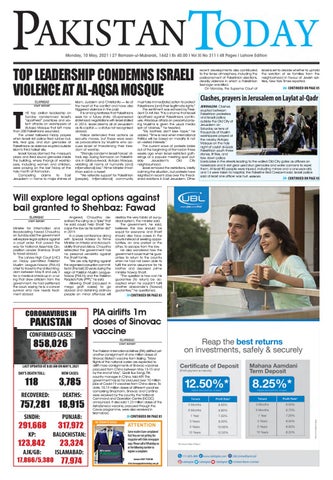
Monday, 10 May, 2021 I 27 Ramzan-ul-Mubarak, 1442 I Rs 40.00 I Vol XI No 311 I 48 Pages I Lahore Edition
Top leadership condemns israeli violence aT al-aqsa mosque ISLAMABAD
T
staff report
he top civilian leadership on Sunday condemned Israel’s “apartheid” practices and violent attacks on worshippers at Al-Aqsa Mosque that left more than 200 Palestinians wounded. The unrest followed Friday prayers when Israeli riot police fired rubber bullets, tear gas, and stun grenades at Palestinians as violence erupted outside Islam’s third holiest site. Israeli forces stormed the mosque’s plaza and fired sound grenades inside the building, where throngs of worshippers, including women and children, were praying on the last Friday of the holy month of Ramadan. Competing claims to east Jerusalem — home to major shrines of
must take immed[iate] action to protect Palestinians [and] their legitimate rights.” The sentiment was echoed by President Dr Arif Alvi. “It is a shame that Israeli apartheid against Palestinians continues. Atrocious attack on peaceful praying Muslims is given the usual media spin of ‘clashes,’” he tweeted. “My brothers don’t lose hope,” he added. “Time is near when International Politics will be based on morality & not on vested interests.” The current wave of protests broke out at the beginning of Ramadan three weeks ago when Israel restricted gatherings at a popular meeting spot outside Jerusalem’s Old City neighbourhood. Israel removed the restrictions, briefly calming the situation, but protests have reignited in recent days over the threatened evictions in east Jerusalem. Other
Islam, Judaism and Christianity — lie at the heart of the conflict and have also triggered violence in the past. It is among territories that Palestinians seek for a future state. US-sponsored statehood negotiations with Israel stalled in 2014. Israel deems all of Jerusalem as its capital — a status not recognised abroad. Police defended their actions as security moves, but these were seen as provocations by Muslims who accuse Israel of threatening their freedom of worship. “Strongly condemn Israeli Forces’ attack esp during Ramazan on Palestinians in Qibla-e-Awaal, Al-Aqsa Mosque, violating all norms of humanity [and] int[ernational] law,” Prime Minister Imran Khan said in a tweet. “We reiterate support for Palestinian [people]. Int[ernational] community
Will explore legal options against bail granted to Shehbaz: Fawad ISLAMABAD staff report
Minister for Information and Broadcasting Fawad Chaudhry on Sunday said the government will explore legal options against a court order that paved the way for National Assembly Opposition Leader Shehbaz Sharif to travel abroad. The Lahore high Court (LhC) on Friday permitted Pakistan Muslim League-Nawaz (PML-N) chief to travel to the United Kingdom between May 8 and July 3 for a medical check-up in a ruling that drew criticism from the government. he had petitioned the court, saying he is a cancer survivor who now needs treatment abroad
Angered, Chaudhry described the ruling as a “joke” that he said could help Sharif “escape the law as his brother did” in 2019. In a press conference along with Special Advisor to Prime Minister on Interior and Accountability Shahzad Akbar, Chaudhry reiterated the government has no personal vendetta against the Sharif family. “We are only fighting against the organised corruption committed in [the last] 20 years during the reign of Pakistan Muslim LeagueNawaz (PML-N) and the Pakistan People’s Party (PPP),” he said. Allowing Sharif [accused in mega graft cases] to go abroad and detaining ordinary people on minor offences will
coronavirus in
pakisTan
CONFIRMED CASES:
destroy the very fabric of our judicial system, the minister said. The government, he said, believes the law should be equal for everyone and Sharif should also face cases in the courts instead of seeking opportunities, on one pretext or the other, to escape from the law. he also wondered how the government could trust his guarantee to return to the country when he had not been able to fulfil the same assurance for his brother and deposed prime minister Nawaz Sharif. “The question is how can his guarantee [to return] be accepted when he couldn’t fulfil another absconder’s [Nawaz] guarantee,” he questioned.
PIA airlifts 1m doses of Sinovac vaccine
858,026
LAST UPDATED AT 8:03 AM ON MAY 9, 2021
DAY'S DEATH TOLL:
NEW CASES:
118
3,785
RECOVERED:
DEATHS:
757,281 18,915 SINDH:
PUNJAB:
291,668
317,972
KP:
BALOCHISTAN:
123,842 AJK/GB: 17,866/5,380
23,324 ISLAMABAD:
77,974
CONTINUED ON PAGE 03
ISLAMABAD: staff report
The Pakistan International Airlines (PIA) airlifted yet another consignment of one million doses of Sinovac Biotech vaccine from Beijing. “More flights of the national carrier are expected to airlift more consignments of Sinovac vaccines procured from China between May 13-15 and by the end of May”, Qadir Bux Sangi, PIA country manager in China, told APP. The government has so far procured over 10 million jabs of Covid-19 vaccines from China alone. To date, 10.19 million doses of different vaccines comprising Sinopharm, Sinovac and CanSino were received by the country, the National Command and Operation Centre (NCOC) announced. It also said 1.23 million doses of the AstraZeneca vaccine, procured through the Covax programme, were also received in Islamabad.
CONTINUED ON PAGE 05
in today’s issue
attention Some readers have complained that they are not getting the magazine with their newspaper copy. Please call or WhatsApp us at the following number to register a complaint. Contact: 0307-7338168 irfan.farooq@pakistantoday.com.pk
recent developments also contributed to the tense atmosphere, including the postponement of Palestinian elections, deadly violence in which a Palestinian teenager was killed. On Monday, the Supreme Court of
Israel is set to decide whether to uphold the eviction of six families from the neighborhood in favour of Jewish settlers, New York Times reported.
CONTINUED ON PAGE 05
Clashes, prayers in Jerusalem on Laylat al-Qadr JERUSALEM: Clashes erupted between Palestinian protesters and Israeli police outside the Old City of Jerusalem on Saturday as tens of thousands of Muslim worshippers prayed at the nearby Al-Aqsa Mosque on the holy night of Laylat al-Qadr. Palestinian youth threw stones, lit fires, and tore down police barricades in the streets leading to the walled Old City gates as officers on horseback and in riot gear used stun grenades and water cannons to repel them. At least 80 people were injured, including minors and a one-year-old, and 14 were taken to hospital, the Palestine Red Crescent said. Israeli police said at least one officer was hurt. agencies
CONTINUED ON PAGE 05
02
Monday, 10 May, 2021
LAHORE
NEWS
riyadh, islamabad working to taCkle islamophobia: saudi diplomat RIYADH/ISLAMABAD
s
STaff RePoRT
AuDI Foreign Minister Prince Faisal bin Farhan Al-Saud on Sunday called for a global dialogue to face the rising tide of Islamophobia, Radio Pakistan
reported. In an interview with Pakistan Television, Al-Saud said Saudi Arabia and Pakistan are jointly working on various challenges, including Islamophobia, facing the Muslim community. The announcement was also made during a meeting between Crown Prince
Mohammed bin Salman and Prime Minister Imran Khan in Jeddah. Appreciating Pakistan’s role in countering Islamophobia, he said the Organisation of Islamic Cooperation (OIC) is an important platform to take up the issue. The interview comes as the prime minister is on his seventh visit to the Kingdom since his August 2018 election. There, he was given a warm welcome by Saudi officials in the western coastal city of Jeddah. The two governments on Saturday signed several agreements and vowed to reset ties strained by months of disagreement over policy on the Kashmir dispute.
118 more pass away of Covid-19 ISLAMABAD: The coronavirus claimed 118 more lives nationwide over the last 24 hours, pushing the death toll to 18,915 on Sunday. According to the National Command and Operation Centre (NCOC), 3,785 new infections were registered after testing 40,736 samples. The positivity rate was recorded at 9.29 percent, it said. The total caseload climbed to 858,026 with the addition of new cases. 752,712 people have recovered from the disease. Whereas, the number of Covid-19 patients in critical care across the country stands at 4,903. Overall 757,281 people have recovered from the pandemic while 12,190,671 total tests have been conducted since the outbreak of the pandemic. Since the outbreak, Punjab reported 317,972 cases, Sindh 291,668, Khyber Pakhtunkhwa 123,842, Islamabad 77,974, Balochistan 23,324, Azad Jammu and Kashmir 17,866 and Gilgit-Baltistan 5,380. VACCINATION CENTRE OPERATIONAL: In view of rising cases, the Expo Centre in Karachi was reopened for a mass vaccination drive. The vaccination centre is said to be the largest in the country, where an estimated 30,000 people could be inoculated in a day with round-the-clock service offered to visitors registered for the jabs. According to an official, some 400-strong workforce of the provincial health department comprising doctors, physicians, healthcare workers and volunteers would be serving at the centre. On the other hand, free jabs are being inoculated to the registered people with the NCOC portal at private medical facilities in Karachi. In December, Sindh Health Minister Dr Azra Pechuho hinted at turning the Karachi Expo Centre into a coronavirus vaccination centre. She had also visited the centre to review the proposal and get a briefing from the experts about the possibility of the plan. INP
Regarding the visit, Al-Saud said it will further strengthen brotherly ties between the two nations. He also acknowledged Imran’s vision for regional peace and prosperity. The top Saudi diplomat commended the role of Pakistan nationals abroad in the development and progress of the kingdom. He said the best facilities are being provided to the Pakistani workforce in the Kingdom as per local regulations. He said more career opportunities were being made available to Pakistani workers in the Kingdom and Riyadh will welcome more talented labour from Pakistan. He also urged investors to take advantage of the investment opportunities
available in both countries. To a question about the environmental challenges, Al-Saud said Saudi Arabia is focused on tackling the issue of climate change and also stressed joint efforts in this regard. In response to another question, he said peace in Afghanistan is imperative for regional stability. During the visit, the two governments also reaffirmed their full support for “all the legitimate rights” of the Palestinians, especially their right to self-determination and establishment of their independent state with East Jerusalem as its capital. The reaffirmation was made during a meeting between the crown prince and the
prime minister in Jeddah, according to a joint statement released by the Ministry of Foreign Affairs. “In the constructive spirit of discussions, the two sides reaffirmed their full support for all the legitimate rights of the Palestinian people, especially, their right to selfdetermination and establishment of their independent state with pre-1967 borders and East Jerusalem as its capital, in accordance with the Arab Peace Initiative and relevant uN resolutions,” the statement read. The official Saudi Press Agency said the two sides also signed agreements addressing the treatment of criminals, and crime. They also agreed two memorandums of understanding on combating drug trafficking, and on financing energy, water, and infrastructure projects. “During the meeting, it was agreed to further strengthen, deepen and diversify the existing bilateral political, economic, trade, defence and security ties,” a statement said. “The talks were marked by exceptional cordiality and a commitment to fortify the upward trajectory in the bilateral relationship,” it added.
All vaccines used in Pakistan are being monitored, says official NEWS DESK Health Services Director General (DG) Rana Safdar on Sunday said that all vaccines being used in Pakistan are being “strictly monitored” and rejected concerns related to coronavirus vaccines in Pakistan, He stressed that none of the concerns were valid. “Separate checks are conducted to gauge the safety
and efficacy of the vaccines,” he added. The government official warned the masses from falling prey to any misleading and untrue information about coronavirus vaccines being used in Pakistan. Safdar said the guidelines for using coronavirus vaccines are based on recent scientific analysis and statistics provided by experts. “We constantly monitor the process to update the
CTD arrests terrorist in Mardan raid, recovers explosives NEWS DESK The Counter-Terrorism Department (CTD) Sunday arrested a terrorist and recovered explosives from him in a raid in Mardan region. CTD officials said Anwar Khan was a proclaimed offender and wanted in terrorism cases to the police with five million rupees bounty on his head. The CTD recovered a heavy machine-gun seven RPG shells and large quantity of munitions, on indication of the
arrested terrorist, officials said. Anwar was wanted to the CTD Mardan in 13 cases of terrorism, according to officials. The arrested terrorism accused also made disclosures about his accomplices during the investigation, officials said. The officials said investigation was underway and important information was expected to be gleaned from the arrested terror suspect. In December last year security agencies arrested five terrorists of the proscribed group in a raid in Peshawar.
Police arrest MQM-London activist involved in 18 murders KARACHI TLTP
Police on Sunday claimed to have arrested an activist of MQM-London, who received training from India and remained allegedly involved in 18 murder acts. Sharing details of the arrest, the Malir City police expressed that the MQM-London activist identified as Muhammad Shahzad aka ‘Khaji’ was allegedly involved in 18 murder cases. 0“He joined the party in 1988 as an activist and later joined a target killing team of Naeem Sharri in 1993,” the police said adding that the
suspect killed a sub-inspector and a constable along with his accomplices in a firing incident. They said that Muhammad Shahzad was also allegedly involved in killing activists from political and religious outfits. “More revelations are expected to come during the investigation process,” the police said adding that arrests would then be made in light of these revelations. He is booked in various cases under anti-terrorism and other charges. On March 18, MQM-London’s Kehkashan Haider can be allegedly heard coordinating for a nefarious killing bid via phone call as another audiotape surfaced suggesting she led the target killers’ wing in the port city.
standard operating procedures of the vaccines,” he said. He urged people aged 40 and above to register for the vaccine and called on those who were 50 and above to avail the walk-in vaccination facility available in Pakistan. “Those aged 50 years and above should just bring along their NICs and mobile phones [to the vaccination centre],” he said.
Quetta imposes ban on entry of vehicles from other districts NEWS DESK District administration has imposed ban on entry of vehicles from other districts in Quetta owing to spike in coronavirus cases.Deputy Commissioner Quetta has dispatched a letter of this effect to the DCs of the adjoining districts. The DC in the letter asked the authorities of the adjacent districts Mastung, Kachhi, Pishin and Qilla Abdullah to stop entry of the vehicles in Quetta. Following the guidelines of the National Command and Operation Centre (NCOC), Balochistan government had recently announced to impose coronavirus lockdown from May 08. Balochistan government’s spokesperson Liaquat Shahwani said in a statement that tougher restrictions have been imposed across the province from May 8 to 16. A ban was imposed on all trade and amusement activities. All markets, shops, shopping malls will remain closed following the new restrictions.
Monday, 10 May, 2021
LAHORE
nCoC direCts full ComplianCe of Covid sops aCross Country during eid holidays ISLAMABAD
a
mIaN abRaR
special session of the National Command & Operation Cente (NCOC) held on Sunday expressed concern on reported violations of the standard operating procedures (SOPs) and has instructed all provincial governments to ensure complete compliance of SOPs with full administrative control during Eidul Fitr holidays. The NCOC session was chaired by Planning Minister Asad umar and Lt Gen Hamood uz Zaman Khan to take a
SPeciAL SeSSion exPreSSeS concern over vioLAtion of SoPS, inStructionS by ProvinciAL governMentS review of mobility control measures being implemented across the country from May 8 to 16, 2021. Chief Secretaries of all provinces also attended the session. A review of SOPs implementation was also carried out. It was reiterated that during this duration, all markets, businesses and shops will remain closed except essential services, including grocery stores,
sindh enters lockdown ahead of eid holidays KARACHI: The Sindh government on Sunday imposed a general quarantine across the province to curtail the spread of the coronavirus. The restrictions targetted travel and tourist points in a bid to prevent a surge in new Covid-19 infections during the Eidul Fitr holidays. All businesses will remain shut from May 9 to May 16. The markets, except dairy shops, will remain closed. The dairy points will remain open until midnight. Essential services including grocery stores, fruit and meat shops, and restaurants are allowed to operate until 6:00 pm. A complete lockdown was implemented on Saturday in Punjab, Khyber Pakhtunkhwa and Balochistan. As per the NCOC decision, markets, shopping points and entertainment venues will remain closed until May 16. Cloth markets, shoe markets, and salon shops were also closed down. However, grocery stores, tandoors, and dairy, meat and fruit shops will be open until 6:00 pm in all three provinces. For the convenience of the people, the State Bank of Pakistan (SBP) has directed commercial banks to remain open on Mondays and Tuesdays so that people do not face any problem ahead of Eid holidays. Battling a third wave of infections and increasingly nervous about the crisis across the border in India, the government has imposed tough restrictions since a one-month lockdown in April last year. “These measures have been necessitated by the extremely dangerous situation which has been created in the region with the spread of virulent mutations of the virus,” tweeted Planning Minister Asad umar, who has been leading the government response to the outbreak. Eid usually sees the mass movement of people around the country and tourist spots crowded with people. Last year, the country saw a spike in cases in the weeks after the celebrations. INP
3 ttp militants arrested PESHAWAR: The Counter-Terrorism Department (CTD) of Bannu police arrested on Sunday three Tehreek-e-Taliban Pakistan (TTP) terrorists involved in the suicide blast on a police station. Khyber Pakhtunkhwa government had put Rs6 million bounty on Zafar Iqbal, Noorani alias Madni and Abdul Shakoor alias Hameedi. They were wanted by the CTD and police in several cases. These terrorists belonged to local groups of TTP commander Afsar Ali and Commander Ilyas alias Qari Bilal. They intended to carry out terrorist activities in Bannu and Mingora before Eidul Fitr, police said. Police arrested them from the adjoining areas of Bannu, Garira, and Khwaja Mad Mundan. In another development, unidentified militants attacked a police mobile in Lakki Marwat, leaving an assistant sub-inspector (ASI) Muhammad Shah dead and a constable injured. Two terrorists were killed in the retaliatory attack. Police also recovered automatic weapons from their possession. INP
pr to run eid special trains between peshawar-rawalpindi In order to facilitate the nationals to spend Eidul Fitr holidays with their relatives, the Pakistan Railways (PR) has announced to run Peshawar-Rawalpindi trains. According to the Pakistan Railways Peshawar chapter, the first special train will leave for Rawalpindi from Peshawar Cantt station at 9 am on Monday. The train will reach Rawalpindi at 12:30 pm via Nowshera, Jahangera, Attock City, Hassan Abdal, Taxila and Golra Sharif. The same train will leave for Peshawar at 2 pm from Rawalpindi and will reach by making stops at Golra Sharif, Taxila, Hassan Abdal, Attock City, Jahangera and Nowshera. The trains will continue to run from May 10 to May 16. Earlier, the Pakistan Railways has announced to run 66 more special trains to facilitate the citizens on eve of Eid amidst a complete ban on public transport. According to the PR spokesperson, the railways will operate 66 special trains from different cities of Punjab, Sindh and Khyber Pakhtunkhwa. NeWS DeSK
pharmacies/medical stores, medical facilities and vaccination centres, vegetable, fruit, chicken & meat shops, bakeries, petrol pumps, food takeaways and e-commerce (home delivery), utility services (electricity, natural gas, internet, cellular networks/telecom, call centres) and media. Moreover, a complete ban on tourism for both locals & outsiders will
be enforced. All tourist resorts, formal and informal picnic spots, public parks, shopping malls; all hotels and restaurants in and around tourist and picnic spots will remain closed during this duration. Tourist leading to any tourism destination will be sent back and will not be allowed to enter tourist destinations. Bookings of all hotels etc have been cancelled. Ban on inter-provincial, inter-city and intra-city public transport will be imposed, except private vehicles, taxis/cabs, rickshaws with 50 per cent occupancy.
PM annoyed by delay in implementation of electoral reforms ISLAMABAD ahmaD ahmaDaNI
Prime Minister Imran Khan has fretted over the delay in implementing the key electoral reforms pertaining to introducing Electronic Voting Machines (EVMs) and extending the right of vote to overseas Pakistanis, it emerged on Sunday. According to a source, PM Imran is annoyed by the delay in introducing EVMs, which will play a pivotal role in extending the right of vote to overseas Pakistanis. In this regard, the premier has directed Adviser to the Prime Minister on Parliamentary Affairs Babar Awan to give definite timelines and update him regularly on the progress on the issues to introduce EVMs. The source said that the adviser to the PM, while presenting the weekly update to the federal cabinet on introducing EVMs and the right to vote to overseas Pakistanis, has informed that section 94 and section 103 of the Election Amendment Bill was in the Ministry of Law for vetting, and it would be done within two days. Thereafter, the draft ordinance would be placed
before the Cabinet Committee for Disposal of Legislative Cases (CCLC) and the stand-alone machine had been selected, whose prototype has been prepared by the National Telecommunication & Radio Corporation (NRTC). It is relevant to note here that President Arif Alvi on Saturday had promulgated the Election (Second Amendment) Ordinance, 2021, which allowed voting rights to overseas Pakistanis and the use of electronic voting machines (EVMs) during the election process. According to the ordinance issued by the president, changes were made to section 94 (1) and section 103 of the Election Act 2017. This second set of changes to the bill will help in ensuring that overseas Pakistanis vote during the next general polls. The source said that the cabinet was apprised that the Election Commission of Pakistan (ECP) has given a requirement of 800,000 EVMs, at a cost of approximately Rs200,000/EVM for the imported machines. In the case of the selection of a locally manufactured machine, the price would be half of the imported one and the same would result in savings of approximately Rs160 billion.
Motorway police foil minor abduction bid, arrest female kidnapper KASUR TLTP
The Motorway Police on Sunday thwarted a kidnap bid of a minor boy who was being transported via M3 near Pattoki and arrested a woman who is allegedly behind the abduction. The police recovered the child during a snap checking exercise and held the alleged kidnapper, one Maryam Bibi, confirmed Motorway Police
spokesperson. According to the details, mother of the victim kid had brought her to District Headquarter Hospital of Sahewal but when the imposter hospital staff took the kid inside, he never returned. After waiting a while for their kid to return, the bereaved family lodged the case in the local Farid Town police station. Following the police complaint, the district authorities informed the motorway police to begin checking exercise which resulted in kid’s recovery.
Eidul Fitr on May 14, Fawad says ISLAMABAD INP
Minister for Information and Broadcasting Fawad Chaudhry on Sunday announced Eidul Fitr will be celebrated on May 14 but called on the people to wait for a final announcement from the Central Ruet-e-Hilal Committee is made. In a tweet, Chaudhry said that the Shawal moon will be sighted on the night of May 13 and Eid will be celebrated the following day. But he further called on the people to wait for a final announcement by the Ruet committee. Ruet-e-Hilal Research Council (RHRC) Secretary General Khalid Ejaz Mufti a day earlier confirmed Eid
would be celebrated across Pakistan on Friday. SPECIAL RAWALPINDI-PESHAWAR EID TRAIN: In order to facilitate the nationals to spend Eidul Fitr holidays with their families, the Pakistan Railways has announced to run special trains on the Peshawar-Rawalpindi route. According to the Peshawar chapter of the railways, the first train will leave for Rawalpindi from Peshawar Cantt station at 9:00 am on Monday and will reach Rawalpindi at 12:30 pm via Nowshera, Jahangera, Attock City, Hassan Abdal, Taxila, and Golra Sharif. The same train will leave for Peshawar at 2:00 pm from Rawalpindi and will reach by making stops at Golra Sharif, Taxila, Hassan Abdal, Attock City, Jahangera, and Nowshera.
NEWS
03
3 soldiers martyred, 5 injured in terrorist attaCks: ispr Three FC soldiers embraced martyrdom while five were injured in the line of duty during two separate terrorist attacks in Quetta and Turbat areas of Balochistan. In Margret, Quetta, terrorists targeted FC troops deployed on security duties. During an exchange of fire, three FC soldiers embraced martyrdom while one got injured. In another terrorist attack in Sherbandi, Turbat, terrorists targeted soldiers patrolling along Pakistan- Iran Border. Resultantly four FC soldiers got injured. Those martyred are Lance Naik Syed Hussian Shah, Sepoy Faisal Mehmood and Sepoy Nauman ur Rehman. NeWS DeSK
will explore legal options against bail granted to shehbaz: fawad CoNtINUED fRoM pAgE 01 “When he was giving Nawaz’s guarantee, we had the hope at the time that NAB and the court would call him and ask that he had given a guarantee for Nawaz and had to come back with him so where has he [Nawaz] gone?” The minister observed the opposition had the same stance and pointed to the call by PPP co-chairman Asif Ali Zardari for Nawaz’s return during a conversation with PML-N Vice President Maryam Nawaz. “The opposition itself thinks that Nawaz is a fugitive.” Chaudhry said the manner in which permission was granted to Sharif to go abroad was a reflection of the “rot in the [judicial] system”. He also questioned the speed with which Sharif’s application for bail was heard and decided on. The minister said giving permission to Sharif to go abroad would mean “setting aside the rights of thousands of prisoners”. “We forget them, acknowledge the class system and allow Shehbaz to go abroad while the rest of the prisoners don’t have the right to even get treatment outside of jail.” Sharif faces corruption charges in three separate court cases. He was released on bail last month on a court order, about seven months after he was arrested by the National Accountability Bureau (NAB) for involvement in money laundering and being in possession of assets disproportionate to declared income. Nawaz, convicted of corruption, lives in self-exile in London. He was released from prison in 2019 on bail to seek medical treatment abroad but never returned home. The government last December started the process to reach an extradition treaty with Britain that would pave the way for the uK to hand over the PML-N supreme leader. Speaking on the occasion, Akbar said the government will file an appeal against the bail orders as the court “was not properly assisted” in the case.
no eid travel plans, #stayhomestaysafe: asad umar Tourist spots across the country will remain closed during Eid holidays this year, Federal Planning Minister Asad umar said on Sunday. In a tweet on Sunday, he reminded people that all tourist destinations will remain closed from May 8 to May 16. “Please do not come, or you will be turned back.” According to the minister, in an NCOC meeting, the chief secretaries from all units with popular tourist destinations were instructed to remind everyone about the restrictions and ensure they were followed. The government has placed a ban on all tourism activities across the country in a bid to curb the spread of the novel coronavirus. Travel nodes leading to tourist spots such as Murree, Galiyat, Swat, Kalam, and northern areas have been closed as well. Inter-province and intercity transport have been banned as well except for the residents of Gilgit-Baltistan who return back home during the vacations. In Sindh, Sea View and beaches have been closed too. Earlier in the day, the government decided to close Ramadan Bachat Bazaars in Punjab. NeWS DeSK
Bilawal felicitates party workers on winning NA-249 by-election KARACHI INP
Pakistan People’s Party (PPP) Chairman Bilawal Bhutto Zardari on Sunday has felicitated his party workers on winning the by-election in National Assembly (NA) constituency NA-249 Karachi again after the vote recount. In a post on the social-networking website Twitter, the PPP leader said, “After the recount we’ve expanded our lead to over 900+ votes.” False accusations have been exposed and the truth has prevailed. People of Karachi have rejected selected and placed their hopes in PPP, he added. After a recount of votes polled across all 276 stations, Mandokhail got 15,656 votes, whereas PML-N candidate Miftah Ismail secured 14,747. This means that the PPP candidate was ahead of the second-placed Mistah Ismail by a margin of 909 votes.
When the unofficial by-poll results were first announced, Mandokhail won with 16,156 votes, whereas Ismail came in second with 15,473, resulting in a difference of 683 votes. The low margin of votes had prompted Ismail to petition the ECP to hold a recount. The ECP, accepting Ismail’s application for a hearing, issued a stay order, withholding the results of the by-poll. Separately, Bilawal hit hard on Imran Khan’s Pakistan Tehreek-e-Insaf (PTI) government for showing insensitivity towards rising inflation and ensuing poverty in the country. In a statement issued on Sunday, Bilawal said that the rate of poverty was dangerously on the rise. He said that with a 30 per cent rise in the poverty rate, 80.5 million people are standing on the edge of the poverty line. He added that daily 15 to 20 people are ending their lives by committing suicide due to poverty. Bilawal asked Prime Minister Imran to come out of
his dream world and assess the ground realities. He said that for a common man life, has become very hard. He said that the government has again raised the power tariff to extract Rs90 billion from the pockets of poor people. He posed a question if the inflation rate exceeds 14 per cent, how a common man would survive? He said that medicine prices in Pakistan have increased 100 per cent adding that no one cares about the poor man. Bilawal maintained the government makes amnesty schemes for “elite” and “langar khanas” for the poor. He told the prime minister that this will not work. The PPP chairman said that if rumours of 20 per cent retrenchment in the industrial sector after Eid turned out to be true then the situation would become more difficult. He said that the premier always blamed corruption being the main reason behind the country’s bad economic situation, while it is in fact his anti-people thinking that has economically destroyed Pakistan.
04
Monday, 10 May, 2021
NEWS
abducted girl rescued after seven years, two held SARGODHA INP
The police on Sunday rescued daughter of a labourer kidnapped some seven years earlier, and two kidnappers were also arrested during the operation. According to details, seven-year-old Ume Kulsoom d/o of a labourer Younas was abducted from Muqam Hayat area of Sargodha on May 20, 2014. The kidnapped girl was earlier taken to bricks kiln in Khushab and then to Chakwal where she served as forced labour and used to sexually abused by abductor and his accomplices. Later, accused entered into fake ‘nikah’ with Kulsoom and she gave birth to a child at age of 13 years. The police using the latest technology traced the girl and rescued here besides arresting two culprits Ahmad Ali and Shoaib. The rescued girl was handed over to her family who lauded police for its action and demanded strict action against the detainees.The police have registered a case against the nabbed abductors and started investigation.
LAHORE
Minister sees uptick in cOrOnavirus cases in sOuthern punjab LAHORE
p
STAFF REPORT
UNJAB Health Minister Dr Yasmin Rashid has said that there is an uptick in Covid-19 cases in south Punjab and stressed for implementation of coronavirus standard operating procedures (SOPs) to stem the spread. Addressing a press conference in Lahore on Sunday, Dr Yasmin said, “The number of coronavirus cases has been increasing in south Punjab.”
PNS SAIF participates in Naval exercises with US, Canada ISLAMABAD STAFF REPORT
Pakistan Navy Ship (PNS) SAIF participated in Focused Operation CHINOOK ARCHER along with ships and aircrafts of United States and Canada in Arabian Sea. Pakistan Navy ships are regularly deployed for PN’s initiative of Regional
in Faisalabad 17 per cent and Sargodha 16 per cent. She said that wherever coronavirus SOPs were implemented the positivity ratio had subsequently decreased. “Covid-19 patients are undergoing treatment on 18 out of 98 ventilators,” she added. She shared that smart lockdown has been implemented in many places in Lahore and Multan with a population of 247,000. She announced that as per the decisions, petrol pumps, tandoors and medical stores will remain open amid the lockdown while the vaccination centres will be open except for Eid holidays.
The minister said that the positivity ratio of Covid19 cases in Rajanpur is 25 per cent while in Rahim Yar Khan it is 23 per cent. Sharing the update on the medical oxygen availability in the province, Dr Yasmin said that work in the oxygen industry will continue even during the Eidul Fitr holidays and appealed to the public that news relating to the availability of oxygen must be cross-checked with the government. The minister said that 15,000 coronavirus tests were conducted on Sunday. Dr Yasmeen said in Lahore the coronavirus positivity ratio is 15 per cent,
Maritime Security Patrol to ensure maritime security in Indian Ocean Region, says Pakistan Navy press release. In addition, as part of CTF-150, PNS SAIF participated in Focused Operation CHINOOK ARCHER along with ships and aircrafts of United States and Canada. The exercise was aimed at impacting narcotic smuggling trade along the hash highway to the East of Oman. Under the realm of Focused Operation, PNS SAIF participated in the Passage Exercise with US naval
ship USS LABOON and Canadian ship HMCS CALGARY. The aim of the exercise was primarily to demonstrate interoperability between participating navies and interdict illegal smuggling/ trade emanating along the hash highway. Pakistan Navy promotes peace and stability in the region and has remained committed to maritime security and order at sea. Participation of PN in such internationally organised Focused Operation is a manifestation of PN’s resolve in curtailing terrorism at sea in all forms. PN Ships being flag bearers of Pakistan continue to remain poised at sea in an effort to curb menace of illegal smuggling and narco trafficking so as to ensure safe regional trade corridors for maritime community.
One killed, seven injured after abbOttabad van falls intO ditch ABBOTTABAD INP
A woman was killed and seven people injured after a passenger van fell into a ditch near Abbottabad’s Bag Bandi Sunday morning. According to Rescue 1122, the accident took place after the steering wheel of the vehicle got locked. The injured people have been rushed to a hospital. The doctors have declared them to be in critical condition. Rescue officials have called in a crane to pull the van out of the ditch.
Police nabs minor accused of looting Rs1.6m from ATM KARACHI TLTP
Police on Sunday claimed to apprehend a minor boy allegedly involved in breaking into the ATM in Karachi’s Gulberg area to loot Rs1.6 million. According to details, a joint raid was carried out by the AVLC and CIA departments of the Sindh police to arrest the young suspect involved in the incident on December 16, 2020. “I broke off the ATM machine with my hand and took off cash tray having Rs1.6 million,” the accused identified as Adnan confessed to his crime before the police. The father of the suspect said that they purchased a residence in Surjani, a rickshaw and some gold from the looted money. SSP Central Arif Aslam Rao said that the suspect used to work at a mechanic shop near the bank and carried out the reconnaissance on his own. “We have re-
covered the document of the residence, rickshaw and other material from his possession,” he said. The Karachi police have solved major crime cases and arrested suspects wanted for their role in such acts. In one such action recently, police claimed to have arrested Abid Shah, a suspect long wanted in robbery and murder crimes who according to the police killed his own henchman in the last robbery, along with his eight alleged accomplices from Orangi Town. The raid conducted today by the District West police confirmed having arrested Shah who in his last alleged robbery bid wounded a civilian with a gunshot and, in fact, killed his own accomplice, police said. After the CCTV footage of the last robbery, within the remits of Docks Police Station, was furnished, the police launched a probe into the case and investigations led to today’s arrest with eight of his henchmen, they confirmed.
Sonia Naz becomes first transgender person to open business under KJP ISLAMABAD APP
The Prime Minister’s Kamyab Jawan Programme helps foster inclusion of trans-people in the society as Sonia Naz, a trans artist, has become the first transgender person to open her own business in fashion designing field after getting soft loan amounting to Rs1 million under its Youth Entrepreneurship Scheme (YES). On a mission to transform the prevailing mindset in society that they are only born to dance or beg, the trans artist said that she wanted to change such way of thinking among people by setting an example. Sonia, in a two-minute video clip, said she swiftly applied for a concessionary loan when she heard in the news that Prime Minister Imran Khan had launched the Kamyab Jawan Programme (KJP) to assist youth in starting their own businesses. She said she felt optimistic after witnessing a third column [transgender] at the application form of the KJP as usually there were only two columns at a form, male and female. She appreciated Prime Minister Imran Khan and the KJP’s team for including transgender community under
such a 'wonderful' initiative. Sonia also spoke about the issues faced by the transgender at their homes and in the society. Commenting over the development, Special Assistant to the Prime Minister on Youth Affairs Muhammad Usman Dar said Sonia became the first transgender who had availed a soft loan under the KJP. He said that the present government, under the leadership of Prime Minister Imran, was working, especially for the marginalized strata of the society. Dar said that soft loans amounting to Rs8.5 billion had been disbursed to 10,000 young entrepreneurs under the YES of KJP. A large number of women were also financially supporting their families after reaping benefits of the KJP, he added. The United Nations Development Programme-Pakistan, extending technical assistance to the YES, also commented over the development through a tweet. “UNDP-Pakistan is proud to offer technical assistance and support to Prime Minister Imran Khan’s Youth Entrepreneurship Scheme of Kamyab Jawan Programme, as it reaches out to provide financial support to vulnerable groups and help people like Sonia start their own businesses in Pakistan,” it tweeted.
Monday, 10 May, 2021
LAHORE
NEWS
STruggle AgAInST corruPT MAfIA, STATuS quo leAdS To nAyA PAkISTAn: PM JeddaH
P
APP
RIME Minister Imran Khan Sunday said that the country was passing through a decisive moment and the struggle against corrupt mafia and status quo would succeed soon, leading to Naya Pakistan. Addressing a gathering of Pakistani community in a ceremony held here in connection with Roshan Digital Account, the prime minister said his government’s struggle was driven mainly for establishment of rule of law in the country. “It is a decisive moment, the old status quo and a mafia were resisting and trying to save themselves. But public supported my party and the government in the struggle for rule of law,” he added. The event was organized by the Embassy of Pakistan in Saudi Arabia where Governor State Bank, Syed Baqir Raza, also highlighted the achievements and promise of “Roshan Digital Accounts”, launched last year, under the vision of the prime minister. The prime minister further said that difference in societies was based upon– the one which had rule of law and the other governed by ‘might is right.’ The system based upon humanity survived and ensured prosperity whereas the rule of jungle led to nowhere, he said. “Those countries prospered where
there is rule of law and justice,” he stressed. The prime minister said the corrupt elements had been united in their efforts to save their skins. “No one can stop this change, due to mass awareness. Social media has brought a change as information travelled very fast. The youth and social media have been the main ingredients of our party’s success,” he opined. He said the struggle continued for that Naya Pakistan which had been envisioned by its founder Quaid e Azam Muhammad Ali Jinnah and which must have been realized many years back. Due to his government’s efforts for Naya Pakistan, the country was rightly back on track and on path to its real destiny. Appreciating the role of about 9 million overseas Pakistanis in the prosperity of the country, he said, they possessed huge potential and had been the biggest asset. He said their potential was not fully tapped and no efforts were made in the past to pursue them to invest in the country. The prime minister said the country’s economy was being stabilized as they had passed through the most difficult times with consistent strengthening of its reserves. He mentioned that government was making efforts to further offer the over-
seas Pakistanis different products like Roshan digital account because the world was changing at fast pace with the use of latest technology. The prime minister lauded the overseas Pakistanis for their patriotism and contribution to the progress and development of Pakistan. Recalling his personal experience of interacting with overseas Pakistanis, spanning over three decades, he termed them an asset for Pakistan. He said that the welfare and wellbeing of overseas Pakistanis was among the government’s top priorities. He said efforts would be made to resolve their issues and nurturing their potential to the benefit of the motherland. The prime minister especially appreciated the role of Pakistani expatriates in the Kingdom – largest Pakistani diaspora abroad, for the largest contribution it makes to foreign remittances of the country. He urged them to utilize the special schemes, such as the Roshan Digital Accounts, which had been launched with a view to facilitate them. The prime minister also encouraged the ambassador to develop close liaison with the Pakistani community in Saudi Arabia, remain aware of their needs and issues and make every effort towards addressing them. About his visit, the prime minister lauded leadership of Saudi Arabia that al-
ways supported Pakistan in the most difficult times. They supported Pakistan and provided oil on deferred payment, similarly, the United Arab Emirates also supported the country, otherwise, Pakistan would have defaulted, entailing severe consequences, he observed. After Covid pandemic, the prime minister said, the fragile economies were devasted worldwide, adding in the neighbouring country, India, daily caseloads were increasing at alarming level. Pakistan was among the few countries, which had navigated in the Covid scenario with much difficulty, he said, adding, Pakistan’s exports were on the rise and the economy had recovered. The prime minister said the economic indicators of the country were showing improvement. Construction industry was providing jobs and the lowcost housing imitative would provide housing facilities to low-income groups. Prior to it, there was no concept of such housing facility in Pakistan, the government was slowly and gradually unfolding such facilities. Earlier, Governor State Bank of Pakistan, Reza Baqir informed that so far, more than 100,000 accounts had been opened under Roshan digital initiative. He said that country’s current account was now in surplus and the its reserves had surged to over 16 billion dollars.
Clashes, prayers in Jerusalem on Laylat al-Qadr continued from page 01 “They do not want us to pray. There is a fight every day, every day there are clashes. Every day there are troubles,” said Mahmoud al-Marbua, 27, speaking near the Old City’s Damascus Gate. Pointing to police chasing youths and firing thunder-flashes at them, he added: “Look how they are firing at us. How can we live?” Tensions have mounted in the city throughout the holy month of Ramadan, amid growing anger over the potential eviction of Palestinians from Jerusalem homes on land claimed by Jewish settlers. In the Palestinian Gaza Strip, hundreds of protesters gathered along the border with Israel. The Israeli military said the crowds threw burning tyres and firecrackers toward the troops. Gaza fighters fired at least one rocket into Israel which landed in an open area, the military said. “We salute the [people] of Al-Aqsa, who oppose the arrogance of the Zionists & we call on our ppl. in Palestine to support their brothers by all means,” Moussa Abu Marzouk, a leader of the armed fighter group Hamas that rules Gaza, said on Twitter. Israel said it was beefing up security forces on Saturday in anticipation of further confrontations in Jerusalem, the occupied West Bank, and Gaza after fierce clashes erupted the previous night at Al-Aqsa Mosque. A Palestinian official said Egypt was mediating between the sides to prevent further escalation and Saturday’s violence appeared less pronounced than Friday’s events.
On Friday, police fired rubber bullets and stun grenades towards rock-hurling Palestinian youths at the mosque on the Noble Sanctuary/Temple Mount plaza holy to both Muslims and Jews. At least 205 Palestinians and 18 Israeli officers were injured in Friday’s confrontations, which drew international condemnations and calls for calm. Clashes have erupted nightly in East Jerusalem’s Sheikh Jarrah — a neighbourhood where numerous Palestinian families face eviction in a long-running legal case. Police said dozens of protesters threw stones at officers there on Saturday. Police Commissioner Yaakov Shabtai said extra officers were being deployed in Jerusalem on Saturday to “enable freedom of worship and maintain order and security.” “At the same time, we will not allow violent riots, lawbreaking or the harming of police officers. We ask everyone to calm the spirits and violence, particularly on such an important day for the Muslim religion,” Shabtai said in a statement. The Israeli military said it was boosting troops in the West Bank and near the Gaza Strip, where Palestinians have sent incendiary balloons over the border, igniting brushfires in Israeli territory. A military spokesman said extra forces there would largely be firefighting ones. QUARTET APPEAL: The Middle East Quartet of mediators — the United States, Russia, the European Union and the United Nations — expressed concern over the violence and potential Jerusalem evictions. “We call upon Israeli authorities to exercise restraint
and to avoid measures that would further escalate the situation during this period of Muslim Holy Days,” the Quartet said in a statement. Prime Minister Benjamin Netanyahu said in a statement that law and order would be maintained in Jerusalem as would the right to worship. Television footage showed buses of Muslim worshippers heading from Israeli Arab cities to Al-Aqsa being stopped by police on the main highway to Jerusalem. Word of the roadblock spread on social media, drawing hundreds of young men from nearby Arab villages and from Jerusalem. Dozens drove their cars the wrong way down the now-empty Jerusalem-bound lanes, picking up fellow Muslims who had abandoned their own vehicles to start the uphill trek on foot. Some chanted in Arabic: “With our souls and our blood, we will redeem you, Al-Aqsa!” Police said it was stopping only those planning to take part in riots before the buses were allowed to proceed. Scuffles broke out and footage showed officers firing stun grenades. Tension was expected to remain high over the next few days. Israel’s Supreme Court will hold a hearing on the Sheikh Jarrah evictions on Monday, the same day that Israel marks Jerusalem Day — its annual celebration of its occupation of East Jerusalem during the 1967 Middle East war. Palestinians want East Jerusalem as the capital of a future state. Israel claims the entire city as its eternal, indivisible capital. Its annexation of the eastern section was not recognised internationally.
05
Top leadership condemns Israeli violence at Al-Aqsa Mosque continued from page 01 The decades-old legal battle over the fate of a few dozen Palestinians, which Israeli officials dismiss as “a real estate dispute”, has become emblematic of a wider effort to remove thousands of Palestinians from strategic areas in East Jerusalem and a stand-in for the whole conflict. The latest wave of violence drew condemnations even from Israel’s Arab allies and calls for calm from the United States, Europe, and the United Nations. The Arab League scheduled an emergency meeting on Monday. “Condemn in strongest terms attack on innocent worshippers in Al-Aqsa Mosque, first Qibla of Islam, by Israeli Occupation Forces in the holy month of Ramzan,” Foreign Minister Shah Mahmood Qureshi said in a tweet. “Such brutality is against [the] very spirit of humanity & human rights law,” he added, expressing Pakistan’s “steadfast support” of the Palestinian cause. In a statement, Minister for Religious Affairs Noorul Haq Qadri said the shelling on unarmed Palestinians is the “worst act of terrorism and inhumanity.” The opposition also echoed the government’s condemnation. National Assembly Opposition Leader Shahbaz Sharif questioned the role of the willingness of the international community in stopping the “worst human rights abuses” that are taking place in Palestine. “There is no one to put stop to Israel’s desire for the occupation of more Palestinian lands,” he said on Twitter. Saudi Arabia and Pakistan on Saturday reaffirmed their full support for “all the legitimate rights” of the Palestinians, especially their right to selfdetermination and establishment of their independent state with East Jerusalem as its capital. The reaffirmation was made during a meeting between Saudi Crown Prince Mohammed bin Salman and Prime Minister Imran Khan in Jeddah, according to a joint statement released by the Ministry of Foreign Affairs. “ In the constructive spirit of discussions, the two sides reaffirmed their full support for all the legitimate rights of the Palestinian people, especially, their right to selfdetermination and establishment of their independent state with pre-1967 borders and East Jerusalem as its capital, in accordance with the Arab Peace Initiative and relevant UN resolutions,” the statement read.
PIA airlifts 1m doses of Sinovac vaccine continued from page 01 While elaborating on the arrival of the next consignments of the vaccines, the state news agency said that one million doses would be arriving between May 13 and 15 while another 1.5 million doses are expected by the end of May. Pakistan is facing a third peak of Covid-19 and the positivity rate has seen a surge, forcing the authorities to tighten the measures and facilitating the vaccination drive. China has pledged to continue the uninterrupted supply of vaccines to help Pakistan defeat the disease. The government began a vaccination drive in March with over a million doses of Sinopharm vaccines donated by China. It received the first consignment after a military aircraft transported it from Beijing on February 1.
Is everyone equal before law? BY ZaHeer aHmad Last month a ten member bench of the Supreme Court quashed the much talked about reference filled against Justice Qazi Faez Issa. Not only that, the bench also refused to consider the report by Federal Board of Revenue on the orders of the Supreme Court. This case is significant in a number of ways. Some people are celebrating the outcome of the case as a victory of Qazi Faez Issa as they believed that the reference against him came out of the PTI government's alleged bias against the respected judge. Others view the judgment in this case is a clear example set by the judges fraternity that judges are beyond accountability and they can't be questioned as to incompatibility between their income and resources. This later implications is itself questionable as judges who apply the law must also apply the same standards of law to themselves and their spouses. It would not be out of place to quote former premier Nawaz Sharif’s case here. In fact, there is a striking similarity between Nawaz Sharif and Qazi Faez Issa's case with regard to the facts. However, curiously enough the outcome of both the cases is utterly different. In the for-
mer case, a premier is sentenced to ten years in jail and is judged as unfit to hold any government office in future while in the latter case the very initiation of a case against a judge on the basis of non declaration of the property belonging to his wife is considered out of bounds for any court of law. Making a case for the immunity of any person from law in a polity which takes inspiration from the Islamic system of law in which neither a ruler nor a judge is considered immune to accountability ( regardless of his position) would amount to the mockery of our legal system as a whole. Hence, it can be safely argued that everyone should ideally be subjected the same standards of law, Here, a distinction with regard to the personhood would cause a grievous hurt to our system of law which is supposed to see everyone ( be a he a premier or a sitting judge) in the same light. In this backdrop a few questions that have been asked by those who keep an eye on the politico-legal developments in the Pakistan beg answers. Raising those questions of legal connotations would put the concerns of experts on law into perspective. First, a news has been making rounds on social and electronic media that two of the ho-
nourable judges of supreme court had reportedly requested the Chief Justice in writing that they be made part of the larger bench being formed to hear the review petitions of Qazi Faez Isa and his wife Serena Isa. As the decision in Qazi Faez Isa case was announced in favour of the judge and his spouse with a majority of six to four, the inclusion of two judges who as per reports wanted to be part of the case is of significant importance. And people who are asking the court to make the name of those judges public are within their rights. So, will the right to information act be applied in this case to let public know the facts of the case? Second, the ten-member bench also included judges who passed minority judgment in the initial decision as Justice Amin-u-Din replaced Justice Faisal Arab. So, on can rightfully ask whether inclusion of a judge who has already made his opinion in the case public is in accordance with the principles of law and fair play? Third, as the honourable judges barred the Supreme Judicial Council to review the report submitted by the Federal Board of Revenue one can justifiably ask to at least make the findings of the report public. After all, what did that report contain of which justice Isa and his wife were afraid of?
cmYK
Why so many people in media and bar associations joined hands to stop the review of this FBR report even by the court itself? Apparently the FBR report of more than hundred pages submitted to the Supreme Court explains that properties were purchased at the cost of Rs. 105 million while Ms. Sarena Isa’s total income ever declared in all her tax records only made a total of Rs. 9 million. Though Sarena Isa did claim that she also has an agricultural income which is neither a part of her declared income nor has she ever filed its taxt returns. Fourth, FBR report shows that Justice Isa and his wife did maintain a MCB Forex Account in Karachi but it was never declared in their tax returns till 2018. Some funds were transferred from this Forex Account, but these were for the purpose of education and living expenses and not for purchase of property. So, one may again rightfully ask how and where the funds (Rs. 105 million) originated that were used by her solicitors in London to purchase property? It is pertinent to say that she was repeatedly asked the same question but she never answered to the satisfaction of court and those who kept a close eye on the case. Fifth, Justice Isa and his spouse report-
edly never disclosed their three London properties in their tax returns till Jan 2020. Furthermore, FBR report mentions that while Justice Isa and his wife initially claimed that properties were purchased by their children who were then independent and adults but later Ms. Sarena Isa changed her stance and claimed that she alone was responsible for the purchase of properties. In both cases Ms. Sarena Isa would have done well if she had given the money trail of the funds that she provided her solicitors in London to purchase the properties in question. Given the facts of the case and the questions that still remain unanswered one may safely take a view that this case could have been better handled. History would perhaps not look kindly to the fact that a sitting premier was disqualified and sentenced to jail term of ten years for not being able to provide the money trail of the properties owned in London by his children while the very initiation of a reference against a justice and his wife was deemed unjustified in a case a with similar facts to the former. Regardless of the legal nuances of both the cases, a common Pakistani citizen expects only one thing from our judicial system i.e , law must treat everyone equally regardless of his / her position
Monday, 10 May, 2021
06 COMMENT
Urgent need for a ‘people’s vaccine’
Shehbaz Sharif’s travel Defying the courts is ill advised
T
IPRs a big barrier to universal vaccination
HE refusal of the FIA to let PML(N) President Shahbaz Sharif to leave the country because it had not yet taken his name out of the system may have given some small schoolboyish satisfaction to elements within the PTI, but it is playing with fire. Mr Sharif had been granted bail not because, as many PTI men are claiming, the judges are corrupt, but because NAB had simply no case. It would seem that PM’s Interior Adviser Shehzad Akbar, who had held several press conferences presenting new ‘discoveries of Mr Sharif’s corruption’, had put together a poorly prepared case. If that is the quality of legal advice being given to the government, it is perhaps not surprising that someone thought ‘the name is still in the system’ would wash. Though all that has happened is that the Court will have to step in again, the long Eid holidays may mean that Mr Sharif will not depart until after the Eid holidays. The best reason for not treating Mr Sharif like this is that he has to have his annual check-up after having beaten off cancer. Also, whenever he has gone abroad, he has always come back and presented himself for the cases against him. He is likelier than not to rush back for the Budget, where as the Leader of Opposition in the National Assembly, and the most prominent leader of the Pakistan Democratic Movement, he is expected to play a prominent role. The only reason to use such a disingenuous excuse is that the PTI base must be satisfied. The news of Mr Sharif’s bail, even though it had been granted because the case against him was so weak, had provoked a frenzy among PTI supporters on social media, who apparently cannot tolerate the idea that yet another Sharif should slip out of Imran Khan’s hands. The animus against Mr Sharif and his elder brother Nawaz should not lead the PTI into defiance of the courts. Prime Minister Imran Khan has blamed the judiciary for acting as a barrier to his agenda. That goes against the constitutional arrangement, which provides for the rule of law, not an individual or a party. Governments are supposed to use their powers, but only if they are lawful.
Dr Omer JaveD
‘The shortfall in global COVID-19 vaccine production could be closed if manufacturers around the world were granted access to the necessary technology and knowledge. But first, the US and other key governments must recognize the drug companies’ opposition to this solution for the deadly rent-seeking that it is.’ – ‘Will corporate greed prolong the pandemic?’ by Joseph E. Stiglitz, and Lori Wallach
C
OVID-19 vaccines that have been produced with both significant public funding, and which have also benefited from previous publicly-funded research, should have been asked from the very beginning by governments, which contracted with them for producing covid-19 vaccines, that their vaccine would not hold intellectual property rights (IPRs) during the time of the pandemic, and that they would freely provide their vaccine-related research in an open-source way, to other producers. Only then the vaccine effort could have provided opportunity to reach both mass production in a timely way, and together with vaccine produced with shared information, would have allowed better protection against Covid-variants, which the world is now seriously grappling with. As the world still struggles to reach such a ‘people’s vaccine’ with regard to temporarily waiving of IPRs at the World Trade Organization (WTO), the global south, especially South Asia, has seen a sharp rise in covid-19 infections. In this regard, a recent Economist article ‘India’s Covid-19 crisis has spiraled out of control’ pointed out ‘Compared with the scale of South Asia’s first wave, which peaked in September, the second is shocking. South America, another region with a surging caseload, is recording 60% more cases
Jerusalem outrage Why Al-Aqsa should not be occupied by Israel
T
HE outrage caused by the attack on worshippers, including women and children, in Al-Aqsa Mosque, the third holiest mosque in Islam, was inevitable, and typical of the kind of atrocity that will keep recurring as long as Israel continues to remain in illegal occupation. It was also typical of the kind of thuggishness towards Palestinians particularly, and Muslims generally, than has been associated with the Netanyahu regime. The Israeli law enforcement agencies used the excuse of the pandemic to attempt clearing the mosque, but the matter could have been amicably settled if the matter had been approached with goodwill. However, the matter is not simply about public health, and feckless Palestinians not behaving. There is the underlying issue of Zionist settlements, both newly built and planned, which the Palestinians are trying to resist. The recently postponed Palestinian Authority election, due on 22 May, was specifically put off until residents of Jerusalem had their right to vote guaranteed. As the Palestinians and their Israeli occupiers jockey for position, the Israelis should realise that they cannot play with the religious sentiments of the Muslims of the entire world. Jews would realize that this is not just a mosque, but the site of the Temple of Solomon, and thus the target of Jewish extremists who wish to expel Muslims from it. The Indian destruction of the Babri Mosque is within recent memory, and the Masjid AlAqsa is a major reason why Muslims detest the Israeli occupation, not to mention the striking parallels between Israel’s illegal existence, and India’s own illegal occupation of Kashmir. It should not be forgotten that Pakistan played a key role in the United Nations in 1948, when it was seized of the matter of the birth of Israel. Pakistan cannot ignore this latest outrage, not least because it merely reinforces the impression of Islam being under threat, something which received much stress during the recent Tehrik-e-Labbaik Pakistan agitation. It should not be forgotten that the OIC was founded after the Masjid Al-Aqsa was set on fire; Pakistan played an important role, it should realise that it cannot hold back now.
Challenges for Women’s Rights in China Mao said that ‘women hold up half the sky’ SyeDa FaDia aSkary
W
OMEN rights and gender discrimination have been a problem for many years in china. Various restrictions were imposed on women to suppress them in society. Income discrepancy and traditional gender roles in the country aimed to place women as inferior to their male counterparts. There are diverse sectors where women face discrimination. Women of the past and present in China have dealt with unfair employment practices. They have had to jump over unnecessary hurdles just to keep up with their male counterparts in society. The Chinese government claims to better prioritize the promotion of gender equality but in reality it does not seem appropriate to say that there is not a single department of life where women are not being suppressed. In jobs, mostly men are preferred over women at high positions. There are a number of contextual examples which demonstrate this discrepancy in the status of women throughout China, and whilst there has been a great deal of movement by women in the popular sphere, others have been brutally repressed by a government dominated by male families. For example, women who have children do not always receive support from their organization or department when they seek maternity leave. China’s history has seen a higher focus on men being the core of not just their families, but also playing a crucial role in in the country’s overall growth and development. After the era of Confucius, society labeled men as the yang and women as the yin. In this same vein, society views the Yang as active, smart and the dominant half. This compared with the Yin, which is soft, passive and submissive. These beliefs are not as prominent today but they persist enough for there to be a problem. The tradition begins at birth with boys being the
Dedicated to the legacy of the late Hameed Nizami
Arif Nizami Editor Yousaf Nizami Aziz-ud-Din Ahmad Managing Editor
Joint Editor
Umar Aziz Executive Editor
Lahore – Ph: 042-36300938, 042-36375965
today than at the peak of the first wave. South Asia is logging four times as many, and with hardly a sign of slowing.’ Moreover, as per the same article, the moving seven-day average of covid-19 cases in South Asia, which was less than 50,000 in around mid-March, had sharply risen to almost 400,000 cases. The rise in cases brought with it greater mutations, and in turn, some of those have resulted in new variants, not being covered by existing vaccines. Therefore, a ‘people’s vaccine’ is urgently needed to reduce the skyrocketing of cases in South Asia, and overall significant number of cases in the global south, mainly on the back of very low level of vaccine availability, and in turn, low rate of its being administered. Rich, advanced countries that have stockpiled vaccine supplies, and have exceedingly higher inoculation rates than developing countries, need to understand that new variants nevertheless reduce the efficacy of vaccines being administered, and breaking the cycle would require a ‘people’s vaccine’, produced in large quantities in available capable facilities which are ready and in a significant number around the world, and more of which which can be made ready, where knowledge and expertise gaps exist, ending them through knowledge sharing, and distributed and administered in a timely manner. One important step in an overall effort to remove IPRs, took place through WTO’s allowance of emergency use of the Chinese vaccine, as pointed out in a New York Times article by Sui-Lee Wee, which said, ‘The World Health Organization on Friday approved China’s Sinopharm’s Covid-19 vaccine for emergency use, easing the way for poorer nations to get access to another much-needed shot to help end the pandemic. The approval allows the Sinopharm vaccine to be included in Covax, the World Health Organization’s global initiative that is designed to promote equitable vaccine distribution around the world.’ At the same time, a very welcome step by the Biden Administration was to temporarily back permission of waiving IPRs on covid-19 vaccines –although it took a number of months for the USA to come to this, since a resolution at WTO by South Africa and India to waive IPRs had been lying there for many months– as reportedly indicated by US Trade Representative, Katherine Tai as ‘This is a global health crisis, and the extraordinary circumstances of the Covid-19 pandemic call for extraordinary measures. The administration believes strongly in intellectual property protections, but in service of ending this pandemic, supports the waiver of those protections for Covid-19 vaccines.’ That being said, the euphoria around the USA’s support was quickly shot down by the German Chancellor, as pointed out in a FT article ‘Angela Merkel rejects US move to waive patents on vaccines’ as ‘Angela Merkel has expressed opposition to the Biden administration’s proposal to suspend intellec-
I
Karachi – Ph: 021-35381208-9
I
preferred children compared to girls in China. A consensus opinion in the country is that if one has a male child versus a female child, the son will grow into a more successful member of the family. The sons are more likely favored because the issue of pregnancy is a non-factor (as they do not get pregnant if there is a mishap) and they can choose almost any job they desire. Of course, this is something that does not support efforts for gender equality nor women’s rights in China. A survey done just last year found that 80 percent of Generation Z mothers did not have jobs outside of the home. Importantly, most of those surveyed were from poorer cities. The same survey found that 45 percent of these stay-at-home mothers had no intention of going back to work. They simply accepted their role of caring for the house. Gender equality and women’s rights in China have shifted toward cutting into the history of patriarchal dominance within the country. Since the Chinese government is not completely behind gender equality in China for women, the feminist movement is still active and stronger than ever. In 2015, the day before International Women’s Day, five feminist activists were arrested and jailed for 37 days. They were just five of an even larger movement of activists fighting against the traditional gender role ideology that has placed females below males. These movements have begun to make great progress towards gender inequality within the country. From 2011 to 2015, a “12th Five Year Plan” had goals of reducing gender inequality in education and healthcare.
Islamabad – Ph: 051-2204545
tual property rights for Covid-19 vaccines, saying it would have “serious implications” for vaccine production worldwide. The German chancellor said the limiting factors in vaccine supply were “production capacities and the high-quality standards, not the patents”. “The protection of intellectual property is a source of innovation and it must remain so in the future,” she added. Merkel was responding to the announcement by President Joe Biden’s top trade adviser, Katherine Tai, who said that while the US “believes strongly” in IP protections, it would support a waiver of those rules for covid-19 vaccines.’ Such reservations of the German Chancellor against allowing waiving IPRs are indeed not wellfounded at all, and reflect the strong influence of big pharmaceutical companies, since the world has a lot of expertise in many parts of the world where covid19 vaccines could be readily produced, and at full satisfaction with regard to maintaining ‘high-quality standards’, if IPRs are removed. Also, temporary removal of IPRs pose no threat to innovation, and rather, open-source approach of knowledge sharing could lead to more heads-togethers around greater information, with most chances of even better and effective research coming out of it for fighting the pandemic, and stopping the loss of life, happening otherwise in significant numbers on a daily basis. The world needs to remove IPRs at the earliest, because in the absence of this, such predictions as from the first innovators of the covid-19 vaccine as per their reported statement ‘The surge of coronavirus infections in developing countries such as India amid a relative scarcity of vaccine supply means that the pandemic will keep spreading until mid-2022, according to the inventors of the first covid-19 vaccine authorized in the West’ stands a strong chance of God forbid, coming true. In terms of what to do next to reach a ‘people’s vaccine, renowned economist, Jayati Ghosh, in her recent Project Syndicate published article ‘Next steps for a people’s vaccine’ pointed out ‘The Biden administration’s decision to stop opposing a proposed covid-19 waiver of certain intellectual-property rights under World Trade Organization rules is a welcome move. But ending the pandemic also requires scaling up knowledge and technology transfer, as well as public production of vaccine supplies.’ It is hoped that IPRs of Covid vaccines will be temporarily suspended for the duration of the pandemic at the earliest possible. The writer holds PhD in Economics degree from the University of Barcelona, and previously worked at International Monetary Fund.Prior to this, he did MSc. in Economics from the University of York (United Kingdom), and worked at the Ministry of Economic Affairs & Statistics (Pakistan), among other places. He is author of Springer published book (2016) ‘The economic impact of International Monetary Fund programmes: institutional quality, macroeconomic stabilization and economic growth’.He tweets @omerjaved7
The plan also was to increase the senior and management positions and make them accessible for women to apply for those positions. Xi Jinping, the current President of the People’s Republic of China, has proclaimed that the country would donate $10 million to the United Nations Entity for Gender Equality and the Empowerment of Women. During the next five years and beyond, this support will help the women of China and other countries build 100 health projects for women and children. On 1 March 2016, the Anti-domestic Violence Law of the People’s Republic of China took effect. This law resulted in the improvement in legislation for gender equality in China. In June of that year, ¥279.453 billion was put forth toward loans to help women, overall. ’There are a number of contextual examples which demonstrate this discrepancy in the status of women throughout China, and whilst there has been a great deal of progress made in some elements of the popular sphere, others have been repressed by a government dominated by male influence. Mao Zedong’s famously published collection of speeches entitled The Little Red Book offers a glimpse into the People’s Republic’s public policy in relation to women, as Mao himself is quoted as saying ‘Women hold up half the sky’ and more overtly.’’ In order to build a great socialist society, it is of the utmost importance to arouse the broad masses of women to join in productive activity. Men and women must receive equal pay for equal work in production. Genuine equality between the sexes can only be realized in the process of the socialist transformation of society as a whole. China has been widening the gender discrimination gap in the society through a legalized way and there is desperate need to raise the voices in gender equality.
In order to build a great socialist society, it is of the utmost importance to arouse the broad masses of women to join in productive activity. Men and women must receive equal pay for equal work in production.
I
Web: www.pakistantoday.com.pk
I
The writer is a freelance columnist
Email: editorial@pakistantoday.com.pk
Monday, 10 May, 2021
COMMENT 07 Editor’s mail Send your letters to: Letters to Editor, Pakistan Today, 4-Shaarey Fatima Jinnah, Lahore, Pakistan. E-mail: letters@pakistantoday.com.pk Letters should be addressed to Pakistan Today exclusively
Life is action, not contemplation
Shafqat Mehmood vs. the students Vested interests may have stopped school assessment-based grading
HaSSaan niazi
T
HERE is an ongoing love-hate relationship between the students and the Federal Education Minister since the covid-19 pandemic began. Unfortunately, it seems to have progressed to extreme hate since the famous social media trend #ShafqatJani has been replaced with #ResignShafqat. Therefore it seems timely to post-mortem this “hate” against Shafqat Mehmood developed across social media. But, before getting into that, all students need to know that Shafqat Mehmood Sahab is a gentleman member of PTI and one of the most beloved cabinet members. He is the one person who is never loud or rude to any of his colleagues. I remember him as a humble listener from my time in the ISF. With the third wave encircling the country breaking the virus positivity records of the last year and this year together, there is extreme anxiety and fear amongst the students across the board; CIEs and the local degrees students alike. The situation however got worse once the neighbouring country switched their Cambridge external assessment from the examination assessed gradings (ESGs) to School Assessed Gradings (SAGs) after other countries around the world. This was the point where the Student movement to push the Government for SAGs for Cambridge exams, instead of ESGs, faced the situation that is now completely gone out of control The movement started with the students in Pakistan demanding the Government to do what the other countries’ governments are doing. It started with a humble request and moved to abusive behaviour (by a few) on social media, which some believe is the reasonfor the Government’s missing the April 17 deadline. However, to me and to many other teachers, the issue is more than just the trolling and abusive language used on social media; it is about the life and death of many students and their parents. Students approached me when they realised that Shafqat Mehmood won’t pay heed to their online protest, so we decided to protest on streets first and build the pressure. Protests started to take place across Pakistan but on April 12 the NCOC decided that exams will take place.
We decided to approach the courts and on the same day had already gone to the Lahore High Court in a Writ against the decision of the Federal Education Ministry. It was taken up on April 13. Our main grounds were very simple: 1) How can exams take place in halls which the NCOC had closed down, since these Halls would only be breeding-grounds for the spread of the covid19 virus? 2) Punjab government and NCOC notifications said where positivity rate is more than eight percent all colleges, schools, restaurants and halls would remain closed and also imposed a complete ban on “Large Gatherings;” 3) Globally our students would be at a disadvantage due to relative marking, since all the countries except Pakistan would be marked under the SAGs. The reply by Cambridge, the British Council and the Federal Ministry was that the exam should take place. SOPs would be strictly observed and on that guarantee the Lahore High Court dismissed our writ on assurance that SOPs would not be violated. However, on the very first exam the SOPs violation was witnessed by the whole nation and finally Shafqat Mehmood gave in to the pressure and announced the cancellation of the exams. Initially it sounded like he heard the voice of sanity since he also postponed the local exams by two months. O/A level exams were cancelled and they will be giving exams in the October/November session, which is a resit session. A-level second year students have been given the option of giving exams in May/June as well as October/November. Things however, got messed up even more after this decision and it is a total chaos right now. Schools have started to condemn the decision of the Federal Education Ministry. Cambridge as per my report is in a state of a shock since it is confused about this stubbornness of the Government. Even it doesn’t know what the government plans to achieve out of this. Meanwhile students are tweeting in further anxiety as confusion. Question remains: Why did Shafqat Mehmood not take the option of SAGs, and why this desperation to put the students under the EAG process? As a teacher in two universities I myself feel clueless. First of all SAGs for me are a better option than traditional exams any day, since your performance is assessed throughout the year, starting from class tests, presentations, mid-term exams and then mock exams. Everyone knows the majority of people fail such exams. The next issue is, which Shafqat Mehmood has said is his biggest concern, that schools will sell the grades like last year when Teacher-assessed grading took place. If your regulatory bodies have failed, why make these exams a lifetime nightmare for the students? Secondly, are lives less important to Shfqat Mahmood than these exams? In these times of uncertainty he should have some mercy on these children. Thirdly, there is a massive difference between Teachers Assessed Grading and SAGs. The world is moving towards assessment-based
performance and today we are not taking this as an opportunity but more of a match between government and students. The students you are talking about who want exams are the ones who didn’t study all year and now want exams as SAGs will reveal their performance. For O level students, schools already asking them to give fees till October if they want schools to send their admissions to Cambridge. While they’ll be studying for their first year of A level exams they’ll be preparing for average 6-9 subjects of O levels. If they are given SAGs, won’t they be assessed again in A levels? Or during their admission test for different universities? In the universities, the HEC applied the policy that universities will take online assignments if classes were online. University is the last exam for every student before they go into professional life where no exam will assess them. Even the University of London external LlB program has given online take-home exams. The people who will clear these exams will be lawyers in a few months. With so much relaxation in every part of the education sector, why make O/A level students suffer? For A Level, apparently they are only 20,000 students so they are not an issue. Not realising only a handful of them will be representing Pakistan in top universities in the world. While NUST and many medical colleges have said they won’t be waiting for October//November results. The first year A level students will again be going through hell when they’ll be giving their first-year exam in October/November and then finals in May 2022. According to the Provincial and Federal Education ministers IF they give SAGs to Cambridge students, then local Board students will want the same. Now this is the argument which shows that we lack leadership since board exams can be postponed, Cambridge exams can’t be postponed. Moreover it’s time for self-reflection as well, as this is admission of the fact that you have failed to improve the local board system in three years. Let’s not forget the $100 million that will be going to the UK through these exams. It seems like there are strong interests involved which are forcing the Ministry to not opt for SAGs. Meanwhile Shafqat Mehmood has decided to take on students on social media by engaging the state’s social media against these kids who are supposed to be his own children, as he is the Federal Education Minister. Now with the lack of trust and so much hate, I personally believe the power of the Federal Minister of Education must be transferred to a committee so a rational outcome can be reached. These children belong to Pakistan and they are the future. We cannot let them hate us. Moreover, to these students who have fought hard to get their rights, I personally respect their struggle and their demands. Let’s not hate Shafqat Mehmood but let’s not give in to his stubbornness either. The writer is a Human Rights Lawyer and Director Human Rights Protection Center, Lahore. Twitter: @HniaziISF Facebook: Hassaan Khan Niazi Insta:@hkniazi
MAN is the most active of all animals. The activities of all other animal are limited only to their search for food and reproduction off spring’s. But man’s activity is spread over a far field. He doesn’t only grow food and produce children, but he also makes numerous useful and beautiful things. For the security of his life he has built up a complex social organisation; and for the proper satisfaction of his wants, an equally complex economic system. Man’s energy flows through many channels and through many unfamiliar activities. Man’s greatness therefore lies in his capacity to act. The most active nations of the world have been most progressive. They have made progress in different spheres of life. They have built their industries, have developed their natural resources, and have often penetrated into foreign lands and built empires across the seas. Thus, they have brought to their land the riches from remote corners of the earth. Inactive nations, on the other hand, live in sloth and poverty. They are dominated by foreigners who develop their resources for their own benefit. They become their slaves and work for strangers in their own land. Thus, the slavery demoralizes them. The history of mankind shows that the nation given to hard labour and constant work have made great achievements, while the achievements of dull and inactive have been very small. Action is the royal road to success, both for nations and individuals. The philosophy of action, therefore, has been highly valued through the ages. But action is the outcome of thought. If our thoughts are mean and narrow, our actions will be cruel and selfish. If, on the other hand, we think of the good of mankind, we shall strive to do good to everyone. The actions of good men are inspired by the ideals of universal love and brotherhood. The persecution of the backward races, on the other hand, is the outcome of the ‘get-rich-quick ‘policy. But, thoughts do not always translate themselves into actions. At times one doesn’t proceed beyond the level of contemplation. We may think like Hamlet, and think deeply; but when the time for action comes, we may find that the requisite will is wanting. Disparity between thought and action is quite common in our world. There is no dearth of great ideals, but there is certainly a dearth of correspondingly great actions. Our statesman talk of lasting world peace, and yet threatens the world with atomic weapons. Our scientists, with their ideals of the pursuit of knowledge, are devising more and more terrible means of mass destruction. Likewise, our religious scholars, with all their mission or peace and love, are afraid to condemn violence and aggression. In the history of mankind great actions have often been done by comparatively small men. In their case the normal disparity between thought and action was eliminated. Inspired by great ideals, they did things which were calculated to do good for mankind, to remove its degradation and to mitigate its sorrows and sufferings. But very often thought is merely and intellectual luxury. We discuss high ideals and show them to the world as a mark of our national glory without ourselves acting in accordance with them. Action and contemplation both are essential for life, and there should be a proper harmony between two. Contemplation alone will not help us, unless our thoughts too are adequately expressed in action. If we are constantly absorbed in thinking we become unfit for affairs of life. We, then, lose will and courage to combat wrong and injustice, and to improve life by our efforts. Therefore, we should not stop at contemplation into practice. Contemplation, therefore, should naturally be followed by action. Malik MuhaMMad abdullah iSlaMabad
A sensible approach THERE is a ray of hope for the overall national economy to build up after listening to the holistic correct approach of the finance minister to solve the teething national problems piled up owing to bad governance over the years. The minister appears to be clear headed and in a very short time of assuming the office , has correctly identified the grave problems facing the country. He has very capably outlined a workable road map to steer the country out of the woods and from its present state of quagmire and despondency. No doubt , the power sector is in a great mess and its problems are many and have been made highly complicated with each passing day . Some of its problems are solvable if there is administrative & a political will . These include massive power thefts , corruption and inefficiency . The government needs to root these out with a stern hand . Then there are technical and policy problems . Surplus or excess power is one of these . You have to pay capacity and fixed charges even if you are not utilising it . The government has not taken any measures or announced any policy for the fruitful utilisation of this surplus energy to eliminate the financial continuous burden on the exchequer. All the above items are contributing to the building up of the notorious Circular Debt . One of the ways to maximise the use of surplus power is to give special incentives and tariffs to export oriented industries to boost exports which is the ultimate awnser to lift the national economy . At the same time , foreign investors should be encouraged to put up their industries by offering them subsidised power tariffs , besides other attractive favourable terms and conditions. Another step could be to offer special reduced power tariffs for certain group of cosumers so that idol excess energy is profitably made use of . Even export of surplus power to the neighbouring countries should be explored , especially in view of launching of many new power generating projects and import of envisaged hydel power from Central Asia , which will further increase surplus power . The real benifits to the economy will accrue only when when our exports grow up . And one of the main ingredients in achieving this is the availability of affordable electrical power , which unfortunately in not in sight in the near future. Whether an affordable and cheaper power can be realised , is a big question mark and a challenge to the sitting government . Engr riaz bhutta lahorE
Follow SOPs on Eid ul Fitr Because of Eid ul Fitr, shopping malls are crowded with people. Government has imposed Lockdown to protect us because shopping is not important then our health. So we must not show irresponsible attitude and strictly follow the SOPs. As we have seen the situation of India, so we should also avoid gatherings on Eid as well to contain the surge of Covid-19 cases and stay at home , not only to save ourselves but also our beloved ones. “Stay Home Stay Safe". iqra zulfiqar karachi
Monday, 10 May, 2021
08 WORLD VIEW
How to pursue détente between Iran, saudI arabIa and tHe uae
AtlAntic council
t
Kirsten Fontenrose
he Abraham Accords between Israel and Gulf nations have taught us the important lesson that long-standing animosities can be set aside when greater national interests are served by making peace. Which raises the question: Do national interests make a compelling case for a thaw in the Gulf? Ongoing discussions among Gulf watchers about the need to de-escalate the protracted gray-zone conflict between Iran and her neighbors Saudi Arabia and the United Arab emirates (UAe) are really discussions about pathways to normalization. Viewed through the lens of national interests, it appears that détente, with the prospect of normalization, would carry substantial benefits for all parties. Both Saudi Arabia and Iran have flirted with warming relations in recent years. In 2017, the Kingdom hosted Moqtada Al Sadr, the powerful Iraqi Shi’a cleric who has close ties to Iran, in Riyadh and discussed ways to reduce tensions with Iran. Following the attack on Saudi Aramco’s Abqaiq oil facility in 2019, which Western intelligence services tied to Iran, Tehran reached out to Riyadh and Abu Dhabi with an offer to discuss de-escalation. The UAe quietly engaged in exploratory talks, but Riyadh was not interested at the time. Based on recent reports of Saudi-Iran talks in Baghdad, it appears that both sides may now see value in a gentleman’s agreement. Saudi Crown Prince Mohamed bin Salman says the Kingdom is seeking “a good and positive relationship with Iran.” There is no time like the present.
presence in the Gulf. The recent decommissioning of the 9th expeditionary Task Force-Levant that has been headquartered in Kuwait for the past six years in support of Operation Inherent Resolve, the campaign against the Islamic State of Iraq and al-Sham (ISIS), is an example of gradual drawdown, keenly observed by Gulf leaders. Debate within the policy community questions whether a US drawdown is wise due to the continuing attacks against Saudi Arabia from the houthi rebels in Yemen, without signs from the houthi camp that they will accept a political settlement in the country in the near term. But US policy has been heading in this direction for some time and a drawdown has bipartisan political support. Therefore, Gulf countries understand that they need to start figuring out how to contribute to their own security. Détente with Iran is one of the only inexpensive ways to do this. It is also one of the only options that is completely under the control of national decision-makers and does not rely on the ability of local security services to build capacity quickly and miraculously. Politically, normalization could improve Iran’s standing within the international community, possibly leading to an unfreezing of its foreign assets and less opposition to sanctions rollbacks. Being a global pariah has its costs. Sanctions against Tehran have led to lost revenue and other opportunity costs, like preventing Iran from engaging with other countries on matters such as information-sharing and capacity-building. The question is: Would the regimes agree to détente and later let normalization happen? In Tehran, the regime’s governance model relies heavily on state security. The country’s leaders maintain domestic tolerance for this model by saying that they are surrounded by threats in two forms: Sunni Arab neighbors and US military bases. If either of these threats becomes less menacing, it chips away at the regime’s raison d’être. In Saudi Arabia and the UAe, there is a worry that any reduction in the perceived threat from Iran could justify a further US military drawdown from the region. Scott Modell, managing director of the Rapidan energy Group, tells me that détente between Iran and her Arab neighbors would send a signal to the market that Iranbacked attacks on Saudi oil infrastructure—from small-scale houthi rocket and drone strikes to major offensives such as the Abqaiq attack—will be less likely. The combination of better Iran-Saudi relations and a possible reset of the Iran nuclear agreement, known as the Joint Comprehensive Plan of Action (JCPOA), point to improved regional stability and a full return of Iranian oil production. While it’s too early to factor in the impact on the oil market of any potential Iran-Saudi rapprochement, the market has already started to price in the positive initial readouts on talks to jumpstart the nuclear deal. A full return of Iranian barrels, however, is not yet reflected in the price. While much will depend on the prevailing sentiment about the state of the global economy and how a post-COVID recovery may affect oil demand, the prospect of Iran’s return to full production capacity in 2021 would probably cause a drop of up to five dollars per barrel. Iran currently exports just over one million barrels per day, most of it to China and in violation of US sanctions. In a best-case scenario, with a new JCPOA in place, Iran could return to full capacity of around 3.8 million barrels per day by the end of this year. Iran will remain at that level until it manages to attract foreign investment to bring on new production and offset declines at older fields. At first glance, it could be assumed that the mere announcement of a near-term return of more than a million barrels a day of disrupted Iranian oil would cause a $7 to $10 drop in the price of oil, reducing the revenue that Saudi Arabia and the UAe rely on to implement their respective Vision 2020 and Vision 2030 plans. But energy experts expect a more moderate price impact from the full return of Iranian barrels. Riyadh and Tehran treat the Organization of the Petroleum exporting Countries (OPeC) as neutral ground despite their intense geopolitical rivalry. With global demand for oil slowly recovering in 2021 and the Biden administration pushing for a renewed JCPOA, Saudi
“DÉTENTE BETWEEN THE GULF AND IRAN IS IN THE UNITED STATES’ INTEREST BECAUSE IT IMMEDIATELY LESSENS THE BURDEN ON THE UNITED STATES TO SECURE ITS ARAB PARTNERS”
WHY DÉTENTE MAKES DOLLARS AND SENSE: economically, Iran can use all the help it can get. Détente could lead to new and enhanced trade relations with the Gulf, thereby boosting Iranian sectors outside of oil and gas regardless of whether its nuclear negotiations with the United States result in sanctions relief. Currently, about 20 percent of Iran’s exports are from industries other than energy. This share can be expanded by exploiting the Gulf’s market for agricultural products, luxury goods, and the industrial products Iran produces such as chemicals and plastics. The Gulf nations can benefit in a similar way, tapping into a new market of more than eighty million people in Iran. Increased tourism would further enhance the economic gains. From a security perspective, Saudi Arabia, the UAe, and Iran all count both Russia and China among their friends. This exposes inherent vulnerabilities for all three, as Russia and China have no interest in taking sides. Russia and China protect Iran in the United Nations for purely selfish reasons, and Russia would eject Iran from Syria if possible. Leaders in Iraq and Lebanon have divided loyalties between the United States and Iran. When you can’t trust any of your friends, what is the strategic benefit of your international relationships? Iran needs to start making friends or at least reducing its enemies. On the other side of the Gulf, growing Saudi and emirati relations with Russia and China will not translate into increased security against the threat they perceive from Iran. Russia and China are transparent about the fact that they will sell arms to both sides of a conflict and will not place their loyalty in any one camp. Any capabilities or training that the Gulf shares with China or Russia are at risk of being shared with Iran, and weapons platforms that the Gulf buys from China or Russia are at risk of being defeated by systems sold to Iran. For all parties, normalization is far cheaper and more secure than an unwinnable arms race. Saudi Arabia and the UAe are acutely aware that the United States is on a trajectory to reduce its troop
Arabia’s oil planners recognize the potential for a full return of Iranian oil to the market and would not expect Iran to abide by any production quotas. HOW TO GET TO DÉTENTE: Assuming good-faith intentions from all involved, here are five potential options for détente that would demonstrate an intent to tangibly de-escalate and reduce mistrust among the parties. each has its pros and cons. 1. Iran, Saudi Arabia, and the UAe could sign a pact of mutual non-aggression. This pact could initially be limited to air and naval space and later be followed by pledges to reduce or end support to Iranian groups attacking Saudi Arabia and Gulf-endorsed Iranian opposition groups. The drafters of the language would need to avoid a myopic focus on Yemen. If such a pledge specified only Iranian support for the houthis, the likely result would be additional Iran-directed attacks on the Kingdom originating from Iraq or even Syria (Saudi Arabia’s air force base in Tabuk is within range of a Samad3 drone carrying a small payload launched from Suwayda in Syria). houthi missile attacks on Saudi Arabia, which have increased dramatically this year, are likely not intended to influence US-Iran nuclear negotiations. They are instead intended to influence Saudi Arabia. Tehran would like to keep nuclear discussions and Yemen in separate lanes and is banking on the fact that the Biden administration has such distaste for the conflict in Yemen and such disdain for Saudi leadership that the United States will ignore the Kingdom’s pleas to consider its security when renegotiating the JCPOA. The purpose of the consistent, Iran-backed barrage of rockets and missiles is to convince Saudi Arabia that its security is now threatened or guaranteed more by Tehran than by Washington. Strong statements by US leaders about America’s commitment to Saudi security have not deterred houthi attacks. Policy decisions like removing the Trump-era terrorist designation on the houthis have only emboldened the group and its Islamic Revolutionary Guard Corps patrons. The American military has not come to Saudi Arabia’s aid to respond kinetically to the houthi threat headquartered in Sana’a, and it will not. Iran is acutely aware that the current US Congress will not approve US military action in Yemen. Tehran hopes Riyadh will decide that the only way to ensure the territorial integrity of the Kingdom is to arrive at a deal made directly with Iran. What would Saudi Arabia be asked to put on the table to make this deal? Anonymous sources speaking to the press report that Iran has requested Saudi support for a renewed JCPOA. however, Saudi Arabia’s position on nuclear negotiations has not and will not impact the steps that the United States chooses to take in these talks. Iran will likely ask for the removal of US troops from Prince Sultan Air Base in Saudi Arabia and guarantees that US troops would not be placed at the port in Yanbu or air bases in Taif or Tabuk. Saudi Arabia will not agree to send American forces home faster than US Central Command might plan to remove them. But for Iran such requests will constitute a strong initial bargaining position. Iran will also ask Saudi Arabia to recognize Bashar al-Assad as the legitimate leader of Syria, paving the way for Syria’s re-entry into the Arab League without implementation of a political transition as described in UN Security Council Resolution 2254. The United States will oppose recognition of Assad, which will force some tough discussions between US and Saudi interlocutors. The new US administration does not yet have a defined Syria policy with which to convince Riyadh that an alternative to Iran’s vision for Syria is viable. There is a precedent for a SaudiIranian agreement. The two nations experienced a thaw in relations in the 1990s under Crown Prince Abdullah bin Abdulaziz Al Saud and Presidents Akbar hashemi Rafsanjani and Mohammad Khatami. Trust between the countries then was no greater than it is now, but those discussions resulted in an agreement to work together against the terrorist threat they both felt threatened their nations. 2. Iran, Saudi Arabia, and the UAe could co-develop a strategy to counter the potential for ISIS resurgence. All parties have reasons for wanting to suppress the terrorist group from re-emerging in Syria or Iraq, but their distinct fears could complicate any efforts to work to-
ISRAEL WILL NOT LIKE THE IDEA OF ARAB-IRANIAN DÉTENTE AT FIRST GLANCE, BUT IT SHOULD NOT BE CONCERNED ABOUT SUCH AN AGREEMENT MAKING IT LESS SAFE. IN FACT, AN AGREEMENT WOULD DEEPEN THE GULF’S RELIANCE ON ISRAEL, AS NO OTHER NATION CAN OFFER BETTER INTELLIGENCE ON WHETHER IRAN IS KEEPING UP ITS END OF THE DEAL
gether. The Gulf countries worry that the growth of Shi’a armed militias aligned with Iran—and opposed to Gulf monarchies—in Syria and Iraq is a direct byproduct of reducing the strength of armed Sunni extremist groups like ISIS. Iran, for its part, shares ISIS’s goals of pushing the United States out of the region and collapsing a few of the Gulf monarchies. Consequently, by Tehran’s calculus, Iran has an incentive to allow Sunni armed groups to exist in a contained area if they only kill Syrians and Iraqis and not Iranians, while the Gulf has an incentive to see ISIS counterbalance Iran-backed militias. 3. Iran and the Arab Gulf could establish a forum for dialogue to address regional flare-ups before they become full-blown conflicts. Such a forum would also serve as a consistent channel of communication should problems escalate. The Organization for Security and Cooperation in europe has taught europeans that requiring agreement on all issues put before the body allows spoilers to single-handedly prevent action. The forum suggested here should not be designed as a direct copy, but informed by it. Membership could be based on maintaining active participation in the forum regardless of what occurs on the ground. For example, one country could still withdraw an ambassador from another country to make a political statement, but this channel for constructive, technical de-escalation would continue to operate behind the scenes. If the forum did nothing else, this continuity of engagement would be a significant contribution to regional stability. 4. People-to-people ties could be expanded and deepened so that any top-level détente works in the long term. This is easier said than done, as both Iran and the Gulf have been radicalizing their populations against one another for quite some time—whether your definition of “some time” goes back to 1979. While Persians and Arabs and Sunni and Shi’a have lived, worked, played, and intermarried with one another throughout history, the governments overseeing them have occasionally done their best to drive them into opposition. These divisive efforts, such as robust disinformation campaigns, must be actively and intensively reversed. This could be helped along through informal programs like an Arab-Iranian version of Seeds of Peace or government grants for joint ventures. It would certainly demand a ratcheting down of currently robust disinformation campaigns. These kinds of bridge-building initiatives can start small and expand as needed, but would require a public endorsement from the top. 5. The United States and europe could encourage and incentivize détente between Iran and the Gulf by helping to monitor compliance. Détente between the Gulf and Iran is in the United States’ interest because it immediately lessens the burden on the United States to secure its Arab partners, which would allow for reduced American troop deployments to the Gulf. This would please the American public as well as Iran. Israel will not like the idea of Arab-Iranian détente at first glance, but it should not be concerned about such an agreement making it less safe. In fact, an agreement would deepen the Gulf’s reliance on Israel, as no other nation can offer better intelligence on whether Iran is keeping up its end of the deal. Additionally, the Gulf’s negotiating position with Iran is strengthened by its new and potentially forthcoming relationships with Israel. The UAe is in a strong position to push back on any Iranian request to downgrade relations with Israel, based on the premise that doing so would require violating an existing, internationally supported agreement in the form of the Abraham Accords and a slew of signed memoranda of understanding. No new agreement can come at the expense of a pre-existing agreement. When measures that seek to reduce tension between Iran and its neighbors are discussed, distrust among the countries is always an obstacle. To address this trust deficit, the United States, europe, and Russia could carry out an important function for both Iran and the Gulf by verifying and monitoring compliance with these measures. Most Middle east observers thought that they would never see normalization between Arabs and Israelis in their lifetimes. Now that we have seen this step taken— this chasm jumped—there is no reason not to envision Arab-Iranian normalization if the regimes prioritize long-term national interests like their economies, their self-sufficiency, and the future well-being of their publics. This roadmap is theirs for the taking.
“GULF COUNTRIES UNDERSTAND THAT THEY NEED TO START FIGURING OUT HOW TO CONTRIBUTE TO THEIR OWN SECURITY. DÉTENTE WITH IRAN IS ONE OF THE ONLY INEXPENSIVE WAYS TO DO THIS”
Kirsten Fontenrose is the director of the Scowcroft Middle East Security Initiative at the Atlantic Council.
Monday, 10 May, 2021
BUSINESS 09
LAHORE
LoCaL PoL PRoduCtIon InCReaSeS 12.7PC In 3QFY21 ISLAMABAD
Cement production likely to see 40pc increase Cement producers are planning to expand production capacity by more than 40 per cent from nearly 69 million tonnes to nearly 99m tonnes over the next several years in anticipation of 10-15pc growth in sales every year, according to a local media report/ Quoting an official of the All Pakistan Cement Manufacturers Association (APCMA), the report stated that almost every cement manufacturer had planned to increase their production capacity through greenfield and brownfield projects. Many projects, especially the brownfield ones, are expected to come on line in the next two years, adding nearly 18m tonnes to the existing capacity. “Almost 95pc of the new capacity is being planned in the north – mostly in Punjab – where the most growth in demand is coming”. The report states that the industry foresees a spike in sales as construction activity picks up further on the back of a generous housing package announced last year by the prime minister to help the economy to recover from the Covid-19 pandemic impact. In addition, mega infrastructure schemes, resumption of work on CPEC related projects and dams, massive reduction of 625bps in the central bank’s policy rate from 13.25pc to 7pc during March and June last year as well as the availability of cheaper long-term financing for new and old projects under the Temporary Economic Refinance Facility (TERF) initiative, which has diluted the borrowing cost of the industry across different sectors, have added to the allure of undertaking such ambitious expansion plans. It may be mentioned that total cement dispatches – domestic and exports both – jumped 19pc to 48.3m tonnes during the period between July and April from 40.5m tonnes a year ago. Domestic sales are up by almost 19pc to 40.2m tonnes and exports by about 20pc to 8m tonnes. The profits after tax of the listed companies grew to Rs35bn during the first three quarters of the present fiscal year to March from a loss of Rs8bn last year as industry sales spiked 37pc to Rs264.3bn. During the third quarter the industry profits rose to Rs18.4bn, or more than half or the total profits during nine months of the current fiscal year. MONITORNG REPORT
Service exports jumps 32pc in March
The export of services posted a growth of 31.72 per cent year-on-year to $563.95 million in March, showed data compiled by the Pakistan Bureau of Statistics. After having contracted in the previous year, the export of services bounced back since January this year. However, the service exports in July-March period of 2020-21 grew by just 0.61pc to $4.37bn as against $4.34bn over the corresponding period last year. On the other hand, service imports surged by 16.08pc to $678.01m in March from $484.09m in the corresponding month last year. The import bill of services declined by 20.42pc to $5.73bn in 9MFY21 against $7.20bn in the corresponding period last year. The deficit in services also dipped by 52.37pc to $1.36m in 9MFY21 as against $2.86bn over the last year. MONITORNG REPORT
APP
t
HE overall production of petroleum commodities has witnessed an increase of 12.71 per cent during the first three quarters of financial year 2020-21 (3QFY21) as compared to corresponding period of the last fiscal year. Petroleum, Oil and Lubricants (POL) products that showed growth including kerosene oil production, which increased by 0.44 per cent during the period under review, Pakistan Bureau of Statistics (PBS) reported. Similarly, the production of Motor Spirits, High Speed Diesel, furnace oil, lubricating oil, jute batching oil, Liquefied Petroleum Gas (LPG) and petroleum products NOS witnessing increase of 26.1 per cent, 20.7 per cent, 9.1 per cent, 2.93 per cent, 4.53 per cent, 11.6 per cent and 4.6 percent, respectively. However, the production of jet fuel oil decreased by 28.6 per cent, diesel oil 47.95 and Solvent Naptha 18.31 during the period under review. On year-on-year (YoY) basis, the production of POL products has witnessed an increase of 76.9 per cent during March as compared to the output of March 2020. During the month under review, the production of jet fuel oil increased by 33.02 per cent, motor spirits 85.2 per cent, high speed diesel by 118.93 per cent, furnace oil by 55.4 per cent, lubricating oil by 36.4 per cent, jute batching oil by 98.8 per cent, solvent naptha by 11.9 per cent, LPG 40.31 per cent and petroleum products nos by 89.52 per cent. On the other hand, the production of kerosene oil dipped by 4.5 per cent and jute batching oil by 77.6
per cent. It is pertinent to mention here that the Large Scale Manufacturing Industries (LSMI) production grew by 22.4 per cent on YoY basis during the month of March 2021 as compared to the corresponding month of last year, PBS reported. LSMI Quantum Index Number (QIM) was recorded at 155.6 points during March 2021 against 127.14 points during March 2020, showing positive growth of 22.4 per cent, according to the latest PBS data. During the first three quarters of the current fiscal
year, the overall production increased by 8.9 per cent compared to the corresponding period of last fiscal year. The industrial production during the July-March period of FY21 was recorded at 150.53 points against the output of 138.11 points during July-March FY20. The highest increase of 6.9 per cent was witnessed in the indices monitored by the Ministry of Industries, followed by 1.5 per cent increase in indices monitored by the Provincial Board of Statistics and 0.66 per cent increase in the products monitored by the Oil Companies Advisory Committee (OCAC).
EU and India agree to resume trade talks at virtual summit DELHI AGENCIES
The European Union and India have agreed to resume stalled free trade negotiations and seek closer cooperation to combat climate change at a virtual summit, as concerns about China bring Brussels and New Delhi closer. Partly overshadowed by the COVID-19 crisis in India, the meeting on Saturday brought together Indian Prime Minister Narendra Modi and all of the bloc’s 27 leaders for the first time in eight years in a sign of the EU’s renewed interest in the Indo-Pacific region. Past EU-India summits have involved only the Indian prime minister and the EU’s chief executive and chairman. “We agreed to resume negotiations for a … trade agreement which would respond to the current challenges,” EU and Indian leaders said in a statement after the talks, adding that for talks to succeed, both sides had to solve market access issues. In parallel, EU and India will start talks on a separate investment protection deal and an accord on geographical indications – famous brand names often linked to the places they are made, from France’s champagne to India’s Darjeeling tea. “Between the EU and India
there is a close relationship but also a lot of untapped potential,” European Commission President Ursula von der Leyen said. “The most untapped potential is in trade and investment.” China’s rise from a benign trading partner to a rival power with a growing military presence has alarmed the West and its allies in the Indo-Pacific, where Brussels wants more influence. “We agreed that, as the world’s two largest democracies, the EU and India have a common interest in ensuring security, prosperity and sustainable development in a multi-polar world,” the joint statement said. German Chancellor Angela Merkel welcomed the resumption of talks. “The negotiations have also stalled many times and that is why I am so glad that they have now been resumed,” she said after an informal EU summit. She said she expected work would move ahead at a “much faster pace”. EU-India trade talks were frozen in 2013 over differences including tariff reductions, patent protection, data security and the right of Indian professionals to work in Europe. Competition with China The bloc’s leaders, at an EU summit in Porto in Portugal, faced pressure over the Modi govern-
ment’s crackdown on dissent, with civil society groups including Amnesty International holding a candlelit vigil outside the summit venue. Ahead of the talks, Amnesty International called on EU leaders to push Modi to “live up” to shared values. “An intolerance of dissent has been a hallmark of Prime Minister Modi’s time in office,” Eve Geddie, the rights group’s EU office director said. A 2020 study by the European Parliament put the benefits of a trade deal for the EU with India at up to 8.5 billion euros ($10.2bn), although the estimate was made before the United Kingdom’s departure from the bloc. The EU and India also agreed to build joint infrastructure projects around the world, notably in Africa, to be described as a connectivity partnership. The deal follows an accord between the EU and Japan in 2019, seeking an alternative to China’s vast Belt and Road Initiative (BRI) infrastructure strategy that raised suspicion in the West and Tokyo. Both sides also pledged increased cooperation to limit climate change. The statement said the EU and India would hold meetings to collaborate in renewable energy, energy storage technology and modernising power grids.
Riyadh to provide $500m to Pakistan for development projects Pakistan and Saudi Arabia have agreed to give strategic direction to their ties through the Saudi-Pakistan Supreme Coordination Council (SP-SCC) by strengthening and diversifying existing bilateral cooperation in different fields. According to a local media report that quoted the Ministry of Foreign Affairs, the Saudi Development Fund will finance projects worth $500 million. The projects to be launched under this initiative will pertain to the sectors of energy, hydropower generation, infrastructure, transport, communication and water resource development. MONITORNG REPORT
Israel and South Korea to sign free trade pact TEL AVIV: Israel will sign a free trade agreement with South Korea this week, marking the first such arrangement with an Asian market, Israel’s economy ministry said on Sunday. The deal is meant to bolster bilateral trade by cutting out customs duties and offering safety nets on investments. Bilateral trade reached about $2.4 billion in 2020, about two thirds of it goods and services imported into Israel, the ministry said. The deal will be signed this week in Seoul during a visit by Israel’s foreign affairs and economy ministers. More than 95% of Israeli exports to South Korea will be customs-free, the ministry said. Israel is working on similar deals with China, Vietnam and India, it added. AGENCIES
Dogecoin tumbles after Elon Musk calls it a ‘hustle’ on ‘SNL’ show NEW YORK AGENCIES
The value of dogecoin dropped sharply in early US hours on Sunday, after Tesla chief and cryptocurrency supporter Elon Musk called it a ‘hustle’ during his guest-host spot on the “Saturday Night Live” comedy sketch TV show. Dogecoin was quoted as low as $0.47 on crypto exchange Binance, down 28% from levels around $0.65 before the show. The billionaire Tesla Inc chief executive hosted the show at 11:30 p.m. EDT on Saturday (0330 GMT on Sunday).
IT HAS OVERTAKEN MORE WIDELY USED CRYPTOCURRENCIES SUCH AS LITECOIN AND TETHER Cryptocurrency enthusiasts had for days been eager to see what he would say, after his tweets this year turned the once-obscure digital currency into a speculator’s dream. Asked ‘what is dogecoin’, Musk replied, “It’s the future of currency. It’s an unstoppable financial vehicle that’s going to take over the world.” When a show cast member Michael Che countered, “So, it’s a hustle?”, Musk replied,
“Yeah, it’s a hustle.” And laughed. Musk is the rare business mogul to have been asked to host the venerable comedy TV show. The timing puts Musk back in the spotlight just as Tesla’s stock is losing steam following last year’s monster rally. The unconventional CEO has posted numerous comments about cryptocurrencies on Twitter and criticized regular old cash for having negative real interest rates.
CMYK
“Only a fool wouldn’t look elsewhere,” he said in February. His cryptic tweets “Doge” and “Dogecoin is the people’s crypto” that month kicked off a rally in dogecoin – created as a parody on the more mainstream bitcoin and ethereum. On Thursday, Musk tweeted: “Cryptocurrency is promising, but please invest with caution!” with a video clip attached in which he said, “it should be considered speculation at this point. And so, you know, don’t don’t go too far in the crypto speculation …”But he also said, in the video, that cryptocurrency has a “good chance” of becoming what he called “the future currency of the Earth.”
On crypto data tracker CoinGecko.com, dogecoin has jumped more than 800% over the last month and is now the fourth-largest digital currency, with a market capitalization of $73 billion. It hit a record high Thursday above $0.73. It has overtaken more widely used cryptocurrencies such as litecoin and tether. Tesla said in February it bought $1.5 billion worth of bitcoin and would soon accept it as a form of payment for its electric cars, a large stride toward mainstream acceptance that sent bitcoin soaring to a record high of nearly $62,000. Tesla shares closed 1.3% higher at $672.37 on Friday.
Monday, 10 May, 2021
10 FOREIGN NEWS
LAHORE
IndIa turns to ex-army medICs as CovId surge sparks CaLLs for LoCkdown
I
AGENCIES
NDIA is to recruit hundreds of former army medics to support its overwhelmed healthcare system, the defence ministry said on Sunday, as the country grapples with record Covid19 infections and deaths amid angry calls for a complete nationwide lockdown. Some 400 medical officers are expected to serve on contract for a maximum of 11 months, the ministry said in a press release, adding that other defence doctors had also been roped in for online consultations. Covid-19 cases and deaths have been hitting records every two or three days. Deaths rose by more than 4,000 for a second consecutive day on Sunday. Many Indian states have imposed strict lockdowns over the past month while others have announced restrictions on public
movement and shut down cinemas, restaurants, pubs and shopping malls. But pressure is mounting on Prime Minister Narendra Modi to announce a nationwide lockdown as it did during the first wave last year. The Indian Medical Association (IMA) called for a "complete, well-planned, preannounced" lockdown instead of "sporadic" night curfews and restrictions imposed by states for a few days at a time. "IMA is astonished to see the extreme lethargy and inappropriate actions from the ministry of health in combating the agonizing crisis born out of the devastating second wave of the Covid-19 pandemic," it said in a statement on Saturday. Modi is battling criticism for allowing huge gatherings at a religious festival and holding large election rallies over the past two months even as Covid-19 cases were surging.
Jordan warns Israel against barbaric attacks on mosque AGENCIES Jordan urged Israel on Sunday to stop barbaric attacks on worshippers in Jerusalem's Al-Aqsa Mosque and said it would step up international pressure. Jordan, which has custodianship of Muslim and Christian sites in Jerusalem, said that Israel should respect worshippers and international law safeguarding Arab rights. East Jerusalem tensions have spilled over into clashes between Israeli police and Palestinians around Al-Aqsa Mosque, Islam's third-holiest mosque, at the height of the Ramadan fasting month. "What the Israeli police and special forces are doing, from violations against the mosque to attacks on worshippers, is barbaric (behaviour) that is rejected and condemned," the government said in a statement. Frictions have mounted in Jerusalem and the occupied West Bank, with nightly clashes in East Jerusalem's Sheikh Jarrah - a neighbourhood where numerous Palestinian families face eviction. Jordanian Foreign Minister Ayman Safadi said that the kingdom, which lost East Jerusalem and the West Bank in the 1967 Arab-Israeli war, would do its utmost to protect rights of Palestinians against ownership claims by Jewish settlers. "Israel as the occupying force carries responsibility for protecting rights of Palestinians in their homes," Safadi said in comments on state media. Jordan had earlier provided the Palestinians with land deeds in Sheikh Jarrah it says proves Israeli settler claims to the property were groundless. "The eviction of Palestinians of Sheikh Jarrah from their homes is a war crime," Safadi said.
Chad military claims victory over rebels in the north AGENCIES Chad's military claimed victory on Sunday in its weeks-long battle with northern rebels that led to the death of President Idriss Deby on the battlefield. The rebel group Front for Change and Concord in Chad (FACT) did not respond to a request for comment. The transitional military authorities have previously said they have defeated the rebels only for fighting to continue. The fighting and broader political instability are being closely watched. Chad is a key power in central Africa and a longtime Western ally against militants across the Sahel region. Crowds in the capital N'Djamena cheered on Sunday as soldiers returned from the front line in a column of tanks and armoured vehicles. "The triumphant return of the army to the barracks today heralds the end of operations and Chad's victory," the army's Chief of the General Staff Abakar Abdelkerim Daoud told reporters. At an army base in N'Djamena, dozens of captured rebels sat in the dirt, on display for the assembled press. FACT fighters crossed the border from Libya in April to take a stand against Deby, whose 30-year rule they opposed. His subsequent death while visiting troops plunged the country into crisis. On Saturday, security forces fired tear gas to disperse a protest against the ruling military council. Led by Deby's son Mahamat Idriss Itno, the council seized power after the former's death, promising to oversee an 18-month transition to elections. Opposition politicians and civil society have denounced the takeover as a coup and called for supporters to take to the streets. At least five people were killed during a protest on April 27.
The health ministry reported 4,092 deaths over the past 24 hours, taking the
overall death toll to 242,362. New cases rose by 403,738, just shy of the record and in-
creasing the total since the start of the pandemic to 22.3 million. India on Saturday reported its highest ever single-day Covid-19 death toll of 4,187. The Institute for Health Metrics and Evaluation estimates that India will see 1 million Covid-19 deaths by August. With an acute shortage of oxygen and beds in many hospitals and with morgues and crematoriums overflowing, experts have said the actual numbers for Covid-19 cases and fatalities could be far higher than reported. The world's largest vaccine producing nation has fully vaccinated just over 34.3 million, or only 2.5%, of its 1.35 billion population as of Sunday, according to data from the government's Co-WIN portal. Support has been pouring in from around the world in the form of oxygen cylinders and concentrators, ventilators and other medical equipment.
EU has not yet ordered more AstraZeneca vaccines, says internal market commissioner AGENCIES The European Union has not yet made any new orders for AstraZeneca vaccines beyond June when their contract ends, European Internal Market Commissioner Thierry Breton said on Sunday. Breton also said he expected that the costs of the EU's recent order for more doses of Pfizer-BioNTech vaccines would be higher than the earlier versions.
The Commission last month launched legal action against AstraZeneca for not respecting its contract for the supply of Covid-19 vaccines and for not having a "reliable" plan to ensure timely deliveries. read more "We did not renew the order after June. We’ll see what happens," said Breton, adding that it was "a very good vaccine". Concerns has risen on potential sideeffects of the Anglo-Swedish Covid-19
vaccine. Europe's medicines regulator said on Friday it is reviewing reports of a rare nerve-degenerating disorder in people who received the shots, a move that comes after it found the vaccine may have caused very rare blood clotting cases. Breton said an increase in prices for second generation vaccines could be justified by the extra research required and potential changes to industrial equip-
Myanmar poet dies after being detained, his family says AGENCIES Myanmar poet Khet Thi, whose works declare resistance to the ruling junta, died in detention overnight and his body was returned with the organs removed, his family said on Sunday. A spokesman for the junta did not answer calls to request comment on the death of Khet Thi, who had penned the line "They shoot in the head, but they don't know the revolution is in the heart." His Facebook page said he was 45. Khet Thi's wife said both of them were taken for interrogation on Saturday by armed soldiers and police in the central town of Shwebo, in the Sagaing region - a centre of resistance to the coup in which elected leader Aung San Suu Kyi was ousted. "I was interrogated. So was he. They said he was at the interrogation centre. But he didn't come back, only his body," his wife Chaw Su told BBC Burmese language news in tears from Monywa, around 100 km (60 miles) away by road. "They called me in the morning
and told me to meet him at the hospital in Monywa. I thought it was just for a broken arm or something ... But when I arrived here, he was at the morgue and his internal organs were taken out," she said. She had been told at the hospital he had a heart problem, but had not bothered to read the death certificate because she was sure it would not be true, Chaw Su said. Reuters was unable to reach the hospital for comment. Chaw Su said the army had planned to bury him but that she pleaded with them for the body. She did not say how she knew her husband's organs had been removed. "He died at the hospital after being tortured in the interrogation centre," the Assistance Association for Political Prisoners activist group said in a bulletin that put the toll of civilians killed since the coup at 780. The group, which monitors details of killings, did not identify the source of its information. OTHER POETS DIED: Khet Thi was at least the third poet to die during protests since the Feb. 1 coup.
Khet Thi had been a friend of K Za Win, 39, a poet who was shot dead during a protest in Monywa in early March. Cultural figures and celebrities have been prominent supporters of opposition to the coup with protests daily in different parts of the Southeast Asian country in spite of the killings and thousands of arrests. Khet Thi had been an engineer before quitting his job in 2012 to focus on his poetry and to support himself by making and selling ice cream and cakes. "I don't want to be a hero, I don't want to be a martyr, I don't want to be a weakling, I don't want to be a fool," he wrote two weeks after the coup. "I don't want to support injustice. If I have only a minute to live, I want my conscience to be clean for that minute." More recently, he wrote that he was a guitar player, a cake baker and a poet - not someone who could fire a gun. But he implied his attitude was changing. "My people are being shot and I can only throw back poems," he wrote. "But when you are sure your voice is not enough, then you need to choose a gun carefully. I will shoot."
China to create 'line of separation' at Everest summit on Covid fears AGENCIES China will set up "a line of separation" at the summit of Mount Everest to prevent the mingling of climbers from Covid-hit Nepal and those ascending from the Tibetan side as a precautionary measure, Chinese state media reported on Sunday. Everest base camp on the Nepalese side has been hit by coronavirus cases since late April. The Nepalese government, starved of tourism revenue, has yet to cancel the spring climbing season, usu-
ally from April to early June before the monsoon rains. It was not immediately clear how the line would be enforced on the summit, a tiny, perilous and inhospitable area the size of a dining table. A small team of Tibetan climbing guides will ascend Everest and set up the "line of separation" at the summit to stop any contact between mountaineers from both sides of the peak, Xinhua news agency reported, citing the head of Tibet's sports bureau.
A group of 21 Chinese nationals are en route to the summit on the Tibetan side, Xinhua reported. The Tibetan guides will set up the separation line ahead of their arrival, the state-run news agency said, without describing what the line would look like. It was also unclear whether the Tibetan guides would be the ones enforcing the "separation", or whether they would remain in the so-called death zone, where many lives have been lost due to a dearth of oxygen, to hold the
ment. The European Union signed a new contract with Pfizer-Biontech to receive 1.8 billion doses of Covid-19 vaccines for 2021-2023, to cover booster shots, donations and reselling of doses, the European Commission said on Friday. "There may be a little extra cost but I will let the competent authorities unveil it in due course," he told France Inter radio.
Boats carrying hundred of migrants arrive in Italy's Lampedusa AGENCIES Nine boats packed with hundreds of migrants arrived on the southern Italian island of Lampedusa on Sunday, and officials said more people were expected as the weather improved. Around 1,200 people got off the vessels at Lampedusa, one of the main landing points for people trying to get across the Mediterranean into Europe, ANSA news agency said. "Migrants arrivals are resuming alongside good weather," Lampedusa's mayor Toto Martello told state broadcaster RAI. "We need to restart discussions about the immigration issue." Around 11,000 migrants disembarked on Italy's coasts from the start of 2021 to May 7, compared with 4,105 in the same period the year before, interior ministry data shows. Overall numbers are still down from 2015, when hundreds of thousands of migrants made the perilous sea crossing to Europe, many of them fleeing poverty and conflict across Africa and the Middle East. But the issue still sharply divides European governments and has fuelled anti-immigration sentiment and parties across the continent. Matteo Salvini, the leader of Italy's far-right League party, called on Prime Minister Mario Draghi to tackle the issue.
line. The top of the 8,848-metre peak is a small mound of snow with barely enough space for half a dozen climbers and guides at any one time. China has not allowed any foreign climbers to ascend from the Tibetan side since the outbreak of the new coronavirus last year due to infection concerns. Tourists in the Everest scenic area in Tibet are also banned from visiting the base camp on the Tibetan side. Mainland China on Sunday reported 12 new Covid-19 cases on May 8 - all of which involved travellers arriving from overseas - up from seven a day earlier. Nepal reported 9,023 new cases on Friday, the country's biggest one-day increase.
Monday, 10 May, 2021
SPORTS 11
LAHORE
Pakistan one wicket away Rahul Dravid predicts 3-2 scoreline in India’s ‘best from 2-0 series sweeP
chance’ to win in England
ZIMBABWE CROSSED 200 FOR THE FIRST TIME, BUT ARE JUST ABOUT HANGING ON AFTER NAUMAN ALI’S FIVE WICKETS HArArA
was the spearhead, first in defence, then in attack, as he successfully saw off the new ball before moving up a gear, taking on the AGENCIES Pakistan bowlers as he brought up a brisk, convincing half-cenAKISTAN are on the cusp of a 2-0 series win after reg- tury. The contrast between the first hour and second was stark, with ular strikes in the final session left the visitors just one wicket away from wrapping up an innings victory. On Zimbabwe bogged down in sheer survival mode early on. At one a day that began with a magnificent spell of fast bowling point, they managed just 15 runs in 13 overs as Kasuza hunkered by Hasan Ali, culminating in yet another five-wicket down, much like he had in the first innings where he managed just four in 43 deliveries. But once Chakabva decided to take haul, Zimbabwe folded meekly in the first innings, and on Sajid Khan in the 18th over, the shackles seemed were forced to follow on. The second time around, to come off all of a sudden. Sajid was thumped for there were flashes of resistance disappointingly ZIMBABWE 132 17, and Kasuza joined the fun shortly after, a absent nearly all series, with an 80 from Regis straight drive over Nauman’s head for six arChakabva and Brendan Taylor’s flamboyant (CHAKABVA 33, HASAN ALI guably the shot of the Test. Nauman had an 30-ball 49 guaranteeing the hosts surpassed 5-27) AND 220 FOR 9 exquisite comeback, though, dragging his 200 for the first time this series. Nauman Ali, (CHAKABVA 80, TAYLOR 49, line back to one Kasuza looked to go after in though, was the chief architect of Zimthe same vein. He failed to get to the pitch, babwe’s downfall in the second, taking five SHAHEEN 4-45, NAUMAN 5-86) and the ball took out his middle stump to nip wickets of his own, before Zimbabwe’s tenth TRAIL PAKISTAN 510 FOR 8 DEC a budding second-wicket partnership. wicket pair dug in to ensure the game would When Taylor came out next, he took the go to a fourth day. (ABID ALI 215, AZHAR ALI attack to the bowlers from the outset. His knock In the morning session, Hasan stormed RUNS 158 BY 126) involved him hitting repeatedly through the air, through the middle and lower order. That helped often close to where fielders stood, relying on pinskittle the home side out for 132, handing Pakistan a point precision to keep him safe. Nauman was lofted for 378-run lead and the opportunity to enforce the follow-on. The fast bowler has been in spectacular form since his return to a pair of neatly timed airborne drives, while a flick of the wrists Test cricket this year, with 19 Test wickets in his last four innings. off Tabish Khan brought him his first six. Before long, there was He would make that 24 in five after a stirring performance in the something of a swagger to Taylor’s game, and he had raced along morning, demonstrating complete command over line, length and to 49 off 30, looking all set to bring up the fastest Test half-century swing as the Zimbabwean batters crumbled in front of him. Tendai by a Zimbabwean. Misfortune struck, though, with the umpire adjudging a tickle Chisoro was undone by one that moved away from the bat on a down leg side had come off the bat. Taylor’s hands initially indilength, with Imran Butt taking a sharp low catch in the slips. The catching behind the wickets was another running theme, cated it had clipped the hipbone, but when the umpire raised his and it brought Hasan his next breakthrough. This time, it was a finger, the hand went to his head in despair. Zimbabwe’s most enshort delivery that grew big on Chakabva, requiring Abid Ali to terprising partnership had been broken after 79 runs, and the releap to grab hold at first slip. Luke Jongwe would be undone sistance to follow was feeble. Chakabva continued to motor along, refusing to let the runshortly after with a sublime inswinger, the batter shouldering arms scoring come to a halt, or allow any bowler to settle. Few would as it came back in to hit the stumps. Roy Kaia, who had been dealt a painful blow on the knee that have begrudged him a hundred, but his approach carried inforced him off on the first day, came back on to bat with a notice- evitable risk, and when a swipe off Nauman caught the outside able limp, and while he accounted well for himself, he even had edge, Babar Azam held on to a sharp catch. The lower order has middle order has proved Zimbabwe’s the chance to extract a bit of revenge. He pinged a short delivery to Abid Ali at short leg, with the ball smashing into his elbow. Abid been weakness time and again, and once more, there was little rewas the man who had forced Kaia off in similar circumstances on sistance. Nauman continued to chip away as the victory drew the first day, and while he lumbered off clutching his funny bone, nearer, completing his own five-fer. Pakistan opted for the extra half hour to try and force a result tonight, but Blessing Muzarathe Pakistani was unlikely to be seeing the lighter side. Zimbabwe showed more application in their final innings of bani stuck in alongside Jongwe before the umpires brought out the series than any other, stalling Pakistan’s charge towards a 2-0 the light metre and called a halt to proceedings. Zimbabwe still series victory, the top order putting up dogged resistance. Chak- trail by 158 runs, and when the players come back out tomorrow, abva, arguably the hosts’ most solid batsman across these Tests, the proceedings are likely to be mere formalities.
P
FORMER CAPTAIN SAYS IT’S RARE FOR TEAMS TO HAVE SO MUCH PREPARATION TIME IN THE LEAD-UP TO A SERIES AGENCIES Rahul Dravid, the last Indian captain to win a Test series in England (in 2007), predicts the upcoming five-Test series between the two teams will end in a 3-2 win for India. The series, scheduled for August-September, will be a “tough” contest overall and a “great series to watch”, he said. “I really do think India have a very good chance this time,” Dravid said in a webinar organised by Live Aid India, a trust to help those affected by Covid-19. “There’s no question about their [England’s] bowling. Whatever bowling attack England put on the park, especially their seam-bowling attack, is going to be fantastic. They have a lot of players to pick and choose from and that’s going to be terrific. “But if you look at their top six or top seven, you really think of one great batsman, a world-class batsman who is Joe Root. Obviously, Ben Stokes is another one, who is a good allrounder, but for some reason [R] Ashwin seems to do well against him. And that should be an interesting contest. I know he’s done well against him [Stokes] in India, but it’ll still be an interesting subplot to the series. “But I just think India will be well-prepared, have the confidence from Australia, there’s lot of belief in the squad. A couple of players have been to England a few times, there’s a lot of experience in the batting order this time around, so this is probably our best chance, maybe say 3-2 to India.” Dravid’s assessment of how well India would do was also based on the Test team’s schedule, and the chance they would get to acclimatise to the conditions. The Indian squad will leave for England on June 2, and will first play New Zealand in the World Test Championship final in Southampton from June 18. After that, they are expected to play intrasquad games in the build-up to the first Test in Nottingham on August 4. India do have a limited-overs series lined up against Sri Lanka, possibly in July, but, given quarantine norms,
it remains unlikely any of the Test squad will travel to that if it happens in the window between the WTC final and the England Tests. “I think India will play really well in England this time,” Dravid said. “It’s a great opportunity we’ve got. After the WTC final, they’re going to be in England for a whole month before the Test series starts. I don’t think any team has had that kind of time to prepare for a Test series as India will have this time, so that surely should be a great advantage. “In England, if there’s one thing you’ve always got to respect, it’s the conditions. It’s slightly different from say an Australia or India. To some extent you sort of get the feeling [as batsmen] that you’re never set. Even if you’re set and you get a good start, batting on 30, 40, 50, things can change very quickly, the weather can change, the ball can swing even after it’s 40-50 overs old. “A lot of times in India or even in Australia, the Kookaburra can become soft, it’s a lot easier to bat after 40-50 overs. That’s not necessarily the case with the Dukes ball. So, it is a case of really being able to concentrate right through the innings and realising that even if you’re set, you’ve got to get a partnership going. Things can change very quickly, so the one piece of advice is when you’re set, value your wicket, play one ball at a time and look to take the game deep. If we put runs on the board, we’ll be competitive.” India have selected a 20-man squad for the tour with four reserve players, and Dravid felt that the composition of the squad made it clear the team management already knew what their best XI would be. “It does [seem balanced],” Dravid said. “It’s a 20-member squad. The only [other] one who could have merited selection would’ve been Kuldeep [Yadav], but he’s fallen away over the last little bit. Also, with the kind of [recent] performances from Axar [Patel], [Ravindra] Jadeja and Washington [Sundar], they’re clear about the kind of balance they want in the squad.
Mohammad Rizwan might be Pakistan’s most important cricketer of the last two years AGENCIES Sometime in 2012, around three years on from his firstclass debut, Mohammad Rizwan confronted a career choice. And as this is professional sport, let’s recognise the reality and call it a life choice: get it right, survive, hopefully thrive; get it wrong, say hello to a life that begins with a snowflake of regret and ends in a snowball of bitterness and anger. To an extent he had already made it. He was playing first-class cricket for Peshawar and had a job with WAPDA, a prominent department, where, potentially, he could end up playing for their side with its attendant attractions of better cricket infrastructure and a secure financial future. Now, however, SNGPL - the domestic powerhouse of the day, who had nearly half the Pakistan side in their ranks - came calling. Rizwan had attracted the attention of their coach, Basit Ali, during a Quaid-eAzam Trophy Division Two game in October 2011. Rizwan, a wicketkeeper, wasn’t even playing that game - he hadn’t played a first-class game for two years. But and this is a very Pakistani story - he came on as a substitute for Riaz Afridi (older brother of Shaheen), who had broken his finger, and took a catch at third slip. This must have been some catch because Ali decided then that he needed Rizwan at SNGPL. When, just over a month later, Rizwan played against SNGPL - this time in the division final - and scored 46 and took eight catches, SNGPL made him a formal offer. Here was the choice. Stay with Peshawar, keep working at WAPDA. He was averaging over 40 with the bat but playing with and mostly among weaker regional sides - a growing fish in a smallish pond. Or move among the whales of the ocean but as a tiny fish. He sought advice from several people. Every single one told him to stick with what he had, because at least he’d be playing regularly. At the star-studded SNGPL there was no guarantee of first-team action. The sole dissenter, an old coach of his, said he should move, because even if he didn’t get into the XI, at least he’d be learning around the best players in Pakistan. Rizwan moved. In his first innings for SNGPL, he top-scored. Against WAPDA. Every choice reveals a trace of its maker and in this choice was an early idea of the kind of person Rizwan might become. Unafraid to move against prevailing opinion. And given that he swiftly became a mainstay in that elite SNGPL side, a
A CONFOUNDER OF EXPECTATIONS, SINCE LATE LAST YEAR HE HAS BEEN THE TEAM’S MAINSTAY IN T20 confounder of people’s expectations. In the years since, it has all crystallised into the more concrete shape we see before us: arguably Pakistan’s most important cricketer after the 2019 World Cup. All of what came before makes the most sense right here in this rich phase of his career. That he became a cricketer against the wishes of his father. That he was called “Jonty” when growing up in tape-ball cricket because he didn’t care about terrain when diving around. That he would wake up at dawn, first for Fajr prayers and then practice, a time of day when every cell in every human’s body rebels against that exact act. That his wicketkeeping credo is that he’d rather break any bone than let a ball go past him because leaked runs are a pain that will never go. That no bitterness emanates from him from the time of Sarfaraz Ahmed’s captaincy, when there was a near-paranoid aversion to picking Rizwan as a back-up in the Pakistan squad. That despite being warned by Mickey Arthur to expect bouncers on his Test debut and to be judicious, he told him, “Mickey, I don’t leave bouncers, if I get one I’m going to play it.” That he then did get a bouncer first ball and that he hooked it straight to the fielder at deep square leg. That he then didn’t play another Test for three years but said he’d play that way again because the hook is his shot. That, when he returned to New Zealand four years later and Pakistan had lost two wickets in the previous over, now as a stand-in captain he hooked the first bouncer he faced five balls into his innings. That he plays while fasting when he could well afford to miss fasts and make up for them later in the year. That he went to England last year having never kept there before, and - in conditions acknowledged as the toughest for the uninitiated - was flawless. And not least, that when the situation spells trouble and doom for everyone, it makes the mood for him; that what this means in plainer terms is, since the start of the England tour last year, he has arrived at the crease at Nos. 6 or 7, with Pakistan, on average, 115 for 4 or 91 for 5, and he has averaged 55.83 and 47.8 respectively, with a hundred
CMYK
and five fifties altogether in those situations. Challenge him at your peril. Question him with extreme caution. Best idea? Don’t, because he’ll make you look silly. Still, it’s one thing to shatter people’s expectations or go against received wisdom. To do what Rizwan has done in the last few months as a T20 batter goes far beyond merely proving people wrong. What he has done is prove himself right: infinitely more challenging - but rewarding - because unlike the praise of others, self-acceptance can’t be faked. He is unrecognisable from the T20 batter he was this time last year. In one way that’s easy because he wasn’t a T20 batter this time last year. By the start of 2020, Rizwan had played 95 T20s with a strike rate - 115 - that never let any conversation about him as a format player begin. In the 2020 PSL, he played two games for Karachi Kings, faced one ball, and was otherwise understudy to Chadwick Walton. That did that not feel unjust. Suddenly now, since December last year, he has been among the leading T20 batters in the world. In that period, Rizwan tops ESPNcricinfo’s Smart Stats batting rating charts for batters who have played at least ten matches (114 players in total). Given we’re in an age where batting roles are becoming increasingly separate and specialised, it’s a little unreal he has done this while simultaneously becoming Pakistan’s most reliable Test bat. The biggest difference is that he is now opening. Before 2020, Rizwan had opened eight times in 75 innings in all T20s; since then he has done so 26 times in 33. Much of that was down to the domestic sides he played in already having settled openers. Nobody ever considered him an opener, despite Rizwan knowing he’d be good at it. No surprises that it took him becoming captain for him to start opening consistently, at the National T20 Cup last October, for Khyber Pakhtunkhwa. Yet though he ended up as one of the tournament’s highest run getters, Pakistan most likely would not have opened with him had it not been for Babar Azam breaking a thumb on the tour to New Zealand. Until then, Rizwan’s T20I career was much like his T20 career. He
had batted at seven different positions in 15 innings until he opened in Auckland; in domestic T20s he hadn’t batted more than a quarter of his innings in any one position. Nobody really knew what kind of T20 player he was, or whether he even was one - other than Rizwan himself. And then, having been criticised for two innings of 17 (17 balls) and 22 (20), he hit a 59-ball 89 in the third game, an innings that has become a fair template for how he operates best. He was energetic through the powerplay with 29 off 23, rather than shredding it apart; there was an extra gear available depending on circumstance through the next phase, with 41 off 27; then a blitz of 19 off nine through the death. Since the start of December in all T20s, Rizwan’s strike rate through the three phases is 133.55, 132.24 and 201. He can go harder in that middle phase (post-powerplay to the 16th) and as in Auckland, often has done. His striking at the death is no small deal in Pakistan’s context. That’s kind of a point about this run, that Rizwan is often enough found at the death. Eight times in the 18 innings in this period, in fact. The run has seen him hit a hundred (at the time, only Pakistan’s second in T20Is), a pair of 80s, a pair of 70s, and an unbeaten 91. These are daddy T20 scores. Big individual scores are slippery measures in this format, even if, in this case, each of those six innings led to a win and - an even more slippery measure - four match awards. Instead, an instructive gauge is the trade-off between the time he spends at the crease and his boundary-hitting. In this period, 30 batters have faced at least 300 balls in all T20s. The median balls-per-boundary (BpB) of these players is 5.6 and Rizwan’s is 5.4. It’s a tight list outside the top three: Jos Buttler, with a BpB of 4.9, is fifth while Rizwan is 14th. But among batters with a better BpB than Rizwan, nobody comes close to matching his consistency in keeping it going - his average, in other words, of 73.4. Devon Conway is next best and not really close, averaging 58.7 with a BpB of 5.3. In the entire list of 30, Baroda’s Kedar Devdhar’s average is closest, at 69.8 but his BpB is 6.7. Rizwan goes big, in other words, and he can go hard. The plank, by all accounts, has been an expansion in the range of his shot-making. But equally it is that we are only now discovering the T20 game he has never been able to show us. That range, by the way, is not just about different shots but also different aesthetics, like he is mimicking different strands and traditions depending on what shot he’s playing. His driving, for example, works off fairly orthodox but minimal movements.
Monday, 10 May, 2021
prayer timings
NEWS
IMrAn KhAn, BushrA BIBI pErForM uMrAh ISLAMABAD
p
staff report
RIME Minister Imran Khan and First Lady Bushra Bibi performed Umrah on Sunday during the official tour of Saudi Arabia. According to the PM Office and Interior Minister Sheikh Rasheed, the doors of the Holy Ka’aba were specially opened for the delegation. Earlier, Senator Faisal Javed had disclosed Imran’s plans for the day. The senator was travelling with the premier to Makkah for performing the lesser pilgrimage. He shared the above information on social media. Javed had also said that the prime minister would also hold meetings with the Organisation of Islamic Cooperation (OIC) secretary-general and the head of the Muslim World League. “He will then address a Roshan Digital Account event in Jeddah,” tweeted Javed. Imran earlier paid respects at Roza-eRasool (Peace Be Upon Him) in Madinah. He had announced his intent to do so a day earlier, hours after he landed in the holy city. “Prime Minister @ImranKhanPTI at Aqdam e Aaliya, while he’s in Madina to pay respect at Roza E Rasoolﷺ,” the PM’s Office had said in a statement issued on Twitter. Earlier, Governor of Madinah, Amir Faisal bin Salman bin Abdul Aziz, had re-
ceived the prime minister upon arrival, the PM’s Office had said. Foreign Minister Shah Mahmood Qureshi, Interior Minister Sheikh Rashid Ahmed, Governor Sindh Imran Ismail, Governor Khyber Pakhtunkhwa Shah Farman, Senator Faisal Javed Khan, and Food Minister Punjab Aleem Khan accompanied the premier. Special Assistant to PM on Political Communications Dr Shahbaz Gill and Special Representative of the Prime Minister for Religious Harmony Maulana Tahir Ashrafi are also part of the delegation. COMMON RESOLVE AGAINST IN-
Afghan FM meets ICC prosecutors to discuss war crimes investigation THE HAGUE agencies
The Afghan foreign minister and prosecutors from the International Criminal Court have met in The Hague to discuss the ICC’s war crimes investigation in Afghanistan, both sides said in a joint statement on Sunday. The ICC is investigating alleged war crimes and crimes against humanity committed in Afghanistan since 2003 by all sides in the conflict, including by government forces, the Taliban, other armed groups, and US-led forces. Shortly after the ICC announced its investigation in March last year, the Afghan government said it is conducting its own probe into some of the same alleged crimes and asked the international court to defer its investigation. “We have made encouraging progress in charting the way forward to ensure that no crime goes unpunished,” said Afghan Foreign Minister Mohammad Haneef
Atmar in a joint statement with the ICC’s Office of the Prosecutor. Atmar met prosecutors in The Hague, Netherlands, where the ICC is based. Under ICC rules, the court only has the power to prosecute crimes committed on the territory of member states when they are unwilling or unable to do so themselves. In the joint statement on Sunday, Prosecutor Fatou Bensouda said she would continue to work with the government of Afghanistan on “how justice may best be served through joint collaborative efforts” while still fulfilling her own duties under the tribunal’s rules. Afghanistan’s Attorney General Zabihullah Karimullah, who also attended, said that prosecutors had discussed information-sharing and cooperation. Bensouda is still assessing Afghanistan’s deferral request. In September, the United States imposed sanctions on Bensouda for investigating whether American forces committed war crimes in Afghanistan.
TOLERANCE: Prime Minister Imran, in a meeting with Secretary-General of the Organisation of Islamic Cooperation (OIC), Dr Yousef A Al-Othaimeen, in Makkah called upon the international community to show a common resolve against intolerance and incitement to violence on the basis of religion. He urged the international community to work together for interfaith harmony and peaceful co-existence. Highlighting the rise of Islamophobic incidents in different parts of the world, the prime minister stressed the importance of a concerted response from the OIC.
He emphasised that it has to be a collective endeavour of the Muslim leadership to make sure that the world recognised the special love and reverence that Muslims have for the Holy Prophet (Peace Be Upon Him). He said that it is imperative not to allow anyone to create any linkage between Islam and terrorism. It is pertinent to mention that following the Prime Minister’s letter addressed to Heads of State of Muslim countries, the OIC Council of Foreign Minister (CFM) in Niamey had adopted a unanimous resolution on observing 15 March as International Day to Combat Islamophobia. PM Imran strongly condemned the Israeli attack against Palestinians in Qiblae- Awaal, the Al-Aqsa Mosque, and reiterated his call on the international community to take steps to protect the Palestinians and their legitimate rights. He also called upon the OIC to play its rightful role in addressing the serious situation. The secretary-general shared information with the prime minister on the OIC’s activities in support of the Jammu and Kashmir dispute. The OIC has steadfastly supported the Kashmir cause and in this context the Niamey CFM culminated with a comprehensive resolution on the issue. The premier and secretary-general discussed Pakistan-OIC collaboration on a range of issues. PM Imran stated that Pakistan is looking forward to hosting the 48th Session of the Council of Foreign Minister.
Pakistan condemns attack at Afghanistan school ISLAMABAD staff report
The Foreign Office has strongly condemned the “reprehensible” attack at a school in Afghanistan’s capital Kabul. Explosions caused by a car bomb and mortars outside a school in the Afghan capital Kabul on Saturday killed at least 68 people and wounded over 150, mostly female students, officials said. “The government and the people of Pakistan offer heartfelt condolences to the government and the people of Afghanistan and pray for quick recovery of the injured,” the statement issued Saturday evening said. The bombing on Saturday evening shook the city’s Shia Muslim neighbourhood of Dasht-e-Barchi. The commu-
nity, a religious minority in Afghanistan, has been targeted in the past by Daesh militants. “Pakistan condemns terrorism in all forms and manifestations,” the FO said, adding that at this moment of grief, Pakistan stands by the Afghan people in their struggle against the scourge of terrorism. Afghan President Ashraf Ghani on Saturday blamed the attack on Taliban insurgents but Zabihullah Mujahid — a spokesman for the militant group — denied involvement, saying it condemns any attacks on Afghan civilians. Families of the victims blamed the Afghan government and Western powers for failing to put an end to violence and the ongoing war. The violence comes a week after remaining US and NATO troops began exiting
Afghanistan, with a mission to complete the drawdown by September 11, which will mark the end of America’s longest war. But the foreign troop withdrawal has led to a surge in fighting between Afghan security forces and the Taliban with both sides trying to retain control over strategic centres. The Taliban has conducted sputtering talks with the Afghan government, begun under the Trump deal, since last fall. It was also invited to an additional high-level inter-Afghan discussion in Turkey later in April but it refused to attend until the withdrawal of foreign troops from Afghanistan. The FO statement also reiterated Islamabad’s resolve to continue to support Afghanistan on its path to peace, progress and prosperity.
FAJR SUNRISE
ZUHR
ASR MAGHRIB ISHA
3:54
12:00
4:44
5:21
6:39
8:07
Govt ramps up efforts to curb Covid-19 spread during Eid ISLAMABAD agencies
In its efforts to curb the third wave of Covid-19, the government has ramped up restrictions across the country for the upcoming holidays of Eidul Fitr, urging the public to stay at home to curtail the spread of the contagion disease. According to the National Command and Operation Centre (NCOC), all businesses, hotels, parks, recreational points, and shopping malls will remain closed from May 8 to 16, covering the Eid holidays from May 10 to 15. Besides, there will also be a complete ban on inter-provincial and inter-city public transport. Monitoring teams at federal, provincial, and district levels will make sure the implementation of the restrictions. However, essential services including petrol stations, bakeries, and pharmacies will be exempted from the restrictions, said the NCOC. Pakistan has seen record deaths and the highest number of critical cases in recent days. The country reported 3,785 new Covid-19 cases over the last 24 hours, bringing the total number of confirmed cases to 858,026, the NCOC said on Sunday. A total of 118 people died during the last 24 hours, raising the death toll to 18,915, according to the NCOC. Considering the grim Covid-19 situation in the country, the government has announced extended Eid holidays and guidelines, Minister for Information and Broadcasting Fawad Chaudhry said. “We have seen the destruction of coronavirus in our neighboring country. In Pakistan, we have recently been witnessing a sharp rise in the number of cases […] and by following standard operating procedures, we will be able to protect ourselves from the virus,” Chaudhry said in a message. “In the past, we used to meet our families, relatives and friends to share the happiness of the festival, but on this Eid, we will be staying at home to save ourselves and families,” he said, adding that “Stay Home, Stay Safe” will be the motto on the Eidul Fitr holidays this time. In order to control a mass mobility of travelers, the government has suspended inbound pedestrian movement through land border crossings with neighboring Iran and Afghanistan from May 5 to 20. Normally, during Eid days, a massive return of migrant workers and overseas nationals for celebrations are witnessed. The country also slashed inbound international flights by 80 percent from May 5 to 20 amid high disease prevalence in various parts of the world and the current disease situation in Pakistan with corresponding extreme stress on the critical care system. Meanwhile, the Covid19 vaccination campaign has also been expedited recently. On Tuesday, the single-day administered Covid-19 vaccine doses surpassed 200,000 for the first time, said Asad Umar, who heads the NCOC, adding that over 5 million people have been registered for vaccination so far. Calling the government’s extended measures timely and effective, health and economic experts in the country believe that the government must go an extra mile to save lives and the national economy from the adverse impact of the pandemic. In a conversation with Xinhua, Talha Hashmi, a physician at the Benazir Bhutto Hospital, Rawalpindi, said that the next few weeks will be crucial in the battle against Covid-19 as the third wave has been gaining strength in the country, resulting in an increase in the number of confirmed cases and deaths.
Chinese rocket debris lands in Indian Ocean, draws criticism from NASA BEIJING agencies
Remnants of China’s biggest rocket landed in the Indian Ocean on Sunday, with most of its components destroyed upon re-entry into the atmosphere, ending days of speculation over where the debris would hit but drawing US criticism over lack of transparency. The coordinates given by Chinese state media, citing the China Manned Space Engineering Office, put the point of impact in the ocean, west of the Maldives archipelago. Debris from the Long March 5B has had some people looking warily skyward since it blasted off from China’s Hainan island on April 29, but the China Manned Space Engineering Office said most of the debris was burnt up in the atmosphere. State media reported parts of the rocket re-entered the atmosphere at 10:24 am (0224 GMT) and landed at a location with the co-
ordinates of longitude 72.47 degrees east and latitude 2.65 degrees north. The US Space command confirmed the re-entry of the rocket over the Arabian Peninsula, but said it was unknown if the debris impacted land or water. “The exact location of the impact and the span of debris, both of which are unknown at this time, will not be released by US Space Command,” it said in a statement on its website. The Long March was the second deployment of the 5B variant since its maiden flight in May 2020. Last year, pieces from the first Long March 5B fell on Ivory Coast, damaging several buildings. No injuries were reported. “Spacefaring nations must minimize the risks to people and property on Earth of reentries of space objects and maximize transparency regarding those operations,” NASA Administrator Bill Nelson, a former senator and astronaut who was picked for the role in
March, said in a statement after the re-entry. “It is clear that China is failing to meet responsible standards regarding their space debris.” ANXIETY OVER POTENTIAL DEBRIS ZONE: With most of the Earth’s surface covered by water, the odds of a populated area on land being hit had been low, and the likelihood of injuries even lower, according to experts. But uncertainty over the rocket’s orbital decay and China’s failure to issue stronger reassurances in the run-up to the re-entry fuelled anxiety. “It is critical that China and all spacefaring nations and commercial entities act responsibly and transparently in space to ensure the safety, stability, security, and long-term sustainability of outer space activities,” Nelson said. Harvard-based astrophysicist Jonathan McDowell told Reuters that the potential de-
bris zone could have been as far north as New York, Madrid or Beijing, and as far south as southern Chile and Wellington, New Zealand. Since large chunks of the NASA space sta-
tion Skylab fell from orbit in July 1979 and landed in Australia, most countries have sought to avoid such uncontrolled re-entries through their spacecraft design, McDowell said.
Published by Arif Nizami at Qandeel Printing Press, 4 Queens Road, Lahore, for PT Print (Pvt) Limited. Ph: 042-36300938, 042-36375965. Email: newsroom@pakistantoday.com.pk