Thursday, 1 April, 2021 I 17 Shaban, 1442 I Rs 15.00 I Vol XI No 273 I 12 Pages I Lahore Edition
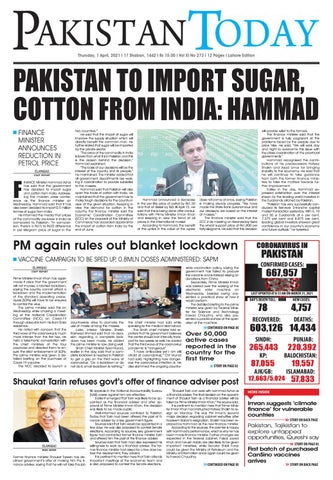
Pakistan to imPort sugar, cotton from india: Hammad g
FINANCE MINISTEr ANNouNCES rEduCTIoN IN PETrol PrICE ISLAMABAD
f
staff report
INANCE Minister Hammad Azhar has said that the government has decided to import sugar and cotton from India. Addressing the maiden press conference as the finance minister on Wednesday, Hammad said that it has also been decided to import 0.5 million tonnes of sugar from India. He informed the media that prices of the commodity are lower in India as compared to Pakistan. “In comparison, there’s a rs15 to rs20 difference in per kilogram price of sugar in the
two countries.” He said that the import of sugar will improve the supply situation which will directly benefit the common man. He further stated that sugar will be imported by the private sector. “The price of the commodity in India is lower than what it is in Pakistan and this is the reason behind the decision,” Hammad explained. “The basis of our decisions will be the interest of the country and its people,” he maintained. The minister added that all government departments are working in coordination to provide subsidies to the masses. Hammad said that Pakistan will also open the trade of cotton with India. He maintained that the government has to make tough decisions for the country in view of the given situation. Keeping in view the demand for cotton in the country, the finance minister said the Economic Coordination Committee (ECC) on the proposal of the Ministry of Commerce has accorded approval for the import of cotton from India by the end of June.
Hammad announced a decrease in the per litre price of petrol by rs1.50 and that of diesel by rs3 till April 15. He said that this is being done after consultations with Prime Minister Imran Khan and keeping in view the trend of oil prices in the international market. According to Hammad, the benefit of the uptick in the value of the rupee
does not come at once, saying Pakistan is making steady progress. “We have made the State Bank autonomous and our decisions are based on the interest of masses.” The finance minister said that the ECC in its meeting on Wednesday fixed the wheat support price at rs1,800 per forty kilograms. He said that this decision
PM again rules out blanket lockdown g
VACCINE CAMPAIgN To BE SPEd uP, 0.8MlN doSES AdMINISTErEd: SAPM ISLAMABAD staff report
Prime Minister Imran Khan has again made it clear that the government will not impose a blanket lockdown, saying the country cannot afford a lockdown and the implementation of the standard operating procedures (SoPs) will have to be ensured to control the virus. The prime minister said this on Wednesday while chairing a meeting of the National Coordination Committee (NCC) on Covid-19 through video-link from his Bani gala residence. He noted with concern that the third wave of the coronavirus is much more intense than the first two. He held a telephonic conversation with the chief ministers of the four provinces and directed them to ensure the strict enforcement of SoPs. The prime minister was given a detailed briefing on the purchase of Covid-19 vaccine. The NCC decided to launch a
countrywide drive to promote the use of masks among the masses. later, Interior Minister Sheikh rasheed Ahmed said that no decision regarding a complete lockdown has been made. He added the prime minister is now doing well. Sindh Chief Minister Syed Murad, earlier in the day, said that a complete lockdown is needed in Pakistan to get a grip on the third wave of coronavirus. “do a lockdown or do not do it, smart lockdown is nothing,”
the chief minister had said while speaking to the media in Islamabad. The Sindh chief minister told reporters that his government believes the centre should ban inter-city transport for two weeks as well. He added that the third wave of the coronavirus pandemic is “dangerous”. “I have antibodies yet I am still afraid of corona[virus],” CM Murad had said, highlighting how dangerous the coronavirus infection is. He also slammed the ongoing country-
wide vaccination policy, saying the government has failed to procure the vaccine and is instead relying on donations from China. Separately, Prime Minister Imran was briefed over the working of the electronic voter machine on Wednesday, besides being presented a practical show of how it would perform. The detailed briefing to the prime minister was given by Federal Minister for Science and Technology Fawad Chaudhry, who also presented a practical show of the operation of the machine.
CONTINUED ON PAGE 05
Over 50,000 active cases reported in the country for the first time STORY ON PAGE 02
Shaukat Tarin refuses govt’s offer of finance adviser post
ISLAMABAD Mian abrar
Former finance minister Shaukat Tareen has declined government’s offer of making him the finance adviser, saying that he will not take the job
till appeals in the National Accountability Bureau (NAB) cases against him are effective. Earlier it emerged that Tarin was likely to be appointed as the financial adviser and after approval of Prime Minister Imran Khan, the decision was likely to be made public. Well-informed sources confided to Pakistan Today that Tarin had been offered the post of finance adviser by a key government figure. Sources said that Tarin would be appointed in a few days. He was also proposed to contest Senate elections. According to sources, key government figure had contacted former finance minister Tarin and offered him the post of the finance adviser. Sources said that Tarin had also expressed his willingness to work as a financial adviser. The former finance minister had asked for a few days before the deployment, they added. It is pertinent to mention here that Tarin attends important meetings of the economic team and is also proposed to contest the Senate elections.
“Shaukat Tarin can work with Hammad Azhar as a financial adviser. The final decision on the appointment of Shaukat Tarin as a financial adviser will be taken by Prime Minister Imran Khan,” the source said. It is pertinent to mention here that Prime Minister Imran Khan had instructed Hafeez Shaikh to resign on Monday. This was PM Imran’s second major decision regarding cabinet reshuffles after Nadeem Babar’s resignation. Shaikh has been replaced by Hammad as the new finance minister. According to the sources, the premier is happy with Hammad’s performance, which is why he has been made finance minister. Further changes are expected in the federal cabinet. Faisal Javed Khan and Farrukh Habib are also likely to be given important ministries, while Senator Shibli Faraz could be given the Ministry of Petroleum and the Ministry of Information once again could be given to Fawad Chaudhry.
CONTINUED ON PAGE 05
will provide relief to the farmers. The finance minister said that the government is fully cognizant of the problems faced by the people due to price hike. He said, “We will work day and night to overcome this issue with the close coordination of the provincial governments.” Hammad recognised the contributions of his predecessors Hafeez Shaikh and Asad umar for bringing stability to the economy. He said that he will continue to take guidance from both the former finance ministers to take the matters towards further improvement. Earlier in the day, Hammad expressed satisfaction over the interest shown by the leading world investors in the Eurobonds pitched by Pakistan. “Pakistan has very successfully concluded its first-ever 3-tranche capital market transaction yesterday. With 5, 10 and 30 yr Eurobonds at 6 per cent, 7.375 per cent and 8.875 per cent, leading global investors showed great confidence in our country’s economy and future outlook,” he tweeted.
coronavirus in
Pakistan
CONFIRMED CASES:
667,957
LAST UPDATED AT 8:13 AM ON MARCH 31, 2021
DAY'S DEATH TOLL:
NEW CASES:
78
4,757
RECOVERED:
DEATHS:
603,126 14,434 SINDH:
PUNJAB:
265,443
220,392
KP:
BALOCHISTAN:
AJK/GB:
ISLAMABAD:
87,055
12,663/5,024
19,557
57,833
more inside
Imran suggests ‘climate finance’ for vulnerable countries STORY ON BACK PAGE
Pakistan, Tajikistan to explore untapped opportunities, Qureshi say STORY ON PAGE 03
First batch of purchased CanSino vaccines arrives
STORY ON BACK PAGE
02
Thursday, 1 april, 2021
lahore
NewS
Over 50,000 aCtive CaSeS repOrted in the COuntry fOr the firSt tiMe ISLAMABAD
i
CASES OF CORONAVIRUS IN YOUNG CHILDREN GROWING FAST
StAff RePoRt
N a first, the daily active Covid-19 cases reached 50,397 in the last 24 hours according to data from the National Command and Operation Centre (NCOC). Therein, 4,757 new coronavirus cases were recorded in the last 24 hours, taking the country’s Covid-19 tally to 603,126. As many as 78 more patients died of coronavirus in Pakistan during the last 24 hours while 4,757 new virus cases emerged. The country-wide death toll from the virus has surged to 14,434 so far since the outbreak of the disease in February.
Sindh CM appears before court in fake accounts case ISLAMABAD INP
Sindh Chief Minister Murad Ali Shah appeared before an accountability court in Islamabad on Wednesday in connection with the fake accounts case. During the proceedings, other suspects including Abdul Ghani Majeed and Khursheed Anwar Jamali were also present. A National Accountability Bureau (NAB) prosecutor requested the court to issue arrest warrants against those accused who did not appear before the court. The counsels for the absent suspects said: “This is the first hearing and some parties may not have received call-up notices.” Following the hearing, Shah also talked to the media saying he will not resign from his office as he has not committed any crime. He said that the coronavirus is a deadly disease but the federal government has administered the shots to a small number of people. He revealed the Sindh government has released funds to procure additional jabs. Shah was summoned by the court in an allegedly illegal contracts and money laundering reference. The NAB addressed the court’s concerns and submitted a record of 66-volume, including testimonies of witnesses.
According to a Ministry of National Health Services, Regulation, and Coordination report issued on Wednesday, a total of 667,957 people have been tested positive for the coronavirus disease in the country since its outbreak in February 2020, out of which 265,443 were in Sindh, 220,392 in Punjab, 19,557 in Balochistan, 87,055 in Khyber Pakhtunkhwa (KP), 57,833 in Islamabad, 5,024 in Gilgit-Baltistan (GB), and 12,663 in Azad Jammu and Kashmir (AJK). However, 603,126 patients have recovered from the disease so far. The third wave of coronavirus is not sparing anyone, as this time the children also falling prey
to the Covid-19 across Pakistan, it emerged on Wednesday. Around 121 children have fallen victim to the coronavirus in Islamabad during the last 24 hours as the new variant of the pandemic started taking its toll even on innocent souls. The children testing positive for the virus are mostly around 10 years old. Meanwhile, of two children, who were admitted to the federal capital’s Pakistan Institute of Medical Sciences (PIMS) a few days back, one has tested negative for the virus. The virus was transmitted to the nine-day-old infant from his mother. According to doctors, he was kept in the intensive care unit for a few
PM Imran, Bahraini counterpart discuss bilateral issues ISLAMABAD INP
Prime Minister Imran Khan had a telephonic conversation with his Bahraini counterpart, Crown Prince Salman bin Hamad bin Isa Al-Khalifa, and discussed matters of mutual interests. The two leaders vowed to further extend the strong bonds of amity that exist between the states, said a statement issued by the Prime Minister’s Office (PMO) on Wednesday, adding that PM Imran invited the crown prince to visit Pakistan. The crown prince enquired about the health of PM Imran, who has recently recovered from Covid-19 after testing positive for the virus on March 20, and wished him a speedy recovery. The ongoing coronavirus situation in both countries was discussed by the two leaders. PM Imran thanked the crown prince for his call and conveyed warm greetings for Hamad bin Isa Al
Khalifa, the king of Bahrain. He hoped that the brotherly ties between Pakistan and the Kingdom of Bahrain will continue to prosper and strengthen in the years ahead. During the conversation, it was agreed to maintain positive momentum in high-level exchanges between the two brotherly countries.
days which resulted in his recovery. Around 15 children have tested positive for the Covid-19 at the hospital so far. However, strangely there are no ventilators available for the children at the hospital. The situation is no different in Lahore where 125 children have contracted the virus during the past one week. So far, around 1, 000 children have been infected by Covid-19 in the provincial capital so far. As far as Karachi is concerned, 15 children have tested positive for the virus during the last one week while 39 have been admitted to different city hospitals during the last 15 days. Around 102 coronavirus-affected children were admitted to the Sindh capital’s largest hospital, NICH, during the last one year.
Cleric injured in Karachi attack KARACHI: INP
A religious scholar was hurt in a gun attack near Karachi’s Manghopir Road on Wednesday, police said. Unidentified attackers opened fire on Mufti Saleem Ullah’s vehicle as a result of which he sustained two injuries and was shifted to Dr Ziauddin Hospital for medical treatment. Two women, including his wife, were also in the car at the moment but they remained unhurt. Deputy Inspector General (West) Asim Qaimkhani confirmed the cleric received two bullets. He said the police are investigating if the incident is a result of personal enmity or a targeted attack. In October last year, religious scholar Maulana and head of Jamia Farooqia seminary Dr Adil Khan was shot dead along with his driver in a suspected targeted attack in Karachi.
Govt directed to fix price of privately imported vaccine shots KARACHI
Gillani nominates Farooq Naik, azam Tarar on judges appointment body ISLAMABAD APP
Leader of Opposition in Senate Senator Syed Yousuf Raza Gillani has nominated Senator Farooq Hamid Naik of Pakistan People’s Party (PPP) and Senator Azam Nazir Tarar of Pakistan Muslim LeagueNawaz (PML-N) to represent the opposition in the Parliamentary Committee on the appointment of judges in the superior courts. Leader of the opposition in the upper house of the parliament, Senator Gillani has forwarded the names of both the senators to the Senate secretary, said a press release. PPP senior leader Gillani was elected as leader of the opposition in the Senate recently, leading to cracks within the Pakistan Democratic Movement (PDM).
On condition of anonymity, a source in the PML-N had informed Pakistan Today that a large group of lawmakers within the PML-N have asked the party leadership to part ways with the PPP. According to details, the appointment of Gillani as the leader of the opposition has angered the PML-N group, led by Khwaja Mohammad Asif, Khwaja Saad Rafique and some others. The group, having a history of acrimony with the PPP, had asked the PML-N leadership not to be fooled by the PPP anymore. “The angry group says that PPP’s conduct is spreading frustration among the PML-N lawmakers and workers. They say that due to the PPP’s betrayal, the PML-N is losing its political status and public charm, and becoming a laughing stock,” the source had said.
The source had added that the Pakistan Tehreek-e-Insaf (PTI) has proved its political acumen by using the PPP while the PML-N is being fooled and proved immature. “The angry group says that due to the political moves of Imran Khan, the PPP is enjoying perks in the government while it also has the top slot as an opposition party. They say that the PPP breaks its promise at every occasion,” the source had said. “The group has asked the PML-N leadership to adopt a clear strategy and part ways with the PPP so as the fight against the PTI could be waged.” Ahsan Iqbal, a senior leader of the PML-N, had said that the PPP has hurt his party and it has formed a separate alliance apart from the PDM. During a press conference, Ahsan
SC for uniform curriculum issue resolution in 1 month ISLAMABAD APP
The Supreme Court (SC) on Wednesday rejected the report of the Ministry of Education and Professional Training pertaining to uniform curriculum and directed the education secretary to appear before the court on the next date of hearing. A three-member SC bench, comprising Chief Justice of Pakistan (CJP) Gulzar Ahmed, Justice Ijaz ul Ahsan and Justice Sayyed Mazahar Ali Akbar Naqvi heard the case. During the course of proceedings, the court rejected the report of the Ministry of Education, stating that it was not satisfactory. The issue of the curriculum was being prolonged, the apex court’s bench added.
The court observed that no concrete steps had been taken for a uniform curriculum. The court therein directed the Education Ministry to complete the work on uniform curriculum. Chief Justice Gulzar Ahmed remarked that the education ministry could not work on one curriculum. He said that there was no curriculum problem in his time, adding that it had been 73 years after independence, yet the ministry had not been able to resolve the issue of the curriculum. The chief justice maintained that the 1960 curriculum had the best religious harmony. The CJP asked the education secretary to resolve the matter of uniform curriculum in one month. Minority Commission Chairman Shoaib Sadhal informed the court that the religious content had been included as a compulsory subject of Urdu and English.
had claimed that the PPP has formed a new alliance with the BAP, Jamaat-eIslami and ANP. “We are saddened by what the PPP has done. Yousaf Raza Gilani became a senator with the votes of the PML-N but the PPP borrowed senators from the government and got Gilani elected as the leader of the opposition,” Iqbal had said. He had said that now the whole of Pakistan is suffering due to the PTI government. He had also said that South Punjab was to become a province in 90 days but not even its name has been given so far. “$500 million are being borrowed from the IMF to run the Pakistani economy. The Pakistani financial institutions are being mortgaged for the sake of the IMF,” he had criticised the government.
INP
The Sindh High Court (SHC) on Wednesday directed the federal government to fix within a week the price of Covid-19 vaccine jabs imported by the private sector. A two-member bench comprising Justice Muhammad Ali Mazhar and Justice Amjad Ali Sahito disposed of an appeal filed by the Drug Regulatory Authority of Pakistan (DRAP) challenging an earlier verdict. The March 18 verdict had suspended a DRAP notification with regard to the withdrawal of exemption in Covid-19 vaccines import to a private pharma company. The firm’s counsel said that the regulator had allowed the import of vaccine on February 2 under certain conditions, following which the company imported one million doses of Russian Sputnik-V vaccine. The counsel lamented the firm is not being allowed to sell the doses. “The company invested $45 million to import the doses. What should we do with it now?” he asked. A DRAP counsel requested the court to not allow the sale of the vaccine until its price is fixed by the federal cabinet. He said that the firm could not be allowed to fix the vaccine price as the authority to do so rests with the government. He said that the company intends to sell the vaccine at inflated prices. The counsel for the firm demanded the government allow it to re-export the vaccine if it is not being allowed to sell it.
Shahbaz ‘not open’ to out-of-court settlement of defamation suit: reports LONDON/LAHORE INP
Counsel for Daily Mail, a British tabloid, failed to woo former Punjab chief minister Shahbaz Sharif to settle his defamation suit against the publication out of court, reports citing sources claimed on Tuesday. A conditional offer to publish an “explanation” of the story was rejected by the Pakistan Muslim LeagueNawaz (PML-N) president who sought damage compensation, an apology and an explanation, and withdrawal of the news. However, David Rose, the reporter who filed the
article, dismissed reports of an out-of-court settlement. The publication has two weeks to submit its evidence to the court. In July 2019, Mail on Sunday published a story about alleged embezzlement of earthquake funds provided by the now-defunct Department for International Development (DFID) for the rehabilitation of the victims, making a case against then-chief minister Shehbaz. In January last year, Shehbaz filed a defamation suit against the newspaper, the publication, its parent Mail Online, and Rose in the High Court of Justice, London for the publishing the “gravely defamatory” story.
Thursday, 1 april, 2021
lahore
tareen SayS fia CharGe Sheet ‘tOtally fabriCated’ ISLAMABAD
a
StAff RePoRt
FTER Federal Investigation Agency (FIA) registered cases against Pakistan Tehreek-e-Insaf (PTI) leader Jahangir Tareen and his son Ali Tareen on charges of corporate fraud and money laundering, the former said on Wednesday that the charge sheet was “totally fabricated”. “I have already submitted a detailed reply along with concrete evidence in response to FIA notice. Unfortunate to see them go on another smear campaign against me & my family without establishing anything illegal,” Tareen tweeted. The tweet comes shortly after the filing of the two first information reports (FIRs) was revealed. The cases were registered under sections 406 (criminal breach of trust), 420 (cheating of public shareholders), and 109 of the Pakistan Penal Code (PPC) — with sections 3 and 4 of the Anti-Money Laundering Act, 2010 — on March 22. One of the cases claims Tareen transferred Rs3.14 billion from the accounts of his JDW-Group to Faruki Pulp Mills
Limited (FPML), a company said to be owned by his son and a relative. The money was then transferred to the accounts of his family members. “The transfers, especially after FY [fiscal year] 2011-2012, were patently fraudulent investments which ultimately translated into personal gains for the family member of the JDW CEO [Tareen],” it said. Likewise, the second complaint says “voluminous withdrawals amounting to at least Rs2.2 billion were fraudulently and dishonestly made through a trusted cash rider”. Amir Waris, employed as a cashier at the company’s corporate head office in Lahore, deposited large amounts into the personal and business accounts of Tareen and his family members. Reports citing sources claim that Tareen and his family converted undisclosed sums in rupees into dollars from the open market and got them transferred to their foreign bank accounts. FIA also booked Tareen’s Chief Operating Officer (COO) Rana Nasim Ahmed on allegations of sugarcane purchase through these funds. “This modus operandi of cash-based
misappropriation and money laundering was employed to break the onwards money trail of deposits into personal and business accounts of the accused Tareen and family,” the second FIR read. Tareen had returned to Pakistan in November after ending his seven-monthlong self-imposed exile after falling out with Prime Minister Imran Khan following an inquiry into the last year’s sugar scandal that accused several sugar producers — including him — of “underreported sales and fraud”. At the time, Special Assistant to Prime Minister on Accountability Mirza Shahzad Akbar had declared sugar-producing units under Tareen’s JDW-Group were found guilty of “double billing” and “overinvoicing” as well as “corporate fraud”. Tareen had rejected the findings of the Sugar Inquiry Commission. “I am shocked at the kind of false allegations levelled against me. I have always run a clean business. All Pakistan knows I always pay full price to my growers,” he had said in a tweet. “I DO NOT maintain 2 sets of Books. I pay all my taxes diligently. I will answer every allegation and be vindicated IA.”
Sindh imposes strict restrictions as third wave intensifies CM MURAD SUGGESTS TWO-WEEK BAN ON INTER-PROVINCIAL PUBLIC TRANSPORT NEwS DESK As Sindh reported 247 new coronavirus cases during the past 24 hours, taking the tally to 265,679, the provincial government imposed new restrictions to curb the spread of the virus. According to Sindh Chief Minister Murad Ali Shah, five more patients succumbed to the virus as the death toll reached 4,502. As many as 224 patients recovered overnight, taking the total to 256,276. The Sindh government thus banned all marriage functions — both indoors and outdoors — with effect from April 6, and introduced a new set of coronavirus restrictions till April 11. A notification from the Home Department announced that broader lockdowns will be imposed in areas with 8 per cent coronavirus positivity ratios. The provincial government announced that indoor dining in restaurants will not be allowed while outdoor dining will only be permitted till 10 pm. Takeaway and home delivery options will be available for
restaurants. The notification said markets, shopping malls and marriage halls will operate from from 6 am to 8 pm for business and commercial activities “with two safe days observance per week as applicable to that area concerned (except essential services i.e. medical stores, clinics, hospitals as well as petrol pumps, bakeries, milk shops and restaurants, etc.)”. People will not be allowed to partake in any social or political gathering or sports events and religious festivals, as well as concerts, as per the notification. People in Sindh will be allowed to hold marriage functions outdoors only till April 5 limited to 300 guests. However, a complete ban will be imposed on wedding functions across the province from April 6 till April 11. Amusement Parks and walking/jogging tracks will remain open with strict adherence to Covid19 SOPs, said the Home Department. It also called on the private and government sector to observe the work from home 50 per cent staff policy in all offices and courts. “Transport to operate at 50
per cent of capacity with strict SOPs compliance,” read the notification. Earlier in the day, CM Murad requested the federal government to ban inter-provincial transport for two weeks in a bid to control the spread of the coronavirus. In a conversation with reporters outside an accountability court in Islamabad where he had gone in connection with the fake accounts case, Murad said that this was the only way the spread of the disease could be curbed. “I am not saying there should be no inter-provincial transport for a year. Only a two-week break can break the transmission cycle,” he said. The chief minister was of the view that there was no concept of a “smart lockdown”. “Either there is a lockdown or no lockdown,” he argued. He said that Sindh had more ventilators than any other province, adding vaccine procurement plans were in the pipeline. He informed the media that the provincial government was contemplating purchasing a singledose vaccine. “But first we will have to check the efficacy of this vaccine,” he said.
Pakistan, Tajikistan to explore untapped opportunities, Qureshi says DUSHANBE StAff RePoRt
Foreign Minister Shah Mahmood Qureshi on Wednesday said that there were a lot of opportunities in different fields to further strengthen relations between Pakistan and Tajikistan, Radio Pakistan reported. Addressing a press conference with his Tajik counterpart, Sirajuddin Mehruddin, in Dushanbe, Qureshi thanked Mehruddin for a “great meeting” to discuss the “spectrum of bilateral ties”. In a tweet, the foreign minister said that both countries had agreed to tap unexplored areas particularly “trade, tourism, and people-topeople engagement”. Qureshi is in Tajik capital as part of his visit to attend the 9th Heart of Asia — Istanbul Process (HoA-IP) Ministerial Conference. He said that Islamabad believed
CASA-1000, a regional electricity generation project linking Central Asia and South Asia, would not only benefit the two nations but the entire region. Launched in 2016, the $1.2 billion, 750-kilometer-long transmission line which is expected to be complete by 2018 will allow Pakistan to import electricity from Tajikistan and Kyrgyzstan via Afghanistan to minimise the country’s now-shrunken electricity deficit. Qureshi said that the project would improve electricity access, integrate and expand markets to increase trade, and find sustainable solutions to water resources management. He said that he was pleased to learn through Mehruddin that Tajikistan President Emomali Rahmon, in a meeting with Afghan President Ashraf Ghani, had “stressed the need for a tripartite transit trade agreement among
Tajikistan, Afghanistan, and Pakistan”. He also said that Pakistan on its part would pursue the matter of tripartite agreement with the Afghan leadership for the benefit of the three nations. Qureshi also expressed satisfaction that bilateral relations with Tajikistan had strengthened with time in line with the two joint declarations of 2017 and 2018 to promote cooperation. In a meeting with his Tajik counterpart, Qureshi said that it was agreed to renew the spirit of the existing roadmap for bilateral cooperation and also decided to activate the joint working groups and the intergovernmental commissions. Qureshi invited influential businessmen from both countries to strengthen trade relations and offered to facilitate the Tajik investors.
NewS
03
No change in Pakistan’s stance on Kashmir dispute: Foreign Ministry ISLAMABAD MIAN AbRAR
Ministry of Foreign Affairs Spokesman Zahid Hafeez on Wednesday said that there is no change whatsoever in Pakistan’s position on the dispute of Jammu and Kashmir and Pakistan’s position is anchored on the United Nations (UN) resolutions on Jammu and Kashmir dispute. The spokesman made this statement while briefing the members of the Parliamentary Committee on Kashmir at the Parliament House. Shehryar Khan Afridi, chairman of the committee, chaired the meeting. Zahid said that Prime Minister Imran Khan’s statement made in Kotli, Azad Jammu and Kashmir (AJK), was consistent with Pakistan’s longstanding policy on the disputed territory, adding Pakistan would continue its support of Kashmiris at all forums. He said that the recent understanding between the Pakistani and Indian military to observe the Line of Control (LoC) Ceasefire Agreement (2003) was aimed at saving the lives and prosperities of the
Kashmiri people living on both sides of the LoC. “To save Kashmiri lives and to provide some comfort to Kashmiris on both sides of the LoC, it was necessary to abide by the ceasefire agreement,” he said. He said that the focus was on purely military understanding on military mechanisms reached about the ceasefire on the LoC. He added that Pakistan believes that any violation of the agreement may jeopardise regional peace and may also hurt the Kashmiris living on both sides of the LoC. “There is absolutely no change in Pakistan’s stance on resolving Kashmir dispute through dialogue and under the UN resolutions on Kashmir dispute,” he said. Afridi said that the pertinent questions of Khurram Dastagir Khan would be addressed by Foreign Minister Shah Mahmood Qureshi in the next meeting. Pakistan Electronic Media Regulatory Authority (PEMRA) Chairman Saleem Ahmed on the occasion said that 50 TV channels had given a specific time to provide coverage of the Kashmir issue and 38 channels had covered Kashmir in terms of documentaries, songs and programmes.
Thursday, 1 April, 2021
04
LAHORE
NEWS
Govt retrieved state lands worth rs450b from illeGal occupants: buzdar LAHORE
p
INP
UNJAB Chief Minister Sardar Usman Buzdar has said that indiscriminate action against land grabbers will continue till every inch of the state lands is recovered from squatters. During a press conference at his office on Wednesday, the CM gave the details and said around 155000 acres of the state lands, having a value of Rs450 billion, have been retrieved in different parts of the province. It is the largest operation in the history of the province and the task will be brought to its logical end, he indicated. During the last seven days, 12318 acres of the state lands worth Rs22.32 billion have been recovered from illegal occupants in 31 districts of the province and 403 FIRs have been registered, besides the arrest of 97 accused, he added. The CM pointed out that indiscriminate action is also underway against sugar and price-hike mafias. The PTI-led government is actively working to curb every sort of mafia and public interest is being fully protected under the leadership of Prime Minister Imran Khan. Buzdar said lands have been retrieved in Sargodha, Sheikhupura, Rawalpindi, Rajanpur, DG Khan, Multan, Narowal and other cities and the recovered state lands will be utilised for public welfare purposes. The government will also recover damages from the influential persons involved in illegal occupation of the state lands, he said, adding that the action is not person or party specific but it is indiscriminate and it will continue. The CM said it is intolerable to occupy the state lands for personal use as the government wants to protect the state lands and the political affiliation of land grabbers is simply irrelevant. The CM disclosed that a strat-
egy has been devised for the best use of the recovered lands while the data bank will also be set up in the board of revenue and steps will be taken so that no one could dare to reoccupy such lands. The PTI government has waged a war against every sort of mafia and the damages incurred to the state due to land grabbers will be compensated, he disclosed. While replying to the questions of the media persons, the chief minister said the anti-corruption establishment takes action if a government employee is found involved in the occupation any state land but the government has started indiscriminate action without caring for any political affiliation. Indiscriminate action will be continued against all even if any land grabber is found as my relative or an officebearer of his party, the CM emphasised and added that the government is active against the land grabbers. To another question, Buzdar clarified that no ban is imposed on any private transport, but a restriction is imposed on public transport to overcome the spread of coronavirus. Steps have been taken against coronavirus and the government does not want to hold complete lockdown but to overcome the spread of the virus, he maintained, adding that businesses have not been shut down but the timings of
UN report urges govts to ban single-use plastics
markets have been reduced to minimize the spread of coronavirus. He further clarified that the purpose of government is not to put the people behind bars but to sensitize them to wear masks for collective safety. The CM said the coronavirus vaccine is being supplied by the federal government but the Punjab government has also constituted a committee to procure this vaccine and the committee will submit its final recommendations. He asserted that the coronavirus SOPs will be implemented in the Ramadan bazaars while a collective decision about Namaz-e-Taraweeh will be made in consultation with the NCOC. Replying to a question about a cabinet reshuffle, the CM maintained space for improvement is always there and the ministers’ performances are also regularly reviewed. He made it clear that the rumours about the South Punjab secretariat are totally baseless, adding that the opponents are spreading disinformation in this regard. “I do not know who is perturbed over my field visits but I do know that a new era of development has been started. A separate district development package is being outlined for the first time and development schemes are being designed in consultation with the public representatives.
three of family die due to car crash in alpuri ALPURI INP
ISLAMABAD TLTP
Vulnerable communities disproportionately bear the brunt of environmental degradation caused by plastics pollution and action is urgently needed to address the issue and restore access to human rights, health and well-being, according to a new UN report. The report titled, ‘Neglected: Environmental Justice Impacts of Plastic Pollution’, was produced by the UN Environment Programme (UNEP) together with the grassroots environmental group, Azul. The findings aim to empower communities affected by plastic waste and advocate for their inclusion in local decision making. The report calls for governments to prioritise the needs of those disproportionately affected by plastic pollution, underscoring that action must be taken at multiple levels. It calls for an expansion in plastic waste monitoring, better studies into its health impacts, and more investment in waste management. Governments should further enforce bans on single-use plastics and encourage their reduction, recycling and reuse. Other actors such as business and industry leaders, nongovernmental actors, and consumers should also make efforts to reverse the situations for those who are socially, economically and politically marginalised. “Environmental justice means educating those on the frontlines of plastic pollution about its risks, including them in decisions about its production, use, and disposal, and ensuring their access to a credible judicial system”, said UNEP Executive Director Inger Andersen. The report showcases how environmental injustices are linked to plastic production, in areas such as deforestation for road building, the displacement of indigenous peoples to conduct oil drilling, as well as contamination of potable water by fracking operations to extract natural gas, in countries such as the United States and Sudan. Moreover, the report warns of health problems among African-American communities living near oil refineries in the Gulf of Mexico, and the occupational risks faced by some two million waste pickers in India.
Three members of a family, including a police constable, lost their lives and three others injured when a jeep fell into deep gorge here on Wednesday. According to details, a jeep, carrying a family, skidded off road and plunged into a deep ravine near Kerai area. As a result of the accident, police constable Rahimzada, Asia Bibi and Nazarzada died on the spot while Noureen Bibi, Jalal and Arshad got injured. The injured were first shifted to a nearby hospital, where they were later referred to Swat Saidu Sharif hospital. The condition of one wounded person was reported as critical. The funeral prayer of Rahimzada was held at Alpuri Police Line, which was attended by DPO Rahim Shah Khan and large number of policemen. He was laid to rest at a graveyard in Bela Shahtoot.
man killed, another injured in firing in swabi SWABI INP
One person was killed and another injured in firing from an armed man over a petty issue here on Wednesday. The culprit fled the scene of crime. The local police said that the incident took place in Asota Sharif area of Swabi, where accused Imran, after exchange of hot words, sprayed bullets at the two people. As a result of firing, Ashraf was killed on the spot while Hilal sustained bullet wounds. The body and injured were shifted a nearby hospital. The police registered a case against the culprit started raids for his arrest.
Thursday, 1 April, 2021
LAHORE
NEWS
PM again rules out blanket lockdown continued from page 01 It was briefed that encouraging results have emerged from the trial of the electronic voting machine. Fawad further briefed regarding the mechanisms and features of the machine, saying that it would help in keeping the results’ process transparent. The results of the electoral process will be available immediately while keeping the safety protocols intact, the briefing to PM Imran noted. On February 22, the Ministry of Science and Technology announced that it has developed an electronic voting machine. Briefing about the machine in Islamabad, Fawad said that the machine comprises two parts; one representing election symbols while the other part will be with the presiding officer. VACCINATION CAMPAIGN: Separately, Special Assistant to the Prime Minister (SAPM) on Health Dr Faisal said that Pakistan has administered 0.8 million doses of the Covid-19 vaccine to the citizens of the country, adding that the campaign would further be sped up. Speaking to the media in the federal capital, the SAPM said: “The reason for that is the epidemic is at its peak right now and apart from all safety precautions […] an important strategy [to control it] is vaccination.” “In the coming months in April, May and June, orders for millions of doses are being finalised and they will keep coming. Then our vaccination process will keep moving forward.” He stated that registration for people above 50 had been opened while the inoculation campaign for people above 60 was ongoing. “We are speeding up this process and want to take it to a stage where a large number of Pakistanis have been vaccinated so it can prove to be an important tool and help in stopping the spread of the disease.” On the occasion, the premier’s special aide also thanked the all-weather friend of the country, China, for providing the donated doses of the vaccine which had allowed Pakistan to kick off its inculcation campaign last month. The prime minister had said at the occasion, “I congratulate my team which has worked promptly and vaccine was imported. We are also thankful to China which has provided vaccine.” Meanwhile, Punjab Governor Chaudhry Mohammad Sarwar has that thousands of people can be affected with coronavirus due to noncompliance with SOPs. “It is important for people to stay at home instead of taking to the streets, to prevent coronavirus resurgence; otherwise there will be less space for coronavirus patients in hospitals”. He said that the coronavirus vaccine is being administered in a completely transparent manner without any discrimination. The opposition should refrain from politicizing every issue and support the government in the fight against coronavirus pandemic as everyone must strive together to protect 220 million Pakistanis from coronavirus, he added. Talking to various delegations of Pakistan Tehreeke-Insaf (PTI) at the Governor’s House, Lahore, Chaudhry Mohammad Sarwar said that the war against Covid has become a war for survival of the nation and Pakistan cannot afford any negligence in it. The opposition should move beyond political interests to support the government in the war against the coronavirus because this spike in coronavirus will be devastating for the country, he stressed. He said that as the coronavirus is resurging, it is incumbent upon every citizen to protect themselves and their family members from coronavirus and that is possible only by following SOPs and staying at homes.
PM laudS FBR FoR hiSToRic Revenue collecTion in MaRch islamabad
P
staff report
rIMe Minister Imran Khan on Wednesday appreciated the Federal Board of revenue (FBr) for achieving historic growth of 41 per cent in March-2021 with collections recorded at rs460 billion. Taking to Twitter, the PM said, “I commend FBr efforts, achieving historic growth of 41 percent in
March-21 with collections recorded at rs460 billion.” “During July ’20-Mar ’21 our collections reached rs3,380 billion which is 10% higher than the same period last year.” He maintained that it reflects broadbased economy revival led by the government’s policies. earlier on February 28, the Federal Board of revenue (FBr) had announced that it had achieved the tax target for the first eight months of the fiscal year, 202021, collecting rs2,916 billion.
ECC approves formation of National Export Development Board: Dawood islamabad GHULaM aBBas
Adviser to Prime Minister for Commerce and Investment Abdul razak Dawood on Wednesday said that the economic Coordination Committee (eCC) of the federal cabinet had approved the formation of a National export Development Board (NeDB). The board will be chaired by the Prime Minister Imran Khan and will also include ministers, exporters, investors and the business community, the adviser said this on his official twitter account. He said that the NeDB became the main forum to discuss the strategy, incentives and removal of business hurdles. To keep the momentum of our value-added exports, eCC in its meeting held on Wednesday approved import of Cotton and Cotton Yarn from India, including land route, he said. The adviser said that this would now be placed before the Cabinet for approval, after which it would be notified. The eCC, however, deferred the decision on Strategic Trade Policy Framework (STPF) 2020-25. Meanwhile Ministry of Commerce and Deutsche Gesellschaft für Internationale Zusammenarbeit (GIZ) GmbH, Germany signed an Implementation Agreement in pursuance of Memorandum of Understanding (MoU) earlier signed between economic Affairs Division (eAD) on behalf of Pakistan and Germany on December 23, 2020 in which the foreign country agreed to support two projects and one is on “improvement of Labor, Social and environmental Standards in Pakistan’s Textile Industry (TextILeS)”.
According to officials under this programme, the Federal republic of Germany would provide GIZ up-to euro 7,500,000 as German contribution for a period of three years. The signing ceremony was attended by Dawood, Dr Sohail rajpoot, special secretary, Ministry of Commerce, from Pakistan’s side and romina Kochius, principal adviser GIZ, from Germany. As per the details, the technical cooperation on this project aims to increase value-addition and competitiveness, and foster innovation by synergizing the environmental, social, and economic dimension of sustainability in the textiles and apparel industry. The outcome of project would be to support digitisation of Labour and Human resource Department’s (LHrD) downstream institutions like Punjab employees Social Security Institution (PeSSI), formulation and implementation of measures to ensure sustainable production, transform 15-20 companies who made use of good environmental practices, innovative technologies or labor standards to move to higher value addition or entered new markets, initiate two campaigns on Occupational Safety and Health (OSH) particularly for SMes to achieve international certification in labor and environmental standards. Dawood met romina and appreciated the government of Germany and her for the valuable support in respect of technical cooperation to Pakistan’s textiles and apparel industry in order to improve labour conditions, compliance standards and resource efficiency. The ceremony ended with notes of thanks from both sides.
Pakistan seeks enhanced ties with Ukraine, COAS tells envoy
Chief of Army Staff (COAS) General Qamar Javed Bajwa, in a meeting with Ukrainian Ambassador Markian Chuchuk at the General Headquarters (GHQ) in rawalpindi on Thursday, said that Pakistan attaches great importance to enhancing its ties with Ukraine in all domains. According to the Inter-Services Public
05
relations (ISPr), the meet took up matters of mutual interest, regional security situation and defence cooperation besides the above-mentioned point. The military’s media wing said that the Ukrainian envoy appreciated Pakistan’s efforts for bringing peace and stability in the region,
especially through its role in the ongoing peace process in Afghanistan. Both sides reiterated their commitment to expanding bilateral engagements through structured forums and regular exchanges, particularly with respect to defence cooperation. news desk
cmYK
However, later it transpired that the Federal Board of revenue (FBr) collected net revenue of rs3,394 billion during the July-March period against the target of rs3,287 billion. This represents a growth of about 10 percent over the collection of rs3,076 billion during the same period last year. The net collection for the month of March was rs475 billion, against a target of rs367 billion, representing an increase of 46 per cent over rs325 billion collected in March 2020 and 129 per cent of the target.
Shaukat Tarin refuses govt’s offer of finance adviser post continued from page 01 Shaikh was sworn in as Finance Minister on December 10, 2020. Under the constitution, Shaikh was to be elected to the National Assembly (NA) or the Senate within six months. His sixmonth term as finance minister was set to expire on June 9. The PM decided to negotiate with the International Monetary Fund (IMF) and hand over the portfolio to the elected representative for the budget. The Ministry of Finance has an important role to play in negotiating with the IMF and preparing the budget. He has been made finance minister in view of the two budgets presented by him.
Thursday, 1 April, 2021
06 COMMENT
Courage for Course Correction
Breaking the ice The booby traps on road to peace
A
flurry of statements by COAS Gen Qamar Javed Bajwa was followed by developments that indicate a breaking of ice between Pakistan and India. The DGMOs of the two armies agreed to restore peace by strictly implementing the agreement on a ceasefire along the Line of Control (LoC) and other sectors. Consequently during the whole of March, the guns from both sides fell silent for the first time in nearly six years, allowing the Kashmiris living on both sides of the LoC to heave a sigh of relief. Last week there was an exchange of messages of goodwill between the two PMs. In Dushanbe, a somewhat overconfident Foreign Minister, Shah Mehmood Qureshi, observed that Pakistan and India were heading towards a positive trajectory of ties. General Bajwa’s call for peace was based on a nascent realization in the corridors of power that national security has to be based on a sound economic foundation, which is hardly the case in Pakistan. The ground realities however require peace in the region. Last month, it was maintained at the Islamabad Security Dialogue that it was necessary to transform Pakistan from a geo-strategic to a geoeconomic hub. This requires a paradigm shift in Pakistan’s approach, taking economic diplomacy to the top of the agenda. This would have come as a shock to those who have been brought up celebrating Pakistan’s geopolitical advantage at the crossroads of the Subcontinent, China, Russia, Central Asia and the Gulf. While stressing the need for peace in the region both General Bajwa and PM Imran Khan underlined the need on the part of India to resolve the issue of Kashmir and other issues with Pakistan. So far there has been no response on the matter from India. The Indian side has other priorities that it wants to be resolved at the earliest. The Indian Army Chief Gen M M Naravane has accused Pakistan of keeping the terror infrastructure including terrorist launch pads intact on its side. India wants infiltration to end on a permanent basis Things cannot proceed beyond CBMs like opening trade or improving visa facilities—-which would no doubt marginally improve the relations—-as long as the two governments do not move towards addressing each other’s core issues . This is no easy task keeping in view the uncompromising stance of hawks on both sides.
Those who challenge the status quo can end very badly
T
HE World Bank’s report on the Pakistan economy seemed very critical of the PTI’s performance, and saw an economy under great pressure, with the government not doing enough to handle the situation. It predicted growth of merely 1.3 percent in the current fiscal, which is anemic, and well below the 6-7 percent needed for the economy to deal with the kind of problems caused by a ballooning population. Another worrisome factor is the increasing debt burden, which the Bank says will peak at a record 94 percent of GDP this fiscal. The Bank has also noted that the government has not fulfilled its promises of cutting public debt and doubling revenue. In its annual South Economic Focus report, the World Bank noted that the government had not achieved either, despite changing five FBR Chairmen, and three Finance Ministers. The government seems hoist on its own petard. If it endlessly quotes every scrap of praise by some foreigner, (any foreigner), it should also have the courage to face the criticism that might come from abroad. The debt situation seems most horrifying, with public debt 72.5 percent of GDP when the PTI came to power, projected to hit 94.4 percent next fiscal year. At that rate, it might well cross 100 percent if this government completes its full term. There is also the problem of inflation, which the World Bank does not see going away. It also seems that the government should give up on its effort to praise itself incessantly, and divert the resources it devotes to that effort, both in terms of money and man-hours, to actually doing something about the economy. Contrary to what Prime Minister Imran Khan thought prior to the election, managing the economy is not a matter of simply ending corruption, but a complex combination of factors which it is showing itself not quite able to handle. The faster the government realizes this, the faster it can get down to the kind of thought needed for successful economic management. There is still enough time left in its tenure for the government to show its seriousness, as well as its realization that there are no quick fixes.
The law must be feared
AttiyA MunAwer
A
mother of three was sexually assaulted on Lahore Motorway Link Road; a five-yearold girl was raped and killed in Karachi, and the way Cyclist Samar Khan was harassed on a busy road in Islamabad is all wrong, but it is not enough to just call it wrong. Now and then such a tragic incident becomes the adornment of the media, everyone says that it was wrong and then the matter is suppressed until another incident happens. As long as we do not bring these repressed issues to the attention of society on a daily basis, and ensure the implementation of strict laws, we cannot expect that this wrong will ever end. There is no doubt that the prevention of crime can be ensured only by bringing social evil to the forefront and by prompt execution of punishment. In the case of sexual assault of a mother of three children on Lahore Motorway Link Road, all the law agencies
Dedicated to the legacy of the late Hameed Nizami
Arif Nizami Editor Joint Editor
Umar Aziz Executive Editor
Lahore – Ph: 042-36300938, 042-36375965
From saying the wrong thing to taking the right step
first case of violence against women in the country. Such incidents happen daily in different cities across the country and governments have been making promises and claims to stop them, but after a while, everything is lost in the dust. However, law enforcement agencies and officials will be well aware that the perpetrators of any kind of crime belong to any class, regardless of their affiliation with any class of society, and are to be treated equally under the law. The law and law enforcement agencies will be ingrained in the hearts of criminals in particular and they will not cross any social, moral, and legal boundaries for fear of being caught and severely punished, but as long as criminals continue to find loopholes to escape the law they will continue to be able to escape by resorting to bribery or solicitation, and until this comes to an end, the incidents across the country will be bigger and bolder than before. No doubt bringing the perpetrators of this motorway gangrape to justice as soon as possible, will prevent further such tragedies and criminals will no longer cross the legal line for fear of punishment. It is also worth noting that in the above case, the culprits were traced as a result of matching the samples found at the crime scene and the DNA data of the culprits. In the light of the investigation of this case, all possible steps are taken to keep the DNA data of the criminals up to date, which will make it easier to reach out to criminals, bring them to justice, convict them, enforce sentences and thus bring down the graph of serious crimes. After this tragedy, a comprehensive plan to secure highways across the country should have been launched by now. If this has not been done, then there should be no delay. The best steps in this regard are inevitable. If the law continues to do its job properly and efforts to change social attitudes continue, the number of such crimes will certainly decrease, but it is time to take the right direction by saying the wrong thing wrong.
M
y late father Nazir Ahmed Malik, the Tehreek-e-Pakistan Gold Medallist, always talked about the importance of courage. Another term he frequently used was, “ In the end it is a game of stamina “. He firmly believed that, “those who courageously hold their ground and fight seldom fail.” The Islamic Republic of Pakistan needs a major course correction but the players in the arena lack the courage and stamina required for such a struggle. Where has all the courage gone in our times? March 18 was the eighth death anniversary of the brilliant Air Commodore Muhammad Mahmood Alam, the 1965 war hero. He was an honest, able, down-to-earth professional, and decided to remain a bachelor all his life. During the Zia regime, he took an appointment with the President to report the corrupt practices of the then Air Chief. He was given a patient hearing but the response of the dictator bewildered him. Zia said, “ Brigadier Sahib you know I am the President, Chief of Army Staff, Chairman Joint Chief of Staff and Chief Martial Law Administrator. you think I don’t know all this?” Alam stood up saying, “Sir, then I am very afraid for Pakistan and will not serve under these circumstances.” He came out and tendered his resignation which was not accepted. Instead he was retired. Thus ended the career of one of the best pilots ever of the Pakistan Air Force. Unfortunately, Pakistan has been derailed several times with very limited corrective mechanisms. In the decade of the 1970s, the elected government had to face a major crisis only a few days after coming into power. The Police Force in Punjab and KP (NWFP then) decided to go on strike. The young Governors (Ghulam Mustafa Khar in Punjab, Hayat Sherpao in KP) refused to be blackmailed by the strikers. Party workers were called to assist in maintaining law and order. The strike was declared illegal and 48 hours’ notice was served for resumption of duty on pain of dismissal. It was a bold move, and the entire force
No quick fixes to this mess of an economy
Managing Editor
Muhammad Mosssedeq to denationalize the oil Industry, which he turned down. Finally he was assassinated in Rawalpindi in 1951 at the same location where Benazir Bhutto met her end. Bhutto had his dreams of an Islamic Bloc with its own nuclear device. Earlier as Foreign Minster he had tried to convince the dictator Ayub Khan to build an Atomic Bomb but he lacked the courage to face the West with such a bold initiative. Finally when he came to power, he convinced Engineer Munir Ahmed Khan who was working at the International Atomic Energy Commission ( IAEC ) to come and lead the programme in his native country. Munir was a major player in developing the device. It was his long term of about 18 years as PAEC Chairman that major milestones were achieved. While Professor Riazuddin of Islamabad University designed the device, it was Munir Ahmed Khan’s team that implemented it. Both remain unsung heroes of this achievement, all other claimants had a minor contribution. Mossedeq was made to suffer for his defiance. he was toppled and then imprisoned. Bhutto also met a similar fate for his vision of creating an Islamic Bloc. The fight for survival has taken away courage. One of my seniors in the USA used to narrate an interesting American Indian belief. According to it, “ An Apache always rides the best horse, in life you have a choice either to be the rider or the ride “. In my professional career, I too had to face several challenges but never allowed myself to be the ride. Unfortunately in the land of the pure there are few riders left, while rides are all over in all shapes and sizes Kaptaan talks about Mafias that control most organizations that pose to be insurmountable, but in reality they can only prevail over the courage-less dudes. No Mafia can stand up to the force of ‘Ethical Management’ that can take them on with courage and a well-thought-out transition plan. There has to be a turnaround, and the riders can no longer be stopped from riding the best horses to attain the cherished goals of the nation. Only with courage, course correction is achievable without which we will continue to flounder.
Dr FAriD A. MAlik
World Bank bears down
Yousaf Nizami Aziz-ud-Din Ahmad
was back on duty within 24 hours. During the democratic regime (1971 to 1977), the police were made to serve the public. Then started the Zia Dark Ages and the era of ‘Muk Muka’. Ruffians were recruited in the force for political mileage. Today it has been rendered nonfunctional, in addition to corruption the men in uniform also indulge in criminal activities. In KP a major purge was carried out to de-politicize the police force but unfortunately in Punjab it could not be done due to political considerations of keeping the coalition government intact. In the United Kingdom, when the country could no longer plunder other weaker nations to fund its welfare expenditures, the Iron Lady, Mrs Margaret Thatcher, got elected Prime Minister (PM) on an agenda of Economic Revival. Trade Unions were the first to come in the way of her financial reforms. The Coalminers’ strike continued for months but she stood her ground. The Queen of England got worried and summoned the PM. She was asked to tone down her advances on the labour, but she refused. Her words were, “Those who seek change have to face resistance and criticism.” Finally she negotiated with the miners and threatened to fire them, as the country desired to move to cleaner fuels for environmental considerations. Those who agreed were called back, the rest were let go. She remained PM for over a decade, and despite her overall popularity, the Conservative Party decided to remove her. She passed away a few years back, and there were wall chalkings saying, “ May you rust in peace.” Ronald Reagan as President introduced some of her reforms to revive the economy. Reaganomics came from that era. His popularity swelled, his Vice President George Bush Sr was elected President after his two terms in power which is quite unusual in US politics. In the Islamic Republic two PMs stand out for courage, but both were made to suffer due to the steadfastness of their convictions. Liaquat Ali Khan, the first PM, and Bhutto, the ninth, will always be remembered for their efforts at course correction. When the Nawabzada visited the USA he was asked to join alliances, which he refused as he wanted Pakistan to be non-aligned. On his return he addressed a historic press conference in London in which he openly talked about the pressures to sign on the dotted line. He was then asked to pressurize the elected PM of Iran
I
Karachi – Ph: 021-35381208-9
I
have taken it as a challenge and brought it to a successful conclusion. Anti-terrorism court Judge Arshad Hussain Bhatta sentenced Abid Malhi and Shafqat Ali to death after they were found guilty of gangraping a woman on the motorway. The judge reserved the verdict after a nearly six-month trial in the camp jail. The verdict was announced at Lahore’s camp jail. The verdict also confiscated the properties of the convicts, imposed a fine of Rs 50,000 each, 14 years imprisonment for robbery, a fine of Rs 2 lakh and five years imprisonment, and a fine of Rs 50,000 for breaking the vehicle. Punjab Minister for Prisons Fayyaz-ul-Hassan Chauhan says that a fair and rapid trial of this case will help in preventing heinous crimes like rape in Pakistan. It is clear that the verdict in this gang-rape case has brought justice to the victims and the perpetrators will soon be brought to justice. However, the damage done to the reputation of the legal institutions cannot be remedied. The only solution to this problem is to prevent such incidents from happening in the future. It is necessary to make our roads and highways as safe as possible. It is often said that the law and order situation was so good in previous times, and the rule of law was ensured to such an extent that women adorned with jewels used to travel alone from one end of the country to the other and no one could look askacne at them. If something like this could have been possible in the past, why isn’t it possible today? When the most advanced inventions in the field of communication have come to the fore, what is the obstacle in ensuring the rule of law? The answer to this question lies in the satisfactory state of law and order. There is no denying the fact that this is not the
Islamabad – Ph: 051-2204545
The writer is ex-Chairman, Pakistan Science Foundation. He can be contacted at: fmaliks@hotmail.com.
After this tragedy, a comprehensive plan to secure highways across the country should have been launched by now. If thid has not been done, then there should be no delay. The best steps in this regard are inevitable.
I
Web: www.pakistantoday.com.pk
I
The writer tweets @AttiyaMunawer
Email: editorial@pakistantoday.com.pk
Thursday, 1 April, 2021
COMMENT 07 Editor’s mail Send your letters to: Letters to Editor, Pakistan Today, 4-Shaarey Fatima Jinnah, Lahore, Pakistan. E-mail: letters@pakistantoday.com.pk Letters should be addressed to Pakistan Today exclusively
Haseena Mohsin - A lost gem
Let her run the farm Women in agriculture bring tangible benefits, not just getting them justice AylA QAyyuM To quote Amartya Sen, “empowering women is key to building a future we want” (UNDP). In Pakistan, despite their extensive involvement in various agricultural activities, several barriers inhibit women farmers from operating inherited or transferred land. It is pertinent to sow the seeds of gender parity; this will unleash the potential of millions of women and lead to significant advances within the country’s agricultural sector.
A
S in other major sectors of Pakistan, women play a significant role in various processes within the realm of agriculture. According to the Agriculture Census of 2010, 5.68 million and 4.34 million women were working full time and part time, respectively, on their family’s holdings. It is critical to note that a significant chunk of women go unreported in these censuses as well; therefore, the actual count of these workers lies beyond a few millions. They perform several notable activities such as sowing, transplanting, harvesting, weeding and storage of crops. They also undertake the backbreaking work of planting rice and picking cotton in the harshest of weathers. Moreover, according to the Finance Division, they actively participate in activities pertaining to livestock by feeding animals, cleaning their sheds, milking and preparing dung cakes; this contributes to 52.2 percent of the overall value of agriculture. Even when male members of the household are forced to attain off-farm employment in urban areas, women take on the dual responsibility of carrying out full-time work in fields while simultaneously performing household duties. However, despite their extensive involvement, women remain systematically disadvantaged in several notable aspects. Women in agricultural households are expected to do a fair share of work along the male workers. Consequently, the line between activities carried out for economic gain and merely additional household chores continues to be blurred. Even in the case of agencies, the participation of these invisible workers is not acknowledged, and they undergo extreme exploitation in the forms of less than minimum wage, abuse and discrimination. Due to rigid patriarchal beliefs and the au-
thoritative role of male workers, the gender disparity in access to agricultural resources persistently widens. The productivity of women farmers is impeded due to their limited ability to attain training and extension services, access credit facilities, purchase necessary inputs, and use basic technologies on the fields. As this inhibits them from producing sufficient output, their dependence on male workers increases. It is also vital to consider the case of contract farming, which entails a pre-agreement between the farmers and buyers on aspects like timing, quality and price of the output. This system exhibits differential effects on women as it is based on a unitary model of the household. This means that the decisions of a single individual determine the entire household’s behaviour. Consequently, contracts are only made with males, who are more likely to focus on commercial agriculture and consider non-food crops as inconsequential. The aforementioned contrast in the social roles, rights and opportunities of men and women has an adverse impact on the latter in the case of the large-scale land deals. More often than not, marginal lands or ‘waste lands’ are offered; these are of significant importance to women as they use them for grazing and to collect firewood, medicinal plants, and wild foods. Most importantly, the poor conditions of women farmers are further exacerbated by the increased concentration of land holdings in the hands of males. Women are not allowed to inherit agricultural property or land. Even the plight of widows remains unheard; they cannot control any land they might inherit from their deceased husbands, and it passes on to the sons or other male relatives. With the growing discourse on gender disparity and rise of
It is crucial to break down obstacles impeding women farmers from operating land and accessing agricultural inputs. Application of nondiscriminatory policies on the operation of land will encourage women farmers to enter the formal sector, thereby strengthening the country’s overall agricultural system
feminist movements like the Aurat March, the discussion on allowing women farmers to independently operate inherited or transferred land is pertinent. This will lead to three main benefits. First, this would contribute to the country’s food security. Empirical evidence by Food and Agriculture Organization (FAO) shows that if women farmers were given the same access to productive resources as their male counterparts, they could increase the agricultural yields on their farms by 20 to 30 percent. With this boost in production, global hunger could decrease by 12 percent. Second, this would lead to better nutrition of these women, their children and the wider community. According to the National Nutrition Survey of 2018, four out of ten children under 5 years of age are stunted while 17.7 percent suffer from wasting. By enabling women farmers to attain an increased ownership of land and better access to inputs, there will be a positive impact on dietary diversification and calorie intake. Several studies note that nutritional status is higher in households where women hold assets or have decision-making power in agricultural work. This autonomy will enable them to reserve a proportion to grow nutritious food for householdconsumption. Moreover, as a result of increased yield in farms, their economic empowerment would lead to pro-nutrition consumption choices. Third, this will strengthen their role as guardians of biodiversity in agricultural regions. Women farmers are less likely to restrict themselves to monocropping and production of commercialized cash crops. They have an intimate relationship with local seeds and plants; they utilize their specialized knowledge of the diverse use of domesticated crop species and wild plants. Through this, they can better respond to food shortages caused by droughts and erratic rainfall. Moreover, to create a favorable microenvironment and efficiently manage the available space, they inter-crop complementary species and practice mixed farming. Therefore, it is crucial to break down obstacles impeding women farmers from operating land and accessing agricultural inputs. Apart from these benefits, application of non-discriminatory policies on the operation of land will encourage women farmers to enter the formal sector, thereby strengthening the country’s overall agricultural system.
It is crucial to break down obstacles impeding women farmers from operating land and accessing agricultural inputs. Application of nondiscriminatory policies on the operation of land will encourage women farmers to enter the formal sector, thereby strengthening the country’s overall agricultural system
The writer is a freelance columnist
WE lost one of the finest dramatists, playwrights,and a great human being Hassena Moin who had written several plays for all three mediums-TV, Stage, and Radio taking Pakistan,s entertainment industry to new heights. The eminent writer was born in Uttar Pradesh India on 20 November 1941 after independence her family migrated to Pakistan and settled in Karachi. Haseena had craved writing since childhood that made her one of the prominent literary figures of the country. At a very young age, she started writing for a Children,s monthly “Bhaijan” and later wrote skits for one of the famous radio programs of that era “Number Nau”. Haseena who had a Master’s in History from Karachi University was also fond of exploring social issues and depicting those through her writings. The first play she wrote for the National television was “Eid Mubarak ‘’ starring Neelofer Aleem and Shakeel that became a huge success followed by Shezori in which Neelofer played the title role. The story of Shezori seemed very much inspired by the novel of Azeem Chugtai. In the early days PTV administration was very strict with its writers, despite that Haseena had a distinct stature and she was always backed by the editors to write plays based on real stories. In an interview, she said, “it is always hard to write by conceiving a story but it becomes easier when I explore my surroundings”. She was so deeply connected to her plays that she used to advise directors for opting for the caste suited to the story. For instance, when she was doing Parchhaiyan, which was based on Henry James’ immortal novel The Portrait of a Lady, she insisted that Sahira and Rahat Kazmi be harnessed to play the leading roles. Aslam Azhar, the big boss at the PTV head office, and Agha Nasir in charge of programs gave their approvals. The serial, directed by Mohsin Ali and Shoaib Mansoor attracted a huge viewership. Her plays Zer Zabar Pesh, Bandish, Ankahi, Uncle Urfi, and Dund earned her peerless fame across the country, however, Tanhaiyan and Doop Kinare are considered among the most successful TV plays of Pakistan’s history. Veteran Bollywood Actor Raj Kapoor impulsed her to write dialogues for his Movie Heena that turned into a blockbuster but following the Babri Mosque incident she refused to take credit for that movie and her name was not displayed. Earlier she had written scripts for the Pakistani Movies yahan Se Wahan Tak-1978 and Nazdikiyan directed by Syed Kamal. Kamran KhamiSo Khowaja Sujawal
Water security SIR, Pakistan, in its early days, was a water rich country with plentiful resources of water , which of course is the fundamental requirement of every living being throughout the whole globe. But unfortunately, nowadays it is water scare country, because only 1000 cubic metres of water is available per day per person. Experts fear it will reach acute water scarcity by 2025 when 500 cubic metres may be all that is available. In many major cities of pakistan people have no access to safe water and are in a worsen condition. However, due to unsafe water waterborne diseases are a common feature and the biggest cause of death, notably for children aged under five years. The country is drastically facing an acute of water shortage, because water is increasingly being polluted due to sewage dumpling, factory effluence entering supplies, and a rapidly growing population which requires more and more water . Climate change is also effecting rain and weather patterns in Pakistan. To sum up my letter I would like to suggest to the government to take dire actions on this major problem. Hence, without water it is improbable to survive on the earth. imtaiz javid awaran
Intolerance in our society PEOPLE nowadays are so intolerant, that nobody is here to listen to anybody. Everyone in our society just want themselves to be heard. The people in our surroundings are always ready to impose whether it is freedom of speech, religion, culture or political differences. Intolerance also may lead towards psychological issues, negativity and hate. Most of the time intolerant people consider themselves superior and don't even hear to the point of view of others. We, as a believers of Prophet Muhammad(P.B.U.H) should view the best example of his life towards tolerance. He set the magnificent sample of tolerance in his whole life for the entire world. Even tolerance and patience is considered to be the best, among all the deeds in Islam. Every adherent of the religion is supposed to follow the exemplary life of our Prophet Muhammad(P.B.U.H) towards tolerance in every part of life. numaira mir Karachi
Tiktok and Youth SIR through the column of your esteemed newspaper, i just want to draw the attention of the Pakistan Telecommunications authority (PTA) on the rising controversy on the ban of tiktok. Tiktok popularity is increasing day by day. But as someone says, with great popularity comes great criticism. The app in the laat few months is facing massive criticism from the public. The app is widely used by the underage children which have sparked outrage from parents, privacy and security. It is just a wastage of time, people are spending hours on just scrolling and seeing videos on tiktok and the youth which is known to be the assets of the country they are wasting their precious time and destroying their developmental period of age in making foolish videos just for the sake of fame. Although i am not in favor of banning the tiktok as it is a great source of entertainment and a provide broader platform for the people to openly show their talent like acting, dancing, painting, sketching , singing and more but but it totally depends on us that how we are using it. beside, some of the content on tiktok is creating social unrest. PTA should have to ask the owner’s of the app for taking some actions on the policy as there should be certain restrictions such as age restriction, tiktok has a vibrant community of users so there should be content limitations in order to minimize the vulgarity and also the parents should filter and monitor the content their children are watching and posting. I hope the authorities should look into this issue and come up with a better solution than banning it. Ban of tiktok is not a solution. madiha zubair Karachi
Thursday, 1 April, 2021
08 WORLD VIEW
IndIA’s dAngerous MyAnMAr polIcy NEW DELHI’S APPEASEMENT OF THE TATMADAW COULD TRIGGER ANGRY PROTESTS, AND PERHAPS INFLAME ANTI-INDIA INSURGENCIES IN THE NORTHEAST
diPloMat
W
SuDhA RAmAchAnDRAn
ITH the Myanmar junta’s crackdown on pro-democracy activists growing in intensity in recent weeks – more than 300 protestors have been killed so far, including dozens of teenagers – a steady stream of people are fleeing across the border into the northeastern Indian state of Mizoram. Among them are policemen who refused to obey the junta’s orders to shoot activists protesting the February 1 military coup. The junta has asked India to repatriate the policemen back to Myanmar. India has not yet deported them. However, New Delhi has also signaled that Myanmar nationals fleeing into India are not welcome. It has sealed its border with Myanmar, and the paramilitary Assam rifles, which guards the India-Myanmar border, is on heightened vigil. India’s Ministry of Home Affairs (MHA) has written to the governments of four northeastern states – Arunachal Pradesh, Nagaland, Manipur, and Mizoram – to “check illegal influx from Myanmar into India.” New Delhi’s measures to prevent Myanmar nationals from entering India have angered people in the northeastern states. The central government “does not want to offend” the Myanmar junta, Hminga Liana, a Mizo political activist, told The Diplomat. The arrival of thousands of asylum seekers at the Indian border, he said, is a “damning indictment” of military rule. By “preventing their accounts from being heard by the world” India is appeasing the Tatmadaw, he charged. India has adopted a cautious approach to events unfolding in Myanmar. While it has clearly expressed its “support” to the “democratic transition” in Myanmar, it has avoided criticizing the military. Its “stated position has been that the political situa-
tion in Myanmar needs to return to normalcy,” Shankari Sundararaman, a professor at the Jawaharlal Nehru University in New Delhi, told The Diplomat. It wants “political stability in the region.” In its first statement following the coup, New Delhi expressed concern over the “political turmoil” in Myanmar, “without making comments on the coup itself,” she said, pointing out that unlike the United States and European countries, India has been “careful not to openly condemn the coup.” This caution stems from the fact that unlike Western countries, India is Myanmar’s neighbor; the two share a 1,643-kilometer-long border. Besides, since 1993, India has been engaging the Tatmadaw, “particularly in the light of insurgency issues in Northeast India,” Sundararaman said. Indeed, it was to secure the support of Myanmar’s generals in its counterinsurgency operations in the conflict-wracked northeast that India shifted away from its policy of overtly backing the movement for democracy, as it did from 1988 to 1993, to reach out to the generals. In particular, India needed the Myanmar military’s support to fight anti-India insurgents, whose bases were located in Myanmar’s jungles. Additionally, India has had concerns over China’s considerable presence in Myanmar, which has implications for India’s security. Distancing itself from Myanmar’s rulers would provide space for China’s influence to grow further; hence, New Delhi has been willing to engage with all regimes in Myanmar – whether democratic, quasi-military, or military – in recent decades. It is in this context that India’s current caution must be seen. While it supports Myanmar’s democratization, it has been careful to avoid drawing the ire of the generals by issuing statements criticizing their actions. It does not want to undermine the relationship with the Tatmadaw that it carefully built up over the past 25 years. Its careful balancing act is now being tested. Deporting the police officials to Myanmar will be appreciated by the Tatmadaw as it will have a chilling effect on others fleeing the military crackdown. However, this would come at a cost. It would deal yet another blow to India’s claims to being a democracy. It would also damage relations with Myanmar at the grassroots level. “India enjoys considerable goodwill in Myanmar,”
Israel is ready for an Arab party in the governing coalition MORE THAN A FIFTH OF ISRAEL’S NINE MILLION CITIZENS ARE ARABS, AND THERE IS EVERY REASON TO INCLUDE AN ARAB PARTY IN THE NEW COALITION JerusaleM Post EDITORIAL
A
FTEr Israel’s election on March 2, 2020, Ayman Odeh’s Joint List alliance of Arab-majority parties made history when it informed President reuven rivlin that its record number of 15 Knesset members would back Blue and White leader Benny Gantz as prime minister. A year later, the landscape of the Arab parties has been drastically altered. Ahead of the March 23 election, Mansour Abbas’s ra’am party left the Joint List alliance to campaign on its own. ra’am won an unexpected four seats, while the Joint List slumped to six. As coalition negotiations move into full gear, ra’am is now being courted by the political blocs on the Left and the right. Prime Minister Benjamin Netanyahu’s rightwing bloc won 59 seats in the 120-seat Knesset – including Yamina and excluding ra’am – two short of a majority. The so-called “change camp” would have a majority of 61 MKs – with ra’am and without Yamina. Abbas has the potential of being a kingmaker by either joining governing coalition or backing it from outside. This presents a major shift from the historical makeup of the governing coalitions in Israel since its founding. As long as Abbas’s party – and the Joint List for that matter – supports the State of Israel and works in the interests of its citizens, why not? It is incumbent on all political parties to remember that for all its flaws, Israel remains a vibrant democracy whose new government and Knesset should represent all its people. More than a fifth of Israel’s nine million citizens are Arabs, and there is
every reason to include an Arab party in the new coalition. Abbas himself has indicated that he would be willing to play ball. “Most of the time, the Arab parties automatically are part of the Left, without considering key issues,” Abbas told The Jerusalem Post in December. “We need to reposition ourselves toward the entire Israeli political spectrum and not one side. We are not in the pockets of the Left or the right. We need to act within the interests of the Arab society that chose us.” Abbas said he believed that the only way for Arab citizens to secure government support in their fight for funding against the main problems facing the Arab community – including poverty, gang violence and housing restrictions – is to be part of the government. It should be noted that neither ra’am nor the Joint List is a beacon of democracy. ra’am, the political wing of the Southern Branch of the Islamic movement, follows an ultra-conservative ideology and is virulently anti-gay. And after the Joint List – comprising Balad, Hadash, Ta’al and Ma’an – announced before the election that it would not share votes with any Zionist party, Meretz officials accused it of choosing nationalism and separatism over Jewish-Arab solidarity. Netanyahu ruled out the idea of ra’am joining a government in his election campaign, calling the party anti-Zionist, but did not rule out “parliamentary cooperation.” And some Likud lawmakers – including former communications minister Ayoub Kara, who met with Abbas on Saturday – have come out in favor of bringing ra’am into a Likudled coalition. “There is a difference between the Joint List that cut off the Arab public from Israel and the new pragmatic ra’am that doesn’t deny Israel’s existence and wants to be a partner in national decisions,” Kara tweeted. After four consecutive elections, though, there needs to be a meaningful change in Israel’s democratic system. The ultimate vision should be full equality for all its citizens and the integration of all its communities. It is with this in mind that we support the idea of including an Arab party for the first time in the Jewish state’s history of almost 73 years – as long it supports the basic tenets upon which Israel was founded.
Sundararaman said, “particularly at the ground level.” According to Liana, deporting the police officials or preventing the entry of Myanmar nationals fleeing the junta would anger Myanmar’s masses. India could therefore lose the popular goodwill it enjoys in Myanmar.So far, India’s strategy has been to balance between the military and the democratic activists in Myanmar. Now it faces challenges closer home. The restive Northeast is up in arms over New Delhi’s unsympathetic policy toward their ethnic kin, who are fleeing into India for sanctuary. Four Indian states – Mizoram, Manipur, Nagaland, and Arunachal Pradesh – abut Myanmar. Ethnic groups straddle the porous border; Myanmar’s Chin ethnic group, for instance, shares kinship ties with the Mizos of Mizoram and the Kuki-Zomi group in Manipur. Nagas live on both sides of the India-Myanmar border; there are Naga villages that sit astride the border. The coup in Myanmar and the junta’s crackdown have evoked a strong emotional response in India’s northeastern states; the plight of their ethnic kin has triggered sympathy among ethnic communities here. Organizations in Mizoram, Nagaland, and Manipur have expressed solidarity with Myanmar’s protestors. responding to public sentiment, the Mizoram government issued a Standard Operating Procedure (SoP) to officials regarding “facilitation of refugees and migrants from Myanmar in connection with the political developments” there. However, a week later, under instructions from the central government, it “revoked” the SoP with “immediate effect.” New Delhi’s order to governments in the Northeast to identify migrants from Myanmar and deport them has triggered mass protests in the region. The surge of mass support to Myanmar nationals fleeing the junta has prompted the Mizoram government to speak up against the central government’s orders. On March 18, Mizoram’s Chief Minister Zoramthanga wrote to Prime Minister Narendra Modi. “Mizoram cannot just remain indifferent to their [Myanmar nationals] sufferings today,” he said stressing that “India cannot turn a blind eye to this humanitarian crisis unfolding right in front of us in our own backyard.”
Zoramthanga has also held a virtual meeting with Myanmar Foreign Minister-in-exile Zin Mar Aung of the National League for Democracy (NLD), which won a landslide victory at national elections held in November. U.S.-based Mizo leaders are said to have participated in the meeting. India “cannot ignore the mood in the Northeast,” Laina said, drawing attention to “rumbles of discontent” in the region. The possibility of “anti-India feelings” in the northeastern states could grow in the coming weeks and months, he said. Since independence in 1947, India has been faced with dozens of powerful separatist and pro-independence insurgencies in its rugged northeast provinces. It is only after decades of difficult counterinsurgency operations, tortuous talks, and development initiatives that India has been able to quell the unrest somewhat. Underlying several of these insurgencies are distinct identities and importantly, strong feelings of alienation from “mainstream” India. The people from the northeastern states feel that the Indian state and even most Indians have little understanding or empathy for their situation and suffering. Such feelings are now bound to surge with the Indian government prioritizing its strategic concerns over the suffering and sentiments of the northeastern people. There are growing calls for India to show more emphatic support to the democracy in Myanmar. “India needs to articulate its stand supporting the restoration of the elected NLD government more clearly,” Sundararaman said. Decisions regarding foreign policy may be made in New Delhi, but recent developments underscore the need for India’s Ministry of External Affairs to listen to voices from the country’s border states, the Indian Express said in a recent editorial. Although India has “much at stake in Myanmar, in security and strategic terms,” New Delhi cannot expect its “Look East” policy to gather momentum if it is reluctant to take on board the sentiments of people in its northeast, the editorial warns. “If the situation in Myanmar does not improve, what is happening today in Mizoram, could well spread to Manipur and the other states as well.” It was to secure the cooperation of Myanmar’s military in fighting the northeast insurgencies that India began courting the generals in the 1990s. That cooperation could cost it dearly now. New Delhi’s appeasement of the Tatmadaw in recent months could trigger angry protests, and perhaps provide a fresh lease of life to antiIndia insurgencies in the northeast. Sudha Ramachandran is an independent journalist based in Bengaluru, India.
AstraZeneca, vaccines and the issue of trust CANADA AT FIRST LIMITED THE USE OF ASTRAZENECA TO PEOPLE BETWEEN 18 AND 64, BUT REAL-WORLD EVIDENCE FROM BRITAIN, WHERE 30 MILLION PEOPLE HAVE RECEIVED AT LEAST ONE DOSE, DEMONSTRATED THAT IT WAS SAFE AND EFFECTIVE FOR ALL AGES Globe and Mail EDITORIAL BOARD
I
f you asked Canadians if they wanted the AstraZeneca vaccine, a lot would say no. And it wouldn’t be because they were vaccine hesitant. It would be because AstraZeneca, the pharmaceutical company producing the low-cost vaccine developed by Oxford University, has repeatedly mishandled the delicate process of proving the safety and efficacy of shots destined to be put into a billion arms. And it’s also because Canada’s health experts are doing their job. As Caroline Quach-Thanh, head of Canada’s National Advisory Committee on Immunization (NACI), put it on Monday, the AstraZeneca vaccine seems to have been “born under not a good star.” Its latest setback came Monday, when NACI unexpectedly recommended that AstraZeneca not be given to people under 55 until there is more information about its possible link to a tiny handful of potentially fatal blood clot cases in Europe that seem to strike younger people. AstraZeneca COVID-19 vaccine has been approved, but for how long and with what risks? Barely 10 days earlier, on March 18, Health Canada had said it was aware of the blood clot issue, but that the benefits of the AstraZeneca vaccine outweighed any risks and that it should be given to people 18 and up. On the surface, it was a confusing reversal. And it came after earlier worries that the vaccine wasn’t proven safe for people over 65 because AstraZeneca’s Phase 3 trials included only a small percentage of older test subjects. Canada at first limited the use of AstraZeneca to people between 18 and 64, but real-world evidence from Britain, where 30 million people have received at least one dose, demonstrated that it was safe and effective for all ages, prompting NACI on March 16 to recommend its use on people 18 and up. AstraZeneca’s research came into question again on March 22, when it said a preliminary analysis of two doses on 32,449 adults in the United States, Peru and Chile showed that it had a 79-per-cent effectiveness rate. That was immediately challenged by the U.S. National Institute of Allergy and Infectious Diseases, which accused
AstraZeneca of using data from February to reach its conclusion, and that more recent numbers indicated an efficacy of between 69 and 74 per cent. It wasn’t a huge discrepancy. AstraZeneca subsequently incorporated the newer data and said its final result showed a 76-per-cent efficacy. But the damage to the company’s reputation was done. So when NACI suddenly recommended a pause on AstraZeneca because of blood clots, for many it was the last straw. Is AstraZeneca safe or not? And what of Canadians who’ve already received it? Are they at risk of a scary side effect known as vaccine-induced prothrombotic immune thrombocytopenia (VIPIT)? The answer is that AstraZeneca is safe. Other countries besides Canada have paused its use for younger adults while the blood clots are investigated. But the threat remains minuscule – there’s never been a case linked to the vaccine in Canada – and, now that the risk has been identified, anyone who develops symptoms can be safely treated. NACI and Health Canada still say AstraZeneca is safe for vulnerable people in high-risk groups – those over 65 or who suffer from other health issues – because any risks are outweighed by the benefits. Part of the rationale for pausing it for people under 55 is that they are at far lower risk of developing severe COVID-19 symptoms, or of dying, than people over 55, and that there is little to lose by waiting for more information about the link between the vaccine and VIPIT. NACI’s rationale also takes into account the fact that the AstraZeneca vaccine, some of which is being made in India under the name Covishield, is not Canada’s primary source of doses. The vast majority – about 90 per cent – come from Pfizer and Moderna. By coincidence, Ottawa announced on Tuesday that Pfizer is increasing its deliveries to Canada in June by five million doses. Ottawa now expects to receive more than 30 million doses from Pfizer and Moderna by the end of June. Pausing AstraZeneca for people under 55 makes sense when all the factors, risks and benefits are weighed. Canadians’ wariness is understandable, but the fact that NACI is erring on the side of precaution should be reassuring to anyone who has received the vaccine, or is offered it.
Thursday, 1 April, 2021
BUSINESS 09
LAHORE corporate corner
CAbiNEt RoULEttE: tAbiSh GAUhAR AS PEtRoLEUM AidE KARACHI
LAHORE: FrieslandCampina Engro Pakistan Limited, in collaboration with Environment Protection Authority, conducted a plantation drive at the former’s Sahiwal Plant under the Go Green Pakistan 2021 campaign in a bid to play its part towards a greener Pakistan. EPA Assistant Director Humaira was the chief guest who also participated in the plantation actively along with FCEPL’s management and employees.. PR
Foreign diplomat, media persons visit the Explorer shop
KARACHI: Malaysian Consul General Khair ul Nazran Abdul Rahman and famous TV star Farhan Ali Agha visited The Explorer shop located at Zamzama Clifton on Wednesday. The explorer is a high-end branded store offering a multitude of good quality products at affordable prices. Sharing his views of his experience after visiting the store, the Malaysian diplomat was highly impressed by the extreme high quality branded goods by world class companies available at The Explorer at affordable prices. Farhan Ali Agha pointed out the merchandise includes a wide range of Victronix products, Wenger luggage and travel accessories, Rotho kitchen products, Felco tools, Maglite torchlights, and the famous knives for hunters; Buckknives of USA. PRESS RELEASE
Shan Foods signs MoU with UNAP to strengthen CSR programme KARACHI: Shan Foods Private Limited (SFPL) signed an MoU with the United Nations Association of Pakistan (UNAP) for Shan Foods CSR SDG Alignment Programme with the agenda of aligning its corporate and CSR activities with the United Nations SDGs with the facilitation of UNAP, which is dedicated to promoting the United Nations development agenda outlined in the 17 Sustainable Development Goals presented by the UN. Shan Foods is primarily focused on the Goal 1: Zero Hunger, which it plans to accomplish through its campaign by beginning with a Malnutrition Awareness Program across Pakistan, with the support of UNAP. PRESS RELEASE
Lucky Cement Ltd. launches third scholarship programme in Lakki Marwat LAHORE: Lucky Cement Limited has launched yet another scholarship programme for the youth of District Lakki Marwat. Under this programme, the eligible students can apply for scholarships for graduate and post-graduate programs. The company will cover the tuition fee expense of the selected students. Students residing permanently and holding domicile of District Lakki Marwat can apply for the program through company’s website. The programme offers an opportunity for the students from this district to attain a degree from leading universities of Pakistan including NUST, LUMS & IBA. Students can apply for various disciplines including Business Management, Engineering & Medical. PRESS RELEASE
PSX introduces Compliance Calendar for listed companies KARACHI: PSX has introduced a Compliance Calendar which consolidates applicable requirements of PSX Regulations, including requirements of financial disclosures, and serves as a guide for listed companies to meet their requirements in accordance with their deadlines. The Compliance Calendar consists of forms to be used from the Correspondence Manual for dissemination/submission of particular information. The calendar consists of both periodic as well as situational requirements. As a matter of good governance, PSX encourages all listed companies to fulfil regulatory requirements prior to their due dates in order to avoid any delay or adverse consequences. PRESS RELEASE
t
ARIBA SHAHID
HE Cabinet has been reshuffled and Special Assistant to the Prime Minister (SAPM) on Power, Tabish Gauhar, now finds himself with the additional charge as the prime minister’s aide on petroleum. He is the current replacement for Nadeem Babar. Some background here is that Nadeem Babar was asked to step down by the prime minister himself, in addition to the secretary of petroleum being suspended for 90 days. This is until the FIA finishes the forensic probe that aims to identify the reasons behind the petroleum shortage last year and the people behind it. What is interesting is that Tabish Gauhar himself tendered his resignation to the prime minister three months ago through Whatsapp because he did not like the unnecessary meddling and interferences within the power ministry. Moreover, before his appointment, he had submitted several proposals which he pitched through his time at the ministry that were not implemented or were overlooked. Gauhar’s resignation came a little over three months since his appointment. The resignation, however, was rejected by the prime minister and Gauhar had been asked to stay. And now, one could say Gauhar got a promotion. So who is Tabish Gauhar? Gauhar was born and raised in Karachi and had then moved to Islamabad when his father got a job at the World Bank. As far as his education is concerned, he did his O-levels from
EX-KE CEO FINDS HIMSELF WITH A PROMOTION MONTHS AFTER TENDERING A REJECTED RESIGNATION. HOWEVER, IS THIS APPOINTMENT FREE OF CONTROVERSY? Beaconhouse and his A-levels from Frobel’s. He is an IBA alumnus belonging to the MBA class of 1996 and is an Electrical Engineer from King’s College London as a Chevening Scholar. He is a UAE iqama holder. His first job was as a systems analyst at Exxon Chemical. He has also worked at Engro. He is also the founder of Oasis Energy, a management consultancy firm in the power and energy sector that was established in 2016. Interestingly enough, Oasis Energy’s website and LinkedIn remain unavailable as of late. Gauhar has also worked at Abraaj Group and has served as the chief financial officer (CFO) at AES Corporation. Moreover, he has also been associated with Hub Power Project in Pakistan. In 2019, he was appointed as a director at Byco. He has more than two decades worth of experience in project development in private power, water and petrochemical industries within the MENA region, Europe and Africa. However, perhaps his most notable role was when had served as the CEO and chairman of K-Electric until 2015. What went down at K Electric? K-Electric was then known as KESC. It had been a private entity since 2005. However, back then power outages had become a menace with day-
long power outages. Despite the terrible operational and financial performance of KE, Abraaj Capital, a private equity firm based in Dubai bought a majority stake in the company and got management control in 2008. In November 2009, Gauhar stepped in as the CEO. Amongst the many changes Gauhar is credited to, the strongest one remains that K-Electric posted its first profit in 17 years in 2012. One way this was achieved was through massive redundancies whereby 7,000 employees were given a golden handshake which resulted in massive protests. Gauhar himself was the target of two shooting events. Gauhar however also found himself as a prime suspect in a criminal case alongside his two security officials in an attempted murder case where they were booked for allegedly asking guards to fire at protesting workers. The case however had been later struck down by the court. Moreover, this is not where troubles at K-Electric ended is. Back then there was talk of corruption at the power company which resulted in Gauhar being summoned to a standing committee to go through important details regarding K Electric and ascertain whether corruption was taking place. However, Gauhar did not attend citing the fact that KE was a private institution and therefore, the company was not answerable to anyone.
Govt to conduct forensic audit of loss making SOEs ISLAMABAD AHMAD AHMADANI
The government has decided to conduct a forensic audit of loss-making State-Owned Enterprises (SOEs) for the last ten years, setting a deadline of June 30 for the task. According to sources, enterprises that will undergo a forensic audit include the Pakistan Railways (PR), Pakistan International Airlines (PIA), Sui Southern, Peshawar Electric Supply Company (PESCO) and Northern Power Generation Company, Pakistan Post, and electricity supply companies (DISCOs) of Quetta, Hyderabad, Lahore and Sukkur as 33 out of a total of 85 SOEs were contributing to major losses. The Cabinet Committee on State-Owned Enterprises (CCoSOEs) has directed the Ministry of Finance to engage the reputable audit firms for the forensic audit of the entities including Pakistan Post Office, QESCO, HESCO, LESCO and SEPCO. So far, five audit firms including KPMG Taseer Hadi & Co., Ernst & Young Ford Rhodes, Deloitte Yousuf Adil & Co., BDO Ebrahim & Co., Grant Thorn-
ton Anjum Rahman, have been consulted on the matter, while A.F. Ferguson, despite being sent an invite, did not appear in the meeting called for consultation. After consulting leading audit firms to discuss the scope and ToRs, at present ToRs have been improved and refined, while the finance division is in process of obtaining approval of CCoSoEs on revised ToRs, A tender will be floated as per Public Procurement Regulatory Authority (PPRA) rules within 14 days after the approval of the Cabinet committee. Profit also leant from sources that some Cabinet members had expressed concerns over the inordinate delay in the start of a forensic audit of SOEs, which the government had decided to carry out last year in October. They were informed by the Finance Ministry that audit firms were initially reluctant to conduct an audit of state-owned enterprises and agreed to do so very recently. It may be noted here that Prime Minister (PM) Imran Khan has urged that the exercise be completed at the earliest to expedite the process of bringing reforms in SOEs.
Need we remind Gauhar that private companies on the Stock Market are answerable to shareholders at the very least? Following this and a whole list of other discrepancies found at K-Electric at the time, Transparency International Pakistan (TIP) filed a case in the Supreme Court of Pakistan (SCP). Gauhar’s love for the media Interestingly enough, Gauhar believes that beat/staff reporters belong to the ‘have not’s which he writes in an article titled “Why is Pakistan so ungovernable” published in 2014. In his words, “The beat/staff reporters are a completely different lot – belonging to the “haves not” of the society.” He adds, “Any important position holder is taken to task ruthlessly because that’s the only opportunity this poor soul has to turn the tables on the system and the society that hasn’t given him much – he suddenly has some “power” and he’ll use it to the maximum – and occasionally to extract favours in private from the same people he’s bad-mouthing publicly.” Is this appointment free from controversy? In simple terms, no. In Gauhar’s defence, all appointments in ministries can become controversial. However, in this case, critics believe that the timing of this decision is crucial. With Gauhar being promoted to Petroleum, there is the probability that the significant progress made on selling the majority stake of K-Electric to Shanghai Electric may be hampered. Moreover, it is said that he is a UAE iqama holder since 1999, which remains highly controversial in Pakistani politics.
Rupee continues upward trend against dollar The Pakistani rupee extended gains against the United States (US) dollar at the start of Wednesday’s trading in the interbank currency market, with the local currency gaining 49 paisa compared to the previous close on the back of $499 million inflows from the International Monetary Fund (IMF) and a Eurobond issue of $2.5 billion. Tuesday’s closing rate was Rs153.09 while the dollar was being quoted at Rs152.60 during early trade at interbank today after having opened at Rs152.50. Earlier, the dollar hit a 22-month low of Rs151.50, last seen on June 11, 2019, before rebounding. The lowest trade reported so far today was at Rs151.75. Yesterday, currency dealers in the interbank market said the dollar had lost 95 paisas and was traded at Rs153, closing at Rs153.09, close to the price available on June 13, 2019, at Rs152.90. NEWS DESK
Nestlé Pakistan wins 1st prize at Living the Global Compact Best Practice Sustainability Awards 2020 KARACHI: Nestlé Pakistan won the first prize at Living the Global Compact Best Practice Sustainability Awards 2020, for the fifth consecutive time, announced by local chapter of UN Global Compact Network Pakistan, for its continuous commitment towards UN SDGs and the ten principles of the UNGC embedded in the way it conducts business. As part of its sustainability journey, Nestlé Pakistan Caring for Water (C4W) initiative, partnered with organisations in government, academia and non-profit, to address the shared water challenges and installed drip irrigation in farming community to save 428 million liters annually, consistent with SDGs 6 and 17. Meanwhile, the Nestlé-BISP Rural Women Sales Programme has helped graduate 1500 BISP beneficiaries out of poverty by imparting them sales trainings and empowering them economically, in line with UN SDGs 3 and 5 – Good Health & Wellbeing and Gender Equality. PRESS RELEASE
Facebook undersea cable to boost South East Asia internet CALIFORNIA AGENCIES
Facebook and Google are planning two new undersea internet cables to connect South East Asia to North America. The project with regional telecoms companies aims to supply faster internet to Singapore and Indonesia. This comes after Facebook withdrew three projects to connect the US to Hong Kong with similar cables, following government concerns over spying. The cables require regulatory approval from the national governments involved. “Named Echo and Bifrost, those will be the first
CMYK
two cables to go through a new diverse route crossing the Java Sea, and they will increase overall subsea capacity in the trans-Pacific by about 70%,” Kevin Salvadori, Facebook vice president of network investments, told Reuters news agency. The cables will be the first to directly connect North America to the main parts of Indonesia, Facebook added. Echo is due to be completed by 2023, in partnership with Google and Indonesian telecoms company XL Axiata. Bifrost is planned to be completed a year later. The PLCN – funded by Facebook and Alphabet, Google’s parent company – was originally intended to link the United States, Taiwan, Hong Kong and the
Philippines. These plans were withdrawn last year following national security concerns raised by the Trump administration, but Facebook confirmed it was still working on them. A separate proposal with Amazon to connect San Francisco with Hong Kong through undersea cables was also abandoned last year. Earlier this month, a further scheme known as the Hong Kong-Americas project was also dropped by Facebook because of “ongoing concerns from the US government about direct communication links between the United States and Hong Kong”. Facebook said it would “reconfigure” the plans to meet US government concerns.
Thursday, 1 april, 2021
10 foreign news
lahore
AustRAliA to build guided missiles to boost defence cAPAcity WELLINGTON
A
AGENCIES
USTRALIA announced Wednesday it would begin building its own guided missiles in close collaboration with the United States as it seeks to boost its defence capabilities. The news comes amid growing unease in the Pacific region about China’s increasing assertiveness and military abilities. Citing the “changing global environment,” Prime Minister Scott Morrison said that it would partner with a weapons manufacturer to build the missiles in a plan that would create thousands of jobs as well as export opportunities. Morrison said that it would initially spend 1 billion Australian dollars ($761 million) on the plan as part of a huge 10-year investment in defence and the defence industry.
“Creating our own sovereign capability on Australian soil is essential to keep Australians safe,” Morrison said. It has been decades since Australia last manufactured advanced missiles, and it currently relies on importing them from allies including the US. Australia is currently building a decoy rocket aimed at disrupting incoming missiles. Michael Shoebridge, the director of defence, strategy and national security at the independent think tank Australian Strategic Policy Institute, said that the announcement was welcome news and filled a strategic gap. “It’s being driven by the two Cs, China and Covid,” Shoebridge said. He said that China’s increasing aggression was a big concern for Australia, as was the vulnerability of global supply chains that had been exposed by the coronavirus pandemic. He also said that Australia’s most pressing need was
for long-range anti-ship missiles that could be fired from warships or aircraft. He added that new army fighting vehicles also needed missile capabilities. Shoebridge said that it would make sense for Australia to build a new generation of hypersonic missiles in collaboration with the US. He said that potential commercial partners included large US weapons manufacturers like Lockheed Martin and Raytheon, although other manufacturers might be involved in developing specific systems, for instance, propulsion. Australia is part of the “Five Eyes” intelligence alliance, along with the US, Canada, Britain and New Zealand. “We will work closely with the United States on this important initiative to ensure that we understand how our enterprise can best support both Australia’s needs and the growing needs of our most important military partner,” Defence Minister Peter Dutton said. He said that building weapons in Australia would not
only enhance its capabilities but would also ensure the nation had sufficient supply for combat operations if there was any disruption to global supply chains. Before the announcement, the Australian Strategic Policy Institute had estimated that Australia would need to spend AU$100 billion over the next 20 years on buying missiles and guided weapons. Shoebridge said that the home-built missiles would help provide a military deterrent during the current decade while Australia waited for a series of new frigates and attack-class submarines to be built. He said that in the event of a conflict, Australia would need a lot of missiles quickly and could not rely on importing them on time. He also said that such a scenario was possible, for instance, if Beijing decided the time was right to take control of Taiwan by force. He added that the announcement also fitted with the US strategy of dispersing its forces and capabilities so it was not vulnerable in any key locations.
Russian parliament greenlights bill allowing Putin to run for two more terms MOSCOW AGENCIES
Russia's upper house of parliament, the Federation Council, passed a bill on Wednesday enabling incumbent President Vladimir Putin to run for two more terms starting in 2024. The bill was approved by the lower house of parliament, the State Duma, a week ago. Putin is expected to sign it into law soon. The draft law on elections was made in pursuance of constitutional amendments adopted in a nationwide referendum in July 2020. One of the 206 constitutional amendments stipulates that the limit of two presidential terms applies to the incumbent head of state, but without taking into account his previous terms. In light of the amendment, the bill grants Putin the possibility of starting his presidency from scratch in 2024 and holding the office for two more terms until 2036.
JINAN: A beautiful view of flowering peace trees. XINHUA
Pfizer says its Covid-19 vaccine protects younger teens BRUSSELS AGENCIES
Pfizer announced on Wednesday that its Covid-19 vaccine is safe and strongly protective in children as young as 12, a step towards possibly beginning shots in this age group before they head back to school in the fall. Most Covid-19 vaccines being rolled out worldwide are for adults, who are at higher risk from the coronavirus. Pfizer’s vaccine is authorised for ages 16 and older. But vaccinating children of all ages will be critical to stopping the pandemic — and helping schools, at least the upper grades, start to look a little more normal after months of disruption. In a study of 2,260 US volunteers aged 12 to 15, preliminary data showed there were no cases of Covid-19 among fully vaccinated adolescents compared to 18 among those given dummy shots, Pfizer reported. It’s a small study, that hasn’t yet been published, so another important piece of ev-
idence is how well the shots revved up the kids’ immune systems. Researchers reported high levels of virus-fighting antibodies, somewhat higher than were seen in studies of young adults. Kids had side effects similar to young adults, the company said. The main side effects are pain, fever, chills and fatigue, particularly after the second dose. The study will continue to track participants for two years for more information about long-term protection and safety. Pfizer and its German partner BioNTech, in the coming weeks, plan to ask the US Food and Drug Administration (FDA) and European regulators to allow emergency use of the shots starting at age 12. “We share the urgency to expand the use of our vaccine,” Pfizer CEO Albert Bourla said in a statement. He expressed “the hope of starting to vaccinate this age group before the start of the next school year” in the United States. Pfizer is not the only company seeking to lower the age limit for its vaccine. Results are
also expected soon from a US study of Moderna’s vaccine in 12 to 17-year-olds. But in a sign that the findings were promising, the FDA already allowed both companies to begin US studies in children 11 and younger, working their way to as young as six-months-old. AstraZeneca, last month, began a study of its vaccine among six to 17-year-olds in Britain. Johnson & Johnson is planning its own pediatric studies. And in China, Sinovac recently announced it has submitted preliminary data to Chinese regulators showing its vaccine is safe in children as young as three. While most Covid-19 vaccines being used globally were first tested in tens of thousands of adults, pediatric studies would not need to be nearly as large. Scientists have safety information from those studies and from subsequent vaccinations in millions more adults. One key question is the dosage: Pfizer gave the 12-and-older participants the same dose adults receive, while testing different doses in younger children.
Watergate figure G Gordon Liddy dies at 90 WASHINGTON AGENCIES
George Gordon Liddy, a brash former FBI agent who helped orchestrate the 1972 Watergate break-in, a crime that began the unravelling of Richard Nixon’s presidency, died on Tuesday at the age of 90. Liddy, who parlayed his Watergate infamy into a 20-year career as a conservative talkradio host, died surrounded by family at the home of his daughter in Mount Vernon, Virginia, his son, Thomas P Liddy, told Reuters
by telephone. “He had a full life, and it just had run its course,” the younger Liddy said of his father, adding that Covid-19 was not a factor. “He did all the good Lord asked of him and then a little more.” Liddy had been diagnosed a few years ago as suffering from Parkinson’s disease, his son said. News of Liddy’s death was first reported by the Washington Post. Liddy, born George Gordon Battle Liddy, was one of the notorious White House “plumbers” whose job it was to plug leaks to the media in the Nixon administration. His portfolio at Nixon’s Committee to Re-elect
the President was “dirty tricks” — and he approached the job with gusto. He and colleague E. Howard Hunt, a former CIA agent, came up with schemes so outlandish and illegal that their superiors often squelched them. Among them were a plot to kill investigative columnist Jack Anderson — an ardent Nixon critic, having anti-war protesters at the Republican National Committee in San Diego in 1972 kidnapped and taken across the border into Mexico — and luring Democratic Party officials to a party with prostitutes.
Thursday, 1 April, 2021
SPORTS 11
LAHORE
SrI LAnkA wObbLe AS GAbrIeL, bLAckwOOD cLAIm wIcketS North SoUND
S
AGENCIES
RI LANKA lost their two overnight batsmen in a rain-interrupted session as the West Indies restricted the tourists to 189 for five in reply to their first innings total of 354 at lunch on the third day of the second and final Test at the Sir Vivian Richards Stadium in Antigua on Wednesday. Shannon Gabriel finally claimed his first wicket of the series, the fast bowler generating sustained, disconcerting pace to account for Dinesh Chandimal while Dhananjaya de Silva fell to the occasional off-spin of Jermaine Blackwood. Pathum Nissanka, who marked his debut in the first Test a week earlier at the same venue with an excellent second innings hundred, and wicketkeeper-batsman Niroshan Dickwella will continue in the
afternoon session, weather permitting. Resuming at the overnight position of 136 for three, Chandimal and Dhananjaya
were immediately challenged by the consistent hostility of Gabriel, who looked completely out of sorts in the first Test but,
for the first time in this brief series, was firing on all cylinders. Chandimal was lucky to escape when a diving Rahkeem Cornwall could not hold on to catch at first slip but the former captain's luck ran out when, unsettled by a blow on the hand earlier in the over, he could not control a hook shot to a lifting delivery on the body and substitute fielder Hayden Walsh Jr completed the comfortable catch at deep square-leg to remove Chandimal for 44. His fifth-wicket partnership with De Silva was worth 75 runs. With the lunch interval beckoning West Indies had even greater cause for celebration when De Silva was adjudged legbefore for 39 to the first delivery of the morning bowled by Blackwood. Although the batsman trudged off the field dejectedly, television replays of the dismissal confirmed that the decision would have been overturned had he opted for a DRS referral.
Top seeds Barty, Medvedev march on in Miami Open MIAMI AGENCIES
World No 1 Ashleigh Barty advanced to the semi-finals of the Miami Open on Tuesday as Russian top seed Daniil Medvedev booked his place in the quarterfinals of the men’s tournament. Barty battled through her third threesetter of the fortnight to oust seventh seeded Aryna Sabalenka of Belarus in two hours and 16 minutes on the Grandstand Court. The Australian will face Elina Svitolina of Ukraine in the semi-finals following her gruelling 6-4, 6-7 (5/7), 6-3 win. Fifth seed Svitolina advanced to the last four after defeating Latvia’s Anastasija Sevastova 6-3, 6-2 later Tuesday. After taking a close first set, Barty appeared to be on the brink of victory after grabbing a 31 lead in the second set tie-break. Sabalenka staged a superb recovery however to snatch the tie-break 7-5, forcing a decisive third set. Barty regrouped in the third though and with Sabalenka clearly in pain clutching her stomach, rammed home her advantage to complete a deserved win. The victory leaves Barty one semifinal win away from retaining her world number 1 ranking, though the Australian insisted she was not preoccupied with holding on to top spot. “It’s an amazing
thing to be No. 1 in the world at the moment, but I promise you that’s not what makes me happy,” Barty said afterwards. “It’s a focus of course. I want to try to do the best that I can, but it’s not a distraction or a pressure in any way.” MeDVeDeV DOWNS TIAFOe: Medvedev meanwhile had an easier ride in the men’s tournament, easing past Frances Tiafoe of the United States in straight sets, 6-4, 6-3. Medvedev hammered down 11 aces in the win, breaking Tiafoe three times en route to victory. Medvedev will face Roberto Bautista Agut in the last eight after the Spaniard eliminated John Isner in three sets to avenge his 2019 quarter-final loss in Miami. Bautista Agut saved a match point at 5-6 down in the third set tie-break to claim a 6-3, 4-6, 7-6 (9/7) win. “I think I played a brilliant set the first set, and then with John you feel always under pressure,” Bautista Agut said. “It was a really tough fight until the last point.” The biggest upset of the day saw world No 87 Sebastian Korda continue his giant-killing run by knocking out Argentina’s fifth seed Diego Schwartzman, winning 6-3, 4-6, 7-5. “I played an incredible match today,” said Korda, the Florida-born son of former Australian Open champion Petre Korda.
“I think mentally I was great out there. I stayed calm. Even when in the tight situations I believed in myself and I went for it,” the 20-year-old added. Korda will face Russia’s fourth-seeded Andrey Rublev in the last eight. Rublev reached the quarters with a 6-4, 6-4 defeat of Marin Cilic. In other last 16 matches on Tuesday, Italy’s 21st-seeded Jannik Sinner downed Finland’s Emil Ruusuvuori 6-3, 6-2 to advance to the last eight. It is the first time the 19-year-old has reached the quarter-finals of an ATP Masters event. “For me it means a lot,” Sinner said.
“The first goal is always trying to improve day after day, going on practice courts and then when you have sometimes good results, it makes you happy.” Sinner will play 32nd seed Alexander Bublik of Kazakhstan in the quarter-finals. Bublik advanced to the last eight with a 6-7 (5/7), 6-3, 6-4 win over 22nd-seeded Taylor Fritz of the United States. Elsewhere, Polish 26th seed Hubert Hurkacz upset Canada’s 12th-seeded Milos Raonic 4-6, 6-3, 7-6 (7/4) to advance to a last eight meeting with second seed Stefanos Tsitsipas, a 6-2, 7-6 (7/2) victor over Italy’s Lorenzo Sonego.
Sarfraz likely to play ODIs against SA: report NEWS DESK Former Pakistan captain Sarfraz Ahmed is expected to play one-day international (ODI) matches against South Africa, according to a news outlet. According to the report, Sarfraz can be assigned the role of a wicket-keeper while Mohammad Rizwan can be positioned as a batsman. The team management is considering to include Rizwan on number 4 and Sarfraz on number 5, the report said, adding that discussions are underway between Pakistan head coach Misbahul Haq and national team captain Babar Azam regarding Sarfraz’s participation in the ODIs. In case the participation of Sarfraz is finalised, either Haider Ali or Asif Ali will be dropped from the squad. On the South Africa tour, Pakistan will play three ODIs from April 2 to 7 and four T20Is from April 10 to 16 in Centurion and Johannesburg. The national side will then depart for Zimbabwe on April 22 for three T20Is and two Tests. SQUADS: T20I: Babar Azam (captain), Shadab Khan, Sharjeel Khan, Mohammad Hafeez, Haider Ali, Danish Aziz, Asif Ali, Mohammad Nawaz, Faheem Ashraf, Mohamamad Wasim Jr, Mohammad Rizwan, Sarfaraz Ahmed, Shaheen Afridi, Haris Rauf, Mohammad Hasnain, Hasan Ali, Arshad Iqbal, Usman Qadir. ODI: Babar Azam (captain), Imam-ul-Haq, Fakhar Zaman, Abdullah Shafique, Haider Ali, Danish Aziz, Saud Shakil, Faheem Ashraf, Mohammad Wasim Jr, Shadab Khan, Mohammad Rizwan, Sarfaraz Ahmed, Shaheen Afridi, Haris Rauf, Mohammad Nawaz, Mohammad Hasnain, Hasan Ali, Usman Qadir. TeST: Babar Azam (captain), Imran Butt, Abid Ali, Abdullah Shafique, Azhar Ali, Fawad Alam, Saud Shakeel, Agha Salman, Faheem Ashraf, Mohammad Nawaz, Mohammad Rizwan, Sarfaraz Ahmed, Shaheen Afridi, Haris Rauf, Tabish Khan, Hasan Ali, Shahnawaz Dahani, Nauman Ali, Zahid Mehmood, Sajid Khan.
Conway, Stokes, Henry and Bhuvneshwar move up in ICC rankings
DUBAI AGENCIES
Devon Conway has entered the top five among T20I batsmen after playing just 13 matches, while in ODIs, Ben Stokes has moved up to No. 2 among allrounders. Matt Henry is up to third and Bhuvneshwar Kumar up at No. 11 in the list of bowlers. In white-ball cricket, performances in the last two games of the three-match ODI series between India and England, which India won 2-1, the final ODI of New Zealand’s 3-0 sweep of Bangladesh and their first two T20Is were considered in the latest ICC rankings, which saw a raft of changes.
Stokes, apart from moving up in the allrounders’ list - he is at 295 points, well behind Shakib Al Hasan, who has 408 - also got to 24th, a rise of four spots, among batsmen after scoring 99 and 35 in his last two innings in India. Jonny Bairstow’s 124 in the second ODI helped him stay at No. 7 among batsmen, while KL Rahul moved up four places to 27th after hitting 108 in the second ODI, and Hardik Pandya reached a career-best 42nd position after hitting 35 and 64. Rishabh Pant, still relatively new to the 50-over format, scored 77 and 78 in the two matches in question, and entered the top 100 as a result, at No. 91. Virat Kohli, Babar Azam and Rohit Sharma held on to their positions at one, two and three for ODI batsmen.
CMYK
In that series, the returning Kumar was one of the star performers, and his 1 for 63 and 3 for 42 helped him gain nine spots in the bowlers’ table, which is headed by Trent Boult. New Zealand had things go their way for the best part of the home ODI series against Bangladesh, and following their 164-run win in the final ODI, Henry has moved up five slots to a career-best third position among bowlers after returning 4 for 27. The first two T20Is have both gone New Zealand’s way - the second after a fair bit of drama - and Conway played a big part in the first win, hitting 92* in 52 balls in a 66-run win. As a result, he has advanced five positions to No. 4, behind Dawid Malan, Aaron Finch and Azam. Glenn Phillips, Player of the Match in the second
win, has also reached a career-best 26th position after scoring 24* and 58*. Tim Southee’s 1 for 34 and 2 for 21 have lifted him two places to seventh, not far from his career-best sixth position in February this year. And following the first Test between West Indies and Sri Lanka, which ended in a draw, Niroshan Dickwella and Nkrumah Bonner made big gains. Dickwella scored his 17th Test half-century - a record for a batsman without a century - and moved up ten places to 29th, while Bonner’s maiden Test century, in only his third Test, put him in the top 50 for the first time, at No. 44. Jason Holder (up three spots to eighth) and Kemar Roach (up from 14th to 12th) were the other West Indians to gain in the rankings.
Thursday, 1 April, 2021
prayEr timiNgS
NEWS
IMRan SUGGeStS ‘clIMate fInance’ foR vUlneRaBle coUntRIeS ISLAMABAD
P
communities. He said that Pakistan’s climate change expenditure was already hovering menacingly around 6 per cent of the annual federal budget, a figure poised to rise further as impacts begin to bite. “Pakistan’s commitment and all these efforts to address global climate now need to be augmented with supportive climate finance and green investments,” he said. Adapting to inescapable climate change comes with acute economic costs, he said: “With rising impacts, our adaptation finance needs have been estimated at $7-14 billion every year.” “In a situation of human and economic catastrophe of Covid-19, he said, the Glasgow COP26 Summit was critical as it gave a rare opportunity to address these challenges through understanding, collaboration, and cooperation.” He recalled that in 2015, an analysis indicated that developing countries would need around $400 billion in climate finance support to shift towards low carbon development pathways. He regretted the drop in clean energy transition ironically coincided with the failure of developed countries to deliver the promised $100 billion a year of climate finance by 2020 — a commitment that remains weak on actual deliverance. “Unless there is a debt relief programme for the global South and enhanced global climate finance leveraging clean investments in these regions, the default fossil fuel-powered pathways will remain unchanged and the invaluable opportunity of a clean energy transition will wither away,” he wrote. Imran further stressed that Pakistan
app
RIME Minister Imran Khan on Wednesday called on rich economies to adopt a holistic approach towards climate change and galvanise supportive finance for vulnerable countries, including Pakistan, suffering environmental challenges. “We expect this to be a moment for the world’s major economies to come forward and galvanize supportive finance for responsible countries like Pakistan, that are doing their best to reduce emissions,” the prime minister wrote in an opinion published in The Times, a British daily. The prime minister mentioned the Global Climate Risk Index ranked Pakistan as the 8th most vulnerable country to climate impacts with the frequency and intensity of climate disasters constantly rising over the decades. Since 2000, Pakistan has lost 9,989 lives, suffered economic losses worth $3.8 billion, and witnessed 152 extreme weather events — all triggered by climate change, he wrote. He pointed that while Pakistan was not a contributor to this globally changing climate and emitted less than 1 per cent of the global carbon emissions, it was committed to being a part of the global solution by pushing the growing economy on to a “greener, cleaner and low carbon future”. Imran said that adapting to climate change remained a challenge, compelling to invest in early warning systems, climate proofing of flood-prone infrastructures, establishing cross-country disaster management networks, and working with local
Govt cuts petrol price by Rs1.55 per litre
was piloting a sovereign debt-linked nature bond to bring innovation to this dialogue, but much more needed to be done. He also expressed intention to travel to the 26th UN Climate Change Conference of the Parties (COP26) in Glasgow with hope and optimism showcasing the country’s positive climate actions, however, said that “without a strong climate finance deal on the table, there may not be any agreement at COP26 — an outcome we can all ill afford”. Imran mentioned that the monsoon season in Pakistan was about both “hope and fear.” “Hope because the rains irrigate our farmlands and refresh our cities after the intense summer heat. Fear that the rains will overwhelm us, bursting riverbanks and unleashing urban flash floods,” he said. The prime minister recalled that last summer, Pakistan experienced the heaviest rains in a century, with an unprecedented cloudburst leaving much of the sprawling metropolis of Karachi inundated, rendering thousands homeless and over 100 dead. Pakistan is used to coping with heavy monsoon rains, he said, however, 2020 was unexpectedly intense with the scientists saying that the situation would become increasingly common as the planet warms. He said that his government had set in motion plans to shift by 2030 a 60 per cent of energy mix towards clean carbon-free energy and 30 per cent of transport towards green electric mobility. “This clean energy shift is complemented by our ambitious vision for planting 10 billion trees, with $650 million being rolled out to plant the first 3.3 billion by 2023 and, thereby, aiming to restore
over 1 million hectares of carbon-absorbing forests,” he said. He mentioned that Pakistan was the only country in the world with an expanding mangrove forest that was helping to increase the carbon-rich ecosystem by 300 percent in the past few decades and now further increasing it to over half a million acres within the next three years. “My government has put its trust and confidence in “nature-based solutions” – with the associated benefit of creating 85,000 new green jobs in the past year alone,” the prime minister said. He said that the Green Stimulus programme included expansion of the country’s protected area coverage to 15 per cent land area and 10 per cent of the marine area by 2023. During the pandemic, he said, the government announced 15 new national parks covering over 7300 sq km of land — all acting as wilderness carbon sequestration zones. He said that investment was being made in protecting farmers through climate-smart agriculture to cope with the growing climate unpredictability. Imran said that Pakistan reflects the glory of nature with its lofty mountains and lush valleys, its gushing rivers, and its burgeoning mangroves. “But as glaciers melt and rains become erratic and unpredictable, my people are suffering. Climate change is already upon us and we are living through the era of forced adaptation,” he said. PM vowed that Pakistan would fight for a deal that delivers a climate secure future for its citizens and the world. “They deserve no less and they will settle for nothing less.”
First batch of purchased CanSino vaccines arrives
The federal government has decided to reduce the prices of petroleum products in the country, a notification from the Finance Division said on Wednesday. The government has reduced the price of petrol by Rs1.55 per litre, high speed diesel by Rs3, kerosene by Rs1.55, and the rate of light diesel oil has been slashed by Rs1.56 per litre. The development comes after Federal Finance Minister Hammad Azhar had announced the government's decision to decrease the prices of petrol and diesel. "This decision is not related to the ECC [meeting that took place] but the first decision we have taken, after consultations with the prime minister, is that we will reduce the prices of petrol and diesel," said Hammad Azhar during a news conference. "The price of petrol will be slashed by Rs1.5 per litre while the price of diesel will be slashed by Rs3 per litre. We took this decision because now, we have some room due to a change in prices at the international market," he said. NEWS DESK
ISLAMABAD Staff rEport
The first batch of CanSino Covid-19 vaccines that the government purchased from China arrived in Islamabad late on Tuesday night. The producer, CanSino Biologics, told Xinhua the single-dose vaccine is expected to facilitate the building of immunity in the society to help the country restore the normal functioning of society and economy. CanSino is one of the four vaccines approved by the Drug Regulatory Authority of Pakistan (DRAP), the other three being China’s Sinopharm, Russia’s Sputnik-V, and the Oxford University-AstraZeneca vaccine. The company had last month released the interim efficacy results of a multi-country trial, which included Pakistan, showing 65.7 per cent effi-
cacy in preventing symptomatic coronavirus cases and a 90.98 per cent success rate in stopping severe infections. Pakistan is experiencing a third, deadlier wave with a sharp rise in new Covid-19 infections and deaths. It recorded 78 deaths in the last 24 hours, and 4,757 new infections, with a transmission rate of 10.82 per cent — meaning for every 100 individuals tested, 10.82 per cent tested positive for coronavirus. The country has recorded 14,434 deaths and 603,126 infections since the pandemic began. Around two-thirds of ventilators and 80 per cent of oxygenated beds are occupied in hospitals in major cities, according to official data. VACCINE PROCUREMENT: Last week, the government announced to have bought more than 1 million doses of Sinopharm and CanSino vaccines, the country’s first
purchase from any manufacturer having previously relied on donations. “We have purchased 1 million and 60,000 doses of Sinopharm and CanSino vaccines,” Asad said at the time. “We will be receiving the consignment before the end of March.” “We want them to deliver that 7 million by the end of April, but they have not confirmed this yet. They might have some supply issues,” he added. Authorities have so far relied on donations and on allocations from the World Health Organisation (WHO)backed COVAX/GAVI initiative for developing nations. The first COVAX/GAVI batch of up to 4 million doses of the Oxford-AstraZeneca vaccine had been due to be delivered in March but was delayed due to the issues the vaccine was facing worldwide, Asad said.
FAJR SUNRISE
ZUHR
ASR MAGHRIB ISHA
5:36
12:14
3:07
7:01
5:27
6:52
US open to discussing wider nuclear deal road map if Iran wishes PARIS: Efforts to sketch out the initial United States and Iranian steps to resume compliance with the 2015 nuclear deal have stalled and Western officials believe Tehran may now wish to discuss a wider road map to revive the pact, something Washington is willing to do. US President Joe Biden’s aides initially believed Iran, with which they have not had direct discussions, wanted to talk about the first steps toward a revival of the agreement that Biden’s predecessor, Donald Trump, abandoned in 2018. The agreement eased economic sanctions on Tehran in return for curbs to the Iranian nuclear programme designed to make it harder to develop an atomic weapon — an ambition Tehran denies. Three Western officials said that the Biden administration and Iran had mainly communicated indirectly via European parties to the deal — Britain, France, and Germany — and that they believe Iran now wants to discuss a broader plan to return to the pact. “What we had heard was that they were interested first in a series of initial steps, and so we were exchanging ideas on a series of initial steps” said a US official who, like others cited in this story, spoke on condition of anonymity. “It sounds from what we are hearing publicly now, and through other means, that they may be […] not interested in (discussing) initial steps but in a road map for return to full compliance,” he said. “If that’s what Iran wants to talk about, we are happy to talk about it,” the US official added. It is not clear, however, whether that is Iran’s stance. Iran’s nuclear policy is ultimately determined by Supreme Leader Ali Khamenei, who said flatly on March 21 that “the Americans must lift all sanctions” before Tehran would resume compliance. “If sanctions are […] really canceled, we will return to our obligations without any problems,” Khamenei said. “We have a lot of patience and we are not in a hurry.” agENciES
Biden nominates Pakistan-origin Muslim for federal judgeship WASHINGTON: United States President Joe Biden on Tuesday nominated a first Pakistanorigin Muslim federal judge to a District Court in the history of the country. If confirmed by the Senate, Zahid N Quraishi will become the first Muslim to serve in that position in New Jersey. Biden’s 11 judicial nominees are highly diversified — including three Black women for circuit courts, the first Asian American and Pacific Islander female for District Court for the District of Washington, and the first woman of colour to serve as a federal judge for the District of Maryland. “This trailblasing slate of nominees draws from the very best and brightest minds of the American legal profession,” Biden said. “Each is deeply qualified and prepared to deliver justice faithfully under our Constitution and impartially to the American people – and together they represent the broad diversity of background, experience, and perspective that makes our nation strong.” Staff rEport
Pakistan slips back two spots on Global Gender Gap Index, reports WEF Pakistan has fallen behind in the wage gap between genders, according to the recent findings of the Global Gender Gap Index. The report found that Pakistan was one of the worst countries for gender parity after showing that the wage gap between men and women had widened to 55.6 per cent. Only Iraq, Yemen and Afghanistan fared worse. The scorecard for the country places Pakistan at 152 in economic participation and opportunity, 144 in educational attainment, 153 in health and survival, and 98 in political empowerment. It is important to note that the pandemic has rolled back years of progress towards equality between men and women, according to a report released by the World Economic Forum (WEF) on Wednesday, which showed the crisis had added decades to the trajectory towards closing the gender gap. A range of studies have shown that the Covid-19 pandemic has had a disproportionate impact on women, who have lost jobs at a higher rate than men, and had to take on much more of the extra childcare burden when schools closed.
The effects will be felt in the long-term, according to the WEF, which in its annual Global Gender Gap Report found that the goalposts for gender parity appeared to be moving further away. “There has been sort of a rollback to traditional behaviours inside the home, and that then creates a double shift for women who are working,” WEF Managing Director (MD) Saadia Zahidi told a virtual press conference. The organisation, which usually gathers the global elite in the plush Swiss ski resort of Davos each year, had found in its previous report, published in December 2019 right before the pandemic hit, that gender parity across a range of areas would be reached within 99.5 years. But this year’s report shows the world is not on track to close the gender gap for another 135.6 years. “Another generation of women will have to wait for gender parity,” the WEF said in a statement. The Geneva-based organisation’s annual report tracks disparities between the sexes in
156 countries across four areas: education, health, economic opportunity and political empowerment. WORKPLACE EQUALITY IN 267 YEARS: On the plus side, women appear to be gradually closing the gender gap in areas such as health and education. But inequality in the workplace — which has long appeared to be the stickiest area to fix — is still not expected to be erased for another 267.6 years. And the pandemic has not helped. The WEF pointed to a study by the UN’s International Labour Organization showing that women were more likely to lose their jobs in the crisis, in part because they are disproportionately represented in sectors directly disrupted by lockdowns. Surveys by pollsters Ipsos have meanwhile shown that women were carrying a greater share of the burden of increased housework and childcare during lockdowns. “We find that women around the world are now spending (the equivalent of) a fulltime job doing childcare,” Ipsos chief operating officer Natalie Lacey told Wednesday’s
press conference. “This has taken its toll. The level of stress that women are feeling is higher than men,” she said. Women were also being hired back at a slower rate than men as workplaces opened up again, according to LinkedIn data referenced in the report. “It has been a very tough year for working women,” LinkedIn vice president Sue Duke told the press conference. At the start of the pandemic, women “saw a real dip in hiring… [and this] is recovering slower than male hiring,” she said, lamenting especially a “marked decline in the hiring of women to leadership roles.” Wednesday’s report also highlighted the severe under-representation of women in the ballooning tech sector. “If we want a dynamic future economy, it is vital for women to be represented in the jobs of tomorrow,” Zahidi said. POLITICAL GENDER GAP GROWING: It was in the political sphere that the march towards gender parity did the biggest about-face, with several large-population
countries seeing the political gender gap widen, the WEF study found. Women still hold just over a quarter of parliamentary seats worldwide, and only 22.6 per cent of ministerial positions. On its current trajectory, the political gender gap is not expected to close completely for another 145.5 years, the report found. That marks a 50-per cent hike from the estimated 95 years in the 2020 report, released at the end of 2019, WEF pointed out. Progress across the categories varies greatly in different countries and regions. The report pointed out that while Western European countries could close their overall gender gap in 52.1 years, countries in the Middle East and North Africa will take nearly 142.4 years to do so. Overall, the Nordic countries once again dominated the top of the table: the gap between men and women was narrowest in Iceland, for the 12th year running, followed by Finland and Norway. New Zealand took fourth place, ahead of Sweden. NEWS DESK
Published by Arif Nizami at Qandeel Printing Press, 4 Queens Road, Lahore, for PT Print (Pvt) Limited. Ph: 042-36300938, 042-36375965. Email: newsroom@pakistantoday.com.pk