Thursday, 4 March, 2021 I 19 Rajab, 1442 I Rs 15.00 I Vol XI No 245 I 12 Pages I Lahore Edition
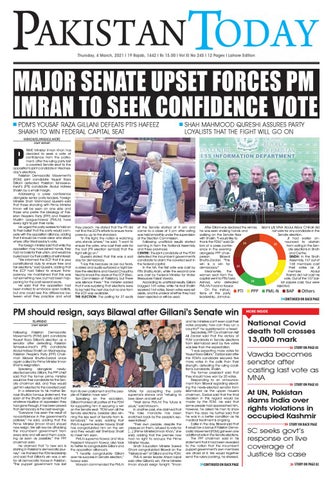
Major Senate upSet forceS pM IMran to Seek confIdence vote g
pdM'S youSaf raza gillani defeatS pti'S hafeez Shaikh to win federal capital Seat
g
Shah MahMood QureShi aSSureS party loyaliStS that the fight will go on
KARACHI/ISLAMABAD/LAHORE
p
STAFF REPORT
riMe Minister imran khan has decided to seek a vote of confidence from the parliament, after the ruling party lost a coveted Senate seat to the opposition’s joint candidate in wednesday’s elections. pakistan democratic Movement’s (pdM) joint candidate yousaf raza gillani defeated pakistan tehreek-einsaf’s (pti) candidate abdul hafeez Shaikh by a small margin. addressing a press conference alongside senior party leaders, foreign Minister Shah Mahmood Qureshi said that those standing with prime Minister imran will be seen on one side and those who prefer the ideology of pakistan people’s party (ppp) and pakistan Muslim league-nawaz (pMl-n) have every right to join their ranks. he urged the party workers to hold on to their belief that the party would compete with the opposition alliance, adding that it should be made clear who stood where after wednesday’s vote. the foreign minister said that while the opposition may have joined hands, they had no basis for their union, and would be buried soon by their politics of self-interest. “we informed the ecp that it is your constitutional duty to ensure free and fair elections,” said Qureshi, adding that the ecp had failed to ensure transparency. he maintained that this was not something new, but had been happening for the past several years. he said that the opposition had been invited to embrace open ballots, but one could see the difference between what they practice and what
they preach. he stated that the pti did not find the ecp's efforts to ensure transparency up to the standard. “in this fight, the nation is watching who stands where,” he said. “i want to ensure the voter, who cast their vote for the bat [pti election symbol] that the fight will go on.” Qureshi stated that this was a sad day for democracy. “i say this because as per our fears, a video and audio surfaced a night before the elections and fawad chaudhry tried to knock the doors of the ecp (election commission of pakistan), but there was silence there.” the minister added that it was surprising that elections were to be held the next day but no one from the ecp was available. THE ELECTION: the polling for 37 seats
of the Senate started at 9 am and came to a close at 5 pm after voting was held smoothly under the supervision of the election commission. following unofficial results started coming in from the national assembly and three provinces: CENTRE: the joint candidate of the pdM defeated the incumbent government's candidate to claim the coveted seat in the federal capital. in the na, the first vote was cast by pti's Shafiq arain, while the second one was cast by federal Minister for water resources faisal Vawda. according to unofficial results, gillani bagged 169 votes, while his rival Shaikh received 164 votes. Seven votes were set aside, and it is unclear whether they had been rejected or will be used.
after gilani was declared the winner, he was seen shaking hands and walking on the Senate floor with Shaikh. "i would like to thank the pdM," said gilani at a press conference in the evening alongside ppp chairperson Bilawal Bhutto-zardari. "this win is a win for democracy." Meanwhile, the women seat from the capital went to pti's fozia arshad, who defeated pMl-n's farzana kausar. on the instructions of the party leadership, Jamat-e-
PM should resign, says Bilawal after Gillani’s Senate win ISLAMABAD STAFF REPORT
following pakistan democratic Movement’s (pdM) joint candidate yousaf raza gillani’s election as a senator after defeating pakistan tehreek-e-insaf’s (pti) candidate abdul hafeez Shaikh on wednesday, pakistan people’s party (ppp) chairman Bilawal Bhutto-zardari once again called for prime Minister imran khan’s resignation. Speaking alongside newlyelected senator, gillani, the ppp chief said that the former prime minister would be their candidate for the Senate chairman slot, and they would get him elected to the coveted post. in a reference to his mother Benazir Bhutto’s famous statement, the scion of the Bhutto dynasty said that whatever injustice of oppression they had gone through, it has been proved that democracy is the best revenge. “everyone has seen the result of no-confidence in the government’s policies,” he said, adding that the prime Minister [imran khan] should now resign. we will now be attacking the incumbent government from every side and will send them packing as soon as possible,” the ppp chairman said. he claimed that “a new era is starting in pakistan’s democratic journey”. he thanked the pdM leadership and said that gillani’s win was a win for all democratic forces in pakistan. “this puppet government has lost
from its own parliament and the people of pakistan have won.” Speaking on the occasion, gillani thanked all parties of the pdM for supporting him in securing a win on the Senate seat. “pdM won all the Senate elections, besides also winning the key seat of Senate from islamabad,” he said, adding that pMl-n supreme leader nawaz Sharif has congratulated him on the win and they would visit Shehbaz Sharif to meet him soon. pMl-n supremo nawaz and Vice president Maryam nawaz also took to twitter to congratulate gillani and the opposition alliance’s. “i heartily congratulate gillani over his success in Senate election,” nawaz said. Maryam commended the pMl-n
Mnas for accepting the party supremo’s stance and “refusing to bow down and sell out”. “well done pMl-n! the future is yours,” said Maryam. in another post, she claimed that “the fake mandate has been snatched back by the people’s representatives”. “their own people, despite the pressure on them, refused to vote for […] (prime Minister) imran khan,” she said, adding that the premier now had no right to occupy the prime Minister house. Sindh education Minister Saeed ghani congratulated Bilawal on the “historical win” of gillani and the pdM. pMl-n senior leader ahsan iqbal said after gillani’s win, prime Minister imran should resign tonight. “imran
and his ministers can’t even cast their votes properly; how can they run a country?” he questioned in a tweet. Separately, ppp co-chairman asif ali zardari said that the victory of pdM candidate in Senate elections from islamabad seat by five votes was less than the expectation. “i was expecting more votes for yousuf raza gillani,” zardari said after the pdM’s candidate secured five more votes in the polls than their strength, defeating the ruling coalition’s candidate, Shaikh. the former president said that they should have won by 20 votes. responding to an announcement from Bilawal regarding elevating the newly-elected senator from islamabad as the upper house’s chairman, zardari said that the final decision in this regard would be made by the pdM. he said that some people had approached him, however, he asked his men to show them the door. he further said that he was in a better condition as his medical treatment is ongoing. earlier in the day, Bilawal said that it would be a bonus if pakistan democratic Movement (pdM) got even one additional vote in the Senate elections. the ppp chairman said in his statement that it had been revealed to the nation that the incumbent puppet government’s own members are afraid of it. we would together send the rulers packing, he stressed.
CONTINUED ON BACK PAGE
islami (Ji) Mna abdul akbar chitrali did not vote for any candidate in the Senate election. Ji had earlier announced to abstain from voting in the Senate elections in Sindh and centre. SINDH: in the Sindh assembly, 167 out of 168 members cast their votes as Ji member abdul rashid did not cast his vote. out of the 167 ballot papers cast, four were rejected.
CONTINUED ON BACK PAGE
more inside
National Covid death toll crosses 13,000 mark STORY ON PAGE 03
Vawda becomes senator after casting last vote as Mna STORY ON PAGE 03
At UN, Pakistan slams India over rights violations in occupied Kashmir STORY ON BACK PAGE
Sc seeks govt’s response on live coverage of Justice isa case STORY ON PAGE 02
02
Thursday, 4 March, 2021
LAHORE
NEWS
SC SeekS govt’S reSpoNSe oN lIve CoverAge of JuStICe ISA CASe IsLAMABAD
ADDL AG SAYS GOVT WILL OPPOSE SC JUDGE’S REQUEST
tltp
W
HILE adjudicating a review petition of their brother judge Justice Qazi Faez Isa on Wednesday, a 10-member bench of the top court issued notice to the federal government over possibility of live transmission of the proceeding of the matter. On June 19, 2020, seven judges of a the present 10judge bench have quashed a presidential reference against Justice Isa but also ordered the Federal Board of Revenue (FBR) to conduct an inquiry into the judge’s family members’ foreign assets and submit a report to the Supreme Judicial Council (SJC). Pleading his own case before a 10-member bench for revisiting the order, the sitting judge of the top court
Justice Isa requested for a live broadcast of the proceedings in the matter. Justice Umar Ata Bandial is heading the 10-member bench. During the course of hearing, a member of the bench Justice Syed Mansoor Ali Shah observed that science and technology should be welcomed to bring transparency to the justice system. During the course of hearing, Justice Isa contended that two members of a bench could negate administrative decisions taken by the full court, saying a decision by the 10-judge larger bench cannot be overturned by a full court from the administrative view. Justice Mansoor Ali Shah remarked that science and technology have played a great role in improving and ensuring transparency in the system and referred to
innovation in DNA research, as hundreds of convictions were overturned. Likewise, cameras were installed in the district courts for supervision. However, Justice Shah also wondered about the downsides of live coverage of court proceedings. Terming the top court verdict in Zulfiqar Ali Bhutto murder case as the ‘most controversial’, Justice isa referred to Justice Naseem Hassan Shah’s interview wherein he had revealed that there was pressure by the government to issue a verdict against the Pakistan People’s Party (PPP) leader. A member of the bench Justice Munib Akhtar asked the judge to deliver an argument on live coverage of the matter raising the question whether the judge (Justice Qazi) will sit in full court if the current matter is referred to it. To which Justice Isa responded he will decide once
PPP seeks action against Imran over development funds, meetings with MPs IsLAMABAD INp
Pakistan People’s Party (PPP) leader Nayyar Bukhari on Wednesday wrote to Chief Election Commissioner (CEC) Sikandar Sultan Raja, drawing his attention to the release of development funds by Prime Minister Imran Khan to MPs and senators as well as his meetings with lawmakers ahead of the elections for the upper house, In his letter, Bukhari maintained since the announcement to release funds by the prime minister ahead of Senate elections constitutes a breach of the ECP code of conduct, therefore action be taken against him. In January, PM Imran, meeting the long-standing demand of Pakistan Tehreek-e-Insaf (PTI) MPs for development funds for their constituencies, announced a grant of
Rs500 million for each member of the National Assembly (NA) and provincial assemblies to carry out development schemes for their voters. Responding to the development, opposition parties had criticised the premier for doing so with Senate elections weeks away, calling the move a “political bribe”. On the other side of the board, Senate Standing Committee on Information and Broadcasting Chairman Senator Faisal Javed Khan on Wednesday said that Prime Minister Imran was the sole leader standing against corrupt practices and struggling to bring transparency in the country’s electoral process. Talking to media persons outside the Parliament House, he said that PM Imran, to ensure transparency and discourage anti-democratic values, had expelled twenty of his own party’s members of provincial assemblies (MPAs) for their
involvement in unfair practices in the previous Senate elections. The opposition, on the other hand, was protecting the corrupt practices and wanted to maintain the status quo for their personal gains, he remarked. Prime Minister Imran, he said, since day-one had conveyed that no corrupt person would be offered a National Reconciliation Ordinance (NRO) and he “still remains firm in his stance.” He recalled the time when the Kashmir issue was being highlighted at the international fora, and the opposition had held sit-ins and demonstrations which badly affected the Kashmir cause. He said, be it legislation on FATF or the Covid-19 issue, the opposition tried to blackmail the incumbent government and sought personal relaxations in their cases of corruption at the cost of national interests. Their moves were never given any weight by the honest PTI leadership,
he maintained. He said that Pakistan Democratic Movement’s (PDM) resignation card also failed when their own parliamentarians refused to resign from the assemblies and they even could not win public support to fulfil their personal agenda. The previous regimes, Javed said, have promoted the culture of corruption, nepotism and rigging. As a result “we lost social, moral and democratic values in the country,” he added. These corrupt elements and their families, he said were flourishing while the poor people of the country were becoming even poorer. He further said that it was imperative now to bring transparency in the system if “we want to protect the future of our coming generations and want to give them a better Pakistan”. He claimed that PTI would win today’s Senate election.
PPP CEC asks ECP to investigate Sindh Opp’s strange behaviour News Desk KARACHI: Allied Bank recently signed a Memorandum of Understanding (MOU) with National Incubator Center (NIC) which is the largest technology incubation center in Pakistan and managed by Teamup. Both organizations aim to promote innovation and digitization in the ecosystem. press release
ISLAMABAD: Following the surge of interest post the recent launch of its CBIP programme in Pakistan, Porto Montenegro, one of the flagship international waterfront developments in Montenegro, has revealed their muchawaited new neighborhood, BOKA Place. press release
Pakistan People’s Party (PPP) Central Election Cell (CEC) Incharge Taj Haider has written a letter to the Election Commission of Pakistan (ECP), asking the electoral commission to investigate the “mysterious behaviour” of the three opposition parties in Sindh, all of whom have booked their MPAs into hotel rooms on the day of the Senate election. A letter, dated March 2, stated that according to various media sources, Pakistan Tehreek-e-Insaf (PTI) booked 30 rooms at the Karachi Pearl Continental Hotel, where 15
about the state of the members of provincial assemblies, pointing out that they may be bribed or placed under duress to affect their vote. It is pertinent here to mention that the PTI, MQM-P and Grand Democratic Alliance (GDA) made arrangements for their provincial lawmakers’ to stay at one place for security reasons. They would be going to the Sindh Assembly together to cast their votes in today’s election, a local news outlet reported earlier. PPP Secretary General Syed Nayyar Hussain Bukhari also wrote a letter to the electoral body where he urged the ECP to take notice of the code of conduct’s violation by Prime Minister Imran Khan.
PM to share Pakistan’s perspective on Covid-19 challenges at 14th ECO Summit IsLAMABAD staff report
ISLAMABAD: The National Bank of Pakistan and EveryWater have signed an agreement under which NBP will extend financing to enable this Pakistani startup formed by young chemical engineers to go to market with its innovative water purification solution. press release
provincial lawmakers were currently residing. “Likewise, MQM [Muttahida Qaumi Movement-Pakistan] has booked rooms at the Regent Plaza for their MPAs. This unusual behaviour of the MPAs of PTI and MQM residing in hotels despite having accommodation in Karachi raises concerns,” the letter further read. “This unusual behaviour of the MPAs of PTI and MQM residing in hotels despite having accommodation in Karachi raises concerns,” he wrote. “The ECP is also requested to investigate who is bearing the lodging expenses,” the letter added. Haider raised concerns
Prime Minister Imran Khan will open the 14th Summit of Economic Cooperation Organisation (ECO), to be held virtually on Thursday (March 4), and share Pakistan’s perspective on Covid-19 challenges. The theme of the summit is “Regional Economic Cooperation in the Aftermath of Covid-19”. The prime minister will open the summit in Pakistan’s capacity as the chair of the 13th Summit. Turkish President Recep Tayyip
Erdogan will chair the 14th Summit, the Foreign Office (FO) said in a press release. Sharing Pakistan’s perspective on Covid19 challenges, the prime minister will outline his vision for regional economic development in line with the ECO’s founding principles of promotion of trade and connectivity, it added. Pakistan, Iran and Turkey are the founding members of ECO, which was formed in 1985 from the erstwhile Regional Cooperation for Development (RCD). Afghanistan, Azerbaijan, Kazakhstan, Kyrgyz Republic,
Tajikistan, Turkmenistan and Uzbekistan later joined it. As a founding member, Pakistan remains strongly committed to the ECO, which aims at promoting effective regional cooperation, with focus on communications, trade, culture and connectivity, the FO said. The summit is the highest platform of the 10-member ECO. The summit meetings entail exchange of views on regional and global issues of interest to the ECO region and review of the progress in implementation of the ECO programmes and projects, it added.
after receiving the agenda of the full court. Justice Isa contended that the chief justice of Pakistan (CJP) is also chairman of the Supreme Judicial Council (SJC) and used to head full court meetings, saying the position of chief justice should not be used for conflict of interest. Justice Isa further said that if a recording of the matter in hand is available, it will illuminate the students for educational purposes saying, “Why we should bury history.” Upon which a member of the bench Justice Manzoor Ahmad Malik observed Justice Isa should avoid any argument that may become part of a judgment which may be cited before him in any case. However, Justice Isa said that if a judge could be maligned publicly, why their case could not be heard publicly, adding the main stakeholders of the justice system are litigants. He said that live coverage of the current matter will not only be beneficial for education and bringing more discipline but will also improve the quality of the justice system. When Justice Isa referred to a question as to what ‘establishment’ was, head of the bench Justice Umer Ata Bandial termed it as a political argument, however, Justice Isa contended the question was not political but is an avoidance of the truth. Raising from his seat, the Additional Attorney General for Pakistan Amir Rehman apprised the bench that the government will oppose Justice Isa’s request for live coverage of the case in hand. Later, hearing of the matter was adjourned till March 8.
NAB shuts inquiries against Ishaq Dar, Akram Durrani over lack of evidence IsLAMABAD INp
The National Accountability Bureau (NAB) on Wednesday announced to shut inquiries against the former finance minister Ishaq Dar and former Khyber Pakhtunkhwa (KP) chief minister Akram Khan Durrani, besides approving another reference against former Punjab CM Shehbaz Sharif. According to a handout issued by the NAB, the accountability watchdog’s meeting headed by Chairman Justice (r) Javed Iqbal approved the decisions during the executive board meeting. The watchdog shut down the inquiries against Ishaq Dar, Jamiat Ulema-e-Islam-Fazl (JUI-F) leader Akram Durrani and Federal Board of Revenue (FBR) chairman over lack of evidence against them. The NAB further said that it has decided to form a committee regarding the Pakistan International Airlines (PIA) owned Roosevelt Hotel in the United States, which would review the decision to shut down the hotel. The accountability watchdog also approved references against former Capital Development Authority (CDA) chairman Imtiaz Inayat and Parks Director General (DG) Liaquat Qaimkhani, besides also approving investigations against other CDA officials.
Thursday, 4 March, 2021
LAHORE
NAtIoNAl CovID DeAth toll CroSSeS 13,000 mArk THREE VACCINATED HEALTH WORKERS CONTRACT CORONAVIRUS IsLAMABAD
N
News desk
ATIONAL death toll due to Covid-19 crossed the 13,000 mark, reaching 13,013 as the coronavirus claimed 75 more lives in the past 24 hours, said the National Command and Operation Centre (NCOC) on Wednesday. According to the NCOC, 1,388 fresh infections were reported during the aforementioned period and the national tally of cases has reached 583,916. The total count of active cases is 16,648 and out of them 1,561 patients were stated to be in critical condition. In the past 24 hours, as many as
6,849 patients recovered from the disease and so far the number of recoveries has been 554,225. A total of 32,945 tests were conducted across the country in the past 24 hours, while so far 9,055,069 samples have been tested. Sindh reported at least 225 new coronavirus cases during the past 24 hours, taking the tally to 258,903. According to Chief Minister Murad Ali Shah, 16 more patients succumbed to the deadly virus as the toll surged to 4,388. He further said that 326 patients recovered overnight, taking the total to 248,184. At least 712 new coronavirus cases were recorded in Punjab during the past 24 hours, taking the provincial tally to
173,395. According to the Punjab Primary and Secondary Health Care Department, at least 50 more patients succumbed to the pandemic as the total reached 5,441. The department added that at least 162,658 patients had recovered from the deadly virus as yet. Meanwhile, three health workers at Mayo Hospital fell victim to coronavirus despite being vaccinated, according to a media report. Sources in the hospital said a doctor, head nurse and ward in-charge have recently been diagnosed with coronavirus, although they got vaccinated a couple of days ago. The doctor was vaccinated on February 23 and showed coronavirus
symptoms five days later, while the head nurse and ward in-charge were vaccinated at the inauguration of the coronavirus vaccine and showed virus symptoms after 15 days. So far, 1,100 health workers have reportedly been vaccinated against the coronavirus at Mayo Hospital. Pakistan Medical Association Lahore President Dr Ashraf Nizami, however, said that no vaccine guarantees 100 percent results. Everybody should abide by the health protocols to mark themselves safe, he said. A primary and secondary healthcare department spokesperson said antibodies start to form 14 days after the first dose of the coronavirus vaccine, so it is important to take precautions even after the inoculation.
Vawda becomes senator after casting last vote as MNA ptI moves eCp for gillani’s disqualification: leader ISLAMABAD: Pakistan Tahreek-e-Insaf (PTI) on Wednesday filed a petition in the Election Commission of Pakistan (ECP) seeking disqualification of former prime minister and Pakistan Democratic Movement (PDM) joint candidate for Senate Yousaf Raza Gillani. On Tuesday, a leaked video clip showed Yousaf Gillani’s son, Ali Haider Gillani, telling some unidentified PTI MPs about techniques of wasting their votes. In a press conference, Yousaf Raza Gillani and Pakistan Peoples Party (PPP) chief Bilawal Bhutto-Zardari played down the clip saying asking for votes from every constituent was their “democratic right”. Speaking to media outside ECP on Wednesday, PTI leaders Farrukh Habib and Kanwal Shauzab, while accusing the former premier of indulging in corruption practices, regretted the clip. staff report
VAWDA CAN’T BE DISQUALIFIED AS HE HAS ALREADY RESIGNED, RULES IHC IsLAMABAD staff report
Announcing its reserved verdict in a case seeking disqualification of Pakistan Tehreek-e-Insaf’s (PTI) leader Faisal Vawda, the Islamabad High Court (IHC) Wednesday ruled it cannot disqualify Vawda as he has already resigned from his National Assembly (NA) seat after casting vote as MNA in the Senate election. The ruling came as part of IHC Justice Amir Farooq’s 13-page written verdict. The IHC remarked that the minister’s affidavit that was submitted to the Election Commission of Pakistan (ECP) was “apparently false”. “There are consequences of submitting a false affidavit according to the order of the Supreme Court of Pakistan,” the IHC remarked, adding that the ECP should decide what to
do about the PTI leader’s allegedly false affidavit. Earlier in the day, the IHC reserved its judgement in a case seeking disqualification of PTI leader Vawda. A single bench of the IHC comprising Justice Aamer Farooq heard the petition moved by Barrister Jahangir Jadoon. During the hearing, Vawda’s counsel argued that the case against his client in the court stands ineffective as Vawda has resigned from his NA seat. However, Jadoon objected to the argument, stating that several members of the assembly resigned from their seats and joined the parliament again in the past. He added that a person remains a member of the assembly unless the NA speaker accepts the resignation. “Faisal Vawda submitted a fake oath regarding his dual nationality
and, therefore, he has neither remained Sadiq (truthful) nor Ameen (trustworthy),” Jadoon remarked. Quoting the Supreme Court, he said that such a person cannot be a member of the parliament. “It is clear from the record of the Election Commission that Vawda was a US national until the acceptance of his nomination papers,” he said. He added that the scrutiny was completed on June 18 while the PTI leader surrendered his dual nationality on June 25. On February 23, a tribunal of the Sindh High Court (SHC) declared Vawda eligible to participate in the Senate polls. The decision was announced by the court while hearing Pakistan People’s Party (PPP) candidate Qadir Khan Mandokhail’s appeal against approval of Vawda’s nomination papers for the polls.
NEWS
03
hafeez Shaikh to become adviser again after 4 months NFC MATTERS MAY GO AGAIN ON BACK BURNER IsLAMABAD Ghulam abbas
As Finance Minister Abdul Hafeez Shaikh has lost the Senate election against former premier Yousuf Raza Gillani, he may again become an adviser to Prime Minister Imran Khan on finance, the position he held two months ago. As per the constitution, Shaikh, who has not been elected like other parliamentarians, will no longer be able to hold the position of a minister after six months in the portfolio. In April 2019, he was appointed as an advisor to the PM on finance, after a cabinet reshuffle by Prime Minister Imran. On 11 December 2020, Shaikh was appointed as Federal Minister of Finance and Revenue. While most ministers have to be elected representatives – i.e. members of the National Assembly (NA) or Senate – there is a clause in the Constitution that allows for short-term appointments of non-elected ministers. According to clause nine of Article 91 of the Constitution, a non-elected person can be appointed a federal minister for six months once during the five-year tenure of the NA. “A minister who for any period of six consecutive months is not a member of the National Assembly shall, at the expiration of that period, cease to be a Minister and shall not before the dissolution of that Assembly be again appointed a Minister unless he is elected a member of that Assembly,” reads the clause. This means that Sheikh will have to step down in June 2021 and resume serving as the adviser to the PM on finance. The incumbent government had decided to make Shaikh a federal minister with the intention to elect him as a Senator to handle budgetary affairs, especially the matter related to National Finance Commission (NFC), as an adviser cannot even chair the NFC meetings. Shaikh had to win a parliament seat to continue as the finance minister after June 11. He is a key member of the government’s economic policies and reforms plan, under the International Monetary Fund’s (IMF) loan programme. In a setback to the ruling party, Gillani, who was backed by an alliance of 11 opposition parties known as the Pakistan Democratic Movement (PDM), won the vote for the Senate’s seat in Islamabad. Gillani bagged 169 votes while Shaikh got 164 votes in a the neck-to-neck contest. Earlier, Shaikh’s appointment as chairman of NFC was objected to by Sindh and some political parties, resulting in the reconstitution of the 10th NFC. In the absence of a federal minister to chair the NFC, Prime Minister Imran, as minister incharge, had chaired only one meeting with concerned officials of the finance ministry in almost six months. As the finance ministry had prepared a summary for the meeting of NFC under the chairmanship of the prime minister, only one department meeting was held, in which the premier was briefed about the NFC and related issues.
The memorabilia of two engaging autobiographies By syeD AfsAr sAjID 1. Title: ‘YaadaiN’ (Memoirs) Author: Shafaat Ahmad Chaudhry Published by: Nastaleeq Matbua’at Pages: 214 – Price: Rs.800/2. Title: ‘Umre Guzashta ki Kitab’ (A Story of the Past) Authors: Meesaq Husain Zaidi – Misdaq Husain Zaidi Published by: Alhamd Publicaions, Rana Chambers, Lake Road, Lahore Pages: 796+243 - Price: US$ 22
An autobiography is a self-written document intended to review and project its author’s life story in such a way as to readily elicit the readers’ participation in the ‘vanity fair’ as a curious viewer, and partaker too. It is customary with men of eminence in different fields of life to pen down their cumulative personal experience of life in the form of a book, at the fagging end of their physical careers. Thus autobiographies of great men serve as a beacon of light for those who succeed them (the posterity) in life’s supervening cyclorama. The instant review carries a brief overview of two such publications by three learned writers who have excelled in their professional careers as a bureaucrat, broadcaster and chartered accountant respectively. ‘YadaiN’ Shafaat Ahmad Chaudhry is a retired (provincial) civil servant. ‘YadaiN’ is his second publication after a gap of some twenty-seven years when his first book titled ‘Shagufta Shagufta’ (a collection of his light-hearted personal essays termed as ‘inshaiya’ in Urdu) saw the light of day in 1993. In the instant book he has given a graphic account of his life spanning his childhood, adolescence, youth, middle age
and now the old age. Being a sportsman, he has always kept himself in a state of physical alacrity by partaking of a wide range of sports activity such as cricket, badminton, and tennis. The book is neatly arranged into subheads spelling out the details of the author’s personal experiences which include his views, comments, observations, reflections, and perceptions with regard to the ever-confounding dilemma that life is, for most of us. Incidentally, this scribe happens to know Shafaat Ahmad from very close quarters as an abiding and well- meaning colleague in the provincial civil service and then as a trusted friend in the social fraternity. He is a man of an all-round personality: a capable bureaucrat with a remarkable executivecum-legal acumen, a popular social figure, a sportsman of high merit, and a litterateur with a keen sense of humour. Shafaat Ahmad has fully ‘exposed’ himself in his autobiography in that he has can-
didly described not only his achievements in the book but also his errors and omissions as a man of the world. His narrative is simple but lucid, couched in a witty conversational style, colloquial though, yet sans any slangs. His tale is a tale of plodding struggle against heavy odds which transformed him into a man of substance both physically and spiritually, over a prolonged period of trials and tribulations. The book is interspersed with snaps of the author’s personal and public appearances projecting the various aspects of his career as a civil servant, sportsman, and a man of a happy family. His spouse was a great woman inasmuch as she firmly stood by him in the face of hardships and constraints of sorts. The underlying message of the book is devotion, dedication and courage that one needs to inculcate in order to lead a meaningful life. The anecdotes narrated in the book bear the expanse of his memory as much as his ability to recapitu-
late and vivify it. ‘Umre Guzashta ki Kitab’ The co-authors of the book Meesaq Husain Zaidi and Misdaq Husain Zaidi are real brothers but with different careers. The former is an ex-broadcaster, a working journalist, writer and litterateur, now settled in the US whereas the latter is a professional Chartered Accountant turned commercial magnate, based in the UK. The life stories of the two brothers are mutually consonant insofar as these illustrate the long winding struggle of two siblings placed in a leisurely but comfortable childhood in Dehradun and (then) a small Muslim principality of Danpur in the district of Buland Shahr (UP), in the years immediately before and after the Partition. Coming of a distinguished Sadaat family (of district Bijnor, UP) of well-to-do businessmen, they were reared well but the frenzy of the Partition of India into two selfgoverning dominions ignited unprecedented communal riots in the entire Subcontinent and revolutionized the whole fabric and pattern of the social, political, cultural and economic life of the people of the two newly emerged States. The authors’ father Syed Ishtiaq Husain Zaidi succumbed to the relentless butchery of the Gurkha Regiment in the heart of the city of Dehradun on 16th September, 1947 on the pretext of violation of the curfew which had been imposed in the town to circumvent growing lawlessness in the wake of Partition. After the assassination (martyrdom) of their Father, the family had to move to Bhopal for a brief sojourn under economic compulsions whereafter they returned to Danpur to rejoin their maternal grandfather Maulana Abdul Ghafoor who was Mohtamim of the Darul Uloom and Administrator Auqaf in the principality. The times were very hard; so the family finally decided to migrate to Pakistan, in parts, in
early and mid-‘Fifties’ (1951, 1952 and 1955), the co-authors of this publication having immigrated in 1952. Here after completing their education, elder brother Meesaq Zaidi took up broadcasting as a career while Misdaq Zaidi, the younger one, decided to emigrate to England (1963). The first part of the book is composed in a narrative form, unchronological in time, place and action, and yet coherent. The author calls it an elegy concerning his age with focus on its political, social and cultural aspects. It encompasses his life-long observations, experiences, situations and events besides an account of his interaction with contemporary celebrities and key figures belonging to different shades and walks of life. Men and matters being integral constituents of the family have been highlighted in great detail. So it looks like an almanac of the Zaidi family scattered in various parts of India, Pakistan and other countries of the world. Meesaq Zadi, the author of this part, is now settled in Denver (Colorado-US). He is in complete retirement, though writes a column captioned ‘Arz Kiya Hai’ (My submissions!) regularly for the weekly ‘Urdu Post’, Canada. The second part of the autobiography relates the life history of the younger brother Misdaq Zaidi, literally starting from the scratch and rising to great heights on the socio-economic plane. It is a tale of struggle, pristine yet prismatic --- drenched in tedium, toil, and turbulence. Misdaq Zaidi graduated from zero to hero over a span of some two decades when he became a certified Chartered Account mustering a wide range of consultancy besides launching his own company styled as Zaidi & Co, in London and Dubai. The narration in the second part is descriptive but sequential. The author is now an international celebrity in the coveted fields of monetary evaluation, tax revaluation and corporate business.
Thursday, 4 March, 2021
04 NEWS
LAHORE
Traffic police harass ciTizens wiTh challans, confiscaTion of vehicles LAHORE
T
SHAHAB OMER
He Lahore traffic police have started harassing citizens in the name of challans and confiscation of vehicles instead of taking action against the real violators, Pakistan Today observed on Wednesday. A survey found that the traffic wardens stand in groups at different roads and instead of stopping the real violators, they start harassing the law-abiding people. Sources in the office of traffic police informed that through verbal orders, a target of every traffic warden in the department is set to issue challans of a certain amount every month so that maximum amount could be collected. Zubair Hassan, a resident of Cantt, informed that his office is located on Jail Road. “I have to use Jail Road every day to reach my office. There is an army check post near Sher Pao Bridge, from where almost every vehicle, after proper checking, is allowed to enter the Cantt area. When-
Motorway gang-rape accused plead not guilty on indictment LAHORE TLTP
An anti-terrorism court (ATC) on Wednesday indicted two accused in a case pertaining to the gang-rape of a woman on the Lahore-Sialkot motorway. Suspects Abid Malhi and Shafqat Bhagga were presented before the court as Judge Arshad Hussain Bhatta resumed the hearing. The court ordered the prosecution to provide a copy of the charge-sheet to their lawyers for perusal. The suspects pleaded not guilty and opted to contest the charges. The court, therefore, summoned prosecution witnesses to record their testimonies on the next hearing. On September 9, a woman along with her children was waiting for help on the Lahore-Sialkot motorway after her car ran out of fuel when she was forcefully brought out of the car at gunpoint and gang-raped in Gujjarpura area on the outskirts of the provincial capital.
ever a person passes through this check post, he/she is always on alert. There are also some traffic wardens standing by the check post, who stop the vehicles for no reason. There is no signal and no issue of overspeeding, and the vehicles pass through at a very slow speed. But the wardens stop vehicles in the name of checking and harass people for not having papers, not wearing seat belts or sometimes using mobile phones before issuing challans. Many people, who are with families, consider it safe to receive a challan but some people insist that they were not using a mobile phone or doing any violation. But the wardens first harass the people and then challan them without giving any logical reason. It is as if they were looking for their prey and not the violators. The higher authorities should take notice of this as this department is for the convenience of the people and not for harassing them.” Aziz-ud-Din, a resident of DHA, also made a similar complaint, saying that he passes by the Fortress Stadium on the Mall
Road almost daily and has to deal with a similar problem. He said, “A traffic warden named Mohammad Idris, whose belt number is 437 TW, seems to have a personal enmity with car owners. Idris is always looking for a prey. If someone does a violation, his challan should be mandatory, but he also issues challans without any violation, which shows that the warden is suffering from some mental stress and wants to take some revenge from the citizens. even with regard to the challan fee, the public is not told by the wardens that which challan will have to be paid for which amount. Sometimes, these wardens challan up to Rs200 on seat belt violation and sometimes they do not hesitate to challan up to Rs1,000 for the same violation. To date, the traffic police have not disclosed to the public the amount of challan against any violation because they have to decide the amount of the challan at their will.” Khawar Majeed, a resident of Ferozpur Road, said that the violation of traffic rules and number of accidents on main and signal-free roads of the city are very high as
the traffic wardens are not willing to enforce the rules. “Where do these traffic wardens go at night? Is not there any violation of traffic rules at night? All kinds of traffic, big and small, on the signal-free roads and adjacent to it, including Jail Road, violate dangerously, and sometimes the wardens present there do not stop the vehicles. At night, heavy vehicles, including cars, rickshaws and motorbikes, pass through in the opposite direction at the U-turn points on the signal-free road, which is extremely dangerous but there is no one to stop them. Signals are violated at night but no traffic warden is present on duty. Overspeeding vehicles are dangerous for the whole traffic but the wardens do not speak there,” he said. “The traffic wardens are present at different places of the roads in the form of groups and it seems like their job is not to stop people from violating, but to trap them. With the arrival of new traffic wardens, it was being expected that the system would change, but they have neither
managed the pressure of traffic nor stopped the rate of accidents. They have no plan to reduce the traffic pressure during the peak hours and manage the signals on time. They do not set up training camps to familiarise the public with the general traffic rules.” Senior Advocate Azhar Saddique said, “The behaviour of our traffic wardens is very strange. They first allow violations and then issue challans while their job is to prevent violations. Wardens stand on the corners and look for prey. Anti-corruption cases should be registered against those wardens who issue challans for fulfiling their target.” On the other hand, the traffic police spokesman denied all such complaints and said that the task of the traffic police is enforcement, which is being done in the best possible way. “With regard to unregistered vehicles, there is a law that they cannot come on the road. The buyers should register the new vehicles from the showrooms. Wardens only challan on violations. If there will be a policy not to challan, we will not do it,” he maintained.
An ironclad friendship growing stronger in the new era WANG YI On May 21, 1951, the People’s Republic of China and the Islamic Republic of Pakistan entered into formal diplomatic relations. In the seven decades ever since, the two countries have stood together, rain or shine, and built an exceptional, ironclad friendship. This friendship has become a strategic asset, most dearly cherished by both the sides. The China-Pakistan friendship has a time-honoured history. As late Chinese Premier Zhou enlai said friendly exchanges between the Chinese and Pakistanis can be traced as far back as the dawn of history. Over 2,000 years ago, China and Pakistan were already connected by the ancient Silk Road, when our people visited each other amid echoes of camel bells. In the extended course of history, the friendship has steadily grown stronger and deeper. The friendship enjoys a solid foundation. We always support each other on our respective core interests and major concerns. even at critical times, be it when New China endeavoured to break external blockade and make diplomatic opening, or when Pakistan stood up to crises to defend national dignity, we have always been there for each other, and have become true friends in need. The friendship has deep roots among the people of two sides. In the times of hardship, one always extends a helping hand to the other as early as possible. Such mutual support and assistance have no strings attached, and are pure acts of goodwill and friendship. When the great earthquake hit Wenchuan of China in 2008, Pakistan donated all its tents in reserve. When Pakistan suffered devastating floods in 2010, China launched the largest humanitarian operation in its history to help Pakistan from land and air. There are numerous touching stories like these. Indeed, developing China-Pakistan friendship is a nation-wide consensus in both the countries. Since the turn of the century, the relationship has grown even stronger, and cooperation has been upgraded across the board. In 2015, President Xi Jinping made a historic state
visit to Pakistan. Leaders of the two countries agreed to elevate the relationship to an all-weather strategic cooperative partnership. This has opened up a new chapter of friendly interactions. High-level exchanges are frequent. The heads of state and government maintain communication via bilateral visits, by telephone calls and at multilateral events. Through timely, in-depth exchange of views on bilateral cooperation and major strategic issues of mutual interest, they keep the relationship in the right direction, give strategic guidance to its development and steadily make new progress in bilateral strategic cooperation. Practical cooperation is fruitful. We have put in place a “1+4” cooperation structure that centres on the China-Pakistan economic Corridor (CPeC) and prioritises the Gwadar Port, transportation infrastructure, energy and industrial cooperation. Under CPeC, 70 early-harvest projects have been identified, among which 46 have been launched or completed. A total of $25.4 billion have been invested, creating 70,000 jobs for Pakistan. CPeC, as a signature project under the Belt and Road Initiative, has served as a fine example as China and other Islamic countries work to synergize their development strategies. People-to-people exchanges are booming. We hold culture months, film weeks, tourism years and national promotion activities. exchanges and cooperation are moving ahead in media, think-tank, academia, education, culture and sports. In the Year of China-Pakistan Friendly exchanges in 2015, we held a series of cultural exchange events that took our friendship to a new high. The recent years have witnessed the highly popular 100-member youth groups exchange programme under the vision for a lasting friendship, enabling more and more Pakistani students to study in China. The ever-growing force for China-Pakistan friendship has been the firmest basis for our bilateral relations. Cooperation on multilateral occasions is close. We both observe the purposes and principles of the UN Charter, and have common values of advocating multilateralism over unilateralism, free trade over protectionism, and win-win over hegemony. We are both committed to upholding the existing international order and the UN-centred international system. And we both believe in peaceful settlement of international disputes through consultations and negotiations. China and Pakistan coordinate and collaborate closely in the UN, the Shanghai Cooperation Organisation, the Asia-europe Meeting, the
ASeAN Regional Forum, and other regional and international mechanisms. We have made important contributions to solving regional hotspot issues and advancing international counter-terrorism cooperation, and injected enormous positive energy into the cause of regional and global justice. Our friendship has withstood the test of the sudden onslaught of Covid-19, and has emerged even stronger. At the toughest moment of China’s battle against the coronavirus, Pakistan did all it could to provide China with donations. Pakistanis from all social sectors expressed unanimous support for China’s Covid response, and opposed the attempt to politicise the virus and stigmatise China. When Covid cases surged in Pakistan, China’s government, military, businesses and social organisations all pitched in to help. China provided successive batches of medical supplies, sent medical teams, and intensified experience sharing and technological exchanges. In addition, our two countries established a joint response mechanism to ensure that all CPeC projects proceed uninterrupted. This set an example of effective transnational response to Covid-19. This year marks the 100th anniversary of the Communist Party of China. The country will embark on a new journey toward a modernised socialist country and realising the second centenary goal. Pakistan is advancing economic and social development in full speed and improving social welfare to turn into reality the vision of Prime Minister Imran Khan for Naya Pakistan. As an all-weather strate-
gic cooperative partner, China always gives priority to its cooperation with Pakistan in its overall external cooperation. We will continue to firmly support Pakistan in safeguarding its sovereignty, independence and territorial integrity; in deepening reform and opening wider and raising self-reliance ability; in enhancing political unity, national security and social stability; and in playing a bigger and constructive role in international and regional affairs. In a world of drastic changes unseen in a century, deepening China-Pakistan strategic cooperation is the natural option. No matter how the regional and international landscapes may evolve, and what challenges and risks may arise, China will continue to work with Pakistan to advance cooperation in all areas, cement our ironclad friendship, and build an even closer community with a shared future in the new era. During this year, China and Pakistan will inaugurate grand and warm celebrations to honour the 70th anniversary of diplomatic relations, including high-level visits, business exchanges and cultural activities. I hope that people from all walks of life of both the countries, especially the younger generation, will take an active part in renewing the ironclad friendship to push forward our all-weather strategic cooperative partnership. I am confident that our joint efforts will usher in an even brighter future of China-Pakistan relations. The writer is State Councilor and Foreign Minister of the People’s Republic of China.
Thursday, 4 March, 2021
LAHORE corporate corner Falcon-i wins several big clients to provide advanced fleet management solutions KARACHI: Falcon-i is Pakistan’s leading fleet management company, offering IoT (Internet of Things) based solutions that enables clients to monitor the movement and safety of their automobiles with more control and connectivity. With this progressive vision, it has recently added several industry-leading enterprises to its portfolio of over 200 corporate clients. The Head of Corporate & Enterprise Solutions at Falcon-i – Naveed Aijaz stated: “It is an honor for us to be entrusted by some of the largest enterprises, for helping to keep an eye on their fleets. Our individual customers with diverse tracking needs also express their complete trust on Falcon-I, due to our consistent performance and highquality services that ensure greater efficiency and safety.” PRESS RELEASE
Telenor velocity invites startups for its 7th cohort LAHORE: Telenor Pakistan’s Digital Accelerator Programme, Telenor Velocity, has opened for applications from startups for its 7th Cohort. As part of this programme, Telenor Velocity will guide, support and mentorstart-ups using Telenor Pakistan’s experts, analytics and access to scaling opportunities over a period of four months. Speaking at the development, Khurrum Ashfaque, Chief Operating Officer, Telenor Pakistan, said, “Telenor Velocity aims to nurture and mentor start-ups that use technology as an enabler across various verticals which is Telenor Pakistan’s expert domain. We are living in the start-up generation with increasing digitisation by the day. These tech based new businesses need a platform to jet start their ventures that not only enable solutions for the society but also puts Pakistan on the map for innovation through technology.” PRESS RELEASE
Jazzcash partners with haball for digitized supplier payment solutions KARACHI: JazzCash has collaborated with Haball, a supplier payment digitization company, as its partner to help in digitizing supply chain payments. With this partnership, JazzCash and Haball aim to empower retailers and suppliers to transition from manual cash handling to digital payments, boosting the supply chain efficiency as a result. Talking about this initiative, JazzCash CEO, Erwan Gelebart, stated, “JazzCash has successfully reached more than 12 million people in Pakistan. To foster this growth and truly cultivate a cashless business economy in the country, it is imperative to digitize larger businesses and evolve partners from all business avenues. In this digital age and with partners like Haball, we aim to open a new door towards digitizing payment processes, to gain higher business efficiencies and minimize risks related to theft and fraud.” PRESS RELEASE
Lng demand in 2020 remained steady despite covid-19: shell KARACHI: Global liquefied natural gas (LNG) trade increased to 360 million tonnes in 2020, according to Shell’s latest annual LNG Outlook, despite the unprecedented volatility caused by the Covid-19 pandemic which resulted in lockdowns around the world. “LNG provided flexible energy which the world needed during the Covid-19 pandemic, demonstrating its resilience and ability to power people’s lives in these unprecedented times,” said Maarten Wetselaar, Integrated Gas, Renewables and Energy Solutions Director at Shell. “Around the world countries and companies, including Shell, are adopting net-zero emissions targets and seeking to create lower-carbon energy systems. As the cleanest-burning fossil fuel, natural gas and LNG have a central role to play in delivering the energy the world needs and helping power progress towards these targets.” PRESS RELEASE
Philip morris Pakistan wins two awards at nFeh csr awards 2021 KARACHI: Championing Corporate Social Responsibility, Philip Morris (Pakistan) Limited (PMPKL) has been recognized at the National Forum for Environment and Health (NFEH) 13th Annual CSR Award 2021. PMPKL was declared as the winner for awards in two categories: “Employee Volunteerism” and “Waste Management/Recycling” during a ceremony held in Islamabad on Thursday. Expressing her views on this recognition, Andleeb Uroos Ahmed, Manager Communications PMPKL, said, “We are very thankful to NFEH for recognizing PMPKL once again for its commitment to improve the lives of people in various communities and our efforts in helping the environment. Giving back to society and driving positive change are core values of our organization globally and locally. From our management to employees from across the board, our aim is to create long-term, sustainable impact for our people and communities. PRESS RELEASE
NEWS
05
The unwiTTing archivisT: shahid hamid BY Mehvash In the lineup for Lahore Literary Festival 2021, earlier this month, one of the sessions was an interview of the author of Treasured Memories, Shahid Hamid. The author holds a degree in economics from the University of Cambridge and is a barrister at law from the Honourable Society of the Inner Temple. He was a civil servant for the first fourteen years of his working life, during which he also served in East Pakistan, now Bangladesh. He has been a member of the elite Civil Service of Pakistan (CSP); senior advocate of the superior courts; federal minister of defence, establishment and law; governor of the Punjab province and a public-spirited citizen who has served as chairman or member of a large number of educational and medical institutions, think tanks and social welfare organisations. What is noteworthy in this memoir is that what began as a personal re-visiting of the past, after the pandemic we are all living through had ‘incarcerated’ Mr Hamid, became an archival piece about the years that he experienced in some very high offices in Pakistan. It is a piece that rings true because of his reputation as an above-board, honest, apolitical person. His book touches on historical personalities and political dramas in the corridors of power with a simple and direct approach, not shying away from a refreshing frankness that becomes, perhaps unwittingly, an honest archive of some of the most important periods of our history. To say that an archive is a page-turner sounds far fetched, but as someone who has also been a faroff witness to the events that he mentions, I say that genuinely. These serious events are offset by behindthe-scene observations of some great international personalities, be they heads of state such as Queen Elizabeth of England or thespians such as Shabana Azmi, or beloved Pakistani figures such as Maheen Khan, the designer. In the end, it is a necessary, easy-to-read book for anyone wanting a glimpse into the machinery that has created the chequered history of Pakistan. For my interview below, therefore, I dwelt on the archival aspect of his memoir. Mehvash Amin: I noticed while reading that there is remarkable attention to detail: names, places, dates, etc. Have you been in the habit of writing a journal or did you go over all your facts as you wrote? Shahid Hamid: I never kept a diary. Thought about doing so once in a while, but never found the time. I did keep some treasured letters, like the one that I received from the late Prime Minister Zulfiqar Ali Bhutto on Independence Day 1976, saying that the work I was doing as Director General LDA would be rewarded in this world and the heavens. I have reproduced the full text of this letter in my book. Another treasured letter that I have preserved was from my cousin Pervez Bashir Nawaz. He was a young army officer at the time of my father’s arrest in 1978 and offered to seek an interview with General Zia ul Haq for my father’s release. I have a good memory, though not a photographic one. My friend, President Farooq Leghari, commented about this when, after showing me the large bundle of reports which were to form the basis for the Dissolution Order under Article 58(2)(b) of the Constitution on 5th July 1996, he said, “You can’t take them with you as we to have preserve secrecy, but I know you have a good memory and won’t need them.” I don’t know about others, but with me there are any number of incidents, both pleasant and unpleasant, etched in my memory bank and I have recounted some of them in anecdotal form in my book. My wife, Sarwat, and I also have many albums of pictures from our earliest days to the present. My book includes 60 pages of pictures. Nothing revives memory better than a look at the pictures of the past. These albums are the pictorial diaries. MA: Your memoir is more than a personal journey… it also navigates some crucial twists and turns in our nation’s history that you had access to because of your high offices. In that sense, it becomes a memoir of the country. How aware were you of the historical importance of your memoir when you were penning it down? SH: My primary purpose when I started writing my book was to tell my daughters, and even more so my grandchildren, about their ancestors and the early years of my life in various parts of Pakistan and abroad, and the turning points and combination of events that led to my holding high constitutional of-
fices. When I got to the point of writing about my tenure as Defence, Establishment and Law Minister of Pakistan, and later as Governor of the Punjab, I decided that I would not hold anything back and that I would give a true and honest account of the events of which I was a part. It is for you and the readers to judge whether my narrations ring true. While doing so, please remember that I have never been an officebearer or member of any political party and have no political ambitions. It is for these reasons that my memories and revelations of events within the inner corridors of power may have, what you call, ‘historical importance’ greater than some other recollections of those times. MA: I notice that you have always been apolitical, and not afraid of giving criticism. Were you afraid of any backlash from some of the people that you criticised? SH: No, never. I have always spoken my mind on the issues important to me. On some occasions, not many, President Leghari, whom I dealt with on a daily basis as a federal minister, and Prime Minister Nawaz Sharif, whom I met on an average of once every ten days as Governor Punjab, never resented my advice because they knew it was honestly given without any underlying motives and also because I never publicised disagreements. I don’t recall any disagreements with Chief Minister Shahbaz Sharif. I firmly believe that the President of Pakistan and the governors of the provinces should play a non-political role once they are in office, regardless of their past political affiliations. Their concentration should be on issues of education, health and matters directly affecting the welfare of the common man, on policies and not contentious politics. Like the British monarch, they should play the role of advisor and, where necessary, of a warner. If they do so they will meaningfully contribute to the unity of our Islamic republic and serve as an invaluable bridge, when occasion demands, between the government and the opposition. MA: It is said that those who do not remember history are doomed to repeat it. Generally, what do you think is the importance of archives? SH: Archives are primary source documents that have an enduring evidentiary, cultural or historical value that are worth preserving in perpetuity. Self-evidently archived records are invaluable for researchers in different fields of study, especially history. The main storage facility in the Punjab for archived records is the archives department in the Lahore secretariat of the provincial government. Archives can certainly help in learning the lessons of history and the mistakes made in the past. It is important to remember that mistakes are made not only by individuals who hold high office, but also by people as a whole. We blame Yahya Khan and his senior generals, Zulfiqar Ali Bhutto and Sheikh Mujibur Rehman for the breakup of Pakistan, forgetting that initially the army crackdown in East Pakistan had majority support in West Pakistan. Have we learnt any lessons from that disaster? I think so. The lesson was and is that in a federation the grievances and demands
engro Fertilizers wins duPont Ke committed to bringing global safety innovation award Karachi to power surplus KARACHI: Engro Fertilizers has been declared as situation by 2022 one of only three global award winners at the virtual ceremony of 14th DuPont Safety and Sustainability Awards. Sharing the company’s journey of safety excellence, Nadir Qureshi - CEO of Engro Fertilizers, said, “A relentless commitment to safety is one of the core values of Engro. We have always strived to set world class HSE standards for both our employees and the communities in which we live and operate. This focus is continuously reinforced by our leaderships’ commitment, with my Chairman and Board regularly highlighting this core commitment and our teams embodying this culture. We are humbled by this global accolade and it is our endeavor to get to similar levels of world-class safety in the new logistics business that was launched 18 months ago.” PRESS RELEASE
CMYK
KARACHI: K-Electric remains committed to bringing Karachi to a power surplus position by 2022 through a series of planned investments across the power value chain. These investments, which would be subject to regulatory approvals will allow KE to benefit consumers and the economy at large. This was stated by Aamir Ghaziani, Chief Financial Officer of K-Electric at the Corporate Briefing, held via webinar, which was attended by analysts from leading brokerage houses and other stakeholders. The impact of Covid coupled with increased finance cost due to accumulated receivables from government and its entities led to KE reporting a loss in FY 2020. However, analysts were informed that the first half of FY21 has shown improvement in key operational and financial indicators. PRESS RELEASE
of the smaller provinces must not be ignored, and the devolution of power under the Eighteenth Amendment in 2010 is heartening evidence that we, as a people, have learnt the lesson of 1971. As for individuals who hold high office, their mistakes seldom get repeated because, more frequently than not, they do not get another chance to hold such office again. Also, I think we should be careful not to over-stress the importance of ‘learning from the lessons of history’, because over a span of time, no two seemingly similar situations are exactly alike. MA: You have written: “Father was concurrently accredited to Jordan. There was no separate embassy in Amman. The West Bank was part of Jordan. Jerusalem was in Jordan. I travelled with my parents all over the West Bank. We prayed in Masjid Al Aqsa. We went to Hebron, the Dead Sea, Bethlehem, Jericho and Galilee and all along the River Jordan.” I find these lines fascinating, that in a single lifetime Jerusalem, the pivotal centre of three religions, has been all but banned to Pakistanis. Do you think we will see a change in the present status quo any time soon? SH: I am normally an optimist, but not in this case. The late King Hussein of Jordan was quite possibly not altogether unhappy about losing the West Bank in the 1967 War with Israel, because the Palestinians were never his supporters. The late Yasser Arafat lost his best chance for a liveable settlement when he declined to accept the terms negotiated by President Bill Clinton with Israeli Prime Minister Rabin at Camp David. The only progress made by the Palestinians since then is the Israeli vacation of the Gaza Strip. On the other hand the increasing number of Israeli settlements in the West Bank have altered the demography of the area and there is no sign that this will stop at any time in the foreseeable future, especially when more and more Arab states are making their separate peace with Israel. For us in Pakistan, the fate of the West Bank, especially Jerusalem and that of the Palestinians, is a very emotional issue, but there is very little we can do to affect the course of events there. MA: You also wrote: “There was in my generation and in the generation of my elders, who were even more responsible for what happened than those of my age, a touch of racism and superiority. We were fairer, we were taller, we were better looking, they were under the influence of the Hindus who dominated their teaching profession, they were trying to break Pakistan, how dare they, and much more.” You have been extremely open about former East Pakistan, the ’71 war and Bangladesh. Do you think that as a nation we should apologise to Bangladesh? SH: The Pakistan Resolution of 1940 was presented by A. K. Fazl ul Haq, the then Prime Minister of Bengal. Several prominent Bengali leaders, Hussain Shaheed Suhrawardy, for example, were in the forefront in the struggle for Pakistan. For the first 24 years of our existence as an independent country, they were part of us. I served in East Pakistan from 1967 to 1969 and bear witness that the preponderant majority were as patriotic as we in the West. They continue to be our brothers in faith. We wronged them when we did not accept the democratic mandate thrown up by the 1970 elections and much more by the military crackdown of 1971. It is irrelevant whether over the years they have exaggerated the number of casualties they suffered in that year. Our Islamic faith teaches us that the murder of one is the murder of all humanity. So should we apologise? Maybe, maybe not. Many in present-day Bangladesh were not blameless, especially in their treatment of Biharis who stood by their allegiance to Pakistan then and later. There has to be a national consensus on this matter developed through an informed debate in parliament. Any apology must be premised on the understanding that it will lead to complete normalisation of relations and permanent closure of this tragic chapter in the history of relations between the two countries. MA: Who were the main editors of your book? Your wife Sarwat seems to be at your side in every step you take. How instrumental was she in the production of this book? SH: My book was edited again and again by my wife Sarwat and my daughters Asma and Alia, as well as my grandson Akbar Ali. The grammar, the punctuation, the spellings, the selection of 60 pages of pictures—all four of them contributed to the point that I was ready to offer them co-authorship. But the memories are mine.
Bankislami rises to sky with Pia KARACHI: BankIslami has partnered with Pakistan International Airline (PIA) to co-brand their aircrafts, taking BankIslami’s visibility up a notch. PIA proudly features BankIslami headrests and pillow covers in all flights allowing customers to be acquainted with BankIslami. PIA serves 43 destinations operating 100 flights a day, making it the airline with the largest number of connections and the carrier of choice for people travelling to and from Pakistan. BankIslami is taking this partnership opportunity to raise its brand image and recognition as one of the country’s premier finance institutes. Commenting on this development, BankIslami President and CEO, Syed Amir Ali stated, “At a time when providing simple mediums for financial inclusion to the masses has become imperative, BankIslami is making sure that this access is technologicallyadept and Shariah-compliant.” PRESS RELEASE
Thursday, 4 March, 2021
06 COMMENT
Healing the wounds of the nation
The debacle in Islamabad Sitting government losing elections
A
The Senate elections show how much the country needs a clean-up
FTER nowshera, Rawalpindi. This should lead the ruling party to do a lot of soul searching. In the most hotly contested Senate election, the Pakistan Tehreek-e-Insaf’s candidate Abdul Hafeez Shaikh has been defeated by the Pakistan Democratic Movement’s Yousuf Raza Gilani. Federal Minister for Science and Technology Fawad Chaudhry had earlier claimed that Shaikh would get over 180 votes, but the finance minister ended up with 164, losing the election by five votes. There were already reports in the media of widespread resentment among PTI legislators over the allotment of ticket to a man who had no affiliation with the party and was sure to leave the country after losing his job. Some of the dissenters had come out into the open. Sensing the danger, Prime Minister Imran Khan had set aside all official activities to personally canvass for his finance minister. That even the PTI chief failed to persuade the dissidents indicates the depth of resentment against Shaikh. Many would interpret the debacle as a rebellion against the decisions taken by the party leadership without caring for the party workers’ opinions, which is unfortunately all too common among the country’s major political parties. The dissidents have not only voted against Shaikh but have also revolted against the party chief. That PTI’s Fauzia Arshad has won the women’s seat, defeating the PDM’s Farzana Kausar, again indicates that party dissidents stood by a well-known PTI worker but refused to support a technocrat who they thought was being imposed on them. Former premier Yousaf Raza Gillani’s victory has boosted the morale of the PDM which might now go for a no-confidence move against the PM. The government spokesmen are claiming that some of the voters had been bribed to go against the party’s whip. If the claim is accepted, this would raise questions about the moral health of the PTI. A video and a short audio script are being used to prove that money played a role in determining the results. The Election Commission of Pakistan needs to conduct a thorough and transparent inquiry into the allegations. Meanwhile, instead of indulging in its favourite blame game, the PTI would do well to do some brainstorming after the loss of two elections within a fortnight.
Dr FariD a. Malik
O
n January 20, Joseph Robinette Biden Jr took oath of office as the 46th President of USA. The Presidential elections were held on november 3. It had been a close race. While Biden managed to get 306 electoral votes, Trump got 232. The voter turnout was the largest ever (46.8 percent), and 81 million Americans voted for Biden, Trump trailed with 74 million. The country is the oldest constitutional democracy of the world where incumbents have usually managed to get a second term in office unless a major debacle has taken place. Jimmy Carter lost the elections in 1980 to Ronald Reagan due to the US Embassy Hostage crisis in Iran. George Bush Sr lost in 1992 to Bill Clinton, mainly because of being over-confident after winning the first Iraq war. Donald Trump campaigned hard for his second term. As an anti-establishment politician, he had created his own constituency. He came from nowhere to first get his party nomination and then the presidency. Perhaps it was the pandemic that cost him the election, otherwise he had positioned himself well for a second term against the wishes of the establishment. After taking over the presidency, Joe Biden has started a process of healing the nation. Strife serves no purpose, it stalls progress. nations rise and fall together. The focus has now shifted on common good. ‘For the people legislation’ has started. Trump escaped impeachment for the unprecedented attack on the US Congress on January 4 by supporters of his. The divisions are being bridged. By contrast, democracy in the land of the pure has been repeatedly attacked both by men in uniform and their civilian pseudo-political leadership. The wounds continue to bleed. There have been no attempts at healing. The ‘ Zia Dark Ages ‘ have been the deadliest which refuse to end. The divides that he created have become traps for the entire nation. Most civil institu-
Re-establishing some sanity SC takes first step to bringing the Bar under control
T
HE latest incident, that of the trashing of the Islamabad High Court by lawyers, on February 8, in the course of which the Chief Justice Justice Athar Minallah, was trapped in his chambers, seems to have capped such incidents as the December 2019 attack on the Punjab Institute of Cardiology, as well as a number of attacks on judges in their courtrooms by lawyers who did not like a particular verdict. The attack was carried out by a group of lawyers protesting the demolition by the Capital Development Authority of a large number of lawyers’ chambers constructed on land belonging to a football ground. In its decision on the case, a four-member IHC bench ruled that the chambers were illegal and to be demolished. It gave a deadline of this Pakistan Day for the playing of a football match between students, and of Pakistan Day next year for the completion of a judicial complex for Islamabad’s district courts. While it would perhaps be an exaggeration to say that the lawyers’ community has been controlled, this marks perhaps the first occasion that lawyers have been shown that the methods of violence and brute force do not yield the desired results, and that they will be held to the standard of what is legal, not what they will. It is perhaps of greater weight because it comes from the bench. The relationship between the Bench and the Bar has been so close because not only the latter appear before the former, and obtain its decisions, but the former is recruited from its ranks. It is the ability to obtain the bench’s decisions that gives the members of the Bar their power. The breaking of the nexus in this case should show the Bar that it cannot expect blind support from the bench when it has not got the law on its side. The Bar should realise that a regard for the law is what has given it its respect in society as one of the learned professions. If it strays, it will find that it will not be supported, and that it will not be able to do what it wants.
Zainab naZir
T
HE sight of children with their poker faces lost in a trackless jungle of pain, women with reptile eyes and unkempt hair, and disabled and disadvantaged old people begging throughout the day and the night across Pakistan’s streets is a grim and constant reminder of the millions who live in abject poverty. Begging is one of the most ancient pandemics in the world. Pakistan is fraught with beggars of all shapes and ages. From a child barely able to talk and walk to a young educated adult to an old disabled person, and from a needy to an expert to an appointed professional, many people are seen to be buried in the curse of begging. Beggars are found on every street,main road, roundabout, pavement, and in front of mosques and shrines, and main roads asking for money. In some cases, beggary is tolerated due to religious reasons. People give alms to beggars to earn “sawab” but they forget that the beggars are professionals who earn their living by begging. In our part of the world, the beggary mafia has turned into a form of ‘organized crime’. The organizers have criminal intentions to maximize profit for
Arif Nizami Editor Managing Editor
Joint Editor
Umar Aziz Executive Editor
Lahore – Ph: 042-36300938, 042-36375965
To heal the wounds of the nation, an honest man on the top needs an able team to first understand the grim ground realities and then be able to improve them. A wounded nation can neither advance nor survive in the long run, so the healing process has to be started without ado
The writer is ex-Chairman, Pakistan Science Foundation. He can be contacted at: fmaliks@hotmail.com.
Cynically playing on people’s best feelings
Dedicated to the legacy of the late Hameed Nizami
Yousaf Nizami Aziz-ud-Din Ahmad
tions continue to be non-functional. The wounds of the nation have to be healed to move forward to end the era of strife (1977 to 2018). A ‘Truth and Reconciliation Commission’ may be needed. The nation has come under attack several times. I remember the first speech of Zulfiqar Ali Bhutto (ZAB) when he took over the truncated Pakistan. He said, “I have come over to pick up the pieces of what remains of Pakistan”. A lot has been written about the crimes of the establishment of its times that resulted in the breakup of the Quaid-e-Azam’s country. The democratic era that followed (1971 to 1977) did heal some of the wounds. The unanimously agreed Constitution of 1973 was a gift of this era. The republic was moving in the right direction till it was hit by the Zia onslaught of 5 July 1977. Since then the decline has continued unabated. Education, health, transport, every vital sector has deteriorated beyond repair. The political leadership that was imposed on the nation, continues to suck the blood of the impoverished masses. I clearly remember my first class at the prestigious Government College Lahore in the year 1969. There were students from all corners of the country who came from small village schools. Their commitment to academics was exemplary. Except spoken English, they had command over all subjects. Merit prevailed, most of them then landed in engineering and medical colleges to serve the nation with their professional knowledge. There were a few rogues who never attended classes, sat in the fruit shop and cafeteria all day. One of them was nawaz Sharif who managed to get admission on a wrestling seat. I never saw him in a clasroom or examination hall. His interest was to wrestle in the nearby Akhara (wrestling ring) of the famous Bholu Brothers. He even ended up getting married into that family. After finishing my Engineering programme, I proceeded abroad for higher education. On my return, I found out that Mian Sharif had succeeded in promoting his eldest son first as Chief Minister of Punjab and then as Prime Minister. In one of the meetings of THE Chand Bagh School, I had the opportunity of meeting Lt. Gen (retd) Ghulam Jilani Khan who as Governor had shortlisted nawaz Sharif for the post of CM of the province. I asked him, if nawaz could write a paragraph in any language, read a page of text
and understand it, speak extempore for a minute on any topic? The answer was in the negative, but he did mention about his special negotiating skills (mukmuka). It is this skill that has brought us to the brink with the collapse of institutions. In his second tenure as PM, Mian Sahib not only attacked the Supreme Court of Pakistan, he also managed to pass a bill in the national Assembly declaring himself Amir-ul-Momineen (Khalifa) of Pakistan. It was due to the efforts of progressive People’s Party Senators like Aitzaz Ahsan and Raza Rabbani that the move was blocked and the country was saved. The interim constitution of 1972 in Article 216 had legislated the forming of Administrative Accountability Courts which were then toned down in Article 212 of the 1973 permanent version. In 1979 the entire Article was removed from the Constitution. Executive abuses continue unabated. Half of civil litigation is because of the administrative malfunction in the country. Administrative accountability is the need of the hour for which Article 212 has to be restored. I am sure it will bring the much needed relief to the public. In the Constitution of the Islamic Republic of Pakistan there are about 20 articles that cover human rights, each one of them is being violated, including Article 25A under which the right to education has been guaranteed. The recent Senate elections clearly indicate the vested interests that operate in our legislative framework. The party in power desires transparent voting while the opposition is opposing it. Perhaps for the first time real information gathered by the agencies is being used to counter the crime of ‘horse trading’ instead of being filed in dossiers to be used at appropriate time. This election may prove to be a major milestone in the clean-up of the system. If money prevails it will further cripple the democratic order. The country needs credible political leadership to end the ‘Zia Dark Ages’ that continues to derail democracy in our times. To heal the wounds of the nation, an honest man on the top needs an able team to first understand the grim ground realities and then be able to improve them. A wounded nation can neither advance nor survive in the long run, so the healing process has to be started without ado.
I
Karachi – Ph: 021-35381208-9
I
themselves by forcing people, mostly children, to beg. There is a hand supporting every palm soliciting alms. Children are kidnapped, transformed and traded between different begging gangs. The gang leaders exploit people by preying on their economic and financial vulnerabilities. The social evil of beggary is destabilising and demoralising our nation and giving birth to uncertainty and insecurity. While poverty is real, begging is quite often carried out in organized plans and gangs. Groups and gangs use advanced technologies such as smartphones, emails, and modern transportation systems to plan and implement their mafia goals. For example, smartphones are used not only to beg, but also to trace the location of the beggar, to inform beggars about law enforcement activities and warning them when “anti-begging squads” are near. Motorbikes are used to help the member beggars disappear from the signs of danger. The beggar children are mostly those who were first abducted by the mafia, and then given a hideous appearance or disability. The street beggars do not keep the money for themselves. For every street, every intersection, every shrine, every public park, there exists a mafia that employs children and sometimes adults to work for them. There is a huge influx of the institutionalised beggar mafia to our land and it is the responsibility of people at the helm to take action and find solutions in an appropriate and humane manner. The dilemma of begging is often presented to us as a morally paradoxical choice between competing values. It questions the public concern for clean cityspaces against the indicative presence of beggars. However, even the slightest association with the mafia issue reveals such collocation to be an attempt at enshrouding the main problem: anti-begging laws seek to take away its poorest people’s basic human right of freedom of expression and speech. A big proportion of Pakistan’s population is below the poverty line. Begging has become an occupation in today’s world. The beggars masquerade or use different guises as their emotional tools. Fake blind people, the fake disabled and the fake dumb can be seen in every nook and cranny of our country. Beggars deliberately mutilate and disfigure themselves to get
Islamabad – Ph: 051-2204545
I
Web: www.pakistantoday.com.pk
I
more money and sympathy from people. Orphaned and under-privileged children are at the highest risk of exploitation and slavery. The sad reality is that the begging children are even unaware of what they are being forced to do. Beggars working under the protection of different mafias are also expected to be involved in crimes such as robbery, drug trafficking, kidnapping and sometimes prostitution as well. The existence and addition of the beggar mafia in Pakistan is a clear reflection of state failure due to the prevailing political, social, and economic conditions. Based on current data, the beggar mafia is likely to grow and flourish; criminal begging groups are becoming more complex, as they network and collaborate with other illegal organizations, and incorporate other planned criminal activities into their agencies. There should be an immediate halt to population growth first of all. Secondly, the government and non-governmental organisations should establish factories and training institutes at different places to put all the people involved in the beggar mafia to work. Moreover, for physically deformed beggars, there should be special institutions and production centers where they can work and earn respectively. Beggars have existed in human society even before the dawn of history. not only anti-beggary units, but we all are equally responsible for cleansing our society from this mafia. There is no law to counter this begging business and the social evils that it carries with it. Every now and then as your car stops at the traffic signal a hand knocks on the window asking for money. This puts one in a dilemma, should I give him or not? Giving to a beggar is an impulsive action, something that makes you feel good. But instead of giving money to beggars we can fulfill their needs. If a child asks for food, give him food. If a man says he needs to pay the school dues of his son, go and pay for him. If a woman says she needs to get milk for her little one, go and buy her milk. If the person is capable of doing labour, offer them work. If a man says he needs to pay his house rent, go and pay his rent. nipping it in the bud would help us counter this mafia. The writer is a freelance columnist
Email: editorial@pakistantoday.com.pk
Thursday, 4 March, 2021
COMMENT 07 Editor’s mail Send your letters to: Letters to Editor, Pakistan Today, 4-Shaarey Fatima Jinnah, Lahore, Pakistan. E-mail: letters@pakistantoday.com.pk Letters should be addressed to Pakistan Today exclusively
Unemployment UnEMPLOYMEnT is one of the most horrifying issues which hampers the development and advancement of a country. Unemployment is very common and a critical issue in the country where more than 2 million people remain unemployed in every year. A larger number of people can be seen who have degrees and abilities still remain jobless. But now covid-19 pandemic has caused countless problems to the world. It has downed the economy of every country through out the world. It has increased unemployment in every country but in pakistan, where it has added a large number to unemployment. now a large number of people who are unemployed can be found in pakistan. So the unemployed people will face multiple problems if the authorities do not pay attention to the prevention of this issue. SamEEr aSlam awaran
Senate elections
Changing face of global human security Security is not just about states, but people too
Dr kavita kuMari
B
ASICALLY, human rights refer to all human beings having universal status to which all are entitled simply by being human. It is not limited to providing all human beings with the needs for their physical subsistence but involves a certain degree of minimal comfort beyond merely keeping one’s organs working because human subsistence also consists of being able to function. Having grown out of the liberal traditions of the 18th century Europe, the concept had roots in the philosophical traditions of most civilizations which ranged for over 2000 years. The main idea of Aristotle that like should be treated alike remained a motivating factor in the history of human existence. Typically human rights are categorized as two, negative human rights and positive human rights. The concept of negative human rights denotes actions that a government should not take as it follows mainly the Anglo-American tradition. It was codified in the USA’s Bill of Rights, the English Bill of Rights and the Canadian Charter of Rights and Freedom and include freedom of speech, religion and assembly. On the other hand, positive human rights denote rights that the state is obliged to protect and provide. It follows mainly the Rousseauian Continental European legal tradition and is codified in the Universal Declaration of Human Rights and in many constitutions of the contemporary world. Examples of such rights include: the right to education, to a livelihood, and to legal equality. The legal concept of human rights is itself the product of a specific process of history. In Europe it emerged as a consequence of the political and legal values gained from 16th century Renaissance and 18th century Enlightenment. In later centuries even the legal frameworks also began to be based on liberal and Marxist philosophies. While the liberal philosophers from Locke to Rawls thought of individual rights in terms of personal freedom, Marx considered rights in a bourgeois framework as constraints on human freedom. Further these two schools of thought also differ in their analysis of the relation between the individual and the collective. While liberals have always interpreted this relation in terms of the private and the public, the logic of Marxists has always been to create the conditions for greater human solidarity through resolution of tensions rooted in the structures of dominance, the power and property, in particular.
The basic themes of human security have been elaborated in a series of reports prepared by multinational independent commissions composed of prominent leaders, intellectuals and academics. In the early years of the 1970s, the Club of Rome groups produced a series of volumes on the ‘World problematique’ which narrated “a complex of problems troubling men of all nations: poverty; degradation of the environment; loss of faith in institutions; uncontrolled urban spread; insecurity of employment; alienation of youth; rejection of traditional values; and inflation and other monetary and economic disruptions.” The said report further laid stress on a state of global equilibrium to be designed so that ‘the basic material needs of each person are satisfied, and each person has an equal opportunity to realize his individual human potential’. In line with this, the 1980s witnessed two independent commissions in order to change thinking on development and security. The first was the Independent Commission on International Development Issues chaired by Willy Brandt and second, the Independent Commission on Disarmament and Security Issues, chaired by Olof Palme. The first Commission issued the north-South report in 1980 and in its introduction, it noted that the heart of the matter was the “will to overcome dangerous tensions and to produce significant and useful results for nations and regions- but first and foremost, for human beings- in all parts of the world”. It also argued the necessity of a north-South engagement for development. The second Commission authored the famous Common Security report which drew attention towards alternative ways of thinking about peace and security. Apart from focussing on military issues and the staples of national security, it acknowledged that in the Third World security was also threatened by “poverty, deprivation, and economic inequality”. A new thinking in matters of human security began to grow rapidly with the end of Cold War in the first part of the 1990s. First the Stockholm Initiative on Global Security and Governance issued a call for “Common Responsibility in the 1990s. It referred to challenges to security other than political rivalry and armaments and dealt also with threats that stem from failures in devel-
opment, environmental degradation, excessive population growth and movement, and lack of progress towards democracy. Four years later its sentiments were echoed in the Commission on Global Governance’s report, “Our Global neighbourhood” which maintained that the concept of global security must be broadened from the traditional focus on the security of states to include the security of people and the security of the planet. These reports were the precursors to human security thinking which led us to an explicitly human security perspective with some vigour. The concept of human security and human rights is incomplete without human development. Generally, while analysing human development, three approaches are used to measure the well-being of the people. The first one is, physical quality of life index which contains three indicators– adult literacy rate, infant mortality and life expectancy. The second approach is the basic needs approach which argues that the basic needs of adequate nutrition, primary education, health sanitation, water supply and housing are available to the poorest to a reasonable extent. The last, being the human development index approach, is the most widely used index. According to the Human Development Report 2005, published by the UnDP, all the 177 countries in total are categorized into three broad groups: High Human Development, Medium Human Development and Low Human Development. In this report India is placed in the Medium Human Development countries and ranks at 127 among them. In a nutshell, human security relates directly to the protection of every individual simply by being a human. In the Post-Cold War phase, a clear-cut thinking and action as well have taken a concrete shape in this regard which have focussed, in place of the classical notion of state security, on the safety of the individual and is or her values thereof. Though in the sphere of ideational and institutional frameworks and issues, they both are different, but successes in human and national security areas have become mutually supportive and failure in either will reciprocally weaken the other.
In a nutshell, human security relates directly to the protection of every individual simply by being a human. In the Post-Cold War phase, a clear-cut thinking and action as well have taken a concrete shape in this regard which have focussed, in place of the classical notion of state security, on the safety of the individual and is or her values thereof. Though in the sphere of ideational and institutional frameworks and issues, they both are different, but successes in human and national security areas have become mutually supportive and failure in either will reciprocally weaken the other
The writer is a guest faculty member of the political science department of the B.N.Mandal University, Saharsa, Bihar, India, and can be reached at kavitapyp@gmail.com
THE decision of the Supreme Court in favor of constitutional supremacy in the conduct of Senate elections is a welcome relief for Rule of Law. nations thrive through Writ of Laws and the Will of People, otherwise they may exist geographically like Somalia, but their citizens become insecure within the country, exposed to lawlessness of rogue armed militias. Pakistan was never destined to become a sanctuary for extremists and terrorists, a legacy of Zia junta, nor suffered the ethnic and sectarian divide endured after Musharraf. While Musharraf was a paid employee, technically subordinate to Secretary Defense, he was declared eligible to contest elections twice as President. Use of violence must be the sole monopoly of the state, exercised through disciplined uniformed services, working within their defined constitutional role and oversight by a legitimate elected government, which derives its powers through constitution. State sovereignty once compromised, exposes the country to chaos and insecurity. If only Quaid’s advice given on 14 June 1948 at Quetta had been followed in letter and spirit and all constitutional office holders and paid employees of state upheld their oath, for superiority of the constitution, Pakistan would not have suffered the humiliation of surrender and breakup in 1971. A country that chooses to disregard the vision and legacy of the Father of nation when Justice Muneer regularized the illegitimate dismissal of the First Constituent Assembly, constituted by MAJ on 11 August 1947 in 1955 by GG. He had earlier dismissed the legitimate PM Khawaja nazimuddin in 1954, by giving a controversial verdict on the case filed by Maulvi Tamiz-ud-Din. It was the last nail in Jinnah’s vision of a modern democratic welfare state. The Law of necessity must be buried for the sake of posterity and the future of 220 Million citizens. malik Tariq ali lahorE
Remembering Ejaz Durrani ACCLAIMED Film Actor and ex-husband of Melody Queen Madam noorjahan Ejaz Durrani Passed Away in Lahore early Monday Morning after a prolonged illness at the age of 86. He was a Superstar during Pakistan Film Industry,s Golden era who rose to stardom through a blockbuster Movie of Pakistan’s History Heer Ranjha in which he was paired up with film star Firdous who passed away last year. He held around 150 films to his credit, popular among those were Pak Daman, Dildar, Mirza Sahiban, Dia Aur Toofan, Zarqa, Sola Aaney, and Ishq na Puchhe Zaat. Born in 1935 in Jalalpur Jattan, Gujrat, the Lollywood veteran also served as the vice president of the Film Producers Association. He was considered one of the pioneers in strengthening Pakistani entertainment during his four-decade career, the first hero of the local film industry able to charm, attract and influence those around him. He ruled over the film industry during the 60s and early 70s but faced a sharp decline with the emergence of nadeem, Waheed Murad, and Shahid. Durrani married Melody Queen noorjahan but untied the knot after 12 years of togetherness. He married Firdous later as their affair was the take of the town at that time. Actors and actresses of Pakistan.s entertainment industry took to Twitter to pay homage to the Super Star of the golden age. Chaudry Kamran Ejaz Chairman Film Distributors Associations Said that; Ejaz was an iconic figure and a source of inspiration for young actors and was always optimistic about reviving the lost glory of the Pakistan Film industry. kamran khamiSo khowaja Sujawal
PM campaigning PRIME MInISTER Imran Khan continued meetings with members of the national Assembly (MnAs) on second day Tuesday here at the Parliament House ahead of the Senate elections. Punjab Chief Minister Sardar Usman Buzdar, federal ministers Shafqat Mehmood, Asad Umer, Syed Amin ul Haq, Syed Ali Haider Zaidi, Makhdoom Shah Mahmood Qureshi, Pervez Khattak, Tariq Bashir Cheema and Makhdoom Khusro Bakhtiar, Special Assistant Malik Muhammad Amir Dogar and Parliamentary Secretary for Planning Mohtarma Kanwal Shozab were also present in different meetings. The MnAs, who met the prime minister, included Raja Riaz Ahmed (nA-110), Raza nasrullah Ghumman (nA-105), Khurram Shehzad (nA-107), Sardar Talib Hussain nakai (nA-140), Rahat Amanullah Bhatti (nA-119), Malik Karamat Ali Khokhar (nA-135), Tahir Sadiq (nA-55), Muhammad Ibrahim Khan (nA-158), Haji Imtiaz Ahmed Chaudhry (nA-85), Syed Faizul Hassan (nA-70), Chaudhry Shaukat Ali Bhatti (nA-87), Syed Mubeen Ahmed (nA175), Zahoor Hussain Qureshi (nA-152), Prince Muhammad nawaz (nA-12), Sher Akbar Khan (nA-9), nawabzada Shahzain Bugti (nA-259), Khalid Hussain Magsi (nA-260), Dr Khalid Maqbool Siddiqui (nA-255), Sabir Hussain Qaimkhani (nA-226), Salahuddin (nA-227), Usama Qadri (nA-253), Iqbal Muhammad Ali (nA-240), Kishwar Zehra, Saleh Muhammad (nA-13), Ali Khan Jadoon (nA-16), Imran Khattak (nA-26), Amir Hussain (nA-245), Malik Umar Aslam Khan (nA-93), Abdul Majeed Khan (nA-187), Mohtarma Fozia Behram, Mohtarma Sobia Kamal Khan, Mohtarma Sajida Begum, Mohtarma nusrat Wahid, Lal Chand, Shanila Ruth, Dr. Ramesh Kumar, Jay Parkash, Jamshed Thamis, Abdul Ghaffar Wattoo, Muhammad Yaqub Sheikh, Chaudhry Farrukh Altaf, Khawaja Sheraz Mehmood, Ahmad Hussain Dehar and Makhdoom Zain Hussain Qureshi, and Member of the Provincial Assembly Fida Hussain . ali khan lahorE
Thursday, 4 March, 2021
08 WORLD VIEW
Biden’s narrow window of opportunity on iran WASHINGTON MUST QUICKLY RESURRECT THE NUCLEAR DEAL—OR RISK A FULL-BLOWN CRISIS IN THE MIDDLE EAST
Foreign AFFAirs
f
Vali nasr
ORMER President Donald trump’s Iran policy was an abject failure, applying maximum pressure to minimal benefit. the united states withdrew from the Iran nuclear deal and ratcheted up sanctions on tehran. But far from containing Iran, these actions aggravated the country’s leaders and emboldened them to expand their nuclear enrichment activities. the result was greater regional volatility and a heightened risk of direct conflict between Washington and tehran. President Joe Biden knows he must reverse this dangerous downward spiral. In the hope of returning to the agreement that his former boss, President Barack Obama, brokered in 2015, Biden has agreed to join talks with the accord’s signatories. Iran, too, has indicated that it is ready to renew its commitments under the deal, responding to Washington’s overture by delaying a threat to disrupt the work of uN nuclear watchdogs. so far, so good. But reversing the damage done by the previous administration is easier said than done. Precious little trust remains between Iran and the united states, and fraught domestic politics in both countries makes restoring the deal a long shot. to have any hope of salvaging the agreement, the new u.s. administration will have to move fast. WHO MOVES FIRST? Iran’s priority is a return to the pre-trump status quo. tehran wants Washington to revoke all new sanctions imposed by the previous administration, including those blocking Iranian oil sales and access to the international financial system. But before giving ground, Washington wants verifiable proof that tehran is back in compliance with the tenets of the 2015 deal, which would require it to reverse the enrichment and other prohibited nuclear activities it has undertaken since May 2019.
some in the u.s. and European foreign policy establishment argue that Washington should press for full compliance—or even for further concessions—before rejoining the deal. It is easy to read desperation into Iran’s repeated calls for the united states to quickly lift economic sanctions, and Washington may be tempted to press its advantage. But delay will only weaken Biden’s hand, risking a total collapse of the 2015 agreement. If that happens, Iran could follow through on threats to increase its uranium enrichment and accelerate its nuclear weapons programs, precipitating a major crisis that could put the united states and Iran on a path to war. Iran’s rulers know they must strengthen the economy, but they are also under tremendous political pressure to stand up to the united states. Growing u.s. economic pressure and the January 2020 killing of General Qasem soleimani, the top commander of the elite Quds Force of Iran’s Islamic Revolutionary Guard Corps—as well as the more recent assassination of the Iranian nuclear scientist Mohsen Fakhrizadeh, reportedly by Israeli operatives—have only strengthened hard-liners among Iran’s leadership, pushing moderate voices in favor of engagement and diplomacy to the margins. A recent wave of media mea culpas from those who previously spoke in support of the nuclear deal is telling of the country’s current mood, as is the ascendancy of those who frame the united states as an existential threat bent on Iran’s destruction. Iran adopted “strategic patience” in response to trump’s “maximum pressure,” but the longer Biden tarries, the more Iran’s leaders will be willing to use regional tensions and their country’s nuclear program and bomb-making capabilities to pressure the united states. For that reason, Biden must lead by example and move as quickly as possible to formally return to the nuclear deal, deferring u.s. demands for verification until u.s. and Iranian negotiators can agree on a precise sequence of steps that will bring both countries into full compliance with the accord. LOSING THE PEOPLE: trump’s strategy was seen in Iran as an all-out effort to bring about regime change, to weaken or even break up Iran, and to shift the regional balance of power in favor of Iran’s rivals. It was also seen as callous and vindictive, alienating everyday Iranians, many of whom have little love for their own regime. squeezing Iran’s leaders inflicted immense pain on the general population and, during the pandemic, denied Iranians access to
medicine and pharmaceutical supplies. One of the trump administration’s last acts was to sanction an Iranian pharmaceutical company that is developing a COVID-19 vaccine. With popular suspicion of and anger at the united states running so high, tehran has little to fear from what ordinarily are the united states’ most powerful weapons: the ideals, values, and products—from democracy and freedom to Hollywood and social media—that so vex Iran’s hard-line theocrats. Maximum pressure during a deadly pandemic appears to have immunized the Iranian public against American soft power. And the more Iranians perceive the united states as a threat, rather than a lure, the more likely they are to support a nuclear program as a necessary deterrent. Voices arguing that the nuclear agreement is a trap are increasingly prominent in Iran’s parliament as well as in the country’s media, think tanks, and universities. the deal, these critics say, will take more than it will give, constraining Iran’s nuclear and military programs without yielding any tangible economic benefits. It will also make Iran vulnerable to the united states’ true intention, which is the destruction of Iran. Having withstood trump’s maximum pressure, the critics argue, Iran should confront the united states now instead of lowering its guard and allowing its hands to be tied by the nuclear deal. Absent an overture to tehran, the Biden administration looks no different to these Iranians than its predecessor did. supreme Leader Ayatollah Ali Khamenei has, for now, kept the option of restoring the nuclear deal on the table. In a recent televised speech, he said that Iran and the united states would have to move quickly and concurrently to resurrect the accord, with tehran returning to compliance at the same time that Washington removes sanctions. As the ultimate decision-making authority in Iran, Khamenei essentially laid out the narrow path his government must now follow. THE WAY FORWARD: In Iran, as in the united states, domestic politics and foreign policy are entwined. Hardliners virulently opposed to the agreement won election to parliament in 2020, while moderates who championed negotiation with the united states sustained electoral losses. A successful resumption of the nuclear deal that unlocks economic benefits for Iran will weaken the hardliners and even influence who becomes Iran’s next president in elections slated for June. the outcome of that contest, in turn, will decide the tenor of u.s.-Iranian re-
lations over the next five years. Biden must return swiftly and fully to the 2015 agreement. then, in a less fraught climate, he can negotiate a methodical coupling of Iran’s compliance to u.s. sanctions relief, a sequence that will prevent a slide toward a larger and avoidable crisis with Iran. At the same time that he announces his recommitment to the deal, Biden should announce unilateral measures that will improve the livelihoods and welfare of Iranians, a move that would revive Iranian popular support for constructive engagement with the united states. Among the confidence-building measures Biden could take are removing visa restrictions on Iranians, offering waivers for Iranian oil sales, unfreezing some of Iran’s funds in Asian banks, and giving the International Monetary Fund a green light to approve a pending $5 billion emergency loan to Iran to fight COVID-19. A quick return to the nuclear deal is not without risks. the Biden administration will likely face strong opposition in Congress, especially if Iran fails to reciprocate quickly. But a total collapse of the agreement would run the much greater risk of a full-blown crisis in the Middle East. And with diplomacy off the table, Iran and the united states could very well end up in a shooting war that neither wants or can afford. VALI NASR is Majid Khadduri Professor of International Affairs and Middle East Studies at the Paul H. Nitze School of Advanced International Studies at Johns Hopkins University.
How rape allegations have rocked Australian politics MR MORRISON SAID: “I THINK WE’VE GOT A PROBLEM IN THE PARLIAMENT AND THE WORKPLACE CULTURE THAT WE HAVE TO WORK ON”
BBC
J
Frances Mao
ust a fortnight ago, Australia was shocked by a former political adviser’s allegations that she had been raped in the nation’s Parliament House. Brittany Higgins said she’d been attacked by a male colleague - also an adviser for the ruling Liberal Party - in a government minister’s office in 2019. Her story has triggered a flood of other women to come forward with their own experiences of alleged sexual assault and harassment in Australian politics. the most explosive of these - a 1988 rape allegation - now hangs over an unidentified cabinet minister. the minister denies rape, Prime Minister scott Morrison said on Monday. Mr Morrison has referred the case to authorities, but New south Wales state police closed their investigation on tuesday, citing insufficient evidence. A rape accusation against an opposition MP has also been referred to authorities. As the allegations pile up, Mr Morrison’s government in particular is facing a public clamour for answers. Here’s how events have unfolded so far. BRITTANY HIGGINS SPEAKS OUT: Ms Higgins said she was 24 and weeks into a new “dream job” when she was taken to parliament by a senior colleague after a night out in March 2019. Heavily drunk, she had fallen asleep in the minister’s office before waking, she said, to find the man sexually assaulting her. the man was sacked in the days following, not for the alleged assault but for breaching office security with the latenight visit. Meanwhile Ms Higgins told her boss - then Defence Industry Minister Linda Reynolds - that she had been sexually assaulted. the meeting occurred in
the same room where Ms Higgins alleged the attack took place. Ms Reynolds has said she offered support to her aide to go to the police. Ms Higgins said she felt pressure that doing so would lead to her losing her job. Ms Higgins said she had since felt “silenced” by the Liberal Party, but decided to speak out after seeing a photo of Mr Morrison in January. It showed him celebrating the activism of a sexual assault survivor. “He’s standing next to a woman who has campaigned [for survivors’ rights]... and yet in my mind his government was complicit in silencing me. It was a betrayal. It was a lie,” she told news.com.au. PM CRITICISED FOR RESPONSE: A day after Ms Higgins came forward, Mr Morrison apologised for the way her complaint had been treated by the government two years ago. He also promised inquiries into parliament’s work culture and support for political staff. However, he sparked a public backlash when he appeared to suggest that he’d understood Ms Higgins’ experience better after his wife urged him to think of his two daughters. “she said to me: ‘You have to think about this as a father. What would you want to happen if it were our girls?’” he told reporters. Women in particular condemned Mr Morrison’s framing of the issue. Did he need to think of Ms Higgins as someone’s daughter, they asked, before he could empathise or take her account seriously? Mr Morrison and his ministers were also accused of skirting questions about who within the government knew what and when, and why they didn’t do more. It has since emerged that several people in Parliament House - including at least three cabinet ministers - knew about the alleged crime. the prime minister maintains he learnt of the allegation at the same time as the rest of the nation. But when he disputed a suggestion by Ms Higgins that one of his advisers had been “checking up” on her - doubting her recollection in that instance - she was quick in her reply. In a statement, Ms Higgins said: “the continued victim-blaming rhetoric by the prime minister is very distressing to me and countless other survivors.”
OTHER WOMEN COME FORWARD: since Ms Higgins’ spoke out, four other women have come forward to local media to accuse the same man of sexual assault or harassment. One woman said she’d been raped by the man in 2020 after drinks and dinner with him. “If this had been properly dealt with by the government in 2019 this would not have happened to me,” she told the Australian. Another woman, an election volunteer, said she was also raped by the man after a night out in 2016. A third woman said the man had stroked her thigh during a group dinner with colleagues in 2017. she made a report to police after seeing Ms Higgins speak out, the ABC reported. Last Wednesday, a fourth woman told news.com.au she had felt pressured by the man to have sex in 2014. then late last week, amid suggestions that some lawmakers had been reticent to report Ms Higgins’ allegations earlier, the Australian Federal Police (AFP) issued a statement to lawmakers. It reminded them to report any criminal allegations they had come across. CABINET MINISTER ACCUSED OF RAPE: On Friday, two opposition senators - Labor’s Penny Wong and Greens’ sarah Hanson-Young - referred a letter they had received to the AFP. It alleged that a man who was now a cabinet minister had raped a 16-year-old girl in 1988. the identity of the minister and the alleged victim have not been reported by Australian media. the woman took her own life last June, aged 49. Earlier last year, the woman went to New south Wales Police, but an investigation was suspended after she died. Last week, friends of the woman wrote a letter to the prime minister and other lawmakers, urging him to establish an independent investigation. this was needed, the letter argued, because police would most likely not be able to launch an investigation. Criminal cases typically require testimony from a complainant and the woman had died. “Failure to take parliamentary action because the New south Wales Police cannot take criminal action would feel like a wilful blindness,” the letter said. But Mr Morrison on Monday declined to do so, insisting it was a case for police. “the individual involved here has vigorously rejected these
allegations,” he told reporters on Monday. “And so, it’s a matter for the police,” he said, adding that “there was nothing immediate considered that was necessary for me to take any action on”. On tuesday, police confirmed there was “insufficient admissible evidence to proceed” with a case. “As such, NsW Police Force has determined the matter is now closed,” it said. Others say the matter is not over, even if it is not taken up by police. Mr Morrison’s predecessor, Malcolm turnbull, has called on the minister to identify himself and address the allegations. He said the minister’s identity was so widely known in Canberra it was untenable for him to remain silent. On sunday, a government lawmaker referred a separate rape allegation against a Labor MP to police. No further information about that allegation is yet known. PUBLIC PRESSURE REMAINS: the allegations of the past fortnight have reignited wider questions about Australian political culture, including long-held debates about sexism and misogyny. One of the women who alleges she was raped by the political adviser said she had come forward, in part, to “help shine a light on this awful culture”. Last week, Mr Morrison said: “I think we’ve got a problem in the parliament and the workplace culture that we have to work on.” But calls for more action from the government continue to grow. Critics argue, for instance, that a cabinet minister accused of a serious crime should be stood aside pending an investigation - a suggestion the government has rejected. Meanwhile, Ms Higgins has now filed a police complaint. she is “determined to drive significant reform” in how parliament handles cases such as hers. “I believe that getting to the bottom of what happened to me and how the system failed me is critical to creating a new framework,” she said.
Thursday, 4 March, 2021
BUSINESS 09
LAHORE
PakiStan Set tO get three new airlineS
MARKET DAILY
P
Stocks extend rally with 196-point gain KARACHI STAFF REPORT
The Pakistan Stock Exchange (PSX) continued to head north on Wednesday, with the benchmark index crossing the 46,000 barrier amid improved market sentiment. Equity markets around the world also witnessed a positive trend, whereas crude oil prices inched up from the previous close; WTI crude price rising 2.09pc to $61.00, while Brent crude price increasing 2.14pc to $64.05 (as at 3:54pm PST). “The market stayed positive for the most part in excitement of Senate elections. Besides, energy chain received fresh flows from investors on the back of release of funds from the government after conclusion of deal with IPPs. Other than banks and E&P stocks, most companies on the bourse witnessed price gains,” a report issued by Arif Habib Ltd read. SUMMARY: Reminiscent of yesterday, the benchmark KSE-100 Index remained in the green throughout the session, registering its intraday high at 46,189.25 after adding 224.98 points. It settled higher by 196.51 points at 46,160.78. Among other indices, the KMI-30 Index accumulated 618.78 points to end at 77,024.79, while the KSE All Share Index added 130.59 points, closing at 31,665.08. The overall market volumes increased from 399.16 million shares in the previous session to 402.11 million shares (0.7pc). Average traded value also inched up 2pc, from $146.2 million to $149.6 million. Azgard Nine Ltd (ANL +2.80pc), TRG Pakistan Ltd (TRG 0.00pc) and Byco Petroleum Pakistan Ltd (BYCO +2.71pc) led the volume chart, exchanging 32.02 million, 27.76 million and 27.57 million shares, respectively. Sectors that kept the benchmark index afloat included cement (+52.44 points), oil & gas marketing (+26.84 points) and engineering (+25.75 points). Among the companies, MCB Bank Ltd (MCB +21.84 points), International Industries Ltd (INIL +20.09 points) and Sui Northern Gas Pipeline Ltd (SNGP +16.92 points) remained the top contributors. Adding 1.28pc to its cumulative market capitalization, the oil & gas marketing sector eded as the session’s top performer, with SNGPL (+5.72pc), HASCOL (+1.12pc) and HTL (+3.06pc) posting decent gains.
Private sector borrowing jumps 80pc Private sector borrowing through banks went up by 80 per cent in the first eight months of the current fiscal year, reflecting accelerated economic activities in the country. According to a local media report based on data released by the State Bank of Pakistan (SBP), the private sector borrowed Rs352 billion during July to Feb 19, FY21. This was 80.5pc higher than the borrowing of Rs195bn made during the same period in FY20. Bankers said the first quarter of the new fiscal was largely under the negative influence of Covid-19 which appeared in March 2020 but the borrowings started from the second quarter of FY21. However, the pace of borrowing rapidly increased during the last three months. The previous fiscal year was badly damaged by the pandemic and the private sector almost stopped borrowing in the last quarter of FY20. So far the private sector borrowing has increased by Rs157bn or 80.5pc till Feb 19 from July 1. The private sector borrowing was just Rs196.3bn for the entire FY20. So far the private sector borrowing from Islamic branches of conventional banks was Rs95.2bn compared to 94bn in the same period of last fiscal. Despite higher borrowing by the private sector, the government also borrowed heavily from the scheduled banks during the current fiscal FY21. For the first eight months of the current fiscal total The banks’ investment in long-term investment bonds (PIBs) increased by Rs1.216tr to Rs14.102tr during the first half of FY21. NEWS DESK
AKISTAN’s domestic market is set to receive a significant boost as the country prepares to launch three new airlines. The Civil Aviation Authority (CAA) is in the process of awarding operational permits to three new domestic airlines to provide a “breather” to local travel and tourism business badly hit by the coronavirus pandemic. Two of these startups have completed the necessary administrative processes, while the third remains under scrutiny. Subject to a successful first year, the carriers may also go on to operate international services. A CAA spokesperson said on Wednesday that Q-Airlines, Fly Jinnah and Jet Green Airlines last week ap-
Q-AirLines, FLy JinnAH And Jet Green AirLines Are in tHe process oF seekinG reGULAtory ApprovALs plied for Regular Public Transport (RPT) licences to launch domestic flight operations. “The process for permission to these airlines for starting domestic flight operations in the country is underway,” the spokesperson said. “Apart from CAA, multiple government institutions are involved in the process; that may take time,” he added. RPT licenses would be issued after the completion of legal formalities and final approval from the federal cabinet, he said.
With the launch of the three airlines, the country will have a total of seven airlines, including state-owned Pakistan International Airlines (PIA). In addition, the number of aircraft in the country would also increase. Pakistan currently has less than 50 percent the number of aircraft needed for a country of more than 220 million people. The airlines seeking permits are legally bound to keep a minimum fleet size of three airworthy aircraft for domestic operations. They can operate on international routes after the completion
of one year in the domestic sector for which a minimum of five airworthy aircraft on a purchase/dry-lease are required, according to the National Aviation Policy 2019. Pakistan currently has three airlines — Airblue, SereneAir and AirSial — operating in the private sector, of which Airblue and SereneAir have around 11 and five aircraft respectively and operate international routes covering mainly Saudi Arabia and the United Arab Emirates. AirSial, with three aircraft, launched in December 2020. The people associated with the travel industry hope the new airlines will provide “breathing space” for a dying sector reeling from the impact of the COVID-19 pandemic. NEWS DESK
HBL and Akhuwat ink strategic MoU to provide affordable housing to masses LAHORE PRESS RELEASE
HBL's Islamic banking arm and Akhuwat have signed a Memorandum of Understanding (MoU) to roll out a programme that will provide Shariah-compliant housing finance facilities to applicants identified by Akhuwat. The MoU was signed in Lahore by Akhuwat Founder Dr Amjad Saqib and HBL Islamic Banking Head Muhammad Afaq Khan. Through this MoU, Akhuwat will not only recommend the individuals but will also oversee the construction of houses for selected applicants. Akhuwat has a solid track record of work on alleviating poverty and empowering socially and economically marginalized families through interest-free micro-finance and by harnessing entrepreneurial potential, capacity building and social guidance. HBL is the first bank in Pakistan to have entered into this relationship with Akhuwat, which has a substantially large client base and network to reach out to people across the country. This project will uplift the lives of millions of people in the Pakistan and is in line with the Government of Pakistan’s (GoP) vision of providing affordable housing units to underserved segments of society through Naya
Pakistan Housing and Development Authority (NAPHDA). NAPHDA is a special body formed by the GoP and is the biggest government-backed housing program ever attempted. Commenting on this strategic partnership, Muhammad Aurangzeb, President & CEO – HBL stated, “This agreement will help further the Bank’s financial inclusion agenda by helping finance cost effective, sustainable housing units for previously underserved segments of the country. We look forward to working with the professional team at Akhuwat and to play our part in furthering the next phase of Pakistan’s economic development.” Dr Amjad Saqib stated, “Akhuwat Islamic Microfinance is happy to work with HBL, the largest bank in Pakistan, for provision of low-cost houses for poor and needy. Through this collaboration, we intend to support the poor to build their own houses, InshaAllah” Commenting at the signing, Muhammad Afaq Khan, Head, Islamic Banking – HBL, said “Pakistan faces a housing crisis. This agreement will help provide affordable housing solutions to the citizens of Pakistan regardless of income level. HBL’s national presence, largest distribution network, effective Islamic Banking arm and investment in technology and talent, enables the Bank to undertake this task of strategic national importance.”
Bank of Khyber posts Rs2.15bn profit for 2020 PESHAWAR AZIZ BUNERI
The Bank of Khyber (BoK) closed the previous year with a historic profit before tax (PBT) of Rs3, 806 million, while profit after tax (PAT) clocked in at Rs2,151 million as compared to Rs1,306 million for the same period of 2019. The bank maintained a strong payout to shareholders, declaring dividends of Rs1.5 billion for year 2020 (Rs.1.5 per share) along with bonus shares at 5pc. BoK's earning per share was recorded at Rs2.1 as compared to Rs1.3 in 2019. "Deposits increased 11.47pc to Rs203,071 million, advances reached Rs129, 063 million, whereas investments closed at
Rs113,478 million for 2020,” a statement issued after 165th meeting of BoK Board of Directors read. The board meeting, which approved the bank’s financial results for the year ended 31st Dec 2020, was co-chaired by KP Additional Chief Secretary and BoK Board of Directors Chairman Shakeel Qadir Khan. KP Finance Secretary Atif Rahman and BoK Managing Director Ihsanullah Ihsan were also present on the occasion.
Expressing satisfaction over the historic performance of the bank, the BoK chairman remarked, “Despite challenges posed by the Covid-19 pandemic, the bank’s performance for the year 2020 remained sound. A sustained and visible improvement in all facets of the bank's operations have been achieved which greatly helped in neutralizing an adverse operating environment. Our strong balance sheet gives us the foundations for future growth." The said that expansion of branch network, especially in remote and unbanked areas of the country, proved a landmark decision which ignited business potential of these areas and also enabled the bank to improve its spread by generating sizeable low-cost deposits.
US venture capital firm SOSV trains two Pakistani startups through accelerator programme LAHORE TAIMOOR HASSAN
Lahore-based e-grocer 24Seven.pk and Dastgyr, a marketplace for small retailers and manufacturers, have been selected for the US-based venture capital firm SOSV’s Mobile Only Accelerator (MOX) cohort 10. Each startup has received approximately $150,000 in investment in addition to a six-month intensive accelerator programme, which includes cross-border market entry, sales and customer development, and fundraising readiness. Recognised by Pitchbook as the world’s most active seed investor in 2020, SOSV had more than 1,000 portfolio companies and $855 million in assets under management as of the end of 2020. SOSV invests in Pakistan mainly through its programme Mobile Only Accelerator and plans to increase investment activities in Pakistan and the larger MENA region in the upcoming years. “We believe that Pakistan’s buzzing startup ecosystem is under-invested in and holds much promise. With half the population under the age of 25 and 75 per cent of people owning a mobile phone, the country is ready for breakthroughs in mobile-first products and services,“ SOSV General Partner and Mobile Only Accelerator Managing Director (MD) William Bao Bean said. “The teams of entrepreneurs at Dastgyr and 24Seven.pk have shown remarkable insights into inefficiencies and opportunities across multiple sectors, and we’re thrilled to see them progress throughout the programme.” With an economy projected to grow at 6pc per year through 2026, Pakistan is expecting significant venture capital investment in the upcoming years, reports McKinsey. In recent years, Pakistani startups have been selected by leading global accelerators–with networks spanning Silicon Valley to Asia’s tech hubs—where programme graduates become mentors to later cohorts of aspiring founders. Operated by SOSV, MOX is a global accelerator for consumer internet, focusing on mobile-first markets including Southeast Asia, South Asia, Middle East, South America, and Eastern Europe. Each startup in the MOX ecosystem receives approximately $150,000 investment, a sixmonth accelerator programme, and perpetual support through growth, business development and fundraising modules.
Closing gender gap to boost Pakistan’s GDP by 30pc: ADB Asian Development Bank (ADB) Country Director Xiaohong Yang has said that Pakistan can increase its gross domestic product (GDP) by up to 30pc by bridging the gender gap. While explaining the new country partnership strategy (CPS) for 2021–2025, she termed gender inequities a significant challenge for Pakistan, with low literacy rate and labour force participation for women. “The ADB will support women’s economic empowerment, provide quality opportunities for social advancement, and enhance women’s resilience to external shocks.” She said the bank would look to increase women’s access to financial services and raise their skills and education levels – increasing their access to higher-skilled and
waged employment such as the ICT sector, and bolster social protection programmes where women are the primary beneficiaries. “The ADB will also prioritise interventions to cut women’s poverty and drudgery by improving their access to modern technology, particularly in the agriculture sector, connecting them to affordable and reliable energy, and contributing convenient water supply and sanitation solutions.” Further, the ADB would also help ensure women’s access to safe transport systems and urban spaces while improving the capacity of executing and implementing agencies to implement gender-inclusive projects. Under Vision 2025, she noted, the country aims to achieve upper-middle-income status and provide quality jobs to its growing
labour force. She said that the ADB’s assistance to Pakistan would focus on three strategic pillars: improving economic management, building resilience through human capital development and social protection, and boosting competitiveness and private sector development to expand economic opportunities. Given the economic and social vulnerabilities exposed by the pandemic, this CPS places particular emphasis on building resilience. The ADB will seek to upgrade education and health facilities, improve the quality of health care, strengthen social protection systems, and up-skill workers so they can weather future crises, she added. With respect to poverty reduction, she said the ADB would seek to enhance produc-
CMYK
tivity and well-being by improving education, nutrition, health systems, clean water and sanitation, affordable housing, and social protection. On ADB’s response to Covid-19, Xiahong Yang said in 2020, ADB committed $500 million to help finance the government’s counter-cyclical economic stimulus with a focus on boosting safety nets for the jobless and helping poor and vulnerable groups including women and children. The ADB also provided a $300 million emergency support loan and re-purposed $30 million to help reduce the socio-economic and health impacts of the pandemic. ADB worked very closely with other international financial institutions and bilateral agencies during the Covid-19 crisis and mobilized
about $1.22 billion in co-financing from other development partners. In addition, ADB quickly mobilised about $6 million in grants, together with $9 million in co-financing from other bilateral donors for immediate humanitarian and health emergency expenditures and training for health workers, she added. She said a robust private sector is critical to Pakistan’s goal of achieving uppermiddle-income status, but the high cost of doing business limits its competitiveness. Unreliable access to basic infrastructure is also a significant constraint for private sector activities, while access to finance remains limited for women entrepreneurs, small businesses, and other underserved segments. NEWS DESK
Thursday, 4 March, 2021
10 FOREIGN NEWS
LAHORE
MyanMar sEcuriTy forcEs shooT dEad 13 anTi-coup proTEsTErs dEspiTE calls for rEsTrainT YANGON
M
AGENCIES
yANMAR security forces opened fire on protests against military rule on Wednesday, killing at least 13 people, witnesses and media reported, a day after neighbouring countries called for restraint and offered to help Myanmar resolve the crisis. The security forces resorted to live fire with little warning in several towns and cities, witnesses said, as the junta appeared more determined than ever to stamp out protests against the February 1 coup that ousted the elected government of Aung San Suu Kyi. “It’s horrific, it’s a massacre. No words can describe the situation and our feelings,” youth activist Thinzar Shunlei yi told Reuters via a messaging app. A spokesman for the ruling military council did not answer telephone calls seeking comment. The heaviest toll was in the central town of Monywa, where five people - four men and one woman - were killed, said Ko Thit Sar, editor of the Monywa Gazette. “We’ve confirmed with family members and doctors, five people have been killed,” he told Reuters. “At least 30 people are wounded, some still unconscious.” In the main city yangon, witnesses said at least three people were killed when security forces opened fire with automatic weapons in the early evening. “I heard so much continuous firing. I lay down on the ground, they shoot a lot and I saw two people killed on the spot,” protester Kaung Pyae Sone Tun, 23, told Reuters. He said several people were wounded and carried away. Two people were killed in the country’s secondbiggest city Mandalay, a witness and media reports said. Two people were killed in the northern mining town of Hpakant, a resident there said, and one person was killed in the central town of Myingyan. At least 35 people have been killed since the coup. The violence came a day after foreign ministers from Southeast Asian neighbours urged restraint but failed to unite behind a call for the release Suu Kyi and the restoration of democracy. “The country is like the Tiananmen Square in most of its major cities,” the Archbishop of yangon, Cardinal Charles Maung Bo, said on Twitter, referring to the violent suppression of student-led protests in Beijing in 1989. Security forces breaking up protests in yangon detained about 300 protesters, the Myanmar Now news
agency reported. Video posted on social media showed lines of young men, hands on heads, filing into army trucks as police and soldiers stood guard. Reuters was unable to verify the footage. ‘CONTINUE THIS FIGHT’: Images of a 19-year-old woman, one of the two shot dead in Mandalay, showed her wearing a T-shirt that read “Everything will be OK”. Police in yangon ordered three medics out of an ambulance, shot up the windscreen and then kicked and beat the workers with gun butts and batons, video broadcast by US-funded Radio Free Asia showed. Reuters was unable to verify the video independently. Democracy activist Esther Ze Naw told Reuters that the sacrifices of those who died would not be in vain. “We will continue this fight and win. We shall overcome
this and win,” she said. On Tuesday, the Association of Southeast Asian Nations (ASEAN) failed to make a breakthrough in a virtual foreign ministers’ meeting on Myanmar. While united in a call for restraint, only four members - Indonesia, Malaysia, the Philippines and Singapore - called for the release of Suu Kyi and other detainees. “We expressed ASEAN’s readiness to assist Myanmar in a positive, peaceful and constructive manner,” the ASEAN chair, Brunei, said in a statement. Myanmar’s state media said the military-appointed foreign minister, Wunna Maung Lwin, attended the conference and “apprised the meeting of voting irregularities” in a November election. The military justified the coup saying its complaints of voter fraud in the Nov. 8 vote were ignored. Suu Kyi’s
Swiss to vote on banning face veils in referendum criticised as Islamophobic ZURICH AGENCIES
"Stop Extremism!” urges a red billboard in a quiet village outside Zurich above an image of a scowling woman wearing a black headscarf and face veil. The billboard is part of a campaign by the far-right Swiss People’s Party (SVP) to ban face coverings in public and which will be voted on in a binding national referendum on Sunday. Opinion polls suggest most Swiss will back it and the ban will become law. “In Switzerland our tradition is that you show your face. That is a sign of our basic freedoms,” said Walter Wobmann, an SVP member of parliament and chairman of the referendum committee. The proposal predates the Covid-19 pandemic, which has seen all adults forced to don masks in many settings to prevent the spread of infection. It gathered the necessary support to trigger a referendum in 2017.
It does not mention Islam directly, and also aims to stop violent street protesters and football hooligans wearing masks. Still, local politicians, media and campaigners have dubbed it the 'burqa ban'. The proposal compounds Switzerland’s tense relationship with Islam after citizens voted to ban building any new minarets in 2009. Two cantons already have local bans on face coverings. Wobmann said the vote was not against Islam itself, but added, “The facial covering is a symbol for this extreme, political Islam which has become increasingly prominent in Europe and which has no place in Switzerland”. France banned wearing a full face veil in public in 2011 and Denmark, Austria the Netherlands and Bulgaria have full or partial bans on wearing face coverings in public. No one in Switzerland wears a burqa and only around 30 women wear the niqab, the University of Lucerne estimates.
party won by a landslide, earning a second term. The election commission said the vote was fair. Junta leader Senior General Min Aung Hlaing has pledged to hold new elections but given no time frame. Foreign firms should suspend all business in Myanmar to send a clear message to the military, Chris Sidoti, a former UN expert on the country said. Suu Kyi, 75, has been held incommunicado since the coup but appeared at a court hearing via video conferencing this week and looked in good health, a lawyer said. She is one of nearly 1,300 people who have been detained, according to activists. Ousted President Win Myint is facing two new charges, his lawyer, Khin Maung Zaw, said, including one for a breach of the constitution that is punishable by up to three years in prison.
Turkey says it may negotiate maritime demarcation with Egypt ANKARA AGENCIES
Turkey and Egypt could negotiate and sign a maritime demarcation deal in the eastern Mediterranean if their ties, which have been strained, allow for such a move, Turkish Foreign Minister Mevlut Cavusoglu said on Wednesday. Ties between them have been frosty since Egypt’s army ousted Muslim Brotherhood President Mohammed Mursi, an ally of President Tayyip Erdogan, in 2013. They have also been at odds over maritime jurisdiction and offshore resources, as well as differences in Libya, where they backed opposing sides in the civil war. Last month, Egypt announced the start of a bid round for oil and natural gas exploration and exploitation in 24 blocks, including some in the Mediterranean. Cavusoglu told a news conference that Egypt’s exploration bids had respected Turkey’s continental shelf in the region and Ankara viewed this positively. “As the two countries with the longest coastlines in the eastern Mediterranean, if our ties and the conditions allow it, we can also negotiate a maritime demarcation deal with Egypt and sign it amongst ourselves,” Cavusoglu said.
Blast strikes Dutch Covid-19 test centre; police call it an attack BOVENKARSPEL AGENCIES
A blast struck a coronavirus testing centre north of Amsterdam before sunrise on Wednesday, shattering windows but causing no injuries in what police called an intentional attack. An explosives team visited the site in the town of Bovenkarspel, 55 km (35 miles) from the capital, where police said a metal cylinder involved in the explosion had been recovered.
It “must have been placed” there, police spokesman Menno Hartenberg told Reuters. “Something like that doesn’t just happen by accident.” The head of the public health service called for “the swift arrest of the perpetrator”. “Our people throughout the country are working hard to protect society from this pandemic,” André Rouvoet, head of the health service said. “Such a cowardly act of destruction does not only affect our employees in
Bovenkarspel. This affects us all.” A security guard in the testing centre alerted police to a “loud blast” that broke several windows shortly before 7 a.m., a police statement said. The incident comes shortly before national elections on March 17 widely seen as a referendum on the government’s handling of the pandemic. Anger at healthcare authorities has increased since the start of 2021, with the head of the National Institute for Health now ac-
companied by a security detail. Another test location in the nearby town of Urk was burned down during several days of rioting in January sparked by the introduction of a nighttime curfew. “After the incident in Urk we ramped up security as I think most locations across the Netherlands did,” said Harry Katstra, spokesman for the Hollands Noorden regional health service. Bovenkarspel, a rural town, is currently suffering one of the Netherlands’ worst Covid-19 outbreaks, with 181 cases per 100,000 inhabitants, compared with around 27 per 100,000 nationally. At least one hospital has sent patients to other provinces due to a lack of intensive care beds.
Thursday, 4 March, 2021
SPORTS 11
LAHORE
Quetta Gladiators defeat Multan sultans by 22 runs karachi
a
Agencies
T the 14th attempt, the unthinkable happened: the team that lost the toss and were asked to bat first managed to win a match in the 2021 Pakistan Super League. Winless in their first four games of the season, Quetta Gladiators were unlikely candidates to break the infamous chasing streak, and it was an unlikely contender who fired them to a defendable total. Usman Khan, making his official T20 debut at the age of 25, hit 81 off 50 balls to lead them to 176 for 7, a total which could and should have been significantly higher but for a stumble in the middle overs. With the ball, the wizardry of their two main spinners, Qais Ahmad and Mohammad Nawaz, was key, as Multan Sultans became the first side to fall short in a chase despite yet another half-century from Mohammad Rizwan - his third in five innings to date in this tournament. Usman Khan's debut fireworks: All of the talk about Quetta Gladiators coming into this season revolved around their top-order batting, and specifically their two platinum picks at January's draft. In Chris Gayle and Tom Banton, they had a ready-made opening partnership between the one of the GOATs in the shortest format and
one of its brightest young talents. Things have not played out as planned. Gayle played two innings at No. 3 before departing for Antigua, winning a recall to West Indies' T20I set-up at the age of 41, while Banton was dropped after making nine runs in two innings and watched Wednesday night's game from self-isolation after testing positive for Covid-19. In their absence, the unknown Usman was plucked from obscurity and played one of the innings of the season to date. He was last seen playing in the D20 tournament in the UAE in December, having made a couple of first-class appearances for Karachi Whites in October 2017, but was thrown in at the deep end alongside the 18-year-old Saim Ayub and got the Gladiators off to a flying start. Usman was strong all around the ground, but particularly square of the wicket, with a preference for the leg side. He was particularly punishing against Carlos Brathwaite, whom he hit for 27 in 11 balls including a four and two sixes at the end of the 13th, but his best shot was a clean strike over long-on against Imran Tahir. SULTANS FIGHT BACK: Tahir was making his first appearance of the season, coming into the side alongside Imran Khan and Shan Masood as Usman Qadir, Shahid Afridi and Chris Lynn were left out. It was an emotional night for him, as he dedicated
his first wicket to his close friend Tahir Mughal, who passed away in January following a battle with cancer. And Tahir's second wicket, which saw him trap Usman lbw when reverse-sweeping on 81, sparked a mini-collapse. Faf du Plessis had struggled for timing, making a run-a-ball 17 and playing on off Sohail Khan the ball after Usman's dismissal, and it took a pair of cameos from Azam Khan and Mohammad Nawaz to drag the Gladiators to 176 for 7 after their 20 overs. Shahnawaz Dhani bowled some superb yorkers at the death, managing to extract movement from the old ball at high pace, but struggled for consistency and ended up conceding 44 from his four overs. RIZwAN'S STRONG START: Rizwan and James Vince started the chase well, racing to 53 for 0 inside the powerplay to stay level with the required rate as they took advantage of a loose start from the Gladiators' seamers and feasted on the legspinner Zahid Mahmood. Sarfaraz Ahmed also burned both of his side's reviews early on. But Qais and Nawaz came on after the powerplay and immediately put the brakes on. Qais removed Vince in his first over, feathering an edge through to Sarfaraz, and pinned Shan Masood lbw trying to sweep in his second. The four overs immediately after the powerplay brought only 16 runs, leaving
the required rate up at 10.8. Rizwan led the rebuilding job, surviving an optimistic stumping shout from Sarfaraz on 49 but batting with the fluency that has defined his tournament, but Qais struck for a third time as Rilee Rossouw spooned a catch to fine leg. Sohaib Maqsood holed out to long-on, leaving Khushdil Shah as the only real support for Rizwan, and despite an expensive third over from Dale Steyn, the rate continued to look beyond them. THE CURSE IS BROKEN: Mohammad Hasnain made two breakthroughs bowling at high pace in his third over, removing both
Shah and Brathwaite, leaving Rizwan as the last man standing. He holed out off Mahmood, who had Sohail caught at long-on a ball later, and should have had a hat-trick but for Ben Cutting's drop at mid-off. Tahir whacked a six over the covers off Hasnain, but the Gladiators managed to close the game out regardless. The Gladiators are still bottom of the pile on net run-rate, level on points with the Sultans. Both sides have identical records, having lost four games out of five, and are already in real danger of missing out on the play-offs.
Babar, Mohammad help Karachi Zimbabwe win first Afghanistan Test in two days Kings down Peshawar Zalmi Malik was trapped lbw. That reduced Zalmi to 34 for 3, after which Ravi Bopara and Haider Ali looked to cobble together a partnership. Although Abbas kept them quiet, the duo took on Imad Wasim for a 16-run eighth over but the stand was broken when Christian got Haider’s wicket in the tenth, caught deep behind square on the leg side. BOPARA, RUTHERFORD SIZZLE FOR ZALMI: At 69 for 4, the Zalmi were in big trouble, but their two overseas players Bopara and Rutherford changed the innings’ complexion. Soon after, the Zalmi were past three digits and their partnership of fifty was reached in 40 balls. The fireworks then came out as Zalmi hit 79 off the last five overs. Rutherford’s back-to-back sixes off Ilyas bookended the 17th over. Bopara then reached his fifty off 38 balls in the 18th with a boundary. And when Rutherford fell for 46 in the in the 19th over, Zalmi had gone past 150. However, a score of 150-odd got a major boost in the KARACHI KINGS final over when incoming batsman Amad Butt smacked 32 off the 20th. 191 FOR 4 (BABAR 77, hard-hitting allrounder hit three MOHAMMAD 67, SAQIB 2-41) The karachi fours off the first three legal deliverBEAT PESHAWAR ZALMI 188 FOR ies, then hit a six, and after Christian Agencies 5 (BOPARA 58*, RUTHERFORD had to rebowl the final delivery due Early into the second innings, it finally to five wides, Butt smacked a six to 46, ABBAS AFRIDI 2-27, seemed like a side batting first would win a end the over, taking his personal tally game in PSL 2021. However, it was not to be to 27 off seven and Zalmi’s score to 188 ILYAS 2-38) BY SIX as frequent dropped catches from the Peshawar for 5. WICKETS Zalmi fielders combined with individual fifties for A TOP-ORDER COLLAPSE FOR THE Babar Azam (77 not out) and Mohammad Nabi (67) KINGS: The momentum of a positive end to secured Karachi Kings’ comfortable victory at the National the first innings had rubbed off on the Zalmi, and when Stadium. Kings’ win briefly takes them from fourth to first the second innings started they struck first ball wicket the on the PSL 2021 points table. It also takes the streak of chas- wicket of Sharjeel. Looking to pull Mohammad Imran, Sharing sides winning to 13 in as many games. jeel found Mohammad Irfan at short fine leg. Irfan then got When Mohammad joined Babar in the seventh over of the among the wickets when he got a length ball to Joe Clarke to chase, the Kings were struggling at 43 for 3 in a chase of 189. angle across, only for the Englishman to poke a catch to the But, they made full use of the chances offered by the Zalmi wicketkeeper. The quick two wickets, though, did not deter fielders to add 118 runs over the next 9.3 overs. After Moham- Babar from playing his shots. He punished loose balls from mad’s dismissal in the 17th over, Dan Christian then played Irfan for back-to-back fours and then hit Saqib Mahmood for an unbeaten cameo of 16 en route to hitting the winning runs, a four down the ground to keep the scoreboard ticking. Howthereby completing a redemption arc for the Australian, hav- ever, he saw a third batting partner walk back when the outing conceded 32 – the most expensive over in PSL history – of-form Colin Ingram mistimed a pull for a catch on the leg in the last over of the first innings. It was a fitting end to the side. At that point, Kings were 43 for 3 and in a real bother. contest that a misfield for four brought an end to the game. MOHAMMAD, BABAR MAKE FULL USE OF There were some positives for the Zalmi, though, who CHANCES: Mohammad had shown early signs of being in were playing without regular captain Wahab Riaz (back nig- pristine touch with the bat with a boundary off Butt and a six gle), Imam Ul Haq and Mujeeb Ur Rahman. At one stage in off Umaid Asif to start aggressively. In the 11th over, with the first innings, they too were struggling at 69 for 4, and that his personal score at 20, he was dropped by Butt at deep midthey reached 188 for 5 was courtesy a 40-ball 58 from Ravi wicket. Not only did that dropped chance go for four, but MoBopara – who came into the XI for this match – and a 32-ball hammad hit the next ball for six to move to 30 in the space 46 from Sherfane Rutherford. of two deliveries and took the run-tally in the over to 21. ABBAS AFRIDI GIVES KINGS EARLY BOOST: With Having dropped Mohammad at the boundary, Butt then Imam dropped from the XI, Zalmi had a new opening pair of faced the full brunt of his mistake when he took the ball in the Kamran Akmal and Tom Kohler-Cadmore. Together they got 14th. Mohammad hit him for consecutive fours and a six in off to a positive start, adding 30 for the first wicket but in the the space of three balls to bring up his 28-ball fifty and ended fifth over PSL debutant Abbas Afridi – who was Pakistan’s the over with another four to take 18 off the over. Midway highest wicket-taker at the last U-19 World Cup – got the through the 15th over, Babar picked Asif’s slower ball nice breakthrough. Having troubled Akmal consistently in his first and early and deposited it into the crowd. The mid-overs asover, Abbas, who is former Pakistan quick Umar Gul’s sault from the two brought the equation down to a gettable 63 nephew, bowled a short ball that the batsman hit straight to off five overs. Butt’s nightmare in the second innings, though, third man. Four balls later, Abbas removed the struggling was far from over. He gave away five wides in the 16th with Kohler-Cadmore for 10 when the Englishman mistimed a a slower ball gone wrong when the pressure began to shift flick to Sharjeel Khan at midwicket. from the Kings to the Zalmi. Babar then smoked him over Youngster Mohammad Ilyas then struck with the first ball deep midwicket to reach his fifty with a six. He then found of his match in the next over when stand-in captain Shoaib the gap at midwicket to bring the hundred partnership up.
CMYK
aBU DhaBi Agencies
Zimbabwe sauntered to a big win over Afghanistan in the first Test meeting between these two sides, which lasted just two days, in Abu Dhabi. After bowling Afghanistan out for scores of 131 and 135, Zimbabwe needed just 17 runs to win and got them unscathed in 3.2 overs in their second innings. Zimbabwe's captain Sean Williams, who brought up his third Test century and second as captain, and 19-year-old Afghan opener Ibrahim Zadran, who top-scored for his team with 76 in the second innings, showed the application required to craft an innings on the given pitch. Solid defensive technique was a must and any errors in length could be punished, which they both did. No other batsmen on either side managed more than 44 runs, with only four Zimbabweans other than Williams getting into double figures and one other Afghan player, Afsar Zazai, making more than 30. Eight Afghan batsmen were dismissed for single figures in their second innings, five of them for ducks. Neither Zimbabwe nor Afghanistan played Test cricket for a year before this and the struggles of their batsmen was as much an illustration of the dearth of long-form
cricket as it was an indication of the comparative strength of their bowling styles. Zimbabwe's quicks Victor Nyauchi, Blessing Muzarabani and Donald Tiripano shared 16 of the 20 Afghan wickets among them while left-arm spinner Amir Hamza took a career-best 6 for 75, his second successive five-for in Tests. Ultimately Williams, and the two half-century stands he shared with Sikandar Raza and Regis Chakabva, proved to be the biggest difference between the two sides. While Raza and Williams stabilised Zimbabwe from 38 for 4 on the first day, Chakabva's proactive presence helped push Zimbabwe into a commanding lead, while Williams acted as the fulcrum around which the innings was build. Williams lost his overnight partner Ryan Burl in the second over of the second morning, but Chakabva transferred pressure back on to Afghanistan. He scored 24 runs off the first 34 balls he faced, and struck Zimbabwe's only six. Williams' approach had been watchful throughout and he scored 11 runs in 22 balls in the morning before he had the opportunity to drive Yamin Ahmadzai through extra cover. Ahmadzai thought he had Williams caught behind on 70, and there seemed to be a sound, but umpire Ahmed Shah Pakteen was unmoved.
Maxwell, Agar shine as Australia down New Zealand in third T20I WELLiNGTON Agencies
Spinner Ashton Agar produced the best bowling performance in Australia’s Twenty20 international history in a 64-run win over New Zealand in Wellington on Wednesday. Agar’s match-turning six for 30, including three in one over, derailed a New Zealand fightback as Australia avoided a series loss in the third Twenty20 international. Under-fire skipper Aaron Finch hit 69, his best T20 international score for more than two years, and Glenn Maxwell smashed 70 from 31 balls. The result leaves the five-match series at 2-1 in New Zealand’s favour with two games to go. Finch said the Australians, who have rested stars such as David Warner, Steve Smith and Mitchell Starc for the New Zealand tour, were still targeting a series win. Australia finished their 20 overs at 208-4 after losing the toss and being asked to bat. In reply, New Zealand were bundled out for 144 in 17.1 overs thanks to Agar’s heroics. Only four players have taken six wickets in a men’s T20 international before, none of them from Australia. In the face of the Australian on-
slaught, the Black Caps lacked the swagger of the opening two matches, with shellshocked allrounder Jimmy Neesham conceding 28 runs in a single over as Maxwell ran riot. The focus ahead of the match was Finch’s poor form. Critics including former great Mark Waugh had questioned Finch’s place in the team but Australia selector George Bailey this week insisted Finch would remain captain for the T20 World Cup in India later this year. The Australian captain was lucky to avoid an LBW dismissal on the first ball he faced. But Finch responded to the close shave with controlled aggression, using his feet and attacking the ball to forge an 83-run partnership with Josh Philippe, who made a well-crafted 43. Finch repaid Baily’s faith with his highest score in T20 internationals since July 2018, including a 43-ball half century that was his first in more than a year. Maxwell also shook off a lean spell bringing up a 25-ball half century. Opener Martin Guptill’s 43 and a Devon Conway knock of 38 were highlights for New Zealand. But Agar snuffed out hopes of a home victory with six consecutive wickets that took the New Zealanders from 109 for four to 144 for nine.
Thursday, 4 March, 2021
PRayeR Timings
newS
at un, Pakistan slaMs inDia over riGhts violations in oCCuPieD kashMir neW YorK
D
aPP
ECRyING the Indian disinformation campaign targeting Islamabad, a Pakistan diplomat on Tuesday drew the United Nations Human Rights Council’s (UNHRC) attention to New Delhi’s failure to respond to the gross rights violations in occupied Kashmir evoking international condemnation. “India has failed and will continue to fail in hiding its brutal repression of the Kashmiri people behind the self-serving smokescreen of terrorism,” Junaid Suleman, second secretary, told the forum exercising his right of reply after an Indian representative had attempted to malign Pakistan. “As Pakistan highlights India’s atrocities in Occupied Jammu & Kashmir,
which have been well-documented by the office of the UN High Commissioner for Human Rights, UN mandate holders (rights experts) and international NGOs, the Council has yet to hear any response from India — a country that claims to be the world’s largest democracy but has shamelessly violated every human rights principle, norms and laws,” said Suleman. The Indian representative, Pawan Badhe, had reacted to Pakistan Ambassador Khalil Hashmi’s speech in which the envoy had urged the UN rights chief to conduct an impartial investigation into Indian violations of human rights in the disputed region. Ambassador Hashmi had also made similar demands when he spoke on behalf of the Organisation of Islamic Cooperation (OIC). Responding to Indian terrorism claims, Suleman said that New Delhi’s “compulsive obsession with Pakistan is
neither new nor surprising.” He pointed out that the Indian government had deployed tools of deflection, deception, and disinformation as evident from the EU DisinInfo Lab’s two investigative reports and the “infamous Arnab Goswami saga.” At the same time, he said Pakistan was not the only target of the Indian disinformation network, citing the shuttering of Amnesty International’s office last year and vicious attacks on the UN Human Rights machinery. “yet,” Suleman said, “India’s façade of a practicing democracy stands exposed today […] its representative can no longer mask the facts that it is in India only where dissent is sedition; where human rights activists are branded as terrorists; and where peaceful protests are treated as part of an imaginary global conspiracy against a failing state.”
“From forced conversion to arbitrary denial of citizenship rights, and from statesanctioned communal violence to apartheid policies, the BJP-RSS regime has now codified the choice between extermination or total submission for India’s minorities. Under the leadership of Prime Minister (Narendra) Modi, Home Minister Amit Shah, and [Uttar Pradesh] Chief Minister yogi Adiyanath, the Indian state machinery has launched anti-Muslim campaigns such as ‘Love Jihad’, ‘Land Jihad’, incited public lynching and violence, and legislated mass ostracisation under the patently discriminatory citizenship law.” “With a documented history of pogroms in Gujarat, Muzaffarnagar, Malegnon, and most recently in Delhi, many independent observers have been obliged to conclude that in India, a cow is safer than an Indian Muslim,” he observed.
Major Senate upset forces PM Imran to seek confidence vote continued from page 01
PM should resign, says Bilawal after Gillani’s senate win continued from page 01 Bilawal said: “The party which got our candidate disqualified one day before the polls are now in a panic. The government which was thinking to easily win the elections is now worried that it will be sent home.” The PPP leader said that the prime minister would be “ousted” with the collective effort of the people and the opposition. “We will get him [Prime Minister Imran Khan] out of here together. PDM is with the people,” Bilawal said. Moreover, Gillani claimed that he has won the polls beforehand and his opponent from PTI, Shaikh, would not receive votes. The erstwhile premier spoke to the media and said PDM’s purpose has already been fulfilled. Commenting over his son Ali Haider Gillani’s leaked video, he claimed that the footage was planted. Prior to the election, PML-N leader and former prime minister Shahid Khaqan Abbasi instructed the party MPs to vote for PDM’s joint candidate Gillani. Abbasi, while chairing a meeting of the party’s parliamentary body attended by 80 PML-N MPs, directed them to reach parliament by 11:00 am to vote for Gillani. He also conveyed a special message from PML-N supremo and deposed prime minister Nawaz and party President Shehbaz, directing all the parliamentarians to stay in Islamabad until the completion of polling. Speaking to reporters after the meeting, PML-N spokesperson Marriyum Aurangzeb said: “Now is the time for [Prime Minister] Imran Khan to go home.” “The parliamentary party meeting discussed the Senate election and the arrest of vote thieves in Daska and demanded that the facts about the abduction of 20 presiding officers be brought to light,” she said. Marriyum said that the government was still in power due to the support of the coalition parties. “If the coalition leaves, the government will fall at once,” she declared. She said that Shehbaz, and other detained parliamentarians including Khawaja Asif and Khursheed Shah would come to the assembly to cast their votes.
PPP's Saleem Mandviwalla, Sherry Rehman, Taj Haider, Shahadat Aiwan, and Jam Mehtab Dhar were elected to general seats. Among the government candidates PTI's Faisal Vawda won one seat while its allied party Muttahida Qaumi Movement-Pakistan’s (MQMP) Faisal Sabzwari won the other. Meanwhile, PPP's Palwasha Khan won the woman's seat with 60 votes. MQM-P candidate Khalida Ateeb emerged the second victor. PPP's Farooq H Naek won one of the technocrat seats with five more votes that the opponents, whereas PTI's Saifullah Abro won the other with 57 votes. BALOCHISTAN: In the Balochistan Assembly all 65 members cast their votes, with the last vote cast by Mir Hamal Kalmati of the Balochistan National Party (BNP). Independent candidate Abdul Qadir, Jamiat Ulema-e-Islam-Fazl's (JUI-F) Maulana Abdul Ghafoor Haideri, BNP’s Muhammad Qasim and Awami National Party's (ANP) Arbab Umar Farooq have each been elected to a general seat. Balochistan Awami Party (BAP)
also scored a sizeable victory with candidates Ahmed Kakar, Sarfaraz Ahmed Bugti and Ahmed Umar Ahmed victorious on general seats. BAP candidate Samina Mumtaz, who was backed by the government, and independent candidate Nasima Ahsan, who joined ANP a day earlier, won the technocrat seats. Government-backed BAP candidate Dhanesh Kumar won the minority seat. KHYBER PAKHTUNKHWA: In the Khyber Pakhtunkhwa (KP) Assembly all 145 votes were cast. The polling time had been extended due to some unknown difficulties. PTI's Shibli Faraz, Mohsin Aziz, Zeeshan Khanzada, Faisal Saleem and Liaqat Khan Tarakai have won a general seat each. Awami National Party’s (ANP) Hidayatullah Khan also one won seat, besides JUI-F's Attaur Rehman. PTI candidates for two technocrat seats emerged victorious in Senate polls. Dost Muhammad Khan of PTI obtained 59 votes while Hamayan Khan of same party got 49 votes, according to unofficial results. Farhatullah Babar of PPP got 34 votes and lost the seat. Of the two women seats, PTI's Sania Nishtar won one, with 56 votes,
while another candidate from the party, Falak Naz obtained the other with 51 votes. PTI won the minority seat as well with Gurdeep Singh. Polling started under the supervision of the Election Commission of Pakistan (ECP) with a total of 78 candidates contesting from Balochistan, Sindh, KP, and Islamabad. 11 Senate hopefuls from Punjab were elected unopposed on February 25 after disqualification or withdrawal of papers by other contestants. Five seats each went to the PTI and PMLN, while one was grabbed by the Pakistan Muslim League-Quaid (PML-Q), an aide of the PTI in Punjab and at the Centre. PTI was seeking to wrest control of the Senate from opposition parties. It had 12 seats in the House, and the PPP and PML-N had 12 and 25 seats each. PTI was looking to go up to 25 seats after the elections, and, along with other coalition parties and independents, have a slender majority in the Senate which the government needs to pass key legislation, including legal reforms sought by global institutions such as the International Monetary Fund (IMF) and Financial Action Task Force (FATF).
‘nobody is safe anymore’: afghans in shock after three female media workers killed KABUL: Outrage rippled through Afghanistan on Wednesday as funerals were held for three female media workers gunned down in the eastern city of Jalalabad, the latest assassinations to rack the war-weary country. Journalists, activists and judges have recently been ambushed by gunmen or killed by explosives attached to their vehicles as surging violence forces many into hiding — with some leaving Afghanistan. The killings have escalated since peace talks began last year between the Afghan government and the Taliban, sparking fears that the insurgents are eliminating perceived opponents. The three women were shot and killed in two separate attacks after they left the Enikass TV station where they worked on Tuesday. An Islamic State affiliate later claimed responsibility for the murders, saying its gunmen carried out the killings of what it called “journalists working for one of the media stations loyal to the apostate Afghan government”. Friends and family gathered in Jalalabad to bury their loved ones as they pleaded for an end to the killings. Mohammad Nazif said his cousin Sadia Sadat was just 18 years old when she was killed on Tuesday, and she had been working at the TV station over the past year to help support her family. “Her family was very happy for her to work in TV. She had not received any warnings,” Nazif told AFP. “I don’t know why the militants target such innocent girls. I ask them to stop the targeted killing of media workers.” A colleague at Enikass TV who spoke on condition of anonymity said the station was reeling from the murders, saying the three victims were like “family”. agencies
FAJR SUNRISE
ZUHR
ASR MAGHRIB ISHA
5:36
12:14
3:07
7:01
5:27
6:52
Pakistan to import cotton from Central asian states iSLamaBad sHaHZaD PaRacHa
Pakistan has decided to import cotton from the Central Asian states through Torkham border, it was learnt on Wednesday. According to sources, the Ministry of Commerce has sought the ECC's approval to import cotton from Afghanistan and Central Asian states, including Turkmenistan and Uzbekistan. The Economic Coordination Committee will take up the MoC's summary on cotton import on Friday. As per the data released by the Ministry of National Food Security and Research, cotton production in the country would most likely clock in at 7.7 million bales this year, as against the consumption of 12 million bales. Cotton ginners, on the other hand, estimated 5.5 million bales for the year. Sources said that MoC has also requested the food ministry to make arrangements for fumigation at Torkhum border. In addition, they added, the government is mulling to import cotton and yarn from India. Adviser to Prime Minister on Commerce Razzaq Dawood shared in a tweet on Wednesday that the prime minister has expressed serious concerns over the shortage and escalating prices of cotton yarn. "The PM has instructed [officials] to take necessary measures, including cross-border trade of cotton yarn, to keep the momentum of value-added exports," he added. According to sources, APTMA is currently exerting pressure on the government, asking it not to allow cotton and yarn import from India as some millers have allegedly hoarded the commodity owing to which rates were high in the market. Presently, the price of cotton is at an all-time high of Rs12,000 per maund.
Dollar slips to rs157.13 as rupee continues recovery Pakistani Rupee appreciated by 72 paisas (+0.46pc) against the US Dollar on Wednesday, making it the eighth straight session of gains against the greenback. According to the State Bank of Pakistan, dollar opened at Rs157.85 and closed at Rs157.13 on Wednesday. The greenback has fallen to its lowest level witnessed in the last 12 months. The rupee traded within a range of 60 paisa per USD, showing an intraday high bid of 157.55 and an intraday low offer of 157.05. Within the open market, rupee was traded at 157.20/157.80 per dollar. The rupee has gained Re1 against the greenback during the last week. The exchange rate was at Rs159.10 on February 19, 2021. Currency experts said that the growth in export receipts and inflows of workers remittance helped the rupee to register gains. neWs DesK
Coronavirus in
Pakistan
CONFIRMED CASES:
583,916
LAST UPDATED AT 7:16 AM ON MARCH 3, 2021
DAY'S DEATH TOLL:
NEW CASES:
75
1,388
RECOVERED:
DEATHS:
Oil gains as OPEC+ considers rollover rather than output boost 554,225 13,013 London agencies
Oil prices rose on Wednesday, boosted by expectations that OPEC+ producers might decide against increasing output when they meet this week, while signs of progress with the coronavirus vaccine rollout in the United States gave further support. Brent crude was up 92 cents, or 1.5pc, at $63.62 a barrel by 1445 GMT. US West Texas Intermediate (WTI) crude rose $1.03 cents, or 1.7pc, to $60.78.
“The fundamentals of the oil market suggest further strength as oil demand grows with the recovery and a likely bounce in leisure and travel activity,” said Norbert Rucker, analyst at Swiss bank Julius Baer. “We see oil prices pushing temporarily above $70 by mid-year.” Oil prices jumped after Reuters, citing three sources, reported that the OPEC+ group comprising the Organization of the Petroleum Exporting Countries and allies including Russia is considering rolling over production cuts from March
into April rather than raising output. The group had previously been widely expected to ease the production cuts when it meets on Thursday. Kuwaiti Oil Minister Mohammad alFares said the market was being supported by optimism over vaccinations. US President Joe Biden said the United States would have enough Covid-19 vaccines for every American adult by the end of May after Merck & Co agreed to make rival Johnson & Johnson’s inoculation. Biden said he hoped that the United States would be “back to normal” at this
time next year and potentially sooner. The American Petroleum Institute (API) reported that US crude stocks rose by 7.4 million barrels in the week to Feb. 26, in stark contrast to analysts’ estimates for a draw of 928,000 barrels. However, that build occurred while US refining capacity was shut during the survey week because of cold weather in Texas. Refinery runs fell by 1.75 million bpd, API data showed. Official data from the US Energy Information Administration will be released later today.
SINDH:
PUNJAB:
258,679
173,395
KP:
BALOCHISTAN:
AJK/GB:
ISLAMABAD:
72,801
19,076
10,319/4,956
Published by Arif Nizami at Qandeel Printing Press, 4 Queens Road, Lahore, for PT Print (Pvt) Limited. Ph: 042-36300938, 042-36375965. Email: newsroom@pakistantoday.com.pk
44,690