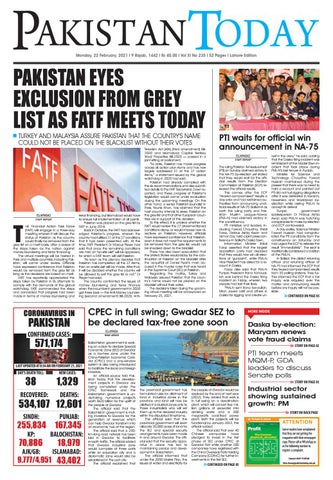
Monday, 22 February, 2021 I 9 Rajab, 1442 I Rs 40.00 I Vol XI No 235 I 52 Pages I Lahore Edition
Pakistan eyes exclusion from grey list as fatf meets today g
Turkey and Malaysia assure PakisTan ThaT The counTry's naMe could noT be Placed on The blacklisT wiThouT Their voTes
ISLAMABAd staff report
t
he Financial action Task Force (FaTF) will engage in a three-day meeting wherein it will discuss the status of Pakistan as the country could finally be removed from the grey list on a merit basis, after a review of the steps taken by the nation against money laundering and terror financing. The virtual meetings will be hosted in Paris and multiple countries, including Pakistan, will come under review. officials have expressed confidence that Pakistan would be removed from the grey list as long as the decisions are based on merit. FaTF has reportedly appreciated the steps taken by Pakistan in its attempts to comply with the demands of the global watchdog. FaTF commended the steps and conceded that progress had been made in terms of money laundering and
terror financing, but islamabad would have to ensure full implementation at all points. Pakistan was placed on the grey list by FaTF in June 2018. back in october, the FaFT had acknowledged Pakistan’s progress, wherein the country had fulfilled 21 of the 27 conditions that it had been presented with. at the time, FaTF President dr Marcus Pleyer had said that once the remaining conditions are met, an “on-site visit” will be approved, for which a FaTF team will visit Pakistan. “as soon as the plenary decides that Pakistan has completed all the 27 items, then an onsite visit will be made. after that, it will be decided whether the country will be allowed to exit the grey list or not,” dr Pleyer had said. The country confronted the issues of money laundering and terror finance when the incumbent government in 2020 got three laws — the anti-Money laundering (second amendment) bill-2020, anti-
coronavirus in
Pakistan
CONFIRMED CASES:
571,174
LAST UPDATED AT 8:54 AM ON FEBRUARY 21, 2021
DAY'S DEATH TOLL:
38
RECOVERED:
NEW CASES:
1,329 DEATHS:
534,107 12,601 SINDH:
PUNJAB:
255,834 167,345 KP:
BALOCHISTAN:
AJK/GB:
ISLAMABAD:
70,886
18,979
9,777/4,951 43,402
Terrorism act (aTa) (third amendment) bill2020 and islamabad capital Territory waqf Properties bill-2020 — passed in a joint sitting of parliament. “To date, Pakistan has made progress across all action plan items and has now largely addressed 21 of the 27 action items,” a statement issued by the global watchdog in 2020 had said. Pakistan had already complied with the six recommendations and also submitted details to the FaTF secretariat, dawn reported, and these progress of Pakistan’s legislation would come under evaluation during the upcoming meetings. on the other hand, a senior Pakistani journalist in Paris, younis khan, has claimed that the host country intends to keep Pakistan on the grey list and that other european countries are in support of this decision. To this effect, it is unclear whether the FaFT would review the 27 aforementioned conditions alone, or would impose new directives on Pakistan. however, officials have expressed confidence that Pakistan, even it does not meet the requirements to be removed from the grey list, would not be knocked down to the blacklist. There has also been speculation that the united states would lobby for the continuation of Pakistan on the blacklist after the acquittal of daniel Pearl’s main accused in the murder case that was heard in the supreme court (sc) of Pakistan. regarding the matter, Turkey and Malaysia assured Pakistan that the country’s name could not be placed on the blacklist without their votes. The decisions taken during the upcoming virtual meeting will be announced on February 25, 2021.
PTI waits for official win announcement in NA-75 ISLAMABAd staff report
The ruling Pakistan Tehreek-e-insaf (PTi) on sunday claimed victory in the na-75 by-election yet stated that they would wait for the official results from the election commission of Pakistan (ecP) released the official results. This comes after the ecP “feared compromised” results a day prior and had restrained authorities from announcing unofficial results of na-75 sialkot-vi as both the ruling party and Pakistan Muslim league-nawaz (PMl-n) had claimed victory in the constituency. PTi ministers and leaders, including Fawad chaudhry, shibli Faraz, Firdous ashiq awan and usman dar, held a joint press conference in sialkot’s daska town. information Minister shibli Faraz asserted that the largest opposition party had decided that they would now win all elections at ‘gunpoint’, while PMl-n vice President has asked for a recount in daska. Faraz also said that PMl-n Punjab President rana sanauallah was behind the daska firing incident on Friday, wherein two people had lost their lives. “PMl-n sent rana sanaullah, Mian Javed latif and others in daska for rigging and create un-
CPEC in full swing; Gwadar SEZ to be declared tax-free zone soon ISLAMABA Mian abrar
balochistan government is working on a plan to declare special economic Zone (seZ) at Gwadar as a tax-free zone under the china-Pakistan economic corridor (cPec) and a one-window system is also being introduced to facilitate the local and foreign investors. an official source told Pakistan Today that the development projects in Gwadar are being completed under the cPec framework and the balochistan government is undertaking numerous projects worth rs20 billion for the uplift of the people of Gwadar. The official said that the balochistan government is inviting investors to Gwadar for the generation of revenue which can help Gwadar transform into an economic hub of the region. The official said that a 250km-long road network has been laid in Gwadar to facilitate smooth traffic. The official added that Gwadar industrial zone would comprise of three parts while an education city and a diplomatic zone would also be established in the port city. The official explained that
rest in the area,” he said, adding that the daska firing incident was reminiscent of the Model Town incident that took place during PMl-n’s last tenure in Punjab. Minister for science and Technology chaudhry Fawad hussain maintained during the presser that there was no need to hold a recount and pointed out PTi did not hurl rigging allegations after it was defeated in karachi, nowshera and wazirabad byelection while asking PMl-n to accept its defeat Punjab government spokesperson dr Firdous ashiq awan said PMl-n was hatching conspiracies to make by-election and ecP controversial. a day earlier, science Minister Fawad hussain had congratulated the PTi candidate from the constituency on saturday and had urged the ecP to release the result “immediately”. The seat is traditionally considered a bastion of the PMl-n. in sialkot, the district returning officer and returning officer of na-75 had informed the ecP that they feared compromised results from 20 polling stations. They further informed the ecP that a fair inquiry was required over the matter and announcing results before any inquiry will not be possible.
CONTINUED ON PAGE 05
more inside
Daska by-election: Maryam renews vote fraud claims STORY ON PAGE 02
PTi team meets MQM-P, Gda leaders to discuss senate polls STORY ON PAGE 03 the provincial government has formulated rules for allotment of land in industrial zones in the province and land will now be allotted in industrial zones only to those industrialists who will set them up to the decided industry within the stipulated timeframe. The official said that the provincial government will soon allocate 20,000 acres of land for the seZ and special security arrangements have been made in and around Gwadar. The official said that the security apparatus in place has led to maintaining peace and development in balochistan. The official informed that under the 2050 Master Plan, the issues of water and electricity for
the people of Gwadar would be resolved by the end of next year (2022). They added that work is in full swing on a desalination plant, which will convert five million gallons of seawater into drinking water and a 300 megawatts coal-fired power plant. both the projects will be functional by January 2023, the official added. The official said that over 40 chinese companies have pledged to invest in the first phase of seZ under cPec at Gwadar Port while another 200 companies have registered with the china overseas Ports holding company (coPhc) for further investments in the first seZ.
CONTINUED ON PAGE 05
Industrial sector showing sustained growth: PM STORY ON BACK PAGE in today’s issue
attention Some readers have complained that they are not getting the magazine with their newspaper copy. Please call or WhatsApp us at the following number to register a complaint. Contact: 0307-7338168 irfan.farooq@pakistantoday.com.pk
02
Monday, 22 February, 2021
LAHORE
NEWS
DASkA By-electioN: MAryAM reNewS vote frAuD clAiMS LAHoRE
P
Staff RePoRt
AKISTAN Muslim LeagueNawaz (PML-N) Vice President Maryam Nawaz renewed on Sunday claims of vote fraud during a byelection for a National Assembly (NA) seat in a Sialkot constituency on Friday. The Election Commission of Pakistan (ECP) on Saturday stopped the results of the NA-75 (Sialkot-IV) by-election — a seat in Daska Tehsil of the city which fell vacant after the demise of Pakistan Muslim LeagueNawaz (PML-N) MP Sahibazada Syed Iftikharul Hassan Shah in August. In an unprecedented move, the election commission in a press statement said it suspected that the results of 20 polling stations in the constituency had been falsified because it received the results of the constituency with “unnecessary delay”. Responding to the development, Maryam said that the release was a “charge sheet” against the government.
ECP SUSPECTS RESULTS OF 20 POLLING STATIONS HAD BEEN 'FALSIFIED' On Sunday, speaking to reporters in Lahore before leaving for Daska, she said: “The plan of rigging they made using the administration and the police had failed badly despite its implementation and the use of the worst state terrorism to enforce it. “This is a glaring thing that they used every tactic [available] and are now out in the open and stand exposed […] they should now know their standing in the eyes of the people.” Maryam, while referring to the violence between the workers of PML-N and Pakistan Tehreek-e-Insaf (PTI) on the election day, said: “They took lives and abducted ECP staff; 20 presiding officers were made missing persons.” Unidentified suspects opened fire near five polling stations, including Main Bazar, Gondka and Rangeela Chowk polling stations, halting polling at five stations.
Man accused of inciting violence during Daska by-election arrested STAff REPoRT SIaLKot
Punjab police on Sunday arrested Hamza Butt on a charge of inciting violence during a by-election in Daska Tehsil of Sialkot on Friday which killed two people and injured three. One of the victims was reported to be a member of the Pakistan Tehreeke-Insaf (PTI) while the other belonged to the Pakistan Muslim League-Nawaz (PML-N). A PTI polling agent was also among the injured, reports suggested. Police said two other suspects — Khalid Bagri and Javed Butt — nominated in the first information report (FIR) are on pre-arrest bail. The case was registered at Bambanwala police station on February 19. Punjab Chief Minister Usman Buzdar had also taken notice of the incident. In a tweet, Buzdar said those involved in the shooting incident “will be arrested as soon as possible and punished strictly according to the law”. He had added that he has demanded an investigation report from the inspector general of police. “Prompt action will be taken against the accused,” he had said.
NAB to probe ‘illegal appointments’ in Sindh education department KARACHI
The incident created panic among voters. However, the situation was brought under control after the arrival of the police. She further questioned why out of the 361 polling stations, the staff of only 20 polling stations had to go missing during the “fog” and why were the results of these polling stations suddenly changed when the officers returned after 12 hours. “What bigger evidence is there than this,” Maryam questioned. Maryam is expected to visit the house of a local PML-N leader, Nausheen Iftikhar, in Daska. Reports suggest she will also offer condolences to the families of the young man who was killed in electionday violence. ECP STOPS INITIAL RESULTS: In the press statement, the election commission had said it received the results of the constituency with
“unnecessary delay”. It said it had tried to contact the presiding officers (POs) several times to ascertain the situation but achieved no success. “The chief election commissioner tried to contact the Punjab inspector general of police, commissioner and deputy commissioner on receiving information from the district returning officer (DRO) and returning officer (RO) so the whereabouts of the presiding officers concerned could be ascertained but received no response,” read the statement. Chief Election Commissioner Sikandar Sultan Raja also contacted Punjab Chief Secretary Jawad Rafique Malik who assured him that the results would be sent after tracing the “missing” officers and polling bags. But soon after, Malik too made himself “unavailable”, the statement said. The presiding officers appeared along with the polling bags around six in the morning, the statement said. “The DRO and RO of the NA-75 (Sialkot) constituency informed [the ECP] that there is a suspicion of falsification in the results from 20 polling stations.
Rumours of under invoicing false, says Morris Garages PRESS RELEASE Morris Garages (MG) officials in Pakistan state that the rumours relating to under invoicing are absolutely false and baseless and are nothing but a panic response to the tremendous success of the introduction of British automobile brand – “MG” in Pakistan. The officials further states that MG JW Automobile (Pvt) Ltd (MG Pakistan) is a joint venture between JW SEZ (Pvt) Ltd and SMIL. SMIL owns the majority shares in the joint venture and is a subsidiary of SAIC, which is the largest auto manufacturer in China and the seventh largest in the world. In 2006, SAIC purchased the prestigious British brand “Morris Garages (MG)” and is now marketing automobiles under that brand all over the world. Under Green Field Policy, SAIC’s joint venture company is setting up, a state-of-art local assembly plant for MG automobiles in Lahore. The Financial Dictionary defines the expression ‘underinvoicing as “The act or practice of stating the price of a good on an invoice as being less than the
price actually paid" to evade customs duty. In Pakistan, the importers set up their own companies abroad, then get those companies to purchase products abroad and then the Pakistani company pretend to purchase and import that product from its own company abroad at a far lower price with the sole object of evading customs duty, something that is obviously illegal. As per MG officials, MG Pakistan has indeed negotiated hard and has succeeded in purchasing MG HS directly from its principal/manufacturer (SAIC), for a price of just US $ 11,632 (corresponding MSRP RS 5.449 million). Since the actual / declared price is paid to the principal (SAIC), hence, it cannot be called under-invoicing. MG Officials further states that the ultimate beneficiary of the negotiated price is valued customers, a rare phenomena in the Pakistani auto mobile sector. As per MG officials, no one has approached them to seek MG Pakistan views before spreading this rumor, otherwise MG Pakistan, being owned by a renowned business conglomerate, would have clarified this.
Protesters attack Geo, Jang media office NEwS DESK Protesters in the port city attacked the main office of Geo and Jang media group “under an elaborate plan”, said Karachi Bureau Chief Faheem Siddiqui. The protesters were angered by an edited video that had gone viral on social media. Siddiqui said that the protesters had declared beforehand that there were no police officials in the area. Dozens of protesters tore down a walk-through gate and broke through the main gate of the office located on I I Chundrigar Road. Footage of the office showed shattered glass lying on the floor near the reception area of the building. Speaking on the incident, Federal Minister for Information Shibli Faraz condemned the violence and
said that people “always have the choice to launch a formal protest”. Sindh Information Minister Nasir Hussain Shah also appeared on air to express solidarity and said he will shortly arrive at the venue. When asked why police did not act promptly, Shah said that he strongly condemns such violence. “I spoke to the SSP and I was told the protest was to head from Shaheen Complex to Press Club but they came this way,” he said. He added that action will be taken against whoever was behind the incident. The provincial information minister said that Chief Minister Sindh Murad Ali Shah has also ordered “strict action” to be taken against all those found involved. Separately, Karachi Press Club President Fazil Jamili said that the words of a single analyst should not be taken as the opinion of the entire media house. He
pointed out that even “if any anchor’s words hurt someone”, Geo itself had issued an apology on the matter and that the “issue should have been laid to rest”. “But to create an issue out of it and to use to propel a campaign against Geo and to bring a mob to the office and to vandalise the building, to attack the staff is in no way acceptable,” he said, adding that the Press Club condemns the incident. A journalist affiliated with the media group, Zebunnisa Burki, said police had “looked on” as the protesters attacked the Geo/Jang offices. Muttahida Qaumi Movement-Pakistan (MQM-P) leader Faisal Subzwari termed the attack “highly reprehensible”, asking what the Sindh Police and authorities were doing when “attackers led by [a] known blackmailer travelled several kilometres in Red Zone”.
Miscreants set fire to polling station during Thar by-election THARPARKAR INP
The polling during a by-election on a National Assembly seat was interrupted in the Kesarar area of Tharparkar on Sunday when unknown miscreants set ablaze a polling station, reducing ballot papers and other polling material to ashes. Sindh police have arrested four individuals, officials said. The seat had fallen vacant after the death of Pakistan Peoples Party (PPP) MP Noor Mohammad Shah due to Covid-19 in December. Analysts see the real contest between Pir Ameer Ali Shah Jilani of the PPP and Nizamuddin Rahimoon of Pakistan Tehreek-e-Insaf (PTI). Thar Deputy Commissioner Mohammad Nawaz Soho said that the district administration had taken various measures to hold the election in a fair and transparent manner. Speaking on the incident, PTI candidate Nizamuddin Rahimoon alleged that the blast took place at the Kesrar polling station “under police supervision”. “My agents have been arrested and my voters are being chased away, but the people of
Tharparkar will ensure that the truth wins,” he said, claiming that the police were aiding his opponents. Meanwhile, Sindh Chief Minister Syed Murad Ali Shah in a telephonic conversation with the the chief election commissioner (CEC) discussed the by election in Tharparkar on Sunday. CEC Sikandar Sultan Raja, in the telephonic conversation, said that all possible steps will be taken to ensure holding a peaceful and fair by-election. The election commission chief also said that no political intervention or negligence will be tolerated in the election. Chief Minister Murad Ali Shah assured the CEC, wholehearted cooperation from the provincial government and the administration to the election commission for the by-election. “The by-election at NA-221 has been in progress peacefully,” the provincial election commissioner maintained. “The chief minister has informed about the situation during the by-election in Tharparkar,” the provincial election commissioner said. “The harassment claim from the PTI candidate is incorrect and the claim about harassment of voters in the constituency is baseless,” the provincial election chief said. “No political intervention will be tolerated
in the by-election”, the Sindh election commissioner further said. On the other hand, the Pakistan People’s Party (PPP) in a letter had asked the CEC to take notice of the violations in the by-election in NA-221 Tharparkar. “A polling station has been set on fire, ballot boxes were burnt and women voters were subjected to harassment,” the PPP said in its letter. The party also demanded steps from the election commissioner to ensure transparency in the electoral process. It is pertinent here to mention that the PPP seems likely to retain its hold on NA-221. Counting is underway as of the time of filing and PPP candidate Pir Ameer Ali Shah Jilani is leading with 70518 votes. Meanwhile, PTI candidate Nizamuddin Rahimoon is in the second lead with 29057 votes. The total number of registered voters in the constituency was 281,900. Of whom, 157,099 were men and 124,801 were women. 318 polling stations had been set up, 79 for men, 78 for women, and 161 combined polling stations with 857 polling booths, 456 for men and 401 for women. 95 polling stations had been declared highly sensitive and 130 sensitive with 2,350 staffers deployed.
INP
Following the orders of the Sindh High Court (SHC), the National Accountability Bureau (NAB) has launched an investigation into allegedly illegal appointments in the provincial education department. The agency has sought a record of appointments made in the education department since 1989. Credentials of the teachers and technicians along with the Computerised National Identity Cards (CNICs) have also been sought. It has also asked for the record of the officials responsible for the “illegal” appointments and also directed the department to inform what, if any, action was taken against them. The high court had given a deadline to the concerned authorities for completing an investigation into the scam. SHC Chief Justice Ahmed Ali Shaikh had chided NAB officials over failure to complete the probe within the time frame. NAB had opened the investigation in 2017.
Over 86m children vaccinated against polio under UAE-funded project ISLAMABAD Staff RePoRt
More than 86 million children under the age of five were vaccinated against polio between 2014 and 2020 under a UAE-funded programme, data shared by Emirates News Agency (WAM) said. Pakistan is one of the two polio-endemic countries in the world along with Afghanistan. The country is facing a challenging situation in polio eradication with the upsurge in the number of polio cases. In 2020, 84 polio cases were reported across the country. The government’s efforts to rid the country of polio have lately suffered setbacks due to attacks on vaccinators and police personnel guarding them. The deadly violence is also cited as a factor for the upsurge
in new cases that had dropped to only 12 cases in 2018. The UAE Polio Vaccination Campaign is part of the UAE-Pakistan Assistance Program (UAE-PAP) launched by Abu Dhabi Crown Prince Sheikh Mohammed bin Zayed Al-Nahyan in 2011 to support global efforts to protect communities against diseases and epidemics. The prince has since donated $247.8 million for the cause, with an emphasis on Pakistan and Afghanistan. “The campaign’s success underscores the UAE’s leading role in reinforcing the efforts of the international community and the programs of the United Nations agencies that aim to protect communities from diseases, pandemics, crises and disasters,” UAE-PAP director Abdullah Khalifa AlGhafli said.
The campaign covered high-risk areas, especially in northwestern Khyber Pakhtunkhwa (KP) province, where over half of 500 million doses donated by the UAE were administered. In 2019, conservative hard-liners in Peshawar spread rumours of children falling sick due to the vaccine, triggering a backlash in KP, where most of the country’s polio cases have been detected. “Children in these areas are in constant need of vaccines throughout the year, due to malnutrition and weak immunity, as well as an environment that acts as an incubator of the disease, which makes the job of the program’s teams even harder, especially during the Covid-19 pandemic,” Al-Ghafli added, as he praised Pakistani health workers who faced “dire field conditions and challenges.”
Monday, 22 February, 2021
LAHORE
NEWS
03
Alvi SAyS frANce’S ‘iSlAMiSt SePArAtiSM’ Bill DiScriMiNAtory ISLAMABAD
P
MoNItoRINg RePoRt
RESIDENT Arif Alvi has urged France to desist from entrenching “discriminatory attitudes” against Muslims into laws aimed at fighting so-called extremism. Paris needs to bring people together instead of stamping Islam in a certain manner to create “disharmony and bias,” said Alvi, according to Radio Pakistan. Alvi, who spoke at an international conference on religious freedom and minorities’ rights on Saturday, was referring to a controversial bill introduced by French President Emmanuel Macron in October to fight so-called “Islamist separatism”.
PARIS NEEDS TO BRING PEOPLE TOGETHER INSTEAD OF STAMPING ISLAM IN A CERTAIN MANNER TO CREATE 'DISHARMONY AND BIAS', SAYS PRESIDENT “Islam in France must be freed from foreign influence,” Macron had said, promising improved oversight of the financing of mosques. On Tuesday, the French National Assembly approved the bill with a vote of 347-151, garnering support from lawmakers in Macron’s ranks as well as other centrist parties. It now heads to the Senate. Hosted by the Presidency, the event was attended by Minister for Religious Affairs
Pir Noorul Haq Qadri, Parliamentary Secretary Shunila Ruth, and European Union (EU) Ambassador to Pakistan Androulla Kaminara. Besides, Member of the US Democratic Central State Committee (DSCC) Ayesha Khan and Implementation of Minority Rights Forum chairman Samuel Pyara also addressed the moot attended by representatives of the minority communities and international organisations, religious
scholars, and bishops. Alvi recalled that Pakistan communicated to the West that the blasphemy against Holy Prophet Muhammad (Peace Be Upon Him) in the name of freedom of expression is considered an insult to the entire Muslim community. The bill is being criticised because it targets the Muslim community and imposes restrictions on almost every aspect of their lives. It restricts the education choices of the Muslim community by preventing families from giving children home education. The bill also prohibits patients from choosing doctors based on gender for religious or other reasons and makes compulsory “secularism education” for all public officials.
PTI team meets MQM-P, GDA leaders to discuss Senate polls
Alvi said that the legislation was not in line with the United Nations (UN) charter and contradicted the spirit of social harmony that Europe previously instilled in its society. Let there not be a retrogressive step for situations that arise out of animosity and for situations that are carried forward by the people who do not know about the real Islam, he said. Alvi said that the damage might not be evident at present but would ultimately end up in a terrible scenario of hatred and hostility. To label the entire religion in a different manner and to start taking precautions against the entire community sparks the fact that if not now, it will have very bad repercussions in the next 10 years, he said.
Modi wants to take full control of iok to win next polls: AJk president ISLAMABAD aPP
KARACHI Staff RePoRt
Minister for Planning and Development Asad Umar has said that Pakistan Tehreeke-Insaf (PTI) is trying for Senate elections to be held in a transparent manner as the party is answerable to its voters. He said this on Sunday while talking to the media persons along with Muttahida Qaumi Movement-Pakistan leaders after a delegation of PTI arrived at MQM-P office to discuss the ongoing political situation in the country and the Senate elections. According to details, both parties deliberated upon the strategy for the upcoming Senate elections. Speaking to the media after the meeting, Asad said that they discussed key issues with the MQM-P, adding that
FREE AND TRANSPARENT ELECTION IS THE MANIFESTO OF THE PTI: ASAD UMAR election does not only occur between two candidates but their parties also get involved in it. “We want to take our allied parties onboard,” he said. He also said that a free and transparent election is the manifesto of the PTI. He added that PTI is a democratic party and everyone has one’s own opinion and the government is working with its allies to strengthen democracy in the country. Replying to a question, the minister said that what the Sindh government is doing is only reflecting the victimisation of the political opponents. MQM-Pleader Faisal Sabzwari said that a talk on votes regarding Senate polls
was carried out with the government delegation. He said that reservations on the census results were also raised in the meeting. Sabzwari said that the talks with the government delegation were held in a pleasant environment and the written agreements between both the parties were reviewed. Earlier, a delegation of PTI comprising federal ministers Abdul Hafeez Sheikh, Asad Umar and Muhammad Mian Soomro called on the Sindh Governor Imran Ismail. During the meeting, the progress on federal government-funded development projects under Karachi Transformation Plan came under discussion.
Asad, on the occasion, said that the federation is doing beyond its responsibilities for the development of Karachi. Finance Minister Abdul Hafeez Sheikh said that there are special instructions of the prime minister for the development of Karachi and all projects will be completed well in time. Federal Minister Mian Muhammad Soomro said that Prime Minister Imran Khan’s vision for the development of the province is a good step. Later, the delegation of PTI comprising Shaikh, Asad, Muhammad Mian Soomro, and Fauzia Arshad met with MQM-P leaders.
Media’s role imperative in removing misconception about vaccine: Naseem ISLAMABAD Staff RePoRt
Weeks after the coronavirus vaccination roll out in the country, the experts have started urging the media to play its due role in sensitizing the masses about the importance of taking a jab to achieve the required immunity against Covid-19. “To counter black propaganda, media has a crucial role to neutralize the conflicting statements about Covid-19 vaccine with proper facts,” said Prime Minister’s Focal Person Naseemur Rehman in an interview with Power 99 radio channel. Naseem, who is an international professional with a specialization in development and humanitarian issues, said the world over immunity against various contagious diseases like measles and polio were achieved with the invention of vaccination. “Invention of vaccination against various epidemics was a major achievement in the medical field during the last two hundred years,” he added. He said, unfortunately, Pakistan has “yet to eliminate polio completely and that is mainly due to the negative propaganda and myths about the vaccination.”
Therefore, as a proactive move, the government, civil society and media should launch massive awareness drives to curb the disinformation, stemming from social media about the vaccine. He said that there were multiple countries in the world, where the vaccination was mandatory and people had to face plenty for refusing to get vaccinated against a particular disease. Naseem added that the coronavirus was still a looming threat and “it is early to celebrate the victory against the contagion.” The focal person said that vaccination was imperative for one’s own safety as well as of their loved ones. The vaccines were launched after proper clinical trials so there was no need to be afraid of, he added. He also feared that economic dividends, achieved by the government after successfully coping with the first and second waves of coronavirus, might get reversed in case of public resistance against the vaccination. Currently, the frontline health workers are being vaccinated against the coronavirus under the first phase which was initiated by the government at the beginning of this month after receiving 0.5 million doses of Sinopharm vaccine from China. According to the National Vaccination Strategy,
health workers would be vaccinated in the first phase, while people aged 60 and above to get the vaccine in the second round and those from 18 to 60 years to be immunized in the third phase. Recently, Minister for Planning Asad Umar announced the registration of 65 years old citizens and above for the national vaccination drive in the days to come. So far, the Drug Regulatory Authority of Pakistan (DRAP) has given approval to four, out of total of eight most effective vaccines in the world, for their use in the country that included China’s Sinopharm, and CanSinoBio, Russia’s Sputnik-V and the Oxford University-AstraZeneca. 38 people died in the last 24 hours from coronavirusrelated complications and 1,329 others tested positive for the contagious disease, National Command and Operation Centre (NCOC) data showed Sunday. According to the NCOC update, the new infections were detected from 41,395 samples collected and tested a day earlier. With the new cases, the death toll jumped to 12,601 while the number of positive cases stood at 571,174. The number of active cases has come down to 24,446 as over 534,000 people have recovered from the disease.
Azad Jammu and Kashmir (AJK) President Sardar Masood Khan on Sunday said that Indian Prime Minister Narendra Modi wanted to take full control of Indian Occupied Kashmir (IOK), in order to again win the parliamentary elections in 2024. “If the Kashmir issue had been resolved through drawingroom politics, the UN Security Council, White House and 10-Downing Street would have resolved it long ago,” he said, adding that we would have to come out in streets and squares and pay heed to the cries rising from Srinagar, Baramullah, Rajouri and Poonch. He was addressing a webinar organized by the UK-based Hidayat TV and CNI News. The webinar was also addressed by a former member of the European Parliament, Lords Wajid Khan, Tehrike Kashmir UK President Faheem Kayani and the TV anchor Syed Abid Kazmi. The state president said that the Kashmiri people would never forget those who were helping them in the current environment of distress or those who were raising their voice throughout the world. He maintained that, at present, the Kashmiri people were being killed, their children were being slaughtered, and their daughters were being molested before their eyes, and they are forced to die of starvation by depriving them of their land, business and livelihood. Khan asserted that what Modi was doing, was going to turn the whole of India into another Kashmir where the Muslims, Dalits, Sikhs and the Christians feel themselves to be insecure. “The same was done by the German Nazi ruler Adolf Hitler to Jews, Roma nomads, and Hungarian and Polish citizens, and when his brutalities had crossed all limits, the world had to jointly fight a war against him on the cost of hundreds of thousands of human lives,” he added. The AJK president said that the only option to defeat Modi and rid the Kashmiri people of his repression was that we turn the Kashmir liberation movement into an international campaign of human rights and civil liberties, and at the same time, use our politics, diplomacy and media to disseminate the voice of Kashmiri people in every nook and corner of the world. “We must keep exposing India’s false narrative, and promote our true narrative on a fulltime basis,” he added. The president pointed out that in order to malign the Kashmir liberation movement and to tarnish the image of Pakistan on the international level, India had waged a systematic disinformation campaign which had recently stood exposed, but in spite of becoming all details of this international scam, no action has been taken against India.
FATF meeting amid results season may keep PSX range-bound this week KARACHI Staff RePoRt
The Pakistan Stock Exchange (PSX) may witness rangebound sessions during the next week as the Financial Action Task Force (FATF) will review Pakistan’s progress on the Action Plan from February 22 to February 25. According to analysts, FATF’s review of Pakistan’s progress on the Action Plan will be a key event for the market this week, as four out of five sessions of the PSX during the week will be held under the shadow of FATF meetings. There are media reports that Pakistan may not get rid of the grey list and the status quo may continue till June. A decision to remove Pakistan from the grey list will be received very well by market participants;
however, it seems unlikely. On the other hand, healthy financial earnings are expected as some major companies will announce their results this week. Analysts said that the market will remain positive in the upcoming week given the continuation of the result season. Moreover, with the inflow of remittances from abroad, the Pakistani Rupee is expected to remain stable. The benchmark KSE-100 index of Pakistan Stock Exchange (PSX) is currently trading at a PER of 7.3x (2021) compared to Asia Pac regional average of 17.8x and while offering DY of 6.5 percent versus 2.5 percent offered by the region. The market commenced on a positive note this week. The E&P sector briefly came under the limelight owing to a surge in the international oil prices (Arab Light
reaching USD 64.16/bbl on Thursday). Furthermore, reports of a 19 per cent YoY jump in remittances for January 2021 and PM Imran Khan’s rejection of OGRA’s recommendation of hike in petroleum prices kept the sentiment positive. Furthermore, with the IMF and Pakistan finally reaching an agreement on reforms, which will bring in funds of USD 500 million, further improved investor confidence. However, bears briefly took over as the investors resorted to profit taking. The market closed at 46,228 points, gaining 419 points (up by 1 per cent) WoW. Sector-wise positive contributions came from i) Technology & Communication (250 points), ii) Cement (138 points), iii) Automobile Assembler (76 points), iv) Fertilizer (57 points) and iv) Oil & Gas Exploration Companies (48 points). Whereas sectors that contributed
negatively include i) Commercial Banks (214 points), Power Generation & Distribution (97 points) and Tobacco (6 points). Scrip-wise positive contributors were TRG (209 points), LUCK (124 points), MTL (90 points), SYS (40 points) and OGDC (35 points) while negative contributors included HBL (164 points), HUBC (73 points), and MEBL (38 points). Foreign selling continued this week clocking-in at USD 0.6 million compared to a net sell of USD 3.2 million last week. Selling was witnessed in Commercial Banks (USD 5.1 million) and Technology and Communication (USD 1.4 million). On the domestic front, major buying was reported by Companies (USD 5.5 million and Individuals (USD 4.9 million). Average volumes arrived at 595 million shares (down by 19 per cent WoW) while average value traded settled at USD 159 million (down by 6 per cent WoW).
04
Monday, 22 February, 2021
LAHORE
NEWS
UPlIft PaCKages for all DIstrICts of PUnjaB BeIng forMUlateD: CM LAHORE
t
STAFF REPORT
ERMING the composite development of every city of Punjab as his mission, Chief Minister Sardar Usman Buzdar has said that development packages are being formulated for all the districts of the province. In a statement on Sunday, Buzdar said that the incumbent government is determined for the development of the districts. He said that he has visited every district of Punjab and took a prompt action to resolve the peo-
ple’s problems. “I am not used to working while sitting in the office,” he added. The chief minister said that the visit apprised him first-hand knowledge about people’s problems, besides providing him their feedback. To have knowledge about on-ground issues is utmost necessary for real development, he said. He also said that the model of governance in Punjab has been changed and officers have been directed to go to the field and solve people’s problems. “I don’t believe in one-man show,” Buzdar clarified. He said that decisions have been taken in his tenure with consultation and he believes in taking everyone
along. He said that he has a vigilant eye on the civic problems and needs of the people. Separately, Buzdar said that during the last two years, the PTI government has planted more than one million trees only in Lahore whereas the same were mercilessly cut down in the last regime. Wrong priorities of former rulers resulted in substantial increase in pollution in Punjab, including Lahore, he said, adding that neither these rulers took timely measures to deal with this issue. Excessive utilisation of bricks and cement has destroyed the natural beauty of the city and a new genera-
tion has been provided a polluted atmosphere instead of a clean and hygienic atmosphere, he added. Buzdar said that the problem of smog became serious due to poor planning of former rulers. “Our planted sapling will become fully grown trees within the next few years which will help in controlling the smog issue besides reducing pollution in the city,” he said. He also said that work for planting artificial forests (Miyawaki) on 51 points in Lahore has already been started. With this method, trees grow very fast at low cost. “Insha’Allah, Lahore will soon become a city of gardens and flowers again,” he added.
MCI clears encroachments from posh areas of Islamabad ISLAMABAD: The Metropolitan Cooperation Islamabad (MCI) on Sunday cleared encroachments from Islamabad’s posh areas, including Super and Jinnah supermarkets, G9 Markaz, Aabpara, Shakarparian and Pakistan Monument. Officials told this scribe that Chief Metropolitan Officer Syeda shafaq Hashmi, on the instructions of CDA Chairman Amer Ali Ahmed, directed the removal of encroachments from urban markets. In the first phase, Directorate of Metropolitan Administration cleared encroachments from F6, F7, G9 Marakiz, Aabpara, Shakarparian and Pakistan Monument. Similarly, encroachments were also removed from the footpaths and other pathways as well. Officials said that the operation was conducted due to non-compliance of directives to remove encroachments despite several warnings, adding that now zero tolerance will be shown over encroachments and legal action will be taken against violators. It is pertinent to mention here that Islamabad administration has continued its drive against encroachments with the collaboration of CDA as well as police and has also retrieved thousands of acres of state land in the past one month. STAFF REPORT
P&D withdraws funds for new bus terminal land in Peshawar PESHAWAR: The Khyber Pakhtunkhwa (KP) government has withdrawn the fund released for the new bus terminal in Peshawar, after which it is feared the issue of land purchase for the terminal will face further delay. According to local government sources, after releasing of Rs420 million by the Finance Department for the new bus terminal project, the Planning and Development Department (P&D) returned Rs164 million and transferred it to other projects. P&D sources said that more than 300 acres of land in Peshawar is to be purchased for the new bus terminal which was also approved by the KP chief minister last month. The source added that a total of Rs420 million will be released for the land purchase of this bus terminal. The KP Finance Department had released Rs100 million in the first installment and Rs150 million in second installment and Rs170 million were released in the last installment but now Rs164 million have been withdrawn by the finance ministry for another project. According to sources in the Local Government Department, the matter has been taken up with the P&D and it is hoped that the said amount will be re-released for the new bus terminal without further delay so that the funds are used for the procurement of land for the programme. AZIZ BUNERI
Usama Qureshi appointed senior vice chairman of Pak-UK Business Council KARACHI: The Federation of Pakistan Chambers of Commerce & Industry (FPCCI) President Mr. Nasser Hayatt Maggo has appointed accomplished business and corporate leader Mr. Usama Qureshi on Pakistan-UK Business Council as its Senior Vice Chairman for the year 2021. The council is mandated to facilitate and encourage the business community of Pakistan to promote bilateral trade, investment, business relations, and trade shows. Mr. Usama Qureshi has expressed his earnest desire to help local businesses to find more export orders, investments, and joint ventures from the UK. He views export-led growth essential for job creation and portraying a soft image of Pakistan. Additionally, the president of FPCCI has appointed Mr. Usama Qureshi as the convener of its central standing committee on Corporate Relations & Communications (2021). He will be spearheading and consolidating corporate relations across all industries and regions of Pakistan. PRESS RELEASE
ISLAMABAD: Hikers offer prayers for legendary Pakistani mountaineer Muhammad Ali Sadpara, who went missing while attempting to summit K2, the second highest mountain of the world, on February 5. ONLINE
All steps afoot to ensure peace in Balochistan: Rasheed QUETTA STAFF REPORT
Interior Minister Sheikh Rasheed Ahmed has said that the government is taking all possible steps to ensure peace in Balochistan. Talking to Frontier Corps North Inspector General Major General Muhammad Yousuf Majoka in Quetta on Sunday, the interior minister appreciated the role of FC Balochistan in maintaining law and order in the province. The interior minister was given a detailed briefing on operational readiness, border surveillance and law and order in Balochistan. He said that implementation of all points of the National Action Plan (NAP) will be ensured and inter-provincial coordination will be strengthened to improve law and order. Rashid said that that the government is taking steps
to ensure internal security and would not allow enemies of the country to succeed in their nefarious designs. He said that Gwadar would be the future economic hub of Pakistan and that is why the enemy wants to destabilise Balochistan but all such designs would be foiled by the security forces with the cooperation of the people. “Terrorists who want to destabilise Balochistan would not have a place to hide,” he warned. The interior minister also laid a floral wreath at the Martyrs' Memorial. Earlier, the interior minister, who is on a four-day visit to Balochistan, said that the government is boosting security arrangements by erecting fences along the borders with Afghanistan and Iran. He said this during a visit to the Pak-Iran border where he took an aerial view of Mand and Redeeg and visited the newly-opened trade gateway with Iran at Raimdan/Gabad. Frontier Corps South Inspector General Maj Gen Bilal Safdar and Tur-
bat Deputy Commissioner Ilyas Badini accompanied the interior minister during the visit. The officials at a briefing told the minister that 40 per cent fencing work at the Iran border had been completed and the 928km fence would be completed by June this year. Similarly, he was told that 90pc fencing work had been completed at the Afghan border and the remaining work would be completed in four months. The interior minister said that Pakistan and Iran enjoy cordial relations, which would be further strengthened with the passage of time as Pakistan gave importance to its relations with Iran. He said that Pakistan is developing its border management system on modern lines to provide maximum legal crossing and trade facilities at the borders with Iran and Afghanistan. The minister vowed to facilitate cross-border trade and said that resources were being utilised to boost internal security of the country.
Climate change ministry, CoRe alliance host meeting on recycling ISLAMABAD PRESS RELEASE
Ministry of Climate Change (MoCC) and CoRe (Collect and Recycle), an alliance of leading food and packaging companies, recyclers and non-governmental organisations hosted a stakeholder convening to encourage dialogue regarding the shared challenges of packaging waste and collection mechanism in the country. Talking about the session Malik Amin Aslam, Special Assistant to Prime Minister for Climate Change said, “We have to engage stakeholders to generate a debate around
the creation of a circular economy, with a goal to identify right policy measures to enable formal solid waste management.” He stressed that it was imperative “to help inform a national strategy in coming years” by identifying key issues, challenges and opportunities unique to packaging waste. Highlighting the importance of the convening, Waqar Ahmad, CEO CoRe alliance said, “The convening has allowed us to identify potential challenges of packaging waste and collection mechanism, drive performance improvements and ultimately strengthen collective ac-
tion in this regard.” Talking about the CoRe’s inception, he said, “CoRe is the first ever packaging alliance created with a mission to eliminate packaging waste by enabling formal collection and recycling. It envisions the creation of a circular economy by reducing packaging footprint and encouraging sustainable and innovative practices.” MoCC Joint Secretary Syed Mujtaba Hussain while applauding the efforts of CoRe alliance said, “The convening has helped identify potential ideas and partnerships to work towards finding solutions to this
complex challenge of plastic waste.” CoRe’s goals are to improve post-consumer usage, collection and recycling of packaging waste to help become waste neutral. CoRe’s commitment is to make 100% of packaging recyclable or reusable by 2025. CoRe is comprised of organisations such as Coca-Cola, Ecolean, FrieslandCampina, Green Earth Recycling, METRO, Nestlé, Novatex, Packages Ltd, PepsiCo, SPEL, TetraPak, Unilever along with non- government organizations’ Sustainable Policy Development Institute (SDPI), UNDP and WWF.
Monday, 22 February, 2021
lahore
NewS
Germany refuses arms export to IndIa over ‘poor human rIGhts record’ ISLAMABAD APP
I
n a big snub to India, over its poor human rights record in the Indian Occupied Kashmir (IOK), the German government has refused licence to two firms planning small arms export to the South Asian country. Though Germany is India’s sixthlargest trading partner and its largest trading partner from the European Union, it feared that their small arms could be used against the civilian population in occupied Kashmir. The massive human rights violations and military siege for the last 565 days since August 5, 2019, communication blackout, false incrimination of the innocent civilians have raised eyebrows of the international community with human rights organizations questioning the aggression against Kashmiri people fighting for their right to self-determination guaranteed under United nations Security resolutions. According to a report published in Telegraph India, the concerns over the security forces’ human rights record in Jammu and Kashmir had raised a barrier before Germany’s small arms exports to India. German regulations and covenants restrict, and often prohibit, arms sales to nations or regions where their use might cause direct or collateral damage to civilian populations and institutions. Two Indian security officials familiar with the bar on German small arms producers said that these companies
had failed to obtain export licences from their government on account of the “poor human rights record” in Kashmir. The report also revealed that a Belgian arms manufacturer too had recently walked out of a deal to supply arms to India’s army amid concerns in the Belgian government that the weapons would be used in Jammu and Kashmir. Belgium’s Fn Herstal had signed the Rs700 million deal in 2020 to supply small arms and assault rifles to the army’s Special Frontier Force (SFF). Reports have said that German arms manufacturer Heckler and Koch, whose MP5 submachine guns have been part of the armoury of the national Security Guards (nSG) and Marine Commando (Marcos) units, has withdrawn from the Indian market saying it lacked approval from the German government. “After being rebuffed by Germany, the defence ministry has decided to procure US-made assault rifles,” a security official said. In november 2019, three months after the Centre had revoked Jammu and Kashmir’s special status and restricted movement and communication, Germany had expressed reservations about the clampdown and concern for the people of the region. Germany had earlier too restricted arms export to India citing poor human rights records in states such as Gujarat, Manipur, Jammu and Kashmir, Andhra Pradesh and Maharashtra.
According to the Telegraph India, a defence ministry official recalled that Germany had, during the Kargil conflict of 1999, halted technology transfer for India’s indigenously made Advanced Light Helicopter Dhruv and withheld replacement parts and supplies for German equipment. India was the world’s secondlargest importer of major arms between 2014 and 2018 and accounted for 9.5 per cent of the global imports, according to a report published by the Stockholm International Peace Research Institute in 2019. According to the report, Russia accounted for 58 per cent of Indian arms imports between 2014 and 2018, while Israel, the US and France too increased their arms exports to India during this period. Following the revocation of the special status of Kashmir, the Indian government had imposed restrictions on communication networks adversely impacting livelihoods. According to estimates of the Kashmir Chamber of Commerce and Industries in the first three months since August 2019, there was a loss of over USD 2.4 billion to the economy, which doubled after Covid-19. The doctors were regularly complaining that lack of internet was hurting coronavirus response. According to the Software Freedom Law Centre, India was leading the global internet shutdowns. By november 20, out of 71 internet shutdowns by the government, 57 were in IOK.
ISLAMABAD: A young boy holds his bag over his head as he crosses a field in the outskirts of the federal capital. oNliNe
Staying safe from traitorous hackers City Notes M A NiAzi
t
HE results of the by-elections all over the country should make the Pakistan Tehreek-eInsaf (PTI) think hard. not about the performance of Prime Minister Imran Khan. That is beyond criticism. But about the chief ministers of Khyber Pakhtunkhwa (KP) and Punjab. Whatever might happen in general elections, the ruling party does not lose by-elections. But perhaps the worst performance of all came in KP, where the PTI lost a provincial seat which the PTI had won in the general election. The seat had been vacated by the death of the MPA, and even though the PTI had put up the late member’s child, it still lost. Obviously, the CM had gone to the wrong constituency and gone to sleep. Even if Imran had got his wish, and ended the secrecy of the ballot, the incompetence of the CMs might have stopped the ruling party from the inevitable victory. He has shown, in his
latest pronouncement, how the opposition will prevent the PTI from getting its fair share of Senate seats by selling their votes. The Senate elections are growing increasingly mysterious, with the Pakistan Muslim League-nawaz’s (PMLn) nominee Pervaiz Rashid having a strange tale to tell. He has been disqualified because of an unpaid bill at Punjab House of Rs7.05 million. When the objection was made, he said that he has not incurred the bill. He tried to clear the bill, presumably having the money conveniently close by, but found that the Punjab House officials were not on their seats. Whether or not they were in a meeting, the end result was the same: Rashid got disqualified. Faisal Vawda, on the other hand, got through, though it was objected that he had had foreign nationality at the time he fought the national Assembly (nA) election. In fact, it was because the Election Commission of Pakistan (ECP) has not decided that case, that he was allowed to contest the Senate. Still, he is better off than Rashid. And then Mushahidullah Khan, who
just passed away. He too had won his reputation in the Senate. Luckier than both was probably former United States president Donald Trump, who was acquitted by the US Senate in his second impeachment trial. Apparently, a lot of Republican Senators felt that he was an ex-president, so he should not be convicted. That leaves the criminal courts to bring Trump to account for the January 6 attack on the US Capitol. That means Trump is in the market for a good lawyer. Maybe he should get in touch with nawaz Sharif. And maybe he should account himself lucky that the US does not have a nAB. Well, it could not, could it? not with unpatriotic armed forces like the ones it has. The Myanmar armed forces are true patriots, and those who are protesting against them are traitors, just like anybody will be, if they protest against anything similar over here. But the government is making arrangements. The IT Ministry has called on all ministries to switch to the national Telecommunication Corporation for
05
hosting of their websites. That means a simplification of the task of any traitors who try to resist a burst of patriotic exuberance by the armed forces. Look at Myanmar, where traitors are trying to hack government websites. So, takeovers will have to be e-takeovers, and in addition to PTV and Parliament House, a det will have to be sent to the national Telecom Corporation. Or will it be OK to introduce a bot? It is not just hackers that you need to worry about. Facebook has taken down all news content and links in Australia, to avoid having to pay a royalty to news organisations. Well, they have been taking down some government websites too. And one of the advantages of the Internet has been the possibility of reaching the whole world. You cannot imagine the satisfaction of the Livestock and Dairy Development Department of Baluchistan at knowing that its advice on goat breeding can reach even Greenland. Of course, goat breeders in Greenland (who have landed on that site) have the satisfaction of knowing they can hastily visit another site.
cpec in full swing; Gwadar seZ to be declared taxfree zone soon contInueD froM pAge 01 With this investment, the first phase of the SEZ has been completed, The official explained that future investments in Gwadar Industrial Zone would include new industrial units, including textiles, chemicals, automobiles and mobile phones, which will create more employment opportunities for the local people. The official, when asked, rejected the notion of delays in the CPEC, saying that work on CPEC is in full swing and there are no impediments as the government of Pakistan is extending full cooperation. The official further stated that, despite the coronavirus pandemic, the pace of work has not slowed down on CPEC projects and many such projects have been completed ahead of time. The official added that after the completion of CPEC, Gwadar will become the largest port in the region and an important economic hub in the world, which would benefit various countries. The official said that Gwadar Port is fully operational and cargo ships have started arriving and added that a liquefied natural gas terminal will also be established at the port soon. The official concluded that CPEC is a great economic project and it is a symbol of the cohesive relationship between Pakistan and China and a testament to our friendship.
PTI waits for official win announcement in Na-75 contInueD froM pAge 01 A day earlier, Information Minister Shibli Faraz urged the opposition to support the initiative of open voting in the Senate elections to ensure transparency. Speaking in the Senate on Saturday, the information minister had said that the corruption and giving preference to personal interests over the national interests have weakened democracy and badly affected the country. Faraz had said that the rule of law cannot be ensured until the elimination of corruption and horse-trading in the voting process is why the government wants to ensure transparency in the senate elections. He had said, “It is our responsibility to end the culture of use of money in politics through legislation.”
The information minister had maintained the Pakistan People’s Party (PPP) and PMLn have promised the nation in the Charter of Democracy to hold transparent elections in the country, and they must fulfil their promise to the masses. The minister said both parties ruled the country for ten years each, but failed to hold transparent elections. Concluding the debate, Minister of State for Parliamentary Affairs Ali Muhammad Khan had said Prime Minister Imran Khan is committed to ensuring transparency and rule of law in the country. He had stressed opposition leaders should support the government initiative to set historical tradition regarding holding transparent elections. The minister of state had said the former PPP chairpersons Zulfikar Ali Bhutto and
Benazir Bhutto, and other leaders had played a vital role in strengthening democracy in the country and their political followers should follow their steps. He had said this is a rare opportunity for all political forces to close permanently the doors of corruption and horse-trading through legislation. Taking the floor, PPP Senator Raza Rabbani had said that the PTI government’s presidential ordinance to amend the secretballoting method in the Senate elections is based on “malicious intent”. Turning his guns on the treasury benches, the former Senate chairman had said that President Arif Alvi “went against the Constitution” and “purposely” paved the way for an opportunity to “undermine” the Upper House.
cMYK
Rabbani had reiterated the opposition’s claim that the president had promulgated the ordinance to “control the hostility within their ranks”. “This ordinance was promulgated to forward a political agenda.” “Today is the Senate’s first session after the issuance of the presidential ordinance. According to the Constitution, the ordinance should be presented in the first sitting after its issuance,” he had said. Explaining why he believed that the ordinance was based on “malicious intent”, Rabbani had maintained that the government had not presented it in the national Assembly session yesterday, and neither was it moved in the Senate sitting today. The PPP leader, asking the government why it had not taken the Opposition into con-
fidence regarding the amendment bill, had stated: “After a debate took place on the amendment bill in the national Assembly, the government indefinitely adjourned the national Assembly and Senate’s sessions.” “The ordinance was not presented out of fear that a resolution to reject it might have been presented,” he added. Earlier, the upper house had unanimously passed a condolence resolution over the sad demise of Senator Mushahidullah Khan. Opposition Leader in the House Raja Zafarul Haq had moved the resolution. The resolution said Mushahidullah Khan was a firm democrat and a seasoned politician and his services for democracy, the supremacy of parliament and the people will be remembered for a long time.
Monday, 22 February, 2021
06 COMMENT
DNA in Rape cases
Justice must be seen to be done
A revolutionary Supreme Court judgement paves the way
Faith in the Supreme Court to dispense justice must not be shaken
T
he Supreme Court of Pakistan should not have indicated so baldly which way the wind was blowing by the remarks of the judges on the bench hearing the presidential reference on the question of open balloting for the Senate elections. The remarks of various judges have been to the effect that the election Commission of Pakistan was responsible to ensure that there was none of the buying and selling of votes, indicates that the Court might be veering in the direction of deciding in the government’s favour, and allowing its recent ordinance to take effect, which prescribes for electors to cast open ballots. They indicate that the Court is preparing to decide to jettison the secret ballot, and rule that the inability of the Commission to guarantee a fair and free poll under a secret ballot, makes valid the government decision to have an open ballot. At the same time as these spectres were being raised by the Court itself, the possibility of an outside force taking a hand was raised by the latest episode in what has become a running battle between Mr Justice Qazi Faez Isa of the Court, and the Court itself. Mr Justice Isa has written a dissenting note to the order of the five-member bench ordering that he not hear cases involving the Prime Minister, in which he has expressed the hope that the Court would stand against all constitutional violations. That Mr Justice Isa’s problems with the government began when he authored a judgment in the Faizabad sit-in case that offended a particular institution is known to all. The move by the CJP against Justice Isa unnecessarily forces one to draw a conclusion that the same powers might again be in play. The Chief Justice must remember that the Supreme Court, and the judiciary, must not be compromised, for it is indeed the institution in which, if faith is shaken, people will not know where to turn. The judiciary went through a traumatic movement to gain its independence. It cannot fall back into subservience to any other institution. Before validating any other institution’s illegal actions, the Supreme Court should ask itself why this validation is needed. This may enable it to follow the path of making decisions which further the cause of constitutionalism.
HAfIz MuHAMMAD AzeeM
T
he virus of rape has turned itself into an epidemic. This can be observed from the available statistics. There are at least 11 rape cases reported in Pakistan every day, with over 22,000 rape cases reported to police across the country in the last six years, according to available statistics. however, only 77 accused have been convicted, which comprise 0.3% of the total figure. And if one resides amongst middle-class communities, one would be sure that the figures of reported cases are the only tip of the iceberg. As much as the rape is reprehensible, deplorable, and despicable as an offence, it often proves a denigration for the victim and her family. And the utmost recourse for the victim’s family is to not report it since they do not believe that the system could provide justice to them. They believe this since the system follows archaic laws, entangles the victim and her family in anachronistic procedural laws, and requires a lot of money to fetch justice, in payments to police, lawyers, and others. It is a common sense that a culprit will not commit this unacceptable offence before anyone. So, the whole of the case obviously depends on circumstantial evidence. The rule of appreciation of evidence in circumstantial evidence cases is that it must be interlinked to make out a single unbroken chain. The chain must touches from its one end to the crime and the
Myanmar protests The Myanmar military has found that it has had a harder task than it probably thought it had when it overthrew the elected government of Aung San Suu Kyii’s National League for Democracy on February 1st. Protests have continued ever since, and have gradually grown increasingly violent, to the extent that two protesters have been killed in Mandalay. This should disabuse the Myanmar military of the notion that they would got a walkover. It seems that the military’s claim that the elections were rigged has not gained much, if any, traction. It almost seems that a large number of Myanmarese are ready to die for the principle that the vote must be respected. Whatever the merits or demerits of Aung San Suu Kyii, she was declared the winner of last year’s election, and the failure to honour that result does not seem to have been swallowed as easily as the military thought it would be. One of the more ominous signs for the military has been that those protesting have come to include the educated and the privileged, which indicates that the NLD’s support is coming from those sections of the public that the military most needs to throw their lot in with it. however, it does seem as if the Myanmarese people have had a surfeit of the military rule which lasted from 1962 to 2010, and was succeeded by a pro-military regime of retired generals until 2016, when Suu Kyii came to power after winning elections. Though the Myanmarese military has taken over, this should probably not constitute a precedent for any adventurers anywhere else. People who have had a taste of freedom, including that of freely electing their own government, will not give it up easily. That has been the lesson of several states where there was an attempt by the military to take over again. It should not be ignored that military rule has been followed by democracy. That has been of varying ideologies and effectiveness, but a common factor has been that people seem unwilling to give up being able to choose their government. All militaries should take this lesson to heart.
How the Kashmiri woman suffers for self-determination
AABID SHAHIN
M
y heart starting aching and horrors ran inside my scratched soul when I heard news of the abduction and alleged rape attempt of a Bandipora-based minor girl. I felt myself humiliated and intimidated and at the same I felt something like a sharp knife stabbing the weak walls of my chest. It sent shockwaves down my spine and reminded me that how sexual violence had been a method of retaliation against the common people and their justified desire for the right of self determination. Thousands of Kashmiri women have been battling for the past many decades with no end to the scary injustice. They cry out in suffocating pain and wait for the day when they will be given justice for the trauma they endured. The Kunan Poshpora tragedy, the Asiya Nelofar case and many other cases of gendered violence are yet to be looked at and yet to be solved. This makes one declare that women's bodies have been battlegrounds ever since conflict engulfed the Kashmir valley. They have been robbed of their lives, their peace and their dignity and yet there is no systematic approach to solve the majority of pending rape cases. having nothing in their hands, the survivors of these rape incidents mark the anniversaries of what was done to them and continue to expose and dishonour the accused. In the year of 2005, Médecins Sans Frontières, known for its projects in conflict-torn regions, revealed how Kashmir is witnessing a large scale sexual
Dedicated to the legacy of the late Hameed Nizami
Arif Nizami Editor Managing Editor
Joint Editor
Umar Aziz Executive Editor
Lahore – Ph: 042-36300938, 042-36375965
Therefore, it is high time that investigating agencies must correct their course, mend their ways, and learn the methods of collection, preservation, and use of DNA profiling in the administration of justice, especially in rape cases, to diminish the aftermath of this abhorrent epidemic
Rape as a weapon of war
Lessons to be learned
Yousaf Nizami Aziz-ud-Din Ahmad
other end to the neck of the culprit. Above all, there must be no doubt in any link of the chain. And DNA is also a part of circumstantial evidence in rape cases. Scientifically speaking, the deoxyribonucleic acid known as DNA is a molecule carrying genetic instructions for the development, functioning, growth, and reproduction of all known organisms. it is the hereditary material in humans and almost all other organisms. every living organism on earth has a unique DNA pattern. This pattern now is used in forensic science to identify culprits. This method is known as DNA profiling or DNA fingerprinting. DNA profiling (also called DNA fingerprinting) is the process of determining an individual's DNA characteristics. It is a forensic science technique that is being used in criminal investigations by comparing suspects' DNA profiles and by linking them with other available pieces of evidence to reach their involvement in the alleged crime. In the criminal administration of justice in Pakistan, the DNA has yet not been given substantial evidentiary value. In this regards, the foremost important case to mention is Salman Akram Raja v Government of Punjab, wherein the Supreme Court of Pakistan attempted to remedy the lack of utilization of DNA evidence, and ordered that DNA tests must be conducted in all rape cases, and the samples must be preserved. This was a suo moto case in response to attempted suicide by a minor victim of rape on her failure to get her complaint registered. The Court observed that “DNA provides a mean of identifying perpetrators with a high degree of confidence”… “by using DNA technology the courts would be in a better position to reach at a conclusion whereby the real culprit would be convicted, potential suspects would be excluded and wrongfully involved
I
Karachi – Ph: 021-35381208-9
I
accused would be exonerated”. Due to the lackadaisical and unempathetic behaviour of the legislature, required amendments could not be passed through the legislation in due time. Therefore, the courts too could not help much in giving DNA profiling its true evidentiary value. Thus, in Azeem khan Vs Mujahid Khan the Supreme Court has had to observe that DNA alone is not sufficient to award capital punishment. And since the respective provision of Criminal Procedure Code, 1898, Section 510, does not consider the DNA test report as an admissible piece of evidence, therefore, the court could not base it to uphold the capital sentence. But now, in a very recent revolutionary judgment in the case of Ali haider @ Pappu Vs Jameel hussain, etc the august Supreme Court has given the status of DNA test report as per se admissible. While referring to Article 164 QSO, 1984 (evidence law), section 510 CrPC (Procedural law), and section 9 of PFSA, Act of 2007, the court held that “DNA Test Report prepared by an expert of the PFSA is per se admissible”. To conclude, the court rightly held that “DNA evidence is considered as a gold standard to establish the identity of an accused. It is one of the strongest corroborative pieces of evidence. The usefulness of DNA analysis, however, depends mostly on the skill, ability and integrity shown by the investigating officers, who are the first to arrive at the scene of the crime. Unless the evidence is properly documented, collected, packaged and preserved, it will not meet the legal and scientific requirements for admissibility into a court of law”. Therefore, it is high time that investigating agencies must correct their course, mend their ways, and learn the methods of collection, preservation, and use of DNA profiling in the administration of justice, especially in rape cases, to diminish the aftermath of this abhorrent epidemic.
revolt and how Kashmiri women have been subjected to the worst kind of sexual exploitation. Furthermore, they revealed that the total number of raped women in Kashmir outnumbers that in other existing war-torn regions. Wikipedia states that parliamentary troops carried out gang rape of some 882 of Kashmiri women in 1992 alone. Dara Kay Cohen, a harvard University-based scholar performed extensive research into this field and listed the Kashmir conflict as worst of mass rape wars. These and others like these, there are thousands of research papers and books identifying innumerable unattended cases of sexual violence against women in Kashmir. yet there seems no end to it and justice dies in courts of shame. What is fair is that the victim deserves proper justice no matter who the perpetrator is. But what to do when all goes topsy-turvy? Actually the history of rape as "weapon of war" and "counter insurgency tactic" dates back to the origin of conflict, and was intended to satisfy unjustifiable revenges, to subordinate the local population and to instill fear in them. Rape was employed as method of collective punishment against those who spoke of their rights and led a public outcry. Women of hard-line men, separatists, protesters and militants were targeted and remained toys in the hands of parliamentary troops. Third degree tortures, disappearances and rapes have been clear indication of malpractice of power in the past few decades and in current times as well. Also many times in the fear of getting boycotted, shamed and treated like victims, hundreds of rape cases remained unreported by the
Islamabad – Ph: 051-2204545
The writer is an Assistant District Public Prosecutor. He holds an LL.M. from the Punjab University, writes on various topics, and teaches law. He can be reached at Khokhar.azeem@yahoo.com. His articles can also be accessed on hmazeem.blospot.com.
victims of families. An example of the hushing up of this mass excruciation is the woman who while trying to save the dignity of her raped child pretended herself a rape victim in Gurihakhar (in 1992). Though many human rights organizations and NGOs have peeped into this issue for years, the exact and reliable statistics related to rape cases remain a daydream. The reason is that thousands of cases went unnoticed, unattended and unreported in the past and the same is going on now because the rape has been made common and generally goes unpunished. even today all these allegations find their place in bins and are rejected like they are baseless. Post traumatic stress disorder (PTSD), nightmares, flashbacks, hopelessness, suffocation, suicidal ideation, anger, blame, sense of getting wronged again and fear is what rape has brought to its Kashmiri women survivors. Thus Kashmiri women stand at the verge of getting all of their privacy torn besides they are everyday victims of verbal abuse and the ongoing unrest. Now who to blame for this never ending slaughter of societal dignity? yes the conflict and use of excessive force in the name of law and order are real demons. This violence and human rights butchery would surge unless authorities change the very basis of their policies and listen to the woes of the public. The UN-mandated plebiscite to be held in Kashmir needs to be given a proper shape. People should be given right to express their say that whether they want to be with India, with Pakistan or they want to be become an independent nation. The rest of those involved in sexual violence against Kashmiri women need to be convicted well in time. Restore peace, restore everything!
This violence and human rights butchery would surge unless authorities change the very basis of their policies and listen to the woes of the public. The UNmandated plebiscite to be held in Kashmir needs to be given a proper shape. People should be given right to express their say that whether they want to be with India, with Pakistan or they want to be become an independent nation. The rest of those involved in sexual violence against Kashmiri women need to be convicted well in time. Restore peace, restore everything!
I
Web: www.pakistantoday.com.pk
I
The writer, a student of the University of Kashmir, Srinagar, Indian Unioon Territory of Kashmir, can be reached at aabidshahinjourn@gmail.com
Email: editorial@pakistantoday.com.pk
Monday, 22 February, 2021
COMMENT 07 Editor’s mail Send your letters to: Letters to Editor, Pakistan Today, 4-Shaarey Fatima Jinnah, Lahore, Pakistan. E-mail: letters@pakistantoday.com.pk Letters should be addressed to Pakistan Today exclusively
Increasing kidnappings KIDNAPPING has become the easiest resource to earn. People are often kidnapped in Pakistan and that’s the reason that civilians do not feel save in the country. Lately, a 16 years old girl was kidnapped in the country by three men. Such incidents restrict girls to go out. Such incidents are also the reason for females to skip education. evil of kidnapping is the gangster in a society that hampers a country to get secured. Such issues must be taken into consideration so that we can build a safe society. Farahnaz TurbaT
Legacy of Rusul Bux Palijo
Why the anxiety for an open ballot in the Senate? The chairmanship is in the balance AlI ASHrAf KHAN The Senate elections have entered their final phase to hit a sixer on a full toss after the Prime Minister was reportedly assured of votes by those parliamentarians not happy at the manner in which Senate tickets were granted to some who were yet not enrolled as members of the ruling PTI. This has relaxed the party boss for the time being, but still the role remains of a bankers’ mafia in the politics of Pakistan. On February 14 and 15, when nominations for Senate were to be submitted, it is a strange coincidence the International Monetary Fund also announced revival of the eFF package for Pakistan and promised to release a tranche of $500 million for the current year, while Dr hafeez Sheikh was filling his nomination papers in the election Commission as the PTI nominee, amid strong rumours perhaps of becoming the next Chairman. This revives memories of the Musharraf era when hafeez Sheikh was Privatization Minister, and Mohammadmian Soomro, ex-country head of Bank of America, was first appointed Governor of Sindh, then brought in as Chairman Senate, an office very important because the incumbent becomes President of Pakistan whenever the President is out of country, and is not required to take a fresh oath as it is already given in his oath of office as Chairman to act as such during the absence of the President from the country. Our politicians and legal minds didn’t bother when President Ghulam Ishaq Khan was made to resign along with the Prime Minister in 1993. Then Senate Chairman Wasim Sajjad assumed the responsibility of Interim President of Pakistan along with Moeen Qureshi as Interim PM without taking a fresh oath required for interim arrangements, and then he also claimed the privilege of importing a duty-free Mercedes Benz, which a duly sworn in President could claim as matter of right. the players of the great game know the placement of pawns on their chessboard well, hence thinking minds keep an eye on induction or placement of personS as Finance Minister or Chairman Senate. Prime Minister Liaquat Ali Khan’s blunder was choosing a bureaucrat, Malik Ghulam Mohammad, as his Finance Minister, who had the audacity to accept US demands without Cabinet consent, and which had been already refused by his Prime Minister during his state visit to the USA. Till 1972 Pakistan had a unicameral legislature, until in 1973, in the new Constitution, Prime Minister Zulfikar Ali Bhutto, aided by Mian Mehmood Ali Qasuri and later Abdul hafeez Pirzada, introduced a bicameral legislature, and the institution of a Senate was introduced. Since then the Chairman Senate comes second to the President. This parallels the US Constitution, where the vice-president, who is elected along with the president, chairs the Senate. The PDM alliance has fielded yousaf Raza Gilani for the only seat from Islamabad, against
hafeez Sheikh, who has served as a minister in his cabinet. This selection of the PDM has created a storm in the PTI’s cup of tea, creating doubts about the allegiance and morality of the electoral college voters for the Islamabad seat, being members of the National Assembly. A confused PTI has requested the Supreme Court to give opinion on the desire of Prime Minister Imran Khan to weed out the sale and purchase of votes in elections, which has been going on for more than three decades by establishing transparency just few weeks before the Senate election to obtain the desired results, while this was known to all. Video clips were leaked recently about PTI MPAs from KPK seen busy in transacting this sale, and if Imran Khan had been a little serious about this, should have brought consensus in Parliament as he did on many other occasions last year. Since the Constitution’s Article 226 is abundantly clear about holding a secret ballot for all elections, this law doesn’t need any interpretation, and there is no alternative to amending the Constitution by Parliament according to law. hypocorisy of the ruling party can be seen in news appearing on media that Dr hafeez Sheikh and the PTI has again requested Mr Jahangir Tareen to help the PTI in Senate elections he is known for using aircraft to muster support in elections in Punjab and Baluchistan. Where has transparency and accountability gone? Our past history is full of defiance of vote against party-nominated candidates, after 1985 when no financial tags were attached as is the case now, and Prime Minister Imran Khan is on record for taking disciplinary action after the discovery of horsetrading in PTI in KPK in 2018, while the timing of leaking videos and projection on TV talk-shows gives birth to doubts about free and fair elections on March 3rd. The PDM nominee yousaf Raza Gilani’s candidature has created a stir in PTI while the PTI and PDM developed consensus on the technocrat seats in Senate from
Punjab where Azam Nazir Tarar and Ali Zafar got elected unopposed, as well as the women’s seats, while the exchange of allegations between them is going to the extent of hitting below the belt, also under command of their party heads. The PDM candidate yousaf Raza Gilani was first appointed a Minister of State along with Tasneem Nawaz Gardezi in the 1980s, when PNA leaders had sold their conscience and joined military dictator Ziaul haq’s cabinet including PML (Pagaro) Secretary General Mr. S. M. Zafar (Ali Zafar’s father). Pir Sahib’s party had negotiated a major share with five federal ministers and then he remained housing minister in the Junejo government. In 1988 hw joined the PPP, and became speaker of the National Assembly in 1993. Then again as a result of NRO, when PPP won the elections, he was sworn in as PM to lead the PPP government in 2008. even at that time country’s financial health was in bad shape, and the PPP agreed to appoint Ishaq Dar as the finance minister and immediately after taking oath of office, he rushed to Washington to negotiate a fresh deal with the IMF to save the country from A near-default situation inherited from General Musharraf’s bad governance, who till then was unaware of his impending fate and was still there as President of Pakistan. Now when less than two weeks left to the election, instead of wasting time and energy the PTI could better utilize this time in streamlining the more agitating issues of sky-rocketing of prices of daily consumer goods, eliminating corporate culture from economic activities, banning the import of the world’s surplus and the phenomenal growth of supermarkets in streets of major cities, causing our cottage and small industry and vendors all to haemorrhage, withdrawing GST on consumer goods and eatables, and trying to evolve an Islamic social justice programme instead of pitching people against each other and developing national consensus to create greater national harmony and unity.
When less than two weeks left to the election, instead of wasting time and energy the PTI could better utilize this time in streamlining the more agitating issues of skyrocketing of prices of daily consumer goods, eliminating corporate culture from economic activities, banning the import of the world’s surplus and the phenomenal growth of supermarkets in streets of major cities, causing our cottage and small industry and vendors all to haemorrhage, withdrawing GST on consumer goods and eatables, and trying to evolve an Islamic social justice programme instead of pitching people against each other and developing national consensus to create greater national harmony and unity
The writer can balti1551@gmail.com
be
reached
at
The 91st Birthday of eminent leftist, human Right Activist, Progressive political leader an intellect and author of several books Rasool Bux Paliejo is being observed today. Different events are scheduled to be held across the province and in his native district Thatta by Qaumi Awami Taherikh, Awami Taherikh, and other Nationalist Parties and groups of Sindh. Born in Village Mughar Khan Paliejo near Jungshahi a small town near Thatta on 21 February 1930, Rasool Bux Palijo was an iconic figure of Sindhs Nationalist politics and was deeply concerned about the issues confronted by the poor masses of Sindh. he received his early education from Sindh Madratul Islam one of the most prestigious institutes of the subcontinent,s history, and completed his LLB from Sindh Muslim Law College Karachi. As a young lawyer Paliejo started taking interest in cases related to human Rights and aimed at creating awareness among the people of Sindh about the gusty norms and trends being prevalent in the society. When hyder Bux Jatoi and GM Syed initiated the Anti-One Unit drive he worked shoulder to shoulder with them for the dissolution of one unit. For dictators he was always a bitter opponent to deal with. he was adored by his allies and respected by his foes too for his definite stance about Sindh, he was of the view that Sindh must get its due rights according to the historical Lahore Resolution of 1940. Clearing doubts about the date of birth of Rasool Bux Palejo that raised after some nationalist groups and a few of his family members celebrated the birthday on 20th January this year, his son and political successor Ayaz Latif Palejo said that his Father “ Baba Sain” always told of his birth in the days of bleak winter without referring to any particular date, but the date of birth mentioned in his National identity card was 21st February and most of the birthdays in his lifetime were celebrated on that date. Under an intrigue the date of a legend,s birth was tried to be made controversial; he added. Author of several books Rasool Bux Palejo was an active member of Sindh Adabi Sanghat and holds the credit of introducing literary festivals in the rural areas of Sindh. MRD, a country-wide movement against the dictatorial regime of General Zia-ul-haq got tremendous public response owing to the efforts of Rasool Bux Palejo and his cordial friend Fazil Rahu. he and his wife Zareena Baloch- A noted Singer and human Rights Activist formed Sindiyani Taherikh meant to promote the subjugated women of underprivileged areas of Sindh. During every campaign launched for the rights of Sindh, he remained on the forefront and candidly advocated Sindh,s riparian rights and successfully initiated ,Anti-Kalabagh and Anti-Thall Canal Movement. Kamran KhamiSo Khawaja Sujawal
Senate competition The Senate elections were started in Pakistan. According to the today’s news PMLN led forward of two seats than PTI. We can observe that PMLN is getting more votes and might be on the top. The different parliamentarian would like to vote their political. however, a news came that some parliamentarians are still in jail. And recently Fawad Chaudhary said that PPP is against open ballot to keep up vote purchase. Actually this act seems to be common as I have observed political parties. In the votes mostly people do misunderstanding with their opposed people and win elections in an unjustified manner. Therefore, the government of Pakistan should provide equal rights to all members especially in times of Senate elections in Pakistan. barKaTullah TurbaT
Remembering Dr Agha Saeed AND now he belongs to the ages. That characterization celebrates the death of Professor Dr. Agha Saeed, a giant in Islamic and political scholarship. Dr. Agha Saeed was an author, political philosopher, social scientist, a statesman, scholar activist and a gemstone in the American Muslim community. I knew him for four thrilling decades. Words inevitably cheapen the impeccability of his character and accomplishments. his legacy lives as much in the heart as in the head. he was an institution by himself. he was a great friend of voiceless people and a fearless advocate of human rights and human dignity. he was an icon of fair and balanced scholarship and certainly one of the most recognizable experts on the subject of Kashmir and Palestine. Dr. Saeed was a graduate in Political Science from University of Punjab, Pakistan. he earned his MA and PhD in Rhetoric from University of California at Berkeley. he was also an exchange scholar at the John F. Kennedy School of Government at harvard University. Dr. Saeed was the Founder and Chairman of American Muslim Alliance and founding President of the Pakistan American Democratic Forum. he was the founding Coordinator, American Muslim Task Force on Civil Rights and elections and Coordinator, California Civil Rights Alliance. Also, Founding Chair, American Muslim Political Coordination Council. Dr Saeed was the producer and host of Global Forum TV, focusing on examining major world issues from a Muslim perspective. Dr. Saeed led the successful campaign against the USA Patriot Act that resulted in the California State Resolution SJR10 against the USA PATRIOT act. In 2000 and 2004, Dr. Saeed is the author of: 1. Pakistan in its Own Mirror: elite Autobiographies and National Consciousness 2. Syncretic SelfUnderstanding of South Asian Muslims: Texts and Contexts. Dr Ghulam nabi Fai lahorE
Monday, 22 February, 2021
08 WORLD VIEW
How IndIa’s economIc lIberalIsaTIon enabled sTrongman naTIonalIsm
aeon
T
RavindeR KauR
he early 1990s was a moment of fragile hope and anxiety in India. The nation had just ‘opened up’ its economy to join the world of free markets, a post-Cold War ‘end of history’ global world. The seductive formula held out the promise of foreign investments, high economic growth, and of unleashing the caged spirit of Indian enterprise. It also promised more consumer choices to Indian citizens, dreams of a better life and, most of all, a chance to set the nation’s course to resplendent 21st-century futures. The forward march to market liberalisation also entailed breaking away from India’s legacy of economic nationalism: the anticolonial economics of swadeshi (literally, ‘of one’s own nation’) or self-reliance. Swadeshi had dominated Indian economic policy and thinking since national independence, and it prioritised autonomy over the nation’s resources. The boycott of foreign-made goods was the most popular expression of swadeshi politics. New Indian economic policy in the 1990s threw open the consumer market to foreign goods. Swadeshi-school economic thinkers termed it the ‘coca-colonisation of India’. In this dramatic transition to freemarket capitalism, Coca-Cola became both a sign of the worldly pleasures now available to Indian consumers, and of the treachery of ‘selling out’ to foreign corporations. In 1977, Coca-Cola had been banned by the Indian state. The company was subsequently turned into a nationalist venture that sold an Indian brand of soft drinks called Thums Up. By the 1990s, Coca-Cola was not only back in the newly liberalised India, it bought the Indian brand to expand its operations in the market. The corporate sale of Thums Up to CocaCola illustrated how liberalisation and globalisation had displaced the principles of swadeshi economic nationalism. The freemarket lobby, it was ruefully remarked, had ‘sold out to big business’ and turned its back on India’s anticolonial dream of economic Independence. Though advocates of swadeshi as well as socialist activists contested liberalisation in the early 1990s, few grasped the full consequences of India’s transition to free-market capitalism. Liberalisation of India proved more than the question of foreign consumer goods or foreign takeover of companies that socialist and swadeshi advocates alike aimed to prevent. In the 21st-century global economy, the nation-state is itself undergoing transformation into an enclosure of global capital. In the 1990s, India began courting foreign capital to rejuvenate its economy through global investment programmes. What initially began as a push to sell ‘Made in India’ goods in global markets would soon turn into a ‘Make in India’ project seeking to recast the country as a veritable ‘factory of the world’ for global manufacturing. At the turn of the millennium, a historic publicity campaign portrayed India as an investment hotspot in the global markets. The campaign name was ‘India Shining’, and it was an accurate description of the postcolonial country’s transition to capitalism. By offering India as a refuge for global capital made available through state-led investment programmes, the metaphor signalled a deep transformation. The infusion of capital made India shine in the theatre of the world economy – or, in the language of policy experts, its structural adjustments and lowering of trade barriers were aided and abetted by global financial institutions (the IMF and the World Bank) and facilitated by the state. This move altered the old compact
HOW A COUNTRY USED MYTH AND MYSTIQUE TO TEMPT GLOBAL INVESTORS – AND SEEDED A TOXIC HINDU NATIONALISM IN THE PROCESS NOTE THE NEAR-ABSENCE OF MUSLIM FIGURES OR SYMBOLS IN THE BRAND INDIA IMAGERY between nation and state. Once structurally adjusted, the nation became a site of production, its territory a reserve of untapped natural resources, its population a ‘demographic dividend’ that both produced and consumed, and its culture a unique brand identity. India Shining represented a nation and state bound to an optimistic vision of economic growth and prosperity, the erasure of colonial shame, and even the restoration of a golden, and mythical, hindu past. Originally fashioned to help India acquire a unique cultural identity in the global economy, this softpower mythology of the country as an ancient hindu nation soon became a powerful tool in the religious nationalism of hindutva. This great, ancient, pre-Muslim civilisation, hindu nationalists insist, represents the authentic India. This recent transformation of the nationstate in India provides another counterexample to the misguided promises that a flat world of free markets would make nationstates extinct. Proponents long imagined that globalisation – shorthand for unrestrained mobility of capital, goods, people and ideas – as a world-in-motion, an open-ended market trade sans barriers. National borders were to become superfluous. The story of globalisation itself has been told in the language of movements – flows, motions, networks, mobility, circulations and fluidity. The image is of perpetual motion. The India Shining campaign discloses how the nation-state not only defied the predictions of its end, but was undergoing a makeover to become a capitalist ‘growth story’ in the global economy. This shift becomes especially apparent in the old developing world, which, at the turn of the millennium, global financial institutions and investors imagined as a frontier of emerging markets. The turning point came in the 1990s. That is when the ‘triumph of liberalism’ in euro-America energised the contentious project of neoliberal reforms in the Global South. With the counterweight of communism gone, liberal economic reformers pitched their plans as the only viable future for the developing world. Financial institutions and think tanks, such as the Foreign Policy Centre launched in 1998 by Britain’s prime minister Tony Blair and his foreign secretary Robin Cook, encouraged countries of the Global South to make structural adjustments and ‘open up’ their markets to foreign capital investments. This formula promised economic prosperity to the postcolony and a future as a great power, to win a seat at the table of global politics. India stood as the forerunner among the postcolonial nations that cautiously embraced the liberal project of capitalist reforms. Given its sheer complexity and size in the world economy, India’s decision to embrace market liberalisation served as a compelling example. Among policymakers and journalists, the ‘India Story’ became a shorthand for the promised good times to citizens and profits to investors of the country’s turn to neoliberal economics. The India Story raises the question: what does it mean to love the nation in the 21st century? To ask this question already seems an aberration, given that the ideal of the nation is at odds with commodification and market transactions. After all, Indians have
long imagined the nation as sacred, a dynamic moral-spiritual project with a common history of love and suffering. The origins of 19th-century cultural nationalism in europe lay in the idea of nations as ‘organic beings, living personalities’ that demanded sacrifice and devotion, a ‘special kind of love’ that exceeded all others to sustain this virtual person. Nationalists presumed the nation to be a unique being with an inalienable civilisational essence and a timeless history, and with its territory personified as a sacred being. To love the nation, then, was to celebrate the geist (spirit) of the volk (people), the national romance that embraced natural landscapes and their ethnic inhabitants. The ultimate expression of nationalism was martyrdom for its cause. For Indians engaged in the anticolonial struggle, the figure of the mother goddess, Bharat Mata (Mother India), a feminine embodiment of the nation’s territorial expanse, served as the sacred object of devotion and sacrifice. So how could the sacred nation be put at the disposal of investors in the marketplace? What renders the nation transcendental and open to exchange in the market is imagining it as a living organism, a unique being that can be dressed up as a branded investment destination. That its landscape holds untapped natural resources and its people are consumers and producers enabled the state to represent the nation’s cultural identity, turning it into a corporate brand identity. To love and be devoted to the nation, then, means to work to enhance the brand value and economic potential of the nation. It means adding value to the nation by projecting it as a profitable, market-ready investment destination. The logic of 19th-century cultural nationalism is turned upside-down: the nation’s market value as a profit-generating commercial enclosure becomes a mode of affirming the worthiness of the people (volk) as a great nation. The more the brandnew nation attracts and generates capital, the more it legitimises its aura, its claims of essence, its identity as the chosen people, and its natural ties with the landscape. The infusion of capital continually generates something that exceeds capital – the aura/spirit or the non-extractable difference that’s ploughed back to generate brand capital. In short, the cultural difference distilled into a corporate brand is put to work to generate capital, and capital in return enhances the claims of cultural uniqueness. The commodification of the nation consecrates too the very idea of state sovereignty in ever-new forms: the visual power to celebrate the revitalised nation and to see and show the national territory and its population as valuable factors of production available to global capital. Consider the Brand India publicity material, which mostly appears as a repackaging of the familiar cultural exotica – from yoga to wildlife, from colourful festivals to Ayurveda – in global aesthetics for its consumers in India and the world. What is crucial to this cultural politics of brand-making is not just what’s inside the image-frame but what’s kept outside it: for example, the nearabsence of Muslim figures or symbols in the Brand India imagery. If there’s an exception, it’s the presence of the Taj Mahal, the 17thcentury Mughal monument built in Indo-Is-
lamic style. This mausoleum is a permanent thorn in hindu nationalist politics, but one that can’t easily be evicted from Brand India. The monument is India’s prime tourist attraction and a world heritage site that generates steady profits. The logic of Brand India also extends to rearranging the sociopolitical landscape. Critical to this transformation is how brandmaking opens up a fractious politics of visual re-territorialisation of the nation. Who are the chosen people who inhabit the visual surface of the nation-brand? A form of public recognition of the nation’s cultural essence, that unique visual representation acquires legitimacy when the state sanctions it. It is here that the Brand India imagery assumes significance – the predominant choice of pre-Muslim hindu cultural practices in the image-frame eventually becomes the cultural mainframe of the nation. The celebratory representation of cultural hinduism as symbolic of modern India marginalises all other religious groups and the multicultural identity of postcolonial India. As a result, the ideas ‘India’ and ‘hindu’ are increasingly conflated in the public imagination. (For example, India’s prime minister Narendra Modi recently laid down the foundation of the country’s new parliament in a ceremony with mostly hindu rituals.) The secular and egalitarian roots of the foundational anticolonial nationalism are giving way. Taking its place is unabashed hindu nationalism that neither brooks dissent nor is willing to share power with the minority groups. By producing images of the nation and its culture, and marketing them to global investors, the state asserts its power. historians of nation-states have a saying: states make (or, in this case, re-make) nations, not the other way around. State power demarcates the ‘domestic’ affairs of the nation as a forbidden territory for external actors. But the tacit bargain is that the state manages and facilities capital mobility and, in return, retains the power to rearrange the domestic sphere without external interference or sanctions. This transaction became apparent in August 2019 when the Indian government revoked the special autonomous status of Indian Occupied Kashmir. Two developments took place simultaneously: the region was ‘shut down’ in a curfew with an internet blackout to stymie political protests and at the same time ‘opened up’ for business. The revocation was accompanied by an official announcement of an ‘Investor Summit’ that invited investors to witness first-hand ‘the business-friendly policies of the Government, assess infrastructure, natural resources, raw material, and skill and un-skilled manpower and identify business opportunities in the State’. It’s hardly a surprise, then, that India’s march to become the ‘factory of the world’ – a global space of production that contains natural resources, cheap skilled labour, technology as well as a vast consumer market – is an essential partner with pro-capital hindu majoritarianism. At the heart of this alliance is the pursuit of economic growth, a project that calls for discipline and obedience to the strongman leader who ‘means business’ in more ways than one. This strongman appeal of Modi as a hyper-masculine hindu leader is how he first attracted and won support from captains of industry. Capital has long favoured authoritarian leaders who can capture resources and put them at the disposal of investors, and also produce good news campaigns to celebrate the ‘growth story’ of the nation.
This is where the domains of politics, economics and publicity come together to shape the contours of pro-capital hindu nationalism. The special kind of love for the brand-new nation requires a steady channelling of positive, uplifting images into the global public sphere. It also means overlooking and countering negative images that might harm the nation’s brand value in the world. The need for consistent good news to keep optimism alive is at odds with the requirements of democracy. The heart of democracy is dissent, a practice that involves criticism, disagreement and even expressions of disobedience. This contradiction has created a rupture and a new kind of Indian dissident through the logic of the brand: the anti-national, the one who corrodes the brand value of the nation by exposing the negatives, the communal violence, caste atrocities and poverty otherwise buried beneath the propaganda. In the spectacular catalogue of Brand India, one unusual image stands out. It’s an advertisement that sells India to global investors but barely mentions the country. It captures a key transformative moment in the making of the 21st-century nation and its nationalism from the embers of globalisation. Designed in early 2004, an advertisement reproduces an old drawing titled ‘Columbus Discovers America, 1492’ with a bold new caption: ‘The last time we held so much promise, Columbus discovered America.’ It features an artistic portrayal of the arrival of Christopher Columbus on the shores of the New World. Columbus and his crew appear overjoyed and exhausted, thankful for having found the land of promise after a long and arduous journey. Text accompanying the image reads: When Columbus set sail to find the rich spices of our land, destiny had other plans. Instead of finding us, he discovered America. Years later, modern-day explorers have got our incredible land back on their maps. Because today we are among the globe’s fastest growing economies … And opportunities are endless. For global corporate captains, investors, marketers, exporters and tourists, the weather today is just perfect to sail for our beautiful shores. Our country is shining, and you’ve never had a better time to shine brighter. At the bottom appear the national flag and the official emblem of the India Shining campaign. This campaign and its poetic invitation to ‘sail for our beautiful shores’ was designed to draw the attention of a powerful consumer group – global investors and policymakers – to India. It was witty and effective in the speculative arena of finance capital where postcolonial nations turned emerging markets competed for foreign investments. The sales pitch was direct: Indian commodity is once again available in the global marketplace. The visual sign of India’s ongoing commodification into an investment destination was the presence of Columbus. here, Columbus served to rekindle the old desire for a legendary India that had once moved europeans to undertake a dangerous expedition across the ocean. India Shining promised investors that they could succeed where Columbus and other europeans of the ‘age of discovery’ had failed. They could tap into India’s great resources and wealth. India might have eluded Columbus, but it was now inviting capital to return to the great prize. Ravinder Kaur is a historian of contemporary India. She is associate professor of modern South Asian studies at the University of Copenhagen in Denmark. Her books include Since 1947: Partition Narratives among Punjabi Migrants of Delhi (2nd ed, 2018) and Brand New Nation: Capitalist Dreams and Nationalist Designs in 21stCentury India (2020).
Red alert on political violence in Bengal
T
Times of india
he bomb attack on Bengal junior labour minister Jakir hossain at Murshidabad’s Nimtita railway station is an ominous sign that political violence isn’t just picking up but has also reached a new level ahead of Bengal assembly polls. The state government has now formed a multi-agency SIT to
probe the incident, even as chief minister Mamata Banerjee held Railways responsible and alleged a conspiracy comparable to the assassination of then Punjab CM Beant Singh in 1995. Bengal has a history of political violence which tellingly peaks around election time. This speaks to the abject failure of law and order institutions under successive governments. But the core reason why they have
failed is that irrespective of who’s in government or opposition the use of muscle power has come to be seen as a standard political instrument. Socially a curious paradox exists between Bengal’s so-called bhadralok culture that most state leaders espouse and the hooliganism that underpins their political ambitions. But it doesn’t have to be like this no matter how intense politics is in Bengal. For ex-
ample, in the long hyper-polarised politics of Tamil Nadu, Bengal-style political violence is absent. Meanwhile, the argument that Bengal is different is self-serving. After all, by allowing political violence to continue the state’s political parties limit institutional functioning and keep intact their unofficial channels of patronage. In the larger scheme this prevents Bengal’s economic development and
corrodes social well-being. Most fearfully, the bomb attack on hossain reminds how wildly the fire of political violence has raged in this state as well as others in the past. Nobody would want a return to that. So rein it in before it is too late. Thus, both political sides should sincerely pledge to shun violence and allow law enforcers to do their job. That would be real poriborton.
Monday, 22 February, 2021
BUSINESS 09
LAHORE
Govt prioritises to prevent hike in essential commodities’ prices: hafeez ISLAMABAD
f
STAFF REPORT
INANCE Minister Dr Abdul Hafeez Shaikh has said that Prime Minister Imran Khan's top priority is to prevent a spike in the prices of essential commodities. Talking to the media persons on Sunday, the finance minister said that the government is facing the challenge of reducing taxes on imported items. "When [Prime Minister] Imran Khan came to power, the financial deficit stood at $20 billion," Hafeez said, adding that "external deficit has
now turned into a surplus". The minister said, "There were no exports during the tenure of the previous government, but now, even in the times of Covie-19, the exports increased." Regarding the Senate elections, he said that the "polls are between the political parties... and it should not be given any other context". The government, he added, doubled the budget of the Ehsaas Programme to Rs200 billion." On Thursday, the prime minister said that the country's economic indicators had been on a positive trajectory despite challenges faced by the country, including the coronavirus pandemic.
Sudan shifts to managed currency float amid economic crisis Bitcoin, ether hit fresh highs
KHARTOUM AGENCIES
SINGAPORE/NEW YORK AGENCIES
Bitcoin hit a fresh high on Saturday, extending a twomonth rally that took its market capitalization above $1 trillion on Friday. The world’s most popular cryptocurrency rose to a record $57,553, taking its weekly gain to around 20%. It has surged nearly 100% this year. Bitcoin’s gains have been fueled by evidence it is gaining acceptance among mainstream investors and companies, such as Tesla Inc, Mastercard Inc and BNY Mellon. Ether, the second-largest cryptocurrency by market capitalization and daily volume, on Saturday hit a record $2,040.62, for a weekly gain of about 12%. Ether is the digital currency or token that facilitates transactions on the ethereum blockchain. In the crypto world, the terms ether and ethereum have become interchangeable. Ether futures contracts launched on derivatives exchange CME earlier this month. Elon Musk, the billionaire chief executive of Tesla, said on Saturday the price of bitcoin and ethereum seemed high.
Sudan announced Sunday it was ditching its fixed exchange rate and adopting a managed float, in line with an IMF programme but at the risk of fanning alreadysimmering discontent. The move aims to stem a flourishing black market that has seen the local pound recently trade at around 400 to the dollar, while the official rate was fixed at 55 pounds to the greenback. It is expected to substantially devalue the official exchange rate towards black market levels, sending some prices higher even as citizens grapple with an inflation rate that topped 300 percent last month. The transitional government has decided to undertake policies "aimed at reforming and unifying the exchange rate system by applying a managed flexible exchange rate system," the central bank said in a statement. Closing the yawning gap between the official and black market exchange rates is central to a reform programme agreed with the International Monetary Fund last year. The central bank said its policy shift, which follows the recent appointment of a new cabinet tasked with tackling the economic crisis, is "imperative" to help achieve stability.
CLOSING THE YAWNING GAP BETWEEN THE OFFICIAL AND BLACK MARKET EXCHANGE RATES IS CENTRAL TO A REFORM PROGRAMME AGREED WITH THE INTERNATIONAL MONETARY FUND LAST YEAR It is one of several painful IMF mandated reforms, which also include reducing costly subsidies, as authorities seek to secure debt relief and attract investment following the April 2019 ouster of autocrat Omar al-Bashir. Newly-appointed finance minister Gibril Ibrahim urged citizens to tolerate the impact of the policy change, saying in a press conference on Sunday that it "will require a high patriotic spirit" and "cooperation." Ominously for the transitional authorities, protests have already flared in recent weeks in several parts of Sudan over skyrocketing living costs, with demonstrators citing bread and medication shortages. Sudan's economy was decimated by decades of US sanctions under Bashir, mismanagement and civil
war, as well as the secession of oil-rich South Sudan in 2011. The new exchange rate policy, the central bank said, would allow for the rate to be determined supply and demand, but it would still intervene in the market. In January, the IMF said it was "working very intensively with Sudan to build the preconditions for debt relief. The US recently removed Sudan from its state sponsors of terrorism blacklist, another move Khartoum hopes will unlock debt relief and international funding. The central bank's policy shift comes amid concern that Sudan's level of foreign currency holdings are approaching exhaustion. The recent shortages in bread and also fuel point to the possibility of "severely lacking" foreign reserves, Mohamed el-Nayer, a Sudanese economist, told AFP. Bashir's fall nearly two years ago came after months of protests against his autocratic rule that were triggered by his cash strapped government effectively trebling bread prices. In October, Sudan signed a peace deal with rebel groups that observers hoped would end long-running conflicts in the country's far-flung regions. Last month, the government approved this year's budget. It hopes to bring inflation down to 95 percent by the end of this year.
Why a predictable cold snap crippled the Texas power grid As Texans cranked up their heaters early Monday to combat plunging temperatures, a record surge of electricity demand set off a disastrous chain reaction in the state’s power grid. Wind turbines in the state’s northern Panhandle locked up. Natural gas plants shut down when frozen pipes and components shut off fuel flow. A South Texas nuclear reactor went dark after a five-foot section of uninsulated pipe seized up. Power outages quickly spread statewide - leaving millions shivering in their homes for days, with deadly consequences. It could have been far worse: Before dawn on Monday, the state’s grid operator was “seconds and minutes” away from an uncontrolled blackout for its 26 million customers, its CEO has said. Such a collapse occurs when operators lose the ability to manage the crisis through rolling blackouts; in such cases, it can take weeks or months to fully restore power to customers. Monday was one of the state’s coldest days in more than a century - but the unprecedented power crisis was hardly unpredictable after Texas had experienced a similar, though less severe, disruption during a 2011 cold snap. Still, Texas power producers failed to adequately winter-proof their systems. And the state’s grid operator underestimated its need for reserve power capacity before the crisis, then moved too slowly to tell utilities to institute rolling blackouts to protect against a grid meltdown, energy analysts, traders and economists said. Early signs of trouble came long before the forced outages. Two days earlier, for example, the grid suddenly lost 539 megawatts (MW) of power, or enough electricity for nearly 108,000 homes, according to operational messages disclosed by the state’s primary grid operator, the Electric Reliability Council of Texas (ERCOT). The crisis stemmed from a unique confluence of weaknesses in the state’s power system.
Texas is the only state in the continental United States with an independent and isolated grid. That allows the state to avoid federal regulation - but also severely limits its ability to draw emergency power from other grids. ERCOT also operates the only major U.S. grid that does not have a capacity market - a system that provides payments to operators to be on standby to supply power during severe weather events. After more than 3 million ERCOT customers lost power in a February 2011 freeze, federal regulators recommended that ERCOT prepare for winter with the same urgency as it does the peak summer season. They also said that, while ERCOT’s reserve power capacity looked good on paper, it did not take into account that many generation units could get knocked offline by freezing weather. “There were prior severe cold weather events in the Southwest in 1983, 1989, 2003, 2006, 2008, and 2010,” Federal Energy Regulatory Commission and North American Electric Reliability Corp staff summarized after investigating the state’s 2011 rolling blackouts. “Extensive generator failures overwhelmed ERCOT’s reserves, which eventually dropped below the level of safe operation.” ERCOT spokeswoman Leslie Sopko did not comment in detail about the causes of the power crisis but said the grid’s leadership plans to re-evaluate the assumptions that go into its forecasts. The freeze was easy to see coming, said Jay Apt, co-director of the Carnegie Mellon Electricity Industry Center. “When I read that this was a black-swan event, I just have to wonder whether the folks who are saying that have been in this business long enough that they forgot everything, or just came into it,” Apt said. “People need to recognize that this sort of weather is pretty common.” This week’s cold snap left 4.5 million ERCOT customers without power. More than 14.5 million Texans endured a related
water-supply crisis as pipes froze and burst. About 65,000 customers remained without power as of Saturday afternoon, even as temperatures started to rise, according to website PowerOutage.US. State health officials have linked more than two dozen deaths to the power crisis. Some died from hypothermia or possible carbon monoxide poisoning caused by portable generators running in basements and garages without enough ventilation. Officials say they suspect the death count will rise as more bodies are discovered. THIN POWER RESERVE: In the central Texas city of Austin, the state capital, the minimum February temperature usually falls between 42 and 48 degrees Fahrenheit (5 to 9 degrees Celsius). This past week, temperatures fell as low as 6 degrees Fahrenheit (14 degrees Celsius). In November, ERCOT assured that the grid was prepared to handle such a dire scenario. “We studied a range of potential risks under both normal and extreme conditions, and believe there is sufficient generation to adequately serve our customers,” said ERCOT’s manager of resource adequacy, Pete Warnken, in a report that month. Warnken could not be reached for comment on Saturday. Under normal winter conditions, ERCOT forecast it would have about 16,200 MW of power reserves. But under extreme conditions, it predicted a reserve cushion of only about 1,350 MW. That assumed only 23,500 MW of generation outages. During the peak of this week’s crisis, more than 30,000 MW was forced off the grid. Other U.S. grid operators maintain a capacity market to supply extra power in extreme conditions - paying operators on an ongoing basis, whether they produce power or not. Capacity market auctions determine, three years in advance, the price that power generators receive in exchange for being on emergency standby.
CMYK
Instead, ERCOT relies on a wholesale electricity market, where free market pricing provides incentives for generators to provide daily power and to make investments to ensure reliability in peak periods, according to economists. The system relied on the theory that power plants should make high profits when energy demand and prices soar - providing them ample money to make investments in, for example, winterization. The Texas legislature restructured the state’s electric market in 1999. LOOMING CRISIS: Since 2010, ERCOT’s reserve margin - the buffer between generation capacity versus forecasted demand - has dropped to about 10% from about 20%. This has put pressure on generators during demand spikes, making the grid less flexible, according to North American Electric Reliability Corporation (NERC), a nonprofit regulator. That thin margin for error set off alarms early Monday morning among energy traders and analysts as they watched a sudden drop in the electrical frequency of the Texas grid. One analyst compared it to watching the pulse of a hospital patient drop to life-threatening levels. Too much of a drop is catastrophic because it would trigger automatic relay switches to disconnect power sources from the grid, setting off uncontrolled blackouts statewide. Dan Jones, an energy analyst at Monterey LLC, watched from his home office in Delaware as the grid’s frequency dropped quickly toward the point that would trigger the automatic shutdowns. “If you’re not in control, and you are letting the equipment do it, that’s just chaos,” Jones said. By Sunday afternoon about 3:15 p.m. (CST), ERCOT’s control room signaled it had run out of options to boost electric generation to match the soaring demand. Operators issued a warning that there was “no market solution” for the projected shortage, according to control room messages pub-
lished by ERCOT on its website. Adam Sinn, president of Houston-based energy trading firm Aspire Commodities, said ERCOT waited far too long to start telling utilities to cut customers’ power to guard against a grid meltdown. The problems, he said, were readily apparent several days before Monday. “ERCOT was letting the system get weaker and weaker and weaker,” Sinn said in an interview. “I was thinking: Holy shit, what is this grid operator doing? He has to cut load.” Sinn said he started texting his friends on Sunday night, warning them to expect widespread outages. ‘SECONDS AND MINUTES’: Early Monday morning, one of the largest sources of electricity in the state - the unit 1 reactor at the South Texas Nuclear Generating Station - stopped producing power after the small section of pipe froze in temperatures that averaged 17 degrees Fahrenheit (9 degrees Celsius). The grid lost access to 1,350 MW of nuclear power - enough to power about 270,000 homes - after automatic sensors detected the frozen pipe and protectively shut down the reactor, said Victor Dricks, a spokesman for the U.S. Nuclear Regulatory Commission. About 2:30 a.m. (CST), the South Plains Electric Cooperative in Lubbock said it received a phone call from ERCOT to cut power to its customers. Inside the ERCOT control room, staff members scrambled to call utilities and cooperatives statewide to tell them to do the same, according to operational messages disclosed by the grid operator. Three days later, ERCOT Chief Executive Bill Magness acknowledged that the grid operator had only narrowly avoided the calamity of uncontrolled blackouts. “If we hadn’t taken action,” he said on Thursday, “it was seconds and minutes (away), given the amount of generation that was coming off the system at the same time that the demand was still going up.” AGENCIES
Monday, 22 February, 2021
10 FOREIGN NEWS
LAHORE
MyaNMar prOtesters Gather aGaiN after wOrst day Of viOleNce YANGON
O
AGENCIES
PPONENTS of Myanmar’s February 1 military gathered again on Sunday, undeterred by the bloodiest day of their campaign the previous day when police and soldiers opened fire in the second city of Mandalay, killing two. Early on Sunday, police arrested a famous actor wanted for supporting opposition to the coup, his wife said, while Facebook deleted the military’s main page under its standards prohibiting the incitement of violence. The military has been unable to quell the demonstrations and a civil disobedience campaign of strikes against the coup and the detention of elected leader Aung San Suu Kyi and others, even with a promise of a new election, arrests and warnings against dissent. In the main city of Yangon, several thousand young protesters gathered near the city’s main university campus to chant slogans, while hundreds massed peacefully in Mandalay, the footage shown by a media outlet showed. People also marched in the central towns of Monywa and Bagan and the southern towns of Dawei and Myeik.
THE MILITARY HAS BEEN UNABLE TO QUELL THE DEMONSTRATIONS AND A CIVIL DISOBEDIENCE CAMPAIGN OF STRIKES AGAINST THE COUP “The number of people will increase today and we won’t stop. We’ll continue to our goal of democracy,” said Yin Nyein Hmway at the Yangon protest. The more than two weeks of protests had been largely peaceful, unlike previous episodes of opposition during nearly half a century of direct military rule, which ended in 2011. Members of ethnic minorities, poets, rappers and transport workers marched peacefully on Saturday in various places, but tension escalated quickly in Mandalay where police and soldiers confronted striking shipyard workers. Some of the demonstrators fired catapults at police as they played cat and mouse through riverside streets. Police responded with tear gas and gunfire at the protesters, witnesses said. Video clips posted on social media also showed members of the security forces firing and witnesses said they found the cartridges of live rounds and rubber bullets on
the ground. Two people were shot and killed and 20 were wounded, said Ko Aung, a leader of a volunteer emergency service. Police were not available for comment but the state-run Global New Light of Myanmar newspaper accused the strikers of sabotaging vessels and attacking police with sticks, knives and catapults. Eight policemen and several soldiers were injured, it said. The newspaper did not mention the two deaths but said: “Some of the aggressive protesters were also injured due to the security measures conducted by the security force.” A young woman protester became the first death among anti-coup demonstrators on Friday. She was shot in the head on Feb. 9 in the capital, Naypyitaw. The army says one policeman has died of injuries sustained in a protest. Suu Kyi’s National League for Democracy (NLD) condemned the violence in
Mandalay as a crime against humanity. The army seized power after alleging fraud in Nov. 8 elections that the NLD swept, detaining Suu Kyi and others. The electoral commission had dismissed the fraud complaints. Facebook said it deleted the military’s main page, the Tatmadaw True News Information Team Page, for repeated violations of its standards “prohibiting incitement of violence and coordinating harm”. The Myanmar military is known as the Tatmadaw. ‘DEEPLY CONCERNED’: Early on Sunday, police arrested actor Lu Min, who has been a prominent figure in protests in Yangon and was one of six celebrities who the army said on Wednesday were wanted under an anti-incitement law for encouraging civil servants to join the protest. The charges can carry a two-year prison sentence. His wife, Khin Sabai Oo, said in a video posted on his Facebook page that police had come to their home in Yangon and taken him away. Military spokesman Zaw Min Tun, who is also the spokesman for the new military council, has not responded to repeated attempts by Reuters to contact him by telephone for comment. He told a news conference on Tuesday
India's Serum Institute says prioritising domestic vaccine needs, asks for patience
the army’s actions were within the constitution and supported by most people, and he blamed protesters for instigating violence. The Assistance Association for Political Prisoners activist group says 569 people have been arrested, charged or sentenced in connection with the coup. Western countries that earlier condemned the coup spoke out against the violence. US State Department spokesman Ned Price said the United States was “deeply concerned” by reports that security forces had fired on protesters. France, Singapore and Britain also condemned the violence, with British foreign minister Dominic Raab saying shooting protesters was “beyond the pale”. “Lethal force, intimidation and harassment against peaceful demonstrators is unacceptable,” UN Secretary-General Antonio Guterres said on Twitter. The United States, Britain, Canada and New Zealand have announced limited sanctions with a focus on military leaders but the generals have long brushed off foreign pressure. Suu Kyi faces a charge of violating a Natural Disaster Management Law as well as illegally importing six walkie-talkie radios. Her next court appearance is on March 1.
Only 'language of power' and sanctions can free Navalny, ally says Russia would only consider releasing Kremlin critic Alexei Navalny if its leadership was hit with painful personal sanctions, a close ally said ahead of a meeting with European policymakers in Brussels on Sunday. European foreign ministers are expected to agree on Monday to impose sanctions on allies of Russian President Vladimir Putin in response to the jailing of Navalny. Navalny was arrested last month on his return from Germany following treatment for poisoning with what many Western countries say was a nerve agent. He was jailed on Feb. 2 for violating parole on what he and the Western countries said were trumped-up charges. He lost an appeal on Saturday. Leonid Volkov, Navalny’s chief of staff, told Reuters on Saturday he believes Putin would only consider releasing him if hit by sanctions. “Putin is a dictator, but he is quite rational. If the upsides of having Navalny in prison become less than the downsides, he will change his decision,” said Volkov. “If many of his closest allies become unhappy, this can be dangerous to Putin and this could lead him to decide to change his mind,” Volkov added. “Or maybe not - but sanctions is the best thing that Europe can do now.” AGENCIES
Gun store shooting in New Orleans leaves three dead NEW DELHI AGENCIES
Serum Institute of India (SII), the world’s biggest vaccine maker by volume, on Sunday asked for patience from foreign governments awaiting their supply of Covid-19 shots, saying it had been directed to prioritise India’s requirements. "...I humbly request you to please be patient," SII's Chief Executive Adar Poonawalla said in a tweet here, adding the company "has been directed to prioritise the huge needs of India and along with that balance the needs of the rest of the world." “We are trying our best,” Poonawalla said. Based in the western Indian city of Pune, the company is manufacturing the Oxford University/AstraZeneca Covid-19 vaccine, one of the two shots that India is using to initially vaccinate some 300 million people as part of a national inoculation drive. Many low-and middle-income countries, ranging from Bangladesh to Brazil, are depending on SII’s AstraZeneca vaccine, branded COVISHIELD by the Indian company. But demand is growing, including from Western countries like
Canada, where Poonawalla has promised to deliver the COVISHIELD vaccine next month. Britain’s drug regulator is also auditing manufacturing processes at SII, potentially paving the way for the COVISHIELD vaccine to be shipped from there to the UK and other countries.. Indian Prime Minister Narendra Modi’s government has come under criticism for the slow take-off of its vaccination drive but health authorities are preparing to expand the number of inoculation substantially in coming weeks. India has vaccinated around 11 million people since mid-January. With more than 10.9 million confirmed infections, India has the world’s second highest number of Covid-19 cases, behind only the United States. The country is currently reporting around 12,000 new infections on average each day, a fraction of its peak from last September, according to a Reuters analysis. But federal health authorities on Sunday said they had written to some states that are currently seeing a surge in cases, asking them to improve overall testing, surveillance and monitoring of Covid-19 mutations.
WASHINGTON: A person entered a gun store and shooting range in a New Orleans suburb of the Unites States' Louisiana state and fatally shot two people Saturday, prompting customers and staff to open fire on the shooter, a sheriff said. The shooter also died. The shooting happened around 2:50 pm at the Jefferson Gun Outlet in the suburb of Metairie, according to a release from the Jefferson Parish Sheriff’s Office. Sheriff Joseph Lopinto said the shooter initially struck two people inside, and then several other people — whether employees or store customers — opened fire on the shooter, both inside and outside of the building. Outside the building, a man could be seen afterward behind yellow police tape yelling “Where is my son?” Guns and ammunition are sold in the front of the outlet that faces a main thoroughfare through Jefferson Parish. Customers who want to frequent the gun range generally go around to the side entrance of the building. Staff who work there often wear a sidearm. AGENCIES
Monday, 22 February, 2021
SPORTS 11
LAHORE
QaLanDaRS oPen HBL PSL 6 CamPaign witH 4-wiCket win oveR ZaLmi
L
Agencies
AHORE Qalandars defeated Peshawar Zalmi by four wickets in their first match of this year's Pakistan Super League (PSL) tournament at the National Stadium in Karachi on Sunday. Helped by Mohammad Hafeez and Rashid Khan's splendid knocks, Qalandars successfully chased the 141-run target set by Zalmi with nine balls to spare. The Qalandars started off strong after Fakhar Zaman and Sohail Akhtar opened their innings, before Akhtar (14 off 14) was caught by Shoaib Malik off Mujeeb Ur Rahman in the fifth over. Zaman followed him in the next over, getting caught superbly by Malik off Wahab Riaz after making 15 from as many balls. Agha Salman (21 off 16) then hit three boundaries and a few singles before he was bowled out by Amad Butt. He was replaced by Ben Dunk,
who contributed 22 runs before falling victim to a Wahab Riaz yorker. As Hafeez stayed firm, the Qalandars lost both Samit Patel and David Wiese to Saqib Mehmood in two consecutive balls. While Hafeez finished the game unbeaten at 33 off 26, it was Rashid (27 from 15) who completed the run chase for the Qalandars in style with a six on 18.3 overs. Earlier, after being sent in to bat, Zalmi finished with a score of 140 at the loss of six wickets. Zalmi inningS: Imamul Haq and Kamran Akmal opened the innings for Zalmi. Imam was sent to the pavilion right after, getting caught out by Ben Dunk off Man of the Match Shaheen Shah Afridi's first ball of the match. Imam was replaced by Shoaib Malik. The Peshawar franchise lost their second wicket when Kamran tried to flick a boundary, only for it to land straight in the hands of the perfectly positioned fielder. Haider, who replaced Kamran on
the pitch, got out on his first ball as well, caught by Dunk off Salman Mirza's ball. Malik lost his wicket in the eighth over, caught out by Dunk. Ravi Bopara (34 off 33) and Sherfane Rutherford (24 off 21) then stabilised their side's innings, putting runs onto the scoreboard through to the 15th over. Their partnership ended in the 17th over, however, with Rutherford getting caught by Agha Salman off Afridi's bowling after having contributed 26 runs from 27 balls. Bopara persevered for another two overs before getting caught simply by Rashid Khan, again on a ball by Afridi. He remained the top scorer for Zalmi, having made 50 off 44 balls. Amad Butt contributed a vital 23 runs from 11 balls not out in the last three overs, including a six on the innings' last ball, to enable his side's fighting total. Earlier, Qalandars won the toss and elected to field first. Afghanistan spin wizard Rashid Khan made his first appearance in the
PSL for the Qalandars. Dilbar Hussain was replaced by Salman Mirza due to the former's recurring hamstring injury. Lahore Qalandars, arguably the most sought-after franchise, finally overcame the jinx last year of finishing at the bottom in each of the first four editions. They qualified for the play-offs for the first time and then even reached the final. However, they were defeated by Karachi Kings. teamS laHore QalanDarS: Sohail Akhtar (capt), Fakhar Zaman, Salman Agha, Mohammad Hafeez, Ben Dunk, Samit Patel, David Wiese, Rashid Khan, Ahmed Daniyal, Shaheen Shah Afridi, Salman Mirza. PeSHaWar Zalmi: Kamran Akmal (wk), Imam Ul Haq, Haider Ali, Shoaib Malik, Ravi Bopara, Sherfane Rutherford, Amad Butt, Wahab Riaz (capt), Mujeeb Ur Rahman, Saqib Mehmood, Mohammad Imran.
Lewis Gregory stars as Islamabad United beat Multan Sultans by 3 wickets in HBL PSL 6 clash Agencies Magnificient power hitting by Lewis Gregory in the late overs helped Islamabad United win by three wickets against Multan Sultans in their opening 2021 Pakistan Super League encounter at the National Stadium in Karachi on Sunday. Despite losing wickets in succession towards the middle of their innings, the United chased the 151-run target set by the Sultans with six balls to spare. Alex Hales and Phil Salt began United's run chase, but before they could solidify the partnership, Salt (13) was caught by James Vince off Mohammad Umar in the 4th over. He was replaced by Shadab Khan, who could only chip in five runs before getting caught out off Carlos Brathwaite. Hales added a fine 29 off
20, including two fours and as many sixes, to his side's total but was bowled by Shahid Afridi in the 7th over. Afridi struck again four overs later, dismissing Asif Ali who managed nine runs from nine balls. United began to feel even more pressure after Iftikhar Ahmed was run out by Afridi five balls later. More trouble followed for the United as Hussain Talat was caught off Khushdil Shah before Faheem Ashraf and Lewis Gregory attempted to save the match from slipping away. Ashraf put up 22 runs on the scoreboard from 12 balls before he was caught by Afridi off Brathwaite in the 16th over. But Man of the Match Gregory persevered, smashing a six and three consecutive fours in the second last over to see the United home. SultanS inningS: Earlier, after
being sent in to bat, the Sultans finished at 150-8 in their allotted 20 overs, thanks to a splendid 71-run knock by new captain Mohammad Rizwan. Chris Lynn and Rizwan opened the innings for the Sultans, but Lynn (1 off 5) was dismissed in the second over only, caught by keeper Phil Salt off Faheem Ashraf. Rizwan then piled on runs to build up his team's total, scoring 43 off 27 in 10 overs. The Sultans lost their second wicket in the 8th over, when James Vince (16) was caught by Ashraf on a ball by Lewis Gregory. Rilee Rossouw helped Rizwan with a 25-run knock off 14 laced with two fours and as many sixes, before he was caught by Mohammad Waseem off Shadab Khan. Waseem struck again in the next over, sending Sohaib Maqsood
packing after scoring two runs. Khushdil Khan (7), meanwhile, was caught by Alex Hales off Gregory in the 14th over. A breakthrough came for the United in the 19th over when Waseem bowled out Rizwan, who scored his 71 from 53 balls. The unstoppable Waseem also dismissed Shahid Afridi in the very next ball for a golden duck. Earlier, Islamabad United won the toss and decided to field first against the Sultans. "Lots of dew on the surface, and we'd like to restrict them to around 140," United captain Shadab Khan said, according to ESPNCricinfo. "We try and play our best XI according to the pitch and we'll try and make the most of these conditions," Sultans' new skipper Mohammad Rizwan said.
Djokovic beats Medvedev to win ninth Australian Open MeLBOURne
there, with Djokovic dropping five sets en route to the final and battling an abdominal injury that nearly forced him to pull out after the third round. Despite admitting it was a gamble Peerless world number one Novak to keep playing, with a risk the injury Djokovic demolished Russia's Daniil WORLD NUMBER could get worse and affect the rest of Medvedev in straight sets to win his his season, the 33-year-old chose to ninth Australian Open title and exONE DEMOLISHES continue and it paid off. tend his record-breaking reign at RUSSIAN 7-5, 6-2, 6-2 IN Medvedev, 25, is one of the Melbourne Park Sunday. Djokovic FINAL TO CLAIM 18TH smartest players on tour, keeping his overpowered the fourth seed 7-5, 6opponents guessing with his flat and 2, 6-2 in front of 7,400 fans on Rod GRAND SLAM TITLE low groundstrokes, changing up the Laver Arena to end the Russian's unpace and angles, as he blends impenetrabeaten run at 20 matches. ble defence with opportunistic offence. In winning a third straight Australian But the Serb, who held a 4-3 head-to-head Open for the second time, the Serb claimed his 18th Grand Slam title to move within two of Roger record against him but had lost three of the previous Federer and Rafael Nadal who have 20 each, while four, had his measure. WilD BaCKHanD: In front of a pro-Djokovic denying Medvedev his first. Rarely has a player been so dominant at a single crowd, Medvedev overcooked two forehands on his tournament with the Serb's record-extending ninth opening service game then sent one into the net to title moving him past Federer's eight at Wimbledon hand the Serb the first break points, then a wild but still a long way behind the 13 Nadal has won at backhand saw him immediately on the back foot. Djokovic consolidated with a serve to love beRoland Garros. But it was a rollercoaster ride to get AGENCIES
fore the Russian finally got off the mark with a wobbly hold for 1-3. But then a failed drop shot and net volley from the top seed allowed the Russian to break back. Long rallies ensued and it went with serve until some brilliant groundstrokes from Djokovic earned three break points at 6-5. Medvedev saved two but not the third to lose the opening set. Undeterred, the tall, pencil-thin Russian kept coming and dialed up the pressure to break Djokovic's opening serve in set two, only for the Serb to immediately strike back. Djokovic won three games in a row, despite the disruption of two fans being ejected in an apparent refugee protest, as he took control. He raced to a 5-2 lead with Medvedev smashing his racquet in frustration as the set and the championship began slipping away. Deflated, Medvedev dropped his opening serve in set three and never looked like finding a way back as Djokovic, in his 28th Grand Slam final compared to the Russian's second, drew on his experience to close out the match, dropping to the court in celebration.
Lahore Qalandar partners with Daraz to provide its official merchandise across the nation LAhORe PrESS rElEASE
Pakistan’s leading eCommerce platform announces it’s partnership with the HBL PSL 2020’s runners up Lahore Qalander as their official merchandise partner. This exclusive partnership between Daraz and Lahore Qalanders will help establish both sides to target different segmented audiences. The platform aims to bring a unique shoppertainment experience for users with support of tech innovation and gamification for cricket enthusiasts in Pakistan. The eCommerce platform will be selling the exclusive merchandise of the team for HBL PSL season 6. The consumers and fans of the franchise and the eCommerce platform will be able to buy the team’s merchandise at an exclusive price aided by discounts and deals offered during the tournament. Daraz stands at the forefront of bringing a one of a kind experiences to millions of users by getting a chance to win official merchandise through live videos, competitions and the exclusive One Rupee Game that are scheduled to be announced shortly. Ammar Hassan, Chief Marketing Officer, Daraz Pakistan said, “Daraz being the pioneer in the eCommerce sector aims to uplift the industry of sports merchandising. To achieve this, we have partnered with the most talked about team of HBL PSL.”
Riaz, Sammy rejoin Peshawar Zalmi after successful Covid-19 appeal isLAMABAD AGENCIES
Wahab Riaz and Darren Sammy were allowed to rejoin their Peshawar Zalmi team in the HBL Pakistan Super League (PSL) after their appeal against a quarantine for breaching Covid-19 protocols was accepted by the Pakistan Cricket Board (PCB). “The team [...] has thanked the PSL Event Technical Committee for accepting their appeal,” the board said on Sunday. “They have further assured [that] protocols will be followed and respected as everyone wants the PSL to succeed.” Peshawar Zalmi skipper Riaz and the team’s head coach Sammy breached the team’s bio-secure bubble on Friday night when they met with their team owner, who was not part of the bubble. But they rejoined the team following two negative Covid-19 tests after they were spared the three-day quarantine when their appeal was accepted by the PSL committee. Later Sunday, Lahore Qalandars captain Sohail Akhtar won the toss against Riaz and put Peshawar in to bat.
LAHORE: Pema Chairman Mian Ahmad Fazil, Orient Group of Companies MD Mian Talat photographed with the winners of the Pema Premier League 2021 match between Orient and Electro Lux cricket team at Bahria Town Cricket Stadium. PR
PCB chief wants India visa assurance for T20 World Cup by March LAhORe AGENCIES
Pakistan Cricket Board (PCB) Chairman Ehsan Mani on Sunday said he will demand the International Cricket Council (ICC) shift the T20 World Cup out of India unless the host gives assurances regarding visa and safety arrangements for players by March. “Our government has never told us that we can’t play [in India],” Mani said. “We have agreed with the ICC that we are going to participate and we can’t contravene that."
AUSTRALIA WAS DUE TO HOST THE T20 WORLD CUP BUT HAD TO POSTPONE IT BECAUSE OF THE COVID-19 PANDEMIC “At the ICC level, I have clearly said we need a written assurance from the India government over not only our squad’s visas, but we also need visas for fans, journalists, and the board officials.” Australia was due to host the T20 World Cup but had to postpone it because of the Covid-19 pandemic. The schedule now has
India hosting the 2021 edition and Australia staging the tournament next year. Mani said the ICC had initially told the PCB that it would get the visa clearance from India by December. “ICC has also been a bit loose on it as they told us that it will be done by Dec 31, 2020, but it didn’t happen,” Mani said.
Since then, Mani has twice raised the issue with the ICC and told them that he needed a clear decision by end of March, otherwise, he will demand the event be shifted to the United Arab Emirates (UAE). “It’s already been decided that if India can’t hold the event it will be shifted to UAE,” Mani said. “Legally and constitutionally it’s our right to participate in the tournament and nobody can remove us from the tournament.” Mani said on a personal level he has no problems with Sourav Ganguly, who is the
president of the Board of Control for Cricket (BCCI) in India. “If he wants to organise the tournament in India, I have no problems with it too if he can convince every stakeholder. But ICC has backup plans and if they [India] can’t do it, it will be held at an alternative venue.” The strained political relations between the two nuclear-armed neighbors have prevented the countries from playing in any full bilateral cricketing series since 2007 when Pakistan last toured India. However, both countries have regularly faced each other in the ICC tournaments.
Monday, 22 February, 2021
prayer timings
NEWS
FAJR SUNRISE
ZUHR
ASR MAGHRIB ISHA
5:36
12:14
3:07
7:01
5:27
6:52
IndustrIal sector showIng sustaIned growth: PM ISlAMABAD
P
staff report
RIME Minister Imran Khan has said that the industrial sector is showing sustained growth, adding cumulative growth from July to December last year remained above 8 per cent. In a Facebook post on Sunday, the premier said that large scale manufacturing (LSM) saw another double-digit growth of 11.4 per cent in December last year as compared to the same month of the previous year. The prime minister added the cumulative growth in the first six months of the current fiscal year i.e. from July to December is above eight per cent now. Earlier on February 13, the government cheered the momentous run of the LSM sector consecutively for the six months in December, with industrial units in speed mode to meet a rebound in consumer demand. LSM, which makes 80 per cent of the industrial sector in Pakistan, posted 8.16 per cent growth in the first half of the current fiscal year and grew 11.4 per cent year on year in December and 13.5 per cent over November, according to the Pakistan Bureau of Statistics (PBS). “Robust growth trends of large scale manufacturing have continued in December,” Hammad Azhar, minister for industries and production wrote on Twitter. In July-December, all three data
collection authorities registered an increase in production. The Ministry of industries, measuring the output trend of 36 items, recorded a 6.23 per cent increase in production. The provincial bureau of statistics, counting production of 65 products, logged 1.63 per cent growth. Oil Companies Advisory Coun-
cil, logging outputs of 11 oil and petroleum products, measured growth of 0.29 per cent year-on-year. The government was expecting contraction in the current fiscal year when the coronavirus crisis rocked the economy that was trying to recover. LSM contracted 10.2 per cent last fiscal
year. Overall, the manufacturing sector shrank 2.6 per cent in FY2020 as shutdowns and supply chain disruptions related to Covid-19 exacerbated other adverse factors affecting the sector since FY2019. The production in July-December 2020-21 as compared to July-December 2019-20 increased in textile, food, beverages and tobacco, coke and petroleum products, pharmaceuticals, chemicals, non-metallic mineral products, automobiles, fertilisers and paper and paperboard while it decreased in electronics, leather products and engineering products, said the PBS. Moreover, Federal Minister for Finance Hafeez Shaikh has said that the Pakistan Tehreek-e-Insaf’s (PTI) top priority is to prevent a spike in the price of essential commodities. “The government is facing the challenge of reducing taxes on imported items,” he said while addressing the media in the federal capital. “When Imran Khan came to power, the financial deficit stood at $20 billion,” Shaikh said adding that “the external deficit has now turned into a surplus”. The minister explained that there had been no exports during the previous regimes, but the situation is vastly improved now. “Even in the times of Covie19, the exports increased,” he said. The government, he added, doubled the budget of the Ehsaas Programme to Rs200 billion.”
Protesting Indian farmers vow to amass more supporters outside capital Delhi More than 100,000 farmers and farm workers gathered in India’s northern Punjab state on Sunday in a show of strength against new farm laws, where union leaders called on supporters to amass outside the capital New Delhi on February 27. Tens of thousands of Indian growers have already been camped outside Delhi for nearly three months, demanding the repeal of the three reform laws that they say will hurt them and benefit large corporations. Prime Minister Narendra Modi’s government, which introduced the laws last September, has offered to defer the laws but refused to abandon them, arguing that legislation will help farmers get better prices. Both sides
have met for several rounds of negotiations but failed to make any headway, and farmers’ unions have vowed to carry on the protests until the laws are rolled back. At Sunday’s rally at a grain market in Barnala, a town in Punjab, union leaders outlined plans to mobilise farmers and farmworkers from across the northern state and move to a protest site outside Delhi later this month. “We came here to make Punjab’s farmers aware of the movement in Delhi. We came to tell them what’s happening there and what will happen next,” prominent farmer leader Joginder Ugrahan told Reuters. A sea of supporters, including tens of thousands of women, began gathering in Barnala early in the day,
riding in on buses, tractors, trailers and cars. Local police estimated a crowd of between 120,000 and 130,000 eventually gathered, comprising one of the largest rallies against the laws. Baljinder Singh, a 52-year-old farmer, said he had travelled 30 kilometres to attend the rally. “Our objective is that the black laws enacted by the Modi government are repealed,” Singh said, tightly grasping a flag of a farmers’ union. In New Delhi, a senior official from Modi’s ruling Bharatiya Janata Party blamed opposition parties for attempting to prolong the agitation but said the government was open for further talks. agencies
Punjab govt denies accusations of shirked duties during by polls DIVISIONAL AND DISTRICT ADMINISTRATION HAD PREPARED A COMPREHENSIVE PLAN, MAINTAINS THE SPOKESPERSON lAhore staff report
A spokesperson for the Punjab government has categorically contradicted an erroneous impression being created by some circles that the administration was not present on the occasion of by-elections, saying that it is totally baseless and contrary to the facts. The spokesperson said that the press release of the chief election commissioner (CEC) also stated that the chief secretary was in contact with him till 3 am. The spokesperson added that all the officers had been active in discharging their duties and the chief secretary was personally monitoring the whole situation. The spokesperson said that a control room was set up at the divisional level and officers had been continuously submitting the report to the authorities. The spokesperson mentioned that the divisional and district administration had prepared a comprehensive plan, the officers were deployed under the same plan and they performed their duties diligently and honestly. The Punjab government was accused of negligence after clashes between the workers of the ruling Pakistan Tehreek-e-Insaf (PTI) and Pakistan Muslim League-Nawaz (PML-N) in Sialkot’s NA-75 constituency broke out on Friday. During the incident, two people, one from each party, lost their lives. While the leaders of the ruling party held the PML-N as the perpetrators behind the incident, the PML-N itself was very vocal about holding the Punjab government, particularly its chief minister, liable for the incident. “Where is the chief minister of Punjab? He says an FIR [first information report] will be registered. You should be booked in the FIR,” PML-N leader Marriyum Aurangzeb had lashed out during a press conference on Friday. “This provincial government can’t hold one by-election.” The PML-N vice president had also demanded a case be registered against Prime Minister Imran Khan and Punjab Chief Minister Usman Buzdar over “vote theft” and the deaths of the two people who died.
Iran says us must first lift sanctions before talks to revive 2015 deal DUBAI agencies
Tehran said on Sunday the United States must first lift sanctions on Iran if it wants to talk about salvaging the 2015 nuclear deal, reiterating its stance that it will not make the first move to restore the pact with major powers. President Joe Biden’s administration said last week it was ready to talk to Iran about both nations returning to the accord, which aimed to prevent Tehran from acquiring nuclear weapons while lifting most international sanctions. Former President Donald Trump abandoned the deal in 2018 and reimposed sanctions on Iran, which in turn gradually began breaching the terms of the agreement. Published by Arif Nizami at Qandeel Printing Press, 4 Queens Road, Lahore, for PT Print (Pvt) Limited. Ph: 042-36300938, 042-36375965. Email: newsroom@pakistantoday.com.pk