Monday, 8 February, 2021 I 25 Jamadi-ul-Sani, 1442 I Rs 40.00 I Vol XI No 221 I 52 Pages I Lahore Edition
Govt to welcome Sc’S deciSion on open ballot matter, SayS QureShi MULTAN
F
staff report
oreIGn Minister Shah Mahmood Qureshi has said that the government wants to hold the Senate elections through open ballot to maintain transparency and end horse-trading, but will welcome Supreme Court’s (SC) decision on the matter. Talking to the media on Sunday, the foreign minister said that Prime Minister Imran Khan wants to end corrupt practices. He said that holding of the Senate polls through open ballot would discourage sale and purchase of votes and bring transparency in the election process. He also said that the government
wants to introduce a transparent system for the Senate polls to close the way of
corruption on a permanent basis. He further said that the ruling party lacks
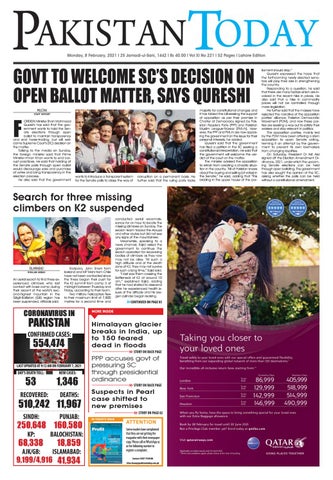
Search for three missing climbers on K2 suspended
ISLAMABAD Ghulam abbas
An aerial search to find three experienced climbers who lost contact with base camp during their ascent of the world’s second-highest mountain in the Gilgit-Baltistan (GB) region has been suspended, officials said.
Sadpara, John Snorri from Iceland and MP Mohr from Chile have not been contacted since the three began their push for the K2 summit from camp 3 at midnight between Thursday and Friday, according to their team. Two military helicopters flew to their maximum limit of 7,800 metres for a second time and
coronaviruS in
pakiStan
CONFIRMED CASES:
554,474
conducted aerial reconnaissance for an hour to locate the missing climbers on Sunday. The search team traced the Abruzzi and other routes but did not see any signs of the mountaineer. Meanwhile, speaking to a news channel, Sajid asked the government to continue the search operation for recovering bodies of climbers as they now may not be alive. “At such a high altitude and at the death zone of K2, they may not survive for such a long time,” Sajid said. “I last saw them crossing the Bottleneck of K2 at around 10 am,” explained Sajid, adding that he had started to descend after he experienced health issues at the altitude and his oxygen cylinder began leaking.
CONTINUED ON PAGE 05
more inside
Himalayan glacier breaks in India, up to 150 feared dead in floods STORY ON BACK PAGE
LAST UPDATED AT 9:12 AM ON FEBRUARY 7, 2021
DAY'S DEATH TOLL:
53
RECOVERED:
NEW CASES:
1,346 DEATHS:
510,242 11,967 SINDH:
PUNJAB:
250,648 160,580 KP:
BALOCHISTAN:
AJK/GB:
ISLAMABAD:
68,338
18,859
9,199/4,916 41,934
PPP accuses govt of pressuring SC through presidential ordinance STORY ON BACK PAGE
Suspects in Pearl case shifted to new premises STORY ON PAGE 02 in today’s issue
attention Some readers have complained that they are not getting the magazine with their newspaper copy. Please call or WhatsApp us at the following number to register a complaint. Contact: 0307-7338168 irfan.farooq@pakistantoday.com.pk
majority for constitutional changes and it has tabled the bill seeking the support of opposition as per their promise in Charter of Democracy signed by Pakistan People’s Party (PPP) and Pakistan Muslim League-nawaz (PML-n). However, the PPP and PML-n are now opposing the government on the issue for their personal interests, he added. Qureshi said that the government has filed a petition in the SC seeking a constitutional interpretation. He said that the government will welcome the verdict of the court on the matter. The minister advised the opposition to refrain from creating a chaotic situation in the country. “All of Pakistan knows about the buying and selling [of votes] in the Senate,” he said, adding that “this bidding in the upper house of the par-
liament should stop.” Qureshi expressed the hope that the forthcoming newly elected senators will play their role in strengthening the country. responding to a question, he said that there are many factors which are involved in the recent hike in prices. He also said that a hike in commodity prices will not be controlled through more legislation. He further said that the masses have rejected the narrative of the opposition parties’ alliance, Pakistan Democratic Movement (PDM), and now these parties are seeking a way out to satisfy their workers and stay relevant in politics. The opposition parties, mainly led by the PDM have been offering a stern opposition to open Senate voting, terming it an attempt by the government to prevent its own lawmakers from changing loyalties. on Saturday, President Dr Arif Alvi signed off the election Amendment ordinance, 2021, under which the upcoming Senate elections can be held through open balloting. The government has also sought the opinion of the SC, asking whether the polls can be held without a constitutional amendment.
02
Monday, 8 February, 2021
lahore
news
ChaIrman rules PrCs wIThouT managIng board, PresCrIbed ProCedures ISLAMABADD
I
MIAN ABRAR
N blatant violation of its own rules, the Pakistan Red Crescent Society (PRCS) is operating without its managing board for the last five months, while not only hampering the smooth flow of its routine operations but also raising serious concerns over the transparency and accountability process within the organisation, Pakistan Today learnt on Sunday. According to sources, PRCS Chairman Abrarul Haq has misused his position by introducing cronyism in the organisation and toying around with its resources in violation of the rules and procedures. The tenure of the previous managing body had expired on September 10 last year, but the chairman did not bother to
convene an Annual General Meeting (AGM) just to push his agenda in the organisation, the sources said. Prior to the expiry of the tenure, the previous managing body had written a letter to the President House through Ministry of Health and nominated six members to be appointed to the managing body. On the management’s continued requests to appoint their nominated persons, the President House in its letter dated November 6, 2020 had directed the PRCS to elect its new managing body according to relevant rules, which require election of members by holding an AGM. “It is requested to process the case for selection of members of PRCS managing body in the light of relevant rules,” reads the letter. However, sources said that the process for election of managing body’s members has not been initiated so far despite a lapse
Transparent polls real strength of democracy: Faraz
of almost five months. “In the absence of the managing body, the chairman is using all its powers, including the financial powers, and this is why he is not bothered to convene an AGM as it would elect independent board members. The chairman has declared a state of emergency in the organisation, which empowers him to take extraordinary decisions in the wake of any disaster in the country,” the source said. “The scope of the emergency clause is limited and it is traditionally applied in the wake of any disaster in the country, but the clause is being used on the matters, which do not fall in the purview of any emergency. This raises very serious questions on transparency and accountability within the organisation. It is also interesting to note that the chairman did not convene even a single meeting of the managing body
during his tenure despite the fact that the previous board was very much functional,” the source added. Sources also said that almost all the key departments in the PRCS are being run on acting charge basis and several part-time advisors are hired by the incumbent chairman on attractive salaries. “Joint Director Operation Abidullah Khan is heading the finance department on acting charge basis for the last several months, Deputy Director MRE Adnan Zaman is looking after the administration department, Deputy Director PMER Javed Mazhar is occupying additional charge of the fleet department, Deputy Director Response Atif Ali is supervising the CVA department, and Deputy Director Organizational Development Raja Rehan is holding additional charge of the procurement department,” the source revealed.
Karachi police book PTI leader for resisting anti-encroachment drive
Suspects in Pearl case shifted to new premises
ISLAMABAD STAFF REPORT
Minister for Information and Broadcasting Senator Shibli Faraz on Sunday said that transparency in elections is the real strength of a democracy. In a tweet, Faraz said that by "opposing the [proposed] open balloting [during the forthcoming Senate polls], the opposition made clear their intention that they don't want the politics of money to end." Opposition parties' hue and cry over the step [open ballot] to ensure transparency in the Senate elections is beyond comprehension, he added. His tweet comes days after the government promulgated a presidential ordinance to amend the Elections Act of 2017, paving way for the upcoming Senate elections to be held through an open vote. Reports citing sources said that the measure would allow the government to amend the Constitution as presidential ordinances cannot be utilised to enact any constitutional amendments. Leaders of the Pakistan Democratic Movement (PDM), an 11-party opposition alliance, on Saturday opposed the move, saying the amendment could only be brought about through the parliament. “The government is horrified by the Pakistan Democratic Movement's (PDM) decision to contest Senate elections,” Pakistan People's Party (PPP) Chairman Bilawal Bhutto-Zardari said during a press conference. In January, the PDM announced to jointly contest the Senate polls.
Pharmacist passes away of coronavirus ISLAMABAD
KARACHI STAFF REPORT
The Sindh government has shifted the principal suspect in the 2002 murder of Wall Street Journal reporter Daniel Pearl from a death cell to a newly-built facility inside the prison. In January, a three-judge panel quashed 18-year-old murder convictions against four suspects, including British-born Ahmed Omar Saeed Sheikh. However, kidnapping convictions were left in place, but the other four men were ordered freed as they had already served out sentences for the kidnapping charges. Subsequently, on February 2, the Supreme Court (SC) ordered the Sindh government to remove Sheikh from his death cell in the Karachi Central Prison and transfer to a government safe house as a stepping stone to his full release. A notification from the Sindh Home Department issued Saturday said all five suspects “are to be shifted to the newly constricted Rooms for the meeting of spouses with Prisoners situated outside of the main prison and within the boundary of Central Prison Karachi.” However, "no internet, telephone and for that matter any device/means of communicating with [the] outside
“Even the most senior post of secretary general (grade-21) is occupied by a junior officer, Dr Adeel Nawaz, whose original post is deputy director first aid (grade-18).” When contacted, the chairman, in a written statement, admitted that the organisation’s managing body is nonexistent for almost last five months. “The process for constitution of the board was initiated soon after the completion of the previous board’s term in the second week of September last year. The first letter in this connection was written by the PRCS on September 11 last year to the President House. Since then we are in continuous contact with the office of the president in the matter to remove constitutional ambiguities. Soon the board would be in place as the president has given approval of calling the AGM to complete the process,” the statement reads. However, the chairman failed to explain the delay in constituting the managing body even after receiving clear instructions from the President House three months ago. “The PRCS is running smoothly, efficiently and without any hindrance. The PRCS is committed to ensure professionalism, transparency and competence, and to eliminate nepotism and corruption from the organisation,” he said.
world is to be provided," it added. In line with the Supreme Court's decision, the notification also directed to ensure complete security of the rest house and allowed Sheikh’s family access to him between 8:00 am and 5:00 pm [GMT+5]. Pearl, 38, was abducted on January 23, 2002, in Karachi and beheaded the next month, reportedly by AlQaeda. Prior to his kidnapping, the journalist had been investigating the link between reportedly Pakistan-based militants and Richard Reid, the notorious “Shoe Bomber” who attempted to blow up a flight from Paris to Miami with explosives hidden in his shoes. In July 2002, following the hearings, an antiterrorism court (ATC) in Hyderabad had sentenced to death Sheikh and life term to other co-accused. Sheikh was convicted of helping lure Pearl to a meeting in Karachi in which he was kidnapped. However, all four convicts had moved SHC in 2002 challenging their convictions. In HIS AuTObIOgRApHY, In THE LInE OF FIRE: A Memoir, former president Pervaiz Musharraf had claimed that Sheikh, a student at the London School of Economics (reports suggest he did not graduate), was hired by MI6 to engage in “jihadi operations”, adding that “at some point, he probably became a rogue or a double agent”.
KARACHI: Karachi police on Sunday registered a complaint against Pakistan Tehreek-e-Insaf (PTI) leader and Sindh Assembly Opposition Leader Haleem Adil Sheikh on charges of assault and disruption during an anti-encroachment drive carried out at his Malir farmhouse a day earlier. The police said that first information report (FIR) was registered at the Memon Goth police station under sections pertaining to disturbance of the public peace, losses to government property, assault on government officials, attempted murder, intimidation. At least 70 people, including Sheikh, were named in the case filed on behalf of Muhammad Ayub, a resident of Korangi town. The case was filed after an operation against Sheikh's farmhouses in Karachi on Saturday in which anti-encroachment teams encountered resistance, with protesters throwing stones at government staff and smashing windows of their vehicles. Commenting on the development, Sindh Information Minister Nasir Shah said that the operation against encroachments was carried out on the direction of Chief Justice Justice Gulzar Ahmed. "Haleem Adil Sheikh was crying hoarse that action had been taken against his family," he said. STAFF REPORT
Second batch of Sinopharm Covid-19 jabs soon: reports ISLAMABAD INP
Pakistan is likely to receive the second tranche of the Chinese Sinopharm Covid-19 vaccine within the next 24 hours. Reports citing sources suggest Beijing will provide another half a million jabs of the vaccine. Pakistan has asked China for another one million doses. About 6 million doses will arrive by the end of March under the COVAX scheme, with the remainder due by mid-year, State Minister for Health Dr Faisal Sultan announced last week.
Meanwhile, all measures to procure the Russian Sputnik vaccine have also been finalised. The sources in the ministry of national health service said the government okayed procurement of the Russian jabs for a limited period. Seperately, Dr Faisal said that the country could get “in the range of tens of millions” of vaccine doses under an agreement with China’s CanSino Biologics. The company’s Ad5-nCoV Covid-19 candidate is nearing completion of Phase III clinical trials in Pakistan, awaiting results likely to come in by midFebruary, he said.
Pakistan has also been pledged 17 million doses of AstraZeneca’s Covid-19 vaccine under a global scheme to deliver coronavirus treatments to developing nations. A countrywide vaccination drive started last week. Half a million doses of the Sinopharm vaccine are being used in the first phase. Sindh has been provided 84,000 doses of the vaccine, Punjab 70,000, KP 65,000, and Balochistan 10,300 doses. The government plans to cover the majority of the population for free, but private companies could also be allowed to import and sell vaccines.
INP
Renowned pharmacist and Pharmacy Council of Pakistan (PCP) Vice President Abdul Qadir Javed Iqbal died of Covid-19 on Sunday. During his career, Dr Iqbal served at key posts in the Ministry of National Health Services and Drug Regulatory Authority of Pakistan (DRAP). According to his LinkedIn profile, he spent more than 40 years at national and international organisations at senior management and decision-making level in pharmaceutical policies, procurement, and supply chain management among other endeavours. The government portal keeping track of the coronavirus outbreak in Pakistan on Sunday recorded 1,346 new infections of the novel coronavirus after conducting 33,319 tests, receiving back transmission rate of 3.86 percent. LADY DOCTOR LOSES LIFE TO COVID-19: A lady doctor from Khyber Pakhtunkhwa (KP), Dr Aneela Nasir, lost her life to coronavirus on Sunday, taking the number of healthcare workers succumbing to the pandemic in the province to 45. Nasir was on a ventilator in a Rawalpindi hospital for the last several days. In KP, so far 68,338 confirmed cases of coronavirus have been reported while 63,953 have also been recovered from it while 1,952 deaths were recorded. In the last 24 hours, 158 new cases and four deaths were reported from KP, as per the latest data shared by the National Command and Control Centre (NCOC).
DraP session on Covid-19 jabs' adverse reactions reporting ISLAMABAD APP
Pakistan National Pharmacovigilance Centre (PNPC) of the Drug Regulatory Authority of Pakistan (DRAP) in collaboration with the World Health Organisation (WHO) has arranged a day-long training on "reporting of Covid-19 vaccine adverse events" on Monday. This session is being arranged for the capacity building of focal persons on potential adverse effects of the Covid-19 jabs. So far, the government has approved three vaccines for emergency use and establishes as many as 582 emergency vaccination centers for their administration. As per the roll-out plan, the vaccine will first be made available to more than 400,000 doctors and frontline healthcare workers, teachers and social
workers because they run the highest risk of exposure to the contagious disease. After that, the shots will be provided to citizens over the age of 65, who generally face a higher mortality risk from the virus. According to WHO directions, following the administration of jabs, the vaccine developer will report any adverse events to the global health regulator. Similarly, in addition to its efficacy, the vaccine is expected to be safe. Any untoward side effects may be reported to Division of Pharmacy Services, DRAP. These vaccine centers will remain vigilant and report any adverse effects to the office of the District Health Officer (DHO) and will forward to provincial and national focal persons of Expanded Programme on Immunisation (EPI) and Pharmacovigilance centres
respectively. National EPI will officially submit its report to PNPC while National Database and Registration Authority (NADRA) will also collect information on adverse effects on Computerised National Identity Card (CNIC) and National Immunisation Management System (NIMS) database. DRAP Director Dr Abdur Rashid who received training from various countries will deliver lectures in this regard. Organisers of the event expressed the confidence this day-long training will help and support the provinces to report adverse events of vaccines. As per the plan, any such events will be reported on a daily, weekly and monthly basis depending on their severity. Representatives from WHO Country office and DRAP CEO will also join the session.
Monday, 8 February, 2021
lahore
news
bIden wanTs ImmedIaTe soluTIon To KashmIr Issue ISLAMABD
T
TLTP
HE US State Department Urdu Spokesperson Zed Tarar has said that President Joe Biden wants an immediate solution to the Kashmir issue. Talking to a private television channel, Tarar said that President Biden has made it clear that human rights are a fundamental issue for the United States. He added that the US understands that Kashmir is a human rights issue and Washington wants that mobile service and 4G should be restored in Kashmir immediately. "Pakistan and India should work out for the reduction of tensions along the
Line of Control [LoC] and start a positive dialogue on the Kashmir issue," he said. Describing both India and Pakistan as partners of the US, Tarar said that the two countries must agree to formulate a strategy to ease tensions against one another through dialogue. Speaking on the human rights and digital blockades in Kashmir, Tarar demanded that the Indian government should lift the internet blockade in the region and freedom of expression must be respected and protected in the valley. Speaking about the Doha agreement on the Afghan peace process, the State Department spokesperson said that Washington is not reviewing the agreement with the
maryam’s daughter out of danger after severe accident: Pml-n LAHORE: Mehrun Nisa, the eldest daughter of Pakistan Muslim League-Nawaz (PML-N) Vice President Maryam Nawaz, got severely injured after her car met an accident in Lahore on Saturday night. PML-N spokesperson Marriyum Aurangzeb said in a statement on Sunday that Nisa suffered a head injury in the car accident and currently she is in the intensive care unit (ICU) of a private hospital after undergoing a surgery. Nisa is out of danger now, said the spokesperson, adding that the PML-N vice president has cancelled her participation in the Pakistan Democratic Movement’s (PDM) public gathering, scheduled for Tuesday in Hyderabad. She appealed to the people to pray for the early recovery of Nisa. Following the news of Nisa’s accident, Federal Minister for Science and Technology Fawad Chaudhry took to Twitter and sent best wishes to Maryam’s daughter for an early recovery. “Prayers for early recovery. May God keep everyone safe from accidents,” he wrote. TLTP
sindh govt urged to exhibit responsibility in provision Covid-19 vaccines ISLAMAbAD: Minister for Planning and Development Asad Umar on Sunday urged the provincial government to exhibit responsibility in provision of coronavirus vaccine to health workers. The Sindh government should prefer health workers rather giving importance to VVIP culture, he said in an interview with a private television channel. Taking notice of misuse of Covid-19 vaccine, he said administering vaccine to VVIPs was a regrettable incident reported in Karachi. The minister said that provincial government should avoid misusing of coronavirus vaccine. He urged the concerned quarters in Sindh to streamline the system in health department. The federal government, he said, could take the control of vaccine provided to Sindh government for health workers. APP
open balloting in senate polls aimed at ensuring transparency: minister ISLAMAbAD: Minister of State for Parliamentary Affairs Ali Muhammad Khan on Sunday said that the Pakistan Tehreek-e-Insaf (PTI) government intended to conduct the forthcoming Senate elections through open voting to discourage the notorious practice of horse-trading. Bringing an end to secret balloting is the topmost priority of the government, intended at ensuring the transparency of the process, APP quoted him as saying. Open voting, he said, was so essential in public and national interest. He said it was also mentioned in the so-called Charter of Democracy, signed between slain prime minister Benazir Bhutto and Pakistan Muslim League-Nawaz (PML-N) supreme leader Nawaz Sharif in 2006, to conduct the Senate elections through an open ballot. But now the parties' leadership was doing politics on the issue. In response to a question, Khan said that the government would not create hindrance in a way of the opposition’s proposed long march to Islamabad. He said that the member parties of the Pakistan Democratic Movement (PDM) leadership will fail in gathering its workers and supporters for the rally as the people had already rejected them. APP
intention of making changes to it. He maintained that the new US administration is scrutinising whether or not the Taliban are complying with the terms and conditions of the Afghan peace process. “The Afghan war is almost 20 years old and the US does not want war,” Tarar stated, adding that the US wants peace in the region. On Daniel Pearl case, Tarar expressed the hope that those behind the murder of slain US journalist Daniel Pearl will be held accountable by the government, adding that justice should also be seen to be happening. Talking about the Middle East and the Iran nuclear deal, Tarar said that the new US administration certainly
standards of Pakistani education will rise, claims minister NEWS DESK
intends to rejoin the "nuclear deal with Iran" but would consult with its partners in the Middle East. “Obviously, the United Arab Emirates (UAE), China and European Union (EU) would be consulted“ about the Iran nuclear deal, he stated, before returning to the deal. He said that Biden’s administration is exploring ways to restore the 2015 nuclear deal that Iran signed with major world powers including the US. But, the deal was abandoned in 2018 by former president Donald Trump, who restored sanctions over Iran. He disclosed that the nuclear deal and its associated conditions are being scrutinised before the resumption of the agreement.
NAB denies claims of approving plea bargains NEWS DESK The National Accountabilty Bureau (NAB) has categorically rejected the claims that it has approved any plea bargains, wherein the anti-graft body issued a statement explaining that the courts alone greenlight any such agreements. In the aforementioned statement, NAB explained the method for processing a plea bargain application, wherein the accused first pleads guilty and then pays the looted amount back, after which the accused is disqualified from contesting elections for a period of 10 years. Through this policy, the anti-graft watchdog maintained that a total of Rs487 billion were returned and deposited in the national exchequer, which it called a "remarkable achievement". "Established to eradicate corruption and to recover looted money from corrupt elements", the anti-corruption body claims to have recovered "Rs714 billion looted money from corrupt elements since its inception and deposited all looted money in the national exchequer". A time period of 10 months has been prescribed "to complete the process of initiating complaint versification, inquiries and investigations to filing a reference", it stated. "An accused can apply for plea bargain as per clause 25-B of NAB ordinance, 1999," the statement added. "NAB receives the application of plea bargain request who voluntarily submits his application to NAB for plea bargain after seeing the documentary and solid proofs of corruption in NAB. NAB examines the plea bargain application of the accused as per law. The liability of the accused is determined on the basis of his looted money with markup and after determination of the total liability of the accused, NAB informs total liability to the accused and forwards the request of plea bargain of the accused for plea bargain along with his total liability for decision of the respective accountability court. "The respective accountability court accords the final approval of the plea bargain request of the accused. In the respected accountability court, the accused admits his
03
guilt before the respected accountability court. The respected accountability court after hearing arguments of both sides, gives a decision for acceptance of a plea bargain of the accused. "Therefore, it is not correct that NAB is the authority for acceptance of plea bargain request of the accused in any case," the watchdog highlighted, saying the accused "not only confesses his guilt in writing but also agrees to return all looted money and submits first tranche of his total looted liability". Citing the fact that other countries also have the option of plea bargains in their legal systems, the body said the accused "does not go to jail but he faces all other punishments under the relevant laws applied on the culprit". "A plea bargainer lost honor and dignity in the society. After a plea bargain, the government servant is dismissed from government service immediately after striking a plea bargain. "He becomes disqualified for Government service for his remaining life. A politician becomes disqualified for 10 years. He could hold public office or contest elections after ten years," it added, underscoring that businesspersons cannot obtain a loan from a scheduled bank for 10 years after they strike the bargain. "NAB officers do not receive any money from the recovered amount as NAB always believes in absolute transparency, professionalism and merit as per law," stated the anti-graft body. Quoting a survey, it said some 59 per cent people of Pakistan "expressed their satisfaction over the performance of NAB as manifested in surveys conducted by Gillani and Gallup". "Transparency International Pakistan, World Economic Forum, PILDAT and Mashal Pakistan have also appreciated NAB. This has indeed rejuvenated NAB," it added. The anti-graft watchdog said it had the distinction of signing a memorandum of understanding (MoU) with China for "combating corruption and sharing each other’s experiences regarding elimination of corruption".
Federal Minister for Education Shafqat Mehmood lamented the fact that a "certain class" within the country thought that only Oxford or Cambridge could be considered as standards of education on Sunday, and said that the Single National Curriculum (SNC) would help Pakistan achieve the same international standard. Speaking at a local news talk show, the education minister said that the new curriculum would improve education standards across the country for students, adding that will aim to bring about equality in the sense that madrassah students and students of elite schools and colleges will enjoy the same facilities. "And those standards will be higher, not lower," he added. "Our syllabus can be compared with that of any other syllabus around the world," he said. "We have prepared it keeping in mind modern standards [of education]," added Shafqat. In reply to a question, the education minister explained that the standards of teacher training and distance learning would be improved. Earlier this month, Shafqat had announced that the academic year would begin in August this year and that the country will adopt the SNC from the next academic year. The announcement had been made through the official Twitter account of the Ministry of Federal Education and Professional Training, wherein the ministry had stated that it has developed the SNC with consultation from the relevant stakeholders for grades pre-1 to 5 and that this “shall be followed by all public and private schools across the country from next academic year”. According to the ministry, under the directives from the federal minister for education, the new year “would start now in August 2021 due to extension in examination dates to be held in May/June and also prolonged school closures in the academic year of 2020”. Furthermore, the ministry had said that a letter was sent to all provincial and area governments regarding the Textbook Policy under the unified curriculum. It had stated that publishers are “allowed to develop these textbooks aligned with SLOs prescribed by SNC” and that they will require a no-objection certificate (NOC) by the provincial textbook boards so that they may “check any inclusion of anti-Pakistan, antireligion, and any other hate material”. Meanwhile, the textbook boards have been advised to “exercise due diligence to ensure that private publishers are producing textbooks in line with the objectives and contents of SNC”.
India’s actions pose threat to world peace, security: munir ISLAMABAD STAFF REPORT
Pakistan's Permanent Representative to the United Nations Munir Akram has said that India’s actions clearly pose a danger to international peace and security. He, in an article published in the news portal of the world body, said that the Jammu and Kashmir dispute is one of the oldest unresolved issues on the agenda of the United Nations Security Council (UNSC). Akram said that under international law, the people of Jammu and Kashmir have the right to restore their right to self-determination by any means at their disposal, including armed struggle. He said, however, to justify its oppression, India has sought to portray the legitimate Kashmiri freedom struggle as terrorism. The Pakistani envoy said that the UN and the international community have a responsibility to help resolve the Jammu and Kashmir dispute.
‘aman 21’ brings russia, naTo in joint drill for first time in decade ISLAMABAD STAFF REPORT
Pakistan Navy is all set to host the largest multinational maritime exercise ‘Aman 21’ in the North Arabian Sea this month and this will be the first time in a decade that Russia will participate in a joint military exercise with the North Atlantic Treaty Organisation (NATO) members. This year’s exercise is more significant as it brings the three largest navies, US, China and Russia, under one platform for collaborative maritime security. More than 45 countries will take part in the 7th exercise of the series being held every two years since 2007. The objectives of the multinational maritime exercise, including contribution to regional peace and stability; a united resolve against terrorism, crimes and other threats in the maritime domain; and to bridge the gap and enhance interoperability among regional and extra-
regional navies with Pakistan Navy acting as a bridge in the region. Chief of Naval Staff (CONS) Admiral Amjad Khan Niazi said recently that Aman (Peace) exercise under the motto ‘Together for Peace’ offers the participating countries a chance to work together keeping differences aside to defeat common adversaries and hybrid warfare such as terrorism, piracy, terrorism, drugs and arms trafficking, human smuggling, and climate change. Pakistan Navy initiated the exercise in 2007 with only three participants but the message of collaborative maritime security was widely accepted and the participation greatly expanded. As many as 46 countries and 115 observers participated in Aman-19 naval exercises and around 11 navies, including those of China, US, UK, Australia, Turkey, Italy, Malaysia, Oman, Sri Lanka participated with their warships. It is a huge achievement for the
Pakistan Navy that the number of participating countries grew immensely in a few years as the message of peace and collaboration appealed to both eastern and western navies, NATO and non-NATO members. In comparison, India’s Malabar Exercise, which started in 1992 and attracted only three navies, Pakistan’s Aman exercise garnered global recognition as it is not against any country and benefits all states. The exercise should not be seen as war games but drills against non-traditional security threats as the primary goal of Aman exercise is to uphold peace and stability in the region. With the growing competition between China and the United States in the region, Pakistan has chosen to act as a bridge in the region due to its traditional role as a peacemaker in the maritime domain. Through the Aman exercise, Pakistan will once again play the role of a peacemaker and provide a platform for
China and Russia on one side and the US and allies on the other side to come together. The exercise is also an enabler of Pakistan Navy’s ambitions of transforming into a blue-water force as it is in the process of equipping itself with the modern surface, airborne, submerged and unmanned systems to develop capabilities to play a greater role in the Indian Ocean region. Pakistan’s unique geostrategic importance has further elevated with the development of the new Gwadar Port under the multi-billion dollar China Pakistan Economic Corridor (CPEC), which calls for enhanced maritime security. Gwadar Port is located close to the Strait of Hormuz, the world’s most important oil transit choke-point, and connects three regions: South Asia, Middle East and Central Asia. Pakistan Navy’s initiatives such as the Aman exercise are also vital to secure the national and global sea routes in the IOR, country’s maritime security, and overall national security.
04
Monday, 8 February, 2021
LAHORE
NEWS
A move towArds An informed future PUNJAB PUNCH SHAHAB OMER
t
he Punjab Information Commission’s (PIC) decision to make the answer sheets of Punjab Public Service Commission (PPSC) exams public has had the department’s officials worried, while the civil society and the legal fraternity have been rejoicing over the move. When a candidate who failed a PPSC exam requested the commission to recheck his papers and provide him a certified copy of his answer sheets, the commission flatly refused to comply. The candidate did not relent and filed an appealed with the PIC under the Right to Information Act. Later, the PPSC officials appeared to be reluctant to
answer to the candidate’s query and cited secrecy as the reason. Meanwhile, the PIC investigated the matter, and considering all legal aspects of the picture, decided that the candidate’s demands were valid as the answer sheets were not secret documents, and directed the PPSC to provide the said documents to any candidate who asks for them after the results are announced. Speaking on the condition of anonymity, an official of the PPSC said that the PIC’s decision was “extremely troubling” for them. “Now candidates would want to know the reasons for their failure,” the official said, adding that this decision will lead to a number of new leaks, as when things become transparent, many things that were “pre-managed” will not happen. Citing the amount of information requests this decision will lead to, the official
said that a bureaucratic organization will have to “check the intelligence of candidates and also provide services to them”. Candidates have previously waited for long periods to learn about the reasons for their failure in the exams. One past candidate informed Pakistan Today that despite waiting four years, he still does not know why he failed the exam. he said that the recent incident of the paper being leaked may have answered his question. “Why do they hesitate to provide answer sheets when we submit the fee and the commission examines us as a government department?” he asked. “If the checking is done in a transparent manner, then why are they afraid to provide the answer sheets?” he further said that he will also file an appeal for his answer sheets and the answer sheet of someone who passed the exam along with an official reason for his failure. “Candidates
have their dreams tied to government jobs, how will they succeed if they are not told the reasons for their failure,” he remarked. Advocate Azhar Siddique, a legal expert, hailed the verdict as a “landmark decision” that interprets the true spirit of Article 19A (Right to Information Information). he stressed the need for encouragement for such decisions, adding that many things are likely to change after this decision. “Candidates appearing in PPSC exams were very upset and I think this decision will end the culture of exploitation in the name of secrecy,” he said. “There is a big mafia in PPSC which is trying to go to the court against this decision and they will do their best to have it reversed,” he added. Referring to the recent paper leak scandal, the legal expert said that as long as such things are hidden in the name of se-
Punjab signs pact to build small, intermediate dams LAHORE STAFF REPORT
In a bid to utilise water resources in an efficient manner, the Punjab government on Sunday signed an agreement to build small and intermediate dams in the province. According to details, a memorandum of understanding (MoU) was signed between the provincial Irrigation Ministry and NeS-
PAK in a ceremony, which was also attended by Punjab CM Usman Buzdar. Under the MoU, a feasibility study would be carried out using modern drone technique for the construction of small and intermediate dams at 13 hill torrents. Shedding light on the project, Buzdar said that the pilot project for the construction of the reservoirs would begin in June this year. “The water reservoirs will help in providing water to 200,000 acres of land, besides also minimizing the impact and losses from floods,” he said.
crecy, such incidents will continue to happen. he urged the PIC to launch a fullfledged awareness campaign as such decisions are written in legal language, excluding the common man from understanding them properly. “It is important that PIC officials and commissioners arrange meetings, awareness sessions and campaigns with stakeholders and explain to them in simple terms how they can get information from PPSC,” Siddique suggested. When contacted, PIC Chief Commissioner Mehboob Qadir Shah said that every citizen has the right to information. he cited the reluctance of providing information to the general public as one of the primary reasons for the society’s deterioration. he said that while he does not know the actual reason behind this attitude, the persistence of “Babu Culture” may be one explanation. “Right to information discourages such a culture,” he added. Shah said that PIC’s decision had been announced keeping in view all complexities and references. “Our commission announces decisions on merit without any pressure,” he maintained.
It is pertinent to mention here that other than Punjab province, small and big dams have been planned and established in other parts of the country also to ensure better utilisation of water resources. According to a report, in Khyber Pakhtunkhwa (KP), 25 small dams have been completed in different areas to store flood and rainwater during monsoon for irrigation and drinking purposes in July 2019. Nine dams, including Gandyaley, Chanday Fateh Khan and Auxiliary Kandar dams in Kohat, Azakhel in Peshawar, Naryab in hangu, Sharki and Changhoz dam in Karak, Darganatu in Bannu and Jalozai dam in Nowshera have been completed under the annual development programme during 2002 to 2019.
Two minors die due to stubble burning in Chiniot CHINIOT: Two minors, a brother and sister, were burned to death due to stubble burning in Chiniot on Sunday. As per details, five-year-old Abrar and seven-year-old Shahzadi received burn injuries while playing in the area due to stubble burning. Both the children were moved to Allied hospital, Faisalabad, as there was no treatment centre for burn injuries in Chiniot. The children breathed their last at the hospital. A case was registered at Chenab Nagar police station against the landlord, Aijaz, for burning stubble. In December last year, the Lahore high Court (LhC) had slapped a fine of Rs50,000 over stubble burning, while hearing a case regarding smog. Some farmers clear their agricultural fields by burning the residue that is left on the land after harvesting to prepare the land for the next round of seeding. A report of the Judicial environmental Commission was submitted to the LhC. “476 industries and kilns were inspected in a bid to control smog problem in the province,” the report had stated. INP
Process starts to uplift under-developed areas in Punjab: Firdous LAHORE STAFF REPORT
Special Assistant to Punjab Chief Minister on Information Dr Firdous Ashiq Awan has said that process of development has been started in under-developed areas of the province to bring them at par with developed areas. In a statement on Sunday, Dr Firdous said that Chief Minister Usman Buzdar is determined for composite development of the province and, hence, he announced a historic development package of Rs15 billion for different projects in Rajanpur. She said that a university will be set up in Rajanpur while the development package consists of Girls Degree College Rojhan, Trauma Centre in District headquarter hospital, Rescue 1122 Centers in Fazilpur and Kot
Mithan and last but not the least up-gradation of Rural health Centers of Dajal and Fazilpur. The special assistant said that 34 veterinary clinics would be set up at the cost of Rs300 million whereas sewerage and rehabilitation of drainage systems would be completed at the cost of Rs400 million. She said that mother and child hospital, dual carriageway road from Jampur to Kashmore including construction and repair of other roads, construction of Morang dam and many other important projects will help improve the living standards of the people of Rajanpur. She also said that Rajanpur had been deliberately deprived of the right to development by the previous governments but the chief minister is working day and night to resolve the problems of the people of such remote areas.
India's actions in Kashmir pave way for int'l intervention: Moeed ISLAMABAD STAFF REPORT
Advisor to Prime Minister on National Security Dr Moeed Yusuf has said that India's unilateral actions in Kashmir have paved the way for the international community to intervene and resolve the long-standing dispute. In an interview with Turkey’s Anadolu Agency, Moeed reiterated Pakistan's commitment to peace, including with India, but called on the world to compel India to implement international law vis-a-vis Kashmir i.e., UN Security Council (UNSC) resolutions that call for a plebiscite in the Muslim-majority region. he said, “We are dealing with a neighbour who is motivated by expansionist ideology and can go to any extent to undercut Pakistan.” expressing willingness to take things forward, he said: "Pakistan will take two steps if India takes one." To a question that many countries often don't buy Pakistan's narrative against India, Moeed said, “In reality, the western world wants a counterweight to China, a larger market to sell arms. So far, we haven't got the response we think we should get, not only on the dossier but on Kashmir as well.” Moeed said that under the BJP regime, India's relations with all neighbouring countries, including China, Nepal, Bangladesh and Sri Lanka, are getting worse. "We have also pointed out that India is being a spoiler in Afghanistan, undermining Pakistani sovereignty and stability.” he said, “The eU DisinfoLab's recent disclosures are not our creation. So, it's the eU. It's they who have
to take this on now. The eU Parliament has already held an open hearing. There is an investigation going on; it must reach its logical conclusion. It's crucial.” Responding to a question about civil-military relations, he said both the civilian and military leadership are working in tandem with each other, adding: “The prime minister is fully empowered to make all decisions. It is his right to call upon his military for anything and everything that is constitutional. And he uses that right. Today, civilians are empowered to decide on everything, and both civil and military leaderships are on the same page.” he said that a narrative has been projected about Pakistan that its resources are completely skewed towards the military. “In reality, our military is grossly under-resourced, given the challenges we face.” he said that Pakistan has a pivotal geo-economic location. “We want connectivity with Central Asia because it has major energy reserves. It's landlocked; it wants to use our port. That's why we want peace in Afghanistan. We are open to connectivity to the east.” he further said that Pakistan is open to providing economic bases to the entire world. Talking about Pakistan’s relations with Turkey and Azerbaijan, the advisor said the foreign ministers of these three countries recently met in Islamabad and all three countries resolved to continue improving their relationship further. “Turkey, Pakistan, and Azerbaijan have worked closely in the past and have a good and solid relationship. This engagement is against no other country. There are common interests of connectivity, economic gains, investment and politics.”
Monday, 8 February, 2021
LAHORE
NEWS
LAHORE: PSO CEO and Managing Director Syed Muhammad Taha presents a cheque sponsoring the higher education of five students to Karachi IBA Corporate Relations and Communications Director Alumni Malahat Awan. The agreement was signed by PSO CSR Trust Chairperson Babar H. Chaudhry and IBA Executive Director Dr Syed Akbar Zaidi. PREss RELEasE
05
Govt to end diScounted tariFF For FertiliSer FirMS t
HE government is set to end concessionary gas tariff for Fatima and Engro Fertilizer plants by the middle of the year. The two fertiliser companies are currently availing a concessionary gas tariff of $0.70 per mmbtu. However, the concessionary period for Fatima Fertilizer is set to expire in July 2021 whereas Engro Fertilizer’s concessionary period is coming to an end by June 2021. According to a report by the Express Tribune, the government and Engro Fertilizer are in dispute over expiration of gas supply agreement at discounted rates. Once the concessionary period comes to an end for
both the plants, the government would review the gas tariff for the entire fertiliser industry consuming indigenous gas and the existing distortions would be removed for creating a level playing field for all players, the Petroleum Division had informed the Economic Coordination Committee (ECC) in a recent meeting. The plants of both fertiliser companies were selling the fertiliser to farmers at the same higher rate being charged by other plants despite the fact that they had been receiving cheaper gas. Other fertiliser plants had been paying Rs302 per mmbtu for gas to be used as feedstock and Rs1,023 per
mmbtu for fuel stock. However, new fertiliser plants of Fatima and Engro had been paying Rs112 per mmbtu for gas to be used as feedstock. These new fertiliser plants had not even booked the Gas infrastructure Development Cess (GIDC). Hence, these plants emerged as major beneficiaries as they paid less for gas and did not pay GIDC. Meanwhile, the economic decision making body approved extension in gas supply to Fauji Fertilizer Bin Qasim (FFBQL) for the next five years. However, the supply was committed on an available basis, which means there was no guaranteed supply. NEws DEsk
Imports of six smugglingprone goods surge 55pc Japanese foreign minister’s commendation for FY20 conferred upon PBS ISLAMABAD: Ministry of Foreign Affairs of Japan has conferred the Foreign Minister’s commendation for FY20 upon Pakistan Bonsai Society (PBS), in recognition of their significant contributions towards the promotion of Japanese art in Pakistan and enhancing cultural relations between the two countries.On behalf of the Foreign Minister of Japan, Consul-General of Japan in Karachi Isomura Toshikazu presented the commendation to PBS President Khawaja Muhammad Mazhar at a conferment ceremony held at his official residence on Saturday. PREss RELEasE
Motor vehicle tax collection grows by 15pc in 1HFY21
The quantum of smuggled goods into the country decreased during the first seven months of FY21 as compared to the corresponding period last year, according to data of the Pakistan Customs which showed a higher collection of duties and taxes. Formal imports of six smugg¬¬ling-prone commodities — green tea, black tea, tyres, textile products, ¬electronic goods and palm oil — increased by over 55.51 per
cent, the latest data showed. Official data compiled by the Pakistan Customs showed that the import value of the six commodities jumped 55.51pc to Rs659.930 billion during July-January FY21 from Rs424.354bn last year. The duty and taxes collection from these commodities also grew 40.19pc to Rs194.813bn in 7MFY21 from Rs138.956bn last year. Also, the import value of these products under
Petroleum levy collection registers 102pc increase in 1HFY21 ISLAMABAD TLTP
ISLAMABAD TLTP
The collection of motor vehicle tax increased by 15 per cent to Rs12.7 billion during the first half (July– December) of FY21 owing to improved business and commercial activities after ease in coronavirus lockdown. According to official statistics, the motor vehicle tax collected by all the provinces increased to Rs12.7 billion during the first half of the current fiscal year as compared with Rs11 billion in the corresponding half of the last fiscal year. Province wise collection data revealed that Punjab contributed the major chunk under this head. The Punjab province collected Rs7.08 billion as motor vehicle tax during the first half of the current fiscal year as compared with Rs6.52 billion in the corresponding half of the last fiscal year. In terms of growth, the Sindh province registered an increase of 28.48 percent to Rs4.28 billion during the period of July–December of the current fiscal year as compared with Rs3.33 billion during the same period of the last fiscal year. The collection of motor vehicle tax by the province of Khyber Pakhtunkhwa registered an increase of 2.24 percent to Rs865 million during the first half of the current fiscal year as compared with Rs846 million in the corresponding half of the last fiscal year. The Balochistan province collected Rs413 million as motor vehicle tax during July–December 2020/2021 as compared with Rs303 million in the same period of the last fiscal year. Earlier in January, the Excise and Taxation (E&T) department, Islamabad Capital Territory (ICT) extended the deadline for submitting token tax on vehicles without penalty till January 31.
the ATT declined 51.15pc to Rs146.160bn during the period under review from Rs299.208bn last year. The manufacturing data released by the Pakistan Bureau of Statistics (PBS) showed production of most products except motor tyres failed to record positive growth indicating that the demand is being met through imports. Meanwhile, data on smuggling of petroleum products and auto parts is not available. MONITORING REPORT
The collection of petroleum levy has registered a 102 per cent increase during the first half of the current fiscal year (FY21), according to official data. The collection of petroleum levy increased to Rs275.3 billion during July–December of the current fiscal year 2020-21 as compared with Rs136.4 billion in the corresponding half of the last fiscal year. The petroleum levy is one of the major components of non-tax revenue of the federal government financing the budget deficit and creating room for development expenditures. The federal government was collecting Rs22.27 as petroleum levy on per litre of gasoline in December 2020. Meanwhile the levy was Rs15.74 on per litre gasoline included in retail price during November 2019. It is pertinent to mention here that the government’s non-tax collection during the first half of the current fiscal
year has shown a massive increase of 151 percent. Nontax collection was recorded at Rs895.3 billion in the first half of the ongoing financial year as compared to Rs356.3 billion in the same period of the previous year, according to the latest data of the ministry of finance. The breakup of Rs895.3 billion non-tax collection showed that the government has collected Rs44 billion as markup on public sector entities (PSEs), Rs11.9 billion as dividend, Ra18.6 billion as surplus profit of State Bank of Pakistan. In non-tax revenues, the government has collected Rs6.5 billion as defence receipts, Rs6.9 billion as passport fee and Rs4.3 billion as discount retained on crude oil. The government had accumulated Rs35.1 billion as royalties on oil and gas and Rs745 million as Windfall Levy against Crude Oil, Rs1.65 billion as petroleum levy on LPG, Rs9.5 billion as Gas Infrastructure Development Cess, Rs13.3 billion as Natural Gas Development Surcharge and Rs47.5 billion as others in July to December period of the year 2020-21.
Imports of six smuggling-prone goods surge 55pc The quantum of smuggled goods into the country decreased during the first seven months of FY21 as compared to the corresponding period last year, according to data of the Pakistan Customs which showed a higher collection of duties and taxes. Formal imports of six smugg¬¬ling-prone commodities — green tea, black tea, tyres, textile products, ¬electronic goods and palm oil — increased by over 55.51 per cent, the latest data showed. Official data compiled by the Pakistan Customs showed that the import value of the six commodities jumped 55.51pc to Rs659.930 billion during July-January FY21 from Rs424.354bn last year. The duty and taxes collection from these commodities also grew 40.19pc to Rs194.813bn in 7MFY21 from Rs138.956bn last year. Also, the import value of these products under the ATT declined 51.15pc to Rs146.160bn during the period under review from Rs299.208bn last year. The manufacturing data released by the Pakistan Bureau of Statistics (PBS) showed production of most products except motor tyres failed to record positive growth indicating that the demand is being met through imports. Meanwhile, data on smuggling of petroleum products and auto parts is not available. MONITORING REPORT
Motor vehicle tax collection grows by 15pc in 1HFY21 ISLAMABAD TLTP
The collection of motor vehicle tax increased by 15 per cent to Rs12.7 billion during the first half (July–December) of FY21 owing to improved business and commercial activities after ease in coronavirus lockdown. According to official statistics, the motor vehicle tax collected by all the provinces increased to Rs12.7 billion during the first half of the current fiscal year as compared with Rs11 billion in the corresponding half of the last fiscal year. Province wise collection data revealed that Punjab contributed the major chunk
under this head. The Punjab province collected Rs7.08 billion as motor vehicle tax during the first half of the current fiscal year as compared with Rs6.52 billion in the corresponding half of the last fiscal year. In terms of growth, the Sindh province registered an increase of 28.48 percent to Rs4.28 billion during the period of July– December of the current fiscal year as compared with Rs3.33 billion during the same period of the last fiscal year. The collection of motor vehicle tax by the province of Khyber Pakhtunkhwa registered an increase of 2.24 percent to Rs865 million during the first half of the current fiscal year as compared with Rs846 million in the corresponding half of
the last fiscal year. The Balochistan province collected Rs413 million as motor vehicle tax during July–December 2020/2021 as compared with Rs303 million in the same period of the last fiscal year. Earlier in January, the Excise and Taxation (E&T) department, Islamabad Capital Territory (ICT) extended the deadline for submitting token tax on vehicles without penalty till January 31. The decision was taken by keeping in view the enormous rush from the vehicle owners inside the office, Director, E&T Bilal Azam said. The motorists could submit their vehicle token fee at the excise office from 9 am
cMYK
to 8 pm even after their office time or any designated branch of National Bank of Pakistan in the federal capital, he added. An online interface, he said, had also been set up between the Pakistan Post and the Excise and Taxation department, for collection of token tax of vehicles having Smart Card registration book. The appellants could submit their token to the authorised Pakistan Post’s offices located in various sectors of the city including, F-8 Markaz, G-9 Markaz, I-10/4, G-8, G-10 Markaz, F-6 and G-6.Azam urged the motorists to use online appointment system, introduced by the department recently, to get their vehicle registered without waiting in long queues.
Search for three missing climbers on K2 suspended contInueD froM pAge 01 “I waited for my father and others at Camp 4 for many hours, preparing water and food for them. I kept the light of camp on to help them find the camp while descending. However, I did not receive any message from them,” he said. A member of the mountaineers’ team, Chhang Dawa Sherpa, in a tweet on Sunday said: “Today, first flight by army in the morning with @eliasaikaly made it up to 7000 m and second flight in the afternoon by two army helicopters (along with Sajid and I) made a search”. He added that they could unfortunately not find a trace of the missing mountaineers and according to him, the wind above 6,400m was still 40 km/hour. Karrar Haideri, a top official with the Alpine Club of Pakistan, said that army helicopters resumed the search that began Saturday for Ali Sadpara and his two companions, John Snorri of Iceland and Juan Pablo Mohr of Chile. The three lost contact with base camp late Friday and were reported missing Saturday after their support team stopped receiving reports from them during their ascent of the 8,611-meter (28,250-foot) high K2 mountain. “The base camp received no signals from Sadpara and his foreign companions after 8,000 meters. A search is on and let’s pray for their safe return home,” Haideri told The Associated Press. News of the missing men comes a day after a Bulgarian mountaineer was confirmed to have died on K2. He is the third mountaineer to die on K2’s slopes this year, after a Spanish climber fell to his death last month. Russian-American Alex Goldfarb also died on a nearby mountain during an acclimatising mission in January. On Saturday, choppers flew to a height of 7,000 meters (23,000 feet) to try to locate the missing mountaineers with no success. Ministry of Foreign Affairs (MoFA) issued a statement saying Iceland Foreign Minister Gudlaugur Thór Thórdarson spoke to his Pakistan counterpart, Shah Mahmood Qureshi, through the telephone. Qureshi assured him that Pakistan will spare no effort in the search for the missing mountaineers. Sadpara and his team left their base camp on February 3, a month after their first attempt to scale the mountain failed because of weather conditions. Haideri noted Sadpara’s experience as a mountaineer who has climbed the world’s eighth highest mountains, including the highest, Mount Everest, and was attempting to climb K2 in winter. K2 is the most prominent peak on the Pakistan side of the Himalayan range and the world’s second tallest after Mount Everest. Winter winds on K2 can blow at more than 200 kph (125 mph) and temperatures drop to minus 60 degrees Celsius (minus 76 Fahrenheit). A team of 10 Nepalese climbers made history on January 16 by scaling the K2 for the first time in winter.
Monday, 8 February, 2021
06 COMMENT
The elitist paradigm and Pakistan’s economy
Omitting the bad news The government’s failure to give figures on debt raises suspicions
T
HE more charitable explanation for the government’s omission of key information from the annual debt policy statement, which it lays before the National Assembly every year as obliged by the Fiscal Responsibility and Debt Limitation Act 2005, is gross incompetence. The less charitable explanation is that the government is trying to hide something. The Debt Office has reached a first of sorts, as it claimed it had omitted information it had already provided. This must be the first time a government organization has had any hesitation about repeating information. The suspicion does raise its head that the government is trying to hide something, perhaps that it has failed to control debt, and there is an upward trend in incurring debt, and thus that it is not in compliance with the targets laid in the Act, or perhaps that the government wants to hide the fact that it is borrowing to service old loans. Fresh debt should go towards project financing, but the amount of debt, which is not being released, going towards servicing old loans is not a sustainable practice. This does not bode well for the resumption of the IMF programme which has seen the third tranche withheld. The debt situation is not encouraging for resumption of the facility, and it is not helpful that there has been a puerile attempt to conceal information. This need is leading the government to take actions it had previously vowed never to take, just as much as it went to the IMF after loudly and decidedly proclaiming that it would not. The increase in the power tariff was big enough a shock, and it was followed promptly by a fuel price hike. While this may gain it brownie points with the IMF, it further placed the ordinary consumer under pressure. The government is also likely to hurriedly abolish by a presidential ordinance corporate income tax exemptions worth between Rs 150 billion to Rs 200 billion a year, rather than wait to do so in the coming 2021-2022 Budget, so as to secure the resumption of the programme. The government may feel that the Fiscal Reliability and Debt Limitation Act cannot be obeyed. If so, it should say so forthrightly. In the digital age, concealment is not possible, and such old-fashioned behavior is not expected of such a tech-savvy party.
How the country’s economic progress is stalled Dr Umair ashraf
A
few days back I came across a tweet by a leading business personality of Pakistan, who is CEO of a large electronics brand and also owns a PSL franchise since its commencement. The tweet stated, ”Starbucks or Costa to Pakistan!?” hinting at bringing in one of the largest coffeemakers in the world to Pakistan. Apparently the tweet must have induced excitement for the general population of Pakistan, which could be seen on Twitter following this tweet. Even though a coffee lover by heart my opinion has been ambivalent on this. The said business personality has a history of introducing foreign brands in Pakistan from different sectors including automobiles and son, and has used Twitter to create hype among consumers. But if we see it in a broader picture, he speaks in casual parlance of privileged while addressing to the consumer market. If we look at the social class structure in Pakistan, Costa or Starbucks coffee can only be afforded by a particular upper class of Pakistan as their daily go to coffee place. Pakistani businessmen have a long history of reinforcing social hierarchy in Pakistan owing to their style of doing business. And this is evident by the fact that despite improved economic growth indicators, the social class structure in Pakistan has retained its arbitrariness and over the past two decades. The elite cater elite and thus the status quo remains intact. The Elite and upper class in Pakistan makes only a very little portion of the population while the middle and lower classes makes the rest of it. The gap between the social classes, more importantly between upper and middle classes, has widened. The social, cultural and income inequality between the two is more than evident. The elitist paradigm of doing business in Pakistan is that they introduce trends in Pakistan, make it a subject of social attainment and persuade the middleclass to follow in their footsteps as consumers. The middleclass in return exhausts its resources to follow these trends and only helps the elite in accomplishing its
Indian farmers’ protests The Modi government passes up another chance to end them
I
We must not give up. The Kashmiris haven’t
Wajeeha Bilal
T
HE other day while going through an article that brought the attention towards silence of most of the writers on the issue of Kashmir, I realized that it only raised questions that it was too weak to answer. Using silence for people who aim to raise their voice, defies the precepts of logic. Are we really as convicted of this crime as claimed by some? Writers are definitely complex but not silent. Our service to the system of humanity is a creative challenge to capture the struggles of our fellow people in an accent that transcends common literature. Children in Kashmir are being progressively exposed to brutality– a fact that has infested the region for decades. The lockdown that stripped Kashmir of its special status, and then restrictions on movement to prevent the coronavirus, has taken a toll on Kashmir’s society and people. Their life is molded by a sense of oppression and negativity. Severance in formal schooling, controlled opportunities to socialize and devious agendas are leading to a rise in miseries and mental problems among the Kashmiri children.
Dedicated to the legacy of the late Hameed Nizami
Arif Nizami Editor Umar Aziz
Asher John
Joint Editor
Executive Editor
Deputy Editor
Lahore – Ph: 042-36300938, 042-36375965
Sooner or later, the elites shall have to let down the guards to their capital and open it up for the middle class to enter. The former’s privilege may not last longer than latter’s patience
Silence on Kashmir will be death of hope
NDIAN Prime Minister Narendra Modi has shown how stubborn he is in refusing to back down on the controversial farm laws, which have provoked farmers’ protests at various entry points in New Delhi, with backchannel contacts failing to yield results. As the protests have gone on since September it seems that Modi’s commitment to those expected to benefit from the new laws is unwavering. The intensity of the protests may increase now that the weather, while troublesome, is turning mild. The protesters, who have withstood the rigours of winter, and of the winter rains, out in the open, show no sign of giving up. The mixing of support for Khalistan with the farmers’ protest was shown on the recent Indian Republic Day, when protesters took over the Red Fort, and one farmer flew the Sikh flag, the Nishan Saihib, from the Fort’s flagstaff. This is easily understood, for the farmers holding the sit-in in New Delhi, belong to Haryana and East Punjab. The latter are primarily Sikhs. It may be remembered that the Khalistan Movement, as befitting a movement of mostly Sikh farmers, had more than a modicum of specific demands involving farming and dealing with agriculture. It must be remembered that if Punjabi farmers, arguably India’s best-off agriculturists, are disaffected enough to contemplate a future outside the Indian Union, farmers of other communities would also be disaffected. This is the case, as farmers are now protesting all over India. The Modi government must realize that it cannot continue with this present confrontation with the famers, and not just because of the electoral losses it will face in a country that is still largely agricultural. Modi cannot afford the protests to turn violent, even though that is what many want to happen. He must also remember that though his government does control the New Delhi police, the opposition Aam Aadmi Party is in power in the Union Territory, which means he cannot do anything he wants. Modi is now courting great unpopularity in the rural areas, as he seems not to realize that farmers’ distress is leading to more farmers; suicides every year, all over India.
Aziz-ud-Din Ahmad
business strategies. The result is Pakistan has become a permanent importer. Its imports have grown twice as fast as exports in 2020. We import every other luxury item in the world at the behest of the elite class. Pakistanis have become a nation of consumers with limited productivity and innovativeness. The moneyed elite of this country tips the scales of markets in its favour by means of corrupt business practices, tax evasions and advantageous access to the corridors of power. They use their privilege to import commodities at the expense of the national exchequer rather than to create something of value through their own enterprise. The result is we have an unproductive rent seeking elite class, contributing little to the economy of Pakistan which has become deplorable. Pakistan has one of the lowest investment rates in the world. The productivity has diminished and the elite class which includes social, political and financial bigwigs, lack the innovation and vision necessary to uplift the economy and society of Pakistan. The weak regulatory structure of country and fragile institutions have supported the elitist status quo over the years. Instead of investing in technology and innovation to support the economy and create opportunities for young entrepreneurs from the middle class, the egocentric elitist businessmen invest their capital in buying urban land and turn them into housing societies. This adds nothing to the economy of the country. A famous wealthy family from Gujranwala which was recently in news for allegedly spending over a billion rupees on a wedding, has announced to build a complete replica of Paris in a housing society in Gujranwala. Their privilege has even blinded the creativity and originality that can be found from within Pakistan. While Elon Musk is building space rockets and elec-
I
Karachi – Ph: 021-35381208-9
I
tric cars, Pakistani business elites are competing with one another in building housing societies. Another sector which has a sheer lack of innovation is the auto industry. It is heavily protected by the government, but has failed to provide consumers with automobiles at par with the rest of the world. The business personality I mentioned in the start of this article used an opportunity in this sector and introduced a compact SUV which costs almost Rs six million in the market, again catering to the needs of the elite. Currently, a consumer belonging to the middle class cannot even afford to buy a hatchback without spending his or her whole fortune. One of the reason is that these bigwigs only navigate through their elite social structure which sociologist Pierre Bourdien terms “Social and cultural capital”. And they are not ready to share it with classes lower to them. The elite create, control and guard their domain, serving as gatekeepers to those outside who might seek to gain entry to this capital. It is now extremely rare, if not impossible, for an individual of lower or middle class origin to access the theatres and forums where elite business takes place, regardless of their aptitude, entrepreneurship and level of education. The elite enjoys export subsidies in all sectors without an iota of contribution to the export growth. And the result is the dilemma of economy we are witnessing. The solutions may need a completely separate article but I would mention an excerpt from Dr. Ishrat Hussain’s book Pakistan: The Economy of an Elitist State, which gives the three imperatives that should influence the governance of this country. They are following: 1) Restore confidence in country’s institutions i.e government, legislature, judiciary, universities etc. 2) Initiate and sustain technological change and manage transition to a modern economy and society. 3) Foster stability and trust in social and cultural relationship between various classes and segments of the population. The implementation of above goals is intertwined and should be looked at collectively rather than individually and sequentially. Sooner or later, the elites shall have to let down the guards to their capital and open it up for the middle class to enter. The former’s privilege may not last longer than latter’s patience.
It is not possible to witness these crimes with sinful silence. It makes us guilty to sit silently in our living rooms while watching horrible news and atrocities committed against unarmed human beings. The daily news of our oppressed brothers and sisters triggers a haunting realization of helplessness. It instills an urge within ourselves to make a difference through our words or actions. Kashmir continues to bleed and witnessing its pain with a shameful silence can only mean the death of hope for humanity. Houses are being burnt, young men killed and innocent children tormented with painful memories for life. The excuse for silence and inaction lies in the inability to be strong enough to raise a voice. For every Pharaoh there is a Moses (AS), for every Yazid there is Hussain (RA) and for every evil that rises in the society there is a mightier hope that must rise from within us, ourselves. Only crying over the sufferings of fellow humans will not solve the problems, for they survive in the hope that the people watching their news will raise their voice for them. Our hearts bleed with sorrow and we want to make a difference for the oppressed, that goes beyond the limits of logic and words. News and media are filled with such brutal accounts but they cannot kill our spirits when there is bound to be resistance through our thoughts, words and actions. We appeal for peace in the region of Jammu and Kashmir, which has lived in conflict for as long as we can remember. The main issues children are facing in the region currently are violence and lack of education. If there was no awareness and check by the people who stood with the right, this earth would have been an abode of mischief. Following the right requires that we
Islamabad – Ph: 051-2204545
The writer is a freelance columnist
stand unanimous in creating awareness and exposing any ideology that aims at breaking that thread. A tyrant is a tyrant, a crime is a crime and abuse is an abuse whether physical or verbal, there is no how and why to it, and we stand against it. In the post-corona world, a new order may be in the making where humanity will be respected with compassion and empathy. Being silent over Kashmir is undeniably sinful only if we choose to do so. Whenever we stand against the wrong, we issue an indictment against the domination of silence, reminding us all of our responsibility to voice the rightful cause. Witnessing crime in silence is a mute agreement that is signed with oneself to jerk off any responsibility. We can always create a difference in this world through our thoughts, words, beliefs and actions. If only we would stand together in awareness against the felonious acts, then justice and human kindness would surely triumph over cruelty and crime. Abu Sa’id al-Khudri reported: The Messenger of Allah, Peace and Blessings Be Upon Him, said, “Whoever among you sees evil, let him change it with his hand. If he is unable to do so, then with his tongue. If he is unable to do so, then with his heart, and that is the weakest level of faith.” Staying in shadows and crying in silence does not resonate with our true nature. Whether we are aware of it or not, we are not without voices. Then why think, reason, speak, write or even live, if not for some profound purpose? Our words have the power to trigger a movement of empathy that is contagious beyond its direct reader. Silence is cheap, words speak louder and actions louder still. Writing is a sign of respect and homage that we pay to those whose pain we feel but cannot cope with. We think, write and speak in honour of those who endured unjustly. It’s not silence in any form but shows strength of words for our brothers and sisters whose lives we wish to change. Our purpose is fulfilled when our words have stirred reason and stood with the oppressed. Think, write, speak or work – we do what we can; we stand against oppression and in solidarity with the Kashmiris.
Silence is cheap, words speak louder and actions louder still. Writing is a sign of respect and homage that we pay to those whose pain we feel but cannot cope with. We think, write and speak in honour of those who endured unjustly.
I
Web: www.pakistantoday.com.pk
I
The writer is a published author. Her work includes “The Conscious Ego” and “The Beautiful Present”
Email: editorial@pakistantoday.com.pk
Monday, 8 February, 2021
COMMENT 07 Editor’s mail Send your letters to: Letters to Editor, Pakistan Today, 4-Shaarey Fatima Jinnah, Lahore, Pakistan. E-mail: letters@pakistantoday.com.pk Letters should be addressed to Pakistan Today exclusively
Favouritism TO begin with, when I think about discrimination the one issue that sticks out in my mind is Favouritism. Favouritism is like action as if you only have one student and others does not exist. Playing favourites is a bad habit; you can harm apparently in harmless ways. In a Class there is always someone that will stand out and someone that will not but despite of that they all are equal. Moreover, one may be smarter than the other but at the end of the class they all are students. All should be treated fairly. Nevertheless, they may not be the smartest but each student has a talent inside them. After all everyone is created uniquely. Showing Favouritism on one student may have a bad effect to another student because they may lose their respect and starting doubting about the teacher’s capability. Always choosing the smart ones is never a good deed because how can a Teacher bring out the best on those average students if they only set their eyes on the favourites. A Teacher is always labelled as the second parent and a parent’s love and attention must be equally divided among it’s children. Whether it’s pretty or ugly, smart or dumb, rich or poor they all deserve the best. ShEhnaz zahir SiT Panjgoor
What if Bose had returned to India... What if Bose had survived?
m.j. akBar
P
OLITICS has been trapped so firmly between personality and party that we tend to overlook the role of geography in shaping electoral destiny. So much attention has been consumed by the debate about two men identified by 1930 as the potential leaders of free India, Jawaharlal Nehru and Subhas Chandra Bose, that we have ignored the consequences of a meteoric Bose trajectory across the Indian horizon. There was one striking difference: Nehru became luminous in Gandhi’s glow; Bose had his own radiance. What if Bose had, on 17 August 1945, taken a ship from Thailand to Bengal rather than a Japanese plane to Taipei, en route to Russia in the belief that only the USSR could confront the British Empire? True, the British were determined to put Bose on trial if they arrested him. They were livid, in particular, at the fact that Bose had broken army discipline by raising the INA. But Bose’s influence had spread far beyond the INA into the regular army. On 15 June 1945, Wavell sent London a ‘Note by Military Intelligence (Extract)’ based on the interrogation of an unnamed officer who had commanded a “guerilla” regiment against the British. Officers and men of the INA, he said, were sincere in their war for India’s independence; no compulsion was used. When they returned to India there would a rapid permeation of nationalism throughout the Indian Army. General Sir Claude Auchinleck, commander in chief of the Army, admitted, in a top secret and personal note sent on 24 November 1945, that a death sentence against any INA officer or solider following a court martial would lead to greater unrest than in 1921 and 1942, and recommended leniency; a “considerable” number of Indian troops were calling the INA patriots, not traitors. When, on 3 January 1946, Captain P.K. Sahgal, Captain Shah Nawaz Khan and Lieutenant G.S. Dhillon, got the death sentence, Auchinleck reduced it to merely “cashiering” and “forfeiture of pay and allowances.” If such were the passions a trial of INA officers aroused, we can barely imagine the fire across India if Bose had been tried. Moreover, he did not belong to the Indian Army, so how could he be court-martialed? Bhulabhai Desai cited “modern international law” which recognized the “right of subject races” to fight for liberation, during his defense of INA officers. Desai asked whether de Gaulle’s Free French forces were legal when they declared war against the German occupation of
France. If the Free French was legal, so was INA. I am not suggesting Bose could have won the 1952 election. Gandhi’s influence, the emotional impact of his martyrdom, and the sheer strength of the Congress organization he created, would in all likelihood have prevailed with the electorate. But the Forward Bloc would have been a formidable presence in the first free Parliament, and by 1957 Bose would have been able to stake his claim for the leadership of India. With Bengal as his base, and the east as its main artery, Bose could have fashioned a Coastal Coalition; moreover, he would have cracked apart the Inland Consolidation of Congress with serious inroads into Bihar, the North East, Rajasthan, minority pockets and urban India. Bose was never overawed, not even by Gandhi. He had the ability to think through a strategy before he took his first step. Bose’s command over Bengali affections needs no reiteration. He would have won every seat in Bengal in 1952. And he was born in Cuttack and had family affinity to Odissa. A complementary factor would have helped politically: Odissa was packed with princely states. Gandhi never extended his mass movement to the princely states, on the sound logic that they were ruled by Indians. Bose would have capitalized on this Congress weakness through his own organizational reach. Tamil Nadu, either directly, or more likely through the DMK, would have responded to a leader from a non-Hindi state with alacrity. In Telengana, Bose’s strong anti-poverty policies could have helped his party fill the vacuum left by the waning Communist movement, and the thin Congress base in the old Nizamate. Kerala’s Socialists might have proved more enduring in their strongholds, but Bose would in all likelihood have enticed them into an anti-Congress coalition. In 1967 the Forward Bloc was part of anti-Congress alliance in Bengal; in 1957 Bose would have been the natural leader of any such group. Congress would have been vulnerable in the Mysore state area of Karnataka. While Bose might have faltered in Maharashtra, Congress would never have enjoyed the kind of electoral sweep that it commanded till 1977. In Gujarat, Bose’s personal magnetism and an alliance with local leadership could have been productive. It was a state waiting for an anti-Congress leader. The Bose factor would have worked in Jharkhand, Chhattisgarh and the North East, where alienation against Congress began much earlier than in the rest of the country, because in the 1950s and 1960s, Congress took tribal communities for granted. Bihar is the one state in the Hindi heartland which would have welcomed Bose. The east and north-east of Bihar has cultural overlap with Bengal; but more, Bihar has a strong socialist streak. In 1939, when Bose challenged Gandhi and went on to become an elected President of Congress for the Tripuri session, he got surprising support from Bihar’s delegates. One can visualize the core theme of a Bose campaign in 1957: poverty. India was as poor as the British had left it. The economic despair was soon to find expression in the Naxalite movement. The original Naxal triumvirate included tribal leader Jangal Santhal, the tribal leader. The twin poles of the Bose manifesto would have been social harmony and economic equity. That brings us to a key factor for Congress success between 1952 and 1971, and the party’s partial revival at the beginning of this century. Congress has won a simple majority only with overwhelming Muslim support. In 1952, Congress got 364 seats and 45 ercent of the vote; in 1957, 371 with 47.8 percent. Minus the Muslim
vote, the percentage falls to the mid-30s, with seats tumbling in its wake. Look at the 1967 elections, when many Muslims turned away. In 1920 and 1921 Muslims accepted Mahatma Gandhi’s leadership of the non-cooperation, or, in their terminology, Khilafat, movement. Their first doubts about Congress arose when Gandhi abruptly suspended non-cooperation after the attack on a police station at Chauri Chaura, when the British government had begun to display serious signs of disarray. In 1937 Jawaharlal Nehru attempted to win their affections through a “mass contact” programme. He failed comprehensively. No Muslim voter was with Congress in 1946. From the first general election of independent India, Congress had one message for Indian Muslims: you have nowhere else to go. With Bose offering an alternative, Muslim support would have crashed in 1957, not 1967. Bengal’s Muslims would have voted for Bose in 1952, like other Bengalis; after five years, Bihar would have followed, along with the Gangetic plains and in the Coastal Coalition. Congress might still have remained the largest single party, but Bose would have been PM. In 1957 Nehru was 68, Bose 60. In fact, after the 1957 elections an exhausted Nehru gave serious thought to resigning. Then his memory would have been untarnished by the 1962 defeat by China, the people’s famished conditions and the 1960s’ economic gloom. With Bose as PM, India’s defence capability would not have been compromised by multilateralism soaked in nonalignment. Mao would have thought twice before ordering an offensive against one who had raised an army from POWs and led troops in a deadly conflict. We cannot be equally certain about Bose’s economic policies, but he strongly believed in strategic logic in pursuing objectives. If Bose had turned towards home in 1945, rather than seeking to continue from a European vantage point, we would have seen a conscious youth vote emerge in 1957. By 1945, Bose had become the unrivalled hero of the young. Gandhi recognized the Bose phenomenon much earlier than his disciples, and acknowledged it even though Bose had opposed his philosophy and was living in Germany. In June 1942 Gandhi told the American journalist Louis Fischer: “I regard Bose as a patriot of patriots. He may be misguided. I think he is misguided. I have often opposed Bose. Twice I kept him from becoming President of Congress. Finally, he did become President, although my views often differed from his.” Four years later, on 15 February 1946, Gandhi was mesmerized: “The hypnotism of the Indian National Army has cast its spell upon us. Netaji’s name is one to conjure. His patriotism is second to none…His bravery shines through all his actions. He aimed high but failed [during the war]. Who has not failed?...My praise and admiration can go no further…The lesson…[he] brings to us is one of self-sacrifice, unity irrespective of class and community, and discipline. If our adoration will be wise and discriminating, we will rigidly copy this trinity of virtues, but we will as rigidly abjure violence.” Bose was an advocate of war against an imperial power, and a fountainhead of peace between Indians. realized this. If he had been alive, he might have voted for Congress in 1952 and Bose in 1957. Mobashar Jawed Akbar is a leading Indian journalist and author. He is the Editor-in-Chief of The Sunday Guardian. He has also served as Editorial Director of India Today. He tweets at: @mjakbar.
Gawadar stadium PICTURES of Gawadar Stadium went viral a week ago, even International Cricket Council (ICC) tweeted its picture and termed it the most beautiful Cricket Ground of the world. This Stadium is between rocky mountains and also covered by open deserted area. Gawadar deep sea port which is back bone of CPEC project, picture of stadium definitely caught attention of world. Meanwhile Baloch nation and locals of Gawadar suffered from this picture. They also demand to share their picture of grief and address it. Habitants of the city face scarcity of water, they are barred to fish in their own sea which is main source of earning. There is a visible threat of demographic change, as soon as CPEC is completed foreigners and locals of other provinces settle in Gawadar, they would be driven into minority. Another major concern of people is “fencing Gawadar” if movements of local people is being restricted in early days it would be extended in future. Major issues if local people are not heard and highlighted which can blur the beautiful picture of Gawadar in really means. A very condemnable fact in our media is that media highlights picture of Gawadar does not highlight picture of people living in Gawadar. Giving importance to land over the people should end now. noor Baloch Karachi
Breaking The War Jinx THERE have been Western media reports of possible nuclear war across the world. For instance, Charles Richard, the Commander of the US Strategic Command has started shedding light on the possibility of nuclear war. Abbreviated to the USSTRATCOM, this unit is part of the combatant commands in the US defense sector. Furthermore, even PROCEEDINGS, a monthly magazine from the US Naval Institute has been widely talking about such issues as nuclear war facing the world community. By the way, there are some questions now. What is the use of nuke war? What use is it of going to war? Catastrophic impacts apart, all the war tactics have been proved to be pretty much dangerous to the international community and humanity. Just look at all the COVID-19 vaccines available out there in the world now! All those vaccines have been nothing but the sums of great knowledge and hard work involved. Where is the question of aggression in the corona fight here? Rather or instead, there have been many core issues inflicted on mankind and the globe. Poverty, economic crisis, climate change issues and agrarian problems are some of those issues to be looked into as quickly as possible. As one practical example, the people in my native areas like Korkai, Tuticorin, Tiruchendur, Kanyakumari, Nagercoil, Marthandam and Tirunelveli in Tamil Nadu have been into rigorous and diverse agricultural activities, working hard and embracing new changes. Therefore, the world should move on in the direction of overall growth. Let Mother Nature grow up and prosper in her own natural ways. So should the human race. Let us all get immersed in the lap of Nature instead of waging war on one another. Besides, there is no denying the fact that the best way out to end war is by non-violence greatly attached to Asian region. P SEnThil Saravana Durai MuMBai
Smart Policing AS far as human rights violations are concerned, we suppose to encounter such a trend more in our police stations. It is no denying the fact that we desperately need CCTV cameras in police stations and the absence of it gives free hand to police officials carrying out human violation. For instance, when a person is wrongfully caught and brought to the police station letter a writ of habeas corpus is filed to the court for securing his rights. Keeping in view, installation of cameras is essential so that footages can be used as a piece of evidence. In a globalized world, we are a developing country, upgrading of police is pivotal along with the scientific evidence. In foreign countries, we can see that body cameras are installed on police officials to record each move so that the accused must not claim of being caught illegally. Different actions are emerging day to day of police affairs in which custodial deaths, assumption of alcohol, harsh behavior on part of police officials and many more are seen, such kind of activities should be prevented by monitoring the entire operation of police stations. But when we talk about human life, the concerned authority also needs to improve the condition of police stations. Secondly, we often see that whenever a police officer commits human violation or breaks the law he is suspended temporary rather than punishing for his act, when it comes to lodging an FIR, aggrieved person is found running from pillar to the post for his basic right he is denied of his basic right, lodging of FIR is mandatory . Our resources and taxes are being wasted. Installation of cameras will work like a defense shield not only for public but also for police officials, but the bottom line is whether police will abide by law and work according to it or will it violates, tortures and abuses physically the commons if the intention of work is positive then CCTV is a blessing but if they want to run their personal practice then CCTV is a curse. Shafi ahMED Khowaja jaTi Sujawal
Monday, 8 February, 2021
08 WORLD VIEW
tHe case against Pakistani normalisation witH israel PAKISTAN, PLEASE DO NOT VALIDATE APARTHEID; DO NOT MAKE MILITARY OCCUPATION NORMAL
counTErPunch
t
RaMZY BaROud
HE Pakistani government should never, under any circumstances and no matter the pressure, normalise with Israel. Doing so is not only dangerous – as it will embolden an already vile, racist, violent apartheid Israel – but it would also be considered a betrayal of a historic legacy of mutual solidarity, collective affinity and brotherhood that have bonded Palestinians and Pakistanis for many generations. The bond between Palestine and Pakistan is not one that is based on rhetoric. Rather, it is cemented through blood and sacrifice, as Pakistani fighters have taken part in the desperate Palestinian-Arab attempt at pushing back Zionist colonization of the Palestinian homeland in 1948. Whenever Palestinians think back of those who stood by
their side during their times of hardship and collective pain, Pakistan always features prominently on the list. But it is not just this. The Pakistani Air Force also took part in the war of 1967 when Israel occupied the rest of historic Palestine and, more importantly, in the pivotal war of 1973, when Arabs and Muslims fought back. It was no surprise to learn that the Pakistani government recognized the Palestine Liberation Organization (PLO) as the ‘sole and legitimate representative of the Palestinian people’ before the Arab League had done so at the Rabat Conference in Morocco in 1974. It is terribly sad to see that Morocco, despite the collective love shared between the Moroccan and the Palestinian people, has succumbed to Jared Kushner’s political designs to normalize with Israel. Trump’s sonin-law had launched a decided campaign to normalize Israel in the eyes of Arabs and Muslims, without forcing Tel Aviv to make a single political concession to the occupied and oppressed Palestinians. Countries like Morocco, Bahrain, the United Arab Emirates and Sudan sold Palestine so cheaply, in exchange for limited gains. Pakistan cannot join this misled club. A country of Pakistan’s size, of its large and vibrant population and of the kind of moral authority it possesses is not meant to be an American lackey, dancing to the drumbeats of the US administration, of Kushner-like politicians, who are unable to decipher the long-term consequences of their actions. If Pakistan normalizes with Israel through any kind of diplomatic, cultural or trade exchanges, it will send an unprecedented message to the rest of the Muslim
Umma; in fact, to the whole world that Muslims are now willing to coexist in a reality in which injustice, in all of its manifestations is, simply, normal and acceptable. What kind of moral authority would that make Pakistan, especially as it is leading the fight against the occupation of Kashmir and the perpetual injustices and violence that is experienced daily by millions of Kashmiris? From a very young age, all Palestinians are reminded that the struggle for Palestine is part and parcel of the larger struggle against the evils of military occupation anywhere in the world, starting with Kashmir. Every Palestinian mosque often ends its Friday sermons with a heartfelt prayer to Allah, to bring to an end the woes of mankind, from Palestine to Kashmir, to Afghanistan, to Iraq, to Syria and so on. At times, this camaraderie is all that Palestinians are left with, as the so-called international community has long-turned its back on the Palestinian people and their seemingly endless tragedy. But what would Pakistan gain from normalization with Israel, anyway, aside from lofty promises that are likely to be forgotten as soon as the Joe Biden Administration takes over the White House? What did Egypt and Jordan gain from their normalization and diplomatic ties with Israel, over the course of 40 and 26 years, respectively? They are certainly not better off in any way. Since then, the Egyptian pound has been devalued numerous times against the US dollar. Jordan, on the other hand, has been reeling under a prolonged economic crisis, one that seems to worsen with time. Additionally, the geopolitics of the Middle East is in an unprecedented state of flux. Since the seismic American decision to ‘pivot to Asia’ in 2012, its ‘leadership from behind’ in the NATO-led war in Libya and every other major regional event since, it is crystal clear that the US is no longer the dominant party in the greater Middle East region. With its Asian domain evidently
shrinking due to China’s growing economic and political might and outreach and its ‘scramble for Africa’ facing numerous obstacles, the US is no longer in a position to dictate, neither to Pakistan nor any other country, on how to conduct its foreign policy. The upcoming US administration is likely to be busy for years in a desperate attempt to stave off some of the damage inflicted by the Donald Trump Administration, starting with amending some of its ties with its European and NATO allies. This is not the time to join yet more American political gambles, lining up Arabs and Muslims on the side of Israel to fight some imagined Iranian threat. On the contrary, this is the time for influential and well-regarded countries like Pakistan to champion their own initiatives, with the help of other peace and justice loving countries, to force Israel to respect international law, to end its military occupation of Palestine and to dismantle its system of racist apartheid. This will certainly garner Pakistan the respect and leadership it deserves as a global Asian and Muslim power. The Palestinian and Pakistani peoples need each other as vanguards against racism, military occupation and injustice. They must remain united at the forefront of this defining fight, no matter the sacrifices and the pressures. If Pakistan abandons this noble fight, the pain of this loss will be felt most deeply in the heart of every Palestinian, for generations to come. Pakistan, please do not validate apartheid; do not make military occupation normal. Ramzy Baroud is a journalist and the Editor of The Palestine Chronicle. He is the author of five books. His latest is “These Chains Will Be Broken: Palestinian Stories of Struggle and Defiance in Israeli Prisons” (Clarity Press, Atlanta). Dr. Baroud is a Non-resident Senior Research Fellow at the Center for Islam and Global Affairs (CIGA), Istanbul Zaim University (IZU).
Why Bangladesh’s mainstream media has been silent on explosive charges in new Al Jazeera documentary EXCEPT THE NATIONAL ENGLISH DAILY NEW AGE, NONE OF THE MAINSTREAM NEWSPAPERS OR TELEVISIONS PRINTED OR BROADCAST ANYTHING ABOUT THE INVESTIGATION eign Affairs and Army Headquarters about the documentary. These institutions mainly debunked the investigation, dismissing it as “nothing more than a misleading series of innuendos and insinuations”.
scroll
o
Faisal MahMud
N February 1, Qatar-based international news channel Al Jazeera released a documentary in which it alleged that Bangladesh’s army chief General Aziz Ahmed had been offering aid to his fugitive brothers, who had been convicted for murdering a political rival. The documentary titled All the Prime Minister’s Men alleged that Ahmed helped his brothers obtain fraudulent passports and run illegal businesses abroad, with the tacit approval of the country’s Prime Minister Sheikh Hasina. The investigative documentary, which is a product of two years of work, is based on information from a whistle-blower named Sami. A sting operation on one of Ahmed’s brothers – Haris Ahmed, who has been living under the forged identity in Hungary of Mohammad Hasan – also alleged that Haris Ahmed had functioned as a middleman, amassing bribes in exchange for using his connections with government officials in Bangladesh. The investigation indicated that the Ahmed brothers have been selling off jobs in Bangladesh’s police forces for hundreds of thousands of dollars “in collusion with senior officers”. The Al Jazeera documentary alleged that the country’s home minister, the inspector general and the police commissioner had helped coordinate bribe payments. CREATING A STORM: As soon as it was released, the hour-long investigative documentary created a storm in Bangladesh. Millions of people watched it on Youtube and other social media. Numerous users shared it on Facebook, which has been flooded with posts and comments about the allegations. While the documentary has become the talk of the country over the past few days, one startling feature stood out – the silence of mainstream media about the documentary’s allegations. Except the national English daily New Age, none of the mainstream newspapers or televisions printed or broadcast anything about the investigation. They only published the statements issued by the Ministry of For-
FEAR OF DIGITAL SECURITY ACT: In their defence, some of the leading dailies of Bangladesh said the Digital Security Act – a controversial law that could be used to suppress free speech – is the main reason behind their contrived silence. “If we were a free media today, we would have delved deeper into the widely-talkedabout Al Jazeera report and analysed it, point by point, and exposed it for what it really is – not a top-class work of investigative journalism,” wrote Mahfuz Anam, the editor of The Daily Star, the country’s highest-circulated English daily, in a column on Friday. He added, “We have done nothing because they all are involved with power, both financial and political, and we dare not nudge them. Sometimes we do our own investigative stories but only so long as those who pull the strings are kept out of the scene, or when the real culprit has no political or institutional clout, or when the object of our investigation has fallen out of favour.” RESTRICTIVE LAWS: Earlier, on February 3, the paper carried an editorial stating, “It is really the reflection of the environment in which we operate exemplified by the existence of the DSA, among others, which is perhaps among the most comprehensively restrictive and oppressive laws against the free press anywhere.” An editorial in the Dhaka Tribune titled “Why the silence” explained that the reason for their silence is simple as “the current state of media and defamation law in Bangladesh, and how it is interpreted by the judiciary, makes it unwise for any Bangladeshi media house to venture into any kind of meaningful comment on the controversy”. The Dhaka Tribune editorial said that the Digital Security Act has a chilling effect on Bangladeshi media since it contains language proscribing reporting that is so broad in its scope and threatens such draconian consequences that “no responsible editor can take the chance of publishing reports that might even conceivably fall into its purview”. THE SORRY STATE OF MEDIA: However, Germany-based Bangladeshi media and political analyst Zia Hassan begs to differ. According to him, there are three types of media in Bangladesh.
“There are ones that the regime sees as a threat to its narrative and policies,” he said. “The journalists from those media are either mimed, imprisoned, abducted, or thrown out of the country. Their website IP addresses are immediately blocked. The detective agencies ensure that their voices are never heard.”. The second type, he said, is the type that is operated by the beneficiaries of the regime. They may sound loud but they don’t matter. “However, the third is the interesting type,” he said. “This is the kind of media that project independence and try to maintain objective journalism. The regime tolerates them to a degree, as their presence allows it to display a symbol of a functioning democracy.” He added: “The cries for free speech, media freedom, and complaints about restrictive digital security laws we hear are from this third type of media establishment. To many this sounds a little hollow, if not completely diabolical.” According to Hassan, these independent media entities are the direct beneficiaries of the regime’s elimination of the media entities that would now have been extremely popular and would have the motivation and courage to expose the regime’s crimes. “In the past, these independent outlets have worked tirelessly to build the exclusionary Bengali nationalist narrative on which the current fascism now thrives,” he said. “These two parties have an uneasy relationship, but both have a common interest in keeping the status quo – the mafia regime that Al Jazeera exposed – alive.” LOSING PUBLIC TRUST: Hassan said the complaints about freedom of speech and media freedom are only due to their discomfort at losing people’s trust, which is making
them financially unsustainable. “They care about freedom of speech and media only when it hurts them, because I don’t remember them caring about freedom of speech when their market competitors were eliminated or when the telecom regulatory authority blocks platforms like investigative entities like Netra news operating from abroad,” said Hassan. Renowned Bangladesh photojournalist Shahidul Alam said that an explosive report involving key government officials on a leading international channel should have been splashed across the front page of every newspaper with bold headlines. “To report on the rebuttal without having reported on the news itself, is journalistically untenable, but situationally understandable,” said Alam. “The government boasts of a free and unfettered media, but the unwritten taboos in the media include critiquing the prime minister or the military, as many in jail will testify.” He said this journalistic “lapse” is substantiated by the candid admission by the editor of the Daily Star as he wrote, “If one looks at the flood of totally groundless and unsubstantiated defamatory cases under the DSA against journalists and newspapers, and the promptness with which such cases were accepted and the accused sent to jail and refused bail for weeks if not months, the answer will be obvious. “The irony is we are not even mentioning the intimidation, threats and restrictions of advertisements and other tactics that are used. But even then, we must struggle on and, that’s what we do.” Faisal Mahmud is a Dhaka based journalist.
Jeff Bezos lets go; to create a Himalaya? Economic TimEs American tech billionaires tend to do what eastern spiritual masters urge, without visible impact on local business leaders: let go. Bill Gates left active leadership of the company he co-founded and led, Microsoft, early on. Sergey Brin and Larry Page had not quite entered their dotage when they handed over Google to a professional manager. Now, Amazon founder Jeff Bezos, the world’s richest man, whose divorce settlement has permitted his ex-wife to become one of the world’s most prolific givers to good causes, has given up running his company and decided to become executive chairman. He is not exactly riding off into the sunset but will no longer be centrestage in the ecommerce giant. Even if he does not quite take off for Mars in a Blue Origin rocket, this is quite dramatic. Bezos says he wants to focus on interests beyond ecommerce. Besides his space enterprise, he has other ventures, including a climate initiative and The Washington Post. However, it would not be surprising if Bezos comes up with something altogether new, an unknown unknown, with his new portfolio of innovation at Amazon. The division that was founded to help store and manage data for the ecommerce operation, the cloud computing arm, Amazon Web Services became the biggest money spinner for Amazon, and the man who ran it, Andy Jassy is the nominated new CEO. Few would have imagined that an enabling ancillary division would evolve into a very profitable standalone business. That could well happen again, if delivery robots and drones that Amazon is toying with access superior artificial intelligence via zero-latency communications on a 5G network. Indian entrepreneurs could also see letting go as a new chapter of entrepreneurship rather than as retirement.
Monday, 8 February, 2021
BUSINESS 09
LAHORE
KP Govt to Start one-wIndow ServICe to faCIlItate Power CruSh PlantS ISLAMABAD
K
aZIZ BUNerI
HYBER Pakhtunkhwa (KP) Chief Minister (CM) Mahmood Khan has directed concerned authorities to start a one-window service for the issuance of licences and NOCs to facilitate those who intend to install power crush plants. While chairing a meeting of Minerals and Mineral Development Department here the other day, the KP CM directed to ensure the issuance of such licenses and NOCs within a week so that legal river bed mining and power crushing is encouraged in the province and illegal companies are discouraged. The meeting discussed various matters related to regulate and streamline power crush plants, river
Imran Maniar takes charge as SSGC managing director
REGULATING POWER CRUSHER PLANTS, RIVER BED MINING WOULD PRESERVE NATURAL ENVIRONMENT, PROTECT INFRASTRUCTURE DURING NATURAL DISASTERS, KP CM SAYS bed mining and mining in urban and rural set ups with special focus on the effective implementation of rules framed to this end. Besides provincial cabinet members Timur Saleem Jhagra, Akbar Ayub, Sultan Khan, Arif Ahmadzai and Chief Secretary Dr Kazim Niaz, the meeting was attended by concerned administrative secretaries and other relevant high ups. Mahmood Khan also directed the concerned authorities to work out an ef-
fective mechanism to ensure the implementation of a safe distance as prescribed in the relevant rules for sand and gravel extraction from river beds and mining near urban and rural population so that losses to human lives and properties are minimised in floods and other natural calamities. The meeting was also briefed in detail about various aspects of the proposed River Bed Mining Rules 2021 and it was informed that the proposed rules aimed at protection of rivers, its
course and smooth water flow, protection of infrastructure on river beds, conservational mining of sands, gravels and stones to meet construction industry required and effective enforcement to promote safe mining in river beds. Stressing the need to make all matters related to power crusher plants and river bed mining more people friendly, the chief minister said that regulating power crusher plants and river bed mining in the province would benefit people associated with the business and also preserve the natural environment. A committee comprising of concerned authorities was constituted in the meeting to come up with recommendations for the approval of provincial cabinet to ensure effective implementation of relevant laws as well as streamlining issues related to power crusher plants and river bed mining in the province.
LAHORE Press release
Imran Maniar has been appointed as new managing director (MD) for Sui Southern Gas Company (SSGC). Maniar is an accomplished professional with more than 30 years of strong track record in building, leading and advising private equity and corporations in mergers and acquisitions, restructurings, turnarounds, capital market transactions, logistics, upstream and midstream operations, oil field and engineering services. He has been prolific in managing start-ups and Fortune 500 companies in North and Latin America, Europe and Middle East. Before joining SSGC, Maniar held CFO positions at Marquard and Bahls AG, GL Noble Denton and Eagle Ford Oil and Gas. He has also served as manager strategic planning at Boardwalk Pipeline Partners, partner at Millennium Ventures LLC and as an analyst at Solvay. Imran Maniar has a BS in Industrial Engineering from Purdue University, an MBA from Rice University and has received CFO training at the Stanford Graduate School of Business. He is a Certified Public Accountant (CBA) in the State of California.
IMF chief seeks more help for low-income countries WASHINGTON aGeNCIes
The head of the IMF on Friday urged advanced economies to provide more resources to low-income countries, warning of an emerging “Great Divergence” in global growth that could risk stability and trigger social unrest for years to come. International Monetary Fund (IMF) Managing Director Kristalina Georgieva told reporters that 50% of developing countries were at risk of falling further behind, which raised concerns about stability and social unrest. To avert bigger problems, she said rich countries and international institutions should chip in more. She also urged heavily indebted countries to seek debt re-
structuring sooner rather than later, and to boost conditions for growth. “Last year the main focus was on
the ‘Great Lockdown.’ This year we face the risk of ‘Great Divergence,’” Georgieva told reporters during a video conference. “We estimate that developing countries that have been for decades converging in income levels will be in a very tough place this time around.” Setbacks for living standards in developing countries would make it much more difficult to achieve stability and security for the rest of the world, she said. “What is the risk? Social unrest. You can call it a lost decade. It may be a lost generation,” she said. Georgieva said advanced economies had spent about 24% of GDP on average on support measures during the pandemic, compared to 6% in emerging markets and 2% in low-income countries.
With high-end, value addition products, Challenge Fashion propels Pakistan’s textile industry to do better
Model picture of new textile park which Mr Huang says will be ready in three years.
LAHORE staff rePort
In Pakistan, one of the answers to the country’s persistent economic problems that many have touted as game changing are Special Economic Zones (SEZs). In Pakistan, the reason they are even more important are because they are at the center of the China Pakistan Economic Corridor (CPEC). The SEZs along CPEC routes and at crucial points, particularly in the North, not only have different laws, but have been massive undertakings in setting up infrastructure, housing, power, markets, communication systems, and anything else that might be needed to turn these SEZs into juggernauts of economic growth. These SEZs are supposed to give Pakistan a new industrial identity, in which the country is supposed to stand side by side with Chinese companies to embark on exciting new economic activities in these zones. There are a number of opportunities available for Pakistan to capitalize on with these zones, especially in partnership with China. For this article, we want to look at a new business venture that is hoping to capitalize on the SEZ model. While the company in question has a definite Chinese connection, it is by no means a part of CPEC and is a private undertaking. Challenge is a Chinese company operating in different parts of the world and has a number of umbrella organizations working underneath it. The interesting thing about Challenge is its customers. Already, even though it is new to Pakistan, thanks to their Chinese affiliation Challenge Textile has among its customers global clothing and accessories brands Adidas, Icebreaker, Polartec, The
North Face, Smartwool, Uniqlo, Primaloft and very recently, Reebok. With these companies as their customers, Challenge has already made contributions to Pakistan’s export friendly outlook, by exporting textile products worth $45 million each year since it started operations in Pakistan. Now, they want to get permission to set up their operations into an SEZ, which may result in another boost to Pakistan’s export goals. Even more importantly, Challenge brings to Pakistan a different kind of company. You see, all industries in Pakistan have a horrible habit – demanding things of the government as if they are their God given rights. This tradition of whining in all Pakistani industries makes for painful copy when you interview a CEO or an association chairman. But Challenge is different because they are not asking for anything, but only showing what they have managed to do up until now. Instead of demanding favours, they try to focus on what they can bring to the table in Pakistan. What they claim to bring now, especially if they get their SEZ, is $1 billion in exports. The company in quesTion: How has the Challenge Group managed to attract high profile customers like Adidas and The North Face? Well, before operating in Pakistan, the group has been one of the most acclaimed, well recognized and lauded apparel producing companies in China. Essentially, the business is that they produce quality apparel that big name brands like Adidas would be happy slapping their name on and selling. In China, they have been declared one of top three most innovative companies in the textile industry because of their creative product lines. China’s ministry of industry
and information technology has also declared them one of the four most sustainable companies in the textile industry. Currently, the group’s plan is to invest $150 million into Pakistan over the course of the next three years. This injection of investment would mean the creation of nearly 20,000 jobs in Pakistan, and exports worth $1 billion over the next five years that would help Pakistan’s balance of payments significantly. The company’s argument, as it has been communicated to Profit, is that they are exactly the kind of company the Pakistan government wants to foster, because it will be good for business and good for the country’s economy. It is a simple two way equation – the government gets an improved economy, jobs, and a company of recognition working peacefully in Pakistan, and the Challenge Group continues to churn out profits. That is why the company now wishes to build a Special Economic Zone. Now, a single company getting one and for something like apparel would be interesting, especially since they are asking for one very close to Lahore. However, this is exactly the kind of innovation that was the hallmark of the group in China as well, and what won them all of their major clients. By making an SEZ in the vicinity of Lahore, according to the company, they will be encouraging other national and multinational business groups to expand in Pakistan. Other than the growth of foreign investments and a better balance of payments, the forming of this SEZ, as with most SEZs, hopes to bring about modernization in the industry in Pakistan because of increased competition. It will also quickly develop and urbanize areas surrounding the 80 acres of land on which the group is planning to build their
CMYK
SEZ. This will also result in a higher standard of living in these areas, and encourage people there to set-up ancillary businesses. ViabiliTy of The seZ: Every district of Pakistan has an industrial estate or area with infrastructure that offers a variety of benefits. In Punjab, there are 26 industrial estates, 30 in Sindh, seven in Baluchistan and 12 in Khyber Pakhtunkhwa. The problem on evaluation, however, is that these estates are failing miserably. They have been badly placed in remote areas, and because there are no incentives to move there, a lack of skilled labour and basic facilities plagues these estates. These estates were an early precursor to SEZs. Some of them have been more successful, mostly the ones in larger cities that have significant populations and facilities. Perhaps the best example is Sialkot, which is famous for its sports goods and surgical instruments. The reason Sialkot has become famous for these products is exactly because it is a special industrial estate. The same goes for Faisalabad and textiles and engineering related products in Gujranwala. Now, SEZs are planning to improve on the industrial estates model. Under the current SEZ act, the Federal or Provincial Governments themselves or in collaboration with the private sector under different modes of public-private partnership or exclusively through the private sector. The fiscal benefits under the SEZ law include a one-time exemption from custom duties and taxes for all capital goods imported into Pakistan for the development, operations and maintenance of a SEZ (both for the developer as well as for the zone enterprise) and exemption from all taxes on income for a period of ten years. For any business looking to set up at low
cost, this is a great deal. These SEZs, according to the act, need to be set up in an area of at least 50 acres, with no maximum limit. The group fulfils these requirements, and is also setting up close to Lahore, which should keep them away from worries of falling to the problems of the old industrial estate model. The company already has 80 acres of land near the Lahore-Kasur road that they want to dedicate to the development of an SEZ. The area is well above the required area for an SEZ, which means that there will be more than enough space for related businesses to also set up in the area eventually. However, the land is currently categorized as agricultural land, and is yet to be converted to Industrial land by the Lahore Development Authority. The company is now looking to get this final step done and dusted. In a recent letter to the Prime Minister, the company pointed out that as per the promise of their Chairman in China, Mr Huang, back in April 2019, Challenge Fashion has already begun the process of setting up a state-of-the-art knitting, dyeing, and apparel manufacturing park in Pakistan. According to the letter, in addition to their initial investment of $50 million, the company is getting ready to put in another $100 million into Pakistan over the next three years. Up until now, the project has progressed at a breakneck speed. In Phase one of their attempt, in only eight months, they have been able to establish a 370,000 square feet stitching facility that houses 4000 employees. Through this new facility, their exports are already going up to $70 million from $45 million last year, and are estimated to go up to $100 million next year if work continues at this rate.
Monday, 8 February, 2021
10 FOREIGN NEWS
LAHORE
IrAn’S forEIgn MInIStEr urgES BIdEn to rEturn to nuClEAr dEAl DUBAI
I
AGENCIES
RAN’S foreign minister urged Washington to act fast to return to the 2015 nuclear accord, pointing out that legislation passed by parliament forces the government to harden its nuclear stance if US sanctions are not eased by February 21. Mohammad JavadZarif also referred to elections in Iran in June. If a hardline president is elected, this could further jeopardize the deal. “Time is running out for the Americans, both because of the parliament bill and the election atmosphere that will follow the Iranian New Year,” Zarif said in an interview with Hamshahri newspaper published on Saturday. Iran’s new year begins on March 21. The parliament, dominated by hardliners, passed the legislation in December that set a two-month deadline for an easing of sanctions. President Joe Biden’s administration is exploring ways to restore the nuclear deal
that Iran signed with world powers but was abandoned in 2018 by former President Donald Trump, who restored sanctions. Iran retaliated by breaching the terms of the accord in a step-by-step response. Last month, it resumed enriching uranium to 20 per cent–a level it achieved before the accord. Biden has said that if Tehran returned to strict compliance with the pact, Washington would follow suit and use that as a springboard to a broader agreement that might restrict Iran’s missile development and regional activities. Tehran has said Washington must ease sanctions before it resumes nuclear compliance, and ruled out negotiations on wider security issues such as Iran’s missile programme. US Secretary of State Antony Blinken discussed Iran on Friday in a virtual meeting with his British, French and German counterparts as the group weighed how to revive the deal. “The more America procrastinates, the more it will lose … it will appear that Mr
Egypt frees Al Jazeera journalist after four years in detention CAIRO: Egyptian authorities on Saturday released a journalist working for Qatar’s Al Jazeera television network who was held in pre-trial detention for more than four years, his brother and a lawyer told Reuters. Mahmoud Hussein, an Egyptian detained in December 2016after arriving in Cairo from Doha on vacation, was held on charges of spreading false news, joining a banned group and receiving foreign funds. He was released after Saudi Arabia, the United Arab Emirates, Bahrain and Egypt agreed in January to restore diplomatic, trade and travel ties with Qatar, severed in 2017 over allegations that Qatar supported terrorism, a charge Doha denies. A Cairo court ordered Hussein’s release with “precautionary measures”, pending investigations on February 1, his brother, Nageh Hussein, and lawyer TaherAbou al-Nasr said. Abou al-Nasr said prosecutors had not appealed against the decision, as they had against a similar decision in 2019. It was not immediately clear what the release conditions were but Nageh Hussein said his brother may have to spend several hours a week in a police station. Al Jazeera Media Network welcomed the news: “No journalist should ever be subjected to what Mahmoud has suffered for the past four years for merely carrying out his profession,” the TV network said in a statement on its website. A video posted by his brother on Facebook showed relatives and neighbours receiving him with hugs, chants and drums beating in his village near Cairo. Egypt freed three Al Jazeera journalists, an Australian, an Egyptian-Canadian and an Egyptian, in 2015 after more than one year in detention pending trial. The Committee to Protect Journalists has accused Egypt of putting journalists behind bars to muzzle dissent, saying that 27 were in prison as of late 2020. Egyptian authorities say legal action has only been taken against those who break the law. AGENCIES
Saudi-led coalition says intercepted Houthi armed drone attack DUBAI: The Saudi-led military coalition engaged in Yemen said it had intercepted and destroyed an armed drone on Sunday launched by the Houthi movement towards southern Saudi Arabia. The bomb-laden unmanned aerial vehicle aimed to target “civilians and civilian objects”, coalition spokesman Colonel Turki al-Malki said in a statement carried on Saudi state media. The coalition intervened in Yemen in March 2015 against the Houthis after the group ousted the Saudi-backed government from power in the capital Sanaa. Iran. AGENCIES
Britain will not introduce Covid-19 vaccine passports LONDON: Britain will not introduce Covid-19 vaccine passports, but people will be able to seek proof from their doctor if needed for travel to other countries, vaccine deployment minister NadhimZahawi said on Sunday. “We are certainly not looking to introduce it as part of the vaccine deployment programme,” Zahawi told Sky News. AGENCIES
Biden’s administration doesn’t want to rid itself of Trump’s failed legacy,” Zarif said in
the interview. “We don’t need to return to the negotiat-
Turkey jails four pending trial over university protests: prosecutor ISTANBUL AGENCIES
Four people were formally arrested as part of an investigation into protests against President Tayyip Erdogan’s appointment of a rector at one of the country’s top universities, an Istanbul prosecutor’s office said on Sunday. The protests began last month over Erdogan’s appointment of MelihBulu, an academic and former political candidate, as rector of Istanbul’s Bogazici University. Students and faculty say the process was undemocratic. Istanbul Anadolu prosecutor’s office said four people were jailed pending trial over protests at Istanbul’s Kadikoy district. They were variously charged with crimes including damaging public property and terrorism propaganda. Two others were placed under house arrest, it said. Hundreds of people gathered in Kadikoy this week in support of students protesting at the university. Authorities detained around 165 people on two separate days and two of them were jailed pending trial.
About 600 people have been detained since January 4 as protests spread in Istanbul and Ankara, authorities have said. Most have been released but the government has dismissed protesters’ criticism, saying the demonstrations are politically driven. Officials have also deployed what the United States and United Nations have both described as homophobic rhetoric, with one minister describing students as “LGBT deviants”. Erdogan established two new faculties at the university in a decree published in the Official Gazette on Saturday, in a move critics said was aimed at increasing Ankara’s influence. Ali Babacan, a former Erdogan ally and the current head of the Democracy and Progress Party (DEVA), said on Saturday the move would lead to appointments of people closer to Erdogan. “New academics will be easily employed there and people of a similar profile will be appointed there,” he told broadcaster Halk TV in an interview. “The game plan in the background needs to be seen,” Babacan said, pointing to similar steps being taken at other institutions in the past.
ing table. It’s America that has to find the ticket to come to the table,” he added. On Monday, Zarif hinted at a way to resolve the impasse over which side moves first, by saying the steps could be synchronized. In the latest steps by Iran to develop its missile programme, the Iranian military on Saturday opened a plant to produce hybrid solid fuel for missiles and a factory to build shoulder-fired rockets, state television reported. YEMEN STANCE: Separately, Iran’s Foreign Ministry said on Saturday that a new US stand on the Yemen war could be a helpful step, after Biden said this week Washington was ending its support for a Saudi Arabia-led military campaign in Yemen. “Stopping support […] for the Saudi coalition, if not a political manoeuvre, could be a step towards correcting past mistakes,” state media quoted ministry spokesman Saeed Khatibzadeh as saying. But he added: “This alone won’t solve Yemen’s problem, and the air, sea and land blockade that killed thousands of people in the country due to a lack of food and medicine must be lifted, and the military attacks of the aggressor states led by Saudi Arabia must be ended”. Biden said on Thursday the more than six-year war, widely seen as a proxy conflict between Saudi Arabia and Iran, “has to end.” He also named veteran US diplomat Timothy Lenderking as the US special envoy for Yemen in a bid to step up American diplomacy to try to end the war.
Magnitude 6.3 earthquake strikes southern Philippines MANILA: A strong earthquake with 6.3 magnitude struck the southern province of Davao del Sur in the Philippines on Sunday, with damage and aftershocks expected, the country’s seismology agency said. The earthquake was initially recorded at magnitude 6 at a depth of 10 km (6.2 miles), the GFZ German Research Center for Geosciences earlier said. The Philippines Institute of Volcanology and Seismology (Philvolcs) said it recorded the depth at 15 km, adding that the earthquake was tectonic. The Southeast Asian country is on the geologically active Pacific Ring of Fire and experiences frequent earthquakes, particularly in the south. AGENCIES
Vaccine diplomacy: India seeks to rival China with broad shipments NEW DELHI AGENCIES
India has approved the shipment of Covid-19 vaccine to Cambodia and plans to supply Mongolia and Pacific Island states, officials said on Sunday, as supplies arrived in Afghanistan–all part of the country’s widening vaccine diplomacy. Seeking to steal a march over rival Asian giant China, which has also promised to deliver shots, Prime Minister Narendra Modi’s government has been giving nearby countries millions of doses of the locally made AstraZeneca PLC vaccine, even as its domestic immunisation programme has just begun. Modi is using India’s strength as the world’s biggest maker of vaccines for various diseases to improve regional ties and push back against China’s political and economic dominance. New Delhi has approved 100,000 doses for Cambodia on an urgent basis following a request to Modi from Cambodian Prime Minister Hun Sen, India’s envoy to Phnom Penh said. Cambodia is an important ally of China, which is expected to provide a million doses of Covid-19 vaccines, mainly developed by state firm Sinopharm. “The supply has been assured through the Serum Institute of India despite innumerable competing requests from partner countries and our commitment to our domestic population,” said Ambassador DevyaniKhobragade.
India has given doses to Myanmar, Bangladesh, Nepal, Sri Lanka and the Maldives to help them get started with frontline workers as part of its Vaccine Friendship initiative. On Sunday it sent 500,000 doses of the AstraZeneca vaccine to Afghanistan, the first to arrive in the war-ravaged country, which is still waiting for emergency approval from the World Health Organization to administer them. India has invested millions of dol-
lars in Afghanistan over the years in an expansive effort seen as pushing back against arch rival Pakistan’s influence in the country. “The vaccines are being provided on a grant basis,” a government source said. So far, India had supplied 15.6 million doses of the vaccine to 17 countries either through donations or commercial contracts, said foreign ministry spokesman Anurag Srivastava. Consignments will be sent to Mon-
golia, Caribbean countries and Pacific Island states in the coming weeks, he said. “External supplies are an ongoing process, depending on availability and domestic requirement,” he said. India, which has the world’s second-highest caseload of coronavirus, plans to immunise 300 million people by August. It vaccinated about 3 million healthcare workers in the first two weeks of the campaign that began on January 16 and will need to step up the pace to meet the summer target.
Monday, 8 February, 2021
SPORTS 11
LAHORE
RIzwAn's MAIdEn Ton hElPs sET BIg vICToRy TARgET foR souTh AfRICA RAWALPINDI
M
AGENCIES
OHAMMAD Rizwan scored a first Test century as Pakistan set South Africa a daunting target of 370 to win the second and final Test in Rawalpindi, but the tourists closed the fourth day on 127 for one to set up an intriguing finale. Rizwan was unbeaten on 115 and batted brilliantly with the tail to help add 222 for the final five wickets as the home side were bowled out for 298 in their second innings, profiting from a number of dropped catches by the visitors. Aiden Markram (59 not out) and Rassie van der Dussen (48 not out) gave South Africa hope after adding an 94 for the second wicket, showing the patience and application that will be needed on the final day if they are to claim an unlikely victory. South Africa have not made over 300 in the fourth innings to win a Test since their remarkable 414 for
India risk followon against England after Bess wrecks middle order INDIA 257 FOR 6 (PANT 91, PUJARA 73, BESS 4-55) TRAIL ENGLAND 578 BY 321 RUNS CHENNAI AGENCIES
India faced the prospect of having to follow-on after England off-spinner Dom Bess ripped the heart out of their middle order to reduce them to 257-6 at the close on day three of the opening Test in Chennai on Sunday. After England had posted a mammoth 578 in their first innings before pace bowler Jofra Archer removed both India openers to deny them a strong start to their reply. Rishabh Pant and Cheteshwar Pujara forged the only century-plus partnership of the innings but India still finished the day 321 behind. Washington Sundar was unbeaten on 33 at stumps and Ravichandran Ashwin on eight with the hosts needing another 122 runs to avoid having to bat again if England enforce the follow-on. Earlier, England’s tail added 23 runs to their overnight score of 555-8. On a slow track that offered little carry, Archer generated extra bounce to dismiss Rohit Sharma caught behind for six. Fellow opener Shubman Gill struck five exquisite boundaries, scoring his 29 at a run-a-ball rate, before a superb piece of athleticism from James Anderson cut short his stay. Stationed at mid-on, Anderson dived to his left to take a brilliant catch after Gill had spooned the ball attempting an on-drive off Archer. Bess (4-55) then delivered a twowicket burst which included the prize scalp of Virat Kohli. The spinner drew India’s captain forward with a flighted delivery and Ollie Pope, at short leg, took a sharp catch to dismiss the batsman for 11. In Bess’s next over, Joe Root came up with an even better catch, throwing himself to his left at cover to send back Ajinkya Rahane. Pujara and Pant, in their contrasting styles, combined in a 119-run partnership to halt the slide. The dour Pujara made a patient 73 as Pant counter-attacked, bringing up his fifty in 40 balls. Pujara fell in bizarre manner, pulling Bess towards short leg where Pope ducked and the ball bounced off his shoulder and ballooned to Rory Burns at short mid-wicket. Pant smashed five sixes in his belligerent 91, all off Jack Leach, who eventually had a hand in his dismissal. Nearing his century, Pant advanced down the track to Bess and holed out to Leach in the deep.
four against Australia in Perth in they resumed the fourth day on 129 2008, while the highest successful for six. They lost Hasan Ali (5) early, run chase ever in Pakistan is 315 for lbw to Keshav Maharaj (3-118), benine by the home side, against Aus- fore Rizwan put on 53 with Yasir Shah (23) and 97 for the ninth tralia, in 1994. wicket with Nauman Ali The only wicket to (45). fall was opener Dean The innings Elgar (17), who 127 AFRICA SOUTH was over when edged to wicketFOR 1 (MARKRAM 59 NOT left-arm spinner keeper Rizwan George Linde chasing a OUT, VAN DER DUSSEN 48 NOT (5-64) bowled wide delivery OUT) AND 201 (BAVUMA 44 NOT Shaheen (4) from seamer OUT, HASAN 5-54) NEED PAKISTAN for his first Shaheen Test fiveAfridi. 298 (RIZWAN 115 NOT OUT, LINDE wicket haul, a But the 5-54) AND 272 (FAHEEM 78 NOT remarkable efpitch is still fort given a horgood for batting OUT, NORTJE 5-56) 243 rific injury to the and has not yet RUNS TO WIN small finger on his shown prodigious bowling hand on the turn for the spinners, opening day that left bone proleaving South Africa in with a truding from the wound. South sniff on the fifth day. They would have been chasing Africa had spoken overnight of considerably less had they not hoping to chase around 250, but dropped a number of catches, includ- Pakistan’s tail ensured it would be substantially more than that. Paking off Rizwan when he had four. Instead the latter was the anchor istan won the first Test in Karachi by for the Pakistan second innings as seven wickets.
Mayers makes 210 on debut as Windies seal remarkable win DHAKA AGENCIES
Kyle Mayers made an unbeaten double hundred on his Test debut to help West Indies snatch an extraordinary threewicket victory over Bangladesh in the first Test on Sunday. Hosts Bangladesh declared their second innings on 223-8, setting West Indies a daunting victory target of 395 in Chattogram, and the touring side completed the fifth-highest successful run chase in Test history. Mayers added 216 runs with Nkrumah Bonner (86) to turn the match on its head and took a single off spinner Nayeem Hasan to seal a fairytale victory for a second-string West Indies side led by Kraigg Brathwaite. Mayers, a 28-year-old left-handed batsman from Barbados, remained unbeaten on 210, including 20 fours and seven sixes, and became only the sixth
At 59-3, West Indies looked in trouplayer to score a double hundred in the ble but Brathwaite said he never lost befourth innings of a Test. "It's a great feeling to be playing lief. "We knew it was an open Test cricket," Mayers, who avergame. We trusted our plans, ages about 29 in first-class and Bonner and Mayers cricket, said after collectshowed that they can ing the man-of-theWEST INDIES 259 stick to the plans, match award. AND 395 FOR 7 (MAYERS and make it work," "Then to go on he said. and score a cen210 NOT OUT, BONNER 86, Bangladesh tury, and then to MIRAZ 4-113) BEAT BANGLADESH captain Mominul make it a double, 430 AND 223 FOR 8 DEC (HAQUE Haq admitted the and then going on to win this Test. 115, DAS 69, WARRICAN 3-57, hosts did not bowl well on a final day "A guy making CORNWALL 3-81) BY THREE track. his debut and making "We didn't create a double should inspire WICKETS enough chances, and our all youngsters to work bowlers didn't bowl enough hard and reach this level." in the right areas," Mominul said. West Indies sent a weakened "But all credit goes to Bonner and squad to Bangladesh after several players, including Test captain Jason Mayers who batted really well." The second and final Test will start Holder, opted out of the tour citing here from Thursday. Covid-19 concerns.
Ruthless Medvedev, Rublev fire Russia to maiden ATP Cup triumph MELBOURNE AGENCIES
A relentless Russia crushed Italy 2-0 to win their maiden ATP Cup Sunday with Daniil Medvedev and Andrey Rublev in ruthless, redhot form leading into the Australian Open. Russia were the only nation in the 12-team event to boast two top 10 players and they had swept past Japan, Argentina and Germany en route to the decider. Italy were flattened by the same Russian juggernaut on Rod Laver Arena, with Rublev destroying Fabio Fognini 6-1, 6-2 in just 61 minutes before Medvedev overpowered Matteo Berrettini 6-4, 6-2 in 79 minutes. World number four Medvedev and eighth-ranked Rublev have been the two hottest players on tour since last year’s US Open. They kick off their Australian Open campaigns on Tuesday and are scheduled to meet in the last eight. Medvedev is now on a career-long win streak of 14 matches, including his third ATP Masters title in Paris and victory at the seasonending ATP Tour Finals, with 10 of those victories over top 10 opponents. Rublev has been equally impressive, winning five ATP titles in a breakthrough 2020, more than anyone else, as he raced up the rankings.
Manchester United blow lead twice against Everton, Villa outgun Arsenal LONDON AGENCIES
Manchester United missed out on a share of top spot in the Premier League after twice throwing away leads in a 3-3 draw with Everton, while Arsenal’s top-four chances are fading fast following a 1-0 defeat at Aston Villa on Saturday. United looked set to move level on points with leaders Manchester City until Dominic Calvert-Lewin snatched a point for Everton in the 95th minute at Old Trafford. Ole Gunnar Solskjaer’s men continued their goalscoring form from a 9-0 thrashing of Southampton in midweek as Edinson Cavani’s header and a sumptuous lob from Bruno Fernandes gave them a 2-0 half-time lead. But the defensive problems that have blighted United’s chances of a first league title in eight years were exploited by Carlo Ancelotti’s men after half-time. “Going forward we were very good, but we need to stop conceding easy goals,” said Solskjaer, who claimed expectations of a title challenge were asking too much of a side that finished 33 points behind
champions Liverpool last season. “We’re not talking about winning titles,” added the Norwegian. “This team has come a long way.” Two goals in seven minutes from Abdoulaye Doucoure and James Rodriguez early in the second-half brought Everton level. Scott McTominay’s header restored the Red Devils’ lead 20 minutes from time, but they could not hold on as Calvert-Lewin slotted home after a hopeful free-kick into the box with virtually the last kick of the game. A point aids Everton’s bid for Champions League qualification as they close to within three points of fourth-placed Liverpool. VILLA DREAM: Arsenal’s hopes of a top-four finish are receding as they remain in 10th after a second defeat to Villa this season. The Gunners fell behind after just 74 seconds to Ollie Watkins’s deflected shot and were unable to muster a convincing response. Villa, on the other hand, can dream of making the Champions League as they climb to eighth, five points off fourth with a game in hand. The closest Mikel Arteta’s men came to a response was a stunning save from former Arsenal
CMYK
‘keeper Emiliano Martinez to turn Granit Xhaka’s free-kick behind. “In the Premier League when you give a goal to the opponent – and we gave them another three opportunities to be fair, just giving them to them – and then you are not ruthless in the opponent’s box, you don’t win games,” said a frustrated Arteta. ‘EMBARRASSING’ SOUCEK RED: West Ham remain fifth, but did little to aid their chances of a top-four finish with a 00 draw at struggling Fulham. Scott Parker’s Fulham are still without a win in 12 games, but could easily have shaded a game of few clear-cut chances when Ademola Lookman’s free-kick flew just wide. However, the result was overshadowed by a controversial refereeing decision by Mike Dean deep into stoppage time when West Ham’s Tomas Soucek was sent-off after a VAR review for an unintentional clash with Aleksandar Mitrovic. “I’m actually quite embarrassed for Mike that he would have made that decision,” said West Ham boss David Moyes. Fulham are still eight points adrift of safety after Burnley came from behind to
earn a 1-1 draw against Brighton. Johann Berg Gudmundsson’s equaliser made amends for an earlier mistake when he let Lewis Dunk’s header squeeze past him on the line for Brighton’s opener. A six-game unbeaten run has allowed Brighton to open up a 10-point gap on the bottom three. Newcastle also pulled clear of the drop zone with a thrilling 3-2 win at St James’ Park to ease the pressure on beleaguered boss Steve Bruce. Southampton got off to another nightmare start as Joe Willock struck on his Newcastle debut before two goals from Miguel Almiron, either side of Takumi Minamino’s reply for the Saints, put the Magpies 3-1 up. A fine James Ward-Prowse free-kick dragged the visitors back into it and Southampton should have taken advantage after Jeff Hendrick’s red card and Fabian Schar’s premature departure through injury – which left Newcastle down to nine as they had used all their substitutes. But Newcastle held on to claim just their second win in 14 attempts in all competitions as they moved 10 points clear of the relegation zone.
Monday, 8 February, 2021
PrAyEr TImINGS
NEWS
HiMalayan glacier breaks in india, up To 150 feared dead in floods NEW DELHI
a
AGENCIES
S many as 150 people were feared dead in northern India after a Himalayan glacier broke and swept away a hydroelectric dam on Sunday, with floods forcing the evacuation of villages downstream. “The actual number has not been confirmed yet,” but 100 to 150 people were feared dead, Om Prakash, chief secretary of Uttarakhand, told Reuters. A witness reported a wall of dust, rock and water as an avalanche roared down the Dhauli Ganga river valley located more than 500 kilometres (310 miles) north of New Delhi. “It came very fast, there was no time to alert anyone,” Sanjay Singh Rana, who lives on the upper reaches of the river in Raini village in Uttarakhand, told Reuters by phone. “I felt that even we would be swept away.” Uttarakhand’s Police Chief Ashok Kumar told reporters more than 50 people working at the dam, the Rishiganga Hydroelectric Project, were feared dead though some others had been rescued. Kumar also said authorities had evacuated other dams to contain the water rushing in from the flooded Alakananda river. Prime Minister Narendra Modi said
he was closely monitoring the situation. “India stands with Uttarakhand and the nation prays for everyone’s safety there,” he said on Twitter, after speaking with the state’s Chief Minister Trivendra Singh Rawat. India’s air force was being readied to help with rescue operations, the government said, while Home Minister Amit Shah said disaster-response teams were being airlifted in to help with relief and rescue. Army soldiers have already been deployed and its helicopters were doing an aerial reconnaissance of the area. The neighbouring state of Uttar Pradesh, India’s most populous, put its riverside areas on high alert.
Footage shared by locals showed the water washing away parts of the Rishiganga dam as well as whatever else was in its path. Videos on social media, which Reuters could not immediately verify, showed water surging through a small dam site, washing away construction equipment. “Currently no additional water flows are being reported and there is no flood situation anywhere,” Chief Minister Rawat said on Twitter. “No loss has been reported from villages along Alaknanda.” ‘HIMALAYAN TSUNAMI’: Uttarakhand in the Himalayas is prone to flash
floods and landslides. In June 2013, record rainfall caused devastating floods that claimed close to 6,000 lives. That disaster was dubbed the “Himalayan tsunami” because of the torrents of water unleashed in the mountainous area, which sent mud and rocks crashing down, burying homes, sweeping away buildings, roads and bridges. Uma Bharti, India’s former water resources minister and a senior leader of Modi’s party, criticised the construction of a power project in the area. “When I was a minister I had requested that Himalaya is a very sensitive place, so power projects should not be built on Ganga and its main tributaries,” she said on Twitter, referring to the main river that flows from the mountain. Environmental experts called for a halt to big hydroelectric projects in the state. “This disaster again calls for a serious scrutiny of the hydropower dams building spree in this eco-sensitive region,” said Ranjan Panda, a volunteer for the Combat Climate Change Network that works on water, environment and climate change issues. “The government should no longer ignore warnings from experts and stop building hydropower projects and extensive highway networks in this fragile ecosystem.”
PPP accuses govt of pressuring SC through presidential ordinance Pakistan People’s Party (PPP) leader and former Senate chairman Raza Rabbani on Sunday said that the incumbent government was trying to place pressure on the Supreme Court (SC) through its presidential ordinance. Denouncing the move, Rabbani said that the government ought to have waited for the decision from the SC. He was addressing a press conference in Karachi alongside PPP leader Sherry Rehman. A day earlier, President Dr Arif Alvi had issued the Election (Amendment) Ordinance, 2021, under which the upcoming Senate elections will be held through an open ballot. The ordinance, a copy of which was shared by the president on his Twitter account, will be effective with immediate effect subject to a pending opinion by the apex court on the matter. Rabbani said that none of the relevant stakeholders or even the Senate itself had been properly consulted on the matter and further accused the government of having failed to build a census on the matter. The former Senate chairman said that the handling of the bill of chaotic, and that the government had no real direction with its ordinances. Rabbani claimed that the government was treating the Constitution as
if it could be remoulded into new shapes. He pointed out contradictions in the ordinance and wondered whether the government would conduct the Senate polls all over again if the ordinance was struck down and the Senate elections conducted according to it were declared “invalid”. Speaking on the occasion, Sherry termed the amendments to the Elections Act, 2017, as a “constitutional crisis”, and claimed that the only reason such an ordinance had been introduced was because the ruling party feared that its members were no longer “in their hands”. “You are playing your cards in a way that can create an emergency situation in the country,” the PPP leader said and alleged that the promulgation of the ordinance amounted to an attack on the Constitution and the parliament. “They are ripping its (Constitution’s) page […] amendments in the Constitution is the function of the parliament and no one can deny this,” she maintained. On Saturday, the government had decided to promulgate an ordinance to amend the Election Act, 2017, to hold the upcoming Senate elections through an open ballot. According to sources, the federal cabinet had ap-
proved a summary to promulgate the ordinance to make an amendment to the Election Act, 2017. The approval was taken from the cabinet through a circulation summary as there was not much time for the legislation. The sources added that Attorney General of Pakistan (AGP) Khalid Jawed Khan had drafted the ordinance which was sent to Prime Minister Imran Khan for approval. The ECP has announced to issue the schedule for polls on February 11. However, the enforcement of the ordinance will be subject to the outcome of a presidential reference, wherein the federal government had sought an opinion from the SC that whether the Senate elections could be held through open ballot without any constitutional amendment. The presidential reference is being heard in the SC. A five-judge larger bench of the apex court, headed by Chief Justice of Pakistan (CJP) Gulzar Ahmed, has been hearing the case. The AGP is still arguing the matter and counter-arguments are still awaited. There is a slim chance that the presidential reference would be decided before the time wherein the Senate elections are scheduled. NEWS DESK
FAJR SUNRISE
ZUHR
ASR MAGHRIB ISHA
5:36
12:14
3:07
7:01
5:27
6:52
Thousands protest army takeover in Myanmar’s biggest city PROTEST CROWDS HAVE GROWN BIGGER AND BOLDER SINCE MONDAY’S COUP YANGON AGENCIES
About 2,000 protesters rallied against the military takeover in Myanmar’s biggest city on Sunday and demanded the release of Aung San Suu Kyi, whose elected government was toppled by the army that also imposed an internet blackout. Protest crowds have grown bigger and bolder since Monday’s coup. Labor union and student activists and members of the public chanted “Long live Mother Suu” and “Down with military dictatorship” at a major intersection near Yangon University. Police in riot gear blocked the main entrance to the university. Two water cannon trucks were parked nearby. The protesters held placards calling for freedom for Suu Kyi and President Win Myint, who were put under house arrest and charged with minor offenses, seen by many as providing a legal veneer for their detention. On Saturday, new military authorities cut most access to the internet, making Twitter and Instagram inaccessible. Facebook had already been blocked earlier in the week — though not completely effectively. The US embassy called on the military to give up power and restore the democratically elected government, release those detained, lift all telecommunications restrictions, and refrain from violence. “We support the right of the people of Myanmar to protest in support of the democratically elected government and their right to freely access information,” it said in a tweet. The communication blockade is a stark reminder of the progress Myanmar is in danger of losing after Monday’s coup plunged the nation back under direct military rule after a nearly decade-long move toward greater openness and democracy. During Myanmar’s previous five decades of military rule, the country was internationally isolated and communication with the outside world strictly controlled. Suu Kyi’s five years as leader since 2015 had been Myanmar’s most democratic period despite the military retaining broad powers the continued use of repressive colonial-era laws and the persecution of minority Rohingya Muslims. Sunday’s rally came a day after about 1,000 people — factory workers and students prominent among them — marched down a main street in Yangon. They were met by more than 100 riot police. There was no violence reported. Similar-sized demonstrations took place in at least two other areas of Yangon as well as in Mandalay, the second-largest city. At Yangon’s City Hall, protesters presented flowers to police. Nearly 300 elected lawmakers from Suu Kyi’s National League for Democracy party were supposed to have taken their seats last Monday in a new session of Parliament following November elections when the military announced it was taking power for a year. The military accused Suu Kyi and her party of failing to act on its complaints that last the election was marred by fraud, though the election commission said it had found no evidence to support the claims. The lawmakers met in an online meeting Friday to declare themselves as the sole legitimate representatives of the people and asked for international recognition as the country’s government. UN Secretary-General Antonio Guterres pledged the United Nations will do everything it can to unite the international community and create conditions for the military coup in Myanmar to be reversed.
Published by Arif Nizami at Qandeel Printing Press, 4 Queens Road, Lahore, for PT Print (Pvt) Limited. Ph: 042-36300938, 042-36375965. Email: newsroom@pakistantoday.com.pk