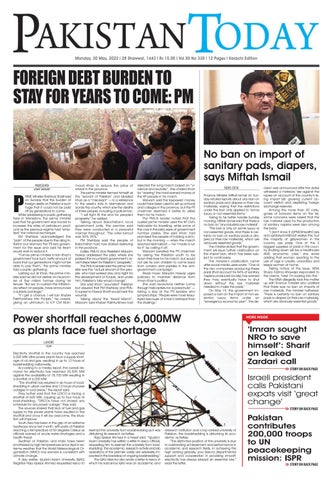
Monday, 30 May, 2022 I 28 Shawwal, 1443 I Rs 15.00 I Vol XII No 330 I 12 Pages I Karachi Edition
foreign debt burden to stay for years to come: Pm No ban on import of sanitary pads, diapers, says Miftah Ismail MAnseHRA
P
sTaff rePorT
RIME Minister Shehbaz Sharif said on Sunday that the burden of foreign debts on Pakistan is such huge that it could not be paid off by generations to come. While addressing a public gathering here in Mansehra, the prime minister said that his government was forced to increase the rates of petroleum products as the previous regime had “emptied” the national exchequer. PM Shehbaz acknowledged the “pain” of the people due to the rising inflation but blamed the PTI-led government for the issue and said his team would work to reduce it. “Former prime minister Imran Khan’s government took such hefty amount of loans that our generations might not be able to pay them,” the prime minister told a public gathering. Lashing out at Khan, the prime minister said he did not deliver on his promise of five million homes during his tenure. “But we, to cushion the inflationary effect on people, have announced a subsidy package.” “If I get a chance, I will turn Khyber Pakhtunkhwa into Punjab,” he vowed, giving an ultimatum to K-P CM Mah-
mood Khan to reduce the price of wheat in the province. The prime minister termed himself as the “servant of Pakistan” and labelled Khan as a “miscreant” — in a reference to this week’s riots in Islamabad and across the country, which saw the deaths of three people, including a policeman. “I will fight till the end for people’s prosperity,” he added. Talking about Balochistan’s local government polls, the premier said they were conducted in a peaceful manner throughout. “The voter turnout was 30%-35%.” PM Shehbaz said the people of Balochistan had now started believing in the province. Earlier, PML-N Vice President Maryam Nawaz addressed the jalsa, where she praised the incumbent government’s recent steps taken for Pakistan’s “prosperity”. The PML-N leader said the prime minister was the “actual servant of the people, who had worked day and night for the development of Punjab, and under him, Pakistan’s fate would change”. She said Khan “wounded” Pakistan but assured that PM Shehbaz and PMLN supremo Nawaz Sharif would heal the wounds. Talking about the “Azadi March”, Maryam said Khyber Pakhtunkhwa had
rejected the long march based on “violence and brutality”. She chided Khan for “wasting” the hard-earned money of the KP people in his march. Maryam said the taxpayers’ money could have been used to set up schools and colleges in the province, but the PTI chairman deemed it better to utilise them for his march. The PML-N leader noted that the ousted prime minister used the KP CM’s helicopter for travelling, while some of the cars in the jalsa were of government number plates. She said Khan had promised the people of holding a sit-in, but in the morning — when the march reached Islamabad — he “made a run for it” by calling it off. Maryam berated the PTI chairman for asking the Pakistani youth to lay down their lives for his march, but would not ask his own children to come back from London and partake in the antigovernment campaign. Read more: Maryam Nawaz urges judiciary to maintain distance from Imran Khan’s politics She said revolutions neither come through helicopters nor a parachute” — taking a jibe at the PTI leaders who jumped ships. “People were more tearyeyed because of Imran’s betrayal than the shellings.”
news desk Finance Minister Miftah Ismail on Sunday refuted reports about any ban on sanitary pads and diapers or their raw materials, saying that the restrictions under the ban only applied to “some luxury or non-essential items.” Taking to his twitter handle Sunday morning, Miftah Ismail said that there is no ban on “any industrial raw material”. “The ban is only on some luxury or non-essential goods. And there is certainly no ban on sanitary pads or diapers (or their raw materials), which are obviously essential goods.” The minister stated that the government will issue further clarification on the import ban, which has been subject to controversy. The minister’s clarification came after social media users wrote: “One of the two companies producing these pads (that account for 84% of sanitary napkins produced locally) has warned they may eventually have to shut down without the raw materials needed to make the pads.” On May 19, the government imposed a ban on the import of non-essential luxury items under an “emergency economic plan”. The de-
Power shortfall reaches 6,000MW as plants face fuel shortage LAHORe TLTP
Electricity shortfall in the country has reached 6,000 MW after power plants face a supply shortage of oil and gas, resulting in up to 12 hours of loadshedding nationwide. According to a media report, the overall demand for electricity has reached 25,500 MW against the availability of 18,700 MW resulting in a shortfall of 6,000 MW. “The shortfall has resulted in six hours of loadshedding in urban centres and 12 hours of power outages in rural areas,” the report said. They further said that the LESCO is facing a shortfall of 600 MW, causing up to four hours of load-shedding. “DISCOs have not shared any schedule for any power outage,” they said. The sources shared that lack of fuel and gas supply to the power plants have resulted in the shortfall and once it will be overcome, the situation will improve. South Asia has been in the grip of an extreme heatwave since last month, with parts of Pakistan reaching a temperature of 50 degrees Celsius as officials warned of acute water shortages and a health threat. Swathes of Pakistan and India have been smothered by high temperatures since April in extreme weather that the World Meteorological Organisation (WMO) has warned is consistent with climate change. A day earlier, Quaid-i-Azam University (QAU) Registrar Raja Qaisar Ahmed requested Iesco to
cision was announced after the dollar witnessed a meteoric rise against the rupee on account of the country’s rising import bill, growing current account deficit and depleting foreign exchange reserves. Among the more than 30 categories of banned items on the list, some concerns were raised that the raw material used for the production of sanitary napkins were also among the bans. “I don’t know if @PMLNHealthCare and @MaryamNSharif realise this, but the majority of girls/women in this country use pads. One of the 2 biggest suppliers of pads in this country shutting down will be a healthcare AND economic crisis,” she wrote adding that women resorting to the use of rags is unsafe, unsanitary and keeps women at home. Taking notice of the issue, MNA Shaza Fatima Khawaja responded to the claims, “Hey! I’m looking into this.” The MNA allegedly took the matter up with finance minister who clarified that there was no ban on imports of raw materials. The minister furthered, “there is certainly no ban on sanitary pads or diapers (or their raw materials), which are obviously essential goods.”
more inside
‘Imran sought NRO to save himself’: Sharif on leaked Zardari call STORY ON BACK PAGE
Israeli president calls Pakistani expats visit ‘great change’ STORY ON BACK PAGE
exempt the university from loadshedding as it was disturbing its research activities. Raja Qaisar Ahmed in a tweet said: “Quaid-iAzam University has written a letter to Iesco Official, requesting him to exempt the university from loadshedding. The academic, research activity and lab operations of the premier varsity are adversely impacted in the backdrop of ongoing loadshedding.” The QAU director also wrote a letter to Iesco in which he said since QAU was an academic and
research institution and a top ranked university of Pakistan, the loadshedding is disturbing its academic activities. “This distinctive position of the university is due to outstanding achievement and performance in academic and research fields. In achieving this high ranking globally, your [Iesco] departmental support and cooperation in providing smooth electricity has always played an essential role,” read the letter.
Pakistan contributes 200,000 troops to UN peacekeeping mission: ISPR STORY ON BACK PAGE
02-03 NEWS 30 MAY_Layout 1 5/30/2022 1:08 AM Page 1
02
Monday, 30 May, 2022 | KARACHI
NEWS
QuESt for truE frEEdom iS rEal jiHad: imraN KHaN CHARSADDA
P
stAff RePoRt
AKISTAN Tehreek-e-Insasf (PTI) Chairman and former Prime Minister Imran Khan Sunday told party workers here that that the quest for true freedom is real jehad. “As long as I am alive, the struggle against thieves will continue and now no one will be able to stop it,” Imran Khan told charged youth at the PTI’s Workers’ Convention held here in Charsadda. He said that Pakistanis will never accept the U.S. slavery and that’s why they are fighting a real war of liberation against thieves. “When a nation fights for freedom, it is jehad.”
Hamza Shehbaz directs steps to resolve water problem in Cholistan LAHORE
The former PM further said that PTI’s workers have been martyred in the war of independence and they were all for the freedom of the country, adding that peaceful protest is their democratic right. While lashing out at current government, he said that American slaves have increased the price of petrol while India bought cheap oil from Russia and reduced prices, India is free but we (Pakistanis) are slaves. The PTI supremo further added that Pakistani delegation has gone to Israel and when the American slaves sit on the top, they will do whatever order is given, adding that they will sell Kashmir by compromising with India. “The current government is now going to recognize Israel,” Imran claimed. The former prime minister was comment
Punjab Chief Minister Hamza Shahbaz has issued necessary directions with regard to taking steps resolving the water problem in Cholistan on a permanent basis along with improving law and order situation in South Punjab. Presiding over a meeting at the Circuit House Bahawalpur on late Saturday night, Hamza Shahbaz directed to undertake emergency steps to resolve the water problem in Cholistan on a permanent basis. On the special direction of the CM, a decision was taken to launch pilot project of solar water pumps in Cholistan, said a handout issued here. Hamza Shahbaz asserted that irrigated places be identified at the earliest in order to install solar water pumps. The CM directed the quantification of wildlife, especially of birds on a scientific basis in the Lal Suhanra National Park along with making a documentary for the promotion of tourism. He directed to avail the services of male and female students from various educational institutions for attaining this purpose and ordered DG Wildlife to submit a report within 10 days in this regard. The CM underscored that the major part of livelihood of the people of South Punjab depended on wildlife and tourism and directed Commissioner Bahawalpur to invite multinational companies to provide assistance to these people. DPO gave a briefing to the CM about the law and order situation in Bahawalpur and CM inquired about how many cameras were installed in the city and how many were functional. Hamza Shahbaz directed to expedite launching crackdown against the criminal elements. He directed DPO Bahawalpur to prioritise maintaining law and order situation along with ensuring security of the people in the district. Commissioner Bahawalpur, Deputy Commissioner, DPO and officials of Forest department gave a briefing to the CM. Additional Chief Secretary and Additional Inspector General Police of South Punjab were also present on this occasion.
ISLAMABAD The Islamabad High Court (IHC) Sunday directed the federal government to serve notices to ex-president Pervez Musharraf and all other successors — the former prime ministers, including the incumbent holder of the office — in cases of missing persons. IHC Chief Justice Athar Minallah has issued 15page order in a case relating to the disappearance of journalist Muadassir Naro and five other people after their petitions were fixed for final arguments, but the federal government requested an adjournment. The court noted that not only nationals, but even non-Pakistani citizens enjoy the fundamental right of security and protection of life. However, the reports submitted on behalf of the Commission of Inquiry on Enforced Disappearances manifest that the phenomenon of enforced disappearances not only exists but the impunity is to such an extent that no one has ever been held accountable, the order noted. “It has, prima facie, become obvious that the Commission, rather than achieving its object, has become a forum which contributes toward making the agony and pain of the victims more profound. Its proceedings seem to have become a mere formality and its adversarial nature undermines and violates the dignity of the loved ones,” it mentioned. Moreover, the court observed in its order that it is alarming that the federal government does not seem to have maintained the record and report of the earlier commission — headed by Justice (retd) Kamal Mansoor Alam. The report and recommendations of the Federal Task Force on Missing Persons also seem to have fallen on deaf ears, it noted. “In a nutshell, while the existence of the grave phenomenon of ‘enforced disappearance’ and impunity against it has never been denied, the federal government has so far failed to dispel the impression that it is an undeclared policy of the state.” The order said the existence of the phenomenon
of “enforced disappearances” is intolerable and, more so, when overwhelming evidence manifests that it has remained and continues to be an “undeclared tacit policy of the state”. On the involvement of the armed forces in such cases, the court observed they cannot, under the Constitution, act on their own and it was the federal government’s responsibility to oversee them. “It is the duty of the federal government, i.e the prime minister and members of the cabinet, to ensure that the constitutional scheme is not violated,” the order said. “The buck stops with the federal government and it is solely to be held accountable for any subversive act or omission of the Armed Forces,” the court added. Moving on to the former president general (retired) Pervez Musharraf — who ruled the country from — 1999 to 2008 — the court noted that he had candidly referred to enforced disappearance as an undeclared policy of the state. “It is an undeniable fact that General (retd) Pervaiz Musharraf, who had taken over the reins of power after abrogating the Constitution and, thereafter, had ruled the country as its chief executive for almost a decade, has candidly conceded in his autobiography ‘In the Line of Fire’ that ‘enforced disappearances’ was an undeclared policy of the State,” the order observed. The federal government shall produce the missing persons before the court on the date fixed or justify the failure of the state to effectively investigate and trace their whereabouts, the court told the attorney-general in the order. The order said once the government issues notice to the chief executives, including Musharraf, they should submit their respective affidavits. In the affidavits, the court said, they should explain why the court should not order proceedings against them for alleged subversion of the Constitution in the context of the undeclared tacit approval of the policy regarding enforced disappearances. “The onus is on each chief executive to rebut the presumption and to explain why they may not be tried for the offence of high treason,” it said.
Sit-in in the sun CITY NOTES M A NIAZI
Old cricketers are doing the most interesting of things, but it’s not because they’re interesting, as because the people they’re doing the things to are letting them do so. Look at Salman Butt, the opener who had been made Pakistan captain, but who flamed out caught telling Amir to do things in accordance with the wishes of the Mombay Bookies, or should we say the Mumbai Matchfixers. Butt has been given a job as coach of the Singapore national team. Singapore is an ICC Associate member, an aspirant for one-day status, and not yet Test status. Now Butt has every right to go for the job. He only knows two things, gambling and cricket. He must get a living from one or the other, not being ‘independently wealthy’, as the phrase goes. He’s a former captain of Pakistan, so he knows cricket, not just as a batsman, but in terms of setting the field and empathizing with bowlers. If it hadn’t been for his brush with the Mumbai Matchfixers, no one would say a word. But what skills will he be imparting to the Singapore dressing-room? How to carry
the other one from Mardan — lost their lives while fighting for the country’s independence. The former premier censured the government for using force against PTI workers who took to the streets against the alleged foreign conspiracy and said that the Supreme Court had allowed the PTI to protest peacefully as a democratic right but the government tried to sabotage it. “Listen, Shehbaz Sharif, Hamza and Rana Sanaullah, we will go to court and we will prosecute you and will make sure to throw your corrupt ” Khan warned. “Male police, following your orders, also invaded homes to disrespect the privacy of women.” He also condemned how the police attacked the vehicle of former Punjab health minister Dr Yasmin Rasheed.
IHC directs govt to issue notices to Musharraf, succeeding PMs in missing persons cases AgeNcIes
APP
on the statement by Israeli President Isaac Herzog in which he acknowledged that he had had a meeting with a PakistaniAmerican delegation, terming the encounter “amazing.” “This government will strike a deal with India to sell the people of Kashmir, and to top it off, they are also going to accept Israel.” Berating the coalition government, Khan said that while it “conspired” with the Americans to remove him from power, the people of Pakistan would never accept an “imported government” that has been imposed on them. Speaking about the violent clashes between PTI workers and the police during the party’s “Azadi March,” Khan said that two of his workers — one from Lahore and
a hands-free phone in one’s guard? I doubt it, because no one is going to pay Singapore to lose. They will, anyway. And no one is going to bet they will win. They won’t..Not
unless the other side fields less than 11. Salman Butt employed as Singapore coach. Wonder what he will teach them? If any random visitor to the Singapore
President felicitates newly-elected President, office-bearers of CPNE ISLAMABAD APP
President Dr Arif Alvi Sunday congratulated the newly elected President of Council of Pakistan Newspaper Editors (CPNC) Kazim Khan and other office bearers. The President expressed the hope that the newly elected leadership of CPNE will play its role against the publishing and spread of fake and unverified news. He stressed the need for creating awareness among youth on the positive use of social media and for identifying the fake news. He asked the media under the CPNE leadership to play its role for raising awareness for welfare of special persons and rights of women. He underlined the need for giving moral training to people for tackling social evils. Media should promote high moral values and Islamic teachings for eradicating social evils, he added. The President expressed the hope that the new leadership of CPNE will fully fulfill its social responsibilities.
dressing-room finds the team sitting in a circle playing mang patta. Or maybe flaash. It’s actually a deadly combination, for Singapore is a majority Chinese country, with 75.9 percent of the population Chinese and Mandarin one of the official languages. (And by the way, another is Tamil, which makes Singapore one of two counties to have Tamil as an official language, the other being Sri Lanka). Now the Chinese love to gamble. Indeed, they have got a gambling problem. So Salman Butt is going to find himself caught in the middle when the Beijing Bookies want a piece of the action, not to mention the Macao Matchfixers. And while Salman Butt works out his share of the action (because I’m sure that he has to pass on a share to the Singapore board: its members must have decided they’d never win the World Cup, so they might as well retire rich), Imran Khan must be chortling over the fact that he had a nation of more than 120 million going for a while, and deciding to cancel his sitin. Well, that was good news for all of us, not so much because of the fact that clashes were avoided, as because it meant stomachs wouldn’t be upset. He intended to bring three million people to a city with a population of two million, with bathroom facilities to match. With the weather what it is, both diarrhea and constipation are problems, so while some would have listened attentively to Imran’s harangue, others would have suddenly gone off into the
bushes, hoping their stomachs would allow them to make it, while still others would not make it to the speech because their straining had borne no result. Last time, Parliament and PTV were stormed for no other reason than the need of desperate PTI workers to use their toilets. Be that as it may, one wonders what happened to the great conspiracy. Has Imran somehow joined it? Or is it simply that the nation showed it did not deserve such a leader by not turning up in sufficient numbers? Or did three million turn up, and we simply didn’t see them? I think that three million were there in spirit. A lot of people didn’t trust their car ACs, and were appalled to learn that there were no facilities at D-Chowk. Incidentally, this weather makes it even more incredible that the last attempt at a revolt, the 1857 Mutiny, was started in May. Wouldn’t it have been better to have tried in November? That way you can get the whole winter in which to do something. In those days, there were obviously no ACs, there being no electricity. Instead, people dug great tunnels in the earth, and filled them with snow brought down from Kashmir in the winters. You would use that ice in the summer. You did not organize gatherings above ground. Imran should realize that people have come once, however many they were, and might prefer to come only in spirit next time. Those who actually went probably are kicking themselves for not doing what everyone else did, and go only in spirit.
02-03 NEWS 30 MAY_Layout 1 5/30/2022 1:08 AM Page 2
Monday, 30 May, 2022 | KARACHI
NEWS
SHarifS ‘biggESt bENEfiCiariES’ of Nab law amENdmENtS: QurESHi
f
NEwS DESK
ORMER foreign minister and PTI Shah Mehmood Qureshi on Sunday accused the government of amending accountability laws to protect the “corrupt elite class”, claiming PMLN chief Nawaz Sharif and Prime Minister Shehbaz Sharif will be the “biggest beneficiaries of the amendments.” “The PTI has decided to approach the Supreme Court to challenge the amendments along with other election-related legislation passed by the government,” the PTI stalwart told a press conference and added that the party has also urged the top court to take notice of changes to the NAB law, which has virtually left the the accountability watchdog dysfunctional. Addressing the journalists in Islamabad, Qureshi alleged the amendments made by the government to the National Accountability Ordinance, 1999 were the ones they had once proposed to the PTI in an attempt to get the NRO. It is to be noted that the National
Assembly had approved the National Accountability (Second Amendment) Bill, 2021, on May 26. According to the amendments, NAB deputy chairman to become acting chairman upon retirement of the chairman. It will be mandatory to initiate process for the appointment of a new chairman two months prior to incumbent’s retirement and completed in 40 days. The Federal and provincial tax matters removed from NAB’s purview besides removal of Regulatory bodies’ decisions from NAB’s purview. Judges to be appointed in accountability courts for a three-year period; cases to be decided within year. NAB will be bound to ensure availability of evidence prior to arrest, otherwise five years imprisonment will handed down any officer for filing false reference. Qureshi claimed that the prime minister will be a direct beneficiary of the amendment made in Section-9 (A-V) which deals with corruption and corrupt practises
as well as wealth beyond sources of income. Similarly, the former minister claimed PML-N supremo Nawaz will also directly benefit from changes in Section-14 of the NAB, which relates to “presumption against accused accepting illegal gratification”. Under this section, the suspect who was bound to furnish a money trail will no longer be required to provide the same, he added. “A blanket cover has been provided to all cases pertaining to money laundering and asset beyond means”, he regretted and added that after the amendment, the legal and statutory protection to NAB has been compromised and it has now come under the federal government. PTI TO APPROACH SUPREME COURT: Shah Mehmood Qureshi revealed that his party has decided to approach the Supreme Court to challenge the amendments along with other election-related legislation passed by the government, saying “we also urge the top court to take notice of changes to the NAB law which has made the accountability watchdog dysfunctional”. He was of the view that the entire
exercise undertaken by the PML-N-led government was aimed at “benefitting” political personalities who were facing high profile cases. He said the amendments approved by the government were in contravention of the UN Convention gainst Corruption and Financial Action Task Force requirements. Qureshi said that around “80 per cent of NAB cases” will be transferred to other courts from accountability courts, saying “this is exactly what the PML-N and the PPP had been looking forward to for a long time”. The PTI leader also objected to the passage of the Elections (Amendment) Bill 2022, which seeks to remove the use of electronic voting machines (EVMs) in general elections as well as disallows overseas Pakistanis from voting electronically. “Overseas Pakistanis are significant contributors to our economy, but the PPP and the PML-N believe that Pakistanis based abroad are inclined towards the PTI, hence it excluded all of them from voting right, which is injustice,” the ex-minister added.
03
He said the PTI also planned to challenge the amendments to the election law as well. Qureshi recalled that he contested polls in 2018 from NA-156 and PP-217 , saying: “I won the NA seat whose result was announced at 10pm, but I lost the provincial seat as its result was declared at 4am.” He said the staff tasked with counting the votes and managing the entire process were the same. “I am telling you because I have seen this happen.” The PTI leader said the electronic voting machines were introduced to eliminate chances of vote tampering, but the opposition did “where it finds its benefit”. LEAKED AUDIOTAPE REJECTED: Meanwhile, PTI Vice Chairman Shah Mehmood Qureshi rejected leaked audiotape between property tycoon Malik Riaz and former president Asif Ali Zardari. Talking to media persons, the former foreign minister said that it is out of question that former prime minister Imran Khan would ask someone to patch things up for him. These people get united just to degrade PTI Chairman, he added. It is important to mention that an alleged audio tape of famous property tycoon Malik Riaz delivering Imran Khan’s message to former President and Pakistan Peoples’ Party (PPP) co-chairman Asif Ali Zardari has been leaked. In the telephonic conversation, Malik Riaz could be heard giving the ex-president the message of PTI Chairman Imran Khan.
Oil rally continues as Brent secures 6.11pc weekly gain
ISLAMABAD tLtP
Crude oil futures rallied for the second week to their highest level since March and surged up to 6.11 percent amid consistent supply concerns due to looming European ban on Russian oil and expectations of higher demand in the US as the summer season looms. Brent, the international benchmark for two-thirds of the world’s oil, surged for the second week in a row. Brent price increased by $6.88 (+6.11
percent) to $119.43 from $112.55 on a week-on-week (WoW) basis. The West Texas Intermediate (WTI), the main oil benchmark for North America, went up by $4.79 a barrel (+4.34 percent) to $115.07 from $110.28 on a weekly basis, after inching down in the preceding week. The price for Opec Basket increased for the second week in a row from $112.04 to $116.50 on a weekon-week basis, showing an increase of $4.46 (+3.98 percent). The OPEC Reference Basket of Crudes (ORB) is
made up of Saharan Blend, Girassol, Djeno, Zafiro, Rabi Light, Iran Heavy, Basra Light, Kuwait Export, Es Sider, Bonny Light, Arab Light, Murban and Merey. The price of Russian Sokol increased for the second consecutive week by $4.64 (+4.69 percent) to $103.56 from $98.92 on WoW basis. Similarly, Arab Light prices witnessed an increase for the second straight week and surged by $4.49 (+4.10 percent) to reach $113.91 from $109.42 a barrel on a weekly basis. The oil prices closed the week with gains ahead of the US Memorial Day holiday weekend, which is the peak US demand season, and as European nations negotiate over whether to impose an outright ban on Russian crude oil. The prices also drew support from strong worldwide demand for fuel. The US driving season and strong travel demand helped prices to rally, as supply growth lags demand growth, the oil market is likely to stay undersupplied, which will help prices to rise in near-term. On the other hand, the European Union countries are negotiating a deal on Russian oil sanctions that would embargo shipment deliveries but delay sanctions on oil delivered by pipeline to win over Hungary and other landlocked
member states. Hungary’s resistance to oil sanctions and reluctance of other countries have held up implementation of a sixth package of sanctions by the 27-member EU against Russia following its invasion of Ukraine. The EU government envoys could reach an agreement in Brussels on Sunday in time for leaders to endorse it at their May 30-31 summit. The easing of the coronavirus pandemic restrictions in China, the world’s largest importer of oil, is also supporting crude prices. Shanghai, the country’s commercial centre, plans to reopen shopping centres and shops from June 1. Opec+, which meets this week, is expected to stick to plans to raise production by only 432,000 barrels a day, providing another supportive factor in a tight market. Oil prices have gained more than 60 percent since last year on supply concerns and improved demand as global economies recover from the coronavirus pandemic. Brent traded close to $140 a barrel in March after Russia’s military offensive in Ukraine, before falling back due to renewed Covid-19 lockdowns in China and the release of oil reserves by International Energy Agency member countries.
PSX sheds 3,740 points as falling spree extends for sixth week KARACHI AgeNcIes
Pakistan Stock Exchange (PSX) remained bearish for the sixth consecutive week amid depleting foreign exchange reserves, domestic political turbulence and economic uncertainty, with the benchmark KSE100 Index shedding 239.26 points (-0.56 percent) to close at 42,861.45 points. Overall, the benchmark index has shed 3,740 points or 8.02 percent during the last six weeks. During the previous week, the benchmark index nosedived during the first two sessions of the week and shed 660.46 points (-1.53 percent) on Monday and 489.93 points (-1.15 percent) on Tuesday, as the State Bank of Pakistan hiked the key policy rate by 150 basis points to an 11-year high at 13.75 percent. Moreover, the heated political environment, besides the persistently deteriorating macroeconomic outlook, also kept the investors’ interest in check. The falling Pakistani rupee against the US dollar amid fast depleting foreign exchange reserves continued to haunt the trading atmosphere at the bourse, thus keeping the bulls at bay. However, the index closed in green during the next three sessions by gaining 62.34 points (+0.15 percent) on
Wednesday, 529.05 points (+1.26 percent) on Thursday and 319.74 (0.75 percent) on Friday. The last three sessions helped the index trim most of the losses on the back of value hunting of attractive stocks, decision of Pakistan Tehreek-e-Insaf’s (PTI) Chairman Imran Khan to postpone the sit-in in the federal capital, and the government’s decision to increase petroleum prices in a bid to resume International Monetary Fund (IMF) loan programme. The government’s step helped strengthen rupee which also gave a boost to the investors’ confidence. According to a report of Topline Securities, concerns over the IMF loan
programme amid declining foreign exchange reserves and increasing political noise weighed on investors’ sentiment. However, some recovery was observed in the last few trading sessions as the PTI chief decided to postpone the sit-in and the government increased prices of petroleum products, thus paving the way for the IMF programme, the report added. During the week under review, average daily traded volume increased 27 percent on a week-on-week basis to 281 million shares, while average daily traded value inclined 26 percent weekon-week to $39 million. The sectors taking the index towards
north were technology and communication (66 points), refinery (40 points), automobile assemblers (32 points), oil and gas marketing companies (15 points) and food and personal care products (14 points). The sectors taking the index towards south were fertilizer (132 points), commercial banks (76 points), cement (56 points), oil and gas exploration companies (41 points) and power generation and distribution (29 points). Foreign selling was witnessed during the week, which came in at $1.5 million as compared to net selling of $6.1 million in the previous week. Major selling was witnessed in cement firms ($1.8 million) and banks ($1.4 million). On the domestic front, buying was reported by individuals ($11 million), followed by proprietary trading brokers ($2.9 million). According to Arif Habib Limited, the market may remain jittery in the upcoming week due to political strains, as PTI has given six days to the government to announce elections. However, it appears that the government’s removal of the subsidy on fuel and electricity will help revive the IMF loan programme. Once the package comes through, other sources of foreign exchange should also open up, which will be a positive for the market.
omar ayub Khan seeks registration of fir against rana Sanaullah HARIPUR INP
Former federal minister and Pakistan Tehreek-e-Insaf (PTI) leader Omar Ayub Khan has sought the registration of a First Information Report (FIR) against Interior Minister Rana Sanaullah. According to details, the former energy minister submitted the application to Haripur’s Hassan Abdal police station. In the application, Omar Ayub said that the police fired tear gas and tortured peaceful protesters at the motorway during the party’s long march. The application further stated that several party workers were injured due to baton-charge and shelling from police. He also nominated the Inspector-General of Police (IGP) Punjab and other police officials in the application.
PPP minister urges Pm to shun practice of summaries approval through circulation
ISLAMABAD INP
In a letter to Prime Minister Shehbaz Sharif on Sunday, Federal Minister Khursheed Shah objected to approval through circulation of summaries and demanded that this practice should be ended. “Matters that are discussed in the cabinet are being approved through circulation of summaries. This practice has been observed during the last one month,” Khursheed Shah informed the prime minister in the letter. “Approval through circulation of summaries was a policy and strategy of Pakistan Tehreek-e-Insaf (PTI) which used to refrain from discussing issues in the cabinet meeting and preferred to get approval from ministers through circulation,” Shah said. “Continuing this tradition of PTI does not create a good impression. My suggestion is that the summaries sent by the departments should be included in the agenda of the cabinet,” he suggested. “So that the advantages and disadvantages of the issues could be discussed in detail before approval,” he added.
04 NEWS 30 KHI ISB_Layout 1 5/30/2022 12:13 AM Page 1
Monday, 30 May, 2022 | KARACHI
04 NEWS
Turkey can be model for ‘green indusTrialisaTion’: experT isTAnBUL
T
anadolu agency
URKEy can serve as a model for other developing nations in “green industrialisation,” while itself focusing on efficiency and cooperation with other countries, experts said. “Turkey has a huge potential of hydro as well as wind power compared to many developing countries,” said Fatma Gul Unal, senior economist at the UN Conference on Trade and Development (UNCTAD). She said the country has a “quite diversified” economy, while its human resources and state machinery are “working in a way that may not exist in many developing countries.” Unal was speaking to Anadolu Agency on the sidelines of a panel on green industrialisation in Turkey, jointly hosted by the
UNCTAD and Istanbul-based Kadir Has University. It was the first in a planned series of events under the UNCTAD project “Integrated policy strategies and regional policy coordination for resilient, green and transformative development” also to be held in Pakistan, Kazakhstan, and Malaysia. “Turkey could be a model for the other developing countries because it has the majority of water resources in the Middle East and North Africa,” said Unal, adding that the country also has a significant amount of arable land. “When green comes to mind, the agricultural sector provides for sustainable development and food security issues which are very current and contemporary right now,” she said. Development “has to be green-transitioned,” the UN economist said. ‘Political will needed for
green industrialisation’: By diverting a mere 2.5% of their GDP to green investments, UN member countries could generate jobs for their people, Unal underlined. “What is missing in this picture is political will and integrated policies, sustainable long-term policies,” she remarked, adding that UNCTAD’s initiative would also lead to regional talks on the exchange of knowledge to show that green industrialisation is possible. Robert Pollin, an economics professor at the University of Massachusetts-Amherst in the US, told Anadolu Agency that Turkey should “invest in raising efficiency standards and increasing public transportation, getting cars off the road.” Investments in electric heating and cooling is also “relatively inexpensive,” he added.
To reduce carbon emissions, Pollin said, Turkey should invest in renewable energy, which would, in turn, reduce its imports in that sector. He suggested that Turkey should work to “substitute imported fossil fuel to having domestic green energy.” To realise green industrialisation, Pollin told the panel that “mobilising existing institutions” would be key for more effective policies. Pointing to the World Bank and International Monetary Fund, Pollin said their efforts would also lead to policies towards achieving sustainability goals. cooPeration between countries: Safdar Sohail, from Pakistan’s National Institute of Public Policy, said Turkey and Pakistan could “help each other and learn from each other in technology” with regard to green industrialisation.
At the regional level, Sohail said, regional economic cooperation would be a better platform for the two countries’ work towards their sustainability goals. “Both countries are doing interesting things in the greening of their economy, like the collaboration between the two countries in public transport facilities,” he said, pointing to the public subway line in Lahore that was built by a Turkish firm, as an example. He said the revival of the IstanbulTehran-Islamabad railway was also a step in the direction of economic integration. Calling for south-south cooperation among the developing nations, the Pakistani expert urged countries to use “cleaner technologies for production.” Amid “hyper globalisation,” he told the panel, “development practice” is needed much more at international levels before it can be at regional levels.
Indian singer and politician Sidhu Moosewala gunned down in Mansa district AgEnciEs
sTp to contest lg polls in sindh against feudal lords: Qadir magsi HYDERABAD aPP
Sindh Taraqi Pasand Party (STP) chairman Dr Qadir Magsi on Sunday said that his party will give tough time to PPP in the local body elections across the province and will not allow anyone to win the elections unopposed. He expressed these views while addressing a meeting of party office bearers of Karachi division at Taraqi Pasand House. Dr Magsi said that Sindh was in a difficult situation for which there was need of joint struggle for the rights of the masses. He alleged that 16000 acres of land had been illegally allotted to Bahria Town while the lands of the province were being illegally occupied. He expressed concern over rising inflation in the country and demanded of the government to reverse the increased prices of petroleum and diesel. He said that young people across Sindh were competing with the feudal lords in the local body elections and now no one would be able to win the elections without contest. STP leaders Haider Mallah, Soomar Mangrio, Ashiq Solangi, Qadir Chana and others were present on the occasion.
singer edava basheer dies during live performance AgEnciEs Kollam, India: The video of the veteran Indian singer Edava Basheer passing away during a live concert in the Kollam district of the Kerala state in India. The viral video sees the deceased singer’s performance the Mano Ho Thum live when he collapsed on stage. The singer was declared dead in a hospital. He was laid to rest at Kadappakada Juma Masjid Kabarishthan. The music show was organized by the Blue Diamond orchestra. He was part of the musical group for years.
Indian singer and politician Sidhu Moosewala was killed on Sunday by unknown assailants in Jawaharke village in Indian Punjab’s Mansa district, The Wire reported. The report said the incident occurred a day after the local police curtailed the security of 424 VIPs, which also included Moose Wala. The Hindustan Times reported that he, along with two others, was four kilometres away from his home in Moosa village when unidentified individuals opened fire at his vehicle. The report quoted the police as saying that Moosewala was hit by multiple bullets and taken to Mansa civil hospital where he died. The condition of the other two was critical. Indian media reported that he had joined the Congress party in December 2021 for the Punjab assembly elections.
He had contested from his hometown of Mansa but suffered a defeat to the Aam Aadmi Party’s (AAP) Vijay Singla. Meanwhile, The Wire reported that his fan-following was in the “millions”, extending all the way to countries such as the US, UK, Canada and Australia. “He was famous for his rap songs with hard-hitting, sarcastic content which asked questions of society, politicians, religious leaders, rival singers and spoke of the country’s problems,” the report added. Indian politicians condemned the news and extended their condolences at the tragedy. “I am shocked and deeply saddened by the gruesome murder of Siddhu Moosewala. Nobody involved will be spared,” said Indian Punjab Chief Minister Bhagwant Mann. “We stand united & undeterred, at this time of extreme grief,” the Congress party said.
Congress leader Rahul Gandhi said he was “deeply shocked and saddened” by the murder. Bharatiya Janata Party leader Man-
jinder Singh Sirsa slammed the provincial AAP government, saying the law and order situation in the province was “totally out of control”.
Stage set to host Asia Rugby Div II Championship 2022 LAHORE PR
Stage is set to host Asia Rugby Div II Championship 2022 here at Lahore, said Arif Saeed President Pakistan Rugby Union in a press conference. Arif said this along with Asia Rugby Chief Executive Johny Stavrinou, Tournament Director Ghaith Jalajel, Secretary PRU Salman Shaikh, Pakistan Rugby team Head coach Gert Mulder, Pakistan national team Captain Hamad Safdar, Thailand head coach Withapong Jindasawat, Captain Patchraaphat Sornritchingchai and Chief Selector PRU Rizwan Malik. The manager of the Thailand rugby team Suti Meethavorn, Director Punjab sports board Hafeez Bhatti, Asia Rugby Media manager Khurram Haroon, PRU management were also present on the occasion. President PRU Arif Saeed welcomed the Thailand rugby team and management of Asia Rugby to the great city of Lahore. All arrangements have been
completed to host Thailand here in Lahore. Pakistan Rugby Union is honored to host such a big event of Asia Rugby
DIV II championship. We will host this event in a very positive manner as we have done many International events in
the past. First test match between Pakistan and Thailand will be played on 29th May 2022 at 7.30 pm in Punjab Stadium while 2nd match on 1st June 2022 here at Punjab Stadium Lahore. He was hopeful that Pakistan team will play high quality rugby and has a good chance for qualifying for Div I. He said we are pleased to have the services of a high quality coach in the form of Gert Mulder from South Africa. Tournament Director who came from Jordan Ghaith Jalajel said that after Covid restrictions and 2019 this is Asia Rugby`s first 15 a Side ranking event. Pakistan national team captain Hamad Safdar said that our boys have trained really hard over the past three months and are hopeful of qualifying for Division I for the first time. Thailand Captain Patchraaphat Sornritchingchai said that we have a good experience playing in this sort of hot weather and are looking forward to this event.
Ashrafi seeks action against those who visited Israel on Pakistani passports isLAMABAD Staff RePoRt
Pakistan Ulema Council (PUC) Chairman Hafiz Tahir Mehmood Ashrafi on Sunday urged the government to take legal action against those who visited Israel on the Pakistani passports. He, in a communique along with other PUC leadership, made it clear that Pakistan had a very clear and explicit stance on the Palestinian issue and the delegation, which held a meeting with the Israeli president
CMYK
were not representatives of Pakistani people and the state. He asked the quarters concerned to hold a thorough investigation into the matter on priority. He said the delegation visited Israel had tried to tarnish the image of Pakistan and Islam. The nation and the state of Pakistan stood by Palestinians for their just cause, he added. Ashrafi said Pakistan would not recognize Israel at any cost and in any circumstances. He said Kashmir and Palestine were burning issues of the Islamic world, and without their res-
olutions, peace and stability in the world could not be possible. He said Israeli government had disgraced all the international resolutions including the United Nations (UN) by allowing the Jewish settlers to forcefully enter in Masajid-AlAqsa. He expressed the hope that a series of atrocities committed by Israeli forces on Palestinians and indignity of Masajid-e-Aqsa would come to an end soon. Ashrafi urged the Organization of Islamic Cooperation and the UN to take notice on disgrace of
Masajid-e-Aqsa by Israeli forces. Maulana Asad Zikriya Qasmi, Maulana Abdul Haq Mujahid, Maulana Noman Haashir, Maulana Mohammad Shafi Qasmi, Maulana Asadullah Farooq, Maulana Abu Bakr Hamid Sabri, Maulana Tahir Aqil Awan, Maulana Mohammad Aslam Siddiqui, Maulana Aziz Akbar Qasmi, Maulana Saad Allah Shafiq, Maulana Mohammad Ashfaq Patafi, Allama Tahir-ul-Hasan, Allama Pir Zubair Abid, Maulana Abdul Hakim Athar and others were present on the occasion.
Monday, 30 May, 2022 | KARACHI
NEWS
05
DElEGaTiOn lEavES fOr inDia TO hOlD waTEr TalkS LAHORE
Sarwar among 150 booked for hurling threats at police ISLAMABAD Staff RepoRt
A case has been registered against 150 people, including Pakistan Tehreek-e-Insaf (PTI) MP Ghulam Sarwar Khan, at Golra police station in Islamabad. The case was registered by Islamabad police on charges of manhandling its force and hurling death threats at them. “The convoy led by Ghulam Sarwar hurled death threats at police […] at the behest of Imran Khan, Pervez Khattak and Shah Mehmood Qureshi,” read the FIR. The police fired teargas, baton-charged and detained supporters of the former prime minister to stop them from reaching Islamabad to demand fresh elections, witnesses said. Clashes between Khan’s supporters and activists and police were reported in multiple cities, including Lahore. Live TV footage showed police fighting with Khan’s supporters, beating them and in some places breaking their vehicles’ windscreens and bundling them into police vans. Such practices have helped make the police “one of the most widely feared, complained against, and least trusted government institutions in Pakistan”, Human Rights Watch (HRW) said. Minister for Interior Rana Sanaullah Khan later said police had carried out a total of 4,417 swoops on Khan supporters’ homes, offices and on protest rallies and had arrested nearly 1,700 people. Of those, 250 were later freed, he said.
Power Plant to bring end to misery in Gwadar by October 2023
ISLAMABAD Staff RepoRt
The longstanding issue of Gwadar city due to growing energy scarcity will end by October 2023 after the completion of the 300-megawatt coal-fired power plant. The 300-megawatt (MW) coal-fired Gwadar Power Plant will cater the needs of some 150,000 local people by the end of 2023 under the 2050 Master Plan of Gwadar, the state-run news agency reported on Sunday citing sources. The power plant is one of the key energy projects under the China-Pakistan Economic Corridor (CPEC). The project is aimed at improving reliability on local power supply that will help resolve power outages in current economic development and urban expansion in Gwadar region. According to the official sources, they are currently spending millions of dollars per annum to generate electricity from diesel generator. The official also hoped that the discussed plant would be operationalized soon to solve the port’s power scarcity issues. Power plant is of great significance to deepening the energy cooperation between China and Pakistan, boosting the development of the Belt and Road Initiative, improving the overall power structure of Balochistan, and promoting local economic development in Gwadar Port. All major projects under CPEC in Gwadar, including Gwadar Power Plant, the New Gwadar International Airport Project, the China Pak Friendship Hospital, China-Pak Technical and Vocational Institute in Gwadar, the Gwadar East-bay Expressway Project, Gwadar Free Zone, and Gwadar Port would become a shining pearl in the region.
a
Staff RepoRt
five-member delegation headed by Indus Water Commissioner Syed Maher Ali Shah left for India on Sunday to hold talks on water disputes between the two nations. The delegation also included the Met director-general and representatives from the irrigation department, Foreign Office and NESPAK, and left for New Delhi via the Wagah border crossing. “We will hold talks over water issues for two days from tomorrow in New Delhi,” Shah said, and added the last meeting was held in Islamabad. The commissioner said they will hold talks with India on sharing flood data besides also raising objections on three water reservoir projects at the Chenab River.
“India has assured that it will submit a report on the construction of the reservoirs to address Pakistan’s concerns,” he said. Shah said their visit was aimed at attending the session and further re-
view of the Indian projects will be planned later. It is pertinent to mention here the 116th meeting of the India-Pakistan Permanent Indus Commission was held in New Delhi on 23-24 March 2021.
More Pakistan, China cooperation in fertilizer sector need of the hour BEIJING
Covid-19 daily update: 50 new cases ISLAMABAD Staff RepoRt
Pakistan reported 50 new Covid-19 cases over the past 24 hours, bringing the total tally to 1,530,285, the ministry of health said on Sunday. A total of 30,379 people died of Covid-19 in Pakistan, with no more deaths over the last 24 hours, according to the ministry’s statistics. On Saturday, 15,256 tests were conducted throughout Pakistan whereas the positivity rate stood at 0.33 percent. Up to 76 patients in the country are in critical condition.
Staff RepoRt
China and Pakistan can explore more cooperation to ensure the supply of fertilizers to the farmers for various crops in Pakistan. At the beginning of this year, the Pakistani government approved the import of 50,000 tonnes of urea from China on immediate basis, at a price lower than the current international level. Besides import and export trade, the two countries can explore more cooperation in fertilizer. S Li Guang, Secretary-General of China Phosphate and Compound Fertilizer Industry Association said, “The type and dosage of fertilizers used should be set according to local conditions and crop characteristics”. “Farmers should not only know the amount of fertilizer to be used, but also understand why they should use it that way.” The saying “no pains, no gains” is not for applying fertilizer, and the overuse of fertilizer will bring about resource waste and environmental damage. Reasonable use of fertilizer can reduce cost and decrease waste for farmers, achieving “twice the result with half the effort”. Besides, improving planting methods can save the amount of fertilizer to be used on a unit area too. Intercropping is a good choice. “This is strawberry-onion intercropping. In the late stage of strawberry planting, onion seedlings are sowed. Onion can secrete some bactericidal substances during its growth, which has the best effect on improving the soil conditions for strawberries. In addition, potassium fertilizer will also be used for strawberries to improve the sweetness of strawberry fruit. Ordinary onions are spicy, but the intercropped onions are sweetened by absorbing the fertilizer for strawberries, which taste great and unique,” Zhu Ning from Agricultural Technology Extension Station of Changping District, Beijing said. Some new fertilizers like organic fertilizer and water-soluble fertilizer are also worth attention. Compared with traditional fertilizers, new fertilizers have the characteristics of high efficiency, compound and slow-release. “In the early stage of planting, some organic fertilizers, such as chicken manure and sheep manure, will be added to make the soil looser and rich in more organic matter. In the late stage of planting, more water-soluble fertilizers will be used for topdressing. “In addition, in recent years, growers and con-
The Foreign Office in a statement said that under the relevant provisions of the Indus Waters Treaty (IWT), the meeting is held annually alternately in Pakistan and India. A host of issues related to the IWT were discussed during the meeting. Pakistan reiterated its objections to Indian water projects including Pakal Dul, Lower Kulnai, Durbuk Shyok and Nimu Chilling, read the statement. Pakistan asked India to share data on water flows as per the provisions of the IWT following the practice in vogue since 1989. The Pakistan side emphasized the importance of early resolution of the outstanding issues in accordance with the provisions of the IWT. Both sides agreed to make endeavours to resolve the issues, conduct tours of inspection and hold the next meeting of the commission in Pakistan at an early date.
Bilawal to visit Turkey, meet President Tayyip Erdogan sumers have more demands on the taste and quality of strawberries. Therefore, some fertilizers such as seaweed fertilizer, fish protein fertilizer and Huangpu acid fertilizer are being used to improve the fruit quality,” Zhu Ning added. “Based on the current experience, the final demand is new fertilizers, not just the superposition of basic fertilizers. A complete set of solutions should be provided in accordance with the local environment, plant types, etc. Through fertilizer products, it will be much simpler for farmers to improve the nutrition for the plants during the whole process,” Li Guang said. Chinese fertilizer companies are looking forward to exploring more cooperation possibilities to ensure supply of fertilizers to farmers for crops in Pakistan. “We also do research on soil conditioners. Next, we are planning to introduce fertilizer and soil conditioners to Pakistan. We will also bring our field management cultivation mode, including how to better raise seedlings, to Pakistan to carry out more cooperation,” Qi Liying, Executive Deputy General Manager of Tianjin Tianlongzaitian Agricultural Science and Technology Co., Ltd. said. Data shows that the cultivated land area in Pakistan has increased by two million hectares in the past two years, and 2021 is the year with the highest urea sales in Pakistan’s history. It is predicted that if the supply of urea cannot be guaranteed, the annual wheat yield in Pakistan may decrease by 5% to 10%.
KARACHI Staff RepoRt
Foreign Minister Bilawal Bhutto Zardari will leave for a two-day visit to Turkey from Dubai on today. According to sources, the foreign minister will leave for Istanbul via Dubai in a special plane where he would meet Turkey’s President Recep Tayyip Erdogan and his Turkish counterpart. He would discuss matters related to bilateral relations, and the promotion of trade between the two countries during the meetings. It is pertinent to mention here that the Ministry of Foreign Affairs has confirmed that Prime Minister Shehbaz Sharif will be visiting Turkey next week, embarking on his first visit to Ankara after assuming office last month.
13 years on, justice continues to elude Shopian rape, murder victims ISLAMABAD Staff RepoRt
Justice continues to elude families of Shopian double rape and murder victims despite the passage of thirteen years. Aasiya and Nelofar were abducted, raped and subsequently killed by the men in uniform in Shopian and their bodies were found on 30th May, 2009, said a report released by the KMS, today. It said the Shopian double rape and murder is a chilling example of Indian troops’ bru-
talities in Indian illegally occupied Jammu and Kashmir (IIOJK) and the incident is witness to institutionalized and structured violence that India is using in the territory. The report deplored Indian troops harass, torture and rape Kashmiri women to suppress the Kashmiris’ freedom struggle. As many as 11,255 cases of rape, gang-rape and molestation by Indian troops have been reported in IIOJK since 1990, it added. The report lamented that the Kashmiri women were subjected to the worst kind of torture by Indian troops owing to their role
in the freedom movement. Kashmiri women are the worst victims of Indian state terrorism as India is using rape of the Kashmiri women as a weapon of war in IIOJK. It said India is employing rape as a military tactic to terrorize and humiliate Kashmiris, adding the international community must wake up to stop sexual violence being used as a war tactic by India in IIOJK and India must be brought to book for committing heinous crimes against the Kashmiris.
CMYK
Shakeel Ahngar, husband of Neelofar and brother of Aasiya, who has lost faith in the Indian institutions, demanded justice from independent international forums. Shakeel in its interview had said he has now completely lost faith in all institutions of India and the occupied territory and demanded a probe by an independent international agency into the Shopian incident. “I have nothing new to add to my poignant tale that I have already recounted umpteen times. The justice delivery system in this part of world stands frozen,” he said.
He added that all investigations initiated by the occupation authorities were a smokescreen used to shield the perpetrators. “The killers, the rapists, are the ones who are doing the investigation,” says the father of one. How can you trust a system that is run by the very people who are part of the society that questions the integrity of a woman who has been raped?” he asked. He, however, said that he would never succumb to any pressure. “I am relentless in my pursuit for justice, come what may,” Ahangar added.
06-07 Comments - 30th May 2022_Layout 1 5/30/2022 12:06 AM Page 1
Monday, 30 May, 2022
06 COMMENT
China is a friend not foe
Getting out of the debt trap The need for $36 billion next year to service debt, shows the problem
How long can China ignore its security concerns?
F
iNaNCe Minister Miftah ismail told a webinar on National Dialogue on the economy: the way Forwartd’ that the country needed $36-37 billion to service its debt. that the figure should be so high is not surprising, and should illustrate the magnitude of the debt trap the country is in. this does not include the country’s other foreign exchange needs, such as to pay for imports of goods and services. it is perhaps no wonder that Dr ismail and his government are so anxious to do a deal with the iMF, not just for the money it would bring, but also because it would open up other sources of borrowing. However, all of that money would not suffice for Pakistan’s needs. the country will find it necessary to approach the money markets for financing, in the shape of fresh bond issues, as well as issuing new sukuks. Not that this is sustainable, but it is also unhealthy, which means that some out-of-the-box thinking is required. actually, it isn’t. Pakistan must learn to sell to the world more than it buys, which most certainly does not mean relying on remittances by expatriate workers. though all sources must be explored, obtaining Foreign Direct investment (FDi) must be encouraged. in fact, it is not clear why there is not more. Pakistan being the fifth most populous country, it is a huge market. that is yet to discuss other advantages, which include rich and varied resources, and a young population. However, there are also many disadvantages, most of which can be ascribed to the government. Not only Dr ismail, but also his predecessor, Mr shaukat tarin, told the webinar that the country needed a Charter of the economy, so as to assure foreign investors especially, that political stability would be maintained, and that economic policies would not swing wildly with the change in governments, with parties ensuring the decisions reached by predecessors were not reversed, and that policies remained the same. as for other problems, political stability was essential, political axes must not be ground at the expense of the economy. it is instructive at this juncture to remember that foreign corporations, which bring in foreign direct investment, are never as politically as intrusive as their governments, and they only involve those governments when theft feel they are being exploited by the home government. there are huge number of measures that can be taken, including the effect on the fuel import bill of switching over to renewables like solar, wind and hydel.
Dr Imran alI SanDano
T
He diplomatic history of China and Pakistan is full of exemplary agreements and events. the people-to-people contact was also started with its full zeal, but suddenly Chinese nationals and interests are being targeted by Balochistan’s ethno-nationalist militant organizations. Balochistan liberation army (Bla) is one of the most active ethno-nationalist militant organizations of the province, which is fighting against the Pakistani government for greater regional autonomy for the province of Balochistan. it is one of the brutal militant organizations which targets ethnic Punjabis, Hazara, sindhi, and now Chinese nationals who are working for the development of Balochistan. since long, Bla has remained involved in inhuman activities and targeted innocent people including engineers, teachers, social activists and administrators. Militants have continuously threatened, bombed, or otherwise attacked schools, resulting in injuries, deaths, property damage, and curtailed education for Balochistan’s children and youth. Fearing for their safety, many teachers—particularly ethnic Punjabis and shiite Muslims and other targeted minorities and now Chinese nationals—have sought leave or transfers, further burdening what is already the struggling educational system in Pakistan. the recent terrorist attack of Bla at Karachi university that resulted in the deaths of three Chinese nationals is also a part of its inhuman philosophy. in an online statement, Bla declared that the suicide bombing intentionally targeted Chinese nationals at university of Karachi “to give a clear message to China that its direct or indirect presence in Balochistan will not be tolerated.” some analysts believe that
Karachi incident Youth’s murder uncovers toxic culture persisting
t
The implications for the global strategic environment SabIna babar
C
lausewitz rightly stated that every weapon is a strategic weapon by considering its relevance with political and military objectives. indeed, weapons are tools for enabling armed forces to pursue political ends. strategic non-nuclear weapons are advanced conventional weapon systems designed to accomplish specific strategic functions. in recent decades, the proliferation of non-nuclear strategic weapons has progressed considerably. there is a race between states for growing arsenals of conventional and non-nuclear strategic-weapon systems, including conventional precision-strike capabilities, electronic, anti-satellite and cyber weapons, as well as missile defense capabilities that may be used in a strategic function. the term ‘non-nuclear strategic weapon’ denotes a category of non-nuclear weapon systems that, used on their own or in conjunction with other weapon systems, and under certain circumstances, can achieve decisive strategic outcomes in conflict. Nonnuclear strategic weapons refer to weapons systems below the nuclear threshold that can achieve the decisive strategic effect. the participants attributed this quality in part to their ability to engage targets at the strategic level of warfare, where the adversary’s sources of national power are located. the strategic non-nuclear weapons have been used in the past in iraq- iran war, in former Yugoslavia where they contributed to deterrence value. However, with the addition of ballistic missiles and a parallel pursuit of higher precision weapons has resulted in readjustment to the proliferation paradigm. the conflict of Nagorno-Karabakh between armenia and azerbaijan was not deterred by the availability of non-nuclear weapons. in this conflict, armed uaVs were used to cause devastating strategic effects, and non-nuclear strategic weapons ike armed uaVs are weapon systems, such as longrange strike weapons and armed uaVs which could be and were used to have devastating strategic effect
Dedicated to the legacy of late Hameed Nizami
Arif Nizami (Late) Founding Editor
Yousaf Nizami M. A. Niazi
Umar Aziz
Joint Editor
Joint Editor
Executive Editor
Lahore – Ph: 042-36300938, 042-36375965
If Beijing has a vested interest in Pakistan or in the region, it is common for each state to carry its interests. If we compare China with the USA, we can easily understand the intentions and development projections. It’s time to stand with our all-weather friend and recognize our foes
The writer is Visiting Scholar at Department of International Relations, Middle East Technical University, Ankara
Russia’s use of strategic non-nuclear-weapon in Ukraine
He young motorcyclists who had shot a motorist and his friend in Malir on Friday night remained unarrested, amid allegations that thety were the children of influential people. there has to be something wrong where such young men can carry around what the police strongly suspect is an unlicensed weapon, on the strength of which they roam around on motorbikes, spreading fear all around. the late Jazlan and his injured friend zargham were shot at because they had had the temerity to call out their assailants for that reckless bike-riding. the problem is that there is a culture of impunity, which existed at the time of the 2012 murder of shahzeb Khanby shahrukh Jatoi and siraj talpur, which was a targeted incident, again because shahzeb had tried to persuade shahrukh and friends from misbehaving. the killers were released after sahzeb’s father forgave them. they were the sons of influentials, and their impunity provided asn unfortunate example to other young men with too much money, too many firearms, and too much testosterone in their systems. the Nazim Jokhio case, where an MNa and MPa are accused to murdering him for reporting their violation of the game laws, is only the laterst example by which influential persons can profit. the weak point of the system is on display. there can be no further movement in this murder unless the victims are caught. there has been plenty of time for the pigeons to flee the coop, to get out of the country and thus outside the jurisdiction of the local police. arresting them will only be the beginning. the process of investigation and evidence gathering allows the police many opportunities of spoiling the case so as to please influentials. this case should allow the sindh government to reform the criminal justice system. too many young men are being sacrificed to the twisted egos of spoiled rich brats.
Editor Aziz-ud-Din Ahmad
the use of suicide bombings and the involvement of women in them by the Bla is a relatively new tactic for the group. apart from Bla, several other Pakistani ethnonationalist and religious militant groups have attempted to actively attack Chinese nationals and interests in Pakistan. last year, Nong Rong, the Chinese ambassador to Pakistan, escaped from a targeted bombing in a Quetta hotel which was carried out by the tehrik-i-taliban Pakistan (ttP). in June 2017, two Chinese nationals were abducted in Quetta, and later killed by the islamic state. i believe this trend will increase in the coming times as China economically entrench in Pakistan and explore deepening security cooperation which will give an open challenge to the usa which has withdrawn from afghanistan and has created a volatile security situation in the region. india will never see Pakistan in a good position. indeed, some external organizations are supporting Bla- and ttPlike militant groups to target China in Pakistan. Pakistan is one of the most enthusiastic member allies in China’s motivated foreign policy project, the Belt and Road initiative (BRi), of which the China Pakistan economic Corridor (CPeC) is a cornerstone. it is more about deepening China-Pakistan friendship. CPeC offers long-term development projects in infrastructure, energy, education, and security. in 2020, the two countries signed an agreement to increase defense cooperation between the Chinese People’s liberation army and Pakistani military. in 2021, both countries announced deeper counterterrorism cooperation. But, increasing target-killing of Chinese nationals in Pakistan has raised security concerns for China. the continuous targeting of Chinese nationals and interests in Pakistan will demonstrate anxieties about Chinese engagement and human security risks. at the moment, the Chinese Communist Party has trust and understanding with Pakistan and deepening economic and security ties, but how long will it sus-
tain such a situation? No doubt, sino-Pak friendship has always been an eyesore for india and now for the usa. Both have continuously been trying to disturb the economic and security cooperation between the two all-weather friends. CPeC has added fuel to the fire, especially for india. therefore it is trying to sabotage CPeC through its malicious activities and hatching conspiracies to destabilize Pakistan by all means available, including its proxies operating in Balochistan. Pakistan has evidence that indian proxies are in Balochistan which include the Balochistan liberation army (Bla), Balochistan liberation Front (BlF), Balochistan Republican army (BRa) and lashkare-Balochistan. these militants have direct connectivity with india’s Raw and National Directorate of security to damage sino-Pak friendship. the logic behind foreign interference in Balochistan is due to its geo-strategic and geo-economic importance. the development of Gwadar port is changing the dynamics of political and geo-economic environments of regional and international powers. they are trying their best to prevent the development of Gwadar port (Balochistan) to protect their own interests. No one can deny that deepening relations between China and Pakistan help Beijing’s geo-political and geoeconomic goals in the region, which may be stretching from reinforcing its traditional alignment with Pakistan against india, which is clear to all. this mutual understanding is based on win-win position - without any interference and proxies. we as a nation have to understand that China is our friend not foe. if Beijing has a vested interest in Pakistan or in the region, it is common for each state to carry its interests. if we compare China with the usa, we can easily understand the intentions and development projections. it’s time to stand with our allweather friends and recognize our foes.
I
Karachi – Ph: 021-35381208-9
I
by azerbaijan, was known beforehand, but, surprisingly, were discounted by armenia. this suggests that their deterrence value should not be overestimated, and that the credible demonstration of such capabilities is often necessary before it can be used in deterrence signaling. in contemporary times, strategic non-nuclear weapons constitute more practical implications. the large-scale employment of these weapons will result in asymmetric conflict specifically in case of weaker states, it gives them an edge as relying on superior technology and weapons will help them fight the conventional war. in the Russia-ukraine war, there is a conventional balance between ukraine and Russia, nevertheless Russia is enjoying asubstantial advantage because of its nonnuclear strategic weapons. Russia has deployed longrange precision-guided weapons which support the notion of Russian emphasis on non-nuclear strategic military deterrence. ukraine has turned into a largest testing ground for cruise and ballistic missiles, as in modern warfare Russia is focusing on non-nuclear strategic weapons. Russia is using non-strategic nuclear weapons in ukraine in different forms; it could use them for demonstration purposes, and not for creating any casualty, it could also use non-nuclear strategic weapons to coerce the west to agree to end its expansionism. Russia can also use these non-nuclear weapons to change operational situations and to achieve ultimate coercion. Russia has launched more than 1950 cruise missile strikes. the Russian missile strategy has involved use of cruise launches, ballistic strikes,
Islamabad – Ph: 051-2204545
hypersonic strikes and use of a coastal defense system to attack the ground target. the precision attacks under the non-nuclear strategy are tilting the war in favor of Russia, recently Moscow has used new generations of powerful laser weapons to counter the western arms flow in ukraine. the trajectories of hypersonic missiles is low, which makes them harder to detect for ukrainian forces, Russia is using them to tackle any kind of defense provided by the west. this war reinforces the transformation and position of power and deterrence with the use of strategic non-nuclear weapons and impacts the thinking of missile doctrine. the basic task of use of non-nuclear weapons is to focus on de-escalation that is working as a bulwark against any military actions of the enemy. For Russia, the goals of these attacks is to degrade the ukrainian force and ensure that if they cross the threshold it can retaliate with a strategic nuclear response. strategic non-nuclear weapons by Russia are complementing its nuclear deterrence by helping Russia gain maximum advantage in their pre nuclear phase of military conflict. apart from that precision missile strikes are providing Russia a strategic advantage as it can attack on infrastructure and capabilities where aerial bombing is risky. the ukrainian case is proving that non-nuclear strategic weapons can be feasible and effective in a conventional war. the strategic non-nuclear weapons and their impact on deterrence cannot be denied as they are linked with mutual vulnerabilities and will further encourage states to deploy more sNws.
The Ukrainian case is proving that non-nuclear strategic weapons can be feasible and effective in a conventional war. The strategic non-nuclear weapons and their impact on deterrence cannot be denied as they are linked with mutual vulnerabilities and will further encourage states to deploy more SNWS
I
Web: www.pakistantoday.com.pk
I
The writer is working as a Research Officer at the Strategic Vision Institute (SVI), a non-partisan think-tank based out of Islamabad, Pakistan.
Email: editorial@pakistantoday.com.pk
06-07 Comments - 30th May 2022_Layout 1 5/30/2022 12:07 AM Page 2
Monday, 30 May, 2022
COMMENT 07 Editor’s mail Send your letters to: Letters to Editor, Pakistan today, 4-Shaarey Fatima Jinnah, Lahore, Pakistan. E-mail: letters@pakistantoday.com.pk Letters should be addressed to Pakistan today exclusively
The language, art and culture of Brushos
Demanding a New Naya Pakistan! Dream Merchant selling Revolutionary Nationalism
a letter from Prometheus agha Iqrar haroon
F
oRMeR Prime Minister imran Khan claims he is fighting against western powers; particularly the usa which, according to him, has taken away the sovereignty of Pakistan. For accusing the Pakistan army to be part of a conspiracy against Pakistan, he gives examples from the rules of Gen ziaul Haq and Gen Musharraf, who according to him had been working for the interests of washington instead of protecting Pakistan’s sovereignty. after establishing that Pakistan is not a sovereign country, he is selling the dream of an independent state if he is allowed to rule again, therefore he says that his struggle against the sitting government is actually the struggle for “real independence” because Pakistan is not an independent country. He categorically says that india has a sovereign foreign policy but Pakistan had never enjoyed this pleasure. His thoughts look novel, exciting, attractive, and honest for those who do not have an idea of a long history of different political philosophies that spread mostly in europe and south america and died down after disastrous outcomes. the dream that imran Khan is selling is not different from what the political philosophy of Revolutionary Nationalism believes. the political philosophy of Revolutionary Nationalism brought several nationalist political movements aiming to achieve so-called “independence” from “foreign dependence” in europe, south america, and africa. Born in France, this political philosophy strongly influenced revolutionary forces against the established order of their eras. some of the known movements were the French Revolution, the irish Republicans engaged in armed struggle against the British Crown, the Cần Vương movement against French rule in Vietnam, Mexican Revolution, Benito Mussolini, and the italian Fascists, the autonomous Government of Khorasan, augusto Cesar sandino in Nicaragua, the Revolutionary Nationalist Movement in Bolivia and several minor movements of african independence, that came to the surface during the 1950s and 1960s. leaders of these movements first indoctrinated their followers that they were not independent and some social groups or foreign powers were ruling them directly or indirectly. the second phase was preparing their followers to break down the system and the third phase was to create a new system. the majority of movements evaporated after creating unrest and chaos between phases two and three. the majority of leaders left the countries and got asylum
in other countries and some of them were killed by their followers when nothing came out of the disastrous breakdown of the administrative systems of their countries. one similarity in all nationalist revolutionary movements was the simplicity of their leaders. they were from masses and they lived with masses. in Pakistan, former Prime Minister imran Khan looks like a leader who is impressed by these movements after losing his 42-months government. imran Khan is telling his followers that he is one of them and he is struggling for them. a man who had been spending money out of government exchequer amounting to Rs 800,000 per day for 42 months to travel 20 kilometers per day between his office and his residence spreading over hundreds of acres of land, is of the view his struggle is for a Pakistan where everybody would be equal, though he is running his mass protest campaign by traveling in a state-owned, state-run helicopter. amazingly, when he lost the majority in the House and was about to be voted out then he realized that his country was not sovereign and the idea of true independence compelled him to ask his followers to come on the road and remove the government that had been formed as a result of his being voted out. Having an opportunity of disbanding the National assembly before that voting out was a chance imran Khan missed and now he is demanding the dissolution of the National assembly and quick announcement of general elections. His political opponents believe that the idea of a us-sponsored conspiracy came to his mind when he had already lost his majority in the House and now he is trying to spread anarchy in the country because he does not want to see anybody sitting in the Prime Ministerial chair except him. there is no doubt that demanding resignation from sitting governments is the core of his politics. He did the same in 2014 but the then Prime Minister Nawaz sharif did not bow down to his demand though imran Khan sat outside Parliament building for 128 days. if we talk about his 2014 Dharna (sit-in), i witnessed that participation never surpassed a number of 20,000 participants although he had the courtesy of almost everybody, and virtually the entire media was manipulating information in his favour, portraying 20,000 people as 200.000. the results of all such manipulation were zero: no resignation, no change in government, and elections held as per schedule. the then PMl(N) government did not resign even though the then prime minister Nawaz sharif was disqualified by the supreme Court. the PMl(N) government completed its tenure under the new PM shahid Khaqan abbasi. General elections were held as per schedule in 2018 and imran Khan formed the government with a margin of one vote. He failed to bag a simple majority needed for his rule but he managed to form the govern-
ment through extensive post-election engineering. Now he is again demanding the resignation of the government and new elections before the scheduled time of august 2023. on March 25, he entered islamabad with his azadi March after the supreme Court ordered the multiparty government to ease its administrative grip over the situation and let him enter islamabad. Having the entire administrative machinery of the KPK government, including the helicopter of the KPK Chief Minister, imran Khan virtually failed to enter islamabad with 15,000-plus protesters though he was claiming he would gather two million people. the result was simple: he went to his Banigala residence, had a rest for a day, and went back to Peshawar which is his base camp nowadays. He held a press conference in Peshawar on May 27 and threatened the government to resign otherwise he would announce another protest within a week. He has written a letter to the Chief Justice of the supreme Court for getting approval for free movement of his protesters so he can come again to islamabad and pitch a tent village and do laundry outside the supreme Court building as he did in 2014. i believe imran Khan knows the government would not resign but he wants to keep building pressure on the sitting government so it fails to work effectively. His legal team is strong and he would keep the government busy between the PM secretariat and supreme Court. i think if Prime Minister shehbaz sharif really wishes to continue peacefully for 14 months, then he must etablish a special cell in the Ministry of law that can be in contact with the supreme Court of Pakistan and can take advice from it before taking any administrative decision like transfers, postings, initiating any new project, moving any bill in the National assembly because the Pti legal team is so heavyweight that it would move the supreme Court against every administrative decision of the multiparty government. Pti can challenge transfers and postings, stating these are politically motivated and must be stopped, new projects can be called “actions against the public interest”, bills can be called “in contradiction of human rights” and so on. i fear every executive decision would be challenged in the courts to halt the normal working of the administrative machinery. Constant pressure through dharnas (sit-ins) and pitching legal battles would send a message abroad that the sitting government is not operational therefore foreign investments would be discouraged and the government under pressure would be vulnerable in front of foreign lending agencies. imran Khan who played havoc with the economy during his 42-months government knows Pakistan needs financial help from abroad otherwise it would default. “The lion is most handsome when looking for food.” — Rumi
Constant pressure through dharnas (sit-ins) and pitching legal battles would send a message abroad that the sitting government is not operational therefore foreign investments would be discouraged and the government under pressure would be vulnerable in front of foreign lending agencies.
The writer is an international award winning journalist who has been in the field since 1988 and appears in national and international media as analyst and political scientist.
GuReN osay is an organisation that was established to promote the culture and art of Brushos of Gilgit-Baltistan. the core objective of organizing this is to instil in the young generation the importance of their dwindling native cultural values. this would help in the preservation of their indigenous culture and language. under Guren osay, events are held to encourage youth in participating in activities like career counselling, book reviews, admissions guidance, thematic hikes and much more—this apart from annual cultural events. Burushaski language is spoken in Yasin, Nagar and Hunza in GB, around 150,000 speakers are said to be speaking this language. Having said so, this language is considered as an endangered by various linguistic research institutions. Guren osay team has initiated a vital effort to reunite the speakers and encourage the research and development of this language amidst the sad demise of the great Burushaski poet and researcher Basharat shafi(late) who had put in his indefatigable effort to enrich and revive this vulnerable language. in fact, the phrase “Guren osay” is taken from one of the verses of his poetry which literally means “to take care”. the core aim of this organisation is to preserve the language in various linguistic dimensions and promote the indigenous culture and art. this organisation has already accomplished many projects in current past in collaboration with lok Virsa to engage the Burushaski speakers across the country. also, it has successfully organized three seasons of the annual event along with various thematic activities promoting this language. the purpose of Guren osay’s third season was to arrange a cultural event for the people of GB and Chitral. Recently, in the third mega event held in lok Virsa heritage Museum, youth proactively participated and performed Burushaski theatre, Burushaski Mushaira, Musical performances, documentaries, comics etc. at the end of the event, token and appreciation awards were also distributed among the participants. among award holders was a Burushaski poet named sher Nadir shahi. the “Basharat shafi” award was given to sher Nadir shahi. this third mega event was appreciable and such events must continue to preserve our languages that are on the verge of extinction. NEELAM WALI GILGIT-BALTISTAN
Food security in Sri Lanka eVeN in this technological world in the 21st century, humans cannot eat money and gadgets to quench their thirst and hunger. this statement is not just self-explanatory or not just an inference. this has been the fact and in other words, physical activities, agriculture and other farming operations should always be encouraged. in the east or the west, countries like the us, australia and continents like asia cannot brush aside agriculture anymore because people out there have been getting their food and eatables only from agricultural activities. this is also true of Russia which has been ruthlessly involved in the war against ukraine, destroying the latter’s ecosystem, humans and economy mindlessly – thereby disturbing the global economy unnecessarily. Here comes a big sad story of the economic crisis sri lanka has been facing now. First off, the people in sri lanka have been reeling from severe economic shocks caused by various factors including a failed regime. unable to bear the brunt of the current economic crisis, people in sri lanka have been shunning their meals at least once or twice a day – even avoiding tea and coffee to save money. on the other hand, this current poor situation may lead to numerous humanitarian crises from violence to hunger deaths to suicidal attempts to child crises to threats to women’s safety – if allowed to continue. the sri lankan government apart, the international community, neighbouring asian countries and the uN should send their assistance to sri lanka in the form of food items immediately. as a matter of fact, backed by water sources and rigorous agricultural activities, my native areas like Korkai, tiruchendur, tuticorin, Nagercoil, tirunelveli and Kanyakumari in tamil Nadu have been home to bananas, paddy, betels and other food crops. only such rigorous agricultural activities and people’s hard work will pave the way for strong food security and economic growth. in this context, the uN, some other asian representatives and global farm experts should visit sri lanka now to take stock of the situation and share their ideas and strategies with the island nation regarding how to strengthen the local agriculture in the next few months. SENTHIL SARAVANA DURAI MUMBAI
Coke Studio Season 14 PaKistaN has a rich history of music. we have so many talented singers but very few of them got international recognition. Coke studio season 14 is breaking the norms for Pakistani music. Coke studio was established in 2008 and onwards it has produced many hit songs. the best thing about Coke studio is that it promotes multiculturalism by inviting artists from all regions of Pakistan and it also creates magic from the fusion of different music genres. Coke studio 14 is produced by zulfiqar Jabbar Khan also known as Xulfi. Xulfi has made great contributions to music. He has introduced many bands in Pakistan and he is the one that helped in the formation of the all Girl Band (taG), the first ever-all-girl band in Pakistan on the set of Nescafe Basement season 4. it wouldn’t be wrong to say that so far Coke studio season 14 is one of the best things that has happened so far in 2022. the season has featured many new faces along with our senior and renowned singers. another best thing about this season is that so much effort has been put into the set for each song. each song got its own set representing the theme of the song. apart from lyrics and music, the video of the songs itself is a treat to watch. there are many reaction videos coming up on Youtube from across the world this season. some of its songs are in the top ranking on spotify which is one of the largest music streaming service providers. Kudos to Xulfi and his team for introducing Pakistan’s rich music to the world. HUMA NAWAZ RAWALPINDI
08 WORLD VIEW 30th May 22_Layout 1 5/29/2022 8:57 PM Page 1
Monday, 30 May, 2022
08 WORLD VIEW
What unItes and dIvIdes the World’s most PromInent IslamIc scholars?
middle east eye Jaan islam
t
WO years after the egyptian revolution, and just weeks after the country’s first democratically elected president was deposed in a coup, thousands of protesters gathered at Cairo’s Rabaa square. in the early hours of 14 August 2013, gunshots rang out as heavily armed egyptian security forces moved in, firing on the crowds of peaceful protesters, including women and children. eyewitnesses even reported security forces shooting at helpless civilians from helicopters, while protesters trying to flee were trapped at the square’s exits. Although estimates of the death toll vary, scholar and author Usaama al-Azami estimates it might have reached into the thousands. A video clip was later released in which the former grand Mufti of egypt, Ali gomaa, was seen speaking to throngs of uniformed officers. He insulted the protesters, comparing them to heretics and misconstruing the words of the Prophet Muhammad (PBUH) to suggest they should be “destroyed”. What could possibly have driven gomaa, who had been one of the most powerful religious authorities in egypt, to sanction such blatant brutality? in his new book, islam and the Arab Revolutions (november 2021), Azami skillfully analyses some of the Muslim world’s most prominent islamic scholars, from apologists for brutal dictatorships to defenders of islamic democracy and human rights. He examines the political leanings of authoritative religious scholars, also known as ulama, and their attitudes towards political power and revolution. in a granular but emotional text, Azami examines the world’s most popular Muslim scholars, including gomaa, yusuf al-Qaradawi, Abdullah bin Bayyah and Hamza yusuf, whose opinions and ideologies vary greatly. Azami meticulously documents the religious justifications used by both pro-democracy and antirevolutionary ulama, alongside their references to Quranic verses and prophetic traditions. He analyses the gradual shift of some scholars - including bin Bayyah and yusuf - from democracy to monarchy. JUSTIFYING VIOLENCE: Azami is primarily concerned with the relationship between two highly influential Sunni Muslim movements: islamism, which he defines as a political movement
IN HIS BOOK ISLAM AND THE ARAB REVOLUTIONS, USAAMA AL-AZAMI EXPLORES SOME OF THE WORLD’S TOP ULAMA, FROM APOLOGISTS FOR BRUTAL DICTATORSHIPS TO DEFENDERS OF ISLAMIC DEMOCRACY associated with the Muslim Brotherhood, and neotraditionalism, a religious leaning that emphasises the importance of the four schools of law, Sufism and aversion to Salafism. The book mainly focuses on egypt, documenting the stomach-churning religious opposition to the 2011 revolution and support for the Rabaa massacre. notable religious leaders not only opposed the revolution, thus justifying the repression of the 30-year Mubarak regime, but continued to support military rule throughout the elections, coup and subsequent Rabaa massacre. ISLAM AND THE ARAB REVOLUTIONS: Azami demonstrates the closeness of such scholars to autocratic rulers, even likening their justification of violence to the islamic State’s justification of brutality against fellow Muslims. Azami also reveals the unsettling implications of the theology espoused by pro-state ulama. While the islamic tradition “historically required rulers to adhere to the rule of islamic law as developed by independent jurists,” scholars such as bin Bayyah and yusuf have repositioned the entire hierarchy of islam, viewing the state as a locus for law and political imperatives as equivalent to divine mandates. At the same time, Azami shows how countless scholars educated within the state religious establishment, especially al-Azhar University, opposed the coup and encouraged the millions of protesters who took part in the Arab Spring, from Tunisia and Libya to egypt and Syria. Azami’s book gives the reader a glimpse into the strong emotions that followed the Rabaa massacre: betrayal, injustice, hatred, despair and misery. He translates and analyses heart-wrenching passages of a sermon delivered by the blind scholar-orator Rajab Zaki after the attack. THIN DIVIDING LINE: Perhaps Azami’s most significant contribution lies in his discussion of Qaradawi, the Muslim Brotherhood-aligned advocate for “islamic democracy”. Qaradawi is portrayed as an emphatic supporter of peaceful but revolutionary change, representative of a large part of the Muslim population, and an ambassador for neo-traditionalist islamism. Azami explores Qaradawi’s political views, including his gradualist approach to change and
Biden’s big Indo-Pacific trade deal is a baby step The administration should view the pact the way other countries do: as a bridge back to real free-trade agreements BloomBerg Editorial Board
B
limited sanction of armed rebellion in cases of necessity and public interest. But while Qaradawi is clearly anti-autocracy and pro-islamic-democracy, the author does not sufficiently address the thin dividing line between democracy and autocracy. Advocates for Muslim revolutions, including bin Bayyah in his early days and Qaradawi, do not directly address how their democratic alternatives are any different. The author does not elaborate on how Qaradawi’s acceptance of modern state institutions results in affirming the same oppressive neocolonial institutions. in this sense, both “enthusiasts for the popular revolutions” and “prominent defenders of the autocratic regimes” are two sides of the same coin. At the same time, Azami exposes the contradictory nature of western critiques of islamism. He notes how scholars such as Andrew March critique islamic democracy for likely falling into the same pitfalls as present-day autocracies, and points out that these critiques apply just as pertinently to liberal democracies in the West. The fact is that the modern state, in its marriage with liberal “democracy,” has redefined identity on the basis of loyalty to the state and the abstract concept of the “people”. The inevitable result is a forced restructuring of identity through centralised education, mass media and the police state. insofar as islamic democracy is an attempt to ground Muslim principles within the problematic institutions of the modern state, it is pertinent to ask whether islam and the state are even compatible enterprises. Azami’s book contextualises the thoughts of a diverse range of highly influential Muslim scholars, exposing the rifts and political connections that underlie them. Jaan Islam is a PhD candidate in Islamic Studies at the University of Edinburgh. He studies Salafi-Jihadism and is a co-author of a new book on Ibn Taymiyya’s political thought, entitled Islam and the State in Ibn Taymiyya: Translation and Analysis (Routledge).
iden administration officials certainly sound enamored with their new indo-Pacific economic Framework for Prosperity. it’s a “rethink” of “what trade policy can be in the 21st century,” says US Trade Representative Katherine Tai, grandiosely. it would be wiser to view the pact a bit more modestly: as a small step forward for an administration that has so far all but ignored free trade. The White House deserves credit for getting 13 other countries to join in launching the framework this week, including trade skeptic india and seven Southeast Asian nations. Together with the US, they represent more than 2.5 billion people and roughly 40% of global gross domestic product. The length of the list reflects the intense desire within the region for greater US engagement and economic leadership. What it means beyond that, however, is unclear. Signatories have agreed only to discuss what should be negotiated within each of the framework’s four pillars — trade; supply chains; green energy, decarbonization and infrastructure; and tax and anti-corruption measures. it remains to be seen which nations will participate in which pillars once negotiations begin, let alone which will sign up to any final agreements, or how binding those commitments will be. Moreover, the US approach to this framework has its shortcomings. Talks will be disjointed, with responsibilities split between the trade representative’s office and the Commerce department. designed to avoid the need for congressional approval, the deal could easily be abandoned by a new administration. Above all, the White House still refuses to offer participants greater access to the US market, which leaves open the question of why they should make any difficult compromises on issues such as workers’ rights, climate targets and corruption. These flaws can be mitigated to an extent. President Joe Biden should consider appointing a coordinator to keep talks moving, harmonize the efforts of USTR and Commerce, and bring in other departments as needed. US officials should appreciate the skepticism they’re facing and offer substantial incentives to make up for the lack of new market access. They should also be willing to rethink the outlines of the framework. in particular, while several countries are likely to be interested in signing a digital-trade agreement, some may beg off if that also requires agreeing to tough US demands on labuor and the environment. it may make more sense to break out a standalone digital pact with wide support, rather than signing up only a few advanced countries, such as Japan and Singapore. Most important, US officials can’t rest on their laurels. even a successfully negotiated framework — far from a sure thing — will not offer indo-Pacific nations what they really want: a way to reduce their growing economic dependence on China. The best way to meet that desire remains for the US to open its markets by joining the Comprehensive and Progressive Agreement for Trans-Pacific Partnership, which seven out of its 13 partners already have. The US should use these negotiations to help find a path back to CPTPP. The talks can serve as a useful sounding board. in discussions with the overlapping CPTPP members, the US should explore ways to make that pact more attractive politically. White House officials should keep their promises to consult regularly with Congress, seeking to rebuild a bipartisan consensus around trade. Publicly, they should use this time to hammer home arguments in favor of greater engagement and stop demeaning the very idea of free-trade agreements. if nothing else, this initiative is one sign that the administration recognizes the importance of trade to the region. it shouldn’t be the last.
Why I disagree with henry Kissinger IT IS GOOD TO OVERESTIMATE YOUR ENEMY SO THAT YOU ARE PREPARED FOR THE WORST geopolitical Futures GEorGE FriEdman
h
enRy KiSSingeR recently spoke at the World economic Forum in davos, Switzerland, where he made two significant statements. One was that Ukraine must be prepared to cede some territory to Russia in order to reach a peace treaty, and in doing so allow Russian President Vladimir Putin to hold on to his position, which Kissinger regards as essential. He also said that Taiwan should not be allowed to become a major issue between the U.S. and China, implying that the U.S. was making it an issue, and by my inference that the Chinese seizure of Taiwan should not trigger a U.S. response. in both cases, Kissinger believes it is in Washington’s interest to accommodate its adversary. He’s arguing that America’s utmost concern should be global stability, which requires accommodating the interests of nations that want to shift the regional balance of power. in other words, the stability of the former Soviet Union, including the political survival of Putin, will stabilize the region and increase global stability. Likewise, ceding Taiwan to China would
stabilize the Western Pacific and increase global stability. Kissinger held this view when he was advising presidents Richard nixon and gerald Ford. during the Vietnam War, the goal was not to win the war – he correctly regarded it as unwinnable – but to avoid a confrontation with China and the Soviet Union. in order to do that, he retained U.S. forces in Vietnam in an unwinnable war to give Moscow and Beijing a sense of American inflexibility, even as he carried out intense bombing in the north to demonstrate America’s willingness to wage aggressive warfare. The ultimate goal was to force the north Vietnamese and its allies to reach an agreement that would allow the U.S. to withdraw from Vietnam in due course and thereby stabilize relations with the Soviet Union. He wanted to show the U.S.’ mettle while maintaining a degree of flexibility. in this convoluted fashion, the war was extended, even lost, but the fundamental goal of a detente with Russia was achieved. Likewise, his mission to China in the early 1970s had a strategic payoff. The Soviets and the Chinese had fought battles along the Ussuri River. The Russians were considering strikes on China’s nuclear facility at Lop nor, and China was challenging Russia for leadership of the communist world. Kissinger approached the Chinese with the offer of an understanding between the U.S. and China. The strategic concern of the United States was a Soviet attack on Western europe. Aligning with China created the possibility of a two-front war. Kissinger had no interest in a war, but the threat would reduce that danger by creating an
unacceptable risk for Russia, which paradoxically helped the U.S. reach an understanding on coexistence, reduced the risk of war and stabilized the global system. it also laid the groundwork for the emergence of contemporary China. Kissinger’s thinking was complex, sometimes seemingly heading away from his ultimate goals, but he focused on a single issue: the threat of the Soviet Union, and thus the threat to the global order. The Soviets threatened europe, they threatened China, they fished in the Caribbean Sea, and they were a nuclear power. He was prepared to pay any price for that because he saw the Soviets alone as a threat to the global system. The Soviets postured as though they were willing to risk up to and including nuclear war. in my opinion, they used this posture as a cape to goad the bull into spending energy on matters the Soviets were not interested in. For all his subtlety, Kissinger had a very simple end: avoid direct war with the Soviets and allow them the initiative so that the U.S. could respond and thus demonstrate its will to Moscow. Kissinger was obsessed with the Soviet Union, so when it started to support groups in Latin America, the U.S. responded. The Soviets did not see themselves as nearly as powerful as Kissinger did, but learned that if the main was quiet, Chile, Syria or Angola could be agitated. Kissinger’s response to the Russian attack on Ukraine flows from the same logic. He sees a conflict between iraq and Syria as frightening the Russians concerning U.S. intentions. He sees Putin as he saw Leonid Brezhnev: as a potentially stabilizing force that is less
dangerous than a power vacuum filled by a less flexible person. in that sense, defending Ukraine could simply make things worse. With China, i think a different but related dynamic was at play. Kissinger’s greatest achievement was opening China and making it an ally. in his mind, he achieved it through accommodation, but in fact it was because China never lost its fear of the United States. After the U.S. inflicted massive casualties on the Chinese army, Mao saw the U.S. as powerful, the U.S. saw China as a possible ally, and each went away relieved by the deal. it is good to overestimate your enemy so that you are prepared for the worst. But excessive miscalculation will blind you to opportunities and make you beholden to moves by the other side. i think that for Kissinger the failure of the British and French to understand how powerful germany was drove him to fear repeating their mistakes. This informs his positions on ceding territory to Russia and China. The weaker party must be the cleverer one and approach the obvious with utter caution. global stability is at stake. in my view, Russia and China are declining powers, while the U.S. is the surging one. This is where you nail the door shut on your adversary. i will confess, of course, that in the 1970s, as i rose to awareness, my fears of the Russians were as intense as anyone. But over time, as i studied their military and spoke to expatriates, i came to see them differently. That was a long time ago, and i have little right to criticize a man i admire. But thinking him wrong is not the same as being reckless. He played the game he thought he had to. He still is. George Friedman is an internationally recognized geopolitical forecaster and strategist on international affairs and the founder and chairman of Geopolitical Futures.
Monday, 30 May, 2022 | KARACHI
NEWS corporate corner 100 percent recovery of electricity dues from defaulters to be ensured: IESCO Chief ISLAMABAD: Timely collection of dues is essential for uninterrupted supply of electricity and timely completion of ongoing projects for system up-gradation. IESCO Chief Dr. Muhammad Amjad Khan directed all field formations in online meeting to make sure timely collection of electricity dues from government departments and private consumers. Strict departmental action will be taken against the SDO whose recovery has been reduced. The Chief Executive has also requested the esteemed consumers to pay their electricity bills on time while fulfilling their national and moral responsibility and if they do not receive the electricity bill for any reason, they can get the duplicate bill from IESCO's website www.iesco.com.pk or from the relevant IESCO SDO office or Customer Services Centers. pr
Special squads to curb onewheeling and road stunt activities in Islamabad
09
PPP MInIStEr AgAIn blAMES PUnjAb fOr ‘StEAlIng SIndH’S wAtEr wItH IrSA’S HElP’ KARACHI
A
TLTp
DvISeR to Sindh Chief Minister on Agriculture Manzoor Hussain Wassan has stated that the provincial government is gravely concerned about the water shortage in the province. Wassan in a statement on Sunday accused Punjab of stealing Sindh’s water with the help of Indus River System Authority (Irsa). They want to turn Sindh into a desert by stopping its due share of water, he further alleged. The Sindh’s advisor said water shortage in the province has reached an alarming level of 53 percent. He further said that the water level at Chamsha and Taunsa Barrages has dropped to 40,000 cusecs of water. After agriculture and drinking water, it is now feared that water supply to industries may be affected, he
said and added that due to acute water shortage, crops of cotton and sugarcane have been damaged. Wassan asked Prime Minister Shehbaz Sharif to take notice of the matter and ensure the provision of a due share of water to Sindh. earlier, Minister for Water Resources Syed Khursheed Ahmed Shah,
who also belongs to Wassan’s party, said that the water situation in the country will improve by June 30. Addressing the floor of the National Assembly, Syed Khursheed Ahmed Shah said Sindh is facing an acute shortage of water and hoped that situation will improve by June 30. He
said the shortage in water will also be shared with the provinces accordingly. Shah said, “We have to be united in this tough situation as the country faced the water crisis in 1951 too.” Meanwhile, the Indus River System Authority on Friday released 119,450 cusecs of water from various rim stations with an inflow of 120,849 cases. According to the data released by Irsa, the water level in the Jhelum River at Mangla Dam was 1,077.85 feet, which was 27.85 feet higher than its dead level of 1,050 feet whereas the inflow and outflow of water were recorded at 29,279 and 31,478 cusecs respectively. The release of water at Kalabagh, Taunsa, and Sukkur was recorded as 73,291, 91,285, and 56,290 cases respectively. Similarly, from the Kabul River, a total of 18,500 cusecs of water was released at Nowshera, and 16,671 cusecs were released from the Chenab River at Marala.
ISLAMABAD: Islamabad Traffic Police (ITP) has erected constituted special squads to curb one-wheeling and road stunt activities in the city. Following the directions of Inspector General of Police Islamabad DR. Akbar Nasir these special squads have been erected to check practices of one wheeling, car racing and rash driving which not only put the lives of violators in danger but also of other road users. Various teams and special squads of ITP would continuously patrol in various areas of the city especially in 7th avenue, 9th avenue, Margallah Road, Kashmir Highway, Expressway, Murree Road to take action against speedsters who play stunt on roads. The policemen of these teams and squad performing in these areas would ensure special vigilance and stopping youngsters to get involved in these stunts putting their lives on risk. SSP (Traffic) Syed Mustafa Tanvir said that strict action would be taken against one-wheelers and rash drivers. He appealed the parents to ensure strict vigilance of their children and do not allow them to play stunt on the roads and risk their lives. "Such steps by the ITP have the only purpose to ensure safe road environment for the citizens of Islamabad," he said but termed the cooperation of the parents vital to stop such life-threatening stunts. The SSP (Traffic) said that bikes of one-wheelers would be impounded and heavy fine tickets will be delivered to them. No laxity will be tolerated in this regard, he added . pr
AIOU conducts first board meeting for History Chair ISLAMABAD: Allama Iqbal Open University (AIOU) has set up a chair "Creating Archives of Intelligentsia of Pakistan” recently. Vice Chancellor, AIOU Prof. Dr. Zia UlQayyum highlighted the salient objectives of newly established Chair on History. He said AIOU has set up a Chair to record and preserve the Oral History on multidisciplinary topics to reconnect our future generation with our history to enhance the pace of ideological and intellectual development. The first meeting of the Board of Management for this chair was held yesterday. Prof. Dr. Samina Awan who held this chair elaborated convened the meeting. Senior Advisor (PMU)Mohammad Rafique Tahir, Convenor, Iqbal Chair, Prof. Fateh Muhammad Malik, Dean Faculty of Social Sciences, Prof. Dr. Hasan Raza, former DGRS, Inamullah Sheikh, and Dr. Abdul Basit Mujahid participated the meeting. Prof. Dr. Iftikhar Haider Malik from Oxford, UK, Prof. Dr. Zahid Munir Amir from Punjab University Lahore, and Prof. Dr. Tahir Kamran from Beaconhouse National University, Lahore attended online. Prof. Halil Tokar of Istanbul Turkey a Board member could not attend due to his travel schedule. Members strategised the long term targets for the Chair including the topics for interviews, an international conference on the Silk Road, along with short term goals of frequent seminars on Oral History at Karachi, Lahore, Quetta and Peshawar regional campuses of AIOU. A plan of action devised for holding interviews in twin cities in first phase and later across the country. Discussion held on conducting Oral History workshops for teachers working in discipline of History from all over the country and identifying research topics for the appointment of research scholars. Introducing the foreign members of the Board of Management at Prof. Awan said that Members of the Board have extensive experience of working on Pakistani Chairs abroad such as Egypt, Cambridge, Oxford and Istanbul and eminent Scholars of Islam, Pakistan and History of the region. She resolved that their expertise will support AIOU team to achieve the targets. She added an "Online Oral History Archive" will be established under the umbrella of the Centre of Excellence as envisioned by the worthy leadership of AIOU. Where social, cultural, economic, environmental, intellectual, public, and regional history with its commonalities in diversity will be promoted. Mohammad Rafiq Tahir, said that the seed we are planting today to preserve history will be an asset for future researchers of History. Prof. Fateh Mohammad Malik said that memories of Tehreek-e-Pakistan also need to be preserved and interviews should be conducted with people who have witnessed the creation of Pakistan . pr
Mr Zaigham, Mr Akbar Sultan, Mr Kashif Kureshi, M Tariq Ismail in a group photograph on the occasion of inauguration of One Central & R-Premioum MagnificentBlocks of Motorway City.
Subsoil hydro-toxicity causing diarrhoea, cholera, AWD in country: Report LAHORE App
In the last few weeks, a large number of diarrhoea, cholera and acute watery diarrhoea (AWD) cases have been reported in various urban centres of Pakistan, and a research study revealed that hydro-toxicity, the slow and gradual toxification of underground water reservoirs, is the main cause of outbreak of these diseases. The report, released by SAIRI (Saarc-Asean Interdisciplinary Research Initiative) on Sunday, said that the upsurge of epidemics had caused concerns among local as well as world health experts. The report, prepared by the Asian Post-doctoral P.I. Prof. Dr Aurangzeb Hafi, said that the factors, responsible for outbreak of these diseases, could lead to their recurrence even if the situation was brought under control immediately. The Communicable Disease Control (CDC) Department Punjab officially reported in the second week of May 2022 that over 2,000 children had been hospitalised with confirmed positive cases of AWD in Lahore since April 1, while over 3,615 cases of cholera were reported in Balochistan. The Pakistan Academy of Family Physicians (PAFP), with 60,000 registered members in Punjab, estimated that 40 per cent of their total patients were diagnosed with diarrhoea ailment. The administration of the governmentrun Children’s Hospital in Lahore stated that the hospital was attending some 500 children with acute diarrhoea daily. Normally, the health authorities report diarrhoea, cholera and AWD cases in monsoon season, but surfacing of these cases at such an extent in April-May is, of course, a matter of concern, Prof. Hafi told APP.
He said that hydro-toxicity was proving one of the grimmest threats to the upcoming generations of Pakistan. The silent but prime culprit behind the lethal phenomenon of hydro-toxicity is the slow and gradual toxification of the underground water reserves, due to ecologically non-compatible seweragedrainage system in the country. The epidemic sequels of cholera and polio are directly associated with the impeded setback of sewage system, believes the researcher. Prof. Aurangzeb Hafi was listed among “Top of the Top Ten” by a Britain-based international organisation, the Impact Hallmarks (IH), for his three scientific discoveries in February 2021. According to the UN statistical records, over 869,000 children under five, die every year due to toxically germ-infested unsafe drinking water — almost 3-4 babies a minute. Countless others undergo sufferings of long-term health consequences. The sewage outlets of the urban areas necessarily do impose a disproportionate and unfair burden on the lands where mostly the poor populations are inhabited. As a result, the soil along with subsoil water reservoirs essentially become inept to shield against the burdens of both the inorganic and organic waste toxicities. In turn, “…eventually and logically, the sources of water allocations for human consumption are left at high stakes…”, cautions the thematic report titled ‘Subsoil Hydro-toxification Indicators’ by SAIRI’s ‘Hydro-De-Tox’ Initiative. The subsoil hydro-detoxication theme initiator, Dr. Aurangzeb Hafi, said in the report, “Places where people do not have adequate access to water largely coincide with those where toxicity-centred diseases endemics in general, and embryonic-teratogenesis pandemic outbreaks in particular, were threateningly high.” The SAIRI report takes the issue steps further by
embracing a thematic debate highlighting the concerns related to severe contamination of underground water reserves, along with its pandemic outbreaks and life-threatening vector-borne consequences, covering not only the human health perspectives and priority concerns, but of all the biological systems on earth. These systems, both the animal and the plant kingdoms, are being severely affected by the perpetuated multiplex of toxications of the wide-extent practice of prevailing sewage drainage system that is not at all ecologically compatible, neither ‘human rights ethicality or morality-oriented’, nor ‘environmentally sustainable’ by no means, through any measure, warns the multi-disciplinary arch-researcher Prof. Hafi. He is credited for identifying the teratogenic effect of underground water’s contaminations responsible for complex embryonic hydrotoxicity resulting in multiple disabilities at pre-birth stages as well as in the newborns.The report also mentions the critical role of the non-eco-compatible sewage-drainage systems in India, Pakistan and Bangladesh, which are in a multiplication capacity to broaden the terribly worsening situation of particulate matter (PM 2.5, PM 10) in the whole region. The author of SAIRI investigative report, Prof. A. Z. Hafi, has prepared another thematic concept-monologue, which highlights the ever-worsening scenario of particulate matter (PM) in Pakistan and the region and its life-threatening consequences. The SAIRI report is two-fold and primarily focuses on the multi-causal segment-orbs of pre-birth disabilities due to complex embryonic toxications, comprehensively briefs that ‘how the subject under focus hydro-toxicity matters and why it merits the global attention, in general, and of the policy making hierarchies in particular.
Monday, 30 May, 2022 | KARACHI
10 FOREIGN NEWS
Xinjiang visit ‘unsupervised’ and ‘open,’ says UN human rights chief BEIJING
B
Agencies
Y stressing her trip is not an investigation, UN human rights chief Michelle Bachelet ended her six-day visit in China and its Xinjiang region with a statement on Saturday night, saying her mission had wide and open discussions with people from different sectors in the region, including prisoners and former trainees of vocational education and training centers and all these meetings were organized by her delegation. The Saturday statement dismissed the rampant disinformation on the Xinjiang region and was also a slap to the US and some Western countries, their media and anti-China forces. Before and during Bachelet’s visit to China’s Xinjiang region, the US and some Western countries, together with antiChina forces are busying in questioning and opposing Bachelet’s visit – a U-turn from their previous vehement call for UN human rights chief’s visit. Analysts said that with their lies of the century, especially the “genocide” allegation going to be debunked via Bachelet’s visit, the US and anti-China forces are increasing pressure on Bachelet and finding the ladder to continue their lies. Chinese State Councilor and Foreign Minister Wang Yi meets with the United Nations High Commissioner for Human Rights Michelle Bachelet in Guangzhou, south China’s Guangdong Province, May 23, 2022. Bachelet said at the Saturday press conference that they had conversations with people from different sectors, including senior officials from Xinjiang, local ethnic residents, academics, religious leaders, visited a prison to talk with inmates, and went to former vocational ed-
ucation and training centers and had exchanges with former trainees. All these meetings were “unsupervised and organized by us,” said the High Commissioner when taking questions from the media and offering details on her visit in the Xinjiang region. “This visit was not an investigation,” Bachelet said in the statement and emphasized again when answering questions from media and she noted that the trip was aimed to have direct discussion with the Chinese government and listen to each other’s concerns and explore the way for “more regular, meaningful interactions in the future.” Women in traditional garb chat during a break from a group dance during the Corban Festival in Hotan. Soon after Bachelet’s press conference, Chinese Vice Foreign Minister Ma Zhaoxu briefed the media that the visit provided an opportunity to observe and experience first-hand a real Xinjiang amid many sensational palpable lies made by certain Western countries and anti-China elements to fulfill their motives of using the Xinjiang region to contain China.
The current statement is relatively objective as the Office of the UN High Commissioner has an independent mechanism with various experts specialized in different fields to make assessments on China’s policies. The West may get a glance of the report and this is also why their attacks on China over Xinjiang topics have reached a new crescendo recently, Zhu Ying, a professor from the Baize Institute at Southwest University of Political Science and Law, told the Global Times. There is no so-called genocide in China’s Xinjiang region and the allegations made by the West are based on various lies. Their opinions cannot represent the international opinion and neither will they make the UN High Commissioner for Human Rights their puppet, Zhu said, noting that the online conference served to dismiss disinformation, introduced the world the nature of her visit and showed the role of the High Commissioner. Bachelet also noted in the statement that her team was also having discussions with the Chinese government on how national legislation and practices must re-
flect international human rights laws and standards, particularly in relation to law enforcement and judicial procedure. Bachelet said she encouraged the government to undertake a “review” of all counterterrorism and de-radicalization policies to ensure they fully comply with international human rights standards. Zhu noted that this can be regarded as an advice from the UN High Commissioner for Human Rights for combining China’s reality with the international criterion on counterterrorism and deradicalization. The Western media are hyping China’s “victory” with Bachelet’s visit – this is the trap they set for China. Protecting human rights is a country’s obligation and there is no so-called winner or loser. China’s human rights developments are for its people and if there is a winner, the Chinese people are the biggest winners, said Zhu. The US and others forces have ramped up efforts to attack Bachelet as they felt worried – after attacking China on Xinjiang for more than three years, their lies are going to be debunked, Xu Jianying, a research fellow at Chinese Borderland Research Institute of the Chinese Academy of Social Sciences, told the Global Times. Xu noted that just as State Councilor and Foreign Minister Wang Yi said when meeting with Bachelet in Guangzhou on May 23, this trip is “a trip of enhancing mutual understanding, a trip of strengthening cooperation, and a trip of clarifying matters.” The development in the Xinjiang region also offers China the confidence to fully displayed its human rights views. At Saturday’s press conference, Bachelet also said that “It would be presumptuous of me to try to encapsulate the full complexity of this vast country’s human rights situation in one statement but allow me to highlight the key topics we were able to discuss at length.”
Passenger plane with 22 on board goes missing in Nepal ISLAMABAD AFP
A passenger plane with 22 people on board went missing in Nepal on Sunday, the operating airline and officials said, as poor weather hampered a search operation. Nepal’s air industry has boomed in recent years, carrying goods and people between hard-to-reach areas as well as foreign trekkers and climbers. But it has a poor safety record. The Twin Otter aircraft operated by Tara Air took off from the western town of Pokhara bound for Jomsom at 9:55 am (0410 GMT) but air traffic control lost contact after 15 minutes. “We are trying to locate the possible area where the aircraft might be,” Sudarshan Bartaula, spokesman for Tara Air, told AFP. “Search and rescue teams from both the police and the army are heading towards that direction.” He said there were 19 passengers on board and three crew members. The passengers included two Germans and four Indians, with the remainder Nepali. Jomsom is a popular trekking destination in the Himalayas about 20 minutes by plane from Pokhara, which lies 200 kilometres (120 miles) west of the capital Kathmandu.
Phanindra Mani Pokharel, a spokesman at the Ministry of Home Affairs, said two helicopters had been deployed for a search operation. But he said visibility was low. “The bad weather is likely to hamper the search operation. The visibility is so poor that nothing can be seen,” Pokharel said. Poor record: Nepal’s aviation industry has long been plagued by poor safety due to insufficient training and maintenance. The European Union has banned all Nepali airlines from its airspace over safety concerns. The Himalayan country also has some of the world’s most remote and tricky runways, flanked by snow-capped peaks with approaches that pose a challenge for even accomplished pilots. The weather can also change quickly in the mountains, creating treacherous flying conditions. In March 2018, a US-Bangla Airlines plane crashed near Kathmandu’s notoriously difficult-to-approach international airport, killing 51 people. The flight from the Bangladesh capital Dhaka crash-landed and skidded into a football field where it burst into flames. 20 passengers miraculously escaped the burning wreckage but sustained serious injuries. An investigation found that the captain suffered an emotional breakdown during the flight, distracting the
freshly qualified co-pilot who was at the controls when it crashed. The report said air traffic control also confused the two ends of the runway, but concluded this had no impact on the flight. PakistaN airliNes: The accident was Nepal’s deadliest since 1992 when all 167 people aboard a Pakistan International Airlines (PIA) plane died when it crashed on approach to Kathmandu airport. Just two months earlier a Thai Airways aircraft crashed near the same airport, killing 113 people. In 2019, three people died when a plane veered off the runway and hit two helicopters while taking off near Mount Everest. The accident happened at Lukla airport which is the main gateway to the Everest region and is reputed to be one of the most difficult in the world for landing and take-off. Also in 2019, Nepal’s tourism minister Rabindra Adhikari was among seven people killed when a helicopter crashed in the country’s hilly east. This month Nepal’s second international airport opened at Bhairahawa, aiming to give Buddhist pilgrims from across Asia access to the Buddha’s birthplace at nearby Lumbini. The $76 million project will ease pressure on the overburdened Kathmandu international airport.
UK companies to trial four-day workweek LONDON AFP
Louis Bloomsfield inspects the kegs of beer at his brewery in north London, eagerly awaiting June, when he will get an extra day off every week. The 36-year-old brewer plans to use the time to get involved in charity work, start a long-overdue course in particle physics, and spend more time with family. He and colleagues at the Pressure Drop brewery are taking part in a six-month trial of a four-day working week, with 3,000 others from 60 UK companies. The pilot — touted as world’s biggest so far — aims to help companies shorten their working hours without cutting salaries or sacrificing revenues. Similar trials have also taken place in Spain, Iceland, the United States and Canada. Australia and New Zealand are scheduled to start theirs in August. Alex Soojung-Kim Pang, a programme manager at 4 Day Week Global, the campaign group behind the trial, said it will give firms “more time” to work through challenges, experiment with new practices and gather data. Smaller organisations should find it easier to adapt, as they can make big changes more readily, he told AFP. Pressure Drop, based in Tottenham Hale, is hoping the experiment will not only improve their employees’ productivity but also their well-being. At the same time, it will reduce their carbon footprint. The Royal Society of Biology, another participant in the trial, says it wants to give employees “more autonomy over their time and working patterns”. Both hope a shorter working week could help them retain employees, at a time when UK businesses are confronted with severe staff shortages, and job vacancies hitting a record 1.3 million. Not all rosy: Pressure Drop brewery’s cofounder Sam Smith said the new way of working would be a learning process. “It will be difficult for a company like us which needs to be kept running all the time, but that’s what we will experiment with in this trial,” he said. Smith is mulling giving different days off in the week to his employees and deploying them into two teams to keep the brewery functioning throughout. When Unilever trialled a shorter working week for its 81 employees in New Zealand, it was able to do so only because no manufacturing takes place in its Auckland office and all staff work in sales or marketing. The service industry plays a huge role in the UK economy, contributing 80 percent to the country’s GDP. A shorter working week is, therefore, easier to adopt, said Jonathan Boys, a labour economist at the Chartered Institute of Personnel and Development. But for sectors such as retail, food and beverage, healthcare and education, it’s more problematic. Boys said the biggest challenge will be how to measure productivity, especially in an economy where a lot of work is qualitative, as opposed to that in a factory. Indeed, since salaries will stay the same in this trial, for a company to not lose out, employees will have to be as productive in four days as they are five. Yet Aidan Harper, author of “The Case for a Four Day Week”, said countries working fewer hours tend to have higher productivity. “Denmark, Sweden, the Netherlands work fewer hours than the UK, yet have higher levels of productivity,” he told AFP. “Within Europe, Greece works more hours than anyone, and yet have the lowest levels of productivity.”
US expresses concern after UN human rights chief visits China WASHINGTON AFP
The United States expressed concern on Saturday over China’s “efforts to restrict and manipulate” the UN human rights chief’s visit to the Xinjiang region where Beijing is accused of detaining over a million people in indoctrination camps. Michelle Bachelet’s long-planned trip this week took her to the far-western Xinjiang region, where the United States has labeled China’s detention of a million Uyghurs and other Muslim minorities a “genocide.” “We are concerned the conditions Beijing authorities imposed on the visit did not enable a complete and independent assessment of the human rights environment in (China), including in Xinjiang, where genocide and crimes against humanity are ongoing,” US Secretary of State Antony Blinken said in a statement. The top US diplomat reiterated his country’s stance that Chinese authorities would
not allow Bachelet full access during her long-planned trip, saying the United States was “concerned” about China’s “efforts to restrict and manipulate her visit.” Bachelet defended her visit earlier on Saturday while still inside China, saying it was “not an investigation” but called on Beijing to avoid “arbitrary and indiscriminate measures” in its crackdown in Xinjiang. She said the trip was a chance for her to speak with “candour” to Chinese authorities as well as civil society groups and academics. Her visit was the first to China by a UN high commissioner for human rights in 17 years and comes after painstaking negotiations over the conditions of the visit. ‘WarNed Not to comPlaiN’: “We are further troubled by reports that residents of Xinjiang were warned not to complain or speak openly about conditions in the region, that no insight was provided into the whereabouts of hundreds of missing Uyghurs and conditions for over a million
individuals in detention,” Blinken said. “The High Commissioner should have been allowed confidential meetings with family members of Uyghur and other ethnic minority diaspora communities in Xinjiang who are not in detention facilities but are forbidden from traveling out of the region.” Bachelet’s remarks were also swiftly criticised by activists and NGOs, who accused her of providing Beijing with a major propaganda win. “Resignation is the only meaningful thing she can do for the Human Rights Council,” said Dilxat Raxit, spokesperson for the World Uyghur Congress advocacy group, while US-based Uyghur activist Rayhan Asat called it a “total betrayal” on Twitter. The trip included a virtual meeting with President Xi Jinping in which state media suggested Bachelet supported China’s vision of human rights. Her office later clarified that her remarks did not contain a “direct endorsement” of China’s rights record. Witnesses and rights groups say more
than one million people have been detained in indoctrination camps in the western Chinese region that aim to destroy the Uyghurs’ Islamic culture and forcibly integrate them
into China’s Han majority. Beijing denies the allegations and says it is offering vocational training to reduce the potential for religious extremism.
11 Sports 30 MAY_Layout 1 5/29/2022 10:56 PM Page 1
Monday, 30 May, 2022 | KARACHI
SPORTS 11
PakiStan whitewaSh Sri Lanka in t20 SerieS KARAcHi
P
StAFF RePoRt
AKISTAN women produced one of their best fielding displays to defeat Sri Lanka women by four wickets in a last-ball thriller to win the third and final Twenty20 International in front of PCB cameras at the Southend Club on Saturday. The victory gave Pakistan a 3-0 series result. Electing to bat first, Sri Lanka were in a position of strength at 69-0 in 11 overs before they made the miscalculation of testing Pakistan fielders’ mobility, agility and athleticism inside the 30-yard circle. This ploy badly backfired as they slipped to 837 in 16.4 overs, including four runouts and a smart catch in the deep by
Iram Javed of Sri Lanka’s top-scorer Chamari Athapaththu (37). The visitors eventually limped to 107 for eight in 20 overs that included five run-outs. This was the 14th time in a women’s T20I that
Mbappe made ‘good decision’ to stay at PSG AFP Kylian Mbappe’s decision to stay at Paris Saint-Germain rather than move to Real Madrid is very good news for French football, France coach Didier Deschamps said on Saturday. Mbappe surprised many and provoked stinging criticism from Spain by agreeing to a new three-year contract last Saturday – despite another Champions League failure by the Qatar-owned side who were knocked out by Real Madrid. Deschamps, speaking after most of his squad gathered ahead of their Nations League matches, said he did not want to get drawn on Spanish anger at Mbappe’s Real snub. “It is his (Mbappe) choice,” said Deschamps. “That Kylian is staying in Ligue 1 is a very very good thing for French football, and for shining a positive light on the championship abroad. “He is French and he is attached to his club. “Paris’s target like six or seven other big clubs is to be domestic champions and to win the Champions League.” Deschamps – who enjoyed a highly successful career playing in Italy with Juventus – said the PSG star still has time on his side to move abroad later in his career. “We are talking about a young player (23),” said Deschamps. “Maybe one day he will feel it is time to move abroad, even if it is not the obligation it was before, given the quality of Ligue 1 now. “In another era there was certainly a difference in levels, if you looked at the hierarchy of championships, but it is not the same as it was 10 years ago. “The fact he is staying in France does not prevent him from accomplishing great things and continue to grow as a player.” The World Cup winning striker’s new PSG contract was attacked by Barcelona president Joan Laporta and La Liga supremo Javier Tebas. Laporta suggested Mbappe’s deal “distorted the market” and went against “the principles of the European Union” whilst Tebas said it was “an insult to football”. UEFA president Aleksander Ceferin hit back at Tebas’s remarks. “There are too many insults anyway in football, and I think that every league should worry about their own situation,” he told AFP on Friday.
five batters were run-out in an innings and second time involving Sri Lanka. The record for most run-outs in an innings – six – is held by Singapore against Myanmar as they scored 86 for nine in April 2019.
The home side was stretched to the limits before they achieved victory for the loss of six wickets on the last ball of their allocation of overs after needing 15 runs off the last 12 balls, eight off the final over and two off the final delivery. Pakistan captain Bismah Maroof, batting at numer seven, brought all her experience into play when she returned not out on 15 priceless runs off 15 balls. She added 17 runs for the unfinished seventh wicket with Kainat Imtiaz who contributed four off seven balls. Athapaththu and Hasini Perera (27) provided their side a solid and confident start when they struck five fours and two sixes between them to carry their side to 69 for no loss in 11 overs. The two batters nudged and pushed the ball for ones and
twos as Pakistan bowlers, while succeeded in protecting the boundaries, were unable to take wickets. But as boundaries became hard to come by and overs running out, the Sri Lanka batters decided to test the fielders and that resulted in a sensational collapse as the tourists lost seven wickets for 14 runs in a space of 34 balls. Perera started the procession when she failed to beat Bismah Maroof and was run-out halfway, next ball Athapaththu holed out to Iram that was followed by three more runouts of Oshadi Ranasinghe, Harshitha Madavi and Ama Kanchana, while Nilakshi de Silva was trapped in front of the wickets by Tuba Hassan and Kavisha Dilhari was castled by Kainat Imtiaz as 690 soon became 83-7. However, a 24-run eighth wicket
Football fans allowed for China’s Covid-delayed kick-off BeiJing AFP
Fans will be allowed in when the coronavirus-delayed Chinese Super League season kicks off on Friday despite the country’s strict Covid controls, state media reported. The season will finally see action three months later than usual in three neutral cities, as China sticks to a strict zero-Covid strategy that has meant tens of millions of people have been locked down in cities such as business hub Shanghai. Analysts had expected the Chinese Super League (CSL) season to begin in empty stadiums, but organisers said spectators will be allowed at the opening match when defending champions Shandong Taishan play Zhejiang in the southern city of Haikou on June 3. “We hope to bring more confidence to the sports industry through our efforts,” Xinhua news agency reported Saturday citing CSL chairman Liu Jun. “During such special circumstances, the opening of the CSL is of great significance to the whole football industry.” Liu said local authorities in the three host cities, the other two are Dalian on China’s east coast and Meizhou in the south — have “made great efforts” to ensure that the games are not interrupted by virus outbreaks. Players and staff from the CSL clubs were quarantined for three weeks in their hotels before being allowed to enter each city’s virus-secure bubble, Chinese media reported. “Organisers also expect that the local governments of the three host cities will open up important matches to fans,” Xinhua said, without saying how many fans would be allowed. The CSL kicks off with 18 clubs this season, but without Chongqing Liangjiang who this month folded
because of massive debt exacerbated by the pandemic. The demise of Chongqing, where Jordi Cruyff was in charge in 2018-2019, dealt another blow to the fast-fading ambitions of China’s football-fan president Xi Jinping. It was the latest of succession of Chinese clubs synonymous with lavish spending to collapse in recent years, including 2020 CSL champions Jiangsu Suning. Despite successfully holding the Winter Olympics in a Beijing closed bubble in February, China this month pulled out of hosting the Olympicssized Asian Games in Hangzhou later this year. The country then quit as hosts of football’s Asian Cup next year after spending billions of dollars to build eight new stadiums and revamp two others for the tournament. The national team failed to reach this year’s World Cup in Qatar, having only qualified once in their history, in 2002, where they lost all three group games without scoring a goal.
partnership between Anushka Sanjeewani (14 not out) and Sugandika Kumari (10) helped Sri Lanka to 107 for eight. Kumari was the last batter who was run-out, raising the total of run-outs in an innings to five. In their target chase, Pakistan had a few nervous moments as they lost wickets at regular intervals, but they were not really under any pressure as they ensured they maintained the required run-rate. Muneeba Ali scored a 33-ball 25, Aliya Riaz hit a 23-ball 17, Nida Dar contributed run-a-ball 14 and Iram Javed scored a 12-ball 10. Unlike Sri Lanka, Pakistan struck eight fours and a six. The two sides will now go head to head in the ICC Women’s Champions matches, which will be played at the same venue on 1, 3 and 5 June.
Shan Masood close to getting selected in white-ball squads Chief selector Mohammad Wasim has revealed that opening batter Shan Masood is close to getting selected for the white-ball squads in the future. The 32-year-old is part of the Test squad as the third opener but his form across formats has stirred a debate to include him in all three formats. Masood is currently leading Derbyshire Falcons in T20 Blast while he was the top scorer for them in the County Championship with 844 runs before the T20 competition started. “Shan Masood isn’t far away from the Pakistan team. He is a part of the red-ball squad as third opener, and he’s close to the white-ball squads,” said Wasim. “Our problem is that we have a top-heavy lineup in white-ball cricket. Our next consideration is perhaps giving him a chance at another position [white ball] and I’ve been in touch with Shan about that. Wasim opined Masood could be tried in the middle order slot but there was a lack of evidence behind this idea. “You want a player to play at his usual number in an ideal situation. However, because of how Shan is performing and how we’re struggling in the middle order, there is a chance that he could fit there in the future. But we lack evidence to support this idea. “We haven’t seen Shan play that role previously, so can we try this experiment at the international level? Ideally, we wait for him to perform in some domestic tournament or league in the middle order to have some evidence for it. “I have been in touch with him about this, and he’s on board with the idea. It’s something under consideration,” he concluded. Remember, Masood is not part of the ODI squad scheduled to play against the West Indies next month. NewS DeSk
Real Madrid wins UEFA Cup defeating Liverpool Agencies Vinicius Junior scored the only goal of the game as Real Madrid beat Liverpool 1-0 in Saturday’s Champions League final in Paris to become kings of Europe for a record-extending 14th time after a night marred by problems outside the ground that led to the kick-off being delayed by over half-an-hour. Brazilian winger Vinicius turned in Fede Valverde’s low cross in the 59th minute at the Stade de France and Liverpool could not find an equaliser as Jurgen Klopp’s side lost to the Spanish giants in a Champions League final for the second time in five seasons. Liverpool will wonder what might have been had the outstanding Thibaut Courtois not pushed Sadio Mane’s shot onto the inside of a post when they were on top in the first half, as they fell short of a trophy treble. Winners of the English League Cup and FA Cup this season, they just missed out to Manchester City for the Premier League title and were denied a victory here which would have put them level with AC Milan on seven European Cups. “These boys played an outstanding season. The two competitions we couldn’t win, we didn’t win for the smallest possible margin,” said Klopp. Instead Real have a fifth Champions League in nine seasons to go with their Spanish title, as Carlo Ancelotti becomes the first coach to win European club football’s greatest prize for a fourth time. Ancelotti was also in charge of Real when they won the 2014 final having triumphed with AC Milan in 2003 and in 2007, the latter victory coming against Liverpool. “We managed the game very well,” said Ancelotti, who called himself “a record man”.
“I had luck to come here last year and have a fantastic season. A fantastic club, a really good squad with a lot of quality and mental character,” he said. DelayeD kick-off: The match kicked off 35 minutes later than the planned 9:00pm (1900 GMT) start in the French capital after chaos at entrances to the stadium led to thousands of Liverpool fans being unable to get to their seats. UEFA blamed the build-ups of supporters at the gates of the stadium on “thousands of fans who had purchased fake tickets which did not work in the turnstiles”. Police also fired tear gas as a handful of younger fans could be seen trying to scale fences around the perimeter of the stadium. The final was only moved to the French capital after Saint-Petersburg was stripped of the game following Russia’s invasion of Ukraine. The delayed kick-off may have been responsible for the slow start to the game, as it was 16 minutes before there was an incident of note, Mohamed Salah turning a low Trent Alexander-Arnold cross towards goal only for Courtois to save. Liverpool were seen as favourites to avenge their loss to the Spanish giants in the 2018 final in Kyiv and they began to take control of the game. Mane came agonisingly close in the 21st minute as he skipped his way into a shooting position inside the box only for Courtois to tip his net-bound shot onto his right-hand post. Klopp’s side, with Fabinho and Thiago Alcantara starting in midfield after overcoming fitness worries, were in control but could not turn their superiority into a lead. outstanDing courtois: Real, meanwhile, created almost nothing in the first half with Karim Benzema quiet, but their captain briefly thought he had got the breakthrough two minutes before the in-
terval. The Frenchman prodded home after the ball broke back to him inside the area but the offside flag was raised. The decision to disallow the goal was upheld after a lengthy VAR check, despite Fabinho deflecting Valverde’s touch through to Benzema. Yet Ancelotti’s side kept their nerve and were rewarded with the goal as the hour mark approached. Valverde drove forward down the right before firing a low ball across the face of goal for Vinicius to turn it in at the far post past his Brazilian national
team colleague Alisson. Just like in 2018, Real had drawn first blood, but this time there was no need for them to send on Gareth Bale in order to ensure victory. Courtois was superb, flying to his right to keep out a curling Salah shot before two saves in quick succession late on. First the Belgian got down low when substitute Diogo Jota deflected Salah’s effort towards goal, and then he produced a strong arm to turn a Salah strike behind. It was Real Madrid’s night.
Monday, 30 May, 2022
pRAyeR timings
NEWS
LG PoLLs: VoTe counT underwAy In 32 BALochIsTAn dIsTrIcTs QUETTA
T
stAff RepoRt
HE local government election in 32 districts of Balochistan concluded Sunday evening peacefully while counting of the votes began. The polling process, which started on time, continued without break till 5:00 p.m in the province apart from Quetta and Lasbela. Since morning, great enthusiasm was witnessed among voters especially youth who came in large number to polling stations to elect their representatives for local government. The turnout of voters was good, the voters thronged to polling stations to cast their votes in large number as high turnout was expected. The supporters of candidates setup private polling booths outside of the premises of polling stations for educating the voters. They also hired private transport to facilitate senior citizens, women and persons with disabilities. As many as 23,835 candidates were
in the run of contesting election on 6259 wards. Similarly, 1584 candidates have been elected unopposed on general seats and election was conducted on 4456 remaining wards. The Election Commission of Pakistan had setup 5226 polling stations including 576 for male, 562 for female and 4088 combined for facilitation of voters and 149 polling station are improvised. Similarly, 12219 polling booths including 6350 for male and 5869 for female were also established to facilitate voters. Out of these polling stations, 2034 were declared most sensitive and 1974 sensitive where elaborate security arrangements were made. Frontier Corps personnel were deployed at all sensitive polling stations for maintaining law and order. An Emergency Control Room was established in the office of IG Police to ensure peaceful conduct of local body elections in 32 districts of Balochistan. The schedule for polls in the two districts, Quetta and Lasbela, will be announced later as delimitation for the
PTI invites applications from aspiring candidates for by-polls to 20 PA seats
elections was underway there following an increase in constituencies by the provincial government, the Election Commission of Pakistan (ECP) said. Polling began at 8:00 am and will continue until 5:00 pm without any pause, the agency said. It further announced to have made tight security arrangements to avoid any kind of untoward incident during the polls. Overall 3,552,398 registered voters took part in the process while 5,226 polling stations — 576 for men and 562 for women — were set up across Balochistan. 1,974 polling stations were declared sensitive and 2,034 as highly sensitive. The voting process is being monitored by the special secretary from the Balochistan office of the election agency. Earlier in the day, Balochistan Chief Election Commissioner Fayyaz Hussain said all the election-related arrangements at the polling stations have been completed and a heavy contingent of law enforcement has been deployed in all 32 districts. The office of the chief election commissioner, Sikandar Sultan Raja, said any
foreign interference in the process will not be tolerated and strict action will be taken against the violators of the election code. Raja asked the people of Balochistan to come out and exercise their right to vote. Earlier in the day, the commission rejected a plea from the Balochistan government to postpone the elections. During the hearing, Raja said the ECP could not reverse its decision to hold the elections and if Quetta will make excuses, it will take up the matter with the Supreme Court. Meanwhile, the provincial government has imposed Section 144 (power to issue order absolute at once in urgent cases of nuisance or apprehended danger), except for Quetta and Lasbela. Under the law, a ban has been imposed on the carrying and displaying of all kinds of weapons, pillion riding, strikes or slogans, and the use of tinted glass on vehicles. The orders, put in place on May 27, will remain in force till May 30. It would, however, not be applicable to personnel of law enforcement agencies.
Pakistan contributes 200,000 troops to UN peacekeeping mission: ISPR
LAHORE stAff RepoRt
Pakistan Tehreek-i-Insaf (PTI) has invited applications from aspiring-candidates for party tickets for the byelections to 20 seats of the Punjab Assembly. These seats fell vacant after the Election Commission of Pakistan (ECP) de-seated 25 Punjab Assembly lawmakers, including five elected on reserved seats, for voting in favour of Hamza Shahbaz during Chief Minister Punjab election. The part has directed its members to filing applications not late by June 01 and the application forms could be obtained from the PTI’s official website. The party also directed the aspiringapplicants that they could seek information from the party’s district president concerned and Punjab secretariat of the party It is pertinent to mention here that the Election Commission of Pakistan (ECP) announced that polling for by-election to 20 general seats of Punjab Assembly will be held on July 17. The ECP has announced schedule for by-election to 20 provincial seats vacated after defecting MPAs of the PTI were deseated. According to the schedule, nomination papers for the by-election could be submitted from June 04 to 07. Scrutiny of nomination papers will be conducted on June 11, the ECP stated. The candidates will be allotted electoral symbols on June 24, while polling will be held on July 17. The dissident Punjab lawmakers include Abdul Aleem Khan, Nazir Ahmed Chohan, Uzma Kardar, Faisal Hayat, Raja Sagheer Ahmed, Malik Ghulam Rasool Sangha, Saeed Akbar Khan, Mohammad Ajmal, Mohammad Amin Zulqernain, Malik Nauman Langrial, Mohammad Salman, Zawar Hussain Warraich, Nazir Ahmed Khan, Fida Hussain, Zahra Batool, Mohammad Tahir, Aisha Nawaz, Sajida Yousaf, Haroon Imran Gill, Malik Asad Ali, Ijaz Masih, Mohammad Sabtain Raza, Mohsin Atta Khan Khosa, Mian Khalid Mehmood and Mehar Mohammad Aslam
ISLAMABAD stAff RepoRt
Pakistan has contributed 200,000 troops to UN peacekeeping missions across the world while 169 of them had laid down their lives to serve humanity globally, the Inter Services Public Relations (ISPR) said. In a message on the occasion of World UN Peacekeepers Day, the ISPR stated that Pakistan stands tall in the comity of nations being one of the largest troops contributing countries in the UN peacekeeping efforts. “Pakistan’s journey in UN peacekeeping operations began in 1960 when the first-ever Pakistan Army contingent was deployed for UN peacekeeping operations in Congo, the military media’s wing said sharing the history of the missions. It said that over the last 61 years, Pakistan has been the most significant and consistent contributor to UN peacekeeping around the world.
“Pakistan has participated in 46 UN peacekeeping missions including some of the most challenging undertakings and so far contributed more than 200,000 troops to the UN peacekeeping missions across the world,” the ISPR said. It further shared that up till now, 169 Pakistani peacekeepers have sacrificed their lives in the noble cause of helping humanity, building peace and bringing stability across the regions under the banner of the UN. The ISPR said that several UN Secretary Generals have profusely appreciated Pakistan’s contributions and even the incumbent Secretary-General António Guterres visited Pakistan and paid rich tribute to Pakistan’s peacekeeping efforts. “Performance of Pakistani peacekeepers has been acknowledged worldwide by numerous world leaders and UN leadership. In addition to Army, many Pakistani peacekeeping contingents have also included troops from FC, Rangers and Police.”
FAJR SUNRISE
ZUHR
ASR MAGHRIB ISHA
4:27
12:29
3:55
5:50
7:07
8:31
Four Pakistanis make it to Forbes ’30 under 30’ Asia list 2022 ISLAMABAD news desk
Four Pakistani entrepreneurs became the reason of pride for the entire country as they made their way to the Forbes ’30 Under 30′ Asia list for 2022. The business magazine features Zain Ahmed, Dur-eAziz Amna, Muhammad Saad and Shawana Shah, who have been selected for their contributions in the fields of e-commerce, enterprise technology, and other. The entrepreneurs have featured in the categories of art and style, industry and manufacturing, media and marketing and social impact, respectively According to Forbes, over 4,000 candidates applied to be on this year’s list, of which 300 young gamechangers were recognised across numerous fields. Zain Ahmad featured in the category of art, style, food, and drink. Muhammad Saad featured in the category of industry and manufacturing. Dur-e-Aziz Amna featured in the category of media, marketing, and advertising, while Shawana Shah made a name for herself in the category of social impact. Who are these four proud Pakistanis? Zain ahmad: Zain Ahmad is a co-founder of Rastah — a Lahore-based Pakistani streetwear brand. The brand, according to Forbes, was launched in 2018 and it features “champions sustainable and artisanal designs, with items being designed, sourced and produced by local artisans in limited quantities in Pakistan.” Rastah’s clothes have been spotted being worn by Bollywood producer Karan Johar, rapper French Montana, and Oscar-winning actor Riz Ahmed, besides being featured in Vogue. dur e aZiZ amna: Dur e Aziz Amna is a Pakistaniborn Yale graduate. Her writings are inspired by her cross-cultural experiences in South Asia and the US and her debut novel, American Fever, tells the coming-of-age story of a Pakistani Muslim girl in rural Oregon. Amna is an award-winning author who has written for Dawn, Al Jazeera, Financial Times and New York Times. muhammad Saad: Muhammad Saad is the cofounder of BridgeLinx, a Lahore-based startup that helps manufacturers and exporters in Pakistan move goods more efficiently by connecting them with truckers and private fleets through a marketplace. It also provides technology solutions to ensure document validation, timely pickups and cargo safety. BridgeLinx raised $10 million in the largest seed round in Pakistan, led by Harry Stebbings’ 20 VC, Buckley Ventures and Indus Valley Capital in September 2020, which was just nine months after its launch. Shawana Shah: Shawana Shah has been featured in Forbes for her social impact work on gender equality. She is the co-founder of Da Hawwa Lur — a platform that provides political, social and economic support to girls, women and transgender persons in Pakistan. Besides this, Shah has launched several feminist movements and became the first Asian to win the Muhammad Ali Humanitarian Award in 2016. She later got selected to join the UN Women’s Beijing+25 Youth Task Force in 2019.
Israeli president calls Pakistani expats visit ‘great change’ Israel President Isaac Herzog has said that he recently received a delegation of Pakistani-Americans, calling it an “amazing experience” and referring to it as an example that showed him “great change” vis-a-vis Israel’s ties with the Muslim world. Herzog delivered these remarks during a special address at the annual World Economic Forum (WEF) meeting in Davos on May 26, Switzerland. While talking about the Abraham Accords — a deal brokered by the United States in 2020 which saw normalisation of relations between Israel, the United Arab Emirates (UAE) and Bahrain. Agencies
‘Imran sought NRO to save himself’: Sharif on leaked Zardari call ISLAMABAD stAff RepoRt
Reacting to the purportedly leaked audio recording of a conversation between real estate tycoon Malik Riaz Hussain and Pakistan Peoples Party (PPP) co-chairperson Asif Ali Zardari discussing prospects of a backchannel deal with Imran Khan, Shehbaz Sharif said the tape “exposed the hypocrisy and double standards” of former prime minister. In the telephonic conversation, shared on social media on Saturday, Hussain could be heard telling Zardari that Pakistan Tehreeki-Insaf (PTI) chairman was “desperate for a patch-up” with him. Though Khan’s party immediately declared the audio “fake”, the PPP remained
non-committal, while a number of party leaders insisted it “seemed genuine”. In the almost 32-second conversation, the date and time of which are not confirmed, Hussain can be heard telling Zardari that Khan had been sending him messages asking him to help “patch up” with the PPP. In a tweet on Sunday, the prime minister said: “The audiotape that surfaced recently exposes Imran Khan’s hypocrisy & double standards.” Criticising his predecessor, Sharif said: “Contrary to his claims, he sought [an] NRO to save himself [and] his [government].” Moving onto the matter of the diplomatic cable, he said: “The fake story [sic] of [a] foreign conspiracy was manufactured after all his efforts failed. His lies stand ex-
posed.” The recording: “Hello,” Zardari says after picking up the phone. “Assalamualikum sir,” responds Hussain. Following the salutations, Zardari asks the real-estate tycoon the reason behind the call. “Sir, I just wanted to inform you about a matter that I have told you about before. I told you I wanted to talk to you about something and you told me that we would discuss it later,” Hussain is heard saying. “I just wanted to say Khan has sent me several messages asking to mediate in a patch-up between you and him, and today, he has sent several messages to me.” “It’s impossible now,” Zardari says. “Yes, that’s fine, I just wanted to bring this matter to your notice.”
Published by Arif Nizami at Plot No 66-C, 1st Floor, 21st Commercial Street, Phase-II (Extension), DHA Karachi and printed at Ibn-e-Hassan Printing Press, Hockey Stadium, Karachi, for PT Print (Pvt) Limited. Ph: 021-35381208-9. Email: newsroom@pakistantoday.com.pk