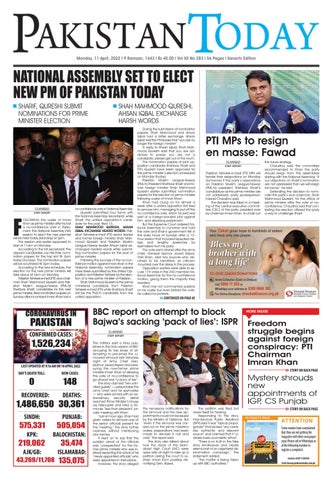
Monday, 11 april, 2022 i 9 ramzan, 1443 i rs 40.00 i Vol xii no 283 i 56 Pages i Karachi edition
NatioNal assembly set to elect New Pm of PakistaN today g
Sharif, QureShi SubMit noMinationS for priMe MiniSter election
islamabad
f
staff report
ollowing the ouster of imran Khan as prime minister after he lost a no-confidence vote in parliament, the national assembly (na) session to elect the new premier will be held today (Monday) at 2pm. the session was earlier supposed to start at 11am on Monday. according to the na secretariat, the aspirant candidates can file their nomination papers for the top slot till 2pm today (Sunday). the nomination papers will be scrutinised till 3pm today. according to the new schedule, the election for the new prime minister will take place at 2pm on Monday. pakistan tehreek-e-insaf (pti) vice-chairman Shah Mahmood Qureshi and pakistan Muslim league-nawaz (pMl-n) Shehbaz Sharif, candidates for the next prime minister, filed nomination papers on Sunday after incumbent imran Khan lost a
PakistaN
CONFIRMED CASES:
1,526,234
LAST UPDATED AT 9:16 AM ON 10 APRIL 2022
DAY'S DEATH TOLL:
NEW CASES:
0
148 DEATHS:
1,486,650 30,361 SINDH:
PUNJAB:
575,331
505,054
KPK:
BALOCHISTAN:
219,062
35,474
AJK/GB:
ISLAMABAD:
43,269/11,708
Shah MahMood QureShi, ahSan iQbal exchange harSh wordS
no-confidence vote in national assembly. Qureshi submitted four forms with the national assembly Secretariat, while Sharif, the unified opposition’s candidate for the post, filed 13. Shah MahMood QureShi, ahSan iQbal exchange heated wordS: pakistan tehreek-e-insaf (pti) senior leader and former foreign minister Shah Mahmood Qureshi and pakistan Muslim league-nawaz leader ahsan iqbal exchanged heated words while submitting nomination papers for the post of prime minister. following the success of the no-confidence motion against imran Khan in the national assembly, nomination papers have been submitted by the united opposition and pakistan tehreek for the election of a new prime minister of pakistan. Shah Mahmood Qureshi is the prime ministerial candidate from pakistan tehreek-e-insaf (pti) while Shahbaz Sharif will be the pMl-n candidate from the united opposition.
coroNavirus iN
RECOVERED:
g
135,075
during the submission of nomination papers, Shah Mahmood and ahsan iqbal had a bitter exchange. ahsan iqbal told the pti leader that “you are no longer the foreign minister”. in reply to ahsan iqbal, Shah Mahmood Qureshi said that you are addicted to power, you are not a candidate, please get out of the room. the nomination papers of joint opposition candidate Shehbaz Sharif and pti’s Qureshi have been approved for the prime minister’s election scheduled on Monday (today). pakistan Muslim league-nawaz (pMl-n) president Shehbaz Sharif and former foreign minister Shah Mahmood Qureshi earlier submitted nomination papers for the election of prime minister following ouster of imran Khan. Khan had clung on for almost a week after a united opposition first tried to remove him, managing to put off the no-confidence vote, which he said was part of a foreign-backed plot against him, and dissolving parliament. but the Supreme court ordered national assembly to convene and hold the vote and Khan’s government fell in the early hours of Sunday after a 13hour session that included repeated delays and lengthy speeches by lawmakers from his party. the vote went ahead after the army chief, general Qamar Javed bajwa, met Khan, said two sources who declined to be identified, as criticism mounted over the delay in the process. opposition parties were able to secure 174 votes in the 342-member national assembly for the no-confidence motion, giving them the majority they needed. Khan has not commented publicly on his ouster but even before the vote, he called for protests.
Pti MPs to resign en masse: Fawad islamabad staff report
pakistan tehreek-e-insaf (pti) Mps will tender their resignations on Monday (tomorrow) if the party’s reservations on pakistan Muslim league-nawaz (pMl-n) president Shehbaz Sharif’s candidature as the prime minister are not addressed, party spokesperson fawad chaudhry said. the decision was taken in a meeting of the central executive committee (cec) of the party, presided over by chairman imran Khan, to chalk out
CONTINUED ON PAGE 05
bbc report on attempt to block bajwa’s sacking ‘pack of lies’: iSPr islamabad staff report
the military said a story published in the urdu version of bbc accusing its top brass of attempting to pre-empt the rumoured removal late Saturday night of army chief gen. Qamar Javed bajwa and pressuring the now-former prime minister imran Khan of allowing the vote of no-confidence to go ahead was “a pack of lies”. the story claimed “two uninvited guests” — presumably the army chief and his spymaster — who were armed with an extraordinary security detail reached prime Minister’s house via helicopter and held a 45minute “less than pleasant” private meeting with Khan. “Just an hour ago, Khan had given orders to remove one of the senior officials present for the meeting,” the story further claimed, without mentioning any names. it went on to say that the sudden arrival of the officials was “unexpected” for the former prime minister who was instead expecting the arrival of his “newly appointed officials” who were appointed in their place. however, the story alleged
the future strategy. chaudhry said the committee recommended to Khan the party should resign from the assemblies starting with the national assembly. “if our objections on Sharif’s nomination are not addressed then we will resign tomorrow,” he said. defending the decision to nominate the party’s vice chairman, Shah Mahmood Qureshi, for the office of prime minister after the vote of noconfidence, chaudhry said that contesting the election offered the party a way to challenge Sharif.
more inside
Freedom struggle begins against foreign conspiracy: Pti chairman imran Khan STORY ON BACK PAGE
Mystery shrouds new appointments of igp, cS punjab the necessary notifications for the removal and the new appointments could not be issued by the Ministry of defence. but “even if the removal was carried out on the prime minister’s orders, preparations had been made to declare it null and void,” the report said. the story also talked about how the doors of the islamabad high court (ihc) were open late at night to take up a petition asking the court to restrain imran from possibly denotifying gen. bajwa.
the petition was filed but never fixed for hearing. responding to the story, inter-Services public relations (iSpr) said it was “typical propaganda” that lacked “any credible, authentic and relevant source” and claimed that it “violates basic journalistic ethos”. “there is no truth in the fake story whatsoever and clearly seems part of an organised disinformation campaign,” the statement added. “the matter is being taken up with bbc authorities.”
STORY ON BACK PAGE in today’s issue
attention Some readers have complained that they are not getting the magazine with their newspaper copy. Please call or WhatsApp us at the following number to register a complaint. Contact: 0307-7338168 irfan.farooq@pakistantoday.com.pk
02
Monday, 11 April, 2022 | KARACHI
NEWS
CHalleNgeS aHead: Key iSSueS faCiNg tHe Next leader ISLAMABAD
W
afp
HOEVER becomes the nation’s next prime minister following the dismissal of Imran Khan Sunday will inherit the same issues that bedevilled the former international cricket star. A poorly performing economy, rising militancy and shaky relations with former allies will be top of the agenda for the next administration. The incoming government will need to stave off “multiple challenges on domestic and foreign relations levels”, said Professor Jaffar Ahmed, director of the Institute of Historical and Social Research. Following are the key issues ahead for the incoming premier of the country: THE ECoNomy: Crippling debt, galloping inflation and a feeble currency
have combined to keep growth stagnant for the past three years with little prospect of genuine improvement. “We don’t have any direction,” said Nadeem ul-Haque, vice-chancellor of the Pakistan Institute of Development Economics (PIDE), a research organisation in Islamabad. “Radical policy reforms are needed to turn around the economy.” Inflation is ticking along at over 12 percent, foreign debt is at $130 billion — or 43 percent of GDP — and the rupee has dipped to 190 to the dollar, a decline of nearly a third since Khan took power. A $6 billion International Monetary Fund (IMF) bailout package signed by Khan in 2019 has never been fully implemented because the government reneged on agreements to cut or end subsidies on certain goods and improve revenue and tax collection. “The IMF package must go on,”
Opposition parties also decide to hold power show outside Parliament House NAveeD MIrAj IsLaMaBaD
Whilst the show of power inside the National Assembly hall today (Sunday) will decide whether or not Prime Minister Imran Khan stays in the coveted office, both Pakistan Tehreek-e-Insaaf and the major opposition parties especially the PML (N) and the PPP have also made arrangements to exhibit their public support on the roads of the federal capital. The call to its supporters and workers to gather in the capital was given by the PTI a few days back, the opposition parties , whose MNAs are already in Islamabad over the last few days, have entrusted the responsibility to their Senators to bring the workers from their respective areas on the day of voting. This has only further heightened the risk of any possible clash between the party workers. The Red Zone has been sealed in order to avoid any untoward incident on the Constitution Avenue or close to the Parliament house. Sources within the opposition parties told this correspondent that they are gathering their workers and supporters in the capital to celebrate the ouster of Imran Khan. “If the PTI can call in its workers to put pressure on the opposition parties, we also have the right to come with a counter strategy,” they said warning the government will be responsible in case of any violent incident.
Najam Sethi expected to return as PCB Chairman NeWS DeSk The winds of change have started to knock on the doors of the Pakistan Cricket Board (PCB) after Imran Khan was out from power through a vote of a no-confidence motion, becoming the first prime minister in the country’s history to be unseated by a parliamentary revolt. According to sources, Najam Sethi’s chances of another innings as the cricket board chairman are bright while it is likely that the current head Ramiz Raja will resign by himself very soon (claim of close circles). As history suggests, change is mandatory after a switch in power. Najam Sethi has close ties with the opposition leader and potential new Prime Minister Shahbaz Sharif. He is keen on returning to the cricket board and preliminary talks have already been started. Najam, 73, first served as chairman in 2013 but had to fight a legal battle with Chaudhry Muhammad Zaka Ashraf. He returned to charge in 2014 but Shahryar Khan was named chairman and Sethi was given the charge of the powerful executive committee. Behind the scenes, he had the main powers. In August 2017, he was reappointed chairman of the board but a year later, he stepped down after Imran Khan took charge as Prime Minister and announced his successor, former ICC President Ehsan Mani, as the new head of the cricket board. Najam Sethi wants to complete some of his unfinished business in PCB while he is also very interested in making Pakistan Super League (PSL) a bigger brand which was started in his time. Some of his close ones are also likely to return to PCB. Many of the current officials won’t be able to save their positions, including Zakir Khan, who currently holds the post of Director International Cricket. On the other hand, the possibility of the return of the old domestic system under the new government is also bright. In the system created at the behest of Imran Khan, the departments were abolished and domestic cricket was limited to six associations, which left thousands of cricketers unemployed. Although former chairman Ehsan Mani claimed that cricketers and coaches would have the same income as before, it didn’t happen. Many players and officials have been forced to drive away from the game and look to do other work. So far, no improvement has been seen in the domestic system. Persuading departments to form teams again will not be easy. Major changes are expected in Pakistan cricket over the next month.
said Ehsan Malik, head of the Pakistan Business Council. On the bright side, remittances from Pakistan’s vast diaspora have never been higher, although the cash flows have put Pakistan on the radar of the Financial Action Task Force (FATF), the global moneylaundering and terrorist-funding watchdog. “This is a hanging sword which could fall on the country any time,” Jaffar said. RISE oF mIlITANCy: Tehreek-iTaliban Pakistan (TTP), a separate movement that shares common roots with the militants who took power in Afghanistan last year, have stepped up attacks in recent months. They have threatened an offensive against government forces during Ramadan — which started Sunday — and in the past have been blamed for a string of murderous attacks. Khan attempted to bring militants back into the mainstream, but talks with the TTP
militants got nowhere last year before a month-long truce collapsed. Afghanistan’s Taliban say they will not allow the country to be used as a base for foreign militants, but it remains to be seen if they will genuinely put a stop to the activities of thousands of Pakistani Islamists based there — or where they will go if they are kicked out. There are no easy solutions even for the incoming government, experts say. “The insurgency challenge would remain as big and crucial for the new government,” said political analyst Rafiullah Kakar. Mineral-rich Balochistan is riven by sectarian strife and violence. Kakar suggested a two-pronged approach — “confidence-building measures and political reconciliation” in Balochistan, but taking off the kid gloves for the Taliban “once and all”. FoREIGN RElATIoNS: Khan claims
the United States orchestrated his removal by conspiring with the opposition, and the next government will have to work hard to patch up relations with Washington — a key arms supplier countering Russia’s trade with India. Khan angered the West by continuing with a visit to Moscow on the day Russia invaded Ukraine, and was also one of the few world leaders to attend the opening of the Beijing Winter Olympics when others boycotted in protest at what they claimed was China’s rights record. Still, army chief Gen. Qamar Javed Bajwa allayed some fears last weekend by saying good relations with the United States remain high on Pakistan’s agenda — and the military holds huge sway regardless of which civilian administration is in power. “The incoming government… needs to put in a hard effort to undo the damage,” said Tauseef Ahmed Khan, a political analyst and journalism teacher.
‘Good man, exceptional record’: Goldsmith on Imran LONDON staff RepoRt
Hours after Imran Khan became the first prime minister of Pakistan to be removed from office through a vote of no-confidence, British billionaire and environmentalist Ben Goldsmith came out in his support on Twitter. Goldsmith is the brother of Jemima Goldsmith (nee Khan) who was married to Khan from 1995 to 2004. On Sunday, Goldsmith tweeted that Khan was a “good and honourable man” who was motivated “only by a strong desire to do good by his country”. He also said that Khan’s record was exceptional, especially in relation to environmental issues.
“My brother-in-law Imran Khan is a good and honourable man, motivated only by a strong desire to do good by his country. His record as PM is exceptional, most of all on the biggest issue of our time: Pakistan under Imran is now a world leader on environmental restoration,” he wrote. Meanwhile, Jemima has not made any similar public statement. Goldsmith is the founder and CEO of London-listed investment firm Menhaden, which focuses on the theme of energy and resource efficiency. Born into the wealthy Goldsmith family, Ben and Jemima are the children of financier James Goldsmith and Lady Annabel Goldsmith.
Explainer: What Pakistan upheaval means for the world WASHINGTON/ISLAMABAD ReuteRs
Prime Minister Imran Khan was ousted from office in a no-confidence vote in parliament in the early hours of Sunday after three years and seven months in power. A new government will be formed most likely under opposition leader Shehbaz Sharif, after parliament reconvenes on Monday to vote for a new prime minister. The nation of more than 220 million people lies between Afghanistan to the west, China to the northeast and India to the east, making it of vital strategic importance. Since coming to power in 2018, Khan’s rhetoric has become more antiAmerican, and he expressed a desire to move closer to China and, recently, Russia — including talks with President Vladimir Putin on February 24, the day the invasion of Ukraine began.
At the same time, US and Asian foreign policy experts said that the powerful military has traditionally controlled foreign and defence policy, but Khan’s sharp public rhetoric had an impact on a number of key relationships. Here is what the upheaval, which comes as the economy is in deep trouble, means for countries closely involved in Pakistan: AFGHANISTAN: Ties between Pakistan’s military intelligence agency and the Taliban have loosened in recent years. Now that the Taliban are back in power in Afghanistan, and facing an economic and humanitarian crisis due to a lack of money and international isolation, Qatar is arguably their most important foreign partner. “We (the United States) don’t need Pakistan as a conduit to the Taliban. Qatar is definitely playing that role now,” said Lisa Curtis, director of the IndoPacific Security Program at the Center for a New American Security think-tank.
Tensions have risen between the Taliban and Pakistan’s military, which has lost several soldiers in attacks close to their mutual border. Pakistan wants the Taliban to do more to crack down on extremist groups and worries they will spread violence into Pakistan. That has begun to happen already. Khan had been less critical of the Taliban over human rights than most foreign leaders. CHINA: Khan consistently emphasised China’s positive role in Pakistan and in the world at large. At the same time, the $60 billion China-Pakistan Economic Corridor (CPEC) which binds the neighbours together was actually conceptualised and launched under Pakistan’s two established political parties, both of which are set to share power in the new government. Potential successor Sharif struck deals with China directly as chief minister of Punjab, and his reputation for
getting major infrastructure projects off the ground while avoiding political grandstanding could in fact be music to Beijing’s ears. INDIA: The nuclear-armed neighbours have fought three wars since independence in 1947, two of them over the disputed Muslim-majority territory of Kashmir. As with Afghanistan, it is Pakistan’s military that controls policy in the sensitive area, and tensions along the de facto border there are at their lowest level since 2021, thanks to a ceasefire. But there have been no formal diplomatic talks between the rivals for years because of deep distrust over a range of issues, including Khan’s extreme criticism of Indian Prime Minister Narendra Modi for his handling of attacks on minority Muslims in India. Karan Thapar, an Indian political commentator who has closely followed India-Pakistan ties, said the Pakistani military could put pressure on the new government in Islamabad to build on the successful ceasefire in Kashmir. Army Chief General Qamar Javed Bajwa said recently that his country was ready to move forward on Kashmir if India agrees. The Sharif dynasty has been at the forefront of several dovish overtures toward India over the years. UNITED STATES: US-based South Asia experts said that Pakistan’s political crisis is unlikely to be a priority for President Joe Biden, who is grappling with the war in Ukraine, unless it led to mass unrest or rising tensions with India. “We have so many other fish to fry,” said Robin Raphel, a former assistant secretary of state for South Asia who is a senior associate with the Center for Strategic and International Studies thinktank. With the Pakistani military maintaining its behind-the-scenes control of foreign and security policies, the change of government was not a major concern, according to some analysts. “Since it’s the military that calls the shots on the policies that the US really cares about, i.e. Afghanistan, India and nuclear weapons, internal Pakistani political developments are largely irrelevant for the US,” said Curtis, who served as then-US President Donald Trump’s National Security Council senior director for South Asia.
Monday, 11 April, 2022 | KARACHI
PSx liKely tO Have rOller-COaSter ride
P
NeWS DeSk
AKISTAN Stock Exchange (PSX) is likely to have a rollercoaster ride owing to domestic political developments, as the former ruling party, Pakistan Tehreek-e-Insaf (PTI), has decided to resign en masse from the assemblies. In a tweet, Fawad, who served as an information minister in Imran Khan’s cabinet, said, “The PTI has decided to resign from assemblies. This process [of resignations] will start from the National Assembly tomorrow after the election of the prime minister.” The benchmark KSE-100 Index of the bourse shed 707.53 points (-1.57 percent) despite Friday’s gain as a mixture of political turmoil, dismal economic data and rupee devaluation struck the trading environment and dampened investor sentiments. The KSE-100 started the week with a loss of 1,250.06 points as dissolution of the National Assembly took its toll on market sentiment. With the absence of a functional cabinet, Pakistan’s economic policy seemed like it was moving forward without a driver. The rupee fell to record lows during the week, while foreign exchange reserves were reported to have hit an almost two-year low. The trend reversed on Tuesday and the market managed to tick up 200 points in a two-day bull run largely owing to cherry picking by market participants. Scrip prices fell to attractive valuations on the back of
bear run in early part of the week and investors resorted to value hunting which propped the market upward. A dip in international crude oil prices pointed towards partial easing of inflationary pressures and drove uptrend at the bourse. Thursday saw the rupee sink to an all time low of Rs188.17 against the greenback and buoyed by the development, the stock market plummeted once again, shedding over 300 points. However, the central bank’s decision to raise the policy rate by 250 basis points, and Supreme Court’s order to set aside the deputy speaker’s
gold rises 1.1pc on risk aversion on weekly basis NeWS DeSk Gold price surged 1.1 percent on a week-on-week (WoW) basis despite a broad-based dollar strength and a sharp upsurge witnessed in the US Treasury bond yields. Gold futures closed the week on a positive note in the international market at $1,946.70 from $1,925.60 per ounce, gaining $21.10 on a week-onweek basis. The price of 10 grams of 24-carat yellow metal in Pakistan, meanwhile, increased by 2.55 percent (Rs2,900) to Rs116,600 from Rs113,700 during the last week. A relatively higher increase in the local gold price was due to the Pakistani rupee’s depreciation against the US dollar, which devalued by 0.32 percent last week and it also impacted local gold prices negatively. Gold price touched its historic high in the local market last week and the yellow metal was traded at Rs134,300 per tola (11.66 grams) after investors relocated the capital from deflating local currency to the inflating precious metal. The gain in gold was seen as the commodity turned positive because risk-off sentiment gripped financial markets amid the possibility of more Western sanctions on Russia. The Pakistani rupee started losing its value since the political unrest began in the country, which has affected the economy and increased concerns; and the development convinced investors to relocate their capital from weakening commodities to strengthening gold. On the global front, gold registered a small gain on Monday. It edged lower on Tuesday and Wednesday, following a 6 percent increase in the 10year US Treasury bond yield. However, gold capitalised on risk aversion and staged a rebound during the last two days of the week. From a technical perspective, gold made a daily close above the 20-day SMA for the first time in two weeks on Friday.
ruling, and restore the National Assembly brought some respite. According to experts, the market is expected to continue its momentum given no other sudden development takes place in the political arena. The market staged a rebound after the Supreme Court of Pakistan deemed the National Assembly deputy speaker’s ruling unconstitutional and reinstated the National Assembly. Moreover, sharp recovery in the local currency against the US dollar, of Rs3.5, drove optimism at the Pakistan’s equity market. “As clarity has emerged on the
political front, we expect the stock market to show strong signs of a comeback in the upcoming week,” said a report from Arif Habib Limited. “Moreover, it is likely that the rollover of Chinese loans worth $2.3 billion is on cards, which will conserve the falling reserves.” During the week under review, average daily traded volume fell 51% week-on-week to 153 million shares, while average daily value traded dropped 42% week-on-week to $26 million. In terms of sectors, negative contributions came from cement (314 points), oil and gas exploration (89 points), power generation and distribution (80 points), engineering (65 points) and food and personal care products (60 points). On the flip side, sectors which contributed positively were chemicals (70 points), fertiliser (63 points), cable and electrical goods (5 points), investment banks/ investment companies/securities companies (4 points) and real estate investment trust (2 points). Foreign selling continued this week, clocking-in at $3.78 million compared to a net sell of $15.55 million last week. Major selling was witnessed in commercial banks ($3.8 million) and cement ($1.4 million). On the local front, buying was reported by Individuals ($14.8 million) followed by banks/ development finance institutions ($4.7 million).
Crude oil price rally cools down for second week NeWS DeSk Crude oil futures lowered over one percent for the second week in a row on the back of the largest-ever release from US crude reserves and news of a coordinated release by other International Energy Agency (IEA) members from emergency stockpiles. The oil price rally cooled down over the past two weeks, with oil prices declining to levels last seen prior to Russia’s invasion of Ukraine. Pandemicrelated lockdowns in Shanghai, slowing US oil demand growth, and a historic strategic petroleum reserve release have all contributed to the sell-off. Interestingly, medium-term prices have hardly budged as near-term oil prices have fallen by over 20 percent, indicating a still-bullish longer-term outlook. Brent, the international benchmark for two-thirds of the world’s oil, edged lower by $1.61 (-1.54 percent) to $102.78 from $104.39 on a week-on-week (WoW) basis. The West Texas Intermediate (WTI), the main oil benchmark for North America, went down by $1.01 a barrel (-1.02 percent) to $98.26 from $99.27 on a weekly basis. The price for Opec Basket slipped marginally from $107.74 to $100.12 on a week-on-week basis, showing a decrease of $7.62 (-7.07 percent). The OPEC Reference Basket of Crudes (ORB) is made up of Saharan Blend, Girassol, Djeno, Zafiro, Rabi Light, Iran Heavy, Basra Light, Kuwait Export, Es Sider, Bonny Light, Arab Light, Murban and Merey. The price of Russian Sokol slipped by $0.79 (0.85 percent) to $92.18 from $92.97 on WoW basis. However, Arab Light prices witnessed an increase of
$2.36 (+2.29 percent) to reach $105.58 from $103.22 a barrel on a weekly basis. Member nations of the International Energy Agency will release 60 million barrels combined over the next six month with United States matching that amount as part of its 180 million barrel release announced in March. Although this is the biggest release since the stockpile was created in 1980, it will fail to ultimately change the fundamentals in the oil market. It is likely to delay further increases in output from key producers, according to analysts. Analysts said the emergency oil release, amounting to about 1 million barrels per day (bpd) from May to the end of the year, might cap price rises in the short term, but would not fully cover volumes lost if more countries impose sanctions against Russia over its invasion of Ukraine, which Moscow calls a “special operation”.
NEWS
03
the rejected bunch is atop its container again: Marriyum aurangzeb STAff repOrT Spokesperson of Pakistan Muslim League-Nawaz (PMLN) Marriyum Aurangzeb on Sunday said the dejected and rejected bunch behind the destruction of people due to inflation, unemployment and economic downturn was once again atop the container. The statement came hours after former premier Imran Khan vowed to begin freedom struggle against a “foreign conspiracy of regime change” in Pakistan. Senior Pakistan Tehreek-e-Insaf (PTI) leader Fawad Chaudhry also said in a statement that the former ruling party has decided to resign en masse from the assemblies and the process to quit assemblies will start from the National Assembly on Monday. In a tweet, Fawad, who served as an information minister in Imran Khan’s cabinet, said, “The PTI has decided to resign from assemblies. This process [of resignations] will start from National Assembly tomorrow after the election of the prime minister.” Meanwhile, speaking to the media in Islamabad following a meeting of the PTI’s Central Executive Committee (CEC), Fawad said the CEC meeting at Bani Gala analysed the political situation after the ouster of Imran Khan through a no-confidence motion. Fawad said the CEC suggested resignations en masse from the lower house of parliament if PTI’s reservations regarding the nomination of PML-N President Shehbaz Sharif as the PM remained unaddressed. “If our reservations on Shehbaz are not addressed, we will resign en masse on Monday,” he added. Aurangzeb in today’s statement urged those trampling the Constitution, law and order, democracy and ethics to let people take a sigh of relief. “Let [the government] rectify the current dismal state of the masses that you’re responsible for,” she remarked. The PML-N leader asked arch-rivals Pakistan Tehreek-e-Insaf (PTI) to run a campaign as they please, but also consider for the time being that the Parliament had kicked them out.
rupee falls 0.32pc against dollar for 9th week NeWS DeSk Rupee slipped by 0.32 percent (-Rs0.59) against the US dollar for the ninth straight week due to political uncertainty in the country and surging oil and commodity prices globally. The rupee slipped from 184.09 to Rs184.68 against the American currency in the interbank market last week. The rupee plummeted to all-time low of 189.51 against the US dollar in the inter-bank market on Thursday; however it recovered on Friday. The rupee is likely to stay stable against the dollar this week after the central bank increased the interest rates and took measures to cut imports and reduce inflationary pressures. The analysts said that a new government is in the offing, which will end the political crisis, and the rupee may recover some of the losses of previous weeks. There has been a concern that what would happen if the political conditions don’t normalise, but the currency market is unlikely to give a negative knee-jerk reaction to the fast-changing political developments,” said a foreign exchange dealer. “The central bank’s measures also gave confidence to investors and markets. We expect the rupee to be stable in the coming week,” he added. While the pressure on the currency has been relieved for the time being, this war is far from won, according to a report. “There are some positives: remittances are expected to shoot up due to Ramzan, exports are following a robust trajectory, and outflows from SCRA [special convertible rupee account] have slowed down,” it said. The report, citing analysts, said the central bank was targeting a real effective exchange rate of around 95 (it was 97.80, at the end of February) which would come to approximately 185/$ for today. “However, the new incoming government will need to get the IMF quickly back on track and garner support to boost reserves, and foreign investors will need to be wooed back.” Interest rates may need another round of adjustment really soon and non-essential imports may require to be temporarily halted,” it added.
PTI takes out massive rallies across country following Imran Khan’s ouster NeWS DeSk The Pakistan Tehreek-i-Insaf (PTI) on Sunday took out rallies in several cities of the country to protest against the ouster of former prime minister and party chairman Imran Khan through a successful vote of noconfidence the previous night. PTI takes out a massive rally in Buner, KP. Earlier in the day, Khan tweeted that today marked the beginning of a “freedom struggle” against what he called was a “foreign conspiracy of regime change”. In an attempt to galvanise his supporters, he said it was always the people who protected their own sovereignty and democracy. PTI spokesperson Fawad Chaudhry had also called on the people to stage protests after Isha prayers while speaking to the media in Islamabad earlier in the day. He said that Khan not leading a massive
movement would amount to a “betrayal with the country’s politics and Constitution”. The party later issued a schedule of the various protests that were planned for cities all over the country starting 9:30pm. ISlAmAbAD: The protest in the capital started from Zero Point, with PTI supporters gathering and waving flags while chanting slogans in the former prime minister’s favour. Flow of traffic at Srinagar Highway was affected due to the rally with long traffic lines forming. Meanwhile, Chaudhry thanked PTI supporters for turning out in Rawalpindi for the protest. Awami Muslim League chief Sheikh Rashid also addressed a rally at Rawalpindi’s Lal Haveli and lashed out at the PML-N, taking aim in particular at prime ministerial nominee Shehbaz Sharif and alleging that he
was trying to avoid indictment in a money laundering reference.
lAHoRE: PTI leader Hammad Azhar posted a video of a rally from his
constituency of NA-126 leaving for Liberty Chowk. PTI Senator Ejaz Chaudhry also shared a video of a rally from the city’s NA133 constituency to Liberty Market in which slogans against the United States could be heard. Other videos shared by the PTI showed a throng of supporters and party diehards out in full force at Liberty Chowk. PESHAwAR: A large number of protesters including women and children turned up at Peshawar Press Club and expressed solidarity with the ousted prime minister. The crowd chanted slogans against Pakistan Democratic Movement chief Maulana Fazlur Rehman and the heads of other political parties along with comments that appeared to be aimed at the military. Images shared by the PTI also showed demonstrations in other parts of Khyber Pakhtunkhwa such as Bajaur and Abottabad.
Monday, 11 April, 2022 | KArAChI
04
news
ImrAn KhAn beComeS PAKIStAn’S fIrSt PremIer to be unSeAteD by PArlIAmentAry revolt
A
T the stroke of midnight, Imran Khan was voted out from power through a vote of a noconfidence motion, becoming the first prime minister in the country’s history to be unseated by a parliamentary revolt. The joint opposition’s no-confidence motion, which required 172 votes in the 342-strong parliament to pass, was supported by 174 lawmakers, shaking the political earth of the country with an unprecedented ouster of the premier and seemingly bringing to an end the protracted crisis. PML-N’s Ayaz Sadiq, who was chairing the session after PTI’s Asad Qasier resigned as NA speaker, announced the result. The assembly will now appoint a new prime minister. Sadiq announced that nomination papers for the new prime minister can be submitted by 2pm today. Scrutiny will be conducted by 3pm and the House would come back to elect a new premier at 11am on April 11 (Monday). The Pakistan Tehreek-e-Insaf (PTI), which stayed in power for over three-anda-half years, had been struggling to stay in power as its allies jumped ship and joined hands with the joint opposition that had been vying for an in-house change. The much-anticipated vote followed on the heels of the perpetually drawn-out session of the National Assembly punctuated by long adjournments amid high political drama as well as unverified swirling speculations gripping the nation. The lower house met at 10.30am Saturday sharp in accordance with the directives of the Supreme Court under the chairmanship of Speaker Asad Qaiser. However, the session dragged its feet into the wee hours of Sunday. Minutes before voting began, Na-
tional Assembly Speaker Asad Qaiser resigned from his post, saying he could not take part in a foreign conspiracy to oust the prime minister. Before announcing his resignation, Qaiser said that he had received “important documents” from the cabinet, which he invited the leader of the opposition and the Chief Justice of Pakistan to see. “In line with our laws and the need to stand for our country, I have decided that I can’t remain on the position of the speaker and thereby resign,” he said. “Because this is a national duty and it is the Supreme Court’s decision, I will ask the panel chairman Ayaz Sadiq to run the session,” Qaiser said. Voting on the resolution then began at 11:58pm, and members in favour of the resolution were asked to exit the gate on Sadiq’s left. Sadiq then adjourned the session for four minutes since according to rules, the same session cannot continue past midnight. The session then resumed at 12:02am, with recitation of the Holy Quran and naat. Then, the voting process continued, with lawmakers confirming their votes by writing their name in a register placed near one of the assembly doors. ‘Will not indulge in politics of revenge’: Minutes after Mr Khan’s ouster was confirmed, PMLN President Shehbaz Sharif vowed that the new regime would not indulge in politics of revenge. Speaking on the floor, Shehbaz Sharif, who is the joint opposition’s candidate for the post of prime minister, paid tribute to all leaders of the joint opposition. “Our alliance will rebuild Pakistan. I don’t want to go back to the bitterness of the past. We want to forget them and move forward,” he said, adding that the alliance will rebuild Pakistan.
The PML-N president expressed gratitude to other leaders, including Asif Ali Zardari and Maulana Fazlur Rehman, for their relentless struggle for upholding the rule of law and constitution which, he added, had finally yielded fruits. He went on to say that no one would interfere in the affairs of law and justice and would run the institutions together. ‘We’ve made history’: BilaWal: Speaking on the occasion, PPP’s chairperson, Bilawal Bhutto Zardari, said he would like to congratulate the whole nation and the House, “as for the first time in the history of the country, a no-confidence motion has succeeded and we have made history”. The PPP chairman recalled what had happened on April 10, adding that on this day, the country approved the 1973 Constitution. “On April 10, 1986, Benazir Bhutto ended her self-imposed exile and arrived in Lahore to launch her struggle against Ziaul Haq,” said Bilawal. The PPP chairman said that on April 10, 2022, the person who was declared “selected” by the Opposition and proved himself to be an “undemocratic burden” on the country saw the end of his rule. “Today [on] April 20, 2022, we welcome [you] back to the purana Pakistan,” said Bilawal. “I have a message for the Pakistani youth that they should never give up on their dreams as nothing is impossible. Democracy is the best revenge. Pakistan Zindabad,” said Bilawal. ‘not old, But Better pakistan’: Meanwhile, taking the floor, MQM Convener Khalid Maqbool Siddiqui said this occasion is not merely to celebrate “but show gratefulness as this time is more of a test than a reward.” “We don’t want a naya [new] or puana [old] Pakistan… we want a better
Pakistan,” the MQM-P leader said. “We have fulfilled our promise now it’s your turn to fulfil your commitments,” Siddiqui said while referring to the agreement that his party inked with the joint opposition in return for supporting the no-trust motion. ‘imran punished for foreign policy’: Meanwhile, the lone PTI MNA present in the house, Ali Muhammad Khan in his emotional speech defended the tenure of Imran Khan as the prime minister of the country, saying that the ousted premier paid the price for pursuing the ‘independent foreign policy’. “I am proud of my leader that he did not bow down before West and fought till the end… he will return to the power with two-third majority,” he added. Last Sunday, NA Deputy Speaker Qasim Khan Suri had rejected the united opposition’s no-trust motion against the prime minister on the grounds that it was backed by a “foreign country” and thus, the opposition parties had violated Article 5 – loyalty to the state and obedience to the Constitution and law. However, the “constitutional crisis” was remedied at the Supreme Court which set aside Suri’s ruling and the subsequent dissolution of the lower house of parliament by President Arif Alvi on the premier’s advice in its landmark unanimous ruling on Thursday night after taking a suo moto notice last Sunday. The 5-0 ruling ordered parliament to reconvene on Saturday, no later than 10:30am, saying that the session could not be prorogued without the conclusion of the no-trust motion against PM Imran. At the start of the session on Saturday, Qaiser vowed to carry out the proceedings of the House as per the orders of the apex court. staff report
PPP announces plan to initiate noconfidence motion against G-B CM Leader of the Opposition of the Gilgit-Baltistan Assembly Amjad Hussain of the Pakistan Peoples Party (PPP) on Sunday announced plans to initiate a no-confidence motion against the Chief Minister of G-B Khalid Khurshid. In conversation with the media, the opposition leader stated, “we are forming a committee to finalise our plan with PDM [Pakistan Democratic Movement] members,” referring to the PPP central executive committee meeting that requested the G-B and Azad Kashmir leadership to go ahead with no-confidence move in their respective regions. The opposition leader further said the committee will deliberate and finalise name for the next chief minister. Amjad Hussain had earlier said that he was in contact with ‘several’ parliamentarians of the Pakistan Tehreek-e-Insaaf (PTI) who had pledged their support with him against the CM, claiming he spent more than 70 per cent of his time in Islamabad. Meanwhile, former chief minister and the regional president of Pakistan Muslim League-Nawaz (PML-N)
Hafizur Rehman has also hinted at initiating a change within the regional government. “We will chalk out our strategy once things are settled in Islamabad,” he said. In addition to opposition parties, the PTI government in G-B has faced resistance from within. A disgruntled group of ministers have already formed an alliance against the chief minister accusing him of failing to strike a ‘reasonable’ deal with the federal government over the provisional constitutional status being given to G-B. “It was a paradigm shift that came after independence but the CM played a weak wicket,” said one of the ministers. Senior minister Abaidullah Baig, however, denied the existence of the rift. Taking to social media, the senior minister stated that there was no truth to the allegations regarding the rift, claiming that all ministers were united under the ‘Khalid Khurshid leadership’. Similar views were expressed by advisor Shams
Lone as he accused opposition leader of spreading rumours. “I can tell you with authority that there is no such thing as no-confidence [motion] in G-B,” Lone told The Express Tribune. He refrained from commenting when asked why he was targeting ministers when they were on the ‘same page’. The departure of Imran Khan from the Prime Minister’s Office is believed to have eased up the no-confidence move against the chief minister of G-B. On April 5, it was reported that the Bachelor of Law (LLB) degree of CM Khalid Khurshid had turned out to be fake, a year after he was appointed to the post. It emerged that Khurshid had acquired his degree from a network of diploma mills operating under the brand name Belford, but it doesn’t actually exist. He was entrusted with the top slot over his ‘outstanding educational achievements’, something even former premier Imran Khan was misled into believing as he called him a ‘right choice’ last year. staff report
KP, Punjab and Sindh governors likely to resign: sources Following the dismissal of PTI Chairman Imran Khan from the office of the prime minister, Khyber Pakhtunkhwa Governor Shah Farman, Punjab Governor Omar Sarfaraz Cheema, and Sindh Governor Imran Ismail are likely to tender their resignations, sources privy to the matter revealed Sunday. Sources said that Ismail is currently attending a meeting of the PTI in Islamabad and he is expected to hand down his resignation upon his return to Karachi. However, his family is still present in Governor House in Karachi. On the other hand, Shah Farman said that he will step down from the governor’s post in case PML-N President Shahbaz Sharif gets elected as the prime minister of Pakistan. “I cannot give Shahbaz the protocol of a prime minister,” Farman said. Moreover, the newly-appointed Punjab Governor Cheema is also expected to resign only after a few days in the office, sources said. Cheema had also been summoned to Islamabad to attend PTI’s core committee meeting. staff report
Asif Zardari congratulates nation on Constitution Day ISLAMABAD staff report
Former president Asif Ali Zardari Sunday congratulated the nation on Constitution Day. “Quaid-e-Awam Zulfiqar Ali Bhutto Shaheed had given a unanimous Constitution to the nation on April 10,” said Asif Ali Zardari. “The 1973 Constitution guarantees the integrity and survival of the federation,” he added and stated that Shaheed Benazir Bhutto fought all her life for the restoration of the 1973 Constitution. “For the sake of the 1973 Constitution, Shaheed Benazir Bhutto faced imprisonment and hardships,” he said and added that the mother of democracy Begum Nusrat Bhutto made historic efforts for the restoration of the 1973 Constitution. “Activists for the freedom of the press also fought hard for the restoration of the Constitution,” he commended and paid red salute to those who faced executions, floggings and imprisonment for the supremacy of the Constitution. He said that the 18th Amendment was a charter between the federation and the units, adding that the rule of the Constitution would strengthen the security of the country and the reputation of the institutions.
Celebs lament fall of Imran Khan, return to ‘purana’ Pakistan At the stroke of midnight, Imran Khan fell from power through a vote of a no-confidence, becoming the first prime minister in Pakistan’s history to have been ousted by a parliamentary revolt. 174 lawmakers supported the joint opposition’s no-confidence motion that required 172 votes in a parliament of 342 members. The outcome shook the political earth of the country, seemingly bringing an end to a protracted crisis. After three-and-a-half years, Khan’s PTI struggled to stay in power as its allies betrayed to joined hands with opposition parties. And while Pakistan’s history has been marred with political instability, no prime minister has ever been removed from office through a no-trust motion. Thus, in the final moments of the former prime minister’s government, his team members paid tribute to him, vowing to fight along his side “for as long as it takes.”
Celebrities, too, followed suit, penning their thoughts on the situation, knowing full well that Khan’s term had come to an end. Many are still lamenting the fall of “hope” and a sad but irrefutable return to “purana” Pakistan. Actor Armeena Khan tweeted a prayer, “May God protect Pakistan and it’s loyal citizens from darkness and the forces of evil that are about to consume it once more. Ameen.” Unable to fall asleep, she took to her Insta Stories to add, “Dil thora toot sa raha hai. Aesa lagta hai jese kuch qeemti si cheez kho di (My heart is breaking a little, it feels like we’ve lost something very precious).” Veteran actor Samina Peerzada shared, “This is not the end, Imran Khan will return with more power and greater resolve. He will not give up and neither will we. We share a great bond. Love for Pakistan.”
In another tweet, she thanked the former prime minister for “waking up the nation,” writing, “Imran Khan, humain is lambi neend say jaganay ka shukria. Humnay is political theatre kay saray chehray jan liay hain pehchan liay hain (we have learnt and memorised the faces behind this political theatre).” Actor Humaima Malick called it a “dark day” while Aiman Khan shared a post hailing Khan as a “true leader.” Teefa in Trouble star Maya Ali too, termed today the “saddest and a dark day in Pakistan’s history.” She lamented, “All we needed was some patience, unity and belief. We have lost a gem, a true politician and honest prime minister. I salute Imran khan that he tried his best and fought for the sovereignty of Pakistan till the last moment. Thank you, kaptan. I know you will come back stronger. Once a leader, always a
CMYK
leader.” While actor Shaan Shahid, as always, penned, “Imran Khan, your journey as a prime minister was phase 1. But your journey as a great leader has started now. The hardships will be your medals, the negativity you bare will be your scars of war. This nation needs you. Don’t give up on us, don’t give up on Pakistan.” YouTube sensation Zaid Ali T tweeted, “Today is a very dark day for Pakistan. We as a nation have lost our most valuable asset. I salute the courage of Imran khan for fighting till his last breath. He is an example of a true champion and leader. Well played, Captain.” Fellow content creator Shahveer Jafry chimed in, “Khan fought alone. I salute him and thank him for that he tried his best to save his country.” Junoon guitarist Salman Ahmad main-
tained, “174 Votes, 14 parties, five judges, 90% of anchors, so democratic. It took all this to defeat one Imran Khan and he still rules the hearts of the majority.” Sharing the now viral speech of PTI member Ali Muhammad Khan, who witnessed the complete session of no-confidence against Imran Khan, designer Maheen Khan tweeted, “What a powerful speech.” And responding to a tweet by author Nadeem Farooq Paracha, who said those “feeling jittery and outraged should actually feel guilty and self-reflect,” designer Khadija Shah tweeted, “If you had a conscience, you would be concerned too. Instead of this immature tit for tat shitty statement.” Paracha was referring to the individuals who had been “applauding and rationalising harassment of activists, journalists and campaigns of character assassination during the ousted regime.” staff report
Monday, 11 April, 2022 | KARACHI
NEWS
05
NatioNal assembly set to elect New Pm of PakistaN today continued from page 01
Eid collection press briefing by Bata MD Muhammad Imran Malik. Pr
furniture exporters urged to tap chinese market
“i
am going to struggle,” he said in an address to the nation on Friday. “I tell all of my supporters across Pakistan, on Sunday, after Isha (evening) prayers, you all have to come out of your homes and protest peacefully against this imported government that is trying to come to power.” Imran Khan loses noconfIdence vote: In a historic first for Pakistan, Imran Khan
was ousted as the prime minister of Pakistan from office through a no-confidence motion after the NA debated on the matter for more than 12 hours and the political situation in the country took a critical turn Saturday night. The session was chaired by Ayaz Sadiq — a member of the panel of chairs — after speaker Asad Qasier resigned from his post. “174 members have recorded their votes in favour of the resolution, consequently the resolution for the vote on no-confidence against Mr Imran Khan, the prime minister of Pakistan, has
been passed by a majority,” Ayaz Sadiq announced after the process of voting was completed. ‘neW daWn’: The front-runner to become the next prime minister, Sharif, said Khan’s departure was a chance for a new beginning. “A new dawn has started … This alliance will rebuild Pakistan,” Sharif told parliament on Sunday. Sharif was for years chief minister of Punjab and has a reputation as an effective administrator. His first tasks will be to repair relations with the military as well as a
key ally the United States, and tend to a stuttering economy. The military viewed Khan and his conservative agenda favourably when he won the election in 2018, but that support waned after a falling-out over the appointment of the influential military intelligence chief. Khan had antagonised the United States throughout his tenure, welcoming the Taliban takeover of Afghanistan last year and more recently accusing the United States of being behind the attempt to oust him. Washington dismissed the accusation.
Sehat Card provides Rs1m free treatment facility to every family in Punjab: Buzdar LaHore sTaff rePorT
iSLamaBad TLTP
Pakistan Furniture Council has urged the local exporters to further vigorously tap Chinese market potentials, besides focusing on improving the quality of their products at par with international standards. Chief Executive Officer PFC Mian Kashif Ashfaq, while talking to a delegation of exporters led by Ishtiaq Ahmad Motianwali Sarkar on Sunday, said the recent upward trend in exports to China is encouraging. He said China is the second largest export destination for Pakistan and the government had been making all out efforts to further boost exports to China by promoting industrialization in the country, providing special subsidies to the business community and working closely with the Chinese government and enterprises to get know how about Chinese market requirements. He said the trade between the two countries has made significant progress as both export and import volumes are on the rise. This is a testament to China’s commitment to the Belt and Road Initiative (BRI) projects with the ChinaPakistan Economic Corridor in the limelight, he added. He said the trade and commerce volumes signify that China wants to provide unconditional support to Pakistan and import more from it in order to uplift its economy, he added. He said China will continue to support Pakistan for a long time to come as Islamabad values unconditional support from Beijing. He said Pakistani exporters must encash this opportunity. Kashif said among major items traded between the two countries, volumes of electronics, textiles, seafood,leather products and agricultural products have gone up on a yearon-year basis. He said the traditional friendly relations between Pakistan and China had become more pragmatic and productive with time. Kashif said the second phase of FTA paved the way for the substantial and sustained growth of the bilateral trade as Pakistan was allowed to export 313 new products to the Chinese market on zero duty which he added was now further extended to 700 products. He said on the other hand, a number of Chinese companies have been cooperating with local enterprises to enhance their production capacity,quality and exports of Pakistani commodities by providing modern technology and equipment,he concluded.
Punjab Chief Minister Punjab Sardar Usman Buzdar said that Naya Pakistan Qaumi Sehat Card has been provided to every family in Punjab under which one million annual free health treatment facilities was provided to it. In a statement issued here on Sunday, he disclosed that the Pakistan Tehreek-e-Insaf (PTI) government allocated Rs.400 billion for the Universal Health Insurance Programme and fulfilled its promise to provide free treatment facility to every citizen of Punjab. Usman Buzdar stressed that the example of Universal Health Insurance Programme is not found in the developing countries adding that free treatment facility is not a favour to
anyone rather it is due right of the masses. He emphasized that the PTI government gave utmost focus on improving health facilities across Punjab. He informed that fatal diseases including cancer can be treated through Naya Pakistan Qaumi Sehat Card. The chief minister intimated that cardiac diseases, hepatitis, liver diseases, TB, AIDS and emergency fracture can be treated free of cost from the quality private hospitals across the province. He highlighted that the example of Naya Pakistan Qaumi Sehat Card Project is difficult to find in the history of the country. Usman Buzdar underscored that the PTI government enhanced its health budget to Rs.399 billion and allocated a huge amount for the improvement of the health sector in the history of Punjab.
Asia Cup 2022 likely to be moved out of crisis-hit Sri Lanka The devasting economic crisis may not allow Sri Lanka to host the Asia Cup 2022 and it is likely that the competition will be moved from the country. Asia Cup 2022, in a T20 format, was announced to be held in Sri Lanka between August 27 and September 11. The dates and the host were announced after an AGM was held between the member countries last month. All five Test teams including Sri Lanka, India, Pakistan, Afghanistan and Bangladesh were set to feature in the tournament, with one more team to join them after a qualifying tournament which was scheduled to be held from August 20. However, the decision to
change the venue will be made at the quarterly meeting of the International Cricket Council (ICC) scheduled to take place in Dubai on Sunday. Pakistan Cricket Board (PCB) Chairman Ramiz Raja
and Chief Executive Faisal Hasnain will attend the meeting. It must be noted that Sri Lanka is also scheduled to host Australia and Pakistan from mid-June to August 2022. agencies
barter mechanism to promote trade with tehran, kabul: saaRc cci iSLamaBad TLTP
President SAARC Chamber of Commerce and Industry Iftikhar Ali Malik has said that Pakistan’s prudent decision of barter trade with Afghanistan and Iran would further strengthen trilateral trade relations and foster existing economic ties among the three neighbouring Muslim countries. Talking to a delegation of traders led by Waqas Anjum which called on him, he said it is a good wisdombased decision of the government to allow imports and exports under barter trade with both countries to promote trade with regional states. He said barter trade has tremendous importance to strengthen regional trade connectivity and to do with foreign exchange and other challenges confronted by the regional countries. He said it is a good point to note that the Pakistan government has amended the relevant part of import and export policy orders 2020 to launch barter trade under the arrangements finalized after taking stakeholders into confidence. He termed the decision a welcoming development because it was being pursued by all relevant stakeholders of all three countries in true letter and spirit to derive the desired results of economic cooperation and prosperity of the people of the region. Malik hoped that the appropriate mechanism of barter trade would be placed in action and finalised by the authorities of Iran and Pakistan. He said a special desk has been established at SAARC Chamber headquarters to facilitate the traders of member countries especially for Afghanistan. A member of the delegation, former president of Lahore Chamber and Chairman Rice Exporters Association of Pakistan (REAP) Shahzad Ali Malik said the decision will provide ample opportunity to our export to Iran especially of rice including Guard rice which is in great demand that’s very popular being best in taste worldwide. He urged the private sector including regional chambers to move forward to take full advantage of the big opportunity. He said REAP welcomed the step and termed it a constructive stride in the right direction to foster the barter trade, he added.
Food insecurity threatens region, Pakistan: experts iSLamaBad TLTP
The looming food insecurity hovering over the region has posed an impending threat to all under-developed countries, especially Pakistan. The speakers said this while addressing a seminar on “Ramification of Food Insecurity in Pakistan,” held here under the aegis of the Founder Group. Mehr Kashif Younis, former senior vice president of Lahore Chamber of Commerce and Industry, quoting the World Food Programme, said recently Pakistan’s double digit food price inflation along with dwindling income has left more Pakistanis food insecure. He said a sizable number of Pakistanis are food insecure of which 18 percent are confronted with acute food insecurity. He said 20 percent of the population in Pakistan
is undernourished and 44 percent of children under five year are stunted. He said in recent years, Pakistan has produced more food that its population consumes and has been a major producer of wheat and rice. However,the poor segment of the society and most vulnerable people in the country can’t afford a sufficient and nutritious diet despite the overall growth in food production. Kashif said primarily this is due to limited economic access to the poorest, especially women lacking an adequate and diverse diet. He said all complementary feeding indicators are far below acceptable levels,only one in 7 children aged 6-23 months hardly gets a meal with scarce dietary diversity. He said a major chunk of children are deprived of the minimum number of meals a day. He said food insecurity has two dimensions: availability and affordability. He
said abject poverty, food insecurity, malnutrition, frequent infections, poor health conditions, and hidden hunger are also closely associated with each other while the number of hungry people is rising every year. He further said the main threats to food security are, population explosion increases food demand, higher food prices, absence of variety of agriculture plant species, increasing in the area of scarcity water, limitation of the availability of land and finally food losses and food waste. He said in prevailing circumstances, we must take immediate corrective measures to avert severe food insecurity grappling the region including Pakistan. He suggested that all stakeholders at the helm of affairs must be taken on board for formulating prudent national policy to address this core issue with the active participation of public and private sectors to achieve the desired results.
cmYK
06-07 Comments - 11th April 2022_Layout 1 4/10/2022 10:32 PM Page 1
Monday, 11 April, 2022
06 COMMENT
Alarming new IPCC report on climate change
Moving on The post-Imran government faces several challenges
T
he first thing to be done after the ouster of Imran Khan and the PTI government is to elect a new PM, which the National Assembly will proceed to do later on today. After that PM has taken oath and formed a government, it has a task that will involve maintaining a balance within the coalition that ousted Imran. That government will naturally have to tackle the challenges that have been left behind by its predecessor, with the foremost being the economy. While there are other contentious issues in the PTI legacy, economic mismanagement was the final straw in the government’s coffin. The incoming government will presumably now find true figures about the state of the economy, rather than the massaged figures the PTI used to tell the world what fine fellows they were. The current account deficit and the trade balance are of immediate concern, while inflation and the negotiations with the IMF must also be priorities. Perhaps the most difficult decision the new government will face is what to do about the populist subsidies announced by the government recently. The IMF doesn’t like them, and broke off talks because of them. Yet rolling them back only gives the PTI, now in the opposition, a talking point. Another talking point will be the foreign conspiracy claim. The new government will be defensive about this, but that domestic political compulsion should not stop it from repairing, as a priority, the damage done to Pakistan’s foreign relations, and that diplomats abroad who host diplomats will not be willing to speak with them frankly because of the fear that Pakistan’s home government might use their words, probably twisted, for domestic political ends. The incoming government will have to tread a line between subservience and offensiveness. Perhaps the most contentious issue for the incoming government is how to reduce the heightened polarization in society, which the PTI has encouraged by numerous examples of bad and intolerant behaviour, but is not alone to blame for this, though as the government it should have resisted it instead of just going with the flow. One of the most important things to do is to avoid the sort of revenge persecution that a new government is supposed to do to settle scores. The incoming government needs to be extracautious because it wants early elections, during which rhetoric will be naturally heightened. It must ensure that the baseline is not positioned high to start with.
The goal for average temperature rise is unlikely to be met
Dr Omer JaveD
‘T
he international goal to limit global heating to 1.5°C (2.7°F) is officially on life support. A United Nations-backed panel of climate scientists warned in a new report released Monday that the world may be on track to warm by more than 3°C– twice the Paris Agreement target– in a change that would painfully remake societies and life on the planet.’ An excerpt from a recently Bloomberg-published article ‘Planet’s breakneck warming likely to pass 1.5°C, UN scientists warn’ The latest report of the Intergovernmental Panel on Climate Change (IPCC), according to the Report, is ‘The Working Group III (WG III) contribution to the IPCC’s Sixth Assessment Report (AR6) [and] assesses literature on the scientific, technological, environmental, economic and social aspects of mitigation of climate change.’ According to the report, the window of opportunity to restrain global average temperature to below 1.5°C is fast closing. In fact, the same Bloomberg article highlighted that one of the main architects is rather not that optimistic that this goal could be met, given the slow progress of steps that need to be taken. According to the article ‘The Paris Agreement in 2015 established a 1.5°C goal as a rallying point for every nation in the world, and the Costa Rican diplomatChristiana Figueres was one of its chief architects. With the release of Monday’s latest report from the Intergovernmental Panel on Climate Change, she’s faced with the increasingly probable outcome that the temperature threshold she helped establish as former executive secretary of the UN Framework Convention on Climate Change will be passed in the years ahead. “I don’t have words to explain. ‘Concerning’ is not enough. This is frankly a terrifying report,” Figueres told Bloomberg Green… “It’s not really about megatons,” she said, speaking of rising levels of greenhouse
Necessary incarcerations Hafiz Saeed’s conviction should show Pakistan doesn’t tolerate terrorists
T
Dr Saira aSaD
H
ARd work and determination speak for themselves, but sometimes, one doesn’t receive a favorable response even after getting higher education due to competition and without references. It is observed in our surroundings that many educated youths are unable to get hold of a job for their survival. Graduate employability issues are very common in our culture. The universities are suggested to play their roles in adjusting the graduated students in the market with compatible salaries. But, many cases are forcing us to highlight this issue where they deserve to be employed as they have no approach for getting the jobs, and get refusals again and again. They are the main earning source for their own family, but even despite having a degree, they are not getting a place in their society to earn according to their qualification. The government and institutions must think seriously on this issue in providing a secure future and leveling the ground for their graduates who form the future generation. They are the future of a country, but most of them are not able to get a single job. Such a pitiful situation is not being considered a serious issue. This is the case of Muhammad Younis from vil-
Arif Nizami (Late) Founding Editor
Yousaf Nizami Umar Aziz
Joint Editor
Joint Editor
Executive Editor
Lahore – Ph: 042-36300938, 042-36375965
Moreover, while the war in Ukraine takes away from focusing on issues that poses the threat of an existential nature, it also pushes countries to move away from fossil fuel reliance to renewable sources of energy
Government and Institutions have to play vital roles in graduates’ placements
Dedicated to the legacy of late Hameed Nizami
M. A. Niazi
and restore peace to Ukraine. But wrong choices now– specifically, continuing to favour fossil fuels over renewable energy– could lock in a far less peaceful future. …The West’s rejection of Russian oil and gas creates an opportunity to accelerate the transition away from fossil fuels. …renewable alternatives like solar and wind power make economic sense. They are far quicker and safer to install than nuclear plants or most of the fossil-fuel alternatives being discussed.’ The impact of climate change is already alarming, especially for poor countries, whereby according to a recent International Monetary Fund (IMF)-published article ‘Poor and vulnerable countries need support to adapt to climate change’ it was pointed out ‘The international community can help poor and vulnerable countries adapt by providing financial support and developing institutional capacity. These countries will suffer the most devastating impacts of climate change even though they’re not responsible for causing it. It’s also in the world’s interest to ensure climate change does not jeopardize development and stability in poorer countries. Investing in climate resilience can also be financially efficient for development partners because up-front investment in protection can be less expensive than humanitarian relief and reconstruction after a disaster.’ The writer holds PhD in Economics degree from the University of Barcelona, and previously worked at International Monetary Fund.Prior to this, he did MSc. in Economics from the University of York (United Kingdom), and worked at the Ministry of Economic Affairs & Statistics (Pakistan), among other places. He is author of Springer published book (2016) ‘The economic impact of International Monetary Fund programmes: institutional quality, macroeconomic stabilization and economic growth’.He tweets @omerjaved7
Graduate employability issue in Pakistan
he conviction of Lashkar-e-Taiba and Jamaat-uddawa chief hafiz Muhammad Saeed of money laundering by an anti-Terrorism Court should help show the world that Pakistan is no longer prepared to protect those who engage in terrorism. however, the sentence, being concurrent, actually amounts to a fiveyear jail sentence, rather than the total of 33 years handed down. Since he has been under detention since July 2019, with time off for time already served, and for remissions and good behaviour, he may be at large quite soon. It is not so much the fate of an individual at stake, as that of the whole country. hafiz Saeed has been convicted for money laundering, and action against terror financiers was one of the steps for which the Financial Action Task Force (FATF) has been looking. True, FATF regionally is dominated by India, true hafiz Saeed is seen by India as behind the 2008 Mumbai attacks, but that is not the real question that needs to be asked. The reality is that the policy of certain supra-state actors patronising terrorist outfits because they could be used has backfired badly, and now the state is hard put to deal with such elements. The Lashkar may have lost its head, which should put a dent in its activities, but the authorities, which had once protected them, should be wary of what happens to the others, who are still at large. Will they, for example, join some other outfit, which still is committed to carrying out terrorism? At least while they were in the Lashkar or the Jamat, it is possible to keep an eye on them, more so than if they were to join an organization of which relatively little was known. It should be realized by supra-state actors that ultimately it is impossible to channelize, let alone control, such elements, and disposal, which becomes necessary, will be as messy and long-drawn-out process.
Editor Aziz-ud-Din Ahmad
gas emissions. “It is fundamentally about the long-term wellbeing of the entire web of life on this planet.”’ And yet if one looks around the world, there is not much effort globally that is going through, especially given the move towards camp-politics apparently, in an overall heating up of the situation in terms of cold war between the USA and China. A February 11 Project Syndicate (PS)-published article ‘Climate accountability now’ highlighted the lack of effort with regard to dealing with climate change as follows: ‘At COP26 in Glasgow last November, there was some progress toward strengthening the 2015 Paris climate agreement’s nationally determined contributions to emissions reduction, closing the gap in financing for climate adaptation, and ending the use of coal. But these advances were nowhere close to sufficient, given the existential threat posed by rising emissions and temperatures. That is why 2022 must be the year of accountability, with all major emitters delivering on the promises of the socalled Glasgow Climate Pact. …In concrete terms, those who still have not set Paris-aligned 2030 targets should do so by COP27 in Sharm el-Sheikh this November. While all countries must fast-track implementation of their new commitments, it is particularly important that wealthy G20 economies do so, because they are responsible for most global emissions.’ Moreover, while the war in Ukraine takes away from focusing on issues that poses the threat of an existential nature, it also pushes countries to move away from fossil fuel reliance to renewable sources of energy. A March 29 PS-published article ‘Replace Russian oil and gas with renewables’ pointed out in this regard ‘The United States recently announced an immediate ban on imports of Russian oil and gas, while the United Kingdom and the european Union pledged to curb them more gradually. The rationale is clear: punish Russia, reduce its leverage,
I
Karachi – Ph: 021-35381208-9
I
lage Chachar, Tehsil Ubauro, district Ghotki, Sindh. he managed to earn his masters’ degree in International Relations in 2016. According to him, he belongs to a poor family living in a mud house. his father works as a farmer and manages bread and butter for his five brothers and four sister s. he supported his own education, as while in college, he used to cook and wash the clothes of his roommates to afford the fees. While doing his BSc he used to work as a labourer and sold juices, chips, and peanuts at toll plazas and on night coaches at night to support himself. In postgraduation, Younis had to work again as a labourer, where nobody could recognize him on daily wages, besides which he used to give tuition as well to afford his education.After 2016, when he completed his masers, he is still without a job. The prayers of his parents are there, who are appreciating his determination and hard work. But, they are ignorant of how he has managed to reach here. Younis’s struggle is a story of determination and hardwork, who has obtained everyhing through his own efforts. According to him, whenever he goes and applies for a job, he is set aside and since 2016, he is still struggling to get the job. With his little earnings from tuition and labour work, he is supporting his younger brothers and sisters. Younis is looking for a miracle, where his voice can reach and he can get financial assistance for further education and a job according to his qualification. We can see a helping hand to the deserving extended by philanthropists in Pakistan. A bright, deter-
Islamabad – Ph: 051-2204545
mined, hardworking, and well-deserved Younis voice is praying to be heard, where they should be given a chance and a helping hand. The youngsters like Younis should be encouraged to prove to be contributing members of their family as well as of society. Known philanthropists like ZaffarAbbassJafferi, General Secretary of JdC NGO; dr. Amjad Saqib, founder of Akhuwat Foundation; Shahid Afridi from Shahid Afridi Foundation (SAF); Ansar Burney from Ansar Burney Trust; Malik Riaz, Chairman of Bahria Town, among others are expected to listen to the voice of a poor and young determined man. A little push to him and others like him will make wonders in their lives, as they deserve to live respectably. In tackling the graduate employability issue in Pakistan, the main problem is lacking work experience. But, how is a fresh graduate to get experience if not given the opportunity? here, the government, and institutions’ responsibilities come, whih are responsible for career advice and initial placements of their graduates in organizations. The graduates should be taught and groomed with interview tips by providing first-hand knowledge about the job market for securing graduate-level jobs. To overcome the issue of graduate employability in Pakistan, the graduates need to discover their career path by determining their hard and soft skills, graduate job typology, career ambitions, and interests. Thus, government and institutions have a vital role in moulding the future generation as contributing members of society.
To overcome the issue of graduate employability in Pakistan, the graduates need to discover their career path by determining their hard and soft skills, graduate job typology, career ambitions, and interests. Thus, government and institutions have a vital role in moulding the future generation as contributing members of society
I
Web: www.pakistantoday.com.pk
I
The writer is Adjunct Assistant Professor at Riphah International University, Islamabad, and can be reached at saira.asad2011@gmail.com.
Email: editorial@pakistantoday.com.pk
06-07 Comments - 11th April 2022_Layout 1 4/10/2022 10:32 PM Page 2
Monday, 11 April, 2022
COMMENT 07 Editor’s mail Send your letters to: Letters to Editor, Pakistan Today, 4-Shaarey Fatima Jinnah, Lahore, Pakistan. E-mail: letters@pakistantoday.com.pk Letters should be addressed to Pakistan Today exclusively
Climate change and Global Cooperation
Dramatic reality We need to concentrate on the real, rather than the dramatic
Dr abDuS Sattar abbaSi
C
ONFLICT is the foundation of dramatic reality. Players in media and politics intentionally or unintentionally join hands to create dramatic realities to develop and drive narratives. Both usually start their discourses with disagreements, frictions and antagonism to quickly grasp the attention of the masses. Blake Ashforth from University of Arizona and his colleague suggest, “Life consists of diverse actions while drama is a structured action. dramatic reality refers to the organization of what may be otherwise factually accurate information about people and events in ways that stress certain facts and underplay others. Using dramatic narratives, media and politicians are able to selectively distil a complex jumble of otherwise ambiguous and contradictory circumstances, events, pronouncements, and impressions into a simplified and relatively coherent portrayal. elements of drama convey information in a manner that stimulates the audience interest, identification, and engagement. dramatic narratives increase the apparent importance of a fact, therefore, allows both the politicians and the media to report news and engage their audiences morally and emotionally.” According to Violina Rindova from University of Maryland and her colleagues, “dramatic narratives usually begin with a disturbance to a seemingly calm or balanced situation. The disturbance creates conflict as a set of circumstances that present people with change and adversity.” In politics or generally in the society changes and uncertainties arise from several endogenous or exogenous shocks, such as changing loyalties, emerging or diminishing alliances, economic conditions, technological changes, cultural evolution, capacity development etc. All such changes enable the media and the politicians to portray dramatic dissonance, because these changes disrupt the status quo and present relevant stakeholders with new challenges and opportunities. The greater the impact of the change on various stakeholders, the greater the extent to which these changes could be adapted as a source for dramatic reality. It usually surprised me to notices news of every murder, rape, theft, and robbery right early in the morning on TV screens. We have been witnessing reports of decline in customer turnover on almost every eid. We are now attuned to the news of economic susceptibility and the collapse
of democratic process in the country. Blaming outgoing or ousted regimes has become a fashion and probably the most palatable narrative for masses. This all emerges from the very first pillar of dramatic reality: the conflict, which all these players utilise knowingly or unknowingly to attain the attention of masses but they fail to comprehend the damaging aspect of creating this purposeful strife, friction and thrill. Common citizens pay the price for these conflicting and thrilling narratives through stress, depression, confusion and hostility. The beauty of human interactions lies in honourable exchanges, calm discourses, and logical narratives. however our current social environment is packed with aggression, intolerance, bullying and disrespect for others. It is this price which we are paying as a nation for these technically but inappropriately crafted conflict-based campaigns by political and media organizations. Utilising academic learning requires commitment to the rules of the game; applying outcomes of theoretical research in a naïve manner lead to the consequences which we are noticing nowadays where people are readily available on workplaces, social media platforms, in the streets and even in our immediate families to tarnish every aspect of the social fabric if anything goes against their preference or opinion. On the basis of their strong attachments people assimilate the central character or the protagonist, which adjusts itself at the centre of their hopes. It is the second and probably the most important component of dramatic reality. People start attributing all their dreams, aspirations and expectations with the central character of the dramatic reality. Now they start considering him or her the saviour, the champion, the transformer, and whatnot. Purposely built protagonists may not fulfil expectations of those who actually drive the whole dramatic reality, because such characters are devoid of real depth. They are usually not connected with ground realities which keep them in the illusion of being exceptionally charismatic to attract and influence every element of the dramatic reality but actually they can’t without crutches which they utilised during the journey of becoming the protagonist. Over attribution exaggerates expected outcomes of protagonist’s actions, making them appear larger than life or at least exceptionally proactive and more capable than its competitors or
opponents. here actually lies the real tragedy, the tragedy of expectations and eventual disappointment when the heroic protagonist doesn’t deliver. Media, politicians and seemingly both national and international invisible forces then develop a character of the protagonist. The purpose of character development in dramatic reality remains to establish credibility of the protagonist for convenient execution of the plan. Violina Rindova and her colleagues also argue that, “character development involves the provision of information about the physical, dispositional, motivational, cognitive, and behavioural attributes that characterize a protagonist– also enables audiences to like, dislike, or identify with the protagonist, thereby emotionally engaging with the dramatic narrative. By developing the character, architects can enhance the credibility of their claims that the protagonist is capable of taking the actions that resolve the uncertainty created by the dramatic reality.” In our case, we remained victim of several such claims, from the absolute Islamic state of the mid-1980s to the modern-day Riasat-e-Madina, from the Islamic bloc of the late 1970s to siding with the USA after 9/11 against a Muslim country, from the aspirations of becoming Asian tiger to recent support deposits in the State Bank of Pakistan to manage extensive depreciation, and from planting a billion trees to erasing unemployment, ad others. Our discourses based on dramatic reality have always taken us to either fantasies or left us in absolute despair. We need to realise that it is not exaggeration which rescues nations, actually it is the real acumen which helps societies grow and flourish. I think now we should start discouraging attention-hungry narratives and hollow slogans. We need to promote in the mainstream all practical contributions from every walk of life, no matter how dull it is. We should encourage collaborations, cooperation, harmony and partnership among masses to find novel ways of progress and development. We should facilitate every initiative which contributes towards the resolution of on-ground issues of a common man. We should explicitly expect those in leadership positions and decision-making bodies to provide a clear roadmap for the prosperity of not only this generation but also the generations to come.
We should encourage collaborations, cooperation, harmony and partnership among masses to find novel ways of progress and development. We should facilitate every initiative which contributes towards the resolution of on-ground issues of a common man. We should explicitly expect those in leadership positions and decision-making bodies to provide a clear roadmap for the prosperity of not only this generation but also the generations to come.
The writer is Associate Professor 6f Management Sciences and Head, Center of Islamic Finance, COMSATS University (CUI) Lahore Campus, and can be reached at drabdussattar@cuilahore.edu.pk
CLIMATe change is a plebian and critical issue in the contemporary world, that has badly hit human life. It has gripped the whole world and wreaked havoc. The reality is that climate change is costing lives and it is a humanitarian crisis as well as an environmental one. The menace of climate change has been triggered by many factors, such as excessive greenhouse gas emissions, enormous use of non-renewable energy sources, deforestation and other anthropogenic activities. Ostensibly, thanks to these factors, the earth gets warmer which leads to changes in climate patterns. According to the intergovernmental panel on climate change (IPCC), the leading body of the United Nations for the assessment of climate change has proved scientific evidence, for warming of the climate system. Unequivocally, scientists, climate experts and authorities of the world have observed the changing patterns of rainfall, floods and temperature rise are some indicators of climate change. The considerable rise in global temperature leads to the rapid melting of ice sheets. The satellites measuring Antarctica show the rapid loss of ice. If the present trends persist, the Arctic could be ice-free in the summer by 2040. According to IPCC reports, there was a 20cm rise in sea level during the 20th century, and if the present trends continue, it could rise by 20cm to 88cm by the year 2100; it will be vulnerable and pernicious for upcoming generations. The global emissions rate has kept worsening over time. hitherto, the process of capitalism and neoliberalism are responsible for environmental degradation due to the ruthless commodification of nature in the race to accumulate profits. Insofar, colonialism also greatly influenced the shape of prevalent economic systems, which have enabled vast accumulation via the ruthless exploitation of people and our planet. For instance, some eminent scientists and climate experts have warned if the global temperature continues to rise at the current pace it will have catastrophic consequences for years. ZAKIR ULLAH MARDAN
Spring and what follows We are stepping out of winter and the beautiful season of spring is knocking at the door. This is the season when the trees grow new leaves, grass becomes greener, and birds make nests to lay eggs and hatch. Flowers start blooming and the farmers prepare for harvest. Businesses bring new stocks to mark the beginning of a new festive season. This is the season that marks the end of harsh winter and the beginning of new life. however, like any good thing, spring does not last forever. The beautiful spring is followed by scorching summer, which brings with it disease and floods. Let us pray that this spring brings new hope, and we eventually get out of the unfortunate perpetual quarrels of our politicians. We finally see them working for the betterment of our beloved country, which cannot take more of their farces. For if they don’t, we will not be prepared for what is come in the future. If our dynastic parties and selfserving political do not realize the gravity of the situation, which has been worsened by the pandemic, we will be caught off-handed by economic misery, dengue, and malaria. We also would not be prepared to handle crushing electricity loadshedding due to increased demand and devastation of floods. One can only wish and pray that our leadership for once behaves in a forward-looking manner for the betterment of the country. RAJA SHAFAATULLAH ISLAMABAD
The health system in Awaran AWARAN is a district present in the southern centre of Balochistan. It was created as a separate district in November 1992. district Awaran is a part of Kalat division with an area of 29510 sq.k.m.s. About 60% of the population of Awaran are nomads and the main source of livelihood is livestock. According to the census of 2017, Awaran has a population of 121,680 and before the earthquake, the population estimated was 206,192. health is a major blessing for human beings. everyone is in a race to keep themselves healthy by hook or by crook. A healthy person enables an active role in society. According to the World health Organisation (WhO), health is a state of complete physical, mental and social well-being. On the 24th of September 2013, a natural disaster (earthquake) hit district Awaran. The earthquake continued up to a year and destroyed the district badly. Many people died and many were injured. The injured ones were shifted to BhQ Uthal and Karachi because the health department of district Awaran was poor and was unable to treat them. 352 deaths were reported in district Awaran according to WhO. The health department of Awaran and district administration were responsible for that. had there been proper hospitals and good doctors, patients would have been treated and even saved. Not only this, district Awaran has been deprived of health facilities even after the earthquake. Many pregnant women and unwell persons died due to the negligence of the health department. The situation is still the same. If a snake or scorpion bites a person, they use herbal medicines to protect their lives. This disaster was a very big lesson for the health department and also for the district administration to reform things but nothing was done. Many researchers visited district Awaran. After seeing the condition of the district, they prompted the residents to take action against the health issues of district Awaran. People tried but nothing happened. People are still facing health issues due to lack of facilities like defaulter of doctors, Absentee of paramedical staff, Lady health Workers Programs (LhW), Traditional Birth Attendant(TBA), Cottage health Programs, Malaria Control Programs, Medical Social Welfare and many more. The government should provide all the needed facilities to the district. MUMTAZ ALI AWARAN
08 WORLD VIEW 11th April 22_Layout 1 4/10/2022 8:59 PM Page 1
Monday, 11 April, 2022
08 WORLD VIEW
Who Will Win FRAnce’s election And does it mAtteR? Middle eAst Monitor
A
rayan FrescHie
s the French election looms on the horizon, Muslims in France are less interested in who will become president, instead of turning their concerns to the systemic islamophobia that envelops all candidates, underpinning the entire political system. The structural nature of anti-Muslim persecution in France has ensured that the outcomes for Muslim citizens remain grim and transcend the party politics of individual politicians. Over the last five years, the direction of state policy towards Muslim citizens has taken a more overtly antagonistic and hostile tone. Fresh out of his first election win in 2017, Emmanuel Macron wasted no time implementing policies aimed at problematising and policing the French Muslim minority. This policy based upon a method coined “systematic obstruction” represents a strategy of applying maximum pressure on Muslim civil society to make their daily work intolerably difficult and tighten the stranglehold on their outcomes. Though euphemistically named, “systematic obstruction” has had cataclysmic consequences for French Muslim citizens as services created and used by the community were effectively dissolved overnight. Over 718 mosques, islamic schools and even Muslim-run businesses were closed, an administrative investigation of over 25,000 establishments began and a total of €46 million in funds were seized from an already economicallydeprived minority. The policy not only continues to be silently implemented, but is willfully hidden from the sight of international observers. it can only be defined as state-led, anti-Muslim persecution, as evidenced in a report i authored for CaGE. The state created new semantics by advocating for a “French islam”, a new religious structure subordinate to the government’s guidelines. Religious leaders are asked to sign an “imam’s Charter”, which explicitly forbids Muslims from invoking their faith when expressing any kind of political dissent. Despite comprising only less than ten per cent of the population and under heavy surveillance, the narrative
ISLAMOPHOBIA AND ANTI-MUSLIM PERSECUTION WILL ALWAYS COME FIRST of Muslims as a dangerous and problematic community remains unabated. “islamism” is perceived as a danger to the republic by more than three-quarters of the French population (77 per cent). While 51 per cent believe that the anti-separatism law, coupled with measures to close down mosques and islamic associations, is likely to reduce the terrorist threat in France. More than half of French people (53 per cent) believe that the media and election candidates do not sufficiently address issues related to the fight against “islamism”. This is a somewhat disturbing perspective when we consider the actual stance of the main presidential candidates. Macron went as far as to label islamic separatism as the main enemy to tackle, reassuring everyone that his “systematic obstruction” policy is set to continue and strengthen. Valérie Pécresse represents a right-wing party that proposed a bill in 2020 to create a “French Guantanamo” where Muslims on file for alleged “radicalisation” could be detained at the simple request of the Ministry of the interior for a period of time subject to potentially indefinite renewal. Do left-wing attitudes fare any better? Mélenchon, the main left-wing candidate, is on record for supporting Putin’s massacres of Muslims in syria and comes from a political family whose islamophobic bigotry is as crude as it is overt. Meanwhile, Marine Le Pen regards the fight against “islamism” as “the first world war of the 21st century” and believes “brutality” should be used against it. according to her programme, she seeks to: “Eradicate islamist ideologies and all their networks from the national territory.” Eric Zemmour asked Muslims: “To renounce the practice of islam which imposes a legal and political code.” He is also on record for implicitly suggesting the deportation of the entire Muslim community. Lastly, Le
Who speaks for the world?
CounterCurrents Dr Lawrence wittner
R
ussia’s brutal war upon the nation of ukraine should remind us that, for thousands of years, great powers have used their military might to launch military assaults upon smaller, weaker societies. since World War ii alone, these acts of aggression have included France’s colonial wars in indochina and algeria, Britain’s military intervention in the Middle East and africa, the soviet union’s military conquest of Hungary, Czechoslovakia, and afghanistan, China’s invasions of Tibet and Vietnam, and america’s wars in indochina, iraq, and afghanistan. Today, great power crimes against humanity, often driven by imperial arrogance and ambition, remain a plague upon the world. Centuries ago, farsighted thinkers began suggesting that wars of aggression could be prevented by establishing a federation of nations to safeguard the peace. Writers such as Dante alighieri, immanuel Kant, alfred Tennyson, and H.G. Wells promoted the idea of moving beyond individual nation-states to create a government representing all of humanity. By the twentieth century, even officials of national governments began to take this idea seriously, particularly after the vast slaughter of World Wars i and ii exposed the terrible consequences of international conflict and great power imperialism. The result was the formation of the League of Nations and, when this international confederation proved too weak to cope with the world crisis of the 1930s and early 1940s, the united Nations. Launched in 1945 with the primary goal of saving future generations from “the scourge of war,” the united Nations moved the world closer to a peaceful, governed planet. The signers of its Charter agreed to “refrain in their international relations from the threat or use of force against the territorial integrity or political independence of any state.” its General assembly provided a forum for discussion of global issues by all nations, large and small. its Committee on Decolonization supervised the end of colonialism across vast swathes of the globe. in addition, the united Nations smoothed the path for
political settlements of numerous small wars, issued the universal Declaration of Human Rights, established an international Criminal Court, and developed significant programs for economic development, world health, social justice, and environmental sustainability. Even so, despite these concessions to civilized norms, the great powers were not willing to give up their traditional dominance of world affairs. structurally, this was expressed through the uN security Council, with five imperial powers being granted permanent membership and veto power. Behaviorally, it was expressed by their powerful armies, by their wars of aggression against smaller nations, by their development of nuclear weapons, and by their insistence upon their right to retain and use them. again and again, their rulers showed that they really did think that they had the right to run the world. are the people of the world condemned to live forever under the heels of the great powers? Or is it still possible to take another step along the road to a peaceful, humane planet? at the moment, the united Nations is the major governmental structure that transcends the desires of a particular nation’s rulers and acts in support of all humanity. When it comes to peace, climate change, world health, women’s rights, refugee resettlement, the eradication of poverty, and a host of other issues, the united Nations invariably defends the interests of the entire world. Given this vital role on a planet still riven by the belligerence of rogue nations, hasn’t the time arrived to strengthen it? some of the ways to strengthen the united Nations have been evident for years. One of the most obvious is to remove the permanent membership and the veto power of the great powers in the uN security Council. There is no logical reason for them to have these privileges. Furthermore, they have often abused them. another is to create a uN Parliamentary assembly, with elected delegates from throughout the world. such an assembly would enhance the world organization’s democratic and participatory character by adding an entity chosen by people, rather than by governments. Yet another is to give the united Nations power to levy taxes to cover its expenses. a uN tax on currency speculation (the “Tobin tax”), for example, would end the organization’s impoverishment, free it from the need to beg for emergency funds from the great powers, and enable it to adequately fund vital global programs. in addition, the united Nations could develop a standing rapid military deployment force, available to contain violent crises before they become full-scale wars and humanitarian disasters. Meanwhile, the great powers could be disarmed down to the level of domestic policing. This reduction in their military might would do a great deal to reduce their imperialist tendencies. These kinds of uN reforms are based on the principle that no single country or small group of countries adequately represents the world and its multiplicity of peoples. The world can―and should―speak for itself. Dr. Lawrence S. Wittner (https://www.lawrenceswittner.com/) is Professor of History Emeritus at SUNY/Albany and the author of Confronting the Bomb (Stanford University Press).
Pen, Zemmour and Pécresse agree that the hijab should be banned in France. Thus, all key candidates are deeply grounded in openly anti-Muslim bigotry. French islamophobia is to be regarded as a deep structural and cultural phenomenon with roots found in the country’s colonial past. The last two decades of the War on Terror have bolstered these attitudes, necessitating every political party in the country to sustain this socially acceptable and long-standing bigotry. sixty years on from the algerian war of independence, islamic practice is seen as a civilisational threat to the perceived values of the republic – this lies in the very foundations of the French psyche. With the might of French power and superiority thrown into question following the algerian victory over the colonisers, many argue that France struggles to reconcile the consequences of that defeat. The “fear of decline” is a common sentiment seized upon politically when leadership candidates
present how they would halt this. islam and Muslims lurk in the shadows of French colonial defeat, so they will forever be marked with “approach with extreme caution” by the political establishment. in 1848, at the height of the algerian colonisation, the Revue des Deux Mondes, a literary, cultural and political magazine published in Paris since 1829, wrote about French colonists: “any colonist of good faith, when driven into a corner, did not fail to reach this conclusion, the impossibility for the two races to live side by side on the same soil.” When one considers the current French perception and treatment of islam and Muslims, we realise how this two-century-old attitude has sadly withstood the test of time. France’s islamophobia is not only historically and culturally entrenched, but is politically established through policies designed to stifle Muslim civic life – no single presidential election outcome will change this. Many French Muslims – demoralised and fearful – have already left the country as a result. The next few years remain critical in how effectively France’s campaign against its Muslim citizens is allowed to roll out unchallenged and how successfully they manage to export these policies as a blueprint to the rest of Europe. We have already witnessed a dangerous trend in this regard with France’s temporary presidency of the European union, meaning it has been able to present its policies as viable approaches for the rest of Europe to co-opt. Changing things at the ballot box is no longer regarded as a viable political solution for a Muslim community already besieged by a pervasive narrative from all political parties. The French Muslim community must build alternative political solutions to usher in civic protections for all. Though the task seems tall, history bears witness that justice can prevail with consistent and bold efforts, even in the face of extreme circumstances. With our collective freedoms at stake, the time has come for creative, robust and effective solutions to resist state oppression in all its hidden and open guises. in the words of the late Frantz Fanon, it is up to our generation to accept this mission and not betray it.
Why far right le Pen is surging in French presidential polls
ArAb news anDrew HaMMOnD
A
s France goes to the polls for the firstround presidential ballot, far right, proRussia and anti-NaTO candidate Marine Le Pen is surging in the polls, a development that is worrying the financial markets. Certainly, incumbent Emmanuel Macron remains the modest favorite to best her in the secondround, two-way run-off on april 24. But French politics is volatile, not least with the added effects of the ukraine conflict. a Harris poll this week put Macron on 51.5 percent to Le Pen’s 48.5 percent in a second-round scenario, which is a far cry from when he beat her in 2017 with 66 percent of the vote. support for the far right in advance of the first round of voting is at its highest point yet: Le Pen and her extreme-right rival, Eric Zemmour, a former talk-show pundit, have more than 30 percent of firstround support between them (Le Pen has risen to 23 percent in recent days). Polls show Macron in first position during the first round at about 26.5 percent. The hard-leftist, Jean-Luc Melenchon, is in third place at about 17 percent and also rising. The unusual political times in which we live are highlighted by the fact that if Macron and Le Pen do end up facing off against each other in the run-off, or indeed if Zemmour or Melenchon unexpectedly break through instead, it would be only the second time in the country’s modern history that neither the party of the mainstream center-right, the Republicans, or the center-left, the socialists, which have governed for almost all of the post-war era, have qualified for the final round of a presidential election. so further unexpected twists and turns cannot be ruled out, especially in the context of distrust of the political class and economic pain for many voters, with investors growing jittery over a closer-than-expected race while France’s borrowing costs are increasing. Therefore, with Europe experiencing its most volatile period in years, if not decades, after the invasion of ukraine, Macron is by no means guaranteed reelection. so far, he has only partially succeeded in his goal of reducing the unemployment rate and re-industrializing France through innova-
tion-led policies. There remains widespread anti-establishment discontent in the country, including the so-called yellow-shirt protests, fueled by economic pain that could be intensified following the sanctions against Russia, and significantly higher gas, electricity and food prices are likely in the coming weeks. French voters have for months cited the cost of living and their purchasing power as their No. 1 concern ahead of the elections, as inflation surges on the back of rising commodity prices and tight supply chains. This is despite the fact that the government estimates gross disposable income, which economists use as a gauge of purchasing power, grew twice as fast under Macron as under his two most recent predecessors. Le Pen is seeking to capitalize on this economic pain in a number of ways, including by proposing cuts to taxes on fuel and presenting herself as an antiglobalization champion through her opposition to international trade, NaTO and the Eu. Her wider platform is centered around an anti-immigration project that would prioritize native French people for housing, jobs and benefits, and a ban on the Muslim headscarf in all public spaces, despite the fact that this is against the French constitution. The fact that she appears likely to get through to the second-round run-off will dismay many in France and internationally. should she pull off a surprise victory, it could be a more savage blow to Brussels than Brexit, given France’s eurozone membership and the fact that, alongside Germany, the country traditionally has been the “twin-engine” of Eu integration. Macron had surged in the polls last month, styling himself as a wartime leader following Russia’s invasion of ukraine. However, he has slipped in opinion surveys since then, with an increasing number of people arguing he has devoted too much time to diplomatic talks with world leaders and coordination with European and other Western allies. aware of this criticism, he is going after Le Pen hard during the final phase of the campaign, including on the issue of Russia which has forced her to distance herself from Vladimir Putin. Campaign leaflets that showed Le Pen shaking Putin’s hand, more than 1 million copies of which had already been printed according to media sources, reportedly were withdrawn by her campaign team. Macron’s main goal is to fill the vacuum of power in the political center ground that was created by the collapse in support for the socialists and Republicans. His pitch is that despite his faults he is a much better choice for moderate-middle voters than Le Pen or Melenchon. Le Pen’s late surge makes for a highly unpredictable finish to the election campaign. While Macron still has the edge, his lead is not insurmountable and the possibility of a big upset cannot be dismissed. Andrew Hammond is an associate at LSE IDEAS at the London School of Economics.
W
Monday, 11 April, 2022 | KARACHI
NEWS
corporate corner Ufone 4G ramzan offer brings big roaming data buckets for saudi Arabia ISLAMABAD: Pakistani telecom operator Ufone 4G brings a new range of prepaid data roaming packages for Saudi Arabia to help customers stay connected to their loved ones. Ufone 4G offers the industry’s best and most economical data services through Saudi Telecommunication Company (STC) and Mobily networks covering the entirety of the Holy land. Apart from high-speed data, the offer also brings unrestricted access to all social media platforms including WhatsApp, so now you can enjoy uninterrupted WhatsApp audio and video calls around the globe. To enjoy seamless services at affordable prices, Ufone 4G users can now dial *506# and choose from three economical prepaid data roaming packages to satisfy all their data needs. For PKR 350 customers can enjoy 1,000 MBs, for PKR 700 customers can subscribe to 2,500 MBs and for PKR 1,500 customers can satisfy their big-data needs with 5,000 MBs. All data roaming buckets are valid for 30 days and allow customers to enjoy glitch-free services without any restrictions. Through the much needed offering, Ufone 4G has once again guaranteed that the telecom operator caters to the needs of its valuable customers traveling to Saudi Arabia during Ramzan by providing them with affordable and easy data solutions. Whether they want to check their emails, browse through their social media, share pictures of the holy places with their dear ones or enjoy unlimited video and voice calls on WhatsApp, Ufone 4G is dedicated to offering great value through lucrative data benefits, allowing its customers to reduce distances and stay connected with their family and friends any time of the day. pr
Utility ramadan relief Package monitoring Continues ISLAMABAD: Managing Director Utility Stores Corporation Taha Aziz Maghribi, General Manager HR & Aid Administration Brigadier (Retd) Hamid Usman and General Manager Operations Sardar Muhammad Khan are also present. The Managing Director is on a surprise visit to all the zones of the Utility Stores Corporation and is monitoring the Ramadan relief package. So that no deficit remains in the convenience of the people and this package of the federal government should be conveyed to the people in an efficient manner. Speaking to the customer on the occasion, the Managing Director said that steps have been taken to ensure adequate supply of all subsidized items. So that millions of people could benefit from this package, some stores have reduced the supply and received complaints about the supply of subsidized items like sugar, ghee and flour. This has been resolved immediately and the supply of subsidized items has been doubled. pr
Woman held for possessing hashish
A rAre PAkistAn-ChinA movie is in the PiPeline ISLAMABAD
A
agencies
Pakistan-China film is in the pipeline with a famous actor Anees Qadir as lead in the rare Pak, China movie. Apart from being an actor, Anees is also working on his own film projects with Chinese partners. “The film will be about how Pakistan and China cooperate in the Karakoram Highway,” Anees told CEN, “If we start this movie, 40% of the shooting will be in China and 60% in Pakistan. It [The film] will be a big surprise for the people of both countries.” The report narrates that, “It’s eight o’clock in the morning. Anees Qadir is sitting at an airport lounge in the northwestern city of Xi’an in China, waiting to board a plane to the southern city of Haikou in China. With a script book in one hand, the Pakistani young man scribbled Pinyin upon the Chinese lines while looking up for new Chinese words on his phone as he recites the lines.
Starting out as a nautical engineering student at a top university in the northwestern city of Xi’an in China, Anees has always harboured the dream of becoming an actor. “Before coming to China, I worked as a radio broadcaster in Pakistan,” the Pakistani actor told media. “And in that role, I wrote stories and characters and performed them in my own way in the radio…So I was acting in the radio [for a long time] …” Without attending any acting courses in a drama school, Anees learns acting by watching classic movies, and polishes his skills by practising scripts and filming and reviewing his own performance. “I don’t have the [acting] diploma actually, but I have the skills.” After graduating in 2018, Anees landed a job as a model for advertisements and photography, during which time, he was approached by a film director and had the opportunity to try for an audition. “I sent him my profile and I got a small role. It was approximately 1 to 2
minutes. I performed that, but it was good for me,” said Anees. Soon after the audition, Anees got his first role in a documentary film, and began to embark on his journey of acting. Now nearly four years into the Chinese film industry, Anees has performed in five films and four TV series in China. And it is an arduous but rewarding process for the Pakistani actor. “I had this quite challenging role as an action hero in a movie because I never learned kung fu…and I have no idea how to react in the fight because the co-actors just throw their fists in the air rather than on my face,” he noted, adding that “So I told the co-actors, if you hit me in the real, I will have the real expressions.” The script poses another challenge. Since the lines are in Chinese, Anees has to first have them translated to understand the scene and the role before transforming them into Pinyin, the romanisation system for Standard Mandarin Chinese, to recite the lines. But all the efforts are paying off. In his latest role, he worked with Yang
Shuo and Jiang Xin, two well-known Chinese actors, in a TV series. “Yang Shuo and I have very good chemistry working together. He was very nice and helped me a lot improve my skills.” Apart from being an actor, Anees is also working on his own film projects with Chinese partners. “The film will be about how Pakistan and China cooperate in the Karakoram Highway,” Anees told media. “If we start this movie, 40 % of the shooting will be in China and 60 % in Pakistan. It [The film] will be a big surprise for the people of both countries.” For this reason, the actor started a media company to facilitate the project. “Through this company, I hope to produce my own projects, offer consultation for Chinese projects intending to venture abroad and distribute films,” he said. Before reaching for the boarding gate, Anees posted a message on his social media account, “Acting is my reward, strength and pleasure,” with his Chinese name Guangming (meaning “a bright future”).
Senior citizen’s camps, free home delivery service launched LAHORE staff report
To facilitate senior citizens, Punjab Model Bazaar Management Company (PMBMC) has launched senior citizen camps in model bazaars and free home delivery service, Profit learnt here. The PMBMC spokesperson Maria Iqbal informed this scribe that the facility was launched by the company keeping in view the arrival of Ramadan and the weather conditions. Iqbal further informed that during the month of February, under the unique business system, the company was providing relief to the public through 5 to 32 percent per kg directly on high quality fruits and vegetables through ‘Sahulat Stalls’. “In the month of February, the price of potato in the open market was RS 45 per kg while in our stalls it was selling at RS 25 per kg. Similarly, the price of onion in the open market was RS48 but at Sahulat stalls it was sold at RS 25 per kg,” she added. The spokesman also informed that during the last month (March) the relief had gone up from 5 percent to 35 percent. “The price of onion at sahulat stalls was RS 33 per kg last month while in the open market it was
Rs 52 per kg. Similarly, chicken was sold at RS 376 per kg in model markets while its price in the open market was RS 410 per kg. Not only that, compared to the open market, bananas were sold at 47 percent, apples at 42 percent and kinnow at 43 percent cheaper rate,” she said. Referring to the month of Ramadan, Iqbal said that flour, rice, pulses, sugar and ghee were available at discounted prices at Sahulat stalls. When asked about the free delivery home mechanism, Iqbal said that the facility would be available in areas up to three kilometers away from model bazaars. “In fact, the camps we have set up for senior citizens have adequate seating arrangements for people aged 60 and over. Whenever a senior citizen arrives, our staff takes orders from them and they are provided with the required items on their seats so the elders don’t have to go around the market. At the same time, we are taking the mobile numbers of these senior citizens so that a database can be created”. “Our staff also gives their number to these citizens so that those who need to have something delivered at home later can avail this facility. The company has provided transportation to the staff for free home delivery,” she concluded.
Pakistan reports 96 new coronavirus cases, no deaths in 24 hours ISLAMABAD LAHORE: Railways Police Quetta division has arrested a woman for carrying 3.5 kilogram hashish in her bag. According to details, the accused Shafqat Bibi was checked by lady head constable at main entrance of Quetta Railway Station. Upon check, 3.5 kg hashish was recovered from her hand bag who was arrested on the spot. The accused was bound to travel from Quetta to Lahore in Jaffer Express train. A case under section 9-C/CNSA Act has been registered against her at railways Police Station Quetta and further investigation is under process. pr
09
staff report
Pakistan has reported no deaths in the last 24 hours by novel coronavirus as the number of positive cases has risen to 1,526,568. The nationwide tally of fatalities has jumped to 30,361 on Sunday. According to the latest fig-
ures by the National Institute of Health (NIH) 96 persons tested positive for COVID-19 in the past 24 hours. Punjab remains the worst-hit province in terms of deaths followed by Sindh and Khyber Pakhtunkhwa. Till now 13,558 individuals have lost their lives to the epidemic in Punjab, 8,097 in Sindh,
6,322 in KP, 1,023 in Islamabad, 792 in Azad Kashmir, 378 in Balochistan and 191 in GB. Furthermore 576,320 coronavirus cases have been confirmed in Sindh, 505,372 in Punjab, 219,257 in Khyber Pakhtunkhwa, 135,126 in Islamabad, 43,295 in Azad Kashmir, 35,480 in Balochistan and 11,718 in Gilgit-Baltistan.
Accused of snatcher gang held with valuables ISLAMABAD: The police have arrested two accused of a snatchers gang involved in numerous incidents of snatching in twin cities, a police spokesman said on Sunday. He said that IGP Islamabad Muhammad Ahsan Younas had categorically ordered all zonal officers for massive crackdown against criminal elements and to protect the lives and property of the citizens. According to the details, a police team of Noon police station under supervision of SP Industrial Area Saud Khan headed by SHO Noon SI Adeel Shoukat, ASIs Malik Asif, Muhammad Iftikhar alongwith other officials apprehended a snatchers gang. The accused were identified as Ghulam Murtaza and Abdul Qayyum. Police team has also recovered snatched cash worth Rs. 50,000, four mobile phones, three motorbikes and weapons used in crime. Two bikes were snatched from Jhangi Syedan and Chishtiabad and one from GT road. During preliminary investigation the accused have confessed their involvement in numerous cases of snatching in areas of PS Tarnol, Noon, Golra and different areas of Rawalpindi. IGP Islamabad Muhammad Ahsan Younas has appreciated this performance of police team and further directed all zonal SPs to intensify the security in their respective areas. “Safety and security of the citizens is our prime responsibility and no laxity would be tolerated in this regard” he added.
PTI dissidents all set to contest polls on PML-N ticket The Pakistan Tehreek-e-Insaf (PTI) MPA of the Jahangir Khan Tareen group, Malik Nouman Ahmad Langrial, has expressed his willingness to contest the by-polls after Punjab chief minister’s election on the Pakistan Muslim League-Nawaz’s (PML-N) ticket. Langrial stated that at the hospitality shown by the PML-N was more than what they had expected, adding that they would be happy to contest on their ticket if it was offered to them. He said that they had not joined the PML-N for any incentive. “We just want to save the country from the wrath of the PTI.” He added that corruption during the PTI rule was at an all-time high. “In addition to corruption, there was incompetence.” The lawmaker said that the PTI has no political future. A party, which after coming to power abandoned those who had given
their blood and sweat for it and relied on “parachuters”, was bound to fail, he added. He said that the PTI lacked vision and its leadership the ability to trust. “We are ready to go back to our constituents if the PTI gets us de-seated.” Another defecting MPA of the ruling party, Muhammad Salman said that there was a legal barrier, and to his understanding that would not allow the PTI to de-seat them. He said that if over a certain number of parliamentarians decided to form a bloc, it would be a forward bloc, and hence won’t be termed defection. Secondly, he added, for the PTI to de-seat them, it “will have to prove that we disobeyed the parliamentary leader’s instructions, which we don’t have at the moment”. However, a senior lawyer Abdullah Malik said that no such provision (forward
bloc) exists after the implementation of the 18th Amendment. He said that Usman Buzdar is no longer the PTI’s Punjab parliamentary leader. However, he added, even if the PTI had them deseated, they would contest the elections on the PML-N ticket. When asked if the PML-N had agreed to give all defecting MPAs a ticket, Salman said that there may be issues on two to three seats, but a majority of the defecting MPAs would get the PML-N ticket. He said that at the moment, the PML-N has the support of 14 PTI MPAs from the Jahangir Khan Tareen group, five PTI MPAs from the Aleem Khan group, three from the Khokhar group and eight other PTI MPAs who assured of their support for the PML-N. Langrial and Salman are among over two dozen defecting MPAs, who have assured of
their support for PML-N candidate Hamza Shehbaz for the Punjab chief minister’s slot. The support paves the way for Hamza, without which they do not have enough votes to cross the magic number of 186. At present, the PML-N has 165 members of its own, of which two have defected from the party, bringing the number down to 163, while Pakistan Peoples Party (PPP) has a total of seven votes, independent MPAs five and Pakistan Rah-e-Haq party has one vote of, which puts the total tally at 176, requiring at least 12 more votes from the PTI. If the PTI moves to de-seat all dissenting members it will bring down its total strength to around 150. Even with the support of the PMLQ, they would lack the numbers to get a noconfidence motion passed from the assembly. Further, 20(3) of the Rules and Procedures of Punjab Assembly 1997, states that
even during the election for leader of the house, if no candidate secures a majority of the house, a round of poll would be held wherein a candidate that secures the most amount of majority votes of the members present in the house would be elected as CM, meaning that majority of present members’ support is enough for chief ministership. However, MPA Ghazanfar Abbas Chheena said that his group stands by the PTI’s nominee – PML-Q leader Pervaiz Elahi – for the Punjab CM’s slot, denying media reports that his group was considering to support PML-N leader Hamza during the elections. Chheena said that his group did not take decisions based on the party’s popularity graph. “Unlike others, the Chheena Group will stand by the Pakistan Tehreek-e-Insaf till the last day of the incumbent provincial assembly.” staff report
Monday, 11 April, 2022 | KARACHI
10 FOREIGN NEWS
Zelenskyy braCes for ‘hard battle,’ Johnson visits kyiv and offers aid
U
Agencies
kRAINE is ready for a tough battle with Russian forces amassing in the east of the country, President Volodymyr Zelenskyy said on Saturday, and British Prime Minister Boris Johnson offered fresh financial and military support during a surprise visit to kyiv. At a meeting in the Ukrainian capital, Johnson told Zelenskyy that Britain would provide armored vehicles and anti-ship missile systems, along with additional support for World Bank loans. Britain will also continue to ratchet up its sanctions on Russia and move away from
using Russian hydrocarbons, he said. The support aims to ensure that “Ukraine can never be bullied again, never will be blackmailed again, never will be threatened in the same way again,” Johnson said. The Uk prime minister was the latest foreign leader to visit kyiv after Russian forces pulled back from areas around the capital just over a week ago. Earlier in the day, the Ukrainian leader met Austrian Chancellor karl Nehammer in the capital, warning in a joint news conference that while the threat to the capital had receded, it was rising in the east. “This will be a hard battle, we believe in this fight and our victory. We are ready to simultaneously fight and look for diplomatic
ways to put an end to this war,” Zelenskyy said. Ukrainian negotiator Mykhailo Podolyak said Zelenskyy and Russian President Vladimir Putin would not meet until after the country defeated Russia in the east, which would bolster its negotiating position. Russia’s “special military operation” in the country, which began on February 24, has forced around a quarter of the Ukrainian population of 44 million to leave their homes, turned cities into rubble and killed or injured thousands. Moscow and kyiv have conducted several rounds of peace talks to seek a political settlement to the ongoing crisis, but achieved no major breakthroughs. Russian officials
said recently they hope this will end “in the foreseeable future.” “We do hope that in coming days, in the foreseeable future, this operation will reach
its goals or will finish by the negotiations between Russian and Ukrainian delegations,” kremlin Spokesman Dmitry Peskov told Sky News on Friday.
NATO, not China ‘destabilizing international security’: China’s mission to EU Agencies
french go to the polls in 1st round of presidential election PARis The AssociATed Press
French citizens flocked to polling stations across the country Sunday to vote in the first round of the country’s presidential election, where up to 48 million eligible voters will be choosing between 12 candidates. Centrist President Emmanuel Macron is seeking a second five-year term, but faces a strong challenge from the far right. Polls close at 7:00 pm (1700 GMT) in most places and an hour later in some larger cities. By noon, just over a quarter of France’s electorate had cast their ballot, slightly down from previous elections. France operates a manual system for elections: Voters are obliged to cast ballots in person, and they are hand-counted once voting closes. Unless someone gets more than half of the nationwide vote, there will be a second and decisive round between the top two candidates on Sunday, April 24. Bundled up against an April chill, voters lined up to cast ballots at one polling station in southern Paris on Sunday before it opened. Once inside, they placed their paper ballots into envelopes and then into a transparent box, many wearing masks or using hand gel as part of Covid-19 measures. Many candidates made early visits to their own polling stations, smiling to journalists. Valerie Pecresse of the Republican Party cast her vote in Velizy-Villacoublay, southwest of Paris, while far-right leader Marine Le Pen cast hers in Henin-Beaumont, a town in northern France 190 kilometres (120 miles) northeast of Paris. Macron and his wife cast their votes in the town of Le Touquet, in northern France. Far-left firebrand Jean-Luc Melenchon is among other prominent figures vying to take the presidential Elysee. Macron for months looked like a shoo-in to become France’s first president in 20 years to win a second term. But that scenario blurred in the campaign’s closing stages as the pain of inflation and of pump, food and energy prices roared back as dominant election themes for many low-income households. They could drive many voters Sunday into the arms of Le Pen, Macron’s political nemesis. Macron trounced Le Pen by a landslide to become France’s youngest modern president in 2017. The win for the former banker — now 44 — was seen as a victory against populist, nationalist politics, coming in the wake of Donald Trump’s election to the White House and Britain’s vote to leave the European Union, both in 2016. With populist Viktor Orban winning a fourth consecutive term as Hungary’s prime minister days ago, eyes have now turned to France’s resurgent far-right candidates — especially National Rally leader Le Pen, who wants to ban Muslim headscarves in streets and halal and kosher butchers, and drastically reduce immigration from outside Europe. This election has the potential to reshape France’s post-war identity and indicate whether European populism is ascendant or in decline. Meanwhile, if Macron wins, it will be seen as a victory for the European Union. Observers say a Macron re-election would spell a real likelihood for increased cooperation and investment in European security and defense — especially with a new pro-EU German government. With war singeing the EU’s eastern edge, French voters will be casting ballots in a presidential election whose outcome will have international implications. France is the 27-member bloc’s second economy, the only one with a UN Security Council veto, and its sole nuclear power.
China’s mission to the European Union said it is the North Atlantic alliance, not Beijing, that is destabilizing international security, Newsweek reported Friday, citing a statement from the mission. “We have seen that China is unwilling to condemn Russia’s aggression, and Beijing has joined Moscow in questioning the right of nations to choose their own path,” said NATO Secretary General Jens Stoltenberg after a meeting on Thursday, calling it “a serious challenge to us all.” China’s mission to the EU told Newsweek in a statement that “since the outbreak of the Ukraine crisis, China has always maintained an objective and fair position, remained committed to promoting peace talks and made positive efforts toward the de-escalation of the situation.” The statement said what China has done “stands in
contrast to the attempts of fanning the flames and adding fuel to the fire as some organizations do,” as it’s well known that NATO has sent weapons to Ukraine after the Russia-Ukraine conflict began. Acknowledging that NATO is a remnant of the Cold War, the statement said the international organization “not only failed to reflect on its role as such but also continued to expand its geographical scope and range of operations and is increasingly targeting China.” “This is the serious challenge confronting global peace and stability,” said the mission. This is not Stoltenberg’s first pressuring China since the Russia-Ukraine conflict began. On March 24, the NATO Heads of State and Government issued a joint statement calling on all states, including China, to uphold international order, including the principles of sovereignty and territorial integrity, as enshrined in the UN Charter, to abstain from sup-
porting Russia and refrain from any action that helps Russia circumvent sanctions. Stoltenberg reiterated the position at a press conference. In response, the spokesperson of the Chinese Mission to the EU said on March 25 that “since the crisis broke out in Ukraine, China has been working actively and constructively in an objective and impartial manner to facilitate peace talks, the cessation of conflicts, as well as the avoidance of a large-scale humanitarian crisis.” Taking NATO’s aerial bombing campaign against the Federal Republic of Yugoslavia from March 24 to June 10, 1999, as an example, the spokesperson said, “The lessons of history must not be forgotten.” “NATO needs to have a good reflection on itself, reject the Cold War mentality, and seek to build a balanced, effective and sustainable European security architecture through dialogue and negotiation under the principle of indivisible security,” the spokesperson said.
Iran says US ‘imposing new conditions’ in nuclear talks TeHRAn AFP
Iran’s foreign minister said Sunday that Washington is “imposing new conditions” in the negotiations to restore the 2015 nuclear agreement. “On the issue of lifting sanctions, they (the Americans) are interested in proposing and imposing new conditions outside the negotiations,” state news agency IRNA quoted Hossein Amir-Abdollahian as saying. “In the last two or three weeks, the American side has made excessive demands that contradict some paragraphs of the text,” he added. Iran has been engaged for a year in negotiations with France, Germany, Britain, Russia and China directly, and the United States indirectly in the Austrian capital to revive the deal, known formally as the Joint Comprehensive Plan of Action (JCPOA). “The Americans keep talking about the need for direct negotiations, but we
have not seen the benefit of direct talks with the United States,” Amir-Abdollahian said. The 2015 agreement gave Iran sanctions relief in exchange for curbs on its nuclear programme to guarantee that Tehran could not develop a nuclear weapon — something it has always denied wanting to do. But the US unilateral withdrawal from the accord in 2018 under thenpresident Donald Trump and the reimposition of biting economic sanctions prompted Iran to begin rolling back on its own commitments. “We seek the lifting of sanctions, but with dignity and with a lasting agreement,” the foreign minister said, adding that “Iran has stood and will stand by its red lines”. The Vienna negotiations aim to return the United States to the nuclear deal, including through the lifting of sanctions on Iran, and to ensure Tehran’s full compliance with its commitments.
They have been paused since March 11 after Russia demanded guarantees that Western sanctions imposed following its February 24 invasion of Ukraine would not damage its trade with Iran. Days later, Moscow said it had received the necessary guarantees. “During my visit to Moscow, we agreed with the Russian side that if we reached an agreement in Vienna, Russia would not be an obstacle,” AmirAbdollahian said. “We were close to concluding technical discussions with the three European countries, but at the same time we faced the crisis and the war in Ukraine,” he added. Talks had progressed most of the way toward reviving the deal, with different parties pointing to the “final phase”, but pending issues are still unresolved. Among the key sticking points is Tehran’s demand to delist the Revolutionary Guards, the ideological arm of Iran’s military, from a US terror list.
China issues guideline on building unified national market Agencies To break local protection and facilitate the smooth flow of economic circulation, China on Sunday issued a guideline on building a unified national market at a faster pace. The unified national market is expected to improve the efficiency of and expand the scale of China’s domestic market, according to the guideline document jointly released by the State Council and the Central Committee of the Communist Party of China. Another goal is to reduce the cost of transactions by facilitating the market-oriented allocation of production factors and helping the circulation of goods and services. China will further unify the basic systems and rules, including those for property rights protection, market access, fair competition and social credit, said the guideline. Facilities and platforms in different sectors, including logistics, deal information and transaction platforms, should be connected across the country, according to the guideline. The guideline also vows to build unified markets for various production factors, including land, labor, capital, technology, data and energy. Moreover, unified standards for goods and services will be set up. Supervision, regulation and law enforcement will be more standardized. The guideline emphasized that local protection and regional barriers should be broken down to ensure open and fair competition.
Monday, 11 April, 2022 | KARACHI
SPORTS 11
VerSTappen SaYS faIlure To fInISH auSTralIan Gp ‘unaCCepTable’ MeLBOURne
a
AFP
frustrated world champion Max Verstappen said it was “unacceptable” Sunday that he was not able to finish the Australian Grand Prix after his Red Bull broke down when he looked destined for second. It was the second time in the opening three races of the season that the Dutchman had failed to go the distance after also retiring in Bahrain. “We are so far behind (Ferrari). We need to finish races,” Verstappen said after pulling
over on lap 39 at Albert Park when running second to winner Charles Leclerc’s Ferrari. “I smell some weird fluid” Verstappen reported over team radio before stopping the car, jumping out and grabbing a fire extinguisher to help marshals to put out flames. “Today was a bad day, I was managing the tyres, I could not fight Charles,” he added. “It was an easy P2 but we didn’t even finish the race — frustrating and unacceptable. These kind of things, if you want to fight for the title, are unacceptable.” Verstappen hasn’t been happy all weekend, saying after qualifying second that he
did not feel happy with his Red Bull. “I never felt comfortable for one lap except the long runs,” he said, blaming it on balance issues. The 24-year-old also moaned after organisers cut the number of drag reduction system (DRS) zones to three from four for safety reasons. DRS allows drivers within one second of the car in front to open a flap mounted on the rear wing to increase top speed and aid overtaking. Red Bull are considered quicker on the straight than the Ferrari, so more DRS zones would have favoured them.
Martin takes Grand Prix of Americas pole in Ducati sweep AUsTin AFP
Jorge Martin grabbed his second pole position of the season at the Grand Prix of the United States on Saturday as Ducati swept the first five places on the starting grid. Martin, who was second in Argentina last weekend, put in a memorable performance after only sneaking into the final qualifying round. He edged out Jack Miller by just 0.003sec with fellow Ducati riders Francesco Bagnaia, Johann Zarco and Enea Bastianini making up the top five. Martin has now qualified on the front row for all four races this season. Six-time MotoGP world champion Marc Marquez will start in ninth place on his Honda as the 29-year-old returns after missing the Argentina race. He suffered double vision after a violent high-side
Shan Masood to play T20 match against India
Mbappe, Neymar shine in PSG win Agencies
Agencies Pakistan opener Shan Masood is likely to feature in a T20 match against India on July 1 while representing Derbyshire Cricket Club. The 32-year-old is currently linked with the club, headed by Mickey Arthur for all formats in this year’s county season. He made his debut in the County Championship at Lord’s this week where he fell short of scoring a century by nine runs. India will travel to England in July for a Test, three ODIs and three T20Is. The Men in Blue are scheduled to play two warm-up T20 games against Derbyshire and Northamptonshire on July 1 and 3. “India will travel to The Incora County Ground to face Derbyshire in a Twenty20 Tour Fixture on Friday 1 July,” Derbyshire shared in a press release. “The number-one ranked T20 side in the world will continue their ICC Twenty20 World Cup preparations against a Derbyshire side, which includes the likes of Pakistan international, Shan Masood, and former Sri Lanka fast bowler, Suranga Lakmal,” it added. Shan’s availability will not be affected as Pakistan will not be having any international fixtures during the first week of July. Babar Azam’s men are scheduled to travel to the Netherlands for ODI series at the end of July while they will fly to Sri Lanka in August for three ODIs and two Tests.
crash in Indonesia last month. Marquez has won seven of the eight races contested at the Texas track. World champion Fabio Quartararo, fastest in practice, will start Sunday’s race in sixth place after falling off his Yamaha. Current world championship leader Aleix Espargaro of Aprilia, who won his maiden MotoGP race at the 200th time of asking last weekend in Argentina, missed out on the qualifying shootout after a crash. The 32-year-old Spaniard will start Sunday’s race 13th on the grid. In Moto2 qualifying, American rider Cameron Beaubier claimed his maiden pole position by 0.3sec over world championship leader Celestino Vietti who rides for Valentino Rossi’s academy team. Aron Canet, who overcame a late crash, makes up the front row.
Kylian Mbappe and Neymar both scored hat-tricks as Paris Saint-Germain romped to a 6-1 thrashing of struggling Clermont on Saturday to move closer to winning Ligue 1. Mbappe, who has still not decided whether he will stay at PSG beyond this season, scored twice and had three assists in last weekend’s 5-1 rout of Lorient. He added another assist and won a penalty in this game as he moved to the top of the Ligue 1 goalscoring charts with 20 goals this season. Maurico Pochettino’s men are now 15 points clear of second-placed Rennes and appear certain to regain the title with only seven games remaining. Clermont remain in 17th spot, just one point ahead of Saint-Etienne who occupy the relegation play-off place. PSG only have Ligue 1 left to play for this season after being knocked out of the Champions League by Real Madrid, but put in a second straight impressive performance. They took the lead in the sixth minute as Mbappe caused havoc in the home defence with a driving run off the left wing. The ball eventually found its way to Lionel Messi, whose clever pass found Neymar and the Brazilian
drilled the ball into the far corner. The Clermont players were left incensed that PSG had continued to attack despite a defender being down injured. The champions-elect doubled their advantage inside 20 minutes as Messi collected his 12th league assist of the season. The seven-time Ballon d’Or winner volleyed the ball through for Mbappe, who prodded it past onrushing goalkeeper Arthur Desmas. But Clermont gave themselves hope of an unlikely comeback shortly before half-time as Jodel Dossou bundled in at the back post to finish off a fine team move. Neymar almost restored PSG’s two-goal lead before the break, but Desmas produced a fine diving save to tip the Brazilian’s shot around the post. The capital giants dominated possession after the restart but struggled to create many chances, and needed goalkeeper Gianluigi Donnarumma to save Jason Berthomier’s shot. But the game was ended as a contest with 20 minutes to play, as Mbappe was brought down in the box by Akim Zedadka following a quick counter-attack and Neymar sent Desmas the wrong way from the spot. Mbappe grabbed his second goal just a few minutes later, racing onto Neymar’s brilliant pass to round Desmas and tap in.
Gough thrilled at prospect of Haris, Shadab representing Yorkshire Agencies Darren Gough, Yorkshire’s interim managing director of cricket, is thrilled at the prospect of Pakistan duo Haris Rauf and Shadab Khan representing the county in the 2022 season. Pacer Haris has left for England and will play the County Championship as well as T20 Blast later on while leg-spinner Shadab will play the club’s first five and last six fixtures of the domestic T20 competition. “I’m excited about Haris Rauf,” said Gough. “He’s burst on to the scene in one-day cricket but he’s very keen to develop his longer format game. “I originally signed him just for the Championship, but once I found out he was available up until June 3, I thought it was a no-brainer to get him in for the first five Blast games as well.” “Shadab is an amazing player, he can bat as high as three, which he did in the PSL, or as low as six, seven or eight to really strengthen our lower order. “He also bowls excellent leg-spin.” It must be noted that as many 10 players will be representing different counties in 2022 season across formats. Shan Masood, Azhar Ali, Mohammad Abbas, Naseem Shah, Zafar Gohar are in action in the first round of County Championship matches.
Iran to assist Qatar for World Cup 2022
Agencies Iran and Qatar have agreed to make transportation arrangements for the upcoming World Cup 2022. Iranian Minister of Roads and Urban Development Rostam Ghasemi met with visiting Qatari Minister of Transport and Communications Jassim bin Saif Al Sulaiti on Kish Island on Sunday. An iconic 2022 building outside the Khalifa International Stadium, which will host games during the Qatar World Cup in Doha, April 1, 2022. Iran’s support will include providing accommodation, air and maritime transportation for passengers and tourists destined for Qatar, with one million visitors estimated when the Qatar World Cup takes place from November 21 to December 18. The arrangements also include launching about 400 direct flights between Kish to Doha, as well as four cruise liners during the event. Iran is expected to receive nearly 100,000 football fans. Located off the southern coast of Iran in the Persian Gulf, Kish Island is 270 km away from Doha, which is about 40 minutes by plane and five or six hours by sea. The Qatar World Cup will be the first to be held in the Middle East, and the second held entirely in Asia after the tournament was held in South Korea and Japan in 2002.
Monday, 11 April, 2022
prayer tiMings
NEWS
FReedom sTRuggle begIns AgAInsT FoReIgn consPIRAcy: PTI chAIRmAn ImRAn KhAn
A
day after leaving office, former prime minister Imran Khan told his followers that Pakistan’s “freedom struggle begins again today against a foreign conspiracy of regime change”. Taking to Twitter, the former premier wrote: “Pakistan became an independent state in 1947; but the freedom struggle begins again today against a foreign conspiracy of regime change.”
The PTI chairman said that it was “always the people of the country who defend their sovereignty and democracy”. The tweet comes after the PTI announced that it will hold countrywide protests against the alleged “foreign conspiracy” that led to the former premier’s ouster through a no-confidence motion. Imran Khan loses noconfIdence vote: A day earlier, in a historic first for Pakistan,
Five TTP militants killed in KP shootout PESHAWAR staff report
At least five terrorists were killed on Sunday in a shootout with police and the Counter-Terrorism Department (CTD) in the Zindi Falak Sher town in Bannu city of Khyber Pakhtunkhwa. According to Bannu police, the slain terrorists belonged to Commander Akhtar Muhammad and Commander Zargul groups of proscribed Tehreeke-Taliban Pakistan (TTP). The police, accompanied by the CTD, conducted an operation on a tip-off about the presence of the terrorists in the area. The terrorists were killed in the shootout while many of their accomplices managed to escape under the cover of darkness. The police and the CTD launched a joint search operation for the arrest of the fleeing terrorists. The police also recovered modern weapons, identity cards, mobile phones, a motorcycle and other equipment from the slain terrorists. They were wanted by the CTD in cases of targeted killings, bomb blasts and attacks on security forces.
Imran Khan to chair meeting of PTI’s Parliamentary Party today ISLAMABAD staff report
Chairman Pakistan Tehreek-e-Insaf (PTI) and former prime minister Imran Khan will chair the meeting of the PTI’s Parliamentary Party on Monday. Sources said that meeting of the PTI’s Parliamentary Party will be held at Parliament House at 12:00 PM. Imran Khan will visit the Parliament House to chair the meeting. PTI will also hold peaceful protest across the country on Monday night. Sources said that PTI will tough time to opponents in the National Assembly. Imran Khan gave a tough time to the PDM, an alliance of the 14 political parties with 29 members and now PTI with 140 members in National Assembly will play role of a strong opposition, sources added.
Imran Khan was ousted as the prime minister of Pakistan from office through a no-confidence motion after the NA debated on the matter for more than 12 hours and the political situation in the country took a critical turn Saturday night. The session was chaired by Ayaz Sadiq — a member of the panel of chairs — after speaker Asad Qasier resigned from his post. “174 members have recorded their
votes in favour of the resolution, consequently the resolution for the vote on no-confidence against Mr Imran Khan, the prime minister of Pakistan, has been passed by a majority,” Ayaz Sadiq announced after the process of voting was completed. Once the voting was concluded and the result was announced, Opposition leaders delivered their victory speeches. The session then was adjourned till 11am on Monday, April 11.
Mystery shrouds new appointments of IGP, CS Punjab LAHORE shahab oMer
Mystery shrouds attempts to appoint new Chief Secretary Punjab and provincial Inspector General of Police as no senior bureaucrat is ready to take up the two key jobs in Punjab. Well placed sources privy to the developments have said that the federal government has yet been unable to find new officers to take up key jobs in Punjab. Yousaf Naseem Khokhar, who is currently posted as the interior secretary, has declined to consider the offer of becoming the chief secretary of Punjab. Khokhar was among the list of three people proposed by the Punjab government, to take the top bureaucrat’s seat in the province. Apart from Khokhar, the names of Tahir Khurshid, and Abdullah were given to the federal government to take up the post of Punjab chief secretary. All three are senior bureaucrats, currently serving in the federal government. However, sources close to these developments have said that upon learning that his name had been proposed as Punjab chief secretary, Khokhar called the Establishment Division secretary and told him that he was not interested in taking up the post. It is learnt that Khokhar told the Establishment Division secretary that he found it beneath his dignity to be bracketed with Tahir Khursheed, one of the other contenders. Khokhar has already served as chief secretary for more than a year during the Usman Buzdar-led government. The federal government removed him from his post in November 2019 and Azam Suleman Khan was posted as his replacement. Tahir Khurshid served as former Punjab Chief Minister Usman Buzdar’s principal secretary. He was relieved of his duties following an investigation into assets beyond means case initiated against him by the National Accountability Bureau. Abdullah is also working as a secretary in the federal government. Meanwhile, officials in Punjab secretariat blame Speaker Punjab Assembly Chaudhry Pervez Elahi for making the bid to transfer the sitting CS and IGP – a charge vehemently denied by the speaker. Speaking on the condition of anonymity, a senior bureaucrat of the Punjab Civil Secretariat informed Pakistan Today that Chaudhry Pervez Elahi wanted to bring back the PTI dissident MPAs to help Chaudhry secure the slot of the Chief Minister.
It merits mention here that the PML-N has allegedly lured around 30 PTI lawmakers and have kept them at a local hotel at Lahore to ensure the win of PML-N’s Hamza Shehbaz. The said bureaucrat further claimed that while the newly appointed Governor of Punjab was being sworn in at the Governor House, Chaudhry had also directed the said officers (Chief Secretary and IG Police) before the new Governor who were present in the ceremony and both officers refused to comply. On the other hand, a senior official of the CM House also informed that a few days ago when former Prime Minister Imran Khan was on a visit to Lahore, Chaudhry had complained to him that the Punjab’s administration was not ready to accept any kind of political order and following that complaint, it was decided to remove Chief Secretary Kamran Ali Afzal and IG Punjab Rao Sardar Ali. The official further informed that later Punjab Chief Minister Usman Buzdar had written a letter to the Federal Secretary Establishment and sent a summary to replace both the officers. It is pertinent to mention here that the convening of an assembly session for the election of Chief Minister in Punjab has become a matter of controversy which will now be decided by the Lahore High Court (LHC). Meanwhile, the opposition alliance has kept its members and dissident members of Pakistan Tehreek e Insaaf in different hotels in Lahore. PTI workers have also staged a protest outside the said private hotel, after which members have been transferred to other hotels. However, in the meantime, the attempt has been made to replace the Chief Secretary and IG Punjab and the matter came to light when opposition leader Punjab and candidate of Chief Minister’s slot Hamza Shahbaz filed a petition in the LHC on Saturday in which the court was requested that the acting Chief Minister of Punjab Usman Buzdar was transferring the Chief Secretary Punjab and IG Punjab who could not do so constitutionally and he has resigned from his post. However, the LHC will decide on Monday whether Buzdar had the power to transfer the officers. The spokesperson of the speaker, Fayyaz Ul Hassan Chohan, however, denied the allegations and said that the Speaker did not exert any pressure nor did he needed it. “It is up to the federal government to decide whether to replace the chief secretary and the IG. There is no truth in this news. If there is a change, it will be a routine,” he added.
FAJR SUNRISE
ZUHR
ASR MAGHRIB ISHA
5:05
12:36
4:04
6:22
6:49
8:06
fiqah-e-hanfia lahore sehr: 4:17 am iftar: 6:28 Pm
islamabad sehr: 4:18 am iftar: 6:35 Pm
karachi sehr: 4:57 am iftar: 6:52 Pm
fiqah-e-jafaria lahore sehr: 3:27 am iftar: 6:38 Pm
islamabad sehr: 4:28 am iftar: 6:45 Pm
karachi sehr: 5:07 am iftar: 7:02 Pm
President Alvi will not resign following Imran’s ouster Despite the political turmoil following the fall of Pakistan Tehreek-e-Insaaf’s (PTI) federal government as Imran Khan was ousted from power through a vote of no-confidence motion, President Dr Arif Ali will continue to hold office for the time being and does not intend to resign. Party’s close aides said that the president will continue performing his constitutional duties as per usual and that the PTI leadership has issued no orders, nor considered his resignation. Sources further claimed that if PTI chief and former premier Imran Khan, in consultation with party leaders, asked President Alvi to resign then he may consider leaving the office. If any potential federal government will take the constitutional route to oust the president, then the party will make a decision based on the circumstances. There is a possibility that Arif Alvi might remain in office under the new potential prime minister Shehbaz Sharif. Those close to the president said that he is currently observing the ongoing political situation. He will decide his position as per the decision of the PTI leadership, keeping his political affiliations in view. As for now, Dr Arif Alvi remains Pakistan’s president. The uncertainty regarding Alvi’s appointment stems from months of political turmoil which led to the ousting of Imran Khan by the joint opposition in the National Assembly. The joint opposition’s no-confidence motion, which required 172 votes in the 342-strong parliament to pass, was supported by 174 lawmakers on early Sunday morning, shaking the political earth of the country with an unprecedented ouster of the premier and seemingly bringing to an end the protracted crisis. staff report
Residence of Imran aide raided at midnight LAHORE Monitoring report
The house of Arslan Khalid, a Pakistan Tehreek-i-Insaf (PTI) leader and former focal person to Imran Khan, in Lahore was raided shortly after the passage of the vote of no-confidence in the then-prime minister in the National Assembly at midnight. “Ex Focal person on PM @ImranKhanPTI on Digital, Dr. @arslankhalid_m’s home has been raided & they have taken all phones from his family!,” read a tweet issued early Sunday by the party. “@FIA_Agency please look into it.” While the country at this moment is without a government, it wasn’t immediately clear which agency carried out the raid and who authorised it. The suspects “misbehaved with his [Khalid’s] old mother in her own house”, Waqas Ahmed, a journalist, tweeted. A former head of the PTI social media team, Khalid was appointed as Khan’s focal person on digital media in February 2019. He led the digital media campaign for the 2018 general elections, according to his profile on the PTI website. A graduate of the King Edward Medical University in Lahore, Khalid has also served as the operations chief of the party’s social media team. PTI MP and former minister for planning and development Asad Umar said the incident “is highly condemnable”. “Patriotic youth like dr. Arslan are an asset for the nation.” The raid came less than two weeks after a Jang Group journalist, Saleem Safi, threatened Khalid with dire consequences “once the dust settled on the no-confidence vote”. Safi had accused Khalid and members of the former government’s social media team of hurling abuses at him, but did not provide any evidence. The incident also coincided with a meaningful speech delivered by Pakistan Muslim League-Nawaz (PML-N) president and prime minister hopeful Shehbaz Sharif who, while addressing the Parliament Saturday night, said there would be “no reprisals against political opponents under the new government”, before adding that the “law would take its course”.
Shehbaz not to take revenge politics forward, dodges questions on Nawaz Sharif’s return ISLAMABAD staff report
Opposition candidate for election of Prime Minister, Shehbaz Sharif Sunday dodged media questions about the return of PML-N leader Nawaz Sharif. “When will Nawaz Sharif return? What will happen to his cases?” a question was put to him by a journalist during an informal talk with media. Shehbaz Sharif expressed the commitment to take forward the country and make it a great nation whilst forgetting bitterness of the past. In his victory speech after ousting the Pakistan Tehreek-e-Insaf (PTI) government through a no-confidence motion against
Prime Minister Imran Khan in the wee hours of Sunday, Sharif had said, “We want to heal the woes and wounds of the nation. We will not take revenge from anybody.” He said there will be no injustice or excesses and innocent people will not be sent behind the bars. He however, said that the law will take its course. The PML-N president said, “We respect the judiciary. There will be no interference in dispensation of justice as the allied parties have great respect for the judiciary.” He vowed to run the affairs of the country in consultations and taking along the institutions. He vowed to transform the country according to the vision of founder of Pakistan Quaid-e-Azam Muhammad Ali Jinnah, en-
suring rule of law and justice in the society. He recalled that opposition leaders including PML-N Quaid Nawaz Sharif faced jail, adding that he did not want to be stuck up in the bitterness of the past and rather “we want to move forward and make Pakistan a great nation, forgetting the past bitterness.” Shehbaz also expressed resolve to mitigate sufferings of the common man and work for welfare of downtrodden segments of the society. He praised allied parties for exhibiting great unity and making the motion against the prime minister successful. He was confident that this unity will again build Pakistan. Later in the day, Shehbaz Sharif nominated himself for the position of prime minister. In accordance with the deadline of the
submission stipulated by the National Assembly, the leader of the opposition submitted nomination papers for the new leader of the house, while the former ruling party Pakistan Tehreek-e-Insaaf (PTI) nominated exforeign minister Shah Mehmood Qureshi for the post of PM. PML-N senior leaders Khawaja Asif and Rana Tanveer will act as proposer and endorser for Shehbaz. Meanwhile, PTI members Aamir Dogar and Ali Muhammad Khan will serve as proposer and endorser for the PTI’s vice-chairman. Prior to submitting the papers the PMLN president took to his official Twitter handle to give “special thanks” to those who stood up “for the Constitution!” The National Assembly Secretariat had
earlier announced the time for the submission of nomination papers and scrutiny for the election of premier and leader of the NA. According to the spokesperson, the submission and scrutiny of nomination papers for the election of the premier and leader of the NA shall be in accordance with the times announced in the house. The spokesperson added that the deadline for the submission of nomination papers for the election of leader of the house is 2pm, while the scrutiny of nomination papers will be conducted at 3pm. However, Shehbaz avoided to give a date for return of Sharif, saying, “Nawaz Sharif’s cases will be followed as per the law.”
Published by Arif Nizami at Plot No 66-C, 1st Floor, 21st Commercial Street, Phase-II (Extension), DHA Karachi and printed at Ibn-e-Hassan Printing Press, Hockey Stadium, Karachi, for PT Print (Pvt) Limited. Ph: 021-35381208-9. Email: newsroom@pakistantoday.com.pk