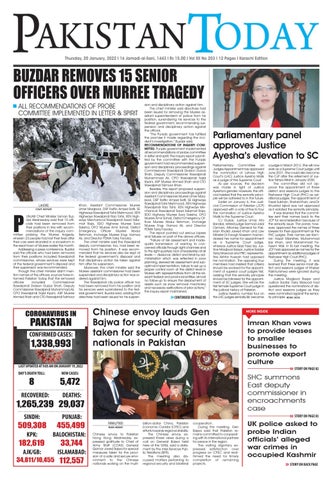
thursday, 20 January, 2022 i 16 Jamadi-al-sani, 1443 i Rs 15.00 i Vol Xii no 203 i 12 Pages i Karachi edition
Buzdar removes 15 senior officers over murree tragedy g
All recommendAtions of probe committee implemented in letter & spirit
LAHORE Staff RepoRt
P
unjAb chief minister usman buzdar Wednesday said that 15 officials had been removed from their positions in line with recommendations of the inquiry committee probing the murree tragedy, wherein 23 people had lost their lives after their cars were stranded in a snowstorm in the resort town of murree earlier this month. Addressing a press conference, buzdar said the officials who had been removed from their positions included rawalpindi commissioner, whose services were kept at the federal government’s disposal and their suspension was recommended. though the chief minister didn’t mention names of the officers, sources have informed pakistan today that the removed officers included commissioner rawalpindi division Gulzar shah, deputy commissioner rawalpindi muhammad Ali, cpo rawalpindi sajid Kiyani, Asp murree Ahmed shah and cto rawalpindi taimoor
Khan, Assistant commissioner murree umer maqbool, dsp traffic Amjad satti, se Highways rawalpindi tahir mehmood, Xen Highways rawalpindi rao tahir, Xen Highways mechanical rawalpindi saad salamat raja, sdo Highway murree ezza saleha, dfo murree Amir sohail, district emergency officer murree Abdur rehman, incharge murree engr. Hamza Ali, and director pdmA tariq faooka. the chief minister said the rawalpindi deputy commissioner, too, had been removed from his position. it was recommended that his services also be kept at the federal government’s disposal and that disciplinary action be taken against him after his suspension. moreover, the chief minister said the murree assistant commissioner had been suspended and disciplinary action was ordered against him. the rawalpindi city police officer too had been removed from his position and his services were surrendered to the federal government, buzdar said, adding that directives had been issued for his suspen-
coronavirus in
Pakistan
CONFIRMED CASES:
1,338,993
sion and disciplinary action against him. the chief minister said directives had been issued for removing the murree assistant superintendent of police from his position, surrendering his services to the federal government, recommending suspension and disciplinary action against the official. “the punjab government has fulfilled the promise it made regarding the incident’s investigation,” buzdar said. ReCommendations of inquiRy Committee: punjab government implemented all recommendations of probe committee in letter and spirit. the inquiry report submitted by the committee with the punjab government had recommended suspension and disciplinary proceedings against commissioner rawalpindi division Gulzar shah, deputy commissioner rawalpindi muhammad Ali, cpo rawalpindi sajid Kiyani, Asp murree Ahmed shah and cto rawalpindi taimoor Khan. besides, the report proposed suspension and disciplinary proceedings against Assistant commissioner murree umer maqbool, dsp traffic Amjad satti, se Highways rawalpindi tahir mehmood, Xen Highways rawalpindi rao tahir, Xen Highways mechanical rawalpindi saad salamat raja, sdo Highway murree ezza saleha, dfo murree Amir sohail, district emergency officer murree Abdur rehman, incharge murree engr. Hamza Ali, and director pdmA tariq faooka. the report pointed out serious lapses and failures on part of the above officers. “failure of risk assessment and inadequate transmission of warning to concerned officials through right channels and to the right quarters; lack of leadership at all levels — divisional, district and tehsil by administration which was reflected in poor planning, skewed risk assessment and suboptimal implementation; failure to set up a proper control room at the district level in murree with representatives from all the relevant federal and provincial entities; almost no follow-up to ensure the deployment of assets such as snow removal machinery and necessary verifications of prior actions,” the inquiry report maintained.
CONTINUED ON PAGE 05
Parliamentary panel approves Justice ayesha’s elevation to sC parliamentary committee on judges Appointment has approved the nomination of lahore High court’s (lHc) justice Ayesha malik as a judge of the supreme court. As per sources, the decision was made in light of justice Ayesha’s gender. However, the official insisted that the seniority principle will be adhered to in the future. earlier on january 6, the judicial commission of pakistan (jcp) approved with a vote of five to four the nomination of justice Ayesha malik to the supreme court. cj Gulzar, justice umar Ata bandial, retired judge sarmad jalal osmani, Attorney General for pakistan Khalid jawed Khan and law minister dr farogh naseem had endorsed her name for appointment as a supreme court judge, whereas justice Qazi faez isa, justice maqbool baqar, justice sardar tariq masood and pbc representative Akhtar Hussain had opposed her nomination. the opposing four members had insisted that criteria should be evolved for the appointment of superior court judges first, adding that the seniority principle should be followed for the appointment of sc judges. she will be the first female supreme court judge in the judicial history of pakistan. justice Ayesha, number four on the lHc judges seniority list, became
Chinese envoy lauds Gen Bajwa for special measures taken for security of Chinese nationals in Pakistan
LAST UPDATED AT 9:05 AM ON JANUARY 19, 2022
DAY'S DEATH TOLL:
NEW CASES:
8
5,472
RECOVERED:
509,308
455,499
KPK:
BALOCHISTAN:
182,619
33,744
AJK/GB:
ISLAMABAD:
34,811/10,455
112,557
imran Khan vows to provide leases to smaller businesses to promote export culture sHc summons east deputy commissioner in encroachments case
1,265,239 29,037 PUNJAB:
more inside
STORY ON PAGE 02
DEATHS:
SINDH:
a judge in march 2012. she will now work as a supreme court judge until june 2031. she could also become the cjp after the retirement of justice Yahya Afridi in january 2030. the committee did not approve the appointment of three district and sessions judges to the peshawar High court (pHc) as additional judges. the appointment of fazal subhan, shahid Khan, and dr Khurshid iqbal was not approved as it violated the seniority principle. it was learned that the committee sent their names back to the jcp for reconsideration because of the seniority issue. the panel, however, approved the names of three lawyers for their appointment as the pHc judges. their names are Kamran Hayat miankhel, muhammad ijaz Khan, and muhammad faheem Wali. in its last meeting, the jcp had approved six names for the appointment as additional judges of peshawar High court (pHc). during the meeting, it was learned that three senior-most district and sessions judges of Khyber pakhtunkhwa were ignored during the meeting. justice maqbool baqar and justice sardar tariq masood had questioned the nominations of district and sessions judges as they were nominated against the seniority principle. NewS DeSk
STORY ON PAGE 03 RAWALPINDI MiaN abRaR
chinese envoy to pakistan nong rong Wednesday expressed gratitude to chief of Army staff (coAs) General Qamar javed bajwa for special measures taken for the provision of a safe and secure environment to the chinese nationals working on the multi-
billion-dollar china, pakistan economic corridor (cpec) and efforts towards regional stability. the chinese envoy expressed these views during a call on General bajwa held here at the GHQ, said a statement by the inter-services public relations (ispr). the meeting also discussed matters pertaining to regional security and bilateral
cooperation. during the meeting, Gen bajwa said that pakistan remains committed to cooperating with its international partners for peace in the region. the visiting dignitary expressed satisfaction over progress on cpec and reaffirmed the need for timely completion of remaining projects.
uK police asked to probe indian officials’ alleged war crimes in occupied Kashmir STORY ON BACK PAGE
02
Thursday, 20 January, 2022 | KARACHI
NEWS
ImrAn KHAn vows to provIDE lEAsEs to smAllEr bUsInEssEs to promotE Export cUltUrE ISLAMABAD Staff RepoRt
PM UNVEILS NEW SME POLICY
RIME Minister Imran Khan Wednesday unveiled the new Small and Medium Enterprises (SMEs) policy, saying that the government would provide leases to businesses and promote export culture in the country under the new policy. “The land is very expensive in our cities … the government would facilitate the businessmen by providing loans on low interest rates and land on lease,” said Imran Khan while addressing a ceremony organised here to launch new policy for Small and Medium Enterprises (SME) sector. The policy lays a special focus on promoting business through facilitation in registration, streamlining of taxes, access to credit and provision of land. The premier said that in the past, only wealthy traders used to get loans from banks but the government has changed the course and even the small traders can avail the facility. “Action would be taken against those
institutions that are creating hurdles [in setting up businesses],” he warned. PM Imran said that despite having a population of 220 million people, the country’s exports were only $22 billion when the government took over. “Singapore with a population of only five million has an export of over $300 billion… many smaller nations have surpassed us but the government has decided to encourage exports,” he added. The prime minister said that the inspections from various institutions became a way for bribery, adding that in such a system a large organisation may survive but smaller businesses suffer the most and end up shutting down completely. He said that Pakistan was growing at the fastest rate in this region at one point in time but due to the policies of different governments, we faced a downfall. “When our president visited the US in the 1960s, the president of that country came
p
to greet him… Malaysians and Indonesians came here to see what we’re doing right… our bureaucracy was considered one of the best in the world but due to political interference, it went downhill.” PM Imran said that many Pakistanis make a large amount of money abroad but when they invest in Pakistan, they get into losses and end up moving back. “I have seen with my own eyes how people from here went to Manchester and how they made money there,” he added. Imran Khan warned that another wave of coronavirus had gripped the country but reiterated his stance against lockdown, saying that his government will not shut down the economy. The country reported about 5,472 new coronavirus cases in the last 24 hours, the highest since August last year. According to the National Command and Operation Center (NCOC), the Covid-19 positivity ratio had reached 9.48 per cent.
The NCOC – the nerve centre of the government’s anti-pandemic strategy – earlier in the day announced new restrictions in cities with an over 10% Covid-19 positivity ratio as the country battles the fifth wave of the deadly pandemic. Talking about the achievements of his government, the prime minister said that Pakistan’s exports are at a record high, the tax collection is at an all-time high level too whereas the overseas Pakistanis have sent record remittances. “Now we’re trying to automate things… we’re trying to make a strategy with NADRA so we can increase the tax net in the country… we’re a country with a population of 220 million but only 2.2 million pay taxes… a country cannot run this way.” He said that investment worth Rs500 million came to Pakistan only via startups during the last few years. “There are many issues and we understand them but the government is committed to resolve them,” he added. Talking about the challenges the country faced when the PTI came into power, the premier said that despite many challenges
Head-hunting drive for DG PSQCA hits dead end ISLAMABAD Ghulam abbaS
The head-hunting campaign of the Ministry of Science and Technology has hit a dead end as despite interviewing around two dozen candidates, the interview panel has failed to find a suitable person to be appointed as Director General (DG) of Pakistan Standard Quality Control Authority (PSQCA). It merits mention that the DG of PSQA is a MP-I scale post. According to insiders, the ministry has interviewed initially 15 candidates, shortlisted by a scrutiny committee
on January 6, 2022, which were considered the most suitable candidates as per their qualification, relevant experiences. However, the interview panel headed by Federal Minister of Science and Technology Senator Shibli Faraz could not select anyone from the list for unknown reasons. The ministry called another group of candidates for interview later which, as per the sources, also could not satisfy the interviewing panel. The ministry has now called another six candidates for interviews on Wednesday despite the fact they hardly qualify to appear in the interview. According to sources, calling those possessing not
relevant qualifications and experiences was violation of management pay scale policy. An official, speaking to Profit on the condition of anonymity, said that there was no need to call those applicants lacking the minimum qualification and experiences for the advertised post. Insiders informed this scribe that some politically influential persons within the ruling party, Pakistan Tehreek-i-Insaf (PTI) were trying to get their candidate appointed to the same post. Profit tried to reach out to the official spokesperson of MoST for comments but received no response until the filing of this story. a
Pakistan’s mega city project worth $7bn turns shady AgencIeS After the British divided Pakistan and India more than seven decades ago, Suleman Mohammad Sajjad Warraich’s father received a section of land on the outskirts of Lahore. It was a place to put roots in the new nation. Later on, Warraich and his family filled their 300 collective acres with vegetable plots, marigold gardens, and guava groves. The property was supposed to pass through generations. But early last year Warraich was told that the government would be acquiring the land. He’d be compensated, and his farm turned into something other than agricultural land. That didn’t sit right with him, so he filed a petition opposing the acquisition. Warraich is among dozens of landowners petitioning against the government’s plan to build a megacity from scratch on the banks of the Ravi river, a once-thriving waterway that’s been depleted by pollution and dwindling water levels. The $7-billion endeavor would span 46 kilometers (29 miles) and include housing, commercial areas, hospitals and schools — creating a metropolis that could ease pressure on overpopulated Lahore and support its urbanization. The Ravi Urban Development Authority, a government body created to manage the project, pitches it as a green initiative that will bring in much-needed resources to clean up the river. “The idea is to manage the area properly,” says RUDA’s Chief Executive Officer Imran Amin. RUDA aims to build a man-made channel and a series of barrages along the Ravi’s path to control its water level, which the authority says will help conserve what limited flow remains and restore Lahore’s supply of groundwater. But some opponents are skeptical of those claims and what they see as a land grab by RUDA. The city’s high court halted the project last year — one ruling in an ongoing legal fight for the future of the river that could reach Pakistan’s Supreme Court. “This is our property. We don’t want to sell it,” says Warraich, sitting on a white plastic armchair outside his farmhouse. “They are acquiring our land for a new city” where local residents won’t be able to continue farming, he says. “I don’t understand this logic.” Pakistan’s leaders have been trying to develop the banks of the Ravi for almost a decade and Prime Minister Imran Khan has made the task a priority. The Ravi river was instrumental to Lahore’s development, but today large pockets sit stagnant while other sections have dried up completely. A water-sharing treaty with India has limited its flow, while Pakistan’s own mismanagement has exacerbated the problem. For decades, the river has collected untreated sewage from Lahore, as
well as industrial and agricultural waste. In recent years, Pakistan has developed legislation to regulate water use amid warnings that the country will face water scarcity by 2025. According to a government study last year, only 39% of water sources across 29 cities were safe for drinking. Cleaning up the Ravi could help Pakistan forestall an impending water crisis — its basin is home to some 50 million people and the river irrigates about 7 million acres of land. These short-term solutions, however, will run up against the climate clock. Most of Pakistan’s rivers are fed by melting snow from glaciers in the Himalayas, which are set to shrink as the world heats up. As global average temperatures rise beyond 2 degrees Celsius — a highly likely scenario based on current trajectories — the volume of Himalayan glaciers will be halved. Global warming is set to increase precipitation across Pakistan, but climate models show the seasonality and intensity of those rains will become less predictable. That’s bad news for farmers given the vast majority of crops grown in Pakistan are dependent on reliable monsoon patterns. Though agriculture provides less than 20% of the country’s gross domestic product, it employs 40% of its labor force. Pakistan isn’t the first country to try and solve its environmental issues with more development. Governments have plowed billions of dollars into eco-city initiatives everywhere from Malaysia to Iceland to simultaneously boost economic growth and adapt to a warming planet. The projects are marked by common features including more efficient public transport, green spaces and wastewater treatment systems. RUDA says that Ravi City will follow the same mold and become a sister city to Lahore, helping to control its urban sprawl while reviving the river. A 2017 census put the population of Pakistan’s second-biggest city at 11 million, though unofficial estimates say it’s grown to about 13 million since. RUDA will take “all the proceeds from this zone which you are developing and put it in the water channelization, barrages and the wastewater treatment plants,” says Amin. Pakistan has had some success with planned cities. Its capital, Islamabad, shares a larger metropolitan area with neighboring Rawalpindi — the way RUDA says it envisions its city relating to Lahore. The grid structure of Islamabad is drastically different from other Pakistani cities; traffic and pollution are better and the city feels orderly in a way Lahore does not. But critics worry that the new city, which RUDA says will take 12 to 15 years to build, will replicate Lahore’s problems instead of fixing them — especially its
inequality. They also say the government’s focus on building a new city could lead to further neglect in parts of Lahore. As the city boomed, it has stretched west toward the Ravi, spawning packed settlements around the river. The area’s population density contrasts starkly with growing wealth at the other end of the city, where singlefamily houses built on large lots in private communities extend far enough to almost kiss the border with India. Lower-income residents in Lahore bear the brunt of the city’s environmental woes, living in areas with dirty water and bad air. Meanwhile, wealthier residents are protected in housing developments that operate like private businesses with separate water supplies. “It’s a very sad reflection of what has happened to our city because it has been totally commercialized,” says Fauzia Qureshi, an architect and urban planner. The question for residents like Warraich who are being pressured to give up their land is whether the potential improvements and compensation will be worth it. To create the proposed city, RUDA would sell land to developers, who would build on it under the government’s supervision. Opponents argue that the promised environmental benefits of Ravi City are being used to justify the government’s exercise of “eminent domain” — giving it the right to claim private property for public use — on land they fear will actually be used by private developers for commercial purposes. RUDA’s official land-use master plan sets aside space for a high-rise residential zone, business district, and area that will be called Sports City. “There won’t be any forced acquisition,” says Amin from RUDA. “Unless it’s important where it’s [a] wastewater treatment plant or something which is necessary to be placed there and we will try our best” to give current residents “a fair market price.” According to Section 45 of the Ravi Urban Development Authority Act, which outlines RUDA’s powers and functions, the authority may “use such force as may be necessary” to “eject any person in unauthorized occupation of any land or property vested in the Authority.” The document also gives RUDA power “to remove, demolish or alter” any building or structure as needed to realize development plans. There’s no guarantee that those plans will help restore the Ravi. Raising the river’s levels by creating a channel and barrages will have “almost no impact” on Lahore’s groundwater levels, says Vaqar Zakaria, an environmental consultant. The city’s water table will keep being depleted unless groundwater usage by housing developers and factories is regulated, he says, something that isn’t addressed in RUDA’s proposal.
and hurdles the government has shown great progress. “When we came into power, the government was going towards bankruptcy so we had to deal with that first… we rushed to friendly countries and China, UAE and Saudi Arabia helped us… when we saved the country from bankruptcy the coronavirus pandemic arrived which was a challenge not only for Pakistan but the entire world but due to the right policies, we managed to tackle that situation too,” he added. He warned that another wave of coronavirus was coming into the country but added that the government will not shut down the economy. PM Imran said that he understands that there was rising inflation in the country but added that the prices of commodities increased in the entire world. “But despite this, a record number of mobile phones, motorcycles and cars are being sold in the country.” He further said that the policies of the government would soon yield results and many good things for the countrymen will come in near future.
nEprA’s csr award ceremony comes under fire ISLAMABAD ahmad ahmadani
National Electric Power Regulatory Authority (NEPRA) Member Sindh Rafique Ahmad Shaikh on Wednesday raised serious objections over a Corporate Social Responsibility (CSR) award ceremony held at NEPRA Headquarters without the approval of the authority. NEPRA member Sindh said that the invitation for the ceremony was sent through email to all licensees without the approval of the authority. He said NEPRA should not be the part of any activity which in any manner directly or indirectly involves money matters. According to him, the role of NEPRA to help or guide its licensees to join hands with a NonGovernment Organisation (NGO) under its “Power with Prosperity (PwP)” drive is not justified. The first ever CSR award ceremony which has later become controversial was organised by NEPRA to celebrate the achievements of NEPRA’s licensees in the area of CSR. The ceremony was chaired by NEPRA Chairman Tauseef H. Farooqi, and was attended by a large number of NEPRA professionals and licensees including, KElectric, Pakistan Atomic Energy Commission (PAEC), Water and Power Development Authority (WAPDA), Engro and others.
In call with UAE crown prince, Imran condemns Houthi attack on Abu Dhabi ISLAMABAD Staff RepoRt
Prime Minister Imran Khan Wednesday condemned the Houthi attack against Abu Dhabi — that killed one Pakistan national and two Indians, and was claimed by the Iranbacked militia — in a telephonic conversation with United Arab Emirates (UAE) Crown Prince Mohammed bin Zayed Al Nahyan. Police in the capital, Abu Dhabi, said Monday’s attacks targeted three oil tanker trucks at an oil facility and an extension of the Abu Dhabi International Airport. They said six people were wounded. There was no significant damage to the airport or oil facility, police added. Today, the prime minister expressed solidarity with the leadership, government and people of the Emirates, a press statement issued by his office said. Khan underlined that such attacks could not be justified under any circumstances and stressed their immediate cessation, observing they posed a grave threat to regional peace and security. The prime minister offered deepest condolences to the families of all the victims and prayed for the speedy recovery of the wounded. Al Nahyan thanked Khan for the “strong expression of support”, and also offered condolence on the death of the Pakistan national. A spokesperson for the rebel group said it had carried out the attacks on the UAE’s economic hub of Abu Dhabi in retaliation for its role in a military offensive in Yemen last week.
Thursday, 20 January, 2022 | KARACHI
NEWS
nAb UrgEs IHc to bIn mAryAm’s rEqUEst for AcqUIttAl In forEIgn propErtIEs cAsE ISLAMABAD
t
Staff RepoRt
HE National Accountability Bureau (NAB) on Wednesday appealed to the Islamabad High Court (IHC) to turn down the latest request of Maryam Nawaz for her acquittal in the Avenfield House reference, recommending instead an exemplary fine be
imposed on Pakistan Muslim League-Nawaz (PML-N) vice president. In July 2018, an accountability court ruled that deposed prime minister Nawaz Sharif and his family laundered money in the 1990s to pay for four luxury apartments in Park Lane, central London, drawing on allegations that resurfaced in the 2016 Panama Papers. Accountability Court judge Mohammad
Bashir sentenced Maryam to seven years’ imprisonment, fined the family £10m and ordered the seizure of the Avenfield properties. She also received an additional one-year sentence for presenting forged documents in court. In October, Sharif, his daughter and her husband, Muhammad Safdar, had filed appeals in the Islamabad High Court (IHC) against their convictions. The court in
September that year suspended their sentences and released them on bail. Saying the petition was inadmissible for the proceedings, the agency, in its response, contended Maryam’s application is devoid of facts. “The Supreme Court has already given its judgement on the allegations levelled in her petition, and the accountability court had pronounced its verdict in the reference after
Social curbs return to cities with over 10 percent coronavirus contagion rate
03
completing all the legal formalities,” it informed the court. “Similarly, the defendant was given a patient hearing at the trial court as well.” The anti-graft watchdog also rejected the claims of political engineering, adding neither she nor her father submitted the money trail in the reference. Maryam and her brothers, Hassan and Hussain Nawaz, are fugitives from justice, it said. The verdict in the case was announced by accountability judge Bashir and late former accountability judge Arshad Malik — who Maryam claimed was “pressured and blackmailed” to convict her father in Al-Azizia Steel Mills corruption reference — had nothing to do with it, the NAB recalled.
sarina requests nAb to take action against law minister, others newS DeSk
INDOOR GATHERINGS, WEDDING CEREMONIES AND DINING TO REMAIN SUSPENDED BETWEEN JANUARY 20-31 ISLAMABAD/kARAcHI Staff RepoRt
The National Command and Operation Centre (NCOC) Wednesday reinstated Covid-19 restrictions, suspending indoor weddings and dining in cities with transmission rates exceeding 10 per cent as authorities scrambled to find the missing link in the fresh outbreak. The meeting also okayed the presence of up to 300 people in the indoor gatherings and 500 in outdoor events in the districts with a positivity rate under 10 percent. Whereas, in districts with transmission rates crossing the barrier of 10 percent, outdoor gatherings are permitted to allow up to 300 people while indoor events remain strictly prohibited. The meeting also allowed education activities to continue for those under and over 12 in districts with a positivity rate of up to 10 percent. But the attendance is halved for those under 12, and 100 percent for those
over 12 in districts. A press statement issued from the body said the restrictions will remain in effect from January 20 to 31, and will be reviewed on January 27 to assess the latest situation. The ban on indoor dining, however, will go into effect from January 24. The development came as the nation reported almost 5,500 new cases of the coronavirus, the highest singleday tally since August. On August 4, the nation logged 5,661 infections in a single day, which gradually dropped to 291 on December 29. The daily caseload, however, has spiked again since the beginning of this month after some cities reported cases of the new Omicron variant. Pakistan registered 5,472 new infections with a 9.5 percent positivity rate in the last 24 hours, according to the Ministry of National Health Services data. The total number of cases rose to 1.14 million since March 2020. Simultaneously, 628 patients have recovered, bringing the total number of recoveries to
1.26 million, said the NCOC. Meanwhile, another eight people died due to the pandemic, pushing the death toll to 29,037. Pakistan is currently battling a fifth wave of the crisis, along with the rising Omicron cases across the country. Sindh, mainly Karachi, is the worst hit, reporting around 60 percent of the total new infections. On Tuesday, Minister for Information and Broadcasting Fawad Chaudhry said the cases of Omicron variant were “the highest in school-going children” in the port city. The provincial government, however, has no plans to reimpose coronavirus restrictions as hospitals have not reported a serious burden. A few schools in the capital of Islamabad have been shut after the virus was found among students. The government has so far administered the first dose of a Covid-19 vaccine to over 100 million, while over 76 million people have been fully vaccinated, according to official data.
Qureshi invites opposition to support efforts for south Punjab province MULTAn Staff RepoRt
Foreign Minister Shah Mahmood Qureshi on Wednesday invited leaders from the opposition parties to join the government in efforts to make southern Punjab a province. Qureshi, in a tweet, said Pakistan Tehreek-i-Insaf (PTI) manifesto promises the creation of a separate province for the people of the south — the poorest in the nation’s richest province. I welcome all opposition leaders to put the longstanding desire of the people of South Punjab foremost. Together we must reach consensus on passage of a Constitutional amendment for the creation of a separate province for South Punjab. https://t.co/xDF2qrJMmT Shah Mahmood Qureshi
pbs to hold first-ever digital census ISLAMABAD Staff RepoRt
The Pakistan Bureau of Statistics (PBS) has started preparations to hold Pakistan’s firstever digital population census this year. According to reports citing sources, the Ministry of Planning, Development and Special Initiatives has asked the Finance Division for funds to the tune of Rs5 billion. The ministry’s boss, Asad Umar, constituted a six-member Census Advisory Committee comprising demographers and experts to put forward recommendations for holding the digital census in line with international practices. After several meetings, the committee proposed holding a real-time digital census. The funds sought would be granted following the approval of the Economic Coordination Committee (ECC). Last week, a session of the Council of Common Interest (CCI) with Prime Minister Imran Khan in the chair approved holding the 7th population census. The 49th session of the body, attended by all four chief ministers, also approved the constitution of a census monitoring committee. Khan felicitated the members for the establishment of the permanent secretariat of the CCI. “A permanent secretariat demonstrates the governments’ spirit for mutual cooperation,” he said.
(@SMQureshiPTI) January 19, 2022 Irrespective of political affiliation, the national interest requires unity on a constitutional amendment, he added. Southern Punjab — one of the most impoverished parts of South Asia — has been run by major landowners for centuries. The loyalty of thousands of families used to be unquestioning. In 2018, Imran Khan agreed to hive off a new province and scooped up the support of a political bloc led by now-minister Khusro Bakhtyar. Qureshi said that as a party, we continue to work consistently to deliver on recognition of south Punjab as an independent province and we have instituted separate administration, structure, budgets, jobs and benefits with over 35 percent development budget for south Punjab and ring-fencing to stop financial reappropriation.
“Through reform, our focus is socio-economic uplift. The South Punjab Civil Secretariat under an Additional Chief Secretary is manifest of this as is setting up district development coordination committees to improve service delivery for ease and convenience of people of South Punjab,” he added. I welcome all opposition leaders to put the longstanding desire of the people of south Punjab foremost. Together we must reach a consensus on the passage of a Constitutional amendment for the creation of a separate province for South Punjab, Qureshi added. In April, Prime Minister Khan gave the nod to a plan envisaging the development of south Punjab as a separate “administrative zone” in the province with an allpowerful secretariat to tackle issues ranging from lack of resources to under-representation of the region’s populace in public sector jobs.
Sarina Isa, the spouse of Justice Qazi Faez Isa, on Wednesday requested the National Accountability Bureau (NAB) to take action against Law Minister Dr Farogh Naseem, former attorney general of Pakistan Anwar Mansoor Khan, Advisor to Prime Minister Mirza Shahzad Akbar and other senior officials of the Federal Board of Revenue (FBR), according to Express Tribune. Sarina wrote a letter to the NAB chairman and prosecutor general and mentioned in the letter that the law minister broke the law to protect himself from criminal prosecution and that he tailored an amendment to the income tax law. “Section 216 of the Income Tax Ordinance states that tax records ‘shall be confidential’ and if these are accessed (other than by income tax officers) anyone doing so commits a criminal offence. Gentlemen, when you accessed my tax records you broke the law. In my review application submitted to the Supreme Court, I protested against this violation of the law and requested that action be taken. My review was accepted; detailed reasons are awaited. Apprehending that your careers would end and you would face criminal prosecution you proposed an amendment to the existing law”, the letter stated. Sarina, while addressing the law minister, claimed that he dishonestly drafted the Finance (Supplementary) Bill by adding an exception to section 216 to protect him from prosecution for violating the confidentiality of her tax records, and did so when the detailed judgment of her review was awaited. “Is this not contempt of court? The fact that you have inserted the amendment and state that it ‘shall always be deemed to have been so added’ is a clear admission of guilt that you and others committed an offence under section 216″, Sarina stated in the letter. “Clearly you all committed another offence, the one mentioned in section 9(a) of the NAB Ordinance, which states that if anyone in power, ‘misuses his authority so as to gain any benefit or favour for himself or any other person, or if he does anything ‘which grants of attempts to grant any undue benefit in any taxation matter or law’ commits the offence of corruption and corrupt practices,” the letter stated. “Chairman and Prosecutor General of NAB, I have named the persons who first committed an offence under section 216 of Income Tax Ordinance and then to save themselves from its consequences committed another offence under section 9(a) of the NAB Ordinance of corruption and corrupt practices.
Karachiites to receive 76 paisa/unit relief in bills of February 2022 ISLAMABAD ahmad ahmadani
National Electric Power Regulatory Authority (NEPRA) has reduced the price of electricity by 76 paisa per unit for K-Electric consumers on account of fuel charges adjustment (FCA) for the month of November 2021and issued a notification to this effect. According to NEPRA notification, the price of electricity for K-Electric (KE) consumers has been reduced by Rs0.7591 per unit under the head FCA of November 2021 and the consumers of KE will get relief in the bills of February 2022. Similarly, this reduction in power price will be applicable to all the consumer categories except lifeline consumers, domestic consumers consuming upto 300 units and agricultural consumers of the K-Electric. Likewise, negative adjustment on account of
monthly FCA will also be applicable to the domestic consumers having Time of Use (ToU) meters irrespective of their consumption level. This reduction on account of FCA of November 2021 will be shown separately in the consumers’ bills on the basis of units billed to the consumers in the respective month to which the adjustment pertains. As per NEPRA notification, K-Electric will reflect the fuel charges adjustment in respect of November 2021 in the billing month of February 2022. And, in case, the incremental industrial and winter incentive package becomes applicable in KElectric, the amount of negative FCA allowed to such consumers would be adjusted in the subsequent adjustments of KElectric. “While effecting the Fuel Adjustment Charges, K-Electric Ltd. shall keep in view and strictly comply with the orders of
the courts notwithstanding this order, “said NEPRA notification. Earlier, the KE had requested an increase Rs0.32 for FCA of November 2021 and NEPRA conducted a hearing on the matter on 3rd January 2022 and reserved its judgment after hearing objections raised by interested and affected parties. However, the NEPRA has now issued its decision after scrutiny of records and verification of facts and
figures. It is pertinent to mention here that NEPRA officials while speaking on the occasion of hearing said that power price for KE consumers is likely to be reduced by 75 paisa per unit instead of the 32 paisa per unit hike as requested by the KE. “Power consumers had faced an additional burden of over Rs144 million due to violation of merit order,” they said. However, KE officials denied
the same saying that power consumers did not bear any additional burden due to the absence of gas sales and a purchase agreement. NEPRA’s vice chairman replied that it is strange that there is no impact on gas consumers due to absence of gas sales as they are going to be hit with an impact of over Rs3 billion because of low gas pressure. Meanwhile, officials of KE said that work on three agreements with the government for power purchase has been initiated. “KE is near to inking a 2050MW power purchase agreement with central power purchasing agency (CPPA). The electric supply company has also forwarded a draft regarding tariff differential subsidy while the company will also be able to get 2050MW of electricity from National Transmission and Despatch Company (NTDC) by 202324,” an official of the KE said.
Thursday, 20 January, 2022 | KARACHI
04
NEWS
WorLd Bank HaILs PakIstan’s energY sector reForms ISLAMABAD
t
staff report
HE World Bank’s Country Director for Pakistan, Najy Benhassine has appreciated the energy sector reforms undertaken by the Pakistan govern-
ment. Najy Benhassine was talking to Federal Minister for Energy Hammad Azhar on Wednesday. Benhassine and Azhar during the meeting also reviewed progress about the World Bank funded ongoing projects in the energy sector. Appreciating the World Bank’s sup-
port in the economic development of Pakistan, the minister said that Pakistan values its partnership with the World Bank and other financial institutions. Azhar lauded the World Bank’s role in support of various development initiatives of the Government of Pakistan, especially in the energy sector. He underscored the importance of the Bank’s assistance for Pakistan’s energy sector reform programme. The minister hoped that continuous engagement with the World Bank for bringing improvements in the power sector will further promote governance, efficiency, service delivery and shall bring benefits for the common people.
Fakhar Imam vows to ensure credit facility for growers ISLAMABAD staff report
Minister for National Food Security and Research Syed Fakhar Imam has made it clear that no stone will be left unturned to ensure easy access to credit facility for growers to promote and develop the agricultural sector in the country. The Minister presided over the meeting of the National Coordination Committee of Agriculture Transformation Plan on Wednesday, which discussed the progress so far made under the transformation programme. The meeting also discussed the subsidy being provided to farmers on different agriculture inputs, said a press release. Imam said that accessibility to credit is important for achieving sustainable agriculture development and economic growth in the country. He said the agriculture sector development and prosperity of the farming community across the country is top priority of the government, adding the government is taking measures to enhance per-acre crop output in the country for enhancing food safety and security.
Leather goods exports surge 9.41pc to $319.8m in 1HFY22 ISLAMABAD staff report
CPEC enabled Pakistan to meet energy demand, cut production costs: official ISLAMABAD Xinhua
The China-Pakistan Economic Corridor (CPEC) has not only turned Pakistan into a power surplus country but also cut the production cost of electricity, Khalid Mansoor, special assistant to the prime minister on CPEC Affairs, said. Pakistan needs a lot of power for domestic and industrial consumers, and the nation’s main production technology depends on expensive imported furnace oil, Mansoor told Xinhua in an interview. In the light of this situation, China invested in power plants in
Pakistan and added 5,320 megawatts of electricity to the national grid at a lower cost. “Now people do not face the long hours of load shedding, and the coal-burned power generation has reduced the overall tariffs as well. So we are very thankful to China for their cooperation,” he added. Another significant contribution of CPEC to Pakistan is that it has improved the transmission and distribution of electricity, and cut the line losses through the state-ofthe-art ±660kV Matiari-Lahore high-voltage direct current transmission project, which was com-
pleted despite Covid-19 challenges last year, he said. Talking about CPEC’s role in the agricultural sector of Pakistan, Mansoor said it is among the major priorities of the current government, and for that purpose, the country wants to benefit from the experience and expertise of China. He said that as the industrialisation process under phase two of CPEC moves ahead, more electricity will be used by the industrial sector, and the country will enjoy the perks offered by CPEC including import substitution, more exports and wealth creation.
The leather goods exports witnessed an increase of 9.41 percent during the first half of the current financial year 2021-22 as compared to the exports of last year. According to the Pakistan Bureau of Statistics, during July-December (2021-22), Pakistan exported leather goods worth $319.791 million against the exports of $292.279 million during July-December (2020-21), showing growth of 9.41 percent,. Among the leather products, the exports of leather garments increased by 9.73 percent by going up from $152.888 million last year to $167.768 million during the current year. The leather gloves exports also rose by 9.19 percent to $142.627 million from $ 130.623 million. Likewise, the exports of all other leather goods also increased by 7.16 percent during the period under review as these went up from $8.768 million last year to $ 9.396 million during the current fiscal year. Meanwhile, on a year-on-year basis, the leather goods’ exports witnessed an increase of 1.87 percent during the month of December 2021, as compared to the same month of last year. The leather exports during December 2021 were recorded at $53.153 million against the exports of $52.179 million in December 2020. During the period under review, the leather garments increased by 6.49 percent while the export of gloves dipped by 2.79 percent, in addition, the exports of other leather goods also decreased by 7.33 percent.
Pakistan conveys condolences over deaths in Afghanistan earthquake The government on Tuesday expressed sadness about the loss of life and property in an earthquake hitting western Afghanistan the previous day. “We are deeply saddened at the earthquake that struck Badghis province in western part of Afghanistan on Jan. 17 that resulted in the loss of many precious lives as well as destruction of property,” the Foreign Office said in a statement. Monitoring report
PID (I) 4941/21
CMYK
Thursday, 20 January, 2022 | KARACHI
NEWS
05
96 PEOPLE IN UMERkOT TOOk THEIR OwN LIvES AFTER BEINg BLACkMAILED uMERKOt
Islamabad: Federal Minister for Human Rights Dr. Shireen Mazari inaugurating 11th Photo exhibition "Islamabad: Poem by Nature" organized by Photojournalists Association at PNCA. pr
AMBASSADOR OF THE CZECH REPUBLIC CALLS ON AIR CHIEF
D
News Desk
URING the year 2021, around 96 people, including 40 women, took their own lives in Umerkot. According to a report published by an NGO, the majority of the people who took their lives were married. Getting married at a young age
and being blackmailed through social media for various reasons were the two main reasons which led to the spurt in the suicide cases, per the report. Early marriagEs/misusing social mEdia: The researcher, Sardar Bhaio, said people are being blackmailed on social media, adding that “many kids wrote letters before taking their lives”. “Parents are marrying off their
Buzdar removes 15 senior officers over Murree tragedy cOntInuED fROM pAgE 01
Ambassador of the Czech Republic H.E. Mr. Tomas Smetanka called on Air Chief Marshal Zaheer Ahmed Baber Sidhu, Chief of the Air Staff, Pakistan Air Force in his office today. The visiting dignitary lauded professionalism of PAF personnel and exceptional progress made by PAF over the years, especially through indigenization. The Air Chief highlighted the cordial relations between the two countries and reiterated his resolve to further augment the existing cooperation between the two Air Forces. Various matters of mutual interest and professional cooperation also came under discussion during the meeting. pr
children at a young age without their consent which is why the suicide rate has been increasing,” he added. The report further added that suicide cases are not usually reported as families think it would be “disgraceful”. On the other hand, police suspect many suicide cases to be murders which stops people from reporting these cases. Cases are reported if reason for
“The reliance was placed entirely on verbal confirmations besides lack of coordination among the departments to work in a unified manner to help the stranded tourists,” it added. The inquiry report recommended that Murree may be upgraded to the status of a district. Automated entry-exit points be established for counting entry and exit of vehicles from Murree on real-time basis, which may be connected with a “Visit Murree” application that can issue entry permits or ticket to tourists based on the absorption capacity of local infrastructure. A comprehensive master-plan of Murree may be prepared and implemented for the future development and promotion of Murree as tourism destination of choice, it recommended. “Strict building code regulations should be developed and implemented, land use control should be enforced strictly and illegal buildings, structures
must be demolished forthwith. A modern earlywarning system may be established with the PMD in Murree to warn officials, tourists, and travelers,” the reported recommended. “Department of tourist services may be strengthened by appropriate human and physical resources. The regulatory framework for various tourist and allied services may be developed and implemented. Official use of WhatsApp especially for transmission of official documents and information be discouraged in line with federal government instructions and policies,” it further recommended. The report recommended that a joint management committee under the co-convenership of Deputy Commissioner and Station Commander, Pakistan Army, may be set up for Murree to implement upgradation and master plan. “Safe City infrastructure may be established in Murree. All snow-clearing management services be equipped with modern gadgetry, snow-borne equipment and appropriate gear,” the report concluded.
PLRA approves citizens’ universal access to all land records LAHORE shahab omer
The Punjab Land Record Authority (PLRA) has approved provision of universal access to all Land Record Centers in Punjab for the convenience of citizens, Pakistan Today learnt here on Wednesday. Ali Raza Butter, an official of PLRA, informed this scribe that this access will help people to get land documents [Fard] in future and this service will also save time and travel. “In fact, the main purpose of this facility is that a person who resides in Lahore and owns land in Jahanian will no longer have to go to Jahanian to get his land documents; instead, he or she will get these documents from the Land Record Center in Lahore or from any center in Punjab”. “The fee set by the authority for the acquisition of Fard is RS 500 and it has not yet been decided how much fee the beneficiaries of universal access will pay as only the access to this service has been approved so far, however, when this service will be launched, there will definitely be various formalities regarding its fees
and paperwork,” he informed. Butter further informed that Chairman PLRA Sardar Ahmad Ali Khan Dareshak has also approved the service structure for the staff of the authority. On the other hand, another PLR official, speaking on condition of anonymity, informed that the approval of the service structure was a very unilateral decision in which nothing was decided for the welfare of the staff. “We have staged several protests on the roads for the approval of the service structure and the purpose of these protests was to build our service structure and regularization of staff. But in the service structure approved
by the chairman, the authority wants staff to work on a three-year contract and then re-enter the contract. That is, the employees of the authority have to work on contract till the age of retirement. In addition, the service structure does not mention any pensions, nor does it guarantee job security,” he said. Another PLRA official informed that the decision was taken by the board of the authority deliberately to ensure the eradication of Patwari culture. “Despite the modern-style authority and its modern system, the eradication of corruption has not yet been ensured especially the staff posted at the Land Record Centers are still dealing with the people in the style of Patwaris and often the authority office receives complaints from people
that they [staff] are forcing the public to pay bribes. Some officials of the authority want these people not to be regularized in their jobs so that they are in danger of being fired for corruption and by doing so, the staff will focus only on their work and not on taking bribes,” he believed. Butter, however, said that this was not the case but that the approval of the service structure was aimed at the welfare of the staff and that the authority had taken a better step to meet their [staff] long standing demands. “Due to the career ladder and development structure, promotion from Class IV employees to administrative officers has been linked to academic qualifications, annual performance, training and departmental examinations. Performance-based incentives for staff of the Land Record Center were also unanimously approved and approved by the Chairman of the PLRA Board. All the 5200 Dahi Markaz Malls across Punjab have also been declared as Land Record Centers to provide computerized land record services to the general public,” Butter maintained.
death is unnatural: SSP Umerkot Senior Superintendent of Police (SSP) Umerkot Mukhtiar Khaskheli said that the police probes the matter if the reason for death is unnatural, adding that “the police registers a first information report (FIR) upon confirming that the person is murdered”. The report also stated that usage of drugs among men, domestic issues, poverty, and sexual harassment are the motives for suicide.
Playwright and activist Lakht Pasha laid to rest in Lahore Punjabi playwright, translator, political activist and founder of theatre group, Punjab Lok Rahs, Akbar Pasha, popularly known as Lakht Pasha or Pashi, passed away in Lahore on Monday. Born in 1946, he trained the youth, labourers and artists during his 76-year span of his life and transferred his left-leaning progressive thoughts to the generations younger to him through his study circles. He spent most of his life in Lahore but the last15 years in district Okara and Sahiwal. Pashi completed his school education from the Muslim Model High School before moving to the National College of Arts (NCA), Lahore. During his student life, he was inspired by Prof Mubarak Haider, Prof Eric Cyprian and Dr Naeem of the Philosophy Department of the Punjab University and his political mentor poet Najm Hosain Sayed. Pashi used Punjabi language for street theatre starting in 1983 with the Punjab Lok Rahs. He believed the people’s theatre must be in people’s language. He was impressed by Safdar Hashmi’s progressive theatre group, Sehmat, that inspired young men and women of his generation due secular values. Pashi was motivated by Major Ishaq’s struggle for the working class under Mazdoor Kisan Party (MKP). His famous plays performed by Punjab Lok Rahs included Haneray Da Pandh (A Journey into Darkness), Akhyan (Eyes), Hond Unhond (Being and Nothingness), Ghairat (Honour), Dakait (Dacoits), Ayanay (Kids), Parchi (Vote), Lakeer (Division), Bhulekha (Illusion), Bandiwan (Prisoners), Kurlaat (Screech), Kahani Wali Chri De War (The Story of a Sparrow), Saar & Vajog (Consciousness), Kattan Harray (Weavers), Sam Deo Tey Tael Shahzadi (Sam, the Giant and Oil Princess), Dharo (Injustice), Bati Dharain (Breastfeeding), Panjwan Chiragh (The 5th Lamp), Zanani (The Woman), Daroo (Medicine), Global Village, Rang Badrang (Colour and Colourlessness), Aik Probhera Akhar (An Alien Word). Pashi translated Gorki’s novel, Mother, from Russian language into Punjabi. The novel is still seeing its publishing. The published works of Pashi include Punjabi translations of books of Sigmund Freud, Carl Jung and Alfred Adler. His admirers are planning to publish his 100-page Punjabi poetry collection and anthology of 76 Punjabi plays. Pashi was critically ill for the last two months and was laid to rest at Miani Sahib. News Desk
Supernet, Avara win Rs250m project in Pakistan ISLAMABAD staff report
In what could be dubbed a major triumph, Supernet Limited and Australian technology partner Avara Technologies (Pvt) Ltd have been awarded a new project worth Rs250 million, enabling in-country engineers and technicians to rectify faults throughout the equipment’s lifecycle. The new project, valued at approximately Rs250 million, constitutes Phase 3 of the programme for the supply of multiservice multiplexers and associated operations, maintenance, warranty, and support services. Supernet Limited (Supernet) announced on Wednesday that they, in conjunction with their Australian technology partner Avara Technologies Pvt Ltd (Avara), have been awarded a new project worth approximately Rs250 million within a long-term program that was awarded in 2021 by a major Pak-
istani customer. The new project valued at approximately Rs250 million constitutes Phase 3 of the program for the supply of multiservice multiplexers and associated operations, maintenance, warranty and support services. The program includes the establishment of a repair facility in Pakistan and the transfer of knowledge through an expansive training program enabling in-country engineers and technicians to rectify faults throughout the equipment’s lifecycle. Avara’s DynaFlex product family is a flexible, fully-featured, access multiplexer with powerful cross-connect and protection capabilities. With the ability to handle a wide range of interfaces like POTS, SCADA, Ethernet, Serial Data and Tele-Protection, the DynaFlex platform is an ideal choice for transporting mission-critical TDM services over PDH, SDH, Ethernet or MPLS-TP packetbased interfaces. DynaFlex offers a broad
range of hot-pluggable channel cards to complement a range of physical interfaces in a modular manner. In 2021 Supernet and Avara successfully delivered in time the first batch of DynaFlex multiplexers under Phase 1 of the program despite supply chain and logistics challenges due to the Covid-19 pandemic. The delivery for Phase 2 is under implementation with the newly awarded Phase 3 expected to reach completion towards the tail end of 2022. Ali Akhtar, Supernet’s Head of BU, Telecoms & Defense and Lasha Aponso, CEO, Avara jointly stated, “This is a major triumph for us right at the start of 2022 and we are thrilled to have been awarded this new project. It reaffirms the trust and satisfaction of the customers in our products and services. On the back of this victory, we’re charging full steam ahead with our plans to expand business in Pakistan.” It is worth mentioning here that Supernet
cMYK
Limited has already secured a telecommunications infrastructure development project worth over Rs150 million from a Pakistani mobile network operator to supply optical fiber and associated equipment and its deployment in different areas of Punjab. The total length of different segments constituting the project is approximately 140
kilometres. “We are excited to play our part in the expansion of telecommunications infrastructure in Pakistan and supporting the proliferation of communications and digital services by mobile network operators in the country,” said Ali Akhtar, head of business unit-telecoms and defense at Supernet.
06-07 Comments - 20th January 2022_Layout 1 1/19/2022 11:14 PM Page 1
Thursday, 20 January, 2022
06 COMMENT
Preparing for Change
Moves on the chess board Government’s talks offer a nonstarter?
W
ItH demoralisation spreading among PtI allies and party’s legislators, the government is keen to stop the opposition making use of it. the government has therefore extended an invitation to the opposition to hold talks on issues near to the latter’s heart like electoral and judicial reforms and the appointment of a new NAB chairman. Information Minister Fawad Chaudhry claims that the prime minister himself had invited the opposition to negotiate on these three issues. this is likely to be rejected by the opposition as a tactical overture. Had it been a serious move Imran Khan would have been personally leading the government team. Instead Mr Chaudhry has once again categorically reiterated that Mr Khan would not sit with any opposition leader, including Shehbaz Sharif. At a time when the Army is seen to have distanced itself from the ruling party, the PM would not like to send the message to those who matter that he is not hobnobbing with the opposition. What adds to the worries of the ruling party is that after fighting against one another for a whole year, the opposition parties have ended, in the main, their differences over tactics aimed at overthrowing the government. Instead of insisting on prior resignations from the Assemblies, the PML(N) and JUI(F) have instead agreed to the PPP’s suggestion to work together for a no-confidence move against the government in the National Assembly. they know it is a long shot but consider it worth trying. Lacking the required numbers in the lower house, the opposition will have to lobby with the increasing number of dissidents in the PtI as well as its allies. the opposition leaders hope that due to the government’s unpopular economic policies, public pressure would force a number of PtI lawmakers as well others from the allied parties to join hands with the opposition. to the PtI’s dismay, the issue of two marches on Islamabad can no longer be used to divide the opposition. As PPP chief Bilwal Bhutto Zardari has put it, the two different long marches would create more difficulties for the government. Many however still remain skeptical regarding the present display of unity among the opposition parties continuing for long.
The status quo must be replaced
Dr FariD a Malik
“I
t is not the strongest or the most intelligent who will survive but those who can best manage change “; said Leon c. Megginson. In a world driven by technology only change is permanent, and nations that do not prepare for it, invariably perish. Unfortunately, since July 1977, change has been installed in the land of the pure Insteading of preparing for it, we have been crushing all attempts towards it. No one seems to know the way forward, so we continue to languish in despair and darkness. Only effective change management can reverse this deadly decline. the status quo is not an option, never was, never will be. the sooner we come out of this stagnation syndrome the better it will be. the current system is choked and non-functional. As a nation we have been unable to come out of this era of stagnation. the status quo is so entrenched that mafias have taken over. the task of reforms is both difficult and life threatening. the evil spell of the Zia era refuses to be warded off. the Machiavellian approach of ‘Do Nothing’ was introduced during that period (July 1977 to August 1988). All the gains of the democratic era (December 1971 to July 1977) were wiped out. there was a paradigm shift. By getting involved in the Afghan Conflict, the focus shifted to ‘security’ instead of much-needed human development.
Capping it all Stuffing religiosity into education for political gain
The problem must be handled before it goes out of control NaveeN iqbal
A
forced marriage is simply a marriage in which either one or both the parties are not willing to tie the knot. In Pakistan, as cousin marriage is very common, mostly parents force their children to marry their nieces or nephews because they want strong relationships with their siblings. For this cause, they usually sacrifice the wishes of their children which is unethical and immoral. According to a general estimation, only one out of every ten girls is asked by her parents if she agrees to marry or not;while five out of ten boys are asked for their consent to marriage which means that forced marriages are a dilemma for both the genders, though females are worse hit.. On the other hand, a scientific research shows that cousin marriages are very dangerous to health as they can cause serious diseases to the children of the union. Despite the fact that everyone knows about the given scientific research, everyone keeps them unaware of it and keep wedding off their children. One of the fatal diseases which comes with cousin marriages in particular is thalassemia. In recent times especially, we have witnessed a rise in thalassemia cases across the country. It simply spreads when both spouses have minor thalassemia, then their children are likely to get affected by major thalassemia. Many countries have got control over the spread of thalassemia, but Pakistan is yet to combat it. One way to stop it from spreading is having thalassemia tests before marriages, but due to forced marriages in mind, parents make excuses and skip the tests. Besides this, mostly the undeveloped villages in Pakistan follow the wrong culture of forced marriages. Unfortunately, we can also observe that very young children are wedded off who still cannot understand the complications of a relationship like marriage. For example, when you ask these kids – both girls and boys – why they had been married at a young age, they cannot even comprehend that marriage has any such rules or age fixed or consent is material for marriages. Such marriages can even spoil the family bonding when
Dedicated to the legacy of late Hameed Nizami
Arif Nizami (Late) Founding Editor
Yousaf Nizami M. A. Niazi
Umar Aziz
Joint Editor
Joint Editor
Executive Editor
Lahore – Ph: 042-36300938, 042-36375965
I
Karachi – Ph: 021-35381208-9
I
My question was “ Will the PM support us in the fight against the Mafia of status quo?”‘ He was baffled and could not give a straight answer, clearly indicating only lip service with no long-term commitment for change. Except for the PM, no one seems willing to stick out his head for the much needed change. Policies are formulated with great fanfare but lack the will or the methodology of implementation. Somehow it is assumed that once formulated the policy would be implemented by the bureaucracy, not realising that they are a part of the problem. Colonial bureaucrats are trained to maintain the status quo, and change goes against their professional and personal interests. Once in office they strengthen this evil but after retirement they give long sermons for the much needed change to move forward. Public representatives are required to watch for their interests but they are unable to push for the welfare of the electorate, as the entrenched bureaucracy comes in the way. Old political parties then opted for a system of Muk Muka or ‘Pay for Service’ to get the job done, which has led to massive corruption. If evolutionary changes are stalled it invariably leads to revolution and bloodshed. to avoid anarchy, nations must prepare for change as it is needed. the age-old saying holds way; “What cannot be cured must be endured”. Personally, I think our endurance limits have been stretched too far, now we must look for a cure through well planned change mechanisms. Let us prepare for the inevitable before it is too late.
If evolutionary changes are stalled it invariably leads to revolution and bloodshed. To avoid anarchy, nations must prepare for change as it is needed. The age-old saying holds way, “What cannot be cured must be endured”. Personally, I think our endurance limits have been stretched too far, now we must look for a cure through well planned change mechanisms. Let us prepare for the inevitable before it is too late.
Forced marriages
P
UNJAB Education Minister Murad Raas must be now realizing that he has got into the situation foreseen in the saying “Be careful what you wish for.” He had blithely announced first that Nazara of the Quran was to become compulsory in all schools, in which students would learn the recitation of the Holy Quran. For this, he then had to announce the creation of 70,000 posts of Arabic teachers. Admittedly, the recruitment of such a large number of teachers would be a boon for the PtI, though how such a large body was to become suddenly available was not known. However, all problems were not solved, for Mr Raas’s press conference on tuesday indicated that he had bent his mind to solving another problem, that of uncovered heads. that was the reason he gave for his announcement that private schools were being directed to make caps for boys and scarves for girls part of the uniform. It is considered better to cover the head while reciting the Holy Quran, but it is not compulsory. this would probably not solve Mr Raas’ problems, for there then comes the issue of ablutions, which are compulsory for handling the Quran. With a large number of schools still bereft of drinking water, children may be reduced to performing tayammum. After that would be the issue of female periods: girls having them cannot perform ablutions, and approach the Quran only while wearing gloves or while holding a cloth. Mr Raass might find other problems arise as he goes along. the purpose of the general kowtowing to religiosity of this kind may well be so as to appeal to voters (whose own children are probably no longer in school) that they have done something to ‘Islamize’ education. thus generations of schoolchildren will be forced to undergo these experiences for a political gain, that of enhancing the appeal of the PtI to voters of a religious bent. the PtI should not forget that this is essentially a cosmetic measure, designed to promote religiosity rather than genuine religious devotion, and is targeted both at the students so much as at those who will be satisfied, at secondhand, that the schools are becoming more sanctified.
Editor Aziz-ud-Din Ahmad
While the ‘security state’ flourished, other important segments of development were ignored. the imposed civilian leadership was allowed to carry out unprecedented loot of the nation’s assets. While the people suffered, the state was focused on ‘security’ while ignoring the ensuing plunder. As leader of the progressive segment of the country, Benazir Bhutto tried to introduce the much needed change but Nawaz Sharif with the active support of the establishment of its time thwarted all her efforts at reforms. A new cadre of political bounty hunters was created which has now turned into a menace. Agencies have enough data on their misdeeds which is used only in times of need but not made public to push them out of the arena. In order to grow, nations must prepare for change. transitions are never easy, which must be planned with a clear road map to move forward. For sound decision making, data is required which is not easily available in the land of the pure. Ground realities keep changing which are not accounted for by the policy makers. the chain of command no longer exists in most civilian institutions creating serious impediments for any desired change. Even the necessary records are in disarray, no one seems to know where to start. When Shaukat Aziz took over as Prime Minister, he summoned all the senior officers (Grades 21, 22) for a sermon on change. After his not so convincing speech, the question and answer session started. A federal secretary suggested that the young officers should be first trained for meaningful impact. As Chairman of Pakistan Science Foundation, I shared my own experience of dealing with the mafia which came in the way of change. I asked for his support to take on this menace to restore the writ of the state.
they grow up. Not only the villages, but urban people are also following suit. It is usually the family who selects or rejects the girl or boy for marriage. It seems more an exchange deal than a marriage. It is, in fact, in the universal human rights charter that consent should be taken from both, girl and boy, before they are married. But sadly, a lack of awareness regarding universal human rights and national laws regarding marriages keep pushing us more and more into the ditch of forced marriages. Forced marriages have also affected the minorities in Pakistan. According to a 2019 record, approximately a thousand Christian and Hindu girls were compelled for marriage without their consent in Pakistan. Mostly people drive their children to get married when a rich family comes with a marriage proposal, because it is every parent’s dream that their children should get a happy life. Hindus see the caste, religion and richness of the people and then accept the proposal without taking into consideration the will of their children. Because cousin marriages are not a right practice according to the Hindu religion, as cousins are deemed as brothers; they cannot marry with their cousins. However, they adopt the concept of richness which is wrong because happiness cannot be determined by being rich.
Islamabad – Ph: 051-2204545
The writer is ex-Chairman, Pakistan Science Foundation. He can be contacted at: fmaliks@hotmail.com.
Everyone, whether girl or boy, should be asked their consent for marriage, because it is a very critical affair. It can destroy the entire set-up of a family and can even cause deaths. It is due to these forced marriages that we have seen a rise in suicide rates across the country. If we do not end it here, I fear we can lose national assets in the near future. Federal and provincial governments need to think of it and practically implement laws to prevent forced marriages across the country, not merely on paper. The writer is a freelance columnist
Everyone, whether girl or boy, should be asked their consent for marriage, because it is a very critical affair. It can destroy the entire set-up of a family and can even cause deaths. It is due to these forced marriages that we have seen a rise in suicide rates across the country. If we do not end it here, I fear we can lose national assets in the near future. Federal and provincial governments need to think of it and practically implement laws to prevent forced marriages across the country, not merely on paper
I
Web: www.pakistantoday.com.pk
I
Email: editorial@pakistantoday.com.pk
06-07 Comments - 20th January 2022_Layout 1 1/19/2022 11:14 PM Page 2
Thursday, 20 January, 2022
COMMENT 07 Editor’s mail Send your letters to: Letters to Editor, Pakistan today, 4-Shaarey Fatima Jinnah, Lahore, Pakistan. E-mail: letters@pakistantoday.com.pk Letters should be addressed to Pakistan today exclusively
Religious Intolerance in Pakistan
India’s myopic foreign policy India can’t handle nuclear weapons
aMjeD jaaveD
I
N a joint statement, the UN Security Council’s five permanent members (the P5) said a nuclear war cannot be won and must never be fought and vowed to prevent the spread of atomic weapons. Welcoming this statement, India’s External Affairs Ministry spokesperson said that “as a responsible nuclear weapon state, India has a doctrine of maintaining a credible minimum deterrence based on a ‘no first use’ posture and non-use of nuclear weapons against non-nuclear-weapon states. “Credible minimum deterrence” and “no first-use” are hackneyed phrases in India’s statements of its nuclear policy. the truth is that India’s nuclear policy has been in a state of flux. In historical perspective, India’s attitudes towards nuclear weapons kept changing over the years. During the 1950s, India stridently opposed nuclear weapons while stressing the need for harnessing atomic energy for peaceful purposes. During the 1960s, India’s attitude subtly mutated. the uncompromising opposition to nuclear weaponry caved in to accommodate nuclear weapons as an instrument of ‘high politics’. the real stimulus was perhaps India’s defeat in the Sino-Indian border war of 1962. this policy appears to have been influenced by strategic analyst Jasjit Singh’s research. He surveyed scores of incidents involving the threat of nuclear weapons. His inference was that ‘nuclear weapons played an important political role, rather than a military one’. Another analyst, K. Subrahmaniam, also concluded that ‘the main purpose of a thirdWorld arsenal is deterrence against blackmail’, rather than to blackmail neighbours (as India happened to do). Subsequently, India’s advocacy of peaceful use of nuclear energy did not obstruct its nuclear tests, while India’s nuclear posture kept shifting over a continuum of five possibilities ranging from renunciation of nuclear option to maintaining a ready nuclear arsenal and operational nuclear force. Between these two extreme options lay: limited nuclear arms control (regional nuclear-free zone), nuclear option (no operational nuclear force) and recessed deterrence (raising operational nuclear force in a few months). till recently, India desisted from declaring its enthusiastic preference for a ready nuclear arsenal. the underlying objective of the dormant-nuclear policy was to maintain India’s championship of the global non-proliferation order. Another restraint on India’s ready-arsenal policy was India’s desire to avoid ennui of several countries, including the USA. the USA
could have punished India’s ready-arsenal policy by scuttling India’s access to economic resources, and technological expertise. In short, India’s dream of participating as a leader in the global economy could have been shattered by a paradigm shift to the ready-arsenal nuclear policy. A cataclysmic change has now occurred in India’s policy because of the 123 Agreement and membership of the NSG. India has embarked on ‘ready nuclear-arsenal policy’. It is no longer committed to no-first-use nuclear doctrine (nuclear strike only in response). Its current policy is ready-arsenal ‘deterrence by punishment’ as advocated by Bharat Karnad. By developing short-range missiles, and deploying aircraft at bases near Pakistan’s border and in far-off tajikistan (Aeinee and Farkhor), India is trying to encircle Pakistan. Karnad suggested that India should have a ready arsenal of 330 nuclear weapons by 2030. However, Zia Mian and Nayyar believe that India is actually attempting to build about 400 nuclear warheads), at least four times what Pakistan currently possesses. Kashmir remains the nuclear tinderbox. It was this dispute that triggered the past wars in 1948, 1965, 1971 and 1999, besides a quasi-war or military standoff in 2001-2002. India wants the issue to remain on backburner, but Pakistan wants early resolution. John thomson, in his article ‘Kashmir the most dangerous place in the world’ has analysed whether it is a myth or reality to perceive Kashmir as the most dangerous place in the world. He has given cogent arguments to prove that the Kashmir issue could once again spark another Indo-Pak military confrontation with concomitant risks of nuclear war. Most western analysts, also, do not rule out the possibility of a nuclear war because of the Kashmir dispute. Carnegie Endowment for International Peace has pointed out that ‘avoiding nuclear war in South Asia will require political breakthroughs in India-Pakistan’. Aware that Kashmir was a ticking bomb which could mushroom into another war with India, Pakistan’s President Musharraf made some out-of-box personal proposals to resolve the dispute. Instead of taking the proposal in its true spirit, India portrayed them as capitulation on demand for a plebiscite. However, Musharraf had to clarify that India should not misconstrue his flexibility. In his interview with Reuters, he said, “India has to be flexible also. I’ll be bold in moving forward, but if somebody thinks, I’ll be bold to give up, I’m not giving up at all”. Musharraf’s proposals are, if anything, a regurgitation of former Indian foreign secretary Jagat S. Mehta’s proposals. Yet, India did not find them palatable enough to be digested. the lingering Kashmir issue, the casus belli between the two next door nuclear-capable neighbours, at daggers drawn, remains a flashpoint. US ex-President Bill Clinton called Kashmir a nuclear flashpoint. Several writers including Mushtaqur Rehman have elaborated why Kashmir is the most dangerous place in the world (Divided Kashmir: Old Problems, New Opportunities for India, Pakistan and the Kashmiri People, London, Lynne Reinner Publishers, London, 1996, pp. 162-163). No talks, no mediation. India’s message is loud and clear: ‘snatch away Kashmir from us, if you can’. that is an open invitation to war, perhaps nuclear war. India is reluctant to talk to Pakistan eyeball-to-eyeball. Nor is it amenable to thirdparty mediation. What do India’s own foreign secretaries call for? Jagat S. Mehta: Mehta understood India’s abhorrence of the word ‘plebiscite’. So he pre-
sented some proposals to serve as requirements for evolving a solution after a period of ten years. His proposals are contained in his article “Resolving Kashmir in the International Context of the 1990s” Some points of his quasi-solution are: (a) Pacification of the valley until a political solution is reached. (b) Conversion of the LOC into “a soft border permitting free movement and facilitating free exchanges…” (c) Its immediate demilitarization to a depth of five to ten miles with agreed methods of verifying compliance. (d) Final settlement of the dispute between India and Pakistan can be suspended (kept in a “cold freeze”) for an agreed period. Shyam Saran: In his book How India Sees the World, he makes startling revelations. He recalls how Siachen Glacier and Sir Creek agreements could not fructify for lack of political will or footdragging. Similarly, demarcation of Sir Creek maritime boundary was unnecessarily delayed. Foreign Secretary and national-security advisor Shiv Shankar Menon ruled out ‘a military solution’ as an option to settle India-Pakistan disputes. Menon said so while participating in a panel discussion alongside Pulitzer Prize-winning American author and academic Steve Coll and US journalist and author Peter Bergen. As quoted in Victoria Schofield’s book Kashmir in the Crossfire, ex-foreign secretary JN Dixit says ‘it is no use splitting legal hair. Everybody who has a sense of history knows that legality only has relevance up to the threshold of transcending political realities. And especially in inter-state relations… So to quibble about points of law and hope that by proving a legal point you can reverse the process of history is living in a somewhat contrived utopia. It won’t work.’ In a 2010 newspaper article, ex-foreign secretary: Krishnan Srinivasan asks India to learn from the Indo-Russian dispute on the Kurile Islands. Srinivasan points out ‘Russia has for long been Japan’s hypothetical enemy’. But, the two countries are no longer at daggers drawn over the Kurile Islands dispute. Several times in history, India had to shun inflexibility and beg for mediation. India herself rushed to the United Nations for help against `raiders’. In 1962, battered by Chinese troops in the North Eastern Frontier Agency (Arunachal Pradesh), New Delhi rushed to US President John F. Kennedy for “two squadrons of B-47 bombers” and “12 squadrons of supersonic fighters manned by American crew”. Unable to remove Pakistani fighters from Kargil heights, including tiger Hill, India again approached the USAfor help during the Kargil crisis: Journalist Barkha Dutt, in her book, This Unquiet Land: Stories from India’s Fault Line says: “the former Indian National Security Advisor Brajesh Misra during an interview to NDtV revealed that a letter given to President Clinton by PM Vajpayee [in Kargil quandary] had hinted that India was contemplating crossing the Line of Control as well as using nuclear weapons if Pakistan did not pull out the fighters from Kargil.” India’s bellicose foreign policy is based on deceit and deception. this policy is contrary to advice by India’s own foreign secretaries. India unilaterally included the disputed Kashmir state and Nepalese and Chinese territory in Indian maps. No talks, no third-party mediation, is an open invitation to war, perhaps a nuclear Armageddon. Even if India wins a nuclear war, the victory would be pyrrhic. Peace not war with neighbours is the way out. The writer is a freelance journalist, has served in the Pakistan government for 39 years and holds degrees in economics, business administration, and law. He can be reached at amjedjaaved@gmail.com
RELIGIOUS extremism is a grave menace to Pakistan’s human rights situation in the modern-day world. Hindus, Muslims, Sikhs, Christians and other religious minorities in Pakistan face frequent discrimination. they feel threatened in their homes and working places in Pakistan. When Pakistan was founded in 1947, its makers had dreamt of founding a secular state, where every individual regardless of their faith would be given equal opportunities and allowed to live their life freely. But, things are vice versa in modern-day Pakistan which does not reflect the vision of Quaid and Iqbal. Additionally, things have worsened in the past few decades due to a combination of certain factors which include a radicalized Pakistani society, an educational institution that breeds hatred and a set of laws that Muslim majorities use against other minorities for their vendettas. As a matter of grave concern, the groups that claim to be the defenders of Islam and carry out suicide attacks, kill people who are quite unaware of Islam; thus they germinate hatred and spread disharmony which exploits the image of Pakistan. these so-called “Jihadists” when interviewed, know nothing about Islam. the most recent tragedy was when a Sri Lankan man, who had been working in a Pakistani factory for the last 10 years, was tortured to death and burnt. It was quite cruel; even an animal is not treated the way he was killed. Muslims have forgotten the Quran which directs a man not to kill his fellow being since killing of one person is equal to the killing of entire humanity. It is categorically inscribed in the Quran, “Whoever kills a human, kills the whole humanity and whoever saves a human, saves the whole humanity.” to cut the long story short, religious intolerance and sectarian violence have affected the emotions of hundreds of thousands of non-Muslims and even many Muslims living in Pakistan. All of this can end if Muslims learn the real meaning of Islam which is harmony with all cultures and religions since the present world has become a globalized society where diverse cultures are existing. If Muslims realize the true essence of Islam, they would know how Islam supports religious harmony and protects the rights of minorities. It is high time the government deal with such factions vehemently so as to tell the world that Pakistan is a peaceful state and respects all religions. SADIA FAZAL HYDERABAD
Self-reflection and the way forward PAKIStAN’S society has been slowly plunging into the chaos of uncertainty. this plunge has been heavily accelerated by the indecisiveness of our political leaders. those leaders who should spend time devising a viable economic strategy choose to spend their time responding with clever retorts to the opposition. While the latter does the same. As valuable time passes, our debts grow and our economy fails, while Pakistani people pay the price. these circumstances have led to people becoming more toxic and suspicious about everyone and everything. Extremist factions who promise a false sense of security are rising more than ever and as a nation, we have no idea of our place in our own country. Instead of channelling our hopelessness through toxic attitudes towards others and towards Pakistan, we should strive to improve our situation through productive means. Instead of relying on someone else to get us out of this mess, we should begin to self-reflect and find out a realistic way in which we can contribute to our society that is meaningful. No matter how small our contribution may be, slowly it amounts to something considerable and moving. IBRAHIM BUKHARI RAWALPINDI
The budget farce IF we pick up the budget speech of any of the finance ministers over the past seventy-four years, it would be more or less the same. Similarly, the hurls unleashed by the opposition on the government also remain the same with only the faces changing. Presenting the annual budget/finance bill of the country is a very serious matter. It requires focus and mature discussion of the treasury and the opposition benches to ensure that the country stays out of financial crises. A copy of the budget is presented to each member, which they are supposed to read and discuss in the national assembly. However, our members hardly ever open the document. the script of the farce in the national assembly remains the same. the government claimed that “Mulk eik nazuk daur sey guzar raha hai” and that all the financial misery of the country was due to the previous governments. Many times, the minister presenting the budget and making this claim is the one who also had presented the previous budget he/she is condemning. Without changing anything substantial, the ruling party always claims that they have presented a budget that would change the fate of the country. the opposition always accuses the government of presenting a “people unfriendly” budget and of being sold out to the international lenders. the opposition parties raise hues and cry during the session while the ruling party members shower praises on their government. this drama never changes while the country keeps slipping into an economic abyss. We have recently seen it in the national assembly when the supplementary finance bill (mini-budget) was presented. the opposition is accusing the government of selling the country to IMF without giving any suggestions for a different path. the government is claiming they have done wonders for something where they had no choice. the fact of the matter is that we spend more than we earn and have always depended on foreign aid and loans. We are so deep into the vicious cycle of loans that it has become impossible to survive with dignity. the only solution would require tough measures to cut down our spending including the defence budget and increase the tax net. Without everyone paying taxes and cutting our expenses, we will never be able to achieve economic sovereignty. For that, all stakeholders must sit together and agree on some long-term strategies that ensure economic stability and financial viability. Otherwise, I am afraid the country won’t be able to economically survive much longer without compromising its freedom. RAJA SHAFAATULLAH ISLAMABAD
08 WORLD VIEW 20th January 22_Layout 1 1/19/2022 10:07 PM Page 1
Thursday, 20 Janauary, 2022
08 WORLD VIEW
STARVING AFGHANS USE CRYPTO TO SIDESTEP US SANCTIONS, FAILING BANKS, AND THE TALIBAN NGOS LOOKING TO PROVIDE EMERGENCY AID TO AFGHANISTAN DESPITE FAILING BANKS AND US SANCTIONS ARE TURNING TO CRYPTOCURRENCY
intercePt LEE FANg
W
HEn the Taliban took over Afghanistan in August of last year, Fereshteh Forough feared that the group would close her school in Herat, the country’s thirdlargest city. Code to Inspire, an nGO Forough founded, was teaching computer programming to young Afghan women, and the Taliban oppose secondary education for women. Months later, the picture is much different — and worse — from what Forough imagined. The school survived, becoming mostly virtual, but has transformed from a coding boot camp into a relief organization. The biggest risk for Forough’s students wasn’t lack of education, it was hunger. Forough looked for a way to provide emergency checks to the women but was stymied by banks that don’t want to risk violating severe U.S. sanctions. JPMorgan Chase repeatedly blocked her attempts to transfer money, she said, and she grew increasingly alarmed by students who said they couldn’t access cash at local Afghan banks — many of which have closed or imposed strict withdrawal limits. In response, she turned to cryptocurrency to provide monthly emergency payments to help students afford enough food to survive. “Since September, we’ve been sending cash assistance, about $200 per month, for each family, because the majority of our students have said their family lost their jobs. They are the sole breadwinner of the family,” explained Forough, whose family fled Afghanistan in the early 1980s, during the Soviet occupation, and now lives in new Hampshire. Code to Inspire pays its recipients in BUSD, a so-called stablecoin whose value is tied to the U.S. dollar, and then the women convert it to afghanis, the local currency, at money exchanges. “We created a safe way for our girls to cash out their crypto and pay for expenses, so they can pay for medical expenses and food and everything that’s needed.” There are several advantages to using crypto: Afghans fleeing the Taliban can take their assets with them without risk. Humanitarian agencies seeking to bypass banks and discreetly avoid the Taliban can provide cash directly to those in need. Smugglers and intermediaries who may steal or try to resell aid packages can be circumvented if aid is given directly through a digital
transaction. “I am still in disbelief that I could receive money without any fear of [it] being confiscated in such a transparent way,” said T.n., a 21-year-old graphic design student in Herat enrolled in Code to Inspire, in a statement to The Intercept. “Creating a BUSD wallet was very easy and it was a delightful experience knowing how fast and in such a private way you can receive money even in Afghanistan.” While code to inspire is in a uniquely tech-savvy position compared with most Afghan organizations, Forough isn’t alone in thinking that blockchain-based solutions may help Afghans in need in the midst of an unprecedented economic crisis. Several other nGOs and humanitarian organizations — facing a choice between failed banks still hampered by sanctions and hawala networks of informal money traders that many fear are tied to the drug trade or controlled by the Taliban — are considering the use of cryptocurrency as an alternative. One American attorney advising international groups in Afghanistan said that his clients are moving closer to experimenting with crypto payments, though he was not at liberty to identify the nGOs and asked for anonymity to protect their identities. Others are stepping up in a more visible way to harness the power of cryptocurrency to deliver assistance. Sanzar Kakar, an Afghan American raised in Seattle who has worked on commercial projects in Afghanistan, including a local ride-hailing company akin to Uber, created an app. “We’re trying to solve this problem, that 22.8 million Afghans are marching toward starvation, including 1 million children this winter who might die of starvation,” said Kakar. HesabPay, launched in 2019, helps Afghans transfer money using crypto. “We can’t get money through banks, but 88 percent of Afghan families have at least one smartphone,” said Kakar, who hopes to facilitate money transfers of afghanis, along with USDC, another stablecoin. He is in the process of setting up money-exchanging shops at which Afghans can obtain QR codes or trade crypto for hard currency. “You can trade back and forth, send it overseas or receive it overseas, without ever touching banks, without touching the Afghan government or Taliban,” said Kakar. “It’s all on the blockchain network.” A liquidity crisis is at the heart of the growing catastrophe in Afghanistan. Following the pullout of U.S. forces last August, the country was isolated overnight. The U.S. seized assets from the Afghan central bank and ended transfers of U.S. currency. Companies in Poland and France contracted to print the afghani ended shipments. Almost immediately, the Society for Worldwide Interbank Financial Telecommunication, known as the
SWIFT system, which underpins international financial transactions, suspended services in Afghanistan. Commercial banks couldn’t lend money, and retail customers couldn’t take their own money out of banks. The departure of the international community, fearing that any transaction within Afghanistan would violate sanctions on the Taliban, ground the economy to a halt. nearly four-fifths of the Afghan budget was foreignfunded before the U.S. left. The Biden administration has issued exemptions to the sanctions for humanitarian aid. These Treasury Department licenses, however, have done little to mitigate the spiraling crisis, as The Intercept has reported. Taliban leaders listed by the sanctions are in charge of senior Afghan government positions, leading many banks to continue to block routine transactions because they conclude that any tax or duty paid to the government could risk violating sanctions. Overcompliance and compliance costs associated with the sanctions have damaged the ability to conduct ordinary commerce in the country, leading to mass unemployment and skyrocketing food and fuel costs. So though humanitarian aid is technically allowed, restrictions by banks have made it functionally impossible. Several U.S. banks contacted by The Intercept declined to comment on the record about the shut-off of transactions with Afghanistan. “We comply with all economic sanctions laws and regulations and process nGO-related payments accordingly. We have no further information to share,” said a spokesperson for Wells Fargo. new reports continue to show ghastly consequences of the economic collapse in the country. Parents have sold children into arranged marriages in order to purchase enough food to survive. In Kandahar, a high school teacher recently died of starvation after at least four days of not eating, according to a local human rights watchdog. UnICEF estimates that 3.2 million children face malnutrition and over 1 million face the immediate risk of death by starvation. The United nations reports that only 2 percent of Afghanistan’s population of 40 million is getting enough to eat. The Biden administration, while choking off the Afghan economy, has approved $782 million in aid since October. The funds include shelter, emergency food and hygiene services, and 1 million Covid-19 vaccine doses. The challenges to introducing cryptocurrency payments and transactions, however, are steep. “We explored this option, but it is not for us,” said Kevin Schumacher, deputy executive director of Women for Afghan Women. “How do you pay 1,100 staff in 16 provinces, many of whom can’t read or write, with crypto?” “Even the smallest fluctuations in crypto rate can erase thousands of dollars off your books,” added Schumacher. He also feared that the Treasury Department and
IRS would look down upon audits that included cryptocurrency payments. “Lastly, very, very, very few vendors in Afghanistan understand and use crypto.” The fluctuations in value can be mitigated, said Kakar and Forough, by using stablecoins that are pegged to the dollar and are not subject to the wild fluctuations in valuation that occur with popular cryptocurrencies such as Ethereum or Bitcoin. Many Afghans use Binance, the international trading platform, which allows users to buy and sell stablecoins along with more speculative coins. Kakar explained that many steps are in place on his app to ensure that users are authenticated. HesabPay, Kakar’s company, is running commercials on Afghan television and radio stations to explain the product, which uses biometric technology (such as facial recognition) to identify users. “It’s all in the blockchain, all on a permanent ledger outside of the whole banking system, but under the purview of the Treasury, so they know that money is not being used for terrorism finance,” said Kakar. Cashless digital transactions that sidestep traditional banks still pose risks, especially for U.S. citizens or financial institutions facilitating or investing in platforms for Afghans. Rahilla Zafar, a former U.S. aid worker in Afghanistan, now works with cryptocurrency donors to raise charitable funds for the region. “Even though these are decentralized technologies, you don’t want to have any involvement with the Taliban, you want to directly help the people,” said Zafar, who noted that U.S. donors are concerned about accidentally violating sanctions. Zafar works with Crypto for Afghanistan, a charity that helps donors raise money for humanitarian projects. One such project is ASEEL, an app that originally served as an Etsy-style marketplace, helping Afghan artisans sell handmade goods. now the company has transformed into a relief organization, distributing packages of food and medicine. ASEEL accepts Bitcoin, Litecoin, Ethereum, and other major cryptocurrencies, which are used to purchase supplies. But as nasrat Khalid, the founder of ASEEL, explained, it can’t provide direct cash payments in Afghanistan because of the sanctions. “We’ve helped 55,000 people, a lot of traction in the last six months. But we can only do aid packages because of the OFAC status,” said Khalid, referencing the Treasury Department’s sanctions enforcement office. Despite the steep learning curve and several barriers to entry, within Afghanistan using crypto is seen as an unqualified improvement on the status quo. Zafar recalled working in Afghanistan years ago, when militants would raid vans transporting cash around the country. Forough said that her sister’s bank account was seized by the Taliban after the U.S. withdrawal because of her work with Western groups. There are more and more new reports of banks closing. With crypto, Forough’s tiny pocket of Afghanistan is surviving. “A group of our students just finished our academy scholarship, 77 of them,” said Forough. “Including, I believe, the very first female blockchain coders in Afghanistan. It’s very exciting even though the situation on the ground is not very pleasant.”
Regime change in the global economy Project Syndicate MICHAEL SPENCE
I
n 1979, W. Arthur Lewis received the nobel Prize in economics for his analysis of growth dynamics in developing countries. Deservedly so: His conceptual framework has proved invaluable in understanding and guiding structural change across a range of emerging economies. The basic idea that Lewis emphasized is that developing countries initially grow by expanding their export sectors, which absorb the surplus labor in traditional sectors like agriculture. As incomes and purchasing power rise, domestic sectors expand along with the tradable sectors. Productivity and incomes in the largely urban, labor-intensive manufacturing sectors tend to be 3-4 times higher than in the traditional sectors, so average incomes rise as more people go to work in the expanding export sector. But, as Lewis noted, this also means that wage growth in the export sector will remain depressed as long as there is surplus labor elsewhere. Because labor availability is not a constraint, the key factor with respect to growth
is the level of capital investment, which is needed even in labor-intensive sectors. The returns on such investment depend on competitive conditions in the global economy. These dynamics can produce startlingly high growth rates that sometimes continue for years, even decades. But there is a limit: when the supply of surplus labor is exhausted, the economy reaches the so-called Lewis turning point. Typically, this will happen before a country has climbed out of the lower-middle-income range. China, for example, reached its Lewis turning point 1015 years ago, which brought about a major shift in the country’s growth dynamics. At the Lewis turning point, the opportunity cost of shifting more labor from traditional to modernizing sectors is no longer negligible. Wages start to increase across the whole economy, which means that if growth is to continue, it must be driven not by shifting labor from low- to higher-productivity sectors, but by productivity increases within sectors. Because this transition often fails, the Lewis turning point is when many developing economies fall into the middle-income trap. Lewis’s growth model is worth revisiting because something similar is happening today. When the global economy started to open and become more integrated several decades ago, massive amounts of previously disconnected and inaccessible labor and productive capacity in emerging economies shifted to the manufacturing and export sectors, producing dramatic results. Manufacturing activity relocated from developed countries, and emerging economies’ exports grew faster than the global economy.
Owing to the sheer scale of relatively low-cost labor in emerging economies (especially China), wage growth in advanced economies’ tradable sectors was subdued, even when the activity did not shift to emerging economies. Labor’s bargaining power was reduced in developed economies, and the negative pressure on middle- and low-income wages spilled over to non-tradable sectors as displaced labor in manufacturing shifted to non-tradable sectors. But that process is largely over. Many emerging economies have become middleincome countries, and the global economy no longer has any larger reservoirs of accessible low-cost labor to fuel the earlier dynamic. Of course, there remain pools of underutilized labor and potential productive capacity, for example in Africa. But it is unlikely that these workers will enter productive export sectors fast enough and at sufficient scale to prolong the pre-turning point dynamics. The Lewis turning point will have profound consequences for the global economy. The forces that have been depressing wages and inflation over the past 40 years are receding. A wide range of emerging and developed economies are growing older, reinforcing the trend, and the COVID-19 pandemic has further reduced the labor supply in many sectors, possibly on a permanent basis. Under these conditions, the fourdecade decline in labor incomes as a share of national income is likely to be reversed – though automation and other rapidly advancing labor-saving technologies may counteract this process to some extent. In short, now that several decades of de-
veloping-country growth have exhausted much of the world’s unused productive capacity, global growth is increasingly constrained not by demand but by supply and productivity dynamics. This is not a transitory shift. One clear consequence of this process is that inflationary forces have shifted fundamentally. After vanishing or flattening for an extended period, the Phillips curve (which describes an inverse relationship between inflation and unemployment) is probably back, permanently. Interest rates will rise along with inflationary pressures, which are already forcing major central banks to withdraw liquidity from capital markets. A highly indebted global economy (the legacy of years of low interest rates) will go through a period of turbulence as debt levels are reset for a “new normal” interest-rate environment. Portfolio asset allocations will be adjusted accordingly, and the extended honeymoon during which risk assets outperformed the economy will end. It is anyone’s guess how abruptly this will happen. Specific outcomes are impossible to forecast precisely. The global economy’s encounter with the Lewis turning point will be a period of considerable uncertainty, which is to be expected with any tectonic shift. Many parts of the global economy will experience a fundamental regime change. Several decades of growth in emerging economies have driven a massive increase in middle-income consumers and overall purchasing power, while simultaneously removing the world’s ultra-low-cost productive capacity. Of course, there may still be periods of demand-constrained growth, following
crises like the pandemic or future climatedriven shocks. But the underlying pattern will be one of supply- and productivity-constrained growth, because the remaining reservoirs of underutilized productive capacity simply are not large enough to accommodate growing global demand. Lewis’s work was not primarily focused on the global economy, except to the extent that international markets provide the technology and demand needed to fuel early-stage export-led growth in developing countries. nonetheless, his insight that growth patterns shift dramatically depending on whether there are accessible untapped productive resources (especially labor) is as relevant as ever. Applied to the transitions now underway in the global economy, Lewis’s insights imply major changes in growth patterns, the structure of economies, the configuration of global supply chains, and the relative prices of pretty much everything – from goods, services, and labor to commodities and various asset classes. Equally important, they indicate that this transition will be irreversible. navigating the global version of the Lewis turning point will be tricky. Understanding the underlying structural changes is the necessary place to start. Michael Spence, a Nobel laureate in economics, is Professor of Economics Emeritus and a former dean of the Graduate School of Business at Stanford University. He is Senior Fellow at the Hoover Institution, serves on the Academic Committee at Luohan Academy, and co-chairs the Advisory Board of the Asia Global Institute.
Thursday, 20 January, 2022 | KARACHI
NEWS
LInE OFF CErEMOny HELD FOr MOST aWaITED LOCaLLy-aSSEMbLED PrOTOn X70
corporate corner IMC Introduces Taglon Supreme Engine Oil Another Step towards carbon neutrality Indus Motor Company (IMC) launches its all new Taglon Supreme SP/GF-6A 0W-20 Engine Oil formulated specifically for Gasoline and Hybrid Vehicles. Amongst the attendees of the launch ceremony were Vice President of Idemitsu Lube Pakistan Pvt. Ltd., Imran Zaib and After Sale Business Leader, Customer First Department, IMC, Azam Khan. Taglong Supreme is the API SP and ILSAC GF-6 category oil, which is the most advance and latest in the world. Not only gasoline engines, Taglon Supreme Engine Oil is recommended for use in hybrid vehicles also, such as Toyota Cross, Prius, Aqua, and any other. Taglon Supreme has been designed and created in a way that it significantly improves fuel efficiency and engine life and reduces engine wear and tear by dispersing deposits and sludge by way of enhanced detergency. Taglon Supreme also possesses better fluidity at lower temperatures and provides exceptional cold start ease and protection against wear at the time of cranking. Furthermore, it is at par with the latest emission and environmental regulations. Speaking on this occasion, Ali Asghar Jamali, CEO IMC, said, “This is indeed a big moment for us. This partnership and the launch of Taglon Supreme is a testament to our commitment to move towards carbon neutrality. We will always strive to provide products and services that are at par with international standards.”. pr
Founder's Day Celebrates at Hamdard Public School Founder's Day Celebration, Food Festival 2022 took place at Hamdard Public School, Madinat-Al- Hikmah on 17th January, 2022 to celebrate the 102nd Birth Anniversary of Shaheed Hakim Mohammed Said. The Chief Guest, Dr. Ahsana Dar - Adjunct Professor, Faculty of Eastern Medicine, Hamdard University inaugurated the event in the presence of Honorable Mrs. Sadia Rashid - President Hamdard Foundation Pakistan, Mrs. Fatema Munir Ahmed - Managing Director & CEO Hamdard Laboratories (Waqf) Pakistan and Dr. Syed Shabib Ul Hasan - Vice Chancellor, Hamdard University. The guests were welcomed in the Bilawal Stadium following the enthusiastic parade by the students from Hamdard Public School (HPS). Post arrival, bouquets were presented to the Honorable Guests by the students of Junior Section (HPS). The event officially started with the recitation of Holy Quran by Hafiz Rayyan Hussain. The Chief Guest along with Honorable Guests and Hamdard Public and Village Schools' staff proceeded for the ribbon cutting ceremony and inaugurated the Food Festival 2022. Dr. Khalid Naseem - Administrator Hamdard Public and Village Schools along with administrative and academic heads took all the prestigious guests to visit the food stalls arranged by the students of Hamdard Public School and Hamdard Village School. Dr. Ahsana Dar and Mrs. Sadia Rashid interacted with the students and purchased their items presented on sale, also enjoyed playing various games offered at stalls. Dr. Ahsana Dar admired the setup and stated that such activities bring in positive development in students and enable them to learn new skills for their future. Mrs. Sadia Rashid presented a gift as a token of gratitude to Dr. Ahsana Dar on behalf of Hamdard Public and Village Schools. pr
CEO, CFO KE visits Saylani Welfare
a
L Haj Automotive (Pvt.) Ltd., the progressive assembler and distributor of Proton in Pakistan held the line off ceremony for the most awaited locally assembled Proton X70. Pakistan National Cricket Icon and Proton’s Brand Ambassador Shahid Afridi attended the ceremony as chief guest. The occasion was also graced by the management of Al-Haj and Proton. The roll out of the Proton X70 marks a breakthrough in Pakistan’s automotive industry, as this is the first time that a highly advanced SUV is being assembled locally in Pakistan. Al-Haj has built a state-of-the-art vehicle plant which employs the latest technology and equipment that ensures that the locally assembled Proton X70 conforms to Proton’s Global Quality Standards. This high-tech plant has been tai-
lored and customized according to the needs and requirements of assem-
bling an advanced and intelligent vehicle like the Proton X70. One of the
OGDCL Donates 45-Seater Bus to Girls College Karak
TRANSPORT FACILITY WORTH RS. 20 MILLION WILL ENSURE FREE PICK & DROP SERVICE FOR FEMALE STUDENTS FROM THE LOCAL POOR FAMILIES Oil & Gas Development Company Limited (OGDCL) a leader E&P company in Petroleum Sector in Pakistan is striving to improve the livelihood of the communities through its Corporate Social Responsibilities (CSR) initiatives in various sectors. In another initiative under the Corporate Social Responsibility (CSR), the Oil and Gas Development Company (OGDCL) has donated a 45-seater (Air-Conditioned) bus to the Government Postgraduate College, Karak. The transport facility of approximately costing Rs. 20 Million, will help saving around 600 female students of the college from financial hardships in terms of managing their daily transport arrangements. The OGDCL Management responded to a request from Principal of the College with endorsement from the concerned Member National Assembly, Mr. Shahid Khattak along with local notables and Deputy Commissioner, Karak for provision of the bus for the College. The female students belonging to rural areas
of Karak city are mostly from poor families and they do not have adequate affordable transport facilities to commute “to and from” college. Around 600 female students are getting their BS level Education in the college and some of them are facing huge financial hardships in terms of managing their daily transport arrangements. OGDCL takes pride in giving priority to the female population of District Karak (being the top producing district for OGDCL) while acknowledging and addressing their education related travelling needs. The CSR initiative by the OGDCL will go a long way in promoting the women’s education in the area. OGDCL being a socially responsible Company, is also providing facilities to the local communities of District Karak in the areas of Education, Health, Water, Infrastructure, Environment, Sports etc. The Company aims to launch a Greater Water Supply Scheme for the community to overcome the problem of water shortage in district Karak. The efforts are underway for planning, designing and construction of the project with active assistance from Government of Khyber Pakhtunkhwa. The estimated cost of the project is Rs.380 Million. pr
Starlink Not to Charge Advance Money from Pakistani Users Moonis Alvi, CEO KE & Aamir Ghaziani, CFO KE visited Saylani Welfare. During the visit, CEO KE appreciated Saylani Welfare's contribution towards the development of society at large, and also distributed certificates to students who successfully completed their course on Islamic Finance. pr
Islamabad (January 19th, 2022) Pakistan Telecommunication Authority (PTA) informs the general public that satellite broadband provider Starlink has neither applied for nor obtained any license from PTA to operate and provide internet services in Pakistan. Therefore, general public is advised in their own interest that they must refrain for engaging in any pre-booking orders being placed on Starlink or any of its associated websites. The directions came in the wake of reports that Starlink, through its website, is asking intended subscribers to pay a deposit of USD 99 (refundable) as pre-order for equipment/services. PTA has already taken up the matter with Starlink to stop taking pre-order bookings from intended consumers with immediate effect as the Company has not been granted any license for provision of internet services in Pakistan. pr
several advanced technologies employed include the class-leading 7axis Robotic paint shop that is of industry best standard. Al-Haj closely worked with technical experts from Proton Malaysia to setup the X70 manufacturing facility that also has the capability to install and calibrate ADAS Systems in Proton X70. This facility is not only available at the plant, but also at all authorized 3S Dealerships across Pakistan. Al-Haj reaffirms to resolve delivery issues and fulfillment of all pending booked orders of CKD X70 units. Deliveries of the locally assembled Proton X70 will start from March 2022. The build quality and features of the locally assembled X70 will be same as that of the Imported X70 as Proton continues to set new industry standards in Pakistan. pr
Inam Ghani for practical driving tests for license issuance on daily basis
77915 driving licenses issued by DLA, NHMP since 31st December, 2021 The Inspector General, Inam Ghani has issued special directives to conduct practical driving tests for issuance of HTV-B and HTV-PSV driving licenses, regularly from Monday to Friday, on daily basis to enhance facilitation of general public. Previously, National Highways and Motorways Police (NHMP), Driving Licensing Authority (DLA), Islamabad practical test for issuance of HTV-B / HTVPSV driving licenses were conducted only on Thursdays, which was an inconvenience for aspirants. In addition to above, all applicants for driving licenses including Pakistanis with International Driving Licenses will be required to qualify all assessments in accordance with the rules and regulations to maintain the standards of the NHMP Driving Licensing Authority. Stern steps are being taken at Drivers Licensing Authority to ensure issuance of driving licenses to only eligible and skilled drivers after successful completion of prescribed procedure. IG, Inam Ghani said that all Pakistanis are entitled for processing and issuance of driving licenses regardless of their cities and provinces of residence. 77915 driving licenses have been issued by DLA, NHMP, Islamabad since 31st December, 2021. In addition to huge numbers of male candidates, a considerable number of female candidates are also expressing keen interest in obtaining driving licenses from NHMP DLA because of its safe environment for both genders. The officers especially examiners of DLA, NHMP have earned their reputation by virtue of their untiring efforts, transparency and impartiality in assessment of driving capabilities. A special monitoring mechanism has been developed to enhance efficiency of officers and wipe out the chances of all possible evils including bribery, favoritism, nepotism etc. All out efforts are being made to maintain and improve the quality of services as well as to ensure implementation of standardized mechanism for processing and issuance of driving licenses. pr
Meeting held to review current privatisation program ISLAMABAD: Federal Minister for Privatisation Mohammed Mian Soomro chaired a comprehensive review meeting regarding the ongoing privatisation program in Islamabad. Senior officials of the Ministry attended the meeting. Federal Minister was briefed about the entities from financial, industrial and power sectors on the active privatisation list. For the sale of remaining Federal Government Properties, the FASA has been signed with M/s HLB ljaz Tabassum & Co. on December 28, 2021. For the divestment of 20% of government shares in Pakistan re-insurance Co. Ltd. the SLIC Man-
09
agement/ Ministry of Commerce has yet to confirm that they do not intend to divest 24.4% shareholding of SLIC in PRCL, to maintain strategic shareholding of Government of Pakistan in PRCL. The requisite information is awaited to proceed with the reevaluation of PRCL shares by financial advisors, which subsequently will be approved by PC Board and CCOP. It was briefed that the EOIs for House Building Finance Company Ltd. (HBFCL) have been published and some parties have indicated their intention for submitting EOI, however the deadline is January 31, the privatisation process
is likely to be completed in June this year. The updated matter relating to the Heavy Electrical Complex (HEC) will be placed before the upcoming Privatisation Board meeting. The PC Board will also consider the pre-qualification of investors for Pakistan Steel Mills. The buyers’ side due diligence and opening of Virtual Data Room (VDR), which will be opened after approval of pre-qualification. For proceeding with the privatisation of Sindh Engineering Limited (SEL), there are certain prior actions which are to be completed by the Ministry of Industries and Production including constitution of SEL. pr
Thursday, 20 January, 2022 | KARACHI
10 foReIgn news
UK PM Johnson faces growing PressUre to resign LoNDoN
B
ReuteRS
RITISH Prime Minister Boris Johnson was fighting to shore up his premiership on Wednesday amid a revolt by his own lawmakers who are angry over a series of lockdown parties in Downing Street. Propelled into the top job to “get Brexit done”, Johnson in 2019 won his party’s biggest majority in more than 30 years but now faces calls to resign after a series of revelations about parties in Downing Street — the prime ministers’ home and office — during COVID lockdowns. Johnson has repeatedly apologised for the parties and said that he was unaware of many of them. However, he attended what he said he thought was a work event on May 20, 2020 which revellers had been told to “bring their own booze”. To trigger a leadership challenge, 54 of the 360 Conservative MPs in parliament
must write letters of no confidence to the chairman of the party’s 1922 Committee. As many as 20 Conservative lawmakers who won their seats at the last national election in 2019 plan to submit letters of no confidence in Johnson, the Telegraph reported. A handful of others have already said they had written such letters. “Group of 2019 MPs to submit letters to try to hit threshold of 54 to trigger a contest,” BBC Political Editor Laura Kuenssberg said on Twitter. “They might hit 54.” An analysis by The Times newspaper showed that 58 Conservative lawmakers had openly criticised the prime minister. Toppling Johnson would leave the United Kingdom in limbo for months just as the West deals with the Ukraine crisis and the world’s fifth largest economy grapples with the inflationary wave triggered by the COVID pandemic, with UK inflation rising to the highest level in nearly 30 years. Leading rivals within the Conservative Party include Chancellor of the Exchequer
Rishi Sunak, 41, and Foreign Secretary Liz Truss, 46. Johnson on Tuesday denied an accusation by his former adviser that he had lied to parliament about a lockdown party, saying nobody had warned him the “bring your own booze” gathering might contravene COVID19 rules. He sidestepped questions about whether he would resign if proven he misled parliament, saying only that he wanted to wait for the outcome of an internal inquiry. Johnson will address parliament on Wednesday after his Cabinet is expected to approve plans to end the recent restrictions imposed to tackle the spread of COVID-19 in England. Opposition leaders have accused Johnson of being a serial liar and called on him to step down. Scandal: The rise of Alexander Boris de Pfeffel Johnson, often referred to as simply “Boris”, to prime minister was the grandest move in a career that took him from journal-
ism via TV show fame, comedy and scandal into the cauldron of the Brexit crisis — and then to the frontline of the coronavirus pandemic. If lockdown parties sink that career, it would mark yet another extraordinary twist to nearly 12 years of tumultuous Conservative Party rule which has included Brexit, a referendum on Scottish independence and a quiver of elections.
A flamboyant figure known for his ambition, untidy blond hair, flowery oratory and cursory command of policy detail, Johnson’s rise to power was all about Brexit. But after securing Britain’s exit from the European Union, Johnson was hit by the COVID pandemic which has killed 152,513 people in the United Kingdom. After surviving COVID in 2020, he said it nearly killed him.
Afghan acting PM calls for official recognition of Taliban administration AGENcIES
china calls on U.s. to foster positive climate for olympic athletes StAFF REPoRt China’s Foreign Ministry on Wednesday called on the United States to practice the Olympic spirit and work together with China to create a positive atmosphere for athletes coming from all countries to participate in the upcoming Winter Olympics in Beijing. Chinese Foreign Ministry spokesperson Zhao Lijian made the remarks at a press briefing. He confirmed that China has issued visas to some members of the U.S. delegation consisting of State Department officials. The South China Morning Post reported on Wednesday that China has agreed to grant visas to 46 U.S. officials for the Winter Olympics, though the U.S. government said in December that it would not send an official delegation to the Games. Zhao said a large number of U.S. officials from the State Department and other government agencies are among the U.S. delegation coming to China for the Winter Olympics. Many of the officials hold diplomatic or official passports, he added.
Afghanistan’s acting prime minister, Mullah Hasan Akhund, on Wednesday called for international governments to officially recognise the country’s Taliban administration, saying at a news conference in Kabul that all conditions had been met. “I ask all governments, especially Islamic countries, that they should start recognition,” Akhund said, in his first major public broadcast appearance since he assumed the role in September. Foreign powers have been reluctant to recognise the Taliban administration which took over Afghanistan in August while Western nations led by the United States have frozen billions of dollars
worth of Afghan banking assets and cut off development funding that once formed the backbone of Afghanistan’s economy. Akhund and other Taliban administration officials made an appeal at the news conference, also attended by United Nations officials, for a loosening of restrictions on money into the country, blaming its growing economic crisis on the freezing of funds. “Short-term aid is not the solution; we must try to find a way to solve problems fundamentally,” he said. The international community has ramped up humanitarian aid, designed to address urgent needs and largely bypass official channels. But as the country faces a cash crunch and a deteriorating economy over the harsh winter, millions of people have plunged into poverty.
Chinese couple trapped on lockdown date gets engaged BEIJING AFP
A Chinese couple who were trapped on a neverending date thanks to a virus lockdown have been relieved to find that love, not Covid, is in the air. Zhao Xiaoqing, a 28-year-old woman from northern China’s Shaanxi province, thought her date in mid-December with a young man living in a different city would be a one-day affair where she would also get to know his family. Young Chinese in smaller cities and rural communities often rely on family and friends to introduce potential matches and can meet their date’s family
at the same time. “I never thought about staying the night, because it’s pretty awkward,” Zhao Xiaoqing, who was meeting the man for only the second time, told local media Jimu News on Monday. But authorities in her date’s city of Xianyang suddenly ordered a lockdown due to a spike in virus cases, leaving the woman unable to return home. The man’s parents urged the pair to tie the knot after just one week together — but Zhao said she felt it was “too rushed.” Zhao said she was “not too interested” when she first saw a photograph of the man — named Zhao Fei — but later thought he looked better in real life.
Despite the awkward start, the pair began to develop feelings for each other, and have now decided to get engaged. “We get along very well,” Zhao Xiaoqing, who is an online apple trader, told Jimu News. “I have to sell apples on livestream at his house, but no matter how late it is he’s always by my side. I’m very touched by this,” she said. “Our souls are compatible, we get along very well, and both our parents are happy,” she said. The story captured the imagination of online audiences. But while some swooned over the relentless march of fate, others warned again rushed decisions. “Then after a year or two you’ll get
Chinese researchers develop ‘electronic skin’ ISLAMABAD StAFF RePoRt
Researchers in China have developed a wireless flexible skin patch that enables the exchange of tactile stimuli between a human operator and a robot. Crafted by a team of scientists from City University of Hong Kong, Dalian University of Technology, Tsinghua University, and the University of Electronic Science and Technology of China, the device is sensitive enough to capture movement and stress factors, for instance twisting and turning. While there is already technology that allows humans to operate robots remotely, what makes this ‘electronic skin’ patch stand out is the fact that it is far less bulky, easier to handle and, last but not least, apparently provides more feedback than its predecessors. In an article published in Science Advances journal, the Chinese researchers
The UN Secretary General’s Special Representative for Afghanistan Deborah Lyons also spoke at the event, saying Afghanistan’s economic crisis was a serious problem that needed to be addressed by all countries. “The United Nations is working to revitalise Afghanistan’s economy and fundamentally address Afghanistan’s economic problems,” she said. Afghanistan’s acting foreign minister, Amir Khan Muttaqi, said the Taliban administration was seeking economic relations with the international community. “Humanitarian aid is the short-term solution to economic problems; but what is needed to solve problems in the long run is the implementation of infrastructure projects,” he said.
explain in more detail what technical features make that possible. Patches are placed on the operator’s joints, with sensors reacting when a patch is bent, and sending the corresponding signal to the robot directly via Bluetooth, or alternatively, through a local network or the internet. The sensors are made of
piezoresistive materials, the electrical resistance of which changes when subjected to mechanical stress, thus allowing the capture of the operator’s movements. The system allows two-way feedback, as similar sensors are attached to parts of the robot. Signals are sent over to the electronic skin, where they activate
tiny magnets that vibrate at different frequencies corresponding to the pressure applied. So sensitive is the device that the operator can tell between softer and harder pieces of rubber held by a robot, the researchers claim. With the use of Bluetooth, the feedback signals are delivered in an impressive four microseconds, with that figure increasing manifold when operating through a Wi-Fi network, according to the article. However, regardless of how the data is transmitted, the delay is below the 550 microseconds an average human takes to react to tactile stimuli anyway. The device’s battery allows for more than an hour of non-stop work, while in standby mode it can last for up to two weeks. Although still a prototype, the system could come in handy down the road, with bomb disposal and radioactive waste cleanup being just some of the areas where robotic assistance would likely be appreciated.
tired of each other and divorce… I’ve seen too many of these kinds of flash marriages,” wrote one. “Sis, think clearly about this,” warned another. Zhao’s story went viral on Chinese social media just days after another pair made headlines for being trapped on a week-long blind date thanks to a Covid lockdown. Wang, a woman in central China’s Henan province, has been stuck in her suitor’s apartment since going for a home-cooked meal as their first date in early January. But romance has not blossomed for Wang, who complained her date was as talkative as a “wooden mannequin”.
three indian naval personnel killed in blast on soviet-era warship in Mumbai AFP Three Indian naval personnel were killed in an explosion on one of the country’s oldest destroyers at a naval dockyard in Mumbai, authorities said. The blast occurred on Tuesday in an internal compartment on the Soviet-built INS Ranvir, commissioned in 1986, according to the Indian Navy. “No material damage has been reported … [A] board of inquiry has been ordered to investigate into the cause,” the navy said in a statement on Tuesday. Broadcaster NDTV quoted sources saying the explosion did not involve weapons or ammunition. Media reports said 11 people were also injured and were being treated at a navy hospital. The Indian government is in the middle of a huge modernisation of its armed forces to replace old equipment, much of it Soviet vintage.
Thursday, 20 January, 2022 | KARACHI
SPORTS 11
Govt allows 25pc crowd occupancy for HBl psl’s KaracHi leG: pcB
t
NEws DEsk
HE Pakistan Cricket Board (PCB) on Wednesday announced that the government has allowed spectators up to 25 percent of the stadium’s capacity in the HBL Pakistan Super League (PSL) 2022’s Karachi matches, scheduled to be played at the National Stadium from January 27 to February 7.
Beijing 2022 official warns against violations of ‘olympic spirit’ BEIJING ReuteRs
Behaviour by athletes that violates the Olympic spirit or Chinese rules could be subject to punishment, a Beijing 2022 official said, after rights groups voiced concern about the safety of competitors if they protest at next month’s Games. Rule 50 of the Olympic Charter states that “no kind of demonstration or political, religious or racial propaganda is permitted in any Olympic sites”, although it was relaxed last year to allow for gestures on the field if they are made without disruption and with respect for competitors. The International Olympic Committee (IOC) has made it clear that athletes are free to express their opinions on any matter in press conferences and interviews within the Olympic bubble, as long as it is not during competition or medal ceremonies. Yang Shu, deputy director general of Beijing 2022’s International Relations Department, was asked during a virtual briefing on Wednesday about concerns for athletes if they speak out about rights issues during the Winter Games, which begin on February 4. “Any expression that is in line with the Olympic spirit I’m sure will be protected and anything and any behaviour or speeches that is against the Olympic spirit, especially against Chinese laws and regulations, are also subject to certain punishment,” Yang said. Cancellation of accreditation is a potential punishment in line with guidelines in the Organisers’ playbook, he said during the event hosted by China’s embassy in Washington. However, the playbook mainly addresses Covid-19 prevention measures and does not address issues such as speech or protest. In past Olympics, any breach of the Olympic charter by athletes was handled solely by the IOC. Yang’s comments came after athletes travelling to the Beijing Olympics were warned on Tuesday by speakers at a seminar hosted by Human Rights Watch about speaking up on rights issues while in China, for their own safety. On Tuesday, the IOC said in an emailed response to a request for comment from Reuters that it “recognises and upholds human rights as enshrined in both the Fundamental Principles of the Olympic Charter and in its Code of Ethics” at all times. Some countries including the United States, Britain, Japan and Australia have announced diplomatic boycotts of the Games.
The National Command and Operation Centre (NCOC), which manages the the country’s response to the coronavirus, gave the approval. However, entry of spectators would be subject to strict Covid-19 protocols. “The decision means around 8,000 spectators will be allowed inside the venue [on] each match day,” the cricketing body said in a statement. “Anyone violating the NCOC guidelines shall
be liable to be evicted out of the stadium.” It further said: “Spectators are the essence of any sport event and in this background, we now hope to set the stage with 25pc crowds to attend Karachi matches of the HBL PSL 2022 …. As a responsible organisation, we completely understand our obligations in relation to health and safety of the fans and will leave no stone unturned in strictly implementing the NCOC guidelines.”
Babar, Rizwan, Shaheen included in ICC T20I team of the year NEws DEsk The International Cricket Council (ICC) on Wednesday reveals its T20I team of the year with three players from Pakistan, Babar Azam, Mohammad Rizwan and Shaheen Shah Afridi being included. It is pertinent to note that Azam, who captains the Pakistan side, has been named the skipper of the ICC team for the shortest format. According to details, the team consists of Jos Butler, Mohammad Rizwan (wk), Babar Azam (c), Aiden Markram, Mitchell Marsh, David Miller, Tabraiz Shamsi, Josh Hazlewood, Wanindu Hasanranga, Mustafizur Rahman and Shaheen Shah Afridi. Praising skipper Azam for his outstanding display with the bat in the shortest format in 2021, the ICC said the batsman was at his “classy best” in the format last year, during which he was also the leading run-scorer at the T20 World Cup. Azam played 29 matches and aggregated 939 runs at an average of 37.56 with one century and nine half-centuries, the ICC said. The cricket body also hailed Rizwan for his consistent performance last year. “Aggregating a staggering 1,326 runs in only 29 matches, Rizwan struck at an average of 73.66 and a strike-rate of
134.89.” The ICC also recognised the Pakistani gloveman for his contributions behind the stumps. Afridi’s “brilliant movement with the new ball and reversing it with the old” in matches last year was among notable high-
lights for the ICC. The pacer picked up 23 wickets in 21 matches at an average of 26.04 and an economy of 7.86, the ICC said, adding that “he will undoubtedly prove to be a fearsome prospect.”
According to the ICC, releasing a team of the year is a way to recognise 11 “outstanding individuals who have impressed one and all — be it with the bat, the ball or their all-around exploits in a calendar year”.
Indian trailblazer Sania Mirza to quit tennis this year AFP Indian former doubles world number one Sania Mirza said on Wednesday she will retire from tennis at the end of this season with injuries taking their toll. It came after the 35-year-old, regarded as her country’s greatest women’s tennis player, bowed out of the Australian Open in the first round with her partner Nadiia Kichenok of Ukraine. “I have decided this will be my last season. I’m taking it week by week, not sure if I can last the season, but I want to,” she told press in Melbourne, in comments later confirmed to AFP by her father. “I still feel I can play well, go deep into tournaments and all that. But beyond this season, I don’t see my body do it either. It’s beat.” Mirza, who has won six Grand Slam doubles titles, is paired with America’s Rajeev Ram in the mixed doubles at the Australian Open. They play on Thursday in the first round. Mirza, who is married to for-
mer Pakistan cricket captain Shoaib Malik, last won a women’s doubles title at the Ostrava Open in September, with China’s Zhang Shuai. But Mirza admits that injuries and a young family is drawing a curtain on her career. “I do feel my recovery is taking longer, I’m putting my three-year-old son at risk by travelling so much with him, that’s something I have to take into account. I think my body is wearing down,” she said. “My knee was really hurting today and I’m not saying that’s the reason we lost, but I do think that it is taking time to recover as I’m getting older.” Mirza became the first Indian to win a WTA singles title, in 2005, in her hometown Hyderabad. She reached the fourth round of the US Open the same year and by 2007 was among the women’s top 30. But a wrist injury caused her to concentrate on doubles, forging a partnership with Swiss great Martina Hingis which produced three Grand Slam titles.
Barty, Badosa power through as Nadal continues bid for 21st Slam MELBOURNE AFP
Women’s top seed Ashleigh Barty stayed on course for a potential fourth-round showdown with Naomi Osaka with a second flawless display at the Australian Open on Wednesday. Barty, chasing a first title at her home Grand Slam, barely broke sweat as she powered past Italian qualifier Lucia Bronzetti 61, 6-1 in just 52 minutes on Rod Laver Arena. The ultra-consistent Barty, who won a warm-up tournament in Adelaide, hasn’t dropped her serve for 48 straight games over five matches this year. “I felt like we had a good preparation in
Adelaide. We played well, played throughout tough matches. (My coach) Craig Tyzzer is the master,” said the two-time Grand Slam champion. “I feel like our whole team works extremely well together. We’re enjoying our tennis and being able to produce some pretty good stuff.” Barty, who won Wimbledon last year, is potentially one win away from a last-16 showdown with defending champion Osaka, who plays American Madison Brengle in Wednesday’s night session. But first Barty will have a much tougher task in the third round on Friday against seasoned Italian 30th seed Camila Giorgi, who beat Czech Tereza Martincova 6-2, 7-6 (7/2). “She is an incredible ball striker and one
of the most athletic girls out there,” said Barty of Giorgi. In-form eighth seed Paula Badosa, who won the Sydney warm-up tournament, also powered through against an Italian qualifier, Martina Trevisan, 6-0, 6-3. It was Badosa’s seventh match in 10 days but the Spaniard said she was holding up well. “(I feel) pretty good,” said the new world number six, who only broke into the top 20 for the first time in October last year. “It wasn’t an easy match. It was a tricky match against Martina. We know each other since long time. She’s a fighter. I’m pretty happy about the win today.” Nadal quest for 21: Later Rafael Nadal steps up his march towards a record
21st Grand Slam title. Nadal, who recently won his first tournament after five months out battling a foot injury, was highly impressive in racing past American Marcos Giron in straight sets on Monday to open his campaign. “I am super-happy about all the work that we have done to try to be back. We are here enjoying the tennis,” said the Spanish sixth seed, who faces German qualifier Yannick Hanfmann for a place in the third round. Nadal’s half of the draw was made easier when the unvaccinated nine-time champion Novak Djokovic was thrown out of Australia. Men’s third seed Alexander Zverev is looking to follow his Olympic gold in Tokyo
last year with a first Grand Slam title. He safely came through a tricky latenight first-round clash against fellow German Daniel Altmaier despite not being at his best. “It’s the first round of hopefully a very long Grand Slam, you are not always going to play your best tennis,” said the 24year-old. He will play Australia’s John Millman, who will garner plenty of partisan vocal support in another late-night encounter on Rod Laver Arena. Seventh seed Matteo Berrettini, who endured frequent toilet trips in a gutsy four-set win on Monday, will hope he doesn’t need to reach for the Imodium again when he comes up against American qualifier Stefan Kozlov.
Thursday, 20 January, 2022
PrAyer Timings
NEWS
UK police asKed to probe indian officials’ alleged war crimes in occUpied Kashmir
a
London-based law firm filed an application with British police on Tuesday seeking the arrest of India’s army chief and a senior Indian government official over their alleged roles in war crimes in Indian-occupied Kashmir (IoK). Law firm Stoke White said it submitted extensive evidence to the Metropolitan Police’s War Crimes Unit documenting how Indian forces headed by Gen Manoj Mukund Naravane and Home Affairs Minister Amit Shah were responsible for the torture, kidnapping and killing of activists, journalists and civilians. The law firm’s report was based on over 2,000 testimonies taken between 2020 and 2021. It also accused eight unnamed senior Indian military officials of direct involve-
ment in war crimes and torture in IoK. India’s Foreign Ministry said it was not aware of the report and refused to comment. The Ministry of Home Affairs also did not comment. “There is strong reason to believe that Indian authorities are conducting war crimes and other violence against civilians in Jammu and Kashmir,” the report states, referring to territory that is part of the Himalayan region. The request to London police was made under the principle of “universal jurisdiction” which gives countries the authority to prosecute individuals accused of crimes against humanity committed anywhere in the world. The international law firm in London said it believes its application is the first time that legal action has been taken abroad
against Indian authorities over alleged war crimes in IoK. Hakan Camuz, director of international law at Stoke White, said he hoped the report would convince British police to open an investigation and ultimately arrest the officials when they set foot in the UK. Some of the Indian officials have financial assets and other links to Britain. “We are asking the UK government to do their duty and investigate and arrest them for what they did based on the evidence we supplied to them. We want them to be held accountable,” Camuz said. The police application was made on behalf of the family of Zia Mustafa, a jailed Pakistani freedom fighter whom Camuz said was the victim of an extrajudicial killing by Indian authorities in 2021, and on the behalf
of human rights campaigner Muhammad Ahsan Untoo, who was allegedly tortured before his arrest last week. Kashmiris and international rights groups have long accused Indian troops of carrying out systematic abuse and arrests of those who oppose rule from New Delhi. Rights groups have also criticised the conduct of freedom groups, accusing them of carrying out human rights violations against civilians. In 2018, the UN human rights chief called for an independent international investigation into reports of rights violations in Kashmir, alleging “chronic impunity for violations committed by security forces”. India’s government has denied the alleged rights violations and claims such claims are “separatist propaganda” meant to
FAJR SUNRISE
ZUHR
ASR MAGHRIB ISHA
5:58
12:40
3:41
7:18
6:01
7:22
demonise Indian troops in the region. The law firm’s investigation suggested that the abuse has worsened during the coronavirus pandemic. Its report also included details about the arrest of Khurram Parvez, the region’s most prominent rights activist, by India’s counterterrorism authorities last year. Parvez, 42, worked for the Jammu and Kashmir Coalition of Civil Society, which has written extensive reports about Indian troops’ use of violence and torture. Other accounts in the report discuss journalist Sajad Gul, who was arrested earlier this month after he posted a video of family members and relatives protesting the killing of a freedom commander. Human rights lawyers have increasingly used the universal jurisdiction principle to seek justice for people who were unable to file criminal complaints in their home countries or with the International Criminal Court, located in The Hague. Last week, a German court convicted a former Syrian secret police officer of crimes against humanity for overseeing the abuse of thousands of detainees at a jail near Damascus a decade ago. The AssociATed Press
Shehbaz, Tarin test positive for COVID-19 Leader of the Opposition in the National Assembly Shehbaz Sharif, and Federal Minister for Finance and Revenue Shaukat Tarin have tested positive for COVID-19 on Wednesday. It is pertinent to note that the news of both Shehbaz and Tarin testing positive for COVID-19 comes as active coronavirus cases in Pakistan surged to 44,717 in the last 24 hours, the highest since October 6, according to official figures released Wednesday morning. PML-N spokesperson Marriyum Aurangzeb revealed in a statement that the PML-N president had last tested positive for COVID-19 in June 2020, is now isolating at home and resting as per his doctor’s advice, “Shahbaz Sharif has asked the masses and PML-N workers to pray for his health,” she added.
Meanwhile, the finance minister has suspended all his engagements, while the meeting of the Economic Coordination Committee (ECC) has also been deferred. In recent days, President Arif Alvi and Federal Minister for Education Shafqat Mehmood had tested positive for COVID-19 again as well. The president has recovered from the virus six days after testing positive. Dr Rana Muhammad Safdar, the director-general of health, had warned that COVID-19 infections in Pakistan are doubling every week on average and could strain the country’s healthcare system in two weeks’ time. In the last 24 hours. the country registered a positivity ratio at 9.48% as 5,472 new cases were detected after 57,669 tests were conducted, said the National Command and
Operation Centre (NCOC), the forum leading Pakistan’s COVID response. Eight new deaths pushed the death toll to 29,037, while new infections have taken the caseload to 1.34 million, the NCOC’s data showed. The Pakistan Medical Association (PMA), meanwhile, has expressed concerns regarding the worsening coronavirus situation in the country The association warned of further aggravation of the coronavirus situation across the country in the next two to three weeks and said that there is a risk that the Omicron variant could become more deadly.. The medical body, in a statement Tuesday, demanded the government immediately impose a ban on political rallies, sit-ins, and other public gatherings. news desk
Victim in couple harassment case says ‘pressured’ to pursue matter ISLAMABAD sTAff rePorT
The female complainant in a case pertaining to sexual harassment of an Islamabad-based couple Wednesday, yet again, refused to identify the prime suspect Usman Mirza. “I am being pressured to pursue the case,” she told Islamabad High
Court (IHC). She and her partner had accused Usman Mirza, a local influential and the prime suspect, and his friends of harassing, torturing, and filming them in the E-11 sector in July. A police probe into the incident — videos of which went viral on social media — revealed the victims were forced to perform sex in front of members of the gang, and the
woman was tortured to perform a nude dance and recorded. However, in a twisted turn of events, the woman, who was scheduled to testify and cross-examined before a trial court against Mirza, January 11 sought permanent exemption from the case, maintaining she could neither pursue the case nor want to appear in person before the court.
Published by Arif Nizami at Plot No 66-C, 1st Floor, 21st Commercial Street, Phase-II (Extension), DHA Karachi and printed at Ibn-e-Hassan Printing Press, Hockey Stadium, Karachi, for PT Print (Pvt) Limited. Ph: 021-35381208-9. Email: newsroom@pakistantoday.com.pk