Wednesday, 19 January, 2022 I 15 Jamadi-al-Sani, 1443 I Rs 15.00 I Vol XII No 202 I 12 Pages I Karachi Edition
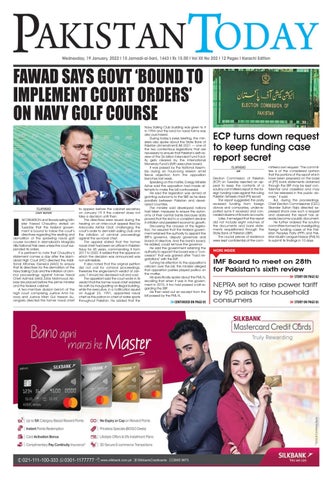
Fawad says govt ‘bound to implement court orders’ on navy golF course
ISLAMABAD
i
staff report
NfoRmAtioN and Broadcasting minister fawad Chaudhry stated on tuesday that the federal government is bound to follow the court’s directives regarding the sealing and demolition of the sprawling naval golf course located in islamabad’s margalla Hills National Park area unless the court suspended its orders. it is pertinent to note that Chaudhry’s statement comes a day after the islamabad High Court (iHC) directed the Additional Attorney General (AAG) to ensure that its directives for the demolition of the Navy Sailing Club and the initiation of criminal proceedings against former Naval Chief Admiral (retd) Zafar mahmood Abbasi are placed before the prime minister and the federal cabinet. A two-member division bench of the high court comprising Justice Amir farooq and Justice mian Gul Hassan Aurangzeb directed the former naval chief
to appear before the cabinet secretary on January 19 if the cabinet does not take a decision until then. the directives were issued during the hearing on an inter-court appeal filed by Advocate Ashtar osaf, challenging the court’s order to demolish sailing club and the initiation of criminal proceedings against the ex-naval chief. the appeal stated that the former naval chief had been an officer in Pakistan Navy for 45 years, commanding it from 2017 to 2020. it added that the appeal on which the decision was announced was not admissible. it also noted that the original petition did not call for criminal proceedings, therefore the single-bench verdict of January 7 should be declared null and void. the appellant said the court wrote in its verdict that the former naval chief violated his oath by inaugurating an illegal building, while the executive, in a notification issued on August 23, 1991, appointed naval chief as the patron-in-chief of water sports throughout Pakistan. He added that the
Navy Sailing Club building was given to it in 1994 and the land for naval farms was also purchased. During today’s press briefing, the ministers also spoke about the State Bank of Pakistan (Amendment) Bill 2021 — one of the two contentious legislations that are necessary to ensure that Pakistan’s sixth review of the $6 billion Extended fund facility gets cleared by the international monetary fund’s (imf) executive board. it was passed by the National Assembly during an hours-long session amid fierce objection from the opposition benches last week. Speaking on the matter, Energy minister Azhar said the opposition had made attempts to make the bill controversial. He said the legislation was aimed at granting autonomy to the SBP, as he drew parallels between Pakistan and developed countries. the minister said developed nations had taken measures to ensure the autonomy of their central banks because data proved that this led to a consistent decline in inflation and persistent economic growth. Discussing the clauses of the legislation, he assured that the federal government retained the authority to appoint the SBP’s governor, deputy governors and board of directors. And the bank’s board, he added, could remove the governor. He said the government retaining the authority to appoint the board was a “concession” that was gained after “hard negotiations” with the imf. turning his attention to the opposition’s criticism over the bill, the minister alleged that opposition parties played politics on the matter. He specifically spoke about the PmL-N, recalling that when it was in the government in 2015, it too had passed a bill regarding the SBP. He then read out an excerpt from the bill passed by the PmL-N.
CONTINUED ON PAGE 05
ECP turns down request to keep funding case report secret ISLAMABAD inp
Election Commission of Pakistan (ECP) on tuesday rejected an appeal to keep the contents of a scrutiny committee’s report in the foreign funding case against the ruling Pakistan tehreek-i-insaf (Pti) secret. the report suggested the party received funding from foreign donors and companies, under-reported sums it received and concealed dozens of its bank accounts. Later, it emerged that the report did not include eight volumes of the documents and bank statements requisitioned through the State Bank of Pakistan (SBP). the crucial pieces of evidence were kept confidential at the com-
mittee’s own request. “the committee is of the considered opinion that the portions of the report which have been prepared on the basis of [Pti] bank statements obtained through the SBP may be kept confidential and classified and may not be released in the public domain,” it said. But, during the proceedings, Chief Election Commissioner (CEC) Sikander Sultan Raja directed expressed shock over such a request and observed the report has already become a public document. He further ordered the scrutiny committee formed for investigating foreign funding cases of the Pakistan Peoples Party (PPP) and Pakistan muslim League-Nawaz (PmL-N) to submit its findings in 10 days.
more inside
IMF Board to meet on 28th for Pakistan’s sixth review STORY ON PAGE 02
NEPRA set to raise power tariff by 95 paisas for household consumers STORY ON PAGE 03
02
Wednesday, 19 January, 2022 | KARACHI
NEWS
OppOsitiOn senatOrs renew demand fOr details Of retired military OffiCials in nadra
t
NewS DeSK
HE Senate on Tuesday again saw an intense debate over retired military officers holding key positions in the National Database Registration Authority (Nadra) and other state organisations, with opposition senators demanding details of such appointments but state minister Ali Muhammad
Cpne, apns, pBa dismiss media revenue quoted by information minister KARACHI pR
Media associations CPNE, APNS and PBA have issued a statement taking serious notice of Information Minister FawadChaudhary’s tweet about media revenues and dismissed figures quoted by him as baseless and completely incorrect. Subsequently the original source also clarified that the figures were printed erroneously due to a technical error. The joint statement called the information minister’s tweet a classic example of fake news and an attempt to create a divide between media houses and workers. The statement went on to specifically point out how the minister himself is spreading false news. He has only exposed his own ignorance about the matter and also how ill-informed his ministry is. The statement also demanded that the minister withdraw his tweet immediately.
rupee slips to 176.18 against Usd with 26 paisas fall KARACHI Staff RepoRt
Pakistani rupee shed 26 paisas (-0.15 percent) against the US dollar on Tuesday, ending the two-day winning streak. The State Bank of Pakistan said in a statement that the dollar opened at Rs175.92 in the interbank market and closed at Rs176.18. The rupee witnessed a trading range of 36 paisas during the session, showing the intraday high bid of 176.26 and low offer of 175.90. Within the open market, the rupee was traded at 177/178 per dollar. Overall Pakistan rupee shed 11 paisas against the US dollar during the two sessions of this week, while it has appreciated by 33 paisas during the current year 2022. The local unit has depreciated by Rs18.75 during the ongoing fiscal year 2021-22. The experts were of the view that trade and current account deficits due to rising import bill and depletion in the foreign exchange reserves are major threats to the rupee’s stability. The trade deficit ballooned by 106 percent to $25.48 billion in the first half of the current fiscal year 2021-22 due to a massive surge in imports, which touched $40.50 billion.
Khan equating the query to “hatred for the armed forces”. It is pertinent to note the matter was previously discussed on December 29, and saw Jamaat-i-Islami (JI) Senator Mushtaq Ahmed complain that he had specifically asked for the number of ex-military men rehired in Nadra but was instead given a general figure saying that the Authority has 13,997 employees in total. “I asked this question because unemployment in
“A strange tradition has been set here that apart from one or two federal ministers no one else comes to the parliament to answer questions. This is a matter of the Senate’s honour,” he said. Rabbani requested the Senate chairman to compel ministers concerned to answer the questions raised in the parliament regarding their departments. Responding to Senator Ahmed’s question, Minister of State for Parliamentary Affairs Ali Muhammad Khan repeated the answer he provided in the previous session, suggesting that a fresh query be submitted over the specific issue of rehiring retired armed forces personnel. At this, the JI senator insisted that the question he submitted was specifically regarding military hiring but the minister also maintained that the question he received was only about deputations in general.
Pakistan has surged, according to the Pakistan Bureau of Statistics. The youth are not getting employment and on the other hand, we are specifically recruiting retired personnel of the armed forces in good positions,” the senator stated. At this, PPP Senator Raza Rabbani remarked that Interior Minister Sheikh Rashid was “probably the minister in charge of answering this question”.
Moody’s assigns B3 rating to Pakistan’s Sukuk offering KARACHI Staff RepoRt
Moody’s has assigned a B3 rating to the proposed US dollar-denominated trust certificates (Sukuk) issuance by the government of Pakistan, a statement said on Tuesday. The Sukuk will be issued through the Pakistan Global Sukuk Programme Company Limited, a special purpose vehicle, which is wholly-owned by the government and whose debt and trust certificate issuance are, in Moody’s view, ultimately the obligation of the government, it added. The assigned rating to the Sukuk mirrors Pakistan’s current issuer rating. According to the terms and conditions the trust certificates will constitute direct, unconditional and unsubordinated obligations of the government. The payment obligations represented by the securities to be issued by the company rank pari passu with all of the government’s current and future senior unsecured external debt. Proceeds from the Sukuk issuance will be used by the Pakistan Global Sukuk Programme Company to purchase assets from the National Highway Authority. The amounts subsequently received by the government in consideration for the transaction will be used for general budgetary purposes. However, Moody’s noted that its Sukuk ratings do not express an opinion on the structure’s compliance with Shariah law. Pakistan’s B3 issuer rating is underpinned by its relatively large economy and robust long-term growth potential, as well as ongoing reforms that may strengthen
policy effectiveness over time. The credit challenges to the economy of the country include structural constraints to export competitiveness, the government’s high debt burden and a narrow revenue base that reduces fiscal flexibility and weakens debt affordability, as well as political risks that can influence the reform trajectory. “Pakistan’s ESG Credit Impact Score is Highly Negative (CIS-4), reflecting its high exposure to environmental and social risks, as well as its weak governance profile,” the rating agency stated. “Relatively weak institutions constrain the government’s capacity to address ESG risks. The exposure to environmental risk is Highly Negative (E-4 issuer profile score), because of Pakistan’s vulnerability to climate change and the limited supply of clean, fresh and safe water. With varied climates across the nation, the country is significantly exposed to extreme weather events, including tropical cyclones, drought, floods and
PSX sheds 104 points in low-volume, range-bound session KARACHI Staff RepoRt
The Pakistan Stock Exchange (PSX) continued with bearish trend in another low-volume session on Tuesday, with the benchmark KSE-100 Index shedding 104.79 points (-0.23 percent) to close at 45,507.41 points. The market opened on a positive note but remained volatile due to the rising number of Omicron cases and surging crude oil prices. The market switched between the green and red territories and remained positive for most part of the session except for the last one hour trading, which eroded all the gains of the day. The KSE-100 Index moved in a range of 288.64 points, showing an intraday low of 45,469.46 points and a high of 45,758.10 points. Among other indices, the KSE All Share Index shed 75.07 points (-0.24 percent) to close at 31,159.16 points, while KMI All Share Islamic Index shed 0.26 points (-0 percent) to close at 22,439.33 points. A total of 357 companies traded shares in the stock exchange, out of them shares of 135 closed up, shares of 200 closed down while shares of 22 companies remained unchanged. Out of 95 traded companies in the KSE-100 Index, 33 closed up, 58 closed down and four remained unchanged. The overall market volumes decreased by 8.36 million to 165.14 million shares. Total volumes traded for the KSE-100 Index increased by 6.97 million to 78.60 million shares. The number of total trades increased by 7,697 to 92,640, while the value traded
increased by Rs1.46 billion to Rs7.56 billion. Overall, market capitalisation decreased by Rs18.80 billion. Among scrips, TRG topped the volumes with 20.69 million shares, followed by WTL (17.67 million) and HUBC (8.15 million). Stocks that contributed significantly to the volumes included TRG, WTL, HUBC, TELE, and CNERGY, which formed over 37 percent of total volumes. In terms of rupee, UPFL remained the top gainer and witnessed an increase of Rs409 per share, closing at Rs20,899 whereas the runner-up was NESTLE, the share price of which climbed up by Rs90 to Rs5,500. BATA remained the top loser in terms of rupee and witnessed a decrease of Rs99.9 per share, closing at Rs2,000, followed by ISIL, the share price of which declined by Rs39 to close at Rs486 per share. The sectors taking the index towards south were cement with 55 points, commercial banks (39 points), power generation & distribution (27 points), technology & communication (24 points) and textile composite (11 points). The most points taken off the index were by HUBC which stripped the index of 26 points followed by LUCK (22 points), BAHL (19 points), CHCC (13 points) and SCBPL (12 points). The sectors taking the index towards north were oil & gas exploration companies with 50 points, fertilizer (15 points), refinery (6 points), oil & gas marketing companies (4 points) and glass & ceramics (3 points). The most points added to the index were by POL which contributed 30 points followed by ENGRO (23 points), PPL (11 points), MCB (9 points) and OGDC (6 points).
extreme temperatures.” “In particular, the magnitude and dispersion of seasonal monsoon rainfall influence the agricultural sector growth and rural household consumption. The agricultural sector accounts for around 20 percent of GDP and exports, and nearly 40 per cent of total employment,” it added. Overall, around 70 per cent of the entire population live in rural areas. As a result, both droughts and floods can create economic, fiscal and social costs for the sovereign. The exposure to social risk is Highly Negative (S-4 issuer profile score), driven primarily by safety concerns that have limited investment and diversification opportunities. The government is focused on reducing poverty and inequality, strengthening social safety nets, and promoting human capital as key priorities through its expansive “Ehsaas” programme, although effects will take time to materialise and are limited by still weak institutions and governance. The influence of governance is Highly Negative (G-4 issuer profile score). Upward pressure on Pakistan’s rating would develop, if ongoing fiscal reforms were to expand the government’s revenue base, raise debt affordability, and lower its debt burden beyond our current expectations, Moody’s noted. A structural reduction in external vulnerability risks, including though higher levels of foreign exchange reserve adequacy that were sustainable and/or increased economic competitiveness that were to lift export prospects, would also put upward pressure on the rating.
Crude oil prices hit seven-year highs on supply concerns ISLAMABAD Staff RepoRt
Crude oil’s bull run is showing no signs of slowing, as prices surged around 2 percent on Tuesday to their highest levels since October 2014. As of 1320 hours GMT, Brent, the international benchmark for two-thirds of the world’s oil, gained $1.13 (+1.27 percent) to reach $87.58 a barrel. The benchmark hit $87.85 a barrel during the session. On the other hand, the US West Texas Intermediate (WTI) price reached $85.38 a barrel, up by $1.56 (+1.86 percent). WTI crude futures rose to $85.53 during the early trading. The price for Opec Basket was recorded at $85.46 a barrel with a gain of 0.87 percent, Arab Light was available at $87.62 a barrel with an increase of 1.55 percent and the price of Russian Sokol jumped to $89.66 a barrel with an increase of 1.54 percent. The supply concerns are giving the market a solid boost. Frantic oil buying, driven by supply outages and signs the Omicron variant will not be as disruptive as feared for fuel demand, has pushed some crude grades to multi-year highs, suggesting the rally could be sustained a while longer. The Opec+ is still nowhere near pumping to its overall quota, and this narrowing cushion could turn out to be the most bullish factor for oil prices over the coming months. Crude oil prices have posted four consecutive weeks of gains, which has been the longest winning streak since October 2021, in evidence that the demand recovery remains robust as fears about the effect of Omicron die down. Several banks have forecast oil prices of $100 a barrel this year, with demand expected to outstrip supply, thanks in large part to OPEC’s limited capacity. Morgan Stanley predicts that Brent crude will hit $90 a barrel in the third quarter of this year, while JPMorgan has forecast oil to hit $125 a barrel this year and $150 in 2023.
IT services’ exports grow by 37.55pc in five months ISLAMABAD Staff RepoRt
Pakistan has earned US $1,051.050 million by providing different information technology (IT) services to various countries during the first five months of financial year 2021-22 Pakistan Bureau of Statistics (PBS) reported that this shows growth of 37.55 percent as compared to the corresponding period of fiscal year 2020-21, Among these services, the Pakistan Bureau of Statistics said, the export of computer services grew by 39.39 percent as these surged from US
$593.170 million last fiscal year to US $826.800 million this year. Among the computer services, the exports of software consultancy services witnessed increase of 47.92 percent, from US $200.272 million to US $296.246 million while the exports of hardware consultancy services also roInforse by 256.52 percent from, US $0.276 million to US $0.984 million, it added. In addition, the exports of other computer services increased by 26.88 percent going up from US$ 249.881 million to US $317.056 million. The country’s exports have witnessed a considerable surge of 29.48
per cent in the first half (July-December) of the current fiscal year, as compared to the corresponding period of last year, PBS said. The exports during July-December (2021-22) were recorded at Rs2,562,063 million as against the exports of Rs1,978,753 million during JulyDecember 2020-21. Meanwhile, on a year-on-year basis, the exports from the country increased by 29.34% in December 2021 as compared to the exports of December, 2020. The exports during December, 2021 amounted to Rs489,918 million against the exports of Rs378,776 million during
December 2020. On a month-on-month basis, the exports however declined by 2.41 percent as compared to the exports of Rs502,009 million in November 2021. Main commodities of exports during December 2021 were knitwear (Rs77,961 million), readymade garments (Rs61,411 million), bedwear (Rs44,905 million), rice others (Rs33,868 million), cotton cloth (Rs33,502 million), cotton yarn (Rs18,874 million), towels (Rs16,867 million), fruits (Rs12,376 million), made-up articles (excl. towels & bedwear) (Rs12,272 million) and fish & fish Preparations (Rs9,050 million).
Wednesday, 19 January, 2022 | KARACHI
nepra set tO raise pOwer tariff By 95 paisas fOr hOUsehOld COnsUmers ISLAMABAD
t
Staff RepoRt
HE National Electric Power Regulatory Authority (NEPRA) is preparing to increase power tariff by Rs0.95 per unit for household consumers. According to details, the suggestion for increase in power tariff has been made from Rs0.08 per unit to Rs0.95 per unit for separate slabs of household consumers.
The tariff would be raised by Rs0.08 per unit using over 100 units of electricity, followed by Rs0.18 per unit hike for over 200 units, Rs0.48 per unit for 201 to 300 units, and Rs0.95 per unit for 301 to 700 units. The increase in basic tariff will abolish an Rs20 billion annual subsidy from the government and the recommendations would be mulled over during the NEPRA hearing on January 24. In a bombshell for Karachiites, the National Electric Power Regulatory Authority (NEPRA) has
approved an increase in electricity tariff for Karachi in terms of fuel adjustment charges in early January. According to a notification issued by the NEPRA, the electricity tariff will be hiked by Rs1.07 per unit in terms of fuel adjustment for the month of October. The amount will be received in the bills of January, it said, adding that the Karachiites will have to bear an additional burden of Rs1.91 billion. The hearing for fuel adjustment was held by NEPRA on November 03.
Pakistan, Qatar vow to cement energy cooperation ISLAMABAD Staff RepoRt
Pakistan and Qatar have vowed to further promote cooperation in the energy sector. Federal Minister for Energy Hammad Azhar and Minister for Energy and Chief Executive of Qatar Energy, Saad Sherida al-Kaabi in a virtual meeting on Tuesday discussed further promoting bilateral ties, particularly in the sector of energy. Hammad Azhar thanked Qatar for ensuring timely supplies of Liquefied Natural Gas (LNG) to Pakistan despite its shortage globally. Welcoming the decision of Qatar Energy to invest in setting up the LNG
arrest warrants for top punjab civil servant issued LAHORe Staff RepoRt
A civil court in Lahore on Tuesday issued nonbailable arrest warrants for Punjab Chief Secretary Kamran Ali Afzal on charges of noncompliance with its orders. The court also issued warrants for two chief inspectors from the Punjab Energy Department. Judge Muhammad Tariq Rasheed issued the directives in a case pertaining to officials refusing to write down the new address of a local business after its shifting to another location. His court also ordered the provincial Finance Department to withhold the salaries of the said officials. The petition was filed by the owner of Iqbal and Sons, a factory located in Kasur. He said his business was shifted to another location and requested the court to issue an order for the correction of its new address. The court had ordered the chief secretary and the energy department to change the address but they could not do so.
terminal in partnership with a consortium of leading Pakistani companies, the Minister assured all possible support from the public sector. He underscored that this project will be another milestone in the energy security of Pakistan and hoped that the Financial Investment Decision (FID) will be concluded soon. It may be recalled that Pakistan signed a ten-year LNG agreement with Qatar in February last year. As per the agreement, Pakistan will get 3 million tonnes of LNG per year from Qatar Energy under the deal from January 2022. However, on Pakistan’s request, Qatar started early supplies from November 2021.
IPO remains headless for past seven months ISLAMABAD Ghulam abbaS
The Intellectual Property Organization (IPO) Pakistan remains headless for past seven months as Ministry of Commerce (MoC) is yet to finalize recruitment of a new chairman of the organization. Effective protection of IPR consisting of Copyrights, Patents and Trademark is critical for attracting and retaining Foreign Direct Investment (FDI) in the country. While the overseas investors term the lack of government focus on protection of the Intellectual Property Rights (IPRs) as a major cause of revenue loss, the top bureaucrats are least bothered about the IPO functioning. As per Intellectual Property Rights (IPR) Survey conducted by Overseas Investors Chamber of Commerce and Industry (OICCI), the investors were facing multiple impediments regarding registration and resolution of the IPR-related cases in the country. As per the survey overall, 37 percent of the respondents indicated that it takes one to three years to resolve a standard IPR dispute while 22 percent said that it takes more than five years’ time to get the dispute resolved. Respondents also expressed concern regarding the penalty on IPR violation being insignificant and not sufficient to act as a deterrent. Moreover, the IP
Tribunals were not fully functional in all three major cities of Karachi, Lahore and Islamabad. The OICCI IPR Survey 2021 conducted in late 2021 reflects the assessment of the foreign investors on the state of intellectual property protection in Pakistan. The foreign investors participating in the survey showed higher satisfaction (from 17 percent in 2020 to 37 percent in 2021) on IPOP, the IPR regulator in Pakistan, and have urged the IPOP for taking a leading role in ensuring the effective IPR regime in the country. OICCI members have also asked the IPOP for support in strengthening IPR regime by automating and fast-tracking the process of registering an IP, massively promoting awareness on the importance of IPR and its impact for business/investment, and in improving the skills of Law Enforcement Authorities (LEAs) to proactively stop the abuse of IPR. Currently, all the OICCI members rely on their own resources for monitoring the threat of IPR violations. However, there is a great desire for all the IP owners to work in partnership with the government authorities for a better IPR regime in Pakistan. Serious lack of awareness and appreciation about IPR, lengthy timelines for granting IP rights, long drawn judicial proceedings, inadequately trained staff at LEAs and low penalties prescribed under IPR laws for IPR violations, were some of the key concerns highlighted in the survey.
Minister says Islamabad killing of policeman ‘act of terrorism’ ISLAMABAD Staff RepoRt
A police officer was killed and two others injured in a rare shootout in Islamabad late Monday which Minister for Interior Sheikh Rasheed Ahmed called “an act of terrorism”. The late-night gun battle started when two gunmen riding a motorcycle opened fire on a police checkpoint in Islamabad. “A policeman was martyred while two others were wounded,” the police said in a statement, adding both attackers were killed. Ahmed has ordered an inquiry into the incident, a rare security breach in the heavily guarded capital, which is home to dozens of embassies. Hours later, the Tehreek-e-Taliban Pakistan (TTP) claimed responsibility for the attack, raising fears insurgents had a presence in one of the nation’s safest cities. Mohammad Khurasani, the spokesman for the TTP, took to Twitter to claim responsibility for the gun attack. He said the TTP also targeted police in two separate attacks in Khyber Pakhtunkhwa a day earlier. Pakistan is battling a resurgence of TTP following the Afghan Taliban’s return to power in Afghanistan last year. Based in Afghanistan, the TTP is a separate movement that shares common roots with the Afghanistan group. Head Constable Munawar, the deceased, “was on duty and terrorists shot a burst [of fire] on him,” Ahmed said while speaking to the press on Tuesday after attending the official’s funeral. “This was not an incident of theft or robber,” said
the minister who also disclosed the government “have received a kind of signal that terrorist incidents have started happening” in the capital. “This is the first incident of the year and we need to be very alert,” he warned, adding that both of the slain militants involved in the attack had been identified. Seperately, Shahid Zaman, a senior Islamabad Police official, told AFP the incident was “an act of terror”. The government announced late last year it had entered a month-long truce with the TTP, facilitated by Afghanistan’s Taliban, but that expired on December 9 after peace talks failed to make
progress. The TTP has been blamed for hundreds of suicide bomb attacks and attacks across the country. But after the 2014 massacre of nearly 150 children at Army Public School in Peshawar, the military sent huge numbers of troops into TTP strongholds and crushed the movement, forcing its fighters to retreat to Afghanistan. Earlier this month, a senior leader of the TTP was killed in eastern Afghanistan. Khalid Balti, also known by the nom de guerre Muhammad Khorasani when he served as the spokesperson of the proscribed group, was killed in Nangarhar province.
NEWS
03
pm lauds monetary assistance to priyantha’s widow ISLAMABAD Staff RepoRt
Prime Minister Imran Khan has lauded Sialkot business community and Rajco industries for providing monetary assistance to the widow of Sri Lankan National Priyantha Kumara who was killed by a violent mob in Sialkot last year. In a tweet on Tuesday, he pointed out that the business community of Sialkot has transferred $ 100,000 to the account of the widow. He said Rajco industries is transferring a monthly salary of $2,000 to her account and it will continue to do so for ten years. Earlier, it was reported that Rajco Industries has sent Rs17.6 million ($100,000) in monetary assistance and the salary for the month of December 2021 to the family of its deceased former general manager. Rajco Industries has transferred the money from the National Bank’s Sialkot District Court branch to a bank account held by Kumara’s widow. According to media reports from last month, the Sialkot Chamber of Commerce and Industry raised $100,000 to support Kumara’s family. SCCI President Mian Imran Akbar stated that the organisation is taking appropriate measures to prevent future incidents similar to the one that resulted in Kumara’s lynching. He stated that foreign employees and businessmen will be protected. “It is our responsibility to provide financial assistance to the affected family of the Sri Lankan citizen,” he added.
ppp tables bill seeking regulation of sC suo motu powers NewS DeSK Pakistan Peoples Party (PPP) Senator Farooq H Naek has tabled a bill in the Senate, seeking a constitutional amendment to the regulation of Supreme Court’s discretionary suo motu powers under Article 184(3) to provide a right of appeal to the aggrieved party in such cases. The bill suggests that a three-member bench shall be constituted to take the suo moto order and in the event an appeal has been made, filed within thirty days, it should be heard by a five-member bench of the apex court, adding that no decision shall be taken during this period. The bill, which has been referred to the relevant Senate Standing Committee for consideration, proposes that the exercise of the suo motu cases should be determined in such a manner that it provides a procedure for an appeal against the order, and on how the bench be constituted and what should be the composition of the bench which takes up cases under Article 184(3) of the Constitution. It is pertinent to note that earlier, former chief justice Asif Saeed Khosa had also suggested proposals to amend Supreme Court Rules 1980 for giving right of appeal against the decisions which would be given under Article 184 (3) of the Constitution. A full court meeting was also held to discuss the same but consensus could not be evolved.
Wednesday, 19 January, 2022 | KARACHI
04 NEWS
TAPI PIPeLINe PRoSPecTS fINALLy GeT A ShoT IN The ARM IsLAMABAD
T Security forces neutralise two terrorists in North Waziristan RAwALPINDI staff RepoRt
Security Forces have neutralised two terrorists in an Intelligence Based Operation (IBO) in Thal, North Waziristan District. According to the ISPR, the security forces conducted an IBO on reported presence of terrorists in Thal, North Waziristan District. “During intense exchange of fire, two terrorists – Ghayoor and Bahauddin – got killed. Large quantity of weapons and ammunition was also recovered from the killed terrorists,” the statement said. Per the ISPR, the killed terrorists were involved in terrorist activities against security forces, target killing and kidnapping for ransom.
News Desk
HE Turkmenistan– Afghanistan–Pakistan–India (TAPI) natural gas pipeline has been long aborning, but its prospects recently got a shot in the arm. The 1100-mile and $10 billion project, which has seen numerous delays since the pipeline consortium, was announced in late 2014, though the project was first mooted in 1991, Oilprice.com reported. Construction started in early 2018 with a projected in-service date of 2021, but halted later that year after workers clearing the route were killed by unknown assailants. Also, the project’s $10 billion cost estimate is a decade old, and an update may cause further delay to the Asian Development Bank-funded effort that is now slated to resume work in September 2022. Turkmenistan will loan Afghanistan the funds for its share of the project, to be repaid from gas transit revenues. Representatives of the government of Tajikistan recently met officials in Afghanistan, and the Taliban announcement that it will dedicate 30,000 troops to pipeline security may motivate the parties to start construction. The completed pipeline will allow Turkmenistan to reduce its reliance on its
biggest gas customer, China, which has recently taken most of Turkmenistan’s gas exports, though in 2021 the country doubled its gas exports to Russia, which used to be the biggest importer of Turkmen gas until it was displaced by China in 2010. The pipeline will generate additional income that Ashgabat can use to improve services to citizens, a priority after the recent unrest in neighboring Kazakhstan. For Afghanistan, the project would provide transit fees of about $500 million per year, along with an annual share of 500 million cubic meters of gas for the first ten years, ultimately increasing to 1.5 bcm per year.
For Pakistan, the pipeline would help solve the country’s persistent energy shortfalls, such as the deficit between current gas production of 4 billion cubic feet per day (BCFD) against demand of 6 BCFD. By 2025, gas production is expected to fall to less than 1 BCFD due to depletion of gas reserves while demand increases to 8 BCFD. In late 2020, Pakistan and Russia signed a deal to complete the 700-mile Pakistan Stream Gas Pipeline, to move LNG from Port Qasim (Karachi) to Kasur. Pakistan may be dealing with Russia to balance against China, or maybe the deal was decided on strictly dollarsand-cents terms. Regardless, this project
may crowd out attention and funding for Pakistan’s phase of TAPI. A richer energy mix and pipeline transit revenues would strengthen Pakistan as it negotiates new efforts with China under the umbrella of the China– Pakistan Economic Corridor. Pakistan’s leaders will need to strengthen their position vis-à-vis China while demonstrating to Beijing they are a reliable partner that will develop energy resources that can accommodate China’s projects. But first, those leaders must and take on entrenched business and national security interests to successfully support TAPI, despite the economic benefits to its neighbours.
Economic ties with Russia on positive trajectory: Qureshi IsLAMABAD tLtp
Foreign Minister Shah Mahmood Qureshi has said that relations between Pakistan and Russia are on a positive trajectory. Pakistan and Russia are developing an understanding on the North-South Gas Pipeline project, which is a significant step for bilateral cooperation in economy and energy, the foreign minister said in a statement on Tuesday. Furthermore, the foreign minister stated that Russian President Putin’s recent statement against Islamophobia vindicates the stance of Pakistan and Prime Minister Imran Khan on the issue. “This indicates that the two countries are moving ahead at regional and global levels with identical ap-
proaches,” he said. “Pakistan has been part of the Moscow Format and a Russian representative attended the Troika Plus meeting in Islamabad,” the foreign minister said. He added that Russian Representative for Afghanistan Zamir Kabulov also participated in the recently held extraordinary session of the OIC Council of Foreign Ministers in Islamabad. Qureshi said that both countries held mutual consultations on the humanitarian crisis in Afghanistan and that Pakistan’s efforts have resulted in drawing the world’s attention to the situation in Afghanistan; however, further attention is required. “The humanitarian situation is further deteriorating in Afghanistan with the severity of cold weather,” he added.
Murad Raas proposes to add dupattas, caps to school uniforms across Punjab
News Desk Punjab Education Minister Murad Raas has given directive to private schools to make dupattas or scarves a compulsory part of the school uniform for female students and caps for male students. While speaking at a press conference in Lahore, the Punjab education minister said that the Punjab Assembly has passed a bill making the teaching of the Holy Quran with translation compulsory for primary students as well as students of classes six to 12. He stated that the bill to teach Holy Quran with translation has been passed for the first time in Pakistan and will be implemented soon. For this, the minister said that private schools’ uniforms should be revised. The provincial education minister directed schools to provide male students with caps and female students with dupattas or scarves with their uniform. Additionally, he stated that there are over 30,000 vacancies for teachers in Punjab schools and would
be filled soon. According to Murad Raas, no decision has been made to close educational institutions as a result of COVID-19 as yet. Educational institutions will also remain open until other departments are closed. However, Punjab Chief Minister’s Focal Person on Digital Media Azhar Mashwani has refuted reports of the provincial government making caps and headscarves mandatory for schoolchildren in the province. Punjab Education Minister Murad Raas had announced earlier in the day that the Punjab Assembly has passed an act, “the Punjab Compulsory Teaching of Holy Quran Act, 2021,” to teach Nazra Quran (recitation) to primary students and recitation with translation to the students from 6th to 12th grades for the first time in history. For this, the minister said that private schools’ uniforms should be revised. However, Punjab CM’s focal person clarified Raas’s statement, saying that the directive for adding caps and headscarves to the uniforms was only for the periods reserved for Quran recitation, and not a permanent and mandatory part of the uniforms. Taking to Twitter, Mashwani said that the students will be required to wear caps and dupattas while reading the Quran but they will not have to cover their heads during any other period. Raas, while addressing the press conference, said that the act for compulsory Quran teaching will finally be implemented. He directed schools to provide male students with caps and female students with dupattas or scarves with their uniforms. Raas further stated that there were more than 30,000 vacancies for teachers in Punjab schools, which would be filled soon. He said that no decision has been taken for the closure of educational institutions in the wake of the coronavirus outbreak. The educational institutions will also remain open until other departments are not closed.
Lt-Gen Waseem Alamgir to assume charge as Rector, NUMS RAwALPINDI News Desk
Major General Waseem Alamgir of Army Medical Corps has been promoted to the rank of Lieutenant General. According to the ISPR, Waseem Alamgir will be assuming charge as Rector National University of Medical Sciences (NUMS).
PM directs to improve performance of PIA, to provide best aviation services IsLAMABAD staff RepoRt
Prime Minister Imran Khan Tuesday directed the authorities concerned to improve the performance of the national flag carrier Pakistan International Airlines (PIA). Chairing a high-level meeting held here to discuss the matters pertaining to aviation, the prime minister called for ensuring the provision of the best aviation services to the people. PM Khan also emphasized the launch of a competitive process in the country to ensure better service delivery to the passengers. Minister for Aviation Ghulam Sarwar Khan, Finance Minister Shaukat Fayaz Tarin and relevant senior officers attended the meeting.
newS
05
MOFA, ISPR MARk thRee yeARS OF ‘OPeRAtIOn SwIFt RetORt’ AgAInSt InDIA newS deSk
P
AKISTAN on Sunday has reiterated its resolve to safeguard its sovereignty and territorial integrity at all costs as it marks the third anniversary of the armed forces’ exemplary response to India’s ill-conceived military airstrikes inside its territorial airspace. According to the Ministry of Foreign Affairs statement, India, in utter violation of the United Nations charter and international law, violated Pakistani airspace on February 26, 2019, and conducted airstrikes inside Pakistani territory. “The botched attempt at infringing Pakistan’s sovereignty was swiftly riposted by Pakistan’s armed forces,” the statement said, adding that not only did Pakistan resolutely safeguard its sovereignty, it also displayed utmost
restraint. On February 27, 2019, the Pakistan Air Force (PAF) had launched Operation Swift Retort in broad daylight, in response to the violation of its airspace by Indian Air Force (IAF) fighter jets in the dark of night on February 26. Two Indian fighter jets a MiG-21 Bison and a SU30 were shot down by the PAF during the operation. The captured pilot of one of the downed aircraft was later returned to India as a goodwill gesture. “Pakistan is a proponent for regional peace and stability. At the same time, our desire for peace is accompanied by strong resolve and capability for self-defence,” the ministry maintained. It further stated that February 27 also served as a lesson for India that “none of its militarism and war-mongering jingoism would go without a befitting response.”
The ministry emphasised that India must remain mindful of the consequences of its reckless conduct in February 2019 and “refrain from any such misadventure in the future”. “The government, armed forces and the people of Pakistan continue to stand firm in their resolve to safeguard the country’s sovereignty and territorial integrity against any aggression,” it reiterated. The ministry further underscored Pakistan’s commitment to the peaceful resolution of the Kashmir dispute in accordance with the relevant UN Security Council Resolutions and the wishes of the Kashmiri people. The communique called upon the international community, including the United Nations, to hold “India accountable for its gross and systematic human rights violations and crimes against humanity in IIOJK”, without further delay.
PM reaffirms ‘unwavering commitment’ to national security Continued from page 01 The intrusion in Pakistani airspace by Indian Air Force (IAF) aircraft had happened for a second consecutive day, as one of its planes had to release payloads in the Balakot area while being chased away in the early hours of the day. The Pakistan military spokesman had then promised “surprise” for India in response to the IAF aggression. A day later, the IAF jets entered Pakistani airspace after the PAF strikes on the other side
of the LoC from Pakistani airspace for, what the Foreign Office and Army had described as, a demonstration of Pakistan’s “right, will and capability for self-defence”. The PAF strikes across the LoC were first announced by then FO spokesman Dr Mohammad Faisal via a tweet. “PAF undertook strikes across LoC from Pakistani airspace. The sole purpose of this action was to demonstrate our right, will and capability for self-defence. We do not wish to escalate but are fully pre-
Lahore Qalandars thrash Multan Sultans to claim maiden PSL trophy Continued from page 01 Earlier, Lahore Qalandars had handed a 181-run target to Multan Sultans. Lahore, after electing to bat first, got off to the worst possible start as they were reduced to 25-3 in 4.2 overs. The in-form Fakhar Zaman was removed for just three runs by Asif Afridi with Shahnawaz Dahani taking a great catch, while Abdullah Shafique was also removed by Asif. After that, Mohammad Hafeez showed his experience and class as he steered the ship for Lahore by playing sensibly. With Kamran Ghulam, he forged an important 54-run partnership to steer the inning. Hafeez took the attacking mode as he went after the opponent bowlers, and was finally removed for 69 runs by Dahani. He scored those runs off 46 balls with one six and nine fours. After, his dismissal Harry Brook and David Wiese registered a 43-run stand in just 2.4 overs as they went rampant against the Multan bowlers. Wiese remained not out for 28 runs off just eight balls with three sixes, while Brook scored 41 runs off 22 balls. In terms of bowling for Multan, Asif was the stand out bowler with brilliant figures of 3-19 in four overs, while leggie Imran Tahir gave away just 22 runs in a wicket-less four-over spell. Dahani went to the cleaners in the late overs as he ended with figures of 1-34 in three overs. Rumman Raees conceded 35 runs in just two overs. Shaheen Shah Afridi youngest captain to win PSL trophy Shaheen Shah Afridi, who was impressive throughout the Pakistan Super League (PSL) achieved a tournament record as he led Lahore Qalandars to their maiden victory. The 21year-old became the youngest captain to lift the PSL trophy as Lahore handed Multan Sultans a 42-run defeat at the Gaddafi Stadium. Before Shaheen, Mohammad Rizwan was the youngest captain, 28, to lead his side to victory. The Sultans won the PSL title in 2021. The star left-arm pacer not only led Lahore Qalandars from the front as a skipper in this year’s PSL, but he was also brilliant with the bowl as he delivered some brilliant spells, especially with the new ball. In the year’s league, he took 20 wickets — equaling Shadab Khan for most wickets — in 13 games and also clicked at a good pace along, and was also tight with his line and lengths.
pared if forced into that paradigm,” he had tweeted. Shortly afterwards, the then Pakistan military spokesman Maj Gen Asif Ghafoor announced the shooting down of IAF aircraft. He had tweeted, “IAF crossed LoC” after the PAF strikes in India-occupied Kashmir (IOK). “PAF shot down two Indian aircraft inside Pakistani airspace. One of the aircraft fell inside AJK while the other fell inside IOK. One Indian pilot arrested by troops on the ground while two in the area,” he had stated.
Two-day agricultural exhibition inaugurated in Sargodha SargodHa Staff RepoRt
Federal Minister for National Food Security and Research Syed Fakhr Imam inaugurated a two-day agricultural exhibition organized by Agriculture Department Punjab at University of Sargodha. Minister for Agriculure, Punjab Syed Hussain Jahania Gardezi and Secretary Agriculture Punjab Asad Rehman Gilani specially participated. Speaking on the occasion, Syed Hussain Jahania Gardezi said that this is a mega event of its ever first kind in Sargodha district in which a large number of exporters of high value agriculture, farmers and other stakeholders are participating. Holding this exhibition will further impove the linkages between farmers and the industry. Farmers will be able to learn about the latest production technology of fruits and vegetables. The Provincial Minister for Agriculture said that efforts were being made to reach markets globally to increase the exports of agricultural products and this agricultural exhibition was a continuation of these efforts. About 75 Stalls of local and domestic agricultural products, industry, agricultural machinery, fruits and vegetables have been set up in the exhibition. The exhibition will help improve the high value agriculture chain and increase our agricultural exports. Prior to the event, the Agriculture
Department Punjab has so far organized Pakistan Horti Expo and Punjab Agri Expo exhibitions for the promotion of High Value Agriculture chain, which was attended by more than 35,000 visitors including importers, buyers and businessmen from abroad. More than 40 delegations from different countries (Malaysia, Indonesia, Qatar, Egypt, Sri Lanka, Bahrain, Tajikistan, Uzbekistan, Saudi Arabia, Belarus and Ukraine etc.) participated. Through these 5 exhibitions, business deals worth $ 13.2 million were made. Addressing the function, Federal Minister for National Food Security and Research Syed Fakhr Imam said that steps were being taken to increase agricultural exports in line with the vision of the Prime Minister of Pakistan. This exhibition held today in Sargodha district is one of those series. It will not only make the farmers aware of modern production technology but also increase the agricultural exports. On this occasion, Secretary Agriculture Punjab Asad Rehman Gillani said under the ongoing project “Establishment of Model Farm Project” at a cost of Rs. 3.20 Billion practical training has been provided to farmers. Under this scheme, support has also been provided to the Citrus industry (processing units) to improve their storage and value addition capacity. Apart from this, agricultural exhibitions are also being organized to increase the country’s agricultural exports.
125 Pakistanis safely evacuated from Ukraine ukraine Staff RepoRt
The Pakistan Embassy in Ukraine stated on Sunday that Ambassador Dr Noel Khokhar met with the deputy internal affairs minister of Ukraine to discuss the facilitation of evacuation for Pakistani citizens from the war-hit country. A statement released by the embassy stated that they had requested a meeting with the commander of border points for the
Ukraine-Poland border to highlight the issue of Pakistanis stuck on the Ukrainian side awaiting exit. As the Russia-Ukraine conflict escalates, the embassy has provided updates regarding their evacuation efforts. The body stated that 125 Pakistani citizens have been successfully evacuated so far, while 376 have reached the Ukraine-Poland border, four are at the UkraineRomania border and nine at the
Ukraine-Hungary border. According to the statement, the Pakistan mission has been providing accommodation to students in Ternopil and transportation wherever possible, especially from Lviv to the border crossings. The embassy reported that a night curfew has been imposed in the cities of Kharkiv, Lviv and Ternopil, while the capital city Kyiv is under a 24-hour curfew. Due to the increased conflict,
the embassy stated that “there is no safe place in Ukraine” and the Ternopil district administration issued a warning on Saturday to civilians to keep lights off. As cities in Western Ukraine, previously believed to be safe experience heightened encounters, including Lviv and Ternopil, the embassy highlighted that “the majority of students from Kharkiv have already reached Lviv and have departed for the Poland border”.
CmYk
The director-general of the Inter-Services Public Relations (ISPR) on the occasion highlighted the Pakistan armed force’s achievements in the operation, which included shooting down two Indian fighter jets, the navy detecting an Indian submarine at sea and a “resounding response” at the line of control. In a tweet, the DG ISPR said: “Today marks the third anniversary of ‘Op[eration] Swift Retort’ when Pakistan armed forces gave a befitting response to Indian failed misadventure.” He maintained that the Pakistan army’s response was a “testament to [the] professionalism and determination” of the armed forces for defending the “motherland”. “Not just weapons or numbers but the resolve of a nation and operational preparedness of [the] armed forces define success in face of adversity,” he stated.
Daily COVID-19 case count falls to lowest in Pakistan since January 4 newS deSk Pakistan reported only 847 new COVID-19 cases in a single day, the lowest since January 4, amid a drastic drop in the country’s active coronavirus cases, the National Command and Operation Centre’s (NCOC) data showed Sunday morning. The daily case count on January 4 stood at 630, as per the NCOC data. Pakistan’s active case count significantly fell to 37,212 from 61,332 on Saturday. The number further sank to 36,803 as 1,236 patients suffering from coronavirus recovered overnight. The national COVID-19 body said it conducted 40,127 diagnostic tests during the last 24 hours. The 847 new cases that emerged during these tests placed the country’s COVID-19 positivity ratio at 2.11% and the overall case count at 1,508,504.
06-07 Comments - 28th February 2022_Layout 1 2/27/2022 10:10 PM Page 1
Monday, 28 February, 2022
06 COMMENT
Some issues in dealing with climate change crisis
Ukraine crisis Pakistan must be seen on the right side of history
R
USSiA’S invasion of Ukraine can only be described as an unjustifiable and extreme action that will have serious lasting effects on both countries for years to come. With hundreds of lives having already been lost on both sides, in all likelihood, the conflict will become bloodier with each passing day. Only time will tell how and when this war ends and the extent of damage that is done as a result but a majority of the world has already outrightly condemned Vladimir Putin’s actions, with the US and some european countries imposing heavy sanctions. Within Russia, widespread anti-war protests have been held and the state has attempted to quell this uprising through brute force and has intensified its censorship efforts, pressurizing tech giants to set up legal entities in the Russia as part of a new law. in this backdrop, Pakistan’s decision to go ahead with a preplanned bilateral visit to Moscow has made Prime Minister imran Khan the only leader of a democratic nation so far to have met Putin in Russia after the start of the conflict. The visit could perhaps be categorized as ‘bad timing’ but that would be an inexplicable excuse to try and sell to the US and european countries who have expressed their displeasure over the meeting. However, maintaining a good relationship with Russia is also important for Pakistan from a geopolitical and economic standpoint. Pakistan, along with china and Russia’s help is attempting to resolve the Afghan crisis. A net importer of energy, Pakistan has to keep Russia engaged as the latter is the second largest gas producing country in the world. it seems the Foreign Office has not approached the matter with the sensitivity and carefully thought out strategy that it deserves. The optics of the entire visit being held on the eve of Russia advancing into Ukraine despite international pressure and warnings will have diplomatic consequences for islamabad. it is necessary now that Pakistan takes a more neutral and clear position on Ukraine, preferably one where it also calls for Russian troops to exit Ukraine. Short of this, Pakistan will not be seen on the right side history when the conflict eventually ends.
Developed countries must lead the effort better and do more
Dr Omer JaveD
S
ince the industrial Revolution, the countries mainly responsible for causing climate change crisis are basically those that form the developed world. Yet after the end of colonization in the last century, countries that gained independence after that have had needs to reduce poverty, and in turn ambitions for economic growth to catch up on last time as colonized people, and given the ability to modern state of technology to make such rapid gains in industrialization possible, have continued to quickly gain ranks in terms of contributing towards global carbon emissions. A recent Foreign Affairs (FA) published article ‘The coming carbon tsunami: developing countries need a new growth model – before it’s too late’ by indicated in this regard as follows: ‘Since the dawn of the industrial Revolution, countries have released one and a half trillion metric tons of carbon dioxide into the atmosphere. The largest cumulative emissions have come from the United States, european countries, china, and Russia, in that order. But these countries are now prosperous enough to pay for policies that can place them on the path to net-zero emissions by midcentury. The top emitting countries of the future could come largely from the developing world—countries such as Brazil, india, indonesia, and South Africa, which face the herculean task of bringing millions out of poverty while simultaneously adapting to the harsh realities of climate change.’ Transition to green new technologies requires finances to support workers, and firms in making that shift, including investing in skills’ capacities to adjust with the needed change. According to international
Australian team arrives in Pakistan An important tour that must end safely
A
FTeR close to a quarter of a century, the Australian cricket team has arrived in Pakistan to play a full series that includes Test matches, ODis and T20s in three cities. The primary concern for any nation touring Pakistan is security and it is clear that the government, armed forces and other security enforcing institutions have made satisfactory arrangements to ensure all practice sessions and matches are executed safely, otherwise, cricket Australia would not have sent a team. The importance of this tour being a success cannot be emphasized enough as it would demonstrate to other top cricketing nations that Pakistan is more than equipped to execute such bilateral series. Another challenge that must be handled with equal attention and precision is maintaining the bio-bubble throughout the series to avoid players getting covid-19. Additionally, traffic management on match days must be planned so that the normal daily routines of citizens are not interrupted and they are not inconvenienced. credit must also go to the Pakistan cricket Board (PcB) under its new chairman Ramiz Raja for producing a world-class squad that top teams must compete against to achieve that coveted number one spot in the rankings. While they were unable to make it to the final stage of the T20 world cup, the Pakistani side under Babar Azam was simply unrecognizable, playing top notch cricket to beat formidable opponents such as india and new Zealand. This tour should also serve as a lesson to both england and new Zealand whose unprofessional, irresponsible and most importantly unnecessary last minute cancellation of confirmed tours dealt a severe blow to the revival of international cricket in Pakistan. Their actions received valid condemnation from critics at home and abroad and both nations must make reparations now by touring Pakistan. There is still a long way to go before Pakistan completely recovers from what transpired in Lahore in 2009 when the Sri Lankan team was attacked; the country has simply not been the same since. The resurgence of terrorism in the country since the Taliban takeover in Afghanistan is fast developing into a serious threat with the enemy attacking city centers and security forces with increased frequency. it is imperative that intelligence agencies along with security forces get ahead of the problem before it gets out of control. There is much excitement in the country over the Australians touring Pakistan and one hopes that the cricket is competitive and entertaining and that the series ends on a high note.
A friend in need is a friend indeed Questions over the US’ future role and fidelity
Kawsar UDDin mahmUD
U
S policy towards the ongoing Ukraine crisis is undoubtedly unsatisfactory and inadequate so far. no suspicion that just debating whether Ukraine should get arms or not and delivering incessant imbecile lip service, rather than providing armors or taking grave measures to bring a halt to this war proves the US is reluctant to get engaged in this crisis. A rare instance can be found in international politics that defends imposing economic sanctions to stop a war. What the US is doing now regarding the crisis based on only sanctions intriguingly depicts that this erstwhile superpower is going to lose its credibility of playing a ‘major’ hegemonic role. The US playing an impactful role in nATO could take robust and effective measurements but its disinclination in this respect will bring about many negative consequences in the future. Scholars argue the US will have suffered from such type of pessimistic and despondent policy in these rainy days for Ukraine. While the US is still pendulous in providing arms to Ukraine, Volodymyr Zelensky is gravely concerned with nATO’s role to protect its nation. The US and
Dedicated to the legacy of late Hameed Nizami
Arif Nizami (Late) Founding Editor
Yousaf Nizami M. A. Niazi
Editor Aziz-ud-Din Ahmad
Umar Aziz
Joint Editor
Joint Editor
Executive Editor
Lahore – Ph: 042-36300938, 042-36375965
Monetary Fund, already high corporate debt of firms globally, increased all the more and rapidly during the pandemic. A recently published article ‘World’s biggest firms failing over net-zero claims, research suggests’ by Guardian highlighted a study, which pointed towards weak performance of a number of major firms globally in making a meaningful contribution in an overall effort to deal with the climate change crisis. The article highlighted as follows: ‘Some of the world’s biggest businesses are failing to live up to claims they will hit net-zero emissions targets, according to research that suggests they will cut their carbon emissions by only 40% rather than the 100% cuts claimed.’ At the same time, developing countries with limited fiscal space, rising debt sustainability issues, especially in the wake of the pandemic, and keeping a balance between making health/development/ stimulus related expenditures, and in shifting towards technologies that put carbon emissions in an overall effort to reach net zero in the next few decades. Yet, the developed countries have neither provided enough climate finance to developing countries, nor have played much-needed meaningful role in reforming the multilateral system away from neoliberalism to make it fairer, and in turn allow developing countries to be on a sustainable growth path, one that suffers minimally from money-laundering and off-shore accounts/safe-heavens, allows greater debt sustainability, and ability for developing countries to practice counter-cyclical policies, and in turn have enough fiscal space to make both needed climate- and development/stimulus expenditures. The same FA published article pointed out in this regard that ‘if industrialized countries do not shoulder the responsibility to help prevent this next wave of emissions, the global effort to avoid climate disruption will fail. …in order to simultaneously preserve the environment and help lift hundreds of millions of people out of poverty, rich countries must provide financing and policy support at a scale that has so far been unavailable to poorer countries. There are roughly two dozen emerging economies across the globe that are poised to expand their greenhouse gas emissions dramatically in the near future if they do not receive this assistance.’ With regard to money laundering taking a lot out of the fiscal space of developing countries, and the overall insufficient policy emphasis of developed countries to play their part in discouraging moneylaundering, economics nobel laureate, Joseph Stiglitz recently pointed out in his Guardian published article ‘credit Suisse has allowed the morally bankrupt to steal from the poor far too long’ as follows: ‘The bombshell revelations of the Suisse secrets… are a
I
Karachi – Ph: 021-35381208-9
I
nATO members should ponder; this is not just a question to their future role but also their ‘liberal, humanitarian, and democratic portrayals of ideological stances.’ it is well-palpable that the US, in this respect, will envisage mass agitation and criticism. The US et al were continuously babbling that Zelensky might not be skeptical about their support to Ukraine and imposing sanctions on Russia, by contrast, Bloomberg reported that the US is not going to impose sanctions on Russian crude oil. imposing on ‘particular’ areas and giving room to ‘other goods and products’ proved that the US is just prejudiced with its self-interest not others’ miseries. Thus, this has been another negative value for its credibility. Still, no major military measurement, no impactful sanction, no major policy to bring peace and to stop the war has been taken by US and nATO. How bizarre the ‘interest” is in international politics! if ‘interest’ doesn’t ensure the credibility of acceptance then what would it be termed? coming to the question on Russia’s aggressive strategy through making breakaway states- Donetsk and Luhansk-, which great power would be pleased with seeing another great power diverts its neighbor from its realm that would be a peril for its security? no state would be happy with such insecurity and the dire political nature of other states. Then why should Russia be? The US would never be pleased with seeing Manuel López Obrador as a disciple of Putin and as a threat against the US security. However, Putin’s strategy to make proxy states and invade others bringing a ludicrous explication on international law is not new. Putin exploited the same strategy in invading Georgia in 2008. On the other hand, the US and its nATO allies could not map any meticulous policy to save Ukraine from such invasion though they preserve vigorous strategic experiences. Therefore, the Ukraine crisis is nATO’s failure, not Russia’s. Russia is solely concerned with its security which led it to be notorious like the US was notorious towards iraq only based on groundless perceptions of so-called WMD. That is why Obama called it ‘a war of choice’ and brought a halt to this war in 2011.
Islamabad – Ph: 051-2204545
I
Web: www.pakistantoday.com.pk
I
continuation of the path-breaking work of the Panama Papers and the Paradise Papers. …it appears the countries that suffer the most from the bank’s assistance to bad actors are developing countries and emerging markets. …How many stories, how many revelations, how many exposés, will it take for Switzerland, the US, UK and other countries to change their laws on secrecy in banking and real estate, and all the other activities that facilitate money laundering and promote crime and corruption? While this treasure trove showed Switzerland benefiting from a flow of money from poor countries, the system itself is corrupting: the rot of tainted money spoils all that it comes in touch with.’ Hence, in addition to providing enough climate finance to developing countries, developed countries will need to quickly improve its policy focus with regard to money laundering, if it wishes to build the otherwise little capacity of developing countries in making needed climate related expenditures. Overall, also, not much could be achieved during cOP26 meetings last year in terms of detailed tangible steps as to how countries will move towards the net-zero carbon emissions goal. On the contrary, a recent Financial Times (FT) published article ‘Fossil fuel and agriculture handouts climb to $1.8tn a year, study finds’ highlighted a study, which pointed out the significant level of subsidies being provided globally that would likely exacerbate the climate change crisis. The article pointed out in this regard that ‘Governments worldwide are spending at least $1.8tn a year on subsidies in support of heavily polluting industries led by coal, oil, gas and agriculture, according to new research, despite their commitment to climate change targets. About 2 per cent of global gross domestic product was spent annually on subsidies that encourage unsustainable production or consumption, deplete natural resources and degrade ecosystems, the independent researchers Doug Koplow and Ronald Steenblik concluded. The biggest beneficiary of the handouts was the fossil fuel industry, which enjoyed $640bn a year, while the agricultural and forestry sectors received $520bn and $155bn, respectively, the research found.’ This subsidy provision direction needs to change if a serious effort needs to be made, in dealing with an otherwise existential, and fast unfolding climate change crisis. Already for instance, and this is just for europe and only for the last forty years, according to a recent Guardian published article ‘extreme weather has cost europe about €500bn over 40 years’ the impact of extreme weather has been very significant. The article, reflecting the study by european environment Agency, pointed out as follows: ‘Severe floods and other trillion euros in the past four decades, with Germany, France and italy the worst-hit countries.’
“This morning we are alone in defending our country just like yesterday. The most powerful forces in the world watch from afar. Have yesterday’s sanctions persuaded Russia?” These Zelensky words exhibit the grim portrayal of the US and its nATO’s ‘rational foreign policy and realist dogmatism.’ Showing liberal plantain and breaking ray of hope by realist policy will head other states’ reliability and fidelity on the US toward a dire brink in the near future. Zelensky might be astute to foresee US’ reluctance to provide a total help in this region. He might learn from the first european war of the 21st century, the Russo-Georgian war in which Putin followed a similar strategy to invade Georgia by making proxy states- South Ossetia and Abkhazia. The crimean crisis of 2014 could be another instance for the Zelensky government. Reports say nATO warships had left the Black Sea before Russia began the invasion. This current leads us to speculate, ‘a friend in need’s a friend indeed’ is a doubtful proverb. it actually doesn’t work when it comes to talking about ‘interest’ going beyond the humanitarian issue. However, looking at the AUKUS treaty, during its formation, France had to give up more than just a pact, a partnership of $90 billion with Australia only for the so-called “rational” policy of the US and UK that had been termed as “Stab in the Back” by Macron. Macron didn’t give up on keeping hope on the Biden government though he expressed a sole disquiet. Therefore, if this offishness and isolationist type of development in US and nATO policies continues further, it leaves no suspicion that this will envisage a drought of acceptance in the coming days. However, to conclude, china is economically and militarily growing at a nimble pace in the indo-Pacific region and around the world, Russia is strengthening its military exercises in the West frontier but still the US is paying less heed to these calculations. The United States of America, an “erstwhile” global superpower, and its nATO allies must be concerned with their future role in the world order. To the extent of securing trustworthiness with its allies and other states they must follow more transparent policies that would bring peace based on their liberal lessons, not war based on ‘liberal reasons for war.’ War never brings good upshots for humanity. The writer is a student, writer and political analyst. He can be reached: Kawsarduir[@]gmail.com
Email: editorial@pakistantoday.com.pk
06-07 Comments - 28th February 2022_Layout 1 2/27/2022 10:10 PM Page 2
Monday, 28 February, 2022
COMMENT 07 Editor’s mail Send your letters to: Letters to Editor, Pakistan Today, 4-Shaarey Fatima Jinnah, Lahore, Pakistan. E-mail: letters@pakistantoday.com.pk Letters should be addressed to Pakistan Today exclusively
The plight of child labour in Pakistan
Gender inequality in education A barrier to economic progress
Dr mUhammaD abDUl Kamal
G
enDeR inequality refers to the variability in the conditions that women and men encounter when exercising their full human rights. in 2015, 193 nations agreed to the Sustainable Development Agenda (2030), which comprises 17 Sustainable Development Goals (SDGs), several of which address gender inequality to varying degrees. Goal-4 specifically focuses on education, in particular, stressing the importance of vigorously striving for universal education goals. Goal-5 emphasizes gender equality and women empowerment that ensures the equal participation of women in the process of decision-making process, social, political, or economic. Goal-8 promotes and encourages the creation of a healthy and positive work environment for women that will upraise sustainable economic growth. The premise behind the aforementioned commitments is that granting women equal access to education, as well as political and economic bodies, will assist in the development of more sustainable economies and societies. in Pakistan, there is a substantial gender disparity in education. Pakistan is a patriarchal society in which women face a wide range of discrimination, leading to a low social, economic, and political status. Women comprise 52 percent of Pakistan’s total population, according to World Bank statistics. Keeping such a large portion of the population illiterate is a dreadful situation, and it might be the root cause of the country’s fragile and lopsided economy. Pakistan is positioned fourth-worst in the world for gender parity in the 2021 Global Gender Gap Report. in terms of educational attainment, Pakistan is ranked 144th out of
nafeesa GUl Qazi 156 countries in the report. Pakistan’s entire education system has a 13 percent gender disparity in enrollment. in addition, just 46.5 percent of women are literate, 61.6 percent attended primary school, 34.2 percent attained high school, and 8.3 percent attended tertiary education. The report further revealed that Pakistan will need 136 years to bridge the gender disparity at its present rate of progress. There are insufficient government schools for children, or those that are available are inaccessible to schoolchildren. The situation is significantly worse in Pakistan’s rural areas, where schools lack essentials such as water, power, and other educational necessities. When gender inequality in education rises, it has an impact on a family’s socioeconomic position. While on the macro level, gender disparities in education lead to the underutilization of human capital, which has the potential to stifle economic growth. As a corollary, the government should reassess its laws and norms in order to expeditiously bridge the gender gap. explicitly, women’s education improves social objectives like educating the coming generation, preventing child mortality, reducing fertility, and enhancing child nutrition. On the flip side,
Education alone is insufficient to enable women to enter the labor force in Pakistan due to traditional dogmas and cultural customs. Teenage pregnancy is the leading social factor forcing girls to drop out, while sons are given priority in attaining education
such social goals have a progressive impact on the economy, for instance, reducing poverty, improving labor productivity, human development, and eventually driving economic growth. in a nutshell, improved gender parity and women’s participation in economic activities are strongly tied to social and economic progress. Women’s education, health, and autonomy are essential for human development and long-term stability. Pakistan tends to lag in all critical parameters. The government must strive and ensure that all of its population has access to education. According to UniceF, 22.8 million children aged 5 to 16 are out of school, with girls accounting for over 60% of these children. To address the issue of school dropouts, the government should build additional schools and train newly recruited teachers. The government should start “education for All children” programs and make it a high priority, allocating 4% of GDP to education rather than the current 2%, which is insufficient to address and meet the needs of education. it should begin implementing state-ofthe-art teacher training programs and facilities, as well as ensuring their implementation and effective follow-up. in addition to upgrading the present school system, more schools with advanced and modern technologies and facilities should be built to address the dire need for education, particularly for girls. education alone is insufficient to enable women to enter the labor force in Pakistan due to traditional dogmas and cultural customs. Teenage pregnancy is the leading social factor forcing girls to drop out, while sons are given priority in attaining education, particularly tertiary education. implementing measures aimed at reducing household care obligations (for example, free daycare, and positive discrimination for female employees) will certainly boost women’s participation in economic activities. These prejudices can only be addressed by spreading awareness. There is also a pressing need to modify societal customs and attitudes that discriminate against women through public awareness and education efforts. Women’s growing importance to the general wellbeing of their families and society must be conveyed through these efforts.
In Pakistan, there is a substantial gender disparity in education. Pakistan is a patriarchal society in which women face a wide range of discrimination, leading to a low social, economic, and political status.
Dr. Muhammad Abdul Kamal is working as Assistant Professor at Abdul Wali Khan University Mardan. He can be reached at kamal@awkum.edu.pk M/s. Nafeesa Gul Qazi is a graduate student at Abdul Wali Khan University Mardan.
TODAY, our nation is plagued by the menace known as child labour. children are stripped of their childhood, and sent to work in grueling sweatshops and factories across the nation. instead of going to class and gaining an education, children work themselves to the bone for reasons they do not understand. instead of making friends and carelessly running around in juvenile bliss, these children bruise and bleed for the heartless animals who force them to work. Going hand in hand with the employers are the parents who force their weak and voiceless children into work, only to snatch their hard-earned wages for their own gain. This brings into question the entire society we live in, including the current laws on guardianship of children, and their enforcement by the masses. Over the course of the cOViD 19 pandemic, child labor grew at an exponential rate, while authorities had their hands full trying to mitigate the effects of the virus, shuttered schools coupled with crippling economies means more children are driven into the workforce. it should come as no shock that while child labor is a foul field, it has irrefutable impacts on economies such as Pakistan. The disturbing part is that due to its unpoliced nature, children incarcerated in this vicious world will undoubtedly be pushed into hazardous work environments, such in the burning heat of brick kilns. in continuum, the unregulated essence of child labor directly contributes to rising health risks across the world. initially, children incur wounds and cuts, from operating equipment neither designed for nor intended from them. The number of asthmatics increase as young and sensitive lungs succumb to the black smoke of factories. Diseases like leukemia can develop from early exposure to harmful chemicals. On a similar note, this kind of stress and emotional volatility at such a young age can lead to depression, anxiety and other ills later on. But there is still hope. Governments and their people must work hand in hand to eradicate this evil. On the institutional side, constant policing and regulatory checks are being made to find and catch the perpetrators of these crimes against humanity. it is also the job of each individual citizen to take responsibility and help save the society they live in. Only by banding together for the greater good will we be able to finally put an end to child labor. MUHAMMAD HAAD LAHORE
Sunk cost fallacy THe sunk cost fallacy is the inclination to follow an endeavour if one has already invested time, effort, or wealth into it, whether the current costs offset the benefits. it means making irrational decisions because we favour influences other than the current alternatives. This theory is not limited to ordinary decision-making but involves institutional and bureaucratic issues as well. For example, Pakistani society has constantly carried out decisions based on past imaginations, which means that we go against evidence that shows it is no longer the best decision. For instance, people in both urban and rural areas have consistently voted for representatives that have had a poor track record. currently, our economy is also dealing with the same scenario. A dozen new ministers have been tested on inconsistent economic decisions that have strained the economy. The old, practised laws and modes of commerce need to be regulated and renewed by gauging their pros and cons. implementing past precedents may somewhat vary from the present because the world is progressively changing, and new regulations will require time. The sitting government successfully broke the bar on the rotten laws and planned new trade strategies, something that signals a positive boost. There may be several reasons for predilection to this sunk cost fallacy. Still, the primary observing factor is loss aversion. Loss aversion is an intellectual prejudice that specifies why, for the individual, the grief of losing is twice as powerful as the pleasure of gaining. Although challenging to overcome such cognitive fallacies, it is difficult to eradicate the gargantuan of irrational choices. Still, we can focus on current and future costs and benefits instead of past commitments. We should focus on concrete actions instead of feeling guilt that accompanies dropping an earlier commitment, as studies have shown that when we are deterred from making decisions based on our emotions, the effects of the sunk cost fallacy are reduced. NAZIM KHAN KARACHI
The dangers of plastic usage ALTHOUGH plastic bottles have made mineral water and other drinks easily accessible and portable, the price we have to pay for this luxury is extremely high. Plastic bottles are one of the major contributors to plastic pollution throughout the world. The manufacturing process of plastic water bottles itself releases carbon dioxide into the atmosphere, which contaminates the oxygen. Resultantly, it is difficult for people to breathe. not only do plastic bottles litter the landscape but the plastic does not decompose and remains in the soil for decades eventually disintegrating into microparticles. The microplastic particles are polluting the ocean and threatening marine life and biodiversity. Plastic waste is either consumed by seabirds, seagulls, and marine mammals, or they get entangled in the waste. it is estimated that 20% of sand is composed of microparticles across the world’s beaches and approximately 46,000 pieces of plastic are floating in the ocean. Some plastic waste also ends up in landfills and is responsible for chemical leakages, disruption of ecosystems, etc. i request the government of Pakistan to either switch to glass bottles or implement strategies to reuse plastic bottles. To ensure that it is effective, people should be given an incentive to return plastic bottles to retailers. companies should be encouraged to reuse bottles by thoroughly sterilising them. Also, companies should be told to collect non-usable or damaged plastic bottles that can be converted and used to manufacture other items. Given the deteriorating environmental conditions, the use of plastic bottles must be drastically reduced. SHAHRYAR KHAN PESHAWAR
08 WORLD VIEW 28th February 22_Layout 1 2/27/2022 10:06 PM Page 1
08 WORLD VIEW
WhaT dOes Russia have in mind nexT fOR ukRaine? FOR THOSE WHO UNDERSTAND MOSCOW’S ESTABLISHMENT AND VIEW OF THEIR COUNTRY’S VITAL INTERESTS, NONE OF THIS SHOULD BE A SURPRISE
Responsible sTaTecRafT AnATOL LieVen
T
He illegal Russian invasion of Ukraine has shocked the West and many ordinary Russians. But for those who understand the Russian establishment and its view of Russia’s vital interests, it should not have come as a complete surprise. Since nATO expansion first began in the mid-1990s, Russian officials and other establishment figures have been warning that if the West tried to turn Ukraine into an ally against Russia, this would lead to confrontation and quite possibly war. As the great international relations scholar Hans Morgenthau taught, to craft a viable U.S. policy towards other major states, it is essential to understand from within how they see the world and their country’s place in it. Today, we need to do this if we are to craft a policy towards Russia that will bring about an end to this war, a Russian withdrawal from Ukraine, and a restoration of Ukrainian sovereignty. The foreign and security establishments of all major states operate on the basis of what might be called doctrines concerning their countries’ vital interests and place in the world. The Russian establishment believes that Moscow must be one pole of a multipolar world. If you do not believe in that, you do not belong to the Russian establishment, just as if you do not believe in U.S. global primacy, you do not belong to the U.S. establishment. Ukraine is critical to that vision. A Ukraine hostile to Russia and strongly linked to the West negates any possibility of Russia leading a reasonably strong regional bloc of states. From this point of view, most Western observers have not understood just how severe was the defeat suffered by Russia when Ukraine experienced the revolution of 2014 and rejected membership of the eurasian Union. Seizing part of the Donbas, and even annexing Crimea, were very miserable consolation prizes by comparison. Ukraine is by far the biggest former Soviet republic apart from Russia, with 44 million people to Kazakhstan’s 18 million and Belarus’ nine million. Ukraine has by far the largest Russian ethnic minority outside
Russia. Without a largely Russian-speaking Ukraine, Russia loses most of its status as an international language. Without Ukrainian membership, the eurasian Union is a pathetic shadow. At the very least, the Russian establishment—going back to Boris Yeltsin’s administration in the 1990s—has been absolutely determined that Ukraine should not join an anti-Russian alliance. Russia’s interest in Ukraine however goes far beyond the economic and strategic. As emphasized in Putin’s articles and speeches, Russians see their own cultural and historical identity as closely bound up with that of Ukraine. This owes something to the origins of the Russian state and Orthodox religion in Kievan Rus, and something to the role of Ukrainians in modern Russian culture, as symbolized by nikolai Gogol (Mykola Hohol in Ukrainian), a great Ukrainian writer who identified with the Russian empire and wrote in Russian. This factor imparts a strong element of historicallybased nationalism to the Russian and Putin attitude towards Ukraine. There is some understanding in Russia of why Ukrainians would want their own state, but almost none of why Ukrainians would want to define that state against Russia. Hence the Russian demonology of “nazism” and “U.S. manipulation.” In other words, while Russian officials use the term “Monroe Doctrine” to explain and justify their desire to prevent Ukraine joining a hostile alliance, their interest in that country has an emotional force wholly absent from U.S. attitudes to Mexico. Whether Russia would have accepted a Western offer of compromise (if one had been made) involving a moratorium on nATO expansion and mutual arms limitation, we will probably never know, and this question is now academic. L’appetit vient en manger (“appetite grows with eating”) as the French say, and the more of Ukraine Russia now occupies, the more ambitious its goals in Ukraine are likely to be. The point is, however, that these goals are now overwhelmingly focused on Ukraine. nobody in Moscow now appears to believe that there is any possibility of an agreement with nATO on conventional arms limitation, or on some form of new european security architecture. The most that can be hoped for by Moscow is a Cold War-style treaty on nuclear arms reductions, and perhaps some agreement on cybersecurity. When the Russian government decided to invade Ukraine, it chose to accept that relations with the West would be basically hostile for a long time to come. The Russian government aims to establish a Russian sphere of influence, not a new version of the Soviet Union. Putin has stated that “whoever does not miss the Soviet Union has no heart, but whoever wants it back has no brain.” The eurasian Union falls vastly far short of the USSR. Kazakhstan for example is a member, and has always sought good relations with Russia. But
Kazakh officials have stated publicly and repeatedly that it is not some form of super-state; and Kazakhstan has repeatedly refused to follow Russia’s lead in international affairs—including most recently by refusing to recognize the independence of the Donbas republics. The eurasian Union and Collective Security Treaty Organization (CSTO) are loose partnerships. As for Russian domination of eastern europe beyond the borders of the former USSR, this is vastly beyond Russia’s ambitions and capability. not merely would it involve Russia in an attack on nATO, with all the hideous risks that this would entail (whereas the United States and nATO have declared explicitly that they will not fight to defend Ukraine); but it would require Russia to subjugate and hold down Poland. Russian officials and commentators with whom I have raised this possibility have simply burst out laughing at the absurdity of the idea. Concerning Ukraine, there are two possible paths for Russia to take. Which one will be chosen will become apparent in the next days, or possibly hours. The first would be an agreement with the existing Ukrainian government (as publicly demanded by Russia immediately after the invasion) that would guarantee Ukrainian neutrality and the exclusion of Western armaments. Moscow will almost certainly also demand that the Donbas republics, and any other Russian-speaking areas occupied by the Russian army, receive fully autonomous status within a federal Ukraine. Moscow would likely present this to the West as an expanded version of the Minsk II agreement of 2015 on autonomy for the Donbas within Ukraine. The second path would be for Russia to occupy Kiev itself, replace the Ukrainian government with Russian puppets, and draw up a new Ukrainian federal constitution by Russian diktat. At this point, Moscow might also try to force its Ukrainian client state to join the eurasian Union and CSTO. This would be a vastly more dangerous project for Russia. Unlike local governments in the Russian-speaking areas, which Moscow at least hopes could gain a measure of local legitimacy, a puppet government in Kiev and the Ukrainian ethnic heartland would only survive with the permanent presence of a Russian army. The government and army would face permanent mass unrest and violent resistance, which it only could quell through savage repression. This would be atrocious for the people of Ukraine, and very dangerous for nATO. If the United States decided to arm a guerrilla war in Ukraine, such a force could only be supplied through Poland—which Russia then might directly target, which likely would expand and escalate the conflict dramatically. Furthermore, this guerrilla war would inevitably turn into an ethnic conflict of Ukrainian nationalists against the local Russian pop-
ulation, making any long-term unity of Ukraine next to impossible and probably lead to the eventual Russian annexation of the Russian-speaking areas of Ukraine. The purpose of Western sanctions against Russia should be to press Russia to withdraw its army from Ukraine and restore Ukrainian sovereignty and territorial integrity (minus Crimea). This however will inevitably now require some form of compromise with Russia on Ukrainian neutrality (but not membership of the eurasian Union) and federalism. Short of the military defeat of the Russian army or the collapse of the Russian state, it appears impossible now to achieve unconditional Russian withdrawal from Ukraine. The alternative is for the United States to use sanctions not to change Russian policy in Ukraine, but to overthrow the regime in Russia itself by crippling the Russian state and economy. This would be a vastly more ambitious and dangerous project, and probably futile. The U.S. use of sanctions to bring about regime change has been a universal and unmitigated failure—in Cuba, Venezuela, Iraq, Iran and north Korea. Russia is much stronger than those states, and will probably receive much greater help from China, whose economy has now overtaken that of the United States. Such a strategy would sooner or later also open up a gulf between the United States and its european allies, involving as it would the indefinite sponsorship of an armed struggle in Ukraine, with all the consequences of that for europe. Above all, Western sanctions should be intended to help the Ukrainian people. The latter strategy of guerilla warfare would instead instrumentalize Ukrainians as a weapon to weaken Russia and recall some of the worst U.S. actions of the Cold War, when Washington supported local insurgencies (sometimes led by evil figures like Jonas Savimbi and extremist ideologies like that of the Afghan Mujahedin), with no regard whatsoever for the interests of local peoples. Outside europe, the Cold War was waged over the corpses of innumerable Africans, Asians and Central Americans, and there was often no moral difference at all between the “pro-Western” and “pro-Soviet forces.” For America to go down this path would be a betrayal of those very Ukrainians whom the U.S. administration says that it wants to help. Anatol Lieven is a Professor at Georgetown University School of Foreign Service, Qatar, visiting professor in the War Studies Department of King’s College London, and a senior fellow of the New America Foundation in Washington DC. He is the author of Pakistan: A Hard Country. Anatol spent the first part of his career as a journalist in Afghanistan, Pakistan and the former USSR.
The mystery of what happens when we die NEW RESEARCH SUGGESTS THE POINT WE’VE TRADITIONALLY CALLED “DEATH” MIGHT HAVE BEEN A FEW SECONDS TOO EARLY RT Chris sweeney
O
ne of the questions everyone wants the answer to may have been solved by accident. A groundbreaking study offers hard new evidence that, at the moment we shuffle off this mortal coil, our life really does flash before our eyes, challenging the very understanding of the time at which death actually occurs. Dr Ajmal Zemmar, a neurosurgeon at the University of Louisville, in the US, stumbled across something so deep, it throws doubt over when a person truly dies. He was treating an 87-year-old patient, who had a bleed between the brain and skull. Although Zemmar removed the clot, the patient began having seizures, so an electroencephalogram (eeG) was attached to record his brain activity. This was all routine. “The thing that changed the standard was this: while the eeG was recording, the patient suffered a cardiac arrest and died. So, now, all of a sudden, we have the firstever recording from life to death in the human brain,” Zemmar told RT. To the layperson it might not sound that profound, but there are a few reasons such activity has never been recorded before. First, it’s impossible to know when someone will die in order to be ready to measure it. And, second, the accepted way to measure life is by recording a heartbeat - that is, the activity of the heart,
rather than the brain. “What we do as standard is record eKG [electrocardiogram] activity. When we have a patient in the ICU, we don’t, as standard, record eeG,” explained Zemmar. “So, one thing our study might open up for discussion is this: is it worthwhile considering recording eeG? When do we die – is it when the heart stops beating or when the brain stops reacting?” Zemmar and his colleague Professor Raul Vicente Zafra of the University of Tartu, in estonia, and their team recently published a paper titled ‘enhanced Interplay of neuronal Coherence and Coupling in the Dying Human Brain’. By analysing the readings, they saw a spike in brain activity after ‘death’. “There’s a frequency called the gamma band, which is electrical activity in your brain going up and down 40 or 50 times per second … And we saw that, after cardiac arrest, the power of this rhythm increased,” said Vicente. “We also saw the power increase in this same frequency range when someone was engaged in activities like memorising a list of words, for example.” Based on the data the researchers collated, the idea of our life flashing before our eyes at great speed when we die is a serious possibility. Such oscillations occur for a full 30 seconds before death, if we have the misfortune to suffer a cardiac arrest. In Zemmar’s view, a previous paper offers further confirmation of this theory: “In a study in rats that was done nine years ago by colleagues in the United States, they saw very similar findings around the time of death in those that had no injury and had a clean, healthy brain. In these rats, they were observing very similar findings to what we’re seeing in the human brain.” Zemmar’s and Vicente’s team kept their research on ice as they analysed their findings, but now they’ve pub-
lished it and are posing some very big questions. “One of the things we would like to open up for discussion is this: if, when we say the patient ‘died’, we refer to the time when their heart stopped, is that correct? Because, if their brain keeps going, are they really dead?” Zemmar speculated. “We would rather say, in this case, that, after the heart stopped pumping blood, we recorded 30 seconds of activity in the brain. To us, the patient was not yet dead, by definition.” As testament to how big these findings could be, the study has garnered global interest. But it’s been hard work for Zemmar and Vicente to ensure their study is as robust as possible. “We’ve been working on this data set for quite some time – that’s something people don’t realise – so it’s very nice now to get the rewards and the attention, and see them being interested. All this analysis takes time and it’s been the work of months, if not years,” explained Vicente. The neuroscientists do appreciate, however, that they have data from only one patient and that the extreme nature of collecting similar data means it’s unlikely their research will be repeated on a mass scale. “We have one case, and one is better than none. We’ve waited for quite some time to go out with this, hoping there would be more people coming along to give us more cases, but there simply aren’t any,” Zemmar said. Some might still be wondering why they can’t just repeat their research. “The difficulty is we would have to speak with families and say, ‘In the last moments, would you be OK with us doing an experiment?’ even if families would agree to this, you can’t predict death,” explained Zemmar. “So, when the patient dies and you keep them artificially alive with machines and put on
electrodes, I don’t know how much true brain activity you would capture and how much would be the brain saying goodbye and the heart artificially working.” He and Vicente hope that, by releasing their data, they will prompt other scientists with relevant research to share it with them so further conclusions can be drawn in what is surely one of the most defining scientific studies in history, calling into question the very idea of death. “There is no scientific evidence that the patient would really have died when the heart stopped beating, if you just look at the pure data we have. It might be a few seconds later, maybe in some other patients it’s a few seconds less or more. I don’t know. But it’s fair to say, maybe what we declared as death was a few seconds too early,” said Zemmar. It could be different for each individual. Is it 20 seconds? 45 seconds? 90 seconds? Speaking to RT via Zoom, both men were beaming and clearly proud their work is receiving so much positive attention. It could also cap an incredible rise for Zemmar, who, as a refugee, fled Afghanistan aged six with his parents, arriving in Berlin just three days before the wall came down in 1989. He was raised there before pursuing a career in neuroscience internationally. “The moment we saw similar findings to what they had seen in the rat study… those are the moments you live for as a scientist. It’s like when a soccer player wins the World Cup. It was one of the most unforgettable moments we’ve ever had,” he said. ‘We have the first-ever recording of what’s happening in a brain from life to death’ Of course, what happens when we die is not only a scientific question, but a spiritual one. Ironically, this study might actually be of more use to the living than the dead. “I’ve received messages from friends and patients who recently lost a family member,” said Zemmar. “They said the idea that their loved one might have been having a flashback of the nicest moments of the life that they’d experienced together gave them calm at the moment they had to say goodbye.” Chris Sweeney is an author and columnist who has written for newspapers such as The Times, Daily Express, The Sun and the Daily Record, along with several international-selling magazines.
Wednesday, 19 January, 2022 | KARACHI
NEWS
corporate corner NA body expresses dismay on word of “alien” card issued to Bengalis, proposes to change its name ISLAMABAD: Coordination Committee (NADRA), under the Conveniership of Deputy Speaker National Assembly Qasim Khan Suri, took notice of non-functionality of District Level Committees (DLCs) regarding the issue of blocked Identity cards. The committee proposed for altering the formation of DLCs as of NADRA briefed the participants about non-functionality of these committees. The committee observed that being Public Representatives it is their prime obligation to ensure easy access to fundamental right of “Identity” for its citizens. The committee also observed that smaller provinces need special attention of NADRA as Balochistan is the only province which did not have NADRA mega centre to facilitate the common people. The committee also proposed that the number of female centre be increased especially in KPK and Balochistan to facilitate women of these areas. The committee appreciated the performance of Chairman NADRA regarding recruitment of local people to facilitate the local and it also appreciated the inclusive policy of NADRA on latest technology analyst. The committee agreed to the proposition f Chairman NADRA about the word “Alien” and proposed to change its name immediately as the word “Alien” is disrespect to its holders as observed by Chairman NADRA. The meeting of Coordination Committee (NADRA) was held under the Chairmanship of Deputy Speaker National Assembly Qasim Khan Suri in the Parliament House today. While observing the sensitivity attached with the issuance of Computerized National Identity Card (CNIC), Deputy Speaker National Assembly Qasim Khan Suri said that identity is a fundamental right to each Pakistani. He said that there must not be any discrimination on the basis of nationality and language in the provision of CNIC. He expressed his dissatisfaction over non-establishment of Mega centre of NADRA in Balochistan. He instructed NADRA to immediately complete the establishment of NADRA mega centre in Quetta. He also took notice of the fact that the 95 percent of NADRA centers are being functioned in rented buildings. He stressed on the need to review this trend as NADRA deals with sensitive data. He also stressed to develop a proper payment mechanism for overseas Pakistanis so that they can easily pay NADRA for its services. Chairman NADRA Muhammad Tariq Malik briefed the participants initiatives of NADRA for inclusive identity. He also briefed the participants of the meeting regarding its initiatives of issuance of Succession certificates and Armed license procedure. He also said that total 157 districts of the country and 510 Tehsils out of 543 Tehsils in the country has NADRA centre and he said that till June 2022 the target of establishment of NADRA centre in each Tehsil of the country would be fulfilled. There are 13 Embassies where NADRA has its office and soon the number of office would be Increased. Chairman NADRA also presented NADRA’s performance during his first 150 days. He apprised the committee about new initiatives so far taken for general public and overseas Pakistanis. The committee members appreciated Chairman NADRA’s performance. The meeting was attended by MNAs Mr. Gul Dad Khan, Muahmmad Alamgir Khan, Sardar Muhammad Israr Tareen and Senior officers of NADRA and National Assembly Secretariat. pr
TALIBAN GOVT GIVES APPROVAL FOR PAKISTAN-AFGhANISTAN RAIL LINK
T
HE Taliban government on Tuesday gave approval for a railway link between Afghanistan and Pakistan, greenlighting rail links between the cities of Peshawar and Kabul and Peshawar and Jalalabad. Approval for a rail link with Uzbekistan was also given. The cabinet of the new government, during the meeting, also approved a rail link between Jalalabad and the capital Kabul. The cabinet meeting was presided by Afghan Prime Minister Mullah Muhammad Hassan Akhund. It is pertinent to note that during the first phase, fea-
sibility studies and surveys would be conducted and the findings of the first phase would be shared with higher officials during the second phase of the project. A change in police and armed forces uniforms was also approved during the cabinet meeting. With the funds raised under the joint appeal, a 573-km long railway link will be constructed. The shortest economic track would run from Peshawar to Kabul and from Kabul to Uzbekistan via Mazare-Sharif and the route will have “27 stations, 912 artificial constructions and 7 tunnels” to facilitate cargo movement.
Chairman Rehmatulil Alameen Authority, IIUI President discuss role of varsities in promotion of Seerah
In December last year, Prime Minister Imran Khan signed a “Joint Appeal Letter” seeking $4.8 billion loan from various International Financial Institutions (IFIs) for a railway line project connecting Pakistan with Afghanistan, Uzbekistan and the Central Asian Republics. The official statement noted that PM Imran “supported Uzbek efforts to secure financing for the project by signing Joint Appeal Letter addressed to the Heads of various International Financial Institutions (IFIs) by Heads of State/Government of Uzbekistan, Afghanistan and Pakistan.” News Desk
AIOU provides free matriculation education to the people of Balochistan, former FATA and GB ISLAMABAD: Allama Iqbal Open University (AIOU) as a prestigious national educational institution is striving hard to provide quality educational facilities to Pakistani population and particularly its underprivileged and marginalized strata located in the far flung areas of the country. In this regard, Prof Dr Zia Ul -Qayyum, VC, AIOU has directed all regional directors to initiate massive awareness campaigns throughout the country about university’s scholarships, fee concession and financial assistance schemes so that no one is deprived of education owing to lack of financial resources. It is pertinent to mention here that university is playing its due role in the process of national progress and development byproviding free matriculation education to the people of Baluchistan, former FATA and GB. Moreover, scholarships and fee concession schemes have been launched to provide financial assistance to the poor and the needy. pr
ISLAMABAD pr
Chairman of the National Rehmatulil Alameen Authority, Ejaz Akram and President, International Islamic University (IIU), Dr. Hathal Homoud Alotaibi had a meeting on Tuesday here at the new campus of the university. During the meeting, the role of educational institutions in promoting teachings of the Prophet (PBUH) and the importance of research in the light of Seerah were discussed. IIU President apprised the Chairman of the National Rehmatulil Alameen Authority about the uni-
versity's role in promotion of Islamic research and values in the form of collaborations, research and training. He also briefed him about the research and training projects at constituent units of the university as well as he also told about the service of the scholars of the university. Mr. Ejaz Akram said that universities are vital institutions to promote the teachings of the Holy Prophet (PBUH) in society. He emphasized that universities must conduct research regarding the true message of Islam in light of the teachings of the Holy Prophet (PBUH). He also appreciated the efforts and vision of IIUI.
LUMS observes Convocation 2020 and 2021 LAHoRe: LUMS' first in-person Convocation ceremonies since 2019 were held on two days. Pro Chancellor LUMS, Mr. Abdul Razak Dawood, officiated the convocation for the Class of 2020 on Saturday, January 15, 2022, and the ceremony for the Class of 2021 on Sunday, January 16, 2022, at the LUMS campus in Lahore. Founding Pro Chancellor, Syed Babar Ali and member, LUMS Board of Trustees, Dr. Pervez Hassan were also present on both commencement ceremonies. Students felt overwhelmed and involved in rejoicing the celebration together as a community, noticing and marking its various aspects that they missed since the start of the pandemic two years ago. A warm address by the Registrar, Ms. Zara Fateh Qizilbash, welcomed students and their families on both days followed by exclusive talks by the Vice Chancellor, Dr. Arshad Ahmad, and the keynote speakers. During his address, the Vice Chancellor, Dr. Arshad Ahmad, recalled notable moments from LUMS’ journey through 2020-21, calling them as the years of strength and resilience. While we are still emerging from the grip of this pandemic, the Vice Chancellor paid exemplary homage to all members of the LUMS community including the students, staff, faculty members, and parents who stayed connected through these challenging times and maintained uninterrupted learning through technology and innovation. He inspired the students to embrace the idea of quality and apply it in every aspect of their life. To propel growth, he advised the students to adopt the values of merit, integrity, and empathy. He also urged the students to serve the society through research and purpose and recognise the power of change that has been vested within them through their academic endeavours at LUMS. Dr. Arfa Sayeda Zehra, educationist, public intellectual, culture expert, gender specialist and human rights activist, addressed the Class of 2020 as a keynote speaker. pr
09
Managing Director PBM, Malik Zaheer Abbas Khokhar and CEO Roots International Schools and Colleges, Waleed Mushtaq showing the document of MoU for the joint collaboration in Social Services, in Islamabad on January 18, 2022. pr
METRO PAKISTAN JOINS GERMAN CONSULATE FOR PARKS CLEANING DRIVE KARACHI: METRO, the leading international wholesale company, joins the consulate of the Federal Republic of Germany in Karachi for the launch of an environmental project at Clifton’s Aunty Park. As part of Corporate Social Responsibility, METRO Pakistan provided the cleaning equipment, gloves, garbage bags and bins, and extended its support for the initiative. The DG Parks Karachi, Mr. Junaidullah Khan, was the chief guest for the occasion. Speaking at the occasion, Mrs Birgit Nicole Kuhlmann, the Deputy Head of Mission at the German Consulate General in Karachi, said “We are here to inaugurate the Aunty Park environmental project 2022, together with our Pakistani partners METRO and TrashIt. We will be refurbishing and cleaning up the park, and will be placing garbage bins, and at the same time we will be running awareness drive for cleanliness of the premises and protection of the nature” Representing METRO, Mr. Imran Shamim, Senior Manager Corporate Affairs, said “METRO being the biggest wholesale company always supports the constructive initiatives to protect environment and nature, and today we have sponsored this activity by the German Consulate Karachi. pr
Police martyrs pride of force; says IGP ISLAMABAD pr
The funeral prayer of head constable Munawar Hussain was offered here on Tuesday who was martyred in the shootout on Monday night. Federal Minister for Interior, Sheikh Rashid Ahmed, Inspector General of Police, Muhammad Ahsan Younus, senior officers from Pakistan Army and police Jawans attended the funeral. A guard of honor was presented by a well-armed contingent of Islamabad Police to the martyred policeman. The capital police chief met with the family of martyr personnel and expressed condolences on behalf of the police force and prayed for the departed soul. Speaking on the occasion, IG Islamabad said the
police force stood with the family of the martyr, adding that they would be taken care of in every possible way. All privileges would be ensured to them
under police shuhda package. According to police a shootout took place in Karachi Company police precincts in Sector G-8. Two other policemen were
injured in the exchange of fire. The personnel were on a routine patrol and had set up a checkpoint at Jillani Chowk when two terrorists mororbike opened fire at the police party. The officials retaliated and three suffered bullet wounds. The terrorists were killed on the spot, while the policemen were shifted to hospital, where the head constable Munawar Hussain embraced martyrdom. IGP Islamabad along with senior officers had visited PIMS Hospital last night to review the arrangements and directed the hospital management to provide the best medical facilities to the injured personnel. Shaheed Munawar Hussain joined the police force on February 23, 1984. He served in different divisions of capital police during his stay at service.
Wednesday, 19 January, 2022 | KARACHI
10 FOREIGN NEWS
Kashmir independenT press Club shuT down in media CraCKdown
T
NEws dEsk
HE future of press freedom in Indian Illegally Occupied Jammu and Kashmir has been thrown into question after pro-government journalists and police officers forcibly took over its independent press club, which the authorities later shut down. The incident, which follows the harassment and detention of dozens of journalists in Kashmir in recent months, is the latest attack on independent journalism in the region, which is disputed between India and Pakistan. A small group of journalists supportive of the Indian government stormed the Kashmir Press Club with the assistance of armed police over the weekend, allegedly threatening its ruling body, and locked up the build-
ing, preventing journalists from entering. The club, which has irked the government by defending media freedoms and its critical reporting, had been about to hold new elections. The overthrow was widely condemned. The Editors Guild of India said it was “aghast at the manner in which the office and the management of Kashmir Press Club … was forcibly taken over” and accused the state of being “brazenly complicit in this coup”. The former chief minister of Indian-administered Kashmir, Omar Abdulllah, also called it a “state-sponsored coup”. The worst fears of the independent journalist community in Kashmir were confirmed on Monday when the regional administration declared the press club had been deregistered as a society and “ceased to exist”, and that the land on which it stands was being taken
China calls on Taliban to fulfil international community’s expectations bEIJINg AnAdolu Agency
With the Taliban at the helm in Afghanistan for the past five months now, China on Tuesday called on the interim government to respond to the “international community’s expectations.” “Afghanistan should respond to international community’s expectations, build an open and inclusive political structure, make mild domestic and foreign policies, fight terrorism, be friendly with other countries and integrate into the international community,” Lijian Zhao, a Chinese Foreign Ministry spokesman, told a news conference in Beijing. Taliban regained power in August 2021 after the withdrawal of foreign forces and the breakdown of the US-backed government. However, the Taliban-led interim government has yet to gain international recognition. On Monday, a group of UN human rights experts accused Afghanistan’s Taliban leaders of institutionalising systematic gender-based discrimination and violence against women and girls. “The vast majority of girls who should be attending grades 7-12 are being denied access to school, based solely on their gender,” the experts said. They also expressed concerns over the reports of “extrajudicial killings and forced displacement of ethnic and religious minorities.” The Taliban have promised to reopen schools including those for girls by coming March. Meanwhile, the country is also experiencing a severe humanitarian crisis. Many donors and organizations, including the World Bank and International Monetary Fund, have withheld payments since the Taliban swept into power on August 15 last year. The US government blocked $9.4 billion of the central bank’s reserves soon after withdrawing its forces from Afghanistan on August 31. Several countries, including Pakistan and China, have called for the release of Afghanistan’s frozen assets. Islamabad and Beijing have also sent shipments of humanitarian aid to Kabul. The UN has sought at least $5 billion in global funding to help survive the struggling Afghans. “The international community should respect Afghanistan’s sovereign independence, territorial integrity and support Afghan people’s exploration of their own suitable development path, and realization of stability and development there,” Lijian said, according to Chinese daily Global Times.
back into government hands. “It seems the ultimate goal was to shut down the Kashmir Press Club,” its general secretary, Ishfaq Tantray, said. “By this action, they wanted to stifle the voice of journalists that resonated through the forum … the only democratic and independent journalist body” in the region. The government defended its actions as protecting press freedom and ensuring the “safety of bona-fide journalists”. There has been a growing crackdown on independent journalism in Kashmir since the national government led by Narendra Modi unilaterally revoked the region’s autonomy in August 2019, stripped it of statehood, dissolved its government and brought it under Delhi’s control. Journalists reporting critically in the region have faced intimidation, harassment
and lengthy and exhausting interrogations and investigations. More than 40 have been subjected to raids or police questioning in the past two years or placed on no-fly lists, preventing them from leaving the country. The government also introduced a draconian new media policy for Kashmir in June 2020, which introduced mandatory background checks for journalists and gave the administration power to prosecute those whom officials decide are spreading misinformation or fake news. The press club is the latest independent civil society group, following the Kashmir High Court Bar Association and the Kashmir Chamber of Commerce, to be forcibly prevented from holding elections since August 2019. “Journalism has been choked in the region, especially in last two years, with con-
tinuous summons and detentions of journalists,” said Fahad Shah, the editor of the local newspaper the Kashmir Walla. “Multiple raids have been conducted at journalists’ houses and offices too. It is just unfortunate how brazenly power is being used and laws are being scuttled to force people to toe a line that the government is comfortable with.” Sajad Gul, an independent journalist from Kashmir who has reported on alleged “fake encounters”, in which the military stages the death of civilians as militants, was detained on Monday under the Public Safety Act, a law that allows people to be arrested to prevent them acting against the security of the state.
More than a dozen dead in coalition strikes on Yemen’s Sanaa YEmEN ReuteRs
An airstrike killed about 14 people in a building in the Yemeni capital of Sanaa, residents said on Tuesday, during strikes across the city launched by the Saudi-led coalition fighting the Houthi group. The alliance strikes on Houthi-held Sanaa followed an attack claimed by the Iran-aligned Houthis on Monday on coalition partner the United Arab Emirates, in Abu Dhabi, in which three people were killed. The coalition also said it intercepted eight drones launched toward Saudi Arabia on Monday. Early on Tuesday, the coalition said it had begun air strikes against strongholds and camps in Sanaa belonging to the Houthi group, Saudi state media said. The strikes appeared to be the deadliest since 2019 on Sanaa.
The strike that killed about 14 people, according to initial estimates, was on
the home of a former military official. It killed him, his wife, his 25-year-
old son, other family members and some unidentified people, a medical source and residents told Reuters. Coalition strikes around the city had killed a total of about 20 people, the deputy foreign minister for the Houthi administration, which holds much of northern Yemen, said on Twitter. Houthi-run Al Masirah TV said strikes had damaged houses, killed at least a dozen people and wounded about a dozen. The UAE has armed and trained Yemeni forces that recently joined fighting against the Houthis in Yemen’s energy-producing regions of Shabwa and Marib. Monday’s Houthi-claimed attack on two sites in the UAE set off explosions in fuel trucks, killed three people and ignited a blaze near Abu Dhabi airport. In response, the UAE said it reserved the right to respond to “terrorist attacks and criminal escalation”.
Before pullout, US watchdog warned of Afghan air force collapse AgENcIEs Months before US President Joe Biden announced the United State’s complete withdrawal from Afghanistan last year, Washington’s watchdog warned that the Afghan air force would collapse without critical American aid, training and maintenance. The report was declassified on Tuesday. The report by the Special Inspector General for Afghanistan Reconstruction (Sigar) John Sopko, submitted to the Department of Defence in January last year, underscores that American authorities had been alerted that Afghanistan’s air force did not have the capabilities to survive after a US withdrawal. In particular, the report points to US failure to train Afghan support staff, leaving the air force unable to maintain its aircraft without American contractors. US air support to government forces was key in the 20-year-war against Taliban insurgents. Its removal — along with the inability of the Afghan air force to fill the void — was one factor that contributed to the Taliban’s sweeping victory as the Americans withdrew.
The inspector general’s office told The Associated Press on Monday that it is rare for Sigar reports to be classified but when they are, a declassified version is issued by the Pentagon in under two months. The office said it did not know why it took the Defence Department more than a year before declassifying this particular report, or why it did so now, five months after the Taliban took power. Sigar has tracked and documented Washington’s spending and progress in Afghanistan since the office was established in 2008. It has released successive reports that documented corruption, Afghan and US leadership failings and weaknesses within the Afghan army, offering recommendations on where to improve. Since the 2001 US-led invasion that ousted the Taliban and during the long war that ensued, Washington spent more than $145 billion on reconstruction in Afghanistan and nearly $1 trillion on its military engagement. Billions went to building up the Afghan military forces. Biden announced in April that the last 2,500-3,500 US troops would leave along with Nato’s 7,500 troops,
following a deal reached with the Taliban by the Trump administration. The announcement started a rapid collapse of the Afghan defence forces. The Taliban’s sweep through the country was swift, with many areas falling without a fight as Afghan troops — many of whom had not received their salaries from the Afghan government in months — fled. Afghan warplanes continued to hit Taliban positions in some areas in June and July last year, but it was not enough to stem the tide. The Taliban entered Kabul on Aug 15 after USbacked President Ashraf Ghani fled the capital. By the end of August, the US completed its chaotic departure and the evacuation of tens of thousands of Afghans, marked by images of young men clinging to departing US aircraft for an opportunity to live in the US and flee the Taliban’s harsh and restrictive rule. Over the preceding months, Afghan officials had warned that the air force was not able to stand on its own. Ata Mohammed Noor, a powerful warlord in northern Afghanistan who was a key US ally in the 2001 defeat of the Taliban, said the fleet was overused and under-maintained.
The Centennial Journey of Communist Party of China: Great achievements, historical experience AmbAssAdor NoNg roNg The Communist Party of China (CPC) has become the world’s largest ruling party with global influence. Imagine how it develops from a party of 50 members to more than 95 million today. For anyone who wants to know the secrets, one should study carefully on the Sixth Plenary Session of the 19th CPC Central Committee, at which the “Resolution of the Central Committee of the Communist Party of China on Major Achievements and Historical Experience of the Party’s Centenary Struggle” was passed. Some of the keys to the success of the CPC are hereunder: The first is to uphold the party’s leadership and ensure the party’s unity and centralization. The CPC is the core force of the cause of socialism with Chinese characteristics. China has 56 ethnic groups and a population of 1.4 billion. If the Central Committee of the CPC does not have a core and the whole party does not have a core, it will be easy to break up and nothing can be done.
At this plenary session, the CPC established Comrade Xi Jinping as the core of the Party Central Committee and the core position of the whole Party, and established guiding position of Xi Jinping Thought on Socialism with Chinese Characteristics for a New Era. The CPC as well as the Chinese people will be more united towards the great rejuvenation of the Chinese nation. The second is to stick to a correct development path that suits the national conditions of the country. The direction determines the future, and the road determines the destiny. Through a century of struggle, the CPC has united and led the people of the whole country based on China’s national conditions and embarked on a path of socialism with Chinese characteristics that is in line with China’s economic and social development. Although there are challenges and ups and downs in the process, it has always been firm for us to move forward in the right direction on the whole. The third is to adhere to people-centered path and let the people be the masters of the
country. In last December, China released the “Democracy in China” white paper, introducing the concept of people’s democracy throughout the process. In all areas of the democratic process, such as consultation, decision-making, management, and supervision, there is a set of systems and procedures to ensure that the final decision is of people’s will and to people’s benefits. “If the shoes fit or not, only you know.” Whether a country is demo-
cratic or not, it has to be judged by the people. And I am proud to say that ours suits China’s condition and really works. The fourth is to maintain a global vision and strive to build a community of shared future for mankind. A party should always motivate itself with high targets that provide constant driving force. The CPC not only seeks happiness for the Chinese people and rejuvenation for the Chinese nation, but also seeks progress for mankind and great unity for the world. To this end, President Xi Jinping put forward the concept of building a community with a shared future for mankind. As shown in addressing the COVID-19 pandemic, China initiated the largest global emergency humanitarian operation, and provided material aid, medical support, vaccine aid and cooperation to many countries, developing countries in particular, including Pakistan. As President Xi Jinping said during the telephone call with Prime Minister Imran Khan last October, facing the fundamental changes unseen in a century in the world,
China and Pakistan should stand more firmly together and incessantly strengthen strategic mutual trust. China supports Pakistan in exploring a development path that suits its own national conditions, and is willing to share with Pakistan the experience of the CPC in governance. Early next month, Prime Minister Imran Khan will go to China to attend the opening ceremony of the 2022 Beijing Olympics and hold discussions on bilateral ties. The leaders of both countries will meet face to face to set the course of future development of China Pakistan relations for the new year and beyond. I have full confidence on the success of this visit, and firmly believe that China’s development, as well as the CPC’s experience, will bring new opportunities for high-quality development of our iron friend. Let’s work hand in hand to this aim, and enrich the connotation of our all-weather strategic cooperative partnership for the new era. The writer of the article is Chinese Ambassador to Pakistan.
Wednesday, 19 January, 2022 | KARACHI
SPORTS 11
Lewandowski and PuteLLas win FiFa ‘Best’ awaRds PARIs
B
AFP
AYERN Munich’s record-setting striker Robert Lewandowski retained FIFA’s top men’s player title Monday at “The Best” of 2021 ceremony as Barcelona captain Alexia Putellas collected the award for best women’s player. The 33-year-old Lewandowski set a Bundesliga goal record last season, and edged Argentine Lionel Messi of Paris SaintGermain and Egyptian Mohamed Salah of Liverpool for the award. “I’m happy and honoured to win this award, and I feel very proud,” said Lewandowski who scored a total of 48 goals for club and country in 2020-2021. Lewandowski scored three times for Bayern at the weekend taking his 2021-2022 season tally to 39 goals in 33 matches.
The trophy was some consolation for the Polish striker who lost out to Messi for the older and rival award the Ballon d’Or in November. For Putellas, it marked an awards double as the Spaniard triumphed over Barcelona team-mate Jennifer Hermoso and Chelsea’s Australian striker Sam Kerr, just as she did for the Ballon d’Or. The 27-year-old midfielder enjoyed an exceptional 2020-2021 season with Barcelona, leading the Catalans to the Spanish league and cup double as well as the Champions League. “This trophy is for everyone in the team,” Putellas said. “The trophy will be an inspiration for us all.” The best starting women’s 11 however featured no Barcelona player. Cristiano Ronaldo won the Special Award in recognition of setting a record of most international goals scored for his coun-
try, beating Ali Daei’s long-standing mark of 109 for Iran. The 36-year-old Ronaldo now has 115 goals from 184 games with Portugal after making his debut aged 18 back in 2003. “I never expected to beat this record, and I thank my teammates from these past 20 years,” said Ronaldo, who also holds the record for 140 Champions League goals. Chelsea’s Senegalese stopper Edouard Mendy and Christiane Endler of Lyon won the goalkeeping awards. Chelsea picked up both coaching awards through Thomas Tuchel and Emma Hayes. “Ultimately, the coach is only as good as the people they have around them,” said Hayes, whose charges were beaten in the Woman’s Champions League final but won the Super League and the League Cup. German coach Tuchel arrived at Chelsea half-way through the season, and transformed an under-achieving side into a ruth-
less unit to win the prestige Champions League title. “I’m overwhelmed,” said Tuchel. “I enjoy being here, it’s a good fit. “I’m grateful to have such supportive people around me, to feel so good in such a competitive club.”
Erik Lamela, now of Sevilla, won the best goal award for his trick rabona shot for Spurs in the North London derby. The medical staff and players of Denmark, who had to deal with Christian Eriksen’s collapse on the field at the Euro won the “fair-play” award.
Mohammad Hasnain to undergo test on bowling action after being reported by umpires in Big Bash League NEws DEsk
Rublev dispels Covid concerns with easy win
Young Pakistan pace bowler Mohammad Hasnain will undergo a test on his bowling action on Tuesday after it was reported by umpires in the Big Bash League (BBL) The development comes after the the 21-year-old — who played for Sydney Thunder — was accused of chucking during a match against Sydney Sixers The Hyderabad-born pacer, who made his debut over at the BBL with a triple-wicket maiden, will undergo the test at the International Cricket Council accredited bio-mechanics laboratory in Lahore, the report said. According to a details, the incident occurred during the first innings of the match as Sixers’ captain Moises Henriques failed to connect when Hasnain bowled a bouncer. Words were exchanged between the duo, with Henriques telling Hasnain: “Nice throw, mate”. According to the ICC website, an illegal bowling action is where a player is throwing rather than bowling the ball. “This is defined by the ICC as being where the player’s elbow extends by an amount of more than 15 degrees between their arm reaching the horizontal and the ball being released,” the rules state. If the player is found to be using an illegal bowling action, then they will be suspended from bowling until they have modified their bowling action and undertaken another test successfully, the rules add.
MELBOURNE AFP
Russia’s world number six Andrey Rublev brushed aside any concerns over a recent Covid-19 virus scare to power into the second round of the Australian Open on Tuesday. Rublev, having his first hit-out of the new season, blasted past Italian Gianluca Mager 6-3, 6-2, 6-2 in 1hr 24min on Margaret Court Arena. Rublev, who withdrew from the Russian team for the ATP Cup in Sydney late last month after testing positive for the virus, was in total command. He broke Mager’s serve seven times, hit 31 winners with just 13 unforced errors. “I was a bit tired before my first match because I was positive to Covid, but now everything is fine,” Rublev said. “I didn’t know how I would play in my first match, it’s not easy when you go into one of the best tournaments without playing for a few weeks. “But I am really happy with how it all went.” The Russian will next face either Lithuania’s Ricardas Berankis or Spaniard Roberto Carbelles Baena in the second round.
Spezia stop AC Milan topping Serie A AFP Emmanuel Gyasi coolly finished a 96th-minute counterattack to give Spezia their first Serie A victory away to AC Milan, 2-1, on Monday night. Milan gave up a 1-0 lead as they missed a chance to overtake neighbours Inter at the top of Serie A, while third-place Napoli closed to within two points with a 2-0 win in Bologna. In the late game, Fiorentina crushed dispirited Genoa 6-0 to jump sixth. Milan dominated much of the game but spurned a host of chances. In the 44th minute, Rafael Leao escaped behind the Spezia defence but was flattened by goalie Ivan Provedel kicking wildly at the bouncing ball. Theo Hernandez fired the penalty wide. A minute later Leao escaped again and this time reached the ball first and lobbed Provedel to give Milan the lead. Spezia hit back when Kevin Agudelo, finding a huge hole in the home defence, tapped in a low Daniele Verde cross at the near post after 64 minutes. As the game entered five minutes of added time, Jun-
ior Messias put the ball in the net for Milan, but the referee had already whistled for a foul rather than allow the home team the advantage. Milan coach Stefano Pioli blamed that decision for what happened next. “We lost our lucidity after having suffered an injustice, it’s a shame,” Pioli told Italian broadcaster DAZN. “The responsibility is ours but it must be shared tonight with the referee. It’s all the more strange that he didn’t whistle for half-fouls during the whole game and now he whistles when the ball is on our player’s foot.” Milan applied frenzied pressure and Provedel made three saves from Zlatan Ibrahimovic. The first was from a close-range shot, the second from a curling free kick and the third, and best, to claw away a looping header dropping just under the bar. Spezia sprung one last counter-attack. Victor Kovalenko rolled the ball across the penalty area to Gyasi, who, with the game on the line, carefully controlled then coolly placed the ball inside the far post. “Anyone can have a bad night,” said Pioli. “We will try to react, the team has always known how to do it.”
Milan host Juventus on Sunday. It was Spezia’s third straight away victory and lifted them to 14th in the table, six points clear of the relegation places. In Bologna, Mexican Hirving Lozano scored from close range in the 20th and 47th minutes. Striker Victor Osimhen came on for the last 20 minutes wearing a protective mask, a little less than two months after suffering facial fractures. Osimhen had travelled to Nigeria to join the national squad for the Africa Cup of Nations but returned to Italy after contracting Covid-19. In Florence, rising star Dusan Vlahovic squandered an 11th-minute penalty for the home team with a lazy Panenka that Salvatore Sirigu, reaching up, pawed away. It hardly mattered, as the home team tore apart Genoa, who have won once in the league all season and on Saturday fired Andriy Shevchenko after just two months as coach. Four minutes later, Sirigu dived at Vlahovic’s feet for a brave save but the ball ran to Alvaro Odriozola who scored to start the rout. Cristiano Biraghi struck with two long-range free kicks. Giacomo Bonaventura scored from close range. Vlahovic hit the target with another cute lob. Diminutive Lucas Torreira ended the scoring with a header.
‘She chopped her hair off’: Women’s struggle to play cricket in Pakistan NEws DEsk Bisma Amjad plays cricket. She aspires to play internationally and was picked for the national under-19 World Cup squad. But when the pandemic came, because she was a woman, there was nowhere for her to practise, so she dressed as a man to play alongside male cricketers at “gully cricket” — the street game. “Boys used to play gully-cricket even during the pandemic,” she says. “But the movement of girls was restricted, so we couldn’t play at all. I had no option but to dress like a man and practise with them,” says Amjad, 19, who has bowled at first-class and regional matches. In traditional circles in Karachi, Amjad hears constant comments such as “your skin will turn darker” or “it is a boys’ game and you are wasting your time. Do a course that will help you after marriage.” She says that many girls from conservative families or rural areas dress like boys so they can play cricket without being noticed.
“A friend of mine has chopped her hair off so she
could go and play without being known as she is a girl,” says Amjad. “Women who play sport have to struggle a lot in our society.” Amjad’s father supported her and drove her to matches but when he became ill she had to stop playing for a few months. “After my father recovered and I got his permission, I learned to ride a bike so I could commute on my own,” she says. Cycling brought its own problems. “Men would say ‘look, look, she is riding a bike. She used to wear a headscarf, what happened to her?’” she says. Fiddling with a cricket ball, she says: “I give my savings to my parents to show that I earn some money. I keep telling them, give me a few months more, I will prove it.” They have now given her one year to break into the national team or else drop cricket. Amjad was chosen for the under-19 squad to play the World Cup in 2021, but it was cancelled due to the pandemic, and now she has to keep playing first-class cricket to have any hope of making the national team.
Cricket is the most widely played and watched sport in Pakistan. But not women’s cricket. Excitement is building for the start of the seventh season of the Pakistan Super League (PSL) on 27 January. The league hosts six teams from different parts of Pakistan and promotes cricket, helps male players earn a living and a place in the national team. The Pakistan Cricket Board (PCB) has yet to propose a time frame for the women’s league it had promised three years ago. The chairman, Ramiz Raja, has confirmed that there will be one. The news has delighted the Pakistan women’s cricket captain, Javeria Khan. “That is very welcoming since it would encourage more women to play cricket,” she says, adding: “Men have a lot of such tournaments where they can show their talents but women do not have such opportunities. “Here, a woman has to work twice as hard as a man to prove her talent,” she says. “Gender discrimination exists all over the world, but in Asia, the issue is more rampant.”
Wednesday, 19 January, 2022
prAyer timings
NEWS
CaBInet aPProveS one-tIMe waIver to IMPorted vehICleS oF overSeaS PakIStanIS ISLAMABAD
F
shAhzAd pArAchA
EDERAL Cabinet Tuesday approved a one-time waiver to clear vehicles of Overseas Pakistanis stuck at ports since January 2021. Sources said that the Ministry of Commerce had requested the cabinet to give a one-time waiver for clearing five imported vehicles (Honda Civic 2017, Suzuki Jimny 2015, Nissan NV100 clipper 2015, Toyota Tundra 2015, Daihatsu Mira 2017) stuck up at ports for the last one year due to Covid-19 related restrictions. The MoC informed the cabinet that the above-mentioned vehicles cannot be cleared because they have exceeded the
permissible age limit by a few days (maximum 10 days) and that is caused mainly by delay in shipment and disruption in logistics resulting from Covid19 related restrictions. It is pertinent to mention that these vehicles could have been cleared had they been imported by December 31, 2020. The Commerce Ministry also informed the cabinet that the FBR supported their plea that voyages of cargo vessels have been badly affected due to the prevailing Covid-19 situation globally. Therefore, in order to facilitate overseas Pakistanis whose vehicles have been stuck at ports, it is proposed that general relaxation of 10 days may be allowed up to January 10, 2021, for the clearance of imported vehicles that might have exceeded their permissible
SC moved for recovery of ex-GB chief judge’s pension ISLAMABAD
age-limited up to 10 days and are pending customs clearance. A handout issued by the PM secretariat states that the cabinet approved a one-time waiver of delay due to Covid19 in importing vehicles of Overseas Pakistanis on the recommendation of the MoC. The five vehicles will be cleared by paying customs duty within ten days which have been parked at the port for the last one and a half years after the approval. Meanwhile, the Cabinet on the recommendation of the Ministry of Finance has granted an exemption to First Women Bank Limited for six months’ audit of 2019-20 and an approved audit of 2021 for the sixth year by KPMG. Sources said that the Privatization Commission has requested the Finance
Maryam, Bilawal make conflicting statements on PTI govt’s ouster ISLAMABAD
news desk
miAn AbrAr
A lawyer belonging to Gilgit-Baltistan (GB) has approached the top court for halting the monthly pension of former chief judge of the region, Rana Shamim. Rashid Minhas Umar, through his counsel Muhammad Nawaz Kharal, has filed petition under Article 184 (3) of the Constitution. The petition stated that after the promulgation of the Empowerment and Self-Governance Order, 2009, the then government had appointed retired SC judge Muhammad Nawaz Abbasi as the first chief judge of the G-B Supreme Appellate Court for three years. It added that there was no provision for pension benefits. Instead on the completion of three years, the judge had “illegally and improperly” fixed his pension and benefits, which were drawn by him. The petition further stated that the pension and benefits were also availed by other judges who were appointed with him. It also stated that later, the then federal Kashmir Affairs minister Manzoor Ahmed Watto had appointed his “blue-eyed worker” and an advocate of his hometown, Rana Muhammd Arshad, a resident of Okara, who was practicing as an advocate in Lahore, the second GB chief judge for three years under the Empowerment and Self-Governance Order, 2009. “In the period of three years, no judgment has been passed by him … and on [the] completion period of three years he had illegally, improperly drawn the pension and benefits,” read the petition. “After this, one Dr Rana Muhammad Shamim who was elevated in 2007-08 as an additional judge in the Sindh High Court, after the period of 7/8 months was shunted out from the Sindh judiciary as he was corrupt and incompetent, [and] has also forged his date of birth.” The plea maintained that Shamim was a worker of the PML-N and was one of the lawyers in the “Musharraf plane hijacking case”. When the PML-N came into power, it first appointed him (Shamim) as the chairman of the Press Council of Pakistan, it added. The petition further claimed that as soon as the post of the GB chief judge fell vacant, Shamim was appointed to the post for three years on August 30, 2015. The petition contended that chief judge and the judges with them were appointed under the GB Empowerment and SelfGovernance Order, 2009 and no pension and benefits were admissible. It is also stated that on October 5, 2018, the GB Bar Association in its meeting which was chaired by the petitioner, being its president, had passed a unanimous resolution demanding that the GB Council Secretariat and its secretary, who was the secretary of the ministry of Kashmir Affairs and GB as well and the GB AGPR in the connivance with each other, had released an amount of Rs640,00,000 and monthly Rs750,000 as pension for Shamim be withdrawn.
division to complete the pending audit of FWBL for the financial year 2018 by June 30, 2022, as the government has a plan to privatize the bank till December 31, 2022. The Board of Directors of FWBL had also approved M/s KPMG as auditor to finalize the audit from 2018 to 2020 in a meeting held in November 2021. Besides, the BoD had also requested SECP to grant exemptions in order to call the AGP for 2018 and an appointment of auditors for the subsequent year can be made. Sources said that the SECP has recommended the bank to get approval from the cabinet if it wants to conduct an audit from KPMG as every public sector company in the financial sector shall change its external auditors every five years.
Top opposition leaders of the opposition – Maryam Nawaz and Bilawal Bhutto Zardari – Tuesday made headlines by making conflicting statements on the ouster of Pakistan Tehreek-e-Insaf (PTI) government. While PML-N Vice President Maryam Nawaz said that the ouster of PTI government is just a matter of days, Bilawal said that his party would not support any unconstitutional step to remove the government. Talking to media persons, Maryam said that the performance of the government is very poor. “Inflation, unemployment, the Murree tragedy, what more issues does one talk about,” she added. Maryam said that Prime Minister Imran Khan is in power and yet, his own members do not respect him. She said that several people lost their lives due to government’s incompetence in Murree and now people can no longer tolerate this government even for a day. Talking about claims of PTI that four leaders of PML-N had talked about removing Nawaz Sharif from leadership of the party, Maryam said that the PML-N is still intact despite repeated trials and hardships. On the contrary, Bilawal trashed any undemocratic move to dislodge PTI-led government, Chairman of PPP Bilawal Bhutto Zardari said that
no-confidence motion is the only option the opposition parties have to dislodge the government. “If the PDM reconsiders it stance on resignations [from assemblies] and adopt our viewpoint in this regard, we can certainly work together for the cause,” said the PPP chief in a statement issued here. Bilawal said that all opposition parties will have to play role. “We have to dislodge the government, no matter the number of marches,” he said and added that PPP’s reservations regarding the prices of essential commodities being multiplied due to the minibudget has been proved correct. “Pakistan had already been facing an economic crisis before the mini-budget, which has now led to historic price hike, unemployment and poverty. The people are being crushed under this burden,” he said. The PPP leader that his party has already decided that it will take to the streets against this incapable government and will start the long march from Karachi on 27 February. “However, we can never resort to undemocratic practices. My demand from the first day was to bring a no-confidence motion against this government. The government should be dislodged through democratic means. We will pass through the constituencies of their MNAs and allies and show them the demand of the people, which is to be liberated from the tyranny of this
new Pakistan,” he added. “Whenever the PPP has launched a long march against the government, the latter has been harmed. The bill regarding the State Bank of Pakistan was bulldozed at around midnight, counting was not done, our amendments were not heard. This was the biggest economic attack on the country in its history,” he said. He further stated that after this legislation, the State Bank is not answerable to the government, parliament, judiciary and the people. Rather, he asserted, it will be run on the dictation of international financial institutions. “The account of our defence budget will be in the State Bank and the government, parliament or the judiciary will have no control over it,” he said, adding that the country’s defence expenditure would be for the world to see and the nuclear programme will be threatened. “This government has attacked our economic sovereignty and democratic liberties,” he maintained. Regarding the presidential system, Bilawal said that history is witness to the fact that our country has been dismembered under this system. The Chairman PPP said that the constitution of the Quaid-e-Awam has given a federal, democratic and parliamentary Islamic republic to the nation.
Pakistan, UK agree to finalise agreement for repatriation of convicted criminals United Kingdom High Commissioner to Pakistan Christian Turner on Tuesday called on Minister for Interior Sheikh Rasheed Ahmed. According to a press release, issues of mutual and bilateral relations came under discussion during the meeting. The two sides agreed to finalise and sign at the earliest agreements for repatriation of convicted citi-
zens and criminals. They were of the view that bilateral agreements would further strengthen cooperation between the two countries. They realised that the agreements are in the interest of both countries and there is a need to accelerate progress on these. Speaking on the occasion, the interior minister said Pakistan and the United Kingdom have long-
standing ties and “we attach immense importance to our relations”. He said that Pakistanis residing in the United Kingdom are also helpful in promotion of bilateral ties. The high commissioner said Pakistan and the United Kingdom have friendly relationship. He also appreciated Pakistan’s assistance in evacuation of foreigners and Afghan citizens from Kabul. news desk
Fajr SUnriSe
ZUhr
aSr Maghrib iSha
5:58
12:40
3:41
7:18
6:01
7:22
IMF Board to meet on 28th for Pakistan’s sixth review KARACHI stAff report
The Executive Board of the International Monetary Fund (IMF) has scheduled a meeting on January 28 for Pakistan’s sixth review under the Extended Fund Facility (EFF). The discussion, ‘2021 Article IV Consultation, Sixth Review under the Extended Arrangement under the Extended Fund Facility, and Requests for Waivers of Nonobservance of Performance Criteria and Rephasing of Access’, comes after Pakistan requested the IMF to move the meeting to the end of January. Earlier, the finance ministry of Pakistan had announced that the sixth review of the $6-billion EFF would be held on January 12. Pakistan’s National Assembly on Thursday last week, passed the Finance (Supplementary) Bill and the State Bank of Pakistan (SBP) Amendment Bill, 2021. The country will receive around $1 billion after the completion of the review, bringing the total disbursements under the EFF to around $3 billion. Pakistan and the IMF reached a staff-level agreement in November last year, on policies and reforms needed to complete the sixth review under the $6 billion EFF. The news of the executive board meeting comes as the country looks to issue US dollardenominated Sukuk bonds and the successful completion of the review will make it easier for other international lenders to give funds to Pakistan.
Covid positivity ratio hits 8-month high with 5,034 fresh cases ISLAMABAD stAff report
The coronavirus positivity ratio in the country has surged to 9.45 percent, the highest since May 8, 2021. According to the data released by the National Command and Operation Centre (NCOC) on Tuesday, as many as 5,034 new cases were reported in the last 24 hours after 53,253 tests were conducted across the country. The country has reported the highest number of cases in a day since August 5, 2021 when the daily infections were registered at 4,745. The country also registered 10 more deaths, bumping the death toll to 29,029, official figures showed, with overall cases reaching 1.33 million after the detection of fresh infections. More than 60 percent of total cases were reported from Sindh as the province reported 3,283 new coronavirus cases during the past 24 hours, bringing the total of confirmed cases in the province to 507,476. According to Chief Minister Murad Ali Shah, as many as 215 patients also recovered overnight, lifting the tally to 472,739. He added that six more patients succumbed to the virus during the period. So far 7,709 patients have succumbed to the deadly virus. Parliamentary Secretary on Health Dr Nausheen Hamid said Tuesday that the federal government is mulling over schools’ closure for children under the age of 12 years, as they are yet to be vaccinated. Dr Hamid said the government does not plan on closing schools where children above 12 years, staff, and teachers have been vaccinated. She said the National Command and Operation Centre (NCOC) — the forum leading the country’s pandemic response — is devising a strategy to keep checks and balances on public gatherings, which are a major reason for the spread of the virus. It will be formulated in a day or two, she said. The parliamentary secretary said there is no need to impose blanket restrictions across the country and curbs will only be enforced where the positivity ratio is high — with Karachi at the top. “Public gatherings will definitely be suspended in these cities and criteria are being set for it […] the NCOC will have a strategy formulated in two to three days,” Dr Hamid said. Meanwhile, Pakistan has seen a 30% spike in mental illnesses caused by the coronavirus in recent months, recent surveys and health specialists said. The latest survey conducted by the Sindh Mental Health Authority, a state-run government organization that provides mental health services in southern Sindh province, showed that depression and suicidal thoughts are the major problems developed among coronavirus patients or even those who have recovered. Senator Karim Khawaja said that around 40% of the 1,500 survey respondents have reported suffering from low to high depression after being infected with the coronavirus.
Govt increases tax on mobile phone recharge ISLAMABAD AhmAd AhmAdAni
The government has increased the tax on each mobile balance recharge and telecom companies have been informing their users about charging a 15 per cent withholding tax on recharge of the mobile balance. According to sources, the government has increased withholding tax (WHT) from 10 percent to 15pc and the
telecom companies through text messages have been informing their respective users about an increase in WHT of Rs 13.04 on recharge/reload of every card costing Rs100. Announcing to levy additional tax, telecom companies have made it clear in their text messages to their users that from now, on a recharge of balance Rs100, the consumers will get a balance of Rs86.95, sources told Pakistan Today.
Sources in the telecom industry said that the government by increasing WHT from 10pc to 15pc will earn a revenue of approximately Rs 43 billion a year. The Cellular Mobile Operators (CMOs) are deducting only Withholding tax and General Sales Tax on the pre-paid recharge/reload. As per details, total government taxes on recharge of Rs 100 is Rs 27.23 as GST @ 19.5pc is Rs 14.19 and WHT @ 15% is
Rs 13.04. On the recharge of Rs. 100, balance provided to the user is Rs. 86.95 after deduction of Rs. 13.04 against withholding tax @ 15% while balance with customer for usage (excluding WHT, GST@ 19.5pc) will be Rs 72.76. GST @19.5% is applied on per call, SMS, and data usage basis. When a user consumes its remaining balance of Rs. 86.95, a total of Rs. 14.19 as GST is charged.
Furthermore, PTA had already fixed a ceiling on call setup charges @ Rs. 0.15 per call. An official of Pakistan Telecommunication Authority (PTA) when contacted said that PTA is vigilant about the rates and tariffs being charged by Cellular Mobile Operators (CMOs) and action will be initiated on any reported incidence of charging above the published tariffs and applicable taxes in accordance with the law.
Published by Arif Nizami at Plot No 66-C, 1st Floor, 21st Commercial Street, Phase-II (Extension), DHA Karachi and printed at Ibn-e-Hassan Printing Press, Hockey Stadium, Karachi, for PT Print (Pvt) Limited. Ph: 021-35381208-9. Email: newsroom@pakistantoday.com.pk