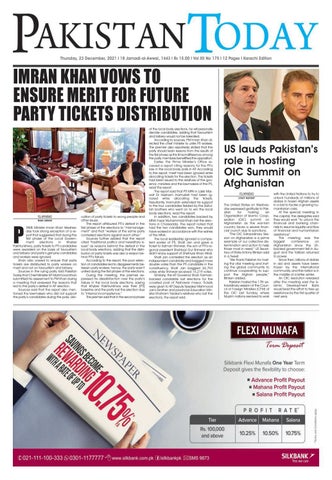
Thursday, 23 December, 2021 I 18 Jamadi-al-Awwal, 1443 I Rs 15.00 I Vol XII No 175 I 12 Pages I Karachi Edition
Imran Khan vows to ensure merIt for future Party tIcKets dIstrIbutIon
ISLAMABAD
P
Mian abrar
rime minister imran Khan Wednesday took strong exception of a report that suggested that during the first phase of the Local Government elections in Khyber Pakhtunkhwa, party tickets to PTi candidates were awarded on the basis of favouritism and bribery and party’s genuine candidates and workers were ignored. Khan also vowed to ensure that party tickets are distributed to party workers on merit and not on favouritism and bribery. Sources in the ruling party told Pakistan Today that Chief minister KP mahmood Khan submitted his assessment to Pm Khan during a meeting that reviewed the reasons that led to the party’s defeat in KP election. Sources said that the report also mentioned the lawmakers who did not support the party’s candidates during the polls, allo-
cation of party tickets to wrong people and other issues. The report attributed PTi’s defeat in the first phase of the elections to “mismanagement” and that “workers of the same party contested elections against each other.” Sources further added that the report cited “traditional politics and hereditary issues” as reasons behind the defeat in the local body elections, adding that the distribution of party tickets was also a reason behind PTi’s failure. According to the report, the poor selection of candidates led to disagreements between party workers; hence, the party wasn’t united during the first phase of the elections. During the meeting, the premier expressed his dissatisfaction over the party’s failure in the local body elections, saying that Khyber Pakhtunkhwa was their [PTi] baseline and the party lost the election due to “internal incompetence.” The premier said that in the second phase
of the local body elections, he will personally decide candidates, adding that favouritism and bribery would not be tolerated. According to sources, Pm imran Khan directed the chief minister to unite PTi workers. The premier also reportedly stated that the party should learn lessons from the results of the first phase as this time indifference among the party members benefitted the opposition. earlier, the Prime minister’s Office received a report citing reasons for the PTi’s loss in the local body polls in KP. According to the report, merit had been ignored while allocating tickets for the election. The tickets had been issued to the relatives of the governor, ministers and the lawmakers of the PTi, read the report. The report said that PTi mPA in Lakki marwat Dr Hasham inamullah had been ignored while allocating the tickets. resultantly, inamullah extended his support to the four candidates fielded by the Saifullah brothers who went on to win the local body elections, read the report. in addition, two candidates backed by mNA Fazal muhammad Khan lost the elections in Charsadda. The report noted that had the two candidates won, they would have worked in accordance with the wishes of the mNA. The local leadership ignored a competent worker of PTi, Shafi Jan and gave a ticket to Salman Shinwari, the son of PTi’s regional president Shehbaz Gul Shinwari who didn’t enjoy support of Shehryar Khan Afridi. Shafi Jan contested the election as an independent candidate and bagged more double votes than the PTi candidate in the constituency. Shafi Jan bagged 26,793 votes while Shinwari received 15,219 votes. Similarly, the KP Governor Shah Farmanbacked candidate lost elections for the coveted post of Peshawar mayor. Tickets were given to KP Deputy Speaker mehmood Jan’s brother and provincial education minister Shahram Tarakai’s relatives who lost the elections, the report said.
US lauds Pakistan’s role in hosting OIC Summit on Afghanistan ISLAMABAD staff report
The United States on Wednesday expressed gratitude to Pakistan for hosting an Organisation of islamic Cooperation (OiC) summit on Afghanistan as the war-torn country faces a severe financial crunch due to sanctions. “The OiC extraordinary Session on Afghanistan is a prime example of our collective determination and action to help those most in need,” US Secretary of State Antony Blinken said in a tweet. “We thank Pakistan for hosting this vital meeting and inviting the global community to continue cooperating to support the Afghan people,” Blinken added. Pakistan hosted the 17th extraordinary session of the Council of Foreign ministers (CFm) of the OiC last Sunday, where muslim nations resolved to work
with the United Nations to try to unlock hundreds of millions of dollars in frozen Afghan assets in a bid to tackle a growing humanitarian crisis. At the special meeting in the capital, the delegates said they would work “to unlock the financial and banking channels to resume liquidity and flow of financial and humanitarian assistance”. The meeting was the biggest conference on Afghanistan since the USbacked government fell in August and the Taliban returned to power. Since then, billions of dollars in aid and assets have been frozen by the international community, and the nation is in the middle of a bitter winter. An OiC resolution released after the meeting said the islamic Development Bank would lead the effort to free up assistance by the first quarter of next year.
02
Thursday, 23 December, 2021 | KARACHI
NEWS
ChInEsE InvEstORs EyE KP EnERgy, MInEs & MInERAl sECtORs IsLAMABAD
A
Mian abRaR
group of Chinese investors and business tycoons has expressed its intention to set up factories in various sectors and large-scale industrial units in Khyber Pakhtunkhwa to revive industries. The group members, including Chinese women entrepreneurs, called on KP Minister for Local Government and Rural Development Faisal Amin Gandapur at Khyber Pakhtunkhwa House, Islamabad, and introduced their companies to him, said a statement issued on Wednesday. Welcoming the Chinese group’s offer and investment plan, the minister assured full cooperation on behalf of the provincial government and invited all members to visit Khyber Pakhtunkhwa for practical progress on the plan.
He said that rapid agricultural and industrial development in Khyber Pakhtunkhwa is a long standing dream of both Prime Minister Imran Khan and Chief Minister Mahmood Khan and the federal and provincial governments are working hard to make it a reality. He said that his government has invited not only the Chinese but the entrepreneurs from the whole world also to invest in Khyber Pakhtunkhwa with full confidence wherein generous steps have been taken for safe foreign investment in the province. “Online and one window services have also been provided for this purpose,” he added. Gandapur said that the launch of the game changer China-Pakistan Economic Corridor (CPEC) has opened a golden chapter of global investment not only over here but in the entire region. He said that CPEC has ushered in a golden chapter of global investments.
Punjab registers FIRs, imposes fine to combat smog problem: relief commissioner News Desk Punjab relief commissioner Babar Hayat Tarar has stated that Punjab has registered over 2,970 FIRs between October 1 and December 18, and a hefty fine has been imposed on industrial emissions, stubble burning and traffic violations to tackle its smog problem. Tarar, who is also a senior member of Board of Revenue, further revealed that the smog problem has been alleviated as a result of effective government measures. It is pertinent to note that last week, the central and southern areas of Punjab were engulfed with heavy smog, which resulted in disruption of flight and train operations in some cities of the province. Several flights from the Lahore and Sialkot airports faced delays due to the critical smog situation. Four flights scheduled for Lahore were diverted to Islamabad. As per reports, schedule of trains from Karachi and Quetta was also affected. Meanwhile, motorways were blocked for traffic at different spots after reports of several traffic accidents. M2 from Bhera, M4 from Shershah to Shamkot and M5 from the Jalalpur interchange to Shershah and from Rohri to Guddu were also blocked.
The minister said that Pak-China friendship would be further strengthened due to CPEC and the region would get double and quadruple progress and prosperity with passage of time. The group members requested the minister to cooperate in the processing of codal formalities. The group is already making diversified investments in various parts of Pakistan. They discussed their investment plans in respect of establishing state-of-the-art machinery manufacturing, energy, mines and mineral development, especially the mining and other productive sectors. They told the minister that apart from the industrial zones along the CPEC corridor passing through the province, they also want to industrialise in remote districts and places where raw materials are readily available. They hinted at a detailed visit to the province soon.
Ashrafi, Jamil meet Sri Lankan high commissioner, apologise for Sialkot tragedy News Desk Special Representative to the Prime Minister on Religious Harmony and Middle East Hafiz Muhammad Tahir Mehmood Ashrafi and renowned religious scholar Maulana Tariq Jamil on Wednesday met Sri Lankan High Commissioner Mohan Wijewickrama at the Sri Lankan Embassy in Islamabad and expressed grief at the lynching of Sri Lankan national Priyantha Kumara by a charged mob in Sialkot earlier this month. Kumara, a senior manager at a factory in Sialkot, was tortured to death on December 3 by hundreds of protesters, including the factory employees, and his body was later burnt. Talking to the media after the meeting, Ashrafi condemning the Sialkot incident and said that the factory’s management has decided to bear all the expenses of the two children of Kumara, besides giving the position of senior manager to a Sri Lankan citizen in the factory.
Maulana Tariq Jamil apologised for the incident and said that Islam does not allow such barbarity. The religion does not allow oppression at all. Jamil said that Islam’s literal meaning refers to submission, surrender and peaceful reconciliation, especially compliance with divine directives. The whole Pakistani nation is ashamed for that barbarity. No one has the right to burn anyone, he added. Speaking on the occasion the Sri Lankan high commissioner thanked both dignitaries for visiting the embassy and said that the Sri Lankan government is fully satisfied with the steps taken by the Pakistani government. Earlier on December 7, clerics from various schools of thought had visited the Sri Lankan Embassy in Islamabad and unanimously condemned the lynching of Kumara, calling it “un-Islamic” and extrajudicial”. They had demanded that strict legal action be meted out to those responsible.
CCoE to discuss five agenda items tomorrow IsLAMABAD Staff RepoRt
A meeting of the Cabinet Committee on Energy ( CCoE) scheduled on Thursday will take up five agenda items based on summaries of the petroleum division, power division, and deputy chairman Planning Commission. According to a statement by the Cabinet Division, the meeting will be held under the chair of Minister for Planning, Development and Special Initiatives, Asad Omar, at the Cabinet Division. Cabinet Committees Deputy Secretary Syed Ayaz Anwar has requested minimum participation in the meeting in view of Covid-19 precautions. The summaries which will be taken up by CCoE include import of oil and port constraints at Karachi, inquiry constituted by GHCL regarding the damage of gas turbine No. 14 of 747MW Combined Cycle Power Plant at Guddu, Jamshoro Joint Venture Limited (JJVL) LPG Plant, LNG terminal and LNG virtual pipeline, and the monthly report sheet of power plants operated out of merit, primarily for security constrained economic dispatch of November. Any other item may be discussed with the permission of chair, as per the statement. It is pertinent to mention here that the upcoming meeting will not consider the new refinery policy 2021 which was among the agenda items of the previous CCoE meeting. Local refineries are currently facing furnace oil storage constraints mainly due to the refusal of Independent Power Producers (IPPs) to lift stocks from refineries whereas refineries have been making efforts to convince the power division for resolving the issue.
NCHR holds consultations with civil society, media kARACHI
32 suspected cases of Omicron variant reported in Balochistan
ppi
At least three dead, several injured as fog causes M-2 motorway pile-up News Desk At least three people died and around half a dozen were injured as fog causes pile-up of multiple vehicles on the Lahore-Islamabad Motorway (M2) on Wednesday near Babu Sabu. As per details, rescue officials had to use cutters and other equipment to rescue those trapped in the wreckage. One of the deceased had been identified as 32-year-old Bakhtawar Amanat. The injured have been identified as Dilawar Mulazim, 50; Sarfaraz Mumtaz, 35; Salman Razzaq, 22; Anwar Ismail, 32; Bashir Yaqoob, 52 and Sibgha Islam, 22. The injured were immediately shifted to a nearby medical facility for treatment and first aid. Earlier in November, at least 25 people were injured in multiple pile-ups on the M-2 motorway between Lahore and Islamabad. As per the rescue services. multiple vehicle collisions were reported at three different points, Kala Shah Kaku, Qila Sattar Shah and Khanpur, owing to low visibility amid dense fog.
National Commission for Human Rights (NCHR), in collaboration with European Union-funded Huqooq-ePakistan Project (HeP), launched its country-wide consultative process for the commission’s four-year strategic plan. In this regard, two consultative sessions were held with civil society representatives and media, where participants shared a broad range of opinions to devise a pragmatic strategic plan for the NCHR. The commission plans to hold similar consultative sessions in other provincial capitals in order to gather information and recommendations from all parts of the country. Presided over by NCHR Chairperson Rabiya Javeri Agha and led by senior expert from HeP Dr Osama Siddique, the consultations engaged participants on their views about the state of human rights in Pakistan and their level of awareness of NCHR’s role and mandate. The participants also held extensive discussions on NCHR functions and ways of effective collaboration between the commission and human rights stakeholders, especially general public. In her welcome remarks, Rabiya Javeri Agha said that opinions and recommendations coming out from these consultations would be taken into
News Desk
account while preparing the NCHR’s strategic plan and determining next steps for the commission. The chairperson said that the commission is a broad mandated entity. “One of the main functions of the commission is to inform the government of the problems faced by the people and civil society in the form of reports. The second major role is to provide relief to the victims and survivors through its civil court and suo moto powers,” she said adding that a robust connection between the commission, civil society and media would empower NCHR to effectively perform these two vital functions. She said media plays a crucial role in protection and promotion of human rights. It informs, educates and sensitise the general public as well as policy makers, civil society and those implementing the laws and policies.
Besides that, it connects people with the government and other stakeholders. Dr Osama Siddique said that developing the commission’s strategic plan through consultations with civil society and the government across Pakistan ensures that diverse perspectives are considered as NCHR charts its plan for the coming years. He said that human rights is a complex cross cutting area and it is incredibly important that there should be greater synergies and cooperation between all those who stand as custodians of human rights. In her remarks, HeP Executive Director Seema Jaffer talked about the initiatives been taken by the project. She said that protection of human rights is the basis of all democratic and progressive societies. Internationally, human rights indicators determine the image of a country.
Balochistan has reported at least 32 suspected cases of the Omicron variant of coronavirus, Geo News reported on Wednesday. According to the report, Kalat District Health Officer (DHO) Nasrullah Lango confirmed the number of suspected cases to the news outlet and said that the samples taken from the suspected patients have been sent to the National Institute of Health (NIH), Islamabad for confirmation. All the suspected patients, including a woman who recently delivered a baby, are from Kalat and none of them has a travel history, the report quoted the DHO as saying. As per the report, the DHO said that the condition of the said patients is stable and they have been quarantined at their homes. Meanwhile, Balochistan Chief Minister Abdul Quddus Bizenjo expressed concerns over the suspected presence of the Omicron variant in Kalat and sought a report from the health department. Earlier, the country had reported one confirmed and another suspected case of the new variant of coronavirus. On December 13, the Aga Khan University Hospital had confirmed it had detected the country’s first-ever case of the Omicron variant in a patient, who had no travel history, through genesequencing. According to media reports, the second case of the Omicron variant of coronavirus was reported from Karachi.
Thursday, 23 December, 2021 | KARACHI
NEWS
03
FM QuREshI REAFFIRMs PAKIstAn’s COMMItMEnt tO hOst sAARC suMMIt
F
News Desk
OREIGN Minister Shah Mehmood Qureshi on Wednesday reaffirmed Pakistan’s commitment to host the SAARC leaders during the meeting with the group’s secretary general Esala Ruwan Weerakoon, who is currently on a visit to Islamabad. He revealed that Pakistan was ready to host the long-delayed summit of the South Asian Association for Regional Cooperation (SAARC) when what it said “artificial obstacles” in its way were removed. It is pertinent to note that Pakistan was
supposed to host the summit in 2016 but India boycotted the gathering of SAARC leaders and also persuaded some other member states to do the same. Under the SAARC charter, the summit cannot take place if any of the member countries stays out. Since then India consistently has been staying away from the summit thus delaying the gathering of leaders of eight nations of South Asia. In fact in recent year because of differences and tensions between India and Pakistan, the SAARC was virtually dead until Covid-19 pandemic hit the world when the member states used the association’s platform for collaboration.
However, it is unlikely the organisation will realise its full potential in the foreseeable future given the deep divisions between Pakistan and India and also new alignments in the region. Nevertheless, the FM told the SAARC secretary general that Pakistan was committed to the principles and objectives of the SAARC Charter for the welfare of the people of the region, economic integration and regional prosperity. “Pakistan believed SAARC could provide a conducive and congenial atmosphere to build economic synergies and transform the quality of life of the people of
South Asia,” Qureshi said as per the foreign office statement issued today. FM Qureshi recalled the important and constructive role played by Pakistan in realising the true potential of SAARC and making it a useful organisation for regional cooperation and mutual benefit based on the principle of sovereign equality. He reassured the secretary general of Pakistan’s strong support for regional cooperation and urged him to accelerate the pace of the SAARC process. FM Qureshi reiterated Pakistan’s commitment for hosting the SAARC Summit when the artificial obstacles created
Pakistan’s B2B agritech startup Tazah closes pre-seed round at $6.5m LAHORe taiMooR HaSSan
Lahore-based B2B fresh produce marketplace Tazah Technologies has raised an additional $4.5 million in its pre-seed extension round, bringing the total pre-seed raise to $6.5 million. Tazah’s initial pre-seed tranche of $2 million was raised in October. The extension round was co-led by Pakistan’s Fatima Gobi Ventures (FGV) and USbased Vibe Capital. The round was joined by Shorooq Partners, Nuwa Capital, Ru-net, Alter Global, Julian Capital, Kinnow Capital, Early Grey Capital and K3 Fund. The round also had participation from Silicon Valley based angel investors including Sahil Bloom, Siqi Chen, Matt Brezina, among others. For Nuwa Capital, one of the largest funds in the Middle East, this will be their first investment into Pakistan. Existing investors including Global Founders Capital, Zayn Capital, i2i Ventures and notable angels also reinvested in the round. Profit has seen internal documents and can confirm the $4.5 amount raised in the fresh round. According to the Pakistan Bureau of Statistics (PBS), the agriculture sector is the largest, contributing around 24%to the country’s gross domestic product and accounting for half of the employed labour force. In a primarily offline farmer to retailer agri supply chain, fresh produce such as fruits and vegetables from farms are sold by farmers to
middlemen, who then sell it to wholesalers. Individual retailers buy from wholesalers at a price inflated because of the margins earned by the two actors: middlemen and wholesalers. Retailers then sell it to end consumers, deciding their margins based on the location they are selling at. The massive hike in price from farm to retailer happens because of multiple actors taking cuts in the form of margins at each stage these products are traded. There are multiple points of handling and logistics for goods that are perishable in nature. The handling and deliveries are done through an inefficient and archaic infrastructure which adds to the costs, increasing the prices further. It also leads to post-harvesting wastage and affects the quality of the products which are perishable in nature. Middlemen and wholesalers are the ultimate winners since they are able to exploit farmers and enjoy better margins. Whereas farmers lose on these margins while relying on predatory loan sharks to finance their working capital requirements. On the other hand, the retailer has to pick fruits and vegetables from wholesalers at the start of the day at rates that fluctuate daily. The product quality is also not top-notch because of the inefficiencies in the supply chain. The end customer naturally suffers in terms of the prices he has to pay for staple vegetables and fruits that have a very low price at the beginning of the supply chain. In quality terms as well, the retailer and eventually the customer
Cng association launches countrywide protest against gas suspension IsLAMABAD Staff RepoRt
is paying a high price for a product that has lost on quality by the time it reaches these stakeholders. Founded in August 2021 by two exCareem executives Abrar Bajwa and Mohsin Zaka, B2B marketplace Tazah aims to solve these problems by connecting farmers directly with fruit and vegetable retailers, eliminating the traditional middlemen and wholesalers. In turn, the prices at which retailers are able to buy from farmers are better. Tazah also has parallel storage and delivery service through which it is able to deliver directly to the retailers instead of them having to go out and buy at the beginning of the day, and the product quality is also better. The startup claims that since their launch, they have been able to hit an annualized gross merchandise value (GMV) of $7 million. Headquartered in Lahore, the startup has expanded operations into Karachi with another city launch in the pipeline. The B2B agritech space is heating up, with one of Tazah’s competitors, Jiye Technologies, raising $2.5 million in preseed funding yesterday. On how Tazah plans to stay ahead in this market, Abrar Bajwa, co-founder of Tazah said that it all depends on the ability to execute. “It is a hard space and there are challenges of execution on every scale. It is going to get difficult to execute at scale and we believe that we have the best team to scale quickly,” said Abrar Bajwa, co-founder of Tazah. On future plans, Abrar said: “With the technology and talent pedigree that
New film policy finalised to incentivise industry: Fawad IsLAMABAD Staff RepoRt
The All Pakistan CNG Association (APCNGA) has launched a nationwide protest against the government’s decision to discontinue gas supply to the Compressed Natural Gas (CNG) sector, lamenting that the move is illegal. The protest began with a sit-in of the APCNGA and Sindh CNG Association outside Sui Southern Gas Company’s (SSGC) office on Wednesday, and will be extended to Punjab according to the association’s plan. Speaking on the occasion, APCNGA Group Leader Ghiyas Abdullah Paracha said that a few elements are giving wrong information to the federal cabinet which is resulting in erroneous decisions, putting hundreds of thousands of jobs and investments worth billions at stake. He urged Prime Minister Imran Khan to take note of the situation and intervene to provide relief to both the masses and investors. Paracha said that the decision to discontinue gas supply to CNG stations was illegal as the priority list of various gas consuming sectors was ignored. “According to the national gas policy, the CNG sector has been placed at the fourth position while the CNG sector has been placed at the second position in the LNG policy,” he said.
we are building, we believe that expanding into regional markets with similar dynamics is a logical move.” Besides using the funds for expansion, the startup also plans to diversify its offerings and deploy financial products for farmers and retailers. Tazah claims to have realised a high rate of month-on-month customer retention, with many users being return customers and exhibiting a subscriptionlike ordering frequency very rarely seen in other industries. Mohsin Zaka, Co-Founder of Tazah, said: “Our experience of leading large national teams and growing complex marketplaces has helped us tremendously in quickly scaling our business and building the capability to manage multi-city operations. We have also built a very strong founding team by acquiring the best talent from different industries.” Ankur Nagpal, Founder of Vibe Capital said, “It’s inevitable that this business should exist. It’s a very inefficient supply chain at the moment, and Tazah streamlines it.” “The company is growing really fast and on track to hit eight figures in annualized GMV in the next couple of months and that still represents a very small percentage of the overall market. What we are most excited about is the ability to build additional products (particularly financial products) for this market. For instance, Tazah is in a great position to start extending lines of credit to their business buyers that they pay off after reselling the inventory,” he said.
Minister for Information and Broadcasting Fawad Chaudhry Wednesday said that the government has finalised a new film policy to incentivise the industry. Addressing a press conference here, Fawad said in the new policy, the government had proposed the Federal Bureau of Revenue (FBR) to charge higher taxes if a channel is airing foreign dramas so that they should not be cheaper than local content. “Our television channels have made it a norm to import foreign dramas, which is comparatively cheaper than the local ones, and as a result, our local dramas have suffered a huge blow,” he said. “Foreign actors are being hired for advertisements; our actors are remaining unemployed — and without any reason — foreign actors are being hired,” he said. Regretting that major companies ignore local talent for their advertisements, the information minister said that the government would also impose heavy taxes on such ads — to pave the way for Pakistani artists. Earlier, a Memorandum of Understanding (MoU) was signed between Pakistan Television and the Arts Council of Pakistan regarding National Entertainment Awards. Shedding light on the MoU, he said the government would try to revive all the mediums —
music, drama, and films — through it. He said under the MoU, the government would bestow 22 awards, which will be given to the top Pakistani musicians, artists, and films. “We will also distribute Rs250 million through these awards.” He said the National Entertainment Awards would be the largest in the history of the country. He said he is hopeful the masses would again be interested in the country’s dramas and films through these measures. “We weakened those who could narrate Pakistan’s story […] we were the third biggest filmmakers in the 1960s. Similarly, Pakistan ranked third or fourth when it came to cinema screens,” he said. The information minister said “with much effort”, we ruined our film and drama industry, and now, our music is headed in the same direction. The minister said for the first time, entertainment channels have been included in the government’s advertisement policy. The government is simplifying the process to obtain a no-objection certificate (NOC) to shoot films in the country, as Pakistan has one of the most beautiful sites in the world, he said. The information minister said, as a result, foreign filmmakers could also easily shoot their films in Pakistan. He said a film-making division was also established in PTV, and currently, two multi-million dollar films on Zaheeruddin Babar and Tipu Sultan were under production.
in its way would be removed. The FM, while expressing condolences on the death of Sri Lankan citizen Priyantha Kumara in Sialkot, stated that entire political leadership, religious scholars and the Pakistani nation had condemned the incident and the Government of Pakistan was determined to take all necessary steps to bring perpetrators to justice. The SAARC head thanked the foreign minister for sharing his views on different SAARC related issues and assured him of his concerted efforts to strengthen cooperation among the member states so as to realise the full potential of SAARC.
Oil climbs on weaker dollar, China, amid Omicron caution MeLBOURNe agencieS
Oil prices rose again on Wednesday as the dollar slipped, with risk appetite returning as some governments resist imposing lockdowns to curb the spread of the Omicron COVID-19 variant and as China said it would be able to sustain economic growth. US West Texas Intermediate (WTI) crude futures rose 50 cents, or 0.7%, to $71.62 a barrel at 0235 GMT after jumping 3.7% on Tuesday. Brent crude futures rose 44 cents, or 0.6%, to $74.42 a barrel after gaining 3.4% on Tuesday. Oil prices typically move inversely to the US dollar, with a weaker greenback making commodities cheaper for those holding other currencies. Meanwhile a senior Chinese state planning official said on Wednesday Beijing would work to aid economic growth, including stepping up government spending, strengthening support to manufacturers and stabilising industry supply chains. The country, the world’s biggest oil importer, would “strive to stabilise economic operations in the first quarter, the first half and even the whole year,” the official told Xinhua News Agency. Meanwhile, some governments are trying to hold off imposing new pandemic curbs to slow the spread of the Omicron coronavirus variant, including in Britain and Australia, which should help support fuel demand. British Prime Minister Boris Johnson said he would not introduce new COVID-19 restrictions before Christmas, but said the government may need to take steps afterwards. In Australia, Prime Minister Scott Morrison on Wednesday ruled out lockdowns and instead urged people to get booster shots to protect themselves even as the country hit a pandemic high of more than 5,000 new infections.
Thursday, 23 December, 2021 | KARACHI
04
NEWS
PM dubs KP LG PoLLs As A systEM oF ‘suCCEssFuL dEMoCrACiEs’
P
M Imran Khan on Wednesday called the KP local government polls, a start of a modern local government system that exists in ‘successful democracies’. The PM took to his official Twitter handle to state that “amidst the noise over K-P LG [elections] no one realises these elections are start of modern, devolved LG system as exists in successful democracies.” “Directly elected Tehsil nazims will improve governance and create future leaders,” he added. The premier further stated that it was the first time in Pakistan’s 74-year-long history wherein the country had “an empowered LG system”. A day earlier, PM Imran admitted that the PTI had made ‘mistakes’ in the first phase of K-P’s local government
elections and pinned the blame on “wrong candidate selection”, a day after his party lost several seats in the province. The premier took to his official Twitter handle to admit that his party had “paid the price” for its mistakes and wrote that he would “personally” be overseeing PTI’s LG election strategy in the second phase of K-P’s local body polls as well as those held across the country. His tweet came in the wake of the ruling PTI suffering a major blow as the JUI-F cruised to victory with its candidate grabbing the pivotal post of the Peshawar mayor in the first phase of the local government elections held in K-P since the merger of tribal districts. As a response, PML-N Vice President Maryam Nawaz on Tuesday said
Enormous investment opportunities for Japan in maritime sector: Ali Zaidi ISLAMABAD: Federal Minister for Maritime Affairs Syed Ali Haider Zaidi has said that Pakistan’s maritime sector offers enormous investment opportunities for the Japanese investors. He stated this while talking to Ambassador of Japan to Pakistan WADA Mitsuhiro who visited the Ministry of Maritime Affairs and called on him here on Wednesday. Matters of mutual interest came under discussion during the meeting and the minister proposed to set up a tax free zone in Port Qasim for the period of next ten years to boost investment and development for both the nations. Syed Ali Haider Zaidi reiterated that Pakistan is a country having huge potential in terms of human resource, fisheries, cheap labor and agriculture. The vision of Blue Economy is opening new corridors for enlargement of progress not only for Pakistan but it also offers huge investment opportunities to Japan, he added. The Minister Maritime Affairs assured the Japanese envoy of full assistance from Pakistan and elucidated about the importance of recent coastal developments in Gwadar and Port Qasim. He further apprised about the huge development going on in Port Qasim including a project worth approx. 150m to 200m in pipeline. The Government of Pakistan is going to announce building of three more terminals in the coming two months that will open massive investments opportunities for Japan. Minister further discussed the provision of the export of Tuna to Japan. As Japan is one of the biggest consumers of Tuna and Pakistan has huge potential to provide the export in abundance to Japan. It will further prove fruitful for both the economies of Pakistan and Japan. Staff RepoRt
that PM Imran should leave the poor people alone and go home to save the bit of respect he has left, after the PTI’s loss. “No leader will want to seek an election ticket from the PTI after the recent embarrassing defeat of the party in K-P.” She went on to add that it was the first sitting government in the country, which was losing elections one after another, adding that even the party’s own lawmakers were criticising the government during talk shows. It is pertinent to note that on the directives of Chief Minister Mehmood Khan, a report was prepared to figure out the reasons for PTI’s defeat. As per sources, PM Imran has summoned KP Chief Minister Mahmood Khan as well. It has been further revealed by
sources that the main reason for the defeat of PTI, apart from inflation, was major internal differences within the party, with some members of the Assembly not supporting the PTI nominees. Sources further said that action had been decided against two members of the National Assembly and four members of the Provincial Assembly for supporting opposition candidates. According to PTI sources, CM Mehmood is consulting with provincial ministers before submitting the report to the premier. The CM is to brief PM Imran on the results of the local body elections and inform him about the distribution of tickets. As per sources, PM Imran Khan will provide guidelines for the next phase of the strategy, as well. NewS DeSk
KP LG polls: Fazl aims to continue struggle along with PML-N to overthrow govt JUI’s President Maulana Fazlur Rehman, who also serves as the chief of the Pakistan Democratic Movement, has expressed that he has aimed to continue struggle along with the PML-N to oust the government. It is pertinent to note that Fazl thanked PML-N supremo Nawaz Sharif on Wednesday, for congratulating him over JUI’s success in the recent Khyber Pakhtunkhwa local government elections against PTI. The JUI leader, in a tweet, said that JUI-F and PML-N will continue to struggle for the complete restoration of democracy, provision of the right to vote to the people, and overthrowing the incumbent government. “Our joint struggle will continue till the complete restoration of democracy, provision of the right to vote to the people, ousting of this selected government and Pakistan’s return to the way of a better and more sustainable future,” Fazl wrote. The remark came in reaction to former PM Nawaz Sharif’s tweet where he congratulated Fazl for his party’s success in the first phase of the LG polls. “[I] present heartily felicitations to Maulana Fazlur
Rehman and his comrades on JUI-F’s great victory in the first phase of the recent local body elections in Khyber Pakhtunkhwa,” Nawaz Sharif wrote. It merits mention that JUI has won the most seats in the 2021 LG polls in KP, while PML-N has won two seats according to the unofficial and unverified results received so far. It is to note that the incumbent PTI suffered a major setback after the Maulana Fazlur Rehman’s JUI candidate won the seat for the post of Peshawar mayor in the local government elections held in Khyber Pakhtunkhwa, according to unofficial and unverified results. The ruling party’s defeat was made obvious in the first phase of LG polls in KP, with Opposition party JUI emerging victorious and PTI failing to bag a single mayor seat out of the four. PTI not only faced a setback in the mayoral elections but Tehreek Ulema-e-Islam also defeated the ruling party in the tehsil council election. In the first phase of local body elections in KP, elections were to be held for 61 tehsil councils and five city councils; however, no elections were held in Baka Khel tehsil and
Dera Ismail Khan city council. According to sources, elections of the tehsil council were to be held in 61 tehsil councils; however, the polling process in Baka Khel tehsil of KP’s Bannu district was halted after the law and order situation was disrupted. Moreover, results of two more tehsils were withheld, hence, so far results of 46 out of 58 tehsil councils have been declared. As per unofficial and unverified results, JUI candidates have won 16 seats in the tehsil council. Meanwhile, 10 candidates of the ruling party PTI managed to secure the seats. Apart from these, eight independent candidates won the seats of chairman of tehsil council. While six members of ANP, three members of PML-N, two members of Jamaat-e-Islami and one chairman of Tehreek-e-Istiqlal Pakistan (TIP) have been elected. As for the Mayor seat elections, initially, polling was to be held for five city mayor seats, however, polling in Dera Ismail Khan was postponed following the murder of Awami National Party’s candidate. Hence, polling was only conducted in Marda, Peshawar, Kohat, and Bannu. NewS DeSk
ECP accepts Azam, Fawad’s apologies The Election Commission of Pakistan (ECP) on Wednesday accepted the written apologies tendered by Railways Minister Azam Swati and Information Minister Fawad Chaudhry. The apologies were accepted by a two-member ECP bench, headed by Nisar Ahmed Durrani. Both federal ministers had reportedly accused the commission and chief election commissioner of accepting bribe and taking side of the opposition parties. The commission had taken serious notice of the allegations and asked the ministers to prove their accusations. During the hearing on December 3, Swati and Fawad had submitted their written apologies. However, Swati had skipped the hearing and failed to appear before the commission as his lawyer had submitted an apology on his behalf. The ECP had objected to it, saying all institutions should respect each other, and summoned Swati on December 22 in person. It had reserved its verdict on Fawad’s written apology as well. During the hearing on Wednesday, Swati appeared before the commission and said he has always raised his voice to make the ECP an independent institution. While talking to the media after the hearing, Swati thanked the ECP for accepting his apology and said that the government wants to make the Election Commission of Pakistan as an independent institution. He heralded that the ECP is going to make good decisions regarding the use of Electronic Voting Machines (EVMs). ECP SuMMonS MEEtIng to DISCuSS EVMS: According to a news outlet, the ECP has summoned a meeting of its technical committee on Thursday to discuss the possible inclusion of electronic voting machines (EVMs) and extending voting rights to overseas Pakistanis in the next general election. Reportedly, the meeting will be chaired by the Chief Election Commissioner (CEC) Sikandar Sultan Raja and the expansion of EVMs and prospects of voting procedure through the technology will be decided in the light of the recommendations by the committee. VotErS’ VErIfICAtIon ProCESS ExtEnDED tILL DEC 31: Meanwhile, the ECP extended door-to-door voters’ verification process pertaining to the electoral lists 2021-22 for 10 days in the interest of public service. According to ECP’s press release, December 21 was the last date of the verification campaign, which has been extended till December 31 so that a large number of people can register their votes. ECP has also extended SMS 8300 service till December 31 and made it free for facilitation of people. NewS DeSk
Time to boost Pakistan, Argentina economic, trade ties KARACHI Staff RepoRt
Ambassador of Argentina Mr. Leopoldo Francisco Sahores Wednesday stressed the need for implementing agreements and Memorandums of Understanding (MoUs) between Argentina and Pakistan to boost bilateral trade and expand people to people relations. Addressing a webinar organized by Karachi Council on Foreign Relations (KCFR) under the chairmanship of Mr. Ikram Sehgal, the envoy said that it was time to take stock of the bilateral agreements to the benefit of the peoples of Argentina and Pakistan. He reminded of Argentina’s support at the UN, during Pak- India War in 1971 which finally brought in a cease fire under the auspices of UN. He also acknowledged and thanked Pakistan for it’s support for the resolution for the negotiation between the Argentina and the United Kingdom. In order to find a peaceful and definitive solution to the sovereignty dispute related to Malvinas (Falk Land) Island including the maritime areas around those islands, the ambassador said that this existing institutional framework of MOUs and Agreements would prove successful only when it comes to it its implementation. “We needed to increase people to people contacts especially to diversify the bilateral trade which has a lot of potential. 70 years of diplomatic relations had been celebrated
CMYK
where the foreign minister was the chief guest,” he added. He said that trade between the two countries was negligible and about 155 millions. Argentina is very competitive Agriculture county and Pakistan though a huge agriculture player, yet depends heavily on food imports to meet the local demands which is a consequence of absolute machinery and technology and scarce use of bio technology, storage deficiency and in this respect a joint venture is being launched between PASCO with a help of Argentina experts technology that will help reduce the loss and damages to the grains. He also mentioned that foots and mouth disease is of great concern for the beef industry and hinders the dynamic development of export oriented sector in Pakistan too. “Argentina was ready for cooperating in vaccination of the cows. I propose setting up of Spanish language centers which is one of the UN’s official language and the second largest native language spoken in the world. That this will enable Pakistani students of their ability to study in Argentina,” he added. Replying to a question, the Ambassador said that there was a need to establish bilateral trading forums for increasing the bilateral trade between the two countries. In response to another question, the ambassador said that like Pakistan Argentina has also been negotiating with IMF and had overcome the difficult times when his country had defaulted over return of IMF loans.
He was certain that both countries with concerted efforts will overcome their problems with IMF. Before His Excellency, the Former Pakistan Ambassador to Argentina Ms. Naela Chohan who had been Pakistan’s Ambassador in Argentina talked about the historic links between Argentina and Pakistan. That relations were very well founded since 1951, that both of the countries have a lot of things in common, especially there consensus on Malvinas and their initial support on Kashmir issue. That both countries have similar challenges and both peoples are determined to overcome the challenges. She appreciated the recent exchanges of technologies in the fields of aviation wherein Argentina and Pakistan had ordered acquisition GF-17 Aircraft. The Webinar was concluded by KCFR’s Chairman Ikram Sehgal. He thanked for participation by His Excellency and Ms. Naela Chohan and said that there was a lot of common things between the two countries as stated by both of them and there was a lot of needed to be done beyond MOUs in the fields of trade and economic affairs, culture and education, tourism. He liked His Excellency’s proposal to advance in different fields but especially in agriculture whereas Pakistan was the 5th largest milk producing country but still was not producing exportable cheese that is value addition and welcomed the proposal given by H.E.
Thursday, 23 December, 2021 | KARACHI
Food sECurity top AgENdA itEm iN NAtioNAl sECurity plAN: FAKHAr imAm Islamabad
p
staff rePort
AKISTAN has declared food security as a national security issue by putting food security on the top agenda item in the national security plan. Federal Minister of National Food Security and Research Syed Fakhar Imam said this while addressing a workshop organised by Islamic Organisation for Food Security (IOFS) on “OIC Country Experience in Food Security Governance for Strengthening South-South Cooperation” on Wednesday. Imam said that Pakistan has reduced food and nutritional insecurity from 24 percent in the year 2014-15 to 18.3 percent in 2019-20 and is engaged in further
reduction through agricultural and livestock development along with livelihood improvement and economic uplift of the general mass. He said that the present government is trying its best to address all the four pillars of food security through various initiatives and programs. In this connection Prime Minister’s Agriculture Emergency Program has been initiated with nearly Rs285 billion which primarily focused on such as productivity enhancement of wheat, rice & sugarcane with cost of approximately Rs34 billion, oil seeds enhancement program with cost of about Rs10 billion, conserving water through lining of watercourses with a cost of Rs180 billion, enhancing command area of small and mini dams in Barani areas with a cost of
CommANdEr royAl BAHrAiN NAVAl ForCE CAlls oN Air CHiEF
Rs28 billion and water conservation in Barani areas of Khyber Pakhtunkhwa with a cost of Rs13 billion. He said that to resolve the issue of food security, numerous initiatives have been taken to increase household income which include mechanised harvesting of wheat, rice, maize and fruits, silos for grain storage, cold storage facility for horticultural commodities and valueadded products through provision of harvesting machinery for rice, cob and fruits on 50% subsidy, exemption of 28% import duty and 17% GST on locally manufactured silo, replenish of SBP’s financing facility for storage of agricultural produce and development of small scale or cottage industry under Ehsas and Kamyab Jawan Programme. Furthermore, the government has
PM unveils plan for purpose built new Panagahs Islamabad Pr
Commander Royal Bahrain Naval Force (RBNF) Rear Admiral Mohammad Yousif Al Asam called on Air Chief Marshal Zaheer Ahmed Baber Sidhu, Chief of the Air Staff, Pakistan Air Force in his office today. During the meeting, both the dignitaries discussed matters of professional and mutual interest. Rear Admiral Mohammad Yousif Al Asam commended the professionalism of PAF and acknowledged its rising indigenous capacity in aviation industry. The Air Chief said that Pakistan and Bahrain enjoy longstanding religious, cultural and historical bonds which are manifested through strong ties between both air forces. The Air Chief reiterated his resolve to further enhance the existing bilateral cooperation between the two brotherly countries. Pr
Chairman NHA holds E-Kacheri
ISLAMABAD: As per directive of Prime Minister of Pakistan Mr. Imran Khan on reaching out to the public through holding Khuli Kachehris by organizations under the Federal Government, Chairman National Highway Authority Capt (R) Muhammad Khurram Agha held E-Kachehri at head office of the Authority through NHA official Facebook Page and answered to the questions raised by the people all over the country and issued on spot directions to undertake steps for earlier solution of public complaints. Answering to the question placed by the people, Chairman National Highway Authority Capt (R) Muhammad Khurram Agha said, Sukkur-Hyderabad Motorway is the last missing link of Peshawar Karachi Motorway (PKM) and that bids for construction of the Sukkur-Hyderabad Motorway have been received. Now NHA is in process of their evaluation. He further said, widening and rehabilitation of BalkasarMianwali-Muzaffargrah road is underway to facilitate the traffic. He said, contractor has already been mobilized on Chitral-Ayum Road Likewise work on Chitral-Shandur Road is in progress, and it will be completed in three years’ time period. Steps are being taken for earlier payments to the land owners/affectees of Gilgit-Shandur Road. He said, paper work for Kharian-Rawalpindi Project is being completed while feasibility study is being made of Mangla Mirpur-Muzaffarabad and Kharian-Basima Road Projects. Keeping in view the importance of Kohat-Jand Road, Chairman National Highway Authority Capt ® Muhammad Khurram Agha said, this project will also be completed soon, while work on Peshawar-Northern Bypass is progressing gradually. He recalled, as per planning, Shahdara Flyover Project on N-5 will be undertaking on Public Private Partnership basis. Pr
fast-tracked access to credit/finance through registration of farmers and FVOs and women through biometric mapping and issuance of Kisan cards for subsidy and credit. In addition, import of more than 3 million tons of wheat and 0.3 million tons of sugar in the year 2020-21 are the preventive steps taken to ensure food security of the country. Fakhar said Pakistan has great potential for enhanced productivity of food and Fiber crops but natural hazards exert great pressure for its stability and sustainability like, climate change, floods, deserts, locusts and Unforeseen calamities like Covid-19. In order to make the agricultural sector more stable and sustainable, the government is planning to cope with these hazards through various actions and mitigation policies.
In a soft launch today, Prime Minister Imran Khan broke the ground for the new model Panagahs being built in Islamabad Capital Territory with improved standards and structure. On the special instructions of the Prime Minister, the four new Panagahs are being built in Tarlai, Tarnol, G-9 and Mandi More areas of Islamabad adjacent to the existing facilities. At the event, PM also unveiled the final plans of these multistoried Panagahs to be constructed. He lauded Ehsaas team, CDA, NCA and all concerned for their collaborative efforts and instructed to ensure the speedy execution of new model Panagahs. The Prime Minister underlined the importance of provision of quality food and service at the Panagahs. He directed the concerned departments to provide Ehsaas services at the Panagahs and also emphasized upon providing skill development training at the Panagahs enabling the residents to become contributing citizens in the society. The Prime Minister appreciated the collective efforts of the concerned departments and directed them to replicate the model in the provinces on the same line. Earlier, Senator Dr. Sania Nishtar, SAPM briefed the PM on the Panagahs’ new strategic plan including construction, furnishing, governance, execution, digital monitoring, capacity building and financing. “In addition to ‘bed breakfast and meals’ facilities for labourers, these Panagahs will also have Ehsaas One Window Centers, to enable labourers and the underprivileged class to benefit from the government’s social welfare programs.”, said Dr. Sania.
Automation in FBR is important for taxpayers' facilitation: Shaukat Tarin The Adviser to Prime Minister on Finance & Revenue, Mr. Shaukat Tarin chaired an important meeting on Automation at FBR (HQs), Islamabad on December 22, 2021. The meeting was attended by Chairman FBR/Secretary Revenue Division, Dr. Muhammad Ashfaq Ahmed, Member FBR (IT) Dr. Ashfaq Ahmad Tunio, Chief Information Officer (CIO) Mr. Mansoor Sultan and Chairman of Board of Governors PRAL, Syed Javed. The Adviser on Finance & Revenue was apprised of the progress
made on the automation initiatives, data center upgradation and initiatives on data security. The Adviser emphasized on the critical importance of automation for taxpayer facilitation, administrative efficiency and transparency. He also directed FBR to take all necessary measures for ensuring security of taxpayers’ data and remarked that all the required resources will be made available for the desired purpose. He further added that a proper monitoring mechanism must be established for signature initiatives taken by the government. Pr
CmYK
NEWS
05
corporate corner Khushhali microfinance Bank holds a special event on National Working Women’s day ISLAMABAD: Khushhali Microfinance Bank Limited, the leading microfinance institution in Pakistan, in continuation of its efforts, to elevate the role of women in the corporate sector, organized a special event to celebrate National Working Women’s Day at its corporate office in Islamabad. To celebrate the efforts and contribution of women at work, Khushhali Microfinance Bank organized multiple programs, led by Human Resources department, to recognize, honor, and appreciate their commitment and excellence. The event also featured an exclusive session for the female students representing various universities, which shed light on the bank’s business model, the emerging microfinance sector, and how Khushhali Microfinance Bank has consistently been leading the industry through timely implementation of customer centric policies and technology. Moreover, four talented female students were offered academic internships for a period of eight weeks to learn and gain first-hand experience from corporate functions through its first virtual recruitment drive. The drive was conducted from Khushhali Microfinance Bank corporate office, Islamabad, in collaboration with multiple universities across the nation to further enhance the efficacy of student outreach programs. Pr
06-07 Comments - 23rd December 2021_Layout 1 12/23/2021 12:02 AM Page 1
Thursday, 23 December, 2021
06 COMMENT
Corruption Foundry
PM at Foreign Office Difficulties in defending the indefensible
P
RIMe MINISTeR Imran Khan has again called Pakistan’s participation in the Afghan jihad and the war against terror self-inflicted wounds, a view shared by quite a few in Pakistan. A few years back Mr Khan had asserted that the country hired the Jihadis for dollars and then went on to eliminate them for dollars. This was a scathing exposure of Ziaul haq’s and Pervez Musharraf’s all out support for the US Afghan policies which led to tens of thousands of deaths of Pakistani civilians and army personnel. The Afghan jihad devastated Afghanistan and was followed by a civil war where armed groups fought each other on ethnic and sectarian grounds. The prolonged civil war led to tens of thousands of indigent Afghan refugees migrating to Pakistan, Iran and other countries. What remains intriguing is that while Musharraf was hand in glove with the USA, Mr Khan never accused him of acting against the country’s interest. he took no notice of Musharraf allowing the use of Pakistani bases to launch drone attacks inside and outside the country. Similarity of views led Musharraf to invite Khan to form an alliance with his All-Pakistan Muslim League before the 2018 polls. Till recently Musharraf’s biggest crime in Khan’s view was giving an NRO to politicians instead of handing over jihadis to the USA for dollars. Is this another U-turn? Speaking at the Foreign Office Mr Khan recounted what he considered to be his government’s successes. These included improving the country’s image. According to Mr Khan if a survey is conducted, it would prove that the county’s image has improved compared to what it was three years back. The surveys conducted recently, however, suggest otherwise. Amnesty International’s Report shows corruption has risen over the last three years; according to the latest report of the US Commission on International Religious Freedom (USCIRF) Pakistan still has laws that enable militant extremism and are used to persecute the minorities; according to Press Freedom Index by Reporters Without Frontiers (2020) the country’s press freedom rank dropped to 145 out of 180 countries. What’s more, it does not raise Pakistan’s stature if it is seen to be bending itself backward to please the IMF or if it continues to remain on FATF’s grey list, or if the country is known as a ‘hybrid democracy’ where the establishment plays the dominant role.
The genesis of the House of Sharifs
Dr FariD a Malik
T
he rise of Ittefaq and of the Corruption Foundry has been synonymous. Mian Muhammad Sharif of Gawalmandi started with a small graphite cruicible furnace on Fleming Road not too far away from his small residence, to produce manhole covers after melting scrap. The product was then supplied to the Lahore Municipal Corporation (LMC) with a clandestine arrangement to buy back the stolen covers. When the menace got out of control with several missing lids, it was decided to replace them with cement covers. Mian Sharif firmly believed that every person had a price, pay and get your job done. It was termed; Muk Muka (Wheeling-Dealing). Together with his six brothers, he worked both smart and hard. The small Ittefaq Foundry, as it was called then, moved to the Industrial Area of Kot Lakhpat during the 1960s. It was the dictator’s misguided policy of industrialization. Mian Sharif managed to get two plots, one was used as a workplace while on the other he managed to get an NOC to build seven mansions, one for each brother. Compared to the professionally run BeCO (Batala engineering Company) next door, his place was primitive. Cow dung was used for Mould Making, with very poor labour practises. In the 1970s, both Ittefaq and BeCO were nationalized and renamed LeFO (Lahore engineerind and Foundry) and PeCO (Pakistan
Train to progress
engineering Company). Zia-ul-haq, the usurper and tormentor of Pakistan, returned LeFO to its original owners free and clear with no liabilities while the same offer was denied to the brilliant engineer C.M Latif of BeCO, who refused to carry the debt. After coming into the corridors of power M5an Sharif created the ‘ Sharif Group ‘, leaving his brothers and the ‘ Ittefaq Group ‘ behind. It was a new era of moving from Metal to Money Foundry by misusing state power. A foundry is a place where material is shaped after melting. As a Materials engineer, I have been exposed to two foundries (Metal, Silicon). In the metal foundry, scrap is melted in various furnaces and then poured into moulds to obtain the desired shape. Silicon is produced from silica sand which is melted in a high flux cell and then grown around a seed to obtain the desired crystal orientation of the material. While melting metals is ancient, silicon gained prominence with the development of the semiconductor industry. While Ittefaq Foundry was primitive, Pakistan was the first country in Asia to produce silicon from local sands in the 1970s. The National Institute of Silicon Technology (NIST) was established to develop the much needed electronic industry. Zia together with the Shari’s started the degenerative process in the country which has continued unabated todate. While the Sharifs and their foundry business multiplied, the rest were left behind to rot. Despite a glorious start through NIST and NIe (National Institute of electronics) to move into the hi-tech arena, the land of the pure was pushed towards the formation of ‘Corruption Foundry’ through experienced and corrupt- to-the-
core foundrymen of Gawalmandi. While Ittefaq Foundry moved from Fleming Road to the Industrial Area of Kot Lakhpat in stages, the Corruption Foundry moved fast all over the land of the pure through major inroads into national institutions by the Foundrymen who had managed to come to the helm with the help of the establishment of that time. Moulding and shaping is the forte of foundrymen, which was used effectively to introduce corruption at all levels. Those who resisted were punished, while the ones who joined the gang flourished. Mukmuka’ became a way of life. Rules, regulations, merit were all compromised at the altar of loyalty. Benazir as leader of Bhutto’s Progressive Party resisted this invasion but then fell into the trap under the influence of her husband Asif Zardari of Bambino Cinema Karachi, who was known for selling show tickets in the black market. With Benazir out of the way in 2007, the Foundrymen and the Cinemamen combined together to corrupt the core of the nation from which recovery seems to be an uphill task. Pakistan Tehreek-eInsaf (PTI) under the leadership of Imran Khan has decided to fight this menace but so far with limited success. The ‘Corruption Foundry’ is well entrenched and its influence runs deep both in the bureaucracy and the judiciary. The prevalent rule saw that the Ittefaq Foundry was shut down and its land sold after plotting. It has been alleged that the sale proceeds of the extended family property have not reached all the heirs. The foundry from where it all started ended with ‘corruption’, what goes around comes around. While nations are built through professionally run metals and silicon foundries, this ‘corruption foundry has the potential to undo the Islamic Republic of Pakistan that was created and built with great sacrifice by the founding fathers under the dedicated leadership of Quaid-e-Azam Muhammad Ali Jinnah.
The foundry from where it all started ended with ‘corruption’, what goes around comes around. While nations are built through professionally run metals and silicon foundries, this ‘corruption foundry’ has the potential to undo the Islamic Republic of Pakistan that was created and built with great sacrifice by the founding fathers under the dedicated leadership of Quaid-e-Azam Muhammad Ali Jinnah
The writer is ex-Chairman, Pakistan Science Foundation. He can be contacted at: fmaliks@hotmail.com.
But can the government keep it going
T
OIC meeting on Afghanistan and Pakistan
he freight service to Istanbul via Tehran left Islamabad railway station on Wednesday in a ceremony which was also attended by the Uzbak and Kazakh ambassadors, whose countries would find along the route, and thus able to benefit from the service. The new service links up the old RCD members. RCD was formed along with the old Central Treaty Organisation of the 1960s, on the pattern of the european Union, which served as the political and economic platform for the european members of NATO. The RCD became the economic Cooperation Organisation, which was expanded to include the ex-Soviet Central Asian Republics and Afghanistan. The new rail link overlaps the Chinese Belt and Road Initiative, and though it does formally form a part of it, it clearly allows connectivity to all countries which can connect to one. It illustrates the flexibility and strength of the BRI concept, that while this service increases the trade opportunities among the three countries, it also allows China to use this route to Southern europe out of Pakistan, or even the Central Asian Republics. however, this service could be canceled if it is run at a loss. None of the railroads involved can afford to run it through a subsidy. It would be better if the three countries’ diplomatic missions acted to increase the trade, and thus the freight service demanded, among the countries involved. Such a service had been introduced in 2009, but had to be abandoned in 2011. Pakistan Railways now plans a weekly service. That a freight train is expected to cover the distance in 215 hours, without counting the time stationary at Zahidan in Iran, is reasonable, but is only acceptable for passenger traffic if the journey is continuous. Railways Minister Azam Swati said at the inauguration that a passenger service was on the cards. That would involve visa issues,but Pakistani Interior Minister Sh Rsheed Ahmad would be ideally placed to solv them, being a former Railways Minister. It is necessary before passengers are added to the mix, that the freight operation be run smoothly, with the traditional safety and punctuality which railways are known for the world over.
The Afghan delegation deserved to both hear and listen
Dr MuhaMMaD akraM Zaheer
T
he Organization of Islamic Cooperation (OIC) aims to promote Islamic solidarity by coordinating social, economic, scientific and cultural activities. It is also to support the peaceful struggle of Muslims for their rights. The organization has also formed the International Islamic News Agency, the Islamic Development Bank, the Islamic Solidarity Fund, and the World Centre for Islamic education. The Organization has also been working to improve its role in Afghanistan after the withdrawal of the USA. The situation of Afghanistan has deteriorated further and there is a fear of a humanitarian crisis and there are many concerns about this in the Muslim world. The OIC member states have urged their members and non-member states to mobilize the necessary financial resources to organize and implement urgent humanitarian assistance to the people of Afghanistan. In the statement of the inaugural session of the OIC Council of Foreign Ministers held in Islamabad, the organization’s Assistant Secretary General for humanitarian Affairs, Tariq Ali Bakht Salah, stated that after decades of war and insecurity, the people of Afghanistan need relief and peace. It is a challenge for the international community to act swiftly to ensure that the people of Afghanistan have unhindered access to life-saving aid and humanitarian facilities
Dedicated to the legacy of late Hameed Nizami
Arif Nizami (Late) Founding Editor
Yousaf Nizami M. A. Niazi
Editor Aziz-ud-Din Ahmad
Umar Aziz
Joint Editor
Joint Editor
Executive Editor
Lahore – Ph: 042-36300938, 042-36375965
I
Karachi – Ph: 021-35381208-9
I
and services. he added that the OIC humanitarian Office in Kabul, in collaboration with various international agencies, would fulfill its responsibility to provide much needed assistance to millions of needy people. he expressed confidence that the OIC with the collaboration of the United Nations and regional partners, as well as key stakeholders, would take all necessary steps for a lasting solution to the devastating humanitarian situation in Afghanistan, in which millions of lives are at stake. The situation in Afghanistan is alarming. According to UN figures, almost half of the country’s population has reached critical levels of hunger. The World Food Program estimates that 3.2 million children in Afghanistan are at risk of severe undernourishment. The United Nations Development Program fears that 97 percent of Afghans could fall below the poverty line if immediate steps are not taken to address the humanitarian crisis. In a meeting, Foreign Minister Shah Mehmood Qureshi expressed concern that the withdrawal of economic migrants from Afghanistan could begin. he had warned european officials that the migrants would be heading to europe, thus Western nations should not be under the illusion that the crisis in Afghanistan would not have any effect on them. The Afghan delegation to the conference was led by its foreign minister, and it was important for the people gathered to listen to it. however, it is just as important for the Taliban representatives in the delegation to hear what the world thinks of them. Pakistani officials have privately complained that the Taliban leadership is not accepting their demands. Many Western envoys in Islamabad have also made it clear that their governments will not be willing to cooperate with the Taliban but in the areas of girls’ education, women’s rights and a more comprehensive government
Islamabad – Ph: 051-2204545
in Kabul. Don’t notice any obvious changes. The key issue at this stage is the crumbling economy in Afghanistan. Lack of banking channels means that to get financial aid into the system and then deliver it to the people who need it most, is a major obstacle to reducing the country’s precarious situation. Many Western ambassadors to Islamabad say their governments have promised huge sums of money for Afghanistan, although they are opposed to formal recognition of the Taliban government. however, there is no way to reach the desired recipients of this assistance unless a proper banking system is established. As a host, Pakistan can rightly claim credit if significant progress is made. The forum provided an excellent opportunity for Pakistan to articulate its priorities as a key player in Afghanistan and to develop its strategic narrative so that it can be seen as a key driver for peace and stability in the neighborhood and the region. Prime Minister Imran Khan has done a good job of ensuring the solid participation of Muslim countries as well as key officials of international organizations. The Foreign Ministry has worked hard to bring this mega event together. Pakistan was in a good position to take many important steps from this platform. however, in parallel, it also had to deal with the challenge of countering the negative perception among the USA and other Western nations that it had helped engineer the defeat of the USA. So far, Pakistan has struggled to change that perception and has dangerously cooled its relations with Washington. US special envoys for Afghanistan were also attending the meeting, as well as Russian officials. It is hoped that the Pakistani authorities will use this opportunity to build a strong case for their diplomacy and try to eliminate the negative perceptions that escalate anti-Pakistan sentiments.
Pakistan was in a good position to take many important steps from this platform. However, in parallel, it also had to deal with the challenge of countering the negative perception among the USA and other Western nations that it had helped engineer the defeat of the USA.
I
Web: www.pakistantoday.com.pk
I
The writer has a PhD in Political Science and can be reached at akramzaheer86@yahoo.com
Email: editorial@pakistantoday.com.pk
06-07 Comments - 23rd December 2021_Layout 1 12/23/2021 12:02 AM Page 2
Thursday, 23 December, 2021
COMMENT 07 Editor’s mail Send your letters to: Letters to Editor, Pakistan Today, 4-Shaarey Fatima Jinnah, Lahore, Pakistan. E-mail: letters@pakistantoday.com.pk Letters should be addressed to Pakistan Today exclusively
Recruitment policy in South Asia IN most South Asian countries, including Pakistan, brain drain is a major issue. each year many educated professionals emigrate from the country and settle in different parts of the world in search of better employment opportunities and to improve mobility. One of the reasons for this is that Pakistan is lagging in almost all sectors i.e. education, economy and health. The recruitment system of public organisations has prevented different sectors from advancing and creating new opportunities. For example, the higher education or university recruitment system in Pakistan is still outdated because no Pakistani universities have managed to feature in the QS rankings of top 200 universities globally. Universities gain global recognition for their academic research and scholarship because of which they prioritise hiring academics with greater expertise in scholarly work. however, in Pakistan, universities have set different standards for recruitment. The process involves giving weightage to the SSC (Matric), hSSC (FSC/FA), bachelor and master’s degree marks while considering 5 marks for publication only and giving equal weightage to local higher education Commission (heC) recognised journals and international peer-reviewed journals. In addition, all public sector universities charge an application fee that ranges from Rs3,000 to Rs10,000. Globally, no universities charge any fee from candidates for recruitment. Consequently, the use of such policies by Pakistani universities has discouraged people and compelled them to seek employment out of the country. I request the concerned authorities to consider this matter in earnest and adopt recruitment policies that are favourable for the faculty. Dr rahEEl YaSin MalaYSia
Pakistan’s new strategic pivot: geo-economics And digital technology must not be forgotten Dr Qaisar rashiD
O
N 14 December 2021, addressing the Margalla Dialogue Forum 2021 on “Foreign Policy Challenges of Future in changing Geo-political Landscape”, a debate organized by the Islamabad Policy Research Institute (IPRI), Pakistan’s Foreign Minister Shah Mahmood Qureshi said, “Indeed, we live in times of uncertainty. The world order seems to be in a state of severe stress and disarray. In these times, foreign policy and geo-politics is largely linked to geoeconomics. I have consistently maintained, from here on, that the economy is in many ways our strategic compass with a dominant presence as a priority of foreign policy.” The major drawback inherent in the statement is that it is Qureshi’s personal opinion, and not a declaration on behalf of Pakistan’s Foreign Office. Nevertheless, in the statement, Qureshi has admitted that Pakistan’s foreign policy has been in the throes of seeking relevance. Two points are implied. First, long ago, the world went economic but Pakistan failed to read the transferal. Second, anchored in geography, Pakistan’s priority for politics has not paid dividends. It is high time Pakistan forsook its denial mode and moved its focus to economy. For the failure to shift the focus of the foreign policy to economy, Qureshi also mentioned the reason: the mindset. In this regard, Qureshi expressed his wish explicitly: “Pakistan as a geoeconomic centre with unparalleled regional connectivity has to come as a mindset, top down... We have had to reset the existing geopolitical mindset and embrace the importance of geo-economics.” That is, the mindset infatuated with ideological conflict and geopolitical strategies, which brought wars, drugs, terrorism and instability to Pakistan, has to be reformed. In this statement, the major admission is that the geopolitical mindset is still dominant, hindering the path to economic prosperity. even today, Pakistan is beset with the ravages of archaic thought. The Pakistanis have to shift their mindset from geopolitics to geo-economics. Qureshi is uttering the right sounds, against the background that the Cold War (1945-1991) remained anchored in ideology, dictating its terms to politics. After the end of the Cold War, the world made the economy its priority and the
economy started dictating its terms to politics. Compared to that, the Pakistanis remained obsessed with the idea that ideology was still relevant and that ideology could bring up another Cold War which could benefit them owing to Pakistan’s geographical placement at the crossroads of South, Central and West Asia. The Pakistanis have spent three decades waiting for the delivery on the idea but in vain. The mindset created or shaped during the Cold War kept on asserting itself even after the end of the war. The hangover of the Cold War still lingers on in many brains in varied forms. On the occasion, Qureshi also said, “For a shift from geopolitics to geo-economics, Pakistan wants a relationship with the USA in sync with our changed priority.” This is where the ordeal lies. Qureshi did not generalize the shift in priority but localized it to the Pak-US bilateral confines. Nevertheless, the reason for the confinement or the selective application is fathomable. That is, Qureshi did not want to give an impression that generalization could also impinge upon Pakistan’s relations with India. Such is a constraint Pakistan has been enmeshed in. Yet, Qureshi felt forced to say that Pakistan alone could not achieve the goal of geo-economic strength unless it was at peace with its archrival, India, as Qureshi said, “Pakistan’s quest for peace and geo-economic strength cannot be a solo performance. It takes two to tango.” Focusing on PakUS relations, Qureshi said, “Pakistan does not want a transactional relationship with the USA. We want multifaceted ties that are not susceptible to the vagaries of regional and international policies.” Nevertheless, Qureshi was aware of the USA’s reservations on Pakistan’s growing trade relations with China. This was why he tried to strike a balance between the USA and China by saying, “enhanced trade and investment ties with the USA and cooperation in regard to regional connectivity can work to
Focusing on Pak-US relations, Qureshi said, “Pakistan does not want a transactional relationship with the USA. We want multifaceted ties that are not susceptible to the vagaries of regional and international policies.”
our mutual benefit.” The statement was in line with Qureshi’s utterance on the occasion, “a country like Pakistan …cannot make binary choices. We will remain equidistant, accessible to all, reaching out to all.” Two points are significant here. First, squeezed in between the national interests of the USA and China, Pakistan has been making efforts to seek economic benefits from both countries. Pakistan cannot make an either-or choice, as the binary choice, but Pakistan is not alone in the equation. The USA is driven by its own priorities, and so is China. Much depends upon whether or not they offer Pakistan sufficient leeway diplomatically to circumvent the binary choice. Second, Pakistan is not in a position to present itself as equidistant to both the USA and China, even if Pakistan claims that it prefers geo-economics to geopolitics. The reason is that Pakistan has fostered different kinds of relations with both the countries. The past haunts the present and the present dictates the future. In his address, Qureshi also laid an overly greater emphasis on digital technology by mentioning phrases such as digital diplomacy, digital economy, digital growth, digital alliance, digital sphere, digital space, and so on. Many people believe that digital technology is reshaping inter-state relations. Social media is considered a source of connection conveying one’s message instantly, as the former US President Donald Trump used to do. Nevertheless, social media remains an informal medium that can be used to convey kneejerk reactions but not a thought-through answer. Using social media to convey critical messages, other than pleasantries, has an evanescent life. Diplomatic outreach does not rely on digital technology, especially when formal relations between two countries are concerned. Qureshi not only linked the foreign policy with the economy but also with digital technology. That is, the better the economy; the better the future of the foreign policy. Similarly, the better the control over the digital sphere, the more the chances for amassing and monopolizing data, and the better the chances of influencing mindsets, controlling narratives and crafting perceptions. In short, Qureshi is right in saying that Pakistan has to make a strategic pivot from geopolitics to geo-economics. That is, seeking the benefit of its geography, Pakistan’s orientation (or preference) has to be shifted from politics to economy.
In short, Qureshi is right in saying that Pakistan has to make a strategic pivot from geo-politics to geoeconomics. That is, seeking the benefit of its geography, Pakistan’s orientation (or preference) has to be shifted from politics to economy
The writer is a freelance journalist and can be reached at qaisarrashid@yahoo.com
Punjgoor bleeds PUNJGOOR is one of the most dangerous cities of Balochistan, Pakistan where the occurrence of criminal activities is at the highest peak. Painfully, several innocent civilians have been killed within a month; their rights for survival seem very hard with facing major violence day by day. The offenders are yet not arrested and it shows a massive failure of the administration of justice. It indicates that Punjgoor’s police and administration have surrendered before criminals and failed to provide justice to the victimized families who have been crying for justice and peace. There is no governmental FIR. The criminals are roaming freely, and each family is at fearfulness and risk. The civilians from Punjgoor have been left at the mercy of killers, thieves and robbers. Incidents that occurred in Punjgoor in September include kidnapping and murder. One recent example is the torturing of a five-year-old boy by unidentified motorcyclists, who later on left him injured on the way and fled. The boy was in critical condition and was taken to the Civil hospital where he succumbed to his injuries. On the other hand, a young man namely Saghar Baddani, a resident of Tas (a town in Punjgoor), went for hunting birds. Painfully his dead body was returned to his family. It is the responsibility of the administration and local government to provide protection and safety to its citizens so that they must remain safe and be protected. It is mentioned in the Constitution of Pakistan (1973) where the fundamental rights are given from Article 9 to 28 that the State is responsible for these rights to be secured and protected. We appeal to the law enforcement authorities to bring the rule of law in motion and perform their legal duties to bring the culture of justice, peace and equality in Punjgoor. GOhraM ShOUKaT QUETTa
Surging cybercrime in Pakistan INCReASING crimes are being committed via the internet, computers and mobiles. Technology is a double-edged sword and it is helping the best and the worst of humankind. Where technology has immensely benefited humankind with its advent, it has also done much damage. In all eras, society has been divided between those who have actively participated in doing good and those who have taken sides with the wrong although there might be circumstances at play in the back. Crime has taken a new and refined form and the line which distinguishes something as crime is being blurred by the fact that the technology being generated and the ways being devised by which information is manipulated for personal benefit or organised crime committed are increasing at a much higher rate than the ways in which the government can ever work to eradicate it. The need of the hour is to make people aware of these declining conditions so that they can be on guard of this new threat to their security. They should be aware of internet frauds, robbers, kidnappers and the like which use the internet to get their way. Currently, the media has not presented this as a pressing issue as it actually is, nor did the government take any visible action against it because there are no laws for such offenders. It is high time that the exploitation of technology is brought to serious consideration. ahSan naSir lahOrE
WHO’s report on NCDs WhO has released its latest report on non-communicable diseases (NCDs). As a strategic response to NCDs, the report, according to WhO, “lays out, for the first time the health and economic benefits of implementing the most cost-effective and feasible interventions to prevent and control NCDs (WhO Best Buys) in low- and lower-middle-income countries.” however, when it comes to interventions for reducing tobacco use, it seems as if WhO is in a time warp. Though one would agree with the interventions of increasing taxes on tobacco use, large graphic warnings, ban on all tobacco advertising, making public places smoke free, and educating masses about its health hazards, it is high time that WhO gives innovative ideas such as tobacco harm reduction a chance. Adult smokers need every possible opportunity to give up the habit of smoking. Now it has been scientifically proven that tobacco harm reduction helps smokers in quitting or switching to lesser harmful alternatives. Tobacco harm reduction works because almost all disease risk attributed to smoking come from the smoke and the particles of tar and toxic gases inhaled from burning tobacco. If smokers can find satisfactory alternatives to cigarettes not involving combustion but providing nicotine, they would avoid almost all disease risks. WhO needs to make tobacco harm reduction one of its best buys for reducing smoking rates. JUnaiD ali Khan lahOrE
08 WORLD VIEW 23rd December 21_Layout 1 12/22/2021 10:09 PM Page 1
Thursday, 23 December, 2021
08 WORLD VIEW
AfghAnIstAn’s lOOmIng fAmIne: wIll the Us help the tAlIbAn?
Financial Times
MILLIONS FACE STARVATION THIS WINTER AFTER THE WITHDRAWAL OF FOREIGN AID AFTER THE ISLAMIST GROUP TOOK POWER
Benjamin Parkin and Fazelminallah Qazizai
l
IKE millions of Afghans, Sibghatullah Ahmadi was happy about the end of 20 years of war in his country. Fighting had devastated his village in Kapisa, a province near Kabul. But four months after the Taliban seized power and the US pulled out, he has little to cheer. Jobless and in debt, the 25-year-old now plans to leave his two-year-old child and pregnant wife to cross into Iran, where he will look for work on a construction site. Many like him opt to continue on a perilous overland journey to Europe. Since the Taliban took the capital Kabul in August — following a rapid military offensive — the foreign funding that made up nearly half of the country’s $20bn gross domestic product under former president Ashraf Ghani has stopped. Millions of Afghans who depended on the armed forces, bureaucracy or international organisations are now out of work or owed months of wages. Sanctions, and the freezing of more than $9bn in overseas central bank reserves by the US, have isolated the regime and further paralysed the economy. International groups and economists say Afghanistan’s swift unravelling is unprecedented. The IMF expects the economy to contract 30 per cent in a matter of months. Already the poorest country in Asia, according to the Un Development Programme, millions of Afghans are now unable to afford food. Unicef estimates that 1m children are at risk of dying from hunger as the freezing winter depletes food supplies and cuts off rural communities. The Un’s World Food Programme estimates that 98 per cent of Afghans do not have enough food, with at least a quarter of the 40m population approaching famine levels of food insecurity. “Every day we are witnessing the gradual collapse of one system. The banking system, the health system . . . education, water, sanitation — all of these systems are falling one after the other,” says Abdallah al-Dardari, the UnDP’s Afghanistan head. “It can either implode with massive regional consequences, or something has to happen, but you cannot continue monitoring the collapse of each of these systems, with horrendous humanitarian consequences,” says al-Dardari. “People cannot just wait and see their children starving to death.” The Taliban, lacking the resources and expertise to stop the economic disaster, call the asset freezes evidence of the west’s callousness. “Just give us our own money,” says Shafi Azam, a director in the foreign ministry. “The international community is making ordinary Afghans hostages to avenge their own political failures.” The US and its allies defend the financial restrictions on Afghanistan as a response to the Taliban’s decision to conquer the country militarily — rather than reach a political settlement with the Ghani government — and its repressive practices towards women.
But with Afghanistan on the brink of famine, there is growing popular and diplomatic pressure on the US, Europe and other countries to unfreeze the reserves and try and prevent what some fear will be a catastrophic humanitarian crisis. Although some nations are providing limited food assistance and other aid through bodies like the Un, broader support to the Taliban-controlled country remains a political red line in the west. Yet critics warn that without more substantive measures, vital public health and education services will collapse. The US state department said on Monday that the US had provided $208m in humanitarian assistance to Afghanistan since August, more than any other country. Still, many Afghans direct their rage towards the US, Europe and their allies. Those individuals left behind in the chaotic evacuation feel betrayed, while analysts and foreign diplomats call the swift unravelling of the Afghan state an indictment of the deeply corrupt system the US and nato spent 20 years fighting a brutal war to build. “The whole state was run on corruption,” says one western official. “That’s why it fell apart.” ‘HAPPIER IN WAR THAN VICTORY’: After taking over Afghanistan, the Taliban promised they would bring order, end violence — both from the conflict and street crime — and crackdown on corruption. Even many of their domestic critics concede some improvements on those counts, but whatever security now exists in Afghanistan is fragile and unevenly enjoyed. While the Taliban declared an “amnesty” for their former opponents, human rights groups have documented quiet campaigns of executions and “disappearances” of former police officers and others identified as rivals in provinces across the country. The Taliban deny this, or attribute it to rogue fighters settling personal scores. But many Afghans are quietly terrified. “They don’t chase us during the day,” says one former US military interpreter who is trying to leave, but “at night they’re different”. The Taliban are also embroiled in its own counterinsurgency against the Islamic State Khorasan or Isis-K, an offshoot of the extremist group. The two sides have engaged in a vicious campaign of bomb attacks and executions that has killed hundreds of people since the summer. Terrorist attacks, often targeting mosques and areas associated with the country’s Hazaras, a Shia Muslim minority, continue with regularity including in Kabul. Hazaras, themselves long persecuted by the Taliban, are now dependent on the group for protection from Isis. “The Isis threat existed before. But with the coming of the Taliban, it is worse,” says Zaman, a 26-year-old Hazara student who is trying to leave Afghanistan. “We’re not hopeful for a better future.” Much about the Taliban’s new order remains unclear — and many Afghans who remember their brutal rule between 1996 and 2001 are sceptical about whether the group can change. Supreme leader Haibatullah Akhundzada remains so
elusive that there are rumours he is dead, though these have been contradicted by recent reports of public appearances. Analysts and diplomats point to unresolved factionalism between the old guard of Kandahari leaders, such as deputy prime minister and Taliban co-founder Abdul Ghani Baradar, and the Haqqani group, whose power has surged since the takeover, represented by figures like interior minister Sirajuddin Haqqani. Taliban-run ministries have done little policymaking in the four months since taking power. Many of the fighters that make up their rank-and-file remain unpaid and are sometimes so poor they rely on non-Taliban assistance for food, housing and clothes. One 27-year-old Taliban military officer, who arrived in Kabul over the summer after years of fierce fighting in Afghanistan’s provinces, admits to a degree of listlessness among himself and his men as they adjust from jihad to the daily reality of governing. Many, he says, “were happier in war than in victory. This was an ideological war and we were happy to be martyred.” ‘THE SHATTERING OF DREAMS’: The Taliban’s repressive treatment of women is the biggest obstacle to its efforts to normalise relations with the world. When the group first ruled Afghanistan, women were not allowed to study or work, leave the house without a male guardian and were subject to sadistic punishment including stoning for rule-breaking. nadia, aged 14, has not seen her best friends Zakira and Mariam since the Taliban arrived in Faizabad, a town in the foothills of northeastern Afghanistan’s Hindu Kush mountains, in early August. Like many teenage girls across the country, she has not been allowed to return to school and now spends her days helping her mother bake bread, wash dishes and sweep the mud-walled compound where she and her six siblings live. In Faizabad, as in much of Afghanistan, the Taliban have prevented girls above the age of 13 from studying. The group claims this is simply a temporary measure, but nadia’s mother Mawia remembers when the Taliban were last in power, and does not believe such reassurances. In some parts of the country at least, teenage girls are still allowed to study, women can continue working in certain jobs and they are not subject to blanket restrictions on their movement. The foreign ministry’s Azam says it’s only a matter of time before girls return to school nationally. He argues that the Taliban don’t want to push reform on deeply conservative rural communities, where girls were often not studying under the previous government either. The Taliban also claim to have softened other policies since they last ruled. Music and smoking — punishable before — are tolerated. At a recent wedding in Kandahar, even Taliban foot soldiers listened enthusiastically to live music and smoked shisha pipes. Yet foreign officials say the Taliban’s equivocation on girls’ education, despite intense international lobbying, points to the powerful resistance within the group.
India revives friendship with Russia; should correct pro-American tilt AMERICAN INGLORIOUS DEFEAT IN AFGHANISTAN HAS ALSO MADE INDIA PONDER THAT AMERICA MAY NOT BE ABLE TO HELP IT FACE AN INCREASINGLY ASSERTIVE CHINA Pravda Sawraj Singh
O
n December 6, Indian Prime Minister narendra Modi and Russian President Vladimir Putin met in new Delhi for the 21st IndiaRussia summit and inked 28 agreements. They decided to expand cooperation in defense, space and oil. Vladimir Putin called India a great power and a time-tested friend, he said that the ties were growing and he was looking into the future. narendra Modi said that a lot of geo-political equations emerged, but India-Russia friendship remained a constant. There was also a 2+2 dialogue attended by External Affairs Minister S Jaishankar, his Russian counterpart Sergey Lavrov; Defense Minister Rajnath Singh and his Russian counterpart General Sergey Shoygu. Some of the agreements signed are: n AK203 rifles will be manufactured at a plant in Amethi (UP); n long term sourcing of organic fertilizers, coking coal, and related projects in the Russian Far East; n enhanced sourcing of Russian crude oil on long
term contracts; strengthening LnG imports to India. Both sides discussed the evolving Afghanistan situation, emphasizing that its territory should not be used for terrorism. A pact was made between the Reserve Bank of India and Bank of Russia for responding to cyber-attacks. Russia and India want to increase their annual trade to 30 billion dollars in 2025 from about 10 billion dollars in 2019. India has decided to give a 1-billion-dollar line of credit to businesses to invest in Russia’s Far East. A Chennai-Vladivostok maritime corridor will open business opportunities. India may have a free trade agreement with the Russian-led Eurasian Economic Union. It will expedite movements of goods between the two regions. India has decided to go ahead with the long-range S400 surface-to-air missile defense system deal in spite of tremendous American pressure to cancel the deal. India confirmed that the S-400 missile defense systems from Russia had started arriving this month and will continue. India is realizing that American influence and strength are on the decline, whereas Russian and Chinese influence are growing. America is no longer able to control the world. America has been unable to contain China in Asia and Russia in Europe. The Quad (America, n
Japan, Australia and India) and the AUKUS (Australia, UK and US) alliances have not helped America to contain China. China seems determined to unite Taiwan with China. It looks like a matter of time when that happens. China seems to be in no hurry and it seems to feel that time is on its side. It just has to wear down Taiwan. Ukraine seems to have become the testing ground in Europe. America has put its power and prestige at stake there. However, Russia seems to have the edge there. Russia has drawn red lines that it does not want America to cross. Russia does not want America to expand the nATO to the other East European countries because that will bring the nATO very close to the Russian borders. If America crosses the red lines, then Russia is going to invade Ukraine. So far it appears that America is unlikely to take the risk. Russia is likely to wear down the nATO and Ukraine and probably will prevail. American inglorious defeat in Afghanistan has also made India ponder that America may not be able to help it face an increasingly assertive China. India seems to feel that Russia can help it in dealing with China. India also seems to be realizing that its future lies in the east. India started the look east policy a while ago. However, it was not convinced that the west is in a state of decline. There-
There are no females in high-ranking positions within the Taliban, and the group have cracked down on sporadic women-led protests triggered by its takeover of power. The Taliban military officer dismisses the idea that women had a right to protest. “The only reason they protest is to leave [Afghanistan],” he says. “So why should we block the streets for the interests of a few women?” THE END GAME: Afghanistan’s economy surged after the US and its allies first ousted the Taliban regime in 2001, with gross domestic product rising from around $4bn in 2002 to $20bn last year. But many of those gains — not only in growth but health, education and opportunity — are swiftly being lost. now, despite the limited humanitarian aid like food support, analysts say that more substantive funding is needed to protect the economy and public services from total collapse. The fate of billions of dollars worth of dams, mines and pipelines being built with western funds is also uncertain. Critics argue more support is necessary to prevent regional instability, fresh outbreaks of violence and a migrant crisis. Some countries, including the US, are talking to the Taliban through diplomatic channels in Qatar — which helped negotiate the peace deal between the two — while the EU and a handful of others plan to reopen missions in Kabul. Rival powers have sought to fill the void left by western countries. Russia, Turkey and Pakistan — whose longstanding covert support for the Taliban many blame for its victory — have all looked to deepen ties with Afghanistan since the Taliban took over. China has also expanded its presence, with business groups exploring the country’s vast reserves of minerals like lithium and striking deals to buy agricultural products. Khan Jan Alokzai, acting director of Afghanistan’s Chamber of Commerce, says that Chinese business activity in Kabul has swelled in recent months. “The US has paid in blood and treasure and the Chinese will get the fruit, get the harvest,” says one western official. Direct Chinese financial support to Afghanistan has been modest, providing around $30m in humanitarian aid in September. Azam says that the Taliban will not let Afghanistan become a vassal state to foreign powers, an implicit criticism of the previous administration. “The relationship with the US, Pakistan, India, China, Russia — it will be based on our policies,” he says. “If the US or India wants a government to become a puppet, that will never happen.” Western officials question how long a Taliban government can last without foreign financial support, yet are slowly coalescing around an uncomfortable conclusion: its survival may be in their best interests. “The collapse of this regime would be catastrophic,” says one of them. “It would be worse for everyone.” Some names have been anonymised to protect the identities of vulnerable sources.
fore, the look east policy was never seriously implemented and India continued its tilt towards the west that started after the collapse of the Soviet Union. The resurgence of Russia as a world power has convinced India that it should revive its traditional and time-tested friendship with Russia and should come back to the eastern fold. Recent developments point in the same direction that America’s influence and prestige are on the decline. America started a campaign for the diplomatic boycott of the Winter Olympics in Beijing. However, it seems to be getting nowhere. So far only a few countries have joined it; Australia, UK and Canada have announced that they are diplomatically boycotting the Games. India has decided not to join the boycott. Similarly, France and Italy have also announced that they are not joining the boycott campaign. China has declared that it will take very tough counter measures against the countries which will boycott the games. President Vladimir Putin has said that he will go to Beijing to participate in the ceremonies. Antonio Guterres, Secretary-General of the United nations, is also going. China intends to make these Olympics a great success like the Summer Olympics of 2008. America’s democracy summit does not seem to be very effective. The criteria for being considered a democracy seems to be arbitrary to a point that it looks more like a joke. For example, Pakistan is a democracy whereas Sri Lanka, Bangladesh and Bhutan are not considered democratic countries. The only criteria for democracy is that you are not close to China or Russia, or America needs you to advance its goals. Pakistan was declared democratic because America needs it to deal with the Taliban in Afghanistan. However, Pakistan really humiliated America by refusing to attend the summit. America faced another setback right in its backyard when nicaragua broke its longstanding diplomatic relations with Taiwan and switched allegiance to Beijing. There are now only 14 countries, none of them well known, which now recognize Taiwan. India must accept the fact that decline of America is not a transient, but a well-established trend.
Thursday, 23 December, 2021 | karaChI
News
corporate corner BANK ALFALAH ENABLES ALFA QR PAYMENT OPTION AT NAHEED SUPERMARKET’S RETAIL OUTLET KARACHI: Naheed Supermarket, a leading name in the retail shopping sector in Pakistan, has entered into an agreement with Bank Al Falah to enable its Alfa QR at its retail outlet. The agreement enables the QR payment option for the Alfa QR customers, providing them ease of payment at the Naheed Supermarket, and can also enjoy upto 20% or Rs 1000 cash back by making payment through Alfa QR as the launch promotion The Alfa QR, a product backed by Bank Al-Falah, enables the valued users to make payments with just 3 taps within the app. With AlfaPay the customers can simply scan AlfaQR codes to make instant payments now at Naheed Super market as a Masterpass merchant. Payments can be made using the Bank Alfalah Account, Credit Card, Wallet or with Orbits. Sharing his thoughts, Mr. Munsub Abrar, CEO Naheed Supermarket said, “We at Naheed Supermarket facilitate our customers in terms of shopping with ease of payments and implementation of Alfa QR facility is our latest addition to it. The enablement of digital payment system is aligned with the national vision of Digital Pakistan.” The agreement was signed by Munsub Abrar, CEO Naheed Supermarket and Adnan Nasir, Head digital Payments, Bank Al-Falah at Naheed’s head office in Karachi, in presence of Abraruddin, Founder and Chairman, Muhammad Fahad COO, Hassan Raza, Head of Creative, from Naheed Supermarket; and Rabia Atlas Unit Head Proximity Payments, Arwa Saleem, Manager Proximity Payments, and Yahya Inam, Business Manager Proximity payments, from Bank AlFalah. PR
K-Electric launches 2nd KHI Awards to honor entities uplifting Karachi KARACHI: In furtherance of its commitment towards overall development of Karachi, K-Electric has launched the 2nd KHI Awards. The purpose of the awards is to honor and support the organizations that are serving the city of Karachi and working towards its development. Building on the resounding success of 1st KHI Awards, the utility has returned with its 2nd iteration through which it will commemorate the rich history of Karachi by paying tribute to entities from all walks of life whose work benefits Karachi through social, infrastructural, and environmental contexts. In line with the United Nation’s 2030 Agenda for Sustainable Development to balance the focus on economic, social and environmental factors, the awards will be presented to the winners in the form of electricity rebates, enabling social entities to focus on elevating Karachi and its residents. The selection to be made by an independent jury who will review the projects that directly benefit the people of Karachi via community uplifting initiatives and infrastructure development in the following 13 categories; Education, Public Health, Uplifting Communities, Inclusion, Livelihood & Vocational Training, Heritage & Culture, Digital Accessibility & Financial Inclusion, Sports, Safety (road, fire, home, personal), Sustainability & Environment, Empowering Women, Social Service and New Organisation. On the occasion of the launch, Syed Moonis Abdullah Alvi, CEO K-Electric commented, “Our role at KE extends beyond power provision and hence we strive to engage and uplift the communities we operate in through social investments. To witness the first KHI Awards was monumental and I believe it was an innovative way to be involved with so many worthy organisations that are on a similar trajectory as KE that are aiming for a prosperous Karachi. Now to be at the second KHI Awards, we continue to be involved with even more organisations and cover more aspects of the needs of our citizens.” This program is for not-for-profit organisations or entities who are involved in social work or social impact projects or services in Karachi and/or its adjoining areas (KE service territory). Through these awards, KE focuses on promoting community uplift and enable infrastructural development in the city, both of which are key components of NEPRA’s CSR vision on “Power with Prosperity”. Through 1st KHI Awards 34 organisations were selected as the winners through PKR 40 million in electricity rebates, positively impacting at least 8.8 million lives. Some notable winners of the 1st KHI Awards include; Child Life Foundation – an organization with the mission to provide children with quality and affordable healthcare facilities, Idaara-e-Taleem-o-Agahi a public trust working to address profound crisis of education, Kiran Foundation – a foundation that provides transformational education and holistic support in marginalized communities, National Academy of Performing Arts – an academy which is dedicated to create sustainable opportunities in the performing arts for young artists, among various others. Organizations that are interested to participate in the 2nd KHI Awards are invited to download the application form from www.ke.com.pk/khiawards. Applications for the awards are available until January 25th, 2022 (midnight). KE encourages participating organisations to carefully read entry instructions before applying. Selection of organisations will be made by a panel of independent judges based on who has the most impactful projects/initiatives developed and executed and those demonstrating best practices examples of urban innovation with focus on the use of technology and mobile solutions, for Karachi and/or its adjoining areas within Sindh and Balochistan that fall under KE’s service territory. PR
09
WINTER SAFETY MEDIA CAMPAIGN FORMALLY LAUNCHED IN QUETTA
A
large gathering of clerics (Ulema) and media persons held today at Quetta Press Club, witnessed the formal launch of SSGC’s Winter Safety Media Campaign in Balochistan. This campaign is a yearly activity in SSGC’s event calendar that primarily focuses on saving precious human lives that used to be unfortunately lost in the yesteryears due to careless use of gas fired appliances, especially gas heaters. In the very campaign, SSGC educates its customers on the safe use of heaters that need to be shut off after properly warming the room, before going to bed. Launching of this safety campaign over the years has resulted in significantly bringing down the toll of human deaths. For this purpose, SSGC not only executes advertising campaigns on print and electronic media but the deadly hazards are effectively highlighted through Company’s digital media platforms. To supplement its efforts SSGC’s Quetta Regional office undertakes multiple BTL activities that
include public announcements through loud speakers mounted on its service vehicles that roam around in and outside gasified towns and villages of Balochistan. Moreover, handbills are distributed at public places whereas posters are also pasted on prominent places, that alert its readers on safe use of gas heaters. Another effective measure taken in this regards is the engagement of religious leaders (ulemas) who have a strong following in Balochistan. Through their sermons, especially in Juma prayers they inform their audience on taking relevant precautionary measures. Besides the uelmas, SSGC also partners with the media fraternity to propagate the message of safe use of gas heaters. In today’s luncheon reception held in the honor of Ulema and media fraternity that was well attended by both these segments, the speakers stressed upon the people not only to conserve gas but also to handle gas heaters with much needed wisdom. Those who addressed the gathering included Peer
Syed Habibullah Chisti, Ameer Jamat Ahal-e-Sunnat Balochistan, Molana Anwar-ul-Haq Haqqani, former member Rohit-e-Hilal Committee, Mufti Abdul Wajid Agha, Imam Masjid PSP Colony, Professor Syed Arshad Yameen, Muhtamim Jamia Al-Huda and Mufti Mohamad Noman, Nazim Mohammadi masjid whereas the media fraternity was represented by Salman Ashraf, President Balochistan Union of Journalists (BUJ). The learned speakers besides educating on the safety campaign also highlighted few issues for SSGC to take care of, with regards to low pressure of gas in some areas, speedy new connections, special gas tariff for Balochistan, etc. General Manager Balochistan Region Madni Siddiqui in his speech not only comprehensively replied to all points raised by the speakers but also went on length to explain the present situation, the Company is confronted with and the constructive measures it has taken recently to address the same. He informed that despite of shortage in its
Defence Housing Authority Education System (DHAES) holds declamation competition on Quaid Day
To pay homage to the Father of the Nation, Quaid-e-Azam on his 143rd Birth Anniversary, Defence Housing Authority Education System (DHAES) organized a declamation competition between various Universities and Colleges of Punjab Province. A total of 12 Universities and Colleges participated in this declamation contest, namely Military College Boys Jhelum, Government Gordon Graduated College Boys Rawalpindi, FG Sir Syed College Boys Rawalpindi, Sadiq Public School Boys Bahawalpur, Divisional Public School & Intermediated College Boys Lahore, Forman Christian College (A Charted University Boys Lahore, Garrison College for Boys Lahore, Chenab College Girls Jhang, Sadiq Public School for Girls Bahawalpur, Lahore College for Women University Lahore, Army Public School and College for Girls (Azam Garrison) Lahore and Defence Degree College for Women Lahore. Students gave rich tributes to Quaid-eAzam’s sterling leadership that swayed the Muslims of subcontinent to join the struggle for an independent homeland, Pakistan. They also highlighted expositional stages of his life as a student, a lawyer, a political leader, a statesman and a role model for the youth; thus earning the title of the Father of the Nation Quaid-e-Azam Muhammad Ali Jinnah. His guiding principles
of Unity, Faith and Discipline are defined as the way forward for Pakistan to overcome economic, ethnographic, political or strategic difficulties, Press Release added. Administrator DHA Lahore, Begum and Brigadier Waheed Gul Satti were the Chief Guest on the occasion. While speaking on the occasion, Administrator DHA Lahore, Brigadier Waheed Gul Satti, congratulated the participants for participating in this declamation contest and commended the prize holders, and DHAES management for organizing this event. At the end, Begum and Brigadier Waheed Gul Satti gave away prizes to the position holders. The consolation prize went to M. Ahil Kamran of Forman Christian College (A chartered university), while for Urdu declamation Aiman Fatima of Chenab College Jhang was the runner up and Ayyan Asghar of Military College Jhelum was declared winner. In English declamation Arham Ikram of Sadiq Public School Bhawalpur was the runner up and Rameen Fatima of Chenab College Jhang was declared winner. The overall team trophy was lifted by Chenab College Jhang. Faculty members of the participating Universities and Colleges, students, DHA Lahore officials and residents of DHA Lahore, also attended this event. Press Release concluded. PR
NICL emerges as top performers, stands strong financial footing National Insurance Company Limited (NICL) after having gone through difficult time in the pasthas now emerged as one of the top earners/performers as entity of the Government of Pakistan and stands on strong financial footing and one of the highest tax payerscontributing the national exchequer under the leadership of the new CEO Mr. Khalid Hamid. • NICL reported a remarkable Rs 15.5 Billion plus record premium underwritten till the end of November 2021, grew by around 50% from the year 2019, supported by profitable business growth and a strong investment performance. This was the first time that a company has achieved a milestone of crossing the 15 Billion Target before year end and all time highest investment profit of Rs approx Rs
4.5 Billion in General Insurance Industry in the year 2021. By year end the additional business will be added and expected to reach, close to Rs 20 Billion, even higher mark including renewals and additional business. • The company’s underwriting premium was reported to be Rs.10 billion in the year 2019 and now at as the year 2021 (ending November), their underwriting premium was underwritten and collected to be over Rs.15.5 billion. This is big achievement for the current regime as the stigma associated with the company has now been completely shifted to commendation in 2021 with almost 50 % growth (as compared to Year 2019) in underwritten premium with a strong leadership of the new CEO appointed in Year 2021. PR
system, SSGC’s management gives priority to its customer in Balochistan who are facing the hardship of winter season. He asked the media persons and ulemas to highlight against the nuisance of gas compressors that has speed up in recent past. Not only its illegal, hazardous, but it also deprives a large neighborhood from gas, if one deploys this devise in his home. Company’s Spokesperson and Head of Corporate Communications Salman A. Siddiqui who was master of ceremony of today event also explained the role of SSGC as gas transmission and distribution company. Due to constant depletion of gas reserves by 8-10% every year SSGC faces a visible shortage of gas supplies in its system due to which it as to resort to a gas load management plan that is approved by government of Pakistan in which the domestic customer is the first priority. Launching ceremony concluded on vote of thanks from Acting DGM Distribution Anwar Baloch who thanked the audience for gracing the occasion with their presence.
Meezan Bank becomes the First Bank in the Country to Launch State Bank of Pakistan’s I-SAAF Scheme for Small and Medium Enterprises (SMEs)
Meezan Bank, Pakistan’s first and largest Islamic bank, also became the first bank to launch the Islamic SME Asaan Finance Scheme (I-SAAF) for Small and Medium Enterprises (SMEs) under State Bank of Pakistan’s (SBP) SME Asaan Finance Scheme (SAAF). The launch ceremony was held at Multan Chamber of Commerce and was attended by Dr. Reza Baqir - Governor, SBP, other senior officials of SBP, Mr. Ariful Islam - Deputy CEO, Meezan Bank, Mr. Khawaja Muhammad Hussain - President Multan Chamber of Commerce – and members of the business community. Under the Scheme, Meezan Bank will extend Shariah-compliant short-term and long-term facilities of up to PKR 10 million to eligible customers, at a subsidized rate of 9 percent per annum. The Scheme was introduced by SBP, and eight participating banks were selected through a transparent bidding process. Meezan Bank was one of the successful bidders, with a sizeable share in the overall program, and the only Islamic bank offering its Shariah-compliant alternate, in-line with its Vision of establishing ‘Islamic banking as banking of first choice...’ I-SAAF will allow access to finance to SMEs that despite being credit-worthy are unable to avail financing due to collateral or other requirements. While distributing cheques to I-SAAF customers, Mr. Ariful Islam – Deputy CEO, Meezan Bank reaffirmed the bank’s commitment to invest in human resource and technology to ensure success of the Scheme and enable a swift and hassle-free application process for its customers. Mr. Ariful Islam also presented a memento to Dr. Reza Baqir for gracing the event with his presence. PR
The Institute of Chartered Accountants of Pakistan (ICAP) in collaboration with Unilever Pakistan organized the Grand Finale of the annual mega finance competition, National Finance Olympiad 2021. Mr. Ashfaq Yousuf Tola, FCA, Vice President ICAP and Mr. Khalilullah Shaikh, FCA, Chairman PAIB Committee and Council Member ICAP presented the NFO 2021 champions trophy to ArtT Business School. PR
Thursday, 23 December, 2021 | KARACHI
10 foReIgn news
With Warning for unvaccinated, Biden lays out plan to fight surging omicron wAsHINGTON
u
ReuteRs
.S. President Joe Biden announced on Tuesday more federal vaccination and testing sites to tackle a surge in COVID-19 driven by the Omicron variant, and said 500 million free athome rapid tests will be available to Americans starting in January. Biden offered both a warning to the unvaccinated, who he said have “good reason to be concerned,” and reassurance that those who are inoculated can gather for the holidays despite the new variant sweeping the country. “No this is not March of 2020,” Biden told reporters at the White House. “Two hundred million people are fully vaccinated, we’re prepared, we know more.” Biden’s remarks came as some cities and states imposed new measures aimed at protecting the public, including stricter vaccine mandates. Striking a dire tone about the risks to the one-in-four American adults who are not fully vaccinated, Biden said they “have a significantly higher risk of ending up in the hospital or even dying.” Biden noted that former President Donald Trump has also received his booster shot. “Maybe one of the few things he and I agree on,” he said. The measures laid out on Tuesday include activating new pop-up vaccination clinics run by the Federal Emergency Management Agency and federal testing
sites starting this week, including in hot spot New York City. Biden also said that some 1,000 military doctors, nurses and medics have been deployed to support hospitals already being overwhelmed by COVID-19 patients in some areas. Biden’s pandemic response has been criticized for focusing on vaccines at the detriment of testing and masking, and for underestimating the impact of the anti-vaccine movement in the United States. In his speech, Biden said Americans had a patriotic duty to get vaccinated and called out social media companies and TV networks for “peddling lies and allowing misinformation that can kill their own customers.” The new federal measures will not be fully in place by Christmas, leaving many Americans scrambling to find available tests ahead of holiday gatherings and travel – and confused about whether it is
safe to press ahead with their plans. The Omicron variant, which was first detected last month and now accounts for 73% of U.S. cases, is causing infections to double in 1.5 to 3 days, according to the World Health Organization. It is not yet known whether it causes more serious illness than the Delta variant. The rapid rise of infections is once again disrupting life across the country, canceling events from Broadway shows to professional sports. In New York, Washington and other U.S. cities there were long lines for COVID-19 tests as people sought to find out if they were infected before celebrating the holidays. “If I don’t, I could take a chance of sending it home to my family, and I’m not trying to do that,” said Ronald Tives as he lined up in Washington’s Farragut Square on Tuesday. With new infections spiking, local officials are also taking steps to encourage
vaccinations, including boosters, and increase testing and mitigation measures. New York City Mayor Bill de Blasio announced on Tuesday a $100 incentive for residents who get a COVID-19 vaccine booster at city-run sites by the end of the year. The city’s public hospitals said they would ban most visitors. Starting on Wednesday, only hospitalized infants and children, women in labor and dying patients can have visitors. They must be fully vaccinated or show a negative COVID-19 test from the past 48 hours. The city earlier said tests would be required from the past 24 hours. In California, Governor Gavin Newsom said on Twitter that all healthcare workers would be required to receive booster vaccines. The state is expected to announce additional measures on Wednesday. Chicago will require patrons to present proof of COVID-19 vaccinations for entry to restaurants, bars, gyms and some other indoor spaces, effective Jan. 3, Mayor Lori Lightfoot said on Tuesday. Biden noted that the Omicron variant is so contagious that it will infect vaccinated Americans but that they will be far less likely to become seriously ill. These breakthrough infections are rising among the 61% of the country’s fully vaccinated population, including the 30% who have gotten booster shots. Still, Biden told Americans that those who are vaccinated and follow guidance around using masks, especially while traveling, should feel comfortable celebrating the holidays as planned.
Afghan national museum reopens with permission from Taliban KABUL AFP
Afghanistan´s national museum is once again welcoming visitors and exhibiting pre-Islamic artefacts with the Taliban´s blessing, a stark contrast to when the group ransacked and shuttered the facility during
their last stint in power. A trickle of citizens made their way around the sprawling exhibit rooms in Kabul when AFP recently visited, marvelling at treasures ranging from painted Stone Age pottery to ancient coins and religious items. “It´s inborn in humans that they attach value to their history,” said Rahmatullah, 65, after intently examining a collection of 2,000year-old swords. “I wanted to know more about the history of my country. It has a special place in my heart”. The museum reopened in late November with permission from the Taliban´s new ministry of information and culture, around three months after the group retook power and ended their two-decade insurgency.
Some artefacts on open display are fundamentally at odds with the Taliban´s radical ideology, including pottery collections featuring images of animals and humans. During their first 1996-2001 rule, Taliban fighters destroyed items including statues at the museum, while tens of thousands of items were looted and never recovered. In that period, the group also blew up 1,500-year-old giant statues of the Buddha in the central Bamiyan valley. But Taliban fighters now guard the museum and its treasures from potential attack by insurgents. According to chief curator Ainuddin Sadaqat, there has been no attempt to restrict what is on display. Only “15 to 20 percent of exhibits are of Islamic heritage”, the 35-year-old told AFP. “We also have visitors from the Taliban,” who sometimes come to tour the museum in large numbers, Sadaqat said. The reopening comes as the Taliban present a more moderate image while allegedly seeking to unlock billions of dollars in international aid suspended since the fall of the western-backed government and for sanctions to be lifted, AFP reported.
china refutes Blinken’s accusation, says u.s. is ‘champion of economic coercion’ News DesK Chinese Foreign Ministry spokesperson Zhao Lijian said on Wednesday that the United States is the “champion of economic coercion,” in a rebuke to U.S. Secretary of State Antony Blinken’s accusation. In a phone call with Lithuanian Prime Minister Ingrida Simonyte on Tuesday, Blinken said he noted reports that China’s customs authorities are “not clearing Lithuanian shipments or shipments with Lithuanian components, and that they are rejecting import applications from Lithuania,” and accused China of constituting “a form of economic coercion.” Zhao denied the reports and said the U.S. wanted to drive a wedge between China and Lithuania. “The U.S. is the champion of economic coercion and military coercion, and has been widely criticized all over the world,” said Zhao at a regular news briefing in Beijing. He added the U.S. has abused the idea of national security, and even told lies to suppress companies of other countries. Zhao also urged Lithuania to face up to the sticking point in the relations with China and correct its mistake. China downgraded its diplomatic relations with Lithuania to the level of charge d’ affaires last month after the European country interfered in the Taiwan question and China’s internal affairs.
china accuses eu of interfering in hKsar election News DesK The Chinese Mission to the European Union (EU) on Tuesday accused the EU of “gross interference” in Hong Kong Special Administrative Region (HKSAR) election held on Sunday, and expressed strong disapproval and firm opposition. The accusation came after Josep Borrell, the EU’s High Representative for Foreign Affairs and Security Policy, made a statement on the election for the seventh-term HKSAR Legislative Council (LegCo). “In accordance with the Constitution and the Basic Law of the Hong Kong Special Administrative Region, China has adopted and enforced the Law on Safeguarding National Security, improved HKSAR’s electoral system and implemented the principle of ‘patriots administering Hong Kong’,” said a spokesperson for the Chinese Mission. Saying that the election was held smoothly and in an orderly manner after improvements to the HKSAR electoral system, the spokesperson added that the election process was fair, just, open, safe and clean, and all democratic rights of voters were fully respected and guaranteed. “Hong Kong is China’s Hong Kong. How HKSAR’s electoral system is designed, improved and operated is purely China’s internal affair, which allows no foreign interference,” said the spokesperson. “We urge the EU side to abide by international law and the basic norms governing international relations, immediately stop meddling in Hong Kong affairs and China’s internal affairs in any form and stop undermining Hong Kong’s prosperity and stability.”
Afghanistan’s young Taliban fighters face the challenge of peace KABUL Agencies
The generation of young Taliban fighters that conquered Kabul has gone through the euphoria of victory to face an uncertain future as the country they won after two decades of war plunges ever deeper into economic crisis. Most have known only fighting and while their battlefield memories may be a source of pride, they must now adjust to a world that wants to forget about war. For the moment, four months after the fall of Kabul, many still bask in the achievement of overcoming the United States and its allies after a struggle that ruled their lives for so long. “When I started in the Jihad against the Americans, I was 14 or 15 years old,” said Nasratullah, a 24-year-old from Wardak province. “During that time, my brother was our group leader and
I used to participate in some battles only. But when I turned 20, I spent all my time with the mujahidin and in battle.” Recently married, he is now in charge of security at a Kabul police station but had only a walkie talkie with him as he walked across a dusty cricket field. “I am so delighted because we have fulfilled all the ambitions that we have been carrying for the past 20 years.” For the people of Kabul, a city many Taliban fighters had never seen before their victory, the first reaction to the fall of the capital was very different. Thousands were killed and maimed by Taliban suicide bombers during their long campaign to overthrow the Western-backed government and for many in Kabul the sight of the long-haired fighters on the streets caused only shock and fear. That feeling has eased as the Kalashnikov-wielding insurgents in their rag-tag mix of loose tra-
ditional clothing and combat jackets have been replaced by uniformed security forces. But fears of revenge against anyone associated with the former government remain, and there are concerns over what will happen to women and to girls who are still largely excluded from high school education. Nasratullah blamed American propaganda for tarnishing the image of the Taliban. “They used all their resources, they have brainwashed the people, they used every way to show us as bad people.” For their part, the Taliban fighters have memories of war which shape the way they look at the world now. Mansoor, from Maidan Wardak province, who carries the title Mawlawi given to those respected for their religious knowledge, spent 14 or 15 years in the insurgency, eight of them in the notorious Bagram prison outside Kabul where many Taliban were
held. “When Americans told me you are a prisoner, I told them those who had come to be occupiers are the real detainees,” he said in the red-carpeted police station where he now oversees security for the 7th district of Kabul. “The prison was not for me, it was for them all these years. We were physically detained, but our ideas were freer than ever.” “When I was free, I joined the fight the next day.” ‘Jobs for MusliMs’ But as Kabul recovers from the trauma of August to face a mounting economic crisis, the challenge facing the Taliban was summed up by 18-year-old madrasa student Sayed Adel. “We are happy that we have an Islamic government, but an Islamic government must provide jobs for Muslims,” he said. “Today all the Muslims are in poverty, no one can provide his family with food.”
Thursday, 23 December, 2021 | KARACHI
SPORTS 11
BABAr AzAM reclAiMs toP sPot in lAtest icc t20i BAtting rAtings
P
News Desk
AKISTAN skipper Babar Azam has bagged the top spot in the latest International Cricket Council (ICC) Men’s T20 International (T20I) Batting Rankings once again, a week after dropping to second place, behind Englishman David Malan. After the latest update by the ICC, Azam now shares the number one rank with Malan, both having a rating of 805 points. “With scores of 0 and 7 in the first two T20Is against the West Indies, Babar dropped two spots to number three in last week’s rank-
ings update,” the ICC statement said. “He came roaring back and is now tied at the top of the rankings with Dawid Malan after a brilliant 79 in the final T20I that helped Pakistan complete a clean sweep over West Indies,” it added. Babar is now at the top in the men’s T20I and One-Day International (ODI) rankings going into the final nine days of the year, the ICC said in a write-up on the batsman’s “stellar” year. Babar overtook Indian captain Virat Kohli to become the number one-ranked ODI batsman in the world in April. He followed that up by usurping another record from Kohli, becoming the fastest cricket
player to reach the milestone of 2,000 runs in the T20I format, having accomplished the feat in just 52 innings compared to Kohli’s 56. Later in May, Azam was voted the ICC’s Men’s Player of the Month for April 2021. Meanwhile, wicketkeeper-batsman Mohammad Rizwan — who is the only batsman to have crossed the 1,000-run mark in T20Is in a calendar year — has climbed to the third spot with a career-best rating of 798. “Rizwan was the Player of the Match in the final T20I against West Indies, helping his side chase 208 in less than 19 overs with a brilliant 45-ball 87,” the ICC said.
Miandad hails Babar as world’s best batsman
Shadab to play for Brisbane Heat in BBL: report
News Desk Former Pakistan captain and legendary batsman Javed Miandad has praised national cricket team captain Babar Azam, terming him a top batsman, a news outlet reported on Wednesday. According to the report, Miandad said that “Babar Azam is a top hitter and there is no doubt about his batting capabilities”. “Babar Azam does not get cowed by bowlers. This is his special quality,” he added. Miandad hoped that Babar Azam will see many other laurels and records come under his belt, saying that if a player scores a triple century, he is definitely a great player. “In my view, drop-in wickets are of no use in Karachi,” he said. Javed Miandad had retired in 1996 after making his debut in international cricket in 1976. He had played 124 Tests and 233 One-day Internationals for Pakistan.
News Desk Pakistan cricketer Shadab Khan will play in the ongoing season of the Australian Big Bash League (BBL), Geo News reported on Wednesday. According to the report, Brisbane Heat has roped Shadab in while the signing of an agreement between the two parties is in the final stages. Shadab will leave for Australia as soon as the agreement is signed, the report said, adding that the cricketer
PCB to award scholarships, Rs.30,000 stipend to 100 young cricketers News Desk Pakistan Cricket Board (PCB) has announced ‘Pathway Junior Contracts’ for young cricketers under the strategy of investing in youth and pathways cricket following a bottom-up approach. It has also been announced by PCB that under ‘Pathway Cricket Foundation ‘ PCB will appoint qualified coaches for young cricketers. These initiatives were presented by PCB Chairman Ramiz Raja and were fully backed by BoG. The decision was made at the 67th meeting of the Board of Governors (BoG) of PCB on December 21 in Karachi. Under ‘Pathway Junior Contracts’, the PCB will award 100 contracts to the most outstanding and bright cricketers under the ages of 11, 14, 16 and 19. Under
Abid Ali to undergo heart procedure today kARACHI News Desk
Test Cricketer Abid Ali will have another stent put into the artery of his heart today, a day after he underwent an angioplasty. The player had to undergo the procedure after he was rushed to the hospital for experiencing chest pain. According to doctors, Abid has been recommended bed rest for two months. However, the star cricketer can go back to his normal routine after bed rest. The cricketer posted a video today asking people to pray for him as he has a small medical procedure tomorrow as well. He said that after that, he will be discharged from the hospital. “I am thankful to God as I am faring well,” said Abid Ali while recording his video. “I request all of you to pray for me as I have a small medical procedure tomorrow. So I request all my family members, fans and all my wellwishers to pray for me.” The Pakistan Cricket Board (PCB) on Tuesday said Test cricketer Abid Ali was diagnosed with acute coronary syndrome after he complained of chest pain during a match of the Quaid-e-Azam Trophy. Sources say that the 34-year-old has undergone surgery to have stents put in his heart and he is doing well.
will remain with the team until the end of the ongoing season. Pakistan’s Haris Rauf, Muhammad Hasnain, Syed Faridoun, and Ahmed Daniyal have also signed agreements to play in the league. Haris, Faridoun and Daniyal are representing Melbourne Stars while Hasnain is playing for Sydney Thunders. It is pertinent to mention that Shadab had earlier represented Brisbane Heat in the seventh season of the league.
this programme, the talented young cricketers will receive a stipend of PKR 30,000 per month and also earn 100 percent scholarship, which will provide them access to cost-free education at a leading local educational institution that, in turn, will help them become wholesome individuals. The PCB will also appoint highly qualified resident foreign coaches at the National High Performance Centre. These coaches will work very closely with 100 teenage cricketers to nurture and develop them and prepare them for future events, including the U19 PSL, which is marked for October 2022. These coaches will also be available to assist and help elite and emerging cricketers. PCB Chairman Ramiz Raja stated that “in order to create a long-term sustainable process, it is essential that we continue to tap into, stimulate and motivate the
youth’s passion and talent for cricket, whilst focusing on a bottom-up approach towards participation and making attempts to bridge the wide divide between pathways and Pakistan cricket journey” He further stated that “we feel that our Junior Contracts and Cricket Foundation initiatives will now play a decisive role in ensuring that raw talent from even the remotest and less privileged of areas in Pakistan reaches its full potential” The PCB Chairman concluded by stating that “through these and various other initiatives, including an all-Pakistan Talent Hunt Programme, we aim to unearth the hidden talent and provide them absolute clarity at a very young age that the PCB will back, support and provide a clear pathway through which they can embark on their journey of representing Pakistan at an international stage.”
PCB announces schedule of teams to tour Pakistan till 2025 News Desk The history of Pakistan cricket witnessed a rough patch in 2009 when the Sri Lankan cricket team was made the target of a terrorist attack. The repercussions of this event are still felt even to this day, which is something the Pakistan Cricket Board (PCB) has been aiming to eradicate completely for years. With Pakistan’s image shattered on the international stage, Pakistan was forced to play all of its home series in the UAE; this not only was inconvenient but also depleted a lot of the funds which could have been spent on the development of cricket, and more. As years passed, Pakistan started to revive the culture of cricket on home soil; the PCB organised Pakistan Super League (PSL) in Pakistan, hosted World XI matches, and then hosted international
series against the likes of Zimbabwe, South Africa, Sri Lanka, Bangladesh, and West Indies. With these tours going smoothly and without any security blip, other teams were also encouraged to tour Pakistan until New Zealand recently pulled out of the series, citing a ‘security threat’. Following New Zealand, England also cancelled their tour to Pakistan. This reminded Pakistani fans of the era which followed after the Sri Lankan team was attacked and having made such progress, no fan was willing to accept it. The PCB, however, made extreme efforts to ensure that cricket in Pakistan is not halted for long. It is worth adding that in addition to the international series, Pakistan will also be hosting the ICC Champions Trophy in 2025, which is also a huge boost. After successful negotiations, these teams are scheduled to tour Pakistan in the next four years:
Australia tour of Pakistan (March / April 2022) 3 Tests, 3 ODIs, 1 T20I West Indies tour of Pakistan (June 2022) 3 ODIs England tour of Pakistan (September 2022) 7 T20Is England tour of Pakistan (December 2022) 3 Tests New Zealand tour of Pakistan (December / January 2022-23) 2 Tests, 3 ODIs West Indies tour of Pakistan (Jan 2023) 3 T20Is New Zealand tour of Pakistan (April 2023) 5 ODIs, 5 T20Is
ASIA CUP (2023) 6 teams participating ICC Champions Trophy (2025) 8 teams participating
Thursday, 23 December, 2021
prAyer tiMings
newS
FAJR SUNRISE
ZUHR
ASR MAGHRIB ISHA
5:51
12:30
3:28
7:12
5:48
7:10
COAS fOr glObAl CONvergeNCe, SiNCere effOrtS tO Avert lOOmiNg hUmANitAriAN CAtAStrOphe iN AfghANiStAN RAWALPINDI
g
stAff correspondent
ENERAl Qamar Javed Bajwa, Chief of Army Staff (COAS), Wednesday stressed upon the need for global convergence and sincere efforts to avert a looming humanitarian catastrophe in Afghanistan. The COAS expressed these views during a meeting with Rear Admiral Mohammad Yousif Al Asam, Commander Royal Bahrain Naval Force who called on him at GHQ. During the meeting, matters of mutual interest, current security situation in
Afghanistan and bilateral cooperation in defence & security fields were discussed. The COAS said that Pakistan desires to maintain the tradition of bilateral engagement and wish for long term & multi-domain enduring relationship with Bahrain. He underscored the importance of peace and reconciliation initiatives in Afghanistan. The visiting dignitary acknowledged the professionalism of Pakistan Armed Forces and vowed to enhance cooperation in various fields. He also appreciated Pakistan’s role in Afghan situation, special efforts for border management and role in regional stability.
fresh spell of heavy showers, snowfall to begin in most parts of country from Saturday: pmD
ADB to loan Pakistan $1.54bn for energy, urban development projects ISLAMABAD App
UNSC unanimously adopts resolution to ease aid to Afghanistan The UN Security Council on Wednesday unanimously adopted a US-proposed resolution that facilitates humanitarian aid to Afghanistan, which is on the verge of economic collapse, while keeping funds out of Taliban hands. The resolution states that “payment of funds, other financial assets or economic resources, and the provision of goods and services necessary to ensure the timely delivery of such assistance or to support such activities are permitted.” Such assistance supports “basic human needs in Afghanistan” and is “not a violation” of sanctions imposed on entities linked to the Taliban, it adds. The international community has struggled over how to avert a humanitarian catastrophe amid an economic meltdown in Afghanistan since the Taliban swept back to power in mid-August, prompting the United States to freeze $9.5 billion in assets belonging to the Afghan central bank. An earlier US resolution had sought to authorise caseby-case exemptions to sanctions, but that was blocked by veto-wielding permanent Security Council members China and Russia. “Humanitarian aid and life-saving assistance must be able to reach the Afghan people without any hindrance,” China’s UN Ambassador, Zhang Jun, said in a tweet Monday. The decision to limit the scope of the resolution to one year, which was not part of the first draft, aims to satisfy Washington’s European allies, who, like India, had criticised the absence of any deadline and called for strict control over the destination of aid. Agencies
The government and Asian Development Bank (ADB) on Wednesday signed six financing agreements worth $1.54 billion for energy sector reforms, social protection, urban infrastructure, transport, and irrigation. The projects were approved by ADB Board of Directors (BoD) last week. The agreements were signed between Secretary Economic Affairs Division (EAD) Asad Hayauddin and ADB Country Director for Pakistan Yong Ye. ADB Governor and Minister for Economic Affairs Omar Ayub Khan along with other ADB officials witnessed the signing ceremony. According to details, the deal includes a $300 million policy-
based loan to support financial, technical and governance reforms to strengthen Pakistan’s energy sector. The financing is part of the second subprogramme of ADB’s Energy Sector Reforms and Financial Sustainability Programme, which aims to reduce and manage the circular debt. The two parties also signed a loan agreement of $385 million for the Khyber Pakhtunkhwa Cities Improvement Investment (KPCII) project to improve water supply and sanitation in the cities of Abbottabad, Kohat, Mardan, Mingora, and Peshawar. The ADB and the EAD also signed loan agreement of $15 million for KP Cities Improvement Project (PRF II) in addition to another loan agreement of $5 million for Kurram Tangi Integrated Water Resources Development Project.
The bank will also lend Pakistan $235 million to upgrade the 222-kilometer Shikarpur–Rajanpur section of the National Highway55 which is part of the Central Asia Regional Economic Cooperation (CAREC) Corridor 5 that links the ports of Karachi and Gwadar in southern Pakistan with national and international economic centres to the north. Moreover, the agreements also include $603 million results-based lending programme to expand Ehsaas social protection programmes in Pakistan through conditional cash transfers. Under the programme, ADB will provide a regular loan of $600 million and a $3 million grant from the Asian Development Fund and will administer a $24 million grant from the Education Above All Foundation.
CPNE discusses digital media ecosystem with PM’s aide ISLAMABAD stAff report
A delegation of Council of Pakistan Newspaper Editors (CPNE) Wednesday called on the Prime Minister’s Focal Person for Digital Media Dr. Arsalan Khalid. The CPNE delegation was led by its President Kazam Khan while Ayaz Khan, Irshad Arif, Sardar Khan Niazi and Farooq Tahir were also present. The delegation discussed with Dr Arsalan Khalid about integrated digital media ecosystem in the country. The meeting agreed that a strategy for dig-
ital transformation of newspapers would be formulated and in line with the vision of digitalisation to the regional level. last week, the CPNE delegation also had met with the Federal Minister for Information and Broadcasting during which the Information Minister announced the incorporation of CPNE-affiliated electronic newspapers into digital media advertising. The Focal Person for Digital Media informed the delegation that the application date for the Digital Advertising Policy has been extended till December 31 to ensure digital participation of all stakeholders.
The Pakistan Meteorological Department (PMD) has predicted a fresh spell of heavy showers and snowfall in most parts of the country from Saturday to Tuesday, under the effect of a “strong westerly weather system”. “It is likely to grip most parts of the country on Sunday and may persist till Tuesday,” the forecast said. As per the press release issued by the Met Office on Wednesday, the weather system is expected to enter the western and upper parts of the country on Saturday evening or night, after a long dry period. The Met Office further said that under the new weather system, “prevailing smoggy condition[s] in urban cities and water stress in barani areas (rainfed) is likely to subside”. It predicted that rainfall will be beneficial for the wheat crop. The PMD advised all relevant authorities to remain “vigilant” during the forecast period. As per the details, the Met Office revealed that under the effect of this system, isolated heavy showers are expected in Balochistan’s Quetta, Ziarat, Pishin, Zhob, Qila Abdullah, Nokkundi, Dalbadin, Noshki, Turbat, Panjgur, Peshawar, Pasni, Jiwani, lasbela, Kalat, Khuzdar, Mastung, Nasirabad, Jaffarabad, Jhal Magsi, Bolan, Sibi, Kohlu and Barkhan areas of Balochistan on Saturday and Sunday. It warned that heavy showers may cause flash floods in “vulnerable areas” of Sibi, Bolan, Kalat, Khuzdar, Nasirabad and Kohlu. Heavy and isolated spells of rain are also expected in Punjab’s Dera Ghazi Khan, layyah, Rajanpur, Multan, Khanewal, Sahiwal, Okara, Bahawalnagar, Bahawalpur and Rahim Yar Khan areas over the weekend, and in Sindh’s Sukkur, larkana, Shaheed Benazirabad, Dadu, Karachi, Hyderabad, Jamshoro, Mirpurkhas and Khairpur regions. From Sunday to Tuesday, heavy and isolated spells of rain are expected in Islamabad, Azad Kashmir and GilgitBaltistan, according to the forecast. Downpour will also likely be experienced in Khyber Pakhtunkhwa’s (KP) Chitral, Dir, Swat, Malakand, Kohistan, Shangla, Buner, Mansehra, Abbottabad, Haripur, Swabi, Mardan, Nowshera, Peshawar, Charsaddda, Bajaur, Kurram, Waziristan and Kohat regions during this period. Moreover, Rawalpindi, Attock, Chakwal, Jhelum, Mandi Bahauddin, Sargodha, Khushab, Bhakkar, Mianwali, Faisalabad, Jhang, Toba Tek Singh, Hafizabad, Gujranwala, Gujrat, Sialkot, Narowal, lahore and Kasur in Punjab are also expected to receive heavy rain between Sunday and Tuesday, the Met Office said. According to the PMD, Murree and Galiyat in Punjab, Neelum valley, Bagh and Rawalakot in Azad Kashmir, Naran, Chitral, Dir, Swat, Malam Jabba and Kaghan in KP and Hunza, Gilgit, Skardu and Astore in the Gilgit-Baltistan region are expected to receive snowfall between Sunday and Tuesday. It is also likely to snow in Balochistan’s Quetta, Pishin, Ziarat, Qila Abdullah, Harnai and Chaman on Saturday night and Sunday. It said heavy snowfall may lead to road closures in Murree, Galiyat, Nathiagali, Kaghan, Naran, Dir, Swat, Chitral, Astore, Skardu, Hunza,Gilgit, Neelum Valley, Bagh and Haveli. news desk
Govt paid off $29bn foreign loans in three years, Senate told ISLAMABAD MiAn AbrAr
The upper house of the parliament was informed on Wednesday that the government has paid $29 billion loans during the last three years and a total of $55 billion will be paid during the government’s overall tenure of five years. leader of the House Dr Shahzad Waseem said this while responding to a point of order raised by Pakistan Peoples Party (PPP) Senator Raza Rabbani. Waseem said that $12.2 billion loans will be paid this year while $12.5 billion would be paid next year. He said the Pakistan Muslim league (PMl-N) government paid $27 billion during its five year tenure. He said Pakistan was pushed into a quagmire of loans by ill-finan-
cial management of past governments and now the people are bearing its burden. Despite all hardship, the government is making all-out efforts to pass minimum burden on the masses, he added. Regarding the money bill, Dr Shahzad said all bills come to the houses after approval of the federal cabinet. Both Senate and National Assembly are in session and no ordinance can be promulgated as per law, he added. He urged the opposition lawmakers to avoid speculations and points should be raised on solid evidence. The government is not going for the first time for the International Monetary Fund (IMF) programme; rather in the past so many times such programmes were available. During a question-hour session, Adviser to the PM on Commerce and Investment
Abdul Razak Dawood informed the house that a Pak-Uzbekistan Business forum was held in July this year at Tashkent for bilateral trade promotion. He said more than 2,000 business meetings have taken place during the forum that helped in signing approximately $50 million agreements and deals, besides 14 other memoranda of understanding. Dawood said that besides the business forum, the two sides also signed the agreement between Uzbekistan and Pakistan on Transit Trade (AUPTT) on July 15 this year. About the salient features of AUPTT, he said that transit trade between Uzbekistan and Pakistan would take place along predetermined routes and only utilizing specified ports and border crossings. The adviser said Uzbekistan and Pakistan are obligated to ensure that suitable in-
frastructure and personnel are available at border crossings and would provide separate spaces for off-dock terminals and warehousing, at entry/exit points and other customs notified places, on reciprocal basis. While each country remained responsible for licensing transport operators like trucking firms registered in their territory, Uzbekistan and Pakistan would issue Road Transport Permits on the basis of which, transport operators would be able to transport goods through the other country’s territory. Uzbek trucks may carry goods via Pakistan to sea ports rather than having to re-load them onto Pakistani trucks at the AfghanistanPakistan border and vice versa, he added. He said the Uzbek government would recognise Pakistani drivers’ licences and vehicle registration documents, and vice versa
while the Uzbek and Pakistani governments would expedite and simplify the process for awarding multiple-entry visas to truck drivers from one another’s countries. With the exception of selected perishable items, goods transiting through Uzbekistan and Pakistan would be stored in sealed containers meeting international specifications, the adviser added. He said the Uzbekistan-Pakistan Transit Trade Coordination Committee (UPTTCC), which would be established under the AUPTT, would be responsible for monitoring and facilitating the implementation of the agreement. Dawood said moreover, as per article 40 (1) of AUPTT, each contracting party would notify the other party in writing regarding completion of its internal legal procedures necessary for the entry into force of the Agreement.
Published by Arif Nizami at Plot No 66-C, 1st Floor, 21st Commercial Street, Phase-II (Extension), DHA Karachi and printed at Ibn-e-Hassan Printing Press, Hockey Stadium, Karachi, for PT Print (Pvt) Limited. Ph: 021-35381208-9. Email: newsroom@pakistantoday.com.pk