Monday, 20 december, 2021 i 15 Jamadi-al-awwal, 1443 i rs 40.00 i Vol Xii no 172 i 48 Pages i Karachi edition
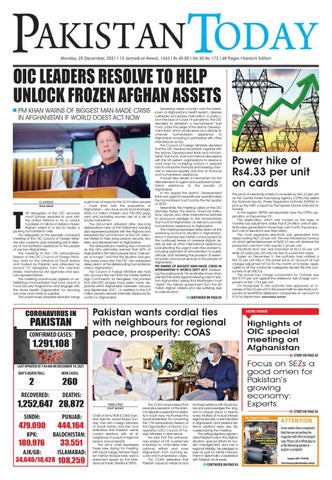
OIC leaders resOlve TO help unlOCk frOzen afghan asseTs g
PM Khan warns of biggest Man-Made crisis in afghanistan if world does't act now
ISLAMABAD Mian abrar
T
he delegates of the oic exclusive moot sunday resolved to work with the United nations to try to unlock hundreds of millions of dollars in frozen afghan assets in a bid to tackle a growing humanitarian crisis. the delegates of the specially convened meeting of the oic council of foreign Ministers also vowed to play a leading role in delivery of humanitarian assistance to the people of war-torn afghanistan. the meeting of the 17th extraordinary session of the oic council of foreign Ministers, held on the initiative of saudi arabia and hosted by Pakistan was attended by around 70 delegates from the member states, international aid agencies and special representatives. the meeting unanimously agreed on establishing a humanitarian trust fund, launch a food security Programme and engage with the world health organization for securing vaccines and medical supplies. the unanimously adopted resolution brings
a glimmer of hope for the 22.8 million people – more than half the population of afghanistan – who face acute food shortage; while 3.2 million children and 700,000 pregnant and lactating women are at a risk of acute malnutrition. the document adopted after day-long deliberations here at the Parliament building also expressed solidarity with the afghans and reiterated the commitment of the oic Member states to help bring peace, security, stability, and development to afghanistan. the extraordinary meeting was convened as the Un’s estimates warned that 60% of afghanistan’s 38 million people face “crisis levels of hunger” and that the situation was getting worse every day. the oic also expressed deep alarm at the deteriorating humanitarian crisis in afghanistan. the council of foreign Ministers also took into account the fact that the United nations high commission for refugees, has pointed that 665,000 people have been newly displaced within afghanistan between January and september 2021 – in addition to the 2.9 million people already internally displaced by conflict in afghanistan.
COrOnavIrus In
pakIsTan
CONFIRMED CASES:
1,291,108
expressing deep concern over the breakdown of afghanistan’s health system, disease outbreaks and severe malnutrition, in particular in the face of covid-19 pandemic, the oic decided to establish a humanitarian trust fund, under the aegis of the islamic development bank; which would serve as a vehicle to channel humanitarian assistance to afghanistan including in partnership with other international actors. the council of foreign Ministers decided that the oic general secretariat, together with the islamic development bank and humanitarian trust fund, shall commence discussions with the Un system organizations to device a road map for mobilizing actions in relevant fora to unlock the financial and banking channels to resume liquidity and flow of financial and humanitarian assistance. it would also devise a mechanism for the disbursement of urgent and sustained humanitarian assistance to the people of afghanistan. in this regard the islamic development bank was urged to expeditiously operationalize the humanitarian trust fund by the first quarter of 2022. Meanwhile, the meeting called on the oic Member states, the islamic financial institutions, donors and other international partners to announce pledges to the humanitarian trust fund for afghanistan as well as to provide humanitarian assistance to afghanistan. the meeting expressed deep alarm at the worsening economic situation in afghanistan, which it pointed was further compounded by the continued freeze of overseas afghan assets as well as other international assistance, exacerbating the urgent cash-flow problems, including payment of remuneration to public officials, and hindering the provision of essential public and social services to the people of afghanistan. PM warns of biggest Man-Made crisis in afghanistan if world did’t act: addressing the participants, Prime Minister imran Khan warned the world against brewing crisis in wartorn afghanistan, saying that washington must “delink” the taliban government from the 40 million afghan citizens who are suffering due to crisis situation.
CONTINUED ON PAGE 05
Power hike of rs4.33 per unit on cards the price of electricity is likely to increase by rs4.33 per unit as the central Power Purchasing agency (cPPa) has asked the national electric Power regulatory authority (nePra) to jack up the tariff, a report by the express tribune claimed on sunday. in this regard, nePra will reportedly hear the cPPa’s application on december 29. the application, which was moved on the basis of monthly fuel adjustment, states that 8.24 billion units of electricity were generated in november. last month, the production cost of electricity was rs66 billion. the most expensive electricity was generated from diesel costing rs27.20 per unit. this was followed by furnace oil, which generated power at rs20.27 per unit whereas the production cost from lng was rs17.26 per unit. electricity from iran was imported at rs13.35 per unit while 20 paisa per unit was lost due to power line losses. earlier on december 9, the authority had notified a rs4.75 per unit hike in the power price on account of fuel charges adjustment (fca) for the month of october, applicable to all the consumer categories except life line consumers of all discos. the actual fuel charge component for october was rs9.9179 per unit against the reference fuel charge component of rs5.1733 per unit. on november 9, the authority had approved an increase of rs2.52 per unit in the power tariff for electricity consumers of ex-waPda distribution companies on account of fca for september. Monitoring report
Pakistan wants cordial ties with neighbours for regional peace, prosperity: coas
more inside
highlights of oic special meeting on afghanistan STORY ON PAGE 02
LAST UPDATED AT 7:44 AM ON DECEMBER 19, 2021
DAY'S DEATH TOLL:
NEW CASES:
2
260
RECOVERED:
DEATHS:
1,252,647 28,872 SINDH:
PUNJAB:
479,090
444,164
KPK:
BALOCHISTAN:
180,976
33,551
AJK/GB:
ISLAMABAD:
34,640/10,428
108,259
RAWALPINDI staff report
chief of army staff (coas) general Qamar Javed bajwa sunday met with foreign Ministers of saudi arabia and iran and reiterated that Pakistan wants cordial relations with all its neighbours in pursuit of regional peace and prosperity. the army chief expressed these view during his meeting with saudi foreign Minister faisal bin farhan al-saud here, said a statement issued by the interservices Public relations (isPr).
the coas emphasised that peaceful resolution of the Kashmir dispute is essential for stability in south asia. he thanked the saudi leadership for convening the 17th extraordinary session of the organisation of islamic cooperation (oic) council of foreign Ministers in islamabad. he said that this extraordinary session of oic is extremely important to channelise international efforts and save afghanistan from looming security and humanitarian crises. the coas reiterated that Pakistan values its historical and
brotherly relations with saudi arabia and acknowledges the kingdom’s unique place in islamic world. Matters of mutual interest, regional security, current situation in afghanistan and bilateral defence relations were also discussed during the meeting. the visiting dignitary appreciated Pakistan’s role in the afghan situation, special efforts for border management, and role in regional stability. he pledged to play his part for further improvement in diplomatic cooperation with Pakistan at all levels.
CONTINUED ON PAGE 05
focus on seZs a good omen for Pakistan’s growing economy: experts STORY ON PAGE 03 in today’s issue
attention Some readers have complained that they are not getting the magazine with their newspaper copy. Please call or WhatsApp us at the following number to register a complaint. Contact: 0307-7338168 irfan.farooq@pakistantoday.com.pk
02
Monday, 20 December, 2021 | KARACHI
NEWS
HIgHlIgHTS of oIC SPeCIal MeeTIng on afgHanISTan ISLAMABAD
e
APP
NvOYS from 57 Islamic nations met in Islamabad Sunday for a summit aimed at relieving the humanitarian crisis in Afghanistan while testing diplomatic ties with its new Taliban rulers. The meeting of the Organisation of Islamic Cooperation (OIC) was the biggest major conference on Afghanistan since the US-backed government fell in August. Highlights of the inaugural session of the 17th extraordinary meeting of the bloc held at the National Assembly are as follows: The session started at 9:45 am with the recitation of the Quranic verses underscoring the commandments of Allah guiding to spend on orphans, and offering zakat to support the destitute facing crisis-like situations.
The arrival of foreign guests, delegates, federal ministers, parliamentary secretaries, MPs and Senators, and media started at 8:00 am. Foreign Minister Shah Mahmood Qureshi arrived at the House at 9:45 am and greeted the participants. The OIC secretary general, Saudi Arabia Foreign Minister Faisal bin Farhan Al-Saud and Prime Minister Imran Khan arrived between 11:30 am and 11:35 am one after the other. The session was opened by Foreign Minister Qureshi at 11:45 am. His speech started at 11:50 am and ended at 12:04 pm, and highlighted the looming crisis in Afghanistan, proposing a six-point plan to assist that nation. The speech of top Saudi diplomat started at 12:05 pm before ending at 12:13 pm. OIC Secretary General Hissein Brahim Taha’s speech started at 12:14 pm and ended
at 12:23 pm. On behalf of Asia Group of the bloc, Turkey Foreign Minister Mevlüt Çavuşoğlu gave statement between 12:23 pm and 12:28 pm. On behalf of Regional Arab Group of OIC countries, Jordan Foreign Minister Ayman Safadi delievered a seven-minute long speech starting at 12:28 pm. Representing the African Group, Nigeria Foreign Minister Geoffrey Onyeama talked between 12:36 pm and 12:42 pm. Islamic Development Bank (IDB) President Dr Muhammad Sulaiman Al Jasser speech started at 12:43 pm and ended at 12:50 pm. Immediate, medium and long-term measures suggesting sustainable rebuilding of Afghanistan. Economic empowerment of communities, particularly youth and women, through their inclusion in economic system.
Death toll in Karachi sewer gas blast jumps to 17 KARACHI The AssociATed Press
Three terrorists killed, security official injured in shootout: ISPR ISLAMABAD sTAff rePorT
Three terrorists, including a commander, were killed and one security official was injured during an exchange of fire between security forces and terrorists in Khyber Pakhtunkhwa, separate army statements said. The statements said that security forces conducted an intelligence-based operation in the Bajaur district. During the exchange of fire, a terrorist commander was killed and one security official was injured, the military’s media wing Inter-Services Public Relations (ISPR) said in the statements. In another operation, two terrorists were killed in a shootout with security forces in the Boya area of the North Waziristan district of the province, the ISPR said.
Pakistan, Malaysia agree to enhance media cooperation
ISLAMABAD sTAff rePorT
Pakistan and Malaysia have agreed to enhance cooperation in the drama, film and media industry. The understanding was reached at a meeting between Minister for Information and Broadcasting Fawad Chaudhary and Malaysian Foreign Minister Saif-udDin Abdullah on Sunday. The two sides agreed upon exchange of media delegations and expertise of the film and drama industries of the two countries. Speaking on the occasion, Fawad Chaudhary said that Pakistan has presented translated dramas of different other languages and it wants that Malaysian people also watch Pakistani productions. The two sides also exchanged views on the Afghanistan situation and matters of mutual interest. Speaking about the Afghanistan situation, the information minister said the international community must come forward to bring the Afghans out of the conundrum they are in. On his part the Malaysian foreign minister appreciated Pakistan’s role in helping the Afghan people. He said Pakistan is an important member of the Organisation of Islamic Cooperation and its efforts in organising this conference are commendable.
The death toll from a sewer gas blast in Karachi jumped to 17 as some critically injured people died overnight and Sunday, police said. Initially, 12 people were reported dead and 11 others injured in Saturday’s gas explosion in a sewage system in the commercial hub of Pakistan. Senior police officer Sarfaraz Nawaz Shaikh said the loss of lives and property could be blamed on human errors of construction over the sewer. He said the number of injured also increased to 16. The blast destroyed the HBL bank building constructed over the sewer. The building was one of several ordered to vacate after violating building laws, according to Mukhtar Abro, a local administrator, who said the structures were to be demolished in the coming weeks. Many sewage channels in the city have been covered, mostly illegally, by constructing concrete structures over them.
CPEC to help Pakistan get out of debt through wealth creation ISLAMABAD iNP
China-Pakistan Economic Corridor (CPEC) will help Pakistan break free from debt burden through wealth creation. Some western media and think tanks have labelled it a “debt trap” for Pakistan, but the situation on the ground shows it is allowing the country to break free from the shackles of Western debts through wealth creation. Pakistan lies at the heart of the Chinese Belt and Road Initiative (BRI). Beijing has committed to funding 80 percent of CPEC worth $62 billion. However, despite such generosity and ambition, the Western media has been making propaganda regarding this project. The mega project is being hailed as a game-changer for Pakistan. However, since 2018, the growth of CPEC has been hampered by the economic crisis. International donors have expressed concerns that CPEC financing has resulted in massive purchases of Chinese technology and supplies, increasing Pakistan’s debt load in 2018. This shows that the “debt trap” rhetoric is misguided and a failed attempt to downplay the benefits of CPEC to Pakistan. CPEC can alleviate Pakistan’s financial troubles by providing a firm foundation for the industry by meeting the country’s energy needs and establishing an effective transportation infrastructure. China’s vote of confidence in Pakistan’s economy increases as it remains the greatest donor of net foreign direct investment (FDI) in Pakistan when compared to other countries, according to recent research by Gwadar Pro. Long-term concessional government borrowing from China is used to fund CPEC infrastructure and transportation projects. The FDI and commercial borrowing from Chinese financial institutions are used in CPEC energy projects, which are either primarily foreign-owned joint ventures or Chinese investors. However, non-CPEC energy projects are financed in a variety of ways, including private domestic funding, private commercial financing, and concessional financing by the government from international financial institutions. If executed as anticipated, these initiatives will assist Pakistan in eliminating the power deficit and significantly improving energy costs and fuel mix. Over the next seven to nine years, current investment
estimates call for an increase in installed capacity of around 24 gigawatts, including 8.6GW due to CPEC (Source: Centre of Excellence for CPEC). The majority of the initiatives are focused on renewable energy. As a consequence, the initiative will assist Pakistan in eliminating its deficit and reducing its reliance on furnace oil, making the energy industry more independent and resilient to global oil price fluctuations. Meanwhile, measures regarding investment by Pakistan are expected to result in a long-term balance of payments (BoP) outflows. In the medium term, these projects will require BoP outflows in the form of debt repayment, profit repatriation, and input fuel imports. These outflows are expected to rise in the coming years, culminating at roughly USD3.5-4.5 billion by FY2024-25 and then progressively decreasing in the long term as forecast savings from the phase-out of oilbased energy generation are realized (Source: Centre of Excellence for CPEC). Pakistani exports are rapidly expanding to fulfill the country’s growing foreign currency funding demands. The overall exports in FY2020-21 were recorded at
USD27.209 billion, up from USD21.476 billion in 2019-20, according to the Federal Board of Revenue (FBR). This is also due to the positive impact of CPEC on exports, which will help balance the predicted losses. However, given the time necessary to build up extra export capacity as a result of efficiency gains, the impact of these investment programs would most likely accrue gradually over time. After the completion of energy generation and under-construction projects, the second round of CPEC will have a broader impact on economic activity. In the future, increased productivity, lower costs, improved trade linkages, and infrastructure are expected to boost Pakistan’s gross domestic product (GDP). The effects of the second round of CPEC will most likely emerge over time and may result in a large contribution in the long term, albeit the actual impact will be dependent on many other supportive factors. CPEC projects are in full gear, and the country is rapidly moving towards industrial cooperation, which will help the government lower its debt load by wealth creation.
Monday, 20 December, 2021 | KARACHI
Focus on sEZs a good omEn For Pakistan’s growing Economy: ExPErts ISLAMABAD
d
Agencies
IFFERENT special economic zones (SEZs) are being established across Pakistan and several others are in the pipeline under China-Pakistan Economic Corridor to boost industrialisation, exports and generate employment. Experts suggest Pakistan’s economic growth is heavily reliant on exports. This is due to the fact that the access to foreign exchange allows the country to fund its imports, stop erosion of its currency value, repay debts, and address the balance of payment issue. Solution to these problems is massive industrialisation and diversifying the export base. For this to happen, the government is implementing its “Made in Pakistan” agenda to stimulate import substitution. The policy’s goals are to create jobs, boost value-added exports, and stimulate
import substitution. The government is working on different strategies. The objective behind “Made in Pakistan” motto is to produce goods and services in the country rather than importing those that disturbs the country’s trade balance. For this purpose, the government has adopted the concept of SEZs. These SEZs are planned to be built in different locations to operationalise industries, to solve global competitiveness issues, and to develop industrial clusters in the economy. SEZs are intended to encourage domestic and international investors to promote and build industrial infrastructures that focus on export promotion, import substitution, technology transfer, and job creation. As of May 2021, the 21 notified SEZs account for about 10,029 acres of industrial land, of which 5,220 acres (52%) have been allotted to investors for establishment of industry with anticipated investments of over Rs633
billion, of which 43.6% is Foreign Direct Investment of $1.73 billion. It’s worth noting here that under SEZ Act 2012, a zone enterprise is required to begin building within six months of approval and to begin commercial production/operations within 24 months, although title to land is only granted after six months of regular operations. There are nine SEZs planned to develop in Pakistan, and the development of some has already started. The first SEZ is being developed in Nowshera – the Rashakai Special Economic Zone consists of around 1,000 acres of land. On completion, it is expected to generate around 500,000 jobs. The second, Dhabeji Special Economic Zone, consists of 4,530 acres of land and it’s going to be the biggest economic zone in Pakistan. It is expected to create 500,000 jobs. While establishing SEZs, Pakistan can follow the example of China. The
first Special Economic Zone was established in China in 1980. In recent years, according to statistics, China’s national SEZs have contributed around 22% of GDP, 45% of the national foreign direct investments and around 60% of exports. China’s SEZs are thought to have provided more than 30 million jobs, raised participating farmers’ income by 30%, and hastened industrialisation, agricultural modernisation, and urbanisation. Foreign investors have also made investments in China’s Special Economic Zones as they were highly satisfied with the Chinese business policies, incentives, and security provided to them. With CPEC entering the most crucial second phase of implementation, establishing economic zones across the country, Pakistan is all set to see massive inflow of foreign direct investment, job creation, boost in exports and stabilisation of the external sector.
Apple seeks dismissal of India apps market antitrust case LOS ANGELES Agencies
Apple Inc has asked India’s antitrust watchdog to throw out a case alleging abuse of market power in the apps market, saying it is too small a player in the South Asian country where Google is dominant, a filing seen by Reuters shows. The filing was made after the Competition Commission of India (CCI) started reviewing allegations that Apple hurts competition by forcing app developers to use its proprietary system which can charge commissions of up to 30% on in-app purchases. Apple denied the allegations in its filing to the CCI and stressed that its market share in India is an “insignificant” 0-5%, while Google commands 90100% as its Android operating system powers most other smartphones. “Apple is not dominant in the Indian market … Without dominance, there can be no abuse,” Apple said in the submission dated Nov. 16 which was signed by its Chief Compliance Officer, Kyle Andeer. “It has already been established that Google is the dominant player in India,” it added. Apple and the CCI did not respond to a request for comment. A spokesperson for Alphabet Inc’s Google declined to comment when asked about Apple’s assertions in the filing. The complainant in the case, a little-known nonprofit group called “Together We Fight Society”, said that Apple with iOS dominates the market for nonlicensable mobile operating systems. Apple countered that in its filing, saying the entire smartphone market – which includes licensable systems like Android – is the market that should be taken into consideration. Apple also described the Indian complaint as a “proxy filing” in its CCI submission, saying that the complainant was “likely acting in concert with parties with whom Apple has ongoing commercial and contractual disputes globally and/or that have complained to other regulators.” The US tech company did not give any evidence in its submission to support its claim. The non-profit told Reuters that Apple’s remark was “made to prejudice the mind” of the CCI “without any iota of proof.”
LAHORE In order to enhance documentation and transparency and to further strengthen the foreign exchange regulatory regime, the State Bank of Pakistan (SBP) has amended the regulations governing sale of foreign exchange to individuals by exchange companies. According to a statement released by the central bank on Sunday, this step, which is in continuation of other measures being taken by SBP, is primarily to discourage speculative buying and selling of foreign exchange from the exchange companies without affecting the ability of the market to serve the genuine needs of the public. Consequent to these amendments,
03
Footwear exports surge 14pc to $58.7m in 5mFy22 ISLAMABAD tLtp
The footwear exports surged 13.91 per cent to $58.743 million during the first five months (July-November) of the current financial year 2021-22 on a year-on-year (YoY) basis. According to the data released by Pakistan Bureau of Statistics (PBS), the country exported footwear worth $58.74 million during 5MFY22 against the exports of $51.57 million during the same period of FY21, showing growth of around 14 per cent. In terms of quantity, the exports of footwear also increased by 4.11 percent by going up from 6,369,000 pairs to 6,631,000 pairs, according to the data. Among the footwear products, the exports of leather footwear rose by 8.13 percent as it surged from $43.767 million last year to $47.326 million during the current year. The canvas footwear exports of the country stood at $0.219 million during the current year against $0.185 million during last year, showing an increase of 18.38 per cent. Likewise, the exports of all other footwear commodities increased by 46.97 per cent during the period under review as these went up from $7.619 million last year to $11.198 million during the current fiscal year. Meanwhile, on a YoY basis, the footwear exports increased by 22.84 percent during the month of November 2021 as compared to the same month of last year. The footwear exports during November 2021 were recorded at $11.035 million against the exports of $8.983 million in November 2020. On a month-onmonth (MoM) basis, the exports of footwear increased by 20.36 per cent during November 2021 as compared to the exports of $9.168 million in October 2021, the PBS data revealed.
use of rupee increased in afghanistan PESHAWAR Aziz BuneRi
In the coming weeks, the CCI will review Apple’s response to the allegations and could order a wider investigation or dismiss the case altogether if it finds no merit in it. Details of CCI investigations are not publicly disclosed. The CCI is separately conducting an investigation into Google’s in-app payment system as part of a broader probe into the company after Indian startups last year voiced concern. Apple’s iOS powered about 2% of 520 million smartphones in India as of end-2020 with the rest using Android, according to Counterpoint Research, though it adds that Apple’s smartphone base in the country has more than doubled in the last five years. Apple has been grappling with similar allegations in other parts of the world. In the United States, it is locked in a legal battle with “Fornite” creator Epic Games over the issue and South Korea this year became the first country to ban dominant app store
operators from forcing developers to use their payment systems. In the European Union , regulators last year started an investigation into Apple’s in-app fees for distribution of paid digital content and other restrictions. Companies like Apple and Google say their fees cover the security and marketing benefits their app stores provide. In its CCI filing, Apple argued that the in-app commissions it charges are “not unfair or excessive” and have decreased over time, adding that it charges lower rates from small developers. “Only a small number of large developers, many of which are multi-billion-dollar conglomerates, pay the headline rate of 30%,” Apple said. “Competing platforms have charged similar or higher commissions as Apple. Particularly, Google has charged a 30% commission on its app store,” it said.
SBP amends regulations for forex transactions through exchange companies stAff RepoRt
NEWS
exchange companies shall ensure that any individual shall not purchase foreign exchange from all exchange companies in excess of $10,000 per day and $100,000 (or equivalent in other currencies) per calendar year, in the form of cash or outward remittances. These limits have been set taking into consideration the individual’s personal needs for foreign exchange, the statement added. In addition, the individuals shall continue to avail the facility of remitting the educational and medical expenses abroad up to $70,000 per calendar year and $50,000 per invoice respectively, from banks as per existing regulations (for details on this see SBP circular). For remittance of any amount in excess of these limits, or for any other purposes,
individuals can approach Foreign Exchange Operations Department of SBP-BSC, through their bank. Further, there is no change in regulations with respect to foreign currency accounts of the individuals. The exchange companies shall obtain supporting documents against sale of foreign exchange in excess of $1,000 (or equivalent in other currencies) substantiating the purpose of transaction. Further, exchange companies shall not perform transactions against authority letters. Instructions further emphasised that ECs shall perform transactions only at authorised outlets of the company and shall not provide delivery services to the customers.
Circulation of the Pakistani rupee has increased in many provinces of Afghanistan after the collapse of banking system in the neighbouring country. In this regard, Profit while speaking with Afghan currency dealers learnt that traders and the people have started using Pakistani currency in most provinces over the past month due to the Taliban’s restrictions on the banking and money exchange system in Afghanistan. “Due to fluctuations in dollar and Afghan currency rates, everyone here is using the Pakistani rupee,” one Afghan trader said. Over the past month, as the Afghani depreciated, so has the exchange rate of the Pakistani rupee, although shopkeepers do not openly accept doing trade in Pakistani rupees. Small traders and locals in Afghanistan are using Pakistani rupees for daily transactions and purchases of food items. He further said that provinces adjacent to Pakistan prefer the rupee instead of the Afghani because they will face a 10 per cent loss in converting the rupee to Afghan currency. Over the years, the use of rupee had decreased at the past government had opposed its use. But now, after the Taliban’s takeover, the situation has been reversed rather quickly. According to a trader, Hameed Khan, they also need rupees to import goods from Pakistan as both Pakistani and Afghani traders prefer to use the Pakistani currency for trade due to the uncertain situation in Afghanistan. Khan said that a few days ago, a joint commission was set up by various civilian and military agencies to monitor shopkeepers and the general public who were carrying out transactions in Pakistani currency. “If the Afghan government fails to reactivate the banking system for traders and the general public, it will not only increase the use of rupee but also affect traders’ ability to import goods,” Khan said.
Monday, 20 December, 2021 | KARACHI
04 news
OIC leaDers lauD PakIsTan’s effOrTs, Call fOr unIfIeD aCTIOn On afghanIsTan CrIsIs ISLAMABAD
T
Staff CoRReSpondent
HE Muslim world leaders attending the extraordinary session of OIC countries’ foreign ministers, Sunday called for an immediate and unified action to avert the looming humanitarian crisis in Afghanistan which otherwise could impact world peace. Addressing the opening session of the 17th extraordinary Session of the Organisation of Islamic Cooperation’s (OIC) Council of Foreign Ministers to discuss the humanitarian situation in Afghanistan, the leaders were unanimous to call for the OIC’s role to protect the brotherly country from an economic collapse. In his address, Saudi Foreign Minister Prince Faisal bin Farhan Al-Saud said that the economic difficulties could trigger a humanitarian crisis and lead to further instability, impacting impact regional and international peace. He said the people of Afghanistan have suffered for too long and had faced years of instability. The Saudi FM said that the OIC meeting expressed solidarity with the Afghans and drew the world’s attention towards the need for immediate action to put an end to the deteriorating situation. He also urged OIC member states to play a part in providing the Afghans with the necessary support and to prevent an economic collapse in the country. He told the gathering that Saudi Arabia had extended aid of one billion Saudi Riyals
and had recently airlifted food supplies on the directives of King Salman bin Abdulaziz. He also condemned terrorist actions targeting minorities in Afghanistan. OIC Secretary-General Hissein Brahim Taha thanked the member countries for electing him to head the OIC and also thanked Pakistan for the warm welcome. “We thank Pakistan and its people for playing host to the Conference, which is yet another expression of the country’s full commitment to the advancement of the issues of the Muslim Ummah, and its concern for promoting peace and security in the region,” he said. “This effort gives a universal message of harmony and solidarity,” he said, adding that the Afghan issue has always been high on the OIC agenda. “The OIC has always taken a strong position which supports its member countries,” he said adding that the Muslim world body called for the sovereignty, unity and territorial integrity of Afghanistan. The OIC secretary-general said that the role of OIC members in delivering humanitarian assistance was more important now than ever before as the pandemic had exacerbated existing challenges. “We commend the humanitarian assistance provided by some member states to the Afghan people. We also call for all parties concerned to cooperate with the OIC mission in Kabul to provide relief to the affected Afghan people,” he said. “We call all Afghan parties to put the interests of their people first, protect their lives, keep away from violence and bring lasting peace in fulfillment of their aspira-
tions and hopes for stability, decent living and prosperity.” Taha said, “The OIC is ready to carry out a follow-up of the outcome and to play its role in supporting humanitarian action in coordination with the relevant OIC missions and relief agencies across the Muslim world,’ he said. Turkish Foreign Minister Mevlut Cavusoglu, who spoke on behalf of OIC Asia Group, said the solidarity with the Afghan people was OIC countries’ moral obligation and religious duty. He said the OIC should play a leading role in mobilizing international support for the Afghan people and called for a coordinated mechanism for supporting the Afghan people. The Turkish foreign minister also urged
the world to support Pakistan’s efforts and called the establishment of a Trust by the Islamic Development Bank a step in the right direction. Mevlut Cavusoglu also underscored the need for enhanced engagement with the Taliban to achieve peace and stability in Afghanistan, adding that the inclusive government and respect for women’s rights would increase the legitimacy of the Afghan government. Under-Secretary-General for Humanitarian Affairs and Emergency Relief Coordinator Martin Griffiths said Afghanistan’s economy was now in free fall and if we do not act decisively and with compassion, this fall will pull down the entire population with it. Martin Griffiths said the need for liquidity and stabilization of the banking system was
now urgent to save the lives of the Afghan people as well as enable humanitarian organizations to respond. He said the UN stands firmly with the OIC in its efforts to contribute to the humanitarian endeavor. The Chairman of Islamic Development Bank Muhammad Sulaiman Al Jasser said that immediate humanitarian relief to Afghanistan is essential to build a foundation for economic recovery and development. He said there was a need for medium to long-term engagement to promote self-reliance and development beyond immediate humanitarian relief through reconstruction activities. The Chairman Islamic Development Bank also emphasized the need for the development of agriculture sector in Afghanistan to ensure food security and poverty reduction. Foreign Minister of Jordan Ayman Safadi emphasized the need for rebuilding and reconstructing efforts for peace and stability in Afghanistan. He said choice was clear as all the Muslim world should together protect Afghan people as half of the population was under threat. He said it was time to take the right decision and achieve the shared goals. Minister for Foreign Affairs and Cooperation of Niger Youssouf Elmouctar commended the Government and the people of Pakistan for hosting the session despite the COVID-19 pandemic. He commended the Saudi initiative for convening the session on Afghanistan as the situation had led to a multifaceted crisis there. He said the Afghan people particularly the winter would be unable to bear the severe winter season which necessitated immediate action to address the situation. He called for all the possible efforts to extend support to the people of Afghanistan without any interference in the affairs of the country. He also called for respecting the rights of the Afghan people in light of the Islamic teachings.
Iran calls for sending humanitarian aid to Afghanistan ISLAMABAD Staff RepoRt
Two killed, five injured in Bajaur blast ISLAMABAD Staff RepoRt
A bomb blast hit a vehicle in the Bajaur district of Khyber Pakhtunkhwa, killing at least two people and injuring five others, police and media said on Sunday. According to the police, an improvised explosive device planted at a roadside by miscreants went off as the vehicle carrying workers of a political party passed through the Kamar Sar town of Bajaur district. Security forces and rescue teams rushed to the site and shifted the injured to a nearby hospital, where some of the injured were said to be in critical condition. Security forces cordoned off the area and kicked off a search operation. No group or individual claimed the attack.
CTD arrest nine terrorists in Punjab ISLAMABAD Staff RepoRt
Nine terrorists were arrested in separate intelligencebased operations in Punjab, an official said on Sunday. In a bid to avert terror activities, the personnel of the Counter-Terrorism Department (CTD) conducted more than 40 operations in different districts of the province late Saturday and arrested nine militants, Senior Superintendent of Police (SSP) Mansoor ul-Haq Rana said. The arrested militants belonged to the proscribed Tehreek-iTaliban Pakistan (TTP) and Islamic State (IS) groups, said the official, adding the terrorists were planning to carry out terror activities. Six terrorists were arrested during the operation in Lahore, according to the CTD, adding the accused have been shifted to an undisclosed location for investigation. Separately, three militants were nabbed in two separate raids at their hideouts in Multan and Toba Tek Singh. Police recovered a huge cache of explosives, weapons, detonators and sensitive material from their possession. The arrested were also involved in collecting donations to finance terror activities in Punjab and distributing banned books among people and motivating them to join the militant organisations, according to police.
Iran called for sending humanitarian aid to Afghanistan regardless of political interests on the sideline of the Organisation of Islamic Organization (OIC) summit held in Islamabad on Sunday. Assistant Foreign Minister and head of Iran’s delegation to OIC in Islamabad Rasoul Mousavi said the objective of the extraordinary session of the organisation is to arrange humanitarian assistance to Afghanistan, reported Khaama Press. He added there is a consensus among all the 57 member states of the organisation in this regard. Speaking exclusively to the IRNA news agency, Mousavi said all the delegations are trying to find ways to provide humanitarian aid to Afghanistan. “As the Taliban’s interim government has not been recognized by the international community yet, many of the OIC member states have been stressing upon the need to devise a mechanism for dispatching aid to Afghanistan,” said Mousavi. The diplomat added they support all international efforts to send humanitarian assistance to Afghanistan and that Iran’s borders are open for any relief activity, reported Khaama Press. Foreign Minister Shah Mahmood Qureshi, who chaired the session, made an inaugural address at the meeting.
Convened by Saudi Arabia as OIC chair and hosted by Pakistan, 70 delegates participated in the historic session. More than 100 days have passed since the Taliban assumed control over Afghanistan but the group is yet
to be recognised by any country. Respect for women and human rights, establishing inclusive government, not allowing Afghanistan to become a safe haven of militancy are the preconditions for the recognition set by the international community.
Maryam’s appeal fixed for hearing in Avenfield reference NewS DeSk The Islamabad High Court (IHC) has fixed appeals of Pakistan Muslim League Nawaz’s (PML-N) Vice President Maryam Nawaz in Avenfield Property reference on Tuesday for hearing. It is pertinent to note that a division bench of the IHC comprising Justice Aamer Farooq and Justice Mohsin Akhter Kiyani would hear the appeals of Maryam Nawaz and Captain (retd) Muhammad Safdar. Earlier, the appellants had challenged their conviction in the Avenfield property reference, and their lawyers had sought adjournment from the court on the pretext of engagements in the Supreme Court. It merits mention that the court had already separated the matter of Nawaz Sharif from the case after declaring him as an absconder.
CMYK
Monday, 20 December, 2021 | KARACHI
NEWS
SAudi FM CALLS On PM iMrAn, hAiLS PAKiStAn’S EFFOrtS tO hELP AFGhAniStAn iSLamaBad
F
staff rePort
OREIGN Minister Kingdom of Saudi Arabia Prince Faisal Bin Farhan Al Saud Sunday called on Prime Minister Imran Khan and discussed with him key issues of bilateral interests. The Prime Minister conveyed cordial greetings for the Custodian of the Two Holy Mosques King Salman Bin Abdulaziz Al Saud and Crown Prince Mohammed bin Salman. Appreciating the Saudi initiative to convene the Extraordinary Session of the OIC Council of Foreign Ministers on the humanitarian situation in Afghanistan,
Premier Imran Khan expressed the hope that the world would not repeat the mistake of disengaging with Afghanistan. He urged the international community to support the vulnerable people of Afghanistan. To alleviate the sufferings of the Afghan people, the Prime Minister highlighted that Pakistan remained committed to facilitate humanitarian organizations working from Pakistan for their humanitarian support to Afghanistan. Reaffirming Pakistan’s abiding commitment to the continued well-being of the people of Afghanistan, the Prime Minister highlighted that Pakistan has already committed to immediate relief of in-kind humanitarian assistance worth
Pakistan wants cordial ties with neighbours for regional peace, prosperity: COAS continued from page 01 Pakistan, Iran are brotherly neighbours with shared history, culture & religion; says COAS During his meeting with Foreign Minister of Iran, Mr Hossein Amir Abdollahian, the COAS discussed geo-strategic environment particularly situation in Afghanistan, defence & security cooperation were discussed during the meeting. Pak-Iran Border security mechanism also came under discussion. The COAS said that Pakistan and Iran are two brotherly neighbours with shared history, culture and religion. Defence collaboration between the two countries has been strengthening over the years, the COAS reiterated. Referring to OIC’s extra ordinary session, COAS termed it historic development for addressing the dire humanitarian situation in Afghanistan and bringing international community to a shared vision and joint strategy to find solution to emerging challenges in the region vital for peace and stability. Iranian FM acknowledged Pakistan’s contributions towards regional peace and the important role that Pakistan is playing in this regard. Both sides agreed to stay engaged for enhanced bilateral cooperation while jointly working to assist in bringing positive developments in issues concerning the region particularly efforts to mitigate challenges facing people of Afghanistan.
Rs. 5 billion, which comprises of food commodities including 50,000 MT of wheat, emergency medical supplies, winter shelters and other supplies. On Pakistan-Saudi Arabia bilateral relations, PM Imran Khan underscored the special significance of the PakistanSaudi Arabia relationship, which is based on close fraternal ties, historic links, and support at the gross-roots level. Recalling his visit to Saudi Arabia in October 2021, the Prime Minister highlighted the assiduous follow-up on the decisions taken and stressed the need for exploring new avenues of cooperation to further deepen bilateral relations in diverse fields. Thanking the Prime Minister for the
hosting the Extraordinary Session of the OIC Council of Foreign Ministers on the humanitarian situation in Afghanistan, Prince Faisal expressed hope that the Session would be instrumental in mobilizing the international community to support the people of Afghanistan on humanitarian grounds. He also underscored the importance that Saudi Arabia attaches to its strong relationship with Pakistan, based on bonds of brotherhood. Pakistan and Saudi Arabia enjoy close fraternal elations, marked by close cooperation and mutual support. Saudi Arabia is a member of OIC Contact Group on Jammu & Kashmir and steadfastly supports the Kashmir cause.
SHC takes action against SBCA, orders demolition of illegal structures in Karachi The Sindh High Court has given directive for the demolition of illegal structures on a plot in North Nazimabad’s Block-C and ordered to take immediate action against SBCA officers as well as the builders. The court was furious at SBCA officials for failing to take action against the construction in question. A two-member bench, comprising Justice Zafar Ahmed Rajput and Justice Muhammad Faisal Kamal Alam, heard the petition. Justice Alam inquired from the SBCA counsel about the action taken against the authority’s officers. The SBCA counsel sought a week’s time. “Where are the builders Kashif Hussain and Umair Irshad? Who is Rajab Ali?” the bench asked. The petitioner’s counsel argued that Rajab Ali was the builder who built and sold the building. The SBCA’s counsel argued that the department did not have the necessary team to demolish such a large number of structures. “Why did you let it reach this stage?” Justice Alam questioned. Justice Rajput remarked that even if ordinary peo-
ple put a sack of gravel outside their homes, SBCA officials reach the site immediately. “Don’t you see so many illegal constructions? What were your inspectors doing when all this was happening?” Justice Rajput asked. The court issued notices to the Sindh Building Control Authority (SBCA) director general and builder Irfan Ahmed. It was argued in the petition that illegal constructions were being carried out in North Nazimabad. “Illegal portions will cause the worst problems for the residents of the area. SBCA officials have failed to fulfill their responsibilities,” it contended. Also, the Sindh High Court, while issuing a written verdict on the petition against illegal constructions in North Nazimabad Block D, ordered an immediate halt to construction work on Plot No D-1, 8/11. A two-member bench, headed by Justice Zafar Ahmed Rajput, issued the verdict. Separately, in a petition filed against illegal constructions in the Akhtar Colony area of Mehmoodabad, the Sindh High Court directed the petitioner
to make the Cantonment Board Clifton (CBC) a party in the plea. The two-member bench, headed by Justice Zafar Ahmed Rajput, heard the petition against the construction of illegal portions in Akhtar Colony. The petitioner’s counsel argued that portions were being constructed in Akhtar Colony. “Illegal constructions in house number 5/18 staff line may be stopped,” he contended. In its observation, the court remarked that the said area sis not fall under the jurisdiction of the SBCA. “How can SBCA take action in DHA Phase-1?” the court asked. It ordered the petitioner to make CBC a party in the petition. In another case, the Sindh High Court sought a report from the Engineering Council on a petition seeking further construction on a shop in Jodia Bazaar. A two-judge bench, headed by Justice Zafar Ahmed Rajput, heard the petition. The petitioner’s counsel contended that illegal constructions had been completed on a shop in Jodia Bazaar.
05
Violence in KP LG Polls claims two lives, three injured KaraK News desk
At least two people were killed and three others sustained injuries in a firing incident Sunday at a polling station in the Takht-e-Nasarati Tehsil of the Karak district in Khyber Pakhtunkhwa (KP). The incident happened when the polling for KP’s local body election was underway. However, the polling was subsequently stopped after the situation turned chaotic there. According to the report, one of the deceased was a paternal cousin of PTI’s MNA Shahid Khattak, while the other was his bodyguard. Per eyewitnesses, the assailants fled the scene after opening fire at the polling station. On the other hand, armed men attacked polling stations in Zakha Khel and Landi Kotal areas of Khyber District, as a result of which ballot boxes were smashed and polling materials were also damaged. Armed men also broke into the polling station at Malik Nadir Shah School in Landi Kotal Bazaar, smashed ballot boxes, damaged election materials, and took the election staff hostage. Due to the disorder, polling has been suspended in 20 polling stations. PolliNg stoPPed iN BANNU district: Earlier today, the polling process in Baka Khel tehsil of Bannu district was also halted after the security situation got out of hand. A statement issued by the Election Commission of Pakistan (ECP) said that the new date for polling in Baka Khel will be announced later. No announcement has so far been made regarding reelection in the other affected districts. KP is holding the first phase of the local government elections in its 17 districts today. The polls will be held in the rest of KP next month. Polling started at 8am and continued till 5pm. Leader of the Opposition in KP Assembly Akram Khan Durrani had levelled allegations against a provincial minister of PTI of storming into five polling stations in Baka Khel and taking the polling staff hostage.
Bakakhel incident: ECP initiates inquiry against KP minister BANNU: The election commission has launched an inquiry against Khyber Pakhtunkhwa’s minister Shah Muhammad Khan, sources said on Sunday. The family of the provincial minister being held responsible for worsening law and order in Bakakhel. “Over 30 people had entered in polling stations in tehsil Bakakhel,” Deputy Commissioner Bannu district said. He added that six policemen and the polling staff including women were taken hostage. PTI workers had entered in five polling stations in Bakakhel and the opposition had also held provincial minister Shah Muhammad Khan responsible for the intrusion. INP
OIC leaders resolve to help unlock frozen Afghan assets continued from page 01 “If the world doesn’t act now, this will be the biggest man-made crisis which is unfolding in front of us,” said the premier while delivering the keynote address at the 17th extraordinary session of the Organisation of Islamic Cooperation’s (OIC) Council of Foreign Ministers convened to discuss the situation in neighbouring Afghanistan here at the Parliament House. Envoys from 57 Islamic nations as well as observer delegations are participating in today’s session. The premier, who was the last to speak before the televised portion of the event concluded, began his speech by welcoming the participants to Pakistan. Khan said that Afghanistan could potentially become the biggest “man-made crisis in the world” if the world did not act now. “Forty one years ago, an extraordinary session of the OIC was held in Pakistan to discuss the situation in Afghanistan,” he told the gathering, which also included Taliban foreign minister Amir Khan Muttaqi alongside delegates from the United States, China, Russia, the European Union and UN. PM Imran said no other country had suffered as much as Afghanistan, adding that even before the Taliban seized control, half of the population was below the poverty line. He said that 75 per cent of the country’s budget was also supported by foreign aid. He noted that any country, in a situation similar to that of Afghanistan, would collapse. Commending the other speakers for highlighting the gravity of the situation in the war-torn country, he said: PM Imran said that the OIC also had a “religious duty” to help the Afghans. “They (US) have been in conflict with the Taliban for 20 years but this [concerns] the people of Afghanistan,” he said, adding that it was important to take immediate action. He noted that the Taliban had to fulfill the commitments they had made to the inter-
national community, which included forming an inclusive government and ensuring women’s rights. “[However], the idea of human rights is different in every society,” he said, giving the example of Khyber Pakhtunkhwa province which borders the war-torn country. “The city culture is completely different from the culture in rural areas […] we give stipends to the parents of the girls so that they send them to school. But in districts bordering Afghanistan, if we are not sensitive to the cultural norms, then they won’t send them to school despite receiving double the amount. We have to be sensitive about human rights and women rights,” he said. He reiterated that Afghanistan was headed for chaos unless the world took immediate action. Such a situation will not suit the US because “chaos means the inability to fight terrorism,” he said, adding that Pakistan also faced a threat from ISIL (Daesh). PM Imran said that Pakistan was currently housing over three million refugees, adding that country was also providing shelter to more than 200,000 refugees who had overstayed their visas. “The situation in Afghanistan means they can’t go back. We are already suffering from the impact of the Covid-19 pandemic. We are not in a position to deal with a influx of refugees.” He questioned how poorer countries, that were still struggling to get their economic back up, would be able to cope with an influx of refugees. Addressing the participants, the premier said he was impressed by the suggestions put forward by Islamic development banks for providing immediate assistance. “I look forward to the fact that you will come up with a road map by the end of this evening,” he said, reiterating that “chaos in Afghanistan suited no one”. PAkistAN ProPoses six-PoiNt roAdmAP: Pakistan proposed a six-point strategy — ensuring food security, reviving
the national economy and building institutional capacity to counter terrorism — to address the looming economic and humanitarian crises in Afghanistan and enhance its ability to tackle the growing threat of militant violence. In his opening address at the 17th Extraordinary Session of the Council of Foreign Ministers (CFM) of Organisation of Islamic Cooperation (OIC), Foreign Minister Shah Mahmood Qureshi proposed a vehicle within the 57-nation bloc to sustainable humanitarian and financial support to the war-ravaged nation. The emergency in Afghanistan, with millions facing hunger as winter sets in, has caused mounting alarm, but the international community has struggled to come up with a coordinated response given Western reluctance to help the Taliban government, which assumed power in August. Convened by chair Saudi Arabia — and hosted by Pakistan — to discuss the crises in Afghanistan, the session is being attended by 20 foreign ministers, 10 deputy foreign ministers and delegates from about 70 nations. Taliban foreign minister Amir Khan Muttaqi is among the delegates, alongside others from the United States, China, Russia, Germany, the European Union and the United Nations. The meeting is the biggest major conference on Afghanistan since the US-backed government fell. Qureshi called for increasing the investment, bilaterally or through the OIC platform, in the education and skill training of the Afghanistan public. He proposed the establishment of an expert group of OIC and the United Nations to consider ways and means to ensure the revival of the banking service in that country. The foreign minister also called for enhanced engagement with Afghanistan to bring in political and social inclusivity besides ensuring respect for human rights particularly women’s rights. In November, the UN envoy to
cmYK
Afghanistan delivered a bleak assessment of the situation following the Taliban takeover, saying that an affiliate of the Islamic State group has grown and now appears present in nearly all 34 provinces. UN Special Representative Deborah Lyons told the Security Council the Taliban has been unable to stem ISKP’s growth. “Once limited to a few provinces and the capital, ISKP now seems to be present in nearly all provinces, and increasingly active,” she said, adding that the number of the group’s attacks have increased from 60 strikes in 2020 to 334 this year. sAUdi Pledges Aid: Saudi Foreign Minister Faisal bin Farhan Al-Saud announced to provide one billion riyals in aid to Afghanistan. Al-Saud said the issue must be looked at on humanitarian grounds observing people in the war-torn country, including women and children, were suffering. “The economic crisis in Afghanistan could get more serious, the people there are looking forward to our help,” he added. The diplomat reiterated that “we want peace” in that country and that the tense situation in Afghanistan could have an impact on the region and beyond. He paid tribute to Pakistan for convening the moot and making the arrangements in the shortest possible time. AFgHANistAN teeteriNg oN ‘BriNk oF disAster’: The United Nations has repeatedly warned that Afghanistan is on the brink of the world’s worst humanitarian emergency with a combined food, fuel and cash crisis. Any aid pledges were set to be announced in the evening. No nations have yet formally recognised the Taliban government and diplomats face the delicate task of channelling aid to the stricken Afghan economy without also propping up the hardline group. The World Health Organisation (WHO) and UN agencies have warned of the human-
itarian crisis. Hospitals are desperately short of medicines, up to 95 percent of all households face food shortages, the poverty level is soaring toward 90 percent and the Afghani, the national currency, is in free fall. Pakistan has been at the forefront in pressing for world engagement in Afghanistan. Foreign Minister Shah Mahmood Qureshi said Friday he has warned in talks with many foreign ministers — including with US Secretary of State Antony Blinken in Washington — that a total collapse in Afghanistan will hurt efforts to fight terrorism and trigger a massive exodus from the country. Refugees will become economic migrants, he added, meaning they would not want to stay in neighbouring countries of Pakistan and Iran but will try to reach Europe and North America. Qureshi also warned that if Afghans are left without help, militant groups such as alQaida and the regional Islamic State affiliate will regroup and flourish amid the chaos. The OIC has leverage because of its nature as an Islamic organisation and Qureshi expressed hope the summit will also be an opportunity for the world’s Muslim nations to press upon the Taliban the imperative of allowing girls to attend school at all levels and for women to return to their jobs in full. Qureshi said the meeting would speak “for the people of Afghanistan” rather than “a particular group”. Pakistan, Saudi Arabia and the United Arab Emirates (UAE) were the only three countries to recognise the previous Taliban government of 1996 to 2001. Qureshi said there was a difference between “recognition and engagement” with the new order in Kabul. “Let us nudge them through persuasion, through incentives, to move in the right direction,” he told reporters ahead of the OIC meeting. “A policy of coercion and intimidation did not work. If it had worked, we wouldn’t have been in this situation.”
06-07 Comments - 20th December 2021_Layout 1 12/19/2021 11:38 PM Page 1
Monday, 20 December, 2021
06 COMMENT
Some important economic issues entering 2022
Shershah building collapse Amid the death and destruction, questions
T
heRe is no doubt that the collapse of a building in Shershah, Karachi, was a great shock. No less than 17 people were killed in the blast-cumcollapse, customers, guards and other guards of the building, which housed a bank branch. That the blast was not terrorism is positive, but searching questions need to be asked about why any building should built over a sewage line. Also, what was being done about the inspection of a building 60 years old? Apart from terrorism, it seems that the blast was not caused by any leakage from a Sui Southern pipeline, and there is the possibility of a spontaneous explosion of methane gas produced in the sewage line, though there has been no statement on this from any Karachi Water and Sewerage Board spokesperson about this. It is not as if this is a sudden incident, the first of its kind. There were two building collapses last year, in March and October, with a total of 28 people killed. Someone, somewhere, needs to realize that Karachi is beginning to age, and while old-time builders did a better job than today, buildings’ structural integrity can no longer be taken for granted. Too many buildings are past their expiry date, and need inspection. In some cases, it may be possible to make necessary alterations while the building is still occupied, while in others, there may be no alternative to evacuation, demolition and reconstruction. A major obstacle in this process is that municipal functions have been a political football. The Karachi Metropolitan Corporation has not been allowed to function through its elected representatives, because the city opposes the PPP, which otherwise dominates the province. For example, the KSWB is headed by the PPP’s Local Government Minister Nasir hussain Shah, who belongs to Sukkur district. Meanwhile, it needs to be examined why the original permission was given, and if the sewage was laid later, why the building was not obliged to secure itself. This may involve digging up some pretty ancient skeletons, but that may be necessary to save lives today. The Sindh government must overcome its desire to exploit Karachi, and allow the people of the city to select the elected representatives who can stop any more bloodletting.
The Covid-19 pandemic, climate change and easy money
Dr Omer JaveD
T
he current year saw the spread of Covid19 vaccines, from their beginnings in the later part of 2020. Yet, while on one side the absence of removal of intellectual property rights (IPRs) meant that the world struggles more than it should have to, in order to reach one most potent vaccine against the Covid pandemic, on the other hand, vaccine inequality still remains a potent tool in the hand of the virus to keep transforming to more aggressive mutations, mainly at the back of seriously low vaccination in Africa, and in global south overall. Project Syndicate (PS) editors in a recent article ‘PS commentators’ predictions for 2022’ pointed out with regard to issues revolving around covid-19 vaccines as follows: ‘With the covid-19 pandemic heading into its third year, last year’s radically different “new normal” is no longer so new. The coronavirus continues to acquire mutations and threaten economic and social stability around the world.’ Going into 2022, an important pledge the policymakers of both countries and in multilateral institutions should make is to come together as one global humanity facing a global threat. Vaccine apartheid needs to end, and with it, inordinate favours for domestic voter bases and corporate interests. Renowned economists, Mariana Mazzucato and Jayati Ghosh, in their recent PS article indicated in this regard ‘In addition to prolonging the covid-19 pandemic and threatening the economic recovery, the new omicron variant is a reminder that our system for managing global health emergencies remains woefully inadequate. Until we can ensure rapid production and equal availability of vaccines globally, the coronavirus will remain in charge.’ Another important issue, and even more consequential in terms of being both an important reason for covid-19, and also overall a significant determinant of existence of life as we know of it, climate change, which continues to remain a big challenge as 2021 saw, especially in the wake of lukewarm response of the COP26 conference in terms of commitments primarily in terms of finishing reliance on fossil fuel in a much faster manner. Co-author of the important and famous book Why nations fail: the origins of power, prosperity, and poverty, Daron Acemoglu highlighted this in the same PS article
Parveen Rehman judgment Deterrence begins
T
he sentencing of four of the five accused of murdering Orangi Pilot Project director Parveen Rehman in 2013, to life imprisonment, and the fifth to seven years’ imprisonment, probably does not end the story, for there are still a number of appellate remedies available to the accused. Considering the magnitude of the sentences, and the number of the accused, it is likelier than not that these remedies will be availed, and the case taken all the way to the Supreme Court. however, for the heirs, it should be recognized that an important stage has been passed, and the trial court, an Anti-Terrorist Court, has convicted the killers and sentenced them. It will arouse some concern that this stage took eight years to reach, and the broader question of legal reform remains to be handled. however, the motive of the killers, taking possession of the Orangi Pilot Project’s office, concealed the fact that Ms Rehman was killed because she spoke out against criminal elements that had taken over the politics of Karachi, and misused that in the real estate business. She had been speaking out against extortion, illegal possession (the qabza mafia) and other ills bedeviling the real estate business. The punishment meted out to the culprits should begin to serve as a deterrent against those who had engaged in illegal practices without fear of punishment. Since Ms Rehman’s murder, Karachi may have been freed from the grip of those who had the city in its grip, but the whole country is now in the grip of those who want to suppress all voices of opposition. Perhaps they might learn from this example that justice may take time overcoming the culprits, but overcome them it does. The fear of skeletons being dug out of cupboards should give pause to all those who try to break the law, what to speak of those who are guilty of the unsolved crimes that have been committed in the recent past.
The militarization drive of China in the South China Sea Nizam HassaN
C
hINA is marching forward in the race of global domination amidst plenty of geostrategic hurdles on her trajectory. The inflammatory atmosphere in the South China Sea has the potential to act as a nightmare for the nurturing— dreams of china becoming the global Master China has been giving its claims a legitimate face over the South China Sea for the past decades, but the growing involvement of the USA— a non-claimant over the water— in the shape of regional military-cum-economic pacts with neighboring nations, such as Philippine makes the quagmire subject to more complications. The South China Sea is located on the south of China, and it is surrounded by a half dozen countries: China, the Philippines, Indonesia, Vietnam, Taiwan and Brunei. It is stretched in a maritime area of 1,400,000 sq miles from the trait of Malacca,which lies between Indonesia and Malaysia, to the Taiwan Strait. It contains nearly 250 islands, atolls, cays, shoals and reefs, including the Golden, Spratly and Paracel Islands. Furthermore, the ea is among the most strategically important maritime areas in the world where crucial sea lanes, islands and trade routes lie; and, nearly $4 trillion worth of value in capital 5s generated from the sea, and 40 percent of global liquefied Natural Gas (LNG) is transported to various countries of the world annually. Six percent of US trade also passes from this sea. This economic, military and strategic importance has made South China a nuclear flashpoint in the world.
Dedicated to the legacy of late Hameed Nizami
Arif Nizami (Late) Founding Editor
Yousaf Nizami M. A. Niazi
Editor Aziz-ud-Din Ahmad
Umar Aziz
Joint Editor
Joint Editor
Executive Editor
Lahore – Ph: 042-36300938, 042-36375965
about predictions for 2022 as ‘It is difficult to be optimistic about 2022. Despite all the corporate pledges and media attention focused on climate change, the COP 26 conference was a failure. In 2022, we will continue to realize that greenhousegas emissions are not declining, and that more radical responses are needed.’ In addition, highlighting the needed sense of urgency with regard to combating climate change that needs to be shown going into 2022, especially by the main polluters, Agnes Binagwaho pointed towards some of the significant impacts of climate change in the same PS article ‘Global carbon dioxide emissions will continue to increase, with the largest contributions coming from high- and uppermiddle-income countries (european, Chinese, and US per capita emissions are, respectively, six, seven, and 14 times higher than Africa’s). human activities will continue to fuel climate change, contributing to the fatal decline of important species such as bees, whose colonies are also being decimated by the inappropriate use of pesticides, habitat destruction, and air pollution. Given that heatwaves, droughts, floods, and other extreme weather events prevent people from engaging in agricultural work, and that bees and other pollinators affect 35 percent of the world’s agricultural land and support the production of 87 of the leading food crops, we will see an increase of global insecurity, even in developed economies. Unable to sustain the production of the food they need, many of the world’s poor will be pushed into extreme poverty, suffer malnutrition, and migrate.’ Call it a lack of ability, or the heightened sense of greed to serve selfish and immediate interests that is hindering policymakers to see the fast-approaching edge of cliff for world, and falling into a very difficult world of high global temperatures and its consequences on environment, economy, and everyday life as we know it, the fast is that the world is entering 2022 with a huge backlog of inaction, and of such important issues as climate change, and vaccine inequality. And if this was not enough, the world may be getting closer to a debt pandemic and fast as 2022 unfolds, given continued significant influence of Neoliberalism/Washington Consensus on the policy frameworks of many countries, including many rich, advanced countries having strong bearing on global financial system, and multilateral institutions, for instance, International Monetary Fund (IMF). Such persistence, in turn, has meant that inclination towards procyclical policies in both advanced – since many western capitals already pushing towards tight monetary policies, with a similar stance also likely to be adopted on the fiscal side, sooner than later – and developing countries will lead to curtailing aggregate demand, when the contrary should be per-
I
Karachi – Ph: 021-35381208-9
I
The growing movement of China in the South China Sea is a great matter of security concerns of the other claimant countries, such as Vietnam and Philippine, bringing Washington much closer to the issue, thus transforming it from a regional to an international concern between the two mighty powers of the world. It is also one of the key reasons for the tense and bitter bilateral diplomatic relation between Beijing and Washington. China tries to use the tool of history to justify its hegemony over the South China Sea; particularly, the “Nine Dash Line” is the instrument through which China legitimizes and legalizes its right in the eyes of international law. Nevertheless, the regional claimants in the South China Sea take the support and help of the United Nations Convention on Law of the Sea (UNCLOS) which states contiguous waters to be 12 nautical miles beyond the territorial water boundary of that particular country. International law only allows states to enforce taxation, immigration, customs and pollution regulations within the confines of its contiguous water. The Chinese claim of 80 percent hegemony of the South China Sea encroaches on the convention dramatically. however, the claimant countries keep negating the Chinese claim and dub it unlawful. The USA is leaving no stone unturned containing China in the South China Sea; be it the military agreements with Philippine, or the resonating international hand in various world forums, Washington is stretching its limbs not only in the South China Sea but playing an engaging role to China in the South Pacific Ocean. Washington is well aware of the fact that if it takes the right steps of containment in the South China Sea, China would have to confront discouragement in its giant economy as China
Islamabad – Ph: 051-2204545
I
Web: www.pakistantoday.com.pk
I
sisted with in the shape of looser macroeconomic policies, a balanced macroeconomic policy is pursued that allows giving proper attention to both macroeconomic management, and adequately attending to stimulus/development expenditure, and climate expenditure needs. Jayati Ghosh in the same PS article regarding predictions for 2022, pointed out ‘For the developing world, the era of cheap money will end, even if central bankers in advanced economies hold back on plans to tighten their own monetary policies. Given the uncertain, uneven, and unequal recovery from the pandemic, this is bad news for most of the world. Prepare for massively increased financial instability, with more debt crises and banking crises generating economic turmoil in many parts of the world. In fact, 2022 may be the year when global “leaders” finally learn the hard way that protecting their elites’ own interests at the expense of everyone else can have damaging, even catastrophic, consequences.’ Therefore, instead of policies that lead to austerity, rich, advanced countries should continue with macroeconomic policies on a loose side at home while keeping in mind the mainly supply-side nature of inflation. At the same time, both rich, advanced countries, and multilateral institutions move towards undoing the neoliberal nature of policies, which for instance protect IPRs with regard to Covid vaccines, even during the pandemic, and on the other hand, understand the limitedness of the usage of macroeconomic policy tools with developing countries given the longevity of the pandemic, and slow economic recovery in the wake of vaccine inequality, producing greater demands on governments to provide for stimulus/development expenditures, especially for health sector, and also overall greater and more inclusive economic growth, given the highly likely rising levels of inequality and poverty. hence, institutions like IMF persisting with procyclical policies, should adopt a contrary stance going into 2022, while greater financial support needs to be provided by rich countries to developing countries, in the wake of the recession-causing pandemic, slow economic recovery in global south due to serious vaccine inequality, and a significant supply-side global commodity price shock. The writer holds PhD in Economics degree from the University of Barcelona, and previously worked at International Monetary Fund.Prior to this, he did MSc. in Economics from the University of York (United Kingdom), and worked at the Ministry of Economic Affairs & Statistics (Pakistan), among other places. He is author of Springer published book (2016) ‘The economic impact of International Monetary Fund programmes: institutional quality, macroeconomic stabilization and economic growth’.He tweets @omerjaved7
is surrounded by two other regional giants, Russia and India. The latter fought wars and still engages in border skirmishes in the Tibet region. On the other hand, there is the millions in funding to the Philippines armed forces and making further engagements to equip its army with modern and sophisticated war weapons. The intermittently exchange of diplomatically harsh language and the hovering fears of a nuclear war makes the South Pacific a nuclear flashpoint between two giants trapped in a Thucydides trap. China would never want any outsider force in the South Pacific which might place it a hurdle in its path. Approximately, 80 percent of Chinese trade occurs in this Sea. It will put maximum efforts on the regional countries to counter the hedging policy of the USA. The expansion of the Chinese navy in the sea began in 2014and still goes on today. Furthermore, China intends to reverse the burgeoning presence of the USA, its economic rival. China bases its rationale on the Nine Dash Line which is being challenged and renounced by the interested parties; China says it has the right to exercise its hegemony over the South China Sea, therefore it throws a shadow of doubt over the claims of other countries. China continues to reinstate its claim through the Nine Dash Line narrative. Nonetheless, the latest virtual bilateral engagement between Chinese President Xi Jinping and US President Joe Biden sheds some positive development in the relationship. But, the Philippines has had a bit of a harsh reaction over the enhanced advancement of the troops in the sea. Beijing continues to bring forward no-stringsattached policy towards the claimant nations in order to balance the power equilibrium. The situation in the South China Sea gives it the potential of being a nuclear flashpoint in the region. Therefore, avoiding nuclear confrontation there should be a clear demarcation of the sea limits before the eyes of the international forums so that the region must not be used for proxy purposes. The writer can be nizambaloch149@gmail.com
Email: editorial@pakistantoday.com.pk
reached
at
06-07 Comments - 20th December 2021_Layout 1 12/19/2021 11:38 PM Page 2
Monday, 20 December, 2021
COMMENT 07 Editor’s mail Send your letters to: Letters to Editor, Pakistan Today, 4-Shaarey Fatima Jinnah, Lahore, Pakistan. E-mail: letters@pakistantoday.com.pk Letters should be addressed to Pakistan Today exclusively
The collection of taxes
Support for Afghanistan reiterated
muHammaD zaHiD rifat
P
AKISTAN has yet again reiterated its all-out support to Afghanistan to avert the humanitarian crisis which is looming large on the horizon as winter is fast setting in and Afghan people are looking around and waiting for much needed assistance to pour in from all over the world. Pakistan has all along been supporting the people of Afghanistan’s urgent requirements for assistance and calling for release of frozen funds of Afghanistan by the international community ever since the US-led NATO forces left war-torn country Afghanistan and Taliban assumed power a couple of months back. All-out support for the people of Afghanistan was reiterated yet again by no less a person than Prime Minister Imran Khan while presiding over the meeting of the Apex Committee on Afghanistan. This reiteration of support to the Afghan people has come on the eve of 17th extraordinary Session of the Organization of Islamic Cooperation (OIC) Council of Foreign Ministers, held in Islamabad on Sunday. Pakistan is hosting the important moot of OIC Council of Foreign Ministers after 41 years, the initiative for which was taken by the OIC Summit Chair, Saudi Arabia, on November 29, to convene the meeting to consider the situation in Afghanistan. Pakistan had not only strongly welcomed the initiative but also offered to host the moot in Islamabad which was accepted by Saudi Arabia forth with. OIC Secretary General hissein Brahim Taha welcomed the move and said in a statement the other day that they looked forward to the upcoming meeting of the OIC Council of Foreign Ministers in Islamabad for producing a positive outcome that would end the humanitarian plight of the Afghan people. Afghanistan is a founding member of the Organization of Islamic Cooperation (OIC) which has 57 members and five states as observers. As part of the Islamic Ummah, the OIC member
countries are bound by fraternal bonds of amity and brotherhood with the people of Afghanistan. Prime Minister Imran Khan and Foreign Minister Shah Mahmood Qureshi have been time and again emphatically telling the international community at large that if Afghanistan is not supported but abandoned a new war could be started there and warned that to abandon Afghanistan at this critical stage would be a historical mistake as instability in Afghanistan could give way to renewed conflict and also trigger an exodus of refugees. The backdrop of this important moot is the serious humanitarian situation in Afghanistan which is looming large with winter fast setting in and much of the assistance forthcoming in the form of food items, medicines, blankets and such like. Pakistan on its part has been dispatching consignments of food items, medicines, blankets frequently, and has also allowed India even to send food grains to Afghanistan through its territory. China has also announced that it will continue helping the people of Afghanistan. But still not much help was forthcoming from the international community and frozen funds of Afghanistan were also not being defreezed. According to the estimates of the United Nations, as much as 60 percent of Afghanistan’s 38 million people are threatened with crisis levels of hunger and the situation is getting worse with every passing day. World Food Programme has also warned that 3.2 million children in Afghanistan are at the grave risk of acute malnutrition And, UN high Commissioner for Refugees (UNhCR) has estimated that a large number of 665,000 people have become newly displaced within Afghanistan between January to September 2021. These people are in addition to 2.9 million people who are already internally displaced in that country. Needless to emphasize here that the advent of winter has further exacerbated the situation and timely help is not forthcoming and the people of Afghanistan are left unattended in this very critical and difficult time then the situation could aggravate into a major humanitarian crisis about which Pakistan has been warning the international community.
Pakistan is hosting the important moot of OIC Council of Foreign Ministers after 41 years, the initiative for which was taken by the OIC Summit Chair, Saudi Arabia, on November 29, to convene the meeting to consider the situation in Afghanistan.
Over the years, the OIC has been extending consistent support to the people of Afghanistan. But today, more than ever before, the people of Afghanistan need support from the international community, including the OIC. As stated above, Pakistan on its part had consistently been engaged in intense diplomatic outreach, illustrated by Prime Minister Imran Khan’s contacts with world leaders, foreign Minister Shah Mahmood Qureshi’s numerous bilateral interactions and visits to four neighbouring countries of Afghanistan, namely Iran, Tajikistan, Kyrgyzstan and Turkmenistan, establishment of the six neighbouring countries’ platform at the initiative of Pakistan, participation in the Moscow format meetings, the hosting of the Troika Plus meeting in Islamabad and other visits and engagements evolving around Afghanistan. By and large, the international community is concerned over the situation in Afghanistan. International partners of Afghanistan also want to help. Needless to mention here that OIC, being the world’s second largest organization after the United Nations, is the collective of the Islamic Ummah can and must play its much expected role in addressing the humanitarian needs of our Afghan brethren, sisters and children. Any positive move on the part of the OIC ‘s leadership would hopefully also be helpful in galvanizing other international actors to come forward and extend a much-wanted and needed helping hand to the people of Afghanistan. Continued engagement of the international community with Afghanistan is therefore an imperative to say the least. Against this backdrop, the upcoming extraordinary Session of the OIC Council of Foreign Ministers in Islamabad on December 19 would hopefully be providing an opportunity to considering practical engagements and come up with concrete steps to help and address the humanitarian needs of the people of Afghanistan. It is not only expected but also very much hoped that besides expressing solidarity, the OIC member states through their Foreign Ministers and rest of the international community including the european Union and five permanent members of the UN Security Council attending the important moot will also be considering and making pledges of the financial and in-kind support and assistance which the people of Afghanistan are very keenly looking for. If hopefully a humanitarian crisis, which looming large over Afghanistan, is averted as well as economic stability assured then peace in the country can be consolidated and quite obviously this will also have a regional peace dividend. Peace in Afghanistan will mean peace and security in Pakistan indeed.
If hopefully a humanitarian crisis, which looming large over Afghanistan, is averted as well as economic stability assured then peace in the country can be consolidated and quite obviously this will also have a regional peace dividend. Peace in Afghanistan will mean peace and security in Pakistan indeed.
The writer can zahidriffat@gmail.com
be
reached
at
IN order for any country’s economy to prosper, the collection of taxes is a fundamental requirement. Appropriate tax collection allows any government to bring improved public services to citizens and create an inclusive future that leaves no one behind. As the world begins to see the light at the end of the Covid-19 tunnel, Pakistan must face up to its economic dilemma in the shape of various loans and borrowings. having one of the lowest tax to GDP ratios in the world, Pakistan’s informal economy shows no signs of slowing down. It is high time that the Pakistan government channels its lost tax revenues into public service development. There is a strong need to improve areas like education, health, and infrastructure development. The opportunity lies in the sizable worth of the tobacco industry, standing at approximately 81 billion sticks sold every year. Out of that number, legal operations account for only about 60% of the market share. The rest is all illegal. excise duties and sales taxes are responsible for generating enough revenue to contribute significantly to the national exchequer. For example, the government generated PKR 117 billion in tobacco revenues, during FY 2019-20 alone. It comes as no surprise that in challenging times like the ongoing pandemic, the average consumer shifts their attention to more affordable options in consumables. Cigarettes are no different; consumers look for affordable options even in cigarettes when times get rough. Illegal cigarettes provide just that, a cheap alternative to satisfy the addiction of smoking cigarettes. These illegal cigarettes have now become a cheap alternative to original, tax-paying products. The rising number of illegal operations around the country has become a reason for concern, not only for authorities but for every individual Pakistani citizen as well. If the government can create and execute a comprehensive strategy to curb illegal cigarette manufacturing and distribution, then it could save up to PKR 77+ billion every year. With that amount, Pakistan could build more than 500 hospitals, which would be completed with an amount of approximately PKR 136 million per hospital, and it would be capable of treating close to 34,000 patients every day. Another efficient use of the additional PKR 77 billion to the national exchequer would be to invest in education capable of accommodating 22 new universities. The federal education budget for this year is PKR 83 billion, and the revenue lost to illegal cigarette manufacturing and trade makes up 92% of it. The threat of tax evasion is determined to continue harming Pakistan’s economy and its right to progress. It is predicted to cross PKR 462 billion, only in the next 6 years. The time to act against illegal businesses is now, and it starts with awareness. MUHAMMAD ALAMGIR KHAN ISLAMAbAD
The downfall of American power OUR world has faced the dominance of many superpowers. Many empires had raised and declined. For example, Rome was a powerful empire. Then, Britain dominated empirical power in europe. At the end of World War II in 1945, America got power. At the same time, USSR was also a mighty empire. Their rise and downfall were spontaneous no one could give the example of the specific date of their rise and downfall. British empire ruled the world and dominated its powers on the world from 1800 to 1950. After the Suez Canal crisis, the USA became the leading power in the world in 1955. Following this, Afghanistan has been considered to be the graveyard of empires for the last 30 years. In the 19th century, Afghanistan was colonized by the mighty British empire. Later, Soviet Union established its empire in 1978 with a communist form of government in Afghanistan. It lost its excellent economy due to the communist government in a 12 year time. Then when they left after 1989, USSR faced a breakdown. We have been observing the ongoing situation in Afghanistan, which is quite shocking. Consequently, the Taliban took over Afghanistan after a long twentyyear struggle and made the previous government come to its knees. It was expected that the intelligence committee had ensured that it would certainly happen if the USA withdrew its troops. Still, it was unexpected, so rapid and softly. The war continuously between the USA and Taliban for the last 20 years was considered an endless war. The successful administration of the US had been ignoring the situation. When Trump started negotiation with the Taliban, and finally Joe Biden followed. the Taliban took over Afghanistan, bringing an end to America’s longest war. Still, it impacted American credibility and international politics. This is the point where I can see the downfall of American power and european dominance. This watershed moment will be remembered for formalizing the end of the Pax American and bringing down the inevitable West ascendancy when China challenged the global preeminence of the USA. The USA may never recover from the strategic blow and disaster. Now the world knows the USA can leave its allies in Peril Act its on choice. Interestingly, those who were supporting the Afghan government and the USA are in trouble now. Some experts are off the view that the Taliban might take revenge. The dramatic collapse of Afghan defence and then the government was directly linked to US betrayal. Biden and Trump had reduced US forces to 25000 in Afghanistan that could have stayed unless the negotiations with the Taliban were more stable. They could have saved this revolt and the chaos in Afghanistan, but they ordered the rapid exit. The USA had trained Afghan forces but did not make them capable enough to be independent. They always relied on NATO and America. The USA was supplying weapons and controlled the forces on its hands. Biden’s order to pull out troops without a transition plan unleashed a Domino effect on 8500 NATO troops and 18000 US military members withdrew within 6 months and left Afghan forces alone. It was not a military failure but a political failure. The two decades of war brought the Taliban back to power again in 2001. The geopolitical implications of the US defeat in Afghanistan are much more significant globally than the American defeat in Vietnam in 1975. Taliban recapture of power brought a chance for other extremist group movements. Taliban power in Afghanistan will sooner threaten USA security; by contrast, China’s interest will be aided by the Taliban’s defeat, the world’s most powerful military. The exit of the USA has left great space unfilled for China to replace it to become a superpower in the world. China has made strategic roads into mineral-rich Afghanistan and depends on its penetration of Pakistan, Iran, and Central Asia. China gave diplomatic recognition and much-needed infrastructures, and economic assistance to Afghanistan. The images of helicopters transporting Americans from Afghanistan are the significant loss of American credibility and power in the world. NASEER AHMED Lasbela
08 WORLD VIEW 20th December 21_Layout 1 12/19/2021 8:53 PM Page 1
Monday, 20 December, 2021
08 WORLD VIEW
WHy THe Iran nuclear deal Is THe besT beT for IsraelI securITy IT’S THE ELEVENTH HOUR ON THE IRAN NUCLEAR DEAL AND ISRAELI SECURITY OFFICIALS ARE SPEAKING OUT IN ITS FAVOUR national inteRest AlExANdRA B HAll
W
HEN President Donald Trump pulled the United States out of the Iran nuclear deal (formally known as the Joint Comprehensive Plan of Action or JCPOA) in 2018, he made one of the worst policy decisions in recent history. But he did not make this decision on his own. Former Israeli prime minister Benjamin Netanyahu was ardently opposed to the deal and strongly influenced Trump’s decision-making. Now, former Israeli security officials are saying that withdrawing from the deal was the worst possible decision for both U.S. and Israeli security. Jeremy Ben-Ami, president of J Street, joined Ploughshares Fund’s podcast Press the Button to discuss what top Israeli security experts are saying, and how we got into this mess in the first place, with co-host Tom Collina. The Iran nuclear deal is an agreement between the United States, United Kingdom, France, China, Russia, Germany, and Iran. This deal aimed to curb Iran’s nuclear program and was successful until the Trump administration unilaterally withdrew from the deal in 2018. Now, Iran and the United States are in talks to
negotiate re-entry to the deal through third parties in Vienna. However, since Trump’s 2018 withdrawal, much has changed—the United States has imposed “maximum pressure” sanctions on Iran, and Iran’s nuclear program has made significant progress. “I think it’s really important to understand that we probably wouldn’t be in this mess if Benjamin Netanyahu hadn’t pushed Republicans, and pushed opponents of President Obama, to adopt this as their policy,” said Ben-Ami. When the Iran deal was first being negotiated in 2015 it was not an easy lift domestically, or internationally. Ben-Ami reflects that “one of the reasons that the deal survived [U.S.] congressional review was because of the views of the Israeli security establishment.” Back in 2015, many Israeli experts came out in support of the deal, saying that it was the best thing for Israeli-Iranian relations. Now, many are raising the alarm bells that the US must return to the Iran deal. Ben-Ami says, “this is not a surprise.” But it is significant. As Israel’s former defense minister (20132016) Moshe Ya’alon said “Looking at the policy on Iran in the last decade, the main mistake was the withdrawal from the agreement…it gave them an excuse to go ahead [with enrichement].” Ben-Ami explains that it is not only the former defense minister, or senior officials like a former director of Mossad, and a former head of military intelligence, speaking out but also, “the desk officers, the ones writing up the analysis that went up the chain. And their analysis was—this is a good deal…don’t break
it and don’t push the U.S. to, to get out of it.” This demonstrates that those who really understand the deal see the value in it. Instead, the message Netanyahu and Trump sent was that they would rather prioritize short-term political gain and risk conflict than do what experts in both nations said was best for international security—stay in the deal. Taking a step back, Ben-Ami notes: “I think one of the most fascinating things in the work that we all do for peace and for diplomacy is that some of our best validators are the folks who step out of military security and intelligence services.” These officials are coming away from decades of experience in analysis with an understanding of these complex issues and they are concluding that “there are no military solutions to political problems. And that is the frustration of their entire career.” As we wait for news from the talks in Vienna, it must be emphasized that diplomacy with Iran is the only reasonable path forward. There is no military solution to Iran’s nuclear program. Ben-Ami concludes, “you can rattle the sabers all you want, and you can … run all the exercises you want. But at the end of the day, a military strike on Iran is not in the best interest, the national security interest, of the state of Israel.” Alexandra B. Hall is the policy associate and special assistant to the president at Ploughshares Fund, a global security foundation.
Global freedom is on the decline
Reason ERIC BOEHM
T
he vast majority of the world’s population is less free today than it was about a decade ago—and all residents of the world’s 10 most populated countries have seen their freedoms decline over the same period. That’s the most worrying takeaway from the annual Human Freedom Index, an annual report produced by the libertarian Cato Institute and the Frasier Institute, a Canadian think tank. This year’s index ranks the United States as the world’s 15th most free country out of the 156 jurisdictions included in the analysis. The top five freest countries are Switzerland, New Zealand, Denmark, Estonia, and Ireland. Egypt, Sudan, Yemen, Venezuela, and Syria are at the bottom of the rankings, which take into account 82 indicators of economic, personal, and civil freedoms. Somewhere has to be considered the freest place in the world, but the global trends are moving in the wrong direction. Since the first report was published in 2008, the authors of this year’s version note that about 83 percent of the world’s population has seen freedom decline. The gap between the most and least free has also widened, with some 40 percent of the world’s people now residing in countries that rank in the bottom 20 percent for overall freedom. “The decline in fundamental rights represents a disturbing trend that was occurring even before the world experienced the COVID-19 pandemic and its social and political effects,” writes
Ian Vásquez, vice president of international studies at Cato. “The areas that saw the largest falls globally were freedom of expression, freedom of religion, and freedom of association, assembly, and civil society. Although our report does not yet pick up freedom data from 2020, we fully expect to see a deterioration in global freedom indicators in future reports.” Freedom in the United States is on the decline in both absolute and relative terms, according to the new report. In 2008, the U.S. ranked seventh in the world but has steadily slipped lower, though it still ranks well ahead of the global average: But the decline in freedom in the United States is nothing compared to what has happened in Hungary—a country now routinely (and wrongly) held up by segments of the nationalist right as an example that America should seek to emulate. Hungary ranks 59th in this year’s index, down from a high of 29th in 2009. Recent efforts by strongman dictator Viktor Orbán to curtail freedom of expression and erode the rule of law are clearly reflected in the ratings, with Hungary now ranking considerably less free than its European neighbors: As Reason noted last month, the twin threats of political populism and the COVID-19 pandemic have triggered an erosion in democratic values across the globe. International Institute for Democracy and Electoral Assistance, a nonprofit based in Sweden that has been tracking democracies around the globe since 1975, warns in a new report that the number of countries that are becoming “more authoritarian” by the group’s calculus is three times the number of countries that are moving toward democracy. This year is the fifth consecutive year in which the trend has been moving in that direction. Freedom and democracy are not necessarily synonymous—and sometimes can be quite in tension—but democratic governments throughout history have done a better job of protecting and promoting freedom than more authoritarian regimes. Now, the two values seem to be declining in tandem.
How Indian farmers led one of the largest protests in history—and won FOR AN ENTIRE YEAR, THOUSANDS OF FARMERS IN INDIA SUCCESSFULLY DEMONSTRATED AGAINST THE CORPORATIZATION OF AGRICULTURE, BUT THEIR FIGHT ISN’T OVER YET
PRogRessive Magazine SANKET JAIN
G
orakh Bhagre, a farmer in Western India’s Maharashtra state, faces a dilemma: “If I sell my crops, what will my family eat? If I don’t sell my crops, how will we survive?” Last year, private traders offered him a mere 5,750 Indian Rupees, or $75, for 551 pounds of soybeans. With no better option, Bhagre was forced to sell at this throwaway price. “I couldn’t even recover the cost of production,” he says. Since then, fifty-year-old Bhagre has taken on seven different odd jobs to make ends meet. An Adivasi (Indigenous) landless farmer from the Koli Mahadev community, he works as a farmworker, mason, woodcutter, devotional singer, and other part-time gigs, including harvesting grapes. His situation, he says, is a direct result of “the massive corporatization of Indian farming.” Despite Bhagre’s sixteen-hour workdays, he is determined to fight this system with non-violent protests. When India’s far-right Prime Minister Narendra Modi hastily passed three contentious farm laws in September 2020 that deregulated farming by completely opening it to corporations, forty farm unions with tens of thousands of members responded by leading one of the world’s largest demonstrations. The protest was called off on December 9, a full 378 days later, after the government repealed the laws. When farmers weren’t allowed to enter New Delhi, India’s capital, they camped at the city’s outskirts. From November 26, 2020, the day the protests began, Bhagre—who lives 800 miles away from Delhi—joined
more than twenty local and state-level protests and has even attended one in the capital. Fearing the upcoming federal elections and intense fight put up by farmers, Modi announced the withdrawal of the laws a year later, on November 19, 2021. Farmers, however, didn’t stop protesting: They continued pressuring government officials to approve their demands, which included compensation to the families of the hundreds of farmers who died during the protests, entitlement to minimum support prices (MSPs), and revoking legal cases against the protesting farmers. “The way he [Modi] brought laws was autocratic, and he repealed them in a similar way,” says Vijay Jawandhiya, an activist and farmers’ leader based in Maharashtra, referencing how the Modi government repealed the law in a parliamentary session that lasted less than five minutes. Farmers remain livid as rightwing media and Modi’s party leaders labeled them traitors, anti-nationals, or terrorists. The protesting farmers also faced brute force, barricades, tear gas, water cannons, nails, internet shutdowns, trenches, name-shaming, legal notices, and several other forms of intimidation. In his address while repealing the laws, Modi mentioned that “despite his best efforts, he couldn’t convince a section of the farmers.” But, as Bhagre notes, “Not even once did Modi walk down to meet farmers.” During the protests, more than 600 farmers died due to Delhi’s biting winter cold followed by heavy rains. From the onset, the protesting farmers responded with non-violent measures like writing hundreds of postcards, calling for a nationwide shutdown of economic activities, and road blockades. They even united many nonfarmers as India witnessed a general strike of 250 million people in 2020. On October 3, an SUV belonging to Union Minister Ajay Mishra rammed through protesting farmers in Uttar Pradesh’s Lakhimpur Kheri district, killing four farmers and a journalist. In response, a caravan of farmers began traveling across India carrying the dead farmers’ ashes. Narayan Gaikwad, seventy-four, carried these ashes 1,000 miles away through twenty villages in Western
Maharashtra. Accompanying him was a delegation of around 100 local farmers. They began making people aware of the callousness with which the government had treated the farmers. “This movement helped build solidarity,” says Gaikwad. Despite a year of protests, the government has yet to approve the legal entitlement to a MSP for all crops. MSP is a floor price determined by India’s Agriculture Ministry that protects farmers from volatile markets. Currently, the ministry authorizes an MSP for twenty-three commodities, but nothing codifies it, making farmers like Bhagre vulnerable to the free market. “Had the Government even assured an MSP,” Bhagre tells The Progressive, “I wouldn’t have had to work sixteen hours [per day].” The government has claimed it is working toward an MSP framework. But, if progress isn’t made soon, farmer leader Gurnam Singh Charuni said, “We may resume the protest.” While safety nets barely exist for the Indian farmers, activists say that the three agricultural reform laws would have made it difficult to survive. Lawyer Amol Naik from Maharashtra’s Mudshingi village, who is also a farmer, says, “These laws will benefit the corporations who will exploit the farmers by paying them less since there’s no mention of an MSP.” Naik has traveled to more than fifty villages in Maharashtra’s Kolhapur district to raise awareness of the draconian farm laws. “The legal language of these laws,” he believes, “is not easy to comprehend.” India’s farm sector, according to Naik, has suffered one crisis after another. In 2006, the Eastern Indian state of Bihar passed a farm law that dismantled market yards—where farmers would sell their produce—and opened them to private traders. In 2018-19, the income of Bihar farmers from crop production was around $15 less than the national average. Meanwhile, from crop production, they only make roughly $35 per month. “If these laws are good for farmers, Naik asks, “why are farmers in Bihar becoming poor and forced to work as laborers?” Pro-government media claimed that the farmers who protested were wealthy. The government’s own data,
however, suggest that more than half of India’s farmers are indebted with an average outstanding loan of $970 per household. Farmers earned $50 per month from crop production between July, 2018 and June, 2019, while the highest income came from wages, highlighting why farmers are demanding an MSP. Gulab Shinde, a fifty-four-year-old farmer from a village near the city of Nashik, has spent his life protesting. When I met him at Azad Maidan sports ground in Mumbai on November 28, he said, “Even my grandchildren have started joining the protests now.” Several thousands of farmers from Maharashtra’s villages had gathered in Mumbai as part of a protest which was also joined by Rakesh Tikait, one of the farmer leaders spearheading the movement. Like Bhagre, Shinde is dependent on the rains. During this year’s farming season, when Shinde had to water his soybeans one last time, he reached out to a wealthy farmer, who asked Shinde for 112 pounds of soybeans in return for five hours of water supply. “This is what happens when the government doesn’t help farmers,” he told me. “Our issues are complicated and won’t be solved merely by repealing the laws.” Farmer-activist Jawandhiya adds, “The farmers are in the same position as they were before these laws. But now, the entire world has taken cognizance of their protests. This is a big victory.” Indeed, it is a victory borne out of the efforts of thousands of rural farmers’ dedication—farmers whom the mainstream media never bothered to talk to. Fifty-fouryear-old Mumtaz Haider led awareness sessions in rural Maharashtra in the middle of the COVID lockdown. “I would take the secret routes and reach the farmers’ fields,” she says. Haider mobilized several hundreds of farmers at the district level. “Our biggest success was making the nonfarmers in our village aware of why farmers are protesting.” Haider has been patient with her younger counterparts, many of whom often lost motivation. “It’s a long haul, but today when these laws have been repealed, everyone realized how important local protests are,” she says proudly. For protesting farmers’, however, this is not the end. Bhagre says: “We’ve shown the world that nonviolent protests keep democracy alive, and we won’t stop fighting ‘til we get a fair price for the produce.” Sanket Jain is an independent journalist based in Kolhapur, India and a 2019 People’s Archive of Rural India fellow.
Monday, 20 December, 2021 | KARACHI
NEWS
corporate corner KASB & KTrade Annual Investor Summit KARACHI: The country’s economy was under pressure from the external account and fiscal imbalances, the consequent weakening of currency and soaring inflation, according to the KASB KTrade Securities Investment Outlook presented at the “KTrade Annual Investor Summit Investing in 2022”, on Thursday. The outlook said that after a considerable signs of economic overheating, the government and the central bank were compelled to cut short the prevalent accommodative policies and make a structural shift towards stabilisation. Pakistan’s external accounts have been under a considerable pressure since May 21 amid the onset of the commodity up-cycle, it said. Elevated commodity prices in tandem with rising economic activity pushed Pakistan’s import bill to record-high levels. Citing PBS, Pakistan’s trade deficit has more than doubled to $20.6bn (+112 percent YoY). While remittances continue to remain high, Pakistan’s CAD is projected to surge to 5.0 percent of GDP in the current fiscal year, it added. The external account leakages, coupled with debt servicing obligations, have caused SBP’s foreign reserves balance to fall by over 20 percent in a span of three months. The import cover, in turn, has declined to 2.5 months. This pressure resulted in the Pak rupee losing over 10 percent of its value FYTD. Inflationary pressures have rapidly picked up in the past few months in Pakistan with CPI inflation touching double-digits in Nov 21. The global commodity up-cycle has trickled into Pakistan’s economy as the prices of several constituents in the inflation basket have surged fast. The situation was further exacerbated by domestic supply constraints and revised fuel and energy tariffs. At current pace, CPI inflation is projected to average 11 percent in FY 22, comfortably crossing SBP’s target of 7 percent to 9 percent. Pr
Trust of customers can be won only by providing them best services; says IESCO CEO ISLAMABAD: Dr. Muhammad Amjad Khan, Chief Executive Officer, IESCO while addressing the IESCO officers and staff said that the trust of the customers can be won only by providing them the best services. Making the solution possible on a priority basis is the most important professional responsibility. Chief IESCO visited various Complaints Offices and Customer Service Centers and met the customers visiting the offices, listened to their problems and issued orders to resolve them on the spot. We are the servants of the people and if our customers are satisfied with our services, it is a testament to our success, he said. The IESCO Chief directed all the Circles in-charge that the role of the Complaints Offices, Customer Service Centers and other offices should be exemplary in all cases. Improper behavior from customers will not be tolerated and all offices should have proper and clean seating arrangements for customers and delays in resolving consumer power issues will not be tolerated. P r
AIOU providing skilled training for CPEC: Vice Chancellor ISLAMABAD: Allama Iqbal Open University (AIOU) Vice Chancellor Dr Ziaul Qayyum has said that his university was providing skilled training required for workers to contribute to the China Pakistan Economic Corridor (CPEC). Qayyam elaborated that the university had planned to start a project to provide skilled training required in Industrial Zones along the route of CPEC to the people of the areas. Initially, such setup is being arranged in Rashakai and Gilgit-Baltistan industrial zones, he said in an interview with the official media. Qayyam maintained it would be a sustainable model for the local people, adding, the university was already in process of designing a course in this regard. About the provision of free education to various segments of the society, he informed that the university was providing free education to transgender, prisoners and martyrs’ children. Currently, around 30 transgenders were getting free education from the university, he remarked. The VC underlined that the AIOU was all set to open up its full-fledged regional office in Afghanistan to promote education in the country at this much needed time. “The office would be set up once the university gets permission from the federal government, which is already helping Afghanistan in various fields,” he mentioned. The initiative of offering helping hand to Afghanistan, he stated, paced up after the recent visit of Afghan Ministry of Higher Education delegation during which the delegates had requested the varsity to help their country in promoting education, reconstructing educational infrastructure and training Afghan teachers. The AIOU VC underscored that the AIOU was already helping Afghan students residing in refugee camps in acquiring education from the university, adding that the visiting delegation were well aware about the operations of varsity. Pr
09
PAKISTAN'S lEAThER ExPORTS RISE By 14 PERCENT ISLAMABAD
T
Staff CorreSPondent
his year Pakistan’s leather export increased up to 14 percent, say top businessmen in the industry. Danish Khan, the owner of highways Creations Pvt Ltd Karachi, has said that the export of leather garments was at the top of the list and leather gloves came at the second. he added, with significant relaxations in lockdown at various destinations and the government’s prudent policies, the leather industry was witnessing a steady recovery. According to the Annual Report(2020-21) by Pakistan Tanners Association, the export of leather&leather products from Pakistan increased by 8.86% from $765.355 million to $833.199 million during July-June 2020-21 as compared to the same period of the corresponding year, which is a great source of satisfaction for the leather exporters. Agha saiddain, former chairman of Pakistan Tanners Association said that in 2007-08, the leather exports were $1.25 billion per year and now it declined to $833 million. “But due to current government’s policies such as online system, refund on sales tax, and dollar’s price, we would have escaped the crisis and touch the previous figure of 2007-08.” As for the structure of leather export, according to the Pakistan Bureau of statistics, around 20% of
total exports is finished leather, 34% is leather garments, 31% is gloves, footwear accounts for 13% and 2% is leather goods in the fiscal year 2020-21. For these data, “it is a strange thing that the export of footwear is less and leather garment is more. World figures are not like that. in the world, footwear comprises 65% of total leather exports,” Mr. Agha saiddain said, adding “we have not worked on footwear, there are no joint ventures, law and order situation in Karachi was unsuitable for big brands.” since China is the number one producer of footwear and leather goods and Pakistan produces excellent leather to big brands with lower labor costs, he said there’s much potential for cooperation in a winwin situation. he also suggested the joint ventures should be included in CPEC special economic zones. he added that tanneries can process the raw materials from all over the regions in Pakistan, even those imported from Uzbekistan, Tajikistan, iran, Afghanistan, and Azerbaijan. “Currently, we are utilizing only 50% of our tanning capacity. Fifty percent further tanning capacity exists. it takes no time in increasing the tanning capacity.” Besides, China is also a big importer of Pakistani finished leather with its large population and high consumption capacity. Pakistan has an advantageous edge of CPEC and leather export is greatly benefited from FTA signed with China. “Freight charges in the world are exorbitant. A 20-feet container of $800 goes in $3200. if this is transported to China through CPEC then it will be
NTDC expanding infrastructure to meet growing power demand expeditiously
In order to check the progress of the 500 kV substation Faisalabad West and 220 kV Lalian grid station, the Managing Director NTDC Engr. Manzoor Ahmad visited both sites of grid stations today. During the visit MD NTDC was apprised that overall 80 percent construction work of the 500 kV Faisalabad West Grid Station and around 60 percent work on 220 kV Lalian Grid Station near Chiniot has been completed so far. MD NTDC inspected and had detailed coordination meeting with NTDC team and Contractors of both the projects and directed them to speed up the pace of work through close collaboration to meet the stringent timelines. Engr. Manzoor Ahmad said that 500 kV grid station Faisalabad West is being constructed with the cost of Rs. 9379 million spread over 90 acres of land. Two transformers of 750 MVA and 3 transformers of 250MVA will be installed at the Grid Station. Construction work on 40 km associated 220 kV transmission line is also underway. It is pertinent to note that two 500kV transmission lines for said grid station have already been completed and energized. However, 220 kV grid station Lalian is being constructed with a cost of Rs 360.77 million. MD NTDC directed to complete 220 kV Lalian Grid Station before coming summers. The projects will strengthen transmission network of both NTDC and FESCO and will help to address the issues of overloading, low voltage and forced load shedding in FESCO region. The completion of the project will facilitate and help to tackle the increasing demand of electricity of domestic, industrial, commercial and agri consumers of Faisalabad Electric Supply Company (FESCO). Later, MD NTDC Engineer Manzoor Ahmad planted trees at both sites. Senior officers along with NTDC, NESPAK and contractors were also present during the visit of grid stations. P r
Foodpanda celebrates its riders by unveiling the vibrant new ‘Rider Kit’ ISLAMABAD: foodpanda, Pakistan’s leading food delivery platform and e-commerce company, exhibited its latest Rider Kit at an exciting launch event held in Karachi. The event is a testament to foodpanda’s commitment to support the company’s biggest strength, i.e. its riders. The key features of the kit, among other things, include a newly designed jacket to protect riders from the cold weather during winters and helmet to provide additional safety during travelling. The event was attended by foodpanda’s management, top riders, restaurants vendors and homechefs. Speaking at the event CEO foodpanda, Nauman Sikander Mirza, stated, “We are very excited to launch our new rider kit and showcase our appreciation to the delivery heroes who make it possible for us to provide excellent service to our customers. These delivery riders are critical to our business and providing them a safe and effective environment is a top priority for foodpanda. We will continue to focus on improving working conditions for our riders and offer access to flexible economic opportunities across the country. foodpanda is working tirelessly to ensure that support is available for the riders across Pakistan, as a commitment to their strategic roadmap to create economic opportunities and a favourable working environment. foodpanda cares deeply for people and for the communities in which it operates, and believes they have an essential role to play especially after the onset of COVID-19 crisis. So far foodpanda has created economic opportunities for thousands of people nationwide including 50,000+ riders and 5,000+homechefs. Pr
fantastic,” he said. Agha saeed also called for attention to livestock as animal skin is related to animals’ health. “skin faults and skin diseases that are now coming to Pakistan, if controlled, we can increase our exports up to 23%,” he said, adding that now research on this topic has been conducted in collaboration with the University of Veterinary sciences, for they found 23% of exports are losing from here. Now there are 800 tanneries in Pakistan, out of which large tanneries account for only 10%, then medium and small tanneries take up the rest. Despite many companies are rapidly getting LWG certification, still some cannot afford it due to a treatment plant that costs almost 15 to 20 crore (Rs150-200 million). “if they are subsidized, financial aid is granted, and they install treatment plants and qualify for LWG certification then the future of Pakistani leather industry is very good,”he said. Besides, there are still concerns. Asif Kaimkhani, a leather product seller in Karachi said that the number of leather craftsmen is decreasing. “The last generation of leather craftsmen, the ones who were pupils have now become masters working with the machines. Their eyesight has been weakened. When they get retired, there are few successors.” A supervisor of a leather factory urged the need for the latest and modern machinery for laborers to efficiently facilitate their work. in addition, a shortage of gas is mentioned.
Chairman FBR Spends a Busy Day at Pak-Iran Border, Taftan
On the second day of his visit to Quetta, Chairman FBR/Secretary Revenue Division, Dr. Muhammad Ashfaq Ahmed, spent a busy day at Pak-Iran border and visited Customs House, Taftan on Saturday. He was accompanied by Dr. Muhammad Saeed Khan Jadoon, Member (Customs Policy), FBR, Mr. Muhammad Sadiq, Chief Collector Customs (Balochistan) and Mr. Rashid Habib, Collector Customs, Appraisement, Quetta. The Chairman was warmly received by the officers and staff of Appraisement and Enforcement Collectorate at Juzak Airfield. During the visit, Colonel Asad, General Manager, NLC, Quetta briefed the Chairman about different initiatives taken by NLC for the traffic management at Taftan and further apprised him about future projects of NLC. Later, Chairman FBR visited Bazarcha Zero Point and discussed its reopening with Frontier Corps and District Administration. He remarked that the issue of allocation of land for Bazarcha would also be taken up with the Chief Secretary, Balochistan. The Chairman then visited Pak-Iran border and newly established NLC Border Terminal at Taftan. He directed the NLC authorities at Taftan to provide facilities for the Customs staff, traders, and the passengers. He visited the Customs Baggage and Immigration Hall where he was briefed by the Additional Collector Enforcement and FIA authorities. He also visited newly constructed Customs Complex and appreciated the efforts of the Collectorate of Appraisement for establishing the infrastructure in the far-flung area. He directed to renovate the building to make ample space for the residences of officers and officials being posted at Taftan. He further directed to complete the project by the end of February, 2022 before he visits Taftan again. He also inaugurated the mosque constructed by the Pakistan Customs with the assistance of local traders. Afterwards, the Chairman held an meeting with the local notables led by Mr. Ejaz Khan Sanjrani and consisting of influencers and businessmen from Taftan, Mashkel and Nokundi. They expressed their concerns over the closure of Bazarcha Border Point at Mashkel. Chairman FBR assured the delegates that Bazarcha will soon be re-opened after fulfilment of all necessary legal formalities. He also informed the notables from Mashkel that the re-opening of Customs Station Katagar will be planned in consultation with all the stakeholders. Last but not the least, Chairman FBR held an important meeting with the Iranian delegation comprising of DG Customs Seistan & Balochistan province, representatives of Ministries of commerce, Transportation, Foreign Affairs and Border Security who presented a charter of demands. He assured the Iranian delegation of his fullest support in strengthening mutual cooperation and promised to involve the Federal Government in ensuring the required intervention at policy level. He directed the Chief Collector, Customs (Balochistan) to resolve the operational issues on top priority. Pr
Monday, 20 December, 2021 | KARACHI
10 FOREIGN NEWS
Hundreds queue for passporTs In Kabul In bId To leave afGHanIsTan
H
AFP
UNDREDS of people braved sub-zero temperatures in Afghanistan’s capital to queue outside the passport office early Sunday, a day after the Taliban government announced it would resume issuing travel documents. Many began their wait the previous night and most stood patiently in single file — some desperate to leave the country for medical treatment, others to escape the Taliban rule. Tense Taliban personnel periodically charged crowds that formed at the front of the queue and at a nearby roadblock. “We don’t want any suicide attack or explosion to happen,” said Taliban security operative Ajmal Toofan, 22, expressing concerns about the dangers of crowding. The local branch of the Islamic State group — the Taliban’s principal enemy —
killed more than 150 people in late August when citizens massed at Kabul airport in a desperate bid to leave during the early days of the new regime. “Our responsibility here is to protect people,” Toofan added calmly, his gun pointed professionally towards the ground. “But the people are not cooperating.” He spoke to AFP as one of his colleagues pushed a man who then fell headlong just short of a coil of barbed wire. Mohammed Osman Akbari, 60, said he was urgently trying to reach Pakistan, because dilapidated hospitals at home were unable to complete his heart surgery. Medics “put springs in my heart”, he said, referring to a stent. “They need to be removed and it’s not possible here.” Nearby, ambulances containing people too sick to queue were parked at the side of the road. “The patient has a heart problem,” said
Minorities call for assurance of safety from Indian government AnAdolu Agency The Indian government must take steps to ensure a safe environment for minorities in the country, community leaders say. On Minorities Rights Day in India, which is being observed Saturday, representatives of minority communities also allege that the government has failed to bring an end to attacks on minorities. According to the last census held in 2011, the number of minorities in the country is about 19.3% of the total population. Of late, there has been an increase in attacks against minorities in India, especially Muslims. “There are many forces that are anti-minority, and now particularly religious minorities are facing a threat. Organizations and individuals are being threatened by Hindutva groups, and the problem is aggravating. The unusual thing now is (such) attacks are no longer considered a crime. Rather, it has become a norm,” Niyaz Farooqui, secretary of Jamiat Ulama-i-Hind, India’s largest socio-religious Muslim organization, told Anadolu Agency. “The authorities are not acting very tough against these groups, and that is why we are seeing the situation is aggravating,” Farooqui said, adding: “There is fear among other minorities as well. Even Dalits (who are at the bottom of the Hindu caste system) are facing a tough time, as well.” Elias Vaz, vice president of the All India Catholic Union, a federation of Catholic associations in the country, said a “very small number of people are trying to disturb the nation’s social fabric.” “They are trying to disturb the idea of India because of their selfish reasons for power. The nation will overcome all these glitches that we are facing at this moment,” he told Anadolu Agency. “India is a country with diversity, so everyone has their own space in the nation and it is built upon various diverse cultures. Now it is a very small number of people who are trying to disturb the idea for everybody.” In October, three nonprofit groups released a report stating that over 300 incidents of violence targeting the Christian community were reported this year. Vaz further noted that in many places, the government has failed to fulfill its duty to protect minorities. “I think it is a temporary thing. India has survived in the past, and it will survive as a nation,” he said. Rising feaR: Many leaders in the country also say that over the years, fear among minorities has increased. “The fear among minorities over the years has increased. They (government) are not taking steps, apparently because of the vote bank. The Indian government needs to look at all the people equally,” Prem Singh Chandumajra, a senior leader of Shiromani Akali Dal, a Sikh-focused political party in India, told Anadolu Agency. According to a February 2021 report by Human Rights Watch, “prejudices embedded in the government of the ruling Hindu nationalist Bharatiya Janata Party (BJP) have infiltrated independent institutions … empowering nationalist groups to threaten, harass and attack religious minorities with impunity.” The ruling BJP, however, has rejected the allegations and claims to be protecting the rights of all citizens and minorities. Community representatives also say that the majority of the people who do not want such things to continue should raise their voices against these incidents. ‘MinoRites totally safe’: While India’s Minister for Minority Affairs Shri Mukhtar Abbas Naqvi was not available for comment, the chairman of the government-setup National Commission for Minorities, Iqbal Singh Lalpura, told Anadolu Agency that minorities are safe in the country. “They are totally safe in India, and no atrocities are being committed. But of course, there are certain complaints which we are receiving of discrimination, in property or in jobs … we are addressing them,” he said.
ambulance driver Muslim Fakhri, 21, referring to a 43-year-old man lying on a stretcher inside his vehicle. An applicant has to be present to ensure the passport is issued, he explained. ‘no one caRes’: The Taliban initially stopped issuing passports shortly after their return to power, which came as the previous, Western-backed regime imploded in the final stages of a US military withdrawal. In October, authorities reopened the passport office in Kabul only to suspend work days later as a flood of applications caused the biometric equipment to break down. But the office said Saturday that the issue has been resolved and those whose applications were already in process can now get their documents. Mursal Rasooli, 26, said she was happy to hear the news. “The situation here is not peaceful,” she told AFP, hugging her two-year-old daughter
Bibi Hawa close for dual relief against the biting cold. “If the situation gets worse than this, then we have the passport” and can flee, she said. Her husband is in Iran because he could not find work here, she added, before expressing concern about skyrocketing prices and a lack of jobs and education for women and girls. Issuing passports — and allowing people to leave amid a humanitarian crisis the UN has called an “avalanche of hunger” —
is seen as a test of the Taliban’s commitment to the international community. The Taliban are, meanwhile, pressing donors to restore billions of dollars in aid that was suspended when they came to power. Local musician Omid Naseer, sporting a leather jacket, short beard and unkempt hair, was desperate to leave. For “months now, since the Taliban came (to power), we’ve had no work”, he said. “The artists are most vulnerable, but no one cares.”
Tensions mount as Germany says NATO will not let Russia dictate its military posture Agencies NATO will discuss Russia’s security proposals but it will not let Moscow dictate the alliance’s military posture, German Defence Minister Christine Lambrecht said on Sunday on a visit to German troops based in Lithuania to deter a Russian attack. On Friday, Moscow set out a list of demands for the West that includes withdrawing NATO battalions from Poland and Estonia, Latvia and Lithuania, once part of the Soviet Union. Russia is also demanding a legally binding guarantee that NATO will give up any military activity in Eastern Europe and Ukraine and an effective Russian veto on future NATO membership for Ukraine – which the West has already ruled out. “We need to solve the current tensions on the diplomatic level but just as well by putting up a credible deterrence,” Lambrecht told reporters in Rukla on her first visit to German troops abroad. The combat units, deployed three years after Moscow’s annexation of the Ukrainian peninsula
Crimea in 2014, are meant to stall an assault and buy time for additional NATO troops to arrive at the frontline. “We will discuss Russia’s proposals…But it cannot
be that Russia dictates to NATO partners their posture, and that is something that we will make very clear in the talks (next week at the NATO council),” she added. The West has threatened harsh economic sanctions on Russia should Moscow escalate its military build-up on Ukraine’s border. Moscow says it is only responding to threats to its security from Kyiv’s increasingly close relations with NATO. Speaking alongside Lambrecht on Sunday, Lithuania’s Defence Minister Arvydas Anusauskas accused Russia of trying to drive a wedge into the alliance, and said NATO must not allow Moscow to divide Europe into spheres of influence. “We need to support Ukraine with all means, which includes the delivery of lethal weapons,” Anusauskas added, without giving details on what kind of weapons he meant. Lambrecht declined to comment on a report by Spiegel on Saturday that NATO’s top general Tod Wolters had suggested the alliance should establish a similar military presence as in Poland and the Baltic states in Bulgaria and Romania.
Afghan FM tells OIC isolation of Taliban beneficial for none news desk Afghanistan’s interim Foreign Minister Amir Muttaqi on Sunday told OIC that the political isolation of Afghanistan after the takeover of the country by the Taliban was not beneficial for anyone in the world. While speaking at the 17th Extraordinary Session of the Council of Foreign Ministers of Organisation of Islamic Cooperation (OIC), Muttaqi said the Taliban regime was ready to “listen to and accept all requests, concerns and advice of Islamic countries in relation to Afghanistan that can lead towards a proper and just roadmap and direct us out of the current crisis.” He claimed a decree was announced by the leader of the Islamic Emirate about the rights of women, which shall prove instrumental in giving them their rights. According to the Afghan FM, the Islamic Emirate of Afghanistan continued to be “targets of partisan propaganda by a number of media outlets whereby the present picture of Afghanistan is displayed in a distorted manner to the world. He said, “we, as a representative and responsible government of the Afghan people, consider human rights, women rights and participation by all capable Afghans from various regions our duty. We have done much in this regard and will continue to take further steps.” He further stated that there were no political prisoners in Afghanistan and all of the government departments were operating smoothly. “Five-hundred thousand civil servants from the former regime are continuing to work in the various departments of the Islamic Emirate and none are treated in a discriminatory or vindictive manner,” he said, adding that the current set up of the Afghan government include “people from all ethnicities, regions and faiths”. “We remain committed to broadening by providing favorable opportunity of participation for professionals from all ethnicities and faiths,” he added. Muttaqi went on to say that the corruption has been eliminated in Afghanistan and the new regime had established its writ across the country. “The new government exercising control over the entire country – that has secured its geography and territorial integrity, established security, does not
pose a threat to any world country and as a ruling system – reserves the right to have formal relations with the world and be a responsible member of the wider international community.” He also urged international investors “specifically those from Islamic countries to begin investments in Afghanistan”. He assured that the Afghan soil will not be used for terrorism, urging the global powers to “support the prevailing stability and back it both politically and economically.” “We, from our side, assure them about providing all necessary facilities. As a result of the prevalent security, Afghanistan can now transform into a hub of regional economic connectivity,” he added. During the address, he said the Afghan people needed urgent assistance to prevent a humanitarian collapse. “At a time when our people have been devastated by wars, drought, the Covid-19 pandemic and poverty, as billions of our dollar reserves have been frozen, and the suspension of development and assistance projects by the International Monetary Fund, World Bank, Asian Development Bank and other institutes, have led to health, education and social services teetering on the brink, all of this has only harmed the general public.” “All these elements need urgent resolutions and we remain hopeful about jointly addressing them with the assistance of Islamic countries and international humanitarian organisations. We need urgent assistance in the short-term and our compatriots need liquidity more than items in order to retain the value of Afghani currency and to address their principle needs,” he further said. He also criticised the US for slapping sanctions on Afghanistan, saying the weakening of the Taliban regime was not in the interest of anyone. “The sanctions on Afghanistan and freezing of assets by the United States of America is harming the Afghans, is a clear violation of the human rights of Afghans and can be interpreted as enmity with an entire nation.” “We urge participants of this great gathering to remind US officials that persecution of Afghans and weakening of the Afghan government is not in the interest of anyone.
Man beaten to death in India for attempted ‘sacrilege’ at Golden Temple AFP A man was beaten to death in India for allegedly trying to commit an act of sacrilege at the Golden Temple, the holiest shrine of the Sikh faith. Local media reported that the unidentified man jumped over a railing into the temple’s inner sanctum during Saturday evening prayers in the northern city of Amritsar. Broadcaster NDTV said, the man tried to grab a sword kept in front of the Guru Granth Sahib, the Sikh holy book, when he was stopped by worshippers and later beaten to death. Punjab state chief minister Charanjit Singh Channi condemned the man’s “most unfortunate and heinous act” in a series of tweets from his office late Saturday. Channi also ordered a probe to find out the “underlying motive and real conspirators behind the dastardly act.” Defence of the Guru Granth Sahib and Sikh shrines against desecration is a highly sensitive issue for the community. Former Indian prime minister Indira Gandhi was assassinated by her Sikh bodyguards in 1984 after she ordered a brutal army assault on the Golden Temple to flush out separatists. Her killing sparked a bloody pogrom in the capital New Delhi which left nearly 3,000 Sikhs dead. In 2015, a controversial biopic of Sikhism’s founder Guru Nanak was pulled after protests prompted by his depiction in human form, which is against the tenets of the religion. And a group of Nihang — a warrior order within the Sikh faith — tortured and killed a man on the outskirts of New Delhi in October after accusing him of desecrating the holy book.
Monday, 20 December, 2021 | KARACHI
SPORTS 11
Pakistan to face south korea in asian hockey seMifinal DHAkA
Murray says clear-thinking key on road back to top ABU DHABI AFP
Andy Murray believes he is playing with more “clarity” and has a better idea of how he needs to compete against the top players as he approaches the new season with renewed purpose and confidence. The former world No.1, down to 134 in the rankings, had a positive weekend in Abu Dhabi, where he claimed two victories over Dan Evans and Rafael Nadal before losing to Andrey Rublev in the final of an exhibition tournament. The 34-year-old Murray, who is attempting a comeback no player with a metal hip has ever dared to embark on, struggled to find his best form against the top players last season, but finished 2021 with some promising results, including two top-10 triumphs over Hubert Hurkacz and Jannik Sinner. “I feel like now I’m a lot clearer in my mind about how I’m going to play and the way I’m going to go about my matches in the next year,” Murray told reporters in Abu Dhabi on Saturday. “Decision-making comes from having a clear mind and clarity about the way you want to play and right now I’m quite sure on that and I believe that will help me in the important moments.” Murray missed last February’s Australian Open after contracting Covid19 and with the current surge in cases in the UK, the Scot is wary of suffering a similar fate ahead of next month’s action in Melbourne. “Obviously it’s a concern,” he said. “I want to try and stay safe. When I get home, I’m going to do all of my physical training at home in my house and avoid going to the national tennis centre; there’s been a number of cases there the last week to 10 days.” Murray is expecting to receive a wildcard into the main draw of the Australian Open – a tournament where he has reached, and lost, five finals. The Brit owns a strong 48-13 win-loss record at Melbourne Park but has also experienced so many near-misses Down Under.
P
News Desk
AKISTAN on Sunday qualified for the semi-finals of the Asian Hockey Champions Trophy after defeating Bangladesh by 6 -2. Pakistan will now face South Korea in the semi-finals on Tuesday, while India and Japan will face each other in the second semi-final. In the last group match of the Asian Champions Trophy in Dhaka, Bangladesh played a brilliant game against Pakistan in the first quarter and even took a one-goal
lead in the 13th minute but Nadeem Ahmed scored for Pakistan in the very next minute to equal the score. In the second quarter, Pakistan launched a goal attack several times and ended up scoring 3 goals in a row. In the third quarter, the Pakistan team continued the attack and scored more goals, while the home team managed to add a goal to the scoreboard. However, at the end of the allotted time, Pakistan won the match 2-6 and made it to the semi-finals. Nadeem Ahmed and Ijaz Ahmed scored two goals each for Pakistan.
Badminton: Chinese pair Chen, Jia wins world women’s doubles title News Desk Chinese shuttlers Chen Qingchen and Jia Yifan won the women’s doubles title at the 2021 Badminton World Federation (BWF) World Championships in Huelva, Spain on Sunday. They defeated South Korea’s Lee Sohee and Shin Seungchan 2-0 (21-16, 21-17) to clinch their second title at the championship, their first victory since 2017. The Chinese duo took an early lead in the first set, but the second seeds then surpassed them to lead 16-14. China’s top seeds thwarted their opponents’ attempt to win the first set by clinching seven points straight to seal the deal at 21-16. The second set saw a similar scenario, with China’s Olympic silver medalists in Tokyo taking the lead, Lee and Shin tying the set at 10-10 and then outscoring the Chinese duo at 14-12. Chen and Jia won six points straight to reclaim their lead, and made sure they didn’t lose it again. Later on Sunday, He Jiting/Tan Qiang of China won the men’s doubles silver medal, with Japanese duo Takuro Hoki/Yugo Kobayashi taking the top spot on the podium. Team China’s He Bingjiao and Zhang Yiman won bronze medals in the women’s singles event, as they lost to Tai Tzu-ying of Chinese Taipei and Akane Yamaguchi of Team Japan, respectively, in the semifinal round.
England crumble again to give Aussies complete control AgeNcIes England were staring down the barrel of another sorry defeat on Saturday, dismissed for 236 then forced to watch as Australia batted again and stretched their lead in the day-night second Ashes Test in Adelaide. Joe Root and Dawid Malan had survived the opening session of day three unscathed, building a 128-run stand as they chased Australia’s imposing first-innings 473 for nine declared. But it all came crashing down after the dinner break with both players removed in quick succession, Root for 62 and Malan for 80, sparking a collapse that saw England slump from 150 for two to 236 all out. Making matters worse, they did so against a second-string attack with Pat Cummins and Josh Hazlewood both missing. Stand-in Australian skipper Steve Smith could have enforced the follow-on, but chose to rest his bowlers and send in the openers to turn the screw with two days left. They negotiated some 75 minutes for the loss of David Warner for 13, needlessly run out after a disastrous mix-up with Marcus Harris, who remains unbeaten on 21. Nightwatchman Michael Neser was on two as Australia reached 45 for one, building their lead to 282. Hostile pace from Mitchell Starc and Nathan Lyon’s dangerous spin did the damage to England, complemented by Cameron Green, who bagged Root for the second consecutive time. Starc claimed 4-37 and lyon 3-58: No bowler enjoys using the pink ball as much as the leftarmer Starc. His record now stands at 50 wickets 18 ahead of next-best Josh Hazlewood at an average of 18.10 in day-night Tests. “We’ve got a bit of a luxury of having played eight Tests and [six] have been here,” Starc said. “I don’t think Ive nailed it. But we’ve all got a certain plan to it.” malan Said root and himSelf Should have carried on: “It’s pretty frustrating and disappointing — to lose two wickets like we did on Friday night, then get ourselves back into a position where we could get within touching distance of them,” said Malan. “Ultimately Rooty or myself should have gone on and got a big hundred.” England crashed by nine wickets in the first Test at Brisbane and if they go 2-0 down in Adelaide the Ashes are as good as gone, needing to win all three re-
maining Tests. Australia bowled repeat maidens at the start of the second session and Root looked increasingly uncomfortable against Green, who was starting to find movement with the pink ball. Having passed 1,600 Test runs in a calendar year — only the fourth player in history to do so — Root poked at a Green delivery and got an edge to Smith at slip, leaving him still searching for an elusive firstever century in Australia. Malan soon followed, slashing at a Starc thunderbolt that took a nick, again into Smith’s safe hands. Malan has now scored nine Test 50s but only converted one into a century. “We let it meander a little bit through the first session,” Starc said, while heaping praise on all-rounder Green. “He’s a serious talent for a young kid, he’s a great addition to our bowling attack, he was extremely good in that session after the break.” Starc added: “We hold all the cards in terms of when we want to bowl and how big a lead we want to have, we’ve certainly got a few options on the table.” Like in Brisbane, England’s batting folded. Ollie Pope survived a bat-pad review but only lasted two more balls, charging down the wicket to Lyon and edging to Marnus Labuschagne at short leg on five. Jos Buttler fell without scoring to Starc and England trudged off to tea on 197 for six. It didn’t take long for Australia to clean up the rest with Chris Woakes and Ollie Robinson also undone by Lyon, and when Ben Stokes was bowled by Green for 34, it was all but over.
England had resumed at 17 for two after losing openers Rory Burns (four) and Haseeb Hameed (six) to a fiery 40-minute spell from Starc, Neser and Jhye Richardson under lights on Friday evening. root Strode out on five, alongSide malan on one: They had perfect early batting conditions on a flat Adelaide pitch and Root settled, slamming a well-timed drive for four to boost his confidence. Starc was hit for 11 off his first over and the pair quickly brought up their 50 partnership. Malan completed his 50 with a single off Neser, while Root hit Richardson to the boundary to reach his 52nd half-century. Scoreboard auStralia (1st Innings) 473-9 declared (M. Labuschagne 103, D. Warner 95, S. Smith 93; B. Stokes 3-113) england (1st Innings, overnight 17-2): R. Burns c Smith b Starc 4 H. Hameed c Starc b Neser 6 D. Malan c Smith b Starc 80 J. Root c Smith b Green 62 B. Stokes b Green 34 O. Pope c Labuschagne b Lyon 5 J. Buttler c Warner b Starc 0 C. Woakes b Lyon 24 O. Robinson lbw Lyon 0 S. Broad c Head b Starc 9 J. Anderson not out 5 eXtraS (LB-6, NB-1) 7 total (all out, 84.1 overs) 236 fall of WicKetS: 1-7 (Burns), 2-12 (Hameed), 3150 (Root), 4-157 (Malan), 5-164 (Pope), 6-169 (Buttler), 7-202 (Woakes), 8-204 (Robinson), 9-220 (Stokes) boWling: Starc 16.1-6-37-4; Richardson 19-4-78-0; Neser 11-0-33-1; Lyon 28-11-58-3; Green 10-3-24-2 auStralia (2nd innings): M. Harris not out 21 D. Warner run out 13 M. Neser not out 2 eXtraS (LB-8, NB-1) 9 total (for one wicket, 17 overs) 45 fall of WicKet: 1-41 (Warner) boWling (to-date): Anderson 4-3-2-0; Broad 3-0-90; Robinson 4-1-12-0; Woakes 4-2-13-0 Still to bat: Marnus Labuschagne, Steve Smith, Travis Head, Cameron Green, Alex Carey, Mitchell Starc, Nathan Lyon, Jhye Richardson
Air Marshal Aamir Masood, Senior Vice President PSF, with Player and Officials at Mushar Squash complex, Islamabad.
asian individual squash championship-2021 concludes at Mushaf squash complex IsLAMABAD Pr
21st Asian Individual Squash Championship for Men & Women organized by Pakistan Squash Federation (PSF) concluded on Sundayhere at Mushaf Squash Complex, Islamabad. The Men's event comprised of 32 players, whereas, the Women's event had a 16 players’ draw. Apart from Pakistan, a group of international players, officials and referees from Hong Kong, Iran, Kuwait, Malaysia, Qatar, Singapore & Sri Lanka participated in the tournament. The Finals of Men & Women events were played today. Air Marshal AamirMasood, Senior Vice President PSF, graced the closing ceremony as Chief Guest and awarded trophies & prize money amongst the finalists. Squash legends MrQamarZaman and MrJansher Khan along with event sponsors also attended the prize distribution ceremony. The Women's Final was played between Tong Tsz Wing from Hong Kong and Rachel Mae Arnold from Malaysia wherein Tong Tsz Wing defeated Rachel Mae Arnold with a game score of 3-0 (11-8,13-11 and 11-5) in 34 minutes. The Men's Final was played between Ng Eain Yow from Malaysia and Yip Tsz Fung from Hong Kong in which Ng Eain Yow clinched the Men's title of 21st Asian Squash Championship. He defeated Yip Tsz Fung with a game score of 3-0 (11- 6, 13-11 and 119) in 40 minutes and won the championship finals. Successful hosting of the mega event is reflective of Pakistan's commitment to promotion of sports both in country and at international level.
Monday, 20 December, 2021
PrAyer timings
newS
Vote Count underway In VIolenCe-hIt lG PollS In KP C ounting of votes was underway after polling ended in local government elections in 17 districts of Khyber Pakhtunkhwa (KP) that were marred by violence and mismanagement. the districts where elections were held included Buner, Bajaur, Swabi, Peshawar, nowshera, Kohat, Karak, Dera ismail Khan, Bannu, tank, Haripur, Khyber, Mohmand, Charsadda, Mardan, Hangu and Lakki Marwat. the polling process remained slow, and voters present inside polling stations were allowed to cast their votes beyond the 5pm deadline. in takht-e-nasrati tehsil of Karak, at least two people were killed and three oth-
ers critically injured in firing carried out at a polling station, according to Rescue 1122. Rescue officials shifted the injured to the Karak District Headquarters Hospital after administering first aid to them. in Charsadda, meanwhile, a man was wounded after unknown individuals opened fire outside a polling station. Violence was also reported from Zakhakhel area of the Khyber tribal district, where unidentified individuals entered a polling station and broke ballot boxes, a senior government official told media requesting not to be named. He said polling was suspended in 12 polling stations after the men tried to forcibly stop the election. in the first phase of elections, polling was held for two tiers of the local bodies,
while the elections in the remaining 18 districts will take place on Jan 16, 2022. A total of 19,282 candidates are contesting for the seats of general councillors at 2,359 village councils and neighbourhood councils (VCnCs), while the number of women candidates is 3,905 for the same number of VCnCs. Similarly, 7,513 candidates are running for peasant/worker seats, 290 for the youth, and 282 for the minority. Besides, 689 candidates are contesting for the seats of mayor or chairman of 63 tehsil councils of KP’s 17 districts. Bilawal accuses PTi for rigging: Amid the polling process, PPP chairperson Bilawal Bhutto Zardari fired a broadside at the Pti, saying the
party “has sunk to new lows in its attempts to rig local body elections”. He said an AnP candidate was assassinated a day before polling, and that “the members of his family accused Pti minister of first trying to bribe him then killing him.” He was referring to the murder of umar Khitab Sherani on Saturday. He said representatives of the Pti were “caught red-handed” in Peshawar, while stamping ballot papers the night before polling. “All day there have been reports of Pti ransacking polling stations attacking polling staff including women,” he alleged. Bilawal called upon the Election Commission of Pakistan to take action against “rigging and ensure free and fair elections”. news desk
Pentagon documents reveal ‘deeply flawed’ US air war: report
WASHINGTON AFP
newly obtained Pentagon documents show that the uS air wars in the Middle East have been marked by “deeply flawed intelligence” and resulted in thousands of civilian deaths, including many children, the new York times reported Saturday. it said a trove of confidential documents covering more than 1,300 reports of civilian casualties undercuts the government’s portrayal of a war fought with precision bombs. Pledges of transparency and accountability, it said, had regularly fallen short. “not a single record provided includes a finding of wrongdoing or disciplinary action,” the paper reported in what it said was the first of a two-part series. While several of the cases mentioned by the times have been previously reported, it said its investigation showed that the number of civilian deaths had been “drastically undercounted,” by at least several hundred. surveillance flaws: Among three cases
cited was a July 19, 2016 bombing by uS special forces of what were believed to be three islamic State group staging areas in northern Syria. initial reports were of 85 fighters killed. instead, the dead were 120 farmers and other villagers. Another example was a november 2015 attack in Ramadi, iraq after a man was seen dragging “an unknown heavy object” into an islamic State position. the “object,” a review found, was a child, who died in the strike. Poor or inadequate surveillance footage often contributed to deadly targeting failures, the report said. More recently, the united States had to retract its claim that a vehicle destroyed by a drone on a Kabul street in August had contained bombs. Victims of the strike, it turned out, were 10 members of a family, including children. Many civilian survivors of uS attacks, the report says, were left with disabilities requiring expensive treatment, but condolence payments numbered fewer than a dozen. Asked for comment, Captain Bill urban, spokesperson for the uS Central Command, told the times that
“even with the best technology in the world, mistakes do happen, whether based on incomplete information or misinterpretation of the information available. And we try to learn from those mistakes. “We work diligently to avoid such harm. We investigate each credible instance. And we regret each loss of innocent life.” unseen from The air: the uS air campaign in the Middle East grew rapidly in the final years of former president Barack obama’s administration, as public support waned for the seemingly endless ground wars. obama said the new approach, often using unmanned aircraft controlled from far away, represented “the most precise air campaign in history,” able to keep civilian deaths to a minimum. the new technology made it possible to destroy a part of a house filled with enemy fighters while leaving the rest of the structure standing, the Pentagon said. But over a five-year period, uS forces executed more than 50,000 airstrikes in Afghanistan, iraq and Syria, the report said, with much less than the advertised precision. in compiling its report, the times said its reporters had “visited more than 100 casualty sites and interviewed scores of surviving residents and current and former American officials”. the paper obtained the Pentagon documents through Freedom of information requests beginning in March 2017 and lawsuits filed against the Defence Department and the Central Command. A new suit seeks records from Afghanistan. Before launching air strikes, the military must navigate elaborate protocols to estimate and minimise civilian deaths. But there are several ways available intelligence can mislead, fall short, or at times lead to disastrous errors. For example, the times said, video shot from the air does not show people in buildings, under foliage or under tarpaulins or aluminum covers. And available data can be misinterpreted, as when people running to a fresh bombing site are assumed to be militants, not would-be rescuers. Sometimes, the times said, “Men on motorcycles moving ‘in formation,’ displaying the ‘signature’ of an imminent attack, were just men on motorcycles.” Captain urban, the Central Command spokesman, said air-war planners do their best under exceedingly difficult conditions.
FAJR SUNRISE
ZUHR
ASR MAGHRIB ISHA
5:45
12:25
3:24
7:05
5:44
7:05
Shibli Faraz escapes attack, driver injured DARRA ADAM KHEL stAFF rePort
the vehicle of Minister for Science and technology Shibli Faraz was attacked with stones by unknown assailants in Darra Adam Khel, Kohat on Sunday. However, the minister escaped the attack unhurt. Reportedly, the security guard and driver of the minister have sustained injuries in the incident. As per details, Shibli Faraz was travelling from Kohat to Peshawar after casting his vote in the local government elections when his car came under attack. in a tweet, Faraz said he was returning from his native Kohat, where he had gone in connection with Sunday’s local government elections, when he was “attacked” and fired upon by a crowd. “[i] miraculously remained safe, though [my] driver was injured who was administered medical aid,” Faraz wrote, thanking the people for their wishes Minster of information and Broadcasting Fawad Chaudhary took it to twitter and condemned the incident. He mentioned that unknown people opened fired on the car of Shibli Faraz at Dara Adam Khel. During the incident, he remained save but his driver was critically injured and taken to the hospital. “thankfully, he remained safe but unfortunately the driver is seriously injured and has been transported to the hospital. “We strongly condemn this incident,” he wrote. According to the details shared by police, unknown people pelted stones on the car of Senator.
Israeli forces nab Palestinians suspected of killing settler WEST BANK AFP
israeli forces said Sunday they caught four Palestinian men suspected of firing at a car full of students at a West Bank settlement outpost, an attack that killed one man and wounded two others. “the Four terrorists who carried out the shooting attack last thursday were caught,” it said in a statement. “the suspects were transferred to the security forces for further investigation and the weapon of the suspect who carried out the shooting was captured.” the captives are suspected of firing a hail of at least ten bullets that killed Yehuda Dimentman, 25, and injured two fellow students as they drove out of Homesh, an illegal outpost in the northern West Bank, on thursday evening. the army said the suspects were caught in the village of Silat al-Harithiyah, in the Jenin governorate in the northern West Bank. Dimentman was married and a young father studying at a yeshiva operating in Homesh, which had been evacuated by israeli forces in 2005 but where settlers nevertheless continued to operate a religious school. About 2,000 people attended his funeral. “We closed off the building in which they were found,” army spokesman Brigadier general Ran Kochav told israeli public radio. “i believe we are talking about a terrorist organisation,” Kochav said, although he did not specify a group. Multiple Palestinian groups had praised the attack, though none claimed responsibility. the arrests follow a tense weekend. on Saturday, israeli border police said they arrested a 65-year-old Palestinian woman in Hebron after she allegedly stabbed an israeli settler, injuring him. on Friday, settlers raided the northern West Bank village of Burqah, near the site of the fatal ambush. An AFP reporter observed israeli assailants hurling stones through the windows of homes and firing weapons. Further south in the village of Qaryout, a Palestinian man was hospitalised after settlers assaulted him at home, Palestinian official news agency Wafa reported. israeli police said they were investigating the incident. israel captured the West Bank in 1967 from Jordan. nearly 500,000 israelis have moved into settlements in the territory, which the international community regards as illegal.
75 reported dead in Philippines typhoon: officials MANILA AFP
At least 75 people have been reported killed in the strongest typhoon to hit the Philippines this year, official tallies showed Sunday, as efforts to deliver water and food to devastated islands ramped up. More than 300,000 people fled their homes and beachfront resorts as typhoon Rai ravaged the southern and central regions of the archipelago. the storm knocked out communications and electricity in many areas, ripping off roofs and toppling concrete power poles. Arthur Yap, governor of the popular tourist destination Bohol, said on his official Facebook page that mayors on the devastated island had reported 49 deaths in their towns. that took the overall number of reported deaths to 75, according to the latest
official figures. Yap said 10 people were still missing on the island and 13 were injured after the storm smashed into the country thursday as a super typhoon packing wind speeds of 195 kilometres (120 miles) per hour. “Communications are still down. only 21 mayors out of 48 have reached out to us,” Yap said, raising fears the death toll could rise in the flood-hit province. thousands of military, police, coast guard and fire personnel are being deployed to assist in search and rescue efforts in the worst-affected areas. A Philippine navy ship carrying goods and other relief would depart for Bohol on Monday, Yap said, after he earlier declared a state of calamity on the island. there has also been widespread destruction on Siargao, Dinagat and Mindanao islands, which bore the brunt of Rai when it
slammed into the Philippines. Aerial photos shared by the military showed severe damage in the Siargao town of general Luna, where many surfers and holidaymakers had flocked ahead of Christmas, with buildings stripped of roofs and debris littering the ground. Dinagat governor Arlene Bag-ao said Saturday the damage to the island’s landscape was “reminiscent if not worse” than that caused by Super typhoon Haiyan in 2013. Haiyan, which is called Yolanda in the Philippines, was the deadliest cyclone on record in the country, leaving more than 7,300 people dead or missing. Rai’s wind speeds eased to 150 kph as it barrelled across the country, dumping torrential rain that inundated villages, uprooting trees and shattering wooden structures. it emerged over the South China Sea on Saturday and headed towards Vietnam.
the Philippines — ranked one of the world’s most vulnerable countries to the impacts of climate change — is hit by an aver-
age of 20 storms and typhoons every year, which typically wipe out harvests, homes and infrastructure in already impoverished areas.
Published by Arif Nizami at Plot No 66-C, 1st Floor, 21st Commercial Street, Phase-II (Extension), DHA Karachi and printed at Ibn-e-Hassan Printing Press, Hockey Stadium, Karachi, for PT Print (Pvt) Limited. Ph: 021-35381208-9. Email: newsroom@pakistantoday.com.pk