Saturday, 11 December, 2021 I 6 Jamadi-al-Awwal, 1443 I Rs 15.00 I Vol XII No 163 I 12 Pages I Karachi Edition
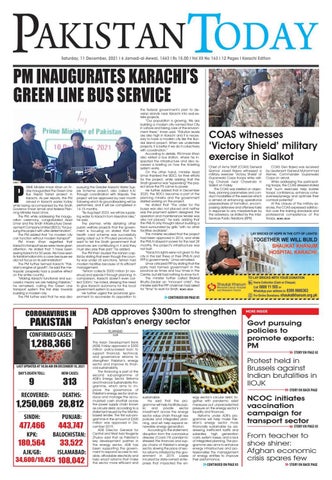
PM inaugurates Karachi’s green Line bus service
P
RIMe Minister Imran Khan on Friday inaugurated the Green Line Bus Rapid Transit project in Karachi. As per reports, the PM arrived in Karachi earlier today while being accompanied by the Sindh Governor Imran Ismail and federal Planning Minister Asad Umar. The PM, while addressing the inauguration ceremony, congratulated Asad Umar and the Sindh Infrastructure Development Company Limited (SIDCL) “for pursuing this project with utter determination”. The PM added that “no modern city can function without modern transport” PM Imran Khan regretted that Karachi’s transport issues were never given attention. He stated that “I have been seeing Karachi for 50 years. We have seen its transformation into a cave because we did not focus on its administration” The PM further termed Karachi “Pakistan’s engine of growth”, he said the metropolis’ prosperity had a positive effect on the entire country. “Making Karachi functional and successful means we are helping Pakistan,” he remarked, calling the Green Line transport system the first step towards building a modern city. The PM further said that he was also
pursuing the Greater Karachi Water Supply Scheme project, also called K-IV, through coordination with Wapda. The project will be approved by next month following which its groundbreaking will be performed, and it will be completed in 14-15 months. “By Aug-Sept 2023, we will be supplying water to Karachi from Keenjhar lake,” he said. The premier, while detailing other public welfare projects that the government is focusing on stated that the health card scheme was successfully being rolled out in PTI-ruled provinces. “I want to tell the Sindh government that provinces are contributing in it and they must also play their part,” he added. The PM then lauded the Iranian capital by stating that even though the country was under US sanctions, Tehran had modern facilities because of its efficient management. “Tehran collects $500 million [in revenue] and spends it through planning. In comparison, Karachi doesn’t even collect $30m,” he noted, stressing the need to give Karachi autonomy for the local government system to succeed. He further urged the provincial government to reconsider its opposition to
coronavirus in
PaKistan
CONFIRMED CASES:
1,288,366
LAST UPDATED AT 10:36 AM ON DECEMBER 10, 2021
DAY'S DEATH TOLL:
NEW CASES:
9
313
RECOVERED:
DEATHS:
1,250,069 28,812 SINDH:
PUNJAB:
477,466
443,747
KPK:
BALOCHISTAN:
180,564
33,522
AJK/GB:
ISLAMABAD:
34,600/10,425
108,042
the federal government’s plan to develop islands near Karachi into real-estate projects. “Our population is growing. We are building a modern city named Ravi City in Lahore and taking care of the environment there,” Imran said. “Pollution levels are also high in Karachi and it is necessary to have a modern city like the Bundal Island project. When we undertake projects, it is better if we do it collectively with coordination.” According to details, PM Imran Khan also visited a bus station, where he inspected the infrastructure and also received a briefing on how the ticketing system works. On the other hand, minister Asad Umar thanked the SIDCL for their efforts for the project, while adding that the Sindh governor was “supervising” the project since the PTI came to power. He further added that in December 2020, the SIDCL became a part of the planning ministry and the government started working on the project. He stated that “the order for the buses was also not placed and neither was the payment system designed; the operation and maintenance tender was also not placed,” he said, adding that the PML-N only thought about building a track surrounded by grills “with no other facilities available”. The minister recalled that the project had been approved in 2016, and while the PML-N stayed in power for the next 28 months, the project’s infrastructure was not built. “Karachi’s rights were not given to the city in the last three of their (PML-N and PPP’s) governments,” Umar remarked. Umar criticized PPP by stating that the party had formed government in the province six times and four times in the Centre, but still had nothing to show for it. The minister further called Bilawal Bhutto-Zardari an “innocent child”, the minister said the PPP chairman had asked for “time” to work for Sindh. News Desk
COAS witnesses ‘Victory Shield’ military exercise in Sialkot Chief of Army Staff (COAS) General Qamar Javed Bajwa witnessed a military exercise ‘Victory Shield’ of Gujranwala Corps troops while visiting Chanoki near Chawinda in Sialkot on Friday. The COAS was briefed on objectives, planning parameters and conduct modalities of the exercise which is aimed at enhancing operational preparedness of formation, encompassing defensive and offensive tasks in response to any misadventure by the adversary, as stated by the InterServices Public Relations (ISPR)
CONTINUED ON PAGE 05
ADB approves $300m to strengthen Pakistan’s energy sector ISLAMABAD TLTP
The Asian Development Bank (ADB) Friday approved a $300 million policy-based loan to support financial, technical, and governance reforms to strengthen Pakistan’s energy sector and improve its financial sustainability. The financing is part of the second sub-programme of ADB’s energy Sector Reforms and Financial Sustainability Programme, which aims to improve the governance of Pakistan’s energy sector and reduce and manage the accumulated cash shortfall across the power supply chain known as circular debt, according to a statement issued by the Manilabased lender. The first sub-programme in the amount of $300 million was approved in December 2019. ADB Director General for Central and West Asia Yevgeniy Zhukov said that as Pakistan’s key development partner in the energy sector, ADB has been supporting the government to expand access to reliable, affordable electricity and help enact reforms that make the sector more efficient and
COAS Gen Bajwa was received by Lieutenant General Muhammad Aamer, Commander Gujranwala Corps on arrival. While addressing the participating troops, the COAS stressed stated that “such exercises help bolster troops’ confidence, enhance cohesiveness/synergy and optimise their combat potential” At the closure of the military exercise, the COAS expressed satisfaction over the training standards and professional competence of the troops. News Desk
more inside
Govt pursuing policies to promote exports: PM STORY ON PAGE 02
Protest held in Brussels against Indian brutalities in IIOJK STORY ON BACK PAGE sustainable. He said that the programme will help facilitate public and private sector investment across the energy sector value chain through key policies and integrated planning, and will help expand renewable energy generation. According to the statement, disruption from the coronavirus disease (Covid-19) pandemic stressed the finances and supply chains of Pakistan’s energy sector, slowing the pace of sector reforms initiated by the government in 2019. Losses incurred by state-owned enterprises that impacted the en-
ergy sector’s circular debt, together with pandemic relief measures put unprecedented pressure on the energy sector’s liquidity and finances. Reforms under ADB’s programme will help make Pakistan’s energy sector more financially sustainable by addressing inefficient tariffs and subsidies, high generation costs, system losses, and a lack of integrated planning. The programme also aims to enhance energy infrastructure and professionalise the management of energy entities to improve their performance.
CONTINUED ON PAGE 05
NCOC initiates vaccination campaign for transport sector STORY ON PAGE 03
From teacher to shoe shiner: Afghan economic crisis spares few STORY ON BACK PAGE
02
Saturday, 11 December, 2021 |KARACHI
NEWS
Govt pursuinG policies to promote exports: pm p News Desk
RIME Minister Imran Khan on Friday said that the government is pursuing policies to support expansion of local businesses and promote import substitution and exports.
The prime minister expressed these views after inaugurating the new 100,000 tonnes polyvinyl chloride (PVC) III Plant of Engro Polymer and Chemicals (EPCL), which will enable import substitution of PVC and boost exports as well. He urged the business community to focus on import substitution and diversification of the export base to support sustainable economic growth of the country. He appreciated the pivotal role played by Engro Corporation and its subsidiaries in different
murad raas refuses to accept school closure requests News Desk Punjab’s Minister for Education Murad Raas on Friday refused to accept school closure requests. The minister took to his Twitter and stated that “I am shocked,” adding that the learning losses children have suffered since the start of COVID-19 are “tremendous.” At this point, schools should be the “last place to ever shut down” “Who are these ignorant people? Unbelievable!” he added. It is pertinent to note that according to a UNESCO database, schools in India, Bangladesh, Nepal and Afghanistan remain only partially open, while those in Pakistan and Sri Lanka are fully open. Additionally, UNICEF has called on governments in South Asia to safely resume in-person learning and ensure that students catch up, as well as improving connectivity, with a top official warning the consequences could last decades.
Former cJcsc Gen shamim Alam Khan passes away in rawalpindi News Desk Former chairman joint chiefs of staff committee General (retd) Shamim Alam Khan was laid to rest in the Army Graveyard in Rawalpindi, stated the Inter Services Public Relations (ISPR) on Friday. The funeral of the former four-star general was attended by incumbent CJCSC General Nadeem Raza, Chief of Army Staff General Qamar Javed Bajwa and Chief of Naval Staff Admiral Muhammad Amjad Khan Niazi. The funeral was attended by large number of civil and military officials including senior retired Army officers as well as the relatives of deceased. The 84year-old former chairman JCSC breathed his last in Rawalpindi on Thursday reportedly due to Covid-19. He leaves behind a widow and three sons. General Shamim was born in 1937 to Mehboob Alam Khan and Amirun Nisa Begum, a couple whose all nine sons joined Pakistan’s armed forces and fought for the protection of the country either in 1965 or 1971 wars against India.
sectors of the economy. Engro Corporation President and Chief Executive Officer Ghias Khan said: “As a home-grown conglomerate, Engro has always strongly believed in the economic potential of Pakistan and, therefore, we have committed to invest in businesses that help solve some of the most pressing issues of Pakistan.” “This expansion is a landmark achievement for Engro, and we are confident that it will reshape the petrochemicals landscape of Pakistan. We fully support the government’s ‘Make in Pakistan’ policy to promote export-oriented industrialisation,” he added. Through enhanced local production, EPCL will now be contributing around $240 million towards import substitution, while the company has exported PVC resin worth $25 million to Turkey and the Middle East markets in 2021.
Punjab reports 33 dengue cases in a day News Desk Punjab reported 33 new cases of dengue during the past 24 hours, according to Primary and Secondary Healthcare Department (P&SHD) Secretary Imran Sikandar Baloch. In a press statement, Imran said that 23 cases were reported from Lahore, 3 from Gujranwala, 2 from Kasur, 2 from Rawalpindi, and one each from Faisalabad, Mianwali and Okara. He said that 156 deaths due to dengue fever and 25,914 cases have been reported from all over Punjab so far this year. He said that a total of 355 patients are undergoing treatment across Punjab, adding that 255 patients are admitted in Lahore hospitals while 100 patients are under treatment in other districts of the province. During the past 24 hours, 399,255 indoor locations and 104,824 outdoor locations were checked across the province while larvae were destroyed from 148 locations. In Lahore, 43,776 indoor places and 7,167 outdoor locations were checked for dengue larvae and 123 positive containers were destroyed. Dengue is a mosquito-borne viral disease that has rapidly spread in recent years around the world. These mosquitoes
are also vectors of chikungunya, yellow fever and Zika viruses. Dengue is
widespread throughout the tropics, with local variations in risk influenced by
rainfall, temperature, relative humidity and unplanned rapid urbanization.
2 suspects arrested for filming, blackmailing and raping women in Quetta News Desk Quetta police has arrested two suspects for allegedly raping, filming, and blackmailing two sisters in Quetta on Thursday. On the complaint of the mother of the two girls under Sections 34 (common intention), 354-A (stripping woman of her clothes), 365-B (seducing or forcing of adults into illicit intercourse), 376 (punishment for rape), 376-A (disclosure of identity of victim of rape, etc), 496-A (enticing or taking away a woman), 503 (criminal intimidation), 506 (punishment for criminal intimidation) and 509 (violating modesty or causing sexual harassment) of the Pakistan Penal Code, a first information report (FIR) of the case was registered at Quaidabad police station on December 2. As per the FIR, the mother said that the two suspects had been blackmailing her two daughters, aged 19 and 16 years for two years. The complainant stated that the accused “have been forcing them into prostitution after recording [their] nude videos and photos and threatening them” She further added that four to five days ago (from the time of the FIR’s registration), the suspects had blackmailed her daughters,
kidnapped them and shot obscene videos to share on social media, while adding that she had captured the evidence on a USB and requested the initiation of legal proceedings against the suspects. Quaidabad Station House Officer (SHO) Ijaz Ahmed stated that “the suspect drugged the young girls after luring them with the prospect of jobs and then blackmailed them after making [their] obscene videos,” the SHO said. He added that the suspect was produced before the court of Quetta’s judicial magistrate and was remanded in
police custody for seven days. According to the SHO, a high-level investigation team had been formed to interrogate the suspect and the police were conducting raids to arrest the remaining gang members. The SHO further revealed that one of the two suspects had been arrested on December 2 and many inappropriate videos of girls were found from his possession, and his laptop, various mobiles and other devices were seized, while adding that the suspect’s brother had also been arrested on Thursday and was being interrogated.
The officer further added that efforts were also underway to recover the two kidnapped girls who were last traced in Afghanistan’s capital Kabul and police were trying to tackle the issue at the international level. Quetta Deputy Inspector General (DIG) of Police Syed Fida Hassan Shah, while addressing the presser stated that the seized material was sent to the Punjab Forensic Science Agency for technical analysis and further action would be taken on the basis of the findings. “I am personally monitoring the case,” the DIG said, adding that daily meetings of the investigation team were being held. He said the case was being processed smoothly, and technical evidence and testimonies were being collected. “I reassure [you] that it will be our full effort and we will also show you by making a strong case, getting a conviction when it ultimately goes to the court and making it an example so no one dares in the future to think about doing such injustice with our girls.” DIG Shah stated that no pressure was being exerted on the police in any way and it was conducting an independent investigation. He declined to share further details since the case is still under investigation.
Saturday, 11 December, 2021 | KARACHI
NEWS
ncoc initiAtes vAccinAtion cAmpAiGn For trAnsport sector t News Desk
HE National Command and Operations Centre (NCOC) on Friday announced initiating a special vaccination campaign for the transportation sector which will be administered nationwide. The vaccine is being administered by all federating units under a joint campaign from December 8 to 18, as per NCOC’s statement. Inspections will be conducted at entrances and exits of bus stops, toll plazas and interchanges, and all types of public and private intercity and intra-city transport will be checked, while inspection teams would be deployed on motorways, national highways and inter-provincial boundaries. As per the NCOC, a total of 3,793 inspections were completed on December 8 alone and 46 vehicles impounded and eight people arrested. It is pertinent to note that the NCOC stressed that only vaccinated individuals, or those with medical exceptions, will be permitted to travel. Non-vaccinated transport staff and passengers will be inoculated on the spot via mobile vaccination teams. Earlier on Thursday, the first “suspected” case of the Omicron variant of Covid-19 in Pakistan has been reported in Karachi. The variant was detected in an unvaccinated woman who was admitted for treatment at Aga Khan University Hospital (AKUH), Mehar Khursheed, media
coordinator at the department said. “We are awaiting the results of the final (genome sequencing) confirmatory test, which will take a few days. We have reported the suspected patient to the health department for their action. The patient did
BISP consultant attacked in Islamabad IslamabaD Shahzad Paracha
A consultant working in Benazir Income Support Programme (BISP) reportedly lost his eye in an attack in Islamabad. Sources said that an unidentified man attacked Sohail Hasan, a consultant in BISP, with a rod on Thursday evening when he was jogging in F9 Park, Islamabad. The security guards deputed there shifted the BISP consultant to PIMS hospital late at night for treatment. Sources said that the consultant lost one eye due to the attack and doctors are now trying to save the other eye. Meanwhile, the recently posted Inspector General of Police Ahsan Younus also took notice of this incident and immediately directed the SSP Operations to visit the crime scene. According to
Islamabad police, the accused will be arrested as soon as possible after collecting the evidence. Sources said that safe city cameras have not recorded anything related to this incident. Questions have been arising about how a man entered F9 Park with a rod and no one noticed this. The Capital Development Authority (CDA) looks after the affairs of F9 Park and a number of people including the families visit the park every day for jogging. Meanwhile, the high-ups of BISP on Friday visited the PIMS hospital when they came to know that Sohail Hasan had been attacked, sources added. The scribe asked Chairperson BISP Sania Nishar for comments on this matter but she did not reply despite seeing the Whatsapp message.
well and has been discharged,” the AKUH spokesperson Anam Haleem said in the statement. A notification from the District Health Office (DHO) in Karachi East said the 65year-old has been discharged from the
facility, however, and is currently isolated at home. The patient had travelled abroad, an official told Reuters without giving any details of the location, but added that contact tracing was underway. The notification said a rapid response
PesHawaR aPP
The Election Commission of Pakistan (ECP) has imposed a fine of Rs50,000 each on 11 legislators, including PPP Chairman Bilawal Bhutto Zardari, for violations of code of conduct during the first phase of the local bodies’ polls. According to a notification issued by the ECP, the central leadership of PPP, despite the announcement of schedule of local bodies’ polls, participated in a public meeting that prompted the commission to issue notices to them. On failure in giving justification, the ECP imposed a penalty of Rs.50,000 each on Bilawal, Chief Minister Sindh Murad Ali Shah, Provincial Minister Saeed Ghani, MNAs Khurshid Shah and Abdul Qadir Patel. In the meanwhile, the Election Commission also summoned the Opposition Leader in KP Assembly Akram Khan Durrani and imposed a similar fine on MNA Zahid Durrani for violation of code of conduct for local bodies’ polls. Similarly, the Election Commission also
News Desk
with the unit. He spotted the enemy tanks close to a minefield near the village Harar Khurd. At his own initiative he directed accurate fire of recoilless rifles, resulting in
team was “taken on board immediately” to trace, test, quarantine and vaccinate to control the variant’s spread in line with the guidelines issued by the National Command and Operation Centre (NCOC). Two of the woman’s contacts, who also tested positive for the coronavirus but do not have the Omicron variant, are also admitted to the hospital, the notification added. The DHO has also requested Karachi East Deputy Commissioner Syed Muhammed Ali Shah to impose targeted quarantines in the vicinity. Sindh Health Minister Dr Azra Fazal Pechuho stated that “Omicron is very transmissible but deaths or serious [conditions] have not been seen in recent reports coming from South Africa (where the variant was first detected). There is no cause for concern. We are conducting a genomic study which will take one or two weeks.” It would be confirmed whether the woman was infected with the Omicron variant once the study was completed, she added. “The virus also spreads because people are not vaccinated. This woman was not vaccinated either. I am appealing to you to get the second dose and if you are fully vaccinated, get the booster dose. It can protect you,” she stressed. The National Institute of Health (NIH) in Islamabad said the sample of the coronavirus patient was “not yet confirmed to be Omicron via whole-genome sequencing” which would be performed after the NIH received the sample.
11 legislators fined for violating election code of conduct
50th martyrdom anniversary of Sowar Muhammad Hussain observed ISPR paid tribute to Nishan-e-Haider (NH) holder, martyr Sowar Muhammad Hussain on his 50th martyrdom anniversary which is being observed today on Friday. Director General Inter-Services Public Relations (ISPR) Major General Babar Iftikhar toook to Twitter to pay tribute to Sowar Muhammad Hussain Shaheed, Nishan-eHaider (NH) for his fearless courage and sacrifice in Zafarwal-Shakargarh Sector, 1971. “His fearless actions inflicted heavy losses on enemy destroying 16 Indian Tanks thus proving that courage knows no bounds,” DG ISPR said. It merits mention that Sowar Muhammad Hussain was born on 18 June 1949 in Dhok Pir Bakhsh, whihc is now Dhok Muhammad Husain Janjua. On 3 September 1966 he was enrolled as a driver and after training joined 20 Lancers. During 1971 war, Sowar Muhammad Hussain took an active part in every battle
03
the destruction of sixteen enemy tanks. During the battle, he received a burst of machine-gun in the chest and embraced martyrdom on 10 December 1971.
imposed a fine of Rs50,000 each on PTI MPA Pakhtun Yar Khan and PPP MPA Sher Azam Wazir for participation in the election campaign in Bannu. Furthermore, a fine of Rs50,000 has also been imposed on the Provincial Transport Minister Shah Mohammad Wazir for addressing a public meeting in favour of his supported candidate in Bannu. Other legislators, who were penalised, include Maulana Lutf-Ur-Rehman and Ahmad Karim Kundi (Rs30,000). The ECP also issued warning to several members of the national and provincial assemblies, including Nighat Yasmin Orakzai of PPP.
Saturday, 11 December, 2021 | KARACHI
04
NEWS
SSGC to halt GaS Supply to non-expoRt SeCtoR fRom today ISLAMABAD
t
AhmAD AhmADANi
HE Sui Southern Gas Company (SSGC) on Friday announced that the gas supply to all general industries (non-export) including their captive power plants across Sindh and Balochistan will be suspended from December 11 (Saturday) ostensibly to maintain gas supply to domestic consumers. SSGCL, in a statement dated 10th December 2021, said that all general industries (non-export) including their Captive Power Plants (CPPs) will remain discontinued till further orders; however, zero rated export industry including its CPPs along with the fertilizer sector will continue to get the gas. “The volume of gas curtailed from this arrangement would be diverted to domestic customers for them to cater their enhanced gas loads in context of the winter season,” said SSGCL statement. According to a spokesman of SSGCL, the decision to suspend gas supply to this sector has been taken in order make gas available to the domestic and commercial sectors during the current winter season that has seen a major de-
mand-supply gap due a extraordinary spike in fulfilling water and space heating needs in Upper Sindh and specially Balochistan that is already experiencing chilly winter season. Gas supply to CNG sector and all Captive Power Plants of non-export industry industrial units was already suspended till February 15, 2021 and further orders respectively due to the winter spike. However, zero rated export industry including its CPPs and fertilizer sector will continue to get the supply of gas. It may be noted here that in Balochistan, supply of additional gas is a must for the survival of human lives since gas serves as a LIFELINE to a huge population that keeps itself warm through water and space heating gas appliances in extremely low temperatures. “SSGC looks forward to the non export industrial sector for understanding the gravity of the situation and expects its cooperation for serving the domestic customers through uninterrupted gas supplies,” said Salman Ahmed Siddiqui, SSGCL spokesman. According to SSGCL, the decision to discontinue gas supply to the non-export sector was made in accordance with the Ministry of Energy’s approved gas load
management plan (Petroleum Division). With the advent of winter season, SSGCL is facing severe shortage in the indigenous gas receipts from producers every passing day resultantly depleting line pack and simultaneously, SSGC is also experiencing increased gas consumption in the domestic sector that peaks during winter season and ultimately causes low gas pressure in the system. SSGCL’s Deputy General Manager, Sohail Mustafa Jaleel, in a letter dated 10th December, 2021 to all industrial association, requested to cease 100percent consumption of gas in all general industries (non-export) captive power units operative till further orders in the larger interest of the general public. “We expect that in appreciation of emerging situation, needed cooperation and support shall be extended to SSGC to smooth sail across this difficult period,” said Sohail Mustafa Jaleel, Deputy General Manager, SSGCL. Earlier on November 27, SSGCL had cut the gas supplies to all Captive Power Plants (CPPs) of general industries (nonexport) across the two provinces in adherence to Petroleum Division’s priority order for gas load management. The discontinuation of gas supplies to
all these Captive Power Plants (CPPs) was exercised under the Gas Sales Agreement (GSA) signed with CPPs, as the agreement states that gas supply will be provided by the company on an ‘as and when available’ basis only during March to November each year, a statement had read, adding that the domestic sector tops the list of the petroleum division’s priority order of gas load management. On November 29, SSGCL announced the suspension of gas supply to the CNG sector in Sindh and Balochistan till February 15, 2022. “In adherence to the Government of Pakistan approved Gas Load Management Plan, that places domestic and commercial customers on top of the gas sectoral list, it has been decided to suspend gas supplied to all CNG stations across Sindh and Balochistan as per following schedule i.e. from December 1st 2021 (8:00 am) till February 15, 2022 (10:00 pm),” a statement released by the gas utility in this regard said. SSGCL added that the SSGC looks forward to the CNG sector for understanding the gravity of the situation and expects its cooperation for serving the domestic customers better, through uninterrupted gas supplies.
PSX sheds 123 points amid expected hike in interest rate Rupee falls further to 177.71 against dollar The Pakistani rupee on Friday plummeted again, setting the sixth all-time low of 177.71 against the US dollar. According to the State Bank of Pakistan, the dollar opened at Rs177.61 in the interbank market and closed at Rs177.71, shedding 10 paisas (-0.06 percent). Within the open market, the rupee was traded at 179/180 per dollar. Earlier during this December, the dollar hit the then highest ever levels of Rs177.61 on December 9, Rs177.43 on December 8, Rs176.79 on December 7, Rs176.77 on December 3 and Rs176.42 on December 2. Overall, the local currency shed 94 paisas against the greenback during the last five days. The rupee’s depreciation during the ongoing fiscal year 2021-22 has been Rs20.29 and Rs17.56 in the current year 2021. The rupee is under the pressure of soaring import bill which needs to be curtailed immediately as the depleting foreign exchange reserves will hardly cover the bill for around three months if it continues to report around the same figures. Official data revealed that Pakistan’s trade deficit ballooned by 112 percent to $20.59 billion during the first five months (JulyOctober) of the current fiscal year 2021-22. The trade deficit was at $9.72 billion in the same months of the last fiscal year. The import bill surged by 69.17 percent to $32.934 billion during July–November 202122 as compared to $19.468 billion in the same period of the last fiscal year. NEWS DESK
KARACHI TLTP
The Pakistan Stock Exchange (PSX) remained bearish for the second day in a row on Friday, with the benchmark KSE-100 Index shedding 123.06 points (-0.28 percent) to close at 43,395.78 points. The market opened on a positive note but remained in the green zone only for the first 15 minutes of the session, and succumbed to selling pressure. The market remained in the negative zone till end of the session as the investors opted to square their positions, anticipating aggressive interest rate hike on December 14. The KSE-100 Index moved in a range of 561.5 points, showing an intraday high of 43,606.4 points and a low of 43,044.9 points. A total of 342 companies traded shares in the stock exchange, out of them shares of 131 closed up,
shares of 192 closed down while shares of 19 companies remained unchanged. Out of 91 traded companies in the KSE-100 Index, 35 closed up, 55 closed down and one remained unchanged. The overall market volumes decreased by 21.32 million to 179.17 million shares. Total volumes traded for the KSE-100 Index decreased by 14.92 million shares to 82.48 million shares. The number of total trades decreased by 19,566 to 86,043, while the value traded decreased by Rs2.02 billion to Rs6.73 billion. Overall market capitalisation decreased by Rs5.29 billion. Among scrips, TRG topped the volumes with 14.62 million shares, followed by TREET (14.24 million) and WTL (13.62 million). Stocks that contributed significantly to the volumes include TRG, TREET, WTL, HASCOL, and TPLP, which formed around 32 percent of total volumes.
The major sectors taking the index toward south were oil & gas exploration companies with 37 points, technology & communication with 33 points, commercial banks with 33 points, textile composite with 17 points and power generation & distribution with 15 points. The most points taken off the index were by SYS which stripped the index of 40 points followed by BAHL with 21 points, DAWH with 17 points, HBL with 17 points and UBL with 13 points. The major sectors taking the index toward north were food & personal care products with 31 points, fertilizer with 28 points, engineering with 5 points, insurance with 4 points and cement with 3 points. The most points added to the index were by NESTLE which contributed 21 points followed by TRG with 16 points, FFC with 13 points, MEBL with 12 points and BAFL with 12 points.
corporate corner Sindh govt, Ke, WB sign mou
KARACHI: Committed to the aim to expand its portfolio of clean energy, KE has allied with Sindh Energy Department (SED) and the World Bank to develop a solar park with an aggregate capacity of 350 MW under the ambit of the ‘Sindh Solar Energy Project’ (SSEP). The objective of SSEP is to increase solar power generation and access to electricity in Sindh Province. The purpose of this tripartite arrangement – formalized today with the signing of a Memorandum of Understanding (MoU) – is to develop and implement sustainable, costeffective, and competitive utility-scale IPPsin Karachi under a competitive bidding structure. Through this collaboration, an additional 700 GWh of clean energy will be added to KE’s electricity supply mix that should offset carbon emissions by 300-350 kilotons per annum. This is in line with the Government of Pakistan’s aim, as stipulated in the Alternative and Renewable Energy (ARE) Policy 2019, of increasing the share of renewables (excluding hydel) as a share of the country’s power generation capacity to 30% by 2030. The MoU was signed between Secretary, Energy Department, Government of Sindh, Abu Bakar Ahmed Madani, CEO K-Electric, Syed Moonis Abdullah Alvi, and World Bank Country Director for Pakistan, Najy Benhassine who joined via video from Islamabad. This tri-partite collaboration is being supported by the World Bank through development financing to the Government of Sindh for the implementation of SSEP. SED will be responsible for conducting relevant project-related studies, implementation of the competitive bidding process, and construction of any public sector infrastructure that is required. The solar IPPs would be constructed and owned by competitively selected private sector developers. Once complete, the power from the project (s) would be inducted into KE’s grid via power off-take agreements, enhancing its ability to serve the current and evolving needs of its growing consumer base of 3.2 million. Speaking at the occasion, the Sindh Minister for Energy, Imtiaz Ahmed Shaikh commented, “This project has been in the works for some time and is being achieved with close collaboration and support of the stakeholders. The Sindh Energy Department is committed to making a meaningful contribution in the effort towards Pakistan's cleaner and greener energy future, and we hope to share our learnings and experience at the national and international level to expand the scale of the impact.” CEO K-Electric Moonis Alvi also mentioned, “We appreciate the Sindh Energy Department and the World Bank for coming together on this historic event, which demonstrates our collective commitment towards the sustainable growth and future of Karachi and the Province of Sindh at large. At KE, environment and sustainability are integral parts of our strategy, focused on mitigating the impact of carbon and increasing KE’s footprint of clean energy. We follow Environment and Sustainability Management Systems (ESMS) to ensure our business activities have a minimal harmful impact on our surroundings. As the only vertically integrated power utility company in Karachi, it is of utmost importance for us to ensure the availability of clean, reliable, and low-cost electricity for our consumers which will promote economic growth for Pakistan.” Joining remotely, Country Director for the World Bank Pakistan, Najy Benhassine said, “Transitioning to renewable energy offers Pakistan the potential to reduce its generation costs, diversify away from imported fossil fuels, and realize climate change, air pollution, and water conservation benefits. Sindh Province is key to increasing the share of renewable energy generation in Pakistan and developing new ways of providing electricity access. PR
IESCO issues power suspension schedule ISLAMABAD PR
According to Islamabad Electric Supply Company (IESCO)’s spokesman, System Maintenance/Development Work is in process. Therefore power supply of below mentioned feeders/areas will be temporary suspended as per given schedule: On 11th December, From 10:00 AM to 02:00 PM, Askari-7, Sir Syed Road, FFC, Ahmadal Feeders, From 08:00 AM to 03:00 PM, Sanghoi, Nathwala, Safdar Shaheed Feeder, From 08:00 AM to 12:00 Noon, Gulshan Abad, Rata Feeders From 09:00 am to
02:00 pm, Tamasamabad, Iqbal Road-II, Sarafa Bazaar, Jinnah Road, Dhok Hasso, Mohammadi Chowk, Hyderi Chowk, Benazir Hospital, Airport, Kayani Road, Peshawar Road, Millatabad. Radio Pak, Bhadana, Pind Hoon, Kariala, AMC, AFIRM, Race Course, Kalial, Gulshanabad, Dhok Noor, 502 Workshop, Adiala, Askari14, Humayun-1, Humayun, Zeeshan Colony, Millat Chowk. , Megan, Klar Kahar, Islamia Chowk, Dawlatullah, Sarkal, Dalwal, Duffer, Toba, PD Khan, Karsal, Danda Shah Bilawal, Dhok Ghazni, Talagang City, Dhalar, Moghla, Multan Khurd, Karwar, Ghauri
Garden, G- 8/1, Khayaban-e-Iqbal, G-6, Mahfooz Shaheed, Farash Town, F-8, I-11/3, G-9 Center, International School, G-11, Pir Mehr Ali Shah, Rahara, PHA-1, C M Pak Zong, Bahria Enclave, Isolation Hospital, Sunny Bank, Cecil, Kohala, PC, Blaura, Bari Imam, Kamshir Road, Dhok Farman Ali, Bostan Khan Road, Media Town-2, RCCI Express, Murree Brewery. State Bank, Gulshanabad, Chakri, Quaid-e-Azam Colony, Cantt. , Brahma, Dharek, Pind Padiyan, Sangjani, Wahdat Colony, Industrial Estate, Lala Rukh, Marvi, Shadi Khan, Shah Dir, Qaziabad, Bolniwal, Ghorghashti, Karpa,
CMYK
Mathial, Jhang, Meira Sharif, Khor, Mahfooz Shaheed, Laniwala , Ajmal Shaheed, F7 Court, Abbaspura, Sanaullah Shaheed, CMH Jhelum, Bolani, Kadiala, Puran, F-6 Machine Mohalla, Pakhwal, Dina Three Rohtas, Gadari, Padial, Safdar Shaheed, Sanghoi, Nathwala, Mumtaz Shaheed, Gujar Khan, City Sohawa, Court Sohawa, Mill Awan, Galyana, Islampura Feeders, Shaheen, E-8 Navy, NHQ, Silver Hawks, NDU, NIC, Centaurs Flats, NHQ-2, Sector A, From 09:00 AM to 04:00 PM. Shaheen, E-8 Navy, NHQ, Silver Hawks, NDU, NIC, Centaurs Flats, NHQ-2, Sector A , B,
F, G & H, Sector AC & KLMN, Feeders, From 10:00 am to 11:00 am Chakralal, Mureed, Islamia Chowk, Sarpak, Main Bazaar, Ara Bazaar, Biharpur Feeders, From 09:00 am to 12:00 Noon Shaheed, Alipur, Karwar, New Lab-1, 2 & 3, Pentac 1, 2 & 3, Anoop, CNS Lab, O Lab, Tamir, Karpa, Simli Dam, Pentak Colony, Farash Town Feeds and surrounding areas will remain off. IESCO management apologizes to its esteemed customers for the power outage. If the work is completed ahead of time, the power supply can be restored even before the scheduled time.
Saturday, 11 December, 2021 | KARACHI
PM inauguRates KaRachi’s gReen Line Bus seRvice h contInued from page 01
E addressed Bilawal by stating that “dear child, 50 years ago your grandfather was made the chief martial law administrator of the president of Pakistan. How much more time do you need?” Umar further revealed that the federal government had also taken responsibility for the K-IV water supply project after it was abandoned, adding that the PC-1 for the project had been submitted to the planning ministry and work would begin within two months. He stated that the PTI government was making solid progress on all the
projects announced under the transformation programme. “We don’t just make promises, we deliver.” According to the minister, the Frontier Works Organisation had been mobilised for the Karachi Circular Railway (KCR) project and work had begun on the ground. “Not only local, but international companies are also showing interest in the project,” he revealed. While commenting on the Karachi Transformation Plan announced by the prime minister last year, he revealed that “Commercial operations will begin on December 25 and total operations will start by January 10” He further revealed that the second
FBR chairman holds ekatchehri
project concerned the construction of stormwater drains in the city, adding that work on the Mehmoodabad nullah had been completed and it would be inaugurated in 10 days, while adding that 50 per cent of the work on the Gujjar and Orangi nullahs had been completed. As per the details of the Green Line project, work on the Rs16.85 billion federal government-funded bus project had begun after then-prime minister Nawaz Sharif inaugurated it in February 2016 by performing the groundbreaking. The project was estimated to be completed by the end of 2017, but kept getting new deadlines. Since the launch of the scheme, the battered roads on either
ADB Central and West Asia Director for Energy Joonho Hwang said that ADB continues to work with development partners to advance crucial energy sector reforms and implement a road map As a sequel to e-katchehries held regularly to comply with the directions of the Prime Minister of Pakistan, Chairman Federal Board of Revenue (FBR)/Secretary Revenue Division, Dr. Muhammad Ashfaq Ahmed held an E-Kachehri at FBR (HQs) on Friday to listen to the complaints and concerns of taxpayers. This is the third consecutive week of holding E-Kachehri by the Chairman FBR after he decided to hold it on every Friday to expedite redressal of grievances of taxpayers. He listened to the complaints of the taxpayers and issued on-spot directions for resolution of complaints. He also advised the taxpayers to visit their nearest RTO and Collectorate of Customs for redressal of any problem confronted by them. The Chairman FBR appreciated the suggestions put forth by the taxpayers and assured them that their valued input would be duly considered for formulation of tax policies and initiatives for taxpayers’ facilitation. He reaffirmed that FBR was making all out efforts to facilitate the taxpayers. The Chairman FBR has issued specific directions to all Field Formations for according top priority to the grievances and concerns of female taxpayers and those originating from the remote and marginalized areas of Pakistan. Needless to add that the weekly E-Kachehri being held by Chairman FBR on regular basis will not only contribute significantly to the timely redressal of the grievances of taxpayers but will also keep a strong check on the performance of the Field Formations. Chairman FBR has already instructed all field formations to resolve the outstanding issues of taxpayers and made it clear that any negligence in this regard will not be tolerated. P r
for a competitive electricity market. Ultimately, these reforms will help improve the quality and reliability of power supply to the benefit of all—commercial, domestic, urban, and rural consumers, Hwang added. Pakistan is a founding mem-
ber of ADB. Since 1966, ADB has committed more than $36 billion to promote inclusive economic growth and improve the country’s infrastructure, energy and food security, transport networks, and urban and social services.
Mazari, Francis discuss human rights situation
Federal Minister for Human Rights Dr. Shireen Mazari held a meeting today with Provincial Minister of Baluchistan for Human Rights and Minorities, Mr. Khalil Gorge Francis at Ministry of Human Rights, Islamabad. Federal Secretary for Human Rights Mr. Inamullah Khan was also present in this meeting. Provincial Minister described that Baluchistan Government has apportioned funds of Rs1.6 billion to different projects under the subject of human rights and human development and they have successfully accomplished the tasks of establishing required infrastructure and appointment of administrative head of the department. He requested the Federal Minister for extending the technical assistance from the forum
05
corporate corner Dawood inaugurates virtual export gallery
side of the route have turned into a great source of nuisance for commuters and for the shopkeepers doing their businesses. On September 19, the first batch of 40 buses had arrived in the city which the planning minister had referred to as a “ray of hope” and “milestone”, calling it the beginning of modern public transport service for Karachiites after a long gap of 40 years. On October 21, the second consignment of 40 buses for the Green Line project arrived in the city, raising the number of buses to 80 and rekindling citizens’ hope that the Bus Rapid Transit System (BRTS) in the metropolis was set to be launched. It is supposed to facilitate the travel of approximately 300,000 passengers daily.
ADB approves $300m to strengthen Pakistan’s energy sector contInued from page 01
NEWS
of her ministry to build up links between Baluchistan and Sindh governments for better coordination concerning human rights issues. He further expressed that the incumbent government in Baluchistan is working exceedingly to resolve the issues of harassment, forced conversions, minorities related issues and it is planning to build a district level coordination network to resolve the human rights issues under the provincial department of Human Rights. Federal Minister for Human Rights stated that Ministry of Human Rights would help to make connections of provincial government in Baluchistan with international donors like EU, UNESCO, UN-Women and UNDP for build-
ing set-ups of protection centers for women and transgender persons . She mentioned that her ministry is not getting the actual data from Baluchistan that is a causing major hurdle to proceed. Federal Secretary for Human Rights informed that recently a series of sensitization workshops have been conducted in all four provinces by Ministry of Human Rights under an awareness program on Transgender Persons (Protection of Rights) Act2018 and Zainab Alert, Response and Recovery Act 2020. In addition to this he told that Legal Aid and Justice Authority has been established to provide legal and financial assistance and this organization can be approached by all kinds of needy and deserving women including acid attack victims. At the end, Federal Minister desired that Baluchistan government should establish the women protection centers on replica model of the one that is established in Islamabad and steps must be taken to empower the provincial Commission for Human Rights in Baluchistan to undertake all such issues to concerned authorities for speedy redressal and resolution. Pr
KARACHI: Inaugurating the Pakistan Virtual Export Gallery at the Trade Development Authority of Pakistan (TDAP) Mr. Abdul Razzak Dawood, The Prime Minister's Commerce and Investment Advisor, said that the government working day and night to increase export. The quality of Pakistani products, which we export, is of the highest quality. The federal advisor expressed satisfaction over the performance of TDAP officers and said that the TDAP exhibition in Lahore should be organized in a better arrangement as guests from abroad would be interested in Pakistani product. Secretary TDP Mr. hsan Ali Mangi and other senior officials in their briefing stated that the exhibition of engineering and health equipment in Lahore is being held in Lahore from 25 to 27 February 2022, for which a budget of RS: 179.6 million has been approved. The exhibition is expected to feature about 150 exhibitors and around 250 foreign delegates from 41 countries. Further added that the Lahore Exhibition will display engineering and health equipment’s and the common people will be allowed to visit on the last day. Mr. Dawood directed that heavy machinery should also be exhibited in the exhibition. Efforts should be made to open a large open hall, displaying tractors and other machinery manufactured in Pakistan. Heavy machinery manufactured in Pakistan is required in other countries including Africa. During the meeting, the Federal Advisor spoke on the phone with TDP officers performing the duty in Sukkur and Abbottabad, discussed on export and quality of the dates and honey, and appreciated the work of the youth. P r
Mobilink Microfinance Bank Limited President and CEO Ghazanfar Azzam and Chief Business & Products Officer Muhammad Asim Anwar inaugurate a new branch in Hasan Abdal. The launch serves as a testament to MMBL’s continuous growth of its banking network and services across Pakistan, encouraging sustainable financial inclusion and economic empowerment for all. Pr
International Mountain Day celebrated Islamabad Pr
To celebrate International Mountain Day 2021, Pakistan Tourism Development Corporation (PTDC) in collaboration with Alpine Club of Pakistan and other partner organizations is organizing a 3-day program to raise awareness about the importance of mountains in human existence, to highlight the potential and restrictions in mountain development, and to foster alliances that will bring good change to mountain people and surroundings worldwide. The inaugural session was held on 10th December 2021 in the President House. President of the Islamic Republic of Pakistan-Dr. Arif Alvi was the chief guest of the session. Addressing the inaugural session, His Excellency-President of Pakistan Dr Arif Alvi stated that: “Pakistan is a country rich in natural beauty, and the birth place of many civilizations. Mountain tourism is a foundation of the local economy, offering jobs and business possibilities. What we have to do is to properly plan and develop mountainous
areas and enhance our Human resource with skilled workforce.” Managing Director of Pakistan Tourism Development Corporation (PTDC), Mr Aftab-ur-Rehman Rana, while giving a presentation highlighted potential of mountain tourism and efforts of present government for the development of tourism for the socioeconomic development in the mountain areas of Pakistan. He especially mentioned
that government is working to create an enabling environment for private sector to come forward to invest in developing high standard facilities for the tourism in PakistanHe also stressed on the need to promote eco-friendly tourism in the mountain to safeguard the natural environment of our mountain areas”. Giving presentation in the inaugural session Colonel (R) Manzoor, Ex-President
cmYK
Alpine Club of Pakistan mentioned that: “Our nation is ideal for explorers since it has some of the world's highest mountain peaks and a diversified topography that responds to the needs of all types of tourists.” Chief Guest Dr Arif Alvi also presented the awards among the nominees who have made valuable contribution in the field of sustainable mountain tourism under the categories of Climate Change, Sustainable Tourism and Mountaineering and Adventure Sports. A large number of prominent professionals from Tourism Industry, environment and Hospitality Sector were present in the event. In the continuation of the event, PTDC and Alpine Club of Pakistan is organizing a one-day conference on the theme Sustainable Mountain Tourism at Pearl Continental Hotel-Rawalpindi on the 11th of December 2021. Sustainable mountain tourism can help to provide new and alternative livelihood opportunities while also encouraging poverty reduction, social inclusion, landscape and biodiversity protection. Another event will be organized on 11 December 2021 to create awareness about
mountain tourism among young children and students of various institutes on Margalla Hills National Park. It will be a day long event consisting of nature study camp and Eco-hike for children to study ecology of Margalla Hills. This event is jointly organized by PTDC, Alpine Club of Pakistan, Sustainable Tourism Foundation Pakistan and Islamabad wildlife Management Boards. On 12th December 2021, another field activity will be held on Margalla National Park where university students will participate in Eco-hike and clean up drive on Trail 5 of Margalla hills. This event will be organized by PTDC with the support of Riphah International University, Pakistan Sports Board, Sustainable Tourism Foundation Pakistan, Pakistan Association of Tour Operators, Islamabad wildlife Management Boards and Hashoo group. As a national tourism organization, PTDC’s efforts to promote and develop tourism, especially in the mountain areas of Pakistan are not hidden truth. PTDC motivates every Pakistani to engage in mountain protection and adventure activities.
06-07 Comments - 11th December 2021_Layout 1 12/11/2021 12:14 AM Page 1
Saturday, 11 December, 2021
06 COMMENT
The Myth of Academies
Pakistan and the new Cold War era Non Alignment is the best way out
They are clever money-making machines
C
HineSe economic growth has been the dominant fact of 21st century international relations and is likely to continue to shape global politics for a long time. Fears of China surpassing the USA as the world’s largest economy have caused stress and anxiety among US policymakers irrespective of whether the Democrats or Republicans are in power. Republican President Donald trump’s Secretary of State Mike Pompeo called for a ‘new alliance of democracies’ to oppose China. Under Democrat President Joe Biden nAtO leaders were persuaded to declare China a global security challenge. Attempts have been made by successive US administrations to embed india in plans to compete with China. the latest attempt to isolate China was by announcing the so-called Democracy Summit which taiwan was also supposed to attend. Among other countries invited was Philippines, which has the thirdlowest index rank of 15 countries in the east Asia & Pacific region for democratic freedom, just above Myanmar. the USA is not known for supporting the rights movements in military-ruled countries or oppressive regimes considered its allies. the Democracy Summit was therefore just a political gimmick aimed at rallying friendly countries to speak against China’s human rights record, its trade practices and its military’s increasingly assertive behavior, that has unnerved US allies in the Pacific. PM imran Khan did well not to attend the summit. Pakistan and China have a long history of mutual assistance at times of need. the ongoing China–Pakistan economic Corridor (CPeC) worth $62 billion is intended to rapidly upgrade Pakistan’s infrastructure and strengthen its economy by the construction of modern transportation networks, numerous energy projects, and special economic zones. it is rightly referred to as a game changer for Pakistan. China has also helped in enhancing Pakistan’s defence capability. it is highly unrealistic to assume that any government in Pakistan would let down China. Pakistan has also a long history of good relations with the USA also, which is Pakistan’s largest export destination. islamabad has also vital economic interests in Washington’s european allies. While it is unrealistic to hope that Pakistan might bridge gaps between the USA and China, it would be disastrous for it to join any political bloc formed against China or the USA.
Hamid EHsan WarraicH
S
itting in an office of a senior police officer from the Police Service of Pakistan and listening to him quote Herman Melville that “it is better to fail in originality than to succeed in imitation” opened wide before me the dilemma of the aspirants of the Central Superior Service (CSS) and other competitive examinations in Pakistan. it has been witnessed in the recent past that academies reign superior over the analytical yet fragile minds of these aspirants and eviscerate them of their originality in pursuit of imitating those who have succeeded. And here starts the profiteering tendencies of the academies that do not sell the skills but fears. islamabad, Lahore, and Karachi are considered the hubs of these academies. Aspirants would agree that these academies, unfortunately, are being considered the pre-CSS or PMS (Provincial Management Services) colleges that are mandatory to succeed. there are academies which have enrollment crossing 1500 aspirants, a lot more than many private colleges across the country. now, the question arises why
After the TTP ceasefire’s end, the govt must ask itself why it is talking
Afghan Taliban have more stakes than both parties in peace talks between the Government of Pakistan and TTP
t
He ending by the tehrik-i-taliban Pakistan (ttP) of the ceasefire deal it had made with the Pakistan Army should have been predicted, because the ttP’s demands had not been met. the expectations that the ceasefire would lead to some sort of amnesty have been proved unrealistic. Prime Minister imran Khan’s desire to give the ttP an amnesty and bring it and its members into the mainstream has run ashore on the shoals of the ttP’s demands, which centre around continuing the fight against the military and to replicate the success of the Afghan taliban against the USA. the Pti government was rash in attempting the talks because the taliban have made some demands which cannot be fulfilled. the facilitation, which was expected from the Afghan taliban, was also not forthcoming with the present outcome. Just as Pakistan claims it has no control over the taliban, the taliban claim they have no control over the ttP. the ttP demand for the right to establish a political office in a third country shows they regard the Pakistani military as some sort of occupying force. the demand for the implementation of Sharia is beyond the competence of even the government to deliver and it shows that the ttP actually wants Sharia in place of the Constitution. their demand that the integration of the former tribal areas into KP be reversed is probably more complicated than the original integration. the ttP seems to have forgotten that the Afghan taliban got the withdrawal of foreign forces because they were inflicting more casualties than the USA was willing to accept to continue foreign occupation. it must not be forgotten that the Pakistan Army is a national army and the parallel breaks down. the negotiations have not ended but how the talks will move forward if the ttP resumes its attacks is to be seen. this is an opportunity for the government to do two things: think hard about what it hopes to achieve and whether the talks lead that way; bring on board all those who have been direct victims of the ttP, including both parties and persons who have lost people to terrorism by ttP.
Junaid afridi
L
ASt month, an unexpected development emerged in the headlines, indicating that Pakistani officials have initiated a peace process with the tehrik taliban Pakistan. Prime Minister imran Khan later verified this in an interview with tRt. Last Monday, Pakistani information Minister Fawad Chaudhry said that the ttP, and the Pakistani government had agreed to a month-long ceasefire agreement. the agreement will expire on December 9, ttP spokesman Muhammad Khurasani said. A spokesman for the ttP confirmed that it has agreed to a one-month ceasefire with the government starting november 9 and that talks between the two sides are continuing. “it is necessary that both sides observe the ceasefire,” said Mohammad Khorasani. He added that the Afghan taliban “is filling the role of a mediator” in the current negotiations process.” in a separate interview with the BBC’s Amir Khan, Afghan taliban Foreign Minister Maulvi Muttaki stated that they are mediating between Pakistan and the ttP. He further stated that the Afghan taliban had stepped in at the “request” of both parties. “no final agreement has been reached; however, the start has been very good, and in the first part of the [talks] there has been an agreement on a onemonth ceasefire,” said Muttaqi. “Both sides agreed that talks will remain ongoing.” Although Pakistan’s Security forces’ Multiple Operations has decreased terrorism for several years, after the rise of the taliban in Afghanistan has given a new perceptive to the ttP which resulted in an in-
Dedicated to the legacy of late Hameed Nizami
Arif Nizami (Late) Founding Editor
Yousaf Nizami M. A. Niazi
Umar Aziz
Joint Editor
Joint Editor
Executive Editor
Lahore – Ph: 042-36300938, 042-36375965
The writer is a lecturer of Political Science.
The Elephant in the room
Ceasefire breaks down
Editor Aziz-ud-Din Ahmad
these academies are considered very important even to the foreign graduates to get through the competitive examinations. Following are some of the reasons why these academies have penetrated deep into the life of an aspirant. Firstly, the advertisement tactics. these institutions have banked on the cutting-edge advertisement tactics that have engrossed all the attention of the aspirants. Advertisement is a major tool to generate huge profits. in advertisements two things are sold. One is fear of how difficult the exam is along with the importance of the academy to crack it. the second is showcasing those who have succeeded by taking their interviews regardless of the fact if they have ever joined the academy or not. the former talks about the danger and the latter about the rescue. Secondly, introducing different sections. One is termed as the general section and the other is the super of the special section. this is again a tactic to attract aspirants. those in the special section get a kind of a royal treatment where they are given the special attention that adds nothing but a more financial burden. in all this process if anything is compromised that is the originality of the aspirants which they have learnt during their graduation programmes. thirdly, introducing the test sessions. giving tests is always considered the best method to get confidence before appearing in such competitive exams. For the tests, there is a separate fee structure which is another burden on the aspirants. this financial burden is justifiable if the evaluation is up to the mark. After meeting some aspirants, it has been realized that the evaluation in these academies does not match that of the Federal Public Service Commission or the Punjab Public Service Commission. thus, giving tests is another wasteful and extravagant activity in these academies. Fourthly, the interview saga. When out of thousands of candidates, 2-3 percent of the candidates make it through the written examinations, the academies again welcome the qualifiers with their arms wide open. Here is the stage where aspirants lose all
their originality and are morphed into a hotchpotch of different personalities. What havoc the academies wreak on these adamant yet docile qualifiers is to convince them to adopt those qualities that are liked or likely to be liked by the interview panelists. the qualifiers in their quest for allocation blindly imitate the panellists and those who have got allocation in the previous attempts. they prepare themselves from the exam point of view and forget about their own personality. this is the reason why we see that many capable qualifiers could not get allocated. Lastly, back to square one. When the half-hearted not-allocated aspirants go back and ask the academies about their non-allocation, they again sell them two things, fear and panacea. the cycle goes on and on until the last attempt. Many would ask where the myth is. the myth lies in the fact that after every result the academies start portraying themselves as the ambassadors of success and fall into an unending rat race. though i am not good at numbers, it would help to understand. if on average 10 candidates from an academy get through out of 1500 enrolled, the simple calculation would show 0.67 percent result. What about those who could not succeed? the irony is that those who could not get through would keep injecting finances into the banks of the academies and those who have got through would be considered the booster shots in the form of advertisements to attract more aspirants. in all this unholy business the aspirant is at the losing end. He loses the originality, the confidence, the ego, the time, the discipline and above all, the honesty. All these traits are deemed to be important to become a good civil servant. the academies do not play with the emotions of a single candidate but with those of an entire family. For instance,5of there are 40,000 applicants and half of them appear in the exams. More than 80 percent of those appeared have direct or indirect links with the academies. Roughly, these institutions are playing with the emotions and future of 80 percent of the families. this emotional lynching is beyond any cure. Last but not the least, unfortunately, the victims of these academies are the educated and ma be the creative youth which lose all their creative and analytical skills at the hands of these academies. the need of the hour is that the government needs to take cognizance of the issue which is burgeoning. the fire is kindled and is ready to rise.
I
Karachi – Ph: 021-35381208-9
I
crease in ttP strikes on security personnel who were killed or injured as a result of the attacks. According to data compiled by the Pakistan institute for Peace Studies (PiPS), an islamabad-based research organization, the ttP carried out 95 attacks in 2020, killing 140 people. in 2021, it carried out 44 attacks in the first six months of the year. From July, however, coinciding with the resurgence of the taliban towards Kabul, the ttP increased their activity. From July until September, the group carried out another 44 attacks, claiming 73 lives, more than 90 percent of whom were Pakistan military personnel. imran Khan has always had a narrative against the wars in Pakistan; he has always said, “these are our own people, talk to them,” which he has been repeating for the past 20 years. However, the Pakistani military may be skeptical about the outcome of these discussions and how long any peace agreements will last. Since the ttP’s formation in 2007, islamabad has struck peace agreements with several groups. However, none of the agreements have been sustained, and most of them have been followed by an outbreak of violence. the ttP has made several demands, including the right to open a political office in a third country, the reversal of the Federal Administered tribal Areas’ merger with Khyber-Pakhtunkhwa province, and the introduction of an islamic system in Pakistan. Pakistan will not accept these demands at any level. So this truce isn’t going to last very long, and there’s a slim likelihood that these discussions will lead to a real breakthrough sooner or later. Pakistan is likely to be pushed by the Afghan taliban for these talks. they are a major actor in these discussions. they have a lot riding on these discussions, and they may have a lot more at stake than Pakistan and the ttP. the question now is why the Afghan taliban are more averse to these talks than both parties. At this time, Pakistan is one of their main key allies. Although Pakistan didn’t recognize their gov-
Islamabad – Ph: 051-2204545
ernment, Afghanistan’s foreign minister paid his first visit to the country. Pakistan is also lobbying for them on the global stage. Prime Minister imran Khan has urged the international community to engage the taliban administration and unfreeze Afghanistan’s foreign exchange reserves. Pakistan can also assist them in establishing their government’s credibility on the international stage. At this moment, the Afghan taliban would not want to sour relations with Pakistan at any cost. the one thing that can sour this relationship is the ttP. Pakistan is putting pressure on the taliban to take action against ttP. they will sour their relations with Pakistan if they do not take action against the ttP, but it is also a test case for them if they can effectively negotiate between the Pakistani government and the ttP. By demonstrating the taliban leaders’ capacity to prevent cross-border terrorism, it could help establish the credibility of the transitional government in Kabul and relieve some regional security fears. now, if they take action against ttP, there will be terrible consequences. to begin with, there would be an internal conflict among the Afghan taliban, as there would be opinions about how to take action against the same ideological group, who did nothing wrong but desired Sharia in an islamic country. Second, if they begin taking action againstthe ttP, this will be a major problem for them. ttP militants will then join iSKP, as they did previously when Pakistani military operations against ttP resulted in the majority of ttP fighters joining iSKP in Afghanistan. iSKP is already a significant threat to the Afghan taliban, and they would never want to strengthen them by attacking the ttP. negotiations and a settlement between Pakistan and the taliban are therefore the only safe option for the Afghan taliban. this is why these talks have been arranged by the Afghan taliban
ISKP is already a significant threat to the Afghan Taliban, and they would never want to strengthen them by attacking the TTP. Negotiations and a settlement between Pakistan and the Taliban are therefore the only safe option for the Afghan Taliban. This is why these talks have been arranged by the Afghan Taliban
I
Web: www.pakistantoday.com.pk
I
The writer tweets @ijunaidafridi
Email: editorial@pakistantoday.com.pk
06-07 Comments - 11th December 2021_Layout 1 12/11/2021 12:14 AM Page 2
Saturday, 11 December, 2021
COMMENT 07 Editor’s mail Send your letters to: Letters to Editor, Pakistan today, 4-Shaarey Fatima Jinnah, Lahore, Pakistan. E-mail: letters@pakistantoday.com.pk Letters should be addressed to Pakistan today exclusively
Immunomodulatory effect of liquorice in broiler
OBCs Reservation in India: Problems crop up OBC reservation may clash with SC/ST reservations
dr raJkumar singH
C
OMPAReD to SCs/Sts reservation, the provision of reservation for Other Backward Classes (OBCs) in india remained a matter of controversy and legal dispute from the day it was implemented. in October 2017, Ram nath Kovind, the President of indian Republic, notified a fivemember Commission headed by g. Rohini, the former Chief Justice of Delhi Court, under Article 340 of indian Constitution, to explore the idea of sub-categorisation in order to examine the a. extent of inequitable distribution of benefits of reservation among various castes and communities under OBCs, b. to work out the various mechanisms, criteria and parameters for the actual subcategories to re-arrange the 27% reservation and c. for bringing order in the Central list of OBCs by removing repetitions. earlier, in 2011, the national Commission for Backward Classes had recommended subcategorisation within OBCs as they formed around 35 percent of the total population of the country and 11 states of india, such as West Bengal, tamil nadu, Maharashtra, Andhra Pradesh, telangana, Karnataka, Jharkhand, Bihar, Jammu and Kashmir region and Haryana and the Union territory of Puducherry had already implemented the sub-categorisation. However, its report revealed that the prime beneficiaries of 97 percent reservation included the Yadav, Kurmi, Jat, Saini, thevar, ezhava and Vokkaliga castes. earlier, following the implementation of the Mandal Commission report in 1992, the national Commission for Backward Classes (nCBC) was formed in 1993 to examine the complaints regarding inclusion and exclusion of groups within the list of backward classes and advise the central government, and it found a constitutional status through the 102nd Constitutional Amendment Act which came into force in August 2018. it inserted three new articles, that is, 342A, 366 (26C) and 338B in the Constitution. Among them Article 342A deals with the power of the President of india to notify a particular caste as a socially and educationally backward and the power of the Parliament to change the list, and
Article 366 (26C) also gives the President alone the exclusion power of all communities to identify the Socially and educationally Backward Classes (SeBC) and include them in a list to be published under Article 342A (1). in this context, the States can only make suggestions to the President or the nCBC for removing or adding or modifying the list of backward classes. Article 338B, inserted in the amendment only deals with the structure, duties, and powers of the nCBC. even before making the 102nd Amendment in 2018 and 1993, the State governments and Union territories were empowered to prepare and maintain their own State List or Union territory List of SeBC, but the amendment of 2018 created a confusion between Centre and the State governments and it was understood that the Centre has taken the power of State governments and Union territories to include or exclude any caste in the list. in order to remove this anomaly and misunderstanding the 127th Constitutional Amendment Act was moved in the first week of August this year. the 127th Amendment aims to adequately clarify that the states and Union territories are empowered to prepare their own list of SeBCs and recently it was necessitated after the Supreme Court in its Maratha reservation ruling on May 5 upheld the 102nd Amendment, but said that the President, based on the recommendations of the nCBC, would determine which community would be included on the state OBC list. Although, it added that the power of states to make reservations, in favour of particular communities or caste, the quantum of reservation, the nature of benefits and the kind of reservations, and all other matters falling within the ambit of Articles 15 and 16, except with respect to identification of SeBCs, remain undisturbed. therefore, this amendment necessitated a Supreme Court interpretation because if the State lists of State gets abolished, nearly 671 communities would lose access to reservation in educational institutions and in appointments. the Bill find wide support of both treasury as well as Opposition parties as restoring powers of the states to identify backward classes has been a demand by many regional parties and even the ruling party’s own OBC leaders and both major parties want to get support among the OBC communities in the poll-bound states. that political angle had forced them to come together and pass the Bill with an overwhelming major-
ity. in May 2021, too, the three-judge bench of the Supreme Court of india while delivering its judgement on a petition challenging Section 12 (2-C) of the Maharashtra Zila Parishad and Panchayat Samitis Act 1961, which mandated that the state should provide for 27 percent reservation to OBCs, overturned its own earlier decision and declared that OBCs reservation is merely a statutory provision and not constitutional as reservation for the SCs and Sts and struck down the elections of several OBC members of the Zila Parishad along with quashing the OBCs quota fixed by the State election Commission (SeC), because the OBC candidates in these districts together with the SC/St quota the total number of reserved seats in these districts went beyond the limited quota of 50 percent reservation for all categories. in other words, it means clearly that wherever seats are so limited that the reservation for the SC/St alone fills up the 50 percent quota, then no seats could be reserved for the OBC candidates at all. As the OBC reservation was merely ‘statutory’ and not ‘constitutional’, the government of the day was fully empowered to scrap the OBC reservation by simply amending the law because it had no constitutional guarantee. in the context, the apex court had also quashed the review petition of Maharashtra government, challenging its earlier decision that scrapped a quota in local bodies of the state. there is also a tendency prevalent in the government to subvert the OBC and SC/St reservation in educational institutions and in many government bodies. For instance, till the UPA government days the reservation for the teaching staff in universities and other higher education institutes was decided each year on the basis of total number of vacancies notified by the institute at the beginning of the year, but now it is decided separately for each department and if there is only one vacancy in any department, it will be unreserved but where two, one will be unreserved and one for SC/St and no seat left for OBC. With the latest judgements/explanations of the Supreme Court of india, the OBC leaders of Maharashtra, in particular, have considered the verdict a major setback for the community.
Wherever seats are so limited that the reservation for the SC/ST alone fills up the 50 percent quota, then no seats could be reserved for the OBC candidates at all. As the OBC reservation was merely ‘statutory’ and not ‘constitutional’, the government of the day was fully empowered to scrap the OBC reservation by simply amending the law because it had no constitutional guarantee
The writer is head of the political science department and dean of the Social Sciences faculty of the B.N.Mandal University, Madhepura, Bihar, India. He can be reached at rajkumarsinghpg@gmail.com
inFeCtiOUS bronchitis virus (iBV) is a significant poultry pathogen that causes millions of dollars of loss. the poultry birds are vaccinated against iBV. Yet it is difficult to control the disease if the maximum vaccine amount is not achieved. the best immune status of poultry birds is the key to optimal growth. the current compromised health status of poultry is due to the maximum use of antibiotics. in such conditions, the birds are immunocompromised and cannot fight with the pathogen which leads to a disease outbreak. Herbal plants and their extracts are more effective for a better immune system. Liquorice extracts have some beneficial effects under such circumstances as well. therefore, liquorice benefits poultry nutrition and has properties on the growth, better performance and immunity status of poultry. A study was conducted, to determine the immunomodulatory effects of liquorice on broiler chicken vaccinated with infectious bronchitis live vaccine. Day-old (n=60) broiler chicks were assigned to four groups with 15 birds each. the three groups (A, B, C) were vaccinated with infectious bronchitis live vaccine and two groups (A, B) were supplemented with 0.1gm and 0.3gm of liquorice extract in one-litre drinking water whereas the fourth one was taken as control. Liquorice extract was prepared in 75 percent ethanol and then ethanol and water evaporated in rotatory evaporator. the broilers were reared on the floor provided with an ad libitum supply of feed and water. the broilers were vaccinated with live vaccine at a dose rate of 0.5 ml at 3rd and 17th day of age. Antibody titer was determined at 1, 14, 21, 28, 35, 42 days of age from four birds of each group. At the 42nd day of age, five birds were taken from each group to determine gross and histopathological lesions of immune organs. the results of the study indicated an increased antibody titer of liquorice supplemented groups. the overall results of the present study indicated that liquorice extract increased antibody titer in vaccinated chickens with infectious bronchitis live vaccine. this high antibody titer, in turn, protects the birds from severe infections of infectious bronchitis. there were no histopathological changes observed due to liquorice and live vaccine in broiler birds. HAFIZA QAMAR-UN-NISA AND AMIR MAJEED LAHoRE
EVMs for transparency? Being well into my nineties, i have witnessed all the elections held in Pakistan since independence. never have i witnessed an election where the defeated party or individual would concede in a graceful manner. in a country like Pakistan where literacy levels are low, resources are limited, and personal ethical values are far from perfect, irregularities are guaranteed to happen. Because everyone does it, nobody concedes when they lose. i recall, decades ago, that i travelled to my village to cast my vote, but to my surprise, the presiding officer at that polling station told me that my vote had already been cast. i was not alone; such incidents are quite common and often lead to mudding the transparency of the electoral process. through time we as a nation become cynical of the electoral process and are unwilling to accept defeat in the process. it has now become our national character to reject defeat and cry foul play if we don’t win. this has even crept into our attitude toward defeat in other domains such as sports. For example, if we win a cricket match it is celebrated with great jubilation. However, if god forbid, we lose, it is dubbed as some kind of foul play ranging from a grand conspiracy against Pakistan to players selling themselves for money. therefore, i am afraid the eVMs that our government is trying to push for so vehemently would make any difference in improving the trust of people on the electoral. given that all the opposition parties have rejected the idea and that such machines have had their problems around the world, it might further erode whatever trust people have in the elections. the political leadership of the country must first change their attitudes and set examples of conceding defeat with grace. Once people see that win and loss are a logical outcome of the process and their leaders show dignity in wake of loss, they would regain trust in the system. As long as our leaders keep celebrating their wins and blaming the loss on rigging, people are not going to trust whatever method of elections is used. RAJA SHAFAATULLAH ISLAMAbAD
Murder of language tHeRe was a time when Radio Pakistan and Pakistan television were considered as institutions, where besides other official responsibilities, language proficiency was another important domain. Lexicographers and linguistic experts were hired for the training of newcomers and staffers. the same pattern was followed in the newspapers. the silver screen was another medium where efforts continued to teach people by using the correct language. As a result of that, both listeners and viewers while enjoying the high standard of language, also started understanding how the correct language can be spoken. those people who are now in their 40s, still remember the quality language, having idioms and couplets by the actors like Begum Khursheed Mirza, Arsh e Munir, Mahmood Ali, Subhani Bayunis etc. those days are gone now, and it seems difficult, if not impossible to restore the language in its true shape. in the fast-changing scenario, probably neither we have time, nor need to take care of the language. Most of the people think it is quite enough the language is being spoken, but how, it is not their headache. nowadays, it seems the language itself is the biggest victim of the era. there is no invasion of our language from outsiders. instead of that, we the insiders, are the real culprits against our language. no one has the time to ponder why the language is being victimized by none other than ourselves. true, there should be as easy communication, but in the name of easiness, there should be no murder of language. to preserve our national language is in true shape is our common responsibility and if we do not accomplish the task, history will not forgive us. DR SYED QAMAR AbbAS KARAcHI
08 WORLD VIEW 11th December 21_Layout 1 12/10/2021 10:22 PM Page 1
Saturday, 11 December, 2021
08 WORLD VIEW
The TruTh of BIden’s fraudulenT deMocracy suMMIT THE DEMOCRACY SUMMIT DEMONSTRATES THAT WASHINGTON’S ALLEGED COMMITMENT TO FREEDOM AND DEMOCRATIC VALUES AS A KEY FEATURE OF US FOREIGN POLICY IS AS INCONSISTENT AND HYPOCRITICAL AS EVER natIonal IntErEst ted Galen Carpenter
W
AShINGTON’S much-ballyhooed virtual democracy summit on December 9 and 10 is already generating justifiable criticism. Centering U.S. foreign policy on democracy promotion —rhetorically, if not substantively—brings back memories of George W. Bush’s ill-fated effort. Playing the democracy card has also exacerbated already serious tensions between the Biden administration and Russia and China. Both powers interpret the summit as an effort to enlist other nations in a hostile, containment policy directed against them. The worst feature of the summit, though, is the brazen hypocrisy of U.S. policy on democracy. True, this has been a long-standing, embarrassing characteristic of Washington’s foreign policy. Many of the “Free World” allies that U.S. leaders embraced, funded, and armed throughout the Cold War
were actually brutal and corrupt tyrants. What mattered to U.S. officials was that those regimes were reliably anti-communist and especially anti-Soviet. The nature of their domestic rule could be—and usually was— overlooked. The invitation list to Biden’s summit underscores that the U.S. double standard on democracy is alive and well. Although the administration excluded all of the governments that are obvious, indisputable autocracies, some of the invitees warranted a reaction of surprise, if not outright disgust, from people truly committed to democratic norms. Despite the State Department’s own reports confirming that Pakistan and the Philippines are frequently guilty of “extrajudicial killings” and other civil liberties abuses, representatives of both governments will participate in the summit. likewise, India and Brazil are given the honor of providing input on democracy promotion, despite their own dramatic backsliding into authoritarian practices in recent years. Kosovo also made the invitation list, even though key members of the country’s political elite face charges of war crimes and crimes against humanity before an international tribunal. Charges in this case include the systematic murder of prison-
ers of war to sell their organs on the international black market. A clear pattern emerges regarding inclusions and exclusions, especially in murky or marginal cases. Two types of governments make the invitation list even when there are serious questions about their own commitment to democracy. In the first category are the significant geopolitical players that Washington is courting for strategic objectives. This category is why there was almost no chance India or Brazil would be snubbed. U.S. leaders want India to become an active member of a containment policy directed against China. Both the Trump and Biden administrations lobbied aggressively to convert the Quadrilateral Security Dialogue, commonly known as the Quad, which has Japan, Australia, India, and the United States as members, into a military alliance for that purpose. Although the Quad has conducted a growing number of joint military exercises, Indian prime minister Narendra Modi has thus far refrained from making that policy commitment, but Washington’s courtship continues. Brazil is a key economic and political player in the Western hemisphere, and Washington is especially concerned about
Indonesia’s shifting redlines on regional security HISTORICALLY, INDONESIA HAS FOCUSSED ON MAINTAINING STRATEGIC AUTONOMY AS GREAT POWER RIVALRIES INTENSIFIED rajaratnam school of IntErnatIonal studIEs eMirza adi syailendra and leonard C sebastian
I
NTeRNATIONAl relations of the Asia Pacific since the end of the Cold War and the era of US unipolar domination has focussed primarily on cooperation. This has anesthetised policymakers to the reality of a new era of intensifying political, economic and military competition, which necessitates strategies like AUKUS. Yet when it comes to Indonesia signalling regarding AUKUS, the ‘Indonesian way’ involves subtlety. The critical question is whether Australia and the United States can read and interpret Indonesia’s tacit signals and the threshold of its support. Given that Indonesia is a democracy, views among its elite vary, ranging from anxiety to ambivalence. Still the absence of any outward expression of hostility signals an implicit consensus: AUKUS does not impinge on Indonesia’s wider regional interests. The five-point statement on AUKUS issued by Indonesia’s Foreign Ministry did not criticise the creation of the security pact or its provision for Australia to acquire nuclear-powered submarines. The statement used predictable language: ‘Indonesia is deeply concerned over the continuing arms race and power projection in the region’. This was a mild reaction compared to former Indonesian foreign minister Marty Natalegawa’s negative reaction to the United States stationing marines in Darwin and Indonesian elite criticism of US freedom of navigation operations in the South China Sea. These indicate that Indonesia’s redlines on regional security have shifted. Indonesia is more tolerant of the near presence of US military hardware and allies in the region than in the past. Still, there are limits to what Jakarta will accept. First, AUKUS should not be aimed at pursuing a Soviet Union-style containment of China but should instead be for the preservation of US dominance in the region. Second, Jakarta does not want a realignment of powers that would diminish its ability to nonbalance, thereby compromising its strategic autonomy. Third, AUKUS should not be an exclusive bloc but should have an inclusive framework for order, with ASeAN at its centre. Indonesia’s Foreign Minister Retno Marsudi reminded her ‘good friend’, Australian Foreign Minister Marise Payne, that Australia is a party to the ASeAN Treaty of Amity and Cooperation. This was also an indirect message to convey that Indonesia understands the difference between nuclearpowered and nuclear-armed submarines. The acquisition of nuclear-armed submarines would run contrary to Indonesia’s commitment to the treaty for a Southeast Asian Nuclear Weapon-Free Zone. Yet Australia’s acquisition of nuclear-powered submarines strengthens Indonesia’s ability to maintain cautious competition between the United States and China. Indonesia’s repeated reminders to Australia of its commitment to non-proliferation indicates that, as AUKUS negotiations continue, this is the line that cannot be
crossed. Indonesia’s tacit acceptance of the AUKUS pact should be understood as a tactic to navigate the changing regional order. Indonesia will increasingly signal its support for initiatives that discourage the creation of a G2 involving China and the United States. A G2 condominium de-emphasises ASeAN’s role in the region. It could also mean that the special treatment afforded by China to Indonesia would no longer be necessary and Indonesia would not be able to exploit US–China rivalry to its advantage. historically, Indonesia has focussed on maintaining strategic autonomy as great power rivalries intensified. Indonesia’s strategic thinking has often been shaped by its first vice president Mohammad hatta’s dictum mendayung di-antara dua karang (‘rowing between two reefs’). This doctrine is linked to non-alignment and Indonesia’s desire to preserve its strategic autonomy as a post-colonial state. Still, Indonesia’s interaction with the idea of strategic autonomy has been pliable. Former president Sukarno’s tilt to the Soviet Union to gain US recognition of Indonesia’s sovereignty over West Papua or former president Suharto’s cautious alignment with the United States to cement his regime’s legitimacy are two lessons from the past that are still alive in Indonesia’s modern consciousness. A condition of limited rivalry allows Indonesia to play great powers off each other, reaping some economic and political benefits. To establish more durable relations with Indonesia, China has fostered a condition of hybridity — becoming more assertive in Indonesia’s Natuna islands exclusive economic zone while deepening China–Indonesia economic ties. China has been willing to shoulder the burden of risky mega investments and entertain Indonesian President Joko ‘Jokowi’ Widodo’s desire for asserting the central government’s territorial control by investing in Indonesia’s remote regions from Sulawesi and Kalimantan to North Sumatra. To neutralise China’s influence over Indonesia, Washington has acknowledged the renaming of the North Natuna Sea in Indonesia’s favour. The US also increased defence cooperation with Indonesia, manifesting in the largest joint military exercises in the Indonesia–US diplomatic history called Garuda Shield, held last August, which China subsequently protested. In the event of a US–China grand bargain, these benefits might cease to flow to Indonesia. Some form of limited rivalry between great powers is the more desirable outcome for Indonesia. Emirza Adi Syailendra is Associate Research Fellow in the Indonesia Programme at RSIS and a PhD candidate at the Strategic and Defence Studies Centre, Coral Bell School of Asia Pacific Affairs, The Australian National University. Leonard C Sebastian is Associate Professor and Coordinator of the Indonesia Programme at the S Rajaratnam School of International Studies (RSIS). He also serves on the College of Adjuncts, Institute for Governance and Policy Analysis, University of Canberra.
President Jair Bolsonaro’s government and its growing economic ties with Russia and China. Given this geopolitical context, Biden administration officials will not allow defects in either country’s domestic governance to be an obstacle for strategic objectives. The way for smaller countries with highly questionable democratic credentials to get Washington’s imprimatur for the democracy summit was to obediently follow the U.S. lead on important international issues. It is notable, for example, that Poland and even Ukraine received invitations to the conclave, but NATO member hungary did not. Granted, there is little question that hungary’s government under Prime Minister Victor Orban has displayed growing autocratic tendencies. however, Poland has exhibited similar troubling behavior, albeit in a slightly milder form. There is one glaring difference, though; Warsaw enthusiastically embraces Washington’s confrontational policy toward Russia, while Budapest is far more ambivalent. Washington’s hypocrisy is even more evident in Ukraine’s summit invitation. Ukraine has been even more blatant than hungary in silencing opposing media outlets and committing other civil liberties abuses. In its 2021 re-
port on political freedoms, Freedom house gives hungary a score of sixty-nine, putting it in the “partially free” category. But Ukraine receives an even more anemic score of sixty— continuing its steady decline over the past several years. Indeed, several of Washington’s other invitees do not fare well either. India’s score is sixty-seven; the Philippines, fifty-six; Kosovo, fifty-four; and Pakistan, a dismal thirty-seven—barely keeping that country out of the “unfree” category. however, Washington has decided to treat Ukraine as a NATO member in everything but name and to make Kiev a front-line ally against Russia. Consequently, Ukraine’s deterioration of democratic values and practices is considered immaterial. Such a flagrant double standard should embarrass the Biden administration. The democracy summit demonstrates that Washington’s alleged commitment to freedom and democratic values as a key feature of U.S. foreign policy is as inconsistent and hypocritical as ever. Biden and his advisers richly deserve whatever scorn they receive. Ted Galen Carpenter is a senior fellow in defense and foreign policy studies at the Cato Institute.
Minorities are overrepresented in Indian jails THE OVER-REPRESENTATION OF MUSLIMS IN JAIL IS TO SOME EXTENT A REFLECTION OF THE COMMUNAL BIAS OF THE POLICE IndIan ExprEss Christophe Jaffrelot and Maulik saini
T
he National Crime Records Bureau (NCRB) reports show that in almost all the states of the Indian Union, irrespective of the party holding office, religious minorities are over-represented in jail. Muslims are a case in point. During UPA II, they represented 21 to 22.5 per cent of the “undertrials” and under NDA II (from 2014 to 2019) 19 to 21 per cent. But law and order being a state subject, this question needs to be scrutinised at this level. Muslims are (and were) over-represented among jail inmates in almost all the hindu-majority states: In Assam, Muslims, according to the 2011 census, are 34 per cent of the population and they represent 43 to 47.5 per cent of the “undertrials”; in Gujarat, Muslims are 10 per cent of the population and since 2017, they have been about 25 to 27 per cent of the “undertrials” (they were 24 per cent in 2013); in Karnataka, Muslims are 13 per cent of the population and they are 19 to 22 per cent of the “undertrials” since 2018 (they were 13 to 14 per cent in 20132017); in Kerala, they are 26.5 per cent of the population and 28 to 30 per cent of the “undertrials”; in MP, Muslims are 6.5 per cent and 12 to 15 per cent of the “undertrials” since 2017 (they were already 13 per cent in 2013); in Maharashtra, Muslims are 11.5 per cent of the population, and their percentage among the “undertrials” peaked at 36.5 per cent in 2012 (it went back to its 2009 level, 30 per cent, in 2015); in Rajasthan, Muslims are 9 per cent and they represent 18 to 23 per cent of the “undertrials” (they were 17 per cent in 2013); in Tamil Nadu, Muslims are 6 per cent, and 11 per cent of the undertrials since 2017; in Uttar Pradesh, Muslims are 19 per cent of the population, and 26 to 29 per cent of the “undertrials” since 2012; in West Bengal, Muslims are 27 per cent of the population, and they represent more than 36 per cent of the “undertrials” since 2017. The only major state where Muslims have been under-represented among the “undertrials” is Bihar, where the latter are 15 per cent when Muslims constitute 17 per cent of the population. The over-representation of Muslims in jail is to some extent a reflection of the communal bias of the police. In many states, the percentage of “convicted” Muslims is much lower than their percentage amongst “undertrials”. Take 2019: The percentage drops from 47.5 per cent of “undertrials” to 39.6 per cent of “convicted” in Assam; from 19.5 to 14 per cent in Karnataka; from 31 to 27 per cent in Kerala; from 12 to 10 per cent in MP; from 30 to 20 per cent in Maharashtra; from 18 to 17 per cent in Rajasthan; from 29 to 22 per cent in UP. These data show that
when the judiciary, at last, take up the cases of many “undertrials”. the judges realise that there is not enough evidence and they release people who have spent a lot of time — years sometimes — incarcerated for no reason. The police and judiciary are, therefore, somewhat at cross purpose in many states, to such an extent that the share of the convicts is not much larger than the share of the Muslims in many states, including Karnataka, Kerala and even UP. At the pan-Indian level, the proportion of Muslim convicts was 2.5 percentage points above the percentage of Muslims in the population, according to the 2011 census (14.2 per cent). The police and the judiciary are on the same page in only a few states. The percentage of Muslim “convicts” is equal to the percentage of Muslim “undertrials” in only one state, Tamil Nadu (11 per cents) and the former are more than the latter in only three states: Gujarat (31 against 25 per cent), West Bengal (38 against 37 per cent) and Bihar (18 against 15 per cent). If Muslims are overrepresented among jail inmates in most of the hindu-majority states — among “undertrials” more than “convicts” — hindus are overrepresented among jail inmates in the only Muslim majority Indian Occupied Kashmir. In this state, where hindus represent 28.5 per cent of the population, they were 34 to 39.5 per cent of the “undertrials” between 2014 and 2019 and were even more over-represented among convicts — between 42.6 and 50.5 per cent. Muslims, 68.3 per cent of the state population, followed the opposite trajectory: Their percentage of “undertrials” (between 60.5 per cent and 56 per cent) was much higher than their share of the “convicts” (between 53 and 43 per cent). Similarly, in Punjab, Sikhs — 58 per cent of the population — tend to be underrepresented among the undertrials at 51 per cent in 2019 and 52 per cent in 2018, whereas Muslims (2 per cent of the population) are over-represented at 4-5 per cent. These detailed figures suggest something very disturbing: In almost every state, the minorities are over-represented in jail and the majorities are under-represented. This is a clear indication of the communalisation of the police that tends to prevail, irrespective of the ideology of the ruling party. One of the only ways to correct this state of affairs could be the recruitment and promotion of policemen from minority communities. Indeed, Muslims are under-represented among the IPS officers, except in Indian Occupied Kashmir. Jaffrelot is senior research fellow at CERISciences Po/CNRS, Paris, professor of Indian Politics and Sociology at King’s India Institute, London and Saini is a Data Analyst & Researcher on Indian politics.
Saturday, 11 December, 2021 | KARACHI
NEWS
09
SBP fOREx RESERvES lEAP 16.6PC
T TRG Pakistan appoints Hasnain Aslam as CEO TRG Pakistan Limited has appointed Hasnain Aslam as the Chief Executive Officer (CEO) as well as a director on the board of the company, according to a filing sent to the Pakistan Stock Exchange (PSX) on Friday. “We hereby inform you that Hasnain Aslam has been appointed as a Director on the Board as well as the Chief Executive Officer of TRG Pakistan Limited with effect from 10th December 2021 in place of Muhammad Ziaullah Khan Chishti,” the filing stated. The development comes days after Zia Chishti resigned from his role as CEO and director of TRG Pakistan Limited, besides resigning from his positions at TRG International Limited. Earlier, Chishti had stepped down from his role as chairman, CEO, and director of Afiniti Ltd. It is pertinent to mention here that 23-year-old former employee of Afiniti, Tatiana Tatiana Spottiswoode had detailed allegations of sexual assault against Chisti to the US Congress on November 16. Chishti has denied the allegations. Monitoring report
HE State Bank of Pakistan’s (SBP) foreign exchange reserves increased by 16.6 per cent or $2.648 billion to $18.658bn during the week ended on December 3 as compared with the $16,010.3 held on November 26, the central bank announced on Thursday. “After accounting for external debt and other official payments, SBP reserves increased by $2.648bn,” the SBP said in a statement, adding that the increase in reserves came primarily on the back of a $3 billion deposit by the Saudi Fund for Development.
The total reserves of the country rose to $25.150bn while the holdings of the commercial banks were $6.492bn during the week. It may be recalled that on November 29, the central bank of Pakistan and the Saudi Fund for Development (SFD) signed a deposit agreement for funds worth $3 billion. On October 27, the SFD agreed to deposit $3 billion in the SBP to help support its foreign reserves. The fund had stated that an official directive was issued to supply $1.2 billion to finance Pakistan’s oil products trade during the year. Monitoring report
Budgetary borrowing doubles in 5MFY22
Pakistan witnessed fastest export growth in South Asia during Nov: Dawood
Indian PM Modi to take final call on crypto regulatory framework The government’s borrowing for budgetary support surged 108 per cent to Rs104 billion during the first five months of the current fiscal year to bridge the widening fiscal gap. according to a report by Dawn that cited data released by the State Bank of Pakistan (SBP). Details show that the government borrowed Rs50bn in the same period of last fiscal year but the fiscal deficit remained high at 7.5pc of GDP or Rs3.41 trillion at
the end of FY21. Most of the liquidity has been accumulated from domestic sources like treasury bills and Pakistan investment bonds (PIBs) while the net outflow from National Savings Schemes (NSS) reduced the chance to borrow any higher amount. The fiscal deficit for FY22 has been projected at 6.8pc of GDP but the macro indicators suggest it could be much higher
than the target. In the budget FY22, the fiscal deficit was projected at Rs3.99 trillion. The sources of financing were Rs1,246bn from net external financing, Rs2,492bn from net domestic financing and Rs252 as privatisation proceeds. So far the central government borrowed Rs1,580bn during FY22 as the total debt reached Rs40.279tr in October compared to end of June. Monitoring report
Gold price slips to Rs101,400 per 10gm ISLAMABAD tLtp
BENGALURU agencies
India’s Prime Minister Narendra Modi will take a final decision on the regulatory framework for cryptocurrencies, amid conflicting views, financial newspaper the Economic Times reported on Friday. The draft bill for cryptocurrencies has been finalised by the finance ministry but certain sections of the government felt more detailed discussions might be required, according to the report citing two persons familiar with the development. The officials are likely to meet later in the day to form a final consensus on the Bill, the report added. The bill is expected to be tabled in the current session of the parliament. The finance ministry didn’t immediately respond to Reuters’ request for a comment. Earlier this week, Reuters reported that the proposed legislation to ban the use of cryptocurrencies as a method of payment in India also seeks to make those who infringe the law subject to arrest without a warrant.
International gold prices remained almost flat on Friday amid a renewed upside in the US Treasury yields. Gold in the international market was available at $1,776.40 per ounce after shedding $0.20 at 1315 hours GMT. The price of 10 grams of yellow metal in Pakistan, meanwhile, decreased to Rs101,400 after shedding Rs100. Gold in the local market was available at Rs101,500 per 10 grams on Thursday last. According to experts, gold stalled its early rebound amid the renewed upside in the US Treasury yields. They said that gold seems set to book the fourth straight weekly loss. They said that gold has been oscillating in a familiar trading band over the past two
weeks or so. The range-bound price action could still be categorised as a bearish consolidation phase. They said that the negative outlook is reinforced by the fact that spot prices have repeatedly failed to clear/find acceptance above a technically significant 200-day SMA. This, in turn, suggests that the near-term bias remains tilted firmly in favour of bearish traders, they added. Meanwhile, the US dollar struggled to capitalise on the previous day's positive move and witnessed a range-bound price action on the last day of the week. This further acted as a tailwind for the dollar-denominated commodity, though the uptick lacked bullish conviction. Expectations that rising inflationary pressure would force the Fed to tighten its monetary policy sooner rather than later capped
Brent oil may drop into $71.88$72.69 range SINGAPORE agencies
Brent oil may keep dropping into a range of $71.88-$72.69 per barrel, following a completion of the bounce from the Dec. 2 low of $65.72. The bounce adopted a zigzag mode, consisting of three waves, with the wave c and the wave a being roughly equal. The deep fall on Thursday confirms the completion of
the bounce. An inverted head-and-shoulders indicates a target of $80.40, which looks far away and unrealistic. It has to be temporarily aborted. Resistance is at $74.51, a break above which could lead to a gain to $75.20-$76.14 range. Only a further gain above the Thursday high of $76.70 could confirm the continuation of the uptrend. On the daily chart, oil looks heavy
around $73.50, a pivotal level in evaluating the following direction. Chances are it may drop below this level. The drop will essentially signal a return of the price into the lower channel, which indicates a very bearish target zone of $54.62$59.08. Each reader should consult his or her own professional or other advisers for business, financial or legal advice regarding the products mentioned in the analyses.
gains for the non-yielding gold. From a technical perspective, a convincing break below the $1,773-72 area will test the monthly swing low, around the $1,762 region. Some followthrough selling below the $1,75958 zone will confirm a fresh bearish breakdown and drag gold prices further towards the next relevant support near the $1,750 level. On the flip side, any subsequent move up might continue to confront stiff resistance near the $1,792-93 region (200-DMA). The mentioned barrier coincides with 100-day SMA and is closely followed by the $1,800 round-figure mark. A sustained strength beyond has the potential to lift spot prices to the next relevant resistance near the $1,810-15 supply zone en-route the $1,832-34 horizontal barrier.
Pakistan’s exports had the fastest growth rate in South Asia during November this year, Adviser to PM for Commerce and Investment Abdul Razak Dawood said on Friday. Taking to Twitter, the premier’s commerce advisor claimed that the country’s exports grew by 33.5 per cent compared to Bangladesh’s 31.3pc and India’s 26.5pc growth. “This has been made possible by the hard work of our exporters and they deserve praise for this accomplishment,” he added. It may be recalled that Pakistan’s exports during the month under review jumped to a historic monthly high of $2.903 billion as compared to $2.174 billion during the corresponding period last year. Announcing the same on Twitter on December 1, Dawood had said that the figures had surpassed the government’s target of $2.6 billion. The commerce advisor had shared that during the first five months of the current financial year (5MFY22), Pakistan’s exports increased by 27 per cent to $12.365 billion, as compared to $9.747 billion recorded in the same period last year; this he said, was against a target of $12.2 billion for the said period. It is pertinent to mention here that the government has set a target of $38 billion for exports of goods and services for the ongoing fiscal year whereas Razak Dawood has expressed optimism that the government would try and exceed the target, reaching $40 billion in the current fiscal year. news dessk
Saturday, 11 December, 2021 | KARACHI
10 FOREIGN NEWS
Turkey won’T Turn iTs back on afghanisTan: erdogan ANKARA
T
AnAdolu Agency
URKEy does not have “the luxury” of turning its back on Afghanistan, Turkish President Recep Tayyip Erdogan said on Friday. “It is our common wish that Afghanistan achieves lasting peace and stability,” Erdogan told a meeting of the Parliamentary Union of the Organisation of Islamic Cooperation Member States (ISIPAB). “We do not have the luxury of
turning our backs on the Afghan people,” he added. Since the Taliban took power, Turkey and Turkish aid groups have sent extensive aid to the people of Afghanistan, with Turkish officials warning about the humanitarian situation in the country. On the Syrian crisis, Erdogan accused the UN Security Council of not fulfilling its duties, saying it has turned into “a great disappointment”. He added that countries like Turkey, which are neighbours to crisis regions, “bear the real burden
on the issue of migration and refugees, rather than the Western countries which are loud on the matter”. Turkey has been a key transit point for irregular migrants who want to cross into Europe to start new lives, especially those fleeing war and persecution such as the Syrian civil war that began in early 2011. The country already hosts 4 million refugees, more than any country in the world, amid signs that a new wave of Afghan refugees might head towards Turkey and the EU.
Regarding permanent peace and stability for the Israel-Palestine conflict, Erdogan said it can only be resolved with the establishment of an “independent, sovereign, and territorially integrated” Palestinian state based on 1967 borders with East Jerusalem as its capital. “To make the Palestinians pay the price of the genocide against the Jews in Europe during World War II is unfair and unscrupulous,” he said. On Islamophobia and hate speech, Erdogan urged ISIPAB members to take “more decisive steps”. “We cannot allow Europe,
where 35 million Muslims from different origins live, to turn into a concentration camp for our brothers and sisters,” he said. “As an organisation, we must take more decisive steps in the fight against Islamophobia and hate speech.” The president recalled Turkey’s help to other countries during the coronavirus pandemic by saying that it had delivered aid to 160 countries and 12 international organisations in need, as well as supplied vaccines to 11 countries.
UK court permits Julian Assange’s extradition to US on spying charges tHe AssocIAteD PRess
Tesla’s elon Musk says he is ‘thinking of’ quitting his jobs
A British appellate court opened the door on Friday for Julian Assange to be extradited to the US by overturning a lower court ruling that found the WikiLeaks founder’s mental health was too fragile to withstand the American criminal justice system. The High Court in London ruled that US assurances were enough to guarantee Assange would be treated humanely and directed a lower court judge to send the extradition request to the home secretary for review. The home secretary, who oversees law enforcement in the United Kingdom, will make the final decision on whether to extradite Assange. However, the appellate court ruling handed down on Friday is likely to be appealed. A lower court judge earlier this year refused an American request to extradite As-
sange to the US to face spying charges over WikiLeaks’ publication of secret military documents a decade ago. District Judge Vanessa Baraitser denied extradition on health grounds, saying Assange was likely to kill himself if held under harsh US prison conditions. The US appealed, challenging the notion that Assange’s mental health made him too vulnerable to withstand the US judicial system. Lawyer James Lewis said Assange has no history of serious and enduring mental illness and does not meet the threshold of being so ill that he cannot resist harming himself. US authorities have told British judges that if they agree to extradite Assange, he could serve any US prison sentence he receives in his native Australia. US prosecutors have indicted Assange on 17 espionage charges and one charge of computer misuse over WikiLeaks’ publication of thousands of leaked military and
diplomatic documents. The charges carry a maximum sentence of 175 years in prison, although Lewis said the longest sentence
ever imposed for this offence is 63 months. Assange, 50, is currently being held at London’s high-security Belmarsh Prison.
ReuteRs Tesla Inc Chief Executive Officer Elon Musk is “thinking of” leaving his jobs and becoming an influencer, the world’s richest man tweeted on Thursday. “Thinking of quitting my jobs and becoming an influencer full-time wdyt [what do you think],” Musk said in the tweet, without elaborating. It was not immediately clear if Musk, a prolific user of the social media platform, was being serious about quitting his roles. Musk, who is also the founder and CEO of rocket company SpaceX, and leads brainchip startup Neuralink and infrastructure firm The Boring Company, said during a conference call in January that he expects to be the CEO of Tesla for “several years”. “It would be nice to have a bit more free time on my hands as opposed to just working day and night, from when I wake up to when I go to sleep seven days a week. Pretty intense.” Last month, he asked his followers on Twitter whether he should sell 10 per cent of his stake in the electric-car maker, to which the majority agreed. He has sold shares worth nearly $12 billion since.
India’s top general laid to rest with full military honours NeW DeLHI Agencies
India’s top general, Bipin Rawat, was cremated in New Delhi on Friday with full military honours, including a 17-gun salute, two days after he and 12 others died in a helicopter crash in southern India. Only one person survived the accident. The Indian Air Force has commissioned an inquiry into the incident. Hundreds of soldiers escorted the carriage bearing the 63-year-old general’s body on its final journey through India’s capital. A dozen senior military officers had earlier kept a vigil while his body lay in state at his home. Onlookers showered flowers on his coffin during the procession, and dozens holding the Indian flag ran alongside the carriage. The bodies of Rawat, his wife and 11
defence personnel who also died in the crash were brought to New Delhi late on Thursday, where Prime Minister Narendra Modi and others laid wreathes before the flag-draped coffins.
“India will never forget their rich contribution,” Modi said. The crash: Thirteen out of 14 people, including Chief of Defence Staff General Bipin Rawat, were killed when an Indian
Air Force (IAF) helicopter crashed in Tamil Nadu’s Coonoor on Wednesday. The 63-year-old was travelling with his wife and other senior officers in the Russian-made Mi-17 chopper, which crashed near its destination in southern Tamil Nadu state. Footage from the scene showed a crowd of people trying to extinguish the fiery wreck with water buckets while a group of soldiers carried one of the passengers away on an improvised stretcher. Rawat was headed to the Defence Services Staff College (DSSC) to address students and faculty from the nearby Sulur air force base in Coimbatore. The chopper was already making its descent at the time of the crash. It came down around 10 kilometres (six miles) from the nearest main road, forcing emergency workers to trek to the accident site, a fire official told AFP.
Indonesian Muslims hold Friday prayers in shadow of deadly volcano PeNANGGAL ReuteRs
Indonesian Muslims gathered for Friday prayers in an evacuation centre on the slopes of Mount Semeru, where thousands of people remain in limbo after a series of eruptions in the past week by the volcano left thousands homeless. The 3,676-metre (12,060 foot) volcano erupted spectacularly on Saturday, sending a towering cloud of ash into the sky and dangerous pyroclastic flows into villages below. In the Penanggal evacuation centre, Abdul Ghofar joined several hundred others displaced by the disaster for Friday prayers in a makeshift mosque set up using a tent
in a field. “I usually pray at my village … I can’t believe this is what has happened to me,” said Ghofar, 47, who recounted hearing a loud boom on the day of the eruption before a black cloud of ash turned everything dark in his village of Curah Kobokan. Ghofar, who was working as a food vendor, thought he and his mother might die, but then some light appeared in the sky and they managed to flee without any possessions. He said his cousin, who worked as a sand miner near the volcano, was still missing and he was now waiting to be relocated. At least 45 people were killed and hundreds injured. More than 6,500 were evacuated, many of them
uncertain whether they will ever be able to live in the area again. In a field kitchen set up at the volunteers centre, evacuation chopped vegetables and cooked rice and eggs, to place in around 2,000 food parcels a day for the people sheltering in the area. Sukur, 70, who uses one name, was among a number of the displaced sheltering in a tent at the centre this week. “In this situation we feel happy as well as sad. Happy because we are gathered with many people, but sad because we remember now we don’t have a house,” said Sukur, who despite the difficult conditions was dressed immaculately in a blue batik shirt and a traditional Indonesian peci hat.
Saturday, 11 December, 2021 | KARACHI
Root And MAlAn leAd englAnd fightbAck in fiRst Ashes test brISbAne:
J
AFP
OE Root and Dawid Malan batted through the final session to give England some hope of salvaging a draw in the opening Ashes Test against Australia at the Gabba on Friday. England were 220-2 at the close of play, with skipper Root on 86 and Malan 80, only 58 runs behind Australia after starting their second innings 278 runs in arrears. After England lost both openers in the session before tea, Root and Malan looked increasingly comfortable on the third day Gabba pitch as they steadily wore down the Australian attack. Root’s 86 not out is one short of his highest score in Australia and took him past 1500 — 1541 — runs in a calendar year, the most ever by an Englishman, surpassing Michael Vaughan’s 1481 in 2002. He barely offered a chance in his innings, stroking 10 boundaries, including a sublime reverse sweep off spinner Nathan Lyon. Lyon, still searching for his 400th Test wicket, never looked like breaking through against the English batters. The South African-born Malan scored his only Test century on the last tour of Australia and although not as comfortable as his captain, he also looked in control for most of his innings. He did struggle with fatigue towards the close, however, and at one stage went down with cramp. Earlier, Travis Head scored a superb 152 to put Australia in what seemed a commanding position after their first innings. Australia were finally dismissed for 425
on Friday, 30 minutes before lunch, a handsome lead of 278. England then survived a tricky period and went to lunch 23 for no wicket. Rory Burns, who was out first ball of the series on Wednesday when clean-bowled by Mitchell Starc, was lucky to survive the dreaded pair when he was adjudged leg-before wicket on Starc’s sixth ball of the first over Friday. But after reviewing the decision, replays showed the ball was just missing the top of middle stump, and a relieved Burns survived. But he didn’t last long after lunch and gloved a ball to wicketkeeper Alex Carey off Australian captain Pat Cummins. Haseem Hameed looked in great touch and eased to 27, but he tried to glance a wide ball from Starc, only to get a faint touch to Carey. Superb Head: Head, who was controversially selected for the Test ahead of Usman Khawaja, played a magnificent hand. Coming in with the score at 189-3, Head then saw David Warner and Cameron Green fall in consecutive balls as England tried to stage a fightback. But Head refused to be tied down and launched a brilliant counterattack, being particularly harsh on England’s left-arm spinner Jack Leach. After blasting the third-fastest century in Ashes history in the final session on Thursday, Head carried on where he left off on Friday morning, flashing at anything wide and attacking Leach anew. Head played and missed a number of times, but was rewarded for his stroke play, his 152 coming from only 148 balls, including four massive sixes and 14 boundaries.
Head brought up his 150 with a pullshot through square leg off Leach, whose Test future must surely be in doubt after going for 102 runs in his 13 overs. England, who scored only 147 runs in their first innings, didn’t help their cause
with three dropped catches in the session. Chris Woakes put down a caught-andbowled chance, wicketkeeper Jos Buttler couldn’t handle a tough caught behind off Mark Wood and Hameed grassed a chance in the deep, also off Wood’s bowling.
Kohli lost ODI captaincy as India wanted sole white-ball skipper: Ganguly reuterS Virat Kohli’s decision to relinquish the 20-overs captaincy resulted in him being removed as India’s one-day skipper as selectors did not want to have two different white-ball captains, Board of Cricket Control of India (BCCI) chief Sourav Ganguly said. Opener Rohit Sharma took over as one-day captain on Wednesday, a month after succeeding Kohli as T20 skipper following their disappointing World Cup campaign. The board, which rarely explains even routine decisions, did not even mention Kohli by name in conveying the leadership change in a single sentence at the bottom of a press release announcing the Test squad for the upcoming tour of South Africa. “The board and selectors had asked Virat to rethink his decision to quit T20 captaincy. He had declined the suggestion at the time,” former captain Ganguly told Friday’s Times of India newspaper.
“The selectors were uncomfortable with the idea of having two captains for white-ball cricket.” India reached the semi-finals of the 50-overs World Cup in 2019 under Kohli but exited from the group stage at this year’s Twenty20 World Cup. While happy to play under Rohit in the Twenty20 World Cup in Australia next year, Kohli, who remains the Test captain, was keen to lead India in the 50-overs showpiece on home soil in 2023. “He has done well even as an ODI captain. But it was not going to be easy to have two captains in white-ball cricket with two World Cups in two years,” Ganguly said. “The selectors felt the team needed one vision and varied styles of captaincy could disrupt the planning,” Ganguly said, adding that he and chief selector Chetan Sharma spoke to Kohli before making the change. “We explained the vision to him. He understood the situation and it was only then that Rohit was named the captain of the ODI team.”
SPORTS 11
Wood was rewarded for his consistent high pace, taking 3-85, including the wicket of Head, while Ollie Robinson was the most dangerous of the English bowlers with 3-58. Woakes rounded out a decent effort from the three seamers with figures of 2-76.
Pakistan finalises security arrangements for Australia tour ISlAMAbAD INP
Interior Minister Sheikh Rasheed Ahmad has assured foolproof security for the Australia team, who are scheduled to tour Pakistan next year. The Aussies are due to visit Pakistan in March-April 2022 to play three Tests, three ODIs and a T20I in Karachi, Lahore and Rawalpindi. The delegation, which had arrived in Karachi on December 7, met the minister in Islamabad, where Pakistan Cricket Board (PCB) Director International Cricket Zakir Khan was also present. “We have finalised the security arrangements for Australia visit,” Rasheed said. “Our Prime Minister is also an ex-cricketer and Pakistan is safe for the game.” He further said that the people are waiting to see Australia in action in Pakistan for the past 24 years. The four-member delegation includes three officials from Australia and a renowned security expert Rigg Dixon. The delegation will also visit Gaddafi Stadium in Lahore and Pindi Cricket Stadium in Rawalpindi.
Barty to return to action in Adelaide, Nadal and Osaka in Melbourne Melbourne AFP
Ashleigh Barty will return to action for the first time in four months at Adelaide in January while Naomi Osaka and Rafael Nadal kickstart their Australian Open build-up in Melbourne, officials said Friday. Barty hasn’t played since a shock third-round loss at the US Open in September, but the Australian still finished 2021 as world number one after a season in which she won five titles. The reigning Wimbledon champion headlines an Adelaide International field that boasts nine of the world’s top 10 women, including Iga Swiatek, who will be defending her title. Former world number ones Garbine Muguruza, Karolina Pliskova and Victoria Azarenka are also entered for the January 2-9 event, along with world number two Aryna Sabalenka. The only top 10 player missing in Adelaide will be seventh-ranked Estonian Anett Kontaveit. Defending Australian Open champion Osaka, who has slipped to 13 in the world, will play at the Melbourne Summer Set event from January 3-9, which features simultaneous women’s and men’s tournaments.
She will be joined by US Open champion Emma Raducanu, whose form has slumped since her shock win at Flushing Meadows. Others on the Melbourne bill include Simona Halep, Elise Mertens and Anastasia Pavlyuchenkova, the top-ranked player at 11. US great Serena Williams, who is marooned on 23 Grand Slam titles — one short of the all-time record held by Margaret Court — has pulled out of the Australian summer, saying she was not “where I need to be physically”. Most of the leading men are scheduled to start 2022 at the ATP Cup in Sydney from January 1, including nine-time Australian Open champion Novak Djokovic, Daniil Medvedev and Alexander Zverev. But Spanish superstar Nadal opted to skip it and will instead have a lower-key preparation in Melbourne at a tournament also featuring former world number three Grigor Dimitrov. Nadal, competing with Djokovic to be the first man to reach 21 Grand Slam titles, has hardly played since losing in the semi-finals of the French Open. He plans to make his tennis return at an Abu Dhabi exhibition later this month before travelling to Australia, where all players are expected to be fully vaccinated against coronavirus.
Saturday, 11 December, 2021
PrAyEr TimiNGS
NEWS
Protest held in Brussels against indian Brutalities in iioJK
t
HE EU-Pakistan Friendship Federation Europe and the Pashtun Organisation Belgium (POB) organised a protest against the ongoing brutalities in the Indian Illegally Occupied Jammu and Kashmir (IIOJK), in front of prominent European institutions in Brussels on Thursday. The protest was staged on the occasion of International Human Rights Day which is being observed, today. It merits mention that the day also marks the first anniversary of the EU Disinfo Lab report, which highlighted the Indian propaganda campaign against Pakistan. The protest was led by the federation’s chairman Chaudhry Pervez Iqbal and the
POB’s Naveed Akhtar. A large number of Pakistanis living in Belgium took part in the protest. Chairman Iqbal and other participants urged the international community to play its role in resolving the dispute in accordance with UN resolutions. Iqbal condemned Indian human rights violations in the besieged valley committed by Prime Minister Narendra Modi-led government. Demonstrators demanded an investigation into the misinformation report and a ban on think-tanks and NGOs named in it. Protesters also held placards against fake Indian media outlets and the Indian armed forces in solidarity with the people of the occupied valley.
FAJR SUNRISE
ZUHR
ASR MAGHRIB ISHA
5:45
12:25
3:24
7:05
5:44
7:05
Reza Baqir appointed as IFSB chairman State Bank of Pakistan (SBP) Governor Dr Reza Baqir has been appointed as the chairman of the Council of Islamic Financial Services Board (IFSB), Malaysia, for the year 2022, a news outlet reported on Friday. According to the report, Baqir’s appointment was approved by the IFSB Council in its 39th meeting held on Thursday in Abu Dhabi, United Arab Emirates (UAE). He had been serving earlier as the deputy chairman of the IFSB Council for the year 2021. Dr Baqir will also be serving as the chairman of the IFSB General Assembly for the year 2022. The General Assembly is the representative body of all the members of the IFSB. As per the report, Baqir said that he felt deeply honoured to assume the chairmanship of the Council of IFSB. He thanked his fellow council members for placing their trust in him. He also expressed his sincere gratitude to UAE Central Bank Governor Khaled Mohamed Balama Al Tameemi for leading the board for the year 2021 in an excellent manner. He said that with the support of his fellow council members, he aspires to help IFSB realise its mandate
and continue providing high-quality intellectual guidance to the global Islamic finance industry as envisaged in IFSB’s forward-looking and ambitious Strategic Performance Plan 2022-24. He also pledged to transform IFSB as one of the most progressive and robust standard-setting bodies globally. The IFSB Council is the senior executive and policymaking body of the IFSB. It consists of one representative each from a full member of the IFSB, comprising senior executives from leading regulatory and supervisory authorities on Islamic finance. Currently, there are 187 members of the IFSB, which comprise 81 regulatory and supervisory authorities, 10 international inter-governmental organisations, and 96 market players (financial institutions, professional firms, industry associations and stock exchanges) operating in 57 jurisdictions. The mandate of the Council, inter alia, is to formulate and approve the policies and strategies of the IFSB, approve and make by-laws of the IFSB and adopt and approve for issuance prudential and supervisory standards. NEwS dESk
Earlier, FM Qureshi reiterated Pakistan’s deep concerns about human rights violations by India in Jammu and Kashmir, and efforts to change the demography of the disputed territory in violation of UNSC resolutions. Moreover, it was reported that European Commission Vice President Josep Borrell said that the EU is closely following the human rights situation in Jammu and Kashmir and stressed resolution of the dispute through dialogue. Borrell underscored the need for restraint, de-escalation of tensions and called for constructive political and diplomatic engagement. This was stated as Borrell co-chaired the sixth round of the EU-Pak Strategic Dialogue along with Foreign Minister Shah Mahmood Qureshi in Brussels. NEwS dESk
From teacher to shoe shiner: Afghan economic crisis spares few KABUL AGENCiES
In the biting cold of a Kabul autumn, Hadia Ahmadi, a 43-year-old teacher who lost her job after the Taliban seized the Afghan capital in August, sits by the roadside trying to earn the equivalent of a few cents polishing shoes. The abrupt withdrawal of foreign aid following the Taliban victory has sent Afghanistan's fragile economy into freefall, leaving millions facing hunger and making once well-off middle-class families destitute. "I turned to polishing shoes when I saw that my kids were hungry," said Ahmadi, a mother of five who did not want to give her family name. The economy has long stood on shaky foundations, dependent on aid that has now disappeared and with enormous gaps between the Kabul elite and millions living just above the breadline. Ahmadi's family typified the progress made by a section of society during 20 years of Western-backed rule. After a decade of teaching, with a husband employed as a cook in a private company and a daughter with a job as a clerk at a government agency, they enjoyed a modest prosperity that was swept away in a matter of weeks. With girls' schools closed indefinitely, her job was first to go, and her husband and then her daughter lost theirs soon after. A son studying computer science was forced to give up his course when the family could no longer afford the tuition fees. Roadside displays of household goods for sale have sprung up across Kabul, as families try to raise money to eat. They bear witness to how common Ahmadi's experiences have become, with people taking once unimaginable steps to survive. "We are spending days in hunger right now, and for the time being, there is no one
in our family who could financially support us all," she said. The Taliban famously did not allow women to work outside the home when they were last in power between 1996-2001 and have now severely limited employment opportunities for women. But for many like Ahmadi, there is no alternative. "Some widows are the only food providers for their families, while some women want to financially help their husbands," she said. "The Taliban must allow women to go to work. They must provide jobs for them, there is no employment right now." 'AfghAn economy collApsing before our eyes': The UN has warned of a humanitarian disaster in Afghanistan and is trying to raise $4.5 billion to help avoid the worst, but with foreign aid blocked and the bank system near collapse, the economy has been strangled by a lack of cash. The UN humanitarian chief reiterated the warning of Afghanistan’s economic collapse in an interview with The Associated Press on Thursday. “[It] is happening before our eyes” he said and urged the international community to take action to stop “the freefall” before it leads to more deaths. Martin Griffiths said donor nations need to agree that in addition to emergency humanitarian aid they need to support basic services for the Afghan people including education, hospitals, electricity and paying civil servants — and they must inject liquidity into the economy which has seen the banking system “pretty well shut down.” “We’re seeing the economic collapse being exponential,” he said. “It’s getting more and more dire by the week.” Griffiths said the liquidity issue must be settled by the end of the year and money must be funneled to front-line service workers during the winter, adding that he had to
revise his earlier view that Afghanistan could get through the winter on pure humanitarian assistance because of the worsening economic situation. As one example, he said, four million children are out of school and nine million more will be soon and the reason is simple — 70 per cent of teachers haven’t been paid since August. “And if we don’t make that happen, all that discussion about the right of women and girls going to school becomes academic,” he said. “So, my message today is a wake-up call about the humanitarian consequences of an economic collapse and the need to take urgent action,” Griffiths said. The Taliban initially promised tolerance and inclusiveness toward women and ethnic minorities but their actions so far, including renewed restrictions on women and the appointment of an all-male government, have
been met with dismay by the international community. Afghanistan’s aid-reliant economy was also thrown into deep turmoil following the Taliban takeover. The central bank’s $9 billion in reserves, most of which is held in the US, were frozen and the International Monetary Fund blocked about $450m because of a “lack of clarity” about a new government. The Taliban leadership has banned all foreign currency transactions and urged the US to ease sanctions and release Afghanistan’s overseas assets in order for the government to be able to pay teachers, doctors and other public sector employees. Griffiths said the UN is asking the US and other donors for money, which he insisted will not go to the Taliban but through UN channels directly to the people who need it — teachers, doctors, electricity providers and other civil servants.
Griffiths said the consequences of Afghanistan’s collapsing economy are becoming more apparent — reports of hospitals without electricity, severe malnutrition and three or four children in one hospital bed, and tens of thousands of unpaid doctors, teachers and civil servants struggling to survive. He recalled that the US always supported the provision of electricity in Afghanistan, but 80pc of electricity sources are “now at the brink of stoppage, and without electricity you have automatic consequences.” 'mAking enormous effort to Address liquidity crisis': Griffiths said the World Bank (WB), the UN and the US government are making “an enormous effort” to address the liquidity crisis. He said he will head to Washington on December 21 to meet with US Secretary of State Antony Blinken to discuss Afghanistan’s collapsing economy. “By the end of the year, I’d like to see the beginnings of liquidity receding as a problem,” he said. Griffiths said the UN would like to see $700m come through by January 31, which would be earmarked for services to help the Afghan people. He said the WB reprogrammed $280m for Afghanistan into humanitarian assistance which was “really good.” Griffiths said the US Treasury also needs to provide letters for traders in Afghanistan saying they are not breaking sanctions. The US has carved out humanitarian exemptions from sanctions, he said, adding that the UN Security Council has to do the same. Griffiths warned that if critical services aren’t provided to the Afghan people, “we know what’s going to happen.” “They didn’t leave in August, did they?” he asked. “They didn’t leave the country because they don’t want to. They won’t leave the country unless they have to. If that happens, where have we seen this movie before?”
Published by Arif Nizami at Plot No 66-C, 1st Floor, 21st Commercial Street, Phase-II (Extension), DHA Karachi and printed at Ibn-e-Hassan Printing Press, Hockey Stadium, Karachi, for PT Print (Pvt) Limited. Ph: 021-35381208-9. Email: newsroom@pakistantoday.com.pk