Monday, 8 November, 2021 I 2 Rabi-us-Sani, 1443 I Rs 40.00 I Vol XII No 130 I 48 Pages I Karachi Edition
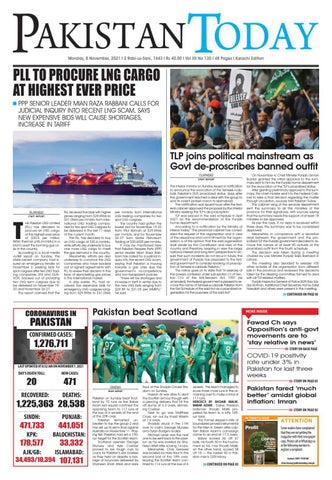
PLL to Procure LNG carGo at hiGhest ever Price g
PPP SeNIOR LeADeR MIAN RAZA RABBANI CALLS FOR jUDICIAL INqUIRy INTO ReCeNT LNG SCAM, SAyS New exPeNSIVe BIDS wILL CAUSe SHORTAGeS, INCReASe IN TARIFF
TLP joins political mainstream as Govt de-proscribes banned outfit ISLAMABAD staff report
ISLAMABAD
t
staff report
He Pakistan LNG Limited (PLL) has decided to procure an LNG cargo at the highest ever price of $30.6 per million British thermal units (mmbtu) in a bid to avert the looming gas crisis in the country. According to a local media outlet report on Sunday, the state-owned company had issued an emergency tender on November 2, seeking bids for spot cargoes after two LNG trading companies, eNI and GUNVOR, backed out of providing two LNG term cargoes due to be delivered on November 1920 and November 26-27. The report claimed that the
PLL received five bids with higher prices ranging from $29.8966 to $31.0566 per mmbtu from international LNG trading companies for two spot LNG cargoes to be delivered in the last 11 days of the current month. The PLL has decided to buy an LNG cargo at $30.6 mmbtu, while efforts are underway to buy one more LNG cargo to meet the gas demand in the country. Meanwhile, efforts are also underway to convince the LNG companies who have backed out of signed agreements with PLL to review their decision in the face of skyrocketing gas prices in the international market. A day earlier, PLL had received five expensive bids for emergency LNG cargoes ranging from $29.8966 to $31.0566
coroNavirus iN
PakistaN
per mmbtu from international LNG trading companies for two spot LNG cargoes. The country had gotten the lowest bid for November 19-20 from Vitol Bahrain at $29.8966 per mmbtu and for November 26-27 from qatar Petroleum Trading at $30.6500 per mmbtu. It may be mentioned here that Pakistan Peoples Party (PPP) senior leader Mian Raza Rabbani has called for a judicial inquiry into the recent LNG scam, saying that Pakistan is moving towards a gas crisis due the government’s incompetence and non-transparent policies. “There will be shortages and increase in tariff in winter due to the new LNG bids ranging from $29.89 to $31.05 per MMBTU,” he said.
The interior ministry on Sunday issued a notification to announce the revocation of the Tehreek-i-Labbaik Pakistan’s (TLP) proscribed status, days after the government reached a deal with the group to end its violent protest march to Islamabad. The notification was issued hours after the federal cabinet approved the proposal by the Interior Ministry seeking the TLP’s de-proscription. TLP was placed in the said schedule in April 2021 on the recommendation of the Punjab home department. According to a notification by the Ministry of Interior today: “The provincial cabinet has considered the request of the organisation and in view of the assurance and commitment by the organisation, is of the opinion that the said organisation shall abide by the Constitution and laws of the country and therefore, keeping in view the larger national interest and long term perspective to ensure that such incidents do not recur in future, the government of Punjab has proposed to the federal government to consider revoking of proscription of Tehreek-e-Labbaik Pakistan.” The notice goes on to state that “in exercise of the powers conferred under sub-section (1) of Section 11U of the Anti-Terrorism Act, 1997 (as amended), the federal government is pleased to remove the name of Tehreek-e-Labbaik Pakistan from the First Schedule of the said Act as a proscribed organisation for the purposes of the said Act”.
Pakistan beat Scotland
Fawad Ch says Opposition’s anti-govt movements are to ‘stay relative in news’
1,276,711
STORY ON BACK PAGE
COVID-19 positivity rate under 3% in Pakistan for last three weeks
LAST UPDATED AT 8:52 AM ON NOVEMBER 7, 2021
NEW CASES:
20
471
STORY ON PAGE 03 SHARJAH Mian abrar
RECOVERED:
DEATHS:
1,225,363 28,538 SINDH:
PUNJAB:
471,733
441,051
KPK:
BALOCHISTAN:
178,577 AJK/GB:
33,332 ISLAMABAD:
34,493/10,394
107,131
CONTINUED ON PAGE 03
more inside
CONFIRMED CASES:
DAY'S DEATH TOLL:
On November 4, Chief Minister Punjab Usman Buzdar granted the initial approval to the summary sent to him by the Punjab home department for the revocation of the TLP’s proscribed status. After granting preliminary approval to the summary, the chief minister sent it to the Federal Cabinet to take a final decision regarding the matter through circulation, sources told Pakistan Today. The cabinet wing of the services department sent the summary to all the ministers of the province for their signatures, with sources saying that the summary needs the support of at least 18 ministers to be approved. As per the rules, if no reply is received within three days, the summary was to be considered approved. Meanwhile, in compliance with a secretive deal between the government and the proscribed TLP, the Punjab government decided to remove the names of at least 90 activists of the proscribed outfit from the fourth schedule. The decision was taken during a meeting chaired by Law Minister Punjab Raja Basharat in Lahore. The meeting also decided to release 100 other activists of the organisation from different jails in the province and reviewed the decisions taken by the steering committee formed to deal with all TLP-related matters. Punjab Inspector General of Police (IGP) Rao Sardar Ali Khan, Additional Chief Secretary Home Zafar Nasrullah and others were present in the meeting.
Pakistan on Sunday beat Scotland by 72 runs as the Babar Azam-led squad confined the opposing team to 117 runs at the loss of 6 wickets at the end of the 20th over. Pakistan remained unbeaten to top the group-2 and has set up its semi-final against Australia on November 11. Playing first, Pakistan had set a 190run target for the Scottish team. Scotland openers George Munsey and Kyle Coetzer proved to be tough nuts to crack for Pakistan’s star bowlers as they held on despite a barrage of bouncers delivered by Shaheen Shah Afridi and Haris
Rauf at the Sharjah Cricket Stadium on Sunday. Hassan Ali was able to dent the Scottish armour though with a piercing delivery that hit the off stump at 5.3 overs, dismissing Coetzer. Next to go was Matthew Cross, run out by Imad wasim at 7.6 overs. Shadab struck in the 11th over to claim George Munsey and Dylan Budge’s scalps. Michael Leask was the next one to be sent back to the pavilion as he was bowled by Shaheen Afridi after scoring 14 runs. Meanwhile, Chris Greaves was bowled by Haris Rauf in the second ball of the 19th over, leaving the Scottish team confined to 114 runs at the loss of 6
wickets. The team managed to score three more runs in the remaining over to make a total of 117 runs. HEROICS by SHOaIb MaLIK, babaR azaM: earlier, Pakistan batsman Shoaib Malik propelled his team to a lofty 189run total. The former skipper’s blitz of boundaries proved instrumental for the Men in Green after captain Babar Azam’s campaign came to an end at 17.3 overs. Babar scored 66 off 47 balls, his fourth 50 in the tournament so far, mar Shoaib Malik, on the other hand, scored 58 off 18 — the fastest 50 in Pakistan men’s T20I history.
CONTINUED ON PAGE 03
Pakistan fared ‘much better’ amidst global inflation: Imran STORY ON PAGE 02 in today’s issue
attention Some readers have complained that they are not getting the magazine with their newspaper copy. Please call or WhatsApp us at the following number to register a complaint. Contact: 0307-7338168 irfan.farooq@pakistantoday.com.pk
02
Monday, 8 November, 2021 | KARACHI
NEWS
PAkISTAn FAREd ‘muCh BETTER’ AmIdST GloBAl InFlATIon: ImRAn ISLAMABAD
P
aPP
RIME Minister Imran Khan Sunday said Pakistan managed “much better” than other countries amidst an unexpected spurt of inflation caused by prolonged Covid-19 quarantines. In a tweet, the prime minister said an unprecedented rise in commodity prices internationally had adversely affected most countries in the world as a result of the lockdowns.
“Pakistan MashaAllah has fared relatively much better,” he observed. A report in the Economist observed that a rebound in the prices of services is a major factor pushing inflation higher. Consumers are returning to restaurants, bars, hairdressers and other in-person businesses faster than workers are, it noted. The prime minister also shared a video clip of Ministry of Finance spokesperson Muzammil Aslam who turned down the notion of a dwindling economy. Quoting the data from the Food and Agriculture Organisation, Aslam said
Govt directs all TV channels to show map of Pakistan before 9pm bulletin NewS DeSk As per a notification issued by the Pakistan Electronic Media Regulatory Authority (Pemra), the government has directed all TV channels to show daily the Pakistan map before airing the 9pm news bulletin. “All the news channels (both public and private) have to flash the political map of Pakistan for 02 seconds before airing the news bulletin at 09:00 pm on regular basis,” read Pemra’s letter, titled ‘Streamlining Correct Use of Pakistan Political Map‘. It is pertinent to note that earlier in August, PM Imran Khan had announced the approval of a new political map of Pakistan, which included Indian-occupied Kashmir in its entirety. The approval was given in a Cabinet meeting chaired by PM Imran earlier during which the participants were apprised of the latest situation in the occupied Muslimmajority region. The premier while speaking during a live televised address to the nation stated that “Today is the most important day in the history that we are presenting a new political map of Pakistan before the world.” “The cabinet has approved the map,” he said, adding that the Kashmiri and national leadership had also green-signalled it. The new map would now be used in school and colleges as well, he concluded.
Closing Ceremony of the 3rd International PACES
PR Closing Ceremony of the 3rd International PACES (Physical Agility and Combat Efficiency System) Competition held at Ayub Stadium, Lahore. Lieutenant General Muhammad Abdul Aziz, Commander Lahore Corps was Chief Guest at the occasion. The championship was specially significant due to the participation of 101 international military sportsmen from 6 countries including Iraq, Jordan, Palestine, Sri Lanka, UAE and Uzbekistan, while Egypt, Indonesia, Japan and Myanmar also participated as observers. 9 teams of Pakistan Army took part in competition. In International Teams Category, Sri Lanka secured gold medal while UAE and Uzbekistan jointly won Silver medal. While bronze medal was shared by Palestine, Jordan and Iraq. In Domestic Teams Category, Defending Champions, Engineers Regimental Centre Team won the Gold Medal. While Silver medal was won by Multan Corps and Bronze Medal by Baloch Regimental Centre Team. In Individual Category, Warrant Officer Mubarek from UAE and Sapper Ahmed Raza from Engineers Centre secured Gold Medals in 3.2 kms race. In Pull Ups event, Gold Medal has been secured by Corporal Dissanayake from Sri Lanka and Sapper Amjad from Engineers Centre with 967 Pull Ups setting a new PACES Championship record. In Sit Ups, Gold Medals were secured by Corporal Dissanayake from Sri Lanka and Sapper Shahzad from Engineers Centre. In Push Ups, Gold Medals were secured by Corporal Obesiri from Srilanka and Sapper Irfan of Engineers Center. In Combat Efficiency Test, Gold medals were secured by Corporal Raja Karuna from Sri Lanka and Naik Ijaz from Multan Corps. In Fittest of the Fittest category, Corporal Dissanayaka from Sri Lanka and Sapper Amjad from Engineers Centre received gold medals.
between September to October, food prices increased by 1.9 percent, World Cereal Index by 3.2 percent, edible oil prices by 9.6 percent, and dairy products by 2.6 percent. However, he said despite the worldwide inflation trend, the exports recorded an increase of 17 percent in October and are expected to touch the impressive $30 billion mark by December. Textile exports are also expected to reach $22 billion by year-end, hadded. Aslam said consequent to the government’s timely measures, the non-oil imports of the country reduced by 12.5
percent last month making a difference of $750 million. He said due to increasing income, tax collection also surged with a 32 percent increase in four months, resulting in the government receiving an additional Rs151 billion compared to the corresponding period last year. He said according to the latest data, the cotton crop increased by 81 percent during the last four months. In August, the industry recorded a growth of over 12 percent and companies’ profits by 21 percent. “All this shows that the country’s economy is heading fast and employment would be required in the coming days,” the spokesperson commented. Addressing a question about any relief
for the middle class in the prime minister’s recently announced Rs120 billion relief package, he said the government had already announced a concession of Rs5 to Rs7 on every electricity unit to be consumed more than the previous year’s consumption during November to February. Moreover, he said the sugar prices would fall in the near future owing to record sugarcane crop. “All these things will appear on the ground in coming days,” Aslam said. He said the prices of oil, gas and edible oil were not in the government’s control, however, owing to the record crops this year, Pakistan would emerge from a food deficit to a food surplus country.
Four BLA, TTP militants arrested in Karachi IBO kARACHI inP
Counter-Terrorism Department (CTD) personnel have arrested four terrorists of proscribed militant organisations during an operation in Karachi on Sunday. The arrests were made during an intelligence-based
operation (IBO) conducted in the Piracha graveyard of Shershah town. The detained terrorists — identified as Riyan, Afzal, Shamim Khan and Faisal — belong to the Balochistan Liberation Army (BLA) and Tehreek-eTaliban Pakistan (TTP). A day earlier, Sindh CTD had arrested a wanted shooter belonging to a Lyari gang in a raid held in
OIC to continue supporting Kashmiris’ right to self-determination: special envoy APP The special envoy of the Organization of Islamic Cooperation (OIC) on Jammu and Kashmir Yousef Aldobeay Sunday said OIC would continue to support Kashmiris’ right to self-determination. He was speaking during a meeting here with the representatives of All Parties Hurriyat Conference (APHC) in Pakistan. He assured the delegation of Kashmiri leaders that OIC would continue extending support for the Kashmir cause. The Kashmir issue was similar to the Palestine issue as the human rights of the people of Kashmir and Palestine were being violated and they were facing the threat of demographic changes. The special envoy reaffirmed OIC’s support to the just struggle of the Kashmiri people. He expressed complete solidarity with the valiant Kashmiri people. He said OIC had longstanding support for the right of self-determination of the people of Jammu and Kashmir in accordance with UN Security Council resolutions. The foreign ministers of OIC Contact Group on Jammu and Kashmir extended the support to Kashmiris in a joint communique during a meeting on the sidelines of the 76th session of the UN General Assembly in New York in September this year. The envoy said after his visit to Azad Jammu and Kashmir he would prepare and present a report during the next ministerial meeting of the OIC, on the situation in the region. In the coming days, the OIC
envoy will get a first-hand account of the gravity of the situation on the ground in the Indian Illegally Occupied Jammu and Kashmir and along the Line of Control. This was the second visit of the special envoy to Pakistan and Azad Jammu and Kashmir. Yousef Aldobeay said his first visit to Azad Kashmir last year was beneficial as during it he had the opportunity to meet the Kashmiri leadership. Ghulam Muhammad Safi, Faiz Nakshbandi, Sheikh Abdul Mateen and Altaf Wani were part of the APHC delegation which met the OIC special envoy. The APHC delegation thanked the special envoy for the OIC’s steadfast support to the people of Indian Occupied Jammu and Kashmir. The delegation apprised the special envoy of the grave human rights and humanitarian situation in the IIOJK. They stressed that following its illegal actions of 5 August 2019, India was now taking steps to disenfranchise the Kashmiri people and to turn the IIOJK into a Hindu dominated territory. The delegation unequivocally rejected these actions and termed them as gross violation of UN Security Council resolutions and international law including the 4th Geneva convention. The Kashmiri delegation affirmed that no amount of suppression by the Indian occupation forces can subdue the resolute spirit of the Kashmiri people to free themselves from the yolk of Indian occupation. They underscored that the valiant Kashmiri struggle will soon be crowned with the glory of success.
Karachi. During interrogations, Miraaj alias Chhotu confessed to killing four people including constable Farooq in 2019 in the Pak Colony graveyard. The CTD personnel also recovered guns from his possession. The accused was previously arrested in various crimes including extortion and remained behind the bars for a period of time.
FBR constitutes committee to probe alleged valuation fraud ISLAMABAD Shahzad Paracha
The Federal Board of Revenue (FBR) has constituted a fact finding committee to probe the alleged valuation fraud worth billions that took place in the Customs department. Sources said that the tax department has constituted a four-member committee under the chair of Director General (DG) Post Clearance Audit Seema Raza Bukhari and consisting of three other members, including Collector Fayyaz Rasool Maken, Additional Director Khaldin-ul-Haq and Deputy Director Fahad Bashir. The team has been tasked to probe the alleged valuation fraud and investigate the legal violations committed by the Quetta Collectorate of Customs (Appraisement), from 2015 to onward. Sources said that the Customs’ Intelligence department, in its investigations, had found out that collectors of the Quetta Collectorate of Appraisement had reportedly been fixing very low and nominal advance assessable values of certain imported goods, including dry fruits and tiles for the last five to six years whereas the Directorate of Customs Valuation had already determined much higher values of the same goods. The collectors ignored these values in violation of the express provisions of Section 25-A of the Customs Act which had conferred over them the power to determine assessable values of imported goods, until 2019, after which these powers were abolished and omitted from law by the Finance Act, when it surfaced that the collectors had abused their powers, causing massive revenue losses. Sources also said that there is a need to assess the legal status of the prima facie’s letter issued by the then DG Valuation, who currently serves in the Board of Investment (BoI), as reportedly this letter was written in violation of the Custom Act law and had paved the way for similar frauds by successive collectors at Quetta.
Pakistani exports to China surge 60pc since launch of FTA: Amb Moin SHANGHAI Mian abrar
Pakistan Ambassador to China, Moin-ul-Haque has said that China is now Pakistan’s largest trading partner as the overall bilateral trade has witnessed unprecedented increase of more than 60 percent since the launch of the second phase of the Free Trade Agreement (FTA) in January last year. During his visit to the 4th China International Import Expo (CIIE), being held in Shanghai, he expressed the confidence that Pakistan’s exports to China would double in the next 3 to 5 years as a result of increasing interest of Pakistani companies to trade with China. The 4th China International Import Expo that started from November 5 and will continue till November 10, has attracted nearly 3,000 businesses from 127 countries and regions. The ambassador said Pakistan and China are very close partners cooperating on international multilateral affairs including trade
imbalances, climate change, health pandemics. Meanwhile, Moin-ul-Haque paid a visit to the Pakistan National Pavilion in Yiwu city of Zhejiang province as part of the economic diplomacy and outreach efforts of the Embassy and Consulates General in China. The pavilion was established in November 2019 at Yiwu China Import Commodity Center Plaza, with an objective to showcase Pakistani traditional and exportable products and culture and to promote bilateral trade. Upon his arrival, the ambassador was received by Eman Li, Chief Executive Officer of the Eman Logistics Co. Ltd., who is also the Honorary Investment Counselor (HIC) of Pakistan. Her company is the operator of the Pakistan pavilion. Ms. Eman briefed the ambassador about the working of the Pakistan Pavilion and efforts being made for promotion of Pakistani products to China through the Pavilion platform. Haque appreciated the role being played by the pavilion and noted that a number of such pavilions had
been established across China which were significantly contributing in introducing Pakistani products to the Chinese market thus leading to substantial increase in Pakistan’s exports to China. During the visit, the ambassador also held a round table discussion with representatives of local chambers of commerce and businessmen. They expressed keen interest in doing business in Pakistan in the fields of solar energy, Halal meat, city lights, stationery, trading and warehousing. The ambassador appreciated their interests and ensured full facilitation in realisation of their business ventures. Meanwhile, Ambassador Haque visited Yiwu city in Zhejiang province and met with the members of the Pakistani community. Yiwu city is a famous hub of small commodities trading in China. A sizable Pakistan community, involved in trading business, resides in Yiwu. As part of the government’s community advocacy and outreach initiative, the ambassador met and interacted with members of the Pakistan community residing in the city and nearby region.
Monday, 8 November, 2021 | KARACHI
COVID-19 POSITIVITy raTe unDer 3% In PaKISTan fOr LaST THree weeKS ISLAMABAD
P
StAff RePoRt
AKISTAN on Saturday confirmed 471 new Covid-19 cases and 20 more deaths, the National Command and Operation Center (NCOC) said on Sunday. Pakistan reported a coronavirus positivity rate of less than 2% for the 21th consecutive day, government data showed Sunday morning.
According to the National Command and Operation Centre (NCOC), 43,348 COVID-19 tests were conducted across the country in the last 24 hours, of which 471 returned positive. The country has recorded less than 1,000 daily infections for the last three weeks. Per the official portal, the rate of positive cases during the last 24 hours was 1.08%. Since October 16, Pakistan’s positivity rate has been under 2%. The NCOC, a department leading the campaign
against the pandemic, said that the country has conducted 21,101,314 tests so far, confirming 1,276,711 cases, including 1,225,363 recovered cases. There are 22,810 active cases under treatment across the country, including 1,233 in critical condition. The pandemic killed 20 people on Saturday, bringing the death toll to 28,538. Sindh is the most affected province of the country with 471,733 infections, followed by Punjab which has reported 441,051 infections.
Government won’t spare hoarders, profiteers: official ISLAMABAD INP
Adviser to Punjab Chief Minister on Information Hasaan Khawar said Pakistan Tehreek-i-Insaf (PTI) government would take action against those involved in the hoarding of sugar
and profiteering off its artificial shortage. The government was also taking steps to eliminate the role of brokers and sugar dealers, those who create an artificial shortage in the market for petty gains, he said while talking to a news channel. He said the government was fully
Hindu body to celebrate Diwali at historic KP temple
aware of problems that people were facing and due to hoarding the essential edible items gets in its price hike. To avoid the sugar crisis in the country, he said the Punjab government took prompt steps and imported sugar which was available in the market at a controlled rate, adding that a mechanism was being
Ministers suggest debate over summary to remove TLP ban: reports ISLAMABAD
ISLAMABAD
StAff RePoRt
StAff RePoRt
A summary recommending revocation of ban on the radical Tehreek-i-Labbaik Pakistan (TLP) party forwarded to the federal cabinet was yet to be signed on, people familiar with the development said on Sunday. In April, the government had proscribed the party after its supporters held violent rallies to condemn the arrest of their leader, Saad Hussain Rizvi. Rizvi had threatened protests if authorities did not expel the French ambassador over depictions of Prophet Muhammad (P.B.U.H.) in his country. But last week the government and the party reached an agreement to end the 10-day long, and at times deadly violent, rally — third of its kind in less than a year — calling for the closure of the French embassy and Rizvi’s release who has been serving prison time since April. Following the deal, Prime Minister Imran Khan on Saturday approved the submission to the cabinet of the summary but sent it to his cabinet for their opinion. The cabinet recommendations will be then sent to the prime minister after a stipulated period of time for further decisions on the matter. According to the rules of business, if a minister fails to respond within the stipulated time period, it is assumed they have approved the recommendations of the document. While the prime minister accorded his approval to the summary, some key ministers demanded an open debate on the issue. They suggested a discussion over the issue in the upcoming session of the cabinet, according to sources. “Some federal ministers are yet to sign the summary,” a source said. “At least 14 ministers signatures are required to lift the ban.” A session of the cabinet is scheduled on Tuesday with the prime minister in chair.
Pakistan Hindu Council (PHC) will organise a grand function on Monday to celebrate the festival of Diwali at the historic Terri Temple in Karak village of Khyber Pakhtunkhwa. The body will host a large number of pilgrims from Sindh and Balochistan. The event will also be attended by Chief Justice Gulzar Ahmed and other dignitaries. Diwali — also known as Deepavali — is the annual Festival of Lights. It is held on the darkest night of the Hindu lunar calendar and ushers in new beginnings just before the arrival of the new moon. Diwali is also observed by Sikhs, Jains and Newar Buddhists around the world. The council has urged the Evacuee Trust Property Board (ETPB) to provide boarding and lodging facilities to nearly 1,500 pilgrims in Hassan Abdal arriving from Sindh and Balochistan to participate in the annual fair. The pilgrims from different parts of the country have already started arriving at Hassan Abdal from where they will move to the destination where the celebration is scheduled to take place.
Verification of electoral rolls begins ISLAMABAD APP
The Election Commission of Pakistan (ECP) launched Sunday a door-to-door verification campaign for electoral rolls prepared by the National Database and Registration Authority (Nadra). The first phase of the campaign would continue until December 6. Registration powers have been assigned to a total of 142 officials: 42 in Punjab, 30 in Sindh, 35 in Khyber Pakhtunkhwa and 34 in Balochistan for updating electoral rolls for the next general elections. Likewise, 2,065 assistant registration officers have been posted to assist those officers. The second phase would begin on January 26 and continue until March 11. All provincial election commissioners have been assigned the task to oversee all stages of the revision of electoral rolls in their respective jurisdictions. The preliminary draft of the electoral rolls would be displayed in designated display centres for public review. The public is also urged to use the opportunity to register their complaints about corrections in the list, transfer of their votes to/from the address on their National Identity Cards (NIC). The voters could add their names to the list and remove the names of deceased voters and voters who have shifted elsewhere. The review officers would decide about the authenticity of voter lists’ objections in their respective areas. ECP also asked the people to ensure receiving their NIC — a prerequisite for registration as a voter and exercising their right to franchise. According to ECP, a person who was in the service of Pakistan could apply to the registration officer for enrollment in the electoral area in which he temporarily resided for being in the service of Pakistan and the facility was also available to his spouse and children.
set up to overcome the shortage and strict action would be taken against those involved in hoarding and profiteers. He criticised the Pakistan Peoples Party government that has been in power in Sindh for the last 13 years but was not ready to take responsibility and instead indulged in politics on the crisis.
The summary by the Punjab government suggesting revocation of the proscribed status reached Saturday to the Ministry of Interior that will later present it to the cabinet division as a final formality to revive the hardline party. The ministry, that put TLP leaders in the Fourth Schedule reserved for proscribed outfits and individuals, will forward the recommendations after approval to the federal cabinet. The cabinet will then give the final nod to the restoration of TLP after which it will no longer remain an outlawed group. It would be via circulation that the cabinet division will approve the summary of recommendations. Minister for Law and Justice Farogh Naseem earlier told the media: “We have given the green signal to the summary of recommendations on TLP matter by the Punjab government.” OBSTACLES NEAR GUJRAT REMOVED: Meanwhile, the authorities removed obstacles on a section of a bridge on the Chenab River and restored regular traffic. The obstacles were placed to bar the marchers of TLP from crossing it. The toll plaza at the river has also been opened and regular traffic is restored on both sides of it. However, containers are still present at the old and new bridges near Gujrat city. The protesters of the banned group were marching towards Islamabad to press for their demands. The Punjab government had deployed Rangers in eight districts of the province to address any untoward incident. Rangers were deployed in Lahore, Rawalpindi, Jhelum, Sheikhupura, Gujranwala, Chakwal, Gujrat and Faisalabad districts to tackle any law and order situation amid the protest. The situation, however, diffused after the government struck the deal with the group while releasing several of its arrested workers.
NEWS
03
TLP joins political mainstream as Govt de-proscribes banned outfit ContInueD froM pAge 01 The government had declared the TLP a proscribed outfit under the anti-terror law in April this year, after three days of violent protests by the group’s members across the country. A day earlier, Prime Minister Imran Khan had approved the submission of the summary to his cabinet while an anti-terrorism court granted post-arrest bail to several leaders of the group in the criminal cases registered with different police stations. “The cabinet considered the summary dated Nov 6, submitted by the Interior Division, which was circulated in terms of Rule 17 (1)(b) read with Rule 19 (1) of the Rules of Business, 1973 for ‘de-proscription of TLP’ and approved the proposal,” says the decision by the cabinet. According to the Rules of Business, 1973, approval by circulation means that a summary is sent to federal ministers for their opinion. The ministers’ recommendations are then sent to the prime minister after a stipulated period of time for further decisions on the matter. If a minister fails to respond within the stipulated time period, it is assumed that they have approved the recommendations made in the summary. As per the contents of the Ministry of Interior’s summary, the TLP had made a request to the Punjab government for its de-proscription on April 29. A proscription review committee (PRC) was then constituted to deliberate on the matter and it concluded that the government’s decision to declare the TLP a proscribed outfit was “based on merit”, the summary said while recalling the history of the entire episode. It added that the views of the law ministry had also been obtained on the matter. “In view of the commitment and assurance given by the organisation (TLP)” as well as “keeping in view the larger national interest”, the provincial cabinet asked the federal government to consider de-proscription of the TLP, the summary had noted.
Pakistan beat Scotland ContInueD froM pAge 01 Scotland first drew blood against Pakistan by dismissing opener Muhammad Rizwan at 6.1 overs. That followed by Fakhar Zaman being sent back to the pavilion at 9.4 overs. The third man to go was Muhammad Hafeez, at 14.6 overs. The Men in Green won the toss and opted to bat first. The star duo of skipper Babar Azam and Muhammad Rizwan opened the game for the side. Rizwan was replaced by Fakhar Zaman, who was then replaced by Muhammad Hafeez, who in turn was replaced by Shoaib Malik. With four men down, Pakistan looked to Malik and Asif Ali to give the side a defensible total. Pakistan are unchanged, while Scotland have two changes: Macleod, Evans out; Tahir, Budge in, ESPN Cricinfo reported. “We want to bat first, put a total and put pressure on them. We are not complacent. We are looking to carry on with our momentum. The same team,” said Pakistan skipper Babar Azam said after he won the toss. “People back home love cricket a lot and they are supporting us. We are trying to make them happy with our performances,” he added. Meanwhile, Scotland captain Kyle Coetzer said: “We’ve been looking forward to these games and we’ll be going out there today to give our best. We have to test ourselves against the best.” “Coming into the tournament, we came in believing that we are capable of competing against the best and we’ll still believe that. But we have to go through these kinds of tests. Hopefully, in our journey we’ve inspired a few people in Scotland and around the world too,” he added.
PDM ‘a gathering of heterogeneous elements’: minister ISLAMABAD INP
Minister for Information and Broadcasting Fawad Chaudhry dubbed the anti-government opposition alliance “a gathering of heterogeneous elements” that he declared had neither a leader nor any programme for the public. In a tweet sent Sunday, Chaudhry said: “Some opposition parties have a presence in one division, others in three.” The minister said the opposition neither had any
leader nor any programme. “The attempt on their part to launch a movement against the only federal party [Pakistan Tehreek-i-Insaf] was nothing but an attempt to keep themselves alive in the media,” he said. Chaudhry declared PTI was the only national political party in Pakistan and one with a “national agenda”. His tweet came a day after the Pakistan Democratic Movement (PDM) decided to launch nationwide protests as well as a long march on Islamabad against the
government’s “anti-people” measures and rising inflation. A statement issued following a virtual meeting of the alliance announced: “A protest will be held in Karachi on November 13, followed by one in Quetta on November 17 and in Peshawar on November 20.” The last rally would be taken out in Lahore, from where protesters would march towards the capital, PDM Secretary General Shahid Khaqan Abbasi said. “This movement will end only after sending [Prime Minister] Imran Khan packing,” the statement said.
India’s NSA Summit to be ‘flop show’; an attempt to undo ‘spoiler’ image ISLAMABAD APP
Having faced strategic losses in Afghanistan after US withdrawal, India is going to hold the NSA-level summit in New Delhi next week, which the analysts believe, is just an attempt to rectify its image of “spoiler” and make a comeback to enhance its relevance in the region. Being well-cognizant of India’s true face and negative role in the region particularly in Afghanistan, a key regional stakeholder Pakistan had already declined India’s invitation to be part of the summit. “I will not go! I am not going … a spoiler cannot be a peacemaker,” Moeed Yusuf told media on November 2,
when asked whether he planned to go to attend the Summit on the invitation of Indian counterpart Ajit Doval. According to Indian media, China has not yet confirmed its participation in the summit which was being keenly watched. “Aside from Pakistan, another country that is yet to respond to India’s invitation is China,” Indian news agency ANI reported Friday. “China has not responded yet to India’s invite,” DNA also reported. For the Summit scheduled to be held on November 10, India had invited Pakistan, China, Russia, Iran, Tajikistan and Uzbekistan. The defense and security analysts are of the view that India always used Afghanistan as a staging ground and a second front against Pakistan.
“India has become irrelevant on Afghanistan after the withdrawal of US-led international forces from Afghanistan. It is desperately trying to stage a comeback,” said Executive Director of Islamabad Policy Research Institute Hussain Nadim. He said with the equation disturbed after the emergence of a new political reality in Afghanistan, India was deeply worried about its strategic losses. Coupled with the fact that China has also foiled the Indian project in Ladakh by completely outmaneuvering India through the use of force. The think tanks are appreciative of Pakistan‘s decision of non-participation in the NSA Summit in New Delhi which had dealt a blow to India.
04 NEWS 8th November 2021_Layout 1 11/7/2021 10:48 PM Page 1
Monday, 8 November, 2021 | KARACHI
04 NEWS
DIPLomATIc coRneR: KKH beST TRADe RouTe To booST PAK-KAzAKHSTAn TRADe voLume: Amb YeRzHAn KISTAFIn ISLAMABAD
A
MIaN abrar
MBASSAdoR of Kazakhstan to Pakistan, Mr Yerzhan Kistafin Sunday called for using the Karakorum Highway (KKH) as best trade route between the two countries. Ambassador Kistafin expressed these views during a call on President All Pakistan Business Forum (APBF) Syed Maaz Mahmood, Chairman Ibrahim Qureshi and General Secretary Khurram Niaz during his visit to APBF on Sunday. The Ambassador said that the KKH becomes inaccessible during the harsh winter season but it can be safely used during the remaining part of the year. He hoped that the peace and stability in Afghanistan would strengthen trade ties between Pakistan and Kazakhstan, besides contributing to the economic uplift of Afghanistan as a regional transit hub. Yerzhan Kistafin pointed out that a number of Pakistan products including fruits, vegetables, pharmaceuticals, surgical instruments and leather goods had a great potential in Kazakhstan. Pakistan and Kazakhstan have great potential to enhance cooperation in many fields and if both countries facilitate their private sectors, the annual bilateral trade volume could surge from the current level to $300-500 million. The current bilateral trade volume of $45 million was hugely low, compared with the real potential of bilateral trade, he said, adding that the alternative route of Karakoram Highway may also be explored for uplifting bilateral trade. The Kazakh ambassador said
Kazakhstan is the biggest landlocked country in the world and we understand the importance of regional connectivity. He said Afghanistan could be the most beneficial country if trade increases between Pakistan and Kazakhstan though it. He warned that if stability did not come to Afghanistan, it would have wider regional implications. Pointing to increased potential of people to people cooperation between Kazakhstan and Pakistan, he said Pakistan Prime Minister discussed bilateral agenda and economic cooperation during meeting with Kazakhstan President in dushanbe. He said our nations have been cooperating for centuries but nowadays there is less information about the culture and lifestyle of the people of both
countries. He said we need to enhance awareness about each other. Speaking on the occasion, APBF President Syed Maaz Mahmood said both countries should focus on establishing air, road and railway links in order to boost two-way trade. Regular exchange of trade delegations and holding single-country exhibitions on a reciprocal basis is necessary to identify new areas of mutual cooperation. Maaz Mahmood recommended that both countries must take initiatives to enhance trade and investments in textile and cotton products, pharmaceuticals, and food items, engineering equipment and machinery, and construction enterprises. Pakistan and Kazakhstan are going to sign three memoranda of understanding for cooperation in the areas of trade
and investment, defence and strategic studies, and training in foreign services which needs to be institutionalized as soon as possible. APBF Chairman Ibrahim Qureshi said there is a paradigm shift in Central Asia to further enhance regional connectivity through greater regional cooperation and socio-economic integration due to which there is an urgent need that both the countries must institutionalize all possible measures to further strengthen their bilateral relations. Ibrahim Qureshi said that peace in Afghanistan may be a game changer for the rest of the region and may open a new gate of unlimited opportunities of mutual cooperation, coordination and collaboration in diverse fields between the two countries. Syed Maaz Mahmood said the scope and horizon of diplomatic relations between the two countries are diversified and dynamic due to which right from the beginning both the countries have been sharing better political understandings include various official mutual visits of their leadership and cooperation and meaningful coordination within various international organizations i.e. the United Nations (UN), the organization of Islamic Cooperation (oIC), Economic Cooperation organization (ECo), Shanghai Cooperation organization (SCo) and Conference on Interaction and Confidence-Building Measures in Asia (CICA). Moreover, the APBF President said that Pakistan also offers the critical over land routes and connectivity for mutually beneficial trade and regional energy cooperation. Whereas Kazakhstan is an integral part of Central Asia Region connected with ancient links with South Asia.
Seven godowns sealed, 19 arrested for hoarding sugar in Bahawalnagar BAHAWALNAGAR INP
As many as seven godowns were sealed and 2,321 hoarded sacks of sugar were recovered during the action of civic authorities in Bahawalnagar on Sunday. The authorities have launched a crackdown against the artificial shortage of sugar which caused the rates of the commodity to go further up.
In recent action in Bahawalnagar, as many as seven godowns were sealed, and 2,321 sacks of sugar worth more than Rs20 million. Furthermore, 19 people were arrested over the charges of hoarding and selling the sugar at excessive rates. The deputy commissioner said action will continue against the hoarders in the region. Key to note that Punjab Chief Minister Usman Buzdar has ordered the authorities concerned to take stern action against sugar hoarders across the province.
Chairing a high-level meeting here in Lahore, the CM Usman Buzdar has directed Punjab Minister for Industries and Commerce Mian Aslam Iqbal to speed up the crackdown against sugar hoarders in the province. He also ordered to ensure the availability of sugar in markets to the general public at govt fixed rates. The chief minister also asked Mian Aslam Iqbal to take steps for the early start of sugarcane crushing season 2021-22.
Anti-Hoarding drive: 799 raids conducted; 19 nabbed, 24 FIRs registered in Pindi RAWALPINDI: Rawalpindi district administration conducted 799 raids in different markets of the district to check hoarding and profiteering during current month while 19 shopkeepers were arrested, 24 FIRs were lodged besides imposing Rs 200,000 fines on the violators. According to a district administration spokesman, Chakki wheat flour was being supplied at Rs 58 per kg. The administration on the directives of Chief Minister Punjab Sardar Usman Buzdar launched a special campaign and took action against the profiteers and hoarders while 19 premises were also sealed for violating the orders of the government. Commissioner Rawalpindi division Syed Gulzar Hussain Shah was also regularly chairing meetings to review prices of daily use items. In the last few days, after artificial price hike, strict action was taken in all divisions of the province including Rawalpindi and the whole sale dealers of sugar were arrested for creating artificial shortage. A wholesale dealer of sugar was also arrested in Rawalpindi on the same charges, she added. Imported sugar was being sold in 33 sahulat bazaars across Rawalpindi district and so far 329 metric tonnes had been sold in these markets, she informed. Flour was also being sold at government-fixed rates across the district, she said adding, so far, 286,000 bags of flour had been sold in these markets. She informed that the prices of potatoes, tomatoes and onions were better than several other cities. dC counters had also been established to provide relief to the citizens particularly at big stores in the division. At present, 127 dC counters were functional in Rawalpindi division, she informed. The Commissioner had directed all the price control magistrates to ensure sale of quality wheat flour at the sale points, she said adding, the authorities were instructed to strictly monitor the sale of sugar at the shops being provided sugar at Rs. 89. Sale of sugar at Rs 90 per kg should also be ensured, she added. Staff rePort
Sugar hoarding: Two of four sugar brokers detained in Lahore LAHORE: The Lahore administration is tightening its noose around the sugar mafia as the authorities have issued detention orders of sugar brokers involved in the artificial hike in the price of the commodity. Sources on Sunday divulged that according to a source report of the sensitive agencies, four brokers were manipulating the sugar prices. In the light of the intelligence report, the city administration has decided to zero tolerance in on the sugar mafia and ordered for the house arrest of two brokers: Shahzad Faisal and Junaid Butt for 30 days. Sources informed that the report, prepared by the sensitive agencies, has identified four big brokers who were involved in the price spike. Among them, two have already been taken into custody, sources added. Lahore deputy commissioner has issued orders of house arrest of two other brokers. The house arrest orders of broker Shahzad Faisal, s/o Allah Rakha, r/o dHA Phase V, Lahore; and another broker Junaid Butt, s/o Riaz Butt, r/o Tauheed Park, Multan Road, Lahore have already been issued. According to source report, both the brokers have been involved in hiking sugar price by creating artificial shortage of the commodity and spreading rumours. The house arrest order was issued under Section III of Public ordinance, 1960 in the light of all documentary proofs. Both the brokers will be kept in house arrest under the watch of Central Jail, Kot Lakhpat superintendent. A copy of house detention orders has been sent to the home department additional chief secretary, Lahore commissioner, Lahore CCPo, Punjab IG and IG Jails. INP
Environment paying price of conflict in Kashmir SRINAGAR ageNcIeS
The decades-long conflict in Indian-occupied Kashmir that has cost human life also has not spared the fragile environment of the region, experts say. For International day for Preventing the Exploitation of the Environment in War and Armed Conflict that fell on November 6, Anadolu Agency spoke with experts to understand how armed conflict is costing the environment with unbearable consequences. “Wherever there is anthropogenic (human) activity, it is definitely going to cost the environment, particularly in eco fragile zones,” dr. Irfan Rashid, an expert on the environment and climate change, told Anadolu Agency. As India pledges support for environmental protection at the 26th UN Climate Change Conference, also known as CoP26, underway in Glasgow, Scotland, environmental concerns in its own backyard have remained unanswered, particularly in the northeastern regions. DEgRADAtION: In the Kashmir region, the environmental degradation can be traced back to after the partition of the Indian subcontinent into India and Pakistan that heavily
affected the Himalayan region, according to research scholar Jennifer Crook. In a research paper, War in Kashmir and its effect on the environment, Crook wrote that the deployment of Indian and Pakistani armies in Kashmir in 1947 led to large-scale poaching of rare species such as ibex, blue sheep, urian the big-horned sheep, antelopes and the snow leopard. “At first, the soldiers were killing the animals for food but when the poorly paid soldiers realised how valuable the animal furs and skins were in the international markets, they started to slaughter the Kashmiri animals with much greater zeal,” wrote Crook. She noted that the consequence has been that some rare species like the snow leopard, flying squirrel and long-tailed Himalayan marmot have been pushed to the verge of extinction. Environmental activist Raja Muzaffar Bhat told Anadolu Agency that the armed presence at any eco-fragile zone is devastating to the environment. “Not only it impacts humans but it greatly dangers flora and fauna of the area while giving reference to Tosamaidan meadow which sometimes back was being used an artillery firing range by the Indian army,” said Bhat. Sixty-eight people were killed and 37
have been injured over the years due to the unexploded shells lying in the meadow, which lies in central Kashmir’s Budgam district, according to Under the Right to Information Act. That includes children. In 2017, a court ruling directed compensation to victims while it also called out for measures to tackle environmental degradation in the area. But the Tosamaidan Bachov front, an organization working for the betterment of the area, said the government has not taken many initiatives and many victims have not yet been paid compensation. REcEDINg NAtuRAL REsOuRcEs: The Kashmir region is home to 120-150 glaciers but due to human interference and tension, they are receding at a pace, experts say. Scholar dH Eddie, in his 2002 study titled The Military Impact on the Environment, said environmental stress is a cause and effect of political tension and military conflict between India and Pakistan and they fought to assert or resist control on the natural resources of Jammu and Kashmir. “If this conflict continues these resources become scarcer,” the study said. “The more human interference around these natural resources, the more environmental
CMYK
problems will arise.” Eddie added that it has led to recession in glaciers because we have allowed a lot of human interference. Another study, Linking the recent glacier retreat and depleting streamflow patterns with land system changes in Kashmir Himalaya, India, published in the journal Water by Irfan Rashid, Ulfat Majeed, Sheikh Aneaus and Mauri Pelto assessed the changes in Kashmir’s largest glacier, the Kolahoi Glacier, between 1962 and 2018, and found that the glacier is receding at a very fast pace. “It has lost almost 23 percent of its area since 1962 and has fragmented into smaller parts,” it said. It also said the glacial snout has been melting and retreating fast and has been in an imbalanced state between 1962 and 2018 with melting rates being much higher than the accumulation rates. “once you emit smoke or soot on the glacial body, it quickly absorbs it making it prone to heat which automatically helps it into recession,” said Rashid. A separate study mapped 147 glaciers in the Kashmir region said they were reduced 28.82% from 1980 to 2018 and glacier loss in the region is much higher as compared to other Himalayan regions.
gROWINg WILD/mAN cONfLIct: Steadily decreasing forest cover in Kashmir, a result of legal and illegal logging operations and human encroachments into the forest, is a direct cause for increasing encounters between humans and animals, experts say. It is complicated by the presence of a huge military buildup around those areas. Aliya Mir, a wildlife expert said when we have eroded or denuded forest areas which is the living habitat of many animals, the cost will be innumerable. “We are seeing an increasing number of wild/ animal conflicts and the reason is human interference. If we can stop it, we can also stop these conflicts,” said Mir. Kashmir’s dense forest area has also shrunk considerably, from 37% of its total area to 11%. Mohammad Sultan Bhat, who heads The Third Pole website of the geography department at Kashmir University, said the area under dense forests around the tourist resort of Pahalgam in southern Kashmir has fallen by 191 square kilometers (74 square miles) from 1961 to 2010 with an average annual loss of 3.9 square kilometers (1.5 square miles), largely due to illegal construction in a forested area.
Monday, 8 November, 2021 | karachi
News
DevelopmeNt works worth rs. 142 BN IN DIstrIct peshawar uNDerway: cm mahmooD khaN PESHAWAR
c
Aziz Buneri
HIEF Minister Khyber Pakhtunkhwa Mahmood Khan has said that work is in progress on various developmental schemes worth Rs. 142 billion in district Peshawar whereas developmental schemes worth Rs. one billion in each constituency of the district would also be started adding that keeping in view the health facilities requirements of Peshawar region, a tertiary level hospital under public private partnership would also be established. Addressing a public gathering in Peshawar on Sunday Mahmood Khan said that when Prime Minister Imran Khan came into power, the country faced a difficult situation, the country was plunged into foreign debts and economy of the country was on the verge of collapse. He said that the incumbent government under the visionary leadership of Prime Minister Imran Khan, as its top priority started to take practical steps to revive the economy but unfortunately it was badly hit by corona pandemic adding that Prime Minister Imran Khan, through an effective strategy steered the economy of the country successfully which was acknowledged and appreciated worldwide. Mahmood Khan remarked that the global pandemic of corona as elsewhere in the world is resulted in the current wave of inflation in Pakistan, and the present government under the vision of leadership of Imran Khan is taking result oriented steps to provide maximum possible relief to the public in the prevailing situation adding that the Prime Minister Imran Khan has announced a historic relief package worth Rs. 120 billion
to give relief to the general masses. Mahmood Khan stated that if need arises the provincial government would divert developmental budget to give maximum relief to the people. He ascribed the flawed economic policies of the previous rulers as another reason for the current inflation and said that during the past seventy years various political parties ruled the masses and enjoyed powers, looted the public exchequer but made no planning for the future of the country which has resulted in the current inflation badly affecting the poor masses. Mahmood Khan further said that the incumbent government was not only committed but also taking visible steps to steer the nation out of these crises. Touching upon the three year performance of his government, Mahmood Khan stated that when the provincial government came into power, three years back, it had to face a number of challenges, the merger of tribal areas being top of them adding that merger of Ex-FATA was undoubtedly a complicated and difficult task but because of the full support and visionary guidelines of Prime Minister Imran Khan, the provincial government completed the entire process of the merger in the short time of the two years and now the government is focusing on the accelerated development of these areas, completion of Peshawar Bus Rapid Transit Project was another challenge for the incumbent provincial government which has now become an iconic project of public transport benefitting thousands of commuters on daily basis. He added that completion of Swat Motorway Phase-I and launching of Rashakai Special Economic Zone were yet another two important
achievements of the provincial government. The chief minister remarked that the incumbent provincial government was working under a well-conceived planning in agriculture, industry and other sectors adding that progress is being made on CRBC Gomal Zam and Tank Zam Dam projects to bring the huge chunk of unirrigated land of southern district under cultivation with the aim to ensure the food security of the province. Similarly, the provincial government was working on the establishment of economic zones and construction of motorways in the province to make the province a hub of trade and industrial activities adding that D.I Khan Motorway, Swat Motorway, Chitral Motorway and Khyber Pass Economic Corridor projects, on completion would connect all the districts of the province with one another and thus boost trade and economic activities. Touching upon the public welfare initiatives of the province Mahmood Khan termed Sehat Card Plus Scheme as a flagship project of his government and said that under the scheme cent percent population of the province was being provided free healthcare facilities adding that Kissan Card Scheme was another important scheme of his government under which fertilizers, seeds, pesticides and other agriculture related items are being provided to farmers on subsidized rates. Mahmood Khan said that the provincial government had earmarked Rs. 10 Billion in the current budget for food card scheme to give relief to the needy families of the province and added that education card would also be launched very soon to give support to the needy students to pursue their academic career in reputed education institutions across the country.
Subsidy under PM’s relief package to be gradually increased, says Sania Nishtar Newly formed 14member Balochistan cabinet swears in Newly formed 14-member Balochistan cabinet took oath at a ceremony at the Governor House in Quetta on Sunday. Balochistan governor Syed Zahoor Ahmad Agha administered the oath to the new cabinet members. As per the official handout, a notification of the appointment of five advisors would also be issued on the occasion. Balochistan Awami Party’s (BAP) Mir Zahoor Ahmed Buledi, Sardar Mohammad Saleh Bhootani, Sardar Abdul Rehman Kethran, Nawabzada Tariq Magsi have now become part of the new cabinet. Moreover, Ahsan Shah, Mir Naseebullah Marri, Mubeen Khan Khilji and Mir Asadullah Baloch also took oath of office as provincial ministers Furthermore, Noor Nuhammad Damar, Akbar Askani, Sikandar Imrani, Abdul Khaliq Hazara, Zamrak Achakzai and Muhammad Khan Lehri were also sworn in to the new cabinet. Earlier on October 29, BAP leader Mir Abdul Quddus Bizenjo took oath as the new Balochistan chief minister after he was elected to the office unopposed. Governor Balochistan Zahoor Ahmed Agha administered the oath to the newly-elected chief minister at the Governor House, Quetta, after he received 39 votes in the Balochistan Assembly. news desk
City notes M A niAzi
t
HE sympathy of Imran Khan was manifest in his speech announcing the Great Subsidy, which wll make us forget that there was anything like inflation. However, the increase in petrol prices the next day made everyone suspicious. However, as he pointed out the day after that, prices were still the lowest in the entire region. Now aht are we to make of that? Was this just another of the U-turns that prove Imran is a great leader, or was that to be taken as an expression of intent? What we need is a rationing scheme. And the ration depots are to be allocated to PTI workers. Not only will it create employment, but also a class of those dedicated to the PTI. It should not be forgotten that allocating ration depots was so effective for the PPP that it is still remembered over four decades later.
The subsidy amount being given under the newly announced Ehsaas Rashan programme would be gradually increased keeping in view the impact of inflation on the purchasing capacity of the common people, Special Assistant to the Prime Minister on Poverty Alleviation and Social Protection Dr Sania Nishtar said in an interview with APP on Sunday. For now it is important that this system runs on a massive scale in a transparent manner and creates an acceptability among the masses, she said, adding that the amount of subsidy or the quantity of the commodities can be increased through a single policy decision. She said the success of the programme will be determined once the “buyers and the kiryana store merchants are mobilised and registered on a large scale”. She claimed that the system was developed on a “fast track basis in a
very short period [of time] to provide relief to the masses”. The SAPM revealed that the web portal to register beneficiaries under the Ehsaas Rashan programme will start operating from Monday. “The programme will enable buyers — having a monthly income of less than Rs31,000 – to buy flour, pulses and edible oil on subsidised rates from the designated stores,” she said. The merchants having bank accounts would download the app to ascertain the eligibility of the buyers so that they could pass on the subsidy, Dr Sania said. She added that the buyers would be able to purchase the items at subsidised rates and receive a digital receipt. Nishtar said there were 1,000,000 grocery stores across the country and all were eligible to reg-
ister with this programme through their bank accounts. To a question about the expansion of Ehsaas Tahafuz initiative, the PM’s aide said the pilot project being executed at the Holy Family Hospital, Rawalpindi had served 600 patients so far. “The programme would be upscaled to 16 hospitals nationwide during this calendar year.” About the Ehsaas Undergraduate Scholarship Program, she said the portal for the registration would remain open till November 30; however, there was a possibility of an extension in the date. Responding to a question on fake messages and portals circulated on social media, Nishtar said that a meeting in this regard would be held with the officials of the Pakistan Telecommunication Authority (PTA), Federal Investigation Agency (FIA) and other security agencies next week. APP
05
Iraq prime minister survives assassination bid, calls for ‘calm and restraint’ Iraq’s Prime Minister Mustafa al-Kadhemi was “unharmed” in a “failed assassination attempt” after a drone attack on his official residence on Sunday night, his office said. “A drone tried to target the residence” of the premier, who was not injured, his office said in a statement. The attack in Baghdad’s Green Zone was the first to target the residence of Kadhemi, who has been in power since May 2020, and came as Iraq’s political parties wrangle over who will run the next government after elections last month. That vote saw the Conquest (Fatah) Alliance, the political arm of the pro-Iran Hashed al-Shaabi paramilitary network, suffer a substantial decline in its parliamentary seats, leading the group to denounce the outcome as “fraud”. No group has yet claimed responsibility for Sunday’s attack, which left two bodyguards injured, according to a security source. PM calls for calM: In a tweet, Kadhemi called “for calm and restraint on the part of everyone for the good of Iraq”. “My residence has been the target of cowardly assault. Praise God, I am fine and so are those who work with me,” he then said in a short video shared on social media. “Cowardly missiles and drones don’t build nations.” Kadhemi’s office described the attack as a “failed assassination attempt”. The United States swiftly condemned the attack and said it was “relieved to learn the prime minister was unharmed”. “This apparent act of terrorism, which we strongly condemn, was directed at the heart of the Iraqi state,” State Department spokesman Ned Price said in a statement. “We are in close touch with the Iraqi security forces charged with upholding Iraq’s sovereignty and independence and have offered our assistance as they investigate this attack.” A large number of security forces were deployed in and around the heavily guarded Green Zone, which also hosts the US embassy and is frequently targeted by rocket attacks. On October 31, three rockets fell in Mansour, a neighbouring district, without causing any injuries. Mounting tensions: The attack came during a period of soaring tensions over the results of the October 10 elections. Hundreds of Hashed supporters clashed with police on Friday while protesting near the Green Zone to vent their fury over the result. One protestor died of their injuries in hospital, according to a security source, while a Hashed source said two demonstrators were killed. The health ministry reported 125 injuries, most of them from the security forces. Several hundred supporters of pro-Iranian groups returned to the Green Zone on Saturday to protest. Some burned a portrait of the prime minister, whom they called a “criminal”. According to preliminary tallies, the Conquest won around 15 of the 329 seats in parliament last month, down from the 48 it held previously, which made it the second-largest bloc. The big winner this time, with more than 70 seats according to the initial count, was the movement of Moqtada Sadr, a Muslim preacher who campaigned as a nationalist and critic of Iran. Final election results are expected within weeks.
Journalist’s widow seeks justice, financial assistance nausHero feroZ: Late journalist Aziz Memon’s widow has appealed for the immediate arrest of her husband’s killers and sought financial assistance to run her house and a job for her son. She has also appealed for fulfilment of the promises made by the provincial ministers and advisors to provide her jus-
tice and financial help. She said her financial condition was very bad and all their expenditures were being borne by her late husband’s elder brother. The deceased journalist Aziz Memon was the correspondent of a local regional newspaper and a news channel at Mahrabpur Tehsil of district Naushero Feroz, Sindh, who
was murdered on February 16, 2020. Late Aziz Memon’s widow said the provincial ministers and advisors had promised for the provision of job to her son but unfortunately not a single promise had been fulfilled so far. She appealed to the Prime Minister, Chief Justice of Pakistan, Army Chief and
Chief Minister Sindh for financial support and justice. The deceased journalist’s elder brother Hafeezur Rehman said that he had requested the provincial ministers and advisors for provision of job to late Aziz’s son, who was an Engineer, but they were still waiting for a positive response. APP
Does aNyBoDy kNow what to Do? The depots, or rather the rationing system behind them, was basically political rather than economic. Dismantling the rationing stem under Zia paved the way for most of the rollback of Bhutto’s economic measures. I know those policies have led to a lot of flak for Bhutto, but at least it provided an excuse. And a target.Rolling things back was the main game in town. But when you look at Imran’s tenure, what is there to roll back? What are the steps which, if taken, will get the economy back on track? Just one example will suffice. When Pakistan achieved autarky in wheat and sugar, Zia was able to end rationing. I spent the next 30 years with the working assumption that Pakistan was self-sufficient in wheat and sugar. We’re not completely independent of imports for food, for we im-
port palm oil, doe vanaspati ghee. But Imran has managed to bring wheat and sugar back on the list of things we either import, or starve. So what is there to reverse? In fact, that bothers me.Because the other parties, both of which we have tried before, don’t have any solutions about how we are to get out of this mess. So how do we get out? I’m afraid that the previous solution, better governance, if necessary by the military, will probably not work. I’ve got the sneaking suspicion that the present mess is not the result of not operating the system right, but of the system coughing and sputtering, and no longer being able to run. It had seemed that the opposition dream of the PTI falling of its own weight was basically an excuse for inaction. But it seems
CMYK
it might be right. But where it might be wrong is its belief that it would not be as hapless if it took the reins. After all, it hasn’t shared any ideas about how it would do better. That might be because it doesn’t want to give the PTI any ideas, but it might also be because it’s as intellectually bankrupt as the PTI. Another act of intellectual bankruptcy was the Indian team taking the knee at the T20 World Cup, which is ongoing. Well, not so much intellectual bankruptcy as poverty really,because that was basically a borrowed action, not really a spontaneous one.And the Indian cricketers should be worried about Kashmir because Imran has announced that he will act as the representative of the Kashmiri people. The Indian cricket team seems to produce rightwingers too, but skipper Virat Kohli was
quick to spring to the defence of the Muslim on the team, Muhammad Shami, who was trolled on the Internet because of India’s defeat by Pakistan in their pool match. Shami went in at number nine in the last over, and didn’t face a delivery because the batsmen had crossed over when Pandya was out. He did hve the worst economy rate of the attack, but the good Hindus in the attack didn’t have a markedly lower economy rate. If the Mumbai Matchfixer was in action, he had convinced them too. Anyhow, for defending this performance, Kohli was trashed on the social media. One threat he got was the rape of his daughter. She’s nine months old. The netizen tried to use a Pakistani’s picture, but was identified as a Telugu speaking BJP supporter. More BJP supporters speak Telugu than Pakistanis.
06-07 Comments - 8th November 2021_Layout 1 11/7/2021 11:18 PM Page 1
Monday, 8 November, 2021
06 COMMENT
The need for more ambitious commitments
Dearest LNG ever The PTI government doesn’t seem to learn
P
AKiStAN managed to pay the highest ever price of $30.60 mmbtu for a Liquefied Natural Gas (LNG) cargo to stave off a gas shortage in the coming winter. this cargo is to take the place of a cargo on which commodity trader and energy giant Eni reneged on their commitment to deliver the cargo they had promised. the situation is critical enough, but what makes it so shameful is that there was a similar crisis last year, and there had to be panic buting then too. it seems the government learnt nothing from that debacle, and went ahead and signed an agreement with partners it apparently did not know the track record of. One of the factors for the needless crisis is that the government still has a monopoly over the import of LNG. in principle, the private sector has been allowed to import, which would include taking on the responsibility of ensuring that suppliers are reliable. however, while the government has paid lip service to the idea of private imports, it has used the complicated LNG storage and regasification process as an excuse for imposing deadlines which cannot be met. in principle, the Pti government had the right idea in bringing in advisers from the sector in Nadeem Babar and tabish Gauhar, but they have both resigned under clouds, showing, it seems, that the Pti does not choose experts wisely. hammad Azhar, the Energy Minister, seems hapless in the entire crisis, which indicates that good intentions are apparently not going to be enough to ensure that people’s cookers and geysers keep alight this winter. the old excuse, put forward by the Pti’s supporters, that the Pti needs time to learn, will no longer wash. Surely now in its third winter, the Pti can be expected to know what are the problems of the winter, and be able to tackle them. the issue with experts is that they usually bring along both biases and friendships. this applies to any sector, and the Pti has gained more experience than most in this. the more usual combination of political leaders and bureaucrats would probably be best able to deal with issues, rather than the fly-by-night whizz kids and carpetbaggers the regime seems to favour.
Bargaining at COP26
Dr. Omer JaveD
‘We the islands, that are devastated most, demand that your commitments of one hundred billion [dollars] annually be increased to meet the four trillion dollars the World Bank reports is needed. We see the scorching sun is giving us intolerable heat, the warming sea is invading us, the strong winds are blowing us every which way. Our resources are disappearing before our eyes, and our future is being robbed from us. Frankly speaking, there is no dignity to a slow and painful death: you might as well bomb our islands, instead of making us suffer, only to witness our slow and fateful demise. Leaders of the G20, we are drowning, and our only hope is the life-ring you are holding. You must act now. We must act together.’ – Address by President of Palau at the COP26 summit
W
hiLE it is the combined responsibility of both developed countries to come together with needed commitments– much more ambitious than being made– the onus falls on developed countries nevertheless to show far greater ambition, in terms of policy actions and finances, than have been committed and come true on. George Monbiot in his November 5 Guardian published article ‘Never min aid, never mind loans: what poor nations are owed is reparations’ indicated in this regard: ‘the wealthy nations, always keen to position themselves as saviours, have promised to help their former colonies adjust to the chaos they have
MPA booked Nazim Jokhio’s murder a test for the PPP in more ways than one
t
hE PPP needs to wonder why a case for the murder of Nizam Jokhio was only registered after the family and other protesters had to protest at several places. true, the alleged murderer, Jam Awais, is a party MPA, but the FiR says that he had tried to get some foreign guests to hunt the houbara bustard, an endangered species. Nizam tried to stop them, which allegedly enraged Jam Awais, who summoned him to his farmhouse in Malir, whee he and four others allegedly beat Nizam to death. it seems that Jam Awais thought his stature as an MPA extended to two criminal acts: the hunting of houbara bustards, and killing someone on his land. it is to be hoped that the government allows a fair investigation and a fair trial to take place, and does not emulate the Balochistan case where an MPA who ran over a traffic policeman, killing him, managed to escape justice. At the very least, whether there is a trial or the victim’s family compounds the offence by accepting blood money, Jam Awais should not be awarded the PPP ticket again, and he should be expelled from the party. it is not right that, in this third decade of the 21st century, such egregious displays of the Sindhi wadero’s impunity before the law should have any place. these two actions are considered crimes of the worst kind, and thus committing them with impunity has a pleasure of its own: hunting an endangered species and murdering another human being. it is part of the dark side of the Sindhi landowning tradition, though it is not really a Sindhi thing, but applies to a large extent across the entire indoGangetic plain, extending northwards to Punjab and eastwards to Balochistan, and westward to Bengal, crossing both Uttar Pradesh and Bihar. if the PPP professes to be a liberal, progressive party, and to be headed by a ‘woke’ individual like Bilawal Bhutto Zardari, it will not tolerate upholders of this culture in its ranks.
India is still conspiring against Pakistan
attiya munawer
W
ith the withdrawal of the US troops from Afghanistan and the establishment of the taliban government there, the atmosphere of regional peace and stability seems to be improving, yet the challenges facing Pakistan in terms of its own security have increased. india first had a rare opportunity to foment conspiracies to destabilize Pakistan by infiltrating its trained terrorists into Pakistan with the help of the Kabul administration through Afghan territory. But since the Afghan revolution, the interests of both the USA and india have received a setback. however, india is keen to find new ways to create chaos and unrest inside Pakistan based on its security-weakening agenda or Pakistan, following protests by a banned organization. According to government officials, the hand of our enemy india can be seen behind the atmosphere of disturbance. there is no doubt that the Pakistan military is endowed with the stratagem and God-given capabilities to overcome all kinds of internal and external challenges, but the traditional insidious enemy we face
Arif Nizami (Late) Founding Editor
Yousaf Nizami M. A. Niazi
Umar Aziz
Joint Editor
Joint Editor
Executive Editor
Lahore – Ph: 042-36300938, 042-36375965
While it is important that every country makes an ambitious effort to deal with the existential crisis in the shape of climate change, yet nevertheless the onus of commitments to deal with the climate change crisis, lies with rich, advanced countries, who have been big polluters in the historical sense, and have greater financial space, and hence responsibility to both commit much higher than developing countries, but also to provide need financial assistance to developing countries
Determined to retaliate
Dedicated to the legacy of late Hameed Nizami
Editor Aziz-ud-Din Ahmad
caused. Since 2009, these rich countries have pledged $100billion a year to poorer ones in the form of climate finance. Even if this money had materialised, it would have been a miserly token. By comparison, since 2015, the G20 nations have spent $3.3 trillion on subsidising their fossil fuel industries. Needless to say, they have failed to keep their wretched promise.’ At the same time, the commitments that have been made, although encouraging, are not ambitious enough. in a November 5 editorial, The Guardian indicated encouraging part as: ‘Pledges made during Cop26’s first week were encouraging. But without adequate finance and monitoring they don’t mean much. While it is not yet clear exactly where the various pledges will get us to in terms of limiting temperature rises, the new agreement on methane spearheaded by President Joe Biden and a commitment by india to get half of its energy from renewable sources by 2030 are highly significant.’ having said that, the encouraging signs, although not ambitious enough, are also facing an uphill task. A recent Bloomberg published article ‘india’s 2070 climate target is a far bigger deal than it sounds’ while shows optimism over india’s much changed stance in reducing emission since COP21 in Paris, nevertheless the much-needed target of 2050 has been missed by 20 years, which is big indeed. the limit of 2050 indeed needs to be seen with a sense of extreme rigidity, and rightly so given iPCC’s forecast on reaching 1.5°C in a little over a decade. As per the article ‘For a world that needs its carbon emissions to diminish to nothing within the next 30 years, the announcement by
I
Karachi – Ph: 021-35381208-9
I
india’s Prime Minister Narendra Modi of a 2070 net zero target might sound profoundly disappointing. the world’s biggest emitter, China, isn’t promising zero before 2060. the second-largest, the USA, is unlikely to be able to pass legislation through Congress sufficient to fortify President Joe Biden’s 2050 target against unpicking by future administrations or the courts. Now the third-ranked polluter is out with a promise that’s 20 years too late. After a lacklustre communique on climate from the Group of 20 meeting in Rome, the United Nations climate conference in Glasgow might appear to have already failed.’ Although the writer does not agree COP26 has failed, yet optimism of Bloomberg about india’s emission related net-zero target by 2070 is indeed something the writer does not share. the bigger polluters have more responsibility, and science needs to take precedence over politics, and shorterterm profits; and there are no term gains to be had for the planet if meaningful action is not taken on dealing with the climate change crisis. Moreover, while it is important that every country makes an ambitious effort to deal with the existential crisis in the shape of climate change, yet nevertheless the onus of commitments to deal with the climate change crisis, lies with rich, advanced countries, who have been big polluters in the historical sense, and have greater financial space, and hence responsibility to both commit much higher than developing countries, but also to provide need financial assistance to developing countries, particularly to those that are highly vulnerable.
can do anything to harm our security. india was infiltrating the country yesterday and is still trying to create instability today. in this context, all the military leaders in the meeting of the Joint Chiefs of Staff Committee reviewed the security situation and internal peace and stability in the country and have given a strong message to the enemy of their ability to respond fully to any aggression. there is no denying the fact that we are at a critical juncture in history where the demands of national security and defense have increased. Our military establishment is fully aware that the modalities of the Fifth Generation Warfare have changed radically. Our forces have not only strengthened themselves in accordance with the requirements of the modern age but have also convinced the enemy of their professionalism. the enemies of Pakistan are very conspiratorial and well aware that it is beyond their limits to subdue Pakistan on the battlefield, and so constantly engage in external and internal conspiracies against Pakistan to create instability. the whole plot that india had laid against Pakistan to worsen the situation in Balochistan and disrupt the CPEC route has been ruined, so nowadays india outcries through its media. in addition, to initiate propaganda against Pakistan, it is also instilling misunderstandings between Pakistan and the taliban. Pakistan’s behaviour to find a peaceful solution to all disputes remains in its position, while india’s stance has been on indian provocations. the silence of the world powers is incomprehensible. the USA itself has benefited from Pakistan’s policy of establishing peace and helping its peaceful withdrawal from
Islamabad – Ph: 051-2204545
The writer holds PhD in Economics degree from the University of Barcelona, and previously worked at International Monetary Fund.Prior to this, he did MSc. in Economics from the University of York (United Kingdom), and worked at the Ministry of Economic Affairs & Statistics (Pakistan), among other places. He is author of Springer published book (2016) ‘The economic impact of International Monetary Fund programmes: institutional quality, macroeconomic stabilization and economic growth’.He tweets @omerjaved7
Afghanistan, but the USA seems reluctant to genuinely mediate in the tense Pak-india relationship. On the one hand, Pakistan is facing the shady outlook of the world and on the other hand, it is surrounded by internal and external threats. there is a political confrontation within the country that has reached its climax; igniting conspiracies to create misunderstandings between the national state institutions are tantamount to allowing the enemy to openly carry out its plots against the security of the country. if india openly plans a surgical strike on us then a concrete answer should be given based on national unity and not by taking political differences to personal enmities to show india a glimpse of national anarchy and give it a rare opportunity to attack the country’s security according to its false tactics. it could be done by making our security invincible, which is possible only in an atmosphere of national unity and solidarity. it is very unfortunate that the Pakistan Army has turned the tide of history by sacrificing thousands of lives of its personnel and the Almighty has once again given Pakistan the opportunity to become a nation and change the destiny of the country and nation. But even on this occasion, some politicians and their prolific intellectuals are unwittingly instrumental in the enemy’s policies leading the nation; to create chaos through inverted statements instead of guiding the nation. their inclination may instigate the agenda of anti-national elements, not the agenda of any patriotic force. it is obligatory to unclench the fist from the tools of the enemy. Our national political leadership should, instead of fighting with each other, sit together and strengthen the Pakistan military position to fulfill the demands of the defense of the homeland. So, at this time the political leadership has to ensure the defense of the country more than the political trading because if the country remains, the flower of politics will also bloom with grace.
Our national political leadership should, instead of fighting with each other, sit together and strengthen the Pakistan military position to fulfill the demands of the defense of the homeland.
I
Web: www.pakistantoday.com.pk
I
The writer tweets @AttiyaMunawer and an be reached at attiabutt121@gmail.com
Email: editorial@pakistantoday.com.pk
06-07 Comments - 8th November 2021_Layout 1 11/7/2021 11:18 PM Page 2
Monday, 8 November, 2021
COMMENT 07 Editor’s mail Send your letters to: Letters to Editor, Pakistan today, 4-Shaarey Fatima Jinnah, Lahore, Pakistan. E-mail: letters@pakistantoday.com.pk Letters should be addressed to Pakistan today exclusively
Social media, a mode of communcation or exploitation?
Arab Spring in Syria A look at one place the Arab Spring went awry
raJa Furqan ahmeD
T
hE Arab Spring was a series of popular pro-democracy uprisings that enveloped several largely Muslim countries. the events began in the spring of 2011. however, the political and social impact of these popular uprisings remains significant today. the term “Spring” refers to the Revolutions of 1848 also known as the “People’s Spring” when political upheavals swept Europe. Ever since spring has been used to describe movements toward democracy. Western media began popularizing the term “Arab Spring”. After successful uprisings in Yemen, tunisia and Egypt, where the incumbent presidents fell, it also gave hope to Syrian pro-democracy activists. the movement started in March 2011 when a peaceful protest erupted in Syria after 15 boys were detained and tortured for writing graffiti in support of the Arab Spring. One of the boys, a 13-year-old, was killed after having been brutally tortured. the Syrian government, led by President Bashar al-Assad, responded to the protests by killing hundreds of demonstrators and imprisoning many more. the event caused the situation to develop into a full-blown civil war. Mass Protesters also demand reforms, the ouster of President Bashar al-Assad, allowing political parties, equal rights for Kurds, and broad political freedoms, such as freedom of *ress, speech and assembly. in July 2011, defectors from the military announced the formation of the Free Syrian Army, a rebel group aiming to overthrow the government, and Syria began to slide into war. the Free Syrian Army (FSA) is a loose conglomeration of armed brigades which is backed by the USA, turkey, and several Gulf countries. While the protests in 2011 were mostly non-sectarian, the armed conflict surfaced starker sectarian divisions. Most Syrians are Sunni Muslims, but Syria’s security establishment has long been dominated by members of the Alawi sect, of which Assad is a member. in the Syrian crisis there are domestic as well as foreign factors involved. Mainly four main groups are fighting first the Syrian armed forces and its allies which include iran, Russia and especially the Lebanese hezbollah, secondly Kurds, then iSiS and the fourth includes groups of Syrian rebels which are supported by the USA, the Gulf states, turkey, israel and Saudi Arabia. According to the eports, the US intelligence agency, the CiA, trained nearly 10,000 rebels. As in the crises, the main conflict is between sectarian Shia and Sunni. the Assad regime gets support from Shia states as well as a Shia militant organi-
zation, but on the other side Al-Qaeda, the Sunni militant organization, is backed by the Sunni Gulf States. the islamic Republic of iran has also made amazing efforts to keep President Bashar al- Assad in power. iran has provided significant support for the Syrian government in the civil war which includes financial, technical, and logistical support, as well as the training of the troops. the main reason for supporting the Assad regime by iran is to counter the USA and Saudi Arabia. Foreign backing and open intervention have played a big role in Syria’s war. Russia entered the conflict in 2015 and has been the Assad government’s main ally since then. Since 2016, turkish troops have launched several operations against the islamic State of iraq and the Levant (iSiL, also known as iSiS) near its borders, as well as against Kurdish groups armed by the USA. the USA has armed anti-Assad rebel groups and led an international coalition bombing iSiL targets since 2014. israel carried out air raids inside Syria, reportedly targeting hezbollah and pro-government fighters and facilities. the first time Syrian air defences shot down an israeli warplane was in February 2018. the USA has repeatedly stated its opposition to the Assad government backed by Russia but has not involved itself as deeply. Former US President Barack Obama had warned that the use of chemical weapons in Syria was a “red line” that would prompt military intervention. in April 2017, the US carried its first direct military action against Assad’s forces, launching 59 tomahawk cruise missiles at a Syrian air force base from which US officials believe a chemical attack on Khan Sheikhoun had been launched. One year later, on April 14, despite Russian warnings, the USA launched an attack together with France and the UK, at “chemical weapon sites”. in 2013, the CiA began a covert programme to arm, fund and train rebel groups opposing Assad, but the programme was later shut down after it was revealed that the CiA had spent $500 million but only trained 60 fighters. in September 2015, Russia launched a bombing campaign against what is referred to as “terrorist groups” in Syria, which included iSiL as well as anti-Assad rebel groups backed by the USA. Russia has also deployed military advisers to shore up Assad’s defences. At the UN Security Council, Russia and China have repeatedly vetoed Western-backed resolutions on Syria. in December 2018, President trump announced a decision to withdraw the roughly 2000 US troops remaining in Syria. On 16 January 2019, an attack in Manbij claimed by the self-proclaimed islamic State killed at least 19 people, including four Americans. Prior to that attack, only two Americans had been killed in action in Syria since the US-led campaign began. the US-led international coalition continues to carry out military strikes against the islamic State and provides support to the Syrian Democratic Forces (SDF) and internal security
forces. the pullout of US troops has increased uncertainty around the role of other external parties to the conflict including iran, israel, Russia, and turkey as well as the future of internal actors. On the other hand, peace negotiations have been ongoing between the Syrian government and the opposition to achieve a military ceasefire and political transition in Syria, but the main sticking point has been the fate of Assad. the first round of UN-facilitated talks between the Syrian government and opposition delegates took place in Geneva, Switzerland, in June 2012. the latest round of talks in December 2017 failed amid a tit-for-tat between the Syrian government and opposition delegates over statements about the future role of Assad in a transitional government. in May 2017, Russia, iran and turkey called for the setup of four de-escalation zones in Syria, over which Syrian and Russian fighter jets were not expected to fly. in January 2018, Russia sponsored talks over the future of Syria in the Black Sea city of Sochi, but the opposition bloc boycotted the conference, claiming it was an attempt to undercut the UN effort to broker a deal. in a few Arab countries, this movement promotes and brings democracy and freedom, but on the other side it also leads towards civil war. Syria is one of the worst cases of the Arab spring as it led towards the worst humanitarian crisis. the Syrian refugee crisis is the largest refugee and displacement crisis of our time, affecting about 17.6 million people and spilling into surrounding countries. Since the war officially began on 15 March 2011, families have suffered under a brutal conflict that has killed hundreds of thousands of people, torn the nation apart, and set back the standard of living by decades. About 5.6 million Syrians are refugees, and another 6.2 million people are displaced within Syria. Nearly 12 million people in Syria need humanitarian assistance. At least half of the people affected by the Syrian refugee crisis are children. According to the UN, more than five million Syrians have had to leave the country. Many have gone to neighbouring countries, like Jordan, Lebanon, turkey or iraq. More than six million more have tried to find safety elsewhere in Syria. turkey is the largest host country of registered refugees with over 3.6 million Syrian refugees. in February 2020 about 900,000 people in northwest Syria fled further north, toward the turkey border, since conflict increased in December 2019. Many are living in extreme cold and out-ofdoors as schools and hospitals are targeted by bombardment. the only possible solution to end the war is through a political solution in which influential states can play a part by encouraging negotiation rather than taking sides in the war.
Many are living in extreme cold and out-of-doors as schools and hospitals are targeted by bombardment. The only possible solution to end the war is through a political solution in which influential states can play a part by encouraging negotiation rather than taking sides in the war
The writer tweets @furqanraja1122
thE evolution of social media has made the transfer of information much faster and efficient because people have constant access to WiFi and electronic gadgets. Most people interact with different people around the world via social media apps. it cannot be denied that social media has made information more accessible and communication easier. however, increased use of social media has had a detrimental impact on the overall wellbeing of individuals and society. Different social media apps display loads of information, pictures, videos, etc, that millions of people view around the world. Much of the content we see on social media is unregulated and unfiltered, which is where the problem lies. People can no longer differentiate between reality and fantasy, genuine and fake. Everything turns into a trend, and everybody hops onto the bandwagon without understanding the full context. the line between private and public life has been blurred as people post more and more about their lives on different social media channels. trends and clickbait are often used to incite hate, racism, and xenophobia. it is pertinent to probe that is a free-for-all social media where people can say whatever they want feasible? Or a social media where users’ speech can be easily restricted? Neither. For their part, social media companies must improve moderation in local languages, be more transparent about content moderation procedures, and improve existing channels of communication. Criminal behaviour on the internet such as cyberterrorism, hate speech, morphing and misusing photographs, cyberstalking, hacking, etc are already illegal under several sections of the Prevention of Electronic Crimes Act (Peca) 2016. these rules streamline the state’s censorship of social media under Section 37 of Peca, and can cease to exist if parliament amends the act to delete this draconian section, a move several lawmakers and government members already support. instead, the state must focus on quality digital literacy, provide legal protection to victims of cybercrime that the FiA is failing at currently, and understand the workings of social media and the internet. it must stop deliberately violating the basic democratic right of free speech. Social media has paved the way for the use of artificial intelligence (Ai) tools to understand people’s behavioural and thinking patterns, which are then manipulated by different bodies and individuals for their vested interests. increased reliance and fixation on social media have led to a loss of agency amongst people. the youth are much more vulnerable to exploitation via social media in different ways. Comparison to people’s physical appearances, lifestyles, and achievements has fuelled anxiety and depression amongst teenagers today. Even comedic content can become distressing for people. it is important that social media content is regulated and limited. People should remain mindful when using social media and limit their use if they find it distressing or overwhelming. DEEDAr Ali KAnDhKoT
Religio-political nexus RELiGiON and politics are two important but separate domains. Religion can be not only be used as a guiding tool in multiple aspects of life, but it could also become a tool of manipulation. historically, religion has caused a vast number of conflicts around the world. But, religion itself is not to be blamed as people who use religion for political gains are the real problem. take, for example, the case of European history. Although most Europeans were Christians, their sub-religious schools of thoughts, primarily the reformist and anti-reformist, became the cause behind many conflicts. Moreover, there have also been numerous fights among Protestants and Catholics as well. the “War of Cologne”, the “thirty Years War” and many others occurred because of religious differences. All these conflicts led to the death of millions of men, women and children. And as a result, huge economic and military losses were incurred. Both religion and politics have one common goal: that is to acquire political power and use it to fulfill their aims. however, to achieve this object, their methods are different. Religion mobilizes religious sensibilities of people in order to get their support to capture power; while politics uses intrigue, diplomacy, and makes attempt to win public opinion either democratically, if the system allows it, or usurps power with the help of army, if the society is under-developed and backward. therefore, in power struggle, both politics and religion make attempts to undermine each other. if religion holds political authority, its ambition is to exploit it to fulfill a divine mission. it claims that it derives authority from divinity and therefore its mission is holy, motivated to reform society under the spiritual guidance. Politics, on the contrary, bereft of any value, directs its policy on the needs and requirements of society whereupon, it obliges to change laws and system of government accordingly. this is a basic difference between two approaches of religion and politics: Religion determines its authority on divine laws which could not be changed with human intervention; While in pragmatic political approach society should move ahead, change and adjust itself with the new arising challenges of time. in its secular approach man is responsible to determine his destiny. he is not under the control of divinity to remain submissive and inactive. On the contrary, he is supposed to initiate and plan to build a society according to his vision. But if one is to analyse closely, one can make the argument that religion was only used as a reason to involve people in these conflicts. the actual purpose was to gain political supremacy. the very same has happened in our contemporary history. Religion has long been used as the dividing line between the masses. the people have been controlled and manipulated by religious sentiments. When religious sentiments were amalgamated with politics, history became a witness to the inevitable catastrophic consequence of india’s partition — the biggest migration even in history. Using religion as a tool to win people over has been a very effective technique for the political elite. As a result, religious intolerance is on the rise. this is a matter of grave concern and it has been paid lesser heed than it deserves. it is about time that we fix these fault lines because the consequences could prove really disastrous for the world, let alone Pakistan. FASEEh AhMED ATTocK
08 WORLD VIEW 8th November 21_Layout 1 11/7/2021 9:50 PM Page 1
Monday, 8 November, 2021
08 WORLD VIEW
More flood, heAtWAve, drought. A 3℃ hotter World Is MuCh Worse thAn 1.5℃
Israel just declared our human rights work ‘terrorism.’ But it won’t silence us THE UNITED NATIONS HIGH COMMISSIONER FOR HUMAN RIGHTS HAS DEMANDED THAT THE DESIGNATIONS BE REVOKED IMMEDIATELY L a times
OUR EXPERIENCE DURING COVID TELLS US THAT RELATIVELY MODEST PERTURBATIONS TO A SYSTEM CAN LEAD TO MAJOR AND UNANTICIPATED KNOCK-ON EFFECTS. LIKE CLIMATE CHANGE
Conversation
I
NIGEL ARNELL
n the Paris Agreement, countries committed to seek to limit the increase in temperature to 1.5oC above pre-industrial levels. However, even if countries fulfilled their current pledges to reduce emissions, we would still see an increase of around 2.7oC. no wonder that nearly two thirds of Intergovernmental Panel on Climate Change (IPCC) authors who responded to a new survey conducted by the journal nature expect the increase to be 3oC or more. So how different would the impacts of climate change be at 3oC compared to 1.5oC? At the outset, it is important to point out that – even if impacts increased in line with temperature – the impacts at 3oC warming would be more than twice those at 1.5oC. This is because we already have an increase of around 1oC above pre-industrial levels, so impacts at 3oC would be four times as great as at 1.5oC (an increase from now of 2oC compared with 0.5oC). In practice, however, impacts do not necessarily increase linearly with temperature. In some cases, the increase accelerates as temperature rises, so the impacts at 3oC may be much more than four times the impacts at 1.5oC. At the most extreme, the climate system may pass some “tipping point” leading to a step change. Two years ago colleagues and I published research looking at the impacts of climate change at different levels of global temperature increase. We found that, for example, the global average annual chance of having a major heatwave increases from around 5% over the period 19812010 to around 30% at 1.5oC but 80% at 3oC. The average chance of a river flood currently expected in 2% of years increases to 2.4% at 1.5oC, and doubles to 4% at 3oC. At
1.5oC, the proportion of time in drought nearly doubles, and at 3oC it more than triples (these are all global averages weighted by the distribution of population or cropland: see the paper for details). There is of course some uncertainty around these figures, where the range of possible outcomes gets wider as temperature increases. There is also variability across the world, and this variability also increases as temperature rises, increasing geographical disparities in impact. River flood risk would increase particularly rapidly in south Asia, for example, and drought increases at faster than the global rate across much of Africa. The difference between 1.5oC and 3oC can be stark even in places like the UK where the impacts of climate change will be relatively less severe than elsewhere. In a recent study, colleagues and I found that in England the average annual likelihood of a heatwave as defined by the Met Office increases from around 40% now to around 65% at 1.5oC and over 90% at 3oC, and at 3oC the chance of experiencing at least one day in a year with high heat stress is greater than 50%. The average proportion of time in drought increases at a similar rate to the global average. The chances of what is currently considered a ten-year flood increases in the north west of England from 10% each year now to 12% at 1.5oC and 16% at 3oC. As at the global scale, there is considerable variability in impact across the UK, with risks related to high temperature extremes and drought increasing most in the south and east, and risks associated with flooding increasing most in the north and west. Again, there is lots of uncertainty around some of these estimates, but the general direction of change and the difference between impacts at different levels of warming is clear. The real consequences for people will depend on how these direct physical impacts – the droughts, the heatwaves, the rising seas – affect livelihoods, health and interactions between elements of the economy. Our experience during COVID-19 tells us that what appear to be relatively modest initial perturbations to a system can lead to major and unanticipated knock-on effects, and we can expect this with climate change too. If the relationship between temperature increases and physical impacts like melting glaciers or extreme weather is often non-linear, then the relationship between temperature increases and the effects on people, societies and economies is likely to be very highly non-linear. All this means a 3oC world will be a lot worse than a 1.5oC world. Nigel Arnell, Professor of Climate Change Science, Director of the Walker Institute, University of Reading.
W
RANA AND MILENA
E work at Addameer, one of the biggest organizations providing direct support to Palestinian political prisoners. Recently, our workplace and five other leading Palestinian human rights organizations were designated as “terrorist” groups by Israeli Defense Minister Benny Gantz. Harassment of human rights advocates by the Israeli authorities is routine. But this latest move is a blanket attack that effectively outlaws our work; puts us at risk of arbitrary arrest and prosecution and our organizations at risk of forcible closure or defunding; and criminalizes public expressions of support for our work. International human rights groups, including Human Rights Watch and Amnesty International, have condemned this designation as “appalling and unjust.” Israeli human rights groups are standing with us. The United nations High Commissioner for Human Rights has demanded that the designations be revoked immediately. On a daily basis, we at Addameer give free legal support to Palestinians held in Israeli prisons, helping families to navigate a legal system that was built by Israel to facilitate the settler-colonial takeover of land. We conduct visits to hundreds of prisoners a year, documenting cases of torture, medical negligence and other forms of violence. We also fight for the rights of political prisoners on the international stage, filing urgent appeals, complaints and crucial reports to the United nations. This summer, we advocated for the release of Amal nakhleh, a 17-year-old Palestinian boy who was arrested by Israel without charge or trial despite a rare autoimmune disorder. We visited prisoners in solitary confinement in Israel’s infamous naqab prison, who told us about the torture and inhumane living conditions they were subjected to. We visited hunger strikers protesting their arbitrary detention in hospital beds in the Ramleh prison clinic and submitted appeals to United nations bodies to intervene. We have called on the International Criminal Court to investigate Israeli war crimes, and in Israeli military and civil courts, we have defended Palestinian parliamentarians, students, children, journalists, feminists, human rights defenders, academics and thousands of everyday people who are arbitrarily arrested every year. We also defend Palestinian political prisoners in jails run by the Palestinian Authority. This is the vital work that Israel is trying to end. As Palestinians we can hardly be surprised that Israel is trying to silence us with the claim of
“terrorism.” This red herring, with decades of antiArab racism behind it, is used against us every time we try to stand up for our rights under Israel’s prolonged military occupation, entrenched apartheid system and ongoing settler-colonialism. Since Israel’s military occupation of the West Bank in 1967, the Defense Ministry has classified more than 400 Palestinian organizations as “hostile,” “unlawful,” or “terrorist.” This criminalization extends to all aspects of Palestinian civil society — from journalists and nongovernmental organizations to students and human rights defenders. Working with prisoners, we have seen intimately how any Palestinian can be criminalized and arrested. The low standard of evidence and the politicized context of Israeli military courts results in a conviction rate of over 99%, making it nearly impossible for Palestinians to challenge a charge against them. Israel’s 2016 counterterrorism law is now being used to expand the powers of Israeli authorities to criminalize legitimate social, humanitarian, political and charitable action by Palestinians. The five other organizations targeted in Gantz’s declaration are the Palestine branch of Defense for Children International, Al-Haq, the Union of Palestinian Women’s Committees, Bisan Center and the Union of Agricultural Work Committees. Like Addameer, they are well-known pillars of Palestinian civil society, providing essential services and doing legal, human rights, monitoring and advocacy work that Palestinians desperately need. As workers in these organizations, we routinely face the risk of arrest, residency revocation, deportation and travel bans. The Israeli military raided Addameer’s offices in 2002, 2012 and most recently in September 2019, during which they ransacked our files and stole significant equipment and data, including five laptops. Many of our coworkers and board members have been arrested, often on administrative detention orders, which allow Israel to hold Palestinians without charge, trial or conviction, indefinitely. We call on members of civil society across the globe to stand with us. Imagine if the young activists in your community were being targeted and arrested. Imagine if the nonprofits providing services to the most vulnerable among you were being outlawed and their staff punished. We are members of Palestinian civil society, but we are also members of the global community dedicated to social justice. We need the international community to demand that Israel rescind the terrorist designations immediately. Rana is a programs manager at Addameer. Milena is an international advocacy officer at Addameer. They are withholding their last names because of risks to their safety.
Climate change will kill national sovereignty as we know it ALL THE WORLD’S PEOPLE HAVE A LEGITIMATE INTEREST IN THE GREENHOUSE GASES EMITTED IN ANY GIVEN JURISDICTION
BLoomBerG
A
ANDREAS KLUTH
S we collectively hurtle into the era of climate change, international relations as we’ve known them for almost four centuries will change beyond recognition. This shift is probably inevitable, and possibly even necessary. But it will also cause new conflicts, and therefore war and suffering. Since the Peace of Westphalia in 1648, diplomats have — in peacetime and war alike — for the most part subscribed to the principle of national sovereignty. This is the idea, enshrined in the Charter of the United nations, that foreign countries have no right “to intervene in matters which are essentially within the domestic jurisdiction of any state.” The concept was born, along with the entire system of modern states, in the physical and psychological rubble of the Thirty Years War. Starting in 1618, the European powers intervened in one another’s territories
almost willy-nilly. Round after round of war left about one in three central Europeans dead. It was in that continental graveyard that statesmen (they were all men) stipulated that it was best if every state henceforth minded only its own business. nobody at the Peace of Westphalia was deluded enough to think that this realist notion would end war as such. After all, by acknowledging sovereignty, the system accepted that countries pursue their national interests, which tend to clash. But at least the new consensus offered the chance of preventing another indiscriminate bloodletting. Even then, the principle of sovereignty was never absolute or uncontroversial. For a long time, the best idealist counterargument was humanitarian — that countries have not just the right but the duty to intervene in other states if, say, those are committing atrocities such as genocide. now, however, there’s an even more powerful case against sovereignty, put forth by thinkers such as Stewart Patrick at the Council on Foreign Relations. It’s that in a world where all countries collectively face the planetary emergency of global warming, sovereignty is simply no longer a tenable concept. That insight has probably also dawned on many delegates to COP26, the United nations climate summit now under way in Glasgow. What’s at stake in those negotiations is not any country’s “national” interest as such, except insofar as it’s part of the collective interest of our species in preserving the global commons: the atmosphere and biosphere. And although aviation regulators might disagree, the borders around our territorial
jurisdictions just don’t extend up into the air. A carbon dioxide molecule emitted in China, the U.S. or India will waft who-knows-where and accelerate climate change everywhere. It will flood cities in Germany, burn forests in Australia, starve people in Africa and submerge islands in the Pacific. All the world’s people, therefore, have a legitimate interest in the greenhouse gases emitted in any given jurisdiction. An early and tragicomic demonstration of this shift in international relations was the dust-up in 2019 between Brazilian President Jair Bolsonaro and his French counterpart, Emmanuel Macron. Bolsonaro, a populist firebrand, was at that time allowing fires to burn wide swathes of the Amazon rainforest. It happens to be the world’s primary “lung” or “carbon sink,” pulling greenhouse gases out of the atmosphere and storing them in trees. Except now the Amazon was belching carbon back into the air. Speaking for many, the French president accused his Brazilian counterpart of abetting “ecocide.” Sounds like the new genocide, doesn’t it? Bolsonaro shot back that Macron was a neocolonialist and followed up with a sexist jibe aimed at Macron’s wife. The underlying issue was sovereignty: Is a rainforest located in Brazil the business of Brazil or of the world? Would, in a hypothetical future scenario, an alliance led by France be within its rights to declare war on Brazil to prevent ecocide, and thereby humanity’s suicide? (Fortunately, 100 countries including Brazil this week pledged instead to cooperate in phasing out deforestation). This opens a new line of thinking about world affairs. Policymakers are already steeped in analyses of the new types of conflict that global warming will cause
within and between countries. Those include wars over access to freshwater, the disappearance of arable land or mass migrations. But the creeping obsolescence of Westphalian sovereignty as the operating system of international relations would cause even more upheaval. And this looks inevitable. Some powers or alliances will in the future contemplate military interventions in other states to end what they will define as ecocide. Others may even go to war if they believe rival countries are taking unilateral measures against climate change that threaten their own interests. America’s national Intelligence Council, for example, has thought about what would happen if some country were to spray huge quantities of aerosols into the stratosphere. Such geoengineering might reflect sunlight and cool the planet, as ash does after a big volcanic eruption. But it could also change weather patterns and rob other countries of their livelihood. Who in this scenario would be sovereign over what? The time to think about the demise of sovereignty is now. Maybe we’ll need an ecological equivalent to what the World Trade Organization is to commerce: A new international body that makes the conundrum explicit and attempts to maintain order. Even then, the world is likely to become more unstable and dangerous, not only ecologically but also geopolitically. We all dread environmental Armageddon. But we don’t want another Thirty Years War either. Andreas Kluth is a columnist for Bloomberg Opinion. He’s the author of “Hannibal and Me.”
Monday, 8 November, 2021 | KARACHI
NEWS
corporate corner karachi industrialists commend record progress on kE's state of the art bqP’s-iii power plant
PakIStan, Iran voW to booSt bIlatEral tradE to $5bn ISLAMABAD
P KArAchI: A delegation of senior industrialists and members of Karachi Industrial Forum visited K-Electric’s (KE) 900 MW Bin Qasim Power Station 3 (BQPS-III) on Monday and were apprised of the progress on the mega project, being set up at an estimate cost of USD 650 million. The delegation included 25 members of Karachi Industrial Forum (KIF) which is a joint platform of 7 prominent industrial associations of Karachi including Landhi Association of Trade and Industry (LATI), Bin Qasim Association of Trade and Industry (BQATI), North Karachi Association of Trade and Industry (NKATI), Korangi Association of Trade and Industry (KATI), Federal B Area Association of Trade and Industry (FBATI), SITE Association of Trade and Industry (SATI) and SITE Super Highway Association of Industry (SSHATI). On this occasion, top management of KE including Moonis Alvi – Chief Executive Officer, Sadia Dada – Chief Marketing and Communication Officer, Abbas Husain – Chief Generation & Transmission Officer, and Amer Zia – Chief Distribution Officer welcomed the delegation. During the visit, KE’s management briefed the delegation about the city’s rising power demand as the utility’s total consumers increased by over 226,000 and observed a growth rate of around 26% in the industrial sector, last year. They were also told that as per estimates, the power utility expects addition of around 700 MW new connections by FY 23, with almost half of it coming from industrial consumers. The delegation was further apprised about BQPS-III possessing efficiency of around 60%, will be one of the top 5 highest efficiency plants in the country and will be critical to meet Karachi’s rising power demand. Furthermore, delegates were also informed about the measures being taken by the utility to facilitate existing and future industrial consumers. KE has been working actively to bolster its infrastructure with an investment of over PKR 410 billion since privatization. This has enabled the company to almost double its transmission and distribution network and also reduced its T&D losses by 16.7% points, and the power utility is committed to further these improvements through its robust investment plan. In addition to 900 MW plant, the company is working closely with the Federal Government and associated ministries under the guidance of NEPRA to build interconnections to draw additional power from the National Grid which will further support Karachi and will result in Pakistan’s industrial and economic development. Pr
SUSPEnSIon SCHEdUlES For 08th novEMbEr 2021 According to Islamabad Electric Supply Company (IESCO)’s spokesman, System Maintenance/Development Work is in process. Therefore, power supply of below mentioned feeders/areas will be temporary suspended as per given schedule: On 08th November from 09:00 AM to 02:00 PM, Race Course, Dhok Awan, Zaraj Housing Scheme, New Rawat, Dhadial City, Chakri, Arsalan Poultry Farm, SPD, Padial, Gagan, Chahan, Mahouta, Lehtar-2, Kambili Sadiq , Fazal Ahmad Shaheed, New Chawah, Ghazan Khan, Scheme-2, Sitara Market, Navy One, Khanna East, Shakrallah, Mahfooz Shaheed, Abbasi Market, Karachi Company, I-9/4, I-10/1, Bella Road, Klinger Guardian, Bhara Kahu, Sunny Bank, Cecil, Gharial, MCM, TDCP, Treat, T&T, Shamsabad, Khanna Road, Dhok Hekmadad, Liaquat Bagh, Jinnah Road, Mangtal, Quaidabad, Eid Gah , People's Colony, Captain Amir, Azharabad, Zircon Heights, I-14/3, Mohanpura, Haider Road, Tipu Road, Chaklala, CBR-1, Mehboob Shaheed, Murree Brewery, Askari-7, Dhok Noor, Dhamyal. Qureshiabad, Ara Bazar, Rawat, Dhok Awan, Mandira, Basali, Sukho, Raman, CB Khan-2, Mushtaq Hussain, Taxila, I-Block, A-Block, PMC, Pathargarh, Ahmednagar, Col. Sher Khan, Valley, Paswal, Gondal, Sarka, Fawara Chowk, Shahenka, New Musa, Dhok Fateh, Pindi Gheep Rural, Mianwala, Dhakner, Mahfooz Shaheed, Khor, Gul Muhammad, Laniwala, Sajjad Shaheed, Fateh Jang City-2, Ajmal Shaheed , F-7 Katchary, Abbaspura, Sanaullah Shaheed, CMH Jhelum, Puran, F-6 Machine Mohalla, Pakhwal, Pedial, Industrial, M. Riaz Shaheed, Gadari, Col. Muhammad Akram, Captain Nisar Shaheed, Safdar Shaheed, Sanghui, Nathwala, Hamlet, Ward No. 8, Kot Dhamik, Baba Shaheed, Thackeray, Kangar Thatti, Jamalwal. Bhoon, Klar Kahar, Millat Chowk, Islamia Chowk, Latifal, Mulhal Mughals, Jund Awan, Chakral, Pipli, Blixar, Dharnal, Moort, Para Fatyal, Thawa Muharram Khan, Jatla, Patwali Feeders, From 08:00 AM to 05:00 PM, Jhang Feeder and surroundings will remain closed. IESCO management apologizes to its esteemed customers for the power outage. If the work is completed ahead of time, the power supply can be restored even before the scheduled time. Pr
09
staff rePort
AKISTAn and Iran have decided to increase bilateral trade volume, which currently stands at around $360 million, to $5 billion within the next five years. The announcement was made at the conclusion of the Joint Trade Committee (JTC) meeting for which Adviser to Commerce and Investment Abdul Razak Dawood was visiting Tehran along with the senior business leaders. Presidents of the Federation of Pakistan Chambers of Commerce (FPCCI) and Industry and Quetta Chamber of Commerce and Industry (IQCCI) were part of the delagation. Later, in a tweet, Abdul Razak Dawood said that he is happy to announce the conclusion of the meet-
ing of Joint Trade Committee between Pakistan and Iran, in which both the countries have agreed on barter trade-in rice, construction of border markets, movement of Pakistani trucks under TIR and Customs cooperation. “These measures will not only increase our exports, but they will also enhance trade and connectivity within the region,” he added. The PM’s advisor had met with Iran’s Minister for Industry, Mining and Trade, Syed Reza Fatimi Amin before the meeting of the 9th JTC. According to a press release issued here on Sunday, the PM’s advisor stressed on making trade and investment relations more broad based. The two discussed matters relating to trade and investment between the two countries and resolved to translate the decisions of 9th JTC into positive and
Eight banks to roll out collateralfree loan scheme for SMEs: SBP
tangible outcomes. The Iranian minister invited Pakistani companies to invest in Iran. Earlier on Friday, the commerce advisor had left for Iran on a two day visit to negotiate bilateral trade and investment. Soon after, an official statement said that the Ministry of Commerce and State Bank of Pakistan (SBP) are working to analyse the country’s imports so that timely interventions can be made. It is pertinent to mention here that Pakistan and Iran have agreed to start initial talks on the Free Trade Agreement (FTA) and other important issues of trade for increasing the bilateral trade volume and investment opportunities. Moreover, a Memorandum of Understanding (MoU) on exhibition cooperation was also signed between the two countries.
Islamabad Police committed to resolve public issues on priority
CENTRAL BANK ALSO OFFERING SHARIAH-COMPLIANT VERSION OF SME ASSAN FINANCE
The State Bank of Pakistan (SBP) announced that banks have shown an overwhelming response to an innovative financing scheme for collateral-free lending to SMEs introduced by the central bank and supported by the federal government. As per details, out of 20 banks that competed for participating in the scheme, eight banks under four categories have been selected on the basis of the highest amount of finance and highest number of SME clients to be served. The categories include large banks, midsized banks, small banks, and banks in collaboration with fintech. The winning banks are Habib Bank Ltd, United Bank Ltd, Allied Bank Ltd, Meezan Bank Ltd, Bank Alfalah Ltd, The Bank of Punjab, JS Bank Ltd and The Bank of Khyber, which were selected through a transparent bidding process. According to a press release by SBP, the central bank, under the SME Assan Finance (SAAF) scheme, will provide refinance to the banks at 1 per cent per annum for onward
lending to SMEs at a maximum end-user rate of up to 9pc per annum. The end-user rate under SAAF would be attractive for SMEs when compared with the usual cost of financing for them from informal sources which can run 25pc – 50pc per annum. The margin available to banks will help them to make an upfront investment in human resources, technology and processes to cater to promote SME finance. The incentive will be provided to banks for the first three years of this scheme after which it is expected to become self-sustaining whereas the government will also provide risk coverage of up to 60 per cent, the statement said. Furthermore, under the scheme, SMEs can avail of collateral-free financing of up to Rs10 million to meet their long-term capital expenditure and short-term working capital needs. It may be mentioned here that SBP Governor Reza Baqir has announced that a Shariah-compliant version of SAAF is also available. Monitoring rePort
ISLAMABAD: ‘Open Courts’ are being held across the city to ensure the early redressal of public complaints and effective poling measures are being adopted by Islamabad Police to resolve public issues, curb crime and bridge the gap between police and public. It was stated by SP (Rural Area) Muhammad Usman Tippu while addressing the people at `Open Kutchery’. This interaction with public was held following directions of IGP Islamabad Qazi Jamil ur Rehman for effective interaction of police with public. SDPO, Station House Officer and a large number of people and other police officials were also present on the occasion. The SP (Rural) said that people should identify the elements in the police or in their surroundings supporting the anti-social activities so that action could be initiated against them. He urged people to cooperate in the registration of new residents of slum areas so that unidentified people could be apprehended. People ensured their cooperation with Police and the Public didn't make any complaint of inappropriate police behavior. He said that police have the responsibility to take care of the people and police officials should be informed in case any personnel demand bribe for or delay registration of cases. He said that policy of free registration of crime has been adopted by Islamabad police while effective action is underway against land mafia, drug pushers and other anti-social elements. The SP (Rural Area) said that police succeeded to ensure effective policing in the area through public cooperation. He said that disciplinary action would be taken against those policemen involved in sluggish policing. He also directed the police officials to ensure interaction with respected people in their respective areas and resolve public grievances through prompt action. On the occasion, he listened to the problems of the people and issued directions to immediately resolve them. The people of the area lauded this step of Islamabad Police and hoped that their problems would be resolved on priority basis. Pr
100 days to commit to disability rights under its global “Equal World” campaign, Sightsavers ISLAMABAD: A new campaign and petition that is calling on the government of Pakistan to make lasting commitments to people with disabilities has been launched 100 days before the second Global Disability Summit. The Summit will be held in February 2022 in Norway to address the global needs of people with disabilities, and ensure they are integrated into policies and laws. It is the world’s biggest gathering of people with disabilities, governments, international agencies, charities and business leaders, and is a vital opportunity for governments and organisations everywhere to implement the UN Convention on the Rights of Persons with Disabilities (UNCRPD). The ‘Equal World’ campaign, run by INGO Sightsavers, along with the Community Based Inclusive Development Network Pakistan (CBIDN), is counting down to the pivotal event and appealing for the government to take advantage of the opportunity by attending and making strong commitments. Sightsavers’ Country Director Munazza Gillani has said, “We are calling on the government of Pakistan to attend the summit with high-level representation and to make ambitious, properly financed commitments that will result in real change. To achieve this, ministries and their relevant departments must engage with people with disabilities and their representative organisations ahead of and during the summit. We are also calling on the government of Pakistan to ensure the 2022 Census effectively counts people with disabilities.” She added, “Next year’s summit is an opportunity for the government to make their actions speak louder than their words and commit to securing disability rights. That is what our Equal World campaign is calling for. We look forward to working with the government to ensure the voices of people with disabilities are heard through consultations and workshops over the coming weeks and months ahead of the Summit.” The first Global Disability Summit in 2018 was a pivotal moment for disability rights globally, and a demonstration of political leadership, bringing attention to disability on the global stage. Despite this progress, many of its commitments still need to be met and financed to ensure that the rights of people with disabilities, especially from marginalised groups, are protected and enforced worldwide. National Coordinator (CBIDN), Dr Sarwat Mirza said, “The Global Disability Summit is a huge opportunity for governments like Pakistan to address inequality and promote disability rights. Many people with disabilities around the world face the daily denial of their human rights. The COVID-19 pandemic has increased this inequality, particularly for women and girls with disabilities.” Abia Akram Chairperson of the National Forum of Women with Disabilities and Member of National Disability Council said “Women’s empowerment is a complex and cross-cutting subject, and no government can achieve it alone. We all need to take up joint initiatives for the social and economic empowerment of women in general and women with disabilities in particular. This agenda should also get the attention of national and global leaders during Global Disability Summit 2022”. The Global Disability Summit will be held on February 15-17, 2022 and is hosted by the governments of Norway and Ghana, and the International Disability Alliance. To join the Equal World campaign, sign the petition and call for action on disability rights, please visit: w.sightsavers.org/pakistan . Pr
Monday, 8 November, 2021 | KARACHI
10 FOREIGN NEWS
Over 100 fActOries shutDOwn in AfghAnistAn Due tO limiteD bAnKing system
f
Aziz BUNeRi
ACTOrIES in various provinces of Afghanistan began to close after the Taliban takeover on 15 August. The closures of factories not only led to the relocation of investors from Afghanistan and would also increase unemployment in the war-riddled country. Industrialists said that closures of banking system, lack of remittances, declining demand and Taliban occupation have also led to the closure of factories in the country. Traders in Afghanistan face severe difficulties in importing raw materials due to limited banking system, which is also one of the reasons behind the closure of factories in the country. Thus, the sources said that about 100 factories in the western province of Herat have closed down since the Taliban takeover in middle of August. Herat is one
of the industrial cities of the country where 300 to 350 factories were operating but now there are less than 50 factories operating in Herat Industrial Estate. The sources said that due to the current crises, investors are waiting for banks to transfer their capital abroad. The industrialists who have invested billions of dollars over the past twenty years are now moving to safer countries. The sources said that if this continues, the country will be facing shortage of goods and rampant unemployment. According to traders who have invested more than $6 million in a food processing factory in Herat Industrial Park, their factory has been out of order for the past several weeks. The factory had 240 employees but now due to lack of raw materials and unfavorable conditions, the factory has stopped and the employees have
been sent on unpaid leaves. The owner of another factory in Herat city said that his factory had stopped production a month ago due to non-availability of raw materials. The owners aid that banks are not allowing factories to transfer funds for raw materials. He said that they are not allowed to access their bank assets to resume the operation. The factory owner said that he has no hope therefore; he has shut-down the factor. Meanwhile, despite the Taliban government’s tax cuts, investors are not ready to take the risk of investing in Afghanistan. Afghan businessmen demanded that the Taliban government immediately to activate the banking system for industrialists so that they can import raw materials to resumes the factories operation. They warned that if the trend continues, the rest of the factories will close soon.
India hunts ‘fake news’ spreaders after anti-Muslim attacks AgeNcies
Drug raid in Aryan Khan’s case was ‘pre-planned’ and framed, witness reveals News Desk The infamous drug case which has already gone through many twists and turns is now probing new questions with the latest revelation. A new development in the Aryan Khan’s drug case has been made. A witness claimed that the 23-year-old was framed, adding that the Narcotics Control Bureau cruise raid was ‘pre-planned.’ A witness named Vijay Pagare recorded his statement with Mumbai Police’s special investigation team (SIT) on November 4 during which he termed the raid as a plan by certain individuals to make money. The witness stated, “The entire strategy was finalised on September 27, while the cruise ship was raided on October 2.” The witness went on to add that, “I have reasons to believe that the raid was pre-planned and Aryan Khan was framed in the drug case.” The witness also highlighted the alleged involvement of BJP worker Manish Bhanushali in the case.
Four mosques were vandalised and several Muslim-owned homes and businesses were ransacked in Tripura last month Indian police are seeking the owners of around 100 social media accounts accused of sharing “fake news” after mob attacks on mosques in the country’s northeast. Last month’s violence in Tripura state erupted on the sidelines of a rally for hundreds of followers of a right-wing Hindu nationalist group. The incident appeared to be a revenge attack prompted by the killing of several Hindu worshippers across the border in Muslim-majority Bangladesh. Four mosques were vandalised and
several Muslim-owned homes and businesses were ransacked. According to police, people aiming to whip up further violence shared misleading images on social media after the incident. “The accounts identified were spreading rumours, fake news, fake videos and fake photographs that were not even linked to Tripura,” a senior police officer in the state told AFP on Sunday, on condition of anonymity. “It is still too early but everyone will be identified and arrested for such fabrications.” A police report released to media on Saturday identified 102 posts that it said were published by “unknown miscreants” to provoke conflict between “people of differing religious communities”.
Local media reports said police had written to Facebook, Twitter and YouTube to demand the posts be removed. Much of the offending posts had been removed by Sunday and AFP could not determine their content. Those that remained online largely appeared to be highlighting the plight of Muslims targeted in the attacks. “Tripura is burning!” read a post by an Indian journalist based in New Delhi, which was published on the day of the incident without accompanying photos or footage and highlighted in the police document. Last month’s attacks put the state on high alert, with security forces guarding mosques and police banning gatherings of
more than four people. Tripura is ruled by Prime Minister Narendra Modi’s Bharatiya Janata Party. Leaders of India’s minority Muslim community say they have increasingly been subject to attacks and threats, with little opportunity for official recourse, since the Hindu nationalist party came to power in 2014. “The state government is yet to initiate any big action against those who perpetrated violence,” said a statement from a coalition of Indian Muslim groups on Saturday. “Those police officers who did not prevent the violence should also be subject to enquiry and action must be taken against them,” it added.
Jemima Khan quits ‘The Crown’ over ‘disrespectful’ portrayal of Princess Diana News Desk British producer Jemima Khan, who was also a close friend of the late Princess Diana, has decided to withdraw her support for Netflix’s The Crown. The portrayal of the Princess of Wales was far from respectful and compassionate, stated that the 47-year-old screenwriter. It is pertinent to note that Jemima Khan was initially hired as an adviser to writer Tony Morgan for the show, but she has now backed out and has refused a writing credit. Earlier, she has worked with Mor-
gan, whom she also briefly had a rumored relationship with, from last September to this February. Meanwhile, a spokesperson for the show , in response to her declining a writing credit, said that Khan has “been a friend, fan and vocal public supporter” of the hit series and while she was someone who was considered a “well-informed source” she was never hired as a writer for the show. Sources further reveal that she requested that her contributions be removed from the series as Diana’s story was not handled as “respectfully and compassionately” as she had hoped.
Sudan internet cuts complicate civil disobedience campaign against coup
kHARTOUM ReuteRs
Sudanese pro-democracy groups launched two days of civil disobedience and strikes on Sunday in protest
at last month’s military coup, though participation appeared to be limited by continuing interruptions to internet and phone connections. Local “resistance committees” and the Sudanese Professionals As-
sociation (SPA), which led demonstrations in the uprising that toppled then-president Omar al-Bashir in April 2019, are organising a campaign of protests to try to reverse the military takeover.
On Sunday morning people were out on the streets in the centre of the capital, Khartoum, though there was less traffic than usual, residents said. In Khartoum North, security forces patrolled major streets
carrying sticks and tear gas grenades. A teachers’ union said security forces used tear gas at the education ministry building for Khartoum State to break up a sit-in staged to oppose any handover to military appointees. Five people were arrested, it said. Some hospitals and medical staff were working normally while others were on strike. “A number of people did not know about the call for civil disobedience because of the internet cut,” said one resident in central Khartoum who asked not to be named. Internet services have been badly disrupted since the October 25 coup, and phone coverage remains patchy. Though daily life came to a near standstill, shops, roads, and some banks have since reopened. The coup halted a power-sharing arrangement between the military and civilians that had been agreed upon after Bashir’s overthrow and was meant to lead to democratic
elections by late 2023. Top civilians including several ministers were detained, and Prime Minister Abdalla Hamdok was placed under house arrest. Since the coup, mediation efforts involving the United Nations have sought the release of detainees and a return to power-sharing, but sources from the ousted government say those efforts have stalled. Activists demanding that the military exit politics have announced a schedule of protests leading up to mass rallies on November 13 under the slogan “No negotiation, no partnership, no compromise”. Hundreds of thousands took to the streets against military rule in two demonstrations before and after the October 25 coup. Western powers have paused economic assistance to Sudan and say that relief on tens of billions of dollars of foreign debt is at risk unless there is a return to democratic transition.
Monday, 8 November, 2021 | KARACHI
SPORTS 11
T20 WorLd CUp: IndIa CraSh oUT oF ToUrnaMenT aS neW ZeaLand deFeaT aFghanISTan by 8 WICkeTS ABU DHABI
I
Agencies
NDIA were effectively pushed out of the T20 World Cup on Sunday as New Zealand defeated Afghanistan by eight wickets. New Zealand thus became the remaining semi-finalist to qualify from Group 2 after Pakistan. Chasing a modest 125, skipper Kane Williamson (40) and Devon Conway (36) put on an unbeaten stand of 68 to drive the team home in 18.1 overs in Abu Dhabi. The Kiwis join Pakistan as the two teams in the semi-finals from Group 2 with eight points each, leaving India’s final match against Namibia on Monday a dead rubber. England and Australia had already made the semifinals from Group 1. The semi-final match-ups will be decided after Pakistan play Scotland in the second match of the day. Left-arm quick Trent Boult returned figures of 317 from his four overs and was ably supported by Tim Southee, who took two wickets, to restrict Afghanistan to 124-8. Najibullah Zadran played a lone hand with his 48-ball 73 to give the Afghanistan total some respectability after they elected to bat first. New Zealand’s pace bowlers rattled the opposition’s top order with quick strikes as Adam Milne sent
Man City outclass crisis-hit Man Utd MANCHESTER Agencies
Manchester United suffered another home humiliation as Manchester City cruised to a 2-0 win at Old Trafford on Saturday to raise further questions over the future of Ole Gunnar Solskjaer. Eric Bailly’s own goal and Bernardo Silva’s strike on the stroke of half-time was the difference between the sides on the scoreboard. But that did little justice to the chasm between the teams as only a string of stunning saves from David De Gea prevented United from a thrashing similar to the 5-0 humbling they were handed by Liverpool less than two weeks ago. Solskjaer bought himself some time with a 3-0 win at Tottenham last weekend. But United have now won just one of their last six Premier League games and could finish the day 11 points off the top of the table should Chelsea beat Burnley at Stamford Bridge. Solskjaer‘s switch to a back five worked a treat at Spurs, but that owed much to the return of Raphael Varane from injury. Without the French World Cup winner, who sustained a hamstring injury against Atalanta on Wednesday, the Norwegian’s decision to retain the same system quickly backfired. Bailly was included for the first time in the Premier League this season and took only seven minutes to give City the perfect start when he sliced Joao Cancelo’s cross into his own goal. United have won just five of Cristiano Ronaldo’s 13 appearances since the five-time Ballon d’Or winner returned to the club. Had things gone differently in the final days of August, Ronaldo could have been lining up for City as they pursued the 36-year-old to fill the void left by Sergio Aguero. Ronaldo’s goalscoring heroics have kept United alive in the Champions League, but he has netted just once in the last six Premier League games. Boos: The Portuguese nearly bailed out a terrible first 45 minutes from the Red Devils when his volley was brilliantly saved by Ederson and Mason Greenwood failed to turn the rebound into an empty net. But it was De Gea who was by far the busier ‘keeper. The Spaniard spread himself to miraculously block from Gabriel Jesus before saving from Cancelo, Kevin De Bruyne and denying a second own goal off the boot of Victor Lindelof. However, even De Gea was at fault for City’s second when Silva got an outstretched leg to Cancelo’s cross and the United stopper flapped the ball into his own net. Boos greeted the half-time whistle as the travelling City support gleefully chanted “Ole’s at the wheel” to mock the United boss. Solskjaer responded by introducing former City winger Jadon Sancho, who has failed to hold down a place in the United team in recent weeks despite costing £73 million ($98 million) to sign from Borussia Dortmund in July. Sancho injected a little more pace into the United attack, but the home side were still barely able to sustain any pressure as City’s passing triangles left them chasing shadows in the Manchester rain. Phil Foden hit the post and Jesus had strong appeals for a penalty waived away as City could easily have won by a far more comprehensive margin. A shock 2-0 home defeat to Crystal Palace last weekend left Pep Guardiola’s men with little margin for error in the title race.
back Mohammad Shahzad caught behind for four in his first over. Boult got going from the other end to get Hazratul-
lah Zazai out for two and Southee trapped Rahmanullah Gurbaz lbw for six as Afghanistan slipped to 19-3. Zadran counter-attacked with a handful of bound-
aries including two off Jimmy Neesham but soon took to defence after losing his partner Gulbadin Naib for 15. Naib dragged a wide delivery from Kiwi leg-spinner Ish Sodhi onto his stumps. Skipper Mohammad Nabi joined Zadran at the crease as the duo attempted to push the scoring against the spinners and singled out Mitchell Santner for runs. The left-handed Zadran smashed Santner for two sixes and later got to his 50 in a 33 balls. It was his second fifty in this T20 World Cup and sixth overall. Southee broke the 59-run partnership, seeing off Nabi for 14. Boult got the key scalp of Zadran with Neesham taking a good diving catch in the deep and the Afghans struggled to get runs in the final overs. New Zealand remained clinical in their modest chase with Martin Gutptill and Daryl Mitchell mixing their singles and twos with occasional boundaries. Mujeeb Ur Rahman struck with the wicket of Mitchell, caught behind for 17. Spin king Rashid Khan then sent back Guptill bowled for 28 to bag his 400th wicket in T20 matches. But Williamson stood firm with Conway who joined his skipper for a smooth partnership that steered the team home. The left-hand Conway smashed four boundaries and the winning runs in his 32-ball knock.
Pakistan good all-round team, Babar Azam a superstar: Australia coach Justin Langer AFP Australia coach Justin Langer has praised the Pakistan cricket team as they prepare for a potential semi-final showdown with the Green Shirts at the Twenty20 World Cup this week. Pakistan have been the dominant force in Group 2, winning all four of the matches to date, and Langer looks forward to the clash in Dubai. Commenting on the Pakistan side, he said: “They’ve got a good all-round team, like we have, and they’re well led.” The Australian coach also had words of praise for skipper Babar Azam and told reporters he looks forward to the clash in Dubai. “Their captain, Babar Azam, is a superstar of the game. They’ve some good pace bowlers and they’ve a
couple of good spinners, so they’re a well-balanced side like we are, so it should be a great game of cricket.” Langer’s team booked their place in the last four on Saturday as David Warner’s unbeaten 89 steered the Australians to an eighth-wicket win over the West Indies that secured a second spot in Group 1 of the competition’s Super 12 phase. Langer believes his team can re-establish themselves as the best in the world. “Not that long ago we were the best team in the world and some of that cricket shows we can be the best team in the world,” Langer told reporters. “I think England are leading the way at the moment and we’ve got exciting prospects. “We’re taking great lessons from this tournament on how we can continue to play T20 cricket now, for this tournament, and mov-
ing forward.” The Australians made a strong start in the competition before suffering a heavy-eight wicket defence against England that left the Aaron Finch-captained side uncertain about their place in the knockout rounds. But comprehensive wins over Bangladesh and the West Indies ended those doubts and the Australians are likely to face Pakistan, who lead Group 2 with their final match against Scotland to be played on Sunday, in Thursday’s semi-finals. “It was brilliant again last night, I think our last few games have been outstanding cricket,” said Langer. “The boys have really stepped up. It was quite a sobering experience against England. We knew we had to do some work and the way the boys responded to that has been brilliant, so it’s nice to be in the semi-final. “You can’t win it unless you’re in the semi-final. It’s nice to be sitting here, knowing we’re in a semi-final on Thursday.”
Stokes return ‘massive boost’ for England’s Ashes hopes: Burns LONDON AFP
Confidence is high in the England camp that they can regain the Ashes, with opening batsman Rory Burns saying Sunday the return of the talismanic Ben Stokes has provided a “massive boost” for the squad. England have not enjoyed much Test success in recent months, losing home series to New Zealand and India, and have not held the Ashes since 2015. But the late inclusion of Stokes, who has not played any cricket since July because of a finger injury and mental health issues, has lifted the squad, Burns said. “It’s obviously a massive boost to get Stokesy back in the side,” Burns said from the luxury resort on the Gold Coast where England’s Test players, who arrived in Australia on Saturday, are serving 14 days in quarantine. “You know what a good player he is. To get a bloke of his calibre back around our group is a big lift for us. “It’s exciting because we wanted to get out here and have the best side possible and obviously Ben adds to that.” The 30-year-old Stokes is a proven match-winner and his unbeaten 135 in a record run chase at Headingley carried England to a stunning one-wicket victory and ensured the 2019 Ashes were squared. But the New Zealand-born all-
rounder has played down his return to full fitness and told Sky Sports before leaving for Australia that while he was desperate to be back playing in the “pinnacle of Test cricket”, one player did not make a team. “Although I know I’m a senior member of that team over the last few years, every member of that team is just as important as each other,” he said. “We’ve got the likes of Jimmy (Anderson), Broady (Stuart Broad) who have obviously been there, done that. Rooty — fantastic leader and England’s greatest-ever batter, so we’ve got everything to come back at Australia with what they’ve got.” England have taken a back-up squad to Australia to provide the opposition in two warm-up games before the first Test starts in Brisbane on December 8. The second Test is in Adelaide from December 16, followed by the Boxing Day Test in Melbourne, Sydney beginning on January 5 and Perth on January 14, subject to quarantine requirements. Members of England’s Test squad currently playing in the T20 World Cup — Jos Buttler, Jonny Bairstow, Dawid Malan, Chris Woakes and Mark Wood — will travel on to Australia from the UAE after the tournament.
Former T20 champions Windies, Sri Lanka miss 2022 Super 12 spots DUBAI ReuteRs
Former champions West Indies and Sri Lanka will have to go through the preliminary round of next year’s T20 World Cup in Australia after dropping out of contention for the eight automatic qualification spots for the Super 12 stage. The finalists of the ongoing T20 World Cup and the next six highest-ranked teams at the November 15 cutoff date will be the automatic qualifiers for the Super 12 stage in the 2022 tournament, according to the International Cricket Council (ICC). The Caribbean side, who won the 2012 and 2016 editions of the 20over showpiece, will be ranked 10th at the cutoff date following their Super 12 defeat to Australia in Abu Dhabi on Saturday, the ICC said. The champions in 2014, Sri Lanka will be ranked ninth and will have to once again play the preliminary round to qualify for the Super 12 stage next year like they did during the current tournament. Namibia and Scotland are the other sides from the ongoing Super 12 stage who will join the West Indies and Sri Lanka in the preliminary stage of the 2020 tournament, to be played in October and November. The ICC said that Bangladesh will rise to the eighth spot and automatically qualify for the Super 12 stage despite losing all five matches in Group One. England, Pakistan, India, New Zealand, South Africa, hosts Australia and Afghanistan are the other seven teams that will advance straight through to the Super 12.
Monday, 8 November, 2021
prayer timinGs
NEWS
FawaD Ch says OPPOsiTiON’s aNTi-gOVT MOVEMENTs arE TO ‘sTay rELaTiVE iN NEws’
F
EDERAL Minister for Information and Broadcasting Fawad Chaudhry on Sunday jeered at opposition parties by calling their movement against the Pakistan Tehreek-e-Insaaf (PTI) government “merely an effort to stay relevant in the news”. “They don’t have any leaders, nor do they have any programmes,” Fawad said. While adding that the opposition parties in Pakistan are an “unholy alliance”, with some divided into groups of one and others intro three. He went on to call PTI the “only federal party” and added that “The only national political party is the PTI, whose agenda is the national agenda”
The information minister maintained that their movement against (PTI) was nothing more than an attempt to stay relevant. It is pertinent to note that the minister’s statement comes a day after the Pakistan Democratic Movement (PDM) – an alliance of opposition parties – announced that it would stage a series of rallies in the provincial capitals and finally a long march from Lahore to Islamabad against the PTI-led government for its anti-people policies and the rising inflation. “A protest will be held in Karachi on November 13, followed by one in Quetta on November 17 and in Peshawar on November 20,” read a statement issued following the meeting. news desk
‘Violation of the Constitution’, PML-N calls judiciary to take suo motu notice on Daska by-polls following ECP report The PML-N has requested that the judiciary to take a suo motu notice on the Daska by-polls by calling it “violation of the Constitution” following the report by the Election Commission of Pakistan which determined that the elections were not held in a free and transparent manner. PML-N leader and former PM Shahid Khaqan Abbasi, while speaking to media stated that Article 240 of the Constitution says all institutions should help the Election Commission of Pakistan in holding transparent elections. The former premier revealed that the ECP’s report contains the names of all those involved in the “rigging” of the polls held on February 19, and that a meeting held in this regard was attended by “many PTI members”. He alleged that the “meeting he meeting decided how the election would be rigged.” Shahid Khaqan Abbasi on behalf of PMLN requested the judiciary to give an exemplary punishment to all “conspirators” and termed the report a “test” for the superior judiciary. He went on to state that the Deputy Colleges of Sialkot summoned all presiding officers to Daska College and gave them instructions . “Presiding officers were directed to keep voting slow in Daska city”, while adding that they were “told not to interfere in whatever the police and administration do”. He added that “Polling stations were ordered to close at 4:30pm and all Form 45.” Abbasi further alleged that the Deputy Education (Female) also invited women presiding officers to her home and that Assistant Commissioner Daska and DSP Sambrial were also present at the DEO’s house. “Women presiding officers were asked to help the government and not interfere in rigging,” he stated. Adding to that, Abbasi stated that 20 presiding officers were transferred via private vehicles under the “scheme” and were “kept at two different police stations” as well as an unknown location, while revealing that one woman presiding officer was “maltreated”. news desk
FAJR SUNRISE
ZUHR
ASR MAGHRIB ISHA
5:25
12:16
3:26
6:42
5:49
7:07
Taliban promise military action if TTP talks fail ISLAMABAD staff report
Shehbaz states PM Imran Khan must ‘face the law’ and submit resignation following by-poll report of Daska PML-N President Shehbaz Sharif has demanded on Sunday that PM Imran Khan must submit face the law and submit his resignation as a latest report by the Election Commission of Pakistan (ECP) surfaced suggesting irregularities in the Daska by-election. It is pertinent to note that ECP released a report on Friday, pertaining to the February by-elections in Daska’s NA-75 constituency concluded that election officials, police and the local administration failed to play their “designated role in the requisite manner and were found [to be] puppets in the hands of their unlawful masters” during the by-polls. It has also been found by the report that police officers and officials played an “absurd” role in the byelection. The report identified their failure in providing protection to the staff and to the polling material, while also questioned if the police conspired, maligned and consequently annulled the whole by-election. “After an analysis of various statements of the inquiry proceedings, it could be induced that the police were either under the influence of a constant force that guided them or they deliberately remained blind to whatever was happening around them,” the report stated. In this regard, Shehbaz Sharif stated that attempts were being made to rob and snatch from the people their right to elect their own representatives. “Imran Khan Niazi must tell what is he waiting for after the ECP report disclosed everything?” he asked while adding that “It requires a big heart to become [ex-prime minister] Nawaz Sharif and face the law.” Shehbaz went on to assure that his party would strongly resist and oppose the government’s plan to introduce electoral reforms, electronic voting machines and amendments in the NAB ordinance, while adding that the PML-N would join hands with other political parties against the government’s alleged plan to “enslave” the people of the country. Similarly, PML-N senior leader Shahid Khaqan Abbasi also took the government to task over the inquiry report, and read out some of its findings about attempted rigging in the by-poll at a presser, while alleging that multiple government tiers from the local
administration to the provincial and federal government were involved in the attempted rigging. “This issue goes to the top [and] Punjab Chief Minister [Usman] Buzdar and Prime Minister Imran Khan will have to give answers,” he stated. “We hope the ECP will give exemplary punishments to these people. We hope the judiciary will not close its eyes on this violation of the Constitution and will take the kind of action that no one ever thinks about stealing the election,” he added. “If our judiciary wants to do anything for the country then today is the test for it,” he remarked. Terming the issue a “test” for the higher judiciary, Abbasi said if it could disqualify a prime minister for not taking a salary — referring to the disqualification of Nawaz Sharif — then it could take action on a constitutional violation as well. According to the ECP inquiry report, it seemed that “a constant observatory force drove or goaded” presiding officers, who failed to perform their duties during the bypoll. The report — submitted by Punjab Joint Election Commissioner Saeed Gul to the ECP secretary — said the statement given by the 20 POs who were “forcefully taken to some unknown places invoked the point that … facts were being concealed by the POs”. It noted that while the said POs blamed police for the irregularities reported during the by-poll, “their statements can never justify their negligence and maladministration.” It merits mention that the controversial by-polls in February this year was marred by violence, rigging and the disappearance of more than 20 presiding officers (POs), and a fact-finding inquiry was launched to probe into the irregularities. In this regard, the ECP had withheld the results of the by-poll and ordered re-election in the entire constituency after suspicion that the results might have been falsified. The order was later upheld by the Supreme Court. A by-poll was held in the constituency in April, with PML-N’s Syeda Nosheen Iftikhar winning the contest by securing 110,075 votes against Pakistan Tehreek-i-Insaf’s Ali Asjad Malhi, who had bagged 93,433. news desk
Days before the Afghan Taliban were at the gates of Kabul, Pakistan was already in talks with the government in-waiting to deal with terrorist outfits such as banned Tehreek-e-Taliban Pakistan (TTP) and Baloch groups which have been for years operating out of the neighbouring country. Pakistani officials in their interactions with the Taliban leadership made a clear demand that all these groups must not only be denied space to operate but also sought military action against them. After Taliban captured Kabul on August 15, Pakistan shared a list of most-wanted terrorists seeking their extradition. The Taliban leadership came up with a proposal, offering Pakistan their good offices to initiate talks with the TTP and its affiliates. But at the same time the interim Taliban government promised military action against those groups, which were not willing to reconcile, according to sources familiar with the development. It was because of this reason that Pakistan initiated talks with the TTP. The two sides reportedly held at least three face-to-face meetings. One was held in Kabul while the other two took place in Khost. The chief of Haqqani network, Sirajuddin Haqqani, is thought to have played a role of mediator. Although there was no official confirmation, reports suggested that the TTP agreed to announce a month-long ceasefire in return for Pakistan releasing dozens of terrorist group’s prisoners. “I can neither confirm nor deny the reports of talks between Pakistan and the TTP,” Pakistan’s Ambassador to Afghanistan Mansoor Ahmed Khan told The Express Tribune. He, however, said engagement with the TTP or its affiliates should be seen in the context of counter-terrorism efforts and a strategy agreed between Pakistan and the Taliban government. “When we go for the solution of any problem, there are ways to deal with it,” the envoy said, adding that there were elements within terrorist groups who might be willing to reconcile and others who might be dealt with military action. It is believed that Pakistan is trying to woo reconcilable elements within the TTP and its affiliates. The aim of this strategy is particularly focused on the foot soldiers. If Pakistan succeeds in wooing reconcilable elements, it would weaken the terrorist outfit, according to officials familiar with the government strategy. When asked whether Pakistan initiated talks with the TTP because of the Taliban government’s refusal to take military action against it, Ambassador Mansoor said this was not the case. “The Taliban government has not said at any stage it would protect the TTP or give them sanctuary. At every stage they have assured us that no group would be allowed to use Afghan soil against Pakistan,” the ambassador said. He referred to the October 21 visit of Foreign Minister Shah Mahmood Qureshi to Kabul where according to the ambassador, the Taliban gave a very “positive response” to Pakistan’s demand for tackling TTP and other anti-Pakistan groups. Qureshi was accompanied by DG ISI Lt General Faiz Hameed and other officials. “The Taliban government assured us that military action will be taken against all such groups,” Ambassador Mansoor said. He went on to add that the Taliban government would not allow its soil to be used against Pakistan or any other country. “These groups will be eliminated,” claimed the ambassador, who frequently interacts with the Taliban government. Pakistan is believed to have reached an understanding with the Taliban government on the two-pronged strategy. Pakistan, at the request of the Taliban government, agreed to give talks a chance. If those efforts failed, the Taliban government would take military action against the TTP and other groups threatening Pakistan. But the ambassador had a word of caution, saying at this stage one must not comment on the outcome of the ongoing efforts to deal with the TTP. He said the matter was being dealt by the relevant security institutions in Pakistan.
MoF terms Kashmir Affairs & GB Ministry’s SOPs an interference in regional govts’ affairs ISLAMABAD Ghulam abbas
The Ministry of Finance (MoF) has termed SOPs issued by the Ministry of Kashmir Affairs and GB (KA&GB) for the execution of projects under the federal Public Sector Development Programme (PSDP) as an interference in affairs of the two regional governments. The matter was scrutinised after both the governments of Gilgit Baltistan (GB) and Azad Jammu and Kashmir (AJK) expressed concerned about a long list issued earlier in April this year. According to sources, the MoF, in its views shared with the Prime Minister office, Ministry of Planning, Development and Special Initiatives and other stakeholders concerned, has made it clear that the KA&GB ministry has a limited role under the law. As per Rules of Business, 1973, the federal government only allows the ministry the
role of processing cases in the Central Development Working Party (CDWP) and Executive Committee of National Economic Council (ECNEC) and coordination between the center and regional governments. However, the KA&GB ministry had issued SOPs which drastically curtailed powers of the regional governments, especially GB, to execute development projects. Besides creating hurdles in the execution of development projects, the SOPs also hindered financial transactions for AJK and GB. While discussing the issue in a recent meeting held at PM House, Prime Minister Imran Khan had sought views of the MoF for resolution of the issue. According to an official statement issued after the meeting, the premier asked the authorities concerned to clear all legal and procedural hiccups to facilitate the people of GB who have to travel long distances to reach Islamabad for getting their issues resolved.
“However, despite all other ministries showing favor of authorising AJK and GB to execute development projects and financial transactions, the KA&GB ministry was reluctant to accept the two governments’ financial autonomy as it meant losing the power to supervise the them,” sources said. In the letter to the PM’s Office, the MoF has said that since employees of AJK and GB are not federal government employees and the KA&GB division has no control over those employees, the ministry is not competent to issue instructions to any institution under the regional governments. As per the MoF, the SoPs issued by secretary KA&GB would ultimately create administrative problems, besides putting provincial employees in an awkward position when instructions are issued from different quarters. It may be mentioned here that fund releases of the federal PSDP to AJK were al-
ready being made directly from the finance division, which takes hardly a week. However, the same procedure has yet to be made possible for GB. The GB government had demanded an extension of the same system to its government in order to ensure fast implementation on development projects in the area. According to an official privy to the matter, the deputy chairman Planning Commission, during a meeting on the development plan of GB last month, had also agreed to make releases to GB directly from the finance division instead of making the payments through the KA&GB ministry, which takes over 40 days to fulfill formalities. It is worth mentioning here that as per the SOPs issued by the Ministry KA&GB on April 6, all project directors are required to approach it directly without involving respective departments under the GB governments. “The mandate in the affairs of PSDP projects will vest in the ministry, and no
other authority without the approval of secretary KA&GB shall perform the same,” the order read, further stating: “the opening bids for award of contract/consultancy shall be carried out in the ministry, or outside of ministry with prior approval of secretary KA&GB.” The development had raised questions over the intentions of federal government that has repeatedly claimed of working on granting provincial status to GB through a constitutional amendment. The letter has over a dozen points that renders the regional government ineffective with regard to PSDP projects being executed in GB. It is pertinent to mention here that the incumbent government had announced a historic five year development package for GB earlier this year. Under the package Rs370 billion would be released for GB to carry out various development projects till FY26.
Published by Arif Nizami at Plot No 66-C, 1st Floor, 21st Commercial Street, Phase-II (Extension), DHA Karachi and printed at Ibn-e-Hassan Printing Press, Hockey Stadium, Karachi, for PT Print (Pvt) Limited. Ph: 021-35381208-9. Email: newsroom@pakistantoday.com.pk