Thursday, 11 November, 2021 I 5 rabi-us-Sani, 1443 I rs 15.00 I Vol XII No 133 I 12 Pages I Karachi Edition
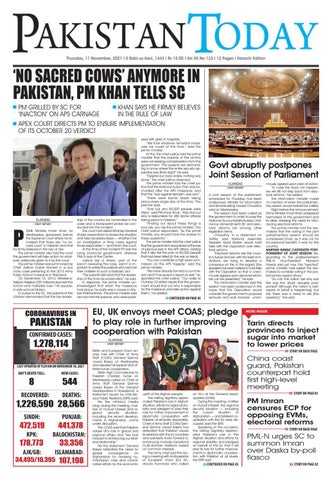
‘No sacred cows’ aNymore iN PakistaN, Pm khaN tells sc g
g
g KhAN SAyS hE FIRMLy BELIEVES PM gRILLED By SC FOR ‘INACTION’ ON APS CARNAgE IN ThE RuLE OF LAW APEx COuRT DIRECTS PM TO ENSuRE IMPLEMENTATION OF ITS OCTOBER 20 VERDICT
ISLAMABAD staff report
P
RIME Minister Imran Khan on Wednesday appeared before the Supreme Court where he remarked that there are “no sacred cows” in Pakistan and that he firmly believes in the rule of law. The prime minister also told the court the government will take action on whatever orders are given to it by the court. The prime minister was summoned by Chief Justice gulzar Ahmed in a suo motu case pertaining to the 2014 Army Public School massacre in Peshawar. On December 16, 2014, Tehreek-eTaliban Pakistan (TTP) militants stormed the school and martyred over 140 people, mostly schoolchildren. In a plea to the SC, the parents of the children demanded that the top leader-
ship of the country be nominated in the case and a transparent probe be conducted into the incident. The court had asked Attorney general Khalid Jawed Khan to review the situation and take necessary steps — whether it be an investigation or filing cases against those responsible — and inform the court. At the time of the incident PTI was the ruling provincial government, whereas PML-N was at the Centre. Justice Ijaz ul Ahsan, part of the bench reviewing the case, said it is important to satisfy the parents who had lost their children to such a barbaric act. “The parents demand that the leadership of the time be prosecuted,” he said. In response, the prime minister acknowledged that when the massacre took place, his party was in power in Khyber Pakhtunkhwa. The prime minister said he had met the parents, who were paral-
coroNavirus iN
PakistaN
CONFIRMED CASES:
1,278,114
LAST UPDATED AT 9:29 AM ON NOVEMBER 10, 2021
DAY'S DEATH TOLL:
NEW CASES:
8
544
RECOVERED:
DEATHS:
1,226,590 28,566 SINDH:
PUNJAB:
472,519
441,378
KPK:
BALOCHISTAN:
178,773 AJK/GB:
33,356 ISLAMABAD:
34,495/10,395
107,198
ysed with grief, in hospitals. “We took whatever remedial measures we could at the time,” said the prime minister. At this, the chief justice told the prime minister that the parents of the victims were not seeking compensation from the government. “The parents are demanding to know where the entire security apparatus was [that day]?” he said. “Despite our clear orders, nothing was done,” the chief justice observed. The prime minister told the chief justice that the National Action Plan was formulated after the APS massacre, and that the “war against terrorism was won”. “There were bomb blasts taking place every single day at the time,” the premier said. “Find out why 80,000 people were killed,” said PM Imran Khan. “Also find out who is responsible for 480 drone attacks taking place in Pakistan.” “Finding out about these things is your job, you are the prime minister,” the chief justice responded. “As the prime minister, you should have the answer to these questions.” The prime minister told the chief justice that the government was pained at the loss of precious lives in the APS attack, adding that it also felt the pain of 80,000 people that had been killed [in the war on terror]. “you can constitute a high-level commission on the APS tragedy,” said the prime minister. “We have already formed a commission and it has issued a report as well,” responded the chief justice. “Our order of October 20 states clearly that the government should find out who is responsible for the massacre and take action against them,” he added.
CONTINUED ON PAGE 05
Govt abruptly postpones Joint Session of Parliament ISLAMABAD staff report
A joint session of the parliament, scheduled for Thursday, has been postponed, Minister for Information and Broadcasting Fawad Chaudhry said on Wednesday. The session had been called by the government in order to pass the National Accountability Bureau Ordinance (Amendment) Bill and electoral reforms bill among other legislation items. Chaudhry, in a statement on Twitter, said National Assembly Speaker Asad Qaiser would hold talks with the Opposition over electoral reforms. “Electoral reforms are the country’s future and we, with the best of intentions, are trying to develop a consensus on this. In this regard, [the speaker] has been tasked to hold talks with the Opposition so that a unanimously agreed upon electoral reform bill can be presented,” he said. The information minister said the session has been postponed in the hope that the Opposition would consider the government’s proposal seriously and work towards unani-
EU, UK envoys meet COAS; pledge to play role in further improving cooperation with Pakistan ISLAMABAD staff report
British and European union envoys met with Chief of Army Staff (COAS) general Qamar Javed Bajwa on Wednesday and assured full support and offered future cooperation. British high Commissioner to Pakistan Christian Turner on Wednesday called on Chief of Army Staff general Qamar Javed Bajwa at the general headquarters in Rawalpindi, a statement issued by Inter-Service Public Relations (ISPR) said. Per the military’s media wing, during the meeting, matters of mutual interest and regional security situation, including the recent developments in Afghanistan, came under discussion. The COAS said that Pakistan values uK’s role in global and regional affairs and “we look forward to enhancing our bilateral relationship.” Per the statement, general Bajwa reiterated the need for global convergence on Afghanistan for avoiding humanitarian crisis and coordinated efforts for the economic
mously agreed-upon plan of action. “In case this does not happen, we will still not step back from electoral reforms,” he added. The information minister made no mention of when the parliamentary session would instead be called. Right before the announcement, Prime Minister Imran Khan addressed lawmakers of the government and its allies, stressing the need for introducing electoral reforms. The prime minister told the lawmakers that the voting in the joint parliamentary session should be considered jihad, as it was not for his personal benefit, it was for the country. MAryAM NAwAz CASTIGATES POSTPONEMENT Of JOINT SESSION: Responding to the postponement, PML-N Vice-President Maryam Nawaz said just now, the “rejected” prime minister had asked the lawmakers to consider voting in the parliamentary session jihad. “So can the nation ask why was the was the ‘jihad’ abruptly postponed? Although the nation is wellaware of [what is happening], but still, there was a need to ask [this question],” she said.
more inside
Tarin directs provinces to inject sugar into market to lower prices STORY ON BACK PAGE
China coast guard, Pakistan counterpart hold first high-level meeting uplift of the Afghan people. The visiting dignitary appreciated Pakistan’s role in Afghan situation, efforts for regional stability and pledged to play their role for further improvement in diplomatic cooperation with Pakistan at all levels. Separately, Chief of Army Staff (COAS) general Qamar Javed Bajwa has reiterated that Pakistan values its relations with the Eu countries and earnestly looks forward to enhancing mutually beneficial multi-domain relations based on common interests. The army chief said this during a meeting with Ambassador of European union (Eu) Androulla Kaminara who called
on him at the general headquarters (ghQ). During the meeting, matters of mutual interest, the regional security situation — including the current situation of Afghanistan — and bilateral cooperation with the Eu were discussed, said the ISPR. Speaking on the occasion, the visiting dignitary appreciated Pakistan’s role in the Afghan situation and efforts for regional stability, and pledged on behalf of the Eu that it will play its role for further improvements in diplomatic cooperation with Pakistan at all levels, the ISPR said.
CONTINUED ON PAGE 05
STORY ON PAGE 03
PM Imran censures ECP for opposing EVMs, electoral reforms STORY ON BACK PAGE
PML-N urges SC to summon Imran over Daska by-poll fiasco STORY ON PAGE 02
02
Thursday, 11 november, 2021 | KARACHI
newS
PML-N urGES SC to SuMMoN IMraN ovEr DaSka by-PoLL fIaSCo IsLAMABAD
P
INP
ML-N Secretary General Ahsan Iqbal said the Supreme Court should also take notice of the alleged rigging in the Daska by-election and summon the prime minister and the Punjab chief minister. Talking to the media, Iqbal said the Election Commission of Pakistan report on the rigging in the by-poll had exposed the government’s “dirty tactics”.
He called for the accountability of those involved in the rigging. “If these people would be held accountable then it will set an example for others in the future,” he added. Iqbal criticising the NAB said the Finance Ministry informed that the NAB only submitted Rs6.5 billion in the national exchequer after receiving a supplementary grant of Rs5.5 billion in the last three months. He urged PTI supporters and those who believed Prime Minister Imran Khan is an honest person, to get information about gifts the premier
received from foreign countries and why the government was hiding in the Toshakhana case. Iqbal also criticised the PTI government for the inflated rate of sugar and questioned why the incumbent government cancelled the tender of sugar that would have fixed sugar price at Rs103 per kilogramme and now it has skyrocketed to Rs160 per kilogramme. The PML-N leader also questioned how fever medicines worth Rs30 million have suddenly disappeared from the stock.
Records of 320,000 Punjab soldiers from first world war uncovered NEws DEsk
ECP reserves judgement on holding of Sindh LG elections IsLAMABAD INP
The Election Commission of Pakistan (ECP) reserved its judgement on holding the local government polls in Sindh while the provincial government sought more time to introduce a new law. A two-member bench of the commission on Wednesday conducted a hearing on the local government elections in Sindh. Jamaat-i-Islami leader Hafiz Naeem ur-Rehman also attended the hearing. During the hearing, the Sindh government sought more time from the commission for bringing the new law. The ECP remarked if the provincial government failed to introduce the law, the commission would hold the local government elections on the basis of the old demarcation. The Sindh government had already sought one month time from the election commission before. The ECP bench asked the provincial government what it had done in a month. “Why not the commission issues a contempt notice to the government for not complying with its order.” The commission said that earlier the Sindh government had cited the problem of publication of population census results. But the results have already been published almost 6 months ago, why the provincial government is not holding LG polls, it added. Rehman said the Sindh government was not serious about holding the local government polls. He pleaded with the commission to bind the provincial government and also demand a timeline from it. The commission said it had summoned the Sindh chief secretary but he didn’t appear. The commission subsequently reserved its verdict.
The records of 320,000 troops from the Punjab who fought in the first world war, left unread in a basement for 97 years, have been disclosed by UK-based historians to offer new insight into the contribution of Indian soldiers to the allied war effort, Guardian reported. Files found in the depths of the Lahore Museum in Pakistan have been digitised and uploaded to a website in time for Armistice Day on Thursday. Whereas historians and the descendants of British and Irish soldiers could search public databases of service records, until now no such facility existed for the families of Indian soldiers. Some UK citizens of Punjab-origin have already been invited to search for their ancestors in the database. They have discovered that their family’s villages provided soldiers who served in France, the Middle East, Gallipoli, Aden and east Africa, as well as in other parts of British India during the first world war. Punjab was split between India and Pakistan in 1947. The shadow minister Tanmanjeet Dhesi uncovered proof among the files that his great-grandfather had served in Iraq and had been wounded in action,
losing a leg. It is hoped that the records will help to dispel myths surrounding the contributions of soldiers from the Commonwealth. Last year, the actor turned activist Laurence Fox apologised after he had earlier criticised the historical accuracy of a Sikh character’s inclusion on the western front in the film 1917. Amandeep Madra, the chair of the UK Punjab Heritage Association who worked with the University of Greenwich to digitise the files, said: “Punjab was the main recruiting ground for the Indian army during world war one. And yet the contribution of the individuals has largely been unrecognised. In most cases, we didn’t even know their names.” Punjabis of all faiths — including Hindus, Muslims and Sikhs — made up about a third of the Indian army, and about one-sixth of all the empire’s overseas forces. Victorian racial ideology mythologised the qualities of soldiers from the region. In 1879, the Eden Commission report noted that “Punjab is the home of the most martial races of India and is the nursery of our best soldiers”. The registers were compiled by the Punjab government in 1919 when the war ended. Comprising 26,000 pages, some are handwritten while others are
APP
Ground breaking at luxury development One Canal Road, Lahore took place on Wednesday. The project is a 200,000 square-foot luxury residential project planned on the main Canal Road within the New Downtown of Lahore. Developer and designer of the project is famous Kobi Karp with interior walls and floorings finished by VERSACE Ceramics.
wounded in battle. “I always wondered what had happened, but no one really knew until now. He came home severely injured and went back to being a farmer,” Dhesi said. “These records give people written proof that our ancestors were there, fighting for Britain. This is about recognising both the contribution my family made, but also the contribution and sacrifice that people from across the Commonwealth made for the war effort,” he said. The pilot project has been uploaded for Armistice Day and before Remembrance Sunday. About 45,000 records from three districts — Jalandhar and Ludhiana, both now in India, and Sialkot in present-day Pakistan — have so far been uploaded to the website. It is hoped that the successful completion of the pilot project will lead to the release of the registers for a further 25 districts comprising an estimated 275,000 soldiers’ records. Dr Gavin Rand, of the University of Greenwich, said: “The personal and family histories of Punjab’s first world war volunteers are largely unknown, even to many descendants. Few Indian veterans left written records of their service, and many Punjabi family histories are dominated by the upheavals and migrations which followed Punjab’s partition in 1947.”
SHC orders immediate settlement of retired employees’ insurance claims kARACHI INP
The Sindh High Court (SHC) on Wednesday ordered immediate payment of group insurance claims of the retired employees of the provincial government. A two-judge bench of the high court, headed by Justice Salahuddin Panhwar, blasted the State Life Insurance Corporation of Pakistan for keeping claims pending for a long time while hearing a case of delay in payment of insurance of 500,000 retired employees
of Sindh. “Sitting over Rs2.5 billion in funds, the insurance company keeping claims pending. A criminal case may be filed against them,” the bench remarked. The court directed the government to amend the law, like other provinces, for immediate payment of the group insurance amount. Sindh finance secretary informed the court claims of families of 5,000 deceased employees have also been kept pending. The bench directed for making the verification procedure easier for the insurance claim.
Ground breaking of mega project at One Canal Road takes place LAHORE
typed. But all provide village-by-village data on the war service of recruits, as well as information on their family background, rank and regiment. Madra, who has co-authored five books about Indian history, said he first approached the Lahore Museum about the files in 2014, having been told about them by Indian military historians who knew of their existence but had never gained access. He was sent sample pages by a curator, and found that they were organised by a village. “The history of each Punjabi person’s family goes back to their village. I could see that this would allow people to peer into their past,” he said. The documents showed that the volunteer rates in many villages were as high as 40%. Dhesi, the shadow railways minister, said his late grandmother had often told him stories about her father, Mihan Singh, who had lost a leg, but he knew little else about his service in the army and there were no known public records to examine. The records from Lahore Museum show Mihan was one of 16,000 soldiers recruited to the Indian army from the Hoshiarpur district in north-east Punjab. A sepoy who served in Mesopotamia, a region now divided between Iraq, Turkey, Syria and Kuwait, he was
The development is projected to yield 115 luxury residential apartments. With current machinery and works on site the iconic tower may soon go vertical topping out at 160 feet. Construction of piling is now underway, along with demolition work on-going on some of the existing buildings. Tree removal, clearing & grubbing has begun as well. The total project Gross Development Value is in excess of $30 Million with our experts estimating construction costs for a project
of this magnitude and standard to be in the range of $16 Million or 13,500 PKR per square foot. The super prime One Canal Road development includes over 30,000 square feet of amenity space including Lahore’s highest sky pool and sky lounge, a 6500 square foot arrival lobby, state of the art gymnasium, full spa, luxury residents cinema, business centre, residents lounge and kids club offering a first of it’s kind ultra luxury 360 lifestyle for Pakistan within a residential building.
Earlier, the petitioners’ counsel said that in other provinces, the amount paid on the retirement of an employee, while in Sindh, they keep the payment pending until a retired government employee reaches 65 years of age. The high court had directed the provincial government and State Life to settle the insurance claims of employees or their legal heirs within a month. It is to be mentioned here that several constitutional petitions have been filed challenging the delay in settlement of insurance claims.
Thursday, 11 november, 2021 | KARACHI
ZahIr JaffEr rEMovED froM CourtrooM aGaIN
Z
NEws DEsk
AHIR Jaffer, the prime suspect in the Noor Mukadam murder case, was thrown out of a courtroom on Wednesday for speaking out of turn during the hearing of the case. Jaffer had appeared before a district and sessions court in Islamabad. Other suspects who were released on bail, including Zahir’s mother Asmat Adamjee and employees of Therapy Works also appeared in the court. During the hearing, the judge inquired where the plaintiff’s lawyer was, to which lawyer Babar Hayat Samoor replied that Shah Khawar was busy at the Supreme Court and asked the judge to start the proceedings. While the hearing was underway, the prime suspect began speaking out of turn. The judge ordered the accused to leave the courtroom, after
Police have booked another PPP lawmaker, MNA Jam Abdul Karim, in the high-profile murder case of Nazim Jokhio whose body was recovered from the farmhouse of PPP MPA Jam Awais in Karachi’s Malir area last week. Jokhio, a 27-year-old father of four, was allegedly tortured to death at Awais’ farmhouse in Malir for trying to prevent the legislator’s foreign guests from hunting houbara bustard near the deceased’s village in Thatta’s Dabeji area and filming it on November 2. Police had subsequently registered a case against Awais and four of his associates on charges of torturing Jokhio. On November 5, Awais had surrendered to law enforcers and was remanded into police custody.
On Wednesday, Malir SSP Irfan Bahadur confirmed to Dawn.com that Karim — who is Awais’ elder brother — had been nominated in the case in light of the statements given by the victim’s family. SSP Bahadur, who heads a team constituted by East DIG Saqib Ismail Memon for investigating the case, said the case was initially registered against five suspects. The number has now increased to 21, 16 of whom are named suspects while five are unidentified. The police official said that six people had been arrested in the case, three of whom were detained for threatening Jokhio for filming the legislator’s guests. Moreover, SSP Bahadur said, police had included kidnapping charges in the the case as the victim’s family claimed that Jokhio was abducted from his house in his village near Ghaghar Phatak area of Thatta and taken to Jam House, Awais’ farmhouse, in Malir where he was
allegedly tortured to death. He said police had conducted raids at the suspects’ house and the digital video recorder from CCTV cameras at Jam House had been taken into custody and sent to a forensic lab in Punjab for further investigation. He added that the mobile phone of the victim’s lawyer had also been sent to Lahore as the family claimed that Jokhio had sent an audio message to the advocate before being killed. Autopsy report finds torture marks on victim’s body Last week, a post-mortem examination of Jokhio found “severe torture marks” all over the body. Additional police surgeon at Jinnah Post-Graduate Medical Centre (JPMC) Dr Summaiya Syed said the autopsy carried out by Dr Mohammed Areeb at the centre’s mortuary revealed that there were “bruises all over the body, including the head”.
Court grants remand of suspects in murder of Sindh journalist by PPP lawmaker kARACHI INP
A district and sessions court in Malir on Wednesday granted physical remand of three suspects in a case pertaining to the murder of a man whose tortured body was found at the farmhouse of a Pakistan Peoples Party (PPP) lawmaker. Police said that the tortured body of 27-year-old Nazim Jokhio was found at the farmhouse of Jam Awais Bijar in Jam Goth on November 3. Later, Bijar along with two others was arrested and remanded in police custody for questioning till November 8. The first information report (FIR) was registered on the complaint by the victim’s brother, who accused Bijar and his brother PPP MP Jam Abdul Karim Bijar
China coast guard, Pakistan counterpart hold first high-level meeting BEIJING StAff RePoRt
New uS special envoy for afghanistan to meet taliban in Pakistan: official
PPP MnA also booked in nazim Jokhio murder case kARACHI
of having a hand in the murder. Bijar was forced to surrender to the police on November 4, following which a local court sent him on three-day police remand. The police produced the accused in the court which accepted its request for a remand until November 16. “The accused had issued threats to Jokhio after his videos on illegal hunting of Houbara bustards went viral [on social media],” the investigation officer (IO) informed the court. “11 accused have been nominated in the case so far and a clause of kidnapping was also added in the charge sheet,” the IO said. An autopsy found severe torture marks and bruises all over the body of the deceased. “Jokhio was subjected to brutal use of force until he
died. His body might be tortured even after his death,” police officials said on Tuesday. The police further revealed that contrary to media reports of Bijar surrendering before the law enforcement, he “didn’t surrender but was forced to surrender himself”. “He had fled from Karachi to Khuzdar in Balochistan,” according to police. “He later returned Karachi and reported to the police.” “The case against Awais is purely a case of murder. The police have also initiated an investigation of the murder with the help of data recovered from his mobile phone,” they said. “The phone locations of other suspects have been spotted,” police said. “We have decided to use the audio and video of victim Jokhio as key evidence in the case.”
IsLAMABAD AgeNcIeS
A senior Pakistani official says the meeting is “primarily aimed at…finding ways to avert a humanitarian crisis in Afghanistan” It will be West’s first trip to the region since taking over from Zalmay Khalilzad Taliban spokesman Zabihullah Mujahid tells a press conference that the group welcomes various regional meetings The new US special envoy for Afghanistan Thomas West will visit Pakistan this week for a meeting with the Taliban foreign minister and senior diplomats from China and Russia, a Pakistani official and the US State Department said. It will be West’s first trip to the region since taking over from Zalmay Khalilzad, the long-serving diplomat who spearheaded the talks that led to the US withdrawal from Afghanistan. The “troika plus” meeting, due to take place on Thursday in Islamabad, will include the Afghan Taliban’s new foreign minister Amir Khan Muttaqi, a senior Pakistani government official told AFP on condition of anonymity. The State Department said earlier in the week that West also plans to visit Russia and India. “Together with our partners, he will continue to make clear the expectations that we have of the Taliban and of any future Afghanistan government,” State Department spokesman Ned Price told a briefing this week. The senior Pakistani official said the meeting is “primarily aimed at…finding ways to avert a humanitarian crisis and to look into possibilities of setting up an inclusive government in Afghanistan”. The United Nations has repeatedly warned that Afghanistan is on the brink of the world’s worst humanitarian crisis, with more than half the country facing “acute” food shortages and winter forcing millions to choose between migration and starvation. West, who was in Brussels this week to brief NATO on US engagements with the Taliban, told reporters that the Daesh have “very clearly” voiced their desire to see aid resumed, as well as to normalise international relations and see sanctions relief. He called for unity from allies on those issues, noting that Washington “can deliver none of these things on our own”. Daesh threat: That includes China, with whom the United States has clashed in recent months over issues including Taiwan. West said Beijing has a “positive role” to play in Afghanistan. He said that while he will visit India, he did not plan to attend a regional security dialogue on Afghanistan there on Wednesday.
Shehroze Kashif makes history as youngest climber to scale K2, everest same year sTAFF REPORT Guinness World Records has recognised Pakistan’s Shehroze Kashif as the world’s youngest climber to summit the world’s two tallest mountains — the 8,849-metre-high Everest and 8,611-metre-high K2 — in the same year, according to a press statement issued by the Alpine Club of Pakistan (ACP) on Wednesday. The statement said that Kashif, who hails from Lahore, achieved the feat aged 19 years and 138 days. He also holds the record for being the youngest person to have climbed K2. The 19-year-old became the youngest Pakistani to scale Everest — the world’s
highest peak — on May 6 this year and summitted K2 — the second highest mountain in the world — on July 27, climbing both the mountains within a span of nearly three months. ACP Secretary Karrar Haidri congratulated Kashif on being recognised by Guinness World Records. Kashif is also the youngest Pakistani to have climbed Broad Peak (8,047m) at the age of 17. He used supplemental oxygen on his climbs at Broad Peak, the Everest and K2. His first climb was at the age of 11 when he climbed the 3,885-metre-high Makra Peak, followed by Musa Ka Musalla, a 4,080-metre-high mountain. Continuing to train for longer and harder
03
The China Coast Guard (CCG) and the Pakistan Maritime Security Agency (PMSA) have held their first high-level meeting, via video link, with both sides vowing further cooperation for maritime law enforcement. During their virtual meeting, both sides reviewed the gains from their cooperation in recent years, discussed the direction for future cooperation and exchanged views on issues of mutual concern, according to a CCG statement. Both sides have vowed to take the opportunity of celebrating the 70th anniversary of the establishment of diplomatic relations between China and Pakistan and work together to promote maritime law enforcement cooperation and advance the building of a maritime community with a shared future.
which Zahir was removed from the room. The hearing was adjourned after cross-examination of the statement of the National Forensic Crime Agency incharge, Muhammad Imran. Last week, Zahir was forcibly removed from the courtroom after he hurled expletives at Additional Sessions Judge Ata Rabbani during the hearing of the case. The accused had repeatedly interrupted the hearing causing the judge to ask the police to remove him from the courtroom, stating that he was creating “drama”. Later, the court warned Zahir about his attitude, claiming that he will not be allowed to appear before the bench if he tried to disrupt the proceedings again. In a written order, Judge Atta Rabbani said that the accused created a “fuss in the court and tried to interfere in the proceedings” during the previous hearing on November 3.
AgeNcIeS
newS
treks, he did the Gondogoro La K2 Base Camp trek at the age of 14 and at 15, he was able to complete the Khurdo Pin Pass (5,800m) trek. At 18, he did Khusar Gang, a 6,050m peak Alpine style. Nepal, China and Pakistan are home to14 of the world’s highest peaks, called the 8,000ers. While the world’s tallest mountain, the Everest, is located in Nepal, Pakistan is home to five mountains more than 8,000m tall, namely K2, Gasherbrum-I, Gasherbrum-II, Broad Peak and Nanga Parbat. Climbers most rely on bottled oxygen to summit these death-zone peaks as the pressure of oxygen is insufficient to sustain human life for an extended time span above the altitude of 8,000m.
04 NEWS 11th November 2021 (LHR)_Layout 1 11/11/2021 12:42 AM Page 1
Thursday, 11 November, 2021 | KARACHI
04 NEWS
Dollar nears rs173 Due to uncertainty over sauDi, iMF packages KARACHI
p
stAff RepoRt
AKISTAnI rupee continued its losing streak against the US dollar in the inter-bank market for the third day in a row on Wednesday and shed Rs1.30 (-0.75 percent). According to the State Bank of Pakistan, the US dollar opened at Rs171.63 and closed at Rs172.93. Within the open market, the rupee was traded at 173/174 per dollar. According to currency experts, the uncertainty over the revival of the International Monetary Fund (IMF) programme and delay in expected inflows from Saudi Arabia are fuelling the fall. Besides, skyrocketing inflation means that the country will enhance import of essential goods to stabilise the prices in the local market; therefore, the dollar is in high demand. Moreover, anticipation of increase in imported inflation has
sparked panic buying of the greenback. The currency dealers said that the rupee witnessed massive decline owing to higher dollar’s demand for import payments. The import bill registered a growth of 65.15 percent to $25.06 bil-
lion during July-October 2021 as compared to $15.17 billion in the same period of the last fiscal year. Saudi Arabia on October 26, 2021 announced additional support of $3 billion to Pakistan for building its foreign
exchange reserves. The financial support is in addition to a $1.2 billion deferred oil facility to Pakistan to help its balance of payment issues. The Pakistani rupee made an alltime low of 175.27 against the greenback on October 26 last. Overall, the rupee depreciated by Rs2.92 during the last three days, while the rupee’s depreciation during the fiscal year 2021-22 has been Rs15.51 and Rs12.76 in the current year 2021. They said that compliance on a few conditions laid down by the IMF is still pending and delay in approval of the next tranche is driving rupee depreciation. They said that matters pertaining to autonomy of the central bank, increase in petroleum development levy and power tariff rationalisation are awaiting conclusion. They were of the view that approval and release of the next tranche worth $1 billion would arrest the rupee’s slide and steer recovery of local currency against the greenback.
Fair Price shops being set up across KP to mitigate sugar issue PESHAWAR Agencies
To tackle the excessive price and smooth provision of sugar in across Khyber Pakhtunkhwa Province, the district administrations are establishing fair price shops. Only in Abbottabad, 28 fair price shops on the directives of the provincial government. According to details, the government has provided 118 metric tonnes of sugar at subsidised rates for the Abbottabad district. The district administration has established 13 sales points in Abbottabad while 4 in tehsil Havelian, two in Lora, and three points in Galyat where masses could purchase sugar at a fixed price of Rs90 per kilogram. The revenue staff would monitor the sale and provision of the Sugar in their respective fair price shops at the controlled prices. The deputy commissioner directed the masses to visit their nearest fair price shop for purchasing Sugar and in case of any discrepancy contact the district control room, established in the DC office immediately . The fixed price outlets were established in Abbottabad, Havelian, Sherwan, Lora Circle and Galyat which are providing relief to the masses. Following the instructions of Deputy Commissioner Abbottabad, Additional Deputy Commissioner Abbottabad Mohammad Shahab Khan along with District food Controller Shad Mohammad Khan inspected Havelian Food Warehouse the other day and reviewed the supply of sugar to the notified vendors.
The subsidised sugar would be sold at Rs86 per kg at wholesale rate while Rs90 per kg at retail price would be available to the general public. The citizens will be allowed to get up to 05 kg of sugar by showing
their ID card and it has been made mandatory for dealers to keep records of all customers as well so that citizens can benefit from the government subsidy and grievances can be resolved on the spot.
no move under consideration to stop releasing spi data: Muzammil ISLAMABAD: There is no exercise under consideration to stop the release of weekly Sensitive Price Index (SPI) data by the Pakistan Bureau of Statistics (PBS). Spokesperson to the Finance Minister, Muzammil Aslam said this on Wednesday while responding to a news report published in a section of the press. Aslam said that a question was raised during committee discussions about best international practice for essential commodities price reporting. Encouragingly, PBS reporting of Consumer Price Index (CPI) and SPI was more prompt than India and Bangladesh, he added. “Just to put the record straight. no such exercise under consideration. When committees discussed the prices, a question was raised on best international practice for essential commodities price reporting. Encouragingly, PBS reporting of CPI & SPI is more prompt than India & Bangladesh,” he tweeted. stAff RepoRt
oil falls despite drop in crude stocks, tight supply ISLAMABAD: Crude oil futures edged lower after early gains on Wednesday, though a potential drop in the US crude stocks and tighter supplies capped losses. At 1255 hours GMT, Brent, the international benchmark for two-thirds of the world’s oil, shed $0.16 (-0.19 percent) to reach $84.62 a barrel. Similarly, the US West Texas Intermediate (WTI) reached $83.73 a barrel, down by $0.42 (-0.51 percent). The price for Opec Basket was recorded at $82.34 a barrel with an increase of 2.78 percent, Arab Light was available at $84.95 with 2.36 percent increase, and the price of Russian Sokol jumped to $85.93 with an increase of 2.48 percent. According to experts, after the strong rally over the last few days, oil prices are in a wait and see mode. They said that market participants will closely watch if the US Energy Information Administration (EIA) will confirm the large draws for crude and oil products and on the next moves from the US administration. Further underpinning the view the market remains tight, they said that oil demand had returned to pre-pandemic levels and demand in the first quarter of 2022 could exceed 2019 levels. The possibility of a spike to $100 per barrel is clearly there, they said. They said that market gains on Tuesday were mainly driven by a short-term outlook from the EIA, which projected gasoline prices would fall over the next few months. The Russian Ministry of Energy said the nation’s oil production could once again reach record highs comparable to the Covid-19 pandemic and the ensuing oil market crisis. “We believe that in 2023-2024 production will amount to about 560 million tons. Our task is to ensure the competitiveness of our resources on the global market, and not to chase only the production figure,” Russian Energy Minister nikolay Shulginov said in an interview. Agencies
Global bodies agree on fast delivery of Covid jabs to poor countries WASHINGTON Agencies
The heads of the International Monetary Fund, World Bank Group, World Health Organisation and World Trade Organisation have agreed on the urgency of delivering more vaccine doses to low-income countries, where less than 2.5 percent of the population has been fully vaccinated. The international organisations and vaccine manufacturers agreed to this during the 2nd high-level consultations, said a statement issued here on Wednesday. At the meeting, all participants agreed on the urgency of delivering more vaccine doses to low-income countries, where less than 2.5% of the population has been fully vaccinated. The objective of the meeting was to identify how to ensure more equitable distribution of vaccines and all those participating pledged to continue working together to gain greater clarity on donations, vaccine swaps and delivery schedules so that distribution of the life-saving vaccines can be more ef-
CMYK
fectively targeted towards those countries most in need. The meeting of the Multilateral Leaders Task Force on Covid-19 built on technical work undertaken by multidisciplinary teams during the months of September and October. During the consultations, the heads of the four organisations and the CEOs also examined how best to tackle trade-related bottlenecks; how to improve the donation process; what additional steps are needed to reach the vaccination target of 40 percent of people in all countries by the end of the year; and how to improve transparency and data sharing with the IMFWHO Vaccine Supply Forecast Dashboard and the Multilateral Leaders Task Force, requiring close collaboration between manufacturers, governments and COVAX on enhanced visibility of delivery schedules, especially for donated doses. The outlook for 2022 was also discussed, focusing on diversification of manufacturing across regions, as well as strengthening collaboration to achieve the global target of vaccinating 70% of the populations of all countries by the middle of the year. The group ac-
knowledged progress in diversifying manufacturing, with new partnerships in multiple developing country regions, and stressed the need to continue to strengthen such manufacturing collaboration. The heads of the organisations encouraged all G20 governments to join the effort to meet the vaccination target of 40% by end2021 by allowing manufacturers to prioritize COVAX and African Vaccine Acquisition Trust (AVAT) contracts; streamlining donations to COVAX and pledging more doses; exploring possibilities for effective vaccine swaps with COVAX and the AVAT; and eliminating export restrictions to vaccines and their inputs.
Thursday, 11 November, 2021 | KARACHI
‘NO SACREd COwS’ ANyMORE iN PAKiStAN, PM KHAN tEllS SC t continued from page 01
HE chief justice reminded the prime minister that seven years had passed since the tragedy took place. Justice Qazi Muhammad Amin Ahmed, speaking to Prime Minister Imran Khan, said: “You have brought the culprits to the negotiating table. Are we once again about to sign a surrender document?” He was referring to a ceasefire agreement reached by the government with the banned Tehreek-e-Taliban Pakistan (TTP) — the militant group behind the attack. The Supreme Court said the government should pay heed to the demands made by the parents and take action against the culprits. The prime minister assured the court that the government will see to it that justice is delivered. The apex court directed the prime minister to ensure implementation of its October 20 verdict. The hearing was adjourned for four weeks. Earlier today, the court had asked the attorney general for an update regarding the registration of the cases, who responded by saying that FIRs cannot be filed against the top officials. At this, the bench angrily had told the government’s lawyer that the incident had taken place as a result of a “security lapse” which the government should accept, adding that the top civil and military leaders of the time should have known about the attack. The chief justice then remarked that Pakistan’s agencies and institutions have access to all sorts of information, but when it comes to the security of the people “our security agencies fail”. While responding to a query, the AGP told the court that the fact-finding report did not hold the former army chief and other senior government functionaries responsible for the attack. “We have such a huge intelligence network, billions of rupees are spent on it. We also claim to be the best intelligence agency in the world,” the CJP observed.
Justice Ijaz ul Ahsan had said the APS massacre had taken place in response to Operation Zarb-e-Azb, adding that state institutions should have taken effective steps against it. During the hearing, the attorney general sought time from the court to seek directives from the prime minister and other officials so he can respond to the court. However, the bench had said this was a very serious case and that it would summon the prime minister and seek answers from him. The issue of the government holding talks with the banned TTP also came up during the hearing. Justice Qazi Amin had remarked that there are reports that the government is holding negotiations with a group and added, “Is it not the responsibility of the state to identify the real culprits [behind the APS tragedy] and nab them.” Meanwhile, CJP Ahmed observed that action should have been taken against those at the top but low-level personnel were punished instead. Justice Aijaz ul Ahsan, another member of the bench, remarked that it was not possible for the terrorists not to have got support from the inside. Interior Minister Sheikh Rasheed appeared outside the Supreme Court before the prime minister arrived, to speak to the media. The minister said that “no game is being played, the game belongs to Imran Khan”. “There is no danger, Imran Khan will fulfil his five-year term,” he added. Responding to a question, the minister said he had arrived at the apex court “to accompany the prime minister if he appears”, adding that he did not know whether PM Imran Khan will show up or not. He refused to comment on the hearing, saying that the law minister or the attorney general were better qualified to speak on the matter. “The Ministry of Interior does not have the solution to every problem,” he said Earlier, while questioning the “inaction” against the perpetrators of the grue-
Matthew Hayden says Babar Azam is the opposite of Virat Kohli, calls him ‘consistent, stable’ Australian legend and current batting consultant of Pakistan cricket team Matthew Hayden has opened up about Babar Azam and his comparisons drawn with the Indian batter Virat Kohli. Hayden shared his thoughts during a virtual press conference on Wednesday. “Babar and his personality is, as you see is what you get,” Hayden said. “He is very consistent. He is very stable. He is not overly flamboyant.” Hayden, who represented Australia for over 16 years as an opening batter, claimed that Babar Azam is perhaps the opposite of his counterpart Virat Kohli. “In fact, I would go as far as to say he is almost the opposite personality to someone like Virat Kohli, who is very animated, very passionate, and very boisterous on the field,” he added. Speaking about Babar’s traits as a batter, Hayden said, “He has great control and a wonderful temperament. Just to give you an insight into that talent, his ability to be able to consistently be able to react to the ball is second to none from what I’ve seen.” “He picks up the line and the length of the ball quicker than the average cricketer that is going around. That is the mark of someone that is a very fine player,” he further added. Hayden claimed that Babar’s ability to remain consistent is primarily down to his reaction time and how quickly he picks up on things. news desk
some 2014 attack on the Army Public School in Peshawar, the Supreme Court ordered the government to submit within four weeks a report detailing measures taken to address the complaints of the parents of victims of the massacre, Radio Pakistan reported. In the attack that provoked horror and fierce international condemnation, members of the proscribed Tehreek-eTaliban Pakistan (TTP), wearing suicide vests, stormed the facility on December 16, slaughtering 147 people, 132 of them children. The report must carry the signatures of Prime Minister Imran Khan, the court further said. The three-judge bench passed the order in a hearing attended by the prime minister after the chief justice ordered him to appear before the court. The proceedings started at 9:00 am. Shortly after, the bench — headed by Chief Justice Gulzar Ahmed, and comprising Justice Qazi Muhammad Amin Ahmed and Justice Ijaz ul-Ahsan — ordered Khan to appear in person at 10:00 am. He, however, arrived about two hours later, just before noon, after receiving a briefing on the case from Attorney General Khalid Jawed Khan who called on him at his office following the court order. The hearing resumed with the prime minister present in the courtroom along with a number of lawyers, security personnel and families of victims. Members of the cabinet including Minister for Interior Sheikh Rasheed Ahmed and Minister for Information and Broadcast Fawad Chaudhry, who is also a barrister, were also present. The order came after years of protests by relatives of the victims. The families are also protesting the government’s recent efforts to strike a peace deal with the group. Wednesday’s proceedings followed the announcement of a one-month “complete ceasefire” between the government and the Afghanistan-based militant group which may be extended if both sides
agree, opening the possibility of a fuller peace accord after years of bloodshed. The rumours of proposed amnesty to the TTP to ensure lasting peace elicited a protest in October when the parents of the students killed by its members rejected the measure and warned to continue protest demonstrations if the Afghanistanbased group was given amnesty. They said the government could, however, announce conditional amnesty for TTP fighters if they gave up their militant activities and surrender. During Monday’s briefing to the political leadership on the security situation, the military informed the participants of the parliamentary committee on national security that once the basic agreement with the group was documented, it would be presented to the political leadership for final approval. “If the political leadership rejected the agreement, the military would revert to kinetic actions against the TTP,” a report said, citing sources. Reuters reported the two sides have been meeting across the border in Afghanistan, with the aid of Afghan Taliban leaders. Today, addressing the prime minister, Justice Ahmed said: “You are in power. The government is also yours. What did you do? […] You brought those guilty [TTP] to the negotiating table.” He was referring to the reports of the agreement between the government and TTP militants. Prime Minister Khan told the Supreme Court his government will initiate action against elements the top judicial forum ordered and affirmed there were “no sacred cows” in Pakistan. “The satisfaction of the parents [of children killed in the APS attack] is necessary,” said Justice Ahsan addressing Khan. Khan’s appearance is the first time since 2012 that a sitting prime minister has been asked to appear before the top court. The last time then-prime minister Raja Pervez Ashraf was asked to appear in connection with a graft inquiry against former President Asif Ali Zardari.
Mazari urges Muslim nations to unite against rights abuse iStanBuL anadolu agency
Divisions in the Muslim world are “unfortunate” and countries like Pakistan and Turkey can push for a united stance against oppression of Muslims across the world, said Human Rights Minister Shireen Mazari. “We need to have stronger voices coming from the Muslim world on these [human rights] issues,” said Mazari, calling on the Organization of Islamic Cooperation (OIC) to do more in this regard. She said the government was “moving towards a welfare state” by reforming the justice system and ensuring basic rights of the people. On war-torn Afghanistan where Taliban are now leading an interim government, the human rights minister urged the international community to step forward and help avert the evolving humanitarian crisis. She added Pakistan will gear up its policy on Kashmir. “In coming months, you will see a more offensive diplomacy on Kashmir,” Mazari said. “In illegally
occupied Kashmir, India is committing war crimes and doing a slow genocide,” she added. ‘DIALogue MAkeS TALIBAn fLexIBLe’: Urging support from the international community on war-torn Afghanistan, she said: “We want the Taliban government to live up to the commitments that they made when they came into Kabul. And we think that it’s better to cooperate with the Taliban and have dialogue with them, rather than to take punitive measures.” Taliban regained power in August after complete withdrawal of foreign forces and breakdown of the US-backed government. “Because if you talk and negotiate, you make them more flexible. If you push them in a corner, they will take a much harder position,” Mazari argued. “And the most important thing right now is for the international community to provide humanitarian aid because there is a humanitarian crisis in Afghanistan,” she said. She said the 20 years of foreign invasion in Afghanistan had left be-
hind “nothing.” “When the US suddenly left, what happened, the infrastructure was not there… it just collapsed. The Afghan National Army melted away. Ashraf Ghani ran away, I believe, newspapers say with money. And there was no government structure, there was no social welfare structure, nothing,” she added. The Taliban-led interim government is facing a financial crunch as the US has frozen Afghanistan’s foreign reserves worth $9 billion. ReDefInIng kAShMIR poLIcy: Mazari said Prime Minister Khan had “redefined the whole narrative on Kashmir when he went to the UN.” “Imran Khan challenged the Indian narrative and showed the link between BJP and fascism, and how they were exterminating Kashmiris and then after the 5th August 2019 move, Pakistan is active at different forums, I myself have been raising the Kashmir issue and writing to UN Human Rights rapporteurs and so on, on different aspects of the Kashmir issue,” she said.
NEWS
05
EU, UK envoys meet COAS; pledge to play role in further improving cooperation with Pakistan continued from page 01 The meeting comes days after a four-member European Union Parliamentary Delegation for South Asia Relations visited Pakistan ahead of the EU reviewing its decision on the country’s GPS+ status in February. GSP+ is a special trade arrangement offered to developing economies by European nations in return for their commitment to implement 27 international conventions on human rights, environmental protection and governance.
Ramiz Raja backs Pakistan squad ahead of semi-final, says it’s ‘impossible to beat them right now’ The former captain hailed the performance shown by the Men in Green and said that the whole nation is together just because of them Pakistan Cricket Board (PCB) Chairman Ramiz Raja has expressed satisfaction over the performance of the national cricket team in the ongoing ICC Men’s Twenty20 World Cup in the United Arab Emirates. The former captain hailed the performance shown by the Men in Green and said that the whole nation is together just because of them. “The performance has been excellent so far,” Raja said in a video message. “The national cricket team has removed the tag of inconsistency from its performance.” Raja further added that the side has been consistent throughout due to the leadership of Babar Azam, self-belief of the players and humility on the field. “Sometimes, you are desperate for a win. Your self-belief gets peaked that you think that no one can beat you. I have played three World Cups and playing it as a player is difficult but the way Babar has led his troops, it is a big achievement,” he added. “Without thinking of the result, play your best cricket. As a cricketer, I am telling you that it’s impossible to beat this side. Regardless of the opposition, play the same brand of cricket you have been playing,” he concluded. It must be noted that Pakistan will face Australia in the second semi-final of the tournament on November 11 at Dubai International Stadium. news desk
Afghan FM arrives on first official visit to Pakistan ISLAMABAD: Interim Afghan Foreign Minister Amir Khan Muttaqi, leading a high-powered delegation, arrived in Islamabad on Wednesday to meet the Pakistani leadership and attend a meeting of “extended Troika” to be held in the federal capital. Besides Muttaqi, Islamabad is also hosting special envoys from the United States, Russia and China as part of diplomatic efforts aimed at preparing the ground for the international community’s recognition of the Taliban government. The top Afghan diplomat was received by Adviser to the Prime Minister on Commerce and Investment Abdul Razzaq Dawood and Pakistan’s special representative on Afghanistan Muhammad Sadiq upon his arrival. This is the first official visit of the interim Afghan FM since the Taliban returned to power after the chaotic exit of US-led foreign forces from Afghanistan in August. A day earlier, Abdul Qahar Balkhi, a spokesperson for the Afghan foreign minister said, “Delegation will discuss enhancing ties, economy, transit, refugees and expanding facilities for the movement of people and will include ministers and working groups from finance and trade ministers.” Last month, Foreign Minister Shah Mahmood Qureshi visited Kabul and announced a raft of measures to help Afghanistan’s faltering economy as well as extending humanitarian assistance. Since the fall of Kabul on August 15, Pakistan has been at the forefront urging the international community to remain engaged with the new dispensation in Afghanistan. staff RepoRt
Rs111bn to be invested in power transmission system: Hammad iSLamaBad staff RepoRt
The National Assembly was informed on Wednesday that an investment of Rs111 billion will be made in the power transmission system during the next three years. Minister for Energy Hammad Azhar told the house during the question hour that the
transmission line projects will be executed in different areas of the country. The minister said that it was because of the power contracts signed by the previous Pakistan Muslim League-Nawaz (PML-N) government, the capacity payments have reached Rs800 billion. He said, “We have reduced the annual flow of circular debt from Rs450 billion to Rs130
billion.” Responding to a question, Hammad Azhar said both Sui Northern Gas Pipelines Limited and Sui Southern Gas Company Limited have been directed to come up with a rehabilitation plan in a month’s time for replacement of damaged pipelines. He said this plan will help address the issue of gas pressures.
cmYK
Parliamentary Secretary for Law and Justice Maleeka Bokhari said the present government has initiated legal reforms to ensure just and expeditious disposal of civil and criminal cases. She said we have also introduced legislation including Code of Civil Procedure Amendment Act, Letters of Administration and Succession Certificates Act, the Enforcement of Women’s Property
Rights Act and Legal Aid and Justice Authority Act. She said the Ministry of Law and Justice has deliberated with relevant stakeholders and will soon introduce Criminal Law Reforms Bill to strengthen the criminal justice system. The house will now meet on Friday (tomorrow) at 10:30am.
t
t t
A
t t
06-07 Comments - 11th November 2021_Layout 1 11/11/2021 12:45 AM Page 1
Thursday, 11 November, 2021
06 COMMENT
Tabdeeli versus Sain Sarkar
APS massacre PM Imran’s appearance did not answer many questions
The Sain is dead, long live the Saqin
B
eFORe Prime Minister Imran Khan gets too happy about his readiness to appear before the Supreme Court, he should notice that the Bench summoning him, headed by the Chief Justice of Pakistan, Mr Justice Gulzar Ahmad, was dissatisfied enough with his answers to order that the federal government reply in two weeks on what steps it had taken to hold accountable those who were responsible for the 2014 Army Public School (APS) massacre. The Supreme Court appeared interested in how the government reconciled taking action against those responsible among the Tehrik Taliban Pakistan with holding negotiations with it and being ready to accept those of its members who were willing to abide by its Constitution. The Court was hearing a petition by parents of the victims of the APS massacre. The Court also made a number of observations about the intelligence agencies, which it noted had failed to provide any prior information that an attack was imminent. The PTI’s relationship with the episode neeeds examining. The Prime Minister said that there was a meeting of the PTI core committee the evening of the massacre. Was that the occasion when it decided to end its famous sit-in, which had by then achieved its purposes, but was beginning to flounder. The Attorney General had said that a case could be registered against the then Prime Minister and the then Interior Minister. The petitioners also want a case registered against the then COAS, DG ISI, Corps Commander Peshawar, and CM KP. The purpose of the Court coincides with that of the parents. The Court wants to fulfill its function of ensuring the law is obeyed; the parents want closure, something which will only be achieved when justice is done. The concerned officials are noe retired, and the politicians are still active, though with differing fortunes. The Court, however, can still ask them to appear before it, if the purposes of justice are thus served. The Court has traditionally followed the lead given to it by the military, as its removals of two PMs, and validation of all four martial laws, but it has also, as in the case of the COAS’ extension, tried to establish its own primary in the state.That motive cannot be excluded in the APS case, but if the Court keeps uppermost the need to deliver justice, it will not go wrong.
Dr FariD a Malik
W
hILe ‘Tabdeeli Sarkar’ is being criticised for lack of performance, no one seems to be talking about the age-old ‘Sain Sarkar’. Political parties make promises, lift hopes but then fail to deliver. In the domain of thermodynamics two phenomena are closely watched, activation energy and catalysts. Some sluggish chemical reactions need strong catalysts to raise the activation energy’ of the system so that the reaction takes place, in other words the reactants convert to products in the form of change. Somehow, in the land of the pure, the impurities are so widespread that the required activation energy has not been achieved in the last three years despite the best efforts of the catalyst’. So many side reactions take place that the end results are never achieved. Struggle of the ‘Tabdeeli Sarkar’ continues while the ‘Sain Sarkar’ has the final laugh, ‘the Donkey remains under the tree’ ( khoti rahi borh thalay ) In the 1973 Constitution it was provided that the election Commission of Pakistan (eCP) would be headed by a judge of the superior judiciary. Perhaps Zulfiqar Ali Bhutto, the chief architect of the document, was averse to the bureaucrats who had served the dictators. It proved to be a bad move as every election since then has been disputed. Considering the logistics involved in the electoral contest, I started writing about the need to appoint individuals with administrative experience who had knowledge of the districts and villages where balloting took place. Finally after the recent electoral reforms the condition was waived and a senior bureaucrat was appointed as Chief election Commis-
Vaccination milestone The government must not lose momentum at this crucial juncture
W
ITh fifty percent of the country’s eligible population vaccinated against Covid-19 with at least one dose, Pakistan has achieved an important milestone on the battle against the pandemic. That this target was achieved the day after 1.7 million vaccine doses were administered across the country makes it all the more commendable. After a terrible start to the vaccination drive that was riddled with supply chain issues, administrative problems including theft and influential people successfully jumping the queue, federal and provincial governments were able to structure the effort in a way that the problems were soon addressed. Securing an ample and steady supply of the vaccine was crucial and countries like China were able to help in this regard, while our timely application and acceptance into the World health Organization’s Covax programme kicked in at the right time to ensure availability of various vaccines. The second challenge was to set up as many vaccination centres as possible, which is where the conversion of large unutilized publicly owned installations such as large halls proved crucial while public and private hospitals, diagnostic centres and other medical complexes provided necessary support as well. Keeping these vaccination centres running around the clock made the process more efficient and safer as these spaces, apart from some exceptions, would not get crowded. It seems the government has realized that the only way to reach some semblance of normalcy where the economy can become fully functional and the population can feel safer as they get on with their lives, is to vaccinate enough people and reach that crucial herd immunity threshold of 70-80 percent. That the science on the effectiveness of the vaccine in preventing the virus from making inoculated patients too sick is definitive and encouraging, making vaccination the first line of defense against the pandemic. In addition to making certain privileges conditional upon receiving at least one dose of the vaccine, a massive outreach program must be undertaken to combat the plethora of misinformation about the vaccine out there. Covid-19 is here to stay and it is as much the responsibility of the government as of the citizenry to make sure each and every resident of the country gets the shot.
The aftermath of the TLP protests DaMiya Saghir
T
he past few years in Pakistan have been disputed and in a constant state of confusion as the extremist and vehement fundamentalists pull the strings, challenging the writ of the state. In the light of the recent Tehreeke-Labaik Pakistan (TLP) protests, there are trigger warnings for the government of Pakistan which gets ready to negotiate another agreement with the TLP. Tehreek-e-Labaik Pakistan (an organization formed at the arrest of Mumtaz Qadri, the assassin of Punjab Governor Salman Taseer) considers itself the guardians of blasphemy laws in Pakistan. The recent wave of violent protests has once again been based on a series of caricatures of the holy Prophet (PBUh) published in the French satirical magazine, Charlie Hebdo, and it demanded the expulsion of the French Ambassador and the release of their detained leader Saad Rizvi, who was arrested during the protests in April 2021. The delay in fulfilling the demands of the TLP decides the fate of several police officers, Chinese officials and civilians whose lives are at stake. The government and the establishment remained unsure on negotiating with TLP as the former wanted to stay put and the latter wanted a stronger national security environment. Among the list of demands was also that the TLP be given the authorization to contest elections and the release of other detained persons who belong to the TLP, along with the leader himself. The word is out in the air that negotiations and agreements between TLP and the government have been signed for a ceasefire but so far, no insight has been released. The government called a combined parliamentary session with representatives of all parties, establishment, and leaders of Gilgit Baltistan and Azad Jammu and Kashmir to be briefed about the current national security environment and the agreement signed. This move was a smart approach by the government as matters of national security should be unanimously decided by all representatives. Not much has been
Arif Nizami (Late) Founding Editor
Yousaf Nizami M. A. Niazi
Umar Aziz
Joint Editor
Joint Editor
Executive Editor
Lahore – Ph: 042-36300938, 042-36375965
I
Karachi – Ph: 021-35381208-9
I
powerful enough to initiate the reactions needed to produce the desired results. The ‘Sain’ are everywhere and in control of the system. The administrative machinery, judiciary are under their strong influence and unwilling to support the Tabdeeli Sarkar. Relief to the public is not on their agenda. To keep the activation energy at the bare minimum, loyalties were procured at the highest market rates. A system of ‘Muk Muka’ was introduced at every tier of the system to ensure rule of the status quo. While the players of the ‘Tabdeeli Sarkar’ are inexperienced, the opposing forces are well entrenched and connected. After the change of government some of the senior officers were arrested for corruption but eventually released on bail, but so far convictions have not taken place. Due to rampant executive abuses, courts are overloaded with cases, seriously impeding their performance. Relief to the suffering masses is the biggest challenge faced by the ‘Tabdeeli Sarkar’. The Prime Minister addressed the nation and announced a subsidy package for the low income group. The people of Pakistan need help which the prevalent system cannot provide unless the activation energy is enhanced manifold. The eyes of the nation are focussed on the catalyst which is working over time, but the side reactions continue to reduce its efficacy. These detours have to be shut to set the course of the nation. The ‘Mirs’, ‘Peers’, ‘Sains’ and ‘Tajirs’ continue to operate at the cost of the masses, and now their heirs have also been inducted to ensure continuity of the ‘ Sain Sarkar ‘. It is the proverbial situation; ‘ The Sain is dead, long live the Sain ‘. It is time for soul searching by the Tabdeeli Sarkar which mere packages and notices cannot deliver.
Relief to the suffering masses is the biggest challenge faced by the ‘Tabdeeli Sarkar’. The Prime Minister addressed the nation and announced a subsidy package for the low income group. The people of Pakistan need help which the prevalent system cannot provide unless the activation energy is enhanced manifold. The eyes of the nation are focussed on the catalyst which is working over time, but the side reactions continue to reduce its efficacy
Extremism wins again?
Dedicated to the legacy of late Hameed Nizami
Editor Aziz-ud-Din Ahmad
sioner (CeC). It has been alleged that the recommendation was made by Sheikh Rashid who was impressed by the performance of Sikander Sultan Raja who had worked under him as Secretary Pakistan Railways During the selection process, it was overlooked that he happened to be the son-inlaw of a Nawaz Sharif confidante, former Principal Secretary Saeed Mehdi. Since then the PTI,) the ruling party, has been complaining about the tilt of the CeC towards the PML(N). The required neutrality has been questioned. electoral reforms and use of technology have become an issue. Under the circumstances, in 2023 there would be another disputed electoral contest. When ZAB won big in the 1970 elections in the Western Wing with the support of the progressives, he claimed that he had buried the politics of Mirs, Peers and Sains, but his claim was short-lived. Zia not only revived them, he added ‘Tajirs’ to the list while the ‘Comrades’ were taken to the dungeons of the Lahore Fort. Those who survived left the political arena to join NGOs (Non-government Organizations). In April 1979 ZAB was also eliminated through the judicial process. Gains of his Awami Hukamat’ were soon neutralized. Civilan institutions came under attack till they were made nonfunctional. PR, which was once profitable and the pride of the nation, started running into losses. WAPDA (Water and Power Development Authority) was also not spared. It was first unbundled with the plan to privatize distribution which has not happened till today. Today we have the most expensive power and gas in the world. The Nandipur Plant outside Gujranwala produces electricity at the rate of Rs 42 per unit mainly because of the corruption of the ‘Sain Sarkar’. Unless the activation energy of the system is increased manifold, Sain Sarkar will continue to call the shots. The catalysts of the Tabdeeli Sarkar are not
shared yet about the briefings in the session but the breathing space required by the government and given to the TLP may have severe implications for the Government itself. Not a long time ago, under the tenure of Asif Ali Zardari, a similar session was called upon to discuss the matter of terrorism in Waziristan and Swat. Although the government itself was not in the favour of releasing the terrorist persons a unanimous decision was reached in the affirmative bringing consequences and threats to Pakistan which later had to be dealt with by wars and violence. A hanging and more predictable implication is history repeating itself especially with an observant eye of the international community which Pakistan cannot render to neglect. Requiring authorization to contest elections and demanding a control over the region of Federally Administered Tribal Areas (FATA) should be viewed as non-negotiable as threats of extremism may take a leap forward. Suspicions remain that political parties may not be certain of making huge favors to the TLP but an establishment leaning in its favour wants to put an end to the protests. The future of Pakistan seems to be more radicalized and rightist. extremism is rising from every single stem of it. Nearly after 26 years, the establishment allows the JUI to hold a strong and a huge Jalsa in
Islamabad – Ph: 051-2204545
The writer is ex-Chairman, Pakistan Science Foundation. He can be contacted at: fmaliks@hotmail.com.
Wana, Waziristan. It is obvious that the government and the establishment are not on the same page anymore, but it appears to be more evident that the establishment is rooting in favour of more radical and extreme Islamization in the country. Acts of negotiation and allowing political activities in Waziristan may provoke other banned fundamentalists to use methods of blackmailing to negotiate their terms as well. If the government agrees to the demands, it means it has already failed to help the country from falling into the hands of radicals. If it doesn’t agree to the terms, chaos and vicious protests will continue to take the lives of civilians, and which may result in worsening conditions for foreign investment. In a failing democratic state, the joint parliamentary session on the National security environment is a sign of a successful parliamentary system. however, a rising extremism, the absence of Prime Minister from the Parliamentary session, the stranglehold of the establishment, declining civilmilitary relations and an escalating movement towards Islamization are creating a menace in the country. While these issues prevail, the PDM has issued a new schedule of rallies which is going to be the cherry on top for the government. The questions which remains is how long will the government last and What’s left in it anymore for the people of Pakistan, and will extremism rise and win in Pakistan?
Acts of negotiation and allowing political activities in Waziristan may provoke other banned fundamentalists to use methods of blackmailing to negotiate their terms as well. If the government agrees to the demands, it means it has already failed to help the country from falling into the hands of radicals. If it doesn’t agree to the terms, chaos and vicious protests will continue to take the lives of civilians, and which may result in worsening conditions for foreign investment.
I
Web: www.pakistantoday.com.pk
I
Damiya Saghir is a Political Science graduate from Kinnaird College for Women Lahore. She can be contacted at damiya.saghir.ds@gmail.com
Email: editorial@pakistantoday.com.pk
06-07 Comments - 11th November 2021_Layout 1 11/11/2021 12:45 AM Page 2
Thursday, 11 November, 2021
COMMENT 07 Editor’s mail Send your letters to: Letters to Editor, Pakistan Today, 4-Shaarey Fatima Jinnah, Lahore, Pakistan. E-mail: letters@pakistantoday.com.pk Letters should be addressed to Pakistan Today exclusively
Untouchability and discrimination
The day of coal is over COP 26 focused on stopping the use of coal haFizur TalukDar
T
he days of coal are coming to an end. Coal has been the main target at the ongoing COP 26 climate conference in Glasgow, Scotland. emphasis has been placed on fulfilling the pledges of the countries to stop its use quickly. The progress made at the conference in this regard is promising. Maybe coal will rule for another 50 years. Coal plays a major role in global warming. The use of coal for various purposes including power generation is causing massive carbon emissions in the atmosphere. As a result, the temperature is rising. This has led to drastic changes in the global climate. Disasters, including cyclones, floods, droughts, heavy rains and droughts, wildfires, and rising sea levels, have increased more than ever before. According to studies by climate experts, environmentalists and scientists, global temperatures are expected to rise by 2°C by the end of this century, more than the temperature before the Industrial Revolution in 180 AD. This would make it impossible to save the earth. According to the study, the temperature has already risen by 1.2°C compared to the time before the Industrial Revolution. At the Paris Climate Conference in 2015, 195 countries reached an agreement that would limit temperature rise to 1.5°C by 2030. Carbon emissions will be reduced to zero by 2050. To this end, the countries concerned will take necessary initiatives. But in the last five years, the expected results have not been achieved. Scientists have come up with studies showing that temperatures are rising at such a rate; It may not be possible to limit the average global rise to 2°C by the end of this century. The COP-26 conference in Glasgow is therefore discussing the issue of taking joint action to stop the use of fossil fuels. In particular, the efforts of the countries concerned to fulfill the commitment to stop the use of coal. Among the topics discussed at the conference until 7 November 2021, are deforestation and the reduction of methane emissions, and stopping investment in coal power and coal projects. Although global coal consumption is lower than ever before, coal still generates 37 percent of the world’s electricity. Most of the carbon dioxide in the world’s air is coming from China, the USA, India, Russia, and the eU, especially Germany, Italy, and Poland. China is the largest emitter of carbon, including 11,535 megatons of carbon dioxide every year. This is one-fourth of the world’s total carbon dioxide emissions. The country emits so much carbon dioxide, mainly because of its dependence on coal. Then the USA emits 5106 megatons annually. The eU emits a combined 3304 megatons. India 2,597 megatons and Russia 1,792 megatons. The success of the COP 26 climate conference so far is that many countries have outlined programmes for climate change. At the conference, more than 40 countries pledged to abstain from using coal in the future. Notable among these countries are Poland, Vietnam, and Chile. China, the USA, India, and Australia, the world’s largest coal users, have not signed the
pact. But China says it will become carbon-neutral by 2070. The USA has announced a target of 2050. Indian PM Narendra Modi has announced India will be carbon neutral by 2070. The eU says it will be carbon neutral by 2050,and Russia by 2060 China has said in its plan to tackle climate change that it will reduce its dependence on coal from 2026. Chinese President Xi Jinping announced last month that it would no longer finance coal-fired projects outside the country. China has also made progress in developing renewable energy. One-third of the world’s solar power is generated in China, which also is the world’s top producer of wind power. At the conference, US President Joe Biden said the United States had adopted a $1.5 trillion clean electricity programme. he said the United States’ carbon emissions have been declining over the past decade. Fossil fuels have been the source of more than 80 percent of US energy for so long. By 2030, the USA will cut carbon dioxide to half of its 2005 level. By 2030, half of all new US cars will be electric. The eU, along with Germany, Italy, and Poland, has set a target of 40 percent of its energy coming from renewables by 2030. India will reduce its carbon emissions by 33-35 percent by 2030. At this time 40 percent of the electricity will come from non-fossil fuels. Russia has promised to reduce its carbon emissions by 30 percent by 2030. At the conference, 130 countries signed a pact to prevent deforestation and create new forests. These include Brazil, Congo, and Indonesia. They have 90 percent of the world’s forests. The agreement pledges $1.9 billion to protect the forest. In this case, it is surprising that Bangladesh and India have not signed the pledge to stop the process of deforestation. however, deforestation accelerates climate change; This is because plants protect the balance of the environment by absorbing large amounts of carbon dioxide. A major step forward in the conference is the signing of more than 100 countries’ pledges to reduce methane emissions by 30 percent by 2030. This is because methane is next to carbon dioxide among the greenhouse gases in the atmosphere. Scientists have called the move a “good start,” according to a report in the science journal Nature. This is because scientists say that this will reduce the rise in temperature by 0.5°C by 2100 just to reduce the emission of methane gas. India announces maximum ban on coal use, 2020; That means coal will not be used after that. Scientists have also described this promise as positive. This is a big indication that the day of coal is going to be over. Coal, natural gas, and mineral oil are fossil fuels. It is also called a mineral resource. It is formed in the process of long decomposition of plants and animals in an air or oxygen-free environment. The world’s fossil resources include
70 percent coal, 14 percent natural gas, and 14 percent oil. Fossil fuels are not available in all countries. Other countries depend on the countries in which it is found. Coal is the most widely used fossil fuel. There were many trees in the world at one time. Plants that have been buried and frozen due to various natural disasters and changes; trees, leaves, stems have turned into coal as a result of chemical changes. This coal was formed millions of years ago. Natural gas is found underground. It is caused by intense pressure and heat inside the earth. Gas is also available from petroleum wells. Its main component is methane, amounting to 60-90 percent. Billions of years ago, plants and marine animals were deposited on the rock. Over time, all of this turns into mineral oil. Coal was the most widely used and important commercial source of energy until the 19th century. After the discovery of petroleum, its use decreased a bit. however, coal is the world’s largest source of energy for power generation. The USA has the largest coal reserves, and accounts for one-fourth of the world’s coal reserves. Then come Russia, China, Australia, and India. There are coals called lignite, peat, subbituminous, bituminous, anthracite, graphite, and so on. Coal is extracted through underground mining. Five coal mines including Barapukuria have been discovered in Bangladesh. India’s main coalfields outside the Bangladesh border are the Jharia, Raniganj, Bokaro, and Karanpura coal mines in the Bengal-Bihar coal fields. In 184, India’s first coal was extracted from the Rapiganj coal mine in West Bengal. After the introduction of the east India Railway in 1854, massive coal mining began. There is a sad history of the death of workers in the country while extracting coal from mines. Coal resources have a big role in the development of civilization. however, this coal and oil gas has now become the biggest tsunami in the world. Carbon emissions into the atmosphere, including greenhouse gases carbon dioxide, carbon monoxide, methane, chlorofluorocarbons, and sulfur dioxide, have caused global warming; People are worried about that. At the World Climate Conference, 200 countries are discussing strategies to save the world from this. Renewable energy is the alternative. Of course, the issue of nuclear power is also coming to the fore now. however, in the wake of the Chernobyl and Fukushima accidents, nuclear energy was seen as a risk. By 1961, coal had become the main fuel for power generation in the USA. At one time houses were illuminated by the light of electricity generated from coal. Coal is widely used in power generation today. Carbon emissions from this coal are increasing and heating the earth. That is why coal, which has been ruling for hundreds of years, is being pulled to save the world. This is good news.
Coal resources have a big role in the development of civilization. However, this coal and oil gas has now become the biggest tsunami in the world.
The writer is freelance columnist
IN Pakistan, there is a huge population that constitutes the ‘gypsy community’, which are usually Dalits or belong to other lower castes considered untouchables. There is no official record of the country’s gypsy people, most of whom do not have identity cards and are denied government schemes. According to a Lahore-based NGO, GODh, there are approximately 10 million gypsy people living in Pakistan. They live in miserable conditions because of inaccessibility to basic utilities such as electricity, gas, potable water, etc. They are socially and politically marginalised and persecuted on religious and ethnic grounds. The gypsy community is spread across the urban and rural areas of Sindh and Punjab and occupies vacant plots along the roads. They are isolated from mainstream society and forced to live in deprivation. I have personally witnessed these injustices in hyderabad where people did not share utensils and food items with the gypsy community. Forced conversions and forced marriages of Dalit women are also commonplace. Unfortunately, very few human rights activists in Pakistan have raised their voices against the atrocities faced by non-Muslim minority groups. The minority groups including the gypsy community deserve justice and the right to equality and freedom. In his last sermon, the holy Prophet (peace be upon him) said, “There is no superiority of an Arab over a nonArab, or of a non-Arab over an Arab, and no superiority of a white person over a black person or of a black person over a white person, except on the basis of personal piety and righteousness.” We must adhere to the teachings of our religion and follow the example of our Prophet (peace be upon him). Prime Minister Imran Khan has time and again preached Riyasat-e-Madina. In doing so he must also call for protecting the rights of minority groups especially Dalits without any discrimination or prejudice. Naimatullah Gadhi Khairpur mirS
A surging turmoil AMID many adversities, begging is a surging misery in Pakistan. According to estimates, there are 5 to 25 million beggars in the country. This figure involves men, women and children of varying ages, which is severe exploitation of both human and child rights. Beggars can be found almost everywhere in Pakistan and those with the most noticeable disabilities invite the most attention and the most money. In some cases, if a child isn’t disabled, a disability is inflicted upon him, by cutting a limb or removing an eye, so that the child gains more sympathy and ultimately more money. Due to increasing destitution when an individual runs out of all options, they eventually resort to begging to sustain their existence. however, some individuals take it as a convenience and prefer to beg to make their living. The worst cause though is trafficking, which involves mafias that recruit innocent and vulnerable people, mostly children. According to a 2010 report in the media, about 3,000 children went missing in Karachi alone. Many of them would have been sent to different parts of the country and forced into begging. In 2018, the Sindh government imposed a ban on child begging. however, it is difficult to determine whether these laws were implemented or not. The authorities should deal with the matter with utmost importance because begging is endangering the fundamental rights of children. The deprivation of rights from an early age makes them more vulnerable to other crimes in the future. Nelson Mandela had said, “Our children are the rock on which our future will be built, our greatest asset as a nation, they will be leaders of our country, creators of national wealth. And those who abuse them tear at the fabric of society and weaken our nation.” Faria mEmoN SuKKur
Water pollution of Pakistan WATeR pollution is a very plebeian issue in Pakistan.The contamination of water bodies with toxic harmful entities and pathogens like fungi, viruses, bacteria, and so many more. Moreover, there are numerous reasons effects of water pollution. Water polluted water often causes many diseases such as typhoid, amoebiasis, ascariasis, rashes, earache, respiratory infection, hepatitis, diarrhea, vomiting stomach aches, cancer, nervous illness. furthermore, according to a solitary estimate, 53,000 children in Pakistan are affected by the ghosts of children diarrhea every year after drinking water containing hazardous bacteria. According to another estimate, 40% per cent of all deaths in Pakistan are caused by water infected with sewage and poor quality industrial water. Pakistani people are suffering many problems due to water pollution. So, it is my humbly request to our PM Imran Khan, to resolve this serious issue as very soon you want to protect the youth of Pakistan. Water pollution is one of the major threats to public health in Pakistan. Drinking water quality is poorly managed and monitored. Pakistan ranks at number 80 among 122 nations regarding drinking water quality. Drinking water sources, both surface and groundwater are contaminated with coliforms, toxic metals and pesticides throughout the country. Various drinking water quality parameters set by WhO are frequently violated. human activities like improper disposal of municipal and industrial effluents and indiscriminate applications of agrochemicals in agriculture are the main factors contributing to the deterioration of water quality. Microbial and chemical pollutants are the main factors responsible exclusively or in combination for various public health problems. This review discusses a detailed layout of drinking water quality in Pakistan with special emphasis on major pollutants, sources of pollution and the consequent health problems. The data presented in this review are extracted from various studies published in national and international journals. Also reports released by the government and non-governmental organizations are included. Causes of water pollution is mainly caused by the disposal of untreated municipal liquid waste, leaking of sewage lines and industrial waste water. effects of water pollution affects adversely in drinking water contamination, pollution of water bodies e.g. rivers, canals, drains, sub-soil water pollution, loss of aquatic life, crop damages, heavy metals in food chain, increased rate of waterborne diseases Remedies to control water pollution include treatment plants for municipal and industrial effluents before disposal to water bodies, adequate collection, recycling and disposal, application of “Clean Technology” at the industrial units, segregate sewage lines to avoid mixing with drinking water supply, filter plants for clean drinking water. Saba baraN turbat, KEch
08 WORLD VIEW 11th November 21_Layout 1 11/10/2021 9:15 PM Page 1
Thursday, 11 November, 2021
08 WORLD VIEW
The US role iN The riSe ANd fAll of poliTicAl iSlAm SO MUCH HAS CHANGED IN THE PAST TWO AND A HALF DECADES ON THE ROCKY ROAD TOWARD DEMOCRACY IN THE ARAB WORLD. AND NOT FOR THE BETTER
Responsible statecRaft
T
EmilE NakhlEh
he euphoria that surrounded Arab and Turkish Islamic political parties’ participation in national elections in the early 1990s has dissipated. Since then, strongman regimes in egypt, Jordan, Tunisia, Sudan, the Gulf States, Turkey, and elsewhere have muzzled these parties, eviscerated the electoral process, and jettisoned democracy as the basis for governance. In addition, U.S. policymakers have generally been skeptical about political Islam and often worked to undermine it. The decision by the Muslim Brotherhood and its ideologically affiliated political parties in the region to enter national elections was a strong signal to Muslim publics that Islam was not inimical to democracy and that political reform and change could occur gradually from within without resorting to violence. These parties signaled to their publics that mainstream political Islam could be a catalyst for change as a mediating structure between the state and society. Many of these parties were already providing social, medical, economic, and educational services to their publics which the state has been unable, unwilling, or slow to deliver. The MB and its affiliated parties across the region — from Turkey to Morocco and egypt — made a strategic decision to participate in elections despite the perceived undemocratic nature of their regimes. They viewed their Islam as a moral compass for their daily social and political interactions and as a basis of their worldview. People voted for them in large numbers because they judged them to be more honest and less corrupt than the “palace” political parties and an agent of civil society institutions and services. In my numerous
conversations with leaders of some of these parties across the Muslim world, as an academic and intelligence analyst, I got the clear impression that their publics viewed these parties as a source of empowerment for democracy and a promise for a hopeful future. As one leader told me at the time, mainstream Islam, unlike the puritanical Wahhabi view of divine rule, believed that man-made rule did not contradict Islamic teachings. “One can be both a good democrat and a good Muslim,” he said. When, for example, egypt’s Muslim Brotherhood, Turkey’s Refah Party, Jordan’s Islamic Action Front, Tunisia’s al-Nahda, and Sudan’s National Islamic Front were allowed to run for elections, diverse segments of their populations voted for them. Some votes were cast as a “protest” against regime repression and corruption; others in recognition of the social services that these parties provided to needy citizens; still others reflected the belief that mainstream Islamic parties embodied the best promise for political change. In contrast with regime-supported ruling parties, most Islamic political parties and movements were the best organized politically and the most authentic representative of their publics. The comparison was most stark in egypt, Jordan, Palestine, Tunisia, and elsewhere. At the time, many pro-reform Arabs and Turks and Western observers of the region welcomed the involvement of mainstream Islamic parties in the political process and encouraged a gradual, peaceful process of change. OPPOSITION TO ISLAMIC POLITICAL ENGAGEMENT: Opposition to Islamic parties’ participation in elections and to democracy in general, however, has been massive and destructive and has come from four major sources. First, autocratic regimes in general opposed fair and free elections because of their animus toward democratic, accountable, and transparent government. Rulers in egypt, Tunisia, Bahrain, Sudan, Turkey, to name a few, believed their rule should not be subject to popular scrutiny through the ballot box. They have always believed that forced obedience through bullets rather than ballots is the best guarantor of domestic stability. They opposed all demands for political change through elections, including those from Islamic political parties. Second, Salafi-Wahhabi ideologues, whether in
Saudi Arabia, Afghanistan, and elsewhere, have opposed man-made constitutions and democratic institutions on the mistaken notion that divine rule was the only legitimate form of government. This is why Saudi Arabia and Afghanistan, for example, have no written constitutions and do not permit fair and free elections. Third, many Arab and Turkish Western-educated “secularists” also opposed Islamic political parties entering the political fray because they did not trust the sincerity of these parties’ commitment to democratic politics. They buttressed their position by a speech given by edward Djerejian, then-Assistant of State for Near eastern Affairs, in 1992 in which he declared that political Islam only believed in “one man, one vote, one time” in order to attain power. Djerejian’s position, which reflected U.S. policy at the time, initially was sympathetic to political Islam but became more concerned that Islamic parties were using the ballot box only to attain power. Once there, they would work to replace democracy with theocracy. That fear resulted in secularists often lining up behind autocratic regimes and thus inadvertently but effectively thwarting democratic reform. Some of these regimes often buttressed their anti-democratic position through the brutal use of force against all pro-reform groups, Islamists, and secularists alike. Consequently, thousands of pro-democracy civil society activists languish in prisons across the region to this very day. Finally, powerful foreign state actors, especially the United States and Israel, which, in collusion with autocratic regimes, have generally been antagonistic toward Islamic political parties. Their underlying assumption was that it’s easier to deal with autocracies than democracies because they worried that any popular input into government policy would be anti-American, anti-imperialist, and anti-Israel. WHAT WENT WRONG ON THE ROAD TO DEMOCRACY IN THE ARAB WORLD? The optimistic vision of establishing “moderate” Islamic political systems based on compromise and community inclusion proved illusory and fleeting. The vision that “moderate Islamists” were key to Arab political reform, as argued in an influential 2005 Carnegie endowment report, has become a mirage. The legacies of such renowned Islamic reformists as Rashed Ghannouchi of Tunisia, hassan al-
Turabi of Sudan, and Fahmi huwaydi of egypt, have been overshadowed by regimes that have deployed “terrorism” laws to suppress pro-democracy advocates. Consequently, political Islam has become so muzzled that it no longer remains a viable agent of political reform and pro-democracy advocacy. So much has changed in the past two and a half decades on the rocky road toward democracy in the Arab world. And not for the better. Several autocrats were toppled during the so-called Arab Spring of 2011, but they were replaced by other dictators. Tunisia was an exception but is now regressing dangerously under the new president, Kais Saied. In Turkey, President Recep Tayyip erdogan has used his Islamic party AKP, the Refah Party’s successor since the early 1990s, to expand his authoritarian rule. Abdel Fattah alSisi has replaced hosni Mubarak in egypt, and Bashar alAssad has survived the popular uprising in Syria. The United States, former european imperialist powers, Israel, Russia, and China have all supported Arab dictators in order to serve their interests. But Arab autocracy with outside support has failed to secure real stability in their countries or to raise Arab peoples from poverty, let alone advance freedom and democratic governance. Yet, these actors, including the dictatorial regimes they have supported, are no more secure today than they were when Arab civil society was vibrant and Islamic political parties were involved in electoral politics. Many Arab states — whether run by autocrats or corrupt billionaires, as in Lebanon — are fragile and likely will implode. Arab states as well as external powers will certainly be affected by the fallout. Internal social unrest could easily spread across the region and beyond. This depressing state of affairs demands that the United States and other actors reconsider their support of Arab dictators and replace their generous supplies of bullets with a renewed commitment to ballots. Ultimately, that is the only way long-term stability, security, and possibly democracy can be achieved. Emile Nakhleh is a retired CIA Senior Intelligence Service Officer and founding director of the CIA’s Political Islam Strategic Analysis Program Office. Nakhleh is currently a Research Professor and Director of the Global and National Security Policy Institute at the University of New Mexico.
Trust is hard to find at the UN climate summit in Glasgow YOUNG ACTIVISTS ARE RIGHT TO DOUBT THE PLEDGES OF GOVERNMENTS, FINANCIAL FIRMS, AND THE FOSSIL-FUEL INDUSTRY new YoRkeR
A
Bill mckiBBEN
S the second week of the cop26 United Nations global climate talks began in Glasgow on Monday, the Washington Post published a truly remarkable piece of reporting that will surely demoralize the hardworking people gathered in the convention hall trying to hammer out an agreement. A team led by the Post’s veteran climate analyst Chris Mooney went through the emissions data proffered by countries at the summit, and found that they were in many cases wildly wrong. Malaysia, for instance, claimed that its forests are sucking up so much carbon that its net emissions are smaller than tiny Belgium’s—even though most researchers are convinced that clearing peatlands for palm-oil plantations, as Malaysia has been doing, is the very definition of a carbon bomb. The Central African Republic reported that its land absorbs 1.8 billion tons of carbon a year; the Post termed it “an immense and improbable amount that would effectively offset the annual emissions of Russia.” The worst-case scenario: the emissions data could be off by twenty-three per cent over all, or roughly the equivalent of China’s emissions. That’s the kind of thing that can undercut whatever confidence the U.N. negotiators are trying to build. Barack Obama spoke at the conference on Monday, telling young people (many of whom are complaining that they can’t get inside the hall) that “you’ve grown up watching many of the adults who are in positions to do something about it either act like the problem doesn’t exist or refuse to make the hard decisions necessary to address it.” But, just three years ago, Obama was in houston, telling a very different crowd, at Rice University’s Baker Institute for Public Policy, “I know we’re in
oil country and we need American energy.” he then said that oil and gas production “went up every year I was President,” adding, “Suddenly, America’s like the biggest oil producer and the biggest gas—that was me, people.” Indeed, although the United States cut carbon emissions during Obama’s years in office, it happened mainly because of his aggressive backing of natural-gas fracking—and the increased methane emissions that came with the switch may have left the nation warming the planet just as much as before. (Methane features prominently in the Post’s analysis.) Meanwhile, in a press release issued last week, the government of the United Kingdom, which is hosting the summit, initially claimed that a hundred and ninety nations and organizations represented there had joined in a breakthrough pledge to phase out coal and stop investing in new coal-power projects. But, as Agence FrancePresse’s Patrick Galey pointed out, by the time the list of nations was published, only twenty-three had announced new plans to abstain from coal, and ten of them don’t even burn coal. Together, he found, the twentythree nations account for just thirteen per cent of the world’s coal use. China, Russia, the United States, and Australia aren’t on the list. As the headline to an article by Galey politely put it, a “chasm” has opened between “COP26 words and climate action.” And, if you think that climate watchers don’t trust governments, you can imagine how they feel about the big financial institutions that are also playing a starring role at the conference. Last week, the C.e.O. of Bank of America, Brian Moynihan, was airily assuring the Wall Street Journal that the transition to renewable energy won’t be too hard. “If there’s a revenue stream, then the funding is infinite,” he said. But, according to a report on Monday from the London Times, a consortium of financial institutions, including Bank of America, has been doing its best behind the scenes to slow down implementation plans for the Net-Zero Banking Alliance, which
was launched earlier this year and has already come under fire, because its members are free to keep lending to fossil-fuel companies. The mistrust is so deep that each new initiative gets written off by activists as soon as it’s announced. As the Stanford energy expert Jeffrey Ball wrote in an Op-ed for the Times on Tuesday, “The deep-pocketed players must be pressed to put their money where their mouths are—and, crucially, to disclose enough information about their spending that outsiders can assess the legitimacy and effectiveness of their efforts.” (By now, of course, almost no one trusts the fossil-fuel industry, as companies have been deceiving the public about climate change since the nineteen-eighties, but that doesn’t mean its power is broken: according to Global Witness, the hydrocarbon players are represented by five hundred lobbyists at the conference—a larger delegation than any country brought.) Any rapid progress on climate change depends on countries having confidence in one another, because the risk that some will try to “free ride”—letting others do the work while they stay the course and still reap the benefit of a cooler world—has been there from the start. Purity is obviously impossible in politics. (even now, Senator Joe Manchin, of West Virginia, is reportedly close to getting yet more subsidies for coal-power plants into the Build Back Better bill—and, according to Mother Jones, trying to decide on the best moment to present his first book proposal.) But the level of impurity is currently so high that the negotiating process is on the edge of breaking down—even as the falling cost of solar and wind energy means that the job of rewiring the planet is actually far easier than it appeared six years ago,
at the Paris climate summit. Fatih Birol, the head of the International energy Agency, claimed that new pledges at Glasgow put the world on a path toward a temperature rise of 1.8 degrees Celsius—which would be great progress, but, as he put it, that progress will be possible only if all the pledges are “fully achieved.” It’s not clear who exactly is supposed to level this mountain of bad faith. Greta Thunberg, the eighteenyear-old Swedish climate campaigner, may be the most honest broker left, and, though she wasn’t formally invited to speak in the hall, her voice has been loud on the streets of Glasgow. “That is not leadership—this is leadership,” she said last week, gesturing to her fellow youth activists. The rise of illiberal leaders around the world means that too many governments are beyond their reach: India’s equivalent of Thunberg, Disha Ravi, an activist in her early twenties, was arrested earlier this year, and, in China, Ou hongyi, who is also just eighteen, has been called in for questioning by the police. But the big pools of capital—the great banks of New York and London, the giant pension funds of the West—are within the reach of young activists, so retail branches and brokerage houses may make for more promising targets than governments. It seems likely that, as the Glasgow summit concludes, that’s where they will turn their attention in a last-ditch effort to hold someone actually accountable for wrecking the planet. Bill McKibben is a founder of the grassroots climate campaign 350.org and a contributing writer to The New Yorker. He writes The Climate Crisis, The New Yorker’s newsletter on the environment.
Thursday, 11 November, 2021 | karachi
NEws corporate corner DG ISI CALLS ON AIR CHIEF
GOvt REquEStS BEIjING’S HELP wItH REmOvING HuRDLES IN SEvEN CPEC PROjECtS
P Lieutenant General Faiz Hameed, Director General InterServices Intelligence called on Air Chief Marshal Zaheer Ahmed Baber Sidhu, Chief of the Air Staff, Pakistan Air Force in his office today. Various matters pertaining to national security and synergy amongst tri- services and intelligence organisations were discussed during the meeting. DG ISI expressed his appreciation for the thorough professionalism of PAF personnel, and their resolve to safeguard the aerial frontiers of Pakistan. The Air Chief lauded the diligent efforts of Inter-Services Intelligence for maintenance of regional peace and stability. pR
16 held during snap checking for having illegal weapons ISLAMABAD: Islamabad Police have established snapchecking last night in the whole city with the purpose to intensify the security of the Capital, a police spokesman said. He said that, following the directions of the Inspector General of Police (IGP) Islamabad Qazi Jamil ur Rehman, Islamabad police have accelerated efforts to nab those persons involved in criminal activities. Zonal Superintendents of Police (SPs), Sub-Divisional Police Officers (SDPOs) and Station House Officers (SHOs) were conducting snap checking themselves along with police teams and ensuring effective policing. During the checking, SP Rural Muhammad Usman Tipu, SP City Rana Abdul Wahan along with their police teams held 16 accused and recovered six pistols, three Kalashnikovs, three guns along with ammunition, iron punch and also impounded six vehicles and 12 motorbikes without documents. The overall efforts are being monitored by the DIG (Operations) Afzaal Ahmed Kausar and the purpose is to ensure effective security and protection to the lives and property of the citizens. Owing these efforts, crime rate is also declining in the city and such endeavors will continue. pR
Foundation university Islamabad Campus: Annual day 2021 The Foundation University Islamabad campus is hosting its Annual Day ceremony on 12th November 2021, whereby medals and certificates will be awarded to students for outstanding performance in academics. Islamabad campus is a constituent campus of Foundation University Islamabad, a private sector university sponsored by the Fauji Foundation. The campus incorporates Foundation University Medical College, Foundation University College of Dentistry, Foundation University Institute of Rehabilitation Sciences, and Foundation University College of Nursing. The parent institute, Foundation University Medical College, was launched in 2001 and today it stands out as a distinguished institution among the medical colleges nationwide. The purpose-built campuses of these colleges are in close proximity to the teaching hospital and provide a student-friendly atmosphere which is highly conducive for learning. They offer an unprecedented combination of research, health care, and knowledge at undergraduate and postgraduate levels. Today their graduates are spread all over the world in national and international post graduate training programs as well as health care institutes where they standout due to their performance and excellent service to the society. pR
09
AkISTAN has requested the Chinese government to remove issues impeding the completion of seven energy and infrastructure projects worth around $12 billion. This was shared by Special Assistant to the Prime Minister (SAPM) on CPEC khalid with local media reporters on Tuesday. “I have written two separate letters to the vice Chairman of National Development and Reforms Commission (NDRC) of China, urging him to remove barriers” Mansoor said. Reports state that the SAPM on CPEC revealed that Islamabad was willing to accept get a mix of Chinese and US dollar loans from Beijing to execute the projects under CPEC. “We have sought Chinese support for six energy and one infrastructure projects – the Mainline (ML-1) scheme of the Pakistan Railways. The cost of the energy projects is $5 billion and the minimum estimated value of the ML-1 scheme is $6.8 billion,” he said. He added that he had taken up the matter with Chi-
CHINESE STATE INSURER NEEDS TO CLEAR ABOUT $13BN INSURANCE COVER OF ENERGY, INFRASTRUCTURE PROJECTS nese ambassador in Islamabad and with his support, written two separate letters to NDRC for the resolution of issues hampering the financial close of the energy projects as well as the term sheet for the ML-I project. It may be mentioned here that the ML-I project is facing a delay of over four years whereas the two countries have been discussing financing terms for the past two years. “The Chinese government is seeking sureties that these new power plants are also not stuck in circular debt,” he revealed, adding that the government was
OGra notifies reduction in rLNG prices for November
ISLAMABAD Staff RepoRt
The Oil and Gas Regulatory Authority (OGRA) has notified a cut in the prices of Re-gasified Liquefied Natural Gas (RLNG) for the consumers of Sui Northern Gas Pipelines Limited (SNGPL) and Sui Southern Gas Company Limited (SSGCL) for the month of November. According to notification issued in this regard on Wednesday, the price of RLNG has been reduced by $0.1037 per Million British Thermal Unit (MMBTU) for SNGPL consumers while SSGCL consumers will benefit from a cut of $0.1021 per MMBTU. The price for SNGPL and
SSGCL has been fixed at $15.6791 per MMBTU and $15.4259 per MMBTU, respectively. According to the authority, the average cost of supply has been taken on a provisional basis as per the Determination of Estimated Revenue Requirement (DERR) for the financial year 2020-21 (FY21), while the weighted average sale price has been worked out in the light of the Ministry of Energy’s advice and Unaccounted for Gas (UfG) has been taken at 6.3 per cent provisionally, in line with a separate decision of the authority issued earlier on November 1. “The above prices have been computed on the basis of data
provided by Pakistan State Oil (PSO) and Pakistan LNG Limited (PLL) whereas the parties including SNGPL, SSGCL, PSO and PLL shall scrutinise the same on the basis of evidence before making payments as per their mutual agreements,” the notification states. It is pertinent to mention here that the new prices of RLNG include charges of LNG terminals, transmission losses, port charges, and margins of the importers – PSO and PLL. It may also be recalled that in October, the price of RLNG had been increased by $0.4294 to $15.7828 per MMBTU for SNGPL and $0.4362 to $15.5280 per MMBTU for SSGC.
Gold continues to attract attention, rises Rs1,000 per tola Gold prices on Wednesday continued an upward trend in the face of rising inflation fears which have boost to demand of the safe-haven metal. The price in the local bullion market gained Rs1,000 per tola and Rs857 per 10 grams to settle at Rs125,800 per tola and Rs107,853 per 10 grams, respectively. A day earlier, the precious commodity closed at Rs124,800 per tola and Rs106,996 per 10 grams whereas on Monday, it closed at Rs123,300 per tola and Rs105,710 per 10 grams. The yellow metal has recorded an increase of Rs8,400 per tola during the last six sessions. The price of gold in the international market; however, remained unchanged at $1,825. Meanwhile, silver prices in the domestic market also remained unchanged at Rs1,440 per tola and Rs1,234.56 per 10 grams. MonitoRing RepoRt
actively working to clear Rs250 billion payments of Chinese firms on account of power purchase that were stuck in the circular debt. Media reports claim that Chinese lenders were ready to provide funds for the above projects but Sinosure had to give insurance policy. China Export and Credit Insurance Corporation — Sinosure — has to underwrite all foreign investments and debts but has been holding back insurance cover of about $5 billion to six major power projects of over 3,500MW under CPEC, a report by Dawn states. In total, the Chinese state insurer needs to clear about $13 billion insurance cover of energy and infrastructure projects on priority basis. Mansoor has said that Pakistan was waiting for a term sheet from China for the finalisation of the loan agreement, adding that Islamabad would demonstrate flexibility on the interest rates, foreign currency and tenor of the loan amounts. MonitoRing RepoRt
20 startups from Punjab to participate in Dubai Expo 2020: minister Punjab Minister for Higher Education & IT Raja Yassir Humayun on Wednesday announced that 20 startups have been selected for Dubai Expo 2020 through the PITB developed Startup Punjab portal. In this regard, the minister held a press conference at the Directorate General Public Relations (DGPR) about the participation of startups from Punjab in the Dubai Expo 2020. Chairman Punjab Information Technology Board (PITB) Azfar Manzoor and PITB DG e-Governance Sajid Latif were also present at the occasion. “All these startups have been selected transparently with respect to their startup domain, growth, revenue, potential impact in the industry and investment readiness. The presentation skills and strength of the teams in terms of talent and skills were also taken into consideration,” the minister informed. Dubai Expo 2020 that commenced on October 1 is being held for six months and will conclude on March 31, 2022. Participation from Pakistan has been scheduled over these six months with Punjab showcasing in November. The government of the Punjab would showcase Punjab’s Startup Ecosystem at the Dubai Expo 2020 under the theme of ‘Startups & Innovation.’ During the press conference, the minister gave a detailed briefing on Startup Punjab portal through which potential startups have been selected for Dubai Expo 2020. He stated, “Punjab government has introduced an online platform, Startup Punjab, developed by PITB. The portal aims at bridging the disconnect between Pakistani startups and international stakeholders under the vision of ‘Invest in Punjab, Buy from Punjab and Work for Punjab.” Startup Punjab is an initiative to connect startups, investors, consumers and talent from Punjab with potential international stakeholders. The portal will be formally launched by the Punjab Chief Minister Sardar Usman Buzdar in the coming days. Registration of startups commenced on September 30, 2021. Of the 311 applications received, 20 were shortlisted by experts based on the marketability of ideas and products and services. The selected startups will present their products at Dubai Expo 2020 from November 16th to 28th in groups. Other activities include Startup Exhibition & Startup Moot, launch of Startup Punjab Portal, MOU signing with Dubai based organizations for supporting startups in Punjab, Panel Discussions on Startup Ecosystem, South Asia’s New Hub of ICT – Punjab, Pakistan, and a seminar on ‘Showcasing Strengths & Opportunities in ICT Sector of Punjab.’ The overarching purpose of “Startup Punjab” is to boost the ICT industry nationwide and expand the footprint of Pakistan on the global entrepreneurship landscape. Staff RepoRt
Global carmakers now target $515bn for EVs, batteries BERLIN agencieS
Global automakers are planning to spend more than half a trillion dollars on electric vehicles and batteries through 2030, according to a Reuters analysis, amping up investments aimed at weaning car buyers away from fossil fuels and meeting increasingly tough decarbonization targets. Less than three years ago, a similar analysis by Reuters found car companies planned to spend $300 billion on EVs and related technologies. But looming zero-carbon mandates in cities such as London and Paris and countries from Norway to China have lent additional urgency to the industry’s EV-related investment commitments. The most recent analysis shows carmakers planning to spend an estimated $515 billion over the next five to 10 years to develop
and build new battery-powered vehicles and shift away from combustion engines. But industry executives and forecasters remain concerned that consumer demand for EVs could fall well short of aggressive targets without substantial additional incentives and even greater spending on charging infrastructure and grid capacity. Brian Maxim, head of global powertrain forecasting at AutoForecast Solutions, likens the growing investment commitments in vehicle electrification to the Cold War: “Once a few manufacturers announced EV programs, everyone else had to announce their own or be viewed as being left behind.” However, he added, “this leaves a lot of vehicle manufacturers planning significant volumes for a vehicle category that has unknown consumer acceptance, and will have minimal to no profit” for years. Reuters compiled the investment data
from company statements, investor presentations and regulatory filings. Other surveys have come up with different spending projections. In June, consulting firm AlixPartners said auto industry investments in electric vehicles would reach $330 billion by 2025. In 2020, all global automakers combined spent nearly $225 billion on capital expenditures and research and development, according to AlixPartners. Tesla Inc, the world’s largest EV manufacturer, appears to be the one company that is selling virtually every vehicle it can build and is readying new multibillion-dollar “gigafactories” near Berlin and Austin that will significantly boost its annual production capacity. In early November, the company was valued at $1.2 trillion, more than twice the combined value of Volkswagen AG, Toyota Motor Corp , Ford Motor Co and General Motors Co. Meanwhile, political and regulatory
pressure is building on the world’s carmakers to begin phasing out production of fossil-fueled vehicles, including gasoline-electric hybrids, over the next 1015 years, while ramping up output of full electric models. A number of countries, from Singapore to Sweden, have said they will ban sales of new combustion engine vehicles by 2030. US President Joseph Biden has said he wants 40% to 50% of sales to be electric vehicles by 2030. Germany’s VW Group, which is still recovering financially from the 2016 Dieselgate emissions cheating scandal, continues to lead the rest of the industry, with more than $110 billion in EV and battery investment commitments through 2030. Those commitments, which represent more than 20% of the industry total, underpin VW’s aggressive rollout plans for mil-
lions of EVs in Europe, China and North America over the next decade. VW’s investments, like those of many of its rivals, are aimed at improving the range and performance of batteries and lowering the cost of EVs, as well as expanding battery and EV production across the globe, according to public data released by the companies. VW and fellow German automakers Daimler AG and BMW AG are planning to spend a combined $185 billion through 2030, while US automakers GM and Ford expect to spend nearly $60 billion through 2025. Chinese automakers, led by VW and GM local partner SAIC Motor, have announced well over $100 billion in investment targets over the next decade. Japanese automakers lag far behind, with Honda Motor, Toyota Motor and Nissan Motor so far publicly committing less than $40 billion combined.
Thursday, 11 November, 2021 | KARACHI
10 FOREIGN NEWS
WorLd ShoULdn’t IgnorE Poor EconoMIc SItUatIon In afghanIStan: MInIStEr
t
MONItOrING repOrt
HE world should not leave Afghanistan alone in the current economic situation where people are living in extreme poverty, a minister said. Addressing a briefing Tuesday, Minister for Information and Broadcasting Fawad Chaudhry said people
in Afghanistan are undergoing very tough economic challenges. “The primary reason for Afghanistan’s present situation is that the assets of the country have been seized. Afghanistan was dependent on foreign aid and right now there is no aid,” the minister said. Talking about Pakistan’s efforts to support the people of Afghanistan in the hour of
Myanmar junta charges detained US journalist with terrorism, sedition
need, he said that Pakistan will send rice and wheat to the neighboring country to help it handle the food crisis. He said a special fund is also being set up by the Pakistani government to help Afghanistan tackle the hunger issue. Meanwhile, the Foreign Ministry announced in a statement that Acting Foreign Minister of Afghanistan Amir Khan Muttaqi
will lead a high-level delegation to Pakistan from Wednesday to Friday. “The exchanges will center on PakistanAfghanistan relations with a particular focus inter alia on enhanced trade, facilitation of transit trade, cross-border movement, land and aviation links, people-to-people contacts, and regional connectivity,” the statement said.
In view of the prevalent situation, Pakistan has been urging the international community to urgently provide humanitarian assistance and economic support to alleviate the sufferings of the Afghan people, the foreign ministry said, adding Pakistan is extending humanitarian and economic assistance to the people of Afghanistan.
UAE foreign minister meets Syria’s Assad, US slams visit to ‘dictator’
YANGON
DUBAI
AFP
AFP
Myanmar’s junta has charged a US journalist detained since May with sedition and terrorism, which carry a maximum sentence of life imprisonment, his lawyer said Wednesday. The Southeast Asian country has been mired in chaos since a February coup, with the military trying to crush widespread democracy protests and stamp out dissent. Danny Fenster, who was arrested as he tried to leave the country in May, was charged under anti-terror and sedition laws, his lawyer Than Zaw Aung told AFP. Conviction under the counter-terrorism law carries a maximum sentence of life imprisonment. The trial is scheduled to begin on November 16. Fenster, 37, had been working for the local outlet Frontier Myanmar for around a year and was heading home to see his family when he was detained. He is already on trial for allegedly encouraging dissent against the military, unlawful association and breaching immigration law, and is being held in Yangon’s Insein prison. “He has become quite thin,” Than Zaw Aung said. Fenster was “disappointed” at being hit with the new charges, which were filed on Tuesday, he added. They come days after former US diplomat and hostage negotiator Bill Richardson met junta chief Min Aung Hlaing in the capital Naypyidaw, handing the increasingly isolated junta some rare publicity. Richardson has previously negotiated the release of prisoners and US servicemen in North Korea, Cuba, Iraq and Sudan and has recently sought to free US-affiliated inmates in Venezuela. The former UN ambassador said he was hopeful he had brokered a deal for a resumption of visits by the International Committee of the Red Cross to prisons — which have been filled with political prisoners. Richardson, declining to give further details, said the State Department asked him not to raise Fenster’s case during his visit. Fenster is believed to have contracted Covid19 during his detention, family members said during a conference call with American journalists in August. Myanmar has been in turmoil since the military ousted Aung San Suu Kyi’s elected government.
The United Arab Emirates foreign minister met Syrian President Bashar al-Assad in Damascus Tuesday in a sign of improving ties between Assad and a US-allied Gulf state, triggering US denunciations of efforts to rehabilitate a “brutal dictator.” Foreign Minister Sheikh Abdullah bin Zayed al-Nahyan is the most senior Emirati dignitary to visit Syria in the decade since the eruption of a civil war in which several Arab states backed mainly Sunni Muslim insurgents against Assad. The visit is widely seen as a sign of regional efforts to end Assad’s diplomatic isolation as Syria grapples with a spiralling economic crisis caused by years of conflict and compounded by Western sanctions. “President Assad received UAE Foreign Minister Abdullah bin Zayed AlNahyan” and an accompanying delegation, Syrian state news agency SANA said. “They discussed bilateral relations between the two brotherly countries and ways to develop cooperation in different sectors that are of common interest,” it added. Sheikh Abdullah underlined in his meeting with Assad “UAE’s keenness on the security, stability and unity of Syria,” UAE’s state news agency WAM said. He also stressed the “UAE’s support for all efforts made to end the Syrian crisis, consolidate stability in the country, and meet the aspirations of the brotherly Syrian people,” WAM reported. US slams expression of ‘support’ But the UAE’s ally Washington quickly expressed concern over the signal sent by the encounter. “This administration will not express any support for efforts to normalise or rehabilitate Bashar al-Assad, who is a brutal dictator,” State Department spokesman Ned Price told reporters, not referring to him as president. The UAE severed relations as Syria’s repression of nationwide protests demanding regime change was escalating into a
Israel ambassador to UK rushed out of LSE after pro-Palestine protests News Desk The Israel ambassador to the UK was rushed out of the London School of Economics by security guards on Tuesday night following pro-Palestine protests against her visit, the Independent reported. Tzipi Hotovely, who became Israel ambassador in August last year, was invited to the university for an interactive session with the LSE Debating Society. Her invitation sparked controversy and pro-Palestinian groups at the school who accused the student union of giving a platform to “racism”. People also waved Palestine flags and shouted “Palestine will be free. Occupation no more”, and “Israel is a terror state.” The protesters observed Hotovely, who is in former Prime Minister Benjamin Netanyahu’s Likud party, has been a staunch supporter of “settler colonialism” and slammed her for employing “Islamophobic rhetoric” in the past. She once served as the nation’s settlement affairs minister. A video that appeared on social media after the ambassador’s visit showed her being rushed out of LSE’s Centre building in Holborn by security personnel. Staff in high-viz jackets were shown holding protesters back to give the ambassador a clear route to her diplomatic Jaguar. The protesters booed the ambassador as she left the university building clutching a bunch of flowers, and one person can be heard shouting: “Aren’t you ashamed?” London police said there were no incidents of note and that no one was arrested at the protests.
devastating war that has since left nearly half a million people dead. Syria is backed by the Gulf state’s regional rival Iran, but in December 2018 the UAE reopened its embassy in Damascus, suggesting an effort to bring the Syrian government back into the Arab fold. The move was followed by the UAE’s calling in March this year for Syria to return to the Arab League — having been a key backer of its suspension in November 2011. Egypt, home of the pan-Arab body, said Tuesday that relations should eventually be restored with Syria but that Damascus needed to first address concerns such as the humanitarian effects of the war. Addressing the Woodrow Wilson International Center for Scholars in Washington, Egypt’s Foreign Minister Sameh Shoukry said that Syria needed to “show greater moderation in how it regains the trust of both the region and in its own internal dynamics”.
Damascus is struggling to secure international aid, namely from oil-rich Arab regional neighbours that supported the opposition in the early days of the war. Last month, the UAE’s economy ministry said it agreed with Syria on “future plans to enhance economic cooperation and explore new sectors”. A ministry statement said the UAE was Syria’s most prominent global trade partner, with a 14 percent share of Syria’s foreign trade. Also last month, Abu Dhabi’s Crown Prince Sheikh Mohammed bin Zayed alNahyan — the de facto ruler of the UAE — discussed developments in Syria with Assad in the second call between the two leaders since March last year. Analyst Nicholas Heras of Newlines Institute in Washington said that the “UAE is Assad’s lifeline” in light of crippling Western sanctions. “Damascus needs the Emirati chan-
nel… to eventually access critical funding and business acumen for an Assad-led reconstruction process in Syria,” Heras said. The UAE is not the only Arab country moving closer to Assad’s government. In October, Assad called King Abdullah II of Jordan for the first time since the start of Syria’s conflict. The two neighbours had reopened a major border crossing days earlier. The UAE is one of the six Gulf Cooperation Council member states that took a tough stance against Damascus in 2012 and eventually recognised an opposition umbrella group as the representative of Syria. Some regional powers see warming up to Damascus as a way of luring Syria away from the exclusive regional influence of Iran — a staunch supporter of Assad’s government that has expanded its military footprint in Syria throughout the course of the conflict.
India hosts talks on Afghanistan boycotted by Pakistan, China New DeLHI The AssociATed Press
India is hosting today senior security officials from Russia, Iran and five Central Asian countries to discuss the situation in neighbouring Afghanistan following the fall of the U.S.-backed government and the Taliban takeover of the country. India’s National Security Adviser (NSA) Ajit Doval invited security chiefs from Iran, Kazakhstan, Kyrgyz Republic, Russia, Tajikistan, Turkmenistan and Uzbekistan. Afghanistan’s Taliban representatives were not invited, while Pakistan and China declined to attend, with National Security Adviser Moeed Yusuf last week calling India a “spoiler” and not a “peacemaker” in Kabul. “This is a time for close consultation among us,” Doval said in opening remarks ahead of the meeting. He said he
hoped the deliberations will help the people of Afghanistan and enhance the region’s collective security. India’s Ministry of External Affairs in a statement said the meeting will address “the relevant security challenges and support the people of Afghanistan in promoting peace, security and stability.” The top security officials were expected to meet Prime Minister Narendra Modi on Wednesday. The first two editions of the meeting were hosted by Iran in 2018 and 2019. India’s foreign ministry officials declared Pakistan’s refusal to attend the meeting was “unfortunate, but not surprising” and “reflects its mindset of viewing Afghanistan as its protectorate.” The meeting underscores India’s attempts to protect its strategic interests in Afghanistan amid Pakistan’s growing influence in the region. Archrivals India and Pakistan have both long tried to
wield influence over Afghanistan to meet their security interests. India’s leaders fear the Taliban rise to power will benefit Pakistan and feed a long-simmering fighting in the disputed region of Kashmir, where profreedom elements already have a foothold. New Delhi’s relations with Afghanistan are in suspended animation. It has has no diplomatic presence left in Kabul after it evacuated its staff ahead of the final U.S. withdrawal from Afghanistan. It did, however, hold its first official meeting with a Taliban representative in Qatar on August 31. Before the Taliban took Kabul, India provided Afghan security forces with operational training and military equipment, even though it has had no troops on the ground. It was also the region’s largest provider of development aid to Afghanistan.
thursday, 11 Novemer, 2021 | KArACHI
SPortS 11
New ZealaNd through to fiNals after beatiNg eNglaNd ABU DHABI
staff report
New Zealand have made it to the finals of the T20 World Cup after beating England at Sheikh Zayed Cricket Stadium, Abu Dhabi. New Zealand had lost key batsmen Martin Guptill and Kane Williamson in their chase of 167 against England in the semifinal of the T20 World Cup on Wednesday. Chris Woakes struck on the third ball to send back Guptill out for four and then got Williamson´s prized scalp after the Kiwi captain, who made five, perished while attempting a scoop shot. Daryl Mitchell, however, scored half
century and got the team home by scoring 72 not out. He was fully supported by Devon Conway who scored a swift 46. James Neesham also chipped in with 27 runs. Earlier, all-rounder Moeen Ali smashed an unbeaten 51 to steer England to a challenging 166 for four against New Zealand in the first semi-final of the Twenty20 World Cup on Wednesday. England lost their openers including Jos Buttler for 29, lbw off Ish Sodhi, after being invited to bat first as Kiwi skipper Kane Williamson won an all-important toss in Abu Dhabi. But Moeen hit back with his 37-ball knock and put on a key partnership of 63
with Dawid Malan, who hit 41, for the third wicket. Pace bowlers Tim Southee and Trent Boult kept a tight leash in the first three overs before Buttler smashed two successive boundaries. Jonny Bairstow also got a couple of fours but did not look comfortable after being promoted to open in place of the injured Jason Roy. Adam Milne replaced fellow quick Boult from one end to break through as he got Bairstow out for 13 off 17 balls with Williamson taking a sharp catch at mid-off. In-form Buttler tried to rebuild but an attempt to reverse sweep legspinner Ish Sodhi got him trapped lbw for 29 off 24 deliveries.
Australia look to halt Pakistan juggernaut in World Cup semi-final AFP Australia are looking to their top-order batting led by the explosive David Warner as well as Adam Zampa’s bag of leg-spin tricks to get past a red-hot Pakistan in Thursday’s second semi-final of the Twenty20 World Cup. The Aussies made their first semifinal of the tournament since 2012 with four wins and a better run-rate than South Africa. But they are up against an unbeaten Pakistan who stormed into the final four with five wins in the Super 12 stage including their first ever in the tournament against rivals India. Australia have won five 50-over World Cup crowns, including three in a row, but still await a T20 world title in six attempts. The left-handed Warner has led the charge with 89 not out in Australia’s win over West Indies and a quickfire 65
against Sri Lanka, an innings that silenced his critics. He now has 187 runs for the tournament. “I was never worried one bit about Dave’s form. He’s one of the all-time great batsmen of our era,” said captain Aaron Finch of his opening partner who came into the World Cup on the back of being dropped from his IPL team. All-rounder Glenn Maxwell said the Australian batsmen will not hold back and go for the runs to unsettle the Pakistan attack led by left-arm quick Shaheen Shah Afridi. “I’ve seen teams go the other way and try and hold wickets back to make sure they get to go at the back end,” said Maxwell. “But for us it’s probably that playing with freedom at the start and really trying to make the most of the powerplay and put the opposition on the back foot.” Zampa is the tournament’s joint second-highest wicket-taker with 11 victims
but the 29-year-old has gone about his business under the radar. “I don’t think that anyone has underrated him,” insisted Finch of Zampa who claimed a tournament-best return of 5-19 against Bangladesh in Dubai. “He’s someone who loves the competitiveness, loves the fight.” Inside the Pakistan camp is Matthew Hayden, the former Australia opener who is the team’s batting coach. Hayden sees the partnership between skipper Babar Azam, the leading run maker at the World Cup ahead of the semi-finals with 264, and Mohammad Rizwan as key. “They are very independent players with their own styles but that blend and mix make for the perfect combination. They are unique,” explained Hayden. Babar and Rizwan hit the ground running at the World Cup with an unbroken 152-run stand as Pakistan trounced India in Dubai by 10 wickets — their first win
over their arch-rivals in 13 World Cup matches. “We will try to continue with the kind of consistency that we have shown in the tournament so far and hope to play good cricket in the semi-finals,” said Babar who has four half-centuries in five innings. On facing Australia, Babar said: “You can’t take any team lightly in T20 cricket. You have to play good cricket on that day.” Pakistan have got a finisher in Asif Ali who hit four sixes off Afghanistan bowler Karim Janat to get his team the required 25 runs in the penultimate over of their Super 12 clash. Veteran batsmen Shoaib Malik, who hit an 18-ball 54 in his side’s last pool win over Scotland, and Mohammad Hafeez add experience to the batting order. And with Afridi in threatening form with the new ball, the 2009 champions seem to have their bases covered.
Salah has two goals as African World Cup qualifying intensifies LONDON afp
Liverpool marksman Mohamed Salah leads Egypt against Angola this weekend with the clear objective of ending his scoring drought to help lift his nation into the final stage of Africa World Cup qualifying. Qualifying for the 2022 tournament in Qatar intensifies on the continent with the last two group rounds, with victory in Luanda moving Egypt into the next stage as Group F winners. The two-time African Footballer of the Year wants to get back on the goal trail in Angola having failed to find the net in his last three appearances for the Merseysiders. Victory will take Salah and his team into the final qualifying phase to decide which five countries represent Africa in Qatar next year.
Here, AFP Sport highlights matchdays 5 and 6, which run from Thursday through Tuesday, with 21 nations chasing eight final-round places, 17 out of contention and Senegal and Morocco already through. Group a: Riyad Mahrez-captained African champions Algeria and Burkina Faso are heading for a final round showdown on a Blida pitch publicly criticised by both teams as unsuitable for international football. Group B: Victory for Tunisia away to closest challengers Equatorial Guinea will clinch first place with a match to spare, and Wahbi Khazri is a potential matchwinner for the Carthage Eagles. Group c: Nigeria recovered swiftly from a stunning home defeat by the Central African Republic and will take an unassailable lead if they defeat Liberia in matchday 5 and Cape Verde fail to secure
maximum points. Group D: Matchday 5 wins for leaders the Ivory Coast at home to Mozambique and Cameroon away to Malawi will leave one point separating them heading into a final-round showdown in Yaounde. Group e: Mali appear the strongest of the African challengers who have never qualified for the World Cup and hold a two-point advantage over Uganda in a section where Kenya have fared dismally. Group F: Former Real Madrid manager and twice Manchester United assistant Carlos Queiroz has had an immediate impact on Egypt since replacing sacked Hossam el Badry after matchday 2. Group G: A groin injury could prevent Arsenal midfielder Thomas Partey playing for Ghana against Ethiopia, but he is a likely starter in a probable group decider at home to leaders South Africa.
South Africa forward Victor Letsoalo, who has impressed for newcomers Royal AM in the domestic league, misses the home match against Zimbabwe through suspension. Group H: Only pride is at stake in a group where Senegal boast a perfect fourmatch record and clinched first place last month by winning away to Namibia through a Famara Diedhiou hat-trick. Group I: Morocco have also secured a final-round place, helped by playing away matches against Guinea and Guinea-Bissau at home because of a Conakry coup and a Bissau stadium not up to international standards. Group J: The most intriguing section with co-leaders Benin and Tanzania, top seeds the Democratic Republic of Congo and surprise 2019 Cup of Nations quarter-finalists Madagascar all capable of finishing first..
Pak vs aus: aaron finch sees ‘crucial battle’ with shaheen afridi in t20 world Cup semi-final AFP Australia skipper Aaron Finch on Wednesday said dealing with Pakistan pace ace Shaheen Shah Afridi will be key to success in the Twenty20 World Cup semi-final. The Aussies have depended on blazing starts by swashbuckling opener David Warner and Finch to get past opponents in the Super 12 stage. But Shaheen stands in Australia’s way with his ability to pick early wickets rattling opposition teams as Pakistan moved into the semi-finals unbeaten with five wins. “Shaheen has been in really good form for Pakistan. Yeah, so that’s going to be a crucial battle no doubt,” Finch told reporters ahead of the knockout tie in Dubai on Thursday. Australia will look to master Shaheen in the key stage of the opening six overs when the powerplay is in operation with only two fielders allowed outside the inner circle. “I think what we’ve seen over the course of the tournament is how important the powerplay is for batting and bowling,” added the Australian captain. “I think the stats around the middle overs and the death overs are pretty similar throughout, but the powerplay definitely holds the key.” Shaheen has claimed six wickets in five games after he set the tournament ablaze with his opening spell of 2-19 following his wickets of Indian openers Rohit Sharma and KL Rahul. The tall left-arm quick has troubled Australia in four meetings with eight wickets and a best of 3-37. He dismissed both Finch and Glenn Maxwell in his first outing against the Aussies in July 2018 in a tri-series in Harare. But facing him would be an in-form Warner who has scored 187 runs including two half-centuries and has been key to Australia’s entry into the final four. Finch, who has had knocks of 37, 44 and 40, praised Pakistan’s powerplay blitz with bat and ball but refused to get into the debate of favourites and underdogs for this knockout game. “Pakistan have played brilliant cricket. I think the way that they’ve gone in the powerplay with the bat and ball has been really crucial to their success,” said Finch. Toss and dew have played a big part across the three venues in the United Arab Emirates but Dubai in particular favouring teams chasing a target. Ten out 11 matches have been won by the team batting second, but Finch played down the importance of the toss in the knockout game. “I think when it comes to finals it doesn’t make too much of a difference to be honest,” said Finch. “I believe getting runs on the board, espe-
Sarfaraz, Haider might replace Malik, Rizwan for Australia semi final, say sources ISLAMABAD staff report
Sarfaraz Ahmed and Haider Ali might replace Shoaib Malik and Mohammad Rizwan after the in-form batters caught the flu ahead of Pakistan’s crucial semi-final against Australia, sources told Geo News on Wednesday. The manager of the Pakistan cricket team, Ibrahim Badees, said COVID-19 tests of both players came back negative, but the doctor has advised them to rest. The players will undergo a medical check up tomorrow before the match. Malik and Rizwan did not partake in the practice session that was held today, while former skipper Sarfaraz was seen giving it his all during the session.
Pakistan will take on Australia in the T20 World Cup semi-final tomorrow (Thursday) in Dubai. Pakistan remained undefeated in the Super 12 stage of the tournament, where they beat India, New Zealand, Afghanistan, Namibia, and Scotland. In a virtual press conference a day earlier, skipper Babar Azam said he was confident that the Men in Green will maintain the momentum and perform well against Australia in the semi-final. Minor flaws have been pointed out in all the matches which sometimes relate to batting, sometimes bowling, Babar said. He said sometimes fielding lapses were also noted. “It is good that we are trying to fix these issues,” he said.
Head-to-head australia wins
pakistan wins
9 no result 1
13 (includes one win on super over after tie)
Last encounter: In their last encounter on November 8, 2019, in Perth, Australia routed Pakistan by 10 wickets with 49 balls to spare to clinch the T20 series 2-0. After restricting the visitors to 106 for eight, openers Aaron Finch (52) and David Warner (48) put Pakistan to the sword. Australia won the second match in Canberra by seven wickets with the first game in Sydney abandoned due to rain.
Thursday, 11 November, 2021
prayer timings
NEWS
TArIn dIreCTs ProvInCes To InjeCT suGAr InTo mArkeT To lower PrICes ISLAMABAD
A
staff report
DVISER to the Prime Minister on Finance and Revenue Shaukat Tarin has directed all the provinces to meet the demand by immediately lifting imported sugar and injecting it into the market so that local prices come down. The PM’s advisor was chairing with the National Price Monitoring Committee (NPMC) meeting held at the Finance Division here on Wednesday. While reviewing the sugar situation, the secretary Finance informed that prices are easing out in Punjab due to proactive measures of the government. The secretary Finance briefed the meeting about the weekly SPI situation
which has increased by 0.67 per cent during the past one week. While reviewing the price trend of essential commodities, the secretary Finance apprised that prices of three essential commodities registered a decline whereas the prices of 20 items remained stable in the period under review. He apprised the meeting that prices of essential commodities also registered a decline in prices as compared to the same month of last year whereas the prices of wheat flour bags remained consistent at Rs1,100 per 20 Kg due to the proactive measures of the Punjab government and ICT administration. The Adviser Finance commended the efforts of the representatives of the Punjab Government and Islamabad administration and expressed concern
over the significant price differential in the wheat flour prices in Sindh and Balochistan Province as compared to other Provinces. He advised the Provincial Chief Secretaries of Sindh and Balochistan to increase the daily releases of wheat to improve the supply situation in the markets. The Adviser reiterated the firm commitment of the Government to ensure smooth supply of wheat flour across the country at government specified rate. While reviewing the price trend of basic commodities, the Adviser to Prime Minister on Finance and Revenue Shaukat Tarin stated that the Government has taken a range of administrative and policy measures and by managing supply and demand chains, the prices of
daily commodities are controlled as compared to the last year. Earlier on Tuesday, Tarin had hinted at providing relief to the sugar industry but called for start of the production “at the earliest” to keep the demand and supply in balance. In this regard, the advisor had held a meeting with a delegation of Pakistan Sugar Mills Association (PSMA) at the Finance Division. The advisor had assured the delegation of addressing all their issues by regular coordination and mutual cooperation between both the sides and emphasised that providing essential items to the common man at a reasonable price is the focus of the present government and that all out efforts are being made in this regard.
PM Imran censures ECP for opposing EVMs, electoral reforms Prime Minister Imran Khan on Wednesday showed disapproval over the decision of Election Commission of Pakistan (ECP) to oppose electronic voting machines (EVMs) and electoral reforms. The PM’s comments came during his address to members of the parliament, where he laid emphasis on electoral reforms, saying that EVMs were necessary for free and fair elections. He went on to add that over the past 50 years, Pakistan had failed at conducting elections that were free, fair, transparent, and acceptable to all parties. He stated that the decision to introduce EVMs was not made overnight, noting that his government had studied election reports and came to the conclusion that EVMs were the solution to stopping rigging. The PM stated that “As soon as the elections are over, the result is in front of you. If someone wants to verify the [results], then they can check the paper trail” “In the last 1.5 years, have they not helped the government, they did not bring any proposals; they just boycotted sessions,” the prime minister added. He went on to point out that the government had invited the Opposition on multiple occasions to discuss the electoral reforms, but they refused to be a part of it, and neither did they propose another solution. The PM went on to wonder as to why had the election commission had opposed the EVMs, as it was their job to conduct free, fair, and transparent elections in the country. “They provided strange reasons: What if there is no electricity in Balochistan, what if this happens, what if that happens,” he said. “Do they know what happens in the [traditional mode] of elections? Ballot papers are double stamped, the results arrive after 24 hours,” he said. The only solution behind it is EVM, he stated. The prime minister told the participants that till they, who are the country’s leaders, do not change themselves, they cannot lift the moral standing of the nation. “Not everyone can do justice, when you have a low moral standing, you enter into deals, you cannot fight mafias,” the prime minister said, noting that all this happens when there are free and fair elections. “You are up against mafias who are against free and fair elections,” he told the participants. The prime minister told the lawmakers that the joint parliamentary session slated for tomorrow (Thursday) should be considered jihad, as it was not for his personal benefit, it was for the country. The prime minister said reforms are always faced with opposition as they go against the corrupt elements vested interest.
FAJR SUNRISE
ZUHR
ASR MAGHRIB ISHA
5:25
12:16
3:26
6:42
5:49
7:07
Troika Plus meets to discuss Afghanistan today ISLAMABAD staff report
Troika Plus meeting of special representatives and envoys for Afghanistan from China, Russia, the United States and Pakistan will be held in Islamabad today (Thursday). Foreign Minister Shah Mahmood Qureshi will inaugurate the meeting, according to a press release issued by the Foreign Office. It said that Pakistan attaches high importance to the Troika Plus mechanism on the situation in Afghanistan. Pakistan hopes that deliberations of the Troika Plus meeting would contribute to the ongoing efforts for achieving lasting peace and stability in Afghanistan. As per MOFA’s statement, special representatives from China, the Russian Federation, the United States and Pakistan will attend the meeting to shed light on the situation in Afghanistan. The Troika Plus on Afghanistan will be attended by Pakistan’s Special Representative for Afghanistan Ambassador Mohammad Sadiq, the State Department’s Special Representative and Deputy Assistant Secretary for Afghanistan Thomas West, Russia’s special envoy for Afghanistan Zamir Kabulov, and Chinese special envoy for Afghanistan, Yue Xiaoyong. Pakistan has still not officially recognised the caretaker government in Afghanistan. However, Qureshi, after his visit to Kabul, told the media that he had invited the Minister of Foreign Affairs of the Islamic Emirate of Afghanistan Amir Khan Muttaqi to Pakistan who accepted his invitation. Pakistan, China, Russia, and the US have major stakes in bringing peace to Afghanistan. These countries have long been active participants in the Afghan peace talks. The four key players had established the forum named Troika Plus to restore peace in Afghanistan, develop regional consensus on the Afghan issue, and help the war-torn country in addressing its problems.
Govt, ITFC sign $761.5m agreement for oil, gas import ISLAMABAD staff report
The government is responsible for bringing electoral reforms, he said, as he mentioned that PTI had staged a 126-day sit-in in 2014 to push for reforms. “We wanted to bring reforms so that the next elections would be fair,” he said. While highlighting the importance of electoral reforms, he said that the 2018 general elections were termed as “rigged” by the PML-N despite the election personnel being appointed during their tenure. Politicians are aware of what happens during Senate elections, he said. “Videos surfaced that money was being distributed [for horse-trading]. This is how low our moral standards have fallen. The public representatives are seen putting money in their bags, while the election commission and the government look on silently.” “The Supreme Court said that verifiable vote should be introduced in Senate elections, but the Opposition parties and election commission opposed it,” he said, wondering why the government was being criticised for electoral reforms as it would gain no “personal benefit” from it. The prime minister asked when everyone knew that horse-trading takes place in Senate elections, then why did the election commission and Opposition op-
pose electoral reforms. The prime minister wondered why the election commission and the Opposition opposed the electoral reforms despite videos showing lawmakers taking money. The prime minister said he had entered politics to bring about change in the country, and that the goal behind “Naya Pakistan” was to put the nation back on track to fulfil its founders’ aims. PM Imran stated that the Opposition parties were the product of a corrupt system and they would always oppose electoral reforms in the country. “They had put their health on the back seat […] in their struggle to form a country in line with Islamic teachings,” he said, adding that Prophet Muhammad (PBUH) had established Riasat-e-Madina and set an example for the rest of the world. The premier said if a nation’s morality remains intact, they cannot be beaten even with atomic bombs — just like Japan. PM Imran Khan said corruption thrives when a nation’s moral values have declined. The prime minister said Scandinavian countries, China, and Jews were progressing as they had followed the way of the Prophet. “Any person who follows his footsteps will thrive.” news desk
The Ministry of Economic Affairs and the International Islamic Trade Finance Corporation (ITFC) have signed a financing agreement, worth $761.5 million, to import crude oil, refined petroleum products and liquefied natural gas (LNG). EAD Secretary Mian Asad Hayaud Din and ITFC CEO Hani Salem Sonbol signed the financing agreement. The facility has been made effective immediately and ready for utilisation by the Pakistan State Oil (PSO), Pak-Arab Refinery Ltd (Parco) and Pakistan LNG Ltd (PLL) for the import of oil and gas. This syndicated murabaha financing facility of $761.5 million is for a period of one year and is a part of the umbrella framework agreement signed with the ITFC in June 2021 for a total envelope of $4.5 billion ($1.5 million annually) for a period of three-years. Originally, ITFC had agreed to provide a financing of $300 million; however, due to the growing energy needs of the country and enhanced confidence level of international financial institutions regarding the economic reforms and recovery amid the Covid-19 pandemic, the financing was oversubscribed by 2.5 times to $761.5 million from $300 million. The financing facility will also be helpful in financing Pakistan’s oil and gas import bill and easing pressure on foreign exchange reserves of the country. Mian Asad Hayaud Din appreciated the support of the ITFC for arranging $761.5 million for trade financing. He also lauded the efforts of Hani Salem Sonbol and his team for making this transaction successful. Moreover, the ITFC and the government have also agreed to continue their cooperation in the future to mobilise financial resources and to support Pakistan’s endeavours to achieve economic growth targets.
Seven years on, all ‘perpetrators of APS attack met their fate’ ISLAMABAD staff Correspondent
All perpetrators of the 2014 Army Public School (APS) attack, including masterminds and those who executed the terrorist activity seven years ago, have been killed, sentenced to death and necessary action has been taken against them. All 12 terrorists involved in the attack were apprehended by the security forces out of which six main terrorists were tried by the military courts and were handed over death sentences, Pakistan Today learnt on Wednesday. Five of them were executed while one terrorist filed a writ petition in the Supreme Court of Pakistan. Six terrorists including Atiqur Rehman alias Usman, Kifayatullah alias Kaif Qari, Sabeel alias Yahya Afridi, Mujeebur Rehman alias Ali and Maulvi Abdul Salam Commander were arrested from Pakistan
while other six were arrested in Afghanistan. According to the details of the incident, Mullah Fazlullah was the mastermind of the terrorist act and this heinous incident involved Swat, Tariq Geedar and Tawheed Wal Jihad subgroups of TTP. Planning of the attack took place at “Shinwari centre” along the Pak-Afghan border. Preparations started under the leadership of Aurangzeb alias Omar Khalifa alias Narai (Amir of Tariq Geedar Group) whereas Commander Asif alias Haji Kamran was made in-charge of the operation. Under the supervision of Asif, four meetings were held at Bara Center to complete the project. Two groups were formed for the completion of the project. One group was headed by Atiqur Rehman, who was accompanied by Maulvi Abdul Salam, Mudassir and Kifayatullah. They stayed at Maulvi Abdul Salam’s house. The group also included
three suicide bombers. Another group was also formed which was led by Taj Muhammad alias Rizwanullah. They lived in a rented house in the Tahkil area. Terrorist Hazrat Ali provided funds for the project while Sabeel alias Yahya transported the suicide bomber to the Peshawar school. Mujeeb-ur-Rehman alias Ali was also a key contributor to the project. The Pakistan Army was appreciated and no blame was affixed on it by the highest inquiry commission formed in the aftermath of the tragic incident that left more than 145 martyred, most of them school students. Soon after the attack, a national consensus was achieved and the National Action Plan (NAP) was drafted to curb the rampant spread of terrorism in the country. The military, in successive campaigns, wrestled back control of areas in erstwhile FATA, which had become a hotbed of militant activity. The army also took disciplinary action
against those individuals, who did not come up to the warranted necessary measures, including dismissal from service. The judicial commission concluded on June 30, 2020, that terrorism perpetrated by the enemies of Pakistan reached its peak in 2013-2014. The report stated that assistance provided to terrorists by the school’s locality is unpardonable. It said while this complicity of the local population compromised the efforts of the security apparatus – made within the available resources – it also augmented and intensified the accomplishment rate of the enemy’s nefarious plan on the other. It said no agency could outperform the impact of any attack effortlessly “when infidels are within”. The commission had said that National Counter Terrorism Authority (NACTA) had issued a generic threat alert about terrorists seeking to target army families and academic institutions as a result of Zarb-e-Azb and
Khyber-1 operations. The commission also lauded Pakistan Army for both uprooting the terrorism from the country post-APS incident and extending unflinching support to the families. The next of kin of the martyred have also been looked after well. In total, over Rs1,207 million have been handed over to the families of martyred while more than Rs337 million have been given to the families of the injured as compensation or donation by the federal and provincial governments as well as the Pakistan Army. Apart from this free Umrah tickets have been provided to three family members whereas they have also been given plots in DHA. The families can also avail free medical treatment at Combined Military Hospitals and can also go abroad for treatment. Furthermore, one sibling of the martyred children is being provided free education at the Army Public School.
Published by Arif Nizami at Plot No 66-C, 1st Floor, 21st Commercial Street, Phase-II (Extension), DHA Karachi and printed at Ibn-e-Hassan Printing Press, Hockey Stadium, Karachi, for PT Print (Pvt) Limited. Ph: 021-35381208-9. Email: newsroom@pakistantoday.com.pk