Monday, 4 October, 2021 I 27 Safar, 1443 I Rs 40.00 I Vol XII No 96 I 50 Pages I Karachi Edition
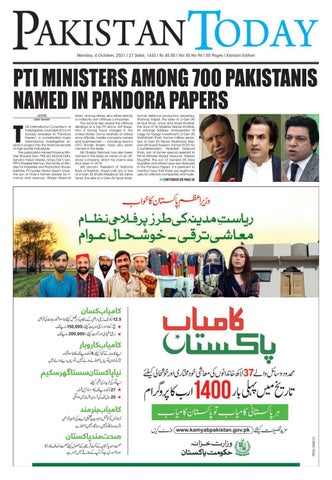
PTI mInIsTers among 700 PakIsTanIs named In Pandora PaPers LAHORE
T
staff report
he International Consortium of Investigative Journalists (ICIJ) on Sunday revealed its “Pandora Papers”, a coordinated major international investigative research project into the financial secrets of high-profile individuals. The publication named Finance Minister Shaukat Tarin, PML-Q’s Moonis elahi, Senator Faisal Vawda, Ishaq Dar’s son, PPP’s Sharjeel Memon, the family of Minister for Industries and Production Khusro Bakhtiar, PTI leader Abdul Aleem Khan, the son of Khan’s former adviser for finance and revenue, Waqar Masood
Khan, among others, who either directly or indirectly own offshore companies. The records also reveal the offshore dealings of a top PTI donor, Arif Naqvi, who is facing fraud charges in the United States. Some relatives of retired army officials, media company owners and businessmen — including Axact’s CeO Shoaib Sheikh, have also been named in the leaks. Mir Shakilur Rehman has also been named in the leaks as owner of an offshore company, which he claims was shut down in 2018. Arif Usmani, President of National Bank of Pakistan, Ahsan Latif, son in law of Lt-Gen (R) Khalid Maqbool, Ms Zahra Tanvir, the wife of Lt-Gen (R) Tanvir Shah,
former defence production secretary, Shahnaz Sajjad, the sister of Lt-Gen (R) Ali Quli Khan, Umar and Ahad Khattak, the sons of Air Marshal Abbas Khattak, Ali Jahangir Siddiqui, Ambassador at Large for foreign investment, Lt-Gen (R) Shafatullah Shah, former military secretary to Gen (R) Pervez Musharraf, MajGen (R) Nusrat Naeem, former ISI DG for Counterterrorism, Abdullah Masood Khan, son of former special assistant to Prime Minister Waqar Masood, hassan Muzaffar, the son of General (R) Afzal Muzaffar and others have also featured in the Pandora Papers. It is pertinent to mention here that there are legitimate uses for offshore companies and trusts.
CONTINUED ON PAGE 05
02
Monday, 4 October, 2021
KARACHI
NEWS
COMpANIes OpeNeD fOR INVestMeNt pURpOses wIth sBp peRMIssION: tARIN
f
News Desk
EDERAL Minister for Finance Shaukat Tarin has said that companies were opened for investment purpose with the permission of State Bank of Pakistan (SBP) but closed between 2014-15 adding that no bank account was opened for these companies and no transaction
was made. Talking to Dunya News, Finance Minister Shaukat Tarin said that the companies were opened when Tariq Malik was working for Bin Laden group. He said that formal permission was taken to invest in his bank. Shaukat Tareen further said that a Dubaibased company showed interest to invest in his bank. He said that he is ready at all times as he has done nothing wrong adding that he has all the documentary
evidence while PM Imran Khan has been informed that all my assets are declared. It is pertinent to mention here that another global scandal similar to Panama Papers is about to unfold. ICIJ will publish 11.9 million documents tonight, a global investigation that will surpass even the Panama Papers of 2016 involves 600 journalists and 150 media organizations from 117 countries.
Complete implementation of National Action Plan only solution for militants: Zardari News Desk
University in every district to provide opportunities to students: CM Buzdar News Desk Punjab Chief Minister Sardar Usman Buzdar has directed the relevant authority to complete the process of filling up the vacant posts of college principals as soon as possible and said that merit should be ensured in the appointment of controllers and secretaries of education boards. He said this while presiding over a meeting which reviewed the matters related to the Higher Education department. He said that a university in every district would provide better opportunities for higher education to the students especially the female students adding that establishment of Indus University in Rajanpur would fulfil the long standing demand of the people of the area. Universities would also be established in Muzaffargarh, Layyah, Bhakkar, Hafizabad, Bahawalnagar, Sheikhupura, Kasur, Attock, Gujranwala and other districts, he added. He said that University of Taunsa and Women University in DG Khan would remove the sense of deprivation among the people of the area. CM was briefed about the progress of setting up of 15 new universities in the province. During the meeting the public-private partnership and joint venture in establishing new universities in Punjab were also discussed. The meeting also decided to introduce the concept of Smart University in the province besides giving principle approval to make further recruitment of College Teacher Interns (CTIs) across the province. Usman Buzdar was further informed that 197 higher education projects would be completed at a sum of Rs 15 billion across the province. The process of transfer of land for 21 new colleges out of 88 had been completed.
UK to accept NADRA-issued COVID-19 certificates as proof of vaccination News Desk The United Kingdom has agreed to accepted NADRA-issued COVID-19 certificates as proof of vaccination for Pakistanis. The news was confirmed by Britain’s High Commissioner to Pakistan, Christian Turner. Previously, the NADRA-issued vaccination certificate was not acceptable in Britain. The unacceptability of Chinese vaccines however still remains in place, which means a significant portion of the Pakistani population would still be unable to enter the UK. The high commissioner also accepted that the decision to place Pakistan on the red list was “highly disappointing” as it effected a lot of people from both countries. Pakistan was removed from the red list and was placed on the amber list on September 22 along with several other countries. Valid Vaccines for UK traVel: Fully vaccinated Pakistanis with one of the European Medicines Agency (EMA) authorised vaccines — including Pfizer, Moderna, Oxford AstraZeneca or Janssen (Johnson & Johnson) are permitted to enter the UK and exempted from quarantine and testing under the rules.
Former president Asif Ali Zardari while expressing grief at the martyrdom of five security personnel yesterday during a security operation, stated on Sunday that complete implementation of the National Action Plan (NAP) is the only solution for militants. It is pertinent to note that during an operation at Spinwam, four Frontier Corps soldiers and one Levies sub-inspector were martyred on Saturday. “The cure for those who challenge the state’s writ is to bring down the nurseries of terrorism,” Zardari stated. He went on to say that terrorists must be seen as enemies of the state, while praying for the martyred security forces personnel. It merits mention that PM Imran Khan’s statememt about the government holding disarmament talks with TTP didn’t go well with the Opposition parties. The Opposition was critical of the PM’s statement. Pertaining to the PM’s statement, PPP has called for a parliamentary session on the matter, while calling the PM’s “extremely sensitive”. PPP General-Secretary Nayyar Hussain Bukhari termed PM’s statement as “rubbing salt in the wounds” of terrorism affectees..
On the other hand, PML-N’s Khwaja Asif was of a view that the PM “should have taken the nation into
confidence over this matter”, considering the suffering Pakistan has gone through, at the hands of terrorists.
Taliban rally outside Kabul as they consolidate rule AgeNcies Around 1,000 Taliban supporters attended a rally on Sunday in a vast field to the north of Kabul, in a show of strength as they consolidate their rule of Afghanistan. The crowd, made up only of men and boys, listened to speeches by leading Taliban officials and commanders at Kohdaman township in the hilly outskirts of the capital. The rally was the first of its kind in the capital since the group seized control of the country seven weeks ago following a lightning offensive. Flanked by white and black Taliban standards and fighters in full combat gear carrying assault rifles, the speakers addressed an audience sat in rows of chairs under awnings. To kick off proceedings, a procession of fighters carrying flags and weapons — including rocket launchers — paraded around the crowd. Some of the mainly unarmed supporters waved homemade posters, while others sported red or white Taliban headbands. Tribal elders watched on crosslegged from the side of the stage. As people started arriving, music honouring the Taliban’s victories echoed around the site as dozens of heavily armed fighters in military combat fatigues stood guard. “America is defeated, impossible, impossible — but possible!” one song said. Some chanted pro-Taliban slogans as they were driven down the dusty road on pick-up trucks to the site, as others shouted “Allahu Akbar” (God is greatest) when they walked into the
shaded area in front of the stage. At the turn-off towards the township, about 10 armed fighters lined the road beneath a large banner honouring a deceased Taliban commander and professing the “support of the people of Kohdaman for the Islamic Emirate of Afghanistan in the action of liberating the country”. Last Thursday, the Taliban had violently cracked down a small women’s rights demonstration in eastern
Kabul, firing shots into the air to disperse protesters. Then, gunmen pushed back the women protesters as they tried to continue with the demonstration, while a foreign journalist was hit with a rifle and blocked from filming. Isolated anti-Taliban rallies — with women at the forefront — were staged in cities around the country after the group seized power, including in the western city of Herat where two people were shot
dead. But protests have dwindled since the government issued an order banning demonstrations that did not have prior authorisation, warning of “severe legal action” for violators. The handful that have gone ahead have been criticised as carefully orchestrated publicity stunts, including a rally at a Kabul university where hundreds of fully veiled women professed support for the new regime.
Monday, 4 October, 2021
KARACHI
NEWS
03
British indians protest against pakistanis in Uk to ‘export’ radicaL ideoLogy IsLAMABAD
a
app
SMALL group of members of the Indian community held a demonstration in the United Kingdom to pour their venom against their Pakistan counterparts which the locals denounced as another attempt by the right-wing Hindu groups to attack Muslims all over the world. The protest was termed as an effort to create an Islamophobic atmosphere in the UK which is rapidly growing in India. The speakers tried to stir sentiments against the Pakistani community living in the UK by making announcements to boycott the restaurants run by Pakistanis. While on the other hand, enlightened Britishers have expressed their serious concerns over the efforts of the Indian government to infuse the Hindutva mindset at home and export it into British society.
They also blamed the neo-Nazi Indian regime for polluting the mindset of peaceful and harmonious societies outside. “This campaign is nothing but a form of prejudice and bigotry against Muslims,” the British citizens opined. “This is quite possibly the stupidest thing I have heard in my life. So, these Pakistani people come to the UK for a better life to provide for their family, just like Indians, but our Hindu brothers are painting it is as a conspiracy to fund and kill Indian soldiers,” another concerned person said. They said the entire Indian nation was suffering from the Hindutva mindset and were just making an issue out of a non-issue because of their hatred. A recently held mega online international conference titled ‘Dismantling Global Hindutva’ in the US was the first academic attempt initiated by academia to understand the undercurrents of Hindutva and its impact on western societies including western campuses
of renowned universities. The conference was addressed by speakers from leading universities in the world including Stanford, Harvard, Princeton, University of Chicago, and Berkeley. Over 600 academics across the world attended the online event. The participants expressed their concerns that Hindutva was becoming a global phenomenon and even the western universities were not safe from its influence propagated by the Indian Hindu students. The conference highlighted that Rashtriya Swayamsevak Sangh was promoting Hindutva. Motivated by the Nazi ideology, its regulatory principle was to transform India from a secular democracy to a Brahmin state where Muslims, Christians Jews and other religious minorities were demoted to the position of second-class citizens. Speakers were of the view that Hindutva was a political philosophy styled after European fascism of the early twentieth
century, an ideology that privileged a cult of personality and authoritarian leadership. The speakers also noted that the term Hindutva was a strategy based on violence, hatred and terrorism. It is an enemy of democracy and has been targeting freedom of speech since the BJP came into power. They were of the view that hatred was being generated by the Hindutva narrative which was against humanity because the philosophy placed Hindutva as a vehicle, and the message was actually the supremacy of Brahmin Varna over any human bearing stark resemblance to Hitler’s neo-Nazi ideology. Speakers were of the view that in the western world, Hinduism was promoted as a culture rather than a religion during the last half a century but now it has changed its face as a brutal and extremist religious monster that wanted to kill everybody except Brahmins. Hindutva had a history of ill-treatment of women, zero respect for transgender rights, minority exploitation, and extreme policies
Faiz Hameed to be Peshawar corps commander? IsLAMABAD Staff RepoRt
Inter-Services Intelligence agency chief Faiz Hameed is expected to be posted as Peshawar Corps Commander anytime after October 10, unverified reports said. The reports which relied on tweets said Hameed was most likely to be posted against the position to ensure continuity keeping in view his critical role in dealing with the evolving situation in Afghanistan since his appointment as spy chief in June 2019. Lt Gen Nauman Mahmood has been commanding XI Corps stationed in Peshawar at present since December 2019. The decision on Hameed’s appointment is expected after October 10 given that three three-star generals are due to retire on October 18.
Those retiring include Lt Gen Majid
Ehsan, Inspector General Arms (IG
Arms), GHQ Rawalpindi; Lt Gen Aamir Abbasi, Quarter Master General, GHQ Rawalpindi; and Lt Gen Hamooduz Zaman Khan, Commander Army Air Defence, Rawalpindi. Hameed “himself doesn’t want [Peshawar post]. Will [prefer to] stay as DG [ISI] till 2022. May get [an] extension. There is precedence”, another tweet read. Per a seniority list, the candidates for the future army chief post [seniority-wise] include Lt Gen Sahir Shamshad Mirza, Lt Gen Azhar Abbas, Nauman Mahmood and Hameed. Incumbent Army Chief Gen Qamar Javed Bajwa who received a three-year extension in January 2020 is due to retire on November 29, 2022. For Hameed’s elevation to COAS post, the precedent is that he must first serve as a corps commander.
towards Muslims, Christians, Jews and nonBrahmins. It violated the basic fundamental rights of everybody. In the name of Hindutva, the Indian government had instituted discriminatory policies including a ban on beef, restrictions on religious conversion and interfaith weddings, and the introduction of religious discrimination through controversial India’s citizenship laws. These measures led to a horrifying rise in religious and caste-based violence, including hate crimes, lynching and rapes directed against Muslims, Dalits, Sikhs, Christians, Adivasis, and dissident Hindus. Women of these communities were being specially targeted. Global experts have warned that India became an epic centre of social terrorism, using highly negative trends for creating communal division and hatred. The experts and media analysts are classifying India as a factory of communal and social terrorism exporting the same globally.
Lahore police suspend officers for torturing citizen News Desk Several police officials have been suspended by Lahore police for torturing a citizen, a press release stated on Sunday. According to the statement, a first information report (FIR) was registered at the Gulshan-e-Iqbal police station in Lahore against the officials for allegedly torturing a citizen named Muhammad Nawaz. As per the FIR, Nawaz was brought to the police station on September 23 by three police officials — Muhammad Naeem, Ali Hassan, and Samsun. Nawaz was later handed over to trainee assistant subinspectors Zahir and Adil Javeed. As per the FIR, Nawaz was then allegedly subjected to torture by the police officials with the “connivance of the station house officer (SHO).” Lahore police immediately launched an inquiry into the matter. Following the inquiry, the director-general (DG) operations directed to immediately suspend and arrest all the officials involved in the incident. As per the statement, an investigation into the incident is in process.
Prime Minister Imran Khan has no offshore companies: Shahbaz Gill News Desk Special Assistant to Prime Minister (SAPM) for Political Communication Dr Shahbaz Gill has said that Prime Minister Imran Khan had no offshore company. “If I have an offshore company, I am accountable for it,” he said and added that the premier could not be held accountable for the acts of any minister. He said that two residences in Zaman Park had the same addresses, but both were situation half a kilometre away from each other. Hence, the person who had an offshore company should be held accountable for it. Addressing a public gathering during inaugural ceremonies of various development projects in his native village Chak No 89-JB Ratna here, he said that the previous governments had left the national economy in a bad shape and Prime Minister Imran Khan had to take multidisciplinary measures to tackle the critical situation.
He said the top most challenge for the PTI was to pay off heavy loans, acquired by the previous governments. In order to tackle the challenge, the government lowered its expenditures to the minimum, but the corona posed yet another threat due to global meltdown. He said that the government was following the most prudent policies and it had overcome the negative impact of the prevailing crisis much earlier than the other countries. About Pandora papers, on the pattern of Panama leaks, he said that “we are not afraid of it, as we have neither been involved in any loot and plunder nor we can be held accountable for it”. He said that the “clean government” of the Pakistan Tehreek-e-Insaf (PTI) has successfully steered the country out of economic crisis. Continuing, he said that the economy was in a bad shape a few years ago, but the Pakistan’s captain boldly faced the situation and now the country was speedily heading towards progress and prosperity.
He said that when Pervez Musharraf left the government, the PPP had to borrow $2.5 billion loan to pay the installments of foreign loans. When the Pakistan Muslim League-N (PMLN) replaced the PPP government, it had to pay loans of $5 billion every year. He said that when the PTI government came to power after the PML-N, it had to pay $11 billion loan every year. He said saving of Rs 1080 million was made only in the expenditures of Prime Minister’s House. He said PM Imran Khan was the custodian of national exchequer, and he would give details of every penny spent from the national kitty. Similarly, the PTI government would make all others accountable for the public money spent by them. He said that the government was giving subsidy of Rs 80 billion on flour, which would give some relief to the inflation-stricken people. The PTI government was launching the Kamyab Pakistan Programme under which interest-free loans would be given to the poor people
Why is it essential for Pakistan, China to enhance coordination against terrorists, safeguard regional stability News Desk In recent years, the global and regional structure has undergone major changes. At present, the change of strategic situations in South Asia and its neighbouring regions is mainly reflected in the Afghan issue. The US hastily withdrew its troops from Afghanistan on the pretext of concentrating resources to contain China, and the Afghan Taliban quickly took over Kabul and are now in control of all Afghan territory. Many strategists and media in the West and India have linked the Afghan Taliban’s seizure of power with China-US relations, China-India relations and India-Pakistan relations. They believe that the successful seizure of power by the Afghan Taliban is a success of China and Pakistan, but a strategic failure of the US, the West and India. The reason why they have this faulty interpretation is mainly due to their geopolitical-competition thinking and zerosum game thinking.
On a larger regional level, in order to contain China, the US is trying its best to promote military competition and even confrontation in the whole Indo-Pacific region. The US not only continues to promote the institutionalization of the Quad, but it has also established a new group AUKUS, a pure military bloc. India is an important pillar of the Indo-Pacific strategy. India also has the ambition to achieve its goal of becoming a global power through the Indo-Pacific strategy of the US and attempts to use the US’ dependence on it to implement Hindu nationalist policies at home and in the region. To achieve its geo-strategic objectives, the US encourages India to play a greater role on the Afghan issue. The US attempts to sacrifice Pakistan’s interests in exchange for India’s strategic cooperation and make India its agent in the region. As we know, India has long been marginalized on the Afghan issue. If India is to play a role in Afghanistan, it is unlikely to
play a positive one. India is likely to use its intelligence agencies and some forces cultivated in Afghanistan and its surrounding areas in the past more than 20 years to undermine and disrupt the stability of Afghanistan. This is unfavorable to Afghanistan and its close neighbors, including China and Pakistan. As all-weather strategic partners, China and Pakistan must work together to maintain and promote regional security and stability. First of all, China and Pakistan must cooperate closely on the Afghan issue to persuade the Afghan Taliban to establish an open and inclusive government and implement a moderate domestic and foreign policy. At present, the verbal expression of the Afghan Taliban is very different from that in the past, but we do not know what specific policies they will champion in the future. The Afghan Taliban are now facing a series of severe challenges. First, the unity of Afghan Taliban itself; Second, whether
on the basis of their CNIC and the prime minister himself would stand guarantor for them. He said that the government was issuing the Kisan Cards through which subsidy would be given to the targeted group and no middleman could pilfer the subsidy. He said that increase in petroleum prices was a global phenomenon, which had multiplied the government difficulties. However, the government had reduced sales tax on petroleum levies on the petroleum products to pass on minimum impact of price hike to masses. He criticised Shehbaz Sharif and Suleman Sharif for projecting fabricated news that they had been exonerated from money laundering case. He said that they were involved in money laundering through mafia companies. He said that work on Rs 13 billion road projects had been started, under which Jhang Road, Sammundri Road, Jaranwala Road and Chiniot Road would be upgraded to provide better communication facilities to people.
the Afghan Taliban can establish an open and inclusive government; Third, food shortage is likely to lead to humanitarian disasters and refugees; Fourth, they hope to win the recognition and assistance of the international community, but at the same time, they also face the hatred, blockade, sanctions and even subversion of some hostile forces in the world. China, Pakistan, Russia and Iran all hope that the Afghan Taliban can establish an open and inclusive regime so that all ethnic groups and parties in Afghanistan can have their own representatives, which is the key for the Afghan Taliban to win domestic and international support. China does not want Afghanistan to fall into turmoil again due to domestic political struggle that always leads to humanitarian crises, nor does China want Afghanistan to become a shelter for Eastern Turkistan forces such as the ETIM. China does not want Afghanistan to become a source of regional unrest due to the excessive intervention of some external forces, affecting the security of CPEC. Therefore, on the issue of Afghanistan, China and Pakistan should coordinate with Russia, Iran and Central Asian countries. These countries together should warn
Europe of a possible refugee crisis, and put pressure on the US, India and some European countries to take responsible actions to provide humanitarian assistance to Afghanistan. While strengthening strategic and security coordination against terrorist supporters, China and Pakistan should work with countries inside and outside the region to promote the construction of an open, inclusive, democratic and equal regional governance structure and security structure. While cooperating to deal with the pandemic, China and Pakistan should also accelerate the building of CPEC. The 10th Joint Coordination Committee (JCC) meeting of CPEC has been held, and a new IT working group has been established, which will bolster CPEC. The success of CPEC will effectively enhance Pakistan’s comprehensive national strength and international status. The key to the success of CPEC is that Pakistan needs to form its own industrial advantages through reform and development that can provide a safer environment for the construction of CPEC. This article first appeared on Global Times
Monday, 4 October, 2021
04 NEWS
KARACHI
SiNDh heAlth AuthORitieS PlAyiNg With liveS OF PAtieNtS: PeW
NCOC daily update: 1,656 new cases, 35 deaths from Covid-19 ISLAMABAD: Pakistan on Saturday confirmed 1,656 new Covid-19 cases and 35 more deaths, the National Command and Operation Centre said on Sunday. The NCOC, a department spearheading the campaign against the pandemic, said the number of overall confirmed cases had risen to 1,249,858, including 1,175,489 recoveries. The number of active cases has dropped to 46,503 across the country, while 3,445 are in critical condition. According to the NCOC, the pandemic killed 35 people on Saturday, increasing the overall death toll to 27,866. Sindh is the most affected province of the country in terms of the number of cases, with 459,392 infections followed by Punjab which has reported 432,809 infections. Staff RepoRt
FBR clarify on fake version of FBR official Website ISLAMABAD: Federal Board of Revenue (FBR) has categorically rebutted malicious in intent and misleading in content a photoshopped version of the interface of FBR official website, displaying a ticker with date of returns filing extended up to 2050. This is a fake news being circulated on social media by some irresponsible elements which is strongly condemned, said a press release issued by FBR here on Sunday. It is further reiterated that the new deadline for filing of Income Tax Returns is October 15, 2021 which will not be extended beyond this date. The original deadline was of September 30 was extended by fifteen days and it was stated that it would not be extended as well. agencieS
PMD predicts Rabi ulAwwal moon on October 7
P
News Desk
AKISTAN Economy Watch (PEW) on Sunday criticized the interference of the Government of Sindh in the federally-operated hospitals of Karachi which is damaging these institutions. “Under the 18th amendment, the control of some important hospitals was handed over to the provincial government in 2011 which resulted in rapid deterioration, therefore, the federal government took back control of three major hospitals in Karachi a
year ago,” it said in a statement. “These hospitals included JPMC, NICD and NICH but the federal government could not take total control due to resistance by the provincial government. Soon, the Sindh government initiated conspiracies and started to appointments on political basis which rapidly deteriorate the hospitals,” said Dr. Murtaza Mughal, President PEW. He said the tactics being employed by the provincial government to get full control of JPMC which has put the future of doctors and health staff employed there as well as under-training post graduate students at stake.
He said that there is a 20 percent quota of Sindh in JPMC while 80 percent quota goes to the students of Balochistan, Gilgit-Baltistan, erstwhile Fata and Pata where there are no training facilities for postgraduate students but the provincial government is trying to fill all the seats with locals which is exploitation. He noted that Jinnah faculty is being run on an ad-hoc basis for a decade, forty important posts are also kept vacant for a decade, doctors in grade 18 are working as professors of grade 20 which amounts to playing with the lives of patients and the fu-
ture of students. The political interference is destroying the biggest hospital of Pakistan as 61 medical officers out of which 35 have postgraduate qualifications have been deprived of promotions for years, he added. The provincial government wants to make circumstances unbearable for the doctors of other provinces so that they resign and politicians can appoint their cronies in their place. Dr. Mughal said that the federal government should act to save the hospitals by taking full control of these hospitals before it’s too late.
KARACHI: The Pakistan Meteorological Department (PMD) has predicted there is a “good chance” of sighting the new moon of Rabiul Awwal on the evening of October 7. Thus the first day of the new lunar month will likely fall on Friday, October 8. The new moon will be born on crossing conjunction point at 16:06 PST on October 6 (Wednesday), the weather department said in a statement. The weather is expected to be partly cloudy or cloudy in most parts of the country on the evening of October 7, according to the climate record. The Eid Milad-un-Nabi is projected to fall on October 19. A meeting of the Central Ruet-e-Hilal Committee is expected to be held on October 7 for sighting the new moon of Rabi ul-Awwal. The meetings of zonal and district Ruet-e-Hilal committees were also expected to be held for collecting evidence in respect of sighting of the new moon at their respective offices. inp
Dubai’s Expo 2020 reveals three worker deaths from Covid-19 DUBAI ap
Dubai’s Expo 2020 acknowledged for the first time on Sunday that three workers had died from the coronavirus over the course of building the world’s fair during the pandemic, as the prestigious event draws scrutiny of labour conditions in the United Arab Emirates. When asked at a press conference about deaths among Expo’s vast foreign labor force, spokesperson Sconaid McGeachin said three workers had died from the virus in addition to three from construction incidents, without specifying when. She declined to describe the extent of the coronavirus outbreak among workers on site. McGeachin again claimed the information about worker casualties was previously available, without elaborating. However, authorities in the run-up to the $7 billion fair had not offered any overall statistics on worker fatalities, injuries or coronavirus infections despite repeated requests from The Associated Press and other journalists. The statement comes a day after Expo offered conflicting reports about how many workers had died in industrial incidents on site, before settling on three. The UAE long has faced criticism from human rights activists over poor treatment of the legions of low-paid migrant laborers from Africa, Asia and the Middle East who power the country’s economy. Dubai has gambled billions on its elaborate World Expo, hoping to make it a huge tourist attrac-
tion and a symbol of the country’s allure. But problems have emerged. The European Parliament last month urged nations not to take part in Expo, citing the UAE’s “inhumane practices against foreign workers” that it said worsened during the pandemic. To pay tribute to the thousands of workers who toiled to build the fairgrounds from scratch, the site features a somber worker’s monument — stone columns wrapped with an engraved roll call of laborers’ names at Expo’s Jubilee Park, nestled between a performance stage and a popular Dubai bar chain. The massive global event has also renewed criticism from human rights groups of the UAE’s suppression of dissent and restrictions on free expression. At a press conference Saturday, French Foreign Minister Jean-Yves Le Drian answered a question about the European Parliament’s concerns over labor abuses in the UAE, saying that France would not join in its call for an Expo boycott and instead raise any potential issues with Emirati authorities “behind closed doors.” However, the sensitive exchange was inexplicably missing from the official Expo transcript of the news conference, raising concerns about transparency at the site. “I will look into that,” said McGeachin when asked about the omission. “I would like to say that this is an oversight.” Meanwhile, Uganda’s long-serving President Yoweri Museveni arrived to visit his nation’s pavilion at Expo. He called the site and the Emirati effort to build the small city
“a challenge to the Africans” as they had “turned a desert into a center of affluence.”
CMYK
“Yesterday when I arrived, they took me for COVID test,” he said. “In Africa, some-
times we say, ‘Big people should not be checked.’”
Monday, 4 October, 2021
KARACHI
NEWS
05
South Korea to ISSue grant of uS$ 4 mIllIon to help paKIStan preServe gandhara BuddhISt herItage, SayS amB Suh Sangpyo iSLamaBad
S
news Desk
OUTH Korean Ambassador Suh Sangpyo has said that Pakistan and South Korea are all set to sign an MoU to preserve and promote Gandhara Buddhist heritage for which Korean government would release a grant of US$ 4 million. Addressing a ceremony held here to celebrate the 4353rd National Day and the 73rd Armed Forces Day of the Republic of Korea, Ambassador Suh Sangpyo said that the MOU is expected to facilitate the Korean Buddhist Tourism project which was discussed when the president of Jogye order visited Pakistan in year 2019. A cake-cutting ceremony was also held to mark the 4353rd National Day and the 73rd Armed Forces Day of the Republic of Korea. “Korean music, dancing and drama are also popular in Pakistan. So there is much more areas to expand bilateral cooperation between Pakistan and South Korea,” he said and added that since establishment of diplomatic ties in year 1983, the relations of the two countries have increased rapidly in manifold areas. “In particular, this year we have witnessed many concrete outcomes in our relations. In Political area, last Wednesday, Korean first Vice Minister came to Islamabad and held bilateral Political Consultation meeting with Foreign Secretary. During the current Afghan crisis, Korea and Pakistan are closely cooperat-
ing with each other. The two foreign ministers had a consultation by telephone and with full supports from the Pakistani government, 390 Afghan nationals were safely moved from Kabul through Islamabad to Korea,” he added. In economic area, he said, Korean companies are increasing investments to Pakistan. “In hydropower sector, already two hydropower plants are under operation producing electricity in Pakistan and the hydropower projects which account 2 billion in total are ongoing. In automobile sector, Korean mark cars, Hyundai and Kia, are locally pro-
duced,” he said. “In mobile phone business, Samsung electronics are establishing an assembly line Karachi and once established as planned by December, the factory will produce 3 million units of mobile phones a year and creating 800 local employees. And some of Korea-Pakistan joint ventures are already in Special Economic Zone,” he added. The Ambassador said South Korea announced the provision of the Economic Development Cooperation Fund of US$ one billion for 5 years starting from next year. “This fund is a soft loan to assist de-
veloping countries. The previous fund was US$ 500 million. Now in terms of the committed volume of EDCF, the number has doubled. Grant assistance from the Korean development agency, KOICA, is also active now, 5 projects ongoing amounting 40 million dollar and next year 2 more projects amount 15 million US dollar will be added up,” he added. Minister for Education Shafqat Mehmood said that Pakistan and Korea have a multifaceted relationship. “There is a long way to go. Bilateral trade of 1.2 billion dollars which needs to be improved. We deeply appreciate the efforts of Korean government to fight climate challenges and Pakistan is also contributing a lot to the cause,” he added. He said that in the field of education, Korea has contributed a grant of 20 million dollars. We also are indebted to Korea for facilitating Pakistani labour. The Korean pop music and film industry are popular too. Pakistan is partner in peace and development with the world,” he added. Speaking on the occasion, Senator Mushahid Hussain said that Pakistan and Korean people have a number of similarities. “South Korea and Pakistan share the oldest unresolved issues with our neighbours. Recent geatures of peace between North and South Korea are encouraging. We need to promote people to people exchanges and further increasing ties in the areas of technological cooperation,” he concluded.
PTI ministers among 700 Pakistanis named in Pandora Papers continued from page 01 The release of this report does not imply that any people, companies or other entities included in the ICIJ Offshore Leaks Database have broken the law or otherwise acted improperly. The ICIJ released a report titled “Prime Minister Imran Khan promised ‘new Pakistan’ but members of his inner circle secretly moved millions offshore” based on Pandora Papers Sunday night. According to the report, leaked documents revealed that “key members” of Prime Minister Imran’s inner circle, including cabinet ministers, their families and major financial backers “have secretly owned an array of companies and trusts holding millions of dollars of hidden wealth”. PM responds: Welcoming the development, Prime Minister Imran Khan tweeted “We welcome the Pandora Papers exposing the ill-gotten wealth of elites, accumulated through tax evasion & corruption & laundered out to financial “havens”. He tweeted that all those named would be investigate and appropriate action would be taken. A source has told Pakistan Today that Prime Minister Imran Khan has summoned a meeting of legal advisors today to look into the matter. Biggest yet: Pandora Papers is “our most expansive exposé of financial secrecy yet”, said the International Consortium of Investigative Journalists that in
2016 leaked an unprecedented 11.5 million files from the database of the world’s fourth-biggest offshore law firm, Mossack Fonseca. Containing 11.9 million files, Pandora Papers are said to be larger than their predecessor in terms of data collection and collaboration, made possible by the largest research team in the history of journalism in the world. More than 600 reporters from around the world, belonging to 150 media organisations spanning 117 countries, participated in the research for two years. The Pandora Papers contain 11.9 million files. Reporters Omar Cheema and Fakhar Durrani from a private media house in Pakistan were part of the investigation team. “The number of people named in [the Pandora Papers] is more than those named in the Panama Papers,” Cheema said, adding “the names are kind of interesting, but you will have to wait for another 24 hours”. He said that the ICIJ teams worked on the project for two years. The project named the Pandora Papers is in reference to the Greek mythology’s character in whose box would be all the ills of humanity. It is expected that Pandora Papers would open another Pandora’s box that might led to the downfall of several capitals of the world and big names. Panama Papers were released when Mian Nawaz Sharif was serving as Prime Minister of Pakistan. The leak exposed details of London properties and offshore
companies owned by his children. The case subsequently made it to the SC that dismissed the PM under articles 62 and 63 of the constitution. Speaking to GEO news Cheema said, “whether it is a public office holder, or an ordinary citizen, offshore companies do need to be declared while filing tax returns and must also be declared to the Securities and Exchange Commission of Pakistan.” “An added responsibility on politicians is that they have to declare their assets to the Election Commission of Pakistan, so they must declare it there as well.” Pandora Leaks strengthens PM’s stance: chaudhry Following the announcement by the ICIJ, Information Minister Fawad Chaudhry said on Sunday that details revealed in the “Pandora Papers” — major international research on the financial secrets held by high-profile individuals set to be released later today — will “further strengthen” Prime Minister Imran Khan’s stance. “Panama Papers revealed offshore assets of very corrupt people. Now another research of ICIJ (International Consortium of Investigative Journalists) is coming. PM Imran stressed upon rich countries that hiding of poor countries’ money in rich countries should be discouraged,” he said in a tweet. “We expect that this research, like Panama [Papers], will open new avenues of transparency and become another reason to discourage corruption,” Chaudhry said.
India matching Chinese troop buildup on disputed border, says Indian army chief India’s army chief has said China is sending troops to their disputed border in “considerable numbers”, prompting a matching deployment by New Delhi in a development he called a “concern”. Tensions have been high between the nucleararmed neighbours following a deadly border battle in June last year in the strategically important Galwan river valley in India’s Ladakh region, near Tibet. The world’s two most populous nations poured tens of thousands of extra troops into the highaltitude region in the Himalayas after the clash. General Manoj Mukund Naravane told reporters in Ladakh on Saturday that the Chinese troop presence along the 3,500-kilometre border had increased in “considerable numbers” and it was a “matter of concern”. Naravane said the Indian military was building up its forces along the border in response. “We have also inducted advanced weaponry. We are strong, quite well-poised to meet any eventuality,” the Times of India newspaper quoted him as saying. India and China have been holding high-level military talks since the June clash and Naravane said another meeting was expected next week. His comments came days after Chinese foreign ministry spokesperson Hua Chunying accused Indian soldiers of illegally crossing the border into Chinese territory, a charge that New Delhi said had “no basis in facts”. Local media reported last week, citing unnamed sources, that nearly 100 Chinese troops had crossed the border into Uttarakhand state for several hours in late August. India and China, which fought a full-scale border war in 1962, have long accused each other of trying to take territory along their unofficial border known as the Line of Actual Control. Agencies
Shah Rukh Khan’s Son, Aryan apprehended in drugs possesion case Bollywood actor Shah Rukh Khan’s 23year-old son Aryan Khan was apprehended along with seven others on Sunday during a raid by Narcotics Control Bureau at a party on a cruise ship in Mumbai. As per the sources, Shah Rukh Khan immediately headed for his lawyer’s office soon after the apprehension was confirmed. According to the NCB, the high-profile raid yielded 13 grams of cocaine, 21 grams of charas, 22 pills of MDMA and 5 grams of MD. The charges brought against Aryan Khan include purchase, possession and use of banned substances, it added. The custody of the arrested has been given to the agency till Monday. by the court. Aryan Khan’s lawyer Satish Maneshinde
denied Aryan’s presence on the cruise, and demanded bail. “Aryan had no ticket, no cabin or seat on board the cruise. He was there because he had been invited. He didn’t even have a boarding pass. Nothing has been found on him. He was arrested on the basis of chat only.” According to the NCB officials, the party began after the ship left Mumbai and was at sea. The raids began at 10 am and went on till 2 pm. The agency revealed that drugs like Ecstasy, Cocaine, MD (Mephedrone) were recovered from the party on board the ship. During the search operation, the suspects possesed different drugs which they tried hiding in their clothes, undergarments and
purses, an NCB official stated. The cruise company in a statement on Sunday said it had nothing to do with the incident. “Cordelia Cruises is in no way, directly or indirectly, connected to this incident. Cordelia Cruises had chartered its ship for a private event to a Delhi-based event management company,” Jurgen Bailom, Chief Executive Officer and President, Waterways Leisure Tourism Pvt Ltd said in the statement. It is pertinent to note that the Narcotics Control Bureau had been actively working to take action on anti-drugs cases since last year following the death of actor Sushant Singh Rajput and a wide-ranging investigation into alleged drug abuse. news Desk
cmYK
Monday, 4 October, 2021
06 COMMENT
What is the issue with QAU?
Changing the NAB law Tampering with the Chairmanship would make accountability even more doubtful
Expulsions or fee hikes?
P
RIME MInISTER Imran Khan will chair over a meeting of key ministers on Tuesday (tomorrow) to consider changes in the national Accountability Ordinance. Apart from the Law Minister and AttorneyGeneral, the Information, Defence, Foreign, Education and Planning Ministers will also attend, thus making it a congregation of legal minds. The principal issue before the meeting is to be the appointment of the nAB Chairman, whose four-year tenure is to expire on October 10. The purpose, it seems of party powerhouses meeting is supposed to explore ways of re-appointing the present Chairman, even though the law provides for a single term of four years. It might also seek some way of avoiding consultation with the Leader of the Opposition in the national Assembly. Any reappointment, or extension, would weaken the accountability process, because it would mean that the present Chairman had been rewarded for how he had made sure that the government did not come up before it, while both members of the previous government and bureaucrats on their side were thrown into jail for prolonged periods. More important, the possibility of an extension could be dangled in front of any future nAB Chairman. The meeting will also work out how the nAB Chairman is to be removed; the Ordinance having only a brief reference, not any details. That prevented proceedings on the scandal in which the Chairman allegedly had developed illicit relations with an accused. If that is remedied, then the Chairman, if reappointed, would have that case hanging over his head. It seems that the government no longer intends to seek opposition consensus over the nAB law. Its railroading of the electoral law amendments, despite claims that it would seek opposition consent, raises the fear that it might try to bulldoze these measures, which would also have the effect of reducing nAB to a mere government department, subordinate to the whims of the government, rather than an independent institution. The government’s tendency to extend tenures of high officials rather than making a fresh appointment, as in the case of the COAS at the beginning of the year, should be kept in check. The purpose of tenures is to not just to provide a convenience, but to provide the basis of independence to those who serve the state. They must not be converted into servants of the government.
Wali Ejaz NEkokara
Q
uAID-I-AzAM university is once again passing through tough times as the students’ protest has passed its ninth day. Students claim that an unjustified fee hike is not acceptable and they will not abandon the protest unless their demand is met. According to information, in 2019, the first-semester fee was around about Rs 59,740. Owing to the economic blow following the coronavirus, the fee witnessed a sharp increase of a whopping 27 percent to Rs76,030 in 2020. In 2021, it has further been increased to Rs80,240. Similarly, the security fee has ballooned from Rs 5,013 to Rs 10,626 this year. undoubtedly, the rising fee is not a positive omen for students who hardly manage their expenses. Toplevel officials maintain that the current government has left the public sector universities with no other option. They say that the government has suspended the grants to public sector universities and has directed them to manage financial needs on their own. Some of the violent activities are also carried out by the students as they have vandalized the QAu server room. This was done to abrogate the online classes. QAu officials stated that Rs 120 million’s worth of equipment has been destroyed that has made the availability of Internet impossible for the next four months. According to a recent notification by the QAu administration, all the rights demands of students have been accepted including on fees, trans-
A burning problem The French Bishops lead the way
A
report by a commission of 22 legal professionals, doctors, historians, sociologists and theologians, which will be unveiled on Tuesday, will show that about 3000 pedophiles have operated within the French Roman Catholic Church since 1950. This has not really come as a surprise, but rather than take any pleasure in the discomfiture the Church might face, those in Pakistan should take note of who set up the commission, which is issuing the 2500-page report: the Conference of French Bishops. That the Roman Catholic Church has had a problem is well-known, as country after country has admitted to this particular evil. It perhaps is inevitable when one has either celibate organizations, or enforced single-sex segregation among boarders. Similar stories leak out of madressahs, but instead of treating them as occasions for self-accounting and reform, the religious loyalty of all clerics is called forth, and the scandalous revelations are treated as an attack by irreligious forces on the faith itself. While reprehensible, it strains the imagination to hear the persistent denials. Even though there is no exact parallel to the Conference, because the problem centers around the madressahs, maybe the Various Wifaqul Madaris could commission such a study. There can be no reform unless the leading teachers deal with the problem, and obtain some information about what the ground situation is like. One of the biggest differences between Pakistan and the countries where the problem has been tackled has been the willingness of victims to come forward. A justice system that enables victims to come forward under cover of secrecy is one way. Some of the prosecutions of offending priests have been because of suits for damages, which have led to victims coming forward. Some similar incentivization may be necessary to make victims come forward. That the problem is there, can no longer be swept under the carpet, as the guilty would like. It is up to the stakeholders, which includes all those conducting single-sex boarding establishments, to reform themselves, which means gathering accurate information for a start, even if it involves a certain amount of initial embarrassment. It should be realized that the French Bishops have acted first, before someone else, perhaps inimical to Church, does so first.
Futile reconciliation The amnesty offer was not fully thought through
Mustafa abdullah baloch
R
ECOnCILIATIOn cannot be done in isolation, but has to have a national consensus and acceptance of the crimes by those receiving amnesty. It is like playing with the emotions of the families who have suffered the loss, and you cannot bury the past for political expediency. Because this will definitely haunt the nation in future. The Prime Minister must first gauge the pulse of the public through Parliament whether the people of Pakistan, especially the bereaved families of victims, are ready to reconcile with those who butchered their loved ones or not. If not, then he must not thrust his decision on the nation, and if yes, he must go through the historical facts of South Africa’s famous Truth and reconciliation philosophy coined by nelson Mandela. nowadays people and countries try to emulate this philosophy; however the key element of this doctrine is that with every reconciliation there comes a burden of truth. For example in ‘Truth and Reconciliation Commission’ nelson Mandela’s wife who had been his biggest support system during his days of incarceration accepted that she aided and abetted in the murder of a white teenage boy after which Mandela with a heavy heart divorced her. For such reconciliation you need the support of Parliament and consent of the nation; while Prime Minister Imran Khan, having ego higher than Himalayas, doesn’t even shake hands with the opposition leaders. Ironically, he is reluctant to reconcile with political parties carrying the public mandate of the same country he is ruling today but is anxious to reconcile with the militant groups. Such a reconciliation does not require en-
Dedicated to the legacy of late Hameed Nizami
Arif Nizami (Late) Founding Editor
Yousaf Nizami M. A. Niazi
Editor Aziz-ud-Din Ahmad
Umar Aziz
Joint Editor
Joint Editor
Executive Editor
Lahore – Ph: 042-36300938, 042-36375965
portation, library timing, and hostels. unfortunately, their fellows. When the administration did not meet despite getting fulfilled their demand, a group of stu- their demand, they adopted the path of a hunger dents is still on strike. These protesters are from Push- strike. Over time, an apolitical matter was transtun and Saraiki student councils. There are five formed into a political issue through malicious propstudent councils, comprising Punjab, Sindh, Pushtun, aganda. Baloch students were being taken as the Saraiki, and Gilgit. With the exception of the Pushtun victims of injustice meted out by the administration. and Saraiki councils, all other councils have called Balochistan Home Minister Sarfraz Bugti visited off the strike following the recent notification by the QAu for meeting the administrative staff to resolve administration. Raising voices against unjust admin- the issue. So, the deteriorating health conditions of istrative decisions is a right of students and listening those who were on hunger strike, and political pressure compelled the administration to restore rustito them is the duty of the administration. As an erstwhile student of QAu, I know that cated students. Currently, students are taking Baloch students as most of the teachers are cooperative. If we talk about administration, it was dysfunctional before the arrival a source of inspiration but hopefully this time the administration will not bow of Vice-Chancellor Muhamdown before the students. mad Ali Shah and Registrar Kowtowing to illegitimate Dr Raja Qaisar Ahmad. I am demands will further one of the students of Dr Hopefully this time the strengthen the propensity of Raja Qaisar Ahmad. Honillegal strikes. I have been estly, I could not find a more administration will not bow told the Islamabad police are cooperative and benevolent trying to eradicate the hurperson in my four years at down before the students. dles and making the roads QAu. The reason for menKowtowing to illegitimate safe for QAu’s buses. tioning this is to make readInitiating the BS proers understand that now the demands will further gram in QAu has appeared administration is working strengthen the propensity of to be an unsuccessful projunder the stewardship of coect. A place like QAu deoperative officials. When I illegal strikes. I have been mands mature students and read the recent notification posted on Twitter by Dr. told the Islamabad police are intermediate students lack that level of maturity. The Raja Qaisar Ahmad, I trying to eradicate the BS programme is contrary thought that if this was the to QAu’s DnA. Secondly, solution then it must have hurdles and making the the role of councils is debeen done before. But after structive. In my four years at roads safe for QAU’s buses learning about students who QAu, I saw many conflicts are still protesting, I conamong councils. There are cluded even deft and timely two main things against handling could not have apwhich the councils seem peased the mess. The students who are still on strike are less concerned about united; one is fee hike and demand for some facilities and the second is unity against Jamiat-Tulba-Islam. the fee but more about their expelled fellows. The Jamiat tries to get a foothold in QAu but the One of my friends told me about the scuffle some Pushtun troublemakers were part of. A few days back, councils’ resistance makes it impossible. The organsome miscreants from the Pushtun community quar- ization of all councils is known as QSF. One of the reled with the library staff and were expelled from important reasons behind the unity of all councils the university. Similarly, some of the Saraiki students against fee hikes and Jamiat is their survival. QSF’s were also rusticated on the charge of violating the bid to resist Jamiat’s presence in QAu is a positive university’s code of conduct. Both councils want the thing but QSF should prove itself a good alternative also. QSF has never played any role to make varsity restoration of the rusticated students. Sadly, QAu has already gone through a similar drugs-free and has never tried to create a conducive situation once before. In 2017, Sindh and Baloch environment for learning. Council’s clash resulted in the rustication of 26 stuThe writer can be reached dents. The majority of expelled students were Baloch. Then, Baloch students protested for the restoration of at waliejaz04@gmail.com
I
Karachi – Ph: 021-35381208-9
I
dorsement of the PM but the acceptance of general pub- question arises who has given him the authority to forlic will which is represented by Parliament. Therefore, give any individual or group without having a debate this serious issue must be put on the floor of Parliament in Parliament which he has never taken seriously since the day he entered power corridors; his statement has for debate before taking any decision in haste. However, in naya Pakistan there are two sets of given an impression of weakness and incapability. Will rules; mercy for those who stay in line with Khan and he again use his much favourite tool, a Presidential orvendetta for those who stand against his incompetent, dinance, to bypass Parliament in this regard? So far that’s how he has been trying to thrust his decisions, unpopular and klutzy government. Over the past many years Pakistan has been a vic- be it ‘Open Balloting’ in Senate elections or the recent promulgation of a Presidentim of terrorism with counttial Ordinance for the use of less terror attacks on innocent electronic voting machines in civilians, political leaders like elections; Khan has always Shaheed Mohtarma Benazir The million dollar question tried to bypass Parliament. Bhutto and the AnP’s Haroon is that with a thin There are some public conBilour and Bashir Bilour, our cerns after the controversial frontline forces who fought questionable majority in statement of the PM. Firstly, with ultimate valour against would he take the responsiterrorism and not to forget the Parliament, unpopularity in bility if in future the militant deadliest APS school maspublic and isolation from the group breaches the agreesacre where 149 innocent ment which he is desperately Pakistani citizens, including international world is Imran seeking? Secondly, who will 132 children, were killed at Khan even eligible to offer be the guarantor? Thirdly, the Army Public School, Pewould the families of martyrs shawar. The pupils were kept an amnesty? Can we trust be taken into confidence or is hostage and were forced to it just a usual dictatorial watch their teachers and printhose who butchered our move by Khan to prolong his cipal being killed in front of innocent APS students? inept government which is them. It was barbaric and horalready tumbling? This is a rifying; the survivors of the serious matter which needs APS attack would still be livnational consensus and thoring in that trauma. The aftermath of this deadliest massacre shook the entire world, ough debate; not the whims and wishes of the Prime and the heart-wrenching optics of the incident brought Minister as an individual. The million dollar question is that with a thin tears in the eyes of every human being. Later in Jan 2015 national Action Plan was es- questionable majority in Parliament, unpopularity in tablished by the government of Pakistan to crack- public and isolation from the international world is down against the terrorists, and the operation was Imran Khan even eligible to offer an amnesty? Can carried out because the public sentiments were strong we trust those who butchered our innocent APS stuand against those who murdered innocent children. dents? Will they not repeat the terror again in future? The APS attack was one of the many horrific inci- nation’s will is more important than that of the PM; dents witnessed by Pakistan in these past few years, is the nation willing to give amnesty to such elein fact the wounds of these attacks are still fresh and ments? These are some of the many questions that Imran Khan must answer to the nation in Parliament won’t be easy for the nation to forget. But ironically PM Khan while recently giving an before giving sweeping statements. interview to an international news channel talked about The writer is a columnist and member of the giving amnesty to those who were responsible for killing thousands of innocent Pakistanis. now the PPP,and tweets @MustafaBaloch
Islamabad – Ph: 051-2204545
I
Web: www.pakistantoday.com.pk
I
Email: editorial@pakistantoday.com.pk
Monday, 4 October, 2021
COMMENT 07 Editor’s mail Send your letters to: Letters to Editor, Pakistan Today, 4-Shaarey Fatima Jinnah, Lahore, Pakistan. E-mail: letters@pakistantoday.com.pk Letters should be addressed to Pakistan Today exclusively
Incorporating Technology in Education AS the saying goes, “ in the midst of every crisis, lies great opportunities.” As the covid-19 has taken its toll on education sector, it has also open new avenue of incorporating technology in our education system. Coronavirus has compelled authorities to digitalize education delivery system in order to provide distant learning during the closure of educational institutes. However, owing to capacity issues, digital divide and digital illiteracy, government is unable to provide dividends of technology to everyone, particularly in the remote areas of Pakistan. A recent decision by the universal Service Fund (uSF) to provide high-speed mobile broadband services to the remote areas of Pakistan is a welcome news in this regard. This will enable residents of these remote areas to access modern education on internet. This will not only revolutionize education delivery but also help in education management in far flung areas. The need of hour, therefore, is to digitalize educational system so that students in distant area can get education in this time of crisis. FaiSal hayat Okara
Karachi’s strays
The myth of educational inclusivity Making education inclusive needs a lot of hard work
M ilyas kalhoro
W
HEn Sarfraz when went to school for admission, he was denied it. The reason of denial, was his inability to speak and hear like normal students. He was advised to get admission in a school of special children. Anwar’s case is not different. He was denied admission because he had a foot with a peculiar structure, causing an abnormal walk. Likewise, though Parkash and Haresh, two brothers from Bagri community (scheduled caste Hindus mostly engaged in sweeping and sanitation work), were admitted, but it was only after huge effort of their father. These examples reflect that the existing framework of educational sector in the country Is not inclusive in any way. The term inclusive education signifies the recognition of, and giving value to diversity in a school setting. According to unESCO, inclusive education is seen as “a process of addressing and responding to the diversity of needs of all learners through increasing participation in learning,” The term not only refers to mainstreaming education of children with special needs, it applies to all children regardless of their ethnicity, gender, personality traits or parents’ socio-economic status. The goal is the equitable provision of learning opportunities irrespective of any kind of difference. The state through different constitutional obligations takes upon itself the responsibility of promulgating inclusive education. One provision extending such obligation is Article 25A of the 1973 constitution. It stipulates that “The State shall provide free and compulsory education to all children of the age of five to sixteen years in such manner as may be determined by law.” Whereas Article 26 states ‘there shall be no discrimination against any citizen on the ground only of race, religion, caste, sex, residence or place of birth.’ This applies also to the educational sector. Constitutional obligations aside, Pakistan has also made international commitments for promotion of inclusive education. One such example is the un Convention on the Rights of the Child (1991) which asks for protecting the rights of children through inclusion in mainstream schools.
It is a sad state of affairs that inclusiveness in our educational system is missing. There are considerable inequalities prevalent by disability, religion, region, gender and socio-economic status. Starting from children with disabilities, the existing structure of mainstream education system in Pakistan does not accommodate such children. Special schools are built for them in every province, including the capital, but these schools suffer from the issues of substandard education and budgetary constraints. The departments of special education in provinces neither have any interaction with the mainstream education departments of the government nor with private institutions. Accessibility of the children with special needs to such schools is very low, especially for those belonging to rural areas, as most of these schools are found in urban areas. The educational plans for Punjab (2013–17), Sindh (2014–18) and Balochistan (2013–18) put emphasis on inclusive education against special education as a future goal, but the efforts required for materialising this shift of policy are invisible. The education system of the country is not fully inclusive when it comes to the minority students. The young learners belonging to minority groups do not get equitable treatment in classrooms. They often hear despicable faith-based comments from their teachers and peers. Such a treatment of minority students in schools is disclosed by a report titled ‘Education and Inequality’ launched by the Institute of Development Research and Corresponding Capabilities (IDRAC) and Human Rights Commission of Pakistan (HRCP) in July 2019. The report said that 60 percent of the nonMuslim students interviewed as part of this study said they had experienced discrimination in classrooms. This faith-based discrimination in educational institutions is contrary to the spirit of inclusiveness. The educational sector of Pakistan is also not inclusive enough in terms of integrating children whose parents have disadvantaged economic backgrounds. The students belonging to well-to-do families manage to get admission in any desired school. While a good number of students belonging to impoverished families do not even dream of going to a public school. They do some kind of work to earn some livelihood for their family. This causes an upsurge in child labour. According to a report of the united nations Children’s Fund (unicef), about 3.3 million Pakistani children are entangled in child
labour. Poverty does not allow such children to attend school. The gender parity in attainment of education is still an unrealised dream. It is the responsibility of the state to ensure full participation of women in all spheres of national life, including education (Article 34). Talking especially about the educational sector, the participation of the fair sex is less. The Global Gender Gap Report (2021) of the World Economic Forum divulges this. The report placed Pakistan at 144th, out of 156 countries, in terms of educational attainment. According to the report, the enrollment gender gap in Pakistan’s overall education system stands at 13 percent. These gaps become widest at the lower educational levels– 84.1 percent in primary, 84.7 percent in secondary and 87.1 percent in tertiary levels. Further, only 46.5 percent of women are said to be literate, while 61.6 percent reportedly attain primary school education. In short, the education system is not inclusive by gender. The children from remote or rural areas are also somewhat at a disadvantage as to earning dividends of so-called inclusive education. Most educational institutions are established in urban areas. The children belonging to rural areas have to come from far off to attend classes. Given the distance of schools, not all the parents get their children admitted to schools. The Constitution through its Articles 22(4) and 37 makes the description of backward areas and prescribes the state must ensure the uplifting of these. However, at the national or provincial level there are no laws or policies dealing with the inclusive education of children from rural or remote areas. The difficulty faced by children of rural areas in getting easy access to educational institutions, makes the inclusivity of the educational sector questionable. The transpiration of inclusive education seems a distant dream in Pakistan. non-inclusion of children with disabilities in mainstream education, prevalent faith-based intolerance in classrooms, and disparity in attainment of education by region and gender, all these realities are reflective of missing inclusive education here. However, materialising inclusive education is not something unattainable. Those at the helm need to display strong willingness for transpiring inclusive education in its true sense so that the likes of Sarfaraz, Anwar, Parkash and Haresh could be integrated into mainstream education.
The transpiration of inclusive education seems a distant dream in Pakistan. Non-inclusion of children with disabilities in mainstream education, prevalent faith-based intolerance in classrooms, and disparity in attainment of education by region and gender, all these realities are reflective of missing inclusive education here.
The writer is an independent educational researcher in Larkana. He can be reached at m.ilyas.kalhoro.mi@gmail.com
I have finally become compelled with how to raise this issue to the government, because now the issue has now become critical. The issue is that the number of street dogs in the city of Karachi is on the upsurge. Because of this increase, they are becoming more dangerous for the people and especially the children. Day by day, the number of incidents involving dog biting is rising. unfortunately, our government doesn’t seem to take this vital issue seriously. People going to the mosque for Fajar and Isha prayers are the most vulnerable. Mothers are constantly in fear when they send their kids to school and or errands because of this issue which is completely neglected by the corrupt officials of the government. Whenever the suggestion/demand of poising these mad dogs is brought up to the respected officials they are more concerned about animal cruelty than the safety of our children. Therefore, I appeal to the Army Chief and the Chief Justice of Pakistan to take note of this serious situation and convince our government to act accordingly. MuhaMMad azEEM karachi
Increasing sexual violence AnOTHER incident of sexual abuse within one month has set a wave of fear and unrest across the district. A minor girl Jamila of around 8 years, daughter of poor labor was subjected to sexual assault by an unknown miscreant in Banu a locality of Taluka Mirpur Bathoro district Sujawal. The girl found semi-unconscious was shifted to civil hospital Sujawal for treatment, where her condition is stated to be stable. Parents of the miseryridden girl have demanded justice while no FIR of the incident has been lodged yet. This case is second of its kind in the district followed by the Ayshiya Themore Rape case that had taken place a month back in a village near Jati. The Higher authorities of the districts have opted to remain silent on that ensuing imprecation. It seems that the people of the remote district are unaware of the ferociousness that has started to pullulate in an otherwise peaceful district. Chief Minister Sindh, Chief Justice of SIndh High Court and IG Sindh are requested to take notice of this gruesome incident kaMraN khaMiSO khOWaJa SuJaWal
Gender problems PROBLEMS surrounding gender have always been present in our society. From Pakistan ranking the third last country on the Human Rights index, to the failure of exercising gender based laws. However as most of us think gender inequality is not just limited to men and women, but transgenders too; a large portion of our population which is largely stigmatised, and mostly ignored. This was further highlighted when a transgender woman Julie, who happens to be an activist, was imprisoned based on a false allegation, and unlawfully kept in men’s jail despite her identifying as a woman. Her suspicious arrest took the social media by storm, since Julie had earned her self quite a rapport with social media activists for her ardour to blatantly state the truths about our society. Which were otherwise shunned into silence; issues like sectarian unrest, sexual exploitation of transgenders, and the prevalent class culture. The rage of her supporters resulted in her release after 7 days. However in the past even when she was not a social media sensation Julie had faught for injustices against her gender, which are far too many to state. The question is how long will we, as a nation, continue to opress the voices of truth and justice into silence, rather than addressing the issue at hand. It is high time that the order of law should be implemented and hold accountable even the keepers of law (police), if they’re caught missusing. There needs to be further revision in law which cater to minorities whether gender based, race based or religion based. SakiNa rizvi karachi
Concerning situation HE challenge for India and Pakistan is how to make certain that they manage their relation in a way that annihilate all points of contention, the convergence between the two countries remain dominant and the pessimistic aspects are manageable. The gap between the two is also expanding. There is growing distrust on the terms between the two countries and the challenge for Pakistan is how it manages that distrust and begins to shrink that distrust. As far as the uS is concerned, uS is aspiring super power but its aspirational ambitions are built on great deal of insecurity, the way it perceives Pakistan’s relations with the China it is being hemmed in by close understanding cordiality between Pakistan and China so lets not discount the insecurity on the uS side. ShaFi ahMEd khOWaJa Jati SuJaWal
Monday, 4 October, 2021
08 WORLD VIEW
A coup Attempt At the ImF
project Syndicate
m
JOsePH e sTIGLITZ
OvES are afoot to replace or at least greatly weaken Kristalina Georgieva, the International Monetary Fund’s managing director since 2019. this is the same Georgieva whose excellent response to the pandemic quickly provided funds to keep countries afloat and to address the health crisis, and who successfully advocated for a $650 billion issuance of IMF “money” (special drawing rights, or SDRs), so essential for low- and middle-income countries’ recovery. Moreover, she has positioned the Fund to take a global leadership role in responding to the existential crisis of climate change. For all of these actions, Georgieva should be applauded. So, what is the problem? And who is behind the effort to discredit and oust her? the problem is a report that the World Bank commissioned from the law firm WilmerHale concerning the Bank’s annual Doing Business index, which ranks countries according to the ease of opening and operating commercial firms. the report contains allegations – or more accurately “hints” – of improprieties involving China,
KRISTALINA GEORGIEVA, THE IMF’S MANAGING DIRECTOR SINCE 2019, HAS BEEN A BOLD LEADER IN CONFRONTING THE ECONOMIC FALLOUT OF THE PANDEMIC, AS WELL AS IN POSITIONING THE FUND AS A GLOBAL PIONEER ON CLIMATE CHANGE. THE EFFORTS NOW UNDERWAY TO REMOVE HER ARE NOT ONLY UNJUST, BUT COULD HAMSTRING THE FUND’S MANAGEMENT FOR YEARS TO COME Saudi Arabia, and Azerbaijan in the 2018 and 2020 indexes. Georgieva has come under attack for the 2018 index, in which China was ranked 78th, the same position as the previous year. But there is an insinuation that it should have been lower and was left as part of a deal to secure Chinese support for the capital increase that the Bank was then seeking. Georgieva was the World Bank’s chief executive officer at the time. the one positive outcome of the episode may be the termination of the index. A quarter-century ago, when I was chief economist of the World Bank and Doing Business was published by a separate division, the International Finance Corporation, I thought it was a terrible product. Countries received good ratings for low corporate taxes and weak labor regulations. the numbers were always squishy, with small changes in the data having potentially large effects on the rankings. Countries were inevitably upset when seemingly arbitrary decisions caused them to slide in the rankings. Having read the WilmerHale report, having talked directly to key people involved, and knowing the whole process, the
investigation appears to me to be a hatchet job. throughout, Georgieva acted in an entirely professional way, doing exactly what I would have done (and occasionally had to do when I was chief economist): urge those working for me to be sure their numbers were right, or as accurate as possible, given the inherent limitations on data.1 Shanta Devarajan, the head of the unit overseeing Doing Business who reported directly to Georgieva in 2018, insists that he never was pressured to change the data or results. the Bank’s staff did exactly as Georgieva instructed and rechecked the numbers, making miniscule changes that led to a slight upward revision. the WilmerHale report itself is curious in many ways. It leaves the impression that there was a quid pro quo: the Bank was attempting to raise capital and offered improved rankings to help get it. But China was the most enthusiastic backer of the capital increase; it was the United States under President Donald trump that was dragging its feet. If the objective had been to ensure the capital increase, the best way of doing so would have been to lower China’s ranking. the report also fails to explain why it
doesn’t include the full testimony of the one person – Devarajan – with firsthand knowledge of what Georgieva said. “I spent hours telling my side of the story to the World Bank’s lawyers, who included only half of what I told them,” Devarajan has said. Instead, the report proceeds largely on the basis of innuendo. the real scandal is the WilmerHale report itself, including how David Malpass, the World Bank president, escapes unscathed. the report notes another episode – an attempt to upgrade Saudi Arabia in the 2020 Doing Business index – but concludes that the Bank’s leadership had nothing to do with what happened. Malpass would go to Saudi Arabia touting its reforms on the basis of Doing Business just a year after Saudi security officials murdered and dismembered the journalist Jamal Khashoggi. He who pays the piper, it seems, calls the tune. Fortunately, investigative journalism has uncovered far worse behavior, including an unvarnished attempt by Malpass to change the methodology of Doing Business to move China down in the rankings. If the WilmerHale report is best characterized as a hatchet job, what’s the mo-
The myth of Angela Merkel THE HOLLOWNESS OF MERKEL IS NOT A VIRTUE. HER LACK OF PRINCIPLE, HER LACK OF AN AGENDA, HAS LEFT GERMANY UNPREPARED FOR MANY OF THE GREAT CHALLENGES OF THE 21ST CENTURY
Spiked
A
Fraser Myers
t the height of Angela Merkel’s powers, the outgoing German chancellor was hailed as the leader of the free world – the supreme defender of the liberal order in an age of populism, and the saviour of Europe in an age of nationalist revanchism. But as Merkel exits the stage, after 16 years at the helm of Europe’s largest and most prosperous nation, the commentary has been much more muted. Hagiographies of her years in power are few and far between. Could the myth of Merkel finally be starting to unravel? there is no question that Merkel is a formidable politician. Her 16-year reign makes her one of Germany’s longest-serving chancellors, placing her alongside the likes of Otto von Bismarck and Helmut Kohl. But while Merkel’s staying power, her dominance, her supreme talent for self-preservation may have served her well, she leaves her party, her country and Europe in a weakened state. Merkel is, above all, an opportunist. She is a politician who has moved with the times, who has ably outmanoeuvred her rivals in and outside her party. ‘Merkiavelli’ is how she was dubbed by the late sociologist Ulrich Beck. She is a political shapeshifter. On the economy, Merkel began her chancellorship as a fiscal hawk, keeping a tight grip on the budget strings for most of her time in office. She leaves office having authorised some of the most generous pandemic spending in the world. On cultural questions, she was at times a social conservative, opposing gay marriage, and other times a hyper-liberal, opening Germany’s borders to a million refugees. Merkel has no ideology beyond what works for Merkel. And this has made it impossible for German politicians to emerge from her shadow. She has managed to dominate the German political scene to such an extent that even Germany’s first post-Merkel elections at the weekend were overshadowed by her presence. this has
come at a huge cost to her party, the CDU. It is wracked by infighting and uncertainty over what direction it should go in. Its two successors to Merkel have both imploded spectacularly. First, there was ‘mini Merkel’ Annegret Kramp-Karrenbauer who lasted less than a year as CDU leader. Now there is the hapless Armin Laschet, who couldn’t manage to muster even 25 per cent of the vote in this week’s elections – the CDU’s worst-ever result. this was once the dominant party of postwar Germany. Germany has had a CDU chancellor for 57 of the 72 years of the federal republic. But Merkel has left the party a hollowed-out husk. Even the rival Social Democrats, the SPD, cannot break free from Merkel’s mould. the SPD’s Olaf Scholz, who narrowly won the election, served as Merkel’s vice-chancellor and finance minister in coalition. During the campaign he presented himself as the continuity candidate rather than the change candidate. He even copied Merkel’s signature hand gesture – the ‘Merkel rhombus’ – to ram this message home. But for a politician who so many are desperate to ape, and whose legacy they are so terrified to break from, Merkel’s time in office has not exactly worked wonders for the country she served. Just look at the German economy. As Wolfgang Streeck has argued on spiked, the economic conditions Merkel inherited were incredibly favourable. Her predecessor, the SPD’s Gerhard Schröder, had brought Germany into the Euro, and had already squeezed the wages of German workers (with the connivance of the trade unions). this made German exports more competitive, even at a time when other developed countries were offshoring their manufacturing bases to the Far East. the SPD paid a heavy political price for these reforms, but Merkel gobbled up the spoils. So what ideas did Merkel bring to the table? Not many. When she first ran for election in 2005, she presented herself as a hardline thatcherite. She wanted a flat tax, welfare cuts, labour-market deregulation. She set herself in opposition to the German economic model – in particular, against the ‘social partnership’ that brings together the state, the private sector and labour unions – in favour of a more Anglosphere style of capitalism. But after only narrowly winning the election, and after forming a coalition with the Social Democrats, most of these plans were dropped. She discovered that she had actually loved the social partnership all along, and that her predecessors had already done the heavy lifting when it came to labour-market reforms. throughout much of Merkel’s time as chancellor, the German economy seemed to be in good shape. It weathered the 2008 financial crash far better than the rest of the West. Germany became a by-word for economic success, efficiency and resilience. Yet towards the end of Merkel’s time in office, Germany’s underlying weaknesses started to come to the surface. Even before the pandemic shut down the world,
Germany was teetering on the edge of recession. It grew just 0.6 per cent in 2019. Its much-vaunted industrial base has been slowly declining as a share of GDP. Even the fate of Germany’s all-powerful auto industry no longer feels so secure – 42 per cent of German car workers now say that they fear for their future. the ‘jobs miracle’ that Merkel oversaw was a mirage. Yes, more people found work, but mainly in poorly paid, low-productivity service jobs. Under Merkel’s penny-pinching regime, the German state has failed to invest properly in infrastructure, and many of its larger construction projects have been beset by delays, cost overruns and corruption. Berlin’s newest airport, Berlin Brandenburg, is emblematic of Germany’s infrastructure woes. It took nine years longer to build than planned, and missed seven of its slated opening dates. Even worse has been the failure to upgrade Germany’s digital infrastructure – Germany has some of the slowest internet speeds in the developed world, and the worst 4G coverage in Europe. Four in 10 companies are still using fax machines. Merkel’s Germany is no model of ‘efficiency’. One area in which she promised major reform was in energy production. Germany has long had a reputation for being ‘green’ and for taking climate change seriously. In 2010 the government initiated the Energiewende – the ‘energy transition’ to low-carbon sources like wind and solar. But one major fault in the plan was that it also included the decommissioning of Germany’s nuclear power plants, despite the fact that nuclear power generation is carbon-neutral. the government had planned to use nuclear as a ‘bridging technology’, keeping plants online until the point at which renewables would be able to provide 100 per cent of energy. But panic struck following the meltdown at the Fukushima Daiichi nuclear plant in Japan. Suddenly, nuclear was declared unsafe, and its removal from Germany’s energy mix was made a priority. In reality, the Fukushima crisis was caused by a tsunami. It had nothing to do with nuclear safety. Nevertheless, Germany’s last nuclear plant will shut down next year. Relying on renewable energy was always a fantasy. Wind farms and solar panels are expensive, unreliable and take up vast chunks of the landscape. Many of the construction projects have been met with fierce local opposition. And when the wind doesn’t blow or the Sun doesn’t shine, other sources of energy have to be brought in. Now that nuclear is out of the picture, Germany has to turn instead to much more polluting energy sources like coal. the end result is that Merkel’s green policies have left Germany with the highest carbon emissions per head in Europe – and some of its highest electricity prices. Merkel’s most radical move in office was her decision to open Germany’s borders to Syrian refugees in 2015. Arguably, this was the moment when the charismafree chancellor became a darling of the global liberal commentariat. She was hailed for her humanitarianism.
tive? there are, not surprisingly, some who are unhappy at the direction the IMF has taken under Georgieva’s leadership. Some think it should stick to its knitting and not concern itself with climate change. Some dislike the progressive shift, with less emphasis on austerity, more on poverty and development, and greater awareness of the limits of markets. Many financial market players are unhappy that the IMF seems not to be acting as forcefully as a credit collector – a central part of my critique of the Fund in my book Globalization and Its Discontents. In the Argentine debt restructuring that began in 2020, the Fund showed clearly the limits on what the country could pay, that is, how much debt was sustainable. Because many private creditors wanted the country to pay more than was sustainable, this simple act changed the bargaining framework. then, too, there are longstanding institutional rivalries between the IMF and the World Bank, heightened now by the debate about who should manage a proposed new fund for “recycling” the newly issued SDRs from the advanced economies to poorer countries. One can add to this mix the isolationist strand of American politics – embodied by Malpass, a trump appointee – combined with a desire to undermine President Joe Biden by creating one more problem for an administration facing so many other challenges. And then there are the normal personality conflicts. But political intrigue and bureaucratic rivalry are the last things the world needs at a time when the pandemic and its economic fallout have left many countries facing debt crises. Now more than ever, the world needs Georgieva’s steady hand at the IMF. Joseph E. Stiglitz, a Nobel laureate in economics and University Professor at Columbia University, is a former chief economist of the World Bank (1997-2000), chair of the US President’s Council of Economic Advisers, and co-chair of the High-Level Commission on Carbon Prices.
As other countries wanted to pull up the drawbridge, to turn their backs on human suffering, Merkel declared, in a somewhat understated fashion, ‘We’ll manage’ (Wir schaffen das). Germany has, by and large, ‘managed’ though Merkel never articulated much of a plan as to how to do it. She also made the decision over the heads of German voters – who never really got a say in the matter. In the months and years since the refugee crisis, though it seems to have always eluded the media spotlight, Merkel has busied herself with tightening up the borders once more. the German government has ramped up deportations and signed new repatriation agreements with countries like Afghanistan. Most controversially, Merkel spearheaded an EU migration deal with turkey, paying the turkish government €6 billion to host millions of illegal immigrants. the refugee policy also provoked an enormous political backlash. the right-wing Alternative for Germany party (AfD) was given rocket boosters. After the 2017 elections, when Merkel scored the lowest-ever vote share for a sitting chancellor, the AfD became the largest opposition party. It has slumped since then, but it has nonetheless established itself as a feature of the German political landscape. the shockwaves from Merkel’s refugee policy reverberated throughout Europe, too. the borders are now back up and are more fiercely guarded than ever. As Merkel leaves office, the EU – or ‘Fortress Europe’ as it is sometimes nicknamed – has some of the most militarised borders in the world. While Merkel muddled through domestically, on the European stage she played a truly destructive role. Yes, she helped to ‘save’ the Euro after the debt crisis. But at what cost? Germany – alongside the ‘troika’ of the IMF, the EU and the ECB – insisted that the only solution to the crisis was brutal, punishing austerity. Public-sector employment was slashed by 30 per cent. At the worst point of the crisis, Greece lost more than a quarter of its entire GDP. Unemployment climbed by 16 percentage points and youth unemployment peaked at around 56 per cent. Italy took the second-biggest hit after Greece. Neither country’s GDP has ever recovered to its pre-crisis level. the Euro was saved, but not Europe. Yet towards the end of Merkel’s time in office, this strict fiscal rectitude went by the wayside – in Germany at least. In response to the pandemic, quite understandably, Merkel’s government turned on the spending taps to meet the demands of an unprecedented economic shock. So far, Germany has spent over €1 trillion on keeping the economy afloat during the Covid crisis – nearly twice as much as Britain. the ‘German model’ of fiscal rules, which was deemed so necessary to deal with the Euro crisis, was quickly shelved when a major economic crisis hit Germany. Austerity for thee, but not for me. the ‘myth’ of Angela Merkel is that she has brought maturity and stability to Germany and to Europe. Her defenders would call her lack of guiding principles pragmatism. But it is really opportunism. She has chased the opinion polls and changed tack accordingly. And on many occasions, Merkel has given in to outright panic – as the denuclearisation policy best illustrates. the hollowness of Merkel is not a virtue. Her lack of principle, her lack of an agenda, has left Germany unprepared for many of the great challenges of the 21st century. Fraser Myers is deputy editor at spiked and host of the spiked podcast.
Monday, 4 October, 2021
BUSINESS 09
KARACHI corporate corner Daraz becomes exclusive digital streaming partner for ICC T20 World Cup in Pakistan
After the disappointment of two international series withdrawal from New Zealand and England in Pakistan earlier this month, Daraz will bring the entire country together on its platform to watch the ICC T20 World Cup free of cost. Daraz announces their exclusive partnership to stream the biggest cricket tournament of the year. Through this partnership, the app users will be able to watch all the matches of the tournament from anywhere on Daraz’s app. PREss RElEAsE
Pak-Afghan traders face difficulties as Afghani further weakens against dollar PESHAWAR AZIZ BUNERI
Pak-Afghan traders are facing serious difficulties after the Taliban takeover, closure of banks and daily appreciation of the US dollar against Afghani. Despite Pakistan's announcement to conduct Pak-Afghan trade in Pakistani rupees, no notification has been issued by the State Bank. However, the Afghan authorities have also conveyed that they will not do trade in Pakistani rupee. Shahid Hussain, chairman of the Transit Trade Standing Committee, said that the main reason for the current difficulties in Pak-Afghan trade is the unavailability of dollars in Afghanistan. He said that in such a situation, traders are not in a position to take orders from Afghanistan. Hussian added that there is a lot of trade going on at present in small sectors but in major sectors it is completely closed. According to Shahid Hussain, the situation will remained the same as long as dollars are available in the general market and banks in Afghanistan. Due to the continuous rise in the value of the dollar in Afghanistan, not only the traders of both the countries are suffering, but it has also increased the prices of essential commodities. According to a currency dealer in Kabul, dollar continues to rise after the Taliban took control of Afghanistan. The value of one US dollar reached 90.50 yesterday. If this situation continues, it will be difficult for traders to import which will affect the general public. According to sources, the Taliban government is also not allowing withdrawals from banks because it is feared that too much withdrawal will start a new crisis in Afghanistan. According to Hashim Khan, a local in Kabul, food prices as well as petrol prices are rising in Afghanistan. Khan said that in the absence of an effective strategy, Afghanistan will face a food crisis in the coming days.
BAn on exPorT oF onIons oPPoseD ISLAMABAD GHUlAM ABBAs
A
ll Pakistan Fruit and Vegetable Exporters, Importers and Merchants Association (PFVA) has opposed the proposed ban on export of onion besides expressing surprise at the government's intention to ban the 'export' of tomatoes. “Astonishing to note that the government is considering banning the export of tomatoes. It seems that the concerned Ministry has been misinformed as tomato is not exported from Pakistan because of two reasons,” the association said, adding that the quality and other specifications of Pakistani tomato do not conform to the demand of the international market and on the other hand, the country barely manages to produce enough tomatoes to take care of its domestic consumption while it has often resorted to import in the past to meet local demand. To recall, the direction was given by Finance Minister Shaukat Tarin during a recent meeting of the National Price Monitoring Committee (NPMC), after a brief from the Ministry of Commerce and Ministry of National Food Security and Research (NFS&R). It may be even worth mentioning here that due to insufficient production of tomato, value-added units for manufacturing tomato paste cannot attain the target of exporting this value-added product.
PFVA CRITICISES GOVT FOR BEING IGNORANT ABOUT TOMATO 'EXPORT' The association also criticised banning the export of onions. It said that there was relatively a big gap in harvesting of onion in Sindh and Balochistan last year due to unfavorable climatic conditions leading to an imbalance in demand and supply phenomena, thus resulting in shortage and sharp escalation in price affecting people. Unfortunately, growers of Sindh, desperate with the situation of a longer gap have started harvesting prematurely to take advantage of high price and exports during this time. The export of poor quality onions may create a bad impression about the country’s product in international markets tarnishing the country's image, the statement explained. “The association, keeping these facts in view, took timely initiatives and suspended export of onion for 15 days. This decision paid anticipated dividends leading to reduction in price and improvement in quality,” it added. According to the horticulture exporters, the harvesting gap in Sindh and Balochistan is quite narrow this year and the country has a strong healthy bumper crop and thus the supply is expected to far exceed demand leading to stabilisation in prices in the local mar-
CPEC to enhance Pakistan’s national strength, int’l status: Global Times BEIJING APP
After a cooperation to deal with the pandemic, Pakistan and China should also accelerate the building of China-Pakistan Economic Corridor (CPEC), a flagship project of the Belt and Road Initiative. The 10th Joint Coordination Committee (JCC) meeting of CPEC has been held, and a new IT working group has been established, which will bolster CPEC. The success of CPEC will effectively enhance Pakistan’s comprehensive national strength and international status, according to an article published by Global Times. The key to the success of CPEC is that Pakistan needs to form its own industrial advantages through reform and development that can provide a safer environment for the construction of CPEC. It said, in recent years, the global and regional structure has undergone major changes. At present, the change of strategic situations in South Asia and its neighboring regions is mainly reflected in the Afghan issue. The US hastily withdrew its troops from Afghanistan and the Afghan Taliban quickly took over Kabul and are now in control of all Afghan territory. Many strategists and media in the West and India have linked the Afghan Taliban’s seizure of power with China-US relations, China-India relations and India-Pakistan relations. They believe that the successful seizure of power by the Afghan
Taliban is a success of China and Pakistan, but a strategic failure of some countries including India. India also has the ambition to achieve its goal of becoming a global power through the Indo-Pacific strategy and attempts to implement Hindu nationalist policies at home and in the region. As we know, India has long been marginalized on the Afghan issue. If India is to play a role in Afghanistan, it is unlikely to play a positive one. India is likely to use its intelligence agencies and some forces cultivated in Afghanistan and its surrounding areas in the past more than 20 years to undermine and disrupt the stability of Afghanistan. This is unfavorable to Afghanistan and its close neighbors, including China and Pakistan. As all-weather strategic partners, China and Pakistan must work together to maintain and promote regional security and stability. First of all, China and Pakistan must cooperate closely on the Afghan issue to persuade the Afghan Taliban to establish an open and inclusive government and implement a moderate domestic and foreign policy. At present, the verbal expression of the Afghan Taliban is very different from that in the past, but we do not know what specific policies they will champion in the future. The Afghan Taliban are now facing a series of severe challenges. First, the unity of Afghan Taliban itself; Second, whether the Afghan Taliban can establish an
open and inclusive government; Third, food shortage is likely to lead to humanitarian disasters and refugees; Fourth, they hope to win the recognition and assistance of the international community, but at the same time, they also face the hatred, blockade, sanctions and even subversion of some hostile forces in the world. China, Pakistan, Russia and Iran all hope that the Afghan Taliban can establish an open and inclusive regime so that all ethnic groups and parties in Afghanistan can have their own representatives, which is the key for the Afghan Taliban to win domestic and international support. China does not want Afghanistan to fall into turmoil again due to domestic political struggle that always leads to humanitarian crises, nor does China want Afghanistan to become a shelter for Eastern Turkistan forces such as the ETIM. China does not want Afghanistan to become a source of regional unrest due to the excessive intervention of some external forces, affecting the security of CPEC. Therefore, on the issue of Afghanistan, China and Pakistan should coordinate with Russia, Iran and Central Asian countries. These countries together should warn Europe of a possible refugee crisis, and put pressure on the US, India and some European countries to take responsible actions to provide humanitarian assistance to Afghanistan.
kets and ensuring good quality be available for export. In Sindh, harvesting of onion started a few days ago and full swing of production is expected in the next 15 days. “We strongly anticipate that keeping these facts in view, the likely ban on onion export would be reconsidered in the supreme interest of the country as well as growers. If this logical suggestion is not given a serious thought, this would create an alarming situation for the growers as well for the country. The growers unable to get reasonable price of crop would get demotivated and either will not grow onion next year or may switch over to some other crops which would lead to shortage of Onion and the country having no other option would import onion by spending valuable foreign exchange to meet requirement of common men,” it said. Furthermore, in a letter sent by PFVA to Advisor to Prime Minister on commerce Abdul Razak Dawood, the PFVA said despite being an important stakeholder it was not involved in the initial stage to get its input on the matter. PFVA is kept away from the “consultative process” on such an important decision-making process by the federal government. The input from PFVA can always assist in making realistic decisions on such national issues and the growers, as well as, exporters can be kept motivated and in high esteem for attainment of exports target of the country, the letter said.
Talks to revive $6bn IMF package begin today Pakistan and the International Monetary Fund (IMF) are set to resume talks for the revival of a $6 billion derailed programme next week, in which both the sides would try to find a middle ground on the contentious issue of increase in electricity prices. According to a report by The Express Tribune, the IMF team joining from Doha, Qatar, will begin the five-day round of technical discussions with Islamabad will begin virtually on October 4. However, the report added that although Finance Minister Shaukat Tarin was keen to conclude the parleys on a positive note during face-to-face meetings with the top IMF management in Washington on October 15, the Fund had not yet shown its willingness for the face-to-face meetings and instead proposed virtual meetings for October 13 to 15. Therefore, the schedule of the policy-level talks remains tentative and it will be finalised next week, the report said quoting finance ministry sources. The policy level talks are coinciding with the annual IMF-WB meetings that will take place from October 11 to 17th. The Pakistan’s embassy in Washington and the State Bank of Pakistan (SBP) governor are trying to get dates from the IMF top management for a physical meeting. The successful conclusion of the talks would facilitate immediate disbursement of $1 billion by the IMF. Pakistan and the IMF had signed the $6 billion deal in July 2019 but the programme was derailed in January 2020 and restored briefly in March this year before again going off the track in June. From June to August there were no serious discussions between the two sides. Another crucial question that will be decided in the coming two weeks is whether Pakistan wants to exit from the IMF programme at its original schedule of September 2022 or it needs extension to get the remaining $4 billion loan. MONITORING REPORT
Oil prices buoyed by soaring gas rates ahead of OPEC+ meet LONDON AGENCIEs
The sharp rise in wholesale gas prices is spilling over into the oil market, with looming demand for electricity generation and heating likely to further spur the sector this winter. The spike in demand and consumption could lead the OPEC+ alliance of oil exporters, which meets in Vienna on Monday, to scale up their production plans. "We could see an additional oil demand boost of nearly one million barrels per day (bpd) for December 2021, half of which we deem quite likely to materialise from incremental oil-for-power generation in Asia," said Bjornar Tonhaugen, an analyst Rystad Energy. "The remaining half is more uncertain and hinges on a colder-than-normal start of winter in the Northern Hemisphere, which would drive oil for heating." If gas prices remain prohibitively high,
some countries in the Middle East and Asia may explore temporarily increasing use of their oil-fired power plants, according to Fitch analyst Dmitry Marinchenko. Overall, oil-fired generation represents only a small portion of global electricity production, around three percent in 2019, according to the International Energy Agency (IEA). That lags far behind 37 percent for coal and 24 percent for natural gas. However, Tony Syme, macroeconomic expert at the University of Salford Business School, said that only "a small minority of power plants" in Britain and the US can switch between coal and gas for power generation. "This number has been declining over the last three decades as the environmental impact of burning fossil fuels has become more important," he said. The price of crude oil, which is subject to many other factors, has risen following
the surge in gas prices, but not as sharply. In Europe, gas prices continue to soar. The Title Transfer Facility (TTF), a Europe-wide virtual trading point for natural gas in the Netherlands, reached the 100 euros ($116, £86) per megawatt-hour (MWh) mark for the first time in its history on Friday. This is five times more than at the start of the year, while oil prices have doubled over the same period. European gas is now roughly twice as expensive as Brent North Sea crude oil -which cost $80.75 dollars per barrel on Tuesday, its highest price in three years -- using notoriously difficult conversion methods "Asia spot natural gas prices are now trading at near the equivalent of $180 per barrel of Brent crude, meaning that oil's appeal as a gas substitute for power generation is almost irresistible," said Jeffrey Halley, senior market analyst at OANDA.
Monday, 4 October, 2021
10 FOREIGN NEWS
KARACHI
Panama fears new ICIJ ‘Pandora PaPers’ leak would agaIn TaInT ITs rePuTaTIon PAnAMA cITY AFP
P
ANAMA fears the publication Sunday of a new expose about financial secrecy in global tax havens could again taint its reputation, which was seriously damaged by the “Panama Papers” scandal, according to a government letter released by local media. “The damage could be insurmountable,” the Panamanian government said in the letter, sent through a law firm to the International Consortium of Investigative Journalists (ICIJ). The letter warns that “any publication” reinforcing “a false perception” of the country as a possible tax haven “will have devastating consequences for Panama and its people.” The ICIJ tweeted that it would release Sunday 1630 GMT its “most expansive expose of financial secrecy yet,” based on the leak of 11.9 million documents “covering every corner of the globe.” The “Pandora Papers” investigation is the result of work by more than 600 reporters in 117 countries, the ICIJ said. The letter from the Panamanian government also references some of the reforms that the Central American
Chinese warplanes fly toward Taiwan for 2nd straight day TAIPEI The AssociATed Press
China flew more than 30 military planes toward Taiwan on Saturday, the second large display of force in as many days. Taiwan’s Defense Ministry said 39 aircraft entered Taiwan’s air defense identification zone in two sorties, one during the day and one at night. That followed a similar pattern on Friday, when 38 planes flew into the area south of the self-governing island. China claims Taiwan, which lies off its east coast, as its territory. The two split in 1949 during a civil war in which the Communists took control of mainland China and the rival Nationalists set up a government on Taiwan. The Communist Party marked the 72nd anniversary of its rule on Friday. Taiwan’s premier, Su Tseng-chang, spoke out on Saturday against the first day’s flights. “China has always conducted brutal and barbarian actions to jeopardize regional peace,” he said while attending the opening ceremony of a science park in southern Taiwan. China has been sending military planes into the area south of Taiwan on a frequent basis for more than a year. The 38 and 39 planes on Friday and Saturday were the most in a single day since Taiwan began releasing reports on the flights, Taiwan’s Central News Agency said. The Defense Ministry said 20 planes took part in the daytime flights on Saturday and another 19 at night. It identified most of them as J-17 and SU-30 fighter jets.
country has made in recent years, although it remains on the EU list of tax havens. It also indicates that since 2016 the registration of more than 395,000 companies and foundations has been suspended, around half of those existing at that time. The government fears that Panama will again be the epicentre of a new global tax havens scandal like the one that followed the ICIJ’s disclosure of the “Panama Papers” in 2016. That massive data leak exposed widespread tax avoidance and evasion using complex structures of offshore shell companies and caused an international outcry. The leak, linked to the Panamanian law firm Mossack Fonseca, damaged Panama’s international image, despite the fact that most of the companies involved were overseas. The investigation revealed the concealment of properties, companies, assets, profits and tax evasion by heads of state and government, political leaders and personalities from finance, sports and the arts. Since then, Panama has carried out various legal reforms to strengthen banking controls and penalize tax evasion with jail time. The Panama of 2016 “is nothing like the Panama of today,” the government said in its letter.
Afghan girls stuck at home, waiting for Taliban plan to re-open schools AgEncIEs As the weeks pass in Afghanistan, the new Taliban administration has yet to announce when it will re-open secondary schools for girls, leaving them stuck at home while their brothers return to class. Two weeks since boys in classes above the sixth grade were told to go back to school, the government says it is working on making it possible for girls to do the same. “My request to the Islamic Emirate is that girls be allowed to go to school,” said Marwa, a Kabul schoolgirl, using the term the Taliban use to describe their government. “Also (female) teachers should be allowed to go to school and teach girls. “I dreamt of becoming a top doctor to serve my people, my country, and my family and work in the community, but now it’s not clear what my future will be,” she added. The issue has become increasingly important as the rest of the world, whose aid money Afghanistan desperately needs, tries to gauge whether the new Taliban government will give women and girls greater freedoms than the last time it was in power. “The Ministry of Education is working hard to provide the ground for the education of high school girls as soon as possible,” Taliban spokesman Zabihullah Mujahid told a news conference on Sept.
21. The ministry put a statement on its Facebook page on Sept. 24 saying no decision had been reached on when girls would be able to go to school, but that work on
the issue was continuing and information would be shared as soon as possible. Girls’ education and literacy rates, while still relatively low by world standards and well below the rates for boys,
have risen sharply since the last Taliban government was ousted by a U.S.-led campaign in the wake of the Sept. 11 attacks. But increasingly, foreign officials and rights activists including U.N. human rights chief Michelle Bachelet and Nobel Peace Prize winner Malala Yousafzai have warned that one of the biggest social gains of the past 20 years may be under threat. Facing a potentially catastrophic economic crisis that will require large amounts of foreign aid, the movement has tried to present a conciliatory face as it seeks to gain international recognition for its government. Officials say they will not repeat the harsh rule of the previous Taliban government toppled in 2001, which banned most girls’ education and forbade women from going out in public without a male guardian. They say all rights for women and girls will be guaranteed in accordance with Islamic law. But they have not said when and under what conditions girls’ schools will be allowed to re-open. “If our Taliban brothers want their government to be stable and the international community to recognise it, according to sharia, they should allow girls to study,” said Shaima Samih, a 57 year-old maths teacher from Kabul.
‘I am not weak’: Qatari women unsuccessful in first legislative elections DOHA reuTers
Voters chose none of the 26 women who stood for election in Qatar’s first legislative elections on Saturday, disappointing candidates who had wanted to lend a voice for women and other Qataris in the Gulf monarchy’s political process. The vote was for 30 members of the 45seat advisory Shura Council while the emir will continue to appoint the remaining 15 members of the body that can approve a limited scope of policies for the small but wealthy country, which bans political parties. “To have all men is not the vision of Qatar,” said Aisha Hamam al-Jasim, 59, a nursing manager who ran in Doha’s Markhiya district. She urged Qatari women to start “voicing what they believe in” and vote for strong women candidates in future. “For the first time in Qatar, this is the opportunity to take part in the political,” she said as people trickled into the polls earlier on Saturday. Jasim, like fellow female candidates, said she had encountered some men who
thought women should not run. Highlighting her administrative skills, she focused on policy priorities like health, youth employment and retirement. “I just say: I’m strong, I’m capable. I see myself as fit as a man … If you want to see me as weak, that’s up to you, but I am not weak,” she said in the polling station where men and women had separate entrances. While Qatar has introduced reforms to women’s rights in recent years, including allowing women to independently get a driving license, it has been criticised by rights groups for issues like the guardianship system, where a woman needs male permission to marry, travel and access reproductive healthcare. Human Rights Watch in March said that when in 2019 women tweeted from an anonymous account about Qatar’s guardianship system, the account shut down within 24 hours after cyber security officials summoned one woman. Naima Abdulwahab al-Mutaawa’a, a candidate and foreign ministry worker whose elderly mother came to vote for her, had wanted to press for a body advocating
for women and children. Several female candidates had been seeking to improve the integration into Qatari society of children of female citizens married to foreigners who, like in other Gulf states, cannot pass their Qatari nationality to
their children. Qatar has one female minister: Public Health Minister Hanan Mohamed Al Kuwari. While Jasim stopped short of advocating for granting passports, fellow candidate Leena al-Dafa called for full citizenship
for children in such cases. Dafa, a writer, does not see those who oppose women in the Shura Council as an obstacle because the ruling emir – and the law – support female participation. “The law gives me this right … I don’t care what aggressive people say about that,” she said, adding that women were best suited to discuss their issues. Al-Maha al-Majid, a 34-year-old industrial engineer stood for election, alongside her policies, to change mindsets. “To convince the males (to vote for women), yes, we may have to put in work or extra effort … I’m willing to take this extra effort in order to be in and to convince this society that the women can do so,” she said. For some, attitudes are hard to shake. Male candidate Sabaan Al Jassim, 65, supports women standing in elections but said their primary role remains in the family. “They are here, they have their fingerprint and they have their vote and a voice … But most important is in the house, to take care of the kids with the families,” he said at a polling station where Jasim and Mutaawa’a sat across the room from him.
Monday, 4 October, 2021
SPORTS 11
KARACHI
RaMiz Raja StReSSeS auSteRity, thoSe dRawing handSoMe SalaRieS MuSt juStify poSitionS
p
NewS DeSk
AKISTAN Cricket Board (PCB) Chairman Ramiz Raja issued an indirect yet stern warning to the board’s officials who are drawing large salaries, saying they would have to justify their positions and remunerations. The PCB chairman was speaking to the board’s employees which included its directors, lower management and ground staff members at the Imran Khan Enclosure in Gaddafi Stadium two days ago. Ramiz stressed on employees of the board to reduce expenses and save costs, adding that he had been told by the prime minister himself how he saves expenses at the Prime Minister House and the Prime Minister Office. “We have to cut the expenses of the board. Have one cup of tea instead of two, use the air conditioner less and turn off the lights when you leave your offices,” said the PCB chairman. Focusing on his plans to reform Pakistan
Cricketer Shan Masood’s sister passes away NewS DeSk Pakistani cricketer Shan Masood’s sister Meeshu passed away on Saturday. Masood while announcing her demise, shared a picture of his sister, with an emotional caption. The cricketer took to twitter to acknowledg his sister as “the most precious thing in my life” and regretted that he never got the time to say goodbye to her properly. “I will miss you so much but I know God has taken you to a better place. Please pray for my sister’s departed soul,” he stated. PCB Chairman Ramiz Raja offered his condolences and prayed for Masood and his family for strength to bear the loss. Former Pakistan captain Sarfaraz Ahmed also condoled the cricketer’s sister’s demise. Shan Masood, in an earlier interview revealed about his sister’s ailment. He revealed that his sister Meeshu suffered from a rare chromosome disorder that has seriously affected her development. “I don’t think there’s a lot of awareness in Pakistan about children like my sister,” Masood stated. “She’s a special child. Her physical development is completely fine. She’s 30 years old, but mentally she hasn’t developed one bit,” he added. “She’s like a newborn child. She couldn’t get a dependent visa, she couldn’t fly to England and live with my parents, so my parents were quite divided in that my mother had to keep going back and forth and my dad was running two houses at once, just to make sure my sister was fine. I just hope she realises what we do and that it makes her proud as well,” he concluded.
cricket, the former Pakistan captain said the board has to ensure that the cricket team becomes the best one in the world. “If our team does not become the number one team in the world, there is no reason for all of us to stay here,” he said. “We have to work to justify our presence here.” Raja said his sole focus lay in uplifting Pakistan cricket, adding that the sport has to be reformed at the grassroots level, which also included improving the condition of pitches in Pakistan. This is not the first time that Ramiz Raja has issued stern directives for PCB officials. On Friday, the PCB chairman delivered a strict message to the coaches of domestic provincial teams, saying that “people who will do a good job will stay, others will go home.” According to Express News, Raja, while criticising the coaches, issued them clear directives to improve their performances. The outlet stated that in a virtual meeting, the PCB chairman expressed distrust over the coaches’ performances and questioned their role in team selection.
Nawaz shines as Northern downs KP ISLAMABAD Agencies
All-rounder Mohammad Nawaz displayed top notch with both the bat and ball which helped Northern a 14-run victory over Khyber Pakhtunkhwa in the 17th match of the ongoing National T20 tournament at the Pindi Stadium, Rawalpindi on Sunday. Set a 182-run target, Khyber Pakhtunkhwa finished their 20 overs at 167 for eight as Iftikhar Ahmed’s fighting half-century went in vain. Khyber Pakhtunkhwa stared their chase briskly with Israrullah and Captain Mohammad Rizwan hitting some delightful shots in the power play overs. Israrullah (25) was the first to go with Haris Rauf taking his wicket. Rizwan was dismissed for 17 by Salman Irshad. Sahibzada Farhan (13) and Asif Afridi (21) were dismissed in the hunt of quick runs against the mounting asking rate.
Iftikhar took the fight to the Northern attack with a series of big shots. The right-hander scored the 16th halfcentury of his T20 career, he was eventually dismissed by Haris for 58 off 34 balls. The middle-order batter hit two fours and five sixes in his innings. The Khyber Pakhtunkhwa challenge subsided after Iftikhar’s dismissal, the win was Northern’s fourth win in six games; Khyber Pakhtunkhwa have also won four and lost two matches. Earlier Northern recovered from a sensational opening over by Shaheen Shah Afridi to post their formidable total. Shaheen removed right-handers Ali Imran and Haider Ali with inswinging deliveries to jolt Northern. Both batters were dismissed for ducks in the space of three balls. Nasir Nawaz (24) and Umar Amin (27) fought back for their side with a 52-run third-wicket partnership which ended with Umar’s dismissal to Asif Afridi. Northern stuttered to 55 for four when Nasir fell to Israrullah. The in-form Mohammad Nawaz joined hands with his
captain Shadab Khan as the two carved out an 89-run stand for the fifth-wicket. Shadab scored 46 off 27 balls (six fours, two sixes). Nawaz completed his second half-century in the tournament, he was run out in the last over for 51 (34 balls, one four, three sixes). Northern continued the attack in the death overs as 98 runs were added in the last seven overs. Asif Ali contributed an invaluable 21 off 11 balls (one four, two sixes) to push his side past the 180-run mark. Shaheen took two while Israrullah, Asif and Imran Khan Snr took a wicket apiece. Scores in Brief: Northern 181 for 7, 20 overs (Mohammad Nawaz 51, Shadab Khan 46, Umar Amin 27; Shaheen Shah Afridi 2-30, Israrullah 1-9). Khyber Pakhtunkhwa 167 for 8, 20 overs (Iftikhar Ahmed 58, Israrullah 25; Haris Rauf 3-31, Mohammad Nawaz 2-26). Wednesday’s matches: Home City Central Punjab vs GFS Sindh and Balochistan vs Northern.
‘Work in progress’ Sri Lanka aim to improve batting, says coach Arthur COLOMBO ReuteRs
Sri Lanka are a “work in progress” and they stand a good chance of success at the Twenty20 World Cup if the team can step up their batting to match the solid bowling attack, coach Mickey Arthur said. Sri Lanka won the T20 World Cup in 2014 but failed to make it beyond the group stage at the last edition in 2016. They are in Group A at the World Cup this year and begin their campaign on Oct. 18 with the first of three qualifying games – against Namibia, Ireland and the Netherlands. “I think if our batting clicks it’ll give us a really good chance because our bowling attack is very good and our fielding standards have improved dramatically,” Arthur said on Saturday. “That (batting) is an area we’ve worked extremely
hard on over the past nine days. “We’ve been very clear in what we want our players
to do in terms of our match practice… So I’m really comfortable now that we have got better at it. But it’s certainly a work in progress. There’s no magic wand here.” Sri Lanka will be without Danushka Gunathilaka, Niroshan Dickwella and Kusal Mendis at the World Cup after they were given one-year bans from international cricket for breaching bio-bubble protocols during the England tour in June. Arthur said the trio’s absence will be a “massive blow” to the team, which will be captained by Dasun Shanaka. “That was a bitter pill to swallow for sure. You suddenly got back to square one in terms of your planning again,” he said. “It was really disappointing, but it led us to find the likes of Charith Asalanka, who has come on beautifully, Kamindu Mendis, who’s playing beautifully… So out of that adversity, it’s allowed opportunities to other players.”
Wildcard race bringing MLB season to a crazy end TORONTO ReuteRs
After six months and 161 games, Major League Baseball will need all 162 contests to bring the postseason picture into focus with the New York Yankees, Boston Red Sox, Toronto Blue Jays and Seattle Mariners chasing two American League wildcard spots. It will be all to play for on Sunday with the Yankees (91-70) and Red Sox (91-70) holding a one game advantage on the Blue Jays (90-71). The Mariners (90-71) kept their playoff hopes alive after defeating the Los Angeles Angels 6-4 on Saturday and head into the final day of the season tied with Blue Jays, though the Mariners hold the head-to-head advantage over the Toronto side. Mitch Haniger starred for the Mariners in their epic win as he drove in five runs and also crushed a two-run homer in the fifth inning that broke a 1-1 tie. Despite their stunning victory, the Mariners will need help from the teams ahead of them if they are
to play in the postseason. Should the four teams remain tied after Sunday’s action it would mean two tie-breaker games on Monday, with the winners playing the wildcard contest on Tuesday. The winner of the wildcard moves into the divisional round where the Tampa Bay Rays, Houston Astros and Chicago White Sox await. “It kind of makes sense that it would come down to
the very last day,” said Yankees outfielder Brett Gardner. “That seems about right with the way the season has gone.” Saturday’s action settled nothing as the Yankees blew a chance to clinch a wildcard berth when they were hammered 12-2 by the Rays while the Blue Jays kept their postseason ambitions moving in the right direction with the drubbing of the Baltimore Orioles 10-1. Toronto got home runs from five different players giving them an MLB leading 258 on the season establishing a new team record. The Red Sox survived a roller-coaster end to their afternoon beating the Washington Nationals 5-3 to keep pace with the Yankees. Deadlocked 1-1 going into the ninth the Red Sox scored four but then needed to fight off a Nationals rally in the bottom of the inning sparked by an Andrew Stevenson two-run homer. In New York, Rays Brandon Lowe slammed three home runs to power Tampa to 100 wins on the season and deny the Yankees an opportunity to
clinch a wildcard. The Blue Jays bats were also booming in Toronto as George Springer, Vladimir Guerrero Jr, Danny Jansen, Teoscar Hernandez and Bo Bichette all homered. Toronto will hope for similar production on Sunday needing a win to stay in the chase. It has been a particularly nomadic marathon for the Blue Jays who began the season playing home games at their Spring training base in Florida, moved to Buffalo, New York for much of the summer before COVID19 restrictions in Canada relaxed enough to allow them to return to Toronto in late July. For traveling that long-and-winding road, Toronto manager Charlie Montoyo believes his team has earned the right to be in contention on the final day of the season. “This team deserves credit and we are going to go all the way to 162,” Montoyo said. “We could have quit in Dunedin, then when we moved to Buffalo we could have quit there too but we never did and we deserve to be here in this moment.”
Monday, 4 October, 2021
prayer Timings
news
PM to unveil KaMyab PaKistan PrograMMe today
FAJR SUNRISE
ZUHR
ASR MAGHRIB ISHA
5:08
12:23
3:47
in today’s issue
P
6:22
7:38
attention Some readers have complained that they are not getting the magazine with their newspaper copy. Please call or WhatsApp us at the following number to register a complaint.
ISLAMABAD app
rime minister imran Khan will inaugurate Kamyab Pakistan Programme today under which loans worth rs1,400 billion would be rolled out among 3.7 million families across the nation. A press statement quoting Finance minister Shaukat Tarin said the project would be a major initiative in the government’s efforts to alleviate poverty by empowering the deprived segments of the society and by supporting them to transform their lives. The programme would also link the low-income groups with banks through micro-finance institutions, the Pm Office said in a press release. The programme also reflects the sense of the state’s responsibility towards the weaker segments of society. The programme will have five components under which the farmers will get interest-free loans under the Kamyab Kisan programme, financing would be made for a business up to rs500,000 under the Kamyab Karobar pro-
6:22
Contact: 0307-7338168 irfan.farooq@pakistantoday.com.pk
Over $15 million per day cash going to Afghanistan: Tarin gramme, financing on easy instalments would be extended for the construction of houses under Sasta Ghar Scheme, besides linking of
successful skilled based scholarship scheme and Sehat insaf Card with the Kamyab Pakistan programme.
Celebrities, world leaders’ offshore companies revealed in Pandora Papers.
The Pandora papers released by the international Consortium of investigative Journalists (iCiJ) show that over 130 billionaires and celebrities from US, UK, russia, mexico, india and Pakistan bought secret assets and conducted hidden transactions. According to sources, Cricket star Sachin Tendulkar is among those whose name have been included in the Pandora scandal. However, Tendulkar’s lawyer claimed that the cricketer’s assets are obtained through lawful means.
Shakira, a Colombian artist’s name have also been included in the Pandora leaks. Shakira’s attorney has denied the claims by stating that her offshore accounts provide no tax benefits. The King of Jordan, the Presidents of Ukraine, Kenya, and ecuador, the Prime minister of the Czech republic, and former British Prime minister Tony Blair are all included in the Pandora Papers. indian billionaire Anil Ambani’s name has also been included in the list. According to
the leaks, he owns 18 asset holding offshore entities. Jordan’s King Abdullah ii has also been included in the list. As per the sources, he secretly acquired $100 million in property in the US and UK, including luxurious beach view houses in malibu. Lawyers for King Abdullah said all the properties were bought with personal wealth, which he also uses to fund projects for Jordan’s citizens. russian President Vladimir Putin’s name is also included in the list of the Pandora leaks. As
per sources, he has unlawful assets in monaco. Tony and Cherie Blair saved hundreds of thousands of pounds in property taxes when acquiring a London office building from an offshore company partially owned by a prominent Bahraini minister. The Azerbaijani President ilham Aliyev and his family, who have been accused of looting their own country, have also been named in the leak. The files show how the family – long accused of corruption in the central Asian nation – bought 17 properties, including a £33m office block in London for the president’s 11-year-old son Heyder Aliyev. The former British prime minister and his wife became the owners of a £6.5m office building in 2017 by acquiring a British Virgin islands (BVi) company controlled by the family of He Zayed bin rashid Alzayani, the constitutional monarchy’s current minister for industry, commerce and tourism.. Kenya President Uhuru Kenyatta and six members of his family secretly owned a network of offshore companies. They have been linked to 11 firms – one of which was valued as holding assets of $30m. news desk
Finance minister Shaukat Tarin revealed yesterday that at least $15 million cash was going into Afghanistan from Pakistan on a daily basis. While appearing on a private TV channel, Tarin explained how such leakages were causing dollar shortages in the market and contributing to the depreciation of the rupee. “This would amount to multiple billion dollars exiting the Pakistani market in a year”, he said.
Although he clarified that the $15 million per day figure was an estimation, it was not much far off considering the limit of cash Afghans are legally allowed to carry into Afghanistan is $10,000. “This alone would account for much of the daily cash dollar leaving the country”, he added. When asked how this would be curbed he said that the limit would be reduced to $1000 immediately, similar to the limits we have with india. news desk
Blast kills several civilians near Kabul mosque: Taliban An explosion targeted a mosque in the Afghan capital on Sunday, leaving a “number of civilians dead,” a Taliban spokesman said. The blast struck near the entrance of the eid Gah mosque in Kabul, spokesperson Zabihullah mujahid revealed on Twitter. On Sunday afternoon, a prayer ceremony for mujahid’s mother, who passed away last week was being
held at the mosque. “Just ahead of the blast the Taliban had blocked the road to hold a prayer ceremony for Zabihullah mujahid’s mother in eid Gah mosque”, an eye witness revealed. Ambulances carrying the wounded immediately rushed towards Kabul’s emergency Hospital. So far, there is no immediate claim of responsibility for the attack. news desk
Some 3,000 paedophiles in French Catholic Church since 1950: probe Some 3,000 paedophiles have operated inside the French Catholic Church since 1950, the head of an independent commission investigating the scandal told AFP days ahead of the release of its report. The commission’s research uncovered between 2,900 and 3,200 paedophile priests or other members of the church, said Jeanmarc Sauve, adding that it was “a minimum estimate”. The commission’s report is due to be released on Tuesday after two and a half years of research based on church, court and police archives, as well as interviews with witnesses. Sauve, a senior French civil servant, said the report, which runs to 2,500 pages, had attempted to quantify both the number of offenders and the number of victims. it also looked into “the mechanisms, notably institutional and cultural ones” within the Church which allowed paedophiles to remain, and will offer 45 proposals.
The independent commission was set up in 2018 by the Bishops’ Conference of France (CeF) in response to a number of scandals that shook the Church in France and worldwide. its formation also came after Pope Francis passed a landmark measure obliging those who know about sex abuse in the Catholic Church to report it to their superiors. made up of 22 legal professionals, doctors, historians, sociologists and theologians, its brief was to investigate allegations of child sex abuse by clerics dating back to the 1950s. When it began its work it called for witness statements and set up a telephone hotline, then reported receiving thousands of messages in the months that followed. An explosion: The report will be delivered to the CeF and released at a press conference on Tuesday to which representatives of victims’ associations are invited.
“it will be an explosion,” one member of the commission told AFP on condition of anonymity.” “it will have the effect of a bomb”, added Olivier Savignac, of the victim’s association Parler et revivre. Bishop eric de moulins-Beaufort, the president of the CeF, said he feared that the report would unveil “significant and frightening figures”, during a meeting with parishioners from his diocese. A message from Church authorities to priests and parishes for weekend masses warned that the report’s publication would be “a harsh and serious moment”, which calls for “an attitude of truth and compassion”. Sauve had said in November that the handling of suspected paedophile cases “in the past has often been faulty”. He said it was “extremely serious that there could have been some institutions and some communities, in small number, where systemic abuses could have been committed”. agencies
Published by Arif Nizami at Plot No 66-C, 1st Floor, 21st Commercial Street, Phase-II (Extension), DHA Karachi and printed at Ibn-e-Hassan Printing Press, Hockey Stadium, Karachi, for PT Print (Pvt) Limited. Ph: 021-35381208-9. Email: newsroom@pakistantoday.com.pk
Monday, 4 October, 2021
Monday, 4 October, 2021
WORLD VIEW
Genesis of Two-nATion THeory T
maLik muhammaD aShraF
HE Independence movement for the creation of Pakistan was arguably the shortest ever struggle to throw off the yolk of subservience to a colonial power. What made that miracle to happen owes it to the fact that despite a thousand years of co-existence with Hindus in the sub-continent, the muslims ever since their arrival in India either as conqueror or traders, maintained their distinct identity culturally and politically and were already a homogenous nationality in India before the movement to end the colonial rule in India started. muhammad Ali Jinnah who initially was a staunch supporter of Hindu-muslim Unity and believed in peaceful co-existence with Hindus under a constitutional arrangement that protected the political rights of the muslims and gave them their due share in governance — after his disillusionment with the designs of the Hindus who only wanted India for Hindus and did not acknowledge the muslims as a separate entity — used this factor to rally around the muslims to the cause of an independent state for the muslims. The process of his transformation into a supporter and leader of the Independence movement began with his statement in 1937 that asserted “India is not a national state. India is not a state but a sub-continent composed of nationalities, the two major nations being Hindus and muslims whose culture, art, architecture, names and nomenclature, sense of value and proportion, laws and jurisprudence, social moral codes, customs and calendar, history and traditions, aptitudes and ambitions, outlook on life and of life are fundamentally different. By all cannons of international law we are a nation”. The vision given by Allama muhammad Iqbal provided a clear direction to this thought process. Pakistan Resolution was finally adopted on 23rd march, 1940, and within a span of seven years Pakistan became a reality on 14th August, 1947,
WE HAVE ALWAYS BEEN A SEPARATE NATION notwithstanding the fact that the Hindus and British did not want partition of the sub-continent and made several overt and covert attempts to sabotage muslim claims to a separate statehood. It is said that achieving independence is not as difficult as the consolidation of the gains of independence and maintaining strong connection with the ideological moorings that guide a nation towards a right path to achieve its cherished goals. Unfortunately Pakistan has failed in both these areas and consequently finds itself at the crossroads even after nearly seven decades of its independence due to the shenanigans of the political leaders and the military dictators. There was never ever a greater need to go back to the drawing board and rediscover the contours of Pakistan envisioned by its founding father and the ideology that spurred the Independence movement. While celebrating the independence those who have brought Pakistan to where it stands now, need to introspect their conduct with a view to retrace their steps to the path chartered by the Quaid and take inspiration from the ideological strands that wove Pakistan into reality. It is also probably the right occasion to apprise the younger generation about Pakistan ideology and the struggle that went into making Pakistan, to instill in them the right spirit behind the Independence movement and the path they are supposed to tread as future architects of this god gifted country. Perhaps a brief insight into the history of co-existence of Hindus and muslims in the sub-continent is justified to make the concept of Pakistan Ideology and the Twonation theory more clear. All historic accounts in this regard ungrudgingly concede that the differences between Hindus and muslims were not confined to the struggle
for political supremacy, but were also manifested in the clash of two social orders as enunciated by Jinnah in his 1937 speech highlighting differences between the two nationalities. The ideology of Pakistan took shape through an evolutionary process. Historical experiences helped sharpen its footprints making it a discernible political reality. Sir Syed Ahmad Khan began the period of muslim self-awakening; Allama Iqbal provided the philosophical explanation and Quaid-i-Azam translated it into reality. The muslims of South Asia believed that they were a nation in the modern sense of the word. The basis of their nationhood was neither territorial, racial, linguistic nor ethnic, rather they were a nation because they belonged to the same faith, Islam. The muslims and Hindus being poles apart from each other having distinct identities was highlighted by Al-Biruni as early as at the beginning of the 11th Century, a fact mentioned by Jinnah in his speeches of 1937 and 22nd march, 1940, before the passing of the Pakistan Resolution. In this speech, he reiterated that Hindus and muslims belonged to two different religious philosophies, with different social customs and literature. They neither intermarried, nor ate together and indeed belonged to two different civilisations whose very foundations were based on conflicting ideas and concepts. The Ideology of Pakistan has its roots deep in the history. The history of South Asia is largely a history of rivalry and conflict between the Hindus and muslims of the region. Both communities have been living together in the same area since the early 8th century yet the two failed to develop harmonious relations. In the beginning, one could find the muslims and
How the Pakistan Movement began SIR SYED AND THEN IQBAL DISTRUSTED CONGRESS
A
Dr rajkumar Singh
mong muslim stalwarts Sir Syed Ahmed was first to look into the problems of the muslim society and strive hard for a solution. He led the attack on Hindu domination and asked the muslims not to identify themselves with the Hindus, to keep aloof from the Congress movement and instead to seek their salvation through cooperation with the British and through modern education. He had to fight on two fronts, to convince his own people to change, and against the British to adopt a more liberal attitude towards the muslims. He clearly laid down his principles distinctly, which were two in number; to the muslims he said that they should take to Western education, and to the British he said that the muslims were not opposed to them; that they were not their enemies no longer; a review in their policy was called for; a reconciliation with the muslims would be in their own interests; it would win the gratitude of the largest minority in the country who could play a balancing part in politics. Theme of his vision: Sir Syed gave new life to a dead society which, within a short period, regained its vigour and self-confidence. He urged the muslims to believe that there was only one way left for survival, namely loyalism in politics and modernism in institutions. The muslims were, in general, not aware how progressive the West was in intellectual pursuits in the economic sector, in military might and political shrewdness, and he urged them to know, learn, understand and then practice these arts. He went further and said that Christianity and Islam are both good religions, although Islam is better. He believed that there could be a reconciliation between Islam and other faiths, and was convinced that muslims must study the modern world, including the physical sciences. For the interest of Indian muslims, he formulated an educational scheme on the Western model and combined this with the basic teachings of Islam, more or less rationalistically interpreted. With the financial aid of the muslim middle classes and support of the government he founded the Anglo-oriental College in 1877, which later became Aligarh muslim University. The educational movements of Sir Syed had its impact on Bengali muslims. It made them conscious of their backwardness compared to Hindus. Towards the end of the 19th century and beginning of the 20th century, muslims in Bengal also began to send their children to English schools and colleges, because they could at last realise that unless their children were educated in English, they would have no opening in government employment or other professions. Impact on British post-mutiny: In the post-mutiny phase it was due to his efforts that the British adopted a pro-muslim attitude or rather became in favour of those elements among the muslims who were opposed to the national movement. British policy towards them underwent a gradual change and became more favourable. This change was essentially due to the policy of balance and counterpoise which the British government had consistently pursued. Sir Syed discouraged the muslims in joining the national movement through the Indian national Congress, formed in 1885. Although he was not opposed to Congress because he considered it predominantly a Hindu organisation; he opposed it because he thought it was politically too aggressive, and he wanted British help and cooperation. He was in no way anti-Hindu or communally separatist. Repeatedly he emphasised that religious differ-
ences should have no political or national significance. Later he also supported thw muslim League, which was founded in 1906 to divert the attention of the younger generation of the muslims. This new political party initially had two principal objects: loyalty to the British government and the safeguarding of muslim interests. The frustration of the muslim masses, and social as well as political experience of Sir Syed, found a new meaning in Dr mohammed Iqbal, a poet, an intellectual and a philosopher. The actual credit for conceiving the idea of Pakistan goes not to Sir Syed but to Sir mohammed Iqbal in the true sense of the term. Sir Syed had laid the foundation and Iqbal raised the structure which was finally finished by mohammed Ali Jinnah. Iqbal was popular especially in the younger generation, and began by writing powerful nationalist poems in Urdu and Persian. His popularity was no doubt due to the quality of his poetry, but even more so it was due to his having fulfilled a need when the muslim mind was searching for some anchor to hold on to. The sensitive heart of the poet was much touched by the despicable conditions of the muslims after the First World War. His intense love of Islam and the failure of the muslims to catch the right spirit of Islam made him reflect deeply in order to reconstruct the true Islamic thought. Vision guided Iqbal and Jinnah: Thus, the idea of a separate muslim State flashed, for the first time, in Iqbal’s vision, was the byproduct of his sensitivity as a poet, discerning mind as a philosopher and his passionate love of Islam as a mystic. mohammed Ali Jinnah, the chief architect of Pakistan, had traced the idea to Iqbal and said, “The idea of Pakistan it is well known, originated in the brain of the late Hazrat Allma Iqbal. He was the mouthpiece of the highest aspirations of his people.” In the then prevailing situation, the dilemma for the muslims was that if they went too far in cooperating with the Hindus their distinctive way of life might be undermined. But if they did not participate fully in the building of the new nation, they ran the danger of remaining an isolated segment of the population which might be left behind as the Hindus moved toward a modernised society and an industrialised economy. Iqbal drew the muslim community from this dilemma and in his Presidential address to the muslim League convention held in Allahabad in 1930, pleaded for a separate state for muslims and said, “I would like to see the Punjab, north-West Frontier Province, Sind and Baluchistan, amalgamated into a single state Self-government within the British Empire or without the British Empire, the formation of a consolidated north-West Indian muslim State appears to me to be the final destiny of the muslims at least the north-West India.” However, with the change in the political situation, the increasing power of the Congress and the humiliation of the League leadership on the electoral front in which Congress governments were formed in a number of provinces, the idea of Pakistan was revived and made the basis of a new movement. meanwhile, the currents of modernisation– education, concentration in urban areas, development of indigenous literature– had influenced the muslims, raised their self-awareness as a community, and, frustrated as they became with democratic politics, accentuated their sense of isolation and separate identity. The writer is head of the Politcal Science department, BNMU< Saharsa, Bihar, India. He can be reached at: rajkumarsinghpg@gmail.com
Hindus struggling for supremacy in the battlefield. Starting with the war between muhammad bin Qasim and Raja Dahir in 712, armed conflicts between Hindus and muslims run in thousands. Clashes between mahmud of ghazni and Jaypal, muhammad ghuri and Prithvi Raj, Babur and Rana Sanga and Aurangzeb and Shivaji are cases in point. When the Hindus of South Asia failed to establish Hindu rule through force, they opted for backdoor conspiracies. Bhakti movement with the desire to merge Islam and Hinduism was one of the biggest attacks on the faith of the muslims of the region. Akbar’s diversion from the mainstream Islamic ideology was one of the greatest success stories of Hindus. However, due to the immediate counterattack by mujaddid Alf Sani and Sufis belonging to Chishtia and Suharwardia sects, this era proved to be short-lived. muslims once again proved their separate identity during the regimes of Jehangir, Shah Jehan and particularly Aurangzeb. The attempts to bring the two communities close could not succeed because the differences between the two were fundamental and had no meeting point. At the root of the problem were the differences between the two religions. So long as the two people wanted to lead their lives according to their respective faith, they could not be one. With the advent of the British rule in India in 1858, Hindu-muslim relations entered a new phase. The British brought with them a new political philosophy commonly known as ‘territorial nationalism’. Before the coming of the British, there was no concept of a ‘nation’ in South Asia and the region had never been a single political unit. The British attempt to weld the two communities into a ‘nation’ also failed. The British concept of a nation did not fit the religio-social system of South Asia. Similarly, the British political system did not suite the political culture of South Asia. The British political system, com-
monly known as ‘democracy’, gave majority the right to rule. But unlike Britain, the basis of majority and minority in South Asia was not political but religious and ethnic. The attempt to enforce the British political model in South Asia, instead of solving the political problems, only served to make the situation more complex. The Hindus supported the idea while it was strongly opposed by the muslims. The muslims knew that the implementation of the new order would mean the end of their separate identity and endless rule of the Hindu majority in the name of nationalism and democracy. The muslims refused to go the British way. They claimed that they were a separate nation and the basis of their nation was the common religion Islam. They refused to accept a political system that would reduce them to a permanent minority. They first demanded separate electorates and later a separate state. Religious and cultural differences between Hindus and muslims increased due to political rivalry under the British rule. The muslim ideology formed the basis of the Two-nation theory. As is evident the muslim desire for a separate homeland was dictated by the historic events as well as their inner voice to fashion their lives in accordance with the teachings of their great religion. Quaid-iAzam wanted Pakistan as a democratic entity inspired and spurred by Islamic teachings but not as a theocracy ruled by priests. our salvation, peace and progress, are therefore inextricably linked to the realisation of the vision of its founding father maintaining strong connection to the ideological moorings of the Pakistan movement. The journey must begin without further delay if we want to see Pakistan to become an eternal reality enjoying a respectable place in the comity of nations. The celebrations and rejoicing on the Independence Day would be meaningless rituals without the changing of our ways.
Religious freedom is under attack like never before GOVERNMENT OFFICIALS ARE USING REGULATIONS TO CRUSH AND SQUEEZE OUT RELIGIOUS FREEDOM ACROSS THE COUNTRY newSweek
H
KELLY SHACKELFORD
ISToRICALLy, religion and its adherents have been often oppressed by government. By contrast, America has been singular in its dedication to preserving the freedom of its people to expect and experience religious freedom. That is now rapidly changing. The number of violent attacks on churches and church gatherings witnessed in recent months is unsettling. Protesters and rioters across the country have decapitated statues of Jesus, desecrated images of the Virgin mary and vandalized monuments to a Jesuit priest. Churches—in Washington, D.C. and California—have been set ablaze as "symbols of oppression." Fire, chain and boot are the tool and trade of a culture laying siege to religious freedom. Using the pandemic as an excuse, elected officials have threatened to permanently shut down synagogues, banned drive-in church services and forbidden singing or chanting in religious services, while decreeing that massive protests with shouting and singing are allowed. Add to these the toxic comments of leading newspapers recklessly blaming churches for the spread of CoVID-19. A nation truly committed to religious freedom would, in a time of national crisis, welcome the essentiality of religion's exercise—not ban it. The data reveal the breadth of the siege. According to a fouryear study on the topic by pollster george Barna, a belief exists—among Americans—that religious freedom is on the decline in the land of the First Amendment. Americans join their global neighbors, according to the Pew Research Center, in observing a global downgrade in religious freedom. Religious freedom, the world population feels, is under siege. In the face of such hostility toward religion and religious freedom, the faithful have celebrated the progress made in recent years in the courts. But wins to defend freedom in court, as the attacks are increasing nationwide, is not fully good news. Ask one of our firm's newest clients, gail Blair, a blind woman who has been banned from a public park because she offered a free copy of the gospel of John to those who may want one. Even if we win this case, which we will do all in our power to do, these increased attacks are not good news. Undoubtedly, wins in favor of religious freedom before the nation's high court are critical and welcome. Just last year, my firm, First Liberty Institute, achieved an important precedent, helping reduce the impact of a nearly 50-year old legal doctrine accounting for the removal of dozens—if not hundreds—of monuments, memorials or displays displaying religious symbols on public property. As much as we should be thankful for the successful cases that have been of critical importance to religious freedom in the past nine years, it masks the seriousness
of the siege against religious freedom: We have had 14 cases at the Supreme Court of the United States in only nine years defending our "first freedom." Put in the context of legal history, the numbers are truly shocking. For the first 110 years of the American republic, the U.S. Supreme Court decided only three questions concerning religious liberty. The Supreme Court's jurisprudence concerning religious freedom begins in earnest in the 1940s, and climbs off the charts from then to the present day. Put another way, for the first almost 100 years of our republic, there were zero cases decided by the U.S. Supreme Court concerning the Free Exercise Clause of the First Amendment, and 110 years passed before the high court heard a case on the First Amendment's Establishment Clause—and then not another case on either clause for another 41 years after that. Since 1940, litigation on religious liberty has exploded at an alarming rate in nearly every area of religious life: school prayer, legislative prayer, release time education, religious land use, distribution of religious literature, conscientious objection, wearing religious head coverings in military service, the Pledge of Allegiance, religious beard length and so forth. our country has witnessed a barrage of litigation directed at the fundamental freedom of religious liberty—more than 75 cases since 1940. The numbers do not lie: It took 110 years to see three Supreme Court cases challenging religious liberty, but only 80 years to litigate more than 75 more. Religious freedom has been under increasing siege for eight decades now. Just look at some of the many cases that are right now being litigated across the nation's lower courts. Coach Joe Kennedy took a knee in silent prayer after a high school football game and lost his job. A multi-ethnic church in the middle of nowhere nebraska just wants to care for its community, providing care to the members of the omaha nation that make up most of the town. yet, the church has been under physical attack and city leaders would rather allow its main street to fall into disrepair than permit Light of the World gospel ministries to build a church on the dilapidated town square. orthodox Jewish synagogues in California have faced 10 lawsuits brought by animal rights in a span of just five years over a religious tradition dating back to at least the seventh century. A nation not experiencing a siege against religious freedom would not find its courthouses filled with lawsuits over a marine Corps veteran-turned-football coach fired for praying, a northern Irish emigre pastoring native Americans in nebraska or our orthodox Jewish neighbors reserving an annual court date in order to practice what the First Amendment clearly protects. The fact that litigation is even necessary is thanks, in some measure, to the lack of political will by leaders to preserve and defend religious freedom. Take
the Religious Freedom Restoration Act (RFRA). not only has the once-wildly popular statute, which almost passed unanimously through Congress, now become the central target of one political party's sworn opposition, but in 2014, just five of the nine justices of the Supreme Court agreed that its protection extends to religious freedom in the marketplace. That it was one vote away from the opposite result reveals the progress of the siege against religious freedom well enough; but why was Burwell v. Hobby Lobby even at the Supreme Court, in the first instance, if our political leaders were so committed to religious freedom? If there were no siege on religious liberty, why has an order of Catholic nuns, the Little Sisters of the Poor, been embroiled in litigation to protect their fundamental rights of conscience since 2013? government officials are using regulations to crush and squeeze out religious freedom across the country. As my colleague Justin Butterfield recently observed, the true genius of Justice Clarence Thomas' majority opinion in yet another Little Sisters of the Poor case is that it gave the country something quite profound: "a requirement that agencies engaged in rulemaking not only may, but must, consider the impact of RFRA (as well as the First Amendment to the U.S. Constitution) on their regulations or risk having those regulations struck down as an arbitrary and capricious exercise of rulemaking power." That such an opinion is necessary speaks volumes. Religious liberty may be under siege, but all is not lost. The First Amendment still exists, and its principles are shared by most. Though the ramparts rise to the level of the walls guarding religious freedom, its defenders stand athwart demands for its redefinition or destruction. We have, in our recent pandemic, lived through what many on the legal, political and cultural Left envision as religious freedom, but often downgrade to "the right to worship": stay in your homes, worship in a virtual environment and don't let your religion outside and certainly not into your workplace, lest you infect the rest of us. That has rightly chafed many Americans. They understand that religious freedom is something more: that one's duty to the Divine is not something granted by government and, therefore, not something permissibly taken by it, either. Rather, it is a freedom attached to our humanity. It is a right meant not merely to permit religious worship, but for it to be exercised. It is a liberty not only to hold one's convictions and conscience, but to speak about them publicly and to live them out freely. It is a sacred human benefit to be fought for—and protected by neighbor, elected official and jurist alike. Kelly Shackelford is president, CEO and chief counsel for First Liberty Institute, a non-profit law firm and think tank exclusively dedicated to defending religious freedom for all Americans.