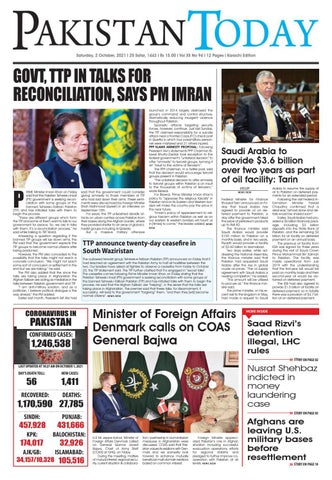
Saturday, 2 October, 2021 I 25 Safar, 1443 I Rs 15.00 I Vol XII No 94 I 12 Pages I Karachi Edition
Govt, ttP in talks for reconciliation, says PM iMran
P
rIMe Minister Imran Khan on Friday said that the Pakistan Tehreek-i-Insaf (PTI) government is seeking reconciliation with some groups of the banned Tehreek-i-Taliban Pakistan (TTP) and has initiated talks with them to begin the process. “There are different groups which form the TTP and some of them want to talk to our government for peace. So, we are in talks with them. It’s a reconciliation process,” he said while talking to TrT World. Answering a question regarding if the banned TTP groups will lay down arms, the PM said that the government expects the TTP groups to become normal citizens after being pardoned. However, the PM also conceded to the possibility that the talks might not reach a concrete conclusion. “We might not reach some sort of conclusion or settlement in the end but we are talking,” he said. The PM also added that the since the talks are taking place in Afghanistan the Afghan Taliban are acting as mediators in the talks between Pakistan government and TTP. “I am anti-military solution, and as a politician, I believe political dialogue is the way ahead,” the PM added. earlier last month, President Arif Alvi had
said that the government could consider giving amnesty to those members of TTP who had laid down their arms. These sentiments were also echoed by Foreign Minister Shah Mahmood Qureshi in an interview on September 15th. For years, the TTP unleashed deadly attacks on urban centres across Pakistan from their bases along the Afghan border, where they provided shelter to an array of global jihadist groups including Al Qaeda. But a massive military offensive
launched in 2014 largely destroyed the group’s command and control structure, dramatically reducing insurgent violence throughout Pakistan. Sporadic attacks targeting security forces, however, continue. Just last Sunday, the TTP claimed responsibility for a suicide attack near a Frontier Corps (FC) check post in Quetta in which four paramilitary personnel were martyred and 21 others injured. PPP SLAMS AMNESTY PROPOSAL: Following President Alvi’s statements PPP Chairman Bilawal Bhutto-Zardari took exception to the federal government’s “unilateral decision” to offer “amnesty” to terrorist groups, terming it an “insult to the victims of terrorism”. The PPP chairman, in a Twitter post, said that the decision would encourage terrorist groups present in Pakistan. “The unilateral decision to offer amnesty to terrorist groups within Pakistan is an insult to the thousands of victims of terrorism,” wrote Bilawal. For Bilawal, Prime Minister Imran Khan’s policy to “appease the religious fascists” in Pakistan and on its eastern and Western borders will make the country pay the price in the near future. “Imran’s policy of appeasement to religious fascism within Pakistan as well as on our eastern & western borders will haunt us in [times] to come,” the leader added. news desk
TTP announce twenty-day ceasefire in South Waziristan The outlawed terrorist group Tehreek-e-Taliban Pakistan (TTP) announced on Friday that it had reached an agreement with the Pakistan Army to halt all hostilities between the two. Our leaders have asked all fighters to observe a ceasefire from today to October 20, the TTP statement said. The TTP further clarified that it is engaged in “secret talks”. The ceasefire comes following Prime Minister Imran Khan on Friday stating that the Pakistan Tehreek-i-Insaf (PTI) government is seeking reconciliation with some groups of the banned Tehreek-i-Taliban Pakistan (TTP) and has initiated talks with them to begin the process. He said that the Afghan Taliban are “helping”, in the sense that the talks are taking place in Afghanistan. The premier said that these talks, for disarmament, if successful, will lead to the government “forgiving” them, “and then they [will] become normal citizens”. news desk
coronavirus in
Pakistan
CONFIRMED CASES:
1,246,538
Saudi Arabia to provide $3.6 billion over two years as part of oil facility: Tarin JHELUM news desk
Federal Minister for Finance Shaukat Tarin announced on Friday that Saudi Arabia has agreed to provide oil on deferred payment to Pakistan, a day after the government hiked the price of petroleum products up to rs8.82. The finance minister said Saudi Arabia would provide $150 million to Pakistan on a monthly basis, and in two years, riyadh would provide a facility of $3.60 billion to Islamabad. Two days earlier, while addressing the National Assembly, the finance minister said that Pakistan had requested Saudi Arabia after the rise in global crude oil prices. “The oil supply agreement with Saudi Arabia is nearing completion,” he added. “This amount will be utilised to procure oil,” the finance minister said. The prime minister, on his recent visit to the kingdom in May, had made a request to Saudi
Minister of Foreign Affairs Denmark calls on COAS General Bajwa
Arabia to resume the supply of oil to Pakistan on deferred payments for an extended period. Following the visit Federal Information Minister Fawad Chaudhry confirmed that a deal was “almost done and details would be shared soon”. earlier, Saudi Arabia had provided a $6 billion financial package, including $3 billion deposits into the State Bank of Pakistan, and the remaining $3 billion for oil facility on deferred payment on an annual basis. The previous oil facility from KSA was signed for three years during the visit of Saudi Crown Prince Mohammad Bin Salman to Pakistan. This facility was made operational from July 2019 with the understanding that the first-year bill would be paid on monthly basis and then second-year oil would be obtained on deferred payment. The IDB had also agreed to provide $1.5 billion oil facility on deferred payment, so in totality there was a provision of $4.7 billion oil on deferred payment.
more inside
Saad Rizvi’s detention illegal, LHC rules STORY ON PAGE 02
Nusrat Shehbaz indicted in money laundering case
LAST UPDATED AT 10:27 AM ON OCTOBER 1, 2021
DAY'S DEATH TOLL:
NEW CASES:
56
1,411
RECOVERED:
DEATHS:
1,170,590 27,785 SINDH:
PUNJAB:
457,928
431,666
KPK:
BALOCHISTAN:
174,017 AJK/GB: 34,157/10,328
32,926 ISLAMABAD:
105,516
STORY ON PAGE 03
H.e Mr Jeppe Kofod, Minister of Foreign Affairs Denmark called on General Qamar Javed Bajwa, Chief of Army Staff (COAS) at GHQ, on Friday. During the meeting, matters of mutual interest, regional security, current situation & collabora-
tion / partnership in Humanitarian measures in Afghanistan were discussed. COAS said that Pakistan values its relations with Denmark and we earnestly look forward to enhance mutually beneficial multi-domain relations based on common interest.
Foreign Minister appreciated Pakistan’s role in Afghan situation including successful evacuation operations, efforts for regional stability and pledged to further improve cooperation with Pakistan at all levels. news desk
Afghans are leaving U.S. military bases before resettlement STORY ON PAGE 10
02
Saturday, 2 October, 2021
KARACHI
NEWS
Saad Rizvi’S detention illegal, lHC RuleS
t
News Desk
HE Lahore High Court (LHC) on Friday declared as illegal the detention of Saad Hussain Rizvi, chief of the proscribed Tehreek-iLabbaik Pakistan (TLP). Hearing a petition filed by Rizvi’s uncle against his continued incarceration Justice Tariq Saleem Sheikh announced the verdict after presiding over daily hearings for the past three days. The detailed judgement in the case is pending. Saad Rizvi, son of late Khadim Hussain Rizvi was taken into custody in Lahore back in April under the Maintenance of Public Order (MPO) Ordinance 1960 for instigating violent protests in all major cities of the country over the matter of the expulsion of the French Ambassador from the country. During Thursday’s hearing, Advocate Malik argued that Rizvi had not been provided with the reasons for being detained again under the Anti-Terrorism Act, 1997. He said he had submitted five applications to the relevant government
department to know the grounds for his detention but hadn’t received a response. He argued that solid grounds were required to incarcerate a suspect, adding that not a single case existed against Saad Rizvi before the year 2018. Another lawyer for the petitioner, Advocate Mian Pervez, said the state had issued the notification for Rizvi’s continued detention with mala fide intentions. Back in July, A review board of the Lahore High Court (LHC) rejected on Friday the Punjab Home Department’s request to extend the detention of Saad Hussain Rizvi, leader of proscribed Tehreek-i-Labbaik Pakistan (TLP). The decision was announced in a closeddoor hearing by the provincial review board, comprising Justice Malik Shahzad Ahmad Khan, Justice Alia Neelum and Justice Sadaqat Ali Khan, on a request by the Punjab Home Department seeking an extension in the TLP chief’s detention. Rizvi’s detention was supposed to end on July 10 in light of the review board’s decision. However, the deputy commissioner of Lahore issued a fresh notification under Section 11-EEE (Powers to arrest and detain
Sirbaz Khan becomes only Pakistani to scale 9 of 14 highest peaks in the world News Desk Mountaineer Sirbaz Khan became the first Pakistani on Friday to climb nine of the world’s highest 14 peaks — each of which has a height of more than 8,000 metres — after he scaled the 8,167-metre-high Dhaulagiri mountain in Nepal, said Alpine Club of Pakistan Secretary Karrar Haidri. Sirbaz was part of the 19-member ‘SST-Dhaulagiri I Expd. 2021 Autumn’ expedition organised by trekking company Seven Summits Trek. According to Seven Summit Trek officials, the climbers summited the world’s seventh highest peak on Friday morning, with Sirbaz raising Pakistan’s national flag upon reaching the mountain’s top. In a Facebook post, Haidri stated that the 32-year-old Sirbaz hails from Aliabad, Hunza and began his professional climbing career in 2016. “Sirbaz became the first Pakistani to summit Mount Lhotse, the world’s fourth-highest mountain at 8,516m in Nepal without the use of supplementary oxygen,” he wrote. His other 8,000m summits include K2, Nanga Parbat, Broad Peak, Manaslu, Anapurna, Everest Gasherbrum II, and now Dhaulagiri. According to Haidiri, Khan had accompanied Muhammad Ali Sadpara on 4 of his 8,000-metre summits and their last expedition together was from Nepal to Manaslu. Sajjad Ali Sadpara, son of the legendary climber Muhammad Ali Sadpara, also took to Twitter to congratulate Sirbaz. “Lots of congratulations to @Sirbazkhan to climb Daulaghiri. After summitting Daulaghiri he is first Pakistani to summit nine 8,000 mountains,” he wrote.
suspected persons) of the Anti-Terrorism Act 1997 and detained Rizvi for 90 days. TLP ProTesTs: An agreement had been reached between the TLP and the federal government in November 2020 to decide on the matter of the French Ambassador’s expulsion in three months. Closer to the deadline, the TLP decided to delay its protest by two and a half months to April 20. In the meantime, Rizvi had told his workers to prepare for a long march if the government did not keep its word thereby forcing the latter to arrest the former on April 12. Police had swooped in on Rizvi at around 2pm on Wahdat Road in Lahore where he had gone to attend a funeral. Outraged, the TLP had issued a call for countrywide protests. The next day, police registered a first information report against the TLP chief under sections of the Anti-Terrorism Act. Within the next few hours, protesters took to the streets in Lahore and blocked the Grand Trunk Road at a number of points. The government had subsequently banned the TLP following the violent protests and sit-ins it staged across the country.
Social media companies may have to pay Rs500m fine for not complying with PTA’s instructions: report News Desk Social media companies could face a penalty of up to Rs500 million if they fail to comply with the instructions of the Pakistan Telecommunication Authority (PTA) on blocking online content, said a report published by Geo News on Friday. Earlier in the week, the federal cabinet had approved amendments to social media rules introduced last year. According to another report published in The News the Ministry of Information Technology and Telecommunication is set to implement fresh rules in the next few days which will be biding on social media companies. According to the new rules, a complaint to block or remove online content may be filed by any person, or their guardian, where such person is a minor, aggrieved by online content, or a ministry, division, attached department, sub-ordinate office, provincial or local department or office, law enforcement or intelligence agency of the government, or a company owned or controlled by the government. Incase a social media company fails to remove or block access to online content as per PTA’s directions, the PTA can serve a written notice requiring the service provider, social media company or significant social media company to remedy the contravention and give a written explanation within 48 hours to the satisfaction
of PTA for non-compliance with directions of the PTA. The report further said that if a social media company fails to respond to the notice or satisfy PTA in respect of the alleged contravention, it may, after affording an opportunity of hearing and by order in writing, take any of the following actions: (a) degrade the services of such a service provider for a period of time as deemed appropriate by it; or (b) block or issue directions for blocking of the entire online information system or (c) impose a penalty up to Rs500 million. “The service provider, social media company, and significant social media company shall not knowingly
host, display, upload, publish, transmit, update or share any online content in violation of the local laws,” the report added. Moreover, according to the report the service provider and the social media company shall provide to the investigation agency designated or established under section 29 of the Act, any information or data or content or sub-content contained in any online information system owned or managed or run by the respective service provider or social media company, in decrypted, readable and comprehensible format or plain version in accordance with the provisions of the Act. The report further added that the service provider and the social media company shall deploy mechanisms to ensure immediate blocking of live streaming through online information systems in Pakistan of any online content particularly, related to terrorism, hate speech, pornographic, incitement to violence, and detrimental to national security on receiving intimation from the authority. The report said that the new rules have relaxed the earlier condition of establishing an office in Pakistan within six months. Moreover, the new rules will provide for, among other matters, safeguards, processes, and mechanisms for the exercise of powers by the PTA under the Act for removal or blocking access to unlawful online content through any information system.
Transgender people brutally killed in Punjab over past seven years LAHORe Shahab Omer
A total of 23 transgender killings have been reported in Punjab so far in the last seven years whereas according to the data obtained from the office of the Inspector General of Punjab Police, the highest murder rate was in Rawalpindi, Pakistan Today learnt. According to documents obtained, two transgenders were killed in Lahore, out of which Muhammad Arsalan belonged to Nishtar Colony and Farzand Ali from Johar Town area. Similarly, Muhammad Abbas within the limits of factory area of Sheikhupura police station, Nawaz within the limits of Sharqpur police station and Azam alias Sana within the limits of City Farooqabad police station were killed. During the last seven years, Shehzad and Zain were killed within the limits of Gujranwala police station Ladhewala Waraich, while Ali Raza alias Nadira was killed within the limits of Arup police station and Usman alias Pia was killed within the limits of Kamonki police station.
“Incidents of oppression and abuse of transgender people are circulating on social media on a daily basis and yet the rate of their registration in the police station is very low. The biggest reason is that there are a large number of transgender people whose families are not ready to adopt them, so whenever there is an abuse or an accident with them, there is no one to report it. Documents revealed that Yasin alias Billi and Hamza Tanveer alias Shahzeb from Waris Khan area of Rawalpindi police station, while Aurangzeb alias Neeli area of Civil Lines police station, Neelam within the limits of Murree police station and Kashif alias Kangana within the limits of Mandira police station, Khyber Shahzad alias Babli within the limits of Saddar Wah police station and an unidentified transgender man was killed within the limits of the airport police station. Similarly, Hassan Raza within the limits of Dina police station of Jhelum, Muhammad Arsalan alias Sawira within the limits of Mianwali police station city, Mohammad Akram within the limits of Saddar
Boriwala police station of Vehari, Muhammad Ashfaq alias Nadia and Sulaiman Rashid alias Muskan within the limits of Harappa police station of Sahiwal, Irfan alias Sunny within the limits of City B division of Bahawalnagar police station and Mazhar Iqbal alias Saima Khan within the limits of Rahim Sadiq Yar Khan’s City Sadiqabad police station were killed. A member of the Youth
Parliament for Transgender informed this scribe that the number was very low, when in fact the number of transgender killings was much higher. “Incidents of oppression and abuse of transgender people are circulating on social media on a daily basis and yet the rate of their registration in the police station is very low. The biggest reason is that there are a large number of
transgender people whose families are not ready to adopt them, so whenever there is an abuse or an accident with them, there is no one to report it. Another important point is that it is very difficult to identify transgender people because many transgender people look like men and have male genitalia. Therefore, it becomes difficult to find the difference between the dead body of a transgender and the dead body of
a common man. Similarly, an important issue is that even if someone from the transgender community goes to the police station to report such a murder or accident, their complaint is not taken seriously. Rather, the transgender is feeling insecure in the police station. In fact, we are already scared because our family and society are not ready to adopt us, and the measures announced by the government to protect transgender people are only visible on paper,” he lamented. On the other hand, an official of the IGP’s office informed that the Transgender Persons (Protection of Right) Act 2018 has been enacted by the government of Pakistan and in the light of which the Punjab government has issued a Transgender Rights Policy 2019. “Under this policy, steps are being taken to provide transgender people with the basic rights enshrined in Article 9 and 25 of Constitution of Pakistan. Such as the right to education, the issuance of CNIC, the right to vote, the right to participate in elections and the right to form unions, etc,” he said.
Saturday, 2 October, 2021
KARACHI
NEWS
03
DeNmark SupportS peaceful, Diplomatic reSolutioN of kaShmir DiSpute: DaNiSh fm
D
news Desk
ANISH Minister for Foreign Affairs Jeppe Kofod on Friday assured that Denmark is aligned with the European Union (EU) and the United Nations (UN) to advocate for peaceful and diplomatic dialogue for the resolution of the Kashmir dispute. The Danish minister said this while addressing a press conference along with Foreign Minister (FM) Shah Mahmood Qureshi in Islamabad where the duo held delegation-level talks. “We are fully in line with the EU and the UN to advocate for peaceful [and] diplomatic dialogue on the Jammu and Kashmir issue. This is what we want to see and what we respect,” he said while commenting on the issue of human rights violations in Indian-occupied Kashmir (IoK). On the other hand, FM Qureshi was questioned regarding the bill in the US
Senate seeking an assessment of Pakistan’s alleged role in Afghanistan and in the Taliban offensive in Panjshir Valley. The FM responded that the government will do everything possible to explain what the correct position was. However, the FM also pointed to the fact that the bill was not necessarily unbiased since it was presented by a group of Republican senators who had a particular view of the US governments handling of the Afghan withdrawal. “Pakistan believes in engagement, communication and defending our interests. We will protect Pakistan’s interest and defend our position because we have a lot to share with the US Congress.” “They have to understand the positive role Pakistan has played in fighting terrorism, facilitating the peace process, what were the causes behind the Afghan debacle and scapegoating Pakistan would be overlooking ground realities.”
“They have to understand that a partnership with Pakistan is required in the future as well to achieve stability in Afghanistan and the region,” he said. Qureshi also said that the matter of providing support to the US for strikes against Al Qaeda targets in Afghanistan is to be decided by the cabinet. Meanwhile, the Danish Minister for Foreign Affairs Kofod rejected the possibility of Denmark recognising the Taliban government adding that $80 million had been allocated for humanitarian relief in Afghanistan in 2021. “We will judge any government in Kabul not on their words but whether they respect people’s rights, whether they are willing to ensure that terrorist groups are not found again and whether they will act as a responsible partner to the international community with the obligations that it implies.” Moreover, while commenting on the the bilateral relations between Pakistan and
Denmark Qureshi said that they were on an upward trajectory adding that a lot more can still be done. “I asked the foreign minister to look at
Merck pill breakthrough raises hopes of preventing COVID deaths
Agencies A pill developed by US drugmaker Merck could half the chances of dying or being hospitalized for those most at risk of contracting severe Covid-19, with experts hailing it as a potential breakthrough in how the virus is treated. If it gets authorization, molnupiravir, which is designed to introduce errors into the genetic code of the virus, would be the first oral antiviral medication for Covid-19. Merck and its partner Ridgeback Biotherapeutics plan to seek US emergency use authorization for the pill as soon as possible and to make regulatory applications worldwide. “This is going to change the dialogue around how to manage Covid-19,” Merck Chief Executive Robert Davis told Reuters. Current treatment options include Gilead Sciences Inc’s antiviral remdesivir and generic steroid dexamethasone, although both are generally only given once a patient has already been hospitalized.
“An oral antiviral that can impact hospitalization risk to such a degree would be game changing,” Amesh Adalja, senior scholar at the Johns Hopkins Center for Health Security, said. Existing treatments are “cumbersome and logistically challenging to administer. A simple oral pill would be the opposite of that,” Adalja added. Due to the positive results, which sent Merck’s shares up more than 9 per cent in early New York trading, the Phase 3 trial is being stopped early at the recommendation of outside monitors. Shares of Covid-19 vaccine manufacturers Pfizer and Moderna dropped by nearly 3 per cent and 10 per cent respectively, moves Michael Yee, a biotechnology analyst at Jefferies, said indicated investors believe “people will be less afraid of Covid-19 and less inclined to get vaccines if there is a simple pill that can treat Covid-19”. Pfizer and Swiss pharmaceuticals group Roche are racing to develop an easy-to-administer antiviral pill for Covid-19, but so far only antibody
cocktails which have to be given intravenously are approved for nonhospitalized patients. A planned interim analysis of 775 patients in Merck’s study looked at hospitalizations or deaths. It found that 7.3 per cent of those given molnupiravir were hospitalized and none had died by 29 days after treatment, compared with 14.1 per cent of placebo patients. There were eight deaths among placebo patients. “Antiviral treatments that can be taken at home to keep people with Covid-19-19 out of the hospital are critically needed,” Wendy Holman, Ridgeback’s CEO, said in a statement. ‘WORK WITH ALACRITY’: Scientists welcomed the potential new treatment to help prevent serious illness from the virus, which has killed almost 5 million people around the world. “The availability of a well-tolerated, effective oral antiviral will be particularly useful in supplementing vaccination as a means to reduce the proportion of patients needing hospital care,” Penny Ward, visiting professor in
pharmaceutical medicine at King’s College London, said. In the trial, which enrolled patients around the world, molnupiravir was taken every 12 hours for five days. The study enrolled patients with laboratory-confirmed mild-to-moderate COVID-19, who had symptoms for no more than five days. All patients had at least one risk factor associated with poor disease outcome, such as obesity or older age. Merck said viral sequencing done so far shows molnupiravir is effective against all variants of the coronavirus, including highly transmissible Delta. It said rates of adverse events were similar for both molnupiravir and placebo patients, but did not give details. Merck has said data shows molnupiravir is not capable of inducing genetic changes in human cells, but men enrolled in its trials have to abstain from heterosexual intercourse or agree to use contraception. Women of child-bearing age cannot be pregnant and also have to use birth control. Merck said it expects to produce 10 million courses of the treatment by the end of 2021, with more coming next year. The company has a U.S. government contract to supply 1.7 million courses of molnupiravir at a price of $700 per course. Davis said Merck has similar agreements with other governments, and is in talks with more. Merck said it plans a tiered pricing approach based on country income criteria. Merck has also agreed to license the drug to several India-based generic drugmakers, which would be able to supply the treatment to low- and middleincome countries. Molnupiravir is also being studied in a Phase 3 trial for preventing coronavirus infection in people exposed to the virus. Merck officials said it is unclear how long the FDA review will take, although Dean Li, head of Merck’s research labs, said “They are going to try to work with alacrity on this”.
Rupee recovers slightly against greenback during intraday trading news Desk The rupee broke its losing streak against the dollar for the first time in four days, gaining 0.11% against the dollar during intraday trading on yesterday. The rupee recovered 18 paisas and closed at a oneday low of Rs170.48 according to SBP data. The Pakistani rupee shed Rs1.58 during the last four days against the US dollar, while depreciation during the fiscal year 2021-22 has been Rs13.24. The local unit has shed Rs10.39 against the US dollar in the current year 2021. The local currency has maintained a downtrend after it touched 22-month high of Rs152.27 in May 2021, losing a cumulative Rs18.35 in the past over four months to date. While the SBP had been maintaining a ‘managed float’ of the exchange rate, the recent volatility had forced them to intervene more aggressively in the interbank market. Reportedly an amount of $1.2
billion had been injected into the currency market ten to stop the 170 barrier from being broken 10 days back. While the SBP was successful, it received criticism for adopting policies practiced by the PMLN government in the past, something it had said it would not do. FITCH expeCTs pAKIsTAnI Rupee TO WeAKen FuRTHeR In 2022 Fitch Ratings revised down its forecasts for the Pakistani rupee on Thursday for both this year and next due to a variety of factors including an increased flow of US dollars into neighbouring Afghanistan. Fitch’s forecast for the rupee’s average rate this year is now 164 to the US dollar compared with 158 previously. For 2022, Fitch now expects an average rate of 180 versus a previous forecast of 165. “Our expectation for the currency to weaken further is based on Pakistan’s worsening terms of trade, tighter US monetary policy, alongside the flow of US dollars
out of Pakistan and into Afghanistan,” it said. The Pakistani rupee has been sliding steadily since May. It was at 170.50 to the dollar on Thursday, more than 10% weaker than its peak in May of 150.95. Analysts say the rupee has been hit by consistently high demand for dollars due to the country’s current account deficit while the Afghan situation is increasing pressure. Pakistan’s Stock Exchange also fell nearly 3% this week on fears that a bill moved in the US Senate seeking to impose sanctions on the Taliban that could potentially extend to Pakistan. Over the long term, tightening US monetary policy alongside higher structural inflation relative to the United States would weaken the rupee against the dollar, Fitch said. It said, however, that the undervaluation of the Pakistani rupee on a real effective exchange rate basis would limit excessive weakness in the currency.
the visa categorisation that we have been put into and have a fresh look at the travel advisory that we have between our two countries,” Qureshi said.
Nusrat Shehbaz indicted in money laundering case Nusrat Shehbaz, wife of Leader of the Opposition in National Assembly Shehbaz Sharif was indicted by an accountability court in Lahore on Friday, in a money laundering reference filed by the National Accountability Bureau (NAB). Nusrat Shehbaz who is currently in London, was indicted through a pleader in the court of accountability judge Naseem Virk. NAB prosecutor Usman Rashid Cheema was also present on the occasion. Earlier in December 2020, Nusrat had been declared an absconder by the accountability court after she persistently failed to appear in the money laundering reference. Opposition leader Shehbaz Sharif had also pleaded for exemption from appearance in the case on account of ill health which was accepted by the court. On Thursday, Shehbaz had suspended all political activities a day ago as he was advised rest by doctors after he injured himself by slipping from a staircase on Wednesday. Earlier in August 2020, NAB had filed a Rs8 billion reference of money laundering before an accountability court against Shehbaz Sharif, his wife, his two sons and other family members. Under the reference, Shehbaz was accused of benefiting from assets held in the name of his family members and other people who had no sources to acquire such assets themselves. According to the reference, Shehbaz’s family members and some other people received fake foreign remittances amounting to billions of rupees in their personal bank accounts. News Desk
Saturday, 2 October, 2021
04 NEWS
KARACHI
Dar De-seating likelier as lHC Dismisses plea CHallenging 60-Day rule
p
News Desk
TI government’s efforts to deseat PML-N’s ex-finance minister Senator Ishaq Dar and get the incumbent Finance Minister Shaukat Tarin elected in his place effectively progressed on Friday after the Islamabad High Court (IHC) dismissed a plea challenging an ordinance making it mandatory to take oath within 60 days or else the seat of the candidate would become vacant. IHC Chief Justice Athar Minallah, while dismissing the petition of PML-N’s Parliamentary Party Leader in Senate Azam Nazir Tarar, ruled that the court’s involvement in parliamentary matters is in violation of the scheme of the Constitution and a factor in the weakening of parliament. “The court has consistently observed that its involvement in matters which otherwise could be resolved by the Majlis-eShoora (Parliament), is in violation of the scheme of the Constitution,” the top judge said. “The trend of involving the judicial branch of the State in matters having politi-
cal content is one of the factors which has contributed towards the weakening of the Majlis-e-Shoora (Parliament) on the one hand, and on the other, it has exposed the judicial branch to unnecessary controversies,” the chief justice noted. The PML-N approached the IHC and challenged the vires of the Election (Third Amendment) Ordinance, 2021, saying it was
person-specific with the sole purpose to target PML-N and ordinances cannot be used to create permanent consequences. Through the ordinance, which was notified in the official gazette on September 3, 2021, the government has inserted Section 72A (seat to become vacant on not making oath) in the Election Act, 2017. Section 72-A states that the “seat of
a returned candidate shall become vacant if he willfully does not make oath within 60 days from the date of the first sitting of the assembly, the Senate or the local government or within 40 days of the commencement of the Elections (Third Amendment) Ordinance, 2021, as the case may be.” In the order, Justice Minallah said that political questions raised before the courts by political parties having representation in parliament undermine its sanctity and supremacy, adding that it is an obligation of the political parties to ensure that political disputes are resolved within parliament instead of involving the courts. He said that the courts should show utmost restraint in matters which fall within the domain of parliament or have political content, saying the two houses of parliament are the highest national forums for debating and resolving political disputes and for formulating policies that are in the best interest of the people of Pakistan. Interestingly, the court noted that the ruling party does not enjoy the majority in Senate and despite having a majority, opposition parties do not disapprove the
HESCO fined Rs31 million by NEPRA for electrocution related deaths of citizens News Desk The National Electrical Power and Regulatory Authority (NEPRA) has imposed a fine of Rs31 million on Hyderabad Electric Supply Company (HESCO) over the deaths of citizens due to electrocution in Hyderabad. A statement by NEPRA said that the fine has been imposed over HESCO’s negligence that led to casualties from July 2019 till October 2020. It stated that 15 people died of electrocution during the said period. “A three-member committee was formed to investigate cases of electrocution, and HESCO was found guilty of negligence in 12 out of 15 cases,” read the statement. Five HESCO employees and seven citizens were killed due to HESCO’s negligence, it added. SEPCO FINES: Last month, NEPRA
imposed a fine of Rs28 million on Sukkur Electric Power Company (SEPCO) on charges of negligence resulting in fatal incidents during the period July, 2019 to November, 2020. NEPRA upon receipt of reports of 20 deaths due to different electrocution
early detection of Breast Cancer can increase survival rate Press release Myths and taboos associated with Breast Cancer must need to be shunned in order to get the disease detected early to increase the chances of survival. But due to society’s coercive practices, at least 70% of Pakistani women suffering from breast cancer seek medical attention at an advanced stage of the fatal ailment. If detected at an early stage, the chances of the survival exceed 90 percent. For women, there are many reasons to overlook the looming threat to their lives, including less awareness about symptoms of breast cancer, limited access to mammogram facilities, concerns that taking the treatment of the disease will result in atrophied femininity and social stigma linked with the disease. Hence, there is a strong need to have a more open discussion about breast cancer to break the barriers. Pink Ribbon Pakistan is observing the first week of October as a call for highlighting early detection of Breast Cancer. To serve the purpose, Pink Ribbon stresses that women of age 40 and older should go for a mammogram test once in two years. Omer Aftab, Chief Executive Officer Pink Ribbon, said, “After our continuous and robust awareness campaigns since 2004 across Pakistan, there has been a 400% increase witnessed among women to take mammogram test for any signs of breast cancer.” He added that to bridge the gap of insufficient treatment facilities and lack of awareness, Pink Ribbon took the initiative of setting up Pakistan’s first dedicated Breast Cancer Hospital in Lahore where deserving patients will be given free-of-cost treatment. He said that two state-of-the-art 3D digital mammogram machines will be installed at the hospital. Mr. Aftab said the construction of hospital hits snag after the coronavirus pandemic put every sphere of life to a standstill. He urged the philanthropists and citizens to donate generously for the cause.
incidents during July 2019 to November 2020, constituted a three-member investigation committee under Section 27-A of NEPRA Act 1997 to visit the relevant areas, conduct investigation and ascertain the facts and possible violations of NEPRA laws, rules and regulations. The
investigation committee’s report revealed that 11 out of the total 20 fatalities occurred due to SEPCO’s negligence. These victims include 4 SEPCO’s employees and 7 persons from the general public. Therefore, the authority issued a show cause notice to SEPCO under Section 27-B of the NEPRA Act, 1997 and later provided an opportunity of hearing to SEPCO. Based on the evidence available on record, submissions of SEPCO and relevant provisions of the laws, rules and regulations, the authority concluded that SEPCO has failed to discharge its statutory obligations to maintain safety standards as laid down in the relevant code and manual. Further, SEPCO failed to report these fatalities to the authority in a prescribed manner as envisaged under NEPRA Performance Standards (Distribution) Rules, 2005.
Amendment Ordinance, 2021. “This court has no reason to interfere and thus usurp the constitutional authority vested in the forums.” The top judge noted that the inserted section 72A persuades the court that it is in the public interest that no elected office remains vacant and the electorate unrepresented for an indefinite period, adding that any interference by the court would be contrary to the public interest and the guaranteed fundamental rights of the people. For the foregoing reasons, he stated, this “court is not inclined to exercise its extraordinary discretionary jurisdiction vested under Article 199 of the Constitution and consequently the petition is accordingly dismissed”. Justice Minallah said that the court expects that the political parties will endeavour to strengthen parliament by resolving the political disputes in accordance with the constitutional provisions and the principles of democracy, adding that they will show restraint in unnecessarily involving the judicial branch of the state to resolve disputes having political content.
Opposition parties protest against rising petroleum prices News Desk Opposition parties on Friday staged a protest in the National Assembly (NA) on account of increasing prices of petroleum products. During the session, members of the opposition gathered around the seat of NA Speaker Asad Qaiser and demanded that the decision related to increasing petroleum prices be retracted. Pakistan Muslim League-Nawaz’s (PMLN) leader Khawaja Asif led the protest and announced to boycott the session after which the speaker adjourned the proceedings. Earlier on Friday, a similar protest was also witnessed in the Punjab Assembly where members of the opposition raised slogans against increase in petroleum prices. Earlier the government had increased the price of petrol by Rs4 per litre to Rs127.20 effective from October 1 (Friday), following fluctuations in the exchange rate and global oil prices. The decision was made as per the recommendation of Oil and Gas Regulatory Authority (OGRA). The prices of high-speed diesel (HSD) was enhanced by Rs2 per litre to Rs122.04 per litre. The price of kerosene oil was also increased by Rs7.02 per litre to Rs99.31. In addition, the price of light diesel oil was increased by Rs8.82 to Rs99.51 per litre.
India, Australia eye striking trade deal by end of 2022 sYDNeY Agencies
Australia and India hope to reach a long-pending landmark trade deal by the end of 2022, according to a joint statement released on Friday announcing the formal relaunch of stalled negotiations. Bilateral trade was around Aus$24 billion (US$17 billion) last year, with India exporting is key services sector and Australian coal going the other way. Both are members of the Quad alliance with the United States and Japan and are looking to deepen strategic ties to counter China as well as economically and in other areas. Following trade ministers’ talks in New Delhi, the two countries backed the “expeditious negotiation” of a Comprehensive Economic Cooperation Agreement. In the meantime, they plan to reach an “early harvest” interim deal by the end of this year under which some duties will already be cut. The two sides hope for a “balanced trade agreement that encourages expanded trade and investment flows to the benefit of both of our economies, and that reflects a shared commitment to the rules-based international trading system”, the statement said. India was Australia’s seventh-largest trading
CMYK
partner and sixth-largest export market in 2020. Negotiations on a comprehensive deal between India and Australia were launched more than a decade ago but stalled in 2015. In recent months New Delhi has also sought to revive trade talks with other countries including the United States, the European Union and Britain. Indian media quoted Australian Trade Minister Dan Tehan as saying that trade could double in the coming years if the comprehensive accord is sewn up. “And it will double in all areas because the complementarity between our economies is so
great,” Tehan was quoted as telling a news conference in India on Thursday. Indian Commerce Minister Piyush Goyal said the two nations “have a very positive interest in expanding trade, which could be kick-started or which could be implemented in the interim, while the contours of the final agreement may take a little longer period of time”. Using a cricket analogy, he added: “This is like a T-20 match, that is why (there are) such aggressive timelines. “The spirit of this partnership is that both India and Australia work in the same team for a win-win for each other.”
Saturday, 2 October, 2021
KARACHI
NEWS
PPP DemAnDs clAriTy in PArliAmenT on TAlks wiTh TTP
F
OLLOWING Prime Minister Imran Khan’s statement during an interview in which he said the government was holding talks with some factions of the banned Tehreek-e-Taliban Pakistan (TTP), PPP leaders questioned why parliament was not taken into confidence over these talks. “There are different groups which form the TTP and some of them want to talk to our government for peace. So, we are in talks with them. It’s a reconciliation process,” he said while talking to TRT World. Terming the move akin to “sprinkling salt on the wounds of martyrs’ families” and questioning why parliament was not taken into confidence over such a “sensitive issue”.
Reacting to the prime minister’s interview, PPP Vice President Sherry Rehman questioned whether PM Imran had “asked parliament what we think about that”. She also questioned whether the premier had heard the TTP’s response to the government’s offer of reconciliation. Meanwhile, PPP secretary general Nayyar Bokhari termed the prime minister’s disclosure that talks were being held a “very sensitive statement” and demanded that a session of parliament be called immediately to discuss it. In a separate statement, PPP information secretary Shazia Marri said the party “strongly condemned” such a big step by the government without first taking parliament into confidence. news desk
Four more trucks carrying humanitarian aid reach Afghanistan
Jazz xlr8 powered startup DeafTawk announces global expansion plans Islamabad pr
Grievances of students about MDCAT test to be resolved: Dr Faisal Islamabad news desk
Four trucks carrying 70 tonnes of humanitarian aid handed were over to Afghanistan on Friday as Pakistan continues to support Afghan people to avert the looming humanitarian catastrophe. The trucks carrying flour, sugar, rice, oil and pulses were handed over by the Pak-Afghan Cooperation Forum via Ghulam Khan border. Ameer of Khost was present to receive the aid from Assistant Commissioner of Miranshah. Besides its own ongoing efforts, Pakistan has also been urging the international community to extend humanitarian aid to Afghanistan for the socioeconomic development of the war-torn country. In their multiple interactions with world leaders, both Prime Minister Imran Khan and Foreign Minister Shah Mahmood Qureshi have asked the world community not to repeat the mistake of abandoning Afghanistan as it would lead to negative consequences of rise in terror incidents and spillover negative effects into neighbouring countries. Earlier this month, Pakistan had delivered another consignment of relief goods to Afghanistan’s Mazar-e-Sharif. “These goods were delivered by our Consul General to Governor Bulkh Maulvi Qudratullah,” Pakistan’s ambassador to Afghanistan Mansoor Ahmed Khan had said on Twitter. The tons of food and medical supplies dispatched via C-130 aircraft are part of the country’s commitments to rebuild Afghanistan’s infrastructure as it tackles the impending humanitarian crisis post-US withdrawal. China had also earlier said it will provide 200 million yuan ($31 million) worth of grain, winter supplies, vaccines and medicine to Afghanistan, adding that it had already decided to donate an initial batch of 3 million Covid-19 vaccine doses to the Afghan people. Foreign Minister Wang Yi said that the United States and its allies have more of a duty to supply economic and humanitarian aid to Afghanistan than any other country, according to a statement from the Chinese foreign ministry. “All parties should strengthen intelligence sharing and border control cooperation to catch and eliminate terrorist groups that have sneaked in from Afghanistan,” in order to ensure regional security and stability, Wang said. news desk
Special Assistant to the Prime Minister (SAPM) on National Health Services Dr Faisal Sultan has assured the students who attempted Medical and Dental College Admission Test (MDCAT) this year that a systematic griev-
ance resolution mechanism would be evolved after discussion with the Pakistan Medical Commission (PMC). In a meeting with a delegation of students who shared concerns about this year’s Medical and Dental College Admission Test, Dr Faisal reassured the students that the PMC will complete a post exam
analysis after the completion of the MDCAT to address the concerns of the students. He said the objective of the MDCAT is to ensure that the public should have competent professionals serving them in the future and reinforce the public trust in the medical education system and the medical professionals.
TWO DECADES OF FIGHTING BREAST CANCER
Shaukat Khanum Memorial Trust Launches Breast Cancer Awareness Campaign The Shaukat Khanum Breast Cancer Awareness Campaign has been launched, which is part of the global efforts to raise awareness on breast cancer in the month of October. Every year, Shaukat Khanum Memorial Trust (SKMT) organises an extensive campaign to educate the public about the importance of early detection of breast cancer. As previous years, SKMT will illuminate landmark buildings in pink this year as well in various cities of Pakistan, such as the President House and the Jinnah Mausoleum (Mazaar-eQuaid). The illuminated buildings will serve as a reminder to the public that women should take out five minutes for regular check-ups, which is essential for early detection of breast cancer. The SKMT has been raising awareness on the subject of breast cancer for the past two decades. According to an estimate, the ten-year survival rate for all types of breast cancer has improved by an encouraging figure of 25 to 30 % over this period. While this improvement shows a better understanding of the
05
disease, earlier detection and improvement in treatment of breast cancer, we need to sustain our awareness efforts to improve outcomes for breast cancer patients. As part of the awareness campaign, SKMT is organising a number of different activities for the public. A Pink Walkathon and a Pink Polo match are planned in Lahore. For cooking enthusiasts, there will be an online Pink Cooking and Baking Contest. Pink Tea Parties are already being organised by supporters from around the World. These activities aim to break the taboo around the subject and to make it into an acceptable topic of conversation inside homes. Additionally, SKMT is conducting online awareness sessions for students of educational institutes and employees of corporate sectors in the major cities of Pakistan including Karachi, Lahore, Islamabad, Rawalpindi, Peshawar, Gujrat, Jehlum, Sargodha, Sahiwal, Faisalabad, Multan, Bahawalpur and Hyderabad. Breast cancer is the commonest cancer in women worldwide and
Pakistan has one of the highest incidences of breast cancer in Asia. Over the years, breast cancer continues to be the highest reported malignancy at Shaukat Khanum Memorial Cancer Hospital and Research Centres in Lahore and in Peshawar. In addition to public awareness efforts, SKMT offers a range of educational and training programmes for healthcare professionals such as Fellowship in Breast Surgery. A dedicated research section continues to perform research into the causes of cancer in our population and SKMT has published a number of studies on the subject of breast cancer. If detected early, breast cancer has a high survival rate and therefore, we need to make a concerted effort towards early detection of this cancer to save lives. No one should have to succumb to a disease, which is treatable, due to inaccessibility. For this reason, SKMT provides financially supported treatment to over 75% of all cancer patients in an effort to diminish barriers to access, which is made possible largely due to the support of generous Pakistanis.
DeafTawk, a startup powered by Jazz xlr8, announced plans to expand its operations globally at a ceremony held to officiate the $250,000 grant it has received under the GSMA Innovation Fund for Assistive Tech. Using this grant, DeafTawk plans to scale up the application and increase its coverage, building the capacity of its interpreters, in order to reach both national and international audiences. DeafTawk is an online sign language services provider enabling people with hearing impairments and was a part of the third Cohort at the NIC under the premium accelerator program, Jazz xlr8. An MoU was also signed at the ceremony between DeafTawk and Jazz, Pakistan’s number one 4G operator and the largest internet and broadband service provider. Jazz will provide assistance to DeafTawk in developing strategies to further support the deaf community and assist with the startup’s expansion plans. DeafTawk after successfully launching its operations in Pakistan and Singapore is expanding its reach to America, Europe and South Asia and will be officially launching in the coming weeks. The startup to date has 92,000+ beneficiaries, has created 1,100 direct jobs, and has a 25% month-on-month revenue growth. “Recognition by the GSMA is a testament to the work DeafTawk has been doing and builds on Jazz xlr8’s reputation as a leading accelerator program in the country. These wins double our resolve to help young entrepreneurs take transformational ideas from start-up to scale-up,” stated Aamer Ejaz, Chief Digital and Strategy Officer at Jazz. “With the support of our donors, the UK Foreign, Commonwealth, and Development Office (FCDO), we aspire to support great ideas and startups like DeafTawk. By helping a community to tackle their inabilities, we think DeafTawk has a potential to contribute exponentially towards digital inclusiveness,” said Bilal Qureshi - Manager, GSMA Innovation Fund. DeafTawk CEO, Ali Shabbar, said, “When we pondered over the idea of DeafTawk, we instantly thought of empowerment through technology. And today, as the thought manifests itself into reality, we are glad to receive this grant and deeply honored by our partners and well-wishers for supporting our work, especially Jazz xlr8, which allowed us to transmit our raw idea into a proven business model. We aim to empower the ones who need a voice and bridge the gap with the GSMA.” Ignite CEO Asim Shahryar, by mentioning the importance NICs hold in Pakistan stated that, “Ignite, through a strong network of NICs across the country, has been uplifting the startup ecosystem of Pakistan for the last five years. Our NICs have incubated more than 800 startups which have raised funding of more than $56 million so far. 2021 has been a remarkable year for Pakistani startups with an investment of more than $300 million so far, and Ignite’s forecast by December is of around $400 million.” The GSMA Innovation Fund is funded by the FCDO and supported by the GSMA and its members. This fund is for startups aiming to address the varying needs of the differently-abled and overcoming barriers to digital inclusion. For this grant, DeafTawk was up against 350 other start-ups and SMEs from 31 nations. After a meticulous assessment process, four final grantees from Asia and Africa were chosen by an independent committee of specialists.
Govt taking every possible step to increase country’s exports: Senate told Islamabad news desk
Adviser to the Prime Minister on Parliamentary Affairs Babar Awan told the Senate on Friday that the government is taking every possible step to increase the country’s exports. Answering a question in the House, he said our export to the Africa continent has increased by seven percent in a short period of one year. He said the Prime Minister has assigned the target of increasing our exports to Africa by 20 percent. Babar Awan said we are exporting Tractors, three-wheel vehicles and home appliances to our export partners in Africa while search for more export partners is also underway. He said vigorous negotiations are underway with container companies to solve the problems of exporters. He said our new trade policy 2021 is
being finalized that will cover all challenges faced by exporters including issues with container companies. The Minister for Finance Shaukat Tarin reassured the provision of sufficient funds for the fair conduct of the next census in the country. To a question, he said the federal government has fixed an amount of five billion rupees during the current fiscal year for the next general census while more amounts will be provided in the coming budget. He said provinces will also provide their due share for this purpose. The Minister said due to prudent policies our GDP is increasing more than our estimates of five percent growth. He said for the creation of more jobs that is only possible through economic growth, we incentivize our export sector and cut the duties on raw material imports. Responding to a calling attention notice,
Minister for Aviation Ghulam Sarwar Khan
CmYK
said the NAB and FIA are conducting in-
quiries into the corruption and irregularities carried out in the construction of New Islamabad International Airport. He said those responsible will be exposed and held accountable. To another calling attention, the Aviation Minister said the present government should be appreciated for taking action against fake degree holders in the PIA. He said that fifty pilots possessing fake degrees were dismissed after a detailed inquiry. Responding to the points of opposition members regarding increase in prices of petroleum products, Leader of the House Shahzad Wasim said the country will move forward under the leadership of Prime Minister Imran Khan regardless of despondency being spread by the Opposition Parties. He said we have tried to absorb the pressure of increase in international oil prices by reducing the petroleum levy.
Saturday, 2 October, 2021
06 COMMENT
India-Sri Lanka relations: Effects of China factor
Hoping against hope For PM inflation is a temporary phenomenon
P
RIME Minister Imran Khan has assured the nation that inflation is a temporary phenomenon, and speeding up work on CPEC will soon bring down food prices. Had the Export Processing Zones (EPZs) been speedily completed during the last three years, these would have provided thousands of jobs and some could have started exporting goods by now. But the PTI government put the CPEC on the backburner. Work on most of the EPZs was stalled. Despite being the epicentre of multibilliondollar projects, Gwadar still lacks basic necessities like reliable access to water and electricity. It will be years before most of the projects start working at full capacity. According to Mr Khan, the operationalisation of the Matiari-Lahore transmission line of 660 kV High-Voltage Direct Current (HVDC) will reduce line losses from 17 percent to four percent, resulting in the availability of cheap electricity for consumers. The claim may be true only partially. There are major problems that remain to be tackled, the circular debt which soared to Rs2.327 trillion in 2020-21 being one. The World Bank has reportedly conveyed its serious reservations to the top government authorities over their not honouring their commitment about an increase in electricity tariff in accordance with the February agreement. In case the government yields, this will increase industrial costs and make power more costly for the common man. The country depends on the import of industrial raw materials, oil and LnG as well as edibles like palm oil, sugar, wheat and pulses. The prices of all these items are on the rise in the international market. Pakistan’s trade deficit is meanwhile piling up. A report published last month tells that Pakistan’s two-month trade deficit had widened 120 percent to $7.5 billion after imports saw a new historic peak but exports plunged for the third successive month despite heavy subsidies given to exporters and significant currency devaluation. The negative trade balance combined with smuggling of dollars to Afghanistan have brought down the value of the rupee with a US dollar costing more than Rs 170 and Fitch expecting dollar to reach Rs 180 in 2022. This will make imported essential goods more costly. On Thursday the government increased the petrol price by Rs 4 per litre which would translate into increases in the prices of virtually every consumer item. Inflation it appears will continue during the next two years of the PTI’s tenure.
The advent of the Rajpaksa brothers upset India
Dr rajkumar Singh
I
n comparison to the robust relationship and legacy of intellectual, cultural, religious and linguistic interaction between India and Sri Lanka, in the recent past, their overall relations began to face rough weather and therefore, all is not well. In January 2021, the killing of four Indian fishermen by the Sri Lankan naval forces, permission to a Chinese company to establish a hybrid energy project close to India, followed by the cancellation of the tripartite Memorandum of Understanding (MoU) between Sri-Lanka, India and Japan for the development of the East Container Terminal (ECT) at the Colombo Port in February 2021, compelled new Delhi to adopt a somewhat different line of interaction while dealing with its southern neighbour. The recent behaviour of Sri Lanka is not in tune with a country like India with which Colombo had a relationship of over 2500 years, and in modern times they both have maintained good neighbourly relations after their independence from the closing years of the 1950s. They established their relationship at all levels and it was marked by trade and investment to progress of developmental assistance projects along with co-operation in the fields of infrastructure development, education, culture and defense Even during the three-decade long years of conflict between the Sri Lankan government and the Lib-
Carmakers come to town The government must take the automotive industry seriously
T
HE coming of Skoda and Volkswagen to Pakistan marks the fact that the demand in the small-car market is growing. While the government has taken much of the credit for the recent growth in the automotive industry, it has not given the sort of consistency of policies that would encourage growth. There is no doubt that the lowering of the interest rate encouraged the offtake of leased vehicles, but with the interest rate being taken up again, it is certainly an act of commitment by the two new entrants, to invest in the Pakistani market and add to the variety of well-built cars currently available to consumers. While there have been a number of Japanese vehicles made for this segment, the entry of two European brands is an indication that the Pakistani market wants differentiation, and more choice than is being offered at present. There are many specific measures that the government can take to encourage more carmakers to come to Pakistan, mainly to do with consumer care financing. However, perhaps more important would be to maintain a consistency in policy that has been lacking so far. There are many changes occurring in the automotive industry, perhaps more so than in other industries. The biggest change is that vehicles are to be powered by electricity, rather than the internal combustion engine, but there are also drastic changes in the vehicles themselves. Computerization is moving vehicles to being self-driven also. The government has apparently made no preparations for that, and has changed a progressive electric vehicles policy. Perhaps most crucial, it has not prepared the national grid for the burden of transportation that will be thrown on it by electric vehicles. Self-driving is an entirely new dimension. The government needs to keep an eye on both current reality and future development. That applies to all things, but it applies in particular to the automotive industry. It is not merely to be trotted for praise when it does well, and forgotten if it does not, but it deserves close attention at all times. The government should also thank its stars that European manufacturers are showing an interest in Pakistan despite the hurdles put in its way.
EVMs need all to accept results to be useful
muhammaD ali alvi
T
HE incumbent government is insisting on the use of electronic voting machines in the next general election because it considers it the only solution for free, fair and transparent elections. The opposition is blatantly opposing the use of EVMs and criticizing the move as a preplanned attempt to secure a majority in upcoming elections. The Election Commission of Pakistan is also hesitant in adopting the change and resisting the idea. In short, the government, opposition and the ECP are at loggerheads over its use. The PTI government in its attempt to reform the electoral process invited the opposition several times but every time it has received a cold shoulder from the opposition. On the other hand, the ECP has also raised 37 objections to the introduction of EVMs. The government ministers, specially Fawad Chaudhary and Azam Swati, are locking horns with the ECP over the matter. They have accused the ECP of taking bribes and siding with the opposition. In return, the ECP has served notices to them and rejected the government allegations. The war of words between these three stakeholders is at its peak and no one seems to hold back. But, before we move further we have to decide whether the change in voting method is inevitable or not. The General elections of 1977 and 2018 were almost 41 years apart. One aspect that is common in these two elections is rigging allegations. not only that, every election in between has been marred by
Arif Nizami (Late) Founding Editor
Yousaf Nizami M. A. Niazi
Umar Aziz
Joint Editor
Joint Editor
Executive Editor
Lahore – Ph: 042-36300938, 042-36375965
The writer is head of the political science department and dean of the Social Sciences faculty of the B.N.Mandal University, Madhepura, Bihar, India. He can be reached at rajkumarsinghpg@gmail.com
The EVMs conundrum
Dedicated to the legacy of late Hameed Nizami
Editor Aziz-ud-Din Ahmad
eration Tigers of Tamil Elam (LTTE), the Government of India supported the rights of the Sri Lankan government and favoured resolution of the struggle through talking and negotiations. However, the past closeness and understanding between the two underwent a drastic change from the regime of Mahinda Rajapaksa who became President of the country in november 2005. During the period of Rajapaksa, Sri Lanka preferred good relations with the People’s Republic of China and encouraged trade and other investments in the country. Again, in 2020, the Rajapaksa Brothers’ team returned to power in the island nation and several major investments projects have been signed with China, bypassing Indian relations and strategic interests. In general, the majority of Sri Lankans view India favourably and India-Sri Lanka relations began on the basis of tthe millennia-old relationship between the two nations and later diversified and matured with the passage of time. Historically, both nations have shared a common culture, language, and religion and a maritime border separated by the Palk Strait. Following the years after independence the two countries resolved their citizenship issues by making several laws and arrangements at national level. However, their relations began complicating since the 1970s with the rising incidents of Tamil citizens of Sri Lanka coming into competition with Sinhala people. The Tamil population of Sri Lanka have been deprived from equal rights as citizens of the country where Sinhalese are in majority. Almost all governments framed pro-Sinhalese policies which ultimately became violent and later transformed into the demand for a separate Tamil State called ‘Tamil Elam’ which lasted for about three decades until the death of LTTE leader Prabhakaran. The understanding between the two deteriorated during the phase of civil war, although India was charged with fomenting terrorism in Sri Lanka, under the terms of the agreement signed with Rajiv Gandhi in 1987 new Delhi sent Indian Peace-keeping Force (IPKF). Apart from this, India provided valuable intelligence inputs to counter the LTTE and bring back peace in the country. After the war it also tried to settle the ethnic issue through peaceful dialogue and political dialogue. Despite sympathy and co-operation on the part of the Indian government, the Sri-Lankan government, perhaps, keeping in view the strategic considerations, began to lean towards China and the latter took its maximum benefit owing to the geographical
location of Sri-Lanka, which matters most for Beijing, and also to marginalise the importance of India in regional politics. In addition, when the civil war and ethnic politics were at their height where Sri-Lanka’s security forces and LTTE were still fighting, China extended moral and material help to Sri Lanka along with defence equipment needed to defeat LTTE. Although, diplomatic relations between the two had been established in 1957, they began warming and opened a new chapter when in november 2005 Mahinda Rajapaksa became the President of Sri Lanka and signed several agreements providing China a large scope for its investments in the country. In fact, Rajapaksa remained very influential in Sri Lankan politics in the last two decades beginning from the year 2002, but the most decisive period proved from november 2005 to 2015 when he was the President of Sri Lanka. The phase between 2000-2010 witnessed a substantial inflow of Investments in Sri Lanka by the Chinese government and the first major project in this context was the Colombo national Performing Arts Theater. As in post-Cold War periods nations, in general, are looking for new foreign direct investment and Colombo allowed Chinese investments at large scale which, to a great extent, hampered Indian understandings and strategic relations with Sri Lanka. India from the beginning and even in the period of Chinese investment in Sri Lanka continued to construct in the country several rehabilitation and developmental works, but the nature and type of Chinese investment affected Indian interests strategically. The Chinese investment in the island nation’s projects were of two kinds: standalone projects and projects linked to the ambitious Chinese programme of the Belt and Road Initiative (BRI), whose projects are mainly related to construction of ports, airports, and power stations. Over the years, China and Sri Lanka established defence and strategic relations and consequently, China supplied a substantial range of modern armaments to the Sri Lankan armed forces and also they defended each other on the issue of violation of human rights in each other’s country at regional and global forums. The pro-China policy of Sri Lanka continued till date except the time when in place of Rajapaksa, Maithripala Sirisena became the President of the country who tried his level best to maintain a balance in the country’s relations with both India and China between 2015 -2019. In particular, India has been worried due to the expansionist policy of China in the Indian Ocean as things are again going to shift in China’s favour with the return of Rajapaksa in 2019, posing more challenges for India and its regional and global politics as a whole.
I
Karachi – Ph: 021-35381208-9
I
rigging allegations. After every election, we hear voices of stolen mandate, systematic rigging and establishment involvement. So a change is needed. Similarly, other aspects that demand change are the number of rejected votes in every election, the questionable role of the presiding officer and the manual vote counting procedure. For example, there were 35 constituencies in the 2013 general election and 30 constituencies in the 2018 election where the rejected votes were greater than the winning margin. Similarly, a whopping 1.67 million and 1.5 million rejected votes in the 2018 and 2013 general elections respectively also present a case for change in voting method. If the above-mentioned figures do not make a case for the change then I wonder what will. Among the objections raised by the opposition, one is that its use has not gone well with other democracies and only a few use it at a national level. But is this argument worth enough to oppose the use of EVMs? Here, it should be noted that the opposition is supporting a voting technique that has been tested by time and has not created a lasting impact while it is opposing a system that has been even adopted yet. Every state should adopt a system that is best suited to its interests rather than relying on the experience of other countries. Why can’t we have a system that suits our needs and requirements? If the use of EVMs can bring change in the electoral process and deal with the problem of rigging and rejected votes, then it should be adopted open-heartedly. We can no longer live under the tags “restoration of democracy”, democracy in its infancy”. The transition of power (with all flaws) has been taking place democratically and the third consecutive elected government will complete its term in 2023. It is high time now to do away with the hurdles in the process. A free and fair election is the essence of democracy and only a democratically elected government with a true mandate can work for the development of the state. The current EVM imbroglio has not only dented the image of the ECP of Pakistan as a free and fair authority but also exposed the lack of debating cul-
Islamabad – Ph: 051-2204545
I
Web: www.pakistantoday.com.pk
I
ture in Parliament. It has also put the credibility of EVMs at stake even before their use. The opposition’s continuous refusal to sit together and debate on the issue has also raised fingers on its role which has been whimsical rather than constructive. This has made a step in the right direction controversial. The PTI government might be able to complete the legislative process through a joint session of Parliament as directed by the Islamabad High court, but will the use of EVMs deliver the desired results? The whole exercise of introducing EVMs has a specific purpose, that is to deal with the problem of election rigging, especially poll-day rigging, but in the light of the current debate on the use of EVMs one can carefully predict that the desired outcome will not be achieved, unless all stakeholders sit together, participate in the debate and agree on it. Albeit it seems difficult, but if the government succeeds in conducting the 2023 general election with EVMs, will the voices of allegations and rigging not be heard given the size of the trust deficit? It does not seem so. The opposition, as expected, will not accept the result if the results go against them. The whole exercise will be a total waste of time and money. The billions of rupees spent on the project will go in vain without any desired outcome. If EVMs are introduced now and all stakeholders are not a hundred percent satisfied and on one page then it might be a fulfilment of the electoral reforms promise of the PTI, but not a long-term initiative. Here the government should act wisely and should not act in haste. To the government’s credit, they have at least taken the initiative to solve the problem. But, the opposition’s role is discouraging rather than constructive. The only solution to the current turmoil is the debate and cooperation of all stakeholders. They should collaborate and sit together for a greater cause, because we cannot achieve political stability and democratic solidarity without a solid foundation that is-smooth transition of power through free, fair and transparent elections. The writer is freelance columnist
Email: editorial@pakistantoday.com.pk
Saturday, 2 October, 2021
COMMENT 07 Editor’s mail Send your letters to: Letters to Editor, Pakistan Today, 4-Shaarey Fatima Jinnah, Lahore, Pakistan. E-mail: letters@pakistantoday.com.pk Letters should be addressed to Pakistan Today exclusively
Child abuse in Pakistan
The Race for Indo-Pacific Supremacy The US-China rivalry has led to the AUKUS Zubair ali Soomro
A
MID the growing US-China rivalry for supremacy, the geopolitics has been altered to gain for oneself and outsmart one’s rival. This time the battlefield is the Indo-Pacific region. Since the USA has forged AUKUS, the regional countries are concerned over this move. AUKUS is a defence agreement- comprising Australia, the UK, and the USA which is aimed at maintaining a free and open Indo-Pacific with nuclear-powered submarines on patrol, and the deal enables Australia to acquire nuclear-powered submarines. China retorted it and termed the alliance a reflection of ‘cold-war mentally’ and claimed that such partnership showed that an anti-China clique had been formed. The three powers do not have any definite purpose behind this agreement but to contain China’s rise. Signing such deals will destabilize peace and trigger an arms race in the region. A Chinese spokesperson claimed that, in order to contain China’s growth, the three are throwing military net around it in waterways like the South China Sea and are attempting to halt China’s economic development. Also, Malaysia and Indonesia are unhappy with this move and are of the view that this will speed up the arms race and aggression in the region; north Korea criticized this development, claiming it as undesirable and dangerous and stated that it will justify north Korea to continue developing its arsenals of atomic weapons; some Russian diplomatic officials dubbed it an step to accelerate arm race and undermine the nuclear non-Proliferation Treaty. Besides regional countries, France was also ticked off with AUKUS, due to cancellation of the previously signed deal of $66 billion between France and Australia for conventional submarines, which will cost France jobs and revenue. On the contrary, India and Japan, the antagonists of China and members of an anti-China pact, namely the Quadrilateral Security Dialogue (also known as QUAD), have warmly welcomed this measure. But in reality, the AUKUS is nothing more than a potential hazard for the region, in which Washington is adopting an Asian-versus-Asian strategy to contain China’s rise and sell its weaponry. However, the results of this gathering storm can be far beyond the thoughts of political scientists and eagerly participating Australia. The first unanticipated loss of this pact is the deteriorating ties of Australia with France. Reportedly, this in consequence has kept Australia away to finalise a free trade agreement with the European Union. Apart from this, Scott Morison’s, Australian Prime Minister, planned visit to Indonesia has been cancelled, because Indonesian President Joko Widodo is no longer available. Australia has been victimised in the US-China rivalry which has its first consequence in the loss of robust ties with France and Indonesia.
Apart from this, since Australia had close economic relations with China, Australian trade unions haves opposed this move; It has criticized AUKUS deal and insisted they do not want war with China and warned of dangers to the country on multiple fronts. Also, the Maritime Union of Australia has opposed this deal and said that the Prime Minister should not engineer such secret deals but instead supply vaccines and help lockdown affected. Moreover, a China state-owned newspaper, Global Times, warned of an arms race and grimly stated that Australian soldiers were likely to be first to die if China counterattacked. To sum up, this deal, without having any challenge to Australia, buying nuclear-powered submarines is a potential step toward endangering and victimising itself for nothing but US gain. Apart from this alliance, the USA has the Quad and Five Eyes to focus on China and keep China’s power from spreading. The Quad consists of the USA, Japan, India and Australia. The main purposes of this alliance were economic and security interests that span the Pacific and Indian Oceans. The Quad was actually tailored for tsunami relief efforts, which lay dormant until 2017. Later, it was revived by US President Donnald Trump to challenge China on every front. And the Five Eyes has the USA, the UK, Canada, Australia and new Zealand, which pool information from intelligence sources. All the Quad members have poor diplomatic relations or even are in a face-off with China, which strengthens the US position in the region. Collectively they are sparing no effort to undermine China’s rise. On September 24, the Quad had an in-person summit, in which they had discussed vaccine export, trade, and technology. They also said, “We stand for the rule of law, freedom of navigation and overflight, peaceful resolution of disputes, democratic values, and territorial integrity of states.” Besides this the main purpose behind the meeting was to opt for a strategy to counter China. In addition to this, the Biden Administration had made clear that it desires to forge a united front of democracies to deal with China across the board, on security, trade, technology, and human rights. Actually, the desire is to make an alliance of democracies to defeat China. All the moves by the USA is taking are not to safeguard any human rights, but to contain China’s economic influence and military power.
However, a Chinese spokesman said: “Faced with the common challenge of fighting the epidemic and economic recovery, the people of the Asia-Pacific region need growth and employment not submarines and gunpowder.” He further vocalized, “Individual powers have repeatedly dispatched military aircrafts and warships to the South China Sea that spark trouble and deliberately provoke conflicts on maritime issues. And, Chinese determination to safeguard national and territorial sovereignty, maritime rights and interest is unwavering, and all will continue to properly handle differences with the countries connected through consultation and negotiations.” This statement clarifies that China does not want war rather prefers consultations, but it is not necessary that it is the reality; China has already focused military power. If both rivals escalate military power, then danger will loom and exacerbate already worsened diplomatic ties. Furthermore, Japan is another active member of Quad, which is ardently participating in the US-China rivalry. However, the participation can be equally annihilatory for Japan. Li Haidong, a professor at the Institute of International relations of China Foreign Affairs University, viewed that Japan has been leaving no stone unturned to use the anti-China clique to gain an upper hand in its territorial conflicts with China, Russia and on the Korean peninsula issue. Further, Chinese analysts also warned Japan, India and Australia that if they went too far in following the US strategy of containing China, they would become cannon fodder as China will steadily safeguard its interests. Additionally, China’s rocketing influence and military power deters America. If China finds any danger from the USA, China’s missile arsenal could annihilate US bases in Asia during the opening hours of a conflict. Equally gruesome for the USA is China’s rapidly growing economic reach, which has expanded as stateowned companies buy up strategic assets such as ports around the globe that could be harnessed in times of war. This ebbing situation can destablise peace in the region. Both the powers should repair their completely dysfunctional relationship and evade forging blocs in the region. If the region divides into blocs, the regional as well as global peace will be at risk.
This ebbing situation can destablise peace in the region. Both the powers should repair their completely dysfunctional relationship and evade forging blocs in the region. If the region divides into blocs, the regional as well as global peace will be at risk
The writer is a freelance columnist
ARTICLE 25 (1) of the pakistani constitution states that “all citizens are equal before Law and entitled to equal protection of Law” Children also need to be protected but unfortunately children are suffering from child abuse as Child abuse is one of worst issue by which Pakistan is suffering . child abuse is an action of abusing the children when they are at a young age .children are abused sexually and also you say the child Labour one of the abuses on children when at young age they go for work they are beaten and sexually abused that makes their physical contact bad. There are many people who involve the children in bad works like drugs, sexual participation and force them to do bad things . Furthermore children are very innocent and are most vulnerable, least powerful and they are unable to protect themselves from the abusers.child abusers often know how to emotionally manipulate their intended victims , gaining their trust well in advance of the actual abuse . furthermore there were many children who were raped and killed in these following years , some of the following cases have occurred in workplace the issue is pending and children are unsafe According to the International Society for the Prevention of Child Abuse (ISPCAn), overall ust41.69 percent respondents were sexually abused in one form or another. Child abuse is become social problem in Pakistan this all because of the poverty , the poor families who send their children for work and are often abused In near 1,780 cases, children were abused by their acquaintances while service providers, such as teachers, shopkeepers and drivers, were involved in 91 such cases. We live in such a sick society where fear of sending the children outside when a children is abused due lack of support from family members, friends and neighbours or the community leads to the isolation of the victim, making him hesitant to share his experience about his abuser.and many of commit suicide Besides other factors responsible for child abuse are socio-economic stresses; unemployment, low selfconfidence and feelings of incompetence, loneliness .more ever ,According to data released by an nGO, eight children were abused every day in Pakistan in one form or the other while 51pc of the victims were girls and 49pc boys and. 2,960 major crimes against children were reported in the four provinces, including Islamabad Capital Territory (ICT), Azad Jammu and Kashmir (AJK) and Gilgit-Baltistan (GB) in 2020. What is going on in our country is how our society is so sick and in the worst condition of kidnapping the children and abusing them. As the children are the future of the nation and it is a rising issue and media can also play an important role in it by creating awareness and the government needs to establish stronger laws regarding children. If once better laws are made against child abusers children can be protected. HomEr Jan BalocH laHorE
Curing corruption CORRUPTIOn is the utilization of public offices, official positions, ranks status, and powers for private benefits. The word corruption is experienced almost everywhere. The most triggering spurs, which encourage corruption, are the paucity of transparency, ineffective accountability, and institutional vulnerabilities. Here, Everything is possible by spending a penny either legal or illegal. Owing to this shortcoming, corruption is continuing despite multiple preventive paces. Its hazardous implications are immense such as it is a big barricade to social, political, and economic development. Furthermore, It imposes its stringency and curse in multiple modes. These corrupt behaviors include bribery, fraud, embezzlement, nepotism, and appropriation of public assets and property for illicit use. It is verified that corruption spread is the yield of great neglect. Lastly, The wise committee should be arranged to check the outcome of devised policies. Making policies isn’t a big act, but its complete implementation till its requisite results is a tremendous job. However, Plentiful policies are planned, but their fruits can’t be harvested. These are useless and futile in this regard. The useful conclusion can emerge that corruption is a proven fact, corruption hampers the countries from attaining development. Firstly, Owing to massive corruption, many projects do not meet the deadlines timely. muHammad afzal KHairpur mirS
Menace of drugs DRUG addiction is one of the most detrimental dilemmas in Pakistan . It is alarmingly ruining the lives of hundreds of thousands people in Pakistan . It takes the youth towards a dark and egregious future and it kills and destroys their lives awfully . Afghanistan is a neighboring country of Pakistan which rapidly supplies dozens of kinds of drugs to Pakistan. UnODC gauged that 800000 youth of Pakistan are addicted to drugs. Due to these drugs , the life of every soul is falling into destruction and misery. Lastly, I would like to plead to the government of Pakistan to stop the drugs so that the future of Pakistan’s youth would be secured . SHoail raSHid laHorE
Tech troubles TODAy’S world is jamed with technology .The main inventions which are playing an important role to destroy our health’s such as computers, mobiles and social media etc. Which almost every family owns. Originally it was created to make our lives more easier then before but later on researches were carried on and it came up that our physical and mental health suffers because of immoderate usage of technology. Technology appears to create global network bringing people together but infact this technology ends up the importance of real life communication the enjoyment of life even because of this we forget to give time to our relatives,families and friends. In today’s world it’s a habit of almost every people to live in their own world stuking at the device screen even when surrounded with the kith and kins. This technology have ruined the peace of people specially, the most inferior impact of technology is that it reduced the quantity and quality of sleep and today’s generation have become habitual of technology. So we should not fail to think of that this technology have harmful effects too for our health so we should not accustomed to technology. We should take care of our health also. urooJ nadEEm HydEraBad
Saturday, 2 October, 2021
08 WORLD VIEW
CIA PloT To kIdnAP ASSAnge In london IS BeIng MISTAkenly IgnoRed
Independent
T
PAtRIcK cocKbURN
hRee years ago, on 2 October 2018, a team of Saudi officials murdered journalist Jamal Khashoggi in the Saudi consulate in Istanbul. The purpose of the killing was to silence Khashoggi and to frighten critics of the Saudi regime by showing that it would pursue and punish them as though they were agents of a foreign power. It was revealed this week that a year before the Khashoggi killing in 2017, the CIA had plotted to kidnap or assassinate Julian Assange, the founder of WikiLeaks, who had taken refuge five years earlier in the ecuador embassy in London. A senior US counter-intelligence official said that plans for the forcible rendition of Assange to the US were discussed “at the highest levels” of the Trump administration. The informant was one of more than 30 US officials – eight of whom confirmed details of the abduction proposal – quoted in a 7,500-word investigation by Yahoo News into the CIA campaign against Assange. The plan was to “break into the embassy, drag [Assange] out and bring him to where we want”, recalled a former intelligence official. Another informant said that he was briefed about a meeting in the spring of 2017 at which President Trump had asked if the CIA could assassinate Assange and provide “options” about how this could be done. Trump has denied that he did so. The Trump-appointed head of the CIA,
ASSANGE AND JAMAL KHASHOGGI WERE TARGETED BECAUSE THEY FULFILLED THE PRIMARY DUTY OF JOURNALISTS – TELLING THE PUBLIC WHAT GOVERNMENTS WANT TO KEEP SECRET Mike Pompeo, said publicly that he would target Assange and WikiLeaks as the equivalent of “a hostile intelligence service”. Apologists for the CIA say that freedom of the press was not under threat because Assange and the WikiLeaks activists were not real journalists. Top intelligence officials intended to decide themselves who is and who is not a journalist, and lobbied the White house to redefine other high-profile journalists as “information brokers”, who were to be targeted as if they were agents of a foreign power. Among those against whom the CIA reportedly wanted to take action were Glenn Greenwald, a founder of the Intercept magazine and a former Guardian columnist, and Laura Poitras, a documentary film maker. The arguments for doing so were similar to those employed by the Chinese government for suppressing dissent in hong Kong, which have been much criticised in the West. Imprisoning journalists as spies has always been the norm in authoritarian countries, such as Saudi Arabia, Turkey and egypt, while denouncing the free press as unpatriotic is a more recent hallmark of nationalist populist governments that have taken power all over the world. It is possible to give only a brief precis of the extraordinary story exposed by Yahoo News, but the journalists who wrote it –
Meet Japan’s new PM
lowy InstItute
I
PURNENDRA JAIN
n a fiercely contested vote on Wednesday, Japan’s ruling Liberal Democratic Party (LDP) chose Fumio Kishida as party president. he is now set to form government as Japan’s next prime minister. In the runoff vote, former foreign minister Kishida comprehensively defeated his nearest rival Taro Kono, a senior minister in the Suga cabinet and former foreign and defence minister. early next week, Japan’s parliament will formally endorse Kishida as the new prime minister because the LDP with its junior partner – the Komeito – holds a sizeable majority in the lower house. Kishida was the first to announce his candidacy for LDP president. Later, Taro Kono, and two female candidates, Sanae Takaichi and Seiko Noda, both former ministers of internal affairs, joined the race. It was a complex and unusual contest: complex because a rare runoff vote became necessary when none of the four candidates was able to secure a majority in the first round – in a break with tradition, faction leaders allowed fellow parliamentarians to vote freely rather than as a bloc in support of a chosen candidate. And unusual, in that it was the first time in the party’s history that two female candidates contested the presidency. Kishida is a veteran LDP politician who has been elected nine times to the lower house from his electoral district in hiroshima. he is the head of his own faction with some 46 members, and has served in senior positions both in the party and government. he was Japan’s longest-serving foreign minister (2012-2017) under Prime Minister Shinzo Abe. As with many LDP politicians, Kishida also comes from a political family; both his father and grandfather were parliamentarians. Kishida is a soft-spoken, conventional and moderate politician whose preferred leadership style would be to work with colleagues through consensus and consultation. While
Kono commanded much greater public support and higher numbers of party rank-and-file votes, Kishida won the race on the solid support of LDP parliamentarians at both the first and runoff ballots – 249 votes to Kono’s 131. While Suga continued in the footsteps of his immediate predecessor by following most of Abe’s domestic and international policy orientations, Kishida is likely to take a different path. he is unlikely to follow the constitutional amendment agenda, a pet project of Abe’s. Favouring an economic stimulus package worth billions of dollars, he will move away from “Abenomics”, a growth strategy based on government spending promoted by Abe. Kishida strongly favours boosting household wealth and delivering the benefits of economic growth to a wider population. his preference is to “create a virtual cycle of growth and distribution” of wealth, and not follow the neo-liberal agenda. Although no major shifts are expected in Japan’s foreign policy, there exist possibilities of some new policy orientations. The United States is sure to remain the key security ally, the hard-line policy on China will continue, the free and open Indo-Pacific narrative will be strengthened and closer relationships with key partners such as Australia and India will be maintained with ASeAN centrality. Kishida prefers greater spending on defence in order to increase Japan’s capability, such as its missile strike ability. he also supports Taiwan’s membership in the Comprehensive and Progressive Trans-Pacific Partnership (CPTPP) – a stance sure to irritate China. While a clear strategy to deal with the coronavirus and a blueprint for his economic plan must be presented soon after he forms government, Kishida’s immediate policy plans will be driven mainly with an eye on the forthcoming general election, which must be held by the end of November. his leadership skills and performance, both within the party and in government, will be under the microscope. Last year, Abe abruptly stepped down, citing health reasons, after being Japan’s longest-serving prime minister. he handpicked Suga as his successor, but Suga only lasted a year, announcing his exit after intense public criticism of his government’s poor management of the coronavirus pandemic. It is likely Kishida will have an initial honeymoon period like most of his predecessors, but he will need to make sure that he maintains a reasonably high popularity rate to continue in the post. even though he received a greater number of parliamentary votes than his competitors, he faired rather poorly when it came to rank-and-file and prefectural votes (eight votes to Kono’s 39).
Zach Dorfman, Sean D Naylor and Michael Isikoff – ought to scoop every journalistic prize. Their disclosures ought to be of particular interest in Britain because it was in the streets of central London that the CIA was planning an extra-judicial assault on an embassy, the abduction of a foreign national, and his secret rendition to the US, with the alternative option of killing him. These were not the crackpot ideas of low level intelligence officials, but were reportedly operations that Pompeo and the agency fully intended to carry out. The aim was to “break into the embassy, drag [Assange] out and to bring him to where we want”, a senior former intelligence officer is quoted as saying. This riveting and important story based on multiple sources might be expected to attract extensive coverage and widespread editorial comment in the British media, not to mention in parliament. Many newspapers have dutifully carried summaries of the investigation, but there has been no furore. Striking gaps in the coverage include the BBC, which only reported it, so far as I can see, as part of its Somali service. Channel 4, normally so swift to defend freedom of expression, apparently did not mention the story at all. In the event, the embassy attack never took place, despite the advanced planning. “There was a discussion with the Brits about turning
the other cheek or looking the other way when a team of guys went inside and did a rendition,” said a former senior US counter-intelligence official, who added that the British had refused to allow the operation to take place. But the British government did carry out its own less melodramatic, but more effective measure against Assange, removing him from the embassy on 11 April 2019 after a new ecuador government had revoked his asylum. he remains in Belmarsh top security prison two-and-a-half years later while the US appeals a judicial decision not to extradite him to the US on the grounds that he would be a suicide risk. If he were to be extradited, he would face 175 years in prison. It is important, however, to understand, that only five of these would be under the Computer Fraud and Abuse Act, while the other 170 potential years are under the espionage Act of 1917, passed during the height of the patriotic war fever as the US entered the First World War. Only a single minor charge against Assange relates to the WikiLeaks disclosure in 2010 of a trove of US diplomatic cables and army reports relating to the Iraq and Afghan wars. The other 17 charges are to do with labelling normal journalistic investigation as the equivalent of spying. Pompeo’s determination to conflate jour-
nalistic enquiry with espionage has particular relevance in Britain, because the home Secretary, Priti Patel, wants to do much the same thing. She proposes updating the Official Secrets Act so that journalists, whistle-blowers and leakers could face sentences of up to 14 years in prison. A consultative paper issued in May titled Legislation to Counter State Threats (hostile State Activity) redefines espionage as “the covert process of obtaining sensitive confidential information that is not normally publicly available”. The true reason why the scoop about the CIA’s plot to kidnap or kill Assange has been largely ignored or downplayed is rather that he is unfairly shunned as a pariah by all political quadrants: left, right and centre. To give but two examples, the US government has gone on claiming that the disclosures by WikiLeaks in 2010 put the lives of US agents in danger. Yet the US Army admitted in a court hearing in 2013 that a team of 120 counter-intelligence officers had failed to find a single person in Iraq and Afghanistan who had died because of the disclosures by WikiLeaks. As regards the rape allegations in Sweden, many feel that these alone should deny Assange any claim to be a martyr in the cause of press freedom. Yet the Swedish prosecutor only carried out a “preliminary investigation” and no charges were brought.
Bezos is on cover of RSS-linked weekly HE MUST TAKE NOTE OF MAGAZINE’S DISAPPROVAL SERIOUSLY
BloomBerg
T
ANDY MUKHERJEE
he world’s second-richest man is getting an almost-daily reminder of how tough it will be to win in the second-most-populous nation. Unlike in China, where the recent attack on tech titans has been delivered with the full formal might of state power, the latest blow on Amazon.com Inc. in India has come from unexpected, and unofficial, quarters. Chairman Jeff Bezos is on the cover of Panchjanya, a hindi weekly he’s unlikely to have ever heard of. The article inside, provocatively titled “east India Company 2.0”, goes on to argue that Amazon is threatening the economic freedom of small Indian traders, attempting to hijack policies and politics, and — via Prime Video — degrading hindu culture and promoting Western values and Christianity. There can be nothing flattering in being compared to the 17th-century British firm that came to trade with a rich, vast land only to end up conquering and plundering it. But does the opprobrium really mean much? Both Bezos and his empire have faced robust criticism around the world, for everything from low pay and poor working conditions in the retailer’s warehouses to its alleged anti-competitive practices. Speaking of unfavorable articles, Lina Khan earned her spurs with her 2017 Yale Law Journal entry, “Amazon’s Antitrust Paradox,” and she’s now the chair of the U.S. Federal Trade Commission. The reason to take the Indian publication’s disapproval seriously is that Panchjanya, “the sound of righteousness,” isn’t any other magazine. Founded by one of the leading figures of the Rashtriya Swayamsevak Sangh, or the RSS, it’s widely believed to be a mouthpiece of the hindu cultural organization that stands behind Prime Minister Narendra Modi’s government, nurturing his right-wing nationalist
party with ideological sustenance and voter mobilization. The timing of Amazon’s bad publicity couldn’t have been worse. The media site Morning Context recently reported that the Seattle-based e-commerce firm is investigating a whistleblower complaint, which alleged that certain monies paid by the retailer have been funneled into bribes by one or more of its legal representatives in India. In its reply to the news website’s questionnaire, Amazon said it had “zero tolerance” for graft. It declined to confirm the specific allegations or the status of any investigation. What is the scale of this alleged bribery? Soon after the Morning Context exclusive, there was a flurry of other media reports, which cited anonymous sources to put a number on what various Amazon entities had spent as legal fees in India in two years: 85.46 billion rupees ($1.2 billion). The Confederation of All India Traders, which accuses the platform of hurting small sellers, latched on to the figure and wrote to Commerce Minister Piyush Goyal — himself no fan of e-commerce platforms — about a “whopping amount” being spent to “manipulate Indian government officials.” Amazon said the number was a misleading representation. Amazon Seller Services Pvt., which is the marketplace in India, paid 520 million rupees in legal fees in a year when it incurred almost 20 billion rupees in expenses on account of “legal and professional services,” which includes everything from accounting and customer research to merchant onboarding costs and logistics services. It seems the $1.2 billion figure also included payments by Amazon India Ltd. — a 26-year-old, completely unrelated firm tucked away in the old, Mughal part of Delhi and engaged in the “growing of crops.” Regardless, the e-commerce behemoth has to investigate the whistleblower complaint. Based on the findings, the U.S. Securities and exchange Commission, which enforces the Foreign Corrupt Practices Act jointly with the Department of Justice, will have to determine if the law was broken. But Panchjanya isn’t waiting for any of that. In Amazon, it has found its rapacious colonizer come to destroy India all over again. “Why does anyone need to offer a bribe?” the article asks. “Only to do something wrong or to hide it.” Online buying doesn’t account for even a 10th of India’s $800 billion retail trade. Yes, Amazon runs one of two dominant
digital marketplaces and has valuable customer data. But it’s nowhere as powerful or all-pervasive as China’s Alibaba Group holding Ltd. A Prime Video series in India, made by Indian writers and directors, can say all it wants against caste, misogyny or religious hatred. It won’t move the needle during elections, which routinely make use of all kinds of prejudices to polarize voters. So why is Amazon being called on the carpet? Simple answer: Diwali. The Indian festive season is approaching, and the pandemic is in retreat. People who have stable jobs and incomes — members of a shrunken middle class — want to breathe. And they want to buy. To destabilize the American giant now will push more business to homegrown offline retailers. New rules that will protect them — by forbidding e-commerce market places from offering “significantly reduced prices” — are at a draft stage, and facing opposition within the government. The attacks don’t stop there. The Sept. 5 issue of Panchjanya had on its cover, in a similar unflattering light, Narayana Murthy, a co-founder of software firm Infosys Ltd. The article referred to glitches in the tax efiling portal the vendor has developed for India to level unsubstantiated accusations that made many in the country’s private sector nervous. “There are allegations that Infosys management is deliberately trying to destabilize the Indian economy,” it said. Interestingly, Murthy, who’s now just a large shareholder in Infosys, owns, through his family office, three-quarters of Cloudtail, the largest seller of goods made by others on Amazon’s India website. Amazon owns the rest. Facing intense scrutiny on large, connected-party resellers on the retailing website, the partners have agreed to dissolve the joint venture by next year. (Murthy hasn’t publicly commented on the article, while the RSS has sought to distance itself by saying that the magazine is not its mouthpiece.) The scurrilous allegations are only part of the problem. As the Canadian communications theorist Marshall McLuhan said, the medium is the message. The RSS, an allmale organization of small traders, builders and businessmen, can be a formidable foe, especially in India’s current climate of strident economic nationalism. First Bezos’s partner ends up on the wrong magazine cover. Then he does. It’s enough to turn Amazon’s India headache, building up for more than five years, into a throbbing migraine.
Saturday, 2 October, 2021
buSINESS 09
karachI
Apple’s iphone privAcy chAnges signAl desire to enter Advertising: rBc
A
Agencies
PPLE’S recent privacy changes for iPhones are signs it may look to tap into an internet advertising market dominated by Facebook and Google, an analyst at RBC Capital Markets said. Since an April software update, most iPhones have allowed users to decide which apps can track user activity – crucial information that helps companies like Facebook deliver tailored ads to users and measure their impact. The feature, which Apple calls App Tracking Transparency (ATT), has worried many digital advertising and mobile gaming companies including Facebook, which says it has made it more expensive and difficult for brands to advertise on its platforms. read more “We view (the privacy changes) as a sign that Apple may want to compete in global advertising,” RBC analyst Brad Erickson said in a client note late Thursday, while starting coverage of Facebook, Amazon and Alphabet with
“outperform” ratings. Article continues after this advertisement Erickson is rated four stars for the accuracy of his earnings estimates on internet companies and recommendations, according to Refinitiv data. “(Apple) can use data privacy as cover while it invests in a search algorithm behind the scenes,” Erickson said, referring to potential advertising revenue from a Googlelike search engine. If advertisers had “no choice but to fly blind with the loss of signal from Apple,” Google-owned YouTube and Amazon’s Connected TV could benefit as advertisers’ next best alternatives, Erickson said. Evercore ISI analysts also pointed to Apple’s possible advertising ambitions in August, saying “hampering third-party advertising” would give it a successful start in advertising. Still, they noted that ATT was meant for user privacy rather than monetization. Apple, Facebook and Alphabet did not immediately respond to Reuters’ requests for comment.
With help from Tesla, nearly 80pc of Norway’s new car sales are electric Agencies OSLO: Demand for Tesla Inc’s mid-sized models helped push up electric car sales in Norway to nearly 80 per cent of total car sales last month, data showed on Friday. The country has been a global leader in switching to electric vehicles and seeks to become the first to end the sale of petrol and diesel engines by 2025. Battery electric vehicles made up 77.5 per cent of all new cars in September, the Norwegian Road Federation (OFV) said, up from 61.5 per cent a year ago. Tesla Model Y, a compact sports utility vehicle, was the top selling vehicle with 19.8 per cent of the car market followed by the company’s Model 3 sedan with 12.3 per cent. Skoda’s Enyaq was a distant third at
4.4 per cent. First unveiled by Californiabased Tesla in March 2019, the Model Y was only recently made available to European customers. By exempting fully electric vehicles from taxes imposed on those relying on fossil fuels, oil-producing Norway has become a leader in ending the use of combustion engines, and in 2020 EVs outsold all other cars for the first time. read more However, Norway’s zero-tax policy could change if the centre-left winners of last month’s national election go ahead with plans to tax the most expensive models. The next government is expected to be headed by Labour’s Jonas Gahr Stoere, and will be made up of parties which have vowed to introduce 25 per cent VAT on the fraction of the price tag of a new car that
exceeds 600,000 Norwegian crowns ($69,300). While Tesla’s Model Y, costing less than the tax threshold, may be unaffected, the company’s high-end S and X models are priced at up to 1.3 million crowns and could face substantial levies. Porsche, Audi and Mercedes-Benz would also be affected. Labour says the tax will bring in extra cash to state coffers and is motivated by a sense of fairness. The tax exemption for electric car purchases was meant as a way to introduce new technology, and can’t last indefinitely, said Skein Road Hansen, a Labour tax policy spokesman. “It is a subsidy. And… the more expensive the car is, the bigger the subsidy,” he said. “We have in the last couple of years received a lot of new models… there is
plenty to choose from for those who still want to buy a car while there is a VAT exemption,” Hansen added. A tax on electric luxury vehicles would be ill-timed and ultimately slow Norway’s electrification, said Christina Bu who heads the Norwegian EV Association, an interest group. Even in the northernmost part of the country with freezing temperatures in winter and reindeer roaming the streets, electric car sales have recently been outselling those powered by petrol, diesel and hybrid engines, Bu said. “Now finally the more rural areas are starting to buy more electric cars and it’s not the time now to remove the tax exemption because we need to also get these areas with higher market shares,” she added.
Emerging market ‘cryptoization’ threatens financial stability: IMF LOnDOn Agencies
coinbase says hackers stole cryptocurrency from at least 6,000 customers Agencies Hackers stole from the accounts of at least 6,000 customers of Coinbase Global Inc, according to a breach notification letter sent by the cryptocurrency exchange to affected customers. The hack took place between March and May 20 of this year, according to a copy of the letter posted on the website of California’s Attorney General. Unauthorized third parties exploited a flaw in the company’s SMS account recovery process to gain access to the accounts, and transfer funds to crypto wallets not associated with Coinbase, the company said. “We immediately fixed the flaw and have worked with these customers to regain control of their accounts and reimburse them for the funds they lost,” a Coinbase spokesperson said on Friday. Article continues after this advertisement The hackers needed to know the email addresses, passwords and phone numbers linked to the affected Coinbase accounts, and have access to personal emails, the company said. Coinbase said there was no evidence to suggest the information was obtained from the company. News of the hack was earlier reported by technology news portal Bleeping Computer.
The advent of digital currencies in emerging markets could spark “cryptoization” of local economies, potentially undermining exchange and capital controls and upsetting financial stability, the International Monetary Fund said on Friday. Bitcoin and its kin have in the last year soared in price and popularity, with emerging and developing market economies such as Vietnam, India and Pakistan seeing rapid growth in some measures of adoption, according to US blockchain researcher Chainalysis. Cryptocurrencies offer, in theory, a cheaper and quicker way of sending money across borders. Backers say digital tokens such as stablecoins could also help protect savings from high inflation or fluctuations in local currencies. In September, El Salvador became the first country in the world to adopt bitcoin as legal tender, with backers tipping the experiment to lower costs for billions of dollars of remittances sent to the Central American nation. read more The IMF said that unsound macroeconomic policies and inefficient payment systems are among the drivers of cryptocurrency adoption in emerging economies, along with the lure of quick gains that has also excited investors across the world. But the IMF said the exact level of adoption of crypto in emerging economies was hard to gauge accurately. Factors such as low credibility of central banks and weak domestic banking systems that can fuel “dollarization” can also contribute to growing crypto use, the Fund added.
Dollarization is where a foreign currency – typically the US currency – is used in addition to, or instead of, a domestic currency. High inflation or the instability of a domestic currency are among the drivers of the process. Wide adoption of stablecoins – digital tokens designed to hold a steady value and seen as useful for savings and commerce – could also pose significant challenges by reinforcing existing dollarization forces, the IMF said. “Dollarization can impede central banks’ effective implementation of monetary policy and lead to financial stability risks through currency mismatches on the balance sheets of banks, firms, and households,” it said. “Cryptoization” could also become a threat to fiscal policy, with digital assets possibly facilitating tax evasion, the IMF added. The fund urged developing nations to strengthen macroeconomic policies and consider the possible benefits from issuing central bank digital currencies as a response to the rise of crypto.
ipos slow down globally in Q3 after frenetic 2021 start Agencies Initial public offerings (IPO) globally slowed in the third quarter of 2021 from their previous frenetic pace, but the number of listings in the first nine months of the year still was the highest since the dotcom bubble of 2000, according to Refinitiv data. IPOs in the third quarter raised a total of about $94.6 billion, down 26.3 per cent from the second quarter, as activity cooled due to a summer slowdown and U.S. scrutiny of Chinese listings following Beijing’s crackdown on DiDi Global Inc just days after its New York IPO. More than 2,000 IPOs have raised a combined $421 billion globally year-to-date, a record high, as private companies rushed to attain the soaring valuations of their publicly listed peers. That was more than double the proceeds raised during the same period last year. This number includes IPOs of 486 special purpose acquisition companies (SPACs) that went public in the first nine months of the year, raising a total of $127.7 billion. Article continues after this advertisement “After record levels of SPAC IPO activity in the first quarter, that market has taken a needed pause. However, we are seeing early signs of that market begin to normalize and open up for the right issuers,” said David Ludwig, global head of equity capital markets at Goldman Sachs Group Inc (GS.N). Among the third quarter’s high-profile IPOs were trading app Robinhood Markets Inc’s $2.1 billion listing in New York and South Korean software company Krafton Inc that raised more than $3.7 billion on the Korean stock exchange. The largest IPO this year so far is Tencentbacked Chinese online video company Kuaishou Technology Co Ltd’s (1024.HK) $5.4 billion offering. In July, US Securities and Exchange Commission Chair Gary Gensler asked for a “pause” in US IPOs of Chinese companies and sought more transparency about their offshore structures and regulatory risk they face in China. Chinese listings in the United States came to a standstill as a result. In the first seven months of 2020, Chinese listings had reached a record $12.8 billion Tech listings remained investor darlings even as valuations were scrutinised more closely. But a greater mix of sectors were among stock market debutantes. In Europe, Taylor Swift’s record label Universal made a highly anticipated debut on the Amsterdam bourse, the most valuable company to list on the continent this year. Volvo Cars is also expected to launch an IPO while Daimler is expected to list its trucks unit to diversify the offering for stock market investors. Ludwig said IPO activity in the fourth quarter could pick up. “The backlog (of IPOs) across the street is very robust, across regions and sectors,” he said.
Saturday, 2 October, 2021
10 FOREIGN NEWS
KARACHI
AfghAns Are leAving U.s. MilitAry bAses before resettleMent wAsHINGTON
s
Agencies
OMEthing unexpected is happening at U.S. military bases hosting Afghan evacuees: Many hundreds of them are simply leaving before receiving U.S. resettlement services, two sources familiar with the data told Reuters. The number of “independent departures,” which top 700 and could be higher, has not been previously reported. But the phenomenon is raising alarms among immigration advocates concerned about the risks to Afghans who give up on what is now an open-ended, complex and completely voluntary resettlement process. In the speed and chaos of the U.S. withdrawal from Afghanistan in August following 20 years of war, many evacuees were brought into the United States under a temporary status of “humanitarian parole.” Once transferred to U.S. military bases, refugee resettlement groups and U.S. officials have been trying to connect people with services for a smooth transition to the United States. In a statement, a U.S. Department of Homeland Security (DHS) spokesperson declined to comment on the figures provided to Reuters by sources but said people who had left the bases “generally” had ties to the United States, like family members of friends, and resources to support themselves. The spokesperson said that in addition, at the outset of the operation many of those
evacuated were U.S. citizens, permanent residents or had approved Special Immigrant Visas so were able to depart quickly. But leaving early could cost other Afghan evacuees critical benefits – like expedited work permits – and create a slew of legal problems down the road, given the complexities of the U.S. immigration system. “It’s a giant can of worms,” said one U.S. Citizenship and Immigration Services official, who spoke on condition of anonymity.
Japan’s Princess Mako will marry her commoner fiance this month
“This could lead to years and years of terrible immigration status problems.” The benefits the evacuees have received have been more limited, so far, than what’s offered to refugees. But that appears set to change following legislation passed on Thursday by Congress – despite opposition from Republicans – that would give Afghan evacuees the more extensive assistance usually provided to refugees. “We should do everything in our power to help our Afghan allies get off to a strong
start in their new homes,” Democratic Senator Jeff Merkley said in a statement. The new legislation says Afghan asylum applications should be expedited. But those who leave U.S. bases early might not get all the legal orientation they need start their applications. One-WaY trIP OFFbase: Immigration experts say Afghans who leave the bases are not breaking U.S. laws and military officials have no legal authority to hold law-abiding Afghans against their will at any of the eight locations hosting 53,000 Afghans who fled the Taliban on U.S. evacuation flights. The scale of the independent departures vary from base to base, according to the sources – more than 300 alone at Fort Bliss in Texas – a figure that is likely to alarm both advocates and critics of the massive U.S. resettlement operation. However, U.S. officials stress that all of the Afghans leaving U.S. bases had already undergone security screening before arriving in the United States. The risk of the independent departures is to the Afghans themselves. Reuters viewed a document, entitled “Departee Information,” that is meant to warn Afghans considering leaving before completing their resettlement. It reminds them that, on base, they can get their immigration paperwork processed and even cash to help pay for travel to their destination in the United States. “Once you leave this base, you forfeit advantages and may not return,” it reads. Margaret Stock, an immigration lawyer
with expertise in cases related to the military, said the warning was not ill-intentioned. “I think they’re trying to look out for people,” she said. “The people managing the bases are rightfully concerned that somebody might not be fully aware of the consequences of wandering off.” Afghans leaving U.S. bases can be a touchy issue in some parts of the country, particularly given media coverage of security incidents at Fort McCoy, in Wisconsin, and Fort Bliss. But General Glen VanHerck, head of Northern Command, pushed back on the idea that criminality was a problem on the U.S. bases. He told Pentagon reporters on Thursday that the numbers of incidents involving robbery and theft were substantially lower than in the general U.S. population, with only eight cases in six weeks. Asked what was the limiting factor in getting Afghans processed for resettlement, VanHerck said it was not vaccinations against measles or the coronavirus or security checks. Instead, it was efforts by U.S. officials to ensure “each of the Afghan guests have a great place to land and have assurances for where they’re going to relocate to.” “So I understand that, right now, is the limiting factor on output,” he said. Reporting by Phil Stewart and Mica Rosenberg; additional reporting by Jonathan Landay; Editing by Mary Milliken and Grant McCool
Biden suffers major setback as trillion-dollar infrastructure plan vote delayed News DesK
TOKYO news Desk
Japan’s Princess Mako and her commoner fiance Kei Komuro announced Friday they will be married on October 26, public broadcaster NHK reported — a controversial union that requires her to give up her royal status. The 29-year-old granddaughter of former Emperor Akihito and Komuro first announced their engagement in 2017. But a date for the marriage was postponed following a financial dispute between Komuro’s mother and her former fiance. Princess Mako and Komuro met while attending the International Christian University in Tokyo in 2012. Before his introduction as the royal fiance, Komuro was better known as the “Prince of the Sea,” after appearing in a beach tourism campaign for the city of Fujisawa, south of the capital. The couple is expected to move to New York after the wedding, where Komuro works as a lawyer. The Princess will reportedly forgo a lumpsum payment of more than $1 million, which she was expected to receive to start her new life outside of royalty. Japan’s imperial law means only male heirs are allowed to inherit the throne. If the other unmarried princesses of the family married commoners, they would also lose their royal status. That could leave the imperial family without enough members to carry out its public duties.
US President Joe Biden has suffered a setback after Congress delayed a vote on a $1tn (£750bn) infrastructure plan. Part of his Democratic Party refuses to move forward with the plan until Congress signs off on a separate $3.5tn plan on welfare and climate change. That plan is at the heart of the party’s agenda for government and passions are high among its liberal (progressive) and centrist wings. Centrists want to scale the legislation back radically. The $1tn public works bill, which would apply to routine transportation, broadband, water systems and other projects, enjoys wide support but liberal Democrats are linking it to their more ambitious welfare and climate change bill. That bill would raise taxes on corporations and the rich, investing the revenue in a broad array of social pro-
grammes, including early childhood education, universal preschool, government-funded two-year college education, paid family and medical leave, an expansion of government health insurance and environmental spending. President Biden and House Speaker Nancy Pelosi have been trying to reconcile the liberals with the centrists. Reflecting the centrist position, Senator Joe Manchin said he was ready to meet the president less than halfway, at $1.5tn. He described the proposed figure of $3.5tn as “fiscal insanity”. Sen Bernie Sanders, a leading liberal, said the issue was “not a baseball game” but “the most significant piece of legislation in 70 years”. A fellow liberal, Representative Ilhan Omar, said: “Trying to kill your party’s agenda is insanity. Not trying to make sure the president we all worked so hard to elect, his agenda pass, is insanity.” The House will be back in session
on Friday when efforts to push through the bills will resume. “We are not there yet, and so, we will need some additional time to finish the work, starting tomorrow morning first thing,” White House Press Secretary Jen Psaki said in a statement on Thursday. Mr Biden’s party has the thinnest of majorities in both the
House and Senate, and is eager to push through its signature policies before next year’s congressional elections, when the Republicans attempt to regain control. On Thursday Congress did pass a temporary measure to keep the federal government funded until early December.
China’s crypto ban aims to eliminate competition with digital yuan: Expert ANKARA Agencies
China’s latest regulations on cryptocurrencies aim to eliminate competition with Beijing’s new digital currency, the digital yuan, an expert told Anadolu Agency on Friday. “Making cryptocurrency transactions in China illegal is a much anticipated move to eliminate any potential competition to the government’s new incoming sovereign digital currency,” David Lesperance, managing director of international tax and immigration advisory firm Lesperance & Associates, said via email. “The digital yuan is part of an all-encompassing series of actions by the Chinese government to have complete control over the lives of its citizens,” he said. China’s central bank, the People’s Bank of China, announced last week that it will tighten regulations on cryptocurrency activities, including trading and mining, as the government intensifies its crackdown on digital coins. Its regulations on the crypto market include prohibiting trading, token issuance and crypto derivatives, considering overseas crypto exchanges, which offer services to domestic residents in China, an illegal activity, and banning financial institutions, non-bank payment companies and internet firms from facilitating crypto trading.
Lesperance argued that China wants to have complete control over its population, and the digital yuan, combined with currency control in China, will give Beijing total vision over the population and all their financial transactions. What can Chinese users do? After Beijing tightening regulations, cryptocurrency holders in China have some options – they can either get
their crypto assets outside of the country or wait for the government to offer a swap for their crypto assets in exchange for digital yuan. “China’s crypto ban will effectively divide that country’s crypto currencies holders,” Lesperance said. He argued that a group of crypto investors in China will act to get their crypto assets and themselves an escape plan to avoid the complete control of the government, while another group will be under the scrutiny of the government unless they act. Central banks: Another hot topic in the crypto market lately is whether central banks around the world will issue their own digital currencies like the People’s Bank of China. “All of the world’s monies and assets will be digitalized. Old paperbased solutions are not fit for a digital world, and central bank fiat currencies are no exception to this. Every central bank will be creating its own digital version of its fiat currency over the coming years,” Matthew Le Merle, managing partner of San Francisco-based venture capital firm Blockchain Coinvestors, which invests in blockchain companies, told Anadolu Agency by email. Noting that central banks around the world were in denial of cryptocurrencies three years ago when digital coins were introduced as alternative payment systems and stores of value in digital wallets, he said: “Today,
there is no serious central banker in the world who doubts that the world will be going digital.” “It is notable that most of the world’s banks do not have digital wallets… In the US, banks are far behind where they need to be. US lawmakers should help by providing constructive and future leaning laws to accelerate these innovations,” he said. Although US Treasury Secretary Janet Yellen has been critical of Bitcoin and other cryptocurrencies, Federal Reserve Chair Jerome Powell said last Wednesday that the Fed is evaluating whether to implement its own digital currency and will be releasing a paper on the issue shortly. “It all begins with a reliable, secure, compliant digital wallet and the US Treasury moving quickly to create a digital dollar,” Le Merle said. Lesperance said the move from physical to digital currency is accelerating. “Some countries such as the US will use a central bank digital currency (CBDC) as a means of protecting its reserve currency status. Other countries such as China will be using it as a means of controlling their citizens,” he said. “Those individuals who are looking for an alternative to the former or are worried about the assault on their freedom of the latter should look seriously at cryptocurrencies,” he added.
Saturday, 2 October, 2021
KARACHI
Only peOple wHO wIll dO a gOOd jOb wIll stay: RamIz Raja tO pROvIncIal cOacHes LAHORE News Desk
Pakistan Cricket Board (PCB) Chairman Ramiz Raja in a message to the coaches of the provincial teams said “perform or go home”. According to Express Tribune Raja severely criticised coaches of the provincial teams, giving them a clear message that underperformance would no longer be tolerated. It was reported that in the meeting with the provincial teams, the newly-appointed chairman expressed distrust over the performance of the coaches and questioned the role of the coaches in the team selection. “Many changes are being made to fix Pakistan cricket, hence, everyone will have to contribute accordingly,” Raja said. Following the meeting there was talk amongst coaches to resign as a whole but it was dropped. The coaches were angry over the “commanding tone” of the new PCB chairman.
SPORTS 11
Imam-ul-Haq admitted to hospital after suffering injury LAHORE News Desk
Balochistan skipper Imam-ul-Haq had to be taken hospital after he suffered an injury during the match against Southern Punjab on Friday. As per the latest updates, he is still undergoing a checkup and an x-ray of his ribs is being carried out. Imam-ul-Haq was injured while he collided with the boundary boards when he was fielding. The left-handed batsman was taken away on a stretcher after the team’s physiotherapist treated him initially. The National T20 is currently ongoing with six teams competing.
Afghan head coach plots team’s World T20 bid from home after Taliban takeover JOHANNEsBURG AgeNcies
Sporting assignments do not come much tougher than Lance Klusener’s role as the head coach of Afghanistan as he tries to plan a World Cup campaign with a team that is 12,000km away. In an ideal world, Klusener and his squad would already be in the United Arab Emirates preparing for their first fixture of the T20 World Cup on October 25. Instead, the former South Africa all-rounder is at home near Durban while the bulk of the players are attending a low-key training camp in a country still getting to grips with its takeover by the Taliban. “We were planning at least a month’s camp (in the UAE) but we are still waiting for visas, so that’s not going to happen. We will try to get there as soon as we can,” Klusener told AFP. Coaching Afghanistan was not easy even before the Taliban took control but it has become even more difficult, with a series against Pakistan postponed and the country’s professional T20 tournament cancelled since the change in regime. The Taliban’s influence has already been felt at the headquarters of the Afghanistan Cricket Board, with a new chairman and chief executive installed. A major concern for Afghanistan’s status as a full member of the ICC is the likely demise of women’s cricket in the country. Klusener, 50, has been to Kabul “about half a dozen times” in varying weather conditions since his appointment two years ago. “I came back from Kabul a couple of days before we shut down. I think it (the Taliban takeover) was always
going to happen but the speed of it took everyone off guard. “That’s how countries work. There’s nothing we can do as sportspeople except work with it or work around it. Taliban ‘supporTive’: “We had a very good training camp for about two-and-a-half weeks. The pitches were pretty good for that time of year. The weather is hugely extreme. I was there in mid-winter
once when those pitches were knee-deep in snow.” He has yet to speak to the new men in charge but says his understanding is that the Taliban are “all for promoting and supporting cricket. By all accounts, they’re very happy for us to continue and have been extremely supportive. “It’s a huge, huge change for the country, for the people. It’s going to take a little bit of time for everyone to
find their feet.” While that happens Klusener — who played 49 Tests and 171 ODIs for South Africa — is concentrating on the everyday challenges of his job. “Unfortunately we always play away from home,” he said. “Throw Covid into it and it is a logistical battle. The last time we played was against Zimbabwe (in Abu Dhabi) in March.” “We’re lucky that quite a few of our guys play in T20 leagues in various places,” said Klusener. Eight of Afghanistan’s 15-man World Cup squad have experience of playing professional T20 cricket in other countries, led by the country’s ‘Big Three’ of Rashid Khan, Mujeeb Ur Rahman and Mohammad Nabi, who are currently involved in the IPL in the UAE. All three are spin bowlers. “I think we’ve got the best spin attack in the world,” said Klusener. “We will be asking questions of any team we play, especially if there is a little bit of turn available. “Our biggest challenge is getting enough runs on the board. That’s been our focus, working on making sure that if we bat first we get something competitive.” One thing Klusener is not worried about is a change in captaincy. Rashid Khan resigned because he was not consulted about selection and Nabi was appointed in his place. Klusener said he did not expect any tension between the two players. “Nabi has a wonderful head on his shoulders. He’s super-calm. All the senior players work extremely well together. He’s one of those guys who thrives on responsibility. I think it’s going to bring the best out of him.
Alejandro del Rey cards history-making ’58 round’ at the Swiss Challenge NEws DEsk Alejandro del Rey ripped up the golfing record books by firing a stunning ’58 round’ on day two of the Challenge Tour’s Swiss Challenge. The Spaniard carded three eagles and eight birdies on his way to an incredible 14-under 58 on the par-72 layout at Golf Saint Apollinaire, taking him from outside the cut-mark to challenging for a maiden Challenge Tour title. The ’58 round’ is the lowest in Challenge Tour history, breaking the previous record of 59 set by Adrien Mork at the 2006 Moroccan Classic and Nicolò Ravano at the 2016 Challenge de Espana, with the performance equalling the lowest round ever recorded on a major men’s professional golf tour. Starting the day 13 shots off the lead after an opening-round 74 and beginning
on the back nine, Del Rey birdied the parfour 10th and made back-to-back eagles over his next two holes. Del Rey carded successive birdies from the 14th to go seven under after just six holes, with the world No 392 then making par on his next three holes to reach the turn in 29 before going run of five birdies in a six-hole stretch from the first. The 23-year-old registered back-toback pars from the seventh to leave him requiring a final-hole birdie to break 60, only for Del Rey to eagle the par-five ninth and go 14 under for his remarkable round. Del Rey’s total beat the previous course record by three shots, set by Marcel Schneider on the opening day, with the round the lowest ever recorded on one of the three tours run by the European Tour.
Saturday, 2 October, 2021
PrAyer Timings
NEWS
FAJR SUNRISE
ZUHR
ASR MAGHRIB ISHA
5:08
12:23
3:47
6:22
6:22
7:38
AheAd of visit, top Us officiAl cAlls for pAkistAn Action on militAnts 'withoUt distinction'
A
top US official called on Friday for Pakistan to take action against all extremist groups ahead of a visit to Islamabad, which has sought reconciliation with militants both at home and in Afghanistan. Deputy Secretary of State Wendy Sherman will meet with Pakistani officials during her October 7-8 visit. “We seek a strong partnership with Pakistan on counterterrorism and we expect sustained action against all militant and terrorist groups without distinction,” Sherman told reporters. “Both of our countries have suffered terribly from the scourge of terrorism and we look forward to cooperative efforts to eliminate all regional and global terrorist threats,” she said from Switzerland, her first stop on a trip that will also take her to India and Uzbekistan. Prime Minister Imran Khan, a longtime critic of US military campaigns, said in an interview aired on Friday that the government had opened talks with some groups of the banned Tehreek-i-Taliban Pakistan (TTP) about laying down their arms. “Some of the Pakistani Taliban groups actually want to talk to our government for
some peace, for some reconciliation,” he told Turkey’s TRT World television. He said the discussions were taking place in Afghanistan with sections of the TTP, which has waged years of deadly attacks. “I repeat, I do not believe in military solutions,” the premier said. Prime Minister Imran has encouraged the world to engage Afghanistan’s Taliban and provide economic support, although he has stopped short of backing recognition — a step opposed by the United States. Sherman praised Pakistan’s calls for an inclusive government in Afghanistan. “We look to Pakistan to play a critical role in enabling that outcome,” she said. Pakistan was one of only three nations to recognise the Taliban’s hardline 19962001 regime but quickly backed the US-led war to oust them after the September 11, 2001, attacks. Secretary Sherman is the highest-ranking career diplomat in the State Department as the Secretary of State, who is equivalent to a foreign minister in other countries, is always a political appointee. She is the highest-ranking US visitor to Pakistan under President Joe Biden and since Taliban’s vic-
tory in Kabul. Last week, Foreign Minister Shah Mahmood Qureshi met his US counterpart Antony Blinken in New York on the sidelines of the 76th session of the UN General Assembly. Their talks focused on the current situation in Afghanistan where the Taliban ousted the pro-US Ghani government in mid-August. The takeover followed the withdrawal of US troops from the war-torn country. The US now wants Pakistan to persuade the Taliban to include other factions in government, respect human rights, allow women to work and girls to attend school. Pakistan has assured the international community that it too wants an inclusive government in Kabul and will continue urging the Taliban to fulfil the promises they made to the international community. But Islamabad has also warned the international community that its influence over the Taliban is limited and it cannot force them to do anything. In his meeting with Secretary Blinken, Qureshi raised the Kashmir issue as well, telling the former that there could be no peace in South Asia until this decades-old dispute was settled. Agencies
Cyclone Gulab changes course, no threat to Karachi: PMD
KARACHI news desk
According to latest updates, the Meteorological Department said there was no threat to Karachi from Cyclone Gulab as the storm was losing its intensity and moving towards Oman’s coastal belt. In a statement, the Met Department said that due to a change in the
course of the cyclone, that originated in the Bay of Bengal last week, the chances of torrential rains in Karachi had reduced. However, the city will still experience drizzle and there were chances of heavy rain till noon. US Joint Typhoon Warning Center in Pearl Harbor said that the storm was moving away from the coast of Karachi, but according to
the system, there was still a possibility of torrential rain in the coastal areas of Balochistan. In the wake of intermittent rains in the city resulting in urban floods, the Sindh government announced a public holiday a day earlier. After the overnight rainfall, water accumulated on various highways, leading to choked arteries across the city. Separately, the Sindh Education Department announced the closure of all public and private educational institutions in the province in the wake of the rains. The University of Karachi also cancelled all examinations that were supposed to be held today. It has yet to announce new dates. Meanwhile, the Meteorological Department said that the highest rainfall of 24.4 mm was recorded in Nazimabad and North Karachi. In a statement, it said 20 mm of rain was recorded in PAF Faisal Base; 19mm in Masroor base; 19.6mm in DHA Phase II; 9.1mm on University Road and 9mm rainfall was recorded in Saadi Town.
Fawad Chaudhry backs PM Imran’s stance on normal life for TTP militants Federal Minister for Information and Broadcasting Fawad Chaudhry on Friday said that militants associated with the banned outfit Tehreek-e-Taliban Pakistan (TTP), who wish to pledged loyalty to the state, should be given a chance at a normal life. The federal minister’s statement came after Prime Minister Imran Khan announced earlier in the day that the government is in talks with some groups of the banned TTP. “Peace loving people who wish to follow the Constitution should be given a chance to get back to a normal life,” said Chaudhry in a video statement. Fawad Chaudhry said that the Pakistan Tehreek-iInsaf (PTI) government seeks reconciliation with those factions of the TTP who will lay down their weapons in accordance with the conditions laid down by the prime minister. “The people who could not fulfil their pledge of allegiance to Pakistan want to return to fulfill this pledge,” he said. “In Balochistan, more than 3,000 disgruntled people have come back to a normal life, who had fallen prey to India’s conspiracies,” he added. Earlier on Friday, Prime Minister Imran Khan had said that the PTI government is seeking reconciliation
with some groups of the banned Tehreek-i-Taliban Pakistan (TTP) and has initiated talks with them to begin the process. “There are different groups which form the TTP and some of them want to talk to our government for peace. So, we are in talks with them. It’s a reconciliation process,” he said while talking to TRT World. Answering a question regarding if the banned TTP groups will lay down arms, the PM said that the government expects the TTP groups to become normal citizens after being pardoned. However, the PM also conceded to the possibility that the talks might not reach a concrete conclusion. “We might not reach some sort of conclusion or settlement in the end but we are talking,” he said. The PM also added that the since the talks are taking place in Afghanistan the Afghan Taliban are acting as mediators in the talks between Pakistan government and TTP. Earlier last month, President Arif Alvi had said that the government could consider giving amnesty to those members of TTP who had laid down their arms. These sentiments were also echoed by Foreign Minister Shah Mahmood Qureshi in an interview on September 15th. news desk
Published by Arif Nizami at Plot No 66-C, 1st Floor, 21st Commercial Street, Phase-II (Extension), DHA Karachi and printed at Ibn-e-Hassan Printing Press, Hockey Stadium, Karachi, for PT Print (Pvt) Limited. Ph: 021-35381208-9. Email: newsroom@pakistantoday.com.pk