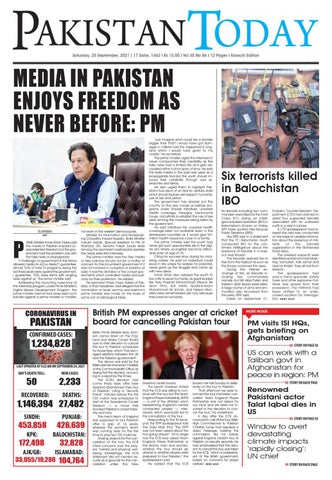
Saturday, 25 September, 2021 I 17 Safar, 1443 I Rs 15.00 I Vol XII No 86 I 12 Pages I Karachi Edition
Media in Pakistan enjoys freedoM as never before: PM
ISLAMABAD APP
P
riMe Minister imran Khan Friday said the media in Pakistan enjoyed unprecedented freedom but the government had the problem only with the fake news or propaganda. “i challenge, no government in the history allowed media to act so freely? i guarantee, almost 70% of total TV programs during the last three years were against the government. i guarantee, 70% news items with angling were against us,” the prime minister said. Addressing the launching ceremony of the internship program under Prime Minister’s Digital Media Development Program, the prime minister said he had never seen such slander against a prime minister or minister,
not even in the western democracies. Minister for information and Broadcasting Chaudhry Fawad Hussain, State Minister Farrukh Habib, Special Assistant to PM Dr Shahbaz Gill, Senator Faisal Javed were among the prominent participants besides the newly selected internees. The prime minister said the free media or free judiciary should not be a matter of concern for the incumbent government if it was not involved in corruption or violation of rules. it was the dictators or the corrupt governments which controlled media and judiciary for their protection, he added. He said even three major dailies of Pakistan, in their headlines, had alleged that the nomination of Azad Jammu and Kashmir’s prime minister was made on the basis of some sort of astrological table.
Coronavirus in
Pakistan
CONFIRMED CASES:
1,234,828
LAST UPDATED AT 9:22 AM ON SEPTEMBER 24, 2021
DAY'S DEATH TOLL:
NEW CASES:
50
2,233
RECOVERED:
DEATHS:
1,146,394 27,482 SINDH:
PUNJAB:
453,858
426,639
KPK:
BALOCHISTAN:
172,498 AJK/GB:
32,828 ISLAMABAD:
33,955/10,286
104,764
“Just imagine what could be a slander bigger than that? i would have got damages in millions had this happened in england which i would have given to my charity,” he remarked. The prime minister urged the internees to never compromise their credibility as the fake news had a limited life and gets discredited within a short span of time. He said the state media in the past was used as a propaganda tool but the youth should improve their credibility through new researches and ideas. He also urged them to highlight Pakistan’s true vision of an islamic welfare state which should feature self-respect, humanity, rule of law and justice. The government has already put the country on the very course as welfare programs under ehsaas initiatives, universal health coverage, Panagas, low-income house, and efforts to establish the rule of law were among the measures being taken by the government. He said initiatives like universal health coverage were not available even in the developed countries as it would give rs1 million health insurance cover to a family. The prime minister said the youth had never got such opportunities like in the digital era where youngsters became billionaires even at age of 25. Citing his success story during his cricketing career, he said no individual could excel in life unless he realizes his potential, never gave up the struggle and came up with new ideas. imran Khan also advised the youth to live a life to serve humanity, as great leaders like Holy Prophet Muhammad (Peace Be Upon Him), Sufi saints, Quaid-e-Azam Muhammad Ali Jinnah, and Nelson Mandela were remembered yet only because they lived for humanity.
Six terrorists killed in Balochistan IBO Six terrorists including two commanders were killed by the Front Corps (FC) during an intelligence-based operation (iBO) in Balochistan’s Kharan on Friday, ArY News quoted inter-Services Public relations (iSPr). The iSPr said in a statement that the FC Balochistan South conducted iBO on the confirmed intelligence about the presence of terrorists in a hideout near Kharan. The terrorists opened fire to flee from the hideout as soon as the troops cordoned the area. During the intense exchange of fire, six terrorists including two commanders namely Gul Mir alias Pullen and Kaleem Ullah Bolani were killed. A large cache of arms and ammunition also recovered from the area, iSPr said. earlier on September 21,
British PM expresses anger at cricket board for cancelling Pakistan tour British Prime Minister Boris Johnson came down on the england and Wales Cricket Board due to their decision to cancel the tour to Pakistan scheduled for November, which “has damaged relations between the UK and the Pakistan government”. The above was said by the British premier and senior ministers of the Commonwealth Office as saying that the decision, according to a report by The Times. The eCB’s decision had come three days after New Zealand abandoned their tour of Pakistan, citing a “security threat” minutes before the first ODi match was scheduled to start at the rawalpindi Cricket Stadium — a move that shocked Pakistan’s cricket fraternity and fans. The men’s team of england was supposed to tour Pakistan after a gap of 16 years, whereas the women’s team was coming here for the first time to play two T20 matches. Sharing reasons for the cancellation of the tour, the eCB cited concerns over the players’ mental and physical wellbeing. interestingly, the eCB statement did not mention security as a grounds for the cancellation unlike the New
Punjab’s Counter-Terrorism Department (CTD) had claimed to arrest four suspected terrorists associated with an outlawed outfit in a raid in Lahore. A CTD spokesperson had relayed the raid was conducted on the basis of credible information about the presence of militants of the banned organisation in the Mohlanwal road area. The arrested suspects were identified as Mohammad Mushtaq, Samiullah, Adil Jamal and Usama Khalid. They all hail from Karachi. The spokesperson had said a hand grenade, safety fuses and other explosive material was seized from their possession. The militants had been shifted to an undisclosed location for interrogation. news desk
more inside
PM visits ISI HQs, gets briefing on Afghanistan STORY ON PAGE 03
US can work with a Taliban govt in Afghanistan for peace in region: PM Zealand cricket board. The report, however, stated that the eCB was willing to continue with the tour but the Team england Player Partnership (TePP) — a unit of the athletes’ union representing england’s central contracted players — intervened, which eventually led to the cancellation of the tour. responding to The Times report, the TePP spokesperson told The Daily Mail, that “the TePP was not even asked about the tour going ahead”. “At no stage has the eCB ever asked Team england Player Partnership or the teams, men and women, whether the tour should go ahead or whether players were prepared to tour Pakistan,” the spokesperson said. He added that the eCB
board met last Sunday to deliberate on the tour to Pakistan. “That afternoon we were informed the tour had been cancelled. Team england Player Partnership was not asked for our input and we were not involved in the decision to cancel the tour,” he underlined. A day after the eCB announced to call off the tour, British High Commissioner to Pakistan Christian Turner had released a video message, insisting the commission did not advise against england cricket’s tour of Pakistan on security grounds. He had emphasised that the decision to cancel the tour was taken by the eCB, “which is independent of the British government, based on concerns for player welfare”. news desk
STORY ON BACK PAGE
Renowned Pakistani actor Talat Iqbal dies in US STORY ON PAGE 03
Window to avert devastating climate impacts ‘rapidly closing’: UN chief STORY ON BACK PAGE
02
Saturday, 25 September, 2021
KARACHI
NEWS
GovT woRkING To RevoLUTIoNIse INdUsTRy To UPLIFT CoUNTRy: PResIdeNT ALvI LAHORe
P
APP
RESIDENT Dr Arif Alvi on Friday said the government was ensuring ‘ease of doing business’ for attracting maximum foreign investment as revolutionizing the industrial sector was vital for the uplift of the country. He was addressing after inaugurating
‘Challange Textile Park’ a project launched by the Chinese with an investment of about $150 million, at Challenge Textile here. He said such initiatives like Challenge Textile Park would help in attracting further investment as it was needed to continuously learn for exploring new ways of bringing foreign investment. Special economic zones were being established, he said. The world was changing and no one can economically isolate a
country, he added. The President said Pakistan China relationships were of paramount importance for bringing development and prosperity in the region. “We invite Chinese to come here, invest and spread a message across the world about available business opportunities in Pakistan”, Alvi maintained. He said it was needed to focus on fast and prompt communication to resolve the issues of businessmen and Prime Minister
Imran Khan led government was working effectively to build more and more special economic zones for creating new employment opportunities and promote industrial sector. Pakistan as a brand, he said was emerging strongly and the government had achieved significant success in the macro finance sector, agriculture sector and overcoming Covid-19 pandemic. The President said that the world may
not be completely free of Covid-19 virus due to its changing variants but efforts could be made to produce enough vaccines for developing immunity among people against virus. Punjab Minister for Industries and Commerce Mian Aslam Iqbal, prominent businessman Qamar Khan Bobi, Chinese Consul General and a large number of business representatives from China were also present.
In a ‘unique’ order, LHC orders NADRA to issue ID card to adopted girl LAHORe INP
The Lahore High Court has given a ‘unique’ order to the National Database and Registration Authority (NADRA) to provide a new identity to an 18-year-old foster girl by giving a fake name to her unknown father and release an identity card to her. Justice Muhammad Shan Gul of the Lahore High Court on Friday wrote down a 9-page detailed judgement on Zarmeen Abid’s petition. Zarmeen who does not know who is her biological father has submitted a petition to the LHC challenging
NADRA’s decision to block her identity card. According to Justice Gul, NADRA had committed a blatant and clear violation of the Constitution by blocking the identity card of an adopted girl. He remarked that Nadra without hearing the stance of a hapless girl who does not know about her real father deprived her of her national identity card. “Without providing the right to defence to an individual, and blocking his/her identity card is tantamount to the negation of his/her identity,” the verdict said. The ID card blockage means that the freedom of a citizen has been restricted and he has been deprived of the
necessities of life. The court observed that the position of an 18-year-old girl sans identity was similar to a defenseless and weak pigeon among a clutter of cats. It’s the responsibility of states at the international level to register their citizens in order to thwart the forced sex trade, labour and human trafficking. To have a legal identity is the foremost constitutional right of every citizen and it is attached to human dignity. It is the responsibility of a state to restrict others who interfere in giving identity to its citizens, the verdict said. Pakistan has endorsed an international accord agreeing to abolish
discriminatory treatment to women. The state entities must ensure the protection of women rights, the court said. The petitioner told the court that she was adopted by Mrs Razsanga and she did not know about her real father nor did her foster mother. She said in the column of father’s name on her B Form, her foster mother’s ex-husband Abid-ulRehman’s name was written. Then her foster mother’s second husband Nasir Ahmad approached NADRA and requested it to write down his name in the column of petitioner’s father name. Now Mr Nasir has blocked her NADRA identity card, the petitioner informed the court.
Punjab government suspends two in Nawaz fake vaccination scandal News DesK A medical superintendent and a senior doctor of Lahore’s Kot Khawaja Saeed Hospital have been suspended in a case relating to the fake vaccination entry of three-time prime minister Nawaz Sharif and they have been directed to report to the health department immediately. Cases have also been registered against three employees of the hospital involved in the fake entry of the coronavirus vaccination. Two of those nominated in the FIR have been arrested. The Federal Investigation Agency and the police have registered separate cases in this regard. According to the FIA cybercrime wing, watchman
Abul Hassan and ward boy Adil used the ID of third employee Naveed to enter former prime minister Nawaz Sharif’s fake entry into the system. Police have registered cases against the three suspects and arrested Abul Hassan and Adil. In addition, the National Command and Operations Center (NCOC) has summoned the Punjab health secretary to Islamabad. The provincial health authorities have prepared a report concerning the controversy and shared it with Chief Minister Usman Buzdar, highlighting lapses in the hospital’s monitoring and supervision systems. “Four employees of the hospital admitted to making the fake entry of Nawaz Sharif’s data,” stated the report,
adding that no senior staff was deployed at the health facility where the management had authorised lowerlevel staff to update the record. A fake coronavirus vaccine entry was made using former PM Nawaz Sharif’s name in the National Immunization Management System (NIMS) at the Government Kot Khawaja Saeed Hospital on September 22. As per the fake entry, Nawaz Sharif, who is currently in London, got his first shot of the Covid-19 vaccine Sinovac at 4:03 pm Wednesday at the hospital. Punjab’s Primary and Secondary Healthcare Department took notice of the incident and wrote a letter to the FIA and asked it to investigate the matter and take necessary action against the culprits.
Country in need of digitisation for empowerment of workers KARACHI APP
Recognition clinched globally and outpouring support from across the country for National Command Operation Center (NCOC) with regard to its success in efficient management of Covid-19 pandemic has ignited a new hope among many Pakistanis seeking digitization as a tool to help social and economic empowerment of over 90 million workers, largely non-registered in the country. NCOC having proven well that technology can literally be a remedy has left many wondering as why labor, social welfare, social security departments and those engaged in public dealing besides institutions as Employees Old Age Benefit (EOBI) can also not get urgently linked to National Database and Registration Authority (NADRA), ensuring listing of every citizen aged 18 years and above regardless of their nature of job – self-employed, regular, temporary or contract in provision of essential details to actually empower the available human resource in the country. The Digital Pakistan Vision 2019 introduced by the Pakistan Tehreek-ePakistan (PTI) government complemented by a strong political will to help country achieve digital solutions for a number of challenges being faced
by the country and its people is an additional source of encouragement for many who despite being duly conscious of the hindrances are optimistic that these may be addressed through sincerity of purpose. For Naeem Sadiq, a senior researcher and citizens’ right activist, the digitization of concerned departments and institutions at federal and provincial levels can pave way for realistic projections and proper categorization of the labor force in the country. “The fact that out of the 90 million workers in the country only ten percent are registered with EOBI whereas the percentage is much low in the available records of concerned social security departments, at provincial or local levels, is denying vast majority of their rights guaranteed under the constitution,” he told APP. Emphasizing that attention has also to be paid towards those associated with informal sectors or working in units with less than five workers and/or self employed, the activist mentioned that around 60 million workers are presently associated either with informal sector, or are self employed, or part-time workers or working in small units and not registered with any government department not even with EOBI with no social security cover or even old age benefit, which though is
a basic right of every senior citizen of the country. In the given circumstances Naeem Sadiq suggested that EOBI may include every citizen above 18 years under its ambit with an efficient mechanism through which all those working under the category of informal sector can be encouraged to contribute to EOBI in accordance to their capacities, even if it may be token, coupled with six percent of minimum wage contribution by EOBI besides the monthly share of the employers (formal and informal sectors). “The approach if followed with due diligence will add no unnecessary burden on the national exchequer and government may not need to pay any extra penny in providing EOBI cover to senior citizens of the country,” said the activist reminding that less than 15% of the people in the country are aware of EOBI’s existence. According to him it was high time that the country should have a compact and completely digitized EOBI, directly linked to NADRA data base, enabling even a small but digitally skilled staff to monitor whether the EOBI contributions of a CNIC holder has been deposited or not by the employer leading towards required intervention with major focus on the fact that all collections and payments are digitized. Reiterating that every citizen must be
entitled to voluntary registration with EOBI and social security, the activist suggested that the current practice of registering organizations only can be replaced by direct registration of individuals. “The NADRA website must display the EOBI and Social Security registration number and payment status for all Workers,” he suggested. Senior trade unionist Habib Junaidi enquired about the occupational safety and health (OSH) of workers and relevance of digitalization said data could be procured but perhaps what is much more needed is change of mindset among the stakeholders. He, however, did agree with Naeem Sadiq that health and safety of workers is all about “Risk Management” and that personnel of all concerned departments must be educated and digitally competent so as to make optimum of available technology for an updated occupational health and safety audit coupled with compilation of accurate workers’ data base. Digital solutions are helpful for each and every section of the society provided concerted efforts are made for proper documentation, a crucial requirement, for realistic as well as public friendly policy formulation and implementation, said senior journalist and Resident Director, Aurat Foundation, Mehnaz Rehman.
Lieutenant General (R) Ishfaq Nadeem passes away News DesK Former Chief of General Staff Lieutenant General (R) Ishfaq Nadeem passed away on Friday, according to media reports. Funeral of Ishfaq was offered in Rawalpindi. Chief of Army Staff (COAS) General Qamar Javed Bajwa, senior civil and military officials, and people from all walks of life attended the funeral. Ishfaq was appointed as Chief of General Staff in November, 2013. Prior to his promotion, Ishfaq had served as Director General Military Operations for two years.
Court rejects bail plea of suspects in Lahore rickshaw harassment case News DesK A local court on Friday rejected the bail plea of two suspects in Lahore rickshaw harassment case. Suspects namely, Abdul Rehman and Irfan Ali moved plea to the court of the additional sessions judge, seeking bail in the case. However, Judge Muhammad Saeed rejected the bail plea of the suspects. Both suspects were identified by the victim. On August 24, the Punjab police claimed to have detained one more suspect involved in harassing the woman who was aboard a Qingqi rickshaw near Lahore’s Greater Iqbal Park on Independence Day. Police had already arrested another suspect who filmed the viral video of a group of women being sexually harassed inside a Qingqi rickshaw. Police had also seized the mobile phones of both prime suspects and have sent them for forensic analysis. According to investigators, both culprits harassed more than 7 women on Independence Day and recorded video of sexual assault.
JUI-F won’t discuss electoral reforms with PTI, says Fazl News DesK The Jamiat Ulema-e-Islam-Fazl will not sit with the Pakistan Tehreek-e-Insaf government on the issue of electoral reforms, said party chief Maulana Fazlur Rehman on Friday. Fazl, who also heads the opposition alliance, Pakistan Democratic Movement, made this clarification during a telephone call with senior PML-N leader Shahid Khaqan Abbasi on the issue of electoral reforms. The JUI-F chief asked the PML-N leader to take JUI-F and other parties of the PDM alliance on board on its contacts with the government on matters relating to electoral reforms. In a recent meeting of NA Speaker Asad Qaisar with parliamentarians from the government and opposition members, it was decided to constitute a joint parliamentary committee to discuss issues regarding electoral reforms.
Saturday, 25 September, 2021
KARACHI IsLAMABAD
P
StAff RePoRt
RIME Minister Imran Khan along with top civil and military leadership visited the headquarters of Inter-Services Intelligence (ISI) today where they were briefed over recent developments in Afghanistan. According to details, the prime minister was accompanied by three services’ chiefs, federal ministers and Chief Minister Balochistan Jam Kamal, and Chief Minister Khyber Pakhtunkhwa (KP) Mahmood Khan. ISI DG Major General Faiz Hameed welcomed the delegation at the spy agency’s headquarters as they were briefed over the recent developments in Afghanistan. A comprehensive briefing was given to the national and military leadership on the national security and regional
NEWS
03
PM vIsITs IsI HQs, GeTs bRIeFING oN AFGHANIsTAN
dynamics with a focus on the ongoing situation in Afghanistan. The prime minister appreciated the diligent efforts of Inter Services Intelligence for national security and expressed his satisfaction over professional preparedness. Prime Minister has made multiple visits to ISI headquarters during the ongoing year in the last such visit, he chaired a meeting of the National Intelligence Coordination
Committee there which was attended by heads of intelligence agencies, Intelligence Bureau (IB), Federal Investigation Agency (FIA), and senior members of the federal cabinet. “Those accompanied the prime minister in the meeting included Information Minister Fawad Chaudhry and Interior Minister Sheikh Rasheed,” a handout issued regarding the meeting said. The prime minister was given a detailed
briefing on enhancing intelligence cooperation as he expressed his satisfaction
Pro-Tareen MPAs express trust in Punjab CM Buzdar’s leadership: reports News DesK More supporters of Pakistan Tehreek-e-Insaf’s Jahangir Khan Tareen faction have met Chief Minister Punjab Usman Buzdar on Friday, wherein Geo News reported that the MPAs have expressed trust in CM Buzdar’s leadership and said that they stand with the PTI leadership.
The Tareen loyalists who met the chief minister include Noman Langaryal, Khwaja Dawood Salmani, and Abdul Hayi Dasti. The disintegration within the Tareen faction caught pace after loyalist Nazeer Chohan parted ways with the group. This followed another PTI MPA Sardar Khurram Laghari, who too is a Tareen supporter, meeting CM Buzdar yesterday.
Sources within the CM House have claimed that more MPAs loyal to Tareen have contacted CM Buzdar and will meet him soon. Provincial Minister for Punjab Prisons and provincial government spokesman Fayyaz Chohan said a few days ago that he has been given a special task to contact all pro-Tareen lawmakers and have them meet CM Buzdar while following party discipline.
Int’l community needs to show ‘big heart’ for shoring up Afghans’ economy PesHAwAR APP
Following completion of one-month of peaceful takeover of Taliban and subsequent new Government in Afghanistan, the international community including the United States of America needs to support the fragile economy to help rebuild the warravaged country. After ceasing inflow of capital, foreign aid, investment and above all freezing of bank accounts, the Afghans economy is in tatters with its people eying up towards urgent assistance by the international community to avert the looming economic crisis. “Afghanistan is on the historic crossroads today. It is up to the international community including the US and regional countries whether they see Afghanistan a progressing, stable and prosperous state with strong economy or they want it relapsed in a state of chaos, infighting and epicenter of terrorism, which can push all back to square one,” said Professor Dr Khurshid Ahmed, International Relations Department, University of Peshawar while talking to APP. He said Afghans economy was heavily dependent on foreign aid and assistance from donor countries that had received severe jolts following the US chaotic withdrawal from Afghanistan. “Afghanistan economy is mostly fragile. Over 60 percent of the Afghans’ economy fed through foreign aid that was recently stopped and about USD 9.5 billion bank accounts of Afghanistan stand frozen adding to social economic woes of millions of poor Afghans,” said Dr Khurshid Ahmed. “This huge amount was meant for Afghanistan and its people have the right on it,” he said, adding
the Afghan Government was facing financial constraints to meet cash demands of the people due to freezing of its accounts. He said if these accounts were not reopened immediately there was a possibility of a serious humanitarian crisis of starvation, hunger and malnutrition of children in Afghanistan and the whole responsibility would be on the international community. Being a poor country suffering from war and instability for the last 40 years since the invasion of USSR in 1979, he said Afghanistan’s development was primarily dependent on international monetary institutions including IMF, World Bank, Asian Development Bank and International NGOs. He said closure of international NGOs had added difficulties for Afghans as the former had left all the development projects incomplete with dust everywhere. He said, “poverty leads to injustice, socioeconomic imbalances and aggressive behaviors and these social ills could be countered through massive development in Afghanistan.” Dr Khurshid said peace and development in Afghanistan was in the best interest of the world including regional countries. “Leaving Afghanistan abandoned as was done in the past, would lead to economic disparity, poverty and would undermine peace efforts in the war torn country.” He said an inclusive Government in Afghanistan and ensuring that the country’s soil would not be used against any country were among the main points of Doha Peace Agreement and now the international community was expecting that the Taliban Government would honor its commitment in this regard. He said, “The Taliban Government was welcomed by people of Afghanistan and it required
time to work for promotion of human rights and women issues besides building of national institutions,” he said, adding Afghans had never accepted foreign occupation and controlling Afghanistan from outside was always counterproductive. Brigadier (r) Mehmood Shah, senior defense analyst and former secretary Security Law and Order erstwhile Fata said that the occupation of Panjshir Valley by Taliban forces was being dubbed as the ‘last nail in India’s coffin in Afghanistan, as its huge investment in men and material to ‘destabilise’ Pakistan has finally washed away. “India had deceived the international community and Afghans in the name of investment and development in Afghanistan,” he said adding India had used Afghan’s soil against Pakistan and the fall of the most strategic Panjshir valley was a great disappointment for BJP rulers and RAW. After seeing crushing defeat of RAW in Afghanistan, he said India had started malicious propaganda against Pakistan and Afghan Taliban Government to divert domestic and international public opinion and hide its shameful acts of terrorism. Brigadier (r) Mehmood said that infiltration of unwanted elements from across the western border had been contained after construction of a long fence, new forts and putting in place a comprehensive security mechanism equipped with drone technology, radars and night surveillance system on Pak-Afghan border. He said no influx of refugees from Afghanistan to Pakistan had been reported after the fall of Kabul one month ago; adding Afghan refugees in substantial numbers were going back to their country which was a positive sign.
over the performance of the National Intelligence Coordination Committee.
Renowned Pakistani actor Talat Iqbal dies in Us News DesK Famous Pakistan film and TV star Talat Iqbal has died in the US, the actor’s family confirmed on Friday. He was hospitalised in a critical condition in Dallas, US two weeks back, days after the death of his daughter Sarah Talat earlier this month. The veteran actor played key roles in several dramas in the 70s and 80s. He also starred in several Pakistani films during his long career.
Jati Umra land case: Court orders to paste notices on sharif’s house LAHORe INP
The court on Friday ordered to paste notices on the walls of Sharif residence after Pakistan Muslim league-Nawaz (PML-N) Vice President Maryam Nawaz refused to accept them. According to details, the court had directed to dispatch the notices to the Sharif family in a case pertaining to the transfer of Jati Umra’s 127 Kanal land. Following the refusal to receive the notices, the court ordered to paste them on the walls of the house and submit the pictures. Earlier, local court had stopped the authorities from canceling transfer of 180 acres of land in Raiwind and summoned all the parties in the case including Punjab government along with relevant data. Preciously, Lahore High Court (LHC) had wrapped up the interim bail plea of Maryam Nawaz in a case regarding illegal transfer of 180 acres of land in Raiwind. A twomember bench conducted hearing on the case during which, the court had directed the National Accountability Bureau (NAB) to inform the PMLN leader 10 days prior to arresting her. Maryam Nawaz adopted the stance that NAB wants to arrest her on the pressure of the government. The NAB spokesperson told that at least 1,440 kanals of land — 180 acres – was transferred in Maryam’s name. This happened after 2013 when 3,568 kanals of land — 446 acres — was transferred in the name of the Sharif family. Sharif family also been accused of changing the Lahore Master Plan in 2015 with the help of the then DCO Noorul Amin Mengal and LDA DG Ahad Khan Cheema. NAB further alleged that Sharif family, with the connivance of officials, got thousands of kanals in Jati Umrah declared as green land.
Lending ear to help deaf protect linguistic identity LAHORe ANAdolu AgeNcy
An international restaurant chain has set an example for all businesses by hiring staff with speech- and hearing-impairments in almost every branch of Lahore. Waleed Hassan and Rehan Fareed both work at the lobby of the restaurant situated at The Mall, the busiest juncture of the city in terms of commercial activities, and take care of the guests’ needs. The world marks the International Day of Sign Languages on September 23 every year to support and protect the linguistic identity and cultural diversity of all people with hearing-impairments and other sign language users. 29-year-old Hassan used to take orders from customers in pre-Covid days. “People used to point at the menu to let me know what they want. It encourages us when they try to talk to us in basic sign language,” Hassan told Anadolu Agency.
Working in the culinary field, both of them aspire to open their own restaurants in the future. “I am serving in the restaurant for the past seven years. I always hope for the best but we have limited opportunities here,” said Fareed. Before their shift starts, their manager Rabia Mujahid assembles the entire staff in the hall and gives them instructions for the day. “While watching them both talking to each other, we all have learned some basic sign language. I think all of us should know this system of communication to make the differently-abled equal partners in our work,” said Mujahid. Sign language curriculum Considering the World Health Organisation estimation of 15 percent prevalence of global disability, around 31 million people in a population of 207 million are likely to be facing some form of disability in Pakistan. Farhat Aslam, the general secretary of Deaf Welfare and Awareness Foundation,
said: “In Pakistan, there are no reliable figures on disability. The last national census to document the disability happened way back in 1998. In the current position, we have no idea about the exact numbers but they are surely very high.”
The foundation was the first institute established by a deaf person, Muhammad Mansha, in 1977. “As a society, this is our responsibility to learn the basics of sign language. When people look at a deaf person with blank
facial expressions it hurts them a lot,” Aslam said, adding there is no curriculum or a subject of sign language at mainstream institutes. Despite having such a large number of differently-abled people, Pakistan is yet to have its sign language curriculum. “I work with international organisations as an interpreter because I know the sign language. And I know this because of my deaf mother. But we do not have a curriculum or specialised subjects of sign language,” Aslam told Anadolu Agency. Native language of deaf community Taking a big initiative, 26-year-old Hassan Ahmad, Pakistan’s first deaf social media influencer and vlogger, is helping people understand the needs of the deaf community. “Learning the sign language is the basic right of a person with a hearing loss. As a YouTuber, I already took steps to spread awareness on the importance of sign language and asking people to learn it to communicate with deaf people in their native language,” said Ahmad.
Saturday, 25 September, 2021
04 NEWS
KARACHI
Weekly inflation SliPS 0.07Pc aS flour, Wheat PriceS diP ISLAMABAD
t
TLTP
HE Sensitive Price Indicator (SPI) based weekly inflation for the week ended on September 23, 2021 for the combined consumption group witnessed a decrease of 0.07 percent as compared to the previous week while it went 13.88 percent up on a year-on-year (YoY) basis. According to data released by the Pakistan Bureau of Statistics (PBS) on Friday, the combined index was at 157.19 on Sep-
tember 23, 2021 as compared to 157.30 on September 16, 2021 while the index was recorded at 138.03 a year ago on September 24, 2020. The SPI is computed on a weekly basis to assess the price movements of essential commodities at a shorter interval of time so as to review the price situation in the country. The SPI comprises 51 essential items and the prices are being collected from 50 markets in 17 cities of the country. During the week under review, out of 51 items, prices of 20 (39.21%) items increased, prices of 10 (19.61%) items de-
creased and prices of 21 (41.18%) items remained constant. The SPI for the current week recorded a decrease in the prices of bananas (7.87%), onions (4.69%), garlic (2.12%), pulse Moong (2.11%), pulse Mash (1.70%), wheat flour bag (1.60%), pulse gram (1.27%), pulse Masoor (0.27%) and rice Irri and potatoes (0.18%) each was observed. On the other hand, an increase was observed in the prices of tomatoes (14.21%), tea Lipton (1.73%) and eggs (1.69%) with a joint impact of (0.09%) into the overall SPI for the combined group of (-0.07%).
According to the PBS data, the year-onyear trend depicts increase of 13.88 percent with most of the items increased, mainly electricity for Q1 (57.92%), LPG (52.90%), chicken (44.39%), vegetable ghee 1-kg (40.14%), vegetable ghee 2.5-kg (38.49%), cooking oil 5 litre (38.16%), mustard oil (37.22%), chillies powder (35.71%), gents sandal (33.37%), eggs (28.83%) and gents sponge chappal (25.13%), while a major decrease was observed in the prices of tomatoes (37.83%), pulse Moong (28.31%) and potatoes (26.89%). The weekly SPI percentage change by
income groups showed that SPI across all quantiles ranged between -0.03 percent and -0.15 percent. The lowest income group witnessed a weekly decrease of 0.15 percent while the highest income group recorded a decrease of 0.03 percent. On a yearly basis, analysis of SPI change across different income segments showed that SPI increased across all quantiles ranging between 12.97 percent and 16.25 percent. Yearly SPI for the lowest income group increased by 16.25 percent while the highest income group recorded an increase of 13.52 percent.
dollar gains 5 more paisas to reach rs169.08 Pakistani rupee continued struggling against the US dollar in the inter-bank for the third consecutive day on Friday and depreciated by 5 more paisas (-0.03 percent). According to the State Bank of Pakistan, the US dollar opened at Rs169.03 and closed at Rs169.08. The local unit depreciated in four out of five sessions during this week. Within the open market, the rupee was traded at Rs169/170 per dollar. The Pakistani rupee shed Rs0.91 during the last five days against the US dollar, while depreciation during the fiscal year 2021-22 has been Rs11.66. The local unit has shed Rs8.81 against the US dollar in the current year 2021. The local currency has maintained a downtrend after it touched 22-month high of Rs152.27 in May 2021, losing a cumulative Rs16.77 in the past four months to date. According to currency dealers, the demand for the US dollar remained high due to upcoming two weekly holidays. They said the dollar’s demand is high because of import and corporate payments due to the quarter-end. They added by every quarter-end, foreign entities operating in Pakistan repatriate profit and dividends to their parent companies abroad. They further said that lower inflows and higher payments resulted in widening of trade deficit as well as current account deficit. They said that widening of trade deficit and the current account deficit also deteriorated the market sentiments. NEWS DESK NARAN: Tourists enjoy boating in Naran. ONLINE
SBP halves banks’ import payment ceiling In order to curb the rising demand for US dollar in the interbank market and arrest rupee depreciation, the State Bank of Pakistan (SBP) has asked commercial banks to provide information about imports worth $500,000. Moreover, the banks have also been asked to submit details about imports arriving in five days. Prior to the revision, the banks had to submit information up to $1 million worth of imports along with import details of two days. The SBP has also directed banks to seek permission for imports that are valued at $500,000 per transaction, cutting in half the original payment ceiling of $1 million, which banks could make without needing central bank authorisation. NEWS DESK
Gold price slips to Rs94,900 per 10gm NEWS DESK Gold prices gained some positive traction on the last trading day of the week and recovered a part of the overnight slump to the lowest level since August 11. At 1320 hours GMT, gold in the international market was available at $1,748.20 per ounce after gaining $4.30. Meanwhile, the price of 10 grams of yellow metal in Pakistan decreased to Rs94,900 after shedding Rs600. The closing prices of the yellow metal in the country remained Rs95,500 on Thursday last. The decrease in local gold prices was also due to overnight change in gold price when the local market was closed. According to experts, gold prices have been trading in a broader range of $1,750 and $1,830 since late June. Gold touched the low of
$1,687.78 on August 9 after breaking the range shortly. The price trades below the 20-day Simple Moving Average (SMA) at 1.801.35, which is confirming the downside pressure on the gold. The Moving Average Convergence Divergence (MACD) holds below the midline with a bearish crossover. Any downtick in the MACD indicator would amplify the selling pressure and the prices would approach the low made on August 11 at $1,724.18. A daily close below the $1,720 horizontal support level would entice bears to retest the levels last seen in April. Gold bears could meet the April 1 low at $1,705.84, the experts warned. On a flip side, if price sustains above intraday high, it could retrace back to the $1,770 horizontal resistance level followed by the high made on September 22 at $1,787.35.
European restriction on PIA may be lifted this year, hopes minister NEWS DESK Minister for Aviation Ghulam Sarwar Khan has expressed hope that restrictions on Pakistan International Airlines (PIA) flights by certain European countries will be lifted during this year. The minister said this on the floor of the Upper House of the Parliament during the question hour on Friday. Replying to a question regarding restriction on PIA flights by certain European countries, the minister said all their observations made by the European countries have already been addressed and their audit team would visit Pakistan in November. He was optimistic that the restriction would be lifted within this year. Talking about the financial health of the national flag carrier, he said that the incumbent government inherited huge financial losses of PIA but managed
CMYK
to reduce it drastically from Rs67.32 billion to Rs34.64 billion during the last three years. The minister said the PIA financial losses were Rs67.32 billion in 2018, which were reduced to Rs52.60 billion in 2019 and Rs34.64 billion in 2020. He said various commercially unviable routes, both domestic and international, were closed to curtail the losses. To another question, he said that Hyderabad airport is operational and can handle aircraft up to ATR-42. According to the PIA financial results for half year ended June 30, 2021, the airline once again failed to achieve a turnaround in its earnings as the air carrier recorded a loss of Rs25 billion. However, the loss was 31.5% lower compared to the loss of Rs36.5 billion recorded in the same period of last year, revealed a notice sent by PIA Corporation to the Pakistan Stock Exchange (PSX).
Brent remains above $77 despite crude prices inch down Crude oil prices went slightly down on Friday after making gains for three days in a row. At 1335 hours GMT, Brent, the international benchmark for twothirds of the world’s oil, shed $0.10 (-0.13 percent) to reach $77.15 a barrel. Similarly, the US West Texas Intermediate (WTI) reached $73.08 a barrel, down by $0.22 (-0.13 percent). The price for Opec Basket was recorded at $74.46 a barrel with 1.06 percent increase, Arab Light was available at $76.29 a barrel with a 2.49 percent increase, while the price of Russian Sokol jumped to $76.68 after gaining 2.65 percent. According to experts, WTI crude futures are more than 1% higher around $73 a barrel this week, having touched a near 8-week high of $73.3 on Thursday and extending gains for the third consecutive week boosted by growing fuel demand and falling US crude inventories. Disruptions in US Gulf Coast production following Hurricane Ida and other storms have led to sharp draws in US and global inventories. EIA data showed US crude stocks fell by 3.5 million barrels to 414 million last week, the lowest since October 2018. Capping some gains was China’s first public sale of state oil reserves. NEWS DESK
dPc doubles guarantee amount for bank depositors to rs0.5m The Deposit Protection Corporation (DPC) has increased the guarantee amount for all eligible depositors of banks from Rs250,000 to Rs500,000. The State Bank of Pakistan (SBP) said in a statement on Friday that the decision has been made by the board members of the corporation in their meeting held on September 06, 2021. This enhanced guarantee amount now provides full protection up to 95 percent of the eligible depositors. The main objective of the deposit protection scheme is to safeguard depositors’ interests and further enhance their trust in the country’s banking sector. The deposit protection facility is applicable to all eligible depositors and does not require any further subscription or registration of depositors. The guarantee amount or protected deposit becomes payable to eligible depositors only if the State Bank of Pakistan declares a bank as a failed bank and is not payable under any other circumstances. NEWS DESK
Saturday, 25 September, 2021
KARACHI
KSE-100 SHEDS ANoTHER 223 PoINTS To cloSE AT 45,073 KARACHI
T
TLTP
HE Pakistan Stock Exchange (PSX) witnessed another roller-coaster session on Friday, with the benchmark KSE-100 Index shedding 223.36 points (-0.49 percent) to close at 45,073.52 points. The market opened on a negative note but turned towards the green zone till half of the session by gaining over 128 points. However, then came aggressive selling that led the market to make an intraday low of over 400 points before recovering over 200 points just before the close of the session. The KSE100 Index moved in a range of 563.2 points, showing an intraday high of 45,424.2 points and a low of 44,861 points. Among other indices, the KSE All Share Index shed 162.85 points (-0.53 percent) to close at 30,777.71
points, while All Share Islamic Index shed 84.08 points (-0.38 percent) to close at 21,927.14 points. A total of 368 companies traded shares in the stock exchange, out of them shares of 122 closed up, shares of 231 closed down while shares of 15 companies remained unchanged. Out of 95 traded companies in the KSE-100 Index, 28 closed up, 64 closed down, and three remained unchanged. The overall market volumes decreased by 74.24 million to 369.54 million shares. Total volume traded for the KSE-100 Index was 186.69 million shares. The number of total trades decreased by 13,933 to 121,843, while the value traded decreased by Rs0.61 billion to Rs11.77 billion. Among scrips, WTL realised a trading volume of 36.71 million shares followed by UNITY (36.18 million) and BYCO (29.57 million). Stocks that contributed significantly to the volumes include WTL, UNITY, BYCO, HUMNL and KEL, which formed 36
percent of total volumes. Sector wise, the index was let down by commercial banks with 63 points, cement with 61 points, automobile assembler with 27 points, technology & communication with 20 points and textile composite with 16 points. The most points taken off the index were by TRG which stripped the index of 26 points followed by MCB with 26 points, CHCC with 19 points, INDU with 18 points and FFBL with 13 points. The sectors propping up the index were oil & gas exploration companies with 25 points, chemical with 22 points, automobile parts & accessories with 8 points, investment banks/ investment companies/ securities companies with 5 points and real estate investment trust with one point. The most points added to the index were by COLG which contributed 23 points followed by HUBC with 14 points, ENGRO with 13 points, OGDC with 12 points and AGP with 11 points.
Promote the High-Quality Development of China-Pakistan Economic Corridor and Build A Closer China-Pakistan Community of Shared Future In the New Era By MR. NINg JIzHe,
PTI is only the national party in Pakistan: Haleem Adil Sheikh KARACHI APP
Leader of the Opposition in Sindh Assembly, Haleem Adil Sheikh, Friday, said that Prime Minister Imran Khan led federal government consider labours as jugular vein of economy and was taking measures for their welfare. He was addressing a gathering of Insaf Jafakash Union of Sui southern Gas Company (SSGC) at company’s head quarter. PTI Labour Wing leaders Naeem Adil Sheikh, Sarbuland Khan, Syed Sajid Ali Gillani and others were also present at the occasion. Haleem said that PTI is the only political party that was consecutively elected in Khyber Pukhtoonkhwa while it also constituted governments in Punjab and Balochistan besides forming the federal government. People of Gilgit Baltistan and Azad Jamu Kashmir have reposed confidence on PTI and PTI is hopeful to form government in Sindh in the next elections as well, he said. Haleem Adil Shaikh said “we support genuine demands of SSGC union as we belied that company could perform better if labour force is content and happy.” He said that PTI was focusing on improving the working environment of public sector companies so that all the problems of workers could be resolved instantly. Haleem Adil Shaikh said that an honest and efficient person was appointed as MD SSGC who is streamlining different issues. Significant decrease has been observed in line loses while steps were being taken to eliminate corruption from the company, he added He said that during COVID-19 situation cash assistance of Rs. 260 billion was disbursed among workers and low income groups through Ehasas program. Haleem accused previous governments of ransacking public sector entities through their reckless policies. He said that Prime Minister Imran Khan is a trend setter in politics of Pakistan who brought an end to two party systems in the country. A single party was dominant in the politics of Karachi for 40 years but tireless struggle of Imran Khan freed the economic hub of the country.
On May 21 this year, Chinese President Xi Jinping exchanged a congratulatory message with Pakistani President Arif Alvi to celebrate the 70th anniversary of the establishment of China-Pakistan diplomatic relations. The two heads of state reviewed how mutual trust and friendship between the two countries have withstood the test of the changing international landscape over the past 70 years and always remained rock-solid, hailed the remarkable achievement attained by the construction of the ChinaPakistan Economic Corridor (CPEC), and expounded the significance of all-weather strategic partnership of cooperation between the two nations. President Xi added, “I would like to work with you to deepen strategic communication and practical cooperation between the two countries, and promote the high-quality development of CPEC”. This has given direction and momentum to the CPEC construction in the new era, and boosted our confidence in building CPEC into a model for highquality development of the Belt and Road Initiative and fostering a closer China-Pakistan community with a shared future. 1. Mutual trust and friend-
ship between the two sides are rock-solid. In his message, President Xi pointed out that the two countries, as all-weather strategic cooperative partners, have extended each other steadfast support over issues concerning our core interests and major concerns; our mutual trust and friendship have always been rock solid despite changes in the international situation over the past seven decades. Over the past 70 years, the two countries have always trusted and supported each other with sincere sympathy, stood together through thick and thin, with bilateral bond and friendship growing ever deeper and stronger as time goes by. China and Pakistan have forged a unique and ironclad amity throughout history. Over 2,000 years ago, the Silk Road became a bridge of friendship linking our two ancient civilizations. In ancient times, Zhang Qian, China’s emissary in the Han Dynasty, Faxian, the master monk in the Eastern Jin Dynasty, and Xuan Zang, the great monk in the Tang Dynasty all once visited Indus River. On May 21, 1951, China established diplomatic ties with Pakistan. Pakistan is one of the first countries to recognize the Peo-
ple's Republic of China and the first Islamic country to establish diplomatic relations with the PRC. On April 21, 2015, during his first visit to Pakistan, President Xi Jinping reviewed the bilateral history in his speech, “since the establishment of our diplomatic ties, thanks to the commitment of successive Chinese and Pakistani leaders and the concerted efforts of our two peoples, our two countries have forged an all-weather strategic cooperative partnership and pursued all-round cooperation. Despite changes in the domestic and international environment, we have always extended sympathy to and genuinely supported each other on issues crucial to our respective core interests. Such friendship is truly unique.” Over the past 70 years, China and Pakistan have trusted, respected and supported each other through thick and thin, and together established an all-weather strategic cooperative partnership. The ironclad bond is vividly exemplified by actions of the governments and the peoples. President Arif Alvi expressed in his message that, “Under the strong leadership of President Xi, Pakistan-China relations are stronger, more solid and more vibrant than ever before.”
newS
05
NADRA’s services will remain suspended on Saturday The National Database and Registration Authority (NADRA) has announced it is conducting an upgradation of its infrastructure on Saturday and Sunday. The authority informed the citizens that the online Nadra services will remain suspended for ten hours starting from late Saturday. The Nadra will carry out the activity from 2200 hours PST on 25 September 2021 (Saturday) to 0800 hours PST on 26 September 2021 (Sunday), according to the announcement made on social media platforms. "During this period clients/customers may experience denial of service. NADRA centres operating on 24/7 basis shall also be closed during this time. Inconvenience is regretted," said the Nadra statement. "All operational Nadra facilities, including Pak-ID portal, issuance of the national identity cards, the Covid certificates via NIMS portal and 24/7 mega centres services, will remain suspended owing to the upgradation of the system."TLTP NEWS DESK
Green line bus test run next month in Karachi A fleet of buses imported from China for the Green Line project have been moved to Surjani Bus Terminal from the Karachi port. According to sources, in the first phase, Green Line buses will run from Sujrani Town to the Numaish Chowrangi route, which will benefit 150,000 passengers on a daily basis. The concerned authorities said a test run of the buses with few passengers will be carried out next month. It is pertinent to mention here that the first consignment of 40 buses for the Green Line bus rapid transit system (BRTS) reached the city, earlier this month. Addressing a ceremony at the Karachi Port for the delivery of the fleet, Sindh Governor Imran Ismail had said: “Another milestone had been achieved with the arrival of the buses as part of the Karachi Transformation Plan (KTP) announced by Prime Minister Imran Khan.” Karachi’s Green Line BRT project with intersections is 24 km long which includes 12.7 km elevated, 10.9 km at grade, and 422 meters underground, and has 25 stations. The phase-II common corridor from Gurumandir up to Municipal Park with a length of 2.5 km has two underpasses at M.A Jinnah Road. The state-of-art underground bus terminal with a parking facility and the commercial mezzanine floor was also being constructed at Numaish. The construction work on Phase-I was started in 2016. NEWS DESK
Ministries given task to complete 1100 proposals: official Various ministries have given suggestions for 1,100 projects to achieve speedy progress for the people of Pakistan, an official said. Talking to PTV, Special Assistant to Prime Minister on Establishment Shahzad Arbab said that the government is working on a reforms agenda to enhance performance of the national institutions. The target has been set to bring improvement in the existing system to address issues of the common man, he added. NEWS DESK
CMyK
Saturday, 25 September, 2021
06 COMMENT
Challenges of the Single National Curriculum
A ticking time bomb And a reluctant government
S
PeAKing at a farmers‘ convention in D.i. Khan, Prime Minister imran Khan displayed concern about the sharp rise in the country’s population. As he rightly put it, if the population was allowed to grow at the current pace, Pakistan may face issues of hunger and poverty. According to Mr Khan, the country needs to focus on primary education and basic health to stop the population from growing astronomically. While the realisation has come after three years in power, it needs to be welcomed. There has been a nearly sevenfold increase in Pakistan’s population since independence, while every year there is an addition of some 4 to 5 million people to the count which is equivalent to the entire population of new Zealand. While South Asia has an alarmingly high growth rate, Afghanistan and Pakistan are identified as having the fastest growing populations in the region. it was under Ayub Khan that significant measures were taken for population control. Bhutto became growingly wary of annoying the religious lobby and failed to take a stand on family planning. Soon after assuming power Ziaul Haq froze the population programme. Later he believed that a large population was needed to continue the jihad against the USSR. Since then week-kneed ruling parties have continued to avoid supporting family planning lest they annoy religious parties. Strong political leaders in the Muslim world have managed to win the clergy over the need for family planning. in highly religious Bangladesh and iran, as well as in indonesia, family planning remains one of the top priorities. While in 1971 east Pakistan had larger population than West Pakistan, its demographic count now is 166,696,900 compared to Pakistan’s 226,132,000. it is not enough for PM to stress the need for population control. What one expects from a leader in power are practical measures. The first is an all-embracing campaign to raise public awareness. The second is provision of funds for field workers. The PM could task some of his several spokespersons, currently blasting the opposition, to campaign in support of population control. He could ask Religious Affairs Minister nurul Haq Qadi and PM’s Special Representative on Religious Harmony Tahir Ashrafi to seek endorsement for family planning from the clerics. The PM could inject funds in the family planning programme to enable lady health visitors to provide advice and whatever else is needed to women.
It needs to be evaluated
Dr SaDia Shaukat
B
eing an educationist, i have critically reviewed the government ‘s proposals for the new Single national Curriculum (SnC). i see a cognitive development gap in children taught by existing curricula and their mental readiness for a SnC that is supposed to end the educational apartheid. The presentation of content information in the SnC lacks the significant element of differentiation for learners at different stages of development. indeed, there is little to show an awareness of how children develop, which is an awareness of the psychology of learning. This will definitely create cognitive dissonance for children who engage with the new curriculum without first having the necessary scaffolding of prior content knowledge. This triggered me to seek some school teachers’ opinions about the appropriateness of the SnC for public and private schools. government teachers highlighted that it would be challenging to implement the SnC simultaneously for all grades, and suggested that it should be launched sequentially from early childhood onwards. They did not support the current proposal to make it compulsory for all grades simultaneously. Teachers working in rural areas, where Urdu is not their students’ mother tongue, were concerned about the technical challenges of using it as the medium of
The end of expansion? Interest rate hike sign of business-as-usual
T
He recent hike by the State Bank of Pakistan’s Monetary Policy Committee (MPC) of the interest rate to 7.25 percent, a rise by 25 basis points, should perhaps be seen as an acknowledgement that the government’s expansionary monetary policy has not yielded the results desired from it. There is a financial mechanism at work which meant that lower interest rates led almost inevitably to a foreign exchange crisis. The MPC’s increase of the interest rate was cautious, which indicates that future adjustments of the interest rate will be relatively gradual. The preceding expansions had led to money being parked in Pakistan, but the decline in foreign direct investment for the first two months of the current fiscal year indicated that that money had left. While those funds may have helped achieve a current account surplus last year, and allowed the government to claim that it had achieved wonders in managing the economy, they did not provide a permanent cover to the failure of the government to do what is really needed to fix the economy: end the various deficits. That would require the carrying out of necessary reforms in the taxation system, and putting the government’s finances on a sound footing, not carrying our cosmetic austerity measures, which have proved to be neither here nor there. One result is that the economy is once again where it was when the PTi took over: in the throes of a foreign exchange crisis. The pity of it is that the government is using previous methods of handling it. Tweaking the interest rate is one such method. The use of foreign exchange reserves built up by borrowing, or plainly put, using borrowed money, to prop up the rupee, was tried by previous governments, and roundly derided by the PTi when it was in opposition. Among the problems the government faces is that it is running out of time. With less than two years to elections, it has no time to do things differently and get results by polling day. it has also not got many options now for the Finance Minister, the present incumbent being the fourth person to hold the office under the PTi government. The present crisis cannot really be handled without displeasing some. This government must show it mettle before it is too late.
There is a rocky road ahead
amr taimur
T
He aftermath of The Taliban’s takeover of Afghanistan following a two decade-long gruelling tug of war with the US, the emergence of a transposed state among the fray raises pertinent questions about the new forces in power and their potential for legitimacy. nevertheless, the Taliban have now announced their government and they are once again in charge of affairs in Kabul. The previous Taliban rule met widespread disapproval in terms of its harsh policies such as the exclusion of women from education, public life and employment, the implementation of capital punishments and the destruction of artistic relics, all of which baffled the world. now once again, the Taliban as a government have formally taken over ruling affairs of the country on September 11. They are viewed as a force different and changed from what they were in the 1990s. Are they changed enough to run a government as well? The Taliban initially assured the world that they would respect the rights of women, include minorities and uphold human rights, implying they would not repeat past mistakes of hosting terror groups and exercise moderation as opposed to the strict islamic rule in the 1990s. The major question of recognition and
Arif Nizami (Late) Founding Editor
Yousaf Nizami M. A. Niazi
Umar Aziz
Joint Editor
Joint Editor
Executive Editor
Lahore – Ph: 042-36300938, 042-36375965
way, we and our country improve and progress. There is little evidence that the originators of the SnC understand the dynamic of the curriculum process, or how to implement it in Pakistan. new curricula are always pilot tested and then implemented. They are then evaluated when in use, and improvements proposed for the next stage of progress. Dynamic, national curriculum frameworks come alive in classrooms, where success or failure relies upon the actions of the teachers charged with delivery. Hopefully the SnC will sharpen the aims and objectives of Pakistan education, but the teachers are an essential component. Currently, in Punjab, QAeD Academy is the main focal point and agency for teacher professional development generally. Short courses led by motivational speakers form the backbone of their offer. There has to be a lot of uncertainty about whether this format really changes the attitudes and behaviour of older teachers in the final phase of their career or generates worthwhile positive change for the others. it will be important for QAeD to continue to develop and enrich its range of support for school-based professional learning. Particularly, QAeD should use competent, well qualified curriculum developers, who recognise the worth and experience of existing teachers. Teachers need to ‘own’ the curriculum, to believe in it, and to teach it with enthusiasm to the students. Younger teachers would find an opening up of the curriculum, which would then need to be supplemented with a range of learning methods, derived from a knowledge of the psychology of learning and discovery. Presently, the government and advisory staff seem to ignore any involvement of the teaching staff in matters connected to policy. nevertheless, the SnC should establish the desired objectives of the government, that asserts ‘one nation: one Curriculum’. Later evaluation studies will also help to determine the credibility of the SnC. With the implementation of the SnC, hopefully a consensus will emerge to establish an appropriate partnership between matters of national policy where the government must lead, and matters of professional practice, which educationists must be allowed to influence. in the dynamic of the curriculum, professional input from educators should be expected to feed into the preparation of government policy. The writer is an assistant professor at the University of Education, Lahore.
Challenges for the New Afghan government
Dedicated to the legacy of late Hameed Nizami
Editor Aziz-ud-Din Ahmad
instruction in certain subjects, especially science. On the other hand, private school teachers raised their concerns about implementing the SnC in the private schools because their students’ level of understanding is more advanced than the SnC assumes. Much more work needs to be done in Pakistan to understand the relationship between the SnC and the Cambridge syllabus, which has been constructed from an extensive knowledge of students’ capabilities. Madrassah is one of the significant education streams that is responsible for religious education. The teaching of tolerance, peace promotion, responsible citizenship, conflict management, and human rights are among the most important aims of the SnC. Students enrolled in all streams of education need to be engaged in these learning objectives but particularly in the madrassah, that has been controversial for ‘hate speech’, ‘sectarianism’, ‘prejudice’ and ‘intolerant beliefs’ for other religions. My earlier research suggests madrassah reform is possible and should proceed towards the unification of syllabuses in the way SnC proposes. The recent initiative of e-Taleem was introduced by MOe to overcome the learning crisis during COViD-19, but there have not yet been any researched evaluations of the extent to which it impacted positively on students’ learning. So there has to be some doubt as to whether introducing the SnC in the manner proposed, while the pandemic is still ongoing, will work wonders in accelerating students’ cognitive development. Pakistan does not currently participate in the international Pisa and TiMMS testing: is there a policy intention that the SnC will lead to this? either way, the SnC creates a heightened need for good quality professional development for teachers, and some issues about whether additional recruitment will be necessary. An example of teacher quality concerns the religious education requirements of the SnC and whether the existing pool of teachers really has the knowledge, skills and dispositions to teach the subject in the educative manner now required. Can that be achieved by training, and will that happen? Curriculum development is always a dynamic process, because teaching involves millions of human interactions in widely varying contexts. it is also cyclical and not linear. The outcomes from one stage feed back to power the next stage. This gives the curriculum, the schools, the teachers and the students a dynamic. For ever, moving on and forward. in this
I
Karachi – Ph: 021-35381208-9
I
legitimacy however is larger and still rests on how this Taliban rule will go forward and whether they possess the bandwidth to run a state on their own without having to depend on outside powers or harsher tactics. The Taliban’s quick-fire takeover sans backing of world powers has reaped significant disadvantages for them, with both the iMF and World Bank already having halted aid already, indicating the attitude of the West. The question arises of how they will be able to carry this out the affairs of government, apart from international donations. Afghanistan’s government was funded by international donors until now, without which Afghanistan faces serious economic collapse. Although there are assurances from the Western and regional powers that they will not entirely pull the plug on funding, they are seemingly not engaging enough. evacuations that took place are also another challenge for this government. Those evacuated from Afghanistan consist of Afghans working for the previous government and employees of foreign aid companies and more people are seeking to evacuate. The Taliban are known for deterring lawlessness through harsh means but experts are needed to run bureaucratic affairs of government. However it could be argued that the group is capable of having a system for allocating authority and responsibility? Still sufficient funds and skilled workforce are needed to run public services, the availability of which look scant until now. Another major question that arises with this new government is whether this new government is acceptable under international law and will it be able to carry out its functions as such? Their engagement with world powers during the peace process at Doha and afterwards, show their capacity to do so. But states tend to practice considerable discretion when it comes to recognition as there is a difference between engage-
Islamabad – Ph: 051-2204545
ment and recognition. This is the reason why the formation of the new government was met with rejection by the world powers. The continued presence of many Taliban leaders on the Un’s designated terrorist list is another challenge for this new Afghan government on international forums. Most of the world powers have been very cautious so far to look at how the Taliban conduct themselves going forward. The world is still wary of the group and its puritanical ways and more prominently its history of hosting terror groups. Afghanistan has been a hub for such organisations operating in this hinterland. This is a major concern of the Western powers as well as the regional powers. Pakistan expressed its expectation of the new Taliban rule by demanding an action against the Tehrik Taliban Pakistan. Similarly, China, Russia, iran and other powers are also asking for backdoor assurances before fully engaging with them. Any of these groups can complicate the relations of this new government with its neighbours or world powers. The Taliban of today would have to be the antithesis of its past counterpart and walk a tightrope. There are an abundance of possibilities ahead for this government. There are many concerns still from the international community ranging from inclusion of minorities, to respect for human rights to the need to suppress Afghanistan from fostering terrorist activity. There may be possibility of some states tacitly engaging with the Taliban rather than expressly stating recognition and using recognition as a foreign policy tool in order to make the new regime subject to international legal obligations. Their legitimacy is debatable but their intention to stay in power isn’t. it isn’t just the Taliban who have to move with the world. it looks like it is also the world that will have to move with the Taliban.
There are an abundance of possibilities ahead for this government. There are many concerns still from the international community ranging from inclusion of minorities, to respect for human rights to the need to suppress Afghanistan from fostering terrorist activity.
I
Web: www.pakistantoday.com.pk
I
The writer is a freelance columnist
Email: editorial@pakistantoday.com.pk
Saturday, 25 September, 2021
COMMENT 07 Editor’s mail Send your letters to: Letters to Editor, Pakistan Today, 4-Shaarey Fatima Jinnah, Lahore, Pakistan. E-mail: letters@pakistantoday.com.pk Letters should be addressed to Pakistan Today exclusively
Effect of COVID 19 on Mental Health
Covid-19 and online education Education go on, even if online
muhammaD ali alvi
T
He global pandemic, covid-19, which emerged during the last months of 2019, impacted almost every field of life. A major health crisis emerged which required immediate and swift action. Restrictions and lockdowns were applied and almost all types of public gatherings were banned. it also had a major impact on education and all educational activities. Due to the ban on public gatherings, the traditional educational arrangement could not proceed as it was susceptible to the spread of the epidemic. For the continuity of educational activities, traditional education was replaced by online education. it meant for the use of technology for the continuity of education and the replacement of online classrooms with in-person classrooms. it was an alternative arrangement and both students and teachers were unfamiliar with it. And, to keep up with the new requirements almost all educational institutions underwent a digital transformation. Since then online education has been the new normal. Online education during covid-19 involved certain merits and demerits. For example, online education kept students busy and saved their educational years by providing them with the opportunity to continue their studies without interruption. it also ensured the safety of students as they could take classes at home without being in contact with anyone else. it was exactly in line with the directions of the World Health Organisation which asked for minimum gatherings and maximum staying at home. Other than that, it made students familiar with the use of technology and provided a new learning environment. Although it cannot be compared with a traditional educational environment where teachers and students both contribute by interacting and sharing ideas, it still provided a learning environment that was useful and productive. More importantly, online education maintained a healthy and productive atmosphere that kept students and teachers active and gave them the courage and strength to fight the pandemic and defeat it. However, on the other hand, it involved certain problems as well. For example, online education involves the use of the internet. A stable
internet connection is a prerequisite for online learning. But unfortunately, not all students have proper internet connections. They do not have at all or if they do, the access is limited. Consider the example of Mureed Abbas, who is a student of the University of the Punjab. He lives in a remote village near Attock. He has to travel for 20 minutes to get access to the internet. And, to continue his online learning he has been dealing with this problem throughout the pandemic. And, there are scores of students who have been dealing with similar problems. Online classes also consume a large amount of data. So a large amount of data is required for uninterrupted learning. Therefore, to continue the educational activities the students have to pay hefty amounts to the service providers. Here, it is pertinent to mention that the covid19 pandemic has adversely affected the economic conditions of the people. For example, according to a survey by iPSOS, every 6 in 10 Pakistanis suffered a reduction in their income because of the pandemic. Hence, it has been difficult for parents and students to deal with the situation because of high expenses. The other problem is that with a strong internet connection a mobile or computer is needed. But not all students have this facility. Many students face problems because of their humble background. Moreover, the most important difference of all, is that there is a huge difference between an in-person classroom atmosphere and an online classroom atmosphere. in-person classrooms provide an opportunity for students to interact with teachers and other students. This interaction makes a classroom productive. A classroom is a place where students learn and are trained by teachers. They are not only trained academically but they are also trained to be responsible individuals of the society. Their moral and ethical development takes place in a classroom. For example in the Quran, The Almighty has described the aim of the prophecy of the Holy Prophet (Peace Be Upon Him) as being to educate and train humankind [62:2]. Similarly, in Nahjul Balagha (‘The Peak of eloquence,’) Hazrat Ali (Msy Allah be Pleased with him) emphasized education along with training (Saying 338). This can only happen in an atmosphere where teachers and students are present physically. Online education, because of its virtual nature, lacked productivity and training in this regard. Also, the non-serious attitude of some stu-
dents causes problems for teachers and other students. As it is difficult to identify and advise them, therefore, this problem persisted throughout the pandemic. Moreover, in online education it has been difficult for a teacher to maintain discipline and keep all students attentive at the same time, because of three reasons a) both teacher and students are not physically present, b) the continuous trouble with the internet connection of some students, and c) irresponsible attitude of some students. Furthermore, evaluation is an important part of education. Without proper evaluation, the quality of education is compromised. Traditional education gives a proper opportunity for evaluation. However, in online education, a proper evaluation system has been a concern of late. Although efforts were made and exams were conducted online, it could not compete with the traditional examination pattern. Despite all this, the important aspect is that it has given a message to the world that even though the resources were limited, education has continued in Pakistan without interruption. it has also given courage to people to deal with any unfamiliar or unexpected situation. now, the situation is getting better with the administration of vaccines and the educational institutes have started to re-open. But Pakistan must not abandon online education completely as it has been a valuable alternative and an efficient way of imparting knowledge. it has also been observed that resurgences of infection are met by the closures of educational institutions in individual districts. This has meant a return to online education. This means that this will probably be the pattern for he future. Although online education is considered as an alternative to traditional coaching, it is something that the government should invest in future. it should be considered as a clear alternative because the covid-19 pandemic has shown that traditional education is prone to external influences. Lastly, the government should spend on making the infrastructure better and ensure the provision of internet facilities all over Pakistan including villages and remote areas. And, all educational institutions should arrange proper training for students and teachers to make them familiar with the use of technology and the elearning environment.
The government should spend on making the infrastructure better and ensure the provision of Internet facilities all over Pakistan including villages and remote areas. And, all educational institutions should arrange proper training for students and teachers to make them familiar with the use of technology and the elearning environment
The writer is freelance columnist
SinCe the outbreak of COViD 19 in late 2019, hundreds of thousands have died worldwide. in order to control the spread of the virus, countries imposed lockdown, confining people to the boundaries of their home. With the outburst of Corona dating back to over a year, many people have suffered severe mental health issues due to the confinement faced after the announcement of lockdown. Mental health issues are a range of conditions which can have a negative effect on one's mood or behaviour. Common mental health issues include depression and anxiety. Stress, pressure and loneliness faced by people, often due to self-isolation can be inducing factors that can ultimately lead to mental health issues. in the months since COViDs outbreak in Pakistan, the number of people diagnosed with mental issues has dramatically risen, as well as the suicide rate across provinces. Over 25 suicide cases have been linked with COViD since its outbreak, with likely more to come if measures aren’t taken. it is estimated that about 50 million people suffer from mental health issues in Pakistan, with a severe lack of psychiatrists to treat them. This means that obtaining mental health treatment can be an issue for many people, resulting in their disorders worsening. Fear of coronavirus as well as sadness caused by isolation and the thought of confinement has only increased the number of mental health issues not only in Pakistan but worldwide. However efforts are being made by the government in order to curb the spread of mental illnesses, through methods such as, providing relevant information about mental issues impact and methods of prevention. in addition the government has published a 26 page document providing instructions on how to avoid mental issues, especially during lockdown. ngOs across Pakistan have taken charge of raising mental health awareness as well, with talks being organized to achieve this. WalEEd QaSim BaShir lahorE
Afghan war: Who is to blame? SePTeMBeR 11th is the deadline for the American army to leave Afghanistan and end it’s decades long war. A lot of people are asking questions of why this war went on for so long and why America has lost this war. And a lot of people end up blaming Pakistan for America’s failures. “Directorate S” is a book written by Steve Coll, that explains Pakistan’s position categorically from the start of the war till the end. From ex President Musharraf till current Prime Minister imran Khan, every Pakistani military and civilian leader have been telling the US only one thing, negotiate with the Taliban as they are local Afghani’s and cannot be expelled from their own country. The book also categorically tells us how the USA always went against Pakistan’s advice, whether it was to help the northern Alliance take over Kabul, or whether to give Pakistan time to deploy troops to the borders before the USA bombed Tora Bora mountains or even when Pakistan asked them to negotiate a peace with Taliban. The book also highlights how the USA used india’s funded Ahmed Shah Masood’s northern Alliance group whose second command was Amrullah Saleh, the current VP of Afghanistan who likes to spew hatred against Pakistan at every opportunity he gets. incidently Ahmad Shah Masood was killed in a suicide attack, two days before September 11th World Trade Center incident, and he was pronounced dead in an indian funded hospital in Tajikistan. Reading the book the readers would understand how Pakistan had always tried to help the USA and even how the Taliban continuously asked to negotiate Peace with the USA, but in both cases their requests were turned down. Therefore at this juncture the people of America, Afghanistan and Pakistan should be asking themselves is why the USA government and CiA allowed the US Army and coalition forces to continue a war, when in the end the USA government had to negotiate a peace settlement anyways? Shahryar Khan BaSEEr P.Engr. PEShaWar
Vaccine hesitancy THe Covid-19 pandemic has wreaked havoc all over the country. Many countries are trying hard to get rid of the virus. The government of Pakistan is also working tirelessly to make Pakistan free from this highly transmissible virus. There is no doubt that the government is playing a laudable role in dealing with this disastrous situation. However, the people are not ready to listen to the authorities. Many people are still reluctant to get vaccinated because of the misconceptions that they are viral on social media and other platforms. A few days ago, i found myself in a queue outside a vaccination centre. While waiting for my turn, i talked to a few people who were standing behind me in the queue. They said that they are getting vaccinated because of the restrictions that the government had announced for the unvaccinated. They added that had it been up to them, they would have remained unvaccinated because they had heard that the Covid-19 vaccines have adverse side effects. These misconceptions are the reason that many people are still unvaccinated. Religious scholars and political leaders must take steps to encourage people to get vaccinated. hammal Zahid Kolahoo
Protecting our kids AT this stage when the child abuse cases, be it in terms of sexual assault, pornography or child trafficking are taking alarming proportions and adversely affecting the individuals, families as well as the whole society, it was a beautiful piece of jurisdiction by the Senate. Dearth of laws and bodies to check such incidents had led the numbers to suffer in the past but today the imposition of this law would assist in curbing the rate of such cases which are leading to serious threats including guilt, self blames, nightmares, insomnia, suicidal ideation, self injury, depression, aggressive behavior etc among the children. Highly hoping to see a positive change. USman mir Karachi
Saturday, 25 September, 2021
08 WORLD VIEW
AbAndonIng AfghAnIstAn Is not An optIon AS THE MOST POWERFUL COUNTRY IN THE WORLD, THE US MUST RESIST THE TEMPTATION TO SHOOT FIRST AND ASK QUESTIONS LATER. THIS HAS BEEN A RECIPE FOR DISASTER IN VIETNAM, IRAQ, AFGHANISTAN, AND BEYOND Project Syndicate: You recently wrote that while “al-Qaeda does have some chance of benefiting from the Taliban’s return to power” (though not nearly as much as many seem to believe), “the same cannot be said” for the Islamic State, which the Taliban “fiercely opposes.” Since then, the local arm of ISIS – known as Islamic State-Khorasan, or ISIS-K – carried out a devastating attack on Kabul airport. Do you think the Taliban will be able to neutralize groups like ISIS-K and consolidate control of Afghanistan, or will the instability wrought by its takeover open the way for its enemies to gain ground? What should the international community do to mitigate the risks of further turmoil? Fawaz A. Gerges: Since 2015, the Taliban and ISIS-K have been engaged in a fierce battle for hegemony in Afghanistan, particularly in the eastern nangarhar province. The clash is not just about territorial control; it is a struggle over who will lead the militant Islamist movement and ensure its “theological purity.” Interestingly, the Taliban and the US military at times informally joined ranks against ISIS, crippling its local affiliate by 2019 after killing many of its hardened lieutenants. Despite these operational setbacks, however, ISIS-K poses a lethal threat in Afghanistan, with about 1,500 to 2,200 combatants. And while the group does not have the capacity to conduct major attacks against the United States and its Western allies, it could target neighboring Pakistan, Central Asian countries, China, or Iran. Ultimately, the Taliban are more powerful and will most likely crush ISIS-K militarily. Moreover, the US and its Western allies have expressed their willingness to work with the Taliban to prevent ISIS-K from establishing a base of operations in Afghanistan. Unless and until it is wiped out, however, ISIS-K will continue to exert ideological pressure on the Taliban, forcing it to accommodate the hardliners in its ranks or risk defections. PS: Regardless of the terrorist threat, you lamented, the United States and its allies have “abandoned the people of Afghanistan, leaving them at the mercy of a brutal and repressive movement.” How should outside actors, beginning with the US, address the humanitarian fallout? Are
there points of leverage that the international community can use to protect the rights of Afghans, especially vulnerable groups like minorities and women? FG: The fear that terrorist groups could reemerge in Afghanistan should not distract analysts from the humanitarian catastrophe that is now unfolding. Left to their own devices, the Taliban cannot provide Afghans with basic goods and services, let alone social and political stability. They are not equipped – in terms of temperament, resources, or experience – to govern a war-ravaged country of almost 40 million people that is beset by economic and social crisis. The West has a moral responsibility not to abandon Afghans. At last month’s G7 meeting, world leaders took a step in the right direction, agreeing to offer the Taliban a road map to recognition, based on conditional engagement. The goal is to moderate the Taliban’s conduct at home and protect the social gains of the last 20 years, especially in terms of female education and human rights. Such engagement would also aim to help the Taliban manage the thousands of militant foreign fighters in Afghanistan and prevent their presence from poisoning the country’s relations with its neighbors. Success is far from guaranteed. But the alternative – abandoning Afghanistan – is not an option. This would create conditions that would benefit Islamist militants and terrorist groups, and further impoverish Afghanistan’s long-suffering people. PS: Last May, you noted that, when it comes to the US, Israel is “the tail that wags the dog.” This is a longstanding dynamic, reinforced by then-Israeli Prime Minister Binyamin Netanyahu, who knew “all too well how to influence US politics, particularly when violent conflict erupts.” Might the Naftali Bennett-Yair Lapid government that has since replaced Netanyahu’s create an opening for US President Joe Biden to begin to address his “Israel problem”? FG: The short answer is no. After all, when it comes to the establishment of an independent Palestinian state, the BennettLapid government is even more hawkish than netanyahu’s coalition. Bennett, in particular, falls far to the right of netanyahu on this topic. Given his domestic priorities and his retrenchment from the Middle East, I highly
Project Syndicate talks with Fawaz A. Gerges, Professor of International Relations at the London School of Economics and Political Science, and the author of several books, including the forthcoming The Hundred Years’ War for Control of the Middle East: From Sykes-Picot to the Deal of the Century, and the newly revised ISIS: A History.
doubt that Biden will invest any real political capital in advancing the prospects of IsraelPalestinian peace. The “Israel problem” will thus remain for the foreseeable future. PS: Last month, you wrote that America’s withdrawal from the Middle East, together with China’s increased engagements, gives regional powers an opportunity to “pursue diplomatic openings and new security arrangements” as they “recalibrate their foreign policies and restore relations with estranged neighbors.” How might a Taliban-led Afghanistan fit into the emerging regional order? What are the odds of an IranianSaudi rapprochement? FG: The Taliban’s strategic victory in Afghanistan undermines America’s position in the Middle East and empowers Iran and its allies, particularly Hezbollah in Lebanon and the Houthis in Yemen. More broadly, it gives all political Islamists a major psychological boost. This will undoubtedly shape the strategic recalibration that is happening across the Middle East. As for an Iranian-Saudi rapprochement, I wouldn’t hold my breath. Yes, they have engaged in secret talks in the past year. But diplomatic normalization and a productive
bilateral relationship is probably a bridge too far. I do, however, expect more de-escalation, rather than a ratcheting up of tensions. PS: Your forthcoming book, The Hundred Years’ War for Control of the Middle East: From Sykes-Picot to the Deal of the Century, explores the past century of power struggles in the region. Why did you think this history needed to be re-examined and re-told now? Are there particular historical insights that could help to guide a peaceful reordering of regional politics? FG: The agency of everyday people in the Middle East and north Africa is substantially shaped by three political dynamics: constant and intense foreign intervention in internal affairs, local trajectories of bad governance, and the international context of regional conflicts, such as the prolonged Israel-Palestine conflict. In order to understand the conditions of the contemporary Middle East – including why regional stability has reached its current nadir after 100 years of state- and nation-building – these are the factors we must be scrutinizing. PS: What lessons should the US learn from its defeat in Afghanistan? FG: As the most powerful country in the world, the US must resist the temptation to
shoot first and ask questions later. This has been a recipe for disaster in Vietnam, Iraq, Afghanistan, and beyond. American leaders must rid themselves of their crusading impulses and moral-superiority complex in international affairs – qualities that have done far more harm than good, including to the US. Instead, they should recognize the limits of hard power and show humility, prudence, and respect for other cultures. This means that, rather than try to remake other countries in America’s image, the US – together with the broader international community – should invest in rebuilding failed institutions abroad, eradicating abject poverty, and combating extremism. American leaders must also bridge the divide between their rosy rhetoric about human rights and democracy and their actions, which are seen as hypocritical and self-serving in many parts of the world. PS: The 2015 book Contentious Politics in the Middle East: Popular Resistance and Marginalized Activism beyond the Arab Uprisings, a collection of essays that you edited, examines popular agency during the Arab Spring uprisings, through the framework of social movement theory. What does this sociological analysis tell us about the Arab world? FG: The Middle East, including the Arab world, will never be stable, prosperous, and harmonious unless the will and the agency of its peoples are taken seriously. Political authoritarianism, which is sustained partly by intense foreign intervention, has pauperized Middle Eastern societies and turned the region into an institutional wilderness. The key lesson is this: as long as people are oppressed and denied freedom and dignity, they will continue to revolt. PS: You have conducted extensive field research in the Middle East. What advice would you give to young scholars interested in studying the region? FG: Look at the region from within, not from without. Look at the region from the bottom up, not from the top down. Recognize that everyday people were struggling long before the Arab Spring uprisings of 2010-12, and that the suppression of those revolts in most countries will not end their struggles. And understand that political authoritarianism and conflict are not the Middle East’s destiny.
The spy who loved, maybe
Guardian
I
John Banville
n a coolly furious essay published in book form in 1968, Hugh Trevor-Roper singled out Kim Philby’s “truly extraordinary egotism and complacency” as forces that seemed to the historian “to have dominated Philby’s character and determined his lonely and difficult course”. Trevor-Roper knew whereof he spoke, for he had served with the British Secret Intelligence Service during the war and saw much of Philby during those years. His observations on his former friend are shrewd. Only a man who believed in himself utterly could have given himself utterly to a cause, as Philby did. Yet he was no fanatic; anything but. John le Carré – who, incidentally, Trevor-Roper strongly attacks in his Philby monograph – pointed out that in the depths of the “fanatic heart” there lurks a doubt, and doubt, in such a heart, is a fatal weakness. There is a question as to whether Philby had a heart at all. His capacity for selfcontrol was well nigh inhuman. He was a secret communist as far back as 1933 – though never a member of the Communist party – and for nearly 35 years, no one in British intelligence knew. Indeed, it seems that no one knew the man at all. Yuri Modin, the KGB controller of the Cambridge spy network, said of him: “He never revealed his true self. neither the British, nor the women he lived with, nor ourselves, ever managed to pierce the armour of mystery that clad him … in the end I suspect [he] made a mockery of everyone, particularly ourselves” – a judgment that is especially suggestive in its last two words.
It might seem that by now everything has been said about Philby that is worth saying, but James Hanning’s book is excellent and fascinating. It is not that he has many new revelations to make, although he does offer fresh material on, for instance, Anthony Blunt’s espionage activities as late as 1962. The fascination of Love and Deception lies in the meticulously detailed account it gives of Philby’s strange half-life in Beirut, where he was banished in 1956 mainly under pressure from the American counterintelligence agencies. Suspicion had fallen on him after the defection of Guy Burgess and Donald Maclean in 1951, and he was quietly fired from MI6, with regret all round. Many in the service considered that he had been shabbily treated merely because he had been loyal to his friend, the drunken and increasingly desperate Burgess. The heart – in all senses of the word – of Hanning’s book is the story it tells of Philby’s third marriage, to Eleanor Kearns, an American he met in 1956 in Beirut. In fact, it was she who met him, at her husband’s behest. She was the wife of the new York Times correspondent in the Middle East, Sam Pope Brewer. Brewer had known Philby in the US, and when the latter arrived in the Lebanese capital to take up a job as a journalist, Brewer was keen to renew an old friendship. Hanning writes: “He knew Philby as a family man who had had to leave his wife and five school-age children behind in England, and wanted him to feel welcome in Beirut.” Brewer had already cancelled two appointments to meet him in the St Georges hotel, the expatriates’ favourite watering hole in the city, and having to cancel yet a third time, he sent his wife in his place to greet the newcomer. The folly of an overly complacent husband knows no limits. The Beirut of the 1950s is a storyteller’s dream, and the St Georges is a dream within the dream. Hanning makes rich use of both the city and the hotel, to the point that they are supporting characters in his book. When Eleanor met Philby on 12 September 1956, the consequences were inevitable. Philby was polished, witty, handsome in a shy sort of way, and as one observer put it, “his very being carried a sexual suggestiveness”. Even TrevorRoper, in his essay, admitted that he “still look[ed] back with pleasure to the time which I spent in his company”.
Eleanor was no slouch herself – one of Philby’s sons, who was a teenager when he met her, described her as “hot”. She had worked in advertising before the war, but after the attack on Pearl Harbor she went into public service as an information specialist, drawing up papers on matters of civil defence. Hanning writes that the US office of war information “considered her reports the best any government agency had produced”. In 1943 she was sent to Istanbul to work in propaganda aimed at persuading neutral Turkey to join the Allied cause. She probably did some spying on the side, and was taught how to look after herself – in her 1968 book, The Spy I Loved, she reveals that she knew how to kill a man in 30 seconds. Hot is the word, all right. But, at whatever temperature, she was a gentle, loving soul, and remained loyal to Philby despite his repeated betrayals of her. As suspicions about Philby’s guilt increased among British intelligence officials, so did his drinking, which led to repeated domestic accidents and injuries. When his old friend nicholas Elliott, an MI6 officer also stationed in Beirut, met him in 1962 he found him helplessly drunk and with a bandaged head – he had fallen in the bathroom and cracked his skull on a radiator. Drunk or sober, he clung on to his secrets. When, under Eleanor’s care, he sobered up and recovered from his wounds he was again his old, eminently clubbable self. However, he must have known the game was very nearly up. When Elliott confronted him, saying British intelligence knew he had been spying for the Russians for years but was willing to offer him an immunity deal, Philby confessed. Yet this part of the story is exceedingly murky. Was Elliott bent on unmasking him, or was he there to alert him that arrest was imminent? One source is adamant Elliott told him that, at the end of the confrontation between the two men, when Philby asked, “What now?” Elliott replied: “You’ve got 24 hours’ head start.” On the evening of 23 January 1963, Philby disappeared from Beirut. Eleanor heard hardly a word from him for months. When he did contact her, he was as cool and charmingly insouciant as ever. Eventually she joined him in Moscow, where matters ran smoothly between them until he began an affair with the wife of his fellow defector
Donald Maclean. Even this affront Eleanor might have put up with. The last straw, however, landed on her already heavily burdened back when she challenged her husband to say, if he were made to choose between her and the Communist party, who would win. A friend reported, according to Hanning: “She said he looked at her in disbelief and just said: ‘The party, of course.’” And yet. Anthony Cave Brown, the author of a book on Philby, suggested that the affair with Melinda Maclean was embarked on at the behest of the KGB, who wished him to be rid of Eleanor because she was an “operational embarrassment”. Despite his love for Eleanor, did Philby choose the party over her, and deliberately drive her away? Hanning dismisses the notion, but, in the case of Philby, can we ever be sure of anything? Love and Deception: Philby in Beirut by James Hanning is published by Corsair (£25).
Saturday, 25 September, 2021
BUSINESS 09
KARACHI corporate corner Haleeb Foods joined hands with Sundas Foundation to support thalassemia patients
Haleeb Foods Limited the pioneer dairy and beverages processor in Pakistan arranged a blood donation drive at their Bhai Pheru Plant, in collaboration with Sundas Foundation. This partnership is a testament to HFL’s corporate social responsibility agenda. Sundas Foundation has been doing remarkable work for the treatment of patients suffering from Thalassemia, Haemophilia and Blood Cancer. As part of this campaign, HFL also donated milk and juice supplies for the underprivileged children in Sundas Foundation’s care. Sharing his view on this collaboration the Haleeb Foods CEO Syed Mazher Iqbal said: “Haleeb Foods has always been at the forefront when it comes to supporting social causes. Through this collaboration, we aim to encourage and actively take part in philanthropic activities for the betterment of the underprivileged.” HFL, being a responsible corporate entity, has always shown strong dedication towards the well-being of society and continues its support for Sundas Foundation in spreading awareness about thalassemia. The company has been catering to the nutritional needs of Pakistani people for decades and vows to continue to do so by providing quality dairy products. Press release
Inauguration of NBP Learning & Development Centre
ECNEC aPPROvES RS20.7BN KCR PROjECT ISLAMABAD aPP
E
xECUTIVE Committee of the National Economic Council Friday approved the Rs20.7 billion infrastructure project for Karachi Circular Railway (KCR). The meeting presided over by Minister for Finance and Revenue Shaukat Tarin considered and approved a summary presented by the Planning Commission regarding the construction of infrastructure for the elimination of level crossings for the loop section of Karachi Circular Railway (KCR). The project will be sponsored and executed by the Ministry of Railways, Government of Pakistan
New York, London keep top spots in global financial centres index LONDON aGeNCIes
New York easily kept the top spot in the latest Global Financial Centres Index (GFCI), while London held on to second place as Chinese cities slipped, according to the ranking published on Friday. The index, published by the Z/Yen Group in partnership with think-tank China Development Institute, will come as a relief to London in particular after it lost access to the European Union financial market when Britain completed its journey out of the
bloc's orbit last December. "The relatively strong performance of New York and London suggests that the financial services sectors in these cities managed to sustain their performance despite radical changes in working practices during the last 18 months," GFCI said in a statement. Hong Kong and Singapore in third and fourth position both fell 25 points in the ratings. "We see two patterns in the results for GFCI 30 – confidence in the recovery of the North American and Western European economies following the shock of 2020; and a
Byco petroleum’s gross profit surges by more than 2.5times to Rs8.1 bn
KARACHI: NBP inaugurated a state-of-art, modern and fully technologically equipped Learning & Development Center at FTC Karachi on Monday, September 20, 2021, to provide the latest and industry-driven learning and development opportunities to its employees. The centre aims to align staff goals and performance with the Bank's strategy, objective and needs. The centre was inaugurated by Arif Usmani, President and CEO of the National Bank of Pakistan along with Group Chiefs. Speaking at the occasion, Usmani said that NBP is transforming its human capital to be a competitive resource by equipping them with the desired skill set in line with the modern banking environment and future challenges. Asma Shaikh, SEVP & Group Chief Human Resource Management Group said that NBP through this L&D Center shall support all endeavours to bring professionalism in the management of people through training and development and shall nurture the learning environment amidst a culture of trust. Learning and Development headed by Saniha Jafri, EVP / Divisional Head L&D is shifting its focus towards need-based learning and inclusive culture by employing the latest industry practices coupled with cutting edge technology to encourage professional development. The event was attended by Ex Com Members, HRMG Team and Logistics Communications & Marketing Team. Press release
and will be located in Karachi, according to a statement issued by the Finance Ministry. The project envisages the construction of flyovers/underpasses along the route of KCR for the elimination of 22-level crossings. The rationalized cost of the project is Rs20,715.368 million on a costsharing basis. The project will facilitate the free movement of the KCR train. In his tweet, Minister for Planning, Development and Special Initiatives Asad Umar informed that Prime Minister Imran Khan would be the chief guest at the groundbreaking ceremony for the project in Karachi next week. The ECNEC also approved a recommendation put forth by the Planning Commission that the Central Development Working Party (CDWP) will be au-
Byco Petroleum Pakistan Limited (Byco), Pakistan’s largest vertically integrated oil refining company, today reported financial results for the year ending June 30, 2021. Despite tough business conditions, the company earned revenue and gross profit of Rs142.1bn and Rs8.1bn respectively during the twelve months, from Rs173.8 and Rs2.9bn last year. The net profit climbed to Rs3.6bn, or a profit of Rs0.67 per share, as compared to the year-ago loss of Rs2.4bn, or a loss of Rs0.46 per share. The operational climate for the oil refineries remained challenging during the fiscal year. On one hand, oil prices and oil demand increased, driven by the re-opening of the global economy which gave respite to the oil sector. Oil consumption in Pakistan started to recover to pre-pandemic levels, with Motor Spirit and High-Speed Diesel witnessing growth. Byco’s efficient management of the crude oil ordering system also had a positive effect on the earnings. On the other hand, the economy continues to feel the effects of COVID-19, and a threat of an economic slowdown driven by a new wave of infections remains. Press release
levelling off following the rapid rise of Asia/Pacific centres and their economic stability in the COVID-19 pandemic," said Michael Mainelli, executive chairman of Z/Yen. "Competition remains tight. Outside the top two centres, only five points on a 1,000 point scale separate the centres ranked third to eighth." In their survey of fintech centres, New York and Shanghai retained first and second positions, with London rising two places to third place as Britain makes fintech-friendly policies a priority.
Mastercard Becomes Official Payment Technology Partner of Expo 2020 Dubai KARACHI: Mastercard has shared a glimpse into the spectacular line-up of Priceless possibilities visitors can expect at the biggest event ever to be hosted in the Arab world. As the Official Payment Technology Partner of Expo 2020 Dubai, the global technology company will connect people to their passions, provide a glimpse into a future powered by digital transformation, and share its industry-leading insights during the six-month period. “With one of the world’s biggest economic and cultural milestones fast approaching, Mastercard is geared to welcome people from across the globe and connect them to unforgettable experiences filled with Priceless possibilities. Together with Expo 2020 Dubai, we have curated a journey that will excite, inspire and mobilize millions of visitors. Together, we will Start Something Priceless,” said Khalid Elgibali, Division President – MENA, Mastercard. Mastercard will connect guests to their passions through the introduction of its Mastercard Cube. Press release
MoIP proposes imposition of 50pc RD on import of EV, HEVs ISLAMABAD shahzad ParaCha
The Ministry of Industries and Production (MoIP) has proposed increasing Regulatory Duties on the import of Electric Vehicles (EVs) and Hybrid Electric Vehicles (HEVs) to 50 per cent. Documents state that the ministry of IP has proposed the imposition of 50pc RD on the import of EVs and HEVs having more than 50KWH battery packs. The rationale of this is that due to the decrease in Customs duty the import of EVs in CBU conditions from 25pc to 10pc. The import of high-end EVs resulted in an increase in the current account deficit. The purpose of EV policy was to promote local manufacturing whereas import of high and EVs have been increased due to reduction of CD so this
will discourage import of high-end CVs in CBU condition. Similarly, it has proposed to in-
crease the RD on hybrid vehicles (CBU) from 15pc to 50pc on 1501cc to 1800cc vehicles.
Justifying this proposal, the ministry thinks that this intervention will discourage the import of vehicles in CBU conditions and improve the CAD. Moreover, the ministry has proposed RDs from 15pc to 50pc on CBU import (normal gasoline vehicles) as this act would also enable the improvement of the current deficit and will encourage the local assembly of all the vehicles in Pakistan. The ministry has also proposed that Federal Excise Duty on locally assembled vehicles cars/SUVs from 1500cc and above be increased from 5pc to 10pc. Similarly, the FED on locally CBU vehicles with an engine capacity of between 1500cc and 1800cc is to be increased from 5pc to 10pc. The Rationale of this increase shall be temporary to deal with the ongoing financial crunch.
thorized to consider the projects where ECNEC gives the decision to approve the project (in question) with the direction of rationalization of cost. If the rationalization exercise results in a downward revision in cost, such projects will be accorded approval by the CDWP, and a status report shall be submitted for the perusal of the Chairman ECNEC. In case of upward cost rationalization/revision, the project shall be re-submitted before ECNEC for consideration/approval. Among others, Federal Minister for Planning Asad Umar, Deputy Chairman Planning, Federal Secretaries, representatives of Provincial governments, and other senior officers participated in the meeting. Federal Minister for Industries and Production Khusro Bakhtiar joined through a video link.
PepsiCo invests PKR160m to launch community water stewardship project with WWF-Pakistan
LAHORE: PepsiCo joined hands with WWF-Pakistan to invest PKR 160 million in a community water stewardship project with the aim for groundwater replenishment of 343 million litres at local watersheds near their Foods manufacturing plants by 2023. The project launch was announced during climate week with a Memorandum of Understanding (MoU) signing ceremony between PepsiCo and WWF-Pakistan. Under this partnership, PepsiCo has pledged to replenish more water than the company uses in its Foods operations through numerous initiatives including rainwater harvesting, floating treatment wetlands, and agricultural water-usage efficiency improvement. The signing of this MoU recognizes that water conservation and replenishment is critical for tackling climate changerelated water scarcity in Pakistan. The PepsiCo-WWF Pakistan collaboration on water stewardship is also consistent with PepsiCo’s global ambition for becoming net water-positive by 2030 in high water-risk sites. PepsiCo through its partnership with WWF-Pakistan will implement various water replenishment techniques at its manufacturing sites for balancing the percentage use of freshwater. The project will also raise awareness among local communities on rainwater conservation, the reusability of conserved water for secondary purposes, and groundwater replenishment. During the MoU signing ceremony, PepsiCo Pakistan, Director Sales Mohammad Khosa shared his views, “Water scarcity is correlated with the escalating climate crisis and we have doubled down on our commitments to tackle climate change through water stewardship in our operations. Water stewardship is a top priority for PepsiCo in waterstressed Pakistan to support our government in developing and managing the water sector for optimal use and community benefit. I take great pride in this initiative as it is a great example for everyone to come forward and create a positive water impact in Pakistan.” Speaking at the occasion, Director General WWFPakistan Hammad Naqi commented, "Urbanization is exacerbating water insecurity in many of Pakistan’s major cities, including Lahore where groundwater levels are falling at an alarming rate of 2.5 to 3 feet per year. These trends are necessitating course correction. Our work with PepsiCo is a big step towards a sustainable water balance as we take communities on board in the Lahore and Multan regions to adopt affordable, localized and eco-friendly solutions to address groundwater challenges.” PepsiCo’s global end-to-end strategic transformation pep+ (PepsiCo Positive), will see the company place sustainability at the centre of how it will create growth and value. By driving positive impact at scale and leveraging its connections with billions of consumers each day, PepsiCo aims to inspire people to make choices that are better for themselves and the planet. As a food and beverage company, PepsiCo is acutely aware of the critical role water plays in the food system and has a vision that wherever in the world PepsiCo operates, water resources will be in a better state because of the company’s presence. In Pakistan, PepsiCo Pakistan’s long-term water strategy aims to achieve sustainable water security for the business, natural ecosystems and local communities that depend on an accessible and reliable supply of clean, safe water. Local initiatives include a 3-year alliance with WaterAid that has enabled access to clean drinking water for 112,300 Pakistani citizens in the urban cities of Lahore, Islamabad, and Karachi. The partnership is supporting the Government of Pakistan’s Clean Green Initiative aimed at environmental sustainability with the goal of safe water provision to underserved communities. In addition, PepsiCo Pakistan is working alongside partners, communities, businesses, and government counterparts to create a positive water impact. Press release
Saturday, 25 September, 2021
10 FOREIGN NEWS
KARACHI
IndIan state hIt by protests after two kIlled In evIctIon drIve NEW DELHI
t
AFP
HOUSANDS staged protests in India's Assam state on Friday, a day after two people were killed when hundreds clashed with police over the state government's eviction of Muslim families from their homes. Assam's government has faced widespread condemnation over the tactics used to eject the families, with critics pointing to them as the latest example of discrimination against Muslims under Prime Minister Naren-
dra Modi's Hindu nationalist Bharatiya Janata Party (BJP). Opposition leader Rahul Gandhi called the police use of guns against protesters "state-sponsored fire". Police said they were attacked with machetes and bamboo sticks. Assam's chief minister Himanta Biswas Sarma, a BJP member, said the police were only doing their duty, but halted the evictions on Friday. Other rallies were organised by student groups, with some burning an effigy of the chief minister. In New Delhi, a dozen students were detained by police as they too protested against the incident. The viral video from Thursday
showed police in riot gear beating a protestor who had fallen to the ground seconds after gunshots were heard. A photographer, hired by district officials to film the evictions, jumped on the man and was seen punching the body multiple times. The photographer has since been arrested, according to police. Leaders of India's 170 million Muslims say they have been unfairly targeted since Modi's party came to power in 2014. They say a controversial nationality law that sparked riots in Delhi in 2020, and hate crimes including lynchings, have all increased fear in their community.
Gunman kills one and then himself at Tennessee supermarket, 12 wounded WASHINGTON REUTERS
A gunman killed one person, wounded 12 and then apparently killed himself at a Tennessee supermarket on Thursday, pursuing panicked shoppers and employees as they fled down the aisles while some took refuge in store freezers, police said. Of the 12 wounded, one was in surgery and another in intensive care after the shooting in the Memphis suburb of Collierville, Police Chief Dale Lane told reporters. A 13th person was treated for an anxiety attack, he said. Police arrived on the scene almost immediately after the shooting at the Kroger grocery in Collierville, a town of about 50,000 some 30 miles (50 km) east of Memphis in southwestern Tennessee. "We found people hiding in freezers and in locked offices. They were doing what they had been trained to do - run, hide, fight," Lane told reporters, calling the gun violence "the most horrific event that has occurred in Collierville history." Lane withheld information about the shooter while investigators attempted to determine if anyone else may have assisted him in the attack, although he did say there was no evidence of terrorism. WREG-TV reported the shooter was an employee who had been fired on Thursday, citing an unnamed law enforcement source. Brignetta Dickerson, a Kroger employee, told WREG that she instructed fellow employees and customers when the shooting broke out to follow her to the back of the store and closed the door behind them, but the gunman followed. "He kept on shooting and shooting and shooting. He shot one of my co-workers in the head and then shot one of the customers in the stomach," Dickerson said, adding
that the shooter appeared to have a military-style rifle. "I'm a little shaky but I'm OK," Dickerson said. There were 44 employees and an undetermined number of customers at the store when the shooting broke out, Lane said. Thursday's violence was the latest in a string of deadly workplace mass shootings that have erupted in US cities, claiming dozens of lives and leaving many more wounded this year. Ten people were killed in March when a gunman opened fire at a King Soopers supermarket owned by Kroger Co (KR.N) in Boulder, Colorado. Kroger spokeswoman Teresa Dickerson said the Collierville store would be closed until further notice. "It is an emotional roller coaster, as you can imagine," Dickerson told reporters. "And we, of course, have provided counselling for every associate, who's here today, and we will continue to do that."
Mobile phones of five French cabinet ministers infected by Pegasus malware PARIS AFP
The mobile phones of at least five French ministers and a diplomatic advisor to President Emmanuel Macron were infected by the Israeli-made Pegasus spyware, sources told AFP on Friday, confirming a report by the Mediapart investigative website. French security services detected the software while inspecting the phones, with the intrusions believed to have taken place in 2019 and 2020, according to the report from Mediapart on Friday. Pegasus, made by the Israeli firm NSO Group, can switch on a phone's camera or microphone and harvest its data, and was at the centre of a storm in July after a list of about 50,000 potential surveillance targets worldwide was leaked to the media. The media consortium behind the revelations, including The Washington Post, The Guardian and France's Le Monde, reported at the time that one of Macron's phone numbers and those of many French cabinet ministers were on the leaked list of potential targets. French authorities declined to comment on Friday. The five ministers targeted are Education Min-
ister Jean-Michel Blanquer, Territorial Cohesion Minister Jacqueline Gourault, Agriculture Minister Julien Denormandie, Housing Minister Emmanuelle Wargon and Overseas Territories Minister Sebastien Lecornu, Mediapart said. Two French sources with knowledge of the investigation confirmed the veracity of the report, while asking not to be identified by name because they were not authorised to speak to the media. "My phone is one of those checked out by the national IT systems security agency, but I haven't yet heard anything about the investigation so I cannot comment at this stage," Wargon told the L'Opinion website Friday. One of her aides told AFP that "the minister doesn't have access to any state secrets, so we can't really see the point of spying on her." In July, Le Monde reported that evidence of an attempted hacking was found on the phone of the former environment minister and close Macron ally Francois de Rugy, with the attempt allegedly originating in Morocco. Morocco's intelligence services were also accused of being behind the hacking of journalists in France, but the kingdom's government has denied the claims and launched legal action alleging defamation.
Shootout inside Delhi courtroom kills three, gang wars blamed NEW DELHI REUTERS
Three people were killed in a suspected gangland shooting inside a Delhi courtroom on Friday, police said, causing panic in the premises. The incident occurred when a suspected gang leader appeared in court and two men who were sitting inside dressed as lawyers fired shots at him, police said. Delhi Police Commissioner Rakesh Asthana said the two men appeared to belong to a rival gang
and that police swiftly returned fire, killing the two assailants. The target of their attack also died later in hospital, he said. Mobile phone images captured by people in the court premises in Rohini, in western Delhi, showed people running for cover while shots rang out. Arun Kumar, an official at the Rohini court, said lawyers should be given a special ID card to reduce the risk of impersonation. Sanjeev Nasiar, President of the Delhi Bar Association, said lawyers would stay away from work on Saturday and review the security measures in courts.
North Korea proposes talks if South Korea lifts ‘hostility’ PYONGYANG AP
The influential sister of North Korean leader Kim Jong Un said on Friday her country is willing to resume talks with South Korea if it doesn’t provoke the North with hostile policies and double standards. Kim Yo Jong’s statement was a response to South Korean President Moon Jae-in’s renewed calls for a declaration to end the 1950-53 Korean War as a way to bring back peace. Her proposal also came days after North Korea performed its first missile tests in six months and South Korea performed its first test of a submarine-launched missile. “If [South] Korea distances itself from the past when it provoked us and criticised us at every step with its double standards and restores sincerity in its words and actions and abandons its hostility, we would then be willing to resume close communication and engage in constructive discussions about restoring and developing relations,” Kim Yo Jong said. To achieve the end-of-the war declaration, she said: “We must ensure mutual re-
spect toward one another and abandon prejudiced views, harshly hostile policies and unfair double standards toward the other side first.” Her comments were a contrast to a blunt statement by a senior North Korean diplomat
earlier on Friday that the end-of-war declaration could be used as a “smokescreen covering up the US hostile policy” against the North. Vice Foreign Minister Ri Thae Song said American weapons and troops deployed in
South Korea and its vicinity and regular US military drills in the region “all point to the US hostile policy toward [North Korea] getting vicious day by day”. North Korea has also long described USled economic sanctions as proof of US hostility against the North. In a response to Ri’s statement, South Korea’s Unification Ministry said it’ll continue its efforts to adopt the end-of-the war declaration and strengthen cooperation with related countries. Cha Duck Chul, a deputy ministry spokesman, said declaring the war’s end would be “a very meaningful step” as it could be a starting point for peace negotiations and denuclearisation on the peninsula. The Korean War ended with an armistice, not a peace treaty, leaving the peninsula in a technical state of war. North Korea has steadily wanted to sign a peace treaty with the United States to formally end the war and for subsequent improved relations. Some experts say the peace treaty could allow North Korea to demand the United States to withdraw its 28,500 troops in South Korea and ease sanctions. Both Koreas had called for an end-of-
war declaration to be made and a peace treaty to be signed during the period of diplomacy with the United States that began in 2018, and there was speculation former president Donald Trump might announce the war’s end in early 2019 to convince North Korean leader Kim Jong Un to commit to denuclearisation. No such announcement was made as the diplomacy faded to a stalemate over easing the sanctions in return for North Korea denuclearising. In late 2019, North Korea said the nuclear crisis won’t be resolved if the United States sought to persuade it to return to the talks with a proposal on the war-end declaration without withdrawing its hostile policy. In recent months, Kim has warned that North Korea would bolster its nuclear arsenal and introduce more sophisticated weapons systems unless the United States drops its hostile policy. Last week, North Korea conducted its first cruise and ballistic missile tests since March, demonstrating its ability to launch attacks on South Korea and Japan, two key US allies where a total of 80,000 American soldiers are stationed.
Saturday, 25 September, 2021
SPORTS 11
KARACHI
BarcELOna’s wOEs cOntinuE with cadiz draw as PrEssurE mOunts On KOEman MADRID
B
AFP
ARCELONA made it three games without a victory on Thursday as a goalless draw with Cadiz further weakened Ronald Koeman’s position as coach. Frenkie de Jong was sent off in the 65th minute at the Ramon de Carranza stadium but holding on for a draw will earn little credit for Koeman, who was also shown a red card in injury-time. Whether Koeman is still in the post for Barca’s game at home to Levante on Sunday remains to be seen but it appears now to be more a matter of when the club can find a replacement than if he will continue in charge. “You have to always try to win each game, but you have to be realistic, you have to see the squad we have, the people we’re missing,” said Koeman. Barcelona are already seven points behind La Liga’s early leaders Real Madrid, albeit having played a game fewer, to go with a poor start in the Champions League after last week’s 3-0 opening defeat by Bayern Munich. A 1-1 draw with Granada on Monday did little to boost morale, with Koeman coming in for heavy criticism after finishing the
game with central defenders Gerard Pique and Ronald Araujo up front. Disappointment with the team’s style and doubts around his future prompted a defiant reaction from Koeman in a press conference on Wednesday. He refused to answer questions, instead reading out a statement that asked for patience and insisted the process of rebuilding the team “deserved unconditional support”. That was taken as a clear message to club president Joan Laporta, who was reluctant to be drawn on Koeman’s future before the match against Cadiz. Laporta told reporters nothing would be decided on the basis of the result alone, while admitting “if we have to take decisions at a certain time, we will take them”. After the match, Koeman said: “He was in the hotel and we said hello before the match. I’m sure there will be more days to talk if the club wants to talk.” Koeman started with 17-year-old Gavi in midfield and 18-year-old Yusuf Demir in the front three, while the much-maligned Luuk de Jong continued down the middle. The first half was almost entirely forgettable, with neither team capable of creating a real chance and a weak shot from Memphis Depay the closest Barcelona came to a goal. Alvaro Negredo’s shot with the outside of his foot drew a good save from Marc-Andre
ter Stegen early in the second period while Luuk de Jong curved a fantastic cross to the back post but Depay miskicked his finish. Barcelona were gaining in confidence but two yellow cards from Frenkie de Jong in four minutes checked their momentum. De Jong was booked for the first time in
the 61st minute for throwing back an arm into Alberto Perea and then for a second time in the 65th, as a careless touch forced him to slide on the stretch, even he flicked the ball away from Alfonso Espino first. VAR would surely have spared De Jong but it could not intervene over a sec-
Former English footballer Owen signs deal to become PFL’s official ambassador
Delayed Ryder Cup returns to raucous reception WASHINGTON REUTERS
The first Ryder Cup since 2018 teed off on Friday to a raucous reception as the Spanish pair of world number one Jon Rahm and Sergio Garcia led Europe's title defence against a US squad determined to reclaim the trophy. With the sun rising over Lake Michigan a long day of golf at Whistling Straits got underway with the opening foursomes and the new "Spanish Armada" of Rahm and Garcia taking on the US pairing of Justin Thomas and Jordan Spieth,
who were teamed together in 2018 in Paris. The Spaniards were introduced to predictable boos and the Americans to wild cheers as the biennial competition got off to an electric start with the roars echoing across the links-style layout next to the Wisconsin shoreline. Over 40,000 golf fans are expected to pile into Whistling Straits but the majority will be waving American flags with Covid-19 travel restrictions keeping most of the European supporters at home after the event was delayed by a year. The hostile welcome was
nothing new for Garcia who is playing in his 10th Ryder Cup but the 41-year-old had a nervy start, sending his tee shot into the bunker while Thomas was perfectly placed in the middle of the dewy fairway. The Americans could not turn that effort into an early lead as the hole ended tied as Dustin Johnson and British Open champion Collin Morikawa stood on the opening tee preparing to take on Briton Paul Casey and Norwegian Ryder Cup debutant Viktor Hovland. Other matches will see the British pairing of Lee Westwood,
ond booking. Cadiz sensed an opportunity and should have scored with 10 minutes left when Espino slipped in Salvi but Ter Stegen came to the rescue, blocking the finish with his legs. The game turned wild in the final minutes as the ball flew from one end to the other.
playing in a Team Europe recordequalling 11th Ryder Cup, and Matt Fitzpatrick going against big-hitting American Brooks Koepka and Daniel Berger. The last match of the first session could be the most explosive with the fiery pairing of Northern Irishman Rory McIlroy and the "Postman" Ian Poulter taking on two American young guns Olympic gold medallist Xander Schauffele and inform Patrick Cantlay, coming off a win at the Tour championship. The morning foursomes will be followed immediately by afternoon fourballs.
NEWS DESK Former English football player Michael Owen has signed a three-year deal to become the official ambassador of the Pakistan Football League (PFL), according to a press release from the Global Soccer Ventures (GSV). “Owen will take the reins of Pakistan football to help devise a strategic partnership programme by uniting the nation with the might of football in England. Owen will reveal the PFL logo from the home of football in England in October. He is scheduled to visit Pakistan to conduct a series of football master classes and formally unveil PFL’s logo. The league’s schedule will be released soon,” the press release reads. Michael Owen said, “Pakistan’s football potential is huge and I am excited about identifying untapped talent in a nation of 220 million. I am looking to cross-promote and develop football between UK and Pakistan through the first ever franchise model league - PFL”. GSV CEO Zabe Khan said, “I am pleased to see Michael play a pivotal role in creating a new era of football in Pakistan. This is a striking partnership to help Pakistan move the goal posts to international development of football.”
French football wrestles with violence in stadiums as fans return PARIS AFP
After a year of football in empty stadiums the return of supporters this season should have been a cause for celebration, but France is reeling from a series of incidents involving fans in and around Ligue 1 games. The latest came on Wednesday when supporters invaded the pitch and flares were thrown at the game between Angers and Marseille, while stones were thrown at a bus taking Bordeaux fans to their match in Montpellier, with 16 suffering minor injuries. These incidents come after last weekend's northern derby between Lens and Lille was overshadowed by a pitch invasion that delayed the start of the second half. Riot police intervened when dozens of Lens supporters stormed the pitch at halftime to confront Lille fans, while both sets of supporters hurled seats at each other over a partition wall. Lens have been ordered to play home matches behind closed doors until further notice, denying them of the crowd that usually creates one of the best atmospheres in France at the Stade Bollaert-Delelis. Previously Nice were docked one point after the abandonment of their game against Mediterranean rivals Marseille on August 22. Nice were also ordered to play three home games behind closed doors at the Allianz Riviera, where Marseille's Dimitri Payet was hit by a bottle thrown from the crowd and supporters streamed onto the pitch as a melee ensued involving players, staff, fans and stewards. The abandoned game will be replayed at a neutral ground next month, behind closed doors.
"Certain clubs managed in the past to put an end to this unacceptable hooliganism," said Jean-Michel Blanquer, France's Minis-
ter of National Education, Youth and Sports, in an interview with news channel LCI following the trouble in Angers, which led to
two arrests on Thursday. "There are people who need to be banned from stadiums in future for this be-
haviour. "We need to be firm. These people are damaging the image of the sport." The incidents certainly don't help French football as it seeks to capitalise on the arrival of Lionel Messi at Paris Saint-Germain. Nor does playing matches in empty stadiums, but the French league has little alternative. Fans have been allowed back into games this season with no limits on capacity, as long as those attending can show they are either fully vaccinated against Covid-19 or have recently tested negative. The trouble began on the opening weekend, when Marseille's Valentin Rongier was hit on the head by a bottle at Montpellier, leading to a 10-minute delay. It has all led to much soul-searching in France, and it may be that many are using the return to the charged atmospheres of football grounds to release pent-up frustrations from a year of coronavirus restrictions. Then again, the incidents have not been replicated in neighbouring countries. The Spanish-born Morocco rightback cost 60 million euros ($70m) from Inter Milan in the summer, a fee that could soon end up looking like a bargain for a player emerging as the best in the world in his position. Hakimi, 22, was sent on to play on the wing when Lionel Messi was controversially substituted by Mauricio Pochettino in PSG's 2-1 win over Lyon last weekend. He then started at Metz in midweek and scored twice, including a stoppage time winner. "He is not just a goal-scorer. He works hard at both ends of the pitch and offers us so many solutions," said Pochettino. PSG host Montpellier on Saturday (today) before facing Manchester City in the Champions League next Tuesday.
Saturday, 25 September, 2021
PrAyer TimiNgs
NEWS
US Can work wiTh a TaliBan govT in afghaniSTan for peaCe in region: pM p RIME Minister Imran Khan has taken the stance that US President Joe Biden’s hardline stance against the Taliban within Afghanistan is “unnecessary”, adding that the US and Taliban could work together to create peace. The premier noted that — keeping in mind the rapidly evolving dynamics of the country since the Taliban takeover — cooperation between regional powers and the United States is crucial in avoiding a catastrophe during an interview with Newsweek’s Senior Foreign Policy Writer Tom O’Connor. PM Imran Khan on the occasion confirmed that Pakistan is a “willing companion” of the US in counterterrorism and other endeavours. Talking about the Taliban assuming complete power for the first time in 40 years, he said this might lead to a stable security situation in the country. The premier hoped the Taliban government would open up possibilities for trade and development projects. PM Imran Khan, however, noted that despite hope, past governments had left the war-torn country in sham-
bles. The premier also stressed the need to neutralise terrorist groups in Afghanistan, especially the TTP. The prime minister noted that Pakistan and the US would need to work to counter terrorism in Afghanistan. He also stressed addressing the humanitarian crisis and economic issues of the country. “I believe that the US can work with a new government in Afghanistan to promote common interests and regional stability,” the prime minister said. The Afghans will accept China’s economic support if Beijing offers, he said, adding that the group had also welcomed the prospects the China-Pakistan Economic Corridor offers and the establishment of close relations with Beijing. On recognising the Taliban government, he said Pakistan aims to reach a decision in this regard after consultations with neighbouring countries. The premier noted that the group had formed an interim government, but once they establish control across the country, “it would legally qualify for recognition”. The prime minister said Islamabad was extremely
concerned about the threat of terrorism from Afghanistan — particularly from the TTP. The terrorist group was has been responsible for scores of attacks and killing several innocent people. “There is indeed a plethora of terrorist groups which, taking advantage of the conflict in Afghanistan, located themselves in that country,” the prime minister said. “Pakistan desires to promote a comprehensive, not selective, approach to neutralising terrorists’ threats from Afghanistan. We will cooperate with the international community, including the US, in this effort,” he said. Speaking about America’s interest in the region, he said Pakistan understood that Washington’s military support to India is designed to contain China, including through the so-called Quad. “Pakistan has its own views on the credibility of this strategy,” he said, adding: “In our view, India will never confront China, especially not to serve US strategic objectives.” News Desk
Window to avert devastating climate impacts ‘rapidly closing’: UN chief UNITED NATIONS APP
UN Secretary-General Antonio Guterres has warned that no region is immune to climate disasters, and that “our window of opportunity” to prevent the worst climate impacts is “rapidly closing”. Speaking in a UN Security Council debate on climate and security, he drew attention to the “deeply alarming” report of the Intergovernmental Panel on Climate Change (IPCC) last month, and said that “much bold climate action is needed” to maintain international peace and security. He urged the G20 industrialized nations to step up and drive action before the UN Climate Conference (COP26) in Glasgow, Scotland, in early November. Against the backdrop of wildfires, flooding, droughts and other extreme weather events, the UN chief said that “no region is immune”. And he pointed out that the climate crisis is “particularly profound” with compounded by fragility and conflict. Describing climate change and environmental mismanagement as “risk mul-
tipliers”, he explained that last year, climate-related disasters displaced more than 30 million people and that 90 per cent of refugees come from countries least able to adapt to the climate crisis. Many of these refugees are hosted by States also suffering the impacts of climate change, “compounding the challenge for host communities and national budgets”, Guterres told ambassadors, adding that the Covid pandemic is also undermining governments’ ability to respond to climate disasters and build resilience. Maintaining that “it is not too late to act”, the top UN official highlighted three “absolute priorities”, beginning with capping global warming at 1.5 degrees Celsius. To avert catastrophic climate impacts, he urged all Member States to up their Nationally Determined Contributions (NDCs) – plans through which countries commit to increasingly ambitious climate action – before COP26 and to translate those commitments into “concrete and immediate action”. “Collectively, we need a 45 per cent cut in global emissions by 2030”, he said. To address the dire impacts of climate disruption, Mr. Guterres stressed the need
for adaptation and resilience, which he maintained requires committing at least half of global climate finance to build resilience and support adaptation. “We simply cannot achieve our shared climate goals – nor achieve hope for lasting peace and security – if resilience and adaptation continue to be the forgotten half of the climate equation”, he said. Climate adaptation and peacebuilding “can and should reinforce each other”, he said, highlighting cross-border projects in West and Central Africa that have “enabled dialogue and promoted more transparent management of scarce natural resources”. And noting that “women and girls face severe risks from both climate change and conflict”, he underscored the importance of their “meaningful participation and leadership” to bring “sustainable results that benefit more people”. The UN is integrating climate risks into conflict prevention, peacebuilding initiatives and its political analysis, the secretary-general explained. “The Climate Security Mechanism is supporting field missions, country teams and regional and sub-regional organiza-
tions…[and] work is gaining traction in countries and regions where the Security Council has recognized that climate and ecological change are undermining stability”, he said. Acknowledging that 80 percent of the UN’s own carbon emissions come from its six largest peacekeeping operations, Guterres said the Organization had to do better. He assured that the UN is working on new approaches to shift to renewable energy producers, which will continue “beyond the lifetime of our missions”. “We are all part of the solution. Let us all work together to mitigate and adapt to climate disruption to build peaceful and resilient societies”, the SecretaryGeneral added. Chairing the meeting, Ireland’s Prime Minister Micheal Martin underscored the importance for the 15-member body to take a greater role in climate assessment and mitigation, including through peacekeeping operations and mandates. “People affected by climate changedriven conflict depend on this Council for leadership”, he said. “Now is the moment for the Council to act”.
FAJR SUNRISE
ZUHR
ASR MAGHRIB ISHA
5:04
12:26
3:52
6:19
6:31
7:47
There’s a ‘unity of approach’ to dealing with Taliban: Blinken US Secretary of State Antony Blinken said on Thursday he believed the world was united on pressing the Taliban after speaking with Pakistan, China and Russia, key players with Afghanistan’s new rulers. Blinken on Thursday met on the sidelines of the UN General Assembly with his Pakistani counterpart and held talks with ministers of the four other vetowielding Security Council members including China and Russia on Wednesday evening. “I think there is very strong unity of approach and unity of purpose,” Blinken told reporters. “The Taliban says that it seeks legitimacy, that it seeks support from the international community. The relationship that it has with the international community is going to be defined by the actions it takes.” Blinken reiterated US priorities for the Taliban including allowing Afghans and foreigners to leave, respecting the rights of women, girls and minorities, and not letting Afghanistan be used again by extremists such as Al Qaeda. The State Department said Blinken highlighted “the importance of coordinating our diplomatic engagement” in talks with Foreign Minister Shah Mehmood Qureshi. Pakistan has called for engagement with the Taliban and the unfreezing of Afghan assets but Qureshi said earlier in the week that there was no rush to recognise a new Taliban government, a step opposed by Western nations. Qureshi, opening his meeting with Blinken, said, “We have to find a way of collectively working to achieve our common objective, which is peace and stability.” China and Russia have both moved to engage with the Taliban but have also stopped short of recognition and have longstanding concerns about religious extremism. News Desk
Cryptos tumble on China’s crackdown, bitcoin falls to $41,104 The cryptocurrency market remained under worst selling pressure on Friday following China’s central bank’s crackdown on illegal financial activities from overseas cryptocurrency exchanges. The market capitalisation went below the $2 trillion mark again within 48 hours as it decreased by 5.7 percent to reach $1.91 trillion as of 1310 hours GMT. The price of bitcoin (BTC), the largest cryptocurrency, shed 5.63 percent to reach $41,104. With this decrease in price, the market capitalisation of the biggest cryptocurrency has reached $773.8 billion. Likewise, ether (ETH) price went down by 8.91 percent to reach $2,801. With this increase in price, the market capitalisation of ETH has reached $328.6 billion. Similarly, XRP price shed 7.94 percent to reach $0.904. The market capitalisation of XRP stands at $90.4 billion after this decrease. Following suit, cardano (ADA) price shed 2.86 percent to reach $2.15. Its market capitalisation has reached $69.6 billion after this decrease. In the same way dogecoin (Doge) price shed 7.97 percent to reach $0.202. With this decrease in price, the market capitalisation of doge has fallen to $26.6 billion. The recent announcement by People’s Bank of China (PBoC) of crackdown on illegal financial activities from overseas cryptocurrency exchanges marks its strongest move against cryptocurrency mining and trading to date. The PBoC has announced a complete ban on cryptocurrency trading. PBoC has banned overseas exchanges from catering to Mainland China residents online. News Desk
Mideast in shambles, but the world has moved on for now BEIRUT The AssociATeD Press
There was a time not long ago when uprisings and wars in the Arab world topped the agenda at the UN General Assembly meetings in New York. With most of those conflicts in a stalemate, the world’s focus has shifted to more daunting global challenges such as the still raging coronavirus pandemic and climate change, as well as new crises in Ethiopia’s embattled Tigray region and the Taliban takeover of Afghanistan. But the situation in the Middle East has deteriorated significantly in more countries and in more ways in the last two years. Lebanon, Syria, Iraq, Libya and Yemen are teetering on the brink of humanitarian catastrophe, with skyrocketing poverty and an economic implosion that threatens to throw the region into even deeper turmoil. “The region’s been crowded out by other global crises, but there’s also a sense of Western hopelessness after so many years of crisis,” said Julien Barnes-Dacey, the director of the Middle East and North Africa program at the European Council on Foreign Relations. After more than a decade of bloodshed and turmoil sparked by Arab Spring uprisings and an Islamic State group onslaught,
most of the region’s Arab countries have settled into a military stalemate or frozen conflict, accompanied by worsening economies, rising poverty rates and heavier repression. In Yemen, an ongoing six-year-war has spawned the world’s worst humanitarian crisis, leaving the country on the brink of famine. The head of the UN food agency warned Wednesday that 16 million people there “are marching towards starvation.” Libya, torn apart for years by rival militias backed by foreign governments, is struggling to find unity. From its shores, more and more desperate people risk their lives trying to cross the Mediterranean Sea to Europe. Iraq, Syria and Lebanon, once countries that made up the cultural heart of the Middle East, are all witnessing a significant economic unravelling, spurred among other things by corruption and political leaders focused on preserving their own interests rather than meeting their people’s basic needs. The most shocking fall in the past two years has been Lebanon, a tiny, multi-religious nation on the eastern Mediterranean with the highest per capita proportion of refugees in the world. The country has been in freefall since a financial crisis began in late 2019, plunging about three-quarters of the population into poverty in the past
months and triggering a brain drain not seen since the 1975-90 civil war days. That has been accelerated by the massive explosion at the port of Beirut in August 2020 that killed more than 200 people and destroyed parts of the city. Long proud of their entrepreneurial skills, Lebanese now struggle to get electricity, fuel or medicine, and most households can hardly scrape together enough for their next meal. “If you’re a Lebanese civilian, there is probably more likelihood to die from medicine shortages in 2021 than there was from a bullet in the 1970s and 1980s,” said Joyce Karam, a Lebanese journalist and adjunct professor of political science at George Washington University. “The economic devastation is eating at the pillars of the state in a way that is getting to a point of becoming irreversible.” A complete collapse in Lebanon could send a new wave of refugees to Europe. In Iraq, gripped by poverty, poor infrastructure and an unresolved displacement issue, desperation could lead to renewed violence. Also getting little traction so far this year is this summer’s 11-day Gaza War, the latest round of fighting between Israel and the Hamas militant group that rules the territory. More than 4,000 homes in Gaza were de-
stroyed or severely damaged and 250 people killed, most of them civilians. 13 people died in Israel. “How many more homes will be lost? How many more children will die before the world wakes up?” Jordan’s King Abdullah said in pre-recorded remarks to the UN General Assembly. While many UN General Assembly gatherings in the past 10 years were characterised by a flurry of diplomatic activity to find a political solution for crises in Mideast countries, none of them are expected to feature prominently, if at all, in this year’s meetings in New York. “Western actors feel out of ideas and energy in terms of focusing high-level attention on putting the region on a better track, particularly given wider global challenges,” Barnes-Dacey said. A combination of war-weariness, donor fatigue and a long list of other world problems has forced Syria, Yemen and other Mideast conflicts into a back seat, with world leaders seemingly resigned to live with wrecked and divided nations for the foreseeable future. In his first address before the UN General Assembly on Tuesday, President Joe Biden did not mention the Arab world’s festering crises, focusing instead on global is-
sues of the Covid-19 pandemic, climate change, tensions with China and the US withdrawal from Afghanistan. Karam, the Lebanese journalist, said the Biden team has its hands full between Covid-19, exiting Afghanistan and pivoting to Asia. “But they’re running the risk of letting these crises fester and being forced to step in later when they become out of control or a threat to US interests,” she said. Still, analysts say neither Europe nor the West can afford to ignore the economic implosion happening in the Middle East. “For Europe, having much of its eastern and southern border turning into one huge arc of crisis is, first of all, a lost opportunity of staggering magnitude,” said Heiko Wimmen, project director for Iraq, Syria and Lebanon at the International Crisis Group. He said destabilisation will project itself into Europe and, to a lesser degree because of the distance, the US, by fueling desperation, migration and instability and at the same time giving momentum and credibility for far-right ideological tendencies. He said while the US may want to extract itself from the region, the Europeans don’t have this luxury. “You can’t be safe if your neighbours’ house is on fire,” Wimmen said.
Published by Arif Nizami at Plot No 66-C, 1st Floor, 21st Commercial Street, Phase-II (Extension), DHA Karachi and printed at Ibn-e-Hassan Printing Press, Hockey Stadium, Karachi, for PT Print (Pvt) Limited. Ph: 021-35381208-9. Email: newsroom@pakistantoday.com.pk