Wednesday, 22 September, 2021 I 14 Safar, 1443 I Rs 15.00 I Vol XII No 83 I 12 Pages I Karachi Edition
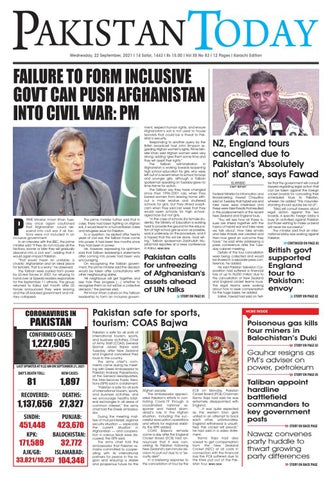
Failure to Form inclusive govt can push aFghanistan into civil war: pm
p
riMe Minister imran Khan Tuesday once again cautioned that Afghanistan could descend into civil war if all factions were not included in an inclusive government. in an interview with the BBC, the prime minister said “if they do not include all the factions, sooner or later they will gradually descend into a civil war”, adding that it would again impact Pakistan. “That would mean an unstable, a chaotic Afghanistan and an ideal place for terrorists. That is a worry,” he observed. The Taliban were ousted from power by US-led forces in 2001 for refusing to hand over al Qaeda leaders responsible for the September 11 attacks. The group returned to Kabul last month after US forces announced they were leaving and the US-backed government and military collapsed.
The prime minister further said that in case, there had been fighting on Afghan soil, it would lead to a humanitarian crises and refugees issue for Pakistan. To a question, he replied after twenty years of civil war, the Taliban have come into power. it had been few months since they had been in power. He, however, expressing his optimism said that Taliban leadership’s statements after coming into power had been very encouraging. On recognising the Taliban government, the prime minister said the decision would be taken after consultations with other neighbouring states. “All neighbours will get together and see how they progress […] whether to recognise them or not will be a collective decision,” the premier said. PM imran Khan called on the Taliban leadership to form an inclusive govern-
coronavirus in
pakistan
CONFIRMED CASES:
1,227,905
LAST UPDATED AT 9:22 AM ON SEPTEMBER 21, 2021
DAY'S DEATH TOLL:
NEW CASES:
81
1,897
RECOVERED:
DEATHS:
1,137,656 27,327 SINDH:
PUNJAB:
451,448
423,670
KPK:
BALOCHISTAN:
171,589 AJK/GB: 33,821/10,257
32,772 ISLAMABAD:
104,348
ment, respect human rights, and ensure Afghanistan’s soil is not used to house terrorists that could be a threat to Pakistan’s security. responding to another query by the British broadcast host John Simpson regarding Afghan women’s rights, Prime Minister Khan said Afghan women were very strong; adding “give them some time and they will assert their rights.” The Taliban administration in Afghanistan is working towards reopening high school education for girls, who were left out of a recent return to school for boys and younger girls, although a Taliban spokesman speaking on Tuesday gave no time frame for action. The Taliban say they have changed since their 1996-2001 rule, when they barred women from leaving home without a male relative and shuttered schools for girls, but they stirred scepticism when they said last week that they would open schools for high schoolaged boys but not girls. “in the case of schools (for female students), the Ministry of education is working hard to provide the ground for the education of high school girls as soon as possible, work is underway on the procedure, and it is hoped that this will be done, God willing,” Taliban spokesman Zabihullah Mujahid told reporters at a news conference in Kabul. news desk
Pakistan calls for unfreezing of Afghanistan's assets ahead of UN talks STORY ON PAGE 03
NZ, England tours cancelled due to Pakistan’s ‘Absolutely not’ stance, says Fawad ISLAMABAD staff report
Federal Minister for information and Broadcasting Fawad Chaudhry said on Tuesday that hybrid war and fake news were interlinked and these were fake threats that resulted in the postponement of the recent New Zealand and england tours. “You will see how all these issues are linked together with the topics of hybrid war and fake news we talk about. How fake emails and fake threats are created and then how great an outcome they have,” he said while addressing a press conference after the Tuesday cabinet meeting. Details of the tour cancellation were being collected and would be shared in a separate press conference, he added. He said Pakistan Television Corporation had suffered a financial loss of up to rs250 million due to the cancellation of New Zealand and england cricket teams tours. The legal teams were working about how to seek compensation for the huge losses, he added. earlier, Fawad had said on Twit-
Pakistan safe for sports, tourism: COAS Bajwa Pakistan is safe for all sorts of international tourism, sports, and business activities, Chief of Army Staff (COAS) General Qamar Javed Bajwa said Tuesday, after New Zealand and england cancelled their tours to the country. The army chief ’s comments came during his meeting with Greek Ambassador to Pakistan Andreas Papastavrou at the General Headquarters, the inter-Services Public relations (iSPr) said in a statement. “Pakistan is safe for all sorts of international tourism, sports, and business activities, and we encourage healthy bilateral exchanges in all areas of common interest,” the army chief told the Greek ambassador. During the meeting matters of mutual interest, regional security situation — especially the current situation in Afghanistan — and cooperation in various fields were discussed, the iSPr said. The army chief told the ambassador that Pakistan remains committed to cooperating with its international partners for peace in the region and ensuring a stable and prosperous future for the
ter that the government will consult lawyers regarding legal action that can be taken against the foreign cricket boards for cancelling their scheduled tours to Pakistan, wherein he added “This misunderstanding should quickly be rid of”. “[We] will consult lawyers about legal action against the two boards, A specific foreign lobby is busy [in activities] against Pakistan but those wishing to make us bend will never be successful.” The minister said that an international lobby was working against Pakistan.
CONTINUED ON PAGE 03
British govt supported England tour to Pakistan: envoy STORY ON PAGE 02
more inside
Poisonous gas kills four miners in Balochistan’s Duki STORY ON PAGE 02
Gauhar resigns as PM’s adviser on power, petroleum STORY ON PAGE 03
Afghan people. The ambassador appreciated Pakistan’s efforts in controlling Covid-19 through a coordinated national response and hailed islamabad’s role in the Afghan situation, including the successful evacuation operations and efforts for regional stability, the iSPr added. COAS Bajwa’s remarks come a day after the england Cricket Board (eCB) had announced that it was cancelling its Pakistan following New Zealand’s last-minute decision to pull out due to a “security alert”. in a blistering response to the cancellation of tour by the
eCB on Monday, Pakistan Cricket Board (PCB) Chairman ramiz raja had said he was extremely disappointed with england. “…it was quite expected as the western bloc gets united in an attempt to back each other, unfortunately. england withdrawal is unjustified, Pak cricket will prevail,” he had said in a video statement. ramiz raja had also vowed to get compensation from the New Zealand Cricket (NZC) at all costs in connection with the financial loss the PCB suffered due to the Kiwis pull out of the Pakistan tour. news desk
Taliban appoint hardline battlefield commanders to key government posts STORY ON BACK PAGE
Nawaz convenes party huddle to thwart growing party differences STORY ON BACK PAGE
02
Wednesday, 22 September, 2021
KARACHI
NEWS
PoiSoNouS gAS killS four MiNErS iN BAloChiStAN’S Duki
f
News Desk
OUR miners inhaled poisonous gas and suffocated to death in a coal mine in Balochistan’s Duki area on Tuesday, Provincial Mines and Minerals Chief Inspector Abdul Ghani said. The workers had entered the mine in Chamalang in the afternoon, but their bodies
had been retrieved from the mine in a rescue operation after they passed away, he added. The bodies were transferred to a nearby hospital and will be handed over to the relatives of the deceased after completing formalities, Ghani said. All four miners hailed from Balochistan’s Zhob district, the official further said. Pakistan Central Mines Labour
ECB independently took decision to call off Pakistan tour: British envoy News Desk British High Commissioner to Pakistan Christian Turner on Tuesday said that Pakistan is a safe country and the England cricket team would visit Islamabad next year. Earlier on Monday, the England Cricket Board (ECB) had cancelled its teams’ next month’s tour to Pakistan, citing increasing concerns about travelling to the region. Talking to a private news channel on Tuesday, Turner said that it is sad that the English cricket team cancelled its tour to Pakistan, adding that it was the decision of the ECB and not of the British government. ECB is an independent institute, he said, adding that “I had personally appreciated the Pakistani team for visiting United Kingdom during Covid-19 pandemic.” “We are all upset due to the this decision because cricket is also in our blood,” he said. “I assure that the English team will visit Pakistan next year and we will work for it,” he added. He said he had done good work for the English team’s visit to Pakistan and being an ambassador, his duty was to bring both nation on a same page. After the cancellation New Zealand’s tour to Pakistan, the English players showed their concerns about the visit, he added.
No case can be reviewed for a second time: SC News Desk The Supreme Court (SC) on Tuesday declared that no case can be reviewed for a second time by the apex court under the Pakistani law, according to Geo News. As per the media outlet, a three-member bench, headed by Justice Umar Ata Bandial, issued the ruling while hearing a review petition on the matter of a plot allotment. During the hearing, Advocate Umar Aslam argued that the SC can allow a second, or even a third review of a case if required. He further argued that the top court can set the precedent of a second review in cases which are mishandled, adding that no clause of the Constitution puts a bar on the court to review its judgment. However, Justice Mansoor Ali Shah observed that there is no place for a curative review in Pakistani law. “A second review was never allowed in life imprisonment and death sentence cases. Are plot allotments more important than somebody’s life?” he asked. Justice Mansoor said that the present case was decided in the absence of the prosecution, adding that if a lawyer fails to argue a case well, it is not the court’s fault. “If any case is poorly handled and the Supreme Court starts conducting reviews, then there will be no end to litigation in the country,” Justice Mansoor added. Justice Bandial said that the apex court may set aside its own orders, which could be a hurdle to human interest, but there is no room for a second review under the Constitution of Pakistan. The Supreme Court, in a matter of public interest, can consider its own judgment as null and void but a second review is not a valid option, he added.
Minister’s brother appointed NAB prosecutor IsLAMABAD INP
Faisal Chaudhry, brother of Minister for Information and Broadcasting Fawad Chaudhry, has been appointed as special prosecutor at National Accountability Bureau headquarters in Islamabad. The notification for of appointment was issued on Tuesday, reports citing people familiar with the development said. Chaudhry will pursue graft cases for the dirty money watchdog in the Islamabad High Court. A barrister by profession, Chaudhry had resigned from the post of the additional advocate general, Punjab in July. He was appointed to the post in December 2018 when the provincial government appointed 18 new additional advocate generals and 42 assistant advocate generals, mostly affiliated to lawyers’ wings of Pakistan Tehreek-i-Insaf and the Pakistan Muslim League-Quaid.
Federation Secretary-General Sultan Khan told Dawn that fatal incidents were increasing because of a lack of implementation of laws related to mines. As many as 90 people have been killed in incidents in different mines across Balochistan this year, he added. In April, eight Duki miners suffered serious burn injuries were working deep
inside their mine when an explosion took place in the area of Balochistan. Mines Inspector Sabir Shah at the time said the incident took place in a coal mine owned by a private company a portion of which collapsed due to the explosion, causing the release of methane gas. After the blast, eight miners were trapped deep inside the mine, he said. However, all
miners were subsequently rescued and taken to the district hospital in Duki, he added. At least 11 coal miners belonging to the minority Shia Hazara community were killed in the Mach town of Balochistan’s Bolan district in early January after militants abducted them and took them to nearby hills before opening fire at close range, Quetta deputy commissioner confirmed at the time.
NAB orders immediate sale of Nawaz Sharif’s properties News Desk The National Accountability Bureau (NAB) has ordered the immediate sale of properties belonging to former prime minister Nawaz Sharif and has issued a letter to the concerned deputy commissioners in this regard. In the letter, Director-General of NAB’s Lahore office, Shahzad Saleem, stated that for the first time in the country’s history, the decision to recover fines from a former prime minister has been implemented. The country’s accountability watchdog maintained that it had initiated proceedings to recover an £8 million fine — equivalent to Rs1.85 billion — from Nawaz in the Avenfield apartments case. Aside from the imposition of fines, in July 2018, an accountability court had sentenced Nawaz to ten years of imprisonment. In the letter, the deputy commissioners have been apprised of all the details of Nawaz Sharif’s saleable properties, including bungalows situated at Lahore’s Upper Mall Road and agricultural lands in Sheikhupura and other areas. The proceeds from the sale of properties would be used for the development of the country, the letter said, adding that if the full amount of the fine is not recovered, a search for further assets of the convict will be carried out.
Later, PML-N demanded to make public details of the recovery of Rs578 billion “ill-gotten money” by NAB. Spokesperson Marriyum Aurangzeb strongly criticised the media statement of the National Accountability Bureau, alleging that it was not a press release but a “nexus” between NAB and Prime Minister House. She said that PML-N demands to publicise the details of NAB’s recovery of Rs578 billion ill-gotten money. Marriyum also demanded to provide details of expenditures for the recovery of the looted money. The PML-N spokesperson alleged that the press release was the part of levelling baseless allegations, propaganda and political agenda against the opponents of the government. She continued that the press statement was actually a request to extend the tenure of the NAB chairman. Marriyum said that Nawaz spent over 35 years in politics but nobody has proved the corruption allegations against him so far. She added that Nawaz gifted nuclear technology to the country besides initiating national projects of electricity, health, education and others. Criticising the anti-corruption watchdog, she said that NAB has never noticed the alleged theft of sugar worth Rs800 billion and legalisation of Bani Gala palace nor Rs400 billion worth
5M PEOPLE LOST JOBS DURING THREE YEARS OF PTI GOVT: SHEHBAZ ISLAMABAD: Opposition Leader in the National Assembly and Pakistan Muslim League-Nawaz (PML-N) President Shehbaz Sharif has said that five million people have lost their jobs during the tenure of Pakistan Tehreek-e-Insaf (PTI) government. Addressing the National Assembly, the opposition leader said that five million workers have been forced to beg. He asked the treasury benches that where are the 10 million jobs, which were promised by the PTI during its election campaign. He said that it has become difficult for the poor people to earn livelihood after the collapse of the economy due to the wrong policies of the government. Shehbaz said that the PML-N did not make thousands of employees of PIA and PSM unemployed. He said that PML-N removed darkness from the country while the PTI took loans and failed to start any project in the country. During the opposition leader’s address, Federal Minister for Human Rights Dr Shireen Mazari said that the PML-N president had to bring back the money stolen from the country during their [PML-N] tenure but his brother [Nawaz Sharif] fled from the country after looting money. In response, Shehbaz said that on what grounds the government is taunting PML-N. He said that inflation is skyrocketing in the country and it has become difficult for the poor people to earn their daily bread. He said that the finance minister had said that no new tax would be imposed on petrol, but look at the petrol and electricity prices, adding that the country is facing record inflation. During Shehbaz’s speech, Member National Assembly Ali Muhammad Khan said that instead of revealing sources of his income after giving statement in this house, Nawaz Sharif presented a fake letter of Qatar. INP
LNG theft and helicopter cases. The PML-N spokesperson further alleged that Imran Khan had made NAB its frontman in the Broadsheet case while his aide Shahzad Akbar used to conduct press conferences against Shehbaz Sharif. She demanded to publicise all details of
Noor Mukadam murder: IHC adjourns bail plea of Zahir Jaffer’s parents until Wednesday IsLAMABAD INP
The Islamabad High Court on Tuesday resumed hearing of bail petitions of prime suspect Zahir Zaffer’s parents in the high-profile Noor Mukadam murder case. Justice Aamir Farooq of the IHC was hearing the petitions moved by Zakir Jaffer and Asmat Jaffer. An associate of the accused’s lawyer turned up before the court and requested an adjournment of the case saying the counsel was busy pursuing a case before the Supreme Court. Granting his request, the court adjourned the case till on Wednesday (today). Meanwhile, Therapy Works CEO Zahoor moved an application seeking to become a party to the case. The
court issued notices to the accused’s lawyer, and other respondents to file their reply to the plea. The prime suspect’s parents, who have been nominated as accomplices in the murder case, approached the Islamabad High Court after a local court rejected their bail on August 5. On Friday, the confessional statement of Zahir Jaffer – the prime suspect in the Noor Mukadam murder case – was read out in court. The statement was read out by lawyer Khawaja Harris, who is representing Zahir’s parents, Zakir Jaffer and Ismat Adamjee, during a hearing on their bail application which had resumed for the third consecutive day by the IHC. To this, Justice Aamer Farooq had said that our police do not know how to make links during
the Broadsheet case. Marriyum alleged that the ministers of the Pakistan Tehreek-eInsaf (PTI) led federal government used to attack the election commission in the name of electronic voting machines (EVMs). She continued that elections reforms were being finalised in a threatening tone.
an interrogation. Harris had said that he wanted to tell the court about the confessional statement and call data record. After this, he read out the confessional statement of Zahir Jaffer before the police. In his arguments, Harris had said that one sentence changes the shape of the whole case. “What was the role of the father? Only the recovery is mentioned in the memo of recovery, so how did his statement get included,” the lawyer had asked. Justice Farooq had said that a memo of recovery states where the main suspect takes an investigating officer and what is recovered. Harris had argued that the statement recorded by the suspect in police custody has no legal status. He had said the statement of the suspect must be recorded before a magistrate. Zahir Jaffer has been found guilty in the case challan with his parents and Therapy Works CEO and employees named accomplices. On July 20, in a grisly murder, Noor Mukadam had been put to death allegedly by her friend Zahir Jaffer, in the vicinity of Islamabad’s Kohsar police station.
Qaim Ali Shah gets clean chit in NAB case kARACHI INP
The National Accountability Bureau has cleared former Sindh chief minister Syed Qaim Ali Shah in an illegal land allotments case against him. The Sindh High Court on Tuesday disposed of the application against Shah after the investigating officer recorded his statement in the court, giving clean chit to
the former. Shah was accused of misusing his authority while allotting government lands. The NAB officer told the court that the agency could not find anything against him. The former chief minister is also facing charges of corruption in the Roshan Sindh project initiated by the provincial government for the installation of solar streetlights across the province.
Shah had won seven of eight general elections he contested, becoming a lawmaker six times, and an MP and Senator once. Shah completed his second term as Chief Minister in March 2013. He was once again, for a third time, elected to the office of chief minister of Sindh after the 2013 elections. In July 2016, the PPP decided to replace him with Murad Ali Shah as the provincial chief executive.
China’s Tianjin Municipality named sister-city to Karachi, Islamabad News Desk China’s Tianjin Municipality was declared as sister cities to Karachi and Islamabad respectively and sisterprovince to Punjab to further enhance the bond of friendship between Pakistan and China, Gwadar Pro reported. Pakistan’s ambassador to China, Moin ul-Haque, and Mayor of Tianjin Municipality, Liao Guoxun, signed the “Letters of Intent” for the establishment of sister-city and sister-province relationships. Earlier, Ambassador Haque held a meeting with the Secretary of Chinese Communist Party Tianjin Municipal Central Committee, Li Hongzhong. The Mayor of Tianjin Municipality, Liao Guoxun, and other
high-level senior officials were also present at the meeting. During the meeting, Hongzhong said that China and Pakistan are all-weather strategic cooperative partners. “Our iron-clad friendship is deeply rooted in the hearts of the people of two brotherly countries,” he said. He said that the commemoration of the 70th anniversary of the establishment of diplomatic relations between the two countries is lifting our strong ties to new heights. The establishment of the relationships will give a big boost to bilateral pragmatic cooperation and exchanges, he added. He also proposed to promote practical cooperation in the fields of port management, higher education,
science and technology, technical and vocational training and people-to-people exchanges. Ambassador Haque thanked the secretary for making excellent arrangements and warm hospitality during his visit to Tianjin. He said that Pakistan-China unique friendship has always stood the test of time and is growing stronger with the passage of time. Ambassador Haque noted that Tianjin Municipality being a key port, transportation and aviation hub, education and cultural centre and with its strong IT industry, could be an important partner of Pakistan. He thanked the secretary for his practical proposals and suggested setting up a joint mechanism for followup work.
Wednesday, 22 September, 2021
KARACHI
PAkistAN cAlls For UNFreeziNg oF AFghANistAN Assets AheAD oF UN tAlks isLamaBad
P
afp
AKISTAN called on world powers to unblock billions of dollars in Afghanistan assets frozen after the Taliban takeover but said it did not expect recognition soon of the new government. Ahead of talks on Afghanistan at the UN General Assembly, Foreign Minister Shah Mahmood Qureshi said the most urgent priority was averting an even deeper economic collapse of the neighbouring nation that could trigger a humanitarian catastrophe. “On one hand, you’re raising fresh funds to avert a crisis and on the other hand money that is theirs — belongs to them — they cannot use,” Qureshi told UN correspondents of several media outlets. “I think freezing the assets is not helping the situation. I would strongly urge the powers that be that
they should revisit that policy and think of an unfreeze,” he said. “It will be a confidence-building measure as well and that could also incentivise positive behaviour.” The United States froze $9.5 billion in Afghan central bank assets and international lenders have stayed clear of Afghanistan, wary of providing money that could be used by the Taliban. While calling for engagement with the Taliban, Qureshi appeared to share the US stance that it was premature to establish formal ties. “I don’t think anybody is in a rush to recognise at this stage and the Taliban should keep an eye on that,” Qureshi said. If the Taliban want recognition, “they have to be more sensitive and more receptive to international opinion,” he said. The minister said Islamabad’s objective is peace and stability in Afghanistan and to achieve that “we would suggest to Afghans that they should have an
inclusive government.” He says their initial statements indicate they aren’t averse to the idea, so “let’s see.” Qureshi expressed confidence the Taliban would live up to their promise “that girls and women would be allowed to go to school, college and university.” The Taliban said on Tuesday girls will be allowed to return to school “as soon as possible”. The Taliban were notorious for their rule from 1996 to 2001 when women were largely barred from work and school, including being banned from leaving their homes unless accompanied by a male relative. During the weekend, the education ministry issued a diktat ordering male teachers and students back to secondary school — but made no mention of the country’s women educators and girl pupils. At a press conference in Kabul, Taliban spokesman Zabihullah Mujahid said of the return of girls to school: “We are finalising things […] it will happen as soon as possible.”
Gauhar resigns as PM’s adviser on power, petroleum isLamaBad Staff RepoRt
Tabish Gauhar stepped down from the post of adviser to the prime minister on power and petroleum divisions, about a year after his appointment, he announced Tuesday. “After a year of public service, I’ve decided to call it a day to return to my family. It’s been the privilege of a lifetime to serve the country, to the best of my abilities, in an honorary capacity,” he tweeted. “I shall remain indebted to the PM for giving me this opportunity.” Gauhar said while challenges in the energy sector were manifold, he had “no doubt that under the able leadership of Hammad Azhar, the MoE [Ministry of Energy] team will continue to stay the
course on structural reforms”. Shortly after his resignation, the Cabinet Division issued a notification, announcing that Prime Minister Imran Khan has accepted his resignation with effect from September 20 (Monday). Who IS TABISh GAuhAr? Gauhar was born and raised in Karachi and had then moved to Islamabad when his father landed a job at the World Bank. He did his O-levels from Beaconhouse and his A-levels from Frobel’s International School. He is an IBA alumnus belonging to the MBA class of 1996 and is an Electrical Engineer from King’s College London as a Chevening Scholar. Gauhar’s first job was as a systems analyst at Exxon Chemical. He has also worked at Engro Corporation.
He is also the founder of Oasis Energy, a management consultancy firm in the power and energy sector that was established in 2016. Interestingly enough, Oasis Energy’s website and LinkedIn remain unavailable as of late. He has also worked at troubled Abraaj Group and has served as the chief financial officer at AES Corporation. Moreover, he has also been associated with the Hub Power Project in Pakistan. In 2019, he was appointed as a director at Byco. He has more than two decades worth of experience in project development in private power, water and petrochemical industries within the MENA region, Europe and Africa. However, perhaps his most notable role was when he served as the CEO and chairman of K-Electric until 2015.
NZ, England tours cancelled due to Pakistan’s ‘Absolutely not’ stance, says Fawad Continued from page 01 He said those who want to force Pakistan to surrender before them never succeed and they should end their misconception as early as possible. “We know there are increasing concerns about travelling to the region,” it had said while referring to Pakistan, adding that going ahead with the tour would “add further pressure to a playing group who have already coped with a long period of operating in restricted Covid environments”. It bears mentioning that the ECB’s decision had come three days after New Zealand abandoned their tour of Pakistan citing a “security threat” minutes before the first One Day International match was scheduled to start at the Rawalpindi Cricket Stadium on Friday — a move that shocked Pakistani fans and officials. Addressing the presser on Tuesday, Fawad explained that green-lit 44 percent increase in the current house rent ceiling of the government employees, aimed at providing major relief to public servants in the wake of high rates of houses fares in the major cities especially in Islamabad. The increase would be applicable to the federal government employees from grade 1 to 22, Minister for Information and Broadcasting Chaudhry Fawad Hussain told media persons. He said the initiative was taken after reviewing the increase in the houses’ fares in major cities. Such practice was repeated after every three years, he added. The minister said the forum accorded approval to include Uzbekistan in the business visa list. The move was aimed at strengthening ties with the Central Asian state as well as providing relief to the business community of the two countries, he added. The cabinet also okayed the import of films from the regional countries so that the film industry could be uplifted by reviving cinema culture through screening of such movies. Fawad said Jammu and Kashmir State Property Budget worth Rs190.383 million for the FY2021-22 had also been approved by the cabinet.
The forum also accorded approval to hire services of M/s KPMG Taseer Hadi and Co. for [audit] of the National Database and Registration Authority financial accounts for fiscal year 202-21. He said that Asif Rauf had been appointed as the chief executive officer of Drug Regulatory Authority for the next three months. The minister informed that the cabinet had expressed concern over giving membership of Parliamentary committees to those Senators and Members of National Assembly who had some sort of conflict of interest with the bodies. He further said that the National Assembly speaker and Senate chairman would be requested to ask those members to tender resignation, otherwise, legislation would be done to remove them from those committees. Fawad expressed the hope that those members having a conflict of interest in some standing committees would resign themselves. He said that the federal cabinet was told that the country had gained a landmark victory against the crippling disease of polio. Ministry of National Health Services was appreciated and congratulated by the cabinet members on achieving such a milestone. The minister said only one case of polio was reported in the last seven months which was the lowest level of reported cases in the country after such a long time. Any country, which wanted to get polio-free country status, had to be remained polio-free for three years, consecutively, he added. It was a good omen that such a level against the disease was achieved after a hiatus, he remarked while expressing the hope that the authorities would continue to move against the disease with the same spirit and the country would eventually emerge as a poliofree in future. He said the Federal Cabinet, on the request of the World Food Programme, also granted one-time permission to make a concession in the port policy orders for release of shipments from Saudi Arabia. About the inclusion of Uzbekistan in the business visa list, he said the initiative would ensure the availability of a five-year multi-visa facility at the relevant Pakistan
Saudi Arabia ready to mediate between Pakistan, India news desk Saudi Arabia has offered to mediate between Pakistan and India in an attempt to reduce long-running tensions between the two nuclear neighbours, according to a statement by Saudi Minister of Foreign Affairs Prince Faisal bin Farhan Al Saud. Talking to Indian media, The Saudi FM said that it is our desire that Pakistan and India should resolve all their disputes, including the Kashmir issue, through dialogue, and further offered Saudi Arabia’s “good offices” for any talks between Pakistan and India. Faisal Bin Farhan Al Saud said that there should be a focus on the path of dialogue between India and Pakistan to resolve issues in a way that can settle concerns permanently. He said that Kashmir is an issue that continues to be a dispute between two countries and therefore what
we would encourage is that there should be a focus on a path of dialogue and discussion among Pakistan and India to resolve these issues in a way that can settle these concerns permanently. The Hindu interviewer noted that one of the issues between India and the Kingdom were statements by the Saudi-led Organisation of Islamic Cooperation (OIC) regarding occupied Kashmir, the status of Indian Muslims and communal violence. When asked whether he had discussed this in a meeting with his Indian counterpart, the Saudi minister said that these were “domestic issues”. “It is up to the people of India and to the government of India to address these concerns. And we would, of course, always support any initiatives in this regard that the Indian government takes, but from our perspective, it’s a domestic affair,” he said.
Consulate within 24 hour-time. The minister said with the addition of Uzbekistan on the list, the bilateral ties would be strengthened further. Fawad said Pakistan and Uzbekistan — especially its political leaders, including Prime Minister Imran Khan and Uzbek President Shavkat Mirziyoyev — enjoyed good ties especially in the context of Afghanistan and trans Mazar-i-Sharif train which would connect Karachi and Gawadr with Tashkent via the landlocked country. He called the Mazar-i-Sharif train a ‘landmark’ vision of the present government, saying talks on the matter were going forward in a remarkable manner. The minister said the Pakistan Telecommunication Authority presented a policy directive to the meeting on a judgment referred by the Islamabad High Court to the federal cabinet regarding the blockage of social media companies and inappropriate content on social media sites. The policy directive was meant to apprise the court that the government was fully empowered to take action for the removal unlawful of content from social media sites. About contemporary social media rules and regulations, he said the government was working on a two-pronged strategy to address social media related issues through new policy initiatives. The strategy was not only aimed at tightening the noose around those companies that were delaying action against producers of pornographic content but also taking legal action against the individuals, involved in making objectionable content in Pakistan, he added. He said issues related to social media had become a major problem in the country that was why a new policy debate on the matter was being initiated that would be led by Minister for Human Rights Dr Shireen Mazari. The debate would help evolve new laws for the purpose, he added. As regards the revival of the film industry, the minister said since the covid-19 cases witnessed a sharp decline and the federal cabinet decided to allow screening of Iranian, Turkish and other countries’ movies, the negotiations with the National Command and Operation Center for the opening of cinemas were underway.
Commenting on occupied Kashmir, he said that it was an issue that “continues to be a dispute” between the two countries. “Therefore, what we would encourage is that there should be a focus on a path of dialogue and discussion among India and Pakistan to resolve these issues in a way that can settle these concerns permanently,” he said. Talking about the Taliban government in Afghanistan, he said that the new leadership had a responsibility to “exercise good judgment and good governance, to be inclusive, to bring in all people in Afghanistan, and to forge a path that can lead to stability, security and prosperity” while also accounting for the concerns of the international community. He also called for providing aid and assistance to the war-torn country. “I think international aid is directed primarily for the benefit of the Afghan people and, therefore, our position is that aid should continue and should not be affected by these situations,” he said in the interview.
NEWS
03
Nine killed, 20 injured in Upper Dir firing ISLAMABAD: Nine people were killed and 20 others injured in a firing between two groups while attending a session of a Jirga, the tribal court, in Upper Dir district late on Monday, police said. The incident happened when the groups gathered in the court to resolve a dispute about a road to be constructed on their lands, Laal Bahadar, station house officer of the Barawal area of the district where the incident happened, said. “During the court hearing, a heated discussion started between the two groups which got worse and they pulled out their guns at each other, followed by a serious exchange of firing,” said the official. Police rushed to the site following the incident, he said, adding that perpetrators of the brawl are being identified by the police. The injured were shifted to a nearby hospital where several of them are in critical condition, the officer said. Staff RepoRt
Four killed in road accident in Punjab ISLAMABAD: A collision between a car and a rickshaw killed four people including three women in Punjab on Tuesday, police said. Several others were injured in the accident that occurred after the overspeeding car collided with the rickshaw on the GT road near Rahim Yar Khan, police officials in the area told media. Three people lost their lives on the spot while another succumbed to his injuries on the way to the hospital, the police said, adding that the accident occurred due to the negligence of the car driver. Following the crash, the police and rescue teams rushed to the site and shifted the victims to a nearby hospital for medical treatment. Staff RepoRt
Additional restrictions lifted in six districts as cases decline ISLAMABAD: The National Command and Operation Centre on Tuesday announced the lifting of additional non-pharmaceutical interventions in six districts following a gradual decline in the Covid-19 contagion rate. NPI is a community mitigation strategy, apart from getting vaccinated and taking medicine, that people and communities take to help slow the spread of viral diseases. Minister for Planning and Development Asad Umar, who also heads the federal body, chaired the session to review the decline in the daily new infections. In the meeting, the participants decided to remove the restrictions from the previously hotspot districts — Lahore, Faisalabad, Multan, Sargodha, Gujarat and Bannu — from September 21 (today). General nationwide restrictions would remain in force until September 30 and be reviewed on September 28. The agency was closely monitoring the spread of Covid and the healthcare apparatus on a daily basis and will take decisions accordingly, the meeting decided. The forum also urged the people who have taken their first dose of a Covid vaccine to complete the vaccination by injecting the second jab “without any delay”. Staff RepoRt
Wednesday, 22 September, 2021
04 NEWS
KARACHI
PSX noSediveS 519 PointS due to loCal, foReiGn faCtoRS KARACHI
t
TLTP
HE Pakistan Stock Exchange (PSX) remained bearish for the third straight session on Tuesday due to resignation of special assistant to the prime minister on power and petroleum and sell-off in international equity markets, with the benchmark KSE-100 Index shedding 519.36 points (-1.12 percent) to close at 46,008.85 points. The market opened on a positive note and this positiveness remained more or less intact except for the last hour trading where news of SAPM Tabish Gauhar;s resignation plunged the cautious market. The KSE-100
Index moved in a range of 1,055 points, showing an intraday high of 46,833.1 points and a low of 45,778.1 points. Among other indices, the KSE All Share Index shed 369.63 points (-1.16 percent) to close at 31,490.64 points, while All Share Islamic Index shed 378.9 points (-1.67 percent) to close at 22,348.32 points. A total of 382 companies traded shares in the stock exchange, out of them shares of 90 closed up, shares of 275 closed down while shares of 17 companies remained unchanged. Out of 97 traded companies in the KSE-100 Index, 15 closed up, 79 closed down, while three remained unchanged. The overall market volumes increased by 131.16 million to 325.88 million shares.
Total volume traded for the KSE-100 Index was 132.43 million shares. The number of total trades increased by 25,950 to 114,864, while the value traded increased by Rs4.24 billion to Rs12.32 billion. The market capitalisation decreased by Rs96.17 billion. Among scrips, TELE led the volume chart with 28.12 million shares, followed by WTL (26.43 million) and TPL (21.44 million). Stocks that contributed significantly to the volumes include TELE, WTL, TPL, BYCO and TRG, which formed 33 percent of total volumes. Sector wise, the index was let down by cement with 101 points, technology & communication with 81 points, commercial banks with 45 points, fertilizer with 39 points and oil & gas exploration companies
with 34 points. The most points taken off the index were by SYS which stripped the index of 53 points followed by MEBL with 37 points, HBL with 34 points, LUCK with 32 points and TRG with 23 points. The sectors propping up the index were insurance with 3 points. The most points added to the index were by HMB which contributed 18 points followed by MCB with 18 points, BAFL with 14 points, ANL with 14 points and COLG with 7 points. According to experts, investors took to the sidelines as they monitored a sell-off in international financial markets coupled with rising commodity prices. A broader sell-off in the global equity markets due to fears from the mounting problems at China’s embattled property giant Evergrande also af-
fected local bourse. They said that the market posted an increase of 305 points during the session early on; however, it lost that gain and by the end of session lost a total of 1,055 points (including the erosion of 305 points earned earlier). At closing, the market saw a steep decline. Selling was witnessed across the board, with heavy implications on technology and cement sectors. Despite low leverage levels in the market in DFC, MTS and MFS segments, the index melted due to calls of redemption at Mutual Funds. Regardless of the steep decline in Index, overall trading volumes remained low compared to the hay days seen in outgoing fiscal, they added.
Gold surges to Rs96,300 per 10gm amid weaker dollar NEWS DESK Gold prices surged 0.5 percent in the international market and remained in positive territory for the third successive day on Tuesday amid a weaker US dollar. At 1205 hours GMT, gold in the international market was available at $1,773.50 per ounce after gaining $8.50. Gold reversed an intraday dip to $1,758 as the US dollar extended Monday's retracement slide from the highest level since August 23 and remained on the defensive. Meanwhile, the price of 10 grams of yellow metal in Pakistan increased to Rs96,300 after gaining Rs800. The closing prices of the yellow metal in the country remained Rs95,500 on Monday last. According to experts, the risk-on impulse – as depicted by a strong rally in the global equity markets – acted as a headwind for the safe-haven gold. This, along with expectations for an imminent Fed taper announcement, triggered a fresh leg up in the US Treasury bond yields and further collaborated to cap gains for the non-yielding yellow metal, they added. The Fed is scheduled to announce its decision on Wednesday and is widely anticipated to leave its monetary policy settings unchanged.
Crude prices snap three-day losing streak on supply concerns NEWS DESK
KARACHI: A view of newly-prepared cemented blocks patch. ONLINE
Rupee recovers 20 paisas as dollar slips to Rs168.52 KARACHI TLTP
Pakistani rupee recovered 20 paisas (+0.12 percent) against the US dollar in the inter-bank on Tuesday. According to the State Bank of Pakistan, the US dollar opened at Rs168.72 and closed at Rs168.52. Within the open market, the rupee was traded at Rs168.80/169.80 per dollar. Pakistani rupee shed Rs0.33 during the last days against the US dollar, while depreciation
during the fiscal year 2021-22 has been Rs11.08. The local unit has shed Rs8.25 against the US dollar in the current year 2021. The local currency has maintained a downtrend after it touched 22month high of Rs152.27 in May 2021, losing a cumulative Rs16.21 in the past four months to date. According to experts, the market witnessed inflows of export receipts and workers’ remittances during the day. They said that the external payment pressure had kept the higher demand for the greenback. The experts said that due to quarter
ending, the dollar’s demand for external payment of import and corporate payments remained high. They said the country has posted a current account deficit and trade deficit during the first two months of the current fiscal year, which also put pressure on dollar demand. The current account deficit has widened to $2.29 billion during the first two months of the current fiscal year. They said the rupee is under immense pressure due to unfavourable macro economic data and Afghanistan's situation.
Crude oil prices snapped the three-day losing streak on Tuesday due to supply concerns as hurricane Ida caused damage to the US offshore facilities. At 1200 hours GMT, Brent, the international benchmark for two-thirds of the world's oil, gained $0.68 (+0.92 percent) to reach $74.60 a barrel. Similarly, the US West Texas Intermediate (WTI) reached $71 a barrel, up by $0.71 (+1.01 percent). The price for Opec Basket was recorded at $74.14 a barrel with 0.04 percent decrease, Arab Light was available at $73.72 a barrel with a 0.77 percent decrease, while the price of Russian Sokol slipped to $73.94 after shedding 1.71 percent. Meanwhile, Suhail Al Mazrouei, UAE minister of energy, has said that Opec+ will stick to its plan to incrementally bring 2 million barrels per day back to the markets by the end of the year. "I think that if things move as they are, of course that's a group decision, not a single country's decision, but I don't see any reason why we shouldn't continue with the plan," Mazrouei told reporters at an event in Dubai. "The plan is working, we are doing our part. And the more we see on the easing of the pandemic measures, the more demand we will have, and if there's demand we will definitely be up to increase the production as the market requires," he added. Opec+, led by Saudi Arabia and Russia, is set to decide whether to bring an additional 400,000 bpd of supply in October.
Technology sector continues to thrive, prosper: WIPO report NEWS DESK Despite the economic devastation wrought by Covid-19, the new technology sector continued to thrive and prosper last year, the UN’s World Intellectual Property Organisation’s (WIPO) said in a new report. According to the findings of the WIPO’s latest Global Innovation Index, (GII) governments and enterprises in many parts of the world scaled up investments in innovation, demonstrating an acknowledgement that new ideas are critical for overcoming the pandemic. “We expected a harsh slump in 2020 of around 3 percent, however, the GII shows there are reasons to be optimistic… with governments showing foresight and not
cutting spending,” Sacha Wunsch-Vincent, WIPO Composite Indicator Research Section and GII co-editor, said at the launch of the report in Geneva. WIPO warned however that the impact of the crisis has been highly uneven across industries and countries. In its annual ranking of the world’s economies on innovation capacity and output, the GII showed that only a few economies, mostly high income, consistently dominate the ranks. However, the Republic of Korea joined Switzerland, Sweden, the United States, and Britain, to make the top 5 of the GII for the first time in 2021, while four other Asian economies feature in the top 15: Singapore (8), China (12), Japan (13) and Hong Kong, China (14). Selected middle-income economies, including
CMYK
Turkey, Vietnam, India, the Philippines, are also catching up and progress made last year by France (11) and China (12) are confirmed, as both are now knocking at the door of the GII top 10. According to a new GII feature - the Global Innovation Tracker - technology, pharmaceuticals and biotech industries, boosted their investments during the pandemic and increased their research and development (R&D) efforts. Top technology companies like Apple, Microsoft and Huawei, increased investment on average about 10 percent last year, and venture capital investment surged, a trend which is continuing this year, Wunsch-Vincent said. In contrast, the transport and travel sectors were heavily hit by containment measures and cut back their outlays. The GII 2021 also shows that technological
progress at the frontier holds substantial promise, with the rapid development of Covid-19 vaccines being the greatest example. "In spite of the massive impact of the Covid-19 pandemic, many sectors have shown remarkable resilience – especially those that have embraced digitalization, technology and innovation", said WIPO Director General Daren Tang. “As the world looks to rebuild from the pandemic, we know that innovation is integral to overcoming the common challenges that we face and to constructing a better future.” The index ranks 132 countries, plus subeconomies such as Hong Kong, and comes a year after WIPO reported that investments in innovation had hit a record high in 2019, showing an average annual profit of 8.5 percent.
Wednesday, 22 September, 2021
KARACHI
OpEn, STABLE gLOBAL TrADE pOLiCy CriTiCAL FOr grEEn TrAnSiTiOn: WEF GENEVA
A
TLTP
N open and stable global trading policy is critical for the green transition while a lack of policy stability will increase the cost and reduce the pace of investment in decarbonisation, according to the World Economic Forum (WEF). Businesses are actively pursuing and ready to accelerate their emission reduction programmes, however, the global trading system needs to adapt to help companies reach their eventual net-zero goal, the WEF said in a climate and trade white paper. “Traditionally, trade and climate policy-making has happened in separate silos. [However,] the urgency of the climate crisis calls for us to break down these silos through public-private co-op-
eration in order to accelerate emissions reductions while achieving prosperity for all,” said Sean Doherty, head of International Trade and Investment and a member of the WEF Executive Committee. “The good news for policymakers is [that] businesses are ready and willing to support this change.” The six-month study, jointly carried out by the WEF and global law firm Clifford Chance, is based on research and interviews with global companies across various industries that include transport, energy, manufacturing and consumer goods. The Covid-19 pandemic has brought 'Build-Back-Better' plans and greener economies into sharp focus, underpinning the need to invest in meeting the UN climate goals and transitioning to a net-zero economy. The 2015 Paris Agreement mandates
countries to lower their carbon emissions to meet the goal of limiting the temperature rise to 1.5°C. Energy producing nations are already investing in technologies such as green hydrogen and renewable power to meet their climate agendas. In August, former Bank of England governor Mark Carney asked governments around the world to unite in making climate-related financial disclosures mandatory and set up a global body to establish unified sustainability reporting standards for the global corporate sector. The number of global corporations with a combined market value of more than $25 trillion from 86 nations are currently supporting the Task Force on Climate-related Financial Disclosures (TCFD) reporting. The number has more than doubled from 1,000 in the first quarter of 2020 until July this year, he said at the time.
The volume of world merchandise trade, which slumped 5.3 percent in 2020, has rebounded from the pandemic-induced collapse that bottomed out in the second quarter of last year. It is expected to grow 8 per cent in 2021, according to World Trade Organisation estimates. The WEF said the objective of its research is to identify necessary changes to the current global trade system and how to better incentivise and accelerate decarbonisation. Businesses surveyed highlighted steps including tariff reductions on goods that are key for decarbonisation and addressed non-tariff distortions as vital for an open global trade environment. Phasing out fossil fuel subsidies and building “coherence around carbon-based trade policies”, are also central planks of a stable trade policy that will encourage decarbonisation, according to the WEF report.
Sindh government turning Quaid-e-Azam House Museum into annex of ‘Zardari house’: Haleem Adil Federal Minister for Maritime Affairs Ali Haider Zaidi Monday said a committee was being constituted to settle the matters pertaining to clearance and waivers of dues of Bin Qasim industrialists. PR
HBL extends its ATM network to Finja card customers KARACHI PRESS RELEASE
HBL in a first of its kind partnership has enabled the acceptance of Finja cards on HBL’s ATM network. Through this arrangement, the Finja card holders will have access to the Bank’s extensive network of over 2100 ATMs, the largest across the country. As part of expanding access to HBL’s banking technology, this cutting-edge facility will enable Finja card holders to process self-service transactions such as cash withdrawals, deposits and fund transfers without any additional charges via HBL’s ATM network. This initiative furthers HBL’s vision of becoming a ‘Technology Company with a Banking License’, as it will facilitate in providing innovative solutions and unmatched open Application Programming Interface (API) banking services through the Bank’s digital assets like HBL Konnect, Mobile and Internet Banking for new-age companies and clients. Commenting on the collaboration, Sagheer Mufti, Chief Operating Officer – HBL said, “HBL has taken one more step for creating customer convenience by leveraging its digital platforms. The partnership with Finja will extend our business model by providing access to HBL’s vast network. Finja’s clients will be able to undertake more transactions through the banking channels thus leading to greater financial inclusion in Pakistan.” Qasif Shahid, CEO & Co-Founder - Finja remarked, “Collaboration between banks and Fintechs is imperative to foster the digital ecosystem and platform-based business models. HBL’s contribution in the development and facilitation of such tech-based solutions will enable significant growth and an upward trajectory in the innovation and financial industries of the country.”
KARACHI: Quaid-e-Azam House Museum a national heritage site came under threat of alteration and defacing as a construction project has been planned on the site in violation of Sindh Cultural Heritage (Preservation) Act. According to details, Sindh government entered into an agreement with Jinnah Society and Karachi Council on Foreign Relations in February 2021 to transform Quaid-e-Azam House into Nation Building Institute and establish a management board with Chief Minister Sindh as its ex-officio chairman. The board was later notified in April 2021. As per memorandum of understanding a public library named “Jinnah Library” was to be established at the house but instead of setting up the library there the existing library was turned into office of the board. Meanwhile a soil testing machine has also been brought at the site for excavation to carry out boring in the premises of the cultural heritage site which might inflict serious damages to the site of historical importance. Sindh Cultural Heritage (Preservation) Act, 1994 restricted owner’s right to destroy, remove, alter or deface the protected heritage. The Quaid-e-Azam House- also called Flag Staff House- was constructed in 1868 and Muhammad Ali Jinnah bought it from former mayor of Karachi Sohrab Caosjee in 1943. In 1948 Mohtarma Fatima Jinnah shifted to the house and lived there for 18 years. Later on, the house was under administration of Quaid-e-Azam Trust that announced to auction the house in 1984 but on directives of Sindh High Court government acquired the house and declared it as a cultural heritage site in 1985. After necessary repair and maintenance different
items those remained in use of Quaid-e-Azam and Fatima Jinnah were shifted from Mohatta Palace to the house and named as Quaid-e-Azam House Museum. After 18th constitutional amendment the museum was handed over to Sindh government. Commodore (r ) Sadeed Anwer Malik informed that Nation Building Institute was working with objectives of setting up an audio-visual centre which will display documentaries and films on Quaid-e-Azam and other heroes of freedom movement. Though Mr Malik insisted that no alteration would be made in the premises he also informed that an underground parking would constructed at the premises without disturbing the existing structure. The Leader of the Opposition in Sindh Assembly Haleem Adil Sheikh, after receiving information about contravention of heritage act and apprehensions of potential damages to the cultural site visited the museum and inspected various sections of the house. Speaking at the occasion Haleem Adil Sheikh termed it a conspiracy of usurping the invaluable land and said that library of the museum was turned into office while a soil testing machine was also present in the premises of the house. Haleem Adil Sheikh alleged that PPP Sindh government has devastated Moen jo Daro, Makli, Bhanbhor, and other cultural and archeological sites of the province and now they have turned towards the national heritage site. Quaid-e-Azam Muhammad Ali Jinnah is founding father of the nation and it was our duty to preserve his belongings and relics, he said and vowed that PTI would protect the national heritage and would not let the mafias to fulfill their nefarious designs. PRESS RELEASE
KARACHI: Fishermen at work with the city in the backdrop of the image. ONLINE
NEWS
05
Coinbase drops cryptocurrency lending plans on SEC pressure: report Coinbase Global is bowing to pressure from the US regulators and tabling plans to launch a product that would pay users interest for lending out their tokens. The decision to shelve its Lend product, which the company announced quietly in an update to an old blog post, comes after the Securities and Exchange Commission (SEC) threatened to sue the firm if it moved ahead, Bloomberg reported. It also represents a dramatic reversal for Coinbase, whose top executives made its skirmish with the SEC public in defiant social media posts on September 7. Coinbase’s about-face comes as the SEC under chair Gary Gensler takes a tougher line on cryptocurrency products that may fall under the agency’s purview and the platforms that they trade on. The planned Lend programme, which would have let users earn 4 per cent by lending their tokens, has become a flash point in growing tension between the regulator and the burgeoning cryptocurrency industry. “As we continue our work to seek regulatory clarity for the crypto industry as a whole, we’ve made the difficult decision not to launch,” the firm said in its September 17 post. “We had hundreds of thousands of customers from across the country sign up and we want to thank you all for your interest. We will not stop looking for ways to bring innovative, trusted programmes and products to our customers.” An SEC representative declined to comment. Similarly, Coinbase declined to comment further on the blog post. The US investors in many ways consider Coinbase, the largest American digital-asset trading platform, to be a standard bearer for the entire industry. In April, the company’s valuation surged to as much as $89 billion when it went public through a direct listing on the Nasdaq stock exchange just as Bitcoin surged to a record high. It has also built up a cadre of experienced securities lawyers to represent it before regulators. For his part, Gensler’s plans to crackdown on what he calls the “Wild West” of finance have earned him rebukes from trade groups and more recently powerful Republican senators. However, the loudest criticism yet has come from Coinbase itself. NEWS DESK
OECD lowers global, US economic growth forecasts to 5.7pc The Organisation for Economic Cooperation and Development (OECD) has warned of an "uneven" global economic recovery as it lowered its 2021 growth forecasts for the world and the United States while raising the outlook for Europe. The world economy has bounced back this year on the back of stimulus measures, the rollout of effective Covid vaccines and the resumption of many economic activities, the OECD said as reported by AFP. But the Paris-based organisation voiced concerns about lower vaccination rates in poorer countries. "The recovery remains very uneven, with strikingly different outcomes across countries," the OECD said in its interim economic outlook. Global gross domestic product has surpassed its pre-pandemic level following last year's Covid-induced recession. Global output is now expected to expand by 5.7 percent this year, down 0.1 percentage points from the organisation's previous forecast in May. But the outlook for 2022 has slightly improved, with 4.5 percent growth now expected, up by 0.1 points. “Output and employment gaps remain in many countries, particularly in emerging-market and developing economies where vaccination rates are low,” the report said. NEWS DESK
Highnoon makes it to Forbes list yet again LAHORE PRESS RELEASE
Although Highnoon Laboratories Limited has had the honour of being a part of the same Forbes list in 2019 as well, however this time it is different. Two years back, the world had not yet been hit by the pandemic of Covid-19. Most of the businesses around the world were severely impacted by Covid, but Highnoon not only survived but also improved its performance. Another highlight this year is that High-
noon is the only pharmaceutical company from Pakistan that has made it to Forbes Best Under a Billion. This is a testament to the fact that the company is showing even more promise and commitment to patient wellbeing and consequently earning the trust of millions of people suffering from health problems. At a time when many companies were right-sizing, down-sizing or even shutting down, Highnoon still played its part in supporting the healthcare industry and giving Pakistan’s economy the push it needed during this difficult time.
Chairman Mr. Tausif Khan marks this accolade as one of the most defining and celebratory moments for the company till date, he commented “Nothing makes me happier than seeing our company rising against all odds. This success has many contributing factors & I would like to extend my heartfelt gratitude to every single stakeholder for their tireless efforts and giving their absolute 100%. Our valued shareholders, medical fraternity and health practitioners, our leadership and most importantly our heroes; the workforce, is the most prized possession and
CMYK
asset of this company” With this and various other milestones under their belt, it seems that Highnoon is on the right track towards even more achievements and excellence. About Highnoon Laboratories Ltd. (PSX: HINOON) Highnoon Laboratories Limited was incorporated as a private limited company in Pakistan in 1984, converted into a public limited company, with its stock listed with Pakistan Stock Exchange since November 1994. The company is principally engaged
in the manufacture, import, sale, and marketing of pharmaceutical and allied consumer products. Right from its inception, alliances with some of the best-known research houses of the global pharmaceutical industry were established by Highnoon. These alliances coupled with aggressive marketing has enabled Highnoon to become the fastest growing pharmaceutical in the last three years. Their registered office is situated at 17.5 Km, Multan Road, Lahore. To learn more please visit: www.highnoon-labs.com
Wednesday, 22 September, 2021
06 COMMENT
The vale of fear
Growth story in jeopardy? What use growth if people’s lives don’t improve?
India's sedition and public-safety charges do not spare even children
I
n less than a year into a growth spurt the country encounters powerful imbalances like a decline in the value of the rupee and a rising current account deficit. The Monetary Policing Committee’s explanation is that the pace of the economic recovery has exceeded its expectations. The “robust recovery” in domestic demand, coupled with higher international commodity prices, was leading to a strong pick-up in imports and a rise in the current account deficit. Among the indicators of the robust growth, according to the SBP, are "the most high-frequency domestic demand indicators such as automobiles, POL (petroleum, oil and lubricants) sales, cement sales and electricity generation. The growth is also “mirrored in the strength of imports and tax collections" The strength of imports as opposed to the weakness of exports brought back the current account into deficit in December 2020 that has been climbing ever since, $0.8 billion in July and $1.5bn in August, reflecting both vigorous domestic demand and high global commodity prices. The current account deficit has also led to the reduction in the value of rupee against the dollar. Reportedly the SBP has ‘thrown’ $1.2 billion into the markets over the last few months to try and shore up the rupee without much success. This is something the PML(n)’s Ishaq Dar has been maligned for by the present government. It remains to be seen how the current account deficit and the fall of the rupee affect the other two elements of macro stability, foreign exchange reserves and public debt. The way the growth is measured by the elite members of the ‘econocracy’ has been challenged. An alternate view stresses the economic well-being of current and future generations and emphasizes distributional aspects of the growth, its sustainability and inclusiveness as well as improvement of the ecology. And now the déjà vu. Under Musharraf, the current account ran a surplus in fiscal years 2003 and 2004 as GDP growth charged on. In FY05 it plunged into deficit in three out of four quarters, closing the year at negative $1.5 billion. Then came the first quarter of FY06, in which the deficit soared to $1.5billion again, reaching in three months the same level it had taken 12 months to reach the previous year. Beside what use is growth if it doesn’t considerably add to jobs?
Amjed jAAved
I
n 2015, the government made public the figure of 16,329 persons having been detained under the Act since 1988, nearly all from Kashmir. India has a slew of laws to detain people incognito for years. To keep people behind the bars scores of First information Reports are registered against innocent people, even children. One notorious law used to incarcerate people is the national Investigation Agency Act. The primary function of the nIA was to investigate and prosecute people for offending the sovereignty, security and integrity of India. But, practically, it is an instrument to create an atmosphere of fear so that no protest takes place. Another fearsome law is India’s Public Safety Act. According to the 2010 Amnesty report ‘A Lawless Law: Detentions under the Public Safety Act’, at least 10,000-20,000 people have been detained under this preventive detention law since it was enacted in the 1970s. In 2016 alone, some 600 detention orders have been issued. The very language of the FIRs speaks volumes on the real intention behind application of this draconian law. Many of the allegations fall in the realm of the imaginary or are couched in the language of conjecture. Take the detention order against a Kashmiri, Parvez, for example. It reads: “You have
England tours cancellation A major diplomatic blow
D
ESPITE all assurances and preparations to safely host international cricket in the country, one after the other, foreign teams scheduled to visit have bowed out owing to undisclosed ‘security threats’. That the intelligence directing these abrupt and hasty decisions is not being shared with Pakistan’s government is a worrisome indication of geopolitics at play, much more than anything else. nevertheless, the English and Welsh Cricket Board’s (ECB) cancellation of the tours of its men’s and women’s teams, confirmed through painstaking negotiations, just two days after new Zealand’s refusal to play a few hours prior to the series kick-off for which they had been present and practicing in the country for at least six days, is a major diplomatic blow that will require significant time to recover from. It had taken close to two decades to reach a point where teams such as the ones that have pulled-out, were comfortable enough to play cricket in Pakistan. The optics of this abandonment therefore entails ramifications that not only are undeserved but have negatively redefined the perception of security and safety in the country. Understandably, cricket fans and the population in general is angry over the treatment meted out to Pakistan, the embarrassment of which is amplified by the fact that the incident took place in the country and we were unable to satisfy the touring side that the threat compelling them to take such drastic measures did not exist. The damage done, however, should not be made worse, which is exactly what sensational, political and emotionally charged statements coming from the interior minister and newly hired PCB chairman are doing. There is no denying the fact that the volatile situation in Afghanistan after the Taliban takeover coupled with an offer of amnesty to the TTP and a premature indication of recognition of the new regime in Kabul has painted Pakistan in a light that it ill-afforded, as it provided regionally hostile countries a much-needed narrative to peddle internationally that would discredit Pakistan’s image of a reformed state that is open for business, travel, sports and investment. In the coming days, the PTI government will have to take decisions over how extensively, at what forums and how severely it will raise its valid grievances over the treatment meted out to it.
The troika-plus efforts to end violence in Afghanistan
muhAmmAd IqbAl
T
HE regional response to the Afghan end game appeared as the last hope to pressurize the warring groups to agree on a peaceful settlement and end decades-old conflict in Afghanistan. The Troika-plus members, comprising Pakistan, the USA, Russia and China, have been meeting on a regular basis in recent months to jointly find a viable solution for peace in Afghanistan. The troika members share common security interests and are working together to tackle the rise of militancy and extremism that will be emanating from the Taliban-ruled Afghanistan. These countries need to come up with a mechanism to prevent Afghanistan from being a hub of transnational terrorist activities. After their swift victory in taking Kabul, the Taliban claimed no one is entitled to use their soil to harm others. Taliban has also agreed to the Doha peace agreement it signed with the USA to disconnect themselves from Al-Qaeda and other banned groups. The question here arises, is it possible for the Taliban to keep a check on a transnational terrorist organization that has a presence on Afghan soil? The Taliban’s swift advance into Kabul increased the fear of Afghanistan’s immediate neighbours about the revival of a fresh layer of extremism and militancy. The fall of Kabul has diverted all the attention to-
Dedicated to the legacy of late Hameed Nizami
Arif Nizami (Late) Founding Editor
Yousaf Nizami M. A. Niazi
Editor Aziz-ud-Din Ahmad
Umar Aziz
Joint Editor
Joint Editor
Executive Editor
Lahore – Ph: 042-36300938, 042-36375965
achieved a prominent position in the separatist camp under the hidden cover of being a human rights activist. In the ongoing unrest, you have been found instigating and advocating the disgruntled elements to resort to illegal activities…” Even minors wearing lattoo shoes were booked under the PSA on the grounds that their appearance is like that of militants, said noted lawyer Parvez Imroze in his testimony before the People’s Tribunal in 2004. Abdul Waheed Bhatt, another Kashmiri, was told, “If you had not been arrested you could definitely (have) crossed IB (international border) to get training…..after returning to India/J&K you would have definitely designed your nefarious activities into action, providing highly pre-judicial to the security of the state.” The PSA targets young people, with little regard to whether they are minors or not. Most of them, loosely categorised as stone pelters, are first detained under the PSA, even though the charges of rioting, unlawful assembly and so on can be slapped under the criminal justice system. In 2010, the security forces began to round up minors lest they take part in protests. Irked by massive arrests, chief minister Omar Abdullah of the occupied Kashmir intervened on behalf of the children. including Faizan Bhatt, but in vain. It transpired that there was no juvenile justice system in Kashmir. The public outcry led to amendments in the PSA act with regard to minors and the setting up of a juvenile home at Harwan in Srinagar. These amendments fell flat on the police. They continued to arrest minors. According to amendments, the onus is on the parents to produce the necessary documents in court to prove the person is a minor. The aim of the arresting agencies is to curb the physical movements of youth who have been at the vanguard of most protests, or are suspected of being activists. The police file open FIRs and then try and negotiate with the parents or relatives for release of the youths. Open FIRs signify incidents of rioting attributed to “unknown persons” as the accused. This enables them to add names later. For those who seek the legal route, there are practical difficulties in making the journey to Srinagar during the unrest when buses are not running, especially when there was a curfew. The detainees are seldom lodged in jails in Kash-
I
Karachi – Ph: 021-35381208-9
I
ward the composition of a new regime in Kabul. Unlike in Kabul, things in the Panjshir valley were going in the opposite direction. The Vice President of the western-backed ousted government, Amrullah Saleh, landed in Panjshir and released a surprising statement that work with the Taliban under one ceiling is not possible. Saleh and Massoud, leaders of Panjshir, have decided not to surrender and opted for fighting with the Taliban. Taliban has also deployed its fresh contingents on the only three ways leading to Panjshir. The Taliban occupied the Valley, but Afghanistan might indulge once again in another civil war if Saleh and Massoud stage a comeback. Several key stakeholders, who fled Afghanistan after the Taliban’s victory, have to respond to the new developments taking place in Kabul. The matter of Ashraf Ghani’s resignation is still pending as the Taliban want a peaceful transfer of power. The second and third largest ethnic communities of Afghanistan, Hazaraqs and Uzbeks, both of which remained strongest opponents to Taliban rule, have yet to clarify their stance over the matter of the Taliban’s entrance into Kabul forcefully and toppling their coalition government. The cloud of another protracted civil war between the Taliban and the former northern Alliance is looming over Afghanistan. Regional states, especially the troika members, need to intervene in the matter and settle it through a broader consensus, otherwise it would have far greater consequences for the security of the whole region. Pakistan will be the most affected country if the Taliban restored its former Islamic emirate in Afghanistan. The rise of Tehrik-e-Taliban Afghanistan (TTA) in Kabul would of course bolster the morale of the banned Tehrik-e-Taliban Pakistan (TTP) to regroup and carry out activities in Pakistan. As it is widely believed that the two violent groups are two sides of the same coin, the TTP would receive overwhelming support to reintegrate and reemerge in Pakistan if the Afghan Taliban restore their emirate without any negotiated political settlement. In the last month as the Taliban bluntly advanced their military victory and multiple provinces fell under their control and now also Kabul, a surge in terrorist activities has also been reportedly carried out by the Pakistani Taliban in a different area of Pakistan in the last month. That implies how the rise of the Tal-
Islamabad – Ph: 051-2204545
I
Web: www.pakistantoday.com.pk
I
mir. They are often sent to jail in Jammu– a journey of four or five hours and perceived as a hostile environment for most Kashmiris. Zubair Ahmed Turay, a 24-year-old. has had the PSA slapped against him seven times and who had 19 FIRs filed against him. The earliest one, related to the Arms Act, dates back to when he was 12 years old. He was acquitted in that case and many others, but is still in jail. As has been written, the PSA is a way of doing away with the requirement of civilised jurisprudence, it is “a devious way to imprison political opponents.” Besides the abovementioned laws and six other draconian laws mentioned in Pakistan’s dossier on Indian war crimes, India indiscriminately uses the sedition law to gag voices of dissent. The sedition law is an archaic relic of the pre-Partition British raj. It stands abolished even in the UK. Under this law, M.K. Gandhi, Maulana Azad, and several pre-Partition leaders were detained and tried. On February 15, three students of a private engineering college were arrested on February for raising pro-Pakistan slogans and posting the video on social media on the first anniversary of the terrorist attack in Pulwama. There are countless other cases. K.M. Munshi’s (India’s draughtsman) amendment removed “sedition” from the Indian Constitution, arguing that its scope was too broad to be compatible with free speech in a democracy, but the Indian Supreme Court’s judgment in the Kedar nath Singh case in 1962 brought it back by the back door. Sedition was abolished in the UK through the Coroners and Justice Act, 2009, under the Gordon Brown government. Three offences were abolished: the offences of sedition and seditious libel; the offence of defamatory libel; and the offence of obscene libel. This law was slapped on some children. Their offence was staging a play at Shaheen School at Bidar in Karnataka, criticising the Citizenship (Amendment) Act. A hundred and fifty years ago in England, holding a meeting or conducting a procession was considered sedition. Even showing discourtesy to government was once considered sedition. India’s notorious law (Section 124-A of the Penal Code) comes from that. Kashmir a very dangerous place for those who dissent. The security forces prowl upon all forms of dissent. It could be a slogan, graffiti, stone throwing, mourning the death of someone killed by the armed forces, defying the state’s categorisation of them as “terrorists” or collateral damage. The writer is a freelance journalist, has served in the Pakistan government for 39 years and holds degrees in economics, business administration, and law. He can be reached at amjedjaaved@gmail.com
iban’s Islamic emirate in Afghanistan carries grave consequences for the security of Pakistan soon. Recently, the Chinese Foreign Minister, Wang Yi, met a high-level Afghan Taliban delegation to inform them about Chinese concerns related to Afghanistan. The primary concern that drives the Chinese fear is the Taliban occupation of Kabul by force and implementing their strict and conservative ideology in Afghanistan. The rise of the Taliban as a victorious force might be a moment of celebration for the East Turkman Islamic Movement to leverage its relations with the Taliban to extend its support to Uyghur Muslims-living in Xinjiang. Despite all this, the commitment of the Taliban’s top political leader, Mullah Abdul Ghani Baradar, commitment that they will never allow any force in Afghanistan to engage in acts detrimental to China, Beijing appears to not rely merely on promises. China is playing a proactive role in the efforts initiated under the banner of the troika to abandon Afghanistan once again to be the base of terrorist organizations. Beijing has also shown its willingness to encourage all Afghan warring parties to sort out the four-decade-old hostility with a broader negotiated political settlement. Russia’s eastern border is encircled by some of the Muslim-majority states. Therefore, the primary concern that drives the Kremlin’s fear is the emergence of radical groups in power in Afghanistan. The history of relations between Russia and Islamic radical groups are replete with animosity dating back to the 1980s. Russia fears that the restoration of the former Islamic emirate in Afghanistan would inflict radicalization and militancy in its Muslim neighbours. The Kremlin is also worried that the new Taliban regime would also export its way of violent occupation, of power and ideology, to the Central Asian states, and if that becomes a reality, that would surely destabilize the region. Any instability in the Central Asia states would be a nightmare and carries serious security challenges for Russia. The role of these regional players is crucial as the three regional members of the group have relations, less or more, with all warring groups of Afghanistan to break down the stalemate and reach any fruitful conclusion. The resemblance of interest of regional states amidst the emerging power vacuum in Afghanistan has further increased the importance of the regional response to the Afghan end game. Despite its troop's withdrawal from Afghanistan, the USA still has a crucial role to play in the intra-Afghan peace process. The world must keep pressure on the next Afghan government and help it to address the issue of militancy and ethnic tensions in Afghanistan. The writer is freelance columnist
Email: editorial@pakistantoday.com.pk
Wednesday, 22 September, 2021
COMMENT 07 Editor’s mail Send your letters to: Letters to Editor, Pakistan Today, 4-Shaarey Fatima Jinnah, Lahore, Pakistan. E-mail: letters@pakistantoday.com.pk Letters should be addressed to Pakistan Today exclusively
Freshwater scarcity DEAR SIR, freshwater scarcity is a reality which is threatening the sustainable development of human society. Earth’s hydrological (water) cycle has been interrupted by the climate change that makes water-scarce regions of the world drier, and makes the other already-wet regions wetter. Recent reports show that two-thirds of the global population is already experiencing water scarcity for at least one month of the year. However, I believe that it is never too late to take small steps and make a huge difference. Every drop will count when you try! The good news is that these alarming facts are being considered, and stakeholders and the general public around the world are all agreeing to take action. Various agencies are putting together policies relevant to sustainable development. Equally important, the international scientific community is working to bring more solutions. Finally, and most importantly, increased public awareness and pressure means that there is still hope for a sustainable future. AzmEEnA SirAj KArAchi
Inflation is being exploited
Indian state terrorism exposed gone missing. Pakistan’s Prime Minister has been vociferously reminding the world and the Un of their ularly compiling reports about blatant violation obligations towards the people of Kashmir as of human rights and even demanding repeal of enunciated in the UnSC resolutions, the plight the Armed Forces Special Powers Act, 1990 of the Kashmiris and the threat that the Indian which gives action of 5 August 2019 pose to peace and secuimpunity to the Indian security forces from rity of the region. Thanks to the diplomatic ofprosecution for their acts of inhumanity against fensive launched by Pakistan to sensitize the Kashmiris. The discovery of mass graves at 31 world community about illegal actions of the Indifferent sites in Indian-Occupied Kashmir ex- dian government that the world community did plains the extent of oppression by the Indian se- not buy the Indian narrative that the situation in curity forces. IIOJ&K was its internal matter. The UnSC in its The Modi government since its advent has informal meeting also reiterated the relevance of upped the ante by pursuing communal policies its resolutions on the Kashmir dispute. But no within India, particularly targeting Muslims and credible move has been made to denounce India also by scrapping special status of Indian-Occu- and putting pressure on her for the implementapied Kashmir, its bifurtion of the Un resolucation into two tions. Double standards territories and its anby the so-called civinexation to the Indian lized world and apathy Union, followed by the by Un are actually enIt is in India’s own long-term promulgation of new couraging India to condomicile law to change tinue treading a interest to fulfill its obligations demographic realities dangerous path. under the UN resolutions. It is in the state. All these India leaders must actions are a blatant virealize that it would not therefore desirable that it should be possible for them to olation of UnSC resolutions, international pay heed to the demands made subdue the freedom law and fourth Geneva movement in Indianby Pakistan including actions Convention. Occupied Kashmir But it is regrettable through the barrel of a against perpetrators of to note that the Un and gun. The people of the international comoppression as pointed out in the Kashmir have proved munity remain oblivibeyond an iota of doubt dossier, rescinding measures ous to what India is that they are not dedoing in Indian-Occuterred by the Indian designed to change pied Kashmir. It is a atrocities and would criminal indifference continue their struggle demographic realities, ending by the international for freedom till its logithe military and digital siege, community, particucal end. The legacy left larly by USA and its alGeelani would be release of all political prisoners, by lies which have forged kept alive. Pakistan a strategic alliance would also not allow allowing unhindered access to with India designed to India to get away with Indian-Occupied Kashmir to the her actions in Indiancontain China. Taking advantage of their Occupied Kashmir. It UN and the independent partnership, India has would continue its supalso been bandying port to the people of permanent human rights around the narrative of Kashmir for their right commission of the OIC, Pakistan sponsoring of self-determination. cross-border terrorism. Modi governindependent journalists, human mentTheneeds It found takers of that to undernarrative in her stratestand that peace and rights and civil society gic partners like USA security in the region organizations which instead of heedwas not possible withing to state-terrorism out resolution of the by India has been putKashmir dispute. It is ting pressure on Pakin India’s own longistan with regard to term interest to fulfill Mumbai and other incidents of terrorism within its obligations under the Un resolutions. It is India. therefore desirable that it should pay heed to Pakistan had also presented a dossier to Un the demands made by Pakistan including acand major world capitals in the backdrop of the tions against perpetrators of oppression as arrest of Kalbhushan Jhadav who confessed sup- pointed out in the dossier, rescinding measures porting and fomenting insurgency in Blochistan designed to change demographic realities, endand sponsoring acts of terrorism within Pakistan. ing the military and digital siege, release of all The dossier also contained collaboration be- political prisoners, allowing unhindered access tween RAW and Afghan intelligence DnS to to Indian-Occupied Kashmir to the Un and the sponsor acts of terrorism on Pakistan soil independent permanent human rights commisthrough TTP. It all became a victim of global sion of the OIC, independent journalists, politics. human rights and civil society organizations. Since 5 August 2019, the people of Indian- It was also obligatory on the world community Occupied Kashmir are living in an open prison to abandon its duplicitous stance regarding with curfews, lockdowns and frequent closure human rights and stop India in her tracks beof means of communication. The India security fore it was too late. Kashmir admittedly is a forces continue with their killing spree through nuclear flash-point. cordon and search operations. not a day goes by when 2-3 youth are not killed by them. ThouMalik Muhammad Ashraf is an academic. sand have been incarcerated and hundreds have He can be contacted at: ashpak10@gmail.com.
The government has presented a dossier exposing India
mAlIk muhAmmAd AshrAf
I
n the back-drop of the death of APHC leader Syed Ali Geelani, an icon of the freedom movement in Indian-Occupied Kashmir, and the inhuman action of the occupation forces in snatching his dead body from his family and burying it under their own supervision, the decision by Pakistan to release a dossier proving how India was violating all international and humanitarian laws in Indian-Occupied Kashmir, is a timely and prudent move to shake the conscience of the so-called civilized world. Foreign minister Shah Mahmood Qureshi, addressing a joint press conference along with Minister for Human rights Dr Shireen Mazari and national Security Advisor Moeed Yousaf last week, revealed that a 131-page dossier comprising details of war crimes by the Indian army and its genocidal actions, resurgence in local resistance exposing Indian claims of normalcy in the state and how India was flouting UnSC resolutions, international laws, humanitarian laws and the 4th Geneva Convention, has been sent to the international community. The dossier relies on references from international and Indian media as well as global human rights organizations such as Amnesty International and Human Rights Watch. The most worrying revelation was regarding running of five training camps for the militant Islamic State at Gulmarg, Rajpur, Jodhpour, Chakrata, Anupgarh and Bikaner. It is feared that by injecting these state-trained fighters, India might try to establish linkages of freedom movement and to justify its own crimes as counter-terrorist operations. It is pertinent to point out that Un in a recently released report had claimed the presence of IS terrorist in Kerala and Karnatka. India is presently ruled by a fascist regime inspired by RSS ideology of ‘Hindutva’ akin to nazism. It can go to any extent to achieve its designs, such as the self-sponsored Pulwama incident to use it as an excuse for action against Pakistan merely to win elections. It was a ranting testimony to the hate-ridden mentality of the Indian rulers. The induction of IS terrorists may well be a tactic to malign the freedom struggle as contended by the foreign minister. The Indian security forces have killed more than 95,000 Kashmiris, raped thousands of women and destroyed innumerable structures since the beginning for the freedom movement in 1989, in an effort to subdue the movement by terrorizing the local people. Amnesty International and Human Rights Watch have been reg-
InFLATIOn, another benefit of the incumbent government, has made wretched every individual. Understandably, government had to impose such taxes and was left with no other option. However, this has increased the prices of basic commodities and has been worst borne by the poor. Furthermore, I feel that the business community including shopkeepers and retailers are availing undue advantage of this by charging more than the actual price in the name of inflation. Therefore, it’s difficult for a common man to meet his needs. The state and concerned authorities should take immediate action against these overcharging shopkeepers and ensure that no one misuses tax policies to their own profit. AwAiS AhmEd ShiKArpur
Disordered minds in power BOTH Trump and Johnson have what the Irish physicist and psychologist Ian Hughes calls “disordered minds”. Trump is a chronic liar, a purveyor of racism, and a large-scale tax cheat. US Special Counsel Robert Mueller’s report on his 22-month investigation of Trump’s 2016 presidential campaign described repeated cases of Trump’s obstruction of justice. Trump stands accused by more than 20 women of sexual predation, a behavior he bragged about on tape, and directed his attorney to make illegal payments of hush money that constituted campaign finance violations. Johnson’s personal behavior is similarly incontinent. He is widely regarded as a chronic liar and as unkempt in personal life, including two failed marriages and an apparent domestic altercation on the eve of becoming the prime minister. He has been repeatedly fired from jobs for lying and other disreputable behavior. He led the Brexit campaign in 2016 on claims that have been proven false. As British Foreign Secretary, he twice leaked secret intelligence – in one case, French intelligence about Libya, and in another case British intelligence about Iran. Like Trump, he has a high disapproval rating among all age groups, and his approval ratings rise with voter age. nAvEEd AbbAS mAitlo iSlAmAbAd
Health problems in Pakistan UnDOUBTEDLY, with better health alone, one can perform, contribute, and play their part in the socio-economic progress and advancement of the country. On the contrary, in a condition of poor health one cannot contribute well to the country’s development. It is disheartening that quality healthcare in Pakistan is a distant dream. Almost all public hospitals lack the very basic facilities. Every health center is facing an acute shortage of beds, experienced doctors, quality medicines, and kind support Pakistan, being a developing country, is facing a number of flaws in the health sector.Although the medical field has been targeted as a means of quick earning from the sick blood of poor patients. Through all the channels of social life, from government to the private hospitals ,we find health being sold on amount of money. The government is spending billions of rupees yearly on the health sector yet we only get poor infrastructure in hospitals led by poor management. One may occasionally and fortunately find cleanliness, punctuality, and a proper use of equipment in the so-called government hospitals. All these flaws are caused because of private clinics which provide a better environment and healthy medication only to those who can afford it. In first world countries the first step that a doctor takes in treatment is getting to know first hand the patient’s family background as well as their medical history. Moreover, they bring patients in a psychologically strong situation that he/she may fight the disease boldly. In Pakistan there is no rule of law for so-called better health. Doctors do not even comprehend the nature of patient and advise overdose to a psychologically weak patient that makes them more sick. Moreover, doctors are highly paid to provide selected expensive medicine on which they are paid heavy amount of percentage and various so-called gifts. At a larger scale the doctors keep an inexperienced nursing staff which takes charge in their absence.Similarly, unspecialised doctors who do not possess a valid medical degree, operate illegal clinics that lead to an unhealthy life. Due to all these flaws including poverty and high fees of private clinics the patient indulges in self-medication which results in a harmful situation later. It also may be because of common selling of medicine without the approval of a doctor. Concluding the message, the medical authorities and the health sector should ensure fair accountability through proper selection of an experienced staff, well-formed structure of hospitals, breakdown of private clinics, and proper selling of legal medicines. uzAir bin jAlil ShiKArpur
Wednesday, 22 September, 2021
08 WORLD VIEW
How AmericA sHould deAl wiTH THe TAlibAn THE UNITED STATES SHOULD REFRAIN FROM UNFREEZING $9 BILLION IN US-HELD AFGHAN ASSETS
ForeiGn aFFairs
A
lisa Curtis
S the United States ends its mission in Afghanistan, U.S. policymakers have already begun to reckon with American military failures over 20 years of fighting. But the war’s disastrous finale was not solely the result of armed conflict. In cataloging its mistakes, Washington must also seriously evaluate its diplomatic efforts— especially peace talks with the Taliban led by U.S. negotiator Zalmay Khalilzad. Both President Donald Trump and President Joe Biden made clear their desire to end U.S. military involvement in Afghanistan. But the negotiations, which were largely held on Taliban terms, were neither necessary nor desirable—in fact, the eventual deal struck in Doha likely hastened the Taliban’s victory. If Biden wishes history to judge his withdrawal from Afghanistan as an acceptable foreign policy decision, his administration must reckon with this diplomatic failure and begin to take a tougher and more realistic approach toward the Taliban. Doing so is the only way to prevent the reemergence of a global terrorist hotbed. Unfortunately, the Trump administration’s desperation to conclude a deal will make this process more difficult. Three years of negotiations empowered Taliban hard-liners, many of whom now play central roles in the new interim government— including al Qaeda–linked haqqani network leader Sirajuddin haqqani. As they craft a post-withdrawal strategy, U.S. officials must therefore change their diplomatic tack—judging the Taliban by their actions before granting them international recognition or economic assistance. This approach, coupled with a new counterterrorism strategy, is the best way to protect vital U.S. interests in the years to come. Although the United States spent years locked in negotiations with the Taliban, Washington’s approach to those talks was often defined by wishful thinking. The socalled Afghanistan Papers—confidential documents published by The Washington Post in December 2019—showed that U.S. military leaders often provided rosy assessments of the military situation or told political leadership that the United States had “turned a corner” in the fight against the Taliban, even when facts showed otherwise. As deputy assistant to the president and National Security Council senior director for South and Central Asia from 2017 to 2021, I witnessed senior civilian officials ignoring or papering over facts that did not comport with their diplomatic agendas. This predilection produced a number of serious negotiating errors that eventually came to define the resulting Doha agreement, the deal paving the way for a U.S. troop withdrawal in exchange for Taliban pledges to counter terrorism and refrain from attacking American soldiers on
their way out. The first mistake—the result of a misguided belief that the Taliban would eventually agree to negotiate with the U.S.-backed government in Kabul— was the U.S. decision to exclude the Afghan government from talks, which prematurely conferred legitimacy on the Taliban. The second error was failing to condition the pace of the talks on Taliban violence levels. Washington’s unwillingness to suspend negotiations, even amid escalating violence, revealed the United States’ desperation for a deal. In the end, the only requirement Washington imposed on the Taliban was to reduce violence for six days before signing the agreement. The third error, based on wishful thinking that the Taliban were actually interested in negotiating a political settlement rather than fighting their way back to power, was forcing Afghan President Ashraf Ghani to release 5,000 Taliban prisoners without a commensurate concession from the Taliban, such as reducing violence. Among the Taliban prisoners released was the Afghan army sergeant Qari hekmatullah, who in 2012 murdered three Australian soldiers in cold blood while they rested on their base. Australian Prime Minister Scott Morrison pleaded with Trump not to force Ghani to release hekmatullah. It was unnecessary to free this hardened Taliban killer, especially when one of Washington’s most trusted allies was opposed to it. The Trump administration, for its part, hoped that hekmatullah’s release would facilitate peace talks—a belief that turned out to be wildly unfounded. Instead, the Taliban used the Doha process to enhance their international legitimacy and divide the Afghan leadership. Altogether, U.S. concessions weakened the Ghani government, sowed divisions among anti-Taliban leaders, and signaled to Afghan security forces that the United States was switching horses, sapping their will to fight. The United States would have been far better off negotiating its withdrawal directly with the Afghan government, something that Ghani himself proposed in early 2019. By doing so, the United States would have avoided demoralizing its Afghan partners as Washington pulled back U.S. forces. Instead, by simultaneously withdrawing its troops and making a political deal with the government’s enemy of 20 years, Washington ended up handing the country over to the Taliban. TERRORIST TIES: Throughout the talks, U.S. negotiators also failed to accurately assess the Taliban’s remaining links to terrorist groups. Secretary of State Mike Pompeo and Khalilzad repeatedly claimed that the Taliban had agreed to break ties with al Qaeda, despite mounting evidence to the contrary. In October 2020, Edmund Fitton-Brown, United Nations Coordinator for the Islamic State, al Qaeda, and Taliban Monitoring Team, said the Taliban had promised al Qaeda before the Doha agreement was signed that the two groups would remain allies. Fitton-Brown also reported that al Qaeda was already celebrating the departure of U.S. and NATO forces from the country as a victory for global radicalism. In a report released in early June 2021, the United Nations also noted that the relationship between the Taliban and al Qaeda remained strong and that the Taliban had done little to sever links that had been
“cemented through second-generational ties.” This was despite explicit language in the eventual agreement stating that the Taliban would instruct their members not to cooperate with groups that posed a threat to the United States and its allies. It is too early to determine exactly how the Taliban’s victory will alter terrorism trends in the region. Still, initial indicators are worrisome. After Kabul’s fall, the Taliban appointed a hard-line interim government headed by Mullah Mohammad hassan Akhund, who served as foreign minister and then deputy prime minister during Taliban rule from 1996 to 2001. Sirajuddin haqqani, the new interior minister, has a $5 million FBI bounty on his head for his role in terrorist attacks that killed U.S. citizens. An exception to this hard-line rule is Mullah Abdul Ghani Baradar, now deputy prime minister, who spent eight years in a Pakistani jail before Khalilzad requested his release to participate in peace talks. Baradar is more moderate and was part of a group of insurgents who engaged in negotiations with hamid Karzai when he was Afghan president in 2009. Baradar’s relegation to deputy, however, appears to be a sign that hard-line Taliban factions currently have the upper hand. LIKE-MINDED PARTNERS: As the United States reckons with these failures, policymakers in Washington must learn from their negotiating mistakes and alter U.S. diplomatic strategy accordingly. A crucial part of this process will be developing a collaborative strategy with the European Union, United Kingdom, and other like-minded states to press the Taliban to meet specific human rights and counterterrorism conditions. This approach would stand in sharp contrast to Khalilzad’s focus on coordinating closely with China and Russia—countries that, unlike the United States’ European partners, place little value on respect for human rights. Although the United States will need lines of communication with the Taliban to get its remaining citizens and allies safely out of the country and deliver humanitarian assistance, there should be no rush to establish formal diplomatic relations with a group that remains allied with terrorists. By closely coordinating with allies and partners and setting clear conditions for engagement, Washington stands the best chance of successfully shaping future Taliban behavior. Striking the appropriate balance is particularly critical here, as nearly 70 percent of the Afghan government’s budget came from foreign aid. The donor community must determine how to meet Afghans’ basic needs while not rewarding the Taliban with diplomatic recognition and economic assistance before the group has earned it. A central condition for any future engagement should be Taliban respect for human rights and governance standards. During their first week back in power, the new leadership went to great lengths to show the world that their movement had evolved on issues of governance, terrorism, and women’s rights. The Taliban spokesperson Zabiullah Mujahid gave a press conference in Kabul where he offered amnesty to those who worked for the government, vowing that there would be no reprisal killings. he said women would be allowed to work, study, and participate in society “within bounds of Islamic law.” Contrary to Mujahid’s statements,
THE MOST EFFECTIVE WAY TO REDEEM WASHINGTON’S BOTCHED WITHDRAWAL AND REBUILD TRUST AMONG US PARTNERS IS TO CLOSELY COORDINATE WITH LIKE-MINDED STATES ON A DIPLOMATIC AND SECURITY POLICY DESIGNED TO SHAPE TALIBAN BEHAVIOUR
LISA CURTIS is Director of the IndoPacific Security Program at the Center for a New American Security and former Deputy Assistant to the President and National Security Council Senior Director for South and Central Asia from 2017 to 2021.
have one child, four children, or none? The SMF answers this question as tentatively as one might expect, given its own centrist politics and the UK’s socially laissez-faire record in this area. But it concludes that the economic effects of the demographic shift that the UK is now going through merit further consideration. Evidence from around the world suggests that if the committees recommended by this report are convened, the climate crisis will figure much more prominently as an issue than it does here. One recent survey found that four in 10 young people are hesitant about having children due to their awareness of the growing risks of disas-
trous global heating. Along with this existential threat, and the fundamental lack of security and hopefulness about the future that it gives rise to, are more immediate problems including the UK’s dysfunctional housing system, low wages and insecure employment, and a chronically underfunded childcare sector that is the third most expensive in the world. It is impossible to say definitively which of these has contributed most to the decline in births. There is no reason why people should not discuss this. But when funding cuts over the past decade have led to a situation where nearly half of all families with three children or more live in poverty at the moment, it seems fanciful to imagine that the government would exert itself to improve the life chances of babies who have not even been born.
To parent or not to parent? Guardian
T
Editorial
here are not many things that most people agree on. But one is that it is a good thing if adults who want children are able to have them. This is the simple idea at the heart of a new report from the Social Market Foundation think tank, which examines the case for pronatalist policymaking in the UK in the context of a falling birth rate, and recommends more research. The Scottish government, the report says, already has a population taskforce. So far so uncontroversial. The birth
rate in England and Wales stood at 1.58 in 2020, well below the 2.1 required to replace the population (in Scotland, the birth rate was 1.29). More than a quarter of the world’s countries have explicitly pronatal policies, usually entailing financial incentives designed to encourage people to have babies. While often associated with anti-immigrant rightwingers, such policies include birth grants in Finland and variable tax rates in France, as well as housing subsidies and other rewards in hungary and Poland. Pronatalism need not be the exclusive concern of nativist politicians seeking to reverse population declines.
That said, many socially liberal people, and particularly feminists, are suspicious of those who advocate for larger families as public policy. Such goals have long been seen as running counter to women’s struggle for equality at work, and in public life more broadly. historically, pronatalist policies have been linked to attempts to restrict female reproductive and other freedoms, most notably in Nazi Germany. Such disturbing associations aside, discomfort often accompanies the idea of official intrusion into what we have been taught, in liberal democracies, to regard as a highly personal choice. What business of the government is it whether we decide to
should refocus its efforts on coordination with other regional democracies, especially India. For too long, Washington eschewed the idea of counterterrorism cooperation with New Delhi out of deference to Pakistan. With that policy in tatters, the United States must realize that it has far more to gain by coordinating with democratic states that fight terrorism than by fruitlessly trying to work with regimes that rely on terrorist proxies to achieve regional objectives. India already is playing a helpful role at the UN Security Council, where it is currently serving a two-year term as a nonpermanent member. As UNSC president, India introduced a strong resolution on Afghanistan in August that called for combating terrorism, upholding human rights, and encouraging an inclusive political settlement with full, equal, and meaningful participation by women. As it devises a new counterterrorism strategy that does not rely on an active troop presence, Washington should also invest in partnerships with Central Asian states that border Afghanistan, such as Uzbekistan and Tajikistan. Without bases inside Afghanistan, the United States will need to invest in enhanced drone technology for operations launched from bases in the Middle East. The Pentagon and intelligence agencies should, moreover, focus on increasing signals and other nonhuman intelligence collection assets in the region. LEARNING FROM MISTAKES: Although Biden is right that al Qaeda has sustained serious damage over the last decade, Afghanistan’s new era offers the terrorist group a unique and dangerous opportunity. The country is now ruled by an Islamist movement that has fought alongside al Qaeda for more than 30 years. Over the months and years ahead, the terrorist group will undoubtedly take advantage of this opportunity to reestablish its power base. Washington, therefore, cannot simply wash its hands of Afghanistan and wish away a terrorist threat that will likely grow over the months and years to come. The United States ignored Afghanistan after the Soviets departed in 1989, and the result was the 9/11 attacks. The central issue, however, is the way in which the United States chooses to engage with the problem. U.S. behavior should be based on both a commitment to freedom and human dignity and an awareness of the terrorist threats emanating from the region. The most effective way to redeem Washington’s botched withdrawal and rebuild trust among U.S. partners is to closely coordinate with like-minded states on a diplomatic and security policy designed to shape Taliban behaviour. The Biden administration must first work to understand why past U.S. negotiations with the Taliban went so wrong—and then begin dealing with the group from a position of strength.
however, women were later told to stay in their homes until the Taliban rank-and-file received instructions on how to treat women properly. The Taliban subsequently banned women’s sports and mandated that women attend only all-female university classes. There have also been reports of the Taliban preventing girls from attending school beyond the primary level and threatening female police officers. Donor countries should make clear that further limits on women’s rights and participation in society, education, and the economy will impact the Taliban’s ability to access international finance. The United States also must maintain Treasury Department sanctions on individuals involved in terrorism. Washington should not accede to Taliban demands to remove the sanctions merely because these leaders now hold positions of power. Furthermore, the United States should refrain from unfreezing $9 billion in U.S.-held Afghan assets so long as terrorist leaders such as Sirajuddin haqqani remain part of the Taliban government. Finally, the Biden team should work closely with like-minded UN Security Council members, including France, Germany, and the United Kingdom, to resist Chinese and Russian pressure to lift sanctions without conditions. In particular, the United States and its European allies should be clear that unless the Taliban establish a more inclusive government, the UN waiver that allowed sanctioned Taliban leaders to travel internationally will be withdrawn when it comes up for renewal later this year. As former U.S. State Department officials have noted, the Taliban misused the waiver to gain international legitimacy while continuing to wage war and assassinate Afghan civil society leaders, journalists, and human rights activists. PARTNERS AND METHODS: Washington also needs to reevaluate its reliance on Pakistan as its key partner on issues related to Afghanistan. This was another mistake during talks with the Taliban, as U.S. negotiators worked hand in glove with Islamabad. Although the United States leaned heavily on Pakistani leaders to facilitate peace talks, statements from officials in Islamabad as the Taliban entered Kabul were revealing. Pakistani Prime Minister Imran Khan announced that the group “had broken the shackles of slavery,” while his special assistant tweeted that “the contraption that the US had pieced together for Afghanistan has crumbled like the proverbial house of cards.” Since 2001, no U.S. administration has been able to successfully convince Pakistan to crack down on Taliban activity inside its territory. Trump, for his part, suspended U.S. military assistance in January 2018, but Islamabad still failed to disrupt the group’s operational activity, financial transactions, or cross-border flows of weapons and fighters. Although it is too late to penalize Pakistan, U.S. officials should learn from 20 years of intransigence and maintain low expectations when it comes to counterterrorism cooperation. Instead, the Biden administration
Wednesday, 22 September, 2021
BuSInESS 09
KARACHI
LPG PRICE May wItnEss Rs19/KG CUt ISLAMABAD
EIU report ranks Karachi among least safe major cities in world Pakistan's largest city and Sindh's provincial capital, Karachi, has emerged as one of the least safe major cities in the world as it was ranked 59th among 60 peers in The Safe Cities Index 2021 report compiled by The Economist Intelligence Unit. The Safe Cities Index (SCI) 2021 report ranks 60 cities across 76 indicators covering digital, health, infrastructure, personal and environmental security. Karachi performed poorly on all indicators. The report which was summarised by Brecorder on Tuesday states that Pakistan’s financial hub Karachi attained an overall score of 39.7 out of 100 on the SCI2021 index, with only Yangon, the capital city of Myanmar, which is facing political turmoil scoring less than Karachi with 39.5 points. In terms of digital security, the country's financial hub was placed at 57th spot with 38.5 points. However, the report placed Karachi among the cities that have a smart city plan or plans to invest in the next five years. “Digital security at the city level is too often insufficient for current needs and insecurity will multiply as urban areas increasingly pursue smart city ambitions,” said the report. In terms of infrastructure security, the port city scored 43 points and was ranked at 57th place, reflecting a dire need for infrastructure upgrades whereas it emerged as the worst performer when it came to personal security and was placed at the bottom (60th) spot with 33.3 points. The report stated that at the urban level, personal security and income levels are connected. “The correlation between city scores for personal security in the 2021 Safe Cities Index and those for the HDI are, after infrastructure, the closest for any pillar,” it said. Furthermore, Karachi attained the 57th spot with a score of 35.4 in terms of environmental security. As in other areas, the key to success in achieving environmental security will be to take an overarching approach to environmental issues rather than a fractured one, and for cities to work with residents rather than seeking to direct them, the report said. Denmark capital Copenhagen was placed first as the safest city in the world with a score of 82.4 overall and Canada's financial centre Toronto second. MONITORING REPORT
t
AHMAD AHMADANI
HE Petroleum Division is making efforts to ensure a cut of approximately Rs19 per kilogramme in the price of liquefied petroleum gas (LPG) through giving relief in taxes imposed on LPG price whereas the upcoming economic coordination committee (ECC) of the Cabinet will take a decision in this regard. According to sources, the petroleum division has forwarded a summary titled “Fiscal incentives for the stabilisation of liquefied petroleum gas prices” to the ECC for consideration and approval. They confirmed that Minister of Energy Hammad Azhar has seen and authorised the submission of the summary sent to the ECC. As per details, the Petroleum Division has also recommended the ECC to approve reduction in PL from Rs4,669
ECC EXPECTED TO APPROVE INCENTIVES FOR STABILISING PRICES per tonne to zero from the existing rate on LPG produced from local sources and decrease GST to 7 per cent from the existing 17pc on local LPG and 10pc on imported LPG. Similarly, it has suggested to make upfront income tax of 5.5pc as adjustable or abolish it entirely and apply corporate tax on the income of LPG importers as it is for producers. Sources also said that if the ECC grants approval to the proposed fiscal incentives, then the price of LPG will decrease by Rs224/cylinder below the Oil and Gas Regulatory Authority (OGRA) notified price of Rs2,060/cylinder for the month of September; however, the proposed changes will result in a dip of nearly Rs17 billion per annum in the government's revenue collection i-e Rs3.51 billion on
account of PLL and Rs13.25 on GST. LPG is a portable clean and efficient fuel and currently is domestically produced from five exploration and production companies i-e OGDCL, PPL, MOL, UEPL, and POL, as well as five refineries i-e ARL, PRL, NRL, PARCO and BYCO. During the last fiscal, FY21, average production of domestic LPG was around 2,010 metric tonnes (MT) per day and in order to meet the demand in the country, nearly 59pc of the total volume was imported during. Around 10 million households are connected to Pipe Natural Gas (PNG) whereas nearly 23 million households rely on LPG or other commercial and non-commercial fuels like kerosene, coal, firewood, dung cake and solar etc. LPG is mostly used by the people living in villages of far flung areas where
SBP deputy governor urges financial sector to boost women’s access to finance FBR warns OMCs of fine, imprisonment to curb smuggling
Punjab millers set fiveday deadline for revisiting wheat policy Rejecting the population-based wheat release policy of the food department as ‘vague’ , flour millers in Punjab have threatened not to lift their respective grain quota from the department’s storages for five days in, what may be called, the first phase of their protest. Millers have said that the new policy not only reduced their grinding charges from Rs600 to Rs400 per 100kg wheat but also changed flour by-products extraction ratio which, he feared, might cause shortage of fine (maida) brand of flour in the market. According to a report by Dawn, the protest call may lead to panic buying in the market, widening the resultant demand and supply gap which may lead to a flour shortage crisis. “The population-based wheat release policy announced the other day is vague, causing unrest among the industry, Punjab Flour Mills Association chairman Asim Raza told a press conference here on Monday. “An emergency meeting of over 300 millers here today expressed its reservations at the policy and decided neither to enter into agreement with the provincial government (on supply of flour) nor lift wheat from food department storages for five days for not taking into confidence the major stakeholder in the wheat market.” Responding to a query, he said they would decide the next phase of their protest, which included closure of the mills, if the government didn’t revisit the policy within five days. MONITORING REPORT
piped natural gas is not available. Furthermore, an average low-income family consumes approximately three cylinders (36kgs) per month costing nearly Rs5,000. On the other hand, the same volume of natural gas supplied through piped network to domestic households costs approximately Rs3,000. OGRA notifies the producer and consumers prices, which are linked with Saudi CP, however, the market and consumer price is driven by import price and demand supply situation. Therefore, actual consumer price may vary from OGRA's notified price during the year. Reportedly, LPG is being sold below OGRA’s notified price to consumers during this month. It is pertinent to mention that Prime Minister (PM) Imran Khan had earlier taken notice of the hike LPG prices during a meeting of the federal cabinet on September 7 and directed the authorities concerned to take measures for reducing it.
ISLAMABAD STAFF REPORT
State Bank of Pakistan (SBP) Deputy Governor Sima Kamil has said that the financial sector needs to realize its role as a key player in advancing regulatory policy and strategies towards promoting women’s access to finance and digital financial inclusion. Sharing her perspective in the keynote address at the UN hosted convention ‘The Untapped Potential’ on CSR4 Women on Tuesday, Sima highlighted the need for introducing digital channels for lending by the financial institutions and capacity building of women for effectively accessing these tools. The event was supported by the government of Norway and chaired by Sima Kamil herself. Meanwhile, Country Representative of UN Women Sharmeela Rassool in her opening address said that "the nexus of corporate social responsibility and women's economic empowerment presents four wins- for the private sector, the state, women and for us as UN Women Pakistan. Through our collaborative efforts, we will achieve the vision of making Pakistan the 10th
largest economy by 2047”, she added. Fareeha Ummar, UN Women Portfolio Manager, in her call for action underscored that private business activity, investment and innovation through social responsibility are major drivers of inclusive economic growth and job creation. She called on the private sector to apply creativity and innovation through a partnership approach ‘towards ensuring income equality, gender equality, equity in access to health, education and social security.’ Evidence shows that Home-Based Workers (HBWs) contribute 1.5 per cent of Pakistan’s GDP, the available data does not include those who are self-employed or contributing family workers. According to the Labour Force Survey for 20172018, out of 5.26 million HBWs in Pakistan, 81pc are women. HBWs are playing an increasingly important role in the economic growth of the country. However, their contribution is undervalued with limited recognition and legal protection. The convention provided an opportunity to recognize the role of women HBWs, while identifying possibilities for their economic advancement in the CSR space.
The Federal Board of Revenue (FBR) has warned four oil marketing companies (OMCs) of officials facing fines and jail term of up to six years in case they fail to remove smuggled goods including cigarettes from their retail outlets. According to local media reports, the notice was sent by Customs department to Pakistan State Oil, Shell, Hascol and Pak-Arab Refinery Company (PARCO) after it found smuggled goods were being sold at retail outlets of these companies. The Customs department has made the licenser responsible for the illegal activities of the licensee, citing an amendment to Section 2(s) of the Customs Act to place retailers under the scope of the law in its warning letters. As per the notice, all those persons who possessed and dealt with smuggled goods would be vulnerable to penalties equal to 1,000 per cent of the value of the goods. Where the value of smuggled goods exceeds Rs300,000, the person will further be liable, upon conviction by a special judge, to imprisonment for a term not exceeding six years and to a fine not exceeding 10 times the value of such goods. Five years ago, the country’s first-ever comprehensive report on smuggling had estimated the revenue loss in the form of duties and taxes at $2.6 billion; however, border posts remain a huge source of the illegal transporting of goods. Although Prime Minister (PM) Imran Khan had approved a detailed plan to curtail smuggling two years ago, it could not be fully implemented due to delay in hiring the staff needed to man border posts and routes that are commonly used to smuggle goods into settled areas. MONITORING REPORT
Bitcoin attempts recovery as Evergrande-led selloff eases NEW PORT AGENCIES
Cryptocurrency prices bounced off 1-1/2 month lows on Tuesday as a heavy selloff overnight linked to concerns about a possible loan default by property developer China Evergrande eased slightly, but investors braced for more volatility. Bitcoin, the biggest and the best known cryptocurrency, traded around $43,000, recovering from a fall to $40,192 earlier in the session. It hit a four-month high of $52,000 on Sept 6. Smaller rival ether, the coin linked to the Ethereum blockchain, rose 1% to $3,012 after falling below $3,000 for the first time since early August. Global markets started the week on a turbulent note after fears that Evergrande's trou-
bles could lead to a fallout for the Chinese and global economies prompted a selloff in riskier assets.
"We can't take a very positive view just as yet until we get through the next few days," said Matthew Dibb, chief operating
officer at crypto index fund provider Singapore-based Stack Funds. "This is purely sentiment driven right now, and it's actually been off very low liquidity," he said, adding that it would be better to wait on the sidelines as crypto markets will continue to be affected by the contagion. The drop in cryptocurrencies comes at a time when institutional interest in the space has risen and made it more mainstream, with many investment banks taking a more bullish stance. Meanwhile, Robinhood Markets is testing new crypto wallet and cryptocurrency transfer features for its app which would allow customers to send and receive digital currencies such as bitcoin, Bloomberg News had reported on Monday. A beta version of its iPhone app showed the company’s work on such features, the re-
port said. There was also a hidden image showing a waitlist page for users signing up for a crypto wallet feature, the report added. A spokesperson for Robinhood declined to comment. The company’s retail shareholders have long waited for a crypto wallet. A day before the brokerage announced its first quarterly results last month, the top question on Say, a platform that lets companies crowdsource questions from retail investors, was whether the brokerage was getting such a wallet. The trading app operator has bet big on the retail investor interest in the digital currency space. Earlier this month, the company said it would roll out crypto recurring investments, allowing users to buy digital coins commission-free and with as little as $1 on a schedule of their choice.
Wednesday, 22 September, 2021
10 FOREIGN NEWS
KARACHI
CaNada's TrUdeaU WINs aNoTher mINorITy IN eleCTIoN, ClaIms 'Clear maNdaTe' OTTAWA
C
AGeNcies
ANADIANS returned Liberal Prime Minister Justin Trudeau to power on Monday in hotly contested elections against a rookie conservative leader, but he failed to gain an absolute majority, according to projections by television networks. Trudeau called the snap election last month, hoping to parlay a smooth Covid-19 vaccine rollout — among the best in the world — into a new mandate to steer the nation's pandemic exit and pass his agenda without opposition support. But after a bumpy five weeks of campaigning, his voice was raspy and he appeared set for a repeat of the close 2019 general election that resulted in the one-time golden boy of Canadian politics clinging to power yet weakened after losing his majority in parliament. At 49, Trudeau had faced tougher political bouts and still came out unscathed. After six years in power, however, his administration is showing signs of fatigue, and it was an uphill battle for him to convince Canadians to stick with his Liberals after falling short of high expectations set in his 2015 landslide win. “You are sending us back to work with a clear mandate to get Canada through this pandemic,” Trudeau told supporters in Montreal. “I hear you when you say you just want to get back to the things you love and not worry about this pandemic or an election.” TRUDEAU 'LIED TO US': Throughout the day, long lineups outside polling stations were observed by AFP journalists in several major cities. Douglas O'Hara, 73, casting a ballot in Trudeau's Montreal electoral district of Papineau, said earlier that he was “very disap-
pointed” with the prime minister. Although he believes Trudeau “did a half-decent job” managing the pandemic, he recalled that the leader had pledged not to go to the polls until the outbreak had subsided. “Then as soon as he gets a chance (when) he thinks he's going to get a majority, he calls an election,” O'Hara said. “I really believe he lied to us.” In Ottawa, Kai Anderson, 25, said Canada's pandemic response was her “number one” issue. “I think the prime minister did a good job managing the pandemic,” she said. Liz Maier, 72, of Vancouver said she too hoped for a Trudeau win for “consistency in leadership” during the public health crisis. Entering the final stretch of the contest, Liberals and Conservatives — the two main political parties that have ruled Canada since its 1867 confederation — were virtually tied, with about 31 per cent support each in public opinion polls, and four smaller factions nipping at their heels. Pollster Tim Powers predicted a Liberal minority win. “But is that a win for him?” he said, noting that Trudeau had hoped for more than just a plurality of seats. “In the end, this election was ultimately for nothing,” University of Winnipeg politics professor Felix Mathieu told AFP, pointing to the projected seat count for each party as being similar to the split in the last parliament, with most incumbents re-elected. 'ANTI-VAXXER MOBS,' CHINA 'COUNTERSTRIKES': The campaign saw the contenders spar over climate actions, indigenous reconciliation, affordable housing, mandatory Covid-19 inoculations and vaccine passports. At rallies, Trudeau was dogged by what he described as “anti-vaxxer mobs,” including one that threw stones at him. Canada's Prime Minister and Liberal
Party Leader Justin Trudeau greets supporters after his victory speech at election headquarters on Sep 20 in Montreal, Canada. The 48-year-old Conservative leader Erin O'Toole, meanwhile, was knocked for his backing of Alberta and two other Toryled provinces' loosening of public health restrictions too soon, with Covid outbreaks now forcing their overwhelmed hospitals to fly patients across Canada for care.
He also fumbled over gun control and was warned by Beijing, according to Chinese state media, that his proposed hard line on China — Canada's second-largest trading partner, with whom relations have soured over its detention of two Canadians — would “invite counterstrikes”. Overall, commented Max Cameron, a politics professor at the University of British Columbia, “this hasn't been a polarising election. There's actually a lot of clustering
around the middle.” O'Toole, a relative unknown who became Tory leader only last year, had tracked his party to the political centre, forcing the Liberals to compete for votes on the left with the New Democrats and Greens, as well as the separatist Bloc Quebecois. The Conservatives, however, also saw their support clawed by former foreign minister Maxime Bernier's far-right People's Party.
China keeps virus at bay at high cost ahead of Olympics BEIJING The AssociATed Press
World powers to meet with Iran at UN to push for return to nuclear talks: France NEW YORK reuTers
Ministers from Britain, China, France, Germany and Russia will meet with Iran at the United Nations later this week to try to give fresh momentum to stalled talks over reviving a 2015 nuclear deal, France’s foreign minister said. A sixth round of indirect talks between Tehran and Washington was adjourned in June after hardliner Ebrahim Raisi was elected Iran’s president. Raisi took office on August 5. Since April, Iran and the world powers have tried to work out how Tehran and Washington can both return to compliance with the nuclear pact, which former US President Donald Trump abandoned in 2018 and reimposed harsh sanctions on Tehran. “The negotiation must restart,” French Foreign Minister Jean-Yves Le Drian said. “Time is playing against a potential accord. We need to take advantage of this week to restart these talks. Iran must accept to return as quickly as possible by appointing its representatives for the negotiations.” New British Foreign Secretary Liz Truss is due to meet with her Iranian counterpart Amir Abdollahian in New York on Monday as high-level officials meet at the annual UN General Assembly. “The UK, US and our international partners are fully committed to a nuclear deal, but every day that Iran continues to delay talks whilst escalating its own nuclear programme means there is less space for diplomacy,” she said in a statement.
The Beizhong International Travel Agency in the eastern city of Tianjin has had only one customer since coronavirus outbreaks that began in July prompted Chinese leaders to renew city lockdowns and travel controls. Most of China is virus-free, but the abrupt, severe response to outbreaks has left would-be tourists jittery about travelling to places they might be barred from leaving. That has hit consumer spending, hindering efforts to keep the economic recovery on track. China’s “zero tolerance” strategy of trying to isolate every case and stop transmission has helped keep the country where the virus first was detected in late 2019 largely free of disease. But the public and businesses are paying a steep price. Foreign athletes are due to compete in the Winter Olympics that start Feb. 4 in Beijing and the nearby city of Zhangjiakou, but the government has yet to say whether restrictions that prevent most foreigners from entering China will be relaxed to allow spectators in. “Two years ago, this was our busiest season,” said the Beizhong agency manager, Wang Hui. “Now, customers tend to postpone their plans because of the outbreaks,” Wang said. “This year is worse than last year.” China is closed to most foreign visitors and discourages its own public from travelling. The government has yet to give final details on anticoronavirus measures for the Winter Games. Some 2,900 athletes are due to compete, plus 800 more in the Paralympic Winter Games on March 4-13. China has reported 4,636 deaths — and none since February — out of 95,577 cases since early 2020. Its total is smaller than one-day new infection figures in the United States, India and some other countries. Since July, outbreaks blamed on travellers bringing the more contagious delta variant into the country have occurred in Nanjing west of Shanghai, Putian and Xiamen in the southeast and Yunnan province in the southwest. But cases number in the dozens, not the tens of thousands of new daily infections seen in other countries. “The zero-tolerance policy has been highly effective in putting Covid under control, but the short-term cost is also extremely high,” economists Larry Hu and Xinyu Ji of Macquarie said in a report. China was the only major economy to grow last year after the ruling party declared the virus under control in March and allowed factories, shops and offices to reopen. Output in the United States, Europe and Japan contracted. Economic output rose 1.3% over the previous quarter in the three months ending in June, better than
0.6% in January-March but among the past decade’s weakest quarters. The International Monetary Fund and private sector forecasters have lowered economic growth forecasts but still expect output to rise by as much as 8.5% this year, up sharply from last year’s multi-decade low of 2.3% and well above the ruling party target of “more than 6%.” Exports in August rose 25.6% over a year earlier, but retail spending growth slowed to 2.5% from July’s 8.5%. “People are clearly worried that they could get trapped in tourist destinations if Covid cases emerge,” economist Iris Pang of ING said in a report. Authorities on September 12 suspended most access to Putian, a city of 2.9 million people in Fujian province, after an outbreak that an official newspaper, Global Times, said might have begun with a resident who returned from Singapore. Cinemas, bars and other public facilities were closed. Supermarkets and restaurants were ordered to limit customer numbers. Xiamen, a coastal business centre in Fujian with 3.5 million people, closed off access to some neighbourhoods after cases were detected there. Schools shut down. An entrepreneur who sells shoes made in Putian online said the outbreak and anti-disease controls have shut down that local industry. “Customers are urging us to deliver goods, but factories have stopped working,” said the merchant, Su Ye. She said September and October usually are busy, but disruptions in production and delivery “will cause orders to drop a lot.” “Many orders were cancelled because of our slow delivery,” Su said. The Global Times said a man who returned from Singapore on Aug. 4 was suspected of spreading the virus to Putian. The traveler, identified by the surname Lin, underwent a 14-day quarantine and nine nucleic acid and serologic tests, all of which were negative, the Global Times said. But he tested positive on September 10. Despite that, the screening and quarantine process is working properly, according to Yu Changping, a physician at the Department of Respiratory Medicine of People’s Hospital of Wuhan University. “There is no special change in the situation,” said Yu. “There is no need to adopt measures different from the past.” Some experts suggest China might need to adopt more flexible tactics because “zero tolerance” is too disruptive and new variants might be impossible to eradicate. “The bottom line is, I don’t think they can keep the virus out, and they need to live with the reality,” said Nicholas Thomas, a professor of health security at the City University of Hong Kong.
Chinese leaders have tried to squelch public discussion of such a possible change. A prominent disease expert, Zhang Wenzhong, faced official criticism after he said on his widely read social media account the world needs to “learn to coexist with the virus.” A former health minister rejected Zhang’s suggestion in a commentary published by the Communist Party newspaper People’s Daily. The university that awarded Zhang’s PhD in 2000 announced an investigation of accusations of plagiarism but concluded his work “met all the criteria” for the degree. For now, tourist arrivals from abroad are shut down. That has devastated high-end hotels and resorts. Some engineers and other employees who were abroad when the government shut down travel in early 2020 have been allowed to return, but lawyers and others say they were turned away. Authorities also are trying to keep the Chinese from leaving the country. The government refuses to issue or renew passports without an important need to travel. Businesspeople have been told that doesn’t include visiting customers or business partners. The government announced last week it had vaccinated just over 1 billion people, or 71% of its population. But while regulators have given emergency approval to nine coronavirus vaccines, most are made by local companies Sinopharm or Sinovac. China has yet to approve BioNTech, Moderna or other vaccines used abroad. “As far as the vaccine strategy is, it’s been very successful, the trouble is the Sinopharm and Sinovac vaccines are not very efficacious against delta,” Thomas said. As is true elsewhere, online grocers and other e-commerce have reaped a windfall from shutdowns and lockdowns. But a wave of bankruptcies has hit small shops, restaurants and other businesses. China’s populous domestic market means travel restrictions “do not impact it as much as countries such as Thailand that depend heavily on tourism,” said Trinh Nguyen of Natixis, a French financial firm, in an email. In another blow to tourism, the government told students and teachers to avoid travel during September’s Mid-Autumn Festival and the Oct. 1-7 National Day break. “There used to be a silver September and a golden October for travel, but now we have nothing,” said Wang, the travel agency manager in Tianjin. People suffering from cancer, heart disease and other chronic, potentially life-threatening conditions, meanwhile have struggled to get treatment as hospitals shut down other departments to focus on treating coronavirus patients or refused to accept cases deemed nonemergency.
Wednesday, 22 September, 2021
SPORTS 11
KARACHI
ArAujo’s lAst-gAsp goAl helps lAcklustre BArcelonA sAlvAge A point AgAinst grAnAdA BARCELONA
r
AFP
ONALD Koeman defended his direct tactics after being accused of betraying Barcelona’s attacking traditions in a 1-1 draw at home to Granada on Monday. Koeman brought Gerard Pique off the bench at Camp Nou to play up front alongside Luuk de Jong, with Ronald Araujo, another central defender, also thrown into the attack as Barca sent in 54 crosses in search of an equaliser. Araujo finally headed home in injury-time after Domingos Duarte had given Granada an early lead but the whistles at the end from the Barcelona fans indicated a point was not nearly enough. “We changed our style a little bit,” Koeman said. “The spaces were out wide, not in the middle. We went with Pique, De Jong and Araujo and from one of those crosses we got the draw.” Koeman’s position was already fragile after last week’s 3-0 drubbing at home to Bayern Munich in the Champions League, a game in which his team failed to muster a single shot on target. After the latest disappointment against Granada, it was put to him that supporters were even angrier about Barcelona’s style than the result. “If you see the list of players, what do you do? Play tiki-taki? Tiki-taki when there are no spaces?” said Koeman. “We did what we had to do. We tried to win another way. We don’t have players one-on-one or with
speed. We’re talking… I’m not going to say more because it seems I have to argue about everything.” KOEMAN ‘CALM’: Koeman insisted on Sunday he was “calm” and not fearing for his future as Barcelona coach but an already-strained relationship with club president Joan Laporta will be pushed to breaking point if results, and performances, do not improve. There were 85 seconds on the clock when Domingos Duarte headed Granada in front. Sergio Escudero was quickest to his cleared corner and he beat Sergio Busquets twice, once to the ball and then again to the line where he fed Duarte, who nipped in front of Frenkie de Jong at the back post. Barca tried to exert some control but they never really stretched Granada, who could have doubled their lead when Jorge Molina volleyed over a cross from the lively Darwin Machis. Sergi Roberto cushioned a shot against the crossbar to begin a late surge of pressure at the end of the first half, which also saw Araujo go close with two headers in quick succession. Luuk de Jong came on for Sergi Roberto at halftime, indicating a more direct approach was coming but Granada were not uncomfortable. Depay hooked over from a de Jong ball in before Oscar Mingueza’s delivery grazed the top of the crossbar. As Barcelona grew more desperate, they became more predictable too, as more and more crosses were slung into the box in the hope someone might capitalise. De Jong should have scored with 11 minutes left but headed over from five yards.
Araujo was booked after a skirmish with Granada’s defenders and then, with the adrenaline still pumping, he grabbed an equaliser for Barca, keeping the ball alive in the box and then dashing forward to meet
Gavi’s chipped ball in. Barca chased a second, with Araujo sprinting down the right and trying to find Pique in the middle. Granada took a deserved point.
NZ missed chance to share 'historic' and 'special' moment with Pakistan: Latham
NEWS DESK Tom Latham, New Zealand stand-in captain for the cancelled Pakistan series, admitted the team's decision to pull out of the tour citing security concerns was "very disappointing" for Pakistan fans, ESPNcricinfo reported. Latham, who is currently in Dubai, was speaking to New Zealand's in-house media
channel, and detailed the build-up to the fateful decision to call off the tour minutes before the start of the first ODI in Rawalpindi. "It was like a normal game day," he said, speaking from his hotel room. "We were leaving at 12:30, and then I got a message on my WhatsApp group that we were having a team meeting at 12 o clock. Everyone was sort of wondering what was up and then we got told the news that we were heading
Chelsea's Tuchel says Pulisic doubtful for Villa clash LONDON
home. It was an interesting 24 hours post that decision but obviously NZC and the Players Association, everyone on the ground in Pakistan and NZ Cricket obviously had players' safety first and foremost. For them to get us to Dubai in 24 hours was outstanding so the guys were very thankful for that." The tour was called off on the day the first ODI was due to be played after what NZC CEO David White later said was a "specific and credible" threat directed at the touring side, one that would not be shared with the PCB or the Pakistan authorities, a point that particularly riled PCB chairman Ramiz Raja and CEO Wasim Khan. Latham spoke of the "historic nature of the tour, 18 years after New Zealand's last, and paid tribute to the Pakistani authorities and NZC for keeping the players' safety foremost in their minds. "It's naturally very disappointing for them [Pakistan and their fans]," Latham said. "It was something they were very
proud of. I remember doing the captain's round with Babar [Azam] the day before and just seeing how happy he was to have international cricket and have us there. He was very excited and it was a historic moment for New Zealand Cricket to be back there 18 years since they were last there. To be part of that was going to be something special, but obviously things changed. NZC acted swiftly along with the people on the ground in Pakistan. While we were there after the decision, the Pakistan authorities were brilliant. They kept us safe at the hotel and we certainly need to thank them." Latham also spoke of everyone's relief at leaving Pakistan safely and getting to Dubai, and said the players were "looking forward to getting home". "We managed to get to Dubai 24 hours after the decision was made. For the guys to connect as a group and spend a bit of time together was nice. It was a hectic 24 hours but we're all good, the guys are in
good spirits and we're looking forward to getting home. "It was a pretty hectic 24 hours once we found out we were heading home. The guys dealt with it all slightly differently but we stayed tight as a group over there in those 24 hours we had in Islamabad. For us to be here and to be safe, the guys were certainly very pleased to get here." New Zealand's decision to pull out of the tour has seen Pakistan's home season, busier than it has been in over a decade, unravel quickly. The England and Wales Cricket Board announced days later their men's and women's sides would not tour as scheduled in October either, citing general player wellbeing and "increasing concerns about travelling to the region", without citing a specific security threat. The prospect of a visit from Australia, due to tour in March next year, also appears exceedingly remote. Originally published on ESPNcricinfo
Federer says 'feeling strong' after knee surgery BERN
REUTERS
REUTERS
Chelsea's American forward Christian Pulisic is still recovering from an ankle injury sustained on international duty this month and Wednesday's League Cup game against Aston Villa will likely come too soon for him, manager Thomas Tuchel said. The 23-year-old picked up the problem in the United States' 4-1 win over Honduras and missed Chelsea's 1-0 Champions League win over Zenit St Petersburg and Sunday's 3-0 victory over Tottenham Hotspur in the Premier League. "I think for Christian the game against Villa is maybe a bit too close. I hope I'm wrong but this is my impression," Tuchel, whose side did not have a shot on target in the opening half against Tottenham, told reporters on Sunday. "He's not in training so far but let's see tomorrow. Maybe if he had a good progression today ... it's possible. It would be super nice for us to have him but for me it's a bit doubtful." Chelsea improved in the second half against Tottenham after the introduction of French midfielder N'Golo Kante to seal all three points. The early pace-setters have 13 points from five games, the same as Liverpool and Manchester United. They face Villa in the third round of the League Cup on Wednesday before a league meeting with champions Manchester City on Saturday.
Swiss great Roger Federer said he has faced no setbacks and is recovering well after his latest knee operation. Federer, who pulled out of the US Open, said in August he would be sidelined for many months because he needed more knee surgery in order to resume playing. The 40-year-old had two procedures in 2020 which resulted in more than a year of rehabilitation before a return to action in March. He last played at Wimbledon in July, where he suffered a quarter-final exit, which ended his dream of a record-extending ninth title at the All England Club. "I'm feeling actually really good ... things are not as I hoped they would be, but I'm recovering well and the rehab is going really good," Federer told Eurosport. "I've had no setbacks. I'm feeling strong and excited for what's to come. I wish I could be back on a tennis court as quick as possible, but I have to be patient. "It's a slow period right now. And I got to take it step by step. And so far so good. I'm very happy." Federer, who shares the men's record of 20 Grand Slam titles with Rafa Nadal and Novak Djokovic, believes that winning a calendar-year Grand Slam is still possible for a male player after Djokovic came close to achieving the feat, only to miss out at the US Open final. Top-ranked Djokovic was bidding to become the first man since 1969 to win the year's four Grand Slam titles but lost to Russia's Daniil Medvedev in straight sets in New York. "I think it is possible that it's going to happen again," said Federer. "We saw it with Novak, myself and
Rafa that we come extremely close. "But I think you need a bit of luck. You need perse-
verance, strength ... that's why I think it's going to be hard. But it's possible."
Wednesday, 22 September, 2021
pRayeR tiMings
NEWS
Nawaz coNveNes parTy huddle To ThwarT growiNg parTy differeNces ISLAMABAD
f
Mian abRaR
OrMEr prime minister and Pakistan Muslim LeagueNawaz chief Nawaz Sharif has convened an important party meeting in London to thwart divisions emerging within the party ranks, Pakistan Today has learnt reliably. An informed source in the PML-N told Pakistan Today that Mian Nawaz Sharif has convened a party meeting of senior leaders in London with an objective to tighten grip over the party affairs and thwart the emerging differences between Maryam Nawaz and Shehbaz Sharif groups. The source said that around 20 PML-N leaders have applied for British visas. Those who applied for visas include lawmakers, party ticket holders and office-bearers. “Among others, former premier Shahid Khaqan Abbasi, Maryam Aurangzeb, Khwaja Mohammad Asif, rana Tanveer Hussain and Amir Muqam are senior party leaders who have applied for British visas,” the source said. PML-N Spokeswoman Marriyum Aurangzeb chose neither to confirm
nor contradict the information obtained by Pakistan Today. However, she remarked that Abbasi and Khwaja Asif were also on the no-fly list. According to the party source, the PML-N President and Opposition Leader Shehbaz Sharif, Vice President Maryam Nawaz and Secretary-General Ahsan Iqbal have not applied for visas as they would be unable to travel to the United Kingdom due to their names placed in the Exit Control List. The source said that the PML-N leadership is desperate to handle a new crisis brewing within the ranks of the party as, despite several efforts, the differences between Maryam Nawaz and Shehbaz Sharif groups could not be bridged. The situation, however, aggravated after the issuance of a show-cause notice to senior leader Mian Javed Latif who has vowed to respond to the notice with full details. PML-N SG Ahsan Iqbal has issued a show-cause notice to Javed Latif asking him why he had castigated remarks against party president Shahbaz Sharif and Khwaja Mohammad Asif. Latif is a Sharif loyalist and is considered very close to Maryam Nawaz while Khwaja Asif is very close to Shehbaz Sharif.
The notice said that a clarification should be made within 7 days as to why disciplinary action should not be taken against Mian Javed Latif. According to party sources, Javed Latif will give a full answer to the show cause. In his reply, Javed Latif will quote the statements of Khwaja Asif and rana Tanveer to support his statement. The sources said Latif would further say that he could even tender resignation if Nawaz Sharif would ask him to do so. It may be recalled that after the interview of Javed Latif three days ago, differences between the Sharif brothers were exposed to the public. Javed Latif in a TV interview had blamed Shahbaz Sharif for trying to work for reconciliation with the establishment. He had referred to Khwaja Asif to promote the politics of personalities in PML-N. Due to this interview, Shahbaz Sharif and Hamza Shahbaz got angry and both did not attend an important meeting of PML-N for the reorganisation of the party. Party President Shahbaz Sharif had requested Nawaz Sharif to issue a show-cause notice to Javed Latif over the controversial interview. “Shahbaz Sharif said that Javed Latif should be
questioned and action should be taken against him. However, Nawaz Sharif has said that notices should not be issued yet. Shahbaz Sharif has recorded a protest over it,” the source said, adding that other leaders have also requested action against Latif. During the interview, Latif had said that some people in PML-N are working on assignments and these four or five people get assignments to distort the party’s statement. “Whenever the movement reaches a decisive stage, one of the leaders gets up and says something new. These are the same people with assignments who talk about reconciliation,” Latif had said. He refrained from naming these leaders and said that assignments are given to these leaders only by those who do not believe in the constitution and law. Latif further said that when a senior politician damages its narrative, it is not possible without assignment and the assignees should learn a lesson from the fate of Chaudhry Nisar. Latif also mentioned that when Nawaz Sharif decides, the party president will be in trouble. He claimed that Nawaz Sharif is returning to Pakistan to serve his jail term.
After NZ and England snubs, Raja says Pakistan will now look after own interest ISLAMABAD the associated pRess
ramiz raja, the chairman of the Pakistan Cricket Board, said the “western bloc” seems united after England became the second country to refuse to play in Pakistan. “I am severely disappointed in England’s withdrawal but it was expected because this western bloc gets united unfortunately and tries to back each other,” raja said in a video message. The England and Wales Cricket Board withdrew its men’s and women’s teams from a tour of Pakistan for a limited-overs series next month, citing increased concerns about travelling to the region. It also cited player fatigue ahead of the T20 World Cup in the United Arab Emirates. New Zealand abandoned its tour to Pakistan last week moments before the toss for the first ODI at rawalpindi. It did not give details of any security threats it had received. “There was a sense of anger because first New Zealand got away without sharing information about the threat they were facing,” said raja, who took over as the PCB chairman on September 13.
“This (England) decision was expected but this is a lesson for us because we go out of our way to accommodate and pamper these sides when they visit.” Pakistan has twice toured England since the pandemic and travelled to New Zealand and the West Indies. The PCB had lined up a domestic season with teams like New Zealand, England, West Indies and Australia. Pakistan was supposed to play at least 12 T20s ahead of the World Cup, but with the withdrawal of both England and New Zealand it will go into the event with just one completed T20. This was against the West Indies. raja said this put into question matches against the West Indies and Australia. “We have a West Indies series that can also be hit, and Australia who is already reconsidering. This England, Australia and New Zealand are all one block. Who can we complain to?” raja said Zimbabwe was willing to play in Pakistan to fill the gap left by both New Zealand and England. Bangladesh and Sri Lanka had offered to send their second-string teams. Pakistan could have hosted Zimbabwe and a second-string Bangladesh team to fill the void but
the PCB would not resort to such “desperation”, he said. Also, all these suggested tours could not materialise due to “logistical difficulties,” raja added. According to media reports, the PCB is facing a loss that could be anything between $15-25 million after the twin pullouts but raja said he was determined to claim compensation from New Zealand Cricket. Pakistan has scheduled its own domestic National T20 Cup in which all the World Cup players are going to participate. raja said Pakistan has set its target to beat at least three teams. “We had one team in our target, our neighbours (India), now add two more teams, New Zealand and England,” raja said. Pakistan would have been treated better had PCB had more financial clout, the 59-year-old said. “We have to improve and expand our cricket economy so that these countries remain interested in playing us,” he said. “They come to the Pakistan Super League where they don’t get spooked or fatigued but collectively they have a different mindset together toward Pakistan.”
FAJR SUNRISE
ZUHR
ASR MAGHRIB ISHA
5:04
12:26
3:52
6:19
6:31
7:47
Taliban appoint hardline battlefield commanders to key government posts KABUL: Afghanistan’s Taliban rulers announced several senior appointments on Tuesday, naming two veteran battlefield commanders from the movement’s southern heartlands as deputies in important ministries. Taliban spokesman Zabihullah Mujahid said Mullah Abdul Qayyum Zakir will be deputy defence minister, while Sadr Ibrahim was named deputy minister for the interior. Both men had been expected to take major positions in the new government but neither was named in the main list of ministers announced this month. The two were identified in UN reports as being among battlefield commanders loyal to the former Taliban leader Mullah Akhtar Mansour who were pressing the leadership to step up the war against the Western-backed government. The appointments add to the roster of hardliners in the main group of ministers, which included figures like Sirajuddin Haqqani, head of the militant Haqqani network, blamed for a string of attacks on civilian targets. But the appointments also appear to reflect concern within the Taliban to secure unity by balancing the regional and personal differences that have surfaced as the movement transitions from a wartime guerrilla force to a peacetime administration. According to a UN Security Council report from June, both Zakir and Sadr commanded significant forces of their own, called mahaz, that traditionally operated across several provinces. They were considered so powerful and independent that there were concerns within the leadership that this could stoke tension over the loyalties of certain groups, particularly in the south and southwest of the country. Zakir, a former detainee in the US military prison at Guantanamo Bay in Cuba, was a close associate of late Taliban founder Mullah Omar. He was captured when US-led forces swept through in Afghanistan in 2001 and was incarcerated in Guantanamo until 2007, according to media reports. He was released and handed over to the Afghan government and was widely tipped to become defence minister in the new government before Mullah Omar’s son, Mullah Mohammad Yaqoob, was appointed to the post. Sadr, a former head of the Taliban military commission from the southern province of Helmand, will be deputy to Sirajuddin Haqqani, whose family comes from the eastern borderlands with Pakistan. afp
Taliban say working on reopening girls’ high schools KABUL: The Taliban administration in Afghanistan is working towards reopening high school education for girls, who were left out of a recent return to school for boys and younger girls, although a Taliban spokesman speaking on Tuesday gave no time frame for action. The Taliban say they have changed since their 1996-2001 rule, when they barred women from leaving home without a male relative and shuttered schools for girls, but they stirred scepticism when they said last week that they would open schools for high school-aged boys but not girls. “In the case of schools (for female students), the Ministry of Education is working hard to provide the ground for the education of high school girls as soon as possible, work is under way on the procedure, and it is hoped that this will be done, God willing,” Taliban spokesman Zabihullah Mujahid told reporters at a news conference in Kabul. Younger girls in primary schools have already resumed their studies in segregated classes. The Taliban also announced appointments for several deputy ministers, although none were women. Amnesty International on Tuesday released a briefing on the alleged deterioration of human rights since the Taliban took over, claiming some women’s rights were under threat while protests on the matter had been violently suppressed. ReuteRs
After Afghans fell from plane, families live with horror KABUL the associated pRess
It’s a scene that has come to symbolise the chaotic end to America’s 20 years of war in Afghanistan: A lumbering US Air Force cargo plane takes off from Kabul airport, chased by hundreds of desperate Afghan men scrambling to get on the aircraft. As the C-17 transporter gains altitude, shaky mobile phone video captures two tiny dots dropping from the plane. Footage from another angle shows many in the crowd on the tarmac stopping in their tracks and pointing. The full extent of the horror becomes apparent only later. The dots, it turns out, were desperate Afghans hidden in the wheel well. As the wheels folded into the body of the plane, the stowaways faced the choice of being crushed to death or letting go and plunging to the ground. More than a month later, much remains unclear about what happened in that tragic takeoff on August 16, a day after the Taliban swept into Kabul, prompting a flood of Afghans trying to escape the country. Even how many were killed remains unknown. Videos show two dots falling from the airborne plane, several seconds apart. But two bodies landed on the same rooftop at the same time, suggesting they fell together, so the other figure seen falling in the
videos could be at least one other person. Also, the US military has said it found human remains still in the wheel well of the C-17 when it landed in Qatar but did not specify how many people. At least one person, a young soccer player, died on the tarmac, crushed under the C-17’s wheels. The US military says it has not completed its investigation into the day. It said the C-17 was bringing in supplies for the evacuation effort at the airport but was mobbed by Afghans on the tarmac as it landed. Fearing the plane would be overwhelmed, the crew decided to take off again without unloading the cargo. Videos taken by Afghans on the tarmac show hundreds running alongside it, and perhaps a dozen people sitting on top of the wheel well, though it is not known how many jumped off before the plane lifted off. One of those tucked into the wheel well was Fida Mohammad, a 24-year-old dentist. He had once been full of hope, his family said. He had married last year in an extravagant ceremony that cost his family $13,000. His dream of opening a dental clinic in Kabul had become a reality. Then the Taliban seized Kabul, and all the possibilities for his future seemed to disappear, his father Painda Mohammed told The Associated Press. The older man still struggles to under-
stand what his son was thinking when he climbed into the wheel well. He’s wracked with guilt, fearing that Fida took such an enormous risk because he wanted to help repay the large loan his father took out for the wedding. Burying his head in his hands, Painda says he spends hours imagining his son’s final minutes, the fear he must have felt as the earth below him began to disappear and the wheels swung in, knowing he had no choice but to let go. On the ground, Abdullah Waiz was asleep in his home at the time and was awakened by a powerful noise. His first thought was an explosion. He rushed outside. His neighbours gestured toward his roof and told him of the bodies tumbling from the sky. Two bodies hit in the same corner of his roof, Waiz said, pointing at the spot, where the concrete was still stained with blood. Waiz believes they were holding hands since they fell in the same location. He collected the remains on a cloth and carried it to a nearby mosque, he said. “For 48 hours after that, I couldn’t sleep or eat,” he said. They identified one body as Fida, as he had stuffed his father’s name and number in his pocket. Local media said the second body was identified as a young man named Safiullah Hotak.
For two weeks at the end of August as the United States and its allies wrapped up their presence in Afghanistan, tens of thousands of Afghans surged toward the Kabul airport, frantic to escape a Taliban-ruled Afghanistan. A two-year-old child died in the stampede. An Islamic State group suicide bomber blew himself up in the middle of the crowd, killing 169 Afghans and 13 US military personnel. Yet even after the explosion, thousands returned to the airport, hoping to make it inside. The scenes were so traumatic that the US Air Force offered psychological counselling to the air force personnel who worked at Kabul airport, as well as the crew of the illfated C-17 flight after it landed at Al-Udeid Air Base in Qatar. Another victim on August 16 was 17year-old Zaki Anwari, a rising star on Afghanistan’s national soccer team. He would spend hours watching his hero Lionel Messi play. “He couldn’t get enough. It was all he talked about, all he did,” said his 20year-old brother Zakir Anwari. Zaki was too young to have known the Taliban’s harsh rule of the late 1990s. But as the militant force swept through the provinces, Zaki’s social media were flooded by rumours and horror stories purporting to tell of life under the Taliban. The last time they ruled, the Taliban banned most sports, including soccer, and
routinely rounded up young men at prayer times to force them to the mosque. Zaki was certain his dream of competing internationally on the Afghan team was over. Zaki went to the airport with an elder brother and a cousin on August 16. He was meant to just watch the car while the cousin, who had worked for an American company, tried to get into the airport. Instead, while they were gone, he climbed over the airport boundary wall. A breathless Zaki then called his other brother Zakir. He said he was inside the airport and was soon getting onto a plane. Zakir said he pleaded with his brother to not go, reminding him he didn’t have his passport or even his ID card with him and asking him, “What will you do in America?’” But his younger brother hung up, then called his mother. “Pray for me. I am going to America,” Zaki said. She begged him, “Come home.” Zaki was no longer listening. He raced alongside the aircraft as it picked up speed until suddenly he was knocked from the side and fell under the wheel and died, witnesses told the family later. Painda Mohammad, the young dentist’s father, watches over and over videos on his phone showing his son dancing at his wedding. Through his tears, he said, “He was a gift from God and now God has taken him back.”
Published by Arif Nizami at Plot No 66-C, 1st Floor, 21st Commercial Street, Phase-II (Extension), DHA Karachi and printed at Ibn-e-Hassan Printing Press, Hockey Stadium, Karachi, for PT Print (Pvt) Limited. Ph: 021-35381208-9. Email: newsroom@pakistantoday.com.pk