Wednesday, 1 September, 2021 I 23 Muharram, 1443 I Rs 15.00 I Vol XII No 62 I 12 Pages I Karachi Edition
US endS 20-year afghan engagement, taliban celebrate ‘complete independence’
KABUL ReuteRs
c
elebratory gunfire resounded across the afghan capital on tuesday as the taliban took control of the airport following the withdrawal of the last US troops, marking the end of a 20-year war that left the Islamist group stronger than it was in 2001. Shaky video footage distributed by the taliban showed fighters entering the airport after the last US troops flew out on a C-17 aircraft a minute before midnight, ending a hasty and humiliating exit for Washington and its Nato allies. “It is a historical day and a historical moment,” taliban spokesman Zabihullah Mujahid told a news conference at the airport after the departure. “We are proud of these moments, that we liberated our country from a great power.” an image from the Pentagon taken with night-vision optics showed the last US soldier to step aboard the final evacuation flight out of Kabul – Major General Chris Donahue, commander of the 82nd airborne Division.
america’s longest war took the lives of nearly 2,500 US troops and an estimated 240,000 afghans, and cost some $2 trillion. although it succeeded in driving the taliban from power and stopped afghanistan being used by al Qaeda as a base to attack the United States, it ended with the hardline militants controlling more territory than when they last ruled. the taliban enforced their strict interpretation of Islamic law from 1996 to 2001, not least by oppressing women, and the world is watching now to see if the movement will form a more moderate and inclusive government in the months ahead. long lines formed in Kabul on tuesday outside banks shuttered since the fall of the capital as people tried to get money to pay for increasingly expensive food. there was a mixture of triumph and elation on the one side as the taliban celebrated their victory, and fear on the other. “I had to go to the bank with my mother but when I went, the taliban (were) beating women with sticks,” said a 22year-old woman who spoke on condition of anonymity because she feared for her safety. She said the attack occurred among a crowd outside a branch of the
coronavirUS in
pakiStan
azizi bank next to the Kabul Star Hotel in the centre of the capital. “It’s the first time I’ve seen something like that and it really frightened me.” thousands of afghans have already fled the country, fearing taliban reprisals. More than 123,000 people were evacuated from Kabul in a massive but chaotic airlift by the United States and its allies over the past two weeks, but many of those who helped Western nations during the war were left behind. a contingent of americans, estimated by US Secretary of State antony blinken at fewer than 200, and possibly closer to 100, wanted to leave but were unable to get on the last flights. british Foreign Secretary Dominic raab put the number of UK nationals in afghanistan in the low hundreds, following the evacuation of some 5,000. ‘LOT OF HEARTBREAK’: General Frank McKenzie, commander of the US Central Command, told a Pentagon briefing that the chief US diplomat in afghanistan, ross Wilson, was on the last C-17 flight out. “there’s a lot of heartbreak associated with this departure,” McKenzie told reporters. “We did not get everybody out that we wanted to get out. but I think if we’d stayed another 10 days, we wouldn’t have gotten everybody out.” the departing US troops destroyed more than 70 aircraft and dozens of armoured vehicles. they also disabled air defences that had thwarted an attempted Islamic State rocket attack on the eve of their departure. as the taliban watched US troops leave Kabul on Monday night, at least seven of their fighters were killed in clashes in the Panjshir valley north of the capital, two members of the main anti-taliban opposition group said. Several thousand anti-taliban fighters, from local militias as well as remnants of army and special forces units, have gathered in the valley under the command of regional leader ahmad Massoud.
CONTINUED ON PAGE 05
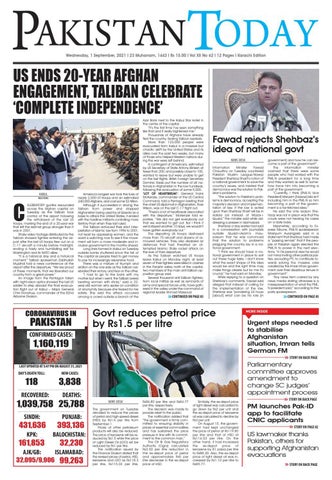
Fawad rejects Shehbaz’s idea of national govt news desK Information Minister Fawad Chaudhry on tuesday countered Pakistan Muslim league-Nawaz President Shehbaz Sharif’s notion of a national government to solve the country’s issues, and insisted that democracy was the solution to Pakistan’s problems. “the solution to Pakistan’s problems is democracy, accepting the majority’s decision and implementation of law. If the law is acted upon then Shehbaz Sharif will be in adiala jail instead of Mazar-iQuaid,” the minister said while addressing a presser in Islamabad. Shehbaz a day earlier had said in a conversation with journalists outside Quaid-i-azam’s mausoleum that he was convinced that the solution to problems plaguing the country lay in a national government. “I think we should have a national government in place to sort out these huge tasks. I don’t know what the exact shape of this idea would be and the right time may make things clearer but for me it’s crucial,” he had said on Monday. While replying to a question on Shehbaz’s comments, Fawad said alleged that instead of calling for the implementation of the law, Shehbaz was “pondering 24 hours [about] what can be his role [in
Govt reduces petrol price by Rs1.5 per litre
CONFIRMED CASES:
1,160,119
government] and how he can become a part of the government”. the information minister claimed that there were some people who had worked with the PMl-N president for a long time and they wanted as well to somehow force him into becoming a part of the government. “Currently, I think [PMl-N Vice President] Maryam [Nawaz] bibi isn’t including him in the PMl-N so him becoming a part of the government is a far-fetched idea.” He said the only reason Shehbaz was not in prison was that the courts were not hearing his cases on a daily basis. Meanwhile, according to express tribune, PMl-N spokesperson Marriyum aurangzeb said in a statement that Shehbaz had made a “passing remark” that if the people of Pakistan again elected the PMl-N to power in the next elections, “in his personal view he would not mind inviting other political parties, excluding PtI, to contribute towards solving the massive crisis created by the Imran Khan government over their disastrous tenure in government”. “any news item carried by any news media stating otherwise is a misrepresentation of what the PMlN president said,” according to the party spokesperson.
CONTINUED ON PAGE 05
more inside
Urgent steps needed to stabilise Afghanistan situation, Imran tells German FM STORY ON BACK PAGE
Parliamentary committee approves amendment to change SC judges’ appointment process
LAST UPDATED AT 5:47 PM ON AUGUST 31, 2021
DAY'S DEATH TOLL:
NEW CASES:
118
3,838
RECOVERED:
DEATHS:
1,039,758 25,788 SINDH:
PUNJAB:
431,636
393,136
KPK:
BALOCHISTAN:
161,853 AJK/GB: 32,095/9,906
32,230 ISLAMABAD:
99,263
news desK the government on tuesday decided to reduce the prices of petrol and high-speed diesel (HSD) by rs1.5 per litre from September 1. Prices of other petroleum products will also be reduced. the price of kerosene will be reduced by rs1.5 while the price of light Diesel oil (lDo) will be reduced by rs1 per litre. the notification issued by the Finance Division stated that the revised prices of petrol, HSD, kerosene and lDo as rs118.3 per litre, rs115.03 per litre,
rs86.80 per litre and rs84.77 per litre, respectively. the decision was made to provide relief to the public. the notification added that “the government is firmly committed to ensuring stability in prices of essential commodities and has sustained the price pressure in line with its commitment to the common man,” the oil & Gas regulatory authority (ogra) calculated rs3.50 per litre reduction in the ex-depot price of petrol and approximately rs5 per litre decrease in the ex-depot price of HSD.
Similarly, the ex-depot price of light diesel was calculated to go down by rs2 per unit and the ex-depot price of kerosene oil was calculated to decline by rs3 per unit. on august 15, the government had kept unchanged the price of petrol at rs119.80 per litre and that of HSD at rs116.53 per litre. on the other hand, it had increased the ex-depot price of kerosene by 81 paisa per litre to rs88.30. also, the ex-depot price of light diesel oil was increased by rs1.10 per litre to rs85.77.
STORY ON BACK PAGE
PM launches Pak-ID app to facilitate CNIC applicants STORY ON PAGE 02
US lawmaker thanks Pakistan, others for supporting afghanistan evacuations STORY ON BACK PAGE
02
Wednesday, 1 September, 2021
KARACHI
NEWS
PM lAunChes PAk-ID APP to fACIlItAte CnIC APPlICAnts
P
NEWS DESK
RIME Minister Imran Khan Tuesday inaugurated Pak-ID Mobile app created by National Database and Registration Authority (NADRA) to provide convenience, especially to the overseas Pakistanis. In a tweet, the prime minister commended Chairman NADRA Tariq Malik and his team for this revolutionary step. The tweet further stated that the applicants by visiting http://id.nadra.gov.pk can now capture fingerprints, photographs and documents using mobile phones. According to a press release by
Pakistan played ‘crucial’ role to achieve peaceful Afghanistan: Mazari
NADRA, the mobile app is meant to facilitate citizens applying for the national identity card, using the Pak-ID portal. The prime minister applauded Chairman NADRA Tariq Malik’s innovative idea of the mobile app which is a step towards implementing the PM’s vision of inclusive registration and a digital Pakistan, the press release added. The statement further said that with the introduction of the NADRA Pak-ID app, Pakistan has become a trailblazer in the ID management industry. The app captures biometrics — fingerprints, facial recognition — and scans documents needed for the processing of citizens’ ID cards and documents. The
Opp opposing electoral reforms, PMDA without reading drafts: minister ISLAMABAD
ISLAMABAD
stAff RepoRt
App
Pakistan was playing a “crucial” role to achieve a peaceful and stable Afghanistan as no country in the region was in favour of prolonged conflict in the war-torn country, Minister for Human Rights Shireen Mazari said. Talking to Pakistan Television, Mazari recalled Prime Minister Imran Khan had repeatedly underlined the fact that there was no military solution to the conflict, and that a political solution achieved through dialogue was the only way forward. Islamabad was making all-out efforts for peace in Afghanistan, as well as in the region, she said, recalling that these efforts were also earning global recognition. The minister further said over 1.4 million registered and unregistered Afghan refugees were residing in the country and world needed to consider Pakistan’s fragile economic situation. She urged the rights organisations and regional players to come forward to help the Afghan nation if they were serious in establishing lasting peace in the region.
Govt set to facilitate Chinese investors: Asad NEWS DESK Federal Minister for Planning, Development and Special Initiatives Asad Umar has said that the government wants to see more Chinese investors coming to Pakistan and would provide them all possible facilitation in this regard. The minister said this during a meeting with a delegation of Port Qasim Electric Power Company (PQEPC), which led by Guo Guangling. SAPM on CPEC Khalid Mansoor and senior officials attended the meeting. Asad assured that issues relating to investments are being taken up at the highest level and would be resolved on a priority basis. He welcomed the delegation and said that Chinese investors have made a significant contribution to Pakistan's economy. Guo Guangling briefed the meeting regarding the latest operational updates and their future potential investments plans in the energy sector. He also briefed the meeting on the latest operational status of the 1320 MW Port Qasim Coal Power project.
Pakistan Muslim League-Nawaz chief Shahbaz Sharif and Pakistan Peoples Party chairman Bilawal Bhutto-Zardari were opposing the proposed election reforms and Pakistan Media Development Authority without reading even a word of the draft proposals, said Minister for Information and Broadcasting Fawad Chaudhry. In a tweet scathingly critical of the two opposition leaders, Chaudhry claimed the two men were also unaware of what the recommendations suggested. The opposition in Pakistan had only one role, and that was to oppose every action of the government and for that purpose, it will enter into an alliance even with Satan, he declared. “It was unfortunate that those people whose decisions for themselves were taken by others harboured ambitions to lead Pakistan.”
Pakistani microfinance pioneer wins Asia’s ‘Nobel Prize’ AFP Muhammad Amjad Saqib, 64, won the Ramon Magsaysay Award for his “first-of-its-kind” interestand collateral-free microfinance programme that catalysed scores of poor households. Nearly two decades after its launch, Akhuwat — founded by Dr Saqib — has grown into the nation’s largest microfinance institution, distributing the equivalent of $900 million and boasting an almost 100 per cent loan repayment rate, the award foundation said. Saqib, who uses places of worship to hand out money, was cited for “his inspiring belief that human goodness and solidarity will find ways to eradicate poverty.” The Ramon Magsaysay Award — named after a Filipino president killed in a plane crash — was established in 1957 to honour people and groups tackling development problems. VAccine deVelopment: Meanwhile, Firdausi Qadri, 70, also won the award for her “life-long devotion to the scientific profession” and “untiring contributions to vaccine development”. Working at the International Centre for Diarrhoeal Disease Research in Bangladesh’s capital Dhaka, Qadri had a “key role” in creating more affordable vaccines
to combat cholera and typhoid, the Manila-based award foundation said in a statement. Qadri was also cited for her leading role in a mass vaccination effort in Rohingya refugee camps in Bangladesh’s southeastern district of Cox’s Bazar in recent years that prevented a cholera outbreak. The disease causes acute diarrhoea and spreads through contaminated food and water. Qadri was also cited for her efforts to build up Bangladesh’s scientific research capacity.
“I’m overwhelmed, extremely delighted but also humbled,” Qadri said in a video message shared by the foundation. It was held virtually this year after the event was cancelled in 2020 due to the coronavirus pandemic. Another winner was Filipino fisherman Roberto Ballon, 53, who was recognised for helping “revive a dying fishing industry” on the southern island of Mindanao where abandoned fishponds had destroyed mangrove forests. With government backing, Ballon and other smallscale fishermen replanted 500 hectares (1,235 acres) of mangrove forests by 2015, boosting their fish catch and quality of life. “What was once a desert of abandoned fishponds is now an expanse of healthy mangrove forests rich with marine and terrestrial life,” the award foundation noted. American Steven Muncy, the founder of the Philippines-based NGO Community and Family Services International, was recognised for helping refugees, assisting victims of natural disasters and getting former child soldiers back to school in Asia. Indonesian documentary maker Watchdoc, which focuses on human rights, social justice and the environment, also won recognition for its “highly principled crusade for an independent media organisation”.
Stakeholder bodies intensify consultations on Afghanistan KABUL AnAdolu Agency
At a time when the eight-member Shanghai Cooperation Organisation is commemorating 20 years of its existence, the situation in Afghanistan is posing a challenge to its three overarching goals, i.e., to ensure safer borders, secure societies, and stable economic progress. Recent weeks have shown a flurry of activities in the Eurasian region. The Chinaled SCO summit is scheduled in Dushanbe, the capital of Tajikistan, on September 17. Just a day ahead, leaders of the Russia-led Collective Security Treaty Organisation will also meet in Dushanbe. These two significant alliances will discuss and formulate measures to stabilize the situation in and around Afghanistan. The withdrawal of foreign troops from Afghanistan is testing the nerves of its neighbours: Pakistan, Tajikistan, Uzbekistan and Turkmenistan. Currently, China, India, Kazakhstan,
app will allow all citizens, including expats to digitally capture fingerprints, photographs and documents. The app is a step towards ending conventional modes of specialised equipment and physical papers for processing IDs. “The innovation will revolutionise the National ID ecosystem in Pakistan by providing public convenience,” the NADRA chairman said. Malik said that the digital dividends of such a technological innovation would yield positive results in financial inclusion, ease of doing business, and egovernance initiatives, by offering remote identification and e-Know Your Customer (KYC). He said that the app would open “new avenues for businesses” allowing them to rapidly take users on board and provide password-less authentication. He further stated that small businesses, startups and fintech organisations will also be able to harvest their digital dividends as rent-seekers will be eliminated and the cost of conducting business will reduce. The offering of digital goods will stimulate young entrepreneurship and promote e-services, the statement said.
AnAlysis Kyrgyzstan, Pakistan, Russia, Tajikistan, and Uzbekistan are members of the SCO. The CSTO includes Armenia, Belarus, Kazakhstan, Kyrgyzstan, Russia, and Tajikistan. Afghanistan enjoys observer status at both the groupings. Pakistan recently reached out to countries surrounding Afghanistan to arrive at a coordinated position about the future setup in Kabul and how to deal with its new rulers. Foreign Minister Shah Mahmood Qureshi visited Tajikistan, Uzbekistan, Turkmenistan, and Iran from August 25-26 to explore the possibility of calibrating of positions of SCO members. During his meeting with Qureshi in Dushanbe, Tajikistan President Imomali Rahmon stressed the need to ensure that the rights of Afghanistan’s minority ethnic groups such as the Tajiks are not
compromised and that they are fully represented at all levels of the society. Secondly, a desire was expressed to guarantee that no elements, either refugees or extremists, will be illegally crossing the Tajik-Afghan border. Thirdly, Rahmon acted to be seen as a champion of not only Tajikistan but also of the larger ethnic Tajik groups living across borders. The ethnic Tajiks account for 27 million population in the world. G20 to discuss AfGhAnistAn in october: Over the past few weeks, Russia is also engaged in consultations to coordinate peacebuilding in the region. On August 27, Russian Foreign Minister Sergey Lavrov visited Italy, the current president of G20, to coordinate efforts on Afghanistan. The G20 summit is expected to take place in Rome from October 30-31. Referring to Italian Foreign Minister Luigi Di Maio’s suggestion for an inclusive format on Afghanistan, Lavrov pointed out that five key neighbouring states, i.e., the three Central Asian states plus Pakistan and
Iran, have not been invited to the G20 consultations so far. “Without them, this discussion will not be complete,” said Lavrov. He said the Italian hosts have promised to come out with a useful format to address the situation. According to Yulia Kudryashova, an expert at Moscow’s International Relations Institute, Central Asia, owing to its strategic geographical location, is situated at the core of the SCO landmass. He said challenges such as an unstable situation in Afghanistan, drug trafficking, and the flow of illegal arms poses a risk to the stability of the entire region. Russia’s Defence Minister, Sergey Shoigu, has reminded that the situation in Afghanistan was fraught with the risk of militants infiltrating into the CSTO countries, while drug trafficking also remained a threat. “We would not want all this to cross over and creep into our territories, the territories of the CSTO countries,” Shoigu said. “We would like stability established, for a coalition government to be formed so that
all the peoples who inhabit Afghanistan are represented, and stability eventually prevails,” he added. summits to discuss risks And opportunities: In the coming weeks, Russia will be assessing the Afghan situation and the consequences under the auspices of both CSTO and the SCO. Lavrov said it was critically important for Russia “to safeguard our southern borders and the borders of our Central Asian allies.” The two summits that will take place in mid-September will take note of risks emanating from Afghanistan and will focus on issues to help Afghans to ensure stability and the normal functioning of civil institutions in their country. Highlighting the significance of the SCO in the current context, Secretary-General Vladimir Norov said its role had increased immensely to normalize the situation in Afghanistan. He recalled that the July 2021 meeting of the SCO foreign ministers in Dushanbe held within the framework of the SCOAfghanistan Contact Group stated that they would support the grouping in fulfilling its important role in achieving peace and reconciliation in Afghanistan.
Wednesday, 1 September, 2021
KARACHI
PM to BreaK ground for South PunjaB SecretarIat Soon: Buzdar LAHORE
P
tLtp
uNJAB Chief Minister Sardar usman Buzdar has said that Prime Minister Imran Khan will soon lay the foundation stone of the South Punjab Secretariat in Bahawalpur. Addressing a press conference on Tuesday, the chief minister said that PM Khan has vowed to carve out a separate South Punjab province and this is also part of the Pakistan Tehreek-e-Insaf (PTI) manifesto. He said that the provincial cabinet has approved amendments to the Punjab Government Rules of Business, 2011 to move further in this regard. He said powers of ACS (South Punjab), secretaries and departments have been clarified while the South Punjab Secretariat will comprise Bahawalnagar, Bahawalpur, DG Khan, Khanewal, Layyah, Lodhran, Multan,
Karachi man arrested for molesting minor KARACHI
Muzaffargarh, Rahim Yar Khan, Rajanpur, and Vehari, and the number of government departments will be 17. He said the South Punjab ACS and secretaries will be administratively fully empowered while ACS (South Punjab) is given the power to transfer grade-17 officers. He is also given the authority to approve the budget and provide funds to the offices of commissioners, deputy commissioners and assistant commissioners. The ACS (South Punjab) is given the authority to write ACRs of South Punjab secretaries, which are given all powers available to Punjab secretaries, and the heads of autonomous bodies, boards, authorities and companies will be answerable to secretaries, he said. He said a 33 percent budget, amounting to Rs190 billion, is reserved for South Punjab. Approval of the service tribunal of south Punjab is also given, he added. The approval of rules of business for the south Punjab secretariat is a historic step to resolve public problems
NCOC daily update: 3,838 new cases, 118 deaths from Covid-19 ISLAMABAD
Staff RepoRt
Staff RepoRt
Police arrested a man on charges of sexually assaulting a four-year-old enrolled in a private school in the North Nazimabad neighbourhood of Karachi. A case was registered at the Taimuria police station on the complaint of the victim’s father, nominating Sameer as the prime suspect. The complainant said that on August 29 when his son went to pick up his ball from inside the school building, the suspect lured him and assaulted him. The police said the victim has undergone a medical checkup that confirmed he was abused.
Pakistan reported 3,838 new Covid-19 cases over the last 24 hours, the National Command and Operation Centre said on Tuesday. The NCOC, the department leading campaign against the pandemic, said that the number of overall confirmed cases has risen to 1,160,119, including 1,039,758 people who have recovered after treatment. The number of active cases has risen to 94,573, including 5,542 critical patients. According to the NCOC, the pandemic killed 118 people on Monday, increasing the overall death toll to 25,788. Sindh is the most affected province of the country in terms of the number of cases with 431,636 infections, followed by Punjab, which has reported 393,136 cases. The vaccination drive in the country has also picked up the pace, with some 41,477,587
Pilot honoured for flying evacuation flight out of Kabul amid takeover chaos ISLAMABAD Staff RepoRt
President Arif Alvi conferred a gold medal on a Pakistan International Airlines pilot for exhibiting valour during a rescue flight to evacuate 170 people, members of former president Ashraf Ghani’s cabinet and highranking officials, from Taliban-controlled Kabul on August 15. The fall of Kabul to the Taliban, at a speed that was not anticipated by the international community, prompted thousands to head to Hamid Karzai International Airport, the only way to fly out of the country. When he landed a passenger airliner that morning, everything seemed normal, said Maqsood Bajrani. Waiting on the tarmac to begin the return flight, “I started noticing that there was panic outside, and the situation was not normal. More people were rushing inside the airport and gunshots were also heard.” Bajrani started to push back ahead of take-off but was then told by the control that passenger flights had been suspended and he did not have the authorisation to take off. He then made the biggest call of his flying career. “I had a conversation with my second officer that we are going to take off even if they don’t authorise it. It was not a normal situation.” “After observing the situation for an hour, I finally took off. The visibility was good which enabled me to avoid the military traffic. There were some Chinooks, Gunship helicopter and some other cargoes.” “Had we delayed for few more minutes we wouldn’t have made it. It was the last commercial flight of that day.” “Most of the passengers were either in the cabinet of the president Ghani or somehow part of the government. They were fleeing the country with their families and were pushing us to take off as soon as possible.” “There was no communication and I was on my own when it came to the technical clearance. I was told to manage the situation by myself.” The passengers were “ready to fly and get out of Afghanistan at any cost” and experienced a wave of relief when the plane finally arrived in Islamabad, he said.
at the grassroots level and they will not have to visit Lahore, he stressed. To a question, the CM said the Punjab government has traced heinous crime cases. “I issued directions to police while taking notice of such cases and some police officials are also removed from their posts,” he stated. Every step is taken to ensure rule of law, he added. To a question, he said the helicopter is used for government duties as he visits different areas to solve public problems on the spot and development is a prime focus of the government as utilisation of budget will be ensured. Speaking on the occasion, Punjab Finance Minister Hashim Jawan Bakht said midnight oil is burnt to formulate rules of business as it is a historic step of CM usman Buzdar-led government. This will remove deprivations and public problems will be resolved at their doorsteps, he added. Provincial ministers Fayyaz-ul-Hasan Chohan, Dr Akhtar Malik, Hasnain Bahadur Dreshak, parliamentary secretary Abdul Hayee Dastee and ACS (South Punjab) were also present during the press conference.
03
Pakistan sounds alarm over illicit trade of radioactive metal in India ISLAMABAD Staff RepoRt
Pakistan expressed concern over lax arrangements for the security of nuclear and other radioactive materials in India after a third instance of seizure of stolen radioactive elements was reported in four months. Last Thursday, the Criminal Investigation Department of the eastern Indian state of West Bengal seized Californium, an extremely expensive radioactive metal, weighing 250.5 grams and worth about $581 million from two people in the Kolkata airport area, The Economic Times reported. Stolen or lost radioactive material has on several occasions been reported in India, most recently in May and June when over 7 kilograms and more than 6 kilograms of uranium were recovered from unauthorised people in separate incidents. The Bhabha Atomic Research Centre in the coastal city of Mumbai pointed out the apprehended natural uranium was “highly radioactive and dangerous to human life”. The string of incidents of theft of nuclear and radioactive metals has raised fears in Pakistan that it could be used as a weapon if acquired by the Hindu extremists. “We have noted with serious concern yet another report of theft and illicit sale of radioactive material in India,” the Foreign Office said. “It is a matter of grave concern for the international community that an extremely rare Sealed Radioactive Source material like Californium could be stolen.” The agency observed that “as in the previous cases, the arrested individuals apparently got hold of the radioactive material by purchasing it” from inside the country. The statement further said repeated incidents not only point to the possible existence of a nuclear black market but also indicates the lax arrangements in India to secure imported SRS material.
11 militants killed in Balochistan raid QUETTA Staff RepoRt
partially 16,171,867
vaccinated and fully inoculated,
according to the latest official data.
Forensic report sufficient for conviction: SC ISLAMABAD INp
In a far-reaching observation, the Supreme Court on Tuesday said forensic evidence linking suspect to the crime was sufficient to prove them guilty, and a lack of witness statements was no longer a hindrance to development. Justice Qazi Muhammad Amin Ahmed made this observation during the hearing of a bail request of a police officer in the murder of a state prosecutor. Senior Superintendent of Police Mufakhar Adeel murdered assistant advocate general Shahbaz Tatla in February last year ostensibly in the name of “honour”. After hiding from police for about a month, Adeel handed himself over to police in the first week of March but only after engaging with some senior police officers to get assurance that the investigation police would not physically torture him after arrest. A three-member bench of the top court, headed by Justice Ijazul Ahsan, which is hearing the case, rejected the bail request of Adeel after he informed the court of lack of interest in seeking bail.
neWS
Prosecutor Azam Nazeer Tarar told the court that Tatla was murdered in a brutal manner. While counsel for the suspect, Mohammad Ramzan Chaudhry, said of the 32 witnesses listed in the case, statements of only 13 had been recorded so far. At this, Justice Ahmed ruled witnesses or no witnesses, the evidence against the former police official was concrete and irrefutable to convict him. Justice Ahsan observed Adeel had fled to Gilgit-Baltistan after
killing Tatla and dissolving his body. However, Adeel’s counsel retorted that he had not escaped but was on duty in the mountainous region. Tarar argued that everything, including Adeel’s phone, his location and his purchasing an acid, was on record. And when Chaudhry complained that there had been no progress in the case for more than a year, Justice Ahsan asked him if he withdraws the bail application of his client, the court will issue directives to speed up the probe.
The counter-terrorism units raided a hideout of the Islamic State group in Balochistan before dawn on Tuesday, setting off a shootout that killed 11 militants, the police said. The units, acting on intelligence, carried out the raid in the district of Mastung, where IS militants had recently killed two police officers. The police said suicide belts, hand grenades and assault rifles were confiscated in the raid. The counter-terrorism department provided no further details and the nationality of the slain militants was not immediately known. The counter-terrorism police is a special branch of the police that fights militant groups.
wednesday, 1 september, 2021
04 nEws
karaChi
ThOuSandS Of GOveRnmenT emPLOyeeS faIL TO GeT vaccInaTed LAHORE
d
SHAHAb OMER
ESPITE the tall claims of providing extraordinary services of free vaccination and service centres by the government, employees of major government departments have not yet been vaccinated against Covid-19, Pakistan Today learnt. According to the documents obtained from Punjab Home Department, the total number of senior and junior personnel in the Punjab Police was 146,200 out of which 41,414 personnel have not yet been vaccinated against Covid-19. However, all 12,802 personnel of the Punjab Prisons Department have been vaccinated. Similarly, all 195 employees of Punjab Probation and Parole Services
have also been vaccinated. The documents further said that all 471 employees of the Directorate of Civil Defense and all 80 employees of the Directorate of Monitoring had been vaccinated. However, 21 out of 518 employees of the Child Protection and Welfare Bureau have not yet been vaccinated while out of the total 644 employees of Punjab Forensic Science Agency, 3 employees have not been vaccinated yet. In a document obtained from Evacuee Trust Property Board, it was revealed that there were 1660 employees out of only 1156 employees have submitted their vaccination certificates against Covid-19. However, the board has decided to hold the salary of that 504 unvaccinated employees until they submit a vaccination certificate. Some top officials of Punjab Police
informed this scribe that even the government has made the policy to hold the salary of unvaccinated staff but despite this policy many of the personnel were unvaccinated. In Punjab Police, despite the policy, everyone is getting paid whether they are vaccinated or not. These vaccinated personnel can spread the coronavirus in the department as well as in the public, a source told. It is very important for all police personnel to be vaccinated as these people also go for various operations, go to the courts and also go to the public, the source added. A major factor is the lack of vaccination of police personnel, many of whom are from rural areas where all forms of vaccination are opposed. Similarly, many police officers working in rural areas are
not even familiar with the name of vaccination, the source further claimed. On the other hand, a senior Punjab Services and General Administration Department official believed that the situation was not as bad as it seems. “Many government departments had started requiring their staff to submit their vaccination certificates to the relevant departments the day after the policy was introduced and those who did not get vaccinated should be vaccinated in any case. In many departments, the salaries of officials who were not vaccinated were also withheld. There are examples of ETPB, education department, health department, hospital staff and many more. We have fully implemented this policy even in the Punjab Secretariat and almost all the staff here are vaccinated,” he said.
PM’s aide on petroleum likely to be replaced ISLAMABAD: AHMAD AHMADANI
Special Assistant to Prime Minister (SAPM) on Power and Petroleum, Tabsih Gauhar, is likely to surrender the charge of petroleum division shortly and a former Chief Executive Officer (CEO), Hascol Petroleum, Waheed Ahmed Shaikh, may be appointed as premier’s aide on petroleum. According to sources, Gauhar is likely to be asked to withdraw the charge of petroleum and it is expected that his role will be restricted to look after the affairs of power division only. “Premier’s aide on power & petroleum Tabish Gauhar will quit the charge of petroleum division in near future and necessary consultations/preparations in this regard are in the final stage,” said sources. Sharing details, the sources said that Gauhar is likely to relinquish charge of petroleum division owing to differences with few federal ministers, presenting a detailed plan of reforms for petroleum division and insisting on a construction of North-South Gas Pipeline
(NSGP) project by the state-owned Sui gas companies instead of Russian companies. About the next SAPM on Petroleum, sources said that the name of Waheed Ahmed Sheikh, former CEO of Hascol Petroleum is under consideration. Sources also informed that Hascol petroleum’s total
loan stands at Rs54bn as per its latest filed financial statements to Pakistan stock exchange and becomes a defaulter of over Rs16 billion loan to National Bank of Pakistan (NBP). They said that the NBP had given an excess loan of Rs8bn to Hascol that is above its approved limit. They said Hascol’s banking wise debt obligation suggests that the company has defaulted on Rs4.10bn loan from Habib Bank Limited, Habib Bank Metropolitan Rs4.92bn, Meezan Bank Limited Rs4.29bn, Askari Bank Limited Rs4.07bn, Bank of Punjab Rs3.98bn, Sindh Bank Limited Rs2.88bn, Faysal Bank Limited Rs 2.071 billion, Bank of Khyber Rs2.002bn, Bank Alfalah Limited Rs1.806bn. Hescol Petroleum has defaulted on its debt obligation as it has restated its accounts in 2019 and booked billions of losses in historical financials while Hescol is now negotiating with banks for possible debt restructuring and has offered conversion options from debt to equity to banks, said sources. They added that Hascol Petroleum had made an offer to banks to purchase its shares and convert them into equity in exchange for the loan it was taking out.
Privatisation Commission calls applications for revival of PSM In an advertisement, the Privatisation Commission of Pakistan has asked for applications for Pakistan Steel Mills (PSM) revival to be submitted by September 30. The Privatisation Commission is encouraging both national and international investors to take part in the revival of PSM. This decision was taken as Prime Minister (PM) Imran Khan and the federal cabinet had directed to speed up the entire
process of revival of the PSM. This announcement was made earlier this year, in a meeting jointly headed by Federal Minister for Privatization, Muhammad Mian Soomro, and the ex-minister for finance, Hammad Azhar. Besides instructing all concerned institutions to expedite the process, the establishment of a new subsidiary for steel mills was also discussed in the meeting. NEWS DESK
Largest-ever IPO introduced in Pakistan by JS Global Consultant and book runner of Airlink Communication Limited, JS Global, introduced the largest-ever initial public offering (IPO) in Pakistan, worth Rs6 billion. The minimum share price of Rs65 Is being offered with a maximum price band of up to 40 per cent mentioned JS Global lead manager and consultant for the issuance of shares Airlink has bid invites for a total of 90 million shares from various investors. On Monday, a bid for 45.44m shares in a price range of Rs65-71 was received by the company. The final strike price will be finalized after the two-day book-building process. The prospectus available on the PSX website says, “IPO proceeds would be utilised for injection of working capital to expand the company’s distribution and retail network.” Currently, Airlink has 14 outlets but they aim to open 150 outlets in the next five years. According to the prospectus, “The issue is expected to generate Rs5.85bn at a floor (minimum) price worth Rs65 per share, out of which Rs3.90bn (new issue of 60m shares) shall be utilised to finance working capital requirements,” Moreover, it said, “The issuer’s total working capital requirement is Rs5.439bn, out of which Rs3.90 billion (72pc of the total working capital requirement) shall be financed by proceeds from the new issue and the remaining Rs1.539bn (28pc of the total working capital requirement) shall be financed from short-term financing facilities.” NEWS DESK
BankIslami crosses Rs300bn deposit landmark KARACHI PRESS RELEASE
HY’21 proved to be a prolific financial cycle for BankIslami as the bank crossed Rs300 billion benchmark for its deposit book. This landmark was achieved as a result of constant efforts made by the bank to strengthen its distribution structure and ‘feet on street’ field force which proved to be pivotal in enhancing its deposit base, particularly the low cost CASA deposits. When compared with balances at Jun’20, the bank’s overall deposit grew by 26% at Jun’21 (growth of 7% from Dec’20) while CASA deposits witnessed an increase of 34% at Jun’21 (increase of 16% from Dec’20). Out of this increase, the growth in Current Deposits was recorded at 39% (increase of 18% from Dec’20). The continuation of the CASA growth trend will play an essential role in enhancing the Bank's net income margin (NIM) going forward. On the credit side, the Bank disbursed funds to corporate entities and retail segments while the investment book was increased through investments in GoP Sukuks to improve overall credit risk profile. BankIslami has successfully achieved SBP’s mandatory targets for housing and construction and the Markup Subsidiary Scheme (MPMG). Owing to contraction in net spreads, the operating profit of the bank decreased to Rs1,592m in HY’21. This decline was offset by net reversals of provisioning during the period. Resultantly, BankIslami posted Profit After Tax (PAT) of Rs1,162m for the half year ended June 30, 2021, an 8% increase from last year’s PAT.
CCoE to review oil refinery policy draft this week ISLAMABAD AHMAD AHMADANI
The upcoming meeting of the Cabinet Committee on Energy (CCoE) is likely to review the revised draft of Pakistan Oil Refining Policy 2021. According to sources, the next CCoE meeting is likely to be held during this ongoing week and this meeting would decide on the revised draft Pakistan Oil Refining Policy 2021 which would be tabled by the petroleum division. “The minister for energy (petroleum division) has seen and authorized submission of the summary to the CCoE of the Cabinet,” said sources. Following the direction of the Economic Coordination Committee (ECC) of the Cabinet to place a summary before the CCoE, the petroleum division has prepared a draft of the Pakistan Oil Refining Policy 2021 for CCoE’s consideration and approval said sources. Earlier, the ECC of the Cabinet on August 11 had directed the petroleum division to place a summary before the CCoE and seek its approval. The petroleum division submitted a summary dated August 13 for the CCoE consideration. The CCoE in its meeting held on August 20 directed the petroleum division to review the policy concerning specific observations
highlighted by the forum and submit the revised draft policy to the CCoE for consideration after incorporating viable recommendations therein. As per sources, the petroleum division has accordingly reviewed the CCoE’s observation and drafted a point-wise response after incorporating certain modifications in the draft policy. According to pointwise response, upfront utilization of incremental tariff protection revenue was previously provided in the policy with effect from 1st January 2022, however, under the new proposed arrangement, this amount can only be used after awarding of EPC (engineering, procurement, and construction) contract by the respective refineries which is expected by the start of 2024 (Sub-section 9.2.3.9 of the Policy). Similarly, Oil and Gas Regulatory Authority (OGRA) will monitor the incremental revenue to be deposited in a special reserve account by each refinery under a separate bank account to be opened in the National Bank of Pakistan (NBP) and ensure its utilization for the expansion of the refineries, on proportionate basis of the incremental revenue and refinery’s contribution (under the principle of Sub-section 9.2.3.9 of the Policy). Likewise, to simplify the government’s arrangements, the mechanism of hiring of
joint external consultants as proposed during the presentation in CCoE’s meeting dated August 20 has been dropped. More, as force majeure is a project-specific contractual arrangement hence it has been deleted from the draft Policy (Sub-section 9.2.3.11 of the Policy). Furthermore, previously, a bank guarantee worth Rs500 million per refinery was required till the financial close. As an abundant precaution, this has been extended till the commissioning of the project (COD). The form and features of the guarantee will be subject to acceptance by MEPD (Sub-section 9.2.3.11 of the Policy). Sources said that the government has been emphasizing refineries to produce Euro-V specification fuels and the proposed oil refining policy 2021 is likely to provide incentives for up-gradation of existing refineries to produce Euro-V specification products as well as encourage potential investors to establish a new state of the art deep conversion refineries through fiscal support. “The existing refineries have progressively upgraded their infrastructure, however, due to high capital requirement, lack of tariff protection and low returns on investment, the existing refineries could not keep pace with the technology around the world,” said the sources.
CMYK
They added that a huge capital investment of around USD2-3.5 billion is required for producing Euro-V specification products which can only be arranged by the refineries from lending institutes at commercial terms. As per details, petroleum products contribute 31 per cent of the primary energy mix of the country with overall consumption of around 20 million tons per annum (MTPA). Out of this, the indigenous production is around 11 MTPA (using 30pc local crude) while deficit petroleum products of 9 MTPA is imported. The deficit crude oil and petroleum products are imported from Saudi Arabia, Abu Dhabi (UAE), Kuwait and open markets of the Gulf and Southeast Asia regions among others. The indigenous and imported crude is refined by five major refineries. Currently, five players are operating in the oil refining sector in Pakistan including, Pak-Arab Refinery Limited (PARCO), Attock Petroleum Limited (ARL), National refinery Limited (NRL), Pakistan Refinery Limited (PRL) and Byco Petroleum Pakistan Limited (BPPL). All the refineries are hydroskimming refineries, except for PARCO which is a mild-conversion refinery. However, four out of five refineries are based on old technologies such as hydroskimming. The fifth refinery i-e Pak Arab Refinery Limited (PARCO) is using semi-conversion technol-
ogy which is also more than twenty years old. These refineries have up-graded their plants during 2015-18 and installed Diesel HydroDesulfurization (DHDs) for producing Euro-II specification High-Speed Diesel (HSD) and Isomerization plants for enhancing the production of Motor Spirit (Petrol) at a cost of around Rs 75bn. It is also learnt from sources that all five refineries of the country are currently in need of financial support from the government to improve their financial position for up-gradation purposes. Similarly, the petroleum products demand-supply projections have indicated a requirement of the additional refining capacity of at least 300,000 barrels per day (bpd) at a cost of USD10-15bn by 2030. This would require a considerable lead time and huge investment for which clear government policy along with attractive incentives need to be in place, said sources. It is pertinent to mention that local refineries are strategic assets for the country and their sustainability & continuity is essential for the country’s prosperity and economic development. Similarly, Pakistan’s local refineries are the backbone of heavy industrial development and are intrinsically connected to the defence and energy security needs of the country. They have a pivotal role in the energy supply chain and economic development of Pakistan.
Wednesday, 1 September, 2021
KARACHI
US endS 20-year afghan engagement, taliban celebrate ‘complete independence’ contInueD froM pAge 01
p
ENTAGON spokesman John Kirby said the US military was not concerned with images of Taliban members walking through Kabul airport holding weapons and sizing up US helicopters. “They can inspect all they want,” he told CNN. “They can look at them. They can walk around. They can’t fly. They can’t operate them…” But he said that “the threat environ-
ment” remains high. “We’re obviously concerned about the potential for Taliban retribution going forward and we certainly, we saw it ourselves, are mindful of the threat that ISISK continues to pose inside Afghanistan.” ISIS-K is the Islamic State affiliate that claimed responsibility for a suicide bombing outside Kabul airport on Thursday that killed 13 US service members and scores of Afghan civilians. US President Joe Biden defended his decision to stick to Tuesday’s with-
drawal deadline. He said the world would hold the Taliban to their commitment to allow safe passage for those wanting to leave Afghanistan. Biden has said the United States long ago achieved the objectives it set in 2001, when it ousted the Taliban for harbouring al Qaeda militants who masterminded the September 11 attacks. But he has drawn heavy criticism from Republicans and some fellow Democrats for his actions since the Taliban took over Kabul this month after a light-
ning advance and the collapse of the USbacked government. Blinken said the United States was prepared to work with the new Taliban government if it did not carry out reprisals against opponents. Taliban spokesman Mujahid said the group wanted to establish diplomatic relations with the United States, despite the two decades of hostility. “The Islamic Emirate wants to have good diplomatic relations with the whole world,” he said.
Fawad rejects Shehbaz’s idea of national govt contInueD froM pAge 01 Regarding the ongoing issue of Pakistan remaining on the UK’s travel red list, Fawad Chaudhry said Prime Minister Imran Khan had taken up the matter with Prime Minister Boris Johnson. “The UK government believes that there needs to be a discussion on Pakistan’s internal [Covid-19] testing mechanism,” he said, adding that a detailed session will be held this week between Special Assistant to the Prime Minister on Health Dr Faisal Sultan and Britain’s chief medical scientist. The information minister said the government was making complete efforts for Pakistan to be taken off the list since it was “a matter of importance to many Pakistanis”. Speaking on other issues, he said the premier had tasked Finance Minister Shaukat Tarin and Energy Minister Hammad Azhar to bring a reduction in the price of liquefied petroleum gas (LPG) cylinders. “The prime minister has emphasised that there is a need to bring cylinder prices down and these two ministers will now
meet on this and take the issue forward.” Addressing the situation in Afghanistan, Chaudhry said the air corridor opened to provide aid to Afghanistan would remain operational. He expressed hope that Afghanistan’s “40-year sad tale” would come to an end and Afghans would be
able to take a “sigh of relief” and Pakistan would be able to strengthen its relations with a stable neighbour. “We have a message for the Afghan people that we pray for your peace and stability and will do whatever is possible to provide relief.” Giving updates on the ongoing evac-
uation process, he said Pakistan’s role was being praised the world over, adding that “we will continue to help and extend our cooperation in the evacuation process.” He said all Pakistanis who wished to be repatriated had been evacuated from Afghanistan. Regarding recognition of any new government in Afghanistan, he said “Pakistan’s policy was clear” that it would not take an isolated decision. “International and regional attitudes would be considered before a decision to recognise the new Afghan regime,” Chaudhry said. Questioned on recent attacks against the Pakistan Army from the Afghan border, he said: “It’s not as if there will be changes the very next day the government is changed. “This is a process and we should wait. The new Afghan authorities have given a clear stance and we hope they won’t allow Afghanistan’s soil to be used against any country.” He said there would be a reduction in Indian “mischief” and funding to use Afghan soil against Pakistan.
US returns trove of looted antiquities to Pakistan ISLAMABAD TLTP
The United States has returned 104 artefacts valued at $3.3 million to Pakistan that were among thousands of antiquities looted from Asian countries and seized from New York art dealer Subhash Kapoor, the Organised Crime and Corruption Reporting Project (OCCRP) reported on Tuesday. “I want to express my gratitude to the Manhattan District Attorney’s Office and the Department of Homeland Security for their efforts in retrieving these stolen cultural treasures of Pakistan,” Pakistan’s Consul General in New York Ayesha Ali said. “Hopefully soon these artefacts will be displayed in Pakistani museums,” she added, reported Arab News. The illegal antiquities trade is a multi-billion dollar global industry according to a 2018 report by Standard
Chartered Bank, and it’s beneficiaries are not just high society art aficionados like Kapoor and his Manhattan clients, but the trade is often a major funding source for criminal and militant groups on the supply side, OCCRP said. “This magnificent collection of artifacts returned to the people of Pakistan epitomises that nation’s rich cultural heritage and humanity’s never-ending quest for enlightenment and peace,” Manhattan District Attorney Cy Vance, Jr. said in a statement last week. “It also evinces the importance of all collectors and gallery owners performing due diligence and ensuring all pieces they purchased were lawfully acquired. I want to thank my Office’s Antiquities Trafficking Unit and our partners at Homeland Security Investigations for their sterling efforts that have resulted in almost 500 treasures, including nearly 150 to Pakistan, being returned to 11 countries over the past year. I look forward
to further repatriations in the near future.” Kapoor is awaiting trial in India and is accused of running an antiquities looting enterprise worth more than $100 million. Kapoor made headlines in the art world in 2011 when he was arrested by Interpol in Frankfurt, Germany, for his involvement in the trafficking of objects, which stretched throughout Afghanistan, Cambodia, India, Indonesia, Myanmar, Nepal, Pakistan, Sri Lanka, and Thailand, among other states, and implicated the collecting practices of museums across the globe. The Manhattan District Attorney’s Office filed criminal charges against Kapoor and seven co-conspirators in 2019, accusing them of operating a $145 million smuggling ring that dealt with thousands of looted antiquities over a period of 30 years. So far some 497 of as many as 2,500 artefacts in Kapoor’s collection have been repatriated to 11 countries.
neWS
05
govt to facilitate farmers through price stability strategy: tarin ISLAMABAD TLTP
Finance Minister Shaukat Tarin has said that a multifaceted price stability strategy will be implemented to facilitate farmers by offering price guarantees and confirmed take off to protect them from exploitation at the hands of middleman and wholesalers. The finance minister said this on Tuesday while having a meeting with SAPM on Food Security Jamshed Cheema on price control strategy for essential commodities. Tarin said that investment through public private partnership will be invited to develop multi-purpose storage facilities for maintaining strategic reserves. While reviewing the value chain of essential commodities, the finance minister stressed upon the need for accurate forecasting to ensure smooth supply of basic items at affordable prices across the country. He emphasised the role of provincial governments for taking proactive measures on top priority to bring price stability in items of daily use in compliance with the directives of the prime minister. The SAPM apprised the minister of the significance of maintaining strategic reserves and strict implementation of administrative measures in order to provide maximum relief to the consumers. After detailed deliberations, it was decided that SAPM will hold consultations with all relevant stakeholders including provincial chief secretaries and chalk out a comprehensive plan to examine the entire food chain of fifteen basic commodities from farm to retail market and identify gaps which need to be filled in through accurate forecasting and proactive decision making to ensure availability of essential items at fair prices. Similarly, there will be a renewed focus on an effective communication strategy to keep the general public well-informed about the measures being taken to ensure price stability and smooth supply of essential items throughout the country. It was also decided that the key focus will be on provision of targeted subsidies for a meaningful market intervention. Separately, the finance minister said that development of Gilgit-Baltistan is the top priority of the present government and all possible steps would be taken to ensure timely provision of funds to upgrade the area through mega projects. During a meeting with Gilgit-Baltistan Chief Minister Khalid Khursheed at the Finance Division on Tuesday, the finance minister assured full support and facilitation to the chief minister for the development of GB. The chief minister apprised the finance minister of the strategic importance of Gilgit-Baltistan and stressed the need for socio-economic and territorial development of the area. He also underlined the steps being taken to upgrade tourism to bring in more revenues for the local population. He said that tourism is a big and growing industry, and there is a greater need to develop transport infrastructure, promoting high-yielding crops and livestock products to place Gilgit-Baltistan on an all-inclusive development trajectory. Announcement of making Skardu an international airport will usher in a new era of development in the field of tourism, he added.
First PIA flight carrying WHO health supplies lands in Afghanistan ISLAMABAD news desk
The World Health Organisation says an aircraft provided by Pakistan delivered the first shipment of much-needed medicine and health supplies to Afghanistan since the country came under the control of the Taliban, Voice of America reported. The humanitarian assistance was loaded in Dubai and flown directly to the northern Afghan city of Mazar-e-Sharif, said a WHO statement. The supplies will be immediately delivered to 40 health facilities in 29 provinces across Afghanistan. The Taliban marched into Kabul on August 15 after their weeklong stunning battlefield advances overran 33 of the country’s 34 provinces without facing any significant resistance from security forces of the ousted Afghan government. The WHO said Monday that a reliable humanitarian air bridge is urgently required
to scale up the collective humanitarian effort. “After days of non-stop work to find a solution, I am very pleased to say that we have now been able to partially replenish stocks of health facilities in Afghanistan and ensure that — for now – WHO-supported health services can continue,” said Dr Ahmed Al Mandhari, WHO regional director for the eastern Mediterranean. The 12.5 metric ton supplies delivered consist of trauma kits and interagency emergency health kits, and are enough to cover the basic health needs of more than 200,000 people, as well as provide 3,500 surgical procedures and treat 6,500 trauma patients. The WHO noted that Monday’s flight was the first of three planned with Pakistan International Airlines to fill urgent shortages in medicine and medical supplies in Afghanistan. Al-Mandhari thanked Pakistan for its efforts to support the WHO and the people of Afghanistan.
“Humanitarian agencies such as WHO have faced enormous challenges in sending life-saving supplies to Afghanistan in recent weeks due to security and logistics constraints. The support of the Pakistani people has been timely and life-saving,” he added. The security crisis stemming from the Taliban takeover of Afghanistan and ensuing efforts by the U.S.-led Western nations to evacuate their personnel along with Afghan allies through the beleaguered Kabul airport had disrupted crucial humanitarian supplies into the conflict-torn country. The WHO called for the world to remain focused on meeting the needs of the people of Afghanistan at this critical time. “The world’s attention over the past two weeks has been focused on the air evacuation from Kabul airport. But the demanding humanitarian work of meeting the needs of tens of millions of vulnerable Afghans who remain in the country is now beginning,” the world body said.
cMYK
06 COMMENT
Hell for Women?
Terrorism emanating from Afghanistan and India Pakistan can't afford negligence
Impunity for rapists makes women unsafe
T
HE country’s military leadership has briefed three parliamentary committees on internal and external security challenges. The idea was to create a national consensus on policies towards Afghanistan and India. Normally exercises at consensus building are undertaken by elected Prime Ministers On account of the ruling party leadership’s scornful attitude towards the opposition, Prime Minister Imran Khan has made himself unfit to lead any attempt to build national consensus even when one is badly required by circumstances. The hasty and disorderly withdrawal of foreign troops from Afghanistan has led to uncertain conditions in the country. More uncertainties are being caused by the Taliban’s behavour. More than two weeks after their capture of Kabul, the Taliban have not been able to form the government. What the world expects is an inclusive administration with moderate policies that include acknowledging girls’ right of education and women’s right of employment. The Taliban need the defreezing of their funds in the USA and resumption of the World Bank and IMF programmes along with financial support from the world to be able to run the government. Much will depend on whether the Taliban take measures to gain international legitimacy and acceptance or revert to their harsh and primitive style of governance, as practiced under Mullah Omar. The devastating suicide attack on Kabul airport and the subsequent rocket attacks show that the IS is alive and kicking in Pakistan’s neighbourhood country. The TTP, which has its eyes fixed on Pakistan’s tribal districts, is also present in Afghanistan. So are Baloch separatists who are supposed to be operating from Afghanistan. India’s RAW has also invested a lot in the terrorist networks to detabilise Pakistan. The situation is highly worrisome. The COAS assured the parliamentarians that Pakistan's borders are secure and armed forces prepared to meet any situation. The terrorist attacks have no doubt become less frequent compared to a decade before. The terrorists however still continue to target security personnel in tribal districts and Balochistan, and Chinese engineers and workers wherever they can, to delay the CPEC projects and create misunderstandings between China and Pakistan. This means Pakistan has to further improve the working of its security agencies and upgrade and modernise its investigation network.
Zubair soomro
A
35-year-old woman and her daughter were raped by a rickshaw driver and his s them accomplice in Lahore; On the Independence Day of Pakistan, a TikTokker was sexually harassed in Lahore; a woman on rickshaw was harassed publicly in Lahore and people were cheering; Noor Mukadam, daughter of a diplomat, was brutally killed in Islamabad; a female schoolteacher was raped by the owner of the school; a minor girl was raped by the principal of a seminary; a woman was gangraped by robbers in front of her family in Sheikhupura; a man with his three friends gangraped his fiancée and snatched jewelry; a 16year-old girl was raped by her stepfather in Lahore; the mother of four children was raped in Bhagatpura; a 10-year-old was raped in Manwan; 17-year-old girl was raped after being promised a job; a minor girl was raped and killed in Korangi; a woman was abducted and gangraped; an elderly woman was tortured, dragged and the attacker attempted to rape her. A few cases have been quoted here. Sorrowfully, numerous other cases remain to be mentioned here. Unfortunately, a tiny figure of cases have been reported, still many cases are unreported. The given obnoxious incidents give women a sense of insecurity and uncertainty. Wretchedly, women in our society are deemed a prey and an open invitation by mad dogs (rapists) which they cannot evade whom they leave no stone unturned to assault. The exponential rise in gender-based violence has CHANGED our society into a hell for women, where they are considered aN inferior segment of society. This abysmal picture of our society adversely impacts our international image. The study conducted by Georgetown Institute for Women, Peace and Security, despite an improvement in women’s perception of community safety, still ranks Pakistan fourth among the worst countries for women to live in. In accordance with the official data- collected from law enforcement agencies and the Human Rights Commission of Pakistan, at least 11 rape cases are reported regularly in Pakistan. More, the last six years data unearthed an icky tally of 22,000 cases registered to police in Pakistan. Dolefully, the conviction rate stood at 0.3% of the total. Research conducted by Geo News revealed that only 41 per cent of cases have been reported to the police. A police official estimated the actual number of assaults could be as high as 60,000 in the last five years. Furthermore, the Cyber Wing of the FIA in
Dangerous debt accumulation Astronomical borrowing a burden on economy
I
N the past three years the PTI government has added Rs 14.9 trillion to public debt, taking the total figure to Rs 39.9 trillion. That this figures is much more than double of what the previous government accumulated in its five-year tenure and the fact that Prime Minister Imran Khan campaigned on the premise of reducing this very figure once he came to power, is a glaring example of how badly he has failed to address systemic issues that have crippled the economy. The country’s total debt and liabilities now amounts to 100.3 –percent of GDP, which is well above the legally permissible debt limit according to the Fiscal Responsibility and Debt Limitation Act 2005. In terms of measures taken to improve the debt profile of the country, Mr Khan claimed in 2019 to bring the total figure down to Rs20 trillion and additionally set up a Debt Inquiry Commission tasked with investigating previous governments’ addition of Rs18 trillion to public debt. Not only has the PTI itself added around 77 percent of that 10-year debt accumulation to the total number in a matter three years, the report of the debt inquiry, despite the investigation’s completion, has been withheld by the PM. Looking at the figures, it is obvious that any such report would be more detrimental to the PTI than any other party. Much of the increase is attributable to external debt that has ballooned from $95.2 billion three years ago to a record $122.2 billion, an increase that only adds to the already hefty burden of servicing foreign loans. What is more, the country has spent around $13.4 billion in mark-up and principal payments, all of which is again borrowed. A vicious cycle of borrowing to service debt is in motion with no end in sight. This is also precisely the reason why the present government has no major development projects to show for the astronomical debt accumulated over the past few years; it simply finances old debt. In the absence of a firm and honest commitment to address the expenditure-revenue gap that forces the country to borrow so heavily, there will be no end to this debt trap. Meaningful tax reforms, expansion of the export base, improvement in security and ease of business to attract Foreign Direct Investment while reducing expenditures is the only way forward. The PTI was voted in as the party of change that would do away with the status quo. Unfortunately, so far, it is more of the same, if not even worse.
Dr James J. Zogby
S
OME expected that all hell would break loose when Ben & Jerry's, the ice cream company, announced that as of 2022 they would no longer license the sale of their products in occupied Palestinian territories. After an initial hysterical response from Israel and its supporters in the USA, the story has largely faded from the news. This should not be interpreted to mean that it's over. Rather it's just another episode in a long-playing drama that will continue to unfold in the months and years to come. There were several reasons why the official Israeli response to Ben & Jerry's decision was so intense: it is the most prominent American business to have taken such a stance; the company's commitment to promoting social justice has given it iconic status among American progressives; and its founders are Jewish Americans. Fearing that the Ben & Jerry's decision might embolden others to follow suit, the Israeli reaction was an exaggerated one with various leaders trying to outdo one another in expressing indignation in hopes that the "sound and fury" would be enough to discourage them. Israel's president called the boycott an effort
Arif Nizami (Late) Founding Editor
Yousaf Nizami M. A. Niazi
Umar Aziz
Joint Editor
Joint Editor
Executive Editor
Lahore – Ph: 042-36300938, 042-36375965
To sum up, society will remain hell for women, as long as our society is patriarchal and culprits remain scot-free. No society can be stable and prosperous, if women of that society are not secure and honoured by every individual. If mentioned laws are implemented effectively, the women of our society can live respectfully and society can be a heaven for them
The writer is freelance columnist
Lessons From the icecream boycott
Dedicated to the legacy of late Hameed Nizami
Editor Aziz-ud-Din Ahmad
Lahore told that they had received 6,168 sexual harassment complaints out of a total of 14,108 in less than eight months. It further explained that mostly the complaints were lodged by university and college students relating to blackmailing by peers through the use of doctored videos and photographs. Regarding violence against women, Punjab made up to 73 percent of total cases, Ministry of Human Rights Tollfree helpline data showed. Besides, recent data by the Punjab police divulged that 1890 rape cases and 88 gang-rape cases had been registered just in the first six months of this year. The reasons behind alarming rise in rape cases, which are mostly opined and observed personally, are rivalries, perpetrators remaining scot-free, and police incompetence. In rivalries, various women have been raped because perpetrators think that it is better to besmirch the enemy and revenge oneself upon him. In June, when a boy eloped with the daughter of an influential person, in revenge his 50year-old mother was kidnapped, tortured, dragged, her half-naked body burned with cigarette butts and the attackers attempted to rape her. In rural areas, women are raped in compensation, if the victim’s father, brother or guardian has raped any girl. Besides, since 2015, more than 22,000 cases of harassment have been registered with the police, and more than 4000 cases are still pending in the courts and only 18 percent of cases have managed to reach prosecution. Such a backlog of cases it takes takes too much time to provide justice to women and to deter others. Thereby, criminals remain unpunished and free to rape another woman with impunity. In some cases, rapists are granted pre-arrest bails. Afterwards, they threaten the victim and her family to withdraw the case; which points to the competence and justice of honorable courts, and also provides free space to those rapists to continue harassing women. Apart from this, various cases are not reported
due to family or social pressure, because they have to undergo another form of victimization. A Karachibased organization, War Against Rape (WAR), exposed that women who report the crime are coerced to visit male-dominated police stations and are asked unnecessary questions. That is why people remain silent and do not register complaints to shun answering gratuitous questions, which creates obstacles in the way of justice by sparing space to rapists. Also, victim blaming also prevents victims from registering complaints. The victim’s character is questioned, she is blamed for the rape and some misogynists and advocates of patriarchal society make allegations against the victim, giving illogical reasons. In consequence, victims find it easier to be silent rather than be pilloried everywhere, and does not register her complaint, which indirectly paves the way for rapists to feel free from being brought to book and harass women whenever and wherever they want. To counter this evil, Punjab Police has launched a safety App that will enable women to contact police through a message and it will enable the police to trace the location of complainants through smart phones. A senior police official has assured that the app will be launched in all districts of Punjab soon and a special squad will be formed soon in this regard. This initiative is praiseworthy and can be fruitful. All women should download this App so that in any emergency they can contact the police easily. Additionally, separate courts for rape cases should be made operational as soon as possible in order to evade years of pending cases. More medico-legal officers should be appointed to speed up the medical process. Police should enforce all laws related to anti-harassment, anti-rape and anti-crimes against women, and all women should be acquainted with these laws so that they can report crimes easily and immediately. To sum up, society will remain hell for women, as long as our society is patriarchal and culprits remain scot-free. No society can be stable and prosperous, if women of that society are not secure and honoured by every individual. If mentioned laws are implemented effectively, the women of our society can live respectfully and society can be a heaven for them.
I
Karachi – Ph: 021-35381208-9
I
"to undermine the very existence of the State of Israel," terming it "a new form of terrorism." Others accused Ben & Jerry's of committing "a blood libel" or "a shameful surrender to anti-Semitism advocated by the Global BDS Movement that seeks the destruction of the State of Israel." Israel's Foreign Ministry announced that it was writing to the 35 states across the USA that have passed anti-BDS legislation, asking them to enforce their laws by punishing Ben & Jerry's. Prompted by some pro-Israel US groups, a handful of elected officials in a few states announced that they will be reviewing options— but thus far, little has been done. The initial hysteria, the scurrilous charges of anti-Semitism, and the effort to link Ben & Jerry's decision to the "Global BDS Movement" demand a response. Ben & Jerry's has a long history of support for progressive causes. They have a board that helps shape company policies on issues from climate change to racial and social justice. For years, activists in the company's home state of Vermont and nationally have been pushing for this boycott, noting that Israel's policies in the occupied lands were inconsistent with Ben & Jerry's mission to support social justice. The company has now agreed and taken the courageous step to pull their product out of Israeli settlements in the West Bank. As Ben Cohen and Jerry Greenfield, the company's co-founders, noted in a New York Times op-ed they penned last month, it was justice, human rights, and respect for international law that moved them to act, not hatred for Israel and most certainly not direction from some "Global BDS Movement." This is what Israel and supporters of its policies won't let themselves understand. Because they either cannot bring themselves to find fault in Israeli behaviour or are simply incapable of breaking ranks with the Israeli government, so they need to cast blame elsewhere. Instead of addressing the issues of the occupation and its attendant human rights abuses and violations of law, they have worked to defame critics or criminalize the actions of those who, like Ben & Jerry's, dare to say that in conscience they cannot continue to
Islamabad – Ph: 051-2204545
I
Web: www.pakistantoday.com.pk
I
contribute to these abuses. In recent years, Israel has poured tens of millions of dollars into the campaign to make boycotting Israel illegal— with some limited success. To date, some 35 states have passed laws to that effect. Each time, however, that these laws have been challenged in court, they have been struck down as violations of free speech. And almost monthly, students at another college campus or leaders of another religious body affirm their intention to boycott Israel or call for sanctions against that state because of its violations of human rights and international law. Clearly, the effort to silence these critics has failed. Israel is also losing the debate in US public opinion— especially among progressives and Democrats. A recent poll commissioned by the Arab American Institute found significant support for the boycott effort. By a margin of 43 percent to 26 percent, American voters said that it was legitimate for opponents of Israel's settlement policies to call for boycotts or the imposition of sanctions to show displeasure with these policies. Among Democrats, the margin was 57 percent to 15 percent. And 49 percent of Americans agreed with Ben & Jerry's decision to withdraw its product from Israeli settlements in the occupied West Bank, with only 31 percent disagreeing with the company's decision. Among Democrats the margin was a substantial 65 percent to 18 percent. And so after all of the name-calling and fortunes spent to silence critics, the challenge to Israeli policies continues to grow. As for Ben & Jerry's, the company appears to have weathered the storm. It's still in business and still a leader in the progressive movement for social justice. It's not automatic that other companies will follow their lead. That will depend on whether grassroots activists are able to replicate the pressure campaign they mobilized to convince Ben & Jerry's to take action. One argument on their side in future boycott efforts is that companies needn't be afraid. That bridge has been crossed. The writer is President of the Arab American Institute
Email: editorial@pakistantoday.com.pk
COMMENT 07 Editor’s mail Send your letters to: Letters to Editor, Pakistan Today, 4-Shaarey Fatima Jinnah, Lahore, Pakistan. E-mail: letters@pakistantoday.com.pk Letters should be addressed to Pakistan Today exclusively
Lessons from 2020 2020 was the worst year which we all experienced. It was tough and full of uncertainties. We lost many living legends, faced many troubles and difficulties. Everyone says goodbye to the departed year with many good and bad memories and welcomes new year with many many hopes and expectations. However, this is not an event to celebrate and party but to learn something from it. Amidst last year many of us lost their loved ones, relatives and friends. But look we are alive even after sustaining many losses and deprivations. It is proof that time and life stops for nothing. Neither time breaked for anyone nor life paused for someone. Last year, everyone committed many sins and mistakes willingly or unwillingly. But we can’t undo them. One mistake once done can’t be reversed but wisdom is to learn from that and strive not to make that mistake again. Doing a mistake is not a big mistake but not learning any lesson from it, is the biggest mistake. So, promise yourself to be something better than your old version. Try to make your 2021 better than 2020. Don’t waste even a single moment of the new year. Utilize your time for achieving your goals and targets. At the commencement of every new year, we set news plans and goals. We hope that the new year will bring many improvements in us. But an alteration in the calendar can’t change your life unless you yourself want to change yourself. Change doesn’t come from only gossiping about it but you have to work for it. I wish this year brings prosperity and happiness to every individual who is seeking it. May this year pass quietly and peacefully! Muzaffar KhoSo SuKKur
Taking care of the indigent
malik muhammaD ashraf
P
RIME Minister Imran Khan formally expanded the ‘Ehsaas Koi Bhooka Na Soye’ programme to Multan, Lahore, and Gujranwala last Friday. He had inaugurated this multi-city rollout of food on wheels on April 11 in Islamabad. Under the programme food will be distributed through 16 mobile trucks in various cities across Pakistan. The number of the mobile trucks is envisaged to be increased to 40 to cover 29 cities. The programme ‘Ehsaas Koi Bhooka Na Soye’ is a new policy initiative of the federal government to eliminate hunger in the country. The initiative is an extension of the Ehsaas Langar policy and it aims at distributing cooked meals at designated delivery points to people in need, especially those at risk of or experiencing hunger. Meals will be delivered free of charge through mobile food trucks. Many of the recipients of free food will be the labour class including the elderly, disabled persons, daily wage earners, women and children who cannot access Ehsaas Langar sites, in industrial zones and bus stations. This programme has been designed in a public-private partnership mode whereby Pakistan Bait-ul-Mal will be responsible for the operations of the food trucks and Saylani Welfare International Trust will be responsible for the provision of meals. The government had signed an agreement with the Saylani Welfare International Trust in 2019 under which the latter would open 112 Langars nationwide over a 2-year period in a public-private partnership. Areas where Langars were to be established included bus stands, industrial areas, railway stations, and places where labourers tend to congregate. The second Caliph of Islam, Umar ibn alKhattab, who expanded Islamic rule through Mesopotamia, Syria and initiated the conquest of Iran and Egypt, is also ungrudgingly acknowledged as the pioneer of the concept of public administration and the proponent of the responsibilities of the state and government towards its citizens, particularly the
people at the lowest rung of the society. His saying that if a dog dies hungry on the bank of Euphrates Umar will be responsible for it, not only underlined a guiding principle for governance, but also played an instrumental role in the evolution of the concept of a modern welfare state. Food and shelter are basic human needs and therefore it is incumbent upon the state and government to give top priority to the policy initiatives that fulfill these needs of the citizens. Quaid-i-Azam Muhammad Ali Jinnah, in his address to the Constituent Assembly on 11 August 1947, among other things said, “Now, if we want to make this great State of Pakistan happy and prosperous, we should wholly and solely concentrate on the well-being of the people, and especially of the masses and the poor.” Apart from providing free food to the hungry the PTI government has also taken a big stride for poverty alleviation under the umbrella of the Ehsaas Programme, The programme consists of 134 initiatives for the elimination of poverty conforming to concepts of safety nets, human capital development, jobs and livelihood and pro-poor governance. The programme is in consonance with the spirit of empathy and compassion as per Islamic injunctions, concept of welfare state, sayings of the second caliph and the founder of the Islamic Republic of Pakistan. Among the steps in regards to pro-poor governance are the Ehsas Kafalat programme and Shelters for homeless, passengers and daily wage earners in the urban centres who are the people at the lowest rung of the society. The Kafalat programme aims to have 7 million women beneficiaries by the end of 2020 out of which 70 percent have already been inducted into the programme. As part of this programme the most destitute women, regardless of religion, race or ethnicity, get paid a monthly stipend of Rs 2000. This monthly stipend ensures some predictability in in-
come, enabling the family to get food and healthcare when they would have otherwise been forced to go without it. This cash flow in addition to social protection also pursues financial and digital inclusion where seven million women will be given bank accounts besides ensuring their access to phones, to increase their access to the messages related to health protection and empowerment. It is for the first time in the history of the country that this pro-poor initiative has been taken. At present 150 shelters are running across the county equipped with modern facilities. The government reportedly has allocated Rs 49.5 million per annum for each shelter Home. According to the data compiled by the concerned authorities, up till now more than 144,609 destitute have benefitted from the Panah Gah, with 16,566 persons provided beds and 128,048 served meals in the Shelters. The programme envisages providing roofs to 29 million people. These shelter homes are being run on a build, run and handover basis in collaboration with charity organizations and the private sector, which is sponsoring it under corporate social responsibility. The foregoing steps undoubtedly strengthen the credentials of the PTI government as a pro-poor entity committed to poverty alleviation and building Pakistan as a welfare state on the model of the state of Medina. It would be pertinent to point out that all these initiatives are owing to the personal commitment of the Prime Minister Imran Khan and his strong belief that no country could achieve sustainable socio-economic development without elimination of poverty. No wonder he is a great admirer of the Chinese success in elimination of poverty and achieving phenomenal economic progress in a few decades. Malik Muhammad Ashraf is an academic. He can be contacted at: ashpak10@gmail.com.
Vandalising sacred places ACCORDING to the constitution of Pakistan, every individual has equal rights to live one’s own life in accordance with the law of the state whether one is a muslim or a non-muslim. Similarly, minorities, being citizens of Pakistan, have the same rights as others have. But it is sad to state that condition is conversely adverse in the land of pure; where they people are treated as second class citizens; where minorities have been become soft targets either in the form of forced conversions or vandalizing their sacred places whether in the name of religion or personal enmity by extremist minded people. Though, demolishing holy places of other religions also lie in the ambit of blasphemous law. The recent incident of setting fire to a shrine (demolished in 1997 too by another mob) of a Hindu saint by mobs in Karak, Khyber Pakhtunkhwa, is also an intolerable and condemnable act. However, no law has been passed to fight this peril out-and-out from our society. No serious action is taken against those ill-minded people who are involved in these ill-planned acts. Hence, it’s a dire need of hour for the ruling government as well as concerned authorities of the state to take pragmatic measures for overcoming this cruelty, and look into this matter for the protection of the vulnerable as well as marginalized sections of the society and its sacred places. KaMlESh BanSari. Sujawal
Making the most of 2021 INITIALLY, I had thought it to be just another New Year. But my mindset had started changing for better perspectives immediately after watching some New Year eve programmes live on CNN. And a lot of laugh, plenty of wishes and a plethora of love had then been exchanged between the CNN anchormen and a few other people including certain New Yorkers during that beautiful TV programme on the Times Square ball drop. On the whole, it seemed like they were all laughing away that bloody pandemic. What a good start to 2021 just born! This could be a positive call to everyone out there. On the other hand, the universe has been facing a lot of business and trade challenges straight from time immemorial. Additionally, the current COVID-19 crisis has just added to the trade issues across the globe. However, continents like Asia, America and Europe have started taking steps to reconcile the current fiasco. More to the point, the intercontinental business/trade activities are the need of the hour in the current context. Economically speaking, the current business statements from the Asian region have been pretty encouraging. Furthermore, sincere efforts and mutual business cooperation are badly needed to expand the potential trade platforms like APEC-Asia Pacific Economic Cooperation, RCEP-Regional Comprehensive Economic Partnership all aimed at encouraging regional business activities through free trade. Free trade has been deemed to be the best way out of economic slump in contrast to the trade war intended to harm other countries. My first-ever job was in fact into export and import activities through the Tuticorin Port in Tamil Nadu. Any attempt to place an embargo on trade activities will only entail a strong backlash. My native areas like Korkai, Tiruchendur, Tuticorin, Nagercoil, Kanyakumari, Tirunelveli have been thriving on easy and free trade, selling the locally procured farm produce like paddy, bananas, betels within the region and to outside areas too. Plus, the idea of protectionism will never go down well with the people and countries. Getting down to free trade is the way forward and well ahead. Countries from the East and the West should come forward to strengthen the global economic status through bold business steps like multilateral negotiations and transboundary free trade. P SEnthil Saravana Durai MuMBai
Unpaid teachers THE schools in the Sindh have been closed since after the first case reported in the country of coronavirus. But there are many teachers like me who are working in private schools, and are still waiting for their salaries. The school’s management has declined to pay the salaries for the month of March and giving the excuses like- the students didn’t pay them the fees of the month of March and will release the salaries the moment they think they are in a position to do so. Through the column of your esteemed newspaper, I want the education department authorities to look into the issue and all the private schools teachers should be paid on time. raBia Khan Karachi
08 WORLD VIEW
The US mUST approach china wiTh hUmiliTy THE FOLLOWING IS A LIGHTLY EDITED TRANSCRIPT OF REMARKS MADE BY KISHORE MAHBUBANI DURING A NEWSWEEK PODCAST DEBATE ON CHINA
newSweek
c
KiShore mAhBuBANi
HINa has been around for 5,000 years. The United states has been around for 250 years. and it's not surprising that a juvenile like the United states would have difficulty dealing with a wiser, older civilization. so the troubles that the United states is having in dealing with China are perfectly
understandable. What the United states doesn't understand is the longer arc of human history. There's a British historian called angus Maddison who pointed out that if you look at the history of the world over the past 2,000 years, the two largest economies of the world have always been those of China and India. It's only in the last 200 years that the West took off, Europe in the 19th century and North america in the 20th century. The past 200 years of world history have been a major historical aberration and all aberrations come to a natural end. It's perfectly natural to see the West retreat to its normal share of global power. and there are some things in the longer arc of human history that cannot be stopped. so the return of China, and subsequently India, are perfectly natural developments.
Of course it's perfectly natural for the United states, which has got used to being number one for 130 years since they replaced British in 1819, to feel a sense of entitlement, that they should always be number one in the world. What the United states lacks in dealing with China is a comprehensive long-term strategy, which is what you need to deal with one of the oldest civilizations on planet earth. This insight actually was given to me by Henry Kissinger. China is not threatening the United states. China is not mounting a military invasion of the United states. China is not sending troops to the U.s. border or naval ships close to United states. This is the most important point for americans to learn: China is not threatening american prosperity because american mid-
The ICHR poster is Hindutva institutionalising pettiness. Trying to erase Nehru is futile
PRinT PuruShottAm AgrAwAl
The Indian Council of Historical research’s ‘azaadi ka amrit Mahotsav’ poster to celebrate India’s 75th year of independence is a telling pictorial representation of the short-sighted and divisive agenda of Hindutva politics. The pathological hatred and fear of Jawaharlal Nehru are integral to Hindutva politics. Nehru represented the best of Indian wisdom earned over the millennia. This wisdom prizes, above all, a balanced view of life, earned through keen inquisitiveness and respectful dialogue. It is not for nothing that in The Discovery of India, Nehru quotes the full text of rigveda’s Nasadiya sukta with pride. He was fascinated by this sukta as it poignantly warns against any hubris claiming the monopoly of truth and finality of knowledge. One is not sure how many of those trolling Nehru day-in and day-out have even heard of it. The rashtriya swayamsevak sangh (rss) has been hating Nehru since day one for the simple reason that he understood and explained best the mortal danger that their and the Hindu Mahasabha’s ideology posed. It threatened not only the inclusive and democratic idea of India but also the Hindu religion and tradition itself. The Narendra Modi dispensation has taken this hatred to a pathological level because of the deep personal inferiority complex vis-a-vis Nehru. This hatred, in its obsession with denigrating and erasing Nehru, does not hesitate to go down to the lowest pettiness. The poster is just another example. The leader, who spent nine years of his life in British prisons and was the first to insist on ‘purna swaraj’ (in 1929) instead of dominion status, going against even Gandhi, is sought to be erased from the history of the freedom movement. Nehru was the visionary who (along with subhas Chandra Bose) drafted the Congress’ Karachi resolution in 1931, outlining the democratic and welfare-oriented character of the state in independent India, and worked wisely to make Independent India a progressive and self-reliant nation, daring to think of nuclear energy enabled country in the late 1940s.
One wonders if the Indian Council of Historical research (ICHr) would consider replacing the word ‘research’ with ‘erasure’ in its nomenclature. The petty mindset is consciously active in Nehru’s erasure, but it is reflected in other inclusions and exclusions as well. Vinayak Damodar savarkar is included as a prominent freedom fighter, despite his mercy petitions, assurances to work for the British government, and actively opposing the Quit India Movement. But, to his credit, savarkar was the first person to describe the 1857 uprising as ‘first Indian war of independence’ in his book The Indian War of Independence of 1857. This poster, designed by his followers, has no place even for rani Lakshmibai and Nana saheb, let alone Begum Hazrat Mahal and azimullah Khan, who were, in any case, destined to be excluded from ‘incredible, new’ India. Despite savarkar’s testimonial, the warriors of 1857 do not have any place in the ICHr narrative of azaadi ka amrit Mahotsav. None of this seems to be a genuine mistake. To put it bluntly, there is a method to the madness, coupled with the deliberate institutionalisation of pettiness. What else can explain the absence of personalities like Maulana azad and Khan abdul Ghaf-
matters but also a fierce nationalist. It was he who first described ‘swaraj’ (self-rule) as his ‘birthright’ as an Indian and worked in that direction in his own way. While undergoing a prison term in Mandalay (Myanmar), Tilak composed shrimadh Bhagvad Gita rahasya, a scholarly and thought-provoking commentary on the Bhagavad Gita. Due to his social conservatism and insistence on Hindu symbols, coupled with indifference regarding violence and non-violence, Tilak has been a major figure in the Hindutva pantheon. so far, that is. The new Hindutva pantheon, obsessed as it is with Modi and Yogi adityanath, has no place even for a Tilak. Perhaps, this is another indication of the unfolding idea of ‘new’ India. Tilak, with all his conservatism, was a serious scholar. He propounded the theory of the arctic as the original home of the aryans, which put M. s. Golwalkar in a quandary — how to reconcile this view of the Hindutva icon with the rss’ idea of the aryans being the ‘original’ inhabitants of India? The answer lay in Golwalkar’s ‘brilliant’ idea ‘those days, the arctic was where India is today. aryans did not come from anywhere, the arctic moved far north from India.’ One cannot even imagine how Tilak would have reacted to this postulation.
far Khan from this poster? Does it not fit the method of attempted erasure of everything Islamic from the cultural memory of our nation and deliberate vilification of almost all historical figures that happen to be Muslim? It is again in tune with the idea of ‘new’ India in which you would look in vain for any figure from the south and northeast, while someone like C. rajagopalachari is considered important enough to join the roll of honour. similarly, in vain one would look for any woman here — no sarojini Naidu, aruna asaf ali, or even annie Besant. THE TILAK-RSS MISMATCH: The most telling exclusion, apart from Nehru, is that of Bal Gangadhar Tilak, a ‘giant among men’ as Gandhiji described him in Young India journal on 4 august 1920. He was, of course, a conservative on social
The exclusion of Tilak by the followers of savarkar is rather understandable. after all, Tilak would find it difficult even to comprehend savarkar’s assertion made at the outset in his book Hindutva, on who a Hindu is: “Hindutva is not identical with what is vaguely indicated by the term Hinduism.” apart from exposing the pettiness of the powers that be, the ICHr poster also brings forth the conflict between Hindu religion and culture, on one hand, and the exclusionary political ideology of Hindutva, on the other. Purushottam Agrawal is a Delhi-based writer, literary historian, and political commentator. He is the editor of the bestselling Who is Bharat Mata (Speaking Tiger, 2019), a collection of texts on and by Jawaharlal Nehru. Agrawal’s latest book is Kabir Kabir (Westland, 2021).
CHINA IS NOT THREATENING AMERICAN PROSPERITY BECAUSE AMERICAN MIDDLE CLASS PROSPERITY HAS BEEN THE MAIN ENGINE OF CHINA'S ECONOMIC GROWTH. SO IF THE CHINESE DESTROY AMERICAN MIDDLE CLASS PROSPERITY, THEY ARE DESTROYING THE MAIN ENGINE OF CHINA'S ECONOMIC GROWTH—AND THE OLDEST CIVILIZATION IN THE WORLD IS NOT A STUPID CIVILIZATION dle class prosperity has been the main engine of China's economic growth. so if the Chinese destroy american middle class prosperity, they are destroying the main engine of China's economic growth—and the oldest civilization in the world is not a stupid civilization. It understands that actually american prosperity is a gift to the world and a gift to China. In this new world that is emerging, the West—including the United states— created
a rules-based order that is based on the United Nations system. It's a system I know well because I was an ambassador to the UN for over 10 years. That rules-based order created by the West is a gift to China and China wants to preserve it and protect it. so the paradox about the world today is that even though the global rules based order is a gift of the west, China embraces it. Kishore Mahbubani served as a diplomat for singapore for 33 years.
Peter the Great’s beard tax WHY DID THE RUSSIAN TSAR SEEK TO BAN BEARDS? JSTOR Daily
T
AmeliA Soth
sar Peter the Great presided over an actual fashion police. His inspectors stalked the streets of st. Petersburg, shaving beards and snipping inches off coats. If you were a bearded man in st. Petersburg, circa 1714, a token would be your only defense against the overweening power of the state. It served as proof that the bearer had paid his yearly beard tax—a few kopecks for peasants, a hundred rubles or more for nobles or military officials. The beard tax was just one part of a larger project: Peter the Great’s aesthetic reinvention of russian culture. The tsar ordered his subjects to replace their familiar long russian overcoats with French or Hungarian jackets. Mannequins set outside the Moscow city gates illustrated the new fashions for all to see. Tailors who continued to sell russian styles ran the risk of steep fines, and anyone walking the streets in an old-fashioned robe was liable to have it shorn short by the Tsar’s inspectors. The project had its roots in Tsar Peter’s days travelling around Europe. In 1697, when he set out on a grand tour, Peter chose to travel incognito, adopting the name “sergeant Pyotr Mikhaylov.” Nonetheless, excited rumors of his visit spread from town to town, heralding him as a giant: 7 feet tall, brilliant, and only half-civilized. The trip would consume the next two years. For a time, he worked at a Dutch shipyard to learn ship-building techniques. He visited heads of state, collections of natural curiosities, and anatomical theaters, and threw legendarily wild parties. One particularly raucous event left every one of his host’s chairs smashed into pieces, his paintings shredded into ribbons, and chunks of pavement torn out of the ground. Upon returning from his travels, he launched immediately into the process of “Europeanizing” his homeland. The first casualty of the tsar’s new enthusiasm were the beards of his court nobles, shorn at his welcome-home party. He doubled down at his New Year’s banquet, at which his razor-wielding jester worked the crowd, giving a box on the ears to anyone who seemed reluctant to shave. according to Captain John Perry, an English visitor to russia, the russians submitted only upon “the Terror of having [their beards]… pull’d out by the roots, or sometimes taken so rough off, that some of the skin went with them.” He goes on to tell the story of a carpenter who was obliged by the ukase to lose his beard: I jested a little with him on this Occasion, telling him that he had become a young Man, and asked him what he had done with his Beard? Upon which he put his Hand in his Bosom and pull’d it out, and shew’d it to me; farther telling me, that when he came home, he would lay it up to have it put in his Coffin and buried along with him, that he might be able to give an account of it to st. Nicholas, when he came to the other World; and that all his Brothers (meaning his Fellowworkmen who had been shaved that Day) had taken the same Care. In this, the carpenter was guided by the teachings of the russian Orthodox Church, which considered uncut facial hair a reflection of piety. Man was created in the image of God; that included the beard. To shave it was a grave sin. To the pious, the beard tax was a shocking scandal. rumors circulated that Peter was not the real tsar but a replacement installed by russia’s enemies. anonymous letters accusing the tsar of blasphemy were scattered on the city streets. Nevertheless, the shavings continued. Finally, in 1705, the russian military division known as the strel’tsy initiated an open revolt in the town of astrakhan. a letter from the rebels proclaimed that they were taking a stand for the Christian faith, and against shaving and foreign dress. The revolt was crushed, and hundreds of rebels lost their lives. The beard tax was just one way that the Tsar sparred with the Church. With typical flair, he organized his drinking companions into a club known as the “all-Jesting and allDrunken synod of Fools and Jesters.” The members played at being cardinals and bishops and performed mock marriages and ceremonies. reading between the lines, it sounds hellish: enforced merriment, compulsory drunkenness, and endless feasts and masquerades. There was no escape from the all-Drunken synod; appointments were for life. In this way, blasphemy served as a test of loyalty for the tsar’s closest companions. The implicit choice was clear: Peter or the Church. as the historian V. M. Zhivov writes in “Cultural reforms in Peter I’s system of Transformations,” by challenging the Church’s power, the Tsar sought to frame himself as a semi-divine figure, outside of the bounds of normal society: The emperor demonstrated that he commanded divine power, and society had the choice of either accepting this inhuman superiority or rejecting it as a satanic enterprise. In any case these ludic enterprises posed a religious dilemma for society… The emperor rose above reality and, wielding the power of life and death, transformed that reality according to his desire, turning age-old customs into blasphemous entertainments and playful inventions into state institutions. Like the beard tax itself, the conflict seems absurd: a few drunken nobles, playing at being priests. But the struggle—one over the very nature of royal power—was deadly serious.
Wednesday, 1 September, 2021
buSIneSS 09
KARACHI corporate corner BOP inks MOU with PSTD
ECC aPPROvES FUNDS TO MEET ROOSEvELT HOTEL CORP LiaBiLiTiES ISLAMABAD
LAHORE: The Bank of Punjab (BOP) has entered into a Memorandum of Understanding (MoU) with the Pakistan Society for Training and Development on July 30, at the BOP Head Office at Lahore. The agreement was signed by Alia Zafar, Group Head, People & Organizational Excellence Group, The Bank of Punjab and Adeel Shareef, Acting Chief Executive Officer, PSTD, whereby senior executives from both the organizations attended the event. The purpose of the MOU is to develop and expand a framework of learning partnership between BOP and PSTD and to establish and implement joint efforts for capacity building and human capital development of the employees at BOP through access to e-learning as well as talent acquisition, competency assessment tools, as well as training of employees of the Bank through state of the art and the best available resources in the country. The MOU provides a holistic framework comprising of training and certification programs for the bank’s employees over the next five years. PRESS RElEASE
APP
T
HE Economic Coordination Committee (ECC) of the federal Cabinet here on Tuesday approved funds to meet emergent liabilities of the Roosevelt Hotel Corporation (RHC) including payment of local taxes and utilities. The summary for funds was presented by the Aviation Division before the ECC, the meeting of which was presided over by the Federal Minister for Finance and Revenue, Shaukat Tarin, according to press statement issued by the Finance Ministry. Among others, the meeting was attended by Federal Minister for Privatisation Muhammad Mian
Soomro, Federal Minister for National Food Security & Research Syed Fakhar Imam, Federal Minister for Maritime Affairs Syed Ali Zaidi, Adviser to the PM on Commerce Abdul Razak Dawood, federal secretaries, FBR chairman, SECP chairman and other senior officers participated in the meeting. State Bank of Pakistan (SBP) Governor Dr Reza Baqir joined the meeting through a video link. According to the statement, PIA-IL requested the ECC to utilise $10 million available with the National Bank of Pakistan (NBP) to clear the immediate financial liabilities. The ECC approved the summary with a direction to exercise due diligence in meeting emergent liabilities and submit utilisation report, before the forum, regarding funding support by the government duly
verified by the external auditors of the entity. The committee also directed to engage a world class consultant to meet the financial and operational challenges faced by RHC. Furthermore, the ECC approved a Technical Supplementary Grant (TSG) in favour of Election Commission of Pakistan (ECP), amounting to Rs 215 million, for holding local government elections in Cantonment Boards thereby, enabling the election commission to perform its constitutional obligations. Moreover, the ECC also accorded approval for a TSG amounting to Rs50,100 million for extending rupee cover against financing by the Asian Development Bank (ADB) of $300 million for the procurement of Covid-19 vaccines and ancillary goods as well as services.
FBR surpasses August revenue collection target by Rs50bn
Pakistan seeks five LNG cargoes SINGAPORE: State-owned Pakistan LNG is seeking five liquefied natural gas (LNG) cargoes for delivery from October to November, two industry sources said on Monday. It is seeking the cargoes for delivery Oct. 8-9, Oct. 23-24, Oct. 28-29, Nov. 6-7 and Nov. 12-13, one of them said, adding that the tender closes on Sept. 2 and is valid for the same day. This is likely a re-tender after an earlier process seeking seven cargoes for October and November garnered interest from only three companies, with offers ranging from just over $17 per million British thermal units (mmBtu) to over $22 per mmBtu, a second source said. Spot Asian LNG prices are currently trading at just over $18 per mmBtu for cargoes delivered into North Asia, traders have said. The earlier tender closed on Aug. 24 but remains valid until Sept. 8. It was not immediately clear if any of the cargoes in that tender had been awarded. Separately, state-owned Pakistan State Oil (PSO) is seeking an LNG cargo for delivery over Oct. 22 to 23 in a tender that closes on Aug. 31 and is valid until Sept. 1, a tender document showed. AGENCIES
US, Pakistan agree to enhance economic ties ISLAMABAD: The United States and Pakistan have agreed to enhance economic and trade ties in different areas of the economy and also decided to look for new avenues of trade. In this regard, Adviser to Prime Minister on Commerce and Investment Abdul Razak Dawood and US Secretary of Commerce Gina M Raimondo held a telephonic conversation to discuss the obstacles in the way of promoting trade and investment between the two countries. According to a press release issued by the Ministry of Commerce, it was the second such engagement at the top level on trade and investment since the inauguration of Biden administration in Washington. The first dialogue was held with the US trade representative in May 2021. The adviser highlighted the trade and investment opportunities for US enterprises in Pakistan in the areas of textile, agriculture, IT, engineering and pharmaceutical. The US secretary of commerce showed keen interest in investment opportunities in the digital economy in Pakistan. Both sides underlined the importance of enhancing collaboration to remove trade barriers and subsequently deepen bilateral trade between the two countries. APP
FBR chairman proposes collaboration with provincial tax authorities ISLAMABAD STAFF REPORT
ISLAMABAD STAFF REPORT
The Federal Board of Revenue (FBR) has surpassed its revenue collection target by Rs50 billion in August. According to provisional data collected by the tax authorities, the tax department has collected more than Rs400bn in revenue till
August 30, 2021, against the target of Rs349bn. Sources said that FBR will collect Rs25 to Rs30bn on Tuesday, the last day of the current month of August, and revenue collection would reach around Rs430bn. It is pertinent to note that the government has set an Rs5829bn revenue target for the current fis-
cal year 2021-22. The finance minister is hopeful that it can achieve the collection target of the current fiscal year by focusing on Point of sales (POS). Sources said that the FBR is regularly sending notices to retailers who do not integrate their machines with the FBR system besides imposing heavy fines.
WTO to examine US-China dispute GENEVA AGENCIES
The World Trade Organization (WTO) has said it would review a long-standing dispute between the China and the United States on Beijing’s use of import controls for rice, wheat and corn. The Geneva-based trade watchdog ruled in 2019 against China’s use of tariff-rate quotas for agricultural imports, which Washington successfully argued had limited market access for US grain exports. Such quotas allow a specified quantity of goods to be imported at lower rates than usual. China has said it has since implemented the WTO recommendations but the United States does not agree and last month said it was entitled to take “countermeasures” against Beijing, without provid-
ing details of the level of retaliation. “The United States is not in a position to agree with China that it has come into compliance with the DSB (dispute settlement body) recommendations in this dispute,” a US delegate told the closed-door meeting on Monday, according to comments shared by the US mission in Geneva. However, the delegate expressed a willingness to work with Beijing to resolve the dispute. China’s mission in Geneva did not immediately respond to a request for comment. A trade official attending the meeting said China’s delegate expressed deep concern about the US approach to this dispute, adding that it was up to Washington to prove it was at fault. The WTO’s dispute settlement panel usually presents its ruling to the parties involved within six months, after a series of hearings and consultations.
In line with the government’s motive to broaden the tax base, FBR Chairman Dr Muhammad Ashfaq Ahmed has initiated a huge challenge to plug in tax evasion of Agricultural Income through close cooperation between FBR and provincial tax authorities to ensure that no taxable income goes untaxed and due taxes are paid in respective collecting jurisdiction. Accordingly, Ahmed has issued a letter to all provincial governments for a proactive collaboration. He has offered to coordinate a technical-level meeting to address the issues relating to taxable agricultural income and curb tax evasion in the national interest. Ahmed has proposed technical collaboration between FBR and Provincial tax authorities on Agricultural Income which is taxed by provinces and is exempt from Federal Income Tax. Chairman has also highlighted that tax evaders claim Agricultural Income as exempt in FBR returns and do not pay tax to either FBR or Provincial Governments. Income Tax ordinance prescribes that Agricultural Income will be exempt only if Provincial Income Tax is paid on it. To strengthen the enforcement of tax laws, FBR has extended cooperation to provincial governments by offering to issue a system generated notices to taxpayers who declare Agricultural Income in Federal Income Tax Returns, to duly discharge their tax liabilities with the provinces. This offer of cooperation by FBR is in the interest of national revenues to ensure that the persons earning Agricultural Income may pay due tax to provinces and that no income goes untaxed by both FBR and provincial governments.
Leaded petrol runs out of gas, century after first warnings NAIROBI AGENCIES
The use of leaded petrol has been eradicated from the globe, a milestone that will prevent more than 1.2 million premature deaths and save world economies over $2.4 trillion annually, the UN Environment Programme (UNEP) said on Monday. Nearly a century after doctors first issued warnings about the toxic effects of leaded petrol, Algeria — the last country to use the fuel — exhausted its supplies last month, UNEP said, calling the news a landmark win in the fight for cleaner air. “The successful enforcement of the ban on leaded petrol is a huge milestone for global health and our environment,” said Inger Andersen, executive director of UNEP,
which is headquartered in Nairobi. Even as recently as two decades ago, more than 100 countries around the world were still using leaded petrol, despite studies linking it to premature deaths, poor health and soil and air pollution. Concerns were raised as early as 1924, when dozens of workers were hospitalised and five declared dead after suffering convulsions at a refinery run by US giant Standard Oil, nicknamed the “looney gas building” by staff. Nevertheless, until the 1970s almost all the gasoline sold across the globe contained lead. When UNEP launched its campaign in 2002, many major economic powers had already stopped using the fuel, including the United States, China and India. But the situation in lower-income na-
tions remained dire. By 2016, after North Korea, Myanmar and Afghanistan stopped selling leaded petrol, only a handful of countries were still operating service stations providing the fuel, with Algeria finally following Iraq and Yemen in ending its reliance on the pollutant. UNEP said in a statement that the eradication of leaded petrol would “prevent more than 1.2 million premature deaths per year, increase IQ points among children, save $2.44 trillion (2.07 trillion euros) for the global economy, and decrease crime rates.” The agency said the dollar figure came from a 2010 study led by scientists at California State University at Northridge. Its chief factors were the benefits of better health for the overall economy; lower medical costs; and a dip in criminal activity
— higher crime rates have previously been linked to exposure to leaded fuel. UNEP warned that fossil fuel use in general must still be drastically reduced to stave off the frightening effects of climate change. Greenpeace hailed the news as “a celebration of the end of one toxic era.” “It clearly shows that if we can phase out one of the most dangerous polluting fuels in the 20th century, we can absolutely phase out all fossil fuels,” said Thandile Chinyavanhu, climate and energy campaigner at Greenpeace Africa. “Africa’s governments must give no more excuses for the fossil fuel industry,” she added. Globally, vehicle sales are set to climb exponentially, particularly in emerging markets. “The transport sector is responsible for nearly a quarter of energy-related global
greenhouse gas emissions and is set to grow to one third by 2050,” UNEP said, adding that 1.2 billion new vehicles would hit the streets in the coming decades. “This includes millions of poor-quality used vehicles exported from Europe, the United States and Japan, to mid- and low-income countries. “This contributes to planet warming and air polluting traffic and (is) bound to cause accidents,” the global body said. Earlier this month, a bombshell report by the UN’s Intergovernmental Panel on Climate Change (IPCC) warned that Earth’s average temperature would be 1.5 degrees Celsius (2.7 degrees Fahrenheit) warmer around 2030 compared to pre-industrial times. A decade earlier than projected, the rise has raised alarm bells about the use of fossil fuels.
Wednesday, 1 September, 2021
10 FOREIGN NEWS
KARACHI
Eight injurEd in dronE attack on Saudi araBia'S aBha airport RIYADH
a
AP
BOMB-LADEN drone on Tuesday targeted an airport in southwestern Saudi Arabia, wounding eight people and damaging a civilian plane, Saudi state television reported. The incident was the latest assault on the Kingdom amid its grinding war in neighbouring Yemen. There was no immediate claim of responsibility for the attack, the second such strike on Abha airport in the last 24 hours. The earlier attack, blamed on Yemen’s Iran-backed Houthi rebels, scattered shrapnel across the tarmac but caused no casualties. The Houthi military spokesman did not answer calls seeking comment. The Saudi-led military coalition fighting the Houthis in Yemen did not elaborate on the assault or provide details about those hurt, beyond
saying that its forces had “intercepted” the explosive drone. The attack comes just days after missiles and drones smashed into a key military base in Yemen’s south, killing at least 30 Saudi-backed Yemeni troops and marking one of the deadliest attacks in the country’s years-long civil war. No one claimed responsibility for the strike, which bore the hallmarks of the Iraniansupported rebels. Since 2015, Yemen’s Houthi rebels battling the Saudi-led military coalition have targeted international airports, along with military installations and critical oil infrastructure, within Saudi Arabia. Those attacks, often striking near the southern cities of Abha and Jizan, have rarely caused substantial damage but over the years killed at least one person, wounded dozens and rattled global oil markets. Within Yemen, the Saudi-led bombing campaign has drawn inter-
Bangladesh sentences six militants to death for killing gay activists DHAKA REUTERS
Six members of a militant group were sentenced to death on Tuesday by a court in Bangladesh for the brutal killing of two gay rights campaigners five years ago. XulhazMannan, 35, the editor of Bangladesh’s first magazine for gay, bisexual, transgender and queer (LGBTQ+) people, and actor Mahbub Rabbi Tonoy, 25, were hacked to death in Mannan’s apartment in the capital Dhaka in April 2016 in an attack claimed by Ansar Al Islam, the regional arm of al Qaeda. The killings were part of a series of attacks on atheist bloggers, academics and other minorities that shocked the South Asian nation of 170 million and led many to go into hiding or flee abroad. Of the eight defendants in the case, six were found guilty of murder and sentenced to death, public prosecutor Golam Sarwar Khan said. The Special Anti-Terrorism Tribunal also convicted the six of belonging to a terrorist organisation, the al Qaeda-inspired domestic militant organisation AnsarUllah Bangla Team, Khan said, a group that police believe is responsible for the murders of more than a dozen secular activists and bloggers. The men's defence lawyer Nazrul Islam said they would appeal their sentences. The tribunal acquitted two other defendants, who are on the run and were tried in absentia, Khan said. Of the six men sentenced to death, two are also on the run and were tried in absentia. One of them is Syed ZiaulHaq, a sacked army major believed to be the group leader and accused of masterminding the killings. Mannan’s magazine, Roopbaan, had no official permission to publish in Bangladesh, a Muslim country where same-sex relationships are illegal and the LGBTQ+ community has long been marginalised. "We are happy with the judgement. At least after a long time, we get justice," said Shahanur Islam, a gay rights campaigner. "But as the LGBT activist as well as anti-death penalty activist, I always prefer a life sentence ... instead of death penalty," Islam said. "Now we have to see what step the government takes. Two culprits are still absconded. Now our expectation the government will take prompt action for execution of judgement after arresting the absconded culprits," he added. Between 2013 and 2016, a spate of attacks targeting secular activists and religious minorities were claimed by Islamic State or al Qaeda-aligned groups. The most serious attack came in July 2016, when gunmen stormed a cafe in the diplomatic quarter of Dhaka and killed 22 people, most of them foreigners. After the cafe siege, more than 100 suspected militants were killed and hundreds more were arrested as the government cracked down on groups as it sought to preserve its image as a moderate Muslim nation.
national criticism for killing civilians, hitting non-military targets like hospitals and wedding parties and devastating infrastructure in the Arab world’s most impoverished nation. The Yemen war has settled into a bloody stalemate even as international diplomatic efforts to halt the fighting intensify. The Houthis have accelerated their push to wrest control of the oil-rich government stronghold of Marib in recent months and escalated their crossborder attacks on the kingdom. As the rebels pressed their offensive on Marib, the Yemeni military said it thwarted an attack on the nearby city of Rahbah on Monday. The raging battles around the critical Marib province in recent months have left thousands of fighters dead, mostly Houthis, and killed 12 government troops on Monday, said a military official who spoke on condition of anonymity because he was not authorised to talk to re-
porters. Yemen’s war started in 2014, when the rebels seized the capital, Sanaa, and much of the country’s
north. The Saudi-led military coalition intervened months later to dislodge the Houthis and restore the internationally recognised govern-
ment. The war has killed some 130,000 people and spawned the world’s worst humanitarian disaster.
Turkey's Erdogan speaks with UAE crown prince over strained ties ISTANBUL REUTERS
Turkish President Tayyip Erdogan held a rare phone call with the UAE's de facto ruler, Abu Dhabi Crown Prince Mohammed bin Zayed Al Nahyan, Erdogan's office said on Tuesday, in a new sign of efforts to improve ties between the regional rivals. Turkey and the UAE have competed for regional influence since the Arab uprisings erupted a decade ago, a rivalry which saw them backing different sides in Libya's civil war and extended to disputes from the eastern Mediterranean to the Gulf. Erdogan said last year Turkey was considering breaking off diplomatic relations after the Gulf state's accord to normalise ties with Israel. "Relations between the countries and regional issues were discussed in the talks," Erdogan's office said of his call with Sheikh Mohammed. The call came two weeks after Erdogan met a senior UAE official and said the two countries had made progress in improving relations which could lead to significant UAE investment in Turkey. "It is in everyone's interest to pursue an agreementbased policy instead of a conflict-based policy. Because the latter has costs. This is an important development,"
a senior Turkish official said of the latest talks. Ankara and Abu Dhabi have backed rival groups in the Middle East for years, with Turkey supporting Islamist movements, especially the Muslim Brotherhood which took part in the Arab Spring uprisings in a bid to overthrow autocrats in the region. Wealthy Gulf leaders
worry such unrest would reach home. The UAE's state news agency WAM said both leaders discussed "the prospects of reinforcing relations between the two nations in a way that serves their common interests and their two peoples." Turkey last year accused the UAE of bringing chaos to the Middle East through interventions in Libya and Yemen, while the UAE and several other countries criticised Turkey's military actions. Ankara has also made overtures this year towards the UAE's main regional allies, Egypt and Saudi Arabia, aimed at overcoming tensions that have impacted Turkey's economy. Turkey's tense ties with Saudi Arabia collapsed after the 2018 killing by Saudi agents of journalist Jamal Khashoggi in the Saudi consulate in Istanbul. Relations with Egypt have been strained since the military overthrew Egypt's first democratically elected president, Mohamed Mursi of the Muslim Brotherhood. Erdogan had been a strong supporter of Mursi. The two countries said on Tuesday they would hold a second round of talk next week. The Turkish official said it was unrealistic to expect to solve long-term problems in a short period of time. "But there is a will to solve them. The issues will not worsen, in the short and medium term relations will get better."
Explainer: What happens now that US troops have left Afghanistan? WASHINGTON REUTERS
For the first time since 2001, there are no American troops in Afghanistan after the United States completed the evacuation of most of its citizens and thousands of at-risk locals. More than 114,000 people have been airlifted from Kabul airport in the past two weeks as part of the US effort. But the end of the US military involvement in Afghanistan raises a new set of questions for Biden and his administration. WHAT HAPPENS TO AMERICANS AND AT-RISK AFGHANS LEFT BEHIND? The United States has evacuated more than 5,500 US citizens since evacuation flights began on August 14. A small number of American citizens have chosen to continue to stay in Afghanistan, many of them so they can be with family members. The Biden administration has said it expects the Taliban to continue allowing safe passage for Americans and others to leave Afghanistan after the US military withdrawal is completed. But there are concerns about how those citizens will be able to leave if there is no functioning airport. Tens of thousands of at-risk Afghans, such as interpreters who worked with the US military, journalists and women’s rights advocates, have also been left behind. It is unclear what their fate will be but officials are concerned that the Taliban may retaliate against them.
The Taliban have pledged to allow all foreign nationals and Afghan citizens with travel authorization from another country to leave Afghanistan, according to a joint statement issued by Britain, the United States and other countries on Sunday. WHAT HAPPENS TO KABUL AIRPORT AFTER US FORCES LEAVE? For the past two weeks, the US military has been securing and operating Kabul’s Hamid Karzai International Airport with nearly 6,000 troops. The Taliban are in talks with governments like Qatar and Turkey to seek assistance to continue civilian flight operations from there, the only way for many people to leave Afghanistan. Turkish Foreign Minister Mevlut Cavusoglu said on Sunday that repairs need to be made at Kabul airport before it can be reopened to civilian flights. Turkey, which is part of the NATO mission, has been responsible for security at the airport for the past six years. Keeping the airport open after foreign forces hand over control is vital not just for Afghanistan to stay connected to the world but also to maintain aid supplies and operations. WHAT DOES THE FUTURE US-TALIBAN RELATIONSHIP LOOK LIKE? The United States has said it does not plan to leave diplomats behind in Afghanistan and will decide on what to do in the future based on the Taliban’s actions. But the Biden administration will have to determine how it is able to ensure a humanitarian and economic crisis does not break out in the country.
The United Nations says more than 18 million people — over half Afghanistan’s population — require aid and half of all Afghan children under 5 already suffer from acute malnutrition amid the second drought in four years. Some countries including Britain have said that no nation should bilaterally recognize the Taliban as the government of Afghanistan. WHAT KIND OF THREAT IS POSED BY ISIS? The one area of cooperation between the United States and the Taliban could be on the threat posed by Islamic State militants. There are questions about how Washington and the Taliban can coordinate and potentially even share information to counter the group. Islamic State Khorasan (ISIS-K), named after a historic term for the region, first appeared in eastern Afghanistan in late 2014 and quickly established a reputation for extreme brutality. The group claimed responsibility for an August 26 suicide bombing outside the airport that killed 13 US troops and scores of Afghan civilians. The United States has carried out at least two drone strikes against the group since then and Biden has said his administration will continue to retaliate for the attack. ISIS-K is a sworn enemy of the Taliban. But US intelligence officials believe the movement used the instability that led to the collapse of Afghanistan’s Western-backed government this month to strengthen its position and step up recruitment of disenfranchised Taliban members.
Wednesday, 1 September, 2021
SPORTS 11
KARACHI
TSiTSiPaS ouTlaSTS Murray iN five-SeT uS oPeN Thriller NEW YORK
a
REUTERS
NDY Murray may have been the forgotten man at the US Open but gave the crowd and Stefanos Tsitsipas a match to remember forcing the third seed to grind out a 2-6 76(7) 3-6 6-3 6-4 win on Monday to avoid the opening round shocker. In the buildup to Flushing Meadows all the talk had centred around the Big Three, Novak Djokovic's hunt for the calendar-year Grand Slam and the absence of Roger Federer and Rafa Nadal. But Murray reminded everyone there was a fourth Beatle in that dominant group as he turned back the clock on Arthur Ashe Stadium court looking more like the player who won the 2012 U.S. Open title than the injury ravaged 34-year-old. "I've said it a lot over this last few months that I know I'm capable of playing that tennis," said Murray, still fighting his way back to form after career-threatening hip surgery. "I need to spend time on the court, getting the chance to play against these guys. "I proved some things to a certain extent. Obviously didn't win the match tonight. "Overall I did well tonight, but I'm really, really disappointed, really disappointed after that, frustrated, all those things." After reaching the final of the French
Open, Tsitsipas arrived in New York and ready to take that final step to Grand Slam champion only to nearly stumble at the first hurdle, needing almost five hours in punishing conditions to see off the former world number one. In the end the question was always going to be how much fuel did Murray have left in the tank and the answer was not enough. After four hours in the sweltering heat that left both men bathed in sweat, the fifth set began with Tsitsipas grabbing the early break while Murray complained with courtside officials about Tsitsipas spending too much time in the bathroom. A fired up Tsitsipas would continue to apply the pressure but the one break was all that would be needed. While Murray may have lost a step, his warrior spirit remains intact as he provided the young Greek with a tennis master class in the first set. After Tsitsipas held serve to open the match Murray stormed through the next five games. With fans back in Arthur Ashe Stadium after it stood empty last year due to the COVID-19 pandemic, the massive arena bubbled with energy that Murray tapped into using the support to full advantage. Tsitsipas meanwhile was using the rules to his advantage, leaving Murray accusing the Greek of cheating by taking bathroom breaks, medical timeouts and changing racquets in an attempt to unsettle him.
If that was Tsitsipas' plan it worked, particularly in the crucial fifth set, as a distracted Murray angrily offered his opinion to the chair umpire, courtside officials and anyone else in ear shot. "I think he's a brilliant player. I think he's great for the game but I have zero time for that stuff at all," said Murray. "I lost respect for him." Murray was particularly upset not only with the timing of Tsitsipas' bathroom breaks but the length with one lasting eight minutes. For his part Tsitsipas noted that he had simply followed the rules. "I don't think I broke any rules," said Tsitsipas. "I'm playing by the rules and sticking to what the ATP (Association of Tennis Professionals) says is fair, then the rest is fine." NAOMI OSAKA BEATS MARIE BOUZKOVA: Naomi Osaka came to Flushing Meadows to entertain and did not disappoint, overcoming a slow start to beat Czech Marie Bouzkova 6-4 6-1 and get her US Open title defence under way in front of a roaring capacity crowd. Unseeded Bouzkova held her own through much of the first set but failed to convert on four break point opportunities against the Japanese four-time Grand Slam winner. Osaka, who fired 21 winners but committed 13 unforced errors in the first set, broke Bouzkova's serve at 5-4 to win the opener and never looked back, winning the first five games of the second despite strug-
gling with her first serve. The world number three closed out the match with a forehand winner, offering a smile and a wave to the stands that were empty a year ago. "I'm the type of player that wants to entertain a crowd as well. I think last year I was just really business," she said. "I wouldn't try to hit a crazy serve or anything like that. Of course, I'm only one match in here and I don't think I've gotten that distracted yet." Osaka's only previous meeting with Bouzkova came at the first round of the Australian Open in 2020, where she also won in straight sets. "I thought today's match was really tough. I haven't played her in a while. I guess just to be able to be the first night match and to win in two sets was really important to me," she told reporters. In the run-up to the year's final major,
Dale Steyn calls time on distinguished career
CAPE TOWN REUTERS
Dale Steyn has announced his retirement from all forms of cricket, closing the curtain on a 20-year career in which he became South Africa's highest wicket-taker in Tests and arguably the country's greatest
ever fast bowler. Steyn retired from the five-day game in 2019 but had been available for limitedovers cricket and hoped to play at the Twenty20 World Cup in the United Arab Emirates later this year, though he had not featured in the team since February last year.
Steyn is a bowler with a reputation of being able to take wickets in all types of conditions, his raw pace, accuracy and ability to get movement both ways being his key weapons. “It has been 20 years of training, matches, travel, wins, losses, strapped feet, jet lag, joy and brotherhood. Today I offi-
cially retire from the game I love the most. Bittersweet, but grateful,” Steyn said in a statement. He took 699 international wickets, including a South African record 439 in Tests, and is regarded as one of the best fast bowlers of his generation with extreme pace in his prime and the ability to swing the ball in both directions. Steyn would have taken many more wickets but for injuries later in his career, especially a shoulder problem that restricted him to only 11 Tests after 2015. He featured in 93 in all, averaging 22.95 with the ball at a strike rate of 42.30. He was a key part of the South African side that rose to number one in the Test rankings in 2012. Some of the former and current cricket greats took to Twitter to hail the pacer on his glorious career spanning two decades. "We have witnessed a fierce bowler in you, whose bowling feats will inspire the future generations," said former Pakistan captain Wasim Akram in a tribute to Steyn. New Zealand's Jimmy Nesham also congratulated Steyn on his "amazing career". AB De Villiers tweeted, recalling amazing memories he had with the fast bowler. Australian pacer Pat Cummins hailed Steyn for "setting a standard for fast bowlers world round to follow for 20 years".
Ronaldo completes Manchester United return MANCHESTER AFP
Manchester United completed the signing of Cristiano Ronaldo on Tuesday for his second spell at Old Trafford for a fee that could rise to 23 million euros ($27 million) from Juventus. The 36-year-old made his name on the world stage in six years at United between 2003 and 2009 before moving to Real Madrid for a then world record transfer fee. Ronaldo scored 118 goals in 292 games during his first spell at United, winning his first Ballon d'Or and Champions League title, as well as three Premier League titles, one FA Cup and two League Cups. "Manchester United is a club that has always had a special place in my heart, and I have been overwhelmed by all the
messages I have received since the announcement on Friday. I cannot wait to play at Old Trafford in front of a full stadium and see all the fans again," Ronaldo said in a statement from United. "I'm looking forward to joining up with the team after the international games, and I hope we have a very successful season ahead." The five-time Ballon d'Or winner has signed a two-year contract with an option to extend that deal by a further season. "Ronaldo’s return demonstrates the unique appeal of this club and I am absolutely delighted he is coming home to where it all started," said United manager Ole Gunnar Solskjaer, who played alongside the Portuguese during his previous time in England. Ronaldo is expected to make his second United debut against Newcastle at Old Trafford on September 11.
much of the talk around Osaka focused on her inconsistent play and relative lack of time on court as she crashed out in the third round of the Tokyo Olympics and the Western & Southern Open. But the match marked a reassuring return to form for the 23-year-old, who looks the likeliest candidate to upset world number one Ash Barty on the New York hardcourts. Osaka, who had her powerful forehand dialled in and held Bouzkova to just 10 winners in the entire match, said she felt at home at Arthur Ashe Stadium, where she won her first major title three years ago. "I'm always nervous during the first round in a Slam," said Osaka. "It felt kind of surreal to walk onto the court and to hear an actual audience this time. To see people and to hear their energy, because last year the automated crowd noise was kind of the same all the time. "But here, people are reacting in real time, so it was cool."
New Zealand ready for Pakistan tour after 18 years NEWS DESK The New Zealand Cricket (NZC) has approved the upcoming Pakistan tour after receiving security clearance, according to a report published in Stuff.co.nz. As per thereport, the New Zealand Cricket has expressed satisfaction with the report of its security expert. Captain Tom Latham in a statement from Dhaka on Zoom said that he believes in Rig Dickason's report. “Someone like Reg, he's been around a long time, and he's worked with New Zealand Cricket for a long time. We here have full trust in what he does for New Zealand Cricket and the processes and regulations that they put in place," Latham was quoted as saying by Stuff.co.nz. “Our focus at this stage is on Bangladesh, but our focus will turn to Pakistan once this series is done.” New Zealand are scheduled to compete against Pakistan in a five-match Twenty20 International (T20I) series in Lahore and a three-match One-Day International (ODI) series in Rawalpindi. The New Zealand squad is expected to travel to Pakistan on September 11 after the conclusion of their T20I series against Bangladesh.
100m Paralympic track thriller as Streng unseats Peacock TOKYO AFP
German sprinter Felix Streng stormed his way to Paralympic gold in the T64 100m in Tokyo on Monday, dethroning British rival Jonnie Peacock who ended up sharing the bronze after a photo finish. The track thriller saw Streng finish in 10.76 seconds, short of the Paralympic record he set just a day earlier in heats, but ahead of Costa Rica’s Sherman Isidro Guity Guity, who took silver. After several tense minutes, the decision came back: a shared bronze, with both Peacock and Germany’s Johannes Flores coming in at precisely 10.78 seconds. The pair beamed as they received their flags to join the other medallists. The race was one of the last on the sixth day of competition in Tokyo, with records again tumbling from the track to the pool. At Tokyo’s Aquatics Centre, 16-year-old Jiang Yuyan won her first Paralympic gold in the S6 50m butterfly final, after smashing her own world record in the heats. Jiang was nearly killed when she was run over by a truck as a three-year-old, but by 14 she was breaking world records and had earned the nickname “Flying Fish”.
Wednesday, 1 September, 2021
PRayeR TimiNgs
NEWS
UrgEnT STEPS nEEdEd TO STAbIlISE AfghAnISTAn SITUATIOn, ImrAn TEllS gErmAn fm ISLAMABAD
P
sTaff RePoRT
RIME Minister Imran Khan during a meeting with German Foreign Minister Heiko Maas stressed the need for urgent steps to be taken to stablise the security situation in Afghanistan and address the country’s humanitarian needs. According to the Prime Minister’s Office, the German FM called upon the premier, where they discussed the Afghanistan situation, along with the ties between Pakistan and Germany. During the meeting, Prime Minister Imran emphasised that a peaceful and stable Afghanistan was “vitally important” for Pakistan as well as the South Asian region, the PMO said. It was important for the international community to remain in support and solidarity with Afghans at this “pivotal moment” in the war-torn country’s history, the premier said. “The prime minister underlined that urgent steps were needed to stabilise the security situation, address humanitarian needs, and ensure economic stability in Afghanistan. “These would require sustained engagement with Afghanistan,” the PMO quoted the premier as saying. He added that the two countries should work closely for the promotion of shared interests relating to regional peace and stability.
Meanwhile, Maas conveyed cordial greetings from German Chancellor Angela Merkel. He informed the prime minister of Germany’s views on the Afghan situation and thanked Pakistan for supporting and facilitating the country’s evacuation efforts from Afghanistan, according to the PMO. He also highlighted that 2021 marked the 70th year of the establishment of relations between Germany and Pakistan. “The two countries are holding a series of events to celebrate this milestone in a befitting manner,” the PMO said. Earlier, Foreign Minister Shah Mahmood Qureshi and his German counterpart Heiko Maas on Tuesday exchanged views on the latest developments in Afghanistan as well as bilateral relations. The foreign minister shared Pakistan’s perspective on the evolving situation in Afghanistan and stressed that the safety of Afghans and an inclusive political settlement were important. He said being the immediate neighbour which suffered for 40 years from conflict and instability next door, Pakistan considered peaceful and stable Afghanistan of vital importance. Foreign Minister Qureshi stressed the need for the international community to engage through positive messaging and constructive actions. He stressed immediate steps to address the humanitarian needs and ensure sustained economic stability.
The foreign minister said measures must be taken to stabilize the security situation, preserve peace, and preclude any mass exodus. He added that positive engagement with Afghanistan would help advance these shared objectives. Noting the strong momentum in Pakistan-Germany relations, Foreign Minister Qureshi recalled the two visits by the Foreign Ministers in April 2021, their telephonic conversation of 21 August, and other high-level exchanges. Qureshi also apprised the German foreign minister of his recent visit to neighboring countries of Afghanistan and his interaction with various foreign ministers. The foreign minister added that Pakistan has been extending all possible support to foreign governments and international organizations in the evacuation of their diplomatic personnel, nationals and others from Afghanistan. In the context of bilateral relations, the Foreign Minister expressed satisfaction over growing cooperation in diverse fields. Stressing the high value Pakistan has attached to its relations with Germany, the foreign minister underscored the resolve to comprehensively upgrade the overall relationship. The year 2021 marks the 70th anniversary of the establishment of diplomatic relations between Pakistan and Germany. A range of events are envisaged by the two countries to celebrate
this milestone in a befitting manner. Maas, who arrived in Islamabad for a two-day visit to discuss the unfolding situation in Afghanistan according to Radio Pakistan, said that while the Taliban had made commitments and pledges to form an inclusive government, it remained to be seen whether their promises were “reliable” in the coming days.” He added that Germany was preparing in close coordination with others to organise charter flights after the Kabul airport became operable again. “We are already seeing that people are travelling via land routes to the borders of Afghanistan, and we need procedures to bring these people to Germany if they are eligible,” he said, adding that he had discussed the subject with Pakistani officials during the trip. The foreign minister said he would be travelling to Doha and Qatar for the same purpose. He thanked Pakistan for helping with evacuation from Kabul, adding that Germany stood prepared to support Afghanistan’s neighbouring countries that would not abandon it in this time of crisis. Maas said Germany was coordinating with Pakistan for the evacuation of its citizens from Afghanistan and will continue to do so in the future. According to Qureshi, Pakistan has facilitated the evacuation of over 10,000 people belonging to international organisations so far.
Parliamentary committee approves amendment to change SC judges’ appointment process ISLAMABAD TLTP
The Parliamentary Committee on Judges Appointment has unanimously approved a constitutional amendment to change the process of judges’ appointment, their removal, and exercise public interest jurisdiction under Article 184 (3) of the Constitution. PPP Senator Farooq H Naek chaired the meeting of the Parliamentary Committee on Appointment of Judges in Superior Courts, held at the Parliament House. The others who attended the meeting includes Senate of Pakistan Secretary Mohammad Qasim Samad Khan and lawmakers Azam Nazeer Tarar, Sarfraz Ahmed Bugti, Ali Muhammad Khan, Raja Pervaiz Ashraf and Rana Sanaullah. Earlier, chairperson of the committee Farooq H Naek had proposed the amendments. The committee unanimously approved the constitutional amendments in the relevant provision of the constitution relating to judiciary. The committee decided that the Supreme Court (SC) judges will be appointed on the basis of seniority, which shall be determined by their dates of appointment as a judge of a high court. If the judges’ appointment dates coincided, the decision will be made based on the basis of their age. They further decided that ad hoc and acting judges of the top court will be appointed on the basis of parliamentary committee’s confirmation. The committee also approved an amendment in Clause 3 of Article 184 of the Constitution. Accord-
ing to the approval, that if the top court exercises suo motu jurisdiction in human rights cases, in that case it would be mandatory that a three-member bench of the court will hear the matter. Since a long, a large number of legal fraternity members have been demanding that a suo motu action must be appealable. The committee also approved that appeal against the order can be filed within 30 days and would be decided by five SC judges within 60 days. It was further decided that if an appeal against an order under this Article was made, the order appealed against shall not be implemented during the pending decision. The committee also approved the recommendation that the age of retirement for high court judges will be increased from 62 years to 65 years, similar to top court judges. Similarly, the committee has approved an amendment in Article 209 of the Constitution. The parliamentarians decided that a reference on the account of misconduct against a judge of the superior judiciary will be decided by the Supreme Judicial Council (SJC) within 90 days. The Article 175-A of the Constitution was also discussed, that states the manner of dealing with the appointment of judges of the SC as well as the composition of the SJC. During the meeting the committee also deliberated on the composition of the Supreme Judicial Council and manner of dealing with the appointment of judges in the top court. The committee decided to invite Federal Minister for Law and Justice Dr Farogh Naseem in the next meeting.
Ahead of its meeting on September 09, the commission for the appointment of superior court judges, JCP, has sought details of reported judgements and list of adjudicated cases of three most senior judges including chief justice of the Lahore High Court. According to sources, the JCP has sought record of Chief Justice LHC Muhammad Ameer Bhatti, Justice Malik Shahzad Ahmad Khan and Justice Shujaat Ali Khan. Likewise, the JCP has also sought the details regarding the dates of their appointments as LHC judges. Chief Justice of Pakistan Gulzar Ahmed has summoned a meeting of the commission on September 9 to consider the name of LHC judge Ayesha Malik for appointment to the Supreme Court as Pakistan’s first female SC judge. Her name will be discussed for the seat that would fall vacant after the retirement of Justice Mushir Alam. Justice Ayesha is number four on the LHC judges’ seniority list. She became an LHC judge in March 2012. It is pertinent to mention that in case of her elevation as top court judge, she will work as an SC judge until June 2031 and will become the Chief Justice of Pakistan after the retirement of Justice Yahya Afridi in January 2030. The Pakistan Bar Council and other lawyers’ bodies have opposed the potential elevation of Justice Malik to the top court. The PBC vice-chairman said that it was a consistent stance of the legal fraternity that the JCP should follow the principle of seniority. He said the practice and desire to pick and choose should be stopped for elevation to the Supreme Court.
FAJR SUNRISE
ZUHR
ASR MAGHRIB ISHA
4:51
12:35
4:04
6:09
7:00
8:19
COAS reiterates resolve to thwart designs of CPEC spoilers RAWALPINDI: Chief of Army Staff General Qamar Javed Bajwa has reiterated the resolve to thwart designs of those who want to spoil China-Pakistan Economic Corridor (CPEC). The army chief expressed this resolve during a meeting with Chinese Ambassador Nong Rong who called on him at the General Headquarters (GHQ) on Tuesday, said the InterServices Public Relations (ISPR). During the meeting, matters of mutual interest, developing Afghanistan situation and regional security were discussed in detail, the ISPR said. The Chinese ambassador appreciated Pakistan’s sincere efforts for bringing peace and stability in the region, especially in the light of recent developments in Afghanistan and reiterated that China will continue to support Pakistan as a strategic partner. China has reassured Pakistan support amid a rapidly evolving situation in Afghanistan following the exit of US troops from Kabul. The Taliban celebrated their total return to power on Tuesday with gunfire and diplomacy, after the last US troops flew out of Afghanistan to end two decades of war. Meanwhile, Heiko Maas, Federal Minister of Foreign Affairs of Germany called on General Qamar Javed Bajwa at GHQ on Tuesday. According to the ISPR, matters of mutual interest, overall regional security situation including the latest developments in Afghanistan and bilateral cooperation in various fields were discussed during the meeting. The COAS said that Pakistan attaches great importance to its relations with Germany and expressed desire for enhanced mutually beneficial bilateral relations. The German dignitary acknowledged Pakistan’s continuous efforts for peace and stability in the region and thanked the COAS for assistance rendered by Pakistan during evacuations from Kabul. TLTP
India announces first formal meeting with Taliban NEWS DELHI ReuTeRs
India's ambassador to Qatar held talks with a top Taliban leader on Tuesday, the Indian foreign ministry said, the first formal diplomatic engagement since the Islamist group took over Afghanistan. The envoy, Deepak Mittal, met Sher Mohammad Abbas Stanekzai, the head of the Taliban's Political Office in Doha, at the request of the Taliban, the foreign ministry said. The foreign ministry said the two sides discussed the safety of Indians left behind in Afghanistan. Mittal also conveyed India's fears that antiIndia militants could use Afghanistan's soil to mount attacks, the foreign ministry said. “The Taliban representative assured the ambassador that these issues would be positively addressed,” the foreign ministry said. The talks come days after Stanekzai was quoted in the local press as saying that the Taliban wanted political and economic ties with India. There was no immediate comment from the Taliban on the talks with the Indians. India invested more than $3 billion in development work in Afghanistan and had built close ties with the United Statesbacked Kabul government. But with the rapid advance of the Taliban, the Indian government was facing criticism at home for not opening a channel of communication with them. In June, informal contacts were established with Taliban political leaders in Doha, government sources said. The big fear is that groups fighting Indian rule in occupied Kashmir will become emboldened with the victory of the Taliban over foreign forces, one of the sources said. “Ambassador Mittal raised India's concern that Afghanistan's soil should not be used for anti-Indian activities and terrorism in any manner,” the foreign ministry said. When the Taliban were last in power from 1996-2001, India along with Russia and Iran supported the Northern Alliance that pursued armed resistance against them. Stanekzai, who Indian officials say received training in an Indian military academy as an Afghan officer in the 1980s, had informally reached out to India last month, asking it not to shut down its embassy, the source said.
US lawmaker thanks Pakistan, others for supporting Afghanistan evacuations An American senator has thanked Pakistan and other countries that supported evacuations of US and other nationals from Afghanistan during a conversation with Pakistani Ambassador Asad Majeed Khan on Monday. “Even as the last US troops leave Afghanistan, I’ll continue to do everything in my power to bring home all Americans & provide asylum to our Afghan partners endangered by their support to the US,” Senator Chris Van Hollen, who was born in Karachi, said in a tweet. “Also thankful to Qatar, UAE, Pakistan, Kuwait & many others supporting evacuation efforts.” In his tweet, Ambassador Khan said he briefed Senator Hollen on Pakistan’s support
for the evacuations and shared Islamabad’s perspective on the urgency of securing an inclusive political settlement in Afghanistan. “[I] shared Pakistan’s perspective on the urgency of securing an inclusive political settlement in Afghanistan,” he added. On Friday, the ambassador spoke to US Republican Senator Lindsey Graham Friday. Graham also praised the Pakistani government for helping to evacuate people wanting to leave Afghanistan, saying that Pakistan must be part of a “sustainable solution” to the conflict in the country. “Any sustainable solution in Afghanistan must include Pakistan,” the US senator had said on Twitter, calling the re-
gion “very complicated” and the current period “dangerous”. “We all must remember Pakistan is a nuclear-armed nation,” he had said, adding that “there is a Pakistan version of the Taliban who wishes (to) topple the Pakistani government and military.” “[I] very much appreciate the efforts of the Pakistani government to assist with the evacuation of US citizens, our allies, and other nations,” Graham wrote on Twitter. A few days ago, the US had reached out to Pakistan and half a dozen other countries it believes can influence the situation in Afghanistan, where the Taliban appear to be consolidating their hold after capturing Kabul.
The foreign ministers of Pakistan, China, Russia, India and Turkey and the foreign secretary of Britain were among the top diplomats’ US Secretary of State Antony Blinken spoke with on Aug 16, his office had announced in a statement. Later, Blinken had called his Pakistani counterpart Shah Mehmood Qureshi to discuss Afghanistan and the developing situation there. According to Radio Pakistan, Qureshi had assured Blinken during their telephonic conversation that Pakistan would remain closely engaged with the US and other international partners in “promoting efforts for supporting a peaceful and stable
Afghanistan”. The foreign minister had stressed the importance of an “inclusive political settlement as the best way forward” in Afghanistan and the need for the US to continue economic engagement with Afghanistan. National Security Adviser Moeed Yusuf had on Aug 26 also underlined that the United States and Pakistan had a shared interest in working together in Afghanistan. “I’m not asking for any sympathy for Pakistan,” the NSA said. “I’m thinking in terms of pure US selfish national interests. How does it help to push away a country of this size, stature and power,” he wondered. with additional input from APP. News Desk
Published by Arif Nizami at Plot No 66-C, 1st Floor, 21st Commercial Street, Phase-II (Extension), DHA Karachi and printed at Ibn-e-Hassan Printing Press, Hockey Stadium, Karachi, for PT Print (Pvt) Limited. Ph: 021-35381208-9. Email: newsroom@pakistantoday.com.pk