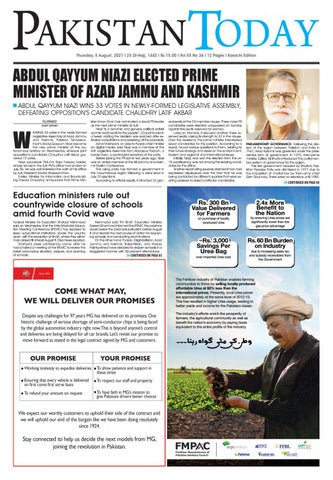
Thursday, 5 August, 2021 I 25 Zil-Hajj, 1442 I Rs 15.00 I Vol XII No 36 I 12 Pages I Karachi Edition
Abdul QAyyum NiAzi elected prime miNister of AzAd JAmmu ANd KAshmir g
ABdul QAyyuM NIAzI WINS 33 vOtES IN NEWly-FOrMEd lEGISlAtIvE ASSEMBly, dEFEAtING OPPOSItION'S CANdIdAtE ChAudhry lAtIF AKBAr ISLAMABAD
W
staff report
INNING 33 votes in the newly formed legislative Assembly of Azad Jammu and Kashmir, Pakistan tehreek-eInsaf’s Abdul Qayyum Niazi became the new prime minister of the autonomous territory on Wednesday, whereas joint opposition’s candidate Chaudhry latif Akbar garnered 15 votes. Niazi succeeds PMl-N’s raja Farooq haider, whose tenure in the AJK PM’s office had ended on July 30. he was administered the oath of his office by AJK President Sardar Masood Khan. Earlier, Minister for Information and Broadcasting Fawad Chaudhry announced that Prime Min-
ister Imran Khan has nominated a local PtI leader as the next prime minister of AJK. Niazi “is a dynamic and genuine political activist and his heart beats for the people”, Chaudhry said in a tweet, adding the decision was reached after extensive consultations and reviewing all the proposals. Azhar Mashwani, an aide to Punjab chief minister on digital media, said Niazi was a member of the AJK legislative Assembly from Abbaspur Poonch, a border town, a central joint secretary of the party. Before joining the PtI some two years ago, Niazi was an active member of the All Jammu and Kashmir Muslim Conference. the ruling party has formed a government in the mountainous region following a clear lead in July 25 elections. According to official results, it clinched 26 gen-
Education ministers rule out countrywide closure of schools amid fourth Covid wave Federal Minister for Education Shafqat Mehmood said on Wednesday that the Inter-Provincial Education Meeting Conference (IPEMC) has decided to keep educational institutions across the country open, with the exception of Sindh, where they will remain closed till at least August 8, Geo News reported. Shafqat’s press conference came after he had chaired a meeting of the IPEMC to review the latest coronavirus situation, closure, and opening of schools.
Mehmood said tht Sindh Education Minister Saeed Ghani had informed the IPEMC the province would review the coronavirus situation before August 8 and decide the next course of action for reopening schools and conducting examinations. On the other hand, Punjab, Gilgit-Baltistan, Azad Jammu and Kashmir, Balochistan, and Khyber Pakhtunkhwa have decided to reopen schools in a staggered manner, with 50 percent attendance.
CONTINUED ON PAGE 05
eral seats of the 53-member house. three more PtI candidates were elected unopposed on Sunday against five seats reserved for women. later on Monday, it secured another three reserved seats, raising its strength to 32 in the house. Over the weekend, the prime minister interviewed seven candidates for the position. According to a report, he put various questions to them, relating to their future strategy and views on the environment, tourism and regional and international issues. Initially, Niazi, who won the election from the lA18 constituency, was not among the leading candidates for the office. Another report citing sources claimed Imran had expressed displeasure over the fact that he was being contacted by different quarters that were exerting pressure to select particular candidates.
PARLIAMENTARY GOVERNANCE: Following the division of the region between Pakistan and India in 1947, Azad Kashmir was governed under the presidential form of government. In 1975, then-prime minister zulfikar Ali Bhutto introduced the parliamentary system of governance for the region. this first government headed by Bhutto’s Pakistan Peoples Party was dismissed in 1977 due to the imposition of martial law by then-army chief Gen ziaul haq. there were no elections until 1985.
CONTINUED ON PAGE 05
02
Thursday, 5 August, 2021
KARACHI
NEWS
U-tUrN comPlete: NaZIr chohaN abaNdoNs JKt, aPologIses to aKbar agaIN
I
NewS DeSk
N an apparent U-turn, Pakistan Tehreek-e-Insaf leader Nazir Chohan on Wednesday abandoned Jahangir Tareen Khan, whose group he was active in, and apologised to Adviser to Prime Minister on Accountability & Interior Mirza Shahzad Akbar. Addressing the media in Lahore alongside Punjab Minister for Prisons Fayyazul Hassan Chohan, Nazir said that he no longer has “any association with the Tareen group”. “Jahangir Tareen used me for his case and then threw me away,” he said. The PTI leader said that he was “never
once called” by Tareen in his hour of need, whereas he went to every court summons of Tareen’s. “I considered him my leader, but he is not fit to be called one,” Nazir said of Tareen. Nazir expressed his gratitude to the senior PTI leadership, naming Chaudhry Pervaiz Elahi and Akbar in particular. “I am grateful to Chaudhry Pervez Elahi who took a strong stance for me,” he said, adding: “Shahzad Akbar was the first to call me when I fell ill and inquired about my health.” “I have apologised to Shahzad Akbar in no unclear terms. I am remorseful over my actions which affected him and his family,”
he said. Nazir went on to state that he has “one leader, and one leader alone”. “His name is Imran Khan.” He said that Tareen “should be ashamed of himself for not even bothering to visit” him in the hospital. The PTI member said that in this entire saga, “the faces of a lot of hypocrites have been exposed”. Fayyazul Hasan Chohan, for his part, acknowledged that conflict within the party had been brewing for a while but that the disgruntled party members took the senior party leadership into confidence over their concerns. “Shahzad Akbar played a positive role in assisting mediation efforts,” he said, adding:
“Nazir Chohan also played a vital role in this regard.” “We have no right to object to anyone’s faith and probe such matters,” he added. Earlier in the day, a district and sessions court in Lahore on Wednesday accepted the bail request of the PTI legislator from Punjab. Nazir was booked in May on the complaint of Akbar who accused the former of levelling allegations concerning his faith during a television programme. Subsequently, the police arrested him last Tuesday but released him the following day after he secured bail, only to arrest him again moments after under cyber laws. Through its order, the court has also directed to release of the suspect after the
PML-N to launch ‘corruption paper’ against PTI on August 17: Marriyum NewS DeSk Pakistan Muslim League-Nawaz Information Secretary Marriyum Aurangzeb said on Wednesday that her party would launch a “corruption paper” on August 17 to highlight the alleged corruption of the ruling party during the past three years. She said this while addressing a news conference in Islamabad. Dawn reported that the former information minister leader claimed the ruling party regularly threw a red herring to divert public attention from core issues of inflation and unemployment. “In July alone, Pakistan witnessed historic inflation as the prices of at least 51 essential commodities skyrocketed in the month. Similarly, the government bought LNG for $15.25 per unit which is 70 per cent more than the purchasing price of PML-N in its tenure,” she
highlighted. She claimed that the PTI had expelled the minister who was about to clinch the LNG deal at $11 and $13 per unit, “but the same was later bought at $15 and as a result, Pakistanis will have to pay $2 billion annually from their pockets”. Lashing out at the government over record imports, she said that there were talks of increasing trade deficit and they were attributed to PML-N, adding that “imports of record $16 billion have been witnessed in July, while 40pc devaluation of Pakistani rupee was seen last month … will the government speak on it?” she questioned. She also claimed that the IMF programme had failed, saying the government hadn’t signed an agreement with it after the budget. The PML-N leader said that if they did not accept the IMF conditions then forthcoming inflation will be damaging for the country and its people.
“Economy doesn’t get fixed through tweets, it is streamlined when you take measures to bring down prices of essential commodities,” she added. Marriyum said that only one person was responsible for all the crises in the country “and that is Imran Khan”. She alleged that Khan made policies for his “ATMs and mafias”, as they help him buy votes in elections. She said that her party would hold daily pressers to expose the PTI’s malpractices. The PML-N spokesperson also rejected reports of various intra-party narratives on public issues, saying the stance of Mian Nawaz Sharif and Shehbaz Sharif were quite clear and their narrative was all about giving respect to the Constitution and the vote. She lamented that the government threw diversions to mislead the public and hide its own “incompetence” under the garb of alleged divisions within the
Justice Isa urges govt to open all civil, military hospitals for Covid treatment ISLAMABAD TLTP
Top court judge Justice Qazi Faez Isa on Wednesday urged the government to get all the public sector as well as combined military hospitals operationalised to treat general public suffering from Covid-19. Earlier on Saturday, Justice Qazi Faez Isa was admitted to a hospital on the advice of his doctors for treatment of Covid-19 infection. At the time of admission, Justice Isa was in good health with mild symptoms, such as cough. Issuing a statement on Wednesday, Justice Isa said that Pakistan is in a
situation that is “no less grave than a war” and a healthcare system where not everyone has access to hospitals would lead to more deaths and sufferings. The Supreme Court judge expressed if all hospitals are not opened for public “class and social divides will further be exacerbated and people continue to suffer and die because of an unequal system”. He further said that the constitution guarantees the right to life as a “fundamental right, of which health is an integral part”. While sharing his Covid-19 “ordeal” in the statement, Justice Isa said, “My wife and I were one of the initial lucky few (less than 2 percent) in the country
who were fully vaccinated as both of us were above 60 — courtesy of the Chinese government. We took every precaution, including always wearing masks in public places, yet contracted the highly infectious Delta variant of the disease. Even with the vaccination, I still had to be hospitalised.” The top judge thanked “very competent doctors and attendants at the Quaid-e-Azam International Hospital all of whom have been integral to the treatment”. He further said the treatment he received was not within the reach of majority of the country’s citizens. “My wife and I are truly blessed for
opposition party. She said that the government was facing embarrassment on various fronts. “Imran Khan is now seeking apology from Shehbaz Sharif, admitting he falsely accused him of corruption. No reply was filed in the court for four years about alleged offer of Rs10 billion by Shehbaz during Panama probe. They are now asking Shehbaz to withdraw the defamation case,” she claimed. She went on to claim that the government also apologised in the UK court regarding a case filed by the Daily Mail. “Where is Shahzad Akbar, he must now hold a press conference on the Broadsheet case and apprise people of the money that will be paid to the court from the public’s pocket,” she alleged. She also said that the Pakistan Democratic Movement had announced a rally in Karachi on Aug 13, adding that it had been postponed due to Covid-19. “Soon we will announce a new date,” she added.
the prayers and support we have received, and bow in abject supplication to Almighty Allah,” he added. Justice Isa criticised the lack of effective social distancing measures by the government. He said, “Internationally recognised and WHO [World Health Organisation] mandated preventive social distancing measures are not being followed [in the country].” “The nation’s health needs to be relegated to expert pulmonologists and other Covid-19 experts who should be brought on TV and radio to explain, warn and educate the nation,” the judge suggested. He added: “Urdu, as well as all other spoken languages and dialects, should be used to communicate. Even the equivalent for the acronym ‘SOP’ [Standard Operating Procedures] has proved elusive. Could ‘Hidayet’ [instruction] or ‘Tibbi Hidayet’ [clinical instructions] not be a start?”
Qureshi asks India to end state-sponsorship of terrorism ISLAMABAD APP
Foreign Minister Shah Mahmood Qureshi on Wednesday called on India to rescind its annexation on August 5, 2019, of Jammu and Kashmir and bring an end to all instruments of oppressions and state-sponsorship terrorism. “India must respect the United Nations Security Council’s resolutions and let the Kashmiris exercise their right to self-determination,” the foreign minister said in his address at the Islamabad Policy Research Institute. Qureshi said India, in a state of “power drunkenness”, had embarked upon a Hitler-inspired Final Solution — a Nazi plan for the genocide of Jews during World War II — to the occupied Kashmir. He termed the August 5 decision a
beginning of intensification of the tsunami of state terrorism. He said the resolutions of the UNSC were cast aside and no tool of cruelty was deemed excessive by the world’s socalled largest democracy. Qureshi said two years on, the Kashmiri people continued to languish in the “largest concentration camp on the planet”. “On top of that, they are being held incommunicado. They do not have access to regular or even emergency medical facilities, a plight not shared even by the worst criminals,” he stressed. He said even Covid-19, which generated unprecedented empathy in the human race, had failed to bring even an iota of relief to the oppressed people. India, he said, was trying to eliminate Kashmiris altogether as the young men were disappearing without leaving a trace. New domicile rules and land laws
were thrust upon the Kashmiris to reengineer the region’s demography, he added. “In its delusion of grandeur, India expected the world, and more pertinently Pakistan, to acquiesce,” he said. Qureshi said Pakistan, guided by the vision of Prime Minister Imran Khan, stood its ground and focused on rousing the international community. “I am happy to note that our efforts have not been in vain. The Security Council has discussed the Jammu & Kashmir dispute thrice since August 2019,” he said. He said the world leaders, parliamentarians, media, humanists and civil society at large had understood that “beyond the smokescreen of Indian sophistry, lies Kashmiris’ perpetual nightmare”. Qureshi said that the government of
Pakistan was absolutely clear that it would continue to lend moral, political and diplomatic support to Kashmiris. He called upon the international community to exhort India to “treat Kashmiris like human beings”. “This will pull out the dagger, which rankles in the heart of bilateral and regional peace and bodes ill for international peace and security,” he said, adding that it would also unlock the potential of South Asia. Qureshi said Pakistan was shifting focus from geo-politics to geoeconomics and wanted peace with India, but not at the expense of the Kashmiris. “We hope Indian leadership will prefer statesmanship over populism,” he said and added that together, it could weaken the extremist narrative through a genuine pacific settlement of a festering dispute.
submission of surety bonds of Rs100,000. The court accepted Nazir’s application after submission of a declaration of settlement by Akbar who announced to forgive the lawmaker for questioning his faith. The cybercrime wing of the agency had booked Nazir on Akbar’s complaint under sections 11 and 20 of Prevention of Electronic Crimes Act, 2016, and read with 298, 500, 505(C), 506 of the Pakistan Penal Code and 29 of the Telegraph Act, 1885. He and some others are accused of running “malicious and hate speech” campaigns against Akbar on social media platforms. Nazir had raised questions about the faith of Akbar.
Verdict reserved on bail plea of Zahir’s parents in Noor murder case ISLAMABAD TLTP
An additional session judge of Islamabad Wednesday reserved verdict over post-arrest bail application of parents of Zahir Zakir Jaffer who has been charged for brutal murder of 27-year-old Noor Mukadam. A heinous crime of murdering Noor who was daughter of former Pakistani diplomat Shaukat Mukadam, came to light on July 20 when she was found dead at a residence in Islamabad’s Sector F-7/4. A first information report (FIR) was registered later the same day against Zahir, who was arrested from the site of the murder, under Section 302 (premeditated murder) of the Pakistan Penal Code on the complaint of the victim’s father. Later on July 24, Islamabad police had also arrested the parents — Zakir Jaffer and Asmat Adamjee — and household staff of Zahir for “hiding evidence and being complicit in the crime”. The parents were later sent to jail on judicial remand till August 9 and subsequently moved a bail petition against their detention. Appearing before the Additional Session Judge Sheikh Muhammad Sohail on Wednesday, the counsel for parents of the accused person advocate Rizwan Abbasi gone through contents of the FIR saying since the first day parents of Zahir publicly condemned the murder. He said the parents were made a part of the investigation on the basis of their son’s statement and that they did not know what was happening in the house where Noor and Zahir were present. Abbasi questioned what false information his clients had provided or what evidence they had hidden, claiming that there was such evidence on record. Meanwhile, public prosecutor Naseem Zia argued that at the time of murder the primary suspect was in contact with the parents, who did not inform the police. “The servant called [them] when the act (Noor’s murder) was being committed but instead of sending police, they sent [employees of] Therapy Works.” The prosecutor argued that a pistol was also recovered from the suspect, and that it was registered in his father’s name. “They tried to save their child on the basis of dishonesty. The bail application should be rejected at this stage,” the prosecutor said. Former judge of the High Court Shah Khawar, the counsel for Shaukat Mukadam, told the court that CCTV footage tie up the parents with the case, adding that the suspect had called his father three times in the evening of July 20 and his mother at 3pm. “This was the time when Noor Mukadam was with Zahir Jaffer. The police station is half a kilometre away [yet] the watchman was not asked to go there. “Prima facie, Zakir Jaffer and Asmat’s act connects with the suspect and that is enough,” Khawar said. At this, the parent’s counsel replied: “Is it a crime for a mother and a son to have contact?” “This is routine communication,” he said, stressing that no script, voice message or WhatsApp message to indicate complicity were found.
Fawad condemns India for not allowing foreign journalists to visit Pakistan ISLAMABAD APP
Minister for Information and Broadcasting Fawad Chaudhry on Wednesday strongly condemned Indian government’s decision for not allowing foreign journalists to visit Pakistan. In a tweet the minister said that India has refused to allow five foreign journalists to visit Pakistan. He said that they were supposed to attend August 5 session of Azad Jammu and Kashmir Legislative Assembly. He said this was making mockery of the slogan of freedom of expression. He said that Pakistan wanted that India should allow independent journalists to visit Indian Occupied Kashmir and let them report facts.
Thursday, 5 August, 2021
KARACHI
NEWS
03
YUSUf reMINdS US Of alterNatIveS aS BIdeN faIlS tO telePhONe IMraN WASHINGTON
N
StAff RePoRt
ATIONAL Security Adviser Dr Moeed Yusuf said Islamabad had a number of other options if the United States continued to give Pakistan and its leadership the cold shoulder. In a conversation with the Financial Times, Yusuf “complained” about President Joe Biden’s failure to contact Prime Minister Imran Khan even as Washington sought help from Islamabad to stop the Taliban from taking over Afghanistan following the withdrawal of foreign troops. “The president of the United States hasn’t spoken to the prime minister of such an important country who the US itself says is make-or-break in some cases, in some ways, in Afghanistan — we struggle to understand the signal, right?” said the official.
“We’ve been told every time that … [the phone call] will happen, it’s technical reasons or whatever. But frankly, people don’t believe it,” he added. Washington has leaned on Pakistan in recent years to help bring senior Taliban leadership to the negotiating table and secure a deal to exit the country with few attacks on US soldiers. But despite calls from Imran to broaden US-Pakistan relations beyond Afghanistan, Biden has yet to call him since taking office this year. “If a phone call is a concession, if a security relationship is a concession, Pakistan has options,” Yusuf said, refusing to elaborate. Pakistan has cultivated deep ties with China, which has invested billions in infrastructure projects as part of its ambitious Belt and Road Initiative. A senior Biden administration official said: “There are still a number of world leaders President Biden has not been able to
speak with personally yet. He looks forward to speaking with Prime Minister Khan when the time is right.” The perceived diplomatic affront marks the latest setback to US-Pakistan relations after their co-operation during the war on terror following the 9/11 attack on the World Trade Center by al-Qaeda, the Islamist group founded by Osama bin Laden. In 2004, the US named Pakistan an official major non-Nato ally, spurred by Washington’s need for support to fight in Afghanistan. But US administrations have since regularly accused their ally of harbouring Taliban insurgents, claims denied by Pakistan. Under Donald Trump’s administration, the US severed $2 billion in security assistance to Pakistan, with the thenpresident accusing Islamabad of “nothing but lies and deceit”. After Trump made a deal with the Taliban that relied heavily on help from
Pakistan, however, he invited Imran to the White House. Yusuf travelled to Washington as part of a delegation including the head of InterServices Intelligence, Gen Faiz Hameed, to discuss the Afghan crisis. A person familiar with last week’s discussions with Biden’s national security adviser Jake Sullivan said the conversation about Afghanistan had been “tough” but that securing a political settlement — which regional experts see as unlikely while the Taliban is making gains on the battlefield — could improve the US-Pakistan relationship dramatically. “There is a lot of effort under way to try to get that [negotiated settlement] process to be a more meaningful process,” said the person. “This is a moment where, arguably, our interests really align, but it’s really up to them to see what they want to do next.” Some analysts in Washington have claimed Imran was snubbed because he is
Accelerating Covid-19 vaccination, govt takes daily inoculations to 1.13m ISLAMABAD StAff RePoRt
The number of coronavirus jabs administered is increasing with each passing day as National Command and Operation Centre on Wednesday said 1.13 million people were vaccinated over the last 24 hours. The development came a day after Pakistan hit a target to vaccinate one million people a day against the contagious disease, making strides in its inoculation campaign just weeks away from a deadline for workers in public-facing roles to obtain vaccination certificates. According to the details shared by the body, vaccinations administered across Pakistan on Tuesday stood at 1,139,580. It further shared the total vaccines administered until now have reached beyond the figure of 33 million. The drive has witnessed a surge in Covid19 vaccinations in recent weeks after the federal government and provinces imposed strict curbs on movement and announced actions against unvaccinated
PM directs to take inspiration from China for waste ban policy ISLAMABAD APP
people. The government announced last week that from the end of this month that workers in schools, shopping malls and hospitality businesses, and the transport and air travel industries would be barred from entering public offices unless they had a certificate. Karachi has also seen an increase in the campaign’s pace with the Sindh government announcing special measures to expedite the process through introducing mobile vaccination units, increasing the number of vaccination centres operating round the clock besides also raising the number of centres in every district of the city. The province has also announced to convert open grounds in Karachi into drive-thru vaccination centres. Murtaza Wahab, a spokesman for the Sindh government, had said that the province administered 222,000 Covid-19 vaccine jabs on Monday besides also sharing a chart showing that one-fourth of the population of Karachi has been vaccinated against the disease. SURGE IN TRANSMISSION RATE IN KARACHI: Meanwhile, after a dip in the surge in Karachi, the
PRIME MINISTER ABDUL QAYYUM NIAZI
A dark horse of politics in Azad Kashmir KARACHI AnAdolu Agency
Prime Minister Imran Khan on Wednesday directed to formulate a comprehensive plan for reducing dependence on imported plastic scrap. Chairing a meeting on waste-management, he instructed to take inspiration from the waste import ban of China for the purpose. China imposed ban on import of waste material, including plastics in 2017, which prevented foreign inflows of waste products into the country. The prime minister said environmental protection was the government’s top priority.The meeting was attended by Special Assistant to the Prime Minister on Climate Change Malik Amin Aslam and senior officials. It was briefed that Pakistan generated 30 million metric tons of waste annually at municipal level, while the plastic waste accounted for 10 to 14 percent of the total waste and would double by 2050. The meeting was apprised that only 30 percent of the 3.9 million tons of plastic waste produced in 2020, was recycled, while Pakistan imported 35,651 tonnes of plastic worth Rs2.4 billion in the last financial year.
NCOC daily update: 4,722 new cases, 46 deaths from Covid-19 ISLAMABAD: Pakistan on Tuesday reported 4,722 new Covid-19 cases, the National Command and Operation Centre said on Wednesday. The NCOC, a department leading campaign against the pandemic, said that the overall confirmed cases reached 1,047,999, including 945,829 recoveries. StAff RePoRt
positivity rate has again jumped to 23.6 percent in the metropolis, despite strict restrictions. The provincial health department today said it noted a three percent surge in this rate. On Tuesday, the Sindh health department had announced a dip in new daily cases in Karachi, recording the rate at 20.1 percent. Sindh has seen soaring coronavirus infections, fuelled by the highly transmissible Delta variant, putting its fragile health infrastructure under extreme pressure. After a sluggish start to the inoculation campaign, the new requirement for certificates of vaccination has led to a rush of people seeking shots, with queues stretching over a kilometre outside some vaccination centres, notably in Karachi. The Sindh government has put extra pressure on people to get vaccinated, warning that it would withhold the salaries of government servants and block people’s cell phone SIM cards unless they had the required certificates.
Little-known Abdul Qayyum Niazi turned out to be a dark horse, winning an intense race for the office of prime minister of Azad Jammu and Kashmir. Niazi, 61, was elected as a member of the Legislative Assembly in the July 25 elections from Poonch district, which lies on the Line of Control (LoC) – a de facto border that divides Jammu and Kashmir between nucleararmed rivals Pakistan and India. Until last week, he was not even in the race. His name echoed in the media after being interviewed by Pakistan’s Prime Minister Imran Khan, who is also the chairman of Pakistan Tehreeke-Insaf (PTI) party, which won majority seats in the polls. Yet, political pundits did not consider him to be serious contender for the top office as he is a new entrant to the party. His nomination superseded several top party leaders and strong candidates for the coveted post, particularly PTI Kashmir president and former premier Barrister Sultan Mahmood Chaudhry, and billionaire Sardar Tanveer Ilyas. It is said that that a tug-of-war between the two heavyweights cleared the way for Niazi to get the prime minister’s office. His surname – Niazi – confuses many who consider him hailing from the tribe of the Pakistani premier. He, however, is from the Mughal community, which is scattered across AJK. POLITICAL CAREER: Born in 1959, Niazi is a veteran politician who
LITTLE KNOWN POLITICIAN WINS INTENSE RACE FOR PREMIERSHIP OF THE AUTONOMOUS TERRITORY
started his political journey as a district councilor. Hailing from Darra Sher Khan village, which sits on the LoC, he was twice elected as a district councilor between 1980 and 1990. He started his mainstream political journey from the platform of Jammu and Kashmir Muslim Conference (JKMC) – the oldest political party of undivided Jammu and Kashmir – in the 2006 elections. He managed to win his first
election, and was appointed as food minister by the then-AJK Prime Minister Sardar Atiq Ahmad Khan. He also served as minister for prisons during the same tenure. Niazi contested the next two elections representing JKMC – in 2011 and 2016 – but lost. In October 2017, he joined the PTI, following its rise in the valley. He is also serving as the joint secretary of the PTI’s AJK chapter.
seen as an extension of security and military apparatus. “There is no question of a civilmilitary disconnect in Pakistan. Let me be categorical: if the Prime Minister had not instructed me and the delegation to be here, we won’t have been here,” said Yusuf, who added that Pakistan had diminished leverage over the Taliban. During the visit, US broadcaster PBS aired an interview with Khan in which he said the US had “really messed it up” in Afghanistan, adding that Washington had treated Islamabad “more like a hired gun”. It was one of a recent slew of criticisms aimed at US audiences that struck some American officials as oddly timed given Pakistan’s efforts to secure a reset. Yusuf said his talk with Sullivan had been “constructive” but that Pakistan would “reconsider” such media appearances if they were backfiring, saying the goal was “not to upset anybody [but to] put very forthrightly Pakistan’s view on the situation”.
Pakistan writes to UNSC again calling attention to India’s ‘illegal, draconian’ steps in IOK ISLAMABAD APP
Foreign Minister Shah Mahmood Qureshi, on completion of two years since India’s illegal and unilateral actions in Indian Occupied Kashmir (IOK), has sent a letter to the United Nations Security Council (UNSC) and UN Secretary General, highlighting the continuation of draconian measures. “In his letter, the foreign minister has drawn attention to the blatant measures taken by India on 5 August 2019 to consolidate its occupation of the disputed territory, followed by additional unlawful steps to strengthen its colonial hold over IIOJK,” the Foreign Office said Wednesday, on giving details of the letter. The latest letter from FM Qureshi is in continuation of Pakistan’s regular communications since August 2019 to keep the UN fully apprised of the grave situation in IOK, and to remind the UNSC of its responsibility to secure a peaceful and just settlement of the Jammu and Kashmir dispute in accordance with its resolutions. The foreign minister in his letter highlighted the illegal changes to the demographic structure and electoral boundaries in the occupied territory, aimed at further marginalisation of Kashmiri Muslims to suppress their demand for freedom from Indian occupation and repression. He categorically rejected all unilateral measures initiated by India in IOK, including the illegal measures announced by it on and after 5 August 2019, as well as any further unlawful steps that may be imposed in the future. “The Foreign Minister has underlined that all such measures by India in IOKare violations of international law, including the UNSC resolutions and 4th Geneva Convention, and, are ipso facto, legally and materially, null and void,” the FO said. The letter highlights that, in order to suppress the people in IOK, India has deployed 900,000 security personnel, enforced the most extended curfew and lockdowns, imprisoned the Kashmiri political leadership, illegally detained 15,000 Kashmiri youth, tortured and extra-judicially killed young boys, put down peaceful protests violently, including by the use of pellet guns and imposed collective punishments by demolishing and burning entire neighbourhoods and villages. Noting India’s active planning as well as promotion and financing of terrorist activities against Pakistan from across the borders, including the recent bombing in Lahore, the foreign minister urged the Security Council to demand that India halt its terrorist and subversive campaign against Pakistan. He stressed that to ensure sustainable peace in South Asia, the onus remains on India to create a conducive environment for engagement and result-oriented dialogue. “To create such an environment, India must reverse all unilateral and illegal measures imposed in IIOJK, including those initiated on and after 5 August 2019, rescind the demographic changes initiated in IIOJK and halt its oppression and human rights violations in IIOJK,” he said. The foreign minister called upon the Security Council to fulfil its obligation to ensure the full implementation of its resolutions guaranteeing the exercise of Kashmiris’ right to self-determination.
Thursday, 5 August, 2021
04 NEWS
KARACHI
PSX GaInS 31 PoInTS In RanGe-Bound SeSSIon KARACHI
T
TLTP
HE Pakistan Stock Exchange (PSX) consolidated gains on Wednesday in a range-bound trading session, with the benchmark KSE-100 Index gaining 31.56 points (+0.07 percent) to close at 47,789.88 points. Overall, the KSE-100 Index has gained 734.59 points in the last three sessions. The market opened on a positive note but it switched between the green and red zones; however, the market remained positive for most part of the session. The KSE-100 Index moved in a range of
270.8 points, showing an intraday high of 47,980.1 points and intraday low of 47,709.3 points. Among other indices, the KSE All Share Index gained 58.27 points (+0.18 percent) to close at 32,664.17 points, while All Share Islamic Index shed 1.33 points (-0.01 percent) to close at 23,390.16 points. A total of 399 companies traded shares in the stock exchange, out of them shares of 179 closed up, shares of 198 closed down while shares of 22 companies remained unchanged. Of the 98 traded companies in the KSE100 Index 46 closed up 49 closed down, while 3 remained unchanged. The overall market volumes increased by 89.74 million to 532.95 million shares.
The number of total trades increased by 6,599 to 162,559; however, the value traded decreased by Rs1.04 billion to Rs15.15 billion. On the other hand, the market capitalisation increased by Rs14.95 billion. Among scrips, TELE topped the volumes with 58.18 million shares, followed by HASCOL (49.69 million) and WTL (45.7 million). Stocks that contributed significantly to the volumes include TELE, HASCOL, WTL, TPL and PACE, which formed over 40 percent of total volumes. The sectors propping up the index were commercial banks with 56 points, oil & gas marketing companies with 17 points, chemical with 13 points, food & personal care prod-
ucts with 8 points and investment banks/ investment companies/ securities companies with 5 points. The most points added to the index were by ANL which contributed 19 points followed by MEBL with 19 points, HBL with 19 points, SNGP with 17 points and POL with 16 points. The sector wise, the index was let down by cement with 28 points, technology & communication with 21 points, refinery with 15 points, pharmaceuticals with 8 points and engineering with 5 points. The most points taken off the index was by TRG which stripped the index of 16 points followed by PPL with 9 points, GATM with 9 points, DGKC with 9 points and BAHL with 8 points.
According to analysts, the domestic equity market witnessed a range-bound trading session owing to the lack of positive triggers. They said that investors’ interest remained subdued on the back of substantial decline of 19.4 percent in cement sales during July 2021. However, revision of SDR allocation by the International Monetary Fund (IMF) and surging vaccination activity managed to add 31.56 points to the benchmark index. They said that the market oscillated between -49 points and +222 points, ending the session +32 points. According to the, profit booking brought the index down from session’s high, which seemed plausible after bullish activities in the past couple of sessions.
Crude prices fall for third day; WTI slips below $70 mark NEWS DESK Oil futures continued their downward slide for the third straight day on Wednesday amid the coronavirusinfluenced economic concerns. At 1355 hours GMT, Brent, the international benchmark for two-thirds of the world’s oil, shed $0.92 (-1.27 percent) to reach $71.49 a barrel. Similarly, the US West Texas Intermediate (WTI) reached $69.41, down by $1.15 (-1.63 percent). The price for Opec Basket was recorded at $73.89 a barrel with 1.45 percent decrease, Arab Light was available at $72.54 a barrel with 0.37 percent decrease, while the price of Russian Sokol slipped to $72.20 after shedding 0.30 percent. According to experts, oil prices are on the back foot on mounting concerns that the increasing spread of the delta variant of the coronavirus in top-consuming countries including the United States and China will cut fuel demand. The United States and China are grappling with rapidly spreading outbreaks of the highly contagious delta variant that analysts fear will limit fuel demand at a time when it traditionally rises in both countries as the summer travel season hits its peak. They said that US stockpile data has provided some support for prices as crude oil, distillate and gasoline inventories declined. Crude stockpiles fell by 879,000 barrels for the week ended July 30. Gasoline inventories fell by 5.8 million barrels and distillate stocks fell by 717,000 barrels, according to the people familiar with the development.
ISLAMABAD: A large banner has been placed near the Constitution Avenue to mark Black Day on August 5. ONLINE
Rupee gains 42 paisas to brake dollar’s upsurge NEWS DESK Pakistan rupee snapped the losing streak against the US dollar after three straight sessions on Wednesday and appreciated by Rs0.42 (+0.26 percent) in the interbank. According to the State Bank of Pakistan, the US dollar opened at Rs163.89 and closed at Rs163.47. Within the open market, the rupee was traded at Rs163.20/164 per dollar. Overall, Pakistani rupee has shed Rs1.04 against the US dollar during the last three days, while depreciation during the fiscal year 2021-22 has been Rs6.11. The local unit has shed Rs3.38 against the US dollar in the current year 2021. The currency dealers said the market witnessed sufficient supply of dollars on the day. They said that reports of additional allocation from the International Monetary Fund, around $2.8 billion by the end of the current month, gave support to the local unit. They said the payment against external debt may put pressure on the local currency. They were, however, optimistic that inflows of export receipts and workers’ remittances would help the rupee make further gains in the coming days.
Gold price surges to Rs96,000 per 10gm NEWS DESK Gold traded up in the international market on Wednesday amid a weaker US dollar and a minor bounce in the Treasury yields. At 1140 hours GMT, gold in the international market was available at $1820.10 per ounce after gaining $8.60 as compared to its closing value on Tuesday last. Meanwhile, the price of 10 grams of yellow metal in Pakistan increased to Rs96,000 after gaining Rs200. The closing prices of the yellow metal in the country remained Rs95,800 on Tuesday last. According to experts, gold price is making gains after ending the last three sessions in the red, as traders preferred to stay on the sidelines ahead of the key US Nonfarm Payrolls release, which will provide fresh signals on the Fed’s next policy action. However, the recent weakness in the US Treasury yields helped gold price hold its footing above the $1820 mark.
WB emphasises on timely completion of policy reforms NEWS DESK Emphasising on timely completion of the ongoing policy reforms and development projects, the World Bank officials have said that WB greatly values its partnership with Pakistan and supports the reform agenda. These views were expressed by World Bank’s South Asia Regional Vice President (SARVP) Hartwig Schafer and Country Director Najy Benhassine during a meeting with Federal Minister for Planning, Development & Special Initiatives Asad Umar on Wednesday. Welcoming the WB officials, the planning minister acknowledged the significant contribution of the World Bank in the socio-economic development of the country. He appreciated the pivotal role currently being played by the World Bank in strengthening governance and service delivery in Pakistan through institutional reforms being undertaken with the support of development partners.
Hartwig Schafer said that the World Bank greatly values its partnership with Pakistan. He also acknowledged the efforts made by Pakistan for effective management of the Covid-19 crisis. He said that WB is fully committed to providing assistance to the developing countries for procurement of Covid-19 vaccines. He highlighted that Pakistan’s efforts to curtail the Covid-19 pandemic through a smart lockdown approach and addressing the socio-economic challenges through a fiscal stimulus package under Prime Minister Imran Khan’s vision of lives and livelihoods are being highly recognised and appreciated by the global community. He further emphasised on timely completion of the ongoing policy reforms and development projects. He also commended the efforts of the Ministry of Planning to resolve long outstanding bottlenecks and expedite the project implementation on a fasttrack basis which is evident from the enhanced disbursement during the last fiscal year.
Bitcoin bounces back to $38,290 as crypto market remains optimistic NEWS DESK Optimism remained rampant in the cryptocurrency market despite intraday losses on Wednesday, with the market cap decreasing 0.6 percent to $1.62 trillion as of 1310 hours GMT. The price of Bitcoin (BTC), the largest cryptocurrency, increased to $38,290 after gaining 1.40 percent. With this increase in price, the market capitalisation of the BTC has reached $718.9 billion. Likewise, ethereum (ETH) price gained 2.1 percent to reach $2,510. With this increase in price, the market capitalisation of ETH has reached $293.5 billion. On the other hand, XRP gained 0.62 percent to reach $0.708. The market capitalisation of XRP stands at $70.8 billion after this increase. Similarly, Cardano (ADA) price reached $1.35 with a 4.88 percent increase in its price. Its market capitalisation has reached $43.4 billion after this increase. Likewise, Dogecoin (Doge) price appreciated by 0.86 percent to reach $0.197. With this increase in price, the market capitalisation of Doge reached $25.7 billion. Earlier in the day, Bitcoin returned to hit local lows of $37,500 in a fresh instalment of its comedown from above $42,000. A look at order book data from major exchange Binance highlighted the veracity of support at $36,000, with sellers lined up at $41,000 and above. Meanwhile, in terms of market sentiment, interest in higher price levels was firm throughout the week despite the retracement. Strong on-chain data combined with conspicuous, albeit unknown, buying activity to buoy bulls further, said the experts.
OIC plans three trade event in Pakistan: envoy ISLAMABAD TLTP
Rizwan Saeed Sheikh, Ambassador of Pakistan to the Organisation of Islamic Cooperation, has said that OIC Pakistan Desk is keen to organise a food festival, trade fair and trade ambassadors’ meeting in the country to increase Pakistan’s trade with the Islamic world. Sheikh said this during his visit to the Federation of Pakistan Chambers of Commerce and Industry (FPCCI) office where he met with business community
delegates, according to a statement issued on Wednesday. He said that a food festival in Lahore, a trade fair in Karachi, and trade ambassadors’ meeting in Islamabad would be held in near future. “We need cooperation and coordination of the private sector in these events,” he added. He said now it is the era of technology and the world is now a global village. “Let’s work together to bring Pakistani products to the OIC market and focus on strengthening trade relations between Pakistan and other OIC countries.”
CMYK
He said that Pakistan has potential for enhancement of trade and he would work for export promotion. “We are always available to resolve the problems of the Pakistani business community while communicating with the OIC countries,” he said. Sheikh said that Pakistan is basically an agricultural country, and it should have a rich contribution in Halal food industry, but, unfortunately, its share is negligible. He said that Iran, Malaysia, UAE, Oman and other Islamic countries are very keenly and positively using the OIC platform.
Sheikh said, “We need to be active and use our energies for interaction with OIC countries, as until and unless we have trade enhancement, our brotherly relationships will not be that much strong as it has to be,” he said. On the occasion, Haji Qurban Ali, head of FPCCI Capital Office, and Mirza Abdul Rehman, Coordinator FPCCI office, said that FPCCI facilitation desk is always available to provide any services needed by the OIC Pakistan Desk. They said that the business community always stands with the OIC.
Thursday, 5 August, 2021
KARACHI
NEWS
05
GloBAl INvestMeNt BANKs eArN $170BN yeArly profIt
engro fertilizers Wins three Awards at pakistan Digital Awards Engro Fertilizers Limited, Pakistan's premier seed-toharvest solutions provider, has been recognized as the “Most Innovative Fintech Solution Provider”, “Best Payment Technology” and “Best Banking Tech of the Year” at the prestigious Pakistan Digital Awards 2021. Faced with the challenges of COVID-19 pandemic, Engro Fertilizers was quick to adapt to the new normal and led the industry towards digitization in all respects, from customer and vendor support to digital payment solutions and virtual operations. This was the first time that the Company was participating at the Pakistan Digital Awards. Out of the 94 categories, it was able to bag three Best in Class awards at the ceremony. Receiving this award, Imran Ahmed, CFO of Engro Fertilizers Limited, shared “The digitization journey that we embarked on a couple of years back has finally started to deliver results as we are now benefiting from improved availability of quality information and better control environment. We are thrilled by this recognition that was in the face of stiff competition. This encourages us to redouble our efforts in leveraging digitization to deliver operational excellence and differentiated customer experiences in the days and years to come”. With “The Best Banking Tech of the Year” and “Best Payment Technology” award, Engro Fertilizers has been celebrated for setting new standards in the fertilizer industry through the launch of various innovative and automated financing solutions in engagement with its banking partners. It co-created Pakistan’s first-ever solution to electronically manage bank guarantees that will transform this banking process. The initiative has reduced ordering cycle, provided customers convenience by not requiring them to make a physical visit to the bank and enhanced corporate services. Further, the move towards paperless operations has resulted in a favorable impact on the environment, and ensured transparency and swiftness of transactions. In the “Most Innovative Fintech Data Solution Provider” category, the Company has been recognized for the group-wide implementation of new Enterprise Resource Planning (ERP) system OneSAP, which has been endorsed as Pakistan’s largest SAP S/4 HANA digital business transformation. By leveraging this technology, the Company was able to achieve the global benchmark in financial reporting by ensuring monthly closing within 24-hours. PR
Abdul Qayyum Niazi elected prime minister of Azad Jammu and Kashmir continued from page 01 The Muslim-majority region is held by Pakistan and India in parts and claimed both in full. A small sliver of land is also held by China. Since India revoked autonomy and annexed the part that it is holding into two centrally administered territories on August 5, 2019, elections in Azad Kashmir have attained considerable significance.
t
HE biggest global investment banks are minting money like never before amid the coronavirus pandemic, as the financial statements show a total profit of more than $170 billion from a dozen of the biggest firms in the past four quarters. A string of trading wins certainly helped the sector in the early days of Covid-19 and as last year’s market volatility faded, investment bankers were ready to fuel the boom in takeovers and fundraising through special purpose acquisition vehicles. Banks with wealth and asset management units enjoyed buoyant equity markets as the world economy began to recover, aided by unprecedented government support programmes. The same trend also proved a boon to retail units, long seen as a drag on earnings, as they started to unwind loan loss provisions. Goldman Sachs and Morgan Stanley also broke their profit records, while European counterparts UBS Group and Barclays posted their highest earnings in a decade as the likes of Deutsche Bank and Societe Generale credited the improving world economy for boosting their business. Banking stocks reflect this strong run of results, with the Dow Jones US Banks Index up 59
percent over the past year and the Eurostoxx Banks Index up 56 percent. Elevated market activity benefited traders who were once out of favour at Deutsche Bank and Barclays, while JPMorgan’s investment bank posted its best quarter in history thanks to deal-making and advisory fees. This upswing in corporate activity mirrored optimism in many parts of the global economy after months of Covid restrictions. In turn, banks felt confident enough to start unwinding vast reserves built for an economic meltdown that hasn’t arrived. In Europe alone, the top 9 banks reported an 88 percent decline in provisions in recent weeks. “All of the banks we rate in the UK and Europe are still holding back material reserves for expected credit losses given the remaining uncertainty,” Laurie Mayers, associate managing director at Moody’s Investors Service in London, said. “The more positive outlook for major economies including house price inflation is, however, driving pressure on banks to release provisions.” Some lenders such as HSBC Holdings are using their extra headroom to reward shareholders as central banks start to relax limits designed to promote lending
during the pandemic. “We definitely feel more confident,” the UK lender's chief financial officer, Ewen Stevenson, said on Bloomberg Television. “We will keep buy-backs under review” together with dividends, he said. With the pandemic still blazing in several regions of the world and rock-bottom interest rates weighing on banks’ lending income, it remains to be seen if the industry can continue breaking profit records. Investors may cast a sceptical eye towards the reserve releases that have flattered earnings in recent quarters, yet they “are a function of the underlying macroeconomy and underwriting acumen”, said Jefferies analyst Joseph Dickerson. “Some of the revenue trends may sustain themselves, particularly as fee income continues to recover and while large-scale writebacks may not repeat, we continue to believe that consensus estimates for credit costs are too conservative,” Dickerson said. Susannah Streeter, senior investment and markets analyst at Hargreaves Lansdown, said in a note after HSBC’s earnings that the investment banking upswing could be subsiding, having supported lenders through the lean months for retail banking. NEWS DESK
Education ministers rule out countrywide closure of schools amid fourth Covid wave continued from page 01 Decisions taken: n Schools to open in a staggered manner. n 50 percent attendance to be observed. n Universities, colleges to open with no restrictions. n Sindh’s schools to remain closed till August 8. n Exams to take place according to time table. n Sindh to announce time table later. n Students to get 5 percent extra marks in exams. The IPEMC decided to reopen universities and colleges with no restrictions imposed, however, the participants of the meeting expressed concerns over the coronavirus situation in higher education institutions, he said. “The overall vaccination in education [sector] has reached 83%, but the inoculations are lagging in higher education institutions which should be ramped up,” the education minister said. For this, the education ministers have been urged to make special efforts to get university students — as they are above 18-years of age — and teachers vaccinated, Mehmood said. In this regard, it is crucial that transport personnel get vaccinated and a deadline of August 31 has already been set for them, the education minister said. Mehmood said all the examinations would continue according to schedule, while there will be changes in Sindh’s timetable. “The exams of classes 9, 10, 11, and 12 will take place in accordance with their date sheet.” Shedding light on an important decision, he said the IPEMC had decided to conduct examinations of only elective subjects, and the marks obtained in them would be proportionally allocated for compulsory subjects. “The IPEMC has decided the students would be given an additional 5% marks in exams as according to a research, the students get better marks in compulsory subjects,” he said. “The next education-related meeting will take place on August 25, along with the National Command
and Operations Centre. Till then, these decisions will remain in place,” Mehmood said. For now, I request students to not pay heed to news on social media as there are a lot of rumours there, he said, adding authentic news would be announced by the education ministry. “Every decision we take is in the best interest of students.” All the provincial education ministers, relevant senior officials, and Special Assistant to Prime Minister on Health Dr Faisal Sultan attend the meeting. The participants had discussed the start of the new academic session, reopening of schools in light of the current Covid-19 situation, and vaccination of schoolteachers and other staff members. Actions to strengthen performance for inclusive and responsive education, funding, coordination, and reporting also came under discussion. Following the meeting, Education Minister Ghani said all educational institutions in the province would remain closed till August 8 and the remaining intermediate exams in Sindh will take place after the coronavirus situation gets better. The education minister, in a statement, said that the educational institutions will remain closed in line with Sindh’s coronavirus restrictions imposed as part of a province-wide lockdown. “The coronavirus situation in Sindh, and especially Karachi, is not satisfactory,” the education minister said, adding it the decision would be reviewed on August 8. Ghani stressed that the coronavirus cases in Karachi and Hyderabad were much higher as compared to other parts of the country. Keeping that in mind, it is not feasible to reopen schools, he said. “The provincial coronavirus task force will meet on August 8 and will decide the way forward,” the education minister said. Sindh had suspended all exams after it imposed a lockdown in the province on July 31, also suspending all in-person education-related activities.
MCB Bank enters into alliance with Alchemative for Internet Gateway payment services Lahore: MCB Bank Limited, one of Pakistan’s leading Banks, has entered into an alliance with Alchemative, an innovative and customer-centric technology company, for providing progressive financial and digital services to ecommerce companies. This strategic partnership is aimed at providing a one stop solution to eCommerce businesses for all of their online retail business needs. Under this agreement, MCB Bank and Alchemative will grant each other Preferred Partner status and will provide a host of financial and digital services to eCommerce merchants, including Internet Payment Gateway services, Tokenization services, Real Time Fraud Filtering, Application development, eCommerce website design and development services, website management and other technical support services all through one unified platform.The agreement was signed between Mr. Salman Nisar Ahmed, Business Head, Digital Banking, MCB Bank and Mr. Omer Farooq, CEO, Alchemative at MCB House, Lahore. Mr. Shahzad Ishaq, Group Head, Consumer & Digital Banking, MCB Bank, Mr. Jasim Ahmed Waheed, Department Head Acceptance, Digital Banking, MCB Bank, Mr. Umer Qasim, Product Manager eCommerce, Digital Banking, MCB Bank, Mr. Muhammad Tayyab, Director Technology, Alchemative and Mr. Ali Abbas, Director Ecommerce, Alchemative were also present at the ceremony. PR
To build a community of health for all nong rong The once-in-a-century Covid-19 pandemic is still wreaking havoc, posing a great threat to the lives and health of people all over the world, and a big challenge to global public health. In the face of this common crisis for mankind, the international community needs solidarity and cooperation more than ever. Regrettably, an unhealthy trend of politicization of the origin-tracing of the coronavirus by certain countries have seriously undermined the global combat against the pandemic, instigating the WHO Secretariat to unilaterally put forward a plan for the second phase of studies into the origins of coronavirus, without the consent of Member States. Many countries have raised concerns and voiced objection to the move. It is a shared belief that the plan is inconsistent with the resolution of the 73rd WHA, or the conclusions and recommendations of the China-WHO Joint Study of the Origins of the Novel Coronavirus. It failed to reflect the
latest outcomes of global research and cannot serve as the basis for the second phase of joint origin studies. 70 countries have written letters, made statements or sent notes to the WHO Director General, stating that they welcome the China-WHO Joint Study of the Origins of the Novel Coronavirus and reject politicizing virus origin-tracing issue. Over 300 political parties, social societies and think tanks in over 100 countries and regions have also submitted a joint statement to WHO Secretariat, calling for WHO to carry out global virus origin-tracing research in an objective and fair manner. This is the legitimate appeal and voice of justice from the international community. China has always taken an open, trans-
parent, scientific and cooperative attitude on the issue of origin-tracing. China has taken the lead in cooperating with the WHO on origin-tracing, and has twice invited WHO experts in for origin-tracing studies, and opened the Wuhan Institute of Virology to international experts. China is ready to actively participate in the origin-tracing studies in a truly scientific manner, meanwhile is firmly against the use of origin-tracing as a tool for political gain and an excuse to slander other countries. As the largest developing country and a responsible member of the international community, China has always championed to the vision of building a global community of health for all, and supported global cooperation in the fight
cmYK
against the pandemic. At the Global Health Summit in May this year, President Xi Jinping made an important address and clearly advocated unity and cooperation among the international community. President Xi promised that China will provide an additional 3 billion US dollars in international aid over the next three years to support Covid-19 response and economic and social recovery in other developing countries. China supports its vaccine companies in transferring technologies to other developing countries and carrying out joint production with them. China proposed to set up an international forum on vaccine cooperation for vaccinedeveloping and producing countries, companies and other stakeholders to explore ways of promoting fair and equitable distribution of vaccines around the world. As of July, China had provided more than 500 million doses of vaccines and its raw fluids to more than 100 countries and international organizations, equivalent to one-sixth of the current global production of Covid-19 vaccines, and
contributed to the accessibility and affordability of vaccines in developing countries. Since the outbreak of Covid-19, China and Pakistan have worked hand in hand to help each other, setting a good example for global cooperation against the pandemic. China has made Pakistan a priority for vaccine aid and exports, providing more than 35 million doses of the vaccine to Pakistan as of July. At 3rd Round of China-Pakistan Foreign Ministers' Strategic Dialogue held recently, the two sides agreed that the origin-tracing of the coronavirus is a scientific task, and should not be politicized. China also appreciates Pakistan's joint letter to the Director-General of WHO and the statement issued by Ministry of Foreign Affairs of Pakistan, stressing that virus tracing is a scientific task and clearly opposing the politicization of the origin-tracing of the coronavirus. China will continue to meet the vaccine demand of Pakistan within all its capacity, and assist Pakistan in strengthening the national health system and tackling the disruptions of the pandemic to economic and social development. The writer is the Chinese ambassador to Pakistan
Thursday, 5 August, 2021
06 COMMENT
A disaster called Pakistan Muslim League
CPEC and PTI officialdom From CPEC Authority to Pak-China Relations Steering Committee
How the League was turned into a ‘Toady Party’
P
AKISTAN and China had launched CPeC in 2015 with an initial investment portfolio of about $46 billion which was subsequently increased to $60 billion. however, the actual investment remained far below. he PML(N) initially treated CPeC as a special gift to it from the Chinese government, keeping details of development plans close to its chest, which caused bickering between the government and opposition parties. Beijing had to step in to put an end to the disputes. What goes to the credit of the PML(N) government however was that the first phase of the CPeC comprising roads and power plants was by and large completed on time. The pace of CPeC developments was remarkable, particularly in Punjab. The PML(N) failed to provide a legal status to the CPeC Authority. This was done by the PTI first by introducing an Ordinance in 2019 followed by a CPeC Authority Bill passed by the National Assembly in 2020 to further fast-track the project. The CPeC Authority finally got legal cover in May 2021 with the unanimous passage of the Bill by the Senate in the absence of the opposition. The road to CPeC’s completion has proved long and winding. While in opposition many PTI leaders had accused the PML(N) leaders of indulging in corruption while undertaking CPeC projects. The PTI leadership was unwilling to give credit to the PML(N) for the project. Soon after assuming power, the PTI govt dropped a number of CPeC projects, including those connected with Gwadar city from the PSDP. Presently five CPeC power projects face delays. As time passed, a perception was formed that CPeC had been put on the back burner, even though it was so crucial not just to Pakistan, but the whole Belt and Road Initiative of China. Moves are afoot now to change the perception. On Tuesday the PM appointed Khalid Mansoor SAPM CPeC. This was followed by CPeC Authority Chairman Asim Saleem Bajwa’s resignation. Last month the PM had set up a Pak-China Relations Steering Committee headed by Asad Umar and comprising over a dozen members including federal secretaries, high-level military and ISI officials. The steering committee is supposed to create inter-ministerial synergy and help remove impediments in coordination, finalisation and execution of projects. Nice verbiage, provided it produces results that alone will determine if the government is serious about CPeC.
Dr FariD a Malik
M
y late father Nazir A. Malik, joined the All India Muslim League (AIML) in 1935 and rose to be its Secretary Finance and Vice President of the Ludhiana chapter. After Partition in 1947, the family migrated to Pakistan with high hopes and aspirations. Like most freedom loving, upright and honest party members, my old man got disillusioned with the party which fell into the ‘Toady Trap’. As loyalty was the hallmark of Jinnah’s leadership, he never joined any other political outfit. however at the fag end of his innings, the old guard organized themselves under the banner of ‘ Karkunane Tehreek-e-Pakistan led by Nawab Zulfiqar Mamdot. For his struggle in the freedom movement, Malik Sahib was bestowed with the Tehreek-e-Pakistan Gold Medal on 14 August 1990 which now hangs in my study as a token of thanks to that generation that not only delivered but also realised the dream by their untiring efforts to build national institutions. I was born and raised as a Muslim League child, and portraits of Quaid-e-Azam Muhammad Ali Jinnah and the other founding fathers were displayed all over the house. Stalwarts of the freedom movement like Khan Qayyum Khan and hussain Shaheed Suharwardy did try to rekindle the original spirit, but were soon sidelined or cornered. It took me a while to understand that the Pakistan Muslim League (PML) was not the continuity of the AIML, the founding party of the country. The honeymoon or transition was shortlived. As President of the AIML, the Quaid presided over the executive Committee (eC) meeting of the party. he desired a constitutional transition of the new political entity but the eC under the ‘ Toady Influence’
NSA’s great
wanted him out. After repeated unsuccessful attempts, Jinnah walked out of the meeting and severed all his links with the PML. Chaudhry Khaliq-uzZaman replaced the father of the nation to lead the newly formed ‘Toady League’. It proved to be the beginning of the end for the founding party of the country. While the rotten stayed behind, the scrupulous like Suharwardy, Maulvi Fazal haq and Mian Ifthikaruddin branched off. The Quaid continued as Governor General but had no say in running the party. By July 1948, his health deteriorated and he left for Ziarat, where he spent his last 60 days only to return to die on a Karachi footpath. his sister Madre Millat Fatima Jinnah was confined to her residence. After the murder of the first Prime Minister Nawabzada Liaquat Ali Khan in 1951 it was all over. There was a ‘Grand Alliance of Toadies’ that took control to manipulate the democratic order. Ghulam Muhammad was followed by Iskander Mirza and finally Ayub Khan landed on the saddle. The first dictator called ‘Toady League’ for support which caused its split. A building located at 33 Davis Road was named ‘Muslim League house’ and made available. Keeping the ‘Toady’ traditions alive, the faction led by Chaudhry Khaliq decided to move there and was called PML (Convention) while those who stayed behind were named PML (Council). Several brand of Muslim Leagues were launched from this building which has proven to be the ‘Freemasons Lodge’ of Democracy. After the 1985 partyless elections both Muhammad Khan Junejo and Mian Nawaz Sharif were launched from here under the banner of PML (Pagara). Later PML (Nawaz) and PML (Quaide-Azam) were also incubated here. In 1965 Ayub Khan contested the Presidential elections against Madre Millat on a PML (Con) ticket while the combined opposition supported her. She was called a traitor by some of the PML stalwarts
who are now a part of the PML(N). Ms Jinnah demanded restoration of the 1956 Constitution to save the federation, while those who opposed her are responsible for the break-up of Quaid’s Pakistan, and their guile and cover-up cannot hide their disservice to the motherland. Last week there were two very disturbing happenings. Imran Khan, after resisting the induction of Moonis elahi into his Cabinet finally succumbed to the traditional PML(Q) blackmail. The second was a TV discussion in which Aftab Iqbal the brilliant host suggested that Pervaiz elahi should have been appointed Chief Minister of Punjab. The entire election campaign of PML(N) in Azad Kashmir has been derogatory to the cause of freedom, the speech of the Kashmir Affairs Minister was also inappropriate but it was directed more against an individual. Chaudhry Zahoor elahi, a dismissed sub-inspector of Police, was launched in Punjab to derail the democratic order and the dynasty has lived up to its design. The Sharifs were introduced by the third usurper to neutralize the democratic gains of the Bhutto regime and to damage civilian institutions which they have done with impunity together with building their personal empires. The temptation of wealth generation was so overwhelming that even Bhutto’s party under the leadership of Zardari fell into the trap. For the democratic order to take root, ‘Toady Parties’ like the PML have to be dealt with. Bhutto banned the ‘ Freemasons Movement in Pakistan ‘ and took over their lodge located at 90 Shahrae Quaid-eAzam. It is time to shut down the ‘Freemasons Lodge of Democracy’ on Davis Road that has been the incubator of all brands of PMLs. As a Muslim League child, with sorrow and pain I demand the dismantling of all brands of PML for causing immeassurable damage to Pakistan and its nascent democracy.
For the democratic order to take root, ‘Toady Parties’ like the PML have to be dealt with. Bhutto banned the ‘ Freemasons Movement in Pakistan ‘ and took over their lodge located at 90 Shahrae Quaid-e-Azam. It is time to shut down the ‘Freemasons Lodge of Democracy’ on Davis Road that has been the incubator of all brands of PMLs
The writer is ex-Chairman, Pakistan Science Foundation. He can be contacted at: fmaliks@hotmail.com.
The dream of e-Governance in Pakistan
Dr Moeed Yusuf should have been more careful
The hurdles must be overcome
N
ATIONAL Security Adviser Dr Moeed yusuf should have perhaps chosen a different medium to deliver a message to the president of the United States than a newspaper interview, and those who chose him should have reflected that this perhaps is not the best means of delivering a message, especially as it seemed driven more by personal pique rather than diplomatic necessity. For Dr yusuf to say that if President Joe Biden did not telephone Prime Minister Imran Khan, Pakistan had other options, amounts to a threat. It cannot have been made without the knowledge of Dr yusuf’s boss. however, if Mr Imran does feel piqued, perhaps he needs look no further than his own ‘same page’ rhetoric or a reason. It has so happened that the US has found that its top officials need not talk to the prime minister, and if they do talk to him, they will have to wait for him to obtain approval from elsewhere. They have found that they can gain access to the source of that approval, and thus find it simpler to talk with the source. If Mr Imran finds himself out of the loop, he has only himself to blame. There is a double implication in Dr yusuf’s statement. First, it must be seen as an expression of support for China in its confrontation with the US. Second, it must be seen as an expression of Pakistani concern at the US’s increasing closeness to India. It fails to accept that the US president and the Pakistani premier both place a high value on the call. Calls to foreign leaders can be doubleedged, as Mr Biden’s predecessor Donald Trump found to his cost, when he faced impeachment last year over his call to the Ukrainian president. President Biden best knows when he should call, or whether he should call Mr Imran.
MuhaMMaD anwar Farooq
T
he way power is exercised through a country’s economic, political, and social institutions comprises the strategies, actions and processes through which citizens and institutions meet their obligations and talk over their differences. e-governance is an important step in the evolutionary process towards this end. electronic means are employed in mutual interaction of government & citizens and government and businesses, as well as in the internal functioning of government offices. egovernance is the integration of Information and Communication Technology (ICT) into the government system to make the working processes efficient, accessible, and convenient. The major intent is to make things easier, simpler and to improve multiple aspects of governance. e-governance is not simply presenting or using certain technological tools, rather it is related to bringing change in the mindset and work culture to integrate government processes and functions to serve the citizens better. In Pakistan, the electronic Government Directorate was established in October 2002. In 2014 the Directorate was merged with the Pakistan Computer Bureau to form the National Information Technology Board (NITB). NITB facilitates Federal Ministries in the implementation of e-governance programmes intending to improve information and service delivery, efficiency, and transparency. Pakistan is gradually moving towards the path of implementation of e-governance to increase the coverage and quality of information and services provided to the general public using ICT in a simple, economical, and cost-effective manner. NITB successfully implemented 24 interactive webs and 9 mobile apps. During the covid-19 pandemic it developed and implemented 7 apps to facilitate decision-making in complex covisd-19 scenarios. In recent years, Pakistan in general and its Punjab province, in particular, have made significant progress in the digitization of their respective public sectors. however, keeping in view its importance as an integrated part of the public service delivery mechanism, there is a need to increase the scope, improve quality and expand its outreach. There are a large
Dedicated to the legacy of late Hameed Nizami
Arif Nizami (Late) Founding Editor
Yousaf Nizami M. A. Niazi
Editor Aziz-ud-Din Ahmad
Umar Aziz
Joint Editor
Joint Editor
Executive Editor
Lahore – Ph: 042-36300938, 042-36375965
I
Karachi – Ph: 021-35381208-9
I
number of obstacles in the implementation of e-governance in Pakistan. There is a diversity in culture and languages in Pakistan. The literacy rate is low. The acceptance of the english language in Pakistan is very low. The e-governance applications are written in english. That is why e-governance projects do not get much success. hence, the e-governance applications must be written in the local language of the people so that they may be able to use and take advantage of these applications. Now the majority of e-governance applications implemented by the government are also available in Urdu and it is a good effort to sort out the problem. The majority of people are unaware of the usage of IT gadgets and modern applications. The majority of people in Pakistan do not have connectivity with the internet. Government networks have to go into all areas, even those which are unfriendly to live in. It is, however, costly to manage this big network. A separation or digital divide exists between the individuals, communities and businesses that have access to Information Technology and those that do not have such access. economic poverty is closely related to limited information technology resources. People who are living below the poverty line cannot afford a computer and internet connection for themselves to take the benefits of the e-government and other online services. economic poverty is not the only cause of this separation; it may also be caused by the lack of awareness among the people. In Pakistan, even some
Islamabad – Ph: 051-2204545
of the economically stable people do not know about the scope and services of e-governance. The government has to take some actions to narrower this digital divide to effectively implement the e-governance projects. In developing countries like Pakistan, the cost is one of the most important obstacles in the path of implementation of e-governance where the major part of the population is living below the poverty line. The per capita income of Pakistan is low as compared to other countries. Therefore, the majority of people cannot afford online services provided by the government which is a challenge for the implementation of egovernance. Government must issue a license after training to those people who are willing to provide such services. Such trained people can provide services to those who are unable to use e-governance applications with nominal charges. It would create a new opportunity for the unemployed. It is also necessary to continuously monitor the outcomes of the already implemented e-governance system. If no one monitors the ratio of requests by the people to the relief granted to the people by the e-governance system then soon it would become a cliché. Now instead of implementation, it is also a big challenge to monitor the efficacy of the e-governance system. It is necessary to change the meaning of ‘e’ in the phrase of e-governance from electronic to efficient. Anyhow, in Pakistan, it would take more time to implement an efficient e-governance system.
It is also necessary to continuously monitor the outcomes of the already implemented e-governance system. If no one monitors the ratio of requests by the people to the relief granted to the people by the egovernance system then soon it would become a cliché. Now instead of implementation, it is also a big challenge to monitor the efficacy of the egovernance system. It is necessary to change the meaning of ‘e’ in the phrase of e-governance from electronic to efficient.
I
Web: www.pakistantoday.com.pk
I
The writer is a freelance columnist
Email: editorial@pakistantoday.com.pk
Thursday, 5 August, 2021
COMMENT 07 Editor’s mail Send your letters to: Letters to Editor, Pakistan Today, 4-Shaarey Fatima Jinnah, Lahore, Pakistan. E-mail: letters@pakistantoday.com.pk Letters should be addressed to Pakistan Today exclusively
Bags not tools ACCORDING to Wikipedia,“Child labour refers to the exploitation of children through any form of work that deprives children of their childhood, interferes with their ability to attend regular school, and is mentally, physically, socially or morally harmful.” Knowing the consequences of child labour, UNICeF declared 12 June as “World day against child labour” Still, in our country child labour is quite common. Children, who are the future of Pakistan, are holding tools instead of bags. According to a survey conducted by the Federal Bureau of Statistics and the National Child Labour, approximately 19 million children below 14 years of age are working as child labourers in Pakistan due to poverty. They are deprived of their due rights along with education. If our youth is going to be uneducated and engaged in work, how will the country progress? The government must make sure that every child must be a student rather than a labour. Afroz MJ TurbAT
WHO warning
Indian denials of UNSC resolutions Today is the second anniversary of India’s abrogation of Kashmir’s special status
MuhaMMaD ZahiD riFat
I
NDIA has been defying United Nations Security Council (UNSC) resolutions for decades, by not holding a plebiscite in Indian-held Kashmir giving the Kashmiris their birthright of self-determination and thus deciding their future themselves. On 5 August 2019, Indian Prime Minister Narendra Modi had gone many steps ahead in resorting to mocking the unimplemented UNSC resolutions, by revoking Article 370 of the Indian Constitution ending the special status of the occupied territory and turning it into an integral part of the Indian Union despite the fact that it was an internationally, more importantly UNSC, declared disputed territory between India and Pakistan. The two neighbouring countries which gained freedom from the British rule in 1947 have fought wars over the Kashmir dispute which somehow continues to be unresolved as India persists on defying the UNSC resolutions which were passed at its own request. As a matter of record, the two countries had fought their first war over Jammu and Kashmir in 1947-48 after India had forcibly occupied a major part of the valley in October 1947 on the pretext of an Instrument of Accession signed by the state’s last maharaja. When the Indian military intervention was countered by the Pakistan Army, India hurriedly moved the Kashmir dispute with the world body under the provisions of the UN Charter on 1st January 1948. The UN Security Council passed Resolution No30 on 20 January 1948 calling for an urgent investigation into the dispute in order to avert the possibility of its turning into a major war between the two countries. This was to be done by the newly-established UN Commission for India and Pakistan (UNCIP). The UNSC adopted Resolution No 47 on 21 April 1948 calling for ceasefire. and decided that the accession of Jammu and Kashmir either to Pakistan or to India would be determined through a free and impartial plebiscite to which both the countries had agreed. The Resolution also instructed the UNCIP to pay a visit to the Subcontinent and take appropriate measures to facilitate India and Pakistan to hold the plebiscite in accordance with UNSC Resolution 47. But India has and continues to defy the UNSC Resolutions, passed on its request, on one or the other pretext, fully knowing that in case a free and independent plebiscite was held, the predominantly Muslim population of the occupied valley would vote to accede to Pakistan. Greatly disappointed over the failure of all efforts for resolving the Kashmir dispute through
peaceful means for years together, the of the occupied territory intensified their indigenous, unarmed freedom struggle in 1980 to secure their right of self-determination, persistently denied by India. The Kashmiris are continuing their struggle in a determined manner offering sacrifices of men, women, youth, children almost every day at the hands of huge occupying Indian security forces whose number has crossed to more than 900,0000 following the 5 August 2019 unilateral action of the Modi government of India. The occupying Indian security forces are committing gross human rights violations in sheer brutality day and night like a genocide of the Muslim population in order to change the demographic position of the disputed territory. Their freedom struggle is continuing despite the bitter fact that India had put the entire occupied territory under complete lockdown after revoking the special status of Jammu and Kashmir two years back. According to the facts and figures available from reliable sources in occupied Kashmir, despite the suspension of all means of communication, more than 100,000 Kashmiris have been brutally martyred by the Indian security forces since 1980, and bloodshed and violence is continuing in an unabated manner. The Indian security forces, equipped with unusual powers, are particularly targeting the Kashmiri youth and hitting them with pellet gunshots. Indian security men also pick up young men in so-called house to house searches and afterwards they are sent to jail in unknown Indian areas. Almost all leaders of the All Parties hurriyet Conference (APhC), the most political representative body of the Kashmiris, had also been taken into custody and put into the Indian jails here and there without any knowledge of their whereabouts to their families. It is an established fact that the lingering, unresolved Kashmir issue has for years together been turned into a flashpoint between the neighbouring nuclear states of India and Pakistan thus threatening and endangering the peace and stability in the region. Through the concerted efforts of Pakistan and its leadership, the Kashmir issue has since been taken out of cold storage after as many as 55 years. The so-called dead issue of Kashmir issue was thus discussed by the UN Security Council thrice within a span of one year though no decisive step was step to resolve the more
than seven decades unresolved issue on which hinges durable peace and security of the region. Lately, though more and more countries are voicing their support for peaceful negotiations regarding the burning Kashmir issue in response to Pakistan’s efforts for ensuring peace and stability in the region, it is rather shocking indeed to note that no country is either willing to pressurize the Indian leadership to implement the UNSC Resolutions or taking any step to threaten India’s trade and economic interests directly or indirectly though persistently expressing over gross human rights violations by Indian security forces in occupied territory and ongoing brutalities and atrocities on unarmed Kashmiris struggling for freedom from shackles of Indian slavery. The Modi government of India has not budged an inch from its unilateral brutal measures in occupied Jammu and Kashmir and continues making mockery of the UNSC Resolutions. The complete lockdown, the longest in human history, in the occupied territory is almost two years old now and continues unabated. All means of communication, health facilities despite the coronavirus pandemic, educational facilities and so on all remain suspended .Media personnel, Indian or foreign , are denied access to the occupied territory where brave, courageous and determined Kashmiris are continuing their indigenous freedom more vehemently with every passing day so as to somehow awake the sleeping conscience of the international community which seems to be more interested in interests with India than rendering some practical help and assistance to the suffering Kashmiris. Over the years, the Kashmiris have been observing October 27 ever year as the darkest day of their history when their territory was forcibly militarily occupied by India in 1947 against their wishes and aspirations. Now, Kashmiris have started observing August 5 as the second darkest day of their history to keep protesting against their territory being made an integral part of India. They observed the second darkest day on August 5 last year for the first time and now they are observing it for the second time. This is bound to happen much sooner than later, with the blessings of the Almighty.
Kashmiris on both sides of Line of Control , in Pakistan and throughout the world will quite obviously continue observing August 5 as yet another darkest day of their history until their indigenous , peaceful and unarmed struggle, fully backed and supported by Pakistan government and people, meets with success and they exercise their much-denied right of selfdetermination in accordance with the UN Security Council Resolutions and decide their future themselves after decades-long sacrifices, violence, bloodshed, atrocities and brutalities at the hands of occupying Indian security forces
The writer can zahidriffat@gmail.com
be
reached
at
IT’S an horrifying fact that the sheesha smokers are not well perceived about the damaging effects of “sheesha” to the health.It is proved that smoking of sheesha is worse than cigrattes. In a hour long session of smoking sheesha contain 200 puffs while cigrattes contain only 20. When one smokes it, it not only effect him but also the people around him gets terribly effected without even smoking it.The world health organisation (WhO) had published a report in 2005 mentioning that smoking of sheesha is hazardous for health. Sheesha cafes must have been banned but still there’s no action took regarding this. But now one must understand that a health is above all and sheesha is a silent killer. fizA NASir TurbAT
What a day in Karachi AFTeR meeting and touching situation of Karachi, A sudden accident or natural disaster wreaked havoc the whole joints of Karachi. There is a multitude of people who faced the music. especially those penury people who unable to survive their live in this hot and heavy issue. I may say, a natural disaster is a benediction from Almught Allah, but to sort out this dilemma is responsibility of All people, whether they are in the government sector or private sector.. The whole political leaders as well as ministers of Sindh have carte blanche to overcome this hit potato which has been hocked a person of Karachi. This terrifying gloom is not only faces of middle-class neighbourhood, but also elite class. Furthermore, This monstrous world already as been faced the music DUe TO COVID-19, A DOZeN OF PeOPLe has LOST TheIR LIVeS AT The DROP OF hAT. It was a setback to this world. Most of the sudden, an incident can be occurred to you at any time. SAMe AS Natural disaster which is an inevitable. Recently, I have seen the whole enchidela of the of cities where Rainwater was stagnant on road of each city of Pakistan especially, Lahore and Karachi. Regarding this natural occurrence, everyone has arisen heap of cinders regarding CM Sahab. Some of them, defamed his reputation in writing words servely. We know that, CM is final and absolute authority to wipe out all daunting tasks from the city, but It is a not only dilemma of Karachi to spick and span the water from the roads but also the others cities are still remaining. This monstrous society is plenary of pompous ass people. We always see our interests and benefits. We take up-turned and some time, we depart from our right principles. So We’re being selfish and rapacious regarding our monetary interest and other one. . A hallmark mark quoted can be stated here. this maxim can be infallible at some angles, but not completely top-notch to sigh. So to mock at others, or musterjocular expression, or your facial expression toward personality personality which feels a vestige of degrading our authority concerned who fought with this pandemic situation and tried to prevent us from this baneful disease. Who took such miraculous and effective steps to desist this disease from occurring again and again, but this society still opposed against him in lieu of extolling. In the nutshell. There is a sophist who depicts that. Same situation happens above given sweeping statement; Try to Change, TRy TO use creativity to your life, Try to be mature, do not change your paths, where you feel under the weather, try to stand at one’s feet, Try to love choose loved ones leader and proponent him inwardly and outwardly. Because of Public. They are nothing, but you must take action or protest regarding any illicit act and you do not allow to defame charming personality at any cost. NirMAl oAd ShikArpur
Punishment and discipline DISCIPLINe is the practice of training to obey rules or using punishments to correct disobedience. It is the teaching of the boundaries. The teaching of what is right and what is wrong. Discipline can be both “positive and negative” For example the positive discipline is admiring children for doing something “Good”, or stopping them for doing wrong by counseling. Negatives can be like smacking and threatening them for doing something inappropriate. Some Parents and most of the Teachers in school believe that they do well by punishing them or “safe smacking”, Whereas the actual discipline is helping them to understand why certain behaviour is unacceptable. Sometimes after getting smacked children (students) get impinge and start to think that it is alright to beat others. Punishment is not the way to motivate them in order to behave more properly. yes! Sometimes somewhere it is right to punish but many times the best way is to understand what was the reason behind the aggressive reaction, behaving in an inappropriate way or doing an offence . After this if they are wrong, the better way is admonishing them to make them stop from doing something unacceptable! Not using corporal punishments. ArifA SAEEd lArkANA
Thursday, 5 August, 2021
08 WORLD VIEW
How IrAn And SAudI ArABIA cAn togetHer BrIng PeAce to tHe MIddle eASt THE PERSIAN GULF RIVALS’ NASCENT RAPPROCHEMENT OFFERS THE BEST CHANCE IN YEARS FOR A RETURN TO REGIONAL STABILITY IN THE MIDDLE EAST ForeIgn AFFAIrs
t
Vali nasr and Maria FantappiE
He shift in Washington is undeniable: the Middle east is no longer a top priority for the United states. the U.s. withdrawal from the broader region is evident in the departure of troops from Afghanistan and reductions in U.s. military commitments to iraq, Jordan, Kuwait, and saudi Arabia, alongside a heightened focus on China and russia. there are good reasons for this shift in strategy, especially given the woeful recent history of U.s. involvement in the region, but it also brings risks of its own. the United states’ precipitous departure from iraq in 2011, for example, paved the way for the rise of the islamic state (also known as isis) and the expansion of iran’s regional footprint. to avert similar damage this time, Washington must find a way to pair reductions in military commitments with gains in regional stability. One of the best opportunities for achieving those gains lies in emerging talks between the region’s two most consequential antagonists: iran and saudi Arabia. even as the United states pares back its commitments, conflict in the Middle east has entered a dangerous new phase. iran and israel are engaged in a shadow war of cyberattacks, targeted assassinations, and sabotage. russia and turkey are backing proxy paramilitary forces in Libya and syria (as well as in the Caucasus). new missile and rocket technologies are finding their way into the hands of nonstate actors, including Hamas, iraqi paramilitary groups, and the Houthis in Yemen. turkey and iran have made surprising leaps in drone warfare capabilities, drastically changing the military balance of power. turkish drones successfully defended idlib in syria and eviscerated Khalifa Haftar’s Arab- and russian-backed militia in Libya, while iran has used sophisticated drones to bypass advanced air defense systems and hit critical targets in saudi Arabia. As such technologies proliferate across the region, conflicts will become more unpredictable and dangerous. And the more likely it is that conflicts spiral out of control, the more likely it is that the United states will have to return to the region to deal with the consequences. the most destabilizing and dangerous rivalry in the region—the one between iran and saudi Arabia—has played out from the Levant to the Persian Gulf, polarizing the region along shiite-sunni and Arab-Persian fault
lines. the long-standing competition escalated first with the start of the iraq war in 2003 and then with the onset of civil wars in syria and Yemen and the 2015 iran nuclear deal. tensions reached an especially dangerous point in 2019, when iran launched a sophisticated military attack on saudi oil installations. today, the two rivals continue to lock horns in Yemen and to jockey for position in iraq and Lebanon, and could be bracing for renewed competition in Afghanistan as the United states withdraws and the taliban take territory. Yet despite all of this, in April senior saudi and iranian military and intelligence officials met in Baghdad following a particularly intense period of drone and missile attacks launched from Yemen and iraq. iraqi Prime Minister Mustafa al-Kadhimi leveraged his relations with both saudi Crown Prince Mohammed bin salman and tehran to bring the two sides together. Before long, bin salman was striking a rare conciliatory tone, saying he wanted “good relations” with iran and expressing his openness to dialogue with the iranian-backed Houthis in Yemen. iran’s government spokesman has shown similar optimism about a breakthrough, and the iranian press are predicting an imminent resumption of diplomatic ties. since April, there have been additional meetings under the oversight of high-level security officials from both sides, including the commander of iran’s Quds Force; after a pause around iran’s presidential election, the talks should pick up again when ebrahim raisi takes office this month. the Persian Gulf rivals have some distance to go to mend fences, but their nascent rapprochement offers the best chance in years for a return to regional stability in the Middle east. the United states stands to benefit immensely from ongoing diplomacy that moves the two sides in the right direction. And although Washington is not at the table, it can offer critical support to the process by providing saudi Arabia with the right mix of encouragement and reassurance—with the ultimate aim of ensuring that a reduced U.s. presence in the Middle east does not bring catastrophe. QUESTIONS OF COMMITMENT: there is cause to question whether saudi Arabia is genuinely committed to talks with iran. riyadh could be using the dialogue to placate Washington by presenting itself as a constructive regional player or to buy time to shore up its position and come up with ways to counter iranian drones. Yet riyadh does have good reason to bury the hatchet with tehran. Most immediate, saudi leaders want to end their costly war in Yemen, and that requires tehran pressuring the Houthis to halt their offensive and engage in serious negotiations. Over the longer term, saudi Arabia can no longer count on unwavering U.s. support, and its relations
with the United Arab emirates have frayed over oil production disputes. And as competition between iran, israel, and turkey intensifies, de-escalation with iran could allow saudi Arabia to expand its influence by playing a balancing role in contested arenas of iraq, Lebanon, and syria. riyadh is playing a weak hand and knows it. the country is stuck in a quagmire in Yemen and is vulnerable to iran’s drone warfare. it backed away from Lebanon, lost in the syrian civil war, and has been on its heels in iraq since 2003. iranian influence, by contrast, is firmly entrenched in the Levant. And thanks to riyadh’s ill-fated 2017 gambit to isolate Qatar, tehran has also expanded its influence onto the southern shores of the Persian Gulf. A nuclear agreement with the United states would, saudi officials fear, only bolster iran’s confidence, ending tehran’s international isolation and allowing its economy and regional trade to expand. But successful talks are in iran’s interest, too. tehran’s bluster masks worries over the cost of its unchecked regional rivalry with riyadh, and the iranian government’s desire for a reduced U.s. presence could be thwarted by ongoing regional tensions. iran would also like saudi Arabia to end its support for ethnic separatist forces in iran and exile media outlets that encourage regime change. After the announcement of the 2015 nuclear deal, iran underestimated its adversaries’ ability to undermine the agreement. this time around, it sees regional engagement as essential to striking, and sustaining, a deal with Washington. And as iran considers competition with israel and turkey, it wants to keep saudi Arabia from fully backing such rivals. talks have thus far focused on narrow security issues, primarily in Yemen—where the most urgent and contentious questions relate to the oil-rich province of Marib. (As one saudi official put it to us, “it’s all about Marib.”) iran wants riyadh to end its economic blockade of Houthi-held areas and to halt airstrikes on Houthi positions, including around Marib. such an agreement would guarantee, the idea goes, a Houthi victory in Marib that would allow tehran to dictate the final settlement in Yemen while continuing to threaten saudi Arabia with drone and missile attacks. saudi Arabia, for its part, is trying to buy time while it bolsters its air defense systems and pushes for an end to drone attacks launched from iraq by iranian-backed militias (three of which recently managed to strike a royal palace in riyadh). Ultimately, iran and saudi Arabia want different things out of talks. tehran hopes they’ll lead to a normalization of iranian-saudi ties, while riyadh wants its security concerns addressed—specifically, a resolution in Yemen and an end to cross-border attacks. saudi negotiators, accord-
ingly, are holding out on normalization until they get real concessions, while iranian negotiators are resisting limited agreements on iraq and Yemen because such deals would address saudi concerns without changing the overall relationship. the dynamics are made more complicated by the fact that although iran knows what it wants, saudi officials are hindered by uncertainty about where U.s. policy is heading—on the specifics of an iran deal, the U.s. troop presence in iraq, and broader U.s. policy in the region. such uncertainty undermines the confidence that saudi officials need to engage in serious dealmaking. THE RIGHT ASSURANCES: Washington can help bolster saudi confidence, and thus encourage real progress in the talks, by providing riyadh with a clear guarantee that it will defend the kingdom in the face of a direct iranian attack. the United states can also help by stressing to iran that in contrast to the unconditional U.s. withdrawal from Afghanistan, troop reductions will depend on a sustainable security agreement between iran and its Arab neighbors, as well as on an end to attacks on saudi assets and territory. Also helpful would be an explicit U.s. commitment to try to prevent the fall of Marib to the Houthis—an outcome that would only prolong the war in Yemen and cause all sides to escalate in dangerous ways—and to put international pressure on iran if Houthis continue their march on Marib. Above all, the United states can help by persuading both iran and saudi Arabia that their own security interests are best served by successful talks. each side should see progress as critical to what its leaders want: U.s. security guarantees in riyadh’s case and a smaller U.s. military footprint in the region in tehran’s. the two goals are not incompatible: the United states has a vast military presence that comes without specific security commitments to saudi Arabia—an arrangement whose shortcomings became abundantly clear when iran attacked saudi oil facilities without a U.s. response. instead, Washington should aim for a smaller military presence, but with specific commitments to saudi security. such efforts could spur exactly the kinds of steps that will, over time, generate momentum, build trust, and create new facts on the ground—the building blocks, in turn, of a regional security architecture that could survive a U.s. withdrawal from the Middle east. VALI NASR is Majid Khadduri Professor of Middle East Studies and International Affairs at the Johns Hopkins University School of Advanced International Studies. MARIA FANTAPPIE is Special Adviser for the Middle East and North Africa at the Centre for Humanitarian Dialogue.
Biden’s withdrawal from Afghanistan THE COSTS OF WAR PROJECT RECENTLY REPORTED THAT IN ADDITION TO THE 7,057 AMERICAN SERVICE MEMBERS WHO DIED DURING MILITARY OPERATIONS SINCE 9/11, A TOTAL OF 30,177 SERVICE MEMBERS AND VETERANS HAVE COMMITTED SUICIDE Interpreter
P
Erin HurlEy
resident Joe Biden’s decision to withdraw all combat troops from Afghanistan in a short space of time aligns with the priorities of the democratic party, but it would be a mistake to view the decision as ideological and impetuous. since Biden’s opinion on American involvement in Afghanistan has been relatively fixed for a decade, it would instead be fair to characterise Biden’s approach as stubborn. But that doesn’t mean he’s wrong. ending the “forever wars” has been a rallying cry on the progressive left in the United states since George W. Bush’s presidency, but the war in Afghanistan is not currently a burning issue in the public psyche. democrats are focused on passing key parts of Biden’s ambitious domestic agenda while they maintain a slim majority in the senate. Americans in general are not unanimously warweary and clamouring for an exit. recent and historical polling reflects ambivalence and uncertainty among Americans, suggesting that there was political space for Biden to delay the Afghanistan decision. in his speech announcing the withdrawal of U.s. combat forces in April, the president argued that the trump administration’s agreement with the taliban represented a binding commitment and that failure to adhere to it would lead the taliban to target remaining American forces. Critics of Biden’s decision suggest that there was room to move diplomatically since the taliban had already abrogated that agreement. Whether true or not, the
agreement simply provided Biden with the opportunity to carry out the withdrawal. it was not the source of his certainty about the policy. General david Petraeus, who managed the war effort in Afghanistan as CentCOM Commander and then as the Commander of U.s. and allied forces on the ground, summed up the most compelling case for remaining in Afghanistan in a recent interview: We had – what i would argue – is a way of managing this…You cannot win in Afghanistan…We did accomplish quite a bit during that period of additional forces: we halted the momentum of taliban, we rolled it back in key areas…we accelerated the training of the Afghan national security forces, and we began the process of transition of tasks slowly from our forces to Afghan forces. And that worked well for a number of years. We were at a point where we had 3,500 troops on the ground. surely that is sustainable in terms of the expenditure of our blood and treasure. that brought us 8,000 coalition forces; it enabled all the contractors who enabled the Afghan Air Force… What i see now, sadly, is the onset of what is going to be quite a brutal civil war, considerable ethnic and sectarian displacement, assassination of government officials, millions of refugees…We will see the return of al-Qaeda and the islamic state though i don’t see an immediate domestic security threat for the U.s. in that regard…And we will see the reestablishment of the kind of medieval ultra conservative islamist regime that was the taliban. in the absence of intense domestic pressure and with the knowledge of what America’s departure would mean for the people of Afghanistan, what explains Biden’s in-
sistence on a full withdrawal now? Looking closely at the case laid out by Petraeus, we can see that Biden’s rejection of the argument for staying reflects a fundamental disagreement over costs and benefits. in his public comments on Afghanistan, Biden emphasises his sheer exhaustion with the use of American military force to provide what he views as short-term stability to Afghanistan and second-tier security benefits to the United states. As he puts it: “i will not send another generation of Americans to war in Afghanistan with no reasonable expectation of achieving a different outcome.” But the key disagreement between Biden and Petraeus lies in how they interpret the costs in this moment. Biden views the costs as cumulative and, in the role that he has assumed as America’s healer-in-chief, is advocating for a policy that would bring closure to the war in Afghanistan. Americans’ ambivalence about Afghanistan is partly a function of the extent to which America’s post-9/11 wars have not represented a shared sacrifice. the wars were funded through deficit spending and fought by the less than 1 per cent of Americans who serve in the armed forces. But Joe Biden’s child served in combat (as did Petraeus’ son), and Jill Biden spent years working with Michelle Obama on initiatives to support military families. the high cost of America’s post-9/11 wars has become increasingly evident in recent years. For example, many who enlisted in the national Guard – a part-time reserve component of the U.s. armed forces – after 9/11 were expecting and anxious to go to Afghanistan but not prepared to make multiple tours to iraq and Afghanistan over a 20-year period. the phenomenon of coming home and attempting to reintegrate into normal life, only to go deploy again, cre-
ated an additional level of trauma for those who had been in combat zones facing improvised explosive devices (ieds) and the possibility of a traumatic brain injury. Many returned after multiple tours injured, broke, divorced and/or otherwise unable to cope. the Costs of War project recently reported that in addition to the 7,057 American service members who died during military operations since 9/11, a total of 30,177 service members and veterans have committed suicide. On 8 July, Biden made a rare formal appearance before the press to defend the Afghanistan withdrawal. He showed no signs of wavering on his policy despite news that the taliban was rapidly gaining ground. Biden pushed back on the idea that a taliban takeover was inevitable, but he acknowledged that the United states needed to expedite efforts to relocate Afghan translators and that Afghan women and girls had reason to be very concerned about their future. in this brief session, the president didn’t directly answer questions about how Americans should feel about the end of the longest war: Was it all for nothing? How can we leave the Afghans to suffer? For those of us who don’t share Biden’s certainty, i think it’s because we can’t quite let go of the idea that a different ending was possible. Erin Hurley, Ph.D., is an expert on the intersection between foreign policy and domestic politics. She has prior experience in U.S. electoral politics and in legislative affairs within the U.S. Department of Defense. Erin spent six years working in Australia and earned her doctorate in International Relations from the University of Sydney.
Thursday, 5 August, 2021
BUSINESS 09
KARACHI SBP announces initiatives to facilitate digital financing The State Bank of Pakistan (SBP) has announced two new initiatives to facilitate the introduction of digital financial products and services by financial institutions to benefit all segments of the society. A statement issued by the central bank on Wednesday said that State Bank of Pakistan (SBP) Governor Dr Reza Baqir announced the initiatives at the 5th stakeholders meeting on digital financial services held on Monday last. These initiatives are the introduction of digital cheques clearing and a unified QR code for payments. The SBP governor also shared that the central bank is actively exploring the development of open banking, which allows sharing and leveraging of customer-permissioned information among the financial institutions to facilitate consumer choice, promote competition and efficiency in the financial sector, and encourage the introduction of innovative products and services for the benefit of the consumers. The goal of these stakeholders meetings that were started by the SBP governor in October 2019 is to bring key players from the public and private sectors together to share information and coordinate the resolution of cross-cutting issues in a collaborative manner and to accelerate the digitalisation of financial services and promote the vision for Digital Pakistan. The initiatives announced by Governor Baqir are targeted towards the overarching objective of accelerating digitalisation and financial inclusion. The digital cheque clearing initiative will replace the physical presentation and clearing of cheques; thereby, substantially reducing the time involved. The second initiative, the introduction of a unified QR code, will allow payments by users from any digital application eliminating the need to use separate apps. Dr Baqir said that the SBP will continue to promote innovative digital financial services and is ready to facilitate these endeavours by resolving the issues as far as possible. He appreciated the stakeholders’ support in facilitating the digital initiatives of the SBP, particularly by the FBR and Nadra in moving forward the drive for digital financial services. The forum was briefed about the significant progress made on the issues identified earlier by the industry, including removal/ reduction of taxes and duties by the FBR on the import of Point of Sale (PoS) machines used for accepting payment cards; facilitation of remote account opening by Nadra; and a review of pricing mechanism for the verification of mobile SIMs by the telecom industry with the help of the PTA. During the meeting, the SBP and PTA announced the formation of a SBP-PTA joint task force to work towards the prevention of digital financial services frauds. BUSINESS DESK
PM SEEkS PlAn tO cut dEPEndEncE On iMPORtEd PlASticS
P
RIME Minister Imran Khan has directed the authorities concerned to formulate a comprehensive plan to reduce dependence on imported plastics. Chairing a meeting on waste management in the country on Wednesday, the prime minister said that environmental protection is one of the top priorities of the government. He said that China's policy of banning plastic imports should also be considered in this regard. The meeting was briefed that Pakistan generates
30 million metric tonnes of waste annually at municipal level and plastic waste makes 10 to 14 percent of total waste and it would be double by 2050. It was informed that only 30 percent of 3.9 million tonnes of plastic waste was recycled last year. It was also told that Pakistan has imported 35,651 tonnes of plastic worth 2.4 billion rupees previous year. Separately, Federal Minister of Science and Technology, Senator Shibli Faraz has said that improper plastic waste disposal has significant adverse affects
to the environment. Addressing the 1st workshop on the challenges and strategies for effective plastic waste management to improve human health on Wednesday, he said that young scientists, UNESCO, PSF and officials are to make conscious efforts for the betterment of the environment. He stated that applied research holds great potential and importance for effective waste management in Pakistan to be an environmentally responsible country. BUSINESS DESK
LHC stays Punjab’s notification to fix sugar price at Rs89.5 per kg LAHORE TLTP
While accepting identical pleas of sugar millers of Punjab on Wednesday, the Lahore High Court (LHC) granted stay order against the provincial government’s notification about fixing sugar price at Rs89.5 per kilogram and restrained the authorities from any action to lift the commodity from their premises under the recently fixed rate. On August 03, a single-member bench of the LHC comprising Justice Shams Mehmood Mirza has reserved verdict in the matter after hearing arguments counsel for the petitioners who contended that sugar millers of the Punjab were not given opportunity to hear their point of view before fixation of the commodity price.
It is pertinent to mention that sugar millers of the Punjab claimed before the court that in result of the provincial government punitive action in the matter against them will have grave impact on supply of sugar in the market. Counsel for the petitioners alleged saying the government intended to confiscate his clients’ mills stock saying such action will affect supplies, adding that he apprised the court that sugar millers required appointment of an auditor in the matter. Sugar millers of the Punjab have claimed before the court that in result of the provincial government punitive action in the matter against them will have grave impact on supply of sugar in the market. Counsel for the petitioners alleged saying the government intended to confiscate his clients’ mills stock saying such action will
affect supplies, adding that he apprised the court that sugar millers required appointment of an auditor in the matter. Announcing its reserved verdict on Wednesday the LHC has restrained the provincial government from carrying out measures against the millers and has directed the cane commissioner to compile the record on sugar supply. In result of the LHCs verdict, all the petitions have been clubbed with the original case as the Bench has issued directives to officials to build a consensus on prices as the petitioners’ counsel saying it was impossible for the millers to sell sugar at government fixed Rs89.5. The single-member bench further said in his order that petitioners point of view was not taken into account as the government announced fixed sugar price.
OGRA rules out any fuel shortage in country Ruling out any shortage of petroleum products in the country, the Oil and Gas Regulatory Authority (OGRA) has said that there are sufficient reserves to meet day-to-day needs of consumers. In a statement on Wednesday, the OGRA said that current stocks in the country are adequate for consumption and vessels carrying supplies have already reached Pakistan and are in the process of unloading. The statement said that the fuel supply chain is fully intact and the consumers are getting petroleum products uninterruptedly. It said the ships carrying supplies of petroleum products have docked at the port and the unloading is in progress. BUSINESS DESK
WB assures support to anti-poverty efforts under Ehsaas Vice President of the World Bank for South Asia, Hartwig Schafer has appreciated Pakistan’s largest social protection intervention of Ehsaas, which has contributed to mitigate the sufferings of poor segments during the pandemic. He was talking to the Special Assistant to the Prime Minister on Poverty Alleviation Dr Sania Nishtar on Wednesday, said a statement. Hartwig Schafer assured full support and cooperation on the behalf of the World Bank for Ehsaas and expressed that countries around the world can learn a lot from Pakistan's Ehsaas programme. Schafer assured full assistance of the World Bank to anti-poverty efforts undertaken under Ehsaas. He also praised the Ehsaas 50% plus benefits policy for women and girls which aims to create a conducive sociocultural and economic environment to ensure women and girls can participate in all spheres of public and private life. Hartwig Schafer was leading a delegation consisting of high-ranking officials from the World Bank- Najy Benhassine, Country Director; Gailius J. Draugelis, Operations Manager; and Amjad Zafar, Senior Social Protection Specialist. While briefing the delegation, Dr Sania outlined ten major foundation stones laid out under Ehsaas to make the programme transparent, inclusive resilient and results driven. She highlighted, in particular, the governance and integrity policy; Ehsaas 50% plus benefits policy for women; culture of delivery tied to policies, frameworks and strategies; institutional consolidation of executing entities; Ehsaas National Socio-economic Registry; One Window operations; transparency measures; digitally enabled systems and dashboards; expert committees; and design stamped roll out of multisectoral programmes that enabled Ehsaas to reach out to 40% of the country’s population. BUSINESS DESK
ABBOTTABAD: Vendors collect their possessions during the anti-encroachment operation on Empire Road. ONLINE
Cotton revival programme to be introduced soon: Fakhar Imam Federal Minister for National Food and Security Syed Fakhar Imam has said that the government is taking steps to introduce technology for growth of cotton crop in the country. Addressing a news conference on Wednesday, Imam said that Prime Minister Imran Khan is focusing on strengthening the agriculture sector and he is reviewing reforms being introduced in the sector. The minister said that Cotton Price Committee has been formed to fix the cotton price at Rs5,000 per 40 kilograms. “If prices fall below Rs5,000/40kg of seed cotton then the intervention policy will be activated,” he made it clear. The minister said that the procurement will be set as 90 percent of the import parity
SAYS STEPS AFOOT TO INTRODUCE TECHNOLOGY FOR GROWTH OF COTTON CROP price (IPP). Furthermore, he said that, “Ministry will constitute a ‘Cotton Price Review Committee’ which will monitor cotton price in the country. This committee will direct the Trade Corporation of Pakistan (TCP) to start procurement if prices fall.” He continues that TCP will initially procure 200,000 bales of cotton. He said that it will ensure that farmers get directly benefited from its procurement. He hoped that it would stabilise cotton prices in the country. He said the government is introducing
quality control system to ensure the quality of cotton seed. He said that efforts are being made to make Pakistan self-sufficient in edible oil. Imam said that the government is working on a cotton revival programme which will be introduced soon. He said primary aim of this programme is to provide quality input for cotton especially cotton seed and pesticides in addition with modernization of ginning technology. Meanwhile, the ceremony of KOPIA Pakistan Centre and Aeroponic Potato Seed
Production System was held at NARC Islamabad in which Syed Fakhar Imam was the chief guest. Fakhar Imam on the occasion said that KOPIA Centre’s cooperative projects and activities include technology development projects related to agriculture and livestock which aim to increase incomes of smallholder farm households. He said KOPIA would help in exchange of research materials, publications and technical information, besides technology development activities of Korean experts and scientists to promote and develop local agriculture sector. On this occasion, SAPM Jamshed Iqbal Cheema informed that Pakistan is importing around $120 million potato seeds for cultiva-
tion of 15,000 acres every year. “Through utilising aeroponic technology, we will not only substitute the import bill but will also be able to produce high quality potato seed locally.” He further expressed that this cooperation will help in achieving higher productivity, reducing post-harvest losses, initiating farm level processing, human resource development, and creating immense job opportunities. Speaking on the occasion, Korean Ambassador SUH SangPyo said that establishment of the KOPIA Centre will serve as a foundation stone in modernising the agriculture sector of Pakistan. The bilateral cooperation will enhance crop productivity, reduce cost of production, and improve production efficiencies. BUSINESS DESK
Thursday, 5 August, 2021
10 FOREIGN NEWS
KARACHI
Families Flee as aFghan army deFends besieged lashkar gah city From taliban KABUL
F
AFP
AMILIES fled their homes on Wednesday as the Afghan army launched a counterattack against the Taliban in a key southern city, with the insurgents stepping up their offensive to capture major urban centres. There has been intense fighting in recent days in the west and the south, while a bomb-and-gun attack in the capital, Kabul, killed eight people on Tuesday — followed by another smaller blast the next morning. Dozens of civilians have died in the battle for Lashkar Gah, a city of 200,000 people that would be the Afghan Taliban's biggest urban prize since they launched a nationwide offensive in May. Resident Saleh Mohammad said hundreds of families had fled as the military asked people to leave on Tuesday, but many were stuck in the crossfire. “There is no way to escape from the area because the fighting is ongoing. There is no guarantee that we will not be killed on the way,” Saleh Mohammad said. “The government and the Taliban are destroying us.” The insurgents have taken control of vast swathes of the countryside and key border towns, taking advantage of the security vacuum left by the withdrawal of US forces. The Afghan Taliban are now targeting cities, with fierce fighting for a week around Herat near the western border with Iran, as well as Lashkar Gah and Kandahar in the south.
The fighting in Lashkar Gah on Wednesday followed another night of heavy clashes between the Taliban and Afghan forces. The military had asked people to evacuate the city as they prepared for a counterattack. “Those families which had financial support or a car have left their homes. The families who cannot afford to are obliged to stay in their own homes as we are,” resident Halim Karimi told AFP. “We don't know where to go or how to leave. We are born to die.” The loss of Lashkar Gah, the capital of southern Helmand province, would be a massive strategic and psychological blow for the government. With the Taliban taking control of some radio and TV stations in the city, and moving into people's homes, the United Nations reported Tuesday that at least 40 civilians had been killed in Lashkar Gah in the previous 24 hours. KABUL ATTACK: In Kabul, a blast injured three people on Wednesday morning, according to police. It came just hours after deadly bomband-gun attacks late Tuesday targeted Defence Minister Bismillah Mohammadi and some lawmakers. The first bomb exploded in the centre of the city, sending a thick plume of smoke into the sky, AFP correspondents reported. The minister was safe and Afghan forces repelled the attacks, but at least eight people were killed, according to interior ministry spokesperson Mirwais Stanikzai. Mohammadi later said it was a suicide
Kidnappers in Nigeria demand ransom to release 80 schoolchildren
car bomb attack targeting his house. Less than two hours after that car bomb detonated, there was another loud blast followed by smaller explosions and rapid gunfire, also near the high-security Green Zone that houses several embassies, including the US mission. A security source said several
REUTERS
Kidnappers are demanding a ransom of one million naira each to release around 80 children snatched from a boarding school in northern Nigeria last month, according to a pastor involved in the negotiations for their release. The attack on the Bethel Baptist High School in the state of Kaduna was the 10th mass school kidnapping since December in northwest Nigeria, which authorities have attributed to criminal gangs seeking ransom payments. "[Bandits] are asking for 1m naira on each of the 80 students remaining with them," Reverend Ite Joseph Hayab told Reuters by telephone.
Kidnappers released 28 children last month after the first batch of 28 was released two days after the raid. But another 81 remain in captivity. Hayab said three students escaped before the 28 were released last month but they were kidnapped again by an unidentified person in the forest who demanded a ransom and was paid over 1m naira by parents. Nigerian authorities have attributed the kidnappings to what they call armed bandits seeking ransom payments. Schools have become targets for mass kidnappings for ransom in northern Nigeria by armed groups. Such kidnappings in Nigeria were first carried out by group Boko Haram but the tactic has now been adopted by other gangs.
claimed the attack, but Washington pointed at the Taliban. Security forces had cordoned off the scene of the attack on Wednesday as troops inspected the buildings and cars damaged by the blasts. Rubble covered the area while there were bloodstains on some of the floors.
Two rockets from Lebanon strike Israel, drawing Israeli retaliation BEIRUT REUTERS
KADUNA
attackers stormed a lawmaker's house after setting off the car bomb and shot at the residence of the defence minister from there. “Several lawmakers were meeting at the house of this lawmaker to make a plan to counter the Taliban offensive in the north,” the source told AFP. No group has yet
Two rockets launched from Lebanon on Wednesday struck Israel, which responded with artillery fire, amid heightened regional tensions over an alleged Iranian attack on an oil tanker in the Gulf last week. Israel's Magen David Adom national ambulance service said there were no casualties on the Israeli side of the hilly frontier, where the rockets ignited a brush fire. There was no immediate claim of responsibility for the rocket strike, launched from an area of south Lebanon under the sway of Iranian-backed Hezbollah guerrillas. Sirens warning of a rocket attack sounded in several Israeli communities, including the northern town of Kiryat Shmona, near the Lebanese border.
In a statement, Israel's military said three rockets were launched from Lebanon, with one falling short of the Israeli border and the others striking inside Israel. Witnesses in Lebanon also reported that several rockets were fired at Israel. "In response, [Israeli] artillery forces attacked Lebanese territory," the military said. Some two hours after the initial shelling, the military said its artillery had fired again at targets, which it did not identify, along the frontier. The United Nations Interim Force in Lebanon said its Head of Mission and Force Commander, Major General Stefano Del Col, was in contact with both parties. "He urged them to cease fire and to exercise maximum restraint to avoid further escalation, especially on this solemn anniversary," the statement said. The border has been mostly quiet since
Israel fought a 2006 war against Hezbollah, which has advanced rockets. But small Palestinian factions in Lebanon have fired sporadically on Israel in the past, and two rockets were launched at Israel on July 20, causing no damage or injuries. Israel responded to that incident with artillery fire. The latest border incidents occurred after an attack last Thursday, which Israel blamed on Iran, on a tanker off the coast of Oman. Two crew members, a Briton and a Romanian, were killed. Iran has denied any involvement. On Tuesday, Britain, Romania and Liberia told the United Nations Security Council it was "highly likely" that Iran used one or more drones to strike the Mercer Street — a Liberian-flagged, Japaneseowned petroleum product vessel managed by Israeli-owned Zodiac Maritime.
'PAINFUL' ANNIVERSARY
Beirut marks one year since port blast with anger and mourning BEIRUT REUTERS
Lebanon marked the first anniversary of the catastrophic Beirut port explosion on Wednesday, with residents expressing anger and sadness in a city where many are still in mourning and demanding justice. One year since the blast, caused by a huge quantity of ammonium nitrate stored unsafely at the port for years, no top official has been held to account, infuriating many Lebanese as their country endures a crippling financial collapse. The Lebanese investigation into the blast is stalling as requests to question senior politicians and former officials have been denied. More than 200 people were killed and thousands more wounded in the blast. One of the biggest non-nuclear explosions ever recorded, it was felt in Cyprus, more than 240 kilometres away. Victims' families have been organising demonstrations demanding justice for those who lost their lives. "We didn't forget yet, it is an hour of anger, sadness," said Khose Khilichian, a resident of the Bourj Hammoud district near the port, who said he would pray for the vic-
tims. "My wife and I were on the balcony, and we just found ourselves in the middle of the living room. My house was all destroyed." The damage is still visible across much of Beirut. The port resembles a bomb site, its towering grain silos unrepaired. A huge banner on a building overlooking the port said: "Hostages of a murderous state." "The neighbourhood changed, the spirits changed, everything changed in this neighbourhood," 72-year-old Habib Frem, who was wounded in the blast and whose house was damaged, said on Wednesday, wearing black to mark the day. Marches are due to converge on the port where prayers are expected to be held just after 6pm, coinciding with the time of the blast. 'NATION IN DANGER': Leading prayers at a hospital that was badly damaged in the blast, Greek Orthodox Archbishop Elias Audi said the investigation must continue until punishment is meted out to those who deserve it. Nobody was above the law, he said, adding that "whoever obstructs justice is a criminal, even if they are highly placed." At the time of the blast, Lebanese were
already facing deepening hardship due to the financial crisis caused by decades of state corruption and waste. The meltdown worsened throughout the last year with the governing elite failing to establish a new cabinet to start tackling the crisis even as poverty has soared and medi-
cines and fuel have run out. French President Emmanuel Macron, who has led Western pressure on Lebanese leaders to enact reforms, pledged a further 100 million euros ($120m) in emergency aid for Lebanon, and 500,000 doses of Covid-19 vaccines. Macron will seek to
raise more than $350m in aid at a donors' conference on Wednesday. Pope Francis wished success for Macron's efforts and said donors should help Lebanon "on a path of resurrection", adding that he had a great desire to visit Lebanon where he said many had lost "even the illusion of living". There have been no steps towards reforms that might ease the economic crisis, with the sectarian elite locked in a power struggle over posts in a new cabinet to replace the outgoing government of Hassan Diab, who quit after the blast. "We tell everyone without exception, our nation is in danger," Najib Mikati, a politician-businessman who was tasked last month with trying to form a cabinet, said in a statement marking what he called a "painful" anniversary. In an op-ed distributed by email, senior officials from the UN, European Union and World Bank said the investigation into the port blast continues to stall, "without a truly independent judiciary able to block political intervention". "The country critically needs a government capable of managing the crisis, working together with a parliament to make progress on reforms," they wrote.
Thursday, 5 August, 2021
SPORTS 11
KARACHI
ANother record oN trAck, BeLArus sPriNter heAds for PoLANd TOKYO
A
REUTERS
NOTHER athletics world record was obliterated at the Olympics on Wednesday, as athletes coped with the heat of political and diplomatic controversy as well as Tokyo’s broiling summer weather. American Sydney McLaughlin shattered her own record in the 400 metres hurdles while a Belarusian athlete left for Poland three days after refusing an order to come home against her wishes and seeking diplomatic protection. The International Olympic Committee (IOC) was investigating the case of sprinter Krystsina Tsimanouskaya, while querying China over athletes who wore Mao Zedong badges on the medals podium but suspending a probe of American shot-putter Raven Saunders after the death of her mother. McLaughlin trailed team mate Dalilah Muhammad coming off the last hurdle but sprinted past her to win gold in 51.46 seconds in a thrilling finish that chopped nearly half a second off her own June record. "I saw Dalilah ahead of me with one to go. I just thought, 'Run your race'," McLaughlin said. "The race doesn't really start until hurdle seven. I just wanted to go out there and give it everything I had." Dalilah Muhammad was also ahead of McLaughlin’s previous record time, reminiscent of Tuesday’s stunning men’s final in the same event, when Norway's Karsten Warholm and silver medallist Rai Benjamin both beat Warholm’s previous record. Women's distance running continued to captivate, as newly-crowned Olympic 5,000 metres champion Sifan Hassan of the Netherlands progressed to the second of what she hopes will be three finals. However, she will have harder work ahead in the 1,500m in the form of defending champion Faith Kipyegon of Kenya. But despite the stellar performances in competition, even the fastest woman in the
world could not outrun Tokyo 2020 broadcast rights holders. Jamaica's gold-medal sprinter Elaine Thompson-Herah said she had been blocked on Instagram for posting videos of her wins in the 100 and 200 metres. "I was blocked on Instagram for posting the races of the Olympic (sic) because I did not own the right to do so. So see y’all in 2 days," she wrote on Twitter. The IOC said the removal was automatic as athletes may not "natively" post content controlled by rights holders. IOC PROBES BELARUS, MAO BADGES: Belarus's Tsimanouskaya, who had taken refuge in the Polish embassy, left in the morning, escorted by officials and wearing a mask, blue jeans, a blue blouse and sunglasses with "I RUN CLEAN" written on them. The IOC said it was investigating the case, which began after the sprinter publicly criticised her coaches during the Games, which end on Sunday. The IOC also said it was awaiting a formal explanation from Chinese Olympic officials as to why two gold medallists wore badges featuring Mao, the founding leader of the People's Republic of China, when Olympic rules bar political statements on the podium. At the same time, the IOC expressed condolences to silver medallist Saunders after learning of her mother's death. "You will understand that given these circumstances the process is fully suspended for the time being," said spokesman Mark Adams. Saunders had crossed her arms in an "X" over her head on the podium on Sunday, a gesture she has said represented "the intersection of where all people who are oppressed meet". She said she hoped to inspire fellow LGBT and Black people, and those struggling with mental health. Away from politics, Italy set a second world record in as many days in the men's pursuit, upsetting favourites Denmark at the Izu Velodrome with an electrifying finish powered by Filippo Ganna that clawed back
Premier League players to continue taking the knee next season LONDON REUTERS
Players from all 20 Premier League clubs will continue to take the knee ahead of games this season to highlight their opposition to racism, the league said on Tuesday. The Premier League said it "wholeheartedly supported" the decision, adding that players and match officials will continue to wear a No Room For Racism badge on their shirts. Players and staff have been taking a knee prior to kickoff since the league returned to action in June last year to show their support for the Black Lives Matter movement. "We feel now, more than ever, it is important for us to continue to take the knee as a symbol of our unity against all forms of racism," the players said in a statement. "We remain resolutely committed to our singular objective of eradicating racial prejudice wherever it exists, to bring about a global society of inclusion, respect, and equal opportunities for all." Premier League chief executive Richard Masters said they would continue to work with players, clubs and football partners to bring about "tangible change" and remove inequality from the sport. Earlier on Tuesday, the English Football League (EFL) said it would back any players and staff who want to take the knee during the 2021-22 season. "For over a year, players have made the personal choice to perform this simple act of protest... helping shine a light on these issues in society and continue a conversation that has been heard across the world," the EFL said in a statement. The EFL will also be promoting a new "Together Against Discrimination" matchday message that will see clubs across its three divisions adopting a unified position reiterating that racism, discrimination and abuse are not welcome in football. The Championship, League One and League Two all kick off this weekend, while the Premier League begins on August 13 with promoted Brentford hosting Arsenal.
Arshad Nadeem reaches javelin throw final News DesK Pakistan’s Arshad Nadeem finished above Germany’s Julian Webber and Czech’s Jakub Vadlejch to win his group and a place in the final of the men’s javelin with an 85.16 throw, a performance that got his coach out of his seat applauding. Vadlejch produced a personal best throw of 84.93m guaranteeing him a place in the final on Saturday. Germany’s Julian Weber, punched his place into the medal round with an 84.41m throw. India’s Neeraj Chopra also went through to the medal round with his first throw of the morning at 86.65 metres, while world leader Germany’s Johannes Vetter also advanced. They will be joined by Finland’s Lassi Etelätalo, whose first attempt of 84.50m, a season’s best, granted him passage to the medal round. The 2012 Olympic champion and bronze medallist five years ago in Rio, Keshorn Walcott of Trinidad and Tobago failed to advance, as he fell short with a throw of 79.33m. Speaking to the media, Nadeem said he was thankful for the support given to him
by Pakistanis. He also appealed to the nation for more prayers so that he can give a stellar performance in the final. The athlete also thanked his coach for his tireless efforts in training him for the Olympics. “We will keep performing like this,” he said, ending with an emphatic “Pakistan Zindabad”.
Nadeem has a personal-best throw of 86.38m, which he achieved in April during his gold medal run at the Imam Raza Athletics Cup in Iran. He is one of the few Pakistani athletes to secure direct qualification for Olympics, thanks to his gold medal-winning throw at South Asian Games in December 2019.
almost a second in the closing laps. Cuba went top of the boxing medals table as Arlen Lopez won his second Olympic title, taking the men's light-heavyweight gold with a cool, skilful performance against the fast-punching and tenacious Ben Whittaker of Britain. In Enoshima south of Tokyo, Matthew Belcher became Australia's most successful Olympic sailor of all time as he and team mate Will Ryan of Australia stormed to gold in the men's 470 sailing class, while Britain's Hannah Mills and Eilidh McIntyre won the women's competition to close the regatta.
At Odaiba Marine Park in Tokyo Bay, Ana Marcela Cunha of Brazil won gold in the women's 10km marathon swimming race, edging out the pack, including 2016 Rio winner Sharon van Rouwendaal of the Netherlands. "I didn't plan it to happen this way, but I'm extremely happy," said Cunha, sporting a shock of fluorescent green and yellow hair perfectly colour coordinated with her Brazilian uniform. Athletes not in the water or indoors continued to roast in the brutal Japanese summer. With trackside temperatures at the athletics stadium having hit 40 degrees Celsius
(104 degrees Fahrenheit) and an archer having collapsed, Sweden and Canada asked organisers to push back the start of Friday’s women's gold medal soccer match, which is now scheduled for 11 a.m. (0200 GMT). "It is primarily about the players' health," said Marika Domanski Lyfors, the head of Sweden's women's team. "There's a pretty big difference between playing in the afternoon or evening." More chill were teen Japanese and British skateboarders, who shredded and soared through the preliminaries in a lively Olympic debut of the women's park competition.
Bangladesh stun Australia again to lead series 2-0 DHAKA AFP
Afif Hossain and Nurul Hasan steered Bangladesh to a 2-0 lead over Australia in the Twenty20 series with an emphatic five-wicket win on Wednesday. Chasing 122 for victory, Bangladesh depended on an unbroken 56-run sixthwicket partnership between Afif, who hit 37, and Nurul, who made 22, to achieve their target with eight balls to spare in Dhaka. Shakib Al Hasan made 26 but Bangladesh were in trouble at 67-5 in the 12th over when Mahedi Hasan departed, stumped off Adam Zampa for 23. Pace bowler Mustafizur Rahman took three wickets to restrict Australia to 121-7 despite 45 by Mitchell Marsh, who got the same score in his side's opening loss of the five-match series on Tuesday. Bangladesh, who recorded their first ever T20 win over Australia in the previous match, have won two successive games against their opponents for the first time across formats. Pace bowlers Josh Hazlewood and Mitchell Starc struck early to remove openers Soumya Sarkar, for nought, and Mohammad Naim, for nine, respectively. Shakib Al Hasan made the hosts fight back with his 17-ball knock and a partnership of 37 for the third wicket with Mahedi. But the 21-year-old Afif showed maturity to thwart the opposition bowling along with Hasan, a wicketkeeperbatsman, and take the team home. Earlier the tourists, who lost the opener after being bowled out for 108 in their chase of 131, slipped from 99-3 to
106-7 after Marsh's wicket. Marsh put on 57 for the third wicket with Moises Henriques, who scored 30, after the departure of the two openers.
Marsh was caught behind off fast bowler Shoriful Islam before Mustafizur struck twice on successive deliveries to send skipper Matthew Wade back for
four and Agar for nought. The third T20 is on Friday with all the matches to be played at the same venue.
Thursday, 5 August, 2021
prayer tImIngs
NEWS
Taliban SeeK ‘lion’S Share of power’ in deadlocKed peace TalKS: Khalilzad WASHINGTON
T
reuters
He Taliban and the Kabul government are far apart in USbacked talks on bringing peace to Afghanistan, with the insurgents demanding “the lion’s share of power” in any new government, the special US envoy said on Tuesday (early Wednesday in Pakistan). Afghan-born veteran US diplomat Zalmay Khalilzad’s bleak assessment of the peace process coincides with Taliban advances on provincial capitals that have uprooted tens of thousands of civilians as the US troop pullout nears completion after 20 years of war. “At this point, they [the Taliban] are demanding that they take the lion’s share of power in the next government given
the military situation as they see it,” Khalilzad told the Aspen Security Forum in an online conference. The deadlocked negotiations in Doha were the subject of a telephone call on Tuesday between US Secretary of State Antony Blinken and Afghan President Ashraf Ghani, with them agreeing on the need to accelerate talks, the US State Department said. Blinken and Ghani also “condemned the ongoing Taliban attacks and displacement of the civilian population,” State Department spokesman Ned Price said in a statement. The Taliban’s rapid advances have fueled fears that the insurgents aim to reestablish by force their harsh brand of Islamist rule ended by the 2001 US-led invasion, including the repression of women and the independent media.
The insurgents say they want a peace deal. Price told reporters that the insurgents would become “international pariahs” if they renege on their commitment to the negotiations “and the concern on the part of all of us, one of the many concerns, is that the result will be civil war.” A car bomb blast followed by sporadic gunfire hit Kabul on Tuesday near the heavily fortified “Green Zone,” leaving three civilians and three attackers dead. Khalilzad was the architect of the US-Taliban deal for a US troop pullout reached in February 2020. In his rare public assessment of the Doha talks started under that deal, Khalilzad said peace can only be reached through a ceasefire and negotiations that would establish a transitional government.
Ghani’s administration says the talks should focus on “bringing the Taliban into the current government,” he said. The Taliban contend that Ghani’s government “is the result of military occupation” and they want an agreement on a transitional government and constitution, Khalilzad continued. “They are far apart,” he said. “They are trying to affect each other’s calculus and the terms by what they are doing on the battlefield.” Khalilzad said that 40 years of continuous conflict “has no legitimacy any more.” “It’s a struggle for a balance of power, dispensation of power between various factions, and no Afghans, especially civilian Afghans, should die because of that,” he added in remarks that risked angering the US-backed Ghani government.
FAjr SUNriSe
ZUhr
ASr MAghrib iShA
4:38
12:38
4:05
6:00
7:16
8:39
Saudi permits entry with Sinopharm, Sinovac vaccines after booster shots ISLAMABAD staff report
Saudi Arabia will only allow entry to travellers who were vaccinated with China-made Sinopharm or Sinovac vaccines if they received a booster shot from one of the four approved vaccines in the Kingdom, according to its e-visa portal. The vaccines that are currently recognised by the Kingdom include: OxfordAstraZeneca, Pfizer-BioNTech, Moderna, and Johnson & Johnson vaccine. “Guests who have completed two doses of the Sinopharm or Sinovac vaccines will be accepted if they have received an additional dose of one of the four vaccines approved in the Kingdom,” the Ministry of Tourism said in a statement on the evisa portal. Riyadh included the Sinovac vaccine on the list of vaccines accepted for entry into the country in July to facilitate those who wanted to perform the pilgrimage. At the same time, while accepting Pakistan’s request to include Chinese vaccines to its list of approved Covid-19 shots, Riyadh permitted Pakistan nationals inoculated with Chinese jabs to enter the kingdom. Saudi Arabia reopened its borders and began allowing vaccinated tourists into the country on August 1 for the first time in 18 months after imposing restrictions at the start of the pandemic to curb the spread of the coronavirus.
Geelani calls for strike on anniversary of withdrawal of Kashmir’s special status SRINAGAR: A top pro-freedom leader called for a strike in Indian-occupied Kashmir on August 5, the day when India scrapped the Muslim-majority region’s autonomy in 2019. Syed Ali Shah Geelani, 91, who has spent the better part of the past decade under detention at his residence in the capital Srinagar, tweeted that August 5 this year will mark the completion of the two years of the disputed region’s “aggressive, illegal and immoral” merger into the Indian Union. “While the entire world was struggling with the Covid-19 pandemic, the Indian government has introduced laws during these two years to convert the Muslim majority into a minority,” Geelani tweeted. He also asked Kashmiri Hindus, who had migrated en masse at the onset of the anti-India insurgency in 1990, not to resettle in separate colonies the Indian government plans to build for them. anadolu agency
NEELUM VALLEY: A stunning t view of Phalawi Valley in Azad Jammu and Kashmir. onlIne
UN demands end to fighting in Afghanistan as Taliban advance; Doha talks deadlocked UNITED NATIONS app
The UN Assistance Mission in Afghanistan (UNAMA) has called for an immediate end to fighting in urban areas, as the Taliban continues a ground assault in the south of the country. UNAMA said civilians are bearing the brunt of the violence as fighting enters cities, according to a post on its official Twitter account. Afghan forces have been intensifying operations against the Taliban, which has launched a major nationwide offensive in the wake of the withdrawal of US and NATO troops over the past few months. The Taliban are advancing on provincial capitals, after making gains in rural areas and smaller cities, UNAMA said. Meanwhile, US
diplomat Zalmay Khalilzad has said that the Taliban and the Kabul government are far apart in US-backed talks on bringing peace to Afghanistan, with the Taliban demanding “the lion’s share of power” in any new government. “At this point, they (the Taliban) are demanding that they take the lion’s share of power in the next government given the military situation as they see it,” he told the Aspen Security Forum in an online conference in Washington. The deadlocked negotiations in Doha were the subject of a telephone call on Tuesday between US Secretary of State Antony Blinken and Afghan President Ashraf Ghani, with them agreeing on the need accelerate talks, the US State Department said. Blinken and Ghani also “condemned the
ongoing Taliban attacks and displacement of the civilian population,” State Department spokesman Ned Price said in a statement. The Taliban’s rapid advances have fueled fears that the insurgents aim to re-establish by force, but the Taliban say they want a peace deal. Price, the State Department spokesman, told reporters that the Taliban would become “international pariahs” if they renege on their commitment to the negotiations “and the concern on the part of all of us, one of the many concerns, is that the result will be civil war.” Speaking in New York, UN Spokesperson Stéphane Dujarric told journalists that latest reports indicate some 40 people were killed, and 118 injured, over the past 24 hours in Lashkagah, capital of Helmand Province.
What you need to know about the coronavirus right now Here’s what you need to know about the coronavirus right now: One of youngest Australia deaths as Sydney outbreak grows Australia reported one of its youngest deaths from Covid-19 on Wednesday as daily infections lingered near a 16-month high despite the lockdown of 5 million people in its biggest city of Sydney entering its sixth week. The unidentified man in his 20s, who had no underlying health issues and had not been vaccinated, died at his home in Sydney, authorities said. He deteriorated rapidly after complaining of only mild symptoms, they said. The death highlights the risk
facing Sydney, which is struggling to contain an outbreak of the highly infectious Delta variant when fewer than 20 percent of its residents are vaccinated. New South Wales Premier Gladys Berejiklian has said at least 50 percent of the state’s population would need to be vaccinated for curbs to ease at the end of August. Many people are wary of taking the AstraZeneca vaccine, the most plentiful of two vaccines approved in the country, because of a rare blood clotting issue. PoPulAtIoN of MAcAu teSted AfteR fouR New covId-19 cASeS:
Macau has launched a test programme for its 600,000 people after the Chinese-ruled city confirmed four new coronavirus cases on Tuesday, its government said. Forty-one nucleic acid testing stations across the city which will run non-stop for at least three days, it said. Appointments would not be required, it said. Macau has registered only 59 coronavirus cases and recorded no deaths, according to Hong Kong government data. fIRSt uS cIty to oRdeR vAccINeS foR ReStAuRANtS, GyMS New York City will become the first major US city to require
proof of Covid-19 vaccination at restaurants, gyms and other businesses, Mayor Bill de Blasio said on Tuesday, as the nation grapples with the rapidly spreading Delta variant. The government and several states, along with some hospitals and universities, already require employees to get inoculated. New York City’s policy requires proof of at least one dose and will be enforced starting September 13. Like mask mandates and last year’s stay-at-home orders, the plan will likely meet stiff resistance. Chance of rolling back Japan’s controversial hospital policy. reuters
Published by Arif Nizami at Plot No 66-C, 1st Floor, 21st Commercial Street, Phase-II (Extension), DHA Karachi and printed at Ibn-e-Hassan Printing Press, Hockey Stadium, Karachi, for PT Print (Pvt) Limited. Ph: 021-35381208-9. Email: newsroom@pakistantoday.com.pk