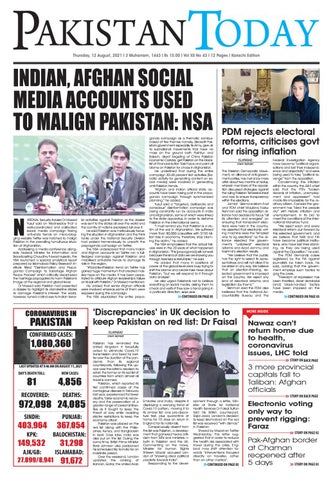
Thursday, 12 August, 2021 I 3 Muharram, 1443 I Rs 15.00 I Vol XII No 43 I 12 Pages I Karachi Edition
IndIan, afghan socIal medIa accounts used to malIgn PakIstan: nsa
n
ational Security adviser Dr Moeed Yusuf said on Wednesday that a well-coordinated and calibrated social media campaign flaring anti-state trends on micro-blogging website twitter was hatched to malign Pakistan in the prevailing tumultuous situation of afghanistan. addressing a media conference alongside Federal Minister for information and Broadcasting Chaudhry Fawad Hussain, the nSa launched a special analytical report prepared by islamabad Policy Research institute titled “Disinformation and Propaganda Campaign to Sabotage afghan Peace Process” which critically deciphered the hashtags propagated to harm Pakistan’s image at the regional and global level. Dr Moeed said Pakistan had presented a dossier to highlight its clandestine strides to damage Pakistan’s interest. the world, however, turned a blind eye to indian terror-
ist activities against Pakistan as the dossier was sent to the states all over the world and the comity of nations expressed lull over it. He said Pakistan was meticulously focusing the situation in afghanistan and the think tanks under the national Security Division had worked tremendously to unearth the propaganda campaign on twitter. the nSa underscored that many indian and afghan accounts on twitter ran a fullfledged campaign against Pakistan and mobilised anti-state trends to damage its role in the region. “#SanctionPakistan trend on twitter has gained huge momentum that created massive hype on the media. it has been perpetrated to attribute afghan leadership’s failure on its soil with Pakistan,” Dr Moeed mentioned. He added that senior afghan officials were involved whereas some of them were exposed during the campaign. the nSa elucidated the entire propa-
coronavIrus In
PakIstan
CONFIRMED CASES:
1,080,360
LAST UPDATED AT 9:46 AM ON AUGUST 11, 2021
DAY'S DEATH TOLL:
NEW CASES:
81
4,856
RECOVERED:
DEATHS:
972,098 24,085 SINDH:
PUNJAB:
403,964
367,054
KPK:
BALOCHISTAN:
149,532 AJK/GB: 27,899/8,941
31,298 ISLAMABAD:
91,672
ganda campaign as a thematic contourbased of five themes namely, discredit Pakistani government especially its army, give air to subnational movements that have no mass on the ground both Pashtun and Baloch, direct targeting of China Pakistan Economic Corridor, get Pakistan on the blacklist of Financial action task Force and point all blame on Pakistan for chaos in afghanistan. He underlined that during the entire campaign 30-40 percent Bot activities (Robotic activity for generating content on social media) were involved in generating anti-Pakistan trends. “afghan and indian official state accounts have been taking part in the propaganda campaign through synchronized planning,” he added. Yusuf said a “targeted, deliberate and conscious” disinformation campaign was being constantly run by accounts in india and afghanistan, some of which were linked to the state apparatus, in order to defame Pakistan in the international arena. “i must remind you that Pakistan is a victim of the war in afghanistan. We suffered more than 80,000 casualties with $150 billion loss in economy, therefore, stop blaming the victim,” he added. the nSa emphasised that the actual failures were in the 20 years of what happened in afghanistan. “this [propaganda] will not work because the kind of data we are showing you through forensics is irrefutable,” he said. He added that many in positions of power at the global level were busy trying to shift the blame and create fake news about Pakistan, “but we will respond to it through data analysis”. He also urged Pakistanis not to believe everything on social media, asking them to check and verify if they saw a trend going in a particular direction. News Desk
CONTINUED ON PAGE 05
PDM rejects electoral reforms, criticises govt for rising inflation ISLAMABAD staff report
the Pakistan Democratic Movement, an alliance of anti-government parties, has met once more after about two months of hiatus, wherein members of the opposition discussed strategies against the ruling Pakistan tehreek-e-insaf and how to ensure transparency within the elections. Jamiat Ulema-e-islam-Fazl and PDM chief Maulana Fazlur Rehman said the opposition alliance had decided to focus “all its attention and energies” on ensuring that transparent elections were held in the country. He asserted that electronic voting machine were the “simplest way to rig elections” as the alliance rejected the government’s “unilateral” electoral reforms and azad Jammu and Kashmir’s election results. “We believe that the public has the right to select its representatives and will not allow it to be stolen in any way. We believe that an election-thieving, selected government is imposed on the country. We reject any kind of electoral reforms and legislation (by them).” Rehman said the PDM also believed that the national accountability Bureau and the
‘Discrepancies’ in UK decision to keep Pakistan on red list: Dr Faisal ISLAMABAD staff report
Pakistan has reminded the United Kingdom it forcefully acted to eliminate Covid-19 transmission and fared far better over the duration of the pandemic than its regional counterparts, following the uproar over the latter’s decision to retain the former on its red list of countries from which almost all travel is banned. Pakistan, which reported its first confirmed cases of the contagious disease in February last year, experienced far fewer deaths, faster economic recovery and the preservation of a greater range of personal liberties as it fought to keep the threat at bay while avoiding stricter restrictions to keep the economy afloat. Pakistan was placed on the red list along with the Philippines, Kenya, and Bangladesh in april. Days later, india was also put on the list. During the same time, British Prime Minister Boris Johnson also postponed his scheduled trip to india for an indefinite period. over the weekend, london updated the ranking of Bahrain, Qatar, the United arab
Federal investigation agency have become “political organisations and lost their independence and objectivity” and were being used to take “political revenge” from the opposition. Condemning the inflation within the country, the JUi-F chief said that the Pti’s “broken records of inflation, unemployment and oppression” had made life impossible for the ordinary citizen. Fazl said the government has “bled the people dry” with historic inflation and unemployment, in its bid to meet the conditions of the international Monetary Fund. “We reject each and every electoral reform put forward by this selected government, and we believe that naB and Fia have become political institutions, who have lost their standing, as they are being used against the opposition,” he said. the PDM demands cases registered by the Fia against journalists be taken back, he said, adding that the government employs such tactics to gag the press. “Freedom of expression has been throttled. Worst dictatorial [and] black-handed tactics have been imposed on the media.
CONTINUED ON PAGE 05
more inside
Nawaz can’t return home due to health, coronavirus issues, LHC told STORY ON BACK PAGE
3 more provincial capitals fall to taliban: afghan officials STORY ON BACK PAGE Emirates and india, despite it displaying a worrying trend of Covid-19 pattern, moving it to its amber list: one pre-departure test, plus quarantine at home for 10 days on return in England for its nationals. Conspicuously absent from the list was Pakistan, a development that garnered heavy criticism from MPs and ministers — both in Pakistan and the UK. Commenting on the move, Minister for Human Rights Shireen Mazari accused london of “showing clear political proclivity towards india”. Responding to the devel-
opment through a letter, Minister of State for national Health Services Dr Faisal Sultan told his British counterpart, Sajid Javid, london’s decision to keep islamabad on the red list was received “with dismay” in Pakistan. Shared by Mazari on twitter Wednesday, the letter suggested that in order to reduce the health risk associated with travel during the crisis, England may shift attention towards “interventions focused directly on traveller, rather than on other metrics”.
CONTINUED ON PAGE 05
Electronic voting only way to prevent rigging: Faraz STORY ON PAGE 02
Pak-afghan border at Chaman reopened after 5 days STORY ON PAGE 03
02
Thursday, 12 august, 2021
karachi
newS
ElECtrONiC vOtiNg ONly way tO prEvENt riggiNg: Faraz ISLAMABAD
t
aPP
HE introduction of Electronic Voting Machines to replace paper ballots was the only way to cut down on potential vote fraud without compromising the electorate’s ability to exercise their democratic rights, Minister for Science and Technology Shibli Faraz said. “The employment of voting machines [during the elections] will not only reduce electoral fraud but also contribute to making elections fairer, safer and more competitive,” he said in a press talk held at the Parliament House Wednesday. He said that the entire world was transferred to modern technology and it was about time for Pakistan to adopt the latest technology to make the elections
transparent. Faraz observed that Pakistan has around 184 million mobile phones users and about 120 million registered voters. For all these people most of them fairly young, technology is not a new thing, he stressed. “The EVMs are never connected to the internet or WiFi […] neither do they have Bluetooth ability nor do they use any sort of operative systems due to which it’s practically impossible to hack into the devices,” he said. It was unfortunate that the elections in the past became controversial due to the lack of technology. “EVM is the best solution to curb electoral fraud and irregularities”, he emphasised. On the occasion, the minister invited National Assembly Speaker Asad Qaiser and other MPs to test the prototypes of machines by casting a trial vote.
Only fully vaccinated can travel by air from Sept 10: NCOC ISLAMABAD TLTP
The National Command and Operation Centre (NCOC) on Wednesday made it mandatory for people to get fully vaccinated before travelling by air, starting September 10. The NCOC issued the fresh directives in order to ramp up vaccinations across the country amid a fourth Covid-19 wave. It has also been decided, the NCOC said, to reduce the gap between two doses of vaccines from 42 to 28 days. “The decision was taken in consultation with health experts,” according to the NCOC. In July, the NCOC had declared Covid-19 vaccination certificates mandatory for domestic air travel from August 1 but to expedite vaccinations the government has now restricted air travel to only fully vaccinated individuals. After September 10, a partial vaccination certificate will not be permissible. Prior to this, the NCOC had also barred unvaccinated people from travelling by train from October 1. During a meeting held on Monday last under the chairmanship of the Federal Minister for Planning, Development, and Special Initiatives Asad Umar, the forum expressed satisfaction over the vaccination process across the country. However, it still urged citizens to get their second jabs on time. Meanwhile, over 4,800 people tested positive for the coronavirus in the last 24 hours in the country. This was revealed by the NCOC on Wednesday. Meanwhile, another 81 people lost their lives to the virus. As many as 4,856 people tested positive for the virus after 64,690 Covid-19 tests were taken, as per the NCOC’s data. This brings the positivity rate to 7.50 percent. The total number of active cases in the country rose to 84,177 on August 11. A total of 972,098 people have so far recovered from the virus while the total number of deaths, with the fresh count of 81 fatalities, have risen to 24,085. Pakistan’s total confirmed case count now stands at 1,080,360. A day earlier, the coronavirus death toll crossed the 24,000 mark in Pakistan after the country reported 86 deaths. Overall, coronavirus cases across Pakistan haven’t declined or risen significantly, however, Sindh lifted its lockdown Monday. Revised Covid-19 restrictions, which will last till August 31, have been announced by the Sindh government.
NCOC daily update: 4,856 new cases, 81 deaths from Covid-19 ISLAMABAD STaff RePoRT
Pakistan on Tuesday reported 4,856 new Covid-19 cases, the National Command and Operation Center said on Wednesday. The NCOC, a department leading campaign against the pandemic, said that the number of overall confirmed cases had risen to 1,080,360, including 972,098 recoveries. The number of active cases has dropped to 84,177 who are under treatment across the country, including 4,513 critical patients. According to the NCOC, the pandemic killed 81 people on Tuesday, increasing the overall death toll to 24,085. Sindh is the most affected province of the country in terms of the number of cases with 403,964 infections followed by Punjab which has reported 367,054 cases.
Pakistan to play vital role in regional economies: Rasheed NewS DeSk Interior Minister Sheikh Rasheed Ahmad has said that Pakistan is going to play a vital role in the regional economies and the coming 4-5 months are crucial for the country. Addressing the business community during his visit to the Islamabad Chamber of Commerce & Industry (ICCI) on Wednesday, Rasheed said that Imran Khan’s policies to steer the economy out of the troubled waters and tackle the Covid-19 pandemic are bearing fruits due to which the country has been put on the path of sound economic growth. He said when the current
government had come into power, there were predictions that Pakistan would default, but the government’s good business and economic policies have set the country in the right direction. Rasheed said that the business community is playing an important role in the economic development of the country and the government is taking many policy measures for ease of doing business. He said that a specific women market would be inaugurated soon to promote the businesses of women entrepreneurs. About issuance of armed licences, he said that a merit-based policy has been adopted for this purpose. He said that chambers of commerce &
industry should own brilliant students for their grooming and promoting entrepreneurship. Speaking at the occasion, ICCI President Sardar Yasir Ilyas Khan lauded the initiatives of the Ministry of Interior for improving the security situation that would facilitate better growth of business activities. He said that ICCI is working actively for the placement of 3,000 students as interns in local industries to provide them practical job experience. He said that the government should introduce a fixed tax regime and selfassessment scheme to broaden the tax base and improve tax revenue. He said that the government should recognise the
high taxpayers that would promote a tax culture in the country. He said specific counters for taxpayers at NADRA, passport offices and other public places should be set up that would facilitate the business community. He said armed licenses should be issued to the business community for self-defence on the recommendation of ICCI. Mian Akram Farid, the chairman of Founder Group, appreciated the government’s initiatives for improving transportation networks that would greatly facilitate the transportation of goods and reduce cost of doing business. He also lauded the efforts of Rasheed for establishing schools, colleges, universities and hospitals in this region.
Firdous highlights cracks in alliance between PTi, PML-Q NewS DeSk Pakistan Tehreek-e-Insaf leader and former special assistant to the Punjab chief minister Dr Firdous Ashiq Awan on Wednesday stated that cracks were appearing in the ties between her party and the Pakistan Muslim League-Quaid due to “personal actions” of the Punjab Assembly Speaker Chaudhry Pervez Elahi. Speaking on a Geo News programme earlier today, Awan, while referring to a recent incident where she was denied entry to Punjab Assembly premises, said the move was a clear indication of the shrinking ties between the two parties. On Aug 9, the former provincial special assistant faced an awkward situation on Monday when she was stopped at the Punjab Assembly gate by the security staff. The security staff told Ashiq, “Sorry madam! You don’t have the permission to enter in the Punjab Assembly.” Firdous was stunned and shocked after the PA security staff apprised her about the update that she could not go into the legislative assembly. She went to attend the oath-taking ceremony of Ahsan Saleem Barryar who won in a recently held byelection on a PTI ticket from Sialkot. Firdous said in Punjabi,” Ki Matlab Aey?” (What do you mean?), to which the Punjab Assembly security
personnel said, “You are respectful, but you are now not allowed to go inside as your name is not on the list.” She insisted the staff to once more look for her name on the list but all her efforts go in vain and she had to move back from Punjab Assembly. “A few days ago, I facilitated enrollment of a son of vice president of PML-Q into PTI and then got him a ticket from PP-38. And if somebody leaves [Pervez Elahi’s] party, contests election from some other platform and manages to get elected … and if the MNA from the constituency is denied access to the provincial assembly, it is a clear indication of souring ties between the two allies,” said the PM’s former aide while speaking on the Geo talkshow on Wednesday. This is not the only time that disputes between the ruling coalition have made headlines. Rather, over the past year the PML-Q has been reportedly blamed the ruling party for not fulfilling the promises it had made earlier. Amid sporadically recurring reports of rifts between the two parties, it was reported in June this year that the matter was settled after the PTI had agreed to one of the PML-Q’s demands of providing development funds to its MNAs. The PTI leader on the occasion corroborated that there were several such instances. “A bill related to journalists was recently tabled and approved on a private members’ day that later triggered protests from
the journalists’ community. Subsequently, I raised a voice that it was a private member’s bill and not the government’s”. She further said that a message was sent to her later that the government was not bound to undertake legislation with her consent. Speaking about her appointment as adviser to the Punjab chief minister, she said the prime minister and Saifullah Naizi had convinced her to go to the province “because of my requirement there”. “Despite losing the elections, I worked in the province for three years and as a result I emerged victorious from PP-38.” She said competitors often pull their opponents’ leg and it was a democratic way to make efforts for progress and “in case someone did that to me, I would hold no grudge against that person.” The former adviser said Prime Minister Imran Khan, would assign her a new role if the party felt her services were required for the country and the province. She said Punjab was a difficult battleground, adding that the PTI’s main rival party had set a different trend among the public and bureaucracy. “Punjab Chief Minister Usman Buzdar, who is an honest man, is not highlighting on media the public welfare works he has undertaken and anyone who doesn’t brag about and publicise their works fails to get prominence on media screens,” she explained.
Bakhtiar elected to top women’s rights body, Sc told ISLAMABAD INP
The Supreme Court on Wednesday disposed of a case pertaining to the appointment of the National Commission on the Status of Women chairperson after it was informed that Nilofar Bakhtiar has been appointed to the post. The news about the appointment of
Bakhtiar, a minister in former prime minister Shaukat Aziz’s cabinet, as the new NCSW chairperson was revealed by Minister for Human Rights Shireen Mazari last month. Her election was subsequently challenged in the apex court. A three-member bench, headed by Chief Justice Gulzar Ahmed, heard the case. During the hearing when Justice Ahmed inquired whether the government had appointed a
chairperson, Additional Attorney General Aamir Rehman responded in affirmative. “Nilofar Bakhtiar has been appointed as the chairperson [of the body] by Prime Minister Imran Khan for a period of three years,” he said. At this, the judge ruled that with the appointment been made, the case has lost its value. Established in 2000, NCSW is a
statutory body mandated to review laws and policies and monitor the implementation of legislation pertaining to women’s protection, equality and empowerment. It also plays a vital role in ensuring that the government meets its international commitments; it can even advocate for foreign policy to be shaped in a way to take into account the impact on women in Pakistan.
Thursday, 12 august, 2021
karachi
newS
pak-aFghaN bOrdEr at ChamaN rEOpENEd aFtEr 5 dayS p ISLAMABAD TLTP
AKISTAN-Afghanistan border crossing at Chaman has been reopened for pedestrian traffic and trade activities on Wednesday after remaining closed for five days. The border crossing had been closed by the Taliban after capturing Spin Boldak, a border town in Afghanistan on August 6. According to Levies officials, the Bab-e-Dosti
gate at the Chaman border has been reopened for pedestrians from both sides, Afghan transit trade and other legal business activities. The Pakistani nationals stuck in Afghanistan are allowed to return to their homeland under Covid-19 SOPs, the officials said. Customs officials said that Afghan transit trade and bilateral trade activities have also been resumed. After taking control of border town Spin Boldak, the Afghan Taliban on August 6 had closed the border crossing between the two countries at Chaman and
demanded a complete dismissal or leniency in the visa requirements for Afghans by Pakistan. “No one would be allowed through until Islamabad dropped or relaxed its visa requirements for Afghans,” they had said. The Taliban, wresting control of Afghanistan in the wake of a withdrawal of US and other foreign troops, last month captured the southeast Chaman-Spin Boldak border crossing from Afghan forces. Since the Taliban took control of Chaman-Spin Boldak, Pakistani border officials there have begun
enforcing visa requirements for Afghans which previously were not as strictly observed. In a statement on Friday, the Taliban had called on Pakistan to scrap all visa requirements for Afghans. "(The crossing) will remain closed for all types of commuting, including transit and trade, for both sides, and pedestrians, until the Pakistani side leaves the gate open, morning to evening, for Afghans holding [Pakistani issued] migration cards or ID cards," the insurgent group's shadow governor for Kandahar province had said in the statement.
Bilawal offers PM, cM slots to PML-n ISLAMABAD MIaN abRaR
After successive sequences of blame-game against each other’s leadership, the two major opposition parties — Pakistan Muslim League-Nawaz and Pakistan People’s Party — have again started hobnobbing for a new powersharing formula. Therein, the PML-N has said that it was mulling the PPP’s offer and would respond shortly. A source in the PPP has informed Pakistan Today that Prime Minister Imran Khan’s Sindh overture has perhaps compelled PPP Chairman Bilawal Bhutto-Zardari to offer a new olive branch to PML-N President and Leader of the Opposition in the National Assembly Shehbaz Sharif, offering it to overthrow the PTI governments in the centre and in Punjab. It has been speculated that Bilawal could fear an imminent threat from the PM’s plan to re-enter interior Sindh. Therein, Bilawal has made a lucrative offer to the PML-N if it joins hands to destabilise the PTI’s governments in centre and Punjab despite his recent blaming of the PML-N for destroying the PDM alliance.
03
“Bilawal has offered the posts of Prime Minister and Chief Minister Punjab to the PML-N. Significant progress has been made in backdoor contacts between Bilawal Bhutto and Shehbaz Sharif. Hence, the PDM parties and PPP have once again mobilized against the government,” the source said. The source said Chairman Bilawal Bhutto-Zardari wants an in-house change in the National and Punjab Assemblies. “The opposition in the federation and Punjab have required numbers. We have offered the posts of prime minister and chief minister of Punjab to PML-N,” the PPP source said. The source said that after initial contacts, the opposition is ready to table motions for the in-house change in the center and Punjab. “Even, some government allies are also with us,” the source said, without elaborating. Asked to explain, the PPP sources claimed that more than 25 members of the government and allies would support the opposition’s move in the National Assembly. Around 31 members of the Punjab Assembly will also support us,” the source said.
another batch of Sinopharm jabs arrives from China ISLAMABAD INP
A consignment of one million doses of the Sinopharm Covid-19 vaccine reached Islamabad on Wednesday. The consignment was airlifted by a foreign airline. Officials from the Foreign Office and the Chinese embassy received the package. On Sunday, a special Pakistan International Airlines flight airlifted from Beijing a consignment of about 0.68 million Sinopharm vaccine doses. The jabs were transferred to the Federal Expanded Programme on Immunisation Warehouse.
P&D board reviews implementation status of ADP 2021-22 LAHORe PReSS ReLeaSe
A review meeting on Punjab Government’s Annual Development Plan 2021-22, chaired by the P&D Board Chairman Abdullah Khan Sumbal was held at the Planning and Development Department, Lahore. The meeting focused on reviewing Punjab’s Development profile and in particular the status of ADP 2021-22 in perspective of the allocated budget, releases and utilization. The P&D chairman urged the departments to continue with focused efforts in their sectors to ensure proper utilization of public funds. P&D Secretary Imran Sikandar Baloch briefed that against 4,688 un-approved schemes at the beginning of the financial year, 4,126 schemes had been approved (92 percent). The budget allocated for ADP was Rs560
billion whereas releases at the spending level stood at Rs118 billion. The meeting was also told that Rs153 billion has been released by Finance Department. Division and department-wise approval statuses of schemes were also discussed in detail. The chairman was briefed that, as instructed by the Punjab chief secretary in the last review, all administrative departments and finance departments need to ensure immediate placement of released funds at the spending level after removing all impediments. The board was also instructed by the chairman that slow placement of funds at the spending level and utilization of funds must be accelerated. To ensure fast track implementation of ADP 2021-22, the guidelines and the timeliness notified by the Punjab chief minister should be followed in letter and spirit, he added.
For the implementation of the abovecited guidelines, robust quality control mechanism needs to be put in place by the administrative departments to ensure quality work as desired by the vision of Punjab CM. The bottlenecks hindering the implementation of ADP must be highlighted in precise terms and indicated to the P&D Board or the concerned quarters for redress. Chairman Abdullah Khan Sumbal added that the Punjab government, following the vision of its CM, is working assiduously to ensure that the utilization is result-oriented. The development received at all levels must be conducted consistently by all concerned Secretaries, said Sumbal. The meeting was attended by Administrative Secretaries, Members of the P&D Board, and other senior officers of concerned departments.
implementing Jinnah’s ideals key to Pakistan’s unity, says Marshall LAHORe STaff RePoRT
A senior church leader has called for protecting the rights of religious minorities in Pakistan and for ensuring civil liberties on equal terms. In his message on National Minorities’ Day, Church of Pakistan President and Moderator Bishop Dr Azad Marshall said that Pakistan’s founding father, Quaid-eAzam Muhammad Ali Jinnah, in his speech on August 11, 1947, had pledged to protect the rights of non-Muslims in the newlycreated country. “In his landmark speech, Quaid gave the basis for a civilized state and a society based on values. He guaranteed religious freedom and civil liberties on equal terms, and called for giving up historical prejudices of race, color, caste and creed to build a cohesive society. “Jinnah wanted to see a tolerant, progressive, liberal, and egalitarian Pakistan, but unfortunately I think that we as a nation have seemingly failed to adopt his vision,” Bishop Marshall said. Marshall said that history is witness to the fact that non-Muslim citizens have contributed wholeheartedly to nationbuilding and their services in various spheres
of life have helped put the country on the path to progress. “We continue to play our role with the same vigour and spirit because we love our homeland and are even ready to offer any sacrifice for its defense,” he added. The church leader said that though successive governments have claimed that they have worked for the uplift and protection of non-Muslim Pakistani citizens, yet the religious minorities continue to face many challenges due to the absence of a proper enforcement mechanism. “Though Pakistan’s constitution guarantees protection of religious minorities and assures them equal rights, I believe that disparities of rights in policies and laws can never ensure equality of status and treatment. We need to realize that in a multicultural and multi-religious society, the ethnocentric approach is not useful to the cause of national unity,” he stated. Bishop Marshall said that inherent discriminatory practices, forced conversions of minority girls, incidents of faith-based violence and continued misuse of the blasphemy laws are some of the major issues that warrant a serious and instant response from the State if we are to truly follow the Quaid’s vision of a pluralistic Pakistan. He also pointed to the concerns raised by
various minority groups over the single national curriculum that the government has implemented in public and private schools across Pakistan. “We have already expressed our concerns over the inclusion of religious content in secular subjects. Our education policy must incorporate the concept of human rights, social justice, peaceful coexistence and non-discrimination, and we hope that the incumbent government will pay heed to our request,” he said. The senior bishop said that issues such as the forced conversion of underage minority girls and misuse of the blasphemy law were not only serious human rights violations but were also bringing a bad name to Pakistan. “It is important that we comprehensively implement in letter and spirit, the judgement of the Supreme Court of Pakistan delivered on 19th June 2014, without further delay,” he urged. With reference to the European Union Parliament’s resolution on the challenges facing Pakistan’s religious minorities, the bishop said that the mainline church leadership was ready to work with the government in addressing those concerns by using their influence and clout in the western world.
“I would like to conclude by saying that National Minorities’ Day is an embodiment of the Quaid’s vision and we should all try our best to promote his aspiration of a multireligious coexistence in Pakistan. Long live Pakistan!” GOVT STRIVING TO SAFEGUARD RIGHTS: Meanwhile, Minister of State for Information and Broadcasting Farrukh Habib said the government was striving to ensure the provision of rights to minority communities.
In his message, he said a level-playing field was being ensured for the communities in all spheres of life, Associated Press of Pakistan reported. The minister said the government had taken various measures for the welfare of minorities, observing that Islam laid great stress on respecting their rights. “Tolerance, mutual respect and protection of human rights are fundamentals of the Islamic society,” he said, adding efforts to maintain interfaith harmony would be intensified.
Thursday, 12 August, 2021
04 NEWS
KARACHI
PM oRDeRS FoR ReDuctIon In MaRkInG Fee oF FooD, non-FooD IteMS ISLAMABAD
I
GHULAM ABBAS
N an initiative to facilitate ease of doing business (EODB), Prime Minister Imran Khan has directed the Ministry of Science and Technology (MoST) to reduce the marking fee being imposed by Pakistan Standard and Quality Control Authority (PSQCA), an attached wing of the ministry, on food and non-food items. While the move may turn the self-reliant authority into a financially dependent institution, the PM office wants to reduce the marking fee drastically which, according an official of PSQCA, would ultimately cut the revenue of the authority to around Rs300 million from the existing Rs1.2 billion. In a letter sent to the ministry, the Prime Minister Office has informed that the proposals submitted by PSQCA regarding the revision of marking fee on flat rates was rejected. The PM Office, as per the letter, directed PSQCA to revise the proposal rationally considering the proposal of Board of Investment (BoI) for food sector i.e. Rs2
for meeting the shortage in revenue of the authority after the revision. However, making PSQCA another dependent and loss making organisation would further burden the government. The authority is presently earning 100pc revenue whereas the employees’ salaries are protected under Section 37 and 38 of PSQCA Act-IV 1996. It may mentioned here that PSQCA has been mandated to inspect and check the quality and standards of over 100 food and non-food items. Last year, the ministry had tried to outsource the inspection of mandatory items despite a whole team and departments existing to do the same job within the ministry. The ministry had prepared a draft proposal for outsourcing quality and standard inspections of over 160 items mandated to PSQCA. Under the plan, private laboratories and companies were to be issuing conformity certificates, licenses and marking items after required tests. In case of outsourcing the mandate of PSQCA, various departments of the authority would be left redundant, leaving labora-
paisa per packet for small and medium enterprises (SMEs) and Rs5 paisa for large scale manufacturers (LSMs). The PM Office claims that such reduction may not impact the revenue of PSQCA. However, sources in the authority claim that it would cause a major cut in revenue affecting overall functions of the authority. The PM Office has also directed PSQCA to compare the CM license issuing time with regional countries to compare and revise the time to 28 days in addition to revising the proposal for food and non-food items along with the impact on revenue and furnish it to MoST immediately. Sources at PSQCA claim that the 28 days of license issuing time is not workable as test reports of some items take more than this duration. According to an official provy to the matter, a meeting of officials from PSQCA, BoI, Federal Board of Revenue (FBR) and others was held here on August 2, 2021 to decide about the revised marking fee; however, no breakthrough was made. Officials claim that the PM Office has assured the PSQCA of making arrangements
tories and machinery of the authority idle. The move, however, failed as the proposed model was also not acceptable in the
SHC extends bails of Durrani, Khuhro in NAB cases
world as PSQCA has signed multiple MoUs and agreements with international standards bodies and organisations.
Rafi Group provides guidance to investors in Sialkot
KARACHI INP
The Sindh High Court on Wednesday extended until October 6 the pre-arrest bail of provincial Assembly Speaker Agha Siraj Durrani in a National Accountability Bureau reference pertaining to purportedly illegal appointments in Benazir Bhutto Shaheed University in Lyari. Durrani submitted a petition in the court against the probe into his alleged misuse of office. During the hearing, a prosecutor for the dirty money watchdog told the high court that the agency had completed its investigation and it was forwarding its findings to NAB headquarters in Islamabad for approval. He further said a reference against the speaker would be filed after getting a nod from the NAB chairman, retired Justice Javed Iqbal. He requested the court to give time to the agency for submission of its report until Iqbal’s approval. At this, the court directed the agency to submit the report in the next hearing. KHUHRO’S BAIL EXTENDED: Meanwhile, the high court also extended the bail of PPP Sindh President Nisar Ahmed Khuhro until September 28. During the proceeding, Khuhro requested the court to direct the federal government to remove his name from the Exit Control List. The NAB is investigating a probe into misappropriation of wheat stock in Sukkur allegedly by Khuhro. The agency is yet to submit its probe report to the court against him. Today, it requested the court to give it a month for the submission of a final report.
Services exports grow by 9.19pc to $5.9bn ISLAMABAD APP
Exports of services increased by 9.19 per cent to $5.937 billion in the outgoing financial year (FY21) compared to $5.437bn during the same period of previous year. According to the data released by the Pakistan Bureau of Statistics, exports of services posted growth of 53.56pc to $579.03 million in June this year against $377.08m over the corresponding month of last year. On a month-on-month (MoM) basis, exports of services went up by 18.39pc. The growth in services exports is mainly led by the highest-ever export of IT services recorded in the outgoing fiscal year by 47pc to $2bn. Services exports also include finance and insurance, trans-
port and storage, wholesale and retail trade, public administration and defence sectors. The commerce ministry has set a $7.5bn target of services exports for 2021-22 (FY22). On the other hand, services imports fell by 10.75pc to $7.812bn in July-June FY21 from $8.753bn over the corresponding period of last year. On a monthly basis, the imports of services posted a negative growth of 7.31pc year-on-year to $597.04m. On a MoM basis, imports declined by 29.93pc. The trade deficit in services sector has declined by 43.45pc to $1.875bn in July-June FY21 against $3.315bn over the corresponding period of last year. In June 2021, trade deficit in services fell by 93.26pc to $18.01m on a year-on-year basis.
SIALKOT: The management of Green Palms Gwadar, a project of Rafi Group, held a successful open house in Sialkot. The three-day open house was held from August 6 to 8, in which the management of the project guided aspiring investors for Gwadar, CPEC Gateway, and International Smart Port City. In the open house, the experts of Rafi Group provided information and guidance about the Green Palms Gwadar project. The experts also informed the customers about the importance of Gwadar and CPEC projects. To highlight the development status of the Rafi Group's flagship projects so far, future plans and the geographical and business significance of Gwadar, the group organises open houses to provide facilities to residents of different cities in their respective cities. PR
Sarsabz Fertilizers all set to celebrate Independence Day LAHORE: The Sarsabz Fertilizers is looking forward to celebrate the upcoming Independence Day of Pakistan with great enthusiasm and excitement. A special patriotic song, paying tribute to Pakistan and its true unsung heroes – the farmers, has been produced. The song will soon be published on SnackVideo, a popular video platform with a fast growing user community. Millions of SnackVideo users will have a chance to boost their festivities of Independence Day by winning a brand new iPhone 12 through an exciting competition. This very first branded campaign on SnackVideo is all set to create history, making Sarsabz the very first brand to utilise the power of this budding platform. SnackVideo users will be required to create their unique video entries using Sarsabz Pakistan’s official song, as published on Sarsabz’s official SnackVideo profile, and tag their entry using the hashtag #SarsabzPakistan. Last date for entry submission will be August 30. PR
Pakistan, WB sign $130m pact to increase literacy in Sindh ISLAMABAD TLTP
Pakistan and the World Bank (WB) have signed a financing agreement, worth $129.99 million, to support efforts to increase literacy and student retention rates in Sindh province. The financing for the Sindh Early Learning Enhancement through Classroom Transformation project includes concessional loan of $100 million by World Bank and Education Sector Plan Implementation Grant of $29.99 million by Global Partnership for Education (GPE). Besides this, an additional GPE Multiplier Grant of $24.78 million would shortly be made available to enhance geographical coverage of the project. Minister for Economic Affairs Omar Ayub Khan witnessed the signing ceremony on Wednesday. The financing agreement was signed by Additional Secretary Economic Affairs Division Zulfiqar Haider, and Country Director WB Najy Benhassine, while Sindh Chief Economist Dr Naeem Zafar also attended the ceremony on behalf of the provincial government.
CMYK
Omar appreciated the World Bank management for extending their continuous support to the government particularly at this difficult time when the country is facing increasing health-related and socio-economic challenges. He said that provision of quality education is one of the top priorities of the government because it plays an essential role in the socio-economic development and prosperity of a nation. The minister further stressed that equal opportunities in education, for both girls and boys, must be ensured at all levels. The minister highlighted that even at times of prevailing difficult situations, the federal government kept its focus on the social sector including health, education and social protection so that the people get basic necessities of life and the economy regains its strength. He reiterated his government’s commitment to further strengthen implementation of reforms, including reform actions aimed to develop key elements of core foundations for human capital accumulation. The objective of the project is to improve reading skills of early grade primary students and increase stu-
dent retention in primary schools in selected 10 districts of Sindh. It aims to improve five core elements of learning i.e. prepared learners, effective teaching, learning focused inputs, safe and inclusive school space, and a well-managed education system to end learning poverty. None of these elements can be left out when seeking to make schools functional and ensuring that students learn and stay in school. Using a school-based approach that focuses on quality, redresses support for drop-outs, improved teacher capacity, and infrastructure catering to safety and learning needs, also will help address the demand and supply side challenges to narrow the gap of girls’ access, transition, and retention rates. The project will pilot a school-based behavioural intervention that will help students recognise that their abilities and skills can change and grow and will focus on key skills such as student efficacy and self-management. The World Bank team reiterated its commitment to continue technical and financial support to the government of Pakistan for priority areas.
Thursday, 12 August, 2021
KARACHI
NEWS
05
InDIan, aFghan socIal meDIa accoUnts UseD to malIgn PaKIstan: nsa
h
continued from page 01
E assured the nation that the country was safe and would remain safe, saying the government would not shy away from calling out whoever was involved in defaming Pakistan. He maintained that the security forces and state institutions of the country were vigilant and there was nothing alarming that should be worried about. “No immediate neighbours of Afghanistan want any protracted conflict in the region. Pakistan will accept any politically resolved solution to the issue bearing full consensus of Afghan powers,” he said while responding to various media queries. Responding to another query, he said Pakistan would expose the propaganda accounts generating anti-state content on regular basis. The NSA shared a report of IPRI highlighted that the hashtag #SanctionPakistan was intermittently used since June 2016 mostly backed by Indian propaganda accounts
where the situation changed in June 2021, when Afghansupported accounts pushed the anti-state trend. Giving a breakdown of a few trends allegedly based on disinformation, Chaudhry said the PTM had initiated 150 trends against Pakistan in the last two years consisting of 3.7 million tweets — and it takes more than 1,000 hours to do tweets at this scale, he added. He said the PTM had also actively supported Baloch activism and on Aug 14, 2020, the hashtag ‘#BalochistanSolidarityDay’ was trended with massive support from India, with around 150,000 tweets posted with the hashtag by Indian activists in a day. The minister went on to say that a few other trends under hashtags ‘#PTMExposedFakeTerrorism’, ‘#DaSangaAzadiDa’ and #BalochistanSolidarityDay had over 200,000 tweets backed by India, while other trends were also started under titles such as ‘Tyrant Pakistan Army’, ‘Army behind target killings’, and ‘Pakistan Army Kill Pashtuns’ to defame Pakistan. “These trends were initiated by PTM and supported by India,” he added.
He noted that a new hashtag was now being trended titled ‘#SanctionPakistan’, which had at least 800,000 tweets, 20,000 among them from the PTM. Afghan Vice President Amrullah Saleh, NSA Rehmatullah Andar and Defence Minister M. Bismillah also participated in these campaigns, he said. Chaudhry said another “interesting trend” seen was that Wikipedia administrators from India were “designing campaigns for PTM and also running their pages on the website”. The proof of such activity was shown in EU Disinfo Lab’s report titled ‘Indian Chronicles’ that exposed 845 websites created to propagate disinformation about Pakistan, he recalled. The minister said there were several instances of misleading tweets like on the occasion of the death of Baloch activist Karima Baloch in Canada when it was alleged that ‘StateKilledKarimaBaloch’ but Canadian police later confirmed her death was a natural one. “But PTM did 20,000 tweets using that hashtag to target Pakistan,” he added. with additional input from APP
PDM rejects electoral reforms, criticises govt for rising inflation continued from page 01 Journalists are being attacked,” he said, adding that the meeting expressed serious concern over the situation and condemned it. He reiterated the PDM’s basic objectives which he said included ensuring that all institutions “fulfil their responsibilities while remaining within the bounds of the law and the Constitution and end their role beyond their authority”. Speaking on Pakistan’s so-called failed foreign policy, the PDM president recalled how recently Pakistan was not allowed to present its case during a United Nations Security Council meeting on Afghanistan. “PDM believes the only way forward in Afghanistan is through an inclusive political solution;. Pakistan aspires for a political and stable Afghanistan,” Fazl said. Fazl said the PDM leaders took an in-depth review of the internal and external challenges facing Pakistan, after which, the meeting’s participants demanded that Opposition lawmakers be taken into confidence over the situation in the neighbouring war-torn country. “An important section of the country is unaware of the situation as facts are being hidden from them,” the JUI-F chief said. The meeting also decided that Qaumi Watan Party chief Aftab Sherpao will be made the senior vice-president of the alliance, he said. To tackle the aforementioned issues, Fazl said that the PDM committee would reconvene on August 21 in Islamabad and August 28 in Karachi. Moreover, he announced that there would be a rally in the port city the day after the meeting (August 29). Speaking on the occasion, Pakistan Muslim League-Nawaz President Shehbaz Sharif said that his brother, Nawaz Sharif, would not return to the country
without getting tested and lamented the fact that the PTI had politicised the health of three-time premier. The PML-N president reminded everyone that several people had “stooped so low” that when Nawaz’s wife was on her death bed, they would make “absurd” comments about her health. The PDM chief presided over the meeting, with Opposition Leader in the National Assembly Shahbaz Sharif, former prime minister Shahid Khaqan Abbasi, and Pakhtunkhwa Milli Awami Party Mahmood Khan Achakzai in attendance. Pakistan Muslim League-Nawaz Senator Prof Sajid Mir, National Party Senator Mir Kabir Mohammad Shahi, JUI-F leader Akram Khan Durrani, Qaumi Watan Party leader Aftab Ahmad Khan Sherpao, and Jamiat Ulema-e-Pakistan Shah Owais Noorani also attended the meeting. PML-N Vice-President Maryam Nawaz attened the meeting via video link. Meanwhile, Minister of State for Information and Broadcasting Farrukh Habib said on Wednesday that the opposition had tried everything to destabilize the democratically elected government, but is now left with only option to cooperate in the Parliament for legislating on electoral reforms to ensure free and fair elections. In a tweet, he said the Pakistan Democratic Movement, a multi-party opposition alliance, had failed to cause any harm to the government after falling short on its towering claims of en-mass resignations, no-confidence move against Prime Minister Imran Khan in the Parliament, sit-in, and long march. The PDM was nothing more than an assembly of unemployed people, he added. The minister said the only option left for the opposition was to legislate on electoral reforms including the use of Electronic Voting Machines in the elections and the provision of the right
to vote to the overseas Pakistanis. Similarly, Minister for State on Climate Change Zartaj Gul Wednesday said that the politics of Pakistan Democratic Movement parties has come to an end and all conspiracies against the government have failed. Talking to a private news channel she said, all parties were united to save their corruption instead of giving positive suggestions on national issues. The coalition of opposition parties should have been good if it was for the welfare of the masses and country, she added. She said that opposition parties should be held accountable before the public as they have plundered the country ruthlessly during their tenure. The state minister appreciated PTI leaders for gaining public confidence in Gilgit Baltistan and Kashmir in recent elections as opposition parties were badly failed there. She said opposition parties did not play any positive role in the Kashmir cause. A day earlier, Leader of the Opposition and PML-N President Shehbaz Sharif contacted his elder brother and former prime minister Nawaz Sharif ahead of the meeting of the Pakistan Democratic Movement and sought his advice on the party’s strategy. According to the party sources, Shehbaz Sharif held an important telephone consultation with the party leader before the important PDM meeting to be held on Wednesday. According to the sources, during the consultation, the two leaders agreed to intensify the anti-government movement and mobilise the PDM. Nawaz directed Shehbaz to activate the PML-N leaders at the party level as well. Shehbaz will convene an important meeting of the party leaders before the PDM meeting in the light of Nawaz’s directive. Meanwhile, PML-N lawmaker
Mian Javed Latif claimed that Nawaz will return home this year. Speaking to the media, Javed Latif said that Nawaz did not compromise on the country’s nuclear programme despite international pressure. He said that Nawaz will not get justice from these courts. Last week, Shehbaz said that government statements based on political hatred are against the prestige of the country. In a statement issued on Friday, he said that statements given by the government against the facts in order to take political mileage are deplorable. Playing politics on the life of Nawaz who remained prime minister for three times is inhuman, he remarked. He went on to say that the government’s attitude on defaming an individual for the sake of politics is bringing a bad name for the country. They should nail senses. Sending Nawaz to London for medical treatment was the decision of “Imran Niazi government”, he held. Treatment facilities for Nawaz were not available in Pakistan was also the decision of a government board, he added. He underscored that the decision for treatment and stay in respect of Nawaz in London would be taken as per doctors’ advice. Nawaz will return to Pakistan when the doctors permit, he added. An appeal has been filed to meet the legal formalities, he pointed out. Nawaz can stay in London till the decision of the appeal, he added. On Thursday, the Home Office of the United Kingdom has rejected PML-N supreme leader and three-time prime minister Nawaz’s request for visa extension. “The UK Home Office has excused itself from further extending Muhammad Nawaz Sharif’s visa,” PML-N spokesperson Marriyum Aurangzeb said in a statement. The Sharif family has also decided to appeal the decision.
‘Abduction’ of Afghanistan ambassador’s daughter remains a puzzle iSLamaBad AnAdolu Agency
Evidence does not support claims that the daughter of Afghanistan’s envoy in Pakistan was kidnapped in the capital city, Islamabad has said, a finding rejected by Kabul. Officials from law enforcement agencies and the Ministry of Foreign Affairs briefed an Afghan delegation, which was in Islamabad for a day-long visit on Sunday, on the investigation into last month’s alleged abduction. “The delegation was conveyed that law enforcement agencies had carried out a detailed and thorough investigation in the complaint and a comprehensive witness account led to the conclusion that the findings on the ground did not corroborate the report by the complainant,” said a Foreign Office statement. This, it said, was further “substantiated by
the technical evidence.” The Foreign Ministry of Afghanistan had claimed that Silsila Alikhail, the daughter of Ambassador Najib Alikhail, was abducted and tortured by unidentified perpetrators on July 16 while on her way home. The next day, Kabul recalled its ambassador from Pakistan, a decision Islamabad called “unfortunate and regrettable.” Minister for Interior Sheikh Rasheed Ahmed has also dismissed Afghanistan’s claims, saying the complainant was neither abducted nor tortured. COMPREHENSIVE BRIEFING: The delegation, the statement added, was given a “comprehensive briefing” on all aspects of the investigation into the reported incident. They were shown video footage from various locations of different times in which the ambassador’s daughter was clearly identifi-
able moving around places independently, it said. “An on-site visit of all the locations visited by the complainant was arranged for the delegation, followed by the presentation of technical data [findings of mobile forensic/geo-fencing] as well,” the press release said. It added that Pakistan attaches high importance to its relations with Afghanistan, and at a critical juncture in the Afghan peace process, “it is extremely important to work jointly for the shared objective of a peaceful, stable and prosperous Afghanistan.” Pakistan said it hoped the embassy of Afghanistan in Islamabad would soon resume its normal operations. FAILED TO IDENTIFY PERPETRATORS: Meanwhile, Kabul on Tuesday said Pakistan has failed to identify perpetrators behind the “abduction.”
cmYK
‘Discrepancies’ in UK decision to keep Pakistan on red list: Dr Faisal continued from page 01 He proposed a three-pronged approach — including a “valid proof of having received a WHO (World Health Organisation) approved Covid-19 vaccine, a PCR test (72 hours prior to departure) and a rapid antigen test at the airport, pre-departure” — as a measure to curb the risk of virus spread through travel instead of the London’s traffic light system. The traffic light system means each country or region is classified as red, amber or green, with restrictions of varying severity to match. England has attributed the move to a “combination of deteriorating epidemiological situation, combined with low testing rates and limited genomic surveillance” in Pakistan. In a statement by the Department of Health and Social Care, London maintained that the aforementioned factors present “a high risk that an outbreak of a new variant, or existing VoC [variants of concern], will not be identified before it is imported to the UK”. The authorities also raised concern over the “current trajectory of the pandemic in Pakistan”, which is currently experiencing a fourth wave of the pandemic. Dr Sultan maintained that while surveillance data, on which the UK said its decision was based, was “undeniably important”, Pakistan’s overall track record of managing the pandemic held more significance. He further compared Covid-19 statistics of Pakistan with those of India, Iran and Iraq, highlighting that its daily cases per million people, daily deaths per million people and total deaths per million people were the lowest in the region, while daily vaccinations per 100 people were the highest. The minister further contended that tests being done in Pakistan constituted “a large enough sample size to be a sensitive and accurate barometer of the epidemic”. He also mentioned other metrics, the data for which he said accurately presented the pandemic situation in the country. However, he admitted that Pakistan lagged behind England in the sphere of genome sequencing, adding the results so far had shown that the Delta variant was the dominant strain in the country. But, he also opined that using genomic sequencing as a performance measure and citing it as a reason to deny travel from Pakistan seemed unnecessary. It “appears to introduce an unnecessarily larger metric, whereas disease security can be reliably achieved via somewhat more targeted measures,” he says. Outlining the salient features of Pakistan’s Covid response, Dr Sultan also pointed out that the country’s efforts in this regard had been recognised by the United Nations General Assembly President Volkan Bozkir and WHO Director General Tedros Adhanom Ghebreyesus. “Forbes appreciated Pakistan’s efforts to tackle pandemic and to stabilise and grow Pakistan’s economy and The Economist ranked Pakistan 3rd among the countries for handling the coronavirus pandemic,” he recalled.
Thursday, 12 August, 2021
06 COMMENT
From vote to note
The twin challenges during Muharram Needed: extraordinary vigilance
There can be no vote ki izzat if the note prevails
M
UHArrAM begins this year amidst a spike in terrorist attacks in the country, particularly in its districts bordering Afghanistan. there is a perception that the situation in Afghanistan resulting from the withdrawal of the US and nato troops has created favourable conditions for terrorist networks to launch attacks inside Pakistan. only days before the beginning of Muharram, the Punjab Counter-terrorism Department shot dead three alleged terrorists during a shootout in an intelligence-based operation in the vicinity of Lahore. the terrorists had reportedly arrived from Afghanistan for the express purpose of targeting the Muharram gatherings and processions. the terrorist groups known for targeting the Shia community include Sipah-e-Sahaba, tehrik-e-taliban Pakistan and Jundallah, which is an affiliates of the IS. they have set up headquarters on the Afghan side of the Durand Line from where they conduct attacks on the Shia community both inside Afghanistan and Pakistan. the kidnapping and killing of 11 Shia coalminers early this year in Balochistan was one of the most horrendous acts of sectarian terrorism. Unless the federal and provincial governments are alert the sectarian terrorists can play havoc. the other danger that needs to be averted is a further spread of coronavirus during Muharram gatherings and processions. the national Command and operation Centre (nCoC) has issued the standard operating procedures (SoPs) to contain the spread of coronavirus during the month. the federal and provincial governments have to discuss these SoPs with the Shia community leaders and seek their active support for implementation of those measures. the Sindh administration has reportedly already undertaken the exercise. the Islamabad administration has imposed a ban on the entry of several clerics who were known for spreading communal hatred while Army and police units have held flag marches in the capital. the KP government has announced measures in cities with a history of sectarian conflict. In Haripur district, which has hosted Afghan refugees in large numbers, the district administration has decided to restrict them to their camps for the 10 days of Muharram. while Punjab government has announced Ashura holidays and the suspension of mobile phone services on the 10thof Muharram, but has yet to spell out other measures to ensure peace during the Ashura.
Dr FariD a Malik
N
o one wants to talk about the 1970 elections as it shattered many myths and also resulted in the break-up of the Quaid-e-Azam’s Pakistan, but it was a major milestone in our struggle for democracy. In west Pakistan the election was free and fair, ideology prevailed over influence. Pakistan Muslim League (Con), the chief tormentor of the democratic order, was anhilitated. Bhutto’s Islamic Socialism prevailed with its promise of ‘Roti, Kapra, Makan’ (Food, Clothing, Shelter). the power of the vote was established. the system worked well till 1975, and during this period, the establishment was kept out of the political arena. with the dismissal of nAP/JUI (national Awami Party, Jamait-e-Ulema Islam) governments in Balochistan and KP followed by military action, the dreaded establishment came back into the fold. Bhutto was convinced to hold elections in early 1977 ahead of schedule to surprise the opposition. A trap had been laid to derail democracy again. the day the assemblies were dissolved, a nine-party opposition alliance was announced called Pakistan national Alliance (PnA). on the grounds of alleged rigging an anti government movement was launched that resulted in the dreaded Martial Law on 5 July 1977. the ‘Zia Dark Ages’ plunged the nation into darkness that continues to block light till today. the 1985 partyless elections ended the era of the vote, replacing it with the note (money). Most progressive activists were hounded, cornered and punished. Comrades of change were looked down upon. Many left the country while others joined ngos (non-govermental organizations) for survival. It is
Karachi projects
an irony that individuals who entered the political arena to earn notes are now demanding the Vote ki Izzat (Sanctity of Votes). real success comes through honest hard work. In the last four decades shortcuts have been taken to build empires. Such misdeeds are recorded and kept by the agencies in safe files to be used at the appropriate time. residents of glass houses cannot afford to pelt stones but can buy votes to get elected. the PPP under Benazir tried to resist the temptation of notes but with Asif Zardari at the helm, the party decided to follow the path of the Sharifs. Like PML(n), the leadership of the PPP also faces corruption charges. Imran Khan’s PtI remains relatively clean. the Prime Minister has taken a firm stand against corruption and is unwilling to negotiate despite the internal and external pressures that threaten his coalition government. Planned efforts are required to end this era of notes that has made the power of votes vanish. only a well-thought ideology can put an end to this era of loot and plunder. So far the national Accountability Bureau (nAB) has not been able to recover the looted money. without convictions, note will prevail again in the next elections scheduled for 2023. In the past the slogan of Inthikab say Pehlay Ehtasib (Accountability before elections) has been used to postpone elections. In order to escape conviction most accused get bails and then prolong the legal process through expensive lawyers. All accused of corruption should not be allowed to participate in the next elections unless exonerated by the courts, this will speed up the process of accountability. Indeed’ Justice delayed is justice denied ‘, these delays have been deadly for the democratic order and have to be dealt with. I inherited about twenty court cases from my litigant father. In every file there was a request for early hearing.
no politician accused of corruption has ever requested early hearing which clearly shows avoidance of final verdict. In the famous nawaz Sharif case, an application was moved for transfer of case from the court of Justice Muhammad Bashir to Arshad Malik, once all homework had been done to neutralize him which included meetings with the Accountability Court Judge in Mecca and Jatti Umra. the power of note was blatantly exercised to gain favours. we, the students of the 1960s and 1970s struggled to get our right of vote from the first usurper. After his fall in March 1969, the first election in 1970 on the basis of adult franchise revived the democratic process in the country. the power of vote prevailed for the first and unfortunately the last time, as since then every election has been disputed. the PML(n) has been the master of rigged electoral contests, getting an absolute majority several times. even in the outgoing assembly in AJK, the party managed to achieve this target. now when the elections are being held under their control, they are complaining of planned rigging. In the checkered political history of Pakistan only the PML(n) has been able to win such absolute control of the parliament mainly because of the power of ‘note’, not ‘Vote’. Zulfiqar Ali Bhutto, the most popular leader of his times, was accused of rigging the elections in 1977 to get a two-third majority in order to amend the Constitution, but lost power in the process. till then, ‘note’ had been out of the political arena. In the words of wali Khan, “with Qayyum Khan we had ideological differences but never blamed each other for corruption “. In other words it was all about ‘Votes’, not ‘notes’. Unless these political bounty hunters’ who entered the corridors of power through the ill-fated 1985 partyless elections are driven out, the power of ‘Vote’ will remain diluted and the entire democratic order will remain hostage to the lure of ‘Biryani’ or ‘Qeemaywalay nan’. Both look delicious but with no meat, raising the often asked question; “ where’s the Beef?”
Till then, ‘Note’ had been out of the political arena. In the words of Wali Khan, “With Qayyum Khan we had ideological differences but never blamed each other for corruption “. In other words it was all about ‘Votes’, not ‘Notes’. Unless these political bounty hunters’ who entered the corridors of power through the ill-fated 1985 partyless elections are driven out, the power of ‘Vote’ will remain diluted
The writer is ex-Chairman, Pakistan Science Foundation. He can be contacted at: fmaliks@hotmail.com.
Making sure that Karachi does benefit
P
Violence against women and the crooked system
rIMe MInISter Imran Khan’s flying visit to Karachi brought good news to the country’s largest city, but while his remarks about the development package for the city would be welcome, they revived a spirit of partisanship that would actually work against purpose of the development programme, which was to bring relief to the citizens of that city, not provide its citizens additional facilities. the fact that the PPP provincial government had not yet inaugurated a number of projects, nor completed the sewage and road projects should not disguise the fact that the city has avoided the kind of devastation this monsoon as that last year, which had prompted the development package. By ordering implementation through the federal government, he will only revive the controversy that started last year, when the federal and provincial governments engaged in a tug o’ war over who was to control the projects. Mr Khan should remember that the projects are meant to benefit the people of Karachi, not the particular PtI MnA or MPA through whose constituency a project might pass. He would be well-advised to remember his own dicta about public representatives needing to hold public money as a sacred trust. the Karachi transformation Package involved large sums, and when such projects are contracted out, contractors are not just willing to pay to be awarded the contract, but public representatives are too often willing to exert their undoubted influence for a consideration. elected officials are not in it only for the money, but also have an interest in how far a project will influence the voters. with elections now firmly on the horizon, as the PtI heads towards the completion of the third year in its five-year term, it would be inevitable that public representatives would be inclined to make this federal money count for them. As Mr Khan intends to campaign in 2023 in interior Sindh, for which he has appointed ex-CM Arbab ghulam rahim as SAPM, he will need to show that his party can deliver, and that means keeping the local leadership of Karachi in check.
Recent cases highlight an alarming trend
Dr SaMina Sabir
G
eorgetown Institute’s women, Peace, and Security index ranks Pakistan 164 out of 167 countries for the year 2019 and it is among five countries that are the worst for women. Victimization has increased because of the increase in crimes and social problems but countermeasures taken by the state are insufficient and ineffective. Furthermore, the criminal justice system is the byproduct of colonial masters that has inherent contradictions with indigenous norms and culture of the society. the parallel application of Islamic laws and imported english laws has created vague circumstances and it is creating hazards in providing apt measures for the treatment of victims. Further, the average conviction rate in Pakistan is 11.66 percent, which is less than 37 percent in India, 85 percent in the USA, and 99 percent in Japan respectively. Moreover, the conviction rate in rape and sexual assault cases is less than 3 percent. A low conviction rate is an indicator of the poor performance of our criminal judicial system. Despite existing laws for the protection of women, they are being constrained, maimed, stabbed, and thrashed. Unfortunately, it is a painful truth that Pakistan is governed under misogynistic
Dedicated to the legacy of late Hameed Nizami
Arif Nizami (Late) Founding Editor
Yousaf Nizami M. A. Niazi
Editor Aziz-ud-Din Ahmad
Umar Aziz
Joint Editor
Joint Editor
Executive Editor
Lahore – Ph: 042-36300938, 042-36375965
I
Karachi – Ph: 021-35381208-9
I
and patriarchal urges and is unable to protect its females from criminals and rapists. In the last couple of months, a UK-based Pakistani citizen was brutally killed in Lahore. Later on, Quratulain was allegedly murdered by her husband and her children saw how ruthlessly their mother was beaten to death. Her younger daughter said that she used music to mute the noises of the torture and maiming but she along with her younger siblings heard everything even the last dying breaths of her mother. It was a heartbreaking moment when the alleged murderer left the children alone with the corpse of their mother. Unfortunately, Pakistan is a country where women are killed, and children keep watch over and mourn the dead bodies of their beloved ones. though the offender is in jail, the monster will be out of prison either by pressurizing the parents of Quratulain or by paying bribes. owing to poor institutional quality, clout wins and justice fails. this is what has been happening in this crooked system for a long time. A day before eid ul Azha, another barbaric and heart-wrenching incident took place in Islamabad, where the son of a business tycoon gunned down, brutally stabbed, slaughtered, and beheaded a 27year-old girl. the executioner with his criminal history has crossed all limits of humanity and beyond. therefore it was not a murder of noor Mukadd am, it was the murder of humanity. the offender looks like a serial killer. nonetheless, the family of the murderer is claiming that the perpetrator is not mentally sound or he is a psychopath. If it is true, then why was he running a business, and why did they not let it be known to the victim to distance herself from him. though this barbaric and atrocious incident was
Islamabad – Ph: 051-2204545
committed by a single person, many people are indirectly involved in it; for instance, the perpetrator’s parents, the security guards, and they should be punished. this murder should not be just an addition to the statistics in the list of crimes but the accused should be hanged publicly to revive the notion deterrence. this is the real time to translate grief into action and attention. Such types of frequent incidents have instigated anxiety in women and they are feeling unsure in their workplaces, in shopping centres, and even in their homes. Female labour force participation is 22.18 percent in Pakistan and it has a significant impact on economic growth. However, if women are harassed, threatened, and murdered, then it would have detrimental effects on the labour force participation rate and thus on economic growth. therefore this is a challenging time for the government to serve justice to the aggrieved families of noor, Quratulain, and many others. the government has to look hard at laws and policies to stop the violence and slaughtering of women at a massive level. there is utmost need for the amendment in the existing legal framework especially for disadvantaged groups like women and children. this can prevent any type of violence whether it is sexual or physical. otherwise, if it happens, please provide better access to justice. A few years ago, I was absolutely against the Aurat march led by feminists against a misogynist and patriarchal society. But now I am convinced that such types of marches are the need of time to educate our women to stand against any type of violence and violation of the basic right of survival. our participation and dissenting voices are our power to make our space in a masculine society.
The government has to look hard at laws and policies to stop the violence and slaughtering of women at a massive level. There is utmost need for the amendment in the existing legal framework especially for disadvantaged groups like women and children.
I
Web: www.pakistantoday.com.pk
I
The writer is an Assistant Professor of Economics at the University of Azad Jammu and Kashmir
Email: editorial@pakistantoday.com.pk
Thursday, 12 August, 2021
COMMENT 07 Editor’s mail Send your letters to: Letters to Editor, Pakistan today, 4-Shaarey Fatima Jinnah, Lahore, Pakistan. E-mail: letters@pakistantoday.com.pk Letters should be addressed to Pakistan today exclusively
PM reiterates commitment to protect minorities’ rights
Where will Afghanistan go after US withdrawal? The Taliban re looking to make a comeback
Jugnoo aiJaz
A
FgHAnIStAn is experiencing another foreign force leaving its ground after over 40 years. the country had been a ground of foreign occupation since 1979 with violent conflicts and wars. the geostrategic importance of the country, and its vast human and natural resources, have been a source of attraction to many foreign occupiers. the country had been a battlefield for the powers during the period of bipolarity and had been the focus of the unipole superpower; the USA, despite the Afghan resistance to the foreign interventions. It is, however, evident from history and the current situation that the foreign actors do not tend to stay forever in the country and eventually withdraw their forces from Afghanistan. the USSr left Afghanistan in 1989 after staying there for nine years and now the USA, after a nearly two-decade military presence, has decided to leave Afghanistan by 11 September 2021. Both the foreign states had their reasons to come and leave from Afghanistan, whether it was for preservation of communist ideology or to fight against terrorism, these states eventually left Afghanistan. the withdrawal of the USSr had left serious repercussions for Afghanistan, it changed the entire dynamics of the domestic, regional, and international affairs. now, as the USA has decided to withdraw its forces from Afghanistan many analysts believe that history is all set to repeat itself. it is worth investigating the future of Afghanistan, as to where it is heading after the US withdrawal. will Afghanistan again face the same results as it did after Soviet withdrawal? the withdrawal of Soviet forces back in 1988 led to chaotic circumstances for Afghanistan. the state fell into a civil war and this paved a ground for the terrorists’ groups to operate from. this time, President Joe Biden’s decision to withdraw US forces from Afghanistan by 11 September 2021 had become a serious concern for stakeholders in Afghanistan and in the international world. this is not the first time that the foreign troops are leaving the country. the USSr withdrew its troops from Afghanistan, the commu-
nist government lost control and infighting started between the seven groups of Mujahideen for the share of power. the withdrawal of Soviet forces created a power vacuum which the nonstate actors aimed to fill in. one such group was the taliban, a small spontaneous group headed by Mullah omar, which marked their presence in Afghanistan by capturing important provinces like Herat and Kabul. the people are now skeptical that Afghanistan might again fall into a civil war with US and nAto forces rapidly withdrawing their troops from Afghanistan. this time as well there are numerous groups present in Afghanistan with taliban and the Afghan government the major group, that are fighting for the share of power. the Afghan government does not have the potential to form a stable peaceful government due to its previous records of corruption and misgovernance. But the USA had declared to assist the government with air support. on the other hand, the taliban have a clear strategy by heading towards a military superiority in the state with capturing choke points and border areas. with the taliban strong on the ground and Afghan government achieving superiority in air command and logistics, infighting will make the security situation in Afghanistan likely to deteriorate. Like in 1988 when Soviets left, Afghanistan became a ground for terrorists’ groups, with no central authority and a totally chaotic environment providing a safe haven for the terrorist groups to carry on their activities. two prominent groups since the time of Soviets; the taliban and Al-Qaeda, share same ideological vision and assist each other in major projects, most notably the “Jihadist project” that serves as a religious obligation for them. this time the taliban are ready to break ties with ISIS but their actions towards Al-Qaeda are rather wary. there is expected a re-emergence of taliban and Al-Qaeda particularly in the eastern and southern parts of Afghanistan. the USA, however, made sure in their deal with the taliban that the taliban and Al-Qaeda will not use Afghanistan soil to initiate terrorist activities against the USA. But many are still not sure that the taliban will keep the deals intact. Peace negotiations in Afghanistan had never been able to ensure a long enduring peace in the country. the geneva Accord signed in 1988 at the time of the Soviet withdrawal from Afghanistan had a major shortcoming, that it did not include one of the major stakeholders in the
country, the Mujahideen. eventually the Accord could not assure peace in the country and civil war started.d the Peace negotiations leading to US withdrawal may again not be able to ensure peace and even before the foreign forces were completely out, violence has already started in Afghanistan. the peace deal struck between the USA and the taliban in early 2020 had made both the parties agree that intra-Afghan talks will be held to ensure peace. However, before any deal is signed between the two, the USA is rapidly taking its forces out of Afghanistan. this time again no conditions for security guarantees had been set before leaving the country. the US had not set any conditions dealing with a possible failure of the peace process. what if the taliban continue fighting and Afghanistan again goes through a period of civil war? what if the Afghan government is completely defeated by the taliban? one of the clauses of the US-taliban deal was complete withdrawal of foreign troops from Afghanistan. As US and nAto forces are moving out of the country, the taliban are expanding their control. the immature structure of the government can lead to the re-emergence of the taliban once again. But are the taliban the same as they were back in 2001? Many analysts assume that the USA is trying to create a narrative around the world that the taliban have changed, and their views are different now, to justify their withdrawal from Afghanistan. But with the taliban establishing power in different districts in the country, the people report that nothing changed in the taliban’s policies. they are still as brutal as they were before, executing people, flogging women, demolishing schools, and so on. taliban holds the same ideological vision they had in 2001. they are against democracy and want to impose Islamic shariah law in the country. A “new emirate” established under the taliban with true Islamic values has been the basic agenda of the taliban since 2001. Afghanistan had experienced foreign interventions throughout its history with drastic consequences. the chain of events in Afghanistan suggests that the country might face similar consequences as it did before; infighting between groups leading to civil war, terrorist activities and once again the Afghan government toppling and the taliban coming into power. whether the taliban will make any concessions under their emirate rule is yet to be seen.
The chain of events in Afghanistan suggests that the country might face similar consequences as it did before; infighting between groups leading to civil war, terrorist activities and once again the Afghan government toppling and the Taliban coming into power. Whether the Taliban will make any concessions under their emirate rule is yet to be seen
The writer is a freelance columnist
PrIMe MInISter Imran Khan has said the observance of ‘national Minorities Day’ is reiteration of State’s commitment towards safeguarding the rights of the minority communities of Pakistan as equal citizens and providing them with an enabling environment to excel in every walk of life. “the commemoration of this day at governmental level is also an acknowledgment of the important role that our minorities have been playing toward development and progress of Pakistan,” the prime minister said in a message on the national Minorities Day being observed across the country on wednesday. with ‘riyasat-e-Madina’, the prime minister said, as their role model and the principles, enunciated by Father of the nation as the sole guide, his government firmly believed that no society could continue its march towards its goal of establishing an inclusive socio-economic development if minority communities were denied their rights and relegated to the second-class citizens. “we believe that inter-faith harmony and protection of vulnerable is not only essential for building a moderate and progressive society but is also an effective bulwark against the rising tide of extremism, hate and crimes against weaker segments of society,” he added. He further said that in line with the promises made in their manifesto, they had been undertaking every possible effort to promote inter-faith harmony and instill a sense of confidence among the minority communities about protection of their constitutional, legal and societal rights. “we have empowered our national Commission for Minorities to play its mandated role in an effective manner. we are committed to implement 5% job quota reserved for minorities in government services. our parliamentarians, civil servants and other members of minority communities, working in governmental and non-governmental domain not only add value to the overall business of the state but also represent moderate face of our society,” he observed. the prime minister further said the day was an occasion to reiterate their commitment and work earnestly to promote inter-faith harmony and work as one nation for those ideals that distinguished them among the comity of nation. “I am confident that our minority communities will continue to work with the same zeal for socio-economic development and prosperity of the country,” he further added. He also directed all officials concerned to ensure completion of all projects within the time-lines, committed by them, as he was keen to inaugurate them as soon as possible for the welfare and benefit of the people of Karachi. Sohail ali Khan iSlamabad
Why Covid-19 only ? tHere is no denying that our country Pakistan is in the grave of several different problems like hunger , poverty , unemployment and many more . these all issues are very old , still they are deprived from solutions . Furthermore , after the approach of Covid-19 , our government has neglected the all issues are existed in our country since some decades rather they are paying the full attention on Covid-19 crisis . However , hunger virus , empty stomach and homelessness are not less than Covid-19 pandemic ; everyday hundred of thousands people die in Pakistan due to these problems which are just neglected. thus , I urge to federal government to concentrate on these issue to solve then later on Covid-19 pandemic . abdul Rahman ShahbEER KhaiRabad
International youth day SIr: Youth play the most effective role in strengthening any country. It is to them that a nation builds up or demount. Looking forward to this advantage, Pakistan is one of those few countries that have the Largest young population in the world. Meanwhile, 64% of Pakistan’s population is below the age of 30.though Pakistan can reach its peak through the power of such youngsters, we are not even able to at least educate or employ half of them. And so on, there are infinite skills hidden in our youth that go unrecognized. Perhaps, tokyo olympics 2020 is a clear indication to this. Disappointingly, just like Muhammad talib stated, “Countries with small population are bagging medals while Pakistan lags”. Clearly, we are missing it somewhere tk enhance our youth or work for their development. Hence, International Youth Day is observed every year on 12th August. this day is celebrated globally to shift focus towards the enhancement and protection of youth in the society. In conclusion, I call the government of Pakistan to work for the betterment of its youth and let them be the economical, educational and emotional strength of our country. Moreover, I admire our youth and the proud olympians of Pakistan (talha talib and Arshad naseem) for letting our heads up. maRia naSEEm TuRbaT
Unemployment tHe ratio of jobs versus the graduates who are annually completing their particular degrees, are not maintaining an equilibrium function in the country for the candidate’s relief. In Pakistan, there is a great deficiency of jobs. In our country two things are extra-ordinarily found common; first “Unemployment” and second “disappointment”. But the matter of the fact is that that majority of people do not amplement self-help processes ( )پآ ددم ینپاfor fulfillment of their expenses.thus, according to the statistics from 2008 to 2020, the ratio of unemployment is increasing with the increase of fresh graduates every year. Analysis shows that in upcoming years the Unemployment ratio will directly increase. Hence, the government may announce a maximum number of jobs so that the ratio of graduates may be satisfied to the ratio of jobs given. And the government may also form such a national organization which would enlighten the people with new ideas of self-help. For the purpose to start mini- businesses and small investments. Such techniques of self-help would really give relief to a one-third of country’s unemployment, rather more. habib ullah aman TuRbaT
Thursday, 12 August, 2021
08 WORLD VIEW
how to Avert A DisAster in AfghAnistAn THE CENTRAL INTELLIGENCE AGENCY SEEMS TO THINK SO; A RECENTLY LEAKED REPORT FROM LANGLEY APPARENTLY ARGUES THAT THE GOVERNMENT OF PRESIDENT ASHRAF GHANI MAY COLLAPSE IN THE COURSE OF THIS YEAR
NatioNal iNterest
D
Michael O’hanlOn
ozens of Afghanistan’s four hundred or so districts have fallen to the Taliban since spring. Six of the country’s thirty-four provincial capitals have fallen in the last week. The United States and NATO partners are now virtually gone from the country, except for a few hundred Turkish and U.S. troops guarding the airport as well as key embassies in the capital city, Kabul. Like Rome and Saigon before it, will Kabul soon fall? Will the Taliban take general control of the country—just as, with the exception of pockets of the nation’s north, it did in the late 1990s? The Central Intelligence Agency seems to think so; a recently leaked report from Langley apparently argues that the government of President Ashraf Ghani may col-
lapse in the course of this year. Alas, President Joe Biden’s regrettable decision to remove the remaining three thousand or so U.S. combat forces from Afghanistan, and to pull them out fast this year, has put the country’s future in doubt. To be sure, things were bad before. But they are much worse now. Whether or not a Taliban-run Afghanistan would ever become a sanctuary again for Al Qaeda or related terrorists, we would have to work very hard to ensure that was not the case—meaning Biden may wind up having to spend more time and resources on Afghanistan after our departure than was the case before. Millions of Afghans, including women and minorities and intellectuals and reformers and U.S. friends, now face greater peril than ever. But all is not yet lost. At least, it might not be. Neither U.S. Central Command nor CIA experts truly know. After all, the CIA thought Syrian president Bashar al-Assad would not last more than a few months once the Arab Spring got going; a decade later, he is still president. This is not to criticize the CIA so much as to note the inherent uncertainties in political-military risk assessment. There is another possible future for Afghanistan, and while not pretty, it is strategically far preferable for the United States: a military stalemate, in which the Taliban holds some of the country and the government while friendly militias hold another big chunk. Perhaps, with luck, this kind of standoff could over time produce the possibility
Act AgAinst rising communAl rhetoric in Delhi
THERE IS ANOTHER POSSIBLE FUTURE FOR AFGHANISTAN, AND WHILE NOT PRETTY, IT IS STRATEGICALLY FAR PREFERABLE FOR THE UNITED STATES: A MILITARY STALEMATE, IN WHICH THE TALIBAN HOLDS SOME OF THE COUNTRY AND THE GOVERNMENT WHILE FRIENDLY MILITIAS HOLD ANOTHER BIG CHUNK of negotiations on power-sharing. At a minimum, it could help keep U.S. allies alive and provide relatively secure parts of the country from which friendly intelligence assets can be based, making it easier to prevent the emergence of violent extremist sanctuaries in Afghanistan in the future. To see how this kind of effective partition of the country could emerge, it is useful to paint a rough image of Afghanistan. Most of the country’s forty million inhabitants live in rural areas. But the cities are key, with Kabul roughly at the geographic center, and then four big regional cities along the country’s perimeter, connected by the “ring road:” Mazar-e-Sharif in the north, Jalalabad in the east, Kandahar in the south, Herat in the west. None of these major cities have fallen to the Taliban, though Kandahar (the inspirational home of the Taliban movement, and former home of Osama bin Laden) is now being contested. Kabul and these major regional centers together hold about ten million people; several million more people live in smaller cities like Kunduz, which has in fact fallen, as have certain stretches of territory that the ring road traverses. A logical strategy for the Afghan government, supported by international partners, needs to focus on these priorities. Ghani may not wish to publicly declare which smaller cities would be conceded to the Taliban for the foreseeable future. Still, the government does need to form a campaign plan about when and where to fight. The essence of the
units (as in the fall of 2001, when they helped call in airstrikes against Taliban positions while working with the so-called Northern Alliance). Request that the United States be willing to use its offensive airpower based in the broader region to help defend against Taliban attacks against the key cities, especially any concentrated attacks that might resemble a Taliban “Tet offensive.” Develop a last-resort plan to relocate, humanely and safely, those Pashtun populations in the country’s north and west that provide cover, recruits, and support for the Taliban and that cannot otherwise be vetted or vouched for. The Pashtun, Afghanistan’s largest (but not majority) ethnic group, provides almost all Taliban supporters and sympathizers. Most Pashtun do not support the Taliban, but almost all Taliban are Pashtun. To create a dependable base of operations above the Hindu Kush mountains, this kind of step may ultimately need to be considered. Clearly, the situation in Afghanistan is bad. In fact, the country is in a state of war unmitigated by any realistic hope of a successful peace process anytime soon, and it is a war that will continue to get worse before it gets better. But that is where things are, and these are the realistic choices. Michael O’Hanlon is a senior fellow at the Brookings Institution and author of The Art of War in an Age of Peace: U.S. Grand Strategy and Resolute Restraint.
the making of a surveillance state in india ALL THE VICTIMS SHOULD APPROACH COURTS, POLICE AND ASK FOR THEIR RIGHTS TO BE ENFORCED
THE PRIMARY RESPONSIBILITY FOR KEEPING THE PEACE LIES WITH THE BJP, AS THE RULING PARTY AT THE CENTRE. IT MUST REIN IN LOCAL ELEMENTS AT THE FOREFRONT OF THE POLITICS OF HATE HiNdustaN times
iNdiaN express
editOrial
In early 2020, the national Capital witnessed its bloodiest riots in 25 years. The riots happened soon after prolonged protests against the Citizenship (Amendment) Act, a polarised election with communal rhetoric, and the failure of the law and order machinery to anticipate and then tackle the violence. Justice for the riot victims remains elusive, and there are serious questions about the investigation process and whether it is being used to frame dissenters and let the culpable get away. But at the core of it, the riots showed that Hindu-Muslim relations in Delhi are fragile. And that is why recent incidents must serve as a wakeup call for all political parties in Delhi, the Delhi government and the Delhi Police, which reports to the ministry of home affairs. On Friday, a resident federation of the capital’s Dwarka locality organised a mahapanchayat against the construction of a Haj house and wrote a letter to the lieutenant-governor, warning of riots; local Bharatiya Janata Party (BJP) leaders are active in the campaign. On Sunday, a former city BJP office-bearer organised a rally at Jantar Mantar, ostensibly to demand a uniform civil code. But reports and video footage show that this was marked by hate speech, targeted at Muslims, and a mob trying to force a journalist to chant a religious slogan. The police, on Monday, filed a first information report against “unknown persons” for the slogans. The primary responsibility for keeping the peace lies with the BJP, as the ruling party at the Centre. It must rein in local elements at the forefront of the politics of hate. The Delhi Police has a new commissioner in Rakesh Asthana, who must prove his professional credentials by cracking down early on such potentially volatile incidents. And the Aam Aadmi Party, which governs Delhi, must play a constructive role, along with all local stakeholders, Hindu and Muslim alike, in building trust.
strategy should probably include these elements: Protect Kabul and the four major regional centers, even if Kandahar might fall. Recognize, too, that car bomb attacks, like the one last week in Kabul near the defense minister’s house, and other “spectacular” attacks cannot be completely prevented. Develop a clear sense of which parts of its military are most effective, starting with the special forces and perhaps the Army’s main formations like the 201st and 203rd Corps, which are both focused on the country’s east. Do not use these precious forces to retake land that cannot realistically be held (like most of the towns in Helmand province in the south, some mountainous zones in the east, and much of the country’s rural areas). Use these military officers to defend key cities and to conduct selective counterattacks. Develop a plan with the United States and NATO to fund the army, policy, and some of those anti-Taliban militias that can help hold territory in certain parts of the country where the militias are stronger than the army—provided that the militias observe certain basic standards of human rights and restraint. Find places in the region where western contractors can work with Afghans to maintain the country’s budding air force—needed to move special forces quickly on the battlefield and to attack Taliban concentrations. Request that the United States embed U.S. special forces with certain Afghan army
t
Mishi chOudhary
.
He past few days have once again provided extensive evidence of a cyberattack on Indian citizens. Barring the evasive statements issued by various ministers of the Government of India, we are yet to hear any substantive explanation of why phone numbers of several Indian politicians, including Rahul Gandhi, activists and lawyers were found to be amongst the 50,000 other phone numbers believed to be potential surveillance targets by governments around the world. It is correct that for a variety of reasons, forensic testing that might have revealed infection by NSO’s Pegasus was not possible in each of these cases. But the presence of these numbers does call for a thorough investigation, instead of another word salad being offered by the government. The French and Israeli governments have already ordered an investigation. Most followers of this controversy will remember that this is not the first time the current government has been accused of snooping on civilians. In 2019, it was alleged that NSO’s software was used by GoI to exploit a vulnerability in WhatsApp to illegally spy on 24 citizens, and hack as many as 121 Indians. All that resulted in was bombastic denials by ministers, and blocking of any action by the ruling party. The Parliamentary Standing Committee on Information Technology chaired by Shashi Tharoor had held some hearings but no substantive outcome resulted or at least no information was made public. Such inaction across board leaves us citizens to wonder whether the surveillance structure is one where all parties are complicit and the inaction is deliberate after some obligatory public outrage. In 2019, WhatsApp, in order to avoid any conflict with GoI, decided to sue NSO in California. The documents filed in that lawsuit tell us that Pegasus
could “remotely and covertly extract valuable intelligence from virtually any mobile device”. Pegasus was designed, in part, to intercept communications sent to and from a device, including communications over iMessage, Skype, Telegram, WeChat, Facebook Messenger, WhatsApp, and others. Pegasus was modular malware, which meant that it could be customised for different purposes, including to intercept communications, capture screenshots and exfiltrate browser history and contacts from the device. That case is now on the discovery stage, in which both sides can request documents and records that may reveal more. This is only a part of the surveillance structure that operates unbridled in India. On March 11, the Indian government casually announced the adoption of facial recognition technology enabled surveillance. We were told that using photographic and other information from government “databases”, 1,100 individual participants in the Delhi riots had been identified. The number was later raised to 1,900. When other advanced democracies, including the european Union and several states in the US, have been slowing down or stopping use of facial recognition in the public sphere altogether, here in India, we seem to be not only traveling at top speed in the other direction, but the actions of the government indicate that rule of law is no more than a small bump on the way. There are at least three other projects that are building a 360-degree surveillance mechanism by the government. These projects, namely CMS, NATGRID and NeTRA, operate under complete secrecy without any publicly available information. CMS and NeTRA are demonstrably among the most invasive in the world — all the more so, considering how a patchwork of broadly worded laws with questionable compliance rates allows them to tap into virtually any network, often without the knowledge of the service providers themselves. NATGRID was built with an intent to enable government agencies to get information such as bank account details and transaction details, in violation of the principles which were laid down in the Supreme Court’s Puttaswamy judgment. There seems to be a concerted effort to create a surveillance state, monitor free flow of information and use technology to control instead of empowering
citizens. Where the government reads every face, political dissent is under permanent intimidation. We cannot live our lives outside the range of others’ cameras anymore. WHAT SHOULD HAPPEN NOW? First, we should not allow this to be yet another scandal that captures our attention for a few weeks before some other thing erupts. We all must keep the pressure on. Second, an independent inquiry commission must be set up. This commission should not be headed by one or two Supreme Court judges but by a panel consisting of members of judiciary, civil society and technical experts. We must also ensure that the matter is not sent to the CBI, who the Supreme Court itself has called a caged parrot. Third, in the absence of an independent judicial inquiry ordered by the Supreme Court, states should order the kind of investigations the state of West Bengal headed by Mamata Banerjee has ordered. Fourth, all the victims should approach courts, police and ask for their rights to be enforced. Courts should stop buying the catchall argument of national security and allow governments to use the market to create an infrastructure of surveillance. Government’s right to have continuous access to our data, without adequate safeguards, should also be held a violation of constitutional human rights. Fifth, information about the three surveillance projects, namely CMS, NATGRID and NeTRA, should be publicly available and they must be subject to the principles laid down in the Puttaswamy case. Sixth, we must use this opportunity to force Parliament to make by statute a strong personal privacy charter protecting the right to be free from forms of behaviour collection and mass data analysis that are demonstrably harmful. Such an Act should not have any exceptions. It should subject all government surveillance — and government use of private surveillance technologies — to the rule of law. Without the freedom to think freely, there are no rights that can be exercised by anyone. If we leave this discussion only to politicians and don’t hold them accountable this time, we are doomed to live through the death of freedom. The writer is Legal Director at Software Freedom Law Centre.
Thursday, 12 August, 2021
BUSINESS 09
KARACHI corporate corner MCB declares highest dividend per share in industry for H1FY21 LAHORE: The Board of Directors of MCB Bank Limited (MCB) in its meeting under the chairmanship of Mian Mohammad Mansha, on August 11, 2021, reviewed the performance of the Bank and approved the condensed interim financial statements for the half year ended June 30, 2021. The Board of Directors has declared 2nd interim cash dividend of Rs5.0 per share i.e. 50% bringing the total cash dividend for the year ending 2021 to 95%, continuing with its highest dividend payout trend. Despite the challenges posed to the operating environment by the recently witnessed resurgence in COVID-19 infections amidst the fourth and the most virulent wave of the outbreak, MCB remained operationally resilient and capitalized on the earlier gained business traction to post another period of sustainable financial growth for its stakeholders. MCB’s unconsolidated Profit After Tax (PAT) for the six month period ended June 30, 2021 increased to Rs14.74 billion (+12%); translating into an Earning Per Share (EPS) of Rs12.44 against an EPS of Rs11.15 reported in the corresponding period last year. Net Interest income reported at Rs31.55 billion with a drop of 12% on account of decreased earning margins due to the expansionary monetary policy regime adopted by the State Bank of Pakistan to combat the downside risks emanating from COVID-19 outbreak. Low policy rate diluted the impact of positive volumetric growth achieved by the Bank in its average earning assets. Nonmarkup income registered phenomenal growth of 34% and aggregated to Rs9.50 billion against Rs7.08 billion in the corresponding period last year. Improved transactional volumes, surge in business activities, diversification of revenue streams through continuous enrichment of Bank’s product suite, investments towards digital transformation and an unrelenting focus on upholding the high service standards in the industry supplemented a growth of 17% in fee income while the dividend income increased by 83%. Return on Assets and Return on Equity reported at 1.63% and 18.66% respectively, whereas the book value per share was reported at Rs129.68. Under Roshan Digital Account (RDA), the Bank has brought in over USD 125 million since the inception of the proposition in September 2020. The volume of foreign trade showed tremendous growth of 64% over H1’2020. While complying with the regulatory capital requirements, the Bank’s total Capital Adequacy Ratio (CAR) is 19.51% against the requirement of 11.5% (including capital conservation buffer of 1.50% as reduced under the BPRD Circular Letter No. 12 of 2020). Quality of the capital is evident from Bank’s Common Equity Tier-1 (CET1) to total risk weighted assets ratio which comes to 16.07% against the requirement of 6%. Bank’s capitalization also resulted in a Leverage Ratio of 6.33% which is well above the regulatory limit of 3.0%. The Bank reported Liquidity Coverage Ratio (LCR) of 245.82% and Net Stable Funding Ratio (NSFR) of 187.82% against requirement of 100%. PRESS RElEASE
Pakistan traders to participate in 10 Chinese exhibitions this year
Govt to inCentivise reMitters oF nrLP t
HE Economic Coordination Committee (ECC) of the Cabinet on Wednesday approved the National Remittance Loyalty Programme (NRLP) with a view to incentivize remitters to transfer funds through formal channels thus further strengthening the inflow of remittances. The meeting of ECC was held under the chair of Federal Minister for Finance and Revenue Shaukat Tarin. Among others, Federal Minister for Interior Sheikh Rasheed Ahmed, Federal Minister for Privatisation Muhammad Mian Soomro, Federal Minister for Energy Hammad Azhar, Federal Minister for Planning and Development Asad Umar, Advisor to the PM on Commerce Abdul Razak Dawood, Advisor to the PM on Institutional Reforms and Austerity Dr Ishrat Hussain, SAPM on Power & Petroleum Tabish Gauhar, SAPM on Finance and Revenue Dr Waqar Masood, Federal Secretaries and other senior officers participated in the meeting. State Bank of Pakistan (SBP) Governor Reza Baqir also participated through a video link. The secretary Finance while giving a detailed presentation on the NRLP before the committee stated that proactive policy measures by the government and central bank have incentivised the overseas Pakistanis and encouraged them to remit their hard earned money through formal channels. “This has contributed to achieving record remittance of $29.4
REMITTANCES DECLINE BY 2PC IN JULY, BUT STILL OVER $2BN
billion in the last fiscal year. It’s a clear reflection of confidence in Pakistan’s economy by overseas Pakistanis,” he added. In order to continue the positive trajectory of remittances, the SBP will introduce a mobile application, NRLP, which will offer rewards to overseas Pakistani against each remittance transaction in accordance with a set criteria. The above application will be formally launched towards the end of October 2021. After due deliberations, the ECC approved the structure and estimated financial impact of the NRLP with a view to incentivise remitters to transfer funds through formal channels thus further strengthening the inflow of remittances. Tarin directed to exercise due diligence before the launch for seamless integration with all service providers to ensure smooth working of NRLP. Meanwhile, overseas Pakistanis working around the world sent $2.71 billion last month, which was the second highest level of remittances reported in the month of July, according to the State Bank of Pakistan. The inflow of remittances continued with over $2bn for the 14th consecutive month.
“In terms of growth, remittances increased by 0.7 per cent over previous month and showed a decline by 2.1pc over the same month last year,” said the SBP. The central bank said this marginal year-on-year dec¬line was largely on account of Eidul Azha, which resulted in fewer working days in July compared to the same month last year. The previous financial year witnessed record inflow of remittances worth $29.4bn with growth of 27pc which supported the external account of the country. According to the latest data issued on Tuesday, the inflow from Saudi Arabia fell to $641 million from $821m in the same month of the previous financial year. The inflow from Saudi Arabia was the highest with $7.667bn in FY21 compared to $6.61bn of FY20. The SBP data showed that the second highest remittances of $530m came from the United Arab Emirates in July FY22 with a decline of 1.4pc compared to the same month of previous financial year. In the entire FY21, the remittances from the UAE grew by 8.9pc to $6.114bn as compared to $5.612bn in FY20. The inflow from the United States of America showed a growth of 24pc in July while it grew by 82pc in the same month of the last financial year. Pakistan received $312m compared to $251m in the corresponding period of last year. The inflows from the UK grew by 58.3pc in FY21 against a decline of 24.7pc in the preceding year while the remittances of $4.067bn from that country were the third largest in terms of amount. NEWS DESK
Govt pursuing vision to double farmers’ income to check poverty: PM BAHAWAPUR APP
Prime Minister Imran Khan on Wednesday said the present government was following a vision to double their income to achieve higher economic growth, ensure food security and check poverty and inflation. “We have a vision to double the income of farmers. They will invest their income in agriculture, which will benefit Pakistan and help reduce poverty, decrease prices of food items and check price-hike,” Imran Khan said while addressing the Kissan Convention. The prime minister mentioned with pride that owing to the government’s policy enhancing support prices of various agricultural crops in-
cluding wheat, sugarcame and maize, the growers secured Rs1,100 billion of additional income during the previous fiscal years. He further said that with the initial two years spent on economic stabilisation due to various inherited challenges on the economic front, his government had finally put the country on the path of economy recovery and achieved around 4 per cent Gross Domestic Product (GDP) growth during the fiscal year 2020-21 (FY21). The prime minister also launched the provincial government’s Kissan Card scheme during the convention, which was also addressed by Chief Minister Punjab Sardar Usman Buzdar and Special Assistant to PM for National Food Security Jamshed Iqbal Cheema.
Govt establishes Rs10bn fund for IT industry
BEIJING: Pakistani exporters and traders will participate to promote different products in 10 exhibitions to be held in China during fiscal year 2021-2022 (FY22). Due to Covid19, more emphasis has been placed on virtual activities, however, some physical exhibitions will also be held during the ongoing fiscal year. The 10 exhibitions, with Pakistan’s participation, include the China International Fair for Trade in Services (CIFTIS), which is taking place in this month in Beijing. Regarding textile products, Intertextile Shanghai Apparel is expected to occur on September 21 to 23. China–ASEAN Expo (in Nanning) and the 18th Weestern China International Fair, both online activities, are also expected this year, CEN reported. Pakistan experts will physically participate in the 25th China Seafood and Fisheries Expo in Qingdao, China in October. China International Import Expo (CIIE), an online event, would take place in November. A Pakistani delegation is also expected to participate in InterTextile Shanghai Fabric, China in March 2022. APP
The government has announced major incentives for the IT and telecom sector in a bid to boost overall growth of the economy. During a meeting on Tuesday, Finance Minister Shaukat Tarin approved Rs10-billion fund to give cash rewards to IT companies against their exports and offered 5 per cent rebate for IT exports. According to local media reports, The meeting was briefed that rebate will be provided at the rate of 5pc of exports while 1pc of annual remittances by the IT sector would be allocated to PSEB every year to carry out skills development, capacity enhancement of IT companies, branding, marketing establishment of software technology parks across Pakistan. It has been decided that the foreign companies will be allowed to repatriation of their profits. Pakistan Software Export Board (PSEB) Managing Director Osman Nasir said the decision will
eventually help increase remittances from the IT services up to $3.5 billion in the ongoing fiscal year against $2.1 billion in 2020-21 only because the multinational companies do not bring back all the earnings back to the country. “There are many expenditures and payments for the companies around the world but due to restrictions they do not remit all amount into Pakistan, now it has been decided that the foreign companies can repatriate their profits to any foreign country,” he added. The finance minister has also agreed that the freelancers will be allowed to open a special dollar account to receive payments for their individual IT exports. The meeting was informed that the industry needs up to 50,000 IT experts annually but we will never grow if the freelancers cannot operate in an open environment. MONITORING REPORT
Oil drops on China fuel demand concerns as Delta coronavirus surges MELBOURNE/SINGAPORE AGENCIES
Oil prices dipped on Wednesday as analysts cut their forecasts for fuel demand in China following mobility curbs from the spread of the highly infectious Delta variant of the coronavirus, offsetting a bullish outlook for US fuel demand. US West Texas Intermediate (WTI) crude futures fell 18 cents, or 0.3%, to $68.11 a barrel at 0500 GMT, after a 2.7% jump on Tuesday.
Brent crude futures dropped 16 cents to $70.47 a barrel, following a 2.3% gain on Tuesday. While both contracts have reclaimed their 100-day daily moving average, a technical chart indicator, they appeared to lack the momentum to stage meaningful revivals as Delta variant fears continued to weigh on markets, said Jeffrey Halley, OANDA’s senior market analyst for Asia Pacific. “Short-term momentum has waned quickly in Asia,” he added. Beijing has imposed travel curbs that
will reduce fuel demand in the world’s second-largest oil consumer, prompting Goldman Sachs to cut its demand forecast for China by 1 million barrels per day for the next two months. “Our base case remains that the Delta wave will impact demand – including in China – for only two months, consistent with prior cycles, including most recently in India,” the bank said. Industry data showed US crude oil and gasoline inventories fell last week, while the US Energy Information Administration
raised its forecast for fuel demand in 2021 and said consumption in May through July was higher than expected, supporting prices. US crude stocks fell by 816,00 barrels and gasoline stocks fell by 1.1 million barrels in the week ended Aug. 6, according to two market sources, citing data from the American Petroleum Institute. Both drawdowns were a bit smaller than analysts polled by Reuters had expected. Weekly figures from the EIA are due on Wednesday.
The EIA’s monthly report showed that the need for supply from the Organization of the Petroleum Exporting Countries (OPEC) will exceed OPEC supply by 1 million barrels per day in the third quarter and by 300,000 bpd in the fourth quarter of 2021, Commonwealth Bank commodity analyst Vivek Dhar said in a note. “With OECD commercial crude oil stockpiles having dropped back to preCOVID levels already, a tightening oil market outlook will likely amplify oil price gains,” he said.
Thursday, 12 August, 2021
10 FOREIGN NEWS
KARACHI
More than 60 killed in algerian wildfires ALGIERS
f
AFP
IREFIGHTERS, troops and civilian volunteers battled blazes in forests across northern Algeria on Wednesday as the country reeled at a death toll of at least 65 people in the latest wildfires to hit the Mediterranean. Soldiers deployed to back the overstretched emergency services tackle the rash of more than 50 fires that broke out on Tuesday accounted for 28 of those killed, state television reported. The authorities say they suspect widespread arson after so many fires erupted in such a short space of time. They have announced several arrests but have yet to elaborate on the identity or suspected motives of those detained. Images of trapped villagers, terrified livestock and forested hillsides reduced to blackened stumps were shared on social media, many of them accompanied by pleas for help. AFP journalists saw villagers desperately trying to put out the spreading fires with makeshift brooms in an effort to save their homes. High winds fuelled the rapid spread of the fires in the tinder-dry conditions created by a heat wave across North Africa and the wider Mediterranean, fire official Youcef Ould Mohamed told the state-run APS news agency. A total of 69 separate wildfires remained active Wednesday, spread across 17 provinces, emergency services spokesman Nassim Barnaoui told reporters. Most of the fires and 16 of the deaths
Russia announces new criminal charge against Navalny
were recorded in Tizi Ouzou district, in the mainly Berber region of Kabylie, east of the capital Algiers. "I left all my stock in my village and fled to Tizi Ouzou with my wife and three children," said Abdelhamid Boudraren, a shopkeeper from the village of Beni Yeni. "Luckily I own a flat in the centre of Tizi Ouzou where I'm holed up with my family and some neighbours." CALLS FOR HELP: There have been mounting calls for aid convoys to be sent to the worst-hit districts with food and medicine from the capital. On Wednesday, an AFP correspondent saw several lorries headed to Tizi Ouzou with aid donated by the public. An appeal for volunteer doctors to assist the city's overstretched medical services also appeared on Facebook. State media have reported four arrests for suspected arson. Meteorologists expect the heat wave across North Africa to continue until the end of the week, with temperatures in Algeria reaching 46 degrees Celsius (115 degrees Fahrenheit). In neighbouring Tunisia, the capital Tunis hit an all-time record of 49 degrees Celsius (120 degrees Fahrenheit) on Tuesday. The Tunisian emergency services reported 15 fires across the north and northwest, but no casualties. On the northern shores of the Mediterranean, Turkey reported eight deaths and Greece three from wildfires that have raged for the past two weeks. Each summer, Algeria endures seasonal wildfires but rarely with anything approaching this year's toll. In 2020, nearly 440 square kilometres (170 square miles) of forest were destroyed
by fire, and several people were arrested on suspicion of arson. On Monday, the UN released a major report showing how the threat from global warming is even more acute than
heatwave or a wildfire. Climate change amplifies droughts, creating ideal conditions for wildfires to spread out of control and inflict unprecedented material and environmental damage.
Germany arrests British man suspected of spying for Russia BERLIN
MOSCOW
ReuteRs
ReuteRs
German police have arrested a British man who worked at the British embassy in Berlin on suspicion of passing documents to the Russian intelligence service in exchange for cash, prosecutors said on Wednesday. German prosecutors said that the apartment and workplace of the man, identified only as David S., had been searched and he would be brought before an investigating judge later on Wednesday. British police said the man was 57. "On at least one occasion, he passed on documents he had obtained in the course of his professional activities to a representative of a Russian intelligence service," Germany's chief federal prosecutor's office said in a statement. "The accused received cash in an as yet unknown amount in return for his transmission of information," it added. Russia's Federal Security Service (FSB) and Foreign Intelligence Service (SVR) did not immediately reply to requests for comment. The Russian Embassy in Germany declined to comment on reports about the case to the Interfax news agency. The British embassy in Berlin is just around the corner from the iconic Brandenburg Gate and a short, 250-metre (273 yard) walk from the Russian embassy, which is on the famous Unter den Linden boulevard. In May, Britain set out plans to crack down on hostile activity by foreign states, introducing a proposed law to give security services and law enforcement new powers to tackle growing threats. The man was arrested on Tuesday in Potsdam, just outside Berlin. He was employed as a local staff member at the embassy until his arrest, which was the result of a joint investigation by German and British authorities, the prosecutors said. British police said in a statement that the man
Jailed Kremlin critic Alexei Navalny faces a new criminal charge of establishing an organisation that incited Russians to break the law, the Investigative Committee, which probes major crimes, said on Wednesday. Navalny, President Vladimir Putin's fiercest domestic critic, is already serving a 2-1/2-year sentence for parole violations he calls trumped up. He was arrested in January after he flew back from Germany where he had been recovering from a nerve agent poisoning. The new crime is punishable by up to three years in jail. Authorities have cracked down hard on opposition activists ahead of parliamentary elections in September. The Investigative Committee said in a statement that Navalny and his allies used his Anti-Corruption Foundation to call on Russians to take part in unauthorised protests in January that authorities said were illegal. A court in Russia declared Navalny's Anti-Corruption Foundation and regional campaign groups "extremist" in June, effectively outlawing their activity. The Investigative Committee on Tuesday announced a new criminal investigation into two close Navalny allies for raising funds for his political network.
previously thought. It highlighted how scientists are quantifying the extent to which human-induced warming increases the intensity and/or likelihood of a specific extreme weather event, such as a
was arrested on suspicion of committing offences relating to being engaged in "Intelligence Agent activity". British spy chiefs say both China and Russia have sought to steal commercially sensitive data and intellectual property as well as to interfere in politics, while Russian agents are also accused of carrying out an attack on former Russian spy Sergei Skripal on British soil in 2018. Beijing and Moscow say the West is gripped with a
paranoia about plots. Both Russia and China deny they meddle abroad, seek to steal technology, carry out cyberattacks or sow discord. The Berlin case has echoes of the shadowy world of espionage practised during the Cold War, when double agent Kim Philby and others in a ring of British spies known as the "Cambridge Five" passed information to the Soviet Union.
Chinese court sentences Canadian Spavor to 11 years on spying charges BEIJING ReuteRs
A Chinese court convicted Canadian businessman Michael Spavor of espionage on Wednesday and sentenced him to 11 years in prison, in a case that is embroiled in a wider diplomatic spat involving Washington and Beijing. His sentencing comes as lawyers in Canada representing the chief financial officer of Chinese telecoms giant Huawei make a final push to convince a court there not to extradite her to the United States. “We condemn in the strongest possible terms this decision after a legal process that lacked both fairness and transparency,”
said Canada’s ambassador to China, Dominic Barton, who was at the detention centre in northeastern China where the verdict was delivered. In a video address to diplomats and journalists gathered at the Canadian embassy in Beijing, Barton called for the release of Spavor and fellow Canadian Michael Kovrig, who is also awaiting a verdict in an espionage case. Barton, who visited with Spavor following the verdict, said Spavor had three messages that he asked to be shared with the outside world: “Thank you for all your support”, “I am in good spirits,” and “I want to get home.” The Dandong Intermediate Court also
said 50,000 yuan of Spavor’s personal assets will be confiscated. He will be deported on the completion of his sentence, Barton said. The potential sentence ranged from 5 to 20 years. China detained Spavor in December 2018, days after Canada arrested Huawei executive Meng Wanzhou at Vancouver International Airport on a warrant from the United States. He was charged with espionage in June 2019. The Dandong court concluded a one-day trial in March and waited till Wednesday to announce the verdict. Spavor’s family said in March the charges against him are vague and have not been made public, and that he has had “very limited access and interaction with his retained Chinese defense counsel”.
Kovrig, a former diplomat, was also detained in China in late 2018 days after Meng’s arrest and charged with espionage. His trial concluded in March with the verdict to be announced at an unspecified date. Some observers have said convictions of the two Canadians could ultimately facilitate an agreement in which they are released and sent back to Canada. China has a conviction rate of well over 99 percent, and public and media access to trials in sensitive cases is typically limited. Since Meng’s arrest, China has sentenced four Canadians to death over drug charges. They are Robert Schellenberg, Fan Wei, Ye Jianhui and Xu Weihong. China has rejected the suggestion that
the cases of the Canadians in China are linked to Meng’s case in Canada though Beijing has warned of unspecified consequences unless Meng was released. Meng was charged with misleading HSBC Holdings PLC about Huawei’s business dealings in Iran, potentially causing the bank to violate American economic sanctions against Tehran. Meng, who has said she is innocent, has been fighting her extradition from under house arrest in Vancouver. Her extradition hearings in Canada are currently in their last few weeks ahead of a ruling from the judge, expected sometime in the next few months, before Canada’s justice minister makes a final decision on whether to extradite her.
Thursday, 12 August, 2021
SPORTS 11
KARACHI
MEssI drEaMs of dElIvErINg Psg ElusIvE ChaMPIoNs lEaguE CroWN PARIS
l
REUTERS
IONEL Messi said on Wednesday he wanted to power Paris St Germain to their first Champions League trophy, putting the tearful farewell he bade to Barcelona behind him after signing a two-year contract with the deep-pocketed French soccer powerhouse. Messi joined the star-studded PSG as a free agent after Barcelona, where he begun and always imagined he would play out his career, acknowledged last week they could no longer afford him. Thousands of PSG fans thronged the side's Parc des Princes stadium, daring to believe their team would now deliver the Champions League having hoovered up domestic titles since free-spending owners Qatar Sports Investment European arrived in 2011 but always fallen short of European soccer's top prize. Messi said he was hungry to add more Champions League titles to the four he won with Barcelona. "That's why I am here (to win trophies). It's an ambitious club," Messi told a news conference. After years of failing to get beyond the quarter-finals, PSG finally reached the final in 2020, but lost to Bayern Munich, while last season they went out in the semi-finals. "My dream is to win another Champions League, and I think this is the ideal place to be to do that," added Messi, who in a nod to his first squad number in senior football at Barcelona will wear the No. 30 jerseyat PSG. The Argentine conceded he did not know when he would make his debut, having not played since winning the
Copa America with his country last month. "I'm coming back from holiday. I need a bit of a pre-season to get myself going," he said. FAIR PLAY RULES: Messi will join former Barca team mate Neymar in Paris. The Brazilian left Catalonia for the French capital in a world record 222 million euro ($259.94 million) deal in 2017, but
never hid his desire to link up with his close friend once again on the pitch. They will now line up with French Word Cup-winner Kylian Mbappe in a potent front-three attack. "To play with the likes of Neymar and Mbappe is insane," Messi continued. France's top soccer league has always been perceived as the poorer cousin to top
flight leagues in neighbouring England, Germany, Spain and Italy. PSG's Qatari money is enabling PSG to compete at their level, though much of the rest of the league is way adrift in terms of resources. In unusual comments praising a club's transfer dealings, Ligue 1 President Vincent Labrune celebrated Messi's signing
as a big win for French soccer. "The arrival of Messi will bolster the attractiveness and visibility of our championship across continents," Labrune said in a statement. He thanked the club's owners for creating what he called one of sport's biggest franchises globally. However, some commentators have asked how PSG could afford to sign Messi within the Financial Fair Play (FFP) regulations of European soccer's governing body, UEFA. UEFA's FFP rules are designed to prevent clubs spending more than they earn. Spain's La Liga's own FFP rules are more stringent than UEFA's, with each club given a salary cap they must adhere to. "We're always attentive to Financial Fair Play. It's the first thing we check with the commercial, financial and legal people before signing someone," PSG chairman and CEO Nasser Al-Khelaifi told the same news conference. "MAGICIAN": Messi held up his new shirt to thousands of fans outside the stadium, waving shyly as they beat drums, released smoke flares and chanted his name. Local fan Nelson Dross, 17, told Reuters: "Why do I love him? Because he makes us dream. He's a magician, a genius." Messi wept on Sunday as he told Barcelona fans he was leaving his childhood club. "I'll always be thankful to Barca and their fans. I went there as a boy, and we had some good and bad times," he said on Wednesday. Asked how he would feel if the time came to square up against his old club, he replied: "It would be nice on the one hand to face them in the Champions League, especially with fans, but on the other strange to go back to my home in another team's shirt - but that's football.
Nadal pulls out of Toronto Masters; Medvedev, Tsitsipas advance TORONTO AFP
England, India docked WTC points for slow over-rate in Nottingham Test DUBAI REUTERS
England and India have been penalised two points each from their 2021-23 World Test Championship (WTC) tally for maintaining a slow over-rate in the first Test in Nottingham, the International Cricket Council (ICC) said on Wednesday. The points deduction leaves both teams with two points apiece in the WTC standings. They have also been fined 40 percent of their match fee, the governing body added. England and India drew the first Test at Trent Bridge last week after rain washed out the final day. The second Test of the fivematch series begins at Lord's on Thursday.
A nagging left foot injury forced Rafael Nadal out of the ATP Toronto Masters on Tuesday as top seed Daniil Medvedev rallied to reach the third round. Nadal, a five-time champion in Canada, pulled the plug on his participation before his scheduled second-round opener with plans to return to Spain for treatment of the injury which kept him from Wimbledon and the Tokyo Olympics. “I’ve had this issue for a couple of months,” he said. “It is not a happy situation after all the success that I had here in Canada. I need to go back (to Mallorca) and try to find a way to be better again. With this pain, I’m not able to enjoy (playing). “I believe that I am not able to compete at the level that I need because the foot doesn’t allow me to move the way that I need,” added Nadal, who was the second seed in the hardcourt tournament. Top-seeded Russian Medvedev opened his week in the second round after a bye and staged a fightback to overhaul Kazakh Alexander Bublik 4-6, 6-3, 6-4. The Russian came back a changed man after a second-set rain delay. “I was not playing well before the rain,” he said. “I was not feeling the ball
and was missing on returns. “I just wanted to play better - I knew I had to if I was going to win. When we got back on court, I felt much better from the first game.” Medvedev advanced with 27 winners and 28 unforced errors in the two-hour victory. New world No 3 Stefanos Tsitsipas cured an extended case of the jitters with a runaway third set to finally overcome Ugo Humbert 6-3, 6-7 (13/15), 6-1. With the win he avenged a pair of previous losses to Humbert, including in the third round of the Olympics. The Greek wasted five match points in the second set while his French opponent held on in a 23-
minute tiebreaker. But after a speedy deciding set, Tsitsipas finally prevailed on his seventh match point, finishing with 37 winners including 16 aces. “It’s all about the fighting spirit,” Tsitsipas said. “I don’t like to give up. It was not easy out there, I had to put in a lot of effort and give my best. It didn’t work out for me in the second set but nothing could stop me in the third.” Sixth seed Casper Ruud made a smooth transition to hardcourt after winning three consecutive claycourt titles, knocking out Marin Cilic 6-3, 3-6, 6-3. The Norwegian, who has moved to
10th in the rankings, won his 36th match of the season. Kei Nishikori, runner up in 2016, carried his Tokyo Olympic and Washington momentum into a 6-4, 6-7 (5/7), 6-2 firstround win over Miomir Kecmanovic. Asia’s leading player, who reached the quarter-finals at the Games and followed up by reaching the semi-finals in Washington, broke the 59th-ranked Serb five times in their match lasting for just over two hours. “My level is good, I’m playing some of my best tennis so far this year over the last couple of tournaments,” Nishikori said. “I’m back on track now.” Olympic silver medallist Karen Khachanov defeated Britain’s Cameron Norrie 6-4, 5-7, 6-4 with 10 aces, lining up a date with 15th-seeded fellow Russian Aslan Karatsev. ISNER WITH EASE: American John Isner, winner of a sixth Atlanta trophy earlier this month, pounded 19 aces in his 64, 6-1 thrashing of Spaniard Alejandro Davidovich Fokina. Serb Dusan Lajovic put out Finnish qualifier Emil Ruusuvuori 3-6, 6-3, 6-3 while Georgia’s Nikoloz Basilashvili beat Washington semi-finalist Jenson Brooksby 2-6, 6-0, 6-4. Brooksby erupted as he was aced on match point, firing his racquet angrily into advertising hoardings at the side of the court.
Williams sisters, Kenin withdraw from Cincinnati Masters CINCINNATI REUTERS
Venus and Serena Williams as well fellow American Sofia Kenin on Tuesday withdrew from the upcoming Western & Southern Open in Cincinnati, dimming the star power at the US Open tune-up event. "Unfortunately, I will not be playing in the Western & Southern Open next week as I am still in recovery from my leg injury at Wimbledon," two-time champion Serena said in a tournament press release. "I will miss all of my fans in Cincinnati whom I look forward to seeing every summer. I plan to be back on the court very soon." Williams, who was forced to retire during her first round match at Wimbledon in June, will instead
focus on being healthy as she aims for a recordtying 24th Grand Slam title in Flushing Meadows later this month. The tournament did not give a reason for why her sister and seven-time Grand Slam winner Venus had withdrawn. World number four Sofia Kenin also announced that she had made the "difficult decision" not compete at the venerable Premier 5 event, which is also known as the Cincinnati Open. "I am rehabbing well in hopes to play the US Open later this month," said the 2020 Australian Open champion Kenin. "I feel another week of recovery is necessary. I want to thank the USTA for all their efforts in holding the event during such challenging times. Best of luck to all
the players." While the tournament will miss those players, the field still boasts world number one and reigning Wimbledon champion Ash Barty, four-time Grand Slam winner Naomi Osaka and reigning French Open champion Barbora Krejcikova. Two-time and defending champion Victoria Azarenka and past Cincinnati champions Madison Keys (2019), Garbine Mugurza (2017) and Karolina Pliskova (2016) will also compete at the outdoor hard court event. A day ago, top-ranked Novak Djokovic withdrew from Cincinnati Masters, saying he needed more recovery time after the Tokyo Olympics. The top-ranked Serbian star, level for the all-time men's record of 20 Grand Slam titles, could become the
first man since Rod Laver in 1969 to win all four major titles in one year. Djokovic, 34, lost at Tokyo to Alexander Zverev in a semi-final and Pablo Carreno Busta in the bronze medal match in what will be his last matches before the US Open after pulling out of the last major tuneup event. "I am taking a bit longer to recover and recuperate after quite a taxing journey from Australia to Tokyo," Djokovic posted on social media. "Sadly, that means I won't be ready to compete in Cincinnati this year so I'll turn my focus and attention to US Open and spend some more time with family. See you in New York soon!" Djokovic is a two-time winner of the Cincinnati event, including last year, when it was played in New York due to the Covid-19 pandemic.
Thursday, 12 August, 2021
prAyer Timings
NEWS
NAwAz CAN’t returN hOMe due tO heAlth, COrONAviruS iSSueS, lhC tOld LAHORE
w
TLTp
HILE seeking a further delay in return from London on medical grounds, counsel for the Pakistan Muslim League-Nawaz (PML-N) supremo informed the registrar of Lahore High Court on Wednesday that Nawaz Sharif cannot travel by air due to ill health and the threat of coronavirus. Sharif, who was granted permission after being diagnosed with an immune system disorder, had been advised to go abroad for medical treatment. The former premier is convicted in two corruption cases and is a suspect in another case. Sharif has been convicted in two corruption cases, however, the Lahore High Court had allowed him to travel abroad for four weeks on medical grounds after the federal government removed Sharif’s name from no-fly list, and then he left Pakistan for the
UK in November 2019 for treatment. Nawaz, serving a seven-year prison term after his conviction in December 2018, was given rare permission in October 2019 to get medical treatment abroad in view of a debilitating health condition. The Islamabad High Court, however, had declared him a proclaimed offender on December 02, 2020, after he failed to appear before a bench – originally formed to hear his appeals against his convictions – despite various notices. After passage of period of 20 months Sharif couldn’t turn up but his lawyer Amjad Pervaiz submitted a fresh medical report with signatures of one cardiothoracic surgeon Dr David Lawrence of London saying the doctors treating Nawaz Sharif have barred him from travelling, visiting public spaces – airports and planes – and staying “very close to healthcare facilities where he is currently under treatment”. A week after the UK government has rejected PML-N supremo Nawaz Sharif visa extension application he
has requested the Lahore High Court from London to exempt him from returning till medical treatment for an indefinite period. In the report, Dr Lawrence said Nawaz was under his “treatment and medical supervision intermittently since 2016″ when he performed a coronary artery bypass surgery on the former premier. “In November 2019, he [Nawaz] was referred…for treatment because of unavailability of specific expertise, technologies, and techniques to treat his diseases along with co-morbidities and associated complications,” the report said, adding that Nawaz has “complex and complicated” medical issues. “Great care needs to be exercised in dealing with each of the diseases and comorbidities he is suffering from in order to maintain the right balance,” Dr Lawrence wrote in the report. At present, an experienced team of haematologists at the Guy’s and St. Thomas Hospital and the cardiologists at the Royal Brompton and Harefield
Hospital are looking after the former prime minister in London, the report added. “Prior to this latest referral Mr [Nawaz] Sharif has been getting treatment here in London for many years,” it said. The medical report further said: “In London, Mr [Nawaz] Sharif underwent extensive medical investigations and scans, including periodic laboratory assays – Rubidium-82 Cardiac Perfusion PET-CT scan (Rest & Stress), echocardiogram and 24-hours Holter analysis. He [Nawaz] had an echocardiogram showing left ventricular hypertrophy and dysfunction (EF 49%) and Aortic Valve Disease (mild AS) and 24-hour Holter analysis [was] reported abnormal with conduction defects (first degree AV Block & BBB morphology) having occasional law atrial rates, aberrant conduction, and ectopic activity.” It is pertinent to mention that this is the 11th medical report of the PMLN supreme leader as the last report was submitted in November 2020.
App
Pakistan and Iraq have agreed to convert their excellent political relationship into a more meaningful economic partnership. The understanding came at a meeting between Foreign Minister Shah Mahmood Qureshi and Iraqi Foreign Minister Dr Fuad Hussein here on Wednesday. The two sides discussed cooperation in various fields including trade, energy, religious tourism, defense cooperation, human resource, and employment. Later addressing a joint news conference, Foreign Minister Shah Mahmood Qureshi said we have agreed to convene an early meeting of the 9th session of the Joint Ministerial Commission. He said this is a good forum to further the relationship. Shah Mahmood Qureshi said we also discussed ways and means to facilitate Iraqi visas for Pakistanis especially during Moharram. He said Pakistan, on the special interest of Prime Minister Imran Khan, has announced a new Zaireen management policy. He said we have a plan to facilitate the Zaireen when they travel to Iraq. We plan to have a Pakistan House in Karbala and open consulates in Najaf and Karbala. He said a medical center will also be established for Zaireen visiting Iraq. Shah Mahmood Qureshi said that he also briefed his Iraqi counterpart about the gross human rights violations taking place in Indian illegally occupied
Jammu and Kashmir. He said both sides have signed a Memorandum of Understanding (MoU) to establish a bilateral political consultation mechanism for regular consultations on issues of regional and global issues so that they can synchronize their positions at the global forums. Iraqi Foreign Minister Dr Fuad Hussein in his remarks recognized that Pakistan is playing an important role in the Afghan peace process. He said Pakistan believes in various political groups come and work together for peace in Afghanistan. As regards Jammu and Kashmir dispute, he stressed the need for resolution of the longstanding dispute through dialogue between Pakistan and India. Expressing the desire to strengthen trade and other relations with Pakistan, the Iraqi Foreign Minister said Pakistani Zaireens are welcomed in Iraq. He said this sort of interaction will help further strengthen bilateral relations. To a question, Foreign Minister Shah Mahmood Qureshi said Pakistan will continue to facilitate the Afghan peace process despite the negative statements emanating from some quarters in Afghanistan. He once again made it clear that Pakistan has no favorites in Afghanistan and ultimately it is the Afghans who have to sit and work out the future for themselves. Iraq Foreign Minister Dr Fuad Hussein arrived in Islamabad on a two-day official visit on Wednesday. On his arrival at the Ministry of Foreign Affairs,
he was received by Foreign Minister Shah Mahmood Qureshi, the Foreign Office said. The two diplomats will hold an in-depth exchange of views on all aspects of bilateral relations, besides witnessing the signing of several memoranda of understanding. The two ministers will also address a joint press conference. During Hussein’s visit, the two sides will review close cooperation in multilateral organisations, in particular, the United Nations and the Organisation of Islamic Cooperation. The visiting minister will also call on the top political and military leadership and have meetings with other dignitaries. In a statement, the Foreign Office said Islamabad and Baghdad enjoyed close ties, perched on strong affinities of faith and culture. “Pakistan accords high importance to these relations and is resolved to further deepen and broaden mutual cooperation in diverse fields. The relationship is reinforced by the similarity of views on a range of regional and global issues,” the statement said. Hussein’s visit comes in the backdrop of a number of ministerial-level visits from both sides in the recent past, signifying the importance accorded by the two governments to augmenting the bilateral relationship. Qureshi had visited Iraq in May. “The visit of Foreign Minister Dr. Fuad Hussein is expected to add further momentum to the positive trajectory of brotherly relations between Pakistan and Iraq,” the Foreign Office said.
ZUHR
ASR MAGHRIB ISHA
12:38
4:05
6:00
7:16
8:39
Misperceptions must be avoided to counter designs of spoilers: COAS
Pakistan, Iraq agree to establish political consultation mechanism ISLAMABAD
FAJR SUNRISE 4:38
RAWALPINDI inp
Chief of Army Staff General Qamar Javed Bajwa has presided over a Corps Commanders Conference at General Headquarters in Rawalpindi on Wednesday. According to a statement issued by the Inter-Services Public Relations, the participants took a comprehensive review of the global, regional & domestic security environment. The forum was given a detailed briefing on the evolving situation along Pak-Afghan International Border, its implications on Pakistan’s internal security, particularly in the western zone, and measures being taken to tackle emerging challenges. On the occasion, the COAS expressed satisfaction over stringent measures being taken for ensuring effective border control as part of the comprehensive Border Management Regime & asked for a high level of vigil along the western Border. Reinforcing Pakistan’s vision for peace, connectivity, and shared prosperity, Gen Bajwa said we have made every possible effort to facilitate the Afghan peace process leading towards a negotiated settlement with utmost sincerity and will continue to do so. He said being a collective responsibility, all stakeholders have to play their part positively for enduring peace in Afghanistan which is pivotal for stability in the region. The Army chief emphasized that misperceptions and scapegoating must be avoided to counter designs of spoilers. Taking a holistic view of the multifarious security challenges faced by Pakistan in various domains in the evolving milieu, the forum underscored the need for adopting the whole of nation approach. Gen Qamar Javed Bajwa also commended formations for maintaining high standards of operational readiness and providing sustained support to civil administration during ongoing national efforts against Covid-19, monsoons, and national polio drive.
US urges Afghanistan’s neighbours not to recognise imposed govt in Kabul The United States has asked the neighbouring countries of Afghanistan to not recognise any government within the conflict-ridden area if it comes into power by force, it emerged on Wednesday The demand was made at a Tuesday afternoon news briefing at the US State Department and preceded a meeting of the Troika Plus nations in Doha on Wednesday. The group, which includes the US, Russia, China and Pakistan, is aimed at finding a political solution to the decades-old war in Afghanistan. During the news briefing, US State Department spokesperson Ned Price said that two key meetings were being held in Doha this week, bringing together representatives from the region and beyond and from multilateral organisations, reported Dawn. The participants will press for a reduction in violence, a ceasefire and a “commitment by the part of these regional and broader governments and multilateral and international institutions not to recognise any government that is imposed by force,” Price said. The meetings in the Qatari capital come as the Taliban have stepped up their campaign to defeat the government as foreign forces withdraw. It is pertinent here to mention that The Washington Post reported on Wednesday that the US is concerned that the Taliban could capture Kabul in 1-3 months, far sooner than previous intelligence assessment suggested.
According to the newspaper, which was citing official American sources, the situation in the country is now worse than it was in June when the US intelligence predicted that Kabul could collapse in 6-12 months after the American troop pullout from Afghanistan. “Everything is moving in the wrong direction,” a source familiar with the new intelligence assessment told the paper. The hostilities between the Afghan government and the Taliban have intensified as foreign troops began withdrawing from the country. The Taliban have since captured large rural territories and launched an offensive on major cities. White House spokesperson Jen Psaki said on Tuesday that President Joe Biden continues to believe it is not inevitable the Taliban would take over Kabul or the entirety of Afghanistan. On Wednesday, the Taliban seized three more provincial capitals in Afghanistan, putting nine of the nation’s 34 in the insurgents’ hands. In this regard, Minister for Information and Broadcasting Chaudhry Fawad Hussain has said in a tweet that the corruption of leadership drowns the nations and Afghanistan is an example of that. He said that with the eighth province falling to the Taliban, the people of Afghanistan and the United States must question the so-called leadership of Afghanistan as to where the $2 trillion re-
ceived to build the Afghan National Army had been spent. The minister pointed out how come all ministers and generals became billionaires but the people of Afghanistan are suffering due to poverty. He asked who is responsible for these sufferings. Hundreds of Afghan soldiers who retreated to the airport outside Kunduz after the Taliban captured the northern city at the weekend have surrendered, a local lawmaker told AFP Wednesday. Amruddin Wali, a member of the Kunduz provincial council, said soldiers, police and uprising forces “surrendered to the Taliban with all their military gear”.
Pakistan has sent its special envoy Muhammad Sadiq and its ambassador to Kabul, Mansoor Khan, while US Special envoy for Afghanistan Ambassador Zalmay Khalilzad is representing Washington in the talks in Doha. Kremlin’s envoy to Afghanistan Zamir Kabulov and the newly appointed Chinese envoy for Afghanistan Yue Xiao Yong are representing their countries. All these countries have major stakes in bringing peace to Afghanistan and are seeking a regional consensus on the Afghan conflict despite their differences. In the press briefing, Price said that Khalilzad had been sent to Doha to “advance
a collective international response to what can only be termed as a rapidly deteriorating security situation”. However, the US media on Tuesday reported that Khalilzad was there to warn the Taliban against pursuing a military victory on the ground. He will “deliver a blunt message: A Taliban government that comes to power through force in Afghanistan will not be recognised,” media reported. In a Voice of America interview earlier this week, the Afghan-born US envoy warned that if the Taliban took over the country by force, “they will become a pariah state”. news desk
3 more provincial capitals fall to Taliban: Afghan officials KABUL: The Taliban seized three more provincial capitals in Afghanistan, officials said on Wednesday, putting nine of the nation’s 34 in the insurgents’ hands amid the US withdrawal from the country. The fall of the capitals of Badakhshan and Baghlan provinces to the northeast and Farah province to the west put increasing pressure on the country’s central government to stem the tide of the advance. While Kabul itself has not been directly threatened in the advance, the Taliban offensive continues to stretch Afghan security forces now largely fighting against the insurgents on their own. The Afghan government and military did not immediately respond to requests for comment. Humayoon Shahidzada, a lawmaker from Farah, confirmed to The Associated Press his province’s capital fell. Hujatullah Kheradmand, a lawmaker from Badakhshan, said the Taliban had seized his province. An Afghan official, who spoke on condition of anonymity about an unacknowledged loss, said Baghlan’s capital also fell. The insurgents earlier captured six other provincial capitals in the country in less than a week, including Kunduz city in Kunduz province — one of the country’s largest cities. After a 20-year Western military mission and billions of dollars spent training and shoring up Afghan forces, many are at odds to explain why the regular forces have collapsed, fleeing the battle sometimes by the hundreds. The fighting has fallen largely to small groups of elite forces and the Afghan air force. The success of the Taliban blitz has added urgency to the need to restart the long-stalled talks in Qatar that could end the fighting and move Afghanistan towards an inclusive interim administration. The insurgents have so far refused to return to the negotiating table. The AssociATed press
Published by Arif Nizami at Plot No 66-C, 1st Floor, 21st Commercial Street, Phase-II (Extension), DHA Karachi and printed at Ibn-e-Hassan Printing Press, Hockey Stadium, Karachi, for PT Print (Pvt) Limited. Ph: 021-35381208-9. Email: newsroom@pakistantoday.com.pk