Friday, 4 June, 2021 I 23 Shawwal, 1442 I Rs 15.00 I Vol XI No 334 I 12 Pages I Karachi Edition
PML-N's Poor ecoNoMic PoLicies caused $20bN Loss to ecoNoMy: tariN
ISLAMABAD
F
staff report
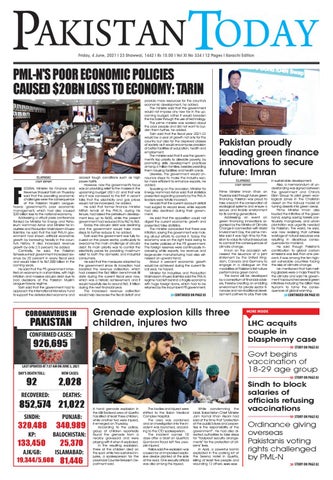
eDeRAl Minister for Finance and Revenue Shaukat Tarin on Thursday said that the prevailing economic challenges were the consequence of the Pakistan Muslim leagueNawaz government’s poor economic management, which had also caused $20 billion loss to the national economy. Addressing a virtual press conference flanked by Minister for energy and Petroleum Hammad Azhar and Minister for Industries and Production Makhdoom Khusro Bakhtiar, he said that the last PMl-N government had shown artificial economic growth by borrowing heavily in the country's history. It also increased revenue growth by only 2.5 percent, he added. Contrarily, he said, the Pakistan Tehreek-e-Insaf government increased revenue by 20 percent in every fiscal year and would take it to Rs7,000 billion in the coming years. He said that the PTI government inherited an economy in a shambles, with high inflation and massive circular debt due to bad decisions of the Pakistan Muslim league-Nawaz regime. Tarin said that the government had to approach the International Monetary Fund to support the deteriorated economy and
accept tough conditions such as high power tariffs. However, now the government's focus was on providing relief to the masses in the upcoming budget 2021-22 and that was why it was conveyed to the IMF in recent talks that the electricity and gas prices would not be increased, he added. He said that former finance minister Miftah Ismail of the PMl-N, during his tenure, had raised the petroleum development levy up to Rs30, while the present government had reduced it by Rs2 to Rs3. Today the circular debt was declining and the government would take more steps to further reduce it, he added. Tarin said the government was fully focused on the power sector, particularly to overcome the main challenge of circular debt. Its main priority was to control the electricity prices for providing maximum relief to both the domestic and industrial consumers. He said that the measures adopted by the government since its inception had boosted the revenue collection, which had crossed the Rs4 trillion benchmark till date during the current fiscal year now, which was a historic achievement, and it would hopefully rise to around Rs5. 8 trillion during the next financial year. The increased revenue collection would help decrease the fiscal deficit and
coroNavirus iN
PakistaN
provide more resources for the country's economic development, he added. The minister said that the government would not impose any new tax in the upcoming budget, rather it would broaden the tax base through the use of technology. The prime minister was worried about the poor people and did not want to burden them further, he added. Tarin said that the fiscal year 2021-22 would be a year of growth not only for the country but also for the deprived classes of society as it would encompass provision of better facilities of education, health and employment. The minister said that it was the government's top priority to alleviate poverty, by promoting skills development practices among 4 million families, besides providing them housing facilities and health cards. likewise, the government would announce steps to make the industry sector more efficient to enhance exports, he added. Speaking on the occasion, Minister for energy Hammad Azhar said that statistics presented regarding poverty by the PMl-N leaders were totally incorrect. He said that the current account deficit had surged to record level, while exports had also declined during their government. He said that the opposition could not digest the current economic growth and presented false statistics. The minister conceded that there was inflation, saying the government was making all-out efforts to control it. Today the economy was on the right track owing to the better policies of the PTI government. The foreign reserves were continuously increasing while exports, tax revenue and large-scale manufacturing had also witnessed an upward trend. About 4 percent economic growth would be achieved during the current fiscal year, he hoped. Minister for Industries and Production Makhdoom Khusro Bakhtiar said the PMl-N regime had left behind a fragile economy with huge foreign loans, which had to be returned by the incumbent PTI government.
CONTINUED ON PAGE 03
Pakistan proudly leading green finance innovations to secure future: Imran ISLAMABAD staff report
Prime Minister Imran Khan on Thursday said through future green financing, Pakistan was proud to take a lead in the conservation of ecological systems and ensure a secure and livable environment for its coming generations. Addressing an event on green financing innovations organised by the Ministry of Climate Change in connection with World environment Day, the prime minister said it was high time for Pakistan to value its natural resources to combat the consequences of climate change. Imran on the occasion witnessed the issuance of a joint statement by the United Kingdom, Canada and Germany to engage in a dialogue on the modalities of Pakistan’s first nature performance green bond. The bond will be developed by a consortium of financial advisers, thereby creating an enabling environment for private sector finances and non-traditional development partners to play their role
Grenade explosion kills three children, injures two
CONFIRMED CASES:
926,695
NEW CASES:
92
2,028
RECOVERED: SINDH:
PUNJAB:
320,488
340,989
KP:
BALOCHISTAN:
133,450 AJK/GB: 19,344/5,608
25,370 ISLAMABAD:
81,446
more inside
LHC acquits couple in blasphemy case Govt begins vaccination of 18-29 age group STORY ON PAGE 03
DEATHS:
852,574 21,022
CONTINUED ON PAGE 03
STORY ON PAGE 03
LAST UPDATED AT 7:37 AM ON JUNE 3, 2021
DAY'S DEATH TOLL:
in sustainable development. Also, a memorandum of understanding was signed between the government and China’s elion Group to pilot green ecological zones in the Cholistan desert on the Kabuqi model of turning deserts into green areas. Prime Minister Imran also lauded the initiative of the green bond, saying saving forests particularly mangroves, and urban plantation was urgently needed for Pakistan. The world, he said, was now realising that ruthless wastage of natural resources was resulting in disastrous consequences for mankind. He said though Pakistan’s contribution to global carbon emissions was less than one percent, it was among the ten highest vulnerable countries facing the risks of climate change. He mentioned that fast-melting glaciers were a major threat to the climate and said his government has launched several green initiatives including the billion tree tsunami to tame the consequences of global warming.
A hand grenade explosion in the Killi Badezai area of Quetta has killed at least three children, while another two were injured, it emerged on Thursday. According to the police, group of children reportedly found the grenade from a nearby graveyard and were playing with it when it exploded. In the resulting explosion, three of the children died on the spot, while two sustained injuries, a spokesperson for the provincial Counter-Terrorism Department said.
The bodies and injured were shifted to the Bolan Medical Complex Hospital. The area was cordoned and an investigation into the incident was launched, according to the CTD spokesperson. The incident comes 10 days after a blast on Quetta’s Qambrani Road left five people injured. Police said the explosion was caused by an improvised explosive device planted at the side of the road. One security official was also among the injured.
While condemning the blast, Balochistan Chief Minister Jam Kamal Khan Alyani had said at the time that “protection of the public’s lives and properties is the responsibility of the government”. He had also directed authorities to take steps for “foolproof security arrangements” for the protection of citizens’ lives. In April, a powerful bomb exploded in the parking lot of the Serena Hotel in Quetta, killing at least five people and wounding 12 others. News Desk
Sindh to block salaries of officials refusing vaccinations STORY ON PAGE 02
Ordinance giving overseas Pakistanis voting rights challenged by PMl-N STORY ON PAGE 02
02
Friday, 4 June, 2021
KARACHI
NEWS
sindh to BlocK salaries of officials refusing vaccinations KArACHI
s
sTAff RePoRT
INDH Chief Minister Murad Ali Shah on Thursday directed the finance department to withhold from July the salaries of government officials refusing to get vaccinated against the coronavirus. The move to block the compensation is aimed at overcoming vaccine hesitancy and encourage a return to normal. The measure, he said, would only apply so long as the officials did not get vaccinated. Presiding over a meeting of the provincial coronavirus task force, the chief minister directed the health department to
install 300 basic health units and vaccination points across the province, giving the target of 30,000 inoculations a day. He further handed a target of 60,000 inoculations a day to mobile vaccination teams and a target of 10,000 shots per day to private hospitals. The development comes as confirmed cases of the coronavirus in Sindh climbed to 320,488 after 1,041 new infections were registered in the last 24 hours. After testing 15,008 samples, the authorities received back a scaled-down positivity ratio of 6.94 percent. The province also reported 22 deaths, raising the toll to 5,073, while the recoveries rose by 1,238 to 290,640.
sindh accuses of stealing Balochistan’s water supply, endangering crops QUETTA: The Balochistan government spokesman Liaquat Shahwani has once again accused Sindh of stealing water from the province, stating that the province should get 7,600 cusecs of water from Pat Feeder Canal, but is actually only getting 6,000 cusecs of water from Sindh. Similarly, he said, they are getting 1,800 cusecs of water instead of 2,400 cusecs from the Kirthar Canal. In the last 10 days, Sindh has been providing 55 percent less water in these two canals, he said. He added that in this situation, there is a danger of destruction of crops on 76,000 acres in the agricultural areas of Balochistan adjacent to Sindh. The Balochistan government has decided to take up the issue of water theft from Sindh with the Sindh government and in the Council of Common Interests, Shahwani said. Last week, the Sindh Cabinet had spoken out against water shortage in the province during the ongoing Kharif season and had blamed the Centre for its “animosity” towards Sindh. Cabinet members had pointed out that the Indus River System Authority had failed to implement the 1991 water accord, adding that instead of distributing the water shortages among provinces in accordance with the agreed formula, Punjab was given the lion’s share. news Desk
Pml-n's poor economic policies caused $20bn loss to economy: tarin
Ordinance giving overseas Pakistanis voting rights challenged by PML-N ISLAMABAD sTAff RePoRT
The presidential ordinance allowing voting rights to overseas Pakistanis and use of electronic voting machines has been challenged in Islamabad High Court by Pakistan Muslim League-Nawaz MNA Mohsin Shahnawaz Ranjha through advocate Umar Gilani. President Dr Arif Ali, the principal secretary of prime minister, ECP secretary and law and justice ministry secretary have been made respondents in the plea. Ranjha in his plea has pleaded with the court to declare the ordinance, allowing voting rights to overseas Pakistanis, null and void. ”The government has become habitual of issuing presidential ordinances.” The petitioner further prayed that according to media reports, the government issued a one-page ordinance on May 9 without taking public
representatives into confidence over this important legislation. “The government has promulgated more than 54 presidential ordinances since September 24, 2018. Issuing ordinances has become a norm [in this country] which is depriving public representatives of the right to legislate,” the petitioner argued. Issuing ordinances is the right of the president but that right can only be exercised in emergency situations, Ranjha said in his plea and urged the IHC to order binning the ordinance. To issue ordinances without the existence of an emergency situation would be tantamount to disrespecting the parliament, he said. “In the PMDC case, the IHC had clarified the circumstances under which a presidential ordinance may be issued,” the petitioner added. On May 8, President Alvi had promulgated the Election (Second Amendment) ordinance 2021, allowing voting rights to overseas Pakistanis.
Court extends detention of Asif in wealth case LAHore inP
ContInueD froM pAge 01 The PML-N government had artificially stabled the rupee, he added. Khusro said that the national economy was now improving and strengthening due to the prudent policies of government under the leadership of Prime Minister Imran Khan. The minister said that the government's full focus on sustainable economic growth through prudent policies. Agriculture and construction sectors had witnessed record growth. The Gross Domestic Product growth rate would hopefully touch 4.8 percent during the current fiscal year, he added.
Following the meeting, the health department announced that thus far some 1.5 million people had received at least one dose of the vaccine across the province, with 429,000 people have been completely vaccinated. It also informed the body that 78,799 people had been administered vaccines in the previous 24 hours. Briefing the meeting, an official said that about 26,812 people coming to the province were tested out of which 55 were positive. He further apprised that on May 29, four people were diagnosed with the Indian variant of the disease and were kept in isolation. The four patients, he revealed, also came in contact with 14 other people who
were also being tested for the variant. Separately, Sindh Education Minister Saeed Ghani said that the provincial task force on Covid-19 had discussed easing coronavirus restrictions gradually, as the number daily cases of infections appears to be on the decline in the province. Addressing traders at the Karachi Chambers of Commerce and Industry (KCCI), Ghani said the provincial task force had hinted at curbing restrictions in its meeting today, adding that “we are moving towards reopening [of businesses] and consultations are underway in this regard.” The minister said the restrictions would be lifted gradually and in phases. “We realised that the lockdown and restrictions on businesses caused problems for the traders. It was an unpopular decision, and the PM was also against the lockdown initially, but this time he also supported it,” he said. The provincial minister said it was also a fact that restrictions coupled with strictness had resulted in the downward trend of Covid-19 cases.
An accountability court in Lahore on Thursday extended the judicial remand of Pakistan Muslim League-Nawaz MP Khawaja Asif in the assets beyond income case against him. The court after extending judicial remand until June 17 adjourned the case. Earlier this week, a Lahore High Court judge refused to hear Asif’s petition seeking post-arrest bail in the case, recusing himself from the case. The National Accountability Bureau had arrested Asif from outside the Islamabad residence of another PML-N leader Ahsan Iqbal in December on charges of being in possession of assets beyond his declared sources of income. According to a detailed charge sheet, NAB was carrying out investigations against Asif under Clause 4 of the NAB Ordinance, 1999 and Section 3 of
the Anti-Money Laundering Act, 2010. “Before assuming the public office in 1991, the total worth of Khawaja Asif’s assets was Rs5.1 million which increased to Rs221m in 2018 after serving on different posts that do not match with his known sources of income,” said the statement. “Accused Khawaja Asif claimed to have received Rs130 million from a UAE firm M/s IMECO, but during the course of the investigation, he failed to present any solid evidence of receiving this amount as a salary,” it said. “This clearly shows that the accused tried to prove his income through fake sources.” Moreover, NAB alleged that Asif was also running a company, Tariq Mir and Company — registered in the name of his staffer — through his frontmen. It said that an amount of Rs400 million was deposited in the account of Tariq Mir and no sources of this huge amount were disclosed.
BJP Politician assassinated in held Kashmir SRINAGAR: Assailants fatally shot a politician belonging to Bharatiya Janata Party in Indianoccupied Kashmir, and separately, police on Thursday killed a Muslim detainee who they said snatched an officer’s rifle and fired at officials inside a police camp. The unidentified assailants shot Rakesh Pandita late Wednesday night in the southern town of Tral, where he was visiting a friend, police said, blaming freedom fighters for the attack. He was declared dead in a hospital. Fighters in occupied Kashmir have been fighting the central government for decades. Suspected militants carried out a string of deadly attacks last year on members of BJP in the held region. Among those killed was a top BJP politician and his father and brother, who were also party members. Pandita was also an elected official for a municipal office in Tral. His body was taken to southern Jammu city for a funeral. He had a secured accommodation in the region’s main city of Srinagar and was protected by two police guards, but he went to Tral without them, a police statement said. Manoj Sinha, New Delhi’s top administrator in Kashmir, and BJP leaders condemned the killing. “Terrorists will never succeed in their nefarious designs, and those responsible for such heinous acts shall be brought to justice,” Sinha said in a tweet. Agencies
shehbaz terms economic growth figures wrong ISLAMABAD TLTP
Pakistan Muslim League-Nawaz President Shehbaz Sharif has claimed that the government is presenting wrong statistics about economic growth and misinforming the public since the start of its tenure. “The government’s statistics [regarding the budget] have already become a subject of debate,” Shehbaz said while addressing a virtual seminar attended by PML-N budget analysts on Thursday. “Their past is evident and they have been putting forth forged figures,” he said. “This comes on top of the government’s worst performance and major failures.” The PML-N chief further stated, “We will present a joint stance after holding consultation with all the parties in the parliament.” Earlier on Sunday, addressing the nation live, Prime Minister Imran Khan said the opposition parties were complaining about the government misleading the nation on the economy as they had not expected it to achieve a growth rate of nearly 4 percent. “The economic growth rate has baffled political opponents who wanted the government to fail in meeting these challenges left behind by our predecessors,” he added. The premier added the country’s projected growth rate at more than 4 percent would spur economic activities in the country, providing job opportunities and reducing price hike. “Pakistan will continue to achieve economic growth in the days to come as a process is gradual and will take time,” he claimed.
Pakistan proudly leading green finance innovations to secure future: Imran ContInueD froM pAge 01 Imran said Pakistan was committed to spearheading innovative nature preservation and biodiversity initiatives and the green stimulus package. He mentioned that the preservation of natural resources was taught to mankind by the Holy Prophet (PBUH) 1,500 years ago, which was relevant even today. Minister for Climate Change Malik Amin Aslam said Pakistan was blessed to realise its enormous blue
carbon asset through a study conducted by the World Bank. He said the study showed that Pakistan’s existing coastal wetlands ecosystem particularly mangrove forests potentially stored 76.4 million tonnes of carbon dioxide equivalent. He said it was encouraging that the ongoing mangrove reforestation drive under the billion tree project could additionally remove 25 million tonnes of CO2e by 2050. Pakistan, he said, produced 3-5 percent of the total
KP sets up glamping pods to facilitate tourists peSHAWAr inP
In order to facilitate the tourists in the summer season, the Khyber Pakhtunkhwa government has set up glamping pods at several sites. The pods have been installed at 10 points — including Thandiani — to provide facilities to the people visiting the northern areas. Each spot contains 26 pods. Last week, the province issued new guidelines and coronavirus-related standard operating procedures.
All the hotels, guest houses, tour operators, had been directed to get their employees vaccinated against the contagion disease in line with the national vaccination policy. The tour operators and hoteliers have been directed to share booking information and other details of each tourist with local authorities in the attached format for further dissemination. Mandatory collection of negative RT-PCR report along with identity cards by hotels and guest houses management should be ensured before booking of rooms, it added.
blue carbon of the world — an “unvalued” commodity valued for the first time by the country. He stressed further research, mapping and monitoring of blue carbon by making an investment in education and training about the subject. World Bank Pakistan Director Najy Benhassine presented to the prime minister the report on blue carbon, which for the first time, gives an economic value to the country’s unvalued marine wealth including mangroves and seagrasses.
Friday, 4 June, 2021
KARACHI
LHC aCquits CoupLe in bLaspHemy Case LAHORE
t
APP
he Lahore high Court on Thursday acquitted a couple on death row seven years after their conviction for alleged blasphemy. The division bench, headed by Justice Syed Shahbaz Ali Rizvi, allowed the appeal of Shafqat emmanuel and his wife Shagufta Maseeh against their conviction by a trial court.
The bench had reserved its verdict on the appeal a day earlier after hearing detailed arguments of the parties. Advocate Saiful Malook represented the appellants before the bench, whereas the complainants were represented by Advocate Chaudhry Ghulam Mustafa. In his arguments, the defence counsel maintained that the trial court ignored the basic principles of criminal justice and committed error in its decision. he further submitted that the trial court had committed material
irregularity in misreading the evidence on record that caused serious miscarriage of justice. he pleaded with the court to set aside the trial court sentence and acquit his clients. however, the complainant’s counsel opposed the plea, stating that the trial court made the decision on merit after the prosecution succeeded in proving its case on the basis of independent and impeachable evidence. Shafqat, watchman of Gojra’s Saint
Cathedral School, and his wife were arrested on July 25, 2013, under Section 295-C, allegedly on the charge of sending blasphemous text messages to the complainants – a shopkeeper, Malik Muhammad hussain, and Gojra tehsil bar’s former president, Anwar Mansoor Goraya. In April 2014, an additional district and sessions judge of Toba Tek Singh handed down death sentence to the couple for blasphemy and fined Rs100,000 each.
Govt begins vaccination of 18-29 age group ISLAMABAD StAff rePort
Pakistan on Thursday began vaccination against the Covid-19 of people aged 18 and above, the National Command and Operation Centre said. Minister for Planning and Development Asad Umar, who also heads the NCOC, announced earlier this week that following the expansion of the drive, all age groups will be vaccinated simultaneously. Umar said more than seven million people have been vaccinated against the contagion disease. he also urged the people to register for the drive as soon as possible. The government launched registration for immunisation for people in the said group on May 16. The minister said in a tweet that registration would be extended to the general population if the vaccine is authorised by the Drug Regulatory Authority of Pakistan. As the vaccine supply improves and the vaccination capability grows, the minister said the government was expanding registrations to include additional age groups. So far, more than 7,953,574 people have been vaccinated against coronavirus in Pakistan. The NCOC earlier decided to set up separate vaccination centres for the teachers and educational staff. It directed authorities to complete the vaccinations
PFIZER JABS RESERVED FOR OUTBOUND NATIONALS, UMAR SAYS by June 5. PFIZER SHOTS RESERVED FOR TRAVELLERS: Meanwhile, the government decided to inoculate the Pfizer shots to people with a work visa, Umar said. The aim of the move is to vaccinate pilgrims and students proceeding for education abroad on a priority basis. Umar said that the vaccine acceptability issue is a global issue and urged other nations to address it. While responding to a question regarding the Pfizer dose, which the country received under the COVAX programme, the minister said that Pakistan received a limited quantity of jabs due to which the government has decided to give it to those who are going abroad where it is approved and mandatory. he said Chinese vaccines are exported the most and highlighted that acceptability towards vaccines is creating problems worldwide. he said that the government is launching a mass vaccination campaign and planned to establish 4,000 vaccination centres across the country. The Ministry of National health Services said Pfizer shots would only be used to inoculate “those with
pia dismissed 700 staffers with dubious educational backgrounds, senate told ISLAMABAD
compromised immunity, transplant patients, pregnant ladies, children of 12 years and above in need of vaccination” and those recommended by a committee of experts. VACCINE CENTRE SETUP: earlier in the day, Umar inaugurated a vaccination centre at The Centaurus Mall to vaccinate the maximum number of people in Islamabad. Talking to reporters, he said that with the setting up of vaccination points, the burden on hospitals and healthcare centres would lessen and more people would be able to get the jabs. he said that on request of the government to come forward in this cause, the corporate community in Islamabad extended their support in the vaccination drive as it was also affected by the virus. he said so far Islamabad was leading the vaccination drive. he also expressed the hope that there would be a positive trend in all cities to take lead for having the highest number of vaccinations. he said that 100 trained officials would remain on duties and standard services would be provided at this centre. he said it was the responsibility of every person to visit the vaccination centre and protect them against
Under new visa policy, Chinese workers to get two-year Pakistani visa in 48 hours ISLAMABAD MiAn AbrAr
APP
Minister for Aviation Ghulam Sarwar Khan on Thursday informed the Senate that as many as 700 staffers of Pakistan International Airlines who were inducted on dubious degrees and political affiliations in the tenures of the past governments have been terminated. In response to supplementary questions during question hour, the minister said that those officials were not only terminated but criminal and judicial actions were also taken against them. Regarding the allegedly fake license of pilots, the minister said that the licenses of 262 pilots were found suspicious after comprehensive background scrutiny. Following the due process, 50 pilots have been terminated, 32 suspended while cases of remaining pilots were pending in various courts. he said the opposition should appreciate the present government’s action against pilots possessing suspicious licenses. The minister said restrictions on PIA flight operations in the european countries would be lifted after International Civil Aviation Organisation’s safety audit in October or November. he said flight operations to six european countries and the United Kingdom have been suspended. The approximate loss incurred due to the closure of flights after his June 2020 statement was Rs7.9 billion during the last six months. Meanwhile, the government also informed the house that it disbursed Rs180 billion in 14.9 million people across the country under the ehsaas programme during the Covid-19 pandemic. Minister of State for Parliamentary Affairs Ali Muhammad Khan said an amount of Rs12,000 per person was disbursed. he clarified that Benazir Income Support Programme was not being closed. A new ehsaas survey was being carried out which would be completed by June 30, he added.
coronavirus. “We want to end all restrictions as early as possible including the opening of educational institutions and markets, but it depends on meeting the target of the maximum number of vaccination in the country.” he said that despite going through several peaks, Pakistan was in better condition in the region and thanked the district administrations, NCOC team, and the police for playing an effective role in curtailing the spread. he said that they still need to continue all such measures as still many patients were on oxygen across the country. he said that a massive awareness drive has been started with the support of traders’ organisations, markets bodies, and clerics. he announced youth of Islamabad have also been engaged to educate citizens about the importance of vaccination. he said that in order to make Islamabad free of coronavirus, MPs were taking part in this drive and appealed to the other political parties to direct their MPs to lead such drives in their respective cities. he assured that the provision of vaccines to every city was the responsibility of the federal government and assured that there was no shortage of vaccines.
Pakistan has approved a new visa policy for the Chinese citizens working on various projects wherein the minimum duration of new visas for Chinese workers would be two years. Interior Minister Sheikh Rasheed Ahmed said the above while briefing the Chinese Ambassador Nong Rong about the new features of the visa regime approved by the federal cabinet for the Chinese workers during a meeting at the Ministry of Interior. Under the new policy, the interior minister said that Chinese citizens will now be issued two-year work visas within 48 hours from the relevant missions. “A separate visa category has been created for Chinese citizens under the China, Pakistan economic Corridor. Special desks are being set up at airports to facilitate the Chinese citizens,” said the interior minister. Rasheed added that the visa facilities were being made exclusively for the Chinese citizens working on various projects including the CPeC projects. The meeting also discussed the bilateral cooperation between China and Pakistan. Talks on the issues of mutual interest including
Pakistan-China bilateral relations were also held. expressing happiness over the completion of 70 years of diplomatic relations between Pakistan and China, Chinese Ambassador Rong said that China is grateful for facilitating visas for Chinese citizens. The Chinese envoy said that the visa facilitation will further enhance trust and expansion in relations between the two countries. he said the CPeC-related projects will create new investment and employment opportunities in Pakistan. Rasheed thanked the Chinese government for providing the Covid-19 vaccine to Pakistan. The ambassador remarked the Pakistani government has made very good arrangements to control the epidemic. On the occasion, Rasheed urged the Chinese government to make arrangements for the return of Pakistani students enrolled in various Chinese universities who are now stranded in Pakistan. he said that Pakistani students risk losing their precious academic years due to the measures taken in wake of the pandemic. The Chinese ambassador acknowledged the issues faced by the Pakistani students and said the Chinese embassy will make the utmost efforts for the return of Pakistani students to China as soon as possible.
NEWS
03
media reforms aimed to protecting press freedom: minister ISLAMABAD APP
Minister of State for Information and Broadcasting Farrukh habib Thursday said that the PTI government is introducing large-scale reforms in the media sector to improve its performance, ensure the job security of its workers and protect freedom of the press. “[The proposed] media regulatory authority is part of our agenda to introduce new media technologies and developed a state of the art effective mechanism”, he said while speaking to a news channel. he further explained that PeMRA was no doubt discharging its responsibilities in a responsible manner but there was a need to develop a mechanism to check if the salaries were being paid on time and regularly and other related issues. habib said that government would not compromise on the issue of salaries of media workers and asserted it would improve the relations between the media bosses and their staffers. While stressing the need for a digital advertisement policy and its monitoring, he observed the digital media industry is growing rapidly and the proposed policy will help improve the economy. It will encourage the corporate sector to adopt digital media as an advertising medium, he said. he said the government wants to digitise its departments to make things easier and it will set a criteria for the registration of YouTube vloggers and other platforms’ users because it cannot simply give advertisements to them on the basis of the number of views on their content. The minister said there were the tech giants did not have an on-ground presence in Pakistan which should keep check and balance and run through a proper mechanism. he said the government would expand media authority offices to address outreach issues, adding, legislation in media to ensure mandatory payments to journalists in print and electronic media that will overcome the problem of delayed payments.
peace, development of pakistan, China, afghanistan linked: Fm ISLAMABAD tLtP
Minister for Foreign Affairs Shah Mahmood Qureshi has said that the peace, prosperity and economic development of Pakistan, China and Afghanistan are linked. In his virtual address at the 4th ChinaAfghanistan-Pakistan Trilateral Foreign Ministers’ Dialogue on Thursday, the foreign minister said that Pakistan has always strived to strengthen its relations with China and Afghanistan in the bilateral as well as regional context. “We attach great importance to this dialogue enhancing cooperation and coordination,” he said. Qureshi said that it was about four years ago that the three countries had conceived this trilateral forum for discussing collaborative efforts to promote peace and stability in Afghanistan and the region, enhancing security and counter-terrorism cooperation and deepening regional connectivity and shared economic development through meaningful projects. The foreign minister said that since then, Pakistan has successfully moved forward this forum through a gradual, phased but consistent approach. he said that the United States and NATO forces have already started withdrawal of troops from Afghanistan. he also said that while the withdrawal of foreign troops from Afghanistan entails serious security challenges, it also offers a unique opportunity for peace and reconciliation in Afghanistan and moving the country from a perpetual internal conflict to an era of peace and stability. “We should, therefore, explore how our three neighbourly countries can work together to deal with the evolving situation in an effective manner and steer it towards achieving our shared objective of lasting peace and stability in Afghanistan and the region,” he said. The foreign minister said that Pakistan, China and Afghanistan are located in a region which has immense opportunities for fostering mutually beneficial economic and development cooperation. “Our three geographically linked countries straddle historical routes traversing east-west and northsouth,” he added.
Role of govt, civil society critical to address climate challenge: experts ISLAMABAD AgencieS
experts from various fields said that the role of the federal government and civil society is critical to address climate change issues direly impacting the economy, society, and politics of the country. Pakistan has already been facing a plethora of challenges on multiple fronts, and the issue of climate change will add fuel to the fire if collective efforts are not made by the state, society and international community, the experts said while expressing their views during an online discussion on climate change, organised by Islamabad-based think-tank Center for
Global and Strategic Studies. Pakistan is already on the top 10 list of most vulnerable countries to climate change, said Rashid Aftab, a public policy and governance expert from the Riphah International University in Islamabad. “It can cause national security threats such as poverty, food insecurity, internal population displacement, and resource scarcity among others,” he said. The country has faced numerous weather-related disasters over the past years including floods, droughts, heatwave and cyclones, Aftab said, adding that these calamities claimed the lives of hundreds of people and damaged properties worth billions of rupees. Yusuf Zafar, an agricultural expert at the Pakistan Agricultural Research Council, said that climate
change issues could increase vulnerabilities for the country’s agricultural sector and forest and water resources, on which the largest part of the economy and livelihood depends. Agricultural productivity has witnessed a decline in recent years due to climate change, drought and crop diseases, threatening the country’s food security, Zafar said, adding that climate-smart agricultural techniques and research-based policies and measures are required to counter the new challenges. Romina Khurshid Alam, a politician and member of the National Assembly, said that the government of Pakistan is taking serious steps to deal with the impacts of climate change and formulating robust environmental policies to minimize environmental degradation.
04
Friday, 4 June, 2021
KARACHI
NEWS
Shehryar pledgeS to take aphC leaderS on board for global Campaign on kaShmir ISLAMABAD
p
MIaN aBRaR
ARLIAMEnTARY Committee on Kashmir Chairman Shehryar Khan Afridi on Thursday pledged to take the All Parties Hurriyat Conference (APHC) leaders on board for the committee's diplomacy with the global community on Kashmir. Addressing the central leaders of the APHC at their headquarter, Shehryar said that since the start of the Pakistan Tehreek-i-Insaf (PTI) government, Prime Minister Imran Khan has transformed the country's policy on Kashmir dispute and the PTI has remained committed to the cause of Kashmir. He said humanity is suffering even in the 21st century as Jammu and Kashmir is the place where barbaric crimes are being committed against humanity. He said that Pakistan has a commitment towards the Kashmir cause and no one can change the love bond between the Kashmiri and Pakistani people. Shehryar said that the premier has clearly expressed his unwavering commitment to the cause of Kashmir and no one can question it. “Whether it is the PM's statement in the UnGA in 2019 or today, the commitment of Imran Khan has been unwavering towards Kashmir and its people. Whether it is Indian Illegal occupation of Kashmir or the Israeli illegal occupation of Palestine, Pakistan has a principled stance against the occupational regimes and it will never compromise over its commitment with
Kashmiris and Palestinians fighting for freedom from occupational forces.” He said that in line with the directions of Imran Khan, he has activated the committee to help raise Kashmir dispute at all national and international forums. He said that though the Covid-19 pandemic has badly hurt the campaign of Kashmir committee, still the committee has adopted innovative measures to help connect with the international organisations and lawmakers of the world through virtual meetings. He said the Kashmiris need to be provided international platforms to build their case of freedom, adding that the Kashmiris can convince the world on their freedom movement. Shehryar appealed to the Pakistani and Kashmiri youngsters and rights campaigners to join hands and build campaigns for Kashmir on social media. He said that he is engaging the Pakistani youth to sensitize them on the Kashmir dispute as due to the failure of past regimes, the youngsters stand disconnected from the Kashmir cause. He said that internet provides best solutions to connect to the rights organisations and activists through modern gadgets in this age of pandemic, adding that Indian Illegally Occupied Jammu and Kashmir has the right to determine its own fate and the Indian forces cannot force it to surrender by continuously imposing double lockdown, economic strangulation and media blackouts. The PM's recent statement on trade with
India has left no doubt on Pakistan's loyalty to Kashmiris, he added. APHC Convener Syed Faiz naqshbandi said that the APHC values the steps taken by the committee under the chairmanship of Shehryar. He welcomed the statement given by the prime minister of Pakistan and said that Kashmir's independence movement is actually a movement of completing Pakistan and this struggle will continue until desired results are achieved.
Ghulam Mohammad Safi, a representative of Tehreek-e-Hurriyat (TeH), said that the TeH Chairman Ashraf Sehrai led the freedom struggle by laying down his own life and son. He lauded the statement of Imran Khan and his commitment to the cause of Kashmir, adding that Imran has won hearts and minds of all Kashmiris. Syed Yousaf naseem said that the way Shehryar is leading the struggle for Kashmir has rekindled hopes of the people of Indian
Illegally Occupied Jammu and Kashmir. He hoped that this campaign would further gather momentum once the pandemic declines, adding that the freedom fighters have taken up arms against the Indian Illegal occupation. APHC’s Mohammad Hussain Khateeb said that if the past governments had tried to project the Kashmir issue like the PTI government, the incidents like August 5 could have been avoided.
Punjab govt doubles fines on traffic violations LAHORE INP
The Punjab government has approved to significantly raise the fines imposed on traffic violations and make it mandatory for the owners of vehicles older than 5 years to obtain a vehicle fitness certificate. For motorcyclists, the fine has been increased to Rs300 or Rs400 depending upon the violation. The fine for riding a motorcycle without a helmet will be up to Rs600 instead of just Rs200. The fine for speeding, wrong parking, driving in the opposite lane and riding a motorcycle without lights at night has been increased from Rs200 to Rs400. The Punjab cabinet has also approved a fine of Rs500 for underage motorcyclists while those without valid driving licenses will be fined Rs600. In addition, the fine for rickshaw drivers has been increased from Rs250 to Rs500. For car drivers, the fine for driving without seat belt, using a mobile phone while driving and driving without a valid driving license has been raised from Rs500 to Rs750. The use of pressure horns and driving on the wrong side of the road will result in fine of Rs1000. Motorcycles with fake number plates will be fined up to Rs1,000 and cars up to Rs2,000, while commercial passenger vehicles will be fined from Rs1,000 to Rs2,000.
Sozo Water Park introduces Pakistan's fastest drop slide LAHORE PR
Dawar Lashari, the general manager of Sozo Water Park, informed that the bullet drop slide, recently inaugurated at the park, is an imported international level slide and installed in Pakistan for the first time ever. He said the drop slide is the first of its kind and has a cost of Rs150 million. “The way the slide thrills its riders is like if someone stands in a chamber at the top of a 50 feet tower and then suddenly drops into an enclosed slide at a steep drop of 90 degrees. During the slide a huge quantity of water is dis-
charged at the speed of 1500 litres per minute to intensify the delight of experience. There is also a super loop of 40 feet diameter to enhance the fun part. The total length of the bullet drop water slide is 170 feet. The ending part is more interesting that the rider lands in a water of only 4-inch depth, so a nonswimmer can easily take the water slide.” “The slide has a colourful lighting strip effect inside and the riders feel like going through a tunnel full of colourful lights. It is a high thrill ride installed for youngsters, who like to try something new. Sozo Water Park is a safe outdoor
space for everyone to beat the heat during summers. This is what centre of disease control (CDC) USA has to say about water parks The CDC is not aware of any scientific report of the virus that causes Covid-19 infection to people through water in pools, hot tubs, water playgrounds, or other treated aquatic venues.” He further said the Sozo Water Park treats its water with chlorine and other chemicals to make its customers safe from any water borne infections or diseases, adding that the bullet drop water slide is a special gift to Lahore during this period of depression and stress.
Police working hard to protect life, property of people: Islamabad IGP ISLAMABAD Staff RePoRt
Inspector General of Police (IGP) Islamabad Qazi Jameel-ur-Rehman has said that the police is working day and night to ensure peace and security in the capital area. The IGP Islamabad, while addressing a reception made in honour of police and business community and hosted by UBD Secretary General Zafar Bakhtawari and Islamabad Estate Agents Association President Sardar Tahir Mahmood, said that it is very difficult to maintain law and order with-
out involving the local community and citizens, adding that community policing is the need of the hour to maintain better security in the city. The IGP said that the Islamabad police and traffic police officers are always on duty to serve the citizens. He said that the business community has always been cooperative with the police in its endeavour to maintain the law and order situation in Islamabad, which is laudable. He thanked the business community for joining hands with the police and cooperating with it to ensure peace and security in the city. He added that
he is personally supervising the traffic matters in Islamabad and black glasses and unauthorised number plates are being removed. The IGP said that the E-challan process has been started in Islamabad and appealed to the business community to continue cooperating with the police for maintaining better security in the city. Speaking at the reception, Islamabad Chamber of Commerce and Industry (ICCI) President Sardar Yasir Ilyas Khan said that the business community is proud of Islamabad police’s performance. He stressed that cameras should be installed in markets and
areas like all over the world to detect culprits, adding that the businessmen of Islamabad should install CCTV cameras in their markets and connect them with the Safe City project. He said that crime rate in Islamabad is the lowest in Pakistan, which is laudable, but still there is scope for further improvement. Zafar Bakhtawari emphasised on community policing and said that instead of taking disputes to the courts, these should be resolved in the police stations through the reconciliation committees. He said police patrols on bicycles have been started in the
city, which would improve security and also resolve health issues. He appreciated the launch of an app by the police and said it would help the police in maintaining peace effectively. He also appreciated the performance of the SSP operations and SSP traffic. Sardar Tahir Mahmood and ICCI Police Committee Chairman Saif-ur-Rehman Khan said that the Islamabad police is ideal force for other cities and the business community has full confidence on the officers. He thanked the Islamabad police for setting up a police desk in the ICCI for the facilitation of the business community.
Friday, 4 June, 2021
KARACHI
LSM gRowS by 10.4pc in Q2, higheSt Since Q4-Fy07: Sbp islamabad
t
Staff rEport
He large-scale manufacturing (LSM) grew by 10.4 percent in the second quarter of the current fiscal year 2020-21, which is the highest quarterly LSM growth since Q4-FY07, according to the State Bank of Pakistan (SBP). The SBP released its Second Quarterly Report on the State of Pakistan’s economy for the fiscal year 2020-21 on Thursday. The report highlights the strengthening of the economic recovery during the second
quarter of the fiscal year, which was evident from the growing pace of industrial activity, the promising output of major Kharif crops (with the exception of cotton), and a pick-up in the services sector during the review period. The large-scale manufacturing (LSM) grew by 7.6 percent during H1FY21, with its growth in the second quarter accelerating to 10.4 percent, the highest quarterly LSM growth since Q4FY07. Construction-allied and food processing industries generated much of the momentum in industrial activity. The construction industry benefited from the
Doors still open to ppp, says Fazl Pakistan Democratic Movement chief Maulana Fazlur Rehman on Thursday said that if Pakistan People’s Party wants to rejoin PDM "and if it thinks that wrong decisions have been made that have damaged democracy, we have not blocked the path for them to do so". The head of the Jamiat Ulema-e-Islam-Fazl made the remarks during a media talk in the city. "They separated from the PDM and bracketed themselves with the PTI," he said, in a reference to the PPP having sealed Yousuf Raza Gillani's appointment as Leader of the Opposition in the Senate via votes from the Balochistan Awami Party, a government ally. He asked who it really was that benefited from a rift in the alliance. Speaking more about the opposition alliance, Fazl said that "the nation was united via the platform of PDM against the illegitimate and failed government" when it first formed. He said that it was too early to say that the PDM is an electoral alliance. "electoral alliances are formed by each party based on its own interests," he said. Fazl likened “running away” from assembly resignations to giving the Pakistan Tehreek-e-Insaf government an opportunity to extend its term. The JUI-F chief had long been calling for lawmakers of the opposition alliance to resign from the assemblies, a position which was opposed by the PPP. The PPP and the Awami National Party have since parted ways with the anti-government movement over disagreements in Senate elections. “I think if we do not resign collectively, the government will extend its term,” the JUI-F chief said. “Running away from the option of resignations is tantamount to giving time to the present government.” He reiterated the claim that massive rallies will be held in Swat on July 4 and in Karachi on July 29. NEWS DESK
favourable policy environment, which included the government’s fiscal incentives under the construction support package, the Naya Pakistan Housing Scheme, as well as financial measures from the State Bank. Within agriculture, most of the major Kharif crops performed better than last year; this improvement was attributed mainly to increases in their areas under cultivation. The government’s support package for Rabi crops, comprising subsidies on key inputs, and an increase in the support price for wheat, are likely to bolster the overall crop sector growth.
However, cotton exerted a drag on the overall agricultural performance, as the revised production estimate of 7.7 million bales represented the lowest output since FY86. Nonetheless, due to the better output of other crops, the overall agriculture sector is expected to register positive growth. As the economic momentum picked up and the country successfully navigated the second wave of Covid without resorting to strict mobility restrictions, firms’ demand for credit nearly doubled on YoY basis during H1-FY21, said the report.
Use of modern technology essential for transparent elections: Fawad islamabad app
Minister for Information and Broadcasting Chaudhry Fawad Hussain Thursday said the use of modern technology would be essential for free, fair and transparent elections in the country. “The use of technology is vital for every sector as we will have to keep pace with today's world,” he said during a meeting with a delegation of Pakistan Bar Council and District Bar Council Faisalabad. Advisor to the Prime Minister on Political Affairs Shahbaz Gill was also present in the meeting. Fawad said the government desired to hold elections in a manner so that no one could point the finger over their transparency and fairness. He urged the lawyers community to give their input about the proposed electoral reforms. The minister said the Faisalabad Bar Council could also utilise the electronic Voting Machines (eVMs) to conduct its elections as Rawalpindi, Multan and Islamabad bar councils had already demanded the government to provide eVMs. He said Pakistan's interest was supreme to all. As the lawyers community were playing a significant role
in the country as evident from their valiant struggle for the supremacy of Constitution and rule of law. The minister assured that the proposal to set up a high court bench in Faisalabad would be considered. He said the lawyers community would also be provided homes under the Naya Pakistan Housing Scheme launched by the Prime Minister Imran Khan. SAPM Shahbaz Gill on the occasion said the lawyers would be provided houses on merit in the low cost housing scheme. The Pakistan Tehreek-e- Insaf (PTI) government, he said, was well aware of the lawyers’ problems and
asked them to prepare recommendations in that regard. Representatives of the bar associations said they were standing with the government for the rule of law. The bar associations, they said, would play a leading role on national issues. Besides Pakistan Bar Council member Ishtiaq A Khan, the delegation included District Bar Association Faisalabad President Akhtar Ali Virk, Secretary Khurram Ijaz Gallo, members Farrukh Gul, Malik Khalid Shafiq and Khalid Awan, and Convener Zafar Iqbal Mangan, and ILF Faisalabad President Javed Sharif Bandisha and Secretary Finance Mansoor Butt.
NEWS
05
SngpL SpeciAL tASK FoRce on UFg contRoL ho. ActionS
SNGPL Special Task Force on UFG control based at Head Office, has conducted series of successful raids in Mardan & Peshawar Region and caught many direct use / bypass cases. The Task Force first targeted Kandar Village, Nowshera and caught a bypass line installed on 2 inch diameter supply main, delivering gas to more than 30 nos. of houses. In other raid, Task Force also caught 9 nos. direct use cases red handed, through which gas was being pilfered and supplied in more than 20 nos. houses, located in Kandar Village Nowshera. Operation continued late at night and all direct use pipes and bypass were removed and lines were repaired on the spot. In continuation of their raids, Task Force went in the area of District Karrak, Tehsil Banda Daud Shah and caught a Plaster of Paris manufacturing industrial unit red handed, involved in gas theft. The pilfered gas was being used in plaster of Paris manufacturing unit. Plastic pipes being used in gas pilferage was recovered and bypass was removed on the spot. Next raid was conducted in BD Shah of district Karrak disconnected 04 nos. bypass cases through which gas was being used in 4 nos. Hotels operational at commercial level. Operation continued late at night, bypasses were removed and line repairing was also carried out on spot. The Cases are being processed for booking of volume as per SOP. Moreover, application in the local police station has also been submitted for lodging FIRs against gas pilferers. prESS rELEaSE
Dollar reaches Rs154.79 as rupee loses 2 paisas Pakistani rupee was weakened by 2 paisas (-0.01 percent) more against the US dollar in the interbank for the third consecutive day on Thursday. According to the State Bank of Pakistan, the US dollar opened at Rs154.77 and closed at Rs154.79. Within the open market, the US dollar was traded at Rs155-155.40. The local currency has shed Rs0.32 against the greenback during the last four days. However, the local unit has gained Rs13.27 against the greenback in the current fiscal year 2020-21 while appreciation has been Rs5.05 in 2021. Currency experts said that the market was under pressure due to dollar demand for import and corporate payments. They said that as the fiscal year is ending in the month of June, the corporate buyers were seen active for dollar buying. NEWS DESK
BOOK REVIEW by syed afsar sajid Title: ‘A Wanderer between the worlds’ Author: Javed Amir Publisher: Imprintpublishing, Islamabad Also available at: Sang-e-Meel Publications, Lahore/Liberty Books, Lahore Pages: 274 – Price: Rs.3000/-
Javed Amir is a well-known diasporic writer, poet, editor, journalist, amateur photographer, adventurer, and a former Pakistani diplomat, settled in the American state of Maryland which is peripheral to Washington DC. He has four remarkable publications in english, to his credit viz., ‘The Mask’ (short stories and poems), ‘Writing Across Boundaries’ (essays and translations), ‘Modern Soap’ (novel), and ‘Thought Never Dies’ (essays, book reviews and recollections). The instant book is designed as a travelogue comprising his ‘literary travel essays’ narrated in his own singular style characterized by curiosity, custom, and catholicity, with a self-sustaining candour as its hallmark. The book’s raison d’etre preambling its introductory part, reads thus: ‘Born under a wandering star I have lived, worked and traveled in five continents. everywhere I went I have explored --- wherever I could -- the hometowns of my favorite writers, painters and musicians which I write in detail in thirty chapters of this book. Here let me briefly list some if not all the cities and countries on the five continents that I have traveled and sometimes also lived in.’ Further in the first chapter, he elaborates his vision of a travel by pronouncing that ‘my
A Wanderer’s Tale travel essays are part memoir or story telling, part photography and part literary criticism’. The epicenter of romance if any in the tale traces to Clemencia, his ‘life-long incomparable companion’, his illustrious spouse of Colombian descent. He regards travel as a quasi-kinesthetic search for meaning not only in his life but also in the soul and spirit of the place he is visiting. This goal is achieved by searching through the lives of iconic writers, poets, painters and musicians who have been a part of that landscape. Renowned journalist, literary writer and critic Khaled Ahmed’s ‘Foreword’ to the book tends to unfold the author’s oeuvre in the context of its intent. The contents of the book comprise thirty-three (3+30) chapters with a delectable surfeit of pictorial illustrations besides the author’s prologue, concise comments by some leading cognoscenti of letters and arts, index of world travels, and the epilogue. At the very outset, the author cites a long but impressive list of world-wide destinations that he has visited during the course of his travel odyssey spread over some forty-two years of globe-trotting across all of the continents of the world. He has deliberately formatted the narrative as two-pronged; one, as an eye-witness account of the travels punctuated with observations and pertinent remarks on the socio-political history, culture and geo-physical attributes of the exotic locations visited by him mostly in the company of his spouse, and two, as glimpses of his personal biography stolen from the fan-
ciful repertoire of a graphic memory. The author passed the first twenty-six years of his life in Asia (British India and Pakistan). His father’s military career facilitated his vast travelling in Undivided India and later in Pakistan. His enlistment in the Pakistan Foreign Service led to his posting to europe in 1970 and then to Africa where he travelled far and wide in pursuance of his diplomatic assignments. Securing a premature relinquishment from the Foreign Service in 1978, he settled in the state of Maryland, in close proximity to Washington DC in the US. The period from 1978 to 2020 saw him journeying across the four corners of the globe besides criss-crossing the length and breadth of his adopted country, the US. In chapter 2 of the book, the author proclaims that ‘this book of literary travels focuses on some thirty of his favorite artists and writers on five continents’. In a literary travel, therefore, ‘to unearth the soul of a place you have to seek the writer who is the voice of that place or the painter of that landscape’ or the musician whose symphonies embellish the folklore of its culture. Reading, writing, and walking are concomitant elements of travelling for pleasure, and education too. It is in this sequence that the writer inter alia traces Lahore to Allama Iqbal, Faiz, Manto, and painters Shakir Ali, Khalid Iqbal and Sadequain; Dublin to novelist Joyce; Isla Negra (Chile) to poet Pablo Neruda; Wales to poet Dylan Thomas; ellicott City (Maryland, US) to journalist H.L. Mencken; Paris to the existentialist Albert
CmyK
Camus; Newark (New Jersey, US) to novelist Philip Roth; Walden Pond (Massachusetts, US) to naturalist Thoreau; Sligo (Ireland) to poet Yeats; Alcala d Henares (Spain) to novelist Cervantes; Cognes-surMer (France) to impressionist painter Renoir; Prague (Czech Republic) to novelist Kafka; Warsaw (Poland) to musician Chopin and film-maker Wajda; London to poet and critic T.S. eliot; Guinea (Africa) to (President) Sekou Toure; Senegal (Africa) to (President) Senghor; Istanbul (Turkey) to novelist Orhan Pamuk; New York (US) to short story writer James Baldwin; Trinidad (a Caribbean island) to novelist Naipaul; Kiowa Ranch (New Mexico, US) to poet and novelist D.H. Lawrence; Grasmere (Lake
District, UK) to poet Wordsworth; Stratfordupon-Avon (UK) to poet and dramatist Shakespeare; Salinas (Calif., US) to novelist Steinbeck; Calendaria (Colombia, South America) to novelist Marquez; Toledo (Spain) to the painter el Greco; and ‘IlliersCombray’ (France) to novelist Proust. And now the commentary on the work! Poet ejaz Rahim of ‘I Confucius’ fame, regards these travel essays as ‘a passionate embracing of the cities’ the author visited, the streets he trod and the memories he enlivened. Riaz Muhammad Khan a distinguished compeer of the author, observes that in the age of ‘mass tourism and the ubiquitous mass media every place has a preview’. In his opinion, only a man of the author’s sensitivity could ‘invoke the inner muses and listen to the rhythm of a space that once inspired a genius to paint or sing or to write’. Another PFS colleague of the author, Sarbuland Khan speaks thus of his latent qualities as a traveller-cum-narrator: ‘Javed’s ability to capture the intimate connections between the creative spirit and the place of its abode allows him and the reader to explore new meanings and deeper dimensions in both.’ Said Ahmed Khan, Javed Amir’s boyhood classmate, calls this book ‘ambitious and beautiful’, ‘simply magnificent’, and ‘grand and huge’. This scribe in his comments on this ‘glamorous’ travelogue, likened it to ‘a voyage into the dark existentialistic actualities of life, an enviable imaginative excursion into the realms of adventure’. Javed Amir’s lady wife Clemencia Amir, his two sons Kamilo Amir and Ivan Amir, and his daughter Sonia Amir Bowie have also contributed short commendatory notes on the literary-cum-educative aspects of the work.
on
Friday, 4 June, 2021
06 COMMENT
Getting an NRO out of Imran?
A Model EVM that failed on testing day And e-voting system declared unsatisfactory
PTI cannot ignore or wish away the Tareen group
P
RIMe Minister Imran Khan is hell-bent on introducing the electronic voting system in the next general elections. electronic Voting Machines (eVMs), according to him, would put an end to complaints about rigging. In the first week of May, he initiated a stream of tweets arguing his case. In the second week of the month, a pliant President promulgated a controversial presidential ordinance authorizing as well as binding the eCP to procure eVMs and let overseas Pakistanis cast ballot through e-voting. In the third week of May, the PtI Government unveiled the prototype of an eVM at Parliament house. the Information Minister invited journalists and bar associations to come and use the machines to satisfy themselves about their accuracy. Interestingly, the government officials who were keen to provide a demonstration of the prototype eVM to the eCP on Wednesday, asked for a delay in the demo till the third week of July. Obviously, something was wrong in the working of the prototype. as if this was not enough, in a second meeting held to discuss e-voting system for expatriate Pakistanis, the Spanish consultant firm told the eCP that Nadra’s system did not meet international standards and recommended technological changes to it. Chief election Commissioner Sikandar Sultan Raja has meanwhile called a meeting next week to deliberate on the report provided to the eCP by the Spanish consultancy firm. after what was done by governmentt functionaries during the by-elections in Daska, few would be swayed by the PM’s argument that his government was keen to hold free and fair elections, all the more so when countywide by-elections showed the government is losing everywhere. While eVMs can tally thousands of votes in minutes, these machines are notoriously poor at preventing fraud. In certain cases, machines are actually significantly more vulnerable to rigging than paper. What is more, rigging starts long before the elections when extraneous elements start changing loyalties through threats and promises of reward. Unless that interference is stopped, neither paper ballots nor eVMs can ensure free and fair elections. there is a need for the eCP to hold consultations with all political parties to evolve a system ensuring transparency and then send it to Parliament to turn it into a new election law. hasty decisions have to be avoided.
At Penpoint M A NIAZI
W
hat exactly is one to make of the emergence of the tareen group within the PtI? Matters have not gone to the extent of asking for separate seats in the National and Punjab assemblies, but they had gone far enough for the Group to nominate parliamentary leaders. to that extent, it meant that the Group had established an identity of its own. however, whether that identity is sufficient to approach the electorate is another matter. the tareen Group may have some currency within the PtI, where Jahangir tareen is a familiar senior figure, but where it is also clear that he is not exactly a vote-getter. that role is reserved for Imran Khan. this makes the tareen Group a purely internal PtI grouping, which is only relevant to national politics because the tareen Group could bring down the PtI governments at the Centre and in Punjab. It should be noted that the tareen Group poses no threat in KP. that indicates the limit of its appeal, which is only limited to southern Punjab. that, coincidentally, is Mr tareen’s adoptive area, from which he contested elections when was able to. Mr tareen suffers from that disadvantage in leading a Group. Like Nawaz Sharif, he is judicially disqualified from ever holding public or party office. the activity of the tareen Group is being taken as an indicator that all is not well between Imran and the establishment, which is supposed to have carried out its most blatant intervention to bring him to office. however, he is thought to be guilty of the same sin as the previous flavours of the month, the PML(N) and the PPP, of assuming that he was something. While it may be true that neither of these two could have first achieved power without establishment support (except the PPP in 1971), both have enough public support, enough coverage of the political spectrum, to remain political forces. Neither has so far been strong enough to oust the establishment from politics, and both seem more interested in getting the support necessary to come to power. the tareen Group seems a product of the fact that Jahangir tareen has fallen out of favour with Imran Khan, and unlike almost the whole of the PtI, had developed links with the establishment before going into the PtI. he was first a CM’s adviser on agriculture in Shehbaz Sharif’s first tenure as Punjab CM. he was Governor’s adviser under the military government, and a minister in the Shaukat aziz Cabinet. Shehbaz himself is counted as an establishment man, in the
Resurgence of terrorism The old problem must not be allowed to come back
t
heRe seems to be a revival of militant activity. the incidents seem to centre around North and South Waziristan, which had developed into the epicenter of terrorism in the not too distant past, and which required a full-fledged and long-term operation by the army to clear the area. the Pashtun tahaaffuz Movement’s MNa Mohsin Dawar has said that the militants are not only returning, but regrouping. JUI(F) chief Maulana Fazlur Rehman has linked the rise of militancy to the impending withdrawal of US forces from afghanistan, which is to take place in September. there is a disturbing aspect to this revival; it is no longer directed against the afghan National army, and the US and NatO forces alongside them, but the most recent attacks have been directed against the Pakistan armed forces. When the USSR withdrew from afghanistan, the resistance was also left at a loose end, and the energies of the Mujahideen found an outlet in some going to Kashmir. this was something outside the control of the governments of the time, but Pakistan developed a reputation for being the terrorism capital of the world. this has been exploited to the hilt by India, which does its best to make sure that Pakistan suffers for this, at all possible international forums, and has not been entirely shed. therefore, Pakistan must ensure that the US withdrawal does not lead to the same sort of result. It must not be forgotten that in the 1990s, the military was not targeted. Now it is. this should lead the military itself to abandon the ‘we-know-better’ attitude in favour of one bringing all stakeholders in the process, and let Parliament decide together on a suitable policy, one which would ensure that there is no revival of the kind of terrorism which placed the country in so much trouble. a good starting-point would be to make sure that the benefits of integration with the rest of the country are indeed reaching the tribal areas. Going by the recent past, they seem just as brittle as they were when taken over by the militants.
The exploitation must end NAveed KhAN
I
NDIa and Pakistan are the two rival nuclear States of South asia. Right from their inceptions, they did not have friendly bilateral relations. they fought three major wars and had been in military standoffs a few times. India has always tried to destabilize Pakistan economically, politically and militarily to become the regional power of south asia. For this purpose India found another country, afghanistan, which bears ill will towards Pakistan due to some of its issues, like the Durand Line, and others, with Pakistan. afghanistan is a landlocked country of south asia and always had a significant place in global politics due to its strategic and economic importance as it has been considered a bridge to the oil and gas trade route and a gateway to the central asian market. On the other hand, India and afghanistan had friendly relations throughout history. India was the only South asian country to recognize the Sovietbacked Democratic Republic of afghanistan. the relation received a massive blow when the afghan civil war started after the Soviet departure from afghanistan in 1989 onwards. the taliban government did not maintain strong relations with India, as during the taliban regime the hindus were being watched keenly in afghanistan. India was involved in building the infrastructure in afghanistan since 1980. When taliban took control, this aid was halted. When the taliban were ruling, they seemed the perfect partners for Pakistan both politically and militarily. that Pro-Pakistani attitude of the afghan taliban was pinching India. Now when the US and allied forces invaded afghanistan and removed the taliban regime, after the 9/11 attacks, a global war on terror was declared by the USa. this major strategic shift set a perfect ground for India to become the strong ally of afghanistan as the taliban were thrown away. the afghan elite leadership believed that Pakistan brought the taliban into power and then toppled them down again by collaborating
Arif Nizami Editor Managing Editor
Joint Editor
Umar Aziz Executive Editor
Lahore – Ph: 042-36300938, 042-36375965
Imran has gone public on Tareen’s guilt, down to quantifying the loss he caused to the exchequer. That means he has convicted him in his mind, and is leaving the justice system to carry out the formalities. This is a contrast with other PTI stalwarts who had run-ins with the law, like Dr Babar Awan and Abdul Aleem Khan, who first resigned and were then reinstated after acquittal, but about whose guilt or innocence Imran never pronounced.
The writer is a member of staff.
How India exploited Afghanistan against Pakistan
Dedicated to the legacy of the late Hameed Nizami
Yousaf Nizami Aziz-ud-Din Ahmad
sense that he wants to work with the establishment, not take it on, as Mian Nawaz Sharif did during the recent Pakistan Democratic Movement (PDM). It is almost as if tareen is supposed to play in the PtI the role Shehbaz does in the PML(N), that of keeping the leader honest, on the side of the angels. the formation of the tareen Group has its main purpose that of ensuring that Jahangir tareen gets a fair shake from the authorities. On the other hand, Imran believes tareen’s involvement in the sugar crisis has harmed him. Whether tareen is responsible for the crisis or not is irrelevant, it is the perception that matters. Imran has gone public on tareen’s guilt, down to quantifying the loss he caused to the exchequer. that means he has convicted him in his mind, and is leaving the justice system to carry out the formalities. this is a contrast with other PtI stalwarts who had runins with the law, like Dr Babar awan and abdul aleem Khan, who first resigned and were then reinstated after acquittal, but about whose guilt or innocence Imran never pronounced. another example, more recent, is of Zulfi Bukhari, who has resigned after being implicated in the Rawalpindi Ring Road scam, but about whom Imran has been quiet. Only in tareen’s case was he not willing to leave the matter to the justice system. the real problem seems to be that the establishment needs politicians to garner votes in the constitutional set-up that prevails. the direct rule by ayub Khan did not really work, with Zulfikar ali Bhutto abandoning him to form his own party. he was left to pick up the pieces of a broken Pakistan in 1971, and was in turn replaced by Zia. however, Zia knew that he could not hold on forever. he promised elections, but held them off until February 1985. the result included Nawaz as Punjab CM, but this could not last forever, and Zia became the first President to dissolve the National assembly.
as long as the President could, every assembly was thus dissolved, and that too by two other Presidents. the dissolution power no longer vests in the President, but that has not meant the end of interference. the problem is that the lid cannot be put on interference the more it happens. there is an odd dynamic at work. those who yield ground are incapable of handling matters, while those who can handle matters are not amenable to guidance. those who think they know best are thus left to use whatever methods of control they find possible. the tareen Group may have managed to demonstrate that the PtI government cannot survive without it, but that means that it will be obliged to do something Imran will find costly indeed: let tareen get away with it. In other words, get an NRO. that is what he has sworn to deny the PML(N) and the PPP. If tareen manages to get away, that may do Imran irreparable damage among his base, which will have to choose between its reverence of Imran as leader, its desire for an accountability of Mian Nawaz Sharif and his relatives which punishes him irrespective of proof of guilt, and a wish to see PtI people protected. While this moral corruption might seem bad enough, the alternative, that of the PtI consuming its own in the time-honoured tradition of dictatorships and one-party states, seems worse. the problem that seems to have arisen is that tareen is not facing court cases because of any suspicion of wrongdoing, but because he was clashing with other powerful figures around Imran. there is every sign that a court has arisen around Imran. that is perhaps inevitable around every party leader, but it is up to that leader to keep this tendency in check, and to keep his feet on the ground. One of the adverse consequences is the jockeying for position among the courtiers. tareen seems to have been the victim of a cabal of enemies, but that was one of the inherent risks of having been one of the courtiers in the first place.
I
Karachi – Ph: 021-35381208-9
I
with the USa. after the taliban’s dismissal, hamid Karzai became President of afghanistan, who hated Pakistan because he was of the view that Pakistani spy agency ISI had killed his father in 1999. he also had some emotional bond with India as he received his masters education form India. When Karzai was interviewed at some point, he considered India as the perfect partner for afghanistan. he called India a democratic, stable, economically rich country and the best friend of afghanistan. this was a perfect platform for India to invest in afghanistan and achieve its strategic and economic goals. During Karzai’s government India reopened its embassy and four consulates in afghanistan to increase its influence there. India provided some &1.5 billion aid for the rebuilding of afghanistan in the post-taliban era and promised to invest about $500 million in the near future. India gained the trust of afghans because of all its efforts to rebuild afghanistan and succeeded in increasing its influence in afghanistan and minimizing Pakistan’s influence there. During this time India constructed a negative image of Pakistan. apart from this, afghanistan’s elites always blamed Pakistan for the destruction of the country and for providing support and safe haven to the afghan taliban. afghanistan also rejects the Durand Line; and claims that the Pashtoon-dominated areas of Pakistan belong to afghanistan. these misperceptions brought afghanistan to build stronger ties with India. India has its own strategic and economic interests in afghanistan for which they are investing ample re-
Islamabad – Ph: 051-2204545
sources. their strategic interests include, to conduct covert operations against Pakistan using afghan soil, to keep eye on Jihadist Islamic Groups; who are fighting in Indian-occupied Kashmir, to minimize Pakistan’s and the taliban’s influence in afghanistan, and to support separatist and militant groups like BLa in Pakistan, the economic interests include getting access to central asia for trade. India projected its image as a true helper, but as realists say there is no permanent friend and no permanent enemy in international relations, what matters are the states’ interests. India, too, was makng all efforts to achieve its own aims. India also exploited the afghan refugees in Pakistan with the help of NDS, by using them in funding militant organizations and carrying out terrorist attacks in Pakistan. that’s how India took the advantage of the lack of cultural, social and political connection between Pakistan and afghanistan and exploited afghans. Pakistan needs to tackle this issue wisely. Pakistan is also playing a vital role in peace talks between taliban and the USa. It needs to regain the trust of afghans by cooperating with the afghan government politically and economically. Pakistan should also make strong military relations with afghanistan in order to oust the threatening Indian influence from afghanistan. Pakistan should strengthen its bilateral relations with afghanistan as Pakistan cannot afford to have same enemy at multiple fronts.
Pakistan needs to regain the trust of Afghans by cooperating with the Afghan government politically and economically. Pakistan should also make strong military relations with Afghanistan in order to oust the threatening Indian influence from Afghanistan. Pakistan should strengthen its bilateral relations with Afghanistan as Pakistan cannot afford to have same enemy at multiple front
I
Web: www.pakistantoday.com.pk
I
The writer is a freelance columnist
Email: editorial@pakistantoday.com.pk
Friday, 4 June, 2021
COMMENT 07 Editor’s mail Send your letters to: Letters to Editor, Pakistan today, 4-Shaarey Fatima Jinnah, Lahore, Pakistan. E-mail: letters@pakistantoday.com.pk Letters should be addressed to Pakistan today exclusively
Self medication IN our country, everyone becomes a doctor for himself/herself by themselves. the practice of self-medication has now socially been adopted which seems to be indelible. Many great experts have warned about this peril on national and international basis but we are here to listen none. Likely, in my home, my mother is our doctor with no doctorate degree. My sister is having a normal cough from couple of days. Meanwhile, my mom handed her some medicines and forced her to take to. I was quite amazed seeing the scenario. It is often observed that people take medicines for flu, fever, headache and other minor disturbing health factors; knowing the fact that these are timely problems for which we should not take medicine at all. We just encourage our hearts and maintain a fake balance by containing cough-syrup, pain-killer, ointments, tonics, vitamins and such similar equipments but we have never pondered over the side effects of these silenced killers. there are more than 50,000 unnecessarily registered medicines in Pakistan. according to the official reports, 500,000 people die annually in Pakistan due to medication errors, wrong prescription, overdose of drugs, self-medication and adverse effects of medicines. ASif MurAd uMrAni KArAchi
Rapists are free
The rich land of poor dwellers Balochistan deserves a fair deal
SIrtAj BAluch rAKhShANI.
B
aLOChIStaN is a region that spans across parts of Iran, afghanistan and is currently Pakistan’s largest and most resource-rich yet least developed region. though meaning “Land of Baloch”, Balochistan barely even belongs to its major ethnicity. It rather belongs to that of looters than its dwellers. Be it Balochistan or the other provinces of Pakistan, all have endured the ordeal of loot and corruption. But Balochistan has been the most affected by the barbarity of corruption. the exploitation of national wealth of this province by its own rulers and the federal government is one of the major issues that Balochistan has been facing since it disputed allegiance with Pakistan in 1948. Given the natural resources and geographical importance, the province should have been one of most developed and economically stable provinces in the modern world but, unfortunately, it lacks the fundamental facilities even poor african nations have. the incompetence and corruptness of our own rulers and the exploitation of our national wealth by each central government has been the root cause of the devastating status quo of the province that constitutes almost half of Pakistan. In this modern era of development and prosperity, the people of Baluchistan are still living in the Dark ages, have the lowest standard of living and are starving to death. Literacy rate is abysmal and the human development index is lower of the least developed african Nations. Some of the far flung districts are like those of the chapters that are left untouched during exam preparations, no one knows even that they exist on the map of Balochistan. awaran, the third largest district, is the least developed district of Pakistan and lags far behind in various aspects of modern life. No education, no electricity, not even a single highway is available. So what..... No one cares! Be it provincial or federal government, all we can expect from them is corruption and exploitation of our national wealth. Fortunately, Balochistan has been blessed with more than enough natural resources that if half of the resources were to be used for the development, Balochistan would be the most prosperous region not only in Pakistan, but pobably
in the whole world. But, as long as corruption and the centre’s unwillingness to grant the province its legitimate rights exist as a hurdle, these resources are useless. the Sui Gas Field is the largest natural gas field in Pakistan with 1.6 trillion cubic feet reserves estimated as of 2017. Discovered in 1952, the gas began to be supplied to different parts of Pakistan by 1955. Surprisingly, the first provinces to receive the gas were Sind and Punjab, not Balochistan. even Sui town is deprived of its own gas and its people are forced to collect wood. even Quetta, the capital, received gas in 1970. Decades have passed since the gas discovery, nut only 14 towns of Balochistan have access, which clearly goes against the constitution of Pakistan which says in article 158,”the province in which a well-head of natural gas is situated shall have precedence over other parts of Pakistan in meeting the requirements from the well-head, subject to the commitments and obligations as on the commencing day.” according to this, Balochistan should have been prioritised over other provinces for gas distribution but, sadly, the centre preferred the inverse. according to the Pakistan Ministry of Petroleum and Natural Resources, Balochistan currently produces 17 percent, but consumes only seven percent of the total national gas supply. and some ridiculous excuses were made that due to the rough terrain of Balochistan, it’s not possible for all Balochistan to receive gas. But even the remotest areas of Punjab, thousands of miles away from Sui, could benefit. the Reko Diq mine, near Reko Diq town in Chagai District, is one of the largest copper and gold mines in the world. It represents one of the largest copper and gold reserves in the world, having estimated reserves of 5.9 billion tonnes of ore grading 0.41 percent copper and gold reserves amounting to 41.5 million oz. Nonetheless, it also fell prey to the centre’s exploitation. the federal government had promised to transfer 20 percent shares in the Saindak Project to the province after 2012, but it has extended the lease agreement with the Chinese company without consulting the provincial government. In lieu of the common people of Balochistan, foreign companies and the federal government have jointly looted these natural resources. Chagai’s fate, like Sui’s, could not be changed even after such a huge discovery and the people of the district remain hapless and frustrated. In the south east, Lasbela District oil refinery was constructed in 2014, capable of processing 120,000 barrels of oil. Furthermore, a power station adjacent to the refinery produces 1350 MW of power. Several cement plants and marble factories are located as is one of the world largest shipbreaking yards, on the Lasbela coast. But no one knows where these benefits go. Lasbela district faces some major and intractable issues with infrastructure being the worst. Water scarcity, no electricity, no roads and having the lowest standard of living. Despite being the hub of economic activities, the district is worsening with each passing day, let alone developing. Nowadays, Gwadar constantly remains in the limelight. “the upcoming hub of economic activities, the soon-to-be Dubai of Pakistan, the door to prosperity for Balochistan” is what politicians echo in their interviews. the China–Pakistan economic Corridor is a collection of infrastructure projects that have been under construction throughout Pakistan since 2013. Originally valued at $47 billion, the
value of CPeC projects is $62 billion as of 2020. CPeC is considered a game-changer for Balochistan which will lead to new heights of prosperity and development. Unfortunately, since the inception of CPeC Balochistan has been further deprived of its rights. It rather seems a trap to change the demography of a Baloch-majority region. CPeC has worsened the status quo and strengthened the sense of deprivation. We’ve seen and appreciated the marine drive, but we closed our eyes when people of Gwadar took the streets protesting against the authorities to get them clean drinking water. We’ve seen the picturesque cricket stadium, and celebrities taking selfies to post on social media, but we have been heedless towards the sufferings of those unemployed youth of Gwadar who lack resources to make both ends meet. Gwadar faces acute water scarcity, electric issues, unemployment, infrastructural problems, illiteracy. But the authorities willingly never paid attention to these issues. If projects like Sui Gas and Saindak could not change our fate, how can we expect CPeC to? Balochistan covers almost half of Pakistan’s total landmass but its average road density is just 0.16 as compared to 0.32 of the national average. the province continues to face acute water scarcity with water shortage and recurrent water droughts threatening the region’s economy which relies on agriculture. Balochistan is the least developed province in terms of the human Development Index (hDI), with the lowest hDI score of 0.421 as compared to Punjab’s 0.732. according to official reports, 71 percent of Baloch were living in multidimensional poverty, compared to 31 percent in Punjab. Balochistan’s unemployment rate was 33.4 percent as against 19.1 percent in Punjab. as many as 92 percent of Balochistan’s districts are categorized as highly deprived. District Dera Bugti, where natural gas was discovered, has the lowest hDI in Pakistan. Balochistan has the country’s lowest literacy rate (43 percent), including the least net enrolment rate for primary schools. Infant and maternal mortality rates in Balochistan are the highest in South asia and its people are succumbing to curable diseases like typhoid, cholera, hepatitis. although Balochistan makes up 44 percent of Pakistan’s total landmass, it has only 17 members out of a total 342 in the Pak National assembly. the overall share of Balochistan in CPeC is only 4.5 percent and if the Gwadar port, airport and hubco projects are excluded then total provincial share is reduced to a meagre one percent. It’s all happening because corruption has taken roots in Balochistan and to uproot this menace needs revolutionary actions. Corruption has spread like a wildfire in Balochistan, and if it is not curbed, we shall have to pay heavily. Corruption aside, the centre’s exploitation of natural resources and its unwillingness to provide Balochistan with its legitimate share is another major hindrance in Balochistan’s path towards a better future. Seventy years have passed but this issue is still kept pending. It’s important to note that until these two issues are solved, neither Balochistan nor Pakistan can strive for a successful, developed and economically sustained future, but rather a dark future awaits us. The writer can be reached at: Twitter: @IamSB_Rakhshani.
I just want to draw the attention of the concerned authorities towards a very serious issue which is being neglected by government and though they are not taking it as serious as it is required to be concerned. It is public hanging of rapists or a strict punishment or sentence should be imposed on rapists. Rape, from the last few years it has become a major problem in our country. there are at least 11 rape cases reported in Pakistan every day. Is this the Islamic Republic of Pakitan where a woman didn’t feel herself safe. Rape is criminal offense in Pakistan. Punishment for rape in Pakistan under the Pakistani law is either death penalty or imprisonment of between ten and twenty five years. Married and unmarried women are raped, girls are raped, childs are raped, boys are raped, trans man and woman are raped, animals are raped, old age woman are raped. even some of them are raped and murdered. this is a loss of many innocent lives. But what, the rapists are roaming freely, finding their new target. this is the high time for the government that they should have to take strict actions on rapists in order to safe the lives of innocent and amplitude of woman. and we will feel safe and free and confident. MAdihA ZubAir KArAchi
Problem of broken roads IN Sachal Goth, G3 stop, wakeel society scheme# 33 Karachi, I want to highlight the problem of broken roads. Our Municipal Corporation wants waking up; and as private appeals to their office had no effect, perhaps a little publicity will do no harm. For the last months Sachal Goath road has been almost impassable. the surface is badly broken up by heavy rains , and on dark night it is positively dangerous for vehicles or carriages to pass that way. Moreover, there are heaps of road metal on both sides of the road, which leave very little room in the middle. It is scandalous that we should be inconvenienced in this way for weeks and I hope the public will bring pressure to bear on those responsible so that the road may be put in through repair without further delay KAnwAl Ali KArAchi
Price surge in Pakistan PaKIStaN’S economy is facing serious challenges on the fiscal front. the main challenges are insufficient revenue generation and high fiscal deficit exports. an insignificant growth and fear of a slowdown in remittances. PtI government is trying to overcome the fiscal challenge in several ways but other relevant and concerned departments are not assisting the government appropriately. even some of the government’s members are repeating their usual activities like past’s governments. there is little scope for encouraging imports of industrial raw material to lift the country’s large-scale manufacturing sector out of recession. this, in turn, means industrial growth may remain stalled in the near future. there is also no room for the rupee to become strong enough in the short term to create demand for the import of even consumer goods. Consumption of domestically produced stuff is also dwindling because of falling income levels and high inflation. Inflation is stubbornly high and is on the rise. agriculture is not growing at the desired pace and industries are producing less. the PtI government is hoping for the export-sector revival. But failure to accelerate revenue collection and boost export earnings is pushing the government to continue to borrow from domestic as well as external resources. SAqib iShAq AZAd KAShMir
Tiktok and Youth SIR through the column of your esteemed newspaper, i just want to draw the attention of the Pakistan telecommunications authority (Pta) on the rising controversy on the ban of tiktok. tiktok popularity is increasing day by day. But as someone says, with great popularity comes great criticism. the app in the laat few months is facing massive criticism from the public. the app is widely used by the underage children which have sparked outrage from parents, privacy and security. It is just a wastage of time, people are spending hours on just scrolling and seeing videos on tiktok and the Youth which is known to be the assets of the country they are wasting their precious time and destroying their developmental period of age in making foolish videos just for the sake of fame. although i am not in favor of banning the tiktok as it is a great source of entertainment and a provide broader platform for the people to openly show their talent like acting, dancing, painting, sketching, singing and more but but it totally depends on us that how we are using it. beside, some of the content on tiktok is creating social unrest. MAdihA ZubAir KArAchi
Friday, 4 June, 2021
08 WORLD VIEW
‘There is hardly a family ThaT has Been spared’ EVERY DAY, MORE THAN 4,000 PEOPLE IN INDIA DIE OF COVID-19. PRATAP BHANU MEHTA BELIEVES THAT PRIME MINISTER MODI IS TO BLAME – AND ACCUSES HIM OF DESTROYING INDIA’S DEMOCRACY MINORITIES ARE CONSIDERED SECOND CLASS CITIZENS. SECULARISM AND LIBERALISM HAVE BECOME INSULTS. THE PROTECTION OF BASIC CIVIL LIBERTIES IS NO LONGER GUARANTEED. THE SUPREME COURT, ONCE CONSIDERED ONE OF THE MOST POWERFUL INSTITUTIONS IN THE COUNTRY, HAS BECOME ONE OF THE MOST SERVILE der spiegel lAurA Höflinger
DER SPIEGEL: In the middle of April, at a time when the hospital beds in the capital were already filling up, Prime Minister Narendra Modi held election rallies with tens of thousands of participants. His party hailed him as having “conquered the pandemic.” Since then, the coronavirus has ravaged the country. How could the government have misjudged the situation so badly? Mehta: modi has always had supreme confidence in his own political skills. But the pandemic has revealed a prime minister who has become trapped in his own mystique. There is no significant opposition or coalition partner that he has to compromise with. even within his own party, the BjP (Bharatiya janata Party), there are no serious opponents left. Bureaucrats are selected on the basis of loyalty rather than expertise. modi surrounds himself with people who don’t tell him the truth, not even quietly. DER SPIEGEL: Are you saying that the COVID-19 disaster in India has been the result of a loss of reality in the top ranks of the government. Mehta: Partly yes. it is one thing to mislead others. But once you start fooling yourself, you are in deep trouble. But i believe that the government’s indifference reflects more: modi always used to value how he looked in the eyes of others. now, though, he doesn’t seem to care much anymore how his behavior comes across. it’s the ultimate expression of power: not even feeling the need to pretend. DER SPIEGEL: That could explain Modi’s strange absence. Since April 20, he has made no noteworthy public appearances. Mehta: That is indeed remarkable. modi has not given a single press conference in the seven years he has been in office. But he has always loved giving big speeches. it is extraordinary that at this moment of absolute national devastation, he has almost disappeared from the public eye. There has been no attempt to convey to the people that there is a prime minister who is feeling their pain. One who at least acknowledges their suffering. DER SPIEGEL: Will Indians blame
Modi for the government’s missteps? Mehta: a month ago i would have said no. But even modi’s supporters are now voicing their anger. His party also draws a not inconsiderable part of its strength from the laziness and division of the opposition. now it looks, tentatively, as if the opposition is becoming better at coordinating. it’s still a long shot, but for the first time, the BjP doesn’t seem invincible. DER SPIEGEL: So far, though, no misstep has harmed the prime minister’s immense popularity. Mehta: This tragedy is different from anything that has come before. We are going through one of the biggest crises since independence. The second wave also hit the middle class hard, and they have always supported modi. There is hardly a family that has been spared. DER SPIEGEL: Why was India hit so hard in the first place? Mehta: That is a question for epidemiologists. But the government made a series of clear mistakes. They ignored warnings, and instead allowed huge gatherings to be held. emergency hospitals were decommissioned. Too little vaccine was ordered too late. DER SPIEGEL: How will Modi’s party react should it really come under pressure? Mehta: in the short term, the BjP will probably put even more emphasis on their agenda of polarization and repression. i have another concern, however. Take Uttar Pradesh, a poor but enormously important state from a political perspective. Uttar Pradesh is led by a BjP politician who has openly called for violence on several occasions and who is considered the future of his party. next year, he will be facing an election. Should he lose big time, he will probably admit defeat. But what if the result is close? Can we then trust the BjP to guarantee a peaceful transfer of power? DER SPIEGEL: The BJP has so far always respected the outcome of elections. What makes you think the party could go as far as stealing an election? Mehta: Remember that we are dealing with a party that suffers from a persecution complex. any criticism is attacked as “anti-national,” as part of a conspiracy against
the state. We have seen in the U.S. what happens when elements of a party no longer abide by the democratic rules of the game. DER SPIEGEL: The writer Ramachandra Guha coined the expression “50-50 democracy” for India 10 years ago in a piece in which he described the flaws in India’s democracy. Where would you place the country? Mehta: Somewhere around 30-70, against democracy. What Guha criticized at the time was that india, although it grants its citizens political freedoms, is a country characterized by deep social inequality. The challenges facing our democracy today are far more serious. minorities are considered second class citizens. Secularism and liberalism have become insults. The protection of basic civil liberties is no longer guaranteed. The Supreme Court, once considered one of the most powerful institutions in the country, has become one of the most servile. indian democracy has deteriorated in almost every aspect. DER SPIEGEL: But isn’t Modi himself proof that democracy works: a man from a poor background who made it to the top? His election was also the rejection of a Westernized elite in New Delhi. Mehta: The BjP likes to pretend that modi’s rise reflects a supposedly more common india. i don’t think that’s the case. Take, for example, indian television, which powers the machinery of hatred that the BjP so relies on. Some of the channels are funded by the same old elite that previously funded the Congress Party. That is as old as money gets. The elite, allegedly so despised by the BjP, are among its greatest supporters. DER SPIEGEL: What role does Hindu nationalism play in the party’s success - this idea that India is first-and-foremost the home of the Hindus? Mehta: a crucial one. But whereas promises like the construction of the temple in ayodhya and the protection of the holy cow served as a means to win an election – such as in 2014 – they have moved on to a project of transforming indian society. india is on its way to becoming a majoritarian democracy, a state in which the Hindu majority dominates the minorities, muslims in particular. Hinduism – which, in its diversity,
eludes fixed definitions – is being converted into an ethnic national identity. muslims, intellectuals, leftists: The BjP has identified a whole range of alleged enemies inside the country against which the Hindu nation must band together. This projection of a constant threat serves to legitimize authoritarianism. DER SPIEGEL: One of many explanations for the rise of nationalism in the West is that its citizens feel left behind. India’s recent past, on the other hand, is a story of ascent. Why does such thinking still resonate here? Mehta: For three reasons. First, Hindu nationalism is nothing new, its undercurrents have been around since the dawn of the indian Republic and have never entirely disappeared. Second, 2014, when modi was first elected prime minister, was a time of nervousness and frustration. The elite feared that we might fall back into an era of economic stagnation, that india was too soft and that democratic processes were holding the country back. The less privileged hoped that modi would break the old, dynastic power structures, end corruption and change their lives for the better. many felt drawn to an ideology that embodied discipline and the exercise of ruthless power. modi was seen as a man who can push through reforms - even against resistance. DER SPIEGEL: And the third reason? Mehta: Over the past 20 years, the BjP has managed to establish itself as a social movement, especially in the cities and villages of northern india, and has thus injected its poison into civil society. They successfully filled the vacuum left by the opposition, you have to give them that. DER SPIEGEL: What are you most afraid of when you think of India’s future? Mehta: The nightmare scenario that comes to mind is the 1920s and 30s in europe – and Germany, specifically. DER SPIEGEL: Comparing Modi’s India to the beginnings of Nazi Germany: Isn’t that a bit of an exaggeration? Mehta: i agree that comparisons with the Weimar Republic are often used too loosely. But the same mechanisms are at play. We are dealing with an ideology that marginalizes muslims as alien, one seventh of the population. every aspect of society must sub-
Pratap Bhanu Mehta, 54, is one of India’s leading intellectuals. The political scientist has taught at Harvard University in the U.S. and at Jawaharlal Nehru University in New Delhi. Most recently, he worked for Ashoka University, an influential private university near Delhi. In March, he unexpectedly gave up his professorship there after senior officials at the institution told him that his criticism of the government posed a risk to the university.
mit to their totalitarian agenda at the expense of civil rights. independent institutions that could protect individual rights are being intimidated. The goal is a state where everyone dances to the same tune. There are also terrifying parallels to india from that time. DER SPIEGEL: The 1920s and 30s in India were the time of India’s struggle for independence. Freedom fighters like Mahatma Gandhi were fighting against British colonial rule. Mehta: Gandhi and india’s founding fathers envisioned a country in which Hindus, muslims and members of other religions could live together peacefully. Their political opponents, the Hindu nationalists, propagated a Hindu state. Then as now, they used the same threat to justify their agenda: that if the Hindus do not unite, india will somehow fall apart or be overrun by enemies. it was this thinking that led to Gandhi’s assassination and the partition of the country. Hindu nationalism was not inspired by european fascism without reason. We are fighting for the survival of indian democracy.
Netanyahu would opt for another election rather than a Bennett-Lapid government IT WOULD TAKE JUST TWO MKS TO DEFECT AT THE LAST MINUTE FROM ANY PARTY IN FAVOUR OF NETANYAHU TO RE-SHUFFLE THE PACK. HE WOULD THEN HAVE THE REQUISITE 61 SEATS IN PARLIAMENT
Middle east Monitor
B
Ali Abu HAbleH
enjamin netanyahu is making last-ditch efforts to try to block opposition leader Yair Lapid from forming a new government in israel. The prime minister’s plea to the leader of the new Hope Party, Gideon Sa’ar, to form a tripartite government, in which both will rotate the premiership with the leader of the Yamina Party, naftali Bennett, has been rejected. The veteran politician is israel’s longest-serving prime minister. He now faces a real challenge that not only threatens his political future but also exposes him to trial and imprisonment on corruption charges. if sent to prison he would follow in the footsteps of another former israeli prime minister, ehud Olmert. His future as head of the Likud Party is also at risk. negotiations to form a coalition government — no
single party has the necessary majority of Knesset seats to form a one-party administration — are ongoing. in the wake of the inconclusive march election, netanyahu was unable to put a coalition together. The president of israel, Reuben Rivlin, then assigned the task to Yesh atid leader Yair Lapid on 5 may. Less than a week later netanyahu had stirred up the hornets’ nest enough and launched another major offensive against the Palestinians in Gaza in an effort to convince everyone that he and he alone is the strongman that israel needs at the helm. However, he was still unable to convince other farright parties to join him in a coalition, despite them controlling 72 seats in parliament collectively. it is clear, therefore, that the far-right camp is divided. not only did Sa’ar reject netanyahu’s approaches, but so did his old adversary and one-time colleague avigdor Lieberman, the head of Yisrael Beiteinu and the fickle Bennett of Yamina. aside from the corruption charges facing netanyahu, there are differences of an ideological-political nature, related to Yisrael Beiteinu’s position on the UltraOrthodox Haredim jews in israel. The prime minister needed just two extra seats to have the required majority of 61 seats; Bennett would not have been able to resist joining a coalition. However, netanyahu failed to play the arab List card, which he had been courting, because that was totally unacceptable to the Religious Zionism bloc. The arab List has been
trying to link up with mainly left-wing groups, illustrating the strength of the Palestinian citizens of israel in the territory occupied in 1948, with all which that entails. its members in the Knesset could have gained a fair degree of influence in government because of the differences in the right-wing camp. it is worth noting that these parities are closer in their alliances to the Zionist left and centre as long as the only alternative is a right-wing coalition government. at the moment, the most likely scenario is a “government of change” with Bennett and Lapid rotating the premiership between them, but it still has to be agreed by the Knesset. This would be a severe blow to netanyahu, both politically and personally. israeli observers of government and political affairs, though, warn that the matter is far from settled, and it is too early to celebrate netanyahu’s fall. even if such a government is announced, they say, the road ahead is still long and difficult. “This odd ship will not reach a safe harbour even after the other coalition agreements are signed,” wrote Yossi Verter in Haaretz. “Only on the day that such a government is sworn in, and the last of the Knesset members cast their votes, will we know that israel has a new government. and this won’t happen before monday next week.” it is noteworthy that the majority available so far to support the Bennett-Lapid “government of change” is 57 Knesset members who can pass the formation in the
event that the arab members abstain from the vote, and 61 members if the United arab List’s four mKs vote for the new government. no official position has been forthcoming from the joint arab List (six mKs), while the national Democratic Rally (one mK) has refused to support the proposed coalition. it would take just two mKs to defect at the last minute from any party in favour of netanyahu to re-shuffle the pack. He would then have the requisite 61 seats in parliament. in the meantime, netanyahu is trying to block the formation of the “government of change” using every trick at his disposal. Caution is still the watchword, as the possibility of a fifth General election in little over two years remains a possibility. That would actually be netanyahu’s preferred option rather than a government headed by Bennett and Lapid. This article first appeared in Arbaic in Addustour.
Friday, 4 June, 2021
BUSINESS 09
KARACHI corporate corner utility stores Acquires sale of Rs. 26 Billion under Ramadan Relief Package ISLAMABAD: Utility Stores Corporation of Pakistan (USC) acquires sale of Rs. 26 billion under Ramadan Relief Package serving around 11 million households. Under the directives of Prime Minister Imran Khan, subsidy on 19 essential commodities was provided to the people of Pakistan through more than 4,800 retail stores. During the month, Islamabad Zone stood first in sales while Lahore and Multan zones bagged 2nd and 3rd positions. Despite outbreak of Covid-19, Utility Stores remained available to the public and maintained continued supplies of food items at prices lower than the open market. USC also operated around 150 Mobile Utility Stores during the pandemic to ensure delivery of essential commodities at far-flung areas. In order to serve the people of Pakistan efficiently, Utility Stores ensured availability of sufficient stock of essential commodities through strict monitoring. The credit of achieving this milestone goes to the people of Pakistan who reposed their trust in Utility Stores and enabled it to successfully transfer Government of Pakistan’s subsidy to the public. Revision of customer-oriented policy, environment friendly packaging, monitoring, observing strict opening and closing hours, better customer services and a hefty gap in prices of essential items at utility stores as compared to the open market made it possible to acquire historic sales record. PRESS RElEASE
telenor velocity announces startup-finalists for its 7th Cohort ISLAMABAD: Telenor Pakistan’s digital accelerator programme, Telenor Velocity is excited to announce the startups for its much anticipated 7th cohort, this time in partnership with Telenor Microfinance Bank / Easypaisa. The startups were welcomed onboard in a virtual orientation session, with keynote addresses by Irfan Wahab Khan, CEO Telenor Pakistan and M. Mudassar Aqil, CEO Telenor Microfinance Bank / Easypaisa. Designed to foster an environment of innovation and collaboration, Telenor Velocity enables Pakistan’s techstartups to break new ground in digital product and service offerings, and to scale to great heights with the support of Telenor Pakistan’s extensive digital resources. Launched in 2016, the accelerator has to date conducted 6 cohorts, with 32 graduated startups, 4+ pilot runs and $40,000 pilot investment. Moreover, $3 million investment has been raised, so far, by the programme’s startups. This year, Telenor Velocity has collaborated with the recently launched Easypaisa Open API Gateway, marking another step towards digital enablement through technology. Easypaisa’s Open API Developer Portal which is now live, allows for seamless third party integration, enabling partners to integrate 30+ digital payments use cases and also testing the processes in a sandbox environment. Telenor Velocity’s 7th Cohort received 70+ applications from mature startup business, out of which 24 startups were shortlisted for the interview rounds. After 4 days of vigorous startup interviews judged by a panel of internal experts from Telenor Pakistan & Telenor Microfinance Bank, 7 startups were chosen for this cohort. The cohort was formed keeping in mind the industries and verticals which need to be amplified in today’s world. The startups work in the areas of Fin-tech, Ed-tech, Agri-tech, Health-tech, and Inclusion. The 7 startups that have been selected for this year’s cohort are Uptrade, GoodEarth, Digi Khata, Foree, Ola Doc, Sehat Kahani, and DeafTawk. PRESS RElEASE
Affirmative Actions at the BoP The Bank of Punjab is fully cognizant of the diversity and potential of its people, where such recognition is central to our strategy and vision. Such diversity is also a distinctive hallmark of our society, where our culture is a pleasant mélange of people with diverse capabilities, and where BOP is keen to work towards the welfare of the under-represented sections of our society as part of our corporate social responsibility. It is the presence of such varied blend of resources that are quintessential to the achievement of our future objectives and our roadmap to “The Big Five”. It is with this objective that the management is geared to use all available resources for creation of an inclusive and enabling environment for our community, our country through creating initiatives and impact within the bank, which provides equal and fair opportunities for all, notwithstanding differences in age, gender, religion, caste, ethnicity, skin color, social and economic background, physical capacity, work and behavioral styles as well as political affiliations. In pursuit of such philosophy, the Board of Directors of the Bank have approved the “Bank of Punjab Affirmative Action Policy”, which aims to increase opportunities within the bank for the under-represented groups such as but not limited to females, differently-abled persons (DAPs) as well as minorities, and will be applicable to all the permanent and contractual employees of the Bank with immediate effect. In line with such strategy, the Bank plans to introduce a number of initiatives for the welfare of the underrepresented groups in the near future. Relatedly, the first such initiative is the commencement of a one-time special promotion criteria for the employees falling in the underrepresented category. PRESS RElEASE
NEPRA mAy oNly APPRovE 43 PAisA Cut iN ElECtRiCity PRiCE ISLAMABAD
t
AHMAD AHMADANI
HE National Electric Power Regulatory Authority (NEPRA) is likely to approve a 43 paisa per unit reduction in electricity tariff which will result in providing approximately Rs4.4 billion relief to electricity consumers. NEPRA on Wednesday completed its hearing on fuel cost adjustment (FCA) for the month of April and it will announce its decision on Friday after reviewing the facts and figures submitted by the Central Power Purchasing Agency (CPPA). However, NEPRA has ordered CPPA to pay back Rs4.47 billion to power consumers. Earlier, CPPA in its pleas asked to decrease power price by 86 paisa/unit.
POWER REGULATOR SAYS LNG AVAILABLE IN ABUNDANCE BUT IT WAS NOT BEING UTILISED FOR POWER GENERATION During the course of NEPRA’s hearing, officials of National Power Control Center (NPCC) informed the power sector regulator [NEPRA] that an additional burden of Rs149.3 million was due to less power generated by some power plants. They said that the Sui Northern Gas Pipelines Limited (SNGPL) was used to reduce gas supply as demand surged, while the supply increased when the demand was low. “Roughly Rs65.5 million worth of burden was due to shortage of LNG,” said officials. A proposal to get a special audit of
the CPPA in a bid to improve its working was also discussed during NEPRA’s hearing. Speaking on the occasion, NEPRA officials said that LNG was available in abundance but it was not being utilised for power generation. NEPRA Chairman Tauseef Farooqi said that load-shedding continued on those feeders where losses were high, adding that the government had been requested to avoid load shedding but it is continuing. He also said that for the circular debt, a system for monthly reporting had been developed with the assistance of the power division.
ECC grants approval for reopening of Kohat Oil Depot under IFEM mechanism ISLAMABAD SHAHZAD PARACHA
The Economic Coordination Committee (ECC) of the Cabinet has granted approval for the reopening of the Kohat Oil Depot under the Inland Freight Equalization Margin (IFEM) mechanism. The meeting in this regard was held under the chair of Federal Minister for Finance and Revenue Shaukat Tarin. During the meeting, the Ministry of Energy (Petroleum Division) presented the summary pertaining to the reopening of Kohat Oil Depot. The meeting was informed that the country required 18 million tonnes of petroleum products per annum and the requirement was met through a supply chain comprising various oil depots scattered throughout the country. According to sources, retail outlets in the Kohat division were fed through the Taru Jabba depot located in Peshawar. The situation has further aggravated after a complete ban in February 2017 by authorities on oil tanker movement through the Kohat tunnel. Consequently, tankers have to travel through only an alternative route, Kotal Pass in Kohat, which is hazardous for heavy transport carrying flammable cargo. According to sources, the reopening of the oil depot will add approximately 2,000 kilolitres to
the country’s storage capacity, and in order to facilitate the dealer and cartage contractor community of the area, the depot can be made ready for the handling of petroleum products within the six months with an expected restoration cost of around Rs3 million. Subsequently, the ECC granted approval to the proposal of the Ministry of Energy (Petroleum Division) for the re-opening of the Kohat Oil Depot under the IFEM mechanism. Meanwhile, the committee also approved the request of the Ministry of Overseas Pakistanis and Human Resource Development regarding a federal government grant for pension support amounting to Rs4.52 billion. The ECC decided that the expenditure may be met from its own resources as EOBI was a self-financing entity. The Board of trustees of EOBI was also directed to look into other possibilities of meeting the pension liabilities. The forum also approved the proposal of the Ministry of Maritime Affairs for the appointment of foreign engineering consultant for planning, preparing, reviewing, and updating of the master plan of Port Qasim Authority, Karachi. The ECC directed that all matters where the Authority was using its own funds, after following the standard procedures, may be decided by the Boards/
Ministries for ensuring efficient progress on important matters. The Economic Coordination Committee also approved the summary moved by the Ministry of Energy (Petroleum Division) for the revalidation of the ECC approval for exploration activities in Block-8 Iraq by Pakistan Petroleum Limited (PPL). The Government of Pakistan allowed PPL to undertake the committed exploration activities with a minimum financial obligation of $100 million (in 2012); out of which$77.6 million have already been invested. The ECC allowed the revalidation with the direction to the PPL board to revalidate the feasibility of investment. The committee also approved technical supplementary grants worth Rs873.32 million for the Ministry of Defence, Rs1.5 billion for the Finance Division, Rs5 billion for the Ministry of Interior, and Rs250 million for the National Heritage and Culture Division for establishing the “Federal Government Artist Welfare Fund”. Three other technical supplementary grants of Rs1.762 billion, Rs3.25 billion, and Rs7.87 billion were approved for the Finance Division for providing funds to KP and Punjab governments for strengthening hospitals and for effective response to COVID-19 and other natural calamities.
“A monthly report on the circular debt was currently being developed,” said Farooqi. According to sources, users who consume 300 units of electricity in a month will not benefit from the expected decrease in power price. They further said that power distribution companies (DISCOs) had collected additional amounts last month and the likely reduction in price was only to pay back the already collected amount. They further added that NEPRA should order the DISCOs to pay back additional amounts along with due profits. “No category of consumers will benefit from the likely decrease as they will collect their amount which they had already paid with last month’s electricity bills,” said sources.
Govt likely to allocate Rs3.1tn for interest payments, Rs1.35tn for defence in upcoming budget ISLAMABAD SHAHZAD PARACHA
The federal government has decided to allocate Rs3.1 trillion for interest-related payments in the upcoming budget. According to sources, the government had allocated Rs2.85 trillion in interest payments during the outgoing fiscal year. Sources said that the government is mulling to allocate another Rs1.35 trillion in defence budget which was Rs1.27 trillion during the outgoing year. In addition, the government is also likely to allocate Rs500 billion for running the affairs of civil government. The government had allocated Rs485 billion during the current year under the same head. Sources further disclosed that the government is also likely to allocate Rs1.1 trillion under the head of grants. Moreover, the tax department has proposed that the government allocates Rs5.82 trillion as tax revenue target and around Rs2.09 trillion as non-tax revenue target for the next fiscal year. According to sources, it has also been decided that the government will allocate Rs660 billion as subsidies in the next fiscal year which was around Rs200 billion more than the outgoing year.
China deepens reform of business permits to boost market entities BEIJING AGENCIES
KP govt proposes new projects worth Rs1.35bn for minorities PESHAWAR AZIZ BUNERI
The Khyber Pakhtunkhwa (KP) government has proposed eight new projects worth Rs1.35 billion in the annual development programme for religious minorities of the province. According to government officials, these projects include sanitation and water supply schemes in residential colonies and the provision of uniforms, books, and scholarships for missionary school students. Four projects worth Rs1 billion for settled districts and four projects worth Rs350 million have been proposed for tribal areas for the next financial year. Special Assistant to the Chief Minister (SAPM) for Minority Affairs Wazir Zada informed the delegation that eight new projects have been proposed for the financial year 2020-21 that include construction of community centers in the settled districts, improvement of sanitation and sewerage system, and rehabilitation of places of worship. Moreover, Rs200 million have been proposed for the celebration of different religious events, Rs200 million have been proposed for
CMYK
missionary school teachers' grants including financial assistance to religious leaders, financial aid to students, uniforms and books, and Rs200 million as welfare package for minorities. For tribal areas, Rs200 million has been proposed for the construction of community centers, improvement of sanitation and sewage system, and rehabilitation of places of worship. Another Rs50 million has been proposed for religious festivals, financial assistance for religious leaders and students, and a plan of Rs50 million has been proposed to provide special grants to teachers of missionary schools and Rs50 million for the welfare of religious minorities. The SAPM said that consultations were underway with the minority communities on the newly proposed projects. After completion of all consultations, the projects will be sent to the KP chief minister for final approval. Regarding the development budget of minorities, Wazir Zada also held a meeting with a delegation of minorities yesterday. Member KP Assembly Ravi Kumar also attended the meeting that was also attended by members of the women's commission.
A full-coverage listing-management system will be adopted for enterprise-related business licensing items nationwide starting from July 1, said a State Council circular released Thursday. At the same time, more reforms of the examination-and-approval system will be launched in pilot free trade zones (FTZs), the circular said. A digital-license system for businesses will be available nationwide by the end of 2022, with paper materials no longer needed if the target information can be obtained via the digital-license system. By the end of 2022, a simplified, highly efficient, fair and transparent industry-access rule with a low threshold and strict management will be established in an effort to make administrative operations more convenient and predictable for market entities. A total of 68 enterpriserelated business licensing items will be annulled nationwide, with another 14 in pilot FTZs, to eliminate operating obstacles in fields such as foreign investment and trade, engineering construction, transport and logistics, and agency services. A total of 15 enterprise-related business licensing items will be transformed into record-filing items, with another 15 in pilot FTZs, to grant market access in fields such as trade and circulation, education and training, medical services, food and finance.
Friday, 4 June, 2021
10 FOREIGN NEWS
KARACHI
IsrAel’s opposItIon deClAres new govt, set to UnseAt netAnyAhU
TEL AVIV
I
AGENCIES
SRAel’S opposition leader moved closer to unseating Prime Minister Benjamin Netanyahu when he officially told the country’s president that he has reached agreements with political allies to form a new government. About 35 minutes before a Wednesday midnight deadline, the centrist Yair lapid told President Reuven Rivlin in an email: “I am ho-
noured to inform you that I have succeeded in forming a government.” Rivlin, attending Israel’s soccer cup final at the time, congratulated lapid by phone, according to his office. lapid’s main partner is far-right extremist Naftali Bennett, who would serve as a prime minister first under a rotation between the two men. lapid, 57, a former TV host and finance minister, would take over after about two years. Their coalition government
AMU’s pro-chancellor dies of Covid-19 complications ALIGARH AGENCIES
Aligarh Muslim University (AMU) Pro-chancellor Ibne Saeed Khan has died at his home due to Covid-19 complications, his family said. Ibne Saeed Khan, 98, passed away, according to a release issued by the university. He was the longest living alumnus of the AMU and had held several posts in different governing bodies of the university, including that of honorary treasurer for the past thirty years. He had recently recovered from coronavirus but suffered a setback due to Covid-19 complications, according his family members. AMU Vice Chancellor Tariq Mansoor paid rich tributes to him and said the university was indebted to the pro-chancellor for yeoman services rendered over the years. He was laid to rest on Wednesday afternoon at his family graveyard at Chhatari town in the neighbouring Bulandshshar. He is survived by his two sons and a daughter. A number of faculty and retired teachers of AMU died after contracting the infection in the second wave of Covid-19.
would comprise a patchwork of small and medium parties from across the political spectrum, including for the first time in Israel’s history a party that represents Israel’s 21 percent Arab minority — the United Arab list. It would also include Bennett’s Yamina (Rightward), centre-left Blue and White, headed by Defence Minister Benny Gantz, the left-wing Meretz and labour parties, former defence minister Avigdor lieberman’s nationalist Yisrael Beitenu
party and New Hope, a right-wing party headed by former education minister Gideon Saar, who broke away from Netanyahu’s likud. But the fragile new government, which would command a razor-thin majority in parliament, was only expected to be sworn in about 10-12 days from now, leaving slight room for Netanyahu’s camp to try and abort it by turning lawmakers over to their side and vote against it. Israeli political analysts widely expected Netanyahu to try every possible political manoeuvre to make this happen, seizing upon Yamina members who are unhappy about joining forces with Arab and leftist lawmakers. “Calm down. Netanyahu’s still prime minister for a few more days until the confidence vote and he’s going to fight every inch of the way to deny the new government its wafer-thin majority. This is still very far from over,” Anshel Pfeffer, political analyst for the Haaretz newspaper, wrote on Twitter. Netanyahu, who has yet to respond to lapid’s announcement, controls 30 seats in the 120-member Knesset, almost twice as many as lapid’s Yesh Atid party, and he is allied with at least three other religious and nationalist parties. ‘GREAT HOPE’: During a 12-year run in the top office, Israel’s longest-
serving leader has been an often polarising figure at home and abroad. Netanyahu, 71, has sought to discredit the Bennett-lapid alliance, saying it would endanger Israel’s security — an allusion to efforts to curb Iran’s nuclear programme and manage ever-fraught Palestinian ties. lapid, a centrist, was given the task of forming a governing coalition after right-wing Netanyahu failed to do so in the wake of a March 23 election. He campaigned under a pledge to “return sanity” to Israel, focusing on Netanyahu’s corruption trial on charges which he denies. “This government will work for all Israel’s citizens, those who voted for it and those who did not. It will respect its opponents and do all it can to unites and connect all parts of Israeli society,” lapid said on Twitter. The new government, if it is sworn in, will face considerable diplomatic, security and economic challenges: Iran, the moribund peace process with the Palestinians, a war crimes probe by the International Criminal Court and economic recovery following the coronavirus pandemic. A source involved in the coalition talks said the proposed new government would try to retain consensus by avoiding hot-button ideological issues such as whether to
annex or cede occupied West Bank territory that Palestinians want for a state. Bennett has said that both sides would have to compromise on such ideological issues in order to get the country back on track, with government debt at 72.4 percent in 2020, up from 60 percent in 2019 and the deficit jumping to 11.6 percent in 2020 from 3.7 percent in 2019. “This is a night of great hope,” Gantz, who will remain in office under the coalition agreements, said on Twitter as he set out on a trip to Washington in the aftermath of 11 days of fierce fighting with armed groups in Gaza last month and as world powers press on in reviving a nuclear deal with Iran. An end to Netanyahu’s tenure may bring reprieve from unprecedented domestic political turmoil, Israel has held four elections in two years — but major shifts in Israel’s foreign policy appear less likely. After lapid’s announcement, a few dozen activists from the protest movement against Netanyahu broke out in cheers. “He’s finished, he’s finished, Yalla Bibi, go,” they chanted outside a bar in Tel Aviv, referring to Netanyahu by his nickname. “We’re hopeful for this change for a better future for this wonderful state,” said 27-year-old student eran Margalit.
Indonesia cancels Hajj pilgrimage again due to coronavirus concerns AGENCIES Indonesia has cancelled the Hajj pilgrimage for people in the world's largest Muslim-majority nation for a second year in a row due to concerns over the Covid-19 pandemic, the religious affairs minister said on Thursday. For many Indonesians, the religious pilgrimage is a once-in-a-lifetime event, with the average wait time 20 years due to a quota system, according to the country's cabinet secretariat. "Due to the pandemic and for the safety of the pilgrims, the government has decided that this year it won't allow Indonesian pilgrims to go again," Minister Yaqut Cholil Qoumas said in a statement. Yaqut said Saudi Arabia had not opened access to the
Hajj. "It's not just Indonesia...no countries have received quotas, because the memorandum of understanding has not been signed," he said, adding that pilgrims who had paid Hajj fees will be pilgrims next year. Saudi Arabia has lifted a ban on travellers arriving from 11 countries that it imposed to curb the spread of coronavirus, the Saudi state news agency said on Saturday, but will still require quarantine procedures. Before the pandemic enforced social distancing globally, some 2.5 million pilgrims used to visit the holiest sites of Islam in Makkah and Medina for the week-long Hajj, and the lesser, yearround Umrah pilgrimage, which altogether earned the kingdom about $12 billion a year, according to official data.
India submerges unclaimed ashes of 1,200 Covid dead in farewell ritual NEW DELHI AGENCIES
Wrapped in white cloth and marked only by numbered stickers, dozens of clay pots lay unclaimed at the Sumanahalli crematorium in the suburbs of Bangalore, where the ashes of India's Covid dead have been piling up. The urns were then transported for a mass riverside immersion ritual with the rest of the southeastern city's uncollected ashes on Wednesday — a total of 1,200 unaccounted virus victims. The Hindu ceremony on the banks of the Cauvery River in the southern state of Karnataka comes as India battles a vicious second wave of infections that has killed 160,000 people in eight weeks, overwhelming the country's healthcare system and crematoriums. In Hinduism, it is believed that immersing or scattering the ashes in the flowing waters of a river considered to be sacred liberates the soul of the deceased. But families have failed to come forward for hundreds of their relatives' ashes in Bangalore. Some are too poor to carry out the rituals
and others are scared of catching the virus at packed crematoriums where the pyres are burning without pause, workers say. “In a family, two to three members might have succumbed to corona and some people fear contracting the infection so they don't want to take (the ashes),” Kiran Kumar, a contractor at Bangalore's T.R. Mills Crematorium, tells AFP. That forced authorities anxious to dispose of the piling remains to take matters into their own hands, organising a ceremony led by Hindu priests and Karnataka state official R. Ashoka in Belakavadi village, located around 125 kilometres from Bangalore. Before their immersion, the ashes were laid on a riverside platform, the clay pots sprinkled with red flowers and surrounded by garlands of yellow marigolds. Ashoka, the state's revenue minister, dipped the first set of unclaimed ashes in the river. Municipal workers placed the rest in a coracle, a small lightweight boat, and submerged the pots, in some cases without the knowledge of the grieving families who failed to collect them.
Friday, 4 June, 2021
SPORTS 11
KARACHI
PSL’S remaining maTcheS To be PLayed in abu dhabi from June 9 LAHORE
T
APP
he Pakistan Cricket Board on Thursday announced the schedule of the remaining Pakistan Super League (PSL) 6 matches. According to the schedule, the matches will be played in Abu Dhabi from June 9 to 24 as the players of the national team will departure for UK from the UAE capital on June 25. The cricketing body said there will be six double-headers, five of them would be held during the preliminary round and the sixth would be played on June 21, when a qualifier and eliminator 1 matches would be played. The double-header matches would start at 6pm and 11pm (PST) respectively, while the single-header matches would begin at 9pm (PST). On June 9, fourthplaced Lahore Qalandars would meet third-placed Islamabad United in what will be the 15th match of the tournament. The PCB statement said, “The delayed start due to logistical and operational challenges that were beyond the PCB’s control will allow the sides sufficient time to train, practice and gear up for the biggest prize in Pakistan’s cricket calendar. “Players and player support personnel, who have completed the mandatory seven-day room isolation and returned three negative tests, are allowed to integrate with their sides and participate in training sessions.” PCB Chief Executive Wasim Khan
‘We cannot postpone again,’ says Tokyo 2020 chief amid pandemic fears TOKYO Agencies
said, “Since its beginning in 2016, the PSL has embraced and overcome numerous challenges only to emerge as a stronger and competitive league. The enhancement and credibility of the PSL brand remains critical to the PCB. I am pleased that we continued to take decisive actions in the face of ongoing pressures and major challenges outside
of our control. Everyone has worked tirelessly to find solutions and way forward. I am delighted that we are now in a positon to announce the complete schedule.” “There was a consensus between the PCB and the franchises that it was imperative to complete the remaining matches in 2021 so that we have a clean 2022 for HBL
PSL 7. Now, after overcoming all obstacles through due diligence and careful planning, I believe we have collectively achieved the desired objective that was set in March following the postponement.” The event was earlier suspended in March after seven people participating in the tournament had tested positive for Covid-19.
NZ's Conway makes debut double century before Root helps revive England
LONDON Agencies
New Zealand's Devon Conway made exactly 200 on his Test debut before England captain Joe Root helped the hosts recover from a top-order collapse on the second day of the series opener at Lord's on Thursday. Opening batsman Conway was last man out in a firstinnings total of 378. England, who slumped to 18-2, ended the day on 111-2, a deficit of 267 runs. Burns was 59 not out and Root unbeaten on 42, with their partnership worth 93 runs. Earlier, South Africa-born left-hander Conway was
in sight of becoming the very first batsman in the 144-year history of Test cricket to carry their bat throughout the entire innings in their first knock in the format when he was run out to end a stay of more than nine-and-a-half hours. Nevertheless, it needed a review of a close call before it was confirmed Root had taken the bails off in time. Even so, Conway was only the seventh batsman to make a double hundred on Test debut. He faced 347 balls, with 22 fours and went to 200 in style when he hooked fast bowler Mark Wood for the only six of his innings. New Zealand No 11 Neil Wagner, also born in South Africa, made 25 not out off 21 balls that included a superb
straight six off Stuart Broad during an entertaining lastwicket stand of 40. Sussex paceman Ollie Robinson, like Conway making his Test debut, led England's attack with four wickets for 75 runs in 28 overs. But New Zealand, who face India in the inaugural World Test Championship final at Southampton later this month, then struck twice despite being without left-arm spearhead Trent Boult, who had been on family leave following a stint in the Indian Premier League. Towering paceman Kyle Jamieson had Dom Sibley lbw for a duck with a ball that straightened the decision upheld on 'umpire's call' after a review. But there was no room for doubt when Zak Crawley was caught behind off Tim Southee for two. Burns and Root, however, then held firm in an often attritional stand, although left-hander Burns did go to fifty in 90 balls. New Zealand resumed on 246-3, with Conway 136 not out after Black Caps skipper Kane Williamson had won the toss. But they lost four wickets for just six runs as they slumped from 288-3 to 294-7, with Mark Wood, the fastest member of England's pace quartet, instigating a collapse. Conway shared a fourth-wicket stand of 174 with Henry Nicholls before his fellow left-hander was caught holed out to long leg off Wood for 61 by England debutant Ollie Robinson. It was a welcome moment for Robinson, who found himself having to apologise after play on Wednesday when racist and sexist tweets he had first posted as a teenager were published again. Wood then removed BJ Watling for just one, with the aid of a sharp slip catch by Sibley. Fellow seamer Robinson, who took two wickets on Wednesday, then had Colin de Grandhomme lbw for nought on review, with Mitchell Santner also out for a duck when he chipped Wood to mid-off. Robinson, however, was deprived of a place on the Lord's honours board when Broad dropped Southee at mid-off to deny him a fifth wicket.
The president of the Tokyo 2020 organising committee ruled out a cancellation or further postponement of the Olympics as doubts swirled among city governments and medical professionals whether the event can be held safely amid the pandemic. Public opinion polls in Japan have consistently shown that a majority want the Games cancelled or put off yet again after being delayed by one year because of the coronavirus crisis. A majority of the Tokyo Metropolitan Assembly feel the same way, the Tokyo Shimbun newspaper reported on Thursday. “We cannot postpone again,” athlete-turned-politician and organising committee president Seiko Hashimoto said in an interview published on Thursday by the Nikkan Sports newspaper. Prime Minister Yoshihide Suga is likely to call a snap election after the Olympic and Paralympic Games, the Asahi newspaper reported, showing his resolve to push ahead with the event. Foreign spectators have already been barred from the Games, and officials are undecided if Japanese fans will be allowed into venues. Economy Minister Yasutoshi Nishimura pointed out on Thursday that excited fans, shouting and hugging could pose a contagion risk. Towns and cities set to host Olympic training or events have increasingly expressed misgivings, amid concern visitors will spread variant strains of the virus and drain medical resources. The government of Ota City has been inundated with complaints by residents over a decision to give preferential Covid-19 vaccinations to city and hotel staff tending to Australian athletes, media reported. The city, about 80 kilometres (50 miles) northwest of Tokyo, is the site of a training camp for Australia’s softball squad, which this week became the first national team to arrive in Japan. Kurume City in the southern prefecture of Fukuoka pulled out of hosting Kenya’s preOlympics training camp, the African nation’s Olympics committee said on Wednesday. A player on Ghana’s Under-24 team tested positive for the coronavirus after arriving in Japan for a friendly match, the Japan Football Association said on Thursday. And in Taiwan, the Chinese Taipei Baseball Association said it was pulling out of Olympic qualifier games in Mexico amid infection concerns. Japan is battling a fourth wave of Covid-19 eight weeks out from the scheduled start of the Games, but the country’s vaccine rollout has been slow and 10 regions including Tokyo are under a state of emergency until June 20. While Japan has avoided the large-scale infections suffered by many other nations, severe cases are rising in the latest outbreak. More than 746,000 cases have been recorded and more than 13,000 deaths. Shigeru Omi, Japan’s top medical adviser, has become more vocal about concerns that he and other medical experts have about staging the Games. On Wednesday, Omi told a parliamentary committee it would be abnormal to host the Olympics amid the current state of infections, and organisers had a responsibility to scale down the event if the situation continues. And on Thursday, Omi told lawmakers that guidance given to the government by public health officials, including himself, was not reaching the International Olympic Committee in charge of the event. “We are now considering where we should give our advice,” he said. “If they want to hold (the Games), it’s our job to tell them what the risks are.”
Sweet 16 for Djokovic, Federer as Barty limps out of French Open PARIS Agencies
Novak Djokovic and Roger Federer both reached the French Open third round for the 16th time on Thursday as the battle for the women's title was thrown wide open after world number one Ashleigh Barty limped out. Top seed Djokovic continued his bid for a second Roland Garros and 19th Grand Slam title with a straight-sets win over Uruguay's Pablo Cuevas. The 34-year-old, who is looking to become the first man in more than 50 years to claim all four Slams multiple times, won 6-3, 6-2, 6-4. "I stayed concentrated. I thought the third set was very difficult for me because he lifted the level of his game," said the world
number one after his 350th Grand Slam match in which he fired 32 winners. Djokovic will next face Lithuanian Ricardas Berankis. Federer stayed on course for a quarter-final showdown with Djokovic but only after becoming entangled in a rare running dispute with the chair umpire. The 20-time major winner and 2009 champion in Paris saw off Marin Cilic for the 10th time in 11 meetings, winning 6-2, 2-6, 7-6 (7/4), 6-2. Federer was handed a time violation by umpire Emmanuel Joseph at 1-3 down in the second set for taking too long between points. "I don't even dare to go my towel anymore," he said to Joseph. Federer, the oldest man in the draw at 39, continued to lose his cool and the set before recovering to defeat
former world number three Cilic. "I had very good moments, in the tie-break in particular, and I served really well to finish," said Federer after hitting 47 winners. Playing in only his second French Open since 2015, Federer goes on to face Germany's 59th-ranked Dominik Koepfer. Women's top seed Barty, already suffering from a left hip injury, retired injured midway through the second set of her second-round match against Poland's 45thranked Magda Linette. The Australian, who won the title on her last visit to Roland Garros in 2019, left the court for medical treatment after losing the first set 6-1. She then called it quits at 2-2 in the second set on Court Philippe Chatrier. "It's heartbreaking," Barty said. "It's a miracle I got past the first round." The 25-year-old's
CMYK
withdrawal leaves the tournament already without the world's top three-ranked women's players. World number two Naomi Osaka pulled out following a media boycott, saying she has suffered "bouts of depression" for three years. Third-ranked Simona Halep, the 2018 French Open winner, withdrew before the event with injury. BIRTHDAY BOY NADAL: World number three Rafael Nadal, bidding for a 14th French Open and record-setting 21st Grand Slam title, celebrates his 35th birthday by facing Richard Gasquet, a player he first met when they were 12 years old. However, schedulers have handed the Spaniard the evening session, meaning no fans on site as the match clashes with a 9pm Covid-19 curfew. Gasquet won his first jun-
ior clash against Nadal at the Petits As tournament in France in 1999. Sadly for him, that was as good as it would ever get. On the ATP Tour, Nadal has monopolised their head-to-head and leads 160. Gael Monfils' 6-0, 2-6, 6-4, 6-3 defeat by Mikel Ymer means Gasquet would have to beat Nadal to avoid the hosts suffering their worst year in men's singles since 1968. Elsewhere Thursday, fourth seed Sofia Kenin, the 2020 runner-up, saw off American compatriot Hailey Baptiste 7-5, 6-3. Three-time quarterfinalist and fifth seed Elina Svitolina was similarly untroubled against Ann Li of the United States, winning 6-0, 6-4. However, ninth seed Karolina Pliskova exited at the hands of 2018 runner-up Sloane Stephens as the 59th-ranked American won 7-5, 6-1.
Friday, 4 June, 2021
Published by Arif Nizami at Plot No 66-C, 1st Floor, 21st Commercial Street, Phase-II (Extension), DHA Karachi and printed at Ibn-e-Hassan Printing Press, Hockey Stadium, Karachi, for PT Print (Pvt) Limited. Ph: 021-35381208-9. Email: newsroom@pakistantoday.com.pk