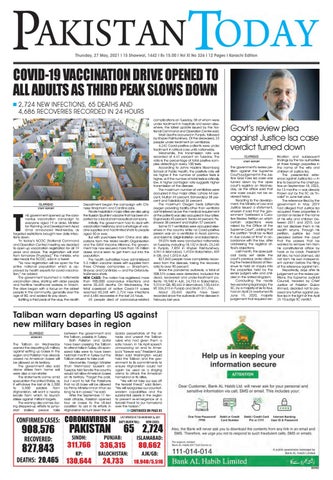
Thursday, 27 May, 2021 I 15 Shawwal, 1442 I Rs 15.00 I Vol XI No 326 I 12 Pages I Karachi Edition
Covid-19 vaCCination drive opened to all adults as third peak slows down g
2,724 NeW INFecTIoNS, 65 deAThS ANd 4,686 recoverIeS recorded IN 24 hoUrS
ISLAMABAD
t
stAff report
he government opened up the coronavirus vaccination campaign to everyone aged 19 or older, Minister for Planning and development Asad Umar announced Wednesday, as targeted restrictions brought new daily infections down. “In today’s Ncoc [National command and operation centre] meeting we decided to open up vaccination registration for all 19 years and above. This registration will start from tomorrow [Thursday],” the minister, who also heads the Ncoc, said in a tweet. “So now registration will be open for the entire national population which is approved by health experts for covid vaccination,” he added. The government launched a nationwide vaccination drive, starting with older people and frontline healthcare workers, in March. The drive began with a focus on the oldest people in the community, generally over the age of 80, and worked its way down. Battling a third peak of the virus, the health
department began the campaign with chinese Sinopharm and canSino jabs. Private hospitals in major cities are also using the russian Sputnik-v vaccine that has been imported by a local pharmaceutical company. Initially, the government had to deal with vaccination hesitancy and a shortage of vaccine supplies and had limited shots to people aged 30 or over. But with purchases from china and allocations from the World health organisation and the GAvI vaccine Alliance, the government has now secured more than 18 million doses and is keen to get them out into the population. The health authorities have administered 5.3 million vaccine doses with supplies from three chinese companies — Sinopharm, Sinovac and canSinbio — and the oxford-AstraZeneca shots. NEW CASES: The nation has registered more than 900,000 coronavirus infections and some 20,465 deaths. on Wednesday, the total caseload of active covid-19 cases reached 60,268 with 2,724 new infections and 4,686 recoveries in the last 24 hours. 65 people died of coronavirus-related
complications on Tuesday, 58 of whom were under treatment in hospitals and seven elsewhere, the latest update issued by the National command and operation centre said. Most deaths occurred in Punjab, followed by Khyber Pakhtunkhwa. of the deceased, 23 people under treatment on ventilators. 4,242 covid-positive patients were under treatment in critical care units nationwide. Meanwhile, the transmission rate was recorded at 4.61 percent on Tuesday. The ratio is the percentage of total positive samples detecting in every 100 tests. According to Johns hopkins Bloomberg School of Public health, the positivity rate will be higher if the number of positive tests is higher, or if the number of total tests is critically low. A higher contagion rate suggests higher transmission of the disease. The maximum number of ventilators were occupied in four major cities: Lahore 44 percent, Multan 69 percent, Bahawalpur 38 percent and Faisalabad 36 percent. The maximum oxygen beds (alternate oxygen providing facility other than ventilator administered as per the medical requirement of the patient) was also occupied in four cities: Gujranwala 45 percent, Swabi 44 percent, Peshawar 38 percent and Multan 57 percent. Some 517 ventilators were occupied elsewhere in the country while no covid-positive person was on a ventilator in Azad Jammu and Kashmir, Gilgit-Baltistan and Balochistan. 59,076 tests were conducted nationwide on Tuesday, including 18,132 in Sindh, 25,245 in Punjab, 7,859 in Khyber Pakhtunkhwa, 4,961 in Islamabad, 1,410 in Balochistan, 459 in GB, and 1,010 in AJK. 827,843 people have completely recovered from the disease, taking the recovery ratio to over 90 percent. Since the pandemic outbreak, a total of 908,576 cases were detected, included the dead, recovered and under-treatment patients: 18,940 in AJK, 24,733 in Balochistan, 5,516 in GB, 80,662 in Islamabad, 130,644 in KP, 336,315 in Punjab and Sindh 311,766. About 20,465 deaths have been recorded since the outbreak of the disease in February last year.
Taliban warn departing US against new military bases in region ISLAMABAD Agencies
The Taliban on Wednesday warned the departing US military against setting up bases in the region and Pakistan has already vowed no American bases will be allowed on its territory. The government also said drone strikes from home soil were also a non-starter. The statements come amid speculation the United States, as it withdraws the last of its 2,500 to 3,500 soldiers from Afghanistan, will want a nearby locale from which to launch strikes against militant targets. The warning also comes during stepped-up efforts to jumpstart stalled peace talks
between the government and the Taliban, possibly in Turkey. Both Pakistan and Qatar have been pressing the Taliban to attend talks in Turkey. UN-sponsored talks were to have been held last month in Turkey but the Taliban refused to take part. Meanwhile, Foreign Minister Shah Mehmood Qureshi on Tuesday told Senate the country would not allow American bases on its territory. “Forget the past, but I want to tell the Pakistanis that no US base will be allowed by Prime Minister Imran Khan so long he is in power,” he said. After the September 11 terrorist attacks, Pakistan opened four air bases to the US-led coalition to aid in its efforts in Afghanistan to hunt down the al-
Qaida perpetrators of the attacks and unseat the Taliban rulers who had given them a safe haven. In his April speech announcing an end to America’s “forever war,” President Joe Biden said Washington would hold the Taliban and the government to its commitments to ensure Afghanistan could not again be used as a staging arena to attack the American homeland or its allies. “We will not take our eye off the terrorist threat,” said Biden. “We will reorganise our counterterrorism capabilities and the substantial assets in the region to prevent re-emergence of a terrorist threat to our homeland over the horizon.”
CONFIRMED CASES: Coronavirus in
908,576 RECOVERED:
pakistan SINDH:
CONTINUED ON PAGE 05 LAST UPDATED AT 7:38 AM ON MAY 26, 2021
DAY'S DEATH TOLL:
NEW CASES:
65 2,724
PUNJAB:
ISLAMABAD: AJK/GB:
827,843
311,766
336,315
DEATHS: 20,465
KP:
130,644
BALOCHISTAN:
24,733
80,662
18,940/5,516
Govt’s review plea against Justice Isa case verdict turned down ISLAMABAD stAff report
The government’s review petition against the Supreme court’s judgement in the Justice Qazi Faez Isa case was turned down by the apex court’s registrar on Wednesday, as the office said that one case could not be reviewed twice. reacting to the development, the Ministry of Law and Justice issued a statement, wherein it said that the government “preferred a curative review Petition on which certain objections were raised by the office of the Supreme court”, adding that the petition “shall be re-filed in due course of time” in accordance with the law, after addressing the registrar office’s objections. Last month, the apex judicial body set aside the court’s previous order directing the Federal Board of revenue to hold an inquiry into the properties held by the senior judge’s wife and children in the United Kingdom. concluding the nearly two-year-long legal saga, the Sc, by a majority of six to four, had on April 26 overturned its June 19, 2020, majority judgement that required ver-
ification and subsequent findings by the tax authorities of three foreign properties in the name of the wife and children of Justice Isa. The presidential reference against Justice Isa — in line to become the chief justice on September 18, 2023, for 13 months — was already thrown out by the Sc as “invalid” in June last year. The reference filed by the government in May 2019 had alleged that Justice Isa acquired three properties in London on lease in the name of his wife and children between 2011 and 2015, but did not disclose them in his wealth returns. Through his petition, Justice Isa had pleaded before the court that the powers that be wanted to remove him from his constitutional office by hook or by crook. President Arif Alvi, he had claimed, did not form his own independent opinion before the filing of the reference against him. reportedly, days after its judgement on the review petitions, the Supreme Judicial council, headed by chief Justice of Pakistan Gulzar Ahmed, decided not to proceed any further against Justice Isa in the light of the April 26 10-judge Sc verdict.
02
Thursday, 27 May, 2021
KARACHI
NEWS
ForMer MiNister FiNaLLy takes oatH as PuNjab asseMbLy MeMber
F
NEWs DEsK
ORMER interior minister Chaudhry Nisar on Wednesday took oath as a member of the Punjab Assembly after a delay of two years and 10 months. The lawmaker was unable to take an oath as a member of the assembly on Monday due to the “absence of the speaker and deputy speaker.” The former interior minister left the assembly soon after he was administered the
oath and then had a casual conversation with journalists. “I will visit Lahore soon … where I will speak to the journalists in detail,” Nisar said, adding that he was not going to join any political party. Nisar had been elected from Punjab Assembly’s constituency PP-10 in the 2018 general elections as an independent candidate. However, the former interior minister refrained from taking oath then, as he alleged that rigging cost him the National Assembly’s NA-59 seat.
PML-N leader arrested after LHC cancels bail LAHORE stAff RePoRt
PML-N MPA Mian Naveed Ali was arrested from outside the premises after the Lahore High Court cancelled his protective bail in a case pertaining to manhandling Pakpattan assistant commissioner. Justice Shehram Sarwar cancelled a request for bail extension filed by the lawmaker and his father Rana Ahmed Ali. Pakpattan city police registered a case against the MPA, his father and six others in November for abusing and kidnapping Assistant Commissioner Khawar Bashir who raided a marquee and imposed a Rs50,000 fine on it for violation of the law. The FIR said Ali abused and threatened the civil servant with dire consequences. The security staff of the civil servant called up the police and meanwhile, the MPA drove the official to the city police station and sped away after dropping him. Later, Chief Minister Usman Buzdar also took notice and sought a report from the Sahiwal regional police officer. REMAND EXTENDED: Meanwhile, a district and sessions court in Lahore extended the judicial remand of PML-N MP Mian Javed Latif until June 2. Judicial Magistrate Sabir Hussain ordered the investigation officer to submit a challan on the next hearing. However, the detained PML-N leader was produced due to fears of breach of the coronavirus-related standard operating procedures. His warrants were dispatched to the court from the jail instead. A large number of PMLN workers gathered at the court to express solidarity with the MP.
86.1pc wheat procurement target achieved MULTAN APP
The food department procured 0.5 million metric ton of wheat against the set target of 0.6 million metric ton across the Multan division. Some 0.5 million metric ton of gunny bags were also distributed among growers. According to food officials, the disbursement of the gunny bags and procurement of wheat at the governmentapproved price of Rs1,800 per mound was carried out in a transparent manner. All facilities were being extended to wheat growers at procurement centres while coronavirus guidelines were also being implemented. The department distributed 171,666 metric ton gunny bags — 93 percent of the total target — while procured 162,468 metric ton of wheat. The provincewide procurement drive would continue until achieving the target, the officials said.
Speaking to the media after he was unable to take the oath, he had said the day for his oath-taking was fixed but he was later informed that swearing-in was not possible in the absence of the speaker and deputy speaker of the assembly. Earlier, amid reports of contacts between Pakistan Muslim League-Nawaz estranged leader Chaudhry Nisar Ali Khan and party president Shehbaz Sharif, party leader Maryam Nawaz has distanced herself from the separated member, saying Nisar has
nothing to do with the PML-N affairs. Speaking to reporters, Maryam said that Nisar is no more in the party and there is no truth in reports of his secret meetings with the party leaders. Former prime minister Shahid Khaqan Abbasi also told media that Nisar has left the PML-N and the party will not take him back. “When you leave your party, the party also leaves you. If Nisar wants to return to the PML-N, he should contact [PML-N supremo] Nawaz Sharif,” said Abbasi.
UN to hold session on Israel's war crimes in Gaza on Pakistan’s request NEW YORK AgeNcIes
Muslim countries are calling on the United Nations to investigate possible crimes committed during the 11day conflict between Israel and Hamas and to establish command responsibility. The UN Human Rights Council will hold a special session on the latest conflict on Thursday, at the request of Pakistan, as coordinator of the Organisation of Islamic Cooperation, and the state of Palestine. Those countries submitted a draft resolution late on Tuesday that would establish an independent international commission of inquiry to investigate all human rights violations in the occupied Palestinian territory, including East Jerusalem, and in Israel, since April 13. It would also examine all underlying root causes of tensions and instability, “including systematic discrimination and repression based on national, ethnic, racial or religious identity,” the draft said. The independent team would collect and analyse evidence of crimes perpetrated, including forensic material, “in order to maximise the possibility of its
admissibility in legal proceedings”. Reporting back in June 2022, it would identify those responsible to try and end impunity and ensure legal accountability. Meirav Eilon Shahar, Israel’s ambassador to the UN in Geneva, said in a tweet last week that convening the session “targeting Israel is testament to the clear anti-Israeli agenda of this body”. Its sponsors were “only rewarding the actions of Hamas, a terrorist organisation”, she added, referring to the rulers of the coastal strip. Since being set up in 2006, the UN rights council, a 47-member forum, has held eight previous special sessions that have condemned Israel and set up several probes into alleged war crimes. The United States rejoined the forum under President Biden after the Trump administration quit accusing it of an anti-Israel bias. The US delegation currently has observer status but no vote. US Secretary of State Antony Blinken visited the Middle East on Tuesday and pledged that Washington would provide new aid to help rebuild Gaza as part of efforts to bolster a ceasefire between its Hamas rulers and Israel.
Two held near Karachi airport KARACHI INP
Two people were taken into custody in injured condition following an “encounter” with Karachi airport police on Wednesday. Malir Senior Superintendent of Police Irfan Bahadur said the suspects — Asim and Azhar Ahmed — were immediately shifted to a hospital. He further said the two had opened fire at the patrolling police. “Illegal arms, ammunition, cellphones and a stolen motorcycle have been
recovered from them,” he said. “The motorcycle recovered is without a number plate.” He further said that police were trying to obtain their criminal record. “The weapons recovered from the suspects have been sent for the forensics,” he informed the media. FLIGHTS RESCHEDULED: In a separate development, multiple flights to and from Jinnah International Airport were rescheduled. PIA flight PK-302 to Lahore was rescheduled. The flight was scheduled to take off at 8:00 am but it departed at 9:00 am. Subsequently, the PK-303 flight from Lahore to Karachi was also delayed.
He said that no one expelled Nisar from the party and he himself left it. Abbasi said Nisar should contact Nawaz Sharif if it is his decision to come back. “However, it is a bigger question that whether the party will take him back or not? I do not think the party will take him back. I do not see a place for Nisar in the PML-N,” he said. Commenting on the reports of meetings between Nisar and Shehbaz, Abbasi said that Nisar has no contact with anyone. “We are all his friends for decades. If he could not keep in touch with us and Nawaz, then it would be difficult for him to return,” he said. Abbasi further said that Shehbaz and Maryam have the same stance over issues. “Everyone has own way of speaking. Maryam plays her role where she is needed. Shehbaz can become prime minister. She will lead the party. Every office is a trust that the party decides,” he added.
PPP not answerable to PML-N, maintains bilawal NEWs DEsK Pakistan People’s Party Chairman Bilawal BhuttoZardari has maintained that his party is not changing its stance, stressing the fact that they are not answerable to the Pakistan Muslim League-Nawaz’s top leaders. The above was sain in response to a question from a reporter during a presser in Badin. The question was on Maryam’s recent comments that the PPP had not responded to the show cause notice sent to it and had shown her support to comments by Pakistan Democratic Movement Secretary-General Shahid Khaqan Abbasi. Abbasi had said on Tuesday that there was no place for the PPP within the opposition alliance until it restored the trust it had betrayed. He said that the PDM had sought a response from the PPP, which Bilawal had torn into pieces. “We had asked for a response. Join together the torn pieces [of the show-cause notice], read it and give us the clarification we had sought,” Abbasi had said. In Wednesday’s press conference, the PPP chairman acknowledged that he had torn the show cause notice and there was no change in his stance on the PDM. “We are not answerable to Maryam or Mian Sahab. We are answerable to the PPP and the PPP’s workers and we think the real joy will be in doing politics together with the PPP’s workers.” Bilawal said that Shehbaz Sharif was the leader of the opposition in the National Assembly and the PML-N president, thus the PPP would consider his stance and statements to be official PML-N policy and conduct its politics according to that. He added that the PPP respected Jamiat Ulemae-Islam-Fazl chief Maulana Fazlur Reh¬man and the two parties had had a “good relationship and contact”. Bilawal said, however, that the PPP was engaging in politics based on its vision, principles, with respect and “we don’t change our stance.” He called on those who wanted democracy to flourish, civilian supremacy and actually wanted to oppose Prime Minister Imran Khan to “instead of opposing the PPP, our friends in the opposition should target the government.” Bilawal also took a jibe at the PML-N, who had formed a government in the year 1991, and said that the “selected” government of that time had imposed an “illegal water accord” on the Sindh government.
BHC serves notices on bureaucrats over NCP vehicles QUETTA tLtP
The Balochistan High Court Wednesday issued showcause notices to top brass of bureaucracy over non-compliance with the court directives in various matters including failure to control larger numbers of non-customs-paid vehicles plying on roads in the province. Advocate Syed Nazeer Agha has invoked the BHC jurisdiction contending that some influential persons are roaming on roads along with their private bodyguards, exhibiting arms and ammunition. Terming the situation as creating panic in the society, the petitioner contended that law enforcing agencies have failed to take any legal action against them for the reason best known to them. He further stated that a number of casualties have occurred in the vicinity of Quetta due to stray firing saying provincial police failed to take action against the culprits whereas Balochistan police chief remained inactive with the concerned SHOs in the matter. While appearing before the bench last month, the advocate general stated the inspector general of police (IGP) and the additional chief secretary (Home),
Balochistan will submit a detailed report regarding proposed action plan to address the issues of stray firings, tinted glasses, private bodyguards, Rahdaries, issued by the different authorities. He assured the court that the concerned authorities will also submit a report about unauthorized number plates inscribed on different vehicles and unauthorized use of official vehicles by the members of the Parliament and officials, within a period of twenty days. The bench has also issued directives to the AG to procure the attendance of the Deputy Commissioner, Quetta, SSP Traffic, Quetta and Director General, Excise and Taxation Department, Balochistan on the next date of hearing along with their proposals. He was further asked to submit a progress report pertaining to development for establishment of the Traffic Engineering Bureau. On Wednesday, a Division Bench of the Justices Muhammad Hashim Khan Kakar and Abdullah Baloch resumed hearing of the petition where no one turned up before the court in the matter. This ignited the bench that said in its order, “We have painfully observed that despite specific directions passed in presence of respondents, neither any proposed action plan nor any document
has been placed on record to show as to whether any action has been taken so far for redressal of grievances of the petitioner. Similarly, Deputy Commissioner, Quetta is also not in attendance and Director General, Excise and Taxation Department has also failed to place on record his proposal or actions taken in respect of un-registered and noncustoms paid vehicles”. Taking serious notice of the situation, the bench issued show-cause notices to the people at the helm of affairs saying, “ In such pathetic circumstances we are left with no option, but to issue show cause notice to IGP, Balochistan, Additional Chief Secretary (Home), Balochistan as well as Deputy Commissioner, Quetta as to why action should not be taken against them on account of their failure to perform their official obligations/duties and violating the specific directions issued by this Court”. The bench also sought a detailed action plan as well as the actions taken so far in pursuance of the court’s earlier directives amid asking them to appear before the court in person on the next date of hearing. Later, the bench adjourned the hearing of the matter till June 10, 2021.
Thursday, 27 May, 2021
KARACHI
NEWS
PM announces health coVerage for PeoPle of DgK, sahIwal DIVIsIons LAYYAH INP
P
RIME Minister Imran Khan has announced universal health coverage through Insaf Health Card for the people of Dera Ghazi Khan and Sahiwal divisions on Wednesday. Addressing the launching ceremony in Layyah, he said that all families of these divisions will be able to get medical treatment up to Rs720,000 from the government as well as designated private hospitals through the Insaf Health Card. He added that an additional amount of 300,000 may be provided to the holders of the card, if necessary, to complete the treatment. The prime minister commended the Punjab and Khyber Pakhtunkhwa governments for providing universal health coverage to all his citizens. He said that
the provision of Insaf Health Cards will become a great safety net for poor people. “I have faith that when a state strives for the welfare of the downtrodden, it begins to flourish,” he stated. He also said that the universal health coverage scheme will also revamp and upgrade the entire health system of Pakistan. He added that it will encourage the private sector to establish hospitals in far-flung areas and the government will facilitate them by providing state land and allowing duty-free import of necessary medical equipment. The premier also appreciated the Punjab government’s initiative of establishing mother and child hospitals and solarisation of all basic health units (BHUs) across Punjab. He commended Punjab Chief Minister Usman Buzdar for uplifting backward areas of the province like DG Khan and Sahiwal divisions.
He said that inclusive development of backward areas also helps prevent the concentration of population in big cities, where the provision of civic amenities has become a challenge now. Regarding recent incidents of barbarism by dacoits in the area, PM Imran announced to take massive operations against these lawbreakers. He said that police and Rangers will be directed to eliminate these dacoits to provide protection to the people. Separately, talking to the members of National Assembly and Punjab Assembly hailing from South Punjab in Layyah, Prime Minister Imran said that the provision of equal development opportunities and bringing people out of poverty is the top priority of the government. He regretted that previous governments ignored development of many areas in the past. He said that distribution of equal development projects is the top priority of his government. The prime
Ali Zafar’s report gives Jahangir Tareen a ‘clean chit’, claims Raja Riaz LAHORE INP
MNA Raja Riaz, one of the outspoken leaders of the group supporting ‘estranged’ Pakistan Tehreek-e-Insaf leader Jahangir Khan Tareen, took everybody by surprise on Wednesday when he said Barrister Ali Zafar’s report had given a ‘clean chit’ to Tareen in a corruption reference. Calling Barrister Zafar a ‘neutral empire’, PTI MNA said his report was a slap on the face of those conspiring against Tareen. “Now there is no justification for the Federal Investigation Agency’s probe into ‘estranged’ PTI leader’s case,” Riaz argued. “We thank Allah (The Almighty) that we have been exonerated in the graft case,” he concluded. According to media reports, Senator Zafar has determined after conducting fact-finding that Jahangir
Khan Tareen is being unfairly targeted by the government agencies, a conclusion that has been contested by the prime minister’s camp during a meeting held in this regard. A formal report hasn’t been submitted yet; however, its key findings have been shared. The senator shared his findings during a meeting presided over by Prime Minister Imran Khan. Attorney General Khalid Javed Khan and Adviser to PM on Accountability Shahzad Akbar were also present in the meeting. Zafar concluded that the charges against Tareen don’t hold much substance and that he was further targeted through the registration of FIRs against him and his son. His findings did not go uncontested. Akbar was asked to give alternative facts in defence of FIA action and Khalid Javed Khan acted as an umpire between the two. Zafar was told that FIRs were registered in line with the recommendations of the
Sugar Inquiry Commission. It bears reiteration that the FIRs were not registered against Tareen, rather, all those held accused are facing the action. After hearing both sides, the attorney general voted in favour of Akbar and held that actions against Tareen were fair. The former caretaker law minister posted a series of tweets after “some persons and the media” were “busy in guessing” on what his findings would turn out to be. “Let me make it clear that there is no report submitted by me. Any findings, not [necessarily] in writing, shall be purely internal to the PTI and have no legal value or status nor can the same have any relevance to or effect pending enquiries/investigations against the sugar barons or Mr Tareen,” Zafar wrote. The senator said that “there is no room for concessions against corruption” as per the government policy set out by Prime Minister Imran.
UNGA president arrives on 3-day official visit ISLAMABAD StAff RePoRt
President of the 75th Session of the United Nations General Assembly, Volkan Bozkir, landed in Islamabad on Wednesday for a three-day official visit. Bozkir has reached Pakistan at the invitation of Foreign Minister Shah Mahmood Qureshi, a statement from the Ministry of Foreign Affairs said. He landed in the country after concluding his visit to Bangladesh and is set to meet top officials of Pakistan
during his three-day visit here. “After an important and fruitful official visit to Bangladesh, I arrived in Islamabad for my official visit to Pakistan,” Bozkir said. “I look forward to my important meetings tomorrow in Islamabad,” he said. During his stay in Islamabad, Bozkir will have detailed talks with the foreign minister, the Foreign Office said, which would cover a wide range of political and socio-economic issues on the UN agenda. The UNGA president will also deliver a talk on the importance of multilateralism.
Bozkir is the first Turkish national to preside over the UNGA. He is a former diplomat and a senior politician. Following his 39-year long illustrious diplomatic career in the Turkish Foreign Service, Bozkir was elected thrice as a member of the Turkish Parliament and has served as the chairman of the Parliamentary Foreign Affairs Committee and EU Affairs minister. He last visited Pakistan in August 2020 before taking up the position of president of the UNGA. “The visit of the PGA would lend an opportunity to showcase Pakistan’s
03
minister asked the parliamentarians to provide details of the provision of clean water, electricity and projects pertaining to prevent riverbank erosion in the area. He directed them to ensure timely completion of all such projects. On the occasion, Chief Minister Buzdar apprised the Prime Minister that Rs30 million have been allocated for Thal jeep rally to promote tourism in the area.
Vlogger beaten up outside residence ISLAMABAD StAff RePoRt
Three unidentified men beat up vlogger and journalist Asad Ali Toor outside his residence in Islamabad late on Tuesday night, reports said. Islamabad police said the masked suspects arrived outside his residence located in an apartment building. A scuffle broke out between Toor and the suspects who thrashed him before fleeing the scene. Toor was later shifted to the hospital where his condition is reported to be stable. The police are investigating the incident. In a tweet, Pakistan Muslim League-Nawaz leader Maryam Nawaz expressed concern. “OMG! This is shocking! May Allah protect him. I hope he is out of danger.” In September last year, Toor was charged with spreading “negative propaganda” against the state and its institutions through social media under the Pakistan Electronic Crimes Act, 2016. In November, the Lahore High Court cleared him of charges, declaring there was not enough evidence to support the charges. Passed in 2016, PECA has been criticised by civil society as a draconian tool used to muzzle free speech.
Imran boasts performance of sharp-toothed watchdogs active contributions to multilateralism and the central role of the United Nations in international affairs,” the Foreign Office said. It said that Pakistan remained committed to supporting the UNGA for the realisation of shared objectives of maintaining international peace and security, economic and social development, promotion and protection of human rights, peaceful settlement of international disputes and developing friendly relations among nations based on the principle of equal rights and selfdetermination of peoples.
ISLAMABAD: Prime Minister Imran Khan on Wednesday said the performance of the anticorruption wing of the Punjab government, including recovery of dirty money and encroached state land, was remarkable when compared to the “dismal” performance of accountability watchdogs in the last ten years of the Pakistan Muslim LeagueNawaz in office. “In the last 31 months of our government in Punjab, the Anti-Corruption [department] recovered Rs 220 billion, in contrast to dismal record of PML-N govt’s 10 yrs,” the prime minister wrote in a series of tweets. He said the difference in the performance of the department during the two governments was “clearly visible in the results [it has] achieved so far”. StAff RePoRt
British Virgin Island Court’s verdict in Reko Diq case big victory of Pakistan: minister ISLAMABAD PPI
Minister, envoy discuss ways to strengthen media cooperation ISLAMABAD: Minister for Information and Broadcasting Chaudhry Fawad Hussain and United Arab Emirates Ambassador Hamad Obaid Ibrahim AlZaabi on Wednesday discussed ways to strengthen bilateral cooperation in the realm of culture, media and joint productions. In a meeting, the minister said that Pakistan and UAE enjoy close fraternal ties which are time-honoured and based on strong pillars of mutual respect, joint trading and collaborative understanding. Cultural cooperation is imperative for strengthening economic cooperation and fostering people to people contacts, said a press release. He said that UAE is home to the second-largest Pakistani community abroad, adding that they are contributing significantly to the progress of both countries. The information minister said that Pakistan and UAE relations have evolved into wide-ranging cooperation in various fields. APP
Law Minister Farogh Naseem has dubbed the British Virgin Island Court’s judgment in Reko Diq case a big victory of Pakistan’s stance. Addressing a news conference on Wednesday, he said this will also provide relief to the country on the economic front. He said the court has accepted Pakistan’s sovereign immunity stance in the case. He recalled that the international arbitration tribunal of the World Bank’s Centre for Settlement of Investment Disputes back in July 2019 had announced a huge award of 5.976 billion dollars against Pakistan in the Reko Diq case. He said, at the same time, the country was facing many other disputes at the international level including that of Karkey and the Broadcast sheet. He said legal teams were constituted to effectively and forcefully present Pakistan’s stance in those cases. He said
those timely steps have now started showing results. Farogh Naseem expressed the commitment to continue to defend Pakistan’s stance in different cases at different international forums. A day earlier, a British Virgin Islands high court saved Pakistan International Airlines from a $6 billion payout to Tethyan Copper Company by voiding the verdict in the Reko Diq case, wherein PIA hotels in Paris and Manhattan were frozen, it emerged on Tuesday. BVI High Court Justice Gerhard Wallbank, while passing the order on December 10, 2020, had attached certain assets belonging to Pakistan International Airlines Investment Limited, including the company’s interests in two hotels — Roosevelt Hotel in Manhattan, New York, and Scribe Hotel in central Paris – as well as the erstwhile frozen 40 percent interest of PIA in a third entity, Minhal Incorporated. Following the historic legal victory, Pakistan International Airlines has again received ownership of its hotels located
in the US and France and other properties. The court had issued the order after the TCC approached it for enforcement of the $5.97 billion award against Pakistan by the Interna¬tional Centre for Settlement of Investment Disputes in Reko Diq litigation on July 12, 2019. The BVI High Court of Justice has ruled in favour of Pakistan after a review appeal the country submitted on the Nov 2020 verdict in which TCC had won an award of US$6 billion, about the size of IMF’s bailout package to Pakistan, to be paid by Pakistan and in turn asked the court to freeze its assets registered in BVS remits. Moreover, the high court has further ruled the litigation expenses incurred by the country in the review appeal will also be recompensed by TCC. Attorney General of Pakistan office said judgment is a “Great legal victory for PIA and Pakistan”. “A short while ago judgment was announced by British Virgin Island High Court. Great legal victory for PIA and
Pakistan. The order was passed earlier on the request of TCC which was seeking enforcement of the Reko Diq award. All orders passed against PIA earlier are now recalled by the Court. Receiver removed from Roosevelt hotel, NY and Scribe Hotel, Paris. Cost of litigation also awarded,” said a statement issued by the AGP office on Tuesday. Additional Attorney General for Pakistan and International Disputes Unit head Ahmed Irfan represented Pakistan before the BVI court. The PIA engaged its own legal team in the case. Similarly, all offshore companies, two registered PIA hotels hired their separate counsels. Prime Minister Imran Khan has appreciated the efforts of the international disputes unit and the office of the attorney general. Earlier this year, the legal team of Tethyan Copper, a gold and copper exploration company involved in Balochistan to develop the Reko Diq mine, visited Islamabad to settle the billion-dollar dispute with the government.
Thursday, 27 May, 2021
04 NEWS
KARACHI
AbdUCtee reCovered in ShikArPUr AS rASheed PrePAreS For Sindh viSit SHIKARPUR
t
TLTP
HE police recovered an abductee during an anti-bandit operation in katcha area of Shikarpur on Wednesday. CIA Police Chief Abdul Wahid Buriro said that a hostage has been recovered from bandits
during a police operation in katcha area. “The recovered man was kidnapped from Shikarpur a month ago,” the police officer said. Interior Minister Sheikh Rasheed Ahmed will meet Chief Minister Sindh Syed Murad Ali Shah on Thursday (today) over the law and order situation in the province. The interior minister, besides having a
Scotmann Pharmaceuticals signs MoU with ACF ISLAMABAD: Scotmann Pharmaceuticals has joined hands with Arthritis Care Foundation (ACF) with the objective to create awareness about rheumatic diseases among the general public. The companies will organise educational seminars and activities, and conduct research projects related to rheumatic diseases. On the occasion, ACF Founder and Chairperson Professor Dr Nighat Meer Ahmad highlighted the mission of ACF, which is to establish, encourage, assist and support medical, social welfare and educational activities pertaining to deserving or under-privileged patients, both adult and children with arthritis and other related rheumatic diseases. She also appreciated the efforts of Scotmann Pharmaceuticals to join hands in this cause. "Scotmann Pharmaceuticals is avidly involved in many research, development and academic projects throughout the country to fulfil its corporate social responsibility and work for the well-being of the people of Pakistan". Scotmann Pharmaceuticals General Manager Marketing and Sales Suhail Khan said. PR
meeting with Murad Ali Shah, will also meet Governor Sindh Imran Ismail during his visit on the directives of Prime Minister Imran Khan. Earlier on Tuesday, Prime Minister Imran Khan directed the interior minister to visit Sindh over the worsening law and order situation in the province. Taking to social networking website,
Twitter, Federal Minister for information and Broadcasting Fawad Chaudhry said that PM Imran has directed the interior minister to visit Sindh and devise an effective strategy in collaboration with the security forces to deal with the poor law and order situation in the province. The visit was scheduled after the governor and Federal Minister for Planning, De-
velopment and Reforms Asad Umar had met with the PM and expressed severe concerns over rising crimes in the province. Sheikh Rasheed during the visit will be given a detailed briefing about the law and order situation in the metropolis by DG Rangers Sindh. After his visit, the interior minister will prepare a report and present it to Prime Minister Imran Khan.
KP raises daily-wage employees’ monthly salaries to Rs21,000 PESHAWAR TLTP
The Khyber Pakhtunkhwa (KP) government has approved an increase of Rs4,000 in the monthly salaries of the daily wage employees in the province. The increase was made after Chief Minister Khyber Pakhtunkhwa Mahmood Khan approved a proposal in this regard, raising the salaries of the daily wage employees. The salaries after the approval have been increased to Rs21,000 from Rs17,000, witnessing an increase by Rs4,000. Earlier on Thursday last, Punjab Chief Minister Usman Buzdar approved a 25 percent special allowance for the government employees of grade 1 to 19. Taking to Twitter, the chief minister announced that the increment will be applicable from June and only those who have previously not received allowances will be eligible. "The decision has been taken in order to reduce the pay gap among government employees working in different departments and improve their economic condition," wrote Buzdar. Earlier in February, the federal government also approved a 25 percent increase in the salaries of protesting employees from grade 1 to 19 on temporary basis. In accordance with the agreement
reached between the special committee constituted by Prime Minister Imran Khan, comprising Federal Minister for Defence Pervez Khattak, Federal Minister for Interior Sheikh Rasheed Ahmed and Minister of State for Parliamentary Affairs Ali Mohammad Khan, and the representatives of the federal government employees, the finance division agreed that a Disparity Reduction Allowance at 25 percent of the running basic pay will be allowed to those civil employees in BPS 1 to 19 of the federal government who have never
been allowed additional salary equal to or more than 100 percent of the basic pay (whether frozen or not) or performance allowance with effect from 01 March, 2021. The finance division agreed that the posts of BPS 1 to 16 or equivalent will be upgraded on the pattern of government of Khyber Pakhtunkhwa with effect from 01 March 2021. It also agreed that the grant of time-scale promotions will be considered for adoption on the same pattern in the next budget.
Parliament to become paperless by January 2023: minister ISLAMABAD INP
Minister for Information Technology and Telecommunication Syed Aminul Haque Wednesday said that all business of the Parliament of Pakistan would be made paperless by January 2023. Addressing the ground-breaking ceremony of “Islamabad IT Park” along with South Korean Ambassador Suh Sangpyo, he said, “The consultant has been hired to digitalise the Parliament by January 2023. All the call attention notices, adjourned motions, attendances, voting and other businesses will be done online through technology.” The minister said the ministry of information technology would also arrange training for the parliamentarians to make them familiar to the technology. Aminul said that proposal is also under consideration to digitalise legislative business and standing committee meetings. He said that for the first time, a paperless cabinet meeting was held, which was a great milestone achieved in the history of the country. He said that the park would include a twelvestorey building, having covered area of 66,893 square metres. The IT park would be developed with state-of-the-art infrastructure and allied facilities for IT companies with financial assistance of Exim Bank of Korea, he added. The project, he said, would be completed in 30 months with the total cost of Rs13.72 billion. He said that the project of establishing the park in Islamabad was linked with the steps for fulfilling Digital Pakistan Vision, which not only mitigate the shortage of infrastructure for IT sector but also facilitate technology transfer through industry and academia linkage, support technology commercialisation, links education and production, promote research and development, and enhances IT exports and industry competitiveness. He said that the Islamabad IT park project is expected to provide over five thousand di-
rect and indirect employment opportunities during the construction phase and about 15,000 employment opportunities to IT experts, students and persons of concerned industry after the completion. He said that a similar type of IT park would also be established in Karachi soon. The minister added that the Islamabad IT park will initially provide office space to around 120 startups and small to medium enterprises, and other ancillary facilities like testing laboratories, class rooms, industry academia linkage centre, and auditorium. He noted that presently total 15 software technology parks are in Pakistan, including three in Islamabad, two in Rawalpindi, eight in Lahore and one each in Karachi and GilgitBaltistan. “We want to establish software technology parks in many small and big cities of the country,” he said, adding that the ministry’s attached department, Pakistan Software Export Board, is working to establish software technology parks in Quetta, Gwadar, Faisalabad, Bannu, Swat, Mardan, Sukkur and Hyderabad. He said that Rs31 billion have been invested over the last two and a half years to improve connectivity across the country. The minister said, whilst penetration of
4G services is being increased, the 5G wireless technology would be introduced by the end of this year. He added that the ministry is committed for the provision of telecom services across the country, including Azad Jammu and Kashmir (AJK) and Gilgit-Baltistan (GB). He said that said that Pakistan’s IT export remittances have surged to $1.70 billion at a growth rate of 45.80 percent during July-April of fiscal year 2020-21, in comparison to $1.17 billion during the same period of last financial year. Speaking on the occasion, Ambassador Suh Sangpyo said that IT parks’ constructions were key projects of the Economic Development Cooperation Fund (EDCF). In the year 2019, a framework agreement was being signed with Pakistan to approve $500 million of EDCF loans that would give financial space for the construction of infrastructure in Pakistan. “Today, we witness together a tangible outcome of the EDCF projects,” he added. He said, “It is very positive to see that revolutionary steps are being taken in IT and telecommunication sector of Pakistan and the Islamabad IT Park will prove to be an important milestone for the ministry of IT and Pakistani skilled persons.”
Thursday, 27 May, 2021
KARACHI
NEWS
FM For bUIldING CloSer ChINA-PAkISTAN CoMMUNITY oF ShAred FUTUre ISLAMABAD
F
STAFF REPORT
OREIGN Minister Shah Mahmood Qureshi has called for forging energies to jointly build closer China-Pakistan community of shared future in the emerging era. He said this while virtually addressing the ruling parties’ dialogue between the Communist Party of China and the Pakistan Tehreek-e-Insaf on Wednesday. He said that Pakistan-China relations have transformed into an ‘All-weather Strategic Cooperative Partnership’ after seven decades. He said that the ChinaPakistan Economic Corridor is a transformational project and it is the top priority of the PTI government to complete the
ongoing CPEC projects. “We are fully committed to complete ongoing CPEC projects and make CPEC a high-quality demonstration project of BRI,” he added. He said that PTI’s vision of building Naya Pakistan and the ideology of CPC of realising ‘Great rejuvenation of the Chinese nation’ carry similarity of goals as per the aspirations of their people. The foreign minister said that PTI was willing to further deepen party-toparty cooperation with CPC, learn from each other, and share vital experiences on governance, party building and party organisation. “We stand ready to enhance cooperation between our two countries and two political parties for realisation of our respective dreams,” he said. Qureshi said that party-to-party relations are an important facet of the bilateral
ICT exports jump 46pc in July-April FY21
cooperation, adding that CPC and PTI enjoyed cordial relations. In the past few years, we have learnt from each other’s experiences through enhanced interaction and mutual exchanges, he added. He said that PTI Chairman and Prime Minister Imran Khan also acknowledged that China’s remarkable achievements in all around national development are a role model for all developing countries. Qureshi recalled the inaugural interaction for this forum in Beijing in March 2019, which said had been able to carry forward the momentum of the last discussions and further solidify good cooperation between PTI and CPC. He said that Pakistan and China had completed seventy years of ‘iron clad’ friendship on May 21, 2021, and mentioned that CPC would celebrate the 100th anniversary of
its founding this year in July. He congratulated the people of two countries, the CPC and General Secretary Xi Jinping for these momentous accomplishments. He said that Pakistan looked forward to further enhancing development and construction of CPEC in its second phase with more focus on industrialisation, poverty alleviation, job creation and socio-economic development. During the Covid-19 pandemic, he mentioned the exemplary cooperation where the two countries supported each other to effectively control the pandemic. Qureshi congratulated the Chinese leadership and the nation for a successful ‘People’s War’ against the pandemic and remarkable economic recovery, and thanked Chinese leadership for consistent support to Pakistan in its fight against the pandemic.
05
corporate corner
Federal Minister for Railways Azam Khan Swati along with Divisional Superintendent Lahore inspected the window trailing of Lahore to Sahiwal section. PR
SNGPl special task force disconnects direct bypass in Phool Nagar
Number of cardiac doctors stands at 1 in KP, 40 in Punjab, SC told
Pakistan’s export of Information Communication Technology (ICT) grew by 46 per cent during the first 10 months of 2020-21. An official announcement said the value of ICT reached $1.70 billion as compared to $1.17bn in 10MFY20. In April, the exports of ICT grew by 66pc to $196m as compared to $118m in April 2020. ICT exports now look set to breach the $2bn mark for the first time. MONITORING REPORT
Tarin for completing NGMS sale process by June end ISLAMABAD: Federal Minister for Finance and Revenue Shaukat Tarin on Tuesday urged the concerned authorities to accelerate the sale process of Next Generation Mobile Services (NGMS) spectrum and complete it by June. He stated this after the 4th meeting of the advisory committee for the release of NGMS in Pakistan approved the draft policy directives in this regard. The federal minister was chairing the meeting through a video link. Federal Minister for IT and Telecommunication Syed Amin-ulHaque, Federal Minister for Industries and Production Makhdum Khusro Bakhtyar, SAPM Finance and Revenue Dr Waqar Masood, secretary Finance Division, secretary IT and Telecommunication, secretary Kashmir Affairs and GB, chairman PTA, executive member Frequency Allocation Board (FAB) and other senior officers participated in the meeting. According to details, the advisory committee was briefed about the draft policy directive of the NGMS in the country for deliberation and apprised about the auction of spectrum in AJK and Gilgit Baltistan. Tarin urged for the acceleration of the project’s completion within the current financial year. He directed that the whole process of auction must be transparent, competitive and in accordance with the legal framework. “The end goal is to improve the efficiency of the spectrum for strengthening and expanding communication and IT services across the country for a digitally progressive and inclusive Pakistan,” he added. Speaking on the occasion, Syed Amin-ul-Haq briefed the committee that existing as well as new entrants will participate in the spectrum auction. “There will be a level playing field so that all operators must have a fair and equal chance in the process”. Moreover, international consultants answered technical queries by the members of the committee. APP
The Supreme Court was shocked on Wednesday to know that there is only one certified cardiac doctor in entire Khyber Pakhtunkhwa and 40 in entire Punjab. A three-member bench headed by Chief Justice Gulzar Ahmed heard a case related to substandard stents. The bench expressed anger over the chief executive officer of KP healthcare commission. “It is shocking to have only one certified cardiac doctor in the entire KP province,” the chief justice remarked. He asked how 4,615 heart procedures were performed in KP in the last one year with just a single certified cardiac doctor.
The court further maintained that unregistered and unqualified doctors should not be allowed to perform surgery. “Any negligence in this regard will be the responsibility of the concerned healthcare commission,” the court maintained. Expressing his frustration, the top judge stated that the healthcare CEO should resign from his position. Also present at the hearing, the Punjab Healthcare Commission CEO informed the court that Punjab has a total of 40 certified cardiologists. To this, the CJP replied that there should be 40 certified doctors in Lahore alone. Justice Mazahir Ali Akbar Naqvi
maintained that the issue of heart disease has turned into a business and is out of the hands of professional doctors. Regarding the substandard quality of stents, Dr Azhar Kayani stated that the Drug Regulatory Authority of Pakistan did not approve the stents approved by the National Interventional Cardiology Board. “Substandard stents are being administered to patients instead of the NICB approved ones,” he added. The SC also ordered Sindh and Balochistan provincial healthcare commissions to submit a report regarding stents. The hearing was adjourned for an indefinite period. NEwS DESk
NEPRA calls for privitisation of DISCOs ISLAMABAD STAFF REPORT
The National Electric Power Regulatory Authority (NEPRA) has called for the privatisation of distribution companies (DISCOs) as it issued their performance evaluation report 2019-20 (FY20), showing that neither of them had shown any distinguishable performance despite constant instructions and monitoring by the regulator. According to the report, NEPRA reviewed the APRs for the year 2019-20, submitted by the distribution licensees on the basis of parameters including, Transmission and Distribution (T&D) losses, recovery, System Average Interruption Frequency Index (SAIFI), System Average Interruption Duration Index (SAIDI), time frame for new connection, load shedding, nominal voltage, consumer complaints, safety, and fault rate. Raising concerns over not taking measures to bring improvement in T&D losses in FY20, DISCOs contributed to a loss of around Rs59 billion due to their inefficiency in and Rs160 billion in recovery, the report states. It said that none of the DISCOs
REGULATOR REFUSES TO RANK DISTRIBUTION COMPANIES DUE TO UNRELIABLE DATA except GEPCO and FESCO could meet the regulator’s expectations while QESCO, PESCO, SEPCO and HESCO have shown the worst performance among all. About the time frame for new connection, NEPRA said that it is alarming that power demand is not being generated despite availability of ample generation in the country and non-provision of new connections to eligible consumers within the prescribed time frame is one of the factors contributing to less demand. NEPRA has also raised serious reservations over the authenticity of data regarding load shedding being carried out by DISCOs in their service territories and said that although the duration of load shedding decreased in FY20 as compared to previous years, but it can be eliminated if DISCOs avail 100 per cent of their allocated quota of power. Highlighting the conditions of complaint centers that NEPRA’s
team witnessed during visits, the report expressed serious reservations over the data which shows that SEPCO did not receive a single complaint in a day in any of its complaint center. Similarly, PESCO, QESCO, FESCO, MEPCO and HESCO also received only 2 to 3 complaints per day in each of their complaint centers during the whole year. Stressing safety as most important parameter for measuring the performance of distribution companies, NEPRA regretted that around 160 fatal accidents involving employees and the general public occurred in a year due to power issues. Furthermore, the report found that the data submitted by distribution companies was significantly fudged. So far, the regulator has initiated legal proceedings against MEPCO due to misreporting data and other misdemeanors regarding code of conduct. It is pertinent to mention here that NEPRA has decided to abandon the exercise of ranking DISCOs based on performance till the time that reliable data is received. For this purpose, the regulator has initiated efforts to move DISCOs towards the adoption of AMI/AMR system.
SNGPL special task force on UFG control HO, has conducted a successful raid in Muslim Town, Madina Village, Phool Nagar and disconnected a direct bypass from site. During raid, it was found that a 3/4" inch diameter service line was installed on 1 1/4" inch diameter main PE pipe through which pilfered gas was being supplied to 50-60 no. of houses, present in the area of Muslim Town Madina village. Pilfered gas was being supplied through underground network of rubber pipes. Bypass was removed and line repairing was also carried out on spot. The case is being processed for booking of volume as per SOP. Moreover, an application in the local police station is also being submitted for lodging FIR against the pilferer. PRESS RElEASE
Taliban warn departing US against new military bases in region contInueD froM pAge 01 The US, along with about 7,000 NATO forces will leave Afghanistan by September 11 at the latest. In a statement earlier this week, the US Central Command said it had completed about 25 percent of its withdrawal. The logistics of withdrawing are tremendous and according to the CENTCOM statement departing troops have already packed military equipment on to 160 C-17 cargo aircraft and shipped them back to America. Besides airlifting its supplies, the United States is also moving equipment out of Afghanistan through Central Asia and Pakistan. In their statement, the Taliban warned against neighbouring countries allowing its territory to be used as a staging area for America. “God forbid such a step is taken, it will be a great historic mistake and disgrace, its shame will go in history,” said the statement. “As we have repeatedly assured others our soil will not be used against anyone’s security, we urge others not to use its soil and airspace against our country.”
HBL inks landmark investment in Finja, Pakistan’s leading digital SME lending Fintech KArAchI PRESS RElEASE
HBL becomes the first bank in Pakistan to invest in a digital fintech startup with its Rs. 176 Million (USD 1.15 Million) participation in the last tranche of Finja’s Rs. 1.56 billion (USD10.15 Million) Series A1 round. HBL joins an impressive list of leading global fintech funds that have invested in Finja including BeeNext, Vostok Emerging Finance, Quona Capital, and ICU Ventures. All
investors from previous rounds topped up their investment in Finja’s Series A1 round. For HBL, an investment in Finja serves two of the bank’s strategic priorities, namely, making investments into Digital Financial Inclusion and Development Finance companies, especially ones making an impact in agriculture and SMEs as these are the backbone of the economy, and proactively reinventing HBL to become a “technology company with a banking license”. Since the beginning of the Covid-
19 pandemic in April last year, Finja has scaled its digital lending portfolio by 550% disbursing over 50,000 digital loans to Micro, Small and Medium Enterprises (MSMEs). Despite being the backbone of the economy, small businesses in Pakistan have traditionally not been able to obtain credit to grow. “We are elated to have HBL participate in this funding round. Our groundbreaking success in digitally scoring undocumented small businesses has resulted in a 64% month-on-month port-
cMYK
folio growth for us since the outbreak of the pandemic earlier this year. Undoubtedly, HBL’s financial clout, massive network and progressive leadership will help us elevate the country’s most important segment, the SMEs,” said Qasif Shahid, CEO and Co-Founder Finja. “These loans are critical for Pakistan’s economic growth. Our productive loans result in a 40% increase in SME revenue with less than a 1% default rate,” added Monis Rahman, Chairman and Co-Founder Finja.
Thursday, 27 May, 2021
06 COMMENT
Sharif’s Model of the Trickledown Economy
A pipe dreaming opposition Can it put the genie back in the bottle
T
HE opposition has exhausted all forms of peaceful protest to force the government to resign and the establishment to reduce its role in national politics but failed to achieve the twin objectives. During most of the period over-optimistic hawks have dominated the opposition’s ranks. JUI(F) chief Fazlur rehman wanted the opposition to immediately resign, calling the 2018 elections into question. This was however rejected at the time by other opposition parties. After realising that its protest rallies had failed to force the government to quit, the opposition decided to hold a countrywide march that was to converge on Islamabad. The insistence by the PmL(N) and some other PDm components on resignations by all opposition parties from assemblies prior to the march created a rift in the PDm which still persists. This has led some of the opposition parties to review the strategy of all-out confrontation with the government and the establishment. What PDm chief Fazlur rehman said at a press conference on Tuesday indicates that while the offensive against the PTI government will be further escalated, there is desire now to enter into a dialogue with the establishment aimed at jointly removing the anomalies in the system, making it more democratic. There is a perception among some of the opposition leaders that the establishment is getting fed up with Prime minister Imran Khan’s government on account of it failures in important spheres, particularly the economy, ineptitude in handling the bureaucracy, rigidness and bad governance. maulana Fazal has made an offer to the establishment to jointly rectify shortcomings in the system. As he has put it, “If we are bound to do politics under oath, then they [establishment] are bound not to do politics under the same oath.” over the last several decades, the establishment has encroached upon large areas of the civilian governments’ turf. It now takes major policy decisions but expects the civilian administrations to take responsibility for its unpopular measures and policy failures. The establishment may turn neutral for a while to put the government supported by it in its place, as happened in the recent byelections. This may not mean that it is willing to accept the elected government’s right to a final say in policy matters, particularly when the opposition parties remain disunited.
‘Trickle-Up’ economics
Dr FariD a Malik
T
HE third usurper, General Ziaul Haq, launched Nawaz Sharif in politics to counter the progressive appeal of Bhutto’s Pakistan People’s Party (PPP). At that time mian muhammad Sharif was head of the Ittefaq Group, a midsized businessman of Lahore who was ferociously against the socialist policies of Bhutto, under which his foundry in Kot Lakhpat had been nationalized. once I had the chance of traveling with Awami National Party (ANP) leader Comrade Ajmal Khattak. As it was a long transAtlantic flight, I had the chance to discuss politics with him. In answer to my question about his alliance with Nawaz and his right of centre party, he said this was mainly for improving the economy. With the collapse of the USSr, most Socialists were lost. While China opted for reforms, only Cuba and North Korea kept the old system going. The Zia-Sharif nexus was for a new Economic order. Zia even denationalized their primitive foundry in Lahore whle holding back the much advanced outfit next door called BECo (Batala Engineering Company). margerat Thatcher in the UK and ronald reagan in the USA both introduced the concept of ‘trickledown’, which meant favoring the rich to expand and invest, hoping for the crumbs to fall. Deregulation and receding state role was the approach. It was called ‘ Thatcherism ‘ and ‘reaganomics’. The net result was a skewed distribution of wealth, as the rich got richer while the poor sank. It is widely argued that Bhutto’s nationalization of functioning industrial units was disastrous for the economy but it was during this period that basic industrialization took place, like the steel mill, fertilizer complexes, defence production, revamping of the atomic energy programme, mineral and oil exploration and so on. The big question is with no major project launch from 1977 to 2018, what have been the economic gains as envisioned by Comrade Ajmal Khattak and his left-of-centre progressive party? As an intern metallurgist, I had the opportunity of working at Ittefaq Foundry which was called
Keeping the lid on No alternative to releasing the report
T
HE supporters of Jahangir Tarin set great store by the report of Syed Ali Zafar into the matter, which supposedly exculpated him in the sugar scandal. However, the report is being held back. Though it has not been formally made, it was the subject of discussion at a recent meeting chaired by Prime minister Imran Khan, and attended by mr Zafar, Pm’s Interior Adviser Shahzad Akbar and Attorney General Khalid Javed Khan. The report not only acquits mr Tarin, but it finds the case against him politically motivated. mr Akbar is supposed to be responsible for the charges being preferred. The Attorney General is said to have decided that mr Akbar had the rights of the matter. mr Akbar is one of the persons mr Tarin holds responsible for having had him involved in the case. If the report becomes public, it would be an important step in his rehabilitation, though his having formed groups in the National and Punjab Assemblies may have lost him mr Khan’s trust permanently. However, for the report to become public, it would have to get past Secretary to Pm Azam Khan, whom mr Tarin accuses of being involved in the cabal against him, of which mr Akbar is supposed to be a member. Perhaps one of the most interested parties in this report’s being made public would be the opposition, for the evidence they hope to find of the government’s methods of dealing with opponents. If the report is not made public, the opposition will cite it as an instance of the government’s political vindictiveness. The government should realize that a report finding someone innocent cannot be suppressed forever. The PTI cannot claim bias in mr Zafar, whom it gave a Senate ticket from Punjab only a couple of months ago. It is also important for mr Khan not to appear to be favouring any side in this process, and the easiest way out for him would be to let the report be made public. Even if it sheds an unwanted light on his methods, that does not mean the methods cannot be used in future.
Why the figure makes sense
Dr. SaMi Ullah
F
rom the last couple of days, majority of masses in Pakistan are discussing emotionally the 3.94 percent growth in GDP during the times of crisis. Every layman is talking on economic indicators based on their political attachment, not based on technical grounds. I have listened to many talks and also gone through the articles, but the majority are reacting according to their political affiliation. Data and empirics have their own behaviour and before talking on this aspect, there is a dire need to know about the behaviour of variables, environment, structure of the economy and even to compare it with some of the neighbours. The other day, I was sitting in a barber’s shop and the barber argued it was not possible to show an exaggerated number of GDP growth when there was a
Arif Nizami Editor Managing Editor
Joint Editor
Umar Aziz Executive Editor
Lahore – Ph: 042-36300938, 042-36375965
Jatti Umra Estate and the Sharif medical City and Educational Complex near raiwind in the outskirts of Lahore. The entire area was developed at state expense.The land area is 1500 Kanals of flat fertile land. From 3 marlas (0.15 Kanal) to 30,000 marlas, it’s a phenomenal rise unheard of in this part of the world. The land around the mausoleum of Baba Farid in Pakpattan was illegally allotted to gain favors. The Elahi Buksh Clinic on Lawrence road was forcefully taken over from the family of Dr Buksh who lay buried there. The plots reserved for the widows and destitutes were doled out to party workers. one of them built a house across the street in Johar Town where I lived, and he was not even a widower. He earned the title of ‘Disco’ as he had installed coloured flashing lights in his verandah. As a token of thanks to his leader, he installed a huge billlboard on the main Canal road depiciting Nawaz Sharif who was shown accepting a bouquet of flowers from his loyal worker. After the takeover in october 1999, the board suddenly disappeared overnight. It was hidden on the roof of his house. The neighbours in order to tease him warned him that the Air Surveillance unit had marked his house. In utter panic , he not only removed the evidence but also sold his house to save the bounty graciously granted him by his leader out of the quota reserved for the widows. Bhutto moved from his Socialist model to a mixed Economic model in which both the public and private sector could coexist, but the welfare of the people was kept paramount. China follows a similar model today after reforms. Following the international trends in the 1980s and 1990s, Zia opted for the ‘Free market’ and ‘Trickledown mode’. mian Nawaz, ably assisted by Abba Ji, launched his own ‘Economic Plan’ first as Finance minister of Punjab and then the Prime minister of Pakistan. The PmL(N) today is a financial cult that has enjoyed a long period of ‘ Trickle Up ‘. Public sector entities were delibratey driven into the ground to lower their value. Privatization is not abdication, the state may be inefficient but it must guard public interests through regulatory mechanisms. While the world has suffered at the hands of the ‘ Trickledown ‘ mode, Pakstan has been plundered through the ‘Trickle Up ‘ bluff in the garb of economic development. The ‘ Zia-Sharif Economic ‘ model has to be dismantled as the ground realities are very grim. For the last 40 years, the PmL(N) has been plundering the wealth of the nation like an invading army which it is not, though it was launched by the military in the 1980s, resulting in a disastrous economic meltdown. The writer is ex-Chairman, Pakistan Science Foundation. He can be contacted at: fmaliks@hotmail.com.
Is 3.94 percent GDP growth fudged?
Dedicated to the legacy of the late Hameed Nizami
Yousaf Nizami Aziz-ud-Din Ahmad
LEFo (Lahore Engineering and Foundry) after nationalization. It was a primitive factory where cow dung was being used for mould making. It was a 19th century outfit where employees worked in subhuman conditions. While BECo was founded by C.m. Latif, a very able and competent engineer, by contrast Ittefaq was run by skilled lohars (Ironsmiths) whose sole aim seeked to make quick profits with minimum input. After gaining political power, mian Sharif the shrewd businessman decided to create the Sharif Group leaving his brothers behind. While he created the Takht-e-Lahore, the entire country became his canvas. The Ittefaq Foundry was finally dismantled and its land sold as plots. Pakistan muslim League (Nawaz) a party that was launched from the muslim League House on Davis road, has no political ideology. It is an outfit of interests not politics. Instead of the traditional ‘Trickledown Capitalist Ecoonomic model’ it came up with their own ‘resources Usurpation model’ or ‘Loot Sharing mode’. Plots, permits, loans, Sros, conflicts of interest, development at state expense and so on are all inclusive. While in the ‘Trickle Down’ mode, expansion and wealth generation takes place at the top hoping for the crumbs to fall. The Sharif model was unique in many ways. After gaining political power, they introduced a ‘Trickle Up’ approach. massive loot and plunder took place at all levels. only invading armies indulge in such a usurpation. After some research I could only come up with two names in the entire party, and both of them have also now been accused of wrongdoing. Ahsan Iqbal, the Secretary General of the party, faces NAB reference for building the Narowal Sports Complex in violation of rules as it was a domain of the provincial government. Senator Pervaiz rashid was not allowed to contest the elections as he had defaulted in payments to the Punjab House where he used to stay. In other words almost every important player of the PmL(N) has benefitted from this ‘Lootcracy’ or ‘Trickle Up’ of the assets of the state, to favor a few at the cost of many including the collapse of vital institutions that were trampled in the process. The approach is very simple. They should all declare their family assets in 1985 when they entered the political arena and reconcile them with their current wealth. money trails have to be provided. The ‘Ittefaq Group’ (mian Sharif and his six brothers) first moved from a three-marla house in Gawalmandi to the industrial area on Ferozepur road adjoining model Town. An NoC was obtained for residential use of the plot. Seven mansions were built to accommodate all the brothers who worked together in the Foundry close by in Kot Lakhpat. After gaining political power, the ‘ Sharif Group ‘ (mian Sharif and his three sons) started to build the
I
Karachi – Ph: 021-35381208-9
I
lockdown and unemployment was increasing rapidly, and there was also increase in vulnerability and poverty. He thought that all these numbers were fudged and not in line with reality. After the barbershop, I went to buy vegetables. While packing my purchases, the vendor said to me, “You know our government performance is exponentially increasing and it is the result of leadership competency and soon you will see the credibility of our economy by expanding employment opportunities for everyone which will further trickle down the reduction in poverty and wellbeing of the general public.” Such sort of discussion is everywhere because we have made everything a political stunt, irrespective of economic, societal, environmental or religious technicalities. As far as the GDP growth of 3.94 percent is concerned, technically it is not too exaggerated, because the National Accounts Committee (NAC) measures GDP annually by comparing it with previous year performance based on the data and team of experts. Everyone knows that last financial year was stuck in a lockdown which had minimized all sorts of economic activities and reduced the GDP to minus 0.4 percent in 2019-2020. Due to this low GDP growth of the previous year, currently our economic activities have recovered and the majority of the sectors are working as per routine. Secondly, our agriculture sector showed a bumper crop for this year and it is because of a favorable environment. Another major factor is expansion in the informal sector activities during the pandemic which has acted on the economy positively. These are the basic points and by comparing last year’s activities, we have recovered in almost all the sectors. Those are contributing to the GDP. The critical point for the general public in this number is that it is not shown in poverty reduction, increase in purchasing power, educational opportunities, health outcome and satisfaction of life and we can call this phenomenon as “Growth Without Development”
Islamabad – Ph: 051-2204545
I
Web: www.pakistantoday.com.pk
I
which requires some new debates. When we consider growth and development as interchangeable concepts then it looks tough to understand the 3.94 percent in the current scenario. on the other hand, we have to differentiate the concepts of growth and development. If we compare 3.94 percent GDP growth of Pakistan with some neighboring countries then there is 11 percent GDP growth for China, 8 percent for India and 7 percent for Bangladesh for the same period, caused by a low GDP base. We are very much behind the neighbours but their people believe in the state that it is a technical game and people are only concerned with what happened with poverty, inequality, employment and quality of life. Unluckily, we are masters in converting every economic (GDP measurement), social (out-of-school children), health (vaccination) and religious (moonsighting) issue into the basket of politics, which is one of the leading factors behind our instability and backwardness from the last many decades. We have the projections of GDP growth from 1.5 to 3 percent from various financial institutions based on the covid-19 situation and ImF/World Bank forecast as per their circumstances, but our people are not taking the state-based SoPs seriously. Pakistani people didn’t follow government instructions throughout the crisis and kept up the economic, social and religious activities informally which have saved the employment of a majority, and led to economic recovery and high growth rate as compared with previous year. After this sudden breakthrough, there is dire need to initiate some strategies for the trickle down of the benefits of economic growth to the masses in terms of price stability, poverty alleviation, skill development for the youth and employment generation for sustained and inclusive development of Pakistan. The writer is Assistant Professor in Economics, University of Gujrat, and can e reached at samiullah@uog.edu.pk
Email: editorial@pakistantoday.com.pk
Thursday, 27 May, 2021
COMMENT 07 Editor’s mail Send your letters to: Letters to Editor, Pakistan Today, 4-Shaarey Fatima Jinnah, Lahore, Pakistan. E-mail: letters@pakistantoday.com.pk Letters should be addressed to Pakistan Today exclusively
Israel Atrocities and Muslim World
Pesticide or Poison? The farmer and consumer are at risk
Fayyaz Salih hUSSain
E
xPoNENTIAL and uncontrolled growth of population forced the industrial revolution to feed the massive population in the world,. No doubt the world has seen huge and unprecedented economic development but this uncontrolled expansion simultaneously depleted every sphere of environment including the hydrosphere, geosphere, and lithosphere. as well as the atmosphere, and generating huge amounts of waste from all segments. When this wastes cross the assimilation capacity of the environment, it creates pollution. Hence poison is spread everywhere, as a result we are facing huge health and environmental consequences. The Pakistani economy is basically semi-industrialized with one of the well designed integrated agricultural sectors. Globally Pakistan is ranked the 23rd largest economy in terms of GDP with the world’s largest irrigation system, Eighty percent of its total 23.3 million hectares are cultivated and approximately 40 percent of the country’s labour force is associated with the agricultural sector, which contributed 18.5% of the country total GDP. A large portion of the population is directly or indirectly associated with agriculture and their main source of living is totally dependent on this sector. The major crops that Pakistan produced are wheat, rice, sugarcane, cotton, mangoes, oranges and dates, other fruit and vegetables. Beside these major crops Pakistan possesses high potentialities to grow almost all types of sub-tropical, tropical, garden and field crops in abundance. Exponential growth of population leads the country to feed more than 220 million people with a growth of 1.95% annually. As population increase, more stress develops on the land to produce more food to meet the demand of millions. The increasing demand can be met by development of new and better crop protection measures. For better crop yield and to protect crops from insects, unwanted herbs, and pets, the indiscriminate usage of synthetic pesticides has been carried out extensively since 1954 after the Locust outbreak. These poisons were used for the benefit of humans, so they were called economic poisons. In 2019, the crop protection poison market was valued at $220 million and with forecast to witness a Compound Annual Growth rate of 8 percent, it is forecast to cross the value of $350 million by 2025. Wheat contributes 37 percent of total food energy in Pakistan, hence it acts as a driver for the crop protection poison market. Tjhe flourishing of textile industry also increased pesticide consump-
tion in Pakistan. About 90 percent of pesticides are used in cotton fields, even several compounds which are banned in the rest of the world, are still used in Pakistan. These poisons consists of various chemical compounds used as insecticides, herbicides, fungicides, nematicides, rodenticides as well as fungicides and growth regulators Pesticides consist of various compounds for wide range and applications such as herbicides, nematicides, insecticides, molluscicides, fungicides, rodenticides and plant growth regulators. Pakistan used more than 85 percent insecticides, 6-7 percent herbicides and fungicides, whereas the world consume 56 percent herbicides in its total pesticides. Insecticides are classified into four main classes, organochlorine, organophosphorus, carbamates and pyrethroids. Among these classes, organochlorines which contained DDT, BHC and Dieldrin are considered as persistent pesticides because they are very stable, cannot be broken down and remain in the environment for a very long time. The organophosphorus group is less persistent. This group contains methyl parathion, endosulfan, malathion, diazinon, monocrotophos, dimethoate and chlorpyrifos. The third group is based on carbamic acid. one of the least persistent and latest developed group belongs to pyrethroids, deltamethrin, fenvalerte and cypermethrin, which are synthetic pyrethroids. Although herbicide usage in Pakistan is comparatively less than insecticides but it also poses a danger to the community. Diuron, paraquat, diquat, atrizine, phosalon, 2,4-T , 2,4-D and metametron are the major herbicides used in different parts of Pakistan, Besides these, aluminum phosphate, cacumin, zinc phosphate, bromadiolone, strychnine warfarin and brodifacoum are also used to control vertebrate animals. Depending on exposure, the toxicity of pesticide can be acute or chronic. Acute toxicity can cause lethal or harmful effects on the first time of inhalation, injection or dermal contact, while its severity can vary by the type of group, contact time and exposure dosage. The symptoms can be observed shortly after exposure or within 48 hours. They can be cough, sore throat, respiratory tract infection, eyes and skin irritation, headache, extreme weakness, vomiting, nausea, seizures, loss of consciousness or death. Low doses of pesticide over time can also cause harmful effects on health and cause illnesses like asthma, Parkinsonism, hyperactivity disorder, anxiety and several types of cancers. Pesticides are normally endocrine disruptors, and imbalance hormones which leads to abnormal function of hormones and can cause reproductive and growth dysfunction in children and adults even at a very low concentration. In adults the reduction of semen is commonly observed due to exposure of endocrine disruptors, hence genital dysfunction, prostate cancers, decreased fertility, ovarian cysts, early puberty, breast cancers, uterus anomalies, multiple complications during pregnancy, neurological disorders, obesity, diabetes, obesity hypothyroidism and thyroid cancers are some disorders observed. Sometime pesticides produced “Coktail effects”: an alteration or enhancement of chemical effects when exposed with very low level with one or more chemicals, combine effect which cannot be understood by physicians. Currently there is no regulations to focus on this issue. In Pakistan, usage of pesticide in Panjab is about 88 percent, Sindh 8.2 percent, Khyber Pakhtunkhwa 2.8 percent and Baluchistan 0.76 percent. The front line exposers of pesticides are usually farmers followed by consumers. Accord-
ing to reports, more than 10,000 Pakistani farmers are poisoned due to indiscriminate use of different pesticides, specially in cotton-growing areas. This is due to less awareness of methods of application, dosage and the lack of proper guidance. Beside human loss, these pesticides become the major source of contamination of soil, water and environment and the food chain. Farmers are routinely exposed to high levels of pesticides, usually much greater than consumers. one of the main reasons for the high level of exposure among farmers is that they usually focused on the efficacy of a pesticide rather than ts safety. other factors including ill planned and improper non-recommended dose, mixing of different pesticides, carelessness while using of nozzles, poor knowledge regarding wind speed, direction, suitable time and crop stage while applying pesticides, improper disposal, negligence of guidelines and failure of regulatory authorities, are the main factors behind the high level of exposure as well as presence of residues in food. All these factors maximize the risk of exposure especially in third world countries. These pesticide residues not only causes severe health effects on farmers and consumers but also endangers other forms of life present in the biosphere. Pesticide residues higher than permissible level have been detected in various tissues, fat samples, blood serum of humans in Pakistan. There is a long history of reported deaths due to pesticidal exposure in Pakistan, but on the other hand, unreported or unrecognized deaths might be huge many. recently in Sindh, hundreds of thousands of fishes were found dead in the Sunhari Canal in Khairpur Nathan Shah, which clearly indicated the higher level of pesticide present in water bodies To overcome this situation and to reduce toxic health effects, one option is to stop the use of banned pesticides (organochlorinated) in Pakistan and to carry out risk assessment of edible commodities by establishing effective and result-oriented residue monitoring of pesticides in food commodities. Unfortunately little attention has been paid to calculate residues on food under best agricultural practices . Higher pesticide residue in food may also be due to the absence of updated food laws in Pakistan. There is a great need to monitor pesticide residue on a regular basis to control the use of pesticide and ensure consumer safety. monitoring should be compulsory in Pakistan to comply with the Stockholm Convention and the implications of the World Trade organization. on the brighter side, some research institutes are constantly working on monitoring residue levels in food commodities. Several labs have been established in different provinces in order to effectively monitor pesticide residue, but there is great need to ensure the sustainability of these analytical laboratories by providing scientific and technical support through chemical analysis of residue in food. There is an urgent need to estimate the pesticide load on the environment as well as population. Specific training specially in toxicology evolution should be provided to the scientific community and general training on the safe use of pesticide to farmers should be conducted effectively on a regular basis. A strict registration and regulation system on production, distribution, and usage of pesticides should be implemented, and there should be a strict monitoring system. Locally, production of hazardous pesticides should be regularized and import of pesticide should be controlled. Effective result-oriented research work must be carried out in order to develop cost-effective and ecofriendly methods for sustainable removal of contaminants from the environment. The writer is a Ph.D Scholar at the National Centre of Excellence in Analytical Chemistry, University of Sindh, Jamshoro, and can be reached at fayyazsalih@hotmail.com
ISrAEL has been shading blood of innocent Palestinian for many decades. more than 200 hundred People have died including 66 children and many women. Tel Aviv also targeted large buildings and media outlet in Gaza. recent ceasefire between Israel and Tel Aviv will save many innocent lives. The story of brutality of Tel Aviv is so long. For long time, Israel has been shamelessly annexing the land of West Bank but the problem started when Jewish settlers launched proactive march towards East Jerusalem and encroached Palestinian homes. Later Israeli armed forces launched operation at Al Aqsa mosque and desecrated it in the month of ramadan. While operation against devotee in the month of ramadan is ruthlessly inappropriate. Last many days, Tel Aviv bombed Gaza with heavy weapons and killed blameless children and women in reaction Hamas threw many rockets towards Israel. Israel committed war crimes and violated human rights and international law by bombarding unarmed innocent civilians and devastating buildings said by international organizations. Despite this time Israel went two steps further and targeted media outlets and attacked Al Jazeera office. Basically, Israel wanted to prevent media to highlight massacre of unarmed people in Gaza. Israel agreed on ceasefire because it had international pressure of western countries to stop further aggression. Israel revealed it in its press release next day that America stress on Israel to agree on ceasefire. Some analyst say that American new administration does not take concentration on middle east policy as it has already waging cold war with China. But Israel wants to drag America into war to get its long-term benefits. The role of Pakistan and other muslim countries on international organizations was admired widely. They used back door diplomacy softly and brought Israel and America on terms. Fo shah muhammad Qureshi blamed Israel that it has deep pockets for media was widely admired by muslim countries. International analyst thinks critically why did Israel attacks holy place in the month of ramzan. They have opinions that Israel has launched brutality because prime minister Netanyahu has lost public confident in the election, he wants to regain public hearts while other say that Israel wants American administration support which has ignored Israel. UN secretary general Antonio Guterres had pleaded Tel Aviv and Hamas to end violent on immediate basis and he emphasized to implement on UN security resolutions. The peace in the region cannot be prevalent unless Israel stop tyranny and annexation into West Bank and east Jerusalem. RaShEEd MangRio hydERabad
Microfinance banks and Naya Pakistan Housing Scheme AS per State Bank of Pakistan’s circular number IH & SmEFD dated 25th march 2021 regarding financing of Naya Pakistan Housing Scheme “ financing under Tier 0 is available through micro finance banks for housing units”. I have today spoken to a micro Finance Bank in Lahore and found out that it not financing Naya Pakistan Housing Scheme. I have spoken to a commercial bank in Lahore and was told it is not providing finance for housing units under Tier 0 of Naya Pakistan Housing Scheme because as per above referred SBP’s circular, micro finance banks should finance housing units under Tier 0. Naya Pakistan Housing Scheme is to help the economically weak and financially underserved segment of our society . I would like to request State Bank of Pakistan to look into this matter and ensure that micro Finance Banks implement SBP’s directive of it’s circular dated 25th match 2021 and thus help the weak segment of our society to realise dream of owning house. Ejaz ahMad Magoon LahoRE
Improving Lollywood PAKISTAN was once reckoned the substantial home of multifarious film studios, cinemas and centers which are primarily situated to the largest cities in Karachi and Lahore. Pakistani cinema has played an indispensable part in Pakistani culture and traditions in recent years and played an enormous role of delivering entertainment to audiences of pakistan with several productions of TV series, dramas and movies on certain social realism but unfortunately the producers are not emphasizing to release movies and dramas on the the background of Pakistan’s history. Apart from this different proficient personalities, leaders who rendered their precious lives to conquer a separate and self determinate country such as Quid- e-Azum mohammad Ali Jinnah, Abdul Sattar EiDi, Zulfuqar Ali Butto, Dr Qadeer Khan, Jamsher Junaid and numerous personalities are there who executed incredible works for the country but with a grief lamentable i have to say that our youths are deprived from the awareness of the pakistan historical background.So with entreaty i say to the film production mafia to creat such kind of movies and series which should create the youth and up coming generation more passionate and patriot towards the nation. SaiMa naikbakth tuRbat
India’s health system CoroNAVIrUS is one of the most discussed issues in the world and yet the experts in the world have not find a suitable vaccine to curb it. However, Pakistan is reporting a large number of cases within a single day as well. on the other hand there is lack of oxygen supply in hospitals too. In India the situation is more worse as Delhi hospitals run of oxygen supplies and health authorities are confused whether to handle the virus or increase oxggen supplies. And people are dying without getting oxygen and majority of them are just waiting for oxygen and the intensive care beds are also full. The situation is becoming dangerous right now in Pakistan too. Therefore, the government of Pakistan should take some more necessary measures in hospitals and check the needs of oxygen too and save people’s lives. baRkatuLLah tuRbat
Thursday, 27 May, 2021
08 WORLD VIEW
Has india’s deadly secOnd wave peaked? says if India manages to test an average of 1.8 million samples daily, a positive rate of 5% would mean about 90,000 daily new cases. “That will be a healthy sign that things are under control,” he said.
Germany, the decline from the peak of the second wave was, in fact, slower than the decline from the peak of the first wave, Dr Sinha said. In France, both declines occurred at about the same rate. “I don’t think that we can apply any universal rule gleaned from the rate of decline of the second wave to India which escaped this particular flu season-associated wave,” he added.
WHAT ABOUT THE RISING NUMBER OF DEATHS? India is only the third in the world to record more than 300,000 deaths - behind the US and Brazil. The real number of fatalities might be much higher as many deaths are not officially recorded. Dr Banaji said daily deaths had not yet obviously peaked because there’s a time lag between cases peaking and deaths peaking. But also, as with cases, there are huge variations in death surveillance and recording between states, and between urban and rural areas. “even when recorded fatalities start to fall, we’ll need to be wary of reading too much into this until we stop hearing reports of large numbers of rural deaths,” said Dr Banaji. Dr Mukherjee said many more deaths were likely to happen in the month between mid-May and June - the models estimate 100,000 deaths during the period. How does India’s second wave compare with other countries? The second waves in both the UK and US saw sharp rises and falls - and both peaked in early January. However, a comparison with the decline of the second wave in other countries may be problematic, according to Dr Sinha. He says most of europe had the second wave around November-January which is the usual flu season. even in normal years, a large number of people suffer from respiratory problems during this time - so a “spike wasn’t entirely unexpected”. And the decline from the second wave has occurred at different rates in different countries. In
WHAT HAPPENS NEXT? India will need more nuanced and strategic plans as it eases the second wave lockdowns. experts say opening indoor dining, pubs, coffee shops, gyms and similar “high risk facilities” should be delayed. Gatherings should be allowed with less than 10 people outdoors or in highly ventilated areas. Big summer weddings in air-conditioned halls are a “virus pit”, said Dr Mukherjee. Most importantly, the flagging vaccination drive needs to pick up speed, and mobile and mass vaccination drives should be introduced. Also, experts say, India will need to closely track new variants or upticks in infection, using real-time epidemiological and sequencing data. The country should also look at pool testing (combining samples for testing to save time and supplies) and wastewater testing (collecting wastewater and analysing for the virus). Dr Banaji said it would be wrong to assume that the virus is running out of fuel. “Immunity is not all or nothing: people infected earlier by an earlier variant of the virus may be vulnerable to reinfection and even transmit the disease.” India has so far partially vaccinated only 10% of its people. “I don’t think we should consider going back to normalcy at least until we are able to vaccinate 80% of our population,” said Dr John. “early declaration of victory over Covid-19 has already had disastrous consequences - we don’t want to repeat that,” said Dr Sinha.
IT IS THE NEW EPICENTRE OF THE GLOBAL PANDEMIC
BBC
T
Soutik BiSwaS
He second wave in recent weeks has overwhelmed the healthcare system, leaving hospitals struggling to cope and critical drugs and oxygen in short supply. But infections now seem to be slowing down. On Monday, cases fell below 200,000 for the first time since 14 April. So is the second wave coming to an end? experts believe that at a national level, the wave is waning. The seven-day rolling average of new reported cases during the wave peaked at 392,000 and has been on a steady decline ever since for the past two weeks, according to Dr Rijo M John, a health economist. But there’s a catch. even if the second wave appears to be waning for India as a whole, it is by no means true for all states. It appears to have crested in states such as Maharashtra, Delhi and Chhattisgarh, but
is still rising in Tamil Nadu, for example, as in much of the north east; and the situation in Andhra Pradesh and West Bengal is unclear. So the wave is not uniform and there are several states that are yet to find their peak in daily new cases, according to Dr John. To be sure, infections are coming down in most of the major cities. “But the weak rural surveillance complicates the picture,” said Dr Murad Banaji, a mathematician at Middlesex University London. “It is possible that total transmission nationwide has not peaked yet, but this is not visible in case numbers because the infection is mostly spreading now in rural areas,” he said. Such heterogeneity at the local level makes it very difficult to guess whether the India-wide trend of a sharp decline in active cases now is sustainable or not, according to Dr Sitabhra Sinha, a scientist at the Institute of Mathematical Sciences in Chennai. Bhramar Mukherjee, a University of Michigan biostatistician who has been closely tracking the pandemic, agreed. “The notion that the peak has passed may give false sense of security to everyone when their states are in fact entering the crisis mode,” she said. “We must make it clear that no state is safe yet.” DOES THE VIRUS’S REPRODUCTION NUMBER OFFER ANY CLUES? The reproduction number of the virus - also called R0 and R- is a way of rating a disease’s ability to spread and estimates the average number of people infected by one already infected person. The only difference between the two values is that R0 is calculated during the onset of the epidemic when almost the entire population is susceptible. R, on the other hand, is calculated once the epidemic has pro-
gressed and a fraction of the population has already recovered and therefore is immune. India’s R number fell below 1 on 9 May, according to Dr Sinha. “If this is a sustained trend and goes even lower in the subsequent weeks, then yes, we can expect to see a sharper fall in the number of cases,” Dr Sinha said. But the R for India “stayed close to 1 in the entire run-up to the second wave, so we need to be careful that this is not a fluke”, he said. “So it is quite possible that things can get worse if some state with a high R but a low number of active cases at the moment climbs up the charts as a result of the epidemic not being properly contained there.” WHEN IS THE SECOND WAVE LIKELY TO END? The rate of decline of cases from the first wave was slow - active cases began declining only from late September last year, a trend which continued till the beginning of the second wave in the middle of February. The decline appears to have been faster in the second wave, and it is not clear why. experts say one reason could be the virus has burnt through a large part of the population. But then what about the fact that the second wave appears to have been driven by mutant strains to which previously infected people may not be entirely resistant? Dr Mukherjee said her models indicated cases would come down to between 150,000 and 200,000 by end of May, and by the end of July may return to where they were in February. But, she said, a lot would depend on how India’s states exit from local lockdowns. Positive rates should be at or below 5% for at least 14 days before a state or country can safely reopen, according to the World Health Organization. Dr John
Rules and RuleRs: On sOcial media cuRbs
What’s going wrong with India’s Act East policy?
Hindu It does seem that most if not all global social media giants will miss complying with the new IT rules of intermediaries, which come into effect. It would be unfortunate if this non-compliance were to trigger a further worsening of the already poor relationship between some social media players and the Government. The new rules were introduced in February. Among other things, they require the bigger social media platforms, which the rules referred to as significant social media intermediaries, to adhere to a vastly tighter set of rules within three months, which ended on May 25. They require these platforms to appoint chief compliance officers, in order to make sure the rules are followed, nodal officers, to coordinate with law enforcement agencies, and grievance officers. Another rule requires messaging platforms such as WhatsApp to trace problematic messages to its originators, raising uneasy questions about how services that are end-to-end encrypted can adhere to this. There are indeed many problems with the new rules, not the least of which is the manner in which they were introduced without much public consultation. There has also been criticism about bringing in a plethora of new rules that ought to be normally triggered only via legislative action. But non-compliance can only make things worse, especially in a situation in which the relationship between some platforms such as Twitter and the Government seems to have broken down. The latest stand-off between them, over Twitter tagging certain posts by BJP spokespeople as ‘manipulated media’, has even resulted in the Delhi Police visiting the company’s offices. Separately, the Government has been fighting WhatsApp over its new privacy rules. Whatever the back-story, it is important that social media companies fight the new rules in a court of law if they find them to be problematic. The other option, that of engaging with the Government, may not work in these strained times. But stonewalling on the question of compliance can never be justified, even if it is to be assumed that the U.S. Government has their back. Facebook, on its part, has made all the right noises. It has said that it aims to comply with the new rules but also needs to engage with the Government on a few issues. What is important is that the genuine concerns of social media companies are taken on board. Apart from issues about the rules, there have been problems about creating conditions for compliance during the pandemic. As reported by The Hindu, five industry bodies, including the CII, FICCI and the U.S.-India Business Council have sought an extension of 6-12 months for compliance. This is an opportunity for the Government to hear out the industry, and also shed its high-handed way of rule-making.
INDIAN DIPLOMACY MUST TAKE A FRESH LOOK AT ITS SOUTHEAST ASIA POLICY
indian ExprEss
T
Sanjaya Baru
He reaction in Singapore to Delhi Chief Minister Arvind Kejriwal’s recent remarks about a Singapore variant of Covid and his related critical comments should alert Indian policymakers and foreign policy analysts to a wider and larger challenge to India’s standing in Southeast Asia as a whole. external Affairs Minister S Jaishankar, who has a good understanding of Singapore and the region and who has maintained good relations with top leaders in the island republic, was quick to nip the controversy in the bud. However, it would be wrong to assume that this was merely a storm in a Chinese tea cup. The reaction of Singapore’s government and, more importantly, its civil society, draws attention to a larger problem India faces in what used to be called the Indo-China region. ever since 1992 when Prime Minister PV Narasimha Rao enunciated a “Look east Policy” reaching out to Southeast Asia, India has engaged the region on all fronts — diplomatic and security, economic and people-to-people. Prime Ministers Atal Bihari Vajpayee and Manmohan Singh built on Narasimha Rao’s foundation and constructed a robust relationship with the Association of Southeast Asian Nations (ASeAN), so much so that in 2007 Singapore’s founder-mentor, Lee Kuan Yew, a longstanding India sceptic, went to the extent of naming China and India as the two engines of Asian economic growth. Continuing this approach, Prime Minister Narendra Modi graduated Look east into an Act east policy. Three developments over the past five years are, however, testing Indian diplomacy in the region. First, the rising profile of China combined with growing China-India tensions; second, disappointment in the region with India’s economic under-per-
formance; and, third, rising concern in the region with India’s approach towards its minorities, especially Muslims and Christians. China’s accelerated rise since the trans-Atlantic financial crisis and the growing assertiveness of the Xi Jinping regime initially generated a strong proIndia sentiment in the region with many ASeAN countries wanting India to balance China’s enhanced power. However, India’s economic slowdown and inward orientation, expressed through the decision to stay out of the Regional Comprehensive economic Partnership (RCeP) agreement, disappointed regional business. While ASeAN and Indian governments tried to maintain good relations, Southeast Asia’s powerful business groups, mostly ethnic Chinese, began losing interest in India. On a parallel track, pride in China’s rise has gained ground among ethnic Chinese across the region. This was first triggered by China’s impressive staging of the Beijing Olympics in 2008, with Southeast Asia’s ethnic Chinese deriving vicarious pride. China’s response to the 2008-09 financial crisis and its growing economic role in the region added to its improved standing among both local business and civil society. However, even as recently as 2017, during the Doklam stand-off between China and India, many ASeAN governments conveyed their quiet support for India in the hope that a robust response from India would keep China’s geopolitical ambitions in the region under check. It would seem that between Doklam and Galwan there has been a change in the Southeast Asian assessment of China and India. How much of this is due to a willingness to accommodate Chinese interests among the region’s elites or due to a growing admiration for China’s assertion of power within the ethnic Chinese community in the region or due to a disappointment with India, is moot. If ethnic Chinese loyalties define one segment of Southeast Asian civil society, Islamic faith defines another large segment. Growing concern about Hindu majoritarianism in India has impacted civil society attitudes in countries like Indonesia, Malaysia, Thailand and Singapore. India deployed the soft power of “Buddhist diplomacy” but that too has not gained much traction as inter-religious tensions in the region grow. In most ASeAN countries, ethnic Chinese practise Islam, Buddhism or Christianity. The growing assertion of a Hindu personality by India’s present ruling dispensation has weakened India’s soft power, globally and in this region.
Taken together, all these developments weakened the business-to-business (B2B) and people-to-people (P2P) connect between India and ASeAN despite the best efforts of hard-pressed diplomats to maintain good government-to-government (G2G) relations. While a lot of foreign policy analysis focuses on G2G relations and official policy statements, and a lot of this can be cited to claim that all is well with IndiaASeAN relations, few are paying attention to how trends in civil society and domestic politics are being shaped. The bottom line is that despite the best intentions of an Act east Policy, India’s standing and image in Southeast Asia have suffered. It is not enough to attribute it all to China’s rising hard power in economic and security terms. India was successful till a few years ago in holding this back with its own hard and soft power. More recently, however, Southeast Asian states and civil society seem less impressed by Indian hard and soft power even as their fear and/or admiration of China has gone up. Both China’s direct influence and that of ethnic Chinese in the region are on the rise. On top of these developments the narrative on the origins and handling of the pandemic has, curiously, generated a pro-China sentiment among the region’s ethnic Chinese communities and many see China as having handled the challenge efficiently while India is seen to have bungled. Drawing attention to ASeAN’s increasingly accommodative approach towards China, Sophie Boisseau du Rocher of the French Institute of International Relations, Paris, recently observed, “The Covid-19 crisis has made this trend more obvious, highlighting not only the internalisation of this ‘privileged relationship’ but also a more disturbing — but unspoken — reality: Southeast Asian countries’ acceptance of China’s soft power and their dependence on it. This change of tone is indeed good news for China’s proactive diplomacy.” What these trends suggest is that Indian diplomacy must take a fresh look at its Act east policy and the constraints being imposed on it by unsatisfactory economic performance and sectarian and communal politics at home. There is only that much that diplomats can do when politicians pursue policies that diminish the country rather than enhance its global standing. Baru is a policy analyst and a writer. His most recent book is India’s Power Elite: Class, Caste and a Cultural Revolution.
Thursday, 27 May, 2021
BUSINESS 09
KARACHI
ECNEC APPRovES RS21BN CovId-19, NATuRAl CAlAmITy CoNTRol PlAN
corporate corner
ISLAMABAD
KARACHI: UNIVERSAL NETWORK SYSTEMS LIMITED (BlueEX) is Pakistan’s first courier and logistics service company to collaborate with a leading lending and financial services institution, Finja Lending Services Limited (FLSL) a subsidiary of Finja Inc. to offer credit collections from FLSL’s customers; specifically, Micro, Small & Medium Enterprises (MSMEs)/karyana stores, across the country. Pr
KARACHI: TPL Corp has partnered with NOWPDP for an empowerment programme named Pehchaan to reduce inequality and ensure that everyone gets a fair chance when competing for positions in the organisation, regardless of their basis of ability, gender, race, color, age, religion or national origin. Pr
TCS pioneers regional trade, launches first TIR pilot to Central Asia KARACHI: For the first time in Pakistan’s history, a TCS truck carrying commercial consignment, travelled from Pakistan to Uzbekistan via Afghanistan. This landmark achievement was led by TCS in collaboration with the Governments of Pakistan, Afghanistan, Uzbekistan and Pakistan Regional Economic Integration Activity (PREIA). On its return journey, it took the same route to deliver goods in Karachi. The Pakistan Regional Economic Integration Activity (PREIA) provided technical and financial support for the pilot project involving TCS. The pilot shipment was the first in a series of five planned trial runs between Pakistan and Central Asia. These shipments will test the viability of various routes for international transit to Central Asia and beyond under the TIR Convention. They will document the associated operational and logistical challenges on this route. PrESS rElEASE
Bitcoin reclaims $40,000 as crypto volatility lingers
T
STAFF rEPOrT
HE Executive Committee of the National Economic Council (ECNEC) has approved the Covid-19 Response and Other Natural Calamities Control Programme (Sindh Component) at the cost of Rs20.8 billion. The meeting of ECNEC was held under the chair of Federal Minister for Finance and Revenue, Shaukat Tarin, virtually at the Cabinet Division on Wednesday. The chair approved the programme without any foreign exchange component. The department of health, government of Sindh will be responsible for sponsoring and executing the programme. The project will be completed on an equally shared financing basis by the government of Sindh and the federal government through PSDP. It is expected to be completed by the end of the year 2023. The project envisages strengthening of the provincial health system to effectively respond to the pandemic-like situations at THQ and DHQ hospitals, while any escalation in the cost of the project will be borne by the provincial government. Furthermore, the ECNEC also approved the
CONSTRUCTION OF 306 KM, 6-LANE, FENCED HYDERABAD-SUKKUR MOTORWAY APPROVED Gomal Zam Multipurpose Project (2nd Revised PCI) at the total cost of Rs25.9 billion. The forum also granted the ex-post facto approval of the expenditures and financial closure of the project by relaxing the decision of the earlier meeting of ECNEC in 2013. It gave approval to the 30MW Hydro Power Project Ghowari (2nd Revision) at the total cost of Rs16 billion. The project is located on the left bank of Shayok River near Ghowari Village in District Ghanche in Gilgit Baltistan and is expected to be completed in four years. The 20 MW Hydro Power Project Hazel, Gilgit was also approved by ECNEC at the revised PC-I cost of Rs 12.9 billion. The project will be executed by the Water and Power Department, Gilgit Baltistan. The Rainee Canal Project (Phase-1: 110 KM), Revised PC-I was approved by ECNEC at the total cost of Rs20.5 billion. WAPDA is responsible for the exe-
cution of the project which will irrigate 412,400 acres in Phase I at a design discharge of 5,500 cusecs in districts of Kashmore, Ghotki, Sukkar and Khairpur. The construction of Hoshab–Awaran–Khuzdar Section of M-8 Project; Section 2: Awaran-Naal, length: 168 Km was also approved at the rationalised cost of Rs32.2 billion. The National Highway Authority (NHA) will be responsible for executing the project. The scope of work includes construction of bridges, box culverts, retaining walls, toe walls, shoulders, along with drainage and allied works. The project is expected to complete in 42 months. Moreover, the construction of HyderabadSukkur motorway at the revised PC-1 cost of Rs191.471 billion was also approved. The 306 km, 6-lane, fenced motorway would be constructed on Built Operate Transfer (BOT) basis with provision of capital and operational VGF to improve financial viability of the project. The chair, while discussing the projects, directed the Planning Commission to prioritise projects that are strategic in nature or can be completed in a shorter period of time to save the exchequer from cost overruns and unnecessary delays in the completion of projects.
ECC approves second phase of Ehsaas Emergency Cash Programme ONGOING SURVEY TO IDENTIFY FOUR MILLION ADDITIONAL BENEFICIARIES ISLAMABAD STAFF rEPOrT
The Economic Coordination Committee (ECC) of the Cabinet on Wednesday approved the launching of the second phase of Ehsaas Emergency Cash Programme. The virtual meeting was held under the chair of Federal Minister for Finance and Revenue Shaukat Tarin. The second phase envisages increasing the number of regular Ehsaas Kafalat beneficiaries to 8 million by June, 2021 through the ongoing National Socio-economic Registry Survey (NSER). All beneficiaries will be provided a 6 monthly tranche (January- June, 2021) of Rs12,000/- per beneficiary under Ehsaas Kafalat. As many as four million additional beneficiaries will be identified through the ongoing NSER survey
by using higher eligibility threshold while remaining below the poverty line. These additional beneficiaries will also be provided one-time emergency cash assistance of Rs12,000 per beneficiary to compensate for unemployment caused by the pandemic. The disbursement process will be initiated within this financial year. The financial impact of providing assistance to these additional beneficiaries will be Rs48 billion. The Ministry of Energy’s power division presented a summary for the payment of the balance amount of Net Hydel Profits to WAPDA through the power division. ECC decided to form a committee with members from the division, WAPDA and Finance Division to discuss the matter in detail and suggest a mechanism for
payment of Net Hydel Projects in a timely manner without pressurizing the national exchequer. The committee also approved the issuance of 12 different notifications for the implementation of Pakistan Single Window (PSW) Act, 2021. The Implementation of the Act will significantly reduce the paperwork for importers and exporters and will help boost trade and economic activity by providing connectivity between different government organisations and with other regional and global windows. The ECC also approved Technical Supplementary Grants (TSGs) worth billions pertaining to repairs and purchases of 6 Aviation Squadron, the Ministry of Federal Education and Professional Training, the Ministry of Information Technology and Telecommunication, the Ministry of Interior, the Ministry of Planning Development and Special Initiatives and the Ministry of National Food Security and Research for clearing the pension liabilities of Pakistan Agricultural Research Council (PARC).
WB pledges support to achieve uplift objectives in Pakistan
LONDON: Bitcoin climbed back above $40,000 on Wednesday for the first time this week, as recent volatility in the cryptocurrency market showed few signs of dampening down. Bitcoin jumped as much as 6.5% to $40,904. Smaller coins, which tend to rise and fall with the largest cryptocurrency, also gained, with ether climbing over 7.5% to over $2,906. Still, bitcoin is down 30% this month, and has lost over 37% from its record high of almost $65,000 hit in April. It has gained over 40% this year, however. Among the drivers of bitcoin’s recent slump have been fears of a crackdown in China on the emerging sector, as well as concerns over the environmental impact of bitcoin production, an energy-intensive process known as mining. Bitcoin plumbed $30,066 last week, its lowest since January, in highly volatile trading. China’s northern region of Inner Mongolia escalated a campaign against cryptocurrency mining on Tuesday, publishing draft rules to root out the business, days after Beijing vowed to crack down on bitcoin mining and trading. AGENCIES
ISLAMABAD APP
The World Bank on Tuesday assured continuous support to the government of Pakistan in achieving the priority development objectives, a press release issued by Ministry of Economic Affairs said. Minister for Economic Affairs Omar Ayub Khan held a consultative meeting with World Bank Country Director Najy Benhassine. Ongoing projects and development priorities of government of Pakistan for the next years, the press release said. The two sides emphasised the need of improved rural infrastructure including farm to market roads. In order to improve the rural economy, it was discussed to improve agriculture productivity through provision of improved seeds and efficient water management system. It was highlighted that cold storage is critical to man-
age short-term demand-supply gaps and price stability. Khan emphasised agriculture and rural transformation through improved connectivity. Lack of economic opportunities and limited connectivity of rural area with urban centers has caused the income gap between urban and rural residents, he said. The minister added that rural development was vital for sustainable socioeconomic development and environmental viability of a country. Furthermore, farmer and non-farmer residents of rural areas can enhance their income through valueaddition in agricultural products, he said. “Improved connectivity between the rural and urban areas will not only facilitate the travelers but also unleash the development potential the remote areas. A reliable and efficient farm to market road network helps to improve supply chain of agricultural products to urban consumers and agro-based industries,” the ministers added.
PSX sees highest trading volume in history The Pakistan Stock Exchange (PSX) on Wednesday recorded a trading volume of more than 1.5 billion shares for the first time in its history. “The traded volume clocked in at 1,560 million shares in today’s session, which is the highest ever in the history of the PSX,” Special Assistant to the Prime Minister (SAPM) on Political Communication, Dr Shahbaz Gill, said in a tweet. Commenting on the development, Planning and Development Minister Asad Umar tweeted, “New daily traded volume record set on the pakistan stock exchange (PSX). Today’s volume exceeded previous record by 39%. The market is reacting to signs of sustained recovery even though risk still remains. Also adding to positive sentiment.” The PSX ended on a positive note, with the benchmark KSE-100 index gaining 511 points, or 1.11 per cent, by the close of the trading session to reach 46,812. More than 306 million shares changed hands by the end of the session, with a total worth of nearly Rs17.6 billion. Stocks of 390 companies were traded, of which 251 gained in value, 124 declined and 15 remained unchanged. Volumes were led by Worldcall Telecom Limited (WTL), with 707 million number of shares traded. Hum Network Limited (HUMNL), Unity Foods Limited, Byco Petroleum Pakistan Ltd and Pakistan International Airlines Corp closed out the top five symbols traded, with volumes of 112.4m, 45.1m, 36.8m and 36.5m, respectively. WTL was up 41.23%, trading at Rs3.22; HUMNL was up 14.68%, trading at Rs7.81; Unity was up 3.53%, trading at Rs45.22; BYCO was up 1.38%, trading at Rs10.27; while PIAA was up 22.15%, trading at Rs5.35. NEWS DESK
Xiaomi says US has formally lifted securities ban BEIJING AGENCIES
Xiaomi said on Wednesday a US court has removed the company’s designation as a Communist Chinese Military Company (CCMC) and lifted all restrictions on US persons buying or holding its stock. “The US District Court for the District of Columbia issued a final order vacating the US Department of Defense’s designa-
tion of the company as a CCMC,” the smartphone maker said in a filing to the Hong Kong bourse. It said the order was made on Tuesday. “The company reiterates that it is an open, transparent, publicly traded, independently operated and managed corporation,” Xiaomi chairman Lei Jun said in the statement. A court filing showed earlier in May that the US Defense Department would remove Xiaomi from a government blacklist, mark-
ing a reversal by the Joe Biden administration of one of Donald Trump’s last jabs at Beijing before exiting office. The filing stated that the two parties would agree to resolve their ongoing litigation without further contest, bringing to an end a brief and controversial spat between the hardware company and Washington that had further soured Sino-US ties. A Xiaomi spokeswoman said the company is watching the latest developments
CMYK
closely, without elaborating. The department had designated the firm as having ties to China’s military and placed it on a list that would restrict US investment in the company. Seven other Chinese companies were also placed under similar restrictions. Xiaomi went on the offensive by filing a lawsuit against the US government, calling its placement “unlawful and unconstitutional” and denying any ties to
China’s military. Soon after that victory, Reuters reported that other Chinese firms placed on the same blacklist were considering similar lawsuits. Xiaomi was among the more high-profile Chinese technology companies that former President Donald Trump targeted for alleged ties to China’s military. Trump had made countering the rise of Beijing a centrepiece of his administration’s economic and foreign policy.
Thursday, 27 May, 2021
10 FOREIGN NEWS
KARACHI
UK PM Johnson considered being inJected with coronavirUs: cUMMings LONDON
b
AGENCIES
RITISH Prime Minister Boris Johnson was disastrously slow to impose a lockdown in 2020 because he thought Covid-19 was a scare story and even considered getting injected with coronavirus on live television to show it was benign, his former chief adviser said. Johnson subsequently caught Covid-19 early in the pandemic and was so ill that he was moved to intensive care at a London hospital where he received litres of oxygen. He later said plans had been prepared to announce his death. In a blistering attack on the British state, Dominic Cummings told lawmakers that the government was completely unprepared for the worst public health crisis in decades and that ministers, including the prime minister, were on holiday in February 2020, some skiing. Such was Johnson's scepticism about Covid-19, he even told officials he was considering getting the government's chief medical advisor to inject him with the novel coronavirus to show the public it was not a big threat, Cummings said. "The prime minister regarded this as just a scare story," Cummings said, adding the view of officials was Johnson's attitude was "don't worry about it and I'm going to get Chris Whitty to inject me live on TV with coronavirus". "When the public needed us most, the government failed," Cummings told lawmakers, adding that it was "crackers" that someone such as Johnson got to be prime minister. Cummings cast the state as woefully disorganised, dominated by "groupthink" and run by ministers such as Health Secretary Matt Hancock who, he said, should be sacked for lying to the public and the government. The health ministry declined to comment. With al-
most 128,000 deaths, the United Kingdom has the world's fifth worst official Covid-19 toll. Though Cummings's attacks have so far failed to dent the prime minister's popularity, his testimony is likely to form the broad lines of scrutiny of a public inquiry next year into the Covid-19 response. COVID 'DISASTER': Asked about Cummings's critique at a weekly question-and-answer session in parliament, Johnson said nobody could credibly accuse him or his government of complacency. "We have worked flat out to minimise loss of life," said Johnson. He did not directly address many of Cummings's claims. Asked if Britain's top civil servant had disclosed he
WhatsApp sues India govt, says new media rules mean end to privacy
had lost faith in Hancock's honesty, Johnson said: "The answer to that is no...and I'm afraid I haven't had the benefit of seeing the evidence that he's (Cummings) bringing to the house." Cummings, the strategist behind the 2016 Brexit campaign and Johnson's landslide election win in 2019, left Downing Street, carrying his personal belongings in a box, in late 2020 after falling out with Johnson. His evidence before lawmakers gave an alarming insight into the heart of the British government as it grappled with the onset of what would become the most devastating public health crisis in a century. The West, Cummings said, failed during the crisis and British officials were resistant to accepting that they should follow the example of Asian powers in locking
Vaccine inequality in India sends many falling through gaps NEW DELHI AGENCIES
NEW DELHI AGENCIES
WhatsApp has filed a legal complaint in Delhi against the Indian government seeking to block regulations that experts say would compel the California-based Facebook unit to break privacy protections, sources said. The lawsuit, described to Reuters by people familiar with it, asks the Delhi High Court to declare that one of the new rules is a violation of privacy rights in India’s constitution since it requires social media companies to identify the “first originator of information” when authorities demand it. While the law requires WhatsApp to unmask only people credibly accused of wrongdoing, the company says it cannot do that alone in practice. Because messages are end-to-end encrypted, to comply with the law WhatsApp says it would have break encryption for receivers, as well as “originators”, of messages. Reuters could not independently confirm the complaint had been filed in court by WhatsApp, which has nearly 400 million users in India, nor when it might be reviewed by the court. The people with knowledge of the matter declined to be identified because of the sensitivity of the issue. A WhatsApp spokesman declined to comment. The lawsuit escalates a growing struggle between Indian Prime Minister Narendra Modi’s government and tech giants including Facebook, Google parent Alphabet and Twitter in one of their key global growth markets. Tensions grew after a police visit to Twitter’s offices earlier this week. The micro-blogging service had labelled posts by a spokesman for the dominant party and others as containing “manipulated media”, saying forged content was included. The government has also pressed the tech companies to remove not only what it has described as misin-
formation on the Covid-19 pandemic ravaging India, but also some criticism of the government’s response to the crisis, which is claiming thousands of lives daily. The response of the companies to the new rules has been a subject of intense speculation since they were unveiled in February, 90 days before they were slated to go into effect. The Intermediary Guidelines and Digital Media Ethics Code, promulgated by the ministry of information technology, designates “significant social media intermediaries” as standing to lose protection from lawsuits and criminal prosecution if they fail to adhere to the code. WhatsApp, its parent Facebook and tech rivals have all invested heavily in India. But company officials worry privately that increasingly heavy-handed regulation by the Modi government could jeopardize those prospects. Among the new rules are requirements that big social media firms appoint Indian citizens to key compliance roles, remove content within 36 hours of a legal order, and set up a mechanism to respond to complaints. They must also use automated processes to take down pornography. Facebook has said that it agrees with most of the provisions but is still looking to negotiate some aspects. Twitter, which has come under the most fire for failing to take down posts by government critics, declined to comment. Some in the industry are hoping for a delay in the introduction of the new rules while such objections are heard. The WhatsApp complaint cites a 2017 Indian Supreme Court ruling supporting privacy in a case known as Puttaswamy, the people familiar with it said. The court found then that privacy must be preserved except in cases where legality, necessity and proportionality all weighed against it. WhatsApp argues that the law fails all three of those tests, starting with the lack of explicit parliamentary backing.
down the country. "The truth is that senior ministers, senior officials, senior advisers like me, fell disastrously short of the standards that the public has a right to expect of its government in a crisis like this," Cummings said. He related meetings in early 2020 when it started to dawn on some officials that Johnson's resistance to a lockdown was a deadly mistake. Cummings said there was no Covid plan and certainly no plan for a lockdown. "I've come through here to the Prime Minister's Office to tell you, quote, I think we are absolutely fucked. I think this country is headed for disaster. I think we're going to kill 1000s of people," Cummings quoted Helen MacNamara, deputy cabinet secretary, as saying. Reuters has reported how Britain was slow to spot the infections arriving, was late with a lockdown and it continued to discharge infected elderly hospital patients into care homes. 'SORRY': There was no data system to deal with Covid, no way to understand its spread and there was "not even a plan to bury all the bodies", Cummings said. Johnson has admitted that mistakes were made and that lessons need to be learned, but his ministers say they were working at pace in the biggest public health crisis in a century. "I take full responsibility for everything that has happened," Johnson told lawmakers on Wednesday. "As I've said before ... I am truly sorry for the suffering that the people of this country have experienced." He has pointed to Britain's vaccination programme as a success that will allow the economy to rebound before its peers. Cummings, played by Benedict Cumberbatch in the film "Brexit: The Uncivil War", also said he was sorry for being too slow to hit the emergency button. "I failed and I apologise," he said, adding that at one point, he pointed to images of Italy on the television in an attempt to convince Johnson that a lockdown was essential.
As the coronavirus tears through India, night watchman Sagar Kumar thinks constantly about getting vaccines for himself and his family of five amid critical shortages of shots in the country. But even if he knew how to get one, it wouldn’t be easy. The main way is to register through a government website. But it is in English — a language the 25-yearold Kumar and nearly 90 percent of Indians can’t speak, read or write — and his family has a single smartphone, with spotty internet service. And even though his state of Uttar Pradesh gives free shots to those under 45, there is no vaccination site in his village, with the nearest hospital an hour away. “All I can do now is hope for the best,” Kumar said. The pandemic’s disparities already were stark in India, where access to health care is as stratified and unequal as many other parts of society. Now wealth and technology is further widening those chasms, and millions are falling through the gaps. That worries health experts, who say vaccine inequality could hamper India’s already difficult fight against a virus that has been killing more than 4,000 people a day in recent weeks. “Inequitable vaccination risks prolonging the pandemic in India,” said Krishna Udayakumar, founding director of the Duke Global Health Innovation Centre at Duke University in North Carolina. “Reducing barriers for the most vulnerable populations should be a priority.” India’s vaccination campaign began in January with a goal of inoculating 300 million of its nearly 1.4 billion people by August. So far, however, it has fully vaccinated a little over 42 million people, or barely 3 percent of its population. The government didn’t reserve enough shots for the campaign and it was slow to scale up vaccine production. Then, with the country recording hundreds of thousands of new infections daily, the government on May 1 opened up vaccination to all adults. That made an already bad shortage even worse. Amid those challenges, the federal government also changed its policy on who can get vaccines and who must pay for them. It allotted itself half of the shots in the country and said it would give free shots to front-line workers and those 45 and older. Individual states and private hospitals could then negotiate deals with the country’s vaccine-makers for the other half of the shots, the government said. That effectively put the burden for inoculating everyone
under 45 on states and the private sector, who often ask members of the public to pay as much as $20 for a shot. The disparities already are showing in rich states where private hospitals tend to be concentrated. The capital of New Delhi has given first shots to 20 percent of its residents, while Bihar state, one of the poorest, has only given shots to about 7.6 percent of its population. And even states that are providing free shots often can’t keep them in stock — both because of the shortage and competition with the private sector. Many experts say the federal policy is a mistake, and it will hit the poorest the hardest. “Vaccinating people is the national duty of the government and they need to vaccinate everyone for free,” said K Srinath Reddy, president of the Public Health Foundation of India. “Nobody should be denied a vaccine because they are unable to afford it or register for it.” Vaccine disparity is “not just a question of inequality but also inefficiency,” said developmental economist Jean Dreze. If people get sick, Dreze said, they will not be able to work. That in turn could push many more into poverty. Already, the poor have to miss work, forgo the day’s wages and travel long distances to get vaccinated. “We should not just make vaccines free but also give people incentives to get vaccinated,” Dreze said. The national government is seeking to address some of the concerns. It has said the website to register for shots will soon be available in Hindi and other regional languages. Still, experts point out half the population lacks internet access, so the better solution would be easier, walk-in registrations for all. The government also has said it will alleviate the vaccine shortages, insisting there will be about 2 billion doses available between June and December. Experts, however, say the government will likely miss that goal. India’s health ministry did not respond to requests for comment from The Associated Press. Kavita Singh, 29, was making the equivalent of $250 a month working as a domestic helper in a wealthy part of the capital. But as cases began to surge in April, she lost her job. “They were scared I would spread the virus and told me to come back only after I am vaccinated,” Singh said. She could not afford paying for a shot, so Singh and her three daughters returned to her village in Bihar state. There is no vaccination centre nearby, and Singh said she does not know if she will ever be able to return to New Delhi. “We barely manage to earn enough for our daily means,” Singh said. “If we use that money for vaccines, then what will we eat?”
Thursday, 27 May, 2021
KARACHI
UEFA bEgInS DISCIPLInAry ProCEEDIngS AgAInSt MADrID, bArCA, JUvE ovEr SUPEr LEAgUE FIASCo
U
LONDON AGENCIES
EFA on Tuesday opened formal disciplinary proceedings against Real Madrid, Barcelona and Juventus, the three clubs which are still refusing to give up the aborted Super League project. “Following an investigation conducted by UEFA Ethics and Disciplinary Inspectors in connection with the so-called ‘Super League’ project, disciplinary proceedings have been opened against Real Madrid CF, FC Barcelona and Juventus FC for a potential violation of UEFA’s legal framework,” said the governing body of European football in a brief statement. UEFA appointed “ethics and disciplinary inspectors” on May 12 to conduct a preliminary investigation. The other nine promoters of the Super League escaped prosecution in exchange for light financial penalties.
UEFA, challenged in mid-April by the launch of the proposed private European tournament at the same time as it announced a major overhaul of its Champions League, has long preferred to negotiate the surrender of the rebels rather than crack down. But having failed to obtain a surrender from the three holdouts, has opted for disciplinary measures without specifying what offences they have committed. UEFA’s statutes prohibit any “grouping or alliance” between clubs without its authorisation. Among the range of sanctions UEFA rules allow, the most severe for the clubs are “exclusion from current and/or future competitions”, as well as “banning from all football-related activities” for the directors. By announcing their own private Super League on the night of April 18-19, the 12 clubs turned European football on its head and threatened the very existence of UEFA. The gradual withdrawal of the
six English participants after 48 hours led to the project being shelved. The two Milan clubs followed and the nine agreed in early May to pay a combined 15 million euros and to forgo five per cent of their European revenue for one season.
Real, Barcelona and Juventus meanwhile retaliated through a Commercial Court in Madrid which referred the matter to the European Court of Justice, asking if UEFA was abusing its “dominant position” by seeking to block a competing tournament.
Edgbaston to welcome 18,000 fans for England Tests as virus rules eased LONDON AGENCIES
Around 18,000 cricket fans will be allowed to attend each day of next month’s second Test between England and New Zealand at Edgbaston, which will be the first of the government’s next wave of pilot events. Under current guidelines, smaller outdoor venues are only permitted to be at 25 percent capacity, but the stadium will be 70 percent full for the second Test against the Black Caps, which takes place between June 10 and 14. To gain entry to the ground in Birmingham, each ticket holder will need to present a negative lateral flow test, taken within the preceding 24 hours. The first Test at Lord’s, which starts on June 2, will be played in line with existing regulations, meaning a capacity of around 25 percent, or around 7,000 people. “Having crowds back into cricket grounds is so important for the game and for our fans too,” said England and Wales Cricket Board chief executive Tom Harrison. “The last 15 months have shown just how big a role
cricket plays in many people’s lives, and we cannot wait to welcome a growing number of fans back to our stadia over the coming months.”
England’s entire programme of home internationals in 2020 was played behind closed doors due to strict Covid19 restrictions, badly hitting income. Britain has been hit hard by the coronavirus pandemic but has been able to ease lockdown measures in part thanks to a highly successful vaccination campaign. The government is hoping to lift the remaining restrictions on June 21, but doubts have emerged after spikes in the Indian variant of the virus across the country. The ECB also said England paceman Jofra Archer had started a period of “intensive rehabilitation” following elbow surgery. “England and Sussex seam bowler Jofra Archer had surgery to address his long-standing elbow issues on Friday,” the ECB said in a statement. “Archer will now commence an intensive rehabilitation period working with the ECB and Sussex medical teams. His progress will be reviewed by his consultant in approximately four weeks’ time.” England have a busy summer of cricket ahead, with white-ball series against Sri Lanka and Pakistan followed by five Tests against India after the two New Zealand Tests.
SPORTS 11 PSL 2021: Cricketers travelling from India, SA issued visas for Abu Dhabi NEWS DESK The Pakistan Cricket Board (PCB) has said that the cricketers and support staff, travelling from India and South Africa for the remaining matches of Pakistan Super League (PSL) sixth edition in Abu Dhabi, have been issued visas by the UAE authorities. The Indian contingent mainly comprises of broadcasters and technicians while the cricketers from South Africa include Faf Du Plessis, Herschelle Gibbs, David Miller, Rilee Rossouw, Cameron Delport and Michael Smith. Most of the people, who will be travelling to Abu Dhabi from Pakistan via chartered flights, have also been issued UAE visas. Earlier on Tuesday, the PCB had postponed its scheduled chartered flights to UAE to transfer the players and support staff. Two aircraft were scheduled to leave from Lahore and Karachi on Wednesday, but the flight was later delayed by 24 hours. “Departure to UAE from Pakistan was delayed by a day due to nonissuance of visas of all passengers,” a PCB official had said.
Andreescu forced to pull out of Strasbourg as precaution STRASBOURG AGENCIES
With the French Open just days away, world No 7 Bianca Andreescu pulled out of a key claycourt warmup event in Strasbourg on Wednesday as a precaution after feeling abdominal pain. The Canadian, who is top seed in the tournament, felt a twinge during her 6-1, 6-4 win against Maryna Zanevska of Belgium on Tuesday. “I will be pulling out of my next match, because I did feel a little bit of an ab tear, and I don’t want to push it at all for Roland Garros,” the 20-year-old said. “I don’t want to take any risks. Nothing serious though. It’s a little discomfort.” The main draw at the French Open starts on Sunday. Andreescu has had two difficult years since winning the 2019 US Open. This year alone she abandoned the Miami final against Ashleigh Barty on April 3 and then contracted Covid-19.
Sponsor calls for Tokyo Games to be cancelled TOKYO AGENCIES
Japan’s Asahi Shimbun newspaper, an official Tokyo Olympics sponsor, called for the Games to be cancelled on Wednesday, in the latest sign of opposition less than two months before the opening ceremony. The call comes with public opinion in Japan firmly against holding the Games this summer, and after prominent business leaders voiced their concern in recent weeks. Organisers insist however that the Games are on, saying an extensive rulebook will keep athletes and the Japanese public safe. The Asahi daily’s editorial urged Prime Minister Yoshihide Suga to “make a calm, objective assessment of the situation and make the decision to cancel this summer’s Olympics”. The paper said it “cannot accept the gamble” of holding the event, despite organisers’ assurances it will be safe. It also accused International Olympic Committee leaders, including vice-president John Coates, of being “self-righteous” and “clearly out of step” with the Japanese public. When asked last week if the Games could be held even during a virus state of emergency, Coates said “the answer is absolutely yes”. Tokyo and other parts of Japan are currently under a state of emergency, which is expected to be extended this week until June 20. “Saying ‘yes’ without demonstrating any clear grounds for it once again drove home the self-righteous image of the IOC,” the Asahi editorial said. Tokyo 2020 CEO Toshiro Muto said it was “natural” that “different media organisations have different views”, but acknowl-
edged that people are “anxious”. “The national and local governments have put stringent measures in place to contain the spread of infections, and we believe the situation will improve as a result,” he said. Muto added that no executive board members had called for the Games to be cancelled or postponed. Two prominent figures in Japanese business have also voiced opposition to the Games in recent weeks. Masayoshi Son, head of tech investment behemoth SoftBank Group, tweeted on Sunday: “Do the IOC have the right to decide if it’s held or not?” “If you think about what people have to put up with, we might have a lot more to lose” if the Games go ahead, he added. And Hiroshi Mikitani, CEO of e-commerce giant Rakuten, called the Games “a suicide mission” earlier this month. “The risk is too big and... I’m against having the Tokyo Olympics this year,” he told CNN. ‘NO CHANGE’ ON GAMES: US Tokyo 2020 chief Seiko Hashimoto acknowledged organisers face “considerable” opposition. “There are a considerable number of Japanese people who are concerned,” she told an executive board meeting. She reiterated that the number of overseas participants would be capped and will face tough restrictions while in Japan, and that the Games will not place extra stress on overstretched local medical system. “We are preparing for a safe operating of the Games and the preparation is ongoing, quite robustly,” she added. Japan has seen a comparatively small outbreak of the virus, with fewer than 12,500 deaths, and has avoided the harsh lockdowns seen in some places. The current
virus emergency mostly limits the sale of alcohol in restaurants and bars and forces them to close early. But the government faces criticism for a comparatively slow vaccine rollout, with no date yet set for expanding jabs beyond medical workers and the elderly. An exception will be made for Japan’s Olympic athletes and some staff who will get early jabs courtesy of doses donated by Pfizer. Those vaccinations will start from June 1, with doses going to around 600 athletes and 1,000 coaches, training partners
CMYK
and other members of staff, according to Japan’s Olympic Committee. IOC chief Thomas Bach said last week that most athletes and team members staying at the Olympic village will be vaccinated by the time the Games begin. But with less than two months to go before the Games begin, the US State Department issued a travel warning for Japan over virus risks earlier this week. The White House said Tuesday that it supported plans to hold the Games, with press secretary Jen Psaki saying “our posi-
tion has not changed on the Olympics”. “There are very specific entry and movement rules and procedures which the organisers have laid out in order to ensure the protection of everyone involved,” she added. Cancelling the Games would cost Japan around 1.8 trillion yen ($16.6 billion), a research institute said Tuesday. But the Nomura Research Institute warned that the country could suffer even greater economic damage as a result of holding the Games, if a spike in infections led to a new state of emergency.
Thursday, 27 May, 2021
prayer timings
NEWS
FAJR SUNRISE
ZUHR
ASR MAGHRIB ISHA
3:54
12:00
4:44
5:21
6:39
8:07
Pakistan exPresses readiness for ‘Positive, Productive’ engagement with eu ISLAMABAD
f
staff report
OreIGN Minister Shah Mahmood Qureshi on Wednesday said Pakistan was ready to play its part for a positive and productive partnership with the european Union, observing that enormous potential existed in domains of trade, climate change and digitisation. In his virtual address to the Foreign Affairs Committee of the european Parliament, the foreign minister said the Strategic engagement Plan signed between Islamabad and the eU in June 2019 had ushered in a new phase in the relationship. Qureshi said the bilateral ties had provided a solid foundation and framework for cooperation in multiple domains, including political and defence, trade and investment, promotion of democracy, rule of law, good governance and human rights, migration and mobility, sustainable development, education and culture and science and technology. He expressed satisfaction that the relationship was moving steadily in a positive direction in all spheres of cooperation and expressed commitment to “remain engaged to further expand our multidimensional partnership”. He said the eU was a traditional friend and a major economic partner with bilateral cooperation based on shared values of democracy, pluralism, mutual understanding and respect. He lauded the eU’s efforts and contributions to fighting the Covid-19 pandemic. Qureshi said trade was an important aspect of the relationship. While the GSP+ status has supported Pakistan’s exports, the government has introduced reforms to attract foreign direct investment to exploit this facility to the fullest, he added. The foreign minister said Pakistan of-
fered an open and deregulated market with 100 percent equity ownership and repatriation of capital and dividends. He mentioned that over the last five years, IT exports had increased by 151 percent and offered the eU to benefit from the country’s human resource in the sector to realise its goals of digitisation. The foreign minister expressed disappointment at the adoption of a resolution by the european Parliament on blasphemy laws, which he said, “reflected a lack of understanding of blasphemy laws and associated religious sensitivities in Pakistan and in the wider Muslim world”. “We need to appreciate the religious sentiments attached to the personality of the Holy Prophet (Peace Be Upon Him) and other religious symbols,” he stressed. He said the government had firmly moved against the radical groups after the recent protests and assured that “no armed pressure group is being allowed to challenge the writ of the state and dictate government policies”. The foreign minister said Pakistan be-
lieved in the policy of restraint and peaceful coexistence and was well poised to assume an even greater role as a responsible and responsive member in the comity of nations. “We want to anchor our international engagement in economic cooperation and the inextricable link between peace and development. Our focus is shifting from geopolitics to geo-economics,” he said. As an emerging market of 220 million people, 60 percent of whom are below the age of 30, Pakistan offers a multitude of opportunities for trade and investment, he observed. He said anchored in economic security, Pakistan was focused on connectivity by promoting trade, transit and energy flow among central and south Asian countries and the Middle east, providing economic bases as a development strategy and peace within our borders and beyond. Qureshi said peace and stability in Afghanistan was paramount in realising the government’s vision of regional economic integration and trans-regional connectivity. He said Pakistan had long maintained
that there was “no military solution” in Afghanistan. We remain committed to an “Afghan-owned and Afghan-led” peace process, he added. He said Pakistan had consistently supported the peace process and the facilitation culminated in the US-Taliban agreement and subsequent commencement of intra-Afghan talks. He warned that continued violence following the withdrawal of the US and NATO forces could potentially lead to rise in drugs production and an exodus of Afghans from their country. Pakistan stands as a gatekeeper in stemming the flow of illegal migrants and narcotics from Afghanistan, he said. He said Pakistan remained firmly committed to improving relations with all its neighbours, including India, however, regretted that the overtures for peace were not reciprocated by India. “Instead, it unilaterally and illegally moved to change the status of Jammu and Kashmir — an UN-recognised disputed territory, and vitiated the environment for dialogue. The onus is now on India to create an enabling environment, he said. Qureshi said the Kashmir dispute is indeed the single biggest obstacle in the way of building durable and lasting peace in South Asia. A solution in accordance with the relevant UNSC resolutions and the wishes of the Kashmiri people is indispensable, he added. He mentioned that the region’s strategic stability was threatened by the growing conventional asymmetry between Pakistan and India. He recalled that eU Disinfo Lab unearthed India’s nefarious activities and urged the european authorities to take notice of the propaganda campaign against Pakistan and not let India misuse the name of their institutions.
NADRA issues identity cards to Afghan refugees ISLAMABAD app
The National Database and registration Authority has issued smart identity cards to registered Afghan refugees residing in the country. The Proof of registration cards are legal identification document and include enhanced security features, said a press statement issued on Wednesday. The issuance of the card is part of the government-led and United Nations High Commissioner for refugees-supported Documentation renewal and Information Verification exercise. This DrIVe is verifying the informa-
tion of 1.4 million registered Afghan-national refugees in the country and will issue them with Por cards based on the same technology used in Computerised National Identity Cards for Pakistan nationals. refugees after completing a drive verification interview will receive a notification message, advising them about the collection of the cards. “The drive exercise is a collaborated effort of the government/Ministry of States and Frontier regions and UNHCr, with the technical assistance of NADrA,” said Saleem Khan, Chief Commissioner for Afghan refugees in Pakistan. About three million Afghans live in Pakistan, with more in Iran, many of them
struggling to get full access to education, health and employment. UNHCr Pakistan representative Noriko Yoshida appreciated the campaign for taking the exercise forward, and termed it an important opportunity to strengthen the protection of refugees and better understand existing needs in the community. “DrIVe will provide updated information about registered Afghan refugees and their immediate family members in Pakistan. This will allow us to better plan and deliver our support to the Government of Pakistan and refugees, as well as the communities hosting them”, Yoshida said. A NADrA spokesperson said the cards were multi-biometric, offering new
possibilities for identity verification, including in the banking sector. DrIVe is also part of a wider effort to assist displaced refugees through the Support Platform for the Solutions Strategy for Afghan refugees. The exercise will help collect data on the educational and professional backgrounds of refugees. This information will enhance support for those who may in the future return voluntarily to Afghanistan. The exercise is scheduled to be completed by the end of the year. Measures are in place at all DrIVe sites to mitigate Covid-19 risks through enhanced hygiene, physical distancing, and the scheduling of set numbers of appointments each day.
stop looking at Pakistan through afghanistan prism, fm tells us SAYS US WELCOME TO HAVE ECONOMIC BASES IN PAKISTAN ISLAMABAD staff report
Foreign Minister Shah Mahmood Qureshi has said the United States maintaining a transactional relationship with Pakistan ‘won’t work’ any longer, adding that it is in the best interest of the US to remain engaged with Pakistan. In an interview published in international media on Wednesday, Qureshi spoke at length about how Pakistan and the United States could ‘build’ their bilateral relationship. “Now if you just come up with a transactional relationship, it won’t work. You can’t just keep on saying, ‘Afghanistan, Afghanistan, Afghanistan.’ There’s a bilateral side to us as well,” the foreign minister said, “Stop looking at us through the Afghanistan prism.” He added, “Pakistan will remain relevant to the US, even if they leave Afghanistan. Our geostrategic location is important. We have 200 million people. We are important in the OIC [Organization of Islamic Cooperation]. We are an atomic power. They will need us, down the line. So it’s better to remain engaged with Pakistan.” Speaking about areas in which the two nations could cooperate, the foreign minister listed trade, investment, climate, “convergence in peace and stability in Afghanistan, even with India,” information technology, energy, agriculture and the diaspora. “There are a lot of places to converge with the US,” Qureshi said. “We need investments, we need technology transfer, but the US is not giving us either. China is giving us that, and more concessions. Of course, China will move in where you don’t. But, we don’t want to fall into any camp. However, China is fulfilling our needs. We’ve made special economic zones. There are no restrictions there. Why doesn’t the US come and invest there? Are we stopping the US? No.” When asked if Pakistan is willing to offer a military base to the United States, Qureshi said: “They are welcome to have economic bases in Pakistan.” On whether China had its eyes on basing in the port city of Gwadar, the foreign minister said: “I don’t have any understanding of any basing [for the Chinese navy]. But how can you predict the future?”
Call for protection of civilians in conflicts, no immunity for war laws’ violators NEW YORK app
Pakistan called for reinforcing the concept of protection of civilians and accountability in all situations of armed conflict, including in Palestine and Indian-occupied Jammu and Kashmir, asserting there should be no impunity for violators of international law. “The goal of protection of civilians is best served by preventing the outbreak of an armed conflict in the first place,” Pakistan Ambassador at UN Munir Akram said in a statement submitted to the Security Council which held an open debate on Tuesday on keeping civilians free from harm in an armed conflict situation. In this regard, the ambassador urged the 15-member body to address the root causes of emerging and long-standing conflicts, including Palestine and Kashmir, and promote just and peaceful solutions. He said Indian moves since August 5, 2019, to impose what its leaders call a “final solution” for occupied Kashmir constitute grave violations of Security Council resolutions and international law.
These actions, he said, include: “Cordon and search operations and fake encounters to the extra-judicial killing of young men, indiscriminate use of live ammunition against peaceful protestors, including pellet guns, collective punishments to destroy entire neighborhoods, arbitrary detention of Kashmiri political leaders, and thousands of young boys on trumped-up charges, targeting of civilians in ceasefire violations along the Line of Control, and forced seizure of private land and attempts to change the demography and convert its Muslim-majority state to a minority.” “Those responsible for such grave and consistent breaches of human rights and international humanitarian laws in Indian-occupied Jammu and Kashmir must be held accountable,” Ambassador Akram said. “Unfortunately,” he said, “neither the resolutions of the Security Council nor the UN Counter-Terrorism Strategy, provide credible means of offering either protection or justice to civilian victims of terrorism or state terrorism.” Pakistan has been a principal victim of externally sponsored terrorism, having lost nearly 80,000 civilians and troops in the
fight against the menace of terrorism. Pakistan, he added, conducted well-planned campaigns to root out terrorists operating from its soil, but still continue to face crossborder terrorism sponsored by adversaries.
“The Security Council resolutions on counter-terrorism do not authorise the use of force on the territory of other states without the express authorization of the Security Council,” he said.
“Nor do they justify compromising the requirement for proportionality in the use of force.” Akram also called for accountability for civilian casualties caused as “collateral damage” by indiscriminate use of force. “As an occupying power, Israel has no right of self-defence under international law,” he said, adding that its use of force against the occupied and besieged Palestinians was illegal. “On the contrary,” he added. “It is the Palestinian people who have the right to struggle ‘by all possible means to secure freedom from foreign occupation.” False equivalence between the occupier and the occupied is morally and legally untenable, he observed, noting that it had given Israel the sense of impunity to use indiscriminate and disproportionate force, including the aerial bombing of Gaza, resulting in the death of over 200 people, including children. “Such attacks amount to collective punishment of civilians and constitute grave violations of international humanitarian law, including the Geneva Conventions.” “There should be no impunity for such violations,” Ambassador Akram said.
Published by Arif Nizami at Plot No 66-C, 1st Floor, 21st Commercial Street, Phase-II (Extension), DHA Karachi and printed at Ibn-e-Hassan Printing Press, Hockey Stadium, Karachi, for PT Print (Pvt) Limited. Ph: 021-35381208-9. Email: newsroom@pakistantoday.com.pk