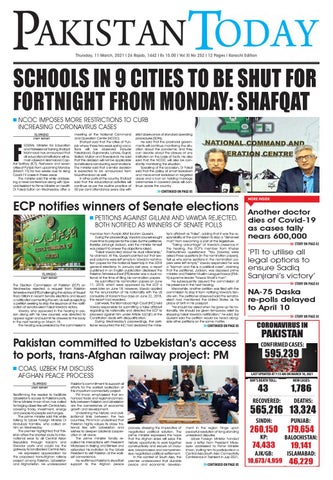
Thursday, 11 March, 2021 I 26 Rajab, 1442 I Rs 15.00 I Vol XI No 252 I 12 Pages I Karachi Edition
sChools in 9 Cities to be shut for fortnight from monday: shafqat g
NCOC impOses mOre restriCtiONs tO Curb iNCreasiNg COrONavirus Cases ISLAMABAD
f
staff report
ederal minister for education and professional training shafqat mahmood has announced that all educational institutions will remain closed in islamabad Capital territory (iCt), peshawar and seven cities of punjab from upcoming monday (march 15) for two weeks due to rising Covid-19 cases in these areas. the minister said this while addressing a news conference along with special assistant to prime minister on health dr faisal sultan on wednesday after a
meeting of the National Command and Operation Centre (NCOC). shafqat said that the cities of punjab where these two-week spring vacations will be observed include faisalabad, gujranwala, lahore, gujrat, sialkot, multan and rawalpindi. he said that this decision will not be applicable to institutions conducting examinations. the minister said that a similar decision is expected to be announced from muzaffarabad as well. in other parts of the country, shafqat said that the educational activities will continue as per the routine practice of 50 per cent attendance every day with
strict observance of standard operating procedures (sOps). he said that the provincial governments will continue monitoring the situation about the pandemic and they can decide about the closure of any institution on the basis of facts. he also said that the NCOC will also be constantly monitoring the situation. speaking at the occasion, dr faisal said that the policy of smart lockdown and micro-smart lockdown in targeted areas and a ban on holding marriage ceremonies in covered areas will continue across the country.
CONTINUED ON PAGE 05
ECP notifies winners of Senate elections g
ISLAMABAD staff report
the election Commission of pakistan (eCp) on wednesday rejected a request from pakistan tehreek-e-insaf (pti) challenging the victory of Yousaf raza gillani in recent senate elections and issued a notification cementing the win; as well as rejecting a petition seeking to stop the issuance of the notification of senator-elect faisal vawda’s victory. vawda, who appeared in the hearing in person along with his new counsel, was directed to appear again and submit his answers to the body in the next hearing on march 18. the hearing was presided by the commission’s
petitiONs agaiNst gillaNi aNd vawda rejeCted, bOth NOtified as wiNNers Of seNate pOlls
member from punjab altaf ibrahim Qureshi. during the proceedings, vawda’s counsel sought more time to prepare for the case. but the petitioner, barrister jahangir jadoon, said the minister himself was present to answer the objections raised. “faisal vawda lied about his dual citizenship,” he claimed. at this, Qureshi pointed out that several columns were left empty in vawda’s nomination papers for the National assembly in the 2018 general elections. in january last year, a report published in an english publication disclosed the pakistan tehreek-e-insaf (pti) leader was a dual national at the time of filing his nomination papers. he submitted his nomination papers on june 11, 2018, which were approved by the eCp a week later on june 18. however, vawda applied for the renunciation of his nationality with the us consulate at Karachi four days on june 22, 2018, the report had revealed. last week, the islamabad high Court (ihC) held vawda responsible for submitting a false affidavit regarding his nationality and directed the eCp to proceed against him under article 62(1)(f) of the Constitution deals with disqualification. during wednesday’s proceedings, the petitioner recounted the ihC had declared the minis-
ter’s affidavit as “false”, adding that it was the responsibility of the commission to stop a “dishonest man” from becoming a part of the legislature. “taking advantage” of vawda’s presence in the hearing, the eCp’s member from Khyber pakhtunkhwa questioned: “You [vawda] were asked three questions [in the nomination papers]. tell us why some sections in the nomination papers were left empty.” vawda responded he was a “layman and this is a political case”, claiming that the petitioner, jadoon, was deposed prime minister and pakistan muslim league-Nawaz (pmlN) supreme leader “Nawaz sharif’s man”. he subsequently assured the commission of his presence in the next hearing. meanwhile, another petition was filed with the commission to stop it from notifying vawda’s senate win. the petitioner observed said the senatorelect had mentioned the united states as his place of birth in his passport. “he should be asked when he gave up his nationality. we should be given temporary relief by stopping faisal vawda’s notification,” he said. but Qureshi said the petition would be heard alongside other petitions on the same matter.
CONTINUED ON PAGE 05
Pakistan committed to Uzbekistan’s access to ports, trans-Afghan railway project: PM g
COas, uzbeK fm disCuss afghaN peaCe prOCess ISLAMABAD staff report
reaffirming the resolve to facilitate uzbekistan’s access to pakistani ports, prime minister imran Khan has called for forging closer ties with Central asia, covering trade, investment, energy and people-to-people exchanges. the prime minister said this while talking to uzbek foreign minister dr abdulaziz Kamilov, who called on him on wednesday. the premier highlighted that pakistan offers the shortest route to international seas to all Central asian republics through Karachi and gwadar ports and could be the gateway to landlocked Central asia. he expressed appreciation for the proposed trans-afghan railway project among pakistan, uzbekistan and afghanistan. he underscored
pakistan’s commitment to support all efforts for the earliest realisation of this important connectivity project. pm imran emphasised that enhanced trade and regional connectivity between pakistan and uzbekistan are the cornerstones of economic growth and development. underlining the historic and civilisational links between the two countries, pm imran underlined that pakistan highly values its close fraternal ties with uzbekistan and wishes to deepen bilateral cooperation in all areas. the prime minister fondly recalled his interactions with president mirziyoyev in beijing and bishkek and reiterated his invitation to the uzbek president to visit pakistan at the earliest convenience. he reaffirmed pakistan’s steadfast support to the afghan peace
more inside
Another doctor dies of Covid-19 as cases tally nears 600,000 STORY ON PAGE 02
‘pti to utilise all legal options to ensure sadiq sanjrani’s victory’ STORY ON PAGE 03
NA-75 Daska re-polls delayed to April 10 STORY ON PAGE 03
Coronavirus in
Pakistan
CONFIRMED CASES:
595,239
LAST UPDATED AT 7:13 AM ON MARCH 10, 2021
DAY'S DEATH TOLL:
43
RECOVERED:
NEW CASES:
1,786 DEATHS:
565,216 13,324 SINDH:
process, stressing the imperative of negotiated political solution. the prime minister expressed the hope that the afghan sides will seize this historic opportunity to work together constructively and secure an inclusive, broad-based and comprehensive negotiated political settlement. in the context of south asia, the premier underscored that durable peace and economic develop-
ment in the region hinge upon peaceful resolution of long-standing unresolved disputes. uzbek foreign minister handed over a letter from president mirziyoyev addressed to prime minister imran, inviting him to participate in a Central asia-south asia Connectivity Conference in tashkent in july 2021.
CONTINUED ON PAGE 05
PUNJAB:
260,150
179,654
KP:
BALOCHISTAN:
AJK/GB:
ISLAMABAD:
74,433 10,673/4,959
19,141
46,229
02
Thursday, 11 March, 2021
KARACHI
NEWS
anotHer doctor dies of covid-19 as cases tallY nears 600,000 PESHAWAR
Y
STAFF REPORT
ET another doctor succumbed to the coronavirus in Peshawar on Wednesday, taking the provincial tally of deaths in the healthcare sector from the contagious disease to 48. In a statement, Provincial Doctors Association (PDA) said Dr Izzat Khan, principal medical officer of District Headquarters (DHQ) Hospital Charsadda, had been diagnosed with the coronavirus and was undergoing treatment at Hayatabad Medical Complex (HMC).
Expressing grief at his demise, the association said that Dr Khan’s contributions to the field of medicine would be remembered. The national tally of coronavirus cases neared 600,000 as infections climbed again following a decline over the last two months. According to data from the Ministry of Health Services, 1,786 new cases were registered in the last 24 hours, taking the caseload to 595,239. With 43 more fatalities, the death toll also rose to 13,324. “Covid-19 infections and hospitalisations in Pakistan are increasing once again. The decline seen over the past 2 months is clearly reversing as positivity has gone up
from 3.31 per cent to 4.16 per cent within a week. We must remember that the pandemic is not over,” Dr Faisal Sultan, the special assistant to the prime minister on national health services, said. The government commenced the vaccination of people aged 60 and above on Wednesday, with Dr Faisal announcing that it would begin with the senior-most citizens who had registered. “We will work our way down in coming days,” he said Authorities have urged registered individuals to wait to receive a text message with instructions on their cellphones. According to a survey released last week, nearly half
COAS discusses regional situation with Bahrain's security officials RAWALPINDI STAFF REPORT
Chief of Army Staff (COAS) General Qamar Javed Bajwa on Wednesday held one-on-one meetings with Bahrain Nation Guard Commander Field Marshal Mohammed Bin Isa Al Khalifa and Bahrain National Security Advisor Major General Shaikh Nasser bin Hamad Al Khalifa, during his visit to Bahrain. During the meetings, issues of mutual interest and regional security situation came under discussion.
Covid-19 SOPs breached as vaccination of people over 60 begins GOVT LAUNCHED A NATIONWIDE CAMPAIGN IN FEBRUARY WITH MORE THAN 400,000 DOCTORS AND FRONTLINE HEALTHCARE WORKERS BEING COVERED IN THE FIRST PHASE ISLAMABAD People in Islamabad crowded the Polyclinic Hospital on Wednesday as the second phase of the coronavirus vaccination drive targeting people who are 60-year-old or above began. Large hoards of senior citizens and a few youths assisting them were seeing cramped in tiny spaces, not observing the government-issued health guidelines, while officials turned a blind eye to the scenes. Those sitting in waiting areas were also seated right next to each other while a few people were roaming around with their masks below the nose. The government is currently using the Chinese Sinopharm vaccine. Pakistan hopes to start receiving the AstraZeneca-Oxford vaccine this month under the World Health Organisation’s (WHO) COVAX initiative. Authorities
Yasmin warns of restrictions if covid-19 guidelines flouted ISLAMABAD Punjab Health Minister Dr Yasmin Rashid on Wednesday warned that ignoring Covid-19 guidelines will further lead to a jump in infections and urged the public to wear face masks, particularly in situations where social distancing is not possible. Talking to a news channel, the minister said that noncompliance with standard operating procedures (SOPs) in letter and spirit
could compel the government to impose another smart lockdown which would affect businesses. She stressed the spread of the disease can be curtailed when masks are being used along with other preventive measures, including social distancing, frequent hand-washing, and cleaning and disinfecting frequently touched surfaces. “We are ensuring that the ‘masks on’ policy is strictly implemented in the province so that local population should be safe,” she added.
expect to receive 17 million doses of coronavirus vaccines under the scheme from March to June.
The government portal keeping track of the outbreak in Pakistan on Wednesday reported 1,786 new
STAFF REPORT
teenage Hindu girl kidnapped, married off to muslim man: family KASHMORE INP
The COAS offered Pakistan's complete support in achieving shared interests in bilateral security cooperation including training and capacity building, said an Inter Services Public Relations (ISPR) press release received on Wednesday. Later, delegation level talks were also held, where current developments in Afghan peace process, border security and necessary steps to be undertaken to facilitate an Afghan-led and Afghan owned peace process were discussed.
STAFF REPORT
of healthcare staff had concerns over Chinese Sinopharm vaccine, which is the only one available in Pakistan for now. The poll of 555 medical workers conducted by Gallup Pakistan and a physicians’ association between February 12 and February 20 found that many health workers would prefer other vaccines. The government distributed 504,400 Sinopharm vaccine doses to provincial authorities by February 20, and 230,000 front-line health workers had got a shot by Friday, Dr Sultan said. Pakistan has not secured any supplies from vaccine manufacturers and is largely depending on the GAVI/COVAX initiative.
infections of the coronavirus after conducting 39,425 tests, receiving back a positivity ratio of 4.53 per cent. The government launched a nationwide vaccination campaign on February 3, with more than 400,000 doctors and frontline healthcare workers, teachers, and social workers being covered in the first phase because they run the highest risk of exposure to the contagious disease. As per the roll-out plan, the second phase which started Wednesday will focus exclusively on citizens over the age of 60, who generally face a higher mortality risk from the virus, and all remaining healthcare workers, while the general public would be accommodated in the third phase. In Lahore, the jabs will be administered at the Expo Centre. Pakistan received its first tranche of the Sinopharm jabs, given by China as a “gift”, earlier this month. The shipment marked the first shots to be imported into the country where more than 595,239 cases of the disease have been reported since the outbreak in February last year.
A 13-year-old girl was kidnapped from her home in Tangwani Taluka of Kashmore, her family has said. Her father Takhtmal told a private TV channel that his daughter Kavita was kidnapped from their home by five people on March 8 and he has not heard from her. The family has filed a first information report (FIR) against the kidnappers. In his statement, her father told the police that five people dragged his daughter from their home to a white vehicle and sped away. He told police that he can identify four of the five kidnappers and their names are Mushtaq, Bhural, Rustam and Muhammad Bux. Two of them were carrying pistols. They told us not to resist and said they will marry her off to Mushtaq, Takhtmal said in his statement. The teenager has been moved to Ghotki from Kashmore where she appeared before a court and sought protection from her family because she claimed she married Mushtaq against the will of her parents, Sindh chief minister’s Special Assistant and a lawyer Veerji Kohli said. Kashmore SSP Amjad Shaikh confirmed that she appeared before a court on Wednesday and told the judge that her age is over 18. Kohli said that there is no law to prove if someone is forcefully converted because the girls or young women appear before a judge and tell them they converted of their own free will. But, he added that the police will deal with this case under the Sindh Child Marriage Restraint Act.
nayyar Bukhari’s son, two others injured in islamabad firing ISLAMABAD: At least three people, including the son of Pakistan People’s Party (PPP) leader and Senator Nayyar Hussain Bukhari, got injured in a firing incident in Islamabad during a jirga. According to police, the firing incident was reported at a house in sector E-7 of Islamabad during a jirga, resulting in injuries to three people. “Jarar Bukhari, son of Nayyar Hussain Bukhari sustained injuries along with two others in the incident,” the police confirmed as they shifted the injured to the Poly Clinic Hospital for medical treatment. INP
Inquiry committee formed after killing of SU student: Sindh IGP THE COMMITTEE WILL HAVE TO PRESENT A DETAILED REPORT OF ITS FINDINGS WITHIN SEVEN DAYS NEWS DESK Sindh Inspector General of Police (IGP) Mushtaq Ahmed Mahar on Wednesday formed a committee to look into the killing of Irfan Jatoi, a student of the Sindh University who was killed in an alleged ‘encounter’ in Sukkur. According to an order issued by the IGP office, an inquiry committee was constituted to probe into the first information report registered under Sections 353 (assault or criminal force to deter public servant from discharge of his duty), 324 (attempt to murder) and 34 (acts done by several persons in furtherance of common intention) of the Pakistan Penal Code (PPC) at Jhangro police station, district Sukkur, regarding the alleged police encounter that took
place on the National Highway near a fish farm at Mando Dero. The inquiry body will be led by Hyderabad Additional IGP Dr Jameel Ahmed and comprise Mirpurkhas Deputy IG Zulfiqar Larik and Kashmore Senior Superintendent (SSP) Amjad Ahmed Shaikh as members. The committee will have to present a detailed report of its findings within seven days, it was learned. The incident, wherein a student of the University of Sindh was forcibly taken from his hostel on February 10 and was shot dead in an alleged police encounter on Sunday in Sukkur district, sparked public outrage a day earlier. Activists and peers of the deceased had taken to social media to raise hue and cry over the incident, while
the police had claimed that the student, 25-year-old Jatoi, was part of a car lifting gang. The alleged encounter took place on the National Highway in the limits of Jhangro Police Station. The police had claimed that three of Jatoi’s accomplices escaped. “The police received a tip-off that some outlaws have been seen…with the noticeable intent of committing a robbery,” Sukkur SSP Irfan Samo had said a day earlier. Jatoi’s family have maintained his innocence since his abduction and had filed a petition in the Jamshoro district and sessions court a day after he was allegedly picked up by the police from the hostel. When the police were summoned before the court, they had pled ignorance about any arrest. However, the family had maintained that Jatoi has been missing for
three weeks and the police are demanding bribes for his release. Reacting to the killing, Lahori academic Dr Ammar Ali Jan had said that he was shocked to hear of the incident and any “silence would mean complicity” on part of the Sindh government. Similarly, activist and lawyer Jibran Nasir had said that the deceased was alleged to be a wanted criminal by Sukkur police while many on social media were saying that he had been abducted from the Sindh University premises. He had called for the provincial police chief to launch an inquiry under Section 5 of the AntiTerrorism Act. Nasir had also called for the office of Sindh Chief Minister Syed Murad Ali Shah to address the incident and “issue a statement on this encounter which has seemed to raise many questions”. “History of encounters in Sindh is tainted with repeated abuse of power and encounter specialists enjoying undue patronage of government.”
Thursday, 11 March, 2021
KARACHI
NEWS
‘PTI To UTIlIse all legal oPTIons To ensURe sadIq sanjRanI’s vIcToRy’ PARLIAMENT TO REMAIN SUPREME ULTIMATELY; UNITY ONLY WAY TO PROCEED, AFFIRM SENATORS islamabad
M
INp
InISTeR for Information and Broadcasting Shibli Faraz on Wednesday said that the ruling Pakistan Tehreek-e-Insaf (PTI) will utilise all its political, democratic and legal options to ensure Sadiq Sanjrani’s victory as chairman of the Senate. The minister reiterated that Prime Minister Imran Khan has a strong commitment to fight against immoral and undemocratic tactics, having previously said that the opposition was harming democracy by using illegal and immoral tactics, including the sale and purchase of votes. “The opposition parties under the PDM want to bring the incumbent government under pressure,” Faraz maintained, adding, “but Prime Minister Imran Khan will not accept any pressure or be influenced [by them],” he stated earlier on March 7. The PTI leader reasoned that the reason the ruling party was still functioning was that the party never gave up its ideology for petty gains. The election of former prime minister Yousaf Raza Gillani as a senator was challenged with the election Commission of Pakistan (eCP) last week. The petitioner had stated that the Pakistan Democratic Movement (PDM) candidate’s win should be declared null and void as the polls were not transparent and further asked the electoral authority to investigate horse-trading in the polls and take action against those responsible. Meanwhile, Sindh Minister education, Saeed Ghani has demanded of the Supreme Court (SC) and the election Commission of Pakistan (eCP) to take notice of the statement by the federal minister for information. Twisting the word’s of the
federal information minister – particularly his comment on using any means to help reelect Sanjrani – Ghani, while addressing a press conference at the PPP media centre in Islamabad on Wednesday, said that this statement of Faraz makes clear the ideology of PTI of using illegal means to get success in the elections. “The PTI is so perplexed after losing Senate seat from Islamabad that they have lost their minds; they are going to every institution to stop Syed Yousaf Raza Gillani from contesting Senate chairman election but are facing defeat from every forum. “This is because Syed Yousaf Raza Gillani is a candidate of PDM which has clear majority in the Senate,” he said. He said that PDM candidates for Senate chairman and deputy chairman will win their elections easily and PTI will again lick their wounds. Ghani said that PTI’s own members have accused their party of awarding party tickets in return of Rs700 million in
Balochistan and Rs350 million in Sindh. He said that the PTI is the same party which used money in its own intra-party elections. Where there is any financial misappropriation in elections, it is evident that some PTI people are involved in it, he added. Separately, PM Imran on Wednesday assured Senate Chairman Sanjrani of full support of government and its allies for upcoming elections of chairman of upper house of the parliament. As per details, Sanjrani called on Prime Minister Imran to discuss strategy for Senate chairman and deputy chairman elections that will be held on March 12. During the meeting, PM Imran said that he is confident that Sanjrani will win the election. He also said that candidate for slot of Senate deputy chairman will also be finalised soon, after consultation with the PTI’s allies. It is pertinent to mention here that PM Imran had named Sanjrani as candidate for Senate chairman’s office.
On the other hand, PDM on Monday nominated newly-elected PPP Senator Gillani as joint candidate in the forthcoming Senate chairman election. PDM chief Maulana Fazlur Rehman announced Gillani’s candidature for the Senate chairman election after a meeting in Islamabad attended by PPP Chairman Bilawal Bhutto-Zardari, Pakistan Muslim League-nawaz (PML-n) Vice President Maryam nawaz and others members of the alliance. While the PTI is trying its best to get its candidate re-elected to the Senate, outgoing senators delivered their farewell speeches in the upper house on Wednesday, wherein they urged for unity to counter various challenges being confronted by the country and said Parliament would ultimately remain supreme. Speaking in the Senate, the lawmakers who would be completing their tenures on Thursday, March 11, spoke for the last time in the house. The outgoing Senator, Mir Kabeer Ahmed Muhammad Shahi thanked his party for reposing trust in him and said that he always fought the case of Balochistan. “I took up various issues of Balochistan’s people and other parts of the country in the house.” He also thanked other senators for their cooperation during his tenure in the House. He was of the view that the Senate of Pakistan should be given more powers. Dr Jehanzeb Jamaldini, while sharing his six years of experience in the Senate, said that the members of all the political parties tolerated each others’ point of view with an open heart. “We need to learn from our mistakes and these should not be repeated again,” he added. He further said that smaller provinces should be given their constitutional rights.
NA-75 Daska re-polls delayed to April 10 SC UPHOLDS ECP'S DECISION TO HOLD RE-POLLS AGAINST PTI'S APPLICATION News desk The election Commission of Pakistan (eCP) has pushed back the re-polling in the Daska nA-75 consistency to April 10. Moreover, the Supreme Court (SC) has denied the ruling party’s application to suspend the re-polling within Daska, wherein a three-member bench headed by Justice Umar Ata Bandial upheld the eCP’s decision after summoning a complete record of the case from eCP and Pakistani Muslim League-nawaz (PML-n) candidate. “This Commission in exercise of powers under Article 218(3) the Constitution read with section 9(1) of the elections Act. 2017, declares the poll held on 19.02.2021 in the subject constituency (nA-75, Sialkot-IV) as void and orders fresh poll/re-poll in the entire constituency on 18th March,” it said. The eCP said that the election in the constituency had not been conducted in a transparent manner, incidents of murders, firing and injuries, bad law and order situation while other circumstances led to make the process of result doubtful.
“From the perusal of available record produced by the parties, the Returning Officer as well as collected by the Commission through different sources, we have come to the conclusion that conducive environment was not available for the candidates,” the order said. “Voters of the constituency and the election in the subject constituency has not been conducted honestly, justly, fairly and in a transparent manner, incidents of murders, firing and injuries, bad law and order situation in the subject constituency creating harassment for voters and other circumstances leading to make the process of result doubtful/unascertainable.” earlier, the top electoral body had termed the polling null and void in the nA-75 Daska, the eCP had ordered re-polling in the constituency on March 18. The change in data comes a day after the appointments of police and administrative officers were notified by the eCP. Gujranwala Deputy Commissioner (DC) Sohail Ashraf had been given an additional charge of Gujranwala commissioner and Gujranwala City Police Officer (CPO) Sarfraz Ahmed Falki as regional police officer (RPO).
“Incidents of murders, firing and injuries, bad law and order situation in the subject constituency [created] harassment for voters and other circumstances leading to make the process of results doubtful/unascertainable,” the eCP order had noted. Additional Deputy Commissioner Revenue Mir Muhammad nawaz had been given an additional charge of the deputy commissioner and Superintendent Police (SP) Investigation Muhammad Imran was given the charge of DPO. Moreover, the appointments of SDPO Adnan Malik and SDPO Sambharial Rizwan Ahmed had also notified. It may be noted that the commissioner, deputy commissioner (DC), RPO, DPO and two DSPs had been removed over the directives of the election commission. earlier on February 25, the eCP had ordered repolling at all polling stations of nA-75 Sialkot-Daska over rigging. The eCP after hearing arguments from Pakistan Tehreek-e-Insaf (PTI), Pakistan Muslim League nawaz (PML-n) and returning officer (RO) had reserved the judgment. Riots had been reported during the polling day and the masses were not provided the right to vote in a true manner.
Russia invites Pakistan to Afghan peace meeting on March 18 islamabad Staff RepoRt
Russia has invited Pakistan to a conference on the Afghanistan peace process planned in Moscow on March 18, the TASS news agency said on Tuesday, but the United States State Department did not confirm American attendance. Russia’s special envoy for Afghanistan Zamir Kabulov said that the US, China, Pakistan, Kabul, and the Taliban have been invited to attend the expanded trilateral consultations on peaceful settlement in the war-torn country, TASS reported. “It is not even a conference, it is consultations of the expanded trio: Russia, the US, China, and Pakistan. Yes, we have invited [Afghan] government representatives, Afghan statesmen, and the Taliban delegation as well,” Kabulov
RUSSIAN ENVOY FOR AFGHANISTAN VISITED PAKISTAN LAST MONTH TO ENCOURAGE ISLAMABAD'S SUPPORT FOR THE MEETING TO HELP FACILITATE THE STALLED PEACE PROCESS said. The Russian envoy visited Pakistan last month to encourage Islamabad’s support for the meeting to help facilitate the stalled peace process. He had told Sputnik news agency that he hopes his visit will encourage Pakistan’s support for the meeting. The TASS report comes after the United States shared with Afghan officials, Taliban leaders and others a draft peace plan calling for replacing the government with a power-sharing interim administration pending elections under a new constitution. The US proposal is intended to jump-start stalled talks in Doha between the Taliban and a team that includes Afghan officials on a political settlement
to decades of conflict. Moscow also has advocated a transitional power-sharing government as part of a peace deal. Russia’s special representative on Afghanistan, Zamir Kabulov, told the Sputnik in February that Moscow was ready to host intra-Afghan peace talks to break the stalemate in Doha. The peace talks between the Taliban and the Afghan government-sanctioned team, which started last September, stalled after several months of bickering and little progress. Although Russia says it is trying to push for a meaningful dialogue between the Afghan factions, parts of Kabulov’s interview with Sputnik, especially his suggestion of the need for an interim
government set up that includes the Taliban, provoked a strong reaction from Kabul. TASS said that the Russian Foreign Ministry planned to hold the conference on Afghanistan on March 18 but gave no further details. A US State Department spokesperson noted that “the United States has met in the past with Russia in support of the Afghanistan peace process. Recently we have discussed scheduling a meeting, but the United States has nothing to confirm at this time”. US Secretary of State Antony Blinken wrote last week in a letter to Afghan President Ashraf Ghani that the United States would ask Turkey to host “a senior-level meeting of both sides in coming weeks to finalise a peace agreement”.
03
He also urged authorities of various institutions to respect each other rights. He maintained that the parliament would ultimately remain supreme in the country because it was the only option to proceed ahead. Muhammad Usman Khan Kakar thanked his party for nominating him as a senator for six years. He also thanked his party workers. He appreciated the Senate Chairman Sanjrani for extending support to the Senators for highlighting the Balochistan issue. He said that he had always fought against the dictatorship and for the restoration of democracy in the country. He added that equal rights should be given to every citizen of the country. Senate of Pakistan should be given powers like national Assembly, he stressed. “I always work for the strengthening of democracy and parliament,” he said. Khushbakht Shujaat thanked her party for giving her a chance to highlight issues of the people of Karachi in the Senate. She said that all political parties should work jointly for strengthening democracy and Parliament. The outgoing senator said that continuity of democracy was in the best interest of the country. She underscored that she tried to serve with the best of her capabilities. She requested Prime Minister Imran to focus on the education sector. She also appreciated Chairman Sanjrani and former chairman Mian Raza Rabbani for conducting the proceedings of the house in a cordial atmosphere.
Unhappy with FBR report, PM seeks indiscriminate action against sugar mafia islamabad tLtp
Prime Minister Imran Khan on Wednesday expressed resentment over the Federal Board of Revenue (FBR), as it failed to show any recoveries from sugar mills owned by government personalities. The FBR presented the report showing recoveries of more than Rs400 billion from sugar mills on the orders of the premier. The report, however, showed recoveries from small sugar companies but failed to show any recoveries from the ‘big fish’. Angered by the report compiled by the supreme tax body, PM Imran Khan asked the FBR officials why across the board action was not initiated in the sugar scandal. The FBR officials replied that investigation against the big companies owned by the Sharif family, JKT group, Khushro Bakhtiar, Humayun Akhtar group, RYK, Ittehad Sugar Mills and others are currently underway; however, the officials failed to give a convincing reply to the premier. Imran Khan ordered the FBR officials to initiate across-the-board action and submit a detailed report into the scam.
Pakistan student wins young scientist award ABBOTTABAD: Umair Masood, a 21-year-old student, has won Young Scientist Award 2021 at an international conference featuring students from 121 countries around the world. Masood achieved this milestone for his contribution in the field of Molecular Diagnostic Techniques at the seventh annual conference held in Australia earlier this month. “It took me three and a half years [to win this award]. I failed multiple times. I faced financial challenges. It was not easy [to get there],” he said, recounting his journey to global recognition. Masood presented two research papers at the International Conference on Molecular Biology and Biochemistry in Australia and the 13th International Conference on Tissue and Regenerative Medicine held virtually. His work explained that people suffering from hereditary diseases could have their diseases detected in a quick and affordable manner while the genes of any living thing can be obtained and transmitted to another. Staff RepoRt
Thursday, 11 March, 2021
04 NEWS
KARACHI
PM LaunCHes 'Koi BHuKa na soye' PrograMMe, vows to Provide direCt suBsidy to 30M faMiLies ISLAMABAD
i
APP
n order to protect the poor people from inflation and price hike, Prime Minister Imran Khan on Wednesday said the government would initiate a revolutionary programme of providing direct subsidy to 30 million families, around half of the country’s population, from June.
He said this while launching the 'Koi Bhuka na Soye' programme, under which the poor and labour classes would be provided free meal boxes twice a day through mobile trucks at various points of Rawalpindi and Islamabad. The prime minister said that through the direct subsidy programme, to be carried out under the umbrella of Ehsaas Programme, the subsidy amounts would be directly credited to the accounts of poor people, enabling them to buy basic
food items like wheat flour, sugar, ghee etc. He added that the government would also bring a similar direct subsidy programme for the farmers to help them in getting fertilizers and other agricultural inputs on subsidised rates. The premier said that 70 per cent of the work for the direct subsidy programme has already been completed while progress on the remaining 30 per cent is underway.
PBIT conducts dialogue between government, exporters to resolve issues LAHORE SHAHAB OMeR
The business community and exporters have suggested to the government that there is a need to tackle issues that are hindering the economy and to reconsider past strategies, which were failed to yield positive results, Pakistan Today learnt on Wednesday. The Punjab Board of Investment and Trade (PBIT) organised a “Public-Private Dialogue” to address the impediments faced by the exporters, in which Provincial Minister for Industries, Commerce and Skills Development Department Mian Aslam Iqbal, Provincial Finance Minister Hashim Jawan Bakht, Special Assistant to Punjab Chief Minister on Business, Investment and Trade Sardar Tanveer Ilyas Khan, PBIT Chief Executive Officer (CEO) Dr Erfa Iqbal and the representatives of different chambers of the province, business community and government departments, including State Bank of Pakistan, Federal Board of Revenue (FBR), Trade Development Authority Pakistan (TDAP) and Income Tax, participated. Erfa welcomed the participants and said that the significance of the exporting sector in the country’s economy can hardly be debated. “Increase in exports is vital to improve a country’s trade and payments balance. The
PBIT convened the dialogue to bring together notable stakeholders to prepare an action plan with a view to boosting exports of the country,” the CEO said. Addressing the participants Mian Aslam disclosed that the Punjab government will establish special economic zones in every district of the province to expedite industrialisation, which would ultimately provide youth with immense employment opportunities and stabilise the economy in the long run. The meeting thoroughly held deliberations on the various issues faced by the exporters and suggested a number of proposals for their amicable resolution. “To meet the needs of the rapidly growing population of the country, policymakers must contend with the numerous issues that impede the economy and reassess the past strategies for development that were failed to provide results. As we pass through an era of unprecedented change and complexity, it is imperative that we refresh our framework for national development. We believe that, once effectively addressed, our challenges likewise offer unprecedented opportunities for transformational progress,” the participants suggested. The participants at the roundtable emphasised that the export sector needs to see credible commitment and consistent support from the federal and provincial gov-
ernments, and reassured that they are willing to make further investments, if they receive the right governmental support, including simplification of cumbersome processes and procedures through effective one-window facilitation. The participants called upon the government, central bank, customs department and other relevant authorities to initiate measures to simplify the complicated laws and regulations to give a boost to regional trade. Speaking to the participants, Mian Aslam said that the national planning process is more participatory, collaborative and people and market-oriented. “Your [participants] suggestions are well noted and will be discussed in the pre-budget sessions to develop a better economic strategy for economic progress and financial independence,” he assured. He further directed the related officials from various departments to note down the issues and suggestions of participants to deliberate upon during the budget sessions. Aslam, in his concluding remarks, said that having taken necessary short-term actions to stabilise the economy, it is logical to shift the focus towards the medium to long-term framework that will bring the country’s economy to its full strength and potential. In his address, Sardar Tanveer said, “Our ultimate
destination is to see Pakistan among the largest economies of the world. The recent years have witnessed the transformational impact of the deepening of democratic culture and institutions. These steps have helped in stabilising the macroeconomic environment of the country, which is evident from growing foreign exchange reserves, robustness in the stock market, growing economic engagement of friends of Pakistan in the development sector, and stabilisation of the national currency.” Speaking to the participants, the provincial finance minister said that plans succeed when they manifest the aspirations of a nation, and empower the citizens and private sector to play their respective roles, provide equal equitable opportunities to all and assign a very well-defined role to the government as a supporter, facilitator, regulator and performance-driven service provider. “The banking sector is the backbone of business development. We have derived a strategy to restore all dry-ports in the province and a good news in this regard is on the cards. A proposal for the payment of interest on subsidy to banks is already made while revolutionary steps for the agricultural transformation are going to be introduced in the upcoming budget,” Bakht said.
LHC seeks govt’s reply over increased chicken prices LAHORE TLTP
ISLAMABAD: A view of clouds hovering on the sky in the federal capital.OnLine
PM briefed about Ravi, business district projects in Lahore ISLAMABAD APP
Prime Minister Imran Khan was briefed about the pace of work on the Ravi Urban City and Central Business District projects in Lahore on Wednesday. He was informed that 5,400 acres of land were acquired for the Ravi project and award for the land had also been announced.
The meeting was told that a 17kilometer road would be constructed to obtain easy access to the Ravi project while around 450 acres of the city would be allocated for agricultural farms with the aim to protect the environment. Many leading investment companies had expressed their interest for investment in the project and their proposals were being considered. The prime minister was also
briefed about the progress made in the project of central business district in the city. He was told that 10,000 trees would be planted to protect the environment in the central business district, which had only 1,390 trees, and a tree metery would be established to register every tree. The physical survey of the area had been completed, the prime minister was informed as he was given briefing
on all aspects of the project. Talking about the two commercial projects, the prime minister said that the projects would generate economic activity worth billions of rupees, besides resolving the issues of the city. The prime minister instructed that the protection of the environment should be ensured in the projects and he should be kept updated about the progress on both the projects.
The Lahore High Court (LHC) on Wednesday issued notices to the concerned authorities on a petition seeking directives for the government to bring down the price of chicken in the province. After a preliminary hearing, a bench of the high court directed the provincial government and other respondents to submit their comments on the writ petition at the next hearing. The petitioner stated before the court that the government has failed to control the rising prices of chicken. The court was requested to order the authorities concerned to take concrete steps to bring down the prices. It is pertinent to mention that the prices of chicken have gone up considerably with chicken meat being sold at as high as Rs500 per kg in Karachi, Rs365 per kg in Lahore and Rs400 per kg in Islamabad. Meanwhile, the Sindh government on Wednesday showed serious concern over a “deliberate” and “abrupt” increase in prices of chicken meat in Karachi. In a letter to the Karachi commissioner, Director of the Bureau of Supply and Prices Javed Hassan Khan said, “In spite of declaring all the deputy commissioners, assistant commissioners and mukhtiarkars as special price magistrates in their respective jurisdictions by the government of Sindh, the notified price of chicken(meat is not implemented and being increased. This abrupt increase in the price of chicken meat and the uncontrolled situation reflect the bad impression of the government functionaries.” He said the special price magistrates are responsible to take stern action against profiteering and rationalise prices of all essential commodities, including chicken meat. The letter demanded the deputy commissioners, assistant commissioners and mukhtiarkars to curb the abrupt and undue hike in the prices of chicken.
Thursday, 11 March, 2021
KARACHI
05 LoCAL MAnUfACtUring of MobiLe PhoneS on the riSe nEwS
Schools in 9 cities to be shut for fortnight from Monday: Shafqat contInueD froM pAge 01 He said that public parks will be closed at 6:00 pm and commercial activities at 10:00 pm except for essential services. He also said that indoor dining will not be allowed in restaurants. “Outdoor seating and takeaway services are permitted. Offices have also been directed to function on 50 per cent staff capacity. The situation will be further reviewed on 12th of the next month,” he added. The SAPM said that the vaccination process of senior citizens of 60 years of age and above has been started and these elderly people can get the vaccination by sending their CNIC number to 1166. Dr Faisal said that coronavirus cases are increasing in the country and urged the administrative departments to enforce the SOPs. Meanwhile, the NCOC on Wednesday issued fresh guidelines following a surge in the Covid-19 cases across the country. The session was held with the authority’s Chairman Asad Umar in the chair and was “given a comprehensive update and review about the nonpharmaceutical interventions (NPIs) already issued and which were valid till March 15”. The statement released by the country’s nerve centre for Covid-19 response said that in view of the prevailing disease pattern and rising positivity ratio, strict compliance with mask-wearing will continue across the board. smart lockdown and micro smart lockdowns will continue based on disease prevalence and hotspots. The statement further said that 50 per cent work from a home policy will be implemented at the discretion of the country’s federating units. However, it will be enforced in Islamabad with immediate effect. The time limit of 10:00 pm on all commercial activities will be reinforced with immediate effect, less essential services. “Amusement Parks across the country will be closed at 6:00 pm.” The statement further said that the earlier decision of reopening remaining places from March 15 has been withdrawn. “However, outdoor dining and takeaways will continue to remain open as per the previous practice.” “Outdoor gatherings will continue to remain limited to a maximum of 300 individuals with strict enforcement of Covid-19 SOPs,” the statement said and added that the decisions regarding NPIs by the forum are the base-line decisions. Federating units are at liberty to impose stricter NPIs in selected cities and districts keeping in view the local trend and spread of the Covid-19 virus. The second phase of the Covid-19 vaccination drive for people aged 60 and above was started at many government hospitals on Wednesday. Parliamentary Secretary for National Health Service Dr Nausheen Hamid said that the senior citizens who have registered themselves for vaccination will receive an SMS with instructions on their mobile phones and the oldest persons will be vaccinated first. She said that the vaccination shots would be distributed fairly, in three stages and citizens should not have any doubt about the vaccination as the vaccine has proven safe. “Beginning with the senior most citizens, who will receive SMS with instructions on their cell phones,” SAPM Dr Faisal tweeted on Tuesday. Earlier, the NCOC head Asad had announced that the vaccination of people aged 60 years and above will start from Wednesday. “Vaccinations will be done in reverse order by age. Which means the oldest person who has registered will be vaccinated first. Full details will be issued tomorrow,” Asad tweeted. Meanwhile, the coronavirus pandemic claimed 43 more lives across the country in the past 24 hours, taking the overall death toll to 13,324, said the NCOC on Wednesday. According to the country’s nerve centre for Covid-19 response, 1,786 fresh infections were reported during the aforesaid period, raising the national tally of cases to 595,239. The total count of active cases is 16,699 and 1,664 of them were stated to be in critical condition. A total of 39,425 tests were conducted across the country during the last 24 hours, while 9,318,038 samples have been tested so far. In the past 24 hours, as many as 1,393 patients recovered from the virus while the number of recoveries so far has been 565,216. Meanwhile, Foreign Minister Shah Mehmood Qureshi’s son and PTI lawmaker, Zain Qureshi, has tested Covid-19 positive for the second time. In a tweet, Zain Qureshi shared the news and said he is isolating himself after developing a mild fever. “I have tested positive for Covid-19 for the second time, isolating at home,” Zain wrote on his Twitter account.
ISLAMABAD gHULaM aBBas
W
ITH the arrival of new investors in the mobile phone manufacturing industry, the Ministry of Industries & Production (MoIP) expects that the new industry to overtake the country's automotive industry in the next few years. As per officials of the Engineering Development Board (EDB) -- a technical arm of the Ministry of Industries & Production (MoIP), the country's mobile phone manufacturing industry was expected to surpass the auto sector in terms of turnover.
provided sufficient advantage to the local manufacturing of mobile phones in comparison with imports of completely built units. "VIVO, Airlink Communications and Inovi Telecom are among the new investors in local assembly of mobile phones, who have already started their trial production in February 2021." According to Ayaz, the combined capacity of these three companies was more than one million mobile handsets per month, whereas Transsion Tecno -a Karachi-based company assembling three famous brands including Itel, Infinix and Tecno -- has increased local assembly from 150,000 units to 650,000 units per month owing to in-
ECP notifies winners of Senate elections contInueD froM pAge 01 “We can de-notify after the decision is taken regarding [Vawda’s] ineligibility but we cannot stop the notification at the moment.” Regarding the victory of Yousaf Raza Gilani, the ECP rejected the plea to stop the issuance of the notification confirming Gilani’s victory in the recent elections for the upper house of parliament. However, it accepted for hearing a petition involving a contentious video, showing the former prime minister’s son, Ali Haider Gillani, explaining to MPs how to waste their votes. Shortly after announcing the short order, the commission issued the victory notifications for Gillani and PTI senator-elect Fauzia Arshad as the returned candidates on general and woman seats respectively from Islamabad. Last Wednesday, Gillani, who was fielded as a joint candidate of the 11-party PDM on a technocrat seat from Islamabad, defeated Finance Minister Abdul Hafeez Shaikh in Senate elections in a major setback to the government.
He received 169 votes to the latter’s 164. Earlier on Wednesday, the IHC dismissed a petition from PTI challenging the victory of PPP leader Gillani in recent Senate elections. During the proceedings on Wednesday, Awan told the court that the PTI wished to bring transparency to the electoral process. However, the judge observed that the party had approached the ECP in this regard, and said that there were “alternative forums” to address such grievances. “The election process is currently ongoing and, under the Election Act [2017], you have other forums [for addressing your grievances],” he said. “Tell us how the court can ignore these forums and hear this writ petition,” Justice Minallah asked. “You are levelling allegations of vote-selling. Some of your own [parliamentarians] are [reported to be] included in this,” he remarked. “The court has faith in Parliament and has always respected parliamentarians.”
The judge added it was everyone’s responsibility to abide by the law. “Your case is pending in the ECP. Use that forum first,” the judge told the PTI MNA. “It is not appropriate to bring political issues to the court unnecessarily,” he added. The high court also rejected a request to disqualify Ali Haider Gillani from his Punjab Assembly seat. On Saturday, three PTI leaders — Farrukh Habib, Maleeka Bokhari, and Kanwal Shauzab — approached the election commission to halt the issuance of the victory notification for Gillani until a probe into the leaked video is completed. In another petition filed on Monday, the trio sought an early hearing of the case which was earlier scheduled for March 11 — a day before the election for the office of Senate chairman. “The matter is extremely important as a senator elected with corrupt practices is now aspiring to become the chairman of Senate,” the petition had said. “It is a matter of utmost importance, which will have far-reaching consequences.”
President Alvi for modernising beekeeping to boost yield, export ISLAMABAD TLTP
President Dr Arif Alvi has urged the beekeeping industry to adopt modern beekeeping and marketing techniques to boost yield and export, in addition to training people affiliated with beekeeping on modern lines to help them increase productivity. Talking to a delegation of All Pakistan Beekeepers and Honey Dealers Association (APBHDA) on Wednesday, the president said that owing to good quality standards, the country’s honey has the potential to hit international markets on at large scale. The president asked the Ministry of Commerce to devise an effective marketing strategy to brand and sell the honey besides, expanding the outreach of the product to other countries. It is pertinent to mention here that commercial
Israel's Netanyahu to make first official trip to UAE on Thursday: reports Israel's Prime Minister Benjamin Netanyahu is to make his first official visit to the UAE on Thursday following an agreement between the two countries to establish ties, Israeli media reported. A senior official in Netanyahu's office declined to comment on the reports by Israeli public radio, Haaretz newspaper and other outlets. The reported visit would take place less than two weeks before Netanyahu faces re-election, Israel's fourth vote in less than two years. The veteran prime minister, in power since 2009, has sought to highlight his credentials as Israel's top statesman as part of his re-election pitch. According to the Israeli reports, Netanyahu will meet with the UAE's leader Sheikh Mohammed bin Zayed Al-
"To further facilitate the electronics sector, EDB has already started work on preparing appropriate framework for local assembly of tablets, allied equipment and mobile accessories," an EDB official said. "This is in line with the board's vision to improve the entire ecosystem and make mobile manufacturing the fastest growing sector in terms of employment and exports." He said following the approval of the Mobile Device Manufacturing Policy 2020 last year, new investors and firms were taking keen interest in the mobile manufacturing industry of Pakistan. Meanwhile, EDB General Manager (Policy) Asim Ayaz maintained that the mobile device manufacturing policy
Nahyan at Abu Dhabi's airport. He will then return to Jerusalem for talks with Hungarian Prime Minister Viktor Orban on the vaccination effort against Covid-19. The United Arab Emirates normalised ties with the Jewish state last September, making it the first Arab country to sign on to the so-called Abraham Accords brokered by former US president Donald Trump. The deal made the UAE only the third majority Arab state to establish ties with Israel, following Egypt in 1979 and Jordan in 1994. Bahrain, Morocco and Sudan subsequently joined the Abraham Accords. Netanyahu had been set to visit UAE and Bahrain in February, but the trip was put off after Israel imposed travel limitations to curb the coronavirus pandemic. agencies
beekeeping is fast becoming a thriving business in rural areas of the country. According to the All Pakistan Beekeepers Trade and Exporters Association (APBTEA), besides providing new job opportunities to thousands of men and women, the business is helping the country earn foreign exchange through exports, mainly to Middle Eastern countries. According to the association, around $6 million in foreign exchange is earned annually through honey exports to Saudi Arabia, the United Arab Emirates, and Kuwait. Pakistan currently produces around 7,500 metric tonmes of honey annually, with more than 8,000 beekeepers rearing exotic species in one million beehives, according to the government’s Honeybee Research Institute in Islamabad (HBRI). In the financial year 2018-2019 (FY19), Pakistan exported honey worth Rs966 million ($5.8 million), about Rs260 million more than FY18, according to the institute.
FPCCI seeks 100pc adjustment of input tax KArAcHI TLTP
In order to improve the country's ease of doing business ranking, the Federation of Pakistan Chambers of Commerce and Industry (FPCCI) has recommended the government to allow 100pc adjustment of input tax by removing the discrepancy created by Section 8B of Sales Tax Act. In a press statement issued on Wednesday, FPCCI President Mian Nasser Hyatt Maggo said that this restriction not only restrains taxpayers to claim their legitimate input tax but also affects the ease of doing business, thereby increasing the cost of business. FPCCI has already informed the concerned authorities about impedi-
cMYK
ments that were negatively impacting economic growth, he said, adding that under Section 8B of the Sales Tax Act, 1990, a registered person was not allowed to adjust input tax in excess of 90pc of the output tax. "At present, global and domestic conditions are completely different as Covid-19 has changed the world economic situation dramatically, with most businesses struggling for survival. In these circumstances, removal of anomalies would help promote trade and business," he opined. Naseer Hayyat extended his chamber's complete support and cooperation to the government, which was striving hard to improve the economic environment amid adverse conditions created by Covid-19.
crease in demand soon after the launch of the policy. "In addition to new entrants in mobile assembly, few experienced companies like GFive and QMobile were already operating in the market, while Samsung and OPPO are poised to enter local assembly in Pakistan market and are probably waiting for the implementation of approved recommendation of policy to remove sales tax on locally assembled mobiles from above $200 category." He said by introducing new players and capacity enhancement by existing companies, Pakistan will soon be able to meet a major portion of local demand, which was around 3.6 million per month in 2020.
Pakistan committed to Uzbekistan’s access to ports, trans-Afghan railway project: PM contInueD froM pAge 01 The premier thanked for the invitation and mentioned that he is looking forward to visiting Uzbekistan. Relations between Pakistan and Uzbekistan are based on common faith, shared history and cultural affinities. These linkages provide a strong foundation for increased bilateral cooperation in myriad fields. Both countries have been closely collaborating at regional and international fora, especially at the United Nations, Organisation of Islamic Cooperation (OIC), Economic Cooperation Organisation (ECO) and Shanghai Cooperation Organisation (SCO). COAS, UZBEK FM DISCUSS AFGHAN PEACE PROCESS: Uzbekistan’s Foreign Minister Kamilov also called on Chief of Army Staff (COAS) General Qamar Javed Bajwa, the Inter-Services Public Relations (ISPR) said on Wednesday. “Abdulaziz Kamilov, Foreign Minister of Uzbekistan called on General Qamar Javed Bajwa, Chief of Army Staff, today,” the statement read. “Matters of mutual interest, overall regional situation including the Afghan peace process and bilateral cooperation in various fields were discussed,” added the military’s media wing. “Both reiterated the desire to further enhance bilateral relations including efforts for peace and security in the region.” The visiting dignitary appreciated Pakistan’s positive role for regional peace and stability, especially Afghan Peace Process and pledged to keep working for better relations between two brotherly countries. Inter-Services Intelligence (ISI) Director General Lieutenant General Faiz Hamid was also present during the meeting.
CAA set to introduce UK-like pilot licensing system KArAcHI TLTP
The Civil Aviation Authority (CAA) has completed its preparations to install the UKlike system for licensing and examination of pilots. The aviation authorities will forward a summary to the federal cabinet in a few days in order to get final approval for the installation of the modern licensing system adopted from the British civil aviation authority. After the final approval of the federal cabinet, the aviation authorities will complete the modern system within a month. The British system for conducting pilots’ examinations and other processes will make the licences of Pakistani pilots acceptable all around the world besides ending irregularities. Besides maintaining transparency, the new system will also assist Pakistan to remove concerns of ICAO alongside raising the standards of pilots’ licences issued by the CAA. According to CAA, the pilots’ examination and the licensing system will be linked to the National Database and Registration Authority (NADRA) biometric system. It is pertinent to mention here that an audit team of the International Civil Aviation Organization (ICAO) is expected to arrive in Pakistan on July 5 to conduct its Universal Safety Oversight Audit (USOA) of the CAA. The safety audit will be completed till July 15.
Thursday, 11 March, 2021
06 COMMENT
Mixing competence with corruption
Imran Khan and secret ballot At times it’s kosher, at others forbidden
T
Education needs attention
HE PM likes to pose as a redeemer who is tasked to fight corruption in all shapes and manifestations, particularly in the realm of politics. Like a man suffering from messiah complex, Mr Khan harbours delusions. Since he believes that the entire opposition is corrupt, he concludes that the people would neither follow the opposition leaders nor vote for them. His wishes stand in the way of comprehending the ground realities. During the first year of his tenure Mr Khan repeatedly challenged the opposition to hold rallies against him, promising to provide containers to their leaders and free lunches to their followers. When the opposition’s protests became bigger, he accused it of hiring unemployed labour, paying each one daily wages and a “Qeemay wala naan” for attending the gatherings. Failing to comprehend why people still followed the opposition parties, Khan accused the media of glorifying the corrupt politicians and thus making corruption acceptable in society. He maintained that the media did this in return for money from corrupt politicians. The PDM’s public gatherings were sneeringly referred to as jalsis, arranged by Patwaris tied to the PML(n) with a still uncut umbilical cord. It was hoped that the gatherings would come to an end once the police used force. The resistance put up by opposition workers to baton charge and teargas shelling in Multan bamboozled Imran Khan and his followers. But Mr Khan still continued to harbour delusions. It was only after the byelections, particularly after his Finance Minister lost to the “corrupt” Yousuf Raza Gilani, that Imran khan started having conniptions. The sycophants around the PM advised him to raise the issue of secret ballot as the main source of corruption in elections. This is ironical as Khan had no reservations whatsoever about the secret ballot in 2018 as this alone had helped him defeat the PML(n)’s candidate for the Chairman’s post despite the PML(n) being the single largest party in the Senate. A year later during the noconfidence vote against Chairman Aslam Sanjrani, Mr Khan had no qualms of conscience over the ongoing sale and purchase of votes, helped by the secret ballot, which was kosher then because it suited Mr Khan politically. The PM’s recent tirade against the secret vote is just an example of political opportunism.
Dr FariD a. Malik
I
n the formative years of Pakistan, corruption was contained while competence prevailed, but not any longer. Those who are competent are invariably corrupt, while those who are honest are mostly ineffective. The golden rule being followed is, ‘no gain no pain’. nothing moves in the land of the pure unless assisted by the lustre of currency. Letters or complaints are not even acknowledged by the highest offices of the land. Officers carry impressive titles like, ‘Public Coordination’, Secretary Co-ordination, Principal Secretary, Principal Staff Officer, Chief of Staff, Chairman Inspection Team, etc, but despite the pomp and show nothing gets done despite written reminders, diary numbers proof of mailing indicating receipt of the communication. The latest trend is not to accept written complaints to delay or even deny relief, which then have to be mailed making it more difficult. Record keeping is very poor with most public records in shambles. Thank God, the ritual of weekly inferno of public records has stopped with the change of government. Despite hectic efforts by the present government of the PTI, the ground realities remain grim mainly because of incompetence in containing corruption. In the last 40 years, a pay-for-service mechanism has been operating which has now come under threat. Honest officers are unwilling to go against the tide by correcting the mistakes of the past, thereby denying the much deserved relief to the public. The standard reply being; “We cannot go against the department.” which means no relief. The public is then encouraged to seek legal remedy, which is both expensive and never ending. More than half of the civil litigation emanates from execu-
Law and order breaking down The blame game solves nothing
A
rash of attacks indicates that terrorism, which had been pushed back, may well be making a resurgence. That the south of the country is restive is shown by the fact that on Wednesday, a vehicle of the Sind Sewage Waste Management Board, leaving a Chinese passenger injured from the vehicle’s shattered glass. This should be seen together with last Saturday’s attack on a Pakistan navy vehicle in Gwadar district, as a result of which three navy personnel were killed. Meanwhile, there have been an increasing number of attacks in north Waziristan, which may indicate a resurgence of militant activity, who had been declared crushed as a result of the Army’s Operation Raddul Fasad. While the Army has been losing a steady trickle of personnel, fatalities have included nGO workers. The usual explanation given is that the militants have help from Indian intelligence, which has been greatly facilitated by the Indian consulates in Kandahar and Jalalabad. Even if this were true, surely the presence of these consulates, where they are not needed, represents a major failure of Pakistani diplomacy. Worse is to come, for if the USA does withdraw its forces as is expected, India is expected to fill the gap for the Ghani government, to Pakistan’s obvious discomfiture. However, that discomfort is indirect; more apposite are the questions that arise about what Pakistani counterintelligence is doing. The example of Kulbhushan Jhadav is quoted, but that success came in 2016, and since then, there have been numerous attacks in both Balochistan and Karachi, targeted at the Chinese presence there. It is no secret that India is resentful of the China-Pakistan Economic Corridor. The record of failure gives rise to the suspicion that counter-intelligence is not paying sufficient attention to its primary task of tracing the activities of the enemies of the state. The country would be better served if the agencies, which are not denied a perhaps disproportionate share of resources, performed their actual task, of ensuring that the country was kept safe.
There’s too much of it Sara YouniS
D
ESPITE strict laws and social awareness, domestic violence is prevalent in Pakistan at an alarming rate. Almost one in three Pakistani women report facing domestic physical violence by partners, in-laws, and in some circumstances by their brothers and parents. The informal estimates are much higher. Such violence, when widespread in society, is also normalized. According to a study conducted by the Bureau of Statistics, more than half of the women respondents in one province believe that it is acceptable for a husband to beat his wife under certain circumstances; and such sentiments also prevail in the rest of the country. According to media reports, more than 51,241 cases of violence against women’ were reported between January 2018 and October 2020. According to a survey conducted on 23 September 2018, by Thomson Reuter Corporation, Pakistan was ranked as the sixth most dangerous nation on the planet for women. The predominant power structure in Pakistan is patriarchy, in which the male figure is in control of all affairs, public and private, thus assuming a dominant position. Women have been excluding from settling on choices and are considered socially and financially dependent on men. Women have to face discrimination and violence daily due to the cultural and religious norms that Pakistani society embraces. About 70 to 90 percent of Pakistani women are subjected to domestic violence. Domestic violence perpetrated upon a spouse can precede the mistreatment of children; this can, in turn, leave a long-term emotional and psychological impact such as behavioral disturbances, with the child replicating the abuse. Women who have experienced domestic violence or abuse are at a significantly higher risk of experiencing a range of mental health conditions including, depression, anxiety, substance abuse, and thoughts of suicide. Domestic violence and oppression of women, especially at home, is unacceptable, and needs to be treated as such. Recently, a heart-wrenching video of a rebellious young man beating his mother went viral. Similarly,
Arif Nizami Editor Managing Editor
Joint Editor
Umar Aziz Executive Editor
Lahore – Ph: 042-36300938, 042-36375965
a part of the legislative branch also suffer from the dual menace of incompetence and corruption. While most time is spent in exposing corrupt practices of the past rulers, there is very little focus on providing relief to the public. Grievances keep mounting while the debates go on unabated. The Health Card Initiative is good and should be expanded as it cuts across the prevalent corruption in this vital human sector. Education also needs this kind of focus as the department is infested with all kinds of unholy practices, including ghost teachers and abandoned schools. A unified curriculum will be launched this March, which should be closely monitored for any hiccups or required adjustments, like all new initiatives. At least the constitutional requirement of Article 25A must be met with universal primary coverage by the next school year starting in August 2021. Combined with unified curriculum these programmes can have major impact on human development by eliminating the menace of illiteracy. Like health, education also needs focus. Despite tall claims nAB has not been able to net the big fish of corruption. Maryam Safdar has been asked to appear before the Lahore office. Let us wait to see what plan of resistance will be deployed this time around. While Shahbaz Sharif remains imprisoned, his son Hamza has been bailed out by the court. nawaz is in London still trying to get his lost platelets back, no one seems to know their current levels. Zardari is on bail in Karachi, desperately trying to topple the elected government of Imran Khan. Though no one desires to go back to the old corrupt ways the public remains confused about the way forward. Let nAB handle corruption, while the people’s representatives focus on building relief delivery mechanisms by improving the prevalent competence at all levels by enforcing strict merit. While competence is manageable, corruption has to be contained.
Though no one desires to go back to the old corrupt ways the public remains confused about the way forward. Let NAB handle corruption, while the people’s representatives focus on building relief delivery mechanisms by improving the prevalent competence at all levels by enforcing strict merit. While competence is manageable, corruption has to be contained
The writer is ex-Chairman, Pakistan Science Foundation. He can be contacted at: fmaliks@hotmail.com.
Domestic violence against Women in Pakistan
Dedicated to the legacy of the late Hameed Nizami
Yousaf Nizami Aziz-ud-Din Ahmad
tive malfunction which is easily correctable in its own area. I can provide a list of cases which can be easily resolved in the executive domain, provided there is a will to do so. It is because of this lack of performance that the executive domain is repeatedly breached by other institutions. Confusion also prevails over the role of the Chief Executives, who have been downgraded to receiving and forwarding desks or clerks, with no clear directions. Under the 1973 Constitution the Prime Minister is the Chief Executive Officer of the country. All appointments above Grade 20, including the Chief of Army Staff, are directly made by him. In the provinces the Chief Minister exercises similar powers. After the 18th constitutional amendment the CMs have been totally let loose of the federation. The CM Sindh, Murad Ali Shah, has recently claimed that he is not answerable to the PM despite the fact that Pakistan is a federation, not a confederation. The big question is whether they are delivering despite all the constitutional autonomy and authority. Building competence levels is much easier than combating corruption. The mafias are well entrenched and are able to dodge reforms. Focus should be on building competence through training and formulation of SOPs (Standard Operating Procedures) for most government procedures to take away discretion which encourages corrupt practices and misuse of authority. nepotism also kicks in. Use of technology helps, but a systems approach is needed to link all the pieces to function in tandem. There are major voids between policy and implementation which can only be overcome through well-defined SOPs. Several reform initiatives were launched during the Musharraf regime which did not have the expected impact. The devolution programme was launched through the nRB (national Reconstruction Bureau), development came under nCHD (national Commission for Human Development) while nAB (national Accountability Bureau) was assigned the task of fighting corruption. Billions were poured in but the returns were marginal mainly because of poor implementation. The elected representatives of the people who are
I
Karachi – Ph: 021-35381208-9
I
painful videos of women’s abuse have also surfaced in recent times. A recent case was of Sadaf Zahra, a married woman whose body founded hanging from the ceiling fan by a bedsheet tied around her neck and a ladder lying close by. The deceased’s friend has held her friend’s husband responsible for her death. Similarly, hundreds of thousands of women across the country face the same plight but have not been able to lift their voices. In the late 1970s and 1980s, Pakistan witnessed regression of women’s rights laws, which have been amending to reflect this discrimination. In the last 10 to 15 years, there has been some success in passing policies to prevent practices such as early-age marriages, honour killings, sexual harassment, domestic violence, and rape. Pressure needs to be maintained upon the central and provincial governments to tackle domestic violence and treat it as a priority; this is a problem that impacts society as a whole. As part of a dialogue recently organized by the KP office of Un Women and the KP’s EVAW Alliance, the scholars have signed a declaration condemning gender-based violence and vowing to spread awareness in their relevant communities to put an end to the practice. The increased focus of religious sermons on ending violence against women can make a notable difference over time. Successive governments have also taken steps to put a stop to the exuberant women abuse. The Constitution of Pakistan ensures women’s security against any form of violence in its Articles 3 and 11. Besides, the
Islamabad – Ph: 051-2204545
national Commission on the Status of Women Bill 2012, the national Policy for Development and Empowerment of Women (nPDEW) 2002, and the Punjab Protection of Women against Violence Act (PPWVA) 2016 are among the measures adopted to protect women from domestic violence in the last decade. PPP Senator Sherry Rehman tabled the Domestic violence Bill on the floor of the Senate for debate, in July 2020. Under the bill, offenders were to be punished by domestic violence which was criminalized. In recent times Shireen Mazari, the Human Rights Minister in the PTI government, started a helpline to enable women and children to report instances of domestic violence. The time is right to act on this issue in Pakistan. Society, too, needs to step up for its women. Regardless of the introduction of pro-women laws that criminalize domestic abuse, the barriers to ensuring justice to the victims are too many. Merely introducing laws that lack proper implementation and establishing helplines do not mean that the state has fulfilled its responsibilities regarding women’s protection. The law also needs further improvements and clarity in its language. It is the responsibility of the state to give protection to its citizens in public and private spaces. There is no way the state could allow its citizens to be subjected to abuse just because it takes pplace in a personal setting. If we do not address violence against women and girls, sustainable growth will remain elusive.
The time is right to act on this issue in Pakistan. Society, too, needs to step up for its women. Regardless of the introduction of prowomen laws that criminalize domestic abuse, the barriers to ensuring justice to the victims are too many. Merely introducing laws that lack proper implementation and establishing helplines do not mean that the state has fulfilled its responsibilities regarding women’s protection.
I
Web: www.pakistantoday.com.pk
I
The writer can be Sarahkhankhan901@gmail.com
Email: editorial@pakistantoday.com.pk
reached
at
Thursday, 11 March, 2021
COMMENT 07 Editor’s mail Send your letters to: Letters to Editor, Pakistan Today, 4-Shaarey Fatima Jinnah, Lahore, Pakistan. E-mail: letters@pakistantoday.com.pk Letters should be addressed to Pakistan Today exclusively
Electronic voting PRIME Minister Imran Khan on Tuesday said electronic voting was essential to ensure transparency in the next general elections and directed the authorities concerned to prepare a feasibility report of the process on priority. Chairing the meeting of federal cabinet here, he said all necessary actions would be taken to end corruption in elections as witnessed in the recent Senate polls. “We want next general elections to be fair and transparent and thus want to initiate the e-voting process well ahead of time,” he said. The prime minister also directed to workout the details for purchase of electronic voting machines (EVMs), adding he would also get regular updates on the progress of project. He said introduction of online voting for overseas Pakistanis was also a matter of priority. Imran Khan said the Senate elections exposed that how political leaders used money to buy votes. He said politicians including Asif Ali Zardari and nawaz Sharif through money-laundering transferred the national wealth to their bank accounts abroad. He mentioned a report of Financial Accountability, Transparency and Integrity (FACTI) which revealed that that $1 trillion was taken out each year from the poor countries to developed states. Presently, he said, $7 trillion of the stolen assets was parked in those safe havens causing irreparable loss to developing countries including Pakistan. The prime minister said moneylaundering severely weakened a country’s institutions. He said in past tenures, the ruling parties launched the projects with mega kickbacks and resultantly the common man paid the price in shape of inflation and heavy loans. “Such politicians normalize corruption in a society, bribe media houses and removes checks and balances to ease their money-laundering chain,” he said. He said a society which set such standards of corruption faced an ethical downfall, adding “a nation gets destroyed when it loses the ability to ensure socioeconomic justice.” Sohail ali Khan iSlamabad
Some common foibles Too much politics, too much positivity
ZaFar aZiZ ChauDhrY
I
S politics the only activity one should remain engaged in? if one were to look up dictionary to learn what the word ‘politics’ implies, the answer is yes, since politics has been defined as “the activities associated with the governance or improvement of a country”. Since all patriotic Pakistanis wish to improve the conditions of their country, therefore there is no surprise that people take so much interest in politics, which of course should not be our primary aim. However, all big and small political events find their place in the newspapers. In all congregations of people, politics is the most favourite topic. With the advent of electronic media, politics has become a catchword in our homes and those of us who do not know the political environment of the country, are regarded as boorish or outcasts. But there is little that is done in our individual positions for our own improvement or for the improvement of the common masses. The practical job of bringing improvement in society is thought to be the task of their representatives sent to the assemblies through their vote, but their own political awareness, they think, has virtually nothing to do with changing their own attitudes.
Such an obsession with politics only suits the professional politicians, and not the general public. However the general public must remain abreast of what is going on in the politics of the country, so that when they are called upon to decide as to who should govern their country, they should be fully aware of the political activities of various leaders and parties, and their ability to handle the affairs of the state, so that they vote for the right person. For a common man to engage in political activities on day-to-day basis would be a sheer waste of time, something in which most of our idle people indulge, which is neither good for them nor for the country. We daily watch on TV talk shows where the practice of mudslinging at other political parties is a common feature which often leads to bitter skirmishes and sometime even to violence between the participants. These talk shows often get bogged down in vituperative language even when no big issues are involved. These verbal bouts, instead of making people learn something about political issues, provide them a sour taste of politics. Hence the time taken by these talk shows only serves to waste public time in fruitless and petty discussion of non-issues. Thus for better training and awareness of the masses in politics, the channel operators should not make such shows a routine practice and should allow them only when there is some important or vital political matter on which public awareness is deemed necessary. Otherwise, when there are no issues to discuss, the hosts are forced to duscuss non-issues,
Next is our attitude to money. All of us know that money is a nice thing, but caring about what you want to do with it, is more important than simply earning money. One should find meanings in important things on which one has a control and should not worry about things on which one has no control.
which leads to a lowering of the quality of debate. Another malady we suffer from is our too much dependence on self-help guides, which means our excessive tendency to be positive all the time. In some ways it cripples our freedom and spontaneity. Improving our lives hinges not on our ability to turn lemons into lemonade, but on learning to stomach lemons better. We must know that human beings are flawed and limited. none of us is perfect in our lives. We must accept our limitations, and by so doing we will also admit our fears, faults and our uncertainties. We should also confront the painful truths about ourselves and thus begin our life with honesty, courage and perseverance. And by doing so we will lead contented and grounded lives. It has been said by an eminent critic of human nature that the desire for more positive experience is itself a negative experience, and, paradoxically, the acceptance of one’s negative experience is itself a positive experience. Our present culture is obsessively focused on unrealistically positive expectations: We are indoctrinated to be happier, healthier, stronger, and always better than the rest. Ironically, this fixation on the positive— on what’s better, what’s superior— only serves to remind us over and over again of what we are not, of what we lack, of what we should have been but failed to become. After all, a truly happy person does not feel the need to stand before others to tell them that he is indeed happy. next is our attitude to money. All of us know that money is a nice thing, but caring about what you want to do with it, is more important than simply earning money. One should find meanings in important things on which one has a control and should not worry about things on which one has no control. Values (like reputation, or popularity) which are not in one’s control should not be consciously pursued. Only those values should be pursued which are under one’s control, like punctuality and hard work and such like, and the rest should be given in the care of the Almighty.
Improving our lives hinges not on our ability to turn lemons into lemonade, but on learning to stomach lemons better. We must know that human beings are flawed and limited. None of us is perfect in our lives. We must accept our limitations, and by so doing we will also admit our fears, faults and our uncertainties
The writer is a former member of the provincial civil service and can be contacted at zafar.aziz.ch@gmail.com.
Ending Covid-19 DOn’T be negligent,” “Don’t drop your guard,” “Don’t be misguided,” “Double down the efforts, “... These have been some of the severe warning signals from the international forums like CDC-Centers for Disease Control and Prevention as against the ongoing corona fight worldwide. Incidentally, most people are not ready to buy into these serious messages. Although there have been encouraging measures and methods in place to reopen economy, schools, colleges, etc, the CDC has been rightly doing its bits and bytes through encouraging people to still wear masks and by warning against letting down guard on the coronavirus. Though I have been in the habit of wearing a mask while out and off to somewhere outside and nearby, there has been the “mix and match” attitude from the people. Even then, I usually feel positive seeing others wear masks. As for the mask mandate, I have been trying to cajole friends and others into wearing the masks in my native areas like nagercoil, Kanyakumari, Tirunelveli, Tuticorin, Tiruchendur and Korkai in Tamil nadu. With the mask on and by being ready to buy this fact, they can still make a big difference to the COVID fight. Also, there is no need to get panicked by unnecessary hearsay like “ We have not yet been out of the woods.” Though caught unawares by the new strain out of the blue, the world community has been rigorously fighting this virus through strong strategies and medically proven powerful vaccines. “Been there, done that” and that said, it finally falls in the hands of the people to permanently end the dangerous thrall of the coronavirus strictly following the rules and doing the things as per the government machinery. P SEnThil Saravana durai mumbai
Third wave is here THE number of Covid-19 cases has surged by around 50 percent. According to a recent report, as many as 1,714 people contacted the virus and 38 lost their lives in a single while the number of active cases increased to 17,352 on March 6. However, many as 210 ventilators were in use across the country with Lahore 30 percent occupancy rate, followed by Islamabad, 32 percent Peshawar, 21 per cent and Multan, 17 per cent. The government should ensure some strict SOPs to the public. now it is our responsibility to follow the SOPs for saving our own life. hammal naSEEr nigwari balnigwar
Student killed THE body of a student of Sindh University was found on Monday, over a month after he was abducted by law enforcers, according to his peers and activists who took to social media to share the news. The police, meanwhile, claimed he was a wanted criminal and was killed in an ‘encounter’. The news of the killing has sparked outrage, with activists calling for the Sindh government to investigate the incident. Lahore-based academic Dr Ammar Ali Jan said he was shocked to hear of the incident and any “silence would mean complicity” on part of the Sindh government. According to him, the victim, Irfan Jatoi, was arrested on February 10 and his body was found yesterday. Activist and lawyer Jibran nasir said that the deceased was alleged to be a wanted criminal by Sukkur police while many on social media were saying that he had been abducted from the Sindh University premises. He called for the provincial police chief to launch an inquiry under Section 5 of the Anti-Terrorism Act. nasir also called for the office of Sindh Chief Minister Syed Murad Ali Shah to address the incident and “issue a statement on this encounter which has seemed to raise many questions”. “History of encounters in Sindh is tainted with repeated abuse of power and encounter specialists enjoying undue patronage of government.” ahmad ShaKEEl QuETTa
Thursday, 11 March, 2021
08 WORLD VIEW
the British press isn’t racist, say the editors. that just shows how long the proBlem will endure tHE knEEjErk dEnIAl of mEgHAn’S clAImS Would not HAppEn If tHE InduStry WAS opEn, HonESt And truly dIvErSE
guardian
a
JosEph harkEr
few years ago, on the day singer Tom Jones revealed he may have Black ancestry, the Daily Mail’s chief cartoonist, Mac, went to work. How did he depict this Black lineage? With a couple of tribal figures, in the jungle: one a topless mother with a baby at her breast; the other a spearcarrying “savage” with three human heads dangling in front of him. It was the most clearly racist depiction of Black people one could possibly imagine. It went in the next day’s paper. By chance, on the day of publication the Daily Mail was hosting an event on behalf of the Journalism Diversity Fund, which gives aspiring journalists from racial-minority backgrounds a helping hand with training courses. As someone who works on diversity in the press, I was invited. A senior Daily Mail editor gave a fulsome speech about the fund’s good work, and why the press needs more diversity. Afterwards, I asked him about the cartoon, and whether he saw any disconnect. I wasn’t sure what reaction I would get but I was still shocked: “What the hell are you say-
ing?” he fumed. “I see nothing wrong with it. You’re simply trying to make trouble.” I’d expected him to be mildly embarrassed by the cartoon, and to try to laugh it off. Instead, despite the crudest of stereotypes it portrayed, he saw absolutely nothing wrong with it at all – and I became the accused. Later, at the same event, I talked to one of the Mail’s senior PR honchos. He told me: “Look what we’re doing here tonight, hosting this diversity event. This is what really matters.” I told him he was wrong. That what matters is what goes in their product every day; that they can spend thousands on feelgood diversity events without it making a single difference to how their organisation operates. I thought back to these conversations, when – in the aftermath of Harry and Meghan’s claims about racism in the media – the Society of Editors issued an immediate rebuttal. “The press is most certainly not racist,” it said, absolving itself immediately of even the slightest guilt over Meghan’s coverage. According to the society, all the press does is hold the powerful to account. That will be news to many people of colour in the UK. Not only have there been glaringly different takes on Meghan compared to Kate (the babybump-caressing; the avocados), but beyond the royal family there are stark contrasts in the way Black and white people are reported on. As footballer Raheem Sterling famously pointed out, these double standards apply to sportspeople too, and define the coverage of their personal lives, down to whether it’s OK to spend your earnings
on a new home for your parents, or not. The Society of Editors represents the heads of national and local newspapers and magazines, among others, and claims its members “are as different as the publications, programmes and websites they create and the communities and audiences they serve”. Yet its management board is overwhelmingly white, and it’s unclear whether its Black members were consulted before making the statement. The society also denied being “bigoted” – but as anyone with the most basic understanding of the issue knows, this is not the same as racism, which operates in far more subtle ways than name-calling or “No Blacks” signs. Despite this, there’s plenty of evidence of the crude kind of racism within the British press: from the conflation of Asians with terrorism or grooming gangs, to the association of Black boys with gang violence. And underpinning this is the long-running institutional racism which the press has never shaken off: the unthinking racism that makes change so snail’s-pace. It’s seen in the dominant culture of almost every national newspaper: middle-class, white, Oxbridge. You’ll find the occasional minority-ethnic person in a senior role, but nothing to seriously challenge the corporate thinking. For the most part, the agenda-setting discussions about race, or religion, take place among a small group of white people: as people of colour, we are mostly spoken about, not to; and it’s a rare thing indeed when we get to lead the discussion. These are the issues at the heart of the
racial disparity in news reporting: subtle biases come together in an in-group which reinforces them, and then key decisions are made, unchallenged by outsiders. It’s why a group of editors can all agree with themselves that the crudest racial stereotypes are just a bit of fun. The first way to tackle this is to accept that there’s a problem: that racism may be an issue, given that only 6% of British journalists are ethnic-minority, and most of them are likely to be in the most junior roles. Instead, the Society of Editors has come out with a kneejerk reaction saying there’s no problem at all. Ironically, only last November it held a Diversity in the Newsroom conference “to discuss what more can – and should – be done”. In one step, it has completely undermined all the warm words that were no doubt spoken at that event. For if there’s no problem about racism in the press, why should anyone care about diversity? Why not just leave it to the white folks running things at the moment, who are clearly doing such an excellent job? More fundamentally, if those in charge are so defensive about even the vaguest allegations of discrimination, then what are the chances of them ever admitting the need for real change? One thing this whole episode shows is that for some British editors, box-ticking is fine: but don’t you dare try to question the way their institutions truly operate. And don’t expect any serious challenge to racism in the newsrooms anytime soon. Joseph Harker is the Guardian’s deputy Opinion editor.
The BBC’s coverage of the Pope’s visit to Iraq was biased and misleading ItS orIgInAl covErAgE of tHIS poSItIvE And unprEcEdEntEd mEEtIng BEtWEEn tWo mAjor rElIgIouS lEAdErS of dIffErEnt fAItHS WAS, unfortunAtEly, mArrEd By lAzy journAlISm At BESt or A mAlIcIouS AttEmpt to mISlEAd tHE gEnErAl puBlIc At WorSt Middle east Monitor
t
omar ahmEd
HE historic visit by the head of the Catholic Church to Iraq was intended to promote interfaith dialogue and help in uplifting the country as it deals with an array of political, security, and economic challenges. Pope Francis’s visit went ahead having been postponed last year owing to security concerns and the pandemic. The papal visit has largely deemed a success, and a high point was the Pope’s almost hour-long meeting with Grand Ayatollah Sayid Ali Al-Sistani, one of the most eminent and popular Shia clerics, in his humble home in the holy city of Najaf. The meeting between a pope and a grand ayatollah was a historic first, as was the visit to Iraq itself. Despite being enormously influential while maintaining an apolitical profile, the Iranian-born cleric is famously elusive towards the media and only rarely makes public appearances. He is credited with issuing a fatwa in 2014 that called on Iraqis to volunteer and help the security forces to fight off the growing threat posed by Daesh. This materialised in a powerful umbrella known as the Popular Mobilisation Forces (PMF) composed of various irregular armed factions and militias which now form an integral part of Iraq’s security
forces; they are mostly but not exclusively Shia groups. Some of these were active between 2003 and 2011 and the most powerful among them receive support from neighbouring Iran, although some of the factions loyal to Sistani have since sought to distance themselves and withdrawn from the PMF altogether. The Vatican stated that the Pope had praised Sistani for having “raised his voice in defence of the weakest and most persecuted” among Iraq’s religious minorities, which includes the dwindling Christian population. However, it was disappointing, but not surprising, that coverage of the Pope’s visit to Iraq by the BBC’s Rome correspondent Mark Lowen was both biased and misleading before being edited. In Lowen’s report of the meeting between the two religious leaders, he originally said that, “Their talks were likely to focus on the interfaith dialogue and Iraq’s Christian minority, long terrorised by Shia armed groups.” The keywords associated with the original article can still be found by a Google search. By most accounts, this is inaccurate, as the main cause of the Christian exodus from Iraq has been persecution by extremist Sunni groups, with Daesh being the most recent example. The extremists also targeted the Shia and Yazidi communities. On Twitter, several people were quick to point out this inaccuracy, and Lowen’s article was revised. He has since deleted a tweet in which he maintained that Iraq’s Christians were being “persecuted by
armed Shia groups”. The updated and more “balanced” article now reads as follows: “The dwindling Christian community here has suffered violence at the hands of Sunni extremists but some also fear the presence of Shia armed groups — and the cleric [Sistani] is seen as a voice of moderation.” The irony was not lost when Lowen mentioned in the same article that, “The pontiff will visit Mosul, where he will say prayers in Church Square for the victims of the war with [Daesh], which left tens of thousands of civilians dead,” considering that the PMF played a crucial role in defeating Daesh and protecting the capital Baghdad. Despite tactically encircling it along with the Kurds, the PMF was notably and deliberately excluded from the main liberation of Mosul city in an attempt to reassure the mostly Sunni inhabitants about feared sectarian reprisals, although some incidents and fears have persisted. It is true, though, that the demography of northern Iraq has seen a noticeable shift following the announcement of Daesh’s territorial defeat, with some Syriac and Orthodox Christians returning to their ancestral areas to find them now under the control of the Shia Shabak community. Although there are some underlying concerns about abuses of power and control, the demographic changes are disputed as to the extent of intentional social engineering or necessity; the Shabak also suffered at the hands of Daesh and left poor living conditions in their own villages. Although the concerns and fears by some Christian resi-
dents about some Shia groups are genuine, they paint a very different picture to that of the original BBC fake news story which suggested that they have been long-persecuted by another religious community which has also been repressed for decades. In fact, the shared plight of the Shia and Christians in parts of the wider region has led to what some have described as an Orthodox-Shia alliance. Interestingly, the BBC report failed to mention that Ayatollah Sistani and Pope Francis discussed a range of issues and not just the plight of Iraq’s Christians and co-existence. According to an official statement released by Sistani’s office, the pair also discussed “the wars, acts of violence, economic blockade, displacement… especially the Palestinian people in the occupied territories.” In fairness, this was also omitted from other mainstream news outlets. The BBC may be better than a lot of Western-centric news media outlets, particularly in the US, but it is still not as independent or impartial as many would like to believe. Its original coverage of this positive and unprecedented meeting between two major religious leaders of different faiths was, unfortunately, marred by lazy journalism at best or a malicious attempt to mislead the general public at worst. As one Rome-based Catholic priest and lecturer on Shia Islam, Christopher Clohessy, commented on Lowen’s reporting, “It seems a pity that the BBC Rome correspondent didn’t take a few minutes to chat with some of us in Rome.”
Burning Books — digitally Erasing “When Harry Became Sally” isn’t the first time Amazon has removed content from its platform, as the site has also disappeared works that advance conspiracy theories and that deny the Holocaust Pittsburgh Post-gazette Editorial Board
Amazon dominates the book-selling industry in the United States, with roughly 53% of all physical book purchases and closer to 80% of all ebook purchases funneling through the tech giant’s online commerce platform. When the company “disappears” a title, it all but vanishes from the marketplace of ideas. This is an outsize influence for any single company, and Amazon should wield its power with caution. Amazon has been scrutinized for quietly removing from its site a controversial book titled “When Harry Became Sally: Responding to the Transgender Moment,” including its Kindle and Audible stores. No notice to author or publisher. The book had been available three years. The company has updated its content guidelines, it said. To be banned: “content that we determine is hate speech.” The vagueness here is a smoke screen for Amazon’s simple predilections. This is a new form of censorship, and it should be labeled as such. While the company has the legal right to remove anything it wants from its site, canceling a book is akin to a digital book burning. Instead of a match, it’s a delete key. Press it and, voila, it’s gone. This is a free speech issue. And, even if one were to consider the speech in a particular book to be “bad” speech, the answer to bad speech is more speech. Amazon has choices in dealing with books that someone finds objectionable for some reason. The company could commission a response to the book and advertise it alongside the original work; or flag the content with a warning; or recommend readers purchase a book with opposing views. But removing the book from the “shelves” altogether is a drastically wrong precedent that urges one to reflect on the dystopian novel “Fahrenheit 451,” by Ray Bradbury. When Bradbury penned this novel in 1953, he was warning of the dangers of book-burning (literal), with a reference to the temperature at which paper ignites. In a country that historically has valued free speech, it’s difficult to portray Amazon’s move as anything other than dangerously un-American. Today, it’s a book on the transgender movement, but what for tomorrow? Books arguing in support of religious practices some consider discriminatory? Books not inclusive enough? Dr. Seuss? Sadly, soberingly, it seems the future is now. Ironically, Amazon’s attempt to bury the book has resulted in skyrocketing sales of “When Harry Became Sally” on other sites like Barnes & Noble. While this does indicate that an Amazon ban cannot completely eliminate a book — at least not immediately — relegating “conservative” books to certain sites will only contribute to the polarization of the country in the long run, sending buyers of different ideologies to different stores. A trio of Republican senators have fired off a sharply worded letter to Amazon owner Jeff Bezos, demanding to know why the book was initially sold then vanished, how exactly it violated the company’s policy, whether other conservative-leaning content is at risk. The public, also, wants answers. Erasing “When Harry Became Sally” isn’t the first time Amazon has removed content from its platform, as the site has also disappeared works that advance conspiracy theories and that deny the Holocaust. It also kicked the conservative social media website Parler off its servers in January, effectively hamstringing the platform. Conservatives are pointing to a shadowy bias against right-leaning content in big tech, but the implications of Amazon’s ban are much greater than political censorship. The company is exercising a sort of thought policing, both for authors and readers. Americans should be united in their condemnation of such practices, regardless of the content being censored. Engagement with an idea and countering it with additional speech leads to a more open, enlightened society. Banning ideas is akin to burning them.
Thursday, 11 March, 2021
BUSINESS 09
KARACHI corporate corner Infinix Pakistan join hands with PSCA to promote women safety KARACHI: Infinix, Pakistan’s most premium smartphone brand, has joined hands with the Punjab Safe Cities Authority (PSCA) to launch Punjab Police - Women Safety App, developed by PSCA and available on iOS and Android. Women will now be able to get help from Emergency Helpline - 15, Rescue 1122, Highway Police, and Motorway Police in case of emergency with just one tap. Speaking about this collaboration, Joe Hu, CEO of Infinix Pakistan, said: “Our vision at Infinix is to ‘Empower Women’ by giving them the freedom to dream big and be able to turn them into reality. To do so we aim to provide a safe space for women in the society so they can prosper as successful individuals.” PRESS RElEASE
KARACHI: Faysal Bank Limited and Akhuwat have come together in a strategic partnership to promote Shariah-compliant affordable housing, under the government’s low-cost housing finance facility for lowincome individuals. The memorandum of understanding was signed by Faysal Bank’s Head of Corporate & Investment Banking Ali Waqar and Akhuwat CEO Dr Amjad Saqib. PR
KARACHI: Engro Energy Limited – a wholly owned subsidiary of Engro Corporation – has signed a memorandum of understanding to support the development of a solarization of Engineer Abul Kalam Library and construction of a Baby Day-Care Center at the prestigious Nadirshaw Eduljee Dinshaw (NED) University of Engineering & Technology in Karachi. PR
ECC APPRovES RS7.8bn RAmAdAn RElIEf PACKAgE ISLAMABAD
A
SHAHZAD PARACHA
Ramadan package worth Rs7.8 billion was approved Wednesday by the Economic Coordination Committee (ECC) following a meeting chaired by Finance Minister Abdul Hafeez Shaikh. The Ministry of Industries & Production presented the Ramadan Relief Package-2021 in accordance with the PM's directive to provide maximum relief to the marginalized segments of the society. Under the proposed relief package, Utility Stores Corporation would sell 19 essential items, including wheat flour, sugar, ghee, oil, pulses (channa, moong, maash), baisen, rice, tea, milk etc. at subsidised rates. Initially, the total quantum of Ramadan Relief Package-2021 was Rs6.3 billion, including Rs100 million for media campaign. However, it has now been enhanced to Rs7.8 billion. During the meeting, the USC officials noted that prices of essential commodities increase every year during Ramadan due to a number of reasons, including artificially orchestrated price hike and black marketing. The USC managing director stated that the procurement of essential commodities would start from April 1, 2021, to ensure the availability of basic items at discounted prices across 4,000 outlets in the country. The committee directed USC MD to coordinate with the Finance Division for timely release of funds to ensure well-timed procurement and other con-
tingent arrangements. The Ministry of Industries & Production presented another summary seeking permission regarding the operation of two plants namely Agritech and Fatima Fertilizer from March till November 2021 to produce urea from SNGPL-based plants. The underlying rationale is to bridge the gap between estimated demand and actual domestic production of urea in the country. The committee approved the operations of the above-mentioned plants with a direction that the ministry may closely monitor the demand-supply situation and take the decision to import urea, if needed, as per requirement during the current year. The health secretary tabled a summary for exemption of taxes and duties on import of auto-disable syringes and raw material needed for local manufacturing of auto-disable syringes in the country. The secretary briefed the forum about efforts underway to switch from conventional syringes to auto-disable syringes as reuse of conventional syringes leads to bloodborne diseases in Pakistan such as hepatitis, HIV. The ECC approved the summary, in principle, and directed the Ministry of Health to hold a follow-up meeting with the Law Division to fine-tune details. The chair also considered a summary regarding exemption of Federal Excise Duty for 10 soft-skin vehicles
imported by the Food and Agriculture Organization (FAO) to be used by the Department of Plant Protection (DPP) for locust control operations. The food ministry requested a one-time FED exemption amounting to Rs10.3 million for 10 vehicles. The ECC constituted a committee with representatives from the Law Division, FBR and the food ministry for further discussion and submission of an updated proposal before the committee. COTTON IMPORT: Meanwhile, the Ministry of Commerce tabled a summary before the ECC seeking permission for cotton import from Afghanistan and Central Asian States through land route via Torkham to bridge the gap between supply and demand and to ensure sufficient availability of cotton in the country. The ECC had granted such permission earlier to workout necessary arrangements with reference to Plant Quarantine Rules to meet Sanitary and Phytosanitary (SPS) requirements for import of cotton via land routes. The Ministry of Commerce requested to extend the above permission for import of cotton via land route during the current financial year. The ECC approved the said request subject to fulfilment of formalities. The IT secretary also presented a summary before the committee based on recommendations by a Cross-stakeholder Committee to address critical issues of cellular mobile industry for digital enablement such as a reduction
AGP issues policy direction for Audit Plan FY22 LAHORE STAFF REPORT
KARACHI: FrieslandCampina Engro Pakistan Limited (FCEPL) participated in the fourth Layton Rahmatullah Benevolent Trust (LRBT) Golf Tournament, held at the Karachi Golf Club to help raise funds for the organization. PR
UTILITY STORES TO ENSURE PROVISION OF 19 ESSENTIAL FOOD ITEMS AT SUBSIDISED RATES
The Auditor General of Pakistan (AGP) has issued the policy direction for the next fiscal year's (FY22) audit plan. According to details, AGP Javed Jahangir issued these directions while chairing a meeting with all the Field Audit Offices (FAOs) to review the progress on the second phase of the Audit Plan 202021. The meeting was convened to decide the broader contours of the next fiscal year's audit activity in the post-Covid 19 world.
The Department of the Auditor General of Pakistan (DAGP) will start its audit activity with effect from July 1. Highlighting the need for a paradigm shift from the traditional model of auditing to modern ways to remain relevant to the stakeholders, the AGP said that the foundation for reforms has been laid at the DAGP with an aim to develop analytical skills, expertise and capability. He said that the DAGP is committed to bringing reforms in the audit and accounts system by introducing latest technology
through digitisation, for which the Audit Management Information System (AMIS) is in the process of implementation. "Three pilot sites will be up by June after which the entire audit business process will be digitised," he said, adding that reporting is also going to be updated to thematic audit, sectoral audit and issue-based reporting to meet the expectations of external stakeholders. It is pertinent to mention that the DAGP has completed its current audit activity whereas audit reports for FY21 have been sent to the president for necessary approval.
CAA set to introduce UK-like pilot licencing system ISLAMABAD: TCL has opened its second flagship store at Rauf Tower, DHA 2, Islamabad. The brand aims to provide consumers a hassle-free shopping experience as they venture out to buy new electronics. To commemorate the opening, the brand is offering exclusive discounts, offers and gifts with every purchase. PR
The Civil Aviation Authority (CAA) has completed its preparations to install a UK-like system for licencing and examination of pilots. The aviation authorities will forward a summary to the federal cabinet in a few days in order to get final approval for the installation of a modern licencing system adopted from the British civil aviation authority. After the final approval of the federal cabinet, the aviation authorities will complete the modern system within a month. The British system for conducting pilots’ examinations and other processes will make the licences of Pakistani pilots acceptable around the world. NEWS DESK
in NADRA Biometric Verification Charges (BVC), license renewal under further spectrum price etc. After a detailed discussion, the ECC constituted a sub-committee under the chairmanship of Adviser to PM on Institutional Reforms and Austerity Ishrat Hussain to deliberate further and present before the ECC accordingly. The Ministry of Communications on the occasion updated ECC on National Freight and Logistics Policy (NFLP) discussed in an earlier meeting held on 20th January 2021. The ministry has segregated the proposals into two broad categories in line with the earlier directive of the committee. The ECC directed to discuss the proposals involving multiple stakeholders as envisaged under the NFLP, through an institutional framework, steered by the Planning Commission deputy chairman for consensus among all stakeholders, including provincial representatives, for a way forward. INCREASE IN OMCs MARGINS: Moreover, the Petroleum Division updated the ECC about the recommendations firmed up by a sub-committee established in line with the earlier decision of the ECC dated 28 Jan 2021 regarding review of oil marketing companies (OMCs) and dealers margins on petroleum products. The ECC approved to revise OMCs and dealers margins on the basis of 85pc of the latest average core inflation with immediate effect and directed to expedite a study by PIDE. Earlier, the ECC had also asked the PIDE to conduct a study to evaluate the margin.
KP govt prepares Rs68b plan for economic uplift of tribal districts PESHAWAR AZIZ BUNERI
The Khyber Pakhtunkhwa (KP) government has prepared a Rs68.16 billion plan, comprising 84 projects in seven major sectors, to boost economic development of tribal areas. The SDU unit of the Planning and Development Department briefed Additional Chief Secretary Shakeel Qadir Khan on the economic development plan, sources said. The plan would be funded by the Accelerated Development Programme under which Rs28.445 billion would be spent on technical education, Rs14.50 billion on agriculture sector and Rs8 billion on the promotion of tourism in tribal districts. Likewise, an amount of Rs7.50bn has been allocated for small and medium enterprises, Rs4.43bn for minerals, Rs4.19bn for agribusiness and Rs1bn for forestry dept. An apex committee headed by the additional chief secretary would be set up for the implementation and monitoring of projects, while separate committees headed by administrative secretaries of concerned departments would be constituted to prepare and implement the economic development projects.
MARKET DAILY
Stocks fall below 44,000 level KARACHI STAFF REPORT
Bears continued to dominate the Pakistan Stock Exchange (PSX) for the third consecutive session of the week, with the KSE-100 Index failing to hold on to early gains and falling below the 44,000 mark. Global equity markets showed a mixed performance, whereas crude oil prices inched up from the previous close; WTI crude price appreciating 0.33pc to $64.21 while Brent crude oil price rising 0.07pc to $67.57 (as at 4:12pm PST).
'KSE-100 SHEDS 531 POINTS MAINLY DUE TO POLITICAL UNCERTAINTY AND GOVT'S PROPOSAL REGARDING WITHDRAWAL OF CORPORATE TAX EXEMPTIONS' "The market continued with the downtrend on Wednesday, mainly due to the government’s proposal to withdraw corporate tax exemption in the wake of IMF programme, increase in electricity tariff and deferment of increase in petroleum prices. Redemptions from mutual funds and insur-
ance companies maintained the selling pressure on stocks," a report issued by Arif Habib Ltd read. SUMMARY: The benchmark KSE-100 Index endured a volatile session on Wednesday, recording its intraday high at 44,424.04 (+201.13 points) and low at 43,620.84 (-
CMYK
602.07 points). It settled lower by 531.23 points at 43,691.68. Among other indices, the KMI-30 Index declined 839.75 points to close at 72,234.30, while the KSE All Share Index dropped 344.44 points, ending at 30,038.08. The overall market volumes contracted from 492.29 million shares in the previous session to 363.20 million shares (-26pc). Average traded value also declined by 10pc, from $149.1 million to $134.5 million. TRG Pakistan Ltd (TRG -5.16pc), Unity Foods Ltd (UNITY -5.33pc) and Ghani Global Holdings (GGL +4.77pc) led
the volume chart, exchanging 38.16 million, 25.04 million and 19.18 million shares, respectively. Sectors that drove the benchmark index south included technology & communication (-129.92 points), cement (-59.77 points) and fertilizer (-51.88 points). Among the companies, TRG Pakistan Ltd (TRG -76.12 points), Systems Ltd (SYS -52.01 points) and Lucky Cement Ltd (LUCK -42.57 points) dented the index the most. Shedding 5pc from its cumulative market capitilisation, the technology & communication sector ended as the session’s worst performer, with Systems Ltd (SYS -6.70pc), NetSol Technologies Ltd (NETSOL -5.73pc) and Telecard Ltd (TELE -4.91pc) posting significant losses.
Thursday, 11 March, 2021
10 FOREIGN NEWS
KARACHI
Children lose parents as thousands flee after equatorial Guinea blast BATA AGENCIES
Callers seeking the parents of lost children have been regularly dialling in to radio and television programmes since a series of explosions levelled much of Equatorial Guinea’s largest city and sent thousands fleeing for the countryside. Three days on, residents of Bata are still coming to grips with the full scale of a tragedy that has killed at least 105 people and injured more than 600 others. Drone footage aired on state television showed block after block of public housing in the coastal city either completely destroyed or close to it, the remnants of their roofs and walls strewn across the neighbourhood’s dirt roads. “There are many children without parents,” said a teacher in Bata, who asked not to be named for fear of reprisals from the authorities in the tightly-controlled central African country. “In the long (term) what do we do with those children?” The reclusive government blamed the explosions on
fires set by farmers living near the military base and the negligent handling of dynamite stocks by the military unit guarding them. It has decreed three days of national mourning from Wednesday, declared Bata a catastrophe zone, unblocked 10 billion ($18.19 million) CFA francs for the response and appealed for international aid. Firefighters continued to comb the rubble on Wednesday for bodies as onlookers wept, state television showed. The authorities appealed for donations of blood and basic goods. A five-year old girl was pulled on Wednesday from the rubble of a house in the military camp where the blast occurred, Equato-Guinean media AhoraEG said. Officials have been forced to turn to refrigerated containers to store bodies, said the teacher and Alfredo Okenve, a human rights activist who lives in exile in Europe. Okenve said his information indicated the number of deaths was between 150 and 200, significantly higher than the government’s official toll of 105. Virgilio Seriche, an official at the information min-
istry, denied that bodies were being stored in containers and said authorities were providing up-to-date information about the number of confirmed deaths. “The reliable data is what the government is publishing about this incident, not what comes from other sources,” he told Reuters. TRAUMATISED: Bata residents are traumatised from the explosions, which lasted for hours on Sunday, and fearful of additional blasts. The first explosion “was so big that all of us and the people around us were shouting: ‘This is a bomb, this is a bomb!’” said the teacher. “People were crying, shouting, running, trying to stay somewhere, but it was panic. We started to see police cars and firemen and people bleeding. It was awful.” The health ministry said in a tweet that it was deploying psychiatrists and psychologists. The United Nations said on Wednesday that the World Health Organization and children’s agency UNICEF had mobilised teams to control infection and provide logistical support. Spain has sent a first
Myanmar security forces surround, arrest protesters; US calls for withdrawal YANGON AGENCIES
Myanmar security forces fired tear gas and surrounded hundreds of anti-junta protesters at two places in Yangon on Wednesday, witnesses said, prompting the US Embassy to call for their withdrawal. In New York, the UN Security Council failed to agree on a statement that would have condemned the coup in Myanmar, called for restraint by the military and threatened to consider “further measures”. Talks on the statement would likely continue, diplomats said, after China, Russia, India and Vietnam all suggested amendments late on Tuesday to a British draft, including removal of the reference to a coup and the threat to consider further action. More than 60 protesters have been killed and 1,900 people have been arrested in the turmoil in Myanmar since the February 1 coup, the Assistance Association for Political Prisoners, an advocacy group, has said. The military has brushed off condemnation of its actions, as it has in past periods of army rule when outbreaks of protest were forcibly repressed. On Wednesday, Police stormed a compound in Yangon housing railway staff and surrounded hundreds of protesters in North Okkalapa district, in another part of the city. More than 100 people were arrested at the two sites, witnesses said. Many of the railway staff are part of a civil disobedience movement that has crippled government business and included strikes at banks, factories and shops since the army ousted Aung San Suu Kyi’s elected government. “We are seeing reports of innocent students and civilians surrounded by security forces in North Okkalapa, as well
as arrests,” the US Embassy said in a statement. “We call on those security forces to withdraw from the area, release those detained, and allow people to depart safely.” Police and army officials did not respond to requests for comment. On Tuesday, Zaw Myat Linn, an official from Suu Kyi’s National League for Democracy (NLD), died in custody after he was arrested, the second party figure to die in detention in two days. “He’s been participating continuously in the protests,” said Ba Myo Thein, a member of the dissolved upper house of parliament. The cause of death was not clear. In a Facebook live broadcast before he was detained, Zaw Myat Linn urged people to continue fighting the army, “even if it costs our lives”. CRACKDOWN ON MEDIA: Police on Tuesday also cracked down on independent media, raiding the offices of two news outlets and detaining two journalists. At least 35 journalists have been arrested since the February 1 coup, Myanmar Now reported, of which 19 have been released. “It is grim, it is horrifying, and it is heart breaking,” Thin Lei Win, the co-founder of the independent Myanmar Now said in an interview. “Protesters as well as journalists are going out every single day wondering whether this is the last day that they are going to be doing their job. And I really fear that things will get worse before they get better.” Meanwhile, after being banned from Facebook and YouTube, Myanmar state network MRTV, which is now controlled by the military, has moved to publishing videos on online platform Vimeo. Since the account was created this month, the MRTV Vimeo channel has posted 141 news bulletins,
including many announcements by the military leadership. Neither Vimeo, MRTV, nor a spokesman for the army immediately responded to requests for comment. REFUSING ORDERS TO FIRE: Some police have refused orders to fire on unarmed protesters and have fled to neighbouring India, according to an interview with one officer and classified Indian police documents. “As the civil disobedience movement is gaining momentum and protest(s) held by anti-coup protesters at different places we are instructed to shoot at the protesters,” four officers said in a joint statement to police in the Indian city of Mizoram. “In such a scenario, we don’t have the guts to shoot at our own people who are peaceful demonstrators,” they said. The United States is “repulsed” by the Myanmar army’s continued use of lethal force against its people and is continuing to urge the military to exercise “maximum restraint”, State Department spokesman Ned Price said on Tuesday. The army has justified the coup by saying that a November election won by the NLD was marred by fraud an assertion rejected by the electoral commission. It has promised a new election, but has not said when that might be held. The junta has hired an IsraeliCanadian lobbyist for $2 million to “assist in explaining the real situation” of the army’s coup to the United States and other countries, documents filed with the US Justice Department show. Ari Ben-Menashe and his firm, Dickens & Madson Canada, will represent Myanmar’s military government in Washington, as well as lobby Saudi Arabia, the United Arab Emirates, Israel and Russia, and international bodies such as the United Nations, according to a consultancy agreement.
batch of emergency aid. The former Spanish colony has been run by President Teodoro Obiang Nguema, Africa’s longest-serving leader, since 1979. It is the Central African country’s worst tragedy in recent memory, and while the government, charitable organisations and private citizens have kept everyone fed and sheltered for now, most of Equatorial Guinea’s 1.4 million people live in poverty. The country is also suffering a double economic shock from the coronavirus pandemic and a drop in the price of crude oil, which provides about three-fourths of state revenue. State media has provided wall-to-wall coverage of the disaster, including the appeals over the lost children, a rarity in a country that human rights activists consider one of Africa’s most repressive and where bad news is often suppressed. Okenve said the scale of the tragedy had left the government with no choice. “If there is information coming out, it is because it is impossible to control,” he said.
us state department blacklists two iranian officials over ‘human rights violations’ WASHINGTON AGENCIES
The US State Department on Tuesday blacklisted two Iranian government interrogators, accusing them of torture and other human rights violations, in what appeared to be the first such action against Tehran under the Biden administration. Secretary of State Antony Blinken in a statement accused the Islamic Revolutionary Guard Corps (IRGC) interrogators of gross violations of human rights, including “torture and/or cruel, inhuman, or degrading treatment or punishment” of political prisoners and people detained in 2019 and 2020 protests in Iran. The Biden administration chose to take the action despite its efforts to coax Iran into negotiations over the 2015 Iran nuclear deal that former President Donald Trump withdrew from in 2018, dramatically increasing tensions with Tehran. “We will continue to consider all appropriate tools to impose costs on those responsible for human rights violations and abuses in Iran,” Blinken said. The move bars Ali Hemmatian and Masoud Safdari, as well as their immediate family members, from entering the United States. State Department spokesman Ned Price said at a news briefing that the United States can both pursue its interests in barring Iran from obtaining a nuclear weapon while also making clear that there will be consequences for violations of human rights. Biden’s administration has said it is ready to talk to Iran about both nations resuming compliance with the nuclear deal, but the parties cannot agree who should make the first move.
Biden to meet virtually with leaders of Japan, India, Australia WASHINGTON AGENCIES
US President Joe Biden will hold an online meeting on Friday (tomorrow) with the leaders of Japan, India and Australia, the White House said on Tuesday, the first leader-level meeting of a four-country group seen as part of efforts to balance China’s growing military and economic power. White House spokeswoman Jen Psaki said the meeting of the “Quad” countries showed the importance placed by Biden on US allies and partners in the Indo-Pacific region. A range of issues facing the global community was expected to be discussed “from the threat of Covid, to economic cooperation and, of course, to the climate crisis,” she said. “This sends a very strong signal of common cause and purpose. And the goal here is basically to introduce the Quad as a new feature of regular diplomacy in the Indo-Pacific,” a senior administration official told Reuters separately. He said the meeting planned to announce financing agreements to support an increase in manufacturing capacity for coronavirus vaccines in India, something New Delhi has urged to counter China’s widening vaccine diplomacy The aim was to reduce manufacturing backlogs, speed vaccination, and defeat
some coronavirus mutations, the official said. Some of the additional vaccine capacity would be used in vaccination efforts in Southeast Asian countries. The United States is looking to strengthen ties with key allies and partners as China adopts an increasingly assertive foreign policy in Asia and elsewhere. The US official said Friday’s (tomorrow) engagement would last about two hours, and lay the groundwork for an in-person meeting later in the year. India, Australia and Japan had all been “directly challenged by China in the recent period,” he said, adding that the meeting was intended to work on “a different vision for the future” in the region. India’s Foreign Ministry said the leaders would address “regional and global issues of shared interest, and exchange views on practical areas of cooperation towards maintaining a free, open and inclusive Indo-Pacific region.” It said the summit would also cover supply chains, emerging and critical technologies, maritime security and climate change. India said Quad leaders would discuss efforts to combat the pandemic and explore “opportunities for collaboration in ensuring safe, equitable and affordable vaccines in the Indo-Pacific region.” Australia’s Prime Minister Scott Morri-
son said the meeting would focus on regional security and climate change. “It will be an historic moment in our re-
gion and it sends a strong message to the region about our support for a sovereign, independent Indo-Pacific,” he told reporters in
Canberra. Friday’s (tomorrow) meeting will take place days before US Secretary of State Antony Blinken and Defence Secretary Lloyd Austin plan to visit Japan and South Korea later this month. The visit by Blinken and Austin will be the first to the Asian allies by the top US foreign policy and defence officials since the Biden administration took office in January. Biden’s administration has committed to reviewing elements of US policies toward China in consultation with allies, as the world’s two largest economies navigate frosty relations that sank to their lowest depths in decades during the Trump administration. Asked whether the Quad could expand in future, the senior US official said it remained an unofficial gathering, despite the decision to hold a leaders’ meeting. “Each country has highly attuned domestic politics and want constructive dialogues, but also want to maintain a degree of manoeuvre room,” he said. “We appreciate and understand that and seek to support it generally and we want to take it step by step. We have had discussions with other countries about other forms of informal association with the Quad and we expect those conversations will continue.” He said South Korea was one of those countries.
Thursday, 11 March, 2021
SPORTS 11
KARACHI
DortmunD Down seviLLa to reaCh ChamPions League quarter-finaLs DORTMUND
e
AGENCIES
RLING Braut Haaland scored twice as Borussia Dortmund held off a late Sevilla fightback to reach the Champions League quarter-finals with a ‘crazy, amazing’ 5-4 aggregate win after a frantic 2-2 second-leg draw on Tuesday. Haaland, who also netted a double in Dortmund’s 3-2 last 16 first-leg victory, tapped in a first-half opener and scored a retaken penalty after the break behind closed doors at Signal Iduna Park. Sevilla forward Youssef En-Nesyri scored a 69th-minute spot-kick and a lastgasp equaliser but Dortmund clung on. Haaland, the man of the match, is the competition’s top-scorer this season with 10 goals in six games. The 20-year-old is the
youngest player to reach 20 Champions League goals, in just 14 appearances, breaking the previous mark set by Kylian Mbappe. “We have been punished by a player (Haaland) who will make his mark on this era,” predicted Sevilla coach Julen Lopetegui. Although they had lost three of their four previous games, Sevilla dominated the opening exchanges and Dortmund had to withstand intense early pressure before taking the lead against the run of play. When the Spaniards lost possession in their own half, Dortmund midfielder Mahmoud Dahoud slipped a pass to Marco Reus, who sprinted to reach the ball at the byline and Haaland diverted in his cut-back. ‘TURBULENT’ FINISH: He had the ball in the net again just after the interval, but the goal was disallowed after the referee decided Haaland had fouled Sevilla defender Fernando before firing home from a tight angle
after consulting the pitchside monitor. However, the referee also awarded a penalty after spotting a foul on Haaland earlier in the build-up. Reus, Dortmund’s usual penalty taker, stepped aside to allow Haaland to take the spot-kick. Although his first effort was tipped onto the post by Yassine Bounou, the Sevilla goalkeeper moved before the kick was taken and Haaland made no mistake with his second attempt. Both Haaland and Sevilla midfielder Joan Jordan were booked for some pushing
TURIN Cristiano Ronaldo’s Juventus crashed out of the Champions League in the last 16 for the second year running on Tuesday, losing to 10-man Porto on away goals despite winning the second leg 3-2 in Turin. Sergio Oliveira’s extra-time free-kick sent twice former winners Porto through to the quarter-finals as the tie finished 4-4 on aggregate. Leading 2-1 from the first leg in Portugal, Oliveira’s firsthalf penalty increased Porto’s advantage but Juventus levelled the tie through two goals from Federico Chiesa, which came either side of Porto striker Mehdi Taremi’s red card. Oliveira then rifled home a low free-kick on 115 minutes, which passed through the legs of Ronaldo, with Adrien Rabiot’s header in reply coming in vain for Juventus. Juventus had been counting on Portuguese striker Ronaldo, the competition’s record goalscorer, and in-form Spaniard Alvaro Morata, who had scored six goals in the competition this season, to pull them through. Pirlo, in his first season as Juventus coach, had regained several injured players including midfielder Arthur and defender Leonardo Bonucci, but captain Giorgio Chiellini remained on the bench with Danilo suspended. Porto goalkeeper Agustin Marchesin produced a sharp early save to turn away a Morata header, while Taremi nodded against the crossbar at the other end in a lively start to the game. The Italian champions fell behind on the night when Merih Demiral conceded a penalty after bundling over Taremi in the box, with Dutch referee Bjorn Kuipers pointing to the spot. Oliveira made no mistake, sending Wojciech Szczesny the wrong way to give the visitors a 3-1 advantage overall. Marchesin continued his heroics, the Argentine blocking from Morata on 26 minutes and Rabiot minutes later after the French midfielder took aim from distance. CHIESA REVIVES JUVE HOPES: Juve hit back after the break thanks to Chiesa’s double, the first on 49 minutes when Ronaldo controlled and knocked it back for Chiesa to curl in
With five minutes left, Bounou produced a stunning reflex save from Dahoud’s shot in the area. However, Sevilla were not finished and En-Nesyri netted again with a powerful header just before the final whistle as Dortmund weathered a late storm. “It was a turbulent game,” said Dortmund caretaker coach Edin Terzic. “It’s not a given for us to get this far, so now to be among the best eight in Europe makes us very happy. Erling Haaland was just outstanding.”
Buttler denies England rotation policy favours T20 cricket over Tests
Ronaldo’s Juventus knocked out in the last 16 again
AGENCIES
and shoving, with the La Liga side angered by Haaland’s celebrations. “I missed the first penalty, but if he’d stood on the line I’d have scored, but he cheated,” added Haaland. “I was a little bit nervous on the second penalty, but I knew it would be nice to score a second goal.” Dortmund defender Emre Can also earned a yellow card and gave away a penalty for a blatant push on Sevilla forward Luuk de Jong, which Morocco striker EnNesyri blasted home.
NEW DELHI AGENCIES
past Marchesin from a tight angle. Porto soon went a man down with Taremi sent off for two quick yellow cards, the second for recklessly kicking the ball away. Despite the Iranian’s absence Porto managed to hold on, with Pepe intervening brilliantly to force Chiesa into striking the post after rounding Marchesin. Chiesa made no mistake just after the hour getting his head to another perfect Juan Cuadrado cross which Marchesin again got a hand to but could not stop as Juve pulled level 33 on aggregate. It was end to end action with Marchesin denying Chiesa a hat-trick, while Morata had a goal ruled out for offside in injury time before Cuadrado was desperately unlucky to see his curling shot smack back off the bar. Porto had the best chance of the first 15 minutes in extra time with Szczesny blocking a Moussa Marega header. But Oliviera won a free-kick and fired in low to beat Szczesny on 115 minutes amid wild celebrations from the Portuguese bench.
Jos Buttler has rejected the suggestion that England have prioritised white-ball cricket over Tests with their rotation policy as they prepare to face India in a Twenty20 series. Buttler is back in India ahead of the start of the five-match series on Friday (tomorrow), having returned home for a rest period that covered the final three matches of the recent Test series. Joe Root’s men slumped to a 3-1 defeat after winning the first game. Wicketkeeper-batsman Buttler was one of several key players who was rotated but he does not believe Eoin Morgan’s white-ball side has been treated with undue preference by selectors. The need for bio-secure bubbles denied Morgan the use of any Test players for a significant chunk of last year’s English summer and Buttler believes the chance to tune up ahead of the T20 World Cup in India later this year is too good to overlook. “Chris Silverwood (England head coach), Joe (Root) and Eoin and the ECB (England and Wales Cricket Board) have worked closely together to balance things as best they can in what is an incredibly difficult situation,” said Buttler. “And it makes complete sense to be here in India ahead of a World Cup that will be played in these conditions. “This is probably the last time we will have
a full-strength squad available to play as best we can in this series against what is an excellent India side in their own conditions.” Buttler is one of a handful of cross-format regulars who could be involved in the latter stages of the Indian Premier League, which starts next month. The IPL final takes place on May 30, three days before the first Test against New Zealand at Lord’s, and could involve Buttler, Ben Stokes and Jofra Archer, all of whom play for Rajasthan Royals. Buttler accepts the idea of missing the Test is “far from perfect” but believes the IPL has a major role to play in helping England win the T20 World Cup. “We all know the benefits of the IPL,” he said. “The tournament is the biggest in the whole of cricket in terms of money and careers can be short.
PCB Chooses Lahore to host remaining hBL PsL matChes: rePort The Pakistan Cricket Board (PCB) has chosen Lahore as the venue for the remaining HBL Pakistan Super League (PSL) matches, according to a private news website. As per the report, the majority of the franchises had agreed to play in Lahore. “Five out of the six franchises urged the PCB to shift the remaining matches of the HBL PSL 6 to Lahore,” an official of the cricketing body was quoted as saying. Reportedly, the final decision in the matter will be taken in the next meeting, which will be held in the coming days. The city was originally scheduled to host 14 of the 34 matches of the event, including the final, from March 10. NEWS DESK
Southampton to host WTC final, says India board chief Ganguly NEW DELHI AGENCIES
Southampton will host the June final of the inaugural World Test Championship (WTC) which was originally scheduled at Lord’s, Indian cricket board president Sourav Ganguly has said. Virat Kohli’s India will face New Zealand in the final following their 3-1 home series victory against England last week. The governing International Cricket Council (ICC), which initially had said the match would take place at Lord’s, did not mention the venue while confirming the finalists on Saturday. It would make an announcement about the venue in due course, an ICC spokesman told Reuters, but
CMYK
Ganguly said Southampton, which has an on-site hotel at the Ageas Bowl, would host the June 18-22 contest. “It has been decided a long time ago. They have the hotel, which makes it easier for them to control (the bio-secure environment),” Ganguly told India Today news channel. The England and Wales Cricket Board (ECB) and the Marylebone Cricket Club, which owns Lord’s, were not immediately available to comment. Southampton and Manchester, which also has a hotel at Old Trafford, hosted matches against West Indies, Pakistan, Ireland and Australia last year when international cricket resumed after being disrupted by the Covid-19 pandemic. New Zealand will play a two-Test series in England in June before taking on India.
Thursday, 11 March, 2021
PRAyER TIMINgS
NEWS
Fajr sunrise
Zuhr
asr maghriB isha
5:36
12:14
3:07
7:01
5:27
6:52
Gillani or Sanjrani – who will have the laSt lauGh? ISLAMABAD
w
Close Contest expeCted in senate Chairman eleCtion on Friday
MIAN ABRAR
HIlE the Pakistan Democratic Movement (PDM) pulled a surprise in the election of Syed Yousaf Raza Gillani on a general seat from the federal capital last week, it seems that the opposition has a daunted task ahead in wake of election of chairman of the Senate scheduled to be held on Friday, March 12. The government has nominated Sadiq Sanjarani for the slot of Senate chairman while the PDM has nominated Gillani. On papers, it must be a cake walk for Gillani, but facts are bitter for him and it seems that none of the two candidates would be able to finish easily. In case none of the two are able to secure 51 votes, Sanjrani would remain chairman and elections will continue till any of the two secures the required number. Both the ruling coalition and the opposition have intensified their campaigns to help win support from each other’s camps as
the elections on Friday would again be held through secret ballot. Despite having a marginal advantage over the government, it would not be a cake walk for the opposition alliance which is operationally being led by an old fox – Asif Ali Zardari who is managing operational arrangements himself. Prime Minister Imran Khan is perhaps the first chief executive of the country who is at the defensive and is crying foul despite having all state resources at hand while the opposition is making strides. Sanjrani is known for his connections and is also actively engaging the senators from all sides. Gillani is also reaching out to the senators with full vigour though Zardari is calling shots himself. However, neither Gillani nor Sanjrani can win the battle as both lack required numbers practically. In the number’s game, the opposition alliance leads the race in the 100-member Senate. The number of opposition alliance is 52
while the number of government allies in the House is 48. However, since Pakistan Muslim league-Nawaz’s (PMl-N) Senator Ishaq Dar has yet not taken oath and is also reluctant to come to Pakistan, the number of opposition is reduced to 51. MQM Senator Khalida Ateeb is also isolated herself due to demise of her husband and she has sought a decree to know if she could come out of isolation and vote for Sanjrani. She may not be able to make it to the polling day which may further complicate the situation for the ruling coalition. However, the ruling party may rejoice as independent Senator Abdul Qadir from Balochistan has joined the PTI, taking the total number of government members to 48. The government circles are claiming the support of one of the two ANP members who has won from Balochistan with support of the ruling coalition. If it happens, it may take the government number to 49 and the opposition’s number would be further reduced to 50.
But one must consider that Jamaat-e-Islami’s (JI) lone voter has to take a decision yet. The government will not be able to get the post of chairman of the Senate without luring two senators from the opposition. It means that Sanjrani would need support of only two opposition senators to win the election of the chairman senate. Soon after the disqualification of PMlN supreme leader Nawaz Sharif, the Election Commission of Pakistan (ECP) had also cancelled party tickets awarded by Nawaz Sharif to Senators Dilawar Khan, Mushahid Hussain Sayed, Asad Ali Junejo, Rana Maqbool, Hafiz Abdul Karim, Nuzhat Sadiq, Rana Mehmoodul Hassan and Shaheen Khalid Butt who were elected as independent Senators. If any among them opts to vote for Sanjrani, it would be legal too. PARTY POSITION: With 19 new successful candidates, the PTI has become largest political party in the Senate and its number has increased to 26. With Qadir joining the PTI, the number has increased to 27. The number of senators of Balochistan
Awami Party (BAP) is 12. The number of independent members in the Senate was earlier eight out of which 4 have retired. One senator, Shamim Afridi, has joined the PPP, bringing the total number of independent senators to three who are supporting the government coalition. The number of Muttahida Qaumi Movement-Pakistan (MQM-P) in the Senate is three. The Pakistan Muslim league-Quaid (PMl-Q) has one member in the Senate and so is the Grand Democratic Alliance (GDA). With joining of an independent, the number of former senators of Pakistan People’s Party (PPP) has risen to 21. The number of PMl-N Senators is now 18 while the Jamiat Ulema-e-Islam-Fazl (JUI-F) has five members. The Awami National Party (ANP) has two new successful senators but one of its members has won with help of the government’s votes. The National Party (NP) has two seats while Pakhtunkhwa Milli Awami Party (PkMAP), Balochistan National Party-Mengal (BNP-M) and JI have one member each.
World Bank predicts pakistan growth rate at 1.3pc for next fiscal year Pakistan’s economic growth is projected to remain below potential, averaging 1.3 per cent for 2021-22, according to a new World Bank (WB) report titled “South Asia Economic Focus: Beaten or Broken, Informality and Covid-19” released on Tuesday. The report analysed by a local media outlet states that this baseline projection, which is highly uncertain, has been predicted over the absence of significant infection flare-ups or subsequent waves that would require further widespread lockdowns, whereas the current account deficit (CAD) is expected to widen to an average of 1.5pc of GDP over FY22, with imports and exports gradually picking up as domestic demand and global conditions improve. Further, the fiscal deficit is projected to narrow to 7.4pc in FY22, with the resumption of fiscal consolidation and stronger rev-
enue driven by recovering economic activity and critical structural reforms. On the other hand, expenditures will remain substantial due to sizeable interest payments, a rising salary and pension bill, and absorption of energy state-owned enterprise (SOE) guaranteed debt by the government, the report says. Finally, external financing risks could be compounded by difficulties in rolling-over bilateral debt from non-traditional donors and tighter international financing conditions, the report says. It is pertinent to mention here that the State Bank of Pakistan (SBP), WB and the government had presented different figures on GDP growth in FY21 earlier in January. While SBP has predicted the real GDP growth of the country cautiously, which may witness an increase in the range of 1.5 per
cent to 2.5 per cent in the fiscal year 2021 amid uncertainties of Covid-19 and its impact on economic activities, the World Bank, in its report titled “Global Economic Prospects (GEP) 2021” stated that Pakistan’s economic growth rate for the current fiscal year is forecast to remain subdued at 0.5 per cent due to continued fiscal consolidation pressures and service sector weakness. On the other hand, the government has set a GDP growth target of 2.1 per cent for the current fiscal year. To note, for FY21, the government has set the fiscal deficit target at 7 per cent of GDP, lower than the actual deficit last year (8.1 per cent). Whereas, for the primary deficit, the government has set a target of 0.5 per cent of GDP compared to the actual deficit of 1.8 per cent last year. NEWS DESK
SBP steps up to promote digitisation in banking sector In order to promote digitisation in the banking sector and encourage use of digital channels, the State Bank of Pakistan (SBP) has instructed all banks to provide a minimum set of services on their internet banking (IB) and mobile banking (MB) channels. According to a statement issued on Wednesday, these services will include bill payments, funds transfer/IBFT, beneficiary management, limit management, credit and debit card management, stop cheque payment etc. To encourage the use of internet and mobile banking services by their customers, banks will not levy any activation, subscription or annual charges on their customers for using such services. "Digitisation of the entire payment process is hindered if the customers can make payments to only those billers that are registered with their own bank. Hence, in order to facilitate the customers, the banks have been advised to make necessary arrangements to ensure that their
customers can make online payments to the maximum number of billers," the statement read. The SBP barred financial institutions from issuing cheque books by default. The decision has been taken to promote digitalization in the banking sector. "Cheque-books that are currently being issued by default shall only be issued upon customer's request," the SBP said. To promote the use of payment cards, the banks will issue debit cards to all new bank account holders and customers who have not previously opted for a debit card, unless the customer opts not to receive any payment card. However, this requirement will not be applicable on customers that are not literate, photo account holders and visually impaired persons. The banks have been authenticating their customers at the bank counters using signatures and paper based instruments. The existing EMV card infrastructure provides secure authentication;
hence, there is potential to facilitate customers by using this infrastructure to replace the manual authentication process. In this regard, the banks/MFBs are now permitted to authenticate their customers at branch counters using chip-and-pin cards and 2 Factor Authentication (2FA) and provide them banking services. Considering the significance of digitization, the banks have also been advised to create a role of Chief Digital Officer (CDO) who would be responsible for steering the digitization efforts. Further, accelerated digitization will also be part of KPIs of every CEO, which will be monitored by their board for its achievement on at least a half-yearly basis. The SBP said that it will continue to promote digitisation in the country and expects the industry to support these efforts, resulting in increased convenience for the customers to fulfil their financial needs through safe, rapid and secure digital infrastructure in Pakistan. NEWS DESK
Published by Arif Nizami at Plot No 66-C, 1st Floor, 21st Commercial Street, Phase-II (Extension), DHA Karachi and printed at Ibn-e-Hassan Printing Press, Hockey Stadium, Karachi, for PT Print (Pvt) Limited. Ph: 021-35381208-9. Email: newsroom@pakistantoday.com.pk