Saturday, 4 September, 2021 I 26 Muharram, 1443 I Rs 15.00 I Vol XII No 65 I 12 Pages I Islamabad Edition
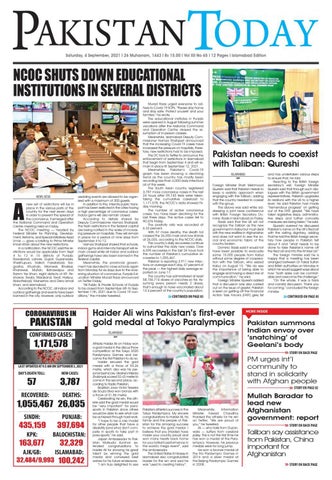
NCOC shuts dOwN eduCatiONal iNstitutiONs iN several distriCts
news desk
a
new set of restrictions will be in place in the various parts of the country for the next seven days in order to prevent the spread of the coronavirus, it emerged after the National Command and Operation Centre meeting held on Friday. The NCOC meeting — headed by Federal Minister for Planning, Development, Reforms, and Special Initiatives Asad Umar — gave a briefing to Prime Minister Imran Khan about the new restrictions. In a notification, the NCOC said the restrictions would be applicable from Sept 4 to 12 in 15 districts of Punjab; Rawalpindi, Lahore, Gujrat, Gujranwala, Sheikhupura, Sialkot, Faisalabad, Sargodha, Khushab, Mianwali, Bhakkar, Khanewal, Multan, Bahawalpur and Rahim Yar Khan; eight districts of KP; Peshawar, Swabi, Malakand, Swat, Haripur, Abbottabad, Mansehra and Dera Ismail Khan; and Islamabad. According to the NCOC, all indoor and outdoor gatherings and events have been banned in the city. However, only outdoor
wedding events are allowed to be organised with a maximum of 300 guests. In addition to this, intercity public transport has been restricted in the cities having a high percentage of coronavirus cases. Indoor gyms will also remain closed. According to details shared by Deputy Commissioner Hamza Shafqaat, the fresh restrictions in the federal capital are being notified in the wake of increasing pressure on hospitals. They will remain in place for a period of nine days from September 4 to 12. Hamza Shafqaat shared that schools, indoor gyms and inter-city transport will remain closed while all indoor and outdoor gatherings have also been banned in the federal capital. Meanwhile, the provincial government has decided to close schools again from Monday for six days due to the worsening situation of coronavirus, Punjab Education Minister Murad Raas announced on Twitter Friday. “All Public & Private Schools of Punjab to be closed from September 6th to September 11th, 2021 due to Covid 19 conditions,” the minister tweeted.
COrONavirus iN
PakistaN
CONFIRMED CASES:
1,171,578
LAST UPDATED AT 9:3 AM ON SEPTEMBER 3, 2021
DAY'S DEATH TOLL:
NEW CASES:
57
3,787
RECOVERED:
DEATHS:
1,055,467 26,035 SINDH:
PUNJAB:
435,159
397,694
KPK:
BALOCHISTAN:
163,677 AJK/GB: 32,484/9,993
32,329 ISLAMABAD:
100,242
Murad Raas urged everyone to adhere to Covid-19 SOPs. “Please stay home and stay safe. Protect yourself and your families,” he wrote. The educational institutes in Punjab were opened in August following summer vacations after the National Command and Operation Centre okayed the resumption of in-person classes. Meanwhile, Islamabad Deputy Commissioner Hamza Shafqaat announced that the increasing Covid-19 cases have increased the pressure on hospitals, therefore, new restrictions had to be imposed. The DC took to Twitter to announce the enforcement of restrictions in Islamabad that begin from September 4 and will remain in place till September 12, 2021. Meanwhile, Pakistan’s Covid-19 graph has been showing a declining trend as the country has mostly been recording less than 4,000 daily infections all of this week. The South Asian country registered 3,787 more coronavirus cases in the last 24 hours after 59,745 tests were taken, taking the cumulative caseload to 1,171,578, the NCOC’s data showed Friday morning. The number of active coronavirus cases, too, have been declining for the last three days. The active cases fell to 90,076 Friday. The positivity rate was recorded at 6.33 percent. With 57 more deaths, the death toll crossed the 26,000-mark and now stands at 26,035, according to the NCOC stats. The country’s daily recoveries continue to outnumber the daily new cases. Over 6,595 recoveries in the last 24 hours took the number of Pakistan’s cumulative recoveries to 1,055,467. Pakistan is reporting 3,911 new infections on average each day, 67 percent of the peak — the highest daily average reported on June 17. The country has administered at least 58,156,714 doses of vaccines so far. Assuming every person needs 2 doses, that’s enough to have vaccinated about 13.4 percent of the country’s population.
CONTINUED ON PAGE 05
Pakistan needs to coexist with Taliban: Qureshi IsLAMABAd inp
Foreign Minister Shah Mehmood Qureshi said that Pakistan needs to keep a realistic approach when engaging with the Taliban, adding that the country needed to coexist with the group. The above was said while addressing a joint news conference with British Foreign Secretary Dominic Raab in Islamabad on Friday. Raab said that the UK will not recognize the Taliban as the new government in Kabul but must deal with the new realities in Afghanistan and does not want to see the social and economic fabric of the country broken. Dominic Raab said it would not have been possible to evacuate some 15,000 people from Kabul without some degree of cooperation with the Taliban, who seized Kabul on August 15. “We do see the importance of being able to engage and having a direct line of communication,” he said. Foreign Minister Qureshi added that a discussion was also carried out on the issue of greylist. Pakistan is keen on getting off the Financial Action Task Force‘s (FATF) grey list
Haider Ali wins Pakistan’s first-ever gold medal at Tokyo Paralympics IsLAMABAd inp
Athlete Haider Ali on Friday won a gold medal in the discus throw competition at the Tokyo 2020 Paralympics Games and became the first Pakistani to do so. Haider secured the gold medal with a throw of 55.26 metre, which also was his personal best score. Ukraine’s Mykola Zhabnyak scored 52.43 metre to come in the second place, according to Radio Pakistan. Brazilian Joao Victor Teixeira de Souza Silva won bronze with a throw of 51.86 metre. Celebrating his win, the athlete said the gold medal would be “very important” for parasports in Pakistan since others would be able to see what can be achieved through hard work. “I hope to be a role model for other people that have a disability [and who] don’t compete in sports to take part in para-sports,” he said. Japan Ambassador to Pakistan Matsuda Kuninori extended congratulations to Haider Ali for showing his great talent by winning the gold medal and conveyed best wishes for his future endeavors. “I am truly delighted to see
and has undertaken various steps to ensure that, he told. Reacting to the British foreign secretary’s visit, Foreign Minister Qureshi said that through such dialogues with the British government representatives, Pakistan upgrades its relations with the UK to a higher level. He said Pakistan had made “tremendous progress” on getting out of the FATF greylist. “We have taken legislative steps, administrative steps and further concrete measures are being taken,” he said. Qureshi averred he discussed Pakistan’s name on the UK’s Red List with the visiting dignitary, adding that he told the British foreign secretary how people in Pakistan felt about it and “what needs to be done to take Pakistan’s name off the Red List and into the Amber List.” The foreign minister said he is happy that a meeting has been arranged between Dr Faisal Sultan and British authorities on Monday in which he would suggest ways about how “both sides can be comfortable and overcome this challenge.” “On the whole, it was a frank and candid discussion. Thank you for coming,” concluded the foreign minister.
CONTINUED ON PAGE 05
more inside
Pakistan summons Indian envoy over ‘snatching’ of Geelani’s body STORY ON BACK PAGE
PM urges int’l community to stand in solidarity with Afghan people STORY ON PAGE 02
Pakistani athlete’s success in the Tokyo Paralympics. My sincere congratulations to Haider Ali, his family and the people of Pakistan for this amazing success to achieve the gold medal. I believe that you [Haider] have made your country proud and won many hearts back home for your brilliant performance in the world’s mega event”, said the ambassador. The United States Embassy in Islamabad also congratulated Haider for the win and said he was “used to creating history”.
Meanwhile, Information Minister Fawad Chaudhry thanked the athlete for his win on Twitter. “We are proud of you,” he tweeted. Ali — who hails from Gujranwala — suffers from cerebral palsy. This is not the first time he has won a medal at the Paralympics. However, his previous medals were for long jump. He won a bronze medal at the Rio Paralympic Games in 2016 and a silver medal at the Beijing Paralympic Games in 2008.
Mullah Baradar to lead new Afghanistan government: report STORY ON BACK PAGE
Taliban say assistance from Pakistan, China important for Afghanistan STORY ON BACK PAGE
02
saturday, 4 september, 2021
islamabad
news
PM UrgeS inT’l CoMMUniTy To STand in SolidariTy wiTh afghan PeoPle
P
NewS DeSk
RIME Minister Imran Khan has urged the international community to stand in solidarity with the Afghan people, undertake positive engagement, and create incentives for ensuring a peaceful, stable and inclusive polity, reported Radio Pakistan. He was talking to British Foreign Secretary Dominic Raab, who called on him in Islamabad on Friday. The Prime Minister also cautioned against the role of “spoilers”, both inside and outside
Afghanistan, which could destabilize the situation. He underlined the importance of a peaceful, secure and stable Afghanistan for Pakistan and regional stability. Imran Khan noted that it is critical to stabilize the security situation in Afghanistan, take steps to consolidate peace, and preclude any mass exodus. In this context, preventing humanitarian crisis and stabilizing the economy were the urgent needs. The Prime Minister further sensitized the UK side on the gross human rights violations in the Indian Illegally Occupied Jammu
US gives 6.6m doses of Pfizer vaccine to Pakistan ISLAMABAD TLTP
and Kashmir, including the inhuman snatching away of the mortal remains of Syed Ali Shah Geelani, the senior Kashmiri leader. On the bilateral plane, Imran Khan inter alia noted the longstanding relationship and strong people-to-people ties between the two countries. The Prime Minister shared concerns on the retention of Pakistan on the Red List, causing inconvenience to dual nationals. Matters relating to climate change, peace and stability in South Asia, and global geopolitical situation were also discussed.
Pakistan wants Afghanistan situation to remain stable, says Fawad ISLAMABAD INP
The United States on Friday shipped 6.6 million doses of Pfizer Covid-19 vaccines to Pakistan through COVAX to assist the country in vaccinating its population against the coronavirus. “The 6.6 million doses will arrive in time to assist the Pakistani government to inoculate young and at-risk Pakistanis and mitigate the fourth Covid-19 wave,” the US embassy in Islamabad wrote on its official Twitter handle. It said that the donation brings the total number of Covid-19 vaccines donated by the US to the Pakistani people to 15.8 million. “The United States is the single largest contributor supporting COVAX efforts toward global Covid-19 vaccine access.” Last month, the US had provided about 3.7 million doses of the Pfizer vaccine to Pakistan. “There is an urgency, now more than ever, to put an end to this devastating pandemic, and Pakistan and the United States are continuing to work together to achieve that goal,” US Embassy Chargé d’affaires Angela P Aggeler said. The United States is proud to partner with the Pakistani people to defeat Covid-19, she said, adding: “Together, we will continue to build a world that is safer and more secure against the threat of infectious disease.” Pakistan also received the first consignment of one million doses of Russian-made Sputnik V coronavirus vaccine on Wednesday.
Court releases 98 suspects in TikToker assault case
Minister for Information and Broadcasting Fawad Chaudhry on Friday said that Pakistan wants the situation in Afghanistan to remain stable. In a statement, the minister said that Pakistan’s proposal on Afghanistan had not been paid heed in the past. He said that Prime Minister Imran Khan had suggested that former Afghanistan president Ashraf Ghani should not hold elections in the country, adding that Ghani did not accept the proposal of the prime minister and the situation is now in front of everyone. He said that so far Afghan refugees have not entered Pakistan. The minister said that presently the situation in Afghanistan do not warrant the people to leave.
He said that Pakistan has influence on Taliban but not control, adding that Pakistan is trying for reopening of Kabul airport as soon as possible. Earlier on Monday, the minister had warned of potential spillovers from the Afghan crisis and said that the world would have to deal with a “huge mess” if Pakistan’s advice on the war-ravaged country is ignored. He had said in an interview with TRT World that the world must listen to Pakistan as “in the recent past, Pakistan’s advice was not paid heed to, and if Pakistan and Imran Khan’s advice was listened to, the situation would have been different.” The minister had added that the situation in Afghanistan is “very worrying” for Pakistan, recalling that “we had to deal with the problems when the Soviet Union left Afghanistan in 1988.”
Covid death toll crosses 26,000 mark ISLAMABAD TLTP
The country has reported 3,787 new cases of coronavirus during the past 24 hours, taking the tally for confirmed cases to 1,171,578. According to the data shared by the National Command and Operation Centre (NCOC) on Friday, at least 57 fatalities were reported during the aforementioned period. A total of 26,035 patients have succumbed to the virus in the country so far. Moreover, 6,595 recoveries were also reported in a day, taking the total recoveries to 1,055,467. The number of active coronavirus cases fell to 90,076. The positivity rate was recorded at 6.33 percent. Punjab reported 1,368 Covid cases and 20 more
deaths due to the virus during the past 24 hours. According to provincial health secretary Imran Sikandar Baloch, 8 deaths were reported from Lahore during the period. He said that active cases in Punjab now total 24,650, adding that the tally of the positive cases in the province stood at 397,695. The official further stated that the total number of deaths due to the virus is currently at the 11,977 mark. The health secretary said that some 361,068 patients have recovered from the disease so far. “As many as 22,549 tests were conducted in Punjab since Sunday, totalling 6,864,310 tests,” he added. The official informed that the positivity ratio in the province is currently at 6.1 percent, adding specific SOPs have been issued for various sectors. He urged the public to
take strict precautions and get vaccinated, terming it the only and effective solution against the virus. Pakistan's Covid-19 graph has been showing a declining trend as the country has mostly been recording less than 4,000 daily infections all of this week. Pakistan is reporting 3,911 new infections on average each day, 67 percent of the peak — the highest daily average reported on June 17. The country has administered at least 58,156,714 doses of Covid vaccines so far. Assuming every person needs 2 doses, that’s enough to have vaccinated about 13.4 percent of the country’s population. During the last week reported, Pakistan averaged about 1,019,949 doses administered each day. At that rate, it will take a further 43 days to administer enough doses for another 10 percent of the population.
Imran expresses resolve to strengthen construction sector NewS DeSk
NewS DeSk A Lahore court on Friday released 98 out of the total 104 suspects that have so far been taken in for the Minar-e-Pakistan assault case after TikToker Aisha Akram could only identify six of them during the court proceedings. At the outset of the hearing, the police produced 98 suspected individuals before Judicial Magistrate Hassan Sarfaraz Cheema. The police informed the court that the suspects had been taken into custody for manhandling TikToker Aisha Akram inside the Greater Iqbal Park (Minar-e-Pakistan) on Independence Day. “Akram identified only six out of the 104 suspects presented during an identity parade,” maintained the police. At this, the court dismissed the 98 suspects, directing the police to release them. Meanwhile, the Punjab deputy inspector-general said that the suspects identified by the victim are the fundamental characters involved in the incident. He said that all the 400 men nominated as suspects in the First Information Report are not involved in the case. However, the investigation is underway and other culprits will also be arrested soon, he added.
Prime Minister Imran Khan has emphasized using locally available raw materials in the construction sector to boost various industries linked with the construction and housing field. Addressing a ceremony of Pakistan Property, Housing, and Construction Expo 2021 in Islamabad on Friday, he said the government will extend every possible support to the manufacturing sector to use locally available raw material. The PM said more incentives are being provided to the construction sector and, in this regard, they are introducing reforms in the Federal Board of Revenue, reported Radio Pakistan. “This is one way of providing employment, wealth creation, increasing revenues to meet expenses and repaying loans. We will repay loans when the economy grows and more than anything, it grows on the basis of construction,” he said. The prime minister called upon the construction sector to fully try and depend less on imports, saying that “all raw material is available in Pakistan.” “I assure you that we will fully help you. It is the government’s job to manufacture more things in Pakistan,” he added. The Prime Minister said a country can only grow when its youth gets employment and the construction sector has the potential for job creation. He said development in this sector will not only help in wealth
creation but repaying the national debt as well. According to Prime Minister Imran, a “construction boom” was coming to the country due to the great demand by the 220 million people for low-cost housing. He lamented that the common man, daily wager or government servants never had the opportunity in the past to build their homes because of a lack of mortgagefinancing options but that obstacle was now removed due to the government’s efforts to pass the foreclosure law. “Banks will give money to people for mortgage financing and then this population of 220m of ours will become an asset because it will generate demand and then construction and related industries will start running.” The premier told the event that he had called the chief of the International Monetary Fund to gain concessions for the construction industry during the Covid-19 pandemic. He also said that over the course of numerous meetings, “we realised … our entire system has evolved in such a manner that it puts obstacles instead of facilitating and encouraging industry and wealth creation.” When a society begins to decline, the premier said, its bureaucracy too devolves and becomes self-serving instead of encouraging growth and prosperity. “It takes time to change the system,” he added. Prime Minister Imran said many meetings had been held to remove obstacles for the construction industry and while they hadn’t been eliminated fully, there were more incentives for the industry than before and the
government would continue increasing them. Speaking about problems within the Federal Board of Revenue (FBR), he said the government was “continuously trying to bring reforms” in the body, pointing out that Finance Minister Shaukat Tarin hailed from the private sector and was familiar with its issues. He said the true potential of Pakistan’s population would be realised when the industry, particularly the export industry, was encouraged. “It is necessary that we help ourselves, facilitate you and the government creates ease of doing business for you but then you too help the government by paying tax,” he emphasised. He said until taxes were paid, the country’s wealth wouldn’t increase and the government wouldn’t be able to facilitate the construction sector so “it is a two-way system.” “We have to help you so your wealth increases. You have to help us through paying tax so we can improve infrastructure and fulfill basic requirements of people.” The premier said the government would continue to work with the ICCI and resolve its issues. Regretting over the policies of previous regimes that neglected our export sector, he said we aim to enhance our exports to 30 billion dollars. He also urged the business community to help the government by paying taxes. The three-day expo that will continue till Sunday is aimed at providing investment opportunities for the construction sector.
saturday, 4 september, 2021
islamabad
Developing countrieS fAcing chAllengeS of climAte chAnge, poverty: pm ISLAMABAD INP
p
RIME Minister Imran Khan has expressed his strong commitment to international cooperation aimed at poverty alleviation, sustainable growth and addressing climate change. Addressing virtually a forum on 20th Anniversary of Juncao Assistance and Sustainable Development Cooperation being held in Beijing China, he said Covid19 has triggered an economic meltdown and slowed down global progress. The extreme poverty rose last year for the first time in over 20 years. Imran Khan said achievement of food security, and improved nutrition, have become greater challenges for
developing countries, adding that sustainable ways of achieving economic recovery, growth and development are critical during the pandemic. He said Juncao technology is one such way which helps small-scale farmers to develop low-cost and commercial-scale mushroom cultivation. The prime minister said China is a role model for developing countries in poverty alleviation. He said its stellar growth has brought eight hundred million people out of poverty over the last four decades. He said China’s leadership role in climate change is also highly appreciated. He commended China President Xi’s vision of a prosperous, clean and beautiful world and initiative to achieve carbon neutrality by 2060. The prime minister said poverty alleviation and
tackling climate change are his government’s key priorities, adding that Pakistan has launched a social safety programme, Ehsaas, with an objective of uplifting marginalised people, eradicating poverty and supporting vulnerable households. Imran Khan said the Ehsaas Emergency Cash programme cushioned the most vulnerable part of population from the economic shocks of Covid-19 pandemic. He said Pakistan being one of the most climate vulnerable countries, fully supports international efforts to combat this scourge. He said “we are progressing towards a clean and green Pakistan. We have already planted one billion trees as part of our ten billion tree project to expand and restore forests.”
news
03
46 customs officers fail to furnish asset details ISLAMABAD TLTP
The Federal Board of Revenue (FBR) on Friday issued a list of 46 officers of Pakistan Customs Service (PCS) in BS-19 and BS-20 who have failed to furnish asset declaration and performance evaluation reports (PERs). A circular issued by the FBR stated that it is intimated that the performance evaluation report (PERs) or declaration of assets or both of 46 officers of PCS BS19 and BS-20, who are in the promotion zone, are missing. According to the statement, 12 officers of BS20 who have failed to file documents include; Dr Naeem Khan, Imtiaz Ahmad Sheikh, Muhammad Asghar Khan, Abdul Qadir Memon, Asif Saeed Khan Lughmani, M Ali Raza Hanjra, M Imran Khan Mohmand, Zeba Azhar, Iftikhar Ahmad, M Saeed Khan Jadoon, Syed Shakeel Shah, and Muhammad Junaid Jalil Khan. Thirty-four officers of BS-19 who have failed to file documents include; Mehnaz Bhaur, Misbah Khatana, Sajjad Hyder Jhin, Shafqat Ali Khan Niazi, Kh Khurram Naeem, Syed Naeem Akhtar, Saira Agha, Ayesha Niaz, M Ashfaq, Nasreen Nawaz, Engr Habib Ahmad, Shoukat Ali, Abid Hussain Hakro, Azhar Hussain Merchant, Jameel Ahmed Baloch, Arbab Qaisar Hamid, Dr Moin-ud-Din Ahmad Wani, Nadeem Ahsan, Ziaullah Shams, Asdaq Afzal Sensera, Agha Saeed Ahmad, Rizwan Salabat, Suleman Yaqub Khan, Ghulam Mustafa, Junaid Ahmed Memon, Sameera Sheikh, Naveed Illahi, Beelam Ramzan, M Saeed Asad, Mahreen Naseem, M Masood Sabir, Saadia Sheeraz, M Hans Ansari, and Azood ul Mehdi. The FBR said that in case of failure in the submission of above documents, the officer himself/herself will be responsible for nonconsideration/ deferment/ supersession.
Alvi to address parliament on September 13 NEWS DESK President Dr Arif Alvi will address a joint sitting of the parliament to discuss three-year performance of the government and the roadmap for the fourth parliamentary year, Geo news reported on Friday. After consultations with President Alvi, National Assembly speaker, and Senate chairman, Adviser to Prime Minister on Parliamentary Affairs Babar Awan revealed the details of the joint sitting, which will be held on September 13 at 11:00 am to mark the beginning of the fourth parliamentary year. Awan said: “Despite Oppositions' threats regarding sit-ins and Covid-19, the beginning of the fourth year is a success for both the parliament and the government.” The adviser reiterated that Imran Khan’s government will complete both “his election promises and his five-year tenure.” Earlier, during a meeting with Speaker National Assembly Asad Qaisar, Awan had said that the parliamentary calendar for the new parliamentary year has been prepared which will be submitted to the House Business Advisory Committee for approval. During that meeting, issues related to the president's address to the joint sitting of the Parliament, pending legislation, and the calendar for the new parliamentary year were discussed. The National Assembly speaker had said that the performance of the National Assembly during its third year was commendable and the members of the treasury and the Opposition should be credited for that. ISLAMABAD: President Dr Arif Alvi exchanges views with AJK Prime Minister Abdul Qayyum Niazi. PPI
Taliban and afghan flags side by side at ‘unity’ cricket match in Kabul AFP A near-full house turned out to watch Afghanistan’s top cricketers play in a trial match in Kabul on Friday, with Taliban and Afghan flags waving side by side in what sports officials called a show of national unity. It was the first match since the Taliban swept to power on August 15, leaving organisers of sports and cultural events wondering what is now acceptable under the Islamists’ rule. The two sides — called Peace Defenders and Peace Heroes — featured many members of the Afghan national team, currently preparing for the Twenty20 World Cup to be played in UAE and Oman from October 17. “It is great to be here and watch cricket,” a Taliban commander named Hamza told AFP at the stadium in Kabul, an American M-16 rifle slung over his shoulder. He was in charge of a contingent of Taliban fighters keeping guard among the crowd — some watching
the game more intently than the spectators. “I am a player myself,” said Hamza. “An all-rounder.” The return of the Taliban has sparked widespread fear in Afghanistan and in the international community, reviving memories of their first stint in power from 1996 to 2001. That regime banned most forms of entertainment — including many sports — and stadiums doubled as public execution venues. Sports the Taliban did allow were strictly controlled and were only for men to play or watch. Certainly there were no women among the crowd of around 4,000 on Friday, but there was plenty of enthusiasm as the teams played a Twenty20 match — the shortest version of the game — scheduled to finish in time for Friday prayers, the most important of the week. Cricket was barely known in Afghanistan until the early 2000s, and its explosive rise in popularity is linked with conflict — the sport was
picked up in Pakistan by Afghan refugees who then seeded it in their home country. The national team has enjoyed a meteoric rise on the international scene since then, gaining coveted Test status in 2017 and now ranking among the top 10 sides in the world in the one-day and Twenty20 formats. In the last 20 years, it has emerged as a powerful symbol of national unity in a country riven by civil war and ethnic conflict. On Friday, fans waved Afghan and Taliban flags side by side, while “Baba cricket” — an elderly superfan dressed head to toe in national colours — was ushered to a prime spot in the stand. Entry was free for spectators on Friday, although everyone was patted down by Taliban guards as they entered the stadium near Chaman Uzuri — a Kabul neighbourhood dominated by Pakhtuns, who make up a majority of Taliban fighters. Although many Kabul residents say security has improved in the weeks
since the government fell, the Taliban are still on alert following the suicide bomb attack at the airport last week that killed more than 100 people — including 13 American troops as they wrapped up a chaotic withdrawal. A beaming Hamid Shinwari, CEO of the Afghan Cricket Board, told AFP the display of flags at the match — which Peace Defenders won by 62 runs — was a positive sign for the country. “It is unity,” he said, adding that talks with Taliban officials signalled a bright future for the sport. He would not be drawn, however, on the fate of the women’s team, with various media reports saying many members had already fled the country or were in hiding — fearful for their future under the new regime. “We have a group on WhatsApp and every night we are talking about our problems and sharing plans about what we should do,” one member of the team told the BBC this week. “We are all hopeless.”
saturday, 4 september, 2021
04 neWs
islamabad
OvER RS21.47bn appROvEd fOR SEvEn uplifT SChEmES in punjab LAHORE
T
TLTP
HE Punjab Development Working Party (PDWP) has approved over Rs21.47 billion for seven development schemes in the province. The approval was given
at a meeting chaired by Chairman Planning and Development Board Abdullah Khan Sumbal on Friday. The approved development schemes included ‘Insaf afternoon schools programme’ at the cost of Rs6,355.728 million, ‘establishment of 100-bed hospital in UC Lakhwanwal, Gujrat’ at the cost
of Rs1,398.978 million, ‘prevention and control of non-communicable diseases like diabetes, hypertension, cancers etc (revised)" at the cost of Rs1,909.18 million, ‘enhanced HIV/AIDS control programme Punjab (3 years) (Phase-II) (revised)" at the cost of Rs2,379.410 million, ‘development of online statisti-
cal system in Punjab" at the cost of Rs496.068 million and ‘construction of gated head regulator from RD.205+000 to 283+000/L of BRBD Link Canal" at the cost of Rs675.707 million, while "dualisation of road from GT Road (Samma) to Gujrat-Dinga Road’ at the cost of Rs8,263.723 has been cleared
and recommended to the federal government for CDWP. Provincial Secretary P&D Mujahid Sherdil, members of the Planning & Development Board, provincial secretaries of concerned departments, and other senior representatives of relevant provincial departments also attended the meeting.
Gold price jumps to Rs98,000 per 10gm NEWS DESK Gold price found its feet and regained positive traction on Friday amid disappointing US economic data. At 1255 hours GMT, gold in the international market was available at $1,824.30 per ounce after gaining $13.70. Meanwhile, the price of 10 grams of yellow metal in Pakistan increased to Rs98,000 after gaining Rs600. The closing prices of the yellow metal in the country remained Rs97,400 on Thursday last. According to experts, gold regained positive traction on the last day of the week and reversed the overnight losses. They said that a recent series of disappointing US economic data, in the ADP jobs and ISM manufacturing employment sub-index, hinted at a dismal nonfarm payroll (NFP) print while further downplaying Fed’s tapering expectations. However, they said that the market mood remains mixed, with China’s economic slowdown concern exacerbated by a contraction in the country’s services sector. On the other side, the stepping down of the Japanese PM Suga and hopes of more Chinese stimulus keep the Asian stocks afloat. However, investors remain cautious ahead of the critical US employment, as gold attempts a bounce amid a mixed sentiment.
Zong 4G partners with Sehat Kahani PRESS RELEASE Zong 4G, Pakistan’s leading cellular and digital services provider, has joined forces with one of the most affluent telemedicine enterprises; Sehat Kahani, to offer thousands of free remote and online consultations for the marginalized strata of the society. Making healthcare services more accessible and inclusive for all. Zong will be offering more than 12,000 e-health consultations to the underprivileged members of the community via the Sehat Kahani Retail app. 7,000 of these consultations will facilitate Covid-19 relief patients whereas 5,000 consultations will apply to non-Covid cases. With healthcare and the wellbeing of Pakistani citizens being the top priority at Zong, the venture further aims to create awareness about COVID-19. To ensure that millions of Pakistanis have ample knowledge about the new variants, prevention measures, pre-vaccine concerns, and post-vaccine cautions. The initiative will lead to the creation of awareness videos and live sessions, which will be produced and shared across the official communication channels of Zong 4G and Sehat Kahani’s social platforms. Live Interactive Sessions will also be organized by team Sehat Kahani which would be cross-posted/shared on Zong’s digital platforms, where individuals will be able to ask questions regarding Covid-19. A 24/7 helpline will facilitate and follow-up with Covid suspects/patients through voice calls. Commenting on the partnership, Mr Wang Hua Chairman and CEO Zong4G said “Zong 4G firmly believes advances in technology and our connectivity will enable healthcare services to be more accessible and inclusive than ever. We are aware of the divide in the access to health care services thus, we are striving to play our role in increasing the access for the underprivileged.” He further added,” Our partnership with Sehat Kahani is testament to our commitment to uplift Pakistan through digital services. As Pakistan battles the fourth Covid wave, health has become one of the key focus areas for the entire country. With frequent lockdowns and low access to primary health facilities, digital health is the best solution to the ongoing health crisis.” “We welcome Zong’s move to use our platform for a greater good and extend the benefits of telemedicine to the masses, especially the underprivileged,” shared Sara Saeed Khurram, Co-Founder and CEO of Sehat Kahani. “We are very pleased by this partnership as it takes forward our mutual mission of democratizing healthcare in Pakistan using telemedicine solutions.”
HYDERABAD: Members of Qomi Awami Tehreek hold protest in favour of their demands. PPI
Karachi traders stage protest for relaxation in business hours NEWS DESK While seeking relaxations in the coronavirus restrictions, Karachi traders have threatened to defy the business hours announced by the provincial government. “We will continue our sit-in until our demands are met,” Jameel Paracha, chairman of a leading merchants’ association in Karachi, said during a protest demonstration on Friday. “If the government remains indifferent to our plight and continues to ignore our protest, we will open our shops after 8:00pm and keep our businesses open on Friday,” he said. He accused the provincial authorities of discriminating among its own cities, adding that Karachi is the
jugular vein of the national economy which contributes 65 percent to the country’s revenue and pays 90 percent of the provincial taxes. Another trade leader Rizwan Irfan said the vaccination ratio is high in Karachi, yet the government is not willing to offer the business community substantial concessions. “We ask the government to end this discrimination,” he said. “If businesses can remain open till 10:00pm in other parts of the province, why not Karachi and Hyderabad? Why are two different instructions issued in one province?” “Almost 80 percent of the traders are now vaccinated in Karachi, and we can provide proof of that,” Paracha said. “So,
why have they imposed such harsh restrictions on our businesses?” He added that traders in the city had suffered huge losses amounting to Rs3.5 billion due to intermittent lockdowns. Authorities in Sindh issued a notification on August 30, extending the Covid-19 restrictions in the province until September 15. The new order allowed traders in all cities, except for Karachi and Hyderabad, to carry out their business activities for six days a week and keep their shops and commercial centres open until 10pm. It is important to note that Covid-19 positivity ratio has remained consistently high in Karachi and Hyderabad which are the biggest and most densely populated cities of the province.
Weekly inflation up by 0.67pc as food prices surge ISLAMABAD TLTP
The Sensitive Price Indicator (SPI) based weekly inflation for the week ended on September 2 for the combined consumption group witnessed an increase of 0.67 percent as compared to the previous week while it went 12.53 percent up on a year-on-year (YoY) basis. According to data released by the Pakistan Bureau of Statistics (PBS) on Friday, the combined index was at 153.16 on September 2, 2021 as compared to 152.14 on August 26, 2021 while the index was recorded at 136.11 a year ago on September 3, 2020. The SPI is computed on a weekly basis to assess the price movements of essential commodities at a shorter interval of time so as to review the price situation in the country. The SPI comprises 51 essential items and the prices are
being collected from 50 markets in 17 cities of the country. During the week under review, out of 51 items, prices of 17 (33.33%) items increased, prices of 08 (15.69%) items decreased and prices of 26 (50.98%) items remained constant. The SPI for the current week ended on September 2, 2021 recorded an increase of 0.67% with most of the items increased. On the other hand decrease in the prices of bananas (5.35%), LPG (2.74%), tomatoes (1.57%), pulse Moong (1.43%), diesel (1.32%), petrol (1.25%), potatoes (0.55%) and rice basmati broken (0.39%) was observed. According to the PBS data, the yearon-year trend depicts increase of 12.53% with most of the items increased, mainly, LPG (50.57%), chicken (50.23%), electricity for Q1 (46.55%), vegetable ghee 1-kg (38.88%), mustard oil (36.98%), vegetable ghee 2.5-kg (36.47%), chillies
CMYK
powder (35.71%), cooking oil 5-liter (34.98%), gents sandal (33.37%), eggs (28.63%), gents sponge chappal (25.13%) and washing soap (21.47%), while a major decrease was observed in the prices of potatoes (28.01%), tomatoes (27.42%) and pulse Moong (20.39%). The weekly SPI percentage change by income groups showed that SPI across all quantiles ranged between 0.63 percent and 0.80 percent. The lowest income group witnessed a weekly increase of 0.76 percent while the highest income group recorded an increase of 0.63 percent. On a yearly basis, analysis of SPI change across different income segments showed that SPI increased across all quantiles ranging between 12.04 percent and 15.51 percent. Yearly SPI for the lowest income group increased by 15.51 percent while the highest income group recorded an increase of 12.20 percent.
KE staff vaccinated against Covid-19 KARACHI PRESS RELEASE
The K-Electric has achieved another milestone in the fight against Covid-19 by attaining 100 percent vaccination for its staff across all KE premises in Karachi and its adjoining areas. This includes the power utility’s customer-facing touchpoints of 30 customer care centres across the city which cumulatively cater to over 3 million consumers on an annual basis. Additionally, vaccinations have also been completed at the company’s 71 grid stations and 5 power stations which are responsible for maintaining the supply of safe and reliable power to the city. Commending the milestone, Chief Executive Officer KElectric, Moonis Alvi said, “Alhamdulillah, this is a great achievement for K-Electric and also the city of Karachi. We especially appreciate the support of the Government of Sindh’s Health Department which enabled a quick rollout of the vaccination to 100% of our people and also their families. Vaccinations offer dual protection to our staff across the city who are regularly interacting with our customers, and will no doubt help to curb the spread of this pandemic.” K-Electric remains committed to the vision of the National Electric Power Regulatory Authority (NEPRA) to achieve a #CovidFreePakistan. As early as May of this year, the power utility partnered with the Government of Sindh’s Ministry of Health to establish fully equipped centres at its certified Elander Road and Nazimbad facilities. In line with the Government of Pakistan’s SOPs and guidelines, KElectric strongly advised all citizens to get vaccinated at the earliest and has been utilizing its communication platforms to raise awareness on the same. Strict protocols have been implemented across facilities to only allow entry to individuals who carry vaccination certificates for the safety of staff and customers alike.
Saturday, 4 September, 2021
ISLAMABAD
Pakistan needs to coexist with taliban: Qureshi r continued from page 01
AAB said that the UK valued its historic relations with Pakistan, adding that he had a positive and constructive discussion with FM Qureshi. “We want to further strengthen our ties with Pakistan,” he said. He thanked Pakistan for safely evacuating British citizens from Afghanistan, adding that the UK will continue to provide aid to Afghanistan on humanitarian grounds. “We will continue to help Afghanistan’s neighbouring countries, including Pakistan,” he vowed, adding “We want to see a prosperous Afghanistan.” Hoping the Taliban will bring stability and an end to violence in Afghanistan, the UK foreign secretary said it was premature to talk about recognising the Taliban at the moment. Speaking about Pakistan’s inclusion in the Red List, Raab said Dr Faisal Sultan would hold a meeting with UK authorities to discuss the technical aspects of the case. “We will be able to take the decision on excluding Pakistan’s name
from the Red List on technical grounds,” he said. In response to a question, Qureshi said he had raised the issue of atrocities in Occupied Kashmir that are being committed by India. Qureshi said he discussed how Geelani was denied a “decent burial” by Indian security forces, adding that it was a violation of an individual’s basic right. “There will be hundreds of funerals [for Geelani]. There is one taking place right here in Islamabad today. Every parliamentarian will go there. If you [UK foreign secretary] were not here, I would have gone myself,” added Qureshi. He said it was not possible to suppress freedom of expression. The Pakistani foreign minister said he discussed the issue with Raab, who said the UK’s position on Kashmir is a stated and known one. “However, he told me that it does not stop them from raising human rights issues..” In response, Raab said that the UK has a longstanding policy of encouraging India and Pakistan both to pursue a solution to the Kashmir crisis. “It is not for the UK to impose its solution to the Kashmir
crisis,” he said, adding that London encouraged both Islamabad and New Delhi to hold concrete dialogue over the issue. Pakistan, which shares a border with Afghanistan, is a key player in the crisis and already hosts about three million Afghan refugees. The British Foreign Office has already sent officials to help process those crossing the border. After talks with leaders in Qatar on Thursday, the British foreign secretary said evacuations may be able to resume from Kabul airport “in the near future”. The Afghan capital’s airport is out of action following the withdrawal of US troops last week. And on Thursday evening he said he had spoken to Tajikistan foreign minister Sirojiddin Muhriddin about “how our countries can help maintain stability in the region, and tackle the humanitarian situation in Afghanistan”. Of the £30 million in aid offered to neighbouring countries, Mr Raab said £10 million would be made available immediately to humanitarian organisations in order to despatch supplies to Afghanistan’s borders. Countries predicted to experience a
significant increase in refugees will also receive £20 million to help with processing new arrivals and to provide essential services and supplies. UNHCR, the UN Refugee Agency, has estimated a worst-case scenario of more than 500,000 refugees fleeing Afghanistan to Pakistan, Tajikistan, Iran, Uzbekistan and Turkmenistan in the coming months. Raab said: “It is vital that we help those fleeing Afghanistan and do not allow the crisis there to undermine regional stability.” He added that the aid showed the UK’s “commitment to shoulder our humanitarian responsibility”. More than 17,000 people have been evacuated by the UK from Afghanistan so far, including more than 5,000 British nationals, Raab has said. The last British plane flying people out of Kabul took off on Saturday, as the remaining foreign troops withdrew from the country. It is feared thousands of people eligible for relocation, including Afghans who worked for the British and their families, have been left behind.
ISLAMABAD: Chief of Naval Staff Admiral Muhammad Amjad Khan Niazi exchanges views with Moroccan Ambassador Mohamed Karmoune. inp
Hyundai Motor set to use internally developed chip for upcoming car South Korea's Hyundai Motor Co plans to use an auto chip it has developed itself for one of its upcoming vehicles next year, the Seoul Economy Daily reported on Friday. Hyundai Motor, which together with affiliate Kia Corp is among the world's top 10 biggest automakers by sales, plans to internally develop a silicon carbide technology-based power chip, the newspaper said, citing an unnamed in-
dustry source. A shortage of chips made by semiconductor companies, fuelled by pandemic interruptions and production issues at chip factories, have forced automakers to halt production and reduce work shifts amid concerns that shortages could continue. Hyundai's research centre and its auto parts affiliate Hyundai Mobis Co Ltd led the chip design process and co-
operated with multiple companies, including system chip manufacturer Magnachip Semiconductor Corp, the newspaper said. “We are aiming to apply our internally developed power chip to a new car to be launched in the second quarter of next year,” an unnamed Hyundai Motor official told the newspaper, without naming the vehicle. The Seoul Economy Daily said the
new vehicle model adopting the chip could be the Ioniq 6, Hyundai's dedicated electric car expected to be launched next year. Hyundai told the newspaper that the chip production date has not been decided Hyundai Motor did not have an immediate comment. In June, Reuters reported that Hyundai and its affiliates are in talks with local chip companies to reduce reliance on foreign supplies. REUTERS
Taliban take over Panjshir, in full control of Afghanistan: report Kabul REUTERS
Taliban forces have taken full control of Afghanistan including the Panjshir Valley where opposition forces had been holding out, three Taliban sources said on Friday as heavy celebratory gunfire was heard in the Afghan capital Kabul. "By the grace of Allah Almighty, we are in control of the entire Afghanistan. The troublemakers have defeated and Panjshir is now under our command," said one Taliban commander.
It was not immediately possible to confirm the reports. Former Vice President Amrullah Saleh, one of the leaders of the opposition forces told Tolo News television station that reports he had fled the country were lies. And in a video clip posted on Twitter by a BBC World journalist who said it had been sent by Saleh, he said: "There is no doubt we are in a difficult situation. We are under invasion by the Taliban ... We have held the ground, we have resisted." He also tweeted: "The RESISTANCE is continuing and will continue. I am here with
my soil, for my soil & defending its dignity." His son, Ebadullah Saleh, denied that Panjshir had fallen, texting the message "No, it's false". There had been reports of heavy fighting and casualties in Panjshir, a rugged valley where several thousand fighters from regional militias and remnants of the old government's armed forces had massed under the leadership of Ahmad Massoud the son of late Mujahideen commander Ahmad Shah Massoud. The Taliban seized Kabul on Aug 15 after rapid advances across Afghanistan.
cmYK
NEWS
05
ncoc shuts down educational institutions in several districts continued from page 01 During the last week reported, Pakistan averaged about 1,019,949 doses administered each day. At that rate, it will take a further 43 days to administer enough doses for another 10 percent of the population. Earlier this week, the NCOC had revised its Covid-19 vaccination guidelines for citizens below the age of 18. “The general public age group for vaccination has been lowered to 17 years,” the NCOC said, adding that the Pfizer vaccine will be administered to those who are below 18 years of age. The statement added that immunocompromised individuals between 12 to 17 years of age will also be vaccinated with the Pfizer vaccine. However, they will currently need to show their medical documents as proof as the vaccination drive has only been opened to persons above 17 years of age for now. The National Health Services ministry spokesperson, Sajid Shah, had said at the time that individuals over 17 years would have to get one dose by Sept 15 and be fully vaccinated by Oct 15 otherwise they would not be allowed to enter educational institutions.
saudi state media companies to start moving from dubai to riyadh
Dubai-based Saudi state-owned media companies will start moving staff this month to the capital Riyadh, sources said, as Crown Prince Mohammed bin Salman presses ahead with plans to remould the kingdom as a regional business hub. The move follows a Saudi government decision earlier this year to stop giving state contracts to companies and commercial institutions that base their Middle East headquarters in any other country in the region. State-owned AlArabiya and Al Hadath TV channels informed their employees this week about plans to start broadcasting 12 hours a day from Riyadh by next January, two sources familiar with the matter told Reuters. They added that it could take up to two years to complete the relocation. MBC Group, the Middle East's largest media company, and Al- Sharq News, a newly created television news channel, have also internally discussed plans to move to Riyadh, the sources said. The Saudi government took ownership of a majority stake in MBC Group when authorities acted to seize assets from those caught up in an anti-corruption investigation in 2018. MBC, Arabiya and Hadath are based in Dubai Media City, the United Arab Emirates' media hub that hosts hundreds of media companies and most of their Middle East headquarters. Sharq is based in Dubai International Financial Centre (DIFC). Arabiya and Hadath did not respond to requests for comment. MBC said in a statement sent to Reuters that back in February 2020, the MBC Group chairman publicly announced the intention to establish a new headquarters in Riyadh which would involve creating a business and production hub. "Our plans are on track," the statement said. Bloomberg reported about the media companies' relocation plans earlier this week. Despite being close allies, Saudi Arabia and the neighbouring UAE are competing to attract investors and businesses as they both i meapursue plans to diversify their economies in a post-oil era. Their national interests have diverged increasingly over the past few years, as well as their views on regional issues such as in their relations with Israel and Turkey. REUTERS
Saturday, 4 September, 2021
06 COMMENT
China and USA in Southeast Asia: Myth and Reality
Cantonment Board Elections Killing a fly with a sledgehammer
W
HilE local government elections are nowhere in sight, it provides a modicum of relief to find that cantonment Board elections are around the corner. cantonment Boards have the power to approve taxes and levies proposed by the cantonment administration; approve bye-laws prepared by the cantonment administration; approve annual budget for the cantonment administration; approve long and short term development plans for the cantonment; and review the performance of the cantonment administration. Within days of the EcP announcing the election schedule and code of conduct, there has been an upsurge in electoral activities in the 42 cantonment boards spread all over the country indicating the people’s eagerness to exercise their right to elect members of grassroot organizations that look after their civic needs. With the opposition parties and the Pti engaged in a no-holds-barred fight, both sides suspect each other of trying to win the elections through foul play. to prevent this the EcP has already announced a code of conduct preventing transfers and appointments of public servants, besides barring all the executive authorities from announcing or launching any development package or using state resources in cantonment Board elections till the announcement of the election results. the blame game has meanwhile started. Khwaja Saad Rafique has alleged that the Pti leaders were using all official resources to get their candidates elected. He maintains that the PMl(N) has approached the EcP in writing about the ongoing pre-poll rigging. the PMl(N) also wants the election results to be announced on September 12 rather than five days later and to extend the time for voting by two hours. the EcP possesses the mechanism to settle complaints of the type. the Pti has put up a bizarre demand. it wants deployment of troops both inside and outside the polling stations for maintaining “law and order” and “ensuring transparency” on the election day in all the cantonment boards. the provincial governments have police at their disposal and can also call the Rangers to assist in the polls. the army is currently fully focused on the borders with india and afghanistan. calling it out to manage a small election would reflect badly on the competence of the provincial governments and the EcP.
The trade war with China has cost the USA in an area it was traditionally influential in
Dr rajkumar Singh
P
olitical analysts across the world are busily engaged in analyzing and calculating the pros and cons of the china-US rivalry at regional and global levels, evaluating their capability and influence thereof, to let the world know actual position and make the necessary resetting for individual nations and assure in general the peace, security and development on a larger scale. in the last three decades, especially after the cold War the relations between china and the USarevolved around three main focal points: a. human rights, b. trade, and c. security. as the chinese political system is based basically on communist ideology with changes brought about by top leaders of china, human rights never occupied a prominent place in the management, unlike other democratic countries of the West where human rights and individual freedom remained a touchstone. However, despite their sharp differences on so many issues, they both give equal importance to the promotion of wealth or overall economy to dominate the region and the world as well. From the beginning, the USa has been a capitalist country while in Marxism, which is the basis of chinese politics and society, all things move according to the movement in economic factors and will also continue the same in future. thus ultimately they both believe in expansion of trade with the countries of the world. Security is the third point where china and the USa not only clash with each other but also make it a factor for doing business with the nations of the
Paralympics Special athlete’s gold makes nation proud
t
HE men’s discus gold for parathlete Haiderali paralleled the story of olympic javelin thrower arshad Nadeem. Both throwing events from a staple of athletics, but are not normally associated with Pakistan. Both athletes achieved what they did by training personally, without much assistance from the government, or even the associations which oversee their sport. the only positive to emerge from their stories is that there is talent aplenty in the country, and it is only a matter of reaching out to talented individuals and providing them the requisite assistance. However, that assistance must be professional. the concept of the gifted amateur is over. the idea of putting someone in charge of a sport just because he once practised it is hopelessly outdated, though perhaps it seems an improvement from the way Pakistan manages its own sports, where ‘organisers’ took charge of a sport after having something to do with its organisation, usually at the club or district level. a symptom of this is the recent appointment of Mr Rameez Raja as PcB chairman, merely because he had captained Pakistan close to 30 years ago. it is not surprising that Prime Minister imran Khan should make this appointment, for though practitioners of every sport, not just cricket, expected a former World cup-winning cricket captain to be more effective in promoting sports, for the sports organisers of his era were ‘gifted amateurs.’ Sports, of all kinds, needs professionals with proven aptitude to provide it the kind of guidance it needs, and to ensure that there is bang for the buck, that sports budgets are wisely spent. But most of all, sports facilities and opportunities must be provided on a large scale, so that young people (of whom the country has an abundance) enjoy themselves. if done properly, athletes will emerge, and medals will be won, and the country’s image enhanced accordingly. Pakistan will not have to depend on its parathletes for medals, though it is to be presumed that in that era too, specially abled people will go on doing the nation proud.
Workplace fires have become a menace for labourers
aTTiYa munaWEr
I
NciDENtS of arson have become commonplace in various cities of Pakistan. there have been at least seven such major incidents in Karachi this year. laws and emergency evictions are talked about, but every new tragedy opens up a pool of government incompetence. a fire broke out in a leather bag manufacturing factory in Korangi Mehran town, Karachi, killing 16 people on the spot. the provincial government and the district administration are most responsible for this but, instead of being ashamed of their shortcomings, they seem to be making political statements because none of their own poor are burning in the fire. there is no doubt that the real cause of this tragic accident is yet to be determined, however all over the country, major fire accidents are usually due to carelessness and neglect of safety measures, be it in factories or multi-story buildings. Buildings are often undesigned for fire emergencies. Government agen-
Arif Nizami (Late) Founding Editor
Yousaf Nizami M. A. Niazi
Umar Aziz
Joint Editor
Joint Editor
Executive Editor
Lahore – Ph: 042-36300938, 042-36375965
region, along with creating dozens of machineries at various levels to make the works smooth and regular. in 2008, china sent its first ambassador to aSEaN and in 2011, the aSEaN-china centre (acc) was established, followed by the establishment of Beijing’s permanent mission in 2012. as china had left earlier its policy of ‘hide and bide’ it expanded itself in more areas than one, which included maritime and non-traditional security of the region. Following the devastation of the tsunami of 2004, it provided a help of $80 million to the affected countries, organized a china-aSEaN tsunami seminar in 2006, hosted workshops on the role of armed forces in disaster relief in 2007 and 2008. in aSEaN countries, china, apart from working on regional cooperation of late, had focused on bilateral and multilateral levels for maritime cooperation in areas of law-enforcement which extended chinese sovereignty beyond its borders. of all schemes of Beijing, the aSEaN countries have responded favourably throughout the period, and during the covid-19 pandemic , after the eruption of trade differences with the USa under Donald trump, china has turned towards aSEaN countries and replaced the USa as its second largest partner after the European Union. ASEAN and the USA although, US-aSEaN relations began in 1977, from the early 1990s, the economic development between them grew rapidly due to various US programmes focusing on trade, investment, technology transfer and education. the USa knew well that Southeast asia is one of the fastest-growing and most dynamic regions of the world and for long the USa had remained a close partner of the area, continuing emphasis on economic development, energy cooperation, people-to-people exchanges, youth and education. However, US interests in the region suffered badly due to change of the earlier policy adopted by President obama and known as the ‘pivot to asia’ and due to failure to achieve the trans-Pacific Partnership (tPP), as again on account of rivalry and sharp differences between the USa and china the countries of the region preferred china rather than USa and they viewed US importance as meagre in comparison to Beijing, a powerful nation of their neighbourhood. The writer is head of the political science department and dean of the Social Sciences faculty of the B.N.Mandal University, Madhepura, Bihar, India. He can be reached at rajkumarsinghpg@gmail.com
The poor are burning in fires
Dedicated to the legacy of late Hameed Nizami
Editor Aziz-ud-Din Ahmad
world and providing them a foolproof security network to make the nations feel and realise in national and global contexts. over the years and decades because of a lot of controversies the issue of human rights has taken a back seat, but economy and security are the preferred fields for both and they aspire to be a force in the region of Southeast asia, which no one can dare deny. By location, Southeast asia is a sub-region of asia consisting of the areas that are south of china, southeast of the indian subcontinent and north-west of australia and include two geographical regions: a. Mainland Southeast asia, comprising cambodia, laos, Myanmar, Peninsular Malaysia, thailand, and Vietnam, and b. Maritime Southeast asia, with andaman and Nicobar islands (india), Brunei, East Malaysia, East timor, indonesia, Philippines, and Singapore. as of 2018, the total population of the region is 655 million, about 8.5 percent of the world’s population, the third most populous geographical region in asia after South asia and East asia. it has occupied approx 1700,000 square kilometers, 10.5 percent of asia and three percent of the Earth’s total land area. in the region there are several ethnic and cultural groups of diverse nature, with hundreds of languages spoken by the people of the area. the single known regional organisation in the area is the association of Southeast asian Nations (aSEaN) established to integrate the area economically, politically, militarily, educationally as well as culturally. initially, or till the close of the 1970s, china considered aSEaN countries as enemies but from the early 1980s when it began to grow rapidly economically and aspired to become a global power like the USa, Beijing changed its earlier policy and started mending and resolving differences with neighbouring countries of the region. Under the new policy first it attempted to expand its power and influence in the region, ultimately in asia as a whole. it was essential on the part of china to develop itself peacefully as well as to have a good rapport with the several members of aSEaN. Going a step further Beijing began a dialogue with aSEaN in 1991 and in 1996 became a full member of the body and worked for its members liberally in 1997 when the asian financial crisis hit them badly. in the meantime, a decision was taken to create a 21st century-oriented partnership for good neighbourliness and mutual trust between china and aSEaN. at the beginning of the new century a fresh chapter opened in china’s relations with aSEaN countries and it was promoted further to the level of strategic partnership for peace and prosperity in the
I
Karachi – Ph: 021-35381208-9
I
cies are responsible for enforcing regulations in these places, but instead of focusing on their work, they are busy collecting extortion; the consequences of this criminal negligence are often felt by the innocent poor in the form of fire. after the horrific incident that took place in Mehran town, Korangi, it has been revealed that this chemical factory was in a residential area and there was no emergency exit route. Even the grille in front of the windows and the roofed gate in the factory were also locked by the factory owners for fear of theft, and there was only one way to get to and from the factory when a fire broke out in a chemical drum, it was not possible for the workers to get out immediately and 16 workers were burnt to death. the people who died were all poor labourers, none of them relatives of the factory owners or management, so they are doing nothing but expressing regret and indulging in rhetoric. incidents of arson are recurring in major cities of the country, and dozens of people have lost their lives in Karachi and lahore so far, but there is still no campaign by district administrations and government agencies to prevent fires. Despite dozens of fires each year, the failure to ensure safety measures in large buildings and factories is a form of malpractice. accidents at workplaces across the country are not surprising, but safety measures must be taken, so the lives of poor workers can be saved from being lost in these accidents. We also have some places where safety measures
Islamabad – Ph: 051-2204545
are strictly followed and workers are trained, where accidents are almost non-existent, but a large number of people have become accustomed to breaking the law; where a common man is guilty, there is also negligence and connivance of the administration involved. there are many illegal factories in the megacities of the country. is there no one to look after them? We have all the institutions and the eyes of the people working in these institutions are also very sharp. the work in these illegal factories is being done with their connivance. Government officials and factory owners are making money, while the poor labour lacks proper safety measures and or ways of escaping a blaze. there is no denying the fact that the life of the poor is of no importance in our system; it prioritizes the protection of interests and lives of the elite and uses the life or death of the labour class in times of need to increase and save the assets, wealth and profits of the ruling class. if one thinks that the relatives of the workers who died in the Mehran town fire incident will get some huge compensation, justice will be served and the killers will be handcuffed, then that person is living in some idiotic imaginary world. How much justice was done in the previous fire incidents is not hidden from anyone. Even in this incident, at most a minor cog in the huge machine responsible will be made a scapegoat. in our class society, the law is only for the poor while the powerful tear it out.
If one thinks that the relatives of the workers who died in the Mehran Town fire incident will get some huge compensation, justice will be served and the killers will be handcuffed, then that person is living in some idiotic imaginary world
I
Web: www.pakistantoday.com.pk
I
The writer tweets @AttiyaMunawer and can be reached at attiabutt121@gmail.com
Email: editorial@pakistantoday.com.pk
Saturday, 4 September, 2021
COMMENT 07 Editor’s mail Send your letters to: Letters to Editor, Pakistan today, 4-Shaarey Fatima Jinnah, Lahore, Pakistan. E-mail: letters@pakistantoday.com.pk Letters should be addressed to Pakistan today exclusively
Books over drugs tHE dream that our children will hold books instead of heroin must not just remain a dream. in Buleda, Kech drugs are supplied so easily under the open sky with no fear, which is why every other person in buleda is a drug addict, including children. the people of Buleda region of district Kech has came out from their homes and took out the third rally on Sunday against the widespread use of drugs. the people had appealed the concerned authorities to take immediate action against the drug dealer and users. Particularly, the new generations who are our future, has to be protected against the use of drugs. the reason behind the unfavorable situations in Buleda is the increasing rate of drug trafficking. We beseech the government to take concrete actions against the smugglers to prevent the future of our youth against narcotics. FIzA NASIr TUrBAT
Voice for justice a Baloch from turbat, Hayat Mirza Baloch was killed by a Fc personal, after a blast in absor, despite being innocent. Now the question is how many parents have to lose their hayats like this? it was called a mistake but the young man was shoted eight bullets that clearly shows it wasn’t a mistake. He lost his life with the dream of being a cSS officer and serve his country. None of us can imagine the heartbreaking scenario of his parents as he was gunned down in front of them. Undoubtedly, Hayat cannot be back but raising our voice is necessary to give him justice. MAHNAz MUSHTAq TUrBAT
The USA heads towards disintegration like the USSR
SajjaD ShaukaT
T
aliBaN freedom fighters watched the last US planes disappearing into the sky over afghanistan on august 30, this year and then fired their guns into the air, celebrating victory after a 20year war which drove the world’s most powerful military out of one of the weakest countries. on the same day, Pentagon announced the complete withdrawal of the US troops. Next day, taliban spokesman Zabihullah Mujahid said: “american soldiers left the Kabul airport, and our nation got its full independence.” after rapidly overrunning provincial hubs, taliban militants on 15 august had entered the afghan capital Kabul, while afghan President ashraf Ghani fled the country. ahmad Muwaffaq Zaidan, an expert on afghan affairs, opined: “the taliban’s three characteristics of patient, steadfast, and dangerous negotiator played a critical role in their victory, the end of the american era and the humiliation of the West.” Prime Minister imran Khan stated that afghanistan has broken the “shackles of slavery,” as the taliban returned to power. taking cognizance of the negative reaction of some US-led Western entities’ concerning the taliban’s seizure of afghanistan, Pakistan, iran, Russia and china have urged the world to support the afghans at this critical juncture for national reconciliation and to restore stability in afghanistan as a first priority. US President Joe Biden defended the chaotic military pullout from afghanistan. He stated: “the decision to leave afghanistan is the right one for america…i’ve argued for many years that our mission should be narrowly focused on counterterrorism, not counter-insurgency or nation building.” apart from facing severe criticism at home, Biden’s unilateral decision of exiting afghanistan was also disapproved by america’s Western allies and other Nato countries who held him accountable for the taliban’s takeover. in fact, US President Biden announced on april 14 that he would begin withdrawing US troops from afghanistan from May 1, setting a deadline for unconditional withdrawal of all
2,500 US troops in afghanistan by September 11 to end america’s longest war by implementing the US-taliban agreement signed in Doha on 29 February 2020. Setting aside the completion of various phases of the US-taliban deal, the USa had started withdrawing its forces. other Nato allies also began withdrawing their military from afghanistan from May 1. indicating various dimensions of Biden’s hastily declaration, Western media had reported: “President Biden said that no amount of US forces can deter the taliban or end the war…the taliban is moving closer to a military victory… the war in afghanistan shattered Biden’s faith in american military power.” The Washington Post pointed out on 19 December 2019: “a confidential trove of government documents reveals that senior U.S. officials failed to tell the truth about the war in afghanistan throughout the 18-year campaign, making rosy pronouncements they knew to be false and hiding unmistakable evidence the war had become unwinnable.” However, the former USSRm which had subjugated ethnic and religious communities in various provinces and regions through its military, disintegrated in 1991. Even its nuclear weapons could not prevent its collapse. one of the major causes of the disintegration of the former Russian Empire was that its greater defence expenditures exceeded the maximum, resulting in economic crises inside the country. in this regard, about a prolonged war in afghanistan, the former President Gorbachev had declared it a ‘bleeding wound’. While learning no lesson, the USa had been acting upon similar policies. Besides affecting other Nato countries, the US cost of the GWot, particularly in afghanistan, had rapidly increased. it also includes other states like Somalia, Yemen, libya, Syria, Nigeria, Philippines and elsewhere in the world where the US military and cia are directly or indirectly involved. the US-led troops, assisted by the cia, carried out indiscriminate mass round-ups in catching up suspected Muslim men and women in afghanistan and iraq, including many other islamic countries without evidence. Besides, ciaFBi torture cells were present in several small countries and in ships. this setup further enhanced US costs for this different war. Especially, after the victory of the taliban, various foreign entities focused on the US/Nato cost of war in afghanistan, including GWot and other related expenditures. Forbes com wrote: “in the 20 years since September 11, 2001, the United States has spent $300 million per day…or $50,000 for each of afghanistan’s 40 million people...$800 billion in direct warfighting costs and $85 billion to train the vanquished afghan army…U.S. taxpayers have been giving afghan soldiers $750 million a year in payroll…Brown University’s costs of War Project estimates the total spending at $2.26 trillion…the cost so far to care for 20,000 U.S. casualties has been $300 billion…the United States has financed the afghan war with borrowed money…more than $500 billion in interest has already been paid.”
Transgender issue in Pakistan
according to the BBc, “the UK and Germany-who had the largest numbers of troops in afghanistan after the US-spent an estimated $30bn and $19bn respectively over the course of the war…Nato has sent $72m worth of supplies and equipment to afghanistan. the bulk of the money spent in afghanistan has been on counter-insurgency operations…official data shows that since 2002, the US has also spent about $143.27bn on reconstruction activities in afghanistan. More than half ($88.32bn) was spent on building up afghan security forces… Nearly $36bn has been allocated for governance and development.” Quoting a report of Washington think tankthe center for Strategic and international Studies, cNBc and The New York Times revealed on 14 November 2018: “the U.S. wars in afghanistan, iraq, Syria…have cost american taxpayers $5.9 trillion…in addition to the money spent…to [domestic] terrorism by the Department of Homeland Security…Veterans benefits and disability payments…indeed the West has largely failed to address the root causes of terrorism that perpetuate seemingly endless waves of fighters who foil the allies’ conventional military superiority.” President Donald trump had started the USa’s disengagement from GWot. He had ordered a withdrawal of 2,000 american troops from Syria, as cia-backed rebel groups and iSiS terrorists had been defeated and almost entire Syria had been liberated by the Russian-led coalition. on 28 November 2018, the US Senate through a decisive majority, voted to end US military support for the Saudi-led war in Yemen. Undoubtedly, the cost of these long-term military engagements purely in dollar terms have accelerated internal US problems, especially backfiring on the ordinary americans, while the coronavirus pandemic has given a greater blow to the US economy. the USa is the homeland of various communities, divided on ethnic, religious and linguistic lines, having affiliations with their own groups. in this connection, in his book Who Are We? The Challenges to America’s National Identity, Samuel Huntington opines, the USa was founded by British settlers who brought with them a distinct culture…the English language, Protestant values, individualism, religious commitment…the waves of immigrants later came to the United States gradually accepted these values and assimilated into america’s angloProtestant culture. More recently, however, our national identity has been eroded by the problems of assimilating massive immigration from latin america; especially Mexico might lead to the bifurcation of the United States.” President Gorbachev had called afghanistan a ‘bleeding wound’, which culminated into collapse of the former USSR. in the same sense, afghanistan proved a ‘bleeding wound’ of the USa, which is moving it on the USSR’s path of disintegration. The writer can be sajjad_logic@yahoo.com
reached
at:
PaKiStaN is the second largest islamic state in the world. islam has given equal rights to everyone. through electronic and print media, we found that being an islamic state; still transgender are neglected by the government and the local society. there is many NGo’s working for human rights, but also they have ignored the transgender. We found, that in Pakistan the transgender are ignored in every walk of life including, education, government jobs, health care and even security for their life. the Supreme court of Pakistan gave certain rights to the trans community, but these rights are still not properly implemented. Even their own families do not accept them. one of the most sensitive social issues in Pakistan is discrimination and violence against the transgender community. trans people, also known as the “third” gender, are considered an abomination by society. We stand together in opposition to such abuse and inequality. as believers in human rights and justice, it is our duty to support all marginalised communities as they fight for respect and equality. and as feminists, we believe that we need to keep fighting for gender-based services and resources together. IrMA yoUSUF KArAcHI
Power problems to continue tHERE is a misunderstanding that recent negotiations between the government and iPPs resulting in signing of MoUs have settled the power issues in favour of the client . as a matter of fact , the contracts signed between the parties still hold good . the government does not gain anything materially through these MoUs , as their contents are not binding on the iPPs as long as the wishes of the client ( the government) as mentioned there in are not converted into fresh contracts between the parties . iPPs have not given any legal undertakings to undo the previous sovereign contracts already in force . So there is no occasion of being optimistic prematurely on the final fate of the MoUs . the problem of continuously rising circular debt haunts us as before and the authorities are silent on this grave issue which is eating away our economy. the wretched power distribution system continues unattended with its technical and commercial pitfalls . it is pity that many parts of the country suffer load shedding even in these times of surplus generating capability simply because power can not reach the end consumers because of transmission & distribution bottle necks . only God knows when will our power system will be corrected . ENgr rIAz BHUTTA LAHorE
Reopening with caution tHE Government took a bold decision to lift restrictions on many sectors following a drop in coronavirus cases. this decision was taken for the sake of economic survival. the business community, industrialists, and mill owners and the general public will benefit from this concession as it would likely revive the economy. However, this also puts the responsibility on everyone to do their part to stop the spread of this deadly disease. it is our collective responsibility to avoid social and physical contact as much as possible. We must all do our part by wearing masks, avoiding unnecessary handshakes, hugging, and close interactions to reduce the spread of coronavirus. the owners of big Stores and Malls should use their influence on their customers to encourage safe behaviors. i would go to the extent that the business community must not only follow all precautions itself but also refuse to entertain anyone not following the SoPs at their business. Similarly, politicians (MNas, MPas, and ministers) and prominent personalities should lead by example and follow all precautions in public. We must as a nation understand that the decision by the government to lift the restrictions was to revive the economy and by no means it should be taken as a declaration that the virus is over. the coronavirus is still lurking around and we all must exhibit responsible behaviors to stay safe while keeping the economy going. rAjA SHAFAATULLAH ISLAMABAd
Saturday, 4 September, 2021
08 WORLD VIEW
On prOpaganda and faIled narratIves: neW understandIng Of afghanIstan Is a must THE US-WESTERN PROPAGANDA, WHICH HAS AFFLICTED OUR COLLECTIVE UNDERSTANDING OF AFGHANISTAN FOR TWENTY YEARS AND COUNTING, HAS BEEN SO OVERPOWERING TO THE POINT THAT WE ARE LEFT WITHOUT THE SLIGHTEST UNDERSTANDING OF THE DYNAMICS THAT LED TO THE TALIBAN'S SWIFT TAKEOVER OF THE COUNTRY
Common Dreams raMZY BaroUD
f
OR twenty years, two dominant narratives have shaped our view of the illegal US invasion and occupation of Afghanistan, and neither one of these narratives would readily accept the use of such terms as 'illegal', 'invasion' and 'occupation.' The framing of the US 'military intervention' in Afghanistan, starting on October 7, 2001, as the official start of what was dubbed as a global 'war on terror' was left almost entirely to US government strategists. Former President, George W. Bush, his Vice President, Dick Cheney, his Secretary of Defense, Donald Rumsfeld and an army of spokespersons, neoconservative 'intellectuals', journalists and so on, championed the military option as a way to rid Afghanistan of its terrorists, make the world a safe place and, as a bonus, bring democracy to Afghanistan and free its oppressed women. For that crowd, the US war in an already war-torn and extremely impoverished coun-
try was a just cause, maybe violent at times, but ultimately humanistic. Another narrative, also a western one, challenged the gung-ho approach used by the Bush administration, argued that democracy cannot be imposed by force, reminded Washington of Bill Clinton's multilateral approach to international politics, warned against the 'cut and run' style of foreign policymaking, whether in Afghanistan, Iraq or elsewhere. Although both narratives may have seemed at odds, at times, in actuality they accepted the basic premise that the United States is capable of being a moral force in Afghanistan and elsewhere. Whether those who may refer to themselves as 'antiwar' realize this or not, they, too, subscribe to the same notion of American exceptionalism and 'Manifest Destiny' that Washington continues to assign to itself. The main difference between both of these narratives is that of methodology and approach and not whether the US has the right to 'intervene' in the affairs of another country, whether to 'eradicate terrorism' or to supposedly help a victim population, incapable of helping themselves and desperate for a western savior. However, the humiliating defeat suffered by the US in Afghanistan should inspire a whole new way of thinking, one that challenges all Western narratives, without exception, in Afghanistan and throughout the world. Obviously, the US has failed in
Afghanistan, not only militarily and politically—let alone in terms of 'state-building' and every other way—the US-Western narratives on Afghanistan were, themselves, a failure. Mainstream media, which for two decades have reported on the country with a palpable sense of moral urgency, now seem befuddled. US 'experts' are as confused as ordinary people regarding the hasty retreat from Kabul, the bloody mayhem at the airport or why the US was in Afghanistan in the first place. Meanwhile, the 'humanistic interventionists' are more concerned with Washington's 'betrayal' of the Afghan people, 'leaving them to their fate', as if the Afghans are irrational beings with no agency of their own, or as if the Afghan people have called on the Americans to invade their country or have 'elected' American generals as their democratic representatives. The US-Western propaganda, which has afflicted our collective understanding of Afghanistan for twenty years and counting, has been so overpowering to the point that we are left without the slightest understanding of the dynamics that led to the Taliban's swift takeover of the country. The latter group is presented in the media as if entirely alien to the socio-economic fabric of Afghanistan. This is why the Taliban's ultimate victory seemed, not only shocking but extremely confusing as well. For twenty years, the very little we knew about the Taliban has been commu-
The sins of the digital era
Jerusalem Post TEHilla SHWarTZ-alTSHUlEr
W
E used to think of the digital world and the “real” world as two very separate arenas. Today, we understand that there is no way of knowing where one begins and the other ends. Once a year, on Yom Kippur, when we contemplate our behavior in the real world, maybe we should also hold a digital day of reckoning. Adults can start with the little things: “I sleep with my phone under my pillow;” “I ignore the children because I’m on Facebook;” “I have lost interest in my partner because of too much screen time;” I use words online that I’d never use face to face.” For adolescents, the confessions might include: “I take too many selfies;” “I learn about relations with girls from free porn videos;” “I’ve intentionally blocked people from my WhatsApp even though I know how much it hurts them;” “I suffer from terrible FOMO (fear of missing out).” And if we can talk in terms of sins, we might refer to deceit (on Tinder), jealousy (on Facebook), prying (on Google), sloth (on netflix), greed (on LinkedIn) and pride (on Instagram). At this point, it might have been possible to conclude this article with some general call for greater morality, that each of us reviews our behavior and takes responsibility for it: Let us cut down on our screen time; educate ourselves and our children what we can and cannot say to friends in WhatsApp groups, and avoid misuse of the Internet; refrain from using our phone as an alarm clock and turn off notifications that are the source of constant distractions. And of course, exert better control over our personal information and read the terms and conditions of apps before giving anyone and everyone access to our data. However, this last year has taught us that there might be something greater at stake than the sum of our digital sins as individuals. We learned about apps that are designed to exploit our greatest vulnerabilities, addicting us and inducing us to hand over even more private information; how our private information is used to influence our understanding and
decision-making and undermine our free will; the fact that our Facebook feeds, search results and Twitter accounts are designed not to increase the range of information we have access to and broaden our thinking, but rather to narrow them or to spread misinformation. Moreover, this past year has been a turning point – throughout the entire world, but perhaps even more so here in Israel. The COVID-19 pandemic has raised public awareness of the fact that, notwithstanding the blessings provided by digital technology, and in addition to the explosive increase in our screen time as a direct result of our social distancing and isolation, we are currently in the throes of a deep crisis. Coronavirus deniers and anti-vaxxers have gained a level of influence and power via social media that far outstrips their number and significance in real life. Thousands of fictional stories designed to spread fear and uncertainty with regard to the vaccine have led directly to increased rates of infection and mortality. In the midst of these events, we held elections in Israel and discovered that our politicians utilize social media to deceive us, using fictitious videos, malicious spin, targeted messaging and networking, open Facebook groups and closed Telegram groups and plenty of fake everything – fake accounts, fake likes and fake news about fake election “fraud.” We also experienced internal violent confrontations during Operation Guardian of the Walls, the likes of which we had never experienced, in the course of which hooligans and lawbreakers used TikTok videos, Facebook posts, and WhatsApp groups to incite and carry out physical violence and to attack neighbors and fellow citizens. In short, we have come to understand that what is at stake is not just our behavior as individual digital sinners and our ability to function as intelligent and autonomous beings, but rather an existential threat to our social cohesion; an issue that affects our health, indeed our very lives, and our capacity as a state to cope with threats that we never imagined existed. Thus, a collective effort of contemplation and soul-searching is essential, because after several years of legislative paralysis in Israel, we now finally have a functioning government. And over the coming year, we will have to begin providing real solutions to address the threats facing us as a society, and not just as individuals: protecting our information, preventing the political manipulation of social media before elections and creating systems to effectively identify and remove dangerous content from cyberspace. All those who seek to spread lies and violence, along with the tech giants whose business model allows them to bloom, must be made to understand that the day of judgment is imminent. The writer is a senior fellow at the Israel Democracy Institute.
nicated to us through Western media analyses and military intelligence assessments. With the Taliban's viewpoint completely removed from any political discourse pertaining to Afghanistan, an alternative Afghan national narrative was carefully constructed by the US and its nATO partners. These were the 'good Afghans', we were told, ones who dress up in Westernstyle clothes, speak English, attend international conferences and, supposedly, respect women. These were also the Afghans who welcomed the US occupation of their country, as they benefited greatly from Washington's generosity. If those 'good Afghans' truly represented Afghan society, why did their army of 300,000 men drop their weapons and flee the country, along with their President, without a serious fight? And if the 75,000 poorlyarmed and, at times, malnourished Taliban seemed to merely represent themselves, why then did they manage to defeat formidable enemies in a matter of days? There can be no argument that an inferior military power, like that of the Taliban, could have possibly persisted, and ultimately won, such a brutal war over the course of many years, without substantial grassroots support pouring in from the Afghan people in large swathes of the country. The majority of the Taliban recruits who have entered Kabul on August 15 were either children, or were not even born, when the US invaded their country, all those years ago. What com-
pelled them to carry arms? To fight a seemingly unwinnable war? To kill and be killed? And why did they not join the more lucrative business of working for the Americans, like many others have? We are just beginning to understand the Taliban narrative, as their spokespersons are slowly communicating a political discourse that is almost entirely unfamiliar to most of us. A discourse that we were not allowed to hear, interact with or understand. now that the US and its nATO allies are leaving Afghanistan, unable to justify or even explain why their supposed humanitarian mission led to such an embarrassing defeat, the Afghan people are left with the challenge of weaving their own national narrative, one that must transcend the Taliban and their enemies to include all Afghans, regardless of their politics or ideology. Afghanistan is now in urgent need of a government that truly represents the people of that country. It must grant rights to education, to minorities and to political dissidents, not to acquire a Western nod of approval, but because the Afghan people deserve to be respected, cared for and treated as equals. This is the true national narrative of Afghanistan that must be nurtured outside the confines of the self-serving Western mischaracterization of Afghanistan and her people. Ramzy Baroud is a journalist and the Editor of the Palestine Chronicle.
Is Norway the new East India Company? Globalist
I
Branko Milanovic
n the 18th century, the English-led East India Company gradually managed to control most of India. Its rule was a disaster for India, but made many directors and stockholders of the company exceedingly rich. The wealth enabled many of them to play important roles in English political, intellectual and business life. As Adam Smith, an uncompromising critic of the East India Company, wrote: “The government of an exclusive company of merchants is, perhaps, the worst of all governments for any country whatever.” THE COMPANY SWITCHES GEARS: Faced with so many depredations, the British government finally took away the monopoly of Indian trade from the company in the midst of the napoleonic wars. This led the Company to redouble its efforts elsewhere: to trade with China. The problem with China was that nothing that company could sell to the Chinese was of interest to them. SELLING OPIUM TO FOREIGNERS: There was a lot that the company wanted to buy from China (porcelain, tea) but nothing to sell. Until it came to the idea of using opium produced in Bengal to sell to China. Despite the ban that the Chinese government had put on opium imports, there was domestic demand for it. To overcome the ban, and in order to sell a widely addictive substance that for ethical reasons it could not sell anywhere else, the company decided to engage in a war to open Chinese ports. THE CENTURY OF HUMILIATIONS: This was the origin of the infamous Opium War, whose final outcomes in 1842 were the opening of five Chinese “treaty ports,” secession of Hong Kong, and extraterritoriality for foreigners living in China. The “century of humiliations” had begun. And the company could finally sell to far-away foreigners something of whose consumption Company members in their private lives disapproved. NORWAY – A MAJOR CLIMATE CHANGE HYPOCRITE: Today’s norwegian government is one of the most active governments in highlighting the threat of the climate change. It tries to replace almost entirely the country’s use of gas-fueled cars by electric cars. It is proud of the decrease in the footprint of its consumption. It funds international activities that are supposed to limit and reverse deforestation in the world. At the same time, for half a century, norway has been one of the significant world producers and, even more important, exporters, of oil and gas. For gas, it is the third largest in the world. Some 50% of the value of norwegian goods exports consists of gas and oil. MONEY DOES NOT SMELL? Moreover, the government has recently decided to expand exploration and production of gas and oil in one of the areas that the very same government acknowledges are most sensitive to climate change — the Arctic Circle. norway thus increases the production and sales of a commodity that it itself deems noxious, and sells it, as the East India Company did with opium, to far-away foreigners while staying domestically clean. “Money has no smell.” nor-
way’s behavior is not only surprising because it is hypocritical: the virtue-signaling stands in manifest contrast with what the government does. DO AS I SAY, NOT AS I DO: It is even more striking when looked at in the context of the struggle of many climate-change activists to reduce emissions, as they try to convince poorer and middle-income countries of the benefits of lower oil production and consumption. This begs the question: If they are so clearly unable to convince the population and the government of the richest country in the world of the benefits of climate control, what arguments do they plan to use to convince Mexico, Gabon, nigeria, Russia to reduce production of gas and oil? These are countries whose incomes are a fraction of norway’s. For example, the median-income person in nigeria has one-twentieth (not a typo: 1/20) of the real income of the median-income person in norway. I could fully understand that Mexico or nigeria might refuse to reduce the production of gas and oil because without it, there would be significant impoverishment of their populations. NO INCOME LOWERING IN MY BACKYARD: But there would be no impoverishment of the norwegian population—by any reasonable metric. norway is a country with a very high income, with a GDP per capita of 66,000 international dollars, 20% higher than that of the United States. This income is fairly equally distributed among its citizens (Gini coefficient of 26). norway should be able to give up the production of its “opium-equivalent.” There is apparently no political support for such a measure, as the current government in its new decision about more extensive exploration and production seems fully assured of majority support. ECONOMIC GROWTH VS CLIMATE CONTROL: THE TRADE-OFF: This holds a very important lesson for all climate change activists. They need, as I have many times insisted, to think much more seriously about the trade-off between economic growth and climate change control. While their models show the incontrovertible advantages of controlling climate change, their policies face popular resistance — from taxes on airplane fuel to taxes on gas (which provoked the Gilets Jaunes movement in France). The popular resistance is due to the unwillingness of almost anyone in the world to accept lower income. Climate change activists might talk in their conferences about people “thriving” on lower incomes, but when offered that alternative, even the citizens of the richest country in the world decline it. OUT WITH HYPOCRISY, IN WITH POPULAR POLICIES: If we want to really confront – as opposed to just talk about — climate change, we should first, get rid of extreme hypocrisy (as this one), and second, design policies that would be acceptable to people. We should start with rich countries, not only because historically they have been the largest contributors to climate change (through historical accumulation of emissions) but also because they should be able to bear costs more easily than the rest. Branko Milanovic is the Presidential Professor at the City University of New York's Graduate Centre, and Senior Scholar at Luxembourg Income Survey.
Saturday, 4 September, 2021
BUSINESS 09
ISLAMABAD corporate corner Lakson Group, Air Arabia join hands to launch Pakistan’s new low-cost airline islamabad: Lakson Group, one of Pakistan's leading business conglomerates and Air Arabia Group, the Middle East and North Africa’s first and largest low-cost carrier (LCC) operator, today announced their decision to form a joint venture to launch “Fly Jinnah”, Pakistan’s new airline. The proposed JV will see the establishment of a low-cost passenger airline serving domestic and international routes from Pakistan. “Fly Jinnah” will serve the strategic vision of Pakistan’s travel and tourism sector and contribute to the country’s economic growth and job creation while providing Pakistanis with reliable and value for money air travel. Iqbal Ali Lakhani, Chairman of Lakson Group, said: “We are excited to partner with Air Arabia is launching Pakistan’s new lowcost carrier. “Fly Jinnah” will serve Pakistan’s travel and tourism sector and will play a constructive role in contributing to the nation’s economic growth.” He added: “This partnership also reflects our commitment to support the development of Pakistan’s air transport sector while providing the citizens and visitors of the country with a new option of value for money air travel. Air Arabia enjoys a track record of reliable and efficient operations, and we look forward to working closely towards launching and developing the new airline.” Sheikh Abdullah Bin Mohammed Al Thani, Chairman of Air Arabia, said: “We are delighted at Air Arabia Group to partner with Lakson Group on this joint venture to launch Pakistan’s new low-cost carrier. We are confident that “Fly Jinnah” will add value to the air transport sector of Pakistan and directly contribute to the local economy through job creation and the development of the travel and tourism sector. We thank Lakson Group and the Government of Pakistan for their trust, and we look forward to working hand in hand to develop the new airline, which will serve as a new value-for-money air travel option for the country.” “Fly Jinnah” will initially be based in Karachi serving a range of domestic routes across Pakistan and then will expand its route network internationally. The new carrier will follow the low-cost business model and provide its customer base with a reliable operation and value-driven product. Work on securing the Air Operating Certificate (AOC) - which allows the airline to start operating - will commence shortly. More details about the launch date, fleet, and destination network will be announced in due course. According to IATA, the air transport industry, including airlines and its supply chain along with the tourism spend are estimated to support US$3.3 billion of GDP in Pakistan. In total, 1 per cent of the country’s GDP is supported by inputs to the air transport sector and foreign tourists arriving by air. press release
KP Govt APProves construction of nine AdditionAL industriAL zones PESHAWAR
t
aZiZ BUneri
HE Khyber Pakhtunkhwa (KP) government on Friday approved the establishment of three new small industrial zones in Abbottabad, two each in Peshawar, Bannu and Mansehra districts of the province. The decision was taken in a meeting of the Board of Directors of the Small Industries Development Board (SIDB) chaired by Advisor to KP Chief Minister on Industries Abdul Karim Khan, who is also the chairman of the board. The meeting also decided to expand the already existing industrial zones in Abbottabad and Dargai. The Small Industrial Estate Peshawar has been in operation for more than 45 years with more than 400 factories. The meeting was informed that the management of Peshawar SIDB has initiated practical steps for the establishment of small industrial estates in Zangli on Kohat Road, some 14 kilometres from the existing industrial zone. These estates will cover an area of 1,200 kanals.
Officials said that efforts were being made to set up various factories at the industrial zone and give
plots directly to the industrialists, without involvement of a third party.
Economic growth being driven by business community: Arif Alvi President Arif Alvi Friday said that the business community was behind driving the economic growth of the country and that the government was making efforts to encourage growth of businesses. The president said this while addressing the 4th Islamabad Chamber of Commerce and Industry (ICCI) Business Excellence Awards Ceremony 2021. At the ceremony, Alvi urged the business community to
mentor and encourage women for their empowerment. Moreover, he mentioned that Pakistan had great potential and should use opportunities to promote tourism. He further encouraged the business community to promote exports of halal meat and IT products. During his address, Alvi said, “Once Afghanistan reaches a state of stability and peace, ample business are-
nas will open for Pakistan and the opportunities will prove to be beneficial for the business community.” He ended his address by stating that Pakistan was on its way to emerge as a great nation due to the policies implemented by the current government in favour of the business community. On this occasion, ICCI President Sardar Yasir Ilyas Khan also appreciated the government's efforts to pro-
mote economic growth. He said that by decreasing the import duties on tourism, the government has helped the tourism sector to reach its potential of generating $30-40 billion revenue. However, he said that the government should likewise reduce import duties on industrial technology and machinery so that the industries in Pakistan can be upgraded according to international standards. Monitoring report
Finance ministry says rising public debt due to perpetual devaluation of rupee The Ministry of Finance (MoF) Thursday said that the reason behind the Rs2.9 trillion public debt was the continuous devaluation of the Pakistani rupee since July 2018. In a statement, the MoF said, “Exchange rate depreciation added around Rs2.9 trillion, an increase of 20 per cent, in public debt and this increase was not due to borrowing but due to revaluation of external debt in terms of rupees after currency devaluation.” The ruling Pakistan Tehreek-e-Insaaf (PTI) government blamed the Pakistan Muslim League-Nawaz (PML-N) government for the rise in public debt
on account of rupee devaluation as during the PML-N government’s tenure, exchange rate was artificially maintained at a higher level which triggered the crises of the balance of payments. According to Finance Minister Shaukat Tarin, the depreciation of the currency was a natural result of the transition to a market-based exchange rate regime. “The high rate of interest, slow GDP growth and lower import-related tax revenues were all caused by the transition,” he said. The MoF further added, “Most of the major adjustments to fiscal and monetary policies have been made and
the debt burden is projected to decline firmly over the next few years.” According to data from the State Bank of Pakistan (SBP), there has been a 60 per cent increase in the public debt since the PTI government came into power as an additional Rs14.9 trillion had been added to total public debt. According to the central bank’s annual debt bulletin, the public debt increased to Rs39.9 trillion by June this year. The finance ministry also communicated that the Covid19 pandemic had led to an economic slowdown and resulted in a deficit Monitoring report
Cement sales surge over 22pc in August ISLAMABAD staFF report
The cement sector posted an encouraging growth of 22.77 per cent in August 2021, as total cement despatches during the month were 4.336 million tonnes against 3.531 million tonnes during the same month of last fiscal year. According to data released by the All Pakistan Cement Manufacturers Association (APCMA), local cement despatches during the month of August increased to 3.814 million tonnes from 2.805 million tonnes in August 2020, showing a healthy increase of 35.98 per cent. Exports shipments, however, continued to decline as the volumes reduced from 726,687 tonnes in August 2020 to 521,468 tonnes in August this year, decreasing by 28.24 per cent. During August this year, the despatches from North-based cement mills were 3.141 million tonnes in domestic markets, showing an increase of 25.42 per cent over 2.504 mil-
lion tonnes in August 2020. South-based mill despatches were 673,572 tonnes of cement in local markets during August 2021, registering a robust increase of almost 124 per cent compared to the despatches of 300,750 tonnes in August 2020. Exports from North-based mills showed a decline by 33.14 per cent as the quantities reduced from 212,076 tonnes in August 2020 to 141,804 tonnes in August 2021. Exports from the South also decreased by 26.22 per cent to 379,664 tonnes in August from 514,611 tonnes during the same month last year. During the first two months of the current fiscal year, total cement despatches (domestic and exports) were 8.235 million tonnes, which is 1.61 per cent lower than 8.37 million tonnes despatched during the corresponding period of last fiscal year. North-based Mills despatches were 6.033 million tonnes of cement domestically during the first two months of the current fiscal year showing a slight increase of 1.57 per cent than cement despatches of 5.939 million
tonnes during July-August 2020. Exports from the North declined by 17.16 per cent to 277,422 tonnes during JulyAugust 2021 compared with 334,899 tonnes exported during the same period last year. Domestic despatches by South-based Mills during July-August 2021 were 1.228m tonnes showing a healthy increase of 50.01pc over 818,600 tonnes of cement despatched during the same period of last fiscal year. There was however a massive decline of around 45 per cent in exports from the South zone as the volumes reduced to 696,823 tonnes in the first two months of the current fiscal year from over 1.277 million tonnes during the corresponding period of last fiscal year. A spokesman of APCMA said that the landed price of coal was around Rs18,000 per ton in August 2018, which had increased multiple times since then and the current landed cost comes to around Rs31,500 per ton, increasing the cost of production by approximately Rs90 per bag. Similarly, the electricity rate that was
Rs11.68 per unit in August 2018 was now Rs19.40 per unit. “This has impacted the cost of production by around Rs35 per bag,” he said, adding that other input costs like packing material, provincial taxes on raw material and fuel prices had also gone up which had increased the overall cost of production. He further emphasised that the current demand for imported coal for the cement sector was around 8.120 million tonnes but there is only one terminal in the country to handle entire coal shipments. “Due to this, the cement industry is continuously facing delays in the unloading of coal shipments, resultantly paying demurrages and incurring extra costs on its operations,” the spokesperson said. “The situation will further aggravate within the next two years when the cement production capacity of the country will increase from 70 million tonnes to around 100 million tonnes per annum,” he added. Accordingly, the demand for coal will increase and coupled with the requirement of other sectors like textile and power etc, handling
by just one terminal will not be possible. APCMA urged the government for the availability of multiple berths for coal handling and also ensuring accessibility at KPT for coal handling (subject to cabinet's approval). “Without increasing the capacity of coal handling, the country will have a major risk of energy security as well as the availability of key industrial materials such as cement, chemicals etc,” the spokesperson said. “Today the situation is very challenging because of the limited coal handling capacity at PIBTL which is causing huge demurrages and costing the exchequer around $100 million per annum,” he added. The spokesman of APCMA said that an increase in domestic despatches was a good sign for the cement industry which shows that the economic activity has picked up which will help the country achieve higher GDP growth. However, he added that the government planners should take notice of declining exports and should support the industry to compete in the international markets.
Saturday, 4 September, 2021
10 FOREIGN NEWS
ISLAMABAD
Ida's record raIN floods New York-area homes, subwaYs; at least 44 dead NEW JERSEY
f
REUTERS
LASH flooding killed at least 44 people in four Northeastern states as remnants of Hurricane Ida unleashed torrential rains that swept away cars, submerged New York City subway lines and grounded airline flights, officials said on Thursday. Across large swaths of New York, New Jersey, Pennsylvania and Connecticut, residents spent the day coping with waterlogged basements, power outages, damaged roofs and calls for help from friends and family members stranded by flooding. At least 13 people lost their lives in New York City, along with three in suburban Westchester County. New Jersey Governor Phil Murphy said in a tweet at least 23 people from that state had perished in the storm. Among the fatalities, three people were found dead in a basement in the New York City borough of Queens, while four residents of Elizabeth, New Jersey, died at a public housing complex flooded by 8 feet (2.4 m) of water. US President Joe Biden declared that an emergency exists in the states of New Jersey and New York and ordered federal assistance to supplement local response efforts due to conditions resulting from the remnants of Hurricane Ida, the White House said late on Thursday. Roadways were transformed into riverlike torrents in minutes as the downpours struck on Wednesday night, trapping drivers in quickly rising floodwaters. Scores of vehicles were found abandoned on area
roadways Thursday. In Somerset County, New Jersey, at least four motorists were killed, officials said. A victim in Maplewood Township, New Jersey, was swept away while he was apparently trying to remove debris from storm drains in the area, police said. "Sadly, more than a few folks have passed as a result of this," Murphy said at a briefing in Mullica Hill in the southern part of the state, where a tornado ripped apart several homes. The National Weather Service confirmed
New Zealand police kill ‘violent terrorist’ after he stabs 6 people at supermarket WELLINGTON AP
New Zealand police on Friday shot and killed a "violent extremist" who was known to authorities, Prime Minister JacindaArdern said, after he stabbed and wounded at least six people in a supermarket. Ardern described the incident as a "terror attack". She said the man was a Sri Lankan national who was inspired by the Islamic State group. She said he was well known to the nation’s security agencies and was being monitored around the clock. She said that by law, the man was not allowed to be kept in prison. Ardern said that three of those who had been stabbed were seriously injured. “This was a violent attack. It was senseless,” Ardern said. “And I am so sorry that it happened.” The attack unfolded at about 2:40pm at a Countdown supermarket in New Zealand’s largest city, Auckland. Ardern said that because the man was under constant monitoring, a police surveillance team and a special tactics group were able to shoot and kill him within 60 seconds of the attack starting. Police Commissioner Andrew Coster said they had concerns about the man’s ideology and kept very close tabs on him. Coster said they followed him from his home to the supermarket on Friday. “He entered the store, as he had done before. He obtained a knife from within the store,” Coster said. “Surveillance teams were as close as they possibly could be to monitor his activity.” Coster said that when the commotion started, two police from the special tactics group rushed over. He said the man approached police with the knife and so they shot and killed him. One bystander video taken from inside the supermarket records the sound of 10 shots being fired in rapid succession. Ardern said legal constraints prevented her from discussing everything that she wanted to about the case, but she was hoping to have those constraints lifted soon. Some shoppers in the supermarket reportedly tried to help those who had been wounded with towels and diapers. “To everyone who was there and who witnessed such a horrific event, I can’t imagine how they will be feeling in the aftermath,” Ardern said. “But thank you for coming to the aid of those who needed you when they needed you.” Auckland is currently in a strict lockdown as it battles an outbreak of the coronavirus. Most businesses are shut and people are generally allowed to leave their homes only to buy groceries, for medical needs or to exercise.
two tree-snapping tornadoes also struck Maryland on Wednesday, one in Annapolis and another Baltimore. A 19-year-old was reported to have died after trying to rescue his mother from a flooded apartment in Rockville, Maryland, according to the Washington Post. The damage came three days after Ida, one of the most powerful hurricanes ever to strike the US Gulf Coast, made landfall on Sunday in Louisiana, destroying entire communities. But the loss of life in the Northeast
dwarfed the confirmed storm-related death toll of nine in Louisiana. In Conshohocken, Pennsylvania, outside Philadelphia, the Schuylkill River inundated hotels, warehouses and condominiums that line the river. Emergency squads were waiting for the waters to recede on Thursday before starting evacuations of possibly hundreds of people who live in nearby apartments, officials said. Four people died in suburban Philadelphia as a result of the storm, according to county spokesperson Kelly Cofrancisco. A Connecticut state trooper perished after his cruiser was swept away in floodwaters in the town of Woodbury early Thursday, state police said. Video footage on the Weather Channel showed flames billowing from a house in the riverfront town of Manville, New Jersey, where flooding prevented access by fire trucks. The house next door appeared to have burned down to the waterline on a street where parked cars were submerged. RECORD-BREAKING RAIN: Ida's remnants brought 6 to 8 inches (15 to 20 cm) of rain to a swath of the Northeast from Philadelphia to Connecticut and set an hourly rainfall record of 3.15 inches for Manhattan, breaking one set by Tropical Storm Henri less than two weeks ago, the National Weather Service said. New York officials blamed much of flooding on the high volume of rainfall in a short span of time, rather than the daily total, which was within predictions. "Because of climate change, unfortunately, this is something we're going to have to deal with great regularity," said Kathy
Hochul, New York's newly inaugurated governor. The number of disasters, such as floods and heatwaves, driven by climate change has increased fivefold over the past 50 years, according to a report released earlier this week by the World Meteorological Organization, a UN agency. The governors of New York and New Jersey urged residents to stay home as crews worked to clear roadways and restore service to subways and commuter rail lines serving millions of residents. "Right now my street looks more like a lake," said Lucinda Mercer, 64, as she peered out her apartment window in Hoboken, New Jersey, just across the Hudson River from New York. Subway services in New York City remained "extremely limited," transit officials said, and commuter rail services to the suburbs were largely suspended. About 370 flights were cancelled at New Jersey's Newark Liberty Airport. Mark Haley of Summit, New Jersey, said getting home after a 15-minute drive to a bowling alley to celebrate his daughter's sixth birthday on Wednesday night became a six-hour slog through floodwaters that frequently blocked his route. "When we got out, it was a war zone," said Haley, 50, a fitness trainer. When he made it home, he found almost 2 feet of water in his basement. Nearly 170,000 electricity customers were without power on Thursday in the four northeastern states that got the bulk of the rain overnight, mostly in Pennsylvania and New Jersey, according to PowerOutage.US, which gathers data from utility companies.
Japan's struggling PM Suga steps down, sets stage for new leader TOKYO REUTERS
Japanese Prime Minister YoshihideSuga said on Friday he would step down, setting the stage for a new premier after a one-year tenure marred by an unpopular Covid19 response and rapidly dwindling public support. Suga, who took over after Shinzo Abe resigned last September citing ill health, has seen his support ratings sink to below 30% as the nation struggles with its worst wave of Covid-19 infections ahead of a general election this year. Suga did not capitalise on his last major achievement - hosting the Olympics, which were postponed in 2020 due to the pandemic months before Suga took office as coronavirus cases surged. Suga's decision to not run in a ruling Liberal Democratic Party (LDP) election in September means the party will choose a new leader, who will become prime minister. Before Abe - Japan's longest-serving prime minister, with an eight-year tenure - the country had gone through six prime ministers in as many years, including Abe's own troubled first one-year tenure. Japan’s Nikkei average futures jumped 2% immediately after media reports that Suga would not run, while the broader Topix Index extended its gains and hit its highest levels since 1991 following the news. "I want to focus on coronavirus response, so I told the LDP executive meeting that I've decided not to run in the party leadership race," Suga told reporters. "I judged that I cannot juggle both and I should concentrate on either of them," Suga said. He added that he would hold a news conference as early as next week. The address ended a rollercoaster week in which Suga pulled out all the stops to save his job, including suggestions he would sack his long-term party ally, as well as plans to dissolve parliament and reshuffle party executive and his cabinet. Ruling LDP officials said Suga would stay on until his successor is chosen in a party-wide election slated for September 29. The winner of the contest is all but assured of being premier because of the LDP's majority in the lower house. The government has been considering holding the general election on October 17. RACE FOR LEADER: Suga's decision opens up the party chief race, as there is no clear favourite to replace the outgoing leader. Fumio Kishida, a soft-spoken former foreign minister, is one of the only two lawmakers who have so far declared their candidacy. On Thursday, he criticised Suga's coronavirus response and urged a stimulus package to
combat the pandemic. "Kishida is the top runner for the time being but that doesn't mean his victory is assured," said Koichi Nakano, political science professor at Sophia University. Nakano said popular Administrative Reform Minister Taro Kono could run if he gets backing of his faction leader, Finance Minister Taro Aso, while former defence minister Shigeru Ishiba could also run but looks at a disadvantage. Kono has led Japan's rocky vaccination rollout but remains high on the list of lawmakers voters want to see succeed Suga. The former foreign and defence minister, Kono is popular with younger voters after building support through Twitter, where he has 2.3 million followers - a rarity in Japanese politics dominated by men in their 60s or older. Ishiba is a soft-spoken former defence minister and rare LDP critic of Abe when the latter was in office. Abe's stance will be closely watched given his influence inside the two largest factions of the LDP - his own Hosoda group and the second-largest faction led by Finance Minister Taro Aso - as well as among the conservative MPs, experts say. Unlike last year, grassroots LDP members will vote along with the party's members of parliament, which makes the outcome of the party leadership race harder to
predict. The LDP-led coalition is not expected to lose its majority in the powerful lower house, but forecasts suggest that the LDP could lose the majority that it holds on its own, an outcome that would weaken whoever is leading the party next. "Stock prices are rising based on a view that the chance of LDP's defeat in the general election has diminished because anyone other than Suga will be able to regain popularity," said senior economist at Daiwa Securities Toru Suehiro. Suga's image as a savvy political operator capable of pushing through reforms and taking on the stodgy bureaucracy propelled his support to 74 percent when he took office. Initially, populist promises such as lower mobile phone rates and insurance for fertility treatments were applauded. But removing scholars critical of the government from an advisory panel and compromising with a junior coalition partner on policy for healthcare costs for the elderly drew criticism. His delay in halting the "Go To" domestic travel programme - which experts say may have helped spread coronavirus around Japan - hit hard, while the public grew weary of states of emergency that hurt businesses.
Saturday, 4 September, 2021
SPORTS 11
ISLAMABAD
Bangladesh Beat new Zealand desPite lathaM heRoics DHAKA
t
REUTERS
OM Latham's unbeaten 65 just failed to steal victory from Bangladesh who won the second Twenty20 against New Zealand on Friday by four runs to go 2-0 up in their five match series. Bangladesh made 141 for six from their 20 overs with Mohammad Naim making 39 and captain MahmudullahRiyad an unbeaten 37. New Zealand's chase only came alive in the final overs and with skipper Latham at the helm they came agonisingly close after needing 20 from the final nervy six balls off Mustafizur Rahman. Mustafizur gave away seven extras among 15 runs conceded but New Zealand ended on 137 for five. Bangladesh spinners again dominated on the slow wicket with Shakib Al Hasan and Mahedi Hasan finishing on two for 12 and two for 29 respectively. Shakib ended a 43 run second wicket stand between Latham and Will Young to get within one wicket of joining Sri Lanka's LasithMalinga as the leading wicket taker in Twenty20 internationals. The Bangladesh all-rounder now has 106 wickets in the shortest format. Latham, who survived a stumping on 54, put Bangladesh under pressure with his solid batting. New Zealand, hammered by seven wickets in the opening game, needed six off
the last ball for victory but Latham managed only a single. "It was a great game to take it down to the last over," said the New Zealand captain. "I thought we learned from the last game and to take it down to the last over with a chance of winning was outstanding." Mahmudullah said he had confidence in Mustafizur to handle the final over. "Mustafizur held BANGLADESH his nerve well and we went really 141 FOR 6 (NAIM 39, close," he said. 37 NOT OUT, MAHMUDULLAH "It was unusual, RAVINDRA 3-22) BEAT NEW but I had quite a bit of confiZEALAND 137 FOR 5 (LATHAM dence in 65 NOT OUT, MAHEDI Mustafizur." Naim and 2-12, SHAKIB 2-29) Liton Das made 59 BY FOUR RUNS runs in Bangladesh's opening stand after Mahmudullah won the toss and elected to bat. Liton, who was dropped before he had scored by Colin de Grandhomme off Cole McConchie, went on the punish New Zealand by making 33 off 29 balls. RachinRavindra (3-22) dismissed Liton in the 10th over and then had Mushfiqur Rahim out for a duck in the next ball. Mahmudullah's 37 from 32 balls guided his side to a challenging score. The third match in the series is on Sunday.
Pope puts England ahead against India LONDON REUTERS
Ollie Pope's diligent unbeaten 74 helped England eclipse India's first-innings total of 191 on day two of the fourth Test at the Oval on Friday. The hosts looked in dire straits at 62-5 but Pope added 89 runs with Jonny Bairstow and 71 with Moeen Ali to steer them to 227-7 at tea.
Chris Woakes, who like Pope is playing his first match of the series, was batting on four at the break with England 36 runs ahead. Umesh Yadav (3-70) dismissed England's in-form captain Joe Root late on Thursday to help India claw their way back into the contest after the tourists folded for 191 in the first innings. The seamer, playing his first match of the series, struck twice after England resumed the second day on 53-3.
Nightwatchman Craig Overton was the first to go, snared at first slip by India captain ViratKohli. Dawid Malan, who made 31, followed suit after Rohit Sharma at second slip dived to his right to take a sharp catch. The Indian seamers, who had been bowling with a lot of discipline, suddenly took their foot off the pedal and boundaries started flowing. Pope looked in particularly good shape
and hit Shardul Thakur for three boundaries in the same over. His aggression appeared to rub off on Bairstow who meted out similar treatment to Mohammed Siraj in the next over. Siraj broke the 89-run stand after the lunch break trapping Bairstow lbw for 37. Moeen made 35 before throwing away his wicket playing a rash stroke against RavindraJadeja. The five-Test series is level at 1-1.
Ronaldo released by Portugal, gets Man United number seven jersey again
Djokovic advances to US Open third round NEW YORK REUTERS
Novak Djokovic's bid for a 21st major title that would complete a calendar-year Grand Slam picked up pace on Thursday as the world number one cruised into the US Open third round with a 6-2 6-3 6-2 thrashing of TallonGriekspoor. Having shaken off the rust in a spotty four-set opening match against 18-year-old Holger Rune on Tuesday, Djokovic was sharper and much more focused against the 25-year-old Dutchman. Just like his first round contest Djokovic dominated early on but this time the 34-year-old Serb never let his foot off the gas as he registered his 77th win at the US Open. Only three men have won more matches at the US Open -- Jimmy Connors (98), Roger Federer (89) and Andre Agassi (79). Djokovic, playing his first event since the Tokyo Olympics, found the intensity that had been lacking against Rune, speeding through the opening set in 30 minutes. "I came out on court with the right intensity, the right focus," said Djokovic. "Better definitely than the first-round match. "It was important I came up with the goods. "I'm very pleased with the level of my tennis. All is going in the right direction." The highlight of the evening for Griekspoor came in the second set when he broke Djokovic but the world number one would break right back and then hold serve to take the set and a 2-0 lead.
Griekspoor had rallied from 2-1 down in his opening match to collect his first ever Grand Slam win but there was no coming back against the top seed. Djokovic then broke Griekspoor twice in the third set before sealing the contest with his 13th ace. Afterwards Djokovic basked in the applause of the crowd, something he had not done for his opening round victory after the Arthur Ashe Stadium crowd had roared on his Danish opponent throughout the match. After beating two young opponents playing in their first US Open main draw, Djokovic next faces Japan's Kei Nishikori, the 2014 US Open runner-up. "I have very good score against him,"
said Djokovic, who swept aside Nishikori 6-2 6-0 in the quarter-finals of the Tokyo Olympics. "He's one of the quickest and most-talented players that I've seen in my career. "He likes to hit the ball early, protect the line, but I know his game well." Meanwhile, Czech fourth seed Karolina Pliskova was on the verge of becoming an early casualty at the US Open on Thursday but fired a record 24 aces to overcome Amanda Anisimova 7-5 6-7(5) 7-6(7) in a thrilling second round encounter. Pliskova bettered Julia Goerges's previous mark (21) for most aces in a women's match at Flushing Meadows set in 2019 and said her serve was key in get-
ting her past the American. The tournament began recording the stat in 1998. "Of course, the serve was huge part of this win," she told reporters. "I thought we kind of pushed each other with the serve. "I had a couple of break points ... but we didn't have many chances on the return. For women's tennis, normally there is break, break, break. That's quite impressive I think." Pliskova looked in control in the opening set after a single break separated the players but Anisimova, ranked 75th in the world, forced a decider when she won the second set tiebreak as the Czech made two double faults. With the home crowd firmly backing Anisimova and cheering every point she won, the New Jersey-born 20-year-old fed off the energy at Arthur Ashe Stadium to save four break points and force another tiebreak. Pliskova found herself 2-5 down in the tiebreak but she stormed back, saving a match point as Anisimova made three errors to hand the world number four a place in the third round. "Super tough match, from the first moment she was playing very good," Pliskova said. "It's difficult to play against you guys," she added, pointing at the crowd. "Hopefully I don't have an American in the next round, two in a row is a lot... I'm shaking a bit." Pliskova beat American Caty McNally in the first round. She will next face Australia's AjlaTomljanovic, who defeated Croatian 30th seed Petra Martic 7-6(6) 6-4.
LISBON REUTERS
Portugal forward Cristiano Ronaldo has been released from the national team squad after picking up a one-game suspension following their 2-1 victory over Ireland on Wednesday, the country's football federation said in a statement. The 36-year-old headed two late goals to give Portugal a 2-1 victory in their World Cup qualifier and received a caution for taking his shirt off while celebrating the winner, meaning he would miss the trip to Azerbaijan on Tuesday. The Portugal captain will also miss Saturday's friendly against World Cup hosts Qatar in Hungary. His release allows him to travel to England earlier than expected, giving him time to quarantine before he can start training with Manchester United ahead of a potential second 'debut' at home against Newcastle United on Sept. 11. The Old Trafford club said Ronaldo will wear their number seven jersey once again. Ronaldo spent six seasons at United between 2003-09, winning eight major trophies, and rejoined them this week from Juventus on a two-year deal. He donned the number seven shirt during his first stint at the club, following in the footsteps of great United players including George Best, Bryan Robson, Eric Cantona and David Beckham. United striker EdinsonCavani, who wore number seven last season and in the 1-0 win at Wolverhampton Wanderers on Sunday, will switch to 21 -- the number he wears on international duty for Uruguay. "I wasn't sure if it would be possible to have the number seven shirt again, so I would like to say a huge thank you to Edi for this incredible gesture," Ronaldo said on United's Twitter feed.
Saturday, 4 September, 2021
PRayER TiMingS
NEWS
FAJR SUNRISE
ZUHR
ASR MAGHRIB ISHA
4:09
12:11
3:50
5:35
6:45
8:13
PAkisTAn summons indiAn envoy over ‘snATChing’ of geelAni’s body
T
newS DeSK
HE Indian charge d’affaires was summoned to the Foreign Office on Friday to condemn India’s “shameless snatching” of veteran Hurriyat leader Syed Ali Shah Geelani’s body from his family and disallowing his burial to be held in accordance with his will. “The Indian charge d’affaires was summoned to the Foreign Office today and conveyed Pakistan’s strong demarche on Indian occupation forces’ callous and inhuman handling of the mortal remains of the iconic Kashmiri leader and freedom fighter Syed Ali Shah Geelani,” the Foreign Office said in a statement. It was also conveyed to the envoy that India’s actions were a “blatant violation” of international humanitarian laws and all tenets of civil and human rights, the FO added. Meanwhile, funeral prayers for Geelani were offered in absentia at Islamabad’s Faisal Mosque on Friday, wherein President Dr Arif Alvi, federal ministers, parliamentarians and a large number of people from different walks of life offered the prayers. National Security Adviser Dr Moeed Yusuf, Inter-Services Intelligence Director-General Lt Gen Faiz Hameed, Federal Minister for Information Fawad Chaudhry and other government officials also attended the prayers. Geelani, an icon of the Kashmir freedom movement, passed away on Wednesday night at his home in Srinagar, in Indian Illegally Occupied Jammu and Kashmir (IIOJK), at the age of 92. He was laid to rest in Srinagar on Thursday amidst heavy deployment of Indian occupation force, that had earlier taken away the body from the family. A day earlier, funerals in absentia were held for the Kashmiri leader in other parts of the country after the news of his demise emerged. Pakistan had announced to fly its national flag at half-mast at the Sindh Governor House and the Chief Minister’s House to mark a ‘day of mourning’ on the Hurriyat leader’s passing away. Separate condolence messages were issued from the Chief Minister House and the Governor House, while statements paying tribute to the veteran leader poured in from political circles. In his message, Sindh Chief Minister Murad Ali Shah said Geelani was a symbol of struggle and resilience who remained under house arrest for the last 12 years. Sindh Governor Imran Ismail noted that Geelani had fought for the Kashmiri people and their right to self-determination. The Pakistani nation pays tribute to his fearless struggle for unwavering commitment to the Kashmir cause, he said. INTERNATIONAL MEDIA GAVE PROMINENT COVERAGE TO GEELANI: International
print and electronic media gave prominent coverage to the demise while in Indian custody of top Kashmiri politician Syed Ali Geelani, with a leading American paper calling him an “influential and uncompromising” leader. “Mr Geelani had long argued that the valley should fall under Pakistan’s control because of its geographical and religious affinity with that largely Muslim country,” correspondent Sameer Yasir wrote in The New York Times. “He (Geelani) said India should remove its troops from Kashmir and hold a long-promised vote over whether Kashmir should be part of India or Pakistan, though he hinted in recent years that he would side with independence if that option were to prevail in a referendum led by the United Nations,” the report said, noting that for years he resisted dialogue with New Delhi over the future of the disputed territory. “The Kashmir valley has long been under the control of Indian security forces,” correspondent Yasir wrote, adding that “In recent years, India’s Hindu-nationalist government has made taming Kashmir a top priority.” The Times’ report, which included several photographs of Geelani sahib engaged in the struggle for Kashmiri people’s right of self-determination, said, “Even in death Mr Geelani showed he could make the region’s Indian-led authorities nervous: They shut down the internet across the Kashmir valley when word of his death spread and beefed up security forces patrolling empty streets.” According to the report, the police took his body away just hours after he died, leading to a quiet funeral for a resistance leader who could once summon thousands of people into the streets to protest, a fact highlighted by many media reports. The Times report also carried Prime Minister Imran Khan’s tweet paying tributes to Geelani sahib who, he said, had “struggled all his life for his people and their right for self-determination.” “A charismatic leader, Mr Geelani was often called ‘Bab,’ or ‘father’ in Kashmiri, and he won popularity for his steadfast resistance to Indian rule. His followers would chant in demonstrations: ‘The one who doesn’t bow, Geelani! The one who can’t be bought, Geelani’!” “He was the most recognized face of Kashmiri resistance against India and an iconic political figure,” Noor Ahmad Baba, a political analyst in Kashmir was quoted as saying in the dispatch. “No other political figure from the valley matched his popularity.” “The authorities had long kept Mr Geelani under watch. With only a few breaks, he had been under house arrest for 11 years,” the Times report pointed out. “Mr Geelani was imprisoned in 1962 for 13 months for participating in anti-India activities. He was arrested again in 1965, accused of nurturing se-
cret contacts in Pakistan, and spent another year or more in prison. “The arrests and jailings continued after he joined an Islamist organization, Jamaat-e-Islami, and was elected to the State Assembly in 1972. The Indian authorities seized his passport in 1981 and never returned it, though they let him travel to Mecca in Saudi Arabia in 2006 for the Muslim hajj pilgrimage. “He began calling for public protests of Indian control in the 1980s, finding a receptive audience among angry Kashmiris. After violence broke out in 1989 — the beginning of more than 30 years of conflict — Mr Geelani became perhaps the movement’s most visible leader. His calls for workers to strike could shut down activity in the Kashmir valley for days. He was a fixture at the funerals of those who died fighting Indian forces. “His public profile may have reached its peak in 2008, when he became the face of resistance after a land dispute unleashed a new wave of demonstrations and violence. “In 2016, protests and violence again erupted, this time after the Indian police killed a militant commander, Burhan Wani. In response, Mr Geelani and other resistance leaders issued “protest calendars,” which dictated when demonstrations would be held and when shops would open and close. The Indian authorities tried to persuade him to help ease tensions, but he refused, calling the outreach a ‘mere optic for Indian media’.” Despite his growing frailty, The Times report said, Geelani sahib remained defiant. The report referred to a video posted online in 2018, as he remained under house arrest, he is shown knocking at the door of his home from the inside, telling Indian soldiers outside to let him out so that he could offer prayers at the funeral of a relative. “Open the door, I won’t fly away,” he tells the policemen. “We want to perform a funeral for your democracy.” In a tribute posted on BBC website, Sumantra Bose, a political scientist who teaches at London School of Economics, said he met Geelani sahib in Srinagar in 1995, and pointed out that he spoke with absolute clarity, with no hedging or fudging on two points. “First, he made it clear that although a proud Kashmiri, he considered his national identity to be Pakistani. “Second, he was implacably hostile to the idea of an independent Kashmir.” In conclusion, Bose wrote, “Geelani’s death comes at a time when many Kashmiris say that the region has become even more volatile since the federal government revoked its autonomous status. “It was his steadfastness of character in the face of tribulations and adversity – rather than his Islamic orthodoxy and loyalty to Pakistan – that earned him a place of honour in the hearts of many Kashmiris.”
Turkey eases travel restrictions for Pakistani nationals ISLAMABAD TLTP
The Turkish government has eased quarantine regulations for Pakistani nationals intending to travel to Turkey and these regulations will become effective from Saturday. Ankara said in a statement on Friday that irrespective of vaccination status, all passengers will submit a negative PCR test result that should be made at most 72 hours before their
entry into Turkey. As per the new regulations, passengers arriving from Pakistan who will have documentary proof of Covid-19 vaccination will be exempted from quarantine. Such vaccination should be of two doses approved by the World Health Organisation (except for Johnson & Johnson which is a single dose). Quarantine exemption will be applied to those vaccinated whose last dose was administered at least 14 days before their travel.
Pakistani travellers who cannot provide proof of vaccination will be quarantined in their residences or addresses that they will declare, while tourists will quarantine at their booked hotels. They will be PCR tested on the 10th day of the quarantine period and in case of a negative result, the quarantine application will be terminated. The persons who do not take a PCR test on the 10th day will be kept under quarantine for 14 days. In case the test results are positive, the case
will be dealt with as per the guidelines of the Turkish ministry of health. Before the Turkish government announced these revised regulations, the Pakistan embassy was in constant touch with the relevant Turkish authorities, sharing the status of vaccination and measures in place in Pakistan for controlling the spread of Covid-19 infections, Pakistani mission in Ankara said. It said, “Pakistan missions in Turkey are available to assist our nationals to the best of our abilities.”
Taliban say assistance from Pakistan, China important for Afghanistan ISLAMABAD Mian abRaR
Taliban Spokesperson Zabihullah Mujahid Friday said Pakistan’s assistance to Afghanistan was very significant, adding that the extension of the China Pakistan Economic Corridor by linking it with Afghanistan was very important. Speaking online at an international conference hosted by the Pak-Afghan Youth Forum titled “Rebuilding Afghanistan Together” at the Pakistan National Council of the Arts, Mujahid spoke for the first time specifically of CPEC, saying that the extension of the corridor, that links it with Afghanistan, “is very important”. He said Afghanistan hopes Pakistan’s help to the Afghan nation will continue “in terms of its peace efforts and increasing the bilateral trade and commerce”. The spokesperson said that Afghanistan “appreciates the longstanding contributions of Pakistan towards the Afghan people” and that Pakistan can rest assured it will “not have any threat from Afghanistan”. Speaking about threats posed to Pakistan by proscribed terrorist outfit Tehreek-e-Taliban Pakistan, said that the issue must be resolved by the Pakistan government, not by Afghanistan. Asked if the Taliban will speak to the TTP to not engage in a conflict with Pakistan, Mujahid said: “The future (Afghanistan) government will have the rightful say about this. However, our principled stance is that we will not allow the use of our soil by anyone for destroying the peace in someone else’s country”. He said that if the TTP considers the Afghan Taliban as their leaders, “they will have to listen to them, whether they like it or not”. The Taliban spokesman added that it is up to Pakistan, and Pakistani ulema and religious figures, not the Taliban, to decide on the legitimacy or illegitimacy of their war and to formulate a strategy in this regard. ECONOMIC FUTURE OF AFGHANISTAN WITH CHINA: Mujahid has in the past laid great emphasis on Afghanistan’s relations with China. In an interview published in the Italian publication La Repubblica, Mujahid said that the “economic future of Afghanistan rests chiefly in the hands of China” as it has agreed to help rebuild the war-torn country. Mujahid was quoted as saying: “China is our most important partner and represents a fundamental and extraordinary opportunity for us because it is ready to invest and rebuild our country”. Speaking of the New Silk Road or the One Belt, One Road initiative, that seeks to link China with Africa, Asia and Europe through an enormous network of ports, railways, roads and industrial parks, the spokesperson said that the project was held in “high regard” by the Taliban. Mujahid said the Taliban “care a lot about the ‘one belt, one road’ project. We own rich copper mines, which, thanks to the Chinese, will be modernised. Finally, China represents our ticket to the markets around the world.” Mujahid said that the New Silk Road or the One Belt, One Road initiative, which seeks to link China with Africa, Asia and Europe through an enormous network of ports, railways, roads and industrial parks was held in “high regard” by the Taliban. “There are rich copper mines in (Afghanistan), which, thanks to the Chinese, can be put back into operation and modernised. In addition, China is our pass to markets all over the world,” he concluded.
Mullah Baradar to lead new Afghanistan government: report KABUL REUTERS
Mullah Baradar, the head of the Taliban's political office, will lead the new government in Afghanistan, at least three sources in the group said on Friday. Mullah Mohammad Yaqoob, the son of late Taliban founder Mullah Omar, and Sher Mohammad Abbas Stanekzai will take senior positions in the government, the sources said. A day earlier, Taliban official Ahmadullah Muttaqi said on social media a ceremony was being prepared at the presidential palace in Kabul, while private broadcaster Tolo said an announcement on a new government was imminent. The legitimacy of the new government in the eyes of international donors and investors will be crucial for the economy as the country battles drought and the rav-
ages of a conflict that took the lives of an estimated 240,000 Afghans. The Taliban's supreme leader, Haibatullah Akhundzada, is expected to have ultimate power over a new governing council, with a president below him, a senior Taliban official told Reuters last month. The supreme Taliban leader has three deputies: Mawlavi Yaqoob, son of the movement's late founder Mullah Omar; Sirajuddin Haqqani, leader of the powerful Haqqani network; and Abdul Ghani Baradar, one of the founding members of the group. ECONOMIC COLLAPSE: Humanitarian organisations have warned of catastrophe as severe drought and the upheavals of war have forced thousands of families to flee their homes. Afghanistan desperately needs money, and the Taliban are unlikely to get swift access
to the roughly $10 billion in assets mostly held abroad by the Afghan central bank. The new, Taliban-appointed central bank head has sought to reassure banks the group wants a fully functioning financial system, but has given little detail on how it will provide the liquidity needed, bankers familiar with the matter said. Afghanistan's real gross domestic product is expected to shrink by 9.7 percent this financial year, with a further drop of 5.2 percent seen next year, said analysts in a report from Fitch Solutions, the research arm of ratings agency Fitch Group. Foreign investment would be needed to support a more optimistic outlook, a scenario which assumed "some major economies, namely China and potentially Russia, would accept the Taliban as the legitimate government", Fitch said.
Published by Arif Nizami at Plot # 7, Al-Baber Centre, F/8 Markaz, Islamabad, for PT Print (Pvt) Limited. Ph: 051-2204545. Email: newsroom@pakistantoday.com.pk