Tuesday, 27 July, 2021 I 16 Zil-Hajj, 1442 I Rs 15.00 I Vol XII No 26 I 12 Pages I Islamabad Edition
Pakistan records highest daily rise in covid-19 cases in two months
ISLAMABAD
P
staff report
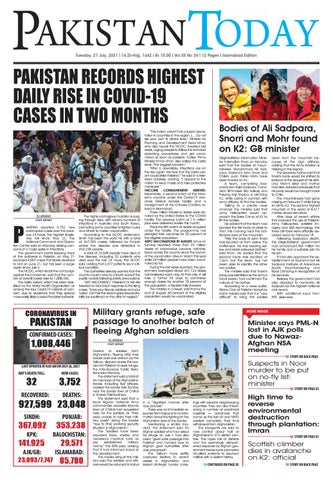
akistan reported 3,752 new coronavirus cases over the previous 24 hours, the highest singleday toll since May 22, the national Command and Operation Centre said on Monday, stoking concerns of a major spike in infections. the government portal keeping track of the outbreak in Pakistan on May 21 recorded 4,007 cases that slowly declined to 663 on June 21, but has seen a surge again since July 6. the nCOC, which leads the campaign against the pandemic, said that the number of overall cases rose to 1,008,446. the Delta variant, which has been classified by the World Health Organisation as among the four Covid-19 variants of concern due to evidence that they spread more easily, likely caused the latest outbreak.
the highly contagious mutation is surging through asia, with record numbers of infections in australia and south korea, prompting some countries to tighten curbs and others to hasten vaccination. according to the nCOC statement, sindh has been the worst hit, with a total of 367,092 cases, followed by Punjab where the disease was detected in 353,238 people. a total of 23,048 people have died of the disease, including 32 patients who died over the last 24 hours, the nCOC said, adding that 2,677 patients are in critical condition. the authorities already warned that the country could move to a fourth wave if the public avoids following safety precautions. “GEt VaCCinatED,” President Dr arif alvi tweeted on Monday in response to the rising cases. “save your friends, relatives and your nation. Don’t let the recent gains toward stability be sacrificed on the altar of neglect.”
coronavirus in
Pakistan
CONFIRMED CASES:
1,008,446
LAST UPDATED AT 8:03 AM ON JULY 26, 2021
DAY'S DEATH TOLL:
NEW CASES:
32
3,752
RECOVERED:
DEATHS:
927,599 23,048 SINDH:
PUNJAB:
367,092
353,238
KPK:
BALOCHISTAN:
141,925 AJK/GB: 23,093/7,747
29,571 ISLAMABAD:
85,780
Bodies of Ali Sadpara, Snorri and Mohr found on K2: GB minister
“this indian variant has caused devastation in countries in the region. [… Do not risk your own & others lives,” Minister for Planning and Development asad Umar, who also heads the nCOC, tweeted last week, urging people to follow the standard operating procedures and get vaccinated as soon as possible. Earlier, Prime Minister imran khan also called the Delta strain “the biggest concern.” “after a downslide, infections are on the rise again. We fear that the Delta variant could strike Pakistan,” he said in a televised address, adding: “i appeal to the nation to wear masks and take protective measures.” VACCINE CONSIGNEMENT ARRIVES: Meanwhile, a second batch of the Moderna vaccine under the Covid-19 Vaccines Global access facility and a consignment of the Chinese Cansino arrived in islamabad. three million Moderna doses were donated by the United states to the COVaX facility. the previous batch of 2.5 million jabs were delivered earlier this month. this is the fifth batch of doses acquired under the facility. the programme has pledged free vaccines for 20 percent of the eligible population. 40PC VACCINATIONS BY AUGUST: Umar on sunday reported more than 25 million doses of coronavirus vaccine administered across the country since the launch of the vaccination drive in March this year while 20 million people have been vaccinated so far. During the last week reported, the government averaged about 467,124 doses administered each day. at that rate, it will take a further 93 days to administer enough doses for another 10 percent of the population, a Reuters tally showed. the minister, in a tweet, said that by the end of august, 40 percent of the eligible population would be vaccinated.
Gilgit-Baltistan information Minister Fatehullah khan on Monday said that the bodies of mountaineers Muhammad ali sadpara, iceland’s John snorri and Chile’s Juan Pablo Mohr have been traced on k2. a team, comprising sadpara’s son sajid sadpara, Canadian filmmaker Elia saikaly and Pasang kaji sherpa, is climbing k2, while being in contact with army officers, to find the bodies. talking to a private news channel, the minister said that army helicopters would approach the Base Camp of k2 to lift the bodies. He added that the team had located the first body at close to 9am this morning near the bottleneck area of the mountain. “First, the body of John snorri was located at 9am below the bottleneck. He was wearing yellow and black coloured clothes,” said khan. He added that the second body was located at 12pm but the team has not been able to identify the other two bodies. the minister said that snorri’s body was identified as the army’s focal person had confirmed the colours of his clothes. according to a news outlet, alpine Club of Pakistan secretary karrar Haideri said that it is “very difficult” to bring the bodies
Military grants refuge, safe passage to another batch of fleeing Afghan soldiers ISLAMABAD staff report
Dozens of soldiers from afghanistan, fleeing after their border post was overrun by the taliban, slipped across the border into Pakistan to seek refuge, the inter-services Public Relations said Monday. the statement said a total of 46 members of the afghanistan forces, including five officers, crossed the border late sunday near the border town of Chitral in khyber Pakhtunkhwa. the statement said that a local afghan national army commander opposite arandu town of Chitral had requested help for the soldiers as “they were unable to hold their military posts” along the border “due to [the] evolving security situation in afghanistan.” the “soldiers have been provided food, shelter and necessary medical care as per established military norms,” the isPR said, adding that it had informed kabul of the development. the media wing of the military said the soldiers and officers would be returned to kabul
down from the mountain because of the high altitude, adding that the army aviation is helping in this regard. the secretary further said that snorri’s body would be shifted to iceland at the request of his wife, Lina. Mohr’s sister and mother had also decided previously that his body would be brought back to Chile. the mountaineers had gone missing on February 5 while trying to climb k2, the second highest mountain in the world at 8,611 metres above sea level. after days of search efforts that included the use of Pakistan army helicopters, satellite imagery and saR technology, the three climbers were officially declared dead on February 18. Following sadpara’s death, the Gilgit-Baltistan government had announced Rs3 million for his family and a suitable job for his son. it had also approved the establishment of Muhammad ali sadpara institute of adventure sports Mountaineering and Rock Climbing in recognition of his services. Besides, the government had also decided to nominate ali sadpara for the highest national civil award. With additional input from aPP. News Desk
more inside
Minister says PML-N lost in AJK polls due to NawazAfghan NSA meeting STORY ON BACK PAGE
suspects in noor murder to be put on no-fly list: minister STORY ON PAGE 03 in a “dignified manner after due process”. there was no immediate response from kabul and no information about the fighting on the afghanistan side of the border. Mentioning a similar incident, the statement said 35 afghan soldiers who had asked for refuge on July 1 had also been “given safe passage into Pakistan and handed over to afghan govt authorities after due procedure”. the taliban have swiftly captured territory in recent weeks in afghanistan and seized strategic border cross-
ings with several neighbouring countries. they are also threatening a number of provincial capitals — advances that come as the last Us and natO soldiers complete their final withdrawal from afghanistan. the insurgents are said to now control about half of afghanistan’s 419 district centres. the rapid fall of districts and the seemingly disheartened response by afghan government forces have prompted Us-allied warlords to resurrect militias with a violent history.
CONTINUED ON PAGE 05
High time to reverse environmental destruction through plantation: Imran STORY ON PAGE 03
scottish climber dies in avalanche on k2: official STORY ON BACK PAGE
02
Tuesday, 27 July, 2021
ISLAMABAD
NEWS
‘NAwAz A Product of MILItAry’S NurSery, Now SPeAKING ILL AGAINSt ArMy’: SheIKh rASheed
M
APP
INISTER for Interior Sheikh Rasheed said Monday former prime minister Nawaz Sharif was a “product of military’s nursery” and now he is speaking ill against the same army. The minister, speaking at a press conference in Islamabad, asked the former prime minister and PML-N supremo to come back to Pakistan and face the corruption cases. The interior minister claimed Nawaz could go to any lengths to propagate his agenda as he was against the army, establishment, and Prime Minister Imran Khan. Sheikh Rashid, while offering a chartered flight for bringing Nawaz back, urged him to stop making speeches while sitting in the United Kingdom and better return to face the cases against him. Moving on to the administrative matters, he said fencing along the Afghan border would be completed by August 14 while
46%-48% of fencing on the border with Iran had been completed. There have been thousands of foreigners living in the country over the last many years
PML-N’s Ismail Gujjar served notice over controversial India remarks
without renewing their visas, he said, adding such people should either leave Pakistan before August 14 or get their visas renewed through online application.
LAHORE Staff rePort
Pakistan Muslim League-Nawaz’s candidate for the Azad Jammu and Kashmir LA-35 election, Chaudhry Ismail Gujjar, was served a show-cause notice by the party on Monday over a controversial statement he made a day ago. According to Dawn, the party candidate had threatened to “call India for help” if the government attempted to rig the election. “If you try to commit such an act [rig elections], I will call India for help … I warn you this is the election of Azad Kashmir and its people, let it be peaceful,” he said while speaking to the media in Gujranwala. “A statement given by you appeared on the electronic media in which you have irresponsibly stated that you will seek help from India for your election,” the notice issued by PML-N Secretary General Ahsan Iqbal reads, asking Gujjar to furnish an explanation within seven days and warning him of strict disciplinary action if he failed to comply with the order.
Pakistan Muslim League-Nawaz Vice President Maryam Nawaz has refused to accept the results of the Azad Kashmir election after Pakistan Tehreek-e-Insaf swept the polls. Taking to Twitter on Monday, Nawaz claimed that her party fought hard but it was not easy to deal with “fraud”. “I have not accepted the results and will not. I have not even acknowledged the results of this fake government. Congratulations to the workers and voters. What will be the course of action on this shameless fraud, the party will decide soon, God willing,” she said. “PML-N has fought a very good election, has fought hard. It is not easy to deal with all the centres of state and power and fraud. I would like to commend all the voters and workers of
PML-N for their courage and bravery. I am very proud of them.” On the other hand, Pakistan Peoples Party chief Bilawal BhuttoZardari said his party has emerged as
ISLAMABAD
Mian abrar
Following a phenomenal victory in the elections of Azad Jammu and Kashmir, Prime Minister Imran Khan has set his eyes on Sindh and has directed the party leadership to accelerate efforts to revive Pakistan Tehreek-e-Insaf (PTI) in Sindh. The meeting was attended by Foreign Minister Shah Mahmood Qureshi, Minister for Planning and Development Asad Umar, Governor Sindh Imran Ismail, former chief minister Arbab Ghulam and party’s parliamentary leader in Sindh Assembly Haleem Adil Sheikh. According to sources in the ruling PTI, Prime Minister Imran chaired a meeting of Sindh Strategy Committee and the political situation in Sindh was discussed. This was the third consecutive meeting of the party to discuss its strategy in Sindh. The meeting decided to hold fourth meeting of the Sindh Strategy Committee in the federal capital next week. It was also decided in the meeting that the political and administrative decisions would be finalised by the federal government for Sindh Province. The meeting also decided that Prime Minister Imran will visit Sindh from August and he would meet leading Sindhi politicians to join the PTI. The premier will also meet with Sindh intellectuals, lawyers’ organisations and civil society.
the largest opposition party in Kashmir despite vote irregularities. Bhutto, in a tweet, said PTI resorted to violence and rigging in the elections, insisting that Election
Commission failed to take action against the ruling party for violating electoral discipline. Bilawal also lauded the party’s Azad Kashmir chapter and said he was incredibly proud of them for putting up a good fight and securing three additional seats from last time. The statements came after the ruling party emerged as the single largest party in a tight race to elect the legislative assembly in Azad Kashmir, grabbing 25 of 45 seats up for grab. Typically, the Kashmir vote has been won by the ruling party. Analysts said this race was tighter than usual. The PPP appeared to be leading with 10 seats while the PML-N has six, Raja Azhar Iqbal, a focal person for the Kashmir election commission, said, adding that two seats seemed to be going to the local groups. About 3.2 million people are registered to vote, he said.
John Kerry lauds PM Imran Khan’s green initiatives for resilient Pakistan Shahzad Paracha
ISLAMABAD
without the support of any other political party. PPP managed to get two to three more seats by spending a “huge amount of cash”, he said. The interior minister said Opposition parties would cry foul even in the next general elections, as he hoped PTI would form government in Sindh in 2023. Talking about the murder of a former Pakistani diplomat’s 27-year-old daughter Noor Mukadam, he said the name of Zahir Jaffer, the main suspect, would be placed on the Exit Control List (ECL). His name has already been added to the Provincial National Identification List (PNIL), the interior minister said, confirming that the father of the suspect and his employees have been arrested. The names of the suspects in the Mukadam case would be presented in the cabinet this week for inclusion in the ECL, he added. He said he wanted Mukadam’s killer to be sentenced to death and those involved in such acts.
Maryam refuses to accept Kashmir election outcome
NEwS DESk
After winning AJK, PM Imran intensifies efforts to secure Sindh
No fine would be imposed on those who apply for the renewal of visa, he said. The minister said the Federal Investigation Agency’s cyber-crime wing would also be developed on modern lines to improve its performance and efficiency. A new policy of verification, renewal, and correction was being introduced in the National Database and Registration Authority (NADRA) for computerised national identity cards, he said. Action has been taken against 39 NADRA officials in Karachi for their alleged involvement in the issuance of fake identity cards, the interior minister said, adding action would also be taken in other cities. The minister said India and Israel have started a hybrid war against Pakistan and wanted to compromise NADRA’s data, adding that he had asked the institution’s new chairman to issue a revised policy within 14 days. On elections in Azad Kashmir, the minister said as he had predicted earlier, PTI would form a government in the region
Pakistan and the United States of America have pledged to jointly work and boost bilateral cooperation for enhanced global climate action to protect world environmental ecosystems and the life on earth they feed. Climate Change Ministry media spokesperson Muhammad Saleem told this scribe that Special Assistant to Prime Minister Imran Khan on Climate Change Malik Amin Aslam and Former Presidential candidate and US Special Envoy for Climate John Kerry made such pledge during their meeting in the British capital’s Kew Gardens on the heels of the preCOP meeting in the run-up to the annual global climate conference set for November this year in Glasgow. “Both sides pondered over at length diverse matters of bilateral cooperation and opportunities for collaboration between US and Pakistani governments in the fields of post-Covid-19 green economic recovery by enhancing investment in nature-based solutions and green job creations, environmental sustainability, climate change, sustainable forest management, air pollution and water conservation and protection and disaster risk reduction”, according to the ministry official. Both Pakistan and the United States also agreed on forming a joint working group to address challenges related to Climate Change. The efforts of Pakistani Prime Minister Imran Khan’s bold action on halting coal-powered plants as well as Pakistan’s leadership on Nature-Based Solutions, including the massive Ten Billion Tree Tsunami, the campaign was appreciated by Senator Kerry during the meeting. He also assured Pakistan of full support from the United States on climate change including providing access to the best available technologies in renewable energy transition,
technical support on climate-smart agriculture and availability of climate finance. The SAPM thanked the United States government for reigniting their leadership role on Climate Change, under the Biden administration, and assured that Pakistan believes in a low carbon development pathway and on nature-based solutions to Climate Change. Pakistan is finalizing its enhanced NDCs to be presented at COP26 and reaffirmed that the world needs to collectively confront the largest challenge humanity has ever faced. Meanwhile, while sharing details of the present government’s green and clean Pakistan initiatives,
Malik Amin Aslam told John Kerry that the incumbent government of Prime Minister Imran Khan has launched various flagship programmes and projects including the world’s largest afforestation programme of 10 Billion Tree Tsunami Programme, Clean Green Pakistan Programme, Protected Areas Initiative, Plastic-Free Pakistan Initiative, Recharge Pakistan Initiative as a part of the country’s efforts to achieve environmental sustainability and climate resilience through conservation and protection of the environment, forests and wildlife, wherein community and youth engagements are being assigned the heightened priority.
Tuesday, 27 July, 2021
ISLAMABAD
NEWS
03
HigH time to reverse environmental destruction tHrougH plantation: imran ISLAMABAD
F
app
ACED with an unfolding climate crisis that is fueling more powerful floods and scorching heatwaves across the country, Prime Minister Imran Khan on Monday said an ambitious plantation drive was the only viable solution to reverse the negative consequences of environmental degradation. Addressing the launch of a nationwide monsoon plantation campaign, the prime minister said deforestation had resulted in increased levels of air pollution and temperatures in the country, which required a special focus on tree planting. At the Fatima Jinnah Park in Islamabad, Imran planted the sapling of the Avocado fruit to kick off the campaign. Speaking on the occasion, the prime minister said the plantation under the Ten Billion Tree Tsunami initiative would help the country gain its lost forest cover, which
was unfortunately low when compared to other countries in the region. He said ruthless tree-cutting during the previous governments had led to rising
pollution levels in cities and emphasised that trees were the natural remedy to absorb the airborne pollutants. Sharing his vision to make every city of
Pakistan green, he asked the local administrations including commissioners and deputy commissioners to ensure proper implementation of the plantation drive and also preserve the green covers. Imran observed the world was acknowledging Pakistan’s role in leading the efforts against climate change, particularly meeting the Bonn Challenge — a global effort to restore 150 million hectares of the world’s degraded and deforested lands by 2020 and 350 million hectares by 2030. The event was attended by Interior Minister Sheikh Rasheed Ahmed, Planning Minister Asad Umer, State Minister for Climate Change Zartaj Gul, Special Assistant to the Prime Minister on Health Dr Faisal Sultan and Senator Faisal Javed Khan. A large number of volunteers were also present to plant saplings in the premises of the park. The activity is taking place in the rainy season of the monsoon as part of the Billion
Tree programme under the auspices of the Ministry of Climate Change and the Capital Development Authority. In the next few weeks, the CDA will plant nearly half a million saplings across Islamabad. Islamabad over the years has witnessed a massive reduction in green cover, particularly in the last two decades. However, the green graph is gradually showing an upward trend after the government of Prime Minister Imran carried out a massive tree plantation campaign under the Clean Green Pakistan Index. Two days ago, Prime Minister Imran planted a sapling in a scenic resort of Nathia Gali to promote plantations for the sake of preserving the natural environment. He also urged the nation especially youth to join hands in gearing up for the campaign. Imran, even before joining politics, has long been a strong advocate for the importance of plantation for the future of a clean and green Pakistan.
Suspects in Noor murder to be put on no-fly list: minister ISLAMABAD Staff RepoRt
The names of the suspects in the murder of the daughter of a former ambassador will be put on the Exit Control List to keep him from fleeing the country, Minister for Interior Sheikh Rasheed Ahmed said on Monday. Noor Mukadam, 27, was found murdered at the residence of one Zahir Zakir in Sector F-7/4 of Islamabad last week. Zakir, widely believed to be the killer, was arrested the same day for his purported involvement in the gruesome incident. A first information report registered on the complaint of Ambassador Shaukat Ali Mukadam nominated Zakir under Section 302 (premeditated murder) of the Pakistan Penal Code. Rasheed disclosed Zakir’s name has already been placed on the Provisional National Identification List, an ECL-like list used to bypass the lengthy process of
putting such people on the no-fly list. The minister further confirmed the parents and domestic helpers of the accused have been arrested. The names of the suspects in the case will be presented in a cabinet meeting this week for approval of their inclusion in the ECL, he said. REMAND EXTENDED: Meanwhile, a district and sessions court in Islamabad granted police another twoday extension in the physical remand of Zakir. He was produced before the court on the expiration of his latest two-day remand, which was secured after an initial three-day remand. The defense, Ansar Nawaz Mirza, argued that the police had already had his client remanded for five days, saying a further remand was “unnecessary”. Zakir, who according to Senior Superintendent of Police (Investigation) Attaur Rehman also holds American nationality, said the US embassy had not approached him as yet.
Tanvir Ilyas or Sultan Mehmood – who would have the last laugh? ISLAMABAD Mian abRaR
With the landslide victory in elections for Azad Jammu and Kashmir (AJK), the Pakistan Tehreek-e-Insaf (PTI) has witnessed another contest started between top hopefuls for the slot of Prime Minister AJK between veteran party leader Barrister Sultan Mehmood and newcomer property tycoon Sardar Tanvir Ilyas. According to unofficial results released so far, the PTI has won 26 seats while the Pakistan People’s Party (PPP) bagged 10 and Pakistan Muslim League-Nawaz (PML-N) could clinch win from only 6 constituencies. Barrister Sultan Mahmood has won the AJK Legislative Assembly seat from LA-3, his parent Mirpur constituency, by defeating his nearest rival Chaudhry Muhammad Saeed of the PML-N by a margin of 3,147 votes, while Sardar Tanvir Ilyas emerged victorious from Bagh constituency. Barrister Sultan Mehmood is an old hand and has been elected to the AJK Legislative Assembly eight times. He has also served as prime minister AJK from
AS LOBBYING FOR TOP JOB IN AJK INTENSIFY, PM MAY OPT FOR A YOUNG, BRIGHT MIND July 30, 1996 to July 24, 2001 when he was associated with the PPP. He joined the PTI in year 2015 when he was a PPP member of the AJK LA. On the other hand, Sardar Tanvir is a newcomer to the PTI and owns a famous multi-storey residential and shopping complex in the federal capital. He is currently serving as the special assistant to the Punjab chief minister. Tanvir actually belongs to Rawalakot district but opted for contesting from Bagh constituency as a large number of his clan live in Bagh. The sources in the ruling PTI say that Tanvir Ilyas has won support from party stalwarts like Minister for Azad Kashmir & Gilgit Baltistan Ali Amin Gandapur, Minister for Communications Murad Saeed, PTI chief organiser Saifullah Khan Niazi and others. On the other hand, Barrister Sultan Mehmood has
won the support of the in-laws of Prime Minister Imran Khan and he is making his last-ditch efforts to become the chief executive of Azad Kashmir. A source in the PTI said that some party stalwarts have also floated a proposal to appoint Sardar Tanvir Ilyas as prime minister and accommodate Barrister Sultan Mahmood by appointing him as president of Azad Kashmir. Another source told this scribe that Prime Minister Imran may also opt to appoint a young and bright lawmaker if the contest between Barrister Sultan and Tanvir Ilyas intensified. “I know prime minister well. He must look for a young and bright mind among party lawmakers as both Sultan Mehmood and Tanvir Ilyas are building pressure for the top slot,” the source concluded.
ied blast injures Four people in Quetta NewS DeSk An improvised explosive device (IED) blast in Hazar Ganji area on the outskirts of Quetta injured at least four people on Monday. According to Dawn, a Frontier Corps (FC) vehicle was also damaged in the blast that took place outside the main gate of the vegetable market at 07:40 am. “As a result, four passersby were injured while a Frontier Corps vehicle was slightly damaged. It was a timed device which had around one kilogramme of explosives. CTD teams are on the spot and gathering evidence,” a spokesman for the Balochistan Counter-Terrorism Department said. The blast caused the windows of nearby buildings to shatter. The site of the incident was cordoned off by security forces and further investigations are under way. The victims were shifted to Bolan Medical Complex Hospital by rescue workers. According to the hospital administration, two of the victims were in critical condition. Condemning the incident, Balochistan government spokesman Liaquat Shahwani said that an emergency had been declared at hospitals in order to provide the injured with the best possible medical treatment. “Those responsible will be arrested and brought to justice,” he said. On July 1, at least six security personnel were injured, two of them seriously, in a motorcycle bomb explosion that targeted an army convoy on Quetta’s Airport Road. Inspector General of Balochistan Mohammad Tahir Rai had said that an IED had been planted on the motorcycle, which was detonated by a remote control.
What makes Delta variant the most formidable version of coronavirus yet? ReuteRS The Delta variant is the fastest, fittest and most formidable version of the coronavirus that causes Covid-19, and it is upending assumptions about the disease even as nations loosen restrictions and open their economies, according to virologists and epidemiologists. Vaccine protection remains very strong against severe infections and hospitalisations caused by any version of the coronavirus, and those most at risk are still the unvaccinated, according to interviews with 10 leading Covid-19 experts. The major worry about the Delta variant, first identified in India, is not that it makes people sicker, but that it spreads far more easily from person to person, increasing infections and hospitalisations among the unvaccinated. Evidence is also mounting that it is
capable of infecting fully vaccinated people at a greater rate than previous versions, and concerns have been raised that they may even spread the virus, these experts said. “The biggest risk to the world at the moment is simply Delta,” said microbiologist Sharon Peacock, who runs Britain’s efforts to sequence the genomes of coronavirus variants, calling it the “fittest and fastest variant yet”. Viruses constantly evolve through mutation, with new variants arising. Sometimes these are more dangerous than the original. Until there is more data on Delta variant transmission, disease experts say that masks, social distancing and other measures set aside in countries with broad vaccination campaigns may again be needed. Public Health England said on Friday that out of a total of 3,692 people hospitalised in Britain with the Delta variant, 58.3 per cent were unvaccinated and 22.8pc were fully vaccinated.
In Singapore, where Delta is the most common variant, government officials reported on Friday that three quarters of its coronavirus cases occurred among vaccinated individuals, though none were severely ill. Israeli health officials have said 60pc of current hospitalised Covid cases are in vaccinated people. Most of them are age 60 or older and often have underlying health problems. In the United States, which has experienced more Covid-19 cases and deaths than any other country, the Delta variant represents about 83pc of new infections. So far, unvaccinated people represent nearly 97pc of severe cases. “There is always the illusion that there is a magic bullet that will solve all our problems. The coronavirus is teaching us a lesson,” said Nadav Davidovitch, director of Ben Gurion University’s school of public health in Israel. ‘Teaching us a lesson’ The Pfizer/BioNTech vaccine, one of the
most effective against Covid-19 so far, appeared only 41pc effective at halting symptomatic infections in Israel over the past month as the Delta variant spread, according to Israeli government data. Israeli experts said this information requires more analysis before conclusions can be drawn. “Protection for the individual is very strong; protection for infecting others is significantly lower,” Davidovitch said. A study in China found that people infected with the Delta variant carry 1,000 times more virus in their noses compared with the ancestral strain first identified in Wuhan in 2019. “You may actually excrete more virus and that’s why it’s more transmissible. That’s still being investigated,” Peacock said. Virologist Shane Crotty of the La Jolla Institute for Immunology in San Diego noted that Delta is 50pc more infectious than the Alpha variant first detected in the UK.
“It’s outcompeting all other viruses because it just spreads so much more efficiently,” Crotty added. Genomics expert Eric Topol, director of the Scripps Research Translational Institute in La Jolla, California, noted that Delta infections have a shorter incubation period and a far higher amount of viral particles. “That’s why the vaccines are going to be challenged. The people who are vaccinated have got to be especially careful. This is a tough one,” Topol said. In the United States, the Delta variant has arrived as many Americans — vaccinated and not — have stopped wearing masks indoors. “It’s a double whammy,” Topol said. “The last thing you want is to loosen restrictions when you’re confronting the most formidable version of the virus yet.” The development of highly effective vaccines may have led many people to believe that once vaccinated, Covid-19 posed little threat to them.
Tuesday, 27 July, 2021
04 NEWS
ISLAMABAD
NATIoNAl oUTsTANDING DEBT sURGEs 4.98Pc MoM IN JUNE
T
NEWS DESK
HE country’s outstanding debt surged by 4.98 percent in June 2021 on a month-on-month basis as it increased to Rs25.31 trillion in June from Rs24.11 trillion in May, showing an increase of around Rs1.2 trillion. On a year-on-year basis, outstanding debt increased by 10.14 percent as it was Rs22.98 trillion in June 2020. The country’s total credit accumulation during the 12 month period (July-June 2020-21)
widened by Rs2.33 trillion as the total outstanding debt at the beginning of ongoing fiscal year June 30, 2020, stood at Rs22.98 trillion. This means that Pakistan’s outstanding debts broadened by 10.14 percent this fiscal year. The total outstanding credit is branched into the amount accumulated by the government sector and that accumulated by the non-government sector. Out of the total outstanding loan, credit given to the government sector accounted for Rs16.63 trillion while credit to non-government sectors accounted
for Rs8.69 trillion. The State Bank of Pakistan’s net credit to the government sector amounted to Rs5.4 trillion which included investments in government securities and government deposits, and other direct loans. During these 12 months, the central bank has retired a sum of Rs1.14 trillion or 17.47 percent. Meanwhile, the second largest source of financing for the sector, the Scheduled Bank’s net credit added up to Rs11.22 trillion which is Rs2.85 trillion higher than the outstanding credit at the beginning of the fiscal year thus indicat-
ing that the sector accumulated additional loans during the period. The State Bank’s claim to outstanding credit of this particular sector is comparatively negligible (only Rs29.81 billion), while on the other side, scheduled banks have a claim to up to Rs8.66 trillion as of the end of this month. At the end of May 2021, the outstanding amount owed to these banks was Rs8.49 trillion indicating that Rs163.25 billion were additionally borrowed during the month whereas during the ongoing fiscal year, Rs622.67 billion were further accumulated.
Gold imports fall to 148kg in 2020-21 NEWS DESK The gold imports during the fiscal year 2020-21 decreased by 22.79 percent to $8.977 million as compared to the imports of $11.627 million during the preceding financial year 2019-20. According to the data released by Pakistan Bureau of Statistics (PBS), Pakistan imported 148 kilograms of gold during the period under review as compared to the imports of 275 kilograms last year, showing a decline of 127 kilograms. Meanwhile, on a year-on-year basis, the gold imports witnessed 100 percent increase during the month of June 2021 as compared to the imports of June 2020. The gold imports during June 2021 were recorded at $0.467 million whereas there were no gold imports during June 2020. On a month-on-month basis, the gold imports during June 2021 decreased by 69.83 percent as compared to the imports of $1.580 million in May 2021. It is pertinent to mention here that the overall merchandise imports into the country increased by 26.60 percent during the fiscal year 2020-21 as compared to the corresponding period of last year. The imports during the year were recorded at $56.405 billion against the imports of $44.553 billion last year. On the other hand, the exports from the country were recorded at $25.304 billion during the year, showing growth of 18.28 percent when compared to the exports of $21.394 billion last year. Based on the figures, the country’s trade deficit increased by 34.29 percent during the period under review as compared to the corresponding period of last year.
The Board of Investment (BoI) and Economic Development Board of Bahrain have agreed to undertake collaborative activities and projects in the areas of mutual interest. The boards will sign a memorandum of understanding (MoU) in this regard during the second session of the Pakistan-Bahrain Joint Ministerial Commission, scheduled for July 28-29, 2021 in Manama, Bahrain, said a statement issued on Monday. Under the agreement, the two countries can develop and undertake collaborative activities and projects; share knowledge and have integrated technical exchange and assistance in the areas of mutual interest, it added. Being the premier investment promotion agency of Pakistan, the Board of Investment is mandated to promote and facilitate local and foreign investments. Bahrain Minister of Foreign Affairs Dr Abdul Latif
NEWS DESK Around 73 Pakistani businessmen in Dubai have received the UAE’s 10-year Golden Visa, said Ahmed Shaikhani, president of the Pakistan Business Council (PBC). Shaikhani said that more than 250 applications have been submitted for the Golden Visa by the PBC members, and around 73 people have received the Golden Visa, Khaleej Times reported. He noted that the Pakistan Business Council has taken the initiative in cooperation with the Dubai Chamber of Commerce and Industry. The Pakistan Business Council works under the umbrella of the Dubai Chamber with the objectives of promoting trade, commerce and investment between the UAE and Pakistan. It consists of a large group of Pakistani businessmen, businesswomen, investors and professionals based in the UAE. The council members represent companies from various and diverse sectors. So far, hundreds of UAE expatriates of different nationalities from various walks of life have been granted Golden Visa by the authorities in the UAE. This includes doctors, engineers, students, businessmen, artists, media persons, and other skilled categories. Recently, 100,000 Golden Visas were announced for the world’s best coders. The UAE also awarded its 10-year residency Golden Visa to Shaikhani earlier this month. “I feel privileged and am grateful to the UAE leadership and authorities for the Golden Visa, which was a much-awaited initiative for the investor community. We can now focus on business instead of spending time on visa applications every two years,” he said. “Pakistanis in the UAE who are eligible for the Golden Visa should benefit from this facility provided by the UAE government because there are no travel restrictions for Golden Visa holders. And this is also a word of appreciation for the investments that Pakistanis have made here in the UAE,” Shaikhani said during an interview on the sidelines of an event held at the Pakistan Consulate, Dubai. Approximately 1.5 million Pakistanis are living and working in the UAE, the secondlargest expatriate community after Indians.
IT exports cross $2bn mark for first time: Dawood NEWS DESK
ISLAMABAD: A breathtaking view of Margalla Hills during monsoon rainfall. ONLINE
Pak-Bahrain commission meets tomorrow to promote trade, cooperation NEWS DESK
73 Pakistani businessmen receive UAE golden visa
Bin Rashid Al Zayani and Foreign Minister Shah Mehmood Qureshi would co-chair the session. The Pakistani delegation will comprise several high officials from the Board of Investment, Petroleum Division, Ministry of Commerce, Ministry of Economic Affairs and the Ministry of Overseas Pakistanis and Human Resource Development. The meeting will focus on bilateral cooperation in various sectors, including political, defence, economic, commerce, finance and banking, industry, public health, overseas employment, higher education, science and technology, information, culture and arts, agriculture and livestock, cultural cooperation and parliamentary exchanges. Regarding the promotion of trade and business development, some sectors of interest include manufacturing, financial services, tourism, healthcare and education, logistics, information and communication technology and vocational training, the statement said. The first session of the Pakistan-Bahrain Joint
Ministerial Commission was held on February 5 to 6, 2017, in Islamabad. During the first session, the meeting had reached a consensus on the low volume of bilateral trade, while it also discussed the future prospects. The Pakistani side had also proposed to offer Special Economic Zones to the Bahraini investors. The volume of bilateral trade between the two countries stood at $117.23 million in 2019-20. Pakistan’s exports to Bahrain included rice, cotton yarn, textured yarn, printing ink, etc, whereas the major imports from Bahrain included ferrous waste and scrap, iron or steel and petroleum bitumen. The second session would be a major breakthrough in terms of showcasing Pakistan’s lucrative investment opportunities to Bahrain. Pakistan has adopted a very liberal and investor-friendly investment policy, which provides no restriction on remitting capital. All the sectors are open for investment and equal treatment will be given to local and foreign investors, it added.
Adviser to Prime Minister on Commerce and Investment, Abdul Razak Dawood has said that the country’s information technology (IT) exports remained $2.12 billion in the fiscal year 2020-21. “ I want to congratulate our IT exporters for crossing the $2 billion export mark for the first time in our history,” the adviser said this on his official twitter account on Monday. He said that during the fiscal year 2020-21, IT exports grew by 47.4 percent to US $2.12 billion as compared to US $1.44 billion in FY 201920. “I have always believed in the abilities of our IT professionals & entrepreneurs. You have done a remarkable job & I encourage you to market your exports even further to achieve more,” said the advisor. Pakistan’s merchandise exports in fiscal year 2020-21 grew 18% to $25.3 billion from $21.4 billion a year earlier, according to the Pakistan Bureau of Statistics.
FBR slashes sales tax on petrol to 10.77pc NEWS DESK The Federal Board of Revenue (FBR) on Monday reduced the sales tax rate to 10.77 percent on supply of petrol from 16.40 percent. The FBR issued SRO 937 (I)/2021 to notify the reduction in sales tax rate on petrol. The federal government on July 15, 2021 announced an increase of Rs5.4 to Rs118.09 in price of petrol from Rs112.69. Similarly, the prices of high speed diesel increased by Rs2.54 per litre, from Rs113.99 to Rs116.53. Kerosene oil price increased by Rs1.39 per litre, from Rs85.75 to Rs87.14. Price of light diesel oil also increased by Rs1.27 from Rs83.40 per litre to Rs84.67 per litre. The sales tax rates on other petroleum products have been kept unchanged as per the notification issued on July 06, 2021. The sales tax rates are: high speed diesel, 17 percent; kerosene oil 6.7 percent; and light diesel oil at 0.2 percent.
Businesses optimistic about direction of economy: Gallup ISLAMABAD TLTP
The business confidence index (BCI) is in green territory pointing that businesses are now posing confidence in future business situations and optimistic about the direction of the country; however, the current business situation score is negative in Q1 2021, indicating poor confidence in the current business situation. The survey, which sought responses from around 490 businesses across Pakistan from 4th June 2021 to 1st July 2021, was published by Gallup in its second-quarter 2021 report of Gallup Pakistan’s Business Confidence Index. According to the survey, 49% of busi-
nesses reported doing well while 52% of businesses reported bad business conditions. Overall, the number of businesses reporting good business conditions has lessened while the number of businesses reporting bad business conditions has increased as compared to the last quarter. Since Q4 2020, the current business assessment has deteriorated with a 24% decrease in people claiming their business situation to be good. The survey revealed that 63% of businesses believe the country is in the right direction, the net score increased by 20% since the 4th Quarter of 2020. 65% of the businesses’ sales have decreased during the past year due to corona & lockdown and its impact on businesses. The breakdown by business type showed
that nearly 3 in 5 service businesses reported a decline in sales in the past year, closely followed by 58% of manufacturing businesses reporting a decline. The highest increase was reported by trade businesses at 21%. As per the survey, 67% of Karachi businessmen report that their sales have decreased, 15% report that they have increased while 18% claim that they have remained the same amid covid related restrictions. Two in 5 businesses reported around an increase in sales up to 20%, followed by 35% businesses each reporting a 20-40% increase. Only 5% of businesses reported an increase in sales over the past year to greater than 60%. Around 50% of businesses reported having the same number of employees while 42% of businesses reported laying off/ hav-
CMYK
ing fewer employees compared to 12 months ago. The number is pointing towards massive unemployment increase and continuing till now. The provincial breakdown highlighted that the percentage of traders considering the business conditions good is highest in Sindh at 50% while 59% of businesses in Khyber Pakhtunkhwa and Balochistan reported bad business conditions. Seven in 10 businesses in the survey are confident that the future will be better. However, the Net Future Business Confidence score decreased by 3% (falling from 44% to 41%) since Quarter 4, 2020. On a provincial basis, 71% businesses from Sindh are optimistic for the future of their business. Businesses in KPK & Balochistan and Punjab were found to be equally least optimistic
about their future business scenario. As compared to Q4 2020, there has been a 10% increase in the number of businesses to 26% that opine that the country is heading in the right direction. With regards to problems affecting businesses, the survey noted that Like Q4 2020, an increase in inflation, followed by issues caused by coronavirus and lockdown are the most pressing problems businesses want the government to solve in Q2 2021. Fifty-seven percent of businesses reported experiencing load shedding within a day, with most of them experiencing for 3 hours. Around 7 in 10 businesses claimed that load-shedding was a big problem for their business, the highest being reported by trade businesses.
Tuesday, 27 July, 2021
ISLAMABAD
NEWS
Military grants refuge, safe passage to another batch of fleeing Afghan soldiers continued from page 01 Hundreds of Afghan army soldiers and civil officials have fled to neighbouring Tajikistan, Iran and Pakistan in recent weeks after Taliban offensives in border towns. For many Afghans weary of more than four decades of wars and conflict, fears are rising of another brutal civil war as American and NATO troops leave the country. The Afghanistan government and Taliban negotiators have met in Qatar’s capital, Doha, in recent weeks, although diplomats say there have been few signs of substantive progress since peace talks began in September. Reeling from battlefield losses, Afghanistan’s military is overhauling its war strategy against the Taliban to concentrate forces around critical areas such as Kabul and other cities, border crossings and vital infrastructure, Afghan and US officials have said. FRAUGHT RELATIONS: Relations between the Ashraf Ghani regime in Afghanistan and Pakistan — long fraught with suspicion and deep mistrust — deteriorated further when the Taliban overran the Afghan border town of Spin Boldak earlier this month. Taliban fighters at the time were seen receiving medical treatment in a hospital in the town of Chaman, across the border from Spin Boldak. Frustrated with its ability to put an end to Taliban advances, Kabul accused Islamabad of providing sanctuary to the fighter group as Afghan forces battle to retake Spin Boldak. The US last week carried out airstrikes in support of Afghan troops in the southern city of Kandahar, about 100 kilometres west of Spin Boldak. Also this month, Kabul recalled its ambassador and other diplomats from Islamabad. Pakistan still hosts about 2 million Afghanistan nationals as refugees from decades of war in their homeland. The Taliban surge gained speed after President Joe Biden announced in mid-April that the last American and NATO troops would soon leave Afghanistan. The 2,500-3,500 American soldiers and 7,000 NATO allies have mostly left the country at this point, with the few remaining soldiers to be gone by August 31. Pakistan has dismissed allegations of aiding the Taliban and points out that it succeeded in pressuring the insurgents into peace talks last year. With additional input from AP, Reuters
PSX tuRnS beARiSh oveR CoviD ConCeRnS, SheDS 120 PointS KaracHi
t
TLTP
HE Pakistan Stock Exchange (PSX) turned bearish on Friday over Covid-19 concerns, with the benchmark KSE-100 Index shedding 120.39 points (-0.25 percent) to close at 47,672.68 points. The market opened on a positive note but switched to the red zone soon and remained under selling pressure throughout the session. The KSE-100 Index traded in a range of 323.7 points, showing an intraday high of 47,930.5 points and a low of 47,606.8 points. Among other indices, the KSE All Share Index shed 49.37 points (-0.15 percent) to close at 32,578.47 points, while All Share Islamic Index shed 78.95 points (-0.34 percent) to close at 23,342.68 points. A total of 400 companies traded shares in the stock exchange, out of them
shares of 189 closed up, shares of 191 closed down while shares of 20 companies remained unchanged. The overall market volumes increased by 136.08 million to 450.24 million shares. The number of total trades increased by 31,199 to 142,926, and value traded increased by Rs2.47 billion to Rs13.56 billion. Likewise, the market capitalisation decreased by Rs15.26 billion. Among scrips, WTL topped the volumes with 127.89 million shares, followed by TELE (45.08 million) and TPL (17.42 million). Stocks that contributed significantly to the volumes include WTL, TELE, TPL, ASC, and BYCO. They formed 49 percent of total volumes. Sector wise, the index was let down by oil & gas exploration companies with 73 points, cement with 55 points, commercial banks with 37 points, power generation & distribution with 19 points and pharmaceuticals with 16 points. The
most points taken off the index were by PPL which stripped the index of 36 points followed by UBL with 25 points, MEBL with 25 points, OGDC with 25 points and HUBC with 17 points. The sectors propping up the index were fertilizer with 58 points, technology & communication with 25 points, textile composite with 15 points, chemical with 14 points and tobacco with 9 points. The most points added to the index were by ENGRO which contributed 36 points followed by MCB with 24 points, EFERT with 24 points, SYS with 13 points and TRG with 13 points. Analysts at Topline Research said that the index opened the day in the positive territory. Initially it reached an intraday high of 47,930 points. But it succumbed to selling pressure for the rest of the day. It closed near its intra-day low of 47,606 points. The start of the futures roll over week, with an outstanding open position
Crypto market turns bullish with Bitcoin reaches $38,484
Pakistan has potential to provide port access to Central Asia: PM iSLamaBad TLTP
Prime Minister Imran Khan has expressed hope that Pakistan's ports will provide the foundation of important trade routes through China-Pakistan Economic Corridor (CPEC). Talking to his adviser on commerce and investment Abdul Razak Dawood on Monday, the prime minister appreciated the Ministry of Commerce and the Board of Investment for prioritising efforts to expand trade relations with Central Asian states for the first time in history. Welcoming growing trade relations with the Central Asian Republics, the prime minister stressed that Pakistan has the potential to provide port access to the region. During the meeting, Abdul Razak Dawood briefed the Prime Minister on the progress of bilateral cooperation and trade agreements with Uzbekistan and the prospects for positive results from investors. He also briefed the prime minister on the strategy for the forthcoming visit to other Central Asian states, particularly Tajikistan. Earlier in the month, Pakistan and Uzbekistan agreed to further strengthen their bilateral relations through strategic partnership and enhanced cooperation in the areas of trade, economy, culture, tourism and connectivity for mutual benefit. Prime Minister Imran Khan and President Shavkat Mirziyoyev of Uzbekistan after holding wide-ranging bilateral talks signed Joint Declaration on the Establishment of Strategic Partnership between Pakistan and Uzbekistan with focus of increased cooperation in the areas of trade and economy. Separately, launching the monsoon plantation drive in Islamabad, Prime Minister Imran Khan Monday said that Pakistan is now recognised as a leading country which is taking steps to reverse carbon emissions. Speaking on the occasion, the premier asked the countrymen to fully participate in the tree plantation campaign to enhance the country's forest cover.
05
The crypto market turned bullish on Monday with the market cap surging 9.60 percent to $1.59 trillion as of 1140 GMT. The price of Bitcoin (BTC), the largest cryptocurrency, increased to $38,484 after gaining 11.88 percent. With this increase in price, the market capitalisation of the BTC has reached $722 billion. On the other hand, ethereum (ETH) price gained 8.71 percent to reach $2,345. With this increase in price, the market capitalisation of ETH has reached $274 billion. Similarly, XRP gained 9.82 percent to reach $0.661. The market capitalisation of XRP stands at $66 billion after this increase.
Likewise, Cardano (ADA) price reached $1.35 with a 10.43 percent increase in its price. Its market capitalisation has reached $43.4 billion after this increase. The same was the case for Dogecoin (Doge) whose price appreciated by 13.49 percent to reach $0.223. With this increase in price, the market capitalisation of Doge reached $29 billion. Experts explain the bullishness with several factors, including recent uplifting comments from Twitter, Tesla, and Ark Invest CEOs at a Bitcoin conference called ‘The BWord’. Elon Musk said that Tesla may once again begin accepting Bit-
coin for its vehicle purchases, adding that both Tesla and space exploration company SpaceX own bitcoin, while he personally has bought bitcoin, ethereum, and dogecoin. The crypto market has recently been hit by concerns over the carbon footprint and energy consumption of Bitcoin mining, a regulatory crackdown on the crypto in China, and criticism coming from European and US officials. Bitcoin is still around $27,000 off its mid-April high of nearly $65,000. However, some experts believe that the stresses Bitcoin has been under are starting to wear off, indicating a return to the bullish crypto market. NEWS DESK
Gold price jumps to Rs94,400 per 10gm Gold price consolidated at higher levels on Monday, kicking off the week with over 0.3 percent gain amid low US Treasury yields. At 1155 hours GMT, gold in the international market was available at $1,809.40 per ounce after gaining $5.70 as compared to its closing value on Friday last. Meanwhile, the price of 10 grams of yellow metal in Pakistan jumped to Rs94,400 with a gain of
Rs500. The closing prices of the yellow metal in the country remained Rs93,900 on Friday last. According to experts, gold bulls are back in the game after having found solid support around the $1798 region. The downbeat market mood remains the key underlying theme so far, boosting the haven flows into the US Treasuries and gold while weighing on the yields, they said.
They said that the benchmark 10-year US Treasury yields are down nearly 5 percent on the day. Escalating Covid-19 concerns and a tense start to the US-Sino trade talks dampen the investors’ sentiment, they further said. Additionally, worse than expected German IFO Survey for July intensified economic growth concerns, underpinning gold price, they added. NEWS DESK
of Rs28.07 billion, coupled with concerns of a ballooning current account deficit kept the market gains in check, they said They said that PPL, MEBL, UBL, OGDC, & LUCK dragged the index lower by a cumulative 126 points while MCB, ENGRO and EFERT added 102 points to the KSE-100 Index. A closing note by Aba Ali Habib Securities said that a major reason for the investor’s negative sentiments was the increasing number of new virus cases. The delta variant is spreading through the country rapidly due to which several restrictions have been placed that are becoming a hindrance for economic activities. Dull trading activity was also attributed to the upcoming monetary policy meeting scheduled for tomorrow (27th Jul), where the rate setters are expected to leave the interest rate unchanged at 7% amid rising virus cases, it added.
Crude prices trade lower on Covid concerns Crude oil futures traded lower on Monday as concerns over the spread of the delta variant of the coronavirus continued to weigh on the market's upward potential. At 1205 hours GMT, Brent, the international benchmark for two-thirds of the world's oil, shed $0.27 (-0.36 percent) to reach $73.83 a barrel. Similarly, the US West Texas Intermediate (WTI) reached $71.67, down by $0.40 (-0.56 percent). The price for Opec Basket was recorded at $69.93 a barrel with 4.4 percent decrease, Arab Light was available at $73.85 a barrel with 6.52 percent increase, while the price of Russian Sokol reached $73.30 after gaining 6.48 percent. According to experts, last Monday's panic over the delta variant and its impact on oil demand recovery ended by the middle of last week; however, fear over the variant continues to hang in the air, and may prevent crude from notching any further substantial gains. They said that oil market fundamentals remained strong, with improving downstream oil demand in the US and Europe boosting sentiment. They said that gasoline demand in several major regions has returned to pre-pandemic levels amid rising road traffic data and even the jet fuel market is showing signs of improvement. They expressed optimism that rising vaccination rates have reduced the likelihood that countries may retreat into full-blown lockdowns. With officials from well-vaccinated countries reluctant to reinstate harsh lockdown measures, the risk of demand growth faltering is diminishing, they added. NEWS DESK
Dollar falls by Rs1.09 to Rs161.23 Pakistan rupee snapped the losing streak against the US dollar on Monday and recovered Rs1.09 (+0.68 percent) in the interbank. According to the State Bank of Pakistan, the US dollar opened at Rs162.32 and closed at Rs161.23. Within the open market, the rupee was traded at Rs162.30/162.80 per dollar. The sharp recovery can be attributed to significant increase in foreign exchange reserves. The foreign exchange reserves of the country reached $25.128 billion after transfer of $1.04 billion against the proceeds of Eurobond, according to the State Bank of Pakistan (SBP), which helped the local currency to make gains against the US dollar Currency experts said that concerns over lockdowns in different parts of the world as well as the country for preventing the coronavirus spread also helped the rupee make gains against the dollar. Pakistani rupee shed Rs2.38 against the US dollar during the last week, while depreciation during the fiscal year 2021-22 has been Rs3.87. The local unit has shed Rs1.14 against the US dollar in the current year 2021. NEWS DESK
SBP urged to cut policy rate to turn around economy iSLamaBad TLTP
The Islamabad Chamber of Commerce & Industry (ICCI) has called upon the State Bank of Pakistan’s Monetary Policy Committee (MPC) to bring down the policy interest rate to 3-4 percent in order to stimulate economic activity and turn around the economy.
In a statement issued on Monday, ICCI President Sardar Yasir Ilyas Khan said that countries around the world made drastic cuts in policy interest rate to enable businesses to combat the impact of Covid-19 pandemic, but the State Bank of Pakistan is still maintaining interest rate at 7 percent, which is quite high as compared to many other countries. Giving a comparison, he said that pol-
icy interest rate in Japan was -0.10%, European countries zero percent, Thailand & South Korea 0.50%, Philippines 1.50%, Malaysia 1.75%, Indonesia 3.50%, China 3.85%, India 4% and Pakistan 7%. The ICCI president said that due to Covid-19 pandemic, the business community is facing many challenges in promoting business activities smoothly and it is the best
cmYK
time that the SBP Monetary Policy Committee should reduce interest rate to at least 34% that would produce multiple benefits for the economy. He said that the low interest rate would facilitate the business class in expanding their business ventures and making new investments in potential sectors of the economy that would ultimately lead to fast
recovery of the economy. It would also make Pakistan an attractive destination for foreign direct investment (FDI), he added. The State Bank of Pakistan (SBP) is scheduled to announce monetary policy for next two months on Tuesday (July 27). The present key policy rate is 7 percent. Analysts believe that the central bank is likely to keep the policy rate unchanged.
Tuesday, 27 July, 2021
06 COMMENT
Violence, law, freedom, and common sense
AJK elections A worrisome toxic campaign
a
s was being predicted by many on the basis of past experience, the aJk elections were won by the party in power in Islamabad. Most of the aJk voters realise, as they do in Gilgit Baltistan, that on account of close links with Pakistan and because the region’s development needs are to a significant level fulfilled by Pakistan government, it is sensible to vote for the party in power in Islamabad. In aJk’s 141.4 billion surplus budget for fiscal year 2021-22, Rs28 billion were to be provided by the government of Pakistan. The election campaign this time has been marked by more than usual bitterness. One had expected the contesting parties to take up the problems facing the people in aJk, point out the government’s failings and spell out policies needed to improve the lot of the masses. One had also expected the party in power and the opposition to spend most of their energies on condemning the Indian govt for the ruthless suppression of the kashmiris. It appeared however that none of the three parties was interested in raising the real issues. What one witnessed instead was that the PTI, PMLn and PPP saw the aJk elections as an opportunity to take their mud slinging match in Pakistan with greater zeal to aJk. The PTI leadership was accused of having sold kashmir to PM Modi and of having decided to turn aJk into a province of Pakistan. The PTI as usual branded he PPP and PMLn leaders as traitors and dacoits. a Federal Minister for kashmir was caught on camera distributing funds among party workers for development during the campaign in violation of elections rules. He was also found to have made objectionable remarks against the opponents in his speeches. He was therefore banned from further campaigning in the elections by the region’s Election Commission. The order was however violated by the minister with impunity. The aJk elections raise disturbing questions. Pakistan is to go through general elections two years hence. The highly toxic campaign one witnessed in the aJk elections led to violence and deaths. In case the trend continues, the level of violence could increase manifold. The aJk Election Commission failed to get its directives implemented. This raises concerns as it does not bode well for the future.
And that old bugbear: ‘victim-blaming’
HASAN AFTAB SAEED
W
as he under the influence of drugs? Was she romantically involved with him then or at any time in the past? Did she go to his house to dissuade him from harming himself? Was she duped into visiting him? Were they childhood buddies? What was his state of mind like when he committed the crime? Was the whole thing premeditated on his part? Was she aware of how unstable he could be? Will he be brought to justice? Only time will tell. Or will it (considering our dismal record in such matters)? These are important questions in the context of investigation of the crime, but it is already too late for her now that she is gone. she is neither the first woman to succumb to extreme violence, nor sadly is she likely to be the last. There are numerous potential victims just like her; and it is of the essence to ensure that they do not meet her fate. The matter can be considered on two different levels. The first – let us call it the community level – is the reformation of society, which includes but is not limited to setting in place norms that are based on a deep respect for life and an appreciation of the freedom of others. Deterrence too has an important role to play. Every effort aimed at ensuring the rule of law and bringing criminals to justice must therefore be encouraged and assisted. But these are projects that will
The long Covid-19 battle Delta variant will be tougher to handle
T
HE coronavirus positivity rate, after falling for the past few weeks is yet again ticking upwards in tandem with hospitalization rates. as only a fraction of the population has been immunized so far, the government has taken a welcome decision to commit $1.1 billion for vaccines to cover the eligible population that from today will also include those aged 18. as the commitment of the funds is fairly late, Pakistan will have to stand in long queues formed because of demand for the vaccines outstripping their supply. The government had announced certain relaxations which although badly needed from an economic standpoint have perhaps contributed to the early arrival of an inevitable fourth wave. To discourage those still unwilling to get a shot, vaccination has been made compulsory for every government or private sector employee. From next month non-vaccinated persons will not be allowed to board domestic flights. The administration cannot afford to lower its guard. There is unfortunately a tendency in some of the PTI leaders to overplay their government’s success. any display of triumphalism or complacency could be extremely harmful on account of new and more dangerous corona variants appearing in various countries. statements such as “world recognizes the struggle waged by Pakistan against COVID-19” remark reminds one of similar accolades that brought tragedy to India. By mid-February, India was counting an average of 11,000 cases a day. The seven-day rolling average of daily deaths from the disease had slid to below 100. Modi was called a “vaccine guru” and an overconfident India announced key elections in five states. In less than a month, things began to unravel. India was in the grips of a devastating second wave of the virus and cities were facing fresh lockdowns. Pakistan is still far away from reaching herd immunity and its vaccination rate remains slow. It has yet to enable its civilian institutions like police to enforce covid-19 sOPs instead of calling in the army. Pakistan would do better to err on the side of caution. so long as there is no herd immunity through all-out vaccination, things can go out of hand because of overconfidence or carelessness.
The quicker we act, the better our chances
MEHMil KHAliD KuNwAr
P
akIsTan contributes less than 1 per cent in global carbon emission, but stands amongst the vulnerable countries of the world that will be affected by climate change in the coming decades. The situation becomes more complex given the state’s fragile trajectory towards economic development and its adherence to fossil fuels. For a country like Pakistan, climate change has become a unique human rights issue and must be dealt with placing the latter at the center of every state policy. activists urge the government to work on a decarbonized economy, giving the protection of its people the prime importance. Climate experts suggest that climate change is no less than a “pandemic” and if it remains uncontrolled, the severity can kill people since there is no vaccine for its treatment. The only thing that seems doable is to limit the carbon emissions and swiftly make a transition to renewable energy. They believe that if we keep on adding dangerous gases into our atmosphere, we will drive the ecosystem to blow out and kill all the species, destroying the planet and indirectly vio-
Arif Nizami (Late) Founding Editor
Yousaf Nizami M. A. Niazi
Umar Aziz
Joint Editor
Joint Editor
Executive Editor
Lahore – Ph: 042-36300938, 042-36375965
And at the same time, one feels obligated to convince other potential victims that there is no shortage in the society of dangerous men – a fact that is not going to change any time soon. And therefore, it is imperative that they avoid putting themselves in a vulnerable position.
The writer is a connoisseur of music, literature, and food (but not drinks). He can be reached at www.facebook.com/hasanaftabsaeed
Climate change is a human rights cause
Dedicated to the legacy of late Hameed Nizami
Editor Aziz-ud-Din Ahmad
take some time before yielding tangible results. In the meantime, women must coexist with men and so they need to take the necessary precautions – on a personal level – to avoid the worst. Each level is crucial, quite independent of the other. But as sure as day follows night, there will be those who will pounce on the mere suggestion of the latter and declare it victim-blaming. advising a woman to be wary of threats from criminals is not the same thing as saying that her naivety is an excuse for a man’s criminal behaviour. Being circumspect in these matters is like fastening the seat belt even if you drive at a pedestrian 40 kmph yourself. For although a failure to do that on your part by no means gives anybody an excuse to rear-end you while driving under the influence; it can save your life if he decides to do that any way. (Law or no law, someone, some day will do it and it is unlikely he will seek your prior approval.) Indiscriminate and ruthless enforcement of the law no-doubt plays a significant role in maintenance of peace in any society. But as is well known, hardened criminals and those with a screw or two loose do not always get deterred by law the way normal, honest men do. Which means that no matter how well the masses are educated, and how strictly the law is enforced, there will always be some men who will be dangerous for women. and since these men do not always come with a label displayed on their foreheads, it is never a good idea for a woman to confine herself alone in a closed space with any man. a woman exposes herself to many risks including that of extreme violence when she is naïve or careless in this regard. Let me break the last sentence down be-
cause it is almost certainly going to be declared victim-blaming on my part, which it is not. I am not implying that because the latest victim ill-advisedly put herself at the mercy of the killer, this somehow shifts the blame from the killer to her; or that it makes her partly responsible for the crime. What I am saying is this: she was naïve enough to put herself in an extremely vulnerable position alone with the wrong man and paid a dear price for her miscalculation. she remains the victim; and the killer still bears full responsibility of the crime, for which he must be taken to task. But even if that comes to pass, the society is not going to transform overnight. Therefore, other potential victims should be wary of putting themselves in a position where a man – cousin, ‘friend’, childhood buddy, colleague, anybody – can do to them whatever he pleases. If she must interact with a person of the opposite gender, as she will often be required to do professionally or in an academic setting, she must do so in open spaces and in the company of others. It becomes risky when the interaction happens out of sight of others in a oneon-one setting. Being squarely on the victim’s side one hopes and prays for the sake of her family members that the criminal is brought to justice. and at the same time, one feels obligated to convince other potential victims that there is no shortage in the society of dangerous men – a fact that is not going to change any time soon. and therefore, it is imperative that they avoid putting themselves in a vulnerable position. Their lives and those of their family members are way too valuable for that. The gains will be well worth the slight curtailment of their freedom.
I
Karachi – Ph: 021-35381208-9
I
lating human rights. apropos of the policies that the government should make, analysts maintain the aspect of human rights should be embedded as a guiding principle. a country already battling with food and energy insecurity and is struggling to provide shelters to disabled and displaced people, climate change will surely play havoc with its current efforts, they reiterate. Experts warn that with a sharp increase in glacier melting and irregular rain patterns, the water in the rivers will likely overflow, giving potential harm to crops and inhabitants living around embankments. as a result, most of them will undergo displacement while others will perish. The crop yields will be destroyed, leaving less for a large number of people. This situation can trigger a disastrous civil war, according to some analysts. seeing the global efforts of people against climate change, Pakistani activists are organising protests while taking this issue as an urgent human rights cause. “The warnings are clear. We have to act now or we might not even live to regret it. I am marching because failing to act now is all but guaranteeing mutually-assured destruction for us and the planet,” said adnan Malik, leading Pakistani actor and film director on a climate change protest. similarly, a seven-year-old girl, Rabab ali, sued the government for putting her rights and the rights of her generation into danger by not working against climate change. “I want the government to give me and my friends a safe environment to grow up in. I want it to help me conserve it for future generations,” she said. Environmental analysts opine that climate change will not affect everyone equally as those segments of the society such as women and children who are already experiencing inequalities and discrimination are prone to suffer more. The lack of access to education, health, and job opportunities will exacerbate the situation further, thrusting more people into poverty. Experts reiterate that Pakistan’s climate mitigation strategies must take on a participatory approach. The concerned parties must make efforts to ensure women and other marginalized segments of the society are included in the decisions making about the problems that affect them and provide them with un-
Islamabad – Ph: 051-2204545
I
Web: www.pakistantoday.com.pk
I
restricted support to enable them to defend themselves in face of any calamity. In a report published by the World Health Organisation, it was revealed that there were 166,000 avoidable deaths in the year 2000 that could be diametrically linked with climate change. The north of the country is more susceptible to climate change as there are relatively more deaths there. almost 36 people gave their lives during flash floods in Chitral in 2015. The aftereffects of these natural incidents also cause damage to the agriculture, farms and infrastructure in such regions. To control the menace of climate change, it has been observed that the government is making plans to disallow the use of coal plants for energy consumption and replacing them with solar and wind for better protection of the environment. Observers say this should be appreciated by achieving a balance and providing the disadvantaged communities access to cheap power supplies who are bearing the brunt of inaccessible and unaffordable sources of power utility. “Our rights to life, food, housing, water and a healthy environment are all threatened by climate change, which also compounds and magnifies existing inequalities. Its increasingly frightening effects have become everyday life for the world’s poorest countries as wealthier countries continue to pass the buck”,” said Rimmel Mohydin, a campaigner at amnesty International. as climate change slowly engulfs us into its lifethreatening effects, everyday is a compromised day in the life experience of human beings. The dark clouds are on the horizon and to prepare itself against them, experts maintain that Pakistan should keep climate change as the most important agenda on its foreign and national policy and align all the efforts in its direction. activists urge that “sustainability to save humanity” should be the new motto of every public and private institution. They say that it has now become a humanitarian cause and the government of a state cannot mitigate its effects alone. When human life becomes endangered by the humans themselves, then its reversibility is only possible through combined human efforts, they reiterate. The writer is a polymer engineer with a profound interest in politics. She works on social issues and gender bias. She can be reached on Twitter @mehmilkhalid
Email: editorial@pakistantoday.com.pk
Tuesday, 27 July, 2021
COMMENT 07 Editor’s mail Send your letters to: Letters to Editor, Pakistan Today, 4-Shaarey Fatima Jinnah, Lahore, Pakistan. E-mail: letters@pakistantoday.com.pk Letters should be addressed to Pakistan Today exclusively
Child abuse in Pakistan
Biden may succeed where his predecessors failed President Biden may well succeed in forging an Israeli-Palestinian peace by restating in the strongest terms that a two-state solution remains the only viable option.
Dr AloN BEN-MEir
T
HE Us remains the indispensable power that can bring both Israel and the Palestinians to an enduring peace as no other power can exert the kind of influence on both sides needed to reach an agreement. For the Biden administration to bring this about, it must play an active role by advancing its own ideas and using its vast resources and influence to persuade and/or pressure both sides to make the necessary compromises to conclude a predetermined peace accord based on a twostate solution, following a period of a few years for a reconciliatory process. Contrary to the view held by most Israelis, the Us’ traditional unqualified support of Israel has caused significant damage to the prospect of an Israeli-Palestinian peace. The Us’ continued political, military, and economic backing—without insisting that Israel bring an end to the occupation—has enabled Israel to maintain the status quo and create new political and physical conditions in the West Bank that have severely undermined the prospect of a two-state solution. Trump made matters worse by unilaterally advancing a peace plan that substantially favored Israel and provided a provision that would have allowed Israel to annex an additional 30 percent of the West Bank, which happily did not come to fruition. although the Palestinian authority (Pa) believes, and justifiably so, that the Us has been biased all along in favor of Israel, it also understands that only the Us can exact from Israel the kind of concessions necessary to make peace possible. However, as the Trump plan has been scuttled and Biden has taken over, the Palestinians have already indicated that they are willing to resume peace talks with Us mediation. Biden should begin by repairing the severe damage that Trump has inflicted on the entire peace process and restore the Palestinians’ confidence in new negotiations that could eventually lead to a permanent solution. New OppOrtuNities: now that Israel has a new government, led by the nationalist naftali Bennett, it provides the Biden adminis-
tration the opportunity to send a clear message to the Israelis that it is time to exhibit some moderation toward the Palestinians and that a twostate solution remains the only option, to which the US is fully committed. While the Bennett government represents the entire Israeli political spectrum from left to right, including the Israeli arabs, the coalition’s decision to put the Israeli-Palestinian conflict on the back burner due to a lack of consensus between its partners is short-sighted and extremely damaging. In fact, only such a government that represents the entire Israeli political spectrum stands a real chance of reaching an agreement. On the Palestinian side, President abbas has taken a hard position in connection with the settlements, Jerusalem, and the refugees, and it will be nearly impossible for him to reverse course and retain power. He does not want to leave the political scene accused of having sold out the Palestinian cause. Given abbas’ untenable position, it is time for the Palestinians to choose new leaders. The Pa has not held parliamentary elections for nearly 15 years and the public has largely lost confidence in the current government. Biden should insist that the Palestinians schedule a definitive date for new elections and pledge to support any freely and fairly elected Palestinian leader, including those affiliated with Hamas, provided that they recognize Israel’s sovereignty and are committed to peace. To demonstrate his support for the Palestinian cause, Biden has wisely reinstated financial support for the Palestinians. In addition, Biden should establish a Us consulate in East Jerusalem serving the Palestinians and invite the Palestinians to reopen their mission in Washington. To show good will on Israel’s part, Biden should implore Bennett to release all Palestinian political prisoners, particularly those who have no blood on their hands. Finally, Biden should make it clear that whereas america stands by its allies and is committed to their security and wellbeing, they in turn must reciprocate by carefully considering the Us’ overall geostrategic interests in the region, particularly in relation to Iran. In this regard, Biden can negotiate a revised deal regarding Iran’s nuclear program, requiring Israel’s support in return for carefully weighing Israel’s concerns over the Iranian nuclear threat and keeping it informed. In fact, a new nuclear deal and progress on the IsraeliPalestinian front will significantly disabuse Iran from exploiting the conflict by arming arab militants, instigating violence, and sowing instability to serve its own interest.
prOcess Of recONciliatiON: Given the complexity of the Israeli-Palestinian conflict, the ingrained mutual hatred, distrust, and hostility, and the growing loss of confidence that peace is attainable, the Biden administration must insist that both parties engage in a process of government-to-government and people-to-people reconciliation. such a process would certainly mitigate distrust, reduce the level of hostility, and open the door for growing cooperation. Indeed, under any circumstances, a few years of calm and cooperation between the two sides will go a long way toward building mutual trust and understanding each other’s concerns, and gradually pave the way for a permanent solution. since it is expected that Bennett will soon visit the White House, President Biden will have the opportunity to explain to the Israeli leader in unequivocal terms that the Us: a) is committed to a two-state solution not only because it is morally correct, but because it is the only solution that will preserve the democratic nature of Israel as well as its Jewish national identity; b) will oppose the annexation of any Palestinian territory and reject the eviction of Palestinians from their homes in any part of the West Bank as well as East Jerusalem; c) strongly supports the expansion of security cooperation between the two sides and requires that Israel and the Pa immediately engage in the process of reconciliation on all levels; d) expects the Bennett government to support a revised Iranian nuclear deal, as described above. Once a peace agreement is achieved with the Palestinians and the rest of the arab Gulf states, the Us will consider extending its nuclear umbrella to the region which may well persuade Iran not to pursue nuclear weapons. With new leadership in the Us, Israel, and soon in the Palestinian authority, there is a rare opportunity to advance the cause of peace. Biden should make it clear to Bennett and his rightwing coalition partners who oppose the creation of a Palestinian state that they are now standing before history; they must face the inevitable and free Israel from the bondage of occupation. This would be the hallmark of statesmanship, in the footsteps of Menachem Begin, especially when Israel’s future well-being and national security are on the line. Biden is well positioned to succeed where his predecessors have failed.
With new leadership in the US, Israel, and soon in the Palestinian Authority, there is a rare opportunity to advance the cause of peace.
Dr Alon Ben-Meir is a professor of international relations at the Centre for Global Affairs at NYU. He teaches courses on international negotiation and Middle Eastern studies. alon@alonben-meir.com
aRTICLE 25 (1) of the pakistani constitution states that “all citizens are equal before Law and entitled to equal protection of Law” Children also need to be protected but unfortunately children are suffering from child abuse as Child abuse is one of worst issue by which Pakistan is suffering . child abuse is an action of abusing the children when they are at a young age .children are abused sexually and also you say the child Labour one of the abuses on children when at young age they go for work they are beaten and sexually abused that makes their physical contact bad. There are many people who involve the children in bad works like drugs, sexual participation and force them to do bad things . Furthermore children are very innocent and are most vulnerable, least powerful and they are unable to protect themselves from the abusers.child abusers often know how to emotionally manipulate their intended victims , gaining their trust well in advance of the actual abuse . furthermore there were many children who were raped and killed in these following years , some of the following cases have occurred in workplace the issue is pending and children are unsafe according to the International society for the Prevention of Child abuse (IsPCan), overall ust41.69 percent respondents were sexually abused in one form or another. Child abuse is become social problem in Pakistan this all because of the poverty , the poor families who send their children for work and are often abused In near 1,780 cases, children were abused by their acquaintances while service providers, such as teachers, shopkeepers and drivers, were involved in 91 such cases. We live in such a sick society where fear of sending the children outside when a children is abused due lack of support from family members, friends and neighbours or the community leads to the isolation of the victim, making him hesitant to share his experience about his abuser.and many of commit suicide Besides other factors responsible for child abuse are socio-economic stresses; unemployment, low self-confidence and feelings of incompetence, loneliness .more ever ,according to data released by an nGO, eight children were abused every day in Pakistan in one form or the other while 51pc of the victims were girls and 49pc boys and. 2,960 major crimes against children were reported in the four provinces, including Islamabad Capital Territory (ICT), azad Jammu and kashmir (aJk) and Gilgit-Baltistan (GB) in 2020. What is going on in our country is how our society is so sick and in the worst condition of kidnapping the children and abusing them. as the children are the future of the nation and it is a rising issue and media can also play an important role in it by creating awareness and the government needs to establish stronger laws regarding children. If once better laws are made against child abusers children can be protected. HomEr Jan BalocH laHorE
Curing corruption CORRUPTIOn is the utilization of public offices, official positions, ranks status, and powers for private benefits. The word corruption is experienced almost everywhere. The most triggering spurs, which encourage corruption, are the paucity of transparency, ineffective accountability, and institutional vulnerabilities. Here, Everything is possible by spending a penny either legal or illegal. Owing to this shortcoming, corruption is continuing despite multiple preventive paces. Its hazardous implications are immense such as it is a big barricade to social, political, and economic development. Furthermore, It imposes its stringency and curse in multiple modes. These corrupt behaviors include bribery, fraud, embezzlement, nepotism, and appropriation of public assets and property for illicit use. It is verified that corruption spread is the yield of great neglect. Lastly, The wise committee should be arranged to check the outcome of devised policies. Making policies isn’t a big act, but its complete implementation till its requisite results is a tremendous job. However, Plentiful policies are planned, but their fruits can’t be harvested. These are useless and futile in this regard. The useful conclusion can emerge that corruption is a proven fact, corruption hampers the countries from attaining development. Firstly, Owing to massive corruption, many projects do not meet the deadlines timely. Their delays pose an adverse impact on the projects. Moreover, corrupt practices spoil/tarnish the quality of work and projects. as a result, Its bad consequences will be tolerated by both the government and the citizens. muHammad afzal KHairpur mirS
Menace of drugs DRUG addiction is one of the most detrimental dilemmas in Pakistan . It is alarmingly ruining the lives of hundreds of thousands people in Pakistan . It takes the youth towards a dark and egregious future and it kills and destroys their lives awfully . afghanistan is a neighboring country of Pakistan which rapidly supplies dozens of kinds of drugs to Pakistan. UnODC gauged that 800000 youth of Pakistan are addicted to drugs. Due to these drugs , the life of every soul is falling into destruction and misery. Lastly, I would like to plead to the government of Pakistan to stop the drugs so that the future of Pakistan’s youth would be secured . SHoail raSHid laHorE
Monsoon season METEOROLOGIsTs of Pakistan have predict heavy rains for next few days, especially in sindh from 27 July to 6 august have probability of monsoon and heavy rainfall. In karachi, it has rained very hard that most of the roads like low lying areas become Lakes. as they discovered that in karachi and Hyderabad the weather will be the same for the next 2 or 3 days. Few days ago, in different cities of Punjab it had rained and the weather turned into a very pleasant atmosphere. Monsoons and heavy rainfall is a cause of complete breakdown for urban life. Like in Mumbai “city of India” their roads turn into gutters and children are swimming in that kind of water. People who are trying to cross the roads through the area are under water at least up to their knees (extra extra).. as we know covid-19 situation is in place and cases are continuously increasing instead of decreasing. arifa SaEEd Tunio larKana
Tuesday, 27 July, 2021
08 WORLD VIEW
Pegasus intel Project brings israel more trouble
al-Monitor
t
BEN CaSPit
HE Pegasus Project affair brings back to the headlines Israel’s glorious status as the leader in cyber technology and champion of intelligence gathering. But the line separating glory from ignominy is often blurred and fragile in the Middle East. Israel is the region’s “cyber queen” and is ranked among the world’s top cyber powers. It is also considered a global “intelligence silo” based on the capabilities of the Mossad, the unbelievably creative technologies of the military’s famed unit 8200 and its national cyber expertise. Still, as we saw this week, things could get complicated. Israel, as all of its allies know, leverages its intelligence assets in order to forge alliances and establish relations, security cooperation and even peace agreements. It not only shares intelligence with other countries (bar information damaging to its own interests), but it also helps other regimes and leaks tips and reports potentially helpful to various leaders. In Jordan’s case (according to reports in past years), it has helped the Hashemite family thwart assassination and other subversive plots against the monarchy. The new era offers a particularly power-
“EVERYONE SPIES ON EVERYONE” ful intelligence tool: cyber power. Senior Israeli cyber experts believe that distinct government footprints underpin the scandal rocking world capitals in recent days that involves the use of the Israeli spyware Pegasus, which was developed by Israel’s NSO cyber company. According to these experts, Israel leverages its cyber capacity and “traded” spyware tools, among them NSO’s Pegasus, with other countries in the Middle East. A source in Israel’s cyber industry told Al-Monitor on condition of anonymity that former Prime Minister Benjamin Netanyahu and his close associate, former Mossad director Yossi Cohen, “met with Middle Eastern leaders and hinted that they would permit them to buy the best attack cyber ware that Israel had to offer as a special ‘bonus’ for establishing full diplomatic relations with Israel.” The issue of Israel’s responsibility for abuse of these cyber tools by other states will undoubtedly feature prominently in discussions around the world. For now, this boomerang has turned around and struck Defense Ministry headquarters in Tel Aviv with full force. French President Emmanuel Macron, for example, intends to demand explanations from Israel about the inclusion of his name on a list of 50,000 leaked phone numbers of leaders, of-
ficials, journalists and activists exposed in an international investigative journalism project that unveiled the use of Pegasus by various governments. NSO co-founder and head Shalev Hulio adamantly denies claims in the expose about his company’s involvement in compiling the list of names, insisting NSO operates with full transparency, sells only to governments approved by Israel for use against criminals and terrorists, and rejects out of hand all accusations against the firm. “This is the tip of the iceberg regarding the use of Israeli technologies for the benefit of such acts,” said Mickey Gitzin, executive director of the New Israel Fund, a social justice and human rights group. “Many of the technologies need the approval of the Defense Ministry, and the level of regulation in the area in Israel is almost zero.” Media reports quote Amnesty International officials as saying that while the human rights organization views NSO as responsible for the abuse of its products, it is not solely responsible. Most of the responsibility, these sources argue, rests with the Israeli Defense Ministry’s export licensing authorities. Although these authorities are diligent and serious in their oversight, more stringent legislation is required to prevent attack cyber
tools and Israeli weapons from reaching human rights violators, they contend. “Clearly, their (NSO) actions pose larger questions about the wholesale lack of regulation that has created a wild west of rampant abusive targeting of activists and journalists. Until this company and the industry as a whole can show it is capable of respecting human rights, there must be an immediate moratorium on the export, sale, transfer and use of surveillance technology,” stated Amnesty. Has the flourishing NSO cyber firm entangled itself and, worse, dragged Israel into a vortex of investigations and lawsuits around the world? That remains to be seen. Similar claims against the company’s spyware surfaced in 2018 following the murder of Saudi dissident journalist Jamal Khashoggi but failed to take off. Can a cyber developer be held to account for the use of its attack spyware by a state that bought it? Regulation of this issue is still in its infancy and the answer rests in a twilight zone, for now. NSO director Hulio told Al-Monitor this week that his company only sells its software to governments, not to private groups, and had made a decision not to sell to just any country. “Some governments are not worthy of having such tools. We work with 45 states and refuse to work with 90 others. … The expose was amateurish; we have no connection with the list of phone numbers that was published and the media outlets that ran the
Cyber is the new weapons system of the future
list don’t know who compiled it. NSO does not have and will not have a bank of targets.” Hulio added that unlike weapons, over which a seller has no responsibility once they are sold, “We have mechanisms that ensure that if a government abuses the software it bought, we can know it. Therefore, there are governments to which we sold in the past and found abuse, and we shut down their system. This is all written in a special transparency report we issued.” Officially, Israel is trying to stay out of the fracas, but several closed-door discussions with multiple attendants have already been held, some in the office of Defense Minister Benny Gantz. The Israeli response will be determined by the extent of the crisis and depth of NSO’s and its own entanglement, should it arise. The Defense Ministry has a well-oiled supervision mechanism to oversee all defense-related exports. The problem is that by the same token that Israel finds it very hard to follow the use of every machine gun or rocket it sells to other countries, surveillance spyware or attack cyber ware is very hard to track. “Everyone spies on everyone,” a senior Israeli security source told Al-Monitor on condition of anonymity. “In the past it was done by planting listening devices, then things moved to fiber optics and satellites, and today spyware planted in mobile phones is popular. It always existed; it always will. The principle is established. The only difference are the means used.”
100 days to save the world FLOODS, FIRES AND DROUGHTS SHOW THE GLOBAL URGENCY. BUT THE PROSPECTS ARE NOT LOOKING GOOD FOR THE COP26 CONFERENCE Guardian Editorial
“THE SCOPE OF WHAT WE NEED TO DEFEND AND PROTECT HAS DRAMATICALLY EXPANDED”
CiPHEr BriEF
“r
WaltEr PiNCUS
IGHT now, the offensive side has all the capability and we on the defensive side have got to run a new defense.” That was John Sherman, the Defense Department’s Acting Chief Information Officer (CIO) when asked what keeps him up at night during a House Armed Services Subcommittee hearing on Information Technology and Cybersecurity on Tuesday, June 29, 2021. “We are going to run a new defense,” Sherman said, “and it’s going to involve making it about the data in the systems as well as artificial intelligence (AI); how we can bring that [AI] to bear so we don’t segment ourselves and have-tohave tens of thousands of defenders doing the work that a set of AI algorithms [can do].” Sherman is no amateur on the subject. He was the Intelligence Community’s CIO where he introduced advancements in cloud computing, cybersecurity and interoperability capabilities. Before that, as a CIA Deputy Director, he built up the agency’s Open Source Enterprise. That same day, June 29, Gen. Paul M. Nakasone, the director of the National Security Agency and head of U.S. Cyber Command described in specific terms the challenge ahead. Speaking virtually to the WEST 2021 Conference of the U.S. Naval Institute and Armed Forces Communications and Electronics Association, Nakasone said, “The scope of what we need to defend and protect has dramatically expanded.” He described the Defense Department’s information network as composed of 15,000 sub-networks, 3 million users, 4 million computers, 180,000 mobility devices, 84 different Defense Department-run internet access points, and 605 million website requests a day. “We used to think about cyberspace as merely the need to protect these computer networks,” Nakasone said. “And while it’s a good place to start, the attack surface is much broader. We need new ways to keep it safe.” For example, he described the need to now protect Navy and Marine weapons systems and the ability to get them new software updates even when ships are out on months-long deployments.
Sherman told the House panel, “Cyber security is my top priority as CIO, along with modernization.” He said that while the fiscal 2022 budget lists $5.5 billion for cyber security, “there’s more in the budget that we ought to be able to reflect,” such as computer protection programs purchased from vendors. “Software capabilities and networks are also critical to our success,” he said. “[We] will release a software modernization strategy later this summer that builds on already developed guidance. We are dedicated to delivering resilient software capability at the speed of relevance.” When asked about current risks, Sherman said, “The main priorities are all being answered in the President’s budget, but we do have some risk areas.” He singled out weapons systems and critical infrastructure, “recognizing that our adversaries are going to be coming after those two.” Moving beyond just the Department of Defense Information Network, which is under his charge, Sherman said, “Looking at weapons systems and elsewhere…because some of these programs were started in the [19]90s when cybersecurity was in a different place, we have a better way to come at this type of area where we’re carrying some risks that I want to do a better job of working with our colleagues in the Department,” mentioning Gen. Nakasone specifically. Toward the end of the hearing, Rep. Scott Franklin (R-Fla.), a veteran with 26 years as a Navy pilot, brought up the subject of accountability around cybersecurity. “In the physical domain,” Franklin said, “a commander would be held accountable if he or she lost equipment or mishandled it. To what extent do you believe commanders are held sufficiently accountable for not caring for DoD information systems in their care?” Sherman described that responsibility as “an evolving area” which he, as a former Army officer, felt passionate about. “If you roll out of a motor pool without proper ammunition or fuel on your [Bradley] fighting vehicle, or push a ship off the dock etRcetera, you’re held accountable for that. Sherman said the subject is being looked at. “We have brought this up to our leadership and have some work to do on it,” he added. “I agree,” Franklin said, “From a Navy standpoint, it’s always been known that the captain is ultimately responsible. It doesn’t matter if he or she is on the bridge if the ship goes aground. You’re relieved of command and, at some point, we’re going to have to understand that the potential damage from cyber intrusions are going to be just as serious as those.” At the same time that Sherman and Nakasone were focused on cyber defense, the Defense Advanced Research Agency (DARPA) was receiving
proposals for feasibility studies on two innovative AI offensive information warfare systems to combat what is called “digital authoritarianism,” a term that describes an authoritarian regime’s use of technology “to surveil, repress, and manipulate domestic and foreign populations.” At least, that was the description given by Josh Baron, a DARPA Information Innovation Office Program Manager, in his June 8, Defense One article. One DARPA program is called Measuring the Information Control Environment, or MICE. It wants to develop artificial intelligence technology to “measure how digitally authoritarian regimes repress their populations at scale over the internet via censorship, blocking, or throttling,” according to a DARPA proposal made public June 1. The proposal said, “There is a need for real-time, comprehensive tools that establish ground truth for how countries are conducting domestic information control. This capability would enable the Department of Defense to strengthen existing United States Government efforts to help curtail repressive actions in cyberspace by either raising awareness (and establishing norms) or by the development of tailored capabilities to combat these repressive actions.” The second DARPA proposal is to study the feasibility of Mobile Anti-Totalitarian HumaNets (MATH), the purpose of which is to use smartphones to disseminate information within highly censored environments where speed of message delivery is not of primary importance. A HumaNet is an unmonitored and fully decentralized smartphone-to-smartphone message delivery network that is resistant to surveillance and blocking, albeit at a cost of significant delay. It exploits smartphone capabilities and human behavior to create decentralized networks where a sender routes a message towards a receiver based on pre-determined places and times that the receiver is likely to be located. DARPA used two examples to show situations where a MATH would be useful. One was described as “messaging by military personnel seeking rescue from behind enemy lines where conventional communication might enable identification, geolocation or time correlation and put the individual at risk for capture…” The other was where there was a need for “creating a decentralized service enabling sharing of information that totalitarian regimes would otherwise suppress.” On both offense and defense, cyber is becoming the weapon system of the future. The Pulitzer Prize Winning Journalist Walter Pincus is a contributing senior national security columnist at The Cipher Brief.
The global reality of the climate crisis could hardly be more stark. A common theme is clear, from western Germany, where about 200 people perished in floods, to Henan province in central China, where at least 50 have died and about 400,000 have been evacuated after overwhelming downpours, to western Canada and the US, where a blistering set of heatwaves has provided the tinder for wildfires on a growing scale, through to the Middle East, where drought threatens communities from Algeria to Yemen, triggering unrest and regional disputes. On this planet there is no hiding place. A hundred days now remain before the nations gather in Glasgow at the United Nations Cop26 climate conference on 31 October. More than 190 world leaders are expected. The UK government calls the summit the world’s last best chance. That is true. Yet words are cheaper than actions and sustained effort, especially when Boris Johnson is involved, and the last best chance is at serious risk of being lost. As things currently stand, the governments of the world, the UK included, are heading to Glasgow without having made the ambitious strategic decisions and collective sacrifices that might enable Cop26 to mark a genuine turning point that is needed in the battle to contain and reverse global heating. This week, environment ministers from the G20 powers – representing more than 90% of the world’s economic production – have been meeting in Naples. This gathering ought to have provided a tremendous springboard towards Cop26. But the meeting has been short on concrete joint policy commitments of the kind that might create the necessary new political momentum. At the heart of the problem is the failure of the G20 to agree on actions and timetables to achieve global net zero greenhouse gas emissions by 2050. This is umbilically linked to the similar failure to set the more ambitious global goal of restricting global heating to an increase of 1.5C in the same period. Reports suggest that the ministers will recognise that 1.5C is preferable to 2C but not do enough about it. This is unacceptable, but it is characteristic of a world struggling to recover economically from the pandemic. Governments’ recovery plans are increasingly falling short of what is needed to reach existing climate goals, never mind new ones. Globally, carbon emissions are again set to rise in 2023, not fall. The world is in danger of losing the path towards net zero. That failure comes down partly to money and partly to politics. Today, as in the past, responsibility should be widely shared. European countries, the UK included, often talk a better game than they play. On Thursday, Angela Merkel admitted as much about Germany’s record. “We can’t continue at the current pace but have to up the tempo,” she conceded. There is little concrete evidence that Britain, as the Cop26 host nation, has done enough to make sure this happens. The task remains urgent. Without big developing countries such as Brazil and India on board, agreement is difficult, and these countries know they have bargaining power. The biggest carbon emitter remains China, where totals are still rising, and the US, whose emissions are falling but historically (and per capita) far exceed China’s. Together they are responsible for 40% of global emissions, so without them nothing decisive is achievable. The US climate change special envoy, John Kerry, is pledging extra money to support global climate initiatives but insists there will be no trade-off with China on human rights in order to secure a stronger climate deal. If an adequate agreement can still be reached, then Cop26 may yet be a success. But the clock is ticking and the stakes are getting ever higher.
Tuesday, 27 July, 2021
BUSINESS 09
ISLAMABAD
Pakistan rankes among toP 10 countries in Business environment BEIJING
Boeing set to face investor scrutiny as problems plague jets NEW YORK
APP
P
AKISTAN has been ranked one of the world’s top 10 economies with the most improved business environment due to taking measures which improved its ability to attract foreign investment and strengthened the ease of doing business (EODB) year by year, China Economic Net (CEN) reported. In this regard, the Annual Report on Investment Security of China’s Belt and Road Construction (2021) was jointly released by China Belt and Road Think Tank Cooperation Alliance, Beijing International Studies University, and other institutions. The report puts forward the fruits of researches
on the political, economic, social, cultural, and ecological investment security in countries along the Belt and Road Initiative (BRI). According to the report, Pakistan has reformed to simplify the process of starting a company and obtaining a construction permit, implementing a series of preferential policies in recent years. In terms of political security, the report said that South Asia as a whole is greatly affected by the superpower game. China, the United States, Russia, Japan, and other countries outside the region have historical ties and practical cooperation here, which makes the geopolitical environment of South Asia complicated. The long-running conflict between India and Pakistan has also intensified pressures on political se-
curity in the region, under which the dispute over Kashmir poses a long-standing risk of war. From the perspective of economic security, Pakistan’s economic security scored up by 220% in 2019 compared to 2010, showing an overall trend of growth. The construction of the China-Pakistan Economic Corridor (CPEC) has greatly boosted public confidence, stimulated domestic demand, and driven production. However, it is worth noting that since 2019, the accelerated marketisation of the domestic exchange rate in Pakistan has led to market fluctuations, currency devaluation, sustained inflation, forcing the government to raise the benchmark interest rate. Besides, the debt burden increased and the international sovereign rating lowered.
AGENCIES
The aviation industry appears to finally be past the worst of the coronavirus downturn, but Boeing's to-do list remains extensive following a messy start to 2021. The problems this year include electrical issues with the 737 MAX jet, fuselage troubles on the 787 and yet another delay in the timeframe for the 777X. The myriad challenges reflect the changed regulatory climate facing Boeing in the wake of a pair of 737 MAX crashes in 2018 and 2019 that claimed 346 lives and led to a 20-month grounding of the aircraft. "Unfortunately for Boeing right now, the added scrutiny is justified," said Ken Herbert, an aviation analyst at Canaccord Genuity. Chief Executive Dave Calhoun on Wednesday will update investors on its latest set of challenges when the company reports second-quarter results. He will likely discuss the prospects for the 787 Dreamliner following Boeing's move earlier this month to cut production after identifying another issue with the aircraft. In May, the Federal Aviation Administration (FAA) formally notified Boeing that the 777X would need more than two years of additional testing and analysis before it could be certified, saying the jet was "not yet ready" to advance to the next stage of evaluation. In April, Boeing notified 16 airlines flying its 737 MAX planes of an electrical issue, leading to the immediate grounding of more than 100 jets. Carriers resumed service on the jets in May after regulators approved Boeing's proposed fix. Boeing has also pushed back the timeframe for new deliveries of presidential plane Air Force Once and experienced numerous setbacks on the KC46 Air Force tanker. Boeing's efforts to get back on track have been complicated by disruptions to supply chains and personnel during the pandemic that have weighed on the broader economy. The company's decision to consolidate 787 production to South Carolina and shift operations from Washington state has also led to disruption. But experts say a good portion of the problems stem from the aftermath of the MAX crashes, including a withering September 2020 congressional report that blasted Boeing as overly focused on profit to the detriment of engineering. The report said Boeing suffered from a "culture of concealment" from regulators at the FAA, who themselves practiced "grossly insufficient oversight" of the company. "The investigations have shown failure in both organizations - Boeing as the manufacturer and the FAA as the overseeing body," said Bertrand Vilmer, head of the consultancy Icare. "Now the FAA is trying to get back on track," Vilmer said. "They are looking more closely for problems, and they are finding them." Both Boeing and the FAA have been changing procedures following recommendations from reviews of what went wrong with the MAX. "Changes happening on both sides are leading to more oversight and supervision," said Hassan Shahidi, head of the Flight Safety Foundation, a nonprofit. "What is important for safety is making sure that system is rigorous and robust, based on data and timely information provided to all parties," Shahidi said. Boeing, for its part, said it has been acting "methodically" to enhance safety practices. With the 787, for example, "the decision to slow down production schedules for additional inspection and perform any necessary rework is the right course of action, even if it may have an operational impact from time to time," the company said in an email to AFP. The FAA is also demanding more from Boeing before it signs off on things. Boeing proposed using an algorithm for inspections of the 787 in May, and the FAA required the company suspend deliveries while it studied the proposal, which it did not want to accept without checking the underlying data, according to a person familiar with the FAA's thinking. The 787 problems have also raised questions about Boeing's internal communication and whether there is "the ability to bring bad news forward," said Herbert, citing public reassurances from Calhoun about the plane prior to the recent difficulties. "It created, at least for shareholders, some of the perception that the company doesn't really have a good handle on these issues," he said.
Xiaomi plans to set up smartphone assembly unit in Pakistan BEIJING APP
Xiaomi, the second biggest smartphone company in the world, is planning to set up its assembly unit in Pakistan in the next 3-4 months, creating employment opportunities as well as making smartphones more accessible to people across the country. According to global analytics firm Canalys, Xiaomi became the world's second largest smartphone vendor behind Samsung, surpassing Apple in Q2 2021, China Economic Net (CEN) reported. Its shipments jumped 83 percent year-on-year to hit a 17 percent global market share during the quarter, per data from Canalys. If this level of growth continues to evolve at its current pace, the China-based tech giant may soon trump Samsung like it did one over Apple, and can become the world's biggest smartphone vendor before the end of this year. Canalys also reports top smartphone vendors, Q1 2021 in
Pakistan which includes Transsion at No 1, Vivo at No 2, Samsung at No 3, Oppo at No 4 and Xiaomi at No 5. Several other smartphone manufacturers have already set up their assembly plants in Pakistan. These brands include Tecno, Infinix, Gfive and Realme. The development came shortly after Realme, another Chinese smartphone manufacturer, announced setting up its smartphone manufacturing plant in Lahore. This resulted in a massive price cut for the brand's smartphone model (C21) being manufactured in the country and if Xiaomi is successful with setting up its own assembly plant in Pakistan, similar results can be expected when it comes to the company's smartphone prices. Realme has already had a test run of its local assembly line in Lahore, causing a considerable drop in the prices of Realme phones, such as that of the new C21.
This was revealed by Realme's Director of Marketing in Southeast Asia, South Asia and Latin America, Sherry Dong. Both Xiaomi and Realme aim to produce smartphones and other Artificial Intelligence of Things (AIoT) products in their local assembly plants in the South Asian country. Affordable products are the hallmark of both companies. As Pakistan is a developing country with a large, young population, establishing local mobile assembly units is expected to have a positive socio-economic impact. It is to be noted that Pakistan, with over 40 million users, is the 7th largest importer of mobile phones globally. Therefore, local manufacturing will also save foreign exchange on mobile phone imports. The local production of smartphones saves the company from paying massive import duty, which has also been increased by up to 240 % following the Annual Budget 2021-26.
PIA operates first Multan-Skardu flight to boost tourism
Pakistan International Airlines (PIA) on Sunday operated the first flight from Multan to Skardu. As per local media reports, the first flight left from Multan airport with 167 passengers on board. The move will give easy access to the people of South Punjab to the northern areas of the country, the PIA spokesperson said. Currently, the PIA is op-
erating direct flights to Skardu from six cities. Earlier, PIA launched its Air Safari flights to boost tourism in the country. The airline’s first scenic Air Safari flight took off from the Islamabad International Airport with 91 tourists, including foreign nationals from as many as 13 countries, on board. MONITORING REPORT
Heathrow airport urges Britain to open up travel after heavy losses LONDON AGENCIES
London’s Heathrow Airport urged Britain to open up travel to vaccinated passengers after its recovery fell behind hubs elsewhere in Europe, pushing its cumulative pandemic losses to $4 billion. Heathrow, which before the pandemic was Europe’s busiest airport, said Britain’s travel restrictions were suppressing trade volumes and traveller demand, and government action was needed quickly or jobs would be lost. Passenger levels at Heathrow were about 20-25% of their pre-pandemic levels, while European airports are already back to about 50%, said Heathrow Chief Executive John Holland-Kaye. “Without the passenger planes going to global markets like the U.S., UK exports aren’t getting out of the country, and the UK will fall behind and that will cost jobs, unless we open up,” he told Reuters on Monday. Heathrow wants Britain to allow fully vaccinated people from the United States and the European Union to be able to travel into Britain without needing to quarantine for 10 days, and says that level of opening up would help fuel a stronger recovery. “Europeans have already opened up unilaterally with the United States, and got the benefits of doing it. There’s no reason why the UK shouldn’t do the same,” he said, adding he believed it could happen as soon as this week. For the whole of 2021, Heathrow forecast 21.5 million passengers would travel through its terminals, a big jump from 4 million in the first six months of the year as restrictions ease and travel demand grows, but a long way off the 81 million who used its facilities in 2019. Holland-Kaye said he was encouraged by a recent pickup as school holidays started. Separately Ryanair said it was seeing strong summer bookings. Yet high levels of COVID-19 cases in the UK and the government’s track record of ultra-cautious rules for travel – and last-minute changes to quarantine requirements – mean uncertainty continues to plague the travel sector. Heathrow said worries over bringing in new restrictions or other countries barring UK travellers, had pushed it to seek a waiver of its Heathrow Finance ICR covenant for 2021 to cover it in case passenger numbers significantly miss its 21 million forecast. For the six months to June 30, Heathrow posted an adjusted loss before tax of 787 million pounds ($1.1 billion), compared with a 471 million loss for the same period last year which was only half affected by the pandemic.
Bitcoin leaps 12pc to test recent peaks, Ether hits 3-week high NEW YORK AGENCIES
Cryptocurrencies like Bitcoin popped to the top of recent ranges on Monday as short sellers bailed out in the wake of a strong week and while traders hoped a handful of positive comments from influential investors might signal a turnaround in fragile sentiment.
Bitcoin rose as far as 12.5% to hit $39,850, its highest since mid-June during the Asia session, while ether hit a three-week peak of $2,344. On the heels of bitcoin’s best week in almost three months, the move put the squeeze on short sellers. Last week, cryptocurrency enthusiast and Tesla boss Elon Musk said the carmarker would likely resume accepting bitcoin once it conducts due diligence on its energy use.
It had suspended such payments in May, contributing to a sharp crypto selloff. Twitter boss Jack Dorsey also said last week that the digital currency is a “big part” of the social media firm’s future and, on Sunday, London’s City A.M. newspaper reported – citing an un-named “insider” – that Amazon is looking to accept bitcoin payments by year’s end. Brokers said that taken together the re-
marks were enough to finally lift the market from the floor of support where it has held steady since a May plunge, while data also pointed to heavy short-seller liquidations – suggesting many might have given up. “Over the last five trading sessions we’ve seen general near-term bullishness in the market, driven by key technicals, as well as recent positive comments,” said Ryan Rabaglia, global head of trading at digital
asset platform OSL. “With a record $1.2 billion in shorts liquidated over the past 24 hours, the outlook and momentum for the week ahead is positive,” he said. Bitcoin was last up 8% at $38,064, putting it within sight of resistance around June’s $41,341.57 peak just a week after it was testing support at $29,500. Ether was last up 5% at $2,304.
Tuesday, 27 July, 2021
10 FOREIGN NEWS
ISLAMABAD
TuniSiAn demoCrACy in CriSiS AfTer preSidenT ouSTS governmenT tuNIs
T
ReuteRs
uniSiA faced its biggest crisis in a decade of democracy on Monday after President Kais Saied ousted the government and froze the activities of parliament, a move his foes labelled a coup that should be opposed on the street. in a statement late on Sunday, Saied invoked the constitution to dismiss Prime Minister Hichem Mechichi and decree a freeze of the parliament for a period of 30 days, saying he would govern alongside a new premier. The move came after a day of protests against the government and the biggest party in parliament, the moderate islamist Ennahda, following a spike in Covid-19 cases and growing anger over chronic political dysfunction and economic malaise. it poses the greatest challenge yet to Tunisia after its 2011 revolution that triggered the “Arab spring” and ousted an autocracy in favour of the democratic rule, but which failed to deliver sound governance or prosperity. in the hours after Saied’s announcement, huge crowds gathered in his support in Tunis and other cities, cheering, dancing and ululating while the military blocked off the parliament and state television station. Parliament Speaker Rached Ghannouchi, the head of Ennahda, which has
played a role in successive coalition governments, decried the moves as a coup and an assault on democracy. in the early hours of Monday, Ghannouchi arrived at the parliament where he said he would call a session in defiance of Saied, but the army stationed outside the building stopped the 80-year-old former political exile from entering. “i am against gathering all powers in the hands of one person,” he said outside the parliament building. He earlier called Tunisians to come onto the streets, as they had done on the day of the revolution in 2011, to oppose the move.
Dozens of Ennahda supporters faced off against Saied supporters near the parliament building, exchanging insults as the police held them apart, televised pictures afterwards showed. Saied, a political independent who swept to office in 2019 after campaigning as the scourge of a corrupt, incompetent elite, rejected accusations that he had conducted a coup. He said his actions were based on Article 80 of the constitution and framed them as a popular response to the economic and political paralysis that have mired Tunisia for years.
However, a special court required by the 2014 constitution to adjudicate such disputes between Tunisia’s branches of state has never been established after years of wrangling over which judges to include, allowing rival interpretations of the law. ‘WORSE SITUATION’: Two of the other main parties in parliament, Heart of Tunisia and Karama, joined Ennahda in accusing Saied of a coup. Former president Moncef Marzouki who helped oversee the transition to democracy after the revolution said it could represent the start of a slope “into an even worse situation”. Saied, in his statement announcing the dismissal of Mechichi and the freezing of parliament, said he had also suspended the legal immunity of parliament members and that he was taking control of the general prosecutor’s office. He warned against any armed response to his actions. “Whoever shoots a bullet, the armed forces will respond with bullets,” said Saied, who has support from a wide array of Tunisians including both islamists and leftists. Crowds numbering in the tens of thousands backing the president stayed on the streets of Tunis and other cities, with some people setting off fireworks, for hours after his announcement as helicopters circled overhead. “We have been relieved of them,” said Lamia Meftahi, a woman celebrating in central Tunis after Saied’s statement, speaking of the parliament and government. “This is
the happiest moment since the revolution.” The president and the parliament were both elected in separate popular votes in 2019, while Prime Minister Hichem Mechichi took office last summer, replacing another short-lived government. Meanwhile, the parliamentary election delivered a fragmented chamber in which no party held more than a quarter of seats. The president has been enmeshed in political disputes with Mechichi for a year, as the country grapples with an economic crisis, a looming fiscal crunch and a flailing response to the pandemic. under the constitution, the president has direct responsibility only for foreign affairs and the military, but after a government debacle with walk-in vaccination centres last week, he told the army to take charge of the pandemic response. Tunisia’s soaring infection and death rates have added to public anger at the government as the country’s political parties bickered. Meanwhile, Mechichi was attempting to negotiate a new loan with the international Monetary Fund that was seen as crucial to averting a looming fiscal crisis as Tunisia struggles to finance its budget deficit and coming debt repayments. Disputes over the economic reforms, seen as needed to secure the loan but which could hurt ordinary Tunisians by ending subsidies or cutting public sector jobs, had already brought the government close to collapse.
China blames US for ‘stalemate’ in ties as talks begin beIJING ReuteRs
China blamed the united States on Monday for a “stalemate” in two-way ties, accusing it of creating an “imaginary enemy”, and setting a confrontational tone during a meeting with uS Deputy Secretary of State Wendy Sherman. Sherman, the second-ranked uS diplomat, arrived on Sunday for the rare face-to-face talks in the northern city of Tianjin amid worsening relations between the world’s two largest economies. “uS-China relations are in a standstill and face serious difficulties,” Vice Foreign Minister Xie Feng was quoted as saying during the meeting by state television. “The united States wants to reignite the sense of national purpose by establishing China as an ‘imaginary enemy’.” Sherman, whose China visit was added late to an Asian itinerary that included stops in Japan, South Korea and Mongolia amid wrangling over protocol between Beijing and Washington, was due to meet later on Monday with Foreign Minister Wang Yi, a member of the state council, or China’s cabinet. On Saturday, Wang had warned that China would
Antibodies from Sinovac's Covid-19 shot fade after about 6 months, booster helps: study ReuteRs The study was conducted by researchers at disease control authorities in Jiangsu province, Sinovac, and other Chinese institutions. Antibodies triggered by Sinovac Biotech's Covid-19 vaccine decline below a key threshold from around six months after a second dose for most recipients, although a third shot could have a strong boosting effect, according to a lab study. Chinese researchers reported the findings from a study of blood samples from healthy adults aged between 18-59 in a paper published on Sunday, which has not been peer reviewed. For participants receiving two doses, two or four weeks apart, only 16.9 per cent and 35.2pc, respectively, still had a level of neutralising antibodies above the threshold six months after the second dose, the paper said. Those readings were based on data from two cohorts involving more than 50 participants each, while the study gave third doses to a total of 540 participants. When participants in some cohorts were given a third dose, about six months after the second, neutralising antibody levels after a further 28 days had increased around 3-5 fold from the levels seen four weeks after the second dose, the study showed. The study was conducted by researchers at disease control authorities in Jiangsu province, Sinovac, and other Chinese institutions.
not accept the united States taking a “superior” position in the relationship, a day after China announced sanctions on former uS Commerce Secretary Wilbur Ross and others. Senior uS officials had outlined Sherman’s expected position during the talks, saying the united States welcomed competition with Beijing but would insist on a level playing field and “guardrails” to avoid conflicts. The uS government and lawmakers have been critical of China’s policy in Hong Kong and Xinjiang, with the uS Senate having passed a bill this month to ban imports from the far western region, citing forced labour concerns. Last Wednesday, State Department spokesman ned Price said that Sherman would be travelling to China “from a position of strength”. Monday’s meeting took place amid frayed relations between Beijing and Washington that have worsened in the months since an initial diplomatic meeting in March in Anchorage, the first under uS President Joe Biden’s administration. At the Alaska meeting, Chinese officials, including Wang, railed against the state of uS democracy, while uS officials accused the Chinese side of grandstanding. Monday’s talks were held amid stringent Chinese
Covid-19 measures, which have meant that visiting foreign officials have met Chinese counterparts outside Beijing, the capital.
Foreign media were kept at a distance from the hotel where the talks took place, but Chinese media were permitted on the premises.
Abu Dhabi slashes business registration costs by 90pc Abu DhAbI AFP
Abu Dhabi will slash the cost of establishing new businesses by “more than 90 per cent” from Tuesday to increase the emirate's — already a magnet for commerce — “competitiveness regionally and internationally”. in recent weeks, authorities have ramped up efforts to woo new business to Abu Dhabi, one of seven emirates that make up the united Arab Emirates. Corporate taxes are practically zero in the uAE as it seeks to diversify its previously oil-based economy. “Business setup fees in Abu Dhabi emirate have been reduced to AED 1,000 ($272) — a reduction of more than 90pc,” the Abu Dhabi Government Media Office said in a statement late on Sunday. The new tariff will see the scrapping of some fees that were previously payable to different public bodies and the reduction of others, and will come into force from July 27 (Tuesday), it added. “The move will significantly enhance [the] ease of doing business in the emirate and increase Abu Dhabi's com-
petitiveness regionally and internationally,” the statement said. According to the Organisation for Economic Co-operation and Development (OECD), the uAE is among “jurisdictions with no or insignificant taxes”. However, the uAE on Monday welcomed the historic deal to overhaul the way multinational companies are taxed, saying it supports the global consensus to combat tax avoidance and profit shifting. More than 130 countries have al-
ready agreed to reforms on international taxation, including a minimum corporate rate of 15pc. “The uAE is fully committed to working collaboratively with the OECD and [inclusive framework] members to further advance the technical discussions to ensure a fair and sustainable outcome can be achieved,” said the assistant under-secretary at the finance ministry, Saeed Rashid al-Yateem, according to a statement carried by the official WAM news agency.
The uAE has recently launched a swathe of economic reforms. Since June 1, foreigners have been able to create businesses and retain control of all of the capital, once only possible in special free zones, compared to a maximum of 49pc outside those zones previously. Abu Dhabi and Dubai, one of the other seven emirates, have traditionally competed to host the regional offices of global businesses, attracting thousands of firms. in June, the Dubai government announced a series of reforms, due to be enacted by mid-September, aimed at reducing the cost of doing business and stimulating economic growth. in recent months, Saudi Arabia, the Arab world's largest economy, has emerged as a competitor to the Emirates' pulling power as it seeks to break its own dependence on oil. With a brand new business district in the capital Riyadh, Saudi Arabia issued an ultimatum to foreign businesses in February that they must locate their regional headquarters there by 2024 or risk missing out on lucrative government contracts.
Tuesday, 27 July, 2021
SPORTS 11
ISLAMABAD
OlymPIcs: schOOlgIrl scOOPs gOld as JaPan Warms TO The games Tokyo
J
ReuteRs
APAN struck more gold on Monday as sentiment towards the pandemic-delayed Tokyo Olympics appeared to shift, and local fans defied organizers to grab a glimpse of the Games. Pint-sized 13-year-old Momiji Nishiya took gold in street skateboarding –new to the Olympics in Tokyo – while in one of the Games’ staple sports a “Terminator” hunted down a dominator to set the swimming pool alight. Love and laughter filled the fencing venue where a marriage proposal was accepted a decade after an original rebuffal, but smiles were thin on the ground for boxing refugee Eldric Sella who, having dreamt for years of competing in the Olympic Games, lasted 67 seconds. Britain’s four-times Olympian Tom Daley finally won a longyearned-for gold when, together with new diving partner Matty Lee, he pulled off a stunning victory in the men’s 10 metre synchronised platform, ending China’s strangle-
hold on the event. Daley told reporters that LGBTQ representation at the Games can change lives. “When I was a little boy and felt like an outsider and felt different and
West Indies, Pakistan rearrange four-match T20 series CHAGUARAMAS AFP
West Indies and Pakistan have agreed to play a revised fourmatch T20 series, Cricket West Indies announced late on Sunday. The two boards were forced into the alteration to the scheduled tour dates after West Indies’ current ODI series against Australia was rocked by a positive Covid-19 test which saw Thursday’s second match suspended. It was finally played on Saturday with the third and final match pushed back to Monday — one day before the scheduled opener against Pakistan. The revised dates allow for an opener in Barbados on Wednesday with three further matches in Guyana. “Together with the PCB (Pakistan Cricket Board), CWI have examined various scenarios, and we jointly agreed that the best solution in the present circumstances is to cancel the first T20I and play a four-match T20I series starting on Wednesday and keep the rest of the tour schedule unchanged,” said CWI president Ricky Skerritt. “Both teams are in the final stages of preparing for the ICC T20 World Cup, so we anticipate an exciting and entertaining series of games.” The T20 World Cup begins in the Gulf in October with West Indies looking to retain the title. The teams will also play two Tests as part of the 2021-23 World Test Championship. West Indies and Pakistan matches’ revised schedule: July 28: 1st T20, Kensington Oval, Barbados July 31: 2nd T20, National Stadium, Guyana
felt like I was never going to be anything because who I was wasn’t what society wanted me to be, and to be able to see out LGBT people performing at the Olympic Games is – I hope (it) can give young kids
hope,” he said. In the pool, Ariarne Titmus lived up to her “Terminator” moniker by clawing back American Katie Ledecky’s early lead to win the 400m freestyle final and pour petrol on the fierce Australia-U.S. pool rivalry. “I can’t believe it, I’m trying to contain my emotions,” said Titmus. GLIMPSE OF GAMES: Team USA got their victory in the 4x100m men’s relay, while Adam Peaty roared with pride after becoming the first British swimmer to defend an Olympic title with gold in the 100m breaststroke. The high-stakes swimming finals, staged in the morning in Tokyo to reach prime time American television viewers, were held in a nearly empty aquatic centre with spectators banned because of Covid-19 restrictions. The loud cheers of one fan, however, were heard across the world when video footage of Titmus’s coach Dean Boxall headbanging and dancing in the stands became a focus for NBC commentators and went viral, making him an instant Games
meme. Locals defied organisers and gathered along the route of the triathlon, grabbing a rare opportunity to see live competition at the pandemic-hit Games. “I think the risk of getting infected is extremely low, almost equal to zero,” said Masao Kitada, a 35-year-old finance worker standing at the roadside. “The Tokyo Games are very special, so I can’t miss this chance.” Norwegian Kristian Blummenfelt took gold at the open air triathlon route on the island of Odaiba in Tokyo Bay. SCHOOLGIRL SKATEBOARDER: Organisers reported 16 new Olympics-related coronavirus cases on Monday, bringing the total number to 148. Support for Japanese Prime Minister Yoshihide Suga slid nine points to 34 percent, its lowest since he took office, a survey showed on Monday, as worries about Covid-19 clouded his hopes the Tokyo Olympics would boost his ratings ahead of an election this year. But Japanese media was full of
Olympic success. The Yomiuri Shimbun broadsheet, one of the world’s largest newspapers by circulation, splashed photos of the judo gold medal-winning Abe siblings, swimmer Yui Ohashi and skateboarder Yuto Horigome with the word “Gold” beneath each of their names. Schoolgirl skateboarder Nishiya is sure to lead bulletins and adorn front pages now. “I welled up in tears because I was beyond happy,” Nishiya said, describing the moment when she realized she had won gold. Her victory put Japan briefly atop the medals table with six golds, along with China and the United States. The US team later nosed ahead of Japan and China by winning a seventh. Naomi Osaka looked good to add to the local haul later in the Games when she sailed into the third round of the tennis competition, sweeping past Swiss Viktorija Golubic. “Definitely it would mean a lot for me to win gold here but I know it’s a process,” she said.
Alcaraz follows in Nadal footsteps as 18-year-old champion UMAG AFP
Carlos Alcaraz became the youngest Spanish champion on the ATP Tour since Rafael Nadal in 2004 when he captured the Umag clay court title on Sunday. The 18-year-old swept past 35-year-old Richard Gasquet of France 6-2, 6-2 in the final. Nadal was also 18 when he won the first of his 88 titles at Sopot in August, 2004. Nadal was just eight days younger that day than Alcaraz is today. World number 73 Alcaraz is the third youngest champion on the main tour since 2000 after Kei Nishikori at Delray Beach in 2008 and Nadal at Sopot. "It's amazing. I have a lot of emotions. I'm really, really happy with this victory, this win, my first ATP title," Alcaraz told atptour.com. "I'm going to enjoy this moment a lot." Alcaraz, who made the last 16 at the French Open in June after going through qualifying, defeated third seed Filip Krajinovic and top-seeded compatriot Albert Ramos-Vinolas to make his first ATP final. "I had a lot of good moments in this tournament. I beat five great tennis players," Alcaraz said. "I think that I grew up a lot in this tournament and I keep a lot of experience from this tournament. It's going to be useful for the future." Fourth seed Gasquet, whose last final appearance was at Bastad in 2018, was seeking a 16th career title and first since 's-Hertogenbosch in 2018. "It was tough for me to play with full intensity. I had a tough match yesterday," said Gasquet who had
need more than three hours to win his semi-final against German qualifier Daniel Altmaier on Saturday. "It was tough, and especially with a guy like Carlos, who is playing really fast with a lot of energy and spin. "He's playing unbelievable. He's only 18 and of course he has a great future and I just couldn't play
at his level and his intensity. That was the key of the match and he didn't lose a point. He played well, very solid. He's a great player." Like Alcaraz, Gasquet was also a highly regarded teenager. He claimed his first tour-level victory as a 15-year-old in 2002 -- more than a year before the Spaniard was born.
'Every kid plays': how Japan fell in love with baseball Tokyo AFP
Every spring and summer, baseball fever hits Japan. But it's not a professional league keeping people glued to their screens -- it's high-school baseball, in a country where the sport borders on a religion. It's no surprise then that baseball is returning to the Olympics at Tokyo 2020. Every weekend, at diamonds across the country, children wince with concentration as they practise, cheered on not just by parents but also passers-by, watching just as intently. More than a century after it was introduced to the country by an American English teacher, Japan has made baseball its own, with a playing style that prioritises teamwork, and a positively fanatical fanbase. In Japan, "every kid plays baseball, every boy plays baseball", Itaru Kobayashi, a former player for the Chiba Lotte Marines, told AFP. "Baseball was invented in the United States, but somehow we fell in love with it," said Kobayashi, now a sports management expert and a professor at Tokyo's J.F. Oberlin University. The game was introduced in 1872 by a
teacher at Tokyo's Kaisei Academy. But it took off after a team from the Ichiko high school beat a group of foreign residents in 1896, sparking a frenzy of interest and further matches against American teams. "These games had symbolic significance in Japan because the Japanese were behind in many aspects, like commerce and industry," said baseball expert Robert Whiting, who has spent decades in Japan. "The message was that if we can beat the Americans at their own game, then surely we
can surpass them in other fields," added Whiting, author of "Tokyo Junkie: 60 Years of Bright Lights and Back Alleys... and Baseball." KOSHIEN MANIA: By the 1930s, a professional league had developed, and half-amillion people lined Tokyo's streets in 1934 to welcome Babe Ruth and 14 other American baseball players on an all-star tour. After World War II, baseball became Japan's national pastime, with a particular reverence reserved for amateur play seen as
untainted by money. The devotion persists to this day. Fumihiko Kaneko, 31, arrived four hours early for a recent Sunday match in the Tokyo Big Six university league, despite already having tickets. He was thrilled at the chance to watch historic arch-rivals Keio and Waseda face off in the league, Japan's oldest. "I've been a baseball fan since I was very little," he told AFP. "Today's match has a history of 100 years!" Japan's favourite baseball events though are the high school tournaments known as Koshien, after the stadium where they are held each spring and summer. Koshien games have sometimes claimed 50 percent of television viewers, and their sound on radios in ramen shops and local stores is as much a part of Japan's summer as the buzz of cicadas. "It's like the World Series and the Superbowl combined," said Whiting of the tournaments that air on national television for hours each day over a fortnight. 'LIKE A RITUAL': The fervour can have a darker side, and there are persistent concerns about the intensity of training and pressure on young players.
"I don't really have fun memories of practising baseball," said Takuya Honda, a worker at a recruitment company who played for 12 years but never made it to Koshien. He eventually quit the sport, only recently taking it back up. "It doesn't matter if I make mistakes now... I finally enjoy playing baseball." Kobayashi believes Japan's fondness for the sport is "partly because baseball is like a ritual". Japanese play emphasises the battle between pitcher and hitter, producing games that can be lower-scoring than the US version, with tension centeredaround strikes and fouls. "Work as a team, unite as a team. We love it," said Kobayashi. The sport's popularity was put to the test when Japan's first professional football league began in 1992. But while football fever fizzled out, baseball continues to grab attention at home and abroad, with Japanese stars like ShoheiOhtani flying the flag in the US leagues. The Olympic competition is being held in Fukushima, spotlighting the region's recovery from the 2011 disaster. And if Japan and the US face off, sparks will fly, Kobayashi said. "For Japanese baseball, beating the United States is the ultimate goal."
Tuesday, 27 July, 2021
PRAyeR timiNgs
NEWS
MinistEr says PML-n Lost in aJK PoLLs duE to nawaz-afghan nsa MEEting
a
S the Pakistan Tehreek-e-Insaf, clinched majority seats in the Azad Jammu and Kashmir general elections held on Sunday, according to unofficial results, Federal Minister for Information and Broadcasting Fawad Chaudhry on Monday said that the recent meeting of three-time prime minister and Pakistan Muslim League-Nawaz supeme leader Nawaz Sharif with Afghan National Security Adviser Hamdullah Mohib was one of the major factors behind the party’s “humiliating defeat”. Addressing a press conference in Islamabad, he said, “The meeting of Nawaz Sharif with RAW agent Hamdullah Mohib was felt by the Kashmiris and it reflected in the election results.” He also said that it was surprising that the PML-N had not given any clarification about whether Nawaz met the Afghan NSA with the party’s permission. Flanked by federal Minister for Kashmir Affairs Ali Amin Gandapur, Fawad said that it was strange of the PML-N to expect victory in the AJK elections and win the confidence of Kashmiris, especially when their leaders were meeting Indian officials. He said that the PML-N and Pakistan People’s Party must immediately demand resignation from Maryam Nawaz and Bilawal Bhutto-Zardari over the parties’ AJK election defeat. “They have no grounds to remain chairpersons of their parties after their humiliating defeat in the polls,” he added. The minister said that the claims of rigging were meaningless given the huge magnitude of the victory PTI had bagged. “Such triumphs are only possible when you have public support, and it stands
proven that people of Kashmir have trust in us,” he stressed. He claimed that the PPP would also be wiped out from Sindh in the 2023 general elections. “This is their last tenure, especially in the wake of their below-par performance,” he said. He pressed upon the rival parties to bring in new leadership. Fawad also regretted a statement by a PML-N candidate about seeking India’s help, saying it was “shameful”. “The PML-N was in power in AJK and it faced a defeat because of its policies,” he added. He said that India desired to have dialogue with Pakistan, and “we also wish to improve our ties as it benefits people on both sides. But there is a condition
that India withdraw its order of Aug 5, 2019, [in occupied Kashmir].” The minister said that Prime Minister Imran Khan, since he assumed power, had left no stone unturned in highlighting the Kashmir issue at all forums. “On the contrary, the speeches of Maryam and Bilawal were entirely based on Imranbashing,” he remarked. This was the difference of narratives that earned the PTI a convincing victory, he said. He added that the prime minister would now decide about nominees for the AJK prime minister and speaker of the legislative assembly. In his remarks, Gandapur said that the AJK prime minister, president and the assembly should have a big role in occu-
pied Kashmir diplomacy, “but our previous rulers didn’t play any role”. He said that Prime Minister Imran would unveil a clear policy on the matter and also bring elected leaders to the front to lead. To a question, he said that the PTI had made commitment for a technocrat seat with just one person, adding that the party would abide by it. He further said the commitment was made with the premier’s permission. The minister also expressed reservations over the AJK election commission’s decision against him. “My comments were not stronger than that of Bilawal and Maryam,” he said, adding that his lawyer would appear before the election commission to contest the case. Meanwhile, Prime Minister Imran thanked the people of AJK for voting his party into power in the general elections and placing trust in it. The premier also vowed to keep raising his voice for the Kashmir cause on all international forums. Earlier, Fawad, in a post on Twitter, said that the resounding victory of Pakistan Tehreek-e-Insaf in Kashmir general elections is a manifestation of the people’s confidence in the person of Prime Minister Imran. The minister said that the opposition parties should reconsider both their leadership and approach to politics. He said that the people were not ready to accept PPP de facto chief Asif Ali Zardari and PML-N supremo Nawaz. It was time for an alternative leadership as there was no future for those who met with Afghanistan National Security Adviser Hamdullah Mohib, he added. Typically, the Kashmir vote has been won by the ruling party. Analysts said this race was tighter than usual. News desk
Scottish climber dies in avalanche on K2: official ISLAMABAD AFP
A renowned Scottish climber died in an avalanche while attempting to scale K2 in northern Pakistan, the world’s second-highest mountain peak, a mountaineering official and the charity said Monday. Rick Allen, 68, died in the avalanche three days ago while trying to reach the summit along a route that had not been attempted previously on the mountain’s southeast face, said Karrar Haidri, the secretary of the Alpine Club of Pakistan. Allen’s two climbing partners survived the avalanche and were subsequently rescued, Haidri added. Their expedition was aimed at raising funds for the U.K.-based charity Partners Relief & Development, where Allen was a board member. The charity, which works for the welfare of children, confirmed Allen’s death on its Facebook page. An experienced and veteran climber, Allen was involved in an avalanche and was rescued in 2018 when he was scaling Broad Peak, which like K2 lies also in the Karakoram Range, along the Pakistan-China border. “Rick died doing what he loved the most and lived his life with the courage of his convictions,” said the charity’s statement. Pakistan is home to several top mountain peaks and climbers flock from all over the world to attempt to scale the summits. Earlier this year, three climbers — Ali Sadpara, Jon
Snorri of Iceland and Juan Pablo Mohr of Chile — died while attempting to summit the 8,611-meter (28,250foot) high K2. Their bodies could not be traced and retrieved despite several attempts by the Pakistani search and rescue team aided by the military.
Last week, famous South Korean climber Kim Hong Bin fell into a crevasse and went missing in bad weather after scaling the 8,047-meter (26,400-foot) high Broad Peak. A rescue operation to try and find him has been put on hold because of bad weather.
FAJR SUNRISE
ZUHR
ASR MAGHRIB ISHA
3:27
12:14
3:59
5:06
7:21
9:02
Extreme weather renews focus on climate change as scientists update forecasts DUBAI ReuteRs
As scientists gather online to finalize a long-awaited update on global climate research, recent extreme weather events across the globe highlight the need for more research on how it will play out, especially locally. The list of extremes in just the last few weeks has been startling: Unprecedented rains followed by deadly flooding in central China and Europe. Temperatures of 120 Fahrenheit (49 Celsius) in Canada, and tropical heat in Finland and Ireland. The Siberian tundra ablaze. Monstrous U.S. wildfires, along with record drought across the U.S. West and parts of Brazil. “Global warming was well projected, but now you see it with your own eyes,” said Corinne Le Quere, a climate scientist at the University of East Anglia. Scientists had long predicted such extremes were likely. But many are surprised by so many happening so fast — with the global atmosphere 1.2 degrees Celsius warmer than the preindustrial average. The Paris Agreement on climate change calls for keeping warming to within 1.5 degrees. “It’s not so much that climate change itself is proceeding faster than expected — the warming is right in line with model predictions from decades ago,” said climate scientist Michael Mann of Pennsylvania State University. “Rather, it’s the fact that some of the impacts are greater than scientists predicted.” That suggests that climate modeling may have been underestimating the “the potential for the dramatic rise in persistent weather extremes,” Mann said. Over the next two weeks, top scientists with the Intergovernmental Panel on Climate Change (IPCC) will finalize the first installment of its sixth Assessment Report, which will update the established science around greenhouse gas emissions and projections for future warming and its impacts. Government representatives are also taking part in the virtual two-week meeting. The report will expand on the last such IPCC report in 2013 by focusing more on extreme weather and regional impacts. When released on August 9, the report will likely serve as a guide for governments in crafting policies around the environment, greenhouse gas emissions, infrastructure and public services. The report’s release was postponed several months due to the coronavirus pandemic. LINGERING UNKNOWNS: While climate modeling has evolved over decades to where scientists have high confidence in their projections, there are still uncertainties in how climate change will manifest — particularly at a local scale. Answering these questions could take many more years. The June heat wave that killed hundreds in Canada would have been “virtually impossible” without human-caused climate change, scientists from the World Weather Attribution network determined. But those temperatures — as much as 4.6 degrees Celsius higher than the previous record in some places — might also have resulted from new atmospheric changes that are not yet captured by climate models. “In the climate models, this does look like a freak event,” said the study’s co-author Friederike Otto, a climate scientist at the University of Oxford. “The climate models do simulate such rare events and don’t suggest there is something else going on, but of course that could mean the models are just not correct. This is really something we and the scientific community need to look into.” One area of mystery is how the Earth’s four main jet streams respond to shifting temperatures. The jet streams are fast-flowing air currents that circle the globe — near the poles and the tropics — driving many weather patterns. They are fueled by temperature variations. Some studies have suggested climate change may be slowing down parts of the northern polar jet stream, especially during the summer.
Pandemic leaves Indians mired in massive medical debts NEW DELHI the AssociAted PRess
As coronavirus cases ravaged India this spring, Anil Sharma visited his 24-year-old son Saurav at a private hospital in northwest New Delhi every day for more than two months. In May, as India’s new Covid-19 cases broke global records to reach 400,000 a day, Saurav was put on a ventilator. The sight of the tube running into Saurav’s throat is seared in Sharma’s mind. “I had to stay strong when I was with him, but immediately after, I would break down as soon as I left the room,” he said. Saurav is home now, still weak and recovering. But the family’s joy is tempered by a mountain of debt that piled up while he was sick. Life has been tentatively returning to normal in India as new coronavirus cases
have fallen. But millions are embroiled in a nightmare of huge piles of medical bills. Most Indians don’t have health insurance and costs for Covid-19 treatment have them drowning in debt. Sharma exhausted his savings on paying for an ambulance, tests, medicines and an ICU bed. Then he took out bank loans. As the costs mounted, he borrowed from friends and relatives. Then, he turned to strangers, pleading online for help on Ketto, an Indian crowdfunding website. Overall, Sharma says he has paid over $50,000 in medical bills. The crowdfunding provided $28,000, but another $26,000 is borrowed money he needs to repay, a kind of debt he has never faced before. “He was struggling for his life and we were struggling to provide him an opportunity to survive,” he said, his voice thick with emotion. “I was a proud father — and now I
have become a beggar.” The pandemic has devastated India’s economy, bringing financial calamity to millions at the mercy of its chronically underfunded and fragmented healthcare system. Experts say such costs are bound to hinder an economic recovery. “What we have is a patchwork quilt of incomplete public insurance and a poor public health system. The pandemic has shown just how creaky and unsustainable these two things are,” said Vivek Dehejia, an economist who has studied public policy in India. Even before the pandemic, healthcare access in India was a problem. Indians pay about 63 percent of their medical expenses out-of-pocket. That’s typical of many poor countries with inadequate government services. Data on global personal medical costs from the pandemic are hard to come by, but in India and many other
countries treatment for Covid is a huge added burden at a time when hundreds of millions of jobs have vanished. In India, many jobs returned as cities opened up after a severe lockdown in March 2020, but economists worry about the loss of some 12 million salaried positions. Sharma’s job as a marketing professional was one of them. When he asked his son’s friends to set up the campaign on Ketto to raise funds, Sharma hadn’t seen a paycheck in 18 months. Between April and June this year, 40 percent of the 4,500 Covid-19 campaigns on the site were for hospitalization costs, the company said. The pandemic has driven 32 million Indians out of the middle class, defined as those earning $10 to $20 a day, according to a Pew Research Center study published in March. It estimated the crisis has increased
Published by Arif Nizami at Plot # 7, Al-Baber Centre, F/8 Markaz, Islamabad, for PT Print (Pvt) Limited. Ph: 051-2204545. Email: newsroom@pakistantoday.com.pk
the number of India’s poor — those with incomes of $2 or less a day — by 75 million. “If you’re looking at what pushes people into debt or poverty, the top two sources often are out-of-pocket health expenditure and catastrophic costs of treatment,” said K Srinath Reddy, president of the Public Health Foundation of India. In the northeastern city of Imphal, 2,400 kilometres (1,490 miles) away, Diana Khumanthem lost both her mother and sister to the virus in May. Treatment costs wiped out the family’s savings, and when the private hospital where her sister died wouldn’t release her body for last rites until a bill of about $5,000 was paid, she pawned the family’s gold jewellery to moneylenders. When that wasn’t enough, asked her friends, relatives and her sister’s colleagues for help. She still owes some $1,000.