Wednesday, 21 July, 2021 I 10 Zil-Hajj, 1442 I Rs 15.00 I Vol XII No 22 I 12 Pages I Islamabad Edition
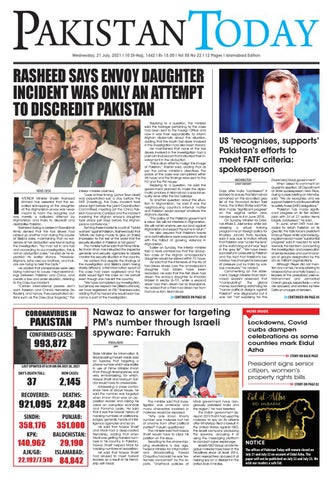
Rasheed says envoy daughteR incident was only an attempt to discRedit pakistan
NeWS DeSk
i
NTERIOR Minister Sheikh Rasheed Ahmed has asserted that the socalled kidnapping of the daughter of the Afghanistan envoy was never meant to harm the daughter, but was merely a colluded attempt by Afghanistan and India to discredit and destabilise Pakistan. Rasheed during a presser in Rawalpindi firmly denied that the taxi drivers had picked up another man during the course of Silsila’s rides, maintaining that no evidence of her abduction was found during the investigation. “No man sat in any taxi and according to our investigation, this is not an abduction case,” he said as he repeated his earlier stance. “However, Afghans, [who are] our brothers, and Indians are trying to twist the facts.” He added that conspiracies were also being hatched to cause misunderstandings between Pakistan and China, and create a law and order situation, referring to the Dasu bus incident. “Certain international powers don’t want Pakistan and China’s friendship [to flourish], and hence, they perpetrated actions such as the Dasu [bus tragedy],” the
interior minister claimed. “Look at their timing. [Johar Town blast] was perpetrated just a day before the FATF [meeting], the Dasu incident took place right before the [Joint Coordination Committee] meeting [of the China Pakistan Economic Corridor] and the incident involving the Afghan envoy’s daughter took place just days before the Afghan peace conference.” Terming these incidents a part of “hybrid warfare” against Pakistan, Rasheed said that “efforts are being made to give an [false] impression to the rest of the world that the security situation in Pakistan is not good.” The minister further said that Prime Minister Imran Khan has instructed the inspector generals and security agencies to closely monitor the security situation in the country. He added that despite the findings of the investigation and Silisila’s claim being starkly different, a first information report of the case had been registered and the state would fight the case on her behalf even though she has left the country. “We have completed our investigation, but [since] we respect her [Silisla’s stance], we have registered an FIR,” Rasheed said, adding that he hoped she would soon become a part of the investigation.
coRonaviRus in
pakistan
CONFIRMED CASES:
993,872
LAST UPDATED AT 8:59 AM ON JULY 20, 2021
DAY'S DEATH TOLL:
NEW CASES:
37
2,145
RECOVERED:
DEATHS:
921,095 22,848 SINDH:
PUNJAB:
358,176
351,000
KPK:
BALOCHISTAN:
140,962 AJK/GB: 22,192/7,510
29,190 ISLAMABAD:
84,842
Replying to a question, the minister said the footage pertaining to the case had been sent to the Foreign Office and now it was their responsibility to inform Afghan diplomats about the situation, adding that the fourth taxi driver involved in the investigation had also been traced. He maintained that none of the taxi drivers involved in the investigation had a past criminal record that indicated their involvement in the abduction. “This is all an effort to malign the image of Pakistan,” Rashid said, adding that as per the prime minister’s directives, the probe of the case was completed within 48 hours and the findings were sent to the FO and the PM House. Replying to a question, he said the government planned to make the diplomatic enclave in Islamabad a special security zone after the Eid holidays. To another question about the situation in Afghanistan, he said it was the neighbouring country’s internal matter and Pakistan would accept whatever the Afghans decide. “The policy of the Pakistani government is clear. We will not interfere in Afghanistan. We will not let anyone use our land against Afghanistan and expect the same in return.” He also assured that Pakistani forces and civil institutions were prepared to deal with the fallout of growing violence in Afghanistan. Earlier on Sunday, the interior minister told a news conference that the abduction case of the Afghan ambassador’s daughter would be solved within 72 hours. He said that the interviews of the trio of taxi drivers whose cars the ambassador’s daughter had ridden have been recorded. He said that the first driver had driven the envoy’s daughter to Khadda Market in sector G-7/1, while a second driver had then driven her to Rawalpindi. He added that a third had driven her from Daman-e-Koh, Islamabad.
CONTINUED ON PAGE 05
US ‘recognises, supports’ Pakistan’s efforts to meet FATF criteria: spokesperson WASHINGTON Staff RepoRt
Days after India “confessed” it lobbied to ensure that Islamabad remained on the so-called grey list of the Financial Action Task Force, the United States said Pakistan made “significant progress” on the original action plan handed over to it in June 2018. On Sunday, Minister for External Affairs S. Jaishankar, while addressing a virtual training programme on foreign policy for Bhartiya Janata Party leaders, said it was due to Indian efforts that Pakistan was “under the lens” of the watchdog and it was “kept in the grey list”. “We have been successful in pressurising Pakistan and the fact that Pakistan’s behaviour has changed is because of pressure put by India by various measures,” he added. Commenting on the statement, Foreign Minister Shah Mahmood Qureshi observed that “manipulating” the global money laundering watchdog for “narrow political designs against Pakistan” was disgraceful but it was not “not surprising for the
Nawaz to answer for targeting PM’s number through Israeli spyware: Farrukh FAISALABAD app
State Minister for Information & Broadcasting Farrukh Habib said on Tuesday that targeting a phone number which was earlier in use of Prime Minister Imran Khan through Israel spyware, was very embarrassing, for which, Nawaz Sharif and Marryum Safdar would have to answerable. Addressing a press conference here at circuit house, he said the number was targeted when Imran Khan was an opposition leader and raising his voice on corruption scandals and Panama Leaks. He said that it was the Nawas’ history of hacking numbers of politicians, judges, generals, heads of intelligence agencies and so on. He said that Nawaz Sharif and Modi had a deep-rooted friendship, adding that when Modi was getting hacked numbers in his country, in Pakistan, Nawaz Sharif helped Modi for hacking numbers of opposition. He said that Nawaz Sharif had refused to meet Hurriyat leaders as a result of his friendship with Modi.
[Narendra] Modi government”. When asked to comment on Qureshi’s assertion, US Department of State spokesperson Ned Price, during a press briefing on Monday, said: “We do recognise, and we support Pakistan’s continued efforts to satisfy those [FATF] obligations.” “Pakistan has made significant progress on its first action plan with 26 of 27 action items largely addressed,” he said. In June, when FATF had decided to retain Pakistan on its grey list, the task force’s president Marcus Pleyer while acknowledging Islamabad made “substantial progress” said it needed to work towards the last item concerning the investigation and prosecution of senior leaders and commanders of groups designated by the UN as militant organisations. Although Pleyer did not mention any names, he was referring to Masood Azhar and Hafiz Saeed — leaders of the proscribed Jaish-eMohammed and Jamaatud Dawah groups, respectively — who are accused, and wanted, by New Delhi on charges of terrorism.
CONTINUED ON PAGE 05
more inside
Lockdowns, Covid curbs dampen celebrations as some countries mark Eidul Azha STORY ON BACK PAGE
President signs senior citizen, women’s property rights bills STORY ON PAGE 02
The minister said that investigation was underway and many characters involved in malware would be exposed. “Why only Imran Khan’s number was malware but not of anyone from other political parties?” Farrukh questioned. The minister said that Nawaz Sharif would have to clear his position on the issue. Reacting to the phone-tapping revelations a day ago, Federal Minister for Information and Broadcasting Fawad Chaudhry had said he was “extremely concerned” by the reports. “Unethical policies of
Modi government have dangerously polarised India and the region,” he had tweeted. The Indian government denied in 2019 that it had used the malware to spy on its citizens after WhatsApp filed a lawsuit in the United States against NSO, the Israeli company producing the spyware, accusing it of using the messaging platform to conduct cyber espionage. Israel’s NSO Group and its Pegasus malware have been in the headlines since at least 2016, when researchers accused it of helping spy on a dissident in the United Arab Emirates.
notice The offices of Pakistan Today will remain closed on July 21 and July 22 on account of Eidul Azha. The paper will not be published on July 22 and July 23. We wish our readers a safe Eid.
02
Wednesday, 21 July, 2021
ISLAMABAD
NEWS
PreSident SignS Senior citizen, woMen’S ProPerty rightS billS ISLAMABAD
P
MiAn AbrAr
RESIDENT Dr Arif Alvi Tuesday signed into law Islamabad Senior Citizens Bill, 2021 and Enforcement of Feminist Property (Amendment) Bill, 2021, paving the way for the empowerment of inheritance to women besides setting up a Senior Citizens Council while steps will be taken for the welfare of senior citizens of Islamabad. The establishment of an old age home “Darul Shafqat” for the elderly will also be implemented while people over the age of 60 will be eligible for the Senior Citizen Card. Senior citizens will have access to
facilities such as museums, parks and libraries free of charge. Treatment facilities, discounts on medicines, separate counters and separate wards will be provided. Elderly people will be given a 20 percent discount on air and rail travel while financial assistance will also be provided to deserving and eligible senior citizens. The President also signed the Enforcement of Women’s Rights (Amendment) Bill 2021. Under the law, Section 5 of the Enforcement of Property Rights Act 2020 has been amended. Under the amendment, the ombudsman’s decision can be appealed to the President within 30 days. Alvi upholds Banking Mohtasib’s order to refund the lost amount to the victim of the
PM to hold rally in Sindh next month: reports NewS DeSk Prime Minister Imran Khan has decided to hold a political rally in Sindh from August, reported Geo. According to Geo, PM Khan’s meetings will be held in Sindh and major personalities will join the PTI. Sources said that meetings with anti-Pakistan People’s Party political forces and joining them with the Pakistan Tehreek-e-Insaf would also be part of the Sindh plan. According to sources, the premier will convene another meeting after Eidul Adha to finalise the party’s Sindh plan. The names of the Sindh Advisory Committee will also be finalised in the same meeting. Sources said that important decisions on obstacles in the implementation of federal projects would also be taken after Eid, while consultations will be held on action against bureaucrats involved in alleged corruption or becoming political tools.
700,000 doses of Sinopharm reach Pakistan ISLAMABAD TLTP
A batch of 700,000 doses of Sinopharm’s anti-Covid vaccine reached Pakistan on Tuesday, with the second consignment of 600,000 doses scheduled to arrive later in the day. According to health ministry officials, two million doses of Sinopharm will arrive in Pakistan in three batches. Earlier, 2.5 million doses of the Moderna vaccine, donated to Pakistan by the US government, arrived earlier in July. Statistics from the National Command and Operations Centre show that 4.5 million people have been vaccinated all over Pakistan, with 22.7 million doses of various vaccines administered. Thirtyseven more deaths due to the coronavirus pandemic were reported during the last twenty-four hours in the country, said the National Command and Operation Centre on Tuesday. According to the NCOC data, 2,145 new cases of coronavirus were reported during the aforementioned period. A total of 40,805 people were tested for the infection on Monday, said the NCOC, out of whom 2,145 turned out to be positive. This brings the positivity ratio across the country to 5.25 percent. Pakistan also reported 37 deaths from the infection over the last 24 hours. With 37 more deaths, 22,848 people have so far succumbed to the virus. The total number of coronavirus cases in the country since the pandemic began has risen to 993,872, while the number of active cases in the country has increased to 49,929. As far as the recoveries are concerned, 921,095 people have recovered from the infection in total. At least 382 new coronavirus cases were recorded in Punjab during the past 24 hours, taking the provincial tally to 351,000. According to the Punjab Primary and Secondary Health Care Department, at least 11 more patients succumbed to the pandemic as the total death count reached 10,892. The department added that at least 329,875 patients had recovered from the deadly virus as of yet, with 119 people recovered in the past 24 hours. Last week, Special Assistant to the Prime Minister on Health Dr Faisal Sultan had said the upcoming Eid-ul-Azha festival will be celebrated in a “limited, closed” environment, hinting at more restrictions to curb the virus spread amid fears of a fourth wave. The minister was speaking about the spike in coronavirus cases and the measures being taken by the federal government. He spoke about the new Delta variant of the coronavirus, saying that the mutations in each new variant of the virus make it very easy to “jump from one person to another. This variant is spreading at a pace of 50-60 percent.”
unauthorized electronic funds transfer case. Meanwhile, President Dr Arif Alvi rejected the representation of a bank against the order of Banking Mohtasib to refund the monetary loss of the account holder that occurred due to Electronic Funds Transfer without his knowledge. The President in his verdict wrote that it was the responsibility of banks to provide knowledge to its account holders about the use of technology to avoid such incidents. “Our simple people need protection through knowledge of technology. The bank must ensure the same,” he stated in response to the representation filed by Habib Bank assailing the order of Banking Mohtasib, which had ordered it to refund the lost amount.
The complainant Ali Ghulam, a retired person who was maintaining his account with the HBL at Islamabad found through his bank statement that an amount of Rs 607,804 was missing from his account through ‘Non 3D Secure Transactions’. He made a complaint to the bank stating that no request was made on his part for activation of the Internet Banking facility and his personal credentials were used in the disputed transactions. On finding no relief to his grievance, the complainant approached the Banking Mohtasib which thrashed the matter on the grounds that the bank did not produce any evidence that it had apprised the account holder of the pros and cons of electronic fund transfer and other related usages of
technology at the time of establishing a banking relationship. The bank was also found non-compliant to the instruction of State Bank of Pakistan Circular dated June 10, 2016, which mandates the bank that “Card Service Provider shall take Consumer’s consent regarding utilization of payment cards on various ADC’s or their cross border usage while maintaining the record of consent as per SBP record /retention policy.” The president in his order said resultantly, the loss of money to the complainant had occurred due to the reason that the bank’s facility of EFT was made operational without his request and consent. “Had this channel not been opened by the Bank, the account holder would have avoided this financial loss,” he said. He said the cumulative reading and perusal of these provisions of law undoubtedly leads to the conclusion that the Banking Mohtasib is to inquire into complaints about banking malpractices, maladministration, wrongdoings, the fraudulent transactions, the corrupt and malafide practices by the Bank officials and pass appropriate orders on conclusion of the inquiry.
NCOC stresses compliance to guidelines during Eidul Azha ISLAMABAD APP
The National Command and Operation Centre on Tuesday declared compliance with the guidelines issued on the occasion of Eid-ul-Azha particularly standard of operating procedures for Eid prayer congregations critical to contain disease spread. The NCOC session was chaired by Federal Minister for Planning, Development and Special Initiatives Asad Umar, wherein the meeting reviewed the implementation of SOPs on Eid-ul-Azha and the spread of the pandemic in Karachi and GilgitBaltistan. The forum was briefed that instructions have been issued to the provincial administrations of all federating units to ensure the implementation of SOPs pertaining to Eid-ul-Azha. The forum expressed satisfaction over additional steps taken by Sindh
government in view of the Covid-19 outbreak. “The NCOC expressed satisfaction at the additional steps taken by Sindh government in view of the Covid spread,” the meeting’s observers noted. A sharp spike in infections has overwhelmed major hospitals in Karachi. The positivity ratio soared past 20 per cent in less than a week and the city’s hospitals are struggling to accommodate patients. According to Sindh Chief Minister Syed Murad Ali Shah, the positivity ratio
hit 25 per cent a day ago. The provincial health officials urged citizens to comply with Covid-19 protocol and to inoculate against the deadly virus. They pointed out that the flouting of SOPs clubbed with the emergence of the Delta variant could lead to a disastrous situation. It appeared that most health facilities are already on the brink of disaster. The forum was informed that keeping in view the surging disease spread, some 500 oxygen cylinders and 30 ventilators were added in Gilgit-
Baltistan. Moreover, the Gilgit-Baltistan government has banned the opening of all restaurants, public gatherings and visit public parks during the Eid-ul-Azha holidays in the wake of Covid-19. According to the notification issued by the government, there will be a ban on indoor and outdoor dining, public gathering, and functions. The forum was briefed on capacity building of vaccination facilities. “At present, over half a million Covid-19 vaccines are being administered daily in the country,” the forum was informed. The Forum announced that the vaccination centres across the country would remain closed only on the first day of Eid-ul-Azha. Moreover, the NCOC was apprised that ample quantity of Moderna vaccine has been provided to vaccination centres for students and others going abroad. Pakistan reported 37 deaths in the last 24 hours by novel coronavirus as the number of positive cases surged to 993,872 on Tuesday. The nationwide tally of fatalities has jumped to 22,848. According to the latest figures by the National Command and Operation Center, 2,145 persons tested positive for Covid-19 in the past 24 hours. Punjab remains the worst-hit province in terms of deaths followed by Sindh and Khyber Pakhtunkhwa.
Women set off on Hajj in Makkah as ‘guardian’ rule cast aside ISLAMABAD AFP
Bushra Shah, a 35-year-old from Pakistan, says she is realising a childhood dream by making the great pilgrimage to Mecca, and under new rules, she’s doing it without a male “guardian”. The Hajj ministry has officially allowed women of all ages to make the pilgrimage without a male relative, known as a mehram, on the condition that they go in a group. The decision is part of social reforms rolled out by de facto leader Crown Prince Mohammed bin Salman, who is trying to shake off the kingdom’s austere image and open up its oil-reliant economy. Since his rise to power, women have been allowed to drive and to travel abroad without a male guardian — even against a backdrop of a relentless crackdown against critics of his rule, including women’s rights activists. “It’s like a dream come true. My childhood dream was to make the Hajj,” Shah told AFP, before setting off from her home in Jeddah, the major port city in western Saudi Arabia. The Hajj, one of the five pillars of Islam, is a must for able-bodied Muslims with the means to do so at least once in their lifetime. For the young mother, making the pilgrimage with her husband and child would have been a distraction that would have prevented her from “concentrating completely on the rites”.
Shah is one of 60,000 pilgrims chosen to take part in this year’s Hajj, which has been dramatically scaled down for the second year running because of the coronavirus pandemic. Only citizens and residents of Saudi Arabia, chosen in a lottery, are taking part. Officials have said that 40 percent of this year’s pilgrims are women. ‘GIFT FROM HEAVEN’: “Many women will also come with me. I am very proud that we are now independent and do not need a guardian,” Shah said. Her husband, Ali Murtada, said he “strongly encouraged” his wife to make the trip alone, after the government’s decision to ban children from participating in the Hajj this year. He will stay in Jeddah to look after their child. “We decided that one of us should go. Maybe she will be pregnant next year or maybe the children will still not be allowed to participate,” the 38-year-old said. It was unclear when the Hajj ministry lifted the restriction, and some women have reported that travel agencies are still reluctant to accept women travelling without a male companion for the Hajj. Some even posted advertisements ruling out groups of unaccompanied women, in a sign of how the dizzying social changes are meeting some resistance in the deeply conservative kingdom. Authorities previously required the presence of a male guardian for any woman pilgrim under the age of 45, preventing many Muslim women around
the world from making the Hajj. That was the case for Marwa Shaker, an Egyptian woman living in the Saudi capital, Riyadh. “Hajj without a guardian is a miracle,” the 42-year-old, who works for a civil society organisation, told AFP. Now travelling to Mecca with three of her friends, the mother of three had tried several times to make the pilgrimage before the pandemic. But she was unable to because her husband had already been and was not permitted to go again so soon.
“I feel enormously joyful. God has called me despite all the obstacles,” she said. For Sadaf Ghafoor, a BritishPakistan doctor, travelling without a male guardian was the “only option”. “We couldn’t leave the children alone,” the 40-year-old said of her three youngsters. Her husband decided to stay behind, and Ghafoor headed to Mecca with a neighbour. “It was not easy to take the decision to go alone […] but we took this opportunity as a blessing,” she said.
Wednesday, 21 July, 2021
ISLAMABAD
NEWS
PakisTan will sTarT exPorTing venTilaTors This year: Fawad
M
NewS DeSk
INISTEr for Information and Broadcasting Fawad Chaudhary on Tuesday said that Pakistan will hopefully start to export ventilators this year. The announcement was made in a tweet, wherein he said that a fourth company has also gotten the license to make ventilators thanks to efforts made by the Ministry of Science and Technology during the pandemic.
“Due to the work achieved at the health ministry during Covid, a fourth company has received the license to produce ventilators,” Fawad said on Twitter. “I’m strongly hopeful that Pakistan will begin exporting ventilators this year,” he added. The minister further said that a health centre was established in Faisalabad and added, “The country will begin producing auto disposable syringes from September.” Pakistan reported 2,145 new coronavirus cases in the last 24 hours, taking the
Jemima criticises Maryam for targeting her children LONDON Staff RepoRt
Jemima Goldsmith, British film producer and former spouse of Prime Minister Imran Khan, lamented the deployment of antiSemitic slurs by Pakistan Muslim LeagueNawaz vice president Maryam Nawaz to target the Jewish lineage of her children. Nawaz, while addressing a rally of charged supporters and activists of her party in Kashmir over the weekend, hit back at Khan who while suggesting the game of polo was reserved for the wealthy questioned the source of income of her son — an active polo player in the United Kingdom. “He [Junaid Safdar] is Nawaz Sharif’s grandson, not [James] Goldsmith’s […] He is not being raised in the lap of Jews,” she had declared. Passed away in 1997, James Goldsmith, Jemima’s father, was a wealthy businessman. “I left Pakistan in 2004 after a decade of antisemitic attacks by the media [and] politicians (& weekly death threats & protests outside my house). But still, it continues,” regretted Goldsmith (nee Khan). Her tweet generated both support and condemnation from Twitterverse across the political spectrum who deplored Nawaz’s selection of words to target her political rival. “This is frankly pathetic. I am sorry you have to go through this,” wrote Meraj Hasan. Academic Ammar Ali Jan observed the “attacks against you and your kids were extremely disgraceful”. “People of Pakistan have nothing but respect for your family. Hope this pushback will be a lesson to those who continue to use bigotry against political opponents,” he wrote.
Tarin holds first meeting of capital market council ISLAMABAD app
The establishment of Capital Market Advisory Council (CMAC) was long overdue as capital markets can improve risk-sharing and the efficiency with which capital is allocated to the real economy, thereby boosting economic growth and development, said Finance Minister ShaukatTarin. Chairing the first meeting of CMAC on Monday, he said that the underlying rationale of the body was to attract investors, especially the ones with lesser resources, to contribute to the capital markets so that their limited resources could be channelised into productive uses. The finance secretary briefed the council members about the purpose behind the formation of the CMAC. “The underlying rationale is to attract investors, especially ones with lesser resources, to contribute in capital markets so that their limited resources are channelised into more productive use. The reforms will be introduced after having input from all the relevant stakeholders,” he stressed.
country’s Covid-19 tally to 993,872. The country’s death toll climbed to 22,848 after 37 more people succumbed to the deadly disease. Meanwhile, 1029 patients recovered from the deadly disease in a day taking total recoveries to 921,095. According to the National Command and Operations Centre, the total active Covid-19 cases across the country were reported to be 49,929. A day earlier, a sharp spike in infections overwhelmed major hospitals in Karachi.
The positivity ratio soared past 20 per cent in less than a week and the city’s hospitals are struggling to accommodate patients. According to Sindh Chief Minister Murad Ali Shah, the positivity ratio hit 25 per cent on Monday.
03
On the same day, in Peshawar, top three hospitals were put on high alert after they reported over 20 coronavirus cases over the last few days. Similarly, 76 new coronavirus cases emerged in Azad Jammu and Kashmir, taking the tally to 22,192.
Covid positivity rate in some areas exceeds 20pc ISLAMABAD Staff RepoRt
Pakistan is facing new challenges in its fight against Covid-19 as the positivity rate in some cities has passed 20 percent, officials and the National Command and Operation Centre said. Amid rising cases of the Delta variant of the virus, the country confirmed 2,145 new Covid-19 infections over the past 24 hours, the NCOC, the department leading the campaign against the pandemic, said on Tuesday. The NCOC said in a statement that the number of total cases rose to 993,872 amidst the fear of a fourth wave. Talking to the media on Monday, the spokesperson of the Sindh government Barrister Murtaza Wahab, said that the Covid-19 positivity ratio in some areas of the province including the port city of Karachi crossed 20 percent. He warned that strict restrictions will be imposed if people do not follow the guidelines identified by the government. The NCOC said that Sindh has been the worst hit, with a total of 358,176 cases, followed by Punjab where the disease was detected in 351,000 people. A total of 22,848 people died of the disease nationwide, including 37 patients who died over the last 24 hours, the NCOC said, adding that 2,697 are in critical condition.
The country currently has 49,929 active cases while
921,095 others have recovered from the disease.
Close race among three political parties in Kashmir election MUZAFFARABAD anadolu agency
Three political parties — Pakistan Tehreek-e-Insaf, Pakistan Muslim League-Nawaz and Pakistan Peoples Party — look racing neck-and-neck as the election campaign takes feverish pitch across the length and breadth of Azad Jammu and Kashmir. Over 3.2 million voters are going to elect the 53member regional assembly for a five-year term in the elections scheduled on Sunday (July 25). Out of 53, there will be direct elections on 45 seats, while eight are reserved for women, technocrats, and religious scholars. But analysts and people on the streets believe that ruling PTI is emerging as a favourite. The history of elections in the region, since 1975, points out that parties ruling Islamabad or its allies have won the elections in the region. The Muslim Conference — the oldest political party of the undivided Jammu and Kashmir — has also won polls when it had allied with a ruling party in Islamabad.
“It has been a tradition in Kashmir that the voters vote for the party which rules Islamabad. And I see slim chances of any change this time too,” said Syed Abrar Shah, a Muzaffarabad-based political commentator. He said the reason behind such a rationale is that the AJK is heavily dependent on resources from Islamabad and a ruling party liberally provides such resources. “For many here, same party rule in Islamabad and Muzaffarabad means more funds and projects for AJK, mainly the rural areas,” he said. Following the division of the Jammu and Kashmir into Pakistan and India-controlled parts in 1947, the AJK was governed under the presidential form of government. In 1975, then Prime Minister Zulfikar Ali Bhutto introduced the parliamentary system of governance in the region. This first government headed by Bhutto’s PPP was dismissed in 1977 due to the imposition of martial law. There were no elections until 1985. So far, the PPP and the Muslim Conference have formed four governments each, whereas the PML(N) has managed to rule the AJK once.
STIFF FIGHT: Before launching its chapter in 2011, PML-N used to support the Muslim Conference in the polls. The reason behind its move was the Muslim Conference had supported the then-president Pervez Musharraf. Ameer Mughal, another Muzaffarabad-based analyst, said there will be no walkover to the PTI. He said the two other parties PML-N and the PPP were giving a stiff fight and are equally in the race. “Islamabad’s ruling party is going to win the elections in AJK once again. But not easily this time,” he said. According to him, the performance of the PTI over the past three years, since it assumed office in Islamabad, is proving a disadvantage for its candidates. He, however, said the PTI has the “advantage” of being new to the region that brightens its chances of appearing a favourite. Shah predicted that out of 45 general seats, the PTI can secure 18-22 seats, the PPP may garner 8-10 seats, and the PML-N 4-6 seats. The local Muslim Conference and independent candidates may win another 3-4 seats. Sajjad Mir, a political analyst, said there are chances that history may be reversed this time in the region. “No doubt, it’s been a tradition that the AJK voters usually prefer the party ruling in Pakistan. But this time, the ground reality is different. We may have an upset this time,” Mir said. “Even if the PTI manages to will against all these odds, it will be by a thin margin, and will need coalition partners to form the government with a weak foundation,” he said. He referred to issues like price rise, increasing inflation as issues working against the PTI. “The PTI despite using all the government resources, could win only 8 seats in the nearby Gilgit-Baltistan region last year. It was the independent candidates who later joined the PTI to help it form the government. But here in Kashmir, hardly any independent candidate can win,” he said. NO CARETAKER SETUP: Also, there is no arrangement for installing a caretaker government in AJK ahead of elections. The incumbent government supervises the elections. “It was the caretaker setup, which stretched to five months instead of its constitutional term of three months, that helped PTI to win the elections in GB. Whereas, according to the constitution, there is no provision of a caretaker setup before polls in AJK,” he said.
Wednesday, 21 July, 2021
04 NEWS
ISLAMABAD
Islamabad: A view of dark clouds hovering on the sky. oNlINe
Turkish groups to distribute meat in Pakistan ISLAMABAD ANAdolu AgeNcy
Turkish humanitarian aid groups are set to distribute aid to tens of thousands of needy people in Pakistan on the holiday of Eidul Adha. “We will slaughter 700 cattle in Pakistan. We expect that about 90,000 people will benefit from the aid,” Ibrahim Carlos Camilo, the Turkish Red Crescent’s regional head, told Anadolu Agency.The aid will be distributed in the Khyber Pakhtunkhwa and Punjab, and the Azad
Kashmir region, Camilo said. “Turkey’s Humanitarian Relief Foundation has plans to slaughter 280 cattle in 16 different regions. We will distribute sacrificial meat to 10,450 families and 700 orphans in the country,” IHH’s Pakistan Representative Murat Kavaktan said. Turkish humanitarian aid groups provide different forms of assistance to poor families worldwide, especially during religious occasions and festivals. On Eidul Adha, people who can afford to slaughter an animal do so and distribute most of the meat to the needy, neighbours and relatives.
HosPitals in KaracHi rEacHing caPacity as DElta variant sPrEaDs KARAcHI
t
ReuteRs
HE spread of the coronavirus Delta variant is reaching alarming levels in Karachi on the eve of Eidul Azha as public and some private sector hospitals are reaching capacity and have started refusing patients, medical officials said on Tuesday. The Sindh government said on Monday that the Covid19 situation in the city is becoming serious, and warned people that ignoring precautionary measures during the three-day Eid holiday could make matters worse. During the past 24 hours, the coronavirus positivity rate in the metropolis increased to 25.7 percent, nearly five times the national rate of 5.25 percent. “Government hospitals have reached saturation point, something not witnessed during previous waves, and even some private hospitals are refusing patients,” said Dr Qaiser Sajjad, secretary-general of the Pakistan Medical Association. “God have mercy on us as people are not taking this pandemic seriously. Such irresponsible behaviour on the Eid festival will make matters worse,” Sajjad told Reuters. The Delta
variant could spread during the holiday as people travel from cities like Karachi to their home towns. According to the Centre for Chemical and Biological Sciences at the University of Karachi, there is 92.2 percent prevalence of the Delta variant in the city. Dr Seemin Jamali, executive director of Jinnah Hospital, Karachi’s biggest, told Reuters that 77 out of its 90 coronavirus beds were occupied and it was planned to add more. “We did not face such a capacity situation during previous waves,” Jamali said. “The situation is getting pretty bad.” The Eid holiday and upcoming elections in Azad Jammu and Kashmir on July 25 could prove to be super spreader events, as government and opposition are busy holding big public gatherings, the two doctors warned. Earlier, sources had told Dawn the health facilities where Covid-19 beds were now largely occupied included the Sindh Institute of Infectious Diseases — a key government facility providing quality freeof-cost treatment to coronavirus patients — Ojha campus of Dow University of Health Sciences, Qatar General Hospital, Civil Hospital Karachi, Lyari General Hospital, Indus Hospital and the 140-bed facility set up at Expo Centre.
Buzdar directs WASA to stay alert amid monsoon rains LAHORE INP
Punjab Chief Minister Usman Buzdar on Tuesday ordered the Water and Sewerage Authority and his management to remain on high alert due to the arrival of monsoon season in Lahore and other cities of the province. Per the statement issued by his office, WASA and provincial authorities have been directed to take immediate steps for the drainage of water from low-lying neighbourhoods. Drainage through machinery should be ensured in the minimum time possible, said Buzdar, adding that effective measures should be taken to ensure smooth flow of traffic during rain. On the other hand, heavy rain has disrupted the transmission system of Lahore Electric Supply Company in different parts of the city. About 130 feeders tripped due to heavy rain in Lahore on Tuesday. Many areas in
DELTA VARIANT HAS ‘SPREAD ACROSS KARACHI’: “The Delta variant is highly contagious and has spread across the city,” said Associate Professor Dr Ishtiaq Ahmed Khan at the Jamilur Rahman Centre for Genomics Research at KU. He regretted public behaviour and said people were not taking the Delta variant seriously. “They are thinking that the fourth coronavirus wave won’t affect them as has happened during the past Covid-19 episodes. But, unfortunately, this might not be the case this time,” he said, calling for strict enforcement of SOPs. Last week, Minister for Planning, Development and Special Initiatives, Asad Umar, said hospitals were seeing a rapid build-up in the influx of Covid patients. He had earlier warned of a fourth wave if precautionary measures were not followed. First identified in India in March, Delta variant has spread to more than 90 countries and is also the most dominant variant in India, the United Kingdom, Russia, Israel, Singapore and more than a dozen other countries. The variant, scientists say, has features that allow it to evade some of the body’s immune system defences. Plus, it has the highest transmissibility of any variant so far, a dangerous combination.
Punjab govt issues guidelines for Eid prayers, sacrificial animals LAHORE INP
the city are facing power outages due to this and other technical faults. Power outages in Allama Iqbal Town, Mustafabad, Chauburji Park, Ali Park, and Data Nagar neighbourhoods have disrupted daily life.
The Punjab government on Tuesday issued standard operating procedures for Eidul Adha prayer and sacrifice of animals in wake of a surge in Covid infections that has stoked fears of a fourth wave. According to a notification issued by the Home Department, the payers would be held at open places and where it is offered indoors, the doors and windows would remain open to ensure cross ventilation. “Eid prayers should be offered in phases to avoid mass congregations,” it said while further requesting scholars and clerics to ensure keeping the sermons short to minimise the risk of Covid spread. The notification issued by the Punjab government also directed against bringing ailing, aged, and children for prayers. “Those entering the prayer area should be tested for temperature besides also being sanitised,” it said.
Wednesday, 21 July, 2021
ISLAMABAD
NEWS
05
SECP for aCtion againSt ComPaniES with unvaCCinatEd EmPloyEES ISLAMABAD
t
rasheed asserts envoy daughter incident was only an attempt to discredit Pakistan contInuED fRoM PAgE 01
STAFF REPORT
HE Securities and Exchange Commission of Pakistan (SECP) has advised over 146,000 companies registered with it, to ensure that their employees, including their families, get vaccinated as soon as possible, warning of regulatory actions if directions are not followed. "The SECP will consider regulatory measures against companies that fail to effectively adhere to the directions and policies of the government for combating the pandemic," the corporate sector regulator said in a circular issued here on Monday. As per the circular, all companies are required to submit vaccination details of their employees and their families by July 26.
US ‘recognises, supports’ Pakistan’s efforts to meet FATF criteria: spokesperson contInuED fRoM PAgE 01
The interior minister said that footage of her trip from Rawalpindi to Daman-e-Koh was missing and the matter was under investigation. He said that the “riddle” would be solved by the evening and all aspects of the case would be unearthed, reflecting some gaps in the statement of the victim. Later on the same day, the interior minister told the media that the kidnapping allegations were suspicious as the investigation has revealed all the facts. “There is a clear difference between the evidence of the investigation and the statement of the Afghan ambassador’s daughter. In the CCTV footage, the girl was walking in the market of Islamabad, Rawalpindi and later Daman-e-Koh,” he said. He also said that the investigation had revealed that the Afghan ambassador’s daughter had lied and no incident of kidnapping had taken place. “The Afghan ambassador’s daughter said her phone was snatched. But the phone was recovered from her,” he said. The minister said that the envoy’s daughter had changed four taxis and no kidnapping allegation was proved. A medical examination report, shared on social media and later confirmed by the Pakistan Institute of Medical Sciences where Alikhil was treated, said that she was admitted with swelling and rope marks on the wrists and ankles. The report said that she was held for more than five hours and also noted that she had some swelling in the brain’s rear occipital region. There were three drivers under investigation, wherein the first had taken the victim to Khadda Market, a second had then driven her to Rawalpindi, and a third had driven her from Daman-e-Koh. However, the statement of the victim did not mention her visit to Khadda Market, Rawalpindi and Daman-e-Koh. Social media activists took to the social media site, Twitter, to register their protest over the Afghan government’s decision to recall its diplomatic staff from Islamabad. “Why should not #Afghan Embassy be handed over 2 Taliban who controls 80 percent of Afghanistan. Kabul regime has no longer functional internal sovereignty. Send Afghan Ambassador back. Recognise de-facto Taliban govt as de-jure Afghan govt,” tweeted Jan Achakzai, a noted columnist and political commentator.
The initial compliance report to be filed at the website of SECP should contain the name of the company, total number of employees, number of employees vaccinated, number of family members eligible for vaccination and the number of eligible family members vaccinated. The circular has been issued to all public listed companies, public unlisted and private companies, associations, trade bodies, chambers, non-bank microfinance companies, modarabas, insurance companies, NBFIs, brokers, intermediaries etc. "In case the employees and their families have not yet started and participated in the vaccination drive, the management of the companies are advised to encourage them for vaccination and provide a compliance report by August 31, 2021." the SECP circular added. The companies were informed that in order to speed
The demand is also backed by Washington, London and Paris, although they like New Delhi do not provide any credible evidence. Price said Washington would “encourage Pakistan to continue working with the FATF and the international community to swiftly complete the remaining action item[s] by demonstrating that terrorism financing, investigations, and prosecutions target senior leaders and commanders of UN-designated groups”. “We do further encourage Pakistan to expeditiously implement its new second action plan,” he said. PAKISTAN CONSIDERS MOVING FATF: The Foreign Office a day earlier said the government was contemplating approaching the money laundering watchdog for an
“appropriate action” against Jaishankar’s claims It observed “India’s credentials for assessing Pakistan in FATF as co-chair” of the body or “for that matter, any other country[‘s] are subject to questions, which we urge FATF to look into.” “Pakistan has always been highlighting to the international community the politicisation of FATF and undermining of its processes by India. The recent Indian statement is just further corroboration of its continued efforts to use an important technical forum for its narrow political designs against Pakistan,” it said. “While Pakistan has been sincerely and constructively engaged with FATF during the implementation of the Action Plan, India has left no stone unturned in casting doubts on Pakistan’s progress through dis-
graceful means. “Pakistan has been exposing India’s duplicitous role to the international community in the past and it will also bring this recent confession by India to the notice of FATF and broader international community.” The statement observed Islamabad’s “immense progress in AML/CTF [anti-money laundering/counter terror financing] domain demonstrated through concrete, tangible and verifiable actions has been openly acknowledged by FATF”. It said Pakistan had resolved to sustain the momentum and trajectory with the support and cooperation of its international partners. “India’s delusions of putting pressure on Pakistan have always remained unfulfilled and would never see the light of day,” it said.
Current account ends FY21 in deficit Pakistan’s current account recorded a deficit of $1.85 billion in fiscal year 2020-21 owing to a jump in imports on account of rise in crude oil prices and vaccine arrivals. The deficit came despite the fact that the current account remained in surplus in the first 11 months (July 2020 to May 2021) of the previous fiscal year. According to data of the State Bank of Pakistan (SBP) compiled in a report by The Express Tribune, the current account deficit - gap between foreign payments and income - had stood at $4.45 billion in fiscal year 2019-20. “Pakistan’s external position is at its strongest in many years,” remarked the SBP in a tweet on Monday. “In line with SBP’s projections, the current account deficit in FY21 fell to only 0.6% of GDP, which is the lowest in 10 years, with exports and remittances at all-time highs.” It said that foreign exchange reserves rose by $5.2
billion in FY21 to over $17 billion - a 4.5-year high. Exports of goods from the country increased 13.73% from $22.5 billion in fiscal year 2019-20 to $25.3 billion in fiscal year 2020-21. On the other hand, imports of goods spiked 23% to $53.8 billion in the previous fiscal year. The country had imported goods worth $43.6 billion in FY20. In addition, the primary income of the country fell 14% during the previous fiscal year, which widened the deficit. According to the SBP, the current account deficit widened to $1.6 billion in June 2021 compared to $650 million in May 2021. “Exports of goods and remittances increased by $368 million and $197 million respectively,” it said. “Meanwhile, imports of goods rose by $1.4 billion.” NEWS DESK
up the vaccination drive, the government of Pakistan has made vaccination mandatory for office workers and advised to encourage their business suppliers, vendors, and customers to get themselves and their families vaccinated at the earliest. The circular stressed that vaccination is seen as the only viable way to counter this global health crisis, as those who have not received the vaccine are seven times more likely to contract the virus than those inoculated. Further, tt also suggested that companies should spend their corporate social responsibility funds for vaccinations. Meanwhile a senior official of the commission added that the data collected will be shared with the NCOC and if needed relevant agencies in coordination with SECP will conduct a counter check of selected data through the NCOC and NADRA's SMS system.
KP sees 50pc drop in business activities PESHAWAR AZIZ BUNERI
Like the rest of the country, Khyber Pakhtunkhwa (KP) has witnessed a 50 per cent drop in business activities due to inflation and rising prices of basic commodities. KP Traders Union President Mujeeb-ur-Rehman told Profit that the rise in prices of food prices, petroleum products and coronavirus has led to low purchasing power of the common man. “The sharp surge in inflation hasn’t only affected the general public but also traders.” He added that last year’s lock down to curb the coronavirus affected business activities, especially small businesses across the province. “By the time government measures to contain coronavirus were relaxed, the common man had lost the power to purchase food, garments, shoes and other necessities,” Rehman said. The continuous increase petroleum products have played major role in increasing the prices of essential commodities which have surged 50 to 60 per cent; people are not coming out for Eid shopping either. Mujeeb said that the business community is facing difficulties due to the drop in sales during Eid season this year whereas there is no hope of relief in electricity bills. He said the government should announce a comprehensive package for small traders in Khyber Pakhtunkhwa who suffered terrorism in the last three decades and were unlucky enough to suffer a pandemic right when they expected things to get better. On the other hand, Irshad Ali, a government employee from Peshawar, said that the current inflation has not only affected ordinary workers but also government employees. “The current salaries can hardly fulfill the basic requirements of our households. There is no way to shop for Eid in our salaries.” He said that the minimum wages of workers classes should be increased at the same pace at which inflation has increased during the present government’s tenure.
Stranded and shattered seafarers threaten global supply lines DELHI AGENCIES
“I’ve seen many men cry,” says Captain Tejinder Singh, who hasn’t set foot on dry land in more than seven months and isn’t sure when he’ll go home. “We are forgotten and taken for granted,” he says of the plight facing tens of thousands of seafarers like him, stranded at sea as the Delta variant of the coronavirus wreaks havoc on shore. “People don’t know how their supermarkets are stocked up.” Singh and most of his 20-strong crew have criss-crossed the globe on an exhausting odyssey: from India to the United States then on to China, where they were stuck off the congested coast for weeks waiting to unload cargo. He was speaking to Reuters from the Pacific Ocean as his ship now heads to Australia. They are among about 100,000 seafarers stranded at sea beyond their regular stints of typically three to nine months, according to the International Chamber of Shipping (ICS), many without even a day’s break on land. Another 100,000 are stuck on shore, unable to board the ships they need to earn a living on.
The Delta variant devastating parts of Asia – home to many of the world’s 1.7 million commercial seafarers – has prompted many nations to cut off land access to visiting crews, in some cases even for medical treatment. Just 2.5% of seafarers – one in every 40 – have been vaccinated, the ICS estimates. The United Nations describes the situation as a humanitarian crisis at sea and says governments should class seafarers as essential workers. Given ships transport around 90% of the world’s trade, the deepening crisis also poses a major threat to the supply chains we rely on for everything from oil and iron to food and electronics. Bulk carrier master Singh, from northern India, is not optimistic of going ashore anytime soon; his last stint at sea lasted 11 months. He said his crew of Indians and Filipinos were living out of cabins measuring about 15 feet by 6 feet. “Being at sea for a very long time is tough,” he says, adding that he had heard reports of seafarers killing themselves on other ships. “The most difficult question to answer is when kids ask, ‘Papa, when you are coming home?'” he said from his vessel, which was
recently carrying coal. India and the Philippines, both reeling from vicious waves of COVID-19, account for more than a third of the world’s commercial seafarers, said Guy Platten, secretary general of the ICS, which represents over 80% of the world’s merchant fleet. “We are seriously disturbed that a second global crew change crisis is looming large on the horizon,” he told Reuters, referring to a months-long stretch in 2020 when 200,000 seafarers on ships were unable to be relieved. People are desperate In a snapshot of the situation, this month almost 9% of merchant sailors have been stuck aboard their ships beyond their contracts’ expiry, up from just over 7% in May, according to data compiled by the Global Maritime Forum non-profit group from 10 ship managers together responsible for over 90,000 seafarers. The maximum allowed contract length is 11 months, as stipulated by a United Nations seafaring convention. In normal times, around 50,000 seafarers rotate on and 50,000 rotate off ships per month on average but the numbers are now a fraction of that, according to industry players, though there are no precise figures.
cMYK
The new crew crisis stems from restrictions imposed by major maritime nations across Asia including South Korea, Taiwan, and China, which are home to many of the world’s busiest container ports. Requirements range from mandatory testing for crews who come from or have visited certain countries, to outright bans on crew changes and berthing operations. “Asia really is struggling and the only countries you can go about routine crew changes to some extent are Japan and Singapore,” said Rajesh Unni, chief executive of Synergy Marine Group, a leading ship manager responsible for 14,000 seafarers. “The issue is that we have one set of people who desperately want to go home because they have finished their tenure, and another set of people onshore that are desperate to get back onboard to earn a living.” Global brands, beware The crisis has led to almost half of commercial seafarers either considering leaving the industry or being unsure whether they would stay or go, according to a survey by the International Transport Workers’ Federation (ITF) in March. This suggests a looming labor crunch that would strain the world’s 50,000-strong
merchant shipping fleet and threaten the integrity of global supply chains. A shortage of container ships carrying consumer products and logjams at ports around the world are already rippling through the retail industry, which has seen freight rates spike to record levels, driving up prices for goods. “You don’t have enough crew anyway. The shipping industry was working on a very lean model,” said Mark O’Neil, chief executive officer of leading ship manager Columbia Shipmanagement and also president of the international association for ship and crew managers. “But now we have all of these problems and we have a large number of seafarers taken out of that available crewing pool,” he said, adding that the result could be vessels unable to sail. Stephen Cotton, general secretary of the ITF, said seafarers were being pushed to their physical and mental limits. “Some in the industry estimate that as many as 25% fewer seafarers are joining vessels than pre-pandemic,” he added. “We have warned that global brands need to be ready for the moment some of these tired and fatigued people finally snap.”
Wednesday, 21 July, 2021
06 COMMENT
Lesson to be learnt from Martyrs’ Day
The Pegasus and Pakistan An international issue requires an international response
The Kashmiris have an indomitable fighting spirit
A
n in-depth investigation by 17 major international news organizations claims that the israeli cyber firm nSO Group has sold cellphone malware that infects iPhones and Android devices and extracts messages, photos and emails, and secretly activates microphones. According to a report india, one of the Pegasus customers, had also targeted a phone which was earlier in Prime Minister imran Khan’s use through the malware. information Minister Fawad chaudhry has expressed concern on the report and said the unethical policies of the Modi government have “dangerously polarised india and the region”. The nSO maintains that the Pegasus is only intended for use against criminals and terrorists. The media investigation has prepared a list of more than 50,000 hacked phone numbers operated by business executives, religious figures, academics, human rights activists, nGO employees and government officials, including cabinet ministers, presidents and prime ministers. The phone numbers of more than 180 journalists listed in the data belong to reporters, editors and executives from some of the most prestigious international newspapers and agencies. This refutes the claim that the hacking is aimed at “criminals and terrorists”. in fact the hacking malware itself can be used to commit crimes. A freelance Mexican reporter, cecilio Pineda Birto, named in the list, was found to have been murdered as killers were able to locate him at a carwash. He was among Mexican journalists apparently selected for surveillance over a two-year period. As the spyware can be used to exactly locate an individual through the phone number, it has presumably been used to target a number of Palestinian resistance figures. The Pegasus also violates peoples’ privacy, making it easy to blackmail important individuals who can be forced to act upon directives that are illegal or against national interest. The Pegasus poses a threat to well established smartphone companies by bringing down their ratings as it breaks into their secrecy codes and users lose confidence in their smartphones. The PTi government is reportedly meditating to develop a new software for the federal ministers as a firewall against the Pegasus. This is a costly enterprise with doubtful outcome. it needs to be accompanied by raising the issue at world forums with like-minded countries for a global moratorium on the international spyware trade.
Amjed jAAved
S
ince 13 July 1932, Martyrs’ Day has been observed in memory of the 13 July 1931 martyrs. it used to be observed with great farvour in occupied Kashmir, Pakistan, Britain and in other countries by the Kashmiri Diaspora and sympathisers of the Kashmir cause. it is a tribute to the Kashmiris’ indomitable spirit that they observed the day even while under the yoke of the Dogras’ tyrannical rule. india could not dare stop observance of the day until it abolished the special status of the state on 5 August 2019. The day has great significance as it reflected that the Dogra rule could not gag the Kashmiris’ resistance despite the Dogra’s incessant reign of terror. To stifle the Kashmiris’ fighting spirit, the Dogra punished even Kashmiri children who played with slingshots and stones. Under the Dogra rule, the Kashmiris were treated no better than beasts of burden. instead of donkeys and horses, Kashmiri Muslims were used to transport goods across Gilgit, Leh and Skardu. They carried luggage on their backs across glaciers as high as 17,000 feet. Thousands perished along the way each year from frostbite, fall from a precipice, and hunger or sickness. The Dogra caravans were not humane enough to stop for a while in the snowy passes to look after the injured porters. Besides performing forced labour, Kashmiris had to pay heavy taxes. All their produce was confiscated by the Dogra. Little was left for tillers and their children to eat. On every item, the oppressed Kashmiri had to pay multiple taxes. Take shawls. not only the shawl-makers were taxed, but also the other intermediaries like importers of pashmina from Ladakh, and storekeepers, whether wholesalers or retailers. The regressive revenue system resulted in famine during the winter of 1877. People began to die of starvation. instead of releasing grain stocks from the royal go-downs, the maharajah’s constabulary drowned the starved, crying people in the Wular Lake.
Khalizad calls on PM Khan The meeting took place in less than ideal circumstance
T
He visit of US Special representative for Afghanistan, Zalmay Khalilzad, to Prime Minister imran Khan was watched with bated breath not just by Pakistanis, but by everyone in the region. Mr Khalilzad called upon the prime minister as the situation in Afghanistan worsened. The visit shows more than anything that while the United States may have exited Afghanistan, they are still very much interested in any developments in the region. While a meeting of this sort could on better days be considered a regular affair, Khalilzad came for a very brief trip on Monday and left immediately after talking to imran Khan. The circumstances seem urgent because they are. Khalilzad arrived in islamabad from Qatar where the Taliban and Afghan government representatives have held two days of talks that ended late Sunday, with a promise by the warring sides to meet again. The visit was also hours after Afghanistan withdrew its ambassador from Pakistan late Sunday after the diplomat’s daughter was brutally attacked last week. To further stress how serious the matter is, the US envoy also met with Pakistan’s army chief General Qamar Javed Bajwa but nothing was immediately known of their discussions. One thing is clear: Pakistan must immediately do all that it can to help give Afghanistan stability. Another takeover by the Taliban will mean nothing but destruction and international backlash for Pakistan that it cannot in good conscience afford right now. To be fair, Prime Minister imran Khan has made his stance on the matter quite clear and said that the US announcing a date for its exit from Afghanistan meant that leverage at the negotiating table was lost and the Taliban gained momentum. With an exit date in sight, there was little that could be done. The Taliban forces have bated their time over the past two decades and have emerged strong once again after the US exit. With an almost clear path to victory in sight, they will feel even more emboldened. That clear path can be made more difficult by Pakistan acting proactively, and the other side of the negotiating table can gain some much needed momentum. With missiles landing close to the Afghan Presidential Palace as President Ashraf Ghani and the country’s ruling brass prayed their eid namaz, the Afghan government did put on a brave face. However, without much needed assistance, they cannot keep it up for much longer.
TAmseel AqdAs
“H
e who controls the heartland controls the world”Halford Mackinder. The assertion of this concept is portrayed in the contemporary dynamics of central Asia, along with its emerging power struggles. The region comprises the heart of eurasia and has retained strategic significance for trade routes throughout history. As of now, strides for central Asian dominance are observed in the international system, with aspirations of accessing the land’s untapped mineral, oil, and gas resources. However, due to the prevalence of rugged mountains and lack of sea access, central Asia has inadequate connections and routes. Such factors resulted in the region’s isolation from global power games; however, china’s aspirations for accessing central Asia via the Wakhan corridor have altered the dimensions of the region for the new Great Game. inarguably, the flashpoint for the initiation of the new Great Game is equated to the narrow strip of land under the sovereignty of Afghanistan, coined as the geostrategically significant Wakhan corridor. Histor-
Editor Joint Editor
Umar Aziz Executive Editor
Lahore – Ph: 042-36300938, 042-36375965
The lesson from the Kashmiris’ struggle for freedom is that repression or palliatives like elections in occupied Kashmir are no good. India shall have to allow the Kashmiris to exercise their right of selfdetermination.
The Wakhan Corridor looms very large in Central Asia
Arif Nizami
Managing Editor
The above events served as a catalyst to the fateful day of 13 July. These included a desecration of holy Quran, and also trial (in camera) of Kashmiri youth Abdul Qadeer by the Dogra’s kangaroo court. Qadeer’s offence was that he had pointed his finger towards the Maharajah’d palace and shouted, “Destroy its every brick”. Abdul Qadeer, from Swat, was an employee of an english army officer, Major Butt of the Yorkshire Regiment posted at Peshawar. While the trial was in progress, a young man arose to say azan. He was shot dead. Another person arose and he too was shot dead. Thus about 21 persons were shot dead in succession. The July 13 event happened in spite of Dogra rulers’ efforts to gag Kashmiris’ voice during the preceding period (1846 to 1931). The struggle for freedom continued in the post-1931 period. it baffles one’s imagination how Kashmiris have sustained their spirit of resistance despite about 162 years of oppression (Dogra rule 1846-1947 to india’s raj, 1947 onwards). india marched its forces into the Valley and annexed Kashmir on 27 October 1947. The selfconceited basis for india’s aggression was a fake instrument of accession. The world community does not recognise this so-called instrument. Thus, the United nations granted the right of self-determination to the Kashmiris. This right is enshrined in the Un’s resolutions of 1948 and 1949. Toynbee’s challenge and Response Theory suggests that if the challenge is too strong, a nation becomes apathetic. ibn-e-Khaldoon’s asabiya (spirit of national cohesion) concept also suggests that a nation’s spirit is likely to be smothered by a challenge which is too heavy. Yet either indians nor the Dogra could gag the Kashmiris. The struggle for freedom has continued unabated despite centuries of oppression. The lesson from the Kashmiris’ struggle for freedom is that repression or palliatives like elections in occupied Kashmir are no good. india shall have to allow the Kashmiris to exercise their right of self-determination. The writer is a freelance journalist, has served in the Pakistan government for 39 years and holds degrees in economics, business administration, and law. He can be reached at amjedjaaved@gmail.com
The new great game in Central Asia
Dedicated to the legacy of the late Hameed Nizami
Yousaf Nizami Aziz-ud-Din Ahmad
The reign of terror by indian forces (now estimated at about 900.000 regulars and security personnel) who replaced the maharajah’s constabulary on 27 October 1947, is no less gruesome. international human rights organisations, as well as india’s national Human Rights commission, have brought into the limelight the mysterious disappearances, the custodial deaths, and countless rapes of hapless women. Like the Dogra, indian rulers are mercilessly exploiting Kashmiris’ economic resources. The bulk of locally-generated electricity is being diverted to indian states. The tourism industry is in shambles. Highly educated people have no jobs. With no inflow of tourists, the shopkeepers have no business. Unlike occupied Kashmir, all the socio-economic sectors in Azad Kashmir are progressing by leaps and bounds. Both permanent and temporary members of the Security council had sympathy with Pakistan’s point of view on Kashmir. Still, india regarded the Kashmiri as a chattel. congress exminister and Kashmiri politician Saifuddin Soz said Home Minister Vallabhbhai Patel was happy to let Kashmir go to Pakistan in exchange for Hyderabad. Lord Mountbatten took Patel’s offer to Pakistan on the exact day the indian Army landed in Srinagar. A landholder in Udhampur in Jammu converted to islam of his free will. The Hindu tehsildar eliminated his share of ownership by transferring it in the name of his brother. The landholder filed a suit for restoration of title. But the court deviously ordered that to get re-entitled the convert should revert to his old religion. The order was based on a decree issued on 31 December 1882. The court’s judgment was interpreted as interference by Hindu rulers in the religious domain of Muslims. Thus the Kashmiri Muslims began to hold rallies and processions despite prohibition on assembly of persons and on Friday sermons. The Muslims petitioned the Additional District Magistrate against a Hindu inspector for disturbing a religious assembly, which was dismissed because the Hindu magistrate held that sermon was not a part of the prayer. On 19 April 1931, the Dogra ruler banned even the eid sermon. Head Warder Balak Ram and Sub-inspector Labhu Ram desecrated the holy Quran while reprimanding constable Fazal Dad of Mirpur. On 20 June 1931, some mutilated pages of the Holy Quran were found in a public latrine in Srinagar.
I
Karachi – Ph: 021-35381208-9
I
ically, the region fell victim to the Great Game at the hands of the British and Russian empires, and the contemporary dynamics assert a similar pattern. With china’s aspirations for creating a highway as part of the mega Belt and Road initiative, Pakistan and china will gain access to the untapped yet abundant central Asian resources. Since these steps directly challenge the interests of india and the USA, the region may serve as the flashpoint for the new Great Game between numerous conflict actors. china aims to revive the former Silk route by constructing a highway through the Wakhjir pass in the Wakhan corridor. Subsequently, central Asian states will be linked via the Karakoram and Kashgar highway, marking the shortest and cheapest trade route with Pakistan and china. Regional trade and associations shall accelerate through increased commerce with central Asia and the Gwadar port, increasing china’s economic and military influence over the region. For instance, investments in gas pipeline routes seek to increase china’s energy dominance in central Asia. Along the same lines, the Wakhan corridor offers economic prospects for Pakistan too, because strides towards a transit economy, job generation, foreign revenue, and regional connectivity shall be undertaken, as the establishment of a route shall integrate the strategic corridors of central Asian states, Afghanistan, Pakistan, and china. The resource-abundant states of central Asia have access to 22 billion barrels of oil in Kazakhstan, 7.5 trillion cubic meters of gas in Azerbaijan, 37 billion barrels of oil in Turkmenistan; meaning, economic incentives for both china and Pakistan. nevertheless, the ambitions affiliated with the Wakhan corridor carry signs of projecting the new Great Game. To begin, this notion directly challenges the national interests of india, since efforts for linking Afghanistan, india, and the chabahar port for regional connectivity shall be undermined. in an attempt to counter the rising influence of china, india has introduced measures to revive historic civilization links with central Asia. indian dyansties such as the
Islamabad – Ph: 051-2204545
I
Web: www.pakistantoday.com.pk
I
Mughals were of central Asian descent, and the region served as a critical component of the Silk Road. Hence, india has extended assistance to central Asian states under the notion of capacity building and human resource development in information technology, pharmaceuticals, and healthcare. Furthermore, the Wakhan corridor highway project directly targets indian national interest in Kashmir. The Karakoram Highway’s establishment was opposed due to its descent from Pakistan administered Kashmir and its role in china’s string of pearls strategy for indian isolation. Hence, the highway project along with china’s increased presence in central Asia and Afghanistan, challenges the border security of india alongside Kashmir, and its aspirations to dominate the region. Adding on, the Wakhan corridor project further aspires to establish a link with the Gwadar port, thereby increasing Pakistan’s trading potential and boosting its economy. Since the states have been involved in diplomatic and military rivalries since 1947, the economic rise of Pakistan impacts the integrity of india. Further, the USA views central Asia as a battleground for countering china’s rising global influence. Although the USA retained a military presence in Afghanistan previously, the Wakhan corridor project has altered its approach altogether. investments in the private sector have been initiated. For instance, $100 million were allocated to Uzbekistan for developing financial markets and increasing trade relations with Afghanistan. consequently, the rising strides towards the Wakhan corridor could be challenged, along with china’s influence. in conclusion, the recent developments in the Wakhan corridor have served as a flashpoint for the new Great Game in resource-abundant central Asia. The current dynamics lie in favour of china and Pakistan; nevertheless, both india and the USA have initiated measures to alter the tide. Since the witnessed developments are recent, the true potential and implications of the new Great Game are yet to be witnessed. can central Asia become a battleground in the US-china cold War? The writer is a freelance columnist
Email: editorial@pakistantoday.com.pk
Wednesday, 21 July, 2021
COMMENT 07 Editor’s mail Send your letters to: Letters to Editor, Pakistan Today, 4-Shaarey Fatima Jinnah, Lahore, Pakistan. E-mail: letters@pakistantoday.com.pk Letters should be addressed to Pakistan Today exclusively
No jobs for the poor
Unrelenting Indian Animosity towards Pakistan Pakistan faces world refusal to accept India’s terrorism
mAlik muhAmmAd AshrAf
I
nDiAn foreign minister S. Jaishankar, while addressing the BJP leaders training programme on government policy in new Delhi on 18 July, admitted that it was due to the efforts of the Modi government that Pakistan was included in the grey list of the FATF and sanctions imposed on groups like Jaish-e-Muhammad and Lashkar-e-Taiba. His statement unravels the mystery surrounding why the USA sponsored a resolution in the plenary meeting of the FATF to put Pakistan on the grey list which was adopted by the agency. i have always contended that pushing Pakistan on the grey list was a sequel to global politics. now it is clear that the USA obliged its strategic partner for its role in its ‘contain china’ policy. Since 2018 india, as chairman of the Asian Group of FATF, has also been making strenuous efforts to consign Pakistan to the black list of the FATF which was thwarted by the persistent support of our friends like china, Turkey and Malaysia. Unfortunately india has been trying every machination to harm and destabilize Pakistan and has invariably spurned initiatives by Pakistan to foster bonhomie through resolution of the outstanding disputes, including Kashmir, to make a new beginning towards peaceful co-existence. it has persistently indulged in projecting Pakistan as an exporter of cross-border terrorism at all available international forums. india also has been carrying out a sustained campaign to malign Pakistan, as revealed by euro Disinfo Lab, by generating and propagating false and fake news through a network of 750 fake media outlets and 550 website domain names in 162 countries. Reportedly indian RAW set up a fake front entity, Srivastava Group, with headquarters in new Delhi in 2005 which over the last 15 years developed this network. not only that, its intelligence agency RAW in connivance with Afghanistan’s nDS has also been helping the Tehrik Taliban Pakistan in executing terrorist attacks in Pakistan, including the one on APS Peshawar in December 2016. it has also been supporting and financing insurgents in Balochistan province besides executing acts of terrorism in the province and Karachi as confessed by Kalbhushan Jhadav, an indian naval officer, who was caught in Balochistan by our intelligence agencies and later awarded
death sentence by the military court. indian links and support to the Balochistan Liberation Army (BLA) are a proven fact. india was also behind the attack on the Karachi stock exchange by BLA on June 29, 2020. The attack carried the hallmark of the 2018 BLA attack on the chinese consulate in Karachi. it was not only designed to scare investors but also to send a warning signal to china, since its companies took over the management control of the stock market in 2016 after acquiring 40 percent of its shares. These shares are held by the Shanghai Stock exchange, Shenzhen Stock exchange and china Financial Futures exchange. The group has also been targeting chinese nationals working on the corridor projects in Balochistan. it killed several workers in a bus attack in Dalbandin district about three years ago. The US-india nexus to sabotage cPec is a wellknown reality. The bomb blast in Jauhar Town Lahore on 23 June was also sponsored and supported by indian RAW. Revealing details of the investigations in the incident, national Security Adviser Moeed Yousaf along with the iG Police Punjab and the federal information Minister in a presser said, “i want to make sure that our message is heard very clearly regarding this particular incident. We have concrete evidence and intelligence, including financial and telephone records, which point to direct indian sponsorship of these terrorists. Through forensic analysis and electronic equipment which has been recovered from these terrorists, the main mastermind and the handlers of this terrorist attack have been identified and there is absolutely no doubt or reservation about informing you that the main mastermind belongs to the RAW, the indian intelligence agency, who is an indian national and is based in india. Very unusually there is also evidence of thousands of attempts of cyber-attacks against our critical investigative infrastructure right after the attack.” The Modi government also orchestrated the Balakot attack in February 2019 as a ploy to win elections, as was revealed in the transcript of Whatsapp conversations between Arnab Goswani, editor-in-chief of Republic TV, and Pratho Dasgupta, the incarcerated head of ratings company Broadcast Audience Research council (BARc), widely reported in the indian and international media.
Pakistan has been inviting the world’s attention to indian state terrorism and even shared a dossier with the Un, the USA and other important countries which contained irrefutable evidence in this regard. But regrettably the response has not been very encouraging. The USA, particularly, has shown criminal indifference to state terrorism enacted by india and instead has gone with her narrative of Pakistan being responsible for incidents of terrorism within india and being an epicentre of terrorism, notwithstanding the fact that india never came up with credible evidence to prove its assertions. The reality is that Pakistan as a front line state in the War on Terror— as an ally of USA— has lost 70,000 of its citizens, including personnel of the security forces and law-enforcing agencies, in addition to the loss of $150 billion to its economy, which indicates an unparalleled commitment to take the fight against terrorism to its logical end. in spite of that, the USA has proved to be an unfriendly ally like always. it keeps looking the other way in regards to the indian acts of terrorism and her continued hostility against Pakistan. it is hypocrisy at its worst. This selective approach to phenomenon of terrorism and unrelenting indian animosity towards Pakistan can have disastrous consequences for peace and security in the South Asian region. Therefore, Pakistan is justified in upgrading its diplomatic offensive to sensitize the world about the terrorist credentials of india. in the backdrop of the Lahore incident, Prime Minister imran Khan was right on the money to ask the global community to mobilize international institutions against this rogue indian behaviour. Responding to a question by an indian Journalist in Tashkent, he rightly said that Pakistan wanted cordial relations with india but RSS ideology of ‘Hindutva’ had come in the way. india was in fact jeopardizing peace and security in the region which ultimately could also harm her own strategic and economic interests. it therefore needs to revisit its stance towards Pakistan in the larger interest of the region as well as the indian masses groaning under the weight of abject poverty. The Sooner that realization sinks in the minds of indian leaders, the better it would be for all the stakeholders in peace and prosperity in the region.
India was in fact jeopardizing peace and security in the region which ultimately could also harm her own strategic and economic interests. It therefore needs to revisit its stance towards Pakistan in the larger interest of the region as well as the Indian masses groaning under the weight of abject poverty. The Sooner that realization sinks in the minds of Indian leaders, the better it would be for all the stakeholders in peace and prosperity in the region
Malik Muhammad Ashraf is an academic. He can be contacted at: ashpak10@gmail.com.
YeSTeRDAY, when i met an old age of my neighbour that showed me people’s disappointment and governments failure.He said that jobs are for the rich and the poor are born to labour only. He told me that his younger brother had done his B.e with good grades and he is still unemployed. He further told me that his brother passes written tests every time but he is dropped in interview again and again because they ask for money and we don’t have any cash to pay off, we just had been living from hand to mouth existence, that’s why my younger brother is still jobless. His words made my heart cry tears of blood. i felt shy and guilty to be part of a society where violation of merit is so common and everything is for the rich, the poor are ignored and neglected as if they don’t even exist. Our each and every institution is corrupt and buyable. it is said that hard work pays off. nay, in Pakistan hard work doesn’t pay but wealth does. We can see many examples around ourselves, competent and hard working students are left behind while the rich and amateurs are getting jobs easily. There is no job in Pakistan which can’t be bought with wealth. What to talk of other professions even our politicians can be bought off. indeed, they all are dishonest and venal.They deserve harsh punishments and vengeances. The question is that who is will bring them to book?—our whole system from a sweeper to the established government is corrupt. A balance in society is important without fairness, opportunities will always mean for the wealthy peoples. The penniless poor will be disregard and passed over in every walk of life. And the rich will be favoured everywhere, such a society will never stand and make progress. Muzaffar KhoSo SuKKur
Old problems Since inception, our country has been unfortunate that our leaders remained self-centered and short-sighted. We adopted the wrong policies and did not take the right steps to lay the foundation of a strong economy. Soon after the partition, Pakistan decided to join the America camp, isolating itself from the USSR led the communist block. The aid from the US did bring some financial benefits but it brought a plethora of problems too. The development on the back of American aid was isolated to urban centers mostly in West Pakistan. This led to a sense of deprivation among the under-developed regions, especially the east Pakistan. Another problem we have suffered the most from is the lack of continuity in policies of national interest. every party or the person, democratic or a dictator, tried to come up with his / her own holy grail for strengthening the economy and getting the country out of misery. The result was that there was no continuity of policies that would ensure continued progress. On the other hand, our neighbor india became a member of the non-aligned movement, inter-alia establishing good relations with the USSR. india drew maximum financial and military benefits from all sides. in addition, there was a continuity of policies pertaining to the national interest in successive governments. india banned imports and took steps to develop its own industrial base. Today, it manufactures everything from cars to satellite components to sophisticated electronics. india has a strong industrial and economic base and is rising as a power on the global scene. Pakistan on the other hand is still struggling, continuing with the policy of pact-work and short-sighted initiatives. Seventy-three years have gone by and we still are mostly dependent on foreign aid. Our industrial base is weak, and the economy is heavily dependent on imports. raja Shafaatullah ISlaMabad
Drug free Pakistan iT is heartening to see that the government of Pakistan has finally decided to impose a healthy levy on cigarettes and other types of tobacco products in the country. in 2012, about one billion cigarettes were consumed in Pakistan. every year the sale of cigarettes increases across the county. The availability of cheap cigarettes allows young people to develop the injurious habit of smoking. Smoking is the single largest cause of lethal diseases. it is estimated that some 75, 000 persons using tobacco die at a young age every year in Pakistan, while the health of millions remains at great risk. Due to huge revenues earned on cigarettes and tobacco, the past government remained insensitive and indifferent to the hazards of smoking. The government’s decision to adopt policy measures to check smoking is a step in the right direction. MurwarId NazIr ahMEd juSaK
PM defiant PRiMe MiniSTeR imran Khan on Saturday categorically stated that he will give up his office but will not give any nRO (national Reconciliation Ordinance) to the opposition. The premier made the comments while speaking to actor Hamza Ali Abbasi during an interview on Humnews that covered a myriad of topics, including his own spiritual journey and his thoughts on Western culture. commenting on the opposition, PM imran said that the parties have been blackmailing the government since day one to grant them amnesty. He maintained that the nRO given to the opposition by former military ruler retired Gen Pervez Musharraf had had disastrous effects on the country, leading to an increase in debt liabilities. “Our biggest problem is that we have debt and there is a deficit between what we earn and what we spend.” He added that the opposition wanted to be “forgiven”, but said that even the Holy Prophet (peace be upon him) had said he would not forgive his daughter when it came to corruption. if i want to let them go, then i should open up our jails,” he said, adding that he would “give up his seat but not give [the opposition] an nRO”. commenting on the Pakistan Democratic Movement’s (PDM) upcoming rally in Lahore on December 13, the premier said that the government has decided to not grant them permission for staging the demonstration. “cases are increasing rapidly [...] those putting up the sound systems and chairs, FiRs will be registered against them.” However, PM imran made it clear that the government would not stop the opposition from participating in the rally. EhtIShaM ahMad lahorE
Wednesday, 21 July, 2021
08 WORLD VIEW
Many snooping questions Times of india ApAr GuptA And VrindA BhAndAri
t
hat spyware was installed in mobile phones of some Indian citizens – those targeted included journalists, politicians, activists, ministers and even a Supreme Court judge – is not really disputable. Reports on such surveillance are credible for multiple reasons. First, they are a part of an international collaborative investigation by Paris-based media non-profit Forbidden Stories and amnesty International. Second, these findings have been vetted by 16 media entities from across the world. Finally, the technical analysis on smartphones that confirms the presence of the spyware and its methodology was undertaken by the reputed Citizen Lab, housed at the University of toronto. Of course, these disturbing revelations are not wholly novel. they are the second tranche of information on the Pegasus spyware manufactured by Israeli company NSO Group. and even a quick glance at facts available raises many questions. according to NSO, this spyware is sold only to governments to investigate and prevent terrorist and national security incidents. Even applicable regulations cited by them require approval by the Israeli defence ministry, since Pegasus is considered a cyber weapon and requires an arms export licence. however, the list of targets in India seems to be far removed from any such potential national security investigation. these people are mostly legislators, journalists and activists. this is a repeat of the first Pegasus-caused privacy breach reported in October, 2019. Several activists, many connected to the Bhima Koregaon investigation, were targeted with Pegasus, which infected their smartphones via a missed call on Whatsapp. GoI’s response now, as it was in 2019, doesn’t give any direct answers. the then It minister Ravi Shankar Prasad had, on October 31, 2019, put out a public statement on twitter. this statement was not even carried as an official press release. It focussed on a request for information from Whatsapp, which actually had alerted victims of surveillance. It didn’t say anything about investigating the NSO Group. Further, there was a non-committal response to the question whether GoI had purchased Pegasus and used it. there was also a boilerplate reference to existing surveillance powers under the telegraph act and the Information technology act. this same response was repeated on the floor of Parliament on November 28, 2019 by Prasad: he said “no unauthorised interception” had taken place. Similar non-responses were rolled out after the latest report on Pegasus-aided surveillance. the statement by ashwini Vaishnav, the present minister for It, also avoids a clear denial or an admission on the use of Pegasus. It also repeats NSO Group’s claims and makes
references to surveillance regulations. What must be done is what GoI has failed to do so far: Institute an independent public inquiry to credibly investigate these allegations, and therefore repair public trust. also, beyond the need for clarity on factual aspects of Pegasus, we must note GoI’s repeated reliance on “authorisation”. this authorisation business simply demonstrates that there are no checks in surveillance powers under the telegraph act and the Information technology act. Our current surveillance regime under these laws – which, incidentally, are under constitutional challenge before the SC – suffers from twin problems of lack of oversight and a lack of transparency. First, a secretary of the home ministry has the authority to order the interception, monitoring, or decryption of a person’s phone if they are satisfied that it is “necessary” or “expedient” to do so under certain circumstances. the only legal safeguard against misuse is a review by a three-member review committee comprising the Cabinet secretary and two other top-level bureaucrats. hence, the authority issuing the interception order and the one which exercises oversight share the same incentives. the surveillance target or the intermediary (such as Whatsapp) has no right to be heard by this committee, and there is no independent accountability mechanism, whether in the form of parliamentary or judicial oversight. But after the SC’s judgments on privacy (KS Puttaswamy, 2017) and aadhaar (KS Puttaswamy, 2019), it is clear that the lack of independent oversight is untenable and unconstitutional, apart from being contrary to democratic norms followed globally. Second, the problem is exacerbated by a complete lack of transparency. the government defends the constitutionality of surveillance provisions on the grounds of checks and safeguards brought in by the review committee. however, we know from data in 2013, that the central government issued 7,500-9,000 orders per month for interception of telephones. It is not humanly possible for any individual to apply their mind to determine the legality of such interception orders and ensure that the rule of law is respected. and it is worse now. Recent RtIs have met with government refusals to provide even such aggregate data. Is the belated data protection bill a remedy? as per the publicly available draft being considered by a Joint Parliamentary Committee, the bill not only doesn’t consider the wider project of surveillance reform, it also creates large exemptions for state surveillance. Given all this, we must have an independent inquiry into the Pegasus controversy to establish facts. that’s the first step in a long corrective process. Apar Gupta is Executive Director, Internet Freedom Foundation. Vrinda Bhandari is a lawyer. Both are parties to a legal challenge to India’s surveillance framework.
Who’s afraid of Lina Khan?
new republiC
J
JAcOB SilVerMAn
UDGING by the reaction of the tech industry and the conservative press, Lina Khan, the chair of the Federal trade Commission, may be the most feared figure in Joe Biden’s administration. this week, Facebook demanded that Khan, a 32-year-old Columbia Law School professor who in recent years became a leading intellectual in antitrust law, recuse herself from an antitrust suit involving the company, claiming that she was biased against it. that followed a similar demand last month from amazon, which argued in a 25-page petition that it believed Khan’s FtC “would not be a neutral and impartial evaluator of the evidence developed in any antitrust investigation against amazon or in deciding whether to bring enforcement actions against the company.” In the last 10 days, the Wall Street Journal has published at least three opinion pieces critical of Khan, accusing her of a “power grab” and of helping the tech giants she claims to critique. “Imagining the FtC as Icarus flying without the constraints of history, economics or law is a fun thought experiment, but we’ve been here before,” wrote Joshua D. Wright, a former FtC commissioner who is now executive director of the Global antitrust Institute at George Mason University’s Scalia Law School. Wright argued that Republicans critical of big tech had been “played.” In his view, Khan’s ascension was “ominous,” as she “wasted no time making confetti of the guardrails at the FtC.” Khan has the right enemies, and the accumulating critiques of her (barely begun) tenure are a sign that she may genuinely have the authority, instincts, and acumen to meaningfully rein in the power of companies like Facebook and amazon. Earlier in her career, Khan wrote a paper on amazon’s monopoly status that became a sensation in the world of antitrust scholarship. “the current framework in antitrust … is unequipped to capture the architecture of market power in the modern economy,” wrote Khan in the Yale Law Review. She called for more action on predatory pricing and a skeptical ap-
proach to vertical integration that allowed platform companies like amazon to become “the titan of twenty-first-century commerce.” She was celebrated—the New York times said she “reframed decades of monopoly law”—and occasionally derided, with her writings glibly dismissed by Republican Senator Orrin hatch as “hipster antitrust.” More thoughtful observers consider Khan an important figure in the New Brandeis movement of antitrust scholars, who believe, as she wrote, that “antimonopoly is a key tool and philosophical underpinning for structuring society on a democratic foundation.” Now tech monopolies fear she may finally be in a position to put her academic ideas into action. We would be fortunate if she did. But fear of Khan may extend to the agency she now leads. the FtC’s own lawyers, including some who didn’t vote for Donald trump, are reportedly leery of Khan, with greater than normal turnover as career staffers flee to the clutches of big law or big tech. amazon and Facebook are among the tech giants hiring antitrust lawyers who might normally be on the other side of the legal bench from them. Ironically—or perhaps representing a textbook example of regulatory capture—the expected increase in FtC activity has led tech companies to recruit those same lawyers who might otherwise be charged with investigating their business practices. the lawyers leaving the FtC, National Journal reported, “have different views compared with Khan’s ideas of what constitutes antitrust behavior and how to bring cases.” as Politico noted after Khan’s confirmation, the FtC has been blasted by progressives for not enforcing existing antitrust laws and for failing to use its potentially broad authorities to promote fair competition. the Obamaera FtC was widely seen as friendly to industry, and advocates hope that Khan’s appointment represents a deliberate departure from an earlier, more passive agency that, for example, closed an antitrust probe into Google in 2013. as Edward Ongweso Jr. wrote in Motherboard, Khan’s job will be easier if she has the support of Congress, but existing FtC authorities—like Section 5 of the FtC act, which allows the agency to set antitrust policy regarding unfair competition— could allow the agency to press forward without new laws or congressional political backing. It may have to: the Biden administration is, in the revolving door tradition, well stocked with former senior figures at major tech companies. Khan’s appointment in March was heralded by leftists and liberals, while 21 Senate Republicans, animated by their own desire to tamp down the censorious power of big tech, voted for her confirmation. Republican Missouri Senator Josh hawley praised her for striking fear
into Silicon Valley boardrooms. Progressive reformers and antitrust thinkers like Zephyr teachout consider her an esteemed colleague. Yet despite the excitement Khan galvanizes among supporters, the Biden administration’s plan for tackling monopolies and promoting competition still has a major hole: there is no chair of the Department of Justice’s antitrust division, and some observers are baffled that one hasn’t been nominated yet, even if it may lead to a contentious confirmation fight. as alexander Sammon recently noted, also in the Prospect, Biden’s recent executive order outlining a multi-agency effort to deal with monopoly, corporate consolidation, and economic competition is potentially compromised from the start without someone heading the DOJ’s antitrust division. a behind-the-scenes battle between various poles of the Democratic Party—candidates range from a Facebook-suing plaintiff’s attorney to one of Facebook’s former lawyers—has seemingly been quashed “by simply not appointing anyone to the position.” Biden’s recent order seemed to confirm many of Khan’s ideas about the need to promote competition and to dig into the business practices and platform structures that have allowed companies like amazon and Facebook to dominate their respective industries. Biden’s executive order is part of an “important crossgovernment effort to re-center antimonopoly policy as a key tool for promoting a fair and thriving economy,” wrote Khan on twitter. She added: “this is an all-hands-on-deck moment to address unchecked market concentration and promote fair competition.” the problem of monopoly and market concentration extends far beyond the tech industry to nearly all aspects of the american economy. the work ahead for Khan and her political allies is tremendous; the headwinds, especially in the form of industry pushback and attempts to discredit her, are already formidable. Without the kind of all-of-government effort Khan seeks, we may find her agency jousting trillion-dollar companies that, even if they are broken up, may very well reform and reconsolidate in the way that, say, at&t did (or Microsoft, a $2 trillion company that doesn’t always figure in current antitrust discussions). Still, Khan likely represents the best opportunity the government has had in a while to carve out a new policy toward corporate monopoly. She hasn’t had much of a chance to do anything yet, but the lines drawn by her critics and supporters alike are all too clear. the tech giants and their supporters fear Lina Khan. they should. Jacob Silverman is a staff writer at The New Republic.
Research shows how dangerous answering or sending emails outside work hours can be for health sleep in the university sector. We surveyed more than 2,200 academic and professional employees across 40 universities from June to November 2020. We specifically looked at universities given the advancing technological changes in the sector and importance of universities to our economic, social and cultural prosperity.
ConversaTion
W
AMY ZAdOW
hat could be so bad about answering a few emails in the evening? Perhaps something urgent pops up, we are tidying up an issue from the day, or trying to get ahead for tomorrow. always being online and available is one of the ways we demonstrate our work ethic and professionalism. But the creep of digital communications into our entire lives is not as harmless as we think. Our new research shows how prevalent out-ofhours communication is in the australian university sector. and how damaging it is to our mental and physical health. Colleagues and I are studying how digital communication impacts work stress, work-life balance, health and
OUR RESULTS: We found high levels of stress along, with a significant amount of out-of-hours communication. this includes: 21% of respondents had supervisors who expected them to respond to work-related texts, calls and emails after work 55% sent digital communication about work in the evenings to colleagues 30% sent work-related digital communication to colleagues on the weekends, while expecting a sameday response. Employees who had supervisors expecting them to respond to work messages after work, compared to groups who did not, reported higher levels of psychological distress (70.4% compared to 45.2%) and emotional exhaustion (63.5% compared to 35.2%). they also reported physical health symptoms, such as headaches and back pain (22.1% compared to 11.5%). We also found the same pattern when it came to contact between colleagues. Groups of employees who felt that they had to respond to work messages from colleagues outside of work hours, compared to groups who did not, also reported higher levels of psychological distress (75.9% compared to 39.3%). they also reported higher levels of emotional exhaustion (65.9% compared
to 35.7%) and physical health symptoms (22.1% compared to 12.5%). although the project team surveyed university employees, this is likely to reflect a societywide problem of digital communication out-of-work hours. an australia Institute survey last year showed australians were working 5.3 hours of unpaid overtime on average per week, up from 4.6 hours the year before. Notably, 31% of employees in our sample reported a moderate or severe psychological disorder, and 62% said they thought the “psychosocial safety climate” – of their workplace — the degree to which it protected their psychological health — was “poor”. By comparison, an estimated 20% of australian adults have experienced a common mental disorder in the previous 12 months. a 2014 beyondblue survey, suggested 52% of employees find their workplace mentally healthy. the personal and social implications of blurred boundaries between home and work are serious. When employees are answering calls or responding to emails at home, this affects their recovery from work – both mentally and physically. Being in a constant state of hyper-vigilance awaiting work notifications at home can affect metabolism and immunity, creating susceptibility to serious health problems such as infection, high blood pressure and depression. In fact, recent research by the World health Organisation and International Labour Organisation suggest that long work hours may even increase the risk of heart disease and stroke. another problem is that when we get work calls or emails out of hours, this also reduces the time for recovery activities such as social interaction, physical exercise
and spending time in natural settings. these are critical activities to maintain physical and particularly psychological health. the personal and social ramifications of work intrusion into home life also have the potential to hurt family relationships, and community supports, like volunteering. So what needs to happen now? We can focus on the immediate problem and reduce the extent of digital connectivity out of work hours. Negotiating work conditions to address the problem like the Victoria Police has recently done is a good start. amending the National Employment Standards to enforce the “right to disconnect” will also protect vulnerable low paid, non-unionised workers who do not have the capacity to negotiate their own work conditions. But while these industrial regulations prevent managers from getting in touch, it won’t change the behaviour of colleagues hassling each other. Or the inward pressure many of us feel to work out of hours. Workplace expert professor Maureen Dollard argues the problem of digital connectivity outside of standard work hours reflects a broader issue around the workplace culture and psychological health. When an organisation values productivity over psychological health, then employees will feel more pressure to manage unrealistic deadlines. Ultimately, our problem with out-of-hours emails and messaging reflects broader societal issues relating to the pressures of productivity, job insecurity and diminishing work resources. Amy Zadow, Research Fellow in Organisational Psychology, University of South Australia.
Wednesday, 21 July, 2021
business 09
islaMabad CORPORATE CORNER Thar Foundation partners with HDF to improve quality of life in Thar
AsiA’s GrowTH ouTlook For 2021 lowErED, 2022 uPGrADED: rEPorT MANILA
T
KARACHI: Thar Foundation - a non-profit organisation, and a subsidiary of Sindh Engro Coal Mining Company (SECMC) has signed a Memorandum of Understanding (MoU) with Human Development Foundation (HDF), a renowned social-development organization. Together Thar Foundation and HDF will launch a series of resourceful initiatives to ensure better quality of life in the impoverished Thar region, while also improving access to school-education for children, especially girls. In the initial phase, HDF will begin with provision of two school-vans for students, especially girls of numerous schools being operated by the Thar Foundation. These school vans have been purpose-built and fitted with special equipment, to ensure safety of the students. This philanthropic program will also enable a family to graduate out of poverty, while providing girls with sustainable access to school. This program is being rolled out according to a self-sustained, socialentrepreneurial model, and there will be no continued financial expenses or additional costs, after the initial social-investment.
KARACHI: The WE Empower UN SDG Challenge – a global business challenge led in partnership by Vital Voices Global Partnership and Julie Ann Wrigley Global Futures Laboratory at ASU – hasannounced the five social entrepreneurs selected, amongst them was SehatKahani’s CEO & Co-Founder Dr Sara SaeedKhurram. As awardees, the five women leaders will participate in capacity-building training sessions, connect with renowned business experts from around the world and gain access to Vital Voices’ global network of more than 18,000 women leaders across 182 countries and territories. The WEEmpower Awardees will also participate in a dynamic pitch competition, hosted by philanthropist, activist and Vital Voices Board Member Diane von Furstenberg, to present their business for the opportunity to receive a $20,000 grant. PRESS RELEASE
ISLAMABAD: Shan Foods, has partnered with Akhuwat Foundation to share the festivities and blessings of Eidul-Adha with the underprivileged community. Shan Foods distributed especially curated goody bags among the beneficiary families of Akhuwat Foundation living below the national poverty line. The goody bags were also handed out to the children of Akhuwat Foundation’s hostel to add to their celebration of Eid. PRESS RELEASE
KARACHI: Jubilee Life Insurance has been awarded with two major awards for the 3rd year in a row at the Pakistan Digital Awards Ceremony 2021. For the exceptional outreach, the campaign for HBL PSL Season 5 by Jubilee Life Insurance bagged the main award in the category of ‘Best Digital Campaign of the Year (Small Budget)’ and theircampaign of Befiker Lounge bagged the second Award in the category of ‘Best Social Media Campaign (Facebook)’. Picture shows: Bilal Ashraf, Syed UsmanQaiser, Head of Marketing and Brand Management, Jubilee Life, Abdul QadeerBhatti, Brand Manager, Jubilee Life, Muhammad ZohaibAyaz, Head of Strategic Planning, Prestige Communications, Umair Shah, Deputy Manager Brand Activation & PR, Jubilee Life. PRESS RELEASE
TLTP
hE Asian Development Bank (ADB) is projecting 7.2 percent economic growth for developing Asia this year, compared with its 7.3 percent forecast in April, as renewed coronavirus disease (Covid-19) outbreaks slow the recovery in some economies in the region. The growth outlook for 2022 is upgraded to 5.4 percent from 5.3 percent, said the ADB in a statement issued on Tuesday. Excluding the newly industrialised economies of hong Kong, China, the Republic of Korea, Singapore, and Taipei,China, developing Asia’s updated growth outlook is 7.5% for 2021 and 5.7% for 2022, compared with earlier projections of 7.7% and 5.6%, respectively. The supplement to ADB’s flagship economic publication, Asian
Development Outlook (ADO) 2021, provides updated projections for the region’s economies and inflation levels amid the Covid-19 pandemic. “Asia and the Pacific’s recovery from the Covid-19 pandemic continues, although the path remains precarious amid renewed outbreaks, new virus variants, and an uneven vaccine rollout,” said ADB Chief Economist Yasuyuki Sawada. “On top of containment and vaccination measures, phased and strategic rejuvenation of economic activities—for instance, trade, manufacturing, and tourism—will be key to ensure that the recovery is green, inclusive, and resilient.” The Covid-19 pandemic remains the biggest risk to the outlook, as outbreaks continue in many economies. Daily confirmed cases in the region peaked at about 434,000 in mid-May. They narrowed to about 109,000 at the end of June, concentrated mainly in South Asia, Southeast Asia, and the Pa-
cific. Meanwhile, the vaccine rollout in the region is gaining pace, with 41.6 doses administered per 100 people by the end of June—above the global average of 39.2, but below rates of 97.6 in the United States and 81.8 in the European Union (EU). East Asia’s growth outlook for 2021 is raised to 7.5%, from 7.4% in April, amid a stronger-than-expected recovery by the newly industrialised economies of hong Kong, China; the Republic of Korea; and Taipei,China. The subregional growth forecast for 2022 is retained at 5.1%. The growth outlook for the People’s Republic of China is likewise maintained at 8.1% this year and 5.5% in 2022, amid steady performances by industry, exports, and services. This year’s growth outlook for Central Asia has been raised to 3.6%, from 3.4% in the April forecast. This is mainly due to an improved outlook for Armenia, Georgia, and Kazakhstan—
Sterling sinks to 5-month low LONDON AGENCIES
The British pound hit its lowest since February on Monday as global markets turned cautious over a surge in coronavirus infections, meaning that riskier currencies lost out to the safe-haven dollar. Risk-aversion ruled the day as bond yields dropped and stocks faced their longest losing streak since the pandemic first hit global markets 18 months ago. The wary moves coincide with Prime Minister Boris Johnson lifting most COVID-19 restrictions in England in what some have dubbed Freedom Day. Johnson has urged the public to remain cautious as infections in Britain are surging. Last week, the pound had its worst week in a month versus the dollar. The downward turn continued on Monday with sterling hitting $1.3663 at 1455 GMT, its lowest since Feb. 4. At 1511 GMT, cable was down 0.6% on the day at $1.36795. Versus the euro, the pound was down 0.6% at 86.3 pence . Neil Jones, head of FX sales at Mizuho, said that the losses
in the pound were caused by investors liquidating their long positions. “The pound was one of the real darlings of the foreign exchange market for a number of months now,” he said, citing Britain’s speedy vaccine rollout as a driver of gains earlier in the year. “Since that time there have been developments, some doubts_ Market participants would not argue with the success of the vaccine because it has been highly successful but just the variant data does seem to be surging on a global basis.” The pound’s status as a risk-sensitive currency means that it faces the potential double whammy of being hurt by rising COVID-19 infections globally, and in the United Kingdom specifically, he added. Britain has the seventh highest death toll in the world and is forecast to soon have more new infections each day than it did at the height of the second wave of the pandemic. But it is ahead of its European peers in terms of vaccine rollout. “I think the pound is basically being influenced by general risk appetite as opposed to anything specifically geared towards the UK itself,” said Ned Rumpeltin, head of European currency strategy at TD Securities.
COMSATS University Islamabad hosts Marcel Grossmann Meeting 2021 ISLAMABAD Every three years, the International Centre for Relativistic Astrophysics Network (ICRANet) holds the Marcel Grossmann Meetings on Advances in General Relativity and Relativistic Astrophysics. This year, the meeting was hosted in Pakistan by COMSATS University Islamabad. In 2021, it was the Sixteenth Marcel Grossmann Meeting which continued for a week. Due to COVID-19 this year it is being held online with 1,200 participants from all over the World, stretching from New Zealand and Australia to Europe, America, Japan and China. The inaugural
daywas started by the Director of ICRANet, Prof. Remo Ruffini, who discovered the first black hole in Pescara, Italy, with talks from speakers based in Russia, England, America, France, and a public lecture from Germany. It was dedicated to the medieval Muslim Astronomer, Ulugh Beg of Samarkand, Uzbekistan, grandson of the conqueror, Timur Lane and launched a series of conferences in the field of Relativistic Astrophysics, to be held in the Central Asian region, including Turkey, Iran and Pakistan. The session consisted of two public lectures by Prof. PRESS RELEASE
Bank Alfalah, ACE Money Transfer hold gold distribution ceremony, announce new promotional campaign LAHORE: ACE Money Transfer, a leading cross-border remittance provider, and Bank Alfalah, one of the largest private banks in Pakistan, held a gold distribution ceremony to the lucky draw winners of the 2021 Joint Prize Campaign for their customers in UK, Europe, Australia and Pakistan. The ceremony was held in Grand Ball Room at Pearl Continental Hotel Lahore on 16th July, 2021 during which three 20 Tola Gold Bars were distributed among MubesheraShadab, Sultana Yasmin, Abdul Mutalib, and four 5 Tola Gold Biscuits were distributed among Muhammed Ahmed, Muhammad Imran Munsab, Muhammad ShabeerSapra, Muhammad RazaUllah. Earlier to this, two 5 Tola Gold Biscuits were distributed in BAFL Chiniot and Sargodha branch toHaleemaKanwal andRazia Sultana. Present at the occasion were the key members of the management from both, ACE and Bank Alfalah. Further, the renowned Pakistani actor and Tamgha-e-Imtiaz recipient, Mehwish Hayat also graced the event to congratulate the winner and announce the upcoming mega promotional campaign for 2021. Through the upcoming mega promotional campaign for 2021, Bank Alfalah and ACE will incentivize the customers sending remittances to Pakistan to win cash prizes, which includes 270 prizes of rupess50,000 each and a bumper prize of rupees 1 crore. The duration of this campaign will be from 1st October to 31st December 2021. PRESS RELEASE
the sub-region’s largest economy. Central Asia’s outlook for 2022 remains at 4.0%. Projections for South Asia, Southeast Asia, and the Pacific for 2021 are lowered as renewed outbreaks are met with containment measures and restrictions, hampering economic activity. South Asia’s growth outlook for fiscal year 2021 is lowered to 8.9% from 9.5%. The forecast for India is downgraded by 1.0 percentage point to 10.0%. Southeast Asia’s 2021 outlook is revised to 4.0% from 4.4%, while the projection for Pacific economies is lowered to 0.3% from 1.4%. however, the 2022 growth forecasts for these subregions are upgraded to 7.0%, 5.2%, and 4.0%, respectively. The inflation forecast for Asia and the Pacific this year is raised to 2.4%, from 2.3% in April, reflecting rising oil and commodity prices. The projection for 2022 remains at 2.7%.
Pakistan hopeful of getting another $1bn in debt relief from G20 MONITORING REPORT Pakistan is hopeful to get a third relief in debt payments from the G20 countries, seeking a suspension of over $1 billion payments. According to a local media report on Monday, the country has sought an overall debt relief of $3.78 billion from G20 countries which would be provided in three phases. The report states that Pakistan has already received relief in two phases, whereas in the first phase, debt payments of over $1.6 billion have been suspended for the period between May to December 2020. The second relief of over $1.1 billion was received for a period of January to June 2021. The report claims that Pakistan is now expecting a third relief between July to December 2021, aiming for a suspension of $1.052 of debt payments from the G20 countries. Earlier in April 2020, the G20 countries had provided major relief to Pakistan by postponing debt payments worth $12 billion and approved the time period up to 2.5 years for the payments of loan installments and interest. It may be recalled that Prime Minister Imran Khan had called for a ‘Global Initiative on Debt Relief’ for developing countries amid coronavirus crisis on April 12 in order to ‘promote coordinated health and economic response’.
Most institutional investors expect to buy digital assets, study finds LONDON AGENCIES
Seven in 10 institutional investors expect to invest in or buy digital assets in the future, although price volatility is the main barrier for new entrants, a study by Fidelity’s cryptocurrency business found. More than half of the 1,100 institutional investors surveyed globally by Coalition Greenwich on behalf of Fidelity Digital Assets between December and April said they had digital asset investments. Around 90% of those interested in investing in future said they expected their company’s or their clients’ portfolios to include digital asset investments within the next five years, the research found. This included direct cryptocurrency investments or exposure through stocks of cryptocurrency companies or other investment products. Those surveyed included high net worth investors, family offices, digital and traditional hedge funds, financial advisors and endowments. Launched in 2018, Fidelity Digital Assets is
the cryptocurrency business of Boston-based Fidelity Investments and offers institutional investors custody and execution services for assets such as bitcoin. The company was one of the first mainstream financial services providers to embrace cryptocurrencies, which increasingly have attracted established financial institutions. The world’s biggest inter-dealer broker, late last month said it was launching a cryptocurrency trading platform with Fidelity and Standard Chartered’s digital assets custody unit. Despite the mainstream interest, cryptocurrency prices and trading volumes have slumped. Bitcoin has fallen around 50% since its high in April. The firms surveyed cited price volatility as the biggest obstacle for new investors, followed by the lack of fundamentals needed to assess value and concerns around market manipulation. In a survey last month JPMorgan Chase & Co, found only 10% of institutional investment firms trade cryptocurrencies, with nearly half labeling the emerging asset class as “rat poison” or predicting it would be a temporary fad.
Wednesday, 21 July, 2021
10 FOREIGN NEWS
Iraq reels as deaTh Toll from markeT BlasT rIses To 36
BAgHdAd
I
AFP
RAq was in mourning on Tuesday for at least 36 people killed when a bomb ripped through a crowded Baghdad market in what the Islamic State group claimed as a suicide attack. The bloody carnage on Monday evening, one of the deadliest attacks in years in the war-scarred country, killed mostly women and children on the eve of Eidul Azha, the annual festival of sacrifice celebrated by Muslims across the world. It sparked revulsion and renewed fears about the reach of the IS, which lost its last territory in Iraq after a gruelling campaign that ended in late 2017, but retains sleeper cells in remote desert and mountain areas. The extremists claimed on the Telegram messenger service that an IS
suicide bomber had detonated an explosives belt in the bustling Woheilat market of Baghdad's district of Sadr City. In the panic and chaos of the attack, screams of terror and anguish filled the air. When the smoke cleared, human remains lay strewn amid scattered sandals, market produce and the charred debris of stalls. Iraqi President Barham Salih condemned the “heinous crime of unprecedented cruelty on the eve of Eid,” writing on Twitter that the perpetrators “do not allow people to rejoice, even for a moment”. The United Nations Mission in Iraq said the attack showed that “the scourge of terrorism knows no bounds”, while the German embassy expressed its “sadness after this senseless and brutal attack”. No official death toll has yet been released by Iraqi authorities, but medical sources told AFP on Tuesday morning that at least 36 people were killed and
about 60 wounded. 'cowArdly AttAck': Prime Minister Mustafa al-Kadhemi said the “cowardly attack illustrates the failure of terrorists to regain a foothold after being defeated by our heroic security forces” and vowed that “terrorism will not go unpunished”. The attack came days before Kadhemi was to meet US President Joe Biden in Washington, and months ahead of a scheduled parliamentary election in October. “This is a clear message that IS is still present and is able to strike targets in Baghdad,” said Osama al-Saidi, head of the Iraqi Political Science Association. “Whenever elections approach, terror attacks happen with the aim of sending a political message that those governing are weak.” Deadly attacks were common in Baghdad during the sectarian bloodletting that followed the US-led invasion of 2003, and later on as
IS swept across much of Iraq. Iraq declared IS defeated in late 2017 after a fierce three-year campaign and attacks became relatively rare in the capital — until January this year when a twin suicide bombing claimed by IS killed 32 people in a Baghdad market. The US-led coalition that supported Iraq's campaign against IS has significantly drawn down its troop levels over the past year, citing the increased capabilities of Iraqi forces. The United States, which provides the bulk of the force, has 2,500 troops left in Iraq — down from 5,200 a year ago. They carry out air strikes, drone surveillance and training of Iraqi forces. US forces have come under repeated attack from paramilitary groups, integrated into the Iraq security apparatus, that support neighbouring Iran, the arch enemy of the United States. 'tIred of everythIng': The latest attack sparked recriminations among Iraqi political leaders. Parliament speaker Mohamed Halbousi called for “leadership changes among senior security officials who have proven their dereliction of duty”. Lawmaker Adnan Al-Zurfi accused commanders of the Falcon Cell counterterrorism unit of having turned from “intelligence gathering to politics”. Iraqi analyst Jassem al-Moussaoui said the attack highlights “the weakness of the security forces which have not been formed on a professional basis but according to their political loyalties”. Many ordinary Iraqis meanwhile shared their grief, exhaustion and sense of helplessness in a country that has endured decades of war and insurgency, as well as an ongoing economic and political crisis. In a widely shared social media post, comedian Ahmed al-Basheer recalled that only days ago at least 60 people died when a fire tore through a Covid-19 hospital unit in the southern city of Nasiriyah. “Every day there's a new calamity,” he wrote. “We're tired of everything”.
Bollywood star Shilpa Shetty’s husband arrested in pornography case MUMBAI: Mumbai police have arrested Bollywood star Shilpa Shetty’s husband Raj Kundra for allegedly producing and broadcasting pornographic films online, six years after the businessman was banned from cricket-related activities over match-fixing charges. Police announced Kundra’s arrest late Monday, calling the 45-year-old “the key conspirator” in a case involving the creation and publication of adult films via internet apps. “We have sufficient evidence regarding this,” police said in a press release, adding that investigations were ongoing. The arrest is the latest scandal to hit Kundra, who has two children with Shetty, the 2007 winner of the British reality show “Celebrity Big Brother”. In 2015, Kundra was banned for life from all cricket-related activities, following an investigation into match-fixing during his stint as the co-owner with Shetty of the Rajasthan Royals, a franchise in the Indian Premier League. India has stringent laws against publishing and transmitting “obscene material”, but watching pornography in private is legal. According to the adult site Pornhub, the nation of 1.3 billion was its third-largest source of traffic in 2018, behind the United States and Britain. In 2015, a government-appointed board of censors blocked the release of the erotic film “Fifty Shades of Grey” in cinemas, despite being shown a toned-down version, sparking claims of moral policing. AFP
Jeff Bezos, world's richest man, boards spacecraft in Texas VAN HORN ReuteRs
Jeff Bezos, the world's richest person, and three crewmates boarded his company Blue Origin's New Shepard launch vehicle on Tuesday in the West Texas desert ahead of its planned suborbital journey, a milestone flight set to help usher in a new era of private space travel. The American billionaire is due to fly on an 11-minute voyage to the edge of space, nine days after Briton Richard Branson was aboard his competing space tourism company Virgin Galactic's successful inaugural suborbital flight from New Mexico. There were generally clear skies with a few patchy clouds on a cool morning for the launch. Bezos, wearing a blue flight suit and cowboy hat, and the other passengers climbed into an SUV vehicle for a short drive to the launch pad before walking up a tower and getting aboard the gleaming white spacecraft, with a blue feather design on its side. Each passenger rang a shiny bell before boarding the craft's capsule. "They are in for the flight of a lifetime," launch presenter Ariane Cornell of Blue Origin said on a live webcast. Branson got to space first, but Bezos is due to fly higher - 62 miles (100 km) for Blue Origin compared to 53 miles (86 km) for Virgin Galactic - in what experts call the world's first unpiloted space flight with an allcivilian crew. It represents Blue Origin's first crewed flight to space. Bezos, founder of ecommerce company Amazon.com Inc, and his brother Mark Bezos, a private equity executive, will be joined by two others. Pioneering female aviator Wally Funk, 82, and recent high school graduate Oliver Daemen, 18, are set to become the oldest and youngest people to reach space. New Shepard is due to blast off around 8 a.m. CDT (1300 GMT) from Blue Origin's Launch Site One facility about 20 miles (32 km) outside the rural Texas town of Van Horn.
India's Covid deaths 10 times higher than reported: study WAsHiNgtON AFP
India's coronavirus death toll is up to 10 times higher than the nearly 415,000 fatalities reported by authorities, likely making it the country's worst humanitarian disaster since independence, a United States research group said on Tuesday. The Centre for Global Development study's estimate is the highest yet for the carnage in the South Asian nation of 1.3 billion people, which is emerging from a devastating surge partly fuelled by the Delta variant in April and May. The study — which analysed data from the start of the pandemic to June this year — suggested that between 3.4 million and 4.7m people had died from the virus. “True deaths are likely to be in the several millions, not hundreds of thousands, making this arguably India's worst human tragedy since partition and independence,” the researchers said. India's official death toll of just over 414,000 is the world's third-highest after the United States' 609,000 fatalities and Brazil's 542,000. Experts have been casting doubt on India's toll for months, blaming the stressed health service rather than deliberate misinformation. Several Indian states have revised their virus tolls in recent weeks, adding thousands
of “backlog” deaths. The centre's report was based on estimating “excess mortality”, the number of extra people who died compared with precrisis figures. The authors — which included Arvind Subramanian, a former chief government economic adviser — did this partly by analysing death registrations in some states as well as a recurring national economic study. The researchers, which also included a Harvard University expert, acknowledged that estimating mortality with statistical confidence was difficult. “(But) all estimates suggest that the death toll from the pandemic is likely to be an order of magnitude greater than the official count,” they said. 'SpecUlAtIve': Christophe Guilmoto, a specialist in Indian demography at France's Research Institute for Development, this month estimated that the death toll was nearer 2.2m by late May. India's death rate per million was nearly half the world average and Guilmoto said “such a low figure contradicts the apparent severity of a crisis that has struck most Indian families across the country”. Guilmoto's team concluded that only one coronavirus death in seven was recorded. A model by the US-based Institute for Health Metrics and Evaluation estimated that
the Covid toll could be more than 1.25m. India's health ministry last month slammed The Economist magazine for publishing a story that said excess deaths were
CM YK
between five and seven times higher than the official toll, calling it “speculative” and “misinformed”. A World Health Organisation report in
May said up to three times more people had died around the globe during the pandemic — from coronavirus or other causes — than indicated by official statistics.
Wednesday, 21 July, 2021
SPORTS 11
ISLAMABAD
Tamim Ton guideS BangladeSh To odi SerieS SweeP
South Korean Paralympian missing after fall from mountain
T
ISLamaBaD ReuteRs
A South Korean Paralympian was missing on Tuesday after falling from the world's 12th highest mountain, the 8,047-metre (26,400 foot) Broad Peak in northern Pakistan, the Alpine Club of Pakistan said. Kim Hong-bin, 57, who represented his country in Alpine skiing at the 2002 Winter Paralympics in Salt Lake City, had reached the summit with other climbers on Sunday, but met bad weather on the way down, the club said. Kim fell into a crevasse on the Chinese side of the mountain, part of the Karakoram range on the border of Pakistan and China. "The rest of the group looked for him, but could not stay up there, and had to come down," Karrar Haidri, head of the Alpine Club, told Reuters. "A search operation is currently being put together, and when the weather permits, helicopters will join the effort." South Korean President Moon Jae-in said in a Tweet he would hold on to the hope of finding Kim alive and await his safe return. Broad Peak was the final summit in Kim's quest to climb the world's 14 tallest mountains, called the "Eight-thousanders" because all are over 8,000 metres. He climbed Mount Everest in 2007. Moon’s message came a day after his congratulatory comments to Kim as the first disabled person to have scaled all 14 peaks. "Hong-bin is now the first person with a disability to climb all eightthousanders in the world," Haidri said. Kim lost all his fingers to frostbite in 1991 while climbing Mount Denali in Alaska. He then took up Alpine skiing, and also competed at national level in paracycling. South Korea's foreign ministry asked Pakistan and China to help locate Kim, ministry spokesman Choi Young-sam told a briefing. Both has agreed and Pakistan said a helicopter would take off as soon as possible, weather permitting, said Choi. Kim also founded an organisation that taught mountain climbing and other outdoor sports to children with disabilities. In February, three climbers - Pakistan's Muhammad Ali Sadpara, Iceland's Jon Snorri, and Chile's Juan Pablo Mohr - died attempting to summit the world's second highest mountain, Pakistan's 8,611-metre K2.
NEWS DESK
AMIM Iqbal's forceful 112 off 97 balls set up Bangladesh's 299 chase before Nurul Hasan, playing his first ODI in nearly five years, put the finishing touches with his 39-ball unbeaten 45 to give the visitors a five-wicket win, ESPNCricinfo reported. The visitors collected full points for the World Cup Super League from the ODI series by winning 3-0 as Zimbabwe, despite batting well in this game, fell into disarray with the ball, and the chase was completed with two overs to spare. Even after removing a rampant Iqbal and Mahmudullah off consecutive balls, the home side couldn't stop Nurul and Mohammad Mithun from adding 64 for the fifth wicket, before Nurul and Afif Hossain, unbeaten on a 17-ball 26, finished the job. Iqbal struck his fastest ODI century, his 14th in the format with eight fours and three sixes. His crucial contribution was in the form of three partnerships: he added 88 with Liton Das for the opening stand before adding 59 with Shakib Al Hasan and 57 with Mithun for the next two wickets. Iqbal pushed Bangladesh's chase into the next gear as early as the eighth over. He struck a six and two fours off Tendai Chatara, who conceded 19 runs in the over. He hammered his second six off a Donald Tiripano free hit, before Das fell top-edging Wessley Madhevere to backward
square leg off a sweep, for 32. Shakib couldn't forgive himself after under-edging Jongwe, having scored a comfortable 30 off 42 balls. Iqbal hardly let go of any scoring opportunities even after Shakib's dismissal. After sweeping Burl for four, he moved into the nineties with a whip off Jongwe. Iqbal reached his century in the 30th over when his drive off Chatara went through mid-off's legs for four. But Tiripano removed Iqbal and Mahmudullah off the first two balls following the drinks break, getting both caught behind to loose shots. Two in-form senior batters gone in a matter of minutes must have worried the Bangladesh dressing room, but Nurul didn't seem too bothered. He opened his account, off the hattrick ball, with a steered four through point, before hammering Jongwe for two fours - a whip across square leg, and chipped over mid-on. Nurul had another brace of boundaries off Tiripano during his nine-ball over, which ended with wicketkeeper Chakabva dropping Mithun. It didn't cost Zimbabwe anything as Mithun fell on the same score, 30, by holing out to long-off off Madhevere. Hossain then completed the job by hitting three fours and a six, two of those taking Bangladesh to the target. Zimbabwe's bowling had fallen apart by then, having conceded 27 extras, apart from missing a few run-out chances and
Chakabva dropping a chance. But it was a much improved batting effort from the home side. Chakabva's career-best 84 kept the Zimbabwe innings together, as he struck seven fours and a six in his 91-ball knock while being promoted to open. He added 71 runs for the third wicket with the rookie Dion Myers, but Zimbabwe were in the middle of a mini-collapse when Chakabva got out. But Raza's six fours and a six in the next seven overs -- sweeping, pulling and driving with class - calmed the home side's nerves. Burl, who had nurdled 12 runs off 25 balls until the 45th over, then took over with his burst of boundaries. He struck 47 runs off his next 18 balls, that started with two fours off Taskin
Ahmed in the 45th over, before flat-batting Mustafizur Rahman for his first six. Next over, he flicked Mohammad Saifuddin for two consecutive sixes on the leg side. When Shakib dropped him at the deepfine-leg boundary, Burl reached his second ODI fifty, off 38 balls. Rahman stopped the carnage by removing Raza in the 48th over for 57 off 54 balls, with seven fours and a six, before Saifuddin dismissed Burl, Tiripano and Chatara in the following over. This 13-ball phase had a big impact on the game ultimately, as a further 15 runs may have given Zimbabwe a psychological advantage. Originally published on ESPNCricinfo
Stefano Travaglia wins Croatia opener Umag ReuteRs
Italy's Stefano Travaglia pulled off an upset Monday as the Plava Laguna Croatia Open began in Umag, beating sixth-seeded Jaume Munar of Spain 6-3, 7-6 (1). Travaglia won 73 percent of his first-serve points and converted four of his seven break-point opportunities. Munar won just 58 percent on his first serve and went 2for-7 on break-point chances. In other first-round matches, Radu Albot of Moldova rallied past Holger Vitus Nodskov Rune of Denmark 1-6, 6-3, 6-2 thanks to a strong performance on return points (43/95). Spain's Carlos Taberner dumped Croatia's Nino
Serdarusic 6-2, 6-2. The event's top four seeds, No. 1 Albert Ramos-Vinolas of Spain, No. 2 Dusan Lajovic of Serbia, No. 3 Filip Krajinovic and No. 4 Richard Gasquet of France, received first-round byes. SwiSS Open GStaad: Sixth-seed Benoit Paire of France was among the first-round winners in Gstaad, Switzerland, topping Slovakia's Jozef Kovalik 6-3, 7-6 (2). Paire was a perfect 8-for-8 in saving break points. Spain's Feliciano Lopez, the No. 8 seed, held a 6-4, 46, 6-5 lead on Switzerland's Marc-Andrea Huesler before Huesler retired. Other opening-round winners were Australia's Marc Polmans, the Czech Republic's Vit Kopriva, Belgium's Zizou Bergs and Sweden's Mikael Ymer.
Top-seeded Denis Shapovalov of Canada, secondseeded Roberto Baustista Agut of Spain, third-seeded Casper Ruud of Norway and fourth-seeded Cristian Garin on Chile had first-round byes. Mifel Open: Sixth-seeded Steve Johnson of the United States pulled away for a 7-6 (4), 6-2 win over Mexican wild-card entrant Gerardo Lopez Villasenor in the first round at Los Cabos, Mexico. Johnson, who lost his serve just once, fired 15 aces to seven for Villasenor. Australia's Alex Bolt recovered from a slow start to top seventh-seeded Andreas Seppi of Italy 0-6, 6-2, 6-3. Also registering first-round wins were Austria's Sebastian Ofner, Russia's Evgeny Donskoy and two US players, Brandon Nakashima and Denis Kudla.
Pandemic Olympics: how the Tokyo Games will be different TOKYO AFP
Tokyo 2020 will be an Olympics like no other: held during a pandemic with crowds of tourists banned, extravagant celebrations replaced by tough infection controls, and even victory hugs off the cards. Here are some of the ways the viruspostponed Games will be different: Rio, London and Beijing's opening ceremonies dazzled the world with lavish effects and spectacular choreography involving thousands of performers in packed stadiums. But the coronavirus-era version on July 23 will be "simpler and more restrained", organisers have said, to reduce infection risks and stay "in tune with the situation". Fewer athletes will attend the opening and closing ceremonies, Olympic officials said in January, with reports at the time suggesting just 6,000 of the 11,000 competitors would be at the opener. Tokyo's ceremonies are also expected to have a sombre aspect -- paying tribute to the millions killed in the coronavirus pandemic as well as the victims of Japan's 2011 quake, tsunami and nuclear disaster. Athletes will have to put their own medals on, and they won't be able to kiss them, because they must wear a mask on the podium. This could make candid moments -- like when cyclist Bradley Wiggins suddenly pulled a silly face as the British national anthem played in Rio -- less likely. Other fun photo-ops will also be difficult to repeat in Tokyo, where athletes are required to keep a distance of two metres from other participants. At Rio, a snap of US gymnast Ragan
Smith -- who is just 1.37m tall -- standing next to 2.11m basketball player DeAndrew Jordan went viral, as did a selfie from a pair of North and South Korean gymnasts. Even without social distancing, the latter is now impossible, as North Korea has
pulled out of the Tokyo Games to protect its athletes from the virus. Japan had hoped for a huge influx of visitors this summer, boosting business for hotels, tour operators and Tokyo's many cat cafes.
But overseas spectators were barred months ago, and now nearly all Games events will take place behind closed doors. The number of people entering Japan for the Olympics and Paralympics will be halved, with around 68,500 athletes,
coaches, backroom staff, officials, IOC members, media and broadcasters expected -- down from an estimated 200,000. Participants will mostly be confined to their accommodation, with sightseeing forbidden and athletes required to leave the Olympic Village 48 hours after they finish competing. In Rio, Fiji's rugby sevens team burst into song after winning gold, their country's first-ever Olympic medal. But this summer, singing is to be avoided along with shouting and cheering. Participants are instead urged to clap or find other ways to celebrate that does not risk spreading droplets Fireworks, banners, mascots and other flashy spectacles will also be scaled back at Tokyo, to cut costs which have ballooned since the event was postponed. Athletes will take daily virus tests and are advised to "keep physical interactions with others to a minimum". But whether this will put a dampener on notorious Olympic Village hook-ups remains to be seen. Organisers are still planning to hand out 160,000 condoms, but say athletes won't get them until they are leaving, and will be told they're for use back in their home countries. Hugs, handshakes and high-fives are all discouraged -- reducing the chances of a controversy like when Egyptian judoka Islam El Shehaby refused to shake the hand of Israel's Os Sasson at Rio after losing to him. El Shehaby was booed by the crowd -another no-no at the Tokyo Games -- and was eventually sent home from Rio. At Tokyo 2020, athletes, media and other officials who break the virus rules could face disqualification from the Games or even deportation from Japan.
Wednesday, 21 July, 2021
PRAyeR timings
NEWS
FAJR SUNRISE
ZUHR
ASR MAGHRIB ISHA
3:27
12:14
3:59
5:06
7:21
9:02
Lockdowns, covid cuRbs dampen ceLebRaTions as some counTRies maRk eiduL azha CAIRO the AssociAted PRess
m
USLIMS around the world were observing Tuesday yet another major Islamic holiday in the shadow of the pandemic and amid growing concerns about the highly infectious delta variant of the coronavirus. Eidul Adha, or the “Feast of Sacrifice,” is typically marked by communal prayers, large social gatherings and, for many, slaughtering of livestock and giving meat to the needy. This year, the holiday comes as many countries battle the delta variant first identified in India, prompting some to impose new restrictions or issue appeals for people to avoid congregating and follow safety protocols. The pandemic has already taken a toll for the second year on a sacred mainstay of Islam, the Hajj, whose last days coincide with Eidul Adha. Once drawing some 2.5 million Muslims from across the globe to the holy city of Mecca in Saudi Arabia, the Islamic pilgrimage has been dramatically scaled back due to the virus. This year, 60,000 vaccinated Saudi citizens or residents of Saudi Arabia have been allowed to perform the Hajj, preventing Muslims from other countries from fulfilling the Islamic obligation. Indonesia marked a grim Eidul Adha amid a devastating new wave of coronavirus cases in the world’s most populous Muslim-majority nation. Large gatherings were banned and tougher travel restrictions were imposed. Vice President Ma’ruf Amin, also an influential Islamic cleric, appealed to people to perform holiday prayers at home with their families. “Don’t do crowds,” Amin said in televised remarks ahead of the start of the holiday. “Protecting oneself from the Covid-19 pandemic is obligatory.” The surge is believed to have been fueled by travel during another holiday — the Eidul Fitr festival in May — and
by the rapid spread of the delta variant. In Malaysia, measures have been tightened after a sharp spike in infections despite a national lockdown since June 1 — people are banned from travelling back to their hometowns or crossing districts to celebrate. House visits and customary trips to graveyards are also banned. Healthy worshippers are allowed to gather for prayers in mosques, with strict social distancing and no physical contact. Ritual animal sacrifice is limited to mosques and other approved areas. Health Director-General Noor Hisham Abdullah has urged Malaysians not to “repeat irresponsible behaviour,” adding that travel and celebrations during Eidul Fitr and another festival on the island of Borneo led to new clusters of cases. “Let us not in the excitement of celebrating the Feast of Sacrifice cause us all to perish because of Covid-19,” he said in a statement. Prime Minister Muhyiddin Yassin urged Muslims to stay home. “I appeal to you all to be patient and abide by the rules because your sacrifice is a great jihad in Allah’s sight and in our effort to save lives,” he said in a televised speech on the eve of the festival. The World Health Organisation has
reported that Covid-19 deaths had climbed after a period of decline. The reversal has been attributed to low vaccination rates, relaxed mask rules and other precautions, and the delta variant. Lockdowns will severely curtail Eidul Adha festivities in Sydney and Melbourne, Australia’s two largest cities. Sydney resident Jihad Dib, a New South Wales state government lawmaker, said the city’s Muslims were sad but understood why they would be confined to their homes with no visitors allowed. “It’s going to be the first Eid in my life I don’t hug and kiss my mum and dad,” Dib told Australian Broadcasting Corp. Melbourne Muslims face their second Eidul Adha in lockdown in as many years. The sudden announcement of the Melbourne lockdown last week will also deal a huge financial blow to retailers who had stocked up on food ahead of what they thought would be usual Eid festivities. Iran on Monday imposed a weeklong lockdown on the capital, Tehran, and the surrounding region as the country struggles with another surge in the coronavirus pandemic, state media reported. The lockdown begins on Tuesday. Not everyone is imposing new restrictions. In Bangladesh, authorities have
allowed an eight-day pause in the country’s strict lockdown for the holiday that health experts say could be dangerous. In Egypt, Essam Shaban travelled to his southern hometown of Sohag to spend Eidul Adha with his family. He said ahead of the start of the holiday that he planned to pray at a mosque there on Tuesday while taking precautions such as bringing his own prayer rug and wearing a mask. “We want this Eid to pass by peacefully without any infections,” he said. “We must follow instructions.” Shaban had been looking forward to pitching in with his brothers to buy a buffalo to slaughter, going door-to-door to give some of the meat to the poor and to the traditional festive meal later in the day with his extended family. “It’s usually boisterous with laughter and bickering with the kids,” he said. “It’s great.” But others will be without loved ones. In India, where Eidul Adha starts Wednesday, Tahir Qureshi would always go with his father for prayers and then to visit family and friends. His father died in June after contracting the virus during a surge that devastated the country, and the thought of having to spend the holiday without him is heartbreaking. “It will be difficult without him,” he said. India’s Muslim scholars have been urging people to exercise restraint and adhere to health protocols. Some states have restricted large gatherings and are asking people to observe the holiday at home. Meanwhile, the pandemic’s economic fallout, which threw millions of Indians into financial hardship, has many saying they cannot afford to buy sacrificial livestock. In Indian-occupied Kashmir, businessman Ghulam Hassan Wani is among those cutting back. “I used to sacrifice three or four sheep, but this year we can hardly afford one,” Wani said.
Rockets land near Kabul presidential palace during Eid prayers KABUL ReuteRs
Rockets hit the Afghan capital on Tuesday, landing near the presidential palace during prayers for the festival of Eidul Adha, officials and media said, but it was not immediately clear who was behind the attack. Three rockets landed outside the palace, said interior ministry spokesperson Mirwais Stanekzai, adding that
there were no immediate reports of injuries. The attack interrupted an outdoor gathering for prayers in the palace compound attended by President Ashraf Ghani, television images showed. The prayers continued amid the sound of explosions, however, and Ghani later delivered a speech from an outdoor podium, broadcast on local media. Insecurity has been growing in Afghanistan, largely spurred by fighting in its provinces as foreign troops
withdraw and Taliban insurgents launch major offensives, taking districts and border crossings. Unlike some previous years, the Taliban did not declare a ceasefire during the Eid holiday this year. On Monday, 15 diplomatic missions and the NATO representative in Kabul urged the Taliban to halt offensives, just hours after the insurgents and the Afghan government failed to agree on a ceasefire at talks in Doha.
Russia says Taliban ready for ‘compromise’ Russia said on Tuesday that the Taliban were prepared for political “compromise”, even as the insurgents launch offensives against government troops to secure greater swathes of Afghanistan while US troops draw down. The Taliban have capitalised on the withdrawal of foreign troops to capture scores of districts, border crossings, and encircle provincial capitals. Rounds of inconclusive talks appear to have lost momentum as the militants make battlefield gains. But the Kremlin’s envoy to Afghanistan, Zamir Kabulov, said during a conference with former Afghan leader Hamid Karzai on Tuesday that the insurgents were prepared to consider political offers put forward by other parties to negotiations. “Over the past 20 or so years, the bulk of the (Taliban) leadership has certainly become fed up with war and understand that there is a need to search for political solutions to the current deadlock,” Kabulov said. He added that based on the statements and actions of the insurgent group, it had shown it was “ready for a political compromise”. “But it’s clear that from their viewpoint a political compromise should be decently presented to them,” Kabulov added. His comments came after another round of inconclusive talks in Qatar over the weekend between the Afghan government and the Taliban that many hoped would kickstart the ailing peace process. Moscow is closely watching the conflict unfold. Soviet Union troops occupied Afghanistan in 1979, and the 10-year conflict claimed the lives of more than 14,000 Soviet troops. In recent years, Russia has sought to reach out to the Taliban and has hosted Taliban representatives in Moscow several times, most recently in July. Moscow is also watching for a potential spill over of the instability into neighbouring ex-Soviet Central Asian countries where Russia maintains military bases. Russian Foreign Minister Sergei Lavrov has said Russia is concerned the instability could spur terror threats and proliferate drug trafficking. Next month Russia is taking part in joint military drills in Tajikistan, which has called up thousands of reservists to help secure its shared border with Afghanistan. AFP
‘We lost’: US veterans say blood spilled in Afghanistan was wasted WASHINGTON ReuteRs
Jason Lilley was a special operations forces Marine Raider who fought in multiple battles in Iraq and Afghanistan during America’s longest war. As Lilley, 41, reflects on President Joe Biden’s decision to end America’s military mission in Afghanistan on August 31, he expresses love for his country, but disgust at its politicians and dismay at the blood and money squandered. Comrades were killed and maimed in wars he says were unwinnable, making him rethink his country and his life. “A hundred percent we lost the war,” Lilley said. “The whole point was to get rid of the Taliban and we didn’t do that. The Taliban will take over.” Biden says that the Afghan people must decide their own future and that America should not have to sacrifice another generation in an unwinnable war. Al Qaeda’s 9/11 attacks on America triggered a nearly 20-year conflict that led to more than 3,500 US and allied military deaths, the deaths of more than 47,000 Afghan civilians, the killing of at least 66,000 Afghan troops, and over 2.7 million Afghans fleeing the county, according to the nonpartisan Costs of War project at Brown University. “Was it worth it? It’s a big ass question,” said Lilley, who was on the front lines of America’s Global War on Terror in Iraq and Afghanistan for almost 16 years. He said he deployed believing troops
were there to defeat the enemy, stimulate the economy and uplift Afghanistan as a whole. They failed, he said. “I don’t think one life was worth it on both sides,” Lilley said as he described his service and his perspective in an interview at his home in Garden Grove, southeast of Los Angeles. Lilley is not alone in reflecting on the US withdrawal after nearly 20 years of war. Many Americans are. The perspectives of Lilley and other veterans can help inform the country about the costs of entering the war and the lessons to be learned from Afghanistan. Lilley’s opinions are his own and some veterans differ, just as Americans generally have different estimations about a war that improved women’s rights and led in 2011 to US Navy SEALS killing al Qaeda leader Osama bin Laden in Pakistan. ‘VIETSTAN’: Biden’s withdrawal has bipartisan support. A July 12-13 Reuters/Ipsos poll showed only about three in 10 Democrats and four in 10 Republicans believe the military should remain. Lilley and other Marines who served in Afghanistan and who spoke to Reuters compared it with the conflict in Vietnam. They say both wars had no clear objective, multiple US presidents in charge, and a fierce and non-uniformed enemy. Part of Lilley’s support network is Jordan Laird, 34, a former Marine scout sniper who described completing combat tours in Iraq and Afghanistan, which Laird and others called “Vietstan.” “You have a deeper understanding of the plight of the Vietnam vets who came home
with lost limbs and being completely and utterly tossed to one side,” said Laird, who now campaigns to improve veteran care. He served in Sangin Valley in Helmand Province, one of the most fiercely contested parts of Afghanistan, from October 2010 to April 2011. In his first three months, he said, 25 members of Laird’s unit were killed in action and more than 200 were wounded. His best friend bled to death in his arms. While in Afghanistan, Lilley said he grew to understand why historians have called it the “graveyard of empires.” Britain invaded Afghanistan twice in the 19th century and suffered one of its worst military defeats there in 1842. The Soviet Union occupied Afghanistan from 1979 to 1989, leaving after 15,000 of its troops were killed and tens of thousands were wounded. Lilley says he was particularly disillusioned by the US military rules of engagement in Afghanistan. He and other units were not allowed to make night raids on the Taliban, for example. “Marines aren’t designed to kiss babies and pass out flyers. We are there to eradicate. We can’t do both. So we tried and failed,” Lilley said. The US Marine Corps referred Reuters to US Central Command, the military command in charge of the Afghanistan and Iraq wars when asked about Lilley’s comment. In an email, CENTCOM had no comment about Lilley’s criticisms. A turning point in Lilley’s thinking came when a Taliban prisoner told him the Taliban would wait out the United States and knew Americans would lose faith in the war, just
as the Soviets did. “That was 2009. Here we are in 2021, and he was right,” Lilley said. “Why did we lose guys? Why?” RETURNING FROM AFGHANISTAN: Back from the battlefield, Lilley, physically fit and heavily tattooed, said he could not even look at the US flag for several years because he felt so angry that his country had sent him and his colleagues to an unwinnable war. He says he has seen several mental health counsellors, but his greatest support network is fellow veterans. Lilley is vice president of the veteranoperated Reel Warrior Foundation, which gives veterans a chance to break from the struggles of re-adapting to civilian life by taking them on fishing trips. He said he is disappointed that the United States does not seem to have learned lessons from Vietnam, where 58,000 American troops were killed in a war that failed to stop Communist North Vietnam from taking over the entire Vietnamese peninsula. “We should avoid war at all costs,” Lilley said. “Don’t rush into the racket of war, into the machine of making money, contracts. A lot of people made a lot of money off of this.” He said it took him years to let go of his anger. “I mean I knew what I was getting into, I mean I grew up on Rambo. I wanted to honour my family in the sense my grandfather fought in War World Two, I wanted to go down that same route and do the selfless thing, but it turns into reality quickly.” Another of Lilley’s Iraq and Afghanistan
Published by Arif Nizami at Plot # 7, Al-Baber Centre, F/8 Markaz, Islamabad, for PT Print (Pvt) Limited. Ph: 051-2204545. Email: newsroom@pakistantoday.com.pk
veteran buddies is Tristan Wimmer, also a Marine scout sniper. Wimmer’s brother Kiernan, also a Marine veteran, died by suicide in 2015 after receiving a traumatic brain injury in Iraq before deploying to Afghanistan. Wimmer, 37, now runs “22 Jumps,” holding fundraising events where he does 22 parachute base jumps in a day to raise awareness about the scourge of veteran suicide. The Department of Veterans Affairs estimated in 2012 that 22 US veterans die by suicide each day. A VA spokesperson said via email that the department is dedicated to former veterans’ physical and mental health. This starts with a program called VA Solid Start, which ensures all veterans returning to civilian life are aware of and have access to an array of help and benefits. Contact is made with them three times in their first year out of the military. Help under VASS is tailored to a veteran’s individual needs and includes access to mental healthcare and resources to ease the stress during the transition to civilian life. Wimmer said of Afghanistan: “By any metric you choose to measure it, it was a fruitless effort. Getting rid of al Qaeda or the Taliban — we didn’t succeed. Increased peace and prosperity for the Afghan people? We didn’t succeed. “In the process, we sacrificed a lot of wealth, we sacrificed a lot of time, we sacrificed a lot of lives, not just American lives, but coalition lives and especially Afghan lives, to walk away essentially having accomplished not a lot. That’s a really hard thing to stomach.”