Saturday, 5 June, 2021 I 24 Shawwal, 1442 I Rs 15.00 I Vol XI No 335 I 12 Pages I Islamabad Edition
Opp lOOking tOwards army tO tOpple gOvt: pm imran
ISLAMABAD
p
staff report
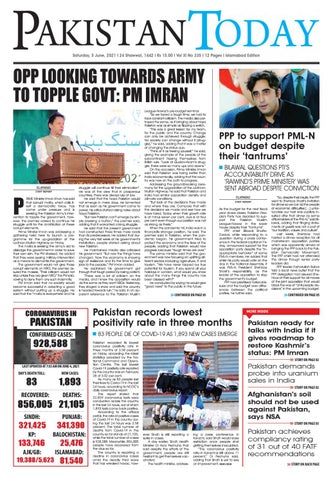
riMe Minister imran Khan has said that corrupt mafia, which calls itself a democratic force, has come under pressure and is seeking the Pakistan Army’s intervention to topple the government, however, the premier vowed to continue his struggle until for the annihilation of these corrupt elements. Prime Minster imran was addressing a gathering held here to launch a programme for the up-gradation of the lodhran-Multan Highway on Friday. The mafia is seeking the army’s aid to dislodge the government in order to save their own skin, the PM stressed. He added that they were eyeing military intervention as a means to dismantle the government. The government would not give those corrupt elements an NrO, the premier assured the masses. “Their criticism would not stop unless they are given NrO,” the PM said, vowing to deny them any such indemnity. PM imran said that no society would become successful in adopting a good system without putting up a struggle. He said that the “mafia is everywhere and his
struggle will continue till their elimination”. He was of the view that in prosperous countries, there was always rule of law. He said that the Naya Pakistan would not emerge in mere days. He lamented that as soon as his government came to power, his critics started raising noise about Naya Pakistan. “But new Pakistan can’t emerge by simple pressing a button,” the premier said, adding that it warranted a long struggle. He said that the present government had constructed three times more roads than its predecessors. He added that during the very first week of his government’s installation, people started asking about new Pakistan. He maintained media also criticised his government. “But now the things have changed. Now the economy is showing sign of resilience and it’s the time to give jobs to the people,” PM imran added. He explained his government got through that tough period by being patient. “There was a lot of critcism on the media, and i knew the opposition would do the same as they want NrOs. yesterday, they staged a show and said the country is headed towards ruin,” he said, in an apparent reference to the Pakistan Muslim
COrOnavirus in
pakistan
CONFIRMED CASES:
928,588
LAST UPDATED AT 7:53 AM ON JUNE 4, 2021
DAY'S DEATH TOLL:
NEW CASES:
83
1,893
RECOVERED:
DEATHS:
856,005 21,105 SINDH:
PUNJAB:
321,425
341,390
KP:
BALOCHISTAN:
133,746 AJK/GB: 19,388/5,623
25,476 ISLAMABAD:
81,540
league-Nawaz’s pre-budget seminar. “So we faced a tough time, we had to face constant criticism. The media also portrayed the same, as if bringing about Naya Pakistan was as simple as flipping a switch. “This was a great lesson for my team, for the public and the country. Change can only be achieved through struggle. No society can change without it [struggle],” he said, adding that it was a matter of changing the status quo. “Think of it as freeing yourself,” he said, giving the example of the people of the subcontinent freeing themselves from British rule. “look at quaid-i-Azam’s struggle, there were so many ups and downs.” On the occasion, Prime Minister imran said that Pakistan was faring better than india economically, adding that the country was now on the path to progress. Addressing the groundbreaking ceremony for the upgradation of the lodhranMultan Highway, he said that Pakistan and india had similar population density and climate conditions. “But look at the decisions they made and where they are. Compare that with the decisions we made and see how we have fared. Today when their growth rate is at minus seven per cent, ours is at four per cent even though our position was not as strong as theirs.” when the pandemic hit, india was in a financially stronger position, he said. The premier said in Pakistan, when the pandemic began, his government tried to protect the economy and the lives of the people, adding that Pakistan would now progress because “tough times are over.” The prime minister said that the government was now focusing on uplifting different sectors including agriculture, iT and tourism. “we have never tapped our true potential for tourism. if you spend all your holidays in london, what would you know about the many things this country has been blessed with?” He concluded by saying he would give “good news” to the public in the future.
CONTINUED ON PAGE 05
PPP to support PML-N on budget despite their ‘tantrums’ g
BilAwAl queSTiONS PTi’S ACCOuNTABiliTy Drive AS ‘rAiwiND’S PriMe MiNiSTer’ wAS SeNT ABrOAD DeSPiTe CONviCTiON ISLAMABAD staff report
As the budget for the next fiscal year draws closer, Pakistan People’s Party has decided to support the Pakistan Muslim league-Nawaz in the lower house despite their “tantrums”. PPP chief Bilawal BhuttoZardari, while responding to a question during a press conference in the federal capital on Friday, announced support for the opposition party despite the “inappropriate behavior” of some PMl-N members. He added that while his party would vote on the day in the National Assembly, it was PMl-N President Shehbaz Sharif’s responsibility, as the leader of the opposition to stop the government’s budget. PPP had prioritised national issues and the budget over differences between the political parties, he further said.
Pakistan records lowest positivity rate in three months g
83 PeOPle Die OF COviD-19 AS 1,893 New CASeS eMerge
Pakistan recorded its lowest coronavirus positivity rate in three months at 3.58 percent on Friday, according the latest statistics provided by the National Command and Operation Centre. The last lowest Covid-19 positivity rate reported by the country was on February 28 at 3.02 per cent. As many as 83 people lost their lives to Covid-19 in the last 24 hours, according to NCOC’s daily coronavirus report. The report stated that 52,859 coronavirus tests were conducted across the country in the last 24 hours, out of which 1,893 tests came back positive. According to the official portal, the rate of positive cases of Covid-19 in the country during the last 24 hours was 3.58 percent. The total number of deaths from Covid-19 in the country so far stands at 21,105, while the total number of cases is 928,588. Meanwhile, 856,005 people have recovered from the virus so far. The country is reporting a decline in coronavirus cases amid the deadly third wave that has wreaked havoc, how-
“So, despite their insults, the PPP went to Shehbaz Sharif’s invitation for dinner so we can rid the people of economic difficulties […] unfortunately our host was publicly insulted after that dinner by some officeholders of the PMl-N,” said Bilawal, adding that flinging statements at guests was not a part of “our tradition, values and culture”. last week, Shehbaz had hosted a dinner reception for all mainstream opposition parties which was apparently aimed at bringing the PPP back to the Pakistan Democratic Movement. The PPP chief had not attended the dinner though senior party leaders did. PPP leader Farhatullah Babar told a local news outlet that the PPP delegation had assured Shehbaz of their support for all moves of the joint opposition that would block the way of “anti-people decisions” in the upcoming budget.
CONTINUED ON PAGE 05
more inside
Pakistan ready for talks with India if it gives roadmap to restore Kashmir’s status: PM Imran STORY ON PAGE 02
Pakistan demands probe into uranium sales in india STORY ON PAGE 02
Afghanistan’s soil should not be used against Pakistan, says NSA STORY ON PAGE 03 ever Sindh is still reporting a spike in cases. A day earlier, Sindh Health Minister Dr Azra Pechuho that said despite the efforts of the government, people are still hesitant to get themselves vaccinated. The health minister, address-
ing a press conference in Karachi, said Sindh would ease restriction once people start getting themselves inoculated. “The coronavirus positivity ratio in Karachi is still above 11 percent,” Dr Pechuho said, adding that Sindh is yet to see an improvement. News Desk
Pakistan achieves compliancy rating of 31 out of 40 FATF recommendations STORY ON BACK PAGE
02
Saturday, 5 June, 2021
ISLAMABAD
NEWS
PAkistAN reAdy for tAlks with iNdiA if it gives roAdmAP to restore kAshmir’s stAtus: Pm imrAN
P
AGENCIES
RIME Minister Imran Khan said on Friday that Pakistan is ready to restart talks with India if Delhi provides a roadmap towards restoring the previous status of occupied Kashmir. “If there is a roadmap, then, yes, we will talk,” the premier told Reuters at his official
residence in Islamabad. In 2019, India withdrew Indian-occupied Kashmir’s autonomy in order to tighten its grip over the territory, sparking outrage in Pakistan, the downgrading of diplomatic ties and suspension of bilateral trade. Previously, Prime Minister Imran and his government have held that India would have to first reverse its 2019 steps for any normalisation process to begin. “Even if they give us a roadmap, that
these are the steps that we will take to basically undo what they did, which is illegal, against international law and United Nations resolutions … then that is acceptable,” Imran said. India’s external affairs ministry did not immediately respond to Reuters’ request for comment. ‘RED LINE’: Prime Minister Imran said he has always wanted a “civilised” and “open” relationship with India.
“It is common sense that if you want to reduce poverty in the subcontinent, the best way is to trade with each other,” he said, referring to the example of the European Union. He said India had crossed a “red line” by revoking the autonomy of occupied Kashmir. “They have to come back for us to resume dialogue,” Imran said, adding, “at the moment there is no response from India.” Prime Minister Imran had made similar
Pakistan demands probe into uranium sales in India ISLAMABAD STAFF REPORT
Pakistan has expressed its deep concern over illicit sales of uranium in India, which show lax controls, poor regularity and enforcement mechanisms as well as possible existence of black market for nuclear materials inside India. In a statement on Friday, Foreign Office Spokesperson Zahid Hafeez Chaudhri said, “We have seen the reports about yet another incident of attempted illegal sale of six kilogrammes of uranium in India. Similar incident involving seven kilogrammes of uranium in the Indian state of Maharashtra last month and other such reports in the past are a matter of deep concern.”
The spokesperson said that the United Nations Security Council Resolution 1540 and the International Atomic Energy Agency Convention on the Physical Protection of Nuclear Material make it binding on states to ensure stringent measures to prevent nuclear material from falling into wrong hands. Chaudhri said that Pakistan reiterates its call for thorough investigation of such incidents and measures for strengthening the security of nuclear materials to prevent their diversion. He said that it is equally important to ascertain the intent and ultimate use of the attempted Uranium sale given its relevance to international peace and security as well as the sanctity of the global non-proliferation regime. Earlier on Thursday, police in Indian Jharkhand state arrested seven people for possessing and planning
to sell ‘mineral uranium’ in the black market, according to The Indian Express. Police said that they seized 6.4 kg of ‘uranium mineral’ from two of the accused. According to the court records and the FIR, a senior police officer in Bokaro received a ‘tip’ on June 2 that five people – Deepak Mahato, Pankaj Kumar, Mahabir Mahato, M Sharma, and Krishna Kant – had ‘gathered together’ and were planning to ‘illegally sell prohibited mineral uranium in the black market’. It is the third time in India that such a highly radioactive substance has been seized by police in recent years. In 2016, police seized almost 9 kg (19.8 lbs) of depleted uranium in the Thane area of Maharashtra. Uranium is used in several areas, including nuclear explosives and medical techniques.
Pakistan desires to strengthen trade, tourism ties with Azerbaijan: President Alvi ISLAMABAD
NAB chairman urges world to halt illegal money transfers
senior politician, PPP leader Zafar Ali khan leghari passes away NEWS DESK Senior politician and Pakistan People’s Party leader Haji Zafar Ali Khan Leghari passed away after a protracted illness on Friday. The deceased was suffering from various diseases for a long time and was under treatment at a private hospital of Karachi where he breathed his last. Haji Zafar Ali Khan Leghari was close aide of former prime ministers Benazir Bhutto and Zulfikar Ali Bhutto and had also served as minister for Pakistan Railways. The deceased had left behind six sons, three daughters and his son Imran Zafar Leghari is MNA from Sindh. His funeral prayers would be offered at Sita Road, Khairpur Nathan Shah on Saturday. Leaders of the PPP have expressed deep grief over his demise and prayed for the departed soul to rest in eternal peace.
No early retirement as sindh okays reforms to cut pension bill NEWS DESK
STAFF REPORT
President Dr Arif Alvi on Friday said Pakistan wanted to further strengthen bilateral ties with Azerbaijan, particularly in the fields of trade, energy, defence, culture and tourism. The president, in a meeting with the visiting Speaker of the Parliament of Azerbaijan, Prof Sahiba Gafarova, who called on him, at Aiwan-e-Sadr, said Pakistan attached utmost significance to its ties with Azerbaijan. He said both the countries had shared religion, values, culture, as well as commonalities of views on regional and international issues. The president underscored the need for exchanging political, cultural, and economic delegations at high levels to further solidify bilateral cooperation. He congratulated the government and people of Azerbaijan on liberation of their territories from occupation of Armenia and signing of landmark peace agreement. The president appreciated the steadfast support extended by Azerbaijan to the legitimate cause of Kashmiri people. He expressed the hope that her visit would further deepen bilateral relations and asked the Speaker to communicate his good wishes to the people and government of Azerbaijan. Prof Gafarova emphasised the need for increasing interactions between the two countries at economic, political, cultural and strategic levels. She also underlined the need for promoting cultural ties to build bridges between the people of the two brotherly countries. The speaker conveyed that the people and political leaderships of Azerbaijan were highly grateful to Pakistan for supporting her country’s stance on Nagorno-Karabakh. She said that her country would continue to support Pakistan’s stance on Kashmir at all fora.
remarks last week, saying Pakistan could not restart trade with India at the cost of the blood of Kashmiris spilt by India, and that any normalisation under the current circumstances would be a major “betrayal” to the people of the occupied region. Earlier this year, Indian officials said the two governments had opened a backchannel of diplomacy aimed at a modest roadmap to normalising ties over the next several months.
ISLAMABAD: Prime Minister Imran Khan holds a meeting with national and provincial lawmakers. PPI
The Sindh cabinet on Friday approved a set of reforms to cut the province’s ballooning pension expenditures. The cabinet with Chief Minister Murad Ali Shah in the chair discussed the reforms to control the pension expenditures. The chief minister said salaries of 493,182 employees cost the government Rs23.9 billion every month while the monthly pension bill is Rs13.3bn. “We have to bring reforms to cut the pension bill,” he stressed, adding if the current system of pension allowed to stay in place, the pension bill will be larger than that of salaries in the next decade. The cabinet was briefed that early retirement will be banned with a minimum of 25 years of service and 55 years of age to be made mandatory for seeking retirement, which will help cut the pension bill by Rs433.3bn annually. In addition to that, pension will be determined on a three-year average salary instead of the last received salary, which will reduce the pension burden by Rs348.8bn. Family pensions will be limited to immediate family members with a wife, husband and son below 21 years of age to be entitled to pension, which will cut the burden by Rs112.179bn.
Medical colleges, universities to reopen across Punjab from June 7 NEWS DESK Medical colleges and universities across Punjab to reopen from June 7, announced provincial health department on Friday. The medical colleges and universities are being reopened on the recommendations of the Punjab cabinet committee on coronavirus after decline in the pandemic cases. The students can take their regular classes from June 7 with the observance of Covid-19 related standard operating procedures. The Punjab Specialised Healthcare department has directed the heads of the medical institutions to ensure strict implementation of the Covid-19 SOPs and ensure vaccination of the employees and the students. Letters have been issued to all the medical colleges and universities across the province.
On Thursday, the Punjab government had announced the reopening of educational institutions across the province from June 7. A notification was also issued by Punjab School Education Department. According to a notification, all the public and private schools, colleges and universities would reopen across the province from June 7 with strict compliance of Covid-19 SOPs. However, educational institutions are allowed to call students on alternate days with 50 percent attendance. The schools would open four days a week. It is pertinent to mention here that Federal Education Minister Shafqat Mahmood announced yesterday that matric and intermediate exams will begin after July 10 across the country. TIMINGS FOR LAHORE EDUCATIONAL INSTITUTIONS: The timings for the educational institutions in Lahore that are scheduled to reopen from
June 7, have been notified. According to CEO Education Lahore Pervaiz Akhtar, the educational institutions will resume the academic activities with 50 percent strength and no student shall attend the school for two consecutive days. The classes from nursery to the middle for girls will commence at 7.15 am and will close at 11.15 am. The timing for classes of matriculation and intermediate would be from 7.15 am to 11.45 am. Meanwhile, the classes from nursery to the middle for boys will commence at 7.30 am and will close at 11.30 am. The timing for classes of matriculation and intermediate would be from 7.30 am to 12.00 pm. Akhtar made it clear that there would be no break. All the concerned authorities have been directed to ensure the observance and compliance of Covid-19 SOPs in letter and spirit.
ISLAMABAD STAFF REPORT
National Accountability Bureau Chairman Justice (r) Javed Iqbal on Friday said corruption breeds injustice, poverty and affects the countries around the world. Virtually addressing the United Nations General Assembly session regarding corruption, Javed Iqbal said NAB being the focal agency of Pakistan under the United Nations Convention against Corruption (UNCAC) is determined to weed out this scourge of corruption and to make Pakistan corruption-free by adopting “accountability for all policy.” He said the NAB being the apex anti-corruption agency and mandated to eliminate corruption, corrupt practices, is operating through a three-pronged strategy of
Pakistan-Egypt first ever Joint Air Defence Exercise ‘Sky Guards-1’ concludes in Cairo RAWALPINDI STAFF REPORT
The first ever Pakistan-Egypt two weeks long Joint Air Defence Exercise “Sky Guards-1” concluded in Cairo, Egypt. Army Air Defence Command commander Lieutenant General Hamood Uz Zaman Khan witnessed the final phase of live firing exercise and closing
ceremony of the Pakistan-Egypt Joint Air Defence Exercise “Sky Guards-1”, said an Inter Services Public Relations (ISPR) news release. The troops of Pakistan Army Air Defence, Pakistan Air Force Air Defence and Egyptian Air Defence Forces participated in the first ever exercise of this kind. The two weeks long exercise was focused on the integration, synchronization, information gathering, interoperability and decision making of committing the
Air Defence assets in a battle to offer an aggressive and prompt response to hostile air threat. The chief guest also witnessed live fire of different weapons including fire of Igla missile by Pakistan Army Air Defence and Crotale missile by Pakistan Air Force Air Defence. The Army Air Defence Command commander lauded the professionalism of participating troops and emphasized the need to be abreast with emerging trends and techniques. Pakistan Ambassador to Egypt Sajid Bilal, Director General Air Operations PAF, Air Vice Marshal Abdul Moeed Khan, Observer Brigadier General Emad Hagi from Bahrain and large number of military officials from both countries attended the ceremony.
Saturday, 5 June, 2021
ISLAMABAD
NEWS
03
AfghAnistAn’s soil should not Be used AgAinst PAkistAn, sAys nsA
n
NEWS DESK
ATIONAL Security Adviser Dr Moeed Yusuf has categorically said that Afghanistan’s soil should not be used for subversive and terrorism activities against Pakistan. In an interview with a private news channel, he said that Pakistan worked hard in the Afghan-peace talks to establish permanent peace there and urged the world countries to recognise its sincere efforts in that regard. Dr Yusuf said that “we are committed from day one that military is not solution of Afghanistan problem and a political solution should be find out”. He underlined the need to play a mediator role between Afghanistan government and Taliban for talks to settle down the matters amicably. He said that the sudden withdrawal of the United States from Afghanistan was not ideal, adding that any shifting of blame on Pakistan for “facesaving” would be unacceptable. He added that the international media had been biased against Pakistan in the past and it was the same today. “[The] United States has assured us that
Pakistan will not be made a scapegoat amidst the withdrawal [of US troops] from Afghanistan, but only time will tell whether [they stay true to their word] as history suggests otherwise,” he remarked. He added that it was “too early to predict whether they [the US] will stick to their words.” The adviser said that Pakistan had always wanted peace in Afghanistan and the hasty withdrawal of US troops from the country was not a good idea. Dr Yusuf also stressed that Pakistan needed to maintain bilateral ties with the US, which continued to view Pakistan as a regional player, without compromising on national interests. “The approach is still regional. [Though], they [the US] have shifted focus from AfPak and are now obsessed with China, seeing India [as a country] that has a role to play [in this equation],” he said. In reply to a question about Pakistan allowing the US to continue to use its airbases, Yusuf denied such reports. “It has been very clearly communicated to the Americans so it’s not debatable,” he said, adding that Prime Minister Imran Khan had been opposing the war in Afghanistan for the
past 15 years, so allowing the US access to airbases after its withdrawal from Afghanistan was not on the table. To another question, he stressed that “it’s important for all stakeholders in Afghanistan to sit together for a political settlement.” Yusuf also empahsised economic stability for Afghanistan, saying that the Afghan economy could not function without support from the outside. “And for that, only Pakistan can give them the regional connectivity, and for investment from China [and the] US, Pakistan is the only linchpin. Afghans must understand this.” The adviser reiterated that in the wake of the US withdrawal from Afghanistan, Pakistan wanted bilateral relationships with America, but with a focus on “not what the US can give us, but what we can take from the US”. He added that Pakistan had made its priorities clear to the world in Geneva, where he met the US National Security Adviser Jake Sullivan last month. He went on to say that Afghans should decide their own fate, adding that any terrorist activities in Afghanistan were not acceptable to Pakistan. The US has announced troop withdrawal from Afghanistan by September 11.
However, with the US troops pulling out from the war-torn country since May 1— a deadline set in the US-Taliban agreement signed last year— there have been reports of the withdrawal being completed by July 4, which is celebrated as the US Independence Day. US President Joe Biden is determined to end what he called “the forever war”, announcing in April that the withdrawal of the remaining 2,500 American forces would be complete by the 20th anniversary of the September 11 attacks. The prospect of an end to the US presence in Afghanistan after 20 years comes despite fighting raging across the countryside in the absence of a peace deal, giving rise to security concerns and fears that violence will increase and could also spill over to neighbouring states, including Pakistan. In a statement issued on Tuesday, the Foreign Office had said Pakistan was worried about a security vacuum in Afghanistan after the US pullout as the already dim prospects of successful reconciliation between warring Afghan groups were growing dimmer with every passing day.
Police release PTM chief after brief detention THE REASON FOR HIS ARREST REMAINS UNKNOWN NEWS DESK Pashtun Tahaffuz Movement chief Manzoor Pashteen was released by the police on Friday evening after being detained for eight hours. According to Kohat District Police Officer Sohail Khalid, the PTM chief was kept in police custody for a short period. “We have just received information from Kohat that police officials have released the PTM chief and others,” a local news outlet reported PTM leader Ihtesham Afghan as saying. He said that the police had intercepted Pashteen and other activists on Khushalgarh Bridge, in the jurisdiction of Gumbat Police, early Friday morning while they were on their way to Bannu to attend a sit-in. Earlier, the media outlet reported, Pashteen had
planned to attend a sit-in in Bannu’s Janikhel area to protest the killing of a local resident. “Our chief’s vehicle was intercepted by police on Khushalgarh Bridge under the guise of security clearance,” the PTM member said, adding that police had not shared any details of Pashteen’s arrest with them. It could not be ascertained whether the arrest was made in an old case or after a new First Information Report was registered. In March, police had booked Pashteen and three of his friends under the treason charge allegedly for raising slogans against Pakistan and state institutions. However, in a tweet about the incident, Pashteen had maintained that he and his companions had come under attack by a group of 20 to 25 people while they were on their way back to Islamabad from Battagram after attending meetings. Prior to that, the PTM chief was booked in multiple
cases of sedition and was also arrested last year. The arrest was made after he had addressed a gathering in Dera Ismail Khan, where he had allegedly said the 1973 Constitution violated basic human rights and made derogatory remarks about the state. Initially, Pashteen was arrested in a case registered against him at DI Khan’s City police station under Sections 506 (punishment for criminal intimidation), 153-A (promoting enmity between different groups), 120-B (punishment of criminal conspiracy), 124 (sedition), and 123-A (condemning the creation of the country and advocating the abolishment of its sovereignty) of the Pakistan Penal Code. He was released from jail on February 25, 2020, after his bail applications in two sedition cases were accepted by a district court in DI Khan. On February 15, 2020, a sessions court in Tank district had granted bail to Pashteen in two cases of sedition, while he was also granted bail in a similar case by a DI Khan court.
Although another round of intra-Afghan talks is scheduled to begin in the next couple of days, Pakistani officials don’t seem very hopeful about a breakthrough. Foreign Minister Shah Mahmood Qureshi, while talking to Speaker of Afghanistan’s Wolesi Jirga Mir Rahman Rahmani on Tuesday, had urged the Afghan groups to “seize this historic opportunity and work out an inclusive, broad-based and comprehensive political settlement for durable peace and stability in Afghanistan and the region,” according to the statement. The fears of a security vacuum have been growing because of the stalemate in the peace process. The peace dialogue has made little progress since it started in September last year except for an understanding of the principles and procedures, which too was achieved after haggling for months over minor issues. Several efforts were made by Pakistan and the international community to push all stakeholders to return to the negotiation table to settle the remaining outstanding issues for ending the conflict, but none of the efforts have succeeded so far.
Bus carrying 28 women labourers attacked in Attock; driver killed NEWS DESK A driver was killed after unidentified men opened fire at a bus near Hassan Abdal in Attock on Friday. 28 women were injured and moved to a nearby hospital, the police said. Five women are said to be in critical condition. The passengers, who work at a biscuit factory, were travelling from Hassan Abdal to Haripur. The police have cordoned off the area and started conducting raids to arrest the suspects.
Arabs recall Pakistani pilots’ gallantry in 1967 war PAKISTAN AIR FORCE SHOT DOWN 3 ISRAELI PLANES IN 6-DAY WAR THAT ENDED WITH ISRAEL’S VICTORY ANADOLU AGENCY The 1967 Arab-Israel war, to all appearances, tilted the geopolitical environment of the Middle East in favor of Tel Aviv, following a humiliating defeat of a three-state Arab alliance. The six-day war ended with a UN-brokered ceasefire, but only after Israel occupied the Golan Heights, Gaza Strip, Sinai Peninsula, and the West Bank, including East Jerusalem, hugely altering the Middle East map. Although the war was fought between Israel and an alliance of Egypt, Syria, and Jordan from June 5 to 10, 1967, nonetheless, it is remembered for the heroics of a fifth country's air force, which had no direct involvement in the conflict. On the occasion of the 54th anniversary of the gamechanging event, the Arabs in the Middle East still recall the heroics of Pakistan Air Force (PAF) pilots who downed several Israeli aircraft, including Mirages, Mysteres, and Vautours, without losing a single plane of their own. Pakistan's Bangladeshi-origin fighter pilot Saif-ul-Azam, who passed away in June last year, alone shot down three Israeli fighter jets during the first three days of the war. According to Air Commodore (Retd.) Kaiser Tufail, author of three books on air force history, the PAF shot down three Israeli jets - all by Flight Lieutenant (at that time) Saiful Azam - between June 5 and June 7. "This is untrue that Pakistani pilots had shot down 10 Israeli planes in 1967 war. In reality, it was three in the 1967 war, and one in 1974 in Syria by Air Commodore (Retd.) Abdul Sattar Alvi," he maintained. The PAF had sent "a few" pilots - mainly for training and advisory role - to Jordan to train the Royal Jordanian Air Force (RJAF) pilots in November 1966. When the war broke out on June 5, 1967, two PAF pilots - Azam and Flt. Lt. Sarwar Shad were serving with the RJAF and Tufail, who served in PAF from 1973 to
2005, recalled. "Though they were purely sent to train the RJAF pilots, the Pakistani government allowed them to perform air defense duties at the outbreak of war," he said, adding that effectively Azam had taken part in the war as his colleague was admitted to the hospital at that time. SAVED FROM TOTAL DESTRUCTION: Azam will go down in history, perhaps the only pilot who have flown fighter planes for four countries -- Jordan, Iraq, Pakistan, and Bangladesh. He also holds the unique record of destroying fighter planes of two different air forces -- India and Israel. While flying the single-seat Hawker Hunter, he shot down the Israeli Air Force's flagship transonic Dassault
Mystere fighter-bomber aircraft in Jordan. When he was shifted to an Iraqi airbase the next day, he brought down two state-of-art Israeli fighter aircrafts Vautour IIA and Dassault Mirage III. Experts say due to Azam's eagle eye, both Iraqi and Jordanian air bases were saved from meeting the fate of the Egyptian Air Force, which was decimated by Israelis. In recognition of his heroic contributions, he was conferred with military awards by Jordan and Iraq. CLASH OF MODERN AND OUTDATED TECHNOLOGIES: Air Marshall (Retd.) Amjad Hussain Khan dubbed the 1967 war as a clash between the modern US and the outdated Russian technologies, which ultimately resulted in Israel's victory. "Apart from RJAF that was trained by Indian pilots on British war style, the Egyptian and Syrian air forces were trained on outdated Soviet tactics. On the other hand, Israeli pilots had training and planes from the US, which both were way modern than that of the Soviet Union," Khan, who was stationed in Iraq from 1967 to 1970 to establish a Fighters' Leader School to train senior Iraqi Air Force and RJAF pilots, told Anadolu Agency. Khan, later, took part and led a contingent of Pakistani pilots in the 1973 Ramadan War against Israel. The key factor, he said, that made a difference was Israel's air power based on US training and technology. "Israel's air defense force was very well organized compared to that of Syrians, and Egyptians, which had no coordination with ground forces." Supporting Khan's views, Tufail said, "The Arab armies and the air forces were no match for the Israelis as Egyptian and Syrian forces were trained on obsolete Soviet tactics." SYMBOLIC: The Arabs in the Middle East recall Azam's outstanding performance in 1967, where his exceptional skills and maneuvering kept the Israeli Air Force at bay. However, according to Tufail, the shooting down of Israeli aircraft could not be capitalized on due to the "total" destruction of air forces and subsequent the
absence of ground support. "The gallantry action of Azam, unfortunately, turned out to be mere symbolic in terms of the ultimate results of the war," he opined. "There was no question of ground support as all three countries' air forces were completely mauled on the ground by Israeli Air Force on the very first day, i.e., June 5 (1967)," Tufail, an author of the bestseller "Against All Odds," said. He asserted that ground support would have been crucial if Pakistani pilots had shot down at least 30 Israeli aircraft and that Arab air and military forces would have been able to give such support. Jordan had only one fighter squadron, which too was grounded in the first Israeli strike on June 6, he said. "Also, the quality of military equipment, including the fighter aircraft, was no match for Israeli equipment," Tufail observed. Another reason for the Arabs' defeat, he went on to argue, was that then-Egyptian President Gamal Nasser had lied to King Hussain of Jordan, claiming that Egyptian forces were on their way to Tel Aviv. This, Tufail added, prompted Hussain to attack Israel for a link-up with Egyptian forces, which turned out to be a disaster. "The truth was that the Egyptian air force had been destroyed on the ground by Israelis, and the Egyptian army was being attacked from the air," he further said. MIDDLE EAST MAP CHANGED: The 1967 war, Khan said, had actually changed the Middle East map, giving an "upper hand" and a "bargain chip" to Tel Aviv. "The 1967 war completely changed the Middle East's geographical scenario just within the six days. Sinai Desert, West Bank, and Golan Heights were lost to Israel, and the latter's superiority was established, which continues to date," he noted. Tel Aviv, he argued, had also managed to capitalize on its military victory in terms of diplomatic success forcing Jordan and Egypt to recognize it. "It was a short war and the Arabs were completely unprepared for that," Khan, who served in PAF from 1952 to 1988, said.
Saturday, 5 June, 2021
04 NEWS
ISLAMABAD
PM PraIses CDa for CoMING ouT of fINaNCIal CrIsIs IMRAN SAYS IT IS TIME TO TRANSFORM ISLAMABAD INTO A MODEL CITY
P
NeWS DeSK
RIME Minister Imran Khan on Friday praised the Capital Development Authority (CDA) for coming out of financial crisis, saying Pakistan’s economy is heading towards betterment and different sectors are showing signs of progress due to the government’s successful economic policies. The premier, in his tweet, said, “Our economic turnaround and success of our construction policy (are) showing results in different sectors. Pakistan is changing. A
NTDC promotes 125 employees Lahore PR
The meeting of the NTDC Promotion Board, presided over by Managing Director Engineer Mohammad Ayub was held at WAPDA House, Lahore, wherein the board approved promotions of 125 NTDC officers belonging to various cadres to the next grades. As many as 21 NTDC officers of human resource, corporate accounts and engineering sections were promoted as manager from BPS-18 to BPS-19. Whereas, during another meeting of the Promotion Board, 104 officers belonging to information technology, corporate accounts and technical sections were promoted from BPS-17 to BPS-18. The managing director said that the NTDC Board of Directors, since its inception, has taken number of initiatives and corrective measures to remove bottlenecks from all departments of NTDC, including human resource. Thus, the BOD pushed management to conduct promotion board meeting for pending cases without further delay, he added. He said that, while ensuring the transparency and requisite merit, PhD professionals from power and telecom sectors were invited as members of the promotion board.
near-bankrupt Capital Development Authority, which [had] posted a deficit of Rs5.8 billion in 2017, would close this financial year with Rs73 billion surplus and Rs26 billion already in accounts. Well done team CDA.” The PM further tweeted that with financial stability achieved, it is time to accelerate transformation of Islamabad into a model city with priority being on reform and restructuring. Other mega cities can also become self-sustaining economic engines of growth through commitment, transparency and innovation. Imran also posted a graph, showing the CDA’s transformation over the years, and
concluded the thread on Twitter. Earlier on Wednesday, the CDA had approved a record budget of Rs156 billion for its non-development and development expenditure for fiscal year 2021-22, according to a news outlet. The CDA board had approved the budget presented by Member Finance Shakeel Jazeb during a meeting at the CDA headquarters with Chairman Amer Ali Ahmed in the chair. The budgetary documents had shown that for the upcoming financial year, no major project is planned, rather focus would be paid on ongoing projects.
Khurshid Shah withdraws bail petition from SC
NeWS DeSK The Supreme Court on Friday dismissed Pakistan People’s Party (PPP) leader Khurshid Shah’s bail application following his withdrawal of the petition. The PPP stalwart will now submit his bail application in the high court
on the delay and hardship grounds. Earlier on Thursday, a threemember bench of the SC, headed by Justice Mushir Alam, had heard Shah’s bail petition. During the hearing, Shah’s lawyer Makhdoom Ali Khan had said that the National Accountability Bureau (NAB) had
closed the inquiry against his client in 2014 and all tax returns filed by his client are on record. Justice Sardar Tariq, on the occasion, had remarked that the point that had not been raised during hearing in a high court could not be raised in the SC as well. When Justice Alam had inquired from Shah’s counsel as to when the reference was filed against his client and when he was arrested, the lawyer had replied that the reference was filed on November 18, 2019 while the arrest was made two months earlier on September 18, 2019. Makhdoom had further said that his client had approached the high court only 30 days after his arrest. Justice Tariq had replied that why not the case should be sent back to the high court. “Raise these points of delay in the completion of trial, merit and hardship there. Even then if the high court does not grant bail, then you may come back to the apex court,” the judge had said. “If we quash the PPP leader’s bail petition right now, he would be left with no legal option.”
Two police officials martyred in firing incident in Islamabad ISLAMABAD: Two police officials were martyred when some unidentified persons opened fire at a police patrol in Islamabad on Thursday night.According to details, some unidentified persons opened fire at a police patrol near Carriage Factory at the IJP Road. Resultantly, two police officials embraced martyrdom. The martyred police officials were identified as Bashir and Ishtiaq. The deputy inspector general operations and other police personnel reached the spot after the incident. Talking to media, the DIG said that all evidence is being collected from the crime scene and the accused will be arrested soon. Meanwhile, Interior Minister Sheikh Rasheed Ahmed strongly condemned the incident and expressed condolences over the martyrdom of police officials and heartfelt sympathy to the families of the martyrs. He has sought a report of the firing incident. INP
Gilgit police fire tear gas on protesting govt employees GILGIT: The Gilgit-Baltistan government employees took to the streets on Friday. The protesters were marching towards the Chief Minister's Secretariat when the police attacked and fired tear gas shells at them. The officials also fired aerial shots. After the clash, the demonstrators sat outside the secretariat, refusing to budge unless their demands are met. The government employees had demanded the government to provide them utility allowance, disparity reduction allowance, and time-scale promotions. INP
THE ROAD AHEAD
Joining forces to raise biodiversity game this World Environment Day hUMaYUN aKhLaQ As governments, companies and international organizations join forces to prioritize sustainable action, threats such as biodiversity loss cannot be overlooked. The more that we harm and degrade Pakistan’s environment, the more we undermine nature’s ability to support people and communities, a factor which strongly improves both quality of life and business prosperity. The alarming pace of biodiversity loss and environmental degradation, along with climate change, has become an increasingly urgent issue that undermines not just local ecosystems and individual species, but ultimately heralds potentially major food security issues and other challenges for societies, economies and companies around the globe. Addressing it requires concerted action -- and corporates have a responsibility to play a part. This issue should matter to every Pakistani. According to global environmental watchdog German Watch we have persistently been rated among the top 10 countries facing adverse impacts of climate change in terms of recurring natural calamities and increased vulnerability due to climate change. And it’s most likely going to get worse before it gets better. Our government is taking action. The reason
why we’re the host country for World Environment Day this year is because of our government’s pledge to fight climate change. Our Prime Minister has called the issue our "defining global challenge". And as a country we’ve begun planting billions of trees that will restore and enhance over one million hectares of forest nationwide. These initiatives will create jobs, sequester carbon and promote an ecosystem-based adaptation. The fight against nature loss should also be a business priority: nature is essential to global economic prosperity and individual business success. We cannot have a sustainable future for people and economies if we do not address nature, climate and people in an integrated way. Indeed, climate change is among the main drivers of biodiversity loss, and yet biodiversity is part of the climate solutions. Many parts of society have been too slow to understand the impacts of our activities on nature. However, awareness is rising fast, and the momentum is building to move towards reversing the curve of biodiversity loss and protecting and preserving the environment. Companies too need to up their game and play a vital role in protecting and promoting our country’s nature. To engage stakeholders in a transformative change, clear and measurable national targets must be set and adhered to if we are going to limit cli-
mate change to within 1.5 degrees Celsius. By working together business, finance and government will be able to drive systemic and transformative change, unlocking new opportunities and allowing everyone to live sustainably on a healthy planet. The road ahead to make human societies respect the planetary boundaries demands transformative change, innovative solutions and significant economic paradigm shift. Public authorities, businesses and civil society must work as one to deliver on commitments for nature. More than two thirds of our impact on biodiversity is due to greenhouse gas emissions. Which is why, through the lens of biodiversity, our climate change strategy has new relevance. The effect of climate change on biodiversity further inspires us to pursue our ambitious net zero emissions goals, both across our own operations and throughout our supply chain. Today, our environmental and sustainability strategy allows us to mitigate our impact on biodiversity, and our focus on electrification will help us deliver 800 million tons of saved and avoided CO2 emissions for our customers over the coming five years; nevertheless, I know that we can do better and there is still potential to do much more. For instance, improvements can be made through sustainable purchasing; increased supply chain traceability would allow us to choose exactly
what we buy, from whom and from where. Biodiversity is an inherently local issue and the impact of raw material extraction can vary greatly, even within the same country. Businesses and corporations have a responsibility to play a major role with other stakeholders from civil society to policy makers. We began our journey to become more sustainable decades ago, but it’s never too late to change. We invite companies to start right now. Even before international agreements, the private sector can start to quantify biodiversity impacts, understanding interdependencies between nature and business, identify risks and define action plans. The journey towards true sustainability is long and still partly unmapped, yet the world needs urgent action. It is only by joining forces today that we can reach sufficient momentum and change societies soon enough. As we mark World Environment Day, as the business community let’s raise the bar on our corporate biodiversity goals and aim to preserve and restore our ecosystem. Countless generations of Pakistanis will either thank us for our actions or hold us accountable if we fail. For their sake, I hope we achieve the former and restore our environment to its wondrous beauty. The writer is country general manager of Schneider Electric Pakistan
Saturday, 5 June, 2021
ISLAMABAD
NEWS
05
UN rePort reiterates threats Posed to PakistaN’s secUrity by afghaN-based ttP, JUa terrorists iSLamaBad
a
MIAN ABRAR
new United Nations report on Afghanistan highlights the continued and ever-growing cross-border terrorist threat posed by proscribed cell, Tehreek-e-Taliban Pakistan, which continues to operate from the eastern Nangarhar province of neighbouring country. The 12th report of the UN monitoring team on Afghanistan was submitted to the UN Security Council adn also notes TTP’s "distinctive anti-Pakistan objectives". Experts believe that the terrorists using Afghan soil may also target China-
Pakistan Economic Corridor and other projects undertaken by Chinese companies in Pakistan due to the influence of Indian and Afghan intelligence over the Afghan-based terrorist groups. Diplomats also noted that the report reinforces similar concerns expressed by an earlier report by the UN Monitoring Team on various terrorist groups. In that report, the team had referred to the strengthening of the TTP in Afghanistan as a result of “return of splinter groups to the TTP fold.” The latest UN report estimates TTP’s strength to be between 2,500 and 6,000 armed fighters, after splinter groups – including “Shehryar Mehsud group, Jamaat-ul-Ahrar, Hizb-ul-Ahrar,
opp looking towards army to topple govt: PM imran continued from page 01 In his remarks, Foreign Minister Shah Mahmood Qureshi said that three districts of South Punjab — Bahawalpur, Lodhran and Multan — will greatly benefit from the up-gradation project launched today. He said that this will reduce the travel time between Bahawalpur and Multan to only forty five minutes. He added that it is the first time that separate development fund is being allocated for South Punjab from the budget of Punjab. Speaking on the occasion, Minister for Communications Murad Saeed said that the present government has completed road infrastructure of 1753 kilometers in its two and a half year tenure and there is a plan to start work on another 6118 kilometers of roads this year. He said that groundbreaking of SialkotKharian motorway will be performed in the next ten days. Approval has also been given for Kharian-Rawalpindi motorway and this project will be started in three months. Murad said that present government initiated work on the western route of the CPEC which will bring prosperity in the underdeveloped areas of the country. He added that “we have increased the revenue of National Highway Authority by seventy two billion rupees”.
govt committed to promote foreign investment in country: tarin iSLamaBad TLTP
Finance Minister Shaukat Tarin has said that the government is firmly committed to providing an enabling environment to promote foreign investment in the country. The finance minister said this while addressing a virtual meeting with the representatives of the US-Pakistan Business Council (USPBC) through a virtual link on Friday. The finance minister underlined that the government intends to further strengthen its valuable trade, investment and people-to-people ties with the US. He underscored that Pakistan has witnessed V-shape recovery amid Covid-19 pandemic due to prudent policies of the government. He said the government is clearly focused to pursue an all inclusive, sustained and robust economic growth over the period of time.
the Amjad Farooqi group and the Usman Saifullah group (formerly known as Lashkar-e Jhangvi)” – joined it, which, Pakistan has asserted, was engineered by Indian agencies. The observations of the UN Monitoring Team’s report yet again vindicate Pakistan’s repeated concerns regarding the threat posed by the TTP to Pakistan’s security as well as the increase in the number of cross-border terrorist attacks being carried out by the terrorist outfit against Pakistan from the Afghan soil. The UN earlier this year, had noted that Tehrik-e-Taliban Pakistan was responsible for over “100 cross-border attacks between July and October 2020”. It would be recalled that last year,
Pakistan handed over a dossier to UN Secretary-General Antonio Guterres on the Indian sponsorship of terrorist groups TTP and JuA, both of which have been proscribed and sanctioned by the 1267 Sanctions Committee of the Security Council. Any direct or indirect support to TTP and JuA constitutes a grave violation of the UN Security Council counterterrorism regime. The latest report, according to the diplomats, is likely to further reinforce Pakistan’s demand that the international community needs to do more to prevent terrorist threats against Pakistan from externally financed and supported terrorist outfits operating from the soil of certain neighbouring countries.
PM urges world to protect ecosystem, environment GOVT TO PLAY DUE ROLE TO FULFIL SINDH’S DEVELOPMENTAL NEEDS iSLamaBad STAFF REPORT
Prime Minister Imran Khan has appealed to the world community to come together to protect the ecosystem and environment for coming generations. Virtually addressing the launch of the Gala for the UN Decade on Ecosystem Restoration on Friday, the prime minister said that rapidly depleting tree cover and degradation of the environment need to be stopped. Highlighting Pakistan's contribution in protecting the environment, the prime minister said, “We have completed the Billion Tree Tsunami project and now we are pursuing another target of growing ten billion trees.” He said that his government has also started another ambitious programme of increasing national parks in the country and so far nine such facilities have been established in various parts of the country. Imran said that the government is also focusing on increasing mangroves cover, which conserves the greatest amount of oxygen. He said, “We also want to restore our wetlands by using floodwater to raise the water table and replenish the aquifer.” The prime minister expressed the hope to create green jobs for youth, especially women. He said, “We managed to give 80,000 green jobs to our people, especially women, in remote areas, where they plant nurseries.” Meanwhile, Pakistan is hosting World Environment Day in partnership with the United Nations Environment Programme on Saturday. This year's observance of World
Environment Day will be on the theme of "ecosystem restoration" and focus on resetting our relation with nature. The day will be celebrated across the world through various events and activities, in line with latest Covid-19 regulations. As host of World Environment Day, Pakistan will highlight environmental issues and showcase the country's own initiatives and its role in global efforts. Led by Prime Minister Imran Khan, Pakistan is fully committed to playing a leadership role in addressing the issue of climate change through various projects and initiatives. The day will also mark the formal launch of the UN Decade on Ecosystem Restoration 2021-2030. The UN Decade is intended to massively scale up the restoration of degraded and destroyed ecosystems to fight the climate crisis, prevent the loss of a million species and enhance food security, water supply and livelihoods. Major corporations, non-governmental organizations, communities, governments and celebrities from across the world adopt the World Environment Day to champion environmental causes. Held annually since 1974, the day has also become a vital platform for promoting progress on the environmental dimensions of the Sustainable Devel-
opment Goal. SINDH’S DEVELOPMENTAL NEEDS: Separately, Prime Minister Imran said that the federal government will play its due role to fulfil developmental needs of the people of Sindh. Talking to a delegation of Muttahida Qaumi Movement-Pakistan (MQM-P) on Friday, the prime minister said that Karachi is an economic hub and its development is imperative for the progress of the country. The prime minister assured the delegation that development needs of Karachi and Hyderabad will be considered in the upcoming budget preparation. He said that harmonised coordination between the coalition parties will play a pivotal role in solving problems of the people of Sindh, especially Karachi. The delegation members reiterated their support for the budget and presented their suggestions. Sindh Governor Imran Ismail was also present in the meeting. Meanwhile, the members of National Assembly and Pakistan Tehreek-e-Insaf (PTI) leaders belonging to different areas of the country called on Prime Minister Imran Khan and discussed the overall political situation and matters pertaining to their constituencies. Those who called on the Prime Minister included Special Assistant on Political Affairs Malik Amir Dogar, Minister for Economic Affairs Umar Ayub Khan, MNA Muhammad Shafiq Arain, Nawab Amanullah Khan, Dr Sher Muhammad Awan, Iffat Tahira Soomro, Shanila Roth, Nusrat Wahid, Riaz Fatyana and Ghulam Bibi Bharwana. Minister for Economic Affairs Umar Ayub Khan discussed the progress on development schemes in Haripur. During the meeting, the premier commended the proposals pertaining to promotion of tourism, provision of low-cost houses and establishment of a digital city in Haripur. He directed to complete the ongoing projects in the stipulated period.
Pakistan's initiatives on environment being recognised globally: Fawad iSLamaBad APP
Minister for Information and Broadcasting Chaudhry Fawad Hussain Friday said it was a great honour for Pakistan to host World Environment Day on Saturday, themed 'Ecosystem Restoration'. Speaking at an inauguration ceremony of two-day photographic exhibition in PakChina Friendship Centre, he said it was a recognition of the Pakistan Tehreek-e-Insaf (PTI) government's initiatives on environment globally. Fawad said the incumbent government had disseminated the maximum information
about environmental hazards, which was unmatched as compared to the past governments. He said the credit went to the environment friendly vision of Prime Minister Imran Khan. He said country’s forests had become desolate, rivers had got polluted, streams had disappeared while trees had become almost extinct but no government had paid heed to the situation which had caused severe damage to the ecosystem. The minister said the PTI led government launched the one billion tree tsunami project in Khyber Pakhtunkhwa which was appreciated and acknowledged at the inter-
national level, including the United Nations organizations. Now, the government had launched 10 billion tree tsunami project which was proving successful, he added. He felicitated the State Minister for Climate Change Zartaj Gul for holding such an exhibition. State Minister for Climate Change Zartaj Gul, State Minister for Information Farrukh Habib were also present on the occasion. At the outset of ceremony, Minister for Information and Broadcasting Fawad Hussain Chaudhry, Minister of State for Climate Change Zartaj Gul, Minister of Information and Broadcasting Secretary Shahera Shahid planted tree saplings separately.
cmYK
PPP to support PML-N on budget despite their ‘tantrums’ continued from page 01 PDM Secretary General Shahid Khaqan Abbasi had, the very next day, categorically stated that there was no place for the PPP within the opposition alliance until it restored the trust it had betrayed. “If you are not committed to trusting the movement, then there is no place for you within the PDM.” Bilawal said that “Raiwand’s prime minister” Nawaz Sharif was sent abroad despite being convicted, as he lashed out at the ruling Pakistan Tehreek-e-Insaf and PML-N. “If the president (Asif Ali Zardari) is from Nawabshah, he remains on medical bail despite trumped-up charges,” the PPP chairman said. Bilawal said that Zardari remains in Pakistan — moving from one doctor to another — despite his children telling him to go abroad and seek treatment. “I want to ask the prime minister (Imran Khan) that what sort of accountability is being implemented in the country?” he asked, adding that if the premier’s friends are being alleged of a crime, no action is taken against them. He went on to say that despite accusations against the prime minister and his sister, no action is taken against them either. However, if the sister of a former president from Nawabshah is blamed for something, “then she is dragged to jail from her hospital bed”, he said, referring to PPP leader Faryal Talpur. The PPP chairman lashed out at the PTI-led government and questioned its standards of accountability. “This system is a mockery of the Constitution.” “If the leader of opposition is from Lahore (Shahbaz Sharif), he is awarded bail, and if the leader of opposition hails from Sukkur (Khursheed Shah), he is denied the right and treated like a ping-pong ball — back and forth from NAB courts to Supreme Court,” Bilawal said. The PPP chairman claimed the authorities were repeatedly blackmailing Shah’s children and his wife. He said that the people would soon hold PTI and PM Imran accountable for their alleged corruption and mismanagement, as he vowed his party would not back down from its stance despite the government’s pressure on it. Bilawal said that PPP would not back down as it believed in the power of the people and parliament, adding if the opposition parties were not capable of sending the government packing, then in the next election, the people would do their work for them. “Why are you begging from the Arab countries and the IMF?” asked the PPP chairperson, dismissing the government’s claims that Pakistan was progressing economically. Bilawal said that whether it was Finance Minister Shaukat Tareen or any other minister, this government was now coming to the terms that the PPP’s stance was correct. “If you remember, president Zardari had said ‘NAB and the economy cannot run together,'” he said. Hitting out at the prime minister, Bilawal said judging by PM Imran’s statements, it was clear he was not aware of the common man’s problems. “The prime minister says Pakistan’s difficult time is over. Not sure about the common man but the IMF’s difficult time is over, for sure,” he said sarcastically. He said that the incumbent finance minister had admitted that the government had been handling financial matters in a poor manner.
Saturday, 5 June, 2021
06 COMMENT
‘Neighbourhood first’ policy: Dreams and realities
World Environment Day Ecosystem rehabilitation needs a holistic approach
India is paying attention to its Eastern neighbours too
W
ORLD environment Day (WeD) has been celebrated under the UN since 1972. Several countries have in the past hosted WeD including India in 2018, with “Beat Plastic Pollution” as the theme of that year’s edition. Today Pakistan will be officially hosting it for the first time with ‘ecosystem Restoration’ as the theme. It goes to Prime Minister Imran Khan’s credit that he took more interest in ecosystem restoration than any of his predecessors. The PPP government did not go beyond announcing a policy statement on climate change and that too in the last year of its rule. The PML(N) government was initially unconvinced of the need to have a fullfledged minister for climate change and turned the ministry into a department, slashing its budget by 60 percent. It was only months before the 2015 Paris climate change conference that it revived the ministry . Soon after forming the government in KP, the PTI government initiated a Billion-Tree Tsunami campaign on Mr Khan’s directives. It was claimed that the target was achieved in 2017. The claim however could not be verified independently. Less than a month after taking oath as PM, Mr Khan kicked off the 10 Billion-Tree Tsunami which was supposed to achieve the objective in five years’ time. Again there is no independent assessment of how much of the target has so far been achieved. Pakistan is however badly in need of expanding its forest cover, which is one of the lowest in the region, well below the 12 percent recommended by the UN. The mere determination to plant a mindboggling number of trees deserves praise and encouragement. The problem with Mr Khan is that he often gets possessed by a single idea, ignoring a host of other relevant issues connected with a problem. The ecosystem in Pakistan has been consistently degraded over the last serval decades. Its restoration demands a comprehensive policy encompassing various spheres, tree plantation being an important part, but not the only one. environmental issues in Pakistan include air pollution, water pollution, climate change, plastics and pesticide misuse, desertification and flooding. It is estimated that almost 500 million gallons a day of untreated effluent are released into the Arabian Sea from Karachi, posing hazards to marine life. While tree planation remains a vital measure, ecosystem restoration needs a holistic approach.
Dr rajkumar Singh
T
he term ’Neighbourhood First’ came to the fore when the present Prime Minister, Narendra Modi, became prime Minister of India in May 2014 and invited the South Asian neighbours who also happen to be the members of the South Asian Association of Regional Co-operation (SAARC) to his swearing-in ceremony, and also met with them collectively and separately, the very next day. This new initiative of the government ignited fresh hope among the neighbours for mutual understanding and cooperation in the true sense of the term. It is also a fact that all members of SAARC, Afghanistan, Bangladesh, Bhutan, Maldives, Nepal, Pakistan, and Sri Lanka, are in close contact with the People’s Republic of China in the diplomatic, economic, and security domains and with them Beijing has forged a geostrategic pool to get its national, regional and global interests fulfilled, peacefully if possible, and by force if necessary. India and China are standing opposite each other, like two rivals in their national, regional, global approach and objectives despite their centuries-old historical and cultural relationships. For instance, Beijing’s Belt and Road Initiative (BRI) project contains the potential of encircling India strategically, apart from its importance for economy and trade. In political and security domains too, Beijing has per-
SBP second-quarter report
T
he State Bank of Pakistan’s second-quarter report does not contain entirely negative news, but it does point to certain developments which cause concern and which must be addressed at once before they go beyond the capacity of the government to handle. Some of the good news includes the GDP growth expected this fiscal year, of 3.94 percent, which compares favorably with -0.4 percent last year, in 2019-2020, and which more importantly indicates that the recovery from the covid-19 pandemic is going to be V-shaped. That drag on the economy meant that while 20.7 million people lost their jobs, the majority of them are back at work. Another positive development has been that the foreign remittances have remained healthy throughout the year, and this has played a key role in keeping a surplus in the balance of payments. however, the State Bank report does mention certain areas of concern, which have to be tackled urgently, if the economy is to be kept on an even keel. The debt situation is of great concern, because it is almost impossible to service existing debt, but the government keeps contracting new debt, both foreign and domestic, to stay afloat. As if that pressure on the balance of payments was not enough, the report expressed concerns that imports were going up. That alone is enough to throw the balance of payments out of kilter. Food insecurity does not help, created by the failure of the government to judge whether or not food staples like wheat, or essentials like sugar, should be imported or exported. Such unpredictability does not bode well for the government’s ability to manage inflation, which is another concern the SBP report mentions. With inflation also fuelled by the devaluation of the rupee, which may make exports cheaper but also makes imported foods dearer, there are tough times ahead. Because exports depend on imported inputs (not just raw materials, but fuel for both transport and power), devaluation has affected their prices, and made it all the more difficult to run up the trade surpluses which are the way out of this situation. The government must focus on handling the problems, and leave the celebrations of the good news to others.
Grasping at straws in Mr Justice Faez Isa’s case
Dr Faqir huSSain
T
he Government’s second “review petition”, labelled a “curative review petition” in the Justice Qazi Faez Isa case has been returned. The Office of Registrar, Supreme Court, found the petition to be suffering from deficiencies and containing scandalous language, and hence unmaintainable. The Spokesperson of the Law Ministry however reiterates the Government resolve to pursue the matter by challenging the rejection order. Under the Supreme Court Rules, an aggrieved party may file appeal against such order before a “Judge in Chambers”. The contents of the petition are not disclosed, hence the grounds or reasons quoted therein for quashing the Court’s short order in the review petition, are not known and cannot be legally scrutinized. The measure however is uncommon and unprecedented. It is also improper and irregular, precisely the way and manner the Reference was filed. The FBR under the law, could seek information of the money trail for funds transfer from the spouse (an independent tax filer). however, the Government, instead filed Reference against the Judge, levelling allegations of financial impropriety. The handling of the matter by the Supreme Judicial Council was equally uncommon. It picked up the
Dedicated to the legacy of the late Hameed Nizami
Arif Nizami Editor Managing Editor
Joint Editor
Umar Aziz Executive Editor
Lahore – Ph: 042-36300938, 042-36375965
The writer is head of the political science department and dean of the Social Sciences faculty of the B.N.Mandal University, Madhepura, Bihar, India. He can be reached at rajkumarsinghpg@gmail.com
Legality of curative review petition
Rise in debt, inflation, imports cause worries
Yousaf Nizami Aziz-ud-Din Ahmad
fectly crafted an approach in each country to achieve its objectives against India, curtail its influence and defame New Delhi. Although they know it well that it is not in their interest and benefit, they often do not dare to say ‘no’ to China and disobey Beijing. Since the days of its Independence and even earlier, India’s foreign policy has remained, by nature, vegetarian and never desires harm to any regional or global country. The boldness that we found in the regimes of Mrs Indira Gandhi and thereafter was the result an alliance (of China, the USA and Pakistan) against India when India became a sympathizer of the USSR in the phase of Cold War at the close of 1960s and early 1970s, when Pakistan played an active role to create an understanding between China and the USA, culminating in the strategic visit of American President Nixon to Beijing. Keeping in view the regional and global politics of the day in August 1971 India signed a Treaty of Peace, Friendship and Friendship with theUSSR, and the latter had sent a fleet to check US preparation to help Pakistan against India during the IndoPak War of 1971. At that time and in successive periods, no doubt, New Delhi has strengthened itself but only against China and Pakistan’s alliance with the former against India. Again, in succession, after the mid-1980s and in the early 1990s, major substantial changes, like disintegration of a superpower (the USSR) which ultimately ended the Cold War between the two superpowers, coming of the regime of globalization and economic liberalization, and at the regional level the formation of SAARC in December 1985. All these developments paved the way for redefinition of relations among the nations of the world. From the viewpoint of India’s security, status and influence in the region and outside, the emergence of China as a great power economically, militarily scientifically and diplomatically, has once again altered the balance of power at regional and global levels. In this new configuration, Beijing treats India as enemy, the USA as a rival and Pakistan as a friend and wellwisher. This unique situation, in practice, has tied Indian hands, and makes it not go beyond a limit even in bilateral relationship with its neighbours, or, to be precise, member countries of SAARC. Following India’s helping attitude towards neibhbours, the new government that took over in New Delhi, in May 2014, undertook to make visits to boost
bilateral relations and in line with this, Narendra Modi visited Bhutan in June 2014, the only country which was out of the purview of direct Chinese influence and strategically known as the ‘Chicken neck’ of India because of its small passage between India and its remote north-east states. This visit of Modi was dominated with economic themes, developing the rich natural resources and hydropower of Bhutan. Viewing Bhutan’s strategic significance China too wants to take the country into its influence and in order to curtail New Delhi’s effects in June 2017 its People’s Liberation Army began to extend a road from Tibet to the Doklam area towards Bhutan with which India had signed a security agreement. As India was bound to address Bhutan’s security concerns, it sent its troops to prevent the construction and after 73 days deadlock, Beijing failed to gain its objectives in Bhutan. however, China did not stop here and sent a high-level delegation to Bhutan in July 2018, again attempting to benefit Bhutan and sidetracking India. From a strategic point of view, for New Delhi, next to Bhutan is Myanmar. It can serve India’s geopolitical, economic and security interests because it shares land borders with India’s north-east and maritime borders in the Bay of Bengal region. here India wants to connect through developmental works as it is also a land bridge to the Association of South east Asian Nations (ASeAN) and will pave the way for the Modi Government’s ‘Look east Policy’ renamed the ‘Act east Policy’. Aung San Suu Kyi, the state councillor and foreign minister in the Bhutan government came to India in October 2016 and also attended the BRICS-BIMSTeC Outreach Summit held in Goa. In response, a return visit was paid by Prime Minister Modi in 2017 to speed up the ongoing projects in Myanmar. In May 2018, the two countries also opened two land-border crossing between India and Myanmar in the state of Manipur and Mizoram. Further the two countries’ engagements in different security projects and Myanmar’s co-operation on the issue of Naga insurgents and India’s soft handling of Rohingyas in India are proof that their bilateral relations are working on an even keel. The Indian President also visited Myanmar in December 2018.
I
Karachi – Ph: 021-35381208-9
I
complaint out of turn and initiated enquiry. Coming in the aftermath of a most controversial verdict in Mr Justice Shaukat Siddiqui’s case, involving the role of establishment, quite naturally, eyebrows were raised when a “show cause notice” was issued to Mr Justice Isa. Mr Justice Isa therefore rushed to knock at the door of Supreme Court to seek justice; so proceedings ensued under Article 184(3) of the Constitution. After a lengthy trial, the Court quashed the Reference, it being found to be illegal. The Court however directed the FBR to initiate proceedings against the spouse and offspring of the judge and submit a report before the Supreme Judicial Council. The Council was asked to proceed suo motu against the judge, if so desired in the light of the report. In review, however, the Court realized its blunder of having gone beyond the permissible parameters and therefore set aside its impugned order. This concluded the legal and judicial process and the matter should have rested there. Not yet, so far as the worthy President, PM, Law Ministry and other authorities are concerned. Perhaps, they are still reeling from the shock of indictment against the Government and the establishment in the landmark judgment in the Faizabad Dharna case. Whatever the motivations or compulsions, the move to file second review, labelled as “curative review petition”, is palpably illegal and unwarranted. The matter is settled and should rest. The phrase “curative review petition” is a new and novel concept in modern jurisprudence. It was evolved first by the Indian Supreme Court, some two decades ago. The issue was as to “whether an aggrieved person is entitled to relief against the final verdict of the Supreme Court, when his review petition is dismissed”? And in keeping with the peculiar facts of the case and its treatment through judicial processes, support was found in the Indian Constitution. The relevant provisions were Articles 32 (power to issue prerogative writs for enforcement of Fundamental Rights), 136 (special leave to appeal from verdict of any court/tribunal), 137 (review jurisdiction) and 142 (doing complete justice in a pending cause/matter). The Court answer was therefore in the affirmative. The Court held that a final verdict can be reopened and evidence/material reevaluated, provided that there is any apprehension of denial of the principle of natural justice, resulting in the miscarriage of justice. A special procedure was prescribed for such review including referring the petition to a bench of
Islamabad – Ph: 051-2204545
I
Web: www.pakistantoday.com.pk
I
the three most senior judges of the Court together with the judges who decided the review petition. For maintaining the petition, approval of majority of judges is required. hearing is conducted in chambers; however in exceptional cases, open proceedings may be held. The Court may engage senior counsel as amicus curiae. Again, heavy cost is imposed for false or fictitious grounds or the case lacking merit. Needless to say, strong evidence is required to prove injustice in the Court’s verdict. Ordinarily, the Supreme Court of Pakistan is quick to follow foreign precedents, particularly the ones formulated by the Indian Supreme Court. examples are the enlargement of jurisdiction under Article 184(3) in taking up, suo motu, cases involving Public Interest Litigation. This was followed by adopting the theory of basic structure. On the issue of curative review petition too, the Court followed the Indian precedent. In a few judgments, it found authorization for it in the Constitution of Pakistan. Reliance is placed on Article 184(3) (original jurisdiction for enforcement of Fundamental Rights), read with Articles 187 (doing complete justice in a pending case/matter) and 188 (review jurisdiction). This may be so, because of similarity in constitutional provisions, due to borrowing from India. however, there are important distinctions/differences also, which are hard to overlook! For instance, unlike in India, Article 187 of the Constitution begins with a rider, “Subject to clause(2) of Article 175”. This clause restricts the Court jurisdiction to be conferred only by the Constitution or the law. It therefore ousts any jurisdiction conceived or imagined by the Court through importation of foreign law/precedent. The Court is the creation of the Constitution and must function under it. And whereas it can interpret the Constitution, it cannot ignore or override or sidestep a clear provision, which bars its powers or jurisdiction. Again, under the Constitution, just one review is permissible under Article 188, and a second review is specifically barred under Rule 9, Order XXVI of the Supreme Court Rules 1980. So there is no scope for entertaining a second review, labelled a curative review petition. Besides, the Court is already under a deluge of huge pendency and cannot afford to avail the luxury of indulging in unending bouts of litigation. To do so, is not just against the Constitution, law and rules, but also detrimental to public interest and policy. The writer served as Registrar of the Supreme Court of Pakistan, Secretary of the Law and Justice Commission and Director General of the Federal Judicial Academy.
Email: editorial@pakistantoday.com.pk
Saturday, 5 June, 2021
COMMENT 07 Editor’s mail Send your letters to: Letters to Editor, Pakistan Today, 4-Shaarey Fatima Jinnah, Lahore, Pakistan. E-mail: letters@pakistantoday.com.pk Letters should be addressed to Pakistan Today exclusively
Technological development is essential
Iran’s strategy for US economic sanctions Iran has evolved many ways to bypass US sanctions
Dr muhammaD akram Zaheer
I
N 2015, Iran made a long term deal (Joint Comprehensive Plan of Action) on its nuclear programme with world’s major powers, known as P5+1. Under the accord Tehran agreed to limit its nuclear programme and allowed the international community visit and observe that programme in return for the lifting of economic sanctions. US President Barack Obama said on that occasion that the deal would prevent Iran having a secret programme. Under this deal, Iran was able to get over $100 billion from foreign investment and the sale of petroleum products, and use the global financing system for trade. The Iranian economy hadGDP growth of 12.3 percent after the agreement. International companies flocked into Iran. In May 2018, President Trump abandoned the landmark deal announcing that “It didn’t bring calm, it didn’t bring peace, and it never will”. Trump’s supporters argued that “Tehran had deceived the international community and that it continued to destabilize the Middle east undeterred, via proxy in Lebanon, Syria, Yemen and other parts of the region”. Then in November 2018, it reinstated economic sanctions targeting both Iran and countries trading with Iran. Washington wanted to apply maximum pressure on Iran to compel it to renegotiate the deal but Tehran remained defiant. Other european parties to the deal like Britain, France and Germany opposed the pulling out, because they argued that Iran is complying with the agreement. european countries also announced that they would establish a mechanism to protect their trade with Iran. Despite this opposition, the US economic sanctions had a substantial impact. The sanctions made Tehran more isolated and its economy was also badly affected. Real GDP growth started dropping. even before the sanctions, the Iranian economy had started to decline, particularly its currency. Western firms and businessmen started fleeing from Iran to avoid jeopardizing their connections with the US financial system and market. Some european and Asian countries did continue to support Tehran and refused to cooperate with the USA. Iran apparently intended to ride out these sanctions in the hope that the postTrump US government would return to the nuclear deal. But it is still worth evaluating the Iranian strategy to escape geopolitical isolation. The isolation reduced Iranian economic activities both at home and abroad. Currency was a major barrier for the Iranian economic activi-
ties fireugn and domestic. Mostly people were avoiding trading, business and transactions in dollars. To get around this, Iran decided to allow trading partners to use their own currencies in bilateral trade and settle any imbalance at the end of a specific period. Iranian Foreign Minister Javad Zarif stated in New York on 29 September 2018, “Sell stuff in your own currency, buy stuff in The other country’s currency and at the end of a specific period, balance it out in non-dollar currency.” It may be possible and even profitable for all its trade partners. Therefore, Tehran has formatted the policy of offering incentives to its trade partners and those countries who are opponents of Washington’s policies like Beijing and Moscow. China and Iran are each other’s largest trade partners as Iran fulfills Chinese oil needs and China helps Iran with diplomatic, political, defense and economic benefits. Trading in Yuan is an attractive opportunity for China to enhance bilateral trade and to promote Yuan. Likewise, Russia also faces US sanctions because of the Ukraine issue and the use of chemical agents. Similarly, it is moving away from the payments in dollars. In the same way, european Commission President Jean-Claude Juncker also said that the eU may plan to increase the use of the euro to trade, particularly to buy oil and gas. For many months, european countries have been looking for an alternative money transfer electronic system which could not be blocked by the US Treasury Department. Moreover, the eU has been discussing the need for a Special Purpose Vehicle (SPV) to protect economic freedom and to pursue legitimate business with Iran. Such a system could possibly facilitate Iran for the payment of exports and imports. In the past, during the multilateral sanctions, Iran had been managing oil export of more than one million barrels a day. After sanctions were reinstated, the Trump Administration wanted to reduce Iranian oil exports to zero but failed. Due to the Iranian incentive scheme, China, India, South Korea and the eU disliked US intentions against Iran. At that time, Iran relied on front companies to do business in China, Iraq and the UAe to lessen the effect of sanctions. The front companies were registered under obscure names. They bought goods and legally shipped them to Afghanistan, Iraq and the UAe, and finally smuggled the goods to Iran through the water and land routes. Iran has been hiring such individuals and private companies owned by Arabs, Iraqis, Syrians and emiratis. Also, Iranian businessmen opened new companies with Chinese, Russian, Arab and other partners worldwide. According to The Wall Street Journal, the Iranian Revolutionary Guard Corps has opened 150 front companies in partnership with Georgian businessmen. For the medicines, the Foreign Investment Company of Iran, which also had made investments in Afghanistan, Oman, Brazil, and Germany, facilitated Iran. On the other hand, Iranian Parliament considered legislation to increase imports of essential goods and to subsidize exports to mitigate the impact of sanctions. Although French and Indian companies are pulling out from the huge pledged investment projects, China is ready to replace them and to
earn benefits. Meanwhile, fishermen in the Gulf have also been complaining that Chinese boats and fishermen are entering their areas. Another strategy of Iran has been relying upon neighboring countries to circumvent sanctions, and it has been purchasing dollars from Afghanistan, Iraq and Pakistan. Almost three million Iranians enter Iraq as religious pilgrims and visit Karbala and Najaf. A large number of essential goods have been smuggled to Iran via UAe and Oman. But due to the pressure of the USA, UAe and Oman cracked down and Iran turned towards Iraq. Due to the incompetence of Iraqi authority, Iranians are allowed to bypass many rules because they have leverage in Shia groups and militia. Similarly, Iranians use another tactic of couriers and porters. Iraqi Kurds bring money and food for their relatives in Iranian Kurdistan. It has become a profitable business for the Kurds of both sides. In the past, Afghan banks have been used to pay for Iran’s imports. Once the president of money exchangers union in Afghanistan said that Iranian rials “come across in trucks” then they are converted to dollars. From this, Afghan middlemen earned five to seven percent commission. A money exchanger in Kabul told Bloomberg TV in September 2018 that dollars are transferred to Iran in remote areas of the Afghan-Iran border. The traders of both sides have multiple entry visas so that border police does not ask them many questions. Moreover, eastern european countries like Belarus hungary and Romania had been getting benefits during the previous sanctions periods, but now they are unclear during the present sanctions. The history of sanctions on Iran demonstrates that Iran has the ability to survive them. They have a record to find a way to sell oil and also rely on their previous experience. Although Iranian people are forced to bear the bitter taste of economic sanctions, but it may compound grievances of economic, political and social hardship. Sanctions have a great effect on the social life and economic activities, but Iran is working hard to maintain trading links with its trading partners. It is looking towards China, Russia and other eastern countries to forge new links to fill the gap left by lost Western Investment. China’s role may prove very critical in who the largest Iranian oil importer is. President hassan Rouhani has encouraged his people by stating “There is no doubt that United States will not achieve success with this new plot of economic sanctions against Iran as they are retreating step by step”. he further said that Iranian nation will ride out the storm of sanctions. The writer has a PhD in Political Science and can be reached at akramzaheer86@yahoo.com
INDeeD, technology has paved the way for the advancements in all spheres of life. From, doing business to the household it has made everything easy to do. Nowadays, it has become very important part of our lives. everyone enjoys its benefits in respect of their use. For instance, students use it as tool of collecting data, attending online lectures, learn through various online portals and prepare for various recruitment tests. Teachers utilize it for preparing lectures, conducting research, making notes for students and above all the educational institutes are arranging online classes in case if on-campus classes are suspended due to any mishap. Such as, at present for avoiding large gatherings to hinder the spread of the lethal pandemic i.e. Covid-19 the governments are adopting online system to arrange online classes throughout the world. Beside this technological advancements have made the world a global village where every person can easily connect with anyone in the world without the hindrance of distance. Video calls, messaging and social websites are the sources which enable the users to communicate and contact with their peers and beloved ones whenever they want. WhatsApp, Facebook messenger, Orkut, Instagram and Twitter are main sources of communication where the users remain updated and connected with each other. Now a person does not need to travel from USA to China only to see his relatives as he is connected with them through these sources of communication. It further facilitates the business activities around the world. For example, few decades ago the trade between countries was of much hectic. The business persons had to travel from one corner of the world to the other in search of markets for supply. But today the world is different. The technological developments have facilitated the business activities. Now, the companies can sale their products in any place of the world without the fatigue of traveling. Further, the business transactions are also easily done through the online facility of banks and financial institutes. even, now the companies are shifting towards the virtual presence of their shops on online websites and provide all information about their commodity to its consumers and attract their interests through online adverts. This revolution has also enabled the small entrepreneurs to establish their own startups in a nominal investment. For instance a house wife is now on a single step away from starting her own business i.e. online selling of day to day products including clothes, toys, and other male female products in their own social circle through their social website accounts. In addition to this, the traditional business of selling and purchasing of huge tangible products such as cars, houses, furniture, machines, devices and many more can easily be sold through the online websites. Ali baba express and Daraz are the cases in point. You or your family can now shop directly from Daraz whatever they want just in few clicks. Jahangir irShad iSlamabad
Recognise the environment ThIS has reference to the World environment Conference being hosted by Pakistan on June 5, 2021. harnessing the unique opportunity, Prime Minister Imran Khan is expected to ask global leadership to take concrete steps for the promotion of the environment to protect the future generation. In this regard, it is urged by the Prime Minister to announce the policies pertaining to the protection of children and the future generation from the environmental disasters which are anticipated to affect the lives of future generations. environmental damage is a pressing human rights challenge, which has an impact on children’s lives today and in the future. Violations of their rights resulting from environmental harm can have irreversible, lifelong and even transgenerational consequences. Children everywhere suffer violations of their rights to life, development, health, food, water, education, culture, play and other rights because governments fail to protect the natural environment. The impact of pollution in one place can be felt by children living far away and climate change is unquestionably a global problem. While environmental harm affects people at any age, children are particularly vulnerable, due to their evolving physical and mental development and status within society. Certain groups of children, including children from indigenous, low-income or other marginalized communities are often at a higher risk, which raises the question of environmental injustice. According to the WhO estimates ‘Of the 5.9 million deaths of children under five each year, 26% are attributable to the environment’. Air pollution alone kills 570,000 children under five every year. But these numbers are only the ‘tip of the iceberg.’ as UN Special Rapporteur Baskut Tuncak. ‘There is a ‘silent pandemic’ of disabilities associated with exposure to toxics and pollution during childhood, many of which will not manifest themselves for years or decades’. This assault on children’s rights remains largely invisible while decision-makers are not held to account. In this regard, the Prime Minister should announce in his speech that Pakistan will formulate the future policies related to urban development and rural economy in which environmental challenges and climate change impacts will not hamper the lives of children. In doing so, the prime minister should announce inclusion of environmental rights of children in the national curriculum and introduce national policy on the environment in which children should have equal representation. Because it is time for the action and children of the country to live in an environment that needs more parks, safe water, improved health and protection from the disasters which caused displacement and migration. naJam un niSa baloch Karachi
The façade of morals TOLeRANCe is an integral quality that people of different groups should own, respecting and understanding one another. As much of an essential constituent it is for a united and prosperous Pakistani people are too busy with the pretext of acting morality greater from another, giving birth to intolerance. We intend not to accept the practices or behavior of people of different regions, cast or culture other than our own. It separates us, acts as a divider, creates disrespect, enmity and war. Fozia a. ghaFoor JuSaK
Saturday, 5 June, 2021
08 WORLD VIEW
Middle east Monitor
i
YvonnE ridlEY
T doesn’t take a genius to see that the failing Zionist project called Israel is coming apart at the seams. It was a genius, though, who predicted the demise of the fledgling state when he was asked to help raise funds for its terrorist cells. Ten years before the state declared its “independence” in 1948 on land stolen from the people of Palestine, Albert einstein described the proposed creation of Israel as something which conflicted with “the essential nature of Judaism.” having fled hitler’s Germany and eventually becoming a US citizen, einstein needed no lessons in what fascism looked like. One of the greatest physicists in history, and supported by some other high profile Jewish intellectuals, einstein spotted the flaws and fault lines in 1946 when he addressed the Anglo-American Committee of Inquiry on the Palestinian issue. he couldn’t understand why Israel was needed. “I believe it is bad,” he said. Two years later, in 1948, he and a number of Jewish academics sent a letter to the New York Times to protest against a visit to America by Menachem Begin. In the well-documented letter, they denounced Begin’s herut (Freedom) party, likening it to “a political party closely akin in its organisation, methods, political philosophy and social appeal to the Nazi and Fascist parties.” herut was a right-wing nationalist party which went on to become the Likud led by Benjamin Netanyahu. As the leader of the Zionist Irgun terrorist group, a breakaway from the larger Jewish paramilitary organisation, the haganah, Begin was wanted for terrorist activities against the British Mandate authorities. even when he became prime minister of Israel he never dared to visit Britain, where he was still on the most wanted list. It was the violence in the run up to the birth of Israel that particularly repulsed einstein, and no doubt this was foremost in his mind when he turned down the offer to become Israel’s president. This offer was put to him in 1952 by the state’s founding Prime Minister, David BenGurion. Polite as his rejection was, einstein believed the role would conflict with his conscience as a pacifist, that and the fact that he would have to move to the Middle east from his home in Princeton, New Jersey where he
The ‘final’ downfall of israel was predicTed by einsTein IT WAS THE VIOLENCE IN THE RUN UP TO THE BIRTH OF ISRAEL THAT PARTICULARLY REPULSED EINSTEIN, AND NO DOUBT THIS WAS FOREMOST IN HIS MIND WHEN HE TURNED DOWN THE OFFER TO BECOME ISRAEL’S PRESIDENT. THIS OFFER WAS PUT TO HIM IN 1952 BY THE STATE’S FOUNDING PRIME MINISTER, DAVID BEN-GURION
had settled as a German refugee. While researching einstein’s views I came across another of his letters, less well known but probably far more revealing than any other he had penned on the subject of Palestine. As brief as it was — just 50 words — it included his warning about the “final catastrophe” facing Palestine in the hands of Zionist terror groups. This particular letter was written less than 24 hours after news filtered through about the Deir Yassin massacre in West Jerusalem in April 1948. Around 120 terrorists from Begin’s Irgun and the Stern Gang (headed by another terrorist who went on to become prime minister of Israel, Yitzhak Shamir), entered the Palestinian village and slaughtered between 100 and 250 men, women and children. Some died from gunshots, others from hand grenades thrown into their homes. Others living in the peaceful village were killed after being taken on a grotesque parade through West Jerusalem. There were also reports of rape, torture and mutilation. A month later the British ended their Mandate rule in Palestine and Israel came into being. The legitimacy claimed by its founders was the November 1947 UN Partition Resolution which proposed that Palestine be divided into two states, one Jewish and one Arab, with Jerusalem administered independently of either side. einstein’s typed letter was addressed to Shepard Rifkin, the executive Director of American Friends of the Fighters for the Freedom of Israel, based in New York. This group was originally launched to promote the anti-British ideas of the Stern Gang, and raise money in America to buy weapons to drive the British out of Palestine. Rifkin was appointed its executive director, although he later referred to himself as “the fall guy”. he had been told by Benjamin Gepner, a commander visiting the US, to approach einstein for his help. Rifkin duly obliged, but in the wake of the Deir Yassin massacre he received a blistering response from the physicist, crafted in just 50 words: Dear Sir, When a real and final catastrophe should befall us in
Palestine the first responsible for it would be the British and the second responsible for it the Terrorist organizations build [sic] up from our own ranks. I am not willing to see anybody associated with those misled and criminal people. Sincerely yours, Albert Einstein. The letter was authenticated and sold at auction when it resurfaced and has since been described as one of the most damning anti-Zionist documents attributed to the genius. It couldn’t be more different in tone and content from the letter he wrote to the Manchester Guardian in 1929, when he lauded the “young pioneers, men and women of magnificent intellectual and moral calibre, breaking stones and building roads under the blazing rays of the Palestinian sun” and “the flourishing agricultural settlements shooting up from the long-deserted soil… the development of water power… [and] industry… and, above all, the growth of an educational system… What observer… can fail to be seized by the magic of such amazing achievement and of such almost superhuman devotion?” einstein based his views when he had visited Palestine for 12 days in 1923 giving lectures at the hebrew University of Jerusalem. It turned out to be his one and only visit to the holy land. As a lifelong pacifist he endeared himself to global peace movements when he wrote the “Manifesto to the europeans” to ask for peace in europe by means of the political union of all states across the continent. Little wonder that he never visited the state of Israel, formed as it was from the barrel of a gun, dynamite and the blood of the Palestinians. There have been many “Deir Yassins” since Nobel Laureate einstein condemned outright what he saw as Jewish terrorism. Today, with Gaza still smouldering from Benjamin Netanyahu’s latest brutal military offensive against the largely unarmed civilian population, the future of the Zionist state has never looked more precarious. We are told that all political careers end in failure, and Netanyahu’s is just one example. We are also told
that societal collapse is inevitable with the continual downfall of governments and the increase of violence often brought about by war and catastrophes. Israel has held four General elections in just over two years, which have been unable to produce a stable government. Netanyahu’s way to maintain his grip on power is to demonstrate that he is the strongman that the country needs to “defend” itself from Palestinian “terrorists”. Moreover, it is under his watch that the Jewish Nation State Law was passed, legislation which contradicts the claim that Israel is a liberal democracy. No wonder, then, that increasing numbers of Jews around the world — in whose name Israel claims to exist and act — are, as einstein was, repulsed by the “Nazi and Fascist” political philosophy of herut which seems to have been reincarnated under Likud and parties which are even further to the right of the political spectrum. Indeed, decent people of all faiths and none are appalled that right-wing extremism appears to be on the verge of engulfing mainstream Israel society as a whole. The most famous Jewish scientist in history knew from its bloody conception that an Israel created and run by right-wing, gun-wielding zealots was not viable. It shouldn’t have taken a genius to tell us that, but it did.
Indian private hospitals are fleecing the people by overcharging for vaccines SEVERAL PRIVATE HOSPITALS, SUPPLYING SII’S COVISHIELD AND BHARAT BIOTECH’S COVAXIN, ARE LEVYING PRICES AS HIGH AS THEY WISH. IT IS A FREE-FOR-ALL SITUATION TODAY, AS FAR AS VACCINES ARE CONCERNED
Counter Currents E A S SArmA
To, Shri Rajiv Gauba, Cabinet Secretary, Government of India, he Pricing and Accelerated National Covid-19 Vaccination Strategy 21-4-2021 (PANCVS) notified by the Union health Ministry has given a free license to the vaccine manufacturers to set prices arbitrarily, ostensibly in a transparent manner, as indicated in Para 8(ii) below. “Manufacturers would in a transparent manner make an advance declaration of the price for 50% supply that would be available to State Govts. & in the other than Govt. of India channel, before 1st May 2021. Based on this price, States, private hospitals, industrial establishments through their hospitals may procure vaccine doses from the manufacturers. Private hospitals would have to procure their supplies of Covid-19 vaccine exclusively from the 50% supply earmarked for other than Govt. of India channel. The price charged for vaccination by private hospitals would be monitored” I have tried to verify from the websites of the Serum Institute of India (SII) and Bharat Biotech to see whether they have disclosed any price at all under this category of supplies but, despite my best efforts, I have not been able to locate any such disclosure. On the other hand, several private hospitals, supplying SII’s Covishield and Bharat Biotech’s Covaxin, are levying prices as high as they wish. It is a free-for-all situation today, as far as vaccines are concerned. It is the low-income families who have been hit badly. Though PANCVS requires the authorities to “monitor” the prices charged, neither the Central agencies nor the States seem to have cared to monitor the same. At the present juncture, however much the Centre may deny it, there is an acute vaccine shortage across the country and those wishing to get vaccinated are literally scrambling for vaccination wherever available. Those seeking vaccination include all income groups, as it is a
T
matter of life and death for them. especially those belonging to the low-income groups, who will lose their daily livelihoods if they fall ill, are anxious to get vaccinated immediately. On the other hand, the private hospitals are merrily making money on vaccines, irrespective of the income and the social status of the people. While the two indigenous vaccine producers do not seem to have disclosed their prices as required, the CoWin website itself indicates the prices charged by some private hospitals in Visakhapatnam as per the following extract from that website. Vaccination centers for 18-44 age group: Apollo hospitals health City (Visakhapatnam(Urban)) – Pin: 530040 Vaccine: COVAXIN. Cost: Rs.1250 Total 17 slots are available on Jun 04 DOSe 1 NOT AVAILABLe (Dose1: 0, Dose2: 17) Apollo hospitals health City (Visakhapatnam(Urban)) – Pin: 530040 Vaccine: COVIShIeLD. Cost: Rs.850 Total 20 slots are available on Jun 04 DOSe 1 NOT AVAILABLe (Dose1: 0, Dose2: 20) CoWin: https://selfregistration.cowin.gov.in What is the basis for the private hospitals charging such high prices? It is not clear, nor has the Union health Ministry cared to verify whether the prices charged amount to earning excessive profits. There does not appear to be any element of public accountability in this. It looks as though the position across the country is the same, as evident from the following two news reports. https://www.thehindu.com/data/data-private-vaccination-centres-charge-two-to-three-times-the-base-priceof-covishield-vaccine/article34714939.ece https://timesofindia.indiatimes.com/india/at-rs700rs1500-price-of-covid-vaccine-in-indias-private-sectoramong-costliest/articleshow/82509814.cms From these reports, the following findings emerge. The CoWIN website shows that the bulk of privatesector vaccination right now is by four big corporate hospital groups — Apollo, Max, Fortis and Manipal Though not explicitly disclosed, the manufacturers’ prices for Covishield and Covaxin seem to be Rs 600 and Rs 1200 per dose. As in the case of many other com-
modities, no Maximum Retail Price (MRP) is prescribed either by SII or Bharat Biotech. There seems to be no assessment made by the Union health Ministry of the extent of profits earned by the manufacturers. The minimum price charged for either vaccine varies widely across the States and there seems to be no valid justification for such a wide variation. From Rs 250, the cost of vaccines in the private sector has shot up by up to six times. It now ranges from Rs 700900 for Covishield manufactured by the Serum Institute of India (SII) and Rs 1,250-1,500 for Covaxin manufactured by Bharat Biotech (BB). Some private centres are charging Rs 1800 for Covishield and Rs 1500 for Covaxin. Out of the 325 private hospitals surveyed in one study, 273 hospitals are charging Rs 800-1000 per dose of Covishield, 20 hospitals charging Rs 1000-1200 and 3 hospitals charging Rs 1200-1400. An overwhelming majority of countries are not making people pay from their own pocket for Covid vaccination. India is not only one of the few exceptions, the cost of vaccines in the private market in India is among the highest — almost $12 for getting a shot of Covishield and $17 for Covaxin. Covishield’s median price at the private hospitals sampled was 75% of the average monthly expenditure of the poorest urban households. In the case of Covaxin, the dent on the income of an urban poor family would be worse. These are startling findings, indicating how, at a time when the Centre’s vaccine strategy (if one can call it a strategy at all!) has converted a buyer’s market to a sellers’ market, by creating a serious vaccine shortage in the country, PANCVS has unleashed serious imbalances in the way vaccine doses are priced by the private agencies, how it has led to profiteering by both the vaccine manufacturers and the private hospitals and how it has placed an unduly heavy cost burden on the low-income groups in the country. There cannot be anything more regressive than this at a time like this, when millions of the workers in the unorganised sector find themselves deprived of their livelihoods for no fault of theirs and when they are left with no alternative other than rushing to any vaccination centre they could reach and get vaccinated. No doubt, the Staterun vaccination centres are providing vaccines free of cost but PANCVS has restricted the window available to them to procure vaccines, as the Centre is starving them of vaccine allotments. The States therefore feel helpless in dealing with the vulnerable sections of the population
in their respective areas. PANVACs has also introduced inequities in the availability of vaccines not only across the States but also across the different income groups. With inadequate hospital infrastructure available in the public sector, many low-income families are forced these days to seek medical treatment for Covid in private hospitals which in turn are collecting from them unreasonably high charges, often, under the table, without issuing receipts. The Centre and the States are, either deliberately or otherwise, have chosen to be mute spectators to this. As a result, the financial position of many low-income families in the country, already crippled due to the Covid-related lockdowns, has further worsened during the last few months. expensive vaccination has compounded this situation further. To get vaccinated and insulate oneself against the deadly Covid virus is a fundamental right under Article 21 of the Constitution and the most vulnerable sections of the population are being denied that right. A quick assessment would show that the ongoing Covid crisis, triggered by PANCVS, has crippled the finances of the vulnerable sections of the population in India, whereas it is the vaccine manufacturers and the corporate hospitals who seem to have taken advantage of the shortages and profiteered at the cost of the poor. PANCVS has broken down the enormous leverage that India would have commanded in the vaccine market by virtue of its huge population of 1.3 billion and literally placed the country, especially the States, at the mercy of both the domestic manufacturers and the overseas ones. No wonder that many overseas manufacturers are dictating terms to the country today. This in itself will further escalate the vaccine prices in India as the suppliers will quote the prices in dollars. The upward hike in the vaccine prices as a result of the entry of the foreign suppliers, especially in a non-competitive market, will further accentuate the inequalities and hit the poor most. PANCVS, in my view, calls for an immediate review, especially keeping in view the concerns already expressed by several State Chief Ministers. Separately, an independent judicial enquiry should be commissioned to assess the undue profits earned by the vaccine suppliers and the private hospitals at the cost of the poor in India. E A S Sarma is a former Secretary to Government of India.
Saturday, 5 June, 2021
BUSINESS 09
ISLAMABAD Pak-Kuwait Investment Company pumps $3mn into Nadeem Hussain led Planet N LAHORE
ECNEC aPProvEs roads to CoNNECt GIlGIt BaltIstaN wItH KP, azad KasHmIr
TAIMOOR HASSAN
ISLAMABAD
Pakistan Kuwait Investment Company (Private) Limited (PKIC) has made an Rs500 million (~$3 million) equity investment in Planet N (Private) Limited to support the growing startup ecosystem of Pakistan. The investment is part of Planet N's larger $10 million round that it expects to close soon to support existing portfolio companies and for investing in new startups. According to a statement received by Profit, the PKIC investment would be the largest equity investment by a local financial institution in a tech investment platform in Pakistan. “The investment was approved by the Board of Directors of PKIC in December 2020. This investment will not only help Planet N expand its operations, but it will also motivate other investors to explore opportunities to develop and strengthen tech entrepreneurship and disruption in the country,” read the statement. With total assets of over Rs107 billion and equity of over Rs38 billion, PKIC is Pakistan’s leading development finance institution (DFI) engaged in investment and development financing activities in the country. PKIC was established as a 50:50 joint venture between the Governments of Pakistan and Kuwait in 1979. On the other hand, Planet N was established in 2016 by Nadeem Hussain, a financial technology veteran in Pakistan. Planet N has invested in tech start-ups such as Tapmad TV, Dawaai.pk, PublishEx, Tez Financial Services, Datalift, PiePie, Kashat, JinglePay and others, spread across various geographies including Pakistan, the United Arab Emirates (UAE), Egypt, Singapore, and the United States (US). Planet N currently has more than 30 companies in its portfolio focusing on financial inclusion, financial technology (fintech), digital media, data science and AI. Diversifying risk For PKIC, the key rationale behind this investment is that as a DFI, it is finding opportunities to support industries in various sectors, and post-Covid, the technology sector witnessed the boom like no other, swaying large investments into startups. “As a development finance institution, the PKIC does project financing, infrastructure development, and supporting priority sectors of the economy,” Umair Aijaz, head of corporate finance and investment banking at PKIC told Profit. “Technology is the priority sector of the economy right now and our investment has come to support this sector. PKIC has made strategic equity investments before like in Meezan Bank. Similar to that, now we have made a strategic investment in Planet N,” he adds. According to the PKIC official, investing in Planet N was a unique opportunity because of the nature of the platform. Planet N knows the technology sector well and has made investments in over 30 companies in this sector. This is also the reason why PKIC did not simply go out into the tech world and invest the $3 million directly into startups. “Technology is a very specialized field. As an institution, we have to look at the commercial viability of investing directly in startups. There could be a tremendous risk,” says Umair. “The investment in Planet N, therefore, diversifies the risk and by investing in a platform, we were able to simultaneously support a good number of startups that are on Planet N’s portfolio,” adds Umair. While this is PKIC’s first investment of this sort, it might not necessarily be the last. As a DFI, PKIC is the first one to move into the startup ecosystem of Pakistan with an investment that is sizable, and the firm finds the technology world enticing enough that if more opportunities seem viable, Pakistan Kuwait Investment Company would not say ‘no’ to it. It all comes down to the returns that PKIC gets on its investment. “Technology sector usually gives a return of 7-10 times. Our expectation is in the similar range in the medium to long term, that is seven to ten years,” says Umair. How would the funds be allocated? According to Nadeem Hussain, executive chairman and CEO at Planet N, the $3 million from PKIC and another $7 million that is expected to be finalised and announced over a span of three months, funds would be allocated for three purposes. “One: our existing companies in which we made initial investments and de-risked them. Since we de-risked them, we want to make sure we hold our position. These startups are now raising additional funds and we are going to hold our position by using the money that we have raised,” says Nadeem. Secondly, there are some companies that were being evaluated for investment by Planet N but investments were paused, awaiting funds. “We take our time evaluating companies and doing our due diligence. We will start funding these companies now,” adds Nadeem. Thirdly, there are the new ideas that entrepreneurs are mulling and the new companies that would be launched and would need new investments.
GHULAM ABBAS
I
TWO ROADS TO BE CONSTRUCTED AT A COST OF RS70BN
N an apparent move to provide alternate routes to the China-Pakistan Economic Corridor (CPEC) project, the federal government on Friday approved two interprovincial connectivity road projects in Gilgit Baltistan (GB) to link the region with Khyber Pakhtunkhwa (KP) and Azad Jammu and Kashmir (AJK). The executive committee of the National Economic Council (ECNEC), which met here with the Federal Minister for Finance and Revenue Shaukat Tarin in the chair, approved the GilgitShounter road project and AstoreShounter (AJK) road projects at a cumulative cost of over Rs70 billion. These regional connectivity roads would connect the strategically located northern part of the country with KP and AJK, ultimately linking it with the rest of the country. According to details, GilgitBaltistan and AJK (Thallichi (GB) Shounter (AJK)), widening and rehabilitation of Astore Valley Road, Package i-iv-103 km, package iv-vii-18km, and total length of 121km (package I to V& VII)) project was approved at the rationalised cost of Rs19.195 billion. The project is being sponsored by the Ministry of Kashmir Affairs and Gilgit Baltistan which is expected to be completed in three years. Earlier, the National Highway Authority (NHA) was contemplating linking AJK with GB through the construction of a grand highway from Shounter in Neelum valley to Astore in
GB. The proposed Shounter-Astore highway was expected to reduce the distance between AJK and GB by several hundred kilometers besides a reduction in traveling time by over eight hours. The ECNEC has also approved the much-awaited project of construction of the 2016 kilometer Shandur-Gilgit Road at the cost of Rs49.946 billion. The project road is located in GilgitBaltistan province and will be executed by the NHA. According to officials, this road is also being considered another alternate route to CPEC as the same would connect the main corridor linking Khunjerab Pass. Apart from the two inter-provincial connectivity roads, ECNEC has also approved dualization of Lilla Interchange (M-2) via Pind-Dadan Khan to Jhelum. The project was approved at the total rationalised cost of Rs12.760 billion. The scope of work includes the construction of two bypasses, bridges over nullahs, culverts, and retaining/breast/toe walls. The project will be completed in three years. ECNEC also directed that the Government of Punjab will fund the land acquisition cost, horticulture charges and Provincial Revenue Authority Tax charges through its own resources. According to officials, the reconstruction of Turbat-Mand Road from M-8 to the Iranian Border-Radeeq 115km Project was approved at the total rationalised cost of Rs10.461 billion. The project is expected to be completed in two years by the Communications
Department Balochistan (as a part of the South Balochistan Package). The project starts from Gwadar-Ratodero Motorway to Kurumb (Iranian Border) in Balochistan. The construction of PanjgurGichak-Awaran Road was also approved at a cost of Rs14.68 billion. The project was approved after discounting the security cost, land acquisition cost, reduction of design consultancy charges from 1.6 per cent to 1 per cent excess in quantities. The Government of Balochistan will make security arrangements for the project and acquire land through its own resources. The release of PSDP funds for the project will be conditional to the Government of Balochistan, allocating a minimum road maintenance budget of Rs5 billion for FY 2021-22 and onwards for its provincial highway network. Moreover, dualization of the Khuzdar-Kuchlak section of the National Highway (N-25) was also approved at a PC-I cost of Rs81.582 billion. The project will be constructed through districts Khuzdar, Surab, Kalat, Mustang, Quetta, and Kuchlak in Balochistan. The National Highway Authority will be the executing agency. Sindh Early Learning Enhancement through Classroom Transformation Project was also approved at the estimated cost of Rs27.162 billion. The Sindh School Education and Literacy Department will sponsor the project which will benefit 12 districts of Sindh. The project is expected to be com-
Citi Pharma to raise up to Rs2.8 billion in IPO KARACHI STAFF REPORT
Citi Pharma Ltd may raise up to Rs2.8 billion, by offering a 35 percent stake to institutional and ordinary investors in an initial public offer (IPO) on the Pakistan Stock Exchange (PSX). The book-building phase of the IPO will be held on June 15 and 16. The company will issue all new shares through bookbuilding at the floor price of Rs28 per share, which includes a premium of Rs18 apiece. At these prices, Citi Pharma is guaranteed to raise at least Rs2 billion in the IPO. However, based on the interest from investors during the book-building process, the strike price may rise by 40 per cent, to Rs39.20 a share. This would translate into Rs2.8 billion. After the book-building process, successful bidders will be provisionally allotted 75 percent of the issue size or 54.5 million shares. The remaining 25 per cent, or 18.1 million shares, will then be offered to retail investors at the strike price. Citi Pharma’s major source of revenue is the manufacturing and sale of active pharmaceutical ingredients, or APIs. These are key substances used in finished pharmaceutical products. Major drugmakers like Glaxo-
SmithKline, The Searle Company, Barret Hodgson and Martin Dow buy their APIs from Citi Pharma. In particular, Citi Pharma sells paracetamol, an API used in painkillers, to GlaxoSmithKline, which sells it under the brand of Panadol. According to Citi Pharma, there are three main reasons it is raising new funds. First, the company is planning to expand its existing capacity of 3,600 tonnes per annum of paracetamol to 6,000 tonnes per annum. This is partly because the demand for paracetamol has surged in the wake of Covid-19. In addition, the company says it plans to add new APIs as well as a pharmaceutical formulation, or final products, to its existing product line. Second, Citi Pharma wants to build three manufacturing facilities, taking its total capacity to 200,000 vials/injectables per day, dry powder/suspension to 60,000 bottles per day, capsules to 4.2 million per day, and tablets to 4.5 million per day. These include dedicated manufacturing lines for penicillin, cephalosporin, and psychotropic and narcotics drugs. Third, Citi Pharma wants to build a 50-bed healthcare facility in Lahore. The hospital will cater to the outpatient department and consultancy clinics, general operations and diagnos-
tic services. Current sponsors of Citi Pharma acquired the company, including its licenses and manufacturing rights, in March 2013. Construction on Citi Pharma’s first plant began in 1993. Production began in 1996, while formulation began in 2003. Today, some 93 percent of the company’s sales originate from the API segment, while the pharmaceutical formulation segment contributes seven per cent to the top line. Over half of total sales in the API segment come through a single client: GlaxoSmithKline. Citi Pharma’s revenue was a little over Rs1 billion in 2016, which grew to Rs3.5 billion by 2020. This reflects an annualised growth rate of 36.5 percent. Similarly, net profit for 2020 was Rs145.6 million, with an annual average growth rate of 27.7 percent. Net profit for the first half of 2021 amounted to Rs168.5 million. The pharmaceutical industry in Pakistan is worth Rs501 billion. It grew at an annualised growth rate of 11.4 percent between 2016 and 2020. Of the 650 existing pharmaceutical companies, only 31 are multinationals. Local firms have a collective share of 60 percent while multinationals control the rest of the market.
pleted in five years. Gish Kaur Storage Dam was also approved at the total cost of Rs11.789 billion. The dam will have a storage capacity of 0.04580 Million Acre Feet (MAF) and will provide irrigation facilities to 13,800 acres of land. The project is expected to be completed by 2025. The construction of the Panjgur Storage Dam Project was also approved at the total cost of Rs12.870 billion. The Ministry of Water Resources will sponsor the project which is located on the Rakhshan River. Furthermore, the ECNEC also approved the Awaran Dam Project at the total cost of Rs14.86 billion. The project will be sponsored by the Ministry of Water Resources, whereas the Irrigation Department of the Government of Balochistan will execute the project. The Establishment of the University of Applied Engineering and Emerging Technologies (UAEET), Sialkot, Punjab was also approved at the total cost of Rs16.648 billion and will be financed through the Annual Development Programme 2021-22 of the Government of Punjab. The establishment of IT Park, Karachi was also approved by ECNEC at a cost of Rs31.199 billion. The project will be executed by the Pakistan Software Export Board (PSEB). Furthermore, the Pakistan University of Engineering and Emerging Technologies (PUEET) Phase I was approved in principle at the total cost of Rs23.551 billion. ECNEC directed that the cost of the project may be further rationalised in three months and the committee should be informed within the same time.
Govt likely to remove age limit for Kamyab Jawan Programme ISLAMABAD SHAHZAD PARACHA
The federal government is likely to remove the age limit for the Kamyab Jawan Programme launched by Prime Minister Imran Khan to support the youth of the country. According to sources, the government is mulling to remove the age limit to facilitate all segments of the society. Presently, applicants that fall in the 20-45 year age bracket are eligible to get the loan under the scheme. According to sources, the government is also considering allocating Rs100 billion more under this programme in the next year’s budget. Meanwhile, Federal Minister for Finance and Revenue Shaukat Tarin on Friday also chaired a meeting to discuss and develop the institutional framework of funding for the Kamyab Jawan scheme. Special Assistant to Prime Minister (SAPM) on Youth Affairs Usman Dar, SAPM on Finance and Revenue Dr Waqar Masood, Akhuwat Foundation executive director, presidents of National Bank of Pakistan, Bank of Punjab and Habib Bank Limited, Naya Pakistan Housing & Development Authority chairman and Habib Bank Limited chairman also attended the meeting. The finance minister considered in detail the proposals prepared by the State Bank of Pakistan (SBP), Bank of Punjab (BoP) and Akhuwat Foundation. The proposals have been developed to facilitate the provision of subsidised loans for agriculture, low cost housing and small businesses to generate employment and promote growth. The role of micro-finance institutions, commercial banks and Rural Support Programmes was also discussed and highlighted as partner institutions to achieve the objectives of the programme. The finance minister said that he wanted the programme to be finalised in a manner so as to cover all the targeted beneficiaries. At the end, the finance minister directed all the concerned parties to prepare the final proposal so that budgetary allocations could be made accordingly.
Govt fails to disburse Rs7.95bn for development of tribal districts in outgoing fiscal year PESHAWAR AZIZ BUNERI
The federal government has failed to disburse as much as Rs7.95 billion allocated for development of the tribal districts in the outgoing year’s budget. Following the merger of tribal districts with Khyber Pakhtunkhwa (KP), the federal government created the Merged Areas Annual Development Programme (ADP)
along with the Accelerated Integrated Program (AIP) under which the federal government directed the KP government to implement ongoing development projects in the tribal districts. The federal government had promised to provide Rs24 billion for this year's development program but released only 67 per cent (Rs16.4 billion) of the committed amount for merged districts in the development programme. The remaining Rs7.95 bil-
lion is yet to be released. According to sources in the planning department, several letters have been written to the federal government asking for the release of the allocated funds to complete the ongoing development projects in tribal districts. However, some of the officials said that the federal government is planning to reduce the allocated funds. Because of the non-availability of funds, most of the projects in the merged districts
CMYK
are incomplete. Sources said that five development programmes had been started in the tribal districts for which not a single penny had been released so far. They said that the Rs10 billion development programme for the districts, a rapid development programme, and other development projects were also underway in the tribal districts under the Public Sector Development Programme (PSDP). The planning department said that the
federal government had allocated Rs3.7 billion to attract female students to school in the tribal districts, but no fund were released for the project this year. Sources said that under the scheme, female students with a 70 per cent attendance were to be provided monthly stipends but no funds were released for the project by the federal government. The officials said that since schools were closed due to Covid-19 lockdowns, the Rs3.7 billion were not released.
Saturday, 5 June, 2021
10 FOREIGN NEWS
ISLAMABAD
BideN executive order BaNs iNvestmeNt iN dozeNs of chiNese defeNce, tech firms wAshington
P
Agencies
ReSIDeNT Joe Biden signed an executive order on Thursday that bans US entities from investing in dozens of Chinese companies with alleged ties to defence or surveillance technology sectors. The move, which his administration says expands the scope of a legally flawed Trump-era order, drew anger from Beijing. The Treasury Department will enforce and update on a "rolling basis" the new list of about 59 companies, which bars buying or selling publicly traded securities in target companies, and replaces an earlier list from the Department of Defence, senior administration officials told reporters. The order prevents US investment from supporting the Chinese military-industrial complex, as well as military, intelligence, and security research and development programs, Biden said in the order. "In addition, I find that the use of Chinese surveillance technology outside the PRC and the development or use of Chinese surveillance technology to facilitate repression or serious human rights abuse constitute unusual and extraordinary threats," Biden said, using the acronym for the People's Republic of China. Major Chinese firms included on the previous Defence Department list were also placed on the updated list, including Aviation Industry Corp of China (AVIC), China Mobile Communications Group, China National Offshore Oil Corp (CNOOC), Hangzhou Hikvision Digital Technology Co Ltd,
Huawei Technologies Ltd and Semiconductor Manufacturing International Corp (SMIC). SMIC is key to China's national drive to boost its domestic chip sector. "We fully expect that in the months ahead ... we'll be adding additional companies to the new executive order's restrictions," one of the senior officials said. A second official told reporters that the inclusion of Chinese surveillance technology companies expanded the scope of the Trump administration's initial order last year, which the White House argues was carelessly drafted, leaving it open to court challenges.
"The US government is stretching the concept of national security, abusing national power and using every possible means to suppress and restrict Chinese enterprises," said Wang Wenbin, a spokesman at the Chinese foreign ministry. "We are firmly opposed to this," Wang told reporters at a regular briefing on Friday, urging the United States to withdraw the list. Biden has been reviewing a number of aspects of US policy toward China, and his administration had extended a deadline for implementation set by former President Donald Trump's order while it crafted its new policy framework.
The move is part of Biden's broader series of steps to counter China, including reinforcing US alliances and pursuing large domestic investments to bolster American economic competitiveness, amid increasingly sour relations between the world's two biggest economies. Biden's Indo-Pacific policy coordinator, Kurt Campbell, said last month that a period of engagement with China had come to an end and that the dominant paradigm in bilateral ties going forward would be one of competition. Senior officials said the Treasury Department would give guidance later on what the scope of surveillance technology means, including whether companies are facilitating "repression or serious human rights abuses." "We really want to make sure that any future prohibitions are on legally solid ground. So, our first listings really reflect that," a second senior administration official said. Chinese investors shrugged off the list, with most of the stocks named, including newly-added ones, making gains on Friday morning. Wu Kan, portfolio manager at Soochow Securities Co, said listed companies were in vital industries such as defence and semiconductors and would get government support, making them investment opportunities. "China has given up illusions and is fully prepared for decoupling in those strategic sectors that relate to national security...so the new ban list is not really a surprise," he said. TIME TO 'UNWIND': Investors would have time to "unwind" investments, a third official said.
The order said the ban would take effect on August 2 for those companies currently listed. US investors would still have 365 days from the date of this or future listings to make transactions for the purpose of divesting, and while it was not required, divesting later than 365 days after listing would be prohibited without authorization. The new list, while overall adding about 10 publicly listed companies, provided few surprises for investors looking to see if they need to unload even more Chinese stocks and bonds. Not included, however, were some previously identified companies, such as Commercial Aircraft Corp of China (COMAC), which is spearheading efforts to compete with Boeing Co and Airbus, and two that challenged the ban in court,Gowin Semiconductor Corp and Luokung Technology Corp. Sinochem, on the earlier list, was also dropped. In May, a judge signed an order removing the designation on Chinese mobile phone maker Xiaomi, which was among the more high-profile Chinese technology companies that the Trump administration targeted for alleged ties to China's military. Stewart Baker, a former Department of Homeland Security official, said the Treasury's "settled regulatory and legal regime" made it a better place than the Defence Department to enforce the ban. "This follows in a growing tradition of the Biden administration coming along and saying: 'Trump was right in principle and wrong in execution, and we'll fix that,'" Baker said.
Netanyahu seeks to peel off opposition supporters ahead of crucial vote
Agencies Israel was approaching the end of an era after the last-minute formation of a motley coalition that could in the next few days oust veteran leader Benjamin Netanyahu, the country’s longest-serving prime minister. Opposition leader Yair Lapid announced the deal just minutes before a midnight Wednesday deadline, prompting celebrations into the early hours by the premier’s opponents and a defiant show of support by his fans. On paper, the prospective coalition commands a slender majority in parliament but a confidence vote is not expected for several days, giving Netanyahu time to woo potential defectors among the unlikely bedfellows ranged against him. With the threat of possible jail time hanging over him in his ongoing trial on corruption charges, the 71year-old is unlikely to allow his record 12 straight years to end without a messy fight, analysts warned. On Thursday, the master political operator was already on Twitter, seeking to play on any last-minute misgivings among right-wing lawmakers about allying with the left against him. “All lawmakers who were elected with votes from the right must oppose this dangerous left-wing government,” he said. On Twitter, Netanyahu’s Likud party called on former right-wing allies to “immediately withdraw”
their signatures. The new coalition would see the religious-nationalist Naftali Bennett serve as prime minister for two years before Lapid, a secular centrist, would take the helm. Should last-minute defections scupper the “change” alliance, Israel would likely have to hold yet another election, the fifth in just over two years. “Opening the champagne right now is a bit hasty,” said Tamar Hermann, a political scientist at the Israel Democracy Institute. ‘I SUCCEEDED’: Lapid, 57, a former TV presenter who heads the centrist Yesh Atid party, put his own prime ministerial ambitions on hold to broker the coalition deal. “I succeeded,” he proclaimed, less than an hour before the deadline. “I promise that this government will work in the service of all of the citizens of Israel, those who voted for it and those who did not,” he wrote on Facebook. The announcement capped four frenzied weeks of negotiations since President Reuven Rivlin tasked Lapid with trying to form a government after Netanyahu failed. Bennett, 49, an estranged former protege of Netanyahu, was the linchpin of the deal to unseat him. On Sunday, Bennett, head of the farright Yamina bloc, announced he would join Lapid to end the “madness”. On the right, the new coalition includes the hawkish New Hope party of Netanyahu’s former ally
Gideon Saar, and secular nationalist Avigdor Lieberman’s Yisrael Beitenu party. Also part of the alliance are the Labor party, the dovish Meretz party, and the centrist Blue and White party of Defence Minister Benny Gantz. For the first time in Israeli’s history, the embryonic coalition also includes an Arab Israeli party, the Islamic conservative party Raam. It released pictures of its leader Mansour Abbas signing a coalition agreement alongside Bennett, a staunch supporter of the Jewish settler movement. S p e a k i n g o n a r m y r a d i o T h u r s d a y, Abbas said: “We obtained the legitimacy to influence the Israeli political system and not just to be present there in the Knesset.” Raam previously ran as part of the Arab-led Joint List but broke away over differences with its communist and Arab nationalist members. Joint List lawmaker Aida Touma-Sliman said she would oppose the new deal because “getting rid of Netanyahu and keeping his path is a political mistake.” EMULATE TRUMP? Allies of Netanyahu lashed out at the coalition. Far-right lawmaker Bezalel Smotrich, head of the Religious Zionism party, attacked the coalition’s dependence on the votes of Arab lawmakers and accused Bennett of cooperating with “a terrorism supporter who identifies with Israel’s enemies”. Yamina member Matan Kahana hit back, telling public radio: “I’m convinced this government will be even more right-wing than the government of Netanyahu.” Netanyahu’s son Yair called Bennett “filth” in a tweet. Netanyahu biographer Ben Caspit predicted the incumbent would fight the new government tooth and nail, doing everything he could to block its formation and then battling it from the opposition benches if necessary. Caspit said Netanyahu could try to emulate his ally, former US president Donald Trump, who gave an incendiary address to supporters before they launched a deadly raid on the US Capitol. “He is trying to burn it all,” Caspit said of Netanyahu. “He still thinks he will succeed against all odds.” Washington on Thursday assured it would remain a staunch ally of the Jewish state regardless of who is in power. “Regardless of what happens, regardless of what government is in place, our stalwart support, our ironclad support for Israel will remain,” State Department spokesman Ned Price said.
Putin inks law to ban 'extremists' from elections amid Navalny crackdown Moscow Agencies
Russian President Vladimir Putin on Friday signed legislation that bars members of "extremist" organisations from running for office, a move allies of jailed Kremlin critic Alexei Navalny say aims to sideline them from parliamentary election this year. Putin's approval of the law comes days before a court will consider outlawing Navalny's anticorruption foundation and regional campaign groups on the grounds they are extremist. The law bars members or heads of groups declared extremist from running for seats in the State Duma, the lower house of parliament, or taking part in other elections for periods ranging from three to five years. The legislation effectively derails campaigns for the parliament announced by some Navalny allies, including Lyubol Sobol, who is being prosecuted over a protest in support of the opposition politician. The signing by Putin coincides with Navalny's 45th birthday, which he is marking behind bars as he serves a 2.5-year sentence for embezzlement charges that he says are trumped up. Navalny's team -which says the extremism allegations are an attempt to blunt their political opposition at parliamentary elections in September -- said sarcastically that the law was "a special birthday greeting from the Kremlin". In a post on his Instagram account, Navalny said he wasn't bothered by having to celebrate his birthday in jail and that he would celebrate all his missed birthdays once he is released. Russia has in the past labelled as "extremist" neo-Nazi and far-right groups, and the Jehovah's Witnesses. If Russia formally declares Navalny's Anti-Corruption Foundation and regional groups extremist, authorities will gain the formal power to jail activists and freeze their bank accounts. The next court hearing in the case is set for June 9. The case has already prompted Navalny's allies to disband the regional groups.
Saturday, 5 June, 2021
SPORTS 11
ISLAMABAD
RAin fRUStRAteS englAnD, new ZeAlAnD AS thiRD DAy of 1St teSt wASheD oUt London
e
Agencies
NGLAND and New Zealand were left kicking their heels in the Lord’s Pavilion after rain prevented any play on Friday’s third day of the first Test. The pitch and square remained fully covered all day and the umpires, following an inspection carried out while rain was still falling, announced at 4:31 pm (1531 GMT) that there was no prospect of play before the cut-off time for a re-start of 6:00 pm (1700 GMT). Play is set to resume at 11:00 am (1000 GMT) on Saturday, with 98 overs — as opposed to the standard 90 — scheduled to be bowled in a bid to help compensate for Friday’s lack of action. The match is intriguingly poised, with England 111-2 in reply to New Zealand’s first-innings 378 that featured debutant Devon Conway’s 200 — the highest score by a batsman making his Test bow in England. England, 267 runs behind, slumped to 18-2 before ending the second day with Rory
Burns 59 not out and England captain Joe Root 42 not out following an unbroken stand of 93. New Zealand looked like batting England out of the game while South Africaborn opener Conway and fellow left-hander Henry Nicholls (61) were sharing a fourthwicket partnership of 174. But they lost four wickets for just six runs as they slumped from 288-3 to 294-7, with Mark Wood, the fastest member of England’s pace quartet, instigating a collapse. Meanwhile, Test debutant paceman Ollie Robinson led England’s attack with 4-75 in the first of this two-Test series. This match at Lord’s, the northwest London headquarters of Marylebone Cricket Club (MCC), marks the return of spectators to international cricket in England after last season’s fixtures were all played behind closed doors because of coronavirus restrictions. The second Test is due to take place at Birmingham’s Edgbaston from June 10-14. New Zealand will then remain in England to face India in the inaugural World Test Championship final at Hampshire’s Ageas Bowl.
PCB names Moin’s son Azam in T20 squad for England and WI tours
‘Nobody else is Serena’: Williams powers into French Open last 16 PARIS Agencies
SQUADS ODI: Babar Azam (captain), Shadab Khan, Abdullah Shafique, Faheem Ashraf, Fakhar Zaman, Haider Ali, Haris Rauf, Haris Sohail, Hasan Ali, Imam-ul-Haq, Mohammad Hasnain, Mohammad Nawaz, Mohammad Rizwan, Salman Ali Agha, Sarfaraz Ahmed, Saud Shakeel, Shaheen Shah Afridi, Usman Qadir. T20I: Babar Azam (captain), Shadab Khan, Arshad Iqbal, Azam Khan, Faheem Ashraf, Fakhar Zaman, Haider Ali, Haris Rauf, Hasan Ali, Imad Wasim, Mohammad Hafeez, Mohammad Hasnain, Mohammad Nawaz, Mohammad Rizwan, Mohammad Wasim Junior, Sarfaraz Ahmed, Shaheen Shah Afridi, Sharjeel Khan, Usman Qadir. Test: Babar Azam (captain), Mohammad Rizwan, Abdullah Shafique, Abid Ali, Azhar Ali, Faheem Ashraf, Fawad Alam, Haris Rauf, Hasan Ali, Imran Butt, Mohammad Abbas, Mohammad Nawaz, Naseem Shah, Nauman Ali, Sajid Khan, Sarfaraz Ahmed, Saud Shakeel, Shaheen Shah Afridi, Shahnawaz Dahani, Yasir Shah (subject to fitness), Zahid Mahmood.
LAhoRe Agencies
Hard-hitting batsman Azam Khan earned his maiden Pakistan callup on Friday after shedding 30 kilos (66 pounds) to earn his place on the tours of England and West Indies. Khan, 22, has been on the radar of selectors for the last year, but was asked to trim his nearly 130-kilo weight before being considered. Azam, the son of ex-skipper Moin Khan, claims to have lost about 30 kilos in the past 12 months. He has a strike rate of 157 in 36 domestic Twenty20 matches, including the HBL Pakistan Super League. “We have... recalled four experi-
enced players and rewarded uncapped Azam for his domestic performance,” said chief selector Mohammad Wasim. Pakistan will play three ODIs and three Twenty20s against England in July, followed by five T20s and two Tests in the West Indies. Medium-pace bowlers Mohammad Abbas and Naseem Shah were recalled for the Tests, while lefthanded batsman Haris Sohail and all-rounder Imad Wasim regained their places in the white-ball squads. Babar Azam will captain all three squads on both tours. Pakistan will fly from Abu Dhabi on June 25 and play the first of three one-day internationals in Cardiff on July 8, after their mandatory quarantine.
Coach Tuchel extends contract with Champions League winners Chelsea till 2024 London Agencies
Chelsea rewarded Thomas Tuchel for winning the Champions League in his first five months in charge with a new contract to 2024 on Friday. The German joined in January with the Blues languishing in ninth in the Premier League. But Chelsea were revitalised by Tuchel’s arrival, climbing the table to finish fourth before winning European club football’s biggest prize against Manchester City in Porto last weekend. “I cannot imagine a better occasion for a contract renewal. I
am grateful for the experience and very happy to stay part of the Chelsea family,” Tuchel said in a club statement. Chelsea director Marina Granovskaia added, “When Thomas joined us in January there was still so much to play for domestically and in Europe. He slotted in seamlessly and immediately became an integral part of the Chelsea family. “Returning us to the top four in the Premier League was crucial, and we could not be happier with our success in the Champions League which crowned a remarkable season at Chelsea. “We are obviously extremely pleased therefore to retain Thomas for a further two years, and look forward to more achievements in the coming seasons.”
CMYK
Serena Williams sent out a warning to the rest of the depleted women’s draw on Friday with a dominant straight-sets win over Danielle Collins to reach the French Open last 16 for the first time since 2018. The 39-year-old, still one short of Margaret Court’s all-time record of 24 Grand Slam singles titles, saw off fellow American Collins 6-4, 6-4, fighting back from 1-4 down in the second set. “I needed to win being down. I needed to find me, know who I am,” said Williams, who had only won one of three clay-court matches this year before the tournament. “Nobody else is Serena out here. It’s me. It’s pretty cool.” Williams is now the highest seed left in her half of the draw, with all of the world’s top four absent from the second week. “There’s still a lot of matches, a lot of great players, as we can see,” she added. “There’s so much depth in this game now, it doesn’t matter if you’re playing in the first round or not, you really have to fight for every match and nothing comes easy.” Williams will next face Kazakh 21st seed Elena Rybakina, with a potential quarter-final against old rival Victoria Azarenka up for grabs. The 21-year-old Rybakina described her fourth-round opponent as “the legend of the sport” after beating Elena Vesnina on Friday. “It’s an interesting position to be in because I’ve been in that position, too, where I’ve played people that I really admired, but
at the same time I wanted to win the match,” said Williams. “The tables are turned. So now, I feel like that’s the same situation, but they want to win. “Then they have nothing to lose. They just are hitting lines. You have to just realise that you can hit the lines, too.” Williams, seeded eighth, had a slight scare in the second set when she fell a break down to 2020 quarter-finalist Collins, but won the next five games to secure victory. When Williams last made the fourth round three years ago, she withdrew injured before a scheduled clash with Maria Sharapova. The former world number one also pulled out last year following the opening round, but she looks in strong form this time around, despite sporting some strapping on her right thigh. Williams thundered down five aces and hit 22 winners against Collins, winning in just 85 minutes on Court Philippe Chatrier. In men’s draw, Russian second seed Daniil Medvedev put in a commanding performance against towering 32nd seed Reilly Opelka, beating the American 6-4 6-2 6-4 to storm into the fourth round. Medvedev, who had not won a match at the claycourt Grand Slam in four previous appearances before this year, broke the 2.11 metre tall American’s booming serve two times in the opening set as Opelka committed an array of unforced errors. The 25-year-old Russian continued his dominance in the second set as Opelka failed to rein in his errors and got broken twice more. Medvedev then sealed the match with an early break in the third set.
saturday, 5 June, 2021
PRAYER TImINGS
news
FAJR SUNRISE
ZUHR
ASR MAGHRIB ISHA
3:54
12:00
4:44
5:21
6:39
8:07
Pakistan achieves comPliancy rating of 31 out of 40 fatf recommendations ISLAMABAD
P
STAFF REPORT
AKISTAN has achieved the milestone of being compliant in 31 out of 40 Financial Action Task Force recommendations regarding technical compliance. According to Finance Ministry, the Asia Pacific Group has published the results of Pakistan’s second mutual evaluation follow-up report on 2 June 2021, wherein the country achieved the ‘compliant/largely compliant’. The communique states that these results prove the sincerity along with resolve of the government in complying with
FATF requirements. In addition, the ministry stated that these results are also a manifestation of the irreversibility and sustainability of the complete process in bringing Pakistan at par with Global anti-money laundering and counter terror financing standards. It bears mentioning that an upgrade of 21 recommendations within this short period of time remains unprecedented in FATF history. FATF’s Mutual Evaluation Report of jurisdictions is assessed in two domains such as Technical Compliance/Legal Instruments, comprising 40 FATF recommendations, and Demonstration of Effectiveness, comprising 11 immediate outcomes.
Pakistan’s MER was adopted in October 2019 in which Pakistan was rated compliant in 10 out of 40 FATF recommendations for technical compliance. After adoption of MER, Pakistan was placed under an observation period by FATF, which expired in February 2021. During the said period, Pakistan carried out major legal reforms, including the enactment of 14 federal and three provincial laws, along with the imposition of relevant rules and regulations. Thereafter, Pakistan submitted its report to FATF on its technical compliance on October 1, 2020. APG has acknowledged that Pakistan has made notable progress in addressing the
deficiencies identified in its MER and has been re-rated compliant/largely compliant in 31 out of 40 FATF recommendations. Pakistan has also submitted re-rating requests to APG on four more recommendations in next follow-up report, which are currently under review. The technical upgrades achieved will help manifest achievement of effectiveness in 11 immediate outcomes of the APG MER process. As a result of this substantial progress, APG has decided to move Pakistan from enhanced (expedited) to enhanced follow-up; and Pakistan will continue to report back to the APG on progress to strengthen its implementation of AML/CFT measures.
Pakistan wants peace, stability in region: FM Qureshi ISLAMABAD STAFF REPORT
Foreign Minister Shah Mahmood Qureshi has said Pakistan desires peace and stability in the region. In a statement on Friday, he said Pakistan has played positive and constructive role in the Afghan peace process but the irresponsible statements of Afghan security adviser are really regrettable which only serve the interests of spoilers. Qureshi said he has invited his Afghan counterpart to visit Pakistan in order to hold discussion on the Afghan peace process and the future strategy.
The minister said Pakistan is focusing on economic diplomacy to address the challenges of poverty, inflation and unemployment. He said “we need to focus on economic integration, investment, and trade and job creation”. He said geo-economics is the foremost priority of our foreign policy as per the vision of Prime Minister Imran Khan. Earlier, Qureshi said that Pakistan attached huge importance to its trilateral mechanism with China and Afghanistan for enhancing cooperation and coordination in the areas of shared interest. In his virtual address at the 4th China-Afghanistan-
Pakistan Trilateral Foreign Ministers’ Dialogue, he said the foreign minister said Pakistan had always strived to strengthen its relations with China and Afghanistan in the bilateral as well as regional context. The minister said, “We strongly believe that peace, prosperity and economic development of our three countries are inter-linked.” Qureshi further said durable peace and stability in Afghanistan would lead to a conducive environment for harnessing the true potential of regional connectivity and further deepening economic inter-dependence through use of innovation and technological advances.
LAHORE: R A factory near the Ring Road in Lahore emits toxic chemicals. This image was taken on the eve of World Environment Day to raise awareness about environmental degradation. ONLINE
turning the tide against corruption vital to achieve sdgs: guterres NEW YORK AGENCIES
With factors contributing to transnational corruption becoming increasingly complex, the UN has launched an initiative to empower all countries to find practical solutions and better tools to track, investigate and prosecute the scourge. UN Secretary General Antonio Guterres told the General Assembly’s firstever special session against corruption via a video message that before the Covid-19 pandemic, the countries all over the world had been “roiled by huge anti-government demonstrations”. “Corruption was one of the protestors’ main grievances. We can be sure those protestors are watching closely now, as trillions of dollars are invested in recovery,” he added. Corruption is often systematic and organised, a crime that crosses borders and “betrays people and democracies”, the UN chief said. “It steals trillions of dollars from people all over the world – usually from those most in need, as it siphons off resources for sustainable development”, he added. When powerful people get away with corruption, citizens lose trust in their governing institutions and democracies become weakened by cynicism and hopelessness. “Turning the tide against corruption is essential if we are to achieve the Sustainable Development Goals (SDGs), promote peace, and protect human rights,” Guterres spelled out. The top UN official stressed the need to reinvigorate political commitment to fight corruption, strengthen international cooperation to recover stolen assets and prevent criminals from finding safe havens overseas for themselves and their funds. He called the creation of the Global Operational Network of Anti-Corruption Law Enforcement Authorities, or GlobE Network, “a step in the right direction”. “The Network will enable law enforcement authorities to navigate legal processes through informal cooperation across borders, helping to build trust and bring those guilty of corruption to justice,” explained the UN chief. The secretary-general said the UN would continue to provide technical assistance and called on all governments to “make full use of the network and encourage further efforts to eradicate corruption”. “Ending impunity for corruption, and returning stolen assets to their owners, are important steps towards a new social contract based on trust, integrity and justice,” he concluded.
Pakistan’s fight to reverse climate change gains recognition KARACHI ANADOLU AGENCY
Pakistan is all set to host the World Environment Day celebrations this year on Saturday, the first time in history in partnership with UN Environment Program (UNEP). Experts view this as recognition of the country’s much-publicized battle against the simmering climate change challenges and an opportunity to lure investment to promote ecotourism and showcase to the world its varied ecology from snowcapped peaks in the north to glistering waters in the south, besides the abundant wildlife. They, however, argue that the country has a long journey ahead to tackle a slew of environmental challenges, from unplanned urbanization to daunting deforestation, and ever-increasing pollution to unseasonal rains, accompanied by floods. Being one of the top 10 countries, which are most vulnerable to climate change, Pakistan is hosting the global event for the first time since the inception of the event in 1970. The theme of this year’s event is ecosystem restoration and resetting relation with nature. Speaking to Anadolu Agency, Kamal Cheema, a Lahore-based environmentalist said hosting this event is indeed a recognition of the country’s efforts to mitigate the climate change challenges. “The event will further bolster the coun-
try’s pledge for a Green Pakistan,” he said. He was referring to Prime minister Imran Khan’s ambitious “10 Billion Tree Tsunami” project, which aims to restore the country’s fast-depleting forest cover. The event will also mark the launch of the UN Decade on Ecosystem Restoration 2021–2030, which aims to prevent, halt, and reverse the degradation of ecosystems on “every continent and in every ocean.” The tree plantation project has earned recognition from the UN as well. While inviting Pakistan to host this year’s World Environment Day event, the UN’s official website referred to this as one of the world’s most ambitious afforestation efforts. 15 MODEL PROTECTED AREAS: Pakistan has recently launched an “Eco-System Restoration Fund” for supporting naturebased solutions to climate change and facilitating the transition towards environmentally resilient initiatives, covering afforestation and biodiversity conservation. Under this project, some 15 protected areas are being developed across the country as models to conserve over 7,300 square kilometers of land, which will create over 5,500 green jobs. “It would be greater opportunity for Pakistan to showcase its efforts regarding environmental issues being faced by the country, and the initiatives it has taken to mitigate them," Kamal Cheema said.
Moreover, he added, the event will provide an opportunity for Islamabad to rally more financial, technical, and institutional support visa-vis its fight against climate change challenges from the international community. Mahmood Akhtar Cheema, the country director of the International Union for Conservation of Nature (IUCN) -- a global environmental organization -- attributed the government’s political will behind the execution of environment-related projects in recent years, which has set Pakistan as an example for the developing world. “Pakistan is emerging on the world map for its efforts for projection of its natural capital. This event will further bolster its position, and provide a chance to convert the simmering (environmental) challenges into opportunities,” he told Anadolu Agency. Mahmood also added that Islamabad can exploit the event to attract international investment to promote its ecotourism and benefit the local people. “Pakistan is a unique country in terms of biodiversity and ecosystem. It is high time to reveal this to the world through a proper strategy," he said. RECOGNITION TO CHALLENGES NOT ENOUGH: Endorsing Mehmood's views, Afia Salam, a Karachi-based analyst who often writes on issues related to environment and wildlife, said "recognition of challenges is just not enough. The government needs to pursue an aggressive policy
and practical steps to stem these threats, which can completely throw off the development trajectory." She said this needs a greater understanding on the part of the government and the political leadership to mitigate the lurking danger and exploit the country's real tourism potential. Pakistan’s varied and compact ecology is its greatest boon. From lofty snowcapped mountains to seashores with limitless opportunities to watch wildlife, sail in the mighty Indus river, and deep-sea diving in the Arabian Sea, the South Asian country has much more to offer to ecology lovers. Northern Gilgit-Baltistan region, bordering neighboring China, is home to six mighty peaks of over 8,000-meter altitude, including the world’s second tallest peak, K-2. In addition to that, the region has over 5,000 large and small glaciers and more than 100 lakes, which jointly make up the world’s largest freshwater reservoir. Pakistan also houses endangered snow leopard and brown bear, in addition to 300 species of wildlife in the breathtaking region. One can also sail in the Indus to witness blind dolphins -- also known as Indus dolphins. Despite some significant achievements in terms of environmental protection in recent years, the country still has formidable challenges ahead, according to experts. “Unplanned urbanization, pollution, de-
Published by Arif Nizami at Plot # 7, Al-Baber Centre, F/8 Markaz, Islamabad, for PT Print (Pvt) Limited. Ph: 051-2204545. Email: newsroom@pakistantoday.com.pk
forestation, sea intrusion, unusual rain patterns, glacial melting, rising temperatures, and drought, you name the challenge and we have it [to face],” Cheema observed. “It is a long road ahead for Pakistan to completely obstruct environmental issues, which are negatively impacting the country’s economy, including the key sectors of health, and agriculture,” he said. NEED FOR LONG TERM STRATEGY: Echoing Cheema’s views, Mahmood noted that Islamabad needs a “long-term” strategy for natural resource management. “Pakistan has had short-term strategies to tackle the issues like climate change. Every government wants a policy or project, which can be completed within its tenure. But it would not work in the case of the environment. It requires a 30-50 years policy to tackle these issues," he observed. However, Salam noted that the "ferocity" and "severity" of sea storms and cyclones have increased due to climate change over the past 10 years. Apart from water stress, and glacial melting, she said, there is a shifting monsoon, which is directly impacting the country's already struggling agriculture output. "Pakistan is a multi-threat country in terms of climate change vulnerability. It needs to do much more to protect the environment, and the local communities from the ravages of climate change," she said.