Wednesday, 23 June, 2021 I 12 Dhul-Qadah, 1442 I Rs 15.00 I Vol XI No 353 I 12 Pages I Islamabad Edition
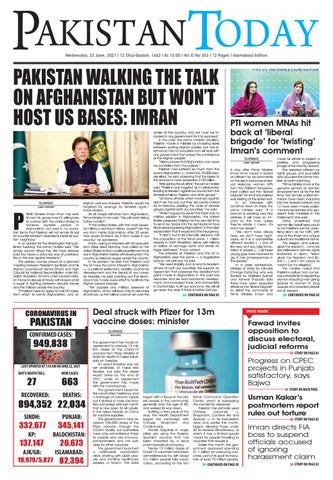
Pakistan walking the talk on afghanistan but won’t host us bases: imran
ISLAMABAD staff RepoRt
P
RIME Minister Imran Khan has reaffirmed his government’s willingness to partner with the United States to achieve durable peace in Afghanistan, but said in no uncertain terms that Pakistan will not render its soil for counter-terrorism operations inside its wartorn neighbour. In an opinion for The Washington Post published Tuesday, the prime minister said: “We simply cannot afford this. We have already paid too heavy a price [by way of participation in the war against terrorism].” The opinion comes ahead of a planned meeting between President Joe Biden and his Afghan counterpart Ashraf Ghani and High Council for National Reconciliation chief Abdullah Abdullah, Ghani’s chief peacemaker, on Friday to discuss US troop withdrawal amid a surge in fighting between security forces and the Taliban across the country. “If Pakistan were to agree to host US bases, from which to bomb Afghanistan, and an
Afghan civil war ensued, Pakistan would be targeted for revenge by terrorists again,” Imran feared. As US troops withdraw from Afghanistan, Prime Minister Imran said: “We will avoid risking further conflict.” “If the United States, with the most powerful military machine in history, couldn’t win the war from inside Afghanistan after 20 years, how would America do it from bases in our country,” he wondered. Imran, during an interview with US news platform Axios aired Monday, had called on the United States to find a political settlement to its war in Afghanistan before withdrawing from the country as violence surges across the country In his opinion, he said that Pakistan and the US have the same interest in Afghanistan — a political settlement, stability, economic development and the denial of any haven for terrorists, he said, pointing out that Islamabad had made every effort to facilitate the Afghan peace process. “We oppose any military takeover of Afghanistan, which will lead only to decades of civil war, as the Taliban cannot win over the
Coronavirus in
Pakistan
CONFIRMED CASES:
949,838
LAST UPDATED AT 7:59 AM ON JUNE 22, 2021
DAY'S DEATH TOLL:
NEW CASES:
27
663
RECOVERED:
DEATHS:
894,352 22,034 SINDH:
PUNJAB:
332,677
345,141
KP:
BALOCHISTAN:
137,147 AJK/GB: 19,979/5,827
26,673 ISLAMABAD:
82,394
whole of the country, and yet must be included in any government for it to succeed.” In the past, the prime minister recalled, Pakistan made a mistake by choosing sides between warring Afghan parties, but now Islamabad has no favourites and will work with any government that enjoys the confidence of the Afghan people. “History proves that Afghanistan can never be controlled from the outside.” Pakistan had suffered so much from the wars in Afghanistan — more than 70,000 people killed, he said, observing that the losses to the economy have exceeded $150 billion. “After joining the US effort,” the prime minister said, “Pakistan was targeted as a collaborator, leading to terrorism against our country from the Tehreek-e-Taliban Pakistan and other groups.” “US drone attacks, which I warned against, didn’t win the war, but they did create hatred for Americans, swelling the ranks of terrorist groups against both our countries,” he said. “While I argued for years that there was no military solution in Afghanistan, the United States pressured Pakistan for the very first time to send our troops into the semiautonomous tribal areas bordering Afghanistan, in the false expectation that it would end the insurgency. “It didn’t, but it did internally displace half the population of the tribal areas, 1 million people in North Waziristan alone, with billions of dollars of damage done and whole villages destroyed,” Imran added. The interests of Pakistan and the US in Afghanistan were the same — a negotiated peace, not civil war, he said. “We need stability and an end to terrorism aimed at both our countries. We support an agreement that preserves the development gains made in Afghanistan in the past two decades. And we want economic development, and increased trade and connectivity in Central Asia, to lift our economy. We will all go down the drain if there is further civil war.
CONTINUED ON PAGE 05
PTI women MNAs hit back at ‘liberal brigade’ for ‘twisting’ Imran’s comment ISLAMABAD staff RepoRt
A day after Prime Minister Imran Khan faced a torrent of criticism for his comments on the rise in instances of sexual violence, women MPs from the Pakistan Tehreek-eInsaf called out the “liberal brigade” for what she insisted was twisting of the statement. In an interview with Jonathan Swan on Axios, the prime minister said: “If a woman is wearing very few clothes, it will have an impact on the men unless they’re robots. I mean, it’s common sense.” “We don’t have discos here, we don’t have nightclubs, so it is a completely different society […] way of life here, so if you raise temptation in society […] all these young guys have nowhere to go, it has consequences in the society.” In a press conference, Minister of State for Climate Change Zartaj Gul, who was flanked by Maleeka Bukhari and Kanwal Shauzab said there have been repeated efforts by the “liberal brigade” to distort the comments of Prime Minister Imran and
Deal struck with Pfizer for 13m vaccine doses: minister ISLAMABAD ReuteRs
The government has made an agreement to procure 13 million doses of the Covid-19 vaccine from Pfizer, Minister of State for Health Dr Faisal Sultan said on Tuesday. An exact timeline was not yet available, Dr Faisal told Reuters, but said the doses would arrive by the end of 2021, under an agreement the government has made with the manufacturer. The government faced initial vaccination hesitancy and a shortage of vaccine supply but it started a mass vaccination campaign late last month that is now open to all adults. It has relied heavily on China for vaccine supplies. The government in May received 100,000 doses of the Pfizer vaccine through the COVAX facility, but authorities have only administered those to people who are immunocompromised and not suitable for other vaccines. The government launched a nationwide vaccination drive, starting with older people and frontline healthcare workers, in March. The drive
mock his efforts to project a positive and progressing image of the country abroad. She rejected criticism by rights groups and journalists who accused the prime minister of victim-blaming. “Prime Minister Imran is the genuine symbol of women empowerment as for the first time, five female parliamentarians have been inducted into the federal cabinet and 12 have been made parliamentary secretaries who represent their ministries in the Parliament,” she said. Zartaj underlined that women like herself were proud to be Pakistani woman practising Islam as her faith, with one of the finest and unique cultural and traditional norms. “My religion, and culture, gives me respect […] and we are believers in women rights enshrined in Islam. “Islam gives me freedom and liberty […] and I am proud to have it [as my religion].” The minister noted that Pakistani culture had numerous precedents of respecting women including men giving spaces to women in long queues and crowded places out of respect.
CONTINUED ON PAGE 05
more inside
Fawad invites opposition to discuss electoral, judicial reforms STORY ON PAGE 03
Progress on CPEC projects in Punjab satisfactory, says Bajwa STORY ON BACK PAGE began with a focus on the oldest people in the community, generally over the age of 80, and worked its way down. Battling a third peak of the virus, the Health Department began the campaign with Chinese Sinopharm and CanSino jabs. Private hospitals in major cities are using the Russian Sputnik-V vaccine that has been imported by a local pharmaceutical company. Nearly 13 million doses of Covid-19 vaccines have been administered so far, with about 3.5 million people fully vaccinated, according to the Na-
tional Command Operation Centre, which is overseeing the pandemic response. Pakistan has primarily used Chinese vaccines — Sinopharm, CanSino Bio and Sinovac — in its inoculation drive and, earlier this month, began allowing those under 40 to receive AstraZeneca, of which it has a limited supply meant for people travelling to countries that require it. Earlier this month, the government approved spending $1.1 billion on procuring vaccines, part of its goal to inoculate at least 70 million people.
CONTINUED ON PAGE 05
Usman Kakar’s postmortem report rules out torture STORY ON PAGE 02
Imran directs FIA boss to suspend officials accused of ignoring harassment claim STORY ON PAGE 03
02
Wednesday, 23 June, 2021
ISLAMABAD
NEWS
CriSiS in BaLoCHiStan averted aS KamaL, rind agree to meet finaLLy, end differenCeS QUETTA
i
MIaN abRaR
N a major breakthrough, Parliamentary Committee on Kashmir Chairman Shehryar Khan Afridi averted a major crisis in Balochistan coalition government by holding separate meetings with Chief Minister Jam Kamal Khan and Pakistan Tehreek-e-Insaf (PTI) Balochistan President Sardar Yar Mohammad Rind and convincing both to mend their differences. It merits mention that Rind has been actively demanding resignation of CM Jam Kamal and has been vocal against the chief
SHEHRYAR AFRIDI CONVINCES BALOCH CHIEFTAINS TO MEND FENCES minister. He has also led a delegation of the PTI from the Balochistan Assembly to federal capital and has held meetings with Prime Minister Imran Khan, Minister for Planning, Development and Special Initiatives Asad Umar and others and demanded ‘removal’ of Balochistan Chief Minister Jam Kamal from his post. In his meeting with Umar, Rind said “it has become impossible to work with Jam Kamal”. PTI deputy parliamentary leader Naseebullah Marri and other MNAs and
Seven of a famiLy gunned down in PeSHawar PESHAWAR INP
Seven persons of the same family were gunned down in Chamkani area of Peshawar on late Monday night, Dunya News reported. According to details, some armed persons barged into a house located in Chamkani area of Peshawar and resorted to indiscriminate firing, killing seven persons of the family, including three real brothers. According to SP Chamkani, seven persons were killed over a property dispute. Police have arrested four accused involved in the gruesome incident while hunt is on to arrest others. Police sources said that the three deceased brothers were identified as Jalal, Salman and Saleem. Two other deceased were identified as Habib Ullah and Bano Bibi.
usman Kakar’s postmortem report rules out torture NEWS DESK Pakhtunkhwa Milli Awami Party’s former senator Usman Khan Kakar’s postmortem report ruled out the possibility of torture after opposition senators demanded a probe into his death on Tuesday. According to Geo News, no sign of torture or hitting were found on Kakar’s body. The only marks found on the body were of surgery and cannulation during his treatment at the hospital. The actual cause of death will be declared in a pathology report, for which several samples have already been obtained from the body. After the completion of the autopsy, Kakar’s body has been handed over to his family to carry out the burial procedures. Kakar’s family said that they will get the pathological samples counter-checked.
inmate commits ‘suicide’ in fia custody ISLAMABAD TLTP
An under-trial prisoner on Tuesday died in the custody of Federal Investigation Agency (FIA) in Islamabad in what police termed an apparent suicide case, a private television reported. According to sources, the FIA arrested a suspect identified as Amir Hafeez in a fraud case and shifted him to the prison of the Islamabad zone. He was a travel agent and a resident of the Bara Kahu area of the capital city. “The inmate was found dead inside the prison,” they said. The police have meanwhile, took possession of the body and started a probe regarding the incident. “It apparently looks like a suicide case, however, a clearer picture will emerge after the post mortem report,” they said. According to the FIA spokesman, the incident was immediately brought to the notice of a magistrate before the body was sent for post mortem after collection of evidence from the spot. The director FIA has suspended four officials including the SHO of the agency’s office for their negligence in the matter, the spokesman said adding that a three-member committee was also formed to submit a report on the matter within a week. In another recent incident, a murder case has been registered against two officers of the Counter-Terrorism Department after the death of a suspect in their custody in the federal capital. An FIR has been registered under sections 322 (Punishment for murder) and 34 (Acts done by several persons In furtherance of common intention) of the Pakistan Penal Code. The deceased was identified as Hassan, 15, a resident of Lower Dir, KPK. His family and friends also staged a demonstration on Saturday to protest the custodial death. According to a statement by the police, the suspect died due to inadequate medical treatment amid extreme heat and fever.
MPAs participated in the meeting and expressed reservations over the Balochistan government. Sources privy to the development told Pakistan Today that Education Minister Sardar Yar Mohammad Rind, who has been actively and openly speaking against his chief minister Jam Kamal Khan. However, the sources said that the differences both the chieftains kept growing and finally Yar Mohammad Rind had decided to tender resignations from his ministerial portfolio as
well as the PTI’s provincial president. However, the sources said that Shehryar Khan Afridi visited Quetta on the direction of Prime Minister Imran Khan and held separate meetings with chief minister Balochistan Sardar Jam Kamal and Sardar Yar Mohammad Rind and convinced both of them to mend fences. The sources said that Shehryar Afridi met Sardar Yar Mohammad Rind first and conveyed a special message from the prime minister. The sources added that Shehryar told Yar Mohammad Rind that the coalition government in Balochistan needed to be supported. The sources said that Yar Mohammad
Rind was accompanied by party’s founding president Nawabzada Jogezai and other party office bearers who also supported the view of Rind. However, the sources said that Shehryar Khan Afridi convinced Rind not to resign as any such step may put the coalition government into a jeopardy. The source said that Shehryar Afridi first convinced Yar Mohammad Rind not to resign from provincial cabinet and Yar Muhammad Rind promised not to resign. Rind also agreed to consider Shahryar Khan Afridi’s request to end differences with Balochistan Chief Minister Jam Kamal Khan. Later during the meeting with Chief Minister Jam Kamal Khan, Afridi urged him to meet Yar Muhammad Rind and mend differences. “Jam Kamal promised to Shehryar that he will try to remove Rind’s reservations and would meet him soon. Shahryar Khan Afridi’s efforts averted the threat of crisis in the Balochistan government and the differences between PTI Balochistan and Chief Minister Balochistan likely to end,” the sources concluded.
CTD arrest two terrorists, affiliated with MQM-L, in night raid: police KARACHI STaff RePoRT
The Counter-Terrorism Department of Sindh police arrested two terrorists belonging to the Altaf Hussaincontrolled London chapter of Muttahida Qaumi Movement in a night raid in Mirpur Khas. In a press conference at Civil Lines police station on Tuesday, CTD Deputy Inspector General Omar Shahid Hamid said that the police have made key arrests in the raid.
“The workers were sent to India [for terrorism] training in line with the policy of party founder,” Hamid said. “Two prominent MQM leaders were entrusted with sending the workers [to India],” he revealed. “Two men arrested in the CTD raid also received training from India. They were also in contact with Hussain’s aide and MQM leader Wasay Jalil and others,” he said. “Large cache of weapons including anti-aircraft gun was recovered from the militants.” “The arrested suspect, Naeem, has
confessed to meeting Anis Ahmed Khan [also an MQM leader] in Tehran,” Hamid said. “We have questioned Khan [in the past]. He will be summoned again [for questioning],” he added. “Khan has been prohibited from leaving the country. The charge sheet [against the suspects] will be filed after collecting more evidence. “Jalil has been residing in the United States. We will contact Interpol for his arrest. Karachi police, Hamid said, has nabbed a cell linked with the University
FIA accuses Shehbaz, family of laundering Rs25bn LAHORE TLTP
The Federal Investigation Agency (FIA) accused the Leader of the Opposition in the National Assembly Shehbaz Sharif and his family members of laundering about Rs25 billion using the bank accounts of employees working for Ramzan Sugar Mills and Al-Arabia Sugar Mills. On June 15, the FIA’s Anti-Corruption Circle issued a notice to the PML-N president, asking him to appear in person before its investigators on June 22 and also bring relevant documents with him. Sources disclosed that the PML-N leader appeared before a five-member investigation team of the FIA Punjab Zone-1 Director Dr Rizwan at Lahore office on Tuesday. Two days ago the Agency summoned Shehbaz and his son, Hamza Shehbaz as soon after the summons both the father and son have appeared before an additional district and sessions judge Lahore who granted pre-arrest bail to them in multi-billion sugar scam. According to a private television, the FIA claimed that Shehbaz and his family members laundered money using 20 bank accounts of peons, clerks, cashiers and warehouse managers employed in the sugar mills. About Rs2.70 billion was laundered in the name of peon Maqsood and about Rs2.80 billion was laundered in the name of Haji Naeem. The anti-corruption watchdog further added that about Rs2.5 billion was laundered in the name of another employee working as a driver
whereas about Rs1.75 billion was laundered in the name of a peon named Aslam. The FIA further claimed that about Rs4.5 billion was laundered in the name of clerks Azhar and Ghulam Shabir Hayat. The names of Qaiser Abbas, Akbar, Iqrar, Anwar, Yaseen, Ghazanfar, Tauqeer, Zafar Iqbal, Kashif Majeed and Masroor Anwar were also used, the FIA added. The FIA further accused the chief financial officer of Sharif Group of Companies of supervising all money laundering whereas Shahbaz’s camp office was used to collect the money and sacks of notes were delivered to Salman Shahbaz’s office under police protocol. All the money from Salman’s office would be sent abroad by hawala and hundi, the FIA claimed. Meanwhile, talking to media, PML-N spokesperson Marriyum Aurangzeb has termed FIA notice to the party head Shehbaz and Hamza as illegal. She alleged that the FIA was now indulged in political revenge after the National Accountability Bureau (NAB), adding the whole drama was being staged in order to create distraction from the anti-people budget. On the other hand, former prime minister Shahid Khaqan Abbasi expressed the NAB cases as baseless saying when the NAB did not find anything against them then benami accounts matter had emerged. Abbasi alleged that efforts were being made to bring a presidential system in cover of electoral reforms, adding a country can never progress where votes are stolen.
Amenity plots in Karachi utilised for commercial, residential purposes: Alvi KARACHI aPP
President Dr Arif Alvi on Tuesday said amenity plots have in the past been avariciously used for residential and commercial purposes in connivance with Karachi’s building regulators and metropolitan corporation. In a meeting with the affectees of the Supreme Court ruling directing the authorities to demolish illegal settlements across the metropolis, the president said: “I assume the chief justice has ordered to halt illegalities in allotments of plots and construction of buildings on residential and amenity plots.” He also stressed on the builders to change their attitude for the better and act responsibly while dealing with such matters. Alvi assured the affected people he would raise and communicate their just concerns on various forums.
Members of the Association of Builders And Developers, affectees of the anti-encroachment drive and representatives of South City Hospital briefed the president in detail about their apprehensions and concerns. President Alvi was told that about 40 to 50 thousand families would be affected by the drive. They complained that no action was ordered against the officials involved in allowing the illegal constructions. Residents of Nasla Towers, a 15-storey residential building which the Supreme Court has ordered to demolish for encroaching on the land meant for a service road, apprised Alvi that the building was approved by the regulators. In the light of the court orders, about 900 buildings would be demolished, participants of the meeting informed the president. The affectees also requested the president to help resolve their problems.
of Karachi. The accused arrested from the institution were in contact with Mehmood Siddiqui [accused of playing a role in getting MQM workers trained by Indian spy agency Research and Analysis Wing], DIG said. “Siddiqui is a former president of the All Pakistan Muttahida Students Organisation and presently staying in India”, he said. “He has been the focal person between the RAW and MQM. Siddiqui was also a facilitator of the arrested suspects,” Hamid said
LHC sets aside woman’s life-term in infant murder case LAHORE: The Lahore High Court (LHC) Tuesday quashed a life sentence to a woman charged with killing her 7-month old niece. Hearing the appeal in the matter on Tuesday, a single-member bench of the LHC comprising Justice Muhammad Amjad Rafique turned down the conviction that trial court awarded to the accused person saying conviction was awarded on the insufficient evidence. Another ground the Justice Rafique noted down in his verdict was that a delay of seven hours was found in the registration of the First Information Report saying no reason was given for such delay. “The prosecution failed to take the cot and other concerned items in its possession”. “The police had not found traces of blood from the crime scene. The post-mortem was not reported in the FIR. The failure in describing the post-mortem is a major flaw in the case,” the judge pointed out in the decision saying, “The post-mortem of the child was conducted nine hours after the incident.” Justice Rafique said in its verdict that the prosecution claimed the child was killed with an iron rod, while the post-mortem report disclosed that the girl was thrown from the first floor of the building. He further said that the prosecution failed to produce the mother of the child. It is pertinent to mention that the trial court awarded life sentence and Rs0.1 million fine to the accused lady. TLTP
LHC sets aside luxury tax recovery notice LAHORE: The Lahore High Court on Tuesday cancelled the recovery of luxury tax on houses of two kanals and above without due course of law. Justice Jawad Hassan took up the petition against the tax notices. He ruled that the Excise and Taxation Department did not comply with the relevant rules for tax recovery. He further said: “Fair trial is the right of every citizen. The Excise Department should not act hastily [against the petitioner].” The citizens had challenged the 2014 imposition of a one-time luxury tax on big residential properties measuring two kanals and above by amending Section 8 of the Finance Act. The petitioner, nominating the Punjab government and the tax collection body as respondents, told the court that he was served with an Rs6.5 million tax notice on a four-kanal house. INP
Wednesday, 23 June, 2021
ISLAMABAD
NEWS
fawad inviteS oppoSition to diScuSS electoral, judicial reformS ISLAMABAD
m
StAff RePoRt
INISTeR for Information and Broadcast Fawad Chaudhry Tuesday invited the opposition to discuss with the government the proposed electoral and judicial reforms to reach a consensus. Addressing the National Assembly during a debate, the minister said the government will welcome the suggestions of the opposition parties on the amendments — The elections (Amendment) Bill, 2020 — proposed in October last to restore the credibility of general elections. Major changes proposed in the bill include more financial autonomy for the election Commission of Pakistan, right of appeal to the Supreme Court by any aggrieved person on delimitation lists, the vacation of seats of a returned candidate if the oath is not taken within 60 days of the first sitting of the assembly, voting right for nationals living abroad and the use of electronic voting machines in elections.
Opposition parties have strongly objected to the use of eVMs and giving foreign nationals the right to vote despite championing the cause during their respective tenures. In his speech, Fawad said the Pakistan Tehreek-e-Insaf government wanted to strengthen the election commission. The use of electronic voting, he said, was critical to ensure transparency and fairness in the polls. The government under the leadership of Prime Minister Imran Khan has put the country on the right track with the economy witnessing accelerated growth, he added. He said while the opposition parties reserved the right to criticise the government, the responsibility also rested with it to contribute positively to the system. He urged the opposition to come to “positive politics” to collectively take the country forward. Declaring the period from 2008 to 2018 as one of darkness for the country, Fawad said the previous governments ruined the economy through their policies. He pointed out that the foreign loans stood at Rs6,000
billion in 2008 which ballooned to Rs26,000 billion in 2018. Today, he said, the situation was such that the government was paying Rs2,000 billion a year in debt servicing. In addition, Rs900 billion were being dished out in capacity payments to the power plants which he said will surge to Rs1,500 billion by 2023.
The minister further said under the 18th amendment, a big share of revenue went to the provinces and administrative units. He said Rs1,600 to Rs1,700 billion went to Sindh over the last two years under the National Finance Commission award. He said another Rs700 to Rs750 billion will be doled out to the province in the 2021-
Imran directs FIA boss to suspend officials accused of ignoring harassment claim ISLAMABAD StAff RePoRt
Prime Minister Imran Khan on Tuesday ordered to suspend officials of the Federal Investigation Agency accused of failing to deal with a sexual harassment complaint. According to a report, a woman approached the Prime Minister’s Office through Pakistan Citizen Portal after the concerned officials allegedly failed to take action on her disclosure. The complaint, per a statement from the PMO, had been lodged five times between December 2019 and June 2021. The complainant, it said, had to quit her employment at a university because of the incessant harassment after which she filed a complaint with the agency. The report further that the
complainant even attempted to kill herself over the agency’s alleged inaction. Meanwhile, the PMO said despite reopening the complaint twice, the agency failed to bring the case to its logical conclusion. Directing FIA Director General Sanaullah Abbasi to suspend the concerned officials, the prime minister ordered an immediate inquiry into the complaint and assured the complainant of justice. Directing the agency to provide relief to the complainant at the earliest, Imran said that no such claim should be ignored. The Prime Minister’s Performance Delivery Unit has also issued a letter to Abbasi to initiate an inquiry against the concerned officials and submit the report to the PMO by July 20.
Lowest Covid-19 positivity rate in eight months: NCOC ISLAMABAD StAff RePoRt
The nation on Monday recorded a Covid-19 positivity rate of 1.7 percent, the lowest over the last eight months, official statistics revealed on Tuesday. According to the National Command and Operation Centre, the nerve center against the pandemic, a total of 663 new Covid-19 cases from 39,017 tests were detected on Monday. The country faced a serious third wave of Covid-19 recently with the positivity rate exceeding 11 percent, but
the situation was brought under control by a massive vaccination campaign, and strict restrictions on business, education as well as social activities. The tally of confirmed cases rose to 949,838 in the country, the NCOC said, adding that 27 people died of the disease on Monday, raising the death toll to 22,034. The country currently has 33,452 active cases whereas 894,352 others have recovered. Punjab is the worst-hit province with 345,141 infections, followed by Sindh which reported 332,677 infections.
APP
Government of Pakistan has partnered with Facebook in its fight against Covid-19 to tackle misinformation creating displeasure among the masses. In Pakistan, over 32 million people received authoritative information regarding Covid prevention and vaccination through social media messaging campaigns conducted by the Ministry of Health and the Ministry of Information’s Digital Media Wing (DMW) in partnership with Facebook. Facebook provided Marketing Partner Support and Advertisement Credits for these campaigns and helped the government increase its engagement rates with the public
on these posts between March 16 and April 6, 2021. As part of these campaigns, Facebook and the ministries focused on creating videos and messages on boosting greater vaccine confidence amongst the nation. The messaging campaigns helped the Ministry of Health increase its total number of page likes to 470,000 – increasing the government’s ability to connect with and provide information to its stakeholders. As Covid-19 vaccines are becoming more readily available to larger groups, Facebook launched new Facebook profile frames in partnership with the Ministry of Health that allow users to share their support for getting vaccinated with their family and friends.
2022 fiscal year. He, however, lamented that the Pakistan Peoples Party government in the province has done little for the provision of so much as basic amenities to the people. He said this was the reason that the prime minister stood up against corruption. Participating in the budget debate, PTI MP Rahat Amanullah Bhatti said the elected representatives shared the responsibility to launch a sustained campaign against power pilferage and to provide clean drinking water to their constituents. Muttahida Majlis-e-Amal MP Muhammad Jamalud Din said the federal government should increase the compensation of its employees by at least 20 percent. Pakistan Muslim League-Nawaz MP Ahsan Iqbal said unrealistic targets have been set in the proposed budget. He claimed the government will not be able to achieve the revenue collection target of Rs5.8 trillion. He said efforts should be made to attract foreign direct investment and bolster the exports. He added that additional funds should be allocated for the Higher education Commission. Another PTI MP Tahir Sadiq Khan said the salaries of government staffers should be enhanced by 25 percent. He opined that the local government system should be restored to address the public issues at the grassroots level. PPP MP Shazia Marri termed the budget as anti-people and anti-farmers. She said the figures presented in the budget were fudged.
15-year-old girl gang-raped, filmed in punjab TOBA TEK SINGH INP
Another rape case has been reported in Punjab, where three men allegedly sexually assaulted a 15-year-old girl and filmed her in Toba Tek Singh. According to the police, the incident took place in the Toba Tek Singh district of Punjab. The accused have been arrested on the complaint of the victim’s family. Nasir, Tasawur and Ahmed have been arrested for sexually abusing a 15year-old girl and filming the act. A case has been registered against, while the investigation was underway. Back in April, a 12-year-old girl was allegedly gang-raped by four men in Karachi’s Memon Goth who filmed and later her video was posted on social media by the culprits. The First Information Report (FIR) stated that four men had raped his daughter. It added that the video of the rape victim was later made viral on social media. The father sought immediate action against the criminals.
Sons of mufti rehman get interim bail in student rape case LAHORE INP
A sessions court on Tuesday granted interim bail to three sons of a seminary teacher Mufti Azizur Rehman in a student rape case, ARY News reported. Three sons of Rehman approached Lahore’s sessions court for interim bail in the case. The court granted bails to Latifur Rehman, Waseemur Rehman and Wasiur Rehman against surety bonds of Rs100,000 each. On Sunday, Punjab police had announced the arrest of a suspect involved in sexually assaulting a seminary student in Lahore along with his son.
Govt partners with Facebook to fight Covid-19 misinformation ISLAMABAD
03
Research shows, when people see others who they know and trust getting the vaccine, they are encouraged to do the same. This can be particularly effective when it comes to encouraging those who were otherwise unsure about getting themselves vaccinated. Speaking in this regard to the support extended by Facebook Special Assistant to the Prime Minister (SAPM) on Health Dr Faisal Sultan said, “We are appreciative of the support extended by Facebook in our fight against Covid-19. We reached 76 percent of our target population through our social media messaging campaigns. The pandemic has brought to the forefront the importance of using digital tools for transmitting critical health information to citizens and keeping them
safe and healthy.” Throughout the pandemic, Facebook has worked closely with the two ministries to direct people to authoritative Covid-19 information. A campaign to create awareness about spotting Coivd related misinformation on social media was also launched in Urdu for the Facebook community in Pakistan in partnership with the Ministry of Information’s Digital Media Wing. Minister for Information & Broadcasting Fawad Chaudhry stated, “We appreciate the hard work put in by the Ministry of Health and the Digital Media Wing of Government of Pakistan in bringing together an engaging campaign in partnership with Facebook. It is crucial to differentiate between information and misinformation in the age of digital
communication. Facebook has supported the spread of accurate information through their drive of removing misinformation and fact checking of news. We hope to partner with Facebook in the future to ensure that the people of our nation are provided with accurate information.” Facebook has worked to take aggressive steps to remove harmful misinformation and connect people to resources from health authorities. Since the start of the pandemic in March 2020, Facebook removed more than 16 million pieces of content from Facebook and Instagram globally for violations against our policies on Covid-19-related misinformation and harm. Between March and October of 2020, Facebook displayed warnings on about 167 million pieces of content on Facebook worldwide based on Covid-19 related debunking articles written by our fact checking partners.
wednesday, 23 June, 2021
04 news
islamabad
ECC aPProvES EiGhT SuPPLEmEnTary GranTS worTh rS3.9bn MEETING APPROVES ENHANCEMENT OF EHSAAS KAFALAT MONTHLY STIPEND ISLAMABAD STAFF REPORT
The Economic Coordination Committee (ECC) of the Cabinet on Monday continued sanctioning supplementary and technical supplementary grants so that these could be approved by the National Assembly along with the federal budget 2021-22. While clearing about Rs3.9 billion worth of eight supplementary grants to different entities for current fiscal year, the ECC meeting, presided over by Finance Minister Shaukat Tarin, also approved indexation policy
LPG prices hiked for third time in four days MONITORING REPORT The prices of the Liquefied Petroleum Gas (LPG) have been raised in the country for the third time within a span of four days as distributors have announced a nationwide strike against the decision on June 30. The Oil and Gas Development Company Limited (OGDCL) announced an increase of Rs6.09 per kilogram in the prices of LPG cylinders. After the recent increase, Rs71.93 would be charged more on the household cylinder while commercial cylinder prices would go up by Rs276.75. Similarly, LPG prices were raised to Rs170 in Gilgit Baltistan (GB) as commercial cylinders would be now available in the region at Rs7, 720 and a household cylinder at Rs2,000. The prices are likely to go up by Rs10 to Rs15 per kilogramme after June 30. It is pertinent to mention here that the LPG distributors chairman has announced to go on strike from June 30 against the decision and said that they would cut the supply of LPG across the country.
Senate body wants no duty, taxes on flour mills, petroleum goods MONITORING REPORT The Senate Standing Committee on Finance on Monday recommended to the government withdrawal of duty and taxes on those goods which will further push up inflation. The meeting chaired by Senator Talha Mahmood also noted with concern that the Federal Board of Revenue (FBR) had issued notices to 1,500 businessmen demanding undue taxes. According to a local media report, the committee sought details of these notices by July 15. Senator Sherry Rehman demanded withdrawal of Rs20 per litre petroleum levy on petroleum products. She further said tax on flour mills industry may cost additional Rs97 on per 20kg bag of flour. The committee unanimously recommended withdrawal of these taxes. Senator Kauda Babar proposed to increase excise duty by Rs25 per pack of Tier-1 cigarettes, Rs15 on Tier-2 cigarette pack.
for cash transfers to poor people that would increase their stipend by Rs166 per month. The meeting approved the request of the Poverty Alleviation and Social Safety Division regarding Indexation Policy for Cash Transfer and allowed the Benazir Income Support Programme (BISP) to adopt the institutional mechanism for periodic update of regular cash transfer benefits to Ehsaas Kafalat Beneficiaries. The beneficiaries would receive an additional cash of Rs166 per month due to indexation. The meeting also constituted a committee to review the mechanism
in future. The committee would be led by Secretary of Finance Division and comprise Additional Finance Secretary and secretaries of Poverty Alleviation and Social Safety Division and Economic Advisor Finance Division, and one co-opted member for independent technical advice. The terms of reference of the committee would be to consider and recommend adjustment of regular cash benefits of BISP i.e. Ehsaas Kafalat Programme for inflationary reasons within three years from last enhancement to the federal cabinet for approval. The committee would also consider and approve any update or adjustment of cash transfers under BISP Programmes other than Ehsaas Kafalat Programme. For the current round, the ECC approved the en-
Chinese steel firms convey concern over facilitating non-taxed units in tribal areas ISLAMABAD GHULAM ABBAS
Following the local industry, Chinese firms have also shown concerns about the government's move to abolish Federal Excise Duty (FED imposed on nontaxed industries in tribal areas. Chinese firms including, Century Steels Pvt. Limited and AL-Haj Asia Star Steel Company Pvt. Ltd., in a joint venture with local companies, have come forward to oppose the government’s initiative, saying that they were worried about the future prospects of their investments. According to sources, representatives of the two companies, accompanied by a delegation of the local steel industry, met with the Federal Minister for Science and Technology, Senator Shibli Faraz, here in Islamabad on Tuesday and expressed their concerns about the abrupt removal of sales tax on the steel units operating in PATA. The prime minister had inaugurated the first ever Chinese steel unit of 500,000 MT annual capacity – Century Steels Pvt. Ltd., in the Rashakai Special Economic Zone (SEZ). This is an exclusive investment from any Chinese company in the steel sector. The company is near to completing civil work and to go into production.
Similarly, Al-Haj Asia Star Steel Company Pvt. Ltd. in a joint venture with a Pakistani company and has installed a plant of 500,000 MT in Pakistan. Al-Haj Asia Star Steel is a joint venture formed in 2017 between Pakistani conglomerate Al-Haj Group and China's Hebei Xingang Iron & Steel Group. Earlier, all stakeholders in the steel industry, while opposing the government’s decision to abolish FED on units operating in erstwhile FATA, had claimed that there was a political hand behind the initiative, which they believed would destroy the industry. The major players in the iron and steel sector said that mis-planning and lack of regulatory oversight was creating distortions in the industry. While criticising the policy makers and government functionaries for inefficiencies, the members of iron and steel sector, in a statement said that after failing to run the Pakistan Steel Mills, the officials were bent upon destroying the steel units in the private sector. “The capacity of Pakistan steel was only 1.2 million tonnes per annum and the government could not run it,” said Mian Akram Fareed, Vice president FPCCI, “But the production of only Mughal and Amreli steel was more than 2 mn tonnes annually, and instead of respecting the private sector
the officials were creating disturbances for the investors.” The steel industry was demanding that the decision to abolish Federal Excise Duty to around 40 units located in former Federally Administered Tribal Areas (Fata) will damage the whole industry. “Just because the tax-exempt goods are sold in the major markets across the country, the main industry was making losses,” Pakistan Association of Large Steel Producers (PALSP) Patron-inChief Abbas Akberali said. He informed that his own company operated at full capacity, and made record sales but still made a loss to around Rs1.7 bn in the last fiscal year (FY20). “It was due to price distortions and when cheap products are available in the markets, we are forced to lower the rates or opt for a shut down,” he added. He highlighted that after abolishing the FED for units in former Fata, the products from that part will be cheaper by up to Rs27,000 per tonne. Meanwhile, Javed Mughal of Mughal Steel Mills said that around 0.5 million tonnes of duty free scrap was imported for the units in FATA during the last fiscal year; however, the electricity bill shows that only 100,000 tonnes of steel products were produced.
hancement of Ehsaas Kafalat monthly stipend by Rs166 per beneficiary per month with effect from January 1, 2022. The ECC approved payment of arrears of contribution amounting to about Rs3.370bn on account of Group Insurance Fund by the Finance Division on behalf of the Federal Government Non-Gazetted (BS 1 to BS 15) employees. The meeting also approved additional funding requirement of Rs75 million to the Ministry of Housing and Works for capital outlay on civil works during the current fiscal year in respect of three different development schemes. In addition, a technical supplementary grant of Rs43 million was also granted to the Ministry of Housing and Works.
Pakistan, Tajikistan agree to further deepen, diversify bilateral ties ISLAMABAD TLTP
Pakistan and Tajikistan have reiterated their resolve to further deepen and diversify bilateral ties for mutual benefit. An understanding to this effect came during the meeting of Pakistan's National Security Adviser Dr Moeed Yusuf with Secretary of Security Council of Tajikistan Nasrullo Mahmudzoda in Dushanbe on Tuesday, said a press statement. Dr Moeed Yusuf said that Tajikistan and Pakistan need to pay special focus on strengthening bilateral cooperation in the areas of trade, transport, connectivity, energy, defence and security. He said Pakistan and Tajikistan share the longest borders with Afghanistan and therefore need to cooperate closely for regional peace and security. He highlighted that Pakistani seaports including Gwadar offer the most economic and efficient route to Tajikistan for its connectivity with the outer world through sea. He extended felicitations to his Tajik counterpart on assumption of Shanghai Cooperation Organisation (SCO) chair and best wishes for successful organization of 16th meeting of Secretaries of the Security Councils of SCO Member States as well as upcoming 20th Anniversary of SCO Summit in Dushanbe in September later this year. Both sides expressed satisfaction at the excellent bilateral ties between the two brotherly countries and reiterated their resolve to further deepen and diversify these ties for mutual benefit. In the meeting, Tajik Secretary of Security Council Mahmudzoda expressed gratitude on behalf of his government for Pakistan's continued assistance in humanitarian and technical spheres including provision of training for capacity building of Tajik servicemen. Mahmudzoda said bilateral ties between Pakistan and Tajikistan are flourishing day by day and the recent visit of Tajik president to Pakistan had added yet another impetus to these ties.
Oil rises on optimism of quick recovery in global demand TOKYO AGENCIES
Crude oil prices rose on Tuesday, with Brent hitting $75 a barrel for the first time since April 2019, as investors remained bullish about a quick recovery in global oil demand and as concerns eased over an early return of Iranian crude. Brent crude futures for August climbed 26 cents, or 0.4%, to $75.16 a barrel by 0400 GMT, paring earlier losses. It rose as high as $75.23 a barrel, the strongest since April 25, 2019, earlier in the session. US West Texas Intermediate (WTI) crude for July was at $73.70 a barrel, up 4 cents, or 0.1%. WTI for August climbed 11 cents, or 0.2%, to $73.23 a barrel. Brent gained 1.9% and WTI jumped
2.8% on Monday. Both benchmarks have risen for the past four weeks on optimism over the pace of global COVID-19 vaccinations and expected pick-up in summer travel. The rebound has pushed up spot premiums for crude in Asia and Europe to multi-month highs. “The market sentiment stays strong with improved outlook for global demand,” said Satoru Yoshida, a commodity analyst with Rakuten Securities, adding that a rally in Asian stock markets is also helping boost risk appetite among investors. Global shares extended their recovery on Tuesday, with Asian markets bouncing from four-weeks lows as investor focus on economic growth partly offset worries about the US Federal Reserve raising rates sooner than expected.
BofA Global Research raised its Brent crude price forecasts for this year and next, saying that tighter oil supply and recovering demand could push oil briefly to $100 per barrel in 2022. Investors are looking to weekly US inventory data as crude oil stockpiles have fallen for four weeks, said Toshitaka Tazawa, analyst at commodities broker Fujitomi Co. US crude stocks were expected to drop for the fifth consecutive week, while distillate and gasoline were seen rising last week, a preliminary Reuters poll showed on Monday. “The oil prices are expected to hold a firm tone amid expectations that fuel demand will pick up quickly along with economic recovery in Europe and the United States,” Tazawa said.
The price gap between the world’s two most actively traded oil contracts narrowed to its lowest in more than seven months, demonstrating that US oil output is still in the COVID-19 doldrums with the market likely to remain undersupplied. Negotiations to revive the Iran nuclear deal took a pause on Sunday after hardline judge Ebrahim Raisi won the country’s presidential election. Raisi on Monday backed talks between Iran and six world powers to revive a 2015 nuclear deal but flatly rejected meeting US President Joe Biden, even if Washington removed all sanctions. “The lower probability of Iranian crude oil returning to the market due to the new hardline president is also supporting the market,” Fujitomi’s Tazawa said.
Bitcoin steadies in Asia trading after Monday’s plunge HONG KONG AGENCIES
Bitcoin stabilised in Asian trading on Tuesday morning a day after a statement from China’s central bank reaffirming the ongoing crackdown on cryptocurrencies in the country sent the world’s largest token to a twoweek low. Bitcoin was last up 3.17% at 32,600,
having dropped more than 10% on Monday. Ether, the second-biggest crypto currency, was up 3.54% at 1,950 after hitting a fiveweek low the day before. Monday’s sell-off was sparked by an announcement from the Peoples Bank of China saying it had summoned China’s largest banks and payment firms urging them to crack down harder on cryptocurrency trading. Beijing has sharply ratcheted up its cam-
paign in the past few weeks, since China’s State Council, or cabinet, said last month it would tighten restrictions on bitcoin trading and mining. However, Tuesday’s price moves suggested Asian traders thought markets overnight had overreacted to the news. “A Chinese ban on cryptocurrencies isn’t something new. The one that came out yesterday was almost a copy of a previous an-
noucement, earlier this year,” said Justin d’Anethan, head of exchange sales at crypto exchange operator EQONEX. “As always, leverage, large participants and fundamental events mean crypto can move dramatically,” he said. Last month, three industry associations issued a ban on crypto-related financial services, but the bodies are much less powerful than the PBOC.
Market participants said at the time that the earlier ban would be hard to enforce as banks and payment firms would struggle to identify crypto-related payments. However, following Monday’s PBOC statement, banks including Agricultural Bank of China and Alipay, the ubiquitous payment platform owned by fintech giant Ant Group, said they would step up monitoring to root out crypto transactions.
Wednesday, 23 June, 2021
ISLAMABAD
MyanMar Militias vow to take on arMy after city firefight Yangon
M
REUTERS
yANMAr security forces backed by armoured vehicles clashed on Tuesday with a newly formed guerrilla group in the second biggest city Mandalay, army-run media, the militias and a witness said, resulting in at least two casualties. Since the army seized power on Feb. 1 and removed Aung San Suu Kyi's elected government, troops have put down pro-democracy demonstrations and strikes and killed or arrested hundreds of protesters. In response, people's defence forces have sprung up across the Southeast Asian country to take on security forces. Until now, fighting involving lightly armed militias has been mainly in small towns and rural areas, but a group claiming to be Mandalay's new People's Defence Force said its members responded after the army raided one of its bases. "The fight has started. There will be more fights," a militiaman identified as Captain Tun Tauk Naing said by telephone. The sound of repeated gunfire could be heard in video footage taken by a resident in Mandalay, a hotspot for anti-coup protests. Army-owned Myawaddy Television said on its Telegram message channel that security forces raided a house and "armed terrorists" fought back with small weapons and bombs. It said four were killed and eight arrested and some
members of the security forces were seriously hurt. The junta typically describes its opponents as "terrorists". Local news site Myanmar Now said about 20 soldiers conducted the raid, sparking a gunfight, and three
armoured vehicles were deployed. Another official from the militia group told the Mizzima news portal that six of its members had been arrested and two soldiers were killed. An activist in Mandalay told reuters he heard gunfire and saw about 10 armoured vehicles. "We are all afraid, but at least we know we have the support of the nation," he said. "Everyone in Myanmar knows the situation in Mandalay now." A small group of demonstrators was seen rallying behind the Mandalay militias, carrying banners and making three-finger gestures symbolising resistance to military rule. A spokesman for the junta did not answer calls seeking comment. State-run MrTV did not report the Mandalay unrest during its nightly newscast. The US Embassy in Myanmar said on Twitter that it was tracking reports of fighting in Mandalay and urgently called for a cessation of violence. The military has used artillery and air strikes in response to guerrilla attacks on soldiers elsewhere in Myanmar, which have led to casualties on both sides and an exodus of tens of thousands of people. The United Nations General Assembly called on Friday for a stop to the arms flow to Myanmar and urged the military to respect the outcome of a November election and release political detainees, including Suu Kyi. Suu Kyi, 76, faces multiple charges including incitement, corruption and official secrets breaches. She appeared in court for her trial on Tuesday and was in normal health, her lawyer said. Her lawyers have said the charges are baseless.
PTI women MNAs hit back at ‘liberal brigade’ for ‘twisting’ Imran’s comment continued from page 01 “Prime Minister Imran Khan is seriously concerned about [the rights of] women and girls and wants to ensure all possible facilities and protection from sexual violence,” she asserted. PTI, after the Pakistan Movement, remained the only party that mobilised women across the country, she claimed. Before that, the sole precedent was the towering personality of Fatima Jinnah accompanied by her brother Muhammad Ali Jinnah, she said. “I am an epitome [of women rights]
coming from a tribal society, I was elected as an MP and became a member of the cabinet […] which became possible only due to strong political support and backing of Prime Minister Imran,” she observed. On the occasion, Bukhari said Imran’s first direction to the Ministry of Law and Justice, after assuming office in 2018, was to introduce laws to reduce sexual violence and discrimination against women. Bukhari said: “you cannot decide his plans for women [rights] by just taking his statements out of context and blowing
Deal struck with Pfizer for 13m vaccine doses: minister
them out of proportion.” She recalled that Imran last year directed to set up special courts under the anti-rape law adopted by the parliament, terming it an unprecedented development. To tackle the instances of sexual assault, she said, the government has established joint investigation teams, anti-rape crisis cells and special courts under the new law. “Under Section-13 of the anti-rape law, the archaic two-finger rule to examine the virginity of a rape victim has been abolished. Character assassination attempts have also been criminalised under this law whereas the trial process in such
cases has been expedited,” she recalled. She added that the anti-rape fund to support the implementation of the legislation has been given rs100 million in initial funding. “Our government has adopted Enforcement of Women’s Property rights Act, 2020 and ensured its grassroots level implementation through the deputy commissioner and ombudspersons. We took calculated measures to curb rape instances.” Bukhari invited all the political parties to partake in the dialogue with a bipartisan approach to protect women against sexual violence.
EU launches anti-trust probe against Google over competition concerns London AFP
continued from page 01 Over the weekend, a special flight of Pakistan International Airlines carrying 1.55 million doses of the Sinovac vaccine reached Islamabad from Beijing. In a statement, the NCOC announced that the shipment was part of the “planned contracted quantity purchased from China”. Measures had been taken to transport the doses to all provinces and federating units as per their requirements, the body announced. The government portal has registered a total of 949,838 cases and 22,034 deaths. On Monday, 663 new infections and 27 deaths were reported.
The EU launched a wide-ranging antitrust probe against Google Tuesday over concerns that it is forcing out rivals in the lucrative online advertising market. The investigation will "assess whether Google has violated EU competition rules by favouring its own online display advertising technology services", a statement said. The probe narrows in on an important slice of Google's business model where over 80 percent of the giant's revenue last year came from advertising, or $147 bil-
lion (124 billion euros). "We are concerned that Google has made it harder for rival online advertising services to compete" in display ad technology, said EU competition chief Margrethe Vestager. At issue is Google's largely unnoticed, but highly dominant technologies that serve as an intermediary or broker between advertisers and publishers online. The business was also at the heart of a recent case in France brought by News Corp, French daily Le Figaro and Belgium's Groupe rossel - that saw Google fined 220 million euros ($267 million). As in France, the EU will try to
determine whether Google gave preferential treatment to its own ad inventory technologies AdX and Doubleclick, but will also look at other aspects of its business. Crucially, the probe will also look into Google's announced plans to prohibit the placement of third party "cookies" on its Chrome browser, a move that has angered some publishers and advertisers. A Google spokesperson said the company "will continue to engage constructively with the European Commission to answer their questions and demonstrate the benefits of our products to European businesses and consumers."
NEWS
05
Pakistan walking the talk on afghanistan but won’t host Us bases: imran continued from page 01 “This is why we have done a lot of real diplomatic heavy lifting to bring the Taliban to the negotiating table, first with the Americans, and then with the Afghan government,” the prime minister said. “We know that if the Taliban try to declare a military victory, it will lead to endless bloodshed. We hope the Afghan government will also show more flexibility in the talks, and stop blaming Pakistan, as we are doing everything we can short of military action. “This is also why we were part of the recent ‘Extended Troika’ joint statements, along with russia, China and the United States, unambiguously declaring that any effort to impose a government by force in Kabul would be opposed by us all, and also would deprive Afghanistan access to the foreign assistance it will need,” he said. He also observed that four of Afghanistan’s neighbours and partners are on the same page on what a political settlement should appear like. Pakistan believes that promoting economic connectivity and regional trade was the key to lasting peace and security in Afghanistan, he said, adding further military action was futile. “If we share this responsibility, Afghanistan, once synonymous with the ‘Great Game’ and regional rivalries, could instead emerge as a model of regional cooperation.”
Pakistan seeks clarification from hBo management for ‘censoring’ PM khan’s interview
iSLamaBad MiAn AbRAR
The government of Pakistan has sought clarification from the American TV channel HBO on what it called ‘the censorship’ of the recent interview of Prime Minister Imran Khan wherein PM’s remarks on the ideology of India’s ruling Hindutva regime was criticized. According to an informed source, a letter has been written by the External Publicity Wing of the Ministry of Information and Broadcasting to the HBO management seeking clarification on the censorship of the PM’s interview on Indian Hindutva ideology. The source said that the federal government has sought clarification from HBO asking why was the statement on Hindutva ideology was deleted from the Prime Minister’s interview? Similarly, Special Assistant for Political relations Shahbaz Gul has also confirmed that a letter has been written to the American channel HBO on behalf of the EP wing to censor part of the interview of PM Imran Khan. He said that Prime Minister Imran Khan said that when he became the Prime Minister, he extended his hand to the Indian Prime Minister Modi for peace. In 2019, India unilaterally changed the legal status of Indian Illegally Occupied Jammu and Kashmir. “My purpose in entering politics is to eradicate poverty and establish a welfare state. Until India withdraws its August 5 measures, talks are not possible,” the prime minister was quoted as saying. He further said that Pakistan’s nuclear program is only for deterrence as Pakistan wants peace and tranquility in the region.
US opens $500 million fund for relatives of Boeing 737 MAX victims WaSHington REUTERS
A $500 million US victim compensation fund for the relatives of 346 people killed in two fatal Boeing 737 MAX crashes opened Monday, the claim administrators told reuters. The fund is part of a settlement with the Justice Department. Boeing Co in January agreed to pay $500 million to compensate the heirs, relatives and beneficiaries of the passengers who died in Lion Air Flight 610 and Ethiopian Airlines Flight 302 in 2018 and 2019. Each eligible family will receive nearly $1.45 million and money will be paid on a rolling basis as claim forms are submitted and completed, said administrators Ken Feinberg and Camille Biros in a joint statement. Families have until October 15 to complete claim forms.
The Justice Department and Boeing did not immediately comment. The fund is part of a $2.5 billion Justice Department settlement reached in January with Boeing after prosecutors charged the company with fraud over the certification of the 737 MAX following a Lion Air crash on Oct. 29, 2019 and an Ethiopian Airlines disaster on March 10, 2019. The settlement allowed Boeing to avoid criminal prosecution but did not impact civil litigation by victims’ relatives that continues. In July 2019, Boeing named Feinberg and Biros to oversee the distribution of a separate $50 million to the families of those killed in the crashes and the new fund's distribution follows a similar formula. While Boeing has mostly settled Lion Air lawsuits, it still face numerous lawsuits in Chicago federal court by families of the
Ethiopian crash asking why the MAX continued flying after the first disaster. The DOJ settlement includes a fine of $243.6 million and compensation to airlines of $1.77 billion over fraud conspiracy charges related to the plane’s flawed design. The Justice Department said in January, "Boeing’s employees chose the path of profit over candor by concealing material information from the FAA concerning the operation of its 737 Max airplane and engaging in an effort to cover up their deception." Some lawmakers say the government did not go far enough, while Boeing says it has taken numerous steps to overhaul its safety culture. Congress ordered a major overhaul of how the FAA certifies new airplanes in December and directed an independent review of Boeing’s safety culture.
cmYK
Wednesday, 23 June, 2021
06 COMMENT
A new Cold War and Wolf Warrior diplomacy
Imran Khan to HBO Ineffectual and hollow
P
RIME MINSTER Imran Khan talked to HBO’s correspondent Jonathan Swan on Pakistan’s nuclear programme, the situation in Afghanistan and the increasing incidents of rape in Pakistan. Pakistan might not have gone beyond the peaceful use of nuclear energy if India had not carried out its first successful nuclear bomb test on 18 May 1974. Again, despite having acquired the ability, Pakistan might not have opted for controlled blasts had India not exploded nuclear devices on May 11 and 13 1998 with Home Minister LK Advani issuing a veiled threat that now that New Delhi possessed the bomb, its neighbour should watch its steps in Kashmir. Mr Khan says once the Kashmir issue is resolved, there will be no need for nuclear deterrents between India and Pakistan. But will India, which is in competition with China, dispose of its nuclear arsenal once the Kashmir issue is resolved? And if India doesn’t, how will Pakistan’s establishment, which insists the nuclear weapon is the sole guarantee of peace? In case of an all-out victory for the Taliban, there will no doubt be an incredible bloodshed in Afghanistan which would affect Pakistan as well. What is needed therefore is political settlement prior to US troop departure. But will a well-armed and battle- hardened Taliban agree to this? What the Afghans and Pakistanis are reaping today was sown by the USA in collaboration with military rulers Ziaul Haq, Musharraf and those who later controlled the establishment. What Pakistan can do now is to make the best of a lost game. One can only hope that Mr Khan will stand by his promise not to allow the USA any bases or any sort of action from Pakistani territory into Afghanistan. Mr Khan’s insensitive remark that if a woman is wearing very few clothes, it will have an impact on men unless they are robots, provides a defence to rapists. The PM’s thinking resembles that of the Taliban who banned wearing of shorts for boys playing football as they believed this incited people to commit sodomy. Doesn’t Islam call upon Muslim males to lower their eyes when coming across non-mahram women? Doesn’t it punish rapists? Any yearly report about the number of children, both male and female, who are abused, will show rapists are not incited by improper dress but a diseased mindset. Unless the mindset is changed, rapes cannot be brought under control.
The G7 Summit didn’t deliver enough
Kashif Mirza
U
S President Joe Biden and other Western leaders had tough words for Russia and China after wrapping up the G7 Summit in England, but they had trouble finding common ground on some big issues. Joe Biden set clear goals and promised to strengthen alliances and make it clear to Putin and to China that Europe and the USA are tight. The biggest argument against calling the unfolding conflict a new Cold War is the claim that, unlike the USSR, China is a lynchpin of the world economy and dominates global supply chains in a way that it is impossible to firewall those linkages. The Biden Administration— that has sought to take allies and partners along to bring collective pressure on China in a bid to advance US interests— has framed this rivalry as an ideological and existential struggle between democracies and autocracies and made it a focal point of its foreign policy. The joint statement after the G7 summit pushed for a Cold War against China. The 2021 G7 summit of the world’s seven largest, advanced economies— Germany, Italy, Canada, France, Japan, the United Kingdom and the USA— has seen the club of the world’s richest democracies returning to a script and setting they are more familiar with. It is also evident that creation of power blocs remains central to US foreign policy doctrine when faced with strong strategic challenge from a peer competitor. In the G7 summit, Biden presented his agenda and said that the democratic alliances and institutions proved their capacity against modern-day threats and adversaries. The partnership between Europe and the USA, and the cornerstone of this agenda at Cornwall, was building a broad coalition against the growing Chinese influence on the global stage. This presents a problem because many European nations including its leading economies have their own reasons for not wanting to antagonise China. French president Emmanuel Macron considers joining an anti-China bloc an erosion of strategic autonomy. German chancellor Angela Merkel was instrumental behind the EU-China Comprehensive
Delusional self-satisfied talk Mr Khattak’s speech only adds to the problems of the poor
O
N the same day when Finance Minister Shaukat Tarin made a fiery winding-up speech of the ongoing National Assembly budget session, lambasting the PML(N) for leaving behind a disaster of an economy necessitating the steps taken by the PTI government such as going to the IMF, Defence Minister Pervez Khattak went a step further, terming the prevalent poverty, joblessness and inflation in the country ‘propaganda’ by opposition parties. While Mr Tarin’s speech was based on facts and figures, such as Pakistan having 13 per cent food inflation and having become a net importer of food, Mr Khattak’s remarks were devoid of any such basis, bordering on the delusional. He went on to claim that in KP, where he was CM for five years, there was “not a single poor or unemployed person”, a comment so preposterous that not only did it get a round of laughter from his own party members, one lawmaker from the Ttreasury benches was compelled to point out that there was poverty in his district of Karak. KP happens to be one of the poorest provinces in Pakistan and perhaps with the exception of some key cities like Peshawar and Mardan, it largely remains poor and underdeveloped with little progress made during the PTI’s eight-year tenure to lift its people out of crippling poverty. Mr Khattak did not stop there and attempted to explain the advantages of inflation, which is a perfectly valid economic argument to make, but better left to someone with a better grasp on basic concepts of economics. Additionally, trying to sell rising prices as a ‘good thing’ for the prosperity of a country while people are losing jobs and having trouble making ends meet, is not the best way to approach the problem. High inflation erodes the value of money, and unless disposable incomes are rising simultaneously due to increased economic activity, it is an undesirable phenomenon. Pakistan’s economy has not grown sufficiently over the past three years to explain or justify the level of inflation that it has been experiencing, hovering between 10–13 percent year-on-year. Perhaps it is because of this casual, nonchalant and ignorant attitude towards the plight of the people that the government has failed to control rising prices, provide jobs and eliminate poverty. The Defense Minister’s speech only adds to the misery of the common man and it has no place in the domain of constructive discourse based on facts and logic.
What is Netanyahu’s legacy? He was bad for the USA, harmful to Israel Washington Watch
N
Arif Nizami Editor Managing Editor
Joint Editor
Umar Aziz Executive Editor
Lahore – Ph: 042-36300938, 042-36375965
Dr JaMes J zogby
ETANyAHU’S 15 years as prime minister have come to an end, but his legacy lives on. If there were questions about what exactly that legacy might be, the never-shy Bibi was quick to list his accomplishments in a “valedictory speech” before the Knesset. In Trump-like fashion, he boasted that he, and he alone, made Israel a “global power”— able to stand up to enemies; resisted pressure from allies to stop building settlements; ended Israel’s “socialist economy” transforming the country into a free-market haven; challenged the old doctrine of “land for peace” and replaced it with “peace for peace” without surrendering an inch of land or “uprooting a single Jew from his home”; gave Israel uncontested military might able to operate anywhere in the region; “transformed Israel into a cyber power”; and paved the way for Donald Trump to end the “Iran deal” and recognize Israeli control over all of Jerusalem. What interested me most about Netanyahu’s presentation was the way it revealed the extent to which he has operated according to the same playbook throughout his entire career and, although he’ll never acknowledge it, he has had accomplices both writing the playbook and implementing it. Netanyahu is sometimes viewed as a manoeuvrer with no goal other than personal power. That’s simply not true. He is, and has always been, an ideologue— a neo-conservative ideologue. The Netanyahu family ties with American neoconservatives go back to the role of BenZion (Benjamin’s father) in helping to launch the movement in the late 1970s. In Bibi’s writings and public speaking, he has always adhered to the neocon’s Manichean apocalyptic worldview: that there is absolute good (Israel and the West) and absolute evil (the rest); that good must fight evil with unrelenting overwhelming force; that weakness or compromise is unacceptable; and that victory is assured. Shortly after the 1993 White House signing of the Oslo Accords, Netanyahu and a few Israeli colleagues
Dedicated to the legacy of the late Hameed Nizami
Yousaf Nizami Aziz-ud-Din Ahmad
Agreement on Investment (CAI) deal. These disparities continue to pull the trans-Atlantic partnership in different directions. France, Germany, Italy and the European Union were clearly concerned about risking their huge trade and investment deals with Beijing or accelerating what has increasingly taken on the tones of a new Cold War. The multiplicity of approaches towards China— there seems to be a French China policy, a British policy that differs from a German strategy and so on— all revolve around the need for the EU to strike the right balance between cooperation, competition and free trade. This inconsistency and mismatching of priorities make it difficult for these groupings to arrive at a consequential China policy. China’s Belt and Road Initiative (BRI) was another thing in the G7’s crosshairs. The summit formally unveiled the US-backed Build Back Better World (B3W) plan as an alternative to the BRI. The cornerstone of G7’s proposed alternative to China’s grand Belt and Road Initiative, cornily named Build Back Better World (B3W), has grand plans of countering China’s multi-trillion-dollar infrastructure programme by providing a transparent infrastructure partnership to help narrow the $40 trillion needed by developing nations by 2035, but the initiative is as impressive on paper as it is vague on specifics. The B3W is ambitious, but lacks a well-defined structure, has no clarity on logistics or financing beyond saying that it will mobilise private sector capital, which is odd given its scale and it is not clear why low- and middle-income countries will rely on an ill-defined patchwork of programmes by America and its allies instead of a single, efficient source of funding and execution. A growing convergence in thinking on China is reflected directly and indirectly in the G7, US-EU and US-NATO communiqués. The summits hit China indirectly in referring to forced technology transfer, use of forced labour in global supply chains, market-distorting actions of state-owned enterprises, creation of excess capacities through subsidies, high quality infrastructure, rebalancing of global supply chains in semiconductors, among others. The US-NATO document sees China’s growing influence and international policies, expanding nuclear arsenal, military modernisation, and military cooperation with Russia as challenges to NATO’s security interests. China is directly targeted by the G7 on human rights, especially in Xinjiang and also on Hong Kong, the situation in the East
I
Karachi – Ph: 021-35381208-9
I
launched an initiative to sabotage the agreements which they identified as a sign of weakness and compromise with evil. They lobbied members of Congress, sending regular faxes making the case that the PLO wasn’t to be trusted and that steps must be taken to abort the agreement because of the dangers it posed to Israel and the USA. One of Netanyahu’s main allies in Congress was Newt Gingrich. When Republicans gained control of Congress and Gingrich became speaker of the House in 1995, the matchup in Washington became Clinton/Rabin supporting the Oslo Accords versus Gingrich/Netanyahu opposing them. Never before had an Israeli opposition party challenged its own government in Washington. Rabin was incensed and angrily condemned this effort. Back in Israel, Rabin was so demonized by opponents of Oslo, that he was eventually assassinated in 1995 for what they called “his act of treason”— a murder that Rabin’s widow always maintained was the result of Netanyahu’s incitement against her husband. When Netanyahu was elected prime minister in 1996 on a platform committed to ending the peace process, Gingrich invited him to address a joint session of Congress. In preparation for his speech, Netanyahu’s American neocon advisers wrote a position paper for him devoted to “Making a Clean Break” from weaknesses that characterized the former Israeli government. It emphasized the need to project power to affirm the moral superiority of Israel and the West and the resolve to resist pressure from those who sought compromise. They stressed undoing the “peace process” with the Palestinians, weakening the PLO, creating alternatives to its leadership, and blocking any official Palestinian presence in Jerusalem. They also called for building regional alliances based on strength to confront enemies— singling out Syria and removing Saddam Hussein from power in Iraq. Additionally, they called for eliminating US economic aid to reduce any possible future source of pressure, while maintaining US military aid, enabling Israel to continue to fight its enemies and theWest’s. That was 1996. In 15 of the next 25 years, Netanyahu has done what he set out to do— at enormous cost. But he didn’t do it alone. He had enablers— in Congress and in the George W. Bush and Trump Ad-
Islamabad – Ph: 051-2204545
I
Web: www.pakistantoday.com.pk
I
and South China Seas, the Taiwan Strait, and a free and open Indo-Pacific. On the subject of extreme sensitivity to China, the US-EU document calls for progress on a transparent, evidence-based, and expertled WHO-convened study on the origins of covid-19, that is free from interference. In order to counter new foreign sanctions, China started ‘Wolf Warrior’ diplomacy to dissuade G7 member states from imposing new sanctions against Beijing under pressure from the USA. It was Chinese President Xi Jinping himself who first introduced China’s Wolf Warrior diplomacy, which originated from Chinese great diplomatic philosophy, and bolstered the Chinese public’s sense of nationalism as part of a strategy to further consolidate his power and increase his prestige. Moreover, Chinese diplomats demonstrated a fighting spirit and took a tough stance on Sino-US relations and international challenges. The Standing Committee of the National People’s Congress of China hastily passed its new law on countering foreign sanctions. G7 and European Union countries imposed sanctions on certain Chinese companies and individuals, after which Beijing imposed countersanctions on the countries in question. There is no real clarity about the G7 alternative to the BRI and how they will act on their declarations. Money is going to be the biggest hurdle. The G7 is no longer the dominant economic player in the world, with its share of the world economy dropping to about 30 percent, a steep fall from the 70 percent it enjoyed till about three decades ago. The western economies are facing a debt crisis and no one really knows how the B3W is going to be financed, while the BRI already has a funding portfolio of nearly $4 trillion and a presence in nearly 100 countries in some form or the other. Moreover, the developing world might be inclined to go with the BRI because of China’s liberal policy. Subsequently, the glue which binds together the seven countries is no longer wealth, but the ideology of democracy. Whether Europe will want to challenge China, which is way too much integrated into the European economy, beyond a point remains to be seen. Ironically, the US, too, is actively engaged with China. The writer is an economist, anchor, analyst and the President of All Pakistan Private Schools Federation. President@pakistanprivateschools.com ministrations. First and foremost were his neo-conservative allies, who helped develop his plan and aided and abetted him along the way. Playing a supporting role were weak-kneed Democrats who refused to see the game that was afoot and hesitated to block this insidious design. Here’s what they did to enable Netanyahu’s “accomplishments”— making it ludicrous for him to claim that he and he alone is responsible for Israel’s “successes.” It’s hard to make the case that Israel became economically and militarily powerful on its own and is a model capitalist society, when the USA annually gives an unrestricted $3.8 billion in military aid, some of which goes to Israel’s own weapons industry, allowing it to become a major arms exporter. For years the USA has contributed additional billions to jump-start Israel’s high-tech sector and underwrites billions of dollars in unrestricted loan guarantees. And it allows tax-exempt donations from US groups to provide everything from support for social services to illegal land purchases and development in the occupied lands. It’s also hard for Netanyahu to claim that he stands up to the USA when he is only able to do so because Israel has the support of Republicans who have thrice invited him to address joint sessions of Congress to “stand up” against Democratic presidents. If it were not for the USA turning a blind eye and providing protective cover and sanctions against international bodies, Israel would be penalized for its illegal behaviour. Claiming, therefore, that it was his leadership that made Israel strong and able to resist pressure takes chutzpah to say the least. It is patently false for Netanyahu to claim that Israel and the West are more secure and the “forces of good” have prevailed because of his leadership and his neocon allies. Today, the Middle East is a mess, still reeling from the disastrous Iraq war which did remove Saddam, but unleashed and emboldened Iran and caused extremist movements to grow and metastasize, leaving the USA to face a multipolar region in turmoil. As we have recently witnessed, despite the boasts and bravado, Israel, while militarily strong, is internally fractured and most definitely not at peace because Palestinians, despite decades of oppression, continue to rise in fierce opposition to the denial of their rights. This is Netanyahu’s legacy. Not his boasts of success, but chaos so great and a hole so deep that it will take decades before we can see real peace and stability based on justice and rights, not on false claims of strength. The writer is President of the Arab American Institute
Email: editorial@pakistantoday.com.pk
Wednesday, 23 June, 2021
COMMENT 07 Editor’s mail Send your letters to: Letters to Editor, Pakistan Today, 4-Shaarey Fatima Jinnah, Lahore, Pakistan. E-mail: letters@pakistantoday.com.pk Letters should be addressed to Pakistan Today exclusively
Criticism of politicians and public office holders
New cold war in the offing It keeps getting worse
MaliK MuhaMMaD ashraf
T
HE Cold War that began between the USA and the USSR immediately after the end of World War II almost divided the entire world into two blocs. The era featured witch-hunts, backyard bomb shelters, the space race, missile crises, détente, the Soviet invasion of Afghanistan and the Star Wars defence proposal. However with the fall of the Berlin Wall, the dismemberment of the USSR, the renouncing of Communism by East European nations in the late 1980s and the 1990s in the backdrop of the Soviet defeat in Afghanistan, the USA emerged as the sole superpower in the world. It was hoped that the new world order that would emerge as a result of these developments would prove to be a harbinger of security and prosperity. However the attempts by the USA as the sole superpower to refashion the world to serve its global strategic interests gave birth to the phenomenon of terrorism, jeopardizing global security and prosperity. During this period the world has also witnessed the emergence of China as a global economic power, posing strategic competition to the USA, which sees it as a threat to its status as the sole superpower and the world leader. This has triggered a US-China rivalry with snowballing intensity. The US and its western allies have launched a persistent and vigorous campaign to soil China’s image in regards to its human rights situation. Dutch Parliament adopted a motion on 25 February describing Chinese actions in the Xinjiang province as ‘genocide’. The Dutch motion was preceded by a similar resolution by the Canadian Parliament on 22 February. A statement released by the US State Department also alleged, “Since at least March 2017, the People’s Republic of China, under the direction and control of the Chinese Communist Party, has committed an ongoing series of crimes including arbitrary imprisonment, separating children from their families, and forced sterilization and abortions for Uighur women.” The statement also accused President Xi Jinping of hiding the atrocities by obfuscation, propaganda and coercion. In the wake of new security leg-
islation in Hong Kong, US lawmakers approved new Hong Kong-related sanctions which envisaged penalties for banks doing business with Chinese officials. A report by the Hong Kong Free Press contended that the growth rate of population in Xinjiang has shrunk by about two-thirds within two years. A new report by Human Rights Watch has also alleged that the Chinese government has increased groundless prosecutions in the far western region, with Uighurs and other Muslims subjected to long prison sentences in Xinjiang. However the spokesman of the Chinese Foreign Ministry, Wang Wenbin, in a press conference recently strongly dismissed the notion of genocide by revealing that between 1978 and 2018, the Uighur population in Xinjiang grew from 5.55 million to 12.71 million. That means the Uyghur population in Xinjiang more than doubled over the past four decades or so. This figure is higher than the total population growth rate in Xinjiang and 10-plus times higher than that of the Han population during the same period. As part of its efforts to stop China’s predicted ascendency as number one economic power, the USA has also unleashed a number of punitive measures against Chinese companies and also started a trade war with the country itself. It is also trying everything possible to scuttle growing Chinese influence across Africa, the Middle East and South Asia, where China has made massive investments under its BRI (Belt and Road Initiative). In addition to the above steps in the economic and political domain, the USA has also adopted military posturing against China in the South China Sea region. It has unfurled efforts to enhance cooperation with its allies on China’s western and eastern flanks, including with Australia, Japan and India. It is fiercely opposing the BRI and its flagship project CPEC with the help of India, which is a rival of both China and Pakistan. The ripples generated by the US policy towards China are also being felt in our part of the world, which evidently is one of the major areas of conflict between the two powers. The USA looks askance at Pakistan’s close collaboration with China as tensions between her and China continue to mount. The dilemma for Pakistan is that while it regards CPEC as a game changer and China as its iron brother it cannot afford rupture of ties with the USA or an-
noying it to the extent of estrangement. It has to carry out a balancing act whereby while keeping its relations with China on an ever high trajectory it also remains engaged with the USA in the economic and other areas. China however is not taking US hostility lying-down. It has come up with its own military strategy not only to assert and protect her territorial claims, but is also pursuing an aggressive foreign policy. It has been strongly rebutting US accusations regarding her strategic ambitions and its allegedly dismal record on human rights. It is also pressing ahead with its BRI initiative more vigorously, unruffled by the US moves. It has also taken retaliatory measures wih regard to the trade war triggered by the USA, though stressing the need for cooperation instead of the confrontation being pursued by the USA. No doubt the rivalry between the two in the form of trade war has sent jitters in the global economy. It is disappointing to note that the rivalry between the two countries continues to further precipitate itself. The US Congress is currently debating the China-specific ‘Strategic Competition Act’ which is viewed by many as a new form of political and economic discrimination against China and her friends all over the world. The Act is regarded not only as an intrusion into China’s internal affairs but also in the foreign relations of other countries that have long-standing ties with China. The foregoing realities are strong pointers towards the beginning of a new Cold War. To be honest, the Chinese narrative of participatory development as enshrined in the BRI enjoys unrivalled acceptance across the globe and is much better than economic initiatives taken by the USA and its allies which invariably had political motives. China is unstoppable as predicted by economists and world watchers. It is destined to become the number one economic power, and possibly military as well, in the near future. The world is faced with enormous challenges like poverty, climate change, terrorism and conflicts like Palestine and Kashmir. Their rivalry will compound, whereas cooperation can usher in a new era of peace and security. The USA bears the major blame for this confrontation and must revisit its ‘Stop China’ policy.
To be honest, the Chinese narrative of participatory development as enshrined in the BRI enjoys unrivalled acceptance across the globe and is much better than economic initiatives taken by the USA and its allies which invariably had political motives. China is unstoppable as predicted by economists and world watchers. It is destined to become the number one economic power, and possibly military as well, in the near future.
Malik Muhammad Ashraf is an academic. He can be contacted at: ashpak10@gmail.com.
IT is an accepted norm that those involved in politics or holding any public office must have the tolerance and patience to withstand criticism. This is as much an Islamic tradition as it is a democratic requirement. It is only in cults that their leaders or followers refuse to exhibit any tolerance for criticism and dissent. Fascism nurtures, when such cults hold any paid or elected public office. While addressing the officers at Staff College Quetta on 14 June 1948, MAJ elaborated on the obligations of those who pledge an oath to uphold the constitution. He stated that ‘the executive authority flows from the Head of the Government of Pakistan”, and therefore any command or orders that may come to you cannot come without the sanction of the Executive Head”. He reminded them of their oath which binds them to uphold the constitution and obey the elected executive head. The 1973 Constitution, while it simultaneously requires all citizens to respect the Judiciary and armed forces, it makes it obligatory on both these institutions to work within their constitutionally defined corridors, and under no circumstances be seen to be involved in politics. Ever since the Law of Necessity was invoked to regularize unconstitutional and supra constitutional acts of individuals and dictators, the judiciary involved in these decisions, has been subjected to criticism and public ridicule. However, those members of the judiciary who complied with their oath to uphold the constitution continue to enjoy immunity from public scrutiny, whilst their judgments once given are open to criticism. This also holds true for our sensitive state institutions like the armed forces. Anyone involved in politics, directly or indirectly, is open to public scrutiny, because their politicized actions and decisions impact the lives of citizens. Malik Tariq ali lahorE
TCF doing good work TCF (The citizens foundation) is such an organization which is rendering its services in entire Pakistan for the purpose of quality education. It aims at providing quality education in less privileged areas. TCF was established in 1995; In this short period of time, it has changed the lives of many poor students and has made innumerable doctors and engineers. It has more than thousand branches in Pakistan and more than one lac students. It has assisted poor students a lot by taking small amount of fee monthly and providing excellent education. Not only this, it also helps students in availing scholarships and prepares its students for the test of different universities spontaneously. The overwhelming services of such foundations and schools must not be over looked; they should be appreciated for their efforts. Long live, TCF. WaSEEM ahMEd hub
Role of charities PUNJAB Governor Chaudhry Muhammad Sarwar has lauded the role of the leading charities and corporate sector in Pakistan in lessening the miseries of the deprived people during the anti-coronavirus lockdown imposed last year. Punjab Governor stated this as he along with Azad Kashmir President Sardar Masood Khan conferred 13th CSR Awards on 75 different companies and organisations for showing excellence in the field of corporate social responsibility during last one year. The Punjab Governor on behalf of the present government assured fullest support to the corporate entities doing philanthropic work. He said the corporate organisations through their CSR initiatives had been helping out the government in its drive to uplift the socio-economic status of the underprivileged segments of society. He said the government always required assistance from bona fide charities and corporate sector to manage disastrous situations like the coronavirus pandemic. The governor mentioned that he personally had led the initiatives with the help of the welfare organisations to assist the poor people during the lockdown imposed last year against the spread of coronavirus. He mentioned that the quality of work undertaken by the charities to do welfare projects in the country had been far better than that of the development projects completed by the government. He mentioned that his own charity had installed water projects to benefit two million people with 10 times less cost than similar water supply schemes of the government. Speaking on the occasion, AJK President lauded services of National Command and Operation Centre owing to which coronavirus-related sufferings remained much less in Azad Kashmir area. He mentioned that Azad Kashmir had so far witnessed just 296 deaths due to Covid-19 out of around 10,000 cases of coronavirus. He appreciated the role of CSR works in alleviating the miseries of the needy people. Shakil qurEShi lahorE
Over speeding takes lives THIS is to draw the concerned authorities to the severe issue of over speeding and taking over. On Saturday 19th June 2021, a trailer ran over a motorcycle killing two people out of one is reported to be a child. This matter is getting an increment as the days go by. As a result, many people are either killed or severely injured for life. While the reckless drivers are allowed to flee from the spot. The police officials take matters in hand for a few days but then it becomes a dusty file leaving the responsible criminal with no charges. I would humbly request the higher authorities to set out strict rules on over speeding as well as taking over as they can cause major loss to the innocent citizens’ lives. they should set speed limits and make sure that every individual driving a truck, or a car must follow them so as to prevent any major loss of life Maria GhulaM MuhaMMad karaChi
Wednesday, 23 June, 2021
08 WORLD VIEW
France’s sILent majorIty has rejected macron – and Le Pen
speCtator
I
JoNathaN milleR
popped down to the Salle du Peuple on Sunday to see how the voting was going in the departmental and regional elections. Although I’m no longer a municipal councillor – à cause de Brexit – and am no longer required to help invigilate the polling, I thought I’d take the temperature. Which was frosty. The French have a reputation for strong participation in elections, but not this time. By the time the votes were tallied, the winner was clear. Abstention won by a landslide. Two-thirds of my commune’s voters stayed at home, reflecting the national turnout. It was the lowest participation in at least 25 years and a vivid illustration of the rejection of voter confidence in every single candidate and party. nationally, the results were a debacle for
WHEN MACRON GOT SLAPPED IN THE FACE BY AN ANGRY VOTER A FEW DAYS AGO, MANY APPLAUDED. THIS ROUND OF VOTING WAS NOT SO MUCH A SLAP IN THE FACE AS A RIGHT HOOK TO THE JAW. HE HAS UNITED FRANCE AGAINST HIM candidates aligned with unloved president Emmanuel Macron, whose lists scraped barely 11 per cent. Things were equally bad for the hapless rightist Marine Le Pen, candidate of the Rassemblement national, née the national Front, whose hopes of leading the vote in numerous regions came to nothing. She managed a first-round lead only in Provence, and it was unimpressive. The traditional left, with 15 per cent and centre right, with 28 per cent, did better, perhaps signalling that disillusioned voters are retreating to the traditional parties, although with no enthusiasm. The extreme left lost support everywhere. It’s difficult to say who was more humiliated. not one of Macron’s ministers – four
of them were candidates in a system allowing politicians to accumulate multiple offices – achieved sufficient votes to make it to the second round. It was a catastrophe for Le Pen, whose hopes of creating a launch pad for next year’s presidential contest turned to dust. After a campaign in which her incoherence was palpable, almost 75 per cent of her traditional voters stayed at home. It was also a deeply unimpressive result for the greens, proven to have negligible support outside the big cities. And it was a reminder that French opinion polls are telling us almost nothing useful. Just days ago, Politico Europe was proclaiming that Macron’s support was surging, preferring to recite the dubious polls and
Iran’s proxy president
Chatham house
L
dR SaNam Vakil
ESS than a decade ago, Ebrahim Raisi, Iran’s newly elected president, was unknown to most Iranians. His story is one of a stalwart cleric and bureaucrat who has gradually risen through the ranks of Iran’s unelected institutions, all the while building important relationships with the clerical establishment, the security and intelligence apparatus, the Islamic Revolutionary Guards Corps (IRGC) and, most importantly, with Supreme Leader Ali Khamenei. Following an intense period of US sanctions, international pressure and confrontation, this election brings to power a Khamenei loyalist alongside a conservative consolidation of elected and unelected branches of government that together will enable the political establishment to prioritize domestic stability, economic development, and the looming issue of who will succeed Khamenei. RAISI’S ASCENT TO POWER: Raisi advanced through Iran’s judicial system as a prosecutor in the early 1980s, overseeing the deaths of thousands of political prisoners before becoming attorney general in 2014. He was also elected to the Assembly of Experts in 2009, a clerical body tasked with monitoring and selecting the supreme leader. In 2016, Raisi was appointed head of Astane Qods Razavi, Iran’s economic conglomerate that manages the investments of the Mashaad-based Imam Reza Shrine. As only the second person to hold this position since the 1979 revolution, his appointment signalled that he was trusted by Khamenei. Raisi became a household name in 2017 when he ran for president against Hassan Rouhani, garnering 15.8 million votes. Two years later, he was appointed head of Iran’s judiciary where he began a targeted anticorruption campaign designed to cleanse the judiciary and the political establishment of graft. He also oversaw a brutal government crackdown following the november 2019 protests. Throughout his ascent, Raisi has been tipped by many – myself included – to be a potential successor to Khamenei as the next supreme leader. A FLAWED ELECTION: Three interconnected trends made Raisi’s entry into the 2021 presidential race a foregone conclusion: deep economic and political frustration over the mismanagement and impact of US sanctions; the COVID-19 pandemic; and disappointment with the Rouhani administration. These trends have fuelled political apathy, resulting in the lowest voter turnout in over four decades at only 48 per cent. In Tehran, the middle class-heavy capital, only 28 per cent came out to vote. Only a handful of presidential candidates were approved by the Guardian Council, the body tasked with vetting candidates, who also disqualified a number of regime insiders and notable reformists, thus engineering the election heavily in favour of Raisi. Growing calls for a boycott came not only from activists in the diaspora but also from reformists inside the country. Interestingly, blank or spoiled ballots
received more votes than the three other candidates. This election was critical for the ageing supreme leader who is looking to cement his legacy and manage the system’s next generation transition. To do so, he needs a pliant president in the executive branch. Khamenei was himself president between 1981-89 but since becoming supreme leader in 1989, he has had trying relations with each of his successors. Hashemi Rafsanjani, who was essential in Khamenei’s promotion to supreme leader, the reformist Muhammad Khatami and even the populist Holocaust denier Ahmadinejad, all had fraying ties with Khamenei. Each of them, as well as Rouhani, have butted heads over factional tensions, international relations and, ultimately, the lack of independent presidential authority. WHAT TO EXPECT FROM A RAISI PRESIDENCY: Raisi has yet to show any flicker of independence or provide detailed policy pronouncements. He is expected to be the first president under Khamenei’s rule whose views and statements have thus far mirrored those of the supreme leader. Like Khamenei, Raisi has called for greater unity between government, parliament and judiciary, needed to align domestic policy and usher through consensus. On economic issues he is an anti-corruption populist who supports bolstering the supreme leader’s vision of self-sufficiency, or the resistance economy. In terms of regional relations, he sees Iran’s regional trade relationships as critical economic supply chains. He also believes that nations sharing the same religion, values and thoughts must have warm relations to expand regional consolidation. During a visit to Iraq he stated ‘there are no states closer to us than Iraq’. He has been a supporter of Iran’s regional forward defence policy seeing this strategy of proxy support as beneficial for the security of the state. While there is optimism that the JCPOA can be revived, it remains unclear if broader talks needed to unlock regional issues can be agreed upon. He has also argued in favour of reviving the Iran nuclear deal (JCPOA) through the talks currently underway in Vienna. The successful revival of the deal would return Iran to nuclear compliance while the United States would remove a cascade of sanctions impeding Iranian trade, financial access and oil exports. The removal of sanctions would give the economy a much-needed boost, necessary to stem economic protests and challenges from within while the broader agreement would also reduce nuclear tensions with the US and Europe. Despite this, it is important to note that Raisi, like Khamenei, is suspicious and sceptical of Western intentions vis-à-vis Iran and will be cautious about future Western engagement. In his candidate statement, he outlined that ‘relationships with the West nor the East must not be a priority for the future government, but a pragmatic move to preserve the national interest’. He supports the strengthening of ties with China as set out in the recent Iran-China 25-year cooperation agreement. Taken together, this foreshadows a continued pattern of antiAmerican resistance, economic nationalism and internal repression, punctuated by moments of pragmatism. In the weeks and months ahead, more will become known about Raisi and his mandate as he makes speeches and cabinet appointments. How the government seeks to address growing economic cleavages, rising poverty levels and deep governance and environmental challenges remains equally ambiguous, as does the issue of how to mobilize and engage the country’s disaffected youth. Above all, it is uncertain if Raisi – as Khamenei’s proxy president – will avoid the fate of his predecessors and manage to promote the supreme leader’s agenda while staying in his good graces. If he can, he could be the next supreme leader.
studiously avoiding leaving their offices to talk to actual voters. The results suggest that politics in France is entropic. Le Pen is utterly hopeless. She’s terrible on television, economically clueless and has a terrible staff. She has uttered not a single memorable phrase throughout the campaign. Many on her flank of the political spectrum are ready to ditch her before the presidential campaign, which she cannot win. Eric Zemmour, the acerbic author, columnist and star commentator on Cnews, is increasingly likely to oppose her in the presidentials next year. Macron’s hubris has led him to the possibility that he might not make it even to the second round in the presidential vote, in
less than 10 months. His obsessive Europeanist ideology and the inept management of Covid remind voters that his presidency has been a complete failure on every front. His proposed economic reforms have stalled. He’s failed to get a grip on the degenerating security situation in which swathes of the country have become essentially ungovernable. His narcissism grates. When he got slapped in the face by an angry voter a few days ago, many applauded. This round of voting was not so much a slap in the face as a right hook to the jaw. He has united France against him. Before the second round next week, it’s too early to be anything other than tentative – and the perverse electoral system might still produce surprises. But the silent voters represent an unambiguous rebuke to a French political class that fails and fails again. It looks like the French have cancelled both Le Pen and the president. Jonathan Miller is the author of France, a Nation on the Verge of a Nervous Breakdown (Gibson Square).
The battle for Africa
Lowy InstItute
I
MAO’S “THREE WORLDS THEORY” WAS A CLASSIC BALANCING STRATEGY AGAINST PERCEIVED THREATS OF ISOLATION AND ENCIRCLEMENT, WHICH REQUIRED CHINA TO ASSERT ITS POSITION AS THE LEADER OF THE DEVELOPING WORLD
Nadège RollaNd
n first overseas trip as U.S. President, Joe Biden has flagged he intends to rally European allies in a critical “battle between democracies and autocracies”, and “make it clear to Putin and to China that Europe and the United States are tight”. Biden is not the only one in the coalition-building business. Although China has no formal allies other than north Korea, for almost a decade the Chinese leadership has been busily building up a global network of supportive “partnerships”, mainly with countries situated along the Belt and Road and in the developing world. Beijing does not just see these partnerships as a way to deepen bilateral cooperation in a variety of domains such as trade and cultural exchanges. “Partners” are also considered as parts of a nascent bloc that could eventually help overcome what the Chinese leadership sees as an existential threat to both the survival of the Chinese Communist Party (CCP) regime and the fulfillment of its global ambitions. Thirty years of Western engagement following the end of the Cold War has not alleviated Beijing’s deepseated belief that the “West”, composed of U.S.-led liberal democracies, has no other objective than to isolate, asphyxiate and eventually destroy a CCP-led China. In this sense, Xi’s China does not feel any more secure than Mao’s China. Mao believed that imperialist superpowers were steadily scheming to deny China leadership over the socialist camp (the Soviets) and bring about the country’s overall demise (the Americans). Cornered by the double menace of “Western blockade and Soviet repression”, Mao envisioned the developing world, composed of Asia, Africa and Latin America, both as a protective buffer and as the centre of the unfolding struggle against imperialists of all stripes. nations of the Third World were to be coaxed into joining an international united front against the First, imperialist, World and into fighting to transform the post-war international system. Meanwhile, the Second World in between – Europe, Japan, Canada and Australia – would be cajoled and neutralised. Mao’s “Three Worlds Theory” was a classic balancing strategy against perceived threats of isolation and encirclement, which required China to assert its position as the leader of the developing world. Today, China’s official rhetoric no longer calls for developing nations to gather under the banner of anti-imperialism, anti-colonialism and anti-hegemonism. Yet, Mao’s Three Worlds Theory eerily chimes with Beijing’s unfolding global strategy. Instead of gathering international support via the promotion of outdated principles with unsavoury Cold War undertones, Beijing’s rallying cry is now focused on economic development and on presenting the developing world with the opportunity of becoming the “real beneficiaries of China’s rise”. The objective remains the same – establishing China as the leader of the global “South” to eliminate the West’s stranglehold and help transform the international system in a way that fits the
CCP’s interests and values. Then, as now, the African continent is an essential piece in what Chinese elites see as a vital geostrategic contest for global influence. Beijing’s objectives have essentially remained the same and are both defensive and offensive: to prevent China’s global isolation and to shape the world according to Beijing’s preferences. In the past, African nations have helped China repeatedly break its diplomatic isolation. In the early 1960s, the newly independent African countries established diplomatic links with the young People’s Republic of China. In 1971, those nations voted in support of China’s permanent seat at the Un Security Council. And after 1989, they continued to welcome Chinese leaders with open arms despite post-Tiananmen sanctions imposed by Western countries. More recently, African nations have been part of a “like-minded group” of 50 countries that has supported Beijing’s Xinjiang policies within the United nations. If the coalition of Western democracies that Biden wishes to create gets serious about constricting China’s international room for manoeuvre, the nations of the global South may yet again play a helpful role for Beijing. Previously, China had not been very successful with the other piece of its strategy, which aimed at consolidating its position as the leader of the “emerging forces” of the world as part of a global strategic competition against its archrivals. Despite generous economic assistance, liberal use of bribery, proactive propaganda campaigns and the provision of weapons and guerilla warfare advisers, the CCP’s success in establishing regimes led by pro-Chinese communist parties in African countries was ultimately limited in the 1960s. Today, Beijing uses a more sophisticated version of several of these tactics to induce countries of the global South to join its “circle of friends”, albeit seemingly without any ideological intent or “strings attached”. Things may already be changing, though. Chinese planners have since at least 2015 been defining a new Africa strategy, which includes reflections on why the Chinese model of political and economic governance can and should be transferred to African countries. For the African continent to properly fit into China’s vision for a new world order, and play an appropriate role within the subsystem that Beijing aspires to create and dominate, it will need to go through a series of transformations, both economic and political, that China aims to assist. This emerging proactive effort grows out of Beijing’s need for its “partners” to be “stable”, i.e., ruled by amenable governments that will favour China’s interests and will not be disrupted by elections or democratic transitions. China’s strategists likely view the African continent as a testing ground for perfecting techniques that can be applied across the developing world, with the aim of building a bloc of populous and increasingly prosperous nations that will support Beijing, follow its lead and eventually help to upend the global balance of power.
Wednesday, 23 June, 2021
BUSINESS 09
ISLAMABAD corporate corner
CABiNET giVES APProVAl To FloAT BoNDS For rAiSiNg rS1.8Tr ISLAMABAD
KARACHI: Under CSR, Pak Suzuki has donated Moist Plus Wound Dressing to Burns Centre on June 4. Moist Plus Wound Dressing is much more effective for the treatment of burnt patients than conventional wound dressing, as it is less painful, fast in healing process and requires less frequency of dressings; it will also be helpful in minimizing mortality cases caused by burnt wound infections. Pak Suzuki Motor Co. Head Corporate Planning, Muhammad Irfan Tariq, Operations Head Muhammad Ali Lodi, and Burns Centre Resource Development Friends Advisor, Muhammad Azmat Shigeyuki Ataka, attended the ceremony along with other officials. PR
JS Bank, Zameen.com collaborate to provide home, solar financing to customers
T
SHAHZAD PARACHA
HE federal cabinet on Tuesday gave its approval to issue domestic and international Ijara Sukuk worth $3.5 billion o raise around Rs1.8 trillion worth debt in the next fiscal year to finance budget deficit. According to sources, in its revised list of assets that the Ministry of Finance has given in collateral to international and domestic lenders, the government has dropped Fatima Jinnah Park, Islamabad. However, three motorways, three international airports and Islamabad Expressway have been added in the list, said sources in the
Ministry of Finance. The Ministry of Finance had asked the federal cabinet to allow issuance of domestic, international Ijara Sukuk to support the government's budgetary position and promote Islamic banking industry in Pakistan. The ministry had requested the Cabinet that there is an urgent need to identify new unencumbered assets to ensure uninterrupted issuance of Ijara Sukuk in the domestic as well as international capital markets. The debt raised through the Sukuk bonds, which are backed by the government’s assets, costs relatively less than the conventional bonds. It is pertinent to mention here that the Finance Division has undertaken 32
domestic and four international Ijara Sukuk transactions amounting to Rs1,573 billion and $3.6 billion till date. Further, the government has also issued two 'Energy Sukuk' of Rs200 billion each in March 2019 and May 2020. The M2 motorway was utilised in January 2005 for international Ijara Sukuk and later on, it was divided into three sections which were utilized from December 2014 onwards. At present, M1 and M3 motorways, the Islamabad Chakwal section of M2 Motorway are unencumbered. Besides this, the government initiated a domestic ijara Sukuk program of Rs756 billion by utilising the unencumbered land of Jinnah International Airport (JIA), Karachi in March 2020. The
CNG sector demands withdrawal of additional taxes, duties on import
KARACHI: JS Bank has partnered with Zameen.com to provide easy and convenient home and solar financing solutions at flexible markup rates. This collaboration will allow existing clientele of Zameen.com to opt for the affordable and conventional solar financing services offered by JS Bank. The agreement was signed by Zulfiqar Ali Lehri – Head of Distribution, Consumer Lending of JS Bank and Sheikh ShujaUllah Khan – Senior Director Sales of Zameen.com. PRESS RElEASE
LAHORE SHAHAB OMER
Meezan Bank, Energy N Automation sign agreement to improve uptime, environment KARACHI: Meezan Bank has signed a supply agreement for green energy and power solution with Energy N Automation (Pvt) Ltd. (ENA), a company of Jaffer Business Systems. ENA will provide power backup to Meezan Bank’s branches countrywide, aiming to reduce carbon footprint by more than 23,000 tonnes per year from the environment. The agreement was signed by Meezan Bank Executive Vice President, Riaz Ahmed, and Jaffer Business Systems Chief Executive and Director, Veqar Islam. The agreement serves as an incentive to reduce both energy consumption as well as carbon emissions at the branch level, furthering the bank’s commitment to play a role in combatting climate change. ENA will provide support and services for the most reliable and innovative super capacitor battery module power solution to over 820 branches of Meezan Bank countrywide, thereby contributing to a greener world by reducing carbon footprint and fuel consumption. PRESS RElEASE
Pfizer, BioNTech to supply Pakistan with 13m vaccine doses KARACHI: Pfizer Pakistan and BioNTech SE have announced an agreement with the National Disaster Management Authority (NDMA) to supply 13 million doses of their Covid-19 Vaccine (BNT162b2). Deliveries are planned during course of 2021. “We are deeply honored to work with the Pakistani government and tomarshal our scientific and manufacturing resources toward our shared goal of bringing Covid-19 vaccine to the people of Pakistan as quickly as possible,” said Syed Muhammad Wajeehuddin, Country Manager Pfizer Pakistan. “I would like to thank the Pakistan government for its support and putting trust in our ability to develop a vaccine that, we believe, has the potential to help address this global pandemic threat. Our goal remains to deliver a global supply of a well-tolerated and effective Covid-19 vaccine for many people around the world, as quickly as we can,” said Sean Marett, Chief Business and Chief Commercial Officer at BioNTech. PRESS RElEASE
CarFirst revamps dost programme
Vivo introduces amazing offers for Daraz Mobile Week 2021
KARACHI: Vivo presents amazing offers to its customers in collaboration with Daraz.pk for Daraz Mobile Week 2021 from June 16 from June 23. The customers are able to participate in the virtual world of mobile phones and pick their favorite vivo smartphone with some incredible gifts and free delivery. Vivo presents its customers a chance to win its hot-selling smartphone Y20 through a lucky draw by engaging in Mission Possible or playing the 1 Rupee Game at Daraz.pk. The Daraz Mobile Week 2021 will see a complete range of vivo smartphones available and high quality gifts bundled with its hot selling models. PRESS RElEASE
asset is almost fully utilised with the issuance of domestic Ijara Sukuk worth Rs636 billion, and structuring of Islamic Naya Pakistan Certificates (INPCs) of around Rs59 billion. Sources said that the continuity in the issuance of domestic Sukuk will also enable the government to meet its target of having 10 per cent Shariah-compliant instruments in domestic securities by the end of FY23. At end-December 2020, this was at 3.8 per cent. "The Finance Division has proposed to raise $3.5 billion out of $1.2 trillion needed for raising additional resources as per the next year's domestic and external financing plan," sources added.
The All Pakistan CNG Association (APCNGA) has demanded the withdrawal of additional taxes and duties on the import of liquefied natural gas (LNG). In this regard, Federation of Pakistan Chambers of Commerce and Industry (FPCCI) Senior Vice President Khawaja Shahzeb Akram along with other officials and former APCNGA chairman, Ghias Paracha, while addressing a joint press conference here on Tuesday, said that an increase in gas price would lead to closure of CNG stations which would lead to unemployment of millions of people. They said that an investment of Rs450 billion would sink whereas the sector had already about Rs100 billion and no one would be able to invest such an amount in Pakistan in the future. Paracha said that if the government removes barriers to private gas imports, and the CNG sector imports its own gas, only 50
MMCFD, the government will benefit by about Rs100 billion annually. “Attention should be paid to exports as well as imports. The monopoly of Sui gas companies is over. The government should ensure the implementation of policies on gas distribution in which unnecessary concerns and monopolistic attitudes of Sui gas companies are countered so that private gas can come in to the country". Paracha added that government companies are not under their control and when gas is not imported or when there is a malfunction in the system or imports are reduced, the entire burden is put on the CNG sector. “Currently, CNG stations in Sindh are closed even though the sector uses very little gas and this is likely to happen soon in Punjab as well. The FPCCI official warned of taking to the streets if the government did not action to address the CNG sectors issues. "We will be forced to stage nationwide protests if the treatment towards the sector will not fair,” he said.
Bitcoin steadies in Asia trading after Monday’s plunge HONG KONG AGENCEIS
Bitcoin stabilised in Asian trading on Tuesday morning a day after a statement from China’s central bank reaffirming the ongoing crackdown on cryptocurrencies in the country sent the world’s largest token to a twoweek low. Bitcoin was last up 3.17% at 32,600, having dropped more than 10% on Monday. Ether, the second-biggest crypto currency, was up 3.54% at 1,950 after hitting a five-week low the day before. Monday’s sell-off was sparked by an announcement from the Peoples Bank of China saying it had summoned China’s largest banks and payment firms
urging them to crack down harder on cryptocurrency trading. Beijing has sharply ratcheted up its campaign in the past few weeks, since China’s State Council, or cabinet, said last month it would tighten restrictions on bitcoin trading and mining. However, Tuesday’s price moves suggested Asian traders thought markets overnight had overreacted to the news. “A Chinese ban on cryptocurrencies isn’t something new. The one that came out yesterday was almost a copy of a previous annoucement, earlier this year,” said Justin d’Anethan, head of exchange sales at crypto exchange operator EQONEX. “As always, leverage, large
CMYK
participants and fundamental events mean crypto can move dramatically,” he said. Last month, three industry associations issued a ban on crypto-related financial services, but the bodies are much less powerful than the PBOC. Market participants said at the time that the earlier ban would be hard to enforce as banks and payment firms would struggle to identify crypto-related payments. However, following Monday’s PBOC statement, banks including Agricultural Bank of China and Alipay, the ubiquitous payment platform owned by fintech giant Ant Group, said they would step up monitoring to root out crypto transactions.
KARACHI: CarFirst has announced the revamp of their iconic incentive program, the Dost Programme. The company initially launched the programme back in November 2019, as an incentive open to everyone who wishes to monetise helping their friends or family sell their cars to CarFirst. The revamp of this programme includes an increased cashback for the Dost’s referral and an uncapped limit, a move welcomed by all as we gradually return to normality. Anyone can become a CarFirst Dost by registering online for free, and start receiving cash rewards for each car sold to CarFirst through their reference. For the CarFirst Dost, the incentives are earned when the car is purchased by CarFirst, with the CarFirst Dost earning anywhere between Rs10, 000 to Rs25, 000, depending on the value of the car they have referred. The fastest way to sell your car is now offering the fastest way to make up to Rs25, 000 through one simple referral! PRESS RElEASE
Easypaisa offers more than 240 unique bill payment options
KARACHI: Easypaisa offers more than 240 unique bill payment options and in the first five months of 2021, customers have paid 32 million bills worth Rs56 billion through the Easypaisa platform. Easypaisa provides a convenient, hassle free process of an instant bill payment across 11 major bill payment categories like electricity, telephone, gas, water, internet service providers, government departments, credit card payments, club fees, investment companies and educational institutions. Easypaisa has recently added many innovative value features for its customers like free recurring bill payment alerts, the ability to scan barcodes on utility bills and a stamped confirmation payment receipt after every bill payment. Customers can also view a dashboard analysis of their previous bill payments and associated amounts in the Easypaisa App. In order to pay your utility bills with Easypaisa, simply download the Easypaisa App on your smart phone and register an Easypaisa account in less than two minutes. To add funds to your Easypaisa account, use IBFT to move funds from any bank account in Pakistan or visit any of the 170,000+ registered Easypaisa agents closest to your location. Once you have funds in your Easypaisa App, you can pay utility bills conveniently. PRESS RElEASE
Wednesday, 23 June, 2021
10 FOREIGN NEWS
ISLAMABAD
IRAN AccUSeS US of meddlINg foR cRItIcISINg electIoN DUBAI
I
REUTERS
RAN accused the United States on Tuesday of interference for saying its election was neither free nor fair as political factions traded blame for the record low turnout and high number of invalid ballots. Ebrahim Raisi, a hardline judge who is under US sanctions, secured victory as expected on Saturday in an election marked by voter apathy over economic hardships and political restrictions. A US State Department spokesman said on Monday the United States viewed the process that made Raisi Iran’s presidentelect as “pretty manufactured”, reiterating the US view that the election was neither free nor fair. TEHRAN REJECTED THE CRITI-
CISM: "We consider this statement as interference in our domestic affairs, contrary to international law and reject it," Iranian government spokesman Ali Rabiei was quoted by state media as saying. Washington did not have the authority to express views on elections in other countries, he said. On Monday, some 150 former United Nations officials and international human rights and legal experts called in a letter for an international commission of inquiry into the extrajudicial killing of thousands of Iranian political prisoners in 1988 in which Raisi is accused of involvement. When asked about allegations that he was involved in the killings, Raisi told reporters: “If a judge, a prosecutor has defended the security of the people, he should be praised ... I am proud to have defended human rights in every position I have held so far.”
Saudi Arabia says it will judge Iran's Raisi by 'reality on the ground' RIYADH REUTERS
Saudi Arabia will judge Iranian President-elect Ebrahim Raisi's government by "the reality on the ground," the kingdom's foreign minister said on Tuesday, while adding that Supreme Leader Ayatollah Ali Khamenei has the final say on foreign policy. Raisi, a hardline judge who secured an expected election victory on Saturday, said on Monday he wanted to improve ties with Gulf Arab neighbours while calling on regional rival Saudi Arabia to immediately halt its intervention in Yemen. After six years of war, Riyadh has failed to defeat the Houthi movement in Yemen. Saudi Arabia also opposes the Iran nuclear deal that Tehran and Washington are trying to revive in indirect talks. "From our perspective, foreign policy in Iran is in any case run by the supreme leader, and therefore we base our interactions and our approach to Iran on the reality on the ground, and that is what we will judge the new government on, regardless of who is in charge," Saudi Foreign Minister Prince Faisal bin Farhan Al Saud told a news conference with his Austrian counterpart. He did not say how he wanted that reality to change, but he did say he was "very concerned" about unanswered questions on Iran's nuclear programme, an apparent reference to the UN nuclear watchdog seeking explanations on the origin of uranium particles found at undeclared sites in Iran. Saudi Arabia and Gulf allies continue to pressure Iran over its nuclear programme, which Tehran says is entirely peaceful, and its ballistic missiles. US intelligence agencies and the International Atomic Energy Agency believe Iran had a secret, coordinated nuclear weapons programme that it halted in 2003. In a bid to contain tensions between them, Saudi Arabia and Iran began direct talks in April.
UN agency says 41 million on verge of famine NEW YORK REUTERS
Some 41 million people worldwide are at imminent risk of famine, the United Nations World Food Programme (WFP) warned on Tuesday, saying soaring prices for basic foods were compounding existing pressures on food security. Another half a million are already experiencing famine-like conditions, said the WFP’s Executive Director David Beasley. "We now have four countries where famine-like conditions are present. Meanwhile 41 million people are literally knocking on famine's door," he said. The WFP, which is funded entirely by voluntary donations, said it needs to raise $6 billion immediately to reach those at risk, in 43 countries. "We need funding and we need it now," said Beasley. After declining for several decades, world hunger has been on the rise since 2016, driven by conflict and climate change. In 2019, 27 million people were on the brink of famine, according to the WFP, but since 2020 the Covid-19 pandemic has been added to the mix. World food prices rose in May to their highest levels in a decade, UN figures show, with basics like cereals, oilseeds, dairy products, meat and sugar up a combined 40 percent versus year ago levels. Currency depreciation in countries like Lebanon, Nigeria, Sudan, Venezuela and Zimbabwe is adding to these pressures and driving prices even higher, stoking food insecurity. Famine-like conditions are present this year in Ethiopia, Madagascar, South Sudan and Yemen, as well as in pockets of Nigeria and Burkina Faso. But Beasley warned against "debating numbers to death" as happened in Somalia in 2011 when 130,000 people - half the eventual toll from starvation - had already died by the time famine was declared. The WFP, which was awarded the Nobel Peace Prize last year, says around 9 percent of the world's population, equivalent to nearly 690 million people, go to bed hungry each night.
More than half of eligible voters were too dissatisfied to vote in the Friday election or appeared to have heeded calls by dissidents at home and abroad to boycott
the election. Turnout in the four-man race was at a record low of around 48.8 percent and there were 3.7 million invalid ballots - an
all-time high - thought to be mostly blank or protest votes. The hardline daily Kayhan said the lowest turnout in presidential elections in four decades was due to Iran's economic woes, which it blamed mostly on the government of outgoing pragmatic President Hassan Rouhani. "It can be said without a doubt that the many livelihood problems and back-breaking pressures imposed on people by the government over the past eight years have been one of the main reasons for the falling rate of participation," Kayhan said in a comment. Iran is seeking to salvage a 2015 international agreement over the scope of its nuclear programme and be rid of punishing US sanctions that have crippled its economy. A hardline election body had barred prominent moderates and conservatives from running in the election, which the moderate Jomhouri-ye Eslami newspaper said was the main reason people did not vote. “Although one cannot ignore economic difficulties, limitations on people’s choices were more important,” it said. “Popular support for the system is in danger of diminishing ...(through) people’s non-participation and invalid votes.”
North Korea warns US misinterpreting signals risks disappointment REUTERS A top North Korean official warned the United States on Tuesday not to misinterpret comments by her leader, saying doing so would end in disappointment, as a US envoy aiming to get talks with the North back on track met South Korea's president. Kim Yo Jong, a senior official in North Korea's ruling party and sister of leader Kim Jong Un, released a statement in state media saying the United States appeared to be interpreting signals from North Korea in the "wrong way". She was responding to US National Security adviser Jake Sullivan, who on Sunday said he saw as an "interesting signal" in a recent speech by Kim Jong Un on preparing for both confrontation and diplomacy with the United States. "It seems that the US may interpret the situation in such a way as to seek a comfort for itself," she said in the statement, carried by the North's KCNA state news agency. "The expectation, which they chose to harbour the wrong way, would plunge them into a greater disappointment." North Korea's nuclear weapons programme has been a seemingly intractable problem for the United States for years. President Joe Biden's administration has conducted a review of North Korea policy that concluded the United States would seek to find "calibrated and practical" ways of inducing it to give up its nuclear weapons. Kim's warning to the United States came as the recently appointed US spe-
cial representative for North Korea, Sung Kim, was visiting South Korea to meet senior officials, including President Moon Jae-in. Moon told the US envoy he would do his best to get inter-Korean and USNorth Korea relations back on track during the remainder of his term in office and expressed hopes for progress toward denuclearisation and peace on the Korean peninsula, presidential
spokeswoman Park Kyung-mee said. Sung Kim reaffirmed Biden's support for meaningful inter-Korean dialogue and engagement and said he would "do his best for resumption of US-North Korea talks", Park said. On Monday, Sung Kim said he was willing to meet the North Koreans "anywhere, anytime without preconditions" and that he looks forward to a "positive response soon".
'CLEVER MOVE': In a sign being seen in South Korea as a positive US gesture, the two allies also discussed scrapping a joint "working group" that analysts say South Korea has seen as an irritant in their relations. Sung Kim, in talks with his South Korean counterpart, Noh Kyu-duk, agreed to "look into terminating the working group", while reinforcing coordination at other levels, the South Korean Foreign Ministry said in a statement. The working group was set up in 2018 to help the allies coordinate approaches to North Korea on issues such as denuclearisation talks, humanitarian aid, sanctions enforcement and interKorean relations amid a flurry of diplomatic engagement with the North at that time. The Moon administration has made building ties with the North a top priority. In an indication of South Korea's doubts about the working group's coordination, a former aide to Moon told parliament last year it was increasingly seen as an obstacle to relations between the two Koreas. South Korea would see ending the working group as a goodwill gesture from Biden, said Ramon Pacheco Pardo, a Korea expert at King's College London. "From a South Korean perspective, this was basically a mechanism for the US to block inter-Korean projects during the Trump years," he said. "It would be a clever political move for the Biden administration to end the group since consultation between Washington and Seoul will take place anyway."
Abu Dhabi opens up free Covid-19 vaccines to tourists ABU DHABI REUTERS
Abu Dhabi, the capital of the United Arab Emirates (UAE), is offering tourists free Covid-19 vaccinations that were previously restricted to UAE citizens and residency visa holders. There is no indication that the change applies to Dubai, the most populous emirate, or the other five emirates that make up the UAE. Visitors with visas issued by Abu Dhabi and passport holders eligible for tourist visas when they arrive in the UAE through Abu Dhabi can book free vaccines, according to information provided by the Abu Dhabi Health Services Company (SEHA), which operates the emirate's public health infrastructure. Holders of expired residency or entry visas are also eligible for free
vaccinations, Abu Dhabi Media Office said on June 11. Job losses and travel restrictions during the pandemic mean some people's residency visas have expired or
have been cancelled when they were made redundant. UAE Health authorities said this month nearly 85 per cent of the eligible population had received at least
one vaccine dose, but did not say how many had had two doses. Infections have risen in the UAE in the past month, and Abu Dhabi still has restrictions on entry, including home quarantine and PCR testing at intervals after arrival. People driving from other emirates are tested to show they are not infected. Travellers from 27 countries including China, Germany and the United States can enter without quarantine on arrival. SEHA offers Covid-19 vaccines by China's state-owned drugmakerSinopharm and by Pfizer/BioNTech in Abu Dhabi. Dubai Media Office did not immediately respond to a request for comment on whether eligibility criteria was to change. Dubai Health Authority information says vaccines are given only to citizens and holders of valid Dubai residency visas.
Wednesday, 23 June, 2021
SPORTS 11
ISLAMABAD
Bowlers leAve wTC fiNAl oN KNife edge LONDON
N
REUTERS
ew Zealand claimed a handy first-innings lead of 32 and restricted India to 64-2 on an absorbing fifth day's play in the final of the inaugural world Test Championship (wTC) on Tuesday. Mohammed Shami inspired India's lion-hearted effort with the ball on day five to deny New Zealand a bigger lead in the lowscoring match. India are 32 runs ahead with eight wickets in hand heading into the reserve day on wednesday, which has been activated to make up for lost time in the weather-hit match. Captain Virat Kohli, batting on eight, and Cheteshwar Pujara, on 12, will hope to avoid any dramatic collapse which could gift New Zealand a shot at the title. earlier, resuming on 101-2, New Zealand were all out for 249 for a 32-run first innings lead at the Ageas Bowl. Kane williamson compiled a painstaking 49, while Tim Southee (30) and Kyle Jamieson (21) provided cameos to push New Zealand past India's first-innings total of
217. Shami (4-76) led India's fightback after skipper Virat Kohli made three inspired bowling changes in the morning session. Shami had Ross Taylor caught spectacularly by a diving Shubman Gill at cover before the seamer sent BJ watling's bails flying with a fuller delivery. The seamer, who got the ball to swing and bounce alarmingly, returned after the lunch break to claim the wickets of Colin de Grandhomme and Jamieson. williamson hit a boundary to put New Zealand ahead but fell agonisingly short of what could have been only the second individual fifty of the match. Ishant Sharma (3-48) ended the New Zealand skipper's five-hour vigil, inducing him into feebly poking at a delivery and Kohli grabbed the edge standing wide at second slip. India lost opener Gill before they could wipe out the first-innings deficit and Rohit Sharma made 30 before Southee trapped him lbw to deny India the upper hand. The one-off match lost two full days to rain on england's south coast, diminishing hopes of a result in the inaugural world Test championship final.
Euro 2020: Denmark storm into knockouts with big win over Russia COPENHAGEN AFP
Haniya secures third position in Asian Tennis Championship LAHORE PR
Haniya Minhas, the young tennis prodigy, participated in the Asian Tennis Championship in Tajikistan. She made Pakistan proud by securing third position at the prestigious tournament. Haniya was supported in her journey by Descon and BARD Foundation as she carried Pakistan’s flag. Before participating in her first international tournament, Haniya had already made history by winning 74 titles by the age of 10. In Tajikistan, she secured a bronze medal in the tournament and is considered to be the highest ranked tennis player from Pakistan in the Asian Tennis Rankings in the Under 14 years age group for both boys and girls. Mr. Faisal Dawood, Board Member BARD Foundation, expressed the pride Descon and BARD Foundation feel in their association with Haniya at a gathering held in her honour in Lahore. “we are elated at Haniya’s achievements in Tajikistan. I am sure that this is only the first of many titles she will bring home from the international stage. Haniya has further cemented the belief BARD Foundation has shown in her.”
Denmark powered into the last 16 of euro 2020 with a brilliant 4-1 thrashing of Russia at a raucous Parken Stadium on Monday, helping to send five other teams through in the process. The Danes knew they had to beat Russia by two goals and hope leaders Belgium saw off Finland in Saint Petersburg to snatch second place in Group B despite opening with two defeats. The first of those losses, to Finland, was overshadowed by Christian eriksen’s onpitch collapse, caused by a cardiac arrest. But it was a joyous night in Copenhagen on Monday as goals from Mikkel Damsgaard, Yussuf Poulsen, Andreas Christensen and Joakim Maehle saw the hosts through in style, as Belgium scored two late goals to beat the Finns 2-0. Kasper Hjulmand’s men will meet wales in the last 16 in Amsterdam on Saturday. “The most important (thing) is that we are now united as Denmark,” Maehle told Danish broadcaster DR after the win in front of a 25,000-strong crowd. “we need to enjoy this moment. I’m super proud of the boys.” Inter Milan player eriksen has left hospital after a successful operation to have a heart defibrillator fitted. The results in Group B also saw Switzerland, who finished third in Group A, the Czech Republic, england, Sweden and France – all yet to play their final group games – move into the knockout phase. The Czechs and england go head-to-head
at wembley on Tuesday, with first place in Group D up for grabs, while Sweden take on Poland and world champions France face holders Portugal, still in danger of a shock exit, on wednesday. The 1992 european champions Denmark still needed Belgium to beat Finland and for a long time it looked like that might not happen. But Finnish goalkeeper Lukas Hradecky put through his own net in unfortunate circumstances with 16 minutes to play, and Romelu Lukaku scored his third goal of the tournament in the 81st minute. Belgium eased through as group winners and will play a third-placed team in Seville on Sunday. AUSTRIA CLINCH HISTORIC WIN: Austria edged to a 1-0 win over Ukraine earlier on Monday to beat their opponents to a spot in the last 16. Christoph Baumgartner’s 21st-minute goal proved enough for Austria to secure second place in Group C behind the Netherlands, who saw off North Macedonia 3-0 in a dead rubber in Amsterdam. Austria will face Group A winners Italy at wembley on Saturday for a quarter-final berth. “we wanted to write history,” Austria coach Franco Foda told uefa.com. “You could see the boys took that on board and showed from the first minute that we wanted to win the game. I’m very proud of my team.” Andriy Shevchenko’s Ukraine, who suffered group-stage exits in 2012 and 2016, now face an anxious wait to see if their three points are enough to get them through as one of the four best third-placed teams.
ABU DHABI: Jubilee Life Insurance Managing Director & CEO Javed Ahmed presents Jubilee Insurance Safe Hand Of The Match award to Johnson Charles after Multan Sultans' win against Lahore Qalandars in HBL PSL 6. PR
Younis Khan quits as batting coach ISLAMABAD AP
Former captain Younis Khan has quit as the national team’s batting coach. The Pakistan Cricket Board declined to comment on the reasons Khan quit just days before the national team is due to leave for england to play a limited-overs series. Khan was appointed last November on a two-year contract until the T20 world Cup in Australia in 2022. “It is sad to lose an expert of the stature and experience of Younis Khan,” PCB chief executive wasim Khan said in a statement Tuesday. “Following a series of discussions, we both have reluctantly but mutually and amicably agreed that it was time to move in different directions.” But Khan said he was hopeful Younis would be available for similar stints in the future. The PCB official said that the cricket board looked forward to Khan “sharing his vast knowledge with the emerging cricketers.” The squad is set to leave Friday for three one-day internationals and three T20s in england. Pakistan will later tour west Indies for five T20s and two test matches. The PCB said the team will be without a batting coach in england and a decision would be made on a replacement for the tour of the west Indies.
South Africa beat West Indies by 158 runs to win Test series SAINT LUCIA AFP
Keshav Maharaj completed just the second hat-trick by a South African in Test history as the Proteas completed a 158-run victory over the west Indies on the fourth day of the second Test of the two-match series at the Daren Sammy Cricket Ground in St Lucia on Monday. In the penultimate over before lunch the left-arm spinner removed Kieran Powell, Jason Holder and Joshua da Silva in successive deliveries to join fast bowler Geoff Griffen, who achieved the feat at Lord’s in 1960, in the record books. Maharaj then followed up with two of the last three to fall in the afternoon to finish with figures of five for 36 as the west Indies were dismissed for 165. Following a comprehensive innings and 63-run victory inside three days in the first Test a week earlier at the same venue, the result gave South Africa the series 2-0, their first away series triumph since 2017 in New
Zealand. “This is huge for us because we haven’t won on the road for quite some time,” said South African captain Dean elgar. “There will be teething years as captain but this is a good, important step on the way forward.” The home side began the day on 15 without loss looking at a victory target of 324. It was unlikely but given they had chased down 395 to beat Bangladesh in February, the west Indies were not without hope. At least not until the 13th over by which stage Shai Hope had joined skipper Kraigg Brathwaite back in the pavilion, both dismissed by pace bowler Kagiso Rabada who then persuaded Kyle Mayers into an ugly hoick which spliced to Dean elgar. HAT-TRICK: Maharaj then stole the headlines with his hat-trick to extinguish any fading west Indian hopes of an unlikely victory. First, opening batsman Powell, who had looked composed and assured through most of his innings of 51, lost his head completely, hoisting Maharaj to deep midwicket where Anrich Nortje barely had to move in taking
the catch just metres off the boundary rope. Holder prodded at his first delivery for Keegan Petersen to take the sharp catch at short-leg and then wiaan Mulder pulled off
a superb snare low to his right at leg-slip when wicketkeeper-batsman da Silva attempted a leg-side glance to the hat-trick ball. “I just decided to bowl normally and it
was a brilliant catch by wiaan,” said Maharaj. “I really didn’t know what to do after that because the excitement of the occasion overtook all of us.” Until the Maharaj intervention, South Africa had relied on the excellence of Rabada who bowled beautifully to remove Brathwaite, caught at slip by elgar, and Hope who fended at a spiteful delivery angled into his body, a faint touch off his left glove carrying through to wicketkeeper Quinton de Kock. “My job is to bowl, but whenever we need some lower-order runs I try to contribute,” said Rabada who also chipped in with 61 runs in this Test which contributed to him earning him the Player of the Match award. Rabada was the most successful bowler in the series on either side with 11 wickets. west Indies held up for some time when play resumed after lunch but it was only a matter of time before Maharaj removed Kemar Roach and Jayden Seales to seal the win. Roston Chase, hampered by a thigh strain sustained in the field on the third afternoon, did not bat.
Wednesday, 23 June, 2021
PRAyeR timings
NEWS
SEcrETS TuMblE ouT oF AFghAn wAr cloSET E
ven a month before the 9/11 attacks, the US administration under President George Bush had finalised a strategy to overthrow the Taliban regime by using direct action. Referring to a meeting of top national security officials in August 2001, Steve Coll, an American journalist and author of Ghost Wars: The Secret History of the CIA, Afghanistan, and Bin Laden, from the Soviet Invasion to September 10, 2001, wrote that the US had effectively decided to provide covert military aid to anti-Taliban groups, more particularly to the group in northern Alliance affiliated with Ahmed Shah Massoud. “The meeting decided to present an ultimatum to Taliban to hand over bin Laden and other al-Qaeda operatives. If the Taliban refused, the US would provide covert military aid to anti-Taliban groups. If both those options failed, the officials agreed to overthrow the Taliban regime through more direct action,” Coll wrote. This was in marked contrast to Bill Clinton’s administration’s policy, which had tended to believe that the Taliban will be able to bring peace and stability to Afghanistan. In her book, Massoud: An Intimate Portrait of the Legendary Afghan Leader, author, and translator Marcela Grad mentioned that in 1997, Assistant Secretary of State Robin Raphel had advised Massoud to surrender to the Taliban to bring peace to the country. But Massoud had responded that “as long as he controlled an area the size of his hat, he would continue to defend it from the Taliban”. Former diplomats believe that Massoud’s confidence stemmed from the fact that till then, the major regional power, India, had agreed to support him. India had established bases at Farkhor and Ayni in Tajikistan housing a military hospital and other assets. INDIAN DIPLOMAT RECALLS SUPPORT TO MASSOUD: Indian Ambassador Bharath Raj Muthu Kumar, who served in Dushanbe from 1996-2000, coordinated military and medical assistance to Massoud and his forces. Quoting Kumar, a senior Indian journalist v. Sudarshan writes in prominent Indian
daily The Hindu, that the contact with Massoud was established just a week after the Taliban took over Kabul in September 1996. Amrullah Saleh, currently first vice president of Afghanistan, who was then posted in Tajikistan’s capital Dushanbe on behalf of the deposed Kabul administration, rang up the Indian ambassador and sought a meeting for “commander”. He had used the word commander for Massoud, who had arrived in Dushanbe early morning after dodging the Taliban. Kumar, after taking permission from his higher-ups in new Delhi walked to Massoud’s home in Dushanbe, where he was hosted with tea and dry fruit. Political leadership in new Delhi had advised the envoy to “listen carefully, report back faithfully, and play it by ear.” Sipping a cup of tea, Massoud asked for India’s help to unseat the Taliban and defeat al-Qaeda. Kumar said short of sending heavy equipment, India provided extensive assistance to the anti-Taliban alliance, which included uniforms, ordnance, mortars, small armaments, refurbished Kalashnikovs seized in Kashmir, combat and winter clothes, packaged food and medicines via Tajikistan. The funds, however, were routed through Massoud’s brother, Wali Massoud, who was stationed in London. India also helped to maintain 10 helicopters owned by northern Alliance with spares and service and also gifted two Mi8 helicopters. It also spent $7.5 million to
set up a medical facility at Farkhor, 130 kilometers (81 miles) southeast of the capital Dushanbe, where Massoud breathed his last when he was brought after an assassination attempt on him on Sept. 9, 2001, at Khoja Bahauddin, in the Takhar Province of Afghanistan. Five months before he died, Massoud was in new Delhi on a four-day visit. India’s former Foreign Minister Jaswant Singh in his book, titled A Call to Honour, wrote: “This had to be a closely guarded visit, as any number of terrorist groups from Afghanistan and Pakistan were vying to take his life.” He noted that “India’s co-operation with the northern Alliance is still largely an untold account. A more complete narration of it has to wait.” MORE US SECRETS COMING OUT: As Afghanistan is reaching an end game, more secrets are tumbling out of the closely guarded closets. In hundreds of confidential interviews that constitute a secret history of the war, US and allied officials have admitted that their fatally flawed warfighting strategies had veered off in directions that had little to do with Al-Qaeda or 9/11. After interviewing more than 600 diplomats and military commanders, the Washington-based Office of the Special Inspector General for Afghanistan Reconstruction (SIGAR), in its seven declassified reports, struggled to answer whom they considered enemy and allies in
Afghanistan. The study — entitled Lessons Learned — highlights the US government’s botched attempts to curtail runaway corruption and failure to build a competent Afghan army and police force, and also to put a dent in Afghanistan’s thriving opium trade. Bob Crowley, an army colonel who served as a senior counterinsurgency advisor to US military commanders in 20132014, told SIGAR that surveys were conducted to reinforce that everything was going right. In an interview to The Washington Post, John Sopko, the head of SIGAR, the agency which conducted the interviews, acknowledged that “the American people have constantly been lied to.” According to an estimate calculated by neta Crawford, a political science professor and co-director of the Costs of War Project at Brown University, various arms of the US administration have spent $934 billion$978 billion in Afghanistan since 2001. In public, US officials insisted they had no tolerance for graft. But in the Lessons Learned interviews, they admitted the US looked the other way while Afghan power brokers plundered with impunity. “I like to use a cancer analogy. Petty corruption is like skin cancer; there are ways to deal with it and you’ll probably be just fine. Corruption within the ministries, higher level, is like colon cancer; it’s worse, but if you catch it in time, you’re probably ok. AnAdolu Agency
FAJR SUNRISE
ZUHR
ASR MAGHRIB ISHA
3:14
12:10
3:54
4:57
7:22
9:06
Taliban capture Afghanistan’s main Tajikistan border crossing The Taliban captured Afghanistan’s main border crossing with Tajikistan, officials said on Tuesday, with security forces abandoning their posts and some fleeing across the frontier. The seizure of Shir Khan Bandar, in the far north of Afghanistan, about 50 kilometres from Kunduz city, is the most significant gain for the Taliban since the US began the final stage of its troop withdrawal in May. “Unfortunately this morning and after an hour of fighting the Taliban captured Shir Khan port and the town and all the border check posts with Tajikistan,” said Kunduz provincial council member Khaliddin Hakmi. Separately, an army officer, speaking on condition of anonymity, told AFP: “We were forced to leave all check posts […] and some of our soldiers crossed the border into Tajikistan. “By the morning, they (Taliban fighters) were everywhere, hundreds of them,” he added. Taliban spokesman Zabihullah Mujahid confirmed the insurgents had seized the crossing, across the Pyanj River. “Our Mujahideen are in full control of Shir Khan Bandar and all the border crossings with Tajikistan in Kunduz,” he told AFP. Amruddin Wali, another provincial council member, said officials “lost contact” with the area on Monday night. The crossing is marked by a 700-metre USfunded bridge that opened in 2007 with the aim of boosting trade between the central Asian neighbours. AFP
FM dares India to hold poll on Kashmir’s status revocation
US could slow pullout from Afghanistan: Pentagon
ISLAMABAD
WASHINGTON: The US military could slow down its withdrawal from Afghanistan due to the gains made by the Taliban, Pentagon spokesman John Kirby said Monday. Kirby stressed that President Joe Biden´s deadline of a full withdrawal by September remains in place, but added that the pace could be adjusted based on conditions. “The situation in Afghanistan changes as the Taliban continue to conduct these attacks and to raid district centers as well as the violence, which is still too high,” he told reporters. “If there needs to be changes made to the pace, or to the scope and scale of the retrograde, on any given day or in any given week, we want to maintain the flexibility to do that,” he said. “We’re constantly taking a look at this, every single day: what´s the situation on the ground, what capabilities do we have, what additional resources do we need to move out of Afghanistan and at what pace.” “All of these decisions are literally being made in real time,” he added. Pentagon officials said last week that the withdrawal, ordered by Biden in April after nearly two decades fighting Al-Qaeda and helping government forces battle the Taliban, is around half completed. At the time of Biden´s order around 2,500 US troops and 16,000 contractors, mostly US citizens, were in the country. The Pentagon has already turned over several of its key bases to government security forces, and has removed hundreds of cargo plane-loads of equipment. Kirby said US forces continue to support Afghan troops in fighting the Taliban.”So long as we have the capability in Afghanistan, we will continue to provide assistance to Afghan forces,” he said. “But as the retrograde gets closer to completion, those capabilities will wane and will no longer be available.” AFP
In an ‘open challenge’, Foreign Minister Shah Mahmood Qureshi on Tuesday asked the government of India to hold a poll among the Kashmiris world over and get their opinion on the unilateral revocation of the special status of Jammu and Kashmir. “If Kashmiris around the world reject these unilateral measures as a result of this referendum, India will have to reconsider its decision,” the foreign minister said in his comments made at a private television channel. Qureshi said the Kashmiris, in any part of the world, were united against India’s illegal step taken on August 5, 2019. He said India’s announcement to convene an all-party conference on June 24 indicated that ‘everything was not alright’. On Afghanistan, the foreign minister said Pakistan as a neighbour wanted peace and stability. He said it could be a matter of concern if the talks with Taliban remained stalled even after sixty percent of the withdrawal of foreign troops from Afghanistan. “Pakistan is ready for a partnership of peace and will not become part of any conflict,” he said. Qureshi said Pakistan would continue to play every possible role in advancing the Afghan reconciliation process. In this regard, he said, Pakistan was ready to discuss all issues including reconstruction of Afghanistan and dignified repatriation of Afghan refugees back to their homeland. On economic situation of the country, he said, the government took several steps including prioritizing economic growth and job creation. He mentioned that businessmen, investors, industrialists and farmers also expressed their satisfaction over the budget, calling it a ray of hope for national economy. The foreign minister said the incapability of Pakistan Muslim League-nawaz government landed the country into the grey-listing by Financial Action Task Force. He said the world was recognizing the steps taken by the government of Pakistan Tehreek-e-Insaf to curb money laundering and terror-financing – the areas totally ignored by the previous governments.
Progress on CPEC projects in Punjab satisfactory, says Bajwa LAHORE APP
CPeC Authority Chairman Lt Gen (r) Asim Saleem Bajwa met with Punjab Chief Minister Sardar Usman Buzdar at his office on Tuesday and discussed progress on ongoing CPeC related projects and corporate agri farming in Punjab. The CM said that work on the CPeC project was in progress on a priority basis with transparency and speed. Special economic zones were also being set up and Chinese investors were provided facilities in these zones, he said and added that CPeC projects would improve the economy. CPeC Authority Chairman Lt Gen (r) Bajwa said CPeC projects were vital for strengthening the national economy and added that these projects were being completed speedily. Progress on CPeC related projects was satisfactory in Punjab, he said. Punjab had a tremendous agri potential and there was a need to promote corporate agri farming under CPeC, he added.
APP
Iran’s Raisi backs nuclear talks, rules out meeting Biden TEHRAN ReuteRs
Iran President-elect ebrahim Raisi on Monday backed talks between Iran and six world powers to revive a 2015 nuclear deal but flatly rejected meeting US President Joe Biden, even if Washington removed all sanctions. In his first news conference since winning Friday’s presidential election, the hardline judge said his foreign policy priority would be improving ties with Iran’s Gulf Arab neighbours, while calling on Iran’s re-
gional rival Saudi Arabia to immediately halt its intervention in Yemen. Raisi, 60, a strident critic of the West, will take over from pragmatist Hassan Rouhani on August 3 as Iran seeks to salvage the tattered nuclear deal and be rid of punishing US sanctions that have crippled Iran’s economy. “We support the negotiations that guarantee our national interests. […] America should immediately return to the deal and fulfil its obligations under the deal,” said Raisi, who is himself under US sanctions. negotiations have been underway in vi-
enna since April to work out how Iran and the United States can both return to compliance with the nuclear pact, which Washington abandoned in 2018 under then-President Donald Trump before reimposing sanctions on Iran. Iran has subsequently breached the deal’s limits on the enrichment of uranium, designed to minimise the risk of it developing nuclear weapons potential. Tehran has long denied having any such ambition. Raisi said Iran’s foreign policy would not be limited to the nuclear deal, adding that “all US sanctions must be lifted and verified
by Tehran”. Iranian and Western officials alike say Raisi’s rise is unlikely to alter Iran’s negotiating stance in talks to revive the nuclear deal. Supreme Leader Ayatollah Ali Khamenei has the final say on all major policy. Asked if he would meet Biden if those sanctions were lifted, Raisi answered: “no.” WHITE HOUSE RESPONSE: The White House downplayed Raisi’s influence, saying no meeting was planned and that Ayatollah Khamenei was the real decisionmaker in Tehran. “We don’t currently have any diplo-
Published by Arif Nizami at Plot # 7, Al-Baber Centre, F/8 Markaz, Islamabad, for PT Print (Pvt) Limited. Ph: 051-2204545. Email: newsroom@pakistantoday.com.pk
matic relations with Iran or any plans to meet at the leader level,” White House press secretary Jen Psaki told reporters. “Our view is that the decision-maker here is the supreme leader.” The US State Department said it regarded the process that elected Raisi as “pretty manufactured” and expected the vienna nuclear talks to resume “in the coming days.” Raisi secured victory as expected in the election after a contest marked by voter apathy over economic hardships and political restrictions.